EP1485657B1 - Heat recuperator with frost protection - Google Patents
Heat recuperator with frost protection Download PDFInfo
- Publication number
- EP1485657B1 EP1485657B1 EP03715848A EP03715848A EP1485657B1 EP 1485657 B1 EP1485657 B1 EP 1485657B1 EP 03715848 A EP03715848 A EP 03715848A EP 03715848 A EP03715848 A EP 03715848A EP 1485657 B1 EP1485657 B1 EP 1485657B1
- Authority
- EP
- European Patent Office
- Prior art keywords
- connection
- ducts
- recuperator
- group
- gas flow
- Prior art date
- Legal status (The legal status is an assumption and is not a legal conclusion. Google has not performed a legal analysis and makes no representation as to the accuracy of the status listed.)
- Expired - Lifetime
Links
- 238000007599 discharging Methods 0.000 claims abstract description 6
- 238000005259 measurement Methods 0.000 claims description 3
- XLYOFNOQVPJJNP-UHFFFAOYSA-N water Substances O XLYOFNOQVPJJNP-UHFFFAOYSA-N 0.000 claims description 3
- 238000010586 diagram Methods 0.000 description 14
- 238000010276 construction Methods 0.000 description 7
- 230000008901 benefit Effects 0.000 description 6
- 238000009833 condensation Methods 0.000 description 6
- 230000005494 condensation Effects 0.000 description 6
- 230000000694 effects Effects 0.000 description 3
- 238000010438 heat treatment Methods 0.000 description 3
- 238000000926 separation method Methods 0.000 description 3
- 230000015572 biosynthetic process Effects 0.000 description 2
- 230000002349 favourable effect Effects 0.000 description 2
- 238000007710 freezing Methods 0.000 description 2
- 230000008014 freezing Effects 0.000 description 2
- 230000006872 improvement Effects 0.000 description 2
- 238000000034 method Methods 0.000 description 2
- 230000008569 process Effects 0.000 description 2
- 241001464837 Viridiplantae Species 0.000 description 1
- 238000003491 array Methods 0.000 description 1
- 230000008859 change Effects 0.000 description 1
- 238000001816 cooling Methods 0.000 description 1
- 230000008878 coupling Effects 0.000 description 1
- 238000010168 coupling process Methods 0.000 description 1
- 238000005859 coupling reaction Methods 0.000 description 1
- 230000007423 decrease Effects 0.000 description 1
- 238000001704 evaporation Methods 0.000 description 1
- 230000008020 evaporation Effects 0.000 description 1
- 230000002538 fungal effect Effects 0.000 description 1
- 230000001105 regulatory effect Effects 0.000 description 1
Images




Classifications
-
- F—MECHANICAL ENGINEERING; LIGHTING; HEATING; WEAPONS; BLASTING
- F24—HEATING; RANGES; VENTILATING
- F24F—AIR-CONDITIONING; AIR-HUMIDIFICATION; VENTILATION; USE OF AIR CURRENTS FOR SCREENING
- F24F12/00—Use of energy recovery systems in air conditioning, ventilation or screening
- F24F12/001—Use of energy recovery systems in air conditioning, ventilation or screening with heat-exchange between supplied and exhausted air
-
- F—MECHANICAL ENGINEERING; LIGHTING; HEATING; WEAPONS; BLASTING
- F24—HEATING; RANGES; VENTILATING
- F24F—AIR-CONDITIONING; AIR-HUMIDIFICATION; VENTILATION; USE OF AIR CURRENTS FOR SCREENING
- F24F12/00—Use of energy recovery systems in air conditioning, ventilation or screening
- F24F12/001—Use of energy recovery systems in air conditioning, ventilation or screening with heat-exchange between supplied and exhausted air
- F24F12/006—Use of energy recovery systems in air conditioning, ventilation or screening with heat-exchange between supplied and exhausted air using an air-to-air heat exchanger
-
- F—MECHANICAL ENGINEERING; LIGHTING; HEATING; WEAPONS; BLASTING
- F28—HEAT EXCHANGE IN GENERAL
- F28D—HEAT-EXCHANGE APPARATUS, NOT PROVIDED FOR IN ANOTHER SUBCLASS, IN WHICH THE HEAT-EXCHANGE MEDIA DO NOT COME INTO DIRECT CONTACT
- F28D21/00—Heat-exchange apparatus not covered by any of the groups F28D1/00 - F28D20/00
- F28D21/0001—Recuperative heat exchangers
- F28D21/0014—Recuperative heat exchangers the heat being recuperated from waste air or from vapors
-
- F—MECHANICAL ENGINEERING; LIGHTING; HEATING; WEAPONS; BLASTING
- F28—HEAT EXCHANGE IN GENERAL
- F28F—DETAILS OF HEAT-EXCHANGE AND HEAT-TRANSFER APPARATUS, OF GENERAL APPLICATION
- F28F19/00—Preventing the formation of deposits or corrosion, e.g. by using filters or scrapers
- F28F19/006—Preventing deposits of ice
-
- F—MECHANICAL ENGINEERING; LIGHTING; HEATING; WEAPONS; BLASTING
- F28—HEAT EXCHANGE IN GENERAL
- F28F—DETAILS OF HEAT-EXCHANGE AND HEAT-TRANSFER APPARATUS, OF GENERAL APPLICATION
- F28F27/00—Control arrangements or safety devices specially adapted for heat-exchange or heat-transfer apparatus
- F28F27/02—Control arrangements or safety devices specially adapted for heat-exchange or heat-transfer apparatus for controlling the distribution of heat-exchange media between different channels
-
- F—MECHANICAL ENGINEERING; LIGHTING; HEATING; WEAPONS; BLASTING
- F24—HEATING; RANGES; VENTILATING
- F24F—AIR-CONDITIONING; AIR-HUMIDIFICATION; VENTILATION; USE OF AIR CURRENTS FOR SCREENING
- F24F11/00—Control or safety arrangements
- F24F11/30—Control or safety arrangements for purposes related to the operation of the system, e.g. for safety or monitoring
- F24F11/41—Defrosting; Preventing freezing
-
- F—MECHANICAL ENGINEERING; LIGHTING; HEATING; WEAPONS; BLASTING
- F24—HEATING; RANGES; VENTILATING
- F24F—AIR-CONDITIONING; AIR-HUMIDIFICATION; VENTILATION; USE OF AIR CURRENTS FOR SCREENING
- F24F12/00—Use of energy recovery systems in air conditioning, ventilation or screening
- F24F12/001—Use of energy recovery systems in air conditioning, ventilation or screening with heat-exchange between supplied and exhausted air
- F24F2012/007—Use of energy recovery systems in air conditioning, ventilation or screening with heat-exchange between supplied and exhausted air using a by-pass for bypassing the heat-exchanger
-
- Y—GENERAL TAGGING OF NEW TECHNOLOGICAL DEVELOPMENTS; GENERAL TAGGING OF CROSS-SECTIONAL TECHNOLOGIES SPANNING OVER SEVERAL SECTIONS OF THE IPC; TECHNICAL SUBJECTS COVERED BY FORMER USPC CROSS-REFERENCE ART COLLECTIONS [XRACs] AND DIGESTS
- Y02—TECHNOLOGIES OR APPLICATIONS FOR MITIGATION OR ADAPTATION AGAINST CLIMATE CHANGE
- Y02B—CLIMATE CHANGE MITIGATION TECHNOLOGIES RELATED TO BUILDINGS, e.g. HOUSING, HOUSE APPLIANCES OR RELATED END-USER APPLICATIONS
- Y02B30/00—Energy efficient heating, ventilation or air conditioning [HVAC]
- Y02B30/56—Heat recovery units
Definitions
- the invention relates to a recuperator for transferring thermal energy from a warm gas flow to a cold gas flow
- the recuperator comprising a first group of ducts with a first connection and a second connection, a second group of ducts with a third connection and a fourth connection, wherein the ducts of both groups extend mutually parallel, first supply means for supplying the cold gas flow to the first connection, first discharge means for discharging the cold gas flow from the second connection; second supply means for supplying the warm gas flow to the third connection and second discharge means for discharging the warm gas flow from the fourth connection, wherein the device comprises alternating means for temporarily and repeatedly alternating connect: the first supply means to the fourth connection; the first discharge means to the third connection; the second discharge means to the second connection and the second discharge means to the first connection.
- recuperator Such a recuperator is disclosed in US-A-4 391 321.
- Recuperators of the kind referred to above have the advantage over prior art heat exchangers that they transfer both latent heat and sensible heat and that freezing is avoided.
- the recuperator disclosed in US-A-4 391 321 has a valve system for control of the flow through reversal of the direction of rotation of the ventilators used to generate the flow.
- This prior art system requires four valves
- the object of the present invention is to provide a recuperator wherein the alternating means comprise two alternating valves located at opposite sides of the combination of the first and second group of ducts.
- a measurement value can be understood to mean a temperature, but also a relative or absolute humidity or another variable which can be measured at a determined location in the recuperator.
- the recuperator is therefore adapted to recover thermal energy from ventilating air of a building.
- the recuperator When the construction of the recuperator is applied as described in the Netherlands patent application number 1000706, it is attractive when the first connection and the fourth connection debouch in a first chamber, and the second connection and the third connection debouch in a second chamber. It is then structurally simple for the alternating means to comprise two valves, each arranged in one of the chambers.
- FIG. 1A shows schematically a heat exchanger designated as a whole with 1, which comprises a first group of ducts 2 and a second group of ducts 3.
- a heat exchanger designated as a whole with 1, which comprises a first group of ducts 2 and a second group of ducts 3.
- the heat exchanger functions as a recuperator for ventilating air in a building, and that the inside of the building is designated with 4 and the outside of the building is designated with 5.
- the ventilating air is supplied from outside by first supply means 6.
- Air which has passed through the first group of ducts 2 is carried to the interior of the building via first discharge means 7.
- the air coming from the inside 4 of the building is supplied to the second group of ducts 3 via second supply means 8. After passing through the second group of ducts, this air is discharged to the outside again via the second discharge means 9.
- the first group of ducts 2 and the second group of ducts 3 are thermally coupled to each other so that the heat relinquished by the airflow in the second group of ducts 3 is absorbed by the airflow flowing through the first group of ducts. An effective manner of heating ventilating air is thus obtained.
- the first supply means 6 herein supply the outside air to the second group of ducts 3, the first discharge means 7 supply the heated air coming therefrom to the inner space 4, the second supply means 8 supply the warm inside air to the first group of ducts 2 and the second discharge means 9 supply the inside air, which has relinquished its heat, to the outside environment 5.
- figure 1C thus shows a configuration wherein the separation of the gas flows between the groups of ducts is maintained and wherein the flow through the groups of ducts is in opposite directions.
- FIGs 2A and 2B show schematically an embodiment in which the regular alternation between the situations shown in figures 1A and 1B is achieved. Use is made for this purpose of two simultaneously operated valves 10 respectively 11.
- the valves 10,11 are herein placed in a position in which the configuration of figure 1A is obtained, and in figure 2B the valves 10,11 are placed in a position in which a configuration of figure 1B is obtained.
- FIGS 2C, 2D and 2E all show an embodiment wherein use is made of individual valves 40-47 to fulfil the alternating functions fulfilled in the embodiment of figures 2A and 2B by valves 10 and 11.
- This embodiment further differs in providing a bypass valve 48.
- This valve serves to provide an extra duct from the inside to the outside, the passage of which can be regulated.
- Valve 12 connects the second supply means to the first respectively the second side of the second group of ducts and connects the second discharge means to the second respectively first side of the second group of ducts.
- Figure 4A shows a diagram for embodying the configuration according to figure 1D in a first position of the valves, while this same diagram is shown in figure 4B in the second position of the valves.
- This diagram is less important since, even though it achieves the advantages of the invention, it does not however achieve the advantages of the configurations according to figures 1B and 1C.
- FIG 5 In figure 5 is formed a box-like structure 14, the central part of which, designated with “15”, comprises two groups of ducts thermally coupled to each other. Likewise forming part of space 15 are two so-called “headers” 16, 17 respectively which ensure that the first group of ducts respectively the second group of ducts is guided to a common connection. Chambers 18, 19 respectively connecting onto "headers" 16,17, are arranged in box-like structure 14.
- Valves 20, 21 respectively provide for distribution of the gas flows to the relevant "headers" 16,17.
- connecting pieces 22, 23 For supply and discharge of gas flows to or from chambers 18,19 respectively, use is made of connecting pieces 22, 23 respectively, wherein there are a further two connecting pieces not shown in the drawing.
- figure 6 is shown a structure with two series of two successively placed recuperators in central part 30, the corresponding connections of which debouch in ducts 31-34 which are adjacent to these connections.
- the ducts are connected to chambers 35,36 with valve constructions 40-47.
- connecting pieces 6-9 the numbering of which corresponds with that of figure 2C.
- a simple system is obtained by coupling the valves, wherein using one size of recuperators a housing can be built for any desired volume of air by forming arrays of recuperators.
- auxiliary heat exchanger is placed on the 'warm' side of the system. It will be apparent that it is also possible to place such an auxiliary beat exchanger on the 'cold' side of the system or even to place an auxiliary heat exchanger on both sides of the system.
Landscapes
- Engineering & Computer Science (AREA)
- Mechanical Engineering (AREA)
- General Engineering & Computer Science (AREA)
- Thermal Sciences (AREA)
- Physics & Mathematics (AREA)
- Combustion & Propulsion (AREA)
- Chemical & Material Sciences (AREA)
- Heat-Exchange Devices With Radiators And Conduit Assemblies (AREA)
- Cleaning Of Streets, Tracks, Or Beaches (AREA)
- Air Supply (AREA)
- Thermotherapy And Cooling Therapy Devices (AREA)
- Table Devices Or Equipment (AREA)
- Water Treatment By Sorption (AREA)
- Resistance Heating (AREA)
- Catching Or Destruction (AREA)
Abstract
Description
- The invention relates to a recuperator for transferring thermal energy from a warm gas flow to a cold gas flow, the recuperator comprising a first group of ducts with a first connection and a second connection, a second group of ducts with a third connection and a fourth connection, wherein the ducts of both groups extend mutually parallel, first supply means for supplying the cold gas flow to the first connection, first discharge means for discharging the cold gas flow from the second connection; second supply means for supplying the warm gas flow to the third connection and second discharge means for discharging the warm gas flow from the fourth connection, wherein the device comprises alternating means for temporarily and repeatedly alternating connect: the first supply means to the fourth connection; the first discharge means to the third connection; the second discharge means to the second connection and the second discharge means to the first connection.
- Such a recuperator is disclosed in US-A-4 391 321. Recuperators of the kind referred to above have the advantage over prior art heat exchangers that they transfer both latent heat and sensible heat and that freezing is avoided.
- The recuperator disclosed in US-A-4 391 321 has a valve system for control of the flow through reversal of the direction of rotation of the ventilators used to generate the flow. This prior art system requires four valves
- The object of the present invention is to provide a recuperator wherein the alternating means comprise two alternating valves located at opposite sides of the combination of the first and second group of ducts.
- The above stated measures of course have an effect with a limited duration. By causing the alternation to occur repeatedly, the effects are obtained over a long and in principle unlimited period of time.
- It is possible to adapt the control means to carry out the alternation at fixed intervals. It is pointed out here that the results depend on the conditions, such as composition of the gas flow, for instance air which is in many cases provided with a large quantity of water vapour. The temperatures, in particular the temperature difference between the "warm" and "cold" side of the recuperator, are of great importance here. The absolute temperature is also important in respect of processes which take place for instance both above and below the freezing point of water.
- It is therefore attractive to have the alternating frequency depend on the conditions. This is achieved in an embodiment wherein the alternation is carried out when a measurement value is reached. A measurement value can be understood to mean a temperature, but also a relative or absolute humidity or another variable which can be measured at a determined location in the recuperator.
- Although the invention is not only applicable to recuperators for use in buildings, this is however where the advantages thereof become particularly manifest.
- The recuperator is therefore adapted to recover thermal energy from ventilating air of a building.
- When the construction of the recuperator is applied as described in the Netherlands patent application number 1000706, it is attractive when the first connection and the fourth connection debouch in a first chamber, and the second connection and the third connection debouch in a second chamber. It is then structurally simple for the alternating means to comprise two valves, each arranged in one of the chambers.
- The present invention will be elucidated hereinbelow with reference to the annexed drawings, in which:
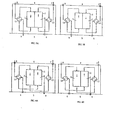
- figure 1A shows a diagram of a heat exchanger according to the prior art;
- figure 1B shows a diagram corresponding to figure 1A, wherein the connections of the groups of ducts are alternated
- figure 1C shows a diagram corresponding to figure 1A
- figure 1D shows a diagram corresponding to figure 1A
- figure 2A shows a diagram of a first embodiment of the invention provided with four-way valves, during a first position of the valves;
- figure 2B is a view corresponding to figure 2A in the second position of the valves;
- figure 2C shows a diagram corresponding to figure 2A in which single valves are applied;
- figure 2D shows a diagram corresponding to figure 2B wherein the valve configuration of figure 2C is applied;
- figure 2E shows a diagram of the valve configuration applied in figure 2c and 2D in an alternative valve position;
- figure 3A shows a diagram of a second embodiment of the invention in the first position of the valves;
- figure 3B is a view corresponding to figure 3A in the second position of the valves; and
- figure 4A shows a diagram of a third embodiment of the invention in the first position of the valves;
- figure 4B is a view corresponding to figure 4A in the second position of the valves;
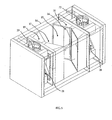
- figure 5 is a partly broken-away perspective view of the construction according to the first embodiment of the invention;
- figure 6 is an exploded perspective view of another construction according to the first embodiment of the invention; and
- figures 7A and 7B show a diagram of a fourth embodiment of the invention.
- Figure 1A shows schematically a heat exchanger designated as a whole with 1, which comprises a first group of
ducts 2 and a second group of ducts 3. For the construction of such a heat exchanger reference is made to the Netherlands patent application number 1000706. - It is assumed for the sake of clarity that the heat exchanger functions as a recuperator for ventilating air in a building, and that the inside of the building is designated with 4 and the outside of the building is designated with 5. The ventilating air is supplied from outside by first supply means 6. Air which has passed through the first group of
ducts 2 is carried to the interior of the building via first discharge means 7. - The air coming from the
inside 4 of the building is supplied to the second group of ducts 3 via second supply means 8. After passing through the second group of ducts, this air is discharged to the outside again via the second discharge means 9. - The first group of
ducts 2 and the second group of ducts 3 are thermally coupled to each other so that the heat relinquished by the airflow in the second group of ducts 3 is absorbed by the airflow flowing through the first group of ducts. An effective manner of heating ventilating air is thus obtained. - The recuperator described up to this point corresponds with the recuperator described in the Netherlands patent application already mentioned above.
- To avoid condensation and possible ice formation at a sufficiently low outside temperature, it is possible as shown in figure 1B to reverse the function of the first group of
ducts 2 and of the second group of ducts 3. A situation is then obtained as shown in figure 1B. - The first supply means 6 herein supply the outside air to the second group of ducts 3, the first discharge means 7 supply the heated air coming therefrom to the
inner space 4, the second supply means 8 supply the warm inside air to the first group ofducts 2 and the second discharge means 9 supply the inside air, which has relinquished its heat, to theoutside environment 5. - It will be apparent that in the situation shown in figure 1B the function of the first and second group of ducts is alternated, so that the inside air now flows through the first group of ducts through which the outside air first flowed, and vice versa. Condensation and ice formed during the situation shown in figure 1A will herein melt and evaporate again in the second group of ducts and be fed to the inside environment. This avoids the problem of ice formation and the problems resulting herefrom, such as blockage and hygienic problems possibly resulting from a high humidity level.
- A greater effectiveness of the heat exchange is also obtained here; the total enthalpy is transferred. The original humidity level is moreover maintained in the inside space.
- It is possible in principle to apply other configurations; figure 1C thus shows a configuration wherein the separation of the gas flows between the groups of ducts is maintained and wherein the flow through the groups of ducts is in opposite directions. This is a possible but less desirable situation; while an improvement is obtained compared to the original situation, the favourable effects are still considerably less than in the solution shown in figure 1B.
- A similar consideration applies for the situation shown in figure 1D; different gas flows herein flow through the groups of ducts relative to figure 1A, thus obtaining the advantages of the situation achieved in figure 1B. The flow direction is in opposite direction, which is favourable per se, but which requires complicated technical provisions for the realization thereof.
- Figures 2A and 2B show schematically an embodiment in which the regular alternation between the situations shown in figures 1A and 1B is achieved. Use is made for this purpose of two simultaneously operated
valves 10 respectively 11. In figure 2A thevalves valves - Figures 2C, 2D and 2E all show an embodiment wherein use is made of individual valves 40-47 to fulfil the alternating functions fulfilled in the embodiment of figures 2A and 2B by
valves - This embodiment further differs in providing a
bypass valve 48. This valve serves to provide an extra duct from the inside to the outside, the passage of which can be regulated. - Such a duct is attractive when the outside temperature is slightly lower than the desired inside temperature and the thermal energy generated inside is sufficient to compensate the heat loss to the outside.
- In the above embodiment there occurs during the alternation a temporary short-circuit which results in mixing of the mass flows. However, when a separation between mass flows is necessary, use can be made of the configuration shown in figures 3A and 3B.
- Use is herein made of
valves Valve 12 connects the second supply means to the first respectively the second side of the second group of ducts and connects the second discharge means to the second respectively first side of the second group of ducts. - By rotating the
valve 12 from the position shown in figure 3A to the position shown in figure 3B, only the flow direction inside the second group of ducts is reversed. It is nevertheless found that such a change in flow direction produces an effect which is positive in respect of the above noted advantages, wherein a separation between the mass flows in the first and second group of ducts is furthermore maintained. - The configuration shown in figure 1D can also be used in the same manner; the valve configurations which are possible here are self-evident.
- Figure 4A shows a diagram for embodying the configuration according to figure 1D in a first position of the valves, while this same diagram is shown in figure 4B in the second position of the valves. This diagram is less important since, even though it achieves the advantages of the invention, it does not however achieve the advantages of the configurations according to figures 1B and 1C.
- An example of the construction of a recuperator will now be elucidated on the basis of figure 5, In figure 5 is formed a box-
like structure 14, the central part of which, designated with "15", comprises two groups of ducts thermally coupled to each other. Likewise forming part ofspace 15 are two so-called "headers" 16, 17 respectively which ensure that the first group of ducts respectively the second group of ducts is guided to a common connection.Chambers like structure 14. - In the chamber is arranged a valve construction designated in the drawing with 20, 21 respectively.
Valves chambers pieces - In figure 6 is shown a structure with two series of two successively placed recuperators in
central part 30, the corresponding connections of which debouch in ducts 31-34 which are adjacent to these connections. The ducts are connected tochambers - It is also possible to place a cooler in the discharge flow of the recuperator, whereby more condensation takes place in the recuperator and more evaporation can take place after alternation.
- This principle can be further elaborated into the embodiment shown in figures 7A and 7B, which is suitable for use in for instance greenhouses.
- Dehumidifying is necessary the whole year in greenhouses, since the chance of fungal growth becomes too great above 85% relative humidity. At present this takes place during the summer and winter by opening the upper windows to a greater or lesser degree. The supply of outside air by a recuperator on the one side and discharge of the moist greenhouse air on the other is already a great improvement in respect of the energy use/misuse. A drawback is then that, just as when the windows are opened, the valuable CO2 content in the greenhouse decreases. In the cultivation of green plants CO2 is added by heating a boiler during the day and supplying the CO2 to the greenhouse, even if the heat is not required. In fig. 7A and 7B a system is drawn wherein the air in the greenhouse is dehumidified without outside air being supplied to the greenhouse or CO2 disappearing from the greenhouse.
Greenhouse air 8 is supplied to arecuperator 12, wherein it relinquishes heat to driedgreenhouse air 7. After leaving thefirst recuperator 12 the air is guided viavalve 11 to thesecond recuperator 1, in which a further cooling and condensation takes place by exchanging the heat with theoutside air 6 which enters thesecond recuperator 1 viavalve 10. The cooled and dehumidified greenhouse air is then supplied to thefirst recuperator 12, where heating takes place to a maximum of thegreenhouse air temperature 8, depending on the quality ofrecuperator 12. Regular alternating ofvalves recuperator 1, ensures that all condensation evaporates in theoutside air 6 and that this (flow 9) leaves the greenhouse with increased humidity and a small temperature increase. - It will be apparent that this configuration is not only applicable in greenhouses or buildings, but that it can also be applied in other processes.
- In the above described configuration the auxiliary heat exchanger is placed on the 'warm' side of the system. It will be apparent that it is also possible to place such an auxiliary beat exchanger on the 'cold' side of the system or even to place an auxiliary heat exchanger on both sides of the system.
Claims (9)
- Recuperator for transferring thermal energy from a warm gas flow to a cold gas flow, comprising:- a first group of ducts (2) with a first connection and a second connection;- a second group of ducts (3) with a third connection and a fourth connection, wherein the ducts of both groups extend mutually parallel;- first supply means (6) for supplying the cold gas flow to the first connection;- first discharge means (7) for discharging the cold gas flow from the second connection;- second supply means (8) for supplying the warm gas flow to the third connection; and- second discharge means (9) for discharging the warm gas flow from the fourth connection,wherein the device comprises alternating means (10,11) for temporarily and repeatedly alternating connect:- the first supply means (6) to the fourth connection;- the first discharge means (7) to the third connection;- the second supply means (8) to the second connection ; and- the second discharge means (9) to the first connection;- and control means for repeatedly changing the connections,characterized in that the alternating means comprise two alternating valves (10,11) located at opposite sides of the combination of the first and second group of ducts (2,3).
- Recuperator as claimed in claim 1, characterized in that the recuperator (1) is provided with supply means for supplying water to the first group of ducts (2).
- Recuperator as claimed in claim 1 or 2, characterized in that the control means are adapted to alternate the connections after a predetermined time has elapsed.
- Recuperator as claimed in claim 1, characterized in that the control means are adapted to alternate the connections when a predetermined measurement value has been reached.
- Recuperator as claimed in any of the preceding claims, characterized in that the recuperator is adapted to recover thermal energy from the ventilating air of a building.
- Recuperator as claimed in any of the preceding claims, characterized in that the device comprises a bypass duct between the second supply means (8) and the second discharge means (9) wherein a controllable valve (48) is arranged in the bypasss means.
- Recuperator as claimed in any of the preceding claims, characterized in that the first connection and the fourth connection debouch in a first chamber (18), that the second connection and the third connection debouch in a second chamber (19) and that the alternating means comprise two valves (20,21) each arranged in one of the chambers (18,19).
- Set of recuperators as claimed in claim 7, characterized in that the recuperators are placed adjacently of each other, wherein the chambers (18,19;35,36) are placed one above the other and the valves (20,21;40-47) arranged in the chambers (18,19;20,21) can be operated by a common operating element.
- Recuperator as claimed in any of the preceding claims, characterized in that the recuperator (1) is combined with an auxiliary heat exchanger (12) , wherein the first group of ducts of the auxiliary heat exchanger (12) is connected between the first discharge means (7) and the first valve (10) and the second group of ducts of the auxiliary heat exchanger (12) is connected between the second group of ducts and the supply means (6).
Applications Claiming Priority (3)
| Application Number | Priority Date | Filing Date | Title |
|---|---|---|---|
| NL1020141 | 2002-03-11 | ||
| NL1020141A NL1020141C2 (en) | 2002-03-11 | 2002-03-11 | Freeze-resistant heat exchanger. |
| PCT/NL2003/000183 WO2003085327A1 (en) | 2002-03-11 | 2003-03-11 | Heat recuperator with frost protection |
Publications (2)
| Publication Number | Publication Date |
|---|---|
| EP1485657A1 EP1485657A1 (en) | 2004-12-15 |
| EP1485657B1 true EP1485657B1 (en) | 2006-03-29 |
Family
ID=28787003
Family Applications (1)
| Application Number | Title | Priority Date | Filing Date |
|---|---|---|---|
| EP03715848A Expired - Lifetime EP1485657B1 (en) | 2002-03-11 | 2003-03-11 | Heat recuperator with frost protection |
Country Status (13)
| Country | Link |
|---|---|
| US (1) | US7644754B2 (en) |
| EP (1) | EP1485657B1 (en) |
| JP (1) | JP2005520119A (en) |
| CN (1) | CN1292211C (en) |
| AT (1) | ATE321984T1 (en) |
| AU (1) | AU2003221162A1 (en) |
| CA (1) | CA2478941C (en) |
| DE (1) | DE60304321T2 (en) |
| DK (1) | DK1485657T3 (en) |
| ES (1) | ES2261926T3 (en) |
| NL (1) | NL1020141C2 (en) |
| PT (1) | PT1485657E (en) |
| WO (1) | WO2003085327A1 (en) |
Cited By (2)
| Publication number | Priority date | Publication date | Assignee | Title |
|---|---|---|---|---|
| AT13643U1 (en) * | 2012-07-02 | 2014-05-15 | Pichler Ges M B H J | Method and device for ventilating rooms |
| DE102014102640A1 (en) | 2014-02-27 | 2015-08-27 | Vasco Group Bvba | Improved recuperator |
Families Citing this family (19)
| Publication number | Priority date | Publication date | Assignee | Title |
|---|---|---|---|---|
| NL1028830C2 (en) * | 2005-04-21 | 2006-10-24 | Level Holding Bv | Recuperative climate control system. |
| GB0600274D0 (en) * | 2006-01-09 | 2006-02-15 | Oxycell Holding Bv | Cooling and ventilation device |
| NL1032801C2 (en) * | 2006-11-02 | 2008-05-06 | Johannes Dirk Mooij | System for connecting two adjacent heat exchangers and the coupling unit to be used. |
| SE534485C2 (en) * | 2009-01-26 | 2011-09-06 | Cellomatic Ab | A ventilation device |
| PL209215B1 (en) | 2009-02-16 | 2011-08-31 | Jakobczak Antoni | Section of recuperator for the supply-and-exhaust ventilation centre |
| EP2287551B1 (en) * | 2009-07-08 | 2015-03-18 | Jakob Eisenschmid | Reheating register for combustion assemblies |
| NL2003671C2 (en) * | 2009-10-19 | 2011-04-20 | Level Holding Bv | CLIMATE MANAGEMENT DEVICE FOR CASES. |
| DE102010045381A1 (en) * | 2010-09-14 | 2012-03-15 | Gea Heat Exchangers Gmbh | heat exchangers |
| EP2951524B1 (en) * | 2013-02-01 | 2020-07-29 | Tetra Laval Holdings & Finance SA | Method for processing a product by using a heat treatment apparatus |
| US9273880B2 (en) * | 2013-08-14 | 2016-03-01 | Elwha Llc | Heating device with condensing counter-flow heat exchanger |
| FR3013823B1 (en) * | 2013-11-28 | 2018-09-21 | F2A - Fabrication Aeraulique Et Acoustique | DOUBLE FLOW AIR / AIR EXCHANGER, AIR TREATMENT PLANT AND METHOD FOR CLEANING SUCH EXCHANGER |
| GB2560728A (en) * | 2017-03-22 | 2018-09-26 | Be Hive Tech Limited | Mechanical ventilation heat recovery apparatus |
| JP6494691B2 (en) * | 2017-05-22 | 2019-04-03 | 三菱電機株式会社 | Heat exchange ventilator |
| RU2657992C1 (en) * | 2017-05-24 | 2018-06-18 | Дмитрий Валерьевич Примоченко | Supply-exhaust installation for ventilation of apartment |
| US10932420B2 (en) * | 2018-04-19 | 2021-03-02 | Therma-Stor, Llc | Greenhouse latent moisture and heat exchanger |
| RU2678811C1 (en) * | 2018-05-25 | 2019-02-01 | Дмитрий Валерьевич Примоченко | Supply and exhaust unit |
| RU189260U1 (en) * | 2019-02-25 | 2019-05-17 | Арман Берекович Костуганов | Forced-air and exhaust ventilation with heat recovery |
| CN115574406B (en) * | 2022-10-10 | 2025-09-12 | 珠海格力电器股份有限公司 | Fresh air conditioning device, control method thereof and air conditioning system |
| KR102824539B1 (en) * | 2022-12-02 | 2025-06-25 | 엘지전자 주식회사 | Air conditioner |
Family Cites Families (7)
| Publication number | Priority date | Publication date | Assignee | Title |
|---|---|---|---|---|
| SE440275B (en) * | 1979-03-21 | 1985-07-22 | Svante Thunberg | HEAT EXCHANGER TO FACILITIES FOR VENTILATION OF LOCATIONS |
| JPH01137139A (en) * | 1987-11-24 | 1989-05-30 | Matsushita Seiko Co Ltd | Heat exchanging type ventilator |
| FI83134C (en) * | 1987-12-18 | 1991-05-27 | Ilmaterae Oy | Method and apparatus for regulating air currents and pressure in air conditioning |
| US7231967B2 (en) * | 1994-01-31 | 2007-06-19 | Building Performance Equipment, Inc. | Ventilator system and method |
| NL194738C (en) * | 1994-02-01 | 2003-01-07 | Ursus Bv | Climate control device. |
| SE508957C2 (en) * | 1996-02-02 | 1998-11-16 | Bo Broberg | Regenerative heat recovery unit comprising a heat accumulator which, through a pivotal movement, exhibits a damper function and heat recovery unit with two connected heat recovery units |
| US6289974B1 (en) * | 1997-07-11 | 2001-09-18 | Elastek, Inc. | Integrated heat recovery ventilator HEPA filter using a HEPA filter material regenerative heat exchanger |
-
2002
- 2002-03-11 NL NL1020141A patent/NL1020141C2/en not_active IP Right Cessation
-
2003
- 2003-03-11 CN CNB038083957A patent/CN1292211C/en not_active Expired - Fee Related
- 2003-03-11 AU AU2003221162A patent/AU2003221162A1/en not_active Abandoned
- 2003-03-11 DE DE60304321T patent/DE60304321T2/en not_active Expired - Lifetime
- 2003-03-11 CA CA2478941A patent/CA2478941C/en not_active Expired - Fee Related
- 2003-03-11 PT PT03715848T patent/PT1485657E/en unknown
- 2003-03-11 US US10/507,492 patent/US7644754B2/en not_active Expired - Fee Related
- 2003-03-11 WO PCT/NL2003/000183 patent/WO2003085327A1/en not_active Ceased
- 2003-03-11 DK DK03715848T patent/DK1485657T3/en active
- 2003-03-11 ES ES03715848T patent/ES2261926T3/en not_active Expired - Lifetime
- 2003-03-11 EP EP03715848A patent/EP1485657B1/en not_active Expired - Lifetime
- 2003-03-11 JP JP2003582473A patent/JP2005520119A/en active Pending
- 2003-03-11 AT AT03715848T patent/ATE321984T1/en active
Cited By (3)
| Publication number | Priority date | Publication date | Assignee | Title |
|---|---|---|---|---|
| AT13643U1 (en) * | 2012-07-02 | 2014-05-15 | Pichler Ges M B H J | Method and device for ventilating rooms |
| DE102014102640A1 (en) | 2014-02-27 | 2015-08-27 | Vasco Group Bvba | Improved recuperator |
| EP2913603A1 (en) | 2014-02-27 | 2015-09-02 | Vasco Group bvba | Recuperator |
Also Published As
| Publication number | Publication date |
|---|---|
| AU2003221162A1 (en) | 2003-10-20 |
| NL1020141C2 (en) | 2003-09-12 |
| CN1292211C (en) | 2006-12-27 |
| DK1485657T3 (en) | 2006-07-31 |
| US7644754B2 (en) | 2010-01-12 |
| US20050236136A1 (en) | 2005-10-27 |
| CN1646863A (en) | 2005-07-27 |
| CA2478941C (en) | 2011-05-17 |
| DE60304321D1 (en) | 2006-05-18 |
| CA2478941A1 (en) | 2003-10-16 |
| ES2261926T3 (en) | 2006-11-16 |
| ATE321984T1 (en) | 2006-04-15 |
| PT1485657E (en) | 2006-08-31 |
| DE60304321T2 (en) | 2006-12-14 |
| JP2005520119A (en) | 2005-07-07 |
| EP1485657A1 (en) | 2004-12-15 |
| WO2003085327A1 (en) | 2003-10-16 |
Similar Documents
| Publication | Publication Date | Title |
|---|---|---|
| CA2478941C (en) | Heat recuperator with frost protection | |
| EP2490520B1 (en) | Device for climate control of greenhouses | |
| EP0026766B1 (en) | A heat exchanger in plants for ventilating rooms or buildings | |
| US20110036541A1 (en) | Heat exchange ventilator | |
| Zhang et al. | Energy requirements for conditioning fresh air and the long-term savings with a membrane-based energy recovery ventilator in Hong Kong | |
| US9222695B2 (en) | Heat exchange ventilator | |
| US20080003940A1 (en) | Ventilator system and method | |
| US20020164944A1 (en) | Ventilator system and method | |
| US20090165485A1 (en) | Hybrid dehumidification system for applications with high internally-generated moisture loads | |
| US20090075581A1 (en) | Cooling and ventilation device | |
| US7059385B2 (en) | Air conditioning device | |
| US4594855A (en) | Process and apparatus for ventilation with heat exchange | |
| KR101037871B1 (en) | Air conditioner using cooling / dehumidification heat recovery technology | |
| JP2006052882A (en) | Heat pump air conditioner | |
| CN104089393A (en) | Indoor heat exchanger with adjustable dehumidification amount and indoor unit | |
| WO2003098120A1 (en) | An air conditioning device comprising recovery cells with inlet and exhaust ducts at both ends where the air flows are controlled by rotating deflectors | |
| JP2006153321A (en) | Heat pump air conditioner | |
| JPS6059487B2 (en) | heat recovery equipment | |
| JP3952308B2 (en) | Heat pump air conditioner | |
| JPS6230923Y2 (en) | ||
| SU1315745A2 (en) | Installation for indirect-evaporating cooling of air | |
| CA2428409A1 (en) | Ventilator system and method | |
| EP0102969B1 (en) | Ventilating wall element | |
| JPS5844248Y2 (en) | air conditioner heat exchanger |
Legal Events
| Date | Code | Title | Description |
|---|---|---|---|
| PUAI | Public reference made under article 153(3) epc to a published international application that has entered the european phase |
Free format text: ORIGINAL CODE: 0009012 |
|
| 17P | Request for examination filed |
Effective date: 20041011 |
|
| AK | Designated contracting states |
Kind code of ref document: A1 Designated state(s): AT BE BG CH CY CZ DE DK EE ES FI FR GB GR HU IE IT LI LU MC NL PT RO SE SI SK TR |
|
| AX | Request for extension of the european patent |
Extension state: AL LT LV MK |
|
| 17Q | First examination report despatched |
Effective date: 20050321 |
|
| GRAP | Despatch of communication of intention to grant a patent |
Free format text: ORIGINAL CODE: EPIDOSNIGR1 |
|
| GRAS | Grant fee paid |
Free format text: ORIGINAL CODE: EPIDOSNIGR3 |
|
| GRAA | (expected) grant |
Free format text: ORIGINAL CODE: 0009210 |
|
| AK | Designated contracting states |
Kind code of ref document: B1 Designated state(s): AT BE BG CH CY CZ DE DK EE ES FI FR GB GR HU IE IT LI LU MC NL PT RO SE SI SK TR |
|
| PG25 | Lapsed in a contracting state [announced via postgrant information from national office to epo] |
Ref country code: SK Free format text: LAPSE BECAUSE OF FAILURE TO SUBMIT A TRANSLATION OF THE DESCRIPTION OR TO PAY THE FEE WITHIN THE PRESCRIBED TIME-LIMIT Effective date: 20060329 Ref country code: RO Free format text: LAPSE BECAUSE OF FAILURE TO SUBMIT A TRANSLATION OF THE DESCRIPTION OR TO PAY THE FEE WITHIN THE PRESCRIBED TIME-LIMIT Effective date: 20060329 Ref country code: SI Free format text: LAPSE BECAUSE OF FAILURE TO SUBMIT A TRANSLATION OF THE DESCRIPTION OR TO PAY THE FEE WITHIN THE PRESCRIBED TIME-LIMIT Effective date: 20060329 |
|
| REG | Reference to a national code |
Ref country code: GB Ref legal event code: FG4D |
|
| REG | Reference to a national code |
Ref country code: CH Ref legal event code: EP |
|
| REG | Reference to a national code |
Ref country code: IE Ref legal event code: FG4D |
|
| REF | Corresponds to: |
Ref document number: 60304321 Country of ref document: DE Date of ref document: 20060518 Kind code of ref document: P |
|
| PG25 | Lapsed in a contracting state [announced via postgrant information from national office to epo] |
Ref country code: BG Free format text: LAPSE BECAUSE OF FAILURE TO SUBMIT A TRANSLATION OF THE DESCRIPTION OR TO PAY THE FEE WITHIN THE PRESCRIBED TIME-LIMIT Effective date: 20060629 |
|
| REG | Reference to a national code |
Ref country code: SE Ref legal event code: TRGR |
|
| REG | Reference to a national code |
Ref country code: DK Ref legal event code: T3 Ref country code: CH Ref legal event code: NV Representative=s name: R. A. EGLI & CO. PATENTANWAELTE |
|
| REG | Reference to a national code |
Ref country code: PT Ref legal event code: SC4A Effective date: 20060623 |
|
| ET | Fr: translation filed | ||
| REG | Reference to a national code |
Ref country code: ES Ref legal event code: FG2A Ref document number: 2261926 Country of ref document: ES Kind code of ref document: T3 |
|
| PLBE | No opposition filed within time limit |
Free format text: ORIGINAL CODE: 0009261 |
|
| STAA | Information on the status of an ep patent application or granted ep patent |
Free format text: STATUS: NO OPPOSITION FILED WITHIN TIME LIMIT |
|
| 26N | No opposition filed |
Effective date: 20070102 |
|
| PG25 | Lapsed in a contracting state [announced via postgrant information from national office to epo] |
Ref country code: MC Free format text: LAPSE BECAUSE OF NON-PAYMENT OF DUE FEES Effective date: 20070331 Ref country code: IE Free format text: LAPSE BECAUSE OF NON-PAYMENT OF DUE FEES Effective date: 20070312 |
|
| PG25 | Lapsed in a contracting state [announced via postgrant information from national office to epo] |
Ref country code: GR Free format text: LAPSE BECAUSE OF FAILURE TO SUBMIT A TRANSLATION OF THE DESCRIPTION OR TO PAY THE FEE WITHIN THE PRESCRIBED TIME-LIMIT Effective date: 20060630 Ref country code: CZ Free format text: LAPSE BECAUSE OF FAILURE TO SUBMIT A TRANSLATION OF THE DESCRIPTION OR TO PAY THE FEE WITHIN THE PRESCRIBED TIME-LIMIT Effective date: 20060329 |
|
| PG25 | Lapsed in a contracting state [announced via postgrant information from national office to epo] |
Ref country code: FI Free format text: LAPSE BECAUSE OF FAILURE TO SUBMIT A TRANSLATION OF THE DESCRIPTION OR TO PAY THE FEE WITHIN THE PRESCRIBED TIME-LIMIT Effective date: 20060329 |
|
| PG25 | Lapsed in a contracting state [announced via postgrant information from national office to epo] |
Ref country code: EE Free format text: LAPSE BECAUSE OF FAILURE TO SUBMIT A TRANSLATION OF THE DESCRIPTION OR TO PAY THE FEE WITHIN THE PRESCRIBED TIME-LIMIT Effective date: 20060329 |
|
| PG25 | Lapsed in a contracting state [announced via postgrant information from national office to epo] |
Ref country code: LU Free format text: LAPSE BECAUSE OF NON-PAYMENT OF DUE FEES Effective date: 20070311 Ref country code: CY Free format text: LAPSE BECAUSE OF FAILURE TO SUBMIT A TRANSLATION OF THE DESCRIPTION OR TO PAY THE FEE WITHIN THE PRESCRIBED TIME-LIMIT Effective date: 20060329 |
|
| PG25 | Lapsed in a contracting state [announced via postgrant information from national office to epo] |
Ref country code: TR Free format text: LAPSE BECAUSE OF FAILURE TO SUBMIT A TRANSLATION OF THE DESCRIPTION OR TO PAY THE FEE WITHIN THE PRESCRIBED TIME-LIMIT Effective date: 20060329 Ref country code: HU Free format text: LAPSE BECAUSE OF FAILURE TO SUBMIT A TRANSLATION OF THE DESCRIPTION OR TO PAY THE FEE WITHIN THE PRESCRIBED TIME-LIMIT Effective date: 20060930 |
|
| REG | Reference to a national code |
Ref country code: FR Ref legal event code: PLFP Year of fee payment: 14 |
|
| REG | Reference to a national code |
Ref country code: FR Ref legal event code: PLFP Year of fee payment: 15 |
|
| REG | Reference to a national code |
Ref country code: FR Ref legal event code: PLFP Year of fee payment: 16 |
|
| PGFP | Annual fee paid to national office [announced via postgrant information from national office to epo] |
Ref country code: NL Payment date: 20190326 Year of fee payment: 17 Ref country code: BE Payment date: 20190327 Year of fee payment: 17 |
|
| PGFP | Annual fee paid to national office [announced via postgrant information from national office to epo] |
Ref country code: ES Payment date: 20190401 Year of fee payment: 17 Ref country code: PT Payment date: 20190222 Year of fee payment: 17 |
|
| PGFP | Annual fee paid to national office [announced via postgrant information from national office to epo] |
Ref country code: IT Payment date: 20200323 Year of fee payment: 18 Ref country code: DK Payment date: 20200327 Year of fee payment: 18 Ref country code: SE Payment date: 20200327 Year of fee payment: 18 Ref country code: AT Payment date: 20200219 Year of fee payment: 18 |
|
| REG | Reference to a national code |
Ref country code: NL Ref legal event code: MM Effective date: 20200401 |
|
| REG | Reference to a national code |
Ref country code: BE Ref legal event code: MM Effective date: 20200331 |
|
| PG25 | Lapsed in a contracting state [announced via postgrant information from national office to epo] |
Ref country code: NL Free format text: LAPSE BECAUSE OF NON-PAYMENT OF DUE FEES Effective date: 20200401 |
|
| PG25 | Lapsed in a contracting state [announced via postgrant information from national office to epo] |
Ref country code: PT Free format text: LAPSE BECAUSE OF NON-PAYMENT OF DUE FEES Effective date: 20201013 Ref country code: FR Free format text: LAPSE BECAUSE OF NON-PAYMENT OF DUE FEES Effective date: 20200331 |
|
| PG25 | Lapsed in a contracting state [announced via postgrant information from national office to epo] |
Ref country code: BE Free format text: LAPSE BECAUSE OF NON-PAYMENT OF DUE FEES Effective date: 20200331 |
|
| REG | Reference to a national code |
Ref country code: ES Ref legal event code: FD2A Effective date: 20210727 |
|
| REG | Reference to a national code |
Ref country code: DK Ref legal event code: EBP Effective date: 20210331 |
|
| REG | Reference to a national code |
Ref country code: AT Ref legal event code: MM01 Ref document number: 321984 Country of ref document: AT Kind code of ref document: T Effective date: 20210311 |
|
| PG25 | Lapsed in a contracting state [announced via postgrant information from national office to epo] |
Ref country code: ES Free format text: LAPSE BECAUSE OF NON-PAYMENT OF DUE FEES Effective date: 20200312 |
|
| PG25 | Lapsed in a contracting state [announced via postgrant information from national office to epo] |
Ref country code: AT Free format text: LAPSE BECAUSE OF NON-PAYMENT OF DUE FEES Effective date: 20210311 Ref country code: SE Free format text: LAPSE BECAUSE OF NON-PAYMENT OF DUE FEES Effective date: 20210312 |
|
| PG25 | Lapsed in a contracting state [announced via postgrant information from national office to epo] |
Ref country code: IT Free format text: LAPSE BECAUSE OF NON-PAYMENT OF DUE FEES Effective date: 20210311 Ref country code: DK Free format text: LAPSE BECAUSE OF NON-PAYMENT OF DUE FEES Effective date: 20210331 |
|
| PGFP | Annual fee paid to national office [announced via postgrant information from national office to epo] |
Ref country code: GB Payment date: 20220328 Year of fee payment: 20 Ref country code: DE Payment date: 20220329 Year of fee payment: 20 |
|
| PGFP | Annual fee paid to national office [announced via postgrant information from national office to epo] |
Ref country code: CH Payment date: 20220404 Year of fee payment: 20 |
|
| REG | Reference to a national code |
Ref country code: DE Ref legal event code: R071 Ref document number: 60304321 Country of ref document: DE |
|
| REG | Reference to a national code |
Ref country code: CH Ref legal event code: PL |
|
| REG | Reference to a national code |
Ref country code: GB Ref legal event code: PE20 Expiry date: 20230310 |
|
| PG25 | Lapsed in a contracting state [announced via postgrant information from national office to epo] |
Ref country code: GB Free format text: LAPSE BECAUSE OF EXPIRATION OF PROTECTION Effective date: 20230310 |