EP1488596B1 - Schlüsselverwaltungsprotokoll - Google Patents
Schlüsselverwaltungsprotokoll Download PDFInfo
- Publication number
- EP1488596B1 EP1488596B1 EP03709982.7A EP03709982A EP1488596B1 EP 1488596 B1 EP1488596 B1 EP 1488596B1 EP 03709982 A EP03709982 A EP 03709982A EP 1488596 B1 EP1488596 B1 EP 1488596B1
- Authority
- EP
- European Patent Office
- Prior art keywords
- key
- node
- group
- nodes
- new
- Prior art date
- Legal status (The legal status is an assumption and is not a legal conclusion. Google has not performed a legal analysis and makes no representation as to the accuracy of the status listed.)
- Expired - Lifetime
Links
Images




Classifications
-
- H—ELECTRICITY
- H04—ELECTRIC COMMUNICATION TECHNIQUE
- H04L—TRANSMISSION OF DIGITAL INFORMATION, e.g. TELEGRAPHIC COMMUNICATION
- H04L9/00—Cryptographic mechanisms or cryptographic arrangements for secret or secure communications; Network security protocols
- H04L9/08—Key distribution or management, e.g. generation, sharing or updating, of cryptographic keys or passwords
- H04L9/0816—Key establishment, i.e. cryptographic processes or cryptographic protocols whereby a shared secret becomes available to two or more parties, for subsequent use
- H04L9/0819—Key transport or distribution, i.e. key establishment techniques where one party creates or otherwise obtains a secret value, and securely transfers it to the other(s)
- H04L9/083—Key transport or distribution, i.e. key establishment techniques where one party creates or otherwise obtains a secret value, and securely transfers it to the other(s) involving central third party, e.g. key distribution center [KDC] or trusted third party [TTP]
- H04L9/0833—Key transport or distribution, i.e. key establishment techniques where one party creates or otherwise obtains a secret value, and securely transfers it to the other(s) involving central third party, e.g. key distribution center [KDC] or trusted third party [TTP] involving conference or group key
- H04L9/0836—Key transport or distribution, i.e. key establishment techniques where one party creates or otherwise obtains a secret value, and securely transfers it to the other(s) involving central third party, e.g. key distribution center [KDC] or trusted third party [TTP] involving conference or group key using tree structure or hierarchical structure
-
- H—ELECTRICITY
- H04—ELECTRIC COMMUNICATION TECHNIQUE
- H04L—TRANSMISSION OF DIGITAL INFORMATION, e.g. TELEGRAPHIC COMMUNICATION
- H04L63/00—Network architectures or network communication protocols for network security
- H04L63/06—Network architectures or network communication protocols for network security for supporting key management in a packet data network
- H04L63/065—Network architectures or network communication protocols for network security for supporting key management in a packet data network for group communications
-
- H—ELECTRICITY
- H04—ELECTRIC COMMUNICATION TECHNIQUE
- H04L—TRANSMISSION OF DIGITAL INFORMATION, e.g. TELEGRAPHIC COMMUNICATION
- H04L9/00—Cryptographic mechanisms or cryptographic arrangements for secret or secure communications; Network security protocols
- H04L9/08—Key distribution or management, e.g. generation, sharing or updating, of cryptographic keys or passwords
- H04L9/0891—Revocation or update of secret information, e.g. encryption key update or rekeying
-
- H—ELECTRICITY
- H04—ELECTRIC COMMUNICATION TECHNIQUE
- H04L—TRANSMISSION OF DIGITAL INFORMATION, e.g. TELEGRAPHIC COMMUNICATION
- H04L9/00—Cryptographic mechanisms or cryptographic arrangements for secret or secure communications; Network security protocols
- H04L9/50—Cryptographic mechanisms or cryptographic arrangements for secret or secure communications; Network security protocols using hash chains, e.g. blockchains or hash trees
-
- H—ELECTRICITY
- H04—ELECTRIC COMMUNICATION TECHNIQUE
- H04L—TRANSMISSION OF DIGITAL INFORMATION, e.g. TELEGRAPHIC COMMUNICATION
- H04L2209/00—Additional information or applications relating to cryptographic mechanisms or cryptographic arrangements for secret or secure communication H04L9/00
- H04L2209/60—Digital content management, e.g. content distribution
- H04L2209/601—Broadcast encryption
Definitions
- the present invention relates to the distribution and management of session keys in a communications network, for example, an internet broadcast application.
- a simple multi-user system provides a key distribution centre (or key server) that is in direct contact with every member of the group.
- Each member shares a key with the key distribution centre (the member's individual key) and, for group communications, all members share a group key.
- the group key must be updated to ensure backward or forward security as the case may be.
- the new group key is sent to the new member, encrypted using the new member's individual key and is sent, as a broadcast, to all existing members, encrypted using the previous group key.
- a join event is relatively straightforward and scales well in terms of computational effort, broadcast bandwidth requirements and secure unicast requirements as the number of users increases.
- the new group key When a member leaves the group, the new group key must be individually sent to members using that member's individual key since, if the new group key was encrypted using the previous group key, the user that has just left the group would be able to generate that new group key (it being assumed that that user would receive the encrypted new key by permitted means or otherwise).
- a hierarchical key tree is disclosed in " Key Management for Multicast: Issues and Architectures" by D Wallner et. al. (National Security Agency, June 1999, www.ietf.org/rfc/rfc2627.txt ).
- a hierarchical binary tree is an efficient tree-based key management technique.
- a hierarchical binary tree works as follows.
- a multicast group has N members (M 1 to M N ).
- a new member joins the group by contacting the controller via a secure unicast channel.
- the new member and the controller negotiate a pairwise secret key.
- the controller stores a binary tree structure in which each node contains a key. At the leaves of the tree there are the N secret keys that the controller has negotiated with each of the members of the group. Each member stores a subset of the controller's keys. The subset of keys stored by a member is the set of keys in the path from the leaf to the root of the tree including the leaf and the root itself.
- the root node represents the key used to encrypt data during the group communication; all other keys in the tree are auxiliary keys used only to facilitate efficient key updates.
- Figure 1 shows a hierarchical tree for a system having three users, M1, M2 and M3.
- the tree has a root node K14 connected to two nodes K12 and K34.
- K12 in turn is connected to nodes K1 and K2.
- Node K34 is connected to node K3.
- the users M1, M2 and M3 are associated with nodes K1, K2 and K3 respectively.
- Each of the nodes K1, K2, K3, K12, K34 and K14 represents a cryptographic key.
- each member of the group knows all the keys from its leaf node up to the root node.
- user M1 knows the keys for nodes K1, K12 and K14.
- User M2 knows the keys for nodes K2, K12 and K14.
- User M3 knows the keys for nodes K3, K34 and K14.
- the root key can be used to encrypt all transmissions involving users M1, M2 and M3.
- FIG 2 shows the same hierarchical tree as Figure 1 , except that nodes K14 and K34 have been replaced with nodes K14' and K34' and the new user M4 is attached via new node K4 to node K34'.
- the keys K14' and K34' are different from the previous keys K14 and K34 to ensure that the system has backward security. This is implemented by the key server at the root node. Key 4 is generated by the key server and keys K34 and K14 are updated (to K34' and K14' respectively) by the key server.
- the new user M4 needs to know the keys K4, K34' and K14'. This information is transmitted to M4 via a secure channel.
- the key server informs the other members of the group of the new keys by sending encrypted broadcasts that all members can receive (non-members will be able to receive the broadcast but they will not be able to decrypt the information sent).
- the following broadcasts are made: K34' encrypted with K3, K14' encrypted with K34' and K14' encrypted with K12.
- User M3 knows the key K3 and can therefore decrypt K34' encrypted with K3 to arrive at K34'. From this, user M3 can decrypt K14' encrypted with K34'. Similarly, users M1 and M2 both know key K12 and can therefore decrypt K14' encrypted with K12. Thus all users once again know all of the keys from their leaf of the tree to the root. Transmissions involving the members of the group (now including the new member M4) can be encrypted with the new root key K14'.
- Figure 3 shows the hierarchical tree of Figure 2 , except that user M3 and node K3 have been removed from the tree, and nodes K14' and K34' have been updated to K14" and K34" respectively. Thus all of the keys that were known to M3 (K3, K34' and K14') have been either removed or updated. Thus the system has forward security.
- the key server updates keys K14' and K34' to generate keys K14" and K34" respectively.
- the key server then broadcasts K34" encrypted with K4 and K14" encrypted with K34".
- the user M4 knows key K4 and so can decrypt K34" encrypted with K4 to arrive at K34".
- M4 can decrypt K14" encrypted with K34" to arrive at the new root key K14".
- K14" must also be broadcast encrypted with K12 so that users M1 and M2 can obtain the new root key. Since previous user M3 did not know either key K4 or key K12, he cannot obtain key K14" from the broadcast messages.
- the principal advantage associated with the use of a tree for the organisation of users in a multi-user system is that any individual user only knows a subset of the keys of the system. Thus, when a user leaves the group, only that subset needs to updated to ensure backward security.
- the number of keys that have to be updated is of the order of log(N), where N is the number of users.
- N is the number of users.
- a hierarchical tree is a binary tree.
- a P-ary tree can be used. As the value P rises, the storage requirement for each user decreases, but at the expense of an increase in the number of transmissions required from the key server.
- a variant of the hierarchical tree described above is the one-way function tree described in " Key Management for Large Dynamic Groups: One-Way Function Trees and Amortized Initialization" by D Baleson et. al. (TIS Labs at Network Associates, 26 February 1999 ).
- the one-way function tree described by Baleson et. al. is a binary tree. Each node of the tree is associated with two keys: an unblinded key K(x) and a blinded key K'(x).
- the session key that is used to encrypt application data includes both the blinded and unblinded keys of the root node.
- the blinded key K'(x) is derived from the unblinded key K(x) using a one-way function (see below).
- K'(x) is 'blinded' in the sense that it is computationally infeasible to find K(x) from K'(x).
- K(x) K' x_left XOR K' x_right
- the members of the system are associated with the leaves of the tree. Each member knows the blinded keys for every node that is a sibling of any of the nodes on the branch of the tree extending from the user to the root of the tree.
- K 14 K'12 XOR K'34
- the purpose of the blinded and unblinded keys is the reduction of the number of keys that a key distribution server has to send during key update operations.
- the key distribution server must send log 2 (N) updates in the form blinded keys (where N is the number of users).
- N is the number of users.
- the updates are encrypted to ensure that only the members who should receive the updates have the necessary keys to decrypt the messages and receive the updates.
- One-way functions such as that used in the one-way function tree described above are mathematical functions that are relatively easy to compute in a first direction but is computationally infeasible to compute in the other (reverse) direction.
- Message digest, fingerprint or compression functions are examples of a first class of one-way functions (functions of this class are commonly called “hash functions").
- a message digest function is a mathematical function that takes a variable length input string and converts it into a fixed-length binary sequence. Modern message digest functions typically produce hash values of 128 bits or longer.
- Message digest functions are used to create a digital signature for a document. Since it is computationally infeasible to deliberately produce a document that will hash to a particular hash value and extremely unlikely to find two documents that hash to the same value, a document's hash value can serve as a cryptographic equivalent of the document.
- message digest functions are MD4 (Message Digest 4), MD5 (Message Digest 5, see “ The MD5 Message-Digest Algorithm” by R. Rivest, MIT Laboratory for Computer Science and RSA Data Security, Inc., April 1992, www.ietf.org/rfc/rfc1321.txt ) and SHA (Secure Hash Algorithm). SHA is generally considered to be the most secure of the three.
- One-way functions can also be generated using pseudo random function (PRF) with varying input and output lengths.
- PRF pseudo random function
- a suitable known PRF is an encryption algorithm called RC5.
- the RC5 encryption algorithm is a fast symmetric cipher algorithm suitable for hardware or software implementation and has low memory and computational requirements.
- a one-way function is a trapdoor one-way function.
- the inverse of a trapdoor one-way function is easily generated if the trapdoor is known but difficult otherwise.
- a public-key cryptosystem can be designed using a trapdoor one-way function.
- Public-key cryptosystems are well known in the art (see Digital Communications Fundamentals and Applications, Bernard Sklar, Prentice-Hall International, Inc., 1998 edition, pages 698 to 702 ).
- the public key in such a system gives information about the particular instance of the function; a private key gives information about the trapdoor.
- the function can be computed in the forward direction only unless the trapdoor is known.
- the forward direction is used for encryption and signature verification.
- the reverse direction is used for decryption and signature generation.
- the algorithms described all require the update information to be encrypted in such a manner that only members entitled to the update information have the necessary keys to decrypt that information.
- One such prior art system is described in " ELK, A New Protocol for Efficient Large-Group Key Distribution” by Perrig et al. (Proceedings of the 2001 IEEE Symposium on Security and Privacy, pages 247-262 ). This describes how (in a member leave event) the key used to encrypt communications to the group is updated by using contributions from the left and right child keys of the key. This is then broadcast to all the members of the group in an encrypted format.
- a method of managing keys in a key distribution system for a communications group in accordance with claim 1.
- the first key of each parent node in said tree of nodes is generated from the first key of each of its child nodes by two one-way functions and a mixing function, the mixing function including the offset as a parameter.
- the present invention further provides a key distribution system for a communications group in accordance with claim 19. Further preferred features of the invention are set out in the appended claims.
- the preferred embodiment of the present invention uses what will be called an offset hierarchy binary tree (OHBT).
- the OHBT system uses offset messages to implement the key update and key recovery mechanisms.
- the offset message can be considered to be the distance between two chains of one-way functions.
- Figure 4 shows a first chain having keys X0, X1, X2, X3 and X4.
- X1 is generated from X0 using a one-way function f
- X2 is generated from X1 using one-way function f
- X3 is generated from X2 using one-way function f
- X4 is generated from X3 using one-way function f.
- Figure 4 also shows a second chain having keys Y0, Y1, Y2, Y3 and Y4. In a similar manner to the first chain, the keys Y0 to Y4 are each separated by one-way function f.
- X0 and Y0 are unrelated different keys. However, it is possible to move from one chain to the other using a straightforward formula.
- the user knowing the root key Y0 of chain Y can, given the correct offset message, recover X2 and, from X2, he can recover the later keys in the X chain.
- chains X and Y are keys in a cryptosystem, then this lack of security is not acceptable since, in order to calculate key X2, the user knowing chain Y can generate a key, X1, that he should not be given access to, thereby disclosing a key that should be confidential.
- Figure 5 shows a first chain having keys X0, X1, X2 and X3 and intermediate keys f(X0), f(X1) and f(X2).
- f(X0) is generated from X0 using a one-way function
- X1 is generated from f(X0) using one-way function f
- f(X1) is generated from X1 using one-way function f
- X2 is generated from f(X1) using one-way function v
- f(X2) is generated from X2 using one-way function f
- X3 is generated from f(X2) using one-way function f.
- Figure 5 also shows a second chain having keys Y0, Y1, Y2 and Y3 and intermediate keys f(Y0), f(Y1) and f(Y2).
- Y0, f(Y0), Y1, f(Y1), Y2 and f(Y2) are each separated by a one-way function f.
- the user can generate X2 and the later keys in that chain but cannot generate X1. Only the intermediate key H(X1) can be generated and that intermediate key is only used temporarily in generating the key X2. It is, of course, computationally infeasible to generate X1 from H(X1).
- a preferred embodiment of the present invention is for use by a multicast group having N members, M 1 to M N and having a group controller (preferably centralised) called the key distribution server.
- the group of users are organised in a tree structure as shown in Figure 6 .
- the users are organised in a hierarchical binary tree having a root node K14 (the key distribution server). Root node K14 has two children, nodes K12 and K34. Node K12 in turn has two children, K1 and K2: node K34 has two children, K3 and K4.
- the users are associated with the leaves of the tree.
- four users M 1 to M 4 are associated with nodes K1 to K4 respectively.
- the system transfers application data in a secure manner by encrypting data using a session key.
- the session key comprises two components: a join field and a leave field.
- the join field value is common to all members. Each node of the tree is however allocated a different value for its leave field.
- the leave field for each node is calculated by the users in a bottom-up approach i.e. given the leave field of a node (the "child_key”), a user can generate the leave field of the parent of that node in the tree (the "parent_key”).
- Offset is an offset message, as described above.
- Parent_key f f child_key , seq_n , pos#_key XOR Offset
- user M1 Given the leave field of K1, user M1 can generate the leave field of K12 and, from the leave field of K12, the user M1 can generate the leave field of K14 as follows:
- the leave field K1 is operated on by a one-way function f to obtain f(K1) and then mixed, using an XOR function, with an offset value, offset_1, to obtain the leave field K12, that can be considered to be part of a different chain of one-way functions.
- nodes K1 and K12 of the tree can be considered to be part of two different chains of one-way functions in the same way as nodes Y1 and X2 in Figure 5 are part of different chains of one-way functions.
- the leave field K2 is operated on by a one-way function f to obtain f(K2) and then mixed, using an XOR function, with an offset value, offset_2, to obtain the leave field K12, that can be considered to be part of a different chain of one-way functions.
- the leave field K12 calculated is, of course, the same as the leave field K12 referred to above.
- Figure 7 shows the generation of leave field K34 from leave field K3 via an intermediate key f(K3) and a mixing function and from leave field K4 via an intermediate key f(K4) and a mixing function.
- the leave fields K12 and K34 are operated on by a one-way function f to obtain intermediate keys f(K12) and f(K34) respectively. Those intermediate keys are mixed, using an XOR function, with offset values offset_12 and offset_34 respectively, to obtain the leave field K14.
- the key distribution server shares a different secret key with each user of the system. This may be achieved by the key server distributing a certificate containing its public key. A user that wants to be part of the group then sends to the key server a random key (the secret key that will be shared between the user and the key distribution server) that is encrypted using the public key. The key server decrypts the encrypted message to regenerate the random key.
- the key distribution server simply calculates the offset required to obtain K1 from the key K_m1 and broadcasts that offset to the group.
- the key distribution server simply uses that offset to generate the leave field K1 because only user M 1 knows the key K_m1.
- the key server calculates the offset messages required by the user M 1 in order to generate, from the random key K_m1, the leave field for each node in the hierarchical tree from the user's leaf node to the root of the tree i.e. the leave fields K1, K12 and K14 as follows:
- the new user has the leave key of the root node (the leave field of the session key) he can decrypt the group traffic.
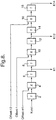
- Figure 8 includes elements 2, 6, 8, 12, 14 and 18 each representing a one-way function f and elements 4, 10 and 16 each representing an XOR function and includes inputs K_m1, offset_m1, offset_1, offset_12 and generates outputs K1, K12 and K14.
- Input K_m1 is connected to the input of one-way function 2.
- the output of one-way element 2 is connected to a first input to XOR element 4, the second input to XOR element 4 being connected to input offset_m1.
- the output of XOR element 4 is connected to the input of one-way function 6.
- the output of one-way function 6 provides the output K1 and is also connected to the input of one-way function 8.
- the output of one-way function 8 is connected to a first input of XOR element 10, the second input of XOR element 10 being connected to the input offset_1.
- the output of XOR element 10 is connected to the input of one-way function 12.
- the output of one-way function 12 provides the output K12 and is also connected to the input of one-way function 14.
- the output of one-way function 14 is connected to a first input of XOR element 16, the second input of XOR element 16 being connected to the input offset_12.
- the output of XOR element 16 is connected to the input of one-way function 18.
- the output of one-way function 18 provides the output K14.
- user M 2 shares a random key K_m2 with the server and receives offsets offset_m2, offset_2 and offset_12 from the key server
- user M 3 shares a random key K_m3 with the server and receives offsets offset_m3, offset_3 and offset_34 from the key server
- user M 4 shares a random key K_m4 with the server and receives offsets offset_m4, offset_4 and offset_34 from the key server.
- Users M 2 , M 3 and M 4 then generate keys K2, K3 and K4 as follows:
- the users M 2 , M 3 and M 4 then generate the remaining leave keys for their branch of the tree as outlined above.
- the join field is common to all members.
- the join field is modified each time that a new user joins the group.
- the leave field of the session key must be updated each time a user leaves the group. Indeed (given the relationship of the leave keys in the tree), every leave field that the leaving user knew must be updated to ensure that that user cannot calculate the new leave field of the session key, and therefore calculate the new session key. This is required to ensure that the system has forward security.
- N is a sequence number and is typically limited in size, perhaps to four bits.
- the sequence number N may be broadcast to the existing users. If so, given that each of those users knows the old join key, each of those users can generate the new join key.
- each of the existing users of the group can generate the new join key without requiring the encryption of information by the key distribution server and without requiring secure connections between the key distribution server and the users. Non-members cannot generate the new join key from the information broadcast since they do not know the old join key.
- New_Join_Key f old_key XOR opad , f old_key XOR ipad , N where
- N may be cyclic in which case it would be possible for a user to recover and catch up having missed a join key update instruction.
- a new member of the group that is given the new join key cannot determine earlier join keys and hence cannot determine earlier session keys with which data has been transmitted (since the former sessions keys each include former join keys that are unknown to the new user). Thus the backward security of the communication system is ensured.
- each new user when a new member joins the group, the existing users generate the new join key themselves and the leave keys are unchanged.
- the new user must be sent the new join key together with all the leave keys between the leaf node of the new user and the root node in a secure manner (using a secret key shared with the key distribution server as described above). For a balanced binary hierarchical tree, each new user will be sent log 2 (N) + 1 leave keys and 1 join key.
- Figure 9 shows how the hierarchical tree of Figure 6 is amended by the inclusion of a new member M 5 .
- the new member M 5 is associated with a node K5 and is made a sibling of node K4 with which user M 4 is associated.
- a new parent node K45 is created for nodes K4 and K5. The new node K45 takes the place in the tree that was previously allocated to node K4.
- Figure 10 lists, in the form of a flow chart, the steps required to integrate a new user is into the system. Those steps are:
- the key K45 has already been calculated by the key distribution server (in the same manner) and used to generate the appropriate offset to send to the new user M 5 to generate the key K45.
- the new member join event is complete and the event terminates at "End” step 36. If the key distribution server denied the new member access to the group in the "KDS Grant Access?" decision box 22, then the join event is terminated at step 36 at this stage.
- join event of the present invention is a very low cost operation in terms of the operations performed by the key distribution server, the data transmitted by the key distribution server and the computational effort required of the users.
- join event described above assumes the occurrence of a single join event.
- the present invention is also applicable to communication systems in which multiple simultaneous join events are allowed.
- the principal difference between a single join event and a multiple join event is that existing members of the system may be required to move down several layers of the hierarchical tree in which case they would have to generate several new tree nodes.
- the join message issued by the key distribution server for a multiple join event includes the sequence number N and the position of all the new nodes that are required to be generated.
- Figure 11 shows how the final hierarchical tree of Figure 9 is amended by the deletion of member M 4 .
- M4 leaves the group node K45 is deleted and node K5 is promoted in its place.
- Nodes K5, K35 and K15 are then re-keyed to give K5', K35' and K15'.
- Figure 12 lists, in the form of a flow chart, the steps required to remove a member from the system. Those steps are:
- the new key K5' is used to generate the new keys K35' and K15'.
- the new leave keys are defined by the formulae:
- the key distribution server may provide hint messages to enable users rekey the tree in the event that they have missed a protocol message.
- the hint message takes the form of the protocol message that is attached a data packet. Simply attaching the previous protocol message to each data packet is feasible since each protocol message is likely to be relatively small when compared to the size of a data packet.
- a user that has missed a protocol message will be able to identify this since he will not be able to decrypt the data transferred by the system. That user will simply need to extract the protocol message from the data stream.
- the system could be extended to provide a number of the most recent protocol messages so that misses of several protocol messages can be caught up.
- the number of protocol messages that can be attached to the data messages is only limited by the amount of data bandwidth the designer of the system is willing to allocate to the hint messages.
- hint messages are well suited to the key distribution system of the present invention since the key update information is not encrypted, and thus can be shared across all members. There is therefore no bar to transmitted one or more hint messages with the data packets.
- the leave event described above assumes the occurrence of a single leave event.
- the present invention is also applicable to communication systems in which multiple simultaneous leave events are allowed.
- the principal difference between a single leave event and a multiple leave event is that the removal of several users leaves the possibility of the remaining tree being configured in more than one possible way.
- the key distribution server must take decisions about the path from each remaining user to the root node and issue protocol messages accordingly.
- the OHBT protocol provides a system in which when a new user joins the group, only a sequence number N needs to be broadcast to the group (although, as discussed above, it is possible for a user to recover, even if one or more protocol messages are missed).
- the join event scales extremely efficiently as the number of users increases.
- each user generates the new join key using a straightforward algorithm.
- a join event is secure because it is computationally infeasible for the new member to calculate the previous join key with a finite probability.
- the leave operation requires the calculation and broadcast of offset messages. These messages can be broadcast as plain text messages and do not need to be encrypted.
- the users generate the new leave keys using a simple double one-way function. Thus, the computational requirements of the users for a leave operation is also low.
- a leave event is secure because although the former member knows the join key and the previous leave key for the root node, he cannot generate the new leave key of the root node and therefore cannot generate the new session key.
- join events In general it is anticipated that the number of join events will be greater than the number of leave events for most systems. This is because there is likely to be a multiple leave event at the end of the communication session. Accordingly, the use of a low cost join event as in the present invention is an advantage.
- the use of multiple key distribution servers present issues of synchronisation between the servers.
- the present invention assists in the transfer of information between key distribution servers since key information in the present invention is transmitted as plain text messages.
- the lack of encryption for the transmission of key information simplifies at least some of the issues associated with the use of multiple key distribution servers.
- the key nodes are arranged in a binary tree.
- a binary tree is not a requirement of the invention.
- the key nodes could be arranged in a P-ary tree (where P is greater than or equal to 2), for example.
- the key distribution sever is preferably centralised at one location. Often it will be convenient for this to be at the source of application data, e.g. a video stream. Arrangements in which the functions of the key distribution server are duplicated and/or distributed over several machines at difference locations.
Landscapes
- Engineering & Computer Science (AREA)
- Computer Security & Cryptography (AREA)
- Computer Networks & Wireless Communication (AREA)
- Signal Processing (AREA)
- Computer Hardware Design (AREA)
- Computing Systems (AREA)
- General Engineering & Computer Science (AREA)
- Data Exchanges In Wide-Area Networks (AREA)
- Storage Device Security (AREA)
- Computer And Data Communications (AREA)
Claims (38)
- Verfahren zur Verwaltung von Schlüsseln in einem Schlüsselverteilungs-System für eine Kommunikationsgruppe, wobei das Schlüsselverteilungs-System einen Baum von Knoten aufrechterhält, der mindestens einen Blatt-Knoten enthält, der einen Eltern-Knoten besitzt, wobei jedem Knoten ein entsprechender erster Schlüssel zugeordnet ist, wobei die Kommunikationsgruppe mindestens ein Mitglied aufweist, dem ein Blatt-Knoten des Baums von Knoten zugeordnet ist,
wobei das Verfahren umfasst:das System aktualisiert die ersten Schlüssel einer ersten Verzweigung von Knoten in dem Baum durch Zuweisen von neuen ersten Schlüsseln zu jedem der Knoten in der Verzweigung,dadurch gekennzeichnet, dass das System ferner umfasst:das System bestimmt Offsets zum Erzeugen des aktualisierten ersten Schlüssels jedes Knotens in der Verzweigung von dem Kind-Knoten in der Verzweigung undverbreitet jeden dieser Offsets, so dass, in Anbetracht des dem Blatt-Knoten der Verzweigung zugeordneten aktualisierten ersten Schlüssels, jeder aktualisierte erste Schlüssel der Verzweigung von Knoten unter Verwendung eines empfangenen Offsets berechenbar ist, wobei Informationen, die zu, von oder zwischen Mitgliedern der Kommunikationsgruppe übermittelt werden, unter Verwendung eines Verschlüsselungs-Schlüssels für Anwendungs-Daten verschlüsselt werden, wobei der Verschlüsselungs-Schlüssel ein Join-Feld und ein Leave-Feld enthält, wobei jedes Mitglied der Gruppe das Join-Feld des Verschlüsselungs-Schlüssels kennt, und wobei das Leave-Feld des Verschlüsselungs-Schlüssels aus dem ersten Schlüssel eines Wurzel-Knotens des Baums abgeleitet wird. - Verfahren wie in Anspruch 1 beansprucht, bei dem der erste Schlüssel jedes Eltern-Knotens in dem Baum von Knoten aus dem ersten Schlüssel eines seiner Kind-Knoten durch zwei Einweg-Funktionen und eine Misch-Funktion erzeugt wird, wobei die Misch-Funktion den Offset als einen Parameter enthält.
- Verfahren wie in Anspruch 2 beansprucht, bei dem die Misch-Funktion eine XOR-Funktion ist.
- Verfahren wie in Anspruch 2 oder Anspruch 3 beansprucht, bei dem jeder Eltern-Schlüssel unter Anwendung der Formel f (f (Kind-Schlüssel) XOR OFFSET) erzeugt wird, wobei OFFSET den Offset bedeutet und f eine Einweg-Funktion darstellt, und wobei Kind-Schlüssel der erste Schlüssel eines Kind-Knotens des Eltern-Knotens ist.
- Verfahren wie in Anspruch 1 beansprucht, bei dem das Join-Feld des Verschlüsselungs-Schlüssels jedes Mal, wenn ein Mitglied der Gruppe beitritt, aktualisiert wird.
- Verfahren wie in Anspruch 5 beansprucht, bei dem das neue Mitglied unter Anwendung des folgenden Verfahrens der Gruppe beitritt: Das neue Mitglied fordert Zugang zu der Gruppe an; dem neuen Mitglied wird Zugang zu der Gruppe gewährt; dem neuen Mitglied wird ein Knoten an einem neuen Blatt-Knoten des Baums von Knoten zugeordnet; dem neuen Mitglied werden sämtliche Informationen gesendet, die zum Erzeugen des ersten Schlüssels jedes Knotens auf einer Verzweigung von Knoten von dem neuen Blatt-Knoten bis zu dem Wurzel-Knoten erforderlich sind, und das Join-Feld des Schlüssels der Anwendungs-Daten wird aktualisiert.
- Verfahren wie in Anspruch 6 beansprucht, wobei das Verfahren ferner umfasst: die Erzeugung eines neuen Knotens als Eltern-Knoten sowohl des neuen Blatt-Knotens als auch eines vorher vorhandenen Knotens.
- Verfahren wie in einem der Ansprüche 5 bis 7 beansprucht, bei dem das aktualisierte Join-Feld unter Anwendung einer Einweg-Funktion aus dem vorherigen Join-Feld erzeugt wird.
- Verfahren wie in einem vorhergehenden Anspruch beansprucht, bei dem jedes Mal, wenn ein Mitglied die Gruppe verlässt, eine Anforderung zur Schlüssel-Aktualisierung erzeugt wird, wobei die ersten Schlüssel jedes Knotens der Verzweigung von Knoten einschließlich sowohl des Knotens, der dem die Gruppe verlassenden Mitglied zugeordnet ist, als auch des Wurzel-Knotens die Schlüssel sind, die aktualisiert werden.
- Verfahren wie in Anspruch 9 beansprucht, bei dem ein Mitglied unter Anwendung des folgenden Verfahrens die Gruppe verlässt: Es wird ein Befehl zum Entfernen eines Mitglieds aus der Gruppe erzeugt; der Eltern-Knoten des dem ausscheidenden Mitglied zugeordneten Knotens wird gelöscht; der Geschwister-Knoten des dem ausscheidenden Mitglied zugeordneten Knotens wird auf die Position befördert, die durch den gelöschten Knoten besetzt war; der erste Schlüssel jedes Knotens auf der Verzweigung von Knoten von dem beförderten Knoten zu dem Wurzel-Knoten wird aktualisiert; Offset-Nachrichten zum Erzeugen der neuen ersten Schlüssel werden an die Gruppe verbreitet; verbleibende Mitglieder der Kommunikationsgruppe berechnen die aktualisierten ersten Schlüssel von Knoten des Baums.
- Verfahren wie in Anspruch 10 beansprucht, bei dem der Befehl, ein Mitglied aus der Gruppe zu entfernen, durch das Mitglied erzeugt wird, das die Gruppe verlässt.
- Verfahren wie in Anspruch 10 beansprucht, bei dem das System einen Schlüsselverteilungs-Server aufweist und der Befehl, ein Mitglied aus der Gruppe zu entfernen, durch den Schlüsselverteilungs-Server erzeugt wird.
- Verfahren wie in einem vorhergehenden Anspruch beansprucht, bei dem die Knoten in einem hierarchischen Baum angeordnet werden.
- Verfahren wie in Anspruch 13 beansprucht, bei dem die Knoten in einem Binärbaum angeordnet werden.
- Verfahren wie in einem vorhergehenden Anspruch beansprucht, das ferner umfasst: Erneutes Übermitteln von Nachrichten, die User in die Lage versetzen, Schlüssel zu aktualisieren, falls die User diese Nachrichten nicht empfangen haben.
- Verfahren wie in Anspruch 15 beansprucht, bei dem die erneut übermittelten Nachrichten an Anwendungsdaten-Pakete angehängt werden.
- Verfahren wie in Anspruch 15 oder Anspruch 16 beansprucht, bei dem die erneut übermittelten Nachrichten eine Sequenznummer enthalten, welche die Position in der Sequenz von Schlüssel-Aktualisierungen anzeigt.
- Verfahren wie in Anspruch 17 beansprucht, bei dem die Sequenznummer zyklisch ist.
- Schlüsselverteilungs-System für eine Kommunikationsgruppe, wobei das Schlüsselverteilungs-System die Kommunikationsgruppe umfasst und einen Baum von Knoten aufrechterhält, der mindestens einen Blatt-Knoten enthält, der einen Eltern-Knoten besitzt, wobei jedem Knoten ein entsprechender erster Schlüssel zugeordnet ist, wobei die Kommunikationsgruppe mindestens ein Mitglied aufweist, dem ein Blatt-Knoten des Baums von Knoten zugeordnet ist, wobei das System dadurch gekennzeichnet ist, dass
das System dazu ausgebildet ist, den ersten Schlüssel jedes Eltern-Knotens in dem Baum aus dem ersten Schlüssel von einem seiner Kind-Knoten durch zwei Einweg-Funktionen und eine Misch-Funktion abzuleiten, wobei die Misch-Funktion einen Offset-Wert enthält, und
Informationen, die zu, von oder zwischen Mitgliedern der Kommunikationsgruppe übermittelt werden, unter Verwendung eines Verschlüsselungs-Schlüssels für Anwendungs-Daten verschlüsselt werden, wobei der Verschlüsselungs-Schlüssel ein Join-Feld und ein Leave-Feld enthält, wobei jedes Mitglied der Gruppe das Join-Feld des Verschlüsselungs-Schlüssels kennt, und wobei das Leave-Feld des Verschlüsselungs-Schlüssels aus dem ersten Schlüssel eines Wurzel-Knotens des Baums abgeleitet wird. - Schlüsselverteilungs-System wie in Anspruch 19 beansprucht, wobei das System dazu ausgebildet ist, eine XOR-Funktion als die Misch-Funktion zu verwenden.
- Schlüsselverteilungs-System wie in Anspruch 19 oder Anspruch 20 beansprucht, wobei das System dazu ausgebildet ist, jeden Eltern-Schlüssel unter Anwendung der Formel f(f (Kind-Schlüssel) XOR OFFSET) zu erzeugen, wobei OFFSET den Offset bedeutet und f eine Einweg-Funktion darstellt, und wobei Kind-Schlüssel der erste Schlüssel eines Kind-Knotens des Eltern-Knotens ist.
- Schlüsselverteilungs-System wie in einem der Ansprüche 19 bis 21 beansprucht, das umfasst:das System ist dazu ausgebildet, die ersten Schlüssel einer ersten Kette von Knoten längs einer Verzweigung des Baums durch Zuweisen von neuen ersten Schlüsseln zu jedem dieser Knoten als Antwort auf eine Anforderung zur Aktualisierung der ersten Knoten dieser Kette von Knoten zu aktualisieren;ein Offset zum Erzeugen des aktualisierten ersten Schlüssels jedes Mitglieds der Kette von dem vorangehenden Mitglied der Kette wird bestimmt, undeine Einrichtung, die dazu ausgebildet ist, jeden dieser Offsets zu verbreiten, dass in Anbetracht des dem ersten Knoten der Kette von Knoten zugeordneten aktualisierten ersten Schlüssels, und jeden aktualisierten ersten Schlüssel in der Kette von Knoten zu berechnen.
- Schlüsselverteilungs-System wie in Anspruch 19 beansprucht, das so eingerichtet ist, dass im Betrieb das Join-Feld des Verschlüsselungs-Schlüssels jedes Mal, wenn ein Mitglied der Gruppe beitritt, aktualisiert wird.
- Schlüsselverteilungs-System wie in Anspruch 23 beansprucht, das so ausgebildet ist, dass das neue Mitglied unter Anwendung des folgenden Verfahrens der Gruppe beitritt:Das neue Mitglied fordert Zugang zu der Gruppe an;dem neuen Mitglied wird Zugang zu der Gruppe gewährt;dem neuen Mitglied wird ein Knoten an einem neuen Blatt-Knoten der Kommunikationsgruppe zugeordnet;dem neuen Mitglied werden sämtliche Informationen gesendet, die zum Erzeugen des ersten Schlüssels jedes Knotens auf einer Verzweigung von Knoten von dem neuen Blatt-Knoten bis zu dem Wurzel-Knoten erforderlich sind,und das Join-Feld des Verschlüsselungs-Schlüssels der Anwendungs-Daten wird aktualisiert.
- Schlüsselverteilungs-System wie in Anspruch 24 beansprucht, wobei das System ferner so ausgebildet ist, dass es einen neuen Knoten als Eltern-Knoten sowohl des neuen Blatt-Knotens als auch eines vorher vorhandenen Knotens erzeugt.
- Schlüsselverteilungs-System wie in einem der Ansprüche 23 bis 25 beansprucht, das ferner dazu eingerichtet ist, dass im Betrieb das aktualisierte Join-Feld unter Anwendung einer Einweg-Funktion aus dem vorherigen Join-Feld erzeugt wird.
- Schlüsselverteilungs-System wie in einem der Ansprüche 22 bis 26 beansprucht, das so ausgebildet ist, dass jedes Mal, wenn ein Mitglied die Gruppe verlässt, eine Anforderung zur Schlüssel-Aktualisierung erzeugt wird, wobei die ersten Schlüssel jedes Knotens der Verzweigung von Knoten einschließlich sowohl des Knotens, der dem die Gruppe verlassenden Mitglied zugeordnet ist, als auch des Wurzel-Knotens die Schlüssel sind, die aktualisiert werden.
- Schlüsselverteilungs-System wie in Anspruch 27 beansprucht, das so ausgebildet ist, dass ein Mitglied unter Anwendung des folgenden Protokolls die Gruppe verlässt:Es wird ein Befehl zum Entfernen eines Mitglieds aus der Gruppe erzeugt;der Eltern-Knoten des dem ausscheidenden Mitglied zugeordneten Knotens wird gelöscht;der Geschwister-Knoten des dem ausscheidenden Mitglied zugeordneten Knotens wird auf die Position befördert, die durch den gelöschten Knoten besetzt war; der erste Schlüssel jedes Knotens auf der Verzweigung von Knoten von dem beförderten Knoten zu dem Wurzel-Knoten wird aktualisiert;Offset-Nachrichten zum Erzeugen der neuen ersten Schlüssel werden an die Gruppe verbreitet;verbleibende Mitglieder der Kommunikationsgruppe berechnen die aktualisierten ersten Schlüssel von Knoten des Baums.
- Schlüsselverteilungs-System wie in Anspruch 28 beansprucht, das so ausgebildet ist, dass der Befehl, ein Mitglied aus der Gruppe zu entfernen, durch das Mitglied erzeugt wird, das die Gruppe verlässt.
- Schlüsselverteilungs-System wie in Anspruch 28 beansprucht, das ferner einen Schlüsselverteilungs-Server aufweist, wobei das System so ausgebildet ist, dass der Befehl, ein Mitglied aus der Gruppe zu entfernen, durch den Schlüsselverteilungs-Server erzeugt wird.
- Schlüsselverteilungs-System wie in einem der Ansprüche 19 bis 30 beansprucht, bei dem die Knoten in einem hierarchischen Baum angeordnet sind.
- Schlüsselverteilungs-System wie in Anspruch 31 beansprucht, bei dem die Knoten in einem Binärbaum angeordnet sind.
- Schlüsselverteilungs-System nach Anspruch 19, wobei das Schlüsselverteilungs-System den Verschlüsselungs-Schlüssel umfasst, der Baum von Knoten einen Wurzel-Knoten enthält, der mindestens einen Kind-Knoten besitzt, die Kommunikationsgruppe mindestens ein Mitglied aufweist,
wobei das System so ausgebildet ist, dass
jedem Knoten des Schlüsselverteilungs-Systems ein unterschiedliches Leave-Feld zugeordnet ist. - Schlüsselverteilungs-System wie in Anspruch 33 beansprucht, das so eingerichtet ist, dass im Betrieb das Join-Feld des Verschlüsselungs-Schlüssels jedes Mal, wenn ein Mitglied der Gruppe beitritt, aktualisiert wird.
- Schlüsselverteilungs-System wie in Anspruch 34 beansprucht, das so eingerichtet ist, dass im Betrieb das aktualisierte Join-Feld unter Anwendung einer Einweg-Funktion aus dem vorherigen Join-Feld erzeugt wird.
- Schlüsselverteilungs-System wie in einem der Ansprüche 34 oder 35 beansprucht, das so ausgebildet ist, dass jedes Mal, wenn ein Mitglied die Gruppe verlässt, eine Anforderung zur Schlüssel-Aktualisierung erzeugt wird, wobei die Leave-Schlüssel jedes Knotens der Verzweigung von Knoten einschließlich sowohl des Knotens, der dem die Gruppe verlassenden Mitglied zugeordnet ist, als auch des Wurzel-Knotens aktualisiert werden.
- Schlüsselverteilungs-System wie in Anspruch 36 beansprucht, das so ausgebildet ist, dass die Misch-Funktion eine XOR-Funktion ist.
- Schlüsselverteilungs-System wie in Anspruch 36 oder Anspruch 37 beansprucht, das so ausgebildet ist, dass jeder Eltern-Schlüssel unter Anwendung der Formel f (f (Kind-Schlüssel) XOR OFFSET) erzeugt wird, wobei OFFSET den Offset bedeutet und f eine Einweg-Funktion darstellt, und wobei Kind-Schlüssel der erste Schlüssel eines Kind-Knotens des Eltern-Knotens ist.
Priority Applications (1)
| Application Number | Priority Date | Filing Date | Title |
|---|---|---|---|
| EP03709982.7A EP1488596B1 (de) | 2002-03-27 | 2003-03-14 | Schlüsselverwaltungsprotokoll |
Applications Claiming Priority (6)
| Application Number | Priority Date | Filing Date | Title |
|---|---|---|---|
| EP02252217 | 2002-03-27 | ||
| EP02252215 | 2002-03-27 | ||
| EP02252217 | 2002-03-27 | ||
| EP02252215 | 2002-03-27 | ||
| EP03709982.7A EP1488596B1 (de) | 2002-03-27 | 2003-03-14 | Schlüsselverwaltungsprotokoll |
| PCT/GB2003/001096 WO2003084166A1 (en) | 2002-03-27 | 2003-03-14 | Key management protocol |
Publications (2)
| Publication Number | Publication Date |
|---|---|
| EP1488596A1 EP1488596A1 (de) | 2004-12-22 |
| EP1488596B1 true EP1488596B1 (de) | 2018-02-28 |
Family
ID=28676393
Family Applications (1)
| Application Number | Title | Priority Date | Filing Date |
|---|---|---|---|
| EP03709982.7A Expired - Lifetime EP1488596B1 (de) | 2002-03-27 | 2003-03-14 | Schlüsselverwaltungsprotokoll |
Country Status (5)
| Country | Link |
|---|---|
| US (1) | US7599497B2 (de) |
| EP (1) | EP1488596B1 (de) |
| AU (1) | AU2003214411A1 (de) |
| CA (1) | CA2477571C (de) |
| WO (1) | WO2003084166A1 (de) |
Families Citing this family (49)
| Publication number | Priority date | Publication date | Assignee | Title |
|---|---|---|---|---|
| US8121296B2 (en) | 2001-03-28 | 2012-02-21 | Qualcomm Incorporated | Method and apparatus for security in a data processing system |
| US9100457B2 (en) | 2001-03-28 | 2015-08-04 | Qualcomm Incorporated | Method and apparatus for transmission framing in a wireless communication system |
| US8077679B2 (en) | 2001-03-28 | 2011-12-13 | Qualcomm Incorporated | Method and apparatus for providing protocol options in a wireless communication system |
| US7693508B2 (en) | 2001-03-28 | 2010-04-06 | Qualcomm Incorporated | Method and apparatus for broadcast signaling in a wireless communication system |
| US7352868B2 (en) | 2001-10-09 | 2008-04-01 | Philip Hawkes | Method and apparatus for security in a data processing system |
| US7649829B2 (en) | 2001-10-12 | 2010-01-19 | Qualcomm Incorporated | Method and system for reduction of decoding complexity in a communication system |
| US7783043B1 (en) | 2002-08-05 | 2010-08-24 | Nortel Networks Limited | Secure group communications |
| US7599655B2 (en) | 2003-01-02 | 2009-10-06 | Qualcomm Incorporated | Method and apparatus for broadcast services in a communication system |
| US8098818B2 (en) | 2003-07-07 | 2012-01-17 | Qualcomm Incorporated | Secure registration for a multicast-broadcast-multimedia system (MBMS) |
| US8718279B2 (en) | 2003-07-08 | 2014-05-06 | Qualcomm Incorporated | Apparatus and method for a secure broadcast system |
| US8724803B2 (en) | 2003-09-02 | 2014-05-13 | Qualcomm Incorporated | Method and apparatus for providing authenticated challenges for broadcast-multicast communications in a communication system |
| CN1910848B (zh) * | 2003-10-14 | 2010-06-16 | 艾利森电话股份有限公司 | 密码学密钥代的有效管理 |
| US7593532B2 (en) * | 2004-04-22 | 2009-09-22 | Netapp, Inc. | Management of the retention and/or discarding of stored data |
| KR100657273B1 (ko) * | 2004-08-05 | 2006-12-14 | 삼성전자주식회사 | 비밀 그룹에서 구성원 가입에 따른 그룹키 갱신 방법 및이를 이용한 비밀 그룹 통신 시스템 |
| KR100579515B1 (ko) * | 2004-10-08 | 2006-05-15 | 삼성전자주식회사 | 브로드캐스트 암호화를 위한 키 생성 장치 및 방법 |
| US7949135B2 (en) * | 2004-11-16 | 2011-05-24 | Telefonaktiebolaget Lm Ericsson (Publ) | Key distribution in systems for selective access to information |
| US7620187B1 (en) * | 2005-03-30 | 2009-11-17 | Rockwell Collins, Inc. | Method and apparatus for ad hoc cryptographic key transfer |
| US8069470B1 (en) * | 2005-04-13 | 2011-11-29 | Oracle America, Inc. | Identity and authentication in a wireless network |
| EP1929423A2 (de) | 2005-09-16 | 2008-06-11 | Koninklijke Philips Electronics N.V. | Kryptographische rollenbasierte zugangskontrolle |
| FR2899748B1 (fr) * | 2006-04-07 | 2008-11-28 | Thales Sa | Schema de diffusion hybride efficace, adapte a une faible bande passante |
| US7936878B2 (en) * | 2006-04-10 | 2011-05-03 | Honeywell International Inc. | Secure wireless instrumentation network system |
| KR20070119335A (ko) * | 2006-06-15 | 2007-12-20 | 삼성전자주식회사 | 브로드캐스트 암호화를 위한 사용자 키 할당 방법 |
| KR101285597B1 (ko) * | 2006-06-29 | 2013-07-15 | 삼성전자주식회사 | 그룹 키 업데이트 방법 및 이를 이용한 그룹 키 업데이트장치 |
| KR101223499B1 (ko) | 2006-09-27 | 2013-01-18 | 삼성전자주식회사 | 그룹 키 업데이트 방법 및 이를 이용한 그룹 키 업데이트장치 |
| KR101377455B1 (ko) * | 2006-10-09 | 2014-04-02 | 삼성전자주식회사 | 브로드캐스트 암호화를 위한 암호화 키 생성 방법 및 장치 |
| KR101213160B1 (ko) * | 2006-11-16 | 2012-12-17 | 삼성전자주식회사 | 그룹 키 업데이트 방법 및 이를 이용한 그룹 키 업데이트장치 |
| KR101300843B1 (ko) * | 2006-11-29 | 2013-08-29 | 삼성전자주식회사 | 리키 인덱스 생성 방법 및 이를 이용한 리키 인덱스 생성장치 |
| US20080155644A1 (en) * | 2006-12-26 | 2008-06-26 | Motorola, Inc. | Method and system for communicating in a group of communication devices |
| KR100929226B1 (ko) * | 2007-08-22 | 2009-12-01 | 한국과학기술원 | 브로드캐스트 암호화를 위한 사용자 그룹내의 키 관리방법 |
| US8447039B2 (en) * | 2007-09-26 | 2013-05-21 | Cisco Technology, Inc. | Active-active hierarchical key servers |
| JP5139028B2 (ja) * | 2007-10-24 | 2013-02-06 | エイチジーエスティーネザーランドビーブイ | コンテンツデータ管理システム及び方法 |
| DE102008021933B4 (de) * | 2008-05-02 | 2011-04-07 | Secutanta Gmbh | Verfahren zur Bestimmung einer Kette von Schlüsseln, Verfahren zur Übertragung einer Teilkette der Schlüssel, Computersystem und Chipkarte I |
| US8189789B2 (en) * | 2008-11-03 | 2012-05-29 | Telcordia Technologies, Inc. | Intrusion-tolerant group management for mobile ad-hoc networks |
| US9237310B2 (en) | 2008-11-26 | 2016-01-12 | Thomson Licensing | Method and system digital for processing digital content according to a workflow |
| US8254580B2 (en) * | 2009-09-30 | 2012-08-28 | Telefonaktiebolaget L M Ericsson (Publ) | Key distribution in a hierarchy of nodes |
| KR101133262B1 (ko) * | 2010-04-08 | 2012-04-05 | 충남대학교산학협력단 | 강인한 scada시스템의 하이브리드 키 관리방법 및 세션키 생성방법 |
| US8675875B2 (en) | 2010-05-18 | 2014-03-18 | International Business Machines Corporation | Optimizing use of hardware security modules |
| US9882713B1 (en) * | 2013-01-30 | 2018-01-30 | vIPtela Inc. | Method and system for key generation, distribution and management |
| US9172532B1 (en) * | 2013-11-19 | 2015-10-27 | Amazon Technologies, Inc. | Multi-tiered encryption system for efficiently regulating use of encryption keys |
| WO2015113138A1 (en) * | 2014-01-31 | 2015-08-06 | Teixem Corp. | System and method for performing secure communications |
| US9641488B2 (en) | 2014-02-28 | 2017-05-02 | Dropbox, Inc. | Advanced security protocol for broadcasting and synchronizing shared folders over local area network |
| JPWO2016132719A1 (ja) * | 2015-02-16 | 2017-12-28 | 日本電気株式会社 | 通信システム、ノード装置、通信端末、及びキー管理方法 |
| WO2016147303A1 (ja) * | 2015-03-16 | 2016-09-22 | 株式会社東芝 | 管理装置、プログラム、システム、機器および方法 |
| US9906513B2 (en) * | 2015-09-28 | 2018-02-27 | Bank Of America Corporation | Network authorization system |
| CN108063756B (zh) | 2017-11-21 | 2020-07-03 | 阿里巴巴集团控股有限公司 | 一种密钥管理方法、装置及设备 |
| WO2019222516A1 (en) * | 2018-05-16 | 2019-11-21 | Lg Electronics, Inc. | Systems and methods for efficient key management in a vehicular intranet |
| JP7105921B2 (ja) * | 2018-07-12 | 2022-07-25 | セクラス ゲー・エム・ベー・ハー | セキュアな階層型参照システムを構築する方法 |
| CN114244499B (zh) * | 2020-09-09 | 2023-09-26 | 如般量子科技有限公司 | 基于树结构对称密钥池的群组通信方法及系统 |
| CN120707161A (zh) * | 2025-06-04 | 2025-09-26 | 苏州义联工业科技有限公司 | 一种基于二维码的产品识别追踪管理方法、系统及存储介质 |
Family Cites Families (7)
| Publication number | Priority date | Publication date | Assignee | Title |
|---|---|---|---|---|
| US5146497A (en) * | 1991-02-27 | 1992-09-08 | Motorola, Inc. | Group rekey in a communication system |
| US6049878A (en) * | 1998-01-20 | 2000-04-11 | Sun Microsystems, Inc. | Efficient, secure multicasting with global knowledge |
| US6240188B1 (en) * | 1999-07-06 | 2001-05-29 | Matsushita Electric Industrial Co., Ltd. | Distributed group key management scheme for secure many-to-many communication |
| EP1075108A1 (de) * | 1999-07-23 | 2001-02-07 | BRITISH TELECOMMUNICATIONS public limited company | Kryptographische Datenverteilung |
| US7103185B1 (en) * | 1999-12-22 | 2006-09-05 | Cisco Technology, Inc. | Method and apparatus for distributing and updating private keys of multicast group managers using directory replication |
| JP2002108710A (ja) * | 2000-07-24 | 2002-04-12 | Sony Corp | 情報処理システム、情報処理方法、および情報処理装置、並びにプログラム提供媒体 |
| US6862354B1 (en) * | 2000-09-29 | 2005-03-01 | Cisco Technology, Inc. | Stream cipher encryption method and apparatus that can efficiently seek to arbitrary locations in a key stream |
-
2003
- 2003-03-14 EP EP03709982.7A patent/EP1488596B1/de not_active Expired - Lifetime
- 2003-03-14 AU AU2003214411A patent/AU2003214411A1/en not_active Abandoned
- 2003-03-14 CA CA2477571A patent/CA2477571C/en not_active Expired - Lifetime
- 2003-03-14 US US10/507,114 patent/US7599497B2/en not_active Expired - Lifetime
- 2003-03-14 WO PCT/GB2003/001096 patent/WO2003084166A1/en not_active Ceased
Also Published As
| Publication number | Publication date |
|---|---|
| CA2477571A1 (en) | 2003-10-09 |
| CA2477571C (en) | 2016-04-26 |
| US20050271210A1 (en) | 2005-12-08 |
| AU2003214411A1 (en) | 2003-10-13 |
| WO2003084166A1 (en) | 2003-10-09 |
| EP1488596A1 (de) | 2004-12-22 |
| US7599497B2 (en) | 2009-10-06 |
Similar Documents
| Publication | Publication Date | Title |
|---|---|---|
| EP1488596B1 (de) | Schlüsselverwaltungsprotokoll | |
| Amir et al. | Secure group communication using robust contributory key agreement | |
| Caronni et al. | Efficient security for large and dynamic multicast groups | |
| Perrig | Efficient collaborative key management protocols for secure autonomous group communication | |
| Kim et al. | Simple and fault-tolerant key agreement for dynamic collaborative groups | |
| Kim et al. | Tree-based group key agreement | |
| US6684331B1 (en) | Method and apparatus for distributing and updating group controllers over a wide area network using a tree structure | |
| US6941457B1 (en) | Establishing a new shared secret key over a broadcast channel for a multicast group based on an old shared secret key | |
| Hardjono et al. | Multicast and group security | |
| Bilal et al. | A secure key agreement protocol for dynamic group | |
| Lu | A novel high-order tree for secure multicast key management | |
| Molva et al. | Scalable multicast security with dynamic recipient groups | |
| Huang et al. | A key-chain-based keying scheme for many-to-many secure group communication | |
| Yuan | Dynamic Policy Update for Ciphertext-Policy Attribute-Based Encryption. | |
| Angamuthu et al. | Balanced key tree management for multi‐privileged groups using (N, T) policy | |
| Pareek et al. | Provably secure group key management scheme based on proxy re-encryption with constant public bulletin size and key derivation time | |
| Cao et al. | Scalable key management for secure multicast communication in the mobile environment | |
| Mukherjee et al. | Scalable solutions for secure group communications | |
| Jun et al. | An extension of secure group communication using key graph | |
| Ng et al. | Scalable balanced batch rekeying for secure group communication | |
| JP4606885B2 (ja) | 鍵配信システムおよび鍵管理サーバならびに鍵配信方法 | |
| Alphonse et al. | A method for obtaining authenticated scalable and efficient group key agreement for wireless ad-hoc networks | |
| Liu et al. | Efficient multicast key distribution using HOWP-based dynamic group access structures | |
| Zou et al. | Trust and security in collaborative computing | |
| Odelu et al. | A secure and efficient time-bound hierarchical access control scheme for secure broadcasting |
Legal Events
| Date | Code | Title | Description |
|---|---|---|---|
| PUAI | Public reference made under article 153(3) epc to a published international application that has entered the european phase |
Free format text: ORIGINAL CODE: 0009012 |
|
| 17P | Request for examination filed |
Effective date: 20040823 |
|
| AK | Designated contracting states |
Kind code of ref document: A1 Designated state(s): AT BE BG CH CY CZ DE DK EE ES FI FR GB GR HU IE IT LI LU MC NL PT RO SE SI SK TR |
|
| AX | Request for extension of the european patent |
Extension state: AL LT LV MK |
|
| 17Q | First examination report despatched |
Effective date: 20071106 |
|
| STAA | Information on the status of an ep patent application or granted ep patent |
Free format text: STATUS: EXAMINATION IS IN PROGRESS |
|
| GRAP | Despatch of communication of intention to grant a patent |
Free format text: ORIGINAL CODE: EPIDOSNIGR1 |
|
| STAA | Information on the status of an ep patent application or granted ep patent |
Free format text: STATUS: GRANT OF PATENT IS INTENDED |
|
| INTG | Intention to grant announced |
Effective date: 20170920 |
|
| RAP1 | Party data changed (applicant data changed or rights of an application transferred) |
Owner name: BRITISH TELECOMMUNICATIONS PUBLIC LIMITED COMPANY |
|
| GRAS | Grant fee paid |
Free format text: ORIGINAL CODE: EPIDOSNIGR3 |
|
| GRAA | (expected) grant |
Free format text: ORIGINAL CODE: 0009210 |
|
| STAA | Information on the status of an ep patent application or granted ep patent |
Free format text: STATUS: THE PATENT HAS BEEN GRANTED |
|
| AK | Designated contracting states |
Kind code of ref document: B1 Designated state(s): DE FR GB |
|
| REG | Reference to a national code |
Ref country code: GB Ref legal event code: FG4D |
|
| REG | Reference to a national code |
Ref country code: FR Ref legal event code: PLFP Year of fee payment: 16 |
|
| REG | Reference to a national code |
Ref country code: DE Ref legal event code: R096 Ref document number: 60350997 Country of ref document: DE |
|
| REG | Reference to a national code |
Ref country code: DE Ref legal event code: R097 Ref document number: 60350997 Country of ref document: DE |
|
| PLBE | No opposition filed within time limit |
Free format text: ORIGINAL CODE: 0009261 |
|
| STAA | Information on the status of an ep patent application or granted ep patent |
Free format text: STATUS: NO OPPOSITION FILED WITHIN TIME LIMIT |
|
| 26N | No opposition filed |
Effective date: 20181129 |
|
| REG | Reference to a national code |
Ref country code: DE Ref legal event code: R079 Ref document number: 60350997 Country of ref document: DE Free format text: PREVIOUS MAIN CLASS: H04L0029060000 Ipc: H04L0065000000 |
|
| PGFP | Annual fee paid to national office [announced via postgrant information from national office to epo] |
Ref country code: GB Payment date: 20220225 Year of fee payment: 20 Ref country code: DE Payment date: 20220217 Year of fee payment: 20 |
|
| PGFP | Annual fee paid to national office [announced via postgrant information from national office to epo] |
Ref country code: FR Payment date: 20220218 Year of fee payment: 20 |
|
| REG | Reference to a national code |
Ref country code: DE Ref legal event code: R071 Ref document number: 60350997 Country of ref document: DE |
|
| REG | Reference to a national code |
Ref country code: GB Ref legal event code: PE20 Expiry date: 20230313 |
|
| PG25 | Lapsed in a contracting state [announced via postgrant information from national office to epo] |
Ref country code: GB Free format text: LAPSE BECAUSE OF EXPIRATION OF PROTECTION Effective date: 20230313 |