EP1505502A1 - Verfahren zur Zuteilung von Objekten an Recheneinheiten - Google Patents
Verfahren zur Zuteilung von Objekten an Recheneinheiten Download PDFInfo
- Publication number
- EP1505502A1 EP1505502A1 EP03018101A EP03018101A EP1505502A1 EP 1505502 A1 EP1505502 A1 EP 1505502A1 EP 03018101 A EP03018101 A EP 03018101A EP 03018101 A EP03018101 A EP 03018101A EP 1505502 A1 EP1505502 A1 EP 1505502A1
- Authority
- EP
- European Patent Office
- Prior art keywords
- objects
- processing units
- storage capacity
- processing unit
- threshold
- Prior art date
- Legal status (The legal status is an assumption and is not a legal conclusion. Google has not performed a legal analysis and makes no representation as to the accuracy of the status listed.)
- Granted
Links
Images








Classifications
-
- G—PHYSICS
- G06—COMPUTING OR CALCULATING; COUNTING
- G06F—ELECTRIC DIGITAL DATA PROCESSING
- G06F9/00—Arrangements for program control, e.g. control units
- G06F9/06—Arrangements for program control, e.g. control units using stored programs, i.e. using an internal store of processing equipment to receive or retain programs
- G06F9/46—Multiprogramming arrangements
- G06F9/50—Allocation of resources, e.g. of the central processing unit [CPU]
- G06F9/5005—Allocation of resources, e.g. of the central processing unit [CPU] to service a request
- G06F9/5011—Allocation of resources, e.g. of the central processing unit [CPU] to service a request the resources being hardware resources other than CPUs, Servers and Terminals
Definitions
- the present invention relates to the field of data processing, and more particularly without limitation, to object size balancing in a multi-computing environment.
- Blade computing relies on blade servers, which are modular, single-board computers. An overview of blade computing is given in "Architectures and Infrastructure for Blade Computing", September 2002, Sun microsystems and "THE NEXT WAVE: BLADE SERVER COMPUTING", Sun Microsystems (www.sun.com/servers/entry/blade).
- a content load balancing blade is commercially available from Sun microsystems ("Sun Fire TM B10n). This blade provides traffic and content management functionalities. Content load balancing is achieved based on URLs, CGI scripts and cookies; server load balancing is achieved based on server loads, response times, and weighted round-robin algorithms.
- US patent application no. 20030105903 shows a web edge server, which comprises a number of blade servers.
- a switch and an information distribution module are provided for the purpose of balancing.
- the information distribution module receives an information message, performs processing on the message to determine a destination, and forwards a message toward the determined destination via an internal communications network.
- the present invention provides for a method of assigning objects to processing units of a cluster of processing units.
- Each one of the processing units has a certain storage capacity.
- For the purpose of balancing the sizes of objects of the individual processing units a given number of objects needs to be distributed. This is accomplished by sorting of the objects by size, which provides a sequence of objects. This sequence is used for assigning of objects to processing units.
- the procedure for assigning of objects to a processing unit starts with the largest object of the sequence and continues until the remaining storage capacity of the processing unit is below the size of the smallest remaining object of the sequence. When this condition is fulfilled, the procedure is carried out again for the next processing unit, whereby the objects which have been previously assigned, are deleted from the sequence. This way a minimum number of processing units, which are required for handling a given set of objects can be determined.
- the remaining storage capacity of a processing unit is determined by the difference between the storage capacity of the unit and the aggregated size of objects, which have been assigned to the processing unit. On the basis of this definition of the remaining storage capacity, the minimum number of processing units is determined.
- the object size balancing procedure is performed again in order to further improve the object size balancing.
- the largest gap between the aggregated sizes of objects being assigned to one of the processing units and the maximum storage capacity is determined.
- This gap is divided by the minimum number of processing units and the result of the division is subtracted from the maximum storage capacity to provide a threshold level.
- the definition of the remaining storage capacity is the difference between the aggregated size of the objects being assigned to the processing unit and the threshold level.
- the theoretical storage capacity limit for a perfectly evenly distributed load is used as a threshold.
- This threshold is obtained by calculating the difference between the total of the storage capacities of the processing units and the total of the sizes of the objects and dividing the difference by the minimum number of processing units. The result of the division is subtracted from the storage capacity, which provides the theoretical limit.
- the assignment procedure is performed again, whereby the remaining storage capacity is defined as the difference between the aggregated size of the objects of a processing unit and the threshold. Typically the storage capacity of the last processing unit of the minimum number of processing units, to which the objects are assigned in the procedure, will not be sufficient to accommodate all of the remaining objects of the sequence.
- the threshold for performing the assignment procedure is varied between the theoretical limit and the storage capacity. For each value of the threshold, a new assignment procedure is performed. For each of the assignments of objects to processing units, a statistical measure is calculated. This statistical measure is a basis to select one of the assignments for optimal object size balancing.
- the standard deviation or variance of the sum of the object sizes assigned to a processing unit is used as a statistical measure.
- the standard deviations obtained for the processing units as a result of the assignment procedure are stored as an overall quality measure of the assignment. The assignment having the lowest overall quality measure is selected.
- each one of the processing units is a blade or a blade server.
- One of the blades can have a program, which implements the principles of the present invention, in order to perform object size balancing. This way the number of swap-operations between the blades can be minimized.
- the principles of the invention are implemented in an application program running on a personal computer.
- the application program is provided with a list of objects and the estimated sizes of the objects, which needs to be handled by the cluster of processing units. On the basis of the object sizes, the minimum number of processing units which are required for the processing can be determined. This information can form the basis for a corresponding investment decision of a customer.
- data objects such as tables, arrays, lists, and trees are distributed to processing units, e.g. blades, in accordance with the principles of the present invention.
- processing units e.g. blades
- each one of the processing units runs a data processing task to which the respective objects are assigned.
- FIG. 1 shows cluster 100 of blades B 1 , B 2 , B 3 , ..., B N .
- Each one of the blades has processor 102 and memory 104. In the example considered here, all memories 104 have the same storage capacity.
- the blades are coupled by a network 106, such as a bus system.
- the number N of blades of cluster 100 needs to be chosen, such that a given number of M objects of varying sizes can be handled.
- cluster 100 implements a so called search engine.
- identical search processors run on each one of the blades.
- the assignment of data objects, such as index tables, to blades can be stored in a dispatcher unit (not shown in the drawing) of cluster 100. This way data objects are assigned to blades and data processing tasks running on the blades.
- Figure 2 shows the corresponding procedure for assigning the objects to blades and thereby determine the minimum value for N.
- step 200 a sorting operation is performed in order to sort the M objects by size.
- the corresponding object sequence is provided in step 202.
- step 204 the index i for the blades is initialised to one.
- step 206 processing of the object sequence starts in the order starting with the largest object of the sequence.
- the first object of the sequence which by definition is the largest object of the sequence, is assigned to blade B 1 in step 206.
- step 208 the first object which has been assigned to blade B 1 is deleted from the sequence.
- step 210 the size of the objects, which have been already assigned, to blade B 1 is added up and a gap G between the aggregated object size and a threshold is calculated.
- the threshold is the storage capacity of one of the blades.
- step 212 it is determined whether there remains an object in the sequence, which fits into the gap G. If this is the case, the largest of these objects is assigned to the blade B 1 in step 214 and deleted from the sequence before the control goes back to step 210.
- step 218 is carried out. In step 218 it is determined whether all objects have already been assigned to blades. In other words, in step 218 it is checked whether the sequence is empty. If this is not the case the index i is incremented in step 220 and the control goes back to step 206 to assign remaining objects of the sequence of the next blade B 2 .
- the index i equals the minimum number N of blades which are required to handle the M objects. This number is outputted in step 222.
- the minimum number N of blades can be a basis for an investment decision for purchasing of a corresponding number of blades.
- the assignment of objects to blades is outputted in step 224 in order to visualize the quality of the object size balancing.
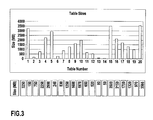
- Figure 3 shows an example.
- the objects are a number of twenty different tables having various sizes between 50 MB and 3566 MB as indicated in figure 3.
- table 1 has a size of 3250 MB
- table 2 has 250 MB
- table 3 has 750 MB
- the table sizes can be actual table sizes or average table sizes which have been obtained by monitoring a real life data processing system.
- the table sizes are estimates for the purpose of planning cluster 100.
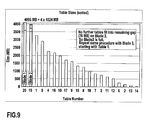
- Figure 4 shows the result of the sorting operation performed on the tables 1 to 20 of figure 3 (cf. step 202 of figure 2).
- Figure 5 illustrates the assignment of the first object of the sequence, i.e. the largest table 20 to blade B 1 .
- Table 20 has a size of 2566 MB, which leaves a gap G of 530 MB of remaining storage capacity (cf. step 210 of figure 2).
- Table 12 which has a size of 520 MB is the largest table which fits into the gap G. This table 12 is thus also assigned to blade 1.
- the aggregated size of the objects assigned to blade 1, i.e. table 20 and table 12, is 4068 MB, which leaves a gap G of 10 MB. This gap G of 10 MB is too small to accommodate even the smallest remaining object of the sequence of tables.
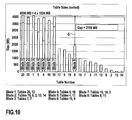
- step 1100 the largest gap G is determined. In the example shown in figure 10, this is the gap G of blade B 8 .
- the other blades B 1 to B 7 have smaller gaps between the aggregated size of the tables assigned to the corresponding blade and the storage capacity of 4 GB.
- step 1106 With the threshold calculated in step 1104 the method of figure 2 is performed again in step 1106.
- the resulting assignment of the objects to the blades is more evenly distributed due to the lowering of the threshold. This is illustrated by way of example in figures 12 and 13 for the example of figure 10.
- Figure 12 shows the threshold T, which has been calculated in step 1104. With the lowered threshold T the assignment procedure of figure 2 is restarted from the beginning whereby steps 200 and 202 do not need to be performed again, if the sorted object sequence has been stored when the procedure of figure 2 was carried out the first time.
- Figure 14 shows an alternative approach for refining the object size balancing.
- Delta 2 is calculated by calculating the difference of the sum of the storage capacity of the blades and the sum of the object sizes of the objects to be assigned to the blades and by dividing the difference by the number of blades.
- the threshold is calculated by subtracting Delta 2 from the storage capacity. This threshold is the theoretical limit for the minimum storage capacities required on the individual blades in order to accommodate the objects if it where possible to distribute the objects with finest granularity.
- step 1404 the method of figure 2 is performed again with the threshold as determined in step 1402 whereby the number N is fixed, i.e. for the last blade B N which is processed the storage capacity will not be sufficient in most cases.
- the threshold as determined in step 1402 whereby the number N is fixed, i.e. for the last blade B N which is processed the storage capacity will not be sufficient in most cases.
- it is checked whether for the last blade, which has been processed, there is in fact an excess amount of memory requirement, which exceeds the storage capacity.
- step 1408 the assignment of objects to blades is outputted in step 1408. If this is not the case, the assignment of objects to blades is outputted in step 1408. If the opposite is the case, the excess amount of memory is divided by the number of blades N which provides Delta 3. In step 1412 the threshold is incremented by Delta 3 and the control goes back to step 1404.
- Steps 1404, 1406, 1410 and 1412 are carried out repeatedly until there is no longer an excess amount of memory.
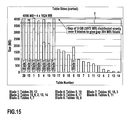
- Figure 15 is based on the example of figure 10 and shows the threshold T as calculated in accordance with step 1402 of figure 14.
- the difference between the sum of the storage capacities of the blades and the sum of the table sizes is 3 GB.
- the 3 GB are evenly distributed over the 8 blades, which provides the threshold T.
- the procedure is continued in order to reduce the gap. This can be done by dividing the gap by the number of blades N and distributing the result over the blades by increasing the threshold correspondingly.
- the gap is calculated as follows: threshold T - sum of the sizes of the objects assigned to blade N.
- the process is stopped if (i) there is no significant change from one iteration to the next (ii) the iterations toggle between different results, (iii) the standard deviation of the distribution of the objects does not improve or (iv) a maximum number of iterations has been reached.
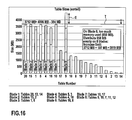
- Figure 16 shows the result of the assignment procedure of figure 2, which has been performed with the threshold T as determined in step 1402.
- the excess memory amount E is 858 MB.
- the assignment method of figure 2 is carried out again with the increased threshold, which provides the result as shown in figure 17.
- Figure 18 shows a further alternative for refinement of the object size balancing.
- step 1400 of the method of figure 14 is carried out in order to calculate Delta 2.
- Delta 2 is equivalent to the gap between the theoretical limit, i.e. the threshold as calculated in step 1402 of the method of figure 14, and the storage capacity of a blade.
- This gap is scanned by a stepwise variation of the threshold in order to identify an assignment of objects to blades which is balanced.
- the number of steps i.e. the number of increments of the threshold, can be predefined or is user-selectable.
- step 1800 Delta 2 is divided by the number of increments, which provides Delta 4.
- step 1802 the threshold is calculated by dividing the sum of the object sizes by the number of blades N. With this threshold the assignment method of figure 2 is performed again in step 1804.
- a statistical measure is calculated as a quality measure for the assignment of objects to blades obtained as a result of step 1804. For example, the standard deviation of the aggregated sizes of objects assigned to each one of the blades is calculated.
- step 1808 the threshold is incremented by Delta 4 and the control goes back to step 1804. This procedure is continued until the threshold has reached the storage capacity, i.e. the upper limit.
- step 1810 one of the assignments obtained as a result of step 1804 is selected on the basis of the overall statistical measure. For example, the assignment having the lowest standard deviation is selected.
- Figure 19 illustrates this method with respect to the example shown in figure 10.
- Delta 4 384 MB divided my the number of increments. For example, the number of increments is 100.
- the standard deviation of the table sizes assigned to blades is calculated for selection of one of the assignments. Preferably the standard deviations are calculated only for those assignments which fit onto the minimum number of blades.
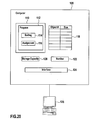
- Figure 20 shows a computer 108, which has processor 110 for running program 112.
- Program 112 has module 114 for sorting of objects by size and module 116 for assigning of objects to blades.
- Further computer 108 has storage 118 for storing a table listing the objects and object sizes to be assigned to blades, storage 120 for storage of a storage capacity value of the blades and storage 122 for storing of the number of blades. Further computer 108 has interface 124 for coupling to workstation 126.
- a storage capacity value for the storage capacity of each individual blade is entered via interface 124 and stored in storage 120.
- the storage capacity value is 4 GB.
- Next program 112 is invoked.
- Program 112 sorts the table of storage 118 by size to provide a sequence of objects (cf. figure 4).
- Next module 116 performs the method of figure 2 in order to determine the minimum number of required blades. This minimum number is stored in storage 122 and is outputted via user interface 124. This number can be a basis for a users investment decision for purchasing the number of blades to realize a data processing system being capable of handling the objects as listed in the table.
- module 116 can perform the methods of figure 11, figure 14 and/or figure 18 for refinement of the object size balancing.
- computer 108 is one of the blades.
- computer 108 can dynamically change the assignment of objects to blades when the object size changes. This way frequent swapping operations for swapping objects between blades can be prevented.
Landscapes
- Engineering & Computer Science (AREA)
- Software Systems (AREA)
- Theoretical Computer Science (AREA)
- Physics & Mathematics (AREA)
- General Engineering & Computer Science (AREA)
- General Physics & Mathematics (AREA)
- Management, Administration, Business Operations System, And Electronic Commerce (AREA)
- Information Retrieval, Db Structures And Fs Structures Therefor (AREA)
- Image Processing (AREA)
- Electrotherapy Devices (AREA)
Priority Applications (7)
| Application Number | Priority Date | Filing Date | Title |
|---|---|---|---|
| AT03018101T ATE550715T1 (de) | 2003-08-08 | 2003-08-08 | Verfahren zur zuteilung von objekten an recheneinheiten |
| EP03018101A EP1505502B1 (de) | 2003-08-08 | 2003-08-08 | Verfahren zur Zuteilung von Objekten an Recheneinheiten |
| AT04763353T ATE410730T1 (de) | 2003-08-08 | 2004-07-20 | Verfahren zum zuweisen von objekten zu verarbeitungseinheiten |
| US10/567,606 US7725900B2 (en) | 2003-08-08 | 2004-07-20 | Method of assigning objects to processing units |
| DE602004017018T DE602004017018D1 (de) | 2003-08-08 | 2004-07-20 | Verfahren zum zuweisen von objekten zu verarbeitungseinheiten |
| PCT/EP2004/008103 WO2005015402A1 (en) | 2003-08-08 | 2004-07-20 | A method of assigning objects to processing units |
| EP04763353A EP1654647B1 (de) | 2003-08-08 | 2004-07-20 | Verfahren zum zuweisen von objekten zu verarbeitungseinheiten |
Applications Claiming Priority (1)
| Application Number | Priority Date | Filing Date | Title |
|---|---|---|---|
| EP03018101A EP1505502B1 (de) | 2003-08-08 | 2003-08-08 | Verfahren zur Zuteilung von Objekten an Recheneinheiten |
Publications (2)
| Publication Number | Publication Date |
|---|---|
| EP1505502A1 true EP1505502A1 (de) | 2005-02-09 |
| EP1505502B1 EP1505502B1 (de) | 2012-03-21 |
Family
ID=33547664
Family Applications (2)
| Application Number | Title | Priority Date | Filing Date |
|---|---|---|---|
| EP03018101A Expired - Lifetime EP1505502B1 (de) | 2003-08-08 | 2003-08-08 | Verfahren zur Zuteilung von Objekten an Recheneinheiten |
| EP04763353A Expired - Lifetime EP1654647B1 (de) | 2003-08-08 | 2004-07-20 | Verfahren zum zuweisen von objekten zu verarbeitungseinheiten |
Family Applications After (1)
| Application Number | Title | Priority Date | Filing Date |
|---|---|---|---|
| EP04763353A Expired - Lifetime EP1654647B1 (de) | 2003-08-08 | 2004-07-20 | Verfahren zum zuweisen von objekten zu verarbeitungseinheiten |
Country Status (5)
| Country | Link |
|---|---|
| US (1) | US7725900B2 (de) |
| EP (2) | EP1505502B1 (de) |
| AT (2) | ATE550715T1 (de) |
| DE (1) | DE602004017018D1 (de) |
| WO (1) | WO2005015402A1 (de) |
Cited By (2)
| Publication number | Priority date | Publication date | Assignee | Title |
|---|---|---|---|---|
| US20090235271A1 (en) * | 2008-03-12 | 2009-09-17 | Canon Kabushiki Kaisha | Information processing apparatus and information processing method |
| US8127299B2 (en) * | 2006-03-28 | 2012-02-28 | Sap Ag | Landscape reorganization algorithm for dynamic load balancing |
Families Citing this family (18)
| Publication number | Priority date | Publication date | Assignee | Title |
|---|---|---|---|---|
| FR2873830B1 (fr) * | 2004-07-30 | 2008-02-22 | Commissariat Energie Atomique | Procede d'ordonnancement de traitement de taches et dispositif pour mettre en oeuvre le procede |
| US7783784B1 (en) * | 2004-08-31 | 2010-08-24 | Oracle America, Inc. | Method and apparatus for adaptive selection of algorithms to load and spread traffic on an aggregation of network interface cards |
| US20060242647A1 (en) | 2005-04-21 | 2006-10-26 | Kimbrel Tracy J | Dynamic application placement under service and memory constraints |
| JP5347648B2 (ja) * | 2009-03-30 | 2013-11-20 | 富士通株式会社 | プログラム、情報処理装置及び状態出力方法 |
| WO2014179593A1 (en) | 2013-05-01 | 2014-11-06 | Paragon Films, Inc. | Stretch films containing random copolymer polypropylene resins in adjacent layers of an nanolayer structure |
| US20150081400A1 (en) * | 2013-09-19 | 2015-03-19 | Infosys Limited | Watching ARM |
| US8719462B1 (en) * | 2013-10-16 | 2014-05-06 | Google Inc. | Systems and methods for distributed log file processing |
| US9396035B2 (en) | 2013-12-06 | 2016-07-19 | International Business Machines Corporation | Multi-dimensional computing and communication resource allocation using bin-packing with per-branch combination tries |
| US8918750B1 (en) | 2013-12-06 | 2014-12-23 | International Business Machines Corporation | Multi-dimensional physical arrangement techniques using bin-packing with per-branch combination tries |
| US10732853B2 (en) * | 2017-04-12 | 2020-08-04 | Oracle International Corporation | Dynamic memory management techniques |
| US10691695B2 (en) | 2017-04-12 | 2020-06-23 | Oracle International Corporation | Combined sort and aggregation |
| US10824558B2 (en) | 2017-04-26 | 2020-11-03 | Oracle International Corporation | Optimized sorting of variable-length records |
| US10984021B2 (en) | 2017-06-29 | 2021-04-20 | Sap Se | Deployment of independent database artifact groups |
| US10674438B2 (en) | 2017-06-29 | 2020-06-02 | Sap Se | Restricting access to external schemas from within a database level container by whitelisting allowed schemas |
| US10776330B2 (en) | 2017-06-29 | 2020-09-15 | Sap Se | Optimized re-deployment of database artifacts |
| US11093443B2 (en) | 2017-06-29 | 2021-08-17 | Sap Se | Database-level container group management |
| US10657114B2 (en) | 2017-11-28 | 2020-05-19 | Sap Se | Reserving key specifications |
| US11030164B2 (en) | 2018-01-18 | 2021-06-08 | Sap Se | Artifact deployment for application managed service instances |
Citations (1)
| Publication number | Priority date | Publication date | Assignee | Title |
|---|---|---|---|---|
| US20020046316A1 (en) * | 1998-11-20 | 2002-04-18 | Elizabeth Borowsky | Apparatus for and method of non-linear constraint optimization in storage system configuration |
Family Cites Families (5)
| Publication number | Priority date | Publication date | Assignee | Title |
|---|---|---|---|---|
| US6216216B1 (en) * | 1998-10-07 | 2001-04-10 | Compaq Computer Corporation | Method and apparatus for providing processor partitioning on a multiprocessor machine |
| US6941365B2 (en) * | 2000-07-28 | 2005-09-06 | Lockheed Martin Corporation | Computer resource allocation layout description |
| US7245632B2 (en) * | 2001-08-10 | 2007-07-17 | Sun Microsystems, Inc. | External storage for modular computer systems |
| US7117294B1 (en) * | 2002-05-28 | 2006-10-03 | Oracle International Corporation | Method and system for archiving and compacting data in a data storage array |
| US7765299B2 (en) * | 2002-09-16 | 2010-07-27 | Hewlett-Packard Development Company, L.P. | Dynamic adaptive server provisioning for blade architectures |
-
2003
- 2003-08-08 AT AT03018101T patent/ATE550715T1/de active
- 2003-08-08 EP EP03018101A patent/EP1505502B1/de not_active Expired - Lifetime
-
2004
- 2004-07-20 DE DE602004017018T patent/DE602004017018D1/de not_active Expired - Lifetime
- 2004-07-20 US US10/567,606 patent/US7725900B2/en active Active
- 2004-07-20 AT AT04763353T patent/ATE410730T1/de not_active IP Right Cessation
- 2004-07-20 WO PCT/EP2004/008103 patent/WO2005015402A1/en not_active Ceased
- 2004-07-20 EP EP04763353A patent/EP1654647B1/de not_active Expired - Lifetime
Patent Citations (1)
| Publication number | Priority date | Publication date | Assignee | Title |
|---|---|---|---|---|
| US20020046316A1 (en) * | 1998-11-20 | 2002-04-18 | Elizabeth Borowsky | Apparatus for and method of non-linear constraint optimization in storage system configuration |
Non-Patent Citations (5)
| Title |
|---|
| "RELATIONAL ASSIGNMENTS FOR DISTRIBUTED DATABASE SYSTEMS", IBM TECHNICAL DISCLOSURE BULLETIN, IBM CORP. NEW YORK, US, vol. 31, no. 1, 1 June 1988 (1988-06-01), pages 219 - 225, XP000045647, ISSN: 0018-8689 * |
| AGGARWAL G; MOTWANI R; ZHU A: "The load rebalancing problem", PROCEEDINGS OF THE FIFTEENTH ANNUAL ACM SYMPOSIUM ON PARALLEL ALGORITHMS AND ARCHITECTURES, June 2003 (2003-06-01), USA, pages 258 - 265, XP002285345 * |
| COFFMAN E G; GAREY M R; JOHNSON D S: "APPROXIMATION ALGORITHMS FOR BIN PACKING: A SURVEY", APPROXIMATION ALGORITHMS FOR NP-HARD PROBLEMS, 1996, pages 1 - 53, XP002285343, Retrieved from the Internet <URL:http://www.ee.columbia.edu/~egc/webpapers/BPchapter.ps> * |
| LEINBERGER W; KARYPIS G; KUMAR V: "Multi-Capacity Bin Packing Algorithms with Applications to Job Scheduling under Multiple Constraints (TR 99-024)", 27 May 1999 (1999-05-27), pages 1 - 23, XP002285342, Retrieved from the Internet <URL:http://www-users.cs.umn.edu/~karypis/publications/Papers/PDF/mrbinpack.pdf> * |
| LU E J -L ; OKUNBOR D I: "An efficient load balancing technique for parallel FMA in message passing environment", PROCEEDINGS OF THE EIGHTH SIAM CONFERENCE ON PARALLEL PROCESSING FOR SCIENTIFIC COMPUTING, March 1997 (1997-03-01), USA, pages 1 - 8, XP002285344, Retrieved from the Internet <URL:http://www.cyut.edu.tw/~jlu/research/parallel/nbody/siam97.ps> * |
Cited By (4)
| Publication number | Priority date | Publication date | Assignee | Title |
|---|---|---|---|---|
| US8127299B2 (en) * | 2006-03-28 | 2012-02-28 | Sap Ag | Landscape reorganization algorithm for dynamic load balancing |
| US20090235271A1 (en) * | 2008-03-12 | 2009-09-17 | Canon Kabushiki Kaisha | Information processing apparatus and information processing method |
| US8347305B2 (en) * | 2008-03-12 | 2013-01-01 | Canon Kabushiki Kaisha | Allocation of storage units for execution of application programs |
| US20130104142A1 (en) * | 2008-03-12 | 2013-04-25 | Canon Kabushiki Kaisha | Information processing apparatus and information processing method |
Also Published As
| Publication number | Publication date |
|---|---|
| EP1654647A1 (de) | 2006-05-10 |
| ATE550715T1 (de) | 2012-04-15 |
| WO2005015402A1 (en) | 2005-02-17 |
| DE602004017018D1 (de) | 2008-11-20 |
| US7725900B2 (en) | 2010-05-25 |
| US20070162629A1 (en) | 2007-07-12 |
| EP1505502B1 (de) | 2012-03-21 |
| EP1654647B1 (de) | 2008-10-08 |
| ATE410730T1 (de) | 2008-10-15 |
Similar Documents
| Publication | Publication Date | Title |
|---|---|---|
| EP1505502A1 (de) | Verfahren zur Zuteilung von Objekten an Recheneinheiten | |
| EP1564638B1 (de) | Verfahren zur Neuverteilung von Objekten an Recheneinheiten | |
| EP1626339B1 (de) | Datenverarbeitungssystem und -verfahren zur Verteilung von Objekten auf Prozessoreinheiten | |
| EP1533699B1 (de) | Verfahren zur Zuteilung von Objekten an Recheneinheiten | |
| CN1225472A (zh) | 服务器内调度和分派排队客户请求的装置和方法 | |
| KR20000036178A (ko) | 금전비용을 최적화하는 로드 분산 제어기 | |
| CN113282409A (zh) | 边缘计算任务的处理方法、装置和计算机设备 | |
| CN112015554B (zh) | 任务处理方法和装置 | |
| CN110941602A (zh) | 数据库的配置方法、装置、电子设备及存储介质 | |
| Karatza et al. | Epoch load sharing in a network of workstations | |
| EP1524599B1 (de) | Verfahren zur Neuverteilung von Objekten an Recheneinheiten | |
| Stavrinides et al. | Data-aware resource allocation of linear pipeline applications in a distributed environment | |
| EP0547992A2 (de) | Verfahren und Gerät für verbesserte Effizienz bei der Datenwiedergewinnung in einer B-Baum-Speicherstruktur | |
| EP1612672B1 (de) | Datenverarbeitungssystem zur Zuweisung von Objekten an Verarbeitungseinheiten | |
| JP2003006390A (ja) | 担当決定支援方法及び担当決定支援方法のプログラム並びに受付振分装置 | |
| JPH05233390A (ja) | 分散データベースのデータ分割管理方式 | |
| US7698710B1 (en) | System and method to improve service in a group of servers | |
| Lee et al. | Some characteristics of optimal workload allocation for closed queueing networks | |
| CN118195222A (zh) | 客服贴子处理系统的贴子分配方法、系统及相关设备 | |
| CN118214739A (zh) | 一种eni-ip池容量动态调整方法及装置 | |
| CN120144200A (zh) | 一种基于物联网的配置实时修改及生效管理系统及方法 | |
| CN121879942A (zh) | 一种任务分配方法、设备、介质及程序产品 | |
| WO2023123367A1 (zh) | 基于业务统计互补特征的数据中心多虚拟网络联合映射方法 | |
| CN120256097A (zh) | 一种基于数据分析的算力服务器的算力管理方法及系统 | |
| CN119960974A (zh) | 一种远程控制任务的分配方法、装置、设备及存储介质 |
Legal Events
| Date | Code | Title | Description |
|---|---|---|---|
| PUAI | Public reference made under article 153(3) epc to a published international application that has entered the european phase |
Free format text: ORIGINAL CODE: 0009012 |
|
| AK | Designated contracting states |
Kind code of ref document: A1 Designated state(s): AT BE BG CH CY CZ DE DK EE ES FI FR GB GR HU IE IT LI LU MC NL PT RO SE SI SK TR |
|
| AX | Request for extension of the european patent |
Extension state: AL LT LV MK |
|
| 17P | Request for examination filed |
Effective date: 20050809 |
|
| AKX | Designation fees paid |
Designated state(s): AT BE BG CH CY CZ DE DK EE ES FI FR GB GR HU IE IT LI LU MC NL PT RO SE SI SK TR |
|
| RIN1 | Information on inventor provided before grant (corrected) |
Inventor name: SAUERMANN, VOLKER |
|
| RAP1 | Party data changed (applicant data changed or rights of an application transferred) |
Owner name: SAP AG |
|
| 17Q | First examination report despatched |
Effective date: 20060823 |
|
| APBN | Date of receipt of notice of appeal recorded |
Free format text: ORIGINAL CODE: EPIDOSNNOA2E |
|
| APBR | Date of receipt of statement of grounds of appeal recorded |
Free format text: ORIGINAL CODE: EPIDOSNNOA3E |
|
| APAF | Appeal reference modified |
Free format text: ORIGINAL CODE: EPIDOSCREFNE |
|
| APAF | Appeal reference modified |
Free format text: ORIGINAL CODE: EPIDOSCREFNE |
|
| APBZ | Receipt of observations in appeal recorded |
Free format text: ORIGINAL CODE: EPIDOSNOBA4E |
|
| APBT | Appeal procedure closed |
Free format text: ORIGINAL CODE: EPIDOSNNOA9E |
|
| GRAP | Despatch of communication of intention to grant a patent |
Free format text: ORIGINAL CODE: EPIDOSNIGR1 |
|
| GRAS | Grant fee paid |
Free format text: ORIGINAL CODE: EPIDOSNIGR3 |
|
| GRAA | (expected) grant |
Free format text: ORIGINAL CODE: 0009210 |
|
| AK | Designated contracting states |
Kind code of ref document: B1 Designated state(s): AT BE BG CH CY CZ DE DK EE ES FI FR GB GR HU IE IT LI LU MC NL PT RO SE SI SK TR |
|
| REG | Reference to a national code |
Ref country code: GB Ref legal event code: FG4D |
|
| REG | Reference to a national code |
Ref country code: CH Ref legal event code: EP |
|
| REG | Reference to a national code |
Ref country code: IE Ref legal event code: FG4D |
|
| REG | Reference to a national code |
Ref country code: AT Ref legal event code: REF Ref document number: 550715 Country of ref document: AT Kind code of ref document: T Effective date: 20120415 |
|
| REG | Reference to a national code |
Ref country code: DE Ref legal event code: R096 Ref document number: 60340316 Country of ref document: DE Effective date: 20120516 |
|
| REG | Reference to a national code |
Ref country code: NL Ref legal event code: VDEP Effective date: 20120321 |
|
| PG25 | Lapsed in a contracting state [announced via postgrant information from national office to epo] |
Ref country code: GR Free format text: LAPSE BECAUSE OF FAILURE TO SUBMIT A TRANSLATION OF THE DESCRIPTION OR TO PAY THE FEE WITHIN THE PRESCRIBED TIME-LIMIT Effective date: 20120622 Ref country code: FI Free format text: LAPSE BECAUSE OF FAILURE TO SUBMIT A TRANSLATION OF THE DESCRIPTION OR TO PAY THE FEE WITHIN THE PRESCRIBED TIME-LIMIT Effective date: 20120321 |
|
| REG | Reference to a national code |
Ref country code: AT Ref legal event code: MK05 Ref document number: 550715 Country of ref document: AT Kind code of ref document: T Effective date: 20120321 |
|
| PG25 | Lapsed in a contracting state [announced via postgrant information from national office to epo] |
Ref country code: CY Free format text: LAPSE BECAUSE OF FAILURE TO SUBMIT A TRANSLATION OF THE DESCRIPTION OR TO PAY THE FEE WITHIN THE PRESCRIBED TIME-LIMIT Effective date: 20120321 |
|
| PG25 | Lapsed in a contracting state [announced via postgrant information from national office to epo] |
Ref country code: BE Free format text: LAPSE BECAUSE OF FAILURE TO SUBMIT A TRANSLATION OF THE DESCRIPTION OR TO PAY THE FEE WITHIN THE PRESCRIBED TIME-LIMIT Effective date: 20120321 Ref country code: CZ Free format text: LAPSE BECAUSE OF FAILURE TO SUBMIT A TRANSLATION OF THE DESCRIPTION OR TO PAY THE FEE WITHIN THE PRESCRIBED TIME-LIMIT Effective date: 20120321 Ref country code: EE Free format text: LAPSE BECAUSE OF FAILURE TO SUBMIT A TRANSLATION OF THE DESCRIPTION OR TO PAY THE FEE WITHIN THE PRESCRIBED TIME-LIMIT Effective date: 20120321 Ref country code: RO Free format text: LAPSE BECAUSE OF FAILURE TO SUBMIT A TRANSLATION OF THE DESCRIPTION OR TO PAY THE FEE WITHIN THE PRESCRIBED TIME-LIMIT Effective date: 20120321 Ref country code: SE Free format text: LAPSE BECAUSE OF FAILURE TO SUBMIT A TRANSLATION OF THE DESCRIPTION OR TO PAY THE FEE WITHIN THE PRESCRIBED TIME-LIMIT Effective date: 20120321 Ref country code: SI Free format text: LAPSE BECAUSE OF FAILURE TO SUBMIT A TRANSLATION OF THE DESCRIPTION OR TO PAY THE FEE WITHIN THE PRESCRIBED TIME-LIMIT Effective date: 20120321 |
|
| PG25 | Lapsed in a contracting state [announced via postgrant information from national office to epo] |
Ref country code: SK Free format text: LAPSE BECAUSE OF FAILURE TO SUBMIT A TRANSLATION OF THE DESCRIPTION OR TO PAY THE FEE WITHIN THE PRESCRIBED TIME-LIMIT Effective date: 20120321 Ref country code: PT Free format text: LAPSE BECAUSE OF FAILURE TO SUBMIT A TRANSLATION OF THE DESCRIPTION OR TO PAY THE FEE WITHIN THE PRESCRIBED TIME-LIMIT Effective date: 20120723 |
|
| PLBE | No opposition filed within time limit |
Free format text: ORIGINAL CODE: 0009261 |
|
| STAA | Information on the status of an ep patent application or granted ep patent |
Free format text: STATUS: NO OPPOSITION FILED WITHIN TIME LIMIT |
|
| PG25 | Lapsed in a contracting state [announced via postgrant information from national office to epo] |
Ref country code: DK Free format text: LAPSE BECAUSE OF FAILURE TO SUBMIT A TRANSLATION OF THE DESCRIPTION OR TO PAY THE FEE WITHIN THE PRESCRIBED TIME-LIMIT Effective date: 20120321 Ref country code: NL Free format text: LAPSE BECAUSE OF FAILURE TO SUBMIT A TRANSLATION OF THE DESCRIPTION OR TO PAY THE FEE WITHIN THE PRESCRIBED TIME-LIMIT Effective date: 20120321 Ref country code: AT Free format text: LAPSE BECAUSE OF FAILURE TO SUBMIT A TRANSLATION OF THE DESCRIPTION OR TO PAY THE FEE WITHIN THE PRESCRIBED TIME-LIMIT Effective date: 20120321 |
|
| 26N | No opposition filed |
Effective date: 20130102 |
|
| PG25 | Lapsed in a contracting state [announced via postgrant information from national office to epo] |
Ref country code: IT Free format text: LAPSE BECAUSE OF FAILURE TO SUBMIT A TRANSLATION OF THE DESCRIPTION OR TO PAY THE FEE WITHIN THE PRESCRIBED TIME-LIMIT Effective date: 20120321 |
|
| REG | Reference to a national code |
Ref country code: CH Ref legal event code: PL |
|
| PG25 | Lapsed in a contracting state [announced via postgrant information from national office to epo] |
Ref country code: MC Free format text: LAPSE BECAUSE OF NON-PAYMENT OF DUE FEES Effective date: 20120831 |
|
| REG | Reference to a national code |
Ref country code: DE Ref legal event code: R097 Ref document number: 60340316 Country of ref document: DE Effective date: 20130102 |
|
| PG25 | Lapsed in a contracting state [announced via postgrant information from national office to epo] |
Ref country code: ES Free format text: LAPSE BECAUSE OF FAILURE TO SUBMIT A TRANSLATION OF THE DESCRIPTION OR TO PAY THE FEE WITHIN THE PRESCRIBED TIME-LIMIT Effective date: 20120702 Ref country code: CH Free format text: LAPSE BECAUSE OF NON-PAYMENT OF DUE FEES Effective date: 20120831 Ref country code: LI Free format text: LAPSE BECAUSE OF NON-PAYMENT OF DUE FEES Effective date: 20120831 |
|
| REG | Reference to a national code |
Ref country code: IE Ref legal event code: MM4A |
|
| PG25 | Lapsed in a contracting state [announced via postgrant information from national office to epo] |
Ref country code: BG Free format text: LAPSE BECAUSE OF FAILURE TO SUBMIT A TRANSLATION OF THE DESCRIPTION OR TO PAY THE FEE WITHIN THE PRESCRIBED TIME-LIMIT Effective date: 20120621 Ref country code: IE Free format text: LAPSE BECAUSE OF NON-PAYMENT OF DUE FEES Effective date: 20120808 |
|
| PG25 | Lapsed in a contracting state [announced via postgrant information from national office to epo] |
Ref country code: TR Free format text: LAPSE BECAUSE OF FAILURE TO SUBMIT A TRANSLATION OF THE DESCRIPTION OR TO PAY THE FEE WITHIN THE PRESCRIBED TIME-LIMIT Effective date: 20120321 |
|
| PG25 | Lapsed in a contracting state [announced via postgrant information from national office to epo] |
Ref country code: LU Free format text: LAPSE BECAUSE OF NON-PAYMENT OF DUE FEES Effective date: 20120808 |
|
| PG25 | Lapsed in a contracting state [announced via postgrant information from national office to epo] |
Ref country code: HU Free format text: LAPSE BECAUSE OF FAILURE TO SUBMIT A TRANSLATION OF THE DESCRIPTION OR TO PAY THE FEE WITHIN THE PRESCRIBED TIME-LIMIT Effective date: 20030808 |
|
| REG | Reference to a national code |
Ref country code: DE Ref legal event code: R082 Ref document number: 60340316 Country of ref document: DE Representative=s name: RICHARDT PATENTANWAELTE PART GMBB, DE |
|
| REG | Reference to a national code |
Ref country code: DE Ref legal event code: R081 Ref document number: 60340316 Country of ref document: DE Owner name: SAP SE, DE Free format text: FORMER OWNER: SAP AG, 69190 WALLDORF, DE Effective date: 20120322 Ref country code: DE Ref legal event code: R081 Ref document number: 60340316 Country of ref document: DE Owner name: SAP SE, DE Free format text: FORMER OWNER: SAP AG, 69190 WALLDORF, DE Effective date: 20141210 Ref country code: DE Ref legal event code: R082 Ref document number: 60340316 Country of ref document: DE Representative=s name: RICHARDT PATENTANWAELTE PART GMBB, DE Effective date: 20141210 Ref country code: DE Ref legal event code: R082 Ref document number: 60340316 Country of ref document: DE Representative=s name: RICHARDT PATENTANWAELTE PARTG MBB, DE Effective date: 20141210 |
|
| REG | Reference to a national code |
Ref country code: FR Ref legal event code: PLFP Year of fee payment: 14 |
|
| REG | Reference to a national code |
Ref country code: FR Ref legal event code: PLFP Year of fee payment: 15 |
|
| REG | Reference to a national code |
Ref country code: FR Ref legal event code: PLFP Year of fee payment: 16 |
|
| PGFP | Annual fee paid to national office [announced via postgrant information from national office to epo] |
Ref country code: FR Payment date: 20210819 Year of fee payment: 19 |
|
| PGFP | Annual fee paid to national office [announced via postgrant information from national office to epo] |
Ref country code: DE Payment date: 20210819 Year of fee payment: 19 Ref country code: GB Payment date: 20210820 Year of fee payment: 19 |
|
| REG | Reference to a national code |
Ref country code: DE Ref legal event code: R119 Ref document number: 60340316 Country of ref document: DE |
|
| GBPC | Gb: european patent ceased through non-payment of renewal fee |
Effective date: 20220808 |
|
| PG25 | Lapsed in a contracting state [announced via postgrant information from national office to epo] |
Ref country code: FR Free format text: LAPSE BECAUSE OF NON-PAYMENT OF DUE FEES Effective date: 20220831 Ref country code: DE Free format text: LAPSE BECAUSE OF NON-PAYMENT OF DUE FEES Effective date: 20230301 |
|
| PG25 | Lapsed in a contracting state [announced via postgrant information from national office to epo] |
Ref country code: GB Free format text: LAPSE BECAUSE OF NON-PAYMENT OF DUE FEES Effective date: 20220808 |