EP1506940A1 - Ceroxidpulver - Google Patents
Ceroxidpulver Download PDFInfo
- Publication number
- EP1506940A1 EP1506940A1 EP04012835A EP04012835A EP1506940A1 EP 1506940 A1 EP1506940 A1 EP 1506940A1 EP 04012835 A EP04012835 A EP 04012835A EP 04012835 A EP04012835 A EP 04012835A EP 1506940 A1 EP1506940 A1 EP 1506940A1
- Authority
- EP
- European Patent Office
- Prior art keywords
- cerium oxide
- oxide powder
- dispersion
- powder according
- cerium
- Prior art date
- Legal status (The legal status is an assumption and is not a legal conclusion. Google has not performed a legal analysis and makes no representation as to the accuracy of the status listed.)
- Granted
Links
Images


Classifications
-
- B—PERFORMING OPERATIONS; TRANSPORTING
- B01—PHYSICAL OR CHEMICAL PROCESSES OR APPARATUS IN GENERAL
- B01J—CHEMICAL OR PHYSICAL PROCESSES, e.g. CATALYSIS OR COLLOID CHEMISTRY; THEIR RELEVANT APPARATUS
- B01J23/00—Catalysts comprising metals or metal oxides or hydroxides, not provided for in group B01J21/00
- B01J23/10—Catalysts comprising metals or metal oxides or hydroxides, not provided for in group B01J21/00 of rare earths
-
- C—CHEMISTRY; METALLURGY
- C01—INORGANIC CHEMISTRY
- C01F—COMPOUNDS OF THE METALS BERYLLIUM, MAGNESIUM, ALUMINIUM, CALCIUM, STRONTIUM, BARIUM, RADIUM, THORIUM, OR OF THE RARE-EARTH METALS
- C01F17/00—Compounds of rare earth metals
- C01F17/20—Compounds containing only rare earth metals as the metal element
- C01F17/206—Compounds containing only rare earth metals as the metal element oxide or hydroxide being the only anion
- C01F17/224—Oxides or hydroxides of lanthanides
- C01F17/235—Cerium oxides or hydroxides
-
- B—PERFORMING OPERATIONS; TRANSPORTING
- B82—NANOTECHNOLOGY
- B82Y—SPECIFIC USES OR APPLICATIONS OF NANOSTRUCTURES; MEASUREMENT OR ANALYSIS OF NANOSTRUCTURES; MANUFACTURE OR TREATMENT OF NANOSTRUCTURES
- B82Y30/00—Nanotechnology for materials or surface science, e.g. nanocomposites
-
- B—PERFORMING OPERATIONS; TRANSPORTING
- B01—PHYSICAL OR CHEMICAL PROCESSES OR APPARATUS IN GENERAL
- B01J—CHEMICAL OR PHYSICAL PROCESSES, e.g. CATALYSIS OR COLLOID CHEMISTRY; THEIR RELEVANT APPARATUS
- B01J35/00—Catalysts, in general, characterised by their form or physical properties
- B01J35/40—Catalysts, in general, characterised by their form or physical properties characterised by dimensions, e.g. grain size
-
- B—PERFORMING OPERATIONS; TRANSPORTING
- B01—PHYSICAL OR CHEMICAL PROCESSES OR APPARATUS IN GENERAL
- B01J—CHEMICAL OR PHYSICAL PROCESSES, e.g. CATALYSIS OR COLLOID CHEMISTRY; THEIR RELEVANT APPARATUS
- B01J35/00—Catalysts, in general, characterised by their form or physical properties
- B01J35/40—Catalysts, in general, characterised by their form or physical properties characterised by dimensions, e.g. grain size
- B01J35/45—Nanoparticles
-
- B—PERFORMING OPERATIONS; TRANSPORTING
- B01—PHYSICAL OR CHEMICAL PROCESSES OR APPARATUS IN GENERAL
- B01J—CHEMICAL OR PHYSICAL PROCESSES, e.g. CATALYSIS OR COLLOID CHEMISTRY; THEIR RELEVANT APPARATUS
- B01J37/00—Processes, in general, for preparing catalysts; Processes, in general, for activation of catalysts
- B01J37/02—Impregnation, coating or precipitation
- B01J37/0238—Impregnation, coating or precipitation via the gaseous phase-sublimation
-
- C—CHEMISTRY; METALLURGY
- C09—DYES; PAINTS; POLISHES; NATURAL RESINS; ADHESIVES; COMPOSITIONS NOT OTHERWISE PROVIDED FOR; APPLICATIONS OF MATERIALS NOT OTHERWISE PROVIDED FOR
- C09K—MATERIALS FOR MISCELLANEOUS APPLICATIONS, NOT PROVIDED FOR ELSEWHERE
- C09K3/00—Materials not provided for elsewhere
- C09K3/14—Anti-slip materials; Abrasives
- C09K3/1409—Abrasive particles per se
-
- C—CHEMISTRY; METALLURGY
- C09—DYES; PAINTS; POLISHES; NATURAL RESINS; ADHESIVES; COMPOSITIONS NOT OTHERWISE PROVIDED FOR; APPLICATIONS OF MATERIALS NOT OTHERWISE PROVIDED FOR
- C09K—MATERIALS FOR MISCELLANEOUS APPLICATIONS, NOT PROVIDED FOR ELSEWHERE
- C09K3/00—Materials not provided for elsewhere
- C09K3/14—Anti-slip materials; Abrasives
- C09K3/1454—Abrasive powders, suspensions and pastes for polishing
- C09K3/1463—Aqueous liquid suspensions
-
- B—PERFORMING OPERATIONS; TRANSPORTING
- B01—PHYSICAL OR CHEMICAL PROCESSES OR APPARATUS IN GENERAL
- B01J—CHEMICAL OR PHYSICAL PROCESSES, e.g. CATALYSIS OR COLLOID CHEMISTRY; THEIR RELEVANT APPARATUS
- B01J35/00—Catalysts, in general, characterised by their form or physical properties
- B01J35/60—Catalysts, in general, characterised by their form or physical properties characterised by their surface properties or porosity
- B01J35/61—Surface area
- B01J35/613—10-100 m2/g
-
- B—PERFORMING OPERATIONS; TRANSPORTING
- B01—PHYSICAL OR CHEMICAL PROCESSES OR APPARATUS IN GENERAL
- B01J—CHEMICAL OR PHYSICAL PROCESSES, e.g. CATALYSIS OR COLLOID CHEMISTRY; THEIR RELEVANT APPARATUS
- B01J35/00—Catalysts, in general, characterised by their form or physical properties
- B01J35/60—Catalysts, in general, characterised by their form or physical properties characterised by their surface properties or porosity
- B01J35/61—Surface area
- B01J35/615—100-500 m2/g
-
- C—CHEMISTRY; METALLURGY
- C01—INORGANIC CHEMISTRY
- C01P—INDEXING SCHEME RELATING TO STRUCTURAL AND PHYSICAL ASPECTS OF SOLID INORGANIC COMPOUNDS
- C01P2002/00—Crystal-structural characteristics
- C01P2002/60—Compounds characterised by their crystallite size
-
- C—CHEMISTRY; METALLURGY
- C01—INORGANIC CHEMISTRY
- C01P—INDEXING SCHEME RELATING TO STRUCTURAL AND PHYSICAL ASPECTS OF SOLID INORGANIC COMPOUNDS
- C01P2002/00—Crystal-structural characteristics
- C01P2002/70—Crystal-structural characteristics defined by measured X-ray, neutron or electron diffraction data
- C01P2002/76—Crystal-structural characteristics defined by measured X-ray, neutron or electron diffraction data by a space-group or by other symmetry indications
-
- C—CHEMISTRY; METALLURGY
- C01—INORGANIC CHEMISTRY
- C01P—INDEXING SCHEME RELATING TO STRUCTURAL AND PHYSICAL ASPECTS OF SOLID INORGANIC COMPOUNDS
- C01P2004/00—Particle morphology
- C01P2004/01—Particle morphology depicted by an image
- C01P2004/04—Particle morphology depicted by an image obtained by TEM, STEM, STM or AFM
-
- C—CHEMISTRY; METALLURGY
- C01—INORGANIC CHEMISTRY
- C01P—INDEXING SCHEME RELATING TO STRUCTURAL AND PHYSICAL ASPECTS OF SOLID INORGANIC COMPOUNDS
- C01P2004/00—Particle morphology
- C01P2004/50—Agglomerated particles
-
- C—CHEMISTRY; METALLURGY
- C01—INORGANIC CHEMISTRY
- C01P—INDEXING SCHEME RELATING TO STRUCTURAL AND PHYSICAL ASPECTS OF SOLID INORGANIC COMPOUNDS
- C01P2004/00—Particle morphology
- C01P2004/60—Particles characterised by their size
- C01P2004/64—Nanometer sized, i.e. from 1-100 nanometer
-
- C—CHEMISTRY; METALLURGY
- C01—INORGANIC CHEMISTRY
- C01P—INDEXING SCHEME RELATING TO STRUCTURAL AND PHYSICAL ASPECTS OF SOLID INORGANIC COMPOUNDS
- C01P2006/00—Physical properties of inorganic compounds
- C01P2006/10—Solid density
-
- C—CHEMISTRY; METALLURGY
- C01—INORGANIC CHEMISTRY
- C01P—INDEXING SCHEME RELATING TO STRUCTURAL AND PHYSICAL ASPECTS OF SOLID INORGANIC COMPOUNDS
- C01P2006/00—Physical properties of inorganic compounds
- C01P2006/11—Powder tap density
-
- C—CHEMISTRY; METALLURGY
- C01—INORGANIC CHEMISTRY
- C01P—INDEXING SCHEME RELATING TO STRUCTURAL AND PHYSICAL ASPECTS OF SOLID INORGANIC COMPOUNDS
- C01P2006/00—Physical properties of inorganic compounds
- C01P2006/12—Surface area
-
- C—CHEMISTRY; METALLURGY
- C01—INORGANIC CHEMISTRY
- C01P—INDEXING SCHEME RELATING TO STRUCTURAL AND PHYSICAL ASPECTS OF SOLID INORGANIC COMPOUNDS
- C01P2006/00—Physical properties of inorganic compounds
- C01P2006/14—Pore volume
-
- C—CHEMISTRY; METALLURGY
- C01—INORGANIC CHEMISTRY
- C01P—INDEXING SCHEME RELATING TO STRUCTURAL AND PHYSICAL ASPECTS OF SOLID INORGANIC COMPOUNDS
- C01P2006/00—Physical properties of inorganic compounds
- C01P2006/16—Pore diameter
- C01P2006/17—Pore diameter distribution
-
- C—CHEMISTRY; METALLURGY
- C01—INORGANIC CHEMISTRY
- C01P—INDEXING SCHEME RELATING TO STRUCTURAL AND PHYSICAL ASPECTS OF SOLID INORGANIC COMPOUNDS
- C01P2006/00—Physical properties of inorganic compounds
- C01P2006/80—Compositional purity
-
- Y—GENERAL TAGGING OF NEW TECHNOLOGICAL DEVELOPMENTS; GENERAL TAGGING OF CROSS-SECTIONAL TECHNOLOGIES SPANNING OVER SEVERAL SECTIONS OF THE IPC; TECHNICAL SUBJECTS COVERED BY FORMER USPC CROSS-REFERENCE ART COLLECTIONS [XRACs] AND DIGESTS
- Y10—TECHNICAL SUBJECTS COVERED BY FORMER USPC
- Y10S—TECHNICAL SUBJECTS COVERED BY FORMER USPC CROSS-REFERENCE ART COLLECTIONS [XRACs] AND DIGESTS
- Y10S977/00—Nanotechnology
- Y10S977/70—Nanostructure
- Y10S977/773—Nanoparticle, i.e. structure having three dimensions of 100 nm or less
-
- Y—GENERAL TAGGING OF NEW TECHNOLOGICAL DEVELOPMENTS; GENERAL TAGGING OF CROSS-SECTIONAL TECHNOLOGIES SPANNING OVER SEVERAL SECTIONS OF THE IPC; TECHNICAL SUBJECTS COVERED BY FORMER USPC CROSS-REFERENCE ART COLLECTIONS [XRACs] AND DIGESTS
- Y10—TECHNICAL SUBJECTS COVERED BY FORMER USPC
- Y10S—TECHNICAL SUBJECTS COVERED BY FORMER USPC CROSS-REFERENCE ART COLLECTIONS [XRACs] AND DIGESTS
- Y10S977/00—Nanotechnology
- Y10S977/70—Nanostructure
- Y10S977/773—Nanoparticle, i.e. structure having three dimensions of 100 nm or less
- Y10S977/775—Nanosized powder or flake, e.g. nanosized catalyst
-
- Y—GENERAL TAGGING OF NEW TECHNOLOGICAL DEVELOPMENTS; GENERAL TAGGING OF CROSS-SECTIONAL TECHNOLOGIES SPANNING OVER SEVERAL SECTIONS OF THE IPC; TECHNICAL SUBJECTS COVERED BY FORMER USPC CROSS-REFERENCE ART COLLECTIONS [XRACs] AND DIGESTS
- Y10—TECHNICAL SUBJECTS COVERED BY FORMER USPC
- Y10S—TECHNICAL SUBJECTS COVERED BY FORMER USPC CROSS-REFERENCE ART COLLECTIONS [XRACs] AND DIGESTS
- Y10S977/00—Nanotechnology
- Y10S977/70—Nanostructure
- Y10S977/811—Of specified metal oxide composition, e.g. conducting or semiconducting compositions such as ITO, ZnOx
Definitions
- the invention relates to a cerium oxide powder whose Manufacture and use.
- cerium oxide is calcined made of cerium hydroxides or cercarbonates. The Calcined oxides are then ground and sieved.
- This cerium (III) salts are under the influence of Oxidative temperature and pressure converted into ceria, the in Form of fine particles crystallized out.
- spray pyrolysis methods in which a Ceria precursor, usually in the form of an aerosol, in a flame is oxidized. Such a method is for example described in EP-A-1142830.
- Pratsinis et al. describe in J. Mater. Res., Vol. 17, pages 1356-1362 (2002), the preparation of high crystallinity ceria powder by flame spray pyrolysis of cerium acetate solutions in solvent mixtures of acetic acid, isooctane and 2-butanol by oxidation by means of oxygen in an oxygen / methane flame.
- the solvent mixture is essential for the preparation of a cerium oxide powder which is free or largely free of coarser particles.
- Acetic acid alone leads to powders with coarse fraction.
- Particularly advantageous for achieving a finely divided powder which is free of coarse fractions is an increase in the ceria precursor flow rate and a reduction in the oxygen flow.
- the mean particle size is derived from the XRD spectrum.
- the specific surface area of the cerium oxide particles which can be between 101 and 240 m 2 / g, should be able to be varied by varying the ratio of cerium oxide precursor and oxygen.
- An increase in the precursor feed rate at constant oxygen flow should lead to an increase in the particle size, an increase in the oxygen flow at a constant precursor feed rate to a reduction of the particle size.
- the pore sizes and their distribution is an important one Feature of using ceria powders in catalytic Processes.
- the ceria powder made by Pratsinis et al has a bimodal pore size distribution, wherein 10% of the pores are smaller than 10 nm.
- the method described allows only the Production of small amounts of cerium oxide (range approx. 10 g / h) and is therefore not very economical. Options for upscaling of the procedure are not given. Farther introduces the use of methane and iso-octane as fuel gas to a high proportion of carbon in the reaction mixture.
- US 5772780 claims a dispersion containing ceria for polishing semiconductor substrates, wherein the ceria in Form of aggregated, crystalline particles with a Crystallite size of not more than 30 nm is present.
- One Production process of ceria particles and ceria containing dispersion is not disclosed.
- US 6420269 claims an abrasive containing a cerium oxide grain obtained by oxidation of a water-insoluble trivalent cerium salt dispersed in water.
- the ceria has a specific surface area between 50 and 500 m 2 / g and a density of 0.8-1.3 g / ml.
- the size of the Ceroxidprimärkornes is not more than 10 nm, the size of the cerium oxide secondary grain, which is formed by aggregation of the primary grains is less than 1 micron.
- the secondary grains have a circumference which is free of edges and has an angle of less than 120 °.
- the cerium oxide grain has a main signal with a half width not smaller than 0.4 ° and not larger than 0.5 °.
- An essential feature is also that the material is not completely crystallized. This should show advantages when polishing semiconductor substrates.
- US 6221118 claims a dispersion which Contains cerium oxide particles of low crystallinity, the Primary particles with a mean diameter of 30 to 250 nm exists.
- the ceria particles have in the Dispersion has a mean diameter of 150 to 600 nm on.
- the cerium oxide particles are obtained by combustion of cercarbonate.
- German patent application DE 10251029.6 dated 02.11.2002 claims a pyrogenically produced ceria powder having a specific surface area of 15 to 200 m 2 / g, which consists of a coarse fraction of crystalline, non-aggregated particles having an average diameter between 30 and 200 nm and a fine fraction in the form of aggregates of finely crystalline, intergrown primary particles with a mean aggregate diameter of 5 to 50 nm. It is prepared by feeding at least one compound which can be oxidatively converted into cerium oxide into a flame which is produced from a hydrogen-containing fuel gas, preferably hydrogen, and an excess of air or an air / oxygen mixture, and there for reaction brings.
- a hydrogen-containing fuel gas preferably hydrogen
- the exit velocity of the liquid droplets from the atomizer unit into the reaction space is greater than 70 m / s and the speed of the reaction mixture in the reaction space is between 0.5 and 2 m / s.
- the flame has an oxygen excess, expressed as lambda, of at least 1.6.
- ceria particles From WO 01/36332 is the production of ceria particles known.
- the ceria particles are in a High-temperature reaction zone, usually a flame, by oxidation of cerium salt solutions, which are in the form of fine Droplets are fed to the reaction zone prepared.
- aggregates will receive the most consist of approximately spherical primary particles. At least some of these aggregates have one cenospheric structure with an aggregate size of 1 to 20 ⁇ m.
- the ceria composition can also aciniform (grape-shaped) aggregates with one average aggregate diameter of less than 500 nm included.
- a cerium oxide composition is included which outweigh the cenospheric aggregates.
- This ceria composition is that of the cenospheric Aggregates are unstable and friable, and therefore at Applications where energy must be applied, for Example shear energy, while working in Dispersions, can disintegrate disorderly. Furthermore, can the fragments obtained after dispersing to a not desired, inconsistent, not Predeterminable particle size distribution in the Dispersion lead.
- CMP polishing semiconductor substrates
- the object of the invention is therefore a cerium oxide powder to provide, which as part of a dispersion is suitable for polishing semiconductor substrates. task It is also a process for the preparation of the To provide Ceroxides.
- Primary particles in the sense of the invention are particles understood, the first formed in the reaction, in the further course of reaction to aggregate aggregates. Under aggregate according to the invention are with each other grown primary particles of similar structure and size too whose surface is smaller than the sum of the individual, isolated primary particles.
- Fig. 1 shows a TEM image a cerium oxide powder according to the invention.
- a powder having a specific surface area may be between 90 and 120 m 2 / g.
- the mean primary particle diameter can be between 8 and 15 nm and the mean projected aggregate diameter between 30 and 70 nm.
- the primary particle diameter have a narrow distribution. This is to be understood that at an average value m of the diameter at least 68% of the particles in the range 0.6 m to 1.4 m or 95% of Particles range from 0.2 m to 1.8 m. At a Mean primary particle diameter of 10 nm means This is at least 68% of the particles in one area between 6 and 14 nm, or 95% of the particles in range between 2 and 18 nm.
- Fig. 2 shows a distribution of the primary particle diameter of a Cerium oxide powder according to the invention.
- the aggregate diameter have a narrow distribution. This is to be understood that at an average m of the projected Aggregate diameter at least 68% of the projected Aggregate diameter in the range 0.6 m to 1.4 m or 95% of Particles range from 0.2 m to 1.8 m. At a mean, projected aggregate diameter of 40 nm this means that at least 68% of the particles in a Range between 24 and 56 nm, or 95% of the Particles are in a range between 8 and 72 nm.
- FIG. 3 shows a distribution of the projected Aggregate diameter of a cerium oxide powder according to the invention.
- At least 70%, more preferably at least 80% of the aggregates of the cerium oxide powder according to the invention may have an area of less than 1500 nm 2 .
- At least 85%, particularly preferably at least 90%, of the aggregates of the cerium oxide powder according to the invention have an area of less than 4500 nm 2 .
- This composition may be of particular importance in the field of catalysis (oxygen storage, oxygen release).
- the ceria powder according to the invention may have a total sodium content less than 500 ppm, more preferably less than 100 ppm, most preferably less than 30 ppm.
- the content of sodium is for many Applications, especially in the semiconductor industry, critical.
- a near-surface layer is understood to mean a surface which is produced by ion bombardment (5 keV argon ions).
- the ceria powder according to the invention may have a Carbon content of less than 0.1% by weight, especially preferably less than 0.05 wt .-%.
- Carbon sources are mainly organic Ceria precursors and organic solvents.
- the ceria powder according to the invention is free from micropores with a pore diameter of less than 2 nm by t-plot to de Boer.
- the volume of the mesopores with a diameter between 2 and 50 nm in the invention Cerium oxide powder can be between 0.40 and 0.60 ml / g, especially preferably between 0.45 and 0.55 ml / g.
- the mesopores in the inventive Cerium oxide powder a monomodal size distribution. This means that when applying the pore volume against the pore diameter no pronounced maximum (point without Slope) in the range between 2 and 50 nm occurs. The Pore volume thus increases steadily with the pore diameter.
- Fig. 4 shows for better understanding of this facts am Example of a ceria powder according to the invention.
- the ceria powder according to the invention is obtained by combination obtained the features mentioned. Are individual features outside the claimed limits, this leads to one Ceria powder with an unfavorable, large Aggregate diameter and / or the formation of a coarse fraction.
- Such a composition is, for example, when the ceria powder as an abrasive in the semiconductor industry is to be used, not tolerable.
- the proportion of cerium compound in the solution is in inventive method between 2 and 40 wt .-%. Lower values do not make sense economically higher values may cause problems with solubility come. It may be advantageous to the proportion of Cerium compound in the solution between 5 and 25 wt .-% to choose.
- the type of solvent whether watery, organic or aqueous-organic is according to the method of the invention not limited. It depends on the solubility of the used cerium compounds. It may, however, be beneficial be an organic solvent or mixtures of use organic solvents with water. For example, alcohols such as ethanol, propanols or Butanols or carboxylic acids such as acetic acid, propionic acid, 2-ethylhexanoic acid be used. halogenated Solvents can also be used however, additional purification steps of the product necessary and therefore less advantageous.
- cerium compounds used after the inventive method is not limited.
- the solution can be at a pressure of 1 to 1000 bar, preferably between 2 and 100 bar, are supplied.
- the atomization of these solutions for example by means of Ultrasonic nebulizer or at least one multi-fluid nozzle be performed.
- the multi-fluid nozzle can be pressed up to be used to 100 bar.
- a Multi-fluid nozzle gives the advantage that the drops with a gas jet can be generated. Contains this Gas jet oxygen, can be a very intense Pre-mixing of the oxidizing agent with the cerium-containing ends Connection can be achieved. advantageously, a droplet separator can be connected downstream.
- An essential feature of the method according to the invention is the observance of the factor lambda, which after the inventive method is between 1.1 and 1.5. Outside this range, no inventive Ceria powder obtained. At smaller lambda values exists the risk of incomplete oxidation, at higher lambda values result mainly in powders containing a Have coarse fraction. As advantageous has a lambda value between 1.2 and 1.5 shown.
- a coarse fraction is obtained even if the Exit velocity of the liquid droplets from the Atomizer unit in the reaction chamber and the Speed of the reaction mixture in the reaction space outside the claimed limits.
- Another essential feature of the invention Procedure is the amount of secondary air that enters the Reaction space is initiated. At least she has to Amount of primary air correspond to the invention To obtain ceria powder. When feeding less Quantities of secondary air must also be increased Proportion of coarse fractions are calculated. As advantageous has proven to be a process in which the double amount the primary air is fed as secondary air.
- a restrictor is provided in the reaction space. This one can be at different Be positioned in the reaction space. With him can the degree of mixing of the reaction components and their Speed be intensified. In general, one will turbulent flow may be particularly preferred.
- the method according to the invention can be carried out in such a way that the reaction mixture after leaving the Reaction space to temperatures of 100 to 200 ° C. is cooled. This can be done by introducing water vapor at one or more points in the reaction space respectively.
- the separation of the solid from gaseous products is not limited in the method according to the invention.
- a cyclone or a filter may be used become. It has proved to be particularly advantageous to use a heatable filter.
- the temperature of this Filters may preferably be between 100 ° C and 200 ° C.
- the temperature in the reaction space measured 0.5 m below the flame, preferably between 1000 ° C and 1400 ° C, more preferably between 1100 ° C and 1250 ° C, lie.
- Fig. 5 shows schematically an arrangement for the preparation of Cerium oxide powder according to the invention.
- 1 aerosol containing ceria precursor
- 2 primary air
- 3 fuel gas
- 4 flame
- 5 secondary air
- 6 reaction space
- 7 Restrictor (optional)
- 8 product discharge.
- the ceria powder according to the invention can be used as a polishing agent in the electronics industry, for heat stabilization of Silicone rubber, as well as used as a catalyst.
- Another object of the invention is a dispersion, which contains the ceria powder according to the invention.
- the dispersion of the invention may be a liquid phase which are aqueous, organic or aqueous-organic is.
- the liquid phase may be an aqueous phase be.
- the dispersion according to the invention preferably has a mean aggregate diameter d 50 in the dispersion of less than 200 nm, particularly preferably less than 100 nm.
- At least 90% of the aggregates in the dispersion according to the invention an aggregate diameter between 200 and 300 nm and no aggregates with one Aggregate diameter of more than 500 nm.
- cerium oxide powder in the inventive Dispersion is not limited. It is preferably located between 2 and 20% by weight, more preferably between 5 and 10% by weight. A content less than 2 wt .-% is not technically and economically sensible. at If it is more than 20% by weight, it becomes difficult Dispersion stable for a reasonable period of time to keep against sedimentation.
- the dispersion according to the invention can be at least one Contain dispersant. This can become one Stabilization of the dispersion contribute.
- Suitable dispersants may be: water-soluble, organic polymers, such as (meth) acrylic acid polymers and their Ammonium salts and polyvinyl alcohols; water-soluble, anionic surfactants such as Ammonium lauryl sulfate and polyoxyethylene lauryl ether ammonium sulfate; water-soluble, nonionic, surfactants such as polyoxyethylene lauryl ether, Polyethylene glycol monostearate and / or water-soluble amines such as monoethanolamine and diethanolamine.
- water-soluble, organic polymers such as (meth) acrylic acid polymers and their Ammonium salts and polyvinyl alcohols
- water-soluble, anionic surfactants such as Ammonium lauryl sulfate and polyoxyethylene lauryl ether ammonium sulfate
- water-soluble, nonionic, surfactants such as polyoxyethylene lauryl ether, Polyethylene glycol monostearate and / or water-soluble amines such as monoethanolamine and di
- the proportion of the dispersant in the inventive Dispersion may preferably be between 0.1 and 50% by weight, based on the cerium oxide powder in the dispersion. Particular preference may be given to values between 1 and 10% by weight. be.
- the dispersion according to the invention may preferably be alkaline be. Particularly preferred is a range between pH 8 and 12 be. If a change in the pH too higher values is desired, this can be preferred with alkaline substances, which are not metal ions, such as for example sodium. Particularly preferred Ammonium hydroxide or tetraalkylammonium hydroxides.
- Another object of the invention is a method for Preparation of the dispersion according to the invention, which characterized in that the inventive Cerium oxide powder in a liquid medium, preferably aqueous, predispersed and then dispersed, optionally dispersing agent and pH Regulating substances before predispersion in be submitted to liquid medium or during the Dispersion are added.
- a liquid medium preferably aqueous, predispersed and then dispersed, optionally dispersing agent and pH Regulating substances before predispersion in be submitted to liquid medium or during the Dispersion are added.
- Dispergiervorganges alternately cerium oxide powder and Dispersants or pH-regulating substances in the liquid medium is added.
- predispersion for example, dissolver, Ultrasound treatment or gear wheel.
- Dispersing are rotor-stator machines, such as Ultra Turrax (company IKA), or those of the company Ystral, furthermore Ball mills or agitator ball mills.
- higher Energy inputs are with a planetary kneader / mixer possible.
- the effectiveness of this system is with a sufficiently high viscosity of the processed mixture connected to the required high shear energies for To divide the particles to bring.
- high-pressure homogenizers can be used become.
- two are under high Pressurized predispersed suspension streams over a Nozzle relaxed. Both dispersion jets hit exactly each other and the particles grind themselves
- the predispersion also under high pressure, however, the collision takes place Particles against armored wall areas. The operation can be repeated as often as required to smaller particle sizes to obtain.
- Another object of the invention is the use of the dispersion according to the invention for polishing oxidic and metallic layers.
- the specific surface area is determined according to DIN 66131.
- the TEM images are taken using a Hitachi TEM device, type H-75000-2 received.
- CCD camera of the TEM device and following image analysis will be approximately 2000 each Aggregates with respect to the primary particle and Aggregate diameter evaluated.
- the stoichiometry of the cerium oxide powder on the surface in the original state is determined on the basis of the fine structures of Ce 3d 5/2 and 3d 3/2 .
- the sodium content is both in original condition, as well After 30 minutes of surface erosion by ion bombardment (5 keV argon ions).
- the pore size distribution is for micropores ( ⁇ 2 nm) by t-plot n. de Boer, for mesopores (2-50 nm) after the BJH method and for macropores (> 50 nm) by Hg intrusion certainly.
- the dispersions are prepared by ultrasonic treatment; Ultrasonic Finger (Bandelin UW2200 / DH13G), Level 8, 100%; 5 minutes) in water.
- the average aggregate diameter d 50 of the cerium oxide powder are determined using a particle size analyzer LB-500, Horiba.
- 1200 g / h of a solution of cerium (III) 2-ethylhexanoate (49% by weight) in 2-ethylhexanoic acid (51% by weight) are filtered through air (5 m 3 / h) through a nozzle with a diameter of 0.8 mm atomized into a reaction space.
- an oxyhydrogen flame burns out of hydrogen (10 m 3 / h) and primary air (10 m 3 / h), in which the aerosol is reacted.
- 20 m 3 / h of secondary air are introduced into the reaction space.
- a restrictor with a length of 150 mm and a diameter of 15 mm is mounted below the flame, through which the reaction mixture is passed. After cooling, the cerium oxide powder is separated on a filter of gaseous substances.
- Example 2 to 9 are analogous to Example 1 carried out, the amounts used and others Process parameters of Table 1 are shown.
- Example 5 uses no restrictor and cerium (III) nitrate is replaced by cerium (III) 2-ethylhexanoate used.
- the name of the dispersions depends on the respective powders.
- the powder P1 from example 1 corresponds to dispersion D1
- P2 corresponds to D2, etc.
- Aggregate diameter in dispersions dispersion D1 D2 D3 D4 Average nm 156 147 114 130 90% smaller nm 237 236 203 205 95% smaller nm 280 277 237 249
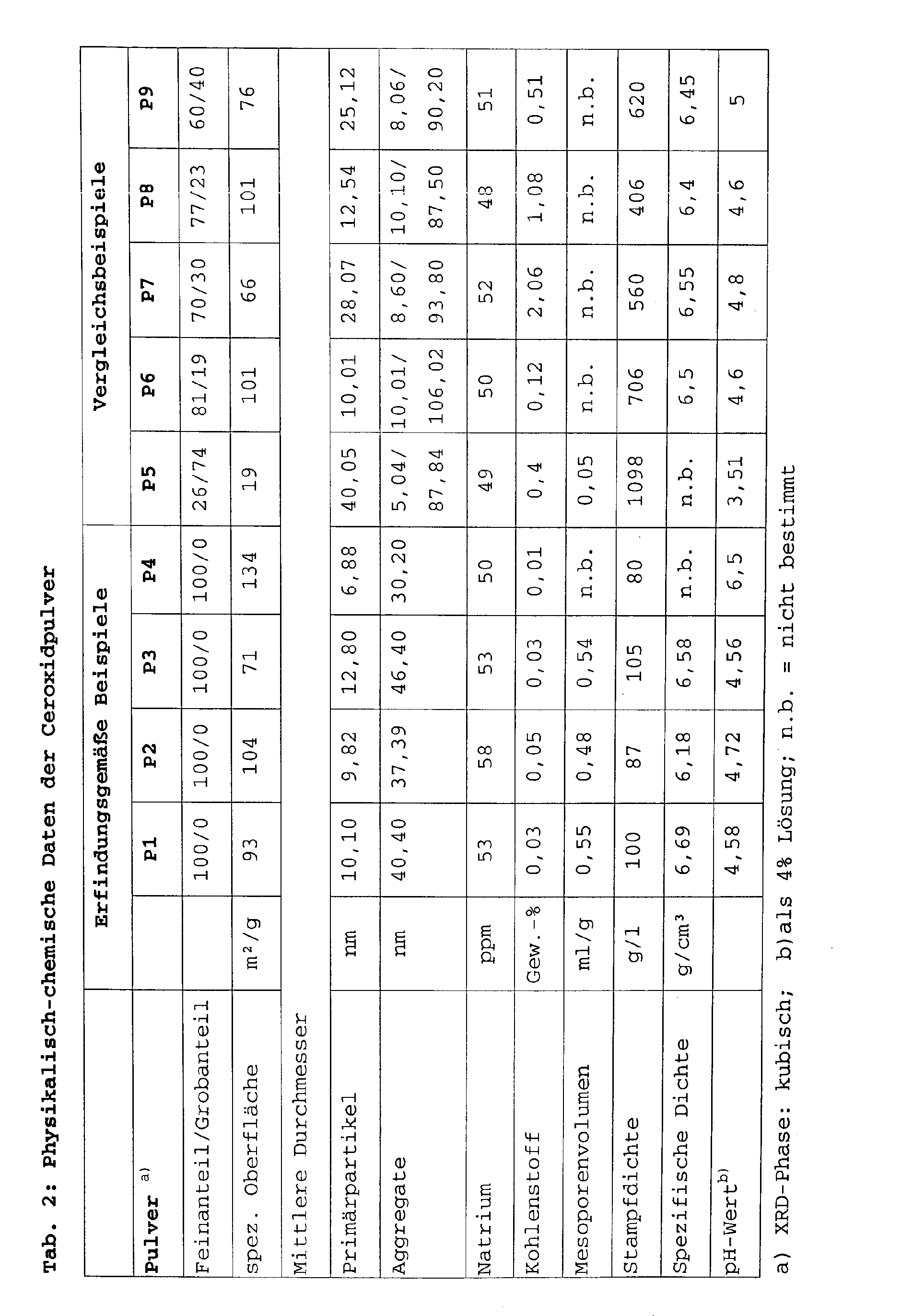
- the examples for the preparation of the cerium oxide powders show that only within narrow limits can an inventive powder, which is free of coarse fractions, be obtained.
- the powders P1 to P4 according to the invention are free from coarse fractions and have mean primary particle diameters between 6.88 nm and 12.80 nm and average aggregate diameters between 30.20 nm and 46.40 nm.
- Example 5 a non-inventive mixture of coarse and finely divided ceria is obtained.
- the parameter lambda, the velocity of the aerosol droplets and the velocity in the reaction space are outside the claimed values.
- example 6 is a non-inventive cerium oxide powder of coarse and fine fraction is formed. Although all process parameters except the secondary air are within the claimed ranges, no powder according to the invention is obtained.
- Example 7 the lambda value and the velocity of the aerosol droplets and the velocity of the reaction mixture in the reaction space are outside the claimed range. In this case, besides a coarse fraction of cerium oxide powder, a high carbon content was also found.
- Example 8 too high a lambda value results in Example 9 too coarse droplet distribution to one not product according to the invention
- the powders P1 to P4 according to the invention have on their surface a stoichiometry of CeO 1.8 , determined by means of XPS analysis.
- Figures 2 and 3 show the narrow distribution of Diameter of the primary particles and the projected Aggregate diameter using the example of powder 2.
- the ceria powders according to the invention can be easily disperse and deliver at already low levels Energy input average aggregate diameter of less than 200 nm.
Landscapes
- Chemical & Material Sciences (AREA)
- Engineering & Computer Science (AREA)
- Organic Chemistry (AREA)
- Materials Engineering (AREA)
- Chemical Kinetics & Catalysis (AREA)
- Nanotechnology (AREA)
- General Physics & Mathematics (AREA)
- Condensed Matter Physics & Semiconductors (AREA)
- Composite Materials (AREA)
- Crystallography & Structural Chemistry (AREA)
- Physics & Mathematics (AREA)
- Life Sciences & Earth Sciences (AREA)
- Geology (AREA)
- Inorganic Chemistry (AREA)
- Compounds Of Alkaline-Earth Elements, Aluminum Or Rare-Earth Metals (AREA)
- Catalysts (AREA)
- Oxygen, Ozone, And Oxides In General (AREA)
- Colloid Chemistry (AREA)
Abstract
Description
Besonders vorteilhaft zur Erzielung eines feinteiligen Pulvers, welches frei ist von Grobanteilen, ist eine Erhöhung der Ceroxid-Precursor-Flußrate und eine Verringerung des Sauerstoffflusses. Die mittlere Partikelgröße wird abgeleitet aus dem XRD-Spektrum. Speziell die Zuführung von iso-Octan mit seiner hohen Verbrennungsenthalpie und einer hohen Verdampfungs/Verbrennungsrate soll den Anteil gröberer Partikel reduzieren. Die spezifische Oberfläche der Ceroxidpartikel, die zwischen 101 und 240 m2/g liegen kann, soll durch Variation des Verhältnisses von Ceroxid-Precursor und Sauerstoff verändert werden können. Eine Erhöhung der Precursor-Zuführrate bei konstantem Sauerstofffluss soll zu einer Erhöhung der Partikelgröße, eine Erhöhung des Sauerstoffflusses bei konstanter Precursor-Zuführrate zu einer Verkleinerung der Partikelgröße führen.
- es eine spezifische Oberfläche zwischen 70 und 150 m2/g,
- einen mittleren Primärpartikeldurchmesser zwischen 5 und 20 nm und,
- einen mittleren, projizierten Aggregatdurchmesser zwischen 20 und 100 nm aufweist.
- das Aerosol aus einem Zerstäubergas, vorzugsweise Luft, und einer Lösung erzeugt wird, die zwischen 2 und 40 Gew.-% einer Cerverbindung, welche oxidativ in Ceroxid umgewandelt werden kann, enthält,
- die Flamme aus einem wasserstoffhaltigen Brenngas und Primärluft, welche Luft selbst oder ein Luft/Sauerstoffgemisch sein kann, erhalten wird,
- in den Reaktionsraum wenigstens die gleiche Menge an Sekundärluft eingeführt wird, wie Primärluft,
- für lambda gilt, dass 1,1 ≤ lambda ≤ 1,5 ist, wobei sich lambda errechnet aus dem Quotienten der Summe des Sauerstoffanteiles der Primärluft, der Sekundärluft und des Zerstäubergases, falls Sauerstoff enthaltend, dividiert durch die Summe aus der zu oxidierenden Cerverbindung und des wasserstoffhaltigen Brenngases, jeweils in mol/h,
- die Austrittsgeschwindigkeit der Flüssigkeitströpfchen aus der Zerstäubereinheit in den Reaktionsraum größer als 500 m/s ist, und
- die Geschwindigkeit des Reaktionsgemisches im Reaktionsraum größer als 2 m/s ist.

| Aggregatdurchmesser in Dispersionen | |||||
| Dispersion | D1 | D2 | D3 | D4 | |
| Mittelwert | nm | 156 | 147 | 114 | 130 |
| 90% kleiner | nm | 237 | 236 | 203 | 205 |
| 95% kleiner | nm | 280 | 277 | 237 | 249 |
Claims (37)
- Polykristallines Ceroxidpulver in Form von Aggregaten von Primärpartikeln, dadurch gekennzeichnet, dass eseine spezifische Oberfläche zwischen 70 und 150 m2/g,einen mittleren Primärpartikeldurchmesser zwischen 5 und 20 nm und,einen mittleren, projizierten Aggregatdurchmesser zwischen 20 und 100 nm aufweist.
- Ceroxidpulver nach Anspruch 1, dadurch gekennzeichnet, dass die spezifische Oberfläche zwischen 90 und 120 m2/g liegt.
- Ceroxidpulver nach den Ansprüchen 1 oder 2, dadurch gekennzeichnet, dass der mittlere, anzahlbezogene Primärpartikeldurchmesser zwischen 8 und 15 nm beträgt.
- Ceroxidpulver nach den Ansprüchen 1 bis 3, dadurch gekennzeichnet, dass der mittlere, projizierte Aggregatdurchmesser zwischen 30 und 70 nm beträgt.
- Ceroxidpulver nach den Ansprüchen 1 bis 4, dadurch gekennzeichnet, dass wenigstens 68% der Primärpartikeldurchmesser in einem Bereich zwischen 0,6 m und 1,4 m liegen, wobei m der mittlere Primärpartikeldurchmesser ist.
- Ceroxidpulver nach den Ansprüchen 1 bis 5, dadurch gekennzeichnet, dass wenigstens 68% der projizierten Aggregatdurchmesser in einem Bereich zwischen 0,6 m und 1,4 m liegen, wobei m der mittlere projizierte Aggregatdurchmesser ist.
- Ceroxidpulver nach den Ansprüchen 1 bis 6, dadurch gekennzeichnet, dass wenigstens 70% der Aggregate eine Fläche von weniger als 1500 nm2 aufweisen.
- Ceroxidpulver nach den Ansprüchen 1 bis 7, dadurch gekennzeichnet, dass wenigstens 85% der Aggregate eine Fläche von weniger als 4500 n m2 aufweisen.
- Ceroxidpulver nach den Ansprüchen 1 bis 8, dadurch gekennzeichnet, dass es eine Zusammensetzung CeOx auf der Oberfläche von 1,5 < x < 2 aufweist.
- Ceroxidpulver nach den Ansprüchen 1 bis 9, dadurch gekennzeichnet, dass es einen Gesamt-Natriumgehalt von weniger als 500 ppm aufweist.
- Ceroxidpulver nach Anspruch 10, dadurch gekennzeichnet, dass der Natriumgehalt an der Oberfläche kleiner als 10 ppm ist.
- Ceroxidpulver nach den Ansprüchen 1 bis 11, dadurch gekennzeichnet, dass es einen Kohlenstoffgehalt von weniger als 0,1 Gew.-% aufweist.
- Ceroxidpulver nach den Ansprüchen 1 bis 12, dadurch gekennzeichnet, dass es ein Mesoporenvolumen von 0,4 bis 0,6 ml/g aufweist.
- Ceroxidpulver nach den Ansprüchen 1 bis 13, dadurch gekennzeichnet, dass es eine monomodale Mesoporengrößenverteilung aufweist.
- Verfahren zur Herstellung des Ceroxidpulvers nach den Ansprüchen 1 bis 14, dadurch gekennzeichnet, dass man ein Aerosol in einer Flamme, welche in einen Reaktionsraum brennt, zur Reaktion bringt, anschliessend den erhaltenen Feststoff von den gasförmigen Stoffen abtrennt, wobeidas Aerosol aus einem Zerstäubergas, vorzugsweise Luft, und einer Lösung erzeugt wird, die zwischen 2 und 40 Gew.-% einer Cerverbindung, welche oxidativ in Ceroxid umgewandelt werden kann, enthält,die Flamme aus einem wasserstoffhaltigen Brenngas und Primärluft, welche Luft selbst oder ein Luft/Sauerstoffgemisch sein kann, erhalten wird,in den Reaktionsraum wenigstens die gleiche Menge an Sekundärluft eingeführt wird, wie Primärluft,für lambda gilt, dass 1,1 ≤ lambda ≤ 1,5 ist, wobei sich lambda errechnet aus dem Quotienten der Summe des Sauerstoffanteiles der Primärluft, der Sekundärluft und des Zerstäubergases, falls Sauerstoff enthaltend, dividiert durch die Summe aus der zu oxidierenden Cerverbindung und des wasserstoffhaltigen Brenngases, jeweils in mol/h,die Austrittsgeschwindigkeit der Flüssigkeitströpfchen aus der Zerstäubereinheit in den Reaktionsraum größer als 500 m/s ist, unddie Geschwindigkeit des Reaktionsgemisches im Reaktionsraum größer als 2 m/s ist.
- Verfahren nach Anspruch 15, dadurch gekennzeichnet, dass die Lösung zwischen 5 und 25 Gew.-% einer Cerverbindung enthält.
- Verfahren nach den Ansprüchen 15 oder 16, dadurch gekennzeichnet, dass die Lösung aus welcher das Aerosol erhalten wird, organisch ist.
- Verfahren nach den Ansprüchen 15 bis 17, dadurch gekennzeichnet, dass die Cerverbindung eine organische ist.
- Verfahren nach den Ansprüchen 15 bis 18, dadurch gekennzeichnet, dass das Aerosol durch eine Ultraschallvernebelung oder mindestens eine Mehrstoffdüse erzeugt wird.
- Verfahren nach den Ansprüchen 15 bis 19, dadurch gekennzeichnet, dass der lambda-Wert zwischen 1,2 und 1,5 liegt.
- Verfahren nach den Ansprüchen 15 bis 20, dadurch gekennzeichnet, dass die Menge an Sekundärluft doppelt so hoch ist wie an Primärluft.
- Verfahren nach den Ansprüchen 15 bis 21, dadurch gekennzeichnet, dass im Reaktionsraum ein Restriktor angebracht ist.
- Verfahren nach den Ansprüchen 15 bis 22, dadurch gekennzeichnet, dass das Reaktionsgemisch nach Verlassen des Reaktionsraumes auf Temperaturen von 100 bis 200°C abgekühlt wird.
- Verfahren nach den Ansprüchen 15 bis 23, dadurch gekennzeichnet, dass die Abtrennung des Feststoffes an Filtern bei Temperaturen zwischen 100 und 200 °C stattfindet.
- Verfahren nach den Ansprüchen 15 bis 24, dadurch gekennzeichnet, dass die Temperatur im Reaktionsraum, gemessen 0,5 m unterhalb der Flamme, zwischen 1000°C und 1400°C liegt.
- Verwendung des pyrogen hergestellten Ceroxides gemäß der Ansprüche 1 bis 14 als Poliermittel in der Elektronikindustrie, zur Hitzestabilisierung von Silikonkautschuk und als Katalysator.
- Dispersion enthaltend das Ceroxidpulver nach den Ansprüchen 1 bis 14.
- Dispersion nach Anspruch 27, dadurch gekennzeichnet, dass das Ceroxidpulver einen mittleren Aggregatdurchmesser d50 in der Dispersion von weniger als 200 nm aufweist.
- Dispersion nach den Ansprüchen 27 oder 28, dadurch gekennzeichnet, dass wenigstens 90% der Aggregate in der Dispersion einen Aggregatdurchmesser zwischen 200 und 300 nm aufweisen.
- Dispersion nach den Ansprüchen 27 bis 29, dadurch gekennzeichnet, dass keine Aggregate in der Dispersion einen Aggregatdurchmesser von mehr als 500 nm aufweisen.
- Dispersion nach den Ansprüchen 27 bis 30, dadurch gekennzeichnet, dass der Gehalt an Ceroxid zwischen 2 und 20 Gew.-% liegt.
- Dispersion nach den Ansprüchen 27 bis 31, dadurch gekennzeichnet, dass sie wenigstens ein Dispergiermittel enthält.
- Dispersion nach Anspruch 32, dadurch gekennzeichnet, das Dispergiermittel die Gruppe der wasserlöslichen organische Polymere, der wasserlöslichen, anionischen oberflächenaktive Stoffe, der wasserlöslichen, nichtionischen, oberflächenaktiven Stoffe und/oder der wasserlöslichen Amine umfasst.
- Dispersion nach den Ansprüchen 27 bis 33, dadurch gekennzeichnet, dass der Anteil an Dispergiermittel zwischen 0,1 und 50 Gew.-%, bezogen auf Ceroxid, liegt.
- Dispersion nach den Ansprüchen 27 bis 34, dadurch gekennzeichnet, dass sie einen alkalischen pH-Wert aufweist.
- Verfahren zur Herstellung der Dispersion gemäß der Ansprüche 27 bis 35, dadurch gekennzeichnet, dass das Ceroxidpulver in einem flüssigen Medium, bevorzugt wässerig, vordispergiert und anschließend dispergiert wird, wobei gegebenenfalls Dispergiermittel und pH-Wert regulierende Substanzen vor der Vordispergierung im flüssigen Medium vorgelegt werden oder während der Dispergierung zugegeben werden.
- Verwendung der Dispersion gemäß den Ansprüchen 27 bis 35 zum Polieren von oxidischen und metallischen Schichten.
Applications Claiming Priority (2)
| Application Number | Priority Date | Filing Date | Title |
|---|---|---|---|
| DE10337199 | 2003-08-13 | ||
| DE10337199A DE10337199A1 (de) | 2003-08-13 | 2003-08-13 | Ceroxidpulver |
Publications (2)
| Publication Number | Publication Date |
|---|---|
| EP1506940A1 true EP1506940A1 (de) | 2005-02-16 |
| EP1506940B1 EP1506940B1 (de) | 2011-12-21 |
Family
ID=33560310
Family Applications (1)
| Application Number | Title | Priority Date | Filing Date |
|---|---|---|---|
| EP04012835A Expired - Lifetime EP1506940B1 (de) | 2003-08-13 | 2004-05-29 | Ceroxidpulver |
Country Status (10)
| Country | Link |
|---|---|
| US (1) | US7264787B2 (de) |
| EP (1) | EP1506940B1 (de) |
| JP (1) | JP4215692B2 (de) |
| KR (1) | KR100604298B1 (de) |
| CN (1) | CN100368299C (de) |
| AT (1) | ATE538071T1 (de) |
| DE (1) | DE10337199A1 (de) |
| IL (1) | IL163462A (de) |
| SG (1) | SG109540A1 (de) |
| TW (1) | TWI294409B (de) |
Cited By (7)
| Publication number | Priority date | Publication date | Assignee | Title |
|---|---|---|---|---|
| US7510693B2 (en) | 2005-02-05 | 2009-03-31 | Degussa Ag | Process for the production of metal oxide powders |
| EP1904072A4 (de) * | 2005-06-27 | 2009-06-17 | Edward Via Virginia College Of | Entzündungshemmende, strahlenschützende und lebensdauerverlängernde funktionen von ceroxid-nanoteilchen |
| US7553465B2 (en) | 2005-08-12 | 2009-06-30 | Degussa Ag | Cerium oxide powder and cerium oxide dispersion |
| EP1931597A4 (de) * | 2005-09-02 | 2011-03-09 | Lg Chemical Ltd | Ceroxidpulver für einkomponentige cmp-aufschlämmung, herstellungsverfahren dafür, einkomponentige cmp-aufschlämmung damit und verfahren zur flachgrabenisolierung unter verwendung der aufschlämmung |
| EP1757560A3 (de) * | 2005-08-12 | 2011-09-07 | Evonik Degussa GmbH | Ceroxid-Pulver und Ceroxid-Dispersion |
| WO2020161067A1 (en) | 2019-02-04 | 2020-08-13 | Evonik Operations Gmbh | Process for the preparation of methionine |
| WO2020249495A1 (en) | 2019-06-13 | 2020-12-17 | Evonik Operations Gmbh | Process for the preparation of methionine |
Families Citing this family (29)
| Publication number | Priority date | Publication date | Assignee | Title |
|---|---|---|---|---|
| DE10337199A1 (de) | 2003-08-13 | 2005-03-10 | Degussa | Ceroxidpulver |
| KR100630691B1 (ko) | 2004-07-15 | 2006-10-02 | 삼성전자주식회사 | 산화세륨 연마 입자 및 그 제조 방법과 cmp용 슬러리조성물 및 그 제조 방법과 이들을 이용한 기판 연마 방법 |
| EP1724012A1 (de) * | 2005-05-21 | 2006-11-22 | Degussa AG | Katalysator bestehende aus Gold auf einem Cerium- und Manganoxid träger |
| KR100782258B1 (ko) * | 2005-08-12 | 2007-12-04 | 데구사 게엠베하 | 산화 세륨 분말 및 산화 세륨 분산액 |
| US8361419B2 (en) * | 2005-09-20 | 2013-01-29 | Lg Chem, Ltd. | Cerium carbonate powder, method for preparing the same, cerium oxide powder made therefrom, method for preparing the same, and CMP slurry comprising the same |
| CN101268017A (zh) * | 2005-09-20 | 2008-09-17 | Lg化学株式会社 | 碳酸铈粉末及其制备方法、由该碳酸铈粉末制备的氧化铈粉末及其制备方法以及含该氧化铈粉末的cmp浆料 |
| CN101039876B (zh) * | 2005-10-14 | 2011-07-27 | Lg化学株式会社 | 用于化学机械抛光的二氧化铈粉末的制备方法及使用该粉末制备化学机械抛光浆料的方法 |
| US8157877B2 (en) * | 2005-12-16 | 2012-04-17 | Jsr Corporation | Chemical mechanical polishing aqueous dispersion, chemical mechanical polishing method, and kit for preparing chemical mechanical polishing aqueous dispersion |
| CN100357362C (zh) * | 2005-12-26 | 2007-12-26 | 内蒙古科技大学 | 一种抛光用超细氧化铈的制备方法 |
| WO2008064357A2 (en) * | 2006-11-22 | 2008-05-29 | University Of Florida Research Foundation, Inc. | Nanoparticles for protection of cells from oxidative stress |
| US8084529B2 (en) * | 2006-12-28 | 2011-12-27 | Dow Corning Toray Co., Ltd. | Thermosetting silicone rubber composition |
| JP5379351B2 (ja) * | 2007-01-17 | 2013-12-25 | 三井金属鉱業株式会社 | セリウム系研摩材 |
| US8491682B2 (en) * | 2007-12-31 | 2013-07-23 | K.C. Tech Co., Ltd. | Abrasive particles, method of manufacturing the abrasive particles, and method of manufacturing chemical mechanical polishing slurry |
| EP2242717A1 (de) * | 2008-02-08 | 2010-10-27 | Umicore | Dotierte ceria-abschleifungen mit gesteuerter morphologie und ihre herstellung |
| FR2931471B1 (fr) * | 2008-05-20 | 2011-01-14 | Commissariat Energie Atomique | Systeme de production autonome d'hydrogene pour un systeme embarque |
| US9585840B1 (en) | 2009-07-10 | 2017-03-07 | University Of Central Florida Research Foundation, Inc. | Redox active cerium oxide nanoparticles and associated methods |
| US8187562B2 (en) * | 2010-05-13 | 2012-05-29 | Korea Institute Of Geoscience And Mineral Resources (Kigam) | Method for producing cerium dioxide nanopowder by flame spray pyrolysis and cerium dioxide nanopowder produced by the method |
| WO2012036786A1 (en) * | 2010-09-17 | 2012-03-22 | University Of L'aquila | Nanoparticles of cerium oxide targeted to an amyloid-beta antigen of alzheimer's disease |
| US11655405B2 (en) | 2014-09-12 | 2023-05-23 | Taiwan Semiconductor Manufacturing Company Limited | Method of manufacturing cerium dioxide powder and cerium dioxide powder |
| SG11201706996RA (en) * | 2015-03-18 | 2017-09-28 | Phinergy Ltd | Metal oxide particles and method of producing thereof |
| CN105017972B (zh) * | 2015-07-20 | 2018-05-04 | 林州市清华·红旗渠新材料产业化发展中心 | 一种铈基抛光粉的制备方法 |
| JP6827318B2 (ja) * | 2016-12-28 | 2021-02-10 | 花王株式会社 | 酸化セリウム砥粒 |
| KR102275429B1 (ko) * | 2017-12-11 | 2021-07-12 | 주식회사 케이씨텍 | Cmp용 슬러리 조성물 및 이에 포함된 연마입자 |
| CN109015341B (zh) * | 2018-08-03 | 2020-08-11 | 成都时代立夫科技有限公司 | 一种基于多孔氧化铈的cmp抛光层及其制备方法 |
| CN109534383B (zh) * | 2019-01-18 | 2022-10-11 | 江西师范大学 | 一种二氧化铈纳米片的合成方法 |
| EP3689851A1 (de) | 2019-02-04 | 2020-08-05 | Evonik Operations GmbH | Salzfreie herstellung von methionin aus methioninnitril |
| US20240158251A1 (en) * | 2021-03-12 | 2024-05-16 | Rhodia Operations | Cerium oxide particles, making process thereof and use thereof in chemical mechanical polishing |
| CN119662130A (zh) * | 2023-09-19 | 2025-03-21 | 雄安稀土功能材料创新中心有限公司 | 一种氧化铈基抛光粉及制备方法、抛光液及应用 |
| KR20260024800A (ko) * | 2024-08-14 | 2026-02-23 | 에스케이엔펄스 주식회사 | 반도체 연마 공정용 연마 입자 분산액, 연마 슬러리 조성물 및 반도체 소자의 제조 방법 |
Citations (2)
| Publication number | Priority date | Publication date | Assignee | Title |
|---|---|---|---|---|
| US5064628A (en) * | 1986-03-26 | 1991-11-12 | Rhone-Poulenc Chimie | Novel ceric oxides and preparation thereof |
| WO2001036332A1 (en) * | 1999-11-17 | 2001-05-25 | Cabot Corporation | Ceria composition and process for preparing same |
Family Cites Families (12)
| Publication number | Priority date | Publication date | Assignee | Title |
|---|---|---|---|---|
| JP2614478B2 (ja) * | 1988-02-01 | 1997-05-28 | 東レ・ダウコーニング・シリコーン株式会社 | フィルム状シリコーンゴム接着剤 |
| KR100336598B1 (ko) | 1996-02-07 | 2002-05-16 | 이사오 우치가사키 | 산화 세륨 연마제 제조용 산화 세륨 입자 |
| JPH11330015A (ja) | 1996-03-29 | 1999-11-30 | Hitachi Chem Co Ltd | 酸化セリウム研磨剤及び基板の製造法 |
| US5858813A (en) | 1996-05-10 | 1999-01-12 | Cabot Corporation | Chemical mechanical polishing slurry for metal layers and films |
| US6887566B1 (en) * | 1999-11-17 | 2005-05-03 | Cabot Corporation | Ceria composition and process for preparing same |
| FR2801298B1 (fr) * | 1999-11-19 | 2002-05-03 | Rhodia Terres Rares | Dispersion colloidale d'un compose de cerium et contenant du cerium iii, procede de preparation et utilisation |
| TWI272249B (en) | 2001-02-27 | 2007-02-01 | Nissan Chemical Ind Ltd | Crystalline ceric oxide sol and process for producing the same |
| JP3945745B2 (ja) * | 2001-03-09 | 2007-07-18 | 三井金属鉱業株式会社 | セリウム系研摩材及び研摩材スラリー並びにセリウム系研摩材の製造方法 |
| US7025943B2 (en) * | 2002-05-15 | 2006-04-11 | The Curators Of The University Of Missouri | Method for preparation of nanometer cerium-based oxide particles |
| DE10337199A1 (de) | 2003-08-13 | 2005-03-10 | Degussa | Ceroxidpulver |
| DE10342826B3 (de) | 2003-09-17 | 2005-05-12 | Degussa Ag | Dispersion von pyrogen hergestelltem Ceroxid |
| US7553465B2 (en) | 2005-08-12 | 2009-06-30 | Degussa Ag | Cerium oxide powder and cerium oxide dispersion |
-
2003
- 2003-08-13 DE DE10337199A patent/DE10337199A1/de not_active Withdrawn
-
2004
- 2004-05-29 AT AT04012835T patent/ATE538071T1/de active
- 2004-05-29 EP EP04012835A patent/EP1506940B1/de not_active Expired - Lifetime
- 2004-07-12 US US10/887,819 patent/US7264787B2/en not_active Expired - Lifetime
- 2004-07-29 SG SG200404340A patent/SG109540A1/en unknown
- 2004-08-10 JP JP2004233631A patent/JP4215692B2/ja not_active Expired - Fee Related
- 2004-08-11 TW TW093124078A patent/TWI294409B/zh not_active IP Right Cessation
- 2004-08-11 IL IL163462A patent/IL163462A/en not_active IP Right Cessation
- 2004-08-12 CN CNB2004100574252A patent/CN100368299C/zh not_active Expired - Fee Related
- 2004-08-12 KR KR1020040063423A patent/KR100604298B1/ko not_active Expired - Fee Related
Patent Citations (2)
| Publication number | Priority date | Publication date | Assignee | Title |
|---|---|---|---|---|
| US5064628A (en) * | 1986-03-26 | 1991-11-12 | Rhone-Poulenc Chimie | Novel ceric oxides and preparation thereof |
| WO2001036332A1 (en) * | 1999-11-17 | 2001-05-25 | Cabot Corporation | Ceria composition and process for preparing same |
Non-Patent Citations (1)
| Title |
|---|
| DURAN P ET AL: "Cerium (IV) oxide synthesis and sinterable powders prepared by the polymeric organic complex solution method", JOURNAL OF THE EUROPEAN CERAMIC SOCIETY, ELSEVIER SCIENCE PUBLISHERS, BARKING, ESSEX, GB, vol. 22, no. 9-10, September 2002 (2002-09-01), pages 1711 - 1721, XP004350849, ISSN: 0955-2219 * |
Cited By (8)
| Publication number | Priority date | Publication date | Assignee | Title |
|---|---|---|---|---|
| US7510693B2 (en) | 2005-02-05 | 2009-03-31 | Degussa Ag | Process for the production of metal oxide powders |
| US7968070B2 (en) | 2005-02-05 | 2011-06-28 | Evonik Degussa Gmbh | Process for the production of metal oxide powders |
| EP1904072A4 (de) * | 2005-06-27 | 2009-06-17 | Edward Via Virginia College Of | Entzündungshemmende, strahlenschützende und lebensdauerverlängernde funktionen von ceroxid-nanoteilchen |
| US7553465B2 (en) | 2005-08-12 | 2009-06-30 | Degussa Ag | Cerium oxide powder and cerium oxide dispersion |
| EP1757560A3 (de) * | 2005-08-12 | 2011-09-07 | Evonik Degussa GmbH | Ceroxid-Pulver und Ceroxid-Dispersion |
| EP1931597A4 (de) * | 2005-09-02 | 2011-03-09 | Lg Chemical Ltd | Ceroxidpulver für einkomponentige cmp-aufschlämmung, herstellungsverfahren dafür, einkomponentige cmp-aufschlämmung damit und verfahren zur flachgrabenisolierung unter verwendung der aufschlämmung |
| WO2020161067A1 (en) | 2019-02-04 | 2020-08-13 | Evonik Operations Gmbh | Process for the preparation of methionine |
| WO2020249495A1 (en) | 2019-06-13 | 2020-12-17 | Evonik Operations Gmbh | Process for the preparation of methionine |
Also Published As
| Publication number | Publication date |
|---|---|
| KR100604298B1 (ko) | 2006-07-28 |
| TWI294409B (en) | 2008-03-11 |
| KR20050018754A (ko) | 2005-02-28 |
| TW200510251A (en) | 2005-03-16 |
| US20050036928A1 (en) | 2005-02-17 |
| US7264787B2 (en) | 2007-09-04 |
| ATE538071T1 (de) | 2012-01-15 |
| SG109540A1 (en) | 2005-03-30 |
| IL163462A (en) | 2008-08-07 |
| CN100368299C (zh) | 2008-02-13 |
| EP1506940B1 (de) | 2011-12-21 |
| DE10337199A1 (de) | 2005-03-10 |
| JP4215692B2 (ja) | 2009-01-28 |
| JP2005060222A (ja) | 2005-03-10 |
| CN1579945A (zh) | 2005-02-16 |
Similar Documents
| Publication | Publication Date | Title |
|---|---|---|
| EP1506940B1 (de) | Ceroxidpulver | |
| DE60217141T2 (de) | Mit zweiwertigen metalloxiden dotiertes aluminiumoxid, hergestellt durch flammenhydrolyse und daraus hergestellte wässrige dispersionen | |
| EP1216958B1 (de) | Wässrige Dispersion, Verfahren zu deren Herstellung und Verwendung | |
| DE10204471C1 (de) | Wässerige Dispersion enthaltend mit Ceroxid umhülltes Siliciumdioxidpulver, Verfahren zu deren Herstellung und Verwendung | |
| EP1203801B1 (de) | Wässrige Dispersion, Verfahren zu deren Herstellung und Verwendung | |
| EP1688394B1 (de) | Verfahren zur Herstellung von Metalloxidpulvern | |
| EP0823885B1 (de) | Verfahren zur herstellung schwach agglomerierter nanoskaliger teilchen | |
| EP1904252B1 (de) | Herstellungsverfahren nanokristalliner sinterkörper auf basis von alpha-aluminiumoxid | |
| EP1308240B1 (de) | Dispersion, enthaltend pyrogen hergestellte Abrasivpartikel mit superparamagnetischen Domänen | |
| DE10235758A1 (de) | Dotiertes Zinkoxidpulver, Verfahren zu seiner Herstellung und Verwendung | |
| DE102007058674A1 (de) | Nanopartikuläre Zusammensetzung und Verfahren zu deren Herstellung | |
| EP1757560A2 (de) | Ceroxid-Pulver und Ceroxid-Dispersion | |
| EP1234800A1 (de) | Wässrige Dispersion, Verfahren zu ihrer Herstellung und Verwendung | |
| EP2116513A1 (de) | Indiumzinnoxohydrat-, Indiumzinnoxid-Pulver und Dispersion hiervon | |
| DE102005047807A1 (de) | Modifizierte Nanopartikel | |
| DE102005033393B4 (de) | Verfahren zur Herstellung von nanokristallinem α-Al2O3 | |
| DE69703083T2 (de) | Verfahren zur Herstellung von feinen kugelförmigen Yttriumoxidteilchen | |
| DE10392703B4 (de) | Metalloxidpulver für Hochpräzisionspolieren und ein Verfahren zur Herstellung desselben | |
| DE60037138T2 (de) | Feine titanoxidpartikel und verfahren zur herstellung derselben | |
| EP1785395B1 (de) | Verfahren zur Herstellung dotierter Metalloxidpartikel | |
| EP1907323B1 (de) | Verfahren zur herstellung von nanopartikeln aus aluminiumoxid und oxiden von elementen der i. und ii. hauptgruppe des periodensystems | |
| EP1468962A1 (de) | Domänen in einer Metalloxid-Matrix | |
| DE10251029A1 (de) | Pyrogen hergestelltes Ceroxid | |
| EP0011265B1 (de) | Verfahren zur Herstellung von Hartferritpulver | |
| DE3339490A1 (de) | Verfahren zur plasmachemischen gewinnung eines feindispersen beschickungsguts |
Legal Events
| Date | Code | Title | Description |
|---|---|---|---|
| PUAI | Public reference made under article 153(3) epc to a published international application that has entered the european phase |
Free format text: ORIGINAL CODE: 0009012 |
|
| 17P | Request for examination filed |
Effective date: 20040529 |
|
| AK | Designated contracting states |
Kind code of ref document: A1 Designated state(s): AT BE BG CH CY CZ DE DK EE ES FI FR GB GR HU IE IT LI LU MC NL PL PT RO SE SI SK TR |
|
| AX | Request for extension of the european patent |
Extension state: AL HR LT LV MK |
|
| AKX | Designation fees paid |
Designated state(s): AT BE BG CH CY CZ DE DK EE ES FI FR GB GR HU IE IT LI LU MC NL PL PT RO SE SI SK TR |
|
| RAP1 | Party data changed (applicant data changed or rights of an application transferred) |
Owner name: DEGUSSA GMBH |
|
| RAP1 | Party data changed (applicant data changed or rights of an application transferred) |
Owner name: EVONIK DEGUSSA GMBH |
|
| RAP1 | Party data changed (applicant data changed or rights of an application transferred) |
Owner name: EVONIK DEGUSSA GMBH |
|
| 17Q | First examination report despatched |
Effective date: 20090220 |
|
| GRAP | Despatch of communication of intention to grant a patent |
Free format text: ORIGINAL CODE: EPIDOSNIGR1 |
|
| GRAS | Grant fee paid |
Free format text: ORIGINAL CODE: EPIDOSNIGR3 |
|
| GRAA | (expected) grant |
Free format text: ORIGINAL CODE: 0009210 |
|
| AK | Designated contracting states |
Kind code of ref document: B1 Designated state(s): AT BE BG CH CY CZ DE DK EE ES FI FR GB GR HU IE IT LI LU MC NL PL PT RO SE SI SK TR |
|
| REG | Reference to a national code |
Ref country code: GB Ref legal event code: FG4D Free format text: NOT ENGLISH |
|
| REG | Reference to a national code |
Ref country code: CH Ref legal event code: EP |
|
| REG | Reference to a national code |
Ref country code: AT Ref legal event code: REF Ref document number: 538071 Country of ref document: AT Kind code of ref document: T Effective date: 20120115 |
|
| REG | Reference to a national code |
Ref country code: IE Ref legal event code: FG4D |
|
| REG | Reference to a national code |
Ref country code: DE Ref legal event code: R096 Ref document number: 502004013164 Country of ref document: DE Effective date: 20120322 |
|
| REG | Reference to a national code |
Ref country code: NL Ref legal event code: VDEP Effective date: 20111221 |
|
| PG25 | Lapsed in a contracting state [announced via postgrant information from national office to epo] |
Ref country code: SE Free format text: LAPSE BECAUSE OF FAILURE TO SUBMIT A TRANSLATION OF THE DESCRIPTION OR TO PAY THE FEE WITHIN THE PRESCRIBED TIME-LIMIT Effective date: 20111221 Ref country code: SI Free format text: LAPSE BECAUSE OF FAILURE TO SUBMIT A TRANSLATION OF THE DESCRIPTION OR TO PAY THE FEE WITHIN THE PRESCRIBED TIME-LIMIT Effective date: 20111221 Ref country code: NL Free format text: LAPSE BECAUSE OF FAILURE TO SUBMIT A TRANSLATION OF THE DESCRIPTION OR TO PAY THE FEE WITHIN THE PRESCRIBED TIME-LIMIT Effective date: 20111221 Ref country code: GR Free format text: LAPSE BECAUSE OF FAILURE TO SUBMIT A TRANSLATION OF THE DESCRIPTION OR TO PAY THE FEE WITHIN THE PRESCRIBED TIME-LIMIT Effective date: 20120322 |
|
| PG25 | Lapsed in a contracting state [announced via postgrant information from national office to epo] |
Ref country code: CY Free format text: LAPSE BECAUSE OF FAILURE TO SUBMIT A TRANSLATION OF THE DESCRIPTION OR TO PAY THE FEE WITHIN THE PRESCRIBED TIME-LIMIT Effective date: 20111221 |
|
| REG | Reference to a national code |
Ref country code: IE Ref legal event code: FD4D |
|
| PG25 | Lapsed in a contracting state [announced via postgrant information from national office to epo] |
Ref country code: CZ Free format text: LAPSE BECAUSE OF FAILURE TO SUBMIT A TRANSLATION OF THE DESCRIPTION OR TO PAY THE FEE WITHIN THE PRESCRIBED TIME-LIMIT Effective date: 20111221 Ref country code: IE Free format text: LAPSE BECAUSE OF FAILURE TO SUBMIT A TRANSLATION OF THE DESCRIPTION OR TO PAY THE FEE WITHIN THE PRESCRIBED TIME-LIMIT Effective date: 20111221 Ref country code: EE Free format text: LAPSE BECAUSE OF FAILURE TO SUBMIT A TRANSLATION OF THE DESCRIPTION OR TO PAY THE FEE WITHIN THE PRESCRIBED TIME-LIMIT Effective date: 20111221 Ref country code: BG Free format text: LAPSE BECAUSE OF FAILURE TO SUBMIT A TRANSLATION OF THE DESCRIPTION OR TO PAY THE FEE WITHIN THE PRESCRIBED TIME-LIMIT Effective date: 20120321 Ref country code: SK Free format text: LAPSE BECAUSE OF FAILURE TO SUBMIT A TRANSLATION OF THE DESCRIPTION OR TO PAY THE FEE WITHIN THE PRESCRIBED TIME-LIMIT Effective date: 20111221 |
|
| PG25 | Lapsed in a contracting state [announced via postgrant information from national office to epo] |
Ref country code: PL Free format text: LAPSE BECAUSE OF FAILURE TO SUBMIT A TRANSLATION OF THE DESCRIPTION OR TO PAY THE FEE WITHIN THE PRESCRIBED TIME-LIMIT Effective date: 20111221 Ref country code: PT Free format text: LAPSE BECAUSE OF FAILURE TO SUBMIT A TRANSLATION OF THE DESCRIPTION OR TO PAY THE FEE WITHIN THE PRESCRIBED TIME-LIMIT Effective date: 20120423 Ref country code: RO Free format text: LAPSE BECAUSE OF FAILURE TO SUBMIT A TRANSLATION OF THE DESCRIPTION OR TO PAY THE FEE WITHIN THE PRESCRIBED TIME-LIMIT Effective date: 20111221 |
|
| PLBE | No opposition filed within time limit |
Free format text: ORIGINAL CODE: 0009261 |
|
| STAA | Information on the status of an ep patent application or granted ep patent |
Free format text: STATUS: NO OPPOSITION FILED WITHIN TIME LIMIT |
|
| PG25 | Lapsed in a contracting state [announced via postgrant information from national office to epo] |
Ref country code: DK Free format text: LAPSE BECAUSE OF FAILURE TO SUBMIT A TRANSLATION OF THE DESCRIPTION OR TO PAY THE FEE WITHIN THE PRESCRIBED TIME-LIMIT Effective date: 20111221 |
|
| 26N | No opposition filed |
Effective date: 20120924 |
|
| PG25 | Lapsed in a contracting state [announced via postgrant information from national office to epo] |
Ref country code: IT Free format text: LAPSE BECAUSE OF FAILURE TO SUBMIT A TRANSLATION OF THE DESCRIPTION OR TO PAY THE FEE WITHIN THE PRESCRIBED TIME-LIMIT Effective date: 20111221 |
|
| PG25 | Lapsed in a contracting state [announced via postgrant information from national office to epo] |
Ref country code: MC Free format text: LAPSE BECAUSE OF NON-PAYMENT OF DUE FEES Effective date: 20120531 |
|
| REG | Reference to a national code |
Ref country code: CH Ref legal event code: PL |
|
| REG | Reference to a national code |
Ref country code: DE Ref legal event code: R097 Ref document number: 502004013164 Country of ref document: DE Effective date: 20120924 |
|
| GBPC | Gb: european patent ceased through non-payment of renewal fee |
Effective date: 20120529 |
|
| PG25 | Lapsed in a contracting state [announced via postgrant information from national office to epo] |
Ref country code: LI Free format text: LAPSE BECAUSE OF NON-PAYMENT OF DUE FEES Effective date: 20120531 Ref country code: CH Free format text: LAPSE BECAUSE OF NON-PAYMENT OF DUE FEES Effective date: 20120531 |
|
| PG25 | Lapsed in a contracting state [announced via postgrant information from national office to epo] |
Ref country code: ES Free format text: LAPSE BECAUSE OF FAILURE TO SUBMIT A TRANSLATION OF THE DESCRIPTION OR TO PAY THE FEE WITHIN THE PRESCRIBED TIME-LIMIT Effective date: 20120401 Ref country code: GB Free format text: LAPSE BECAUSE OF NON-PAYMENT OF DUE FEES Effective date: 20120529 |
|
| PG25 | Lapsed in a contracting state [announced via postgrant information from national office to epo] |
Ref country code: FI Free format text: LAPSE BECAUSE OF FAILURE TO SUBMIT A TRANSLATION OF THE DESCRIPTION OR TO PAY THE FEE WITHIN THE PRESCRIBED TIME-LIMIT Effective date: 20111221 |
|
| REG | Reference to a national code |
Ref country code: AT Ref legal event code: MM01 Ref document number: 538071 Country of ref document: AT Kind code of ref document: T Effective date: 20120529 |
|
| PG25 | Lapsed in a contracting state [announced via postgrant information from national office to epo] |
Ref country code: AT Free format text: LAPSE BECAUSE OF NON-PAYMENT OF DUE FEES Effective date: 20120529 |
|
| PG25 | Lapsed in a contracting state [announced via postgrant information from national office to epo] |
Ref country code: TR Free format text: LAPSE BECAUSE OF FAILURE TO SUBMIT A TRANSLATION OF THE DESCRIPTION OR TO PAY THE FEE WITHIN THE PRESCRIBED TIME-LIMIT Effective date: 20111221 |
|
| PG25 | Lapsed in a contracting state [announced via postgrant information from national office to epo] |
Ref country code: LU Free format text: LAPSE BECAUSE OF NON-PAYMENT OF DUE FEES Effective date: 20120529 |
|
| PG25 | Lapsed in a contracting state [announced via postgrant information from national office to epo] |
Ref country code: HU Free format text: LAPSE BECAUSE OF FAILURE TO SUBMIT A TRANSLATION OF THE DESCRIPTION OR TO PAY THE FEE WITHIN THE PRESCRIBED TIME-LIMIT Effective date: 20040529 |
|
| REG | Reference to a national code |
Ref country code: FR Ref legal event code: PLFP Year of fee payment: 13 |
|
| PGFP | Annual fee paid to national office [announced via postgrant information from national office to epo] |
Ref country code: FR Payment date: 20160520 Year of fee payment: 13 Ref country code: BE Payment date: 20160519 Year of fee payment: 13 |
|
| REG | Reference to a national code |
Ref country code: FR Ref legal event code: ST Effective date: 20180131 |
|
| REG | Reference to a national code |
Ref country code: BE Ref legal event code: MM Effective date: 20170531 |
|
| PG25 | Lapsed in a contracting state [announced via postgrant information from national office to epo] |
Ref country code: FR Free format text: LAPSE BECAUSE OF NON-PAYMENT OF DUE FEES Effective date: 20170531 |
|
| PG25 | Lapsed in a contracting state [announced via postgrant information from national office to epo] |
Ref country code: BE Free format text: LAPSE BECAUSE OF NON-PAYMENT OF DUE FEES Effective date: 20170531 |
|
| REG | Reference to a national code |
Ref country code: DE Ref legal event code: R081 Ref document number: 502004013164 Country of ref document: DE Owner name: EVONIK OPERATIONS GMBH, DE Free format text: FORMER OWNER: EVONIK DEGUSSA GMBH, 45128 ESSEN, DE |
|
| PGFP | Annual fee paid to national office [announced via postgrant information from national office to epo] |
Ref country code: DE Payment date: 20210520 Year of fee payment: 18 |
|
| REG | Reference to a national code |
Ref country code: DE Ref legal event code: R119 Ref document number: 502004013164 Country of ref document: DE |
|
| PG25 | Lapsed in a contracting state [announced via postgrant information from national office to epo] |
Ref country code: DE Free format text: LAPSE BECAUSE OF NON-PAYMENT OF DUE FEES Effective date: 20221201 |