EP1507307A1 - Photoelectric conversion device - Google Patents
Photoelectric conversion device Download PDFInfo
- Publication number
- EP1507307A1 EP1507307A1 EP03725689A EP03725689A EP1507307A1 EP 1507307 A1 EP1507307 A1 EP 1507307A1 EP 03725689 A EP03725689 A EP 03725689A EP 03725689 A EP03725689 A EP 03725689A EP 1507307 A1 EP1507307 A1 EP 1507307A1
- Authority
- EP
- European Patent Office
- Prior art keywords
- photoelectric transducer
- mol
- electrolyte layer
- semiconductor
- transducer according
- Prior art date
- Legal status (The legal status is an assumption and is not a legal conclusion. Google has not performed a legal analysis and makes no representation as to the accuracy of the status listed.)
- Granted
Links
Images

Classifications
-
- H—ELECTRICITY
- H01—ELECTRIC ELEMENTS
- H01M—PROCESSES OR MEANS, e.g. BATTERIES, FOR THE DIRECT CONVERSION OF CHEMICAL ENERGY INTO ELECTRICAL ENERGY
- H01M14/00—Electrochemical current or voltage generators not provided for in groups H01M6/00 - H01M12/00; Manufacture thereof
- H01M14/005—Photoelectrochemical storage cells
-
- H—ELECTRICITY
- H01—ELECTRIC ELEMENTS
- H01G—CAPACITORS; CAPACITORS, RECTIFIERS, DETECTORS, SWITCHING DEVICES, LIGHT-SENSITIVE OR TEMPERATURE-SENSITIVE DEVICES OF THE ELECTROLYTIC TYPE
- H01G9/00—Electrolytic capacitors, rectifiers, detectors, switching devices, light-sensitive or temperature-sensitive devices; Processes of their manufacture
- H01G9/20—Light-sensitive devices
- H01G9/2004—Light-sensitive devices characterised by the electrolyte, e.g. comprising an organic electrolyte
- H01G9/2009—Solid electrolytes
-
- H—ELECTRICITY
- H01—ELECTRIC ELEMENTS
- H01G—CAPACITORS; CAPACITORS, RECTIFIERS, DETECTORS, SWITCHING DEVICES, LIGHT-SENSITIVE OR TEMPERATURE-SENSITIVE DEVICES OF THE ELECTROLYTIC TYPE
- H01G9/00—Electrolytic capacitors, rectifiers, detectors, switching devices, light-sensitive or temperature-sensitive devices; Processes of their manufacture
- H01G9/20—Light-sensitive devices
- H01G9/2004—Light-sensitive devices characterised by the electrolyte, e.g. comprising an organic electrolyte
- H01G9/2013—Light-sensitive devices characterised by the electrolyte, e.g. comprising an organic electrolyte the electrolyte comprising ionic liquids, e.g. alkyl imidazolium iodide
-
- H—ELECTRICITY
- H01—ELECTRIC ELEMENTS
- H01G—CAPACITORS; CAPACITORS, RECTIFIERS, DETECTORS, SWITCHING DEVICES, LIGHT-SENSITIVE OR TEMPERATURE-SENSITIVE DEVICES OF THE ELECTROLYTIC TYPE
- H01G9/00—Electrolytic capacitors, rectifiers, detectors, switching devices, light-sensitive or temperature-sensitive devices; Processes of their manufacture
- H01G9/20—Light-sensitive devices
- H01G9/2027—Light-sensitive devices comprising an oxide semiconductor electrode
- H01G9/2031—Light-sensitive devices comprising an oxide semiconductor electrode comprising titanium oxide, e.g. TiO2
-
- H—ELECTRICITY
- H01—ELECTRIC ELEMENTS
- H01G—CAPACITORS; CAPACITORS, RECTIFIERS, DETECTORS, SWITCHING DEVICES, LIGHT-SENSITIVE OR TEMPERATURE-SENSITIVE DEVICES OF THE ELECTROLYTIC TYPE
- H01G9/00—Electrolytic capacitors, rectifiers, detectors, switching devices, light-sensitive or temperature-sensitive devices; Processes of their manufacture
- H01G9/20—Light-sensitive devices
- H01G9/2059—Light-sensitive devices comprising an organic dye as the active light absorbing material, e.g. adsorbed on an electrode or dissolved in solution
-
- Y—GENERAL TAGGING OF NEW TECHNOLOGICAL DEVELOPMENTS; GENERAL TAGGING OF CROSS-SECTIONAL TECHNOLOGIES SPANNING OVER SEVERAL SECTIONS OF THE IPC; TECHNICAL SUBJECTS COVERED BY FORMER USPC CROSS-REFERENCE ART COLLECTIONS [XRACs] AND DIGESTS
- Y02—TECHNOLOGIES OR APPLICATIONS FOR MITIGATION OR ADAPTATION AGAINST CLIMATE CHANGE
- Y02E—REDUCTION OF GREENHOUSE GAS [GHG] EMISSIONS, RELATED TO ENERGY GENERATION, TRANSMISSION OR DISTRIBUTION
- Y02E10/00—Energy generation through renewable energy sources
- Y02E10/50—Photovoltaic [PV] energy
- Y02E10/542—Dye sensitized solar cells
Definitions
- the present invention relates to a photoelectric transducer. More specifically, the present invention relates to a photoelectric transducer capable of maintaining an excellent conversion efficiency for a long period of time.
- a Schottky junction is formed due to the relationship between the metal and the work function of the semiconductor.
- a semiconductor is in contact with a solution, a similar junction is formed.
- an oxidation-reduction system such as Fe 2+ /Fe 3+ , Fe(CN) 6 4- /Fe(CN) 6 3- , I-/I 2 , Br-/Br 2 , and hydroquinone/quinone is contained in a solution
- an n-type semiconductor is soaked in this solution, electrons in the vicinity of a surface of the semiconductor move to an oxidizer in the solution to reach an equivalent state.
- the vicinity of the surface of the semiconductor is charged positively to form a potential gradient.
- a potential gradient also is formed in a conduction band and a valence band of the semiconductor.
- the photovoltaic effect corresponds to the difference between the oxidation-reduction level of the oxidation-reduction solution and the Fermi level in the semiconductor.
- the principle of the photochemical battery is as described above.
- an oxidation-reduction solution having a low oxidation-reduction level i.e., strong oxidation power
- a semiconductor capable of forming a large difference between the oxidation-reduction level and the Fermi level in the semiconductor is used.
- a semiconductor having a bandgap of 3.0 eV or less is likely to be dissolved in a solution due to a current flowing during photoelectric conversion.
- n-Si forms an inactive oxide coating on the surface of the semiconductor in the water by irradiation with light
- n-GaAs and n-CdS are dissolved in an oxidation manner.
- a dye-sensitized solar battery in which a sensitizing dye that absorbs visible light on a long wavelength side smaller than the bandgap of a semiconductor are supported on the semiconductor.
- the dye sensitization solar battery is different from a conventional wet solar battery using a semiconductor in that electrons are excited by irradiating a dye with light, and a photocharge separation process for the excited electrons to move from the dye to the semiconductor is used as a photoelectric conversion process.
- the dye sensitization solar battery is often associated with photosynthesis.
- chlorophyll has been considered as a dye in the same way as in photosynthesis.
- a dye used in a solar battery has a problem in stability.
- the photoelectric conversion efficiency for the solar battery does not reach 0.5%. Therefore, it is very difficult to directly imitate the process of photosynthesis in the natural world to constitute a solar battery.
- the dye sensitization solar battery attempts to absorb visible light with a long wavelength using the concept of photosynthesis. Actually, the conduction mechanism of electrons becomes complicated, which in turn results in a problem of an increased loss of light energy. In a solid solar battery, an absorption efficiency can be enhanced, if a layer absorbing light is made thick.
- the dye sensitization solar battery only a single molecular layer of a dye on a surface can inject electrons into a semiconductor electrode, and the absorption efficiency cannot be enhanced by increasing the thickness of a light absorbing layer. Therefore, in order to eliminate unnecessary absorption of light, it is desirable that the dye on the semiconductor surface is formed of a single molecular layer, and the area of the single molecular layer is enlarged.
- the dye is chemically bonded to the surface of the semiconductor.
- a carboxyl group is present on the dye so as to be chemically bonded to the surface of the semiconductor.
- the electrons in the conduction band may be bonded again to a ground level of the dye or may be bonded again to an oxidation-reduction material. Because of these problems, a photoelectric conversion efficiency remains low irrespective of the above-mentioned improvement in electron injection.
- a serious problem of the conventional dye sensitization solar battery lies in that only a sensitizing dye supported on the surface of a semiconductor by a single layer can inject electrons into the semiconductor. More specifically, a single crystalline or polycrystalline semiconductor that has been often used in semiconductor electrodes have a smooth surface and does not have pores inside, and the effective area in which a sensitizing dye is supported is equal to an electrode area, so that the supported amount of the sensitizing dye is small.
- a sensitizing dye in a single molecular layer supported on the electrode can absorb only 1% or less of incident light even at a maximum absorption wavelength, so that the use efficiency of light is very low.
- An attempt to form a sensitizing dye as a multi-layer so as to enhance light collecting force also has been proposed. However, a sufficient effect cannot be obtained.
- Gretzel et al. have proposed a method for making a titanium oxide electrode porous so as to allow it to support a sensitizing dye, and increasing an internal area remarkably, as described in JP 01(1989)-220380 A.
- a titanium oxide porous film is produced by a sol-gel process.
- the porosity of the film is about 50%, and a nano-porous structure having a very large internal surface area is formed.
- a roughness factor ratio of an actual area of the porous internal portion with respect to the substrate area
- the supported amount of the sensitizing dye reaches 1.2 ⁇ 10 -7 mol/cm 2 .
- About 98% of incident light is absorbed at a maximum absorption wavelength.
- the novel dye sensitization solar battery that also is called a Gretzel cell is characterized in that the supported amount of a sensitizing dye is increased remarkably due to the above-mentioned porous configuration of titanium oxide, sunlight is absorbed efficiently, and an electron injection speed into a semiconductor is very high.
- Gretzel et al. have developed a bis(bipyridyl)Ru(II) complex as a sensitizing dye for a dye sensitization solar battery.
- the Ru complex has a configuration represented by a general formula: cis-X 2 bis(2,2'-bipyridyl-4,4'-dicarboxylate)Ru(II).
- X represents Cl-, CN-, or SCN-.
- the visible light absorption of the dye sensitizer is ascribed to the charge movement transition from metal to a ligand. Furthermore, carboxyl groups of the ligand are directly coordinated on Ti ions on the surface to form a close electronic contact between the dye sensitizer and titanium oxide. Because of the electronic contact, electrons are injected from the dye sensitizer to the conduction band of titanium oxide at a very high speed of 1 pico second or less, and recapture of electrons injected into the conduction band of titanium oxide by the oxidized dye sensitizer occurs for the order of micro seconds. This speed difference causes the directivity of optically excited electrons, and charge separation is performed at a very high efficiency. This is a difference from the pn-junction type solar battery that performs charge separation by a potential gradient on a pn-junction surface, which is an essential feature of the Gretzel cell.
- the Gretzel cell is a sandwich-type cell in which an electrolyte solution containing an oxidation-reduction pair is sealed between conductive glass substrates coated with a transparent conductive film of fluorine-doped tin oxide.
- One of the glass substrates is obtained by stacking a porous film composed of ultrafine particles of titanium oxide on a transparent conductive film, and allowing the porous film to adsorb a sensitizing dye to form a working electrode.
- the other glass substrate is obtained by coating a transparent conductive film with a small amount of platinum to obtain a counter electrode.
- Spacers are interposed between two glass substrates, and an electrolyte solution is injected into a small gap therebetween using a capillary phenomenon.
- the electrolyte solution uses a mixed solvent of ethylene carbonate and acetonitrile, and tetra iodide-n-propyl ammonium and iodine as solutes, and contains an oxidation-reduction pair of I - /I 3 - .
- Platinum applied to the counter electrode has a catalytic function of performing cathodic reduction of I 3 - to I - of the oxidation-reduction pair.
- the operation principle of the Gretzel cell basically is the same as that of the conventional wet solar battery using a semiconductor.
- the reason why a photocharge separation response is performed uniformly and efficiently in any portion of a porous electrode such as the Gretzel cell is that an electrolyte layer mainly is made of a liquid. More specifically, only by soaking a dye-supporting porous electrode in a solution, the solution diffuses uniformly in the porous material, and an ideal electric chemical interface can be formed.
- the electrolyte layer is a liquid layer, in terms of the stability of a solar battery. Actually, in most cases, even when a battery is produced, the electrolyte solution leaks before the degradation of other battery components, which decreases the performance of the solar battery. Therefore, in order to put the Gretzel cell to practical use, each component constituting the Gretzel cell should be studied in detail, as exemplified in an electrolyte.
- the present invention provides a photoelectric transducer including: a semiconductor electrode provided with a semiconductor layer supporting a sensitizing dye; a counter electrode opposed to the semiconductor electrode; and an electrolyte layer interposed between the semiconductor electrode and the counter electrode, wherein the electrolyte layer includes a compound containing a nitrogen atom having non-shared electron pairs in a molecule and iodine (I 3 - ) with a concentration of 0.06 mol/dm 3 to 6 mol/dm 3 .
- the present invention provides a photoelectric transducer including: a semiconductor electrode provided with a semiconductor layer supporting a sensitizing dye; a counter electrode opposed to the semiconductor electrode; and an electrolyte layer interposed between the semiconductor electrode and the counter electrode, wherein the electrolyte layer includes a polymer compound as a matrix and a compound containing a nitrogen atom having non-shared electron pairs in a molecule.
- the inventors of the present invention have studied earnestly so as to provide a photoelectric transducer capable of maintaining an excellent conversion efficiency for a long period of time.
- a compound containing a nitrogen atom having non-shared electron pairs in a molecule is present in an electrolyte layer.
- the following is inferred: due to the presence of the above-mentioned compound in the electrolyte layer, the surface of a semiconductor that does not adsorb a dye adsorbs the compound; this suppresses a reverse electron reaction occurring on the surface of the semiconductor layer, and a stabilization effect of a conversion efficiency can be obtained.
- the following is inferred: due to the presence of the compound in an electrolyte layer, an effect of enhancing the Fermi level of the semiconductor layer and an effect of suppressing the pH fluctuation of the electrolyte layer are obtained, which contributes to the stabilization of a conversion efficiency.
- the concentration of the compound containing a nitrogen atom having non-shared electron pairs in a molecule preferably is 5 ⁇ 10 -4 mol/dm 3 to 2 mol/dm 3 in the electrolyte layer.
- concentration of the compound preferably is 5 ⁇ 10 -4 mol/dm 3 to 2 mol/dm 3 in the electrolyte layer.
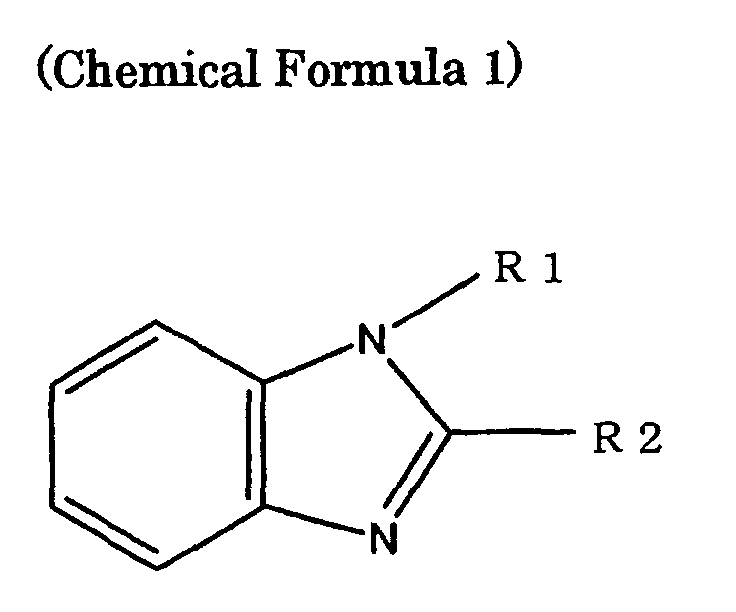
- the compound containing a nitrogen atom having non-shared electron pairs in a molecule those which are represented by, for example, the following Chemical Formula 1 (where R1 and R2 respectively are any substituents selected from the group consisting of an alkyl group, an alkoxyl group, an alkenyl group, an alkynyl group, an alkoxylalkyl group, a polyether group, and a phenyl group (any of the substituents includes 1 to 20 carbon atoms and may be linear or branched, and another element may substitute for a part or an entire of hydrogen) or hydrogen, and R1 and R2 may be different from each other) can be used preferably.
- R1 and R2 respectively are any substituents selected from the group consisting of an alkyl group, an alkoxyl group, an alkenyl group, an alkynyl group, an alkoxylalkyl group, a polyether group, and a phenyl group (any of the substituents includes 1 to 20 carbon atom
- Examples of the compound represented by Chemical Formula 1 include N-methylbenzoimidazole, 1-methyl-2-phenyl-benzoimidazole, 1,2-dimethyl-benzoimidazole, and the like.
- the concentration of I 3 - in the electrolyte layer tends to decrease with a passage of time.
- the reason for this is assumed as follows: compared with the generation reaction of I 3 - by holes generated in a semiconductor layer, the consumption reaction of I 3 - by electrons is more active.
- the concentration of I 3 - becomes too low, the diffusion of redox in the electrolyte layer becomes rate-determining to decrease a conversion efficiency. Therefore, for a use requiring a higher conversion efficiency, it is required to previously increase the concentration of I 3 - to a predetermined value or more.
- the concentration of I 3 - in the electrolyte is determined by the concentration of iodine (I 2 ) at a time of preparation.
- the concentration of I 3 - can be enhanced to prevent a decrease in a conversion efficiency involved in a decrease in the concentration of I 3 - .
- the concentration of iodine in the electrolyte layer is set to be 0.06 mol/dm 3 to 6 mol/dm 3 .
- the concentration of I 2 at a time of preparation is less than 0.06 mol/dm 3 . Therefore, compared with the case of setting the concentration higher than this, a conversion efficiency becomes lower.
- the concentration of I 2 at a time of preparation is set too high, the light absorption in the electrolyte layer not only becomes a factor of decreasing a conversion efficiency, but also makes it difficult to obtain a stabilization effect of a conversion efficiency. Therefore, it is desired that the concentration of I 2 at a time of preparation is set to be 6 mol/dm 3 or less.
- an electrolyte including iodine with a concentration outside of the above-mentioned range may be used.
- the electrolyte layer has a matrix of a polymer compound for holding redox
- the electrolyte becomes a gel or a solid. This alleviates the problem in leakage of liquid of an electrolyte solution, resulting in an increase in application of a device. Thus, it is not necessary to limit the concentration of iodine.
- the quantification I 3 - in the electrolyte can be performed using this feature by spectrophotometry.
- any of an aqueous solvent and an organic solvent can be used.
- an organic solvent is preferable.
- organic solvent examples include carbonate compounds such as dimethyl carbonate, diethyl carbonate, methyl ethyl carbonate, ethylene carbonate, and propylene carbonate; ester compounds such as methyl acetate, methyl propionate, and ⁇ -butyrolactone; ether compounds such as diethyl ether, 1,2-dimethoxyethane, 1,3-dioxosilane, tetrahydrofuran, and 2-methyl-tetrahydrofuran; heterocyclic compounds such as 3-methyl-2-oxazolidinone, 2-methylpyrolidone, and 1,3-dimethyl-2-imidazolidinone; nitrile compounds such as acetonitrile, methoxyacetnitrile, and propionitrile; sulforane; N,N,N',N'-tetramethyl urea; didimethylsulfoxide; dimethylformamide; formamide; N-methylformamide; N-methylacetamide; N-methylpropion
- a nitrile solvent having a boiling point of 100°C or higher constitutes the electrolyte layer.
- a solvent having a boiling point lower than 100°C when a photoelectric transducer is stored in a high-temperature environment, sealing is likely to be broken due to an increase in an internal pressure, which causes a conversion efficiency to be decreased remarkably.
- the nitrile solvent has characteristics of being capable of constituting an electrolyte layer having low viscosity and excellent ion conductivity.
- nitrile solvent having a boiling point of 100° C or higher examples include 3-methoxypropionitrile, succinonitrile, butylonitrile, isobutylonitrile, valeronitrile, benzonitrile, ⁇ -tolunitrile, and the like.
- 3-methoxypropionitrile enables a high conversion efficiency to be obtained, and allows a photoelectric transducer excellent in long-term stability to be provided.
- room temperature molten salt examples include an imidazolium salt described in JP 9(1997)-507334A. Among them, 1-methyl-3-propylimidazolium iodide is a preferable solvent for obtaining a high conversion efficiency due to its low viscosity. It should be noted that room temperature refers to about 15°C to 25°C.
- the solvent constituting the electrolyte layer a mixture of a room temperature molten salt and an organic solvent may be used.
- FIG. 1 is a schematic cross-sectional view showing an example of a photoelectric transducer of the present invention.
- a photoelectric transducer 1 of the present invention has a semiconductor electrode 15 having the following configuration. More specifically, the semiconductor electrode 15 is composed of a transparent electrode 5 formed on the surface of a substrate 3 and a semiconductor layer 7 formed on the surface opposite to the substrate 3 of the transparent electrode 5.
- the semiconductor layer 7 is composed of a semiconductor thin film 17 supporting a sensitizing dye 19 on its surface.
- a counter electrode 9 is present so as to be opposed to the semiconductor layer 7 of the semiconductor electrode 15.
- the counter electrode 9 is formed on the surface of another substrate 11.
- An electrolyte layer 13 is interposed between the semiconductor layer 7 and the counter electrode 9.
- the substrates 3 and 11 glass, plastic, or the like can be used. Plastic is flexible, so that it is suitable for use requiring flexibility.
- the substrate 3 functions as a light incident side substrate. Therefore, the substrate 3 preferably is transparent.
- the substrate 11 may be transparent or opaque. However, the substrate 11 preferably is transparent so as to allow light to be incident thereupon through both sides.
- the thickness of the semiconductor layer 7 supporting the sensitizing dye preferably is in a range of 0.1 ⁇ m to 100 ⁇ m. In the case where the thickness of the semiconductor layer 7 is less than 0.1 ⁇ m, there is possibility that a sufficient photoelectric conversion effect cannot be obtained. On the other hand, in the case where the thickness exceeds 100 ⁇ m, there is inconvenience that the transparency with respect to visible light and infrared light is degraded dramatically, which is not preferable.
- the thickness of the semiconductor layer 7 is more preferably in a range of 1 ⁇ m to 50 ⁇ m, particularly preferably in a range of 5 ⁇ m to 30 ⁇ m, and most preferably in a range of 10 ⁇ m to 20 ⁇ m.
- the diameter of the semiconductor particles generally is in a range of 5 nm to 1 ⁇ m.
- the diameter of the semiconductor particles is less than 5 nm, a hole diameter of the semiconductor layer 7 becomes smaller than 5 nm, which makes it difficult for an oxidation ⁇ reduction material in an electrolytic solution to move; as a result, a light current to be obtained is likely to decrease.
- the diameter of the semiconductor particles exceeds 1 ⁇ m, the surface area of the semiconductor layer 7 is not sufficiently large, so that the supported amount of a sensitizing dye is decreased, and a sufficient light current may not be obtained.
- a particularly preferable range of the diameter of the semiconductor particles is 10 nm to 100 nm.
- the semiconductor material include oxides of Cd, Zn, In, Pb, Mo, W, Sb, Bi, Cu, Hg, Ti, Ag, Mn, Fe, V, Sn, Zr, Sr, Ga, Si, and Cr; perovskite such as SrTiO 3 and CaTiO 3 ; or sulfides such as CdS, ZnS, In 2 S 3 , PbS, Mo 2 S, WS 2 , Sb 2 S 3 , Bi 2 S 3 , ZnCdS 2 , and Cu 2 S; metal chalcogenide such as CdSe, In 2 Se 3 , WSe 2 , HgSe, PbSe, and CdTe; GaAs; Si; Se; Cd 3 P 2 ; Zn 3 P 2 ; InP; AgBr; PbI 2 ; HgI 2 ; and BiI 3 .
- complexes containing at least one selected from the above semiconductors are preferable, such as CdS/TiO 2 , CdS/AgI, Ag 2 S/AgI, CdS/ZnO, CdS/HgS, CdS/PbS, ZnO/ZnS, ZnO/ZnSe, CdS/HgS, CdS x /CdSe 1-x , CdS x /Te 1-x , CdSe x /Te 1-x , ZnS/CdSe, ZnSe/CdSe, CdS/ZnS, TiO 2 /Cd 3 P 2 , CdS/CdSeCd y Zn 1-y S, and CdS/HgS/CdS.
- the flat semiconductor layer as shown in FIG. 1 can be prepared, for example, by coating the surface of the substrate 3 having the transparent electrode 5 with a slurry liquid made of conductive fine particles by a known ordinary method (e.g., a coating method using a doctor blade, a bar coater or the like, a spray method, a dip coating method, screen printing, spin coating, etc.), and thereafter, sintering the substrate 3 by heating at a temperature in a range of 400°C to 600°C. Furthermore, the thickness of the semiconductor layer can be set to be a desired value by repeating the above-mentioned coating and heating/sintering.
- a roughness factor (ratio of a real area of a porous inner portion with respect to a substrate area) can be determined.
- the roughness factor is preferably 20 or more, and most preferably 150 or more. In the case where the roughness factor is less than 20, the supported amount of a sensitizing dye becomes insufficient, making it difficult to improve photoelectric conversion characteristics.
- the upper limit of the roughness factor generally is about 5000.
- the porosity of the film preferably is 50% or more, and its upper limit generally is about 80%.
- the porosity of the film can be calculated from a measurement result of an adsorption-elimination isothermal line of nitrogen gas or krypton gas at a liquid nitrogen temperature.
- the semiconductor layer 7 of the present invention By allowing the semiconductor layer 7 of the present invention to support sensitizing dye molecules, a photoelectric transducer having a high photoelectric conversion efficiency can be obtained.
- the sensitizing dye to be supported on the semiconductor layer 7 of the present invention any of dyes typically used in conventional dye sensitization photoelectric transducers can be used.
- the dye examples include a RuL 2 (H 2 O) 2 type ruthenium-cis-diaqua-bipyridyl complex; transition metal complexes of types such as ruthenium-tris(RuL 3 ), Ruthenium-bis(RuL 2 ), osnium-tris(OsL 3 ), and osnium-bis(OsL 2 ) (where L represents 4,4'-dicarboxyl-2,2'-bipyridine); zinc-tetra(4-carboxyphenyl) porphyrin; iron-hexacyanide complex; phthalocyanine; and the like.
- RuL 2 (H 2 O) 2 type ruthenium-cis-diaqua-bipyridyl complex transition metal complexes of types such as ruthenium-tris(RuL 3 ), Ruthenium-bis(RuL 2 ), osnium-tris(OsL 3 ), and osnium-bis(O
- organic dye examples include a 9-phenylxanthene dye, a coumalin dye, an acridine dye, a triphenylmethane dye, a tetraphenylmethane dye, a quinone dye, an azo dye, an indigo dye, a cyanine dye, a merocyanine dye, a xanthene dye, and the like.
- a ruthenium-bis (RuL 2 ) derivative is preferable.
- the supported amount of the sensitizing dye 19 on the semiconductor layer 7 may be in a range of 1 ⁇ 10 -8 mol/cm 2 to 1 ⁇ 10 -6 mol/cm 2 , and in particular, preferably in a range of 0.1 ⁇ 10 -7 mol/cm 2 to 9.0 ⁇ 10 -7 mol/cm 2 .
- the supported amount of the sensitizing dye 19 is less than 1 ⁇ 10 -8 mol/cm 2 , a photoelectric conversion efficiency enhancement effect becomes insufficient.
- the supported amount of the sensitizing dye exceeds 1 ⁇ 10 -6 mol/cm 2 , a photoelectric conversion efficiency enhancement effect is saturated, which is not economical.
- An example of a method for allowing the semiconductor layer 7 to support a sensitizing dye includes soaking the substrate 3 with the semiconductor layer 7 formed thereon in a solution in which a sensitizing dye is dissolved.
- a solution in which a sensitizing dye is dissolved.
- any solvent can be used as long as it can dissolve a sensitizing dye, such as water, alcohol, toluene, dimethylformamide, and the like.
- a soaking method it is effective to perform reflux by heating and apply an ultrasonic wave while a substrate having electrodes with the semiconductor layer 7 formed thereon is soaked in a sensitizing dye solution for a predetermined period or time.
- the counter electrode 9 functions as a positive electrode of the photoelectric transducer 1 in the same way as in the electrode 5 on the side where the semiconductor layer 7 is formed.
- the material for the counter electrode 9 of the photoelectric transducer 1 of the present invention platinum, graphite, and the like having a catalytic function of giving electrons to a reductant of the electrolyte, so as to function efficiently as a positive electrode of the photoelectric transducer 1, are preferable.
- a conductive film made of a material different from that for the counter electrode 9 may be provided between the counter electrode 9 and the substrate 11.
- the electrolyte layer 13 is interposed between the semiconductor layer 7 supporting the sensitizing dye 19 and the counter electrode 9.
- the kind of the electrolyte is not particularly limited, as long as a pair of oxidation-reduction type constituents composed of an oxidant and a reductant are included in a solvent.
- the oxidation-reduction type constituents in the present invention refer to a pair of materials that are present in the form of an oxidant and a reductant reversibly in an oxidation-reduction reaction.
- the concentration of the dye to be included in the electrolytic solution is varied depending upon the kind and combination of a semiconductor, a dye, and a solvent of an electrolytic solution.
- the concentration preferably is in a range of 1 ⁇ 10 -9 mol/dm 3 to 1 ⁇ 10 -2 mol/dm 3 .
- concentration of the dye in the electrolytic solution is less than 1 ⁇ 10 -9 mol/dm 3 , the dye adsorbed by the surface of the semiconductor is eliminated, and characteristics are likely to be degraded.
- the concentration of the dye exceeds 1 ⁇ 10 -2 mol/dm 3 , the amount of the dye that absorbs light in the electrolytic solution but cannot contribute to photoelectric conversion is increased such that characteristics are degraded.
- the polymer compound used as a matrix in the electrolyte layer various compounds are used.
- vinylidene fluoride type polymer such as polyvinylidene fluoride
- an acrylic polymer such as polyacrylic acid
- acrylonitrile polymer such as polyacrylonitrile
- a polyether polymer such as polyethylene oxide.
- a vinylidene fluoride polymer is used preferably.
- the vinylindene fluoride polymer include a single polymer of vinylidene fluoride or a combination of a vinylindene fluoride and another polymerizable monomer (in particular, a copolymer with a radical polymerizable monomer).
- Examples of another polymerizable monomer (hereinafter, referred to as a "copolymerizable monomer”) to be copolymerized with vinylidene fluoride include hexafluoropropylene, tetrafluoroethylene, trifluoroethylene, ethylene, propylene, acrylonitrile, vinyldene chloride, methyl acrylate, ethyl acrylate, methyl methacrylate, styrene, and the like.
- copolymers may be copolymerized with vinylidene fluoride.
- copolymers can be used, which are obtained by copolymerizing vinylidene fluoride, hexafluoropropylene and tetrafluoroethylene, vinylidene fluoride, tetrafluoroethylene and ethylene, vinylidene fluoride, tetrafluoroethylene and propylene, and the like.
- a plurality of polymer compounds may be mixed to form a matrix.
- another compound generally can be mixed in an amount of 200 parts by weight with respect to 100 parts by weight of vinylidene fluoride polymer.
- the number-average molecular weight of the vinylidene fluoride polymer used in the present invention is generally in a range of 10,000 to 2,000,000 and preferably in a range of 100,000 to 1,000,000.
- the configuration and effect of the photoelectric transducer of the present invention will be specifically illustrated by way of examples, in which initial degradation is prevented by including a compound containing a nitrogen atom having non-shared electron pairs in a molecule in an electrolyte layer.
- the present invention is not limited to only the following examples.
- Titanium oxide powder of high purity with an average primary particle diameter of 20 nm was dispersed in ethyl cellulose to prepare a paste for screen printing. This was designated as a first paste.
- titanium oxide powder of high purity having an average primary particle diameter of 20 nm and titanium oxide powder of high purity having an average primary particle diameter of 400 nm were dispersed in ethyl cellulose to prepare a paste for screen printing. This was designated as a second paste.
- the first paste for screen printing was applied to a conductive glass substrate "F ⁇ SnO 2 " (Trade Name, 10 ⁇ /square) produced by Asahi Glass Co., Ltd., having a thickness of 1 mm and dried.
- the dried substrate thus obtained was sintered in the air at 500°C for 30 minutes to form a porous titanium oxide film with a thickness of 10 ⁇ m on the substrate.
- the second paste was applied to the porous titanium oxide film and dried.
- the dried substrate thus obtained was sintered in the air at 500°C for 30 minutes to form a titanium oxide film having a thickness of 4 ⁇ m on the porous titanium oxide film having a thickness of 10 ⁇ m.
- the resultant substrate was soaked in a sensitizing dye solution represented by [Ru(4,4'-dicarboxyl-2,2'-bipyridine) 2 -(NCS) 2 ], and allowed to stand overnight at room temperature (20°C).
- the above-mentioned dye solution was obtained by including the above-mentioned sensitizing dye in a mixed solution of acetonitrile and t-butanol (volume ratio 50 : 50) in a concentration of 3 ⁇ 10 -4 mol/dm 3 .
- the dye was supported by soaking an electrode with a TiO 2 film in a dye solution at room temperature (20°C) for 24 hours.
- a counter electrode was obtained by applying 5 m mol/dm 3 of H 2 PtCl 6 solution (solvent: isopropyl alcohol) to the conductive glass substrate "F-SnO 2 " with sputtered Pt having a thickness of 20 nm thereon in a ratio of 5 to 10 mm 3 /cm 2 , followed by heat treatment at 450°C for 15 minutes.
- a hot-melt sheet "bynel" Trade Name
- Heating was conducted at 150°C for 30 seconds.
- An electrolytic solution was injected through an injection port with a diameter of 1 mm provided at the counter electrode by a reduced-pressure injection method, and the injection port was sealed by fixing a cover glass having a thickness of 500 ⁇ m with the above-mentioned "bynel”. Furthermore, an epoxy adhesive "Torr Seal” (Trade Name) produced by ANELVA Corporation was applied to the peripheral portion of the cell to enhance sealing strength.
- the electrolytic solution was obtained by dissolving 0.5 mol/dm 3 of iodine and 0.45 mol/dm 3 of N ⁇ methyl benzoimidazole in a mixed solvent composed of 99% by weight of 1-methyl-3-propylimidazolium iodide and 1% by weight of water.
- An electrolytic solution was obtained by dissolving 0.6 mol/dm 3 of dimethylpropyhmidazolium iodide, 0.1 mol/dm 3 of iodine, and 0.5 mol/dm 3 of N-methylbenzoimidazole in 3-methoxypropionitrile.
- a photoelectric transducer was produced in the same way as in Example 1, except that an electrolyte layer having the above composition was used.
- An electrolytic solution was obtained by dissolving 5 ⁇ 10 -5 mol/dm 3 of N-methylbenzoimidazole and 0.5 mol/dm 3 of iodine in a mixed solvent composed of 99% by weight of 1-methyl-3-propylimidazolium iodide and 1% by weight of water.
- a photoelectric transducer was produced in the same way as in Example 1, except that an electrolyte layer having the above composition was used.
- An electrolytic solution was obtained by dissolving 0.6 mol/dm 3 of dimethylpropylimidazolium iodide, 5 ⁇ 10 -5 mol/dm 3 of N-methylbenzoimidazole, and 0.1 mol/dm 3 of iodine in polyethylene glycol (number-average molecular weight NW: 200).
- NW number-average molecular weight
- An electrolytic solution was obtained by dissolving 0.6 mol/dm 3 of 1,2-dimethyl-3-propylimidazolium iodide, 0.1 mol/dm 3 of iodine, and 0.5 mol/dm 3 of N-methylbenzoimidazole in 3-methoxypropionitrile, and adding 5% by weight of poly(vinylidene fluoride-hexafluoropropylene) "KYNAR2801" (Trade Name) produced by ATOFINA Japan to the mixture.
- a photoelectric transducer was produced in the same way as in Example 1, except that an electrolyte layer having the above composition was used.
- An electrolytic solution was obtained by dissolving 0.5 mol/dm 3 of iodine in a mixed solvent composed of 99% by weight of 1-methyl-3-propylimidazolium iodide and 1% by weight of water.
- a photoelectric transducer was produced in the same way as in Example 1, except that an electrolyte layer having the above composition was used.
- An electrolytic solution was obtained by dissolving 0.45 mol/dm 3 of N-methylbenzoimidazole and 0.05 mol/dm 3 of iodine in a mixed solvent composed of 99% by weight of 1-methyl-3 propylimidazolium iodide and 1% by weight of water.
- a photoelectric transducer was produced in the same way as in Example 1, except that an electrolyte layer having the above composition was used.
- An electrolytic solution was obtained by dissolving 0.45 mol/dm 3 of N-methylbenzoimidazole and 6.5 mol/dm 3 of iodine in a mixed solvent composed of 99% by weight of 1-methyl-3-propylimidazolium iodide and 1% by weight of water.
- a photoelectric transducer was produced in the same way as in Example 1, except that an electrolyte layer having the above composition was used.
- Example 1 using a compound containing a nitrogen atom having non-shared electron pairs in a molecule in an amount of 5 ⁇ 10 -4 mol/dm 3 to 2 mol/dm 3 , the conversion efficiency was maintained for a longer period of time, compared with Example 3 in which the content of the compound was smaller.
- Example 1 containing no matrix of a polymer compound in the electrolyte layer, leakage was confirmed; however, in Example 5 in which a matrix of a vinylidene fluoride polymer was formed in an electrolyte layer, leakage was not confirmed.
Landscapes
- Chemical & Material Sciences (AREA)
- Chemical Kinetics & Catalysis (AREA)
- Electrochemistry (AREA)
- Engineering & Computer Science (AREA)
- Power Engineering (AREA)
- General Chemical & Material Sciences (AREA)
- Microelectronics & Electronic Packaging (AREA)
- Hybrid Cells (AREA)
- Photovoltaic Devices (AREA)
- Electromechanical Clocks (AREA)
Abstract
Description

| Solvent of electrolyte | Compound A and concentration (mol/dm3) | Concentration of iodine (mol/dm3) | Initial conversion efficiency | Decrease ratio of conversion efficiency | |
| Example 1 | 1-methyl-3-propylimidazolium iodide | N-methylbenzoimidazole: 0.45 | 0.5 | ○ | A |
| Example 2 | 3-methoxypropionitrile | N-methylbenzoimidazole: 0.5 | 0.1 | ○ | A |
| Example 3 propylimidazolium iodide | 1-methyl-3- | N-methylbenzoimidazole: 5 × 10⁻⁵ | 0.5 | ○ | B |
| Example 4 | Polyethylene glycol (MW: 200) | N-methylbenzoimidazole: 5 × 10⁻⁵ | 0.1 | ○ | B |
| Example 5 | 3-methoxypropionitrile | N-metbylbenzoimidazole: 0.5 | 0.1 | ○ | A |
| Comparative Example 1 | 1-methyl-3-propylimidazolium iodide | None | 0.5 | ○ | C |
| Comparative Example 2 | 1-methyl-3-propylimidazolium iodide | N-methylbenzoimidazole: 0.45 | 0.05 | ○ | C |
| Comparative Example 3 | 1-methyl-3-propylimidazolium iodide | N-methylbenzoimidazole: 0.45 | 6.5 | × | A |
| Comparative Example 4 | 3-methoxypropionitrile | None | 0.1 | ○ | C |
Claims (16)
- A photoelectric transducer comprising: a semiconductor electrode provided with a semiconductor layer supporting a sensitizing dye; a counter electrode opposed to the semiconductor electrode; and an electrolyte layer interposed between the semiconductor electrode and the counter electrode,
wherein the electrolyte layer includes a compound containing a nitrogen atom having non-shared electron pairs in a molecule and iodine (I3 -) with a concentration of 0.06 mol/dm3 to 6 mol/dm3. - The photoelectric transducer according to claim 1, wherein a concentration of the compound containing a nitrogen atom having non-shared electron pairs in a molecule in the electrolyte layer is in a range of 5 × 10⁻⁴ mol/dm3 to 2 mol/dm3.
- The photoelectric transducer according to claim 1, wherein the compound containing a nitrogen atom having non-shared electron pairs in a molecule is represented by the following Chemical Formula 1 (where R 1 and R2 respectively are any substituents selected from the group consisting of an alkyl group, an alkoxyl group, an alkenyl group, an alkynyl group, an alkoxylalkyl group, a polyether group, and a phenyl group (any of the substituents includes 1 to 20 carbon atoms and may be linear or branched, and another element may substitute for a part or an entire of hydrogen) or hydrogen, and R1 and R2 may be different from each other).
- The photoelectric transducer according to claim 1, wherein the electrolyte layer contains a room temperature molten salt.
- The photoelectric transducer according to claim 4, wherein the room temperature molten salt is 1-methyl-3-propylimidazolium iodide.
- The photoelectric transducer according to claim 1, wherein the electrolyte layer contains a nitrile solvent having a boiling point of 100°C or higher.
- The photoelectric transducer according to claim 6, wherein the nitrile solvent is 3-methoxypropionitrile.
- A photoelectric transducer comprising: a semiconductor electrode provided with a semiconductor layer supporting a sensitizing dye; a counter electrode opposed to the semiconductor electrode; and an electrolyte layer interposed between the semiconductor electrode and the counter electrode,
wherein the electrolyte layer includes a polymer compound as a matrix and a compound containing a nitrogen atom having non-shared electron pairs in a molecule. - The photoelectric transducer according to claim 8, wherein the polymer compound is a vinylidene fluoride polymer.
- The photoelectric transducer according to claim 8, wherein the electrolyte layer contains iodine (I3 -) with a concentration of 0.06 mol/dm3 to 6 mol/dm3.
- The photoelectric transducer according to claim 8, wherein a concentration of the compound containing a nitrogen atom having non-shared electron pairs in a molecule in the electrolyte layer is in a range of 5 × 10⁻⁴ mol/dm3 to 2 mol/dm3.
- The photoelectric transducer according to claim 8, wherein the compound containing a nitrogen atom having non-shared electron pairs in a molecule is represented by the following Chemical Formula 2 (where R1 and R2 respectively are any substituents selected from the group consisting of an alkyl group, an alkoxyl group, an alkenyl group, an alkynyl group, an alkoxylalkyl group, a polyether group, and a phenyl group (any of the substituents includes 1 to 20 carbon atoms and may be linear or branched, and another element may substitute for a part or an entire of hydrogen) or hydrogen, and R1 and R2 may be different from each other).

- The photoelectric transducer according to claim 8, wherein the electrolyte layer contains a room temperature molten salt.
- The photoelectric transducer according to claim 13, wherein the room temperature molten salt is 1-methyl-3-propylimidazolium iodide.
- The photoelectric transducer according to claim 8, wherein the electrolyte layer contains a nitrile solvent having a boiling point of 100°C or higher.
- The photoelectric transducer according to claim 15, wherein the nitrile solvent is 3-methoxypropionitrile.
Applications Claiming Priority (3)
| Application Number | Priority Date | Filing Date | Title |
|---|---|---|---|
| JP2002145358 | 2002-05-20 | ||
| JP2002145358 | 2002-05-20 | ||
| PCT/JP2003/005426 WO2003098731A1 (en) | 2002-05-20 | 2003-04-28 | Photoelectric conversion device |
Related Child Applications (1)
| Application Number | Title | Priority Date | Filing Date |
|---|---|---|---|
| EP07107824 Division | 2003-04-28 |
Publications (4)
| Publication Number | Publication Date |
|---|---|
| EP1507307A1 true EP1507307A1 (en) | 2005-02-16 |
| EP1507307A4 EP1507307A4 (en) | 2005-04-20 |
| EP1507307B1 EP1507307B1 (en) | 2008-03-05 |
| EP1507307B9 EP1507307B9 (en) | 2008-08-13 |
Family
ID=29545086
Family Applications (1)
| Application Number | Title | Priority Date | Filing Date |
|---|---|---|---|
| EP03725689A Expired - Lifetime EP1507307B9 (en) | 2002-05-20 | 2003-04-28 | Photoelectric conversion device |
Country Status (9)
| Country | Link |
|---|---|
| US (1) | US20040238826A1 (en) |
| EP (1) | EP1507307B9 (en) |
| JP (1) | JP4185490B2 (en) |
| CN (1) | CN1322592C (en) |
| AT (1) | ATE388475T1 (en) |
| AU (1) | AU2003231536B2 (en) |
| DE (1) | DE60319522T2 (en) |
| ES (1) | ES2304508T3 (en) |
| WO (1) | WO2003098731A1 (en) |
Cited By (20)
| Publication number | Priority date | Publication date | Assignee | Title |
|---|---|---|---|---|
| WO2007093961A1 (en) | 2006-02-13 | 2007-08-23 | Ecole Polytechnique Federale De Lausanne (Epfl) | Ionic liquid electrolyte |
| EP2301932A1 (en) | 2009-09-29 | 2011-03-30 | Ecole Polytechnique Fédérale de Lausanne (EPFL) | Novel ligands for sensitizing dyes of dye-sensitized solar cells |
| EP2325913A1 (en) | 2006-03-23 | 2011-05-25 | Ecole Polytechnique Fédérale de Lausanne (EPFL) | A method for preparing a solar cell |
| WO2011085967A1 (en) | 2010-01-18 | 2011-07-21 | Merck Patent Gmbh | Compounds containing perfluoroalkyl-cyano-alkoxy-borate anions or perfluoroalkyl-cyano-alkoxy-fluoro-borate anions |
| WO2011085964A1 (en) | 2010-01-18 | 2011-07-21 | Merck Patent Gmbh | Electrolyte formulations |
| WO2011085965A1 (en) | 2010-01-18 | 2011-07-21 | Merck Patent Gmbh | Electrolyte formulations |
| WO2011125024A1 (en) | 2010-04-05 | 2011-10-13 | Ecole Polytechnique Federale De Lausanne (Epfl) | Improved electrode |
| EP2388853A1 (en) | 2010-05-20 | 2011-11-23 | Fundacion Cidetec | Ionic liquid based electrolytes containing sulfide/polysulfide redox couple and uses thereof |
| WO2011145120A1 (en) | 2010-05-17 | 2011-11-24 | Daunia Solar Cell S.R.L. | New gel electrolytes suitable for photoelectrochemical devices |
| WO2012041437A2 (en) | 2010-09-30 | 2012-04-05 | Merck Patent Gmbh | Electrolyte formulations |
| WO2012048772A1 (en) | 2010-09-27 | 2012-04-19 | Merck Patent Gmbh | Functionalized fluoroalkyl fluorophosphate salts |
| WO2012076093A1 (en) | 2010-12-08 | 2012-06-14 | Merck Patent Gmbh | Additives for dye-sensitized solar cells |
| WO2012163490A1 (en) | 2011-05-31 | 2012-12-06 | Merck Patent Gmbh | Electrolyte formulations |
| WO2013010641A1 (en) | 2011-07-15 | 2013-01-24 | Merck Patent Gmbh | Compounds containing alkyl-cyano-borate or alkyl-cyano-fluoroborate anions |
| WO2013010640A1 (en) | 2011-07-15 | 2013-01-24 | Merck Patent Gmbh | Compounds containing alkyl-alkoxy-cyano-borate anions |
| WO2013026563A1 (en) | 2011-08-25 | 2013-02-28 | Merck Patent Gmbh | Additives for dye-sensitized solar cells |
| WO2013057538A1 (en) | 2011-10-18 | 2013-04-25 | École Polytechnique Fédérale De Lausanne (Epfl) | Compounds for electrochemical and/or optoelectronic devices |
| WO2013084029A1 (en) | 2011-12-08 | 2013-06-13 | Ecole Polytechnique Federale De Lausanne (Epfl) | Semiconductor electrode comprising a blocking layer |
| EP2883881A1 (en) | 2013-12-12 | 2015-06-17 | Merck Patent GmbH | Cobaltcomplex salts and mixtures of Cobaltcomplex salts for use in DSSC |
| DE102013021029A1 (en) | 2013-12-17 | 2015-07-02 | Julius-Maximilians-Universität Würzburg | Cobalt complex salts |
Families Citing this family (25)
| Publication number | Priority date | Publication date | Assignee | Title |
|---|---|---|---|---|
| DE60035123T2 (en) | 1999-11-15 | 2008-01-31 | Therasense, Inc., Alameda | TRANSITION METAL COMPLEXES BELONGED TO A POLYMER BY A MOVABLE INTERMEDIATE MEMBER |
| US8268143B2 (en) | 1999-11-15 | 2012-09-18 | Abbott Diabetes Care Inc. | Oxygen-effect free analyte sensor |
| US8444834B2 (en) | 1999-11-15 | 2013-05-21 | Abbott Diabetes Care Inc. | Redox polymers for use in analyte monitoring |
| US8070934B2 (en) | 2001-05-11 | 2011-12-06 | Abbott Diabetes Care Inc. | Transition metal complexes with (pyridyl)imidazole ligands |
| US6676816B2 (en) | 2001-05-11 | 2004-01-13 | Therasense, Inc. | Transition metal complexes with (pyridyl)imidazole ligands and sensors using said complexes |
| US8226814B2 (en) | 2001-05-11 | 2012-07-24 | Abbott Diabetes Care Inc. | Transition metal complexes with pyridyl-imidazole ligands |
| KR101231935B1 (en) * | 2005-04-11 | 2013-02-08 | 니폰 가야꾸 가부시끼가이샤 | Electrolyte composition for photoelectric converter and photoelectric converter using same |
| DE102005060392A1 (en) | 2005-12-16 | 2007-06-21 | Süd-Chemie AG | Separating proteins from liquid media, useful e.g. for isolation of proteins from bioreactors or body fluids, using specific clay material that does not swell much in water |
| KR100844871B1 (en) * | 2007-04-06 | 2008-07-09 | 경북대학교 산학협력단 | Dye-sensitized solar cell dye and solar cell using same |
| US9208955B2 (en) * | 2007-05-17 | 2015-12-08 | Daido Metal Company Ltd. | Dye-sensitized solar cell fabricating kit, dye-sensitized solar cell and method of using the same |
| JP5209344B2 (en) * | 2007-05-17 | 2013-06-12 | 大同メタル工業株式会社 | Dye-sensitized solar cell preparation kit, dye-sensitized solar cell and method of using the same |
| CN102165466B (en) * | 2008-09-10 | 2015-03-04 | 松下电器产业株式会社 | Radio identification card |
| JP4557097B2 (en) * | 2008-11-27 | 2010-10-06 | 横浜ゴム株式会社 | Electrolyte for photoelectric conversion element and photoelectric conversion element and dye-sensitized solar cell using the electrolyte |
| US8338692B2 (en) * | 2008-11-27 | 2012-12-25 | The Yokohama Rubber Co., Ltd. | Electrolyte for photoelectric conversion elements, and photoelectric conversion element and dye-sensitized solar cell using the electrolyte |
| JP4725689B2 (en) * | 2008-12-26 | 2011-07-13 | 横浜ゴム株式会社 | Electrolyte for photoelectric conversion element and photoelectric conversion element and dye-sensitized solar cell using the electrolyte |
| CN101819838B (en) * | 2010-03-02 | 2012-10-03 | 中国科学院上海应用物理研究所 | Alkynyl-modified magnetic nano-particle module, amino acid compound-modified magnetic nano-particles, preparation method and application thereof |
| CN101777430B (en) * | 2010-03-15 | 2012-07-04 | 彩虹集团公司 | Preparation method for titanium dioxide membrane used as dye-sensitized solar cell photo-anode |
| CN101777428B (en) * | 2010-03-15 | 2012-05-23 | 彩虹集团公司 | Preparation method of counter electrode of dye-sensitized solar cell |
| JP5773837B2 (en) * | 2011-10-20 | 2015-09-02 | 大阪瓦斯株式会社 | Electrolytic solution and photoelectric conversion element |
| US9805841B2 (en) * | 2012-07-03 | 2017-10-31 | Massachusetts Institute Of Technology | Virus film as template for porous inorganic scaffolds |
| CN103903859A (en) * | 2012-12-27 | 2014-07-02 | 中国科学院上海硅酸盐研究所 | Method for preparing photoanode of dye-sensitized solar cell through coating |
| CN104201362A (en) * | 2014-05-04 | 2014-12-10 | 昆明理工大学 | Preparing method of carbon-doped titanium oxide nanotube array lithium battery anode material |
| JP2019117889A (en) * | 2017-12-27 | 2019-07-18 | 太陽誘電株式会社 | Dye-sensitized solar cell |
| CN108479806B (en) * | 2018-01-06 | 2020-04-28 | 中南大学 | A kind of heterojunction film composed of the same metal and oxygen group element and its preparation and application |
| KR20210058861A (en) * | 2018-09-21 | 2021-05-24 | 엠비엔트 포토닉스, 아이엔씨 | Dye-sensitized photovoltaic cell |
Family Cites Families (13)
| Publication number | Priority date | Publication date | Assignee | Title |
|---|---|---|---|---|
| CH674596A5 (en) * | 1988-02-12 | 1990-06-15 | Sulzer Ag | |
| US5728487A (en) * | 1993-12-29 | 1998-03-17 | Ecole Polytechnique Federale De Lausanne | Photoelectrochemical cell and electrolyte for this cell |
| DE69534293T2 (en) * | 1994-12-21 | 2006-05-18 | Centre National De La Recherche Scientifique (C.N.R.S.) | Liquid, hydrophobic salts, their preparation and their use in electrochemistry |
| JPH11144773A (en) * | 1997-09-05 | 1999-05-28 | Fuji Photo Film Co Ltd | Photoelectric conversion element and photoregeneration type photoelectrochemical cell |
| JP4111360B2 (en) * | 1998-08-11 | 2008-07-02 | 富士フイルム株式会社 | Gel electrolyte, gel electrolyte for photoelectrochemical cell, and photoelectrochemical cell |
| JP2000058891A (en) * | 1998-08-11 | 2000-02-25 | Fuji Photo Film Co Ltd | Electrolyte, electrolyte for photoelectric chemical cell, photoelectric chemical battery and pyridinium compound |
| JP2000090991A (en) * | 1998-09-09 | 2000-03-31 | Fuji Photo Film Co Ltd | Photoelectrochemical battery |
| JP3462115B2 (en) * | 1999-03-29 | 2003-11-05 | 三洋化成工業株式会社 | Non-aqueous electrolyte for dye-sensitized solar cell and solar cell using the same |
| US6291763B1 (en) * | 1999-04-06 | 2001-09-18 | Fuji Photo Film Co., Ltd. | Photoelectric conversion device and photo cell |
| US6900382B2 (en) * | 2002-01-25 | 2005-05-31 | Konarka Technologies, Inc. | Gel electrolytes for dye sensitized solar cells |
| EP1180774B1 (en) * | 2000-08-15 | 2006-10-11 | Fuji Photo Film Co., Ltd. | Photoelectric conversion device and method for producing same |
| JP4222466B2 (en) * | 2001-06-14 | 2009-02-12 | 富士フイルム株式会社 | Charge transport material, photoelectric conversion element and photovoltaic cell using the same, and pyridine compound |
| JP4021637B2 (en) * | 2001-09-27 | 2007-12-12 | 株式会社東芝 | Photosensitized solar cell and method for producing the same |
-
2003
- 2003-04-28 JP JP2004506116A patent/JP4185490B2/en not_active Expired - Fee Related
- 2003-04-28 WO PCT/JP2003/005426 patent/WO2003098731A1/en not_active Ceased
- 2003-04-28 US US10/487,751 patent/US20040238826A1/en not_active Abandoned
- 2003-04-28 DE DE60319522T patent/DE60319522T2/en not_active Expired - Lifetime
- 2003-04-28 CN CN03801649.4A patent/CN1322592C/en not_active Expired - Fee Related
- 2003-04-28 AT AT03725689T patent/ATE388475T1/en not_active IP Right Cessation
- 2003-04-28 AU AU2003231536A patent/AU2003231536B2/en not_active Ceased
- 2003-04-28 ES ES03725689T patent/ES2304508T3/en not_active Expired - Lifetime
- 2003-04-28 EP EP03725689A patent/EP1507307B9/en not_active Expired - Lifetime
Cited By (25)
| Publication number | Priority date | Publication date | Assignee | Title |
|---|---|---|---|---|
| WO2007093961A1 (en) | 2006-02-13 | 2007-08-23 | Ecole Polytechnique Federale De Lausanne (Epfl) | Ionic liquid electrolyte |
| EP2325913A1 (en) | 2006-03-23 | 2011-05-25 | Ecole Polytechnique Fédérale de Lausanne (EPFL) | A method for preparing a solar cell |
| EP2301932A1 (en) | 2009-09-29 | 2011-03-30 | Ecole Polytechnique Fédérale de Lausanne (EPFL) | Novel ligands for sensitizing dyes of dye-sensitized solar cells |
| WO2011039715A1 (en) | 2009-09-29 | 2011-04-07 | Ecole Polytechnique Federale De Lausanne (Epfl) | Novel ligands for sensitizing dyes of dye-sensitized solar cells |
| WO2011085965A1 (en) | 2010-01-18 | 2011-07-21 | Merck Patent Gmbh | Electrolyte formulations |
| WO2011085964A1 (en) | 2010-01-18 | 2011-07-21 | Merck Patent Gmbh | Electrolyte formulations |
| US8835667B2 (en) | 2010-01-18 | 2014-09-16 | Merck Patent Gmbh | Electrolyte formulations |
| WO2011085967A1 (en) | 2010-01-18 | 2011-07-21 | Merck Patent Gmbh | Compounds containing perfluoroalkyl-cyano-alkoxy-borate anions or perfluoroalkyl-cyano-alkoxy-fluoro-borate anions |
| US8901340B2 (en) | 2010-01-18 | 2014-12-02 | Merck Patent Gmbh | Compounds containing perfluoroalkyl-cyano-alkoxy-borate anions or perfluoroalkyl-cyano-alkoxy-fluoro-borate anions |
| WO2011125024A1 (en) | 2010-04-05 | 2011-10-13 | Ecole Polytechnique Federale De Lausanne (Epfl) | Improved electrode |
| WO2011145120A1 (en) | 2010-05-17 | 2011-11-24 | Daunia Solar Cell S.R.L. | New gel electrolytes suitable for photoelectrochemical devices |
| WO2011144306A1 (en) | 2010-05-17 | 2011-11-24 | Daunia Solar Cell S.R.L. | New gel electrolytes suitable for photoelectrochemical devices |
| EP2388853A1 (en) | 2010-05-20 | 2011-11-23 | Fundacion Cidetec | Ionic liquid based electrolytes containing sulfide/polysulfide redox couple and uses thereof |
| WO2011144697A1 (en) | 2010-05-20 | 2011-11-24 | Fundacion Cidetec | Ionic liquid based electrolytes containing sulfide/polysulfide redox couple and uses thereof |
| WO2012048772A1 (en) | 2010-09-27 | 2012-04-19 | Merck Patent Gmbh | Functionalized fluoroalkyl fluorophosphate salts |
| WO2012041437A2 (en) | 2010-09-30 | 2012-04-05 | Merck Patent Gmbh | Electrolyte formulations |
| WO2012076093A1 (en) | 2010-12-08 | 2012-06-14 | Merck Patent Gmbh | Additives for dye-sensitized solar cells |
| WO2012163490A1 (en) | 2011-05-31 | 2012-12-06 | Merck Patent Gmbh | Electrolyte formulations |
| WO2013010641A1 (en) | 2011-07-15 | 2013-01-24 | Merck Patent Gmbh | Compounds containing alkyl-cyano-borate or alkyl-cyano-fluoroborate anions |
| WO2013010640A1 (en) | 2011-07-15 | 2013-01-24 | Merck Patent Gmbh | Compounds containing alkyl-alkoxy-cyano-borate anions |
| WO2013026563A1 (en) | 2011-08-25 | 2013-02-28 | Merck Patent Gmbh | Additives for dye-sensitized solar cells |
| WO2013057538A1 (en) | 2011-10-18 | 2013-04-25 | École Polytechnique Fédérale De Lausanne (Epfl) | Compounds for electrochemical and/or optoelectronic devices |
| WO2013084029A1 (en) | 2011-12-08 | 2013-06-13 | Ecole Polytechnique Federale De Lausanne (Epfl) | Semiconductor electrode comprising a blocking layer |
| EP2883881A1 (en) | 2013-12-12 | 2015-06-17 | Merck Patent GmbH | Cobaltcomplex salts and mixtures of Cobaltcomplex salts for use in DSSC |
| DE102013021029A1 (en) | 2013-12-17 | 2015-07-02 | Julius-Maximilians-Universität Würzburg | Cobalt complex salts |
Also Published As
| Publication number | Publication date |
|---|---|
| EP1507307B1 (en) | 2008-03-05 |
| WO2003098731A1 (en) | 2003-11-27 |
| JP4185490B2 (en) | 2008-11-26 |
| CN1596484A (en) | 2005-03-16 |
| AU2003231536A1 (en) | 2003-12-02 |
| US20040238826A1 (en) | 2004-12-02 |
| ES2304508T3 (en) | 2008-10-16 |
| ATE388475T1 (en) | 2008-03-15 |
| DE60319522T2 (en) | 2009-04-02 |
| JPWO2003098731A1 (en) | 2005-09-22 |
| CN1322592C (en) | 2007-06-20 |
| AU2003231536B2 (en) | 2006-01-12 |
| EP1507307B9 (en) | 2008-08-13 |
| DE60319522D1 (en) | 2008-04-17 |
| EP1507307A4 (en) | 2005-04-20 |
Similar Documents
| Publication | Publication Date | Title |
|---|---|---|
| AU2003231536B2 (en) | Photoelectric conversion device | |
| JP4415448B2 (en) | Photoelectric conversion element | |
| US6683361B2 (en) | Solar cell and solar cell unit | |
| JP4415481B2 (en) | Photoelectric conversion element and manufacturing method thereof | |
| JP5237664B2 (en) | Photoelectric conversion element | |
| JP4479108B2 (en) | Photoelectric conversion element | |
| JP4423735B2 (en) | Photoelectric conversion element | |
| JP2005243440A (en) | Photoelectric conversion element | |
| JP4415482B2 (en) | Photoelectric conversion element | |
| JP4135323B2 (en) | Method for manufacturing photoelectric conversion element | |
| JP4341197B2 (en) | Photoelectric conversion element and manufacturing method thereof | |
| JP2003187883A (en) | Photoelectric conversion element | |
| JP4320869B2 (en) | Method for manufacturing photoelectric conversion element | |
| JP4092908B2 (en) | Photoelectric conversion element and manufacturing method thereof | |
| JP5584447B2 (en) | Photoelectric element | |
| JP2008186632A (en) | Photoelectric conversion element and manufacturing method thereof | |
| JP2002313445A (en) | Photoelectric conversion element | |
| JP5181507B2 (en) | Method for manufacturing photoelectric conversion element | |
| JP6415380B2 (en) | Photoelectric conversion element | |
| JP4352552B2 (en) | Photoelectric conversion element and photovoltaic cell | |
| JP2001273938A (en) | Photoelectric conversion element | |
| JP2008243623A (en) | Manufacturing method of photoelectric conversion element, and photoelectric conversion element | |
| JP2008052936A (en) | Photoelectric conversion element |
Legal Events
| Date | Code | Title | Description |
|---|---|---|---|
| PUAI | Public reference made under article 153(3) epc to a published international application that has entered the european phase |
Free format text: ORIGINAL CODE: 0009012 |
|
| 17P | Request for examination filed |
Effective date: 20040416 |
|
| AK | Designated contracting states |
Kind code of ref document: A1 Designated state(s): AT BE BG CH CY CZ DE DK EE ES FI FR GB GR HU IE IT LI LU MC NL PT RO SE SI SK TR |
|
| AX | Request for extension of the european patent |
Extension state: AL LT LV MK |
|
| A4 | Supplementary search report drawn up and despatched |
Effective date: 20050309 |
|
| RIC1 | Information provided on ipc code assigned before grant |
Ipc: 7H 01G 9/20 A |
|
| DAX | Request for extension of the european patent (deleted) | ||
| GRAP | Despatch of communication of intention to grant a patent |
Free format text: ORIGINAL CODE: EPIDOSNIGR1 |
|
| GRAS | Grant fee paid |
Free format text: ORIGINAL CODE: EPIDOSNIGR3 |
|
| RAP1 | Party data changed (applicant data changed or rights of an application transferred) |
Owner name: ECOLE POLYTECHNIQUE FEDERALE DE LAUSANNE (EPFL) Owner name: MATSUSHITA ELECTRIC WORKS, LTD. |
|
| GRAA | (expected) grant |
Free format text: ORIGINAL CODE: 0009210 |
|
| AK | Designated contracting states |
Kind code of ref document: B1 Designated state(s): AT BE BG CH CY CZ DE DK EE ES FI FR GB GR HU IE IT LI LU MC NL PT RO SE SI SK TR |
|
| REG | Reference to a national code |
Ref country code: GB Ref legal event code: FG4D |
|
| REG | Reference to a national code |
Ref country code: CH Ref legal event code: EP |
|
| REG | Reference to a national code |
Ref country code: IE Ref legal event code: FG4D |
|
| REF | Corresponds to: |
Ref document number: 60319522 Country of ref document: DE Date of ref document: 20080417 Kind code of ref document: P |
|
| REG | Reference to a national code |
Ref country code: GR Ref legal event code: EP Ref document number: 20080401187 Country of ref document: GR |
|
| PG25 | Lapsed in a contracting state [announced via postgrant information from national office to epo] |
Ref country code: FI Free format text: LAPSE BECAUSE OF FAILURE TO SUBMIT A TRANSLATION OF THE DESCRIPTION OR TO PAY THE FEE WITHIN THE PRESCRIBED TIME-LIMIT Effective date: 20080305 |
|
| REG | Reference to a national code |
Ref country code: CH Ref legal event code: NV Representative=s name: ABREMA AGENCE BREVET ET MARQUES, GANGUILLET |
|
| PG25 | Lapsed in a contracting state [announced via postgrant information from national office to epo] |
Ref country code: AT Free format text: LAPSE BECAUSE OF FAILURE TO SUBMIT A TRANSLATION OF THE DESCRIPTION OR TO PAY THE FEE WITHIN THE PRESCRIBED TIME-LIMIT Effective date: 20080305 |
|
| NLV1 | Nl: lapsed or annulled due to failure to fulfill the requirements of art. 29p and 29m of the patents act | ||
| PG25 | Lapsed in a contracting state [announced via postgrant information from national office to epo] |
Ref country code: BE Free format text: LAPSE BECAUSE OF FAILURE TO SUBMIT A TRANSLATION OF THE DESCRIPTION OR TO PAY THE FEE WITHIN THE PRESCRIBED TIME-LIMIT Effective date: 20080305 Ref country code: SI Free format text: LAPSE BECAUSE OF FAILURE TO SUBMIT A TRANSLATION OF THE DESCRIPTION OR TO PAY THE FEE WITHIN THE PRESCRIBED TIME-LIMIT Effective date: 20080305 |
|
| REG | Reference to a national code |
Ref country code: ES Ref legal event code: FG2A Ref document number: 2304508 Country of ref document: ES Kind code of ref document: T3 |
|
| PG25 | Lapsed in a contracting state [announced via postgrant information from national office to epo] |
Ref country code: CZ Free format text: LAPSE BECAUSE OF FAILURE TO SUBMIT A TRANSLATION OF THE DESCRIPTION OR TO PAY THE FEE WITHIN THE PRESCRIBED TIME-LIMIT Effective date: 20080305 Ref country code: NL Free format text: LAPSE BECAUSE OF FAILURE TO SUBMIT A TRANSLATION OF THE DESCRIPTION OR TO PAY THE FEE WITHIN THE PRESCRIBED TIME-LIMIT Effective date: 20080305 Ref country code: PT Free format text: LAPSE BECAUSE OF FAILURE TO SUBMIT A TRANSLATION OF THE DESCRIPTION OR TO PAY THE FEE WITHIN THE PRESCRIBED TIME-LIMIT Effective date: 20080805 Ref country code: SK Free format text: LAPSE BECAUSE OF FAILURE TO SUBMIT A TRANSLATION OF THE DESCRIPTION OR TO PAY THE FEE WITHIN THE PRESCRIBED TIME-LIMIT Effective date: 20080305 Ref country code: SE Free format text: LAPSE BECAUSE OF FAILURE TO SUBMIT A TRANSLATION OF THE DESCRIPTION OR TO PAY THE FEE WITHIN THE PRESCRIBED TIME-LIMIT Effective date: 20080605 |
|
| ET | Fr: translation filed | ||
| PG25 | Lapsed in a contracting state [announced via postgrant information from national office to epo] |
Ref country code: MC Free format text: LAPSE BECAUSE OF NON-PAYMENT OF DUE FEES Effective date: 20080430 Ref country code: RO Free format text: LAPSE BECAUSE OF FAILURE TO SUBMIT A TRANSLATION OF THE DESCRIPTION OR TO PAY THE FEE WITHIN THE PRESCRIBED TIME-LIMIT Effective date: 20080305 |
|
| PLBE | No opposition filed within time limit |
Free format text: ORIGINAL CODE: 0009261 |
|
| STAA | Information on the status of an ep patent application or granted ep patent |
Free format text: STATUS: NO OPPOSITION FILED WITHIN TIME LIMIT |
|
| PG25 | Lapsed in a contracting state [announced via postgrant information from national office to epo] |
Ref country code: EE Free format text: LAPSE BECAUSE OF FAILURE TO SUBMIT A TRANSLATION OF THE DESCRIPTION OR TO PAY THE FEE WITHIN THE PRESCRIBED TIME-LIMIT Effective date: 20080305 Ref country code: DK Free format text: LAPSE BECAUSE OF FAILURE TO SUBMIT A TRANSLATION OF THE DESCRIPTION OR TO PAY THE FEE WITHIN THE PRESCRIBED TIME-LIMIT Effective date: 20080305 |
|
| 26N | No opposition filed |
Effective date: 20081208 |
|
| PG25 | Lapsed in a contracting state [announced via postgrant information from national office to epo] |
Ref country code: IE Free format text: LAPSE BECAUSE OF NON-PAYMENT OF DUE FEES Effective date: 20080428 Ref country code: BG Free format text: LAPSE BECAUSE OF FAILURE TO SUBMIT A TRANSLATION OF THE DESCRIPTION OR TO PAY THE FEE WITHIN THE PRESCRIBED TIME-LIMIT Effective date: 20080605 |
|
| PG25 | Lapsed in a contracting state [announced via postgrant information from national office to epo] |
Ref country code: CY Free format text: LAPSE BECAUSE OF FAILURE TO SUBMIT A TRANSLATION OF THE DESCRIPTION OR TO PAY THE FEE WITHIN THE PRESCRIBED TIME-LIMIT Effective date: 20080305 |
|
| PG25 | Lapsed in a contracting state [announced via postgrant information from national office to epo] |
Ref country code: LU Free format text: LAPSE BECAUSE OF NON-PAYMENT OF DUE FEES Effective date: 20080428 Ref country code: HU Free format text: LAPSE BECAUSE OF FAILURE TO SUBMIT A TRANSLATION OF THE DESCRIPTION OR TO PAY THE FEE WITHIN THE PRESCRIBED TIME-LIMIT Effective date: 20080906 |
|
| PG25 | Lapsed in a contracting state [announced via postgrant information from national office to epo] |
Ref country code: TR Free format text: LAPSE BECAUSE OF FAILURE TO SUBMIT A TRANSLATION OF THE DESCRIPTION OR TO PAY THE FEE WITHIN THE PRESCRIBED TIME-LIMIT Effective date: 20080305 |
|
| PGFP | Annual fee paid to national office [announced via postgrant information from national office to epo] |
Ref country code: ES Payment date: 20120425 Year of fee payment: 10 |
|
| PGFP | Annual fee paid to national office [announced via postgrant information from national office to epo] |
Ref country code: GR Payment date: 20130419 Year of fee payment: 11 Ref country code: IT Payment date: 20130429 Year of fee payment: 11 |
|
| REG | Reference to a national code |
Ref country code: GR Ref legal event code: ML Ref document number: 20080401187 Country of ref document: GR Effective date: 20141104 |
|
| PG25 | Lapsed in a contracting state [announced via postgrant information from national office to epo] |
Ref country code: GR Free format text: LAPSE BECAUSE OF NON-PAYMENT OF DUE FEES Effective date: 20141104 |
|
| PG25 | Lapsed in a contracting state [announced via postgrant information from national office to epo] |
Ref country code: IT Free format text: LAPSE BECAUSE OF NON-PAYMENT OF DUE FEES Effective date: 20140428 |
|
| REG | Reference to a national code |
Ref country code: FR Ref legal event code: PLFP Year of fee payment: 13 |
|
| REG | Reference to a national code |
Ref country code: ES Ref legal event code: FD2A Effective date: 20150528 |
|
| PG25 | Lapsed in a contracting state [announced via postgrant information from national office to epo] |
Ref country code: ES Free format text: LAPSE BECAUSE OF NON-PAYMENT OF DUE FEES Effective date: 20140429 |
|
| PGFP | Annual fee paid to national office [announced via postgrant information from national office to epo] |
Ref country code: CH Payment date: 20150504 Year of fee payment: 13 Ref country code: DE Payment date: 20150421 Year of fee payment: 13 Ref country code: GB Payment date: 20150420 Year of fee payment: 13 |
|
| PGFP | Annual fee paid to national office [announced via postgrant information from national office to epo] |
Ref country code: FR Payment date: 20150421 Year of fee payment: 13 |
|
| REG | Reference to a national code |
Ref country code: DE Ref legal event code: R119 Ref document number: 60319522 Country of ref document: DE |
|
| REG | Reference to a national code |
Ref country code: CH Ref legal event code: PL |
|
| GBPC | Gb: european patent ceased through non-payment of renewal fee |
Effective date: 20160428 |
|
| REG | Reference to a national code |
Ref country code: FR Ref legal event code: ST Effective date: 20161230 |
|
| PG25 | Lapsed in a contracting state [announced via postgrant information from national office to epo] |
Ref country code: CH Free format text: LAPSE BECAUSE OF NON-PAYMENT OF DUE FEES Effective date: 20160430 Ref country code: DE Free format text: LAPSE BECAUSE OF NON-PAYMENT OF DUE FEES Effective date: 20161101 Ref country code: GB Free format text: LAPSE BECAUSE OF NON-PAYMENT OF DUE FEES Effective date: 20160428 Ref country code: LI Free format text: LAPSE BECAUSE OF NON-PAYMENT OF DUE FEES Effective date: 20160430 Ref country code: FR Free format text: LAPSE BECAUSE OF NON-PAYMENT OF DUE FEES Effective date: 20160502 |