EP1514962A2 - A webbing belt - Google Patents
A webbing belt Download PDFInfo
- Publication number
- EP1514962A2 EP1514962A2 EP04004149A EP04004149A EP1514962A2 EP 1514962 A2 EP1514962 A2 EP 1514962A2 EP 04004149 A EP04004149 A EP 04004149A EP 04004149 A EP04004149 A EP 04004149A EP 1514962 A2 EP1514962 A2 EP 1514962A2
- Authority
- EP
- European Patent Office
- Prior art keywords
- belt
- yarns
- warp
- yarn
- edge region
- Prior art date
- Legal status (The legal status is an assumption and is not a legal conclusion. Google has not performed a legal analysis and makes no representation as to the accuracy of the status listed.)
- Granted
Links
- 238000000034 method Methods 0.000 claims abstract description 39
- 238000009941 weaving Methods 0.000 claims abstract description 21
- 238000004519 manufacturing process Methods 0.000 claims abstract description 13
- 230000000694 effects Effects 0.000 claims abstract description 9
- 241001503987 Clematis vitalba Species 0.000 description 1
- 238000010276 construction Methods 0.000 description 1
- 239000004744 fabric Substances 0.000 description 1
- 238000009940 knitting Methods 0.000 description 1
- 230000002093 peripheral effect Effects 0.000 description 1
Images

Classifications
-
- D—TEXTILES; PAPER
- D06—TREATMENT OF TEXTILES OR THE LIKE; LAUNDERING; FLEXIBLE MATERIALS NOT OTHERWISE PROVIDED FOR
- D06C—FINISHING, DRESSING, TENTERING OR STRETCHING TEXTILE FABRICS
- D06C7/00—Heating or cooling textile fabrics
- D06C7/02—Setting
-
- D—TEXTILES; PAPER
- D03—WEAVING
- D03D—WOVEN FABRICS; METHODS OF WEAVING; LOOMS
- D03D1/00—Woven fabrics designed to make specified articles
- D03D1/0005—Woven fabrics for safety belts
-
- D—TEXTILES; PAPER
- D03—WEAVING
- D03D—WOVEN FABRICS; METHODS OF WEAVING; LOOMS
- D03D5/00—Selvedges
Definitions
- THE PRESENT INVENTION relates to a webbing belt, and more particularly, but not exclusively, relates to a webbing belt suitable for use as a safety-belt in a motor vehicle.
- Webbing belts are used as safety-belts in motor vehicles and also in aircraft, but webbing belts also find other applications, for example, as safety-belts incorporated in harnesses for climbers, window cleaners, etc.
- Webbing belts especially webbing belts used as seat-belts, are woven from warp and weft yarns, with the warp and weft yarns typically being multifilament yarns. Belts formed using such a technique will be very pliable.
- Transverse stiffness can be obtained in a belt by using weft yarns which are not of a multifilament construction, but which, instead, are monofilament weft yarns.
- monofilament weft yarns improve the reality properties of a safety-belt, meaning that the safety-belt does not twist as easily when being wound onto, or paid-out from, a retractor reel. Also, reduced twist means that the resulting safety-belt will be more comfortable for a vehicle occupant to wear.
- a problem that arises when using monofilament weft yarns in the manufacture of a belt is that the edges of the belt will be very hard. This is clearly undesirable, especially in the context of a belt which is to be used as a seat-belt in a motor vehicle, especially where the belt may rub against the neck of a seat occupant.
- the present invention seeks to provide a method of manufacturing a belt with soft edges using weft yarns of monofilament, where the edges of the belt are relatively soft.
- a method of manufacturing a belt comprising the steps of weaving the belt from a plurality of warp yarns and at least one weft yarn, the belt having a central region and two opposed edges, the warp yarns in the central region having a predetermined shrinkage characteristic, at least one edge region between the central region and an edge of the belt having a predetermined number of warp yarns, each having a lesser shrinkage characteristic than the warp yarns of the central region, the method comprising the steps of passing the weft yarn across the warp yarns to effect a weaving in the central region of the belt, and, in the or each edge region, looping the weft yarn, on each pass, around a selected warp yarn, so that on a plurality of successive passes the weft yarn is looped around each of the warp yarns in the edge region, the method comprising the subsequent step of shrinking the yarns in the belt.
- the shrinking of the yarns is effected by passing the belt through an oven at a temperature of 180°-230°C.
- the yarns in the edge region are shrinkable yarns which are partially pre-shrunk.
- the weft yarn is looped around a different warp yarn, which is not the same as the warp yarn selected for the preceding pass or for the following pass.
- the warp yarn is looped around each of the weft yarns in the edge region in a predetermined pattern, with that pattern subsequently being repeated.
- the warp yarns used in the edge region are thinner and light than the warp yarns used in the central region.
- the warp yarns used in the edge region are substantially 500 Denier (560 dtx) yarns, whereas the warp yarns used in the central region are substantially 1500 Denier (1670 dtx) yarns.
- the weft yarn is of a diameter of 0.3 mm or less.
- the weft yarn is looped around a warp yarn which is next or next-but-one to the warp yarn selected for the preceding pass.
- a method of manufacturing a webbing belt from warp yarns and a monofilament weft yarn comprising the step of weaving the weft yarn with the warp yarns to produce a belt having a central region which is conventionally woven, and having at least one edge region in which the weft yarn, on successive is looped, passes around different selected warp yarns in the edge region.
- the weft yarns in the edge region have a lesser shrinkage characteristic than the warp yarns of the central region, the method including a closing step of shrinking the yarns in the belt.
- the shrinking of the yarns is effected by passing the belt through an oven at a temperature of 180°C-230°C.
- the yarns in the edge region are shrinkable yarns which are partially pre-shrunk.
- the warp yarn is looped around each of the weft yarns in the edge region in a predetermined "pattern", with that "pattern” subsequently being repeated.
- the warp yarns used in the edge region are thinner and lighter than the warp yarns used in the central region.
- the warp yarns used in the edge region are substantially 500 Denier (560 dtx) yarns, whereas the warp yarns used in the central region are substantially 1500 Denier (1670 dtx) yarns.
- the weft yarns is of a diameter of approximately 0.3 mm or less.
- the weft yarn is looped around a warp yarn which is next to the next-but-one warp yarn selected for the preceding pass.
- a method of manufacturing a belt having a central region and at least one edge region comprising the steps of utilising warp yarns, the warp yarns used to form the edge region of the belt having a different shrinkage characteristic to the warp yarns used to form the central region of the belt, such that on shrinkage of the belt, the edge region yarns will shrink less than the central region yarns, the method comprising the further steps of weaving the belt using at least one monofilament weft yarn, and subsequently treating the belt to effect shrinkage of the yarns used in forming the belt.
- the weft is passed across the warp, to effect a conventional weaving in the central region of a belt and, in the or each edge region, the weft yarn is looped, in each pass, around a selected warp yarn, so that on each successive pass of the weft the weft yarn is looped around a different warp yarn, which is not the same as the warp yarn selected for the preceding pass or for the following pass.
- the weft yarn is looped around each of the warp yarns in the edge region.
- the warp yarn is looped around each of the weft yarns in the edge region in a predetermined "pattern", with that "pattern” subsequently being repeated.
- the yarns in the edge region are shrinkable yarns which are partially pre-shrunk.
- the warp yarns used in the edge region are thinner and lighter than the warp yarns used in the central region.
- the warp yarns used in the edge region are substantially 500 Denier (560 dtx) yarns, whereas the warp yarns used in the central region are substantially 1500 Denier (1670 dtx) yarns.
- the weft yarn is of a diameter of 0.3 mm or less.
- the belt is heat-treated to effect shrinkage of the yarns.
- each successive pass of the weft yarn is looped around a warp yarn which is next or next-but-one to the warp yarn selected for the preceding pass.
- a method of manufacturing a belt having a central region and at least one edge region comprising the steps of taking a plurality of warp yarns which are to form the belt, the warp yarns to form at least one edge region of the belt having a lesser weight and diameter than the warp yarns used to form a central region of the belt, and weaving the belt using at least one monofilament weft yarn.
- the weft yarn is looped around a different warp yarn in the edge region, which is not the same as the warp yarn selected for the preceding pass or for the following pass.
- the weft yarn is looped around a warp yarn which is next or next-but-one to the warp yarn selected for the preceding pass.
- the warp yarns in the edge region have a lesser shrinkage characteristic than the warp yarns of the central region, the method comprising the subsequent step of shrinking the yarns in the belt.
- the shrinking of the yarns is effected by passing the belt through an oven at a temperature of 180°C-230 0 C.
- the yarns in the edge region are shrinkable yarns which are partially pre-shrunk.
- the warp yarn is looped around each of the weft yarns in the edge region in a predetermined "pattern" with that "pattern” subsequently being repeated.
- the warp yarns used in the edge region are substantially 500 Denier (560 dtx) yarns, whereas the warp yarns used in the central region are substantially 1500 Denier (1670 dtx) yarns.
- the weft yarn is of a diameter of 0.3 mm or less.
- a belt formed from a plurality of warp yarns and at least one weft yarn, the belt having a central region and two opposed edges, there being at least one edge region between the central region and an edge of the belt in which successive passes of the weft yarn are each looped around a different selected weft yarn in the edge region.
- each warp yarn in the edge region extends, as an arcuate length of yarn, between adjacent points where that warp yarn is looped by the weft yarn.
- the warp yarn is looped around each of the weft yarns in the edge region in a predetermined "pattern", with that "pattern” subsequently being repeated.
- the warp yarns in the edge region are thinner and lighter than the warp yarns used in the central region.
- the warp yarns in the edge region are substantially 500 Denier (560 dtx) yarns, whereas the warp yarns used in the central region are substantially 1500 Denier (1670 dtx) yarns.
- the weft yarn is of a diameter of 0.3 mm or less.
- a belt formed from a plurality of warp yarns and at least one weft yarn, the belt having a central region and at least one edge region between the central region and an edge of the belt, the warp yarns in the edge region being thinner and lighter than the warp yarns used in the central region.
- the successive passes of the weft yarn are each looped around a different selected warp yarn in the edge region of the belt.
- each warp yarn in the edge region extends, at an arcuate length of the yarn, between adjacent points where that warp yarn is looped by the weft yarn.
- the warp yarn is looped around each of the weft yarns in the edge region in a predetermined "pattern" with that "pattern” subsequently being repeated.
- the belt 1 is of a size suitable for use as a motor vehicle seat-belt, although it is to be understood that the belt may be used for various different purposes, for example as an aircraft seat-belt or a belt forming part of a safety harness or the like.
- the belt 1 is of elongate form, thus having a longitudinal axis and a transverse axis.
- the belt is woven from one or more monofilament weft yarns, which extend transversely to the longitudinal axis of the belt, and, in this embodiment, a plurality of multifilament warp yarns which extend parallel with the longitudinal axis of the belt.
- a central region 2 of the belt is formed using a conventional weaving technique, but the belt has two edge regions 3, 4 where a specific belt structure is provided, examples of which will now be described.
- the warp yarns are shrinkable yarns.
- the warp yarns, exemplified by the warp yarn 5 have a predetermined shrinkage characteristic whereas in the edge region 3 the warp yarns 6, 7, 8, 9 have a different shrinkage characteristic.
- the shrinkage characteristic of the warp yarns 6 to 9 in the edge region 3 is such that these yarns will shrink less than the warp yarns, such as the warp yarn 5, in the central region 2, during a shrinking procedure. This may be achieved by pre-shrinking, to a certain extent, the warp yarns 6 to 9 for use in the edge region 3.
- the warp yarns in the central region 2, as exemplified by the warp yarn 5 may be of, for example, 1670 dtx i.e. 1670 g/10000 m yarn (equivalent to 1500 Denier (i.e. 1500g/9000m)) whereas the warp yarns 6 to 9 in the outer region 3 may be much lighter and thinner, being, for example, 560 dtx yarn (equivalent to 500 Denier).
- the belt 1, as shown in Figure 2, is woven using at least one monofilament weft yarn 10.
- the monofilament weft yarn 10 may be thin, having a diameter of approximately 0.3 mm or less.
- the multifilament warp yarns also preferably have a similar thickness.
- the particular weaving pattern disclosed hereinafter has been found to provide a belt having a thickness of less than 1.05 mm and which is very flat across its entire width.
- the weaving of the belt is accomplished in such a way that the weft yarn is caused to execute a series of "passes" across the warp yarns.
- the weft yarn is woven, in a conventional way, with the warp yarns.
- a specific weave is achieved to provide a soft edge. The same weave is used for both of the edge regions 3 and 4, and will be described with reference to the region 3.
- the weft yarn on each pass extends to a predetermined warp yarn, extends around that warp yarn and then passes back across the central region 2.
- the weft yarn is looped around a different selected warp yarn in the edge region.
- the weft yarn is looped around a different warp yarn which is not the same as the warp yarn selected for the preceding pass on the following pass.
- the weft yarn, on successive passes extends to each of the warp yarns in the edge region, until the weft yarn has been looped round all of the warp yarns in the edge region creating a predetermined "pattern". That "pattern" may then be repeated.
- the weft yarn is looped around the warp yarn 6.
- the weft yarn passes to one side (behind) the first two warp yarns, and is looped around the warp yarn 8 which is spaced from the warp yarn 6 by the warp yarn 7, thus being the next-but-one warp yarn.
- the weft yarn 10 passes to one side of (behind) the first warp yarn, and is looped around the warp yarn 7, which is next to the warp yarn 6.
- the weft yarn passes to one side of (behind) the first three warp yarns, and is looped around the outer-most warp yarn 9, which is next-but-one to the warp yarn 7.
- the weft yarn has been looped around each of the four warp yarns in the edge region of the belt, thus creating a "pattern".
- the "pattern" then begins to repeat itself, and the next pass, pass 15, is such that the weft yarn is again looped around the initial warp yarn 6.
- the next pass 16 is such that the weft yarn is passed behind the first two warp yarns and is looped around the warp yarn 8
- the next pass 17 is such that the weft yarn is passed behind the first warp yarn 6 and is looped around the warp yarn 7.
- the final pass, pass 18, is such that the weft yarn is looped around the outer-most warp yarn 9.
- the "pattern" has repeated, and then repeats repeatedly.
- the webbing belt is shrunk. This may be achieved by placing the belt in an oven at a temperature between 180°C and 230°C, and preferably between 200°C and 230°C. All of the yarns of the belt then shrink, not only the warp yarns but also the weft yarns. Because the warp yarns 6, 7, 8 and 9 in the edge region have been pre-shrunk to have a different shrink characteristic to the warp yarns, such as the warp yarn 5, in the central region 2 of the belt, the warp yarns 6 to 9 in the edge region do not shrink as much as the warp yarns in the central region 2.
- each pass 11 to 18 of the weft 10 is looped round the respective warp yarn 6 to 9 are drawn inwardly towards the central region 2 of the belt.
- the region of each of the warp yarns 6 to 9 which extend between two adjacent passes of the weft which are looped around that warp yarn forms a gently outwardly directed arcuate length of yarn, which still has some resilience, and which therefore is relatively soft. This arcuate length of yarn is created as the warp yarns 6 to 9 do not shrink as much as the warp yarns 2 in the central region of the belt.
- Figure 4 illustrates four weft yarns 6, 7, 8, 9 of the type shown in Figure 3 and also shows a monofilament weft 10.
- the first pass 20 of the monofilament 10 is looped around the warp yarn 6 which is closest to the central region 2 of the belt.
- the next pass 21 is looped around the next-but-one warp yarn, which is warp yarn 8.
- the next pass, 22, passes around the next adj acent warp yarn 9.
- next pass 23 is again looped around the next adjacent warp yarn which is the warp yarn 8.
- the next pass 24 is looped around the next adjacent warp yarn which is the warp yarn 7.
- the next pass 25 begins to repeat the pattern being looped around the warp yarn 6.
- the next pass, pass 26, corresponds with pass 21, being looped around the next-but-one adjacent warp yarn 8.
Landscapes
- Engineering & Computer Science (AREA)
- Textile Engineering (AREA)
- Woven Fabrics (AREA)
- Automotive Seat Belt Assembly (AREA)
- Multicomponent Fibers (AREA)
- Artificial Filaments (AREA)
- Buckles (AREA)
- Treatment Of Fiber Materials (AREA)
- Emergency Lowering Means (AREA)
Abstract
Description
- THE PRESENT INVENTION relates to a webbing belt, and more particularly, but not exclusively, relates to a webbing belt suitable for use as a safety-belt in a motor vehicle.
- Webbing belts are used as safety-belts in motor vehicles and also in aircraft, but webbing belts also find other applications, for example, as safety-belts incorporated in harnesses for climbers, window cleaners, etc.
- Webbing belts, especially webbing belts used as seat-belts, are woven from warp and weft yarns, with the warp and weft yarns typically being multifilament yarns. Belts formed using such a technique will be very pliable.
- It is desirable to make a webbing belt which is relatively stiff in the transverse direction, especially when the belt is to be used as a safety-belt in a motor vehicle, to spread the load which is applied to the vehicle occupant by the belt when an accident occurs. Transverse stiffness can be obtained in a belt by using weft yarns which are not of a multifilament construction, but which, instead, are monofilament weft yarns. Other significant advantages of using monofilament weft yarns is that they improve the reality properties of a safety-belt, meaning that the safety-belt does not twist as easily when being wound onto, or paid-out from, a retractor reel. Also, reduced twist means that the resulting safety-belt will be more comfortable for a vehicle occupant to wear.
- A problem that arises when using monofilament weft yarns in the manufacture of a belt is that the edges of the belt will be very hard. This is clearly undesirable, especially in the context of a belt which is to be used as a seat-belt in a motor vehicle, especially where the belt may rub against the neck of a seat occupant.
- It has been proposed before to provide a relatively soft edge for a belt which has monofilament weft yarns, by using an extra weft yarn and a knitting process at the edge portion. A belt of this type is disclosed is WO 01/48285. Because the described technique requires the use of an extra weft yarn and an additional operation, the technique is relatively costly and time-consuming.
- It has also been proposed to use two weft yarns in parallel, namely a monofilament yarn and a multifilament yarn. The monofilament yarns are woven in such a way that each pass of the monofilament yarn ends at a point spaced from the edge of the belt, so that the monofilament yarns are always spaced a predetermined distance from the edge of the belt. Thus, in the edge region of the belt, there are only the relatively soft multifilament yarns. This arrangement is relatively complicated and requires provision of additional weft yarns.
- It has also been proposed to weave a soft profile at the edge of the belt, as shown in DE 2,446,837, and it has even been proposed to weave a loop of fabric at the edge of the belt to obtain a hollow section, as shown in DE 2,508,732. All of these arrangements require special weaving apparatus or provide an edge portion of a substantially greater thickness than the central region of a belt. This is clearly undesirable, especially where the belt is to be wound on to a retractor spool.
- The present invention, therefore, seeks to provide a method of manufacturing a belt with soft edges using weft yarns of monofilament, where the edges of the belt are relatively soft.
- According to a first aspect of the present invention, there is provided a method of manufacturing a belt, comprising the steps of weaving the belt from a plurality of warp yarns and at least one weft yarn, the belt having a central region and two opposed edges, the warp yarns in the central region having a predetermined shrinkage characteristic, at least one edge region between the central region and an edge of the belt having a predetermined number of warp yarns, each having a lesser shrinkage characteristic than the warp yarns of the central region, the method comprising the steps of passing the weft yarn across the warp yarns to effect a weaving in the central region of the belt, and, in the or each edge region, looping the weft yarn, on each pass, around a selected warp yarn, so that on a plurality of successive passes the weft yarn is looped around each of the warp yarns in the edge region, the method comprising the subsequent step of shrinking the yarns in the belt.
- Preferably the shrinking of the yarns is effected by passing the belt through an oven at a temperature of 180°-230°C.
- Advantageously the yarns in the edge region are shrinkable yarns which are partially pre-shrunk.
- Conveniently, on each successive pass the weft yarn is looped around a different warp yarn, which is not the same as the warp yarn selected for the preceding pass or for the following pass.
- Preferably, in a series of successive passes the warp yarn is looped around each of the weft yarns in the edge region in a predetermined pattern, with that pattern subsequently being repeated.
- Advantageously the warp yarns used in the edge region are thinner and light than the warp yarns used in the central region.
- Conveniently the warp yarns used in the edge region are substantially 500 Denier (560 dtx) yarns, whereas the warp yarns used in the central region are substantially 1500 Denier (1670 dtx) yarns.
- Preferably the weft yarn is of a diameter of 0.3 mm or less.
- Advantageously on each successive pass the weft yarn is looped around a warp yarn which is next or next-but-one to the warp yarn selected for the preceding pass.
- According to another aspect of the present invention, there is provided a method of manufacturing a webbing belt from warp yarns and a monofilament weft yarn, the method comprising the step of weaving the weft yarn with the warp yarns to produce a belt having a central region which is conventionally woven, and having at least one edge region in which the weft yarn, on successive is looped, passes around different selected warp yarns in the edge region.
- Preferably the weft yarns in the edge region have a lesser shrinkage characteristic than the warp yarns of the central region, the method including a closing step of shrinking the yarns in the belt.
- Advantageously the shrinking of the yarns is effected by passing the belt through an oven at a temperature of 180°C-230°C.
- Conveniently the yarns in the edge region are shrinkable yarns which are partially pre-shrunk.
- Preferably, in a series of successive passes the warp yarn is looped around each of the weft yarns in the edge region in a predetermined "pattern", with that "pattern" subsequently being repeated.
- Advantageously the warp yarns used in the edge region are thinner and lighter than the warp yarns used in the central region.
- Conveniently the warp yarns used in the edge region are substantially 500 Denier (560 dtx) yarns, whereas the warp yarns used in the central region are substantially 1500 Denier (1670 dtx) yarns.
- Preferably the weft yarns is of a diameter of approximately 0.3 mm or less.
- Advantageously, on each successive pass the weft yarn is looped around a warp yarn which is next to the next-but-one warp yarn selected for the preceding pass.
- According to another aspect of the present invention, there is provided a method of manufacturing a belt having a central region and at least one edge region, the method comprising the steps of utilising warp yarns, the warp yarns used to form the edge region of the belt having a different shrinkage characteristic to the warp yarns used to form the central region of the belt, such that on shrinkage of the belt, the edge region yarns will shrink less than the central region yarns, the method comprising the further steps of weaving the belt using at least one monofilament weft yarn, and subsequently treating the belt to effect shrinkage of the yarns used in forming the belt.
- Preferably during the weaving of the belt the weft is passed across the warp, to effect a conventional weaving in the central region of a belt and, in the or each edge region, the weft yarn is looped, in each pass, around a selected warp yarn, so that on each successive pass of the weft the weft yarn is looped around a different warp yarn, which is not the same as the warp yarn selected for the preceding pass or for the following pass.
- Advantageously on a plurality of successive passes the weft yarn is looped around each of the warp yarns in the edge region.
- Conveniently in a series of successive passes the warp yarn is looped around each of the weft yarns in the edge region in a predetermined "pattern", with that "pattern" subsequently being repeated.
- Preferably the yarns in the edge region are shrinkable yarns which are partially pre-shrunk.
- Advantageously the warp yarns used in the edge region are thinner and lighter than the warp yarns used in the central region.
- Preferably the warp yarns used in the edge region are substantially 500 Denier (560 dtx) yarns, whereas the warp yarns used in the central region are substantially 1500 Denier (1670 dtx) yarns.
- Advantageously the weft yarn is of a diameter of 0.3 mm or less.
- Conveniently the belt is heat-treated to effect shrinkage of the yarns.
- Preferably each successive pass of the weft yarn is looped around a warp yarn which is next or next-but-one to the warp yarn selected for the preceding pass.
- According to another aspect of the present invention, there is provided a method of manufacturing a belt having a central region and at least one edge region comprising the steps of taking a plurality of warp yarns which are to form the belt, the warp yarns to form at least one edge region of the belt having a lesser weight and diameter than the warp yarns used to form a central region of the belt, and weaving the belt using at least one monofilament weft yarn.
- Preferably in the edge region, on successive passes of the weft, the weft yarn is looped around a different warp yarn in the edge region, which is not the same as the warp yarn selected for the preceding pass or for the following pass.
- Advantageously on each successive pass the weft yarn is looped around a warp yarn which is next or next-but-one to the warp yarn selected for the preceding pass.
- Conveniently the warp yarns in the edge region have a lesser shrinkage characteristic than the warp yarns of the central region, the method comprising the subsequent step of shrinking the yarns in the belt.
- Preferably the shrinking of the yarns is effected by passing the belt through an oven at a temperature of 180°C-2300C.
- Advantageously the yarns in the edge region are shrinkable yarns which are partially pre-shrunk.
- Conveniently in a series of successive passes, the warp yarn is looped around each of the weft yarns in the edge region in a predetermined "pattern" with that "pattern" subsequently being repeated.
- Preferably the warp yarns used in the edge region are substantially 500 Denier (560 dtx) yarns, whereas the warp yarns used in the central region are substantially 1500 Denier (1670 dtx) yarns.
- Advantageously the weft yarn is of a diameter of 0.3 mm or less.
- According to another aspect of the present invention, there is provided a belt formed from a plurality of warp yarns and at least one weft yarn, the belt having a central region and two opposed edges, there being at least one edge region between the central region and an edge of the belt in which successive passes of the weft yarn are each looped around a different selected weft yarn in the edge region.
- Preferably each warp yarn in the edge region extends, as an arcuate length of yarn, between adjacent points where that warp yarn is looped by the weft yarn.
- Advantageously in a series of successive passes the warp yarn is looped around each of the weft yarns in the edge region in a predetermined "pattern", with that "pattern" subsequently being repeated.
- Conveniently the warp yarns in the edge region are thinner and lighter than the warp yarns used in the central region.
- Preferably the warp yarns in the edge region are substantially 500 Denier (560 dtx) yarns, whereas the warp yarns used in the central region are substantially 1500 Denier (1670 dtx) yarns.
- Advantageously the weft yarn is of a diameter of 0.3 mm or less.
- According to a further aspect of the present invention, there is provided a belt formed from a plurality of warp yarns and at least one weft yarn, the belt having a central region and at least one edge region between the central region and an edge of the belt, the warp yarns in the edge region being thinner and lighter than the warp yarns used in the central region.
- Preferably the successive passes of the weft yarn are each looped around a different selected warp yarn in the edge region of the belt.
- Advantageously each warp yarn in the edge region extends, at an arcuate length of the yarn, between adjacent points where that warp yarn is looped by the weft yarn.
- Conveniently in a series of successive passes the warp yarn is looped around each of the weft yarns in the edge region in a predetermined "pattern" with that "pattern" subsequently being repeated.
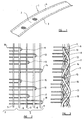
- In order that the invention may be more readily understood, and so that further features thereof may be appreciated, embodiments of the invention will now be described, by way of example, with reference to the accompanying drawings in which:
- FIGURE 1 is a perspective view of part of a belt,
- FIGURE 2 is an enlarged view of part of the edge section of the belt during manufacture thereof,
- FIGURE 3 is a view of the region of the belt shown in Figure 2 following completion of manufacture of the belt, and
- FIGURE 4 is a view corresponding to Figure 3 illustrating an alternative embodiment.
-
- Referring initially to Figure 1, a belt 1 is illustrated. The belt 1 is of a size suitable for use as a motor vehicle seat-belt, although it is to be understood that the belt may be used for various different purposes, for example as an aircraft seat-belt or a belt forming part of a safety harness or the like. The belt 1 is of elongate form, thus having a longitudinal axis and a transverse axis. The belt is woven from one or more monofilament weft yarns, which extend transversely to the longitudinal axis of the belt, and, in this embodiment, a plurality of multifilament warp yarns which extend parallel with the longitudinal axis of the belt.
- A
central region 2 of the belt is formed using a conventional weaving technique, but the belt has twoedge regions - Referring to Figure 2, a peripheral part of the
central region 2 of the seat-belt is illustrated together with theedge region 3. - In this embodiment the warp yarns are shrinkable yarns. Within the
central region 2 the warp yarns, exemplified by thewarp yarn 5, have a predetermined shrinkage characteristic whereas in theedge region 3 thewarp yarns warp yarns 6 to 9 in theedge region 3 is such that these yarns will shrink less than the warp yarns, such as thewarp yarn 5, in thecentral region 2, during a shrinking procedure. This may be achieved by pre-shrinking, to a certain extent, thewarp yarns 6 to 9 for use in theedge region 3. - In this embodiment of the invention the warp yarns in the
central region 2, as exemplified by thewarp yarn 5 may be of, for example, 1670 dtx i.e. 1670 g/10000 m yarn (equivalent to 1500 Denier (i.e. 1500g/9000m)) whereas thewarp yarns 6 to 9 in theouter region 3 may be much lighter and thinner, being, for example, 560 dtx yarn (equivalent to 500 Denier). - The belt 1, as shown in Figure 2, is woven using at least one
monofilament weft yarn 10. Themonofilament weft yarn 10 may be thin, having a diameter of approximately 0.3 mm or less. The multifilament warp yarns also preferably have a similar thickness. The particular weaving pattern disclosed hereinafter has been found to provide a belt having a thickness of less than 1.05 mm and which is very flat across its entire width. - It is to be understood that the weaving of the belt is accomplished in such a way that the weft yarn is caused to execute a series of "passes" across the warp yarns. On each pass, as the weft yarn extends across the
central region 2 of the belt, the weft yarn is woven, in a conventional way, with the warp yarns. However, on reaching theedge regions 3, a specific weave is achieved to provide a soft edge. The same weave is used for both of theedge regions region 3. - In the
edge region 3 the weft yarn on each pass extends to a predetermined warp yarn, extends around that warp yarn and then passes back across thecentral region 2. On each successive pass the weft yarn is looped around a different selected warp yarn in the edge region. Thus, on each pass the weft yarn is looped around a different warp yarn which is not the same as the warp yarn selected for the preceding pass on the following pass. The weft yarn, on successive passes, extends to each of the warp yarns in the edge region, until the weft yarn has been looped round all of the warp yarns in the edge region creating a predetermined "pattern". That "pattern" may then be repeated. - In the example illustrated in Figure 2, on a
first pass 11 of the weft yarn, the weft yarn is looped around thewarp yarn 6. On asecond pass 12 the weft yarn passes to one side (behind) the first two warp yarns, and is looped around thewarp yarn 8 which is spaced from thewarp yarn 6 by thewarp yarn 7, thus being the next-but-one warp yarn. On athird pass 13 theweft yarn 10 passes to one side of (behind) the first warp yarn, and is looped around thewarp yarn 7, which is next to thewarp yarn 6. On thenext pass 14 the weft yarn passes to one side of (behind) the first three warp yarns, and is looped around theouter-most warp yarn 9, which is next-but-one to thewarp yarn 7. Thus, at this stage, the weft yarn has been looped around each of the four warp yarns in the edge region of the belt, thus creating a "pattern". The "pattern" then begins to repeat itself, and the next pass, pass 15, is such that the weft yarn is again looped around theinitial warp yarn 6. Thenext pass 16 is such that the weft yarn is passed behind the first two warp yarns and is looped around thewarp yarn 8, and thenext pass 17 is such that the weft yarn is passed behind thefirst warp yarn 6 and is looped around thewarp yarn 7. The final pass, pass 18, is such that the weft yarn is looped around theouter-most warp yarn 9. The "pattern" has repeated, and then repeats repeatedly. - Following this weaving process, the webbing belt is shrunk. This may be achieved by placing the belt in an oven at a temperature between 180°C and 230°C, and preferably between 200°C and 230°C. All of the yarns of the belt then shrink, not only the warp yarns but also the weft yarns. Because the
warp yarns warp yarn 5, in thecentral region 2 of the belt, thewarp yarns 6 to 9 in the edge region do not shrink as much as the warp yarns in thecentral region 2. - As a consequence of the shrinking of the yarns the points where each pass 11 to 18 of the
weft 10 is looped round therespective warp yarn 6 to 9 are drawn inwardly towards thecentral region 2 of the belt. The region of each of thewarp yarns 6 to 9 which extend between two adjacent passes of the weft which are looped around that warp yarn (for example the region of thewarp yarn 6 between thepass 11 and the pass 15), forms a gently outwardly directed arcuate length of yarn, which still has some resilience, and which therefore is relatively soft. This arcuate length of yarn is created as thewarp yarns 6 to 9 do not shrink as much as thewarp yarns 2 in the central region of the belt. - It has been found that with some "patterns" of weave in the
edge region - Figure 4 illustrates four
weft yarns monofilament weft 10. In Figure 4 thefirst pass 20 of themonofilament 10 is looped around thewarp yarn 6 which is closest to thecentral region 2 of the belt. Thenext pass 21 is looped around the next-but-one warp yarn, which iswarp yarn 8. The next pass, 22, passes around the next adjacent warp yarn 9. - The
next pass 23 is again looped around the next adjacent warp yarn which is thewarp yarn 8. Thenext pass 24 is looped around the next adjacent warp yarn which is thewarp yarn 7. Thenext pass 25 begins to repeat the pattern being looped around thewarp yarn 6. Similarly the next pass, pass 26, corresponds withpass 21, being looped around the next-but-oneadjacent warp yarn 8. - By ensuring that successive passes of the weft are always looped around the next or the next-but-one warp yarn, a superior quality of edge may be achieved for the belt.
- While the invention has been described with reference to a belt which has two opposed edges which have equivalent properties, a belt could be fabricated having only one edge of the type described above, the other edge being of conventional form. The symmetrical belt, as described above, is preferred.
- In the present Specification "comprises" means "includes or consists of" and "comprising" means "including or consisting of".
- The features disclosed in the foregoing description, or the following Claims, or the accompanying drawings, expressed in their specific forms or in terms of a means for performing the disclosed function, or a method or process for attaining the disclosed result, as appropriate, may, separately, or in any combination of such features, be utilised for realising the invention in diverse forms thereof.
Claims (27)
- A method of manufacturing a belt, comprising the steps of weaving the belt from a plurality of warp yarns and at least one weft yarn, the belt having a central region and two opposed edges, the warp yarns in the central region having a predetermined shrinkage characteristic, at least one edge region between the central region and an edge of the belt having a predetermined number of warp yarns, each having a lesser shrinkage characteristic than the warp yarns of the central region, the method comprising the steps of passing the weft yarn across the warp yarns to effect a weaving in the central region of the belt, and, in the or each edge region, looping the weft yarn, on each pass, around a selected warp yarn, so that on a plurality of successive passes the weft yarn is looped around each of the warp yarns in the edge region, the method comprising the subsequent step of shrinking the yarns in the belt.
- A method according to Claim 1 where on each successive pass the weft yarn is looped around a different warp yarn, which is not the same as the warp yarn selected for the preceding pass or for the following pass.
- A method of manufacturing a webbing belt from warp yarns and a monofilament weft yarn, the method comprising the step of weaving the weft yarn with the warp yarns to produce a belt having a central region which is conventionally woven, and having at least one edge region in which the weft yarn, on successive is looped, passes around different selected warp yarns in the edge region.
- A method according to Claim 3 wherein the weft yarns in the edge region have a lesser shrinkage characteristic than the warp yarns of the central region, the method including a closing step of shrinking the yarns in the belt.
- A method of manufacturing a belt having a central region and at least one edge region, the method comprising the steps of utilising warp yarns, the warp yarns used to form the edge region of the belt having a different shrinkage characteristic to the warp yarns used to form the central region of the belt, such that on shrinkage of the belt, the edge region yarns will shrink less than the central region yarns, the method comprising the further steps of weaving the belt using at least one monofilament weft yarn, and subsequently treating the belt to effect shrinkage of the yarns used in forming the belt.
- A method according to Claim 5 wherein during the weaving of the belt the weft is passed across the warp, to effect a conventional weaving in the central region of a belt and, in the or each edge region, the weft yarn is looped, in each pass, around a selected warp yarn, so that on each successive pass of the weft the weft yarn is looped around a different warp yarn, which is not the same as the warp yarn selected for the preceding pass or for the following pass.
- A method according to Claim 5 or 6, wherein on a plurality of successive passes the weft yarn is looped around each of the warp yarns in the edge region.
- A method according to Claim 5, 6 or 7, wherein the belt is heat-treated to effect shrinkage of the yarns.
- A method of manufacturing a belt having a central region and at least one edge region comprising the steps of taking a plurality of warp yarns which are to form the belt, the warp yarns to form at least one edge region of the belt having a lesser weight and diameter than the warp yarns used to form a central region of the belt, and weaving the belt using at least one monofilament weft yarn.
- A method according to Claim 9 wherein, in the edge region, on successive passes of the weft, the weft yarn is looped around a different warp yarn in the edge region, which is not the same as the warp yarn selected for the preceding pass or for the following pass.
- A method according to Claim 9 or 10, wherein the warp yarns in the edge region have a lesser shrinkage characteristic than the warp yarns of the central region, the method comprising the subsequent step of shrinking the yarns in the belt.
- A method according to any one of Claims 1 to 8 or 11, wherein the shrinking of the yarns is effected by passing the belt through an oven at a temperature of 180°-230°C.
- A method according to any preceding Claim, wherein the yarns in the edge region are shrinkable yarns which are partially pre-shrunk.
- A method according to any preceding Claim wherein, in a series of successive passes the warp yarn is looped around each of the weft yarns in the edge region in a predetermined "pattern", with that "pattern" subsequently being repeated.
- A method according to any preceding Claim wherein the warp yarns used in the edge region are thinner and lighter than the warp yarns used in the central region.
- A method according to any preceding Claim wherein the warp yarns used in the edge region are substantially 500 Denier (560 dtx) yarns, whereas the warp yarns used in the central region are substantially 1500 Denier (1670 dtx) yarns.
- A method according to any preceding Claim wherein the weft yarn is of a diameter of 0.3 mm or less.
- A method according to any preceding Claim wherein on each successive pass the weft yarn is looped around a warp yarn which is next or next-but-one to the warp yarn selected for the preceding pass.
- A belt formed from a plurality of warp yarns and at least one weft yarn, the belt having a central region and two opposed edges, there being at least one edge region between the central region and an edge of the belt in which successive passes of the weft yarn are each looped around a different selected weft yarn in the edge region.
- A belt according to Claim 19 wherein each warp yarn in the edge region extends, as an arcuate length of yarn, between adjacent points where that warp yarn is looped by the weft yarn.
- A belt formed from a plurality of warp yarns and at least one weft yarn, the belt having a central region and at least one edge region between the central region and an edge of the belt, the warp yarns in the edge region being thinner and lighter than the warp yarns used in the central region.
- A belt according to Claim 21 wherein the successive passes of the weft yarn are each looped around a different selected warp yarn in the edge region of the belt.
- A belt according to Claim 21 or 22, wherein each warp yarn in the edge region extends, at an arcuate length of the yarn, between adjacent points where that warp yarn is looped by the weft yarn.
- A belt according to any one of Claims 19 to 23, wherein in a series of successive passes the warp yarn is looped around each of the weft yarns in the edge region in a predetermined "pattern", with that "pattern" subsequently being repeated.
- A belt according to any one of Claims 19 to 24, wherein the warp yarns in the edge region are thinner and lighter than the warp yarns used in the central region.
- A belt according to any one of Claims 19 to 25 wherein the warp yarns in the edge region are substantially 500 Denier (560 dtx) yarns, whereas the warp yarns used in the central region are substantially 1500 Denier (1670 dtx) yarns.
- A belt according to any one of Claims 19 to 26 wherein the weft yarn is of a diameter of 0.3 mm or less.
Applications Claiming Priority (2)
| Application Number | Priority Date | Filing Date | Title |
|---|---|---|---|
| US10/660,376 US7178559B2 (en) | 2003-09-11 | 2003-09-11 | Webbing belt |
| US660376 | 2003-09-11 |
Publications (3)
| Publication Number | Publication Date |
|---|---|
| EP1514962A2 true EP1514962A2 (en) | 2005-03-16 |
| EP1514962A3 EP1514962A3 (en) | 2005-12-14 |
| EP1514962B1 EP1514962B1 (en) | 2009-12-30 |
Family
ID=34136773
Family Applications (1)
| Application Number | Title | Priority Date | Filing Date |
|---|---|---|---|
| EP04004149A Expired - Lifetime EP1514962B1 (en) | 2003-09-11 | 2004-02-24 | A webbing belt |
Country Status (5)
| Country | Link |
|---|---|
| US (1) | US7178559B2 (en) |
| EP (1) | EP1514962B1 (en) |
| JP (1) | JP2005089949A (en) |
| AT (1) | ATE453746T1 (en) |
| DE (2) | DE602004024853D1 (en) |
Cited By (3)
| Publication number | Priority date | Publication date | Assignee | Title |
|---|---|---|---|---|
| EP2302117A2 (en) | 2009-09-21 | 2011-03-30 | Storsack Holding GmbH | Transport bag and method for producing a reinforced textile edge |
| DE102009058039B3 (en) * | 2009-12-14 | 2011-05-05 | Autoliv Development Ab | Seat belt webbing and method of making the same |
| US8434527B2 (en) | 2011-02-01 | 2013-05-07 | Autoliv Development Ab | Seat belt webbing and method for manufacturing the same |
Families Citing this family (15)
| Publication number | Priority date | Publication date | Assignee | Title |
|---|---|---|---|---|
| US8387749B2 (en) | 2004-03-01 | 2013-03-05 | Ykk Corporation Of America | Shock absorbing fabric structures |
| US20050189169A1 (en) * | 2004-03-01 | 2005-09-01 | Hajime Tanaka | Shock absorbing lanyards |
| CA2619758C (en) * | 2005-08-16 | 2012-05-08 | Ykk Corporation Of America | Energy absorbing webbings |
| DE102006010775A1 (en) * | 2006-03-08 | 2007-09-13 | Johann Berger | Webbing, method and needle-loom for producing the same |
| US8163362B2 (en) * | 2008-02-29 | 2012-04-24 | Ykk Corporation Of America | Line of sight hose cover |
| US8137779B2 (en) * | 2008-02-29 | 2012-03-20 | Ykk Corporation Of America | Line of sight hose cover |
| US8316988B2 (en) | 2010-08-12 | 2012-11-27 | Ykk Corporation Of America | Shock absorbing fabric structures |
| DE102011084336B4 (en) | 2011-10-12 | 2013-12-05 | Carl Stahl Gmbh & Co. Kg | Webbing and method of making a webbing |
| US9328436B2 (en) | 2013-03-14 | 2016-05-03 | Ykk Corporation Of America | Energy absorbing fabric and method of manufacturing same |
| DE102013210274B4 (en) | 2013-06-03 | 2014-12-18 | Berger Gmbh & Co. Holding Kg | Fine-thread safety belt webbing and method for producing such a seat belt webbing |
| FR3037811B1 (en) * | 2015-06-29 | 2018-05-25 | Zedel | STRAP FORMING BELT AND / OR PAIR OF THROUGHING HARNESS THRUTS, AND ATTACHING HARNESS |
| US10710295B2 (en) * | 2015-11-03 | 2020-07-14 | Intertape Polymer Corp. | Protective covering for wood products |
| CN110923895B (en) * | 2019-11-11 | 2023-12-19 | 肇庆市鼎湖兴文塑胶五金制品有限公司 | A weaving method for edge closing of webbing |
| DE102020206517B3 (en) * | 2020-05-26 | 2021-04-22 | Autoliv Development Ab | Belt strap for a seat belt device of a motor vehicle |
| CN116289043B (en) * | 2022-12-26 | 2025-05-23 | 立讯智造科技(常熟)有限公司 | Braiding belt shaping method |
Citations (1)
| Publication number | Priority date | Publication date | Assignee | Title |
|---|---|---|---|---|
| FR1425411A (en) | 1964-12-04 | 1966-01-24 | Honore Vinson | Improvement in tapes woven by a monofilament |
Family Cites Families (23)
| Publication number | Priority date | Publication date | Assignee | Title |
|---|---|---|---|---|
| US37546A (en) * | 1863-01-27 | Improvement in weaving corsets | ||
| US1037752A (en) * | 1912-03-23 | 1912-09-03 | Helvetia Silk Mills | Weave. |
| US1910073A (en) * | 1931-11-24 | 1933-05-23 | United Elastic Corp | Webbing |
| US3177873A (en) * | 1962-11-28 | 1965-04-13 | Johnson & Johnson | Diaper |
| DE2508732A1 (en) * | 1975-02-28 | 1976-09-09 | Berger Ohg Elastic | Safety belt for vehicle for aircraft - has edges which have rounded profile to prevent clothing wear and injury in case of accident |
| AR206830A1 (en) * | 1974-10-01 | 1976-08-23 | Berger Ohg Elastic | KNITTED TAPE FOR SEAT BELTS |
| DE2446837A1 (en) * | 1974-10-01 | 1976-04-15 | Berger Ohg Elastic | Safety belt for vehicle for aircraft - has edges which have rounded profile to prevent clothing wear and injury in case of accident |
| DE2659789C3 (en) * | 1976-12-31 | 1980-03-13 | Johann Berger | Woven webbing with hollow edges |
| CH636386A5 (en) * | 1978-12-05 | 1983-05-31 | Textilma Ag | TAPE FABRIC, METHOD FOR THE PRODUCTION THEREOF, AND TAPE WEAVING MACHINE FOR CARRYING OUT THE METHOD. |
| DE8304432U1 (en) * | 1983-02-18 | 1983-08-11 | Kühn, Vierhaus & Cie AG, 4050 Mönchengladbach | TEXTILE TAPE, ESPECIALLY SAFETY BELT FOR MOTOR VEHICLES |
| US4481981A (en) * | 1983-03-21 | 1984-11-13 | General Motors Corporation | Soft edge seat belt webbing |
| DE3345508A1 (en) * | 1983-12-16 | 1985-06-27 | Ieperband N.V., Ieper | STRAP WITH FLEXIBLE SHOT MATERIAL |
| JPH0243894Y2 (en) * | 1986-02-28 | 1990-11-21 | ||
| JPH031493Y2 (en) * | 1986-03-17 | 1991-01-17 | ||
| JPH0165744U (en) * | 1987-10-21 | 1989-04-27 | ||
| US4981161A (en) * | 1988-11-17 | 1991-01-01 | Lagran Canada, Inc. | Seat belt webbing having multifilament and monofilament yarns |
| JPH0546982U (en) * | 1991-11-22 | 1993-06-22 | 明大化学株式会社 | Joint structure such as seat |
| DE4409980A1 (en) * | 1994-03-23 | 1995-09-28 | Stahl Gurt Bandweberei | Mfr. of user friendly seat belt weave, gives good transverse stiffness |
| JP3767173B2 (en) * | 1998-06-09 | 2006-04-19 | タカタ株式会社 | Air belt bag |
| US6199597B1 (en) * | 1998-10-13 | 2001-03-13 | Narricot Industries, Inc. | Seat belt webbing double faced with ribs |
| BR9916240B1 (en) * | 1998-12-14 | 2009-01-13 | process for the manufacture of an inflatable belt band, and, belt band. | |
| US6112775A (en) * | 1999-03-05 | 2000-09-05 | Narricot Industries Incorporated | Weft yarn selection mechanism and methods for weaving seat belt webbing |
| PL355767A1 (en) * | 1999-12-24 | 2004-05-17 | Johann Berger | Ribbon and method for production thereof |
-
2003
- 2003-09-11 US US10/660,376 patent/US7178559B2/en not_active Expired - Lifetime
-
2004
- 2004-02-24 AT AT04004149T patent/ATE453746T1/en not_active IP Right Cessation
- 2004-02-24 DE DE602004024853T patent/DE602004024853D1/en not_active Expired - Lifetime
- 2004-02-24 EP EP04004149A patent/EP1514962B1/en not_active Expired - Lifetime
- 2004-03-19 JP JP2004081325A patent/JP2005089949A/en active Pending
- 2004-03-30 DE DE102004015327A patent/DE102004015327A1/en not_active Withdrawn
Patent Citations (1)
| Publication number | Priority date | Publication date | Assignee | Title |
|---|---|---|---|---|
| FR1425411A (en) | 1964-12-04 | 1966-01-24 | Honore Vinson | Improvement in tapes woven by a monofilament |
Cited By (5)
| Publication number | Priority date | Publication date | Assignee | Title |
|---|---|---|---|---|
| EP2302117A2 (en) | 2009-09-21 | 2011-03-30 | Storsack Holding GmbH | Transport bag and method for producing a reinforced textile edge |
| DE102009058039B3 (en) * | 2009-12-14 | 2011-05-05 | Autoliv Development Ab | Seat belt webbing and method of making the same |
| EP2333138A1 (en) | 2009-12-14 | 2011-06-15 | Autoliv Development AB | Safety belt and method for manufacturing the same |
| DE102009058039C5 (en) * | 2009-12-14 | 2014-02-27 | Autoliv Development Ab | Seat belt webbing and method of making the same |
| US8434527B2 (en) | 2011-02-01 | 2013-05-07 | Autoliv Development Ab | Seat belt webbing and method for manufacturing the same |
Also Published As
| Publication number | Publication date |
|---|---|
| EP1514962B1 (en) | 2009-12-30 |
| DE602004024853D1 (en) | 2010-02-11 |
| US7178559B2 (en) | 2007-02-20 |
| DE102004015327A1 (en) | 2005-04-07 |
| US20050056335A1 (en) | 2005-03-17 |
| EP1514962A3 (en) | 2005-12-14 |
| JP2005089949A (en) | 2005-04-07 |
| ATE453746T1 (en) | 2010-01-15 |
Similar Documents
| Publication | Publication Date | Title |
|---|---|---|
| EP1514962B1 (en) | A webbing belt | |
| CN105143534B (en) | Energy absorption fabric and its manufacture method | |
| EP2294255B1 (en) | Shock absorbing fabric structures | |
| CN107107861B (en) | Safety belt for a safety belt device and safety belt device | |
| US20080190691A1 (en) | Shock Absorbing Lanyards | |
| US7954847B2 (en) | Stretchable webbing, inflatable belt, and inflatable belt apparatus | |
| EP1008680B1 (en) | Seat belt webbing | |
| US7845676B2 (en) | Stretchable webbing, inflatable belt, and inflatable belt apparatus | |
| US8567559B2 (en) | Shock absorbing fabric structures | |
| BRPI1005574A2 (en) | SAFETY BELT FABRIC RANGE AND MANUFACTURING METHOD | |
| EP1874988B1 (en) | A webbing belt | |
| EP0119684A1 (en) | Soft edge seat belt webbing | |
| US6375218B2 (en) | Airbelt and airbelt apparatus | |
| CN1040896C (en) | Wowen safety belt for vehicle occupant restraint system | |
| WO2007011336A1 (en) | Shock absorbing lanyards | |
| JP2000185624A (en) | Weaving structure of webbing | |
| EP1790763A2 (en) | Webbing for occupant restraint belt, seat belt, and seat belt apparatus | |
| JP6500741B2 (en) | Seat belt webbing, method of manufacturing the same and seat belt | |
| JP6617568B2 (en) | Seat belt webbing | |
| EP4310232A1 (en) | Airbag fabric | |
| EP1268904B1 (en) | Method of manufacturing a vehicle safety device | |
| JP2015108211A (en) | Belt | |
| HU176644B (en) | Textile band for safety seat belt | |
| HK1150066B (en) | Shock absorbing fabric structures |
Legal Events
| Date | Code | Title | Description |
|---|---|---|---|
| PUAI | Public reference made under article 153(3) epc to a published international application that has entered the european phase |
Free format text: ORIGINAL CODE: 0009012 |
|
| AK | Designated contracting states |
Kind code of ref document: A2 Designated state(s): AT BE BG CH CY CZ DE DK EE ES FI FR GB GR HU IE IT LI LU MC NL PT RO SE SI SK TR |
|
| AX | Request for extension of the european patent |
Extension state: AL LT LV MK |
|
| PUAL | Search report despatched |
Free format text: ORIGINAL CODE: 0009013 |
|
| AK | Designated contracting states |
Kind code of ref document: A3 Designated state(s): AT BE BG CH CY CZ DE DK EE ES FI FR GB GR HU IE IT LI LU MC NL PT RO SE SI SK TR |
|
| AX | Request for extension of the european patent |
Extension state: AL LT LV MK |
|
| 17P | Request for examination filed |
Effective date: 20060529 |
|
| AKX | Designation fees paid |
Designated state(s): AT BE BG CH CY CZ DE DK EE ES FI FR GB GR HU IE IT LI LU MC NL PT RO SE SI SK TR |
|
| 17Q | First examination report despatched |
Effective date: 20070705 |
|
| GRAP | Despatch of communication of intention to grant a patent |
Free format text: ORIGINAL CODE: EPIDOSNIGR1 |
|
| GRAS | Grant fee paid |
Free format text: ORIGINAL CODE: EPIDOSNIGR3 |
|
| GRAA | (expected) grant |
Free format text: ORIGINAL CODE: 0009210 |
|
| AK | Designated contracting states |
Kind code of ref document: B1 Designated state(s): AT BE BG CH CY CZ DE DK EE ES FI FR GB GR HU IE IT LI LU MC NL PT RO SE SI SK TR |
|
| REG | Reference to a national code |
Ref country code: GB Ref legal event code: FG4D |
|
| REG | Reference to a national code |
Ref country code: CH Ref legal event code: EP |
|
| REG | Reference to a national code |
Ref country code: IE Ref legal event code: FG4D |
|
| REF | Corresponds to: |
Ref document number: 602004024853 Country of ref document: DE Date of ref document: 20100211 Kind code of ref document: P |
|
| PG25 | Lapsed in a contracting state [announced via postgrant information from national office to epo] |
Ref country code: SE Free format text: LAPSE BECAUSE OF FAILURE TO SUBMIT A TRANSLATION OF THE DESCRIPTION OR TO PAY THE FEE WITHIN THE PRESCRIBED TIME-LIMIT Effective date: 20091230 Ref country code: FI Free format text: LAPSE BECAUSE OF FAILURE TO SUBMIT A TRANSLATION OF THE DESCRIPTION OR TO PAY THE FEE WITHIN THE PRESCRIBED TIME-LIMIT Effective date: 20091230 |
|
| REG | Reference to a national code |
Ref country code: NL Ref legal event code: VDEP Effective date: 20091230 |
|
| PG25 | Lapsed in a contracting state [announced via postgrant information from national office to epo] |
Ref country code: SI Free format text: LAPSE BECAUSE OF FAILURE TO SUBMIT A TRANSLATION OF THE DESCRIPTION OR TO PAY THE FEE WITHIN THE PRESCRIBED TIME-LIMIT Effective date: 20091230 |
|
| PG25 | Lapsed in a contracting state [announced via postgrant information from national office to epo] |
Ref country code: AT Free format text: LAPSE BECAUSE OF FAILURE TO SUBMIT A TRANSLATION OF THE DESCRIPTION OR TO PAY THE FEE WITHIN THE PRESCRIBED TIME-LIMIT Effective date: 20091230 |
|
| PG25 | Lapsed in a contracting state [announced via postgrant information from national office to epo] |
Ref country code: BG Free format text: LAPSE BECAUSE OF FAILURE TO SUBMIT A TRANSLATION OF THE DESCRIPTION OR TO PAY THE FEE WITHIN THE PRESCRIBED TIME-LIMIT Effective date: 20100330 Ref country code: ES Free format text: LAPSE BECAUSE OF FAILURE TO SUBMIT A TRANSLATION OF THE DESCRIPTION OR TO PAY THE FEE WITHIN THE PRESCRIBED TIME-LIMIT Effective date: 20100410 Ref country code: EE Free format text: LAPSE BECAUSE OF FAILURE TO SUBMIT A TRANSLATION OF THE DESCRIPTION OR TO PAY THE FEE WITHIN THE PRESCRIBED TIME-LIMIT Effective date: 20091230 Ref country code: RO Free format text: LAPSE BECAUSE OF FAILURE TO SUBMIT A TRANSLATION OF THE DESCRIPTION OR TO PAY THE FEE WITHIN THE PRESCRIBED TIME-LIMIT Effective date: 20091230 Ref country code: PT Free format text: LAPSE BECAUSE OF FAILURE TO SUBMIT A TRANSLATION OF THE DESCRIPTION OR TO PAY THE FEE WITHIN THE PRESCRIBED TIME-LIMIT Effective date: 20100430 Ref country code: NL Free format text: LAPSE BECAUSE OF FAILURE TO SUBMIT A TRANSLATION OF THE DESCRIPTION OR TO PAY THE FEE WITHIN THE PRESCRIBED TIME-LIMIT Effective date: 20091230 |
|
| PG25 | Lapsed in a contracting state [announced via postgrant information from national office to epo] |
Ref country code: BE Free format text: LAPSE BECAUSE OF FAILURE TO SUBMIT A TRANSLATION OF THE DESCRIPTION OR TO PAY THE FEE WITHIN THE PRESCRIBED TIME-LIMIT Effective date: 20091230 Ref country code: SK Free format text: LAPSE BECAUSE OF FAILURE TO SUBMIT A TRANSLATION OF THE DESCRIPTION OR TO PAY THE FEE WITHIN THE PRESCRIBED TIME-LIMIT Effective date: 20091230 Ref country code: CZ Free format text: LAPSE BECAUSE OF FAILURE TO SUBMIT A TRANSLATION OF THE DESCRIPTION OR TO PAY THE FEE WITHIN THE PRESCRIBED TIME-LIMIT Effective date: 20091230 |
|
| REG | Reference to a national code |
Ref country code: CH Ref legal event code: PL |
|
| PG25 | Lapsed in a contracting state [announced via postgrant information from national office to epo] |
Ref country code: LI Free format text: LAPSE BECAUSE OF NON-PAYMENT OF DUE FEES Effective date: 20100228 Ref country code: GR Free format text: LAPSE BECAUSE OF FAILURE TO SUBMIT A TRANSLATION OF THE DESCRIPTION OR TO PAY THE FEE WITHIN THE PRESCRIBED TIME-LIMIT Effective date: 20100331 Ref country code: CY Free format text: LAPSE BECAUSE OF FAILURE TO SUBMIT A TRANSLATION OF THE DESCRIPTION OR TO PAY THE FEE WITHIN THE PRESCRIBED TIME-LIMIT Effective date: 20091230 Ref country code: CH Free format text: LAPSE BECAUSE OF NON-PAYMENT OF DUE FEES Effective date: 20100228 Ref country code: MC Free format text: LAPSE BECAUSE OF NON-PAYMENT OF DUE FEES Effective date: 20100301 |
|
| PLBE | No opposition filed within time limit |
Free format text: ORIGINAL CODE: 0009261 |
|
| STAA | Information on the status of an ep patent application or granted ep patent |
Free format text: STATUS: NO OPPOSITION FILED WITHIN TIME LIMIT |
|
| GBPC | Gb: european patent ceased through non-payment of renewal fee |
Effective date: 20100330 |
|
| 26N | No opposition filed |
Effective date: 20101001 |
|
| PG25 | Lapsed in a contracting state [announced via postgrant information from national office to epo] |
Ref country code: IE Free format text: LAPSE BECAUSE OF NON-PAYMENT OF DUE FEES Effective date: 20100224 Ref country code: DK Free format text: LAPSE BECAUSE OF FAILURE TO SUBMIT A TRANSLATION OF THE DESCRIPTION OR TO PAY THE FEE WITHIN THE PRESCRIBED TIME-LIMIT Effective date: 20091230 |
|
| PG25 | Lapsed in a contracting state [announced via postgrant information from national office to epo] |
Ref country code: IT Free format text: LAPSE BECAUSE OF NON-PAYMENT OF DUE FEES Effective date: 20100224 Ref country code: GB Free format text: LAPSE BECAUSE OF NON-PAYMENT OF DUE FEES Effective date: 20100330 |
|
| PGRI | Patent reinstated in contracting state [announced from national office to epo] |
Ref country code: IT Effective date: 20110616 |
|
| PGFP | Annual fee paid to national office [announced via postgrant information from national office to epo] |
Ref country code: IT Payment date: 20120214 Year of fee payment: 9 |
|
| PG25 | Lapsed in a contracting state [announced via postgrant information from national office to epo] |
Ref country code: LU Free format text: LAPSE BECAUSE OF NON-PAYMENT OF DUE FEES Effective date: 20100224 Ref country code: HU Free format text: LAPSE BECAUSE OF FAILURE TO SUBMIT A TRANSLATION OF THE DESCRIPTION OR TO PAY THE FEE WITHIN THE PRESCRIBED TIME-LIMIT Effective date: 20100701 |
|
| PG25 | Lapsed in a contracting state [announced via postgrant information from national office to epo] |
Ref country code: TR Free format text: LAPSE BECAUSE OF FAILURE TO SUBMIT A TRANSLATION OF THE DESCRIPTION OR TO PAY THE FEE WITHIN THE PRESCRIBED TIME-LIMIT Effective date: 20091230 |
|
| PGFP | Annual fee paid to national office [announced via postgrant information from national office to epo] |
Ref country code: FR Payment date: 20130117 Year of fee payment: 10 |
|
| REG | Reference to a national code |
Ref country code: FR Ref legal event code: ST Effective date: 20141031 |
|
| PG25 | Lapsed in a contracting state [announced via postgrant information from national office to epo] |
Ref country code: FR Free format text: LAPSE BECAUSE OF NON-PAYMENT OF DUE FEES Effective date: 20140228 |
|
| PG25 | Lapsed in a contracting state [announced via postgrant information from national office to epo] |
Ref country code: IT Free format text: LAPSE BECAUSE OF NON-PAYMENT OF DUE FEES Effective date: 20140224 |
|
| PGFP | Annual fee paid to national office [announced via postgrant information from national office to epo] |
Ref country code: DE Payment date: 20180226 Year of fee payment: 15 |
|
| REG | Reference to a national code |
Ref country code: DE Ref legal event code: R119 Ref document number: 602004024853 Country of ref document: DE |
|
| PG25 | Lapsed in a contracting state [announced via postgrant information from national office to epo] |
Ref country code: DE Free format text: LAPSE BECAUSE OF NON-PAYMENT OF DUE FEES Effective date: 20190903 |