EP1524030A1 - Verfahren und Vorrichtung zur Herstellung von Mikrokaspseln - Google Patents

Verfahren und Vorrichtung zur Herstellung von Mikrokaspseln Download PDF

Info

Publication number
EP1524030A1
EP1524030A1 EP03023471A EP03023471A EP1524030A1 EP 1524030 A1 EP1524030 A1 EP 1524030A1 EP 03023471 A EP03023471 A EP 03023471A EP 03023471 A EP03023471 A EP 03023471A EP 1524030 A1 EP1524030 A1 EP 1524030A1
Authority
EP
European Patent Office
Prior art keywords
capillary
component
dripping
capillaries
takes place
Prior art date
Legal status (The legal status is an assumption and is not a legal conclusion. Google has not performed a legal analysis and makes no representation as to the accuracy of the status listed.)
Withdrawn
Application number
EP03023471A
Other languages
English (en)
French (fr)
Inventor
Josep-Lluis Dr. Viladot Petit
Juan-Antonio Asensio
Manuel Seva
Current Assignee (The listed assignees may be inaccurate. Google has not performed a legal analysis and makes no representation or warranty as to the accuracy of the list.)
Cognis IP Management GmbH
Original Assignee
Cognis IP Management GmbH
Cognis Iberia SL
Priority date (The priority date is an assumption and is not a legal conclusion. Google has not performed a legal analysis and makes no representation as to the accuracy of the date listed.)
Filing date
Publication date
Application filed by Cognis IP Management GmbH, Cognis Iberia SL filed Critical Cognis IP Management GmbH
Priority to EP03023471A priority Critical patent/EP1524030A1/de
Publication of EP1524030A1 publication Critical patent/EP1524030A1/de
Withdrawn legal-status Critical Current

Links

Images

Classifications

    • BPERFORMING OPERATIONS; TRANSPORTING
    • B05SPRAYING OR ATOMISING IN GENERAL; APPLYING FLUENT MATERIALS TO SURFACES, IN GENERAL
    • B05BSPRAYING APPARATUS; ATOMISING APPARATUS; NOZZLES
    • B05B1/00Nozzles, spray heads or other outlets, with or without auxiliary devices such as valves, heating means
    • B05B1/02Nozzles, spray heads or other outlets, with or without auxiliary devices such as valves, heating means designed to produce a jet, spray, or other discharge of particular shape or nature, e.g. in single drops, or having an outlet of particular shape
    • BPERFORMING OPERATIONS; TRANSPORTING
    • B01PHYSICAL OR CHEMICAL PROCESSES OR APPARATUS IN GENERAL
    • B01JCHEMICAL OR PHYSICAL PROCESSES, e.g. CATALYSIS OR COLLOID CHEMISTRY; THEIR RELEVANT APPARATUS
    • B01J13/00Colloid chemistry, e.g. the production of colloidal materials or their solutions, not otherwise provided for; Making microcapsules or microballoons
    • B01J13/02Making microcapsules or microballoons
    • B01J13/04Making microcapsules or microballoons by physical processes, e.g. drying, spraying
    • BPERFORMING OPERATIONS; TRANSPORTING
    • B01PHYSICAL OR CHEMICAL PROCESSES OR APPARATUS IN GENERAL
    • B01JCHEMICAL OR PHYSICAL PROCESSES, e.g. CATALYSIS OR COLLOID CHEMISTRY; THEIR RELEVANT APPARATUS
    • B01J13/00Colloid chemistry, e.g. the production of colloidal materials or their solutions, not otherwise provided for; Making microcapsules or microballoons
    • B01J13/02Making microcapsules or microballoons
    • B01J13/06Making microcapsules or microballoons by phase separation
    • B01J13/10Complex coacervation, i.e. interaction of oppositely charged particles
    • BPERFORMING OPERATIONS; TRANSPORTING
    • B05SPRAYING OR ATOMISING IN GENERAL; APPLYING FLUENT MATERIALS TO SURFACES, IN GENERAL
    • B05BSPRAYING APPARATUS; ATOMISING APPARATUS; NOZZLES
    • B05B7/00Spraying apparatus for discharge of liquids or other fluent materials from two or more sources, e.g. of liquid and air, of powder and gas
    • B05B7/02Spray pistols; Apparatus for discharge
    • B05B7/04Spray pistols; Apparatus for discharge with arrangements for mixing liquids or other fluent materials before discharge
    • B05B7/0416Spray pistols; Apparatus for discharge with arrangements for mixing liquids or other fluent materials before discharge with arrangements for mixing one gas and one liquid

Definitions

  • the invention is in the field of encapsulation of active ingredients and relates a new method and apparatus for the production of microcapsules by dripping.
  • microcapsule or “nanocapsule” are used by the person skilled in the art Aggregates with a diameter in the range of about 0.0001 to about 5, and preferably 0.005 to 0.5 mm, which contain at least one solid or liquid core, the is enclosed by at least one continuous shell. More precisely, it is coated with film-forming polymers finely dispersed liquid or solid phases in which The polymers are prepared after emulsification and coacervation or interfacial polymerization precipitate on the material to be wrapped. After another procedure molten waxes are taken up in a matrix (“microsponge”) that acts as a microparticle may additionally be coated with film-forming polymers.
  • microsponge a matrix
  • the microscopic capsules can be like Dry powder. Besides mononuclear microcapsules are also multinucleated aggregates, too Microspheres, known as the two or more cores in the continuous shell material distributed. Mononuclear or polynuclear microcapsules can also from an additional second, third, etc. sheath be enclosed.
  • the shell can be made of natural, semisynthetic or synthetic materials. Of course, wrapping materials are, for example Gum arabic, agar-agar, agarose, maltodextrins, alginic acid or its salts, e.g.
  • Semi-synthetic shell materials are, inter alia, chemical modified celluloses, in particular cellulose esters and ethers, e.g. cellulose acetate, Ethylcellulose, hydroxypropylcellulose, hydroxypropylmethylcellulose and carboxymethylcellulose, and starch derivatives, in particular starch ethers and esters.
  • Synthetic wrapping materials are, for example, polymers such as polyacrylates, polyamides, polyvinyl alcohol or polyvinylpyrrolidone.
  • microcapsules of the prior art are the following commercial products (in parentheses is the shell material): Hallcrest Microcapsules (gelatin, gum arabic), Coletica Thalaspheres (marine collagen), Lipotec Millicapseln (alginic acid, agar-agar), Induchem Unispheres (lactose , microcrystalline cellulose, hydroxypropylmethylcellulose); Unicerin C30 (lactose, microcrystalline cellulose, hydroxypropylmethylcellulose), Kobo Glycospheres (modified starch, fatty acid esters, phospholipids), Softspheres (modified agar-agar) and Kuhs Probiol Nanospheres (phospholipids) as well as Primaspheres and Primasponges (chitosan, alginates) and Primasys (phospholipids) ,
  • the preparation of such microcapsules is usually by dripping.
  • This is a first aqueous preparation containing a first monomer optionally together with contains the active ingredients and additives, dropped into a bath, which is essentially the second Contains monomer.
  • the monomers for example oppositely charged polyelectrolytes or the combination dicarboxylic acid chloride / diamine, are thereby selected so that it upon contact with a spontaneous coacervation or interfacial polymerization comes.
  • the dripping takes place with the help of a dropping funnel, what a Laboratory test is certainly sufficient, for the technical implementation, however, out of the question comes.
  • the industrial production of microcapsules is rather using Pressure vessels whose bottom plate is equipped with a variety of fine nozzles.
  • the Monomer solution is applied at generally slightly elevated pressure continuously through the capillaries pressed.
  • a drop formed in this way at the outlet of the capillaries forms, until gravity exceeds the adhesion, the liquid film breaks off and the drop then falls into the bath where the coacervation, i. the formation of the capsule shell takes place.
  • the disadvantage is that the drops - and thus the forming microcapsules - are relatively large and typically have a diameter of about 1 to 2 mm. The process is therefore less suitable, especially microcapsules with much smaller produce medium diameters.
  • the object of the present invention has therefore consisted of known dripping methods to modify the continuous production of microcapsules that also on an industrial scale, that with the least possible technical effort Also capsules with average diameters in the range of 0.1 to 5 mm are obtained.
  • a first subject of the invention relates to a process for continuous production of microcapsules having an average diameter of 0.1 to 5, preferably 0.5 to 1 mm by dripping and spontaneous coacervation of an optionally with active ingredients and additives laden preparation of a first component (a) in the preparation of a second Component (b), which is characterized in that the dripping by at least a capillary takes place and the tear of the drops at the outlet of the capillary by at least a horizontal, tangential or vertical to the direction of fall of the drops extending gas stream is effected.
  • the central element of the invention is that the growth of the drops on The outlet of the capillaries is not determined by the fact that finally the force of gravity is the adhesive force but the demolition of the drop is caused by a gas flow, before it exceeds a certain size. It is by changing the pressure, with which the gas flow flows around the capillary, easily possible, the drop size - and of course, the size of the resulting microcapsules - to adjust precisely.
  • the dripping takes place over a single nozzle.
  • a system of many, for example 10 to 1000 and preferably 50 to 200 similar, arranged parallel to each other
  • capillaries which are arranged for example on a perforated disc, which represents the bottom of a pressure vessel containing component (a).
  • the capillaries have at the outlet preferably a diameter of 0.05 to 2 mm, while their length is uncritical and is usually 1 to 2 cm, which is ultimately due to the Thickness of the perforated plate is determined in which they are arranged.
  • the central element of the method according to the invention is to force the demolition of the drops from the top of the capillary through a lateral gas flow before they have become so large that the liquid film due to gravity interrupted.
  • the pressure of the gas stream can thus be adjust the particle size very precisely. Usually this is done with pressures in the range worked from 0.01 to 3 bar.
  • the capillaries only from one side to flow around the gas, it has proved to be advantageous, at least two to direct opposing gas flows to the outlet of the nozzles to ensure that the tearing drops do not splash around unchecked, but as possible fall vertically into the bath.
  • the perforated plate, which receives the capillaries is designed such that it is in at least a plane is crossed by channels through which the gas streams are passed.
  • the capillaries in the holes of the perforated plate are not fixed, but play the gas flow can escape along the longitudinal section of the nozzles and thus the demolition cause the droplets at the outlet of the capillaries.
  • Another constructive parameter consists in the strength of the perforated disc: this can be chosen so that the capillaries projecting from the disk or sunk into it. In the first case, the gas flow is weaker and allows the formation of larger droplets or microcapsules, in the second case, the gas flow stronger and leads to the opposite result.
  • Another object of the invention relates to a device for dropping monomer solutions, consisting of a pressure vessel (1) with an inlet (2) for the dripping Starting materials, designed as a bottom of the pressure vessel perforated disc (3), which (a) has holes for receiving capillary nozzles and (b) in - at least - one level is traversed horizontally to the longitudinal axis of the capillaries by channels, through which a constant Gas flow can be directed.
  • the pressure vessel is usually cylindrically shaped and can have a diameter of 10 to 100 cm and a capacity of 0.25 to have 5 1.
  • the feed for the raw material mass is preferably in the upper third the pressure vessel and is designed to be heated, so not only solutions, but if required also melting can be promoted.
  • the inlet is provided with a conveying device, the introduction the starting materials also allowed against a pressure of up to 5 bar.
  • the perforated plate is provided at regular intervals with holes for receiving the capillaries, the diameter of which depends on the nozzles and is usually 0.5 to 2.5 mm. The distance from hole to hole is usually about 1 cm, with the holes typically distributed in the form of concentric circles on the perforated plate.
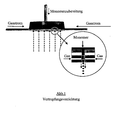
  • the Perforated plate contains channels through which gas from different sides, usually air or Nitrogen can be injected. A schematic representation of the device is shown in FIG Fig.1 reproduced.
  • Suitable components (a) and (b) are, for example, oppositely charged polyelectrolytes, for example anionic polymers (for example polyacrylates, alginic acid salts) and cationic polymers (for example chitosan).
  • anionic polymers for example polyacrylates, alginic acid salts
  • cationic polymers for example chitosan
  • dicarboxylic acid chlorides and diamines for example sebacic or adipic acid dichloride and hexamethylenediamine.
  • component (a) substances which are liquid or pasty at elevated temperature (eg above 25 to 30 ° C.) and which gel in the cold (for example at 5 to 15 ° C.), while as component (b ) cosmetically acceptable oil bodies come into question.
  • An example of component (a) is gelatin, oils may be mineral oils, fatty acid esters, dialkyl ethers and the like.
  • the preparations may be aqueous or oily formulations; Emulsions can also be dripped or serve as a template (“bath”) into which the dropletization takes place.
  • Suitable examples of active ingredients and auxiliaries as well as further parameters which relate solely to the encapsulation of the active compounds can be found, for example, in the publications WO 01/01926, WO 01/01927, WO 01/01928, WO 01/01929 (Primacare), the content of which is expressly included in the teaching of the present invention.
  • the pressure vessel and dropletizer are heated and / or the template is cooled.
  • the finished microcapsules can then be worked up in a manner known per se, ie they are washed, sieved and dried.

Landscapes

  • Chemical & Material Sciences (AREA)
  • Organic Chemistry (AREA)
  • Dispersion Chemistry (AREA)
  • Chemical Kinetics & Catalysis (AREA)
  • Manufacturing Of Micro-Capsules (AREA)

Abstract

Vorgeschlagen wird ein Verfahren zur kontinuierlichen Herstellung von Mikrokapseln mit einem mittleren Durchmesser von 0,1 bis 5 mm durch Vertropfen und spontane Koazervation einer gegebenenfalls mit Wirk- und Zusatzstoffen beladenen Zubereitung einer ersten Komponente (a) in die Zubereitung einer zweiten Komponente (b), welches sich dadurch auszeichnet, dass die Vertropfung durch mindestens eine Kapillare erfolgt und der Abriss der Tropfen am Auslass der Kapillare durch mindestens einen horizontal, tangential oder vertikal zur Fallrichtung der Tropfen verlaufenden Gasstrom bewirkt wird.

Description

Gebiet der Erfindung
Die Erfindung befindet sich auf dem Gebiet der Verkapselung von Wirkstoffen und betrifft ein neues Verfahren sowie eine Vorrichtung zur Herstellung von Mikrokapseln durch Vertropfung.
Stand der Technik
Unter den Begriffen "Mikrokapsel" oder "Nanokapsel" werden vom Fachmann sphärische Aggregate mit einem Durchmesser im Bereich von etwa 0,0001 bis etwa 5 und vorzugsweise 0,005 bis 0,5 mm verstanden, die mindestens einen festen oder flüssigen Kern enthalten, der von mindestens einer kontinuierlichen Hülle umschlossen ist. Genauer gesagt handelt es sich um mit filmbildenden Polymeren umhüllte feindisperse flüssige oder feste Phasen, bei deren Herstellung sich die Polymere nach Emulgierung und Koazervation oder Grenzflächenpolymerisation auf dem einzuhüllenden Material niederschlagen. Nach einem anderen Verfahren werden geschmolzene Wachse in einer Matrix aufgenommen ("microsponge"), die als Mikropartikel zusätzlich mit filmbildenden Polymeren umhüllt sein können. Nach einem dritten Verfahren werden Partikel abwechselnd mit Polyelektrolyten unterschiedlicher Ladung beschichtet ("layer-by-layer"-Verfahren). Die mikroskopisch kleinen Kapseln lassen sich wie Pulver trocknen. Neben einkernigen Mikrokapseln sind auch mehrkernige Aggregate, auch Mikrosphären genannt, bekannt, die zwei oder mehr Kerne im kontinuierlichen Hüllmaterial verteilt enthalten. Ein- oder mehrkernige Mikrokapseln können zudem von einer zusätzlichen zweiten, dritten etc. Hülle umschlossen sein. Die Hülle kann aus natürlichen, halbsynthetischen oder synthetischen Materialien bestehen. Natürlich Hüllmaterialien sind beispielsweise Gummi Arabicum, Agar-Agar, Agarose, Maltodextrine, Alginsäure bzw. ihre Salze, z.B. Natrium- oder Calciumalginat, Fette und Fettsäuren, Cetylalkohol, Collagen, Chitosan, Lecithine, Gelatine, Albumin, Schellack, Polysaccharide, wie Stärke oder Dextran, Polypeptide, Proteinhydrolysate, Sucrose und Wachse. Halbsynthetische Hüllmaterialien sind unter anderem chemisch modifizierte Cellulosen, insbesondere Celluloseester und -ether, z.B. Celluloseacetat, Ethylcellulose, Hydroxypropylcellulose, Hydroxypropylmethylcellulose und Carboxymethylcellulose, sowie Stärkederivate, insbesondere Stärkeether und -ester. Synthetische Hüllmaterialien sind beispielsweise Polymere wie Polyacrylate, Polyamide, Polyvinylalkohol oder Polyvinylpyrrolidon.
Beispiele für Mikrokapseln des Stands der Technik sind folgende Handelsprodukte (in Klammern angegeben ist jeweils das Hüllmaterial) : Hallcrest Microcapsules (Gelatine, Gummi Arabicum), Coletica Thalaspheres (maritimes Collagen), Lipotec Millicapseln (Alginsäure, Agar-Agar), Induchem Unispheres (Lactose, mikrokristalline Cellulose, Hydroxypropylmethylcellulose); Unicerin C30 (Lactose, mikrokristalline Cellulose, Hydroxypropylmethylcellulose), Kobo Glycospheres (modifizierte Stärke, Fettsäureester, Phospholipide), Softspheres (modifiziertes Agar-Agar) und Kuhs Probiol Nanospheres (Phospholipide) sowie Primaspheres und Primasponges (Chitosan, Alginate) und Primasys (Phospholipide).
Die Herstellung derartiger Mikrokapseln erfolgt in der Regel durch Vertropfung. Hierbei wird eine erste wässrige Zubereitung, welche ein erstes Monomer gegebenenfalls zusammen mit den Wirk- und Zusatzstoffen enthält, in ein Bad getropft, welches im wesentlichen das zweite Monomer enthält. Die Monomeren, beispielsweise gegensätzlich geladene Polyelelektrolyte oder die Kombination Dicarbonsäurechlorid/Diamin, werden dabei so ausgewählt, dass es beim Inkontakttreten zu einer spontanen Koazervation bzw. Grenzflächenpolymerisation kommt. Im simpelsten Fall erfolgt die Vertropfung mit Hilfe eines Tropftrichters, was für einen Laborversuch sicher ausreichend ist, für die technische Umsetzung jedoch nicht in Frage kommt. Die industrielle Herstellung von Mikrokapseln erfolgt vielmehr unter Einsatz von Druckbehältern, deren Bodenplatte mit einer Vielzahl von feinen Düsen ausgestattet ist. Die Monomerlösung wird bei in der Regel leicht erhöhtem Druck kontinuierlich durch die Kapillaren gepresst. Ein auf diese Weise am Auslass der Kapillaren gebildeter Tropfen formt sich, bis die Schwerkraft die Adhäsion übersteigt, der Flüssigkeitsfilm abreißt und der Tropfen dann in das Bad fällt, wo die Koazervation, d.h. die Bildung der Kapselhülle erfolgt. Von Nachteil ist dabei jedoch, dass die Tropfen - und damit die sich bildenden Mikrokapseln - vergleichsweise groß sind und typischerweise einen Durchmesser von etwa 1 bis 2 mm aufweisen. Das Verfahren ist damit wenig geeignet, speziell Mikrokapseln mit deutlich kleineren mittleren Durchmessern herzustellen.
Die Aufgabe der vorliegenden Erfindung hat folglich darin bestanden, bekannte Vertropfungsverfahren zur kontinuierlichen Herstellung von Mikrokapseln dahingehend zu verändern, dass auch im technischen Maßstab, dass mit möglichst geringem technischen Aufwand auch Kapseln mit mittleren Durchmessern im Bereich von 0,1 bis 5 mm erhält sind.
Beschreibung der Erfindung
Ein erster Gegenstand der Erfindung betrifft ein Verfahren zur kontinuierlichen Herstellung von Mikrokapseln mit einem mittleren Durchmesser von 0,1 bis 5, vorzugsweise 0,5 bis 1 mm durch Vertropfen und spontane Koazervation einer gegebenenfalls mit Wirk- und Zusatzstoffen beladenen Zubereitung einer ersten Komponente (a) in die Zubereitung einer zweiten Komponente (b), welches sich dadurch auszeichnet, dass die Vertropfung durch mindestens eine Kapillare erfolgt und der Abriss der Tropfen am Auslass der Kapillare durch mindestens einen horizontal, tangential oder vertikal zur Fallrichtung der Tropfen verlaufenden Gasstrom bewirkt wird.
Das zentrale Element der Erfindung besteht dabei darin, dass das Wachstum der Tropfen am Auslass der Kapillaren nicht dadurch bestimmt wird, dass schließlich die Schwerkraft die Adhäsionskraft übersteigt, sondern der Abriss des Tropfens durch einen Gasstrom bewirkt wird, bevor dieser eine bestimmte Größe übersteigt. Dabei ist es durch Veränderung des Druckes, mit dem der Gasstrom die Kapillare umströmt, problemlos möglich, die Tropfengröße - und damit natürlich auch die Größe der resultierenden Mikrokapseln - präzise einzustellen.
Vertropfungsverfahren
In der einfachsten Ausführung des erfindungsgemäßen Verfahrens erfolgt die Vertropfung über eine einzelne Düse. Im Hinblick auf die Herstellung der Mikrokapseln im technischen Maßstab, empfiehlt es sich natürlich, die Vertropfung über ein System von vielen, beispielsweise 10 bis 1000 und vorzugsweise 50 bis 200 gleichartigen, parallel zueinander angeordneten Kapillaren durchzuführen, welche beispielsweise auf einer Lochscheibe angeordnet sind, die den Boden eines Druckbehälters darstellt, welcher die Komponente (a) enthält. Die Kapillaren weisen dabei am Auslass vorzugsweise einen Durchmesser von 0,05 bis 2 mm auf, während ihre Länge unkritisch ist und in der Regel bei 1 bis 2 cm liegt, was letztlich durch die Stärke der Lochplatte bestimmt wird, in der sie angeordnet sind. Bei dem Druckbehälter, der die zu vertropfende erste Komponente enthält, handelt es sich um einen Standardautoklaven, der diskontinuierlich, vorzugsweise aber kontinuierlich mit dem Rohstoff befüllt wird. Zur Beschleunigung der Vertropfung arbeitet man vorzugsweise bei leichtem Überdruck, so dass das Verfahrens als solches in der Regel bei einem Druck von 1 bis 5 bar durchgeführt wird. Das zentrale Element des erfindungsgemäßen Verfahrens besteht wie schon erläutert darin, den Abriss der Tropfen von der Spitze der Kapillare durch einen lateralen Gasstrom zu erzwingen, bevor diese so groß geworden sind, dass der Flüssigkeitsfilm infolge der Schwerkraft abreißt. Vorzugsweise arbeitet man mit Luft, obschon als Gas auch Stickstoff in Frage kommt. Je stärker der Gasstrom ist, um so früher reißen die Tröpfchen von der Kapillare ab und bilden entsprechend kleine Mikrokapseln. Über den Druck des Gasstromes lässt sich somit die Teilchengröße sehr präzise einstellen. Üblicherweise wird dabei mit Drücken im Bereich von 0,01 bis 3 bar gearbeitet. Obschon es an sich ausreichend ist, die Kapillaren nur von einer Seite mit dem Gas zu umströmen, hat es sich als vorteilhaft erwiesen, mindestens zwei einander entgegengerichtete Gasströme auf die Austrittsöffnung der Düsen zu lenken, um sicherzustellen, dass die abreißenden Tropfen nicht unkontrolliert umherspritzen, sondern möglichst senkrecht in das Bad fallen. In einer weiteren speziellen Ausgestaltungsform der Erfindung ist die Lochplatte, welche die Kapillaren aufnimmt, derart ausgestaltet, dass sie in wenigstens einer Ebene von Kanälen durchzogen wird, durch welche die Gasströme geleitet werden. Da die Kapillaren in den Löchern der Lochplatte nicht fest montiert sind, sondern Spiel haben, kann der Gasstrom entlang des Längsschnittes der Düsen entweichen und so den Abriss der Tröpfchen am Auslass der Kapillaren bewirken. Ein weiterer konstruktiver Parameter besteht in der Stärke der Lochscheibe : dieser kann so gewählt sein, dass die Kapillaren aus der Scheibe hervorstehen oder darin versenkt sind. Im ersten Fall ist der Gasstrom schwächer und erlaubt die Bildung größerer Tropfen bzw. Mikrokapseln, im zweiten Fall ist der Gasstrom stärker und führt zum umgekehrten Ergebnis.
Vorrichtung
Ein weiterer Gegenstand der Erfindung betrifft eine Vorrichtung zur Vertropfung von Monomerlösungen, bestehend aus einem Druckbehälter (1) mit einem Zulauf (2) für die zu vertropfenden Einsatzstoffe, einer als Boden des Druckbehälters ausgelegten Lochscheibe (3), welche (a) Bohrungen zur Aufnahme von Kapillardüsen besitzt und (b) in - mindestens - einer Ebene horizontal zur Längsachse der Kapillaren von Kanälen durchzogen wird, durch die ein konstanter Gasstrom gelenkt werden kann. Der Druckbehälter ist üblicherweise zylindrisch geformt und kann einen Durchmesser von 10 bis 100 cm sowie ein Fassungsvermögen von 0,25 bis 5 1 besitzen. Der Zulauf für die Rohstoffmasse befindet sich vorzugsweise im oberen Drittel des Druckbehälters und ist beheizbar ausgelegt, so dass nicht nur Lösungen, sondern falls erforderlich auch Schmelzen gefördert werden können. Da die Vertropfung vorzugsweise bei leichtem Überdruck erfolgt, ist der Zulauf mit einer Fördervorrichtung versehen, die das Einbringen der Ausgangsstoffe auch gegen einen Druck von bis zu 5 bar gestattet. Die Lochplatte ist in regelmäßigen Abständen mit Bohrungen für die Aufnahme der Kapillaren versehen, wobei deren Durchmesser sich nach den Düsen richtet und in der Regel 0,5 bis 2,5 mm beträgt. Der Abstand von Bohrung zu Bohrung beträgt üblicherweise etwa 1 cm, wobei die Bohrungen typisch in Form von konzentrischen Kreisen auf der Lochplatte verteilt sind. Die Lochplatte enthält Kanäle, durch die von verschiedenen Seiten Gas, in der Regel Luft oder Stickstoff eingeblasen werden kann. Eine schematische Darstellung der Vorrichtung ist in Abb.1 wiedergegeben.
Ausgangsstoffe und Koazervation
Das erfindungsgemäße Verfahren ist auf die Herstellung solcher Mikrokapseln anwendbar, bei denen durch Zusammentritt zweier Komponenten eine spontane Koazervation im Sinne einer Grenzflächenpolymerisation oder Fällungsreaktion erfolgt. Geeignete Komponenten (a) und (b) sind beispielsweise gegensätzlich geladene Polyelektrolyte, also etwa Anionpolymere (z.B. Polyacrylate, Alginsäuresalze) und Kationpolymere (z.B. Chitosan). Ebenso kommen Dicarbonsäurechloride und Diamine, beispielsweise Sebacin- oder Adipinsäuredichlorid und Hexamethylendiamin in Betracht. Alternativ können auch als Komponente (a) Stoffe eingesetzt werden, die bei erhöhter Temperatur (z.B. oberhalb von 25 bis 30 °C) flüssig oder pastös vorliegen und in der Kälte (z.B. bei 5 bis 15 °C) gelieren, während als Komponente (b) kosmetisch akzeptable Ölkörper in Frage kommen. Ein Beispiel für Komponente (a) ist Gelatine, als Ölkörper kommen Mineralöle, Fettsäureester, Dialkylether und dergleichen in Frage. Bei den Zubereitungen kann es sich um wässrige oder ölige Formulierungen handeln; ebenso können Emulsionen vertropft werden bzw. als Vorlage ("Bad") dienen, in die die Vertropfung hinein erfolgt. Geeignete Beispiele für Wirkstoffe und Hilfsstoffe sowie für weitere Parameter, die allein die Verkapselung der Wirkstoffe betreffen, sind beispielsweise den Druckschriften WO 01/01926, WO 01/01927, WO 01/01928, WO 01/01929 (Primacare) zu entnehmen, deren Inhalt ausdrücklich von der Lehre der vorliegenden Erfindung miteingeschlossen wird. Falls erforderlich, werden Druckbehälter und Vertropfungseinrichtung beheizt und/oder die Vorlage gekühlt. Die fertigen Mikrokapseln können dann in an sich bekannter Weise aufgearbeitet werden, d.h. sie werden gewaschen, gesiebt und getrocknet.
Claims (12)

  1. Verfahren zur kontinuierlichen Herstellung von Mikrokapseln mit einem mittleren Durchmesser von 0,1 bis 5 mm durch Vertropfen und spontane Koazervation einer gegebenenfalls mit Wirk- und Zusatzstoffen beladenen Zubereitung einer ersten Komponente (a) in die Zubereitung einer zweiten Komponente (b), dadurch gekennzeichnet, dass die Vertropfung durch mindestens eine Kapillare erfolgt und der Abriss der Tropfen am Auslass der Kapillare durch mindestens einen horizontal, tangential oder vertikal zur Fallrichtung der Tropfen verlaufenden Gasstrom bewirkt wird.
  2. Verfahren nach Anspruch 1, dadurch gekennzeichnet, dass die Vertropfung über ein System von 1 bis 1000 gleichartigen, parallel zueinander angeordneten Kapillaren erfolgt.
  3. Verfahren nach den Ansprüchen 1 und/oder 2, dadurch gekennzeichnet, dass die Kapillaren am Auslass einen Durchmesser von 0,5 bis 2 mm aufweisen.
  4. Verfahren nach mindestens einem der Ansprüche 1 bis 3, dadurch gekennzeichnet, dass die Vertropfung bei einem Druck von 1 bis 5 bar durchgeführt wird.
  5. Verfahren nach mindestens einem der Ansprüche 1 bis 4, dadurch gekennzeichnet, dass die Kapillare mit Luft oder Stickstoff begast wird.
  6. Verfahren nach mindestens einem der Ansprüche 1 bis 5, dadurch gekennzeichnet, dass der Gasstrom einen Druck von 0,01 bis 3 bar aufweist.
  7. Verfahren nach mindestens einem der Ansprüche 1 bis 6, dadurch gekennzeichnet, dass die Kapillare mit wenigstens zwei Strömen begast wird.
  8. Verfahren nach mindestens einem der Ansprüche 1 bis 7, dadurch gekennzeichnet, dass man als Komponenten (a) und (b) Stoffe einsetzt, bei deren Inkontakttreten eine spontane Koazervation stattfindet.
  9. Verfahren nach Anspruch 8, dadurch gekennzeichnet, dass es sich bei den Komponenten (a) und (b) um unterschiedlich geladene Polyelektrolyte oder die Kombination aus einem Dicarbonsäurechlorid und einem Diamin handelt.
  10. Verfahren nach mindestens einem der Ansprüche 1 bis 8, dadurch gekennzeichnet, dass man als Komponente (a) einen Gelbildner einsetzt, der bei erhöhter Temperatur flüssig oder pastös ist und beim Abkühlen geliert und als Komponente (b) einen kosmetisch akzeptables Ölkörper.
  11. Verfahren nach mindestens einem der Ansprüche 1 bis 10, dadurch gekennzeichnet, dass man wässrige Zubereitungen, ölige Zubereitungen oder Emulsionen einsetzt.
  12. Vorrichtung zur Vertropfung von Monomerlösungen, bestehend aus einem Druckbehälter (1) mit einem Zulauf (2) für die zu vertropfenden Einsatzstoffe, einer als Boden des Druckbehälters ausgelegten Lochscheibe (3), welche (a) Bohrungen zur Aufnahme von Kapillardüsen besitzt und (b) in einer Ebene horizontal zur Längsachse der Kapillaren von Kanälen durchzogen wird, durch die ein konstanter Gasstrom gelenkt werden kann.
EP03023471A 2003-10-18 2003-10-18 Verfahren und Vorrichtung zur Herstellung von Mikrokaspseln Withdrawn EP1524030A1 (de)

Priority Applications (1)

Application Number Priority Date Filing Date Title
EP03023471A EP1524030A1 (de) 2003-10-18 2003-10-18 Verfahren und Vorrichtung zur Herstellung von Mikrokaspseln

Applications Claiming Priority (1)

Application Number Priority Date Filing Date Title
EP03023471A EP1524030A1 (de) 2003-10-18 2003-10-18 Verfahren und Vorrichtung zur Herstellung von Mikrokaspseln

Publications (1)

Publication Number Publication Date
EP1524030A1 true EP1524030A1 (de) 2005-04-20

Family

ID=34354489

Family Applications (1)

Application Number Title Priority Date Filing Date
EP03023471A Withdrawn EP1524030A1 (de) 2003-10-18 2003-10-18 Verfahren und Vorrichtung zur Herstellung von Mikrokaspseln

Country Status (1)

Country Link
EP (1) EP1524030A1 (de)

Cited By (4)

* Cited by examiner, † Cited by third party
Publication number Priority date Publication date Assignee Title
WO2005118150A1 (de) * 2004-05-28 2005-12-15 Cavis Microcaps Gmbh Modulares düsensystem zur erzeugung von tropfen aus flüssigkeiten unterschiedlicher viskosität
FR2972367A1 (fr) * 2011-03-08 2012-09-14 Capsum Emulsion stable de type eau dans huile
FR2972371A1 (fr) * 2011-03-08 2012-09-14 Capsum Procede de formation de gouttes d'une premiere phase dispersees dans une deuxieme phase sensiblement immiscible avec la premiere phase
WO2012120043A3 (fr) * 2011-03-08 2013-12-05 Capsum Procédé de formation de gouttes d'une première phase dispersées dans une deuxième phase sensiblement immiscible avec la première phase

Citations (4)

* Cited by examiner, † Cited by third party
Publication number Priority date Publication date Assignee Title
GB2135954A (en) * 1980-11-14 1984-09-12 Akad Wissenschaften Ddr Microcapsules and process for the production thereof
EP0313008A2 (de) * 1987-10-20 1989-04-26 Hoechst Aktiengesellschaft Magnetische Membrankapseln und ihre Verwendung
EP1291073A1 (de) * 2001-09-10 2003-03-12 Cognis Iberia, S.L. Polyamidmikrokapseln
DE10205872A1 (de) * 2001-02-16 2003-03-27 Rainer Pommersheim Mikrokapsel insbesondere zur Immobilisierung von organischen oder anorganischen Feststoffen, Flüssigkeiten und/oder Gasen

Patent Citations (4)

* Cited by examiner, † Cited by third party
Publication number Priority date Publication date Assignee Title
GB2135954A (en) * 1980-11-14 1984-09-12 Akad Wissenschaften Ddr Microcapsules and process for the production thereof
EP0313008A2 (de) * 1987-10-20 1989-04-26 Hoechst Aktiengesellschaft Magnetische Membrankapseln und ihre Verwendung
DE10205872A1 (de) * 2001-02-16 2003-03-27 Rainer Pommersheim Mikrokapsel insbesondere zur Immobilisierung von organischen oder anorganischen Feststoffen, Flüssigkeiten und/oder Gasen
EP1291073A1 (de) * 2001-09-10 2003-03-12 Cognis Iberia, S.L. Polyamidmikrokapseln

Cited By (9)

* Cited by examiner, † Cited by third party
Publication number Priority date Publication date Assignee Title
WO2005118150A1 (de) * 2004-05-28 2005-12-15 Cavis Microcaps Gmbh Modulares düsensystem zur erzeugung von tropfen aus flüssigkeiten unterschiedlicher viskosität
FR2972367A1 (fr) * 2011-03-08 2012-09-14 Capsum Emulsion stable de type eau dans huile
FR2972371A1 (fr) * 2011-03-08 2012-09-14 Capsum Procede de formation de gouttes d'une premiere phase dispersees dans une deuxieme phase sensiblement immiscible avec la premiere phase
WO2012120043A3 (fr) * 2011-03-08 2013-12-05 Capsum Procédé de formation de gouttes d'une première phase dispersées dans une deuxième phase sensiblement immiscible avec la première phase
CN103635252A (zh) * 2011-03-08 2014-03-12 卡普苏姆公司 形成分散在与第一相基本不混溶的第二相中的第一相液滴的方法
CN103635252B (zh) * 2011-03-08 2016-08-10 卡普苏姆公司 形成液滴的方法和所形成的液滴的分散体
US10300006B2 (en) 2011-03-08 2019-05-28 Capsum Method for forming drops of a first phase, dispersed in a second phase substantially immiscible with the first phase
EP3552695A1 (de) * 2011-03-08 2019-10-16 Capsum Dispersion von tropfen einer ersten phase, die in einer zweite phase dispergiert sind, die nahezu unvermischbar mit der ersten phase ist
US11026879B2 (en) 2011-03-08 2021-06-08 Capsum Dispersion of drops of a first phase, dispersed in a second phase substantially immiscible with the first phase

Similar Documents

Publication Publication Date Title
DE3116778C2 (de) Verfahren zur Herstellung von aus einem Kern und einer Hülle aufgebauten Körnern
DE2323384C3 (de) Verfahren und Vorrichtung zum Herstellen von nahtlosen, gefüllten Kapseln
AT502777B1 (de) Verfahren zur herstellung von partikeln aus einem keramischen werkstoff
EP2391668B1 (de) Verfahren zur herstellung von polymeren sowie reaktor zur durchführung des verfahrens
DE2725924C3 (de) Verfahren zur Herstellung kugelförmiger Teilchen aus niedrigschmelzenden organischen Substanzen
DD239951A5 (de) Verfahren und vorrichtung zum ueberziehen von teilchen oder fluessigkeitstroepfchen
DE60216597T2 (de) Wirbelschichtgranulation
WO2017129177A1 (de) Verfahren zum herstellen von emulsionen
EP1915135B1 (de) Verfahren zur Herstellung von kugelförmigen Teilchen aus einer pharmazeutischen Substanz
EP1524030A1 (de) Verfahren und Vorrichtung zur Herstellung von Mikrokaspseln
EP2170288A2 (de) Pellets enthaltend pharmazeutische substanz, verfahren zu deren herstellung und deren verwendung
DE2221644C2 (de) Einrichtung zur Herstellung eines Granulats
EP4431176A2 (de) Verfahren und vorrichtung zur herstellung eines im wesentlichen im wässrigen milieu lösbaren cannabinoid-granulats
EP0112521A2 (de) Verfahren und Anlage zur Herstellung von Alkalipolyphosphaten
DE3031088C2 (de)
CN108272119A (zh) 一种通过温控固化制备微胶囊的装置
EP1731219B1 (de) Verfahren zur Mikroverkapselung von organischen Stoffen in Partikelform mittels Einsprühen eines inerten überkritischen Trägergases zusammen mit Beschichtungsmaterial für die organischen Stoffe in eine Hochdruckwirbelschicht in einem Autoklaven
DE19923628C2 (de) Verfahren und Vorrichtung zum Herstellen von partikelförmigen Teilchen
EP2777806B1 (de) Vorrichtung zur herstellung von tropfen aus einem fliessfähigen material
DE1917738B2 (de) Verfahren zum Einbetten bzw Umhüllen von festen oder flussigen Substanzen
Sushma et al. A review on pellets and pelletization techniques
DE102006032083B4 (de) Verfahren zur Herstellung von Mikrokapseln
DE1617737C (de) Verfahren zum Einkapseln von wässrigen Dispersionen
DE102009052337A1 (de) Verfahren zum Herstellen von Pellets sowie Pellets
AT256323B (de) Verfahren und Vorrichtung zum Schmelzspinnen von Fäden aus geschmolzenen organischen fadenbildenden Massen

Legal Events

Date Code Title Description
PUAI Public reference made under article 153(3) epc to a published international application that has entered the european phase

Free format text: ORIGINAL CODE: 0009012

17P Request for examination filed

Effective date: 20031018

AK Designated contracting states

Kind code of ref document: A1

Designated state(s): AT BE BG CH CY CZ DE DK EE ES FI FR GB GR HU IE IT LI LU MC NL PT RO SE SI SK TR

AX Request for extension of the european patent

Extension state: AL LT LV MK

RAP1 Party data changed (applicant data changed or rights of an application transferred)

Owner name: COGNIS IP MANAGEMENT GMBH

AKX Designation fees paid

Designated state(s): DE ES FR GB IT

17Q First examination report despatched

Effective date: 20070824

STAA Information on the status of an ep patent application or granted ep patent

Free format text: STATUS: THE APPLICATION IS DEEMED TO BE WITHDRAWN

18D Application deemed to be withdrawn

Effective date: 20160202