EP1529822A1 - Two-package curing type polyurethane coating composition and coated article - Google Patents
Two-package curing type polyurethane coating composition and coated article Download PDFInfo
- Publication number
- EP1529822A1 EP1529822A1 EP20040256758 EP04256758A EP1529822A1 EP 1529822 A1 EP1529822 A1 EP 1529822A1 EP 20040256758 EP20040256758 EP 20040256758 EP 04256758 A EP04256758 A EP 04256758A EP 1529822 A1 EP1529822 A1 EP 1529822A1
- Authority
- EP
- European Patent Office
- Prior art keywords
- parts
- coating composition
- weight
- type polyurethane
- polyurethane coating
- Prior art date
- Legal status (The legal status is an assumption and is not a legal conclusion. Google has not performed a legal analysis and makes no representation as to the accuracy of the status listed.)
- Granted
Links
- 239000000203 mixture Substances 0.000 title claims abstract description 29
- 239000011527 polyurethane coating Substances 0.000 title claims abstract description 22
- 239000011347 resin Substances 0.000 claims abstract description 34
- 229920005989 resin Polymers 0.000 claims abstract description 34
- -1 acrylic polyol Chemical class 0.000 claims abstract description 32
- 229920005862 polyol Polymers 0.000 claims abstract description 23
- 239000006224 matting agent Substances 0.000 claims abstract description 21
- 239000012508 resin bead Substances 0.000 claims abstract description 21
- 229920002803 thermoplastic polyurethane Polymers 0.000 claims abstract description 18
- 239000003795 chemical substances by application Substances 0.000 claims abstract description 15
- 239000005056 polyisocyanate Substances 0.000 claims abstract description 14
- 229920001228 polyisocyanate Polymers 0.000 claims abstract description 14
- 239000007787 solid Substances 0.000 claims abstract description 13
- 125000002887 hydroxy group Chemical group [H]O* 0.000 claims abstract description 10
- 239000000843 powder Substances 0.000 claims description 12
- 239000003054 catalyst Substances 0.000 claims description 8
- 230000009477 glass transition Effects 0.000 claims description 3
- 239000008199 coating composition Substances 0.000 abstract description 28
- 238000006748 scratching Methods 0.000 abstract description 9
- 230000002393 scratching effect Effects 0.000 abstract description 9
- 238000002845 discoloration Methods 0.000 abstract description 8
- 239000003925 fat Substances 0.000 abstract description 6
- 239000003921 oil Substances 0.000 abstract description 6
- 239000000178 monomer Substances 0.000 description 15
- 239000000049 pigment Substances 0.000 description 9
- 230000000704 physical effect Effects 0.000 description 8
- 229920000178 Acrylic resin Polymers 0.000 description 7
- 239000004925 Acrylic resin Substances 0.000 description 7
- 238000000576 coating method Methods 0.000 description 7
- CTQNGGLPUBDAKN-UHFFFAOYSA-N O-Xylene Chemical compound CC1=CC=CC=C1C CTQNGGLPUBDAKN-UHFFFAOYSA-N 0.000 description 6
- PPBRXRYQALVLMV-UHFFFAOYSA-N Styrene Chemical compound C=CC1=CC=CC=C1 PPBRXRYQALVLMV-UHFFFAOYSA-N 0.000 description 6
- 239000011248 coating agent Substances 0.000 description 6
- 239000008096 xylene Substances 0.000 description 6
- 206010016322 Feeling abnormal Diseases 0.000 description 5
- 238000004519 manufacturing process Methods 0.000 description 5
- 239000000758 substrate Substances 0.000 description 5
- WOBHKFSMXKNTIM-UHFFFAOYSA-N Hydroxyethyl methacrylate Chemical compound CC(=C)C(=O)OCCO WOBHKFSMXKNTIM-UHFFFAOYSA-N 0.000 description 4
- 239000004743 Polypropylene Substances 0.000 description 4
- 230000002411 adverse Effects 0.000 description 4
- 239000002245 particle Substances 0.000 description 4
- 229920001155 polypropylene Polymers 0.000 description 4
- QTBSBXVTEAMEQO-UHFFFAOYSA-N Acetic acid Chemical compound CC(O)=O QTBSBXVTEAMEQO-UHFFFAOYSA-N 0.000 description 3
- XEKOWRVHYACXOJ-UHFFFAOYSA-N Ethyl acetate Chemical compound CCOC(C)=O XEKOWRVHYACXOJ-UHFFFAOYSA-N 0.000 description 3
- CERQOIWHTDAKMF-UHFFFAOYSA-N Methacrylic acid Chemical compound CC(=C)C(O)=O CERQOIWHTDAKMF-UHFFFAOYSA-N 0.000 description 3
- 239000002253 acid Substances 0.000 description 3
- 239000011324 bead Substances 0.000 description 3
- 239000011230 binding agent Substances 0.000 description 3
- 230000000052 comparative effect Effects 0.000 description 3
- 239000003999 initiator Substances 0.000 description 3
- 239000000463 material Substances 0.000 description 3
- 238000000034 method Methods 0.000 description 3
- 238000004381 surface treatment Methods 0.000 description 3
- NIXOWILDQLNWCW-UHFFFAOYSA-N 2-Propenoic acid Natural products OC(=O)C=C NIXOWILDQLNWCW-UHFFFAOYSA-N 0.000 description 2
- HRPVXLWXLXDGHG-UHFFFAOYSA-N Acrylamide Chemical compound NC(=O)C=C HRPVXLWXLXDGHG-UHFFFAOYSA-N 0.000 description 2
- KAKZBPTYRLMSJV-UHFFFAOYSA-N Butadiene Chemical compound C=CC=C KAKZBPTYRLMSJV-UHFFFAOYSA-N 0.000 description 2
- JOYRKODLDBILNP-UHFFFAOYSA-N Ethyl urethane Chemical compound CCOC(N)=O JOYRKODLDBILNP-UHFFFAOYSA-N 0.000 description 2
- RRHGJUQNOFWUDK-UHFFFAOYSA-N Isoprene Chemical compound CC(=C)C=C RRHGJUQNOFWUDK-UHFFFAOYSA-N 0.000 description 2
- 230000005856 abnormality Effects 0.000 description 2
- 125000002723 alicyclic group Chemical group 0.000 description 2
- 125000001931 aliphatic group Chemical group 0.000 description 2
- CQEYYJKEWSMYFG-UHFFFAOYSA-N butyl acrylate Chemical compound CCCCOC(=O)C=C CQEYYJKEWSMYFG-UHFFFAOYSA-N 0.000 description 2
- 150000001735 carboxylic acids Chemical class 0.000 description 2
- 150000001875 compounds Chemical class 0.000 description 2
- 230000003247 decreasing effect Effects 0.000 description 2
- XBDQKXXYIPTUBI-UHFFFAOYSA-N dimethylselenoniopropionate Natural products CCC(O)=O XBDQKXXYIPTUBI-UHFFFAOYSA-N 0.000 description 2
- BHXIWUJLHYHGSJ-UHFFFAOYSA-N ethyl 3-ethoxypropanoate Chemical compound CCOCCC(=O)OCC BHXIWUJLHYHGSJ-UHFFFAOYSA-N 0.000 description 2
- 238000011156 evaluation Methods 0.000 description 2
- 238000005259 measurement Methods 0.000 description 2
- 238000002156 mixing Methods 0.000 description 2
- 229920003023 plastic Polymers 0.000 description 2
- 239000004033 plastic Substances 0.000 description 2
- 229920005749 polyurethane resin Polymers 0.000 description 2
- 102000004169 proteins and genes Human genes 0.000 description 2
- 108090000623 proteins and genes Proteins 0.000 description 2
- 239000002994 raw material Substances 0.000 description 2
- 238000005507 spraying Methods 0.000 description 2
- 238000003756 stirring Methods 0.000 description 2
- 239000000126 substance Substances 0.000 description 2
- WYKYCHHWIJXDAO-UHFFFAOYSA-N tert-butyl 2-ethylhexaneperoxoate Chemical compound CCCCC(CC)C(=O)OOC(C)(C)C WYKYCHHWIJXDAO-UHFFFAOYSA-N 0.000 description 2
- 238000012546 transfer Methods 0.000 description 2
- 229920002818 (Hydroxyethyl)methacrylate Polymers 0.000 description 1
- IGGDKDTUCAWDAN-UHFFFAOYSA-N 1-vinylnaphthalene Chemical compound C1=CC=C2C(C=C)=CC=CC2=C1 IGGDKDTUCAWDAN-UHFFFAOYSA-N 0.000 description 1
- SMZOUWXMTYCWNB-UHFFFAOYSA-N 2-(2-methoxy-5-methylphenyl)ethanamine Chemical compound COC1=CC=C(C)C=C1CCN SMZOUWXMTYCWNB-UHFFFAOYSA-N 0.000 description 1
- JAHNSTQSQJOJLO-UHFFFAOYSA-N 2-(3-fluorophenyl)-1h-imidazole Chemical compound FC1=CC=CC(C=2NC=CN=2)=C1 JAHNSTQSQJOJLO-UHFFFAOYSA-N 0.000 description 1
- OMIGHNLMNHATMP-UHFFFAOYSA-N 2-hydroxyethyl prop-2-enoate Chemical compound OCCOC(=O)C=C OMIGHNLMNHATMP-UHFFFAOYSA-N 0.000 description 1
- QMEQBOSUJUOXMX-UHFFFAOYSA-N 2h-oxadiazine Chemical group N1OC=CC=N1 QMEQBOSUJUOXMX-UHFFFAOYSA-N 0.000 description 1
- GNSFRPWPOGYVLO-UHFFFAOYSA-N 3-hydroxypropyl 2-methylprop-2-enoate Chemical compound CC(=C)C(=O)OCCCO GNSFRPWPOGYVLO-UHFFFAOYSA-N 0.000 description 1
- NDWUBGAGUCISDV-UHFFFAOYSA-N 4-hydroxybutyl prop-2-enoate Chemical compound OCCCCOC(=O)C=C NDWUBGAGUCISDV-UHFFFAOYSA-N 0.000 description 1
- NLHHRLWOUZZQLW-UHFFFAOYSA-N Acrylonitrile Chemical compound C=CC#N NLHHRLWOUZZQLW-UHFFFAOYSA-N 0.000 description 1
- QNRSKOMEMRENSK-UHFFFAOYSA-L C(C=C/C(=O)[O-])(=O)[O-].C(CCC)[Sn+2]CCCC.C(CCCCCCCCCCC)(=O)O Chemical compound C(C=C/C(=O)[O-])(=O)[O-].C(CCC)[Sn+2]CCCC.C(CCCCCCCCCCC)(=O)O QNRSKOMEMRENSK-UHFFFAOYSA-L 0.000 description 1
- IMROMDMJAWUWLK-UHFFFAOYSA-N Ethenol Chemical compound OC=C IMROMDMJAWUWLK-UHFFFAOYSA-N 0.000 description 1
- 239000004606 Fillers/Extenders Substances 0.000 description 1
- 239000005057 Hexamethylene diisocyanate Substances 0.000 description 1
- 239000005058 Isophorone diisocyanate Substances 0.000 description 1
- NTIZESTWPVYFNL-UHFFFAOYSA-N Methyl isobutyl ketone Chemical compound CC(C)CC(C)=O NTIZESTWPVYFNL-UHFFFAOYSA-N 0.000 description 1
- UIHCLUNTQKBZGK-UHFFFAOYSA-N Methyl isobutyl ketone Natural products CCC(C)C(C)=O UIHCLUNTQKBZGK-UHFFFAOYSA-N 0.000 description 1
- GYCMBHHDWRMZGG-UHFFFAOYSA-N Methylacrylonitrile Chemical compound CC(=C)C#N GYCMBHHDWRMZGG-UHFFFAOYSA-N 0.000 description 1
- CNCOEDDPFOAUMB-UHFFFAOYSA-N N-Methylolacrylamide Chemical compound OCNC(=O)C=C CNCOEDDPFOAUMB-UHFFFAOYSA-N 0.000 description 1
- 239000002202 Polyethylene glycol Substances 0.000 description 1
- 239000004721 Polyphenylene oxide Substances 0.000 description 1
- OFOBLEOULBTSOW-UHFFFAOYSA-N Propanedioic acid Natural products OC(=O)CC(O)=O OFOBLEOULBTSOW-UHFFFAOYSA-N 0.000 description 1
- 229920001807 Urea-formaldehyde Polymers 0.000 description 1
- UKLDJPRMSDWDSL-UHFFFAOYSA-L [dibutyl(dodecanoyloxy)stannyl] dodecanoate Chemical compound CCCCCCCCCCCC(=O)O[Sn](CCCC)(CCCC)OC(=O)CCCCCCCCCCC UKLDJPRMSDWDSL-UHFFFAOYSA-L 0.000 description 1
- XQBCVRSTVUHIGH-UHFFFAOYSA-L [dodecanoyloxy(dioctyl)stannyl] dodecanoate Chemical compound CCCCCCCCCCCC(=O)O[Sn](CCCCCCCC)(CCCCCCCC)OC(=O)CCCCCCCCCCC XQBCVRSTVUHIGH-UHFFFAOYSA-L 0.000 description 1
- 239000006096 absorbing agent Substances 0.000 description 1
- 238000010521 absorption reaction Methods 0.000 description 1
- XYLMUPLGERFSHI-UHFFFAOYSA-N alpha-Methylstyrene Chemical compound CC(=C)C1=CC=CC=C1 XYLMUPLGERFSHI-UHFFFAOYSA-N 0.000 description 1
- 239000003963 antioxidant agent Substances 0.000 description 1
- 235000015278 beef Nutrition 0.000 description 1
- OHJMTUPIZMNBFR-UHFFFAOYSA-N biuret Chemical group NC(=O)NC(N)=O OHJMTUPIZMNBFR-UHFFFAOYSA-N 0.000 description 1
- 125000000484 butyl group Chemical group [H]C([*])([H])C([H])([H])C([H])([H])C([H])([H])[H] 0.000 description 1
- 238000006243 chemical reaction Methods 0.000 description 1
- 239000003153 chemical reaction reagent Substances 0.000 description 1
- 210000000078 claw Anatomy 0.000 description 1
- 229920001577 copolymer Polymers 0.000 description 1
- LDHQCZJRKDOVOX-NSCUHMNNSA-N crotonic acid Chemical compound C\C=C\C(O)=O LDHQCZJRKDOVOX-NSCUHMNNSA-N 0.000 description 1
- 230000002542 deteriorative effect Effects 0.000 description 1
- WCRDXYSYPCEIAK-UHFFFAOYSA-N dibutylstannane Chemical compound CCCC[SnH2]CCCC WCRDXYSYPCEIAK-UHFFFAOYSA-N 0.000 description 1
- 239000012975 dibutyltin dilaurate Substances 0.000 description 1
- 238000001035 drying Methods 0.000 description 1
- 125000004185 ester group Chemical group 0.000 description 1
- 150000002148 esters Chemical class 0.000 description 1
- 125000001495 ethyl group Chemical group [H]C([H])([H])C([H])([H])* 0.000 description 1
- 239000011521 glass Substances 0.000 description 1
- 238000010438 heat treatment Methods 0.000 description 1
- RRAMGCGOFNQTLD-UHFFFAOYSA-N hexamethylene diisocyanate Chemical compound O=C=NCCCCCCN=C=O RRAMGCGOFNQTLD-UHFFFAOYSA-N 0.000 description 1
- 125000004051 hexyl group Chemical group [H]C([H])([H])C([H])([H])C([H])([H])C([H])([H])C([H])([H])C([H])([H])* 0.000 description 1
- 229920001519 homopolymer Polymers 0.000 description 1
- IQPQWNKOIGAROB-UHFFFAOYSA-N isocyanate group Chemical group [N-]=C=O IQPQWNKOIGAROB-UHFFFAOYSA-N 0.000 description 1
- ZFSLODLOARCGLH-UHFFFAOYSA-N isocyanuric acid Chemical group OC1=NC(O)=NC(O)=N1 ZFSLODLOARCGLH-UHFFFAOYSA-N 0.000 description 1
- NIMLQBUJDJZYEJ-UHFFFAOYSA-N isophorone diisocyanate Chemical compound CC1(C)CC(N=C=O)CC(C)(CN=C=O)C1 NIMLQBUJDJZYEJ-UHFFFAOYSA-N 0.000 description 1
- PBOSTUDLECTMNL-UHFFFAOYSA-N lauryl acrylate Chemical compound CCCCCCCCCCCCOC(=O)C=C PBOSTUDLECTMNL-UHFFFAOYSA-N 0.000 description 1
- VZCYOOQTPOCHFL-UPHRSURJSA-N maleic acid Chemical compound OC(=O)\C=C/C(O)=O VZCYOOQTPOCHFL-UPHRSURJSA-N 0.000 description 1
- 239000011976 maleic acid Substances 0.000 description 1
- 150000002734 metacrylic acid derivatives Chemical class 0.000 description 1
- 239000002184 metal Substances 0.000 description 1
- 229910052751 metal Inorganic materials 0.000 description 1
- 150000002739 metals Chemical class 0.000 description 1
- FQPSGWSUVKBHSU-UHFFFAOYSA-N methacrylamide Chemical compound CC(=C)C(N)=O FQPSGWSUVKBHSU-UHFFFAOYSA-N 0.000 description 1
- 125000002496 methyl group Chemical group [H]C([H])([H])* 0.000 description 1
- LVHBHZANLOWSRM-UHFFFAOYSA-N methylenebutanedioic acid Natural products OC(=O)CC(=C)C(O)=O LVHBHZANLOWSRM-UHFFFAOYSA-N 0.000 description 1
- 229940088644 n,n-dimethylacrylamide Drugs 0.000 description 1
- YLGYACDQVQQZSW-UHFFFAOYSA-N n,n-dimethylprop-2-enamide Chemical compound CN(C)C(=O)C=C YLGYACDQVQQZSW-UHFFFAOYSA-N 0.000 description 1
- OMNKZBIFPJNNIO-UHFFFAOYSA-N n-(2-methyl-4-oxopentan-2-yl)prop-2-enamide Chemical compound CC(=O)CC(C)(C)NC(=O)C=C OMNKZBIFPJNNIO-UHFFFAOYSA-N 0.000 description 1
- 229930014626 natural product Natural products 0.000 description 1
- 150000002825 nitriles Chemical class 0.000 description 1
- 239000012299 nitrogen atmosphere Substances 0.000 description 1
- 229920005906 polyester polyol Polymers 0.000 description 1
- 229920000570 polyether Polymers 0.000 description 1
- 229920001223 polyethylene glycol Polymers 0.000 description 1
- 238000006116 polymerization reaction Methods 0.000 description 1
- 150000003077 polyols Chemical class 0.000 description 1
- 229920001451 polypropylene glycol Polymers 0.000 description 1
- 229920002635 polyurethane Polymers 0.000 description 1
- 239000004814 polyurethane Substances 0.000 description 1
- 230000001737 promoting effect Effects 0.000 description 1
- 235000019260 propionic acid Nutrition 0.000 description 1
- 125000001436 propyl group Chemical group [H]C([*])([H])C([H])([H])C([H])([H])[H] 0.000 description 1
- IUVKMZGDUIUOCP-BTNSXGMBSA-N quinbolone Chemical compound O([C@H]1CC[C@H]2[C@H]3[C@@H]([C@]4(C=CC(=O)C=C4CC3)C)CC[C@@]21C)C1=CCCC1 IUVKMZGDUIUOCP-BTNSXGMBSA-N 0.000 description 1
- 239000011541 reaction mixture Substances 0.000 description 1
- 230000009257 reactivity Effects 0.000 description 1
- 238000007761 roller coating Methods 0.000 description 1
- 239000004576 sand Substances 0.000 description 1
- 239000002904 solvent Substances 0.000 description 1
- 238000010186 staining Methods 0.000 description 1
- 229920003002 synthetic resin Polymers 0.000 description 1
- 239000000057 synthetic resin Substances 0.000 description 1
- 239000003760 tallow Substances 0.000 description 1
- 238000012360 testing method Methods 0.000 description 1
- 229920005992 thermoplastic resin Polymers 0.000 description 1
- 229920001187 thermosetting polymer Polymers 0.000 description 1
- 238000004448 titration Methods 0.000 description 1
- VZCYOOQTPOCHFL-UHFFFAOYSA-N trans-butenedioic acid Natural products OC(=O)C=CC(O)=O VZCYOOQTPOCHFL-UHFFFAOYSA-N 0.000 description 1
- LDHQCZJRKDOVOX-UHFFFAOYSA-N trans-crotonic acid Natural products CC=CC(O)=O LDHQCZJRKDOVOX-UHFFFAOYSA-N 0.000 description 1
- 239000006097 ultraviolet radiation absorber Substances 0.000 description 1
- 229930195735 unsaturated hydrocarbon Natural products 0.000 description 1
- AVWRKZWQTYIKIY-UHFFFAOYSA-N urea-1-carboxylic acid Chemical group NC(=O)NC(O)=O AVWRKZWQTYIKIY-UHFFFAOYSA-N 0.000 description 1
Classifications
-
- C—CHEMISTRY; METALLURGY
- C08—ORGANIC MACROMOLECULAR COMPOUNDS; THEIR PREPARATION OR CHEMICAL WORKING-UP; COMPOSITIONS BASED THEREON
- C08G—MACROMOLECULAR COMPOUNDS OBTAINED OTHERWISE THAN BY REACTIONS ONLY INVOLVING UNSATURATED CARBON-TO-CARBON BONDS
- C08G18/00—Polymeric products of isocyanates or isothiocyanates
- C08G18/06—Polymeric products of isocyanates or isothiocyanates with compounds having active hydrogen
- C08G18/28—Polymeric products of isocyanates or isothiocyanates with compounds having active hydrogen characterised by the compounds used containing active hydrogen
- C08G18/40—High-molecular-weight compounds
- C08G18/62—Polymers of compounds having carbon-to-carbon double bonds
-
- C—CHEMISTRY; METALLURGY
- C09—DYES; PAINTS; POLISHES; NATURAL RESINS; ADHESIVES; COMPOSITIONS NOT OTHERWISE PROVIDED FOR; APPLICATIONS OF MATERIALS NOT OTHERWISE PROVIDED FOR
- C09D—COATING COMPOSITIONS, e.g. PAINTS, VARNISHES OR LACQUERS; FILLING PASTES; CHEMICAL PAINT OR INK REMOVERS; INKS; CORRECTING FLUIDS; WOODSTAINS; PASTES OR SOLIDS FOR COLOURING OR PRINTING; USE OF MATERIALS THEREFOR
- C09D175/00—Coating compositions based on polyureas or polyurethanes; Coating compositions based on derivatives of such polymers
- C09D175/04—Polyurethanes
-
- Y—GENERAL TAGGING OF NEW TECHNOLOGICAL DEVELOPMENTS; GENERAL TAGGING OF CROSS-SECTIONAL TECHNOLOGIES SPANNING OVER SEVERAL SECTIONS OF THE IPC; TECHNICAL SUBJECTS COVERED BY FORMER USPC CROSS-REFERENCE ART COLLECTIONS [XRACs] AND DIGESTS
- Y10—TECHNICAL SUBJECTS COVERED BY FORMER USPC
- Y10T—TECHNICAL SUBJECTS COVERED BY FORMER US CLASSIFICATION
- Y10T428/00—Stock material or miscellaneous articles
- Y10T428/31504—Composite [nonstructural laminate]
- Y10T428/31551—Of polyamidoester [polyurethane, polyisocyanate, polycarbamate, etc.]
Definitions
- the present invention relates to a two package curing type polyurethane coating composition and a coated article.
- automotive interior parts such as an installment panel, a center console, a door trim, and the like and light electric parts such as a radio cassette recorder, a computer housing, and the like are required to have depth and high grade impression
- a mat coating composition such as a mat solid color and a mat metallic color (e.g., reference to Japanese Kokai Publication 2000-185321, Japanese Kokai Publication Hei-08-199483, Japanese Kokai Publication Hei-08-3881 and Japanese Kokai Publication Hei-07-292053).
- coating compositions excellent in physical properties such as the high designing property, absorption/release property, resistance to scratching, hiding property, and discoloration resistance and also excellent in feeling of touch have been required. That is, at the time of use, they are often brought into contact with the skin, so that it is very desirable for them to give excellent feeling of touch.
- the coating composition With respect to such a mat coating composition, it is particularly preferable for the coating composition to have soft and wet feeling and at the same time smooth and dry feeling without sticky impression as well. Generally, it is difficult to form a film satisfying all of these properties and in many cases, some of the physical properties are inferior. It is particularly difficult to satisfy both wet feeling and dry feeling simultaneously and if one property is tried to be excellent, the other property is easily deteriorated. Further, even if the feeling of touch is excellent, unless other physical properties, e.g. the designing property, film strength, resistance to scratching, discoloration resistance, pot life, and resistance to stains of fats and oils, which are general properties of coating compositions, are maintained, the coating compositions cause problem for practical use.
- other physical properties e.g. the designing property, film strength, resistance to scratching, discoloration resistance, pot life, and resistance to stains of fats and oils, which are general properties of coating compositions
- Japanese Kokai Publication 2000-185321 describes a coating composition comprising a polyurethane fine powder and either a thermosetting resin or a thermoplastic resin and the feeling of touch and apparent feeling are described to be good. However, it does not give high grade feeling of touch simultaneously satisfying soft, wet, and dry feelings and therefore, it is required for the composition to give improved feeling of touch.
- Japanese Kokai Publication Hei-08-199483 describes that a surface treatment composition comprising a synthetic resin as a binder, a resin powder, and an organic natural product powder and that a film obtained from such a surface treatment composition is excellent in appearance and feeling of touch (soft feeling) .
- a surface treatment composition does not give high grade feeling of touch simultaneously satisfying soft, wet, anddry feelings and therefore, it is required for the composition to give improved feeling of touch.
- Japanese Kokai Publication Hei-08-3881 describes a molded product having a suede-like surface obtainedby thermallymolding a resin sheet having a suede-like film layer comprising mainly a binder resin and colored beads.
- a molded product having a suede-like surface is describedas that the product is excellent in appearance and feeling.
- even such a film layer does not give high grade feeling of touch simultaneously satisfying soft, wet, and dry feelings and therefore, it is required to improve its feeling of touch.
- Japanese Kokai Publication Hei-07-292053 describes a polyurethane resin fine powder to be used for a coating composition. Further, it describes an anti-glare coating composition using such a polyurethane resin fine powder and an aim to give soft feeling. However, even such a film layer does not give high grade feeling of touch simultaneously satisfying soft, wet, and dry feelings and therefore, it is required to improve its feeling of touch.
- the present invention aims to give a two package curing type polyurethane coating composition which can form a film having soft, wet and dry feelings simultaneously and which maintain general properties of a coating composition such as the designing property, film strength, resistance to scratching, discoloration resistance, pot life, resistance to stains with fats and oils, and the like and to provide a coated article with such a two package curing type polyurethane coating composition.
- the present invention relates to a two package curing type polyurethane coating composition
- a resin solution containing an acrylic polyol and a curing agent solution containing a polyisocyanate wherein the resin solution contains urethane resin beads (A) in the amount of 25 to 50 parts by weight and an organic matting agent (B) in the amount of 3 to 10 parts by weight and contains the urethane resin beads (A) and the organic matting agent (B) in total of 30 parts by weight or more, respectively, to 100 parts by weight of solid contents of the resin solution, and the acrylic polyol and the polyisocyanate have OH group/NCO group (equivalent ratio) in the range of (4.5/1) to (1.5/1).
- the above-mentioned acrylic polyol has a glass transition temperature (Tg) of -10°C or lower.
- the above-mentioned organic matting agent (B) is a grounded silk powder product.
- the above-mentioned resin solution contains an organotin curing catalyst in the amount of 0 to 0.05 part by weight to 100 parts by weight of the solid contents of the resin solution.
- the present invention relates to a coated article having a film on the surface, wherein said film is formed using the above-mentioned two package curing type polyurethane coating composition.
- the present invention provides a two package curing type polyurethane coating composition
- a two package curing type polyurethane coating composition comprising a specified resin solution and a specified curing agent solution and suitable to coat automotive interior parts such as an installment panel, a center console, a door trim, and the like and light electric parts such as a radio cassette recorder, a computer housing, and the like.
- the resin solution of the two package curing type polyurethane coating composition of the present invention contains an acrylic polyol.
- the acrylic polyol is an acrylic resin having hydroxyl groups.
- the acrylic polyol is not particularly restricted but may be any acrylic polyol having reactivity with polyisocyanate and examples thereof may include compounds obtained by polymerization of a mixture of unsaturated monomers selected from unsaturated monomers containing a hydroxyl group, unsaturated monomers containing an acid group, and other unsaturated monomers.
- the above-mentioned unsaturated monomer containing a hydroxyl group is not particularly restricted and examples thereof may include hydroxyethyl acrylate, hydroxyethyl methacrylate, hydroxypropyl methacrylate, hydroxybutyl acrylate, Placcel FM-1 (manufactured by Daicel Chemical Industries; ⁇ -caprolactone-modified hydroxyethyl methacrylate), polyethylene glycol monoacrylate or monomethacrylate, and polypropylene glycol monoacrylate or monomethacrylate.
- the above-mentioned unsaturated monomer containing an acid group is not particularly restricted and examples thereof may include carboxylic acids such as acrylic acid, methacrylic acid, itaconic acid, crotonic acid, and maleic acid.
- the above-mentioned other unsaturated monomers are not particularly restricted and examples thereof may include acrylic monomers containing an ester group such as methyl, ethyl, propyl, butyl, hexyl, ethylhexyl, and lauryl acrylate or methacrylate esters; vinylalcohol ester type monomers such as esters of carboxylic acids, e. g.
- acetic acid and propionic acid with vinyl alcohol unsaturated hydrocarbon monomers such as styrene, ⁇ -methylstyrene, vinylnaphthalene, butadiene, and isoprene; nitrile type monomers such as acrylonitrile and methacrylonitrile; and acrylamide type monomers such as acrylamide, methacrylamide, N-methylolacrylamide, N,N-dimethylacrylamide, and diacetoneacrylamide.
- the above-mentioned acrylic polyol preferably has a glass transition temperature (Tg) of -10°C or lower.
- Tg glass transition temperature
- Use of an acrylic polyol having Tg of -10°C or lower makes it possible to obtain a coating composition giving a film excellent in soft feeling and resistance to scratching.
- the Tg of the acrylic polyol is further preferably -15°C or lower.
- Tg is a value calculated from Tg of the respective homopolymer obtained by the respective monomers and the weight ratios of the respective monomers to be used for the production of the copolymer.
- the acrylic polyol preferably has a hydroxyl value of 90 to 200 KOHmg/g and a weight average molecular weight of 20000 to 80000.
- the resin solution contains urethane resin beads (A) of 25 to 50 parts by weight to 100 parts by weight of solid contents of the resin solution. Addition of the urethane resin beads (A) gives a coating composition from which a film excellent in the soft andwet feelings canbe formed.
- the urethane resin beads (A) it is needed to use the urethane resin beads (A) as resin beads and in the case of using, for example, acrylic resin beads or other resin beads, sufficient wet feeling cannot be obtained. If the content of the urethane resin beads (A) is less than 25 parts by weight, the wet and soft feelings cannot be sufficient and the produced film is inferior in the feeling of touch.
- the content of the urethane resin beads (A) is more than 50 parts by weight, the film is inferior in the strength and the physical properties of the film cannot be maintained.
- the content of the urethane resin beads (A) is more preferably 28 parts by weight or more, and furthermore preferably 30 parts by weight or more. Also, the content of the urethane resin beads (A) is more preferably 45 parts byweight or less, and furthermore preferably 42 parts by weight or less.
- the urethane resin beads (A) preferably have an average particle diameter of 5 to 25 ⁇ m, more preferably 5 to 20 ⁇ m. If it is less than 5 ⁇ m, the viscosity of the coating composition is increased and the nonvolatile components are decreased at the time of coating to adversely lower the transfer efficiency and if it is lager than 25 ⁇ m, the smoothness of the film may be deteriorated adversely.
- the particle diameter is more preferably 20 ⁇ m or smaller.
- the urethane resin beads (A) preferably have an elasticity value of 200 g or less. If the elasticity value exceeds 200 g, it becomes difficult to obtain good feeling of touch and therefore, it is not preferable.
- the lower limit of the elasticity value is not particularly restricted, however it is preferably 50 g or more.
- urethane resin beads (A) Any types may be used depending on the desired designs regardless of the color, colorless property, transparency, or opaqueness.
- the urethane beads (A) are not particularly restricted and examples thereof may include Art Pearl C 800, Art Pearl CK 400, and Art Pearl U-600T (trade names: all produced by Negami Chemical Industrial Co., Ltd.).
- the resin solution contains an organic matting agent (B) of 3 to 10 parts by weight to 100 parts by weight of solid contents of the resin solution. Addition of the organic matting agent (B) makes it possible to give a coating composition from which a film excellent in dry feeling can be formed.
- the organic matting agent (B) is used for obtaining the dry feeling and use of the organic matting agent (B) gives excellent wet feeling without deteriorating the wet feeling in comparison with the use of an inorganic matting agent. If the content of the organic matting agent (B) is less than 3 parts by weight, the film is insufficient in dry feeling and inferior in the feeling of touch.
- the content of the organic matting agent (B) is more than 10 parts byweight, the film is deteriorated in the strength and cannot maintain the physical properties of the film.
- the content of the organic matting agent (B) is more preferably 4 parts by weight or more. Also, the content of the organic matting agent (B) is more preferably 9 parts by weight or less.
- the organic matting agent (B) preferably has an average particle diameter of 1 to 20 ⁇ m. If it is smaller than 1 ⁇ m, the viscosity of the coating composition is increased and the nonvolatile components are decreased at the time of coating to adversely lower the transfer efficiency and if it is lager than 20 ⁇ m, the smoothness of the film may be deteriorated adversely.
- the average particle diameter is more preferably 2 to 20 ⁇ m.
- the organic matting agent (B) is not particularly restricted and for example, a grounded silk powder product and urea resin may be mentioned and the grounded silk powder product is particularly preferable. If the grounded silk powder product is used, a film excellent especially in dry feeling can be obtained and therefore, it is preferable.
- a commercialized grounded silk powder product Silk Protein Powder GSF manufactured by Idemitsu Technofine Co., Ltd. can be mentioned.
- the foregoing resin solution is required to contain the urethane resin beads (A) and the organic matting agent (B) in total of 30 parts by weight or more to 100 parts by weight of solid contents of the resin solution. If the total content is less than 30 parts by weight, it becomes difficult obtain excellent feeling of touch, e.g. soft, wet, and dry feelings.
- the total content is more preferably 35 parts by weight or more.
- the upper limit of the total content is not particularly restricted, however it is preferably 55 parts by weight or less. If it exceeds 55 parts by weight, the film is deteriorated in the strength and cannot maintain the physical properties of the film in some cases.
- the organotin curing catalyst is not particularly restricted and may be any organotin curing catalyst promoting the curing reaction of the acrylic polyol and the polyisocyanate and examples thereof may include dibutyltin dilaurate, dioctyltin dilaurate, dibutyltin dimaleate, and dibutyltin laurate maleate. If the content of the organotin curing catalyst exceeds 0.05 part by weight to 100 parts by weight of the solid contents, it may results in a problem that the pot life is shortened.
- the resin solution may contain no organotin curing catalyst.
- the curing agent solution to be used in combination with the resin solution in the present invention contains a polyisocyanate.
- the polyisocyanate is a compound containing two or more isocyanate groups.
- As the polyisocyanate aliphatic or alicyclic polyisocyanates are preferable.
- the aliphatic or alicyclic polyisocyanates are not particularly restricted and examples thereof may include hexamethylene diisocyanate or isophorone diisocyanate comprising isocyanurate group, urethodione group, urethane group, allophanate group, biuret group and/or oxadiazine group.
- the resin solution and the curing agent solution may contain other materials based on the necessity to the extent that the feeling of touch such as soft, wet, and dry feelings and other physical properties are not deteriorated.
- the materials to be added are not particularly restricted and examples thereof may include binder resins such as polyester polyol, polyether polyol, acryl-modified acid graft polypropylene chloride resin; pigments such as color pigments, bright pigments, and extender pigments; leveling agents, anti-setting agents, matting agents, ultraviolet absorbers, photostabilizer, antioxidants, and viscosity adjustment agents.
- the materials may be added to the resin solution or to the curing agent solution.
- the two package curing type polyurethane coating composition of the present invention is used for coatingbymixing the resin solution and the curing agent solution immediately before the use.
- it is required to adjust the acrylic polyol and the polyisocyanate so as to keep the OH group/NCO group (equivalent ratio) in the range of (4.5/1) to (1.5/1). If the OH group ratio is higher than 4.5/1, the dry feeling of the obtained film is insufficient. If the OH group ratio is lower than 1.5/1, the soft and wet feeling of the obtained film is insufficient.
- the coating composition of the present invention may be used for a variety of substrates, for example, plastics, metals, glass, foamed things and their molded products and it is suitably used for molded products of plastics such as polypropylene. More particularly, it is used for automotive interior parts such as an installment panel, a center console, a door trim, and the like and light electric parts such as a radio cassette tape recorder, a computer housing and the like.
- the substrates are preferably coated with primers and the coating composition of the present invention may be applied as a top coating composition by wet-on-wet to the substrates, dried and cured to form a film.
- the primer is not particularly restricted but may be any primer which satisfies the properties required generally for the primers, that is, the adhesion to the substrates and the film formed using the coating composition of the present invention as well as the solvent resistance, the film hardness and the like and already existing ones such as Primer RB-188 for polypropylene manufactured by Nippon Bee Chemical Co., Ltd. may be used depending on the purposes.
- a method for applying the coating composition of the present invention to the above-mentioned substrates is not particularly restricted and for example, a spray coating method, a roller coating method and the like can be mentioned and in general, coating may be carried out so as to obtain the dried film thickness in the range of 20 ⁇ m (lower limit) to 45 ⁇ m (upper limit).
- a method for drying and curing a film may be normal temperature curing and baking conditions.
- the baking conditions may be 60 to 80°C for 10 to 60 minutes.
- a coated article obtained by the above-mentioned coating is also included as the present invention.
- the two package curing type polyurethane coating composition of the present invention is excellent in feeling of touch, all of soft, wet, and dry feelings and also desirable in general properties of a coating composition such as the high designing property , film strength, resistance to scratching, discoloration resistance, pot life, and resistance to stains with fats and oils.
- the coated article of the present invention has a film formed from the two package curing type polyurethane coating composition, so that the article is provided with excellent feeling of touch.
- the two package curing type polyurethane coating composition of the present invention is usable for automotive interior parts such as an installment panel, a center console, a door trim, and the like and light electric parts such as a radio cassette recorder, a computer housing and the like. Further, the coated article of the present invention can be used for automotive interior parts and light electric parts with excellent feeling of touch.
- Xylene 530 parts by weight was charged into a four-neck flask equipped with mixing blade, a thermometer, a temperature control unit, a titration funnel, and a cooler and heated to 120°C under stirring condition in nitrogen atmosphere.
- monomer components comprising styrene 54 parts byweight, n-butyl acrylate 613 parts by weight, 2-hydroxyethyl methacrylate 325 parts by weight and methacrylic acid 8 parts by weight and an initiator (tert-butyl peroxy-2-ethylhexanoate) 13 parts by weight were added dropwise for 3 hours and the temperature was kept at the same temperature for 30 minutes.
- the initiator 2 parts by weight and xylene 20 parts by weight were added dropwise for 30 minutes and the temperature was kept at the same temperature for 1 hour. After the reaction mixture was cooled to a room temperature, an acrylic polyol Ac-1 with the characteristic properties shown in Table 1 was obtained.
- the NV value in Table measured according to JIS K 5601-1-2 by heating at 105°C for 3 hours. It is same in the descriptions of Examples thereafter.
- the urethane resin beads used here were subjected to the elasticity value measurement by measuring the load at the time of 10% deformation of the resin beads using a micro-hardness meter (Shimadzu Dynamic ultrafine hardness meter DU H201, manufactured by Shimadzu Corporation). Accordingly, the measurement results were 150 g for Art Pearl C800 Black, 150 g for Art Pearl CK 400 Black, and 2500 g for Ganz Pearl GM 1001.
- Acrylic resin Ac-2 and acrylic resin Ac-3 were produced from the rawmaterials in the ratios as described in the following Table 1 in the same manner as that of the acrylic resin Ac-1.
- Product name Ac-1 Ac-2 Ac-3 Styrene 5.4 9.5 17.2 N-butyl acrylate 61.3 57.3 57.3 2-hydroxyethyl methacrylate 32.5 32.5 32.5 Methacrylic acid 0.8 0.8 0.8 Initiator (tert-butyl peroxy-2-ethylhexanoate) 1.5 1.5 1.5 Xylene 55.0 55.0 55.0 Total 156.5 156.5 156.5 Tg(°C) -20°C -15°C -5°C OHV (KOHmg/g)/solid content 140 140 140 Mw 50000 50000 50000 AV (KOHmg/g)/solid content 5.2 4.6 4.6 NV% 65 65 65 65 65
- a pigment paste containing nonvolatile components of 44% was obtained by dispersing a black pigment, acrylic polyol, and xylene at the following ratios shown in Table 2 by a sand grinder mill.
- Black pigment 5.3 Acrylic polyol: Ac-1 59.6 Xylene 35.1 Total 100.0
- Acrylic polyol Ac-1 83.7 parts, a grounded silk powder (Silk Protein Powder GSF; manufactured by Idemitsu Technofine Co. Ltd.) 4.0 parts, and ethyl 3-ethoxypropionate 52.6 parts were charged into a container equipped with a stirrer and dispersed and then successively mixed with Art Pearl C800, Art Pearl CK 400, the pigment paste, a leveling agent, a anti-setting agent, an ultraviolet absorber, and a curing catalyst solution under stirring and evenly dispersed and finallymixed with methyl isobutyl ketone 32.4 parts to obtain a coating solution with NV 36.3%.
- a curing agent 33.1 parts was added to the obtained coating solution 257.2 parts to obtain a coating composition of Example 1.
- Example 1 In the same manner as Example 1, the respective raw materials in the compositions described in the following Tables 3, 4, 5 and 6 were mixed to obtain coating compositions of Examples 2 to 6 and Comparative Examples 1 to 11.
- a primer for polypropylene RB-188: manufactured by Nippon Bee Chemical Co., Ltd.
- the feeling at the time of touching the specimens with fingers was evaluated on the basis of the following standards.
- ⁇ elastic feeling at the time of touching the surface of each specimen coated with the cured film with fingers
- ⁇ slightly insufficient elastic feeling at the time of touching the surface of each specimen coated with the cured film with fingers, however no practical problem for practical use
- ⁇ hard touch at the time of touching the surface of each specimen coated with the cured film with fingers
- the feeling at the time of touching the specimens with fingers was evaluated on the basis of the following standards. ⁇ : properly wet feeling at the time of touching the surface of each specimen coated with the cured film with fingers; ⁇ : no wet feeling at the time of touching the surface of each specimen coated with the cured film with fingers
- the feeling at the time of touching the specimens with fingers was evaluated on the basis of the following standards. ⁇ : properly dry feeling at the time of touching the surface of each specimen coated with the cured film with fingers; ⁇ : no dry feeling at the time of touching the surface of each specimen coated with the cured film with fingers
- Beef tallow (a reagent) was evenly applied to and spread in a thickness of 2 g/100 cm 2 on the surface of each specimen coated with a cured film and left in a closed container at 80°C for 7 days. Then, the surface was observed with eyes and the evaluation was carried out on the basis of the following standards. ⁇ : no abnormality of the film surface such as stains or blister observed; ⁇ : abnormality of the film surface such as stains or blister observed
Landscapes
- Chemical & Material Sciences (AREA)
- Organic Chemistry (AREA)
- Health & Medical Sciences (AREA)
- Chemical Kinetics & Catalysis (AREA)
- Medicinal Chemistry (AREA)
- Polymers & Plastics (AREA)
- Life Sciences & Earth Sciences (AREA)
- Engineering & Computer Science (AREA)
- Materials Engineering (AREA)
- Wood Science & Technology (AREA)
- Paints Or Removers (AREA)
- Polyurethanes Or Polyureas (AREA)
Abstract
wherein the resin solution contains urethane resin beads (A) in the amount of 25 to 50 parts by weight and an organic matting agent (B) in the amount of 3 to 10 parts by weight and
contains the urethane resin beads (A) and the organic matting agent (B) in total of 30 parts by weight or more, respectively, to 100 parts by weight of solid contents of the resin solution, and
the acrylic polyol and the polyisocyanate have OH group/NCO group (equivalent ratio) in the range of (4.5/1) to (1.5/1).
Description
- The present invention relates to a two package curing type polyurethane coating composition and a coated article.
- Since automotive interior parts such as an installment panel, a center console, a door trim, and the like and light electric parts such as a radio cassette recorder, a computer housing, and the like are required to have depth and high grade impression, they are coated with a mat coating composition such as a mat solid color and a mat metallic color (e.g., reference to Japanese Kokai Publication 2000-185321, Japanese Kokai Publication Hei-08-199483, Japanese Kokai Publication Hei-08-3881 and Japanese Kokai Publication Hei-07-292053).
- With respect to such a mat coating composition, coating compositions excellent in physical properties such as the high designing property, absorption/release property, resistance to scratching, hiding property, and discoloration resistance and also excellent in feeling of touch have been required. That is, at the time of use, they are often brought into contact with the skin, so that it is very desirable for them to give excellent feeling of touch.
- With respect to such a mat coating composition, it is particularly preferable for the coating composition to have soft and wet feeling and at the same time smooth and dry feeling without sticky impression as well. Generally, it is difficult to form a film satisfying all of these properties and in many cases, some of the physical properties are inferior. It is particularly difficult to satisfy both wet feeling and dry feeling simultaneously and if one property is tried to be excellent, the other property is easily deteriorated. Further, even if the feeling of touch is excellent, unless other physical properties, e.g. the designing property, film strength, resistance to scratching, discoloration resistance, pot life, and resistance to stains of fats and oils, which are general properties of coating compositions, are maintained, the coating compositions cause problem for practical use.
- Japanese Kokai Publication 2000-185321 describes a coating composition comprising a polyurethane fine powder and either a thermosetting resin or a thermoplastic resin and the feeling of touch and apparent feeling are described to be good. However, it does not give high grade feeling of touch simultaneously satisfying soft, wet, and dry feelings and therefore, it is required for the composition to give improved feeling of touch.
- Japanese Kokai Publication Hei-08-199483 describes that a surface treatment composition comprising a synthetic resin as a binder, a resin powder, and an organic natural product powder and that a film obtained from such a surface treatment composition is excellent in appearance and feeling of touch (soft feeling) . However, even such a surface treatment composition does not give high grade feeling of touch simultaneously satisfying soft, wet, anddry feelings and therefore, it is required for the composition to give improved feeling of touch.
- Japanese Kokai Publication Hei-08-3881 describes a molded product having a suede-like surface obtainedby thermallymolding a resin sheet having a suede-like film layer comprising mainly a binder resin and colored beads. Such a molded product having a suede-like surface is describedas that the product is excellent in appearance and feeling. However, even such a film layer does not give high grade feeling of touch simultaneously satisfying soft, wet, and dry feelings and therefore, it is required to improve its feeling of touch.
- Japanese Kokai Publication Hei-07-292053 describes a polyurethane resin fine powder to be used for a coating composition. Further, it describes an anti-glare coating composition using such a polyurethane resin fine powder and an aim to give soft feeling. However, even such a film layer does not give high grade feeling of touch simultaneously satisfying soft, wet, and dry feelings and therefore, it is required to improve its feeling of touch.
- Taking the above-mentioned problems into consideration, the present invention aims to give a two package curing type polyurethane coating composition which can form a film having soft, wet and dry feelings simultaneously and which maintain general properties of a coating composition such as the designing property, film strength, resistance to scratching, discoloration resistance, pot life, resistance to stains with fats and oils, and the like and to provide a coated article with such a two package curing type polyurethane coating composition.
- The present invention relates to a two package curing type polyurethane coating composition comprising a resin solution containing an acrylic polyol and a curing agent solution containing a polyisocyanate,
wherein the resin solution contains urethane resin beads (A) in the amount of 25 to 50 parts by weight and an organic matting agent (B) in the amount of 3 to 10 parts by weight and
contains the urethane resin beads (A) and the organic matting agent (B) in total of 30 parts by weight or more, respectively, to 100 parts by weight of solid contents of the resin solution, and
the acrylic polyol and the polyisocyanate have OH group/NCO group (equivalent ratio) in the range of (4.5/1) to (1.5/1). - Preferably, the above-mentioned acrylic polyol has a glass transition temperature (Tg) of -10°C or lower.
- Preferably, the above-mentioned organic matting agent (B) is a grounded silk powder product.
- Preferably, the above-mentioned resin solution contains an organotin curing catalyst in the amount of 0 to 0.05 part by weight to 100 parts by weight of the solid contents of the resin solution.
- Further, the present invention relates to a coated article having a film on the surface, wherein said film is formed using the above-mentioned two package curing type polyurethane coating composition.
- Hereinafter, the present invention will be described more in details.
- The present invention provides a two package curing type polyurethane coating composition comprising a specified resin solution and a specified curing agent solution and suitable to coat automotive interior parts such as an installment panel, a center console, a door trim, and the like and light electric parts such as a radio cassette recorder, a computer housing, and the like.
- The resin solution of the two package curing type polyurethane coating composition of the present invention contains an acrylic polyol. The acrylic polyol is an acrylic resin having hydroxyl groups. The acrylic polyol is not particularly restricted but may be any acrylic polyol having reactivity with polyisocyanate and examples thereof may include compounds obtained by polymerization of a mixture of unsaturated monomers selected from unsaturated monomers containing a hydroxyl group, unsaturated monomers containing an acid group, and other unsaturated monomers.
- The above-mentioned unsaturated monomer containing a hydroxyl group is not particularly restricted and examples thereof may include hydroxyethyl acrylate, hydroxyethyl methacrylate, hydroxypropyl methacrylate, hydroxybutyl acrylate, Placcel FM-1 (manufactured by Daicel Chemical Industries; ε-caprolactone-modified hydroxyethyl methacrylate), polyethylene glycol monoacrylate or monomethacrylate, and polypropylene glycol monoacrylate or monomethacrylate.
- The above-mentioned unsaturated monomer containing an acid group is not particularly restricted and examples thereof may include carboxylic acids such as acrylic acid, methacrylic acid, itaconic acid, crotonic acid, and maleic acid.
- The above-mentioned other unsaturated monomers are not particularly restricted and examples thereof may include acrylic monomers containing an ester group such as methyl, ethyl, propyl, butyl, hexyl, ethylhexyl, and lauryl acrylate or methacrylate esters; vinylalcohol ester type monomers such as esters of carboxylic acids, e. g. acetic acid and propionic acid with vinyl alcohol; unsaturated hydrocarbon monomers such as styrene, α-methylstyrene, vinylnaphthalene, butadiene, and isoprene; nitrile type monomers such as acrylonitrile and methacrylonitrile; and acrylamide type monomers such as acrylamide, methacrylamide, N-methylolacrylamide, N,N-dimethylacrylamide, and diacetoneacrylamide.
- The above-mentioned acrylic polyol preferably has a glass transition temperature (Tg) of -10°C or lower. Use of an acrylic polyol having Tg of -10°C or lower makes it possible to obtain a coating composition giving a film excellent in soft feeling and resistance to scratching. The Tg of the acrylic polyol is further preferably -15°C or lower. In this description, Tg is a value calculated from Tg of the respective homopolymer obtained by the respective monomers and the weight ratios of the respective monomers to be used for the production of the copolymer.
- The acrylic polyol preferably has a hydroxyl value of 90 to 200 KOHmg/g and a weight average molecular weight of 20000 to 80000.
- The resin solution contains urethane resin beads (A) of 25 to 50 parts by weight to 100 parts by weight of solid contents of the resin solution. Addition of the urethane resin beads (A) gives a coating composition from which a film excellent in the soft andwet feelings canbe formed. In the present invention, it is needed to use the urethane resin beads (A) as resin beads and in the case of using, for example, acrylic resin beads or other resin beads, sufficient wet feeling cannot be obtained. If the content of the urethane resin beads (A) is less than 25 parts by weight, the wet and soft feelings cannot be sufficient and the produced film is inferior in the feeling of touch. If the content of the urethane resin beads (A) is more than 50 parts by weight, the film is inferior in the strength and the physical properties of the film cannot be maintained. The content of the urethane resin beads (A) is more preferably 28 parts by weight or more, and furthermore preferably 30 parts by weight or more. Also, the content of the urethane resin beads (A) is more preferably 45 parts byweight or less, and furthermore preferably 42 parts by weight or less.
- The urethane resin beads (A) preferably have an average particle diameter of 5 to 25 µm, more preferably 5 to 20 µm. If it is less than 5 µm, the viscosity of the coating composition is increased and the nonvolatile components are decreased at the time of coating to adversely lower the transfer efficiency and if it is lager than 25 µm, the smoothness of the film may be deteriorated adversely. The particle diameter is more preferably 20 µm or smaller.
- The urethane resin beads (A) preferably have an elasticity value of 200 g or less. If the elasticity value exceeds 200 g, it becomes difficult to obtain good feeling of touch and therefore, it is not preferable. The lower limit of the elasticity value is not particularly restricted, however it is preferably 50 g or more.
- Any types of urethane resin beads (A) may be used depending on the desired designs regardless of the color, colorless property, transparency, or opaqueness. The urethane beads (A) are not particularly restricted and examples thereof may include Art Pearl C 800, Art Pearl CK 400, and Art Pearl U-600T (trade names: all produced by Negami Chemical Industrial Co., Ltd.).
- The resin solution contains an organic matting agent (B) of 3 to 10 parts by weight to 100 parts by weight of solid contents of the resin solution. Addition of the organic matting agent (B) makes it possible to give a coating composition from which a film excellent in dry feeling can be formed. In the present invention, the organic matting agent (B) is used for obtaining the dry feeling and use of the organic matting agent (B) gives excellent wet feeling without deteriorating the wet feeling in comparison with the use of an inorganic matting agent. If the content of the organic matting agent (B) is less than 3 parts by weight, the film is insufficient in dry feeling and inferior in the feeling of touch. If the content of the organic matting agent (B) is more than 10 parts byweight, the film is deteriorated in the strength and cannot maintain the physical properties of the film. The content of the organic matting agent (B) is more preferably 4 parts by weight or more. Also, the content of the organic matting agent (B) is more preferably 9 parts by weight or less.
- The organic matting agent (B) preferably has an average particle diameter of 1 to 20 µm. If it is smaller than 1 µm, the viscosity of the coating composition is increased and the nonvolatile components are decreased at the time of coating to adversely lower the transfer efficiency and if it is lager than 20 µm, the smoothness of the film may be deteriorated adversely. The average particle diameter is more preferably 2 to 20 µm.
- The organic matting agent (B) is not particularly restricted and for example, a grounded silk powder product and urea resin may be mentioned and the grounded silk powder product is particularly preferable. If the grounded silk powder product is used, a film excellent especially in dry feeling can be obtained and therefore, it is preferable. As a commercialized grounded silk powder product, Silk Protein Powder GSF manufactured by Idemitsu Technofine Co., Ltd. can be mentioned.
- The foregoing resin solution is required to contain the urethane resin beads (A) and the organic matting agent (B) in total of 30 parts by weight or more to 100 parts by weight of solid contents of the resin solution. If the total content is less than 30 parts by weight, it becomes difficult obtain excellent feeling of touch, e.g. soft, wet, and dry feelings. The total content is more preferably 35 parts by weight or more. The upper limit of the total content is not particularly restricted, however it is preferably 55 parts by weight or less. If it exceeds 55 parts by weight, the film is deteriorated in the strength and cannot maintain the physical properties of the film in some cases.
- Theresinsolution preferably contains an organotin curing catalyst of 0 to 0.05 part by weight to 100 parts by weight of the solid contents of the resin solution. The organotin curing catalyst is not particularly restricted and may be any organotin curing catalyst promoting the curing reaction of the acrylic polyol and the polyisocyanate and examples thereof may include dibutyltin dilaurate, dioctyltin dilaurate, dibutyltin dimaleate, and dibutyltin laurate maleate. If the content of the organotin curing catalyst exceeds 0.05 part by weight to 100 parts by weight of the solid contents, it may results in a problem that the pot life is shortened. The resin solution may contain no organotin curing catalyst.
- The curing agent solution to be used in combination with the resin solution in the present invention contains a polyisocyanate. The polyisocyanate is a compound containing two or more isocyanate groups. As the polyisocyanate, aliphatic or alicyclic polyisocyanates are preferable.
- The aliphatic or alicyclic polyisocyanates are not particularly restricted and examples thereof may include hexamethylene diisocyanate or isophorone diisocyanate comprising isocyanurate group, urethodione group, urethane group, allophanate group, biuret group and/or oxadiazine group.
- The resin solution and the curing agent solution may contain other materials based on the necessity to the extent that the feeling of touch such as soft, wet, and dry feelings and other physical properties are not deteriorated. The materials to be added are not particularly restricted and examples thereof may include binder resins such as polyester polyol, polyether polyol, acryl-modified acid graft polypropylene chloride resin; pigments such as color pigments, bright pigments, and extender pigments; leveling agents, anti-setting agents, matting agents, ultraviolet absorbers, photostabilizer, antioxidants, and viscosity adjustment agents. The materials may be added to the resin solution or to the curing agent solution.
- The two package curing type polyurethane coating composition of the present invention is used for coatingbymixing the resin solution and the curing agent solution immediately before the use. At the time of mixing the resin solution and the curing agent solution, it is required to adjust the acrylic polyol and the polyisocyanate so as to keep the OH group/NCO group (equivalent ratio) in the range of (4.5/1) to (1.5/1). If the OH group ratio is higher than 4.5/1, the dry feeling of the obtained film is insufficient. If the OH group ratio is lower than 1.5/1, the soft and wet feeling of the obtained film is insufficient.
- The coating composition of the present invention may be used for a variety of substrates, for example, plastics, metals, glass, foamed things and their molded products and it is suitably used for molded products of plastics such as polypropylene. More particularly, it is used for automotive interior parts such as an installment panel, a center console, a door trim, and the like and light electric parts such as a radio cassette tape recorder, a computer housing and the like.
- The substrates are preferably coated with primers and the coating composition of the present invention may be applied as a top coating composition by wet-on-wet to the substrates, dried and cured to form a film. The primer is not particularly restricted but may be any primer which satisfies the properties required generally for the primers, that is, the adhesion to the substrates and the film formed using the coating composition of the present invention as well as the solvent resistance, the film hardness and the like and already existing ones such as Primer RB-188 for polypropylene manufactured by Nippon Bee Chemical Co., Ltd. may be used depending on the purposes.
- A method for applying the coating composition of the present invention to the above-mentioned substrates is not particularly restricted and for example, a spray coating method, a roller coating method and the like can be mentioned and in general, coating may be carried out so as to obtain the dried film thickness in the range of 20 µm (lower limit) to 45 µm (upper limit).
- A method for drying and curing a film may be normal temperature curing and baking conditions. The baking conditions may be 60 to 80°C for 10 to 60 minutes. A coated article obtained by the above-mentioned coating is also included as the present invention.
- Owing to the above-mentioned constitution, the two package curing type polyurethane coating composition of the present invention is excellent in feeling of touch, all of soft, wet, and dry feelings and also desirable in general properties of a coating composition such as the high designing property , film strength, resistance to scratching, discoloration resistance, pot life, and resistance to stains with fats and oils. The coated article of the present invention has a film formed from the two package curing type polyurethane coating composition, so that the article is provided with excellent feeling of touch.
- The two package curing type polyurethane coating composition of the present invention is usable for automotive interior parts such as an installment panel, a center console, a door trim, and the like and light electric parts such as a radio cassette recorder, a computer housing and the like. Further, the coated article of the present invention can be used for automotive interior parts and light electric parts with excellent feeling of touch.
- Hereinafter, the present invention will be described more in details along with Examples, however the present invention should not be limited to these Examples. Without any particular remarks, "part (s) " means "part(s) by weight" in the Examples.
- Xylene 530 parts by weight was charged into a four-neck flask equipped with mixing blade, a thermometer, a temperature control unit, a titration funnel, and a cooler and heated to 120°C under stirring condition in nitrogen atmosphere. Next, monomer components comprising styrene 54 parts byweight, n-butyl acrylate 613 parts by weight, 2-hydroxyethyl methacrylate 325 parts by weight and methacrylic acid 8 parts by weight and an initiator (tert-butyl peroxy-2-ethylhexanoate) 13 parts by weight were added dropwise for 3 hours and the temperature was kept at the same temperature for 30 minutes. Further, the initiator 2 parts by weight and xylene 20 parts by weight were added dropwise for 30 minutes and the temperature was kept at the same temperature for 1 hour. After the reaction mixture was cooled to a room temperature, an acrylic polyol Ac-1 with the characteristic properties shown in Table 1 was obtained. The NV value in Table measured according to JIS K 5601-1-2 by heating at 105°C for 3 hours. It is same in the descriptions of Examples thereafter. The urethane resin beads used here were subjected to the elasticity value measurement by measuring the load at the time of 10% deformation of the resin beads using a micro-hardness meter (Shimadzu Dynamic ultrafine hardness meter DU H201, manufactured by Shimadzu Corporation). Accordingly, the measurement results were 150 g for Art Pearl C800 Black, 150 g for Art Pearl CK 400 Black, and 2500 g for Ganz Pearl GM 1001.
- Acrylic resin Ac-2 and acrylic resin Ac-3 were produced from the rawmaterials in the ratios as described in the following Table 1 in the same manner as that of the acrylic resin Ac-1.
Product name Ac-1 Ac-2 Ac-3 Styrene 5.4 9.5 17.2 N-butyl acrylate 61.3 57.3 57.3 2-hydroxyethyl methacrylate 32.5 32.5 32.5 Methacrylic acid 0.8 0.8 0.8 Initiator (tert-butyl peroxy-2-ethylhexanoate) 1.5 1.5 1.5 Xylene 55.0 55.0 55.0 Total 156.5 156.5 156.5 Tg(°C) -20°C -15°C -5°C OHV (KOHmg/g)/solid content 140 140 140 Mw 50000 50000 50000 AV (KOHmg/g)/solid content 5.2 4.6 4.6 NV% 65 65 65 - A pigment paste containing nonvolatile components of 44% was obtained by dispersing a black pigment, acrylic polyol, and xylene at the following ratios shown in Table 2 by a sand grinder mill.
Black pigment 5.3 Acrylic polyol: Ac-1 59.6 Xylene 35.1 Total 100.0 - Acrylic polyol Ac-1 83.7 parts, a grounded silk powder (Silk Protein Powder GSF; manufactured by Idemitsu Technofine Co. Ltd.) 4.0 parts, and ethyl 3-ethoxypropionate 52.6 parts were charged into a container equipped with a stirrer and dispersed and then successively mixed with Art Pearl C800, Art Pearl CK 400, the pigment paste, a leveling agent, a anti-setting agent, an ultraviolet absorber, and a curing catalyst solution under stirring and evenly dispersed and finallymixed with methyl isobutyl ketone 32.4 parts to obtain a coating solution with NV 36.3%. A curing agent 33.1 parts was added to the obtained coating solution 257.2 parts to obtain a coating composition of Example 1.
- In the same manner as Example 1, the respective raw materials in the compositions described in the following Tables 3, 4, 5 and 6 were mixed to obtain coating compositions of Examples 2 to 6 and Comparative Examples 1 to 11.


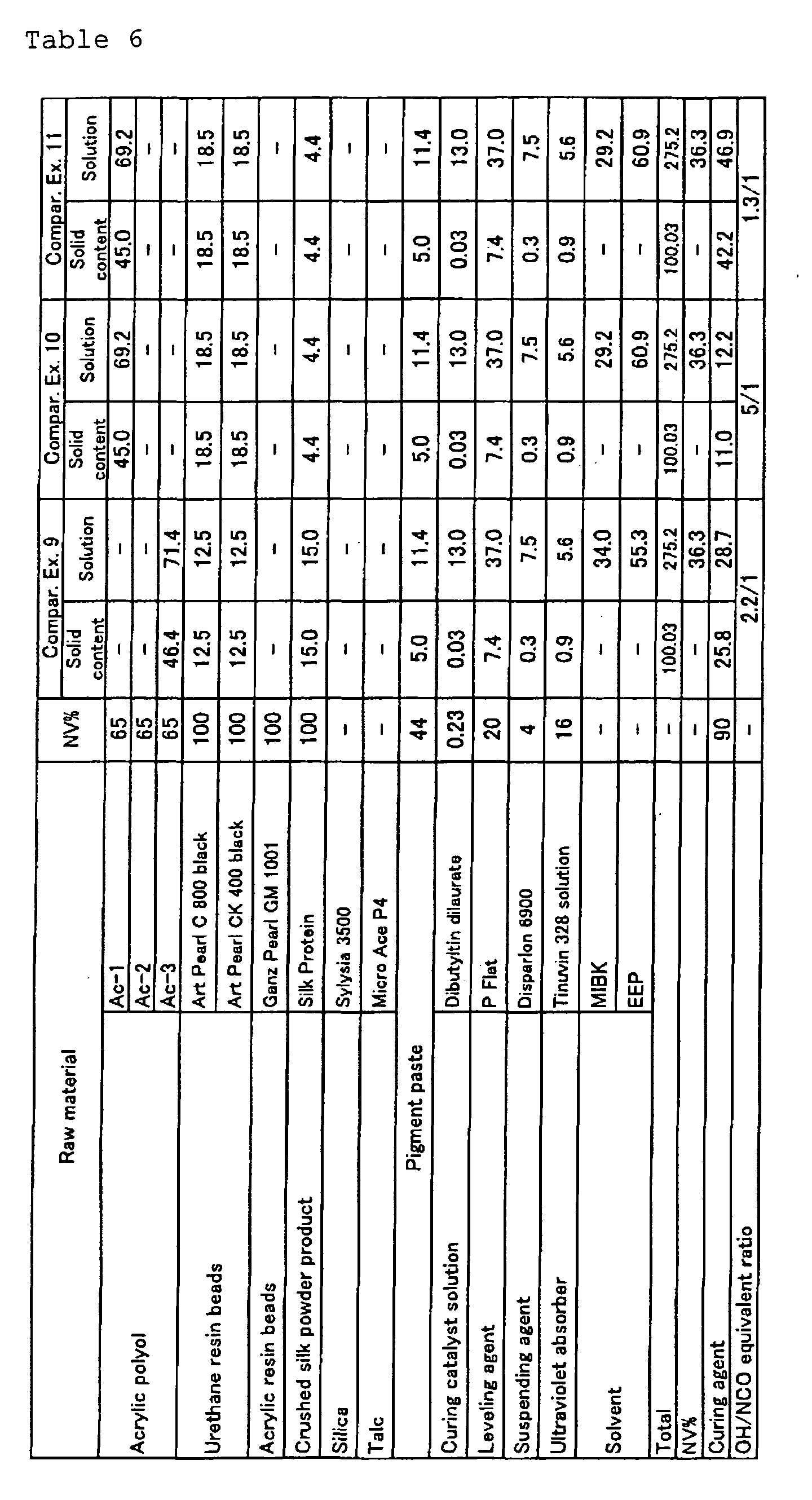
- The obtained respective coating compositions were diluted with a thinner of ethyl acetate/ethyl 3-ethoxypropionate = 50/50 parts by weight so as to adjust the viscosity to be 14 seconds measured at 20°C by #4 Ford Cup viscometer and applied by spray coating to specimens of polypropylene, which had a size of 70 mm × 110 mm × 3 mm and were previously coated in a dry film thickness of 13 µm with a primer for polypropylene (RB-188: manufactured by Nippon Bee Chemical Co., Ltd.) and cured by baking at 80°C for 30 minutes to obtain specimens coated with the respective coating compositions with a dry film thickness of 35 µm.
- The specimens obtained in the above-mentioned Examples were evaluated on the basis of the following standards. The results are shown in Tables 7, 8, and 9.
- The feeling at the time of touching the specimens with fingers was evaluated on the basis of the following standards.
○: elastic feeling at the time of touching the surface of each specimen coated with the cured film with fingers;
Δ: slightly insufficient elastic feeling at the time of touching the surface of each specimen coated with the cured film with fingers, however no practical problem for practical use;
×: hard touch at the time of touching the surface of each specimen coated with the cured film with fingers - The feeling at the time of touching the specimens with fingers was evaluated on the basis of the following standards.
○: properly wet feeling at the time of touching the surface of each specimen coated with the cured film with fingers;
×: no wet feeling at the time of touching the surface of each specimen coated with the cured film with fingers - The feeling at the time of touching the specimens with fingers was evaluated on the basis of the following standards.
○: properly dry feeling at the time of touching the surface of each specimen coated with the cured film with fingers;
×: no dry feeling at the time of touching the surface of each specimen coated with the cured film with fingers - The above-mentioned wet feeling and dry feeling were comprehensively evaluated and for the specimens good in both,
○ was marked and for the specimens inferior in either one, × was marked. - Each specimen coated with a cured film was installed in a vibration type friction rigidity tester. On the other hand, six sheets of gauze were attached to a friction element and made wet with 1 ml xylene. A weight of 800 g was put on the friction pole and a friction test by reciprocating the friction element 10 times and the staining degree of the gauze face was observed with eyes and the discoloration resistance was evaluated on the basis of the following standards.
○: no stain observed;
×: stains observed - The surface of each specimen coated with a cured film was scratched with claws and existence of scratches was observed with eyes and the resistance to scratching was evaluated on the basis of the following standards.
○: no scratch observed;
×: scratches observed - Beef tallow (a reagent) was evenly applied to and spread in a thickness of 2 g/100 cm2 on the surface of each specimen coated with a cured film and left in a closed container at 80°C for 7 days. Then, the surface was observed with eyes and the evaluation was carried out on the basis of the following standards.
○: no abnormality of the film surface such as stains or blister observed;
×: abnormality of the film surface such as stains or blister observed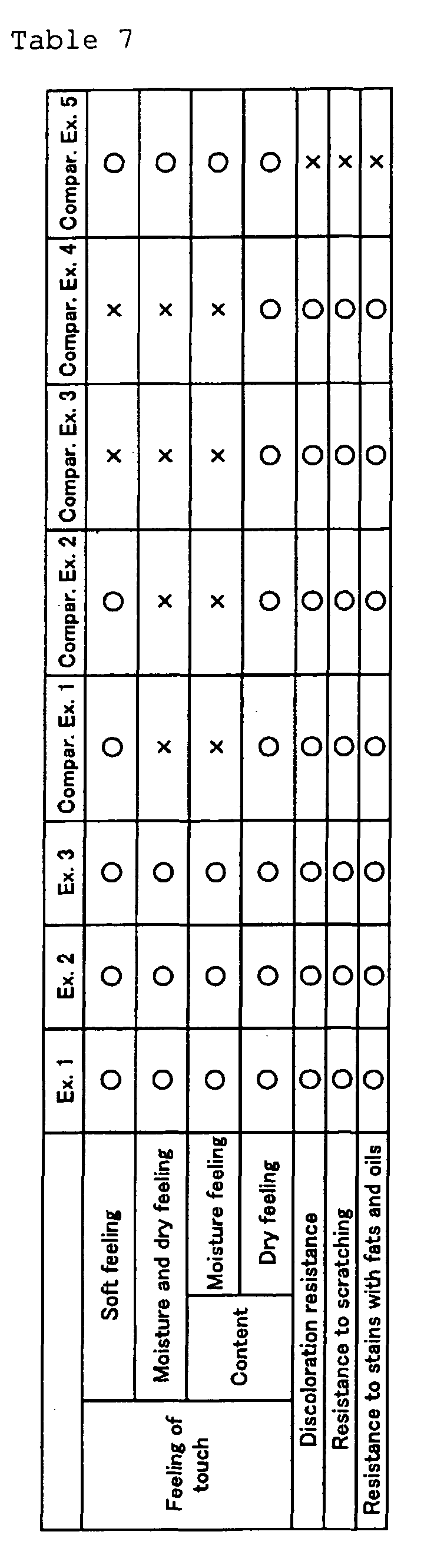


- From the results shown in Tables 7, 8, and 9, it was found that the two package curing type polyurethane coating compositions of the present invention were excellent in both wet and dry feelings, meanwhile the two package curing type polyurethane coating compositions of Comparative Examples were inferior in either one of wet feeling and dry feeling, or inferior in general physical properties of a film such as discoloration resistance, resistance to scratching, and resistance to stains with fats and oils and therefore, they were unsuitable for the practical use.
Claims (5)
- A two package curing type polyurethane coating composition comprising a resin solution containing an acrylic polyol and a curing agent solution containing a polyisocyanate,
wherein the resin solution contains urethane resin beads (A) in the amount of 25 to 50 parts by weight and an organic matting agent (B) in the amount of 3 to 10 parts by weight and
contains said urethane resin beads (A) and said organic matting agent (B) in total of 30 parts by weight or more, respectively, to 100 parts by weight of solid contents of the resin solution, and
said acrylic polyol and said polyisocyanate have OH group/NCO group (equivalent ratio) in the range of (4.5/1) to (1.5/1) . - The two package curing type polyurethane coating composition according to Claim 1,
wherein the acrylic polyol has a glass transition temperature (Tg) of -10°C or lower. - The two package curing type polyurethane coating composition according to Claim 1 or 2,
wherein the organic matting agent (B) is a grounded silk powder product. - The two package curing type polyurethane coating composition according to any one of Claims 1, 2, and 3,
wherein the resin solution contains an organotin curing catalyst in the amount of 0 to 0.05 part by weight to 100 parts by weight of the solid contents of the resin solution. - A coated article having a film on the surface, wherein said film is formed using the two package curing type polyurethane coating composition according to any one of the claims 1, 2, 3 and 4.
Applications Claiming Priority (2)
| Application Number | Priority Date | Filing Date | Title |
|---|---|---|---|
| JP2003376187 | 2003-11-05 | ||
| JP2003376187A JP4455012B2 (en) | 2003-11-05 | 2003-11-05 | Two-component curable polyurethane coating composition and coated article |
Publications (2)
| Publication Number | Publication Date |
|---|---|
| EP1529822A1 true EP1529822A1 (en) | 2005-05-11 |
| EP1529822B1 EP1529822B1 (en) | 2012-03-07 |
Family
ID=34431287
Family Applications (1)
| Application Number | Title | Priority Date | Filing Date |
|---|---|---|---|
| EP20040256758 Expired - Lifetime EP1529822B1 (en) | 2003-11-05 | 2004-11-02 | Two-package curing type polyurethane coating composition and coated article |
Country Status (4)
| Country | Link |
|---|---|
| US (1) | US7351476B2 (en) |
| EP (1) | EP1529822B1 (en) |
| JP (1) | JP4455012B2 (en) |
| CN (1) | CN100390244C (en) |
Cited By (6)
| Publication number | Priority date | Publication date | Assignee | Title |
|---|---|---|---|---|
| WO2009106497A1 (en) * | 2008-02-27 | 2009-09-03 | Basf Se | Multi-layer composite materials comprising a manually not pliable layer, corresponding method of production and use thereof |
| WO2009106499A1 (en) * | 2008-02-27 | 2009-09-03 | Basf Se | Multi-layer composite materials comprising a cellulose-containing layer, corresponding method of production and use thereof |
| WO2009106500A1 (en) * | 2008-02-27 | 2009-09-03 | Basf Se | Multi-layer composite materials comprising a plastic or metal foil, corresponding method of production and use thereof |
| WO2009106498A1 (en) * | 2008-02-27 | 2009-09-03 | Basf Se | Multi-layer composite materials comprising a foam layer, corresponding method of production and use thereof |
| WO2012089827A1 (en) * | 2010-12-30 | 2012-07-05 | BECKERS HIGH PERFORMANCE COATINGS (TIANJIN) Ltd. | Soft touch coating composition |
| WO2019062383A1 (en) | 2017-09-26 | 2019-04-04 | Covestro Deutschland Ag | Two-component system for elastic coatings |
Families Citing this family (16)
| Publication number | Priority date | Publication date | Assignee | Title |
|---|---|---|---|---|
| JP4541019B2 (en) * | 2004-04-05 | 2010-09-08 | オリジン電気株式会社 | Matte paint composition |
| JP2007169397A (en) * | 2005-12-20 | 2007-07-05 | Nippon Bee Chemical Co Ltd | Aqueous one-component coating composition and coated article |
| JP4757117B2 (en) * | 2006-06-30 | 2011-08-24 | 日産自動車株式会社 | Multilayer film forming method and coated article |
| US7863375B2 (en) * | 2008-10-08 | 2011-01-04 | Toyota Motor Engineering & Manufacturing North America, Inc. | Self-stratifying automotive topcoat compositions and processes |
| US8299170B2 (en) * | 2008-10-08 | 2012-10-30 | Toyota Motor Engineering & Manufacturing North America, Inc. | Self-stratifying coating |
| JP2011244247A (en) * | 2010-05-19 | 2011-12-01 | Mitsui Bussan Plastics Trade Co Ltd | Sealing cap structure for mobile phone case |
| US8343631B2 (en) * | 2010-11-03 | 2013-01-01 | Toyota Motor Engineering & Manufacturing North America, Inc. | Low-gloss, two-component clear coats, articles of manufacture having low-gloss, two-component clear coats, and methods for applying the same |
| US9604721B2 (en) * | 2013-06-18 | 2017-03-28 | Dow Global Technologies Llc | Cross-linkable coating composition and method of producing the same |
| KR101704138B1 (en) * | 2014-12-12 | 2017-02-08 | 현대자동차주식회사 | Soft feel coating composition for 1 coat 1 baking system |
| JP7047299B2 (en) * | 2017-09-21 | 2022-04-05 | 凸版印刷株式会社 | Decorative sheet and decorative material using it |
| CN113490723A (en) | 2019-02-27 | 2021-10-08 | 关西涂料株式会社 | Thermosetting coating composition and coated article |
| CN111455729B (en) * | 2020-04-28 | 2022-04-01 | 安徽集友新材料股份有限公司 | Hand-feeling type packaging paper and preparation method thereof |
| CN114456702B (en) * | 2022-01-13 | 2024-05-17 | 东来涂料技术(上海)股份有限公司 | Dual-curing UV leather touch paint and preparation method thereof |
| KR20230111682A (en) * | 2022-01-18 | 2023-07-26 | 현대자동차주식회사 | Automotive hydraulic pressure transfer paint composition with excellent touch, and paints and automotive parts containing the same |
| CN115960523B (en) * | 2022-09-19 | 2023-09-15 | 上海君子兰新材料股份有限公司 | Normal-temperature-dried, repairable and transparent double-component finishing paint with PU skin feel |
| KR102858537B1 (en) * | 2025-02-10 | 2025-09-15 | 주식회사 한샘 | Novel paint compositions for furniture painting |
Citations (5)
| Publication number | Priority date | Publication date | Assignee | Title |
|---|---|---|---|---|
| WO1994028045A1 (en) * | 1993-05-28 | 1994-12-08 | Basf Lacke + Farben Ag | Method of producing structured coatings on platic surfaces |
| JPH07292053A (en) * | 1994-04-28 | 1995-11-07 | Toyota Auto Body Co Ltd | METHOD FOR PRODUCING POLYURETHANE RESIN POWDER, METHOD FOR PRODUCING THE FINE POWDER, AND COATING COMPOSITION CONTAINING THE FINE POWDER |
| JPH08176491A (en) * | 1994-12-27 | 1996-07-09 | Tokushu Shikiriyou Kogyo Kk | Squealing prevention surface treatment agent |
| JPH08199483A (en) * | 1995-01-12 | 1996-08-06 | Showa Denko Kk | Surface-treating composition containing natural product powder |
| JPH10101993A (en) * | 1996-09-27 | 1998-04-21 | Iwate Pref Gov | Soft wood coating composition |
Family Cites Families (9)
| Publication number | Priority date | Publication date | Assignee | Title |
|---|---|---|---|---|
| DE3909597A1 (en) * | 1989-03-23 | 1990-09-27 | Bayer Ag | METHOD FOR THE PRODUCTION OF CROSS-LINKED POLYURETHANE-POLYURETHANE POWDER AND THE USE THEREOF AS ORGANIC FILLERS IN TWO-COMPONENT POLYURETHANE VARNISHES |
| JPH083881A (en) | 1994-06-10 | 1996-01-09 | Dainippon Printing Co Ltd | Molded article having suede-like surface and method for producing the same |
| DE19519006A1 (en) * | 1995-05-24 | 1996-11-28 | Bayer Ag | Powder coating for matt coatings |
| JPH1010993A (en) * | 1996-06-26 | 1998-01-16 | Sony Corp | Projection type image display device |
| EP0920467A4 (en) * | 1996-08-26 | 1999-10-13 | Tyndale Plains Hunter Ltd | Hydrophilic and hydrophobic polyether polyurethanes and uses therefor |
| EP0836155A3 (en) * | 1996-10-09 | 1999-03-31 | Canon Kabushiki Kaisha | Information recording medium |
| AT410213B (en) | 1998-08-04 | 2003-03-25 | Solutia Austria Gmbh | WATER-DILUTABLE BINDER FOR '' SOFT-FEEL '' LACQUERS |
| JP2000185321A (en) | 1998-10-15 | 2000-07-04 | Idemitsu Petrochem Co Ltd | Polyurethane fine powder, resin composition containing the same, material for laser preparation, and high-frequency welding material |
| DE19917228B4 (en) * | 1999-04-16 | 2006-02-02 | E.I. Du Pont De Nemours And Co., Wilmington | Matting and structurant-containing pastes and coating compositions containing them |
-
2003
- 2003-11-05 JP JP2003376187A patent/JP4455012B2/en not_active Expired - Fee Related
-
2004
- 2004-11-02 EP EP20040256758 patent/EP1529822B1/en not_active Expired - Lifetime
- 2004-11-04 US US10/980,185 patent/US7351476B2/en not_active Expired - Fee Related
- 2004-11-05 CN CNB200410092273XA patent/CN100390244C/en not_active Expired - Fee Related
Patent Citations (5)
| Publication number | Priority date | Publication date | Assignee | Title |
|---|---|---|---|---|
| WO1994028045A1 (en) * | 1993-05-28 | 1994-12-08 | Basf Lacke + Farben Ag | Method of producing structured coatings on platic surfaces |
| JPH07292053A (en) * | 1994-04-28 | 1995-11-07 | Toyota Auto Body Co Ltd | METHOD FOR PRODUCING POLYURETHANE RESIN POWDER, METHOD FOR PRODUCING THE FINE POWDER, AND COATING COMPOSITION CONTAINING THE FINE POWDER |
| JPH08176491A (en) * | 1994-12-27 | 1996-07-09 | Tokushu Shikiriyou Kogyo Kk | Squealing prevention surface treatment agent |
| JPH08199483A (en) * | 1995-01-12 | 1996-08-06 | Showa Denko Kk | Surface-treating composition containing natural product powder |
| JPH10101993A (en) * | 1996-09-27 | 1998-04-21 | Iwate Pref Gov | Soft wood coating composition |
Non-Patent Citations (4)
| Title |
|---|
| DATABASE WPI Week 199602, Derwent World Patents Index; AN 1996-017255, XP002318052, "Preparation of polyurethane resin fine powder" * |
| DATABASE WPI Week 199637, Derwent World Patents Index; AN 1996-368468, XP002318050, "Surface treating agent for squeak noise prevention" * |
| DATABASE WPI Week 199641, Derwent World Patents Index; AN 1996-408933, XP002318053, "Natural product powder containing surface treating composition" * |
| DATABASE WPI Week 199826, Derwent World Patents Index; AN 1998-292354, XP002318051, "Coating compositions for softwood" * |
Cited By (9)
| Publication number | Priority date | Publication date | Assignee | Title |
|---|---|---|---|---|
| WO2009106497A1 (en) * | 2008-02-27 | 2009-09-03 | Basf Se | Multi-layer composite materials comprising a manually not pliable layer, corresponding method of production and use thereof |
| WO2009106499A1 (en) * | 2008-02-27 | 2009-09-03 | Basf Se | Multi-layer composite materials comprising a cellulose-containing layer, corresponding method of production and use thereof |
| WO2009106500A1 (en) * | 2008-02-27 | 2009-09-03 | Basf Se | Multi-layer composite materials comprising a plastic or metal foil, corresponding method of production and use thereof |
| WO2009106498A1 (en) * | 2008-02-27 | 2009-09-03 | Basf Se | Multi-layer composite materials comprising a foam layer, corresponding method of production and use thereof |
| US8486522B2 (en) | 2008-02-27 | 2013-07-16 | Basf Se | Multi-layer composite materials comprising a foam layer, corresponding method of production and use thereof |
| US9375904B2 (en) | 2008-02-27 | 2016-06-28 | Basf Se | Multi-layer composite materials comprising a cellulose-containing layer, corresponding method of production and use thereof |
| US9855729B2 (en) | 2008-02-27 | 2018-01-02 | Basf Se | Multi-layer composite materials comprising a plastic or metal foil, corresponding method of production and use thereof |
| WO2012089827A1 (en) * | 2010-12-30 | 2012-07-05 | BECKERS HIGH PERFORMANCE COATINGS (TIANJIN) Ltd. | Soft touch coating composition |
| WO2019062383A1 (en) | 2017-09-26 | 2019-04-04 | Covestro Deutschland Ag | Two-component system for elastic coatings |
Also Published As
| Publication number | Publication date |
|---|---|
| US20050123770A1 (en) | 2005-06-09 |
| JP2005139273A (en) | 2005-06-02 |
| CN1626596A (en) | 2005-06-15 |
| US7351476B2 (en) | 2008-04-01 |
| JP4455012B2 (en) | 2010-04-21 |
| EP1529822B1 (en) | 2012-03-07 |
| CN100390244C (en) | 2008-05-28 |
Similar Documents
| Publication | Publication Date | Title |
|---|---|---|
| US7351476B2 (en) | Two-package curing type polyurethane coating composition and coated article | |
| US11053337B2 (en) | Omniphobic polyurethane compositions, related articles, and related methods | |
| JP5631004B2 (en) | Coating material with high scratch resistance and weather resistance | |
| JP5637860B2 (en) | Coating material with high scratch resistance and weather resistance | |
| RU2502769C2 (en) | Coating agent with high scratch resistance and weather resistance | |
| JP5946356B2 (en) | Coating composition and coating film forming method | |
| JP5683599B2 (en) | Coating material having good storage stability and coating film formed from the coating material having good weather resistance and high scratch resistance | |
| WO1995035334A1 (en) | Acrylate copolymer and polymer composition containing the same | |
| JP6099571B2 (en) | Water-based polyurethane coatings and coatings made from such coatings with high scratch resistance and good chemical resistance | |
| CN107001855A (en) | Non-aqueous coating compositions, it is prepared therefrom that there is coating of improvement adhesive force and scratch resistance and application thereof | |
| CN104487472B (en) | Polyurethane coating composition and application thereof, multistage painting method | |
| EP2298842A1 (en) | Coating composition and coating film formation method using same | |
| JP2005042001A (en) | Coating composition, coating film forming method, and coated article | |
| EP1375547A1 (en) | Resin composition, sheet obtained therefrom, process for producing sheet, and formed object | |
| CN101218316B (en) | Paint compositions and painted objects | |
| JP2014129456A (en) | Clear coating composition for metal plated plastic substrate | |
| JP2002069135A (en) | Acrylic copolymer, resin composition for coating and paint | |
| TW201945411A (en) | Two-component system with improved adhesion | |
| JP7782378B2 (en) | Coating composition and article coated with said coating composition | |
| KR102895615B1 (en) | Base coat composition for plastic | |
| JPH0725973A (en) | Curing agent for two-pack type polyurethane coating | |
| JPWO2019107570A1 (en) | Method for forming coating composition and multi-layer coating film | |
| JP2009149825A (en) | Coating composition and method for forming coated film | |
| JP2024089100A (en) | Coating material, thermosetting resin composition and laminate | |
| JP2024089101A (en) | Coating material, thermosetting resin composition and laminate |
Legal Events
| Date | Code | Title | Description |
|---|---|---|---|
| PUAI | Public reference made under article 153(3) epc to a published international application that has entered the european phase |
Free format text: ORIGINAL CODE: 0009012 |
|
| 17P | Request for examination filed |
Effective date: 20041117 |
|
| AK | Designated contracting states |
Kind code of ref document: A1 Designated state(s): AT BE BG CH CY CZ DE DK EE ES FI FR GB GR HU IE IS IT LI LU MC NL PL PT RO SE SI SK TR |
|
| AX | Request for extension of the european patent |
Extension state: AL HR LT LV MK YU |
|
| AKX | Designation fees paid |
Designated state(s): GB |
|
| REG | Reference to a national code |
Ref country code: DE Ref legal event code: 8566 |
|
| GRAP | Despatch of communication of intention to grant a patent |
Free format text: ORIGINAL CODE: EPIDOSNIGR1 |
|
| GRAS | Grant fee paid |
Free format text: ORIGINAL CODE: EPIDOSNIGR3 |
|
| GRAA | (expected) grant |
Free format text: ORIGINAL CODE: 0009210 |
|
| AK | Designated contracting states |
Kind code of ref document: B1 Designated state(s): GB |
|
| REG | Reference to a national code |
Ref country code: GB Ref legal event code: FG4D |
|
| PLBE | No opposition filed within time limit |
Free format text: ORIGINAL CODE: 0009261 |
|
| STAA | Information on the status of an ep patent application or granted ep patent |
Free format text: STATUS: NO OPPOSITION FILED WITHIN TIME LIMIT |
|
| 26N | No opposition filed |
Effective date: 20121210 |
|
| PGFP | Annual fee paid to national office [announced via postgrant information from national office to epo] |
Ref country code: GB Payment date: 20121031 Year of fee payment: 9 |
|
| REG | Reference to a national code |
Ref country code: GB Ref legal event code: 746 Effective date: 20130827 |
|
| GBPC | Gb: european patent ceased through non-payment of renewal fee |
Effective date: 20131102 |
|
| PG25 | Lapsed in a contracting state [announced via postgrant information from national office to epo] |
Ref country code: GB Free format text: LAPSE BECAUSE OF NON-PAYMENT OF DUE FEES Effective date: 20131102 |