EP1532632B1 - Speicherbaustein mit frühlese-nach-schreiboperation, system und verfahren - Google Patents
Speicherbaustein mit frühlese-nach-schreiboperation, system und verfahren Download PDFInfo
- Publication number
- EP1532632B1 EP1532632B1 EP03762237A EP03762237A EP1532632B1 EP 1532632 B1 EP1532632 B1 EP 1532632B1 EP 03762237 A EP03762237 A EP 03762237A EP 03762237 A EP03762237 A EP 03762237A EP 1532632 B1 EP1532632 B1 EP 1532632B1
- Authority
- EP
- European Patent Office
- Prior art keywords
- data
- write
- read
- memory
- memory device
- Prior art date
- Legal status (The legal status is an assumption and is not a legal conclusion. Google has not performed a legal analysis and makes no representation as to the accuracy of the status listed.)
- Expired - Lifetime
Links
Images





Classifications
-
- G—PHYSICS
- G11—INFORMATION STORAGE
- G11C—STATIC STORES
- G11C7/00—Arrangements for writing information into, or reading information out from, a digital store
- G11C7/10—Input/output [I/O] data interface arrangements, e.g. I/O data control circuits, I/O data buffers
- G11C7/1051—Data output circuits, e.g. read-out amplifiers, data output buffers, data output registers, data output level conversion circuits
-
- G—PHYSICS
- G11—INFORMATION STORAGE
- G11C—STATIC STORES
- G11C7/00—Arrangements for writing information into, or reading information out from, a digital store
- G11C7/10—Input/output [I/O] data interface arrangements, e.g. I/O data control circuits, I/O data buffers
- G11C7/1015—Read-write modes for single port memories, i.e. having either a random port or a serial port
- G11C7/1036—Read-write modes for single port memories, i.e. having either a random port or a serial port using data shift registers
-
- G—PHYSICS
- G11—INFORMATION STORAGE
- G11C—STATIC STORES
- G11C7/00—Arrangements for writing information into, or reading information out from, a digital store
- G11C7/10—Input/output [I/O] data interface arrangements, e.g. I/O data control circuits, I/O data buffers
- G11C7/1015—Read-write modes for single port memories, i.e. having either a random port or a serial port
- G11C7/1039—Read-write modes for single port memories, i.e. having either a random port or a serial port using pipelining techniques, i.e. using latches between functional memory parts, e.g. row/column decoders, I/O buffers, sense amplifiers
-
- G—PHYSICS
- G11—INFORMATION STORAGE
- G11C—STATIC STORES
- G11C7/00—Arrangements for writing information into, or reading information out from, a digital store
- G11C7/10—Input/output [I/O] data interface arrangements, e.g. I/O data control circuits, I/O data buffers
- G11C7/1051—Data output circuits, e.g. read-out amplifiers, data output buffers, data output registers, data output level conversion circuits
- G11C7/106—Data output latches
-
- G—PHYSICS
- G11—INFORMATION STORAGE
- G11C—STATIC STORES
- G11C7/00—Arrangements for writing information into, or reading information out from, a digital store
- G11C7/10—Input/output [I/O] data interface arrangements, e.g. I/O data control circuits, I/O data buffers
- G11C7/1072—Input/output [I/O] data interface arrangements, e.g. I/O data control circuits, I/O data buffers for memories with random access ports synchronised on clock signal pulse trains, e.g. synchronous memories, self timed memories
-
- G—PHYSICS
- G11—INFORMATION STORAGE
- G11C—STATIC STORES
- G11C7/00—Arrangements for writing information into, or reading information out from, a digital store
- G11C7/10—Input/output [I/O] data interface arrangements, e.g. I/O data control circuits, I/O data buffers
- G11C7/1078—Data input circuits, e.g. write amplifiers, data input buffers, data input registers, data input level conversion circuits
-
- G—PHYSICS
- G11—INFORMATION STORAGE
- G11C—STATIC STORES
- G11C7/00—Arrangements for writing information into, or reading information out from, a digital store
- G11C7/10—Input/output [I/O] data interface arrangements, e.g. I/O data control circuits, I/O data buffers
- G11C7/1078—Data input circuits, e.g. write amplifiers, data input buffers, data input registers, data input level conversion circuits
- G11C7/1087—Data input latches
-
- G—PHYSICS
- G11—INFORMATION STORAGE
- G11C—STATIC STORES
- G11C7/00—Arrangements for writing information into, or reading information out from, a digital store
- G11C7/22—Read-write [R-W] timing or clocking circuits; Read-write [R-W] control signal generators or management
-
- G—PHYSICS
- G11—INFORMATION STORAGE
- G11C—STATIC STORES
- G11C2207/00—Indexing scheme relating to arrangements for writing information into, or reading information out from, a digital store
- G11C2207/22—Control and timing of internal memory operations
- G11C2207/2281—Timing of a read operation
-
- G—PHYSICS
- G11—INFORMATION STORAGE
- G11C—STATIC STORES
- G11C2207/00—Indexing scheme relating to arrangements for writing information into, or reading information out from, a digital store
- G11C2207/22—Control and timing of internal memory operations
- G11C2207/229—Timing of a write operation
Definitions
- the present invention relates to the transfer of data in a digital system, and in particular, a memory device and method for read and write operations.
- an amount of idle time occurs on the data interface of a memory device when switching from a write transfer to a read transfer, also known as “W-R turnaround bubble” time.
- This idle time generally occurs from resource conflicts within the memory device and/or device operating constraints.
- Memory device resource conflicts may consist of: 1) shared I/O pins or circuitry between read and write operations, for example bidirectional pins, 2) shared data paths between read and write operations, for example input/output paths, shifters, column I/O amplifiers and bit lines, and 3) shared address/control paths between read and write operations, for example a column decoder or predecoder logic. Many memory devices share resources in order to reduce incremental manufacturing costs and complexity.
- Device operating constraints may include peak current or power restrictions related to customer usage requirements or memory device reliability requirements.
- Memory devices have reduced W-R turnaround bubble time by providing a write buffer for buffering write data and address information.
- a single write buffer may cause a delay in a write operation allowing a read operation to occur before the desired write operation.
- a user may receive erroneous data that does not include the latest write data.
- Complex circuitry may be required in order to ensure data coherency when using a single write buffer.
- a single write buffer may not be programmed to improve data transfer efficiency in multiple memory device configurations.
- What is therefore desirable is a memory device and/or method that provides improved interconnect utilization within operating constraints at a low incremental device cost and complexity.
- the memory device reduces W-R turnaround bubble time without additional complex circuitry.
- the memory device should also be easily adaptable to multiple memory device system configurations. Further, it is desirable for a read and write operation method that allows for a 1) reduced write address buffer, 2) higher memory array utilization and, 3) reduced or simplified scheduling or data coherency logic.
- the US patent 6,018,478 refers to the description of an analogue dual-port memory.
- the memory enables a write operation and read operation during the same time period by dividing into banks and providing a write enable signal pin and an output enable signal pin for each bank, or by dividing components between write use and read use from the address designation circuits to the data bus, input/output buffer, and outside input/output pin, and thereby allows reading and writing to different addresses during the same time period rather than reading and writing to the same address during the same time period.
- the European patent application EP 0 833 342 A2 relates to a memory system and a data transfer method.
- the document explains a prefetch mechanism for reading and writing data to a separate memory array at an early stage, so that the activation and precharge operation, which must be performed before reading the next set of data from the memory array, does not affect nor cause any deterioration of access speed.
- the amount of data prefeched is twice as much as that fetched in the period represented by an array time constant so that in a single bank structure a seamless operation can be performed both for reading and for writing, even when row accesses are performed.
- the US 5,361,343 relates to a microprocessor system, which includes a CPU and a nonvolatile memory.
- a flash EEPROM includes two memory arrays. They can each be separately read, programmed, and erased by the CPU. Each one of the memory arrays within the flash EEPROM has its own address register and decoder. One of the memory arrays can be accessed while the other is being programmed. For example, during the erasure and reprogramming of the one memory array, the CPU can read from the other memory array. This allows the CPU to perform tasks that require access to information stored in flash EEPROM during the reprogramming of flash EEPROM.
- a memory device comprising: an interface to receive a first write address, a first write data, a first control information indicating a write operation associated with the first write data, a read address and a second control information indicating a read operation associated with the read address, and to transmit read data in response to the second control information
- the interface includes a common set of pins to connect to bidirectional data signal lines to both receive the write data and transmit the read data; a first storage array coupled to a first data path and a first address path, wherein the first storage array includes dynamic random access memory storage arrays, and a second storage array coupled to a second data path and a second address path wherein the second storage array includes dynamic random access memory storage arrays, wherein the first write data is provided on the first data path in response to the first control information provided on the first address path and in that the read data is provided on the second data path in response to the second control information provided on the second address path, where
- the memory device further contains an external interconnect, coupled to the interface, to provide the first and second control information, and wherein the first control information precedes the second control information.
- the external interconnect provides a third control information indicating a write operation associated with a second write data, and wherein the first control information and third control information precedes the second control information.
- the first data path is independent of the second data path.
- the first address path is independent of the second address path.
- the first data path includes a first set of signal lines to provide data and the second data path includes a second set of signal lines to provide data.
- the first data path includes a first I/O amplifier and the second data path includes a second I/O amplifier.
- the first address path includes a first column predecoder and the second address path includes a second column predecoder.
- the first address path includes a first column decoder and the second address path includes a second column decoder.
- the present invention provides an early read after write (“ERAW”) method 500 shown in Fig. 5 , which may be implemented in a memory system 50, that supports improved utilization of an interconnect structure 60 between master devices 10(1)-(N) and memory devices 20(1)-(N) shown in Fig. 1 .
- ERAW early read after write
- a memory device maintains continuous data traffic by supporting a read operation which can begin early, while one or more previous write operations are still being processed in an embodiment of the present invention.
- a read operation targets a section of memory core that has an independent data path (for example, global data wires and column I/0 amps) and an independent address path (for example, separate column predecoders and column decoders) from those used by the outstanding write operations.
- an independent data path for example, global data wires and column I/0 amps
- an independent address path for example, separate column predecoders and column decoders
- a write operation on a memory device 20(1) is initiated by asserting a WRITE ("WR") command on interconnect structure 60 from master device 10(1) and includes a transport sub-operation and a retire sub-operation.
- WR WRITE
- These sub-operations may be individually specified using two other commands (“PLD” and "ULD”); in other words, the WR command causes both sub-operations to occur, and the PLD and ULD commands cause only one of the sub-operations to take place.
- a transport sub-operation on memory device 20(1) can be initiated by asserting a PRELOAD ("PLD”) command on interconnect structure 60 from master device 10(1) and includes receiving write data from interconnect structure 60 and storing write data in a buffer in an embodiment of the present invention.
- PLD PRELOAD
- a retire sub-operation on memory device 20(1) can be initiated by asserting a UNLOAD ("ULD") command on interconnect structure 60 from master device 10(1) and includes transferring write data from a buffer to a memory core in an embodiment of the present invention.
- ULD UNLOAD
- a read operation on memory device 20(1) is initiated by asserting a READ command on interconnect structure 60 from master device 10(1) and includes obtaining data from a memory core at a column address and transmitting read data on interconnect structure 60 in an embodiment of the present invention.
- An activate operation on memory device 20(1) is initiated by asserting an ACTIVATE ("ACT") command on interconnect structure 60 from master device 10(1) and includes sensing a row at a row address and transferring data in a memory bank to a sense amplifier in an embodiment of the present invention.
- ACT ACTIVATE
- a precharge operation on memory device 20(1) is initiated by asserting a PRECHARGE ("PRE") command on interconnect structure 60 from master device 10(1) and includes precharging a memory bank in an embodiment of the present invention.
- PRE PRECHARGE
- master device 10(1) is a central processing unit in a desktop computer and memory device 20(1) is main memory, such as Dynamic Random Access Memory ("DRAM") in the desktop computer.
- master device 10(1) is a memory controller.
- master devices 10(1)-(N), interconnect structure 60 and memory devices 20(1)-(N) are in a processing device such as a mainframe computer, a laptop computer, a hand-held computer, a personal digital assistant, a telephone, a cellular telephone, a pager, a printer, an information appliance, or an equivalent thereof.
- master device 10(1)-(N), interconnect structure 60 and memory devices 20(1)-(N) are incorporated on an integrated monolithic circuit.
- master devices 10(1)-(N) and memory devices 20(1)-(N) are coupled by an interconnect structure 60 which allows for one or more master devices 10(1)-(N) and one or more slave devices, such as memory devices 20(1)-(N).
- the term "N" is used as a general variable; its use should not imply the number of master devices is identical to the number of slave devices.
- other components and/or subsystems may be coupled to interconnect structure 60 that are not shown.
- interconnect structure 60 is an external interconnect structure from memory devices 20(1)-(N).
- interconnect structure 60 is a bidirectional memory bus having control and data signal lines.
- interconnect structure 60 includes only data lines or only control lines.
- the block diagram of Fig. 1 is applicable to intrachip, as well as interchip, communications.
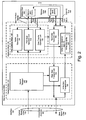
- Fig. 2 illustrates a memory device 20(N) as shown in Fig. 1 according to an embodiment of the present invention.
- Memory device 20(N) is capable of being read from, and written to by, a master device 10(1).
- An interconnect structure 60 is used to communicate control information over control lines 112 and data information over data lines 114 from the memory controller to memory device 20(N).
- memory device 20(N) includes an interface 105 for coupling to interconnect structure 60.
- interface 105 includes I/0 pins.
- memory device 20(N) typically includes three major functional blocks.
- Interconnect structure 60 which includes control signal lines 112 and data signal lines 114, is used to read from and write to memory device 20(N). Interconnect structure 60 provides the proper control signals and data when data is to be written to memory device 20(N). Transport block 120 receives these signals and takes the actions necessary to transfer this information to the remaining portions of memory device 20(N). When memory device 20(N) is read, transport block 120 transmits data on data signal lines 114 in response to control information on control signal lines 112.
- Transport block 120 includes a control transport unit 122 which receives control information on control signal lines 112, and controls a read data transport unit 124 and a write data transport unit 126 to support the communication protocol used in transferring information over interconnect structure 60 (e.g., transferring information between master device 10(1), such as a processor, and memory device 20(N) over interconnect structure 60, such as a memory bus).
- transport block 120 is merely wiring, without any active components whatsoever.
- control transport unit 122 would simply be wires, as read data transport unit 124 and write data transport unit 126 would require no control. In effect, transport block 120 is not implemented in such an embodiment.
- Another embodiment of the present invention includes configuring amplifiers to provide the functionality of transport block 120.
- transport block 120 includes serial-to-parallel converters.
- control transport unit 122 controls the conversion performed by read data transport unit 124 and write data transport unit 126 (which would be the serial-to-parallel converters).
- Other equivalent circuits may also be used with equal success.
- Operations block 130 receives control information from transport block 120, more specifically from control transport unit 122, which provides the requisite signals to a control operation unit 150.
- Core transfer operation unit 136 controls read data operation unit 160 and write data operation unit 170 when transferring data from and to memory core 180, respectively (i.e., read and write operations). Core transfer operation unit 136 also controls memory core 180, causing memory core 180 to store write data and output read data. Precharge operation unit 134 controls memory core precharge operations, which precharge the selected banks in memory core 180. Sense operation unit 132 is provided for the control of memory core sense operations.
- the subsystems of operations block 130 use the control information received to coordinate movement of control and data information to and from memory core 180.
- Read data operation unit 160 and write data operation unit 170 contain circuitry specific to the functions that read and write data from and to memory core 180, respectively.
- Core transfer operation unit 136 contains circuitry used to control memory core 180, including circuitry for the control of read and write operations.
- Core interface signals 190 are provided to control memory core 180.
- control operation unit 150 controls a typical array of DRAM memory cells. In an alternate embodiment of the present invention, control operation unit 150 generates core interface signals for a particular DRAM memory cell architecture. Control operation unit 150 includes a sense operation unit 132, a precharge operation unit 134, and a core transfer operation unit 136 in an embodiment of the present invention.
- Data being read is transferred from the third functional block, a memory core 180, via data I/O bus 185 to a read data operation unit 160.
- the data being read is transferred to read data transport unit 124 (and subsequently; onto data signal lines 114) in response to control signals from control operation unit 150.
- Read data operation unit 160 may consist of, for example, data buffers (not shown) that buffer the outgoing data signals to drive read data transport unit 124.
- Write data operation unit 170 receives write data from write transport unit 126, which is passed on to memory core 180 via data I/O bus 185. As shown, write data core transfer operation unit 136 may control write operation unit 170.
- write data operation unit 170 includes a write data buffer 100 that buffers the incoming data signals.
- write data buffer 100 is a variable depth write data buffer as described in the above identified related patent application entitled "Memory Device and System Having A Variable Depth Write Buffer And Preload Method” filed June 28, 2002, by inventors Richard E. Perego and Frederick A. Ware, published as US 2004/0066673 A1 .
- Write data operation unit 170 may also contain mask buffers that buffer mask information received from write data transport unit 126. As with data buffering, these actions may be taken under the control of core transfer operation unit 136. The mask information is then passed to memory core 180 via data I/O bus 185, as well. The mask information is used to selectively write parts of the data within the memory core. In an alternate embodiment of the present invention, no mask is employed, with the result that all the data is written unconditionally.
- memory device 20(N) includes a shifter and/or predecoder circuitry.
- control operation block 150 may take any number of appropriate configurations, depending in part on the architecture of memory core 180.
- the type of memory cells employed in memory core 180 affects the architecture of control operation unit 150, as different memory cells often require different control signals for their operation.
- Operational block 130 thus contains core transfer operation 150, read data operation unit 160, and write data operation unit 170.
- memory core 180 includes N memory banks having independent address and data paths.
- memory bank 205(1) has address path 190(1) and data path 190(1).
- memory bank 295(N) has address path 190(N) and data path 190(N).
- operations which may be performed on memory core 180 may be generalized into four primary categories: 1) precharge; 2) sense; 3) read; and 4) write.
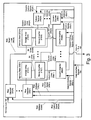
- Fig. 3 illustrates a memory core 180 shown in Fig. 2 in an embodiment of the present invention.
- Memory core 180 includes several basic functional blocks.
- Memory core 180 is illustrated as including multiple memory banks 205(1)-(N). Included in each of memory banks 205(1)-(N) are a storage array, exemplified by storage arrays 210(1)-(N), and a set of sense amplifiers, exemplified by sense amplifiers 215(1)-(N).
- Storage arrays 210(1)-(N) are central to the function of memory core 180, actually holding the data to be stored.
- Storage arrays 210(1)-(N) are connected to sense amplifiers 215(1)-(N) by bit lines 220(1)-(N), respectively.
- Storage arrays 210(1)-(N) are organized into rows and columns of storage cells, each of which stores one bit of information in an embodiment of the present invention. In an alternate embodiment, a storage cell in storage arrays 210(1)-(N) stores multiple bits of information.
- Row addresses 235(1)-(N) is provided to row decoders 225(1)-(N), along with row control signals 240(1)-(N), which cause row decoders 225(1)-(N) to latch a row address.
- row decoders 225(1)-(N) presents this address information to memory banks 205(1)-(N) via row select lines 245(1)-(N).
- column addresses 250(1)-(N) is provided to column decoders 230(1)-(N), along with column control signals 255(1)-(N), which causes column decoders 230(1)-(N) to latch a column addresses.
- column decoder 230(1)-(N) presents this address information to memory banks 205(1)-(N) via column select lines 260(1)-(N) to select which sense amplifiers are connected to the column amplifiers 265(1)-(N).
- the column control signals 255(1)-(N) may include a mask bit signal to selectively mask individual sense amplifiers in accordance with a predetermined masking scheme.
- Column control signals 255(1)-(N) are also provided to column amplifiers 265(1)-(N).
- Column amplifiers 265(1)-(N) are coupled to sense amplifiers 215(1)-(N) by column I/O lines 266(1)-(N), and amplify the data signals input to and output from sense amplifiers 215(1)-(N).
- Column amplifiers 265(1)-(N) are also coupled to data I/O bus 185, permitting the communication of control signals from operations block 130 to the various control structures within memory core 180.
- the signals aggregated as core interface signals 190 thus include row addresses 235(1)-(N), row control signals 240(1)-(N), column addresses 250(1)-(N), and column control signals 255(1)-(N).
- the interface to a memory core 180 generally consists of a row address, a column address, a data path, and various control signals, including mask signals.
- memory cores can have multiple banks, which allow simultaneous row operations within a given core in an embodiment of the present invention.
- the use of multiple banks improves memory performance through increased concurrency and a reduction of conflicts.
- Each bank has its own storage array and can have its own set of sense amplifiers to allow for independent row operation.
- each bank has a respective row decoder, a column decoder, column amplifier, data path and address path.
- Accessing the information in a storage array is typically a two-step process. First, data is transferred between storage array 210(1)-(N) and a corresponding set of sense amplifiers 215(1)-(N). Next, the data is transferred between the sense amplifiers involved and column amplifiers 265(1)-(N). Certain memory core architectures do away with the column amplifiers, transferring the data from the sense amplifiers directly to the data I/O bus 185.
- the first major step, transferring information between storage arrays 210(1)-(N) and sense amplifiers 215(1)-(N), is known as a "row access" and is broken down into the minor operations of precharge and sense.
- the precharge operation prepares the sense amplifiers and bit lines for sensing, typically by equilibrating them to a midpoint reference voltage.
- the row address is decoded, a single word line is asserted, the contents of the storage cell is placed on the bit lines, and the sense amplifiers amplify the value to full rail (i.e., a full digital high value), completing the movement of the information from the storage array to the sense amplifiers.
- the sense amplifiers can also serve as a local cache that stores a "page" of data that can be more quickly accessed with column read or write accesses.
- the second major step transferring information between the sense amplifiers and the interface, is called a "column access" and is typically performed in one step.
- this major step is broken up into two minor steps, e.g. putting a pipeline stage at the output of the column decoder. In this case, the pipeline timing should be adjusted to account for the extra time involved.
- memory core 180 supports these four operations (or some subset thereof). In an alternate embodiment, certain memory types may require additional operations to support architecture-specific features.
- a significant limitation on the effective bandwidth of interconnect structure 60 can arise as the result of the issuance of certain combinations of read and write operations.
- the issuances of certain READ/WRITE command combinations may intrinsically introduce inefficiencies in the utilization of interconnect structure 60.
- a delay also known as a W-R turnaround time data bubble, may occur when a write operation is followed by a read operation. Because the write data is immediately present on interconnect structure 60 and the read data is not present until a later time (determined by the access time of the device being read), a data bubble between the write data and read data naturally occurs. This data bubble impairs the efficient utilization of interconnect structure 60 and the column I/O data path.
- These delays are of particular importance in systems which are configured to maintain full or almost full utilization of interconnect structure 60 by constantly (or nearly constantly) transferring data to and from components attached thereto.
- a read operation uses resources in the order: 1) control signal lines 112, 2) column I/O data path (including data I/O bus 185 and column I/O lines 266), and 3) data signal lines 114; while, a write operation uses them in the order: 1) control signal lines 112, 2) data signal lines 114, and 3) column I/O data path (including data I/O bus 185 and column I/O lines 266).
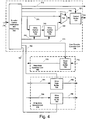
- Fig. 4 shows the structure of a core transfer operation unit 136, a read data operation unit 160, and a write data operation unit 170 for a memory that performs operations that are signaled on the control lines according to an embodiment of the present invention.
- Control signals 710 are received from control transport unit 122.
- Transfer, control, distribution, and sequence (“TCDS") block 705 produces signals to control the memory core 180, the read data operation unit 160, and write data operation unit 170.
- TCDS block 705 handles transfer, control, signal distribution, and sequencing responsibilities.
- Signals 710 are the edge based control signals for memory core 180.
- Signals 715 are signals that are presented to core 180 for a duration of time, and usually have setup and hold requirements with respect to the transition times of signals 710, and are produced by control buffer 720.
- control buffer 720 receives control signals directly from TCDS block 705 via signals 725 through multiplexer 730 that is controlled by signal 735.
- control buffer 720 receives control signals from TCDS block 705 via write control buffer 740, signals 745, write control buffer 750, signals 755, and multiplexer 730 (under the control of signal 735).
- Write control buffers 740 and 750 are controlled by signals 760.
- signals 710 are timed to correspond to the arrival of the operation to signals 715.
- Write control buffers 740 and 750 delay the application of the operation control to the memory core. This delay allows the data corresponding to the buffered write operation to be issued later, better matching the timing of the write operation to that of the read operation when accessing a targeted memory bank. Other embodiments may use additional blocks to change the amount of the delay. For example, a First-in-First-Out (“FIFO") or queue buffer is a preferred storage mechanism for the write data buffer and the write control buffer. In an alternate embodiment of the present invention, less control storage is needed when the control information is supplied by a retire sub-operation instead of the transport sub-operation.
- FIFO First-in-First-Out
- Read data buffer 765 receives read data on signals 770 from memory core 180, at times controlled by signal 771. This data is passed on to the transport block 120 via signals 775.
- read data buffer 765 is an amplifier driving signals 775 without timing signal 771.
- read data operation unit 160 is comprised only of a wire. Other variations for read data operation unit 160 are possible, depending on specific drive and timing characteristics of memory core 180.
- Write data buffer 100 receives write data from transport block 120 via signals 781 at times controlled by signal 782.
- write data buffer 100 is a variable depth write data buffer.
- Write data is passed on to the memory core 180 via signals 783.
- Write mask buffer 785 receives mask data from the transport unit on signals 786 at times controlled by signal 787.
- the mask information is passed on to memory core 180 via signals 788.
- Mask data is used by memory core 180 to selectively write, or not write, parts of the data within memory core 180. In another embodiment, no mask is used, with the result that all the data is written unconditionally.
- ERAW method 500 is performed, in part, by ERAW software 80 stored in master device 10(N).
- components of ERAW software 80 are stored in other devices illustrated in Fig. 1 .
- ERAW software 80 is stored in an article of manufacture, such as a computer readable medium.
- RAW software 80 is stored in a magnetic hard disk, an optical disk, CD-ROM ("Compact Disk Read-Only Memory”), RAM (“Random Access Memory”), ROM (“Read-Only memory”) or other readable or writeable data storage technologies, singly or in combination.
- a logic box or step illustrated in Fig. 5 represent an execution of a software component, such as a software program, a software object, a software function, a software subroutine, a software method, a software instance, a code fragment, singly or in combination.
- a logic box or step represents execution of a software operation, hardware operation, singly or in combination.
- fewer or more logic boxes or steps are carried out in method 500.
- Method 500 initiates by a master device 10(N) generating a write request to a memory device, such as memory device 20(1) illustrated in Fig. 1 , as represented by logic block 501.
- Write control information such as address information is then transferred by master device 10(N) on interconnect structure 60 to a targeted memory device as represented by logic block 502.
- write data is then transferred by master device 10(N) on interconnect structure 60 to the targeted memory device as represented by logic block 503.
- the data is then written to a first memory bank, such as memory bank 205(1) illustrated in Fig. 3 , in the targeted memory device as represented by logic block 504.
- a first memory bank such as memory bank 205(1) illustrated in Fig. 3
- blocks 501-503 are repeated to perform multiple write operations to the targeted memory bank.
- a read request for a second memory bank of the targeted memory device is generated by master device 10(N) as represented by logic block 505.
- Data is read from the second memory bank, such as memory bank 205(N), of the targeted memory device while data is written to the first memory bank of the targeted memory device as represented by logic block 506.
- Method 500 then ends.
- Fig. 6 is a timing diagram illustrating a W-R turnaround bubble time BUB using a memory device that does not have a write data buffer or early RAW software.
- every 4 horizontal cells in Figs. 6-7 equals 5ns.
- control signals received by memory device 20(N), and in particular on control signal lines 112 illustrated in Fig. 2 are represented on the row labeled control signal lines 112.
- a shaded box represents the duration of a particular signal on control signal lines 112.
- a shaded box labeled RD0b at row control signal lines 112 and columns 14-15 represents a READ command signal generated on control signal lines 112 for reading the contents of memory core 180.
- Shaded boxes are grayscale coded to correspond to associate memory bank 205 addresses.
- a READ command is represented as RD0a, RD0b, ... RD2a, RD2b...; while, a WRITE command is represented as WR1a, WR1b, WR1c....
- column I/O signals generated by memory device 20(N) on column I/O lines 266(1) are represented on the row labeled column I/O lines 266(1); while, column I/O signals generated by memory device 20(N) on column I/O lines 266(N) are represented on the row labeled column I/O lines 266(N).
- bi-directional data signals generated on data lines 114 are represented on the row labeled data signal lines 114.
- a PRECHARGE command is represented as PRE0, PRE01, PRE2, ... and an ACTIVATION command is represented as ACT2.
- ACT1 A first ACTIVATION command, ACT1, is not shown in Fig. 6 because the command occurred before edge 14.
- a PRECHARGE command prepares sense amplifier 215(1) and bit lines 220(1) for sensing, typically by equilibrating them to a midpoint reference voltage.
- row address 235(1) is decoded, a single word line is asserted, the contents of the storage cell is placed on bit lines 220(1), and sense amplifier 215(1) amplifies the value to full rail (i.e. a full digital high value), completing the movement of the information from storage array 210(1) to sense amplifier 215(1).
- column access Transferring information on column I/O lines 266(1) from sense amplifier 215(1) to column amplifier 265(1) is known as "column access.”
- a read column access transfers information from a sense amplifier to a column amplifier to data lines and out to the data interface.
- a write column access (without a write buffer) is the reverse.
- an ACTIVATE command allows for accessing a particular memory bank 205(1).
- tRP time is defined as the time between the end of a PRECHARGE command on control signal lines 112 and the end of an ACT command (to the same bank) on control signal lines 112 in an embodiment of the present invention.
- tCWD time is defined as the time between the end of a WRITE command on control signal lines 112 and the beginning of receiving write data on data signal lines 114 in an embodiment of the present invention.
- tRCD time is defined as the time interval between the end of ACTIVATE command and the end of a READ or WRITE command on control signal lines 112 in an embodiment of the present invention.
- tCAC time is defined as the time interval between the end of a READ command and the beginning of generating read data on data lines 114 in an embodiment of the present invention.
- a write operation for a memory device 20(N) is defined as the time between the last bit obtained (for writing) from a data pin interface (for example, data signal lines 114) to the beginning of a column I/O cycle (for example, column I/O lines 266(1)).
- a write operation occurs in 5ns using an 800 MHz clock signal.
- a read operation for memory device 20(N) is defined as the time from when a memory cell in memory core 180 is latched to the first bit obtained (for reading) from a data pin (for example, data signal lines 114).
- Fig. 7 is a timing diagram illustrating a W-R turnaround bubble time BUB using ERAW software 80.
- the W-R turnaround bubble time BUB has been reduced to approximately 5ns from 20ns.
- Figs. 8 and 9 illustrate another embodiment of the present invention.
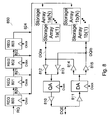
- Fig. 8 illustrates a block diagram of a memory device 850 in an embodiment of the present invention
- Fig 9b illustrates a timing diagram of memory device 850 shown in Fig. 8 .
- memory device 850 corresponds to memory device 20(1) and, RQ and DQE interfaces connect to interconnect structure 60 shown in Fig. 1 .
- Memory device 850 is coupled to an interface RQ that is sampled and held by a register 800.
- interface RQ transfers a command to register 800.
- multiple registers 800-803 are used to delay asserting a command on lines 820, 821, 822, 823, and 824. These delayed commands are decoded to provide control signals that enable read and write data to move between the DQE interface and the storage arrays.
- a second interface DQE transfers data to an input of register DA and interface DQE is driven during a read operation by the output of register QA.
- buffers 810-815 are used at the outputs and inputs of registers QA and DA, and are conditionally enabled to transfer read or write data from one point to another.
- Registers QA and DA like registers 800-803, are controlled by a clock signal.
- register DA drives write data through an internal interconnect structure DQIa to a set of storage arrays 1a(1) through 1a(N), or the set of storage arrays 1a(1) through storage arrays 1a(N) drive read data through an internal interconnect structure DQIa to register QA.
- interface DQE and interconnect structure DQIa may either hold read data or write data, but not typically both.
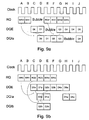
- Fig. 9a shows a timing diagram of a typical read after write operation of a typical memory device that illustrates the result of this resource conflict or a bubble.
- Clock cycles are labeled “A” through “J”.
- a command sequence of two WRITES, two READS, and two WRITEs is directed to memory device 850. These are denoted as “WR0, WR1, RD2, RD3, WR4, and WR5", respectively, on the RQ interface.
- WR0, WR1, RD2, RD3, WR4, and WR5 are denoted as "WR0, WR1, RD2, RD3, WR4, and WR5", respectively, on the RQ interface.
- there is a two cycle gap (cycles C and D) between a WR1 command and a RD2 command labeled as a "Bubble.”
- a WR0 command is provided on a RQ interface during cycle A.
- a WR0 command causes write data D0 that is present on a DQE interface in cycle C to be sampled by a register DA and driven onto interconnect structure DQIa during cycle D. Data D0 is written to the storage arrays during cycle D.
- a WR0 command that is sampled at an end of cycle A is held during cycles B, C, and D so that the appropriate drive enable signals and register load enable signals can be asserted at the correct time. Control logic for generating the appropriate enable signals is known by one of ordinary skill in the art and in not shown in order to clearly show the present embodiment of the present invention.
- a RD2 command is provided on a RQ interface during cycle E.
- a RD2 command causes one of the storage arrays to be accessed in cycle F, and read data to be driven onto an internal interconnect structure DQIa. This read data is sampled by register QA and driven onto interface DQE during cycle G.
- the RD2 command that is sampled at the end of cycle E is held during cycles F and G so that the appropriate drive enable signals and register load enable signals can be asserted at the correct time.
- Control logic for generating the appropriate enable signals is known by one of ordinary skill in the art and in not shown in order to clearly show the present embodiment of the present invention.
- the timing used for a READ command produces read data at the earliest possible time as shown in Fig. 9a (one cycle for receiving the command, one cycle for the access, and one cycle for driving the data). Read data is provided on interface DQE two cycles after a READ command is provided on interface RQ.
- the timing for a WRITE command has been artificially delayed so write data on interface DQE is also provided two cycles after a WRITE command is provided on interface RQ.
- Other alignments are possible, but this alignment has an advantage of simplifying an assignment of timing slots on interfaces RQ and DQE; when a command is placed in a timing slot on a interface RQ, there is a corresponding timing slot available on interface DQE.
- Interconnect structure DQIa is used at different times relative to a command on a interface RQ for two operations (unlike interface DQE). Interconnect structure DQIa is used three cycles after a WRITE command on a interface RQ, and one cycle after a READ command.
- a two-cycle bubble (cycles C and D) is introduced between WR1 and RD2 commands on a interface RQ.
- This bubble is shifted two cycles E and F on a interface DQE, and on cycles H and I on interconnect structure DQIa. If read and write operations used different timing sequences, a bubble would be shifted, but would still be present as a WR-WR-RD-RD-WR-WR command sequence is executed.
- Some systems may require additional cycles on an external interface DQE when a controller changes between transmitting and receiving. This is not shown in Fig. 9a , but the bubble(s) created by this changing between transmitting and receiving constraint would be added to the two-cycle bubble described above.
- a two-cycle bubble represents a performance loss to a system; a memory device is unable to execute any command in the two timing slots. However, it is possible to recover these two timing slots in an embodiment of the present invention.
- Fig. 8 shows a second internal interconnect structure DQIb that connects registers QA and DA to a second set of storage arrays 1b(1) through storage arrays 1b(N).
- a second internal interconnect structure DQIb is added at a very low incremental cost if the existing storage arrays are divided into two groups with half as many as before.
- each existing storage array could be divided into two halves, with each half connected to its own internal interconnect structure.
- a two-cycle bubble shown in Fig. 9a is eliminated as shown in Fig. 9b .
- a "WR0, WR1, RD2, RD3, WR4, and WR5" command sequence is asserted on interface RQ as shown in Fig. 9b .
- a WRITE command is directed to a storage array set "a" and a READ command are directed to storage array set "b".
- a RD2 command is proved in a timing slot immediately after a WR1 command.
- a memory controller adjusts the order in which commands are transmitted to a memory device 850 in order to eliminate a two-cycle bubble.
- a memory controller maintains two queues of WRITE commands (and write data), one for each of the two storage array sets in ERAW software 80.
- a memory controller transmits a WRITE command to a second storage array set, and vice versa.
- it is not a performance issue to delay a WRITE command as long as a memory controller checks a particular write queue to make sure asserting a subsequent READ command will not attempt to perform a read operation at an address which has a pending write operation.
- a bandwidth of external interface DQE (number of signals times the signaling rate) is substantially equal to a bandwidth of interconnect structure DQIa or a bandwidth of interconnect structure DQIb.
- a bandwidth of external interface DQE does not equal a bandwidth of interconnect structure DQIa or a bandwidth of interconnect structure DQIb.
- two external interfaces DQEa and DQEb are selectively coupled to either DQIa or DQIb.
- the bandwidth of DQEa, DQEb, DQIa and DQIb are substantially equal.
- a memory controller generates a command to selectively couple external interfaces to internal interconnect structures.
- external interfaces DQEa and DQEb are both used for a parallel read or write operation.
- additional registers are added to registers DA and QA so that data flowing in either direction is delayed to increase the efficiency of the turnaround of an external interface between a read and write operation.
- ERAW software 80 there are several advantages to using ERAW software 80.
- the efficiency improvement realized is a function of the rate of resource conflicts between initial reads on a W-R transition and the outstanding writes for the duration of concurrent memory bank access.
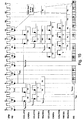
- FIG. 10 illustrates a memory device 1000 according to an embodiment of the present invention.
- Memory device 1000 is a DRAM device having a memory core 1002 and memory interface 1001.
- Memory core 1002 includes a set of memory banks having storage arrays 0-3, with sense amplifiers 0-3 associated with respective storage arrays 0-3.
- Interface 1001 connects to two sets of external interconnect structures RQ and DQ.
- a RQ interconnect structure carries request information (command, control and address information) to memory device 1000.
- a DQ interconnect structure carries data information to and from memory device 1000.
- Receive logic 1003 is coupled to a DQ interconnect structure and Row logic 1004 and Column logic 1005.
- Row logic 1004 is coupled to a set of memory banks by PRECH, PBSEL, BSENSE and RADR interconnects.
- Column logic 1005 is coupled to sense amplifiers by COLLAT, CADR, CBSEL, COLCYC and WRITE interconnects.
- Transmit logic 1006 and Receive logic 1007 is coupled to a DQ interconnect structure and sense amplifiers.
- a RD/WD interconnect is coupled to Transmit logic 1006 and Receive logic 1007.
- WE interconnect couples Receive logic 1007 to sense amplifiers.
- Request information is received and decoded by Receive logic 1003. If a request command initiates a row operation such as an ACTIVATE command (“ACT”) or a PRECHARE command (“PRE”), then control and address information is passed to Row logic 1004. If a request command initiates a column operation such as a READ operation (“RD”) or a WRITE operation (“WR”), then control and address information is passed to Column logic 1005.
- ACT ACTIVATE command
- PRE PRECHARE command
- Row logic 1004 If a request command initiates a column operation such as a READ operation (“RD”) or a WRITE operation (“WR”), then control and address information is passed to Column logic 1005.
- a bank address in a request is placed on a PBSEL interconnect, and a PRECH interconnect is pulsed high, with a rising edge causing a selected bank to be precharged (placed into a state so that an activate operation may be performed).
- a bank address and row address in a request is placed on a RADR interconnect, and a BSENSE interconnect is pulsed low, with a falling edge causing a selected row of a selected bank to be activated (the information in a selected row is copied into an associated sense amplifier for a selected bank).
- a bank address and column address in a request is placed on CBSEL and CADR interconnects, respectively, and COLLAT and COLCYC interconnects are pulsed high, with rising edges causing a selected column of a sense amplifier of a selected bank to be accessed and driven onto an internal RD/WD interconnect.
- Transmit logic 1006 takes this read data on an internal RD/WD interconnect and drives it onto an external DQ interconnect structure.
- Receive logic 1007 takes write data on an external DQ interconnect structure and drives write data onto internal RD/WD interconnect.
- Bank address and column address in a request is placed on CBSEL and CADR interconnects, respectively, and COLLAT and COLCYC interconnects are pulsed high, with rising edges causing write data on RD/WD interconnects to be stored in a selected column of a sense amplifier of a selected bank.
- WE interconnects are used for write mask information. This permits some write data to be stored, and some write data to not be stored (the data in the sense amplifier is not modified in an embodiment of the present invention). Write mask information has approximately the same timing as the write data.
- Fig. 11 is a timing diagram illustrating events on interconnects of memory device 1000 seen in Fig. 10 for a read operation. These timing limits or intervals may constrain minimum time intervals between events on interconnects. These intervals are:
- an occurrence of an event on an interconnect may be constrained by two or more of the above intervals. In an embodiment of the present invention, all applicable time intervals must be satisfied if two or more time intervals apply.
- a signal on an interconnect will be set and held around a rising or falling edge of a signal on another interconnect.
- the amount of time to set and hold a signal (t SET and t HOLD time intervals) is not shown in Figs. 11-13 and 15 .
- the following shows which signals on specific interconnects are used for setting up and holding signals on other interconnects.
- a falling edge of a signal on a BSENSE interconnect is used to set and hold a signal on a RADR interconnect.
- a rising edge of signal on a PRECH interconnect is used to set and hold a signal on a PBSEL interconnect.
- a rising edge of a signal on a COLLAT interconnect is used to set and hold a signal on CADR and CBSEL interconnects.
- a rising edge of a signal on a COLCYC interconnect is used to set and hold a signal on WRITE and RD/WD interconnects.
- Fig. 11 illustrates reading information from memory device 1000, consisting of four request packets on a RQ interconnect structure. These packets contain an ACT command, a RD command, a RD command, and a PRE command, and cause an activate operation, two read operations, and a precharge operation to occur.
- Fig. 12 illustrates writing information to memory device 1000, consisting of four request packets on a RQ interconnect structure. These packets contain an ACT command, a first WR command, a second WR command, and a PRE command, and cause an activate operation, two write operations, and a precharge operation to occur.
- Figs. 11 and 12 illustrate the position of read data and write data on both an internal RD/WD interconnect and on the external DQ interconnect structure.
- Read data and write data share the same physical wires both inside and outside memory device 1000. However, the relative times at which read data and write data occupy these wires are different (relative to the RD and WR commands).
- Fig. 13 illustrates a sequence of read and write commands (RD-RD-WR-WR-RD) applied to memory device 1000.
- ACTIVATE and PRECHARGE commands ACT and PRE are not shown in Fig. 13 because they will not affect the spacing of READ and WRITE commands.
- This provides for a one CFM cycle gap between read and write data on a DQ interconnect structure (between CFM rising edges 10 and 11) to ensure that the two sets of driver circuitry (on memory device 1000 and on a master device, such as an external controller) may turn off and turn on without overlapping.
- a third read command Rx is issued to a bank "x" that is different from storage array 0 and storage array 2 that avoids a bank contention.
- Read command Rx is issued at CFM rising edge 18 or later to insure that there is at least a two cycle turnaround gap on a RD/WD interconnect between an end of a W2 write data and a beginning of a Rx read data.
- Fig. 14 shows how this performance loss can be avoided with a memory device 1400 having split banks.
- memory device 1400 is a DRAM having interface circuitry 1403 coupled to DRAM core 1401 and 1402.
- DRAM core 1401 includes a memory bank set B having storage arrays and associated sense amplifies
- DRAM core 1402 includes a memory bank set A having storage arrays and associated sense amplifiers. Even banks are in bank set A and the odd banks are in bank set B in an embodiment of the present invention.
- Each memory bank set will have a set of interconnects for communicating with interface circuitry 1403 (the letters "a" and "b" are appended to each interconnect).
- Interface circuitry 1403 includes Receive logic 1404 coupled to a RQ interconnect structure, and Transmit logic 1408 and Receive logic 1409 coupled to a DQ interconnect structure.
- Receive logic 1404 is coupled to Row logic 1405 and Column logic 1406.
- Transmit logic 1408 is coupled to multiplexer (mux) 1407.
- Multiplexer 1407 selects read data from a particular bank set in response to a bank address bit.
- Receive logic 1409 is coupled to amplifiers 1410a-b driving interconnects RDa/WDa, RDb/WDb, WEa and WEb. In an embodiment of the present invention, only one of amplifiers 1410a or 1410b is enabled in response to bank address bid.
- Interface circuitry 1403 drives two sets of interconnects.
- Row logic 1405 is coupled to memory bank set A by PRECHa, PBSELa, BSENSEa and RADRa interconnects and coupled to memory bank set B by PRECHb, PBSELb, BSENSEb and RADRb interconnects.
- Column logic 1406 is coupled to memory bank set A by COLLATa, CADRa, CBSELa, COLCYCa, and WRITEa interconnects and coupled to memory bank set B by COLLATb, CADRb, CBSELb, COLCYCb, and WRITEb interconnects.
- WEa and WEb interconnects are coupled to Receive logic 1409.
- Amplifier 1410a is coupled to Receive logic 1409 and RDa/WDa interconnect.
- Amplifier 1410b is coupled to Receive logic 1409 and RDb/WDb interconnect.
- Interface circuitry 1403 select read data from the RDa/WDa and RDb/WDb interconnects using a multiplexing 1407. This represents a very slight overhead in circuit area, but provides a way for reducing a write-read gap described above.
- Fig. 15 illustrates a timing and operation of memory device 1400 having split memory banks.
- Two sets of RD/WD interconnects allows for write data to be sent on RDa/WDa to even banks to be stored and a RDb/WDb interconnect is available for read data from odd banks.
- read commands to odd storage arrays 3 and 5 are provided at CFM cycles 10, 12, 14, and 16. This causes read data R3 and R5 to appear on RDb/WDb interconnects during CFM rising edges 14 through 21, and on a DQ interconnect structure between CFM edges 16 through 24.
- a one CFM cycle gap between write and read data on a DQ interconnect structure (between CFM rising edges 15 and 16) is formed to ensure that the two sets of driver circuitry (on a memory device and on a master device, such as a controller) may turn off and turn on without overlapping.
- a third read command Rx is issued to a bank "x" that is different from storage arrays 0, 2, 3, and 5 that avoids a bank contention.
- Read command Rx is issued at CFM rising edge 18 or later to insure that there is at least a two cycle turnaround gap on RDa/WDa interconnects between an end of write data W2 and a beginning of read data Rx.
- Bank "x" may be even or odd (subject to a bank contention restriction), since there will be no turnaround issue on a RDb/WDb interconnect between R5 read data and Rx read data, if "x" is odd.
- a write-read gap on a DQ interconnect structure has been reduced to one CFM cycle, a minimum for driver circuitry turnaround in an embodiment of the present invention.
- Four read commands are issued immediately after two write commands to a bank set not being used by the write commands in an embodiment of the present invention.
Landscapes
- Dram (AREA)
- Techniques For Improving Reliability Of Storages (AREA)
Claims (9)
- Speichervorrichtung (20(N)), die aufweist:eine Schnittstelle (105), um eine erste Schreib-Adresse, erste Schreib-Daten, eine erste Steuerungsinformation, die einen Schreib-Vorgang verbunden mit den ersten Schreib-Daten anzeigt, eine Auslese-Adresse und eine zweite Steuerungsinformation, die einen Auslese-Vorgang verbunden mit der Auslese-Adresse anzeigt, zu empfangen und Auslese-Daten als Antwort auf die zweite Steuerungsinformation zu übertragen, wobei die Schnittstelle (105) einen gemeinsamen Satz von Anschlüssen umfasst, um bidirektionale Datensignalleitungen (114) anzuschließen, um sowohl die Schreib-Daten zu empfangen als auch die Auslese-Daten zu übertragen;ein erstes Speicher-Array (210(1)), das an einen ersten Datenpfad (190(1)) und einen ersten Adresspfad (190(1)) gekoppelt ist, wobei das erste Speicher-Array (210(1)) Dynamic Random Access Memory ("DRAM") Speicher-Arrays umfasst, undein zweites Speicher-Array (210(N)), das an einen zweiten Datenpfad (190(N)) und einen zweiten Adresspfad (190(N)) gekoppelt ist, wobei das zweite Speicher-Array (210(N)) Dynamic Random Access Memory ("DRAM") Speicher-Arrays umfasst,wobei die ersten Schreib-Daten auf dem ersten Datenpfad (190(N)) als Antwort auf die erste Steuerungsinformation, die auf dem ersten Adresspfad (190(1)) bereitgestellt wird, bereitgestellt werden und Auslese-Daten auf dem zweiten Datenpfad (190(N)) als Antwort auf die zweite Steuerungsinformation, die auf dem zweiten Adresspfad (190(N)) bereitgestellt wird, bereitgestellt werden, wobei die ersten Schreib-Daten auf dem ersten Datenpfad vorhanden sind, wenn die Auslese-Daten auf dem zweiten Datenpfad vorhanden sind.
- Speichervorrichtung (20(N)) nach Anspruch 1, die ferner aufweist:eine externe Verbindung (RQ), die an die Schnittstelle (105) gekoppelt ist, um die erste und zweite Steuerungsinformation bereitzustellen, und wobei die erste Steuerungsinformation der zweiten Steuerungsinformation vorausgeht.
- Speichervorrichtung (20(N)) nach Anspruch 2, wobei die externe Verbindung (RQ) eine dritte Steuerungsinformation bereitstellt, die einen Schreib-Vorgang verbunden mit zweiten Schreib-Daten anzeigt, und wobei die erste Steuerungsinformation und die dritte Steuerungsinformation der zweiten Steuerungsinformation vorausgehen.
- Speichervorrichtung (20(N)) nach einem der Ansprüche 1 bis 3, wobei der erste Datenpfad (190(1)) unabhängig von dem zweiten Datenpfad (190(N)) ist.
- Speichervorrichtung (20(N)) nach einem der Ansprüche 1 bis 4, wobei der erste Adresspfad (190(1)) unabhängig von dem zweiten Adresspfad (190(N)) ist.
- Speichervorrichtung (20(N)) nach einem der Ansprüche 1 bis 5, wobei der erste Datenpfad (190(1)) einen ersten Satz von Signalleitungen umfasst, um Daten bereitzustellen, und der zweite Datenpfad (190(N)) einen zweiten Satz von Signalleitungen umfasst, um Daten bereitzustellen.
- Speichervorrichtung (20(N)) nach einem der Ansprüche 1 bis 6, wobei der erste Datenpfad (190(1)) einen ersten I/O-Verstärker (265(1)) umfasst und der zweite Datenpfad (190(N)) einen zweiten I/O-Verstärker (265(N)) umfasst.
- Speichervorrichtung (20(N)) nach einem der Ansprüche 1 bis 7, wobei der erste Adresspfad (190(1)) einen ersten Spalten-Vordekodierer umfasst und der zweite Adresspfad (190(N)) einen zweiten Spalten-Vordekodierer umfasst.
- Speichervorrichtung (20(N)) nach einem der Ansprüche 1 bis 8, wobei der erste Adresspfad (190(1)) einen ersten Spalten-Dekodierer (230(1)) umfasst und der zweite Adresspfad (190(N)) einen zweiten Spalten-Dekodierer (230(N)) umfasst.
Applications Claiming Priority (9)
| Application Number | Priority Date | Filing Date | Title |
|---|---|---|---|
| US39219702P | 2002-06-28 | 2002-06-28 | |
| US39219802P | 2002-06-28 | 2002-06-28 | |
| US392198P | 2002-06-28 | ||
| US392197P | 2002-06-28 | ||
| US10/353,405 US7187572B2 (en) | 2002-06-28 | 2003-01-29 | Early read after write operation memory device, system and method |
| US353405 | 2003-01-29 | ||
| US442352 | 2003-05-21 | ||
| US10/442,352 US7380092B2 (en) | 2002-06-28 | 2003-05-21 | Memory device and system having a variable depth write buffer and preload method |
| PCT/US2003/020572 WO2004003700A2 (en) | 2002-06-28 | 2003-06-27 | An early read after write operation memory device, system and method |
Publications (3)
| Publication Number | Publication Date |
|---|---|
| EP1532632A2 EP1532632A2 (de) | 2005-05-25 |
| EP1532632A4 EP1532632A4 (de) | 2005-09-21 |
| EP1532632B1 true EP1532632B1 (de) | 2008-10-08 |
Family
ID=30003971
Family Applications (1)
| Application Number | Title | Priority Date | Filing Date |
|---|---|---|---|
| EP03762237A Expired - Lifetime EP1532632B1 (de) | 2002-06-28 | 2003-06-27 | Speicherbaustein mit frühlese-nach-schreiboperation, system und verfahren |
Country Status (4)
| Country | Link |
|---|---|
| EP (1) | EP1532632B1 (de) |
| AU (1) | AU2003248764A1 (de) |
| DE (2) | DE20321101U1 (de) |
| WO (1) | WO2004003700A2 (de) |
Families Citing this family (1)
| Publication number | Priority date | Publication date | Assignee | Title |
|---|---|---|---|---|
| US9734098B2 (en) | 2015-03-31 | 2017-08-15 | Sandisk Technologies Llc | Memory bus management |
Citations (1)
| Publication number | Priority date | Publication date | Assignee | Title |
|---|---|---|---|---|
| EP0833342A2 (de) * | 1996-09-27 | 1998-04-01 | International Business Machines Corporation | Speichersystem und Datenübertragungsverfahren |
Family Cites Families (4)
| Publication number | Priority date | Publication date | Assignee | Title |
|---|---|---|---|---|
| US5245572A (en) * | 1991-07-30 | 1993-09-14 | Intel Corporation | Floating gate nonvolatile memory with reading while writing capability |
| JPH1031886A (ja) * | 1996-07-17 | 1998-02-03 | Nec Corp | ランダムアクセスメモリ |
| JP2865080B2 (ja) * | 1996-09-30 | 1999-03-08 | 日本電気株式会社 | 半導体記憶装置 |
| JP4039532B2 (ja) * | 1997-10-02 | 2008-01-30 | 株式会社ルネサステクノロジ | 半導体集積回路装置 |
-
2003
- 2003-06-27 WO PCT/US2003/020572 patent/WO2004003700A2/en not_active Ceased
- 2003-06-27 EP EP03762237A patent/EP1532632B1/de not_active Expired - Lifetime
- 2003-06-27 DE DE20321101U patent/DE20321101U1/de not_active Expired - Lifetime
- 2003-06-27 AU AU2003248764A patent/AU2003248764A1/en not_active Abandoned
- 2003-06-27 DE DE60323989T patent/DE60323989D1/de not_active Expired - Lifetime
Patent Citations (1)
| Publication number | Priority date | Publication date | Assignee | Title |
|---|---|---|---|---|
| EP0833342A2 (de) * | 1996-09-27 | 1998-04-01 | International Business Machines Corporation | Speichersystem und Datenübertragungsverfahren |
Also Published As
| Publication number | Publication date |
|---|---|
| DE20321101U1 (de) | 2006-01-05 |
| AU2003248764A8 (en) | 2004-01-19 |
| WO2004003700A2 (en) | 2004-01-08 |
| WO2004003700A3 (en) | 2004-10-21 |
| EP1532632A2 (de) | 2005-05-25 |
| EP1532632A4 (de) | 2005-09-21 |
| AU2003248764A1 (en) | 2004-01-19 |
| DE60323989D1 (de) | 2008-11-20 |
Similar Documents
| Publication | Publication Date | Title |
|---|---|---|
| US7848156B2 (en) | Early read after write operation memory device, system and method | |
| US7047375B2 (en) | Memory system and method for two step memory write operations | |
| US8601231B2 (en) | Semiconductor memory asynchronous pipeline | |
| US6125421A (en) | Independent multichannel memory architecture | |
| JP2817679B2 (ja) | 半導体メモリ | |
| US7380092B2 (en) | Memory device and system having a variable depth write buffer and preload method | |
| US6539454B2 (en) | Semiconductor memory asynchronous pipeline | |
| JP4827399B2 (ja) | 半導体記憶装置 | |
| EP1532632B1 (de) | Speicherbaustein mit frühlese-nach-schreiboperation, system und verfahren |
Legal Events
| Date | Code | Title | Description |
|---|---|---|---|
| PUAI | Public reference made under article 153(3) epc to a published international application that has entered the european phase |
Free format text: ORIGINAL CODE: 0009012 |
|
| AK | Designated contracting states |
Kind code of ref document: A2 Designated state(s): AT BE BG CH CY CZ DE DK EE ES FI FR GB GR HU IE IT LI LU MC NL PT RO SE SI SK TR |
|
| 17P | Request for examination filed |
Effective date: 20050421 |
|
| A4 | Supplementary search report drawn up and despatched |
Effective date: 20050809 |
|
| RIC1 | Information provided on ipc code assigned before grant |
Ipc: 7G 11C 7/10 B Ipc: 7G 11C 7/22 B Ipc: 7G 11C 7/00 A |
|
| RBV | Designated contracting states (corrected) |
Designated state(s): DE IT |
|
| RIN1 | Information on inventor provided before grant (corrected) |
Inventor name: WARE, FREDERIC, A. Inventor name: PEREGO, RICHARD, E. |
|
| 17Q | First examination report despatched |
Effective date: 20070118 |
|
| 17Q | First examination report despatched |
Effective date: 20070118 |
|
| GRAP | Despatch of communication of intention to grant a patent |
Free format text: ORIGINAL CODE: EPIDOSNIGR1 |
|
| GRAS | Grant fee paid |
Free format text: ORIGINAL CODE: EPIDOSNIGR3 |
|
| GRAA | (expected) grant |
Free format text: ORIGINAL CODE: 0009210 |
|
| AK | Designated contracting states |
Kind code of ref document: B1 Designated state(s): DE IT |
|
| REF | Corresponds to: |
Ref document number: 60323989 Country of ref document: DE Date of ref document: 20081120 Kind code of ref document: P |
|
| PLBE | No opposition filed within time limit |
Free format text: ORIGINAL CODE: 0009261 |
|
| STAA | Information on the status of an ep patent application or granted ep patent |
Free format text: STATUS: NO OPPOSITION FILED WITHIN TIME LIMIT |
|
| 26N | No opposition filed |
Effective date: 20090709 |
|
| PGFP | Annual fee paid to national office [announced via postgrant information from national office to epo] |
Ref country code: IT Payment date: 20120621 Year of fee payment: 10 |
|
| PG25 | Lapsed in a contracting state [announced via postgrant information from national office to epo] |
Ref country code: IT Free format text: LAPSE BECAUSE OF NON-PAYMENT OF DUE FEES Effective date: 20130627 |
|
| PGFP | Annual fee paid to national office [announced via postgrant information from national office to epo] |
Ref country code: DE Payment date: 20200629 Year of fee payment: 18 |
|
| REG | Reference to a national code |
Ref country code: DE Ref legal event code: R082 Ref document number: 60323989 Country of ref document: DE Representative=s name: EISENFUEHR SPEISER PATENTANWAELTE RECHTSANWAEL, DE Ref country code: DE Ref legal event code: R081 Ref document number: 60323989 Country of ref document: DE Owner name: RAMBUS INC. (N.D.GES. DES STAATES DELAWARE), S, US Free format text: FORMER OWNER: RAMBUS INC., LOS ALTOS, CALIF., US |
|
| REG | Reference to a national code |
Ref country code: DE Ref legal event code: R119 Ref document number: 60323989 Country of ref document: DE |
|
| PG25 | Lapsed in a contracting state [announced via postgrant information from national office to epo] |
Ref country code: DE Free format text: LAPSE BECAUSE OF NON-PAYMENT OF DUE FEES Effective date: 20220101 |