EP1538222A1 - Oligonucléotides pour la détection de salmonella - Google Patents
Oligonucléotides pour la détection de salmonella Download PDFInfo
- Publication number
- EP1538222A1 EP1538222A1 EP04078201A EP04078201A EP1538222A1 EP 1538222 A1 EP1538222 A1 EP 1538222A1 EP 04078201 A EP04078201 A EP 04078201A EP 04078201 A EP04078201 A EP 04078201A EP 1538222 A1 EP1538222 A1 EP 1538222A1
- Authority
- EP
- European Patent Office
- Prior art keywords
- sequence
- enterica
- probe
- salmonella
- bongori
- Prior art date
- Legal status (The legal status is an assumption and is not a legal conclusion. Google has not performed a legal analysis and makes no representation as to the accuracy of the status listed.)
- Granted
Links
- 108091034117 Oligonucleotide Proteins 0.000 title claims abstract description 60
- 238000001514 detection method Methods 0.000 title claims abstract description 55
- JLCPHMBAVCMARE-UHFFFAOYSA-N [3-[[3-[[3-[[3-[[3-[[3-[[3-[[3-[[3-[[3-[[3-[[5-(2-amino-6-oxo-1H-purin-9-yl)-3-[[3-[[3-[[3-[[3-[[3-[[5-(2-amino-6-oxo-1H-purin-9-yl)-3-[[5-(2-amino-6-oxo-1H-purin-9-yl)-3-hydroxyoxolan-2-yl]methoxy-hydroxyphosphoryl]oxyoxolan-2-yl]methoxy-hydroxyphosphoryl]oxy-5-(5-methyl-2,4-dioxopyrimidin-1-yl)oxolan-2-yl]methoxy-hydroxyphosphoryl]oxy-5-(6-aminopurin-9-yl)oxolan-2-yl]methoxy-hydroxyphosphoryl]oxy-5-(6-aminopurin-9-yl)oxolan-2-yl]methoxy-hydroxyphosphoryl]oxy-5-(6-aminopurin-9-yl)oxolan-2-yl]methoxy-hydroxyphosphoryl]oxy-5-(6-aminopurin-9-yl)oxolan-2-yl]methoxy-hydroxyphosphoryl]oxyoxolan-2-yl]methoxy-hydroxyphosphoryl]oxy-5-(5-methyl-2,4-dioxopyrimidin-1-yl)oxolan-2-yl]methoxy-hydroxyphosphoryl]oxy-5-(4-amino-2-oxopyrimidin-1-yl)oxolan-2-yl]methoxy-hydroxyphosphoryl]oxy-5-(5-methyl-2,4-dioxopyrimidin-1-yl)oxolan-2-yl]methoxy-hydroxyphosphoryl]oxy-5-(5-methyl-2,4-dioxopyrimidin-1-yl)oxolan-2-yl]methoxy-hydroxyphosphoryl]oxy-5-(6-aminopurin-9-yl)oxolan-2-yl]methoxy-hydroxyphosphoryl]oxy-5-(6-aminopurin-9-yl)oxolan-2-yl]methoxy-hydroxyphosphoryl]oxy-5-(4-amino-2-oxopyrimidin-1-yl)oxolan-2-yl]methoxy-hydroxyphosphoryl]oxy-5-(4-amino-2-oxopyrimidin-1-yl)oxolan-2-yl]methoxy-hydroxyphosphoryl]oxy-5-(4-amino-2-oxopyrimidin-1-yl)oxolan-2-yl]methoxy-hydroxyphosphoryl]oxy-5-(6-aminopurin-9-yl)oxolan-2-yl]methoxy-hydroxyphosphoryl]oxy-5-(4-amino-2-oxopyrimidin-1-yl)oxolan-2-yl]methyl [5-(6-aminopurin-9-yl)-2-(hydroxymethyl)oxolan-3-yl] hydrogen phosphate Polymers Cc1cn(C2CC(OP(O)(=O)OCC3OC(CC3OP(O)(=O)OCC3OC(CC3O)n3cnc4c3nc(N)[nH]c4=O)n3cnc4c3nc(N)[nH]c4=O)C(COP(O)(=O)OC3CC(OC3COP(O)(=O)OC3CC(OC3COP(O)(=O)OC3CC(OC3COP(O)(=O)OC3CC(OC3COP(O)(=O)OC3CC(OC3COP(O)(=O)OC3CC(OC3COP(O)(=O)OC3CC(OC3COP(O)(=O)OC3CC(OC3COP(O)(=O)OC3CC(OC3COP(O)(=O)OC3CC(OC3COP(O)(=O)OC3CC(OC3COP(O)(=O)OC3CC(OC3COP(O)(=O)OC3CC(OC3COP(O)(=O)OC3CC(OC3COP(O)(=O)OC3CC(OC3COP(O)(=O)OC3CC(OC3COP(O)(=O)OC3CC(OC3CO)n3cnc4c(N)ncnc34)n3ccc(N)nc3=O)n3cnc4c(N)ncnc34)n3ccc(N)nc3=O)n3ccc(N)nc3=O)n3ccc(N)nc3=O)n3cnc4c(N)ncnc34)n3cnc4c(N)ncnc34)n3cc(C)c(=O)[nH]c3=O)n3cc(C)c(=O)[nH]c3=O)n3ccc(N)nc3=O)n3cc(C)c(=O)[nH]c3=O)n3cnc4c3nc(N)[nH]c4=O)n3cnc4c(N)ncnc34)n3cnc4c(N)ncnc34)n3cnc4c(N)ncnc34)n3cnc4c(N)ncnc34)O2)c(=O)[nH]c1=O JLCPHMBAVCMARE-UHFFFAOYSA-N 0.000 title claims abstract description 45
- 241000607142 Salmonella Species 0.000 title claims description 60
- 241001138501 Salmonella enterica Species 0.000 claims abstract description 98
- 241000533331 Salmonella bongori Species 0.000 claims abstract description 57
- 108020004414 DNA Proteins 0.000 claims abstract description 49
- 230000003321 amplification Effects 0.000 claims abstract description 42
- 238000003199 nucleic acid amplification method Methods 0.000 claims abstract description 42
- 108091028043 Nucleic acid sequence Proteins 0.000 claims abstract description 15
- 239000002299 complementary DNA Substances 0.000 claims abstract description 14
- 239000000523 sample Substances 0.000 claims description 73
- 238000009396 hybridization Methods 0.000 claims description 52
- 238000000034 method Methods 0.000 claims description 44
- 239000012634 fragment Substances 0.000 claims description 31
- 239000002773 nucleotide Substances 0.000 claims description 25
- 125000003729 nucleotide group Chemical group 0.000 claims description 25
- 238000006243 chemical reaction Methods 0.000 claims description 19
- 108090000623 proteins and genes Proteins 0.000 claims description 19
- 241001467018 Typhis Species 0.000 claims description 15
- 241000894006 Bacteria Species 0.000 claims description 14
- 150000001413 amino acids Chemical class 0.000 claims description 14
- 101150000726 iagB gene Proteins 0.000 claims description 14
- 239000000872 buffer Substances 0.000 claims description 12
- 239000012472 biological sample Substances 0.000 claims description 11
- 208000015181 infectious disease Diseases 0.000 claims description 11
- 241000293871 Salmonella enterica subsp. enterica serovar Typhi Species 0.000 claims description 9
- 102000004169 proteins and genes Human genes 0.000 claims description 9
- 238000011895 specific detection Methods 0.000 claims description 9
- 150000007523 nucleic acids Chemical class 0.000 claims description 8
- 230000009545 invasion Effects 0.000 claims description 7
- 239000003153 chemical reaction reagent Substances 0.000 claims description 6
- 238000000338 in vitro Methods 0.000 claims description 6
- 108020004707 nucleic acids Proteins 0.000 claims description 6
- 102000039446 nucleic acids Human genes 0.000 claims description 6
- 239000011541 reaction mixture Substances 0.000 claims description 6
- 238000005406 washing Methods 0.000 claims description 6
- 238000004925 denaturation Methods 0.000 claims description 5
- 230000036425 denaturation Effects 0.000 claims description 5
- 108020004635 Complementary DNA Proteins 0.000 claims description 3
- 238000010804 cDNA synthesis Methods 0.000 claims description 3
- 229920001184 polypeptide Polymers 0.000 claims description 3
- 108090000765 processed proteins & peptides Proteins 0.000 claims description 3
- 102000004196 processed proteins & peptides Human genes 0.000 claims description 3
- 230000000295 complement effect Effects 0.000 claims description 2
- 238000012217 deletion Methods 0.000 claims description 2
- 230000037430 deletion Effects 0.000 claims description 2
- 230000035772 mutation Effects 0.000 claims description 2
- 101100536811 Dictyostelium discoideum tgrB1 gene Proteins 0.000 claims 3
- 101150105846 hilA gene Proteins 0.000 claims 2
- 239000013615 primer Substances 0.000 description 34
- 238000003752 polymerase chain reaction Methods 0.000 description 26
- 239000000243 solution Substances 0.000 description 15
- 210000004027 cell Anatomy 0.000 description 14
- HEMHJVSKTPXQMS-UHFFFAOYSA-M Sodium hydroxide Chemical compound [OH-].[Na+] HEMHJVSKTPXQMS-UHFFFAOYSA-M 0.000 description 12
- 239000012528 membrane Substances 0.000 description 10
- 239000000047 product Substances 0.000 description 10
- FAPWRFPIFSIZLT-UHFFFAOYSA-M Sodium chloride Chemical compound [Na+].[Cl-] FAPWRFPIFSIZLT-UHFFFAOYSA-M 0.000 description 8
- 238000002105 Southern blotting Methods 0.000 description 8
- 238000011534 incubation Methods 0.000 description 8
- 102000013415 peroxidase activity proteins Human genes 0.000 description 8
- 108040007629 peroxidase activity proteins Proteins 0.000 description 8
- XLYOFNOQVPJJNP-UHFFFAOYSA-N water Chemical compound O XLYOFNOQVPJJNP-UHFFFAOYSA-N 0.000 description 7
- GEYOCULIXLDCMW-UHFFFAOYSA-N 1,2-phenylenediamine Chemical compound NC1=CC=CC=C1N GEYOCULIXLDCMW-UHFFFAOYSA-N 0.000 description 6
- 230000000692 anti-sense effect Effects 0.000 description 6
- 230000004709 cell invasion Effects 0.000 description 6
- 238000003745 diagnosis Methods 0.000 description 6
- 230000000694 effects Effects 0.000 description 6
- 239000000203 mixture Substances 0.000 description 6
- 230000002285 radioactive effect Effects 0.000 description 6
- 238000012360 testing method Methods 0.000 description 6
- QKNYBSVHEMOAJP-UHFFFAOYSA-N 2-amino-2-(hydroxymethyl)propane-1,3-diol;hydron;chloride Chemical compound Cl.OCC(N)(CO)CO QKNYBSVHEMOAJP-UHFFFAOYSA-N 0.000 description 5
- 241000588724 Escherichia coli Species 0.000 description 5
- 229920001213 Polysorbate 20 Polymers 0.000 description 5
- 235000013305 food Nutrition 0.000 description 5
- 239000000256 polyoxyethylene sorbitan monolaurate Substances 0.000 description 5
- 235000010486 polyoxyethylene sorbitan monolaurate Nutrition 0.000 description 5
- 230000035945 sensitivity Effects 0.000 description 5
- KCXVZYZYPLLWCC-UHFFFAOYSA-N EDTA Chemical compound OC(=O)CN(CC(O)=O)CCN(CC(O)=O)CC(O)=O KCXVZYZYPLLWCC-UHFFFAOYSA-N 0.000 description 4
- 241000588747 Klebsiella pneumoniae Species 0.000 description 4
- 241000607715 Serratia marcescens Species 0.000 description 4
- 238000000376 autoradiography Methods 0.000 description 4
- 238000004737 colorimetric analysis Methods 0.000 description 4
- 238000002474 experimental method Methods 0.000 description 4
- 239000011780 sodium chloride Substances 0.000 description 4
- LENZDBCJOHFCAS-UHFFFAOYSA-N tris Chemical compound OCC(N)(CO)CO LENZDBCJOHFCAS-UHFFFAOYSA-N 0.000 description 4
- 241000305071 Enterobacterales Species 0.000 description 3
- 102000004190 Enzymes Human genes 0.000 description 3
- 108090000790 Enzymes Proteins 0.000 description 3
- 241000282412 Homo Species 0.000 description 3
- 101150049246 KHDRBS3 gene Proteins 0.000 description 3
- 241001465754 Metazoa Species 0.000 description 3
- 241000588912 Pantoea agglomerans Species 0.000 description 3
- 241000588770 Proteus mirabilis Species 0.000 description 3
- 108010006785 Taq Polymerase Proteins 0.000 description 3
- 239000007983 Tris buffer Substances 0.000 description 3
- 238000003556 assay Methods 0.000 description 3
- 238000009835 boiling Methods 0.000 description 3
- 239000013611 chromosomal DNA Substances 0.000 description 3
- 238000000605 extraction Methods 0.000 description 3
- 101150070528 khdrbs2 gene Proteins 0.000 description 3
- 230000003287 optical effect Effects 0.000 description 3
- 239000012071 phase Substances 0.000 description 3
- 241000894007 species Species 0.000 description 3
- 239000000725 suspension Substances 0.000 description 3
- 241000588626 Acinetobacter baumannii Species 0.000 description 2
- 102000002260 Alkaline Phosphatase Human genes 0.000 description 2
- 108020004774 Alkaline Phosphatase Proteins 0.000 description 2
- 238000007400 DNA extraction Methods 0.000 description 2
- 239000003155 DNA primer Substances 0.000 description 2
- 239000003298 DNA probe Substances 0.000 description 2
- 241000194032 Enterococcus faecalis Species 0.000 description 2
- 206010016952 Food poisoning Diseases 0.000 description 2
- 208000019331 Foodborne disease Diseases 0.000 description 2
- 241000588749 Klebsiella oxytoca Species 0.000 description 2
- 241000186779 Listeria monocytogenes Species 0.000 description 2
- TWRXJAOTZQYOKJ-UHFFFAOYSA-L Magnesium chloride Chemical compound [Mg+2].[Cl-].[Cl-] TWRXJAOTZQYOKJ-UHFFFAOYSA-L 0.000 description 2
- 241000186367 Mycobacterium avium Species 0.000 description 2
- 241001646725 Mycobacterium tuberculosis H37Rv Species 0.000 description 2
- 108700035964 Mycobacterium tuberculosis HsaD Proteins 0.000 description 2
- 238000012408 PCR amplification Methods 0.000 description 2
- ISAKRJDGNUQOIC-UHFFFAOYSA-N Uracil Chemical group O=C1C=CNC(=O)N1 ISAKRJDGNUQOIC-UHFFFAOYSA-N 0.000 description 2
- 241000607618 Vibrio harveyi Species 0.000 description 2
- 238000002835 absorbance Methods 0.000 description 2
- 239000011543 agarose gel Substances 0.000 description 2
- 238000004458 analytical method Methods 0.000 description 2
- 230000002759 chromosomal effect Effects 0.000 description 2
- 238000010367 cloning Methods 0.000 description 2
- 238000011109 contamination Methods 0.000 description 2
- SUYVUBYJARFZHO-RRKCRQDMSA-N dATP Chemical compound C1=NC=2C(N)=NC=NC=2N1[C@H]1C[C@H](O)[C@@H](COP(O)(=O)OP(O)(=O)OP(O)(O)=O)O1 SUYVUBYJARFZHO-RRKCRQDMSA-N 0.000 description 2
- SUYVUBYJARFZHO-UHFFFAOYSA-N dATP Natural products C1=NC=2C(N)=NC=NC=2N1C1CC(O)C(COP(O)(=O)OP(O)(=O)OP(O)(O)=O)O1 SUYVUBYJARFZHO-UHFFFAOYSA-N 0.000 description 2
- RGWHQCVHVJXOKC-SHYZEUOFSA-J dCTP(4-) Chemical compound O=C1N=C(N)C=CN1[C@@H]1O[C@H](COP([O-])(=O)OP([O-])(=O)OP([O-])([O-])=O)[C@@H](O)C1 RGWHQCVHVJXOKC-SHYZEUOFSA-J 0.000 description 2
- HAAZLUGHYHWQIW-KVQBGUIXSA-N dGTP Chemical compound C1=NC=2C(=O)NC(N)=NC=2N1[C@H]1C[C@H](O)[C@@H](COP(O)(=O)OP(O)(=O)OP(O)(O)=O)O1 HAAZLUGHYHWQIW-KVQBGUIXSA-N 0.000 description 2
- 230000014670 detection of bacterium Effects 0.000 description 2
- 238000010790 dilution Methods 0.000 description 2
- 239000012895 dilution Substances 0.000 description 2
- 239000012153 distilled water Substances 0.000 description 2
- 238000005516 engineering process Methods 0.000 description 2
- 229940032049 enterococcus faecalis Drugs 0.000 description 2
- 238000010369 molecular cloning Methods 0.000 description 2
- 239000013642 negative control Substances 0.000 description 2
- 238000006386 neutralization reaction Methods 0.000 description 2
- 239000002751 oligonucleotide probe Substances 0.000 description 2
- 230000001717 pathogenic effect Effects 0.000 description 2
- 150000008300 phosphoramidites Chemical class 0.000 description 2
- 238000006116 polymerization reaction Methods 0.000 description 2
- 239000002987 primer (paints) Substances 0.000 description 2
- 230000008569 process Effects 0.000 description 2
- 238000011002 quantification Methods 0.000 description 2
- 238000012163 sequencing technique Methods 0.000 description 2
- 239000001509 sodium citrate Substances 0.000 description 2
- 239000007787 solid Substances 0.000 description 2
- 238000001179 sorption measurement Methods 0.000 description 2
- 238000003756 stirring Methods 0.000 description 2
- 239000000758 substrate Substances 0.000 description 2
- HRXKRNGNAMMEHJ-UHFFFAOYSA-K trisodium citrate Chemical compound [Na+].[Na+].[Na+].[O-]C(=O)CC(O)(CC([O-])=O)C([O-])=O HRXKRNGNAMMEHJ-UHFFFAOYSA-K 0.000 description 2
- 229940038773 trisodium citrate Drugs 0.000 description 2
- 238000012800 visualization Methods 0.000 description 2
- YMXHPSHLTSZXKH-RVBZMBCESA-N (2,5-dioxopyrrolidin-1-yl) 5-[(3as,4s,6ar)-2-oxo-1,3,3a,4,6,6a-hexahydrothieno[3,4-d]imidazol-4-yl]pentanoate Chemical compound C([C@H]1[C@H]2NC(=O)N[C@H]2CS1)CCCC(=O)ON1C(=O)CCC1=O YMXHPSHLTSZXKH-RVBZMBCESA-N 0.000 description 1
- XZKIHKMTEMTJQX-UHFFFAOYSA-N 4-Nitrophenyl Phosphate Chemical compound OP(O)(=O)OC1=CC=C([N+]([O-])=O)C=C1 XZKIHKMTEMTJQX-UHFFFAOYSA-N 0.000 description 1
- 241000589291 Acinetobacter Species 0.000 description 1
- 241001135518 Acinetobacter lwoffii Species 0.000 description 1
- 235000011330 Armoracia rusticana Nutrition 0.000 description 1
- 240000003291 Armoracia rusticana Species 0.000 description 1
- 108090001008 Avidin Proteins 0.000 description 1
- 108091003079 Bovine Serum Albumin Proteins 0.000 description 1
- 101000709520 Chlamydia trachomatis serovar L2 (strain 434/Bu / ATCC VR-902B) Atypical response regulator protein ChxR Proteins 0.000 description 1
- KRKNYBCHXYNGOX-UHFFFAOYSA-K Citrate Chemical compound [O-]C(=O)CC(O)(CC([O-])=O)C([O-])=O KRKNYBCHXYNGOX-UHFFFAOYSA-K 0.000 description 1
- 241000588923 Citrobacter Species 0.000 description 1
- 241001494522 Citrobacter amalonaticus Species 0.000 description 1
- 241000588917 Citrobacter koseri Species 0.000 description 1
- 108020004705 Codon Proteins 0.000 description 1
- -1 D -biotinyl- Chemical group 0.000 description 1
- 238000001712 DNA sequencing Methods 0.000 description 1
- 238000007900 DNA-DNA hybridization Methods 0.000 description 1
- 108010014303 DNA-directed DNA polymerase Proteins 0.000 description 1
- 102000016928 DNA-directed DNA polymerase Human genes 0.000 description 1
- AHCYMLUZIRLXAA-SHYZEUOFSA-N Deoxyuridine 5'-triphosphate Chemical compound O1[C@H](COP(O)(=O)OP(O)(=O)OP(O)(O)=O)[C@@H](O)C[C@@H]1N1C(=O)NC(=O)C=C1 AHCYMLUZIRLXAA-SHYZEUOFSA-N 0.000 description 1
- 101100536354 Drosophila melanogaster tant gene Proteins 0.000 description 1
- 241000607471 Edwardsiella tarda Species 0.000 description 1
- 241000588914 Enterobacter Species 0.000 description 1
- 241000588697 Enterobacter cloacae Species 0.000 description 1
- 241000588722 Escherichia Species 0.000 description 1
- 241001131785 Escherichia coli HB101 Species 0.000 description 1
- 102000013382 Gelatinases Human genes 0.000 description 1
- 108010026132 Gelatinases Proteins 0.000 description 1
- 241000588915 Klebsiella aerogenes Species 0.000 description 1
- 108020005187 Oligonucleotide Probes Proteins 0.000 description 1
- 241000845082 Panama Species 0.000 description 1
- 241000606860 Pasteurella Species 0.000 description 1
- 241000606856 Pasteurella multocida Species 0.000 description 1
- 108010021757 Polynucleotide 5'-Hydroxyl-Kinase Proteins 0.000 description 1
- 102000008422 Polynucleotide 5'-hydroxyl-kinase Human genes 0.000 description 1
- 241000589517 Pseudomonas aeruginosa Species 0.000 description 1
- 206010039438 Salmonella Infections Diseases 0.000 description 1
- 241000607356 Salmonella enterica subsp. arizonae Species 0.000 description 1
- 241001354013 Salmonella enterica subsp. enterica serovar Enteritidis Species 0.000 description 1
- 241000204914 Salmonella enterica subsp. enterica serovar Give Species 0.000 description 1
- 241001437644 Salmonella enterica subsp. enterica serovar Kentucky Species 0.000 description 1
- 241000086242 Salmonella enterica subsp. enterica serovar Poona Species 0.000 description 1
- 241000607388 Salmonella enterica subsp. indica Species 0.000 description 1
- 241000607762 Shigella flexneri Species 0.000 description 1
- 108091081024 Start codon Proteins 0.000 description 1
- QAOWNCQODCNURD-UHFFFAOYSA-N Sulfuric acid Chemical compound OS(O)(=O)=O QAOWNCQODCNURD-UHFFFAOYSA-N 0.000 description 1
- 239000007984 Tris EDTA buffer Substances 0.000 description 1
- 208000037386 Typhoid Diseases 0.000 description 1
- 241001672648 Vieira Species 0.000 description 1
- 239000002250 absorbent Substances 0.000 description 1
- 230000002745 absorbent Effects 0.000 description 1
- 239000002253 acid Substances 0.000 description 1
- 150000007513 acids Chemical class 0.000 description 1
- 230000009471 action Effects 0.000 description 1
- 238000013019 agitation Methods 0.000 description 1
- PNEYBMLMFCGWSK-UHFFFAOYSA-N aluminium oxide Inorganic materials [O-2].[O-2].[O-2].[Al+3].[Al+3] PNEYBMLMFCGWSK-UHFFFAOYSA-N 0.000 description 1
- 125000000539 amino acid group Chemical group 0.000 description 1
- 125000003277 amino group Chemical group 0.000 description 1
- 239000000427 antigen Substances 0.000 description 1
- 102000036639 antigens Human genes 0.000 description 1
- 108091007433 antigens Proteins 0.000 description 1
- 230000001580 bacterial effect Effects 0.000 description 1
- 108010058966 bacteriophage T7 induced DNA polymerase Proteins 0.000 description 1
- 230000000903 blocking effect Effects 0.000 description 1
- 239000012888 bovine serum Substances 0.000 description 1
- 229940098773 bovine serum albumin Drugs 0.000 description 1
- 210000000481 breast Anatomy 0.000 description 1
- 210000004899 c-terminal region Anatomy 0.000 description 1
- 238000004113 cell culture Methods 0.000 description 1
- 239000013553 cell monolayer Substances 0.000 description 1
- 239000003795 chemical substances by application Substances 0.000 description 1
- 239000003593 chromogenic compound Substances 0.000 description 1
- 239000011248 coating agent Substances 0.000 description 1
- 238000000576 coating method Methods 0.000 description 1
- 238000007796 conventional method Methods 0.000 description 1
- 230000008878 coupling Effects 0.000 description 1
- 238000010168 coupling process Methods 0.000 description 1
- 238000005859 coupling reaction Methods 0.000 description 1
- 230000037029 cross reaction Effects 0.000 description 1
- 238000012136 culture method Methods 0.000 description 1
- 238000005202 decontamination Methods 0.000 description 1
- 230000003588 decontaminative effect Effects 0.000 description 1
- 239000005547 deoxyribonucleotide Substances 0.000 description 1
- 125000002637 deoxyribonucleotide group Chemical group 0.000 description 1
- 238000011033 desalting Methods 0.000 description 1
- 230000037213 diet Effects 0.000 description 1
- 235000005911 diet Nutrition 0.000 description 1
- ZBCBWPMODOFKDW-UHFFFAOYSA-N diethanolamine Chemical compound OCCNCCO ZBCBWPMODOFKDW-UHFFFAOYSA-N 0.000 description 1
- 231100000676 disease causative agent Toxicity 0.000 description 1
- 229940092559 enterobacter aerogenes Drugs 0.000 description 1
- 230000002255 enzymatic effect Effects 0.000 description 1
- ZMMJGEGLRURXTF-UHFFFAOYSA-N ethidium bromide Chemical compound [Br-].C12=CC(N)=CC=C2C2=CC=C(N)C=C2[N+](CC)=C1C1=CC=CC=C1 ZMMJGEGLRURXTF-UHFFFAOYSA-N 0.000 description 1
- 229960005542 ethidium bromide Drugs 0.000 description 1
- 238000011049 filling Methods 0.000 description 1
- 239000007789 gas Substances 0.000 description 1
- 238000001502 gel electrophoresis Methods 0.000 description 1
- 230000002068 genetic effect Effects 0.000 description 1
- 230000036541 health Effects 0.000 description 1
- 238000010438 heat treatment Methods 0.000 description 1
- 230000006872 improvement Effects 0.000 description 1
- 101150067249 ipgF gene Proteins 0.000 description 1
- 239000007788 liquid Substances 0.000 description 1
- 230000004807 localization Effects 0.000 description 1
- 229910001629 magnesium chloride Inorganic materials 0.000 description 1
- 239000003550 marker Substances 0.000 description 1
- 239000000463 material Substances 0.000 description 1
- 239000002184 metal Substances 0.000 description 1
- 244000005700 microbiome Species 0.000 description 1
- 238000005497 microtitration Methods 0.000 description 1
- 239000002480 mineral oil Substances 0.000 description 1
- 235000010446 mineral oil Nutrition 0.000 description 1
- 238000001823 molecular biology technique Methods 0.000 description 1
- 238000012544 monitoring process Methods 0.000 description 1
- 238000005457 optimization Methods 0.000 description 1
- 230000008520 organization Effects 0.000 description 1
- 229940051027 pasteurella multocida Drugs 0.000 description 1
- 244000052769 pathogen Species 0.000 description 1
- 230000007170 pathology Effects 0.000 description 1
- 239000008188 pellet Substances 0.000 description 1
- 230000035515 penetration Effects 0.000 description 1
- 239000013612 plasmid Substances 0.000 description 1
- 229920003023 plastic Polymers 0.000 description 1
- 239000013641 positive control Substances 0.000 description 1
- 238000002360 preparation method Methods 0.000 description 1
- 125000002924 primary amino group Chemical group [H]N([H])* 0.000 description 1
- 239000002516 radical scavenger Substances 0.000 description 1
- 206010039447 salmonellosis Diseases 0.000 description 1
- 229940016590 sarkosyl Drugs 0.000 description 1
- 108700004121 sarkosyl Proteins 0.000 description 1
- 238000011896 sensitive detection Methods 0.000 description 1
- KSAVQLQVUXSOCR-UHFFFAOYSA-M sodium lauroyl sarcosinate Chemical compound [Na+].CCCCCCCCCCCC(=O)N(C)CC([O-])=O KSAVQLQVUXSOCR-UHFFFAOYSA-M 0.000 description 1
- 239000007790 solid phase Substances 0.000 description 1
- 230000000392 somatic effect Effects 0.000 description 1
- 238000010186 staining Methods 0.000 description 1
- 239000012086 standard solution Substances 0.000 description 1
- 239000006228 supernatant Substances 0.000 description 1
- 239000013589 supplement Substances 0.000 description 1
- 238000003786 synthesis reaction Methods 0.000 description 1
- 230000014621 translational initiation Effects 0.000 description 1
- 201000008297 typhoid fever Diseases 0.000 description 1
- 230000001018 virulence Effects 0.000 description 1
- 239000003643 water by type Substances 0.000 description 1
Images





Classifications
-
- C—CHEMISTRY; METALLURGY
- C12—BIOCHEMISTRY; BEER; SPIRITS; WINE; VINEGAR; MICROBIOLOGY; ENZYMOLOGY; MUTATION OR GENETIC ENGINEERING
- C12Q—MEASURING OR TESTING PROCESSES INVOLVING ENZYMES, NUCLEIC ACIDS OR MICROORGANISMS; COMPOSITIONS OR TEST PAPERS THEREFOR; PROCESSES OF PREPARING SUCH COMPOSITIONS; CONDITION-RESPONSIVE CONTROL IN MICROBIOLOGICAL OR ENZYMOLOGICAL PROCESSES
- C12Q1/00—Measuring or testing processes involving enzymes, nucleic acids or microorganisms; Compositions therefor; Processes of preparing such compositions
- C12Q1/68—Measuring or testing processes involving enzymes, nucleic acids or microorganisms; Compositions therefor; Processes of preparing such compositions involving nucleic acids
- C12Q1/6876—Nucleic acid products used in the analysis of nucleic acids, e.g. primers or probes
- C12Q1/6888—Nucleic acid products used in the analysis of nucleic acids, e.g. primers or probes for detection or identification of organisms
- C12Q1/689—Nucleic acid products used in the analysis of nucleic acids, e.g. primers or probes for detection or identification of organisms for bacteria
-
- Y—GENERAL TAGGING OF NEW TECHNOLOGICAL DEVELOPMENTS; GENERAL TAGGING OF CROSS-SECTIONAL TECHNOLOGIES SPANNING OVER SEVERAL SECTIONS OF THE IPC; TECHNICAL SUBJECTS COVERED BY FORMER USPC CROSS-REFERENCE ART COLLECTIONS [XRACs] AND DIGESTS
- Y02—TECHNOLOGIES OR APPLICATIONS FOR MITIGATION OR ADAPTATION AGAINST CLIMATE CHANGE
- Y02A—TECHNOLOGIES FOR ADAPTATION TO CLIMATE CHANGE
- Y02A50/00—TECHNOLOGIES FOR ADAPTATION TO CLIMATE CHANGE in human health protection, e.g. against extreme weather
- Y02A50/30—Against vector-borne diseases, e.g. mosquito-borne, fly-borne, tick-borne or waterborne diseases whose impact is exacerbated by climate change
Definitions
- Salmonella contains two species, Salmonella enterica , a species divided into six subspecies, based on biochemical characters and homologies at the DNA level, and Salmonella bongori .
- the genus is subdivided into more than 2000 serovarieties defined using somatic and flagellar antigens.
- Salmonella bacteria are generally pathogenic for animals or humans.
- Salmonella is known to be one of the most common food poisoning agents in developed countries; therefore, rapid and reliable detection methods for Salmonella subspecies are important.
- Salmonella which is responsible for food poisoning, mainly belongs to subspecies I (also called group I) of S. enterica .
- Salmonella enterica subspecies enterica serovariety typhi (hereinafter referred to as Typhi) is the causative agent of human typhoid fever.
- the inventors have sought means for the specific and sensitive detection of all Salmonella species S. enterica and / or S. bongori . With this in mind, they focused on the Salmonella enterica subspecies enterica serovariety typhi strain ( S. Typhi ) and the gene involved in S. Typhi cell invasion.
- the inventors of the present application have identified on a 2.4 kb DNA fragment of S. typhi contained in the 7.9 kb HindIII sequence described by Popoff and Dion (1990), regions likely to participate in the invasion activity of Salmonella enterica subspecies enterica serosurface Typhi in cells, and in particular in HeLa-type cell cultures, these regions being moreover likely to be used in reactions for carrying out a generalized diagnosis of all representatives of S. enterica and / or S. bongori species or possibly under particular detection conditions, for the specific diagnosis of group I of S. enterica .
- IagA and IagB were identified by the inventors and characterized as participating in cell invasion manifesting during infection due to Salmonella enterica subspecies enterica serovariety Typhi.
- These means that can be used for the diagnosis of infection with Salmonella enterica and / or Salmonella bongori include oligonucleotides that can be used in amplification reactions of nucleotide sequences, for example chain polymerization reactions.
- the invention also relates to probes for the detection of nucleic acids of S. enterica or of a subspecies specific for S. enterica and / or S. bongori , these nucleic acids being optionally amplified fragments. .
- the subject of the invention is also a kit and a method for detecting the presence of Salmonella enterica and / or Salmonella bongori in biological samples and, for example, in food products or in any sample being diagnosed. clinical.
- these detection methods and kits are specific for S. enterica group I strains.
- these methods allow on the contrary to search for the presence of S. enterica or S. bongori bacteria of the genus Salmonella .
- the genus Salmonella thus comprises six subspecies or groups I, II, III, IV, V or VI.
- Subspecies I, II, III, IV and VI belong to the species S. enterica and the subspecies V belongs to the species S. bongori .
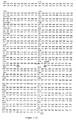
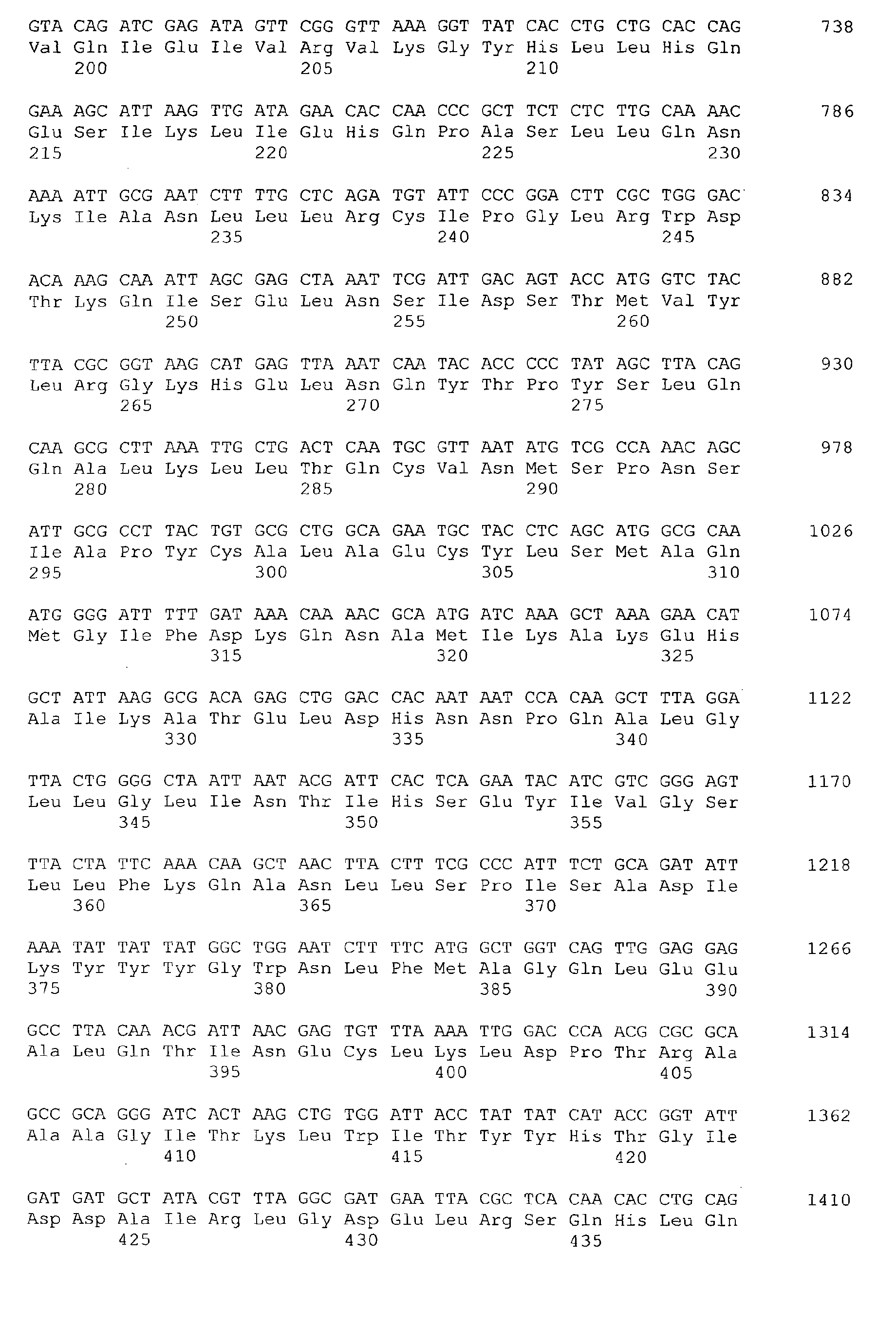
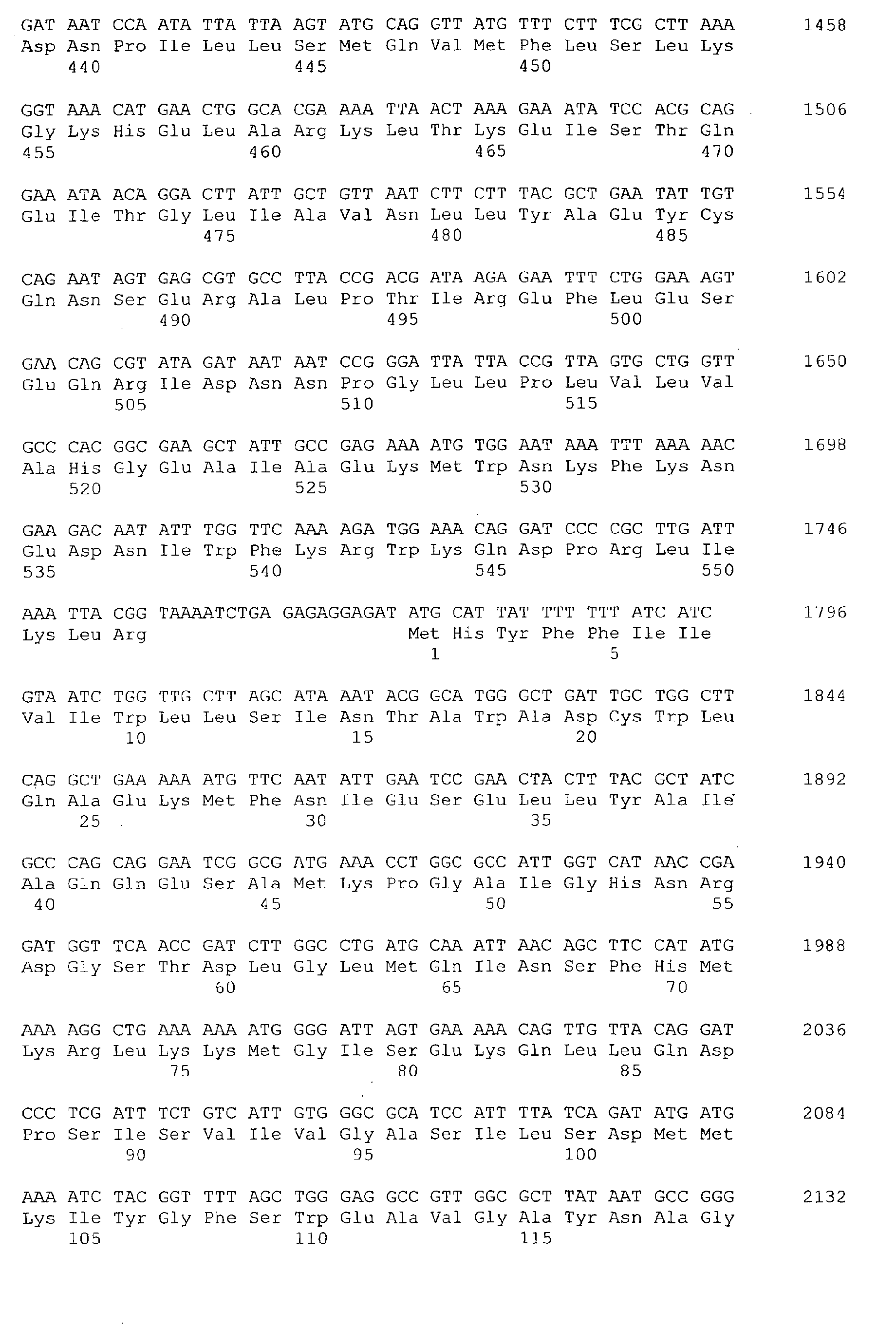
- the invention also relates to the nucleotide sequences involved in the cell invasion by Salmonella enterica subspecies enterica serosurface Typhi, characterized in that it is one of the iagA or iagB sequences respectively between the nucleotides 97 and 1755 of the sequence shown in Figure 1 (IagA) and between nucleotides 1776 and 2255 of the sequence shown in Figure 1 (IagB).
- the invention also aims at sequences of nucleotides modified with respect to iagA or iagB but nevertheless having the same properties as regards cell invasion, or hybridizing in stringent conditions with any of the above sequences.
- the present application also relates to IagA and IagB proteins responding to the sequences shown in Figure 1 or variants of these sequences obtained by mutation, deletion or addition of amino acids since the sequence thus obtained is recognized by antibodies directed against one of said IagA or IagB sequences.
- the subject of the invention is amino acid sequence encoded by the iagA genes and iagB shown in Figure 1.
- the invention furthermore relates to any fragment of one of these sequences, in particular any fragment in purified form, sufficient to preserve S. typhi its adhesion and infection properties of cells, and in particular HeLa cells in culture.
- the method of infection of HeLa cells in culture is the standard process that has been particularly described in the published international patent application under number WO 92/01056.
- the invention relates to means for the detection of the presence of S. enterica and / or S. bongori and, where appropriate, for the quantification of S. enterica and / or S. bongori in biological samples.
- Bio sample means any sample taken for in vitro analysis in animals or humans or taken from food products of any kind or from any liquid, solid or gas which may contain the desired pathogens.
- the object of the invention is, in this context, a nucleotide sequence, having at least 9 nucleotides, characterized in that it hybridises with one of the IagA or IagB sequences presented above.
- Hybridization conditions in question previously are defined according to the desired specificity of hybridization and appropriate conditions are given as an indication in the examples of this application.
- the invention relates to oligonucleotides from the C-terminal part of the iagA sequence shown in Figure 1.
- Oligonucleotide-like sequences may be selected for use as primers for either amplified detection, genomic DNA or Salmonella cDNA of S. enterica and / or S. bongori to the other groups I to VI or a part of these groups is under other conditions for the specific detection of S. enterica group I. It may be in particular nucleotide sequences obtained by chemical synthesis according to the known methods of the skilled person.
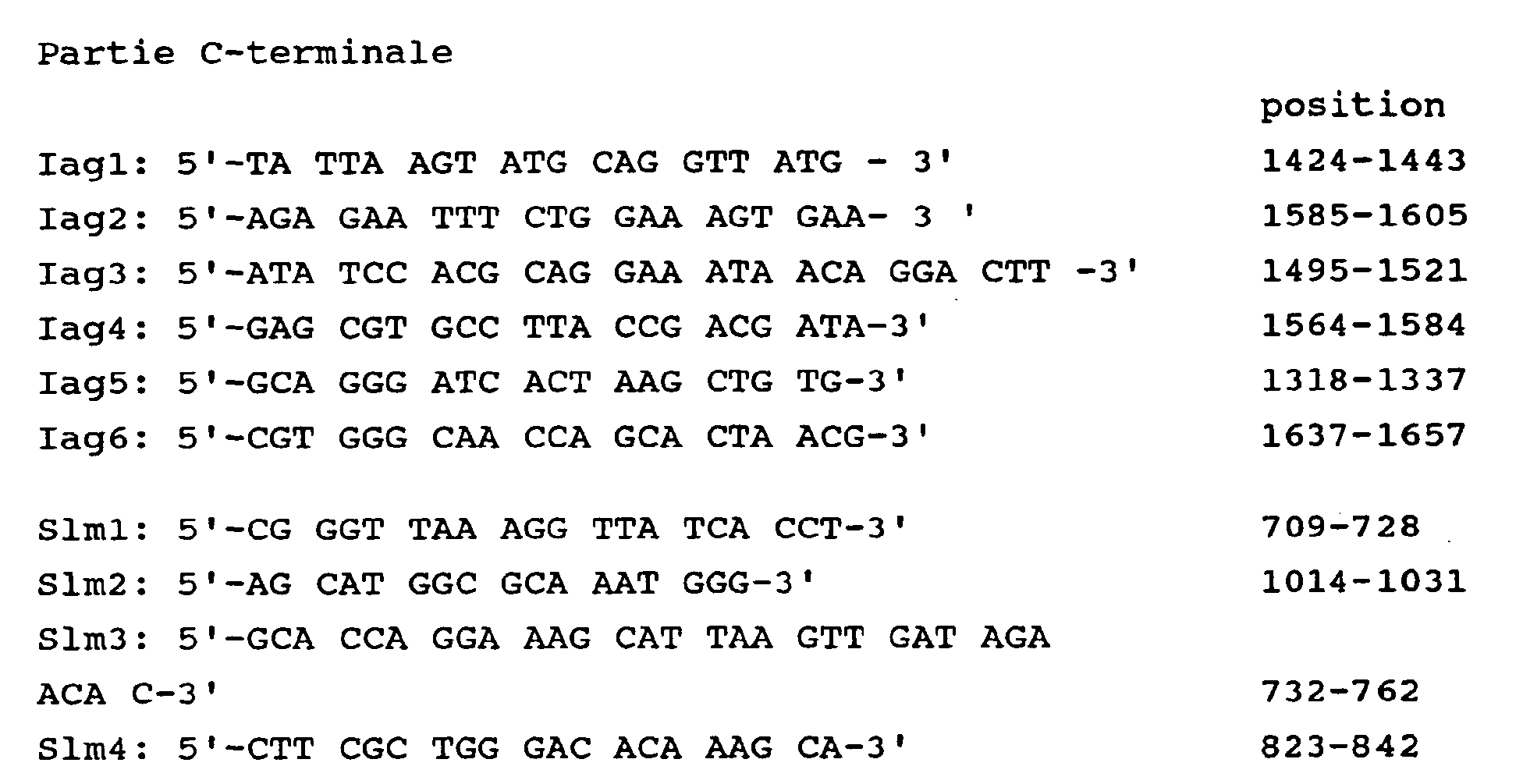
- Preferred oligonucleotides useful for the amplification of nucleic acid characteristic of bacteria belonging to one of the groups I, II, IIIa, IIIb, IV, V or VI of the genus Salmonella and in particular genomic DNA or the CDNA of S. enterica and / or S. bongori are for example the following (their position within the IagA sequence shown in Figure 1 being indicated):
- oligonucleotides susceptible to be used as primers for the amplification of the DNA or cDNA of the iagB gene of all Salmonella strains of S. enterica and / or S. bongori species have been defined from of the iagB sequence shown in FIG.
- the subject of the invention is therefore the oligonucleotides corresponding to the following sequences:
- oligonucleotides can also be used as probes, for example for the detection of the amplification products of the DNA and / or the cDNA of S. enterica and / or S. bongori .
- a preferred pair of primers for carrying out the amplification of the nucleic acid of S. enterica and / or S. bongori is for example formed primers Iag5 (sense) and Iag6 (antisense).
- This pair of primers directs the amplification of a nucleic acid fragment of 340 bp.
- Slm1 sense
- Slm2 antisense primers. These primers are capable of hybridizing with the DNA or ADsaveNc of S. enterica and / or S. bongori bacteria of one of groups I, II, III, IV, V or VI.
- the invention relates to oligonucleotides useful as primers for the specific detection of Salmonella enterica Group I when the detection conditions after the amplification of the DNA or cDNA are those described in example I.
- Such primers are characterized by their ability to amplify nucleic acid sequences of S. enterica or S. bongori strains representative of groups I, II, III, IV, V and VI, but for which the detection conditions are those exposed in Example I, allowing the sole detection of group I bacteria.
- a pair of oligonucleotides that can be used for these purposes, as specific primers for the detection of S. enterica group I DNA or cDNA sequences, consists, for example, of the following sequences:
- the oligonucleotides defined by the inventors make it possible to envisage the diagnosis of S. enterica and / or S. bongori under satisfactory conditions of sensitivity of speed, ease and specificity.
- the invention therefore particularly relates to the use of the abovementioned oligonucleotides as primers for the amplification of a DNA or cDNA sequence of Salmonella enterica and / or Salmonella bongori , included in one of the iagA or iagB sequences as described in the preceding or complementary pages of such a sequence, or the use of these oligonucleotides as a probe for the detection of an amplified nucleotide sequence.
- the oligonucleotides iag5 and iag6 can be used respectively as sense and antisense primers for the detection of S. enterica and / or S. bongori of group I, II, III, IV, V or VI.
- the pair of primers Slm1 and Slm2 can be used for the detection of bacteria of the species S. enterica and / or S. bongori of one of these groups in a biological sample.
- the invention also relates to the use of SS2 and SS28 oligonucleotides for the specific detection in vitro in a biological sample of S. enterica of group I.
- the detection is specific when the primers used for the amplification of the desired nucleotide sequences allow the amplification of S. enterica and / or S. bongori bacteria belonging to one of the other groups II, III, IV, V or VI. , but that the conditions used do not allow the detection of bacteria of these same groups or different organisms that may be present in the biological sample tested.
- oligonucleotides that can be used for the specific in vitro detection in a biological sample, of S. enterica of group I, is characterized in that it comprises the following oligonucleotides:
- the present application is also intended to iagA protein encoded by the iagA nucleotide sequence represented in FIG. 1 as well as an iagB protein encoded by the nucleotide sequence iagB shown at Figure 1.
- the iagA and iagB proteins have respectively the amino acid sequences shown in Figure 1.
- the capture probe used is the oligonucleotide Iag4 and the probe of revelation is the oligonucleotide Iag3.
- the means defined in the context of the invention allow qualitative or quantitative detection of the presence of S. enterica and / or S. bongori bacteria , whether it is a non-specific detection in the breast. one of the groups I, II, III, IV, V or VI of S. enterica and / or S. bongori .
- primers SS2, SS28 and SS40 probe allow the contrary specific detection of S. enterica group I bacteria.
- This DNA fragment was subcloned using a restriction fragment obtained by cutting with the HindIII enzymes, from the HindIII sequence of 7.9 kb described in the publication of Popoff and Dion, 1990, in derivatives of the vector m13 (Messing and Vieira, 1982).
- the method of dideoxy chain termination was implemented in using the modified T7 DNA polymerase (Sequenase, USB Corp.) and universal synthetic oligonucleotides as primers. All the ends of the fragments restrictions used overlapped each other. DNA sequencing was performed at least 2 times on each of the strands. The nucleotide sequence been analyzed using the Lipan program and Pearson, 1985.
- two open reading phases are contained in the sequenced fragment; they are designated by the terms iagA (abbreviation of invasion associate gene) and iagB.
- the two open reading phases are transcribed in the same orientation.
- the first ATG codon (bp 97) of the open reading phase of iagA, which is preceded by the 5'-AGAGA-3 'sequence, is assumed to correspond to the translation initiation site of the iagA gene.
- the iagA gene encodes a polypeptide comprising 553 amino acid residues with a calculated molecular weight of 63026 Da.
- the IpgF protein is encoded by the ipgF gene which is located on the plasmid associated with the virulence of Shigella flexneri , at the 5 'end of the mxi-spa locus (Allaoui et al, 1993).
- the proteins found in Salmonella enterica subspecies enterica serogro Typhi would therefore have a role in the infection by these bacteria, including adhesion and penetration into the cells.
- a protocol for detecting Salmonella subspecies by polymerase chain reaction (PCR) has been developed.
- a pair of oligonucleotides used as primer was defined to amplify a 93 bp fragment of a gene required for HeLa cell invasion by S. typhi strain Ty2.
- the amplification product was analyzed by non-radioactive hybridization sandwiched on microtiter plates using two different oligonucleotides according to the procedure described by Chevrier et al, 1993, Mol. Cell. Probes 7, 187-197.
- the capture oligonucleotide was phosphorylated at its 5 'end and covalently bound to wells bearing amino groups of a microtiter plate.
- the detection oligonucleotide was aminated at its 5 'end and then labeled with a biotinyl-N-hydroxy-succinimide ester. After hybridization, the hybrid molecules were detected by avidin conjugated with alkaline phosphatase and a chromogenic substrate. This method only requires the use of a thermal cycler and a conventional microtiter reader, and can be implemented on a large scale.
- the strains were grown on LB medium at 37 ° C.
- 2 ml of the culture maintained throughout the night have centrifuged and resuspended in 1 ml of TE (buffer 10 mM Tris-HCl pH8 containing 1 mM EDTA).
- TE buffer 10 mM Tris-HCl pH8 containing 1 mM EDTA
- Cells were centrifuged, the pellet was centrifuged resuspended in 500 ⁇ l of sterile distilled water and heated at 100 ° C for 10 minutes. Finally, the solution was centrifuged and the supernatant was preserved for PCR experiments.
- Oligonucleotides were synthesized in a cyclone DNA synthesizer (Millipore-Waters) using phosphoramidite technology.
- oligonucleotide primers were as follows: and The oligonucleotide capture probe, was phosphorylated at its 5 'end with T4 polynucleotide kinase (Boehringer) as described by Sambrook et al., 1989, (Molecular cloning, a laboratory manual, Cold Spring Harbor Laboratory Press, Cold Spring Harbor, NY).
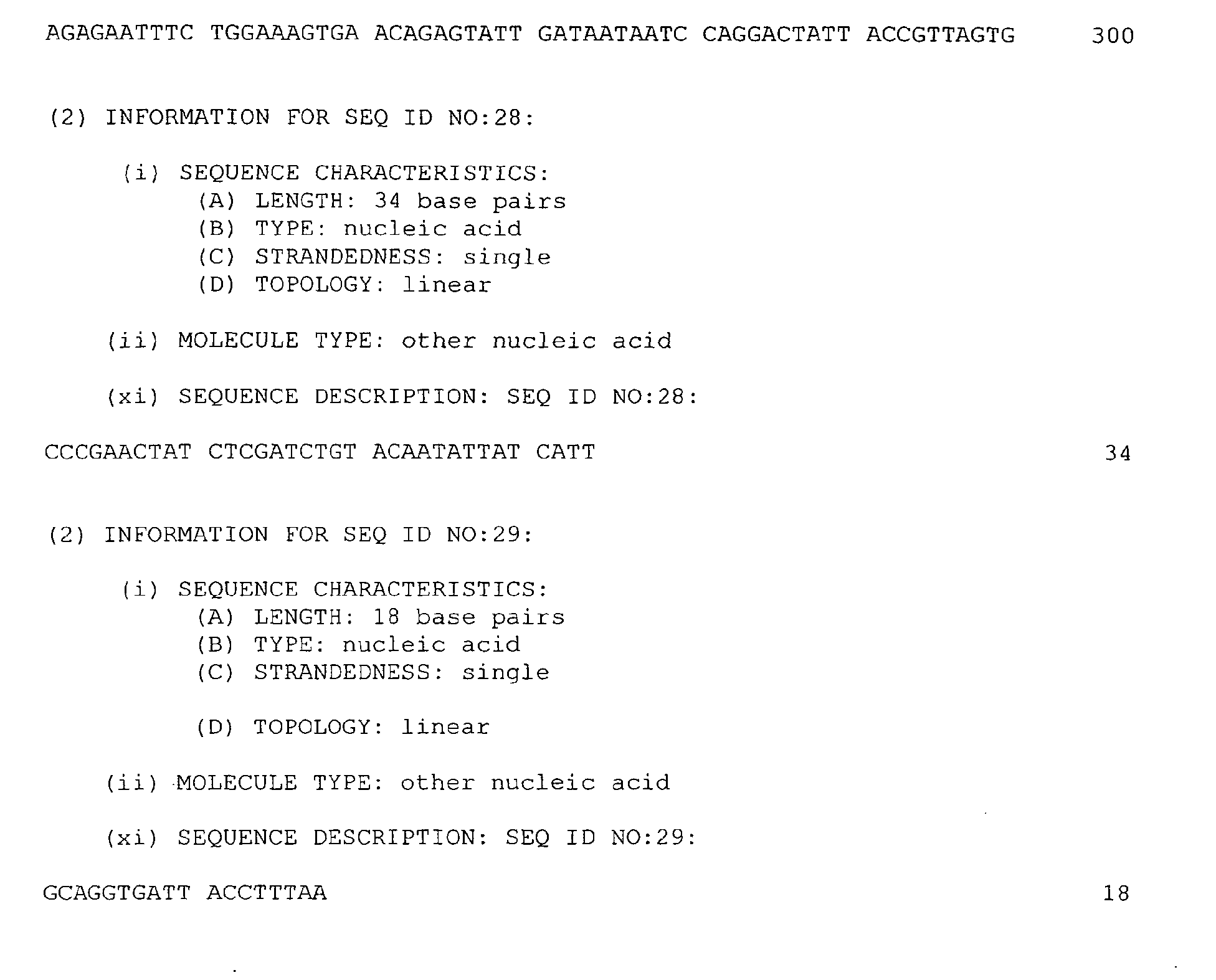
- the octadecanucleotide detection probe SS41 (5'-GCAGGTGATAACCTTTAA-3 ') was synthesized with an amino function at its 5' end using the solid phase phosphoramidite method in an Applied Biosystem 380B DNA synthesizer and then labeled with D -biotinyl- ⁇ -aminocaproic acid-N-hydroxysuccinimide ester (Boehringer) as described by Tham et al, 1990, (FEMS Microbiol Lett 69, 109-116). The capture and detection oligonucleotides were both purified on a HR 10/10 fast desalting column with the FPLC system (Pharmacia).
- the amplification reactions were carried out in a total volume of 100 ⁇ l in a 50 mM Tris-HCl buffer pH 8.5, containing 4 mM MgCl 2 , 100 ⁇ g / ml of bovine serum alumina, 1 ⁇ M of each primer, 200 ⁇ M of each dNTP and 1 U of Taq DNA polymerase (Amersham).
- the amplification mixture was overlaid with 100 ⁇ l of mineral oil and subjected to 10 cycles of amplification according to the following description: the samples were incubated at 94 ° C. for 10 sec to denature the DNA, at 60 ° C. for 10 seconds to match the primers to the DNA and at 72 ° C for 30 sec.
- PCR experiments were performed with 5 ⁇ l of DNA solution. Each experiment included negative controls (5 ⁇ l of TE buffer) for each group of 10 samples and at the end of each run.
- the DNA fragment subjected to the PCR reaction was denatured directly in the wells by sequentially adding 95 ⁇ l of distilled water, 5 ⁇ l of PCR sample, 40 ⁇ l of detection probe and 14 ⁇ l of 1 N NaOH. per well. After 10 minutes, the neutralization was carried out by adding 21 ⁇ l of NaH 2 PO 4 1 M containing 1% of sarkosyl. All samples were made in duplicate. After neutralization, the strip was deposited on a metal surface and held in an oven overnight at 40 ° C. The final concentration of the SS41 biotinylated detection probe was 0.5 nM.
- the band was incubated at ambient temperature for 1 h, washed 5 times with TBS-Tw and finally 200 ⁇ l of 1 M diethanolamine at pH 9.8 containing 1 mM of MgCl 2 and 1 mM of para-nitrophenyl phosphate. been added.
- the reaction of the enzyme was conducted for 30 minutes to 2 hours. Absorbance was measured at 405 nm using a microplate reader (Dynatech).
- the signal obtained with the standard solution of the amplified DNA fragment (800 fm / well) of S. ser. Typhimurium strain C53 was considered 100% representative and used as a reference for each hybridization assay. Blank values correspond to the average absorbance measured in wells coated with oligonucleotide SS40 incubated only with 0.5 nM biotinylated SS41 oligonucleotide probe.
- the primers and probes were selected in the iagA sequence. Different pairs of primers were tested to optimize the sandwich hybridization technique on CovaLink microplates. The chosen pair of primers (SS2 and SS28) allowed the specific amplification of the 93 bp region of genomic Salmonella DNA. Using this pair of primers, it was demonstrated that a standard concentration of MgCl 2 (1.5-2 mM) led to a relatively uninteresting amplification result and that a concentration of 4 mM in MgCl 2 was necessary to obtain efficient amplification. Internal oligonucleotides, SS40 and SS41, were used in a non-radioactive hybridization assay as capture probe and detection probe respectively.
- strain 3975-83 of the 56 strains of subspecies II and 3 strains of the 11 strains of subspecies IIIa gave a positive signal. Salmonella bongori and strains belonging to subspecies IIIb, IV and VI were not detectable.
- enterica subsp. bongori V Heterologous bacteria used in the DNA hybridization test
- PCR amplification allows very high detection sensitive to specific DNA sequences.
- the sensibility of amplification depends essentially on the number of copies of the target DNA, the purity of the sample to analyze, the method of DNA extraction, and the sensitivity of the method used to detect the PCR products.
- Visualization of PCR products by staining with ethidium bromide in a gel electrophoresis is not compatible with routine use of the technique and is not sufficiently sensitive.
- Sensitivity can be improved by the use of double PCR or DNA probes with dot blot hybridization or Southern blot.
- double PCR is very susceptible to contamination by DNA and Dot blot or Southern blot hybridization techniques are not appropriate for automation.
- Microplate hybridization therefore offers a technique appropriate for the detection and quantification of amplified fragments by PCR.
- Covalent attachment simple nucleic acids to microwells represents an interesting variant to adsorption passive and a significant improvement for the detection of amplified fragments by PCR on microwell.
- Salmonella strains causing infection in humans are known to be essentially subspecies I. In fact, more than 95% of human clinical isolates belong to this subspecies (Rowe, B., 1987, Salmonella Surveillance, World Health Organization London). Moreover, in 1991, the "National Center for Veterinary and Food Studies" in Paris (France) reported [Corbion, B. et al., 1991, Inventory of Salmonella] that in previous years, most of the strains isolated at animal in food or environment in 1988 and 1989 (ie 18832 strains) belongs to subspecies I (99.2%).
- the detection limit was below a threshold represented by 10 cells per PCR tube, which is consistent with the results obtained by other techniques similar PCRs. Given the kinship of the acids nuclei between the members of enterobacteria, it was important to control the specificity of these new primers and probes with genres enterobacteria most likely to lead to "false positive" reactions. Results obtained, it can be concluded that no false positive reaction can not take place when the conditions of the PCR and hybridization previously described are followed.
- Salmonella strain 3975-83 (subspecies II) showed a hybridization signal identical to that obtained with isolates belonging to subspecies I.
- This strain was isolated in 1983 from stool of a human patient in Germany. On the basis of the biochemical characteristics, this new serovariety was classified in subspecies II but was considered an atypical strain since its presence in gelatinase was not detected (Le Minor, L. et al, 1984, Supplement No. XXVII, 1983, to Kauffmann-White Scheme, Ann Microbiol (Institut Pasteur) 135 B, 45-51).
- the taxonomic position of strain 3975-83 should be re-examined using the DNA-DNA hybridization technique.
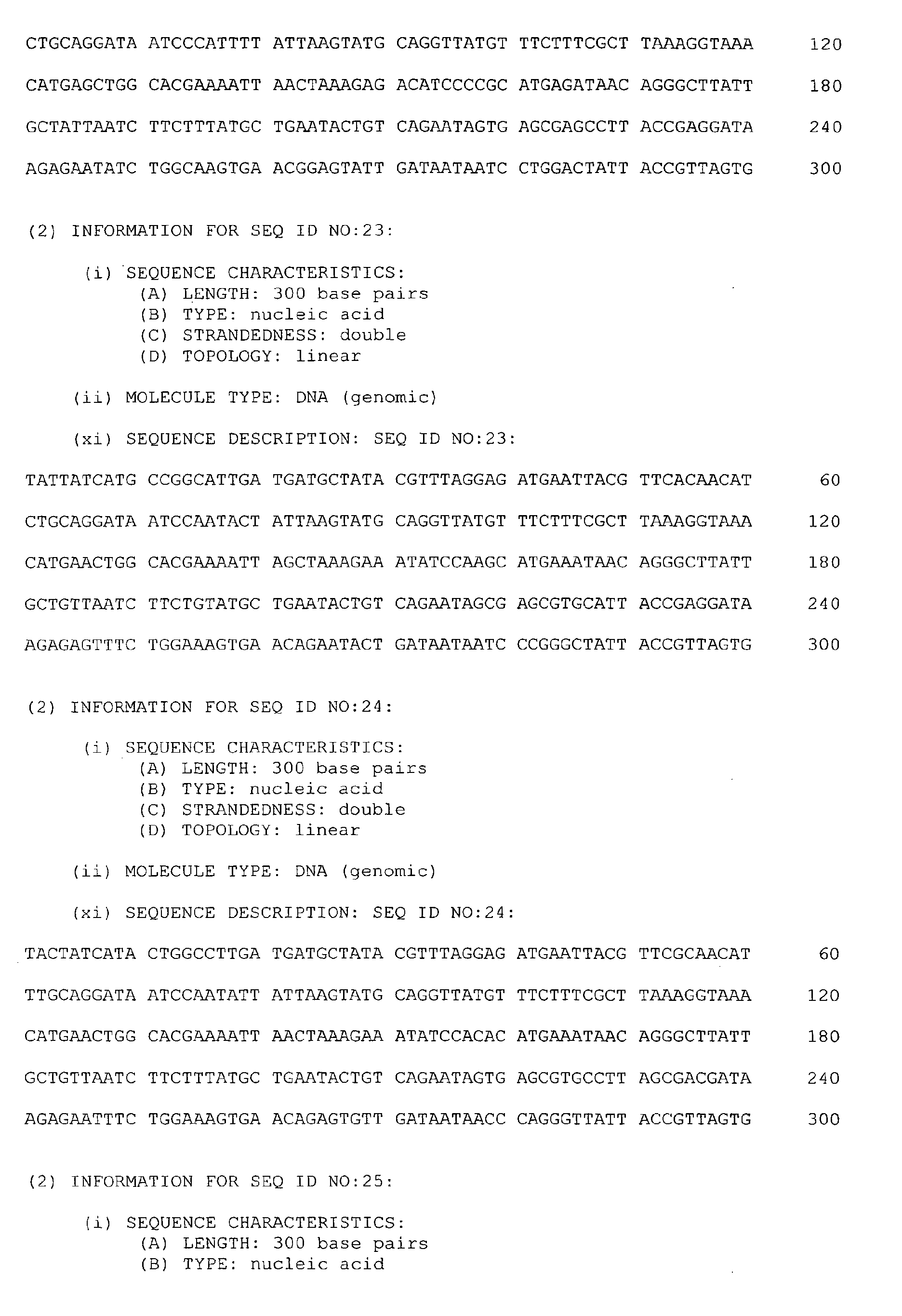
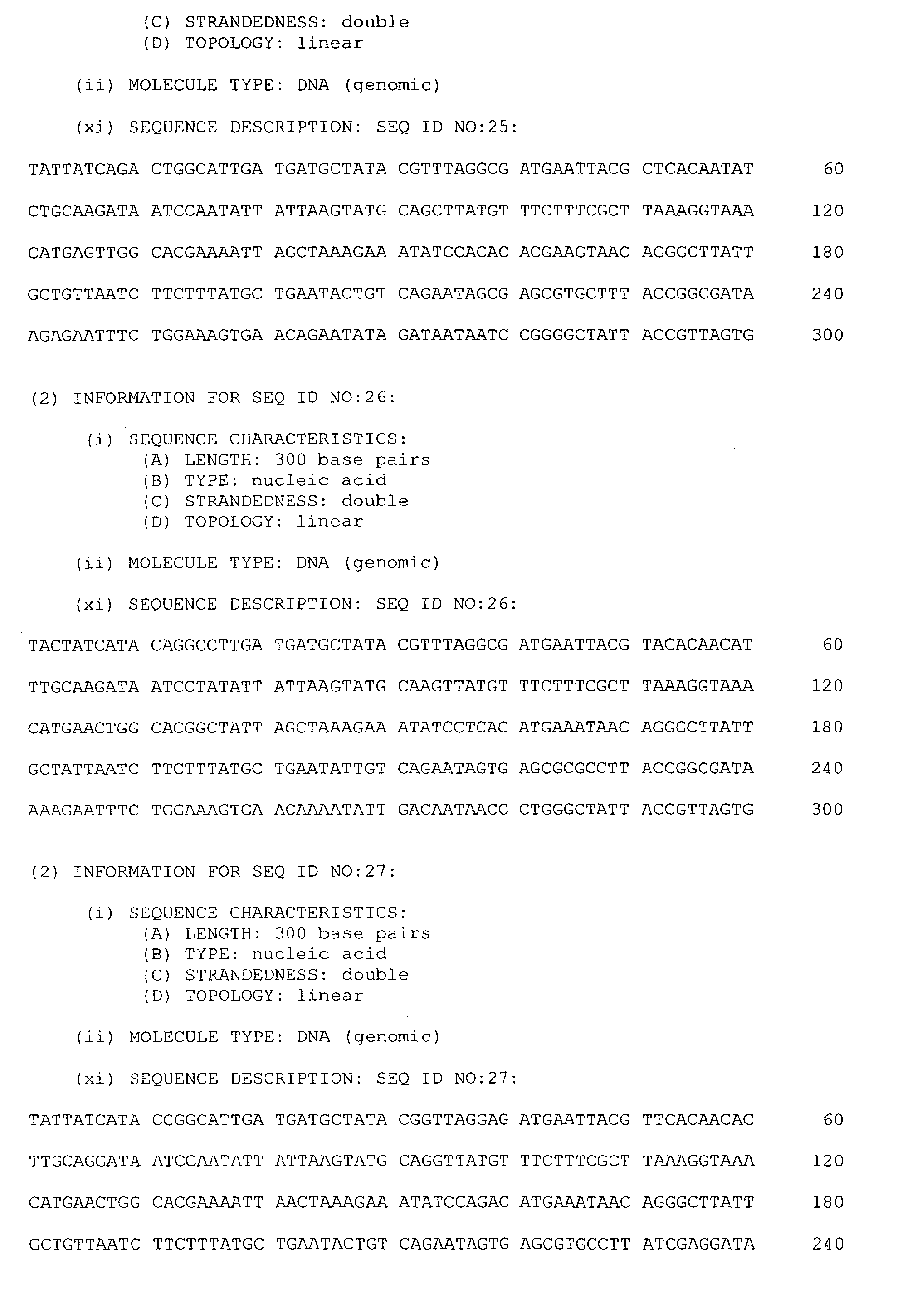
- the DNA fragments chosen are the following (see position in the sequence of FIG. 1):
- the pair of primers Iag5 (sense) and Iag6 (antisense) directs the amplification of a fragment of 340bp
- the couple Slm1 (sense) and Slm2 (antisense) directs the amplification of a fragment of 323bp ( Figure 3).
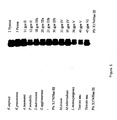
- Figure 4 shows the efficiency of the amplification of the pair of primers Iag5 and Iag6 on 2 representatives of each group of Salmonella.
- a sandwich hybridization detection format has been used.
- probe capture is passively fixed (but can also be covalently attached) to the surface of a well of 96 well microtiter plate.
- probe of revelation is marked by an easy to put element in evidence. The revealing probe is free in the hybridization buffer.
- the capture and revelation probes are two different regions located in inside the amplified fragment.
- the detection probe in the case described here is linked to an enzymatic marker, especially a peroxidase and will serve as a revelation probe. It's the case preferentially oligonucleotides Iag3 and Slm3. Other oligonucleotides may be attached to a solid support of microplate type, a support particulate or membrane and serve as a probe of capture, especially for oligonucleotides Iag4 and Slm4.
- the reaction mixture was carried out using 10 ⁇ l of the solution containing the DNA to be amplified in a volume of 100 ⁇ l .
- DUTP and UNG are used in decontamination system (Brevet Life Technologies European Patent Application 0 401 037).
- the thermocycler used is the Perkin Elmer 9600.
- the probes are labeled with the peroxidase of horseradish (ref PCR protocols: a guide to methods and application; Academic Press (1990), 15, p4513-4534) and the activity of the enzyme is revealed in colorimetry.
- Amersham Detection Reagent (reagent from detection ECL RPN 2105) is prepared extemporaneously volume to volume; 30 ml of total volume for one membrane 5 x 8 cm.
- a cassette for autoradiography is obtained by fixing a sheet of absorbent paper (Whatman paper 3MM) at the bottom. All these steps can to be in the light. Then in darkroom.
- the membrane is bathed in the detection reagent for 1 min, DNA side up, drip quickly the membrane, it is placed in the cassette, DNA side up, we put on a sheet in transparent plastic (otherwise the membrane sticks on the film) and we put an X-ray film over (X-OMAT KODAK movie).
- the exposure is carried out for 30 minutes at room temperature then the film is developed by the classical revelation techniques (developer, water, scavenger).
- 10 ⁇ l of the amplification product were denatured by volume-to-volume addition of a 200mM NaOH solution, 40mM EDTA.
- microplate was emptied and each of the cups received 200 ⁇ l of hybridization buffer containing the denatured amplified fragment and the revealing probe at the concentration of 10ng / ⁇ l. Incubation took place for one hour at 37 ° C with stirring.
- washing washing solution 10X: 100mM Tris, 3M NaCl, 1% Tween 20, pH 7.4.
- the optical density was determined at a wavelength of 492nm (reference at 620nm).
- Iag4 can just as easily be labeled and used as a revealing probe).
- the oligonucleotides selected for carrying out this example were located on the IagA gene sequence (FIG. 7).
- STUDY SALMONELLA STRAINS No. strains serotype Group 1 Salmonella Marseille I 2 Salmonella Nyanza I 3 Salmonella Poona I 4 Salmonella Kampala I 5 Salmonella Taksony I 6 Salmonella Teshie I 7 Salmonella Indiana I 8 Salmonella enteritidis I 9 Salmonella Kentucky 1 10 Salmonella Napoli I 11 841 1 1: a: d: in 215 II 12 1703 K 41: 2: 15 II 13 950 - 71 43: d: z 39 II 14 10-65 44: 24, 223 II 15 3209-81 45: z 23 II 16 5331/86 62: z 29: - IIIa 17 3064-4 / 252 41: k: - IIIa 18 594-54 38: z 54: - IIIa 19 1694 cdai 426 63: z 4, z32: - IIIa 20 S0 50
Landscapes
- Chemical & Material Sciences (AREA)
- Life Sciences & Earth Sciences (AREA)
- Analytical Chemistry (AREA)
- Proteomics, Peptides & Aminoacids (AREA)
- Organic Chemistry (AREA)
- Health & Medical Sciences (AREA)
- Wood Science & Technology (AREA)
- Engineering & Computer Science (AREA)
- Zoology (AREA)
- Microbiology (AREA)
- Bioinformatics & Cheminformatics (AREA)
- Molecular Biology (AREA)
- Physics & Mathematics (AREA)
- Immunology (AREA)
- Biotechnology (AREA)
- Biochemistry (AREA)
- Biophysics (AREA)
- General Engineering & Computer Science (AREA)
- General Health & Medical Sciences (AREA)
- Genetics & Genomics (AREA)
- Measuring Or Testing Involving Enzymes Or Micro-Organisms (AREA)
- Saccharide Compounds (AREA)
- Peptides Or Proteins (AREA)
- Medicines Containing Material From Animals Or Micro-Organisms (AREA)
- Micro-Organisms Or Cultivation Processes Thereof (AREA)
Abstract
Description


- des oligonucléotides tels que décrits précédemment, capables d'hybrider dans des conditions stringentes avec l'ADN génomique ou l'ADNc de S. enterica et/ou de S. bongori,
- une sonde pour la détection des fragments amplifiés répondant à l'une des définitions données dans les pages précédentes,
- les réactifs nécessaires à la réalisation de la réaction d'amplification.
- un couple d'oligonucléotides répondant aux définitions précédemment données, capables d'hybrider dans des conditions stringentes avec l'ADN génomique ou l'ADNc de S. enterica et/ou de S. bongori,
- une sonde répondant aux caractéristiques données ci-dessus.
- la séquence Iag5 (5'-GCA GGG ATC ACT AAG CTG TG-3' et la séquence Iag6 (5'-CGT GGG CAA CCA GCA CTA ACG-3') utilisables en tant qu'amorces pour l'amplification et
- la séquence Iag3 (5'-ATA TCC ACG CAG GAA ATA ACA GGA CTT -3') utilisable comme sonde de révélation et la séquence Iag4 (5'-GAG CGT GCC TTA CCG ACG ATA-3') utilisable comme sonde de capture.


- dénaturation de la séquence de S. enterica et/ou de S. bongori amplifiée,
- mise en contact des séquences de nucléotides amplifiées dénaturées de S. enterica et/ou de S. bongori, avec une sonde de capture et une sonde de révélation obtenues à partir des oligonucléotides ci-dessus définis dans des conditions permettant l'hybridation desdites sondes de capture et de révélation avec la susdite séquence de nucléotides amplifiée de S. enterica et/ou de S. bongori, la sonde de capture étant fixée à la surface d'un puits d'une plaque de microtitration et la sonde de révélation étant marquée et libre dans un tampon d'hybridation approprié ;
- incubation du mélange réactionnel, pendant un temps suffisant pour permettre la réaction d'hybridation ;
- lavage pour éliminer les oligonucléotides n'ayant pas réagi ;
- révélation des sondes de révélation ayant hybridé aux séquences de nucléotides amplifiées.
- dénaturation d'un volume 10 µl de la séquence amplifiée par addition volume à volume d'une solution 200 mM NaOH, 40mM EDTA,
- préhybridation des microplaques dont la surface des puits est revêtue de la sonde de capture, dans un tampon d'hybridation approprié,
- libération de la microplaque et remplissage de chacune des cupules avec 200µl de tampon d'hybridation renfermant le fragment amplifié dénaturé et la sonde de révélation marquée à la peroxydase à la concentration de 10ng/µl,
- incubation du mélange pendant une heure à 37°C sous agitation,
- lavage du mélange ayant réagi avec une solution de lavage 10X (100mM Tris, 3M NaCl, 1% Tween 20, pH 7,4),
- détection de l'activité de la peroxydase liée à la sonde par colorimétrie en présence d'un substrat coloré.
- dépôt de 200µl d'une solution 40mM citrate trisodique, 0,03% H2O 30%, 7,5mg/ml d'orthophenylenediamine (OPD) dans chacun des puits contenant le mélange de réaction,
- incubation de la microplaque pendant 30min à l'obscurité et à 37°C,
- bloquage de la réaction par addition de 50µl/puits d'une solution 4N H2SO4,
- détermination de la densité optique à une longueur d'onde de 492nm (référence à 620nm).
Les sites potentiels de liaison au ribosome sont soulignés.
Sérovariétés des différents isolats de Salmonella testés :



| Sous-espèces de Salmonella utilisées pour évaluer la spécificité des essais d'hybridation de l'ADN. | |||
| Microorganisme testé | N° des isolats | N° des serovars | |
| Salmonella enterica subsp enterica I | 116 | 43 | |
| serovar | Adelaïde | 1 | |
| Agona | 2 | ||
| Altona | 1 | ||
| Angoda | 1 | ||
| Bardo | 2 | ||
| Blockley | 1 | ||
| Bovismorbificans | 3 | ||
| Braenderup | 4 | ||
| Brandenburg | 1 | ||
| Bredeney | 1 | ||
| Broughton | 2 | ||
| Cerro | 1 | ||
| Chester | 1 | ||
| Coeln | 1 | ||
| Concord | 1 | ||
| Dakar | 1 | ||
| Derby | 2 | ||
| Enteridis | 28 | ||
| Georgia | 1 | ||
| Hadar | 1 | ||
| Heidelberg | 4 | ||
| Ibadan | 2 | ||
| Indiana | 1 | ||
| Infantis | 5 | ||
| Lexington | 1 | ||
| London | 1 | ||
| Mbandaka | 1 | ||
| Montevideo | 6 | ||
| Moscow | 1 | ||
| Ohio | 1 | ||
| Orion | 1 | ||
| Panama | 3 | ||
| Paratyphi B | 2 | ||
| Saintpaul | 1 | ||
| Typhimurium | 13 | ||
| Typhisuis | 1 | ||
| Vaertan | 1 | ||
| Veneziana | 1 | ||
| Vinohrady | 1 | ||
| Virchow | 10 | ||
| Wien | 1 | ||
| Woodinville | 1 | ||
| Yolo | 1 | ||
| Salmonella enterica subsp salamae II | 56 | 56 | |
| Salmonella enterica subsp arizonae IIIa | 11 | 29 | |
| Salmonella enterica subsp diarizonae IIIb | 30 | 5 | |
| Salmonella enterica subsp houtenae IV | 5 | 5 | |
| Salmonella enterica subsp indica VI | 5 | 5 | |
| Salmonella bongori | 5 | 5 | |
| (initialement S. enterica subsp. bongori V) |
| Bactéries hétérologues utilisées dans le test d'hybridation de l'ADN | ||
| Genre | Espèces | Nombre d'isolats |
| Escherichia | coli | 4 |
| Edwarsiella | tarda | 1 |
| Citrobacter | amalonaticus | 1 |
| freundii | 1 | |
| Klebsiella | pneumoniae | 1 |
| Enterobacter | agglomerans | 1 |
| asburiae | 1 | |
| hormoechei | 1 | |
| Pasteurella | multocida | 1 |
| Acinetobacter | lwoffii | 1 |
| haemolyticus | 1 | |
| Vibrio | harveyi | 1 |
| Serratia | marcescens | 1 |

- 5 cycles (95°C 15 sec, 50°C 15 sec, 72°C 15 sec)
- 35 cycles (95°C 15 sec, 57°C 15 sec, 72°C 15 sec)
- 2 fois 10 min en 2 X SSC -0,1%SDS à température ambiante,
- 1 fois 30 min en 0,1 X SSC - 0,1% SDS à 42°C,
- 2 fois 10 min en 2 X SSC à température ambiante.
| SOUCHES DE SALMONELLES ETUDIEES | |||
| N° | Souches | Sérotype | Groupe |
| 1 | Salmonella Marseille | I | |
| 2 | Salmonella Nyanza | I | |
| 3 | Salmonella Poona | I | |
| 4 | Salmonella Kampala | I | |
| 5 | Salmonella Taksony | I | |
| 6 | Salmonella Teshie | I | |
| 7 | Salmonella Indiana | I | |
| 8 | Salmonella enteritidis | I | |
| 9 | Salmonella Kentucky | 1 | |
| 10 | Salmonella Napoli | I | |
| 11 | 841 1 1:a:d:en 215 | II | |
| 12 | 1703 K 41: 2: 15 | II | |
| 13 | 950 - 71 43 : d : z 39 | II | |
| 14 | 10-65 44 : 24, 223 | II | |
| 15 | 3209-81 45: z 23 | II | |
| 16 | 5331 / 86 62: z 29 : - | IIIa | |
| 17 | 3064-4 / 252 41: k : - | IIIa | |
| 18 | 594-54 38: z 54: - | IIIa | |
| 19 | 1694 cdai 426 63: z 4, z32: - | IIIa | |
| 20 | So 50/16 62:f, z 51:- | IIIa | |
| 21 | 5251-85 58: r : z 53 | IIIb | |
| 22 | 1758-76 6,14 : z 10 enx 215 | IIIb | |
| 23 | 453-68 16 liv : z53 | IIIb | |
| 24 | 4305-57 16 li(v) : z 35 | IIIb | |
| 25 | 1698-75 11 liv : z | IIIb | |
| 26 | 8275-94 47 : r : enx 215 | IIIb | |
| 27 | 8283-94 53 : z 10 : z | IIIb | |
| 28 | cdc 456-5 / 93 40 : i : 1, 5, 7 | IIIb | |
| 29 | 8284-94 60: i : z | IIIb | |
| 30 | 1693 K 38 : k : z 55 | IIIb | |
| 31 | 1707 48 : f : z 51 : - | IV | |
| 32 | 7231 / 89 45 : z 36, z 38 | IV | |
| 33 | 6887 / 60 48 : f, z 51 : - | IV | |
| 34 | 1357 /73 43 : z4, z 24 : - | IV | |
| 35 | 1550 K 16 : z 4, z 23 : - | IV | |
| 36 | Salmonella Bongor | 261 -66 48 : z35 : - | V |
| 37 | Salmonella Camdeni | 2022 - 77 44 : r : - | V |
| 38 | 4985 - 85 48 : z 39 : - | V | |
| 39 | 7688 - 9166 z 39 : - | V | |
| 40 | 1387 - 7340 : a : - | V | |
| 41 | 1941 - 77 6.7 : z 41: 1,7 | VI | |
| 42 | 1449 K45 : a enx | VI | |
| 43 | 4355 - 84 1.6.14.25 : a :e,n,x | VI | |
| 44 | 1711 K 11 : b : enx | VI | |
| 45 | 1688 K 1,6.14,25 : Z 10 : 1,12,7 | VI |
| SOUCHES NON SALMONELLES | ||
| N° | Nom | Identification |
| 1 | Klebsiella oxytoca | 0059 SDP |
| 2 | Klebsiella pneumoniae | 0054 SDP |
| 3 | Acinetobacter baumanii | 0033 SDP |
| 4 | Proteus mirabilis | RP402 |
| 5 | Serratia marcescens | 0042 SDP |
| 6 | Enterobacter agglomerans | 0067 SDP |
| 7 | Citrobacter diversus | 0068 SDP |
| 8 | Pseudomonas aeruginosa | 0011 SDP |
| 9 | Enterobacter aerogenes | 0066 SDP |
| 10 | Escherichia coli | 0131 SDP |
| 11 | Enterocoque faecalis | 76117 |
| 12 | Proteus mirabilis | AP03 |
| 13 | Enterocoque faecalis | 76117 |
| 14 | Enterobacter cloacae | 0060 SDP |
| 15 | Mycobacterium avium | 6 |
| 16 | Mycobacterium tuberculosis | H 37 RV |
| 17 | Listeria monocytogenes | 1/2 LG3 |
| DETECTION SUR MICROPLAQUE | |
| ECHANTILLONS | DO à 420 nm |
| 2 Nyanza gpe I | 3.029 |
| 3 Poona gpe I | 3.103 |
| 11 gpe II | 3.155 |
| 12 gpe II | 0.751 |
| 18 gpe III a | 3.139 |
| 20 gpe III a | 3.068 |
| 21 gpe III b | 3.161 |
| 30 gpe III b | 3.201 |
| 31 gpe IV | 0.272 |
| 35 gpe IV | 0.527 |
| 36 gpe V | 1.868 |
| 40 gpe V | 3.347 |
| 45 gpe VI | 0.900 |
| Klebsiella oxytoca | 0.022 |
| Klebsiella pneumoniae | 0.017 |
| Acinetobacter baumanii | 0.024 |
| Proteus mirabilis | 0.019 |
| Serratia marcescens | 0.019 |
| Enterobacter agglomerans | 0.023 |
| Mycobacterium avium n ° 6 | 0.025 |
| Mycobacterium tuberculosis H 37 RV | 0.020 |
| Listeria monocytogenes 1/2 LG3 | 0.015 |
| Témoin eau | 0.018 |
| Témoin eau | 0.022 |




Claims (15)
- Séquence de nucléotides participant à l'invasion de cellules HeLa en culture par des bactéries de l'espèce Salmonella enterica sous-espèce enterica sérovariété Typhi (dénommée S. Typhi), caractérisée en ce qu'il s'agit d'une séquence de nucléotides modifiée par rapport à la séquence lagA comprise entre les nucléotides 97 et 1755 de la séquence représentée à la figure 1 ou par rapport à la séquence lagB comprise entre les nucléotides 1776 et 2255 de la séquence représentée à la figure 1, laquelle séquence modifiée ayant la propriété de s'hybrider en conditions stringentes avec l'une de ces séquences.
- Oligonucléotide issu de la séquence lagA comprise entre les nucléotides 97 et 1755 de la séquence représentée à la figure 1, ou de la séquence lagB comprise entre les nucléotides 1776 et 2255 de la séquence représentée à la figure 1, caractérisé en ce qu'il consiste en l'une des séquences suivantes :

- Couple d'oligonucléotides selon la revendication 2, caractérisé en ce qu'il s'agit du couple suivant :et


- Oligonucléotide capable de s'hybrider avec Salmonella enterica et/ou Salmonella bongori, caractérisé en ce qu'il consiste en l'un des oligonucléotides suivants et en ce qu'il est marqué :ou
 ou
ou ou
ou

- Oligonucléotide selon la revendication 4 (ou sonde), caractérisé en ce que la sonde Slm3 est une sonde de révélation de la présence d'une séquence de nucléotides amplifiée et en ce que la sonde Slm4 est une sonde de capture d'une séquence de nucléotides amplifiée.
- Oligonucléotide selon la revendication 4 (ou sonde), caractérisé en ce que la sonde SS41 est une sonde de révélation de la présence d'une séquence de nucléotides amplifiée et en ce que la sonde SS40 est une sonde de capture d'une séquence de nucléotides amplifiée.
- Utilisation des oligonucléotides selon la revendication 2, comme amorces pour l'amplification d'une séquence d'ADN ou d'ADNc de Salmonella enterica et/ou de Salmonella bongori comprise dans une séquence de nucléotides selon la revendication 1, ou dans la séquence lagA, ou dans la séquence lagB, ou dans une séquence complémentaire d'une telle séquence, ou comme sonde pour la détection d'une séquence de nucléotides amplifiée.
- Utilisation du couple d'oligonucléotides selon la revendication 3, comme amorces pour l'amplification de séquences de nucléotides d'une bactérie de l'espèce S. enterica et/ou S. bongori, groupe I, II, III, IV, V ou VI.
- Ensemble d'oligonucléotides utilisables pour la détection de bactéries S. enterica et/ou S. bongori après amplification de l'ADN génomique ou complémentaire de S. enterica et/ou de S. bongori, caractérisé en ce qu'il comprend :un couple d'oligonucléotides selon la revendication 3, capables d'hybrider dans des conditions stringentes avec l'ADN génomique ou l'ADNc de S. enterica et/ou de S. bongori,une sonde selon la revendication 5 ou la revendication 6.
- Protéine présentant les propriétés suivantes :sa séquence correspond à l'enchaínement d'acides aminés compris entre les acides aminés 554 et 713 de la séquence de la Figure 1, ousa séquence est une variante par mutation, addition, ou délétion d'acides aminés, de la séquence de la protéine iagA, correspondant aux acides aminés 1 à 553 de la séquence de la figure 1, ou de la séquence de la protéine iagB, correspondant aux acides aminés 554 à 713 de la séquence représentée à la figure 1.
- Polypeptide présentant les propriétés suivantes :il s'agit d'un fragment de la protéine iagA, correspondant aux acides aminés 1 à 553 de la séquence de la figure 1, ou de la protéine iagB, correspondant aux acides aminés 554 à 713 de la séquence représentée à la figure 1,ce fragment est suffisant pour conserver à S. typhi ses propriétés d'adhésion et d'infection des cellules HeLa en culture.
- Procédé pour la détection in vitro, dans un échantillon biologique, de séquences de nucléotides Salmonella enterica, préalablement amplifiées, par exemple par PCR, caractérisé en ce qu'il comprend les étapes de :dénaturation de la séquence de S. enterica amplifiée,mise en contact des séquences de nucléotides amplifiées dénaturées de S. enterica, avec une sonde de capture et une sonde de révélation obtenues a partir des oligonucléotides selon l'une quelconque des revendications 2 et 4 à 6 dans des conditions permettant l'hybridation desdites sondes de capture et de révélation avec la susdite séquence de nucléotides amplifiée de S. enterica, la sonde de capture étant fixée à la surface d'un puits d'une plaque de microtitration et la sonde de révélation étant marquée et libre dans le tampon d'hybridationincubation du mélange réactionnel, pendant un temps suffisant pour permettre la réaction d'hybridationlavage pour éliminer les oligonucléotides n'ayant pas réagi ;révélation des sondes de révélation ayant hybridé aux séquences de nucléotides amplifiées.
- Kit pour la détection de la présence de Salmonella enterica et/ou de Salmonella bongori dans des échantillons biologiques, comprenant :des oligonucléotides selon l'une quelconque des revendications 2 et 3une sonde pour la détection des fragments amplifiés, selon l'une quelconque des revendications 2 et 4 à 6, etles réactifs nécessaires à la réalisation de la réaction d'amplification.
- Kit selon la revendication 13, caractérisé en ce qu'il permet la détection spécifique des souches du groupe I de S. enterica.
- Produit de l'amplification d'un acide nucléique de Salmonella par le couple d'amorces suivant :


Applications Claiming Priority (3)
| Application Number | Priority Date | Filing Date | Title |
|---|---|---|---|
| FR9500410A FR2729392B1 (fr) | 1995-01-16 | 1995-01-16 | Oligonucleotides pour la detection de salmonella |
| FR9500410 | 1995-01-16 | ||
| EP96400098A EP0721989B1 (fr) | 1995-01-16 | 1996-01-15 | Oligonucléotides pour la détection de salmonella |
Related Parent Applications (2)
| Application Number | Title | Priority Date | Filing Date |
|---|---|---|---|
| EP96400098A Division EP0721989B1 (fr) | 1995-01-16 | 1996-01-15 | Oligonucléotides pour la détection de salmonella |
| EP96400098.8 Division | 1996-01-15 |
Related Child Applications (1)
| Application Number | Title | Priority Date | Filing Date |
|---|---|---|---|
| EP08166396.5 Division-Into | 2008-10-10 |
Publications (2)
| Publication Number | Publication Date |
|---|---|
| EP1538222A1 true EP1538222A1 (fr) | 2005-06-08 |
| EP1538222B1 EP1538222B1 (fr) | 2011-02-02 |
Family
ID=9475150
Family Applications (2)
| Application Number | Title | Priority Date | Filing Date |
|---|---|---|---|
| EP04078201A Expired - Lifetime EP1538222B1 (fr) | 1995-01-16 | 1996-01-15 | Oligonucléotides pour la détection de salmonella |
| EP96400098A Expired - Lifetime EP0721989B1 (fr) | 1995-01-16 | 1996-01-15 | Oligonucléotides pour la détection de salmonella |
Family Applications After (1)
| Application Number | Title | Priority Date | Filing Date |
|---|---|---|---|
| EP96400098A Expired - Lifetime EP0721989B1 (fr) | 1995-01-16 | 1996-01-15 | Oligonucléotides pour la détection de salmonella |
Country Status (11)
| Country | Link |
|---|---|
| US (2) | US5824795A (fr) |
| EP (2) | EP1538222B1 (fr) |
| JP (2) | JP4615635B2 (fr) |
| CN (1) | CN1185346C (fr) |
| AT (2) | ATE497545T1 (fr) |
| CA (1) | CA2167354C (fr) |
| DE (2) | DE69634790T2 (fr) |
| DK (2) | DK1538222T3 (fr) |
| ES (2) | ES2243948T3 (fr) |
| FR (1) | FR2729392B1 (fr) |
| PT (2) | PT1538222E (fr) |
Cited By (2)
| Publication number | Priority date | Publication date | Assignee | Title |
|---|---|---|---|---|
| WO2007085675A1 (fr) * | 2006-01-27 | 2007-08-02 | Universidad Del Pais Vasco | Détection et typage de salmonella dans des prélèvements alimentaires par pcr multiple |
| WO2009147435A1 (fr) | 2008-06-03 | 2009-12-10 | Health Protection Agency | Essai de détection de salmonella |
Families Citing this family (13)
| Publication number | Priority date | Publication date | Assignee | Title |
|---|---|---|---|---|
| FR2729392B1 (fr) * | 1995-01-16 | 1997-03-28 | Pasteur Institut | Oligonucleotides pour la detection de salmonella |
| DE19734940A1 (de) * | 1997-08-12 | 1999-02-18 | Biotecon Ges Fuer Biotechnologische Entwicklung & Consulting Mbh | Nucleinsäuremolekül-Satz für Salmonella-Nachweis, Nucleinsäuren, Kit und Verwendung |
| EP1409738A4 (fr) * | 2001-06-22 | 2005-03-30 | Marshfield Clinic | Procedes et oligonucleotides pour la detection de salmonella sp., e. coli o157:h7, et de listeria monocytogenes |
| JP2003289869A (ja) * | 2002-04-02 | 2003-10-14 | Tosoh Corp | 非定型抗酸菌Mycobacteriumavium検出のためのオリゴヌクレオチドおよび検出法 |
| US20060246463A1 (en) * | 2005-04-20 | 2006-11-02 | Vevea Dirk N | Methods and oligonucleotides for the detection of Salmonella SP., E coli 0157:H7, and Listeria monocytogenes |
| US20060240442A1 (en) * | 2005-04-20 | 2006-10-26 | Vevea Dirk N | Methods and oligonucleotides for the detection of Salmonella SP., E coli 0157:H7, and Listeria monocytogenes |
| EP1895014A1 (fr) * | 2006-09-01 | 2008-03-05 | Bio-Rad Pasteur | Détection de Salmonella par PCR multiplex en temps réel |
| DE602006008150D1 (de) * | 2006-10-12 | 2009-09-10 | Bio Rad Pasteur | Doppelsträngige Sonden zur Fluoreszenzdetektion von Nukleinsäuren |
| WO2008121154A2 (fr) * | 2007-03-31 | 2008-10-09 | Rutgers, The State University Of New Jersey | Séquences d'acides nucléiques pour la biosynthèse de peptides lariats non apparentés à mccj25 |
| MX2010010600A (es) | 2008-03-28 | 2011-03-30 | Pacific Biosciences California Inc | Composiciones y metodos para secuenciacion de acidos nucleicos. |
| WO2009120374A2 (fr) | 2008-03-28 | 2009-10-01 | Pacific Biosciences Of California, Inc. | Procédés et compositions pour la préparation d’échantillon d’acide nucléique |
| US10287638B2 (en) | 2014-03-26 | 2019-05-14 | Texas Tech University System | Molecular discrimination of regulated and non-regulated Salmonella serotypes |
| CN106397605B (zh) * | 2016-08-31 | 2019-05-21 | 深圳市欣扬生物科技有限公司 | 一种融合蛋白质及其在检测沙门氏菌中的应用 |
Citations (4)
| Publication number | Priority date | Publication date | Assignee | Title |
|---|---|---|---|---|
| WO1992001056A1 (fr) * | 1990-07-11 | 1992-01-23 | Institut Pasteur | Sequences nucleiques issues du genome de salmonella typhi, et leurs utilisations notamment pour le diagnostic in vitro de la presence de bacteries du genre salmonella dans les produits alimentaires |
| WO1993004202A1 (fr) * | 1991-08-22 | 1993-03-04 | Washington University | Sondes de polynucleotide de detection de salmonelle |
| WO1993018165A1 (fr) * | 1992-03-02 | 1993-09-16 | The Board Of Trustees Of The Leland Stanford Junior University | Microorganismes presentant un caractere envahissant attenue |
| WO1995000664A1 (fr) * | 1993-06-17 | 1995-01-05 | Bioteknologisk Institut | Identification de salmonella par amplification enzymatique |
Family Cites Families (2)
| Publication number | Priority date | Publication date | Assignee | Title |
|---|---|---|---|---|
| US4358535A (en) * | 1980-12-08 | 1982-11-09 | Board Of Regents Of The University Of Washington | Specific DNA probes in diagnostic microbiology |
| FR2729392B1 (fr) * | 1995-01-16 | 1997-03-28 | Pasteur Institut | Oligonucleotides pour la detection de salmonella |
-
1995
- 1995-01-16 FR FR9500410A patent/FR2729392B1/fr not_active Expired - Lifetime
-
1996
- 1996-01-15 DK DK04078201.3T patent/DK1538222T3/da active
- 1996-01-15 DE DE69634790T patent/DE69634790T2/de not_active Expired - Lifetime
- 1996-01-15 ES ES96400098T patent/ES2243948T3/es not_active Expired - Lifetime
- 1996-01-15 AT AT04078201T patent/ATE497545T1/de active
- 1996-01-15 DE DE69638329T patent/DE69638329D1/de not_active Expired - Lifetime
- 1996-01-15 DK DK96400098T patent/DK0721989T3/da active
- 1996-01-15 ES ES04078201T patent/ES2360344T3/es not_active Expired - Lifetime
- 1996-01-15 AT AT96400098T patent/ATE296897T1/de active
- 1996-01-15 EP EP04078201A patent/EP1538222B1/fr not_active Expired - Lifetime
- 1996-01-15 EP EP96400098A patent/EP0721989B1/fr not_active Expired - Lifetime
- 1996-01-15 PT PT04078201T patent/PT1538222E/pt unknown
- 1996-01-15 PT PT96400098T patent/PT721989E/pt unknown
- 1996-01-16 US US08/586,272 patent/US5824795A/en not_active Expired - Lifetime
- 1996-01-16 CN CNB961043938A patent/CN1185346C/zh not_active Expired - Lifetime
- 1996-01-16 CA CA2167354A patent/CA2167354C/fr not_active Expired - Lifetime
- 1996-01-16 JP JP00462296A patent/JP4615635B2/ja not_active Expired - Lifetime
-
1998
- 1998-05-22 US US09/082,969 patent/US6080545A/en not_active Expired - Lifetime
-
2007
- 2007-09-12 JP JP2007237206A patent/JP2008067706A/ja not_active Withdrawn
Patent Citations (4)
| Publication number | Priority date | Publication date | Assignee | Title |
|---|---|---|---|---|
| WO1992001056A1 (fr) * | 1990-07-11 | 1992-01-23 | Institut Pasteur | Sequences nucleiques issues du genome de salmonella typhi, et leurs utilisations notamment pour le diagnostic in vitro de la presence de bacteries du genre salmonella dans les produits alimentaires |
| WO1993004202A1 (fr) * | 1991-08-22 | 1993-03-04 | Washington University | Sondes de polynucleotide de detection de salmonelle |
| WO1993018165A1 (fr) * | 1992-03-02 | 1993-09-16 | The Board Of Trustees Of The Leland Stanford Junior University | Microorganismes presentant un caractere envahissant attenue |
| WO1995000664A1 (fr) * | 1993-06-17 | 1995-01-05 | Bioteknologisk Institut | Identification de salmonella par amplification enzymatique |
Non-Patent Citations (3)
| Title |
|---|
| CHEVRIER D ET AL: "PCR product quantification by non-radioactive hybridization procedures using oligonucleotide covalently bound to microwells", MOL. CELL. PROBES, vol. 7, 1993, pages 187 - 97, XP002001768 * |
| CHEVRIER D ET AL: "Rapid detection of Salmonella subspecies I by PCR", FEMS IMMUNOLOGY AND MEDICAL MICROBIOLOGY, vol. 10, February 1995 (1995-02-01), pages 245 - 52, XP002001769 * |
| MIRAS I ET AL: "Nucleotide sequence of iagA and iagB genes involved in invasion of HeLa cells by Salmonella enterica subsp. enterica ser. Typhi", RES. MICROBIOLOGY, vol. 146, no. 1, 1 January 1995 (1995-01-01), pages 17 - 20, XP002001767 * |
Cited By (4)
| Publication number | Priority date | Publication date | Assignee | Title |
|---|---|---|---|---|
| WO2007085675A1 (fr) * | 2006-01-27 | 2007-08-02 | Universidad Del Pais Vasco | Détection et typage de salmonella dans des prélèvements alimentaires par pcr multiple |
| ES2300174A1 (es) * | 2006-01-27 | 2008-06-01 | Universidad Del Pais Vasco-Euskal | Deteccion y tipificacion de salmonella en muestras alimentarias mediante pcr multiple. |
| ES2300174B1 (es) * | 2006-01-27 | 2009-05-01 | Universidad Del Pais Vasco-Euskal-Herrico Unibertsitatea | Deteccion y tipificacion de salmonella en muestras alimentarias mediante pcr multiple. |
| WO2009147435A1 (fr) | 2008-06-03 | 2009-12-10 | Health Protection Agency | Essai de détection de salmonella |
Also Published As
| Publication number | Publication date |
|---|---|
| EP0721989B1 (fr) | 2005-06-01 |
| PT721989E (pt) | 2005-10-31 |
| ATE497545T1 (de) | 2011-02-15 |
| DE69634790T2 (de) | 2006-05-04 |
| ES2243948T3 (es) | 2005-12-01 |
| HK1080291A1 (en) | 2006-04-21 |
| EP0721989A1 (fr) | 1996-07-17 |
| DK1538222T3 (da) | 2011-05-23 |
| PT1538222E (pt) | 2011-05-09 |
| US6080545A (en) | 2000-06-27 |
| DK0721989T3 (da) | 2005-10-03 |
| EP1538222B1 (fr) | 2011-02-02 |
| CA2167354C (fr) | 2011-11-08 |
| FR2729392B1 (fr) | 1997-03-28 |
| CN1148625A (zh) | 1997-04-30 |
| FR2729392A1 (fr) | 1996-07-19 |
| JPH08317798A (ja) | 1996-12-03 |
| ES2360344T3 (es) | 2011-06-03 |
| US5824795A (en) | 1998-10-20 |
| CA2167354A1 (fr) | 1996-07-17 |
| DE69634790D1 (de) | 2005-07-07 |
| DE69638329D1 (de) | 2011-03-17 |
| CN1185346C (zh) | 2005-01-19 |
| ATE296897T1 (de) | 2005-06-15 |
| JP4615635B2 (ja) | 2011-01-19 |
| JP2008067706A (ja) | 2008-03-27 |
Similar Documents
| Publication | Publication Date | Title |
|---|---|---|
| EP0721989B1 (fr) | Oligonucléotides pour la détection de salmonella | |
| EP2255011B1 (fr) | Typage et sous-typage moleculaire de salmonella par identification des sequences nucleotidiques variables des loci crispr | |
| Manganelli et al. | Differential expression of 10 sigma factor genes in Mycobacterium tuberculosis | |
| FR2694754A1 (fr) | Fragments d'ADN de mycobactéries, amorces d'amplification, sondes d'hybridation, réactifs et procédé de détection de détection de mycobactéries. | |
| CA2134113A1 (fr) | Procede de destabilisation d'une structure secondaire intracatenaire d'un polynucleotide simple brin, et de capture dudit polynucleotide | |
| Sethabutr et al. | Detection of PCR products of the ipaH gene from Shigella and enteroinvasive Escherichia coli by enzyme linked immunosorbent assay | |
| JPH08510386A (ja) | ポリメラーゼ鎖反応によるサルモネラ菌の同定 | |
| EP0636187B1 (fr) | Sequences nucleotidiques hybridant specifiquement avec une sequence nucleique genomique de campylobacter jejuni | |
| Nguyen et al. | Amplification of Salmonella chromosomal DNA using the polymerase chain reaction | |
| WO1995003412A2 (fr) | Fragment nucleotidique de l'arn ribosomique 23s de mycobacteries, sondes et amorces derivees, reactif et procede de detection | |
| EP0763602B1 (fr) | Détection des Entérobactéries | |
| WO2012071405A2 (fr) | Trousses et essais pour l'amplification de gènes de salmonella exprimés à partir du sang | |
| NL8900670A (nl) | Polynucleotide-probe, werkwijze en kit voor het identificeren en opsporen van gram-negatieve bacterien. | |
| EP1076720B1 (fr) | Sequences nucleotidiques pour la detection des escherichia coli enterohemorragiques (ehec) | |
| EP0577523A1 (fr) | Fragment de l'ADN génomique de Streptococcus pneumoniae, sonde d'hybridation, amorce d'amplification, réactif et procédé de détection de Streptococcus pneumoniae | |
| EP0711841B1 (fr) | Séquences nucléotidiques hybridant spécifiquement avec une séquence nucléique génomique de Campylobacter coli | |
| EP0745691A2 (fr) | Fragment nucléotidique de l'ARN ribosomique 16s de corynébactéries, sondes et amorces dérivées, réactif et procédé de détection | |
| FR2844522A1 (fr) | Procede et sequences nucleotidiques pour la detection et l'identification de microorganismes dans un melange complexe | |
| WO1998055646A1 (fr) | Fragment nucleotidique de l'arn 23s de bacteries du genre chlamydia, utlisations comme sonde, amorce, et dans un reactif et un procede de detection | |
| KR100949521B1 (ko) | 인간의 패혈증-유발 비브리오 불니피쿠스 검출용 유전자증폭키트 및 마이크로어레이 | |
| FR2784117A1 (fr) | Sequences nucleotidiques pour la detection des escherichia coli enterohemorragiques (ehec) | |
| HK1080291B (en) | Oligonucleotides for the detection of salmonella | |
| WO2000071705A1 (fr) | Nouvelle bacterie psychrotrophe et sonde d'adn permettant de la detecter | |
| FR2908785A1 (fr) | Methodes de detection de microorganismes par pcr |
Legal Events
| Date | Code | Title | Description |
|---|---|---|---|
| PUAI | Public reference made under article 153(3) epc to a published international application that has entered the european phase |
Free format text: ORIGINAL CODE: 0009012 |
|
| 17P | Request for examination filed |
Effective date: 20041213 |
|
| AC | Divisional application: reference to earlier application |
Ref document number: 0721989 Country of ref document: EP Kind code of ref document: P |
|
| AK | Designated contracting states |
Kind code of ref document: A1 Designated state(s): AT BE CH DE DK ES FR GB GR IE IT LI LU MC NL PT SE |
|
| RIN1 | Information on inventor provided before grant (corrected) |
Inventor name: POPOFF, MICHEL YVAN Inventor name: LE GUERN FELLOUS, MURIEL |
|
| AKX | Designation fees paid |
Designated state(s): AT BE CH DE DK ES FR GB GR IE IT LI LU MC NL PT SE |
|
| REG | Reference to a national code |
Ref country code: HK Ref legal event code: DE Ref document number: 1080291 Country of ref document: HK |
|
| 17Q | First examination report despatched |
Effective date: 20060321 |
|
| GRAP | Despatch of communication of intention to grant a patent |
Free format text: ORIGINAL CODE: EPIDOSNIGR1 |
|
| RIC1 | Information provided on ipc code assigned before grant |
Ipc: C12Q 1/68 20060101AFI20100614BHEP Ipc: C07K 14/255 20060101ALI20100614BHEP |
|
| GRAS | Grant fee paid |
Free format text: ORIGINAL CODE: EPIDOSNIGR3 |
|
| GRAA | (expected) grant |
Free format text: ORIGINAL CODE: 0009210 |
|
| AC | Divisional application: reference to earlier application |
Ref document number: 0721989 Country of ref document: EP Kind code of ref document: P |
|
| AK | Designated contracting states |
Kind code of ref document: B1 Designated state(s): AT BE CH DE DK ES FR GB GR IE IT LI LU MC NL PT SE |
|
| REG | Reference to a national code |
Ref country code: GB Ref legal event code: FG4D Free format text: NOT ENGLISH |
|
| REG | Reference to a national code |
Ref country code: CH Ref legal event code: EP |
|
| REG | Reference to a national code |
Ref country code: IE Ref legal event code: FG4D Free format text: LANGUAGE OF EP DOCUMENT: FRENCH |
|
| REF | Corresponds to: |
Ref document number: 69638329 Country of ref document: DE Date of ref document: 20110317 Kind code of ref document: P |
|
| REG | Reference to a national code |
Ref country code: DE Ref legal event code: R096 Ref document number: 69638329 Country of ref document: DE Effective date: 20110317 |
|
| REG | Reference to a national code |
Ref country code: CH Ref legal event code: NV Representative=s name: SCHNEIDER FELDMANN AG PATENT- UND MARKENANWAELTE |
|
| REG | Reference to a national code |
Ref country code: PT Ref legal event code: SC4A Free format text: AVAILABILITY OF NATIONAL TRANSLATION Effective date: 20110502 |
|
| REG | Reference to a national code |
Ref country code: SE Ref legal event code: TRGR |
|
| REG | Reference to a national code |
Ref country code: NL Ref legal event code: T3 |
|
| REG | Reference to a national code |
Ref country code: DK Ref legal event code: T3 |
|
| REG | Reference to a national code |
Ref country code: ES Ref legal event code: FG2A Ref document number: 2360344 Country of ref document: ES Kind code of ref document: T3 Effective date: 20110603 |
|
| REG | Reference to a national code |
Ref country code: GR Ref legal event code: EP Ref document number: 20110400987 Country of ref document: GR Effective date: 20110513 |
|
| REG | Reference to a national code |
Ref country code: HK Ref legal event code: GR Ref document number: 1080291 Country of ref document: HK |
|
| PLBE | No opposition filed within time limit |
Free format text: ORIGINAL CODE: 0009261 |
|
| STAA | Information on the status of an ep patent application or granted ep patent |
Free format text: STATUS: NO OPPOSITION FILED WITHIN TIME LIMIT |
|
| 26N | No opposition filed |
Effective date: 20111103 |
|
| REG | Reference to a national code |
Ref country code: DE Ref legal event code: R097 Ref document number: 69638329 Country of ref document: DE Effective date: 20111103 |
|
| PGFP | Annual fee paid to national office [announced via postgrant information from national office to epo] |
Ref country code: MC Payment date: 20121214 Year of fee payment: 18 |
|
| PGFP | Annual fee paid to national office [announced via postgrant information from national office to epo] |
Ref country code: GR Payment date: 20121221 Year of fee payment: 18 |
|
| PG25 | Lapsed in a contracting state [announced via postgrant information from national office to epo] |
Ref country code: MC Free format text: LAPSE BECAUSE OF NON-PAYMENT OF DUE FEES Effective date: 20140131 |
|
| REG | Reference to a national code |
Ref country code: GR Ref legal event code: ML Ref document number: 20110400987 Country of ref document: GR Effective date: 20140801 |
|
| PG25 | Lapsed in a contracting state [announced via postgrant information from national office to epo] |
Ref country code: GR Free format text: LAPSE BECAUSE OF NON-PAYMENT OF DUE FEES Effective date: 20140801 |
|
| PGFP | Annual fee paid to national office [announced via postgrant information from national office to epo] |
Ref country code: LU Payment date: 20141218 Year of fee payment: 20 Ref country code: DK Payment date: 20141222 Year of fee payment: 20 Ref country code: IE Payment date: 20141217 Year of fee payment: 20 |
|
| REG | Reference to a national code |
Ref country code: FR Ref legal event code: PLFP Year of fee payment: 20 |
|
| PGFP | Annual fee paid to national office [announced via postgrant information from national office to epo] |
Ref country code: PT Payment date: 20141217 Year of fee payment: 20 Ref country code: NL Payment date: 20141218 Year of fee payment: 20 |
|
| PGFP | Annual fee paid to national office [announced via postgrant information from national office to epo] |
Ref country code: CH Payment date: 20150121 Year of fee payment: 20 Ref country code: ES Payment date: 20150126 Year of fee payment: 20 Ref country code: IT Payment date: 20150116 Year of fee payment: 20 Ref country code: DE Payment date: 20150109 Year of fee payment: 20 |
|
| PGFP | Annual fee paid to national office [announced via postgrant information from national office to epo] |
Ref country code: SE Payment date: 20150121 Year of fee payment: 20 Ref country code: GB Payment date: 20150114 Year of fee payment: 20 Ref country code: AT Payment date: 20141217 Year of fee payment: 20 Ref country code: FR Payment date: 20150202 Year of fee payment: 20 |
|
| PGFP | Annual fee paid to national office [announced via postgrant information from national office to epo] |
Ref country code: BE Payment date: 20150128 Year of fee payment: 20 |
|
| REG | Reference to a national code |
Ref country code: DE Ref legal event code: R071 Ref document number: 69638329 Country of ref document: DE |
|
| REG | Reference to a national code |
Ref country code: DK Ref legal event code: EUP Effective date: 20160115 |
|
| REG | Reference to a national code |
Ref country code: NL Ref legal event code: MK Effective date: 20160114 |
|
| REG | Reference to a national code |
Ref country code: PT Ref legal event code: MM4A Free format text: MAXIMUM VALIDITY LIMIT REACHED Effective date: 20160115 |
|
| REG | Reference to a national code |
Ref country code: CH Ref legal event code: PL |
|
| REG | Reference to a national code |
Ref country code: GB Ref legal event code: PE20 Expiry date: 20160114 |
|
| REG | Reference to a national code |
Ref country code: IE Ref legal event code: MK9A |
|
| REG | Reference to a national code |
Ref country code: SE Ref legal event code: EUG |
|
| REG | Reference to a national code |
Ref country code: AT Ref legal event code: MK07 Ref document number: 497545 Country of ref document: AT Kind code of ref document: T Effective date: 20160115 |
|
| REG | Reference to a national code |
Ref country code: ES Ref legal event code: FD2A Effective date: 20160426 |
|
| PG25 | Lapsed in a contracting state [announced via postgrant information from national office to epo] |
Ref country code: GB Free format text: LAPSE BECAUSE OF EXPIRATION OF PROTECTION Effective date: 20160114 Ref country code: IE Free format text: LAPSE BECAUSE OF EXPIRATION OF PROTECTION Effective date: 20160115 |
|
| PG25 | Lapsed in a contracting state [announced via postgrant information from national office to epo] |
Ref country code: PT Free format text: LAPSE BECAUSE OF EXPIRATION OF PROTECTION Effective date: 20160125 |
|
| PG25 | Lapsed in a contracting state [announced via postgrant information from national office to epo] |
Ref country code: ES Free format text: LAPSE BECAUSE OF EXPIRATION OF PROTECTION Effective date: 20160116 |