EP1538621A1 - Informationsverarbeitungsvorrichtung, Informationsaufzeichnungsmedium, Informationsverarbeitungsmethode und Computerprogramm - Google Patents
Informationsverarbeitungsvorrichtung, Informationsaufzeichnungsmedium, Informationsverarbeitungsmethode und Computerprogramm Download PDFInfo
- Publication number
- EP1538621A1 EP1538621A1 EP04256762A EP04256762A EP1538621A1 EP 1538621 A1 EP1538621 A1 EP 1538621A1 EP 04256762 A EP04256762 A EP 04256762A EP 04256762 A EP04256762 A EP 04256762A EP 1538621 A1 EP1538621 A1 EP 1538621A1
- Authority
- EP
- European Patent Office
- Prior art keywords
- contents
- data
- control information
- information
- recording medium
- Prior art date
- Legal status (The legal status is an assumption and is not a legal conclusion. Google has not performed a legal analysis and makes no representation as to the accuracy of the status listed.)
- Ceased
Links
Images














Classifications
-
- G—PHYSICS
- G06—COMPUTING OR CALCULATING; COUNTING
- G06F—ELECTRIC DIGITAL DATA PROCESSING
- G06F12/00—Accessing, addressing or allocating within memory systems or architectures
-
- G—PHYSICS
- G11—INFORMATION STORAGE
- G11B—INFORMATION STORAGE BASED ON RELATIVE MOVEMENT BETWEEN RECORD CARRIER AND TRANSDUCER
- G11B20/00—Signal processing not specific to the method of recording or reproducing; Circuits therefor
- G11B20/00086—Circuits for prevention of unauthorised reproduction or copying, e.g. piracy
-
- G—PHYSICS
- G06—COMPUTING OR CALCULATING; COUNTING
- G06F—ELECTRIC DIGITAL DATA PROCESSING
- G06F1/00—Details not covered by groups G06F3/00 - G06F13/00 and G06F21/00
-
- G—PHYSICS
- G06—COMPUTING OR CALCULATING; COUNTING
- G06F—ELECTRIC DIGITAL DATA PROCESSING
- G06F15/00—Digital computers in general; Data processing equipment in general
-
- G—PHYSICS
- G11—INFORMATION STORAGE
- G11B—INFORMATION STORAGE BASED ON RELATIVE MOVEMENT BETWEEN RECORD CARRIER AND TRANSDUCER
- G11B20/00—Signal processing not specific to the method of recording or reproducing; Circuits therefor
- G11B20/00086—Circuits for prevention of unauthorised reproduction or copying, e.g. piracy
- G11B20/0021—Circuits for prevention of unauthorised reproduction or copying, e.g. piracy involving encryption or decryption of contents recorded on or reproduced from a record carrier
-
- G—PHYSICS
- G11—INFORMATION STORAGE
- G11B—INFORMATION STORAGE BASED ON RELATIVE MOVEMENT BETWEEN RECORD CARRIER AND TRANSDUCER
- G11B20/00—Signal processing not specific to the method of recording or reproducing; Circuits therefor
- G11B20/00086—Circuits for prevention of unauthorised reproduction or copying, e.g. piracy
- G11B20/0021—Circuits for prevention of unauthorised reproduction or copying, e.g. piracy involving encryption or decryption of contents recorded on or reproduced from a record carrier
- G11B20/00485—Circuits for prevention of unauthorised reproduction or copying, e.g. piracy involving encryption or decryption of contents recorded on or reproduced from a record carrier characterised by a specific kind of data which is encrypted and recorded on and/or reproduced from the record carrier
- G11B20/00492—Circuits for prevention of unauthorised reproduction or copying, e.g. piracy involving encryption or decryption of contents recorded on or reproduced from a record carrier characterised by a specific kind of data which is encrypted and recorded on and/or reproduced from the record carrier wherein content or user data is encrypted
- G11B20/00507—Circuits for prevention of unauthorised reproduction or copying, e.g. piracy involving encryption or decryption of contents recorded on or reproduced from a record carrier characterised by a specific kind of data which is encrypted and recorded on and/or reproduced from the record carrier wherein content or user data is encrypted wherein consecutive physical data units of the record carrier are encrypted with separate encryption keys, e.g. the key changes on a cluster or sector basis
-
- G—PHYSICS
- G11—INFORMATION STORAGE
- G11B—INFORMATION STORAGE BASED ON RELATIVE MOVEMENT BETWEEN RECORD CARRIER AND TRANSDUCER
- G11B20/00—Signal processing not specific to the method of recording or reproducing; Circuits therefor
- G11B20/00086—Circuits for prevention of unauthorised reproduction or copying, e.g. piracy
- G11B20/00731—Circuits for prevention of unauthorised reproduction or copying, e.g. piracy involving a digital rights management system for enforcing a usage restriction
Definitions
- the present invention relates to an information processing apparatus, an information recording medium, an information processing method, and a computer program.
- Embodiments relate to an information processing apparatus, an information recording medium, an information processing method, and a computer program for realizing the storage of various contents that require contents usage management and the usage management of contents for each of finely segmentalized data units.
- Various software data including audio data such as music data, image data such as movie data, game programs, various application programs can be stored as digital data on various recording mediums, e.g., Blu-ray discs using blue laser, DVDs (Digital Versatile Discs), MDs (Mini Discs), and CDs (Compact Discs).
- Blu-ray discs are discs capable of storing data in highly packed density, and can record a large amount of video contents or the like as data of high image quality.
- Digital contents are stored in such various information recording mediums and provided to users. Users play and use the contents recorded in such information recording mediums on their playback units such as PCs (Personal Computers), disc players, etc.
- PCs Personal Computers
- disc players etc.
- Digital recording devices and recording mediums are capable of repeatedly recording and reproducing digital contents without deteriorating image and audio data. They tend to give rise to such problems as the delivery of unauthorized copy contents via the Internet, the distribution of pirate discs such as CD-R with copied contents, and the widespread use of copy contents stored in the hard discs of PCs or the like.
- DVD players employ a content scrambling system.
- video data and audio data are encrypted and recorded on a DVD-ROM (Read-Only Memory), and a key for decrypting the encrypted data is given to a licensed DVD player.
- the license is given to those DVD players that are designed to comply with certain operation rules against unauthorized copying.
- the licensed DVD player uses the given key to decrypt the encrypted data recorded on the DVD-ROM for thereby reproducing images and sounds from the DVD-ROM.
- An unlicensed DVD player is incapable of decrypting the encrypted data recorded on the DVD-ROM as it has not have the key to decrypt the encrypted data. According to the content scrambling system, therefore, any DVD players that do not meet the requirements for the license cannot play back DVD-ROM with recorded digital data, thus preventing unauthorized duplication.
- home networks With the recent widespread use of data communication networks, so-called home networks are beginning to find use at home for networking home electric appliances, computers, and other peripherals to allow communications therebetween.
- Home networks give users convenience and comfort by allowing networked devices to communicate with each other thereby to share data processing functions of the devices and also to send and receive contents between the devices, and are expected to find increasing use in the future.
- Embodiments of the present invention seek to provide an information processing apparatus, an information recording medium, an information processing method, and a computer program for realizing the copyright management and usage management of each of finely segmentalized data units of contents stored on an information recording medium in the use of various contents stored in the information recording medium which require usage management such as copyright management.
- Embodiments of the present invention seek to provide an information processing apparatus, an information recording medium, an information processing method, and a computer program for converting contents usage control information corresponding to contents allotted to contents management units into encrypted data with unit keys corresponding to the contents management units, and setting and recording falsification verification data corresponding to data including the contents usage control information, for thereby realizing contents usage management at a higher security level.
- an information recording medium storing:
- the predetermined format maybe a Blu-raydisc ROM format
- the main contents include recorded data having a layered data arrangement according to the Blu-ray disc ROM format.
- the subcontents may include a set of data groups including at least one data file, the contents management units being established as units of the data groups, the information recording medium storing path identification information of the files of the data groups corresponding to the contents management units, as data group management information.
- the subcontents may include a set of data groups including at least one data file, the contents management units being established as units of the data groups, the information recording medium having a directory arrangement with the data groups established as individual folders.
- the information recording medium may store identification information of the individual folders of the data groups corresponding to the contents management units, as the data group management information.
- the information recording medium may store contents usage control information corresponding to the contents management units, as the encrypted data based on the unit keys associated respectively with the contents management units.
- the information recording medium may store contents usage control information corresponding to the contents management units, as data having a falsification prevention arrangement.
- the information recording medium may store contents usage control information corresponding to the contents management units and data associated with hash values based on the contents usage control information, as the encrypted data based on the unit keys associated respectively with the contents management units.
- the information recording medium may store repetitive data of contents usage control information corresponding to the contents management units, as the encrypted data based on the unit keys associated respectively with the contents management units.
- the information recording medium may store first playback contents as contents reproduced when the information recording medium is loaded in a drive, the first playback contents being established as contents management units, the contents management units including data stored as the encrypted data based on the individual unit keys associated respectively with the contents management units.
- the information recording medium may store top menu contents as contents reproduced when a menu display function is performed, the top menu contents being established as contents management units, the contents management units including data stored as the encrypted data based on the individual unit keys associated respectively with the contents management units.
- the information recording medium may further store a data file defining information representative of association between the contents management units and indexes, and random number information for generating the unit keys.
- an information processing apparatus including:
- the predetermined format maybe a Blu-ray disc ROM format
- the recording section stores the main contents in the information recording medium as recorded data having a layered data arrangement according to the Blu-ray disc ROM format.
- the management unit setting section may establish the contents management units in association with a set of data groups including at least one data file included in the subcontents, and the recording section records path identification information of the files of the data groups corresponding to the contents management units, in the information recording medium as data group management information.
- the management unit setting section may establish the contents management units in association with a set of data groups including at least one data file included in the subcontents, and the recording section records the at least one data file included in the subcontents in the information recording medium based on a directory arrangement with the data groups established as individual folders.
- the recording section may record identification information of the individual folders of the data groups corresponding to the contents management units, in the information recording medium as the data group management information.
- the recording section may record contents usage control information corresponding to the contents management units, in the information recording medium as the encrypted data based on the unit keys associated respectively with the contents management units.
- the recording section may record contents usage control information corresponding to the contents management units, in the information recording medium as data having a falsification prevention arrangement.
- the recording section may encrypt contents usage control information corresponding to the contents management units and data associated with hash values based on the contents usage control information, based on the unit keys associated respectively with the contents management units, and records the encrypted contents usage control information and the encrypted data in the information recording medium.
- the recording section may encrypt repetitive data of contents usage control information corresponding to the contents management units, based on the unit keys associated respectively with the contents management units, and records the encrypted repetitive data in the information recording medium.
- the management unit setting section may establish first playback contents as contents reproduced when the information recording medium is loaded in a drive, as contents management units, and the recording section records data included in the contents management units as the encrypted data based on the individual unit keys associated respectively with the contents management units.
- the management unit setting section may establish top menu contents as contents reproduced when a menu display function is performed, as contents management units, and the recording section records data included in the contents management units as the encrypted data based on the individual unit keys associated respectively with the contents management units.
- the recording section may further record a data file defining information representative of association between the contents management units and indexes, and random number information for generating the unit keys.
- an information processing apparatus for reproducing usage management contents including:
- an information processing method including the steps of:
- the predetermined format may be a Blu-ray disc ROM format
- the data storing step including the step of storing the main contents in the information recording medium as recorded data having a layered data arrangement according to the Blu-ray disc ROM format.
- the information processing method may further include the steps of:
- the information processing method may further include the steps of:
- the information processing method may further include the step of:
- the information processing method may further include the step of:
- the information processing method may further include the step of:
- the information processing method may further include the steps of:
- the information processing method may further include the steps of encrypting repetitive data of contents usage control information corresponding to the contents management units, based on the unit keys associated respectively with the contents management units; and storing the encrypted repetitive data in the information recording medium.
- the information processing method may further include the steps of:
- the information processing method may further include the steps of:
- the information processing method may further include the step of:
- an information processing method of reproducing usage management contents including the steps of:
- a computer program for recording usage management contents including the steps of:
- a computer program for reproducing usage management contents including the steps of:
- an information recording medium storing:
- the contents usage control information may be encrypted in blocks each having a predetermined amount of data, and stored as block seeds including data of the respective blocks and encrypted block data encrypted based on a block key generated by an encryption process applying the unit keys.
- the block seeds may include block data which do not serve as the contents usage control information.
- the contents usage control information may include data including control information in different categories representing basic control information and extended control information, the basic control information being stored in one block, with falsification verification data for data of the block storing the basic control information being stored in the same block.
- the contents usage control information may include data including control information in different categories representing basic control information and extended control information, the basic control information being stored in one block, with first falsification verification data for data of the block storing the basic control information being stored in the same block, the information recording medium storing second falsification verification data for all data of the basic control information and the extended control information.
- an information processing apparatus for reproducing usage management contents including:
- the acquiring section may acquire block seeds from the blocks of the contents usage control information, and the decrypting section decrypts the blocks based on a block key generated by an encryption process applying the block seeds and the unit keys.
- the information processing apparatus may further include a selection section for selecting only one block data including basic control information from a plurality of block data of the contents usage control information, wherein the decrypting section decrypts the selected block data including the basic control information, and verifies, for falsification, the block data based on falsification verification data included in the block data, and the using section uses the contents based on the decrypted contents usage control information if no falsification is confirmed.
- a selection section for selecting only one block data including basic control information from a plurality of block data of the contents usage control information, wherein the decrypting section decrypts the selected block data including the basic control information, and verifies, for falsification, the block data based on falsification verification data included in the block data, and the using section uses the contents based on the decrypted contents usage control information if no falsification is confirmed.
- the information processing apparatus may further include a selecting section for selecting a plurality of block data including basic control information and extended control information from a plurality of block data of the contents usage control information, wherein the decrypting section decrypts blocks of the selected block data, and verifies, for falsification, the block data based on falsification verification data, and the using section uses the contents based on the decrypted contents usage control information if no falsification is confirmed.
- a selecting section for selecting a plurality of block data including basic control information and extended control information from a plurality of block data of the contents usage control information, wherein the decrypting section decrypts blocks of the selected block data, and verifies, for falsification, the block data based on falsification verification data, and the using section uses the contents based on the decrypted contents usage control information if no falsification is confirmed.
- an information processing apparatus for recording usage management contents in an information recording medium including:
- the information processing apparatus may further include:
- the information processing apparatus may further include:
- the information processing apparatus may further include:
- the information processing apparatus may further include:
- an information processing method of reproducing usage management contents including the steps of:
- the decrypting step may include the steps of:
- the information processing method may further include the steps of:
- the information processing method may further include the steps of:
- an information processing method of recording usage management contents in an information recording medium including the steps of:
- the information processing method may further include the steps of:
- the block seeds may be extracted from block arrangement date which do not serve as the contents usage control information.
- the information processing method may further include the steps of:
- the information processing method may further include the steps of:
- a computer program for reproducing usage management contents including the steps of:
- a fourteenth aspect of the present invention there is provided a computer program for recording usage management contents in an information recording medium, including the steps of:
- the computer program may include a computer program that can be supplied to a computer system which is capable of executing various program codes, through a computer-recording medium such as a CD, an FD, an MO, of the like, or through a communication medium such as a network or the like.
- a computer-recording medium such as a CD, an FD, an MO, of the like
- a communication medium such as a network or the like.
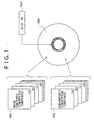
- FIG. 1 shows by way of example an information recording medium storing contents to which the processing according to an embodiment of the present invention.
- information stored on a ROM disc as a contents-stored disc is illustrated by way of example.
- the ROM disc is an information recording medium that stores legitimate contents which is manufactured by a disc manufacturing factory under the permission of contents right holders who have lawful contents copyrights or distribution rights.
- a disc-type medium will be described as an example of information recording medium.
- embodiments of the present invention are applicable to arrangements which employ various forms of information recording mediums.
- an information recording medium 100 stores various contents.
- the contents are generally classified into two categories.
- One of the categories contains main contents 101 including AV (Audio Visual) streams, game programs of the type prescribed by certain standards, image files, audio data, and text data.
- the AV streams include moving image contents such as HD (High Definition) movie contents which include high-definition moving image data.
- the main contents 101 are certain AV format standard data and are stored according to a certain AV data format.
- the main contents 101 are stored as Blu-ray disc ROM standard data according to a Blu-ray disc ROM standard format.
- the subcontents 102 are data having a data format not in accordance with a certain AV data format. Specifically, the subcontents 102 are stored as Blu-ray disc ROM nonstandard data according to an arbitrary format not in accordance with a Blu-ray disc ROM standard format.
- Both the main contents 101 and the subcontents 102 contain various types of contents including music data, image data such as moving images, still images, etc., game programs, and WEB contents. These contents contain various types of information such as contents information available based on only data from the information recording medium 100, and contents information available based on a combination of data from the information recording medium 100 and data provided from a networked server.
- Each or a set of contents contained in the main contents 101 and the subcontents 102 are encrypted with individual encryption keys (unit keys) and stored in the information recording medium 100 for usage management of the contents.
- the information recording medium 100 also stores a disc ID 103 as identifying information of the information recording medium 100.
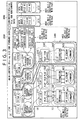
- a storage format of the contents that are stored in the information recording medium according to an embodiment of the present invention will be described below with reference to FIG. 2.
- the information recording medium stores AV streams of moving image contents such as HD (High Definition) movie contents which include high-definition moving image data as main contents 200, and also stores other data and programs, e.g., game programs, image files, audio data, and text data as service data as subcontents 300.
- HD High Definition
- other data and programs e.g., game programs, image files, audio data, and text data as service data as subcontents 300.
- the main contents 200 are stored as Blu-ray disc ROM standard data, for example, according to a Blu-ray disc ROM standard format.
- the subcontents 300 are stored as Blu-ray disc ROM nonstandard data according to an arbitrary format not in accordance with a Blu-ray disc ROM standard format.
- the main contents 200 that are stored according to the Blu-ray disc ROM standard format include moving image contents (AV streams) stored as actual contents to be reproduced, and has a layered arrangement according to the Blu-ray disc ROM standard format. That is, the main contents 200 include:
- the clips (contents data files) 240 have clips 241, 242, 243 that are segmentalized contents data files.
- Each clip 241 has an AV (Audio-Visual) stream file 261 and a clip information file 251.
- the clip file 251 is a data file storing attribute information relating to the AV (Audio-Visual) stream file 261.
- the AV (Audio-Visual) stream file 261 includes MPEG-TS (Moving Picture Experts Group-Transport Stream) data having a data structure of multiplexed information including video, audio, and subtitle data, etc. Command information for controlling the reproducing device at the time contents are reproduced may also be multiplexed in the AV (Audio-Visual) stream file 261.
- the playback interval designation files (play lists) 230 has a plurality of playback interval designation files (play lists) 231, 232, 233.
- Each of the playback interval designation files (play lists) 231, 232, 233 is of such an arrangement that it selects either one of the AV stream data files included in the clips (contents data files) 240, and has at least one play items designating, as a playback start point and a playback end point, certain data of the selected AV stream data file.
- By selecting one playback interval designation file (play list) a playback sequence is determined and contents are reproduced according to the play items of the selected playback interval designation file (play list).
- a play item 234 associated with the playback interval designation file (play list) 231 has a playback start point "a” and a playback end point “b” in the clip 241
- a play item 235 has a playback start point "c” and a playback end point “d” in the clip 241. Therefore, if the playback interval designation file (play list) 231 is selected and contents are reproduced, certain data areas, "a" through “b” and “c” through “d", of the AV stream file 261 which is contents contained in the clip 241 are reproduced.
- the applications 210 are established as layers having combinations of application index files 211, 212 and playback programs 221, 222, or combinations of application execution files 213, 214 and playback programs 223, 224.
- the application index files 211, 212 include contents titles presented on a display which reproduces contents.
- the application execution files 213, 314 include game contents and WEB contents. The user can determine an object to be reproduced by selecting a title included in the application index files 211, 212.
- each of the titles is associated with one of the playback programs (movie objects) 221 through 224.
- a playback process is started based on the playback program associated with the selected title.
- the application index files 211, 212 which are represented as titles 1, 2 in FIG. 2 include a title presentation program for displaying a title and a menu that are automatically reproduced when the information recording medium is set and activated.
- the application index files 211, 212 and the application execution files 213, 214 occasionally include application resource files that are used when applications are executed.
- Various data files e.g., that can be acquired from an information recording medium or a networked server, e.g., image files 225 such as JPEG, PNG, and BMP files, audio files 226 such as PCM and compressed audio files, and various data files 227 such as text and database files are occasionally applied as application resource files.
- the playback programs (movie objects) 221 through 224 are contents playback processing programs for programmably providing functions necessary to present playback contents (HD movie contents).
- the functions include designating playback interval designation files (play lists), responding to manipulating information relative to a contents playback process input from the user, jumping between titles, and branching a playback sequence.
- the playback programs 221 through 224 can jump to each other. According to a user input or a preset program, a playback program to be actually executed is selected, and playback contents are selected from the clips 240 and reproduced by a playback interval designation file (play list) 230 that is designated by the selected playback program.
- the main contents 200 are managed in a layered arrangement according to the Blu-ray disc ROM standard format, as Blu-ray disc ROM standard data, for example.
- contents management units CPS units
- usage management of contents is performed for each of the contents management units (CPS units). Details of the contents management units (CPS units) will be described later on.
- the information recording medium stores the subcontents 300 in addition to the main contents 200.
- the subcontents 300 are contents stored according to a certain AV format, e.g., an arbitrary format not in accordance with the Blu-ray disc ROM standard format.
- the subcontents 300 are game programs, image files, audio data, and text data as service data, for example.
- Sets of data files are set as data groups in the subcontents 300.
- FIG. 2 shows a data group 1, 311 through a data group N, 312. These data groups can also be established as usage management contents.
- a content management unit (CPS unit) is established for each data group to perform usage management of each data group.
- a contents management arrangement for realizing different usage control for each of segmentalized contents stored in the information recording medium will be described below with reference to FIG. 3.
- a different key (unit key) for each of segmentalized contents is assigned as a basic arrangement for realizing different usage control for each of segmentalized contents.
- a unit to which one unit key is assigned is referred to as a contents management unit (CPS unit).
- Each unit key is applied to encrypt the contents belonging to each unit.
- the key (unit key) assigned to each unit is acquired to reproduce the contents.
- Each unit key can individually be managed.
- a unit key assigned to a certain unit A may be established as a key that can be acquired from the information recording medium
- a unit key assigned to a certain unit B may be established as a key that can be acquired by accessing a networked server and meeting such a condition that the user has carried out a predetermined procedure.
- keys associated with respective units may be acquired and managed in independent manners for the respective unit keys.
- CPS units contents management units
- CPS units including application index files 211, 212 or application execution files 213, 214 including one or more titles contained in (A) the applications 210 are set.
- a CPS unit 1, 401 shown in FIG. 3 is a single unit including application index files, playback program files, play lists, and a group of AV stream files as actual contents data.
- a CPS unit 2, 402 is a single unit including application execution files, playback program files, play lists, and a group of AV stream files as actual contents data.
- a CPS unit 3, 403 is a unit including application execution files, playback program files, and various data files that can be acquired from the information recording medium or a networked server.
- CPS unit key key Ku1, Ku2, Ku3 in FIG. 3
- the contents management unit (CPS unit) 1, 401 and the contents management unit (CPS unit) 2, 402 are units which include (A) an application layer in the upper-level layer and (B) playback interval designation files (play lists) + (C) clips (contents data files) in the lower-level layer.
- the contents management unit (CPS unit) 3, 403 is a unit which does not include (B) playback interval designation files (play lists) + (C) clips (contents data files) in the lower-level layer, but includes (A) applications in the upper-level layer and various data files that can be acquired from the information recording medium or a networked server, i.e., image files 225, audio files 226, data files 227, etc.
- the contents management unit (CPS unit) 1, 401 includes a title 1, 211, a title 2, 212, playback programs 221, 222, play lists 231, 232, a clip 241, and a clip 242.
- AV stream data files 261, 262 as actual contents data contained in these two clips 241, 242 are encrypted with the unit key Ku1 which is an encryption key set in association with the contents management unit (CPS unit) 1, 401.
- the contents management unit (CPS unit) 2, 402 includes an application file 213 including game contents, WEB contents, etc., a playback program 223, a play list 233, and a clip 243.
- An AV stream data file 263 as actual contents data contained in the clip 243 is encrypted with the unit key Ku2 which is an encryption key set in association with the contents management unit (CPS unit) 2, 402.
- the application file 213 may be an encrypted file generated with the unit key Ku2.
- the contents management unit (CPS unit) 3, 403 is established as a unit including application files 214, 215, a playback program 224, and various data files that can be acquired from the information recording medium or a networked server by the playback program 224.
- the application files 214, 215 are contained in (A) the application layer as the upper-level layer.
- the contents management unit 3, 403 includes image files 225 such as JPEG, PNG, and BMP files, audio files 226 such as PCM and compressed audio files, and various data files 227 such as text and database files.
- the contents management unit (CPS unit) 3, 403 is encrypted with the unit key Ku3 which is an encryption key set in association with the contents management unit (CPS unit) 3, 403.
- the application program may be executed to reproduce the contents.
- the application program For example, for using an application file corresponding to the contents management unit (CPS unit) 3, 403 or image files 225, audio files 226 such as PCM and compressed audio files, and various data files 227 such as text and database files that correspond to the playback program 224, it is necessary to acquire the unit key Ku3 which is an encryption key set in association with the contents management unit (CPS unit) 3, 403 and decrypt the application file or contents with the unit key Ku3. After the decrypting process is performed, the application program is executed or the various files are executed.
- the unit key Ku3 is an encryption key set in association with the contents management unit (CPS unit) 3, 403
- the application program is executed or the various files are executed.
- Limitations posed on the above processing are that while a certain title is being reproduced, it is not possible to reproduce AV stream files that are not included in the CPS unit to which the title belongs. That is, a movie object executed during the reproduction of a title should not include a command for reproducing AV stream files that are not included in the CPS unit to which the title belongs. Movie objects can have a command for performing title switching. When title switching occurs due to a title jump command, the reproducing device determines that the title being reproduced is changed. Specifically, in FIG. 3, it is possible to execute a command for jumping to the title 2, 212 while the title 1, 211 is being reproduced. After the jump, the title 2, 212 is reproduced.
- a play list can refer to a plurality of clips, but the clips that can be referred to are limited to those included in one CPS unit.
- the unit key does not change while the titles belonging to one CPS unit are being reproduced.
- a seamless connection is easily achieved when AV streams are successively reproduced in the titles.
- titles represent information that is visible to the user, they are advantageous in that it is easy to explain to the user and manage contents when keys are distributed and contents are managed with respect to respective CPS units.
- the information recording medium stores the subcontents 300 in addition the main contents 200.
- the subcontents 300 represent game programs, image files, audio data, and text data as service data, and include a set of data files set as data groups.
- the subcontents 300 are stored as Blu-ray disc ROM nonstandard data according to an arbitrary format not in accordance with the Blu-ray disc ROM standard format.
- the data groups in the subcontents 300 can also be established as usage management contents. If the data groups in the subcontents 300 are established as usage management contents, then the data groups are set as contents management units (CPS units), and usage management is performed for each of the data groups.
- CPS units contents management units
- the data group 1, 311 in the subcontents 300 is established as a contents management unit (CPS unit) 4, 404, and the data group N, 312 is established as a contents management unit (CPS unit) 5, 405.
- Files contained in the contents management unit (CPS unit) 4, 404 are encrypted with a unit key Ku4 which is an encryption key set in association with the contents management unit (CPS unit) 4, 404.
- Files contained in the contents management unit (CPS unit) 5, 405 are encrypted with a unit key Ku5 which is an encryption key set in association with the contents management unit (CPS unit) 5, 405.
- supervisory playback control program for performing supervisory control over the reproduction of contents.
- the supervisory playback control program performs supervisory control over the reproduction of contents.
- the supervisory playback control program identifies a contents management unit (CPS unit) corresponding to contents that are instructed to be reproduced by the user, and performs a process of acquiring a CPS encryption key corresponding to the identified CPS management unit information. If the supervisory playback control program fails to acquire a CPS encryption key, then it displays a message indicative of a playback failure.
- the supervisory playback control program also detects switching to a contents management unit (CPS unit) in the event of a playback execution, and acquires a necessary key and displays a message indicative of a playback failure.
- the supervisory playback control program performs a playback management process based on a unit arrangement and unit key management table shown in FIG. 4.
- the unit arrangement and unit key management table contains contents management units (CPS units) and unit key information in association with indexes, application files, or data groups in the application layer.
- the supervisory playback control program performs a playback management process based on the management table shown in FIG. 4.
- the management table shown in FIG. 4 contains management data corresponding to main contents stored according to a certain AV format (e.g., the Blu-ray disc ROM standard data format), and management data corresponding to subcontents as stored contents different from the certain AV format, as a single management table. These management data may be arranged such that the management data corresponding to main contents and the management data corresponding to subcontents are separately managed. A specific management data file arrangement (directory arrangement) will be described later.
- a certain AV format e.g., the Blu-ray disc ROM standard data format
- the supervisory playback control program When the supervisory playback control program detects switching between contents management units (CPS units) based on switching between application indexes, the supervisory playback control program switches between keys to be applied due to the switching between contents management units (CPS units). Alternatively, the supervisory playback control program performs a process of displaying a message indicating that a unit key needs to be acquired.
- CPS units contents management units
- the supervisory playback control program performs a process of displaying a message indicating that a unit key needs to be acquired.
- a reproducing device which is performing a contents playback process stores the unit key Ku1 of the contents management unit (CPS unit) 1, 401 and also stores the unit key Ku2 of the contents management unit (CPS unit) 2, 402, then when the supervisory playback control program which performs supervisory control on the contents playback process detects switching between units of applications or switching between contents, the supervisory playback control program switches between unit keys depending on the switching between contents management units (CPS units), i.e., switches from Ku1 to Ku2.
- a reproducing device which is performing a contents playback process stores the unit key Ku1 of the contents management unit (CPS unit) 1, 401 and does not store the unit key Ku2 of the contents management unit (CPS unit) 2, 402, then when the supervisory playback control program which performs supervisory control on the contents playback process detects switching between units of applications or switching between contents, the supervisory playback control program performs a process of displaying a message indicating that a unit key needs to be acquired.
- FIG. 5 shows a contents storage format in an arrangement having a first playback and a top menu
- FIG. 6 shows an example of encryption and contents management units (CPS units) set in the contents storage arrangement shown in FIG. 5.
- CPS units encryption and contents management units
- the contents storage format shown in FIG. 5 is an arrangement which stores AV streams of moving image contents such as HD (High Definition) movie contents which include high-definition moving image data, for example, as the main contents 200, and also stores other data and programs, and game programs, image files, audio data, and text data as service data, for example, as the subcontents 300.
- HD High Definition
- FIG. 5 Those details in FIG. 5 which are identical to those in FIG. 2 are denoted by identical reference characters.
- the main contents 200 that are stored according to the Blu-ray disc ROM standard format store moving image contents (AV streams) as actual contents to be reproduced, and has a layered arrangement according to the Blu-ray disc ROM standard format. That is, the main contents 20 include:
- the applications 210 have a first playback 281 as index information for playback contents to be activated when an information recording medium (disc) is loaded into the drive and a top menu as contents 282 as index information for contents to be reproduced when a menu displaying function is activated.
- the first playback and the top menu are playback objects (contents) prescribed according to a BD-ROMAV application standard and having the same structure as the titles.
- the first playback 281 represents indexes for indicating contents that are activated and reproduced when an information recording medium (disc) is loaded into the drive.
- the first playback 281 includes contents including the display of copyright information, for example, and reproduced according to a playback sequence inherent in studios and authoring companies to display the logos of the studios and the authoring companies which edit the contents.
- the top menu 282 represents indexes for indicating contents to be displayed when a menu display function is performed in the reproducing device.
- a playback program corresponding to a specified index is activated, and the reproduction of a contents data file (AV stream) specified by a play list indicated by the playback program is performed.
- the playback procedure is the same as the playback process based on an index such as a title as described above with reference to FIG. 2.
- a different key (unit key) for each of segmentalized contents is assigned as a basic arrangement for realizing different usage control for each of segmentalized contents.
- a unit to which one unit key is assigned is referred to as a contents management unit (CPS unit).
- contents management units (CPS units) are associated with those contents for unit management.
- Contents associated with the first playback and contents associated with the top menu are also encrypted by applying respective unit keys. For using those contents, keys (unit keys) assigned to the respective units are acquired to reproduce those contents.
- a CPS unit 1, 421 is a contents management unit including those contents.
- a CPS unit including only contents associated with the first playback and a CPS unit including only contents associated with the top menu may individually be established.
- the CPS unit 1, 421 shown in FIG. 6 is a single unit including application index files containing a first playback index 281 and a top menu index 282, playback program files, play lists, and a group of AV stream files as actual contents data.
- a CPS unit 2, 422 is a single unit including application execution files, playback program files, play lists, and a group of AV stream files as actual contents data.
- a CPS unit 3, 423 is a unit including application execution files, playback program files, and various data files that can be acquired from the information recording medium or a networked server.
- CPS unit key key Ku1, Ku2, Ku3 in FIG. 3
- the contents management unit (CPS unit) 1, 421 includes a first playback index 281, a top menu index 282, playback programs 221, 222, play lists 231, 232, a clip 241, and a clip 242.
- AV stream data files 261, 262 as actual contents data contained in these two clips 241, 242 are encrypted with the unit key: Ku1 which is an encryption key set in association with the contents management unit (CPS unit) 1, 421.
- the contents management unit (CPS unit) 2, 422 includes a title 1, 283, a playback program 223, a play list 233, and a clip 243.
- An AV stream data file 263 as actual contents data contained in the clip 243 is encrypted with the unit key: Ku2 which is an encryption key set in association with the contents management unit (CPS unit) 2, 422.
- the contents management unit (CPS unit) 3, 423 is established as a unit including application files 214, 215 contained in (A) the application layer as the upper-level layer, a playback program 224, and various data files that can be acquired from the information recording medium or a networked server by the playback program 224, i.e., image files 225 such as JPEG, PNG, and BMP files, audio files 226 such as PCM and compressed audio files, and various data files 227 such as text and database files.
- image files 225 such as JPEG, PNG, and BMP files
- audio files 226 such as PCM and compressed audio files
- various data files 227 such as text and database files.
- the contents management unit (CPS unit) 3, 423 is encrypted with the unit key: Ku3 which is an encryption key set in association with the contents management unit (CPS unit) 3, 423.
- the program may be executed to reproduce the contents.
- the supervisory playback control program identifies a contents management unit (CPS unit) corresponding to playback contents, and performs a process of acquiring a CPS encryption key corresponding to the identified CPS management unit information. If the supervisory playback control program fails to acquire a CPS encryption key, then it displays a message indicative of a playback failure.
- the supervisory playback control program also detects switching to a contents management unit (CPS unit) in the event of a playback execution, and acquires a necessary key and displays a message indicative of a playback failure.
- FIG. 7 An example of the arrangement of a unit key management table in an arrangement wherein contents corresponding to a first playback as playback contents to be activated when an information recording medium (disc) is loaded into the drive and a top menu as contents to be reproduced when a menu displaying function is activated is illustrated in FIG. 7.
- the unit arrangement and unit key management table contains contents management units (CPS units) and unit key information in association with indexes, application files, or data groups in the application layer.
- the supervisory playback control program performs a management process based on the management table shown in FIG. 7.
- the table arrangement shown in FIG. 4 corresponds to the CPS settings shown in FIG. 6.
- the contents management unit (CPS unit) is a unit containing contents corresponding to the first playback and the top menu, and is associated with the unit key Ku1. Different keys (Ku2 and so on) are associated with respective CPS units (CPS 2 and so on). For reproducing contents of each unit, it is necessary to perform a decryption process using a corresponding unit key.
- the supervisory playback control program detects switching between contents management units (CPS units) based on switching between application indexes, the supervisory playback control program switches between keys to be applied due to the switching between contents management units (CPS units).
- the supervisory playback control program performs a process of displaying a message indicating that a unit key needs to be acquired.
- an information recording medium storing contents that are segmentalized in contents management units and encrypted using unit keys as encryption keys for the respective units is loaded into a reproducing device as a device connected to a network such as a home network for reproducing and using the contents
- a reproducing device as a device connected to a network such as a home network for reproducing and using the contents
- contents to be described below include both main contents and subcontents.
- two states i.e., a state independent of a network (discrete state) and a state related to a network (bound state), are defined as states of contents management units (CPS units) on a recording medium.
- CPS units contents management units
- each of the contents management units (CPS units) is in.
- Management information indicative of the discrete/bound state of each contents management unit (CPS unit) is recorded in an information recording medium, a reproducing device (information reproducing device) loaded with an information recording medium, or a management server on a home network which performs an information management process.
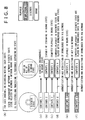
- Contents 1 through 6 shown in FIG. 8 correspond respectively to contents management units (CPS units), and belong to main contents or subcontents.
- Contents that are segmentalized in contents management units (CPS units) stored on an information recording medium include contents that can be reproduced in the discrete state and contents that cannot be reproduced in the discrete state.
- the contents 1 through 4 shown in FIG. 8 are contents that can be reproduced in the discrete state, and the contents 5, 6 are contents that cannot be reproduced in the discrete state.
- Each of the contents (contents management units) on the recording medium can be brought into the bound state by a user's operation or a process in the reproducing device. There are also contents that are inhibited from being brought into the bound state, such as the contents 1 shown in FIG. 8 at (a).
- the information about the discrete and bound states is determined as attributes of the contents (contents management units) stored in the information recording medium, and is stored in the information recording medium as attribute information corresponding to the respective contents management units.
- the information about these processes is recorded as corresponding attribute information of the contents (contents management units) in either the information recording medium or a management server holding management information.
- Examples are contents (contents management units) shown in FIG. 8 at (a) through (f).
- the (d) contents 4 through the (f) contents 6 require that a network connection be made and downloaded data or a unit key be acquired.
- an authentication process is performed to confirm that a data request is made from a proper device or user, and downloaded data and a unit key are provided the server if the authentication process is successful.
- the data transferred through the network are encrypted and provided to the user device.
- an information recording medium storing contents that are segmentalized in contents management units and encrypted using unit keys as encryption keys for the respective units is loaded into a reproducing device as a device connected to a network such as a home network for reproducing and using the contents
- a reproducing device as a device connected to a network such as a home network for reproducing and using the contents
- contents to be described below include both main contents and subcontents.
- two states i.e., a state independent of a network (discrete state) and a state related to a network (bound state), are defined as states of contents management units (CPS units) on a recording medium.
- CPS units contents management units
- each of the contents management units (CPS units) is in.
- Management information indicative of the discrete/bound state of each contents management unit (CPS unit) is recorded in an information recording medium, a reproducing device (information reproducing device) loaded with an information recording medium, or a management server on a home network which performs an information management process.
- Contents 1 through 6 shown in FIG. 9 correspond respectively to contents management units (CPS units).
- Each of the contents (contents management units) on the recording medium can be brought into the bound state by a user's operation or a process in the reproducing device.
- contents that are inhibited from being brought into the bound state such as the contents 1 shown in FIG. 9 at (a).
- the information about the discrete and bound states is determined as attributes of the contents (contents management units) stored in the information recording medium, and is stored in the information recording medium or a management server storing management information, as attribute information corresponding to the respective contents management units.
- the information about these copying processes is recorded as corresponding attribute information of the contents (contents management units) in either the information recording medium or the management server holding management information.
- Examples are contents (contents management units) shown in FIG. 9 at (a) through (f).
- the copy data may be of a type that cannot be reproduced on the device of copy source, and may be of an arrangement that can be reproduced as a result of being copied to another device.
- copy data having the same contents may be stored in a data format (e.g., a file type such as AVI or the like or an MPEG-PS format that can be reproduced by a personal computer) that can be reproduced by general networked devices, in a recording medium which stores data in a plurality of layered formats described above with reference to FIGS. 2 and 3, and for copying the copy data through a network, the copy data are sent for reproduction on those general networked devices.
- a data format e.g., a file type such as AVI or the like or an MPEG-PS format that can be reproduced by a personal computer
- a system which charges for each copy and needs a key for copying should preferably be of a contents management arrangement for limiting the number of copies based on the number of times that a key is distributed.
- Management information for contents management units in an information recording medium which stores contents that are segmentalized in the above contents management units and encrypted using unit keys as encryption keys for the respective units will be described below.
- the contents to be described below include both main contents and subcontents.
- one unit key is established in association with a contents management unit (CPS unit).
- a contents management unit (CPS unit) and key management table is established as the unit key information management table [unit arrangement and unit key management table] as shown in FIG. 4.
- CPS units As attribute information associated with contents management units (CPS units), there is available state information indicative of whether each of the contents management units (CPS units) is in:
- an information recording medium that is capable of writing data therein, two items of information, i.e., an initial state and a current state, are recorded.
- the current state information is written on the information recording medium by an information processing device as a reproducing device loaded with the information recording medium or a networked server.
- FIG. 10 shows an example of the arrangement of "state management table" of initial states and current states that are recorded in an information recording medium that is capable of writing data therein.
- the table describes whether each of the initial states and the current states of contents management units (CPS units) is in the discrete state or the bound state.
- CPS units contents management units
- the state management table shown in FIG. 10 is recorded in the information recording medium and also in an external device such as an information processing device as a reproducing device loaded with the information recording medium or a networked server.
- the external device such as an information processing device as a reproducing device loaded with the information recording medium or a networked server has a state management table of initial states and current states that are recorded.
- the initial states established in the state management table include the following four states:
- the state "a. discretely only” represents contents (contents management units) that are allowed only in the discrete state, and cannot be changed to the bound state.
- the state "b. discrete initially” represents contents (contents management units) that are initially in the discrete state, but can be changed to the bound state.
- the state "c. bound only” represents contents (contents management units) that are allowed only in the bound state, and cannot be changed to the discrete state.
- the state "b. bound initially” represents contents (contents management units) that are initially in the bound state, but can be changed to the discrete state.
- contents that are initially in the bound state assume that the contents are distributed in relation to information on the network. For example, these contents are based on the premise that they will be reproduced in combination with information on the network.
- the current state is established as either the discrete state or the bound state.
- the current state can be established for each contents management unit.
- a contents storage recording medium includes a removable medium that can be removed from the reproducing device
- each of the contents is reset to the initial state at the time the removable medium is removed from the reproducing device.
- the state management table stored outside the recording medium is also initialized.
- the state of the recording medium is registered in an external management server.
- the state management table stored outside the recording medium does not need to be initialized when the removable medium is removed from the reproducing device.
- the management server detects, based on the state management table, that the contents set to the bound state in the home network (A) are about to be redundantly set to the bound state in the home network (B), and does not permit the contents to be set to the bound state in the home network (B).
- the above management process is effective to prevent the same contents from being used as a plurality of contents in parallel.
- the state management table as shown in FIG. 10 may be held by the management server or the like to allow the current state to be referred to even when the removable medium is removed from the reproducing device and also to allow usage management of the contents to be performed based on the current state thus referred to.
- the information recording medium is a recordable medium and records the current state
- the current state can directly be read from the recording medium without confirming whether the contents are in the bound state or not through the server, and usage management of the contents can be performed based on the read current state.
- ROM mediums which inhibits data from being additionally recorded in a normal data area thereof should preferably have a partly recordable area therein for recording the above state management information. ROM mediums of such an arrangement should preferably be used.
- optical disc mediums that are additionally recordable, cartridge mediums having IC memories, etc.
- the state management table shown in FIG. 10 may be integrally combined with or may be independent of the table [unit arrangement and unit key management table] of contents management units (CPS units) and unit keys as shown in FIG. 4.
- the management information corresponding to the contents management units further includes information as to reproduction and usage limitation of contents when the contents are in the discrete state, and information as to reproduction and usage limitation of contents when the contents are in the bound state.
- contents management information is described as attribute information corresponding to the contents in the information recording medium, or recorded in the management server which performs a contents management process. For those contents which are allowed to be used only in the bound state, it is possible to employ a contents usage management arrangement based on only the contents management information recorded in the management server.
- FIG. 11 shows an example of the arrangement of contents usage management information recorded as fixed-length data, i.e., a contents playback and copy control information management table.
- the contents playback and copy control information management table is established as an information table of data of each CPS unit or data of all CPS units.
- the contents playback and copy control information management table shown in FIG. 11 includes control information relative to usage and copying of contents in the form of fixed-length data, such as contents management information depending on the state of contents, i.e., whether contents are in the discrete state or the bound state.
- the management information in the discrete state represents, for example, whether contents can be reproduced in the discrete state or not. For contents that cannot be reproduced in the discrete state, a process of reproducing the contents is described. For example, the connection to a key distribution server, the need for an acquisition of key data distributed in another medium (memory card or the like), and information such as an URL or a telephone number for specifying a server, or an index value to a list storing such information is described.
- the management information in the bound state represents whether or not copying, streaming, and remote playback within a network are possible, the number of copies and expiration date for each of the types of devices in question, whether or not copying/streaming data are present, a data conversion process, and the handling of copy data if the contents are no longer in the bound state.
- FIG. 11 assumes that part or all of the above information is stored in a fixed-length field, data made up of a large number of characters such as the URL and data position (path information) are stored in another file, and an index to a list stored in the other file is stored in the fixed-length field.
- a flag indicative of the acquisition from the server and information indicative of how to access the server may be stored.
- FIG. 12 shows an example of the arrangement of contents usage management information established for each CPS unit, i.e., a contents playback and copy control information management table of contents playback and copy control information recorded as variable-length data.
- a flag indicative of the acquisition from the server and information indicative of how to access the server may be stored.
- a usage example of copy control information (CCI) based on the user definition is, for example, to establish the definition of copy control information (CCI) not depending on the recording medium standard.
- CCI copy control information
- control information which is not available as the copy control information (CCI) determined by the recording system is established as user definition information, and the contents owner or administrator establishes unique copy control information (CCI).
- CCI copy control information
- an application e.g., Java
- CCI copy control information
- an external source such as a server or the like.
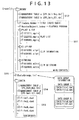
- a BDMV directory is a directory for storing application files in the Blu-ray Disc ROM format.
- main contents data area 511 is a directory storing data files of main contents in a plurality of layered arrangements according to the certain AV format described above with reference to FIGS. 2 and 3, i.e., contents according to the certain AV format (Blu-ray Disc ROM format) having a layered arrangement of applications, play lists, clips, etc., and also storing programs.
- certain AV format Blu-ray Disc ROM format
- AV streams included in the clips are data files encrypted by unit keys that are established for respective contents management units (CPS units).
- a main contents management data area 512 stores management files corresponding to the main contents.
- the main contents management data area 512 stores data files of tables, i.e., a table managing a contents management unit (CPS unit) arrangement and unit keys as shown in FIG. 4, i.e., the [unit arrangement and unit key management table], the [state management table] managing the discrete states and the bound states for the respective contents management units described above with reference to FIG. 10, and the [contents playback and copy control information management table] storing usage of contents and copy control information in the states described above with reference to FIGS. 11 and 12.
- These tables are stored as either individual data files or data files including a combination of tables.
- a subcontents data area 513 is a directory storing contents that do not belong to the main contents, i.e. contents not in accordance with the particular AV format [Blu-ray Disc ROM format], i.e., contents belonging to the data groups shown in FIGS. 2 and 3. These data files are also stored in the user data area of the information recording medium.
- Contents belonging to the subcontents data area 513 may include both contents established as contents management units (CPS units) and contents not established as contents management units (CPS units).
- the contents established as contents management units (CPS units) become data files encrypted with unit keys.
- a subcontents management data area 514 stores management files corresponding to subcontents.
- the subcontents management data area 514 stores data files of tables, i.e., a table managing a contents management unit (CPS unit) arrangement and unit keys as shown in FIG. 4, i.e., the [unit arrangement and unit key management table], the [state management table] managing the discrete states and the bound states for the respective contents management units described above with reference to FIG. 10, and the [contents playback and copy control information management table] storing usage of contents and copy control information in the states described above with reference to FIGS. 11 and 12.
- CPS unit contents management unit
- Data group information 515 represents files storing data group information of subcontents. As shown in FIG. 13, paths of data files belonging to data groups 1 through N are registered. For opening subcontents, the data group information 515 is opened first to acquire the information of a group to which the desired contents belong, and then a data file can be specified based on the acquired information.
- a group is established as a contents management unit (CPS unit)
- it is encrypted with a unit key associated with each data group.
- a data file belonging to a group established as a contents management unit (CPS unit) is to be used, then it is necessary to acquire a unit key and decrypt the data file with the unit key.
- the subcontents data area 513 shown in FIG. 13 is of an arrangement including a mixture of files belonging to all data groups.
- the subcontents data area 513 may have folders for data groups and may have an arrangement of files such as data belonging to data groups and arranged under each of the data groups.
- data group information 522 is arranged as data representing directory names (folder names) corresponding to respective data groups. For opening subcontents, the data group information 522 is opened first to acquire a directory name as the information of a group to which desired contents belong, and the data file is acquired based on the acquired information.
- management information corresponding main contents and management information corresponding subcontents are established separately from each other.
- these management information may be established as files directly connected to routes, so that all the management information corresponding to main contents and subcontents may be managed altogether.
- the directory arrangement shown in FIG. 15 contains a main contents data area 551, a subcontents data area 552, and a contents management data area 553 corresponding to main contents and subcontents.
- the contents management data area 553 stores management files corresponding to both main contents and subcontents.
- the contents management data area 553 stores data files of tables, i.e., a table managing a contents management unit (CPS unit) arrangement and unit keys as shown in FIG. 4, i.e., the [unit arrangement and unit key management table], the [state management table] managing the discrete states and the bound states for the respective contents management units described above with reference to FIG. 10, and the [contents playback and copy control information management table] storing usage of contents and copy control information in the states described above with reference to FIGS. 11 and 12.
- CPS unit contents management unit
- main contents management data There are various storage patterns for main contents management data, subcontents management data, and contents management data including both of them.
- FIG. 16 shows an example of a storage arrangement for those management data.
- the management data are stored in one of patterns described below.
- the management data are stored in either one of the above patterns (A) through (D).
- the [unit arrangement and unit key management table], the [state management table], and the [contents playback and copy control information management table] have been described above as specific examples of management data. All of these tables may not necessarily be stored in one pattern, but may be stored in respective different patterns.
- the above three types of information are saved in an area that cannot directly be accessed by the user, such as a lead-in area of the recording medium.
- the above three types of information are saved in an external server, rather than the recording medium. In this case, the reproducing device needs to acquire information corresponding to the three tables from the external surface before the recording medium is played back.
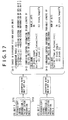
- contents usage control information corresponding to contents which correspond to the respective CPS units described above with reference to FIGS. 11 and 12, i.e., the [contents playback and copy control information management table] storing usage of contents and copy control information, should preferably be processed for antifalsification, and encrypted and stored.
- playback/copy control information is combined with falsification verification data added thereto, and then encrypted and stored.
- falsification verification data 1, 572 are established for playback/copy control information 1, 571 corresponding to the CPS unit 1.
- the falsification verification data may be established as hash data such as SHA-1 or the like, for example, based on the playback/copy control information or MAC (Message Authentication Code) based on the playback/copy control information.
- the playback/copy control information 1, 571 with the falsification verification data 1, 572 added thereto is encrypted based on a unit key corresponding to each CPS unit, and stored.
- the playback/copy control information may be stored in one of different patterns as follows: As shown in FIG. 17 at (A-1), a playback/copy control information file is established for each CPU unit. As shown in FIG. 17 at (A-2), the control information of all CPU units is stored altogether as a single data file including fixed-length data described above with reference to FIG. 11. As shown in FIG. 17 at (A-3), the control information of all CPU units is stored altogether as a single data file including variable-length data described above with reference to FIG. 12.
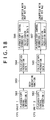
- Hash values based on playback/copy control information 581, 582 corresponding to respective CPS units are generated by a hash generating function 583 such as SHA-1 or the like.
- the hash values are established as falsification verification data 584, 585 corresponding to the playback/copy control information 581, 582 which corresponds to the respective CPS units, and unit keys Ku1, Ku2 corresponding to the respective CPS units are applied to joined data 586, 587 of the playback/copy control information and the falsification verification data to encrypt them into storage files.
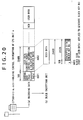
- a falsification prevention arrangement to which no hash function is applied will be described below with reference to FIG. 19.
- playback/copy control information 591, 592 corresponding to the respective CPS units is repeated and joined a plurality of times to establish joined data 593, 594.
- unit keys Ku1, Ku2 corresponding to the respective CPS units are applied to joined data 593, 594 to encrypt them into storage files.
- the encrypted data of the joined same data are established as storage files.
- these storage files are decrypted with the unit keys Ku1, Ku2, any falsification thereof can be verified based on whether a repeated pattern of the same data is detected or not.
- An information processing apparatus for performing a process of reproducing contents acquires encrypted contents usage control information corresponding to contents management units (CPS units) stored in the information recording medium, i.e., playback/copy control information, performs a decryption process which applies unit keys established so as to correspond to contents management units, performs a falsification verification process, and then performs a contents usage process based on the contents usage control information on the condition that no falsification is confirmed.
- CPS units contents management units
- playback/copy control information as contents usage control information is stored according to the pattern shown in FIG. 17 at (A-1), i.e., as established individual files corresponding to the playback/copy control information of the individual CPS units.
- FIG. 20 is a diagram of an arrangement of data of contents usage control information recorded in the information recording medium, i.e., a recorded arrangement of data making up individual files corresponding to playback/copy control information of the respective CPS units.
- FIG. 20 at (a) shows a recorded data arrangement in the information recording medium of the contents usage control information of a CPS unit 001.
- the recorded data has a plurality of data blocks each including 18-byte user control data (UCD) 601 and 2048-byte user data 602 including contents usage control information and hash data as falsification verification data.
- the number of data blocks that are used differs depending on the data length of the contents usage control information.
- the contents usage control information of a CPU unit a shown in FIG. 20 at (a) is contents usage control information corresponding to one of a plurality of CPS units stored in the information recording medium.
- the contents usage control information corresponds to contents usage control information [CPSUnit001.cci] 610 of the CPS unit 001, in a directory indicative of an overall data arrangement recorded in the information recording medium shown in FIG. 21, for example.
- the directory arrangement shown in FIG. 21 is an arrangement including a content data area 612 and a contents management data area 611 corresponding to contents.
- a BDMV directory indicated in the content data area 612 is established as a directory storing contents and applications according to the Blu-ray Disc ROM format.
- the contents according to the Blu-ray Disc ROM format have a layered arrangement of titles, objects, play lists, clip information, AV streams, etc. Data files making up them are established in the BDMV directory.
- the contents management data area 611 stores management files corresponding to contents.
- the contents management data area 611 stores, with respect to each of the CPS units, unit key generation value information (Unit_Key_Gen_Value.inf) as information corresponding to the table managing CPU unit keys of the respective contents management units (CPS units) shown in FIG. 4, and contents usage control information (CPSUnit00n.cci) as playback/copy control information of contents that are established for the respective units.
- unit key generation value information (Unit_Key_Gen_Value.inf) as information corresponding to the table managing CPU unit keys of the respective contents management units (CPS units) shown in FIG. 4
- contents usage control information CPSUnit00n.cci
- FIG. 22 shows an example of the syntax of a unit key generation value information (Unit_Key_Gen_Value.inf) file.
- the unit key generation value information file is a data file which defines information representative of association between contents management units and indexes, and random number information for use in the generation of unit keys.
- the unit key generation value information (Unit_Key_Gen_Value.inf) file is a file defining a first playback as playback contents to be activated when an information recording medium (disc) is loaded into the drive, indexes of a top menu as contents to be reproduced when a menu display function is activated, as described above with reference to FIGS. 5 through 7, information associating titles as other indexes to CPS units, and random number (Vu) information for generating keys assigned to the respective CPS units.
- the unit key generation value information (Unit_Key_Gen_Value.inf) includes the following data:
- the playback/copy control information of the contents is established as individual information of the respective CPS units. Specifically, individual usage control information, as described below, is established for the respective CPS units stored in the information recording medium.
- the number of copies allowed for the recording medium a
- the number of playbacks allowed b
- whether or not remote playback is possible possible, ⁇ .
- the number of copies allowed for the recording medium 0, the number of playbacks allowed: c, whether remote playback is possible or not: not possible, ⁇ .
- the contents usage control information [CPSUnit001.cci] 610 shown in FIG. 21 is contents usage control information corresponding to the CPS unit 001.
- Contents usage control information [CPSUnit002.cci] is contents usage control information corresponding to the CPS unit 002.
- These contents usage control information correspond to the contents stored in the respective CPS units, or specifically usage control information of clip AV stream data 613, 614, 615 in the directory shown in FIG. 21.
- FIG. 23 shows a contents arrangement according to the Blu-ray Disc ROM format illustrative of an association between these AV streams and CPS units.
- the clip AV stream data 613, 614, 615 shown in FIG. 21 correspond respectively to AV stream data 613, 614, 615 shown in FIG. 23.
- the clip AV stream data 613, 614 are data belonging to a CPS unit #1
- the clip AV stream data 615 are data belonging to a CPS unit #2.
- contents playback control information of the clip AV stream data 613, 614 is a contents playback control information file established in association with the CPS unit 001, e.g., the contents usage control information [CPSUnit001.cci] 610 shown in FIG. 21, and contents playback control information of the clip AV stream data 615 is a contents playback control information file established in association with the CPS unit 002, e.g., the contents usage control information [CPSUnit002.cci] shown in FIG. 21.
- the information processing apparatus When the information processing apparatus is to use contents contained in either one of CPS units, the information processing apparatus reads the contents usage control information corresponding to the CPS unit, and performs a usage process according to the read control information.
- the recorded arrangement of the contents usage control information will further be described below with reference to FIG. 20.
- the 18-byte user control data (UCD) 601 in the recorded data shown in FIG. 20 at (a) are control data that are established for each 2048-byte user data 602, and include control data such as playback control information.
- the playback/copy control information for the respective CPS units and hash values as falsification verification data therefor are stored in the user data 602.
- Each data block is subjected to block encryption applying a block key kb that is generated by a block seed 603 set in the block and a unit key Ku corresponding to each contents management unit (CPS unit).
- a block key kb that is generated by a block seed 603 set in the block
- a unit key Ku corresponding to each contents management unit (CPS unit).
- User data 621 shown in FIG. 24 represent user data (2048 bytes) in one data block.
- the usage data are data including playback/copy control information for each CPS unit.
- a block seed having a predetermined length is extracted from the user data (2048 bytes) in one data block, and a block key Kb is generated by an encryption process based on the block seed and the unit key Ku.
- the data portion exclusive of the block seed are then encrypted using the block key Kb.
- 16-byte data are extracted from the beginning of the user data, and the extracted 16-byte data are applied as a block seed 622.
- the 16-byte block seed 622 from the beginning of the user data is subjected to an encryption process, specifically, an AES encryption process, for example, based on a CPS unit key Ku-a 623, generating a block key Kb 624 in step S11.
- an AES encryption process for example, based on a CPS unit key Ku-a 623, generating a block key Kb 624 in step S11.
- the CPS unit key Ku-a 623 that is applied is the unit key of a unit corresponding to the contents usage control information that is subjected to the block encryption. If the contents usage control information that is subjected to the block encryption represents control data for the CPS unit a, then the unit key Ku-a corresponding to the CPS unit a is applied. In this manner, a different unit key established for each CPS unit is applied to generate a block key.
- the data portion of the user data 621 exclusive of the 16 bytes of the block seed 622 i.e., a 2032-byte data area, is subjected to an encryption process, e.g., an AES encryption process, by applying the block key Kb 624.
- an encryption process e.g., an AES encryption process
- the 2048-byte user data serving as the block data are established as the 16-byte block seed 622 which is not encrypted and the 2032-byte data encrypted by the block key Kb 624. These data are recorded in the information recording medium.
- the block seed is extracted from the user data, and is established as different data for each block. Therefore, even though the common CPS unit key Ku is applied, the block key Kb is different for each block, and hence the encryption process is performed with higher security.
- 2048-byte user data 631 shown in FIG. 25 are data that have been subjected to the block encryption described above with reference to FIG. 24, and are made up of a 16-byte block seed 632 which is not encrypted and 2032-byte data 633 encrypted by a block key Kb.
- the 16-byte block seed 632 from the beginning of the user data is subjected to an encryption process, specifically, an AES encryption process, based on a CPS unit key Ku-a 634, generating a block key Kb 635 in step S21.
- an encryption process specifically, an AES encryption process, based on a CPS unit key Ku-a 634, generating a block key Kb 635 in step S21.
- the CPS unit key Ku-a 634 that is applied is the unit key of a unit corresponding to the contents usage control information that is subjected to the block encryption. If the contents usage control information that is subjected to the block encryption represents control data for the CPS unit a, then the unit key Ku-a corresponding to the CPS unit a is applied.
- the data portion of the user data 631 exclusive of the 16 bytes of the block seed 632, i.e., the 2032-byte encrypted data 633, is subjected to a decryption process, e.g., an AES decryption process, by applying the block key Kb 635.
- a decryption process e.g., an AES decryption process
- the 2048-byte user data serving as the block data are made up of the 16-byte block seed 622 which is not encrypted and the 2032-byte data decrypted by the block key Kb 635.
- These data represent contents usage control information corresponding to a certain CPS unit.
- the information processing apparatus for reproducing and using contents uses contents according to the contents usage control information.
- FIGS. 24 and 25 the encryption and decryption processes for one block have been described.
- CPS-associated contents usage control information is recorded using a plurality of blocks depending on the length thereof. Therefore, for recording and reproducing CPS-associated contents usage control information, the process per block described above with reference to FIGS. 24 and 25 is performed on a plurality of blocks.
- FIG. 26 shows an overall recorded data arrangement of contents usage control information corresponding to a certain single CPS unit a.
- the contents usage control information is divided and stored in the user data areas of a plurality of block data.
- the user data of first through nth n blocks are used.
- 16 bytes from the beginning of the user data of each block are extracted as a seed, and an encryption process is performed by applying a unit key Kua 651 to the extracted seed to generate a block key.
- an encryption process is performed by applying a seed 1 and the unit key Kua 651 to generate a block key Kb1, and the block key Kb1 is applied to encrypt the data area of the user data exclusive of the seed.
- an encryption process is performed by applying a seed 2 and the unit key Kua 651 to generate a block key Kb2, and the block key Kb2 is applied to encrypt the data area of the user data exclusive of the seed. The same process is carried out on all the blocks to generate recorded data.
- contents usage control information as playback/copy control information for each CPS unit is divided and stored in the 2048-byte user data areas of block data.
- FIG. 27 shows a first block 701 as a 2048-byte user data area serving as block data storing contents usage control information, and a succeeding block 702.
- the succeeding block 702 includes one or more blocks. It is assumed that the succeeding block 702 contains user data of N blocks, and contains data of 2048 x N.
- the first block 701 contains user data having a total number of bytes: 2048 bytes, and stores the respective data of:
- the first header (16 bytes) contains information as to the number of loops of contents usage control information (playback/copy control information) contained in the first control information (CCI) area and a reserved area.
- the data in the first header (16 bytes) is used as seed information for generating a block key corresponding to this block.
- the seed information since the seed information is not subjected to block encryption, it is stored as plaintext data in the information recording medium. Therefore, if contents usage control information as playback/copy control information for each CPS unit is included in the 16-byte data at the beginning of the user data area of the block data used as the seed information, then the specific details of the control information may possibly leak out. Therefore, the 16-byte area at the beginning of the user data area is established as a header information area for storing data of lower confidentiality.
- the first control information (CCI) area (2012 bytes) following the header stores contents usage control information as playback/copy control information corresponding to each CPS unit.
- FIG. 27 shows the contents usage control information (playback/copy control information) of the first block 701 as including two types of control information, i.e., basic control information (Basic CCI), and extended control information (Extended CCI).
- Basic CCI basic control information
- Extended CCI extended control information
- the first control information (CCI) area stores one item of basic control information (Basic CCI) and four items A through D of extended control information (Extended CCI).
- the basic control information represents data comprising basic minimum contents usage control information.
- the basic control information (Basic CCI) is read by almost all information processing apparatus which perform a contents playback process according to a predetermined contents playback processing program, and the information processing apparatus are required to perform a process according to the control information.
- the extended control information represents data comprising extended contents usage control information (playback/copy control information) applicable to information processing apparatus which have processing functions such as higher-level contents usage processes, e.g., network transfer and streaming transmission and reception of data.
- the basic control information (Basic CCI) is required to be quickly removed from a playback/copy control information storage file.
- extended control information Extended CCI
- FIG. 28 Specific examples of the basic control information (Basic CCI) and the extended control information (Extended CCI) are shown in FIG. 28.
- the basic control information includes the following control information, for example:
- the extended control information includes the following control information, for example:
- the extended control information (Extended CCI) further includes the following control information:
- the extended control information (Extended CCI) may be set to any optional control information.
- the data making up the first block 701 as the 2048-byte user data area serving as block data storing contents usage control information will further be described below with reference to FIG. 27.
- the first block 701 stores a first hash value (20 bytes) generated based on each of the data of:
- the hash value represents data generated by applying a hash function such as SHA-1 or the like to the data of the first header and the data of the first control information (CCI) area, and is established as falsification verification data for the data of the first header and the data of the first control information (CCI) area.
- a hash function such as SHA-1 or the like
- the size of the hash value differs depending on the hash function used.
- the hash function SHA-1 is used and the hash value of 160 bits (20 bytes) is generated.
- a different hash function and a different hash value length may be employed.
- the first hash value is obtained by inputting, to the hash function, data ranging from the beginning of the file to a position immediately prior to the area where the hash value is recorded (if SHA-1 is used, a 2028-byte area from the beginning).
- An information processing apparatus for reading contents usage control information and performing contents usage according to the usage control information calculates a hash value based on the data of the first header and the data of the first control information (CCI) area, and compares the calculated hash value with a hash value stored in the user data area of the block data. If the compared hash values agree with each other, then the information processing apparatus determines that there is no falsification, and continues its processing. If the compared hash values do not agree with each other, then the information processing apparatus determines that there is falsification, and stops reproducing and using the contents according to the contents usage control information.
- CCI control information
- the succeeding block 702 shown in FIG. 27 contains user data of N blocks, and contains data of 2048 ⁇ N bytes.
- the user data of the succeeding block 702 store the respective data of:
- the second header 16 bytes includes 16 bytes from the beginning of the user data of a second block following the first block 701, and contains information as to the number of loops of contents usage control information (playback/copy control information) contained in the second control information (CCI) area and a reserved area.
- the data in the second header (16 bytes) is used as seed information for generating a block key corresponding to 2048 bytes at the beginning of the second block.
- the second control information (CCI) area arbitrary bytes is established as an area for storing a plurality of contents usage control information (playback/copy control information) in a range not exceeding (2048 ⁇ N - (16 + 20)) bytes which are produced by removing the header and the data portion of the overall hash value from the data size (2048 x N) bytes of the succeeding block 702.
- the second control information (CCI) area stores a total of five information blocks E through I of extended control information (Extended CCI).
- the 16-byte data at the beginning of the user data of each block serve as a seed area as block key generation information for each block.
- the seed area is arranged to store either arrangement data of contents usage control information (playback/copy control information) or the same information as the second header or dummy data.
- the overall hash value 20 bytes stores an overall hash value (20 bytes) generated based on all of the following data:
- the overall hash value is generated by applying a hash function such as SHA-1 or the like to the overall data of the first block 701, the second header of the succeeding block 702, and the overall data of the second control information (CCI), and is established as falsification verification data for the overall data of the first block 701, the second header of the succeeding block 702, and the overall data of the second control information (CCI).
- a hash function such as SHA-1 or the like
- the size of the hash value differs depending on the hash function used.
- the hash function SHA-1 is used and the hash value of 160 bits (20 bytes) is generated.
- a different hash function and a different hash value length may be employed.
- the overall hash value is obtained by inputting, to the hash function, data ranging from the beginning of the file to a position immediately prior to the area where the hash value is recorded (if SHA-1 is used, a [file size - 20]-byte area from the beginning).
- an apparatus for performing higher-level contents usage processes according to the extended control information does not verify the hash value of the first block, but performs a data falsification verification process based on the overall hash value.
- the information processing apparatus for performing contents usage calculates a hash value based on the overall data of the first block 701, the data of the second header and the second control information (CCI) of the succeeding block 702, and compares the calculated hash value with a hash value stored in the user data area of the succeeding block 702. If the compared hash values agree with each other, then the information processing apparatus determines that there is no falsification, and continues its processing. If the compared hash values do not agree with each other, then the information processing apparatus determines that there is falsification, and stops reproducing and using the contents according to the contents usage control information.
- CCI second control information
- An apparatus which uses higher-level contents and performs higher-level contents usage processes according to the extended control information calculates a hash value based on the data contained in not only the first block but also succeeding blocks from the second block, and compares the calculated hash value with the overall hash value.
- An apparatus which does not use higher-level contents and but performs higher-level contents usage processes according to only the basic control information may calculate a hash value based on the information set in the first block 701, and compare the calculated hash value with the first hash value set in the first block 701.
- the stored arrangement of the contents usage control information and the hash value setting arrangement shown in FIG. 27 offer the following three advantages:
- FIG. 29 is a diagram showing a syntax corresponding to a stored example of the contents usage control information shown in FIG. 27.
- first block area data 721 made up of 2048 bytes at the beginning and succeeding block area data 722 following the first block area data 721 and having a size which is an integral multiple of 2048 bytes.
- the first block area data 721 establish therein, as header information:
- the above data are 16-byte data of the header.
- the first block area data 721 also establish therein, as first control information (CCI) area information:
- first block area data 721 establish therein:
- the succeeding block area data 722 are of substantially the same data arrangement as the first block area, and establish therein a header made up of information indicative of the number of loops and a reserved area, a contents usage control information (playback/copy control information) area including a data type, a data length, and a data value, a reversed area, and an overall hash value [Hash_value_for_All_CCI] : 160 bits.
- the first block area stores therein both basic control information and extended control information.
- the first block serves as an area storing only basic control information, and all extended control information is stored in a succeeding block from the second block.
- FIG. 30 shows a first block 751 as a 2048-byte user data area serving as block data storing contents usage control information, and a succeeding block 752.
- the succeeding block 752 includes one or more blocks. It is assumed that the succeeding block 752 contains user data of N blocks, and contains data of 2048 ⁇ N.
- the first block 751 contains user data having a total number of bytes: 2048 bytes, and stores the respective data of:
- the basic header (16 bytes) contains information as to the number of loops of contents usage control information (playback/copy control information) contained in the basic control information (CCI) area of the first block 751 and a reserved area.
- the data in the basic header (16 bytes) is used as seed information for generating a block key corresponding to this block.
- the basic control information (CCI) area (2012 bytes) following the header storing only basic control information (Basic CCI) in contents usage control information (playback/copy control information) corresponding to each CPS unit.
- Extended control information Extended CCI is not stored in the first block 751, but stored in its entirety in the succeeding block 752.
- the first block 751 stores a total of five information blocks A through E of basic control information (Basic CCI).
- the basic control information represents data comprising basic minimum contents usage control information (playback/copy control information).
- the basic control information (Basic CCI) is read by almost all information processing apparatus which perform a contents playback process according to a predetermined contents playback processing program, and the information processing apparatus are required to perform a process according to the control information.
- the first block 571 further stores therein a basic hash value (20 bytes) generated based on the data of the basic header (16 bytes) and the basic control information (CCI) area: 2012 bytes.
- the hash value represents data generated by applying a hash function such as SHA-1 to the data of the basic header and the data of the basic control information (CCI) data, and is established as falsification verification data for these data.
- the size of the hash value differs depending on the hash function used. In FIG. 30, the hash function SHA-1 is used and the hash value of 160 bits (20 bytes) is generated. However, a different hash function and a different hash value length may be employed.
- the first hash value is obtained by inputting, to the hash function, data ranging from the beginning of the file to a position immediately prior to the area where the hash value is recorded (if SHA-1 is used, a 2028-byte area from the beginning).
- An information processing apparatus for performing contents usage based on only the basic control information calculates a hash value based on the data of the basic header and the data of the basic control information (CCI) area, and compares the calculated hash value with a hash value stored in the user data area of the block data. If the compared hash values agree with each other, then the information processing apparatus determines that there is no falsification, and continues its processing. If the compared hash values do not agree with each other, then the information processing apparatus determines that there is falsification, and stops reproducing and using the contents according to the contents usage control information.
- CCI basic control information
- the information processing apparatus for performing contents usage based on only the basic control information is not required to perform processes such as the reading of information and the calculation of a hash value for the second block and following blocks, and hence can process data efficiently.
- the succeeding block 752 shown in FIG. 30 contains user data of N blocks, and contains data of 2048 ⁇ N bytes.
- the user data of the succeeding block 752 store the respective data of:
- the extended header 16 bytes comprises 16 bytes from the beginning of the user data of a second block following the first block 751, and contains information as to the number of loops of contents usage control information (playback/copy control information) contained in the extended control information (CCI) area and a reserved area.
- the data in the extended header (16 bytes) is used as seed information for generating a block key corresponding to the second block.
- the extended control information (CCI) area arbitrary bytes is established as an area for storing a plurality of contents usage control information (playback/copy control information) in a range not exceeding (2048 ⁇ N - (16 + 20)) bytes which are produced by removing the header and the data portion of the overall hash value from the data size (2048 ⁇ N) bytes of the succeeding block 752.
- the succeeding block 752 only includes the extended control information except for the basic control information stored in the first block 751.
- the extended control information (Extended CCI) area stores a total of five information blocks A through E.
- the 16-byte data at the beginning of the user data of each block serve as a seed area as block key generation information for each block.
- the seed area is arranged to store either arrangement data of contents usage control information (playback/copy control information) or the same information as the extended header at the beginning of the second header or dummy data.
- the overall hash value 20 bytes stores an overall hash value (20 bytes) generated based on all of the following data:
- the overall hash value is generated by applying a hash function such as SHA-1 to the overall data of the first block 751, the extended header of the succeeding block 752, and the overall data of the extended control information (CCI), and is established as falsification verification data for the overall data of the first block 751, the extended header of the succeeding block 752, and the overall data of the extended control information (CCI).
- a hash function such as SHA-1
- CCI extended control information
- the size of the hash value differs depending on the hash function used. In FIG. 30, the hash function SHA-1 is used and the hash value of 160 bits (20 bytes) is generated. However, a different hash function and a different hash value length may be employed.
- an apparatus for performing higher-level contents usage processes according to the extended control information does not verify the hash value of the first block, but performs a data falsification verification process based on the overall hash value. Only if the information processing apparatus determines that there is no falsification, it continues its processing to use contents. If the information processing apparatus determines that there is falsification, then it stops reproducing and using the contents according to the contents usage control information.
- the information processing apparatus for using contents according to the basic control information is required to decrypt and verify, based on a hash value, only the data of the first block 751, and can dispense with processes of decrypting, calculating a hash value for, and verifying the succeeding block 752.
- the information processing apparatus can therefore perform its processing efficiently.
- FIG. 31 is a diagram showing a syntax corresponding to a stored example of the contents usage control information shown in FIG. 30.
- first block area data 771 made up of 2048 bytes at the beginning and succeeding block area data 772 following the first block area data 771 and having a size which is an integral multiple of 2048 bytes.
- the first block area data 771 establish therein, as header information:
- the above data are 16-byte data of the header.
- the first block area data 771 establish therein, as the basic control information (CCI) area information:
- first block area data 771 establish therein:
- the succeeding block area data 772 are of substantially the same data arrangement as the first block area, and establish therein a header made up of information indicative of the number of loops and a reserved area, a contents usage control information (playback/copy control information) area including a data type, a data length, and a data value, a reversed area, and an overall hash value [Hash_value_for_All_CCI]: 160 bits.
- the contents usage control information includes basic control information (Basic CCI) and extended control information (Extended CCI).
- the basic control information represents data comprising basic minimum contents usage control information (playback/copy control information).
- the basic control information (Basic CCI) is read by almost all information processing apparatus which perform a contents playback process according to a predetermined contents playback processing program, and the information processing apparatus are required to perform a process according to the control information.
- the extended control information (Extended CCI) represents data comprising extended contents usage control information (playback/copy control information) applicable to information processing apparatus which have processing functions such as higher-level contents usage processes, e.g., network transfer and streaming transmission and reception of data.
- a processing sequence of an information processing apparatus for reading contents usage control information (playback/copy control information) in different categories from an information recording medium and performing processes according to the control information will be described below with reference to FIGS. 32 and 33.
- FIG. 32 shows a processing sequence of an information processing apparatus for reading only basic control information and performing contents usage according to the basic control information.
- step S101 the information processing apparatus selects a contents control information file (CCI file) corresponding to a certain CPS unit, and reads 2048 bytes from the beginning of a data area which corresponds to a first block of the file.
- CCI file contents control information file
- step S102 the information processing apparatus acquires 16 bytes from the beginning of the read 2048-byte data of the first block, and performs a key generation process by applying an encryption process, e.g., an AES encryption process, based on a CPS unit key on the acquired 16 bytes as a seed, thereby generating a block key Kb.
- the CPS unit key applied here is a CPS unit key corresponding to a contents management unit (CPS unit) that is associated with the contents control information file (CCI file) that is selected.
- CPS unit contents management unit
- step S103 the information processing apparatus applies the generated block key Kb to perform a decryption process on the block-encrypted data area of the read 2048-byte data of the first block exclusive of the 16 bytes at the beginning.
- the information processing apparatus performs a decryption process according to an AES encryption algorithm.
- step S104 the information processing apparatus calculates a hash value X based on the 2028-byte data of the decrypted block data exclusive of 20 bytes.
- SHA-1 for example, is applied as a hash value calculating algorithm.
- step S105 the information processing apparatus compares the calculated hash value with the hash value (the 20-byte data from the 2028th byte to the 2047th byte of the block data) written in the block data.
- step S107 the information processing apparatus determines that there is falsification, and stops using contents according to contents control information.
- control goes to step S106 in which the information processing apparatus determines that there is no falsification, and acquires contents control information and uses contents according to the contents control information.
- the control information comprises basic control information, and the information processing apparatus performs a contents usage process according to the basic control information.
- FIG. 33 shows a processing sequence of an information processing apparatus for reading both basic control information and extended control information and performing contents usage according to the basic control information and the extended control information.
- step S201 the information processing apparatus selects a contents control information file (CCI file) corresponding to a certain CPS unit, and reads 2048 bytes from the beginning of a data area which corresponds to a first block of the file.
- CCI file contents control information file
- step S202 the information processing apparatus acquires 16 bytes from the beginning of the read 2048-byte data of the first block, and performs a key generation process by applying an encryption process, e.g., an AES encryption process, based on a CPS unit key on the acquired 16 bytes as a seed, thereby generating a block key Kb.
- the CPS unit key applied here is a CPS unit key corresponding to a contents management unit (CPS unit) that is associated with the contents control information file (CCI file) that is selected.
- CPS unit contents management unit
- step S203 the information processing apparatus applies the generated block key Kb to perform a decryption process on the block-encrypted data area of the read 2048-byte data of the first block exclusive of the 16 bytes at the beginning.
- the information processing apparatus performs a decryption process according to an AES encryption algorithm.
- step S204 the information processing apparatus determines whether all the block data of the contents control information file (CCI file) have been read and decrypted or not. If not, control goes back to step S201, and the information processing apparatus repeats the same process on a succeeding block, i.e., acquires a seed, generates a block key Kb, and decrypts the encrypted data.
- CCI file contents control information file
- control goes to step S205.
- step S205 the information processing apparatus calculates a hash value X based on all the block data of the decrypted contents control information file (CCI file), exclusive of the overall hash value of 20 bytes.
- SHA-1 for example, is applied as a hash value calculating algorithm.
- step S206 the information processing apparatus compares the calculated hash value with the overall hash value read from the contents control information file (CCI file).
- step S208 the information processing apparatus determines that there is falsification, and stops using contents according to contents control information.
- control goes to step S207 in which the information processing apparatus determines that there is no falsification, and acquires contents control information and uses contents according to the contents control information.
- the control information comprises basic control information and extended control information, and the information processing apparatus performs a contents usage process according to the basic control information and the extended control information.
- An information processing apparatus 800 has a drive 890 for driving an information recording medium 891 to input and output data recording and playback signals, a CPU 870 for performing data processing operation according to various programs, a ROM 860 as a storage area for programs, parameters, etc., a memory 880, an input/output interface I/F 810 for inputting and outputting digital signals, an input/output interface I/F 840 having an A/D, D/A converter 841, an MPEG codec 830 for encoding and decoding MPEG data, a TS/PS processing section 820 for performing TS (Transport Stream)/PS (Program Stream) processing operation, and an encrypting section 850 for performing various encryption processes. These blocks are connected to a bus 801.
- Data to be recorded are assumed to be of two types, i.e., a digital signal and an analog signal.
- data to be recorded are in the form of a digital signal, it is input from the digital signal input/output interface I/F 810, and, if necessary, encrypted by the encrypting section 850 into data, which are stored in the information recording medium 891.
- the data type of the input digital signal is to be converted before the digital signal is stored, the data type thereof is converted into a storage data type by the MPEG codec 830, the CPU 870, and the TS/PS processing section 820.
- the data in the converted data type are encrypted by the encrypting section 850 and stored in the information recording medium 891.
- data to be recorded are in the form of an analog signal, it is input to the input/output interface I/F 840, and converted into a digital signal by the A/D converter 841.
- the digital signal is converted by the MPEG codec 830 into a digital signal to be recorded.
- the digital signal is then converted by the TS/PS processing section 820 into AV multiplex data in a recording data type. If necessary, the data are encrypted by the encrypting section 850 and stored in the information recording medium 891.
- main contents represented by stream data including MPEG-TS data are to be recorded, then the main contents are segmentalized into contents management units (CPS units), and thereafter encrypted by the encrypting section 850 according to an encryption process using a unit key.
- the encrypted data are then stored in the information recording medium 891 by the drive 890.
- Subcontents are also segmentalized into contents management units (CPS units) corresponding to data groups.
- the data are thereafter encrypted by the encrypting section 850 according to an encryption process using a unit key.
- the encrypted data are then stored in the information recording medium 891 by the drive 890.
- management information i.e., [the unit arrangement and key management table], [the state management table], and [the contents playback and copy control information management table], are also generated or updated, and, if necessary, stored as falsification verification data or encrypted data in the information recording medium 891.
- AV stream data including MPEG-TS data as main contents are to be reproduced
- data read from the information recording medium 891 by the driver 890 are identified as a contents management unit
- a unit key corresponding to the contents management unit is acquired, and the data are decrypted by the encrypting section 850 based on the acquired unit key.
- the decrypted data are then divided into various data, e.g., video data, audio data, subtitle data, etc., by the TS/PS processing section 820.
- the digital data that are decoded by the MPEG codec 830 are converted by the D/A converter 841 of the input/output interface I/F 840 into an analog signal, which is output. If digital data are to be output, then the MPEG-TS data decrypted by the encrypting section 850 are output as digital data through the input/output interface I/F 810 to a digital interface such as an IEEE 1394 cable, an Ethernet cable, or a wireless LAN.
- the input/output interface I/F 810 has a network connection function.
- the reproducing apparatus converts the data into a data type capable of being received by an output destination device and outputs the converted data
- the video data, the audio data, the subtitle data, etc. separated by the TS/PS processing section 820 are converted in rate and codec processing by the MPEG codec 830.
- the data are multiplexed again into MPEG-TS or MPEG-PS data by TS/PS processing section 820, and then output from the digital signal input/output interface I/F 810.
- the data may be converted by the CPU 870 into a codec or multiplex file other than MPEG, and then output from the digital signal input/output interface I/F 810.
- a unit key corresponding to the contents management unit is acquired.
- the data are then decrypted by the encrypting section 850 based on the acquired unit key, and reproduced.
- management information i.e., [the unit arrangement and key management table], [the state management table], and [the contents playback and copy control information management table], are stored in the image recording medium 891, then they are read from the image recording medium 891 and stored in the memory 880. Key information for each contents management unit (CPS unit) required for playback can be acquired from the data stored in the memory 880. If the management tables and unit keys are not stored in the information recording medium, then they may be acquired from a networked server according to a predetermined procedure.
- CPS unit contents management unit
- contents management units are established in association with arrangement data of main contents and subcontents, and one unit key is associated with one contents management unit (CPS unit).
- the supervisory playback control program for performing supervisory control over the reproduction of contents detects switching between contents management units (CPS units), and switches between keys to be applied depending on the switching between contents management units (CPS units). If no key has been acquired, the supervisory playback control program performs a process of presenting a message prompting the user to acquire a key.
- contents usage control information i.e., contents playback and copy control information
- contents usage control information i.e., contents playback and copy control information
- encrypted contents usage control information corresponding to a contents management unit stored in the information recording medium is acquired.
- the acquired contents usage control information is decrypted by applying a unit key corresponding to the contents management unit and then verified for falsification. On the condition that no falsification is confirmed, a contents usage process based on the contents usage control information is performed.
- the acquired data are stored in the memory 880 in the recording and reproducing apparatus.
- the data that are stored include key information necessary for contents playback, subtitle data to be reproduced in timed relation to the reproduction of the contents, audio information, image data such as still image data, contents management information, and usage rules of the reproducing apparatus which correspond to the contents management information.
- the program for performing the reproducing process and the recording process is stored in the ROM 860. While the program is being executed, the memory 880 is used as storage and work areas for parameters and data.
- the apparatus arrangement capable of recording and reproducing data is illustrated. However, an apparatus having only a playback function and an apparatus having only a recording function may be arranged, and embodiments of the present invention are also applicable to those apparatus.
- the processing sequence described above in the specification can be executed by hardware, software, or a combination thereof. If the processing sequence is to be executed by software, a program in which the processing sequence is recorded may be installed in a memory in a computer that is incorporated in dedicated hardware, or may be installed in a general-purpose computer which can execute various processes, and the installed program may be executed.
- the program may be recorded in advance in a hard disc or a ROM (Read-Only Memory) as a recording medium.
- the program may be stored (recorded) temporarily or permanently in a removable recording medium such as a flexible disc, a CD-ROM (Compact Disc Read-Only Memory), an MO (Magneto-Optical) disc, a DVD (Digital Versatile Disc), a magnetic disc, or a semiconductor memory.
- the removable recording medium may be provided as so-called package software.
- the program may be installed from the removable recording medium into the computer.
- the program may be transferred in a wireless fashion from a downloading site into the computer, or may be transferred in a wired fashion from a downloading site into the computer via a network such as the Internet.
- the computer may receive the transferred program and install the program in a built-in recording medium such as a hard disc or the like.
- main contents having a data format according to a certain AV (Audio Visual) format such as a Blu-ray disc ROM format, for example, and subcontents having a data format not according to the AV format are established as contents management units, and data included in the contents management units are stored in an information recording medium as encrypted data based on individual unit keys associated with the respective contents management units. Therefore, not only data according to the AV format, but also data according to an arbitrary format not according to the AV format can be used in various forms.
- the arrangement of embodiments of the present invention is effectively applicable to an information recording medium and an information processing apparatus in a system which is required to store a plurality of contents in the information recording medium and to perform usage control on each of the contents.
- arrangement data of main contents and subcontents are divided into units, and usage control of contents in each of the units, or specifically, usage control of various contents, such as playback control and copy control, can be performed. Since contents usage control can be performed individually in each of contents management units, each of the segmentalized contents can be managed in an information recording medium which stores many contents.
- the arrangement of embodiments of the present invention are effectively applicable to an information recording medium and an information processing apparatus in a system which is required to store a plurality of contents in the information recording medium and to perform usage control on each of the contents.
- arrangement data of main contents and subcontents are divided into units, and usage control information of contents of in each of the units is established and encrypted as falsification verification data. Consequently, the contents are prevented from suffering unauthorized usage due to unauthorized acquisition and falsification of usage control information.
- the arrangement of embodiments of the present invention are effectively applicable to an information recording medium and an information processing apparatus in a system which is required to perform usage control of contents strictly.
- contents usage control information corresponding to contents divided into contents management units is converted into encrypted data using unit keys corresponding to the contents management units, and falsification verification data corresponding to data including the contents usage control information are established and recorded. Therefore, it is possible to prevent the contents usage control information from leaking and being falsified, thus realizing contents usage management at a higher security level.
- contents usage control information corresponding to contents divided into contents management units is divided into basic control information and extended control information, and certain block data including the basic control information are established.
- Each block is encrypted, and falsification verification data corresponding to the block data including the basic control information are established. Therefore, an apparatus for using contents according to only the basic control information is not required to decode data block storing the extended control information and verify those data block storing the extended control information for falsification, but can process data efficiently.
Landscapes
- Engineering & Computer Science (AREA)
- Computer Security & Cryptography (AREA)
- Signal Processing (AREA)
- Theoretical Computer Science (AREA)
- Physics & Mathematics (AREA)
- General Engineering & Computer Science (AREA)
- General Physics & Mathematics (AREA)
- Computer Hardware Design (AREA)
- Signal Processing For Digital Recording And Reproducing (AREA)
- Storage Device Security (AREA)
- Television Signal Processing For Recording (AREA)
- Management Or Editing Of Information On Record Carriers (AREA)
Priority Applications (1)
| Application Number | Priority Date | Filing Date | Title |
|---|---|---|---|
| EP06076566.6A EP1734528A3 (de) | 2003-11-06 | 2004-11-02 | Informationsverarbeitungsvorrichtung, Informationsaufzeichnungsmedium Informationsverarbeitungsverfahren und Computerprogramm |
Applications Claiming Priority (6)
| Application Number | Priority Date | Filing Date | Title |
|---|---|---|---|
| JP2003376789 | 2003-11-06 | ||
| JP2003376789 | 2003-11-06 | ||
| JP2004022638 | 2004-01-30 | ||
| JP2004022638 | 2004-01-30 | ||
| JP2004123100 | 2004-04-19 | ||
| JP2004123100A JP4649865B2 (ja) | 2003-11-06 | 2004-04-19 | 情報処理装置、情報記録媒体、および情報処理方法、並びにコンピュータ・プログラム |
Related Child Applications (1)
| Application Number | Title | Priority Date | Filing Date |
|---|---|---|---|
| EP06076566.6A Division EP1734528A3 (de) | 2003-11-06 | 2004-11-02 | Informationsverarbeitungsvorrichtung, Informationsaufzeichnungsmedium Informationsverarbeitungsverfahren und Computerprogramm |
Publications (1)
| Publication Number | Publication Date |
|---|---|
| EP1538621A1 true EP1538621A1 (de) | 2005-06-08 |
Family
ID=34468325
Family Applications (2)
| Application Number | Title | Priority Date | Filing Date |
|---|---|---|---|
| EP06076566.6A Ceased EP1734528A3 (de) | 2003-11-06 | 2004-11-02 | Informationsverarbeitungsvorrichtung, Informationsaufzeichnungsmedium Informationsverarbeitungsverfahren und Computerprogramm |
| EP04256762A Ceased EP1538621A1 (de) | 2003-11-06 | 2004-11-02 | Informationsverarbeitungsvorrichtung, Informationsaufzeichnungsmedium, Informationsverarbeitungsmethode und Computerprogramm |
Family Applications Before (1)
| Application Number | Title | Priority Date | Filing Date |
|---|---|---|---|
| EP06076566.6A Ceased EP1734528A3 (de) | 2003-11-06 | 2004-11-02 | Informationsverarbeitungsvorrichtung, Informationsaufzeichnungsmedium Informationsverarbeitungsverfahren und Computerprogramm |
Country Status (5)
| Country | Link |
|---|---|
| US (2) | US7874003B2 (de) |
| EP (2) | EP1734528A3 (de) |
| JP (1) | JP4649865B2 (de) |
| KR (1) | KR101106436B1 (de) |
| CN (1) | CN1684183B (de) |
Cited By (3)
| Publication number | Priority date | Publication date | Assignee | Title |
|---|---|---|---|---|
| EP1710950A4 (de) * | 2004-01-29 | 2009-04-29 | Sony Corp | Informationsverarbeitungseinrichtung und -verfahren |
| EP1839307A4 (de) * | 2005-01-19 | 2010-01-27 | Lg Electronics Inc | Aufzeichnungsmedium, vorrichtung zur datenentschlüsselung und verfahren dafür |
| EP2439739A1 (de) * | 2005-11-25 | 2012-04-11 | Sony Corporation | Vorrichtung und Verfahren zur Informationsverarbeitung, Informationsaufzeichnungsmedium und Computerprogramm |
Families Citing this family (43)
| Publication number | Priority date | Publication date | Assignee | Title |
|---|---|---|---|---|
| JP3864881B2 (ja) * | 2002-09-24 | 2007-01-10 | ヤマハ株式会社 | 電子音楽システムおよび電子音楽システム用プログラム |
| JP4649865B2 (ja) * | 2003-11-06 | 2011-03-16 | ソニー株式会社 | 情報処理装置、情報記録媒体、および情報処理方法、並びにコンピュータ・プログラム |
| JP4626221B2 (ja) * | 2004-06-24 | 2011-02-02 | ソニー株式会社 | 情報処理装置、情報記録媒体、および情報処理方法、並びにコンピュータ・プログラム |
| CN101057288B (zh) | 2004-11-09 | 2010-12-22 | 汤姆森许可贸易公司 | 把内容绑定到可移动存储器上的方法和装置 |
| JP4468796B2 (ja) * | 2004-12-02 | 2010-05-26 | ソニー株式会社 | 再生装置、再生方法および再生プログラム、ならびに、記録媒体 |
| KR20060066627A (ko) * | 2004-12-13 | 2006-06-16 | 엘지전자 주식회사 | 컨텐트의 암호/해독을 위한 키를 기록하고 사용하는 방법및 장치와 그 방법에 의해 키가 기록되어 있는 기록매체 |
| KR100733079B1 (ko) * | 2004-12-27 | 2007-06-28 | 삼성전자주식회사 | 디지털 tv 및 그 제어방법 |
| KR101216070B1 (ko) * | 2005-01-19 | 2012-12-26 | 엘지전자 주식회사 | 로컬 스토리지를 이용한 기록매체 재생방법 및 재생장치,기록매체 |
| KR101049133B1 (ko) * | 2005-01-21 | 2011-07-15 | 엘지전자 주식회사 | 기록매체, 기록매체의 재생방법과 재생장치 |
| JP2006277338A (ja) * | 2005-03-29 | 2006-10-12 | Brother Ind Ltd | 情報処理装置及び蓄積装置、情報処理方法及び蓄積方法並びに情報処理用プログラム及び蓄積装置用プログラム |
| US8176565B2 (en) * | 2005-04-15 | 2012-05-08 | Sony Corporation | Information processing apparatus, information processing method, and computer program |
| WO2006120921A1 (ja) * | 2005-05-02 | 2006-11-16 | Matsushita Electric Industrial Co., Ltd. | 記録媒体、オーサリング装置、オーサリング方法 |
| WO2007007805A1 (ja) * | 2005-07-14 | 2007-01-18 | Matsushita Electric Industrial Co., Ltd. | 検証方法、検証プログラム、記録媒体、情報処理装置、集積回路 |
| WO2007010481A2 (en) * | 2005-07-20 | 2007-01-25 | Koninklijke Philips Electronics N.V. | Non-linear presentation of content |
| JP4892900B2 (ja) * | 2005-09-13 | 2012-03-07 | ソニー株式会社 | 情報処理装置、情報記録媒体製造装置、情報記録媒体、および方法、並びにコンピュータ・プログラム |
| US8018609B2 (en) | 2005-09-13 | 2011-09-13 | Sony Corporation | Information processing device, information recording medium manufacturing device, information recording medium, methods therefore, and computer program |
| US8143681B2 (en) | 2006-04-20 | 2012-03-27 | The George Washington University | Saw devices, processes for making them, and methods of use |
| US20100007444A1 (en) * | 2006-04-20 | 2010-01-14 | Anis Nurashikin Nordin | GHz Surface Acoustic Resonators in RF-CMOS |
| JP2007336058A (ja) * | 2006-06-13 | 2007-12-27 | Toshiba Corp | 情報アクセス管理方法および装置およびライトワンスメディア |
| JP4770650B2 (ja) * | 2006-09-09 | 2011-09-14 | ソニー株式会社 | 情報処理装置および情報処理方法並びにコンピュータ・プログラム |
| US20080126430A1 (en) * | 2006-11-28 | 2008-05-29 | Garrett Andrew J | Intermediary document for critical change control |
| US20090124513A1 (en) * | 2007-04-20 | 2009-05-14 | Patricia Berg | Multiplex Biosensor |
| US8018010B2 (en) * | 2007-04-20 | 2011-09-13 | The George Washington University | Circular surface acoustic wave (SAW) devices, processes for making them, and methods of use |
| US9154846B2 (en) * | 2007-09-10 | 2015-10-06 | Verizon Patent And Licensing Inc. | Coordinated multi-media playback |
| US8667279B2 (en) | 2008-07-01 | 2014-03-04 | Sling Media, Inc. | Systems and methods for securely place shifting media content |
| US20100229069A1 (en) * | 2008-07-01 | 2010-09-09 | Takahiro Yamaguchi | Drive device, content reproduction device, recording device, data readout method, program, recording medium, and integrated circuit |
| US9754625B2 (en) * | 2008-07-31 | 2017-09-05 | Warner Bros. Entertainment Inc. | Generation and use of user-selected scenes playlist from distributed digital content |
| US8381310B2 (en) * | 2009-08-13 | 2013-02-19 | Sling Media Pvt. Ltd. | Systems, methods, and program applications for selectively restricting the placeshifting of copy protected digital media content |
| JP5315542B2 (ja) * | 2008-10-03 | 2013-10-16 | 日立コンシューマエレクトロニクス株式会社 | コンテンツ送信方法及びコンテンツ送信装置、コンテンツ受信方法及びコンテンツ受信装置 |
| US8219803B2 (en) * | 2008-10-20 | 2012-07-10 | Disney Enterprises, Inc. | System and method for unlocking content associated with media |
| US9263085B2 (en) | 2009-05-20 | 2016-02-16 | Sony Dadc Austria Ag | Method for copy protection |
| US8351768B2 (en) * | 2009-07-23 | 2013-01-08 | Microsoft Corporation | Media processing comparison system and techniques |
| US9160974B2 (en) | 2009-08-26 | 2015-10-13 | Sling Media, Inc. | Systems and methods for transcoding and place shifting media content |
| US8960004B2 (en) | 2010-09-29 | 2015-02-24 | The George Washington University | Synchronous one-pole surface acoustic wave resonator |
| JP4941607B2 (ja) * | 2011-07-11 | 2012-05-30 | ソニー株式会社 | 情報処理装置、情報記録媒体製造装置、情報記録媒体、および方法 |
| JP4973818B2 (ja) * | 2012-01-16 | 2012-07-11 | ソニー株式会社 | 情報処理装置、および情報処理方法 |
| WO2014002280A1 (ja) * | 2012-06-29 | 2014-01-03 | 富士通株式会社 | 通信プログラム、記録媒体、通信装置、および通信方法 |
| US20140259182A1 (en) * | 2013-03-06 | 2014-09-11 | Sony Dadc Us Inc. | System and method for managing media content |
| JP2016081553A (ja) * | 2014-10-17 | 2016-05-16 | パナソニック インテレクチュアル プロパティ コーポレーション オブ アメリカPanasonic Intellectual Property Corporation of America | 記録媒体、再生方法、および再生装置 |
| US11138233B2 (en) | 2014-10-27 | 2021-10-05 | Kinaxis Inc. | Data storage using vectors of vectors |
| US11144522B2 (en) | 2014-10-27 | 2021-10-12 | Kinaxis Inc. | Data storage using vectors of vectors |
| US11153382B2 (en) * | 2018-06-29 | 2021-10-19 | International Business Machines Corporation | Isolation of management data for security and operational advantages |
| JP7300845B2 (ja) * | 2019-02-15 | 2023-06-30 | 三菱重工業株式会社 | 制御装置、産業用制御システムおよび暗号鍵寿命延長方法 |
Citations (2)
| Publication number | Priority date | Publication date | Assignee | Title |
|---|---|---|---|---|
| DE19907711A1 (de) * | 1999-02-23 | 2000-08-31 | Stefan Mais | Datenträger mit verschieden formatierten Audio- und/oder Videodaten sowie dazugehörige(s) Aufzeichnungsvorrichtung und -verfahren |
| US20020138747A1 (en) * | 2001-03-20 | 2002-09-26 | Clarke John Richard | Restricted data access |
Family Cites Families (18)
| Publication number | Priority date | Publication date | Assignee | Title |
|---|---|---|---|---|
| JP4360026B2 (ja) * | 1999-10-25 | 2009-11-11 | ソニー株式会社 | データ処理装置、コンテンツ管理方法及び記憶媒体 |
| JP2001257670A (ja) * | 2000-03-14 | 2001-09-21 | Hitachi Ltd | コンテンツ記憶装置およびコンテンツ読取装置 |
| JP4366845B2 (ja) * | 2000-07-24 | 2009-11-18 | ソニー株式会社 | データ処理装置およびデータ処理方法、並びにプログラム提供媒体 |
| EP1312087B1 (de) * | 2000-08-16 | 2007-10-03 | Uqe, Llc | Verfahren und gerät zum kontrolieren des verteilens und der benutzung von digitalwerken |
| CN100397501C (zh) * | 2000-09-22 | 2008-06-25 | 松下电器产业株式会社 | 制造光盘的方法 |
| JP2002132457A (ja) * | 2000-10-26 | 2002-05-10 | Victor Co Of Japan Ltd | 情報記録装置及び情報再生装置並びに情報記録再生装置 |
| JP2002164880A (ja) * | 2000-11-29 | 2002-06-07 | Pfu Ltd | コンテンツ提供サーバ、コンテンツ提供プログラムを記録した記録媒体、コンテンツ配信サーバ、およびコンテンツ配信プログラムを記録した記録媒体 |
| JP3861625B2 (ja) * | 2001-06-13 | 2006-12-20 | ソニー株式会社 | データ転送システム、データ転送装置、記録装置、データ転送方法 |
| CN100359573C (zh) * | 2002-06-05 | 2008-01-02 | Lg电子株式会社 | 高密度光盘以及用于记录和再现其上的加密数据的方法 |
| WO2004023759A1 (en) * | 2002-08-28 | 2004-03-18 | Matsushita Electric Industrial Co., Ltd. | Content duplication management system and networked apparatus |
| KR100967748B1 (ko) * | 2002-09-12 | 2010-07-05 | 파나소닉 주식회사 | 기록매체, 재생장치, 재생방법, 기록방법 |
| DE10393469T5 (de) * | 2002-10-10 | 2005-08-25 | Matsushita Electric Industrial Co., Ltd., Kadoma | Optische Platte, Wiedergabevorrichtung, Programm, Wiedergabeverfahren und Aufzeichnungsverfahren |
| CN100466713C (zh) * | 2002-11-28 | 2009-03-04 | 索尼株式会社 | 再现装置和再现方法 |
| US20040213092A1 (en) * | 2003-04-23 | 2004-10-28 | Konica Minolta Photo Imaging, Inc. | Input data recording apparatus, and input data recording method |
| JP3931869B2 (ja) * | 2003-08-14 | 2007-06-20 | ソニー株式会社 | 情報処理装置、情報記録媒体、および情報処理方法、並びにコンピュータ・プログラム |
| JP4059185B2 (ja) * | 2003-10-15 | 2008-03-12 | ソニー株式会社 | 情報処理装置、情報記録媒体、および情報処理方法、並びにコンピュータ・プログラム |
| JP4649865B2 (ja) * | 2003-11-06 | 2011-03-16 | ソニー株式会社 | 情報処理装置、情報記録媒体、および情報処理方法、並びにコンピュータ・プログラム |
| JP4901164B2 (ja) * | 2005-09-14 | 2012-03-21 | ソニー株式会社 | 情報処理装置、情報記録媒体、および方法、並びにコンピュータ・プログラム |
-
2004
- 2004-04-19 JP JP2004123100A patent/JP4649865B2/ja not_active Expired - Fee Related
- 2004-11-02 EP EP06076566.6A patent/EP1734528A3/de not_active Ceased
- 2004-11-02 EP EP04256762A patent/EP1538621A1/de not_active Ceased
- 2004-11-04 US US10/981,251 patent/US7874003B2/en not_active Expired - Fee Related
- 2004-11-05 KR KR1020040089881A patent/KR101106436B1/ko not_active Expired - Fee Related
- 2004-11-08 US US10/984,519 patent/US7533224B2/en not_active Expired - Fee Related
- 2004-11-08 CN CN2004101037762A patent/CN1684183B/zh not_active Expired - Fee Related
Patent Citations (2)
| Publication number | Priority date | Publication date | Assignee | Title |
|---|---|---|---|---|
| DE19907711A1 (de) * | 1999-02-23 | 2000-08-31 | Stefan Mais | Datenträger mit verschieden formatierten Audio- und/oder Videodaten sowie dazugehörige(s) Aufzeichnungsvorrichtung und -verfahren |
| US20020138747A1 (en) * | 2001-03-20 | 2002-09-26 | Clarke John Richard | Restricted data access |
Non-Patent Citations (2)
| Title |
|---|
| LINNARTZ J-P ET AL: "System aspects of copy management for digital video", MULTIMEDIA AND EXPO, 2000. ICME 2000. 2000 IEEE INTERNATIONAL CONFERENCE ON NEW YORK, NY, USA 30 JULY-2 AUG. 2000, PISCATAWAY, NJ, USA,IEEE, US, 30 July 2000 (2000-07-30), pages 203 - 206, XP010511436, ISBN: 0-7803-6536-4 * |
| SONY: "CD-ROM Manual V3.0E", INTERNET ARTICLE, 26 July 1996 (1996-07-26), XP002311965, Retrieved from the Internet <URL:http://www.bloomline-coryphee.com/download/files/handbooks/cdrom30.pdf> [retrieved on 20041222] * |
Cited By (5)
| Publication number | Priority date | Publication date | Assignee | Title |
|---|---|---|---|---|
| EP1710950A4 (de) * | 2004-01-29 | 2009-04-29 | Sony Corp | Informationsverarbeitungseinrichtung und -verfahren |
| US8073143B2 (en) | 2004-01-29 | 2011-12-06 | Sony Corporation | Information processing device and method |
| EP1839307A4 (de) * | 2005-01-19 | 2010-01-27 | Lg Electronics Inc | Aufzeichnungsmedium, vorrichtung zur datenentschlüsselung und verfahren dafür |
| EP2439739A1 (de) * | 2005-11-25 | 2012-04-11 | Sony Corporation | Vorrichtung und Verfahren zur Informationsverarbeitung, Informationsaufzeichnungsmedium und Computerprogramm |
| US8291502B2 (en) | 2005-11-25 | 2012-10-16 | Sony Corporation | Information processing apparatus and method, information recording medium, and computer program |
Also Published As
| Publication number | Publication date |
|---|---|
| CN1684183B (zh) | 2010-09-08 |
| KR101106436B1 (ko) | 2012-01-18 |
| US7533224B2 (en) | 2009-05-12 |
| CN1684183A (zh) | 2005-10-19 |
| US20050131998A1 (en) | 2005-06-16 |
| US20050114295A1 (en) | 2005-05-26 |
| JP4649865B2 (ja) | 2011-03-16 |
| EP1734528A3 (de) | 2013-06-12 |
| US7874003B2 (en) | 2011-01-18 |
| JP2005242972A (ja) | 2005-09-08 |
| KR20050043710A (ko) | 2005-05-11 |
| EP1734528A2 (de) | 2006-12-20 |
Similar Documents
| Publication | Publication Date | Title |
|---|---|---|
| US7874003B2 (en) | Information processing apparatus, information recording medium, information processing method, and computer program | |
| JP4626221B2 (ja) | 情報処理装置、情報記録媒体、および情報処理方法、並びにコンピュータ・プログラム | |
| JP4892977B2 (ja) | 情報処理装置、および情報処理方法、並びにコンピュータ・プログラム | |
| JP3931869B2 (ja) | 情報処理装置、情報記録媒体、および情報処理方法、並びにコンピュータ・プログラム | |
| JP4692003B2 (ja) | 情報処理装置、および情報処理方法、並びにコンピュータ・プログラム | |
| JP5310827B2 (ja) | 情報処理装置、および情報処理方法、並びにコンピュータ・プログラム | |
| US8494157B2 (en) | Apparatus, method, and computer program for processing information and recording medium storing computer program | |
| US8863296B2 (en) | Information processing apparatus, information recording medium, information processing method, and computer program | |
| EP2485151B1 (de) | Informationsverarbeitungsvorrichtung, Informationsverarbeitungsverfahren und Computerprogramm | |
| CN1838294B (zh) | 信息处理装置和方法及内容管理系统 | |
| JP2006319954A (ja) | 情報処理装置、および情報処理方法、並びにコンピュータ・プログラム | |
| CN100437419C (zh) | 信息处理设备和方法、信息记录媒体以及计算机程序 | |
| JP4438764B2 (ja) | 情報処理装置、情報記録媒体、および情報処理方法、並びにコンピュータ・プログラム |
Legal Events
| Date | Code | Title | Description |
|---|---|---|---|
| PUAI | Public reference made under article 153(3) epc to a published international application that has entered the european phase |
Free format text: ORIGINAL CODE: 0009012 |
|
| AK | Designated contracting states |
Kind code of ref document: A1 Designated state(s): AT BE BG CH CY CZ DE DK EE ES FI FR GB GR HU IE IS IT LI LU MC NL PL PT RO SE SI SK TR |
|
| AX | Request for extension of the european patent |
Extension state: AL HR LT LV MK YU |
|
| 17P | Request for examination filed |
Effective date: 20051128 |
|
| AKX | Designation fees paid |
Designated state(s): DE FR GB |
|
| STAA | Information on the status of an ep patent application or granted ep patent |
Free format text: STATUS: THE APPLICATION HAS BEEN REFUSED |
|
| 18R | Application refused |
Effective date: 20080902 |