EP1542729B1 - Stabiles immunogen produkt enthaltend antigenische hetero-komplexe - Google Patents
Stabiles immunogen produkt enthaltend antigenische hetero-komplexe Download PDFInfo
- Publication number
- EP1542729B1 EP1542729B1 EP03772373.1A EP03772373A EP1542729B1 EP 1542729 B1 EP1542729 B1 EP 1542729B1 EP 03772373 A EP03772373 A EP 03772373A EP 1542729 B1 EP1542729 B1 EP 1542729B1
- Authority
- EP
- European Patent Office
- Prior art keywords
- protein
- immunogenic
- klh
- immunogenic product
- antigenic
- Prior art date
- Legal status (The legal status is an assumption and is not a legal conclusion. Google has not performed a legal analysis and makes no representation as to the accuracy of the status listed.)
- Expired - Lifetime
Links
Images






Classifications
-
- A—HUMAN NECESSITIES
- A61—MEDICAL OR VETERINARY SCIENCE; HYGIENE
- A61K—PREPARATIONS FOR MEDICAL, DENTAL OR TOILETRY PURPOSES
- A61K39/00—Medicinal preparations containing antigens or antibodies
- A61K39/385—Haptens or antigens, bound to carriers
-
- A—HUMAN NECESSITIES
- A61—MEDICAL OR VETERINARY SCIENCE; HYGIENE
- A61P—SPECIFIC THERAPEUTIC ACTIVITY OF CHEMICAL COMPOUNDS OR MEDICINAL PREPARATIONS
- A61P31/00—Antiinfectives, i.e. antibiotics, antiseptics, chemotherapeutics
- A61P31/12—Antivirals
- A61P31/14—Antivirals for RNA viruses
- A61P31/18—Antivirals for RNA viruses for HIV
-
- A—HUMAN NECESSITIES
- A61—MEDICAL OR VETERINARY SCIENCE; HYGIENE
- A61P—SPECIFIC THERAPEUTIC ACTIVITY OF CHEMICAL COMPOUNDS OR MEDICINAL PREPARATIONS
- A61P35/00—Antineoplastic agents
-
- A—HUMAN NECESSITIES
- A61—MEDICAL OR VETERINARY SCIENCE; HYGIENE
- A61P—SPECIFIC THERAPEUTIC ACTIVITY OF CHEMICAL COMPOUNDS OR MEDICINAL PREPARATIONS
- A61P35/00—Antineoplastic agents
- A61P35/02—Antineoplastic agents specific for leukemia
-
- A—HUMAN NECESSITIES
- A61—MEDICAL OR VETERINARY SCIENCE; HYGIENE
- A61P—SPECIFIC THERAPEUTIC ACTIVITY OF CHEMICAL COMPOUNDS OR MEDICINAL PREPARATIONS
- A61P37/00—Drugs for immunological or allergic disorders
-
- A—HUMAN NECESSITIES
- A61—MEDICAL OR VETERINARY SCIENCE; HYGIENE
- A61P—SPECIFIC THERAPEUTIC ACTIVITY OF CHEMICAL COMPOUNDS OR MEDICINAL PREPARATIONS
- A61P37/00—Drugs for immunological or allergic disorders
- A61P37/02—Immunomodulators
-
- A—HUMAN NECESSITIES
- A61—MEDICAL OR VETERINARY SCIENCE; HYGIENE
- A61P—SPECIFIC THERAPEUTIC ACTIVITY OF CHEMICAL COMPOUNDS OR MEDICINAL PREPARATIONS
- A61P37/00—Drugs for immunological or allergic disorders
- A61P37/02—Immunomodulators
- A61P37/04—Immunostimulants
-
- A—HUMAN NECESSITIES
- A61—MEDICAL OR VETERINARY SCIENCE; HYGIENE
- A61P—SPECIFIC THERAPEUTIC ACTIVITY OF CHEMICAL COMPOUNDS OR MEDICINAL PREPARATIONS
- A61P37/00—Drugs for immunological or allergic disorders
- A61P37/08—Antiallergic agents
-
- A—HUMAN NECESSITIES
- A61—MEDICAL OR VETERINARY SCIENCE; HYGIENE
- A61K—PREPARATIONS FOR MEDICAL, DENTAL OR TOILETRY PURPOSES
- A61K39/00—Medicinal preparations containing antigens or antibodies
- A61K2039/60—Medicinal preparations containing antigens or antibodies characteristics by the carrier linked to the antigen
- A61K2039/6031—Proteins
- A61K2039/6075—Viral proteins
-
- A—HUMAN NECESSITIES
- A61—MEDICAL OR VETERINARY SCIENCE; HYGIENE
- A61K—PREPARATIONS FOR MEDICAL, DENTAL OR TOILETRY PURPOSES
- A61K39/00—Medicinal preparations containing antigens or antibodies
- A61K2039/60—Medicinal preparations containing antigens or antibodies characteristics by the carrier linked to the antigen
- A61K2039/6031—Proteins
- A61K2039/6081—Albumin; Keyhole limpet haemocyanin [KLH]
-
- A—HUMAN NECESSITIES
- A61—MEDICAL OR VETERINARY SCIENCE; HYGIENE
- A61K—PREPARATIONS FOR MEDICAL, DENTAL OR TOILETRY PURPOSES
- A61K39/00—Medicinal preparations containing antigens or antibodies
- A61K2039/62—Medicinal preparations containing antigens or antibodies characterised by the link between antigen and carrier
-
- A—HUMAN NECESSITIES
- A61—MEDICAL OR VETERINARY SCIENCE; HYGIENE
- A61K—PREPARATIONS FOR MEDICAL, DENTAL OR TOILETRY PURPOSES
- A61K39/00—Medicinal preparations containing antigens or antibodies
- A61K2039/62—Medicinal preparations containing antigens or antibodies characterised by the link between antigen and carrier
- A61K2039/622—Medicinal preparations containing antigens or antibodies characterised by the link between antigen and carrier non-covalent binding
-
- A—HUMAN NECESSITIES
- A61—MEDICAL OR VETERINARY SCIENCE; HYGIENE
- A61K—PREPARATIONS FOR MEDICAL, DENTAL OR TOILETRY PURPOSES
- A61K39/00—Medicinal preparations containing antigens or antibodies
- A61K39/0005—Vertebrate antigens
-
- A—HUMAN NECESSITIES
- A61—MEDICAL OR VETERINARY SCIENCE; HYGIENE
- A61K—PREPARATIONS FOR MEDICAL, DENTAL OR TOILETRY PURPOSES
- A61K47/00—Medicinal preparations characterised by the non-active ingredients used, e.g. carriers or inert additives; Targeting or modifying agents chemically bound to the active ingredient
- A61K47/50—Medicinal preparations characterised by the non-active ingredients used, e.g. carriers or inert additives; Targeting or modifying agents chemically bound to the active ingredient the non-active ingredient being chemically bound to the active ingredient, e.g. polymer-drug conjugates
- A61K47/51—Medicinal preparations characterised by the non-active ingredients used, e.g. carriers or inert additives; Targeting or modifying agents chemically bound to the active ingredient the non-active ingredient being chemically bound to the active ingredient, e.g. polymer-drug conjugates the non-active ingredient being a modifying agent
- A61K47/62—Medicinal preparations characterised by the non-active ingredients used, e.g. carriers or inert additives; Targeting or modifying agents chemically bound to the active ingredient the non-active ingredient being chemically bound to the active ingredient, e.g. polymer-drug conjugates the non-active ingredient being a modifying agent the modifying agent being a protein, peptide or polyamino acid
- A61K47/64—Drug-peptide, drug-protein or drug-polyamino acid conjugates, i.e. the modifying agent being a peptide, protein or polyamino acid which is covalently bonded or complexed to a therapeutically active agent
- A61K47/6415—Toxins or lectins, e.g. clostridial toxins or Pseudomonas exotoxins
-
- A—HUMAN NECESSITIES
- A61—MEDICAL OR VETERINARY SCIENCE; HYGIENE
- A61K—PREPARATIONS FOR MEDICAL, DENTAL OR TOILETRY PURPOSES
- A61K47/00—Medicinal preparations characterised by the non-active ingredients used, e.g. carriers or inert additives; Targeting or modifying agents chemically bound to the active ingredient
- A61K47/50—Medicinal preparations characterised by the non-active ingredients used, e.g. carriers or inert additives; Targeting or modifying agents chemically bound to the active ingredient the non-active ingredient being chemically bound to the active ingredient, e.g. polymer-drug conjugates
- A61K47/51—Medicinal preparations characterised by the non-active ingredients used, e.g. carriers or inert additives; Targeting or modifying agents chemically bound to the active ingredient the non-active ingredient being chemically bound to the active ingredient, e.g. polymer-drug conjugates the non-active ingredient being a modifying agent
- A61K47/62—Medicinal preparations characterised by the non-active ingredients used, e.g. carriers or inert additives; Targeting or modifying agents chemically bound to the active ingredient the non-active ingredient being chemically bound to the active ingredient, e.g. polymer-drug conjugates the non-active ingredient being a modifying agent the modifying agent being a protein, peptide or polyamino acid
- A61K47/64—Drug-peptide, drug-protein or drug-polyamino acid conjugates, i.e. the modifying agent being a peptide, protein or polyamino acid which is covalently bonded or complexed to a therapeutically active agent
- A61K47/643—Albumins, e.g. HSA, BSA, ovalbumin or a Keyhole Limpet Hemocyanin [KHL]
-
- A—HUMAN NECESSITIES
- A61—MEDICAL OR VETERINARY SCIENCE; HYGIENE
- A61K—PREPARATIONS FOR MEDICAL, DENTAL OR TOILETRY PURPOSES
- A61K47/00—Medicinal preparations characterised by the non-active ingredients used, e.g. carriers or inert additives; Targeting or modifying agents chemically bound to the active ingredient
- A61K47/50—Medicinal preparations characterised by the non-active ingredients used, e.g. carriers or inert additives; Targeting or modifying agents chemically bound to the active ingredient the non-active ingredient being chemically bound to the active ingredient, e.g. polymer-drug conjugates
- A61K47/51—Medicinal preparations characterised by the non-active ingredients used, e.g. carriers or inert additives; Targeting or modifying agents chemically bound to the active ingredient the non-active ingredient being chemically bound to the active ingredient, e.g. polymer-drug conjugates the non-active ingredient being a modifying agent
- A61K47/62—Medicinal preparations characterised by the non-active ingredients used, e.g. carriers or inert additives; Targeting or modifying agents chemically bound to the active ingredient the non-active ingredient being chemically bound to the active ingredient, e.g. polymer-drug conjugates the non-active ingredient being a modifying agent the modifying agent being a protein, peptide or polyamino acid
- A61K47/64—Drug-peptide, drug-protein or drug-polyamino acid conjugates, i.e. the modifying agent being a peptide, protein or polyamino acid which is covalently bonded or complexed to a therapeutically active agent
- A61K47/646—Drug-peptide, drug-protein or drug-polyamino acid conjugates, i.e. the modifying agent being a peptide, protein or polyamino acid which is covalently bonded or complexed to a therapeutically active agent the entire peptide or protein drug conjugate elicits an immune response, e.g. conjugate vaccines
Definitions
- the present invention describes stable immunogenic products comprising immunogenic protein heterocomplexes for obtaining a humoral immune response with production of specific antibodies directed against one or more antigens, particularly against a "self” antigen, as well as their use in the field of vaccines.
- the problem of good recognition of the antigen against which an antibody response is sought in an individual must be resolved in a number of cases, including (a) when the antigen of interest is as a "hapten", ie a low molecular weight chemical structure that is little or no immunogenic in free form, but which, once bound to a high molecular weight molecule, is capable of inducing production of antibodies specific for this hapten, and (b) when the antigen of interest is a "self” protein, ie a protein that is produced naturally in the individual, for which there is an immune tolerance due to the deletion of the corresponding T lymphocyte clones, during the development of the immune system.
- hapten ie a low molecular weight chemical structure that is little or no immunogenic in free form, but which, once bound to a high molecular weight molecule, is capable of inducing production of antibodies specific for this hapten
- a self protein ie a protein that is produced naturally in the individual, for which there is an immune tolerance due to the deletion
- a first form of these immunogenic constructs consists of a covalent coupling of the antigen of interest on a carrier molecule, the carrier molecule supplying structures recognized by helper T cells ("helper" cells), in association with class II molecules of the Major Histocompatibility Complex (MHC), and which activate helper T cells which then produce various cytokines, including IL-2, which cytokines will in turn activate the clones of cells specific for the cell. antigen of interest.
- helper T cells helper T cells
- MHC Major Histocompatibility Complex
- the B cells specific for the antigen of interest once activated, will multiply and produce antibodies specific for the antigen of interest, which is the objective sought.
- this type of immunogenic constructs consists of covalent chemical pouring products between the antigen of interest and the carrier molecule, which, after a step of purification and elimination of uncoupled products, are final products of well-defined chemical structure. defined.
- the first form of an immunogenic construct above is for example illustrated by the article by Richard et al. which describes the preparation of products of the covalent coupling between IL-9 and ovalbumin ( Proc. Natl. Acad. Sci. USA, Vol. 97 (2): 767-772 ). It is also illustrated in US Pat. US 6,340,461 (Terman ), which describes coupling products between one or more copies of an antigen of interest, against which a specific antibody response is sought in an individual, and a carrier molecule consisting of a "Superantigen".
- the antigen of interest is exclusively covalently coupled to the carrier molecule, for example using glutaraldehyde (also called "pentanedial”), the non-covalently coupled products being removed in order to obtain a chemically final product. well defined.
- WO 96/27389 discloses immunogenic compounds devoid of toxicity derived from a regulatory protein of an HIV-1, HIV-2 or HTLV-2 virus, by chemical treatment with a coupling agent such as an aldehyde, or of a carrier protein activated by a pre-treatment with an aldehyde.
- a coupling agent such as an aldehyde
- a carrier protein activated by a pre-treatment with an aldehyde.
- WO 02/11759 describes vaccines containing as an active ingredient an immunogen which is a cytokine factor or a cell regulatory factor with immunosuppressive / angiogenic properties.
- the demand WO 02/11759 describes vaccines comprising immunoconjugates between various cytokines and a carrier protein.
- the product of the covalent coupling between the antigen of interest and the superantigen may be prepared in the form of a polymer of said coupling product, for example by non-covalent attachment of the monomer coupling products to each other, through interactions. ions, adsorption interactions or biospecific interactions.
- monomeric coupling products can form complexes with highly positively or negatively charged molecules through salt bridges made under low ionic strength conditions. Large complexes of monomeric coupling products are prepared using charged polymers, such as poly (L-glutamic acid) or poly (L-lysine) polymers.
- the products of exclusively covalent coupling between the antigen of interest and the superantigen can be adsorbed or non-covalently coupled to the surface of microparticles, such as latex beads or other hydrophobic polymers.
- a second form of these immunogenic constructs is generally in the form of a protein skeleton consisting of a linear or branched poly (lysine) polymer on which are covalently attached one or more antigens of interest.
- a third form of these immunogenic constructs consists of microparticles to which the antigen (s) of interest are attached.
- Various forms of microparticles carrying antigens are known.
- the iscomes for “immunostimulating complexes”
- which consist of an antigenic complex and an adjuvant, the QuilA compound are known.
- Liposomes are also known, which have the same disadvantages as iscomes, namely in particular a certain toxicity and secondary immunological effects, due to their lack of purity.
- biodegradable microparticles such as polymers of lactic acid and glutamic acid ( Aguado and Lambert, 1992, Immuno. Biol., Vol. 184: 113-125 ) or starch particles (US Patent Application No. 2002/0098203 - Gutavsson et al.), In the polymer matrix which are trapped antigens of interest. These particles release the antigen in their soluble form during degradation of the polymeric matrix.
- Porous microspheres are also known in which the antigens are immobilized inside the micropores by capture or physical coupling, as described in US Pat. US 5,008116 (Cahn ).
- the present invention describes novel immunogenic constructs that make it possible to solve the various technical problems encountered with the immunogenic constructs known in the prior art and that make it possible to meet the different technical requirements described above.
- the subject of the invention is a stable immunogenic product for the induction of antibodies against one or more antigenic proteins in a subject, characterized in that it consists of protein immunogenic heterocomplexes consisting of between (i) antigenic protein molecules and (ii) carrier protein molecules and in that at least 1 percent and less than 40 percent of the antigenic proteins (i) are bound with the carrier protein molecules (ii) ) by a covalent bond, and in that the antigenic protein (s) (i) consist of cytokines naturally produced by said subject.
- the invention also discloses an immunogenic product comprising stable protein immunogenic heterocomplexes for the induction of antibodies against one or more antigenic proteins in a subject, each heterocomplex comprising (i) a plurality of antigenic proteins related to (ii) a carrier protein molecule, characterized in that in said immunogenic product at least 1 percent and in that less than 40 percent of the antigenic proteins (i) are bound to the carrier protein molecules (ii) by a binding covalent.
- the constitutive immunogenic heterocomplex of said immunogenic product comprises from 5 to 50 antigenic proteins (i) for a carrier protein molecule (ii), preferably from 20 to 40 antigenic proteins (i) for a carrier protein molecule (ii).
- the covalent bonds between one or more of the antigenic proteins (i) and the carrier protein molecules (ii) are carried out via a functional binding chemical agent.
- antigenic molecule of interest any protein comprising one or more B epitopes of a native antigenic protein against which the production of antibodies is sought.
- Said molecule of antigenic interest may consist of the native protein itself or a protein derivative of the native protein, such as a peptide fragment of the native protein, or any biologically inactivated form of the native protein obtained by chemical treatment, physical or by genetic mutation.
- the antigenic protein of interest may also consist of a homo-oligomer or homopolymer of the native protein or a homo-oligomer or homopolymer of a peptide fragment of the native protein.
- the antigenic protein of interest may also also consist of a hetero-oligomer or a heteropolymer comprising a combination of several distinct peptide fragments initially included in the native protein.
- the carrier protein molecule (ii) is an immunogenic protein inducing the production of helper T lymphocytes and / or cytotoxic T lymphocytes directed against cells presenting at their said carrier protein molecule, or any peptide derived therefrom, in association with display molecules of the Major Histocompatibility Complex (MHC), respectively class II and / or class I.
- MHC Major Histocompatibility Complex
- the carrier protein molecule (ii) may be also an immunogenic protein inducing both the production of helper T cells and the production of antibodies by B lymphocytes directed against the carrier protein.
- the immunogenic product is characterized in that the carrier protein molecule (ii) is an immunogenic protein inducing the production of cytotoxic lymphocytes directed against cells presenting on their surface said carrier protein molecule , or any peptide derived therefrom, in association with class I molecules of the Major Histocompatibility Complex (MHC).
- MHC Major Histocompatibility Complex
- the invention also describes a composition, in particular a pharmaceutical composition, an immunogenic composition or a vaccine composition, characterized in that it comprises an immunogenic product as defined above.
- the invention provides novel immunogenic constructs inducing a high level of production of antibodies specific for an antigen of interest in the individual.
- immunogenic protein heterocomplexes of the invention are immunogenic protein heterocomplexes of the invention.
- an excellent antibody response against an antigen of interest is obtained when an individual is immunized with a stable immunogenic product comprising protein heterocomplexes, wherein the heterocomplexes are consisting of stable associations between said antigen of interest and said carrier protein molecule and in which only a small proportion of these associations are due to a covalent bond between the antigen of interest and the carrier protein molecule, the other associations between antigen of interest and the carrier protein molecule being made by weak bonds, ionic interactions, hydrogen bonds, Van der Waals forces, etc.
- an optimal antibody response is achieved when, in a stable immunogenic product as described above, less than 40 percent of the molecules of the antigen of interest are bound by a covalent binding with the carrier protein molecules.
- an antigen molecule of interest linked to a protein molecule carrying a "covalent" bond means that said antigen molecule of interest is covalently bound, chemically, to said carrier protein molecule by at least one covalent bond, that is to say possibly with two or more covalent bonds.
- step (i) of the method for determining the percentage of covalent bonds described above the incubation of a given amount (in number of moles or by weight) of the immunogenic product of the invention under denaturing conditions and Reducing agents cause a dissociation of the weak bonds between the various protein constituents not linked to each other by a covalent bond.
- Preferred denaturing conditions are the presence of urea, for example at the final concentration 8M, or the presence of SDS, for example at the final concentration of 1% by total weight of the solution containing the immunogenic product.
- Preferred reducing conditions are the presence of ⁇ -mercaptoethanol, for example at the final concentration of 5% of the total volume of the solution containing the immunogenic product.
- step (ii) of the method for determining the percentage of antigen molecules of interest and carrier protein molecules linked together by covalent bonds the chromatography support Size exclusion is chosen by those skilled in the art according to their general technical knowledge. For example, those skilled in the art may use the chromatographic media marketed by Pharmacia under the trade names "Superdex 75 TM " and "Superdex 200 TM”.
- step (ii) the molecular fraction corresponding to the carrier molecule covalently bound to the antigen molecules of interest is eluted first, before the eluate fraction (s) containing the antigen of interest under free form.
- the antigen of interest eluted in free form corresponds to the antigen fraction of interest, which was not bound by a covalent bond to the carrier molecule, within the starting immunogenic product.
- the measurement of the amount of antigen of interest covalently bound to the carrier protein molecule is carried out on the protein fraction of high molecular mass, for example in an enzyme immunoassay, in a radioimmunoassay or in a radioimmunoassay. in a direct or indirect immunofluorescence test ("sandwich”), using antibodies specific for the antigen of interest and which do not exhibit any immunological cross-reaction with the carrier protein molecule.
- step (iii) the amount of antigen of interest covalently bound to the carrier protein molecule, which has been measured as described above, is compared to the initial amount of antigen of interest initially included. in the given amount (in number of moles or weight) of the starting immunogenic product, and the percentage of antigen of interest which is covalently bound to the carrier protein molecule is thus calculated in the immunogenic product of the invention.
- step c) of the above process the use of an aqueous wash solution containing one or more protein denaturing agents results in denaturation of the immunogenic product bound to the anti-carrier protein antibodies, which has the effect of to release into the wash solution the antigenic protein molecules of interest that are not covalently bound to the carrier protein molecules.
- step d2) of the process only the molecules of Antigenic proteins of interest that are covalently linked to the carrier protein molecules are quantified.
- the denaturing buffer solution used in step c) contains a surfactant, such as Tween®20, at the final concentration of 0.1% v / v.
- a surfactant such as Tween®20
- the detectable molecule is indifferently a radioactive molecule, a fluorescent molecule or an enzyme.
- an enzyme it is possible to use in particular peroxidase, the presence of which is revealed by colorimeter after incubation with the ortho-phenylenediamine substrate (OPD).
- the subject of the invention is a stable immunogenic product for the induction of antibodies against one or more antigenic proteins in a subject, characterized in that it consists of protein immunogenic heterocomplexes consisting of associations between i) antigenic protein molecules and (ii) carrier protein molecules and in that at least 1 percent and less than 40 percent of the antigenic proteins (i) are covalently linked to the carrier protein molecules (ii), and in that the antigenic protein (s) (i) consist of cytokines naturally produced by said subject.
- the invention also discloses a stable immunogenic product comprising protein immunogenic heterocomplexes for the induction of antibodies against one or more antigenic proteins in a subject, each heterocomplex comprising (i) a plurality of antigenic proteins related to (ii) a carrier protein molecule, characterized in that in said immunogenic product at least 1 percent and in that less than 40 percent of the antigenic proteins (i) are covalently linked to the carrier protein molecules ( he).
- the antibodies whose production is induced by the immunogenic product of the invention consist of “neutralizing” or “blocking” antibodies.
- a “neutralizing” antibody or a “blocking” antibody is defined, according to the invention, as an antibody whose attachment to the target native protein blocks the biological activity of this native protein, which is an important objective sought by the invention, when the native protein against which the antibodies are directed has a biological activity deleterious to the organism, in the pathological context of an individual to be treated, for example when the native protein has an angiogenic activity, a immunosuppressive activity or allergenic activity, including an activity for inducing the production of interleukin-4.
- carrier protein molecule included in the immunogenic product of the invention is meant any protein or peptide at least 15 amino acids in length, regardless of its amino acid sequence, and which, by associating with partially covalent to the antigen molecules of interest for forming the protein heterocomplexes constituting the immunogenic product of the invention, allows the presentation of a large number of antigen molecules of interest to B cells.
- a carrier protein molecule consists of a protein or a peptide of at least 15 amino acids in length, or an oligomer of such a peptide, comprising one or more helper epitopes capable of to activate helper T cells (T helper) of the host organism for the production of cytokines, including interleukin-2, cytokines that will in turn activate and induce the proliferation of B lymphocytes which, after maturation, will produce antibodies against the antigenic protein (i).
- T helper helper T cells
- cytokines including interleukin-2, cytokines that will in turn activate and induce the proliferation of B lymphocytes which, after maturation, will produce antibodies against the antigenic protein (i).
- a carrier protein molecule consists of a protein or a peptide of at least 15 amino acids in length, or an oligomer of such a peptide, comprising in addition to one or more helper T epitopes ("helper") described in the first aspect above, one or more T-cytotoxic epitopes capable of inducing a cellular immune response by producing cytotoxic T lymphocytes specific for the carrier protein molecule, these lymphocytes being capable of recognizing specifically cells expressing at their on their surface, said carrier protein or any peptide derived therefrom, in association with classy molecules of the Major Histocompatibility Complex (MHC).
- MHC Major Histocompatibility Complex
- the carrier protein molecule consists of an oligomer of a protein or peptide comprising, in addition to one or more T helper epitopes, one or more T-cytotoxic epitopes defined above.
- a carrier protein molecule consists of a protein or a peptide of at least 15 amino acids in length, or an oligomer of such a peptide, comprising in addition to one or more helper T epitopes ("helper") defines in the first aspect, one or more epitopes B, capable of inducing the production of antibodies by lymphocytes directed against the carrier protein.
- helper T epitopes
- the carrier protein besides its T helper function, used to activate an antibody response against the antigen of interest, can also activate a cytotoxic response against carrier peptide cells and / or stimulate an antibody response against the carrier protein molecule.
- the carrier protein molecule may also consist of a homo-oligomer or homopolymer of a native protein from which it is derived or of a homo-oligomer or homopolymer of a peptide fragment of the native protein from which it derives.
- the carrier protein molecule can also also consist of a hetero-oligomer or a heteropolymer comprising a combination of several distinct peptide fragments initially included in the native protein from which it derives.
- antigenic protein any protein or peptide of at least 10 amino acids in length, including a hapten peptide, capable of being specifically recognized by the receptors for the antigen expressed by the B lymphocytes of a host organism, human or animal, particularly any mammal, which antigenic protein, when included in an immunogenic product of the invention, stimulates the production of antibodies recognizing said antigenic protein.
- antigenic protein is also meant any protein comprising one or more B epitopes of a native antigenic protein against which the production of antibodies is sought.
- Said molecule of antigenic interest may consist of the native protein itself or a protein derivative of the native protein, such as a peptide fragment of the native protein, or any biologically inactivated form of the native protein obtained by chemical treatment, physical or by genetic mutation.
- the antigenic protein of interest may also consist of a homo-oligomer or homopolymer of the native protein or a homo-oligomer or homopolymer of a peptide fragment of the native protein.
- the protein of antigenic interest may also also consist of a hetero-oligomer or a heteropolymer comprising a combination of several distinct peptide fragments initially included in the native protein.
- an immunogenic product according to the invention advantageously less than 30 percent, and preferably less than 20 percent of the antigenic proteins (i) are linked by a covalent bond with the carrier protein molecules (ii).
- At least 1 percent, and preferably at least 2 percent, of the antigenic proteins (i) are linked with the carrier molecules (ii) by a covalent bond.
- an immunogenic product of the invention is stable in aqueous solution.
- the stability of an immunogenic product of the invention is particularly characterized in that said immunogenic product has a clean isoelectric point, distinct from the isoelectric point of at least one of its protein constituents, respectively the antigenic protein (i) and the carrier protein molecule (ii), and that it migrates accordingly according to a protein band distinct from at least one of the protein bands corresponding respectively to the two protein elements that constitute it in isoelectric focusing tests.
- the immunogenic product according to the invention comprises the antigenic protein (i) and the carrier protein molecule (ii) in their native conformation.
- This technical characteristic of the immunogenic product according to the invention is particularly advantageous for the induction of an immune response against native antigens, that is to say an effective immune response and really protective of the body. host. It has been shown in particular that an immunogenic product according to the invention induces, in the host organism in which it was administered, the induction of a strong humoral response. effective against native antigens accompanied by the production of neutralizing or blocking antibodies to the deleterious biological activity of these native antigens.
- the humoral immune response obtained with an immunogenic product as defined above was 10 to 1000-fold greater than the humoral immune response obtained with administration of a conventional covalent conjugate between the antigen of interest and the carrier protein molecule.
- the plurality of antigenic proteins (i) consists of a plurality of copies of a single antigenic protein.
- the immunogenic product of the invention is used to obtain specific antibodies against a single antigen of interest.
- an immunogenic product comprising immunogenic heterocomplexes as defined above was particularly well suited to the immunization of an individual, by the production of antibodies, against a antigen of self-interest ("self antigen"), ie against a protein normally produced by said individual, for which there is a tolerance of the immune system, in particular a deletion at least partial T helper cell clones (helper T cells) specifically recognizing said antigen.
- self antigen a antigen of self-interest
- helper T cells helper T cells
- the presentation of a "self” antigen to the cells of the immune system of said individual, in the form of the immunogenic product comprising immunogenic heterocomplexes of the invention makes it possible to "break" the tolerance of the immune system of the individual vis-à-vis this antigen.
- the applicant believes that the possibility of obtaining a high level of antibody response against a "self” antigen is due to the presence, within the heterocomplex, of numerous epitopes of the "helper” (or T helper) type carried by the carrier protein molecule, which activate the helper T lymphocytes, and that the various cytokines produced by activated helper T cells, including IL-2, promote activation of B cells to "self” antigens present in the dormant state in the body, thereby breaking immune tolerance B cells to the "self” antigens.
- helper or T helper
- the immunogenic product of the invention is characterized in that the antigenic proteins (i) consist of a plurality of copies of a protein normally recognized as a protein of the self by the cells. of the subject's immune system.
- the greater proportion, more than 60 percent, of the associations between the antigen of interest and the carrier protein molecule are made by non-covalent interactions, there is no theoretical limitation in the number of molecules of antigen of interest associated with a single carrier protein molecule, other than the steric accessibility of the antigen molecules of interest to this carrier molecule.
- the number of antigen molecules of interest associated with the same carrier protein molecule is not limited by the number of chemically reactive functions carried by the carrier molecule allowing the creation of covalent bonds with a plurality of molecules of the carrier molecule. antigen of interest. Consequently, the only physical limit seems to be the number of sites of the carrier protein molecule (ii) that are accessible to the antigenic protein (i).
- the size of the antigen of interest to be associated with the carrier protein molecule is not strictly limited, the antigen of interest can therefore consist of whole proteins of at least 10 kDa. , such as the various cytokines such as IL-4, IL-10, VEGF or interferon alpha.
- an immunogenic heterocomplex of the invention may comprise a combination of several antigens of interest on a single carrier molecule, if the size of the carrier protein allows it.
- the Applicant believes, without wishing to be bound by any theory, that partially covalent associations between the antigen of interest and said carrier protein, which form the protein heterocomplexes included in the immunogenic product of the invention, allow a conformation of heterocomplexes such as that both the antigen of interest and the carrier protein molecule are accessible to the receptors of the cells of the immune system.
- the immunogenic product comprising heterocomplexes as defined above, since the presentation to B cells of a plurality of copies of an antigen of interest on the same molecule carrier, included in the heterocomplex, promotes the phenomenon of "capping" by "cross-linking" receptors of the B cell recognizing the antigen, which contributes to the activation of the cell B which receives, moreover, the activation signals from cytokines produced by helper T cells activated by T-helper epitopes carried by the carrier protein molecule.
- the immunogenic product comprises from 5 to 50 antigenic proteins (i) for a carrier protein molecule (ii), preferably from 20 to 40 antigenic proteins (i) for one or more carrier protein molecule (ii).
- the number of antigen molecules of interest on a single carrier protein molecule depends respectively on the size of the carrier molecule and the size of the antigen molecule of interest.
- the smaller the size of the antigen molecule of interest the greater the number of copies of the antigen molecule of interest on the same carrier molecule.
- the carrier protein molecule is KLH
- 20 to 40 molecules of IL-4, IL-10, interferon alpha or VEGF are associated with each molecule. carrier.
- solubility of the immunogenic product in an aqueous solution varies with the modification of the equilibria governing the molecular interactions within the heterocomplexes, in particular the electrochemical equilibria which depend on "weak” (non-covalent) bonds or the respective concentrations. antigenic proteins and the carrier protein molecule, as well as ionic strength, pH and temperature conditions.
- the covalent bonds between one or more of the antigenic proteins (i) and the carrier protein molecule (ii) are carried out via a bifunctional linker chemical.
- Such a chemical agent may be cyanogen bromide, glutaraldehyde, carbodiimide or succinic anhydride.
- carbodiimides it is possible to use, for example, the following compounds: 1-cyclohexyl-3- (2-morpholinyl- (4-ethyl) carbodiimide (CMC), 1-ethyl-3- (3-dimethyaminopropyl) carbodiimide (EDC) and 1-ethyl-3- (4-azonia-4,4-dimethylpentyl) carbodiimide, 1-cyclohexyl-3- (2-morpholinyl- (4-ethyl) carbodiimide, (1-ethyl-3- (3-dimethylaminopropyl) carbodiimide (EDC) and 1-ethyl-3- (4-azonia-4,4-dimethylpentyl) carbodiimide.
- CMC 1-cyclohexyl-3- (2-morpholinyl- (4-ethyl) carbodiimide
- EDC 1-ethyl-3- (3-dimethyaminopropyl
- the chemical binding agent used comprises at least two reactive aldehyde functions.
- the chemical binding agent is glutaraldehyde.
- the product obtained is stabilized by means of a protein stabilizing agent, formaldehyde, capable of create intrachain links.
- a protein stabilizing agent formaldehyde
- the immunogenic products comprising immunogenic heterocomplexes of the invention are in the form of soluble microparticles in solution, in particular in aqueous solution, the average size of which varies according to (i) the size of the carrier protein molecule, (ii) the size and the number of antigenic proteins associated with the same carrier protein molecule and (iii) the number of carrier molecules associated with the antigenic proteins present in a heterocomplex particle.
- heterocomplex microparticles described in the examples have an average size ranging from 100 nm to 300 nm.
- An immunogenic product comprising immunogenic protein heterocomplexes of the invention comprises exclusively carrier molecules associated with antigenic proteins, to the exclusion of any other material.
- a heterocomplex of the invention does not comprise any polymeric material, protein or non-protein, other than the carrier and antigenic proteins that characterize it.
- immunosuppressive proteins such as the HIV1 Tat protein and the HPV E7 protein (strains 16 and 18) also have activating effects on vascular endothelial cells.
- anti-cancer or anti-viral vaccines comprising a detoxified derivative immunogenic compound of a protein derived from cancer cells, virus-infected cells or stromal immune cells, initially immunosuppressive and / or angiogenic agent, such as for example a protein derived from the Tat protein of the HIV1 virus, the Tax protein of HTLV1 virus, papillomavirus E7 protein or mannan-dependent lectin, in inactivated form.
- the immunogenic product comprising immunogenic heterocomplexes as defined above allows the induction of a strong antibody response against the various deleterious antigenic molecules above.
- the antigenic protein (s) (i) consist of cytokines naturally produced by said subject.
- the antigenic protein (s) (i) are chosen from interleukin-4, interferon alpha, interferon gamma, VEGF, interleukin-10, TNF alpha, TGF beta, and interleukin-5 and interleukin 6.
- the antigenic protein (s) constituting an immunogenic heterocomplex of the invention are immunosuppressive or angiogenic proteins, or proteins derived from immunosuppressive or angiogenic proteins.
- the antigenic (i) immunosuppressive or angiogenic protein (s) is chosen from the E7 protein of a papillomavirus, the HIV 1 virus Tat protein, the Tax protein of HTLV 1 or HTLV 2 virus and the p53 protein. of the self.
- the antigenic protein (s) (i) constituting an immunogenic heterocomplex of the invention are low dose toxic proteins for humans or for a non-human mammal. It is particularly the various proteins that are lethal to humans at a dose less than 1 mg, less than 100 micrograms, less than 10 micrograms, or even less than 1 microgram. These are, first and foremost, toxic proteins that can be used for the production of so-called "biological” weapons, such as ricin, botulinum toxins, staphylococcus enterotoxins, or a toxic anthrax protein (EF, LF, PA).
- biological such as ricin, botulinum toxins, staphylococcus enterotoxins, or a toxic anthrax protein (EF, LF, PA).
- the carrier protein molecule (ii) included in an immunogenic protein heterocomplex of the invention may be a carrier molecule conventionally used in immunology, such as KLH, ovalbumin, bovine serum albumin (BSA), toxoid tetanus, cholera toxin B, etc.
- a carrier molecule conventionally used in immunology such as KLH, ovalbumin, bovine serum albumin (BSA), toxoid tetanus, cholera toxin B, etc.
- the protein carrier molecule may be chosen so as to induce or stimulate, in addition to the production of helper T lymphocytes, a cytotoxic and / or humoral immune response against it. and its counterpart of native protein in the host organism, respectively by the activation of cytotoxic T lymphocytes and B lymphocytes specific for this carrier molecule.
- an immunogenic product of the invention is particularly useful when one simultaneously seeks an effective antibody response against an immunosuppressive or angiogenic deleterious protein, in particular by the production of neutralizing or blocking antibodies.
- a cellular immune response carried out by cytotoxic T lymphocytes directed against cells presenting on their surface the native antigen associated with class I molecules of the Major Histocompatibility Complex (MHC), for example an antigen of a pathogen such as the HIV1 virus or a Papillomavirus, or an antigen specifically expressed in cancer cells, such as CEA, p53, Di12, etc.
- MHC Major Histocompatibility Complex
- the immunogenic product of the invention is characterized in that the carrier protein molecule (ii) is an immunogenic protein inducing, in addition to the production of helper T lymphocytes, the production of cytotoxic T lymphocytes directed to against cells having on their surface said carrier protein molecule, or any peptide derived therefrom, in association with class I molecules of the Major Histocompatibility Complex (MHC), and / or the production of antibodies by B cells directed against the carrier protein.
- MHC Major Histocompatibility Complex
- the immunogenic products comprising immunogenic heterocomplexes of the invention constitute effective immunological means for the active therapeutic vaccination of an individual, whether a human mammal or a non-human mammal, against a large diversity pathologies.
- immunogenic heterocomplex composition contained in an immunogenic product as described to prevent or treat, by active therapeutic vaccination various pathologies are indicated below.
- pancreatic cancer For the prevention or treatment of pancreatic cancer:
- the prevention of allergy can be carried out using an immunogenic product inducing an antibody response against the main effector of the granulation of basophils, IgE isotype antibodies.
- the invention provides an immunogenic product comprising (i) a human IgE isotype antibody and (ii) the inactivated Tat protein of HIV1.
- an immunogenic product as described can be used to immunize individuals against many toxic products used in particular in chemical and biological weapons, such as ricin.
- toxic proteins for which immunization mainly through the production of antibodies, is desired, botulinum toxins, ricin, staphylococcus enterotoxins, Clostridium perfringens toxins, and toxic proteins of the present invention are preferred. 'anthrax.
- antigenic proteins are preferably used, a detoxified protein derived from an anthrax toxin selected from the EF proteins ("Edema Factor”), LF (Lethal Factor) and PA (Protective Antigen).
- a detoxified protein from the Epsilon toxin of Clostridium perfringens is preferably used as the antigenic protein (i) .
- antigenic proteins are preferably used, a detoxified protein derived from a botulinum toxin selected from the toxins A, B, C, D, E, F and G, which are naturally synthesized as a single polypeptide chain of 150 kDa, or the H c fragment of botulinum toxins, which H c fragment has a molecular weight of about 50 kDa.
- inactivated botulinum toxins those skilled in the art may use any technique known per se, especially those used to prepare prior vaccine compositions, such as those described by Fiock et al. or by Siegel et al. ( Fiock, MA, Cardella, MA, Gearinger, NF, J. Immunol., 1963, 90, 697-702 ; Siegel, LS, J. Clin. Microbiol., 1988, 26, 2351-2356 ).
- a detoxified protein derived from ricin toxin preferably the ⁇ fragment of the ricin.
- the invention also describes an immunogenic product comprising (i) the ⁇ fragment of ricin and (ii) the KLH protein.
- a person skilled in the art can use any known technique, such as those described by Osborne et al., Kabat et al. or Kunnitz et al. ( Osborne, TB, Mendel, LB and Harris, JF: Amer.J.Physiol., 1905,14,259-269 ; Kabat, EAHeidelberger, M. and Bezer, AE: J.Biol.Chem., 1947,168,629 -; Kunnitz, M. and McDonald, M. : J.Gen.Physiol, 1948,22,25-. Molded, Y.. Bull.Soc.Chim.Biol, 1951,33,1461-1467 ).
- antigenic protein preferably used as antigenic protein (i) is a detoxified protein derived from a toxin selected from SEA ("Staphylococcal Enterotoxin A").
- SEB Staphylococcal Enterotoxin B
- SEC Staphylococcal Enterotoxin C
- SED Staphylococcal Enterotoxin D
- SEE Staphylococcal Enterotoxin E
- SEG Staphylococcal Enterotoxin G
- SEH Staphylococcal Enterotoxin H
- SEI Staphylococcal Enterotoxin I
- TSST-1 Toxic Shock Syndrome Toxin-1
- enterotoxins may be prepared by those skilled in the art using the techniques described in the works referenced below, in connection with the description of each of these toxins.
- SEA is synthesized as a precursor enterotoxin of 257 amino acids ( Huang, IY, Hughes, JL, Bergdoll, MS and Schantz, EJ: J. Biol. Chem. 1987, 262, 7006-7013 ).
- the mature toxin with a molecular weight of 27100 Da is derived from the precursor toxin by loss of an N-terminal hydrophobic leader sequence of 24 amino acid residues ( Betley, MJ and Mekalanos, JJ: J. Bacteriol., 1998, 170, 34-41 ).
- SEA exists under 3 different isoforms by their PI.
- T-cell receptor binding site T-Cell Receptor or TCR
- TCR T-cell Receptor
- the SEC has 3 antigenically distinct SEC 1, SEC 2 and SEC 3 subtypes.
- the precursor protein contains 267 amino acid residues ( Houde, CJ, Ralphett, SP and Bohach, GA: Mol. Gen. Genet., 1990, 220, 329-333 ) with a signal peptide of 27 amino acid residues ( Bohach, GA and Schlievert, PM: Infect. Immun., 1989, 57, 2243-2252 ).
- SED is made of 258 amino acid residues with a signal peptide of 30 residues AA. Its three-dimensional structure is similar to the structure of other bacterial superantigens.
- SEE which has a molecular weight of 26,000 Da, has 81% sequence homology in AA with SEA.
- SEG consists of 233 amino acid residues ( Munson, SH, Tremaine, MT, Betley, MJ and Welch, RA: Infect. Immun., 1998, 66, 3337-3348 ).
- SEH has a molecular mass of 27300 Da ( Su, YC and Wong, AC: Apll. About. Microbiol., 1995, 61, 1438-1443 ). It does not give an immunological cross-reaction with other enterotoxins.
- SEI has a sequence comprising 218 amino acid residues. It is the toxin that has the lowest level of homology with other enterotoxins.
- SEJ made of 269 amino acid residues exhibits high AA sequence homology with SEA, SEE and SED (64-66%).
- an immunogenic product as described comprises, in combination, several antigenic proteins (i) each derived from a toxic protein above, for example 2, 3, 4 or 5 antigenic proteins (i) each derived from a toxic protein above.
- an immunogenic product as described for the preparation of a vaccine composition for preventing the toxicity of staphylococcal enterotoxins preferably comprises 2, 3, 4 or 5 antigenic proteins (I) each derived from a staphylococcal enterotoxin.
- the carrier protein consists of the KLH protein.
- said carrier protein molecule induces both the production of helper T cells ("T helper"), cytotoxic T lymphocytes and B lymphocytes specific for the molecule protein carrier
- said carrier protein molecule (ii) is selected from the proteins L1, L2 and E7 of a Papillomavirus.
- the carrier protein molecule induces, in addition to the production of helper T cells ("T helper"), the differentiation of cytotoxic T lymphocytes and B lymphocytes specific to the a carrier protein molecule
- said carrier protein molecule (ii) is chosen from the gp160, p24, p17, Nef and Tat proteins of the HIV1 virus.
- T helper helper T cells
- said carrier protein molecule (ii) is selected from CEA, p53, Di12, CaSm, OSA and ETS2 proteins.
- carrier protein (ii) is selected from Bet v 1, Der p 1 and Fel d 1 proteins.
- the chemical binding agent is glutaraldehyde.
- step a) is followed by a step of stabilizing the product comprising the formaldehyde-immunogenic heterocomplexes, prior to step c) of recovering the heterocomplexes .
- glutaraldehyde when used as chemical binding agent, it is present in the coupling reaction medium at a final concentration of between 0.002M and 0.03M, advantageously between 0.02M and 0.03M, preferably the final concentration of 0.026M.
- the coupling reaction with glutaraldehyde is advantageously carried out for 20 minutes to 60 minutes preferably 30 minutes, at a temperature ranging from 20 to 25 ° C.
- excess glutaraldehyde is removed, for example by dialysis using a dialysis membrane having a cutoff of 3 kDa.
- the dialysis step is advantageously carried out at 4 ° C., in a buffer adjusted to pH 7.6.
- said product may be treated in solution with formaldehyde, for example with formaldehyde at a final concentration of 3 mM.
- the stabilization reaction advantageously has a duration between 12 and 48 hours, preferably between 20 and 30 hours and is most preferably a duration of 24 hours.
- the stabilization reaction by the formaldehyde is advantageously stopped by addition of glycine, preferably at the concentration of 0.1 M, for 1 hour and at a temperature between 20 and 25 ° C.
- compositions comprising an immunogenic product comprising immunogenic protein heterocomplexes of the invention
- the present invention also relates to a composition comprising an immunogenic product as defined above.
- the invention also relates to a pharmaceutical composition comprising a protein immunogenic product as defined above.
- the invention also relates to an immunogenic composition characterized in that it comprises, as active principle, an immunogenic product as defined above, in combination with one or more physiologically compatible excipients.
- composition characterized in that it comprises, as active principle, an immunogenic product as defined above, in combination with one or more physiologically compatible excipients.
- systemic adjuvants or mucosal adjuvants are used.
- a mucosal adjuvant is preferably used to prevent epithelial tissue cancers
- systemic adjuvants are preferably used to prevent or treat infections with viruses, such as HIV1 and HTLV1, or to prevent or treat allergies. .
- IFA Incomplete Freund's Adjuvant
- calcium phosphate or alumina hydroxide adjuvants are preferably used.
- adjuvants such as chloro toxin B (CTB) or a mutant of LT toxin (LT) are preferably used.
- an immunogenic composition according to the invention also comprises one or more immunostimulatory agents, in combination with an adjuvant of the immunity, such as, for example, the CpG immunostimulatory agent which is well known in the state of the art. technical.
- a vaccine mucosal or systemic, characterized in that it comprises, as active principle, an immunogenic product as defined above, in combination with one or more excipients, including immunity adjuvants , physiologically compatible.
- the immunogenic compositions or vaccines according to the present invention find use, for example, in the treatment as well as preventive treatment of cancers, in particular cancers induced by viruses such as, for example, ATL (Acute T cell leukemia) caused by HTLV1, or cervical cancer caused by papillomavirus, or Burkitt's lymphoma or Kaposi's sarcoma caused by viruses of the herpes family, respectively Epstein-Barr (EBV) and HHV8, as well as in the treatment of AIDS as well as to prevent or treat allergic reactions.
- viruses such as, for example, ATL (Acute T cell leukemia) caused by HTLV1, or cervical cancer caused by papillomavirus, or Burkitt's lymphoma or Kaposi's sarcoma caused by viruses of the herpes family, respectively Epstein-Barr (EBV) and HHV8, as well as in the treatment of AIDS as well as to prevent or treat allergic reactions.
- immunogenic products according to the invention can be used as follows:
- a patient is administered to a patient, in a form suitable for systemic or mucosal administration, an immunogenic product comprising immunogenic protein heterocomplexes according to the present invention, for example intranasally, in an amount sufficient to be therapeutically effective, at an subject in need of such treatment.
- the administered dose may range, for example, from 10 to 1000 ⁇ g intranasally, once a week for two months, then, given the transient nature of the antibody response directed against the antigen of interest, periodically depending on the rate of serum antibodies, for example every 2-6 months.
- Two or more different immunogenic products can be administered in the same preparation to induce antibodies that neutralize all the deleterious functional sites in the case where only one molecule does not carry all the active sites of the toxin or cytokine overproduced that we want to neutralize.
- the immunogenic products of the invention can be incorporated in pharmaceutical compositions intended for administration by the systemic route or else for administration by the mucous route, in particular muco-mucosa, in particular the intranasal route, the oral route. and the vaginal way.
- the administration may take place in single or repeated doses one or more times after a certain time interval.
- the present application also relates to a pharmaceutical, curative or preventive composition, characterized in that it comprises as active ingredient, one or more immunogenic products as defined above.
- the immunogenic product may be packaged alone or admixed with a pharmaceutically acceptable excipient or mixture of excipients such as an adjuvant.
- a pharmaceutically acceptable excipient or mixture of excipients such as an adjuvant.
- capryl macrogol glycerides such as Labrasol® from Gattefosse or alumina hydroxide (Alhydragel, Superfos, Denmark) are particularly selected.
- the active ingredient will be combined with a mucosal immunity adjuvant such as a CT, LT or CTB mutant.
- a vaccinal pharmaceutical composition is retained above, characterized in that it comprises a mucosal immunity adjuvant, such as a CT mutant (cholera toxin) or LT (labile enterotoxin). E. coli ).
- a mucosal immunity adjuvant such as a CT mutant (cholera toxin) or LT (labile enterotoxin). E. coli ).
- a vaccine pharmaceutical composition above is retained, characterized in that it contains an adjuvant absorbing the active ingredient, such as alumina hydroxide where the gold particles.
- the subject of the present invention is also a process for the preparation of a composition described above, characterized in that, according to methods known per se, the active immunogenic product or products are mixed with acceptable excipients, in particular pharmaceutically acceptable and where appropriate, with a systemic or mucosal immunity adjuvant.
- bioadhesive and gastroresistant microgranules are prepared for the digestive oral route containing the immunogenic active ingredients and, where appropriate, the adjuvants.
- KLH protein 0.58 mg are dissolved in 0.5 ml of 10 mM phosphate buffer pH 8.5. To this solution are added 1 mg of murine VEGF dissolved in 1 ml of the same buffer.
- the protein mixture thus obtained is treated with glutaraldehyde at the final concentration of 0.026 M for 30 minutes at room temperature.
- the excess of glutaraldehyde is then removed by 3 successive dialyses of 2 hours each carried out in a dialysis coil whose cutoff threshold is 3 kDa, at 4 ° C, against 200 ml of phosphate buffer pH 7.6 10 mM.
- the mixture is then treated with formaldehyde at the final concentration of 33 mM for 24 hours. Then the reaction is blocked by the addition of glycine 0.1 M final for 1 hour at room temperature.
- the mixture is finally dialyzed under the same conditions as the dialysis performed previously.
- This heterocomplex represents the active principle of a vaccine that is able to induce mainly in the vaccinee the production of antibodies that neutralize human VEGF.
- KLH protein 0.58 mg are dissolved in 0.5 ml of 10 mM phosphate buffer pH 8.5. To this solution are added 1 mg of human VEGF dissolved in 1 ml of the same buffer.
- the protein mixture thus obtained is treated with glutaraldehyde at the final concentration of 0.026 M for 30 minutes at room temperature.
- the excess glutaraldehyde is then removed by 3 successive dialyses of 2 hours each, performed in a dialysis coil whose cutoff threshold is 3 kDa, at 4 ° C, against 200 ml of phosphate buffer pH 7.6 10 mM .
- the mixture is then treated with formaldehyde at the final concentration of 33 mM for 24 hours. Then the reaction is blocked by the addition of glycine 0.1 M final for 1 hour at room temperature. The mixture is finally dialyzed under the same conditions as the dialysis performed previously.
- the protein mixture thus obtained is treated with glutaraldehyde at the final concentration of 0.026 M for 30 minutes at room temperature.
- the excess of glutaraldehyde is then removed by 3 successive dialyses of 2 hours each carried out in a dialysis coil whose cutoff threshold is 3 kDa, at 4 ° C, against 200 ml of phosphate buffer pH 7.6 10 mM.
- the mixture is then treated with formaldehyde at the final concentration of 33 mM for 24 hours. Then the reaction is blocked by the addition of glycine 0.1 M final for 1 hour at room temperature. The mixture is finally dialyzed under the same conditions as the dialysis performed previously.
- This heterocomplex represents the active principle of a vaccine that is particularly likely to induce in the vaccinated the production of antibodies that neutralize human IL4.
- KLH protein 1 mg are dissolved in 1 ml of 10 mM phosphate buffer pH 8.5. To this solution are added 1 mg of murine IL4 protein dissolved in 1 ml of the same buffer.
- the protein mixture thus obtained is treated with glutaraldehyde at the final concentration of 0.026 M for 30 minutes at room temperature.
- the excess of glutaraldehyde is then removed by 3 successive dialyses of 2 hours each carried out in a dialysis coil whose cutoff threshold is 3 kDa, at 4 ° C, against 200 ml of phosphate buffer pH 7.6 10 mM.
- the mixture is then treated with formaldehyde at the final concentration of 33 mM for 24 hours. Then the reaction is blocked by the addition of glycine 0.1 M final for 1 hour at room temperature. The mixture is finally dialyzed under the same conditions as the dialysis performed previously.
- This conjugate represents the active principle of a vaccine that can induce mainly in the vaccinee the production of antibodies that neutralize human IFN ⁇ .
- 0.625 mg of KLH protein are dissolved in 0.6 ml of 10 mM phosphate buffer pH 8.5. To this solution are added 1 mg of human IFN ⁇ protein dissolved in 1 ml of the same buffer.
- the protein mixture thus obtained is treated with glutaraldehyde at the final concentration of 0.026 M for 30 minutes at room temperature.
- the excess of glutaraldehyde is then removed by 3 successive dialyses of 2 hours each carried out in a dialysis coil whose cutoff threshold is 3 kDa, at 4 ° C, against 200 ml of phosphate buffer pH 7.6 10 mM.
- the mixture is then treated with formaldehyde at a final concentration of 33 mM for 48 hours. Then the reaction is blocked by the addition of glycine 0.1 M final for 1 hour at room temperature. The mixture is finally dialyzed under the same conditions as the dialysis performed previously.
- Example 6 Preparation of a complex gp160-IFN ⁇ .
- This heterocomplex represents the active principle of a vaccine capable of inducing in the vaccinee the production of antibodies which neutralize both the protein structure gp160 of the HIV-1 virus and the immunosuppressive protein IFN ⁇ cytokine.
- this heterocomplex must make it possible to induce a cellular reaction (chemokines, helper T, CTL) directed against the infected cells expressing gp160.
- gp160 protein 0.380 mg are dissolved in 0.380 ml of 10 mM phosphate buffer pH 8.5. To this solution are added 1 mg of human IFN ⁇ protein dissolved in 1 ml of the same buffer.
- the protein mixture thus obtained is treated with glutaraldehyde at the final concentration of 0.026 M for 30 minutes at room temperature.
- the excess glutaraldehyde is then removed by 3 successive dialyses of 2 hours each in a dialysis coil whose cutoff threshold is 3 kDa, at 4 ° C, against 200 ml of phosphate buffer pH 7.6 10 mM.
- the mixture is then treated with formaldehyde at the final concentration of 33 mM for 48 hours. Then the reaction is blocked by the addition of glycine 0.1 M final for 1 hour at room temperature. The mixture is finally dialyzed under the same conditions as the dialysis performed previously.
- This heterocomplex represents the active principle of a vaccine that can induce in the vaccinee the production of antibodies that neutralize both the protein structure gp160 of the HIV-1 virus and the extracellular protein of HIV-1.
- this complex must make it possible to induce cellular reaction (chemokines, helper T, CTL) directed against the infected cells expressing gp160.
- gp120 protein 0.550 mg are dissolved in 0.550 ml of 10 mM phosphate buffer pH 8.5. To this solution are added 1 mg of toxoid Tat protein dissolved in 1 ml of the same buffer.
- the protein mixture thus obtained is treated with glutaraldehyde at the final concentration of 0.026 M for 30 minutes at room temperature.
- reaction is blocked by addition of glycine 0.1 M final for 1 hour at room temperature
- excess of glycine is then removed by 3 successive dialyses of 2 hours each in a dialysis coil whose cutoff threshold is 3 kDa, at 4 ° C, against 200 ml of phosphate buffer pH 7.6 10 mM.
- Comparative Example 8 Preparation of a heterocomplex gp160-Tat GM. (The Tat protein is genetically inactivated)
- This heterocomplex represents the active principle of a vaccine that can induce in the vaccinee the production of antibodies that neutralize both the protein structure gp160 of the HIV-1 virus and the regulatory protein Tat HIV-1.
- this heterocomplex must make it possible to induce cellular reaction (chemokines, helper T, CTL) directed against the infected cells expressing gp160.
- gp160 protein 0.550 mg are dissolved in 0.550 ml of 10 mM phosphate buffer pH 8.5. To this solution are added 1 mg of Tat GM protein dissolved in 1 ml of the same buffer.
- the protein mixture thus obtained is treated with glutaraldehyde at the final concentration of 0.026 M for 30 minutes at room temperature.
- reaction is blocked by the addition of glycine 0.1 M final for 1 hour at room temperature.
- glycine excess is then removed by 3 successive dialyses of 2 hours each in a dialysis coil whose cutoff threshold is 3 kDa, at 4 ° C, against 200 ml of phosphate buffer pH 7.6 10 mM.
- This conjugate represents the active principle of a vaccine that can induce mainly in the vaccinated the production of antibodies that neutralize murine TNF ⁇ .
- 0.625 mg of KLH protein are dissolved in 0.6 ml of 10 mM borate buffer pH 8.8 150 mM NaCl. To this solution are added 1 mg of human IFN ⁇ protein dissolved in 1 ml of the same buffer.
- the protein mixture thus obtained is treated with glutaraldehyde at the final concentration of 0.026 M for 45 minutes at room temperature.
- the excess glutaraldehyde is then removed by 3 successive dialyses of 4 hours each carried out in a dialysis ring whose cut-off point is 3 kDa, at 4 ° C, against 200 ml of phosphate buffer pH 7.6 10 mM 150 mM NaCl.
- the mixture is then treated with formaldehyde at the final concentration of 33 mM for 48 hours. Then the reaction is blocked by the addition of glycine 0.1 M final for 1 hour at room temperature. The mixture is finally dialyzed under the same conditions as the dialysis performed previously.
- the Tat peptide (19-50) provides helper helper epitopes.
- This conjugate represents the active principle of an immunogen able to induce mainly in the vaccinated the formation of anti-IgE antibodies (human).
- Tat peptide (19-50) (4.06 x 10 -8 moles) are dissolved in 0.2 ml of 10 mM borate buffer, pH 8.5.
- human IgE 6.6 x 10 -9 mol
- the mixture thus constituted is treated with glutaraldehyde at the final concentration of 0.026 M for 30 min. at room temperature.
- This heterocomplex is the active principle of a vaccine that induces in vaccinated the formation of neutralizing antibodies directed against the fragment involved in the binding of the molecule of Ricin, thus preventing it from exerting its toxic activity.
- the study of the antigenicity of a heterocomplex with respect to the antigenicity of the proteins that compose it is carried out by a conventional indirect ELISA.
- This technique makes it possible to quantitatively measure a protein by specific recognition of an antibody against an antigen.
- This test consists of depositing dilutions of a sample containing the desired protein in wells of a microtitration plate. A specific polyclonal antibody reacts with the protein immobilized. A second antibody, conjugated to horseradish peroxidase, specific for the first is then added. The formed complex is revealed by incubation with OPD. The yellow color obtained is directly proportional to the amount of fixed proteins. The absorbance (OD) of each well is measured using a microplate reader. The amount of protein present in the sample is then determined using a calibration range.
- the agarose gel isoelectric focusing allows the molecules to be separated according to their isoelectric point (pI) under non-denaturing conditions, which allows us to study the heterocomplexes without destroying the weak bonds existing within these complexes.
- Isoelectric focusing is followed by revelation by Western blotting. After electrophoretic separation, the molecules are transferred to a nitrocellulose membrane by capillarity. These molecules are then characterized by immunochemistry.
- the estimation of the percentage of the antigen molecules of interest related to the carrier protein molecules by a covalent bond in an immunogenic product is carried out for example by molecular sieving on a column containing Superdex 200 under denaturing conditions (8 M urea). and reducing agents (beta-mercaptoethanol 5%).
- The% of antigen molecules of interest linked by a covalent bond is deduced from the amount of antigen of interest (determined by a conventional indirect ELISA) present in the exclusion volume of the column.
- the carrier protein molecule such as KLH, having a higher molecular weight than the upper fractionation limit of the column used (200 kDa in our case), comes out in the exclusion volume of this column. So, under conditions denaturing and reducing, only the antigens of interest covalently bound to the carrier protein molecule out in the exclusion volume.
- the percentage of cytokine bound to the carrier protein was determined by a double sandwich ELISA, using a capture antibody directed specifically against the carrier protein.
- the wells are washed 3 times with PBST, then dilutions of 2 to 2 of heterocomplex (10, 5, 2.5, 1.25, 0.625, 0.312 and 0.156 ⁇ g / ml), made in duplicate, are added in the wells (100 ⁇ l / well).
- the wells are washed 3 times with PBST.
- the tween, dissociating agent, present in the washing buffer makes it possible to eliminate any molecules not covalently fixed on the KLH which is specifically attached to it on the capture antibody.
- the wells After 1 h 30 of incubation at 37 ° C., the wells are washed as before and then incubated with a secondary antibody coupled to peroxidase, directed against the species of origin of the first antibody. After 1 h 30 of incubation at 37 ° C, the wells are washed again. Subsequently, the addition of the peroxidase substrate O-phenylene diamine (OPD) reveals the presence of KLH fixed by the capture antibody and cytokines covalently attached to KLH.
- O-phenylene diamine O-phenylene diamine
- the amount of KLH fixed by the capture antibody and then the amount of cytokine molecules covalently bound to the KLH are calculated using standard ELISA calibration curves.
- the percentage of cytokine covalently bound to KLH is then determined.
- the murine KLH-VEGF heterocomplex has antigenicity identical to the antigenicity of murine VEGF.
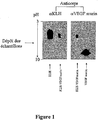
- the figure 1 shows that the murine KLH-VEGF heterocomplex migrates as a single band at a pI different from the native molecules constituting it.
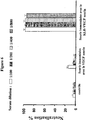
- the figure 2 shows that the human KLH-VEGF heterocomplex migrates as a single band at a pI different from the native molecules the constituent.
- the human VEGF sample was deposited at three different locations to show that it is still migrating to the same location.
- the murine KLH-IL4 heterocomplex exhibits antigenicity identical to the antigenicity of murine IL4.
- the human KLH-IL4 complex has antigenicity equal to the antigenicity of the human IL4 protein.
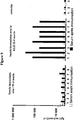
- the figure 3 shows that the human KLH-IL4 heterocomplex migrates in the form of a single band at a pI different from the native molecules constituting it.
- the human KLH-IFN ⁇ complex has antigenicity identical to the antigenicity of human IFN ⁇ .
- the KLH-IFN ⁇ preparation was passed on a S200 superdex column according to the conditions described above. The peak exiting in the exclusion volume was collected, dialyzed and lyophilized. The concentration of antigen of interest was determined by the indirect ELISA technique. The amount of IFN ⁇ found in the excluded volume is 30 ⁇ g whereas 1000 ⁇ g of IFN were used to prepare the immunogenic product, without measurable loss of antigen during the preparation process. The percentage of antigen molecules of interest linked to the KLH molecule by a covalent bond in the immunogenic product comprising KLH-IFN ⁇ heterocomplexes can therefore be estimated at approximately 3%.
- the human gp160-IFN ⁇ complex has antigenicity identical to the antigenicity of the gp160 protein as well as that of human IFN ⁇ .
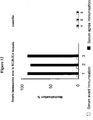
- the figure 4 shows that the gp160-IFN ⁇ uite heterocomplex migrates as a single band at a pI which is very different from the p1 of the recombinant gp160 protein constituting it.
- the pH of this heterocomplex is slightly lower than that of IFN ⁇ .
- the gp160-Tat Toxoid complex has antigenicity identical to the antigenicity of the gp160 protein and that of the Tat protein.
- the gp160-Tat GM complex has antigenicity identical to the antigenicity of the gp160 protein and that of the Tat protein.
- the murine KLH-IL4 heterocomplex exhibits antigenicity identical to the antigenicity of murine IL4.
- the human KLH-IFN ⁇ complex has antigenicity identical to the antigenicity of human IFN ⁇ .
- the Tat- h IgE peptide complex has antigenicity comparable to that of human IgE.
- the KLH-Ricin- ⁇ complex has an antigenicity comparable to that of the ⁇ fragment of the Ricin.
- the complex migrates as a single band and the presence of the ⁇ fragment is evidenced by Western Blot.
- the immunogenic (humoral) activity of the murine KLH-VEGF preparation relative to that of murine VEGF was studied in 18-20 g balb c mice.
- mice On day 0, 7, 14, 21, a group of 8 mice receive an injection of 0.1 ml (10 ⁇ g) of an intramuscular AIF emulsion. A booster injection of 5 ⁇ g in AIF is given at J60.
- a retro-orbital blood sample is taken on each mouse before the first injection at day 2 3 control mice receive the same preparations without immunogen.
- mice are sacrificed 12 days after the last immunization.
- the abnormal toxicity is sought in 3 mice receiving 1 human dose (50 ⁇ g) according to the pharmacopoeia.
- the lack of immunotoxicity of the heterocomplex is evaluated in vitro by a cell proliferation test performed on PBMCs cultured in the presence of the complex and stimulated with PPD or toxoid tetanus.
- the humoral response is measured by the presence in the serum of IgG antibodies directed against murine VEGF, determined by ELISA and expressed as a titre (inverse of the dilution giving an optical density greater than 0.3).
- the figure 5 represents the antibody titers obtained.
- mice immunized with the murine KLH-VEGF preparation have higher IgG antibody titers than mice immunized with murine VEGF only.
- VEGF biological activity assay a selective endothelial cell growth factor.
- Endothelial cells (HUVECs) are cultured in flat-bottomed wells of a microculture plate at 3000 cells per well. The sera from each group of mice were pooled. Different dilutions of these pools of sera (1/100 - 1/800) taken on D-2 and D72 were pre-incubated for 2 hours with 20 ng / ml of murine VEGF and then deposited on these endothelial cells. The cell culture was continued at 37 ° C. in a humid atmosphere charged at 5% CO 2 for 3 days.
- the antibodies induced by the complex have a greater neutralizing power than that induced by murine VEGF.
- the immunogenic activity (humoral) of the human KLH-VEGF preparation relative to that of human VEGF was studied in Balb c mice of 18-20 g.
- mice On day 0, 7, 14, 21, a group of 8 mice receive an injection of 0.1 ml (10 ⁇ g) of an intramuscular AIF emulsion. A booster injection of 5 ⁇ g in AIF is given at J60.
- a retro-orbital blood sample is taken on each mouse before the first injection at day 2 3 control mice receive the same preparations without immunogen.
- mice are sacrificed 12 days after the last immunization.
- the abnormal toxicity is sought in 3 mice receiving 1 human dose (50 ⁇ g) according to the pharmacopoeia.
- the lack of immunotoxicity of the heterocomplex is evaluated in vitro by a cell proliferation test performed on PBMCs cultured in the presence of the complex and stimulated with PPD or toxoid tetanus.
- mice immunized with both the human KLH-VEGF preparation and the human VEGF alone showed no clinical signs and no anatomical lesions.
- the test Immunosuppression shows that doses of 100 ng / ml to 1 ⁇ g / ml of human KLH-VEGF do not decrease the proliferation of lymphocytes.
- the humoral response is measured by the presence in the serum of IgG antibodies directed against human VEGF, determined by ELISA and expressed as a titre (inverse of the dilution giving an optical density greater than 0.3).
- the figure 7 represents the antibody titers obtained.
- mice immunized with the human KLH-VEGF preparation have higher IgG antibody titers than mice immunized with human VEGF alone.
- VEGF biological activity assay a selective endothelial cell growth factor.
- Endothelial cells (HUVECs) are cultured in flat-bottomed wells of a microculture plate at 3000 cells per well. The sera from each group of mice were pooled. Different dilutions of these pools of sera (1/100 - 1/800) taken on D-2 and D72 are preincubated for 2 hours with 20 ng / ml of human VEGF and then deposited on these endothelial cells. The cell culture is continued at 37 ° C. in a humid atmosphere charged with 5% CO 2 for 3 days.
- the antibodies induced by the complex have a greater neutralizing power than that induced by human VEGF.
- the immunogenic (humoral) activity of the murine KLH-IL4 preparation relative to that of murine IL4 was studied in the 18-20 g balb c mouse.
- mice On day 0, 7, 14, 21, a group of 8 mice receive an injection of 0.1 ml (10 ⁇ g) of an intramuscular AIF emulsion. A booster injection of 5 ⁇ g in AIF is given at J60.
- a retro-orbital blood sample is taken on each mouse before the first injection at day 2 to day 72 3 control mice receive the same preparations without immunogen. 14 days after the last immunization, control mice and mice immunized with murine KLH-IL4 are challenged with birch pollen in the presence of alum (100 ⁇ g / mouse) subcutaneously at D74, D95 and D109. Blood samples are taken regularly to monitor the appearance of class G and E antibodies against Bet v 1, a major allergen of birch pollen.
- the abnormal toxicity is sought in 3 mice receiving 1 human dose (50 ⁇ g) according to the pharmacopoeia.
- the lack of immunotoxicity of the heterocomplex is evaluated in vitro by a cell proliferation test performed on PBMCs cultured in the presence of the complex and stimulated with PPD or toxoid tetanus.
- the humoral response is measured by the presence in the serum of IgG antibodies directed against murine IL4, determined by ELISA and expressed as a titre (inverse of the dilution giving an optical density greater than 0.3).
- the figure 9 represents the antibody titers obtained.
- mice immunized with the murine KLH-IL4 preparation had higher IgG antibody titers than mice immunized with murine IL4 alone.
- mice immunized with the murine KLH-IL4 preparation was measured using the murine IL4 biological activity assay.
- This test uses HT-2 cells, murine cell lines whose growth is murine II4 -dependent ( Watson, J. 1979. J. Exp. Med. 150: 1510 .).
- HT-2 cells are grown in round bottom wells of a microculture plate at 10,000 cells per well.
- Sera diluted 1/50 taken on D-2 and D72 are preincubated for 2 hours with 50 ng / ml of murine II4 and then deposited on HT-2 cells.
- the cell culture is continued at 37 ° C. in a humid atmosphere charged with 5% CO 2 for 3 days.
- the antibodies induced by the complex are neutralizing.
- mice immunized with KLH-IL4murin possessing neutralizing IgG directed against murine IL4 block the production of IgE directed against Bet v 1 and begin to produce IgG antibodies directed against Bet v1.
- the immunogenic (humoral) activity of the human KLH-IL4 preparation relative to that of human IL4 was studied in 18-20 g balb c mice.
- mice On day 0, 7, 14, 21, a group of 3 mice receives an injection of 0.1 ml (10 ⁇ g) of an intramuscular AIF emulsion. A booster injection of 5 ⁇ g in AIF is given at J60.
- a retro-orbital blood sample is taken on each mouse before the first injection at day 2 3 control mice receive the same preparations without immunogen.
- mice are sacrificed 12 days after the last immunization.
- the abnormal toxicity is sought in 3 mice receiving 1 human dose (50 ⁇ g) according to the pharmacopoeia.
- the lack of immunotoxicity of the heterocomplex is evaluated in vitro by a cell proliferation test performed on PBMCs cultured in the presence of the complex and stimulated with PPD or toxoid tetanus.
- mice immunized with both human KLH-IL4 preparation and human IL4 only showed no clinical signs and no anatomical lesions.
- the immunosuppression test shows that doses of 100 ng / ml to 1 ⁇ g / ml of human KLH-IL4 do not decrease the proliferation of lymphocytes.
- the humoral response is measured by the presence in the serum of IgG antibodies directed against human IL4, determined by ELISA and expressed as a titre (inverse of the dilution giving an optical density greater than 0.3).
- mice immunized with the human KLH-IL4 preparation have higher IgG antibody titers than mice immunized with human IL4 alone.
- the neutralizing activity of these antibodies induced by the human KLH-IL4 preparation was measured using the human IL4 biological activity test.
- This assay uses TF-1 cells, a human cell line whose growth is human-dependent IL4 ( Kitamura, T. et al., 1989. J. Cell Physiol. 140: 323-34 ).
- TF-1 cells are grown in round bottom wells of a microculture plate at 10,000 cells per well.
- Sera diluted 1/50 taken on D-2 and J72 pre-incubated for 2 hours with 50 ng / ml of human IL4 are then deposited on the TF-1 cells.
- the cell culture is continued at 37 ° C. in a humid atmosphere charged with 5% CO 2 for 3 days.
- the antibodies induced by the complex are neutralizing.
- the immunogenic activity (humoral) of the human KLH-IFN ⁇ preparation relative to that of human IFN ⁇ was studied in Balb c mice of 18-20 g.
- mice On day 0, 7, 14, 21, a group of 3 mice receives an injection of 0.1 ml (10 ⁇ g) of an intramuscular AIF emulsion. A booster injection of 5 ⁇ g in AIF is given at J60.
- a retro-orbital blood sample is taken on each mouse before the first injection at day 2 3 control mice receive the same preparations without immunogen.
- mice are sacrificed 12 days after the last immunization.
- the lack of immunotoxicity of the heterocomplex is evaluated in vitro by a cell proliferation test performed on PBMCs cultured in the presence of the complex and stimulated with PPD or toxoid tetanus.
- mice immunized with both the human KLH-IFN ⁇ preparation and the human IFN ⁇ alone show no clinical signs and no anatomical lesions.
- the immunosuppression test shows that doses of 100 ng / ml to 1 ⁇ g / ml of human KLH-IFN ⁇ do not decrease the proliferation of lymphocytes.
- the humoral response is measured by the presence in the serum of IgG antibodies directed against human IFN ⁇ , determined by ELISA and expressed as a titre (inverse of the dilution giving an optical density greater than 0.3).
- Table 2 shows the antibody titers obtained.
- mouse control 1 ⁇ 500 -1 ⁇ 500 -1 mouse control 2 ⁇ 500 -1 ⁇ 500 -1 mouse control 3 ⁇ 500 -1 ⁇ 500 -1 mice immunized with IFN ⁇ : mouse 4 ⁇ 500 -1 96,000 -1 mouse 5 ⁇ 500 -1 128,000 -1 mouse 6 ⁇ 500 -1 96,000 -1 mice immunized with the KLH-IFN ⁇ complex : mouse 7 ⁇ 500 -1 96,000 -1 mouse 8 ⁇ 500 -1 96,000 -1 mouse 9 ⁇ 500 -1 128,000 -1
- mice immunized with the human KLH-IFN ⁇ preparation have IgG antibody titers equivalent to those of mice immunized with human IFN ⁇ only.
- the neutralizing activity of these antibodies was measured using the biological activity test of human IFN ⁇ . ( Rubinstein S, J Virol, 1981,755-8 ).
- This antiviral effect measurement test aims to evaluate the inhibition of MDBK cell lysis by VSV (Vesicular Stomatitis virus) in the presence of IFN.
- MDBK cells are cultured in round bottom wells of a microculture plate at 350,000 cells per well. Different dilutions of sera (1/100 to 1/800) taken on D-2 and D72 are preincubated for 2 hours with 5 ng / ml of human IFN ⁇ and then deposited on the MDBK cells. After 20 hours of cell culture carried out at 37 ° C.
- the antibodies induced by the complex have a greater neutralizing power than that induced by human IFN ⁇ .
- the results are given in% of neutralization.
- the immunogenic (humoral) activity of the human gp160-IFN ⁇ preparation relative to that of human IFN ⁇ was studied in the 18-20 g balb c mouse.
- mice On day 0, 7, 14, 21, a group of 3 mice receives an injection of 0.1 ml (10 ⁇ g) of an intramuscular AIF emulsion. A booster injection of 5 ⁇ g in AIF is given at J60.
- a retro-orbital blood sample is taken on each mouse before the first injection at day 2 3 control mice receive the same preparations without immunogen.
- mice are sacrificed 12 days after the last immunization.
- the lack of immunotoxicity of the heterocomplex is evaluated in vitro by a cell proliferation test performed on PBMCs cultured in the presence of the complex and stimulated with PPD or toxoid tetanus.
- mice immunized with both human gp160-IFN preparation and human IFN ⁇ alone showed no clinical signs and no anatomical lesions.
- the immunosuppression test shows that doses of 100 ng / ml to 1 ⁇ g / ml of human gp160-IFN ⁇ do not decrease the proliferation of lymphocytes.
- the humoral response is measured by the presence in the serum of IgG antibodies directed against human IFN determined by ELISA and expressed in title (inverse of the dilution giving an optical density greater than 0.3).
- mice immunized with the human gp160-IFN ⁇ preparation have IgG antibody titers equivalent to those of mice immunized with human IFN ⁇ only.
- mice immunized with IFN ⁇ 1/100 1/200 1/400 1/800 mouse 4 d-2 0 0 0 J72 100 80 70 53 mouse 5 d-2 0 0 0 0 J72 100 70 65 50 mouse 6 d-2 0 0 0 0 J72 100 65 60 57 mice immunized with the gp160-IFN ⁇ conjugate : 1/100 1/200 1/400 1/800 mouse 7 days 0 0 0 0 J72 100 100 100 100 mouse 8 d-2 0 0 0 J72 100 100 100 100 mouse 9 d-2 0 0 0 0 J72 100 100 100 100 100 100 100 100 100 100 100 100 100 100 100 100 100 100 100 100
- the antibodies induced by the complex have a greater neutralizing power than that induced by human IFN ⁇ .
- the immunogenic activity (humoral and cellular) of the toxoid gp160-Tat preparation relative to that of the toxoid Tat was studied in the 18-20 g balb c mouse.
- mice On day 0, 7, 14, 21, a group of 3 mice receives an injection of 0.1 ml (10 ⁇ g) of an intramuscular AIF emulsion. A booster injection of 5 ⁇ g in AIF is given at J60.
- a retro-orbital blood sample is taken on each mouse before the first injection at day 2 3 control mice receive the same preparations without immunogen.
- mice are sacrificed 12 days after the last immunization.
- the lack of immunotoxicity of the heterocomplex is evaluated in vitro by a cell proliferation test performed on PBMCs grown in the presence of the complex and stimulated by PPD or toxoid tetanus.
- mice control 1 ⁇ 500 -1 ⁇ 500 -1 mouse control 2 ⁇ 500 -1 ⁇ 500 -1 mouse control 3 ⁇ 500 -1 ⁇ 500 -1 mice immunized with the toxoid Tat: mouse 4 ⁇ 500 -1 48,000 -1 mouse 5 ⁇ 500 -1 64,000 -1 mouse 6 ⁇ 500 -1 48,000 -1 mice immunized with the toxoid gp160-Tat conjugate: mouse 7 ⁇ 500 -1 64,000 -1 mouse 8 ⁇ 500 -1 128,000 -1 mouse 9 ⁇ 500 -1 64,000 -1
- mice immunized with the toxoid gp160-Tat preparation had larger anti-Tat IgG antibody titers than those mice immunized with toxoid Tat only.
- the neutralizing activity of these antibodies was measured using the Cat assay. Different dilutions of sera (1/100 - 1/800) taken on D-2 and D72 are incubated for 2 hours with 50 ng / ml of native Tat. These dilutions are then deposited on HeLa cells, cells stably transfected with a plasmid containing the HIV-1 LTR as a promoter of the chloramphenicol acetyl transferase (CAT) gene. After 24 hours of culture, the cells are lysed and the amount of CAT protein produced is measured by an ELISA, the Cat assay, (Boehringer Mannheim).
- CAT chloramphenicol acetyl transferase
- mice immunized with the toxoid Tat 1/100 1/200 1/400 1/800 mouse 4 d-2 0 0 0 0 J72 60 50 25 20 mouse 5 d-2 0 0 0 0 J72 60 55 30 20 mouse 6 d-2 0 0 0 0 J72 65 50 30 30 mice immunized with the toxoid gp160-Tat conjugate: 1/100 1/200 1/400 1/800 mouse 7 days 0 0 0 0 J72 100 100 100 100 mouse 8 d-2 0 0 0 J72 100 100 100 100 mouse 9 d-2 0 0 0 0 J72 100 100 100 100 100 100 100 100
- the antibodies induced by the toxoid gp160-Tat conjugate have a greater neutralizing power than that induced by the toxoid Tat.
- the production of MIP1 ⁇ in the culture supernatants of splenocytes The splenocytes of the immunized mice and the control mice are isolated and then cultured in round-bottom wells of a micro-culture plate at the rate of 100,000 cells / well in the presence of 5 ⁇ g / ml of p24, gp160, Tat native and a mixture of 5 ⁇ g / ml gp160 and 5 ⁇ g / ml of native Tat. The supernatants are removed after 24 hours of culture and the presence of MIP1 in the supernatants is measured using an R & D ELISA test. The results are expressed in ⁇ g / ml.
- mice immunized with the toxoid gp160-Tat conjugate produce more MIP1 ⁇ chemokines than the cells of mice immunized with the toxoid Tat only when they are activated, in vitro, by the immunogens used during the immunization.
- the splenocytes of the immunized mice and the control mice are isolated and then cultured in round bottom wells of a micro-culture plate at the rate of 100,000 cells / well in the presence of p24, gp160, native Tat and a mixture of gp160 and native Tat.
- the cell culture is continued at 37 ° C. in a humid atmosphere charged with 5% CO 2 for 6 days. 18 hours before the end of the incubation, 0.5 ⁇ Ci of tritiated thymidine / well are added.
- the intensity of the immune response is proportional to the Ip proliferation index.
- mice immunized with the toxoid gp160-Tat conjugate or the toxoid Tat proliferate, when activated, in vitro, with the immunogens used during the immunization.
- the immunogenic activity (humoral and cellular) of the gp160-Tat GM preparation relative to that of the toxoid Tat was studied in the Balb c mouse of 18-20 g.
- mice On day 0, 7, 14, 21, a group of 3 mice receives an injection of 0.1 ml (10 ⁇ g) of an intramuscular AIF emulsion. A booster injection of 5 ⁇ g in AIF is given at J60.
- a retro-orbital blood sample is taken on each mouse before the first injection at day 2 3 control mice receive the same preparations without immunogen.
- mice are sacrificed 12 days after the last immunization.
- the lack of immunotoxicity of the heterocomplex is evaluated in vitro by a cell proliferation test performed on PBMCs cultured in the presence of the complex and stimulated with PPD or toxoid tetanus.
- mice immunized with both the gp160-Tat GM preparation and the toxoid Tat only showed no clinical signs and no anatomical lesions.
- the immunosuppression test shows that doses of 100 ng / ml to 1 ⁇ g / ml gp160-toxoid Tat do not decrease the proliferation of lymphocytes.
- the humoral response is measured by the presence in the serum of IgG antibodies directed against Tat, determined by ELISA and expressed as a titre (inverse of the dilution giving an optical density greater than 0.3).
- Table 1 shows the antibody titers obtained.
- mice immunized with the gp160-Tat GM preparation show greater anti-Tat IgG antibody titers than those of Tat GM-only mice.
- the immunogenic activity (humoral) of the murine KLH-TNF ⁇ preparation relative to that of murine TNF ⁇ was studied in Balb / c mice of 18-20 g.
- a group of 3 mice receives an injection of 0.1 ml of an intramuscular AIF emulsion containing 60 ⁇ g of the KLH-TNF ⁇ heterocomplex.
- a booster injection of 30 ⁇ g and 15 ⁇ g AIF is given respectively at D21 and D60.
- 3 control mice receive an equivalent dose of murine TNF ⁇ according to the same protocol.
- mice On day 0, a group of 3 mice (group C) receives an injection of 0.1 ml of an intramuscular AlF emulsion containing 60 ⁇ g of the murine KLH-TNF ⁇ heterocomplex and 30 ⁇ g of the phosphorothioate 5'-oligodeoxynucleotide. TCCATGACGTTCCTGACGTT-3 '(CpG DNA: 1826). A booster injection of 30 ⁇ g and 15 ⁇ g murine KLH-TNF ⁇ heterocomplex in AIF is given at D21 and D60, respectively. 3 control mice receive an equivalent dose of murine TNF ⁇ according to the same protocol. (group D) A retro-orbital blood sample is taken on each mouse before the first injection at day 2 The mice are sacrificed 12 days after the last immunization.
- the abnormal toxicity is sought in 3 mice receiving 1 human dose (50 ⁇ g) according to the pharmacopoeia.
- the lack of immunotoxicity of the heterocomplex is evaluated in vitro by a cell proliferation test performed on PBMCs cultured in the presence of the complex and stimulated with PPD or toxoid tetanus.
- mice immunized with both the murine KLH-TNF ⁇ preparation and murine TNF ⁇ alone showed no clinical signs and no anatomical lesions.
- the immunosuppression test shows that doses of 100 ng / ml to 1 ⁇ g / ml of murine KLH-TNF ⁇ do not decrease the proliferation of lymphocytes.
- the humoral response is measured by the presence in the serum of IgG antibodies directed against murine TNF ⁇ , determined by ELISA and expressed by title.
- the presence of IgA antibodies against murine TNF ⁇ in vaginal secretions was also determined by ELISA and expressed by title.
- the title represents the inverse of the dilution giving an optical density greater than 0.3.
- the following table shows the antibody titres obtained.
- the immunogenic activity (humoral) of the human KLH-IgE preparation relative to that of human IgE was studied in Balb / c mice of 18-20 g.
- mice On day 0, 7, 14, 21, a group of 3 mice receives an injection of 0.1 ml (10 ⁇ g) of an intramuscular AIF emulsion. A booster injection of 5 ⁇ g in AIF is given at J60.
- a retro-orbital blood sample is taken on each mouse before the first injection at day 2 3 control mice receive the same preparations without immunogen.
- mice are sacrificed 12 days after the last immunization.
- the abnormal toxicity is sought in 3 mice receiving 1 human dose (50 ⁇ g) according to the pharmacopoeia.
- the lack of immunotoxicity of the heterocomplex is evaluated in vitro by a cell proliferation test performed on PBMCs cultured in the presence of the complex and stimulated with PPD or toxoid tetanus.
- mice immunized with both the human KLH-IgE preparation and the human IgE alone showed no clinical signs and no anatomical lesions.
- the immunosuppression test shows that doses of 100 ng / ml to 1 ⁇ g / ml of human KLH-IgE do not decrease the proliferation of lymphocytes.
- the humoral response is measured by the presence in the serum of IgG antibodies directed against human IgE, determined by ELISA and expressed as a titre (inverse of the dilution giving an optical density of greater than 0.3). obtained antibodies.
- mice immunized with KLH pm IgE preparation have titles of IgG antibodies slightly higher than those of mice immunized with the preparation of h IgE.
- the immunogenic activity (humoral) of the KLH-Ricin- ⁇ preparation relative to that of the ⁇ -fragment of the Ricin was studied in Balb / c mice of 18-20 g.
- mice On day 0, 7, 14, 21, a group of 3 mice receives an injection of 0.1 ml (10 ⁇ g) of an intramuscular AIF emulsion. A booster injection of 5 ⁇ g in AIF is given at J60.
- a retro-orbital blood sample is taken on each mouse before the first injection at day 2 3 control mice receive the same preparations without immunogen.
- mice are sacrificed 12 days after the last immunization.
- the abnormal toxicity is sought in 3 mice receiving 1 human dose (50 ⁇ g) according to the pharmacopoeia.
- the lack of immunotoxicity of the heterocomplex is evaluated in vitro by a cell proliferation test performed on PBMCs cultured in the presence of the complex and stimulated with PPD or toxoid tetanus.
- mice immunized both by the KLH-Ricin-human preparation and by the ⁇ -fragment of Ricin alone show no clinical sign and no anatomical lesion.
- the immunosuppression test shows that doses of 100 ng / ml to 1 ⁇ g / ml of KLH-Ricin- ⁇ do not decrease the proliferation of lymphocytes.
- the humoral response is measured by the presence in the serum of IgG antibodies directed against the ⁇ fragment of the Ricin, determined by ELISA and expressed as the titre (inverse of the dilution giving an optical density greater than 0.3). the antibody titres obtained.
Landscapes
- Health & Medical Sciences (AREA)
- Life Sciences & Earth Sciences (AREA)
- Medicinal Chemistry (AREA)
- Chemical & Material Sciences (AREA)
- Bioinformatics & Cheminformatics (AREA)
- Engineering & Computer Science (AREA)
- Pharmacology & Pharmacy (AREA)
- Animal Behavior & Ethology (AREA)
- General Health & Medical Sciences (AREA)
- Public Health (AREA)
- Veterinary Medicine (AREA)
- Immunology (AREA)
- Proteomics, Peptides & Aminoacids (AREA)
- Epidemiology (AREA)
- Molecular Biology (AREA)
- Organic Chemistry (AREA)
- Chemical Kinetics & Catalysis (AREA)
- General Chemical & Material Sciences (AREA)
- Nuclear Medicine, Radiotherapy & Molecular Imaging (AREA)
- Microbiology (AREA)
- Mycology (AREA)
- Virology (AREA)
- Oncology (AREA)
- Toxicology (AREA)
- Tropical Medicine & Parasitology (AREA)
- Communicable Diseases (AREA)
- Pulmonology (AREA)
- AIDS & HIV (AREA)
- Hematology (AREA)
- Medicines Containing Antibodies Or Antigens For Use As Internal Diagnostic Agents (AREA)
- Peptides Or Proteins (AREA)
- Medicinal Preparation (AREA)
Claims (17)
- Stabiles immunogenes Produkt zur Induzierung von Antikörpern gegen ein oder mehrere antigene Proteine in einem Subjekt, dadurch gekennzeichnet, dass es aus immunogenen Proteinheterokomplexen besteht, die aus Assoziationen von (i) antigenen Proteinmolekülen und (ii) Trägerproteinmolekülen aufgebaut sind, wobei mindestens 1 % und weniger als 40 % der antigenen Proteine (i) mit den Trägerproteinmolekülen (ii) mittels einer kovalenten Bindung verbunden sind, und dass das oder die antigenen Proteine (i) aus Cytokinen bestehen, die natürlicherweise von dem Subjekt hergestellt werden.
- Immunogenes Produkt nach Anspruch 1, dadurch gekennzeichnet, dass jeder Heterokomplex (i) eine Vielzahl von antigenen Proteinen, die an ein Trägerproteinmolekül (ii) gebunden sind, umfasst.
- Immunogenes Produkt nach Anspruch 2, dadurch gekennzeichnet, dass für jeden immunogenen Heterokomplex die Vielzahl der antigenen Proteine (i) aus einer Vielzahl von Exemplaren eines einzigen antigenen Proteins aufgebaut ist.
- Immunogenes Produkt nach einem der Ansprüche 2 oder 3, dadurch gekennzeichnet, dass für jeden immunogenen Heterokomplex die antigenen Proteine (i) aus einer Vielzahl von Exemplaren eines Proteins aufgebaut sind, das normalerweise von den Zellen des Immunsystem des Subjekts als Selbstprotein erkannt wird.
- Produkt nach einem der Ansprüche 1 bis 4, dadurch gekennzeichnet, dass es 5 bis 50 antigene Proteine (i) für ein Trägerproteinmolekül (ii) umfasst, bevorzugt 20 bis 40 antigene Proteine (i) für ein Trägerproteinmolekül (ii).
- Immunogenes Produkt nach einem der Ansprüche 1 bis 5, dadurch gekennzeichnet, dass die kovalenten Bindungen zwischen einem oder mehreren der antigenen Proteine (i) und dem Trägerproteinmolekül (ii) mittels eines bifunktionellen chemischen Bindemittels realisiert werden.
- Immunogenes Produkt nach Anspruch 6, dadurch gekennzeichnet, dass das chemische Bindungsmittel mindestens zwei freie Aldehydfunktionen aufweist.
- Immunogenes Produkt nach Anspruch 7, dadurch gekennzeichnet, dass das Bindungsmittel Glutaraldehyd ist.
- Immunogenes Produkt nach einem der Ansprüche 1 bis 8, dadurch gekennzeichnet, dass das oder die antigenen Proteine (i) aus Interleukin-4, Interferon-alpha, Interferongamma, VEGF, Interleukin-10, TNF-alpha, TGF-beta, Interleukin-5 und Interleukin-6 ausgewählt sind.
- Immunogenes Produkt nach einem der Ansprüche 1 bis 9, dadurch gekennzeichnet, dass es aus Produkten ausgewählt ist, welche die folgenden Heterokomplexe umfassen, worin die antigenen Proteine (i) einerseits und das Trägerproteinmolekül (ii) andererseits jeweils sind:a) (i) IL-4 und (ii) KLH;b) (i) Interferon-alpha und (ii) KLH;c) (i) VEGF und (ii) KLH;d) (i) IL-10 und (ii) KLH;e) (i)Interferon-alpha und (ii) gp 160 von VIH1f) (i) IL-4 und (ii) allergenes Antigen Bet v 1g) (i) VEGF und (ii) das Papillomaprotein E7, undh) (i)TNFα und (ii) KLH.
- Zusammensetzung, welche ein immunogenes Produkt nach einem der Ansprüche 1 bis 10 umfasst.
- Pharmazeutische Zusammensetzung, umfassend ein immunogenes Produkt nach einem der Ansprüche 1 bis 10 zusammen mit einem oder mehreren physiologisch verträglichen Exzipienten.
- Immunogene Zusammensetzung, umfassend ein immunogenes Produkt nach einem der Ansprüche 1 bis 10 zusammen mit einem oder mehreren physiologisch verträglichen Exzipienten.
- Impfzusammensetzung, umfassend ein immunogenes Produkt nach einem der Ansprüche 1 bis 10 zusammen mit einem oder mehreren physiologisch verträglichen Exzipienten.
- Immunogene Zusammensetzung oder Impfzusammensetzung nach einem der Ansprüche 13 oder 14, dadurch gekennzeichnet, dass die Zusammensetzung das Immunitätsadjuvans CpG umfasst.
- Verfahren zur Herstellung eines immunogenen Produkts nach einem der Ansprüche 1 bis 9, dadurch gekennzeichnet, dass es die folgenden Schritte aufweist:a) Inkubieren der antigenen Proteine (i), bestehend aus Cytokinen, die natürlicherweise von einem Subjekt hergestellt werden, und des Trägermoleküls (ii) in einem Molverhältnis (i):(ii) von 5:1 bis 50:1 in Gegenwart eines chemischen Bindungsmittels;b) Stabilisieren der in Schritt (a) gebildeten Heterokomplexe durch Behandlung mit Formaldehyd undc) Gewinnen des in Schritt b) gebildeten immunogenen Produkts, welches die immunogenen Heterokomplexe umfasst.
- Verfahren nach Anspruch 16, dadurch gekennzeichnet, dass das chemische Bindungsmittel Glutaraldehyd ist.
Applications Claiming Priority (3)
| Application Number | Priority Date | Filing Date | Title |
|---|---|---|---|
| FR0211455 | 2002-09-16 | ||
| FR0211455A FR2844514B1 (fr) | 2002-09-16 | 2002-09-16 | Produit immunogene stable comprenant des heterocomplexes antigeniques, compositions les contenant et procede de preparation |
| PCT/FR2003/002733 WO2004024189A1 (fr) | 2002-09-16 | 2003-09-16 | Produit immunogene stable comprenant des heterocomplexes antigeniques |
Publications (2)
| Publication Number | Publication Date |
|---|---|
| EP1542729A1 EP1542729A1 (de) | 2005-06-22 |
| EP1542729B1 true EP1542729B1 (de) | 2013-11-06 |
Family
ID=31897411
Family Applications (1)
| Application Number | Title | Priority Date | Filing Date |
|---|---|---|---|
| EP03772373.1A Expired - Lifetime EP1542729B1 (de) | 2002-09-16 | 2003-09-16 | Stabiles immunogen produkt enthaltend antigenische hetero-komplexe |
Country Status (13)
| Country | Link |
|---|---|
| US (3) | US7972603B2 (de) |
| EP (1) | EP1542729B1 (de) |
| JP (2) | JP4698223B2 (de) |
| CN (1) | CN1723041B (de) |
| AU (1) | AU2003279427B2 (de) |
| BR (1) | BRPI0314373B8 (de) |
| CA (1) | CA2499214C (de) |
| DK (1) | DK1542729T3 (de) |
| ES (1) | ES2445331T3 (de) |
| FR (1) | FR2844514B1 (de) |
| NZ (1) | NZ538835A (de) |
| WO (1) | WO2004024189A1 (de) |
| ZA (1) | ZA200502184B (de) |
Families Citing this family (25)
| Publication number | Priority date | Publication date | Assignee | Title |
|---|---|---|---|---|
| CN101495645B (zh) * | 2005-03-23 | 2012-08-22 | 生物-拉德实验室公司 | 蛋白纯化方法 |
| BRPI0609932A2 (pt) * | 2005-05-24 | 2011-10-11 | Neovacs | métodos para preparar um produto imunogênico anti-tnfalfa e para preparar uma composição de vacina, produto imunogênico anti-tnfalfa, composição imunogênica, e, composição de vacina |
| ATE465205T1 (de) * | 2005-12-05 | 2010-05-15 | Nitto Denko Corp | Polyglutamat-aminosäure-konjugate und verfahren |
| US7794732B2 (en) * | 2006-05-12 | 2010-09-14 | Oklahoma Medical Research Foundation | Anthrax compositions and methods of use and production |
| ZA200900899B (en) * | 2006-08-07 | 2010-07-28 | Harvard College | Protein matrix vaccines and methods of making and administering such vaccines |
| US20080181852A1 (en) * | 2007-01-29 | 2008-07-31 | Nitto Denko Corporation | Multi-functional Drug Carriers |
| JP2010526159A (ja) * | 2007-04-10 | 2010-07-29 | 日東電工株式会社 | 多機能性ポリグルタミン酸塩薬物担体 |
| PT2155255E (pt) | 2007-05-09 | 2013-10-15 | Nitto Denko Corp | Composições que incluem um composto hidrofóbico e um conjugado de poliaminoácido |
| CU23652A1 (es) * | 2007-06-29 | 2011-05-27 | Centro Inmunologia Molecular | Composición vacunal homogénea para el tratamiento del cáncer y su método de obtención |
| WO2009111271A1 (en) * | 2008-03-06 | 2009-09-11 | Nitto Denko Corporation | Polymer paclitaxel conjugates and methods for treating cancer |
| CN102008719A (zh) * | 2010-12-02 | 2011-04-13 | 上海微球生物科技有限公司 | 克服b细胞免疫耐受的免疫微球及其应用 |
| WO2012076668A1 (en) | 2010-12-08 | 2012-06-14 | Neovacs | Strongly inactivated and still highly immunogenic vaccine and process of manufacturing thereof |
| EP2462950A1 (de) | 2010-12-08 | 2012-06-13 | Neovacs | Stark inaktivierter und weiterhin hoch immunogener Impfstoff, sowie Verfahren zu seiner Herstellung |
| CA2832260C (en) | 2011-04-07 | 2021-06-22 | Neovacs | Method for treating ifnalpha related conditions |
| WO2013188669A1 (en) | 2012-06-13 | 2013-12-19 | Auto Research Center, Llc | Wake convergence device for a vehicle |
| US9199673B2 (en) | 2012-10-30 | 2015-12-01 | Wabash National, L.P. | Aerodynamic rear drag reduction system for a trailer |
| US8973974B2 (en) * | 2013-04-30 | 2015-03-10 | Wabash National, L.P. | Aerodynamic rear fairing system for a trailer |
| US9409609B2 (en) | 2014-03-24 | 2016-08-09 | Auto Research Center, Llc | Wake convergence device for a pick-up truck |
| US9616944B2 (en) | 2014-05-15 | 2017-04-11 | Wabash National, L.P. | Aerodynamic rear drag reduction system for a trailer |
| CA2921058A1 (en) | 2015-02-16 | 2016-08-16 | Wabash National, L.P. | Aerodynamic rear drag reduction system for a trailer |
| US9776674B2 (en) | 2015-04-29 | 2017-10-03 | Wabash National, L.P. | Aerodynamic rear drag reduction system for a trailer |
| MX376788B (es) | 2015-04-29 | 2025-03-07 | Wabash National Lp | Sistema aerodinámico de reducción de resistencia trasera para un remolque. |
| CN108289909A (zh) | 2015-10-19 | 2018-07-17 | 巴尔的摩马里兰大学 | 用于产生工程改造的人原代血液树突细胞系的方法 |
| CN108752480B (zh) * | 2018-05-30 | 2022-03-29 | 中元汇吉生物技术股份有限公司 | 一种免疫原组合物、其制备方法及其用途 |
| US20210283238A1 (en) * | 2018-08-07 | 2021-09-16 | Glaxosmithkline Biologicals Sa | Novel processes and vaccines |
Citations (1)
| Publication number | Priority date | Publication date | Assignee | Title |
|---|---|---|---|---|
| FR2759296A1 (fr) * | 1997-02-07 | 1998-08-14 | Commissariat Energie Atomique | Complexe non-covalent comprenant au moins un anticorps et un element de liaison aux immunoglobulines associe a une substance active, son procede de preparation et ses applications |
Family Cites Families (19)
| Publication number | Priority date | Publication date | Assignee | Title |
|---|---|---|---|---|
| US98203A (en) * | 1869-12-21 | Improvement in elevators | ||
| FR2635532B1 (fr) | 1988-07-29 | 1992-05-22 | Pasteur Institut | Particules hbsag recombinantes hybrides : caracteristiques morphologiques de l'antigene hbsag contenant 1 sequence immunogene induisant des anticorps neutralisants diriges contre hiv ou susceptible d'etre reconnue par de tels anticorps; sequences nucleotidiques codant pour de telles particules; vaccins les contenant |
| US5008116A (en) | 1988-11-14 | 1991-04-16 | Frederick Cahn | Immunostimulatory microsphere |
| SE467542B (sv) * | 1989-06-13 | 1992-08-03 | Syntello Ab | Syntetiska peptidantigener, immuniserande komposition och immunanalys foer htlv-1 antikroppar |
| WO1991001146A1 (en) | 1989-07-14 | 1991-02-07 | Praxis Biologics, Inc. | Cytokine and hormone carriers for conjugate vaccines |
| FR2677654B1 (fr) * | 1991-06-17 | 1995-11-17 | Pasteur Merieux Serums Vacc | Composes a effet immunogene anti-cytokine, a effet immunogene anticytostatique ou a effet vaccinal anti-infection a hiv. |
| PL322143A1 (en) * | 1995-03-08 | 1998-01-05 | Neovacs | Non-topxic immunogenes originating frommretroviral regulator protein, antibodies as such, method of preparing them and pharmaceutic compositions containing them |
| FR2731355B1 (fr) * | 1995-03-08 | 1997-05-30 | Neovacs | Nouveaux immunogenes, nouveaux anticorps, procede de preparation et compositions pharmaceutiques les renfermant |
| US6093045A (en) * | 1996-03-13 | 2000-07-25 | Osram Sylvania Inc. | Electrical connector module and kit having tamper proof latch mechanism |
| WO1998026747A2 (en) * | 1996-12-17 | 1998-06-25 | Terman David S | Superantigen based methods and compositions for treatment of diseases |
| TR199902562T2 (xx) * | 1997-04-15 | 2000-02-21 | Farmaceutisk Laboratorium Ferring A/S | De�i�tirilmi� TNF alfa molek�lleri |
| JP3591264B2 (ja) * | 1997-12-24 | 2004-11-17 | 富士レビオ株式会社 | Vegf121特異的モノクローナル抗体及び測定方法 |
| JP2002514573A (ja) * | 1998-05-08 | 2002-05-21 | スローン − ケッタリング インスティチュート フォー キャンサー リサーチ | 能動的なワクチン接種のための組成物および方法 |
| FR2781158B1 (fr) * | 1998-07-15 | 2002-12-13 | Vacs Internat | Nouvelles proteines modifiees immunogenes non immunosuppressives, leur procede de preparation et leurs applications |
| FR2792639B1 (fr) * | 1999-04-26 | 2003-06-06 | Neovacs | Nouveaux immunogenes anti-vih (toxoides), nouveaux procedes de preparation et application a la prevention et au traitement du sida |
| JP2003521881A (ja) * | 1999-05-13 | 2003-07-22 | オーストラリアン ポーク リミティッド | ローソニア由来の遺伝子及び関連OmpHポリペプチド、ぺプチド及びタンパク質並びにそれらの使用 |
| FR2812813B1 (fr) * | 2000-08-09 | 2004-11-26 | Neovacs | Utilisation d'immunogenes pour traiter ou prevenir au sein des tumeurs malignes les dereglements immunitaires induits par des facteurs extracellulaires |
| AUPR011700A0 (en) * | 2000-09-14 | 2000-10-05 | Austin Research Institute, The | Composition comprising immunogenic virus sized particles (VSP) |
| JP2004510724A (ja) | 2000-10-06 | 2004-04-08 | ヤゴテック アーゲー | 分子量の低下した澱粉からなる微粒子中に埋め込まれた免疫学的活性物質を含むワクチン組成物 |
-
2002
- 2002-09-16 FR FR0211455A patent/FR2844514B1/fr not_active Expired - Fee Related
-
2003
- 2003-09-16 AU AU2003279427A patent/AU2003279427B2/en not_active Expired
- 2003-09-16 EP EP03772373.1A patent/EP1542729B1/de not_active Expired - Lifetime
- 2003-09-16 NZ NZ538835A patent/NZ538835A/en not_active IP Right Cessation
- 2003-09-16 US US10/527,975 patent/US7972603B2/en not_active Expired - Lifetime
- 2003-09-16 BR BRPI0314373A patent/BRPI0314373B8/pt not_active IP Right Cessation
- 2003-09-16 WO PCT/FR2003/002733 patent/WO2004024189A1/fr not_active Ceased
- 2003-09-16 ES ES03772373.1T patent/ES2445331T3/es not_active Expired - Lifetime
- 2003-09-16 JP JP2004535614A patent/JP4698223B2/ja not_active Expired - Lifetime
- 2003-09-16 DK DK03772373.1T patent/DK1542729T3/da active
- 2003-09-16 CN CN038251477A patent/CN1723041B/zh not_active Expired - Lifetime
- 2003-09-16 CA CA2499214A patent/CA2499214C/fr not_active Expired - Lifetime
-
2005
- 2005-03-15 ZA ZA2005/02184A patent/ZA200502184B/en unknown
- 2005-05-24 US US11/135,660 patent/US8372388B2/en not_active Expired - Fee Related
-
2010
- 2010-10-19 JP JP2010234523A patent/JP2011012084A/ja active Pending
-
2011
- 2011-05-31 US US13/149,041 patent/US8697047B2/en not_active Expired - Lifetime
Patent Citations (1)
| Publication number | Priority date | Publication date | Assignee | Title |
|---|---|---|---|---|
| FR2759296A1 (fr) * | 1997-02-07 | 1998-08-14 | Commissariat Energie Atomique | Complexe non-covalent comprenant au moins un anticorps et un element de liaison aux immunoglobulines associe a une substance active, son procede de preparation et ses applications |
Non-Patent Citations (2)
| Title |
|---|
| RICHARD M ET AL: "ANTI-IL-9 VACCINATION PREVENTS WORM EXPULSION AND BLOOD EOSINOPHILIA IN TRICHURIS MURIS-INFECTED MICE", PROCEEDINGS OF THE NATIONAL ACADEMY OF SCIENCES OF THE UNITED STATES (PNAS), NATIONAL ACADEMY OF SCIENCE, US LNKD- DOI:10.1073/PNAS.97.2.767, vol. 97, no. 2, 18 January 2000 (2000-01-18), pages 767 - 772, XP000985925, ISSN: 0027-8424 * |
| SCOTT ET AL: "When is a search not a search? The EPO approach", WORLD PATENT INFORMATION, ELSEVIER, AMSTERDAM, NL, vol. 29, no. 2, 5 April 2007 (2007-04-05), pages 108 - 116, XP022021330, ISSN: 0172-2190, DOI: 10.1016/J.WPI.2006.10.011 * |
Also Published As
| Publication number | Publication date |
|---|---|
| WO2004024189A1 (fr) | 2004-03-25 |
| CA2499214C (fr) | 2014-02-11 |
| FR2844514B1 (fr) | 2007-10-19 |
| US8697047B2 (en) | 2014-04-15 |
| US8372388B2 (en) | 2013-02-12 |
| DK1542729T3 (da) | 2014-02-10 |
| JP2011012084A (ja) | 2011-01-20 |
| BRPI0314373B8 (pt) | 2021-05-25 |
| JP2006504689A (ja) | 2006-02-09 |
| EP1542729A1 (de) | 2005-06-22 |
| BR0314373A (pt) | 2005-07-19 |
| US20110250174A1 (en) | 2011-10-13 |
| CN1723041B (zh) | 2012-07-18 |
| US7972603B2 (en) | 2011-07-05 |
| AU2003279427A1 (en) | 2004-04-30 |
| CN1723041A (zh) | 2006-01-18 |
| CA2499214A1 (fr) | 2004-03-25 |
| FR2844514A1 (fr) | 2004-03-19 |
| US20060067944A1 (en) | 2006-03-30 |
| ES2445331T3 (es) | 2014-03-03 |
| BRPI0314373B1 (pt) | 2019-11-05 |
| NZ538835A (en) | 2006-07-28 |
| ZA200502184B (en) | 2005-12-28 |
| AU2003279427B2 (en) | 2008-12-18 |
| US20060013800A1 (en) | 2006-01-19 |
| JP4698223B2 (ja) | 2011-06-08 |
Similar Documents
| Publication | Publication Date | Title |
|---|---|---|
| EP1542729B1 (de) | Stabiles immunogen produkt enthaltend antigenische hetero-komplexe | |
| EP0591281B1 (de) | Immunogene verbindungen mit spezifischem anti-cytokin effekt, methode zur herstellung, pharmazeutische zusammensetzung und reaktionskit der diese enthält | |
| EP0814834B1 (de) | Von einem retroviralen regulationsprotein abstammende, detoxifierte immunogene, dagegen gerichtete antikörper, verfahren zur deren herstellung und diese immunogene oder antikörper enthaltende, pharmazeutische zusammensetzungen. | |
| BE1021938B1 (fr) | Composition immunogene pour une utilisation en therapie | |
| EP1096953B1 (de) | Verwendung von immunogenen immunsuppressiven und/oder angiogenen proteinen die inaktiviert sind, verfahren zur deren herstellung, und verwendungen als pharmazeutikum oder impfstoff | |
| CN104507496A (zh) | 包含与crm197载体蛋白偶联的hiv gp41肽的免疫原性化合物 | |
| CA2418899C (fr) | Utilisation d'immunogenes pour traiter ou prevenir au sein des tumeurs malignes les dereglements immunitaires ou vasculaires induits par des facteurs extracellulaires | |
| EP1668036A2 (de) | Verfahren mit hoher ausbeute zur herstellung humaner antikörper, die die biologische wirkung eines humanen cytokins blockieren | |
| EP1427441B1 (de) | VERBUNDSUPERIMMUNOGEN ZUR VERWENDUNG ALS BIFUNKTIONELLER IMPFSTOFF (Tat-gp160) ZUR BEHANDLUNG VON AIDS | |
| EP1237573B1 (de) | Vewendung von inaktivierten immunogenen immunsuppressiven und/oder angiogenen proteinen zur sekretorischen iga herstellung | |
| FR2694938A1 (fr) | Nouveaux peptides, anticorps dirigés contre ces peptides, anticorps anti-idiotypiques, application à titre de médicaments, compositions pharmaceutiques et kits de diagnostic les renfermant. | |
| CA3163277A1 (fr) | Conjugue immunogene destine a induire une reponse immunitaire dirigee contre l'interleukine-6 |
Legal Events
| Date | Code | Title | Description |
|---|---|---|---|
| PUAI | Public reference made under article 153(3) epc to a published international application that has entered the european phase |
Free format text: ORIGINAL CODE: 0009012 |
|
| 17P | Request for examination filed |
Effective date: 20050418 |
|
| AK | Designated contracting states |
Kind code of ref document: A1 Designated state(s): AT BE BG CH CY CZ DE DK EE ES FI FR GB GR HU IE IT LI LU MC NL PT RO SE SI SK TR |
|
| AX | Request for extension of the european patent |
Extension state: AL LT LV MK |
|
| DAX | Request for extension of the european patent (deleted) | ||
| 17Q | First examination report despatched |
Effective date: 20100430 |
|
| RIN1 | Information on inventor provided before grant (corrected) |
Inventor name: LE BUANEC, HELENE Inventor name: ZAGURY, DANIEL |
|
| GRAP | Despatch of communication of intention to grant a patent |
Free format text: ORIGINAL CODE: EPIDOSNIGR1 |
|
| INTG | Intention to grant announced |
Effective date: 20130528 |
|
| GRAS | Grant fee paid |
Free format text: ORIGINAL CODE: EPIDOSNIGR3 |
|
| GRAA | (expected) grant |
Free format text: ORIGINAL CODE: 0009210 |
|
| AK | Designated contracting states |
Kind code of ref document: B1 Designated state(s): AT BE BG CH CY CZ DE DK EE ES FI FR GB GR HU IE IT LI LU MC NL PT RO SE SI SK TR |
|
| REG | Reference to a national code |
Ref country code: GB Ref legal event code: FG4D Free format text: NOT ENGLISH |
|
| REG | Reference to a national code |
Ref country code: CH Ref legal event code: EP |
|
| REG | Reference to a national code |
Ref country code: AT Ref legal event code: REF Ref document number: 638973 Country of ref document: AT Kind code of ref document: T Effective date: 20131215 |
|
| REG | Reference to a national code |
Ref country code: IE Ref legal event code: FG4D Free format text: LANGUAGE OF EP DOCUMENT: FRENCH |
|
| REG | Reference to a national code |
Ref country code: DE Ref legal event code: R096 Ref document number: 60345248 Country of ref document: DE Effective date: 20131224 |
|
| REG | Reference to a national code |
Ref country code: CH Ref legal event code: NV Representative=s name: KIRKER AND CIE S.A., CH |
|
| REG | Reference to a national code |
Ref country code: DE Ref legal event code: R082 Ref document number: 60345248 Country of ref document: DE Representative=s name: PATENTANWAELTE STREHL, SCHUEBEL-HOPF & PARTNER, DE Ref country code: DE Ref legal event code: R082 Ref document number: 60345248 Country of ref document: DE Representative=s name: STREHL SCHUEBEL-HOPF & PARTNER MBB PATENTANWAE, DE |
|
| REG | Reference to a national code |
Ref country code: DK Ref legal event code: T3 Effective date: 20140204 |
|
| REG | Reference to a national code |
Ref country code: NL Ref legal event code: T3 |
|
| REG | Reference to a national code |
Ref country code: SE Ref legal event code: TRGR |
|
| REG | Reference to a national code |
Ref country code: ES Ref legal event code: FG2A Ref document number: 2445331 Country of ref document: ES Kind code of ref document: T3 Effective date: 20140303 |
|
| PG25 | Lapsed in a contracting state [announced via postgrant information from national office to epo] |
Ref country code: FI Free format text: LAPSE BECAUSE OF FAILURE TO SUBMIT A TRANSLATION OF THE DESCRIPTION OR TO PAY THE FEE WITHIN THE PRESCRIBED TIME-LIMIT Effective date: 20131106 |
|
| PG25 | Lapsed in a contracting state [announced via postgrant information from national office to epo] |
Ref country code: PT Free format text: LAPSE BECAUSE OF FAILURE TO SUBMIT A TRANSLATION OF THE DESCRIPTION OR TO PAY THE FEE WITHIN THE PRESCRIBED TIME-LIMIT Effective date: 20140306 |
|
| PG25 | Lapsed in a contracting state [announced via postgrant information from national office to epo] |
Ref country code: EE Free format text: LAPSE BECAUSE OF FAILURE TO SUBMIT A TRANSLATION OF THE DESCRIPTION OR TO PAY THE FEE WITHIN THE PRESCRIBED TIME-LIMIT Effective date: 20131106 |
|
| REG | Reference to a national code |
Ref country code: DE Ref legal event code: R097 Ref document number: 60345248 Country of ref document: DE |
|
| PG25 | Lapsed in a contracting state [announced via postgrant information from national office to epo] |
Ref country code: SK Free format text: LAPSE BECAUSE OF FAILURE TO SUBMIT A TRANSLATION OF THE DESCRIPTION OR TO PAY THE FEE WITHIN THE PRESCRIBED TIME-LIMIT Effective date: 20131106 Ref country code: RO Free format text: LAPSE BECAUSE OF FAILURE TO SUBMIT A TRANSLATION OF THE DESCRIPTION OR TO PAY THE FEE WITHIN THE PRESCRIBED TIME-LIMIT Effective date: 20131106 Ref country code: CZ Free format text: LAPSE BECAUSE OF FAILURE TO SUBMIT A TRANSLATION OF THE DESCRIPTION OR TO PAY THE FEE WITHIN THE PRESCRIBED TIME-LIMIT Effective date: 20131106 |
|
| PLBE | No opposition filed within time limit |
Free format text: ORIGINAL CODE: 0009261 |
|
| STAA | Information on the status of an ep patent application or granted ep patent |
Free format text: STATUS: NO OPPOSITION FILED WITHIN TIME LIMIT |
|
| 26N | No opposition filed |
Effective date: 20140807 |
|
| REG | Reference to a national code |
Ref country code: DE Ref legal event code: R097 Ref document number: 60345248 Country of ref document: DE Effective date: 20140807 |
|
| PG25 | Lapsed in a contracting state [announced via postgrant information from national office to epo] |
Ref country code: SI Free format text: LAPSE BECAUSE OF FAILURE TO SUBMIT A TRANSLATION OF THE DESCRIPTION OR TO PAY THE FEE WITHIN THE PRESCRIBED TIME-LIMIT Effective date: 20131106 |
|
| PG25 | Lapsed in a contracting state [announced via postgrant information from national office to epo] |
Ref country code: MC Free format text: LAPSE BECAUSE OF FAILURE TO SUBMIT A TRANSLATION OF THE DESCRIPTION OR TO PAY THE FEE WITHIN THE PRESCRIBED TIME-LIMIT Effective date: 20131106 Ref country code: LU Free format text: LAPSE BECAUSE OF FAILURE TO SUBMIT A TRANSLATION OF THE DESCRIPTION OR TO PAY THE FEE WITHIN THE PRESCRIBED TIME-LIMIT Effective date: 20140916 |
|
| REG | Reference to a national code |
Ref country code: IE Ref legal event code: MM4A |
|
| PG25 | Lapsed in a contracting state [announced via postgrant information from national office to epo] |
Ref country code: IE Free format text: LAPSE BECAUSE OF NON-PAYMENT OF DUE FEES Effective date: 20140916 |
|
| PG25 | Lapsed in a contracting state [announced via postgrant information from national office to epo] |
Ref country code: BG Free format text: LAPSE BECAUSE OF FAILURE TO SUBMIT A TRANSLATION OF THE DESCRIPTION OR TO PAY THE FEE WITHIN THE PRESCRIBED TIME-LIMIT Effective date: 20131106 |
|
| PG25 | Lapsed in a contracting state [announced via postgrant information from national office to epo] |
Ref country code: GR Free format text: LAPSE BECAUSE OF FAILURE TO SUBMIT A TRANSLATION OF THE DESCRIPTION OR TO PAY THE FEE WITHIN THE PRESCRIBED TIME-LIMIT Effective date: 20140207 Ref country code: CY Free format text: LAPSE BECAUSE OF FAILURE TO SUBMIT A TRANSLATION OF THE DESCRIPTION OR TO PAY THE FEE WITHIN THE PRESCRIBED TIME-LIMIT Effective date: 20131106 |
|
| PG25 | Lapsed in a contracting state [announced via postgrant information from national office to epo] |
Ref country code: HU Free format text: LAPSE BECAUSE OF FAILURE TO SUBMIT A TRANSLATION OF THE DESCRIPTION OR TO PAY THE FEE WITHIN THE PRESCRIBED TIME-LIMIT; INVALID AB INITIO Effective date: 20030916 |
|
| REG | Reference to a national code |
Ref country code: FR Ref legal event code: PLFP Year of fee payment: 14 |
|
| REG | Reference to a national code |
Ref country code: DE Ref legal event code: R079 Ref document number: 60345248 Country of ref document: DE Free format text: PREVIOUS MAIN CLASS: A61K0047480000 Ipc: A61K0047500000 |
|
| REG | Reference to a national code |
Ref country code: FR Ref legal event code: PLFP Year of fee payment: 15 |
|
| REG | Reference to a national code |
Ref country code: FR Ref legal event code: PLFP Year of fee payment: 16 |
|
| PGFP | Annual fee paid to national office [announced via postgrant information from national office to epo] |
Ref country code: TR Payment date: 20220916 Year of fee payment: 20 Ref country code: SE Payment date: 20220920 Year of fee payment: 20 Ref country code: NL Payment date: 20220920 Year of fee payment: 20 Ref country code: GB Payment date: 20220920 Year of fee payment: 20 Ref country code: DK Payment date: 20220922 Year of fee payment: 20 Ref country code: DE Payment date: 20220920 Year of fee payment: 20 Ref country code: AT Payment date: 20220921 Year of fee payment: 20 |
|
| PGFP | Annual fee paid to national office [announced via postgrant information from national office to epo] |
Ref country code: FR Payment date: 20220922 Year of fee payment: 20 Ref country code: BE Payment date: 20220920 Year of fee payment: 20 |
|
| PGFP | Annual fee paid to national office [announced via postgrant information from national office to epo] |
Ref country code: IT Payment date: 20220926 Year of fee payment: 20 Ref country code: ES Payment date: 20221121 Year of fee payment: 20 |
|
| PGFP | Annual fee paid to national office [announced via postgrant information from national office to epo] |
Ref country code: CH Payment date: 20220928 Year of fee payment: 20 |
|
| P01 | Opt-out of the competence of the unified patent court (upc) registered |
Effective date: 20230519 |
|
| REG | Reference to a national code |
Ref country code: DE Ref legal event code: R071 Ref document number: 60345248 Country of ref document: DE |
|
| REG | Reference to a national code |
Ref country code: DK Ref legal event code: EUP Expiry date: 20230916 |
|
| REG | Reference to a national code |
Ref country code: NL Ref legal event code: MK Effective date: 20230915 |
|
| REG | Reference to a national code |
Ref country code: ES Ref legal event code: FD2A Effective date: 20230926 |
|
| REG | Reference to a national code |
Ref country code: CH Ref legal event code: PL |
|
| REG | Reference to a national code |
Ref country code: BE Ref legal event code: MK Effective date: 20230916 |
|
| REG | Reference to a national code |
Ref country code: GB Ref legal event code: PE20 Expiry date: 20230915 |
|
| PG25 | Lapsed in a contracting state [announced via postgrant information from national office to epo] |
Ref country code: GB Free format text: LAPSE BECAUSE OF EXPIRATION OF PROTECTION Effective date: 20230915 Ref country code: ES Free format text: LAPSE BECAUSE OF EXPIRATION OF PROTECTION Effective date: 20230917 |
|
| REG | Reference to a national code |
Ref country code: SE Ref legal event code: EUG |
|
| REG | Reference to a national code |
Ref country code: AT Ref legal event code: MK07 Ref document number: 638973 Country of ref document: AT Kind code of ref document: T Effective date: 20230916 |