EP1542942B1 - Zusammensetzungen, die ionische flüssigkeiten enthalten, und deren vewendungen, insbesondere in der organischen synthese - Google Patents
Zusammensetzungen, die ionische flüssigkeiten enthalten, und deren vewendungen, insbesondere in der organischen synthese Download PDFInfo
- Publication number
- EP1542942B1 EP1542942B1 EP03798215A EP03798215A EP1542942B1 EP 1542942 B1 EP1542942 B1 EP 1542942B1 EP 03798215 A EP03798215 A EP 03798215A EP 03798215 A EP03798215 A EP 03798215A EP 1542942 B1 EP1542942 B1 EP 1542942B1
- Authority
- EP
- European Patent Office
- Prior art keywords
- carbon atoms
- functional
- representing
- group
- cation
- Prior art date
- Legal status (The legal status is an assumption and is not a legal conclusion. Google has not performed a legal analysis and makes no representation as to the accuracy of the status listed.)
- Expired - Lifetime
Links
- 239000000203 mixture Substances 0.000 title claims abstract description 159
- 239000002608 ionic liquid Substances 0.000 title claims abstract description 123
- 238000003786 synthesis reaction Methods 0.000 title claims abstract description 46
- 150000001450 anions Chemical class 0.000 claims abstract description 178
- 150000001768 cations Chemical class 0.000 claims abstract description 172
- 239000011159 matrix material Substances 0.000 claims abstract description 98
- 239000007787 solid Substances 0.000 claims abstract description 95
- 239000007788 liquid Substances 0.000 claims abstract description 74
- 150000003839 salts Chemical class 0.000 claims description 161
- 125000004432 carbon atom Chemical group C* 0.000 claims description 158
- 238000006243 chemical reaction Methods 0.000 claims description 138
- 125000000217 alkyl group Chemical group 0.000 claims description 132
- 230000006870 function Effects 0.000 claims description 118
- 125000003118 aryl group Chemical group 0.000 claims description 65
- RTZKZFJDLAIYFH-UHFFFAOYSA-N Diethyl ether Chemical compound CCOCC RTZKZFJDLAIYFH-UHFFFAOYSA-N 0.000 claims description 61
- -1 sulphonium cations Chemical class 0.000 claims description 56
- 238000000034 method Methods 0.000 claims description 47
- 239000002904 solvent Substances 0.000 claims description 45
- 239000003153 chemical reaction reagent Substances 0.000 claims description 32
- 230000015572 biosynthetic process Effects 0.000 claims description 28
- HXITXNWTGFUOAU-UHFFFAOYSA-N phenylboronic acid Chemical compound OB(O)C1=CC=CC=C1 HXITXNWTGFUOAU-UHFFFAOYSA-N 0.000 claims description 22
- 238000007792 addition Methods 0.000 claims description 21
- ZXMGHDIOOHOAAE-UHFFFAOYSA-N 1,1,1-trifluoro-n-(trifluoromethylsulfonyl)methanesulfonamide Chemical compound FC(F)(F)S(=O)(=O)NS(=O)(=O)C(F)(F)F ZXMGHDIOOHOAAE-UHFFFAOYSA-N 0.000 claims description 20
- 238000010586 diagram Methods 0.000 claims description 19
- QGZKDVFQNNGYKY-UHFFFAOYSA-O Ammonium Chemical class [NH4+] QGZKDVFQNNGYKY-UHFFFAOYSA-O 0.000 claims description 17
- 125000004435 hydrogen atom Chemical group [H]* 0.000 claims description 16
- 238000006069 Suzuki reaction reaction Methods 0.000 claims description 13
- 150000002148 esters Chemical class 0.000 claims description 13
- 238000001704 evaporation Methods 0.000 claims description 12
- 230000008020 evaporation Effects 0.000 claims description 12
- XYFCBTPGUUZFHI-UHFFFAOYSA-O phosphonium Chemical class [PH4+] XYFCBTPGUUZFHI-UHFFFAOYSA-O 0.000 claims description 12
- 238000002360 preparation method Methods 0.000 claims description 12
- 150000001299 aldehydes Chemical class 0.000 claims description 11
- 125000003710 aryl alkyl group Chemical group 0.000 claims description 11
- 238000003776 cleavage reaction Methods 0.000 claims description 11
- 238000005809 transesterification reaction Methods 0.000 claims description 11
- 125000000391 vinyl group Chemical group [H]C([*])=C([H])[H] 0.000 claims description 11
- XYFCBTPGUUZFHI-UHFFFAOYSA-N Phosphine Chemical compound P XYFCBTPGUUZFHI-UHFFFAOYSA-N 0.000 claims description 10
- 229910052799 carbon Inorganic materials 0.000 claims description 10
- 125000002091 cationic group Chemical group 0.000 claims description 10
- 238000000605 extraction Methods 0.000 claims description 10
- 125000001072 heteroaryl group Chemical group 0.000 claims description 10
- 229910052740 iodine Inorganic materials 0.000 claims description 10
- 125000002534 ethynyl group Chemical group [H]C#C* 0.000 claims description 9
- 230000007017 scission Effects 0.000 claims description 9
- YXFVVABEGXRONW-UHFFFAOYSA-N Toluene Chemical compound CC1=CC=CC=C1 YXFVVABEGXRONW-UHFFFAOYSA-N 0.000 claims description 8
- 125000000129 anionic group Chemical group 0.000 claims description 8
- 150000004820 halides Chemical class 0.000 claims description 8
- 239000002253 acid Substances 0.000 claims description 7
- 150000001412 amines Chemical class 0.000 claims description 7
- 150000001502 aryl halides Chemical class 0.000 claims description 7
- 125000000484 butyl group Chemical group [H]C([*])([H])C([H])([H])C([H])([H])C([H])([H])[H] 0.000 claims description 7
- 125000001495 ethyl group Chemical group [H]C([H])([H])C([H])([H])* 0.000 claims description 7
- 125000001436 propyl group Chemical group [H]C([*])([H])C([H])([H])C([H])([H])[H] 0.000 claims description 7
- 125000003903 2-propenyl group Chemical group [H]C([*])([H])C([H])=C([H])[H] 0.000 claims description 6
- 238000005698 Diels-Alder reaction Methods 0.000 claims description 6
- IMNFDUFMRHMDMM-UHFFFAOYSA-N N-Heptane Chemical compound CCCCCCC IMNFDUFMRHMDMM-UHFFFAOYSA-N 0.000 claims description 6
- BLRPTPMANUNPDV-UHFFFAOYSA-N Silane Chemical compound [SiH4] BLRPTPMANUNPDV-UHFFFAOYSA-N 0.000 claims description 6
- 125000004093 cyano group Chemical group *C#N 0.000 claims description 6
- 125000004430 oxygen atom Chemical group O* 0.000 claims description 6
- 229910052707 ruthenium Inorganic materials 0.000 claims description 6
- 229910000077 silane Inorganic materials 0.000 claims description 6
- KXCAEQNNTZANTK-UHFFFAOYSA-N stannane Chemical compound [SnH4] KXCAEQNNTZANTK-UHFFFAOYSA-N 0.000 claims description 6
- 229910000080 stannane Inorganic materials 0.000 claims description 6
- DZLFLBLQUQXARW-UHFFFAOYSA-N tetrabutylammonium Chemical compound CCCC[N+](CCCC)(CCCC)CCCC DZLFLBLQUQXARW-UHFFFAOYSA-N 0.000 claims description 6
- HSFWRNGVRCDJHI-UHFFFAOYSA-N alpha-acetylene Natural products C#C HSFWRNGVRCDJHI-UHFFFAOYSA-N 0.000 claims description 5
- ZADPBFCGQRWHPN-UHFFFAOYSA-N boronic acid Chemical compound OBO ZADPBFCGQRWHPN-UHFFFAOYSA-N 0.000 claims description 5
- 150000002466 imines Chemical class 0.000 claims description 5
- 229910000073 phosphorus hydride Inorganic materials 0.000 claims description 5
- JUJWROOIHBZHMG-UHFFFAOYSA-O pyridinium Chemical class C1=CC=[NH+]C=C1 JUJWROOIHBZHMG-UHFFFAOYSA-O 0.000 claims description 5
- UORVGPXVDQYIDP-UHFFFAOYSA-N trihydridoboron Substances B UORVGPXVDQYIDP-UHFFFAOYSA-N 0.000 claims description 5
- 238000007341 Heck reaction Methods 0.000 claims description 4
- RAXXELZNTBOGNW-UHFFFAOYSA-O Imidazolium Chemical class C1=C[NH+]=CN1 RAXXELZNTBOGNW-UHFFFAOYSA-O 0.000 claims description 4
- XEEYBQQBJWHFJM-UHFFFAOYSA-N Iron Chemical compound [Fe] XEEYBQQBJWHFJM-UHFFFAOYSA-N 0.000 claims description 4
- 125000002252 acyl group Chemical group 0.000 claims description 4
- 125000004453 alkoxycarbonyl group Chemical group 0.000 claims description 4
- 150000001408 amides Chemical class 0.000 claims description 4
- 125000003236 benzoyl group Chemical group [H]C1=C([H])C([H])=C(C([H])=C1[H])C(*)=O 0.000 claims description 4
- 229910000085 borane Inorganic materials 0.000 claims description 4
- 125000003187 heptyl group Chemical group [H]C([*])([H])C([H])([H])C([H])([H])C([H])([H])C([H])([H])C([H])([H])C([H])([H])[H] 0.000 claims description 4
- 125000000623 heterocyclic group Chemical group 0.000 claims description 4
- 125000004051 hexyl group Chemical group [H]C([H])([H])C([H])([H])C([H])([H])C([H])([H])C([H])([H])C([H])([H])* 0.000 claims description 4
- 125000002887 hydroxy group Chemical group [H]O* 0.000 claims description 4
- 125000002347 octyl group Chemical group [H]C([*])([H])C([H])([H])C([H])([H])C([H])([H])C([H])([H])C([H])([H])C([H])([H])C([H])([H])[H] 0.000 claims description 4
- 239000003960 organic solvent Substances 0.000 claims description 4
- 125000001147 pentyl group Chemical group C(CCCC)* 0.000 claims description 4
- BDHFUVZGWQCTTF-UHFFFAOYSA-N sulfonic acid Chemical compound OS(=O)=O BDHFUVZGWQCTTF-UHFFFAOYSA-N 0.000 claims description 4
- 150000003568 thioethers Chemical class 0.000 claims description 4
- 150000003573 thiols Chemical class 0.000 claims description 4
- 238000007056 transamidation reaction Methods 0.000 claims description 4
- RYGMFSIKBFXOCR-UHFFFAOYSA-N Copper Chemical compound [Cu] RYGMFSIKBFXOCR-UHFFFAOYSA-N 0.000 claims description 3
- KCADUUDDTBWILK-UHFFFAOYSA-N Cumulene Natural products CCCC=C=C=C1OC(=O)C=C1 KCADUUDDTBWILK-UHFFFAOYSA-N 0.000 claims description 3
- GYHNNYVSQQEPJS-UHFFFAOYSA-N Gallium Chemical compound [Ga] GYHNNYVSQQEPJS-UHFFFAOYSA-N 0.000 claims description 3
- 239000002841 Lewis acid Substances 0.000 claims description 3
- ZOKXTWBITQBERF-UHFFFAOYSA-N Molybdenum Chemical compound [Mo] ZOKXTWBITQBERF-UHFFFAOYSA-N 0.000 claims description 3
- OAICVXFJPJFONN-UHFFFAOYSA-N Phosphorus Chemical compound [P] OAICVXFJPJFONN-UHFFFAOYSA-N 0.000 claims description 3
- QAOWNCQODCNURD-UHFFFAOYSA-L Sulfate Chemical compound [O-]S([O-])(=O)=O QAOWNCQODCNURD-UHFFFAOYSA-L 0.000 claims description 3
- ATJFFYVFTNAWJD-UHFFFAOYSA-N Tin Chemical compound [Sn] ATJFFYVFTNAWJD-UHFFFAOYSA-N 0.000 claims description 3
- HCHKCACWOHOZIP-UHFFFAOYSA-N Zinc Chemical compound [Zn] HCHKCACWOHOZIP-UHFFFAOYSA-N 0.000 claims description 3
- 229910052782 aluminium Inorganic materials 0.000 claims description 3
- XAGFODPZIPBFFR-UHFFFAOYSA-N aluminium Chemical compound [Al] XAGFODPZIPBFFR-UHFFFAOYSA-N 0.000 claims description 3
- WATWJIUSRGPENY-UHFFFAOYSA-N antimony atom Chemical compound [Sb] WATWJIUSRGPENY-UHFFFAOYSA-N 0.000 claims description 3
- 150000001540 azides Chemical class 0.000 claims description 3
- 229910052797 bismuth Inorganic materials 0.000 claims description 3
- JCXGWMGPZLAOME-UHFFFAOYSA-N bismuth atom Chemical compound [Bi] JCXGWMGPZLAOME-UHFFFAOYSA-N 0.000 claims description 3
- 125000002915 carbonyl group Chemical group [*:2]C([*:1])=O 0.000 claims description 3
- 125000000753 cycloalkyl group Chemical group 0.000 claims description 3
- 150000002118 epoxides Chemical class 0.000 claims description 3
- CCGKOQOJPYTBIH-UHFFFAOYSA-N ethenone Chemical compound C=C=O CCGKOQOJPYTBIH-UHFFFAOYSA-N 0.000 claims description 3
- 229910052733 gallium Inorganic materials 0.000 claims description 3
- 229910052738 indium Inorganic materials 0.000 claims description 3
- APFVFJFRJDLVQX-UHFFFAOYSA-N indium atom Chemical compound [In] APFVFJFRJDLVQX-UHFFFAOYSA-N 0.000 claims description 3
- 150000002576 ketones Chemical class 0.000 claims description 3
- 150000007517 lewis acids Chemical class 0.000 claims description 3
- 125000002496 methyl group Chemical group [H]C([H])([H])* 0.000 claims description 3
- 125000001997 phenyl group Chemical group [H]C1=C([H])C([H])=C(*)C([H])=C1[H] 0.000 claims description 3
- 150000003141 primary amines Chemical class 0.000 claims description 3
- 230000008569 process Effects 0.000 claims description 3
- 150000003335 secondary amines Chemical class 0.000 claims description 3
- 238000000926 separation method Methods 0.000 claims description 3
- 229910052718 tin Inorganic materials 0.000 claims description 3
- 239000011135 tin Substances 0.000 claims description 3
- JOXIMZWYDAKGHI-UHFFFAOYSA-N toluene-4-sulfonic acid Chemical compound CC1=CC=C(S(O)(=O)=O)C=C1 JOXIMZWYDAKGHI-UHFFFAOYSA-N 0.000 claims description 3
- ITMCEJHCFYSIIV-UHFFFAOYSA-M triflate Chemical compound [O-]S(=O)(=O)C(F)(F)F ITMCEJHCFYSIIV-UHFFFAOYSA-M 0.000 claims description 3
- 229910052725 zinc Inorganic materials 0.000 claims description 3
- 239000011701 zinc Substances 0.000 claims description 3
- LLVWLCAZSOLOTF-UHFFFAOYSA-N 1-methyl-4-[1,4,4-tris(4-methylphenyl)buta-1,3-dienyl]benzene Chemical compound C1=CC(C)=CC=C1C(C=1C=CC(C)=CC=1)=CC=C(C=1C=CC(C)=CC=1)C1=CC=C(C)C=C1 LLVWLCAZSOLOTF-UHFFFAOYSA-N 0.000 claims description 2
- AFVFQIVMOAPDHO-UHFFFAOYSA-N Methanesulfonic acid Chemical compound CS(O)(=O)=O AFVFQIVMOAPDHO-UHFFFAOYSA-N 0.000 claims description 2
- 229910014332 N(SO2CF3)2 Inorganic materials 0.000 claims description 2
- RAHZWNYVWXNFOC-UHFFFAOYSA-N Sulphur dioxide Chemical group O=S=O RAHZWNYVWXNFOC-UHFFFAOYSA-N 0.000 claims description 2
- 125000003545 alkoxy group Chemical group 0.000 claims description 2
- 125000004390 alkyl sulfonyl group Chemical group 0.000 claims description 2
- 239000004411 aluminium Substances 0.000 claims description 2
- 229910052787 antimony Inorganic materials 0.000 claims description 2
- 125000004391 aryl sulfonyl group Chemical group 0.000 claims description 2
- JXLHNMVSKXFWAO-UHFFFAOYSA-N azane;7-fluoro-2,1,3-benzoxadiazole-4-sulfonic acid Chemical compound N.OS(=O)(=O)C1=CC=C(F)C2=NON=C12 JXLHNMVSKXFWAO-UHFFFAOYSA-N 0.000 claims description 2
- UORVGPXVDQYIDP-BJUDXGSMSA-N borane Chemical group [10BH3] UORVGPXVDQYIDP-BJUDXGSMSA-N 0.000 claims description 2
- 238000004587 chromatography analysis Methods 0.000 claims description 2
- 229910052802 copper Inorganic materials 0.000 claims description 2
- 239000010949 copper Substances 0.000 claims description 2
- 125000004122 cyclic group Chemical group 0.000 claims description 2
- 125000000524 functional group Chemical group 0.000 claims description 2
- 229910052742 iron Inorganic materials 0.000 claims description 2
- WPBNNNQJVZRUHP-UHFFFAOYSA-L manganese(2+);methyl n-[[2-(methoxycarbonylcarbamothioylamino)phenyl]carbamothioyl]carbamate;n-[2-(sulfidocarbothioylamino)ethyl]carbamodithioate Chemical compound [Mn+2].[S-]C(=S)NCCNC([S-])=S.COC(=O)NC(=S)NC1=CC=CC=C1NC(=S)NC(=O)OC WPBNNNQJVZRUHP-UHFFFAOYSA-L 0.000 claims description 2
- 229910052751 metal Inorganic materials 0.000 claims description 2
- 239000002184 metal Substances 0.000 claims description 2
- JZMJDSHXVKJFKW-UHFFFAOYSA-M methyl sulfate(1-) Chemical compound COS([O-])(=O)=O JZMJDSHXVKJFKW-UHFFFAOYSA-M 0.000 claims description 2
- 229910052750 molybdenum Inorganic materials 0.000 claims description 2
- 239000011733 molybdenum Substances 0.000 claims description 2
- 125000002467 phosphate group Chemical group [H]OP(=O)(O[H])O[*] 0.000 claims description 2
- 229910052698 phosphorus Inorganic materials 0.000 claims description 2
- 239000011574 phosphorus Substances 0.000 claims description 2
- 229910021653 sulphate ion Inorganic materials 0.000 claims description 2
- QEMXHQIAXOOASZ-UHFFFAOYSA-N tetramethylammonium Chemical compound C[N+](C)(C)C QEMXHQIAXOOASZ-UHFFFAOYSA-N 0.000 claims description 2
- 229910052720 vanadium Inorganic materials 0.000 claims description 2
- 125000005647 linker group Chemical group 0.000 claims 8
- 229910052703 rhodium Inorganic materials 0.000 claims 3
- 125000003107 substituted aryl group Chemical group 0.000 claims 3
- 238000005712 Baylis-Hillman reaction Methods 0.000 claims 1
- ATTZFSUZZUNHBP-UHFFFAOYSA-N Piperonyl sulfoxide Chemical compound CCCCCCCCS(=O)C(C)CC1=CC=C2OCOC2=C1 ATTZFSUZZUNHBP-UHFFFAOYSA-N 0.000 claims 1
- 125000001174 sulfone group Chemical group 0.000 claims 1
- TUQOTMZNTHZOKS-UHFFFAOYSA-N tributylphosphine Chemical compound CCCCP(CCCC)CCCC TUQOTMZNTHZOKS-UHFFFAOYSA-N 0.000 claims 1
- 238000005292 vacuum distillation Methods 0.000 claims 1
- CSCPPACGZOOCGX-UHFFFAOYSA-N Acetone Chemical compound CC(C)=O CSCPPACGZOOCGX-UHFFFAOYSA-N 0.000 description 116
- 239000000243 solution Substances 0.000 description 93
- 125000004429 atom Chemical group 0.000 description 80
- 239000000047 product Substances 0.000 description 62
- XLYOFNOQVPJJNP-UHFFFAOYSA-N water Substances O XLYOFNOQVPJJNP-UHFFFAOYSA-N 0.000 description 46
- 238000012360 testing method Methods 0.000 description 35
- OKKJLVBELUTLKV-UHFFFAOYSA-N Methanol Chemical compound OC OKKJLVBELUTLKV-UHFFFAOYSA-N 0.000 description 33
- YMWUJEATGCHHMB-UHFFFAOYSA-N Dichloromethane Chemical compound ClCCl YMWUJEATGCHHMB-UHFFFAOYSA-N 0.000 description 30
- 239000012071 phase Substances 0.000 description 30
- WEVYAHXRMPXWCK-UHFFFAOYSA-N Acetonitrile Chemical compound CC#N WEVYAHXRMPXWCK-UHFFFAOYSA-N 0.000 description 27
- 238000005859 coupling reaction Methods 0.000 description 27
- 229910052757 nitrogen Inorganic materials 0.000 description 23
- LFQSCWFLJHTTHZ-UHFFFAOYSA-N Ethanol Chemical compound CCO LFQSCWFLJHTTHZ-UHFFFAOYSA-N 0.000 description 22
- 230000009257 reactivity Effects 0.000 description 20
- ZMANZCXQSJIPKH-UHFFFAOYSA-N Triethylamine Chemical compound CCN(CC)CC ZMANZCXQSJIPKH-UHFFFAOYSA-N 0.000 description 19
- 239000000758 substrate Substances 0.000 description 18
- 229910052796 boron Inorganic materials 0.000 description 16
- 230000008878 coupling Effects 0.000 description 15
- 238000010168 coupling process Methods 0.000 description 15
- ZOXJGFHDIHLPTG-UHFFFAOYSA-N Boron Chemical compound [B] ZOXJGFHDIHLPTG-UHFFFAOYSA-N 0.000 description 14
- 239000003921 oil Substances 0.000 description 14
- VEXZGXHMUGYJMC-UHFFFAOYSA-N Hydrochloric acid Chemical compound Cl VEXZGXHMUGYJMC-UHFFFAOYSA-N 0.000 description 11
- 239000002585 base Substances 0.000 description 11
- 238000012544 monitoring process Methods 0.000 description 11
- 238000003756 stirring Methods 0.000 description 11
- 239000000126 substance Substances 0.000 description 11
- GETQZCLCWQTVFV-UHFFFAOYSA-N trimethylamine Chemical compound CN(C)C GETQZCLCWQTVFV-UHFFFAOYSA-N 0.000 description 11
- 0 **(CC1)C*1N Chemical compound **(CC1)C*1N 0.000 description 10
- VMHLLURERBWHNL-UHFFFAOYSA-M Sodium acetate Chemical compound [Na+].CC([O-])=O VMHLLURERBWHNL-UHFFFAOYSA-M 0.000 description 10
- ZSWFCLXCOIISFI-UHFFFAOYSA-N cyclopentadiene Chemical compound C1C=CC=C1 ZSWFCLXCOIISFI-UHFFFAOYSA-N 0.000 description 10
- 239000011541 reaction mixture Substances 0.000 description 10
- 238000004064 recycling Methods 0.000 description 10
- NIXOWILDQLNWCW-UHFFFAOYSA-M Acrylate Chemical compound [O-]C(=O)C=C NIXOWILDQLNWCW-UHFFFAOYSA-M 0.000 description 9
- VEXZGXHMUGYJMC-UHFFFAOYSA-M Chloride anion Chemical compound [Cl-] VEXZGXHMUGYJMC-UHFFFAOYSA-M 0.000 description 9
- HEMHJVSKTPXQMS-UHFFFAOYSA-M Sodium hydroxide Chemical compound [OH-].[Na+] HEMHJVSKTPXQMS-UHFFFAOYSA-M 0.000 description 9
- 150000001875 compounds Chemical class 0.000 description 9
- 230000014759 maintenance of location Effects 0.000 description 9
- 238000004949 mass spectrometry Methods 0.000 description 9
- NKPKVNRBHXOADG-UHFFFAOYSA-N 4,6,11-trioxa-1-aza-5-borabicyclo[3.3.3]undecane Chemical compound C1COB2OCCN1CCO2 NKPKVNRBHXOADG-UHFFFAOYSA-N 0.000 description 8
- PAYRUJLWNCNPSJ-UHFFFAOYSA-N Aniline Chemical compound NC1=CC=CC=C1 PAYRUJLWNCNPSJ-UHFFFAOYSA-N 0.000 description 8
- KDLHZDBZIXYQEI-UHFFFAOYSA-N Palladium Chemical compound [Pd] KDLHZDBZIXYQEI-UHFFFAOYSA-N 0.000 description 8
- 238000001914 filtration Methods 0.000 description 8
- 238000002844 melting Methods 0.000 description 8
- 230000008018 melting Effects 0.000 description 8
- 229920005989 resin Polymers 0.000 description 8
- 239000011347 resin Substances 0.000 description 8
- 241001080024 Telles Species 0.000 description 7
- CSCPPACGZOOCGX-WFGJKAKNSA-N acetone d6 Chemical compound [2H]C([2H])([2H])C(=O)C([2H])([2H])[2H] CSCPPACGZOOCGX-WFGJKAKNSA-N 0.000 description 7
- 150000001543 aryl boronic acids Chemical class 0.000 description 7
- 230000008901 benefit Effects 0.000 description 7
- 239000003054 catalyst Substances 0.000 description 7
- 230000000694 effects Effects 0.000 description 7
- 238000001819 mass spectrum Methods 0.000 description 7
- 238000000655 nuclear magnetic resonance spectrum Methods 0.000 description 7
- 229920000642 polymer Polymers 0.000 description 7
- 230000009466 transformation Effects 0.000 description 7
- XKRFYHLGVUSROY-UHFFFAOYSA-N Argon Chemical compound [Ar] XKRFYHLGVUSROY-UHFFFAOYSA-N 0.000 description 6
- BAPJBEWLBFYGME-UHFFFAOYSA-N Methyl acrylate Chemical compound COC(=O)C=C BAPJBEWLBFYGME-UHFFFAOYSA-N 0.000 description 6
- LRHPLDYGYMQRHN-UHFFFAOYSA-N N-Butanol Chemical compound CCCCO LRHPLDYGYMQRHN-UHFFFAOYSA-N 0.000 description 6
- 238000004458 analytical method Methods 0.000 description 6
- 125000004494 ethyl ester group Chemical group 0.000 description 6
- 230000000977 initiatory effect Effects 0.000 description 6
- 150000004702 methyl esters Chemical class 0.000 description 6
- 238000000425 proton nuclear magnetic resonance spectrum Methods 0.000 description 6
- BTBUEUYNUDRHOZ-UHFFFAOYSA-N Borate Chemical compound [O-]B([O-])[O-] BTBUEUYNUDRHOZ-UHFFFAOYSA-N 0.000 description 5
- 150000001503 aryl iodides Chemical class 0.000 description 5
- 238000007306 functionalization reaction Methods 0.000 description 5
- 238000005649 metathesis reaction Methods 0.000 description 5
- IJGRMHOSHXDMSA-UHFFFAOYSA-N nitrogen Substances N#N IJGRMHOSHXDMSA-UHFFFAOYSA-N 0.000 description 5
- YJVFFLUZDVXJQI-UHFFFAOYSA-L palladium(ii) acetate Chemical compound [Pd+2].CC([O-])=O.CC([O-])=O YJVFFLUZDVXJQI-UHFFFAOYSA-L 0.000 description 5
- 229920001223 polyethylene glycol Polymers 0.000 description 5
- QENJZWZWAWWESF-UHFFFAOYSA-N tri-methylbenzoic acid Natural products CC1=CC(C)=C(C(O)=O)C=C1C QENJZWZWAWWESF-UHFFFAOYSA-N 0.000 description 5
- IQQRAVYLUAZUGX-UHFFFAOYSA-N 1-butyl-3-methylimidazolium Chemical compound CCCCN1C=C[N+](C)=C1 IQQRAVYLUAZUGX-UHFFFAOYSA-N 0.000 description 4
- TUXYZHVUPGXXQG-UHFFFAOYSA-N 4-bromobenzoic acid Chemical compound OC(=O)C1=CC=C(Br)C=C1 TUXYZHVUPGXXQG-UHFFFAOYSA-N 0.000 description 4
- QGZKDVFQNNGYKY-UHFFFAOYSA-N Ammonia Chemical compound N QGZKDVFQNNGYKY-UHFFFAOYSA-N 0.000 description 4
- CPELXLSAUQHCOX-UHFFFAOYSA-M Bromide Chemical compound [Br-] CPELXLSAUQHCOX-UHFFFAOYSA-M 0.000 description 4
- OKTJSMMVPCPJKN-UHFFFAOYSA-N Carbon Chemical compound [C] OKTJSMMVPCPJKN-UHFFFAOYSA-N 0.000 description 4
- HEDRZPFGACZZDS-UHFFFAOYSA-N Chloroform Chemical compound ClC(Cl)Cl HEDRZPFGACZZDS-UHFFFAOYSA-N 0.000 description 4
- KFZMGEQAYNKOFK-UHFFFAOYSA-N Isopropanol Chemical compound CC(C)O KFZMGEQAYNKOFK-UHFFFAOYSA-N 0.000 description 4
- DTQVDTLACAAQTR-UHFFFAOYSA-N Trifluoroacetic acid Chemical compound OC(=O)C(F)(F)F DTQVDTLACAAQTR-UHFFFAOYSA-N 0.000 description 4
- 239000008346 aqueous phase Substances 0.000 description 4
- 239000012230 colorless oil Substances 0.000 description 4
- ZBCBWPMODOFKDW-UHFFFAOYSA-N diethanolamine Chemical compound OCCNCCO ZBCBWPMODOFKDW-UHFFFAOYSA-N 0.000 description 4
- 238000009815 homocoupling reaction Methods 0.000 description 4
- 150000002500 ions Chemical class 0.000 description 4
- 238000002156 mixing Methods 0.000 description 4
- 238000006386 neutralization reaction Methods 0.000 description 4
- 229910052763 palladium Inorganic materials 0.000 description 4
- 239000002244 precipitate Substances 0.000 description 4
- 238000001228 spectrum Methods 0.000 description 4
- VDZOOKBUILJEDG-UHFFFAOYSA-M tetrabutylammonium hydroxide Chemical compound [OH-].CCCC[N+](CCCC)(CCCC)CCCC VDZOOKBUILJEDG-UHFFFAOYSA-M 0.000 description 4
- 238000005406 washing Methods 0.000 description 4
- PLDWAJLZAAHOGG-UHFFFAOYSA-N 1-bromo-3-methoxybenzene Chemical compound COC1=CC=CC(Br)=C1 PLDWAJLZAAHOGG-UHFFFAOYSA-N 0.000 description 3
- BXRFQSNOROATLV-UHFFFAOYSA-N 4-nitrobenzaldehyde Chemical compound [O-][N+](=O)C1=CC=C(C=O)C=C1 BXRFQSNOROATLV-UHFFFAOYSA-N 0.000 description 3
- 150000001298 alcohols Chemical class 0.000 description 3
- 150000001336 alkenes Chemical class 0.000 description 3
- 150000003863 ammonium salts Chemical class 0.000 description 3
- 238000013459 approach Methods 0.000 description 3
- 239000007864 aqueous solution Substances 0.000 description 3
- 229910052786 argon Inorganic materials 0.000 description 3
- 150000001642 boronic acid derivatives Chemical class 0.000 description 3
- 230000003197 catalytic effect Effects 0.000 description 3
- 238000009833 condensation Methods 0.000 description 3
- 230000005494 condensation Effects 0.000 description 3
- 239000002826 coolant Substances 0.000 description 3
- 238000002425 crystallisation Methods 0.000 description 3
- 230000008025 crystallization Effects 0.000 description 3
- 238000011161 development Methods 0.000 description 3
- HPNMFZURTQLUMO-UHFFFAOYSA-N diethylamine Chemical compound CCNCC HPNMFZURTQLUMO-UHFFFAOYSA-N 0.000 description 3
- 238000004821 distillation Methods 0.000 description 3
- 238000005516 engineering process Methods 0.000 description 3
- 230000032050 esterification Effects 0.000 description 3
- 238000005886 esterification reaction Methods 0.000 description 3
- 238000000806 fluorine-19 nuclear magnetic resonance spectrum Methods 0.000 description 3
- 238000004128 high performance liquid chromatography Methods 0.000 description 3
- 229910052739 hydrogen Inorganic materials 0.000 description 3
- 239000012074 organic phase Substances 0.000 description 3
- 238000001394 phosphorus-31 nuclear magnetic resonance spectrum Methods 0.000 description 3
- 238000000746 purification Methods 0.000 description 3
- 230000035484 reaction time Effects 0.000 description 3
- 150000003457 sulfones Chemical class 0.000 description 3
- ISXSCDLOGDJUNJ-UHFFFAOYSA-N tert-butyl prop-2-enoate Chemical compound CC(C)(C)OC(=O)C=C ISXSCDLOGDJUNJ-UHFFFAOYSA-N 0.000 description 3
- 238000000844 transformation Methods 0.000 description 3
- NHPPIJMARIVBGU-UHFFFAOYSA-N 1-iodonaphthalene Chemical compound C1=CC=C2C(I)=CC=CC2=C1 NHPPIJMARIVBGU-UHFFFAOYSA-N 0.000 description 2
- NIXOWILDQLNWCW-UHFFFAOYSA-N 2-Propenoic acid Natural products OC(=O)C=C NIXOWILDQLNWCW-UHFFFAOYSA-N 0.000 description 2
- IVLICPVPXWEGCA-UHFFFAOYSA-N 3-quinuclidinol Chemical compound C1C[C@@H]2C(O)C[N@]1CC2 IVLICPVPXWEGCA-UHFFFAOYSA-N 0.000 description 2
- DENKGPBHLYFNGK-UHFFFAOYSA-N 4-bromobenzoyl chloride Chemical compound ClC(=O)C1=CC=C(Br)C=C1 DENKGPBHLYFNGK-UHFFFAOYSA-N 0.000 description 2
- BVKZGUZCCUSVTD-UHFFFAOYSA-L Carbonate Chemical compound [O-]C([O-])=O BVKZGUZCCUSVTD-UHFFFAOYSA-L 0.000 description 2
- CHLICZRVGGXEOD-UHFFFAOYSA-N Cc(cc1)ccc1OC Chemical compound Cc(cc1)ccc1OC CHLICZRVGGXEOD-UHFFFAOYSA-N 0.000 description 2
- CSNNHWWHGAXBCP-UHFFFAOYSA-L Magnesium sulfate Chemical compound [Mg+2].[O-][S+2]([O-])([O-])[O-] CSNNHWWHGAXBCP-UHFFFAOYSA-L 0.000 description 2
- OFBQJSOFQDEBGM-UHFFFAOYSA-N Pentane Chemical compound CCCCC OFBQJSOFQDEBGM-UHFFFAOYSA-N 0.000 description 2
- VYPSYNLAJGMNEJ-UHFFFAOYSA-N Silicium dioxide Chemical compound O=[Si]=O VYPSYNLAJGMNEJ-UHFFFAOYSA-N 0.000 description 2
- 241000897276 Termes Species 0.000 description 2
- 230000004913 activation Effects 0.000 description 2
- 238000013019 agitation Methods 0.000 description 2
- 125000003158 alcohol group Chemical group 0.000 description 2
- 150000001345 alkine derivatives Chemical class 0.000 description 2
- SWLVFNYSXGMGBS-UHFFFAOYSA-N ammonium bromide Chemical compound [NH4+].[Br-] SWLVFNYSXGMGBS-UHFFFAOYSA-N 0.000 description 2
- 229940111121 antirheumatic drug quinolines Drugs 0.000 description 2
- YCOXTKKNXUZSKD-UHFFFAOYSA-N as-o-xylenol Natural products CC1=CC=C(O)C=C1C YCOXTKKNXUZSKD-UHFFFAOYSA-N 0.000 description 2
- QVGXLLKOCUKJST-UHFFFAOYSA-N atomic oxygen Chemical group [O] QVGXLLKOCUKJST-UHFFFAOYSA-N 0.000 description 2
- 150000001721 carbon Chemical group 0.000 description 2
- 150000001732 carboxylic acid derivatives Chemical class 0.000 description 2
- 239000007795 chemical reaction product Substances 0.000 description 2
- 239000000470 constituent Substances 0.000 description 2
- 230000008034 disappearance Effects 0.000 description 2
- 125000006575 electron-withdrawing group Chemical group 0.000 description 2
- 238000010438 heat treatment Methods 0.000 description 2
- 125000005842 heteroatom Chemical group 0.000 description 2
- 239000008241 heterogeneous mixture Substances 0.000 description 2
- 239000008240 homogeneous mixture Substances 0.000 description 2
- 150000004693 imidazolium salts Chemical class 0.000 description 2
- SNHMUERNLJLMHN-UHFFFAOYSA-N iodobenzene Chemical compound IC1=CC=CC=C1 SNHMUERNLJLMHN-UHFFFAOYSA-N 0.000 description 2
- 150000002527 isonitriles Chemical class 0.000 description 2
- KOMLXUNAWWFLRU-UHFFFAOYSA-N lithium;trifluoromethanesulfonamide Chemical compound [Li].NS(=O)(=O)C(F)(F)F.NS(=O)(=O)C(F)(F)F KOMLXUNAWWFLRU-UHFFFAOYSA-N 0.000 description 2
- 238000004519 manufacturing process Methods 0.000 description 2
- 238000005259 measurement Methods 0.000 description 2
- MOVBJUGHBJJKOW-UHFFFAOYSA-N methyl 2-amino-5-methoxybenzoate Chemical compound COC(=O)C1=CC(OC)=CC=C1N MOVBJUGHBJJKOW-UHFFFAOYSA-N 0.000 description 2
- 238000006452 multicomponent reaction Methods 0.000 description 2
- 230000000269 nucleophilic effect Effects 0.000 description 2
- 150000002923 oximes Chemical class 0.000 description 2
- 229910052760 oxygen Inorganic materials 0.000 description 2
- 239000001301 oxygen Chemical group 0.000 description 2
- ZRSNZINYAWTAHE-UHFFFAOYSA-N p-methoxybenzaldehyde Chemical compound COC1=CC=C(C=O)C=C1 ZRSNZINYAWTAHE-UHFFFAOYSA-N 0.000 description 2
- 238000005192 partition Methods 0.000 description 2
- 125000002743 phosphorus functional group Chemical group 0.000 description 2
- BWHMMNNQKKPAPP-UHFFFAOYSA-L potassium carbonate Chemical compound [K+].[K+].[O-]C([O-])=O BWHMMNNQKKPAPP-UHFFFAOYSA-L 0.000 description 2
- 239000000843 powder Substances 0.000 description 2
- 238000001556 precipitation Methods 0.000 description 2
- BDERNNFJNOPAEC-UHFFFAOYSA-N propan-1-ol Chemical compound CCCO BDERNNFJNOPAEC-UHFFFAOYSA-N 0.000 description 2
- 150000003248 quinolines Chemical group 0.000 description 2
- 239000000376 reactant Substances 0.000 description 2
- 239000012429 reaction media Substances 0.000 description 2
- 239000003507 refrigerant Substances 0.000 description 2
- 238000001226 reprecipitation Methods 0.000 description 2
- 238000013341 scale-up Methods 0.000 description 2
- 230000007928 solubilization Effects 0.000 description 2
- 238000005063 solubilization Methods 0.000 description 2
- 230000003381 solubilizing effect Effects 0.000 description 2
- 150000003462 sulfoxides Chemical class 0.000 description 2
- QBUKAFSEUHGMMX-MTJSOVHGSA-N (5z)-5-[[3-(1-hydroxyethyl)thiophen-2-yl]methylidene]-10-methoxy-2,2,4-trimethyl-1h-chromeno[3,4-f]quinolin-9-ol Chemical compound C1=CC=2NC(C)(C)C=C(C)C=2C2=C1C=1C(OC)=C(O)C=CC=1O\C2=C/C=1SC=CC=1C(C)O QBUKAFSEUHGMMX-MTJSOVHGSA-N 0.000 description 1
- SMZOUWXMTYCWNB-UHFFFAOYSA-N 2-(2-methoxy-5-methylphenyl)ethanamine Chemical compound COC1=CC=C(C)C=C1CCN SMZOUWXMTYCWNB-UHFFFAOYSA-N 0.000 description 1
- DUVJMSPTZMCSTQ-UHFFFAOYSA-N 2-ethoxybenzaldehyde Chemical compound CCOC1=CC=CC=C1C=O DUVJMSPTZMCSTQ-UHFFFAOYSA-N 0.000 description 1
- BPOBEWLBMLXUEW-UHFFFAOYSA-N 3-(4-iodobenzoyl)oxypropyl-trimethylazanium Chemical compound C[N+](C)(C)CCCOC(=O)C1=CC=C(I)C=C1 BPOBEWLBMLXUEW-UHFFFAOYSA-N 0.000 description 1
- BMYNFMYTOJXKLE-UHFFFAOYSA-N 3-azaniumyl-2-hydroxypropanoate Chemical compound NCC(O)C(O)=O BMYNFMYTOJXKLE-UHFFFAOYSA-N 0.000 description 1
- LAMUXTNQCICZQX-UHFFFAOYSA-N 3-chloropropan-1-ol Chemical compound OCCCCl LAMUXTNQCICZQX-UHFFFAOYSA-N 0.000 description 1
- YFQXXVNCOXUBQK-UHFFFAOYSA-N 3-hydroxypropyl(trimethyl)azanium;trifluoromethanesulfonamide Chemical compound C[N+](C)(C)CCCO.NS(=O)(=O)C(F)(F)F.NS(=O)(=O)C(F)(F)F YFQXXVNCOXUBQK-UHFFFAOYSA-N 0.000 description 1
- KVBWBCRPWVKFQT-UHFFFAOYSA-N 3-iodobenzoic acid Chemical compound OC(=O)C1=CC=CC(I)=C1 KVBWBCRPWVKFQT-UHFFFAOYSA-N 0.000 description 1
- DTELTOREECFDBC-UHFFFAOYSA-N 3-iodobenzoyl chloride Chemical compound ClC(=O)C1=CC=CC(I)=C1 DTELTOREECFDBC-UHFFFAOYSA-N 0.000 description 1
- KEGVZKLDOCEWHQ-UHFFFAOYSA-M 4-bromobenzoate trifluoromethanesulfonamide trimethyl(propyl)azanium Chemical compound FC(S(=O)(=O)N)(F)F.FC(S(=O)(=O)N)(F)F.BrC1=CC=C(C(=O)[O-])C=C1.C[N+](C)(C)CCC KEGVZKLDOCEWHQ-UHFFFAOYSA-M 0.000 description 1
- GHICCUXQJBDNRN-UHFFFAOYSA-N 4-iodobenzoic acid Chemical compound OC(=O)C1=CC=C(I)C=C1 GHICCUXQJBDNRN-UHFFFAOYSA-N 0.000 description 1
- JNTPTNNCGDAGEJ-UHFFFAOYSA-N 6-chlorohexan-1-ol Chemical compound OCCCCCCCl JNTPTNNCGDAGEJ-UHFFFAOYSA-N 0.000 description 1
- ZCYVEMRRCGMTRW-UHFFFAOYSA-N 7553-56-2 Chemical group [I] ZCYVEMRRCGMTRW-UHFFFAOYSA-N 0.000 description 1
- QTBSBXVTEAMEQO-UHFFFAOYSA-M Acetate Chemical compound CC([O-])=O QTBSBXVTEAMEQO-UHFFFAOYSA-M 0.000 description 1
- KHOITXIGCFIULA-UHFFFAOYSA-N Alophen Chemical compound C1=CC(OC(=O)C)=CC=C1C(C=1N=CC=CC=1)C1=CC=C(OC(C)=O)C=C1 KHOITXIGCFIULA-UHFFFAOYSA-N 0.000 description 1
- NLXLAEXVIDQMFP-UHFFFAOYSA-N Ammonium chloride Substances [NH4+].[Cl-] NLXLAEXVIDQMFP-UHFFFAOYSA-N 0.000 description 1
- VHUUQVKOLVNVRT-UHFFFAOYSA-N Ammonium hydroxide Chemical compound [NH4+].[OH-] VHUUQVKOLVNVRT-UHFFFAOYSA-N 0.000 description 1
- IVRMZWNICZWHMI-UHFFFAOYSA-N Azide Chemical compound [N-]=[N+]=[N-] IVRMZWNICZWHMI-UHFFFAOYSA-N 0.000 description 1
- 239000007848 Bronsted acid Substances 0.000 description 1
- ZXEVXKFSTOPVDK-UHFFFAOYSA-N C/[O]=C(/C=CC=C1)\C1=C Chemical compound C/[O]=C(/C=CC=C1)\C1=C ZXEVXKFSTOPVDK-UHFFFAOYSA-N 0.000 description 1
- SYSZENVIJHPFNL-UHFFFAOYSA-N COc(cc1)ccc1I Chemical compound COc(cc1)ccc1I SYSZENVIJHPFNL-UHFFFAOYSA-N 0.000 description 1
- RDOXTESZEPMUJZ-UHFFFAOYSA-N COc1ccccc1 Chemical compound COc1ccccc1 RDOXTESZEPMUJZ-UHFFFAOYSA-N 0.000 description 1
- QKUHGUIHNVEDTK-UHFFFAOYSA-N C[N](C)(C)CCCO Chemical compound C[N](C)(C)CCCO QKUHGUIHNVEDTK-UHFFFAOYSA-N 0.000 description 1
- ASHGNSQFSGUQEB-UHFFFAOYSA-N C[N](C)(C)CCCOC(/C=C/[AlH2])=O Chemical compound C[N](C)(C)CCCOC(/C=C/[AlH2])=O ASHGNSQFSGUQEB-UHFFFAOYSA-N 0.000 description 1
- DTFKRVXLBCAIOZ-UHFFFAOYSA-N Cc(cccc1)c1OC Chemical compound Cc(cccc1)c1OC DTFKRVXLBCAIOZ-UHFFFAOYSA-N 0.000 description 1
- FXLOVSHXALFLKQ-UHFFFAOYSA-N Cc1ccc(C=O)cc1 Chemical compound Cc1ccc(C=O)cc1 FXLOVSHXALFLKQ-UHFFFAOYSA-N 0.000 description 1
- WLTCKEHCTUYJGI-UHFFFAOYSA-N Diethyl aminomalonate Chemical compound CCOC(=O)C(N)C(=O)OCC WLTCKEHCTUYJGI-UHFFFAOYSA-N 0.000 description 1
- RWSOTUBLDIXVET-UHFFFAOYSA-N Dihydrogen sulfide Chemical class S RWSOTUBLDIXVET-UHFFFAOYSA-N 0.000 description 1
- KRHYYFGTRYWZRS-UHFFFAOYSA-M Fluoride anion Chemical compound [F-] KRHYYFGTRYWZRS-UHFFFAOYSA-M 0.000 description 1
- PXGOKWXKJXAPGV-UHFFFAOYSA-N Fluorine Chemical compound FF PXGOKWXKJXAPGV-UHFFFAOYSA-N 0.000 description 1
- 238000003484 Grieco reaction Methods 0.000 description 1
- 238000006736 Huisgen cycloaddition reaction Methods 0.000 description 1
- 238000006000 Knoevenagel condensation reaction Methods 0.000 description 1
- PWHULOQIROXLJO-UHFFFAOYSA-N Manganese Chemical compound [Mn] PWHULOQIROXLJO-UHFFFAOYSA-N 0.000 description 1
- 229920001367 Merrifield resin Polymers 0.000 description 1
- 235000012093 Myrtus ugni Nutrition 0.000 description 1
- QPHSPRCPBPSVSB-UHFFFAOYSA-N N(S(=O)(=O)C(F)(F)F)S(=O)(=O)C(F)(F)F.C[N+](CCCC)(C)C Chemical compound N(S(=O)(=O)C(F)(F)F)S(=O)(=O)C(F)(F)F.C[N+](CCCC)(C)C QPHSPRCPBPSVSB-UHFFFAOYSA-N 0.000 description 1
- 229910019142 PO4 Inorganic materials 0.000 description 1
- 101150003085 Pdcl gene Proteins 0.000 description 1
- 241000206607 Porphyra umbilicalis Species 0.000 description 1
- QOSMNYMQXIVWKY-UHFFFAOYSA-N Propyl levulinate Chemical compound CCCOC(=O)CCC(C)=O QOSMNYMQXIVWKY-UHFFFAOYSA-N 0.000 description 1
- XUIMIQQOPSSXEZ-UHFFFAOYSA-N Silicon Chemical group [Si] XUIMIQQOPSSXEZ-UHFFFAOYSA-N 0.000 description 1
- 238000003477 Sonogashira cross-coupling reaction Methods 0.000 description 1
- 229910000831 Steel Inorganic materials 0.000 description 1
- NINIDFKCEFEMDL-UHFFFAOYSA-N Sulfur Chemical group [S] NINIDFKCEFEMDL-UHFFFAOYSA-N 0.000 description 1
- 244000061461 Tema Species 0.000 description 1
- 238000006058 Ugi-reaction Methods 0.000 description 1
- XTXRWKRVRITETP-UHFFFAOYSA-N Vinyl acetate Chemical compound CC(=O)OC=C XTXRWKRVRITETP-UHFFFAOYSA-N 0.000 description 1
- LQNUZADURLCDLV-UHFFFAOYSA-N [O-][N+](c1ccccc1)=O Chemical compound [O-][N+](c1ccccc1)=O LQNUZADURLCDLV-UHFFFAOYSA-N 0.000 description 1
- 150000007513 acids Chemical class 0.000 description 1
- HFBMWMNUJJDEQZ-UHFFFAOYSA-N acryloyl chloride Chemical compound ClC(=O)C=C HFBMWMNUJJDEQZ-UHFFFAOYSA-N 0.000 description 1
- 230000029936 alkylation Effects 0.000 description 1
- 238000005804 alkylation reaction Methods 0.000 description 1
- 229910021529 ammonia Inorganic materials 0.000 description 1
- 235000011114 ammonium hydroxide Nutrition 0.000 description 1
- 238000005349 anion exchange Methods 0.000 description 1
- 150000007860 aryl ester derivatives Chemical group 0.000 description 1
- WPKYZIPODULRBM-UHFFFAOYSA-N azane;prop-2-enoic acid Chemical compound N.OC(=O)C=C WPKYZIPODULRBM-UHFFFAOYSA-N 0.000 description 1
- 239000003637 basic solution Substances 0.000 description 1
- HTZCNXWZYVXIMZ-UHFFFAOYSA-M benzyl(triethyl)azanium;chloride Chemical compound [Cl-].CC[N+](CC)(CC)CC1=CC=CC=C1 HTZCNXWZYVXIMZ-UHFFFAOYSA-M 0.000 description 1
- 238000012925 biological evaluation Methods 0.000 description 1
- 230000002051 biphasic effect Effects 0.000 description 1
- 150000001638 boron Chemical class 0.000 description 1
- 125000005620 boronic acid group Chemical class 0.000 description 1
- 150000001649 bromium compounds Chemical class 0.000 description 1
- MGLAGQZLNUBHGO-UHFFFAOYSA-N butyl(trimethyl)azanium;trifluoromethanesulfonamide Chemical compound CCCC[N+](C)(C)C.NS(=O)(=O)C(F)(F)F MGLAGQZLNUBHGO-UHFFFAOYSA-N 0.000 description 1
- 239000011203 carbon fibre reinforced carbon Substances 0.000 description 1
- 238000001460 carbon-13 nuclear magnetic resonance spectrum Methods 0.000 description 1
- 150000007942 carboxylates Chemical class 0.000 description 1
- 238000006555 catalytic reaction Methods 0.000 description 1
- 230000008859 change Effects 0.000 description 1
- 238000012512 characterization method Methods 0.000 description 1
- 239000013626 chemical specie Substances 0.000 description 1
- 150000001805 chlorine compounds Chemical class 0.000 description 1
- 238000004440 column chromatography Methods 0.000 description 1
- 230000000052 comparative effect Effects 0.000 description 1
- 238000006482 condensation reaction Methods 0.000 description 1
- 238000001816 cooling Methods 0.000 description 1
- GBRBMTNGQBKBQE-UHFFFAOYSA-L copper;diiodide Chemical compound I[Cu]I GBRBMTNGQBKBQE-UHFFFAOYSA-L 0.000 description 1
- 238000006352 cycloaddition reaction Methods 0.000 description 1
- 230000007547 defect Effects 0.000 description 1
- 239000003599 detergent Substances 0.000 description 1
- 238000004090 dissolution Methods 0.000 description 1
- 239000012039 electrophile Substances 0.000 description 1
- 238000001962 electrophoresis Methods 0.000 description 1
- 230000008030 elimination Effects 0.000 description 1
- 238000003379 elimination reaction Methods 0.000 description 1
- XIMFCGSNSKXPBO-UHFFFAOYSA-N ethyl 2-bromobutanoate Chemical compound CCOC(=O)C(Br)CC XIMFCGSNSKXPBO-UHFFFAOYSA-N 0.000 description 1
- CEIPQQODRKXDSB-UHFFFAOYSA-N ethyl 3-(6-hydroxynaphthalen-2-yl)-1H-indazole-5-carboximidate dihydrochloride Chemical compound Cl.Cl.C1=C(O)C=CC2=CC(C3=NNC4=CC=C(C=C43)C(=N)OCC)=CC=C21 CEIPQQODRKXDSB-UHFFFAOYSA-N 0.000 description 1
- 238000002474 experimental method Methods 0.000 description 1
- 239000000706 filtrate Substances 0.000 description 1
- 239000012467 final product Substances 0.000 description 1
- 229910052731 fluorine Inorganic materials 0.000 description 1
- 239000011737 fluorine Substances 0.000 description 1
- 125000002485 formyl group Chemical group [H]C(*)=O 0.000 description 1
- 230000004927 fusion Effects 0.000 description 1
- 239000011521 glass Substances 0.000 description 1
- 239000012456 homogeneous solution Substances 0.000 description 1
- 239000001257 hydrogen Substances 0.000 description 1
- XMBWDFGMSWQBCA-UHFFFAOYSA-N hydrogen iodide Chemical compound I XMBWDFGMSWQBCA-UHFFFAOYSA-N 0.000 description 1
- XLYOFNOQVPJJNP-UHFFFAOYSA-M hydroxide Chemical compound [OH-] XLYOFNOQVPJJNP-UHFFFAOYSA-M 0.000 description 1
- 230000002401 inhibitory effect Effects 0.000 description 1
- 150000004694 iodide salts Chemical class 0.000 description 1
- FLYAAOLBBVHFJZ-UHFFFAOYSA-N lithium;trifluoromethanesulfonamide Chemical compound [Li].NS(=O)(=O)C(F)(F)F FLYAAOLBBVHFJZ-UHFFFAOYSA-N 0.000 description 1
- 229910052943 magnesium sulfate Inorganic materials 0.000 description 1
- 235000019341 magnesium sulphate Nutrition 0.000 description 1
- 230000007246 mechanism Effects 0.000 description 1
- 239000000155 melt Substances 0.000 description 1
- 230000004048 modification Effects 0.000 description 1
- 238000012986 modification Methods 0.000 description 1
- 230000007935 neutral effect Effects 0.000 description 1
- 125000004433 nitrogen atom Chemical group N* 0.000 description 1
- QJGQUHMNIGDVPM-UHFFFAOYSA-N nitrogen group Chemical group [N] QJGQUHMNIGDVPM-UHFFFAOYSA-N 0.000 description 1
- 239000012038 nucleophile Substances 0.000 description 1
- 125000002524 organometallic group Chemical group 0.000 description 1
- 239000008188 pellet Substances 0.000 description 1
- NBIIXXVUZAFLBC-UHFFFAOYSA-K phosphate Chemical compound [O-]P([O-])([O-])=O NBIIXXVUZAFLBC-UHFFFAOYSA-K 0.000 description 1
- 239000010452 phosphate Substances 0.000 description 1
- 150000004714 phosphonium salts Chemical class 0.000 description 1
- 239000011736 potassium bicarbonate Substances 0.000 description 1
- 235000015497 potassium bicarbonate Nutrition 0.000 description 1
- 229910000028 potassium bicarbonate Inorganic materials 0.000 description 1
- 229910000027 potassium carbonate Inorganic materials 0.000 description 1
- TYJJADVDDVDEDZ-UHFFFAOYSA-M potassium hydrogencarbonate Chemical compound [K+].OC([O-])=O TYJJADVDDVDEDZ-UHFFFAOYSA-M 0.000 description 1
- 238000005086 pumping Methods 0.000 description 1
- 238000005956 quaternization reaction Methods 0.000 description 1
- 238000011084 recovery Methods 0.000 description 1
- 238000001953 recrystallisation Methods 0.000 description 1
- 238000010992 reflux Methods 0.000 description 1
- 238000000518 rheometry Methods 0.000 description 1
- 239000012266 salt solution Substances 0.000 description 1
- 239000012047 saturated solution Substances 0.000 description 1
- 150000004756 silanes Chemical class 0.000 description 1
- 229910052710 silicon Inorganic materials 0.000 description 1
- 239000010703 silicon Chemical group 0.000 description 1
- 239000000377 silicon dioxide Substances 0.000 description 1
- 125000005353 silylalkyl group Chemical group 0.000 description 1
- PNGLEYLFMHGIQO-UHFFFAOYSA-M sodium;3-(n-ethyl-3-methoxyanilino)-2-hydroxypropane-1-sulfonate;dihydrate Chemical compound O.O.[Na+].[O-]S(=O)(=O)CC(O)CN(CC)C1=CC=CC(OC)=C1 PNGLEYLFMHGIQO-UHFFFAOYSA-M 0.000 description 1
- 239000008247 solid mixture Substances 0.000 description 1
- 239000007790 solid phase Substances 0.000 description 1
- 238000000638 solvent extraction Methods 0.000 description 1
- 241000894007 species Species 0.000 description 1
- 238000012306 spectroscopic technique Methods 0.000 description 1
- 238000004611 spectroscopical analysis Methods 0.000 description 1
- 230000002269 spontaneous effect Effects 0.000 description 1
- 239000010959 steel Substances 0.000 description 1
- 238000006467 substitution reaction Methods 0.000 description 1
- BDHFUVZGWQCTTF-UHFFFAOYSA-M sulfonate Chemical compound [O-]S(=O)=O BDHFUVZGWQCTTF-UHFFFAOYSA-M 0.000 description 1
- RWSOTUBLDIXVET-UHFFFAOYSA-O sulfonium Chemical compound [SH3+] RWSOTUBLDIXVET-UHFFFAOYSA-O 0.000 description 1
- 229910052717 sulfur Inorganic materials 0.000 description 1
- 239000011593 sulfur Chemical group 0.000 description 1
- 150000003512 tertiary amines Chemical class 0.000 description 1
- 150000003530 tetrahydroquinolines Chemical class 0.000 description 1
- WROMPOXWARCANT-UHFFFAOYSA-N tfa trifluoroacetic acid Chemical compound OC(=O)C(F)(F)F.OC(=O)C(F)(F)F WROMPOXWARCANT-UHFFFAOYSA-N 0.000 description 1
- 238000012546 transfer Methods 0.000 description 1
Images






Classifications
-
- B—PERFORMING OPERATIONS; TRANSPORTING
- B01—PHYSICAL OR CHEMICAL PROCESSES OR APPARATUS IN GENERAL
- B01J—CHEMICAL OR PHYSICAL PROCESSES, e.g. CATALYSIS OR COLLOID CHEMISTRY; THEIR RELEVANT APPARATUS
- B01J31/00—Catalysts comprising hydrides, coordination complexes or organic compounds
- B01J31/02—Catalysts comprising hydrides, coordination complexes or organic compounds containing organic compounds or metal hydrides
- B01J31/0277—Catalysts comprising hydrides, coordination complexes or organic compounds containing organic compounds or metal hydrides comprising ionic liquids, as components in catalyst systems or catalysts per se, the ionic liquid compounds being used in the molten state at the respective reaction temperature
- B01J31/0278—Catalysts comprising hydrides, coordination complexes or organic compounds containing organic compounds or metal hydrides comprising ionic liquids, as components in catalyst systems or catalysts per se, the ionic liquid compounds being used in the molten state at the respective reaction temperature containing nitrogen as cationic centre
- B01J31/0281—Catalysts comprising hydrides, coordination complexes or organic compounds containing organic compounds or metal hydrides comprising ionic liquids, as components in catalyst systems or catalysts per se, the ionic liquid compounds being used in the molten state at the respective reaction temperature containing nitrogen as cationic centre the nitrogen being a ring member
-
- B—PERFORMING OPERATIONS; TRANSPORTING
- B01—PHYSICAL OR CHEMICAL PROCESSES OR APPARATUS IN GENERAL
- B01J—CHEMICAL OR PHYSICAL PROCESSES, e.g. CATALYSIS OR COLLOID CHEMISTRY; THEIR RELEVANT APPARATUS
- B01J31/00—Catalysts comprising hydrides, coordination complexes or organic compounds
- B01J31/02—Catalysts comprising hydrides, coordination complexes or organic compounds containing organic compounds or metal hydrides
- B01J31/0234—Nitrogen-, phosphorus-, arsenic- or antimony-containing compounds
- B01J31/0235—Nitrogen containing compounds
- B01J31/0239—Quaternary ammonium compounds
-
- B—PERFORMING OPERATIONS; TRANSPORTING
- B01—PHYSICAL OR CHEMICAL PROCESSES OR APPARATUS IN GENERAL
- B01J—CHEMICAL OR PHYSICAL PROCESSES, e.g. CATALYSIS OR COLLOID CHEMISTRY; THEIR RELEVANT APPARATUS
- B01J31/00—Catalysts comprising hydrides, coordination complexes or organic compounds
- B01J31/02—Catalysts comprising hydrides, coordination complexes or organic compounds containing organic compounds or metal hydrides
- B01J31/0277—Catalysts comprising hydrides, coordination complexes or organic compounds containing organic compounds or metal hydrides comprising ionic liquids, as components in catalyst systems or catalysts per se, the ionic liquid compounds being used in the molten state at the respective reaction temperature
- B01J31/0287—Catalysts comprising hydrides, coordination complexes or organic compounds containing organic compounds or metal hydrides comprising ionic liquids, as components in catalyst systems or catalysts per se, the ionic liquid compounds being used in the molten state at the respective reaction temperature containing atoms other than nitrogen as cationic centre
- B01J31/0288—Phosphorus
-
- B—PERFORMING OPERATIONS; TRANSPORTING
- B01—PHYSICAL OR CHEMICAL PROCESSES OR APPARATUS IN GENERAL
- B01J—CHEMICAL OR PHYSICAL PROCESSES, e.g. CATALYSIS OR COLLOID CHEMISTRY; THEIR RELEVANT APPARATUS
- B01J31/00—Catalysts comprising hydrides, coordination complexes or organic compounds
- B01J31/02—Catalysts comprising hydrides, coordination complexes or organic compounds containing organic compounds or metal hydrides
- B01J31/04—Catalysts comprising hydrides, coordination complexes or organic compounds containing organic compounds or metal hydrides containing carboxylic acids or their salts
-
- B—PERFORMING OPERATIONS; TRANSPORTING
- B01—PHYSICAL OR CHEMICAL PROCESSES OR APPARATUS IN GENERAL
- B01J—CHEMICAL OR PHYSICAL PROCESSES, e.g. CATALYSIS OR COLLOID CHEMISTRY; THEIR RELEVANT APPARATUS
- B01J31/00—Catalysts comprising hydrides, coordination complexes or organic compounds
- B01J31/26—Catalysts comprising hydrides, coordination complexes or organic compounds containing in addition, inorganic metal compounds not provided for in groups B01J31/02 - B01J31/24
- B01J31/28—Catalysts comprising hydrides, coordination complexes or organic compounds containing in addition, inorganic metal compounds not provided for in groups B01J31/02 - B01J31/24 of the platinum group metals, iron group metals or copper
- B01J31/30—Halides
-
- C—CHEMISTRY; METALLURGY
- C07—ORGANIC CHEMISTRY
- C07B—GENERAL METHODS OF ORGANIC CHEMISTRY; APPARATUS THEREFOR
- C07B37/00—Reactions without formation or introduction of functional groups containing hetero atoms, involving either the formation of a carbon-to-carbon bond between two carbon atoms not directly linked already or the disconnection of two directly linked carbon atoms
- C07B37/02—Addition
-
- C—CHEMISTRY; METALLURGY
- C07—ORGANIC CHEMISTRY
- C07B—GENERAL METHODS OF ORGANIC CHEMISTRY; APPARATUS THEREFOR
- C07B37/00—Reactions without formation or introduction of functional groups containing hetero atoms, involving either the formation of a carbon-to-carbon bond between two carbon atoms not directly linked already or the disconnection of two directly linked carbon atoms
- C07B37/04—Substitution
-
- C—CHEMISTRY; METALLURGY
- C07—ORGANIC CHEMISTRY
- C07B—GENERAL METHODS OF ORGANIC CHEMISTRY; APPARATUS THEREFOR
- C07B37/00—Reactions without formation or introduction of functional groups containing hetero atoms, involving either the formation of a carbon-to-carbon bond between two carbon atoms not directly linked already or the disconnection of two directly linked carbon atoms
- C07B37/10—Cyclisation
- C07B37/12—Diels-Alder reactions
-
- C—CHEMISTRY; METALLURGY
- C07—ORGANIC CHEMISTRY
- C07C—ACYCLIC OR CARBOCYCLIC COMPOUNDS
- C07C67/00—Preparation of carboxylic acid esters
- C07C67/03—Preparation of carboxylic acid esters by reacting an ester group with a hydroxy group
-
- C—CHEMISTRY; METALLURGY
- C07—ORGANIC CHEMISTRY
- C07C—ACYCLIC OR CARBOCYCLIC COMPOUNDS
- C07C67/00—Preparation of carboxylic acid esters
- C07C67/30—Preparation of carboxylic acid esters by modifying the acid moiety of the ester, such modification not being an introduction of an ester group
- C07C67/333—Preparation of carboxylic acid esters by modifying the acid moiety of the ester, such modification not being an introduction of an ester group by isomerisation; by change of size of the carbon skeleton
- C07C67/343—Preparation of carboxylic acid esters by modifying the acid moiety of the ester, such modification not being an introduction of an ester group by isomerisation; by change of size of the carbon skeleton by increase in the number of carbon atoms
-
- C—CHEMISTRY; METALLURGY
- C07—ORGANIC CHEMISTRY
- C07C—ACYCLIC OR CARBOCYCLIC COMPOUNDS
- C07C67/00—Preparation of carboxylic acid esters
- C07C67/30—Preparation of carboxylic acid esters by modifying the acid moiety of the ester, such modification not being an introduction of an ester group
- C07C67/333—Preparation of carboxylic acid esters by modifying the acid moiety of the ester, such modification not being an introduction of an ester group by isomerisation; by change of size of the carbon skeleton
- C07C67/343—Preparation of carboxylic acid esters by modifying the acid moiety of the ester, such modification not being an introduction of an ester group by isomerisation; by change of size of the carbon skeleton by increase in the number of carbon atoms
- C07C67/347—Preparation of carboxylic acid esters by modifying the acid moiety of the ester, such modification not being an introduction of an ester group by isomerisation; by change of size of the carbon skeleton by increase in the number of carbon atoms by addition to unsaturated carbon-to-carbon bonds
-
- B—PERFORMING OPERATIONS; TRANSPORTING
- B01—PHYSICAL OR CHEMICAL PROCESSES OR APPARATUS IN GENERAL
- B01J—CHEMICAL OR PHYSICAL PROCESSES, e.g. CATALYSIS OR COLLOID CHEMISTRY; THEIR RELEVANT APPARATUS
- B01J2231/00—Catalytic reactions performed with catalysts classified in B01J31/00
- B01J2231/30—Addition reactions at carbon centres, i.e. to either C-C or C-X multiple bonds
- B01J2231/32—Addition reactions to C=C or C-C triple bonds
- B01J2231/324—Cyclisations via conversion of C-C multiple to single or less multiple bonds, e.g. cycloadditions
- B01J2231/326—Diels-Alder or other [4+2] cycloadditions, e.g. hetero-analogues
-
- B—PERFORMING OPERATIONS; TRANSPORTING
- B01—PHYSICAL OR CHEMICAL PROCESSES OR APPARATUS IN GENERAL
- B01J—CHEMICAL OR PHYSICAL PROCESSES, e.g. CATALYSIS OR COLLOID CHEMISTRY; THEIR RELEVANT APPARATUS
- B01J2231/00—Catalytic reactions performed with catalysts classified in B01J31/00
- B01J2231/30—Addition reactions at carbon centres, i.e. to either C-C or C-X multiple bonds
- B01J2231/34—Other additions, e.g. Monsanto-type carbonylations, addition to 1,2-C=X or 1,2-C-X triplebonds, additions to 1,4-C=C-C=X or 1,4-C=-C-X triple bonds with X, e.g. O, S, NH/N
- B01J2231/341—1,2-additions, e.g. aldol or Knoevenagel condensations
-
- B—PERFORMING OPERATIONS; TRANSPORTING
- B01—PHYSICAL OR CHEMICAL PROCESSES OR APPARATUS IN GENERAL
- B01J—CHEMICAL OR PHYSICAL PROCESSES, e.g. CATALYSIS OR COLLOID CHEMISTRY; THEIR RELEVANT APPARATUS
- B01J2231/00—Catalytic reactions performed with catalysts classified in B01J31/00
- B01J2231/40—Substitution reactions at carbon centres, e.g. C-C or C-X, i.e. carbon-hetero atom, cross-coupling, C-H activation or ring-opening reactions
- B01J2231/42—Catalytic cross-coupling, i.e. connection of previously not connected C-atoms or C- and X-atoms without rearrangement
- B01J2231/4205—C-C cross-coupling, e.g. metal catalyzed or Friedel-Crafts type
- B01J2231/4211—Suzuki-type, i.e. RY + R'B(OR)2, in which R, R' are optionally substituted alkyl, alkenyl, aryl, acyl and Y is the leaving group
-
- B—PERFORMING OPERATIONS; TRANSPORTING
- B01—PHYSICAL OR CHEMICAL PROCESSES OR APPARATUS IN GENERAL
- B01J—CHEMICAL OR PHYSICAL PROCESSES, e.g. CATALYSIS OR COLLOID CHEMISTRY; THEIR RELEVANT APPARATUS
- B01J2231/00—Catalytic reactions performed with catalysts classified in B01J31/00
- B01J2231/40—Substitution reactions at carbon centres, e.g. C-C or C-X, i.e. carbon-hetero atom, cross-coupling, C-H activation or ring-opening reactions
- B01J2231/42—Catalytic cross-coupling, i.e. connection of previously not connected C-atoms or C- and X-atoms without rearrangement
- B01J2231/4205—C-C cross-coupling, e.g. metal catalyzed or Friedel-Crafts type
- B01J2231/4261—Heck-type, i.e. RY + C=C, in which R is aryl
-
- B—PERFORMING OPERATIONS; TRANSPORTING
- B01—PHYSICAL OR CHEMICAL PROCESSES OR APPARATUS IN GENERAL
- B01J—CHEMICAL OR PHYSICAL PROCESSES, e.g. CATALYSIS OR COLLOID CHEMISTRY; THEIR RELEVANT APPARATUS
- B01J2231/00—Catalytic reactions performed with catalysts classified in B01J31/00
- B01J2231/40—Substitution reactions at carbon centres, e.g. C-C or C-X, i.e. carbon-hetero atom, cross-coupling, C-H activation or ring-opening reactions
- B01J2231/42—Catalytic cross-coupling, i.e. connection of previously not connected C-atoms or C- and X-atoms without rearrangement
- B01J2231/4205—C-C cross-coupling, e.g. metal catalyzed or Friedel-Crafts type
- B01J2231/4266—Sonogashira-type, i.e. RY + HC-CR' triple bonds, in which R=aryl, alkenyl, alkyl and R'=H, alkyl or aryl
-
- B—PERFORMING OPERATIONS; TRANSPORTING
- B01—PHYSICAL OR CHEMICAL PROCESSES OR APPARATUS IN GENERAL
- B01J—CHEMICAL OR PHYSICAL PROCESSES, e.g. CATALYSIS OR COLLOID CHEMISTRY; THEIR RELEVANT APPARATUS
- B01J31/00—Catalysts comprising hydrides, coordination complexes or organic compounds
- B01J31/02—Catalysts comprising hydrides, coordination complexes or organic compounds containing organic compounds or metal hydrides
- B01J31/0215—Sulfur-containing compounds
- B01J31/0222—Sulfur-containing compounds comprising sulfonyl groups
- B01J31/0224—Sulfur-containing compounds comprising sulfonyl groups being perfluorinated, i.e. comprising at least one perfluorinated moiety as substructure in case of polyfunctional compounds
-
- C—CHEMISTRY; METALLURGY
- C07—ORGANIC CHEMISTRY
- C07C—ACYCLIC OR CARBOCYCLIC COMPOUNDS
- C07C2602/00—Systems containing two condensed rings
- C07C2602/36—Systems containing two condensed rings the rings having more than two atoms in common
- C07C2602/42—Systems containing two condensed rings the rings having more than two atoms in common the bicyclo ring system containing seven carbon atoms
Definitions
- the present invention relates to compositions containing ionic liquids, as well as their uses, especially in organic synthesis.
- Solid support synthesis has become a very effective and widely used method for the manufacture of combinatorial product libraries (Wilson et al., 1997, Charken et al., 1996, Sammelson et al., 2001, Gravet et al., 1997). Went Worth et al., 1999). Thanks to the development of high-throughput tests for biological evaluation and the discovery of new biologically active products, combinatorial libraries have become very important in pharmaceutical chemistry and agrochemistry. The use of suitably functionalized Merrifield resins has resulted in the development of a multitude of solid support synthesis methodologies (Thompson et al., 1996, Dörwald, 2000).
- ionic liquids (Welton et al., 1999, Wasserscheid et al., 2000) are increasingly used in organic synthesis and catalysis because they have a number of interesting and important physico-chemical properties such as their high thermal stability, their low volatilities and their very low vapor pressures, their low flammability, their high solubilization capacity of both salts and neutral organic molecules and polymers and finally the possibility of easy recycling.
- the present invention aims to provide a new use of ionic liquids as new matrices for organic synthesis in homogeneous phase on soluble support (s).
- the present invention aims to provide new matrices for the organic synthesis on soluble support (s), easily recyclable, liquid in a wide range of temperatures, having a very low vapor pressure and having a very high power of solubilization.
- the object of the present invention is to provide new matrices for the organic synthesis on soluble support (s), the said soluble support (s) being dissolved in said matrices.
- the object of the present invention is to provide new matrices for the organic synthesis on soluble support (s) replacing the resins but without having the disadvantages related to reactions in heterogeneous phase on a solid support.
- the present invention aims to provide a new use of ionic liquids, giving these ionic liquids resin-like properties.
- the present invention relates to the use of an ionic liquid, as liquid matrix for organic synthesis in homogeneous phase on a soluble support, without volatile organic solvent, said ionic liquid being in liquid form or solid to ambient temperature, of formula A 1 + X 1 - , A 1 + representing a cation, functional or not, or a mixture of cations in which either none of the cations is functional or at least one of the cations is functional, and x 1 - an anion, functional or not, or a mixture of anions in which either none of the anions is functional or at least one of the anions is functional.
- ionic liquid refers to a salt or a mixture of salts having a melting point of from -100 ° C to 250 ° C.
- liquid matrix refers to an ionic liquid capable of solubilizing one or more chemical species such as inorganic or organic salts, organic molecules, polymers of natural or synthetic origin.
- the expression “liquid matrix” therefore refers to a solvent consisting of an ionic liquid. These new solvents are non-volatile and have a very low vapor pressure. They are also polar and have the ability to dissolve functional onium salts which can then serve as soluble supports.
- soluble support designates a salt dissolved in the ionic liquid matrix carrying one or more functions allowing the attachment of molecules and their subsequent functionalization as well as the stall at the end of the reaction sequence.
- organic synthesis in a homogeneous phase on a soluble support designates the transformation (s) of the chemical function (s) carried by the soluble support without modifying the liquid matrix, followed by a cleavage reaction releasing the or the desired molecules.
- the term "functional cation" refers to a molecular group that has at least one chemical function, a part of this group carrying a positive charge.
- the term "functional anion” refers to a molecular group that has at least one chemical function, a part of this group carrying a negative charge.
- non-functional cation refers to a molecular group that does not have a chemical function, a portion of this group bearing a positive charge.
- non-functional anion refers to a molecular group that does not have a chemical function, a portion of this group carrying a negative charge.
- the matrix A 1 + X 1 - has no functional ion, it serves as reaction medium inert to the reactants but is capable of dissolving them.
- the matrix A 1 + X 1 - has at least one functional ion, it may serve partly as a reaction medium and partly as a soluble support.
- the matrix A 1 + X 1 - may contain several non-functional cations and / or anions for the following reasons:
- the cation mixture can come from industry. Indeed, many ammonium or phosphonium cation-based detergents are mixtures of salts produced as such by synthesis. They correspond to cuts. Thousands of tons are thus produced at low prices. The interest of using such mixtures in the context of the present invention is therefore economical.
- the melting point of a mixture is lower than the melting point of the constituent of the mixture which melts at the lowest temperature. It may therefore be very important to use a mixture to have an ionic liquid with a reasonable melting point.
- Some functionalized salts in particular those with large anions such as NTf 2 - , PF 6 - , BF 4 - or CF 3 SO 3 - can be liquid at room temperature or melted at a low temperature, for example NTf 2 - is liquid at room temperature.
- This ionic liquid is prepared by alkylation of Me 3 N according to the following reaction:
- Tf representing CF 3 SO 2 .
- the present invention relates to the use as defined above, characterized in that A 1 + represents a non-functional cation or a mixture of non-functional cations and X 1 - a non-functional anion or a mixture of non-functional anions.
- ionic entity refers to the portion of the cation or anion that carries the charge, respectively positive or negative.
- stable composition designates the homogeneous mixture composed of the liquid matrix A 1 + X 1 - and of the functionalized salt (s) A 2 + X 2 - . This composition is said to be stable insofar as it does not undergo spontaneous transformations over time.
- composition is stable by spectroscopic analysis using NMR, IR, visible UV, mass spectrometry or chromatography methods.
- the term "functionalized onium salt” refers to the ammonium, phosphonium and sulphonium salts, as well as all the salts resulting from the quaternization of an amine, a phosphine, a thioether or a heterocycle containing one or more of these heteroatoms, and carrying at least one function F i .
- This expression also denotes an onium salt whose cation as defined above is not functionalized but whose the anion carries a function F i .
- This expression may also denote a salt whose anion and cation carry a function F i .
- a preferred functionalized onium salt is especially chosen from the following: m being an integer from 0 to 20.
- a preferred nonfunctional onium salt is especially chosen from the following: imidazolium, pyridinium Me 3 N + - Bu or Bu 3 P + - Me cations, NTf 2 - , PF 6 - or BF 4 - anions.
- reaction support designates any salt of type A 2 + X 2 - functionalized by a function F i that is convertible and cleavable so as to release the desired molecule at the end of the reaction sequence.
- This expression denotes in particular any salt of type A 2 + X 2 - functionalized by a function F n (last function in the reaction sequence) cleavable so as to release the desired molecule at the end of the reaction sequence
- arm L denotes an alkyl or aralkyl chain which may contain one or more heteroatoms such as nitrogen, phosphorus, sulfur, oxygen, silicon or tin, containing between 1 and 30 carbon atoms, and said arm is especially selected from an alkyl chain containing from 2 to 10 carbon atoms and from 1 to 6 oxygen or nitrogen atoms.
- the ionic matrix is non-functional and it is necessary for the onium salt A 2 + X 2 - to be functionalized, either by intermediate of the cation A 2 + , either via the anion X 2 - , or through the cation A 2 + and the anion X 2 -.
- This particular embodiment of the invention corresponds to the case where the ionic liquid A 1 + X 1 - plays both the role of liquid matrix and functionalized salt.
- the ionic liquid A 1 + X 1 - plays both the role of liquid matrix and functionalized salt is interesting in the measurement where one starts from a single initial product.
- the starting salt is regenerated and therefore recycled.
- the function F 0 of the starting salt can confer on the medium particular properties of reaction activation, for example by hydrogen bonding or by any other activation depending on the function F 0 .
- the present invention relates to the use of an ionic liquid as defined above, characterized in that the cation A 2 + and / or the anion X 2 - functionalized or the salts, corresponding to an ionic entity Y- linked to at least one function F i , are immobilized in the liquid matrix and can not be extracted from the liquid matrix by conventional extraction means, in particular by solvent, and in which the function (s) F i functionalized salt (s) may be converted (s) after at least one reaction resulting from the addition of at least one reagent in said composition.
- immobilized means that the functionalized salt can not be extracted from the matrix by conventional means such as extraction or distillation.
- the present invention is based on the unexpected aspect according to which the mixing of a functionalized salt in a liquid matrix A 1 + X 1 - results in the immobilization of said functionalized salt in said liquid matrix.
- the present invention relates to the use of an ionic liquid as defined above, characterized in that several functionalized salts are immobilized.
- the present invention relates to the use as defined above, characterized in that the cation A 2 + is functional.
- the present invention relates to the use as defined above, characterized in that the cation A 2 + is functional and the anion X 2 - is non-functional.
- the present invention relates to the use as defined above, characterized in that the anion X 2 - is functional.
- the present invention relates to the use as defined above, characterized in that the cation X 2 - is functional and the anion A 2 + is non-functional.
- the present invention relates to the use as defined above, characterized in that A 2 + and X 2 - are functional.
- the ionic liquid of formula A 1 + X 1 - is solid at ambient temperature and the functionalized salt A 2 + X 2 - is liquid at ambient temperature, it is in the case where a liquid functionalized salt is added to a solid matrix at room temperature.
- a homogeneous phase is obtained on melting the mixture which can either remain liquid, or give a solid, or give a solid / liquid heterogeneous mixture.
- the present invention relates to. also the use as defined above, characterized in that the ionic liquid of formula A 1 + X 1 - , acting as a liquid matrix, has a viscosity less than or equal to about 1500 cp (15 Ns / m 2 ), especially less than about 500 cp (5 Ns / m 2 ) and preferably less than about 200 cp (2 Ns / m 2 ).
- the table below corresponds to the viscosities at 23 ° C. of the preferred ionic liquids of the invention.
- a composition of the invention is characterized in that the cation A 2 + and / or the anion X 2 - or functionalized salts, corresponding to an ionic entity Y-linked to at least one function F i , are immobilized in the liquid matrix and can not be extracted from the liquid matrix by conventional extraction means, in particular by solvent.
- An advantageous composition of the present invention is characterized in that the liquid matrix is non-reactive with respect to the functionalized salt.
- the property of non-reactivity vis-à-vis the salt matrix is checked for example using customary spectroscopic techniques such as NMR 1 H, 13 C, mass spectrometry, or by HPLC analysis.
- composition of the present invention is characterized in that A 2 + is a functional cation.
- Another advantageous composition of the present invention is characterized in that the anions X 1 - and X 2 - are identical.
- This particular case concerns in particular the case of large anions such as NTf 2 - , BF 4 - , PF 6 - , CF 3 SO 3 - commonly used for the preparation of ionic liquids.
- This particular embodiment also promotes the solubility of one salt in the other.
- composition of the present invention is characterized in that the anions X 1 - and X 2 - are different.
- This particular case relates to the general case where a functionalized salt, for example a halide (Cl - , Br - , I - , F - ) is dissolved in an ionic liquid matrix.
- a functionalized salt for example a halide (Cl - , Br - , I - , F - ) is dissolved in an ionic liquid matrix.
- This particular embodiment has the particular advantage of allowing the dissolution of inexpensive salts.
- an advantageous composition of the present invention is characterized in that the functional cation A 2 + corresponds to a cationic entity Y + -, linked, optionally via an arm L, in particular an alkyl group comprising from 1 to 20 atoms of carbon, at a function F 0 , said function F 0 being chosen from the conventional functions of organic chemistry, such as hydroxyl, carboxylic, amide, sulfone, primary amine, secondary amine, aldehyde, ketone, ethenyl, ethynyl, dienyl, ether, epoxide, phosphine (primary, secondary or tertiary), azide, imine, ketene, cumulene, heterocumulene, thiol, thioether, sulfoxide, phosphorus groups, heterocycles, sulfonic acid, silane, stannane or functional aryl.
- an arm L in particular an alkyl group comprising from
- a composition of the invention is characterized in that the ionic liquid is chosen from the following: (Ra) 3 N + -R b , X 1 - (Ra) 3 P + -R b , X 1 -
- R a and R b represent linear or branched alkyl groups comprising from 1 to 20 carbon atoms, especially an ethyl, propyl, butyl, pentyl, hexyl, heptyl or octyl group, or functional alkyl groups comprising from 1 to 20 atoms of carbon, or functional or non-functional aryl groups comprising from 6 to 30 carbon atoms, Bu 3 P + -Me, X 1 - ⁇ P (C 6 H 13 ) 3 C 14 H 29 , X 1 - (C 8 H 17 ) 3 N + Me, X 1 - X 1 - being in particular chosen from: NTf 2 - , PF 6 - , BF 4 - or CF 3 SO 3 - ,
- the present invention also relates to the use of a composition as defined above, for organic synthesis, continuously, batchwise, combinatorially, or parallel, and / or for the preparation of product banks.
- the present invention also relates to the use as defined above, for the synthesis of libraries of molecules according to the parallel synthesis technique, according to the following scheme: characterized in that the functionalized salt Y + -LF 1 , X 2 - in the ionic liquid A 1 + , X 1 - is separated into n substantially equal parts, n ranging from 2 to 1024, and in that each of these parts is then converted according to an organic synthesis reaction, preferably a coupling reaction of Heck or Suzuki, each using a different reagent B i to give n solutions each containing a defined compound Y + -LF 2 i , X 2 - , F 2 i representing a function selected from the functions as defined above, i ranging from 1 to n, each solution being treated to release the molecules G i , i ranging from 1 to n, which are each isolated and purified, constituting a bank of molecules.
- the parallel synthesis technique consists in simultaneously and simultaneously preparing perfectly identified single product libraries at the rate of one product per reactor or well, after a sequence of reactions carried out with reagents specific to each product prepared.
- substantially equal refers to a partition in equal volumes, to the errors of experience.
- molecule bank denotes a set of products all identified, not mixed, each of them being arranged in a container of its own. This type of molecule bank results from parallel synthesis. This term may also refer to a mixture of products identified by the analytical techniques available to chemists and resulting from the reaction of a mixture of reagents with a single product or a mixture of products with a single reagent according to the technique separation / mixing.
- the split-mix technique (O'Brecht et al., 1998) consists in reacting n fractions of a solution of a product, each with a different reagent leading to n new products that are mixed after identification. This new mixture is separated into m fractions which are then reacted in parallel each with a different reagent leading to m mixtures of n new products, ie m x n products. These operations are repeated as many times as necessary.
- the - F two i , X two - is separated into m parts, m varies from 2 to 1024. Each of said parts is then treated respectively with a reagent B ' j , j ranging from 2 to m, according to the following scheme:
- a solution of 10 g of the ammonium salt ( 1a ) (65.3 mmol) in 10 ml of water is prepared.
- 20 g of lithium bis-trifluoromethanesulfonamide (71.9 mmol) are dissolved in the same manner.
- the two solutions are mixed and stirred for 2 hours at room temperature for the exchange to be complete.
- the two phases obtained are separated in a separating funnel, and the aqueous phase is extracted twice with 15 ml of methylene chloride. Finally the solvent is evaporated and the product is dried under vacuum.
- the contents of the beaker are transferred to a separatory funnel and decanted to 2 well separated phases
- the ionic liquid (lower phase) is extracted and the aqueous phase is washed twice with 20 ml of chloride Finally, the flask is placed under vacuum to dry the product after evaporation of the solvent.
- the contents of the beaker are transferred to a separating funnel.
- the aqueous phase is extracted with 2 times 15 ml of methylene chloride.
- the organic phases are combined and dried over MgSO 4 .
- the solvent is then evaporated to dryness and the product is dried under vacuum.
- the solid obtained is dissolved in acetone, filtered over MgSO 4 , and evaporated to dryness. A white solid is obtained which is dried in a vacuum desiccator in the presence of P 2 O 5 .
- the contents of the beaker are transferred to a separating funnel and the aqueous phase is extracted with 2 times 15 ml of methylene chloride.
- the 2 organic phases are combined and dried over MgSO 4 .
- the solvent is then evaporated to dryness and the product is dried under vacuum.
- a solution of the salt N, N ', N "-trimethyl-3-hydroxypropylammonium and 3 equivalents of acryloyl chloride in acetonitrile is stirred in the presence of 5 equivalents of solid K 2 CO 3 for 2 hours at a temperature of between 18 and 22 ° C.
- the mixture is then filtered and placed under vacuum to remove the solvent and excess reagent.
- the ammonium acrylate thus obtained is stable at 4 ° C and can be stored for several months.
- the synthesis of substrate was considered according to two approaches: by direct esterification of N, N, N-trimethyl-3-hydroxypropylammonium bis-trifluoromethanesulfonamide, or by metathesis from the corresponding chloride.
- the medium becomes biphasic, the upper phase is removed and the white paste is washed 3 times with 20 ml of anhydrous ether.
- tetrabutylammonium hydroxide 0.1 g (0.38 mmol) of tetrabutylammonium hydroxide is dissolved in 0.6 g of N, N ', N "-trimethylbutylammonium bis-trifluoromethanesulfonamide, as a matrix in a 5 ml flask. 47 mg (0.38 mmol) of phenylboronic acid and finally 0.5 mL of THF (anhydrous) are added, the solution is stirred for 2 hours at room temperature, THF is then evaporated to dryness and the solution is dried under vacuum. .
- THF anhydrous
- the acrylic ester is used, and an aryl ester substituted by an iodine atom as substrates separately.
- the acrylate ( 6 ) was engaged in Heck in the presence of palladium acetate as catalyst, potassium bicarbonate as base and aryl iodide in large excess as reagent (see diagram below).
- the product is released from the support by transesterification with an alcohol (Scheme below), and the possibility of adapting this methodology to the combinatorial technique has been tested.
- transesterification was carried out with different alcohols on a mixture of products 12a to 12i isolated in the last step, according to the procedure below.
- the alcohols used are methanol, ethanol, propanol and butanol.
- the compounds 13a to 13i correspond to the product of formula wherein R is a methyl group.
- Table II below groups these 9 methyl esters, indicating for each the meaning of Ar. This table corresponds to the chromatogram of Figure 2.
- Compounds 14a to 14i correspond to the product of formula in which R is an ethyl group.
- Table III below groups these 9 ethyl esters, indicating for each the meaning of Ar. This table corresponds to the chromatogram of Figure 3. ⁇ b> TABLE III ⁇ / b> Retention time (min) Found mass 14 Ar 13,136 194 14a 13.196 176 14b 13,800 14c 13,980 190 14d 14.087 14th 15.475 254 14f 15.577 206 14g 16.318 221 14h 19,434 226 14i
- the compounds 15a to 15i correspond to the product of formula wherein R is a propyl group.
- Table IV below groups these 9 propyl esters, indicating for each the meaning of Ar. This table corresponds to the chromatogram of Figure 4. ⁇ b> TABLE IV ⁇ / b> Retention time (min) Found mass 15 Ar 13.902 208 15a 13.992 1190 15b 14,608 15c 14.859 204 15d 14.973 15th 16.731 270 15f 16.905 120 15g 17.814 234 15h 22.264 240 15i
- the compounds 16a to 16i correspond to the product of formula in which R is a butyl group.
- the first functionalized salt recycling leads to a yield of 88%.
- the regiospecificity of this reaction is comparable to that observed in the case of the unsupported substrate, ie methyl acrylate.
- the yields of isolated product 18 are identical as is the percentage of the two isomers. It should also be noted that in the second case ( 6b ), after three recirculations, more than 85% of the functionalized salt 1a is isolated from the matrix by simple filtration after precipitation in acetone. This functionalized salt recovery operation may be of interest for the recycling of the matrix and the functionalized salt.
- the third example used to validate the SOSLI principle is the Baylis-Hilman reaction, which consists of the condensation of an aldehyde on the double bond of the acrylic substrate 6 in the presence of 3-hydroxyquinuclidine (see diagram below).
- a mixture of 2 mmol of 6 and 10 mmol of aldehyde in a solvent or in an ionic matrix is stirred at room temperature in the presence of 2 mmol of 3-hydroxyquinuclidine as a base.
- Another example where we applied the SOSLI principle is the Suzuki coupling reaction which involves the coupling of an aryl halide and an aryl boronic acid.
- ii the functionalized salt is used pure and serves as an ionic matrix.
- iii TEA: triethylamine.
- TEAS Tertiary amine of formula: Me 3 N + (CH 2 ) 2 CH 2 NEt 2 , NTf 2 -
- Tests 1 to 4 show that the reactivity of the functionalized salts (ionic supports) whose anion is tetrafluoroborate or hexafluorophosphate is much greater than that observed with a chloride or bis-trifluoromethanesulfonamide anion.
- the fact that all the ionic supports are dissolved in the same matrix proves that, from the point of view of the mechanism, it is the ionic partite of the support which probably intervenes at the palladium level. This observed reactivity is further accompanied by a very high selectivity in the case of the anion of tetrafluoroborate.
- tests 1 to 4 show that the mixture of salts carrying different cations or anions in no way reduces reactivity or selectivity, which offers a great choice and can reduce the cost of cations and anions sometimes expensive: a chloride costs perhaps 50 times cheaper, for example, a triflimide.
- Table XI below corresponds to the chromatogram of Figure 7. ⁇ b> TABLE XI ⁇ / b> Propyl Ester Library 23 R Retention time in minutes and seconds Molecular weight 26.42; 27.36 270 28.13 268 32,29 285 19.28 258 28.96 265 22.82 254 19.53 240 34.52 290
- the condensation reaction of trimethylamine on an alkyl dibromide is carried out under anhydrous conditions with very good yields (> 95%).
- the ammonium bromide thus obtained undergoes an anion exchange reaction (metathesis) in the classical conditions.
- the second step was carried out in the presence of one equivalent of diethanolamine in quantitative yield.
- the step of grafting arylboronic acid has been carried out with good yields and provides a product in two different forms. Indeed, depending on the solvent and the support anion is obtained or not an equilibrium between the tri and tetravalent borates.
- Bu 4 N + OH - dried under vacuum after evaporation of water, is solubilized in TMBA bis-trifluoromethanesulfonamide as a matrix to give a solution at 0.85 mol / l.
- TMBA bis-trifluoromethanesulfonamide a matrix to give a solution at 0.85 mol / l.
- To this solution is added a stoichiometric amount of phenylboronic acid dissolved in anhydrous THF at room temperature. Monitoring the reaction by 11 B NMR after evaporation of the THF shows that it is complete after two hours. There is then a single signal at 3.97 ppm corresponding to a borate.
- the salt was solubilized at room temperature in THF (anhydrous) and then the phenylboronic acid was added. After 18 hours stirring the mixture at room temperature, the precipitate that forms is filtered and then washed with ether.
- the yield of isolated product depends on the amount of phenylboronic acid used. Indeed, in the presence of an excess of the latter is obtained 82% yield. On the other hand a defect makes it fall to less than 50%.
- the monitoring of this reaction is carried out using boron NMR and fluorine.
- N-methyl, N'-ethylimidazolium hexafluorophosphate (EMIM, PF 6 ) was used as ionic matrix, whose melting point is of the order of 56 ° C.
- the reaction mixture is cooled to room temperature and a heterogeneous mixture (solid / liquid) is obtained. Ether is then added and the solid is filtered, which is then rewaxed to extract all of the acrylate.
- the product is then released from the functionalized salt by transesterification according to the procedure described in the various examples cited above. After vacuum removal of the excess methanol, the cinnamic ester is isolated by addition of ether and filtration of the solid mixture consisting of the functionalized salt and the starting solid matrix which can be reused.
- the cleavage of the products after coupling was carried out by two transesterifications, one with methanol and the other with ethanol.
- the products of tests 4, 5, 6, 7 and 8 are mixed and reacted according to the principle "Split and mix" in the presence of alcohol and a catalytic amount of hydrochloric acid.
- This step also makes it possible to recycle the salt with a dedicated stain as well as that of the matrix used for the reaction.
- Table XX corresponds to the chromatogram of Figure 12. ⁇ b> Table XX ⁇ / b> Library of Methyl Esters R Retention time in minutes Molecular weight 14.57 204 15,35 216 16.56 230 20.53 236 21.16 258
- Table XXI below corresponds to the chromatogram of Figure 13. ⁇ b> Table XXI ⁇ / b> Library of Ethyl Esters R Retention time in minutes Molecular weight 15.24 218 16.18 230 17.68 244 22.77 250 23.57 272
- the multi-component reactions simultaneously bring together at least three reaction partners under experimental conditions that do not change over time and allow the creation of several covalent bonds in a single step, unlike conventional reactions or two reagents lead to a product by creating new links.
- RMCs combine convergence and atom economics, two fundamental principles in organic synthesis that are important for combinatorial chemistry.
- these reactions generally take place with a high yield, since they avoid the succession of steps which, at each step, reduce the yield.
- RMCs are those of Passérini and Ugi (Ugi, 1976).
- One of the key elements of these reactions is an isonitrile, whose electronic structure, with a doublet and an electronic gap, allows the passage of a formally divalent carbon atom to a tetravalent carbon atom by addition of an electrophile and a nucleophile.
- the diagram below shows an example of Passérini's reaction.
- RMCs have been transposed on a solid support, for example an amine-terminated resin has been engaged in a Ugi type reaction to conduct after cleavage to a series of adducts of high purity with yields ranging from to excellent (see diagram below) (Lhoel and Nielsen, 1999).
- Quinolines substituted are interesting pharmacophores. Their synthesis on a solid support was carried out by a so-called Doebner RMC, involving aniline, an aldehyde and an ⁇ -dicarbonyl compound (see diagram below) (Gopalsamy and Pallai, 1997). Quinolines are obtained with high purity and very good yields.
- aniline 1 was supported and used with an aldehyde and cyclopentadiene in the presence of butyltrimethylammoniumtriflimide as a matrix to yield tetrahydroquinolines (see diagram below).
- This three-component example consists of a first condensation of aldehyde and aniline to lead to imine. It then reacts in what is formally a reaction of Diels-Alder with cyclopentadiene in the presence of a catalytic amount of trifluoroacetic acid.
- the viscous oil obtained is then dissolved in methanol and refluxed in the presence of 3 drops of concentrated hydrochloric acid. After 12 hours, the product is extracted with ether (2 ⁇ 30 ml) after evaporation of the methanol.
Landscapes
- Chemical & Material Sciences (AREA)
- Organic Chemistry (AREA)
- Chemical Kinetics & Catalysis (AREA)
- Engineering & Computer Science (AREA)
- Materials Engineering (AREA)
- Inorganic Chemistry (AREA)
- Organic Low-Molecular-Weight Compounds And Preparation Thereof (AREA)
- Lubricants (AREA)
- Acyclic And Carbocyclic Compounds In Medicinal Compositions (AREA)
- Physical Or Chemical Processes And Apparatus (AREA)
Claims (32)
- Verwendung einer ionischen Flüssigkeit als flüssige Matrix für die organische Synthese in homogener Phase auf löslichem Träger ohne flüchtiges organisches Lösungsmittel, wobei sich die ionische Flüssigkeit bei Umgebungstemperatur in flüssiger oder fester Form zeigt, mit der Formel A1 +X1 -, wobei A1 + ein funktionelles Kation oder ein nicht funktionelles Kation oder eine Mischung von Kationen ist, in welcher entweder keines der Kationen funktionell ist, oder mindestens eines der Kationen funktionell ist, und wobei X1 - ein funktionelles Anion oder ein nicht funktionelles Anion, oder eine Mischung von Anionen ist, in welcher entweder keines der Anionen funktionell ist, oder mindestens eines der Anionen funktionell ist.
- Verwendung gemäß Anspruch 1, dadurch gekennzeichnet, dass A1 + ein nicht funktionelles Kation oder eine Mischung nicht funktioneller Kationen und X1 - ein nicht funktionelles Anion oder eine Mischung nicht funktioneller Anionen darstellt.
- Verwendung gemäß Anspruch 1, dadurch gekennzeichnet, dass
A1 + ein funktionelles Kation oder eine Mischung von Kationen, von denen mindestens eines funktionell ist, darstellt,
und/oder X1 - ein funktionelles Anion oder eine Mischung von Anionen, von denen mindestens eines funktionell ist, darstellt,
wobei die funktionellen Kationen und die funktionellen Anionen einer ionischen Gesamtheit, nämlich jeweils einer kationischen oder anionischen, entsprechen, die an mindestens eine Gruppe F; gebunden ist, wobei Fi von F0 bis Fn variiert, wobei n eine ganze Zahl ist, die zwischen 1 und 10 variiert. - Verwendung einer ionischen Flüssigkeit gemäß einem der Ansprüche 1 oder 2 für die Herstellung einer stabilen Zusammensetzung enthaltend in Lösung:- mindestens die ionische Flüssigkeit der Formel A1 + X1 -, die die Rolle der flüssigen Matrix spielt und,- mindestens ein funktionalisiertes Salz (Salz mit zugeordneter Aufgabe), insbesondere ein funktionalisiertes Oniumsalz, mit der Formel A2 +X2 - als Reaktionsträger,wobei das funktionalisierte Salz, insbesondere das funktionalisierte Oniumsalz in der flüssigen Matrix aufgelöst ist, um eine homogene Phase zu bilden,
wobei A1 + ein nicht funktionelles Kation oder eine Mischung von Kationen, in welcher keines der Kationen funktionell ist, darstellt, und X1 - ein nicht funktionelles Anion oder eine Mischung von Anionen, in welcher keines der Anionen funktionell ist, darstellt,
wobei A2 + ein funktionelles Kation oder ein nicht funktionelles Kation oder eine Mischung von Kationen, in welcher keines der Kationen funktionell ist oder, in welcher mindestens eines der Kationen funktionell ist, darstellt, und X2- ein funktionelles Anion oder ein nicht funktionelles Anion oder eine Mischung von Anionen, in welcher keines der Anionen funktionell ist oder, in welcher mindestens eines der Anionen funktionell ist, darstellt,
unter dem Vorbehalt dass A2 + und/oder X2 - jeweils ein funktionelles Kation und ein funktionelles Anion darstellen oder enthalten,
wobei die funktionellen Kationen und funktionellen Anionen einer ionischen Gesamtheit Y-entsprechen, nämlich jeweils kationisch Y+- oder anionisch Y--, die gegebenenfalls über einen L-Arm, insbesondere eine Alkylgruppe mit 1 bis 20 Kohlenstoffatomen, mit mindestens einer Gruppe Fi verbunden ist, wobei Fi zwischen F0 und Fn variiert, wobei n eine ganze Zahl ist, die zwischen 1 und 10 variiert, wobei das funktionelle Kation in der Form Y+- L- Fi und das funktionelle Anion in der Form Y--(L)k -Fi dargestellt werden kann, wobei k gleich 0 oder 1 ist, und das funktionelle Anion, wenn k gleich 0 ist, ein einfaches Anion darstellen kann, entsprechend Y-- Fi, insbesondere ausgewählt aus: OH-, F-, CN-, RO- oder RS-, wobei R eine Alkylgruppierung mit 1 bis 20 Kohlenstoffatomen oder eine Arylgruppierung mit 6 bis 30 Kohlenstoffatomen darstellt. - Verwendung gemäß Anspruch 3 für die Herstellung einer stabilen Zusammensetzung, enthaltend in Lösung:- mindestens einen ersten Teil der ionischen Flüssigkeit der Formel A1 +X1 -, deren Kation und/oder Anion einer ionischen Gesamtheit entspricht (entsprechen), die an eine oder mehrere Anfangsgruppen F0 gebunden ist, welcher die Rolle einer flüssigen Matrix spielt, und- mindestens einen zweiten Teil der ionischen Flüssigkeit der Formel AI +X1 -, in welchem die genannte(n) Anfangsgruppe(n) F0 in erste neue Gruppen transformiert wird (werden), was dem zweiten Teil der ionischen Flüssigkeit die Rolle eines funktionalisierten Salzes und eines Reaktionsträgers verleiht,wobei das funktionalisierte Salz und die flüssige Matrix eine homogene Phase bilden,
wobei die oben genannten ersten neuen Gruppen des zweiten Teils der ionischen Flüssigkeit fähig sind, weiter in andere Gruppen transformiert zu werden, ohne dass es eine Auswirkung auf die eine oder mehreren Anfangsfunktionen F0 des ersten Teils der ionischen Flüssigkeit hat. - Verwendung einer ionischen Flüssigkeit gemäß Anspruch 4, dadurch gekennzeichnet, dass das Kation A2 + und/oder das Anion X2 - des oder der funktionalisierten Salze, entsprechend einer ionischer Gesamtheit Y-, gebunden an mindestens eine Gruppe Fi, in der flüssigen Matrix immobilisiert sind, und nicht durch herkömmliche Extraktionsmittel, insbesondere durch Lösungsmittel aus der flüssigen Matrix extrahiert werden können, und in welcher die Gruppe(n) Fi des oder der funktionalisierten Salze am Ende mindestens einer Reaktion, die aus der Zugabe von mindestens einem Reagenz zu der genannten Zusammensetzung resultiert, transformiert werden kann (können).
- Verwendung einer ionischen Flüssigkeit gemäß Anspruch 6, dadurch gekennzeichnet, dass mehrere funktionalisierte Salze immobilisiert sind.
- Verwendung gemäß einem der Ansprüche 4, 6 oder 7, dadurch gekennzeichnet, dass das Kation A2 + funktionell ist.
- Verwendung gemäß einem der Ansprüche 4, 6 oder 7, dadurch gekennzeichnet, dass das Anion X2 - funktionell ist.
- Verwendung gemäß einem der Ansprüche 4, 6 oder 7 bis 9, dadurch gekennzeichnet, dass A2 + und X2 - funktionell sind.
- Verwendung gemäß einem der Ansprüche 1, 2, 4, 6 bis 10, dadurch gekennzeichnet, dass- entweder die ionische Flüssigkeit der Formel A1 +X1 - bei Umgebungstemperatur fest ist, und in einem Temperaturbereich zwischen ungefähr 25 °C und ungefähr 250 °C, insbesondere zwischen ungefähr 30°C und ungefähr 150 °C verflüssigbar ist, und das funktionalisierte Salz A2 +X2 bei Umgebungstemperatur fest ist, und in der verflüssigten ionischen Flüssigkeit A1 +X1 - löslich ist, um eine homogene Phase zu bilden,- oder die ionische Flüssigkeit der Formel A1 +X1 - bei Umgebungstemperatur fest ist und in einem Temperaturbereich zwischen ungefähr 25 °C und ungefähr 250 °C, insbesondere zwischen ungefähr 30 °C und ungefähr 150 °C verflüssigbar ist und das funktionalisierte Salz A2 +X2 - ist bei Umgebungstemperatur flüssig ist und mit der verflüssigten ionischen Flüssigkeit A1 +X1 - mischbar ist, um eine homogene Phase zu bilden,- oder die ionische Flüssigkeit A1 +X1 - bei Umgebungstemperatur flüssig ist und das funktionalisierte Salz A2 +X2 - bei Umgebungstemperatur flüssig ist und mit der ionischen Flüssigkeit A1 +X1 - mischbar ist, um eine homogene Phase zu bilden,- oder die ionische Flüssigkeit A1 +X1 - bei Umgebungstemperatur flüssig ist und das funktionalisierte Salz A2 +X2 - bei Umgebungstemperatur fest ist und in der ionischen Flüssigkeit A1 +X1 - in einem Temperaturbereich, der zwischen ungefähr 25 °C und ungefähr 250 °C, insbesondere zwischen ungefähr 30 °C und ungefähr 150 °C liegt, löslich oder teilweise löslich ist, um eine homogene Phase zu bilden.
- Verwendung gemäß Anspruch 5, dadurch gekennzeichnet, dass:- entweder die ionische Flüssigkeit der Formel A1 +X1 - bei Umgebungstemperatur flüssig ist,- oder die ionische Flüssigkeit der Formel A1 +X1 - bei Umgebungstemperatur fest ist, und in einem Temperaturbereich zwischen ungefähr 25 °C und ungefähr 250 °C, insbesondere zwischen ungefähr 30 °C und ungefähr 150 °C verflüssigbar ist.
- Verwendung gemäß einem der Ansprüche 1 bis 12, dadurch gekennzeichnet, dass die ionische Flüssigkeit der Formel A1 +X1 -, die die Rolle einer flüssigen Matrix spielt, eine Viskosität unter oder gleich ungefähr 1500 cp (15 N.s/m2), insbesondere unter ungefähr 500 cp (5 N.s/m2) und bevorzugt unter ungefähr 200 cp (2 N.s/m2) aufweist.
- Stabile Zusammensetzung enthaltend in Lösung:- mindestens die genannte ionische Flüssigkeit der Formel A1 +X1 -, die die Rolle einer flüssigen Matrix spielt, und- mindestens ein funktionalisiertes Salz (Salz mit zugeordneter Aufgabe), insbesondere funktionalisiertes Oniumsalz, der Formel A2 +X2 - als Reaktionsträger,wobei das funktionalisierte Salz, insbesondere das funktionalisierte Oniumsalz in der flüssigen Matrix aufgelöst ist, um eine homogene Phase zu bilden,
wobei A1 + ein nicht funktionelles Kation oder eine Mischung von Kationen, in welcher keines der Kationen funktionell ist, darstellt, und X1 - ein nicht funktionelles Anion oder eine Mischung von Anionen, in welcher keines der Anionen funktionell ist, darstellt,
wobei A2 + ein funktionelles oder nicht funktionelles Kation oder eine Mischung von Kationen, in welcher keines der Kationen funktionell ist, oder in welcher mindestens eines der Kationen funktionell ist, darstellt, und X2 - ein funktionelles oder nicht funktionelles Anion oder eine Mischung von Anionen, in welcher keines der Anionen funktionell ist, oder in welcher mindestens eines der Anionen funktionell ist, darstellt,
unter dem Vorbehalt, dass A2 + und/oder X2 - jeweils ein funktionelles Kation und ein funktionelles Anion darstellen oder enthalten,
wobei die funktionellen Kationen und funktionellen Anionen einer ionischen Gesamtheit Y- entsprechen, nämlich jeweils kationisch Y+- oder anionisch Y--, die gegebenenfalls über einen L-Arm, insbesondere eine Alkylgruppe mit 1 bis 20 Kohlenstoffatomen, mit mindestens einer Gruppe Fi verbunden ist, wobei F; zwischen F0 und Fn variiert, wobei n eine ganze Zahl ist, die zwischen 1 und 10 variiert, wobei das funktionelle Kation in der Form Y+- L-Fi dargestellt werden kann und das funktionelle Anion in der Form Y--(L)k-Fi dargestellt werden kann, wobei k 0 oder 1 ist und das funktionelle Anion, wenn k gleich 0 ist, ein einfaches Anion entsprechend Y--Fi darstellen kann, insbesondere ausgewählt aus: OH-, F-, CN-, RO- oder RS-, wobei R eine Alkylgruppierung mit 1 bis 20 Kohlenstoffatomen oder eine Arylgruppierung mit 6 bis 30 Kohlenstoffatomen darstellt. - Stabile Zusammensetzung enthaltend in Lösung:- mindestens einen ersten Teil der ionischen Flüssigkeit der Formel A1 +X1 -, deren Kation und/oder Anion einer ionischen Gesamtheit entspricht (entsprechen), die an eine oder mehrere Anfangsgruppen F0 gebunden ist, der die Rolle einer flüssigen Matrix spielt, und- mindestens einen zweiten Teil der ionischen Flüssigkeit der Formel A1 +X1 -, in welchem die eine oder die mehreren Anfangsgruppen F0 in erste neue Gruppen transformiert werden, was dem zweiten Teil der ionischen Flüssigkeit, die Rolle eines funktionalisierten Salzes und eines Reaktionsträgers verleiht,wobei das funktionalisierte Salz und die flüssige Matrix eine homogene Phase bilden,
wobei die oben genannten ersten neuen Gruppen des zweiten Teils der ionischen Flüssigkeit fähig sind weiter in andere Gruppen transformiert zu werden, ohne dass es eine Auswirkung auf die eine oder mehreren Anfangsgruppen F0 des ersten Teils der genannten ionischen Flüssigkeit hat. - Zusammensetzung gemäß Anspruch 14, dadurch gekennzeichnet, dass das Kation A2 + und/oder das Anion X2 - des oder der funktionalisierten Salze, entsprechend einer ionischer Gesamtheit Y-, gebunden an mindestens eine Gruppe Fi in der flüssigen Matrix immobilisiert sind, und nicht durch herkömmliche Extraktionsmittel, insbesondere durch Lösungsmittel, aus der flüssigen Matrix extrahiert werden können.
- Zusammensetzung gemäß irgendeinem der Ansprüche 14 bis 16, dadurch gekennzeichnet, dass die flüssige Matrix gegenüber dem funktionalisierten Salz nicht reaktiv ist.
- Zusammensetzung gemäß einem der Ansprüche 14, 16 und 17, dadurch gekennzeichnet, dass A2 + ein funktionelles Kation ist.
- Zusammensetzung gemäß Anspruch 18, dadurch gekennzeichnet, dass die Anionen X1 - und X2 - identisch sind.
- Zusammensetzung gemäß einem der Ansprüche 18 oder 19, dadurch gekennzeichnet, dass- die Anionen X1 - und X2 - aus den folgenden Familien ausgewählt sind* den nicht komplexen Anionen, ausgewählt insbesondere unter den Anionen BF4 -, PF6 -, CF3SO3 -, CH3COO-, CF3CO2 -,-N(SO2CF3)2 (oder NTf2 -), den Halogeniden, den Anionen BR4 - , RCO2 - oder RSO3 -, wobei R eine Alkylgruppe ist, die 1 bis 20 Kohlenstoffatome enthält oder eine Arylgruppe ist, die 6 bis 30 Kohlenstoffatome enthält, wobei die Gruppe R auch eine perfluorierte oder partiell fluorierte Gruppe dargestellen kann, oder den Anionen R'SO4 -, wobei R' ein Wasserstoffatom, eine Methylgruppe oder eine Ethylgruppe ist;* den komplexen Anionen, die aus der Kombination einer Lewissäure und einem Halogenid, vorzugsweise Cl- oder F- resultieren, mit der allgemeinen Formel MXj, wobei j eine ganze Zahl zwischen 1 und 7 ist, und M ein Metall darstellt, insbesondere ausgewählt unter Aluminium, Zinn, Zink, Wismut, Mangan, Eisen, Kupfer, Molybdän, Antimon, Gallium oder Indium;- die Kationen A1 + und A2 + ausgewählt sind aus den Oniumkationen, wie den substituierten oder nicht substituierten Pyridinium-, Imidazolium-, Ammonium-, Phosphonium-, und Sulfonium-Kationen und vorzugsweise den Ammonium-, oder Phosphonium-Kationen.
- Zusammensetzung gemäß irgendeinem der Ansprüche 14 und 16 bis 20, dadurch gekennzeichnet, dass das funktionelle Kation A2 + einer kationischen Gesamtheit Y+- entspricht, die gegebenenfalls über einen L-Arm, insbesondere eine Alkylgruppe, die 1 bis 20 Kohlenstoffatome enthält, an eine Gruppe F0 gebunden ist, wobei die genannte Gruppe F0 ausgewählt ist aus den klasischen Gruppen der organischen Chemie, wie den Hydroxyl-, Carboxyl-, Amid-, Sulfon-, Primäramin-, Sekundäramin-, Aldehyd-, Keton-, Ethenyl-, Ethynyl-, Dienyl-, Ether-, Epoxyd-, Phosphin- (primär, sekundär oder tertiär), Nitrid-, Imin-, Keten-, Cumulen-, Heterocumulen-, Thiol-, Thiolether-, Sulfoxydgruppen, phosphorisierten hetrozyklischen Gruppierungen, Sulfonsäure, Silan, Stannan, oder funktionelles Aryl.
- Zusammensetzung gemäß irgendeinem der Ansprüche 14 bis 21, dadurch gekennzeichnet, dass die ionische Flüssigkeit ausgewählt ist aus den Folgenden:
(Ra)3N+-Rb, X1 -
(Ra)3P+-Rb, X1 -
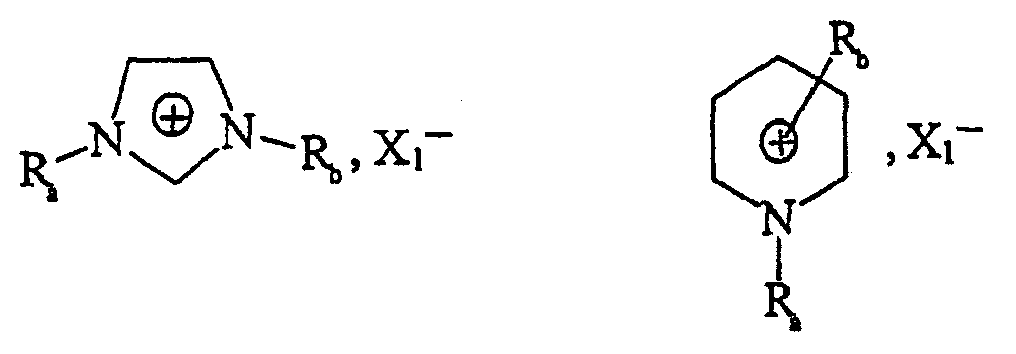
Bu3P+-Me, X1 - ⊕P(C6H13)3C14H29, X1 - (C8H17)3N+Me, X1 -
wobei X1 - insbesondere ausgewählt ist aus: NTf2 -, PF6 -, BF4 -, oder CF3SO3 -. - Zusammensetzung nach irgendeinem der Ansprüche 14 und 16 bis 22, dadurch gekennzeichnet, dass das funktionalisierte Salz aus den folgenden ausgewählt ist:


wobei m eine ganze Zahl zwischen 0 und 20 ist,
Rβ eine substituierte oder nicht substituierte Vinylgruppe, funktionelle Arylgruppe mit 1 bis 20 Kohlenstoffatomen, oder eine funktionelle Alkylgruppe mit 6 bis 30 Kohlenstoffatomen darstellt,
und Ra eine verzweigte oder nicht verzweigte Alkylgruppe mit 1 bis 20 Kohlenstoffatomen, insbesondere eine Ethyl-, Propyl-, Butyl-, Pentyl-, Hexyl-, Heptyl- oder Octylgruppe darstellt. - Verbindung gemäß einem der Ansprüche 14 und 16 bis 23, dadurch gekennzeichnet, dass X2 - ein funktionelles Anion ist, das einem Anion, dessen pKA der zugeordneten Säure geringer als 30 ist, entspricht und insbesondere aus den folgenden Anionen ausgewählt ist:
OH-, F-, RcBZ3 -, N3 -, CN-, oder W C̅ RcV
wobei Z eine -F, -OH, -OR-Gruppe darstellt, R eine Alkylgruppe mit 1 bis 20 Kohlenstoffatomen darstellt,
V und W unabhängig voneinander eine elektroattraktive Gruppe darstellen, insbesondere eine Cyanogruppe, eine Alkoxycarbonylgruppe mit 2 bis 20 Kohlenstoffatomen, eine Acylgruppe mit 2 bis 20 Kohlenstoffatomen, eine Benzoylgruppe, eine Alkylsulfonylgruppe mit 1 bis 20 Kohlenstoffatomen, eine Arylsulfonylgruppe mit 6 bis 30 Kohlenstoffatomen, eine Dialkoxyphosphonylgruppe mit 2 bis 20 Kohlenstoffatomen,
Rc eine verzweigte oder nicht verzweigte, zyklische oder nicht zyklische Alkylgruppe mit 1 bis 20 Kohlenstoffatomen oder eine Arylgruppe mit 6 bis 30 Kohlenstoffatomen darstellt,
und, dass das A2 +-Kation ausgewählt ist aus Ammonium- und Phosphoniumkationen, insbesondere aus den folgenden Kationen:
- Verwendung einer Zusammensetzung gemäß irgendeinem der Ansprüche 14 bis 24 für die kontinuierliche, diskontinuierliche, kombinatorische oder parallele organische Synthese und/oder die Herstellung von Produktbanken.
- Verwendung einer Zusammensetzung gemäß irgendeinem der Ansprüche 14 und 16 bis 25 für die Ausführung eines Herstellungsverfahrens eines Moleküls G ausgehend von eine Anfangsgruppe F0, die gegebenenfalls über einen L-Arm, insbesondere eine Alkylgruppe mit 1 bis 20 Kohlenstoffatomen, an eine ionische Gesamtheit Y+-, die Teil des Kations A2 + des funktionalisierten Salzes A2 +X2 - ist, oder Y--, die Teil des Anions X2 - des funktionalisierten Salzes A2 +X2 - ist, gebunden ist, wobei das Kation die Form Y+-L-F0 und/oder das Anion die Form Y--(L)k-F0 hat, wobei k gleich 0 oder 1 ist, welches Verfahren die Schritte umfasst:- eine erste Zugabe eines Reagenz B1 in die obengenannte Zusammensetzung und die Reaktion zwischen der genannten Gruppe F0 und dem Reagenz B1, die zu einer Gruppe F1 führt, die an die ionische Gesamtheit Y+-, die Teil des Kations A2 + des funktionalisierten Salzes A2 +X2 - ist, und/oder Y--, die Teil des Anions X2 - des funktionalisierten Salzes A2 +X2 - ist, gebunden ist, gemäß einem der folgenden Reaktionsschemata:

 - n-1 folgende Zugaben von Reagenzien Bi, 1 < i ≤ n, wobei n von 2 bis 10 variiert, zu der obengenannten Zusammensetzung, welche bei jeder Zugabe die Reaktion zwischen dem Reagenz Bi und einer Gruppe Fi-1, erlauben, die zum Erhalt einer Gruppe Fi führt, wobei die (n-1)te Zugabe des Reagenz Bn zur Gruppe Fn-1 zum Erhalt der Gruppe Fn führt, wobei die n-1 Zugaben durch eines der folgenden Reaktionsschemata dargestellt werden können:
 - Spaltung der Funktion Fn, die jeweils an die ionische Gesamtheit Y+- oder Y-- des Kations A2 + und/oder des Anions X2 - gebunden ist, was die Gewinnung von einerseits dem funktionalisierten Salz A2 +X2 - in der Form Y+-L-F0, X2 - oder A2 +, Y--(L)k-F0 in Lösung in der ionischen flüssigen Matrix A1 +X1 oder in der Form Y+-L-F'0, X2 - oder A2 +, Y-- (L)k-F'0, in welcher F'0 eine von F0 verschiedene Gruppe darstellt, und andererseits dem Molekül G,gemäß einem der folgenden Reaktionsschemata:


- Verwendung gemäß Anspruch 26 für das Ausführen der Diels-Alder-Reaktion gemäß einem der folgenden Reaktionsschemata:

Y+- ein Oniumkation, wie es in einem der Ansprüche 20 bis 25 definiert ist, und vorzugsweise ein Trimethylalkylammonium-, ein Triethylalkylammonium- oder ein Tributylalkylphosphoniumkation ist,
L einen Arm darstellt, insbesondere eine lineare oder verzweigte Alkylgruppe mit 1 bis 20 Kohlenstoffatomen, oder eine gegebenenfalls funktionelle Aralkylgruppe mit 6 bis 30 Kohlenstoffatomen, und vorzugsweise eine lineare Alkylgruppe vorzugsweise eine lineare Alkylgruppe des Typs (CH2)r, wobei r von 1 bis 20, und vorzugsweise von 3 bis 6, variiert,
X2 - so ist, wie es in einem der Ansprüche 1 bis 26 definiert ist, und insbesondere NTf2 -, BF4 -, PF6 -, Cl- , Br-, CH3COO-, CF3CO2 -, CF3SO3-, BR4 - ist, wobei R wie in Anspruch 20 definiert ist,
die ionische Flüssigkeit A1 +X1 - insbesondere die Form hat: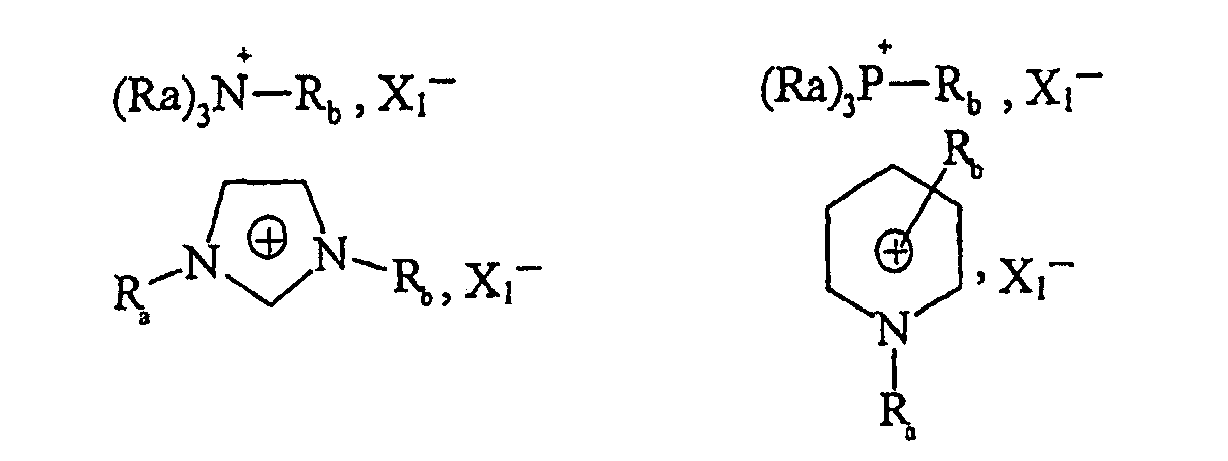
X1- ausgewählt ist aus: BF4 -, PF6 -, NTf2 -, Cl-, Br-, CH3COO-, CF3CO2 -, CF3SO3 -, BR4-, wobei R wie in Anspruch 20 definiert ist,
die Funktionen F0, F1 und F2 wie unten definiert sind:- F0 entspricht einer - χ 1H-Gruppe, in welcher χ 1 ein Sauerstoffatom oder eine -NRf-Gruppe darstellt, wobei Rf einer linearen oder verzweigten Alkylgruppe mit 1 bis 20 Kohlenstoffatomen, oder einer Arylgruppe mit 6 bis 30 Kohlenstoffatomen entspricht,- F1 der folgenden Formel entspricht: - F2 der folgenden Formel entspricht:G der folgenden Formel entspricht:
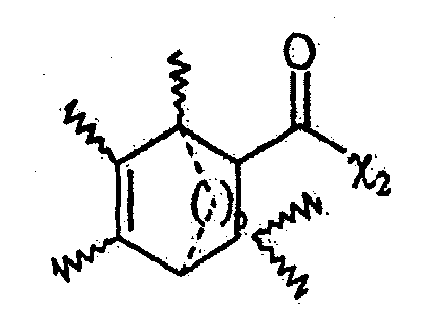
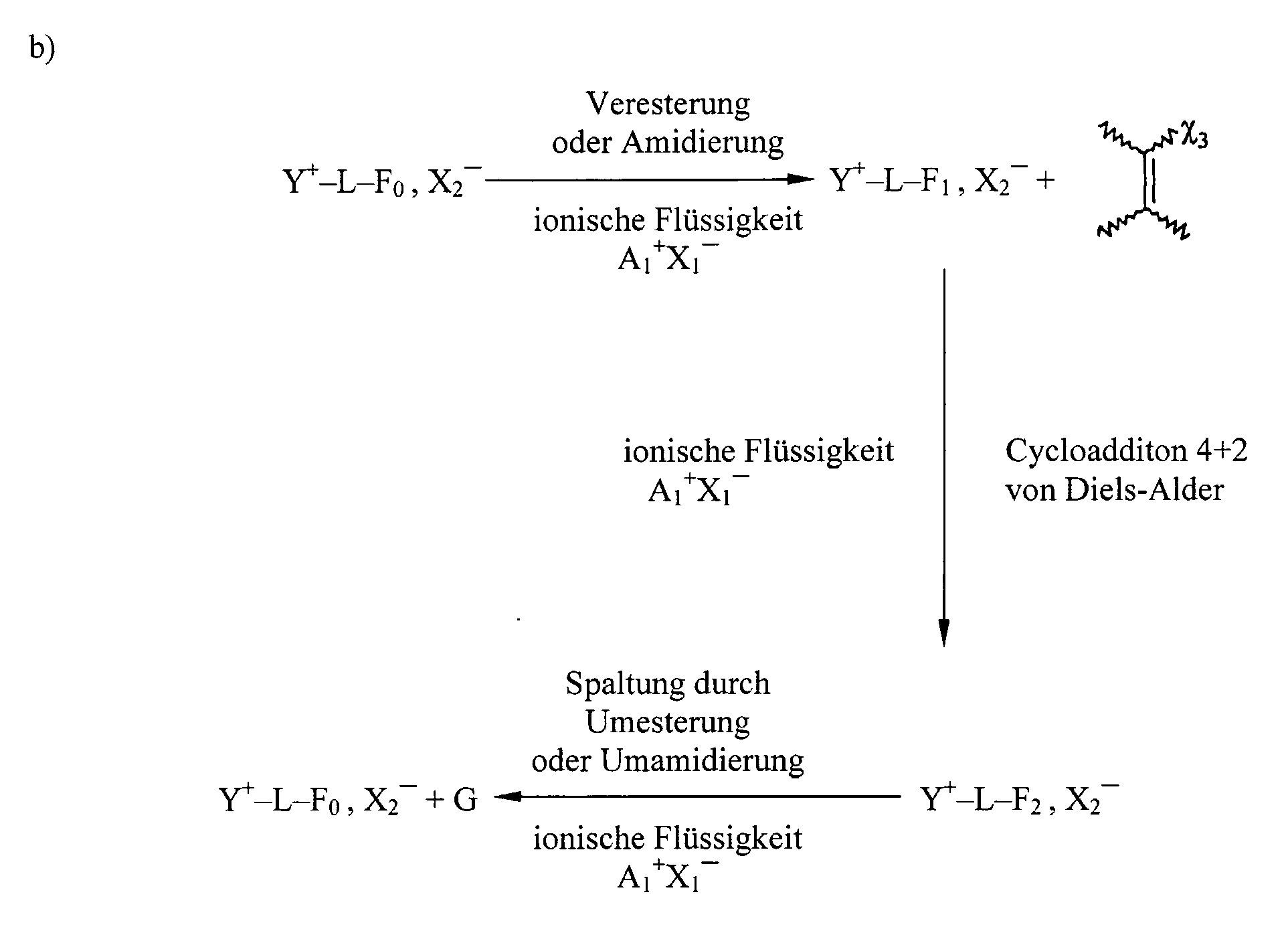
die Gruppen F0, F1 und F2 wie unten definiert sind:- F0 stellt jede Gruppe dar, die das Anbinden eines 1,3-Diens möglich macht, und insbesondere aus den Carbonyl-, Amin-, Alkoxy-, Silan-, Stannan- und Borangruppen, die 1 bis 20 Kohlenstoffatome enthalten, ausgewählt ist,- F1 entspricht der folgenden Formel: - F2 entspricht der folgenden Formel:G der folgenden Fonnel entspricht: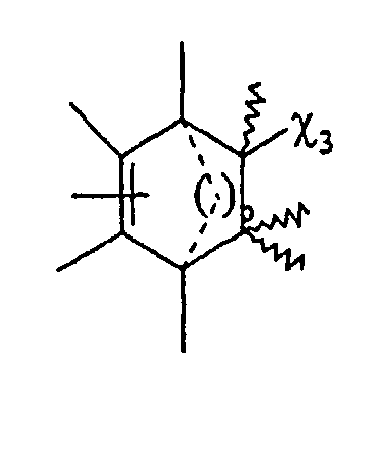

- Verwendung gemäß Anspruch 26 für das Ausführen der Heckreaktion gemäß dem folgenden Reaktionsschema:

L einen Arm darstellt, insbesondere eine lineare oder verzweigte Alkylgruppe mit 1 bis 20 Kohlenstoffatomen, oder eine gegebenenfalls funktionelle Aralkylgruppe mit 1 bis 20 Kohlenstoffatomen, und vorzugsweise eine lineare Alkylgruppe vorzugsweise eine lineare Alkylgruppe des Typs (CH2)r, wobei r von 1 bis 20, und vorzugsweise von 3 bis 6, variiert, ist,
X2 - so ist, wie es in einem der Ansprüche 1 bis 26 definiert ist und insbesondere BF4 -, PF6 -, NTf2 -, CF3SO3 -, Cl-, Br- oder I-,
die ionische Flüssigkeit A1 +X1 - insbesondere die Form hat:
(Ra)3N+-Rb, X1 -
(Ra)3P+-Rb, X1 -

X1 ausgewählt ist aus: BF4 -, PF6 -, NTf2 -, Cl-, Br-, CH3COO-, CF3CO2 -, CF3SO3 -, BR4 -, wobei R wie in Anspruch 20 definiert ist,
die Funktionen F0, F1, F'1, F2 und F'2 wie unter definiert sind:- F0 entspricht einer -χ1H-Gruppe, in welcher χ 1 ein Sauerstoffatom oder eine -NRf-Gruppe darstellt, wobei Rf einer linearen oder verzweigten Alkylgruppe mit 1 bis 20 Kohlenstoffatomen, oder einer Arylgruppe mit 6 bis 30 Kohlenstoffatomen entspricht,- F1 entspricht der folgenden Formel: - F2 entspricht der folgenden Formel:G der folgenden Formel entspricht:

χ3 eine flüchtige Gruppierung darstellt, insbesondere ausgewählt aus den I-, Cl- und Br- Halogeniden, den Mesylat-, Tosylat-, Triflat-, Sulfonat-, Sulfat- oder Phosphatgruppen,
T1, T2, T3, T4 und T5 unabhängig voneinander ein Wasserstoffatom, eine lineare oder verzweigte Alkylgruppe mit 1 bis 20 Kohlenstoffatomen, oder eine Arylgruppe mit 6 bis 30 Kohlenstoffatomen, oder eine funktionelle Gruppe darstellen, die insbesondere ausgewählt ist aus NO2, CN, COOR, OR, COR, NHCOR, NRR", SO2R, I, Br, wobei R und R" unabhängig voneinander eine Alkylgruppe mit 1 bis 20 Kohlenstoffatomen, oder eine Arylgruppe mit 6 bis 30 Kohlenstoffatomen darstellen,
die Gesamtheit


 - wobei F'1 der folgenden Formel entspricht:
 - F'2 der folgenden Formel entspricht:G' der folgenden Formel entspricht:
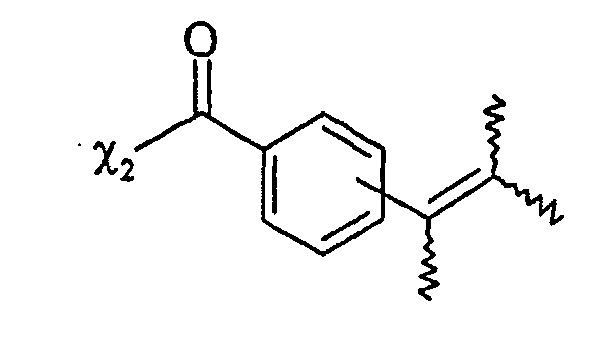
- Verwendung gemäß Anspruch 26 für die Ausführung der Baylis-Hilman-Reaktion gemäß dem folgenden Reaktionsschema:

L einen Arm darstellt, insbesondere eine lineare oder verzweigte Alkylgruppe mit 1 bis 20 Kohlenstoffatomen, oder eine gegebenenfalls funktionelle Aralkylgruppe mit 6 bis 30 Kohlenstoffatomen, und vorzugsweise eine lineare Alkylgruppe vorzugsweise eine lineare Alkylgruppe des Typs (CH2)r, wobei r von 1 bis 20, und vorzugsweise von 3 bis 6, variiert, ist,
X2 - so ist, wie es in einem der Ansprüche 1 bis 26 definiert ist, und insbesondere BF4 -, PF6 -, NTf2 -, CF3SO3 - , Cl-, Br-, I-, CH3CO2 - oder CF3CO2 - ist,
die ionische Flüssigkeit A1 +X1 - insbesondere die Form hat:
(Ra)3N+-Rb, X1 -
(Ra)3P+-Rb, X1 -

X1 - ausgewählt ist aus: BF4 -, PF6 -, NTf2 -, Cl-, Br-, CH3COO-, CF3CO2 -, CF3SO3 -, BR4 -, wobei R wie in Anspruch 20 definiert ist,
die Funktionen F0, F1 und F2 wie unter definiert sind:- F0 entspricht einer -OH-Gruppe- F1 entspricht der folgenden Formel: - F2 entspricht der folgenden Formel:G der folgenden Formel entspricht:

Ar eine substituierte oder nicht substituierte, aromatische oder hetereoaromatische Gruppe darstellt,
ArCHO insbesondere ausgewählt ist aus:

- Verwendung gemäß Anspruch 26 für die Ausführung der Suzuki-Kopplung gemäß einem der folgenden Reaktionsschemata:

R7 eine verzweigte oder lineare Alkylgruppe oder eine Cycloalkylgruppe mit 1 bis 12 Kohlenstoffatomen darstellt,
Y+- ein Oniumkation, wie es in einem der Ansprüche 21 bis 26 definiert ist, und vorzugsweise ein Trimethylalkylammonium-, ein Triethylalkylammonium- oder ein Tributylalkylphosphoniumkation ist,
L einen Arm darstellt, insbesondere eine lineare oder verzweigte Alkylgruppe mit 1 bis 20 Kohlenstoffatomen, oder eine gegebenenfalls funktionelle Aralkylgruppe mit 6 bis 30 Kohlenstoffatomen, und vorzugsweise eine lineare Alkylgruppe vorzugsweise eine lineare Alkylgruppe des Typs (CH2)r, wobei r von 1 bis 20, und vorzugsweise von 3 bis 6, variiert, ist,
X2 - so ist, wie es in einem der Ansprüche 1 bis 26 definiert ist, und insbesondere NTf2 -, BF4 -, PF6 -, Cl-, Br-, CH3COO-, CF3CO2 -, CF3SO3 -, BR4 -, wobei R wie in Anspruch 20 definiert ist, ist,
die ionische Flüssigkeit A1 +X1 - insbesondere die Form hat:
(Ra)3N+-Rb, X1 -
(Ra)3P+-Rb, X1 -

X1 - ausgewählt ist aus: BF4 -, PF6 -, NTf2 -, Cl-, Br-, CH3COO-, CF3CO2 -, CF3SO3 - , BR4 -, wobei R wie in Anspruch 20 definiert ist,
die Funktionen F0, F1 und F2 wie unter definiert sind:- F0 hat die Form -χ 1H, wobei χ 1 ein Sauerstoffatom oder eine -NRf-Gruppe darstellt, wobei Rf einer linearen oder verzweigten Alkylgruppe mit 1 bis 20 Kohlenstoffatomen, oder einer Arylgruppe mit 6 bis 30 Kohlenstoffatomen entspricht,- F1 hat die Form -Re-χ, wobei Re eine aromatische oder heteroaromatische Gruppe mit 6 bis 30 Kohlenstoffatomen darstellt, χ eine flüchtige Gruppe vorzugsweise ausgewählt aus Cl, Br, I, OTf, O-CO2R5 oder OSO3-R5 darstellt, wobei R5 eine Alkylgruppe mit 1 bis 10 Kohlenstoffatomen, oder eine Aralkylgruppe mit 6 bis 30 Kohlenstoffatomen darstellt, wobei F1 vorzugsweise der folgenden Formel entspricht: - F2 hat die Form -Re-R2, wobei Re wie oben definiert ist und R2 ausgewählt ist aus den substituierten oder nichtsubstituierten Aryl-, Heteroaryl-, Ethenyl-, Dienyl-, Allyl-, Ethynylgruppen mit 2 bis 30 Kohlenstoffatomen, wobei F2 vorzugsweise der folgenden Formel entspricht:wobei Ar1 eine aromatische Gruppe darstellt, die vorzugsweise ausgewählt ist aus:


die Funktionen F0, F1 und F2 wie unten definiert sind:- F0 hat die Form - χ1H, wobei χ 1 wie oben definiert ist,- F1 hat die Form -Rq-B(OR7)2, wobei R7 wie oben definiert ist und Rq einer substituierten oder nicht substituierten Arylgruppe mit 6 bis 30 Kohlenstoffatomen, Heteroarylgruppe mit 4 bis 20 Kohlenstoffatomen, Ethenylgruppe mit 2 bis 20 Kohlenstoffatomen, Dienylgruppe mit 3 bis 20 Kohlenstoffatomen, Allylgruppe mit 3 bis 20 Kohlenstoffatomen, Ethynylgruppe mit 2 bis 20 Kohlenstoffatomen entspricht, wobei F1 vorzugsweise der folgenden Formel entspricht: - F2 hat die Form -Rq-Re, wobei Rq und Re wie oben definiert sind, wobei F2 vorzugsweise der folgenden Formel entspricht:wobei Ar1 eine aromatische Gruppe darstellt, die vorzugsweise ausgewählt ist aus:


R3 vorzugsweise eine Phenylgruppe ist,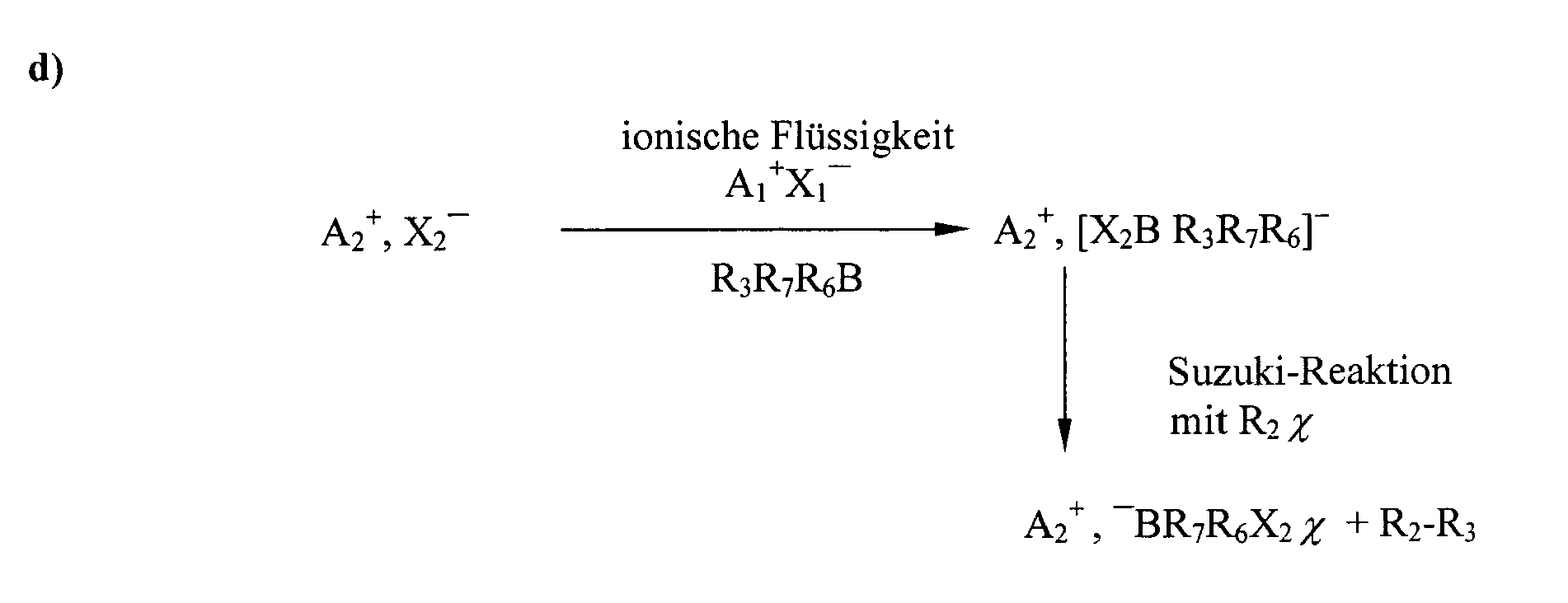
X2 - ausgewählt ist aus OH-, F-, CN-, RsO-, RsS-, vorzugsweise OH- oder F-, wobei Rs eine Alkylgruppe mit 1 bis 20 Kohlenstoffatomen, oder eine Aralkylgruppe mit 6 bis 30 Kohlenstoffatomen darstellt,
R3 und R4 wie oben definiert sind,
R6 und R7 unabhängig voneinander eine Alkylgruppe mit 1 bis 20 Kohlenstoffatomen, oder einer Arylgruppe mit 6 bis 30 Kohlenstoffatomen darstellen,
das borierte Molekül der Formel R3R7R6B ein Trialkyl- oder Arylboran, wobei die Alkylgruppe 1 bis 20 Kohlenstoffatomen und die Arylgruppe 6 bis 30 Kohlenstoffatomen enthält, eine Boronsäure oder ein Boronester, vorzugsweise eine Boronsäure oder ein Boronester , die als Phenylboronsäure ausgewählt ist, ist
R2 und χ wie oben definiert sind, R2 χ vorzugsweise einem Arylhalogenid entspricht, das ausgewählt ist aus:
- Verwendung gemäß den Ansprüchen 1 bis 30 für die Synthese von Molekülbanken nach der Technik der parallelen Synthese gemäß dem folgenden Schema:

- Verwendung gemäß einem der Ansprüche 1 bis 30 zur Ausführung der Synthese der Molekülbank durch die Technik Trennung-Mischung gemäß dem folgenden Schema:
 - n Fraktionen der Lösung Y+-L-F1, X2-, die ausgehend von einem funktionalisierten Ausgangssalz Y+-L-F0, X2 - erhalten wurden, in der ionischen Flüssigkeit A1 +X1 - jeweils mit Hilfe eines verschiedenen Reagenz Bi parallel gemäß einer Reaktion der organischen Chemie, vorzugsweise einer Kopplungsreaktion nach Heck oder Suzuki, transformiert werden, um n Lösungen zu ergeben, die jeweils eine bestimmte Verbindung Y+-L-F2 i, X2 - enthalten, wobei i von 1 bis n variiert, n von 2 bis 1024, vorzugsweise 2 bis 96 , variiert, wobei F2 i eine Gruppe darstellt, die aus den in Anspruch 21 definierten Gruppen ausgewählt ist,- die im voran gegangenen Schritt erhaltenen n Lösungen gemischt werden, um eine Lösung in der ionischen Flüssigkeit A1 +X1 - zu ergeben, die n Produkte Y+-L-F2 i, X2 - enthält, wobei i von 1 bis n variiert, bezeichnet
 - die im vorherigen Schritt erhaltene Mischung von der ionischen Flüssigkeit A1 +X1 und dem funktionalisierten Ausgangssalz Y+-L-F0, X2 - durch übliche Trennverfahren, vorzugsweise durch Vakuumdestillation, durch Extraktion mit einem klassischen Lösungsmittel wie Heptan oder Toluol gefolgt von einer Verdampfung des Lösungsmittels, durch Chromatografie auf einer Kolonne, einer Platte oder unter Druck, getrennt wird, um eine Bank zu erhalten, die n Moleküle G; enthält,wobei diese oben genannte Reihe von Schritten j mal wiederholt werden kann, wobei j zwischen 2 und 10 liegt, um j verschiedene Banken von n Produkten zu erhalten.
Applications Claiming Priority (3)
| Application Number | Priority Date | Filing Date | Title |
|---|---|---|---|
| FR0211910A FR2845084B1 (fr) | 2002-09-26 | 2002-09-26 | Compositions contenant des liquides ioniques et leurs utilisations, notamment en synthese organique |
| FR0211910 | 2002-09-26 | ||
| PCT/FR2003/002795 WO2004029004A1 (fr) | 2002-09-26 | 2003-09-23 | Compositions contenant des liquides ioniques et leurs utilisations, notamment en synthese organique |
Publications (2)
| Publication Number | Publication Date |
|---|---|
| EP1542942A1 EP1542942A1 (de) | 2005-06-22 |
| EP1542942B1 true EP1542942B1 (de) | 2006-12-27 |
Family
ID=31985248
Family Applications (1)
| Application Number | Title | Priority Date | Filing Date |
|---|---|---|---|
| EP03798215A Expired - Lifetime EP1542942B1 (de) | 2002-09-26 | 2003-09-23 | Zusammensetzungen, die ionische flüssigkeiten enthalten, und deren vewendungen, insbesondere in der organischen synthese |
Country Status (9)
| Country | Link |
|---|---|
| US (2) | US20060128996A1 (de) |
| EP (1) | EP1542942B1 (de) |
| JP (1) | JP2006500418A (de) |
| AT (1) | ATE349407T1 (de) |
| AU (1) | AU2003276363A1 (de) |
| CA (1) | CA2500206C (de) |
| DE (1) | DE60310737T2 (de) |
| FR (1) | FR2845084B1 (de) |
| WO (1) | WO2004029004A1 (de) |
Families Citing this family (51)
| Publication number | Priority date | Publication date | Assignee | Title |
|---|---|---|---|---|
| US7888412B2 (en) * | 2004-03-26 | 2011-02-15 | Board Of Trustees Of The University Of Alabama | Polymer dissolution and blend formation in ionic liquids |
| FR2872715B1 (fr) * | 2004-07-08 | 2006-11-17 | Commissariat Energie Atomique | Microreacteur goutte |
| GB0500029D0 (en) | 2005-01-04 | 2005-02-09 | Univ Belfast | Basic ionic liquids |
| GB0500028D0 (en) * | 2005-01-04 | 2005-02-09 | Univ Belfast | Base stable ionic liquids |
| FR2882057B1 (fr) * | 2005-02-16 | 2012-11-23 | Aventis Pharma Sa | Synthese peptidique sur supports solubles de types sels d'onium |
| WO2006096963A1 (en) * | 2005-03-15 | 2006-09-21 | Mcgill University | Ionic liquid supported synthesis |
| BRPI0610858A2 (pt) * | 2005-05-20 | 2010-08-03 | Univ Danmarks Tekniske | processo para carbonilação contìnua através de catálise de fase lìquida iÈnica suportada |
| US8883193B2 (en) | 2005-06-29 | 2014-11-11 | The University Of Alabama | Cellulosic biocomposites as molecular scaffolds for nano-architectures |
| BRPI0612612A2 (pt) * | 2005-06-29 | 2009-01-27 | Univ Alabama | compàsitos de celulose reconstituÍdos por lÍquido iânico como matrizes de suporte sàlido |
| KR100843594B1 (ko) * | 2005-09-07 | 2008-07-03 | 주식회사 엘지화학 | 액상 산화 반응을 이용한 알데히드 화합물로부터의유기산의 제조 방법 |
| US7737106B2 (en) * | 2005-11-29 | 2010-06-15 | The Procter & Gamble Company | Process for making an ionic liquid comprising ion actives |
| JP5142178B2 (ja) | 2006-03-10 | 2013-02-13 | 独立行政法人科学技術振興機構 | イオン性液体で被覆された固定化ルイス酸触媒、及びその使用 |
| EP1911829A1 (de) * | 2006-10-10 | 2008-04-16 | The Queen's University of Belfast | Entsäuerungsverfahren für Rohöl |
| WO2007138307A2 (en) * | 2006-05-25 | 2007-12-06 | The Queen's University Of Belfast | Process for removing sulfur-containing acids from crude oil |
| GB0612305D0 (en) * | 2006-06-21 | 2006-08-02 | Leuven K U Res & Dev | Novel ionic liquids |
| US20100292439A1 (en) * | 2006-07-05 | 2010-11-18 | Centre National De La Recherche Scientifique` | Use of Functionalized Onium Salts for Peptide Synthesis |
| JP2009541302A (ja) * | 2006-07-24 | 2009-11-26 | ザ プロクター アンド ギャンブル カンパニー | シクロヘキセニルケトンのエピマー化方法及びアルドール縮合プロセスにおけるその利用 |
| DE112009000286A5 (de) * | 2008-01-30 | 2010-10-28 | Technische Universität Dresden | Salze mit Aryl-Alkyl-substituierten Imidazolium- und Triazoliumkationen und deren Verwendung |
| WO2009105236A1 (en) | 2008-02-19 | 2009-08-27 | The Board Of Trustees Of The University Of Alabama | Ionic liquid systems for the processing of biomass, their components and/or derivatives, and mixtures thereof |
| FR2930247B1 (fr) * | 2008-04-21 | 2012-12-07 | Commissariat Energie Atomique | Sels d'onium et leur utilisation pour la detection et le dosage des metaux. |
| US8734673B2 (en) | 2008-08-08 | 2014-05-27 | The University Of Toledo | Boron selective ionic liquids and polymeric ionic liquids, methods of making and methods of use thereof |
| US7700529B1 (en) * | 2008-10-14 | 2010-04-20 | International Flavors & Fragrances Inc. | Isomers of bicyclo[2.2.1]hept-5-ene-2-carboxylic acid, ethyl ester and their use in perfume compositions |
| US8114823B2 (en) | 2008-10-14 | 2012-02-14 | International Flavors & Fragrances Inc. | Isomers of bicyclo[2.2.1]hept-5-ene-2-carboxylic acid, ethyl ester and their use in perfume compositions |
| WO2010078300A1 (en) | 2008-12-29 | 2010-07-08 | The Board Of Trustees Of The University Of Alabama | Dual functioning ionic liquids and salts thereof |
| WO2010141470A2 (en) | 2009-06-01 | 2010-12-09 | The Board Of Trustees Of The University Of Alabama | Process for forming films, fibers, and beads from chitinous biomass |
| WO2011011322A1 (en) | 2009-07-24 | 2011-01-27 | The Board Of Trustees Of The University Of Alabama | Conductive composites prepared using ionic liquids |
| US9394375B2 (en) | 2011-03-25 | 2016-07-19 | Board Of Trustees Of The University Of Alabama | Compositions containing recyclable ionic liquids for use in biomass processing |
| DE102011080230A1 (de) * | 2011-08-01 | 2013-02-07 | Helmholtz-Zentrum Dresden - Rossendorf E.V. | Extraktion von Edelmetall(ionen) mittels ionischer Flüssigkeiten |
| CN102731370B (zh) * | 2012-07-13 | 2013-10-16 | 黑龙江大学 | 离子液体的制备方法及应用离子液体钯碳催化合成联苯类化合物的方法 |
| WO2015067478A1 (de) * | 2013-11-05 | 2015-05-14 | Construction Research & Technology Gmbh | Neue bindemittelsysteme |
| JP6489910B2 (ja) * | 2014-05-15 | 2019-03-27 | キヤノン株式会社 | ヒドロキシ化合物、イオン導電剤、および導電性樹脂組成物 |
| JP6478775B2 (ja) | 2014-05-15 | 2019-03-06 | キヤノン株式会社 | アミン化合物及びイオン導電剤、導電性樹脂組成物 |
| US10100131B2 (en) | 2014-08-27 | 2018-10-16 | The Board Of Trustees Of The University Of Alabama | Chemical pulping of chitinous biomass for chitin |
| US10011931B2 (en) | 2014-10-06 | 2018-07-03 | Natural Fiber Welding, Inc. | Methods, processes, and apparatuses for producing dyed and welded substrates |
| US10982381B2 (en) | 2014-10-06 | 2021-04-20 | Natural Fiber Welding, Inc. | Methods, processes, and apparatuses for producing welded substrates |
| EP3098293A1 (de) | 2015-05-27 | 2016-11-30 | Evonik Degussa GmbH | Verfahren zur entfernung von metall aus einem metallhaltigen glyceridöl mit einer behandlung aus basischem quaternärem ammoniumsalz |
| EP3098292A1 (de) | 2015-05-27 | 2016-11-30 | Evonik Degussa GmbH | Verfahren zum raffinieren von glyceridöl mit einer behandlung mit basischem quaternärem ammoniumsalz |
| GB2538758A (en) | 2015-05-27 | 2016-11-30 | Green Lizard Tech Ltd | Process for removing chloropropanols and/or glycidol |
| DE102015212749A1 (de) | 2015-07-08 | 2017-01-12 | Evonik Degussa Gmbh | Verfahren zur Entfeuchtung von feuchten Gasgemischen |
| MX2018010421A (es) | 2016-03-25 | 2019-05-20 | Natural Fiber Welding Inc | Metodos, procesos y aparatos para producir sustratos soldados. |
| JP7114484B2 (ja) | 2016-05-03 | 2022-08-08 | ナチュラル ファイバー ウェルディング インコーポレーテッド | 染色及び溶着された基材を製造するための方法、プロセス、及び装置 |
| DE102016210484A1 (de) | 2016-06-14 | 2017-12-14 | Evonik Degussa Gmbh | Verfahren zur Entfeuchtung von feuchten Gasgemischen |
| DE102016210478A1 (de) | 2016-06-14 | 2017-12-14 | Evonik Degussa Gmbh | Verfahren zur Entfeuchtung von feuchten Gasgemischen |
| EP3257568B1 (de) | 2016-06-14 | 2019-09-18 | Evonik Degussa GmbH | Verfahren zur entfeuchtung von feuchten gasgemischen mit ionischen flüssigkeiten |
| US10927191B2 (en) | 2017-01-06 | 2021-02-23 | The Board Of Trustees Of The University Of Alabama | Coagulation of chitin from ionic liquid solutions using kosmotropic salts |
| WO2018236445A2 (en) | 2017-03-24 | 2018-12-27 | The Board Of Trustees Of The University Of Alabama | Metal particle-chitin composite materials and methods of making thereof |
| EP3483237A1 (de) | 2017-11-10 | 2019-05-15 | Evonik Degussa GmbH | Verfahren zur extraktion von fettsäuren aus triglyceridölen |
| TWI829660B (zh) | 2017-11-11 | 2024-01-21 | 美商天然纖維焊接股份有限公司 | 紗與熔接紗 |
| CN113385225B (zh) * | 2021-06-18 | 2022-11-18 | 抚顺东科新能源科技有限公司 | 一种超分子离子液体催化剂及其制备方法与应用 |
| CN115433126B (zh) * | 2022-08-12 | 2023-10-20 | 浙江工业大学 | 一种功能化喹啉类比色离子探针及其合成方法与应用 |
| CN116393167B (zh) * | 2023-03-09 | 2024-08-16 | 新疆至臻化工工程研究中心有限公司 | 一种用于草酸二甲酯与乙醇酯交换反应的离子液体催化剂 |
Family Cites Families (6)
| Publication number | Priority date | Publication date | Assignee | Title |
|---|---|---|---|---|
| US4463071A (en) * | 1983-11-30 | 1984-07-31 | Allied Corporation | Secondary batteries using room-temperature molten non-aqueous electrolytes containing 1,2,3-trialkylimidazolium halides or 1,3-dialkylimidazolium halide |
| US6030917A (en) * | 1996-07-23 | 2000-02-29 | Symyx Technologies, Inc. | Combinatorial synthesis and analysis of organometallic compounds and catalysts |
| US20020010291A1 (en) * | 1998-12-04 | 2002-01-24 | Vince Murphy | Ionic liquids and processes for production of high molecular weight polyisoolefins |
| JP2001247542A (ja) * | 2000-03-06 | 2001-09-11 | Central Glass Co Ltd | ヘテロ環化合物の製造方法 |
| JP4011830B2 (ja) * | 2000-06-20 | 2007-11-21 | 独立行政法人科学技術振興機構 | N−アルコキシアルキルイミダゾリウム塩、該イミダゾリウム塩からなるイオン液体ならびにイオン性ゲル |
| JP3541223B2 (ja) * | 2001-03-08 | 2004-07-07 | 東北大学長 | イオン性液体中でのPd/C触媒を用いたHeck反応 |
-
2002
- 2002-09-26 FR FR0211910A patent/FR2845084B1/fr not_active Expired - Fee Related
-
2003
- 2003-09-23 CA CA2500206A patent/CA2500206C/fr not_active Expired - Fee Related
- 2003-09-23 EP EP03798215A patent/EP1542942B1/de not_active Expired - Lifetime
- 2003-09-23 AU AU2003276363A patent/AU2003276363A1/en not_active Abandoned
- 2003-09-23 DE DE60310737T patent/DE60310737T2/de not_active Expired - Lifetime
- 2003-09-23 AT AT03798215T patent/ATE349407T1/de not_active IP Right Cessation
- 2003-09-23 WO PCT/FR2003/002795 patent/WO2004029004A1/fr not_active Ceased
- 2003-09-23 JP JP2004539127A patent/JP2006500418A/ja active Pending
- 2003-09-23 US US10/529,361 patent/US20060128996A1/en not_active Abandoned
-
2009
- 2009-05-08 US US12/463,027 patent/US9452425B2/en not_active Expired - Fee Related
Also Published As
| Publication number | Publication date |
|---|---|
| US20060128996A1 (en) | 2006-06-15 |
| AU2003276363A1 (en) | 2004-04-19 |
| DE60310737D1 (de) | 2007-02-08 |
| US20090326228A1 (en) | 2009-12-31 |
| US9452425B2 (en) | 2016-09-27 |
| CA2500206A1 (fr) | 2004-04-08 |
| FR2845084B1 (fr) | 2009-07-17 |
| DE60310737T2 (de) | 2008-03-20 |
| FR2845084A1 (fr) | 2004-04-02 |
| AU2003276363A8 (en) | 2004-04-19 |
| JP2006500418A (ja) | 2006-01-05 |
| WO2004029004A1 (fr) | 2004-04-08 |
| EP1542942A1 (de) | 2005-06-22 |
| CA2500206C (fr) | 2013-06-11 |
| ATE349407T1 (de) | 2007-01-15 |
Similar Documents
| Publication | Publication Date | Title |
|---|---|---|
| EP1542942B1 (de) | Zusammensetzungen, die ionische flüssigkeiten enthalten, und deren vewendungen, insbesondere in der organischen synthese | |
| JP4886967B2 (ja) | 官能化されたイオン性液体およびこの使用方法 | |
| EP2097431B1 (de) | Katalytische komplexe auf rutheniumbasis und die anwendung solcher komplexe in der olefinmetathese | |
| Karthikeyan et al. | Development and efficient 1-glycyl-3-methyl imidazolium chloride–copper (II) complex catalyzed highly enantioselective synthesis of 3, 4-dihydropyrimidin-2 (1H)-ones | |
| EP1641729B1 (de) | Verwendung funktionalisierter oniumsalze als lösliche träger für die organische synthese | |
| Gordon | Ionic liquids: a convenient solvent for environmentally friendly allylation reactions with tetraallylstannane | |
| Pucheault et al. | Task specific ionic liquids and task specific onium salts | |
| Valle-Amores et al. | Oxidized multiwalled nanotubes as efficient carbocatalyst for the general synthesis of azines | |
| Vessally et al. | Direct hydroxyselenenylation of alkenes: A convenient access to β-hydroxy selenides | |
| JP2014139151A (ja) | (e)−1−ハロ−エナミド誘導体又はその塩を製造する方法及び(e)−1−ハロ−エナミド誘導体又はその塩。 | |
| Siva et al. | Syntheses of new dimeric-Cinchona alkaloid as a chiral phase transfer catalysts for the alkylation of Schiff base | |
| EP3360861A1 (de) | Verfahren zur synthese einer bipyridinverbindung und verfahren zur herstellung einer bipyridinverbindung | |
| EP0030528B1 (de) | Verfahren zur Einführung von Alkyl-Aralkyl-Cycloalkylgruppen in eine Funktionsgruppe enthaltende Kohlenstoffkette | |
| EP3896053A1 (de) | Verfahren zur direkten herstellung einer tetrasubstituierten allensäureverbindung mit hoher optischer aktivität | |
| Karthikeyan et al. | Development of highly enantioselective asymmetric aldol reaction catalyzed by 1-glycyl-3-methyl imidazolium chloride–iron (III) complex | |
| CN114989050B (zh) | 对称二硫醚类化合物的合成方法 | |
| Skell et al. | Hydrogen abstraction selectivities for ground-state, S. pi., and excited-state, S. sigma., succinimidyl radicals: cyclopentane/cyclohexane. Origins and resolution of disputed data | |
| US6620972B2 (en) | Method of oxidizing an alcohol using a recyclable fluorous sulfoxide | |
| JP4070444B2 (ja) | 不飽和アミン類の製造方法 | |
| JP2019126751A (ja) | キラルロジウム錯体、及び光学活性β−置換カルボニル化合物の製造方法 | |
| CN105344375B (zh) | 一种l-脯氨酸类有机小分子催化剂及其制备和应用 | |
| Schoetz et al. | Oxidative functionalization of aryl and alkyl germanes | |
| WO1997035833A1 (en) | Method for racemization of optically active amines | |
| CN116947921A (zh) | 一种制备联烯基磷酸酯化合物的方法 | |
| EP0346235A1 (de) | Verfahren zur Herstellung von N-(23-Vinblastinoyl) Derivaten des 1-Aminomethylphosphonsäures |
Legal Events
| Date | Code | Title | Description |
|---|---|---|---|
| PUAI | Public reference made under article 153(3) epc to a published international application that has entered the european phase |
Free format text: ORIGINAL CODE: 0009012 |
|
| 17P | Request for examination filed |
Effective date: 20050318 |
|
| AK | Designated contracting states |
Kind code of ref document: A1 Designated state(s): AT BE BG CH CY CZ DE DK EE ES FI FR GB GR HU IE IT LI LU MC NL PT RO SE SI SK TR |
|
| AX | Request for extension of the european patent |
Extension state: AL LT LV MK |
|
| DAX | Request for extension of the european patent (deleted) | ||
| GRAP | Despatch of communication of intention to grant a patent |
Free format text: ORIGINAL CODE: EPIDOSNIGR1 |
|
| GRAS | Grant fee paid |
Free format text: ORIGINAL CODE: EPIDOSNIGR3 |
|
| GRAA | (expected) grant |
Free format text: ORIGINAL CODE: 0009210 |
|
| AK | Designated contracting states |
Kind code of ref document: B1 Designated state(s): AT BE BG CH CY CZ DE DK EE ES FI FR GB GR HU IE IT LI LU MC NL PT RO SE SI SK TR |
|
| PG25 | Lapsed in a contracting state [announced via postgrant information from national office to epo] |
Ref country code: DK Free format text: LAPSE BECAUSE OF FAILURE TO SUBMIT A TRANSLATION OF THE DESCRIPTION OR TO PAY THE FEE WITHIN THE PRESCRIBED TIME-LIMIT Effective date: 20061227 Ref country code: FI Free format text: LAPSE BECAUSE OF FAILURE TO SUBMIT A TRANSLATION OF THE DESCRIPTION OR TO PAY THE FEE WITHIN THE PRESCRIBED TIME-LIMIT Effective date: 20061227 Ref country code: SK Free format text: LAPSE BECAUSE OF FAILURE TO SUBMIT A TRANSLATION OF THE DESCRIPTION OR TO PAY THE FEE WITHIN THE PRESCRIBED TIME-LIMIT Effective date: 20061227 Ref country code: IE Free format text: LAPSE BECAUSE OF FAILURE TO SUBMIT A TRANSLATION OF THE DESCRIPTION OR TO PAY THE FEE WITHIN THE PRESCRIBED TIME-LIMIT Effective date: 20061227 Ref country code: AT Free format text: LAPSE BECAUSE OF FAILURE TO SUBMIT A TRANSLATION OF THE DESCRIPTION OR TO PAY THE FEE WITHIN THE PRESCRIBED TIME-LIMIT Effective date: 20061227 Ref country code: CZ Free format text: LAPSE BECAUSE OF FAILURE TO SUBMIT A TRANSLATION OF THE DESCRIPTION OR TO PAY THE FEE WITHIN THE PRESCRIBED TIME-LIMIT Effective date: 20061227 Ref country code: NL Free format text: LAPSE BECAUSE OF FAILURE TO SUBMIT A TRANSLATION OF THE DESCRIPTION OR TO PAY THE FEE WITHIN THE PRESCRIBED TIME-LIMIT Effective date: 20061227 Ref country code: SI Free format text: LAPSE BECAUSE OF FAILURE TO SUBMIT A TRANSLATION OF THE DESCRIPTION OR TO PAY THE FEE WITHIN THE PRESCRIBED TIME-LIMIT Effective date: 20061227 Ref country code: RO Free format text: LAPSE BECAUSE OF FAILURE TO SUBMIT A TRANSLATION OF THE DESCRIPTION OR TO PAY THE FEE WITHIN THE PRESCRIBED TIME-LIMIT Effective date: 20061227 |
|
| REG | Reference to a national code |
Ref country code: GB Ref legal event code: FG4D Free format text: NOT ENGLISH |
|
| REG | Reference to a national code |
Ref country code: IE Ref legal event code: FG4D Free format text: LANGUAGE OF EP DOCUMENT: FRENCH |
|
| REF | Corresponds to: |
Ref document number: 60310737 Country of ref document: DE Date of ref document: 20070208 Kind code of ref document: P |
|
| GBT | Gb: translation of ep patent filed (gb section 77(6)(a)/1977) |
Effective date: 20070124 |
|
| PG25 | Lapsed in a contracting state [announced via postgrant information from national office to epo] |
Ref country code: BG Free format text: LAPSE BECAUSE OF FAILURE TO SUBMIT A TRANSLATION OF THE DESCRIPTION OR TO PAY THE FEE WITHIN THE PRESCRIBED TIME-LIMIT Effective date: 20070327 Ref country code: SE Free format text: LAPSE BECAUSE OF FAILURE TO SUBMIT A TRANSLATION OF THE DESCRIPTION OR TO PAY THE FEE WITHIN THE PRESCRIBED TIME-LIMIT Effective date: 20070327 |
|
| PG25 | Lapsed in a contracting state [announced via postgrant information from national office to epo] |
Ref country code: DE Free format text: LAPSE BECAUSE OF FAILURE TO SUBMIT A TRANSLATION OF THE DESCRIPTION OR TO PAY THE FEE WITHIN THE PRESCRIBED TIME-LIMIT Effective date: 20070328 |
|
| PG25 | Lapsed in a contracting state [announced via postgrant information from national office to epo] |
Ref country code: ES Free format text: LAPSE BECAUSE OF FAILURE TO SUBMIT A TRANSLATION OF THE DESCRIPTION OR TO PAY THE FEE WITHIN THE PRESCRIBED TIME-LIMIT Effective date: 20070407 |
|
| REG | Reference to a national code |
Ref country code: CH Ref legal event code: NV Representative=s name: ABREMA AGENCE BREVET ET MARQUES, GANGUILLET |
|
| PG25 | Lapsed in a contracting state [announced via postgrant information from national office to epo] |
Ref country code: PT Free format text: LAPSE BECAUSE OF FAILURE TO SUBMIT A TRANSLATION OF THE DESCRIPTION OR TO PAY THE FEE WITHIN THE PRESCRIBED TIME-LIMIT Effective date: 20070528 |
|
| NLV1 | Nl: lapsed or annulled due to failure to fulfill the requirements of art. 29p and 29m of the patents act | ||
| PLBE | No opposition filed within time limit |
Free format text: ORIGINAL CODE: 0009261 |
|
| STAA | Information on the status of an ep patent application or granted ep patent |
Free format text: STATUS: NO OPPOSITION FILED WITHIN TIME LIMIT |
|
| 26N | No opposition filed |
Effective date: 20070928 |
|
| PG25 | Lapsed in a contracting state [announced via postgrant information from national office to epo] |
Ref country code: MC Free format text: LAPSE BECAUSE OF NON-PAYMENT OF DUE FEES Effective date: 20070930 Ref country code: GR Free format text: LAPSE BECAUSE OF FAILURE TO SUBMIT A TRANSLATION OF THE DESCRIPTION OR TO PAY THE FEE WITHIN THE PRESCRIBED TIME-LIMIT Effective date: 20070328 |
|
| PG25 | Lapsed in a contracting state [announced via postgrant information from national office to epo] |
Ref country code: EE Free format text: LAPSE BECAUSE OF FAILURE TO SUBMIT A TRANSLATION OF THE DESCRIPTION OR TO PAY THE FEE WITHIN THE PRESCRIBED TIME-LIMIT Effective date: 20061227 |
|
| PG25 | Lapsed in a contracting state [announced via postgrant information from national office to epo] |
Ref country code: LU Free format text: LAPSE BECAUSE OF NON-PAYMENT OF DUE FEES Effective date: 20070923 Ref country code: CY Free format text: LAPSE BECAUSE OF FAILURE TO SUBMIT A TRANSLATION OF THE DESCRIPTION OR TO PAY THE FEE WITHIN THE PRESCRIBED TIME-LIMIT Effective date: 20061227 |
|
| PG25 | Lapsed in a contracting state [announced via postgrant information from national office to epo] |
Ref country code: TR Free format text: LAPSE BECAUSE OF FAILURE TO SUBMIT A TRANSLATION OF THE DESCRIPTION OR TO PAY THE FEE WITHIN THE PRESCRIBED TIME-LIMIT Effective date: 20061227 Ref country code: HU Free format text: LAPSE BECAUSE OF FAILURE TO SUBMIT A TRANSLATION OF THE DESCRIPTION OR TO PAY THE FEE WITHIN THE PRESCRIBED TIME-LIMIT Effective date: 20070628 |
|
| REG | Reference to a national code |
Ref country code: FR Ref legal event code: PLFP Year of fee payment: 14 |
|
| REG | Reference to a national code |
Ref country code: FR Ref legal event code: PLFP Year of fee payment: 15 |
|
| REG | Reference to a national code |
Ref country code: FR Ref legal event code: PLFP Year of fee payment: 16 |
|
| PGFP | Annual fee paid to national office [announced via postgrant information from national office to epo] |
Ref country code: FR Payment date: 20180928 Year of fee payment: 16 |
|
| PGFP | Annual fee paid to national office [announced via postgrant information from national office to epo] |
Ref country code: IT Payment date: 20190916 Year of fee payment: 17 Ref country code: DE Payment date: 20190913 Year of fee payment: 17 |
|
| PGFP | Annual fee paid to national office [announced via postgrant information from national office to epo] |
Ref country code: BE Payment date: 20190925 Year of fee payment: 17 |
|
| PGFP | Annual fee paid to national office [announced via postgrant information from national office to epo] |
Ref country code: GB Payment date: 20190919 Year of fee payment: 17 |
|
| PGFP | Annual fee paid to national office [announced via postgrant information from national office to epo] |
Ref country code: CH Payment date: 20190919 Year of fee payment: 17 |
|
| REG | Reference to a national code |
Ref country code: CH Ref legal event code: PFUS Owner name: UNIVERSITE DE RENNES I, FR Free format text: FORMER OWNER: UNIVERSITE DE RENNES I, FR |
|
| PG25 | Lapsed in a contracting state [announced via postgrant information from national office to epo] |
Ref country code: FR Free format text: LAPSE BECAUSE OF NON-PAYMENT OF DUE FEES Effective date: 20190930 |
|
| REG | Reference to a national code |
Ref country code: DE Ref legal event code: R119 Ref document number: 60310737 Country of ref document: DE |
|
| REG | Reference to a national code |
Ref country code: CH Ref legal event code: PL |
|
| GBPC | Gb: european patent ceased through non-payment of renewal fee |
Effective date: 20200923 |
|
| REG | Reference to a national code |
Ref country code: BE Ref legal event code: MM Effective date: 20200930 |
|
| PG25 | Lapsed in a contracting state [announced via postgrant information from national office to epo] |
Ref country code: DE Free format text: LAPSE BECAUSE OF FAILURE TO SUBMIT A TRANSLATION OF THE DESCRIPTION OR TO PAY THE FEE WITHIN THE PRESCRIBED TIME-LIMIT Effective date: 20210401 |
|
| PG25 | Lapsed in a contracting state [announced via postgrant information from national office to epo] |
Ref country code: BE Free format text: LAPSE BECAUSE OF NON-PAYMENT OF DUE FEES Effective date: 20200930 Ref country code: CH Free format text: LAPSE BECAUSE OF NON-PAYMENT OF DUE FEES Effective date: 20200930 Ref country code: GB Free format text: LAPSE BECAUSE OF NON-PAYMENT OF DUE FEES Effective date: 20200923 Ref country code: LI Free format text: LAPSE BECAUSE OF NON-PAYMENT OF DUE FEES Effective date: 20200930 |
|
| PG25 | Lapsed in a contracting state [announced via postgrant information from national office to epo] |
Ref country code: IT Free format text: LAPSE BECAUSE OF NON-PAYMENT OF DUE FEES Effective date: 20200923 |