EP1548182A2 - Flame-retardant nylon carpet and method for manufacturing the same - Google Patents
Flame-retardant nylon carpet and method for manufacturing the same Download PDFInfo
- Publication number
- EP1548182A2 EP1548182A2 EP04078519A EP04078519A EP1548182A2 EP 1548182 A2 EP1548182 A2 EP 1548182A2 EP 04078519 A EP04078519 A EP 04078519A EP 04078519 A EP04078519 A EP 04078519A EP 1548182 A2 EP1548182 A2 EP 1548182A2
- Authority
- EP
- European Patent Office
- Prior art keywords
- flame
- retardant
- weight
- latex
- parts
- Prior art date
- Legal status (The legal status is an assumption and is not a legal conclusion. Google has not performed a legal analysis and makes no representation as to the accuracy of the status listed.)
- Withdrawn
Links
Images

Classifications
-
- D—TEXTILES; PAPER
- D06—TREATMENT OF TEXTILES OR THE LIKE; LAUNDERING; FLEXIBLE MATERIALS NOT OTHERWISE PROVIDED FOR
- D06N—WALL, FLOOR, OR LIKE COVERING MATERIALS, e.g. LINOLEUM, OILCLOTH, ARTIFICIAL LEATHER, ROOFING FELT, CONSISTING OF A FIBROUS WEB COATED WITH A LAYER OF MACROMOLECULAR MATERIAL; FLEXIBLE SHEET MATERIAL NOT OTHERWISE PROVIDED FOR
- D06N7/00—Flexible sheet materials not otherwise provided for, e.g. textile threads, filaments, yarns or tow, glued on macromolecular material
- D06N7/0063—Floor covering on textile basis comprising a fibrous top layer being coated at the back with at least one polymer layer, e.g. carpets, rugs, synthetic turf
- D06N7/0065—Floor covering on textile basis comprising a fibrous top layer being coated at the back with at least one polymer layer, e.g. carpets, rugs, synthetic turf characterised by the pile
-
- D—TEXTILES; PAPER
- D06—TREATMENT OF TEXTILES OR THE LIKE; LAUNDERING; FLEXIBLE MATERIALS NOT OTHERWISE PROVIDED FOR
- D06N—WALL, FLOOR, OR LIKE COVERING MATERIALS, e.g. LINOLEUM, OILCLOTH, ARTIFICIAL LEATHER, ROOFING FELT, CONSISTING OF A FIBROUS WEB COATED WITH A LAYER OF MACROMOLECULAR MATERIAL; FLEXIBLE SHEET MATERIAL NOT OTHERWISE PROVIDED FOR
- D06N7/00—Flexible sheet materials not otherwise provided for, e.g. textile threads, filaments, yarns or tow, glued on macromolecular material
- D06N7/0063—Floor covering on textile basis comprising a fibrous top layer being coated at the back with at least one polymer layer, e.g. carpets, rugs, synthetic turf
- D06N7/0068—Floor covering on textile basis comprising a fibrous top layer being coated at the back with at least one polymer layer, e.g. carpets, rugs, synthetic turf characterised by the primary backing or the fibrous top layer
-
- D—TEXTILES; PAPER
- D06—TREATMENT OF TEXTILES OR THE LIKE; LAUNDERING; FLEXIBLE MATERIALS NOT OTHERWISE PROVIDED FOR
- D06N—WALL, FLOOR, OR LIKE COVERING MATERIALS, e.g. LINOLEUM, OILCLOTH, ARTIFICIAL LEATHER, ROOFING FELT, CONSISTING OF A FIBROUS WEB COATED WITH A LAYER OF MACROMOLECULAR MATERIAL; FLEXIBLE SHEET MATERIAL NOT OTHERWISE PROVIDED FOR
- D06N7/00—Flexible sheet materials not otherwise provided for, e.g. textile threads, filaments, yarns or tow, glued on macromolecular material
- D06N7/0063—Floor covering on textile basis comprising a fibrous top layer being coated at the back with at least one polymer layer, e.g. carpets, rugs, synthetic turf
- D06N7/0071—Floor covering on textile basis comprising a fibrous top layer being coated at the back with at least one polymer layer, e.g. carpets, rugs, synthetic turf characterised by their backing, e.g. pre-coat, back coating, secondary backing, cushion backing
-
- D—TEXTILES; PAPER
- D06—TREATMENT OF TEXTILES OR THE LIKE; LAUNDERING; FLEXIBLE MATERIALS NOT OTHERWISE PROVIDED FOR
- D06N—WALL, FLOOR, OR LIKE COVERING MATERIALS, e.g. LINOLEUM, OILCLOTH, ARTIFICIAL LEATHER, ROOFING FELT, CONSISTING OF A FIBROUS WEB COATED WITH A LAYER OF MACROMOLECULAR MATERIAL; FLEXIBLE SHEET MATERIAL NOT OTHERWISE PROVIDED FOR
- D06N2201/00—Chemical constitution of the fibres, threads or yarns
- D06N2201/02—Synthetic macromolecular fibres
-
- D—TEXTILES; PAPER
- D06—TREATMENT OF TEXTILES OR THE LIKE; LAUNDERING; FLEXIBLE MATERIALS NOT OTHERWISE PROVIDED FOR
- D06N—WALL, FLOOR, OR LIKE COVERING MATERIALS, e.g. LINOLEUM, OILCLOTH, ARTIFICIAL LEATHER, ROOFING FELT, CONSISTING OF A FIBROUS WEB COATED WITH A LAYER OF MACROMOLECULAR MATERIAL; FLEXIBLE SHEET MATERIAL NOT OTHERWISE PROVIDED FOR
- D06N2201/00—Chemical constitution of the fibres, threads or yarns
- D06N2201/02—Synthetic macromolecular fibres
- D06N2201/0263—Polyamide fibres
-
- D—TEXTILES; PAPER
- D06—TREATMENT OF TEXTILES OR THE LIKE; LAUNDERING; FLEXIBLE MATERIALS NOT OTHERWISE PROVIDED FOR
- D06N—WALL, FLOOR, OR LIKE COVERING MATERIALS, e.g. LINOLEUM, OILCLOTH, ARTIFICIAL LEATHER, ROOFING FELT, CONSISTING OF A FIBROUS WEB COATED WITH A LAYER OF MACROMOLECULAR MATERIAL; FLEXIBLE SHEET MATERIAL NOT OTHERWISE PROVIDED FOR
- D06N2209/00—Properties of the materials
- D06N2209/06—Properties of the materials having thermal properties
- D06N2209/067—Flame resistant, fire resistant
-
- Y—GENERAL TAGGING OF NEW TECHNOLOGICAL DEVELOPMENTS; GENERAL TAGGING OF CROSS-SECTIONAL TECHNOLOGIES SPANNING OVER SEVERAL SECTIONS OF THE IPC; TECHNICAL SUBJECTS COVERED BY FORMER USPC CROSS-REFERENCE ART COLLECTIONS [XRACs] AND DIGESTS
- Y10—TECHNICAL SUBJECTS COVERED BY FORMER USPC
- Y10T—TECHNICAL SUBJECTS COVERED BY FORMER US CLASSIFICATION
- Y10T428/00—Stock material or miscellaneous articles
- Y10T428/23907—Pile or nap type surface or component
- Y10T428/23979—Particular backing structure or composition
-
- Y—GENERAL TAGGING OF NEW TECHNOLOGICAL DEVELOPMENTS; GENERAL TAGGING OF CROSS-SECTIONAL TECHNOLOGIES SPANNING OVER SEVERAL SECTIONS OF THE IPC; TECHNICAL SUBJECTS COVERED BY FORMER USPC CROSS-REFERENCE ART COLLECTIONS [XRACs] AND DIGESTS
- Y10—TECHNICAL SUBJECTS COVERED BY FORMER USPC
- Y10T—TECHNICAL SUBJECTS COVERED BY FORMER US CLASSIFICATION
- Y10T428/00—Stock material or miscellaneous articles
- Y10T428/23907—Pile or nap type surface or component
- Y10T428/23993—Composition of pile or adhesive
Definitions
- the present invention relates to a flame-retardant nylon carpet that is fit to be used in a vessel, a vehicle, an aircraft, a movie theater, a theater, a welfare facility, a tall building and so on, where high flame retardance is required, and also relates to a method for manufacturing the same.
- a carpet used as an interior furnishing member for a vessel, a vehicle, an aircraft, a movie theater, a theater, a welfare facility, a tall building and so on also needs to be highly safe, in concrete, highly flame-retardant.
- a pile yarn obtained by Zirpro flameproofing treatment of making wool yarn react with a titanium compound or a zirconium compound to make the wool yarn flame-retardant has been used.
- a nylon BCF bulked continuous filament made of a nylon resin
- the nylon BCF is not used in a use that requires high flame retardance because it is difficult to make it flame-retardant.
- a halogen compound has been used as a flame retardant
- antimony trioxide has been used as a flame retardant aid.
- the flame retardant and the flame retardant aid are not favorable substances from the viewpoint of the safety of the human body and an influence on the environment.
- a passenger cabin of an aircraft is to be a pressurized space while flying, strict safety is required. Therefore, there is a problem that it is impossible to use the frame retardant and the flame retardant aid mentioned above in the aircraft.
- a related art that handles the problems described above is a blend of a polyamide resin, which is a material for a carpet, and a triazine flame retardant (refer to Japanese Unexamined Patent Publications JP-A 2002-173829 and JP-A 2002-309433).
- a polyamide multifilament made by the use of a plurality of polyamide monofilaments made of a polyamide resin composition obtained by blending 98 to 80 parts by weight of a polyamide resin and 2 to 20 parts by weight of a triazine retardant is used as a material for a carpet, whereby the carpet is made to be flame-retardant.
- JP-A 2002-173829 and JP-A 2002-309433 has problems as described below.
- the related art disclosed in JP-A 2002-173829 and JP-A 2002-309433 has problems as described below.
- the triazine flame retardant to the nylon BCF that is superior in elasticity recovering property and abrasion resistance, and increasing the amount of addition in order to stabilize the flame retardance thereof, trouble in a filature operation occurs.
- the flame retardant is dissolved and deteriorated by heat generated at the time of spinning, and a gel-type extraneous matter is generated, which attaches to single yarn as a knot-like extraneous matter at the time of manufacturing the BCF and causes drip breakage, with the result that an operating property is significantly worsened.
- adding 20 parts by weight which is the upper limit, it is possible to use as resin-plastic, but it is impossible to stably produce yarn for the BCF that is an aggregate of thin single yarns in which single yarn is 30 decitex or less.
- polyester fiber which is a material used for a backing fabric, to be flame-retardant is kneading a flame retardant into the fiber in advance.
- flame-retardant polyester "TREVIRA CS” produced by Teijin Limited
- flame-retardant polyester "HEIM” produced by Toyobo Co., Ltd.
- HEIM flame-retardant polyester
- a bromine compound ethylenebispentabromodiphenyl, decabromodiphenyl ether and so on
- antimony trioxide ethylenebispentabromodiphenyl, decabromodiphenyl ether and so on
- halogen compound and the antimony compound as described above is unfavorable.
- An object of the invention is to provide a flame-retardant nylon carpet that is made by the use of a pile yarn containing a nylon BCF without containing a halogen compound and an antimony compound, superior in safety, capable of exhibiting high flame retardance, and fit to be used in a vessel, a vehicle, an aircraft, a movie theater, a theater, a welfare facility, a tall building and so on, and also provide a method for manufacturing the same.
- the invention provides a flame-retardant nylon carpet comprising:
- the backing fabric having the limiting oxygen index of 26 or more is formed by coating or impregnating the backing fabric containing polyester fiber with the latex having the limiting oxygen index of 26 or more, and curing the latex.
- the pile yarn contains 15 to 25 parts by weight of a triazine flame retardant with respect to 75 to 85 parts by weight of an aliphatic polyamide resin.
- the triazine flame retardant is melamine cyanurate.
- the pile yarn further contains a heat stabilizer.
- the heat stabilizer is one or two selected from hindered phenolic compounds and hindered amine compounds.
- the pile yarn further contains a flow stability improver.
- the flow stability improver is one or two or more selected from the group consisting of magnesium stearate, montanic acid magnesium, magnesium behenate, magnesium 12-hydroxystearate, calcium stearate, amide ethylene-bis-stearate and amide ethylene-bis-behenate.
- the latex contains 30 to 200 parts by weight of expanded graphite with respect to 100 parts by weight of a latex component.
- the latex contains 10 to 100 parts by weight of a phosphoric flame retardant with respect to 100 parts by weight of a latex component.
- the latex contains 30 to 200 parts by weight of expanded graphite and 10 to 100 parts by weight of a phosphoric flame retardant with respect to 100 parts by weight of a latex component.
- the phosphoric flame retardant is red phosphorus.
- the phosphoric flame retardant is condensed phosphate.
- the condensed phosphate is one or two selected from ammonium polyphosphate and melamine polyphosphate.
- the phosphoric flame retardant is a phosphoric ester compound.
- the phosphate ester compound is one or two or more selected from the group consisting of 1,3-phenylene bisdiphenyl phosphate, 1,3-phenylene bisdixylenyl phosphate, xylenyl phenyl phosphate and resorcinol bisdiphenyl phosphate.
- the invention provides a method for manufacturing a flame-retardant nylon carpet comprising a pile yarn containing nylon, a backing fabric containing polyester fiber, and latex used for binding the pile yarn to the backing fabric, the method comprising:
- the pile yarn containing nylon has the limiting oxygen index of 26 or more
- the backing fabric containing polyester fiber has the limiting oxygen index of 26 or more
- the latex for binding the pile yarn to the backing fabric has the limiting oxygen index of 26 or more. Since each of the materials composing the carpet has high flame retardance such that the limiting oxygen index is 26 or more as described above, the flame-retardant nylon carpet fit to be used in a vessel, a vehicle, an aircraft, a movie theater, a theater, a welfare facility, a tall building and so on and having high flame retardance is realized regardless of using a nylon BCF for the pile yarn.
- the carpet is capable of exhibiting equal bulkiness, a covering property and durability, so that it is possible to limit the binding of the pile yarn to the backing fabric to approximately half or less.
- the limiting oxygen index of the latex is set to 26 or more, for example, to make the amount of coating used for the binding as small as 500 gr/m 2 in terms of solid content, weight reduction of the carpet is achieved along with limitation of the binding of the pile yarn to the backing fabric, so that a flame-retardant nylon carpet that is fitter to be used in a vessel, a vehicle, an aircraft, a movie theater, a theater, a welfare facility, a tall building and so on is realized.
- the backing fabric having the limiting oxygen index of 26 or more is formed by coating or impregnating the backing fabric containing polyester fiber with the latex having the limiting oxygen index of 26 or more, and curing the latex. Therefore, it is possible to achieve flameproofing of the backing fabric at a low price without using an expensive material such that polyester fiber itself is made to be flame-retardant.
- the pile yarn contains 15 to 25 parts by weight of a triazine flame retardant with respect to 75 to 85 parts by weight of an aliphatic polyamide resin, and it is preferred that the triazine flame retardant is melamine cyanurate.
- the pile yarn further contains a heat stabilizer and/or a flow stability improver, the heat stabilizer is hindered phenolic compounds and/or hindered amine compounds, and the flow stability improver is one or two or more selected from the group consisting of magnesium stearate, montanic acid magnesium, magnesium behenate, magnesium 12-hydroxystearate, calcium stearate, amide ethylene-bis-stearate and amide ethylene-bis-behenate.
- flameproofing of the pile yarn is achieved by blending the triazine flame retardant with the aliphatic polyamide resin at a specific ratio, and it is possible, by further adding the heat stabilizer and/or the flow stability improver, to stably produce yarn without causing breakage trouble at the time of spinning, it becomes possible to make flameproofing of the yarn to be compatible with a stable spinning operation.
- the latex contains 30 to 200 parts by weight of expanded graphite and/or 10 to 100 parts by weight of a phosphoric flame retardant with respect to 100 parts by weight of a latex component.
- the phosphoric flame retardant is at least one or more of red phosphorus, condensed phosphate and a phosphate ester compound, examples of the condensed phosphate are ammonium polyphosphate and melamine polyphosphate, and examples of the phosphate ester compound are 1,3-phenylene bisdiphenyl phosphate, 1,3-phenylene bisdixylenyl phosphate, xylenyl phenyl phosphate and resorcinol bisdiphenyl phosphate.
- the latex thus structured is excellent in safety because a burden thereof on the environment is small, and is capable of achieving stable flame retardance.
- the method for manufacturing a flame-retardant nylon carpet that is low-price, superior in safety and capable of exhibiting high flame retardance is realized.
- Fig. 1 is a simplified cross section view showing a structure of a flame-retardant nylon carpet 1 according to an embodiment of the invention.
- a flame-retardant nylon carpet 1 includes a pile yarn 2 containing nylon, a backing fabric 3 containing polyester fiber and latex 4 used for binding the pile yarn 2 to the backing fabric 3.
- the flame-retardant nylon carpet 1 is used for interior furnishing of a vessel, a vehicle, an aircraft, a movie theater, a theater, a welfare facility, a tall building and so on.
- the latex 4 is applied to and permeates the backing fabric 3, and is represented by hatching in the cross section of the backing fabric 3 in Fig. 1.
- the pile yarn containing nylon has a limiting oxygen index of 26 or more
- the backing fabric containing polyester fiber has a limiting oxygen index of 26 or more
- the latex has a limiting oxygen index of 26 or more.
- an upper limit of the limiting oxygen index is not restricted in specific, but is set to around 38 as a value that can be achieved substantially.
- the limiting oxygen index (abbreviated as LOI on occasion) is one defined by Japanese Industrial Standards (JIS) K7201, and suggests the density (% by volume) of oxygen that is necessary for the concerned substance to continue combustion.
- the pile yarn 2 having the limiting oxygen index of 26 or more is realized by using flame-retardant nylon obtained by making a nylon BCF flame-retardant.
- the pile yarn 2 may be structured so as to be formed by only flame-retardant nylon, or may be structured by blended spinning of flame-retardant nylon and ordinary nylon, or may be structured by yarn twisting of flame-retardant nylon fiber and ordinary nylon fiber.
- the pile yarn 2 may be structured by weaving flame-retardant nylon yarn and ordinary nylon yarn in combination at the time of tufting.
- flame-retardant nylon should be contained at a ratio that enables achievement of the limiting oxygen index of 26 or more.
- the flame-retardant nylon is realized by blending 15 to 25 parts by weight, preferably 20 to 25 parts by weight of a triazine flame retardant with 75 to 85 parts by weight of an aliphatic polyamide resin.
- the triazine flame retardant is melamine, an equimolar reaction product of cyanuric acid and melamine, or the like, and in particular, melamine cyanurate, which is an equimolar reaction product of cyanuric acid and melamine, is preferably used. It is preferred that the blended triazine flame retardant has a mean particle diameter of 5 ⁇ m or less.
- the reason for restricting a blending range of the triazine flame retardant will be described below.
- the blending amount of the triazine flame retardant is less than 15 parts by weight, the limiting oxygen index of 26 or more cannot be achieved, and flame retardance comes short.
- the blending amount is more than 25 parts by weight, a thread forming property at the time of spinning greatly lowers, so that a stable operation becomes difficult.
- the mean particle diameter of the triazine flame retardant is more than 5 ⁇ m, there is a risk that single yarn breakage occurs at the time of producing a flame-retardant nylon BCF, so that it is preferred that the mean particle diameter is 5 ⁇ m or less.
- a heat stabilizer and/or a flow stability improver are added to the flame-retardant nylon.
- a heat stabilizer and/or a flow stability improver are added to the flame-retardant nylon.
- flameproofing of nylon is achieved by blending a proper amount of triazine flame retardant
- stable production of the flame retardant-nylon BCF may be affected depending on the blending amount thereof.
- adding the heat stabilizer or the flow stability improver in particular, by adding the heat stabilizer and the flow stability improver, it becomes possible to stably produce the flame-retardant nylon BCF regardless of the blending amount of the triazine flame retardant.
- hindered phenolic compounds and/or hindered amine compounds are preferably used.
- the hindered phenolic compounds are, for example, N,N-hexamethylenebis(3,5-di-t-butyl-4-hydroxyphenyl) propionate, such as IRGANOX-1098 produced by Ciba Specialty Chemicals Inc.
- examples of the hindered amine compounds are, for example, 1,3-benzene dicarboxyamide and N,N'-bis(2,2,6,6-tetramethyl-4-piperidinyl), such as S-EED produced by Clariant Japan K.K., and it is possible to use them singly or in combination.
- the heat stabilizer is added so as to become 0.1 to 1.0% by weight with respect to the total weight of the flame-retardant nylon.
- the flow stability improver examples include a fatty acid metallic salt such as magnesium stearate, montanic acid magnesium, magnesium behenate, magnesium 12-hydroxystearate and calcium stearate, amide ethylene-bis-stearate, amide ethylene-bis-behenate or the like, and it is possible to use them singly or in combination of two or more. It is preferred that the flow stability improver is added so as to become 0.1 to 1.0% by weight with respect to the total weight of the flame-retardant nylon.
- the latex 4 having the limiting oxygen index of 26 or more is realized by blending 30 to 200 parts by weight of expanded graphite and/or 10 to 100 parts by weight of a phosphoric flame retardant with 100 parts by weight of a latex component.
- Examples of the phosphoric flame retardant are red phosphorus, condensed phosphate, and a phosphate ester compound.
- the condensed phosphate ammonium polyphosphate and melamine polyphosphate are preferably used.
- the phosphate ester compound one or two or more selected from the group consisting of 1,3-phenylene bisdiphenyl phosphate, 1,3-phenylene bisdixylenyl phosphate, xylenyl phenyl phosphate and resorcinol bisdiphenyl phosphate are preferably used.
- the latex 4 When expanded graphite is used as a flame retardant in addition to the phosphoric flame retardant, the latex 4 exhibits an exceedingly stable flame retardance effect because the flame retardance thereof is further increased.
- expanded graphite a hexagonal-plate-shaped flat crystal of a hexagonal system that has a scaly shape and a relatively large mean particle diameter of approximately 100 to 500 ⁇ m, and that has a nature of rapidly expanding approximately 100 to 300 times in a crystal C axis direction when rapidly heated from ordinary temperature to 800°C or 1000°C is preferably used.
- Examples of a preferable composition of the latex 4 are shown in Tables 1 and 2.
- the latex 4 having the limiting oxygen index of 30 to 38 can be realized.
- the latex 4 shown in Table 1 was prepared so that the viscosity became approximately 9,000 cps (measured by a B-type NO4 rotor) by mixing 5 parts by weight of a thickener (CMC type), and the latex 4 shown in Table 2 was prepared so that the viscosity became approximately 10,000 cps (measured by the B-type NO4 rotor) by mixing 3 parts by weight of the thickener (CMC type).
- the viscosity of the latex can be measured by the use of, for example, a B-type viscometer of B-8L model produced by Tokyo Keiki.
- the backing fabric 3 By coating or impregnating the backing fabric 3 with the latex 4 so that the latex 4 shown in Table 1 becomes 900 gr/m 2 as water emulsion and 400 gr/m 2 in terms of solid content, or so that the latex 4 shown in Table 2 becomes 1000 gr/m 2 in the total amount of emulsion and 500 gr/m 2 in terms of solid content, it is possible to bind the pile yarn 2 to the backing fabric 3.
- the coating amount of the flame-retardant latex having the limiting oxygen index of 26 or more is held down to a considerably small amount as compared with the coating amount of latex made to be flame-retardant insufficiently that is used for binding in general. Therefore, by combination of the aforementioned flame-retardant nylon having the limiting oxygen index of 26 or more and the flame-retardant latex described above, weight reduction of a carpet is realized, so that the carpet is preferably used in particular for a use of interior furnishing of conveying means that directs to weight reduction in order to reduce fuel consumption, such as a vessel and a vehicle like a train and an automobile. In particular, in the case of an aircraft application, the combination of the flame-retardant nylon having the limiting oxygen index of 26 or more and the latex is realized to pass the flame-retardant regulation for an aircraft and the lightness in weight of carpet is also realized.
- the backing fabric 3 having the limiting oxygen index of 26 or more is realized by coating and/or impregnating the backing fabric 3 containing polyester fiber with the latex 4 having the limiting oxygen index of 26 or more, and then curing the latex.
- heat treatment at 105 to 160°C is executed as curing.
- a polyester nonwoven fabric may be used as the backing fabric 3 for the flame-retardant nylon carpet 1, it is preferred that, in order to make lightness in weight to be compatible with strength enough to bear heavy walking, a polyester woven backing fabric is used.
- a polyester woven backing fabric for example, as disclosed in Japanese Unexamined Patent Publication JP-A 2002-69829 is preferably used.
- the flame-retardant latex of the composition shown in Table 1 is applied to the polyester woven backing fabric (without pile yarn), the limiting oxygen index is increased from 21 before application to 31 after application.
- Nylon 6 resin 1015 (viscosity measured in conformity with ISO 307 is 150) produced by Mitsubishi Engineering-plastics Corporation was prepared as nylon for the pile yarn, and melamine cyanurate was prepared as the triazine flame retardant.
- the blending ratio of the nylon 6 resin 1015 to the melamine cyanurate was set to 85 parts by weight to 15 parts by weight in the example 1, 80 parts by weight to 20 parts by weight in the example 2, and 75 parts by weight to 25 parts by weight in the example 3. Each of them was melted and kneaded at a resin temperature of 240°C and then pelletized by a biaxial extruder TEX 30 produced by Japan Steel Works, Ltd., whereby a flame-retardant nylon 6 resin composite was produced.
- IRGANOX-1098 produced by Ciba Specialty Chemicals Inc. was blended therewith as the heat stabilizer so as to become 0.5% by weight with respect to the total weight of the composite, and amide ethylene-bis-stearate was blended therewith as the flow stability improver so as to become 0.3% by weight with respect to the total weight of the composite.
- the composite was put into a nylon BCF producing apparatus and melt-spun at 250°C, whereby a solution-dyed BCF of 1440 dtex/56 filament that had a crimp percentage TC of 16% and a trilobar cross section was produced.
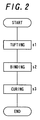
- the flame-retardant nylon BCF was tufted as a pile yarn of 3 ply and 4320 dtex by a 1/8G tufting machine on the backing fabric so that pile weight became 500 gr/m 2 , whereby a carpet was obtained in step s1 of Fig. 2.
- polyester backing fabric As the polyester backing fabric, the polyester woven backing fabric disclosed in JP-A 2002-69828 was used. Polyester yarn of 825 dtex/192 fil was used as warp, polyester yarn of 1100 dtex/250 fil was used as weft, low-melting-point ester fiber of 275 dtex/167 fil was used, and an adhesion woven backing fabric having warp density of 26/inch and weft density of 25/inch was used.
- the flame-retardant latex was prepared so that viscosity measured by a B-type NO4 rotor (a B-type viscometer of B-8L model produced by Tokyo Keiki) became 10,000 cps.
- SBR latex emulsion 100 parts by weight Expanded graphite 150 parts by weight Ammonium polyphosphate 50 parts by weight
- the flame-retardant latex was applied as emulsion for binding of the carpet (a backing agent) so as to become 1000 gr/m 2 and 500 g/m 2 in terms of solid content from the rear surface of the polyester backing fabric in step s2 of Fig. 2, dried at 120°C by a drier, and firmly attached in step s3 of Fig. 2.
- the limiting oxygen index (LOI) of the flame-retardant latex was 35, and the limiting oxygen index of the polyester backing fabric with the flame-retardant latex applied was 31.
- a carpet was produced in the same manner as in the examples 1 to 3 except that 100 parts by weight of the nylon 6 resin 1015 was used and no triazine flame retardant was blended.
- a carpet was produced in the same manner as in the examples 1 to 3 except that the blending ratio of the nylon 6 resin 1015 to the melamine cyanurate was set to 88 parts by weight to 12 parts by weight
- a composite was made in the same manner as in the examples 1 to 3 except that the blending ratio of the nylon 6 resin 1015 to the melamine cyanurate was set to 70 parts by weight to 30 parts by weight, and put into a nylon BCF producing apparatus, and melt-spinning at 250°C was tried, but single yarn breakage occurred frequently, and consequently, a nylon BCF could not be obtained. Therefore, a carpet could not be manufactured in the comparative example 3, so that a performance assessment test was not carried out thereon.
- Operation stability was assessed depending on whether single yarn breakage occurred or not when the spinning material was put into a nylon BCF producing apparatus and melt-spun. In a case where single yarn breakage did not occur and it was possible to continuously operate with stability, operation stability was assessed as good, and in a case where single yarn breakage occurred and it was impossible to continuously operate, operation stability was assessed as bad.
- the assessment result of the flame-retardant test for an aircraft was passed, and the operation stability was also good.
- the assessment result of the flame-retardant test for an aircraft was not passed, and the comparative example 3, the operation stability at the time of weaving was bad.
Landscapes
- Engineering & Computer Science (AREA)
- Textile Engineering (AREA)
- Carpets (AREA)
- Compositions Of Macromolecular Compounds (AREA)
- Treatments For Attaching Organic Compounds To Fibrous Goods (AREA)
- Chemical Or Physical Treatment Of Fibers (AREA)
- Artificial Filaments (AREA)
- Yarns And Mechanical Finishing Of Yarns Or Ropes (AREA)
Abstract
Description
Therefore, a member and a structure that are capable of inhibiting the spread of the trouble as much as possible are used. Accordingly, a carpet used as an interior furnishing member for a vessel, a vehicle, an aircraft, a movie theater, a theater, a welfare facility, a tall building and so on also needs to be highly safe, in concrete, highly flame-retardant.
N,N-hexamethylenebis(3,5-di-t-butyl-4-hydroxyphenyl) propionate, such as IRGANOX-1098 produced by Ciba Specialty Chemicals Inc., and examples of the hindered amine compounds are, for example, 1,3-benzene dicarboxyamide and
N,N'-bis(2,2,6,6-tetramethyl-4-piperidinyl), such as S-EED produced by Clariant Japan K.K., and it is possible to use them singly or in combination. It is preferred that the heat stabilizer is added so as to become 0.1 to 1.0% by weight with respect to the total weight of the flame-retardant nylon.
| SBR latex emulsion | 100 parts by weight |
| Expanded graphite | 150 parts by weight |
| Phosphoric flame retardant (ammonium polyphosphate) | 50 parts by weight |
| Thickener (CMC type) | 5 parts by weight |
| NBR latex emulsion | 100 parts by weight |
| Expanded graphite | 60 parts by weight |
| Phosphoric flame retardant (red phosphorus) | 30 parts by weight |
| Thickener (CMC type) | 3 parts by weight |
| SBR latex emulsion | 100 parts by weight |
| Expanded graphite | 150 parts by weight |
| Ammonium polyphosphate | 50 parts by weight |

Claims (17)
- A flame-retardant nylon carpet (1) comprising:a pile yarn (2) containing nylon;a backing fabric (3) containing polyester fiber; andlatex (4) used for binding the pile yarn (2) to the backing fabric,the pile yarn (2) having a limiting oxygen index of 26 or more,the backing fabric (3) having a limiting oxygen index of 26 or more, andthe latex (4) having a limiting oxygen index of 26 or more.
- The flame-retardant nylon carpet (1) of claim 1, wherein the backing fabric (3) having the limiting oxygen index of 26 or more is formed by coating or impregnating the backing fabric (3) containing polyester fiber with the latex (4) having the limiting oxygen index of 26 or more, and curing the latex (4).
- The flame-retardant nylon carpet (1) of claim 1, wherein the pile yarn (2) contains 15 to 25 parts by weight of a triazine flame retardant with respect to 75 to 85 parts by weight of an aliphatic polyamide resin.
- The flame-retardant nylon carpet (1) of claim 3, wherein the triazine flame retardant is melamine cyanurate.
- The flame-retardant nylon carpet (1) of claim 3 or 4, wherein the pile yarn (2) further contains a heat stabilizer.
- The flame-retardant nylon carpet (1) of claim 5, wherein the heat stabilizer is one or two selected from hindered phenolic compounds and hindered amine compounds.
- The flame-retardant nylon carpet (1) of claim 5 or 6, wherein the pile yarn (2) further contains a flow stability improver.
- The flame-retardant nylon carpet (1) of claim 7, wherein the flow stability improver is one or two or more selected from the group consisting of magnesium stearate, montanic acid magnesium, magnesium behenate, magnesium 12-hydroxystearate, calcium stearate, amide ethylene-bis-stearate and amide ethylene-bis-behenate.
- The flame-retardant nylon carpet (1) of any one of claims 1 to 8, wherein the latex (4) contains 30 to 200 parts by weight of expanded graphite with respect to 100 parts by weight of a latex component.
- The flame-retardant nylon carpet (1) of any one of claims 1 to 8, wherein the latex (4) contains 10 to 100 parts by weight of a phosphoric flame retardant with respect to 100 parts by weight of a latex component.
- The flame-retardant nylon carpet (1) of any one of claims 1 to 8, wherein the latex (4) contains 30 to 200 parts by weight of expanded graphite and 10 to 100 parts by weight of a phosphoric flame retardant with respect to 100 parts by weight of a latex component.
- The flame-retardant nylon carpet (1) of claim 10 or 11, wherein the phosphoric flame retardant is red phosphorus.
- The flame-retardant nylon carpet (1) of claim 10 or 11, wherein the phosphoric flame retardant is condensed phosphate.
- The flame-retardant nylon carpet (1) of claim 13, wherein the condensed phosphate is one or two selected from ammonium polyphosphate and melamine polyphosphate.
- The flame-retardant nylon carpet (1) of claim 10 or 11, wherein the phosphoric flame retardant is a phosphoric ester compound.
- The flame-retardant nylon carpet (1) of claim 15, wherein the phosphate ester compound is one or two or more selected from the group consisting of 1,3-phenylene bisdiphenyl phosphate, 1,3-phenylene bisdixylenyl phosphate, xylenyl phenyl phosphate and resorcinol bisdiphenyl phosphate.
- A method for manufacturing a flame-retardant nylon carpet (1) comprising a pile yarn (2) containing nylon, a backing fabric (3) containing polyester fiber, and latex (4) used for binding the pile yarn (2) to the backing fabric, the method comprising:a tufting step of implanting piles of the nylon pile yarn (2) having a limiting oxygen index of 26 or more in the backing fabric (3) containing polyester fiber;a binding step of coating or impregnating the backing fabric (3) containing polyester fiber with the latex (4) containing 30 to 200 parts by weight of expanded graphite and/or 10 to 100 weight parts by weight of a phosphoric flame retardant with respect to 100 parts by weight of a latex component; anda curing step of curing the latex (4) with which the backing fabric (3) containing polyester fiber is coated or impregnated.
Applications Claiming Priority (4)
| Application Number | Priority Date | Filing Date | Title |
|---|---|---|---|
| JP2003432423 | 2003-12-26 | ||
| JP2003432423 | 2003-12-26 | ||
| JP2004096680 | 2004-03-29 | ||
| JP2004096680A JP2005205157A (en) | 2003-12-26 | 2004-03-29 | Flame retardant nylon carpet and method for producing the same |
Publications (2)
| Publication Number | Publication Date |
|---|---|
| EP1548182A2 true EP1548182A2 (en) | 2005-06-29 |
| EP1548182A3 EP1548182A3 (en) | 2008-03-05 |
Family
ID=34554878
Family Applications (1)
| Application Number | Title | Priority Date | Filing Date |
|---|---|---|---|
| EP20040078519 Withdrawn EP1548182A3 (en) | 2003-12-26 | 2004-12-24 | Flame-retardant nylon carpet and method for manufacturing the same |
Country Status (3)
| Country | Link |
|---|---|
| US (1) | US20050142327A1 (en) |
| EP (1) | EP1548182A3 (en) |
| JP (1) | JP2005205157A (en) |
Cited By (3)
| Publication number | Priority date | Publication date | Assignee | Title |
|---|---|---|---|---|
| BE1018982A5 (en) * | 2009-11-03 | 2011-12-06 | Eoc Belgium | |
| DE102013012843A1 (en) | 2013-08-02 | 2015-02-05 | Anker-Teppichboden Gebr. Schoeller Gmbh + Co. Kg | Textile floor covering, in particular for use in the interior of aircraft |
| CN111713950A (en) * | 2019-03-18 | 2020-09-29 | 德阳聪源光电科技股份有限公司 | Safe and reliable graphene far-infrared electric heating carpet with quick heat energy conduction and uniform temperature |
Families Citing this family (12)
| Publication number | Priority date | Publication date | Assignee | Title |
|---|---|---|---|---|
| US20070248788A1 (en) * | 2006-04-19 | 2007-10-25 | Cheek Glenn E | Replacement automotive carpets |
| GB0914377D0 (en) | 2009-08-17 | 2009-09-30 | Interface Internat B V | Switchable adhesive and objects utilising the same |
| JP5866678B2 (en) * | 2011-04-20 | 2016-02-17 | 住江織物株式会社 | Flame retardant tufted carpet and method for producing the same |
| JP5051559B1 (en) * | 2011-06-27 | 2012-10-17 | 株式会社ヒガシ化学 | Flame retardant interior materials for transportation |
| JP5946614B2 (en) * | 2011-08-15 | 2016-07-06 | ユニチカ株式会社 | Polyamide resin composition and molded body using the polyamide resin composition |
| JP2013103104A (en) * | 2011-11-16 | 2013-05-30 | Ono:Kk | Tufted carpet lining adhesive and flame-retardant tufted carpet |
| US9670337B2 (en) * | 2012-03-13 | 2017-06-06 | Basf Se | Flame-retardant thermoplastic polyurethane comprising coated metal hydroxides based on aluminum |
| USD725794S1 (en) * | 2014-01-07 | 2015-03-31 | Edgar Zamora | Hedge panel |
| EP3287560A1 (en) * | 2016-08-26 | 2018-02-28 | TISCA Tischhauser AG | Floor covering, in particular textile floor covering |
| CN108677353A (en) * | 2018-06-15 | 2018-10-19 | 青岛百花旺塑料科技有限公司 | A kind of crude fibre nylon yarn carpet and its mode of production |
| CN110903643A (en) * | 2019-04-29 | 2020-03-24 | 山东祥龙新材料股份有限公司 | Flame-retardant nylon 1010 material and preparation method thereof |
| CN111793971A (en) * | 2020-06-12 | 2020-10-20 | 诺奥(福建)环保家居用品有限公司 | Flame-retardant ultraviolet-resistant non-woven carpet and preparation method thereof |
Family Cites Families (28)
| Publication number | Priority date | Publication date | Assignee | Title |
|---|---|---|---|---|
| DE1694539C3 (en) * | 1967-06-06 | 1973-10-18 | Knapsack Ag, 5033 Huerth-Knapsack | Process for the production of self-extinguishing copolymers from styrene and acrylonitrile |
| US3719608A (en) * | 1968-11-12 | 1973-03-06 | Dow Chemical Co | Oxidation resistant graphite compositions |
| US3682692A (en) * | 1970-12-04 | 1972-08-08 | Michigan Chem Corp | Flame retardant nylon-containing material |
| US3719547A (en) * | 1970-12-09 | 1973-03-06 | Monsanto Co | Flame retardant pile fabric |
| US3779857A (en) * | 1972-04-27 | 1973-12-18 | Standard Brands Chem Ind Inc | Textile laminating compositions and composite textile structures laminated therewith |
| DE7907356U1 (en) * | 1979-03-16 | 1979-07-19 | Hoechst Ag, 6000 Frankfurt | TUFTING CARPET |
| JPS5953781A (en) * | 1982-09-17 | 1984-03-28 | ユニチカ株式会社 | Fire retardant pile knitted fabric |
| JPS61111340A (en) * | 1984-11-05 | 1986-05-29 | Asahi Chem Ind Co Ltd | Flame-retardant polyurethane foam |
| JPS61279210A (en) * | 1985-06-04 | 1986-12-10 | 旭化成株式会社 | Carpet |
| JP2855626B2 (en) * | 1988-11-04 | 1999-02-10 | 東洋紡績株式会社 | Blanket with excellent flame retardancy and anti-pill properties |
| JPH04100979A (en) * | 1990-08-10 | 1992-04-02 | Achilles Corp | Flameproof shading curtain |
| CA2078626C (en) * | 1992-03-06 | 1999-04-27 | Gary W. Shore | Method for producing polyamide carpet fibers with improved flame retardancy |
| DE59305142D1 (en) * | 1992-09-30 | 1997-02-27 | Hoechst Ag | Flame retardant carpeting |
| US5618605A (en) * | 1993-03-06 | 1997-04-08 | Basf Corporation | Flame-retardant polyamide carpets |
| GB2305922B (en) * | 1994-11-18 | 1998-07-22 | Asahi Chemical Ind | Polyamide resin composition |
| JPH08218222A (en) * | 1995-02-13 | 1996-08-27 | Sekisui Chem Co Ltd | Pile yarn for artificial grass |
| JP3375807B2 (en) * | 1995-10-20 | 2003-02-10 | カネボウ株式会社 | Method for producing polylactic acid resin with excellent thermal stability |
| JP2000129141A (en) * | 1998-10-28 | 2000-05-09 | Asahi Chem Ind Co Ltd | Production of flame-retarded resin composition |
| DE29922034U1 (en) * | 1999-12-15 | 2000-03-02 | Texplorer GmbH, 41334 Nettetal | Clothing, in particular undergarments for people in the military and civil protection sectors |
| JP2001316940A (en) * | 2000-05-09 | 2001-11-16 | Kuraray Co Ltd | Flame retardant polyvinyl alcohol fiber |
| JP3682713B2 (en) * | 2000-05-15 | 2005-08-10 | 平岡織染株式会社 | Flame-retardant polyolefin-based resin-coated sheet and method for producing the same |
| JP4085354B2 (en) * | 2000-08-31 | 2008-05-14 | 株式会社オーノ | Tufted carpet and primary fabric |
| US6740275B2 (en) * | 2000-09-04 | 2004-05-25 | Mitsubishi Engineering-Plastics Corporation | Flame-retardant polyamide-based protective sheet |
| JP2002173829A (en) * | 2000-09-20 | 2002-06-21 | Mitsubishi Engineering Plastics Corp | Flame retardant polyamide filament |
| US20040076824A1 (en) * | 2000-09-20 | 2004-04-22 | Hiroshi Urabe | Flame-retardant polyamide filaments and their use |
| JP2002309443A (en) * | 2001-02-08 | 2002-10-23 | Mitsubishi Engineering Plastics Corp | Flame retardant polyamide multifilament, BCF and carpet using the same |
| JP3703768B2 (en) * | 2002-02-18 | 2005-10-05 | 株式会社クラレ | Method for producing hollow fiber |
| JP3984070B2 (en) * | 2002-02-20 | 2007-09-26 | 小松精練株式会社 | Flame retardant polyester fiber fabric |
-
2004
- 2004-03-29 JP JP2004096680A patent/JP2005205157A/en active Pending
- 2004-12-23 US US11/020,044 patent/US20050142327A1/en not_active Abandoned
- 2004-12-24 EP EP20040078519 patent/EP1548182A3/en not_active Withdrawn
Cited By (4)
| Publication number | Priority date | Publication date | Assignee | Title |
|---|---|---|---|---|
| BE1018982A5 (en) * | 2009-11-03 | 2011-12-06 | Eoc Belgium | |
| DE102013012843A1 (en) | 2013-08-02 | 2015-02-05 | Anker-Teppichboden Gebr. Schoeller Gmbh + Co. Kg | Textile floor covering, in particular for use in the interior of aircraft |
| WO2015014335A1 (en) | 2013-08-02 | 2015-02-05 | Anker-Teppichboden Gebr. Schoeller Gmbh + Co. Kg | Textile floor covering, in particular for use in the interior of aircrafts |
| CN111713950A (en) * | 2019-03-18 | 2020-09-29 | 德阳聪源光电科技股份有限公司 | Safe and reliable graphene far-infrared electric heating carpet with quick heat energy conduction and uniform temperature |
Also Published As
| Publication number | Publication date |
|---|---|
| EP1548182A3 (en) | 2008-03-05 |
| US20050142327A1 (en) | 2005-06-30 |
| JP2005205157A (en) | 2005-08-04 |
Similar Documents
| Publication | Publication Date | Title |
|---|---|---|
| EP1548182A2 (en) | Flame-retardant nylon carpet and method for manufacturing the same | |
| EP2009159B1 (en) | Flameproof woven fabric for chair upholstery | |
| US20100330351A1 (en) | Yarns, high wear resistance fabrics and objects made therefrom | |
| JPWO2003066956A1 (en) | Flame-retardant molded products and fabric products | |
| CN102186928A (en) | Flame retardant polymer composites, fibers, carpets, and methods of making each | |
| KR101737557B1 (en) | Earthquake-proof reinforcement and flame-retarded complex reinforcement method for concrete structure | |
| WO2003008042A1 (en) | Flameproof textile surface structures | |
| US6383957B2 (en) | Flame retardant for mesh sheets and flameproof mesh sheet | |
| US20260078532A1 (en) | Fire retardant nylon fibers and methods for making them | |
| JPH0130953B2 (en) | ||
| JP3249940B2 (en) | Flame retardant for mesh sheet and flameproof mesh sheet using the same | |
| US6248820B1 (en) | Flame retardant for mesh sheets and flameproof mesh sheet comprising the same | |
| WO2008039614A2 (en) | Flame-retardant filament and method of manufacture thereof and protective sleeves constructed therefrom | |
| US6150448A (en) | Flame retardant for mesh sheets and flameproof mesh sheet including the same | |
| KR20180050065A (en) | Flame retardant hotmelt coating yarn and material using the same | |
| JP2005205156A (en) | Flame retardant nylon carpet for aircraft and method for producing the same | |
| KR101951590B1 (en) | Saftey rope | |
| EP3802944B1 (en) | Fire resistant coated polyester mine grid and method for producing it | |
| EP3777617B1 (en) | Carpet | |
| Kandola | Flame-Retardant Design and Protection for Textiles | |
| JP3589867B2 (en) | Flame retardant for mesh sheet and flameproof mesh sheet using the same | |
| JPH07216748A (en) | Heat resistant sheet | |
| JP5727600B2 (en) | Flame retardant mixture, continuous material and product formed therefrom, and method for producing the same | |
| WO2001098569A1 (en) | Fireproof fabric | |
| JPH072404B2 (en) | Heat resistant sheet |
Legal Events
| Date | Code | Title | Description |
|---|---|---|---|
| PUAI | Public reference made under article 153(3) epc to a published international application that has entered the european phase |
Free format text: ORIGINAL CODE: 0009012 |
|
| AK | Designated contracting states |
Kind code of ref document: A2 Designated state(s): AT BE BG CH CY CZ DE DK EE ES FI FR GB GR HU IE IS IT LI LT LU MC NL PL PT RO SE SI SK TR |
|
| AX | Request for extension of the european patent |
Extension state: AL BA HR LV MK YU |
|
| PUAL | Search report despatched |
Free format text: ORIGINAL CODE: 0009013 |
|
| AK | Designated contracting states |
Kind code of ref document: A3 Designated state(s): AT BE BG CH CY CZ DE DK EE ES FI FR GB GR HU IE IS IT LI LT LU MC NL PL PT RO SE SI SK TR |
|
| AX | Request for extension of the european patent |
Extension state: AL BA HR LV MK YU |
|
| AKX | Designation fees paid | ||
| STAA | Information on the status of an ep patent application or granted ep patent |
Free format text: STATUS: THE APPLICATION IS DEEMED TO BE WITHDRAWN |
|
| REG | Reference to a national code |
Ref country code: DE Ref legal event code: 8566 |
|
| 18D | Application deemed to be withdrawn |
Effective date: 20080701 |