EP1561883A1 - Tower for a wind turbine, prefabricated metal wall part for use in tower for a wind turbine and method for constructing a tower for a wind turbine - Google Patents
Tower for a wind turbine, prefabricated metal wall part for use in tower for a wind turbine and method for constructing a tower for a wind turbine Download PDFInfo
- Publication number
- EP1561883A1 EP1561883A1 EP05075067A EP05075067A EP1561883A1 EP 1561883 A1 EP1561883 A1 EP 1561883A1 EP 05075067 A EP05075067 A EP 05075067A EP 05075067 A EP05075067 A EP 05075067A EP 1561883 A1 EP1561883 A1 EP 1561883A1
- Authority
- EP
- European Patent Office
- Prior art keywords
- tower
- metal wall
- prefabricated metal
- wind turbine
- flange
- Prior art date
- Legal status (The legal status is an assumption and is not a legal conclusion. Google has not performed a legal analysis and makes no representation as to the accuracy of the status listed.)
- Granted
Links
- 239000002184 metal Substances 0.000 title claims abstract description 142
- 229910052751 metal Inorganic materials 0.000 title claims abstract description 142
- 238000000034 method Methods 0.000 title claims description 8
- 229910000831 Steel Inorganic materials 0.000 claims description 9
- 239000010959 steel Substances 0.000 claims description 9
- 238000010276 construction Methods 0.000 description 12
- 239000000463 material Substances 0.000 description 5
- 238000005452 bending Methods 0.000 description 2
- 238000012423 maintenance Methods 0.000 description 2
- 239000000565 sealant Substances 0.000 description 2
- 238000007789 sealing Methods 0.000 description 2
- HCHKCACWOHOZIP-UHFFFAOYSA-N Zinc Chemical compound [Zn] HCHKCACWOHOZIP-UHFFFAOYSA-N 0.000 description 1
- 239000011248 coating agent Substances 0.000 description 1
- 238000000576 coating method Methods 0.000 description 1
- 238000005260 corrosion Methods 0.000 description 1
- 230000007797 corrosion Effects 0.000 description 1
- 230000001419 dependent effect Effects 0.000 description 1
- 230000000694 effects Effects 0.000 description 1
- 238000005516 engineering process Methods 0.000 description 1
- 238000007689 inspection Methods 0.000 description 1
- 230000008439 repair process Effects 0.000 description 1
- 230000003068 static effect Effects 0.000 description 1
- 238000003466 welding Methods 0.000 description 1
- 229910052725 zinc Inorganic materials 0.000 description 1
- 239000011701 zinc Substances 0.000 description 1
Images




Classifications
-
- E—FIXED CONSTRUCTIONS
- E04—BUILDING
- E04H—BUILDINGS OR LIKE STRUCTURES FOR PARTICULAR PURPOSES; SWIMMING OR SPLASH BATHS OR POOLS; MASTS; FENCING; TENTS OR CANOPIES, IN GENERAL
- E04H12/00—Towers; Masts or poles; Chimney stacks; Water-towers; Methods of erecting such structures
- E04H12/02—Structures made of specified materials
- E04H12/08—Structures made of specified materials of metal
- E04H12/085—Details of flanges for tubular masts
-
- F—MECHANICAL ENGINEERING; LIGHTING; HEATING; WEAPONS; BLASTING
- F03—MACHINES OR ENGINES FOR LIQUIDS; WIND, SPRING, OR WEIGHT MOTORS; PRODUCING MECHANICAL POWER OR A REACTIVE PROPULSIVE THRUST, NOT OTHERWISE PROVIDED FOR
- F03D—WIND MOTORS
- F03D13/00—Assembly, mounting or commissioning of wind motors; Arrangements specially adapted for transporting wind motor components
- F03D13/10—Assembly of wind motors; Arrangements for erecting wind motors
-
- F—MECHANICAL ENGINEERING; LIGHTING; HEATING; WEAPONS; BLASTING
- F05—INDEXING SCHEMES RELATING TO ENGINES OR PUMPS IN VARIOUS SUBCLASSES OF CLASSES F01-F04
- F05B—INDEXING SCHEME RELATING TO WIND, SPRING, WEIGHT, INERTIA OR LIKE MOTORS, TO MACHINES OR ENGINES FOR LIQUIDS COVERED BY SUBCLASSES F03B, F03D AND F03G
- F05B2230/00—Manufacture
- F05B2230/60—Assembly methods
-
- F—MECHANICAL ENGINEERING; LIGHTING; HEATING; WEAPONS; BLASTING
- F05—INDEXING SCHEMES RELATING TO ENGINES OR PUMPS IN VARIOUS SUBCLASSES OF CLASSES F01-F04
- F05B—INDEXING SCHEME RELATING TO WIND, SPRING, WEIGHT, INERTIA OR LIKE MOTORS, TO MACHINES OR ENGINES FOR LIQUIDS COVERED BY SUBCLASSES F03B, F03D AND F03G
- F05B2240/00—Components
- F05B2240/90—Mounting on supporting structures or systems
- F05B2240/91—Mounting on supporting structures or systems on a stationary structure
- F05B2240/912—Mounting on supporting structures or systems on a stationary structure on a tower
-
- Y—GENERAL TAGGING OF NEW TECHNOLOGICAL DEVELOPMENTS; GENERAL TAGGING OF CROSS-SECTIONAL TECHNOLOGIES SPANNING OVER SEVERAL SECTIONS OF THE IPC; TECHNICAL SUBJECTS COVERED BY FORMER USPC CROSS-REFERENCE ART COLLECTIONS [XRACs] AND DIGESTS
- Y02—TECHNOLOGIES OR APPLICATIONS FOR MITIGATION OR ADAPTATION AGAINST CLIMATE CHANGE
- Y02E—REDUCTION OF GREENHOUSE GAS [GHG] EMISSIONS, RELATED TO ENERGY GENERATION, TRANSMISSION OR DISTRIBUTION
- Y02E10/00—Energy generation through renewable energy sources
- Y02E10/70—Wind energy
- Y02E10/72—Wind turbines with rotation axis in wind direction
-
- Y—GENERAL TAGGING OF NEW TECHNOLOGICAL DEVELOPMENTS; GENERAL TAGGING OF CROSS-SECTIONAL TECHNOLOGIES SPANNING OVER SEVERAL SECTIONS OF THE IPC; TECHNICAL SUBJECTS COVERED BY FORMER USPC CROSS-REFERENCE ART COLLECTIONS [XRACs] AND DIGESTS
- Y02—TECHNOLOGIES OR APPLICATIONS FOR MITIGATION OR ADAPTATION AGAINST CLIMATE CHANGE
- Y02E—REDUCTION OF GREENHOUSE GAS [GHG] EMISSIONS, RELATED TO ENERGY GENERATION, TRANSMISSION OR DISTRIBUTION
- Y02E10/00—Energy generation through renewable energy sources
- Y02E10/70—Wind energy
- Y02E10/728—Onshore wind turbines
-
- Y—GENERAL TAGGING OF NEW TECHNOLOGICAL DEVELOPMENTS; GENERAL TAGGING OF CROSS-SECTIONAL TECHNOLOGIES SPANNING OVER SEVERAL SECTIONS OF THE IPC; TECHNICAL SUBJECTS COVERED BY FORMER USPC CROSS-REFERENCE ART COLLECTIONS [XRACs] AND DIGESTS
- Y02—TECHNOLOGIES OR APPLICATIONS FOR MITIGATION OR ADAPTATION AGAINST CLIMATE CHANGE
- Y02P—CLIMATE CHANGE MITIGATION TECHNOLOGIES IN THE PRODUCTION OR PROCESSING OF GOODS
- Y02P70/00—Climate change mitigation technologies in the production process for final industrial or consumer products
- Y02P70/50—Manufacturing or production processes characterised by the final manufactured product
Definitions
- This invention relates to a tower for a wind turbine which has an exterior side and an interior side and which tower is at least partly composed of prefabricated metal wall parts.
- the invention also relates to a prefabricated metal wall part for use in a tower for a wind turbine.
- the invention further relates to a method for constructing a tower for a wind turbine which has an exterior side and an interior side and wherein the tower is at least partly composed of prefabricated metal wall parts.
- the forces exerted on the top of the tower by the rotor-turbine assembly determine the load, i.e. the bending moments at all essentially horizontal flange connections and welds.
- the ultimate strength is determined by the yield strength of the bolts and by the buckling strength of the tubular metal wall.
- the welds are critical. During service, it is very difficult to inspect the quality of a weld. Also, on-site repairs are awkward.
- Hybrid towers such as towers with concrete walls, poured between an inner and outer steel shell have also been proposed.
- the problem is to assure the quality of the wall, once it has been poured.
- tension means are required to keep the concrete wall under compressive forces.
- concrete towers are not an economical solution.
- a tower for a wind turbine wherein the tower has an exterior side and an interior side and wherein the tower is at least partly composed of prefabricated metal wall parts wherein each wall part comprises an essentially quadrangular portion having an outwardly facing surface in the direction of the exterior of the tower and an inwardly facing surface in the direction of the interior of the tower, said portion having a top edge, a bottom edge, a first side edge and a second side edge, wherein the first side edge is provided with a first flange along at least part of the length of the first side edge and wherein the second side edge is provided with a second flange along at least part of the length of the second side edge.
- the stiffness of the construction is increased by the presence of the flanges of the prefabricated metal wall parts, which act as a rib.
- the transport of complete tower sections is no longer required, thus solving the transport problem.
- the prefabricated metal wall parts are easy to transport with ordinary transport means such as trucks.
- the size of the tower at the foundation is no longer limited by the transport restrictions and a wider base can be used. It also allows construction of higher towers because the size of the base is no longer an issue. The wider base results in a lower local pressure on the foundation, thus enabling to use a simpler foundation.
- the tower is substantially composed of prefabricated metal wall parts.
- the tower according to this embodiment relies on prefabricated metal wall parts as the load bearing elements, and are readily distinguishable from concrete towers, where a wall part serves as a mould for the concrete to be poured in and where, after setting, the concrete serves as the main load bearing material. It should be noted that the tower according to the invention does not comprise concrete as a load bearing material at the location of the prefabricated metal wall parts.
- a tower according to the invention on top of a concrete foundation or base wherein the concrete base extends upwardly, the base forming the lower part of the tower, and a tower according to the invention forming the upper part of the tower.
- first flanges and the second flanges of the prefabricated metal wall parts extend towards the interior side of the tower. This enables to produce a tower where the rib, formed by the adjacent flanges, is located on the inside of the tower, leaving a smooth exterior appearance. A smooth exterior leads to a reduced impact of wind force on the tower and a smooth exterior is considered to be visually more attractive.
- the prefabricated metal wall parts having a height and a width, at least two of the prefabricated metal wall parts have a height which is about 2.5 times larger than the width of the bottom edge, preferably more than five times larger, more preferably more than 10 times larger.
- the height of the prefabricated metal wall parts is to be understood to be the distance between the bottom edge and the top edge of the prefabricated metal wall parts when present in the tower.
- the length direction is defined in the direction of the height of the tower.
- the tower comprises prefabricated metal wall parts which are considerably higher than wide, thus resulting in long side edges of the essentially quadrangular portion of the prefabricated metal wall parts and thereby enabling long flanges being provided at least partly on the side edge thereof. These long flanges enable a large stiffening potential of the tower.
- the first flange of a prefabricated metal wall part is attached to the second flange of an adjacent second prefabricated metal wall part by fastening means.
- the flanges are now fixedly connected, thereby increasing the stiffening potential because of the double thickness of the rib.
- Fastening means comprise for instance a weld or a rivet.
- the fastening means comprise nuts and bolts. This enables to fasten quickly the first and second flange of two adjacent panels to each other.
- the holes required for the bolts to be inserted into may already be present in the prefabricated metal wall parts or may be drilled at the site where the connection between the adjacent panels is made.
- the use of nuts and bolts also enables to temporarily undo the connection, for instance to remove a prefabricated metal wall part from the construction, or to replace a prefabricated metal wall part. It also allows easy on-site and/or off-site inspection.
- the essentially quadrangular portion of the prefabricated metal wall parts is preferably orthogonal or trapezial wherein the length of the first side edge is approximately equal to the length of the second side edge and wherein the bottom edge is longer than the top edge.
- the use of orthogonal prefabricated metal wall parts is called for
- trapezial prefabricated metal wall parts are called for.
- Conical towers enable to construct a tower with a large base and become slimmer with increasing height of the tower. Tapering can be over the entire height of the tower or over part of the length of the tower. The latter can also be achieved by using prefabricated metal wall parts to form essentially cylindrical tower sections and by using prefabricated metal wall parts to form essentially conical tower sections and combine these tower sections into one tower.
- Kinked prefabricated metal wall parts may be used in the upper levels of a conically tapered tower or tower section for a wind turbine wherein the lower levels are made using prefabricated metal wall parts with an essentially flat quadrangular portion, thus reducing the number of prefabricated metal wall parts required for a full ring.
- One prefabricated metal wall part with one kink in the essentially quadrangular portion in a given upper level ring will link up with two prefabricated metal wall parts which have an essentially flat quadrangular portion in the ring immediately below the upper level ring.
- the kinked prefabricated metal wall parts contains more kinks, it may link up with a corresponding number of prefabricated metal wall parts with an essentially flat quadrangular portion. It will be clear that kinked prefabricated metal wall parts in a lower level can also be combined with kinked prefabricated metal wall parts in the upper level.
- the tower has an essentially annular, preferably essentially circular horizontal cross-section.
- An essentially annular horizontal cross section is also obtained if a polygonal horizontal cross section is taken with a large number of facets such as a pentagon or hexagon.
- the essentially quadrangular portion of the prefabricated metal wall parts are curved with a radius corresponding to the radius of the tower at the position of the location of the prefabricated metal wall part. This allows constructing a tower with a smooth curvature, and in case the first and second flanges extend towards the interior side of the tower, the exterior of the tower will be smooth.
- the quadrangular portion of the first prefabricated metal wall parts is essentially flat. The use of an essentially flat quadrangular portion has the advantage that there is no need for a locally dependent curvature in the quadrangular portion and is therefore easier to produce. It is also more convenient during transport of the prefabricated metal wall parts.
- the essentially flat quadrangular prefabricated metal wall parts also comprises at least one kink essentially in the direction between the bottom edge and the top edge of the prefabricated metal wall part.
- the kink (or kinks) therefore runs in the direction of the height of the tower. With the kink (or kinks) a higher buckling stiffness of the prefabricated metal wall part is obtained. It may alo increases the number of facets of the polygonal thereby achieving a smoother exterior of the tower.
- the invention is also embodied in a tower for a wind turbine as described hereinabove wherein the first flange is provided with an additional first flange along at least part of the length of the first flange and/or wherein the second flange is provided with an additional second flange along at least part of the length of the second flange.
- This is advantageous for instance for a further increase in stiffening the tower, particularly when the first flange and second flange are both provided with an additional flange, wherein the first flange with its respective additional flange preferably essentially forms an L-shape and/or wherein the second flange with its respective additional flange preferably essentially forms an L-shape.
- these additional flanges on the first and/or second flanges may be used to attach objects thereto such as stairs, or internal floors.
- the invention is also embodied in a tower for a wind turbine as described hereinabove wherein the first and/or second flanges are at least partly folded back towards the inwardly facing surface of the essentially quadrangular portion of the prefabricated metal wall part, thereby effectively doubling the thickness of the flanges.
- This doubling of the flanges causes an additional stiffening of the construction. It will be clear to the skilled person that the flange could also be folded back twice or more contributing to the stiffening effect.
- the prefabricated metal wall parts are steel parts, preferably high strength steel parts, for instance having a yield strength of about 355 MPa or higher.
- the use of steel enables to use prefabricated metal wall parts of a small thickness, which reduces the weight of the tower.
- the use of high strength steel prefabricated metal wall parts enables a further reduction in weight of the tower. As a result, the foundation of the tower can be constructed more efficient.
- the first flange of a first prefabricated metal wall part is vertically staggeredly attached to the second flange of an adjacent second prefabricated metal wall part by fastening means.
- This application of prefabricated metal wall parts by a stretching bond type connection of the flanges of two adjacent prefabricated metal wall parts also requires the application of prefabricated metal wall parts of different lengths, at least in the first and last ring of the tower or tower section.
- the application of this staggered connection has the advantage over constructing the tower from rings of connected non-staggeredly connected prefabricated metal wall parts that the forces are lead through the construction without having to be led through horizontal flanges which connect the aforementioned rings.
- the overlap at the edges between the staggeredly connected prefabricated metal wall parts is between 1:2 and 1:4, preferably about 1:3, meaning that about 1 ⁇ 2 to 3 ⁇ 4, preferably about 2 / 3 of the respective side edges of adjacent prefabricated metal wall parts overlap.
- the circumference of the tower consists of n adjacently positioned prefabricated metal wall parts, wherein the angle between the first flange and the second flange is 360/ n .
- the prefabricated metal wall part for use in a tower for a wind turbine as described hereinabove is characterised in that the prefabricated metal wall part comprises an essentially quadrangular portion having an outwardly facing surface and an inwardly facing surface, said portion having a top edge, a bottom edge, a first side edge and a second side edge, wherein the first side edge is provided with a first flange along at least part of the length of the first side edge and wherein the second side edge is provided with a second flange along at least part of the length of the second side edge.
- a method for constructing a tower for a wind turbine as described hereinabove, wherein the tower is at least partly composed of prefabricated metal wall parts as described hereinabove.
- the absence of horizontal welds in the towers according to the invention eliminates a known source of fatigue failure, thereby allowing to relieve design restrictions for instance by allowing to use thinner gauge metal plate.
- the locations where a bottom edge of a first prefabricated metal wall part touches a top edge of a prefabricated metal wall part which is located immediately below the first prefabricated metal wall part can be sealed by using sealing means, for instance a sealant. This prevents the outside atmosphere to enter the structure and prevents corrosion.
- the locations where the first flange of a prefabricated metal wall part is connected to the second flange of the adjacent prefabricated metal wall part can, if so desired, also be sealed using sealing means, such as a sealant.
- the tower is provided with stiffening means, such as one or more preferably substantially horizontal stiffening rings. These stiffening means are preferably provided in the interior of the tower to absorb the horizontal forces exerted on the tower. These stiffening means may be provided at different heights of the tower.
- the prefabricated metal wall parts are connected to the ring, thereby obtaining an increased stiffness of the tower. Additional connecting struts may be used to connect the prefabricated metal wall parts to the ring.
- the stiffening means may also be formed by internal floors, or the stiffening means, such as a stiffening ring along internal circumference of the tower, may provide the base for the internal floor or floors. The stiffening means may also contribute to the even distribution of forces and loads over the entire circumference of the tower.
- the prefabricated metal wall parts can be produced for example from hot-rolled metal using commonly known technology.
- the hot-rolled metal may be plate material or coiled material. This material, after optional leveling can be cut to the desired dimensions and shape, and the flanges can be formed on the edges of the essentially quadrangular portion of the prefabricated metal wall parts using conventional bending techniques.
- the optional curvature of the essentially quadrangular portion of the prefabricated metal wall parts or the kink or kinks can likewise be easily introduced.
- the prefabricated metal wall parts may be coated prior to use in the tower e.g. with zinc and/or an organic coating to extend the service life and to reduce maintenance.
- the prefabricated metal wall parts may also comprise additional built-in functionality such as a door for entering the interior of the tower. Internal structures like stairs and floors can be easily installed.
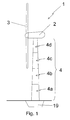
- FIG. 1 a schematic representation of a wind turbine 1 is shown.
- the wind turbine 1 comprises a generator 2, a rotor 3 and a tower 4 onto which the combination of the generator and the rotor is mounted.
- the tower 4 has an exterior surface which forms the outside of the tower 4 and an interior surface which forms the inside of the tower.
- the tower consists of four tower sections 4a-4d.
- the wind turbine is placed on a foundation 19.
- FIG 2 a tower 4 for a wind turbine according to the state of the art is shown.
- Tower segments 4a, 4b, 4c and 4d are mounted on top of each other. These tower segments are made off-site and connected through horizontal flanges and large bolts and nuts. These flanges are indicated schematically by the thick horizontal lines between the tower sections.
- the tower segments are made from curved plates which are welded together horizontally and vertically. These welds, indicated with the dashed lines, are known to be a possible source of fatigue failure, particularly the horizontal welds.
- a base of about 4.3 m and a top diameter of about 2.3 m is commonly used. The dimension of the base is limited by transport limitations.
- FIG 3a a tower 4 for a wind turbine according to the invention is shown, wherein the staggered prefabricated metal wall parts each stagger over about half the length of the neighbouring prefabricated metal wall part and figure 3b shows a tower wherein the staggered prefabricated metal wall parts each stagger over about a third of the length of the neighbouring prefabricated metal wall part.
- the base of the tower is about 6.5 m in diameter whereas the top of the tower has a diameter of about 2.3 m.
- the 6.5 m base diameter poses no transport problems because it can be transported to the building site in pieces.
- the increase in width of the base of the tower increases the stiffness of the tower. It also enables to construct higher towers width adequate stiffness to install high power wind turbines.
- Figure 4a shows an embodiment of a prefabricated metal wall part 5 according to the invention for use in a tower 4 for a wind turbine 1 as described hereinabove.
- the prefabricated metal wall part 5 is characterised in that the wall part comprises an essentially quadrangular portion 6 having an outwardly facing surface 7 facing the exterior of the tower and an inwardly facing surface 8 facing the interior of the tower, said portion having a top edge 9, a bottom edge 10, a first side edge 11 and a second side edge 12, wherein the first side edge 11 is provided with a first flange 13 along at least part of the length of the first side edge 11 and wherein the second side edge 12 is provided with a second flange 14 along at least part of the length of the second side edge 12.
- the first flange 13 is provided with an additional first flange 15 which essentially forms an L-shape with the first flange 13 and the second flange 14 is provided with an additional second flange 16 which essentially forms an L-shape with the second flange 14.
- the prefabricated metal wall parts are not drawn to scale.
- the cross section A-A is shown in figure 4b.
- Typical dimensions for such a prefabricated metal wall parts for the lower ring of a conical tower or tower segment would be a width at the top edge 9 of between about 0.60 and 1.00 m, for example about 0.86 m, a width at the bottom edge 10 of between about 1.30 and 0.70 m, for example about 1.04 m, a height of between about 10 and 20 meters, for example 20 meters, and a height of the extending first flange 13 and second flange 14 of between 0.10 and 0.20 m, for example about 0.15 m.
- a typical thickness of the prefabricated metal wall parts would be between 8 and 16 mm, for example about 12 mm.
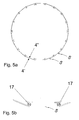
- FIG 5a a schematic cross section of the first ring of a tower for a wind turbine is shown.
- the essentially circular cross-section of the tower in this example is composed of eighteen prefabricated metal wall parts 5.
- the exterior of the tower is indicated by 4', the interior of the tower is indicated by 4".
- the first flange of each prefabricated metal wall parts is attached to the second flange of the adjacent prefabricated metal wall parts by bolts and nuts which are passed through holes in the first and second flange.
- Figure 5b shows a part of the first ring with the prefabricated metal wall parts 5 and the nuts and bolts 17.
- FIG 6 a schematic representation is shown of the L-shaped flange 18 which can be used to attach prefabricated metal wall parts of the first ring to the foundation 19 of the tower, or to the top ring on which the generator is attached.
- FIG 7 a schematic representation of part of the tower construction at the location of a stiffening ring is shown.
- the adjacent, staggeredly connected prefabricated metal wall parts are connected using an overlap at the edges (i.e. in a stretcher-bond type connection) of 1:3 and are also connected to the stiffening ring 20 using connecting struts 21.
- these connecting struts 21 are connected to the flanges 13, 14 (see figure 4) of the prefabricated metal wall parts on one side, and to the stiffening ring 20 on the other side.
- four prefabricated metal wall parts are shown which are indicated with A, B, C and D. The lower edge of part A and the upper edge of part B are adjacent.
- the first side edge of part A is adjacent and connected to the second side edge of part C by their adjacent flanges and fastening means (not shown).
- the connecting struts 21 extend above and below the stiffening ring 20, thereby enabling fixedly connecting the side edges of upper part A to the side edges of lower part B. Due to the 1:3 overlap in this example only about 1/3 of the circumference of the tower has a horizontal seam at or near the location of the stiffening ring. In the example of figure 8 the horizontal seam between part A and B is located near the stiffening ring 20.
- a tower for a wind turbine it is possible to first form a full ring of the tower by attaching at least two adjacent prefabricated metal wall parts along their adjacent flanges.
- This first full ring can be connected to an essentially flat and essentially horizontal foundation for the tower.
- the same result is obtained when starting with a first prefabricated metal wall part which is attached to the foundation after which a second prefabricated metal wall part is attached to the first prefabricated metal wall part and the foundation.
- the following full ring can be constructed upon the ring already present by first building the entire ring and subsequently lifting is on top of the ring already present, or by connecting prefabricated metal wall parts to the ring already present and to each other one by one, the former procedure requiring a larger capacity crane than the latter procedure. Rings are added to the rings already present until the desired height of the tower is obtained.
- the connection between the first full ring and the foundation may be achieved by using a flange that is connected to the foundation.
- the flanges may be simple L-shaped flanges.
- the flanges should have a corresponding curvature.
- a tower for a wind turbine it is possible to first form a full ring of the tower by attaching at least two adjacent prefabricated metal wall parts along their adjacent flanges vertically staggeredly.
- full length prefabricated metal wall parts are combined with prefabricated metal wall parts of half that length
- full length prefabricated metal wall parts are combined with prefabricated metal wall parts of 2/3 and 1/3 of that length (i.e. an overlap of 1:3).
- the remainder of the tower is constructed using essentially full length prefabricated metal wall parts.
- prefabricated metal wall parts of different lengths have to be used to make the top edge of the last ring level.
- prefabricated metal wall parts of non-full length elsewhere in the tower if so desired. This staggeredly attaching the prefabricated metal wall parts provides in a large stiffness of the tower, without introducing horizontal fully annular or circular flanges to connect tower sections.
- the tower When constructing a tower according to the invention, the tower may be constructed top down by starting to construct the top of the tower whilst being suspended onto a yoke construction, the yoke construction being provided with lifting means, such as a hydraulic jack.
- lifting means such as a hydraulic jack.
Landscapes
- Engineering & Computer Science (AREA)
- Architecture (AREA)
- Chemical & Material Sciences (AREA)
- Life Sciences & Earth Sciences (AREA)
- Sustainable Development (AREA)
- Wood Science & Technology (AREA)
- Civil Engineering (AREA)
- Structural Engineering (AREA)
- Materials Engineering (AREA)
- Sustainable Energy (AREA)
- Combustion & Propulsion (AREA)
- Mechanical Engineering (AREA)
- General Engineering & Computer Science (AREA)
- Wind Motors (AREA)
- Buildings Adapted To Withstand Abnormal External Influences (AREA)
- Bridges Or Land Bridges (AREA)
Abstract
Description
- This invention relates to a tower for a wind turbine which has an exterior side and an interior side and which tower is at least partly composed of prefabricated metal wall parts. The invention also relates to a prefabricated metal wall part for use in a tower for a wind turbine. The invention further relates to a method for constructing a tower for a wind turbine which has an exterior side and an interior side and wherein the tower is at least partly composed of prefabricated metal wall parts.
- An ongoing trend in the wind turbine market is the increasing power of the wind turbine in conjunction with increasing tower heights. Larger wind turbines imply an increase in size, weight and loads acting on the tower of the wind turbine. This requires the towers to be stronger and stiffer, and consequently lead to bigger tower dimensions.
- Conventional tubular steel towers for wind turbines of 2 MW and above require very large tower diameters and/or large wall thickness to take the large static and fatigue loads which are exerted on the wind turbine. These large towers are usually constructed by prefabricating a number of tower sections from metal plate by welding curved plates together, often referred to as "cans", and transporting these sections to the site where the tower is to be erected. These sections or cans are bolted to the foundation of the tower and to each other using curved L-type flanges requiring a large number of large bolts. The increasing power of the wind turbines also require the flanges to be produced with an increasing accuracy as to flatness. For land transport, the diameter of the tower section is the main restriction. A diameter of about 4.3 m is usually the upper limit that can be transported to most locations in view of fly-overs etc., and the weight of the section imposes its limits as well.
- In use, the forces exerted on the top of the tower by the rotor-turbine assembly determine the load, i.e. the bending moments at all essentially horizontal flange connections and welds. The ultimate strength is determined by the yield strength of the bolts and by the buckling strength of the tubular metal wall. For the fatigue strength the welds are critical. During service, it is very difficult to inspect the quality of a weld. Also, on-site repairs are awkward.
- Apart from the strength, the dynamic behaviour of the tower is another determining factor. The turbine would be severely damaged if it were to operate at its natural resonance frequency.
- It is known to increase natural frequency and/or the strength and/or stiffness of a wind turbine by increasing the thickness of the metal plate and/or the diameter of the tower. However, transport problems due to size and weight of the tower sections make this solution impractical. Also lattice towers have been used to increase the stiffness of towers for wind turbines. However, lattice towers require a very large number (>2000) of individual parts, significant amounts of maintenance and are considered visually unattractive. Moreover, the dynamic behaviour of such towers is not adequate for large towers. Guyed towers have also been used for wind turbines. These towers are guyed with steel cables at about half the height of the tower. Obviously, this poses a design problem as the cables may not come into contact with the rotor of the wind turbine. Moreover, the costs of the foundations for the cables and the cables itself (with diameters of about 100 mm) are high. Also the cables need to have high fatigue strength.
- Hybrid towers, such as towers with concrete walls, poured between an inner and outer steel shell have also been proposed. The problem is to assure the quality of the wall, once it has been poured. When constructing a tower for a wind turbine using prefabricated concrete elements, tension means are required to keep the concrete wall under compressive forces. Moreover, concrete towers are not an economical solution.
- It is the object of this invention to provide a tower for a wind turbine which provides a large stiffness. It is another object of this invention to provide a tower for a wind turbine which provides sufficient strength to enable application of high power generators on top of the tower. It is still another object of this invention to provide a tower for a wind turbine which does not cause the aforementioned transport problems, even for very large towers and/or towers with a wide base.
- According to a first aspect of the invention, one or more of these objects can be reached by a tower for a wind turbine wherein the tower has an exterior side and an interior side and wherein the tower is at least partly composed of prefabricated metal wall parts wherein each wall part comprises an essentially quadrangular portion having an outwardly facing surface in the direction of the exterior of the tower and an inwardly facing surface in the direction of the interior of the tower, said portion having a top edge, a bottom edge, a first side edge and a second side edge, wherein the first side edge is provided with a first flange along at least part of the length of the first side edge and wherein the second side edge is provided with a second flange along at least part of the length of the second side edge. By using the prefabricated metal wall parts according to the invention, the stiffness of the construction is increased by the presence of the flanges of the prefabricated metal wall parts, which act as a rib. By using prefabricated metal wall parts, the transport of complete tower sections is no longer required, thus solving the transport problem. The prefabricated metal wall parts are easy to transport with ordinary transport means such as trucks. Also, by using the prefabricated parts, the size of the tower at the foundation is no longer limited by the transport restrictions and a wider base can be used. It also allows construction of higher towers because the size of the base is no longer an issue. The wider base results in a lower local pressure on the foundation, thus enabling to use a simpler foundation. The wider base also contributes to the stiffness of the tower, thereby enabling to use high power generators on top of the tower. In an embodiment of the invention the tower is substantially composed of prefabricated metal wall parts. The tower according to this embodiment relies on prefabricated metal wall parts as the load bearing elements, and are readily distinguishable from concrete towers, where a wall part serves as a mould for the concrete to be poured in and where, after setting, the concrete serves as the main load bearing material. It should be noted that the tower according to the invention does not comprise concrete as a load bearing material at the location of the prefabricated metal wall parts. It should also be noted that it is possible to construct a tower according to the invention on top of a concrete foundation or base wherein the concrete base extends upwardly, the base forming the lower part of the tower, and a tower according to the invention forming the upper part of the tower.
- In an embodiment of the invention the first flanges and the second flanges of the prefabricated metal wall parts extend towards the interior side of the tower. This enables to produce a tower where the rib, formed by the adjacent flanges, is located on the inside of the tower, leaving a smooth exterior appearance. A smooth exterior leads to a reduced impact of wind force on the tower and a smooth exterior is considered to be visually more attractive.
- In an embodiment of the invention, the prefabricated metal wall parts having a height and a width, at least two of the prefabricated metal wall parts have a height which is about 2.5 times larger than the width of the bottom edge, preferably more than five times larger, more preferably more than 10 times larger. It should be noted that the height of the prefabricated metal wall parts is to be understood to be the distance between the bottom edge and the top edge of the prefabricated metal wall parts when present in the tower. It should be understood that the length direction is defined in the direction of the height of the tower. This means that the tower comprises prefabricated metal wall parts which are considerably higher than wide, thus resulting in long side edges of the essentially quadrangular portion of the prefabricated metal wall parts and thereby enabling long flanges being provided at least partly on the side edge thereof. These long flanges enable a large stiffening potential of the tower.
- In an embodiment of the invention the first flange of a prefabricated metal wall part is attached to the second flange of an adjacent second prefabricated metal wall part by fastening means. The flanges are now fixedly connected, thereby increasing the stiffening potential because of the double thickness of the rib. Fastening means comprise for instance a weld or a rivet. In a preferred embodiment of the invention, the fastening means comprise nuts and bolts. This enables to fasten quickly the first and second flange of two adjacent panels to each other. The holes required for the bolts to be inserted into may already be present in the prefabricated metal wall parts or may be drilled at the site where the connection between the adjacent panels is made. The use of nuts and bolts also enables to temporarily undo the connection, for instance to remove a prefabricated metal wall part from the construction, or to replace a prefabricated metal wall part. It also allows easy on-site and/or off-site inspection.
- In an embodiment of the invention the essentially quadrangular portion of the prefabricated metal wall parts is preferably orthogonal or trapezial wherein the length of the first side edge is approximately equal to the length of the second side edge and wherein the bottom edge is longer than the top edge. In case of constructing an essentially cylindrical tower, the use of orthogonal prefabricated metal wall parts is called for, in case of constructing a conical tower, trapezial prefabricated metal wall parts are called for. Conical towers enable to construct a tower with a large base and become slimmer with increasing height of the tower. Tapering can be over the entire height of the tower or over part of the length of the tower. The latter can also be achieved by using prefabricated metal wall parts to form essentially cylindrical tower sections and by using prefabricated metal wall parts to form essentially conical tower sections and combine these tower sections into one tower.
- Kinked prefabricated metal wall parts may be used in the upper levels of a conically tapered tower or tower section for a wind turbine wherein the lower levels are made using prefabricated metal wall parts with an essentially flat quadrangular portion, thus reducing the number of prefabricated metal wall parts required for a full ring. One prefabricated metal wall part with one kink in the essentially quadrangular portion in a given upper level ring will link up with two prefabricated metal wall parts which have an essentially flat quadrangular portion in the ring immediately below the upper level ring. In case the kinked prefabricated metal wall parts contains more kinks, it may link up with a corresponding number of prefabricated metal wall parts with an essentially flat quadrangular portion. It will be clear that kinked prefabricated metal wall parts in a lower level can also be combined with kinked prefabricated metal wall parts in the upper level.
- In an embodiment of the invention the tower has an essentially annular, preferably essentially circular horizontal cross-section. An essentially annular horizontal cross section is also obtained if a polygonal horizontal cross section is taken with a large number of facets such as a pentagon or hexagon.
- In an embodiment of the invention the essentially quadrangular portion of the prefabricated metal wall parts are curved with a radius corresponding to the radius of the tower at the position of the location of the prefabricated metal wall part. This allows constructing a tower with a smooth curvature, and in case the first and second flanges extend towards the interior side of the tower, the exterior of the tower will be smooth. In another embodiment of the invention the quadrangular portion of the first prefabricated metal wall parts is essentially flat. The use of an essentially flat quadrangular portion has the advantage that there is no need for a locally dependent curvature in the quadrangular portion and is therefore easier to produce. It is also more convenient during transport of the prefabricated metal wall parts. The application of such prefabricated metal wall parts causes the exterior of the tower to be polygonal. In still another embodiment the essentially flat quadrangular prefabricated metal wall parts also comprises at least one kink essentially in the direction between the bottom edge and the top edge of the prefabricated metal wall part. The kink (or kinks) therefore runs in the direction of the height of the tower. With the kink (or kinks) a higher buckling stiffness of the prefabricated metal wall part is obtained. It may alo increases the number of facets of the polygonal thereby achieving a smoother exterior of the tower.
- The invention is also embodied in a tower for a wind turbine as described hereinabove wherein the first flange is provided with an additional first flange along at least part of the length of the first flange and/or wherein the second flange is provided with an additional second flange along at least part of the length of the second flange. This is advantageous for instance for a further increase in stiffening the tower, particularly when the first flange and second flange are both provided with an additional flange, wherein the first flange with its respective additional flange preferably essentially forms an L-shape and/or wherein the second flange with its respective additional flange preferably essentially forms an L-shape. For the purpose of this application, these additional flanges on the first and/or second flanges may be used to attach objects thereto such as stairs, or internal floors.
- The invention is also embodied in a tower for a wind turbine as described hereinabove wherein the first and/or second flanges are at least partly folded back towards the inwardly facing surface of the essentially quadrangular portion of the prefabricated metal wall part, thereby effectively doubling the thickness of the flanges. This doubling of the flanges causes an additional stiffening of the construction. It will be clear to the skilled person that the flange could also be folded back twice or more contributing to the stiffening effect.
- In an embodiment of the invention the prefabricated metal wall parts are steel parts, preferably high strength steel parts, for instance having a yield strength of about 355 MPa or higher. The use of steel enables to use prefabricated metal wall parts of a small thickness, which reduces the weight of the tower. The use of high strength steel prefabricated metal wall parts enables a further reduction in weight of the tower. As a result, the foundation of the tower can be constructed more efficient.
- In an embodiment of the invention the first flange of a first prefabricated metal wall part is vertically staggeredly attached to the second flange of an adjacent second prefabricated metal wall part by fastening means. This application of prefabricated metal wall parts by a stretching bond type connection of the flanges of two adjacent prefabricated metal wall parts also requires the application of prefabricated metal wall parts of different lengths, at least in the first and last ring of the tower or tower section. The application of this staggered connection has the advantage over constructing the tower from rings of connected non-staggeredly connected prefabricated metal wall parts that the forces are lead through the construction without having to be led through horizontal flanges which connect the aforementioned rings. The overlap at the edges between the staggeredly connected prefabricated metal wall parts is between 1:2 and 1:4, preferably about 1:3, meaning that about ½ to ¾, preferably about 2/3 of the respective side edges of adjacent prefabricated metal wall parts overlap.
- In another embodiment of the invention the circumference of the tower consists of n adjacently positioned prefabricated metal wall parts, wherein the angle between the first flange and the second flange is 360/n.
- According to a second aspect of the invention, the prefabricated metal wall part for use in a tower for a wind turbine as described hereinabove is characterised in that the prefabricated metal wall part comprises an essentially quadrangular portion having an outwardly facing surface and an inwardly facing surface, said portion having a top edge, a bottom edge, a first side edge and a second side edge, wherein the first side edge is provided with a first flange along at least part of the length of the first side edge and wherein the second side edge is provided with a second flange along at least part of the length of the second side edge.
- According to a third aspect of the invention, a method is provided for constructing a tower for a wind turbine as described hereinabove, wherein the tower is at least partly composed of prefabricated metal wall parts as described hereinabove.
- When constructing a tower according to the invention, there is no need for a high capacity crane to lift the tower sections on top of each other at the site where the tower is constructed. A relatively small building crane will be adequate to lift one prefabricated metal wall parts at a time, except in the case tower complete tower sections are built from the prefabricated metal wall parts which are then hoisted upon the foundation or the tower section already present. In that case a more powerful crane is required.
- The absence of horizontal welds in the towers according to the invention eliminates a known source of fatigue failure, thereby allowing to relieve design restrictions for instance by allowing to use thinner gauge metal plate. The locations where a bottom edge of a first prefabricated metal wall part touches a top edge of a prefabricated metal wall part which is located immediately below the first prefabricated metal wall part can be sealed by using sealing means, for instance a sealant. This prevents the outside atmosphere to enter the structure and prevents corrosion. The locations where the first flange of a prefabricated metal wall part is connected to the second flange of the adjacent prefabricated metal wall part can, if so desired, also be sealed using sealing means, such as a sealant.
- In an embodiment of the invention the tower is provided with stiffening means, such as one or more preferably substantially horizontal stiffening rings. These stiffening means are preferably provided in the interior of the tower to absorb the horizontal forces exerted on the tower. These stiffening means may be provided at different heights of the tower. The prefabricated metal wall parts are connected to the ring, thereby obtaining an increased stiffness of the tower. Additional connecting struts may be used to connect the prefabricated metal wall parts to the ring. The stiffening means may also be formed by internal floors, or the stiffening means, such as a stiffening ring along internal circumference of the tower, may provide the base for the internal floor or floors. The stiffening means may also contribute to the even distribution of forces and loads over the entire circumference of the tower.
- The prefabricated metal wall parts can be produced for example from hot-rolled metal using commonly known technology. The hot-rolled metal may be plate material or coiled material. This material, after optional leveling can be cut to the desired dimensions and shape, and the flanges can be formed on the edges of the essentially quadrangular portion of the prefabricated metal wall parts using conventional bending techniques. The optional curvature of the essentially quadrangular portion of the prefabricated metal wall parts or the kink or kinks can likewise be easily introduced. The prefabricated metal wall parts may be coated prior to use in the tower e.g. with zinc and/or an organic coating to extend the service life and to reduce maintenance.
- The prefabricated metal wall parts may also comprise additional built-in functionality such as a door for entering the interior of the tower. Internal structures like stairs and floors can be easily installed.
- The present invention will now be further explained by the following non-limitative drawings and examples.
- In these drawings:
- Figure 1 is a schematic representation of a wind turbine;
- Figure 2 is a schematic representation of a tower for a wind turbine according to the state of the art (not to scale);
- Figure 3 is a schematic representation of towers for a wind turbine according to the invention (not to scale);
- Figure 4 is a schematic representation of a prefabricated metal wall parts according to the invention (not to scale);
- Figure 5 is a schematic cross-section of the first ring of a tower for a wind turbine also highlighting a schematic representation of the bolted connection;
- Figure 6 is a schematic representation of an L-shaped flange.
- Figure 7 is a schematic representation of the tower construction at the location of a stiffening ring.
-
- In Figure 1 a schematic representation of a
wind turbine 1 is shown. Thewind turbine 1 comprises agenerator 2, arotor 3 and atower 4 onto which the combination of the generator and the rotor is mounted. Thetower 4 has an exterior surface which forms the outside of thetower 4 and an interior surface which forms the inside of the tower. The tower consists of fourtower sections 4a-4d. The wind turbine is placed on afoundation 19. - In figure 2 a
tower 4 for a wind turbine according to the state of the art is shown.Tower segments - In figure 3a a
tower 4 for a wind turbine according to the invention is shown, wherein the staggered prefabricated metal wall parts each stagger over about half the length of the neighbouring prefabricated metal wall part and figure 3b shows a tower wherein the staggered prefabricated metal wall parts each stagger over about a third of the length of the neighbouring prefabricated metal wall part. The base of the tower is about 6.5 m in diameter whereas the top of the tower has a diameter of about 2.3 m. The 6.5 m base diameter poses no transport problems because it can be transported to the building site in pieces. The increase in width of the base of the tower increases the stiffness of the tower. It also enables to construct higher towers width adequate stiffness to install high power wind turbines. - Figure 4a shows an embodiment of a prefabricated
metal wall part 5 according to the invention for use in atower 4 for awind turbine 1 as described hereinabove. The prefabricatedmetal wall part 5 is characterised in that the wall part comprises an essentially quadrangular portion 6 having an outwardly facing surface 7 facing the exterior of the tower and an inwardly facingsurface 8 facing the interior of the tower, said portion having atop edge 9, abottom edge 10, afirst side edge 11 and asecond side edge 12, wherein thefirst side edge 11 is provided with afirst flange 13 along at least part of the length of thefirst side edge 11 and wherein thesecond side edge 12 is provided with asecond flange 14 along at least part of the length of thesecond side edge 12. Thefirst flange 13 is provided with an additionalfirst flange 15 which essentially forms an L-shape with thefirst flange 13 and thesecond flange 14 is provided with an additionalsecond flange 16 which essentially forms an L-shape with thesecond flange 14. The prefabricated metal wall parts are not drawn to scale. The cross section A-A is shown in figure 4b. Typical dimensions for such a prefabricated metal wall parts for the lower ring of a conical tower or tower segment would be a width at thetop edge 9 of between about 0.60 and 1.00 m, for example about 0.86 m, a width at thebottom edge 10 of between about 1.30 and 0.70 m, for example about 1.04 m, a height of between about 10 and 20 meters, for example 20 meters, and a height of the extendingfirst flange 13 andsecond flange 14 of between 0.10 and 0.20 m, for example about 0.15 m. A typical thickness of the prefabricated metal wall parts would be between 8 and 16 mm, for example about 12 mm. - In Figure 5a a schematic cross section of the first ring of a tower for a wind turbine is shown. The essentially circular cross-section of the tower in this example is composed of eighteen prefabricated
metal wall parts 5. The exterior of the tower is indicated by 4', the interior of the tower is indicated by 4". In this embodiment of the invention, the first flange of each prefabricated metal wall parts is attached to the second flange of the adjacent prefabricated metal wall parts by bolts and nuts which are passed through holes in the first and second flange. Figure 5b shows a part of the first ring with the prefabricatedmetal wall parts 5 and the nuts andbolts 17. - In figure 6 a schematic representation is shown of the L-shaped
flange 18 which can be used to attach prefabricated metal wall parts of the first ring to thefoundation 19 of the tower, or to the top ring on which the generator is attached. - In figure 7 a schematic representation of part of the tower construction at the location of a stiffening ring is shown. The adjacent, staggeredly connected prefabricated metal wall parts are connected using an overlap at the edges (i.e. in a stretcher-bond type connection) of 1:3 and are also connected to the
stiffening ring 20 using connectingstruts 21. As shown, these connectingstruts 21 are connected to theflanges 13, 14 (see figure 4) of the prefabricated metal wall parts on one side, and to thestiffening ring 20 on the other side. In figure 7 four prefabricated metal wall parts are shown which are indicated with A, B, C and D. The lower edge of part A and the upper edge of part B are adjacent. The first side edge of part A is adjacent and connected to the second side edge of part C by their adjacent flanges and fastening means (not shown). The connecting struts 21 extend above and below the stiffeningring 20, thereby enabling fixedly connecting the side edges of upper part A to the side edges of lower part B. Due to the 1:3 overlap in this example only about 1/3 of the circumference of the tower has a horizontal seam at or near the location of the stiffening ring. In the example of figure 8 the horizontal seam between part A and B is located near the stiffeningring 20. - To construct a tower for a wind turbine according to the invention it is possible to first form a full ring of the tower by attaching at least two adjacent prefabricated metal wall parts along their adjacent flanges. This first full ring can be connected to an essentially flat and essentially horizontal foundation for the tower. Of course, the same result is obtained when starting with a first prefabricated metal wall part which is attached to the foundation after which a second prefabricated metal wall part is attached to the first prefabricated metal wall part and the foundation. Similarly, the following full ring can be constructed upon the ring already present by first building the entire ring and subsequently lifting is on top of the ring already present, or by connecting prefabricated metal wall parts to the ring already present and to each other one by one, the former procedure requiring a larger capacity crane than the latter procedure. Rings are added to the rings already present until the desired height of the tower is obtained.
- The connection between the first full ring and the foundation may be achieved by using a flange that is connected to the foundation. In case of using prefabricated metal wall parts with an essentially flat or kinked quadrangular portion, the flanges may be simple L-shaped flanges. In case of using prefabricated metal wall parts with a curved quadrangular portion, the flanges should have a corresponding curvature.
- To construct a tower for a wind turbine according to the invention it is possible to first form a full ring of the tower by attaching at least two adjacent prefabricated metal wall parts along their adjacent flanges vertically staggeredly. This implies the use of prefabricated metal wall parts of different lengths. In the example of figure 3a, full length prefabricated metal wall parts are combined with prefabricated metal wall parts of half that length whereas in the example of figure 3b, full length prefabricated metal wall parts are combined with prefabricated metal wall parts of 2/3 and 1/3 of that length (i.e. an overlap of 1:3). Off course, it is also possible to stagger the prefabricated metal wall parts differently than those mentioned in figure 3. These embodiments are also considered to be part of the invention. After the first full ring has been completed and connected to the foundation, the remainder of the tower is constructed using essentially full length prefabricated metal wall parts. In the last full ring prefabricated metal wall parts of different lengths have to be used to make the top edge of the last ring level. Of course it is also possible to use prefabricated metal wall parts of non-full length elsewhere in the tower if so desired. This staggeredly attaching the prefabricated metal wall parts provides in a large stiffness of the tower, without introducing horizontal fully annular or circular flanges to connect tower sections.
- When constructing a tower according to the invention, the tower may be constructed top down by starting to construct the top of the tower whilst being suspended onto a yoke construction, the yoke construction being provided with lifting means, such as a hydraulic jack. By first completing a full ring of the tower, preferably by connecting the prefabricated metal wall parts staggeredly, only just above ground level, and subsequently lifting the ring using the yoke and jacks, the following parts can also be mounted just above ground level. This way, there is no need for very high cranes during the construction of the tower, and the construction can be largely performed just above ground level, where wind forces are usually more moderate than high in the air. Also, correction of any misalignment is easier to perform. Another advantage of this top-down or push-up method is that it is more practical to fit a stiffening ring from below in a tapered construction and simultaneously using it to align the prefabricated metal wall parts and to optionally correct any misalignment.
- It is of course to be understood that the present invention is not in any way limited to the described embodiments and examples described above, but encompasses any and all embodiments within the scope of the description and the following claims.
Claims (16)
- Tower (4) for a wind turbine (1) wherein the tower (4) has an exterior side (4') and an interior side (4") and wherein the tower is at least partly composed of prefabricated metal wall parts (5) wherein each wall part comprises an essentially quadrangular portion (6) having an outwardly facing surface (7) in the direction of the exterior of the tower and an inwardly facing surface (8) in the direction of the interior of the tower, said portion having a top edge (9), a bottom edge (10), a first side edge (11) and a second side edge (12), wherein the first side edge (11) is provided with a first flange (13) along at least part of the length of the first side edge (11) and wherein the second side edge (12) is provided with a second flange (14) along at least part of the length of the second side edge (12).
- Tower (4) for a wind turbine (1) according to claim 1 wherein the first flanges (13) and the second flanges (14) of the prefabricated metal wall parts (5) extend towards the interior side (4") of the tower.
- Tower (4) for a wind turbine (1) according to claim 1 or 2 wherein the prefabricated metal wall parts (5) have a height and a width, and wherein at least two of the prefabricated metal wall parts (5) have a height which is about 2.5 times larger than the width of the bottom edge (10), preferably more than five times larger, more preferably more than 10 times larger.
- Tower (4) for a wind turbine (1) according to any one of claims 1 to 3 wherein the first flange (13) of a prefabricated metal wall part (5) is attached to the second flange (14) of an adjacent prefabricated metal wall part (5) by fastening means (17), wherein preferably the fastening means (17) comprise nuts and bolts.
- Tower (4) for a wind turbine (1) according to any one of claims 1 to 5 wherein the essentially quadrangular portion (6) of the prefabricated metal wall parts (5) is preferably essentially rectangular wherein the length of the first side edge (11) is approximately equal to the length of the second side edge (12) and wherein the bottom edge (10) is approximately equal to the length of the top edge (9), or wherein the essentially quadrangular portion (6) of the prefabricated metal wall parts (5) is essentially trapezial wherein the length of the first side edge (11) is approximately equal to the length of the second side edge (12) and wherein the bottom edge (10) is longer than the top edge (9).
- Tower (4) for a wind turbine (1) according to any one of claims 1 to 5 wherein the tower (4) has an essentially annular, preferably essentially circular horizontal cross-section
- Tower (4) for a wind turbine (1) according to any one of claims 1 to 6 wherein the essentially quadrangular portion (6) of the prefabricated metal wall parts (5) are curved.
- Tower (4) for a wind turbine (1) according to any one of claims 1 to 6 wherein the quadrangular portion (6) of the prefabricated metal wall part (5) is essentially flat, and wherein preferably the essentially quadrangular portion (6) of the prefabricated metal wall part (5) also comprises at least one kink essentially in the direction between the bottom edge (10) and the top edge (9' of the prefabricated metal wall part (5).
- Tower (4) for a wind turbine (1) according to any one of claims 1 to 8 wherein the first flange (13) is provided with an additional first flange (15) and/or wherein the second flange (14) is provided with a an additional second flange (16).
- Tower (4) for a wind turbine (1) according to any one of claims 1 to 8 wherein the first flanges (13) and/or the second flanges (14) are at least partly folded back towards the inwardly facing surface (8) of the essentially quadrangular portion (6) of the prefabricated metal wall part (5) for at least partly doubling the thickness of the first flanges (13) and/or second flanges (14).
- Tower (4) for a wind turbine (1) according to any one of claims 1 to 10 wherein the prefabricated metal wall parts (5) are steel parts, preferably high strength steel parts.
- Tower (4) for a wind turbine (1) according to any one of claims 1 to 11 wherein the first flange (13) of at least one prefabricated metal wall part (5) is vertically staggeredly attached to the second flange (14) of an adjacent prefabricated metal wall part (5) by fastening means (17), preferably wherein more than half of the adjacently positioned prefabricated metal wall parts (5) are attached vertically staggeredly.
- Tower (4) for a wind turbine (1) according to any one of claims 1 to 12 wherein the circumference of the tower consists of n adjacently positioned prefabricated metal wall parts, wherein the angle between the first flange (13) and the second flange (14) is 360/n.
- Tower (4) for a wind turbine (1) according to any one of claims 1 to 13 wherein the tower is provided with stiffening means, such as one or more preferably substantially horizontal stiffening rings.
- Prefabricated metal wall part (5) for use in a tower (4) for a wind turbine (1) according to any of the claims 1-14 characterised in that the prefabricated metal wall part (5) comprises an essentially quadrangular portion (6) having an outwardly facing surface (7) and an inwardly facing surface (8), said portion (6) having a top edge (9), a bottom edge (10), a first side edge (11) and a second side edge (12), wherein the first side edge (11) is provided with a first flange (13) along at least part of the length of the first side edge (11) and wherein the second side edge (12) is provided with a second flange (14) along at least part of the length of the second side edge (12).
- Method for constructing a tower (4) for a wind turbine (1) according to any of the preceding claims, wherein the tower (4) is at least partly composed of prefabricated metal wall parts (5) according to claim 15.
Priority Applications (2)
| Application Number | Priority Date | Filing Date | Title |
|---|---|---|---|
| PL05075067T PL1561883T3 (en) | 2004-02-04 | 2005-01-14 | Tower for a wind turbine, prefabricated metal wall part for use in tower for a wind turbine and method for constructing a tower for a wind turbine |
| EP05075067A EP1561883B1 (en) | 2004-02-04 | 2005-01-14 | Tower for a wind turbine, prefabricated metal wall part for use in tower for a wind turbine and method for constructing a tower for a wind turbine |
Applications Claiming Priority (3)
| Application Number | Priority Date | Filing Date | Title |
|---|---|---|---|
| EP04075337 | 2004-02-04 | ||
| EP04075337 | 2004-02-04 | ||
| EP05075067A EP1561883B1 (en) | 2004-02-04 | 2005-01-14 | Tower for a wind turbine, prefabricated metal wall part for use in tower for a wind turbine and method for constructing a tower for a wind turbine |
Publications (2)
| Publication Number | Publication Date |
|---|---|
| EP1561883A1 true EP1561883A1 (en) | 2005-08-10 |
| EP1561883B1 EP1561883B1 (en) | 2007-10-10 |
Family
ID=34833677
Family Applications (1)
| Application Number | Title | Priority Date | Filing Date |
|---|---|---|---|
| EP05075067A Expired - Lifetime EP1561883B1 (en) | 2004-02-04 | 2005-01-14 | Tower for a wind turbine, prefabricated metal wall part for use in tower for a wind turbine and method for constructing a tower for a wind turbine |
Country Status (17)
| Country | Link |
|---|---|
| US (1) | US20070294955A1 (en) |
| EP (1) | EP1561883B1 (en) |
| JP (1) | JP4708365B2 (en) |
| CN (1) | CN100552174C (en) |
| AT (1) | ATE375423T1 (en) |
| AU (1) | AU2005211457B2 (en) |
| BR (1) | BRPI0507467A (en) |
| CA (1) | CA2554663C (en) |
| DE (1) | DE602005002760T2 (en) |
| DK (1) | DK1561883T3 (en) |
| ES (1) | ES2296058T3 (en) |
| NO (1) | NO20063907L (en) |
| NZ (1) | NZ548883A (en) |
| PL (1) | PL1561883T3 (en) |
| PT (1) | PT1561883E (en) |
| WO (1) | WO2005075763A2 (en) |
| ZA (1) | ZA200606325B (en) |
Cited By (24)
| Publication number | Priority date | Publication date | Assignee | Title |
|---|---|---|---|---|
| WO2007082531A1 (en) * | 2006-01-17 | 2007-07-26 | Vestas Wind Systems A/S | A wind turbine tower, a wind turbine, a wind turbine tower elevator and a method for assembling a wind turbine tower |
| WO2007095940A1 (en) * | 2006-02-20 | 2007-08-30 | Vestas Wind Systems A/S | A wind turbine tower, a wind turbine and a method for assembling a wind turbine tower |
| WO2008110309A2 (en) | 2007-03-15 | 2008-09-18 | Mecal Applied Mechanics B.V. | Mast for a wind turbine |
| EP2006471A1 (en) * | 2007-06-20 | 2008-12-24 | Siemens Aktiengesellschaft | Wind turbine tower and method for constructing a wind turbine tower |
| EP2047941A1 (en) * | 2007-10-11 | 2009-04-15 | Siemens Aktiengesellschaft | Method for the strengthening of a welded connexion, and/or for the increase of tolerance of a welded connexion in relation to fatigue load ; Element for a tower of a wind turbine ; Tower of a wind turbine and wind turbine |
| ES2319709A1 (en) * | 2006-11-29 | 2009-05-11 | Prefabricaciones Y Contratas, S.A. | Support structure for wind turbine devices (Machine-translation by Google Translate, not legally binding) |
| WO2010055535A1 (en) * | 2008-11-17 | 2010-05-20 | Tecnopali Group S.P.A. | Tubular tower and construction procedure |
| US7739843B2 (en) | 2007-08-03 | 2010-06-22 | Alejandro Cortina-Cordero | Pre-stressed concrete tower for wind power generators |
| DE102009014926A1 (en) * | 2009-03-25 | 2010-09-30 | Drössler GmbH Umwelttechnik | tower |
| WO2010049313A3 (en) * | 2008-10-31 | 2011-03-10 | Vestas Wind Systems A/S | Method of erecting a tower for a wind turbine |
| WO2011032559A3 (en) * | 2009-09-15 | 2012-01-26 | Ib Andresen Industri A/S | Tubular building structure with hingedly connected platform segment |
| CN102953323A (en) * | 2012-12-04 | 2013-03-06 | 南京联众建设工程技术有限公司 | Spliced-type corrugated steel plate load-bearing column |
| EP2574772A1 (en) | 2011-09-30 | 2013-04-03 | Siemens Aktiengesellschaft | Wind turbine tower |
| EP2636899A1 (en) | 2012-03-06 | 2013-09-11 | Siemens Aktiengesellschaft | Tower base module with segmented base flange |
| CN103899495A (en) * | 2012-12-27 | 2014-07-02 | 北京万源工业有限公司 | Mixed tower of wind turbine generator set |
| US9175492B2 (en) | 2010-03-08 | 2015-11-03 | Acciona Windpower, S.A. | Wind generator tower and process for assembly thereof |
| WO2016091499A1 (en) * | 2014-12-09 | 2016-06-16 | SIAG Industrie GmbH | Method for producing and erecting a tubular tower construction |
| EP3196364A1 (en) * | 2008-06-13 | 2017-07-26 | Tindall Corporation | Base support for wind-driven power generators |
| EP2385245B1 (en) | 2010-05-05 | 2017-09-13 | Siemens Aktiengesellschaft | Steel tower for a wind turbine |
| WO2019020463A1 (en) * | 2017-07-26 | 2019-01-31 | Wobben Properties Gmbh | WIND ENERGY PLANT STEEL TOWER RING SEGMENT AND METHOD |
| WO2019020464A1 (en) * | 2017-07-26 | 2019-01-31 | Wobben Properties Gmbh | Wind turbine steel tower section for a wind turbine tower and method for the production thereof |
| US20200080335A1 (en) * | 2017-03-22 | 2020-03-12 | Wobben Properties Gmbh | Flange segment for a wind turbine, steel tower ring segment, and method |
| US12442207B2 (en) | 2020-08-26 | 2025-10-14 | Vestas Wind Systems A/S | Reinforcement of wind turbine structures |
| US12571229B2 (en) | 2020-10-24 | 2026-03-10 | Aydin OKUROGULLARI | Modular wind tower |
Families Citing this family (60)
| Publication number | Priority date | Publication date | Assignee | Title |
|---|---|---|---|---|
| ES2326010B2 (en) * | 2006-08-16 | 2011-02-18 | Inneo21, S.L. | STRUCTURE AND PROCEDURE FOR ASSEMBLING CONCRETE TOWERS FOR WIND TURBINES. |
| DE102007018025A1 (en) | 2007-04-17 | 2008-10-23 | Nordex Energy Gmbh | Wind turbine tower |
| EP2188467B1 (en) * | 2007-09-07 | 2014-05-28 | Smitt Technology S.R.L. | Tower, in particular for supporting telecommunication appliances |
| US8763313B2 (en) * | 2007-11-15 | 2014-07-01 | General Electric Company | Methods and systems for assembling a tower |
| EP2252749B1 (en) * | 2008-02-06 | 2018-08-15 | Vestervangen Holding Odense ApS | Tower element |
| ES2356679B1 (en) * | 2008-06-06 | 2011-11-28 | Manuel Torres Martinez | TOWER FOR AEROGENERATOR. |
| WO2010057187A2 (en) * | 2008-11-17 | 2010-05-20 | Coben Larry F | Tower construct suitable for wind turbines along with methods for fabricating and erecting the same |
| US20100132299A1 (en) * | 2008-12-02 | 2010-06-03 | General Electric Company | Wind turbine with improved tower and method of assembling same |
| CA2746880A1 (en) * | 2008-12-15 | 2010-07-01 | Wind Tower Systems, Llc | Structural shape for wind tower members |
| US20100229473A1 (en) * | 2009-03-11 | 2010-09-16 | Thomas Industrial Rolls, Inc. | Pneumatic Tower Design |
| DE102009017593B4 (en) * | 2009-04-19 | 2011-01-27 | Timber Tower Gmbh | Tower for a wind turbine |
| DE102009017586A1 (en) * | 2009-04-19 | 2010-10-28 | Timber Tower Gmbh | Tower for a wind turbine |
| EP2422084A2 (en) * | 2009-04-19 | 2012-02-29 | Timbertower GmbH | Tower for a wind power installation |
| ES2549791T3 (en) | 2009-05-19 | 2015-11-02 | Pacadar S.A. | Tower for a wind turbine |
| US20100132269A1 (en) * | 2009-06-15 | 2010-06-03 | General Electric Company | Rail-transportable wind turbine tower |
| US20100257739A1 (en) * | 2009-06-30 | 2010-10-14 | Sujith Sathian | Methods and flange for assembling towers |
| US8061964B2 (en) | 2009-09-05 | 2011-11-22 | Michael Zuteck | Hybrid multi-element tapered rotating tower |
| US7891939B1 (en) | 2009-09-05 | 2011-02-22 | Zuteck Michael D | Hybrid multi-element tapered rotating tower |
| DE102009048936B4 (en) * | 2009-09-11 | 2013-04-11 | Timber Tower Gmbh | Tower for a wind turbine and method for erecting a tower for a wind turbine |
| US20100135821A1 (en) * | 2009-10-30 | 2010-06-03 | General Electric Company | Transportable wind turbine tower |
| IT1396433B1 (en) | 2009-11-16 | 2012-11-23 | Rolic Invest Sarl | WIND POWER PLANT FOR THE GENERATION OF ELECTRICITY AND METHOD TO REALIZE A PILONE OF THE ABOVE WIND FACILITY. |
| CN102834607B (en) * | 2009-12-25 | 2016-07-06 | 苏州可汗极米科技有限公司 | Towers for wind turbines |
| US8720153B2 (en) | 2010-01-25 | 2014-05-13 | Keystone Tower Systems, Inc. | Tapered spiral welded structure |
| US10189064B2 (en) | 2010-01-25 | 2019-01-29 | Keystone Tower Systems, Inc. | Control system and method for tapered structure construction |
| CA2792632C (en) * | 2010-03-12 | 2017-06-27 | Siemens Aktiengesellschaft | Wall portion for a tower of a wind turbine |
| EP2375057B1 (en) * | 2010-03-31 | 2016-05-04 | Siemens Aktiengesellschaft | Wind turbine installation |
| CA2708198A1 (en) * | 2010-05-06 | 2011-11-06 | Mitsubishi Heavy Industries, Ltd. | Offshore wind turbine generator |
| US8771544B2 (en) * | 2010-05-10 | 2014-07-08 | Larry James Hopper | Stair tower module |
| DE102010020443A1 (en) * | 2010-05-12 | 2011-11-17 | Timber Tower Gmbh | Tower for a wind turbine and method for erecting a tower for a wind turbine |
| DK2558714T3 (en) * | 2010-07-12 | 2018-11-05 | Siemens Ag | TOWER CONSTRUCTION |
| CN102713277A (en) * | 2010-08-24 | 2012-10-03 | 三菱重工业株式会社 | Wind turbine device and method for constructing tower for blade wheel |
| US8316615B2 (en) | 2011-01-19 | 2012-11-27 | General Electric Company | Modular tower and methods of assembling same |
| US8209913B2 (en) * | 2011-02-01 | 2012-07-03 | Mitsubishi Heavy Industries, Ltd. | Tubular structure and wind turbine generator |
| JP5808481B2 (en) * | 2011-04-27 | 2015-11-10 | ウズテク エンダストリー テシスレリ インサット イマラット ベ モンタジェ サナイ ベ ティカレット リミテッド シルケッティUztek Endustri Tesisleri Insaat Imalat Ve Montaj Sanayi Ve Ticaret Limited Sirketi | Tower production method |
| DE102011077428A1 (en) | 2011-06-10 | 2012-12-13 | Aloys Wobben | Wind turbine tower |
| CN103890387B (en) * | 2011-08-30 | 2016-09-21 | 菱重维斯塔斯海上风力有限公司 | Transition structure for wind turbine tower |
| EP3581326B1 (en) | 2011-09-20 | 2021-11-03 | Keystone Tower Systems, Inc. | Tapered structure construction |
| JP5741852B2 (en) * | 2011-10-07 | 2015-07-01 | 新日鐵住金株式会社 | Double tube structure |
| DE102011054567A1 (en) * | 2011-10-18 | 2013-04-18 | SIAG Engineering GmbH | Tower structure for establishment of wind turbine, has partial shell with engaging unit or receiving unit provided along longitudinal edges, such that engaging or receiving unit are frictionally engaged with connecting element |
| KR101348619B1 (en) | 2012-01-19 | 2014-01-16 | 삼성중공업 주식회사 | Aerogenerator Having Impact Absorbing Unit |
| CN102678694B (en) * | 2012-06-06 | 2013-12-04 | 国电联合动力技术有限公司 | Flange-free connection mode and implementation method for barrel-type tower frame of large size wind turbine |
| DE102012015489A1 (en) | 2012-08-04 | 2014-02-06 | E.N.O. Energy Systems Gmbh | Method of erecting a steel tower of a wind turbine and tower of steel for a wind turbine |
| US9624684B2 (en) | 2012-11-01 | 2017-04-18 | Marmen Inc. | Wind turbine tower assembly |
| CN104919121B (en) * | 2012-11-15 | 2017-06-23 | 维斯塔斯风力系统有限公司 | Tower section and method for tower section |
| USD760165S1 (en) | 2013-07-01 | 2016-06-28 | Marmen Inc | Tower |
| CN105484945B (en) * | 2016-01-12 | 2018-08-28 | 明阳智慧能源集团股份公司 | A kind of polygon wind power tower and its manufacturing method |
| DE102016106525A1 (en) * | 2016-04-08 | 2017-10-12 | Wobben Properties Gmbh | Connecting body, wind turbine tower ring segment and method for connecting two wind turbine tower ring segments |
| US10053886B2 (en) * | 2016-11-29 | 2018-08-21 | General Electric Company | Connection assembly for wind turbine tower |
| EP3548680B1 (en) | 2017-01-10 | 2023-04-05 | Keystone Tower Systems, Inc. | Wind turbine tower attachment |
| CN110582638B (en) * | 2017-04-06 | 2020-11-03 | 维斯塔斯风力系统有限公司 | Method for retrofitting a wind turbine with an energy generating unit |
| EP3444403A1 (en) * | 2017-08-17 | 2019-02-20 | Siemens Gamesa Renewable Energy A/S | Segmented suction bucket |
| DE102017125716A1 (en) * | 2017-11-03 | 2019-05-09 | Eno Energy Systems Gmbh | Method for erecting a tower with a multi-part tower section and sub-section of a multi-part tower section of a tower |
| ES2903224T3 (en) * | 2017-12-19 | 2022-03-31 | Nordex Energy Spain Sau | Wind turbine tower with reinforcement elements |
| DE102019101330A1 (en) * | 2019-01-18 | 2020-07-23 | Innogy Se | Support structure for a wind turbine |
| DE102019104350A1 (en) * | 2019-02-20 | 2020-08-20 | Wobben Properties Gmbh | Steel tower ring segment for a wind turbine tower section and method |
| CN110671278B (en) * | 2019-10-28 | 2023-09-05 | 同济大学建筑设计研究院(集团)有限公司 | Reverse balance flange node and application method thereof |
| RU2743116C1 (en) * | 2020-08-24 | 2021-02-15 | Линар Салихзанович Сабитов | Support from sections of the multi-faceted cross-section |
| EP4245990B1 (en) | 2022-03-17 | 2026-07-01 | Siemens Gamesa Renewable Energy A/S | CONNECTION EQUIPMENT ADAPTER FOR A WIND TURBINE TOWER SECTION |
| TWI876764B (en) | 2022-12-14 | 2025-03-11 | 日商日本製鐵股份有限公司 | Polygonal cylindrical structure, design method of polygonal cylindrical structure, and foundation structure for offshore wind power generation equipment using polygonal cylindrical structure |
| JP2024085022A (en) * | 2022-12-14 | 2024-06-26 | 日本製鉄株式会社 | Polygonal cylindrical structure |
Citations (6)
| Publication number | Priority date | Publication date | Assignee | Title |
|---|---|---|---|---|
| GB629078A (en) * | 1947-10-29 | 1949-09-09 | Cyril Harcourt Matthews | Improvements connected with the construction of tubular poles |
| FR2621343A1 (en) * | 1987-10-01 | 1989-04-07 | Marseille Lettres Lumiere | Device permitting the making of supports (posts, masts, totems, portal frames) for panels, volumes and cables |
| EP0960986A2 (en) * | 1998-05-27 | 1999-12-01 | Wilfried Arand | Process and device for the construction of tall, hollow, towerlike structures of two hundred meters height and more, specially wind generator towers |
| DE19832921A1 (en) * | 1998-07-22 | 2000-02-10 | Joachim Kretz | Tower construction esp. for wind power plant with metal outer and inner shells and concrete shell arranged between these also connecting carrying elements for forming carrying |
| EP1156175A2 (en) * | 2000-05-15 | 2001-11-21 | Rund-Stahl-Bau Gesellschaft M.B.H. | Method for erecting several similar constructions having a frustoconical shape |
| WO2003069099A1 (en) * | 2002-02-12 | 2003-08-21 | Mecal Applied Mechanics B.V. | Wind turbine |
Family Cites Families (18)
| Publication number | Priority date | Publication date | Assignee | Title |
|---|---|---|---|---|
| US488274A (en) * | 1892-12-20 | Metal column | ||
| DE1559408A1 (en) * | 1965-06-09 | 1969-08-28 | Rensch Eberhard | Framework |
| US4248025A (en) * | 1979-08-08 | 1981-02-03 | Unarco Industries, Inc. | Knock down pole construction |
| JPS6471973A (en) * | 1987-09-11 | 1989-03-16 | Nippon Denro Mfg | Method of constructing hollow steel tower by steel plate assembly system |
| JPH02296952A (en) * | 1989-05-09 | 1990-12-07 | Mitsui Constr Co Ltd | Manufacture of structural steel member |
| US5263297A (en) * | 1989-11-02 | 1993-11-23 | Kim Joong S | Structural member with a metal shell |
| JPH07310460A (en) * | 1994-03-24 | 1995-11-28 | Zeniraito V:Kk | Lighthouse |
| CN2188737Y (en) * | 1994-03-28 | 1995-02-01 | 电力工业部电力建设研究所 | Sealing corrosion-resisting lining bricks |
| FR2749342B1 (en) * | 1996-05-28 | 1998-07-10 | Gautron Michel Abel | SLIMMED AUTOSTABLE STRUCTURE AND METHOD FOR THE PRODUCTION THEREOF |
| JP3958887B2 (en) * | 1998-11-24 | 2007-08-15 | 積水化学工業株式会社 | Column-to-beam connection structure and beam |
| US6148585A (en) * | 1999-01-13 | 2000-11-21 | Baker Metal Products Inc. | Architectural column cover and wall panel assembly |
| US6453636B1 (en) * | 2000-04-24 | 2002-09-24 | Charles D. Ritz | Method and apparatus for increasing the capacity and stability of a single-pole tower |
| JP3732414B2 (en) * | 2001-02-15 | 2006-01-05 | 株式会社巴技研 | Method and apparatus for constructing tower structure |
| DE10113039B4 (en) * | 2001-03-17 | 2017-12-07 | Aloys Wobben | Wind turbine |
| PL203266B1 (en) * | 2001-03-23 | 2009-09-30 | Aloys Wobben | Connecting flange for tubular components |
| HUP0201136A2 (en) * | 2002-04-03 | 2004-04-28 | Meir Silber | Tower structure |
| US7392624B2 (en) * | 2003-02-05 | 2008-07-01 | Dwight Eric Kinzer | Modular load-bearing structural column |
| DE60317372T2 (en) * | 2003-03-19 | 2008-08-21 | Vestas Wind Systems A/S | LARGE DESIGNED TOWERS FOR WIND POWER PLANTS AND METHOD FOR BUILDING SUCH TOWERS |
-
2005
- 2005-01-14 PL PL05075067T patent/PL1561883T3/en unknown
- 2005-01-14 EP EP05075067A patent/EP1561883B1/en not_active Expired - Lifetime
- 2005-01-14 NZ NZ548883A patent/NZ548883A/en not_active IP Right Cessation
- 2005-01-14 DK DK05075067T patent/DK1561883T3/en active
- 2005-01-14 CN CNB2005800041829A patent/CN100552174C/en not_active Expired - Fee Related
- 2005-01-14 DE DE602005002760T patent/DE602005002760T2/en not_active Expired - Lifetime
- 2005-01-14 ES ES05075067T patent/ES2296058T3/en not_active Expired - Lifetime
- 2005-01-14 AU AU2005211457A patent/AU2005211457B2/en not_active Ceased
- 2005-01-14 AT AT05075067T patent/ATE375423T1/en active
- 2005-01-14 JP JP2006551751A patent/JP4708365B2/en not_active Expired - Fee Related
- 2005-01-14 US US10/587,301 patent/US20070294955A1/en not_active Abandoned
- 2005-01-14 PT PT05075067T patent/PT1561883E/en unknown
- 2005-01-14 ZA ZA200606325A patent/ZA200606325B/en unknown
- 2005-01-14 CA CA2554663A patent/CA2554663C/en not_active Expired - Fee Related
- 2005-01-14 BR BRPI0507467-3A patent/BRPI0507467A/en not_active IP Right Cessation
- 2005-01-14 WO PCT/EP2005/000550 patent/WO2005075763A2/en not_active Ceased
-
2006
- 2006-09-01 NO NO20063907A patent/NO20063907L/en not_active Application Discontinuation
Patent Citations (6)
| Publication number | Priority date | Publication date | Assignee | Title |
|---|---|---|---|---|
| GB629078A (en) * | 1947-10-29 | 1949-09-09 | Cyril Harcourt Matthews | Improvements connected with the construction of tubular poles |
| FR2621343A1 (en) * | 1987-10-01 | 1989-04-07 | Marseille Lettres Lumiere | Device permitting the making of supports (posts, masts, totems, portal frames) for panels, volumes and cables |
| EP0960986A2 (en) * | 1998-05-27 | 1999-12-01 | Wilfried Arand | Process and device for the construction of tall, hollow, towerlike structures of two hundred meters height and more, specially wind generator towers |
| DE19832921A1 (en) * | 1998-07-22 | 2000-02-10 | Joachim Kretz | Tower construction esp. for wind power plant with metal outer and inner shells and concrete shell arranged between these also connecting carrying elements for forming carrying |
| EP1156175A2 (en) * | 2000-05-15 | 2001-11-21 | Rund-Stahl-Bau Gesellschaft M.B.H. | Method for erecting several similar constructions having a frustoconical shape |
| WO2003069099A1 (en) * | 2002-02-12 | 2003-08-21 | Mecal Applied Mechanics B.V. | Wind turbine |
Cited By (40)
| Publication number | Priority date | Publication date | Assignee | Title |
|---|---|---|---|---|
| EP2136017A1 (en) | 2006-01-17 | 2009-12-23 | Vestas Wind Systems A/S | A wind turbine tower elevator and a method for assembling a wind turbine tower |
| US8051609B2 (en) | 2006-01-17 | 2011-11-08 | Vestas Wind Systems A/S | Wind turbine tower and method of assembling |
| AU2006336102B2 (en) * | 2006-01-17 | 2010-06-17 | Vestas Wind Systems A/S | A wind turbine tower, a wind turbine, a wind turbine tower elevator and a method for assembling a wind turbine tower |
| WO2007082531A1 (en) * | 2006-01-17 | 2007-07-26 | Vestas Wind Systems A/S | A wind turbine tower, a wind turbine, a wind turbine tower elevator and a method for assembling a wind turbine tower |
| CN101360878B (en) * | 2006-01-17 | 2013-02-20 | 维斯塔斯风力系统有限公司 | Tower of wind turbine, wind turbine, elevator of wind turbine tower and method for assembling wind turbine tower |
| US7877935B2 (en) | 2006-01-17 | 2011-02-01 | Vestas Wind Systems A/S | Wind turbine tower, a wind turbine, a wind turbine tower elevator and a method for assembling a wind turbine tower |
| WO2007095940A1 (en) * | 2006-02-20 | 2007-08-30 | Vestas Wind Systems A/S | A wind turbine tower, a wind turbine and a method for assembling a wind turbine tower |
| ES2319709A1 (en) * | 2006-11-29 | 2009-05-11 | Prefabricaciones Y Contratas, S.A. | Support structure for wind turbine devices (Machine-translation by Google Translate, not legally binding) |
| ES2319709B1 (en) * | 2006-11-29 | 2009-12-18 | Prefabricaciones Y Contratas, S.A. | SUPPORT STRUCTURE FOR AEROGENERATING DEVICES. |
| WO2008110309A3 (en) * | 2007-03-15 | 2009-03-19 | Mecal Applied Mechanics B V | Mast for a wind turbine |
| US8720161B2 (en) | 2007-03-15 | 2014-05-13 | Postensa Wind Structures S.A. De C.V. | Mast for a wind turbine |
| AU2008226028B2 (en) * | 2007-03-15 | 2012-04-05 | Mecal Applied Mechanics B.V. | Mast for a wind turbine |
| WO2008110309A2 (en) | 2007-03-15 | 2008-09-18 | Mecal Applied Mechanics B.V. | Mast for a wind turbine |
| US8250833B2 (en) | 2007-06-20 | 2012-08-28 | Siemens Aktiengesellschaft | Wind turbine tower and method for constructing a wind turbine tower |
| EP2006471A1 (en) * | 2007-06-20 | 2008-12-24 | Siemens Aktiengesellschaft | Wind turbine tower and method for constructing a wind turbine tower |
| CN101328864B (en) * | 2007-06-20 | 2013-04-24 | 西门子公司 | Wind turbine tower and method for constructing a wind turbine tower |
| US7739843B2 (en) | 2007-08-03 | 2010-06-22 | Alejandro Cortina-Cordero | Pre-stressed concrete tower for wind power generators |
| EP2047941A1 (en) * | 2007-10-11 | 2009-04-15 | Siemens Aktiengesellschaft | Method for the strengthening of a welded connexion, and/or for the increase of tolerance of a welded connexion in relation to fatigue load ; Element for a tower of a wind turbine ; Tower of a wind turbine and wind turbine |
| EP3196364A1 (en) * | 2008-06-13 | 2017-07-26 | Tindall Corporation | Base support for wind-driven power generators |
| US8117799B2 (en) | 2008-10-31 | 2012-02-21 | Vestas Wind Systems A/S | Method of erecting a tower |
| WO2010049313A3 (en) * | 2008-10-31 | 2011-03-10 | Vestas Wind Systems A/S | Method of erecting a tower for a wind turbine |
| WO2010055535A1 (en) * | 2008-11-17 | 2010-05-20 | Tecnopali Group S.P.A. | Tubular tower and construction procedure |
| DE102009014926A1 (en) * | 2009-03-25 | 2010-09-30 | Drössler GmbH Umwelttechnik | tower |
| WO2011032559A3 (en) * | 2009-09-15 | 2012-01-26 | Ib Andresen Industri A/S | Tubular building structure with hingedly connected platform segment |
| CN102597390A (en) * | 2009-09-15 | 2012-07-18 | 安德森塔沃森有限公司 | Tubular building structure with articulated platform sections |
| CN102597390B (en) * | 2009-09-15 | 2015-01-21 | 安德森塔沃森有限公司 | Tubular building structure with articulated platform sections |
| US8615965B2 (en) | 2009-09-15 | 2013-12-31 | Andresen Towers A/S | Tubular building structure with hingedly connected platform segment |
| US9175492B2 (en) | 2010-03-08 | 2015-11-03 | Acciona Windpower, S.A. | Wind generator tower and process for assembly thereof |
| EP2385245B1 (en) | 2010-05-05 | 2017-09-13 | Siemens Aktiengesellschaft | Steel tower for a wind turbine |
| EP2574772A1 (en) | 2011-09-30 | 2013-04-03 | Siemens Aktiengesellschaft | Wind turbine tower |
| EP2636899A1 (en) | 2012-03-06 | 2013-09-11 | Siemens Aktiengesellschaft | Tower base module with segmented base flange |
| CN102953323A (en) * | 2012-12-04 | 2013-03-06 | 南京联众建设工程技术有限公司 | Spliced-type corrugated steel plate load-bearing column |
| CN103899495A (en) * | 2012-12-27 | 2014-07-02 | 北京万源工业有限公司 | Mixed tower of wind turbine generator set |
| WO2016091499A1 (en) * | 2014-12-09 | 2016-06-16 | SIAG Industrie GmbH | Method for producing and erecting a tubular tower construction |
| US20200080335A1 (en) * | 2017-03-22 | 2020-03-12 | Wobben Properties Gmbh | Flange segment for a wind turbine, steel tower ring segment, and method |
| WO2019020463A1 (en) * | 2017-07-26 | 2019-01-31 | Wobben Properties Gmbh | WIND ENERGY PLANT STEEL TOWER RING SEGMENT AND METHOD |
| WO2019020464A1 (en) * | 2017-07-26 | 2019-01-31 | Wobben Properties Gmbh | Wind turbine steel tower section for a wind turbine tower and method for the production thereof |
| US11118371B2 (en) | 2017-07-26 | 2021-09-14 | Wobben Properties Gmbh | Wind turbine steel tower ring segment and method |
| US12442207B2 (en) | 2020-08-26 | 2025-10-14 | Vestas Wind Systems A/S | Reinforcement of wind turbine structures |
| US12571229B2 (en) | 2020-10-24 | 2026-03-10 | Aydin OKUROGULLARI | Modular wind tower |
Also Published As
| Publication number | Publication date |
|---|---|
| AU2005211457B2 (en) | 2010-03-18 |
| ZA200606325B (en) | 2008-03-26 |
| PL1561883T3 (en) | 2008-02-29 |
| WO2005075763A3 (en) | 2005-12-01 |
| DE602005002760T2 (en) | 2008-07-24 |
| AU2005211457A1 (en) | 2005-08-18 |
| PT1561883E (en) | 2007-12-27 |
| NZ548883A (en) | 2009-07-31 |
| JP4708365B2 (en) | 2011-06-22 |
| EP1561883B1 (en) | 2007-10-10 |
| CA2554663C (en) | 2011-03-15 |
| WO2005075763A2 (en) | 2005-08-18 |
| CN1918349A (en) | 2007-02-21 |
| US20070294955A1 (en) | 2007-12-27 |
| ATE375423T1 (en) | 2007-10-15 |
| ES2296058T3 (en) | 2008-04-16 |
| BRPI0507467A (en) | 2007-07-10 |
| DK1561883T3 (en) | 2008-02-04 |
| NO20063907L (en) | 2006-11-03 |
| JP2007520653A (en) | 2007-07-26 |
| DE602005002760D1 (en) | 2007-11-22 |
| CN100552174C (en) | 2009-10-21 |
| CA2554663A1 (en) | 2005-08-18 |
Similar Documents
| Publication | Publication Date | Title |
|---|---|---|
| CA2554663C (en) | Tower for a wind turbine, prefabricated metal wall part for use in a tower for a wind turbine and method for constructing a tower for a wind turbine | |
| US7276808B2 (en) | Tower for a wind power station | |
| CA2713368C (en) | Tower element | |
| US8240051B2 (en) | Method for erection of a solar receiver and support tower | |
| US20120107055A1 (en) | Base structure for off-shore wind turbines and method for building thereof | |
| US20140345218A1 (en) | Transition structure for a wind turbine tower | |
| JP4701047B2 (en) | Wind power tower construction method | |
| US20120159873A1 (en) | Composite Connection For A Wind Turbine Tower Structure | |
| DK2574772T3 (en) | The wind turbine tower | |
| US20160265514A1 (en) | Support device and methods for improving and constructing a support device | |
| US8056296B2 (en) | Methods and apparatus for assembling wind turbine towers | |
| EP2350454B1 (en) | Method of manufacturing a wind turbine tower structure | |
| CN106545471B (en) | The construction construction method of tower | |
| CN116122579A (en) | Hoisting method for bidirectional bending dome bracket | |
| CN209779668U (en) | Two unification pile foundations of heliostat stand and basis | |
| MXPA06008704A (en) | Tower for a wind turbine, prefabricated metal wall part for use in a tower for a wind turbine and method for constructing a tower for a wind turbine | |
| EP4621220A1 (en) | Transition piece having a hollow structure intended to support a wind turbine and comprising ultra-high performance fiber-reinforced concrete | |
| DK2350454T3 (en) | PROCEDURE FOR THE PREPARATION OF A WINDMILL TOWER STRUCTURE | |
| CN118343629A (en) | A construction method for supporting wall with special-shaped tower crane | |
| CN119640755A (en) | Mounting construction method for shaft type water inlet and outlet rectifying cone of pumped storage power station | |
| CN118422710A (en) | A pile structure and construction method for an offshore photovoltaic power station in an ice area | |
| MX2008008718A (en) | A wind turbine tower, a wind turbine and a method for assembling a wind turbine tower |
Legal Events
| Date | Code | Title | Description |
|---|---|---|---|
| PUAI | Public reference made under article 153(3) epc to a published international application that has entered the european phase |
Free format text: ORIGINAL CODE: 0009012 |
|
| AK | Designated contracting states |
Kind code of ref document: A1 Designated state(s): AT BE BG CH CY CZ DE DK EE ES FI FR GB GR HU IE IS IT LI LT LU MC NL PL PT RO SE SI SK TR |
|
| AX | Request for extension of the european patent |
Extension state: AL BA HR LV MK YU |
|
| 17P | Request for examination filed |
Effective date: 20060210 |
|
| AKX | Designation fees paid |
Designated state(s): AT BE BG CH CY CZ DE DK EE ES FI FR GB GR HU IE IS IT LI LT LU MC NL PL PT RO SE SI SK TR |
|
| 17Q | First examination report despatched |
Effective date: 20060329 |
|
| GRAP | Despatch of communication of intention to grant a patent |
Free format text: ORIGINAL CODE: EPIDOSNIGR1 |
|
| GRAS | Grant fee paid |
Free format text: ORIGINAL CODE: EPIDOSNIGR3 |
|
| GRAA | (expected) grant |
Free format text: ORIGINAL CODE: 0009210 |
|
| AK | Designated contracting states |
Kind code of ref document: B1 Designated state(s): AT BE BG CH CY CZ DE DK EE ES FI FR GB GR HU IE IS IT LI LT LU MC NL PL PT RO SE SI SK TR |
|
| REG | Reference to a national code |
Ref country code: GB Ref legal event code: FG4D |
|
| REG | Reference to a national code |
Ref country code: CH Ref legal event code: EP |
|
| REG | Reference to a national code |
Ref country code: IE Ref legal event code: FG4D |
|
| REF | Corresponds to: |
Ref document number: 602005002760 Country of ref document: DE Date of ref document: 20071122 Kind code of ref document: P |
|
| REG | Reference to a national code |
Ref country code: PT Ref legal event code: SC4A Free format text: AVAILABILITY OF NATIONAL TRANSLATION Effective date: 20071214 |
|
| REG | Reference to a national code |
Ref country code: SE Ref legal event code: TRGR |
|
| REG | Reference to a national code |
Ref country code: CH Ref legal event code: NV Representative=s name: SUSI PRYDE-HAENI BSC |
|
| REG | Reference to a national code |
Ref country code: DK Ref legal event code: T3 |
|
| REG | Reference to a national code |
Ref country code: GR Ref legal event code: EP Ref document number: 20080400008 Country of ref document: GR Ref country code: PL Ref legal event code: T3 |
|
| REG | Reference to a national code |
Ref country code: ES Ref legal event code: FG2A Ref document number: 2296058 Country of ref document: ES Kind code of ref document: T3 |
|
| PG25 | Lapsed in a contracting state [announced via postgrant information from national office to epo] |
Ref country code: LT Free format text: LAPSE BECAUSE OF FAILURE TO SUBMIT A TRANSLATION OF THE DESCRIPTION OR TO PAY THE FEE WITHIN THE PRESCRIBED TIME-LIMIT Effective date: 20071010 Ref country code: IS Free format text: LAPSE BECAUSE OF FAILURE TO SUBMIT A TRANSLATION OF THE DESCRIPTION OR TO PAY THE FEE WITHIN THE PRESCRIBED TIME-LIMIT Effective date: 20080210 Ref country code: BG Free format text: LAPSE BECAUSE OF FAILURE TO SUBMIT A TRANSLATION OF THE DESCRIPTION OR TO PAY THE FEE WITHIN THE PRESCRIBED TIME-LIMIT Effective date: 20080110 |
|
| ET | Fr: translation filed | ||
| PG25 | Lapsed in a contracting state [announced via postgrant information from national office to epo] |
Ref country code: CZ Free format text: LAPSE BECAUSE OF FAILURE TO SUBMIT A TRANSLATION OF THE DESCRIPTION OR TO PAY THE FEE WITHIN THE PRESCRIBED TIME-LIMIT Effective date: 20071010 |
|
| PLBE | No opposition filed within time limit |
Free format text: ORIGINAL CODE: 0009261 |
|
| STAA | Information on the status of an ep patent application or granted ep patent |
Free format text: STATUS: NO OPPOSITION FILED WITHIN TIME LIMIT |
|
| PG25 | Lapsed in a contracting state [announced via postgrant information from national office to epo] |
Ref country code: SK Free format text: LAPSE BECAUSE OF FAILURE TO SUBMIT A TRANSLATION OF THE DESCRIPTION OR TO PAY THE FEE WITHIN THE PRESCRIBED TIME-LIMIT Effective date: 20071010 Ref country code: RO Free format text: LAPSE BECAUSE OF FAILURE TO SUBMIT A TRANSLATION OF THE DESCRIPTION OR TO PAY THE FEE WITHIN THE PRESCRIBED TIME-LIMIT Effective date: 20071010 Ref country code: MC Free format text: LAPSE BECAUSE OF NON-PAYMENT OF DUE FEES Effective date: 20080131 |
|
| 26N | No opposition filed |
Effective date: 20080711 |
|
| PG25 | Lapsed in a contracting state [announced via postgrant information from national office to epo] |
Ref country code: EE Free format text: LAPSE BECAUSE OF FAILURE TO SUBMIT A TRANSLATION OF THE DESCRIPTION OR TO PAY THE FEE WITHIN THE PRESCRIBED TIME-LIMIT Effective date: 20071010 |
|
| PG25 | Lapsed in a contracting state [announced via postgrant information from national office to epo] |
Ref country code: SI Free format text: LAPSE BECAUSE OF FAILURE TO SUBMIT A TRANSLATION OF THE DESCRIPTION OR TO PAY THE FEE WITHIN THE PRESCRIBED TIME-LIMIT Effective date: 20071010 |
|
| PG25 | Lapsed in a contracting state [announced via postgrant information from national office to epo] |
Ref country code: CY Free format text: LAPSE BECAUSE OF FAILURE TO SUBMIT A TRANSLATION OF THE DESCRIPTION OR TO PAY THE FEE WITHIN THE PRESCRIBED TIME-LIMIT Effective date: 20071010 |
|
| PG25 | Lapsed in a contracting state [announced via postgrant information from national office to epo] |
Ref country code: LU Free format text: LAPSE BECAUSE OF NON-PAYMENT OF DUE FEES Effective date: 20080114 Ref country code: HU Free format text: LAPSE BECAUSE OF FAILURE TO SUBMIT A TRANSLATION OF THE DESCRIPTION OR TO PAY THE FEE WITHIN THE PRESCRIBED TIME-LIMIT Effective date: 20080411 |
|
| PG25 | Lapsed in a contracting state [announced via postgrant information from national office to epo] |
Ref country code: TR Free format text: LAPSE BECAUSE OF FAILURE TO SUBMIT A TRANSLATION OF THE DESCRIPTION OR TO PAY THE FEE WITHIN THE PRESCRIBED TIME-LIMIT Effective date: 20071010 |
|
| PGFP | Annual fee paid to national office [announced via postgrant information from national office to epo] |
Ref country code: PT Payment date: 20131223 Year of fee payment: 10 |
|
| PGFP | Annual fee paid to national office [announced via postgrant information from national office to epo] |
Ref country code: PL Payment date: 20131219 Year of fee payment: 10 |
|
| PGFP | Annual fee paid to national office [announced via postgrant information from national office to epo] |
Ref country code: NL Payment date: 20140126 Year of fee payment: 10 Ref country code: CH Payment date: 20140129 Year of fee payment: 10 Ref country code: DE Payment date: 20140129 Year of fee payment: 10 Ref country code: DK Payment date: 20140127 Year of fee payment: 10 Ref country code: SE Payment date: 20140129 Year of fee payment: 10 Ref country code: IE Payment date: 20140127 Year of fee payment: 10 Ref country code: FI Payment date: 20140129 Year of fee payment: 10 Ref country code: BE Payment date: 20140127 Year of fee payment: 10 |
|
| PGFP | Annual fee paid to national office [announced via postgrant information from national office to epo] |
Ref country code: IT Payment date: 20140123 Year of fee payment: 10 Ref country code: AT Payment date: 20131219 Year of fee payment: 10 Ref country code: GR Payment date: 20140128 Year of fee payment: 10 Ref country code: ES Payment date: 20140127 Year of fee payment: 10 Ref country code: FR Payment date: 20140117 Year of fee payment: 10 |
|
| PGFP | Annual fee paid to national office [announced via postgrant information from national office to epo] |
Ref country code: GB Payment date: 20140127 Year of fee payment: 10 |
|
| PG25 | Lapsed in a contracting state [announced via postgrant information from national office to epo] |
Ref country code: BE Free format text: LAPSE BECAUSE OF NON-PAYMENT OF DUE FEES Effective date: 20150131 |
|
| REG | Reference to a national code |
Ref country code: PT Ref legal event code: MM4A Free format text: LAPSE DUE TO NON-PAYMENT OF FEES Effective date: 20150714 |
|
| REG | Reference to a national code |
Ref country code: DE Ref legal event code: R119 Ref document number: 602005002760 Country of ref document: DE |
|
| REG | Reference to a national code |
Ref country code: NL Ref legal event code: V1 Effective date: 20150801 |
|
| REG | Reference to a national code |
Ref country code: CH Ref legal event code: PL |
|
| REG | Reference to a national code |
Ref country code: DK Ref legal event code: EBP Effective date: 20150131 |
|
| REG | Reference to a national code |
Ref country code: SE Ref legal event code: EUG |
|
| REG | Reference to a national code |
Ref country code: AT Ref legal event code: MM01 Ref document number: 375423 Country of ref document: AT Kind code of ref document: T Effective date: 20150114 |
|
| GBPC | Gb: european patent ceased through non-payment of renewal fee |
Effective date: 20150114 |
|
| PG25 | Lapsed in a contracting state [announced via postgrant information from national office to epo] |
Ref country code: NL Free format text: LAPSE BECAUSE OF NON-PAYMENT OF DUE FEES Effective date: 20150801 |
|
| REG | Reference to a national code |
Ref country code: GR Ref legal event code: ML Ref document number: 20080400008 Country of ref document: GR Effective date: 20150805 |
|
| PG25 | Lapsed in a contracting state [announced via postgrant information from national office to epo] |
Ref country code: PT Free format text: LAPSE BECAUSE OF NON-PAYMENT OF DUE FEES Effective date: 20150714 Ref country code: CH Free format text: LAPSE BECAUSE OF NON-PAYMENT OF DUE FEES Effective date: 20150131 Ref country code: GB Free format text: LAPSE BECAUSE OF NON-PAYMENT OF DUE FEES Effective date: 20150114 Ref country code: FI Free format text: LAPSE BECAUSE OF NON-PAYMENT OF DUE FEES Effective date: 20150114 Ref country code: LI Free format text: LAPSE BECAUSE OF NON-PAYMENT OF DUE FEES Effective date: 20150131 Ref country code: DE Free format text: LAPSE BECAUSE OF NON-PAYMENT OF DUE FEES Effective date: 20150801 |
|
| REG | Reference to a national code |
Ref country code: FR Ref legal event code: ST Effective date: 20150930 |
|
| REG | Reference to a national code |
Ref country code: IE Ref legal event code: MM4A |
|
| PG25 | Lapsed in a contracting state [announced via postgrant information from national office to epo] |
Ref country code: FR Free format text: LAPSE BECAUSE OF NON-PAYMENT OF DUE FEES Effective date: 20150202 Ref country code: SE Free format text: LAPSE BECAUSE OF NON-PAYMENT OF DUE FEES Effective date: 20150115 Ref country code: GR Free format text: LAPSE BECAUSE OF NON-PAYMENT OF DUE FEES Effective date: 20150805 Ref country code: AT Free format text: LAPSE BECAUSE OF NON-PAYMENT OF DUE FEES Effective date: 20150114 |
|
| PG25 | Lapsed in a contracting state [announced via postgrant information from national office to epo] |
Ref country code: IT Free format text: LAPSE BECAUSE OF NON-PAYMENT OF DUE FEES Effective date: 20150114 |
|
| PG25 | Lapsed in a contracting state [announced via postgrant information from national office to epo] |
Ref country code: DK Free format text: LAPSE BECAUSE OF NON-PAYMENT OF DUE FEES Effective date: 20150131 Ref country code: IE Free format text: LAPSE BECAUSE OF NON-PAYMENT OF DUE FEES Effective date: 20150114 |
|
| REG | Reference to a national code |
Ref country code: ES Ref legal event code: FD2A Effective date: 20160530 |
|
| PG25 | Lapsed in a contracting state [announced via postgrant information from national office to epo] |
Ref country code: PL Free format text: LAPSE BECAUSE OF NON-PAYMENT OF DUE FEES Effective date: 20150114 |
|
| PG25 | Lapsed in a contracting state [announced via postgrant information from national office to epo] |
Ref country code: ES Free format text: LAPSE BECAUSE OF NON-PAYMENT OF DUE FEES Effective date: 20150115 |