EP1569290A1 - Catalyst for fuel cell and electrode using the same - Google Patents
Catalyst for fuel cell and electrode using the same Download PDFInfo
- Publication number
- EP1569290A1 EP1569290A1 EP03772695A EP03772695A EP1569290A1 EP 1569290 A1 EP1569290 A1 EP 1569290A1 EP 03772695 A EP03772695 A EP 03772695A EP 03772695 A EP03772695 A EP 03772695A EP 1569290 A1 EP1569290 A1 EP 1569290A1
- Authority
- EP
- European Patent Office
- Prior art keywords
- fuel cell
- heteropolyacid
- catalyst
- electrode
- solid
- Prior art date
- Legal status (The legal status is an assumption and is not a legal conclusion. Google has not performed a legal analysis and makes no representation as to the accuracy of the status listed.)
- Withdrawn
Links
- 239000000446 fuel Substances 0.000 title claims abstract description 64
- 239000003054 catalyst Substances 0.000 title claims abstract description 60
- 239000011964 heteropoly acid Substances 0.000 claims abstract description 71
- 239000007787 solid Substances 0.000 claims abstract description 45
- 229910000510 noble metal Inorganic materials 0.000 claims abstract description 24
- 150000003839 salts Chemical class 0.000 claims abstract description 20
- 229910052723 transition metal Inorganic materials 0.000 claims abstract description 8
- 150000003624 transition metals Chemical class 0.000 claims abstract description 8
- 229910052697 platinum Inorganic materials 0.000 claims description 22
- XLYOFNOQVPJJNP-UHFFFAOYSA-N water Substances O XLYOFNOQVPJJNP-UHFFFAOYSA-N 0.000 claims description 16
- 239000002184 metal Substances 0.000 claims description 14
- 239000011230 binding agent Substances 0.000 claims description 13
- 229910052751 metal Inorganic materials 0.000 claims description 13
- OKTJSMMVPCPJKN-UHFFFAOYSA-N Carbon Chemical compound [C] OKTJSMMVPCPJKN-UHFFFAOYSA-N 0.000 claims description 12
- 239000000203 mixture Substances 0.000 claims description 10
- 239000000843 powder Substances 0.000 claims description 9
- 229910052721 tungsten Inorganic materials 0.000 claims description 9
- 229910052750 molybdenum Inorganic materials 0.000 claims description 7
- 229910052707 ruthenium Inorganic materials 0.000 claims description 7
- 229910052737 gold Inorganic materials 0.000 claims description 6
- 229910052741 iridium Inorganic materials 0.000 claims description 6
- 229910052763 palladium Inorganic materials 0.000 claims description 6
- 229910052703 rhodium Inorganic materials 0.000 claims description 6
- 229910052709 silver Inorganic materials 0.000 claims description 6
- 229910052799 carbon Inorganic materials 0.000 claims description 5
- 229910052742 iron Inorganic materials 0.000 claims description 5
- 229910052748 manganese Inorganic materials 0.000 claims description 5
- 229910052759 nickel Inorganic materials 0.000 claims description 5
- 229910052720 vanadium Inorganic materials 0.000 claims description 5
- 150000001768 cations Chemical class 0.000 claims description 4
- 229910052804 chromium Inorganic materials 0.000 claims description 4
- 229910052802 copper Inorganic materials 0.000 claims description 4
- 229910052758 niobium Inorganic materials 0.000 claims description 4
- 229910052715 tantalum Inorganic materials 0.000 claims description 4
- 229910052719 titanium Inorganic materials 0.000 claims description 4
- 229910052727 yttrium Inorganic materials 0.000 claims description 4
- 229910052725 zinc Inorganic materials 0.000 claims description 4
- 229910052726 zirconium Inorganic materials 0.000 claims description 4
- QGZKDVFQNNGYKY-UHFFFAOYSA-O Ammonium Chemical compound [NH4+] QGZKDVFQNNGYKY-UHFFFAOYSA-O 0.000 claims description 3
- 229910052783 alkali metal Inorganic materials 0.000 claims description 3
- 150000001340 alkali metals Chemical class 0.000 claims description 3
- 229910052784 alkaline earth metal Inorganic materials 0.000 claims description 3
- 230000015572 biosynthetic process Effects 0.000 claims description 3
- 150000002500 ions Chemical class 0.000 claims description 3
- 229920000620 organic polymer Polymers 0.000 claims description 2
- 239000002491 polymer binding agent Substances 0.000 claims description 2
- OKKJLVBELUTLKV-UHFFFAOYSA-N Methanol Chemical compound OC OKKJLVBELUTLKV-UHFFFAOYSA-N 0.000 abstract description 183
- 231100000572 poisoning Toxicity 0.000 abstract description 6
- 230000000607 poisoning effect Effects 0.000 abstract description 6
- BASFCYQUMIYNBI-UHFFFAOYSA-N platinum Substances [Pt] BASFCYQUMIYNBI-UHFFFAOYSA-N 0.000 description 112
- 238000007254 oxidation reaction Methods 0.000 description 43
- 238000000034 method Methods 0.000 description 38
- 238000002484 cyclic voltammetry Methods 0.000 description 32
- 230000003647 oxidation Effects 0.000 description 32
- 239000000243 solution Substances 0.000 description 32
- 125000004429 atom Chemical group 0.000 description 29
- 230000003197 catalytic effect Effects 0.000 description 28
- 239000000126 substance Substances 0.000 description 21
- UGFAIRIUMAVXCW-UHFFFAOYSA-N Carbon monoxide Chemical compound [O+]#[C-] UGFAIRIUMAVXCW-UHFFFAOYSA-N 0.000 description 16
- 229910002091 carbon monoxide Inorganic materials 0.000 description 16
- 239000002245 particle Substances 0.000 description 14
- 238000006243 chemical reaction Methods 0.000 description 12
- 230000000052 comparative effect Effects 0.000 description 11
- 230000000694 effects Effects 0.000 description 10
- 239000002244 precipitate Substances 0.000 description 10
- 238000010521 absorption reaction Methods 0.000 description 9
- CSCPPACGZOOCGX-UHFFFAOYSA-N Acetone Chemical compound CC(C)=O CSCPPACGZOOCGX-UHFFFAOYSA-N 0.000 description 8
- 230000010718 Oxidation Activity Effects 0.000 description 7
- 229910002849 PtRu Inorganic materials 0.000 description 7
- 238000002441 X-ray diffraction Methods 0.000 description 7
- 229910009112 xH2O Inorganic materials 0.000 description 7
- 230000002950 deficient Effects 0.000 description 6
- 238000005259 measurement Methods 0.000 description 6
- 230000009467 reduction Effects 0.000 description 6
- 238000006722 reduction reaction Methods 0.000 description 6
- 229910045601 alloy Inorganic materials 0.000 description 5
- 239000000956 alloy Substances 0.000 description 5
- 238000000192 extended X-ray absorption fine structure spectroscopy Methods 0.000 description 5
- 239000000463 material Substances 0.000 description 5
- BDAGIHXWWSANSR-UHFFFAOYSA-N methanoic acid Natural products OC=O BDAGIHXWWSANSR-UHFFFAOYSA-N 0.000 description 5
- 238000002360 preparation method Methods 0.000 description 5
- 150000001450 anions Chemical class 0.000 description 4
- 239000000470 constituent Substances 0.000 description 4
- 239000013078 crystal Substances 0.000 description 4
- 238000005516 engineering process Methods 0.000 description 4
- 230000006872 improvement Effects 0.000 description 4
- 238000002329 infrared spectrum Methods 0.000 description 4
- 229920000447 polyanionic polymer Polymers 0.000 description 4
- WFKWXMTUELFFGS-UHFFFAOYSA-N tungsten Chemical compound [W] WFKWXMTUELFFGS-UHFFFAOYSA-N 0.000 description 4
- 238000002211 ultraviolet spectrum Methods 0.000 description 4
- WPWHSFAFEBZWBB-UHFFFAOYSA-N 1-butyl radical Chemical compound [CH2]CCC WPWHSFAFEBZWBB-UHFFFAOYSA-N 0.000 description 3
- XEKOWRVHYACXOJ-UHFFFAOYSA-N Ethyl acetate Chemical compound CCOC(C)=O XEKOWRVHYACXOJ-UHFFFAOYSA-N 0.000 description 3
- WSFSSNUMVMOOMR-UHFFFAOYSA-N Formaldehyde Chemical compound O=C WSFSSNUMVMOOMR-UHFFFAOYSA-N 0.000 description 3
- 229910001260 Pt alloy Inorganic materials 0.000 description 3
- 239000006230 acetylene black Substances 0.000 description 3
- 239000007806 chemical reaction intermediate Substances 0.000 description 3
- 239000003153 chemical reaction reagent Substances 0.000 description 3
- 239000003792 electrolyte Substances 0.000 description 3
- 235000019253 formic acid Nutrition 0.000 description 3
- 238000004519 manufacturing process Methods 0.000 description 3
- 229910044991 metal oxide Inorganic materials 0.000 description 3
- 150000004706 metal oxides Chemical class 0.000 description 3
- BCTWNMTZAXVEJL-UHFFFAOYSA-N phosphane;tungsten;tetracontahydrate Chemical compound O.O.O.O.O.O.O.O.O.O.O.O.O.O.O.O.O.O.O.O.O.O.O.O.O.O.O.O.O.O.O.O.O.O.O.O.O.O.O.O.P.[W].[W].[W].[W].[W].[W].[W].[W].[W].[W].[W].[W] BCTWNMTZAXVEJL-UHFFFAOYSA-N 0.000 description 3
- 229920000642 polymer Polymers 0.000 description 3
- 238000001179 sorption measurement Methods 0.000 description 3
- 238000001228 spectrum Methods 0.000 description 3
- 238000006467 substitution reaction Methods 0.000 description 3
- DZLFLBLQUQXARW-UHFFFAOYSA-N tetrabutylammonium Chemical class CCCC[N+](CCCC)(CCCC)CCCC DZLFLBLQUQXARW-UHFFFAOYSA-N 0.000 description 3
- 239000010937 tungsten Substances 0.000 description 3
- OSWFIVFLDKOXQC-UHFFFAOYSA-N 4-(3-methoxyphenyl)aniline Chemical compound COC1=CC=CC(C=2C=CC(N)=CC=2)=C1 OSWFIVFLDKOXQC-UHFFFAOYSA-N 0.000 description 2
- IJGRMHOSHXDMSA-UHFFFAOYSA-N Atomic nitrogen Chemical compound N#N IJGRMHOSHXDMSA-UHFFFAOYSA-N 0.000 description 2
- LFQSCWFLJHTTHZ-UHFFFAOYSA-N Ethanol Chemical compound CCO LFQSCWFLJHTTHZ-UHFFFAOYSA-N 0.000 description 2
- 229910003594 H2PtCl6.6H2O Inorganic materials 0.000 description 2
- UFHFLCQGNIYNRP-UHFFFAOYSA-N Hydrogen Chemical compound [H][H] UFHFLCQGNIYNRP-UHFFFAOYSA-N 0.000 description 2
- ZOKXTWBITQBERF-UHFFFAOYSA-N Molybdenum Chemical compound [Mo] ZOKXTWBITQBERF-UHFFFAOYSA-N 0.000 description 2
- VYPSYNLAJGMNEJ-UHFFFAOYSA-N Silicium dioxide Chemical compound O=[Si]=O VYPSYNLAJGMNEJ-UHFFFAOYSA-N 0.000 description 2
- 238000006555 catalytic reaction Methods 0.000 description 2
- 238000002485 combustion reaction Methods 0.000 description 2
- 238000011161 development Methods 0.000 description 2
- 238000011156 evaluation Methods 0.000 description 2
- 238000001914 filtration Methods 0.000 description 2
- 239000002803 fossil fuel Substances 0.000 description 2
- 229910002804 graphite Inorganic materials 0.000 description 2
- 239000010439 graphite Substances 0.000 description 2
- 125000005842 heteroatom Chemical group 0.000 description 2
- 150000004687 hexahydrates Chemical class 0.000 description 2
- 239000001257 hydrogen Substances 0.000 description 2
- 229910052739 hydrogen Inorganic materials 0.000 description 2
- 125000004435 hydrogen atom Chemical group [H]* 0.000 description 2
- 238000011835 investigation Methods 0.000 description 2
- 150000002739 metals Chemical class 0.000 description 2
- VNWKTOKETHGBQD-UHFFFAOYSA-N methane Chemical compound C VNWKTOKETHGBQD-UHFFFAOYSA-N 0.000 description 2
- 239000011733 molybdenum Substances 0.000 description 2
- 238000000465 moulding Methods 0.000 description 2
- 230000033116 oxidation-reduction process Effects 0.000 description 2
- 230000001590 oxidative effect Effects 0.000 description 2
- 238000000634 powder X-ray diffraction Methods 0.000 description 2
- 239000002994 raw material Substances 0.000 description 2
- 238000006479 redox reaction Methods 0.000 description 2
- 238000010408 sweeping Methods 0.000 description 2
- 238000004297 183W NMR spectroscopy Methods 0.000 description 1
- MFYSUUPKMDJYPF-UHFFFAOYSA-N 2-[(4-methyl-2-nitrophenyl)diazenyl]-3-oxo-n-phenylbutanamide Chemical compound C=1C=CC=CC=1NC(=O)C(C(=O)C)N=NC1=CC=C(C)C=C1[N+]([O-])=O MFYSUUPKMDJYPF-UHFFFAOYSA-N 0.000 description 1
- 229910002621 H2PtCl6 Inorganic materials 0.000 description 1
- YZCKVEUIGOORGS-UHFFFAOYSA-N Hydrogen atom Chemical compound [H] YZCKVEUIGOORGS-UHFFFAOYSA-N 0.000 description 1
- WHXSMMKQMYFTQS-UHFFFAOYSA-N Lithium Chemical compound [Li] WHXSMMKQMYFTQS-UHFFFAOYSA-N 0.000 description 1
- AFCARXCZXQIEQB-UHFFFAOYSA-N N-[3-oxo-3-(2,4,6,7-tetrahydrotriazolo[4,5-c]pyridin-5-yl)propyl]-2-[[3-(trifluoromethoxy)phenyl]methylamino]pyrimidine-5-carboxamide Chemical compound O=C(CCNC(=O)C=1C=NC(=NC=1)NCC1=CC(=CC=C1)OC(F)(F)F)N1CC2=C(CC1)NN=N2 AFCARXCZXQIEQB-UHFFFAOYSA-N 0.000 description 1
- 229910004806 Na2 SiO3.9H2 O Inorganic materials 0.000 description 1
- 229910020341 Na2WO4.2H2O Inorganic materials 0.000 description 1
- 229920000557 Nafion® Polymers 0.000 description 1
- GRYLNZFGIOXLOG-UHFFFAOYSA-N Nitric acid Chemical compound O[N+]([O-])=O GRYLNZFGIOXLOG-UHFFFAOYSA-N 0.000 description 1
- ZLMJMSJWJFRBEC-UHFFFAOYSA-N Potassium Chemical compound [K] ZLMJMSJWJFRBEC-UHFFFAOYSA-N 0.000 description 1
- 229910002837 PtCo Inorganic materials 0.000 description 1
- 229910002836 PtFe Inorganic materials 0.000 description 1
- 229910002844 PtNi Inorganic materials 0.000 description 1
- -1 PtRu Chemical class 0.000 description 1
- 229910002847 PtSn Inorganic materials 0.000 description 1
- KJTLSVCANCCWHF-UHFFFAOYSA-N Ruthenium Chemical compound [Ru] KJTLSVCANCCWHF-UHFFFAOYSA-N 0.000 description 1
- 229910018557 Si O Inorganic materials 0.000 description 1
- 229910021607 Silver chloride Inorganic materials 0.000 description 1
- QAOWNCQODCNURD-UHFFFAOYSA-N Sulfuric acid Chemical compound OS(O)(=O)=O QAOWNCQODCNURD-UHFFFAOYSA-N 0.000 description 1
- 238000000832 X-ray appearance potential spectroscopy Methods 0.000 description 1
- 230000002378 acidificating effect Effects 0.000 description 1
- 239000000853 adhesive Substances 0.000 description 1
- 230000001070 adhesive effect Effects 0.000 description 1
- 239000002998 adhesive polymer Substances 0.000 description 1
- 150000001336 alkenes Chemical class 0.000 description 1
- QVGXLLKOCUKJST-UHFFFAOYSA-N atomic oxygen Chemical compound [O] QVGXLLKOCUKJST-UHFFFAOYSA-N 0.000 description 1
- 238000009835 boiling Methods 0.000 description 1
- 238000004364 calculation method Methods 0.000 description 1
- 239000000969 carrier Substances 0.000 description 1
- 230000008859 change Effects 0.000 description 1
- 238000012512 characterization method Methods 0.000 description 1
- 239000007809 chemical reaction catalyst Substances 0.000 description 1
- 239000013626 chemical specie Substances 0.000 description 1
- 239000002131 composite material Substances 0.000 description 1
- 150000001875 compounds Chemical class 0.000 description 1
- 230000008878 coupling Effects 0.000 description 1
- 238000010168 coupling process Methods 0.000 description 1
- 238000005859 coupling reaction Methods 0.000 description 1
- 230000003247 decreasing effect Effects 0.000 description 1
- 230000006866 deterioration Effects 0.000 description 1
- 238000009792 diffusion process Methods 0.000 description 1
- 230000005611 electricity Effects 0.000 description 1
- 238000003487 electrochemical reaction Methods 0.000 description 1
- 239000007772 electrode material Substances 0.000 description 1
- 238000006056 electrooxidation reaction Methods 0.000 description 1
- 238000006735 epoxidation reaction Methods 0.000 description 1
- 239000003822 epoxy resin Substances 0.000 description 1
- 238000002474 experimental method Methods 0.000 description 1
- 238000000605 extraction Methods 0.000 description 1
- 238000001125 extrusion Methods 0.000 description 1
- 239000007789 gas Substances 0.000 description 1
- 239000011521 glass Substances 0.000 description 1
- 229910021397 glassy carbon Inorganic materials 0.000 description 1
- 125000002887 hydroxy group Chemical group [H]O* 0.000 description 1
- 239000012535 impurity Substances 0.000 description 1
- 238000001746 injection moulding Methods 0.000 description 1
- 229910052744 lithium Inorganic materials 0.000 description 1
- 229910001092 metal group alloy Inorganic materials 0.000 description 1
- 239000002923 metal particle Substances 0.000 description 1
- 239000013528 metallic particle Substances 0.000 description 1
- 239000004570 mortar (masonry) Substances 0.000 description 1
- 239000003345 natural gas Substances 0.000 description 1
- 229910017604 nitric acid Inorganic materials 0.000 description 1
- 229910052757 nitrogen Inorganic materials 0.000 description 1
- 238000010606 normalization Methods 0.000 description 1
- JRZJOMJEPLMPRA-UHFFFAOYSA-N olefin Natural products CCCCCCCC=C JRZJOMJEPLMPRA-UHFFFAOYSA-N 0.000 description 1
- 239000012044 organic layer Substances 0.000 description 1
- 239000001301 oxygen Substances 0.000 description 1
- 229910052760 oxygen Inorganic materials 0.000 description 1
- 238000010979 pH adjustment Methods 0.000 description 1
- 239000005011 phenolic resin Substances 0.000 description 1
- AVFBYUADVDVJQL-UHFFFAOYSA-N phosphoric acid;trioxotungsten;hydrate Chemical compound O.O=[W](=O)=O.O=[W](=O)=O.O=[W](=O)=O.O=[W](=O)=O.O=[W](=O)=O.O=[W](=O)=O.O=[W](=O)=O.O=[W](=O)=O.O=[W](=O)=O.O=[W](=O)=O.O=[W](=O)=O.O=[W](=O)=O.OP(O)(O)=O AVFBYUADVDVJQL-UHFFFAOYSA-N 0.000 description 1
- 229910052698 phosphorus Inorganic materials 0.000 description 1
- 229920006122 polyamide resin Polymers 0.000 description 1
- 229920000647 polyepoxide Polymers 0.000 description 1
- 229920001225 polyester resin Polymers 0.000 description 1
- 239000004645 polyester resin Substances 0.000 description 1
- 229920001721 polyimide Polymers 0.000 description 1
- 239000009719 polyimide resin Substances 0.000 description 1
- 229920001343 polytetrafluoroethylene Polymers 0.000 description 1
- 229910052700 potassium Inorganic materials 0.000 description 1
- 239000011591 potassium Substances 0.000 description 1
- XAEFZNCEHLXOMS-UHFFFAOYSA-M potassium benzoate Chemical compound [K+].[O-]C(=O)C1=CC=CC=C1 XAEFZNCEHLXOMS-UHFFFAOYSA-M 0.000 description 1
- 238000001144 powder X-ray diffraction data Methods 0.000 description 1
- 239000002243 precursor Substances 0.000 description 1
- 230000008569 process Effects 0.000 description 1
- 238000002407 reforming Methods 0.000 description 1
- 238000011160 research Methods 0.000 description 1
- 230000004044 response Effects 0.000 description 1
- 239000000377 silicon dioxide Substances 0.000 description 1
- LIVNPJMFVYWSIS-UHFFFAOYSA-N silicon monoxide Inorganic materials [Si-]#[O+] LIVNPJMFVYWSIS-UHFFFAOYSA-N 0.000 description 1
- 229920002050 silicone resin Polymers 0.000 description 1
- HKZLPVFGJNLROG-UHFFFAOYSA-M silver monochloride Chemical compound [Cl-].[Ag+] HKZLPVFGJNLROG-UHFFFAOYSA-M 0.000 description 1
- WPZFLQRLSGVIAA-UHFFFAOYSA-N sodium tungstate dihydrate Chemical compound O.O.[Na+].[Na+].[O-][W]([O-])(=O)=O WPZFLQRLSGVIAA-UHFFFAOYSA-N 0.000 description 1
- 239000011973 solid acid Substances 0.000 description 1
- 229910000314 transition metal oxide Inorganic materials 0.000 description 1
- CMPGARWFYBADJI-UHFFFAOYSA-L tungstic acid Chemical compound O[W](O)(=O)=O CMPGARWFYBADJI-UHFFFAOYSA-L 0.000 description 1
Images


Classifications
-
- H—ELECTRICITY
- H01—ELECTRIC ELEMENTS
- H01M—PROCESSES OR MEANS, e.g. BATTERIES, FOR THE DIRECT CONVERSION OF CHEMICAL ENERGY INTO ELECTRICAL ENERGY
- H01M8/00—Fuel cells; Manufacture thereof
- H01M8/10—Fuel cells with solid electrolytes
- H01M8/1009—Fuel cells with solid electrolytes with one of the reactants being liquid, solid or liquid-charged
- H01M8/1011—Direct alcohol fuel cells [DAFC], e.g. direct methanol fuel cells [DMFC]
-
- H—ELECTRICITY
- H01—ELECTRIC ELEMENTS
- H01M—PROCESSES OR MEANS, e.g. BATTERIES, FOR THE DIRECT CONVERSION OF CHEMICAL ENERGY INTO ELECTRICAL ENERGY
- H01M4/00—Electrodes
- H01M4/86—Inert electrodes with catalytic activity, e.g. for fuel cells
- H01M4/8605—Porous electrodes
-
- H—ELECTRICITY
- H01—ELECTRIC ELEMENTS
- H01M—PROCESSES OR MEANS, e.g. BATTERIES, FOR THE DIRECT CONVERSION OF CHEMICAL ENERGY INTO ELECTRICAL ENERGY
- H01M4/00—Electrodes
- H01M4/86—Inert electrodes with catalytic activity, e.g. for fuel cells
- H01M4/90—Selection of catalytic material
- H01M4/92—Metals of platinum group
- H01M4/921—Alloys or mixtures with metallic elements
-
- H—ELECTRICITY
- H01—ELECTRIC ELEMENTS
- H01M—PROCESSES OR MEANS, e.g. BATTERIES, FOR THE DIRECT CONVERSION OF CHEMICAL ENERGY INTO ELECTRICAL ENERGY
- H01M4/00—Electrodes
- H01M4/86—Inert electrodes with catalytic activity, e.g. for fuel cells
- H01M4/90—Selection of catalytic material
- H01M4/92—Metals of platinum group
- H01M4/925—Metals of platinum group supported on carriers, e.g. powder carriers
-
- H—ELECTRICITY
- H01—ELECTRIC ELEMENTS
- H01M—PROCESSES OR MEANS, e.g. BATTERIES, FOR THE DIRECT CONVERSION OF CHEMICAL ENERGY INTO ELECTRICAL ENERGY
- H01M4/00—Electrodes
- H01M4/86—Inert electrodes with catalytic activity, e.g. for fuel cells
- H01M4/90—Selection of catalytic material
- H01M4/92—Metals of platinum group
- H01M4/925—Metals of platinum group supported on carriers, e.g. powder carriers
- H01M4/926—Metals of platinum group supported on carriers, e.g. powder carriers on carbon or graphite
-
- Y—GENERAL TAGGING OF NEW TECHNOLOGICAL DEVELOPMENTS; GENERAL TAGGING OF CROSS-SECTIONAL TECHNOLOGIES SPANNING OVER SEVERAL SECTIONS OF THE IPC; TECHNICAL SUBJECTS COVERED BY FORMER USPC CROSS-REFERENCE ART COLLECTIONS [XRACs] AND DIGESTS
- Y02—TECHNOLOGIES OR APPLICATIONS FOR MITIGATION OR ADAPTATION AGAINST CLIMATE CHANGE
- Y02E—REDUCTION OF GREENHOUSE GAS [GHG] EMISSIONS, RELATED TO ENERGY GENERATION, TRANSMISSION OR DISTRIBUTION
- Y02E60/00—Enabling technologies; Technologies with a potential or indirect contribution to GHG emissions mitigation
- Y02E60/30—Hydrogen technology
- Y02E60/50—Fuel cells
Definitions
- the present invention relates to a catalyst capable of estranging molecular hydrogen into atomic hydrogen and changing hydrogen atoms into protons in a fuel cell, and a material using the catalyst adaptable to the electrode for the fuel cell.
- the present invention relates to the catalyst with excellent CO poisoning resistance and excellent methanol oxidizing property which is solid polyacid substitutively doped with a noble metal such as Ru, Rh, Pd, Ag, Ir, Pt and Au, and a transition metal such as Ti, V, Cr, Mn, Fe, Co, Ni, Cu, Zn, Y, Zr, Nb, Mo, Ta, W in their atomic level in lattices of molecules of a metal oxide having various structures and forms, e.g.
- a noble metal such as Ru, Rh, Pd, Ag, Ir, Pt and Au
- a transition metal such as Ti, V, Cr, Mn, Fe, Co, Ni, Cu, Zn, Y, Zr, Nb, Mo, Ta, W in their atomic level in lattices of molecules of a metal oxide having various structures and forms, e.g.
- the direct methanol fuels cells present various problems in practical use such as reduction in the conversion efficiency and discharge of harmful substances owing to adsorption of formic acid or formaldehyde as a reaction intermediate on an electrode surface and their diffusion toward the cathode.
- the catalytic electrode capable of oxidizing methanol at a lower over-voltage and higher reaction rate is demanded.
- a catalytic electrode which has performances expected as these catalytic electrodes for the polymer fuel cell, i.e., CO resistance or methanol oxidation.
- research is being carried out on the alloy of platinum and other transition metals, e.g., PtRu, PtSn, PtFe, PtNi, PtCo and PtV, and a metal/oxide composite electrode carrying platinum particles on the surface of a transition metal oxide.
- the catalytic electrode having an expected performance has not yet been developed.
- New catalytic electrodes are demanded which endures CO with higher concentration and exhibit good catalytic activity for the methanol oxidation.
- heteropolyacid employed in the present invention is known from, e.g., U. Lee, A. Kobayashi and Y. Sasaki, Acta Cryst., C40, 5 (1984).
- the present inventors have made eager investigation to examine the problem. As a result, they have composed new solid polyacid substitutively doped with Pt or Ru as noble metal atoms having a catalytic function in poly-anion lattices of heteropolyacid such as 12-tungstophosphoric acid (H 3 PW 12 O 40 ) and polyacid containing no hetero atom, and found its catalytic activity as a fuel cell electrode.
- heteropolyacid such as 12-tungstophosphoric acid (H 3 PW 12 O 40 ) and polyacid containing no hetero atom
- tungsten (W) site in the polianion skeleton of 12-tungstophosphoric acid (H 3 PW 12 O 40 ) is substitutively doped with one atom of platinum (Pt)
- solid polyacid in which a platinum atom is substituted for only one of 12 tungsten atoms is composed.
- Pt atoms have the same orientation structure and chemical status in the oxide molecule of any solid polyacid, and a characteristic structure in which all the Pt atoms are exposed to the polyacid surface.
- the Pt atoms in these polyacids unlike the Pt atoms in the metallic status, have a specific chemical combining status taken into the polyacid skeleton and so have a possibility of acting as peculiar catalytic active points.
- the Pt atoms are used at a high rate so that the used amount of Pt which is problematic in the fuel cell electrode may be greatly reduced.
- the polyacid itself has high acidity and high proton conductivity, and further contains a large number of atoms with high oxidation numbers and oxidation-reduction capability such as tungsten and molybdenum. This may be advantageous for the adsorbed CO and oxidation reaction of the methanol.
- the reaction of CO and OH or proton is promoted so that the CO poisoning resistance may be reduced.
- the oxidation reaction due to hydrogen extraction in formic acid (HCOOH) that is a reaction intermediate of the methanol oxidation is also promoted so that the oxidation of these adsorption species is promoted.
- HCOOH formic acid
- the solid polyacid substitutively doped with noble metal such as Ru, Rh, Pd, Ag, Ir, Pt and Au, and transition metal such as Ti, V, Cr, Mn, Fe, Co, Ni, Cu, Zn, Y, Zr, Nb, Mo, Ta, W in their atomic level in lattices of the polyacid, exhibits high activity for various oxidation reactions, for example it exhibits high activity for the epoxidation reaction of olefin by oxygen molecules (Y. Nishiyama, Y. Nakagawa, and N. Mizuno, Angew. Chem. Int. Ed. 2001, 40, 3639).
- noble metal such as Ru, Rh, Pd, Ag, Ir, Pt and Au
- transition metal such as Ti, V, Cr, Mn, Fe, Co, Ni, Cu, Zn, Y, Zr, Nb, Mo, Ta, W in their atomic level in lattices of the polyacid
- the solid acid doped with the noble metal such as Pt contains Pt atoms as catalytic active points in its skeleton and the polyacid itself has high acidity, proton conductivity and electron conductivity due to the presence of substituted atoms. For this reason, the above polyacid have a possibility of being served as the catalytic electrode having a peculiar catalytic function.
- the above solid polyacid Since the electron conductivity is improved due to the presence of substituted atoms as described above, the above solid polyacid has a fundamental function as an electrode material. In addition, since the reaction between CO existing on the Pt atom or reaction intermediate species and the hydroxyl group (OH) or proton existing in the neighboring region is promoted, the above solid polyacid has a possibility of being made as the catalytic electrode with a remarkably improved CO poisoning resistance characteristic and excellent methanol oxidation characteristic.
- the atoms within the particle does not participate in the reaction but only the Pt atoms existing on the surface contributes to the catalytic reaction so that the Pt using rate is not improved.
- all the Pt atoms put in the solid polyacid are active and contribute to the catalytic reaction so that dramatic improvement of the Pt using rate can be expected.
- the solid polyacid substitutively doped with hetero atoms, e.g., Pt in its skeleton, which is made according to the present invention, is expected as a high performance catalytic electrode having both the peculiar catalytic characteristic and high Pt using rate.
- the present invention synthesize by a wet process and uses it as a catalytic electrode for a fuel cell.
- the solid polyacid substitutively doped with Pt atoms is made by making a defective structure (11. tungstophosphoric acid) through suitable PH adjustment and inserting Pt atoms in the defective site.
- the heteropolyacid containing the noble metal composed according to the present invention is applied to an electrochemical oxidation-reduction reaction catalyst.
- the heteropolyacid is also advantageous as the electrode catalyst for the fuel cell, and unlike the mixed catalyst of the noble metal and oxide, has a noble metal element and a non-noble metal element arranged in a site-controlled status. For this reason, improvement of the reaction rate can be expected.
- such heteropolyacid containing the noble metal is synthesized and its characteristic as a catalyst for the fuel cell electrode has been found.
- its performance as the catalytic electrode has been demonstrated by investigating the methanol oxidation reaction that can be measured by a simple technique.
- the solid heteropolyacid used in the present invention is required to be non-soluble in an electrolyte. Therefore the solid heteropolyacid is preferably a partial salt of the heteropolyacid.
- partial salt examples include a partial salt with an alkali metal or an alkali earth metal, a partial salt with an organic ammonium ion or a partial salt insolubilized in water by the salt formation with a general cation (positive ion).
- the solid heteropolyacid catalyst for a fuel cell which is held on a surface of a carbon electrode, can be used an electrode for a fuel cell.
- An organic binder or an inorganic binder can be used when holding the catalyst on the surface.
- a mixture of the solid heteropolyacid catalyst for the fuel cell, conductive powder and a binder can be molded.
- organic binder examples include known adhesive polymers such as polyamide resin, polyimide resin, polyester resin, epoxy resin, phenol resin and silicone resin.
- the inorganic binder examples include known inorganic adhesives such as silica and hydrous glass.
- the content of the binder can be suitably determined according to a purpose.
- the noble-metal-atom substituted heteropolyacid of the kind set forth below was prepared.
- the evaluation of structure of the noble-metal-atom substituted heteropolyacid was carried out by the technique such as the infrared absorption, the X-ray diffraction analysis (XRD) and the X-ray absorption edge fine structure (EXAFS). Its characteristic as an electrochemical oxidation catalyst was investigated through the electrochemical methanol oxidation reaction in a solution.
- the solution was evaporated to reduce the solution amount from about 70 ml to 15 ml, and put in the refrigerator. After about one week, a large amount of yellow transparent solid was created mainly on the vessel wall.
- sample (1) This sample is referred to as sample (1).
- the measurement condition was as follows.
- This substitutive type polyacid was separated as solid insolubilized as partial salt by Na and carried on the carbon electrode surface to prepare a catalytic electrode.
- Fig. 2 shows the cyclic voltammogram pattern of the Pt-substituted Anderson type polyacid.
- the methanol oxidation current acquired through an experiment is in the same level as that of Pt metal.
- the above polyacid has a very excellent catalyst characteristic. Since any Pt in the polyacid exists on the polyacid cluster surface, any Pt becomes active. For this reason, it is considered that although the polyacid contains a very little amount of Pt, it exhibits high activity. By using this new catalyst, it has been verified that reduction in the amount of Pt to be used and effective use of the noble metal can be expected in the fuel cell electrode.
- the structure of this catalyst has been confirmed. It is known that in the case of the heteropolyacid, the powder XRD greatly depends on the contents of crystal water. The number of the crystal water greatly depends on the composing condition, particularly at room temperature. At high temperature, the dependency of the composing condition can be relatively reduced.
- the XRD analysis result based on the comparison between sample (1) and a standard sample (2) is shown in Fig. 4.
- the composed sample (1) although it has poor crystallinity, exhibits the same XRD spectrum as the sample (2). It is considered that Na 5 H 3 [PtW 6 O 24 ].xH 2 O that is substantially the same as the standard sample could be created.
- the molecular structure of the anion itself can be investigated by the infrared absorption (IR) and X-ray absorption edge fine structure (EXAFS).
- Fig. 5 shows the IR spectrum
- Fig. 6 shows the moving radius structure function acquired by EXAFS of molybdenum-system substance Na 5 H 3 [PtMo 6 O 24 ].xH 2 O having the same structure as that of tungsten-system Anderson type polyanion.
- the infrared absorption exhibited the absorption pattern peculiar to Anderson type [PtW 6 O 24 ] -8 anion.
- the information on the interatomic distance acquired by EXAFS agreed with that of the Anderson type [PtW 6 O 24 ] -8 anion.
- the catalyst which exhibited the high activity for the electrochemical methanol reaction is the metal oxide molecule having the Anderson type structure, as intended.
- the composition of the substance at issue was requested to the reagent manufacture to confirm whether the substance exhibits the same activity.
- Fig. 3 shows the cyclic voltammogram pattern of the substance at issue. It has been found that the Anderson type heteropolyacid (referred to as sample (3)) prepared by the reagent manufacturer provides the same methanol oxidation activity. Thus, it was verified that the catalyst at issue has the property permitting the mass production.
- sample (3) the Anderson type heteropolyacid
- Keggin type heteropolyacids were examined which have the structure shown in Fig. 8 in which a non-noble metal element such as Si and P is located as a tetrahedron of XO 4 at the center and W, Mo, etc. are arranged as 12 octahedrons of MO 6 on the periphery.
- a non-noble metal element such as Si and P is located as a tetrahedron of XO 4 at the center and W, Mo, etc. are arranged as 12 octahedrons of MO 6 on the periphery.
- the Keggin type heteropolyacid Under the condition of low pH, the Keggin type heteropolyacid is stable in its structure in which 12 pieces of MO 6 are arranged. Under the condition of slightly high pH, it is stable in the structure in which 9 to 11 pieces of MO 6 are arranged, and 1 to 3 defective sites are present. At the defective sites, various metals can be taken in.
- the heteropolyacid having the structure in which various metals such as Mn, Fe and Ni are taken in is known.
- No composition example for Pt has been proposed.
- the Keggin type heteropolyacid includes isomers with different symmetries according to the manner of coupling the octahedrons, i.e., ⁇ type, ⁇ type and ⁇ type.
- ⁇ type ⁇ type
- ⁇ type ⁇ type
- ⁇ type ⁇ type
- K 8 [ ⁇ -SiW 11 O 39 ] .nH 2 O that is a precursor was synthesized. It was prepared in the following procedure according to the reference (Inorg, Synth. vol, 27, 89 (1990)).
- the heteropolyacid with Pt inserted in the Keggin type polyanion had been yet reported. It was composed in the following procedure according to the reference (R. Neumann and C. Abu-Gnim, J. Am. Chem. Soc., 1990, 112, 6025) in which Ru is inserted using K 8 [ ⁇ -SiW 11 O 39 ].nH 2 O.
- the cyclic voltammogram (CV)of the sample (4) was measured in the presence of methanol under the same condition as in Example 1 to examine the methanol oxidation characteristic, thereby estimating its performance as the fuel cell catalytic electrode.
- Fig. 7 shows the cyclic voltammogram pattern.
- great peaks appear in the vicinity of 0.85 V on the side of an anode, and in the vicinity of 0.65 V on the side of a cathode. This represents a pattern peculiar to the oxidation of methanol.
- the value of the methanol oxidation current was 3.947 mA.
- the carrying amount of the catalyst/acetylene black mixture is 1.2 mg
- the rate of the catalyst in the mixture is 20 %
- the molecular weight of (4) is 3860.3
- the atomic weight of Pt is 195.08.
- Example 2 also, like Example 1, since any Pt in the polyacid exists on the polyacid cluster surface, any Pt becomes active. For this reason, it is considered that although the polyacid contains a very little amount of Pt, it exhibits the high activity.
- a group of new substances substitutively doped with the Pt atom in the one atom level which are substances different from the usual Pt metal and Pt alloy, have the catalyst activity equivalent to that of Pt. By using this new catalyst, it was verified that reduction in the amount of Pt to be used and effective use of the noble metal can be expected in the fuel cell electrode.
- the IR is shown in Fig. 9. Strong absorption appears at 965, 905, 887, 781 and 727 cm -1 .
- the powder XRD is shown in Fig. 10. It is suggested that H 2 PtCl 6 that is a starting substance is not crystallized and Pt is taken in the polyacid. Although not shown in Fig. 10, in the EXAPS also, the LII absorption edge was observed. This shows that the substance at issue contains Pt.
- Example 2 was directed to potassium salt. However, it is considered that tetrabutyl ammonium salt is more suitable from the view point of preventing the catalyst from being dissolved into an electrolyte. In order to make the suitable substitution of tetrabutyl ammonium for a cation, it was found that it is better to use the preparing method different from Example 2. The outline of each preparing method is shown in Table 1.
- the cyclic voltammogram (CV) of each of samples (5), (6), (7), (8) and (9) in the presence of methanol was measured to estimate the performance as the fuel cell catalytic electrode.
- the preparation of the catalyst and its fixing on the electrode are carried out as follows. After the polyacid had been dissolved in acetonitryl, graphite was mixed. The solution was dried at 70°C, and baked for two hours in an atmosphere of nitrogen at 200°C. The sample thus created was suspended in ethanol and 5% Naflon solution again. The solution was dropped onto the electrode and dried.
- the methanol oxidation current values are under the condition different from Examples 1 and 2. So these values cannot be directly compared with these Examples. The other condition is the same as Example 1.
- Example 3 The cyclic voltammogram of each of these heteropolyacids is shown in Fig. 11.
- the polyacid contains a very little amount of Pt, it exhibits the same high activity as the case of Pt metal.
- the sample (9) carrying the large amount of Pt the oxidation current starts to flow from a lower potential side than the Pt metal to provide a decreased over-voltage.
- Fig. 3 shows the peak current value due to the methanol oxidation of each of these heteropolyacids in the vicinity of 0.86 V, Pt weight rate in the catalyst after mixed with graphite and the peak current value for the Pt weight.
- the 183 W NMR spectrum of (5) is shown in Fig. 14. As seen, five signals with equal strengths were observed between -92.6 ppm and - 139.1 ppm. It shows that there are five sites of equivalent W. It shows that W of the polianion holds the structure [ ⁇ -SiW 11 O 39 ] 8- before Pt introduction. It is considered that eleven tungstens of the polyanion includes five sites of two equivalent tungstens and one site of one equivalent tungsten, and only two sites are seen owing to the S/N ratio.
- the preparation of the samples with Pt introduced into the ⁇ -Keggin structure having two defective sites was investigated.
- the preparing method was implemented according to the preparing method 3 in Example 3. These samples are referred to as samples (10) and (11).
- the measurement of the cyclic voltammogram (CV) of the samples (10) and (11) in the presence of methanol was carried out under the same condition as in Example 3.
- Example 4 The cyclic voltammogram of these samples is shown in Fig. 16.
- Example 4 also, the samples exhibits, although it contains a very little amount of Pt, the methanol oxidation activity. However, this methanol oxidation activity is lower than that in Example 3.
- the reasons therefor are as follows. First, as shown in Table 2, Pt actually introduced in the heteropolyacid was one for one polyanion and 1/2 that is a theoretical value. Secondly, presumably, the oriented status of Pt influences the methanol oxidation activity.
- Example 5 the sample with Pt introduced in the heteropolyacid in the Mo skeleton was investigated.
- the preparing method was implemented by two methods of the preparing method 3 in Example 3 and the following preparing method 4.
- sample (12) The sample prepared by the preparing method 3 is referred to as sample (12) and the sample prepared by the preparing method 4 is referred to as sample (13).
- sample (12) and sample prepared by the preparing method 4 The measurement of the cyclic voltammogram (CV) of the samples (12) and (13) in the presence of methanol was carried out under the same condition as in Example 3. The result is shown in Fig. 17.
- the P-Mo system Pt-contained heteropolyacid also exhibited the methanol oxidation activity. However this activity is lower than that in Examples 2, 3 and 4. This system does not provide the cooperating effect with the oxidation-reduction capability of Mo.
- the cyclic voltammogram of PtRu alloy particles which are being presently mainly employed for the electrochemical methanol oxidation reaction, was measured in the same method as in Examples 1 and 2 to measure the methanol oxidation activity.
- Fig. 18 shows its cyclic voltammogram pattern.
- the value of the methanol oxidation current was 3.899 mA.
- the value (325.4 A g -1 ) of the substance identified in Example 2 is ten times as large as this value. For this reason, it was verified that the substance identified in the present invention exhibits the excellent characteristic for the electrochemical methanol oxidation reaction as compared with the PtRu alloy particles.
- the value (3.28 x 10 5 mA g -1 ) of sample (7) identified in Example 3 of the present invention is about eight times as large as that (3.84 x 10 4 mA g -1 ) of the substance in this Comparative Example 2. For this reason, it was verified that the substance identified in the present invention exhibits the excellent characteristic for the electrochemical methanol oxidation reaction as compared with the Pt alloy particles which are presently mainly adopted.
- Comparative Example 2 the metal particles of Pt were employed.
- an electrode catalyst technique an increase in the surface area by carrying the substance onto carbon carriers such as Vulcan XC-72 is being attempted. Comparison was also made with this technique. The physical values in this case were computed and shown in Table 3.
- the value (0.438 mA cm -2 ) of the sample (6) identified in Example 3 of the present invention is approximately equal to the value (0.555 mA cm -2 ) of the substance in this Comparative Example 3.
- the substance identified in the present invention exhibits the excellent characteristic for the electrochemical methanol oxidation reaction not inferior to the Pt/Vulcan XC-72R which is the technique mainly employed at present.
- Example 3 The data on the methanol oxidation current and its normalization of each heteropolyacid in Example 3, Example 4 and Comparative Example 2 are summarized in Table 3.
- the present invention provides new materials as an electrode catalyst of the electrochemical reaction.
- These materials are a catalysts each having a new structure with a noble metal atom such as platinum (Pt) or ruthenium (Ru) substitutively inserted in each of solid polyacids in one atomic level at the site of, e.g., a W site.
- a noble metal atom such as platinum (Pt) or ruthenium (Ru) substitutively inserted in each of solid polyacids in one atomic level at the site of, e.g., a W site.
- Pt platinum
- Ru ruthenium
- the catalyst with excellent CO poisoning resistance can be easily designed because of easiness of control of constituent elements and sites.
- the present invention can be applied to the catalytic electrode for the direct methanol type fuel cell which has been widely noticed in recent years as the power source for mobile devices.
- the solid polyacid doped substitutively doped with a different atom, e.g. Pt in its skeleton, fabricated according to the present invention is useful as a high performance catalytic electrode having both unique catalytic characteristic and high Pt using rate. So, it is expected that the catalyst with excellent CO poisoning resistance can be easily designed because of easiness of control of the constituent elements and sites.
- the present invention can be applied to the catalytic electrode for the direct methanol type fuel cell which has been widely noticed in recent years as the power source for mobile devices.
Landscapes
- Chemical & Material Sciences (AREA)
- Chemical Kinetics & Catalysis (AREA)
- Electrochemistry (AREA)
- General Chemical & Material Sciences (AREA)
- Engineering & Computer Science (AREA)
- Materials Engineering (AREA)
- Life Sciences & Earth Sciences (AREA)
- Manufacturing & Machinery (AREA)
- Sustainable Development (AREA)
- Sustainable Energy (AREA)
- Inert Electrodes (AREA)
- Catalysts (AREA)
- Fuel Cell (AREA)
Abstract
The present invention provides a catalyst for a fuel
cell with excellent resistance for poisoning gas such as CO
and the electrode using the same, and a high performance
catalyst for a direct methanol-type fuel cell using
methanol as fuel and the electrode using the same. For
this purpose, the present invention uses a solid
heteropolyacid catalyst for a fuel cell which is a partial
salt of a heteropolyacid including a noble metal and/or a
transition metal and having a molecular weight of 800 to
10000.
Description
The present invention relates to a catalyst capable
of estranging molecular hydrogen into atomic hydrogen and
changing hydrogen atoms into protons in a fuel cell, and a
material using the catalyst adaptable to the electrode for
the fuel cell.
More particularly, the present invention relates to
the catalyst with excellent CO poisoning resistance and
excellent methanol oxidizing property which is solid
polyacid substitutively doped with a noble metal such as Ru,
Rh, Pd, Ag, Ir, Pt and Au, and a transition metal such as
Ti, V, Cr, Mn, Fe, Co, Ni, Cu, Zn, Y, Zr, Nb, Mo, Ta, W in
their atomic level in lattices of molecules of a metal
oxide having various structures and forms, e.g. solid metal
oxide with a molecular weight of 800 to 10,000 containing
the Keggin structure ([XM12O40]n-), the Dawson structure
([X2M18O62]n-) or the Anderson structure ([M7O24]n-), and a
material using the catalyst adaptable to the electrode of
the fuel cell.
Attention has been attracted to a solid polymer fuel
cell as a high energy conversion efficiency device in a
next generation. Practical use of the fuel cell with a
higher energy conversion efficiency than that of an
internal combustion engine has been demanded as the last
resort for an electric vehicle or installed power source.
For practical use of the fuel cell as industrial technology,
it is necessary to use fossil fuels with versatility. For
example, the solid polymer fuel cell using fuels as
methanol or natural gas has been demanded. However, in the
case of using the fossil fuels, carbon monoxide (CO)
contained in reformed gas, even with the concentration of
several ppm, is highly adsorbed on the surface of the
catalyst of a platinum electrode to hinder hydrogen
oxidation reaction. For this reason, it is necessary to
reduce the concentration of CO to a low level in the
reforming system. But this gives rise to the complication
of the system or reduction in the response to load change.
These factors lead to a cost increase, reliability
deterioration, etc. and also provide causes of hindering
the practical use of the fuel cell technology. As a
technology of solving these problems, a PtRu catalyst in
which platinum (Pt) is alloyed with Ru in order to improve
the CO resistance of the platinum catalyst has been widely
used. However a new catalytic electrode having CO with
higher concentration has been demanded.
On the other hand, in recent years, with development
of a mobile electronic device, a power source with a higher
energy density has been demanded. Since the energy
capacity of a lithium battery is limited by its theoretical
density, as an energy density power source exceeding it, a
direct methanol-type fuel cells (Direct Methanol Fuel
Cells) which use methanol as a fuel have received much
attention. Actually, the direct methanol fuel cells, in
which the methanol fuel is directly six-electron oxidized
at the anode, provide a large over-voltage, and also a low
conversion efficiency because of the low reaction rate of
methanol at a low temperature.
Further, the direct methanol fuels cells present
various problems in practical use such as reduction in the
conversion efficiency and discharge of harmful substances
owing to adsorption of formic acid or formaldehyde as a
reaction intermediate on an electrode surface and their
diffusion toward the cathode. Presently, the catalytic
electrode capable of oxidizing methanol at a lower over-voltage
and higher reaction rate is demanded.
Development of a catalytic electrode is demanded
which has performances expected as these catalytic
electrodes for the polymer fuel cell, i.e., CO resistance
or methanol oxidation. Actually, research is being carried
out on the alloy of platinum and other transition metals,
e.g., PtRu, PtSn, PtFe, PtNi, PtCo and PtV, and a
metal/oxide composite electrode carrying platinum particles
on the surface of a transition metal oxide. However, the
catalytic electrode having an expected performance has not
yet been developed. New catalytic electrodes are demanded
which endures CO with higher concentration and exhibit good
catalytic activity for the methanol oxidation.
The structure itself of heteropolyacid employed in
the present invention is known from, e.g., U. Lee, A.
Kobayashi and Y. Sasaki, Acta Cryst., C40, 5 (1984).
The present inventors have made eager investigation
to examine the problem. As a result, they have composed
new solid polyacid substitutively doped with Pt or Ru as
noble metal atoms having a catalytic function in poly-anion
lattices of heteropolyacid such as 12-tungstophosphoric
acid (H3PW12O40) and polyacid containing no hetero atom, and
found its catalytic activity as a fuel cell electrode.
For example, where the tungsten (W) site in the
polianion skeleton of 12-tungstophosphoric acid (H3PW12O40)
is substitutively doped with one atom of platinum (Pt),
solid polyacid in which a platinum atom is substituted for
only one of 12 tungsten atoms is composed. These Pt atoms
have the same orientation structure and chemical status in
the oxide molecule of any solid polyacid, and a
characteristic structure in which all the Pt atoms are
exposed to the polyacid surface.
The Pt atoms in these polyacids, unlike the Pt atoms
in the metallic status, have a specific chemical combining
status taken into the polyacid skeleton and so have a
possibility of acting as peculiar catalytic active points.
In addition, because all the Pt atoms are exposed to the
polyacid surface, the Pt atoms are used at a high rate so
that the used amount of Pt which is problematic in the fuel
cell electrode may be greatly reduced. Further, the
polyacid itself has high acidity and high proton
conductivity, and further contains a large number of atoms
with high oxidation numbers and oxidation-reduction
capability such as tungsten and molybdenum. This may be
advantageous for the adsorbed CO and oxidation reaction of
the methanol.
Specifically, even if the Pt on the polyacid surface
has adsorption species such as CO, since the surface has
the proton conductivity, the reaction of CO and OH or
proton is promoted so that the CO poisoning resistance may
be reduced. Further, the oxidation reaction due to
hydrogen extraction in formic acid (HCOOH) that is a
reaction intermediate of the methanol oxidation is also
promoted so that the oxidation of these adsorption species
is promoted. As a result, improvement of the electrode
performance such as improvement of a methanol reacting rate
and reduction in the over-voltage can be expected.
It is known that the solid polyacid, substitutively
doped with noble metal such as Ru, Rh, Pd, Ag, Ir, Pt and
Au, and transition metal such as Ti, V, Cr, Mn, Fe, Co, Ni,
Cu, Zn, Y, Zr, Nb, Mo, Ta, W in their atomic level in
lattices of the polyacid, exhibits high activity for
various oxidation reactions, for example it exhibits high
activity for the epoxidation reaction of olefin by oxygen
molecules (Y. Nishiyama, Y. Nakagawa, and N. Mizuno, Angew.
Chem. Int. Ed. 2001, 40, 3639).
However, such solid polyacid has not almost been
researched as the electrode catalyst. In particular, the
solid acid doped with the noble metal such as Pt contains
Pt atoms as catalytic active points in its skeleton and the
polyacid itself has high acidity, proton conductivity and
electron conductivity due to the presence of substituted
atoms. For this reason, the above polyacid have a
possibility of being served as the catalytic electrode
having a peculiar catalytic function.
Since the electron conductivity is improved due to
the presence of substituted atoms as described above, the
above solid polyacid has a fundamental function as an
electrode material. In addition, since the reaction
between CO existing on the Pt atom or reaction intermediate
species and the hydroxyl group (OH) or proton existing in
the neighboring region is promoted, the above solid
polyacid has a possibility of being made as the catalytic
electrode with a remarkably improved CO poisoning
resistance characteristic and excellent methanol oxidation
characteristic.
Further, in the platinum metallic particles, the
atoms within the particle does not participate in the
reaction but only the Pt atoms existing on the surface
contributes to the catalytic reaction so that the Pt using
rate is not improved. On the other hand, all the Pt atoms
put in the solid polyacid are active and contribute to the
catalytic reaction so that dramatic improvement of the Pt
using rate can be expected.
The solid polyacid substitutively doped with hetero
atoms, e.g., Pt in its skeleton, which is made according to
the present invention, is expected as a high performance
catalytic electrode having both the peculiar catalytic
characteristic and high Pt using rate.
The present invention synthesize by a wet process
and uses it as a catalytic electrode for a fuel cell. For
example, in the case of 12-tungstophosphoric acid, the
solid polyacid substitutively doped with Pt atoms is made
by making a defective structure (11. tungstophosphoric
acid) through suitable PH adjustment and inserting Pt atoms
in the defective site.
There are few examples in which the heteropolyacid
containing the noble metal composed according to the
present invention is applied to an electrochemical
oxidation-reduction reaction catalyst. There are many
kinds of heteropolyacid that are stable under an oxidation
condition. The heteropolyacid is also advantageous as the
electrode catalyst for the fuel cell, and unlike the mixed
catalyst of the noble metal and oxide, has a noble metal
element and a non-noble metal element arranged in a site-controlled
status. For this reason, improvement of the
reaction rate can be expected.
In the present invention, such heteropolyacid
containing the noble metal is synthesized and its
characteristic as a catalyst for the fuel cell electrode
has been found. According to the present invention, its
performance as the catalytic electrode has been
demonstrated by investigating the methanol oxidation
reaction that can be measured by a simple technique.
The solid heteropolyacid used in the present
invention is required to be non-soluble in an electrolyte.
Therefore the solid heteropolyacid is preferably a partial
salt of the heteropolyacid.
Examples of the partial salt include a partial salt
with an alkali metal or an alkali earth metal, a partial
salt with an organic ammonium ion or a partial salt
insolubilized in water by the salt formation with a general
cation (positive ion).
Further, the solid heteropolyacid catalyst for a
fuel cell, which is held on a surface of a carbon electrode,
can be used an electrode for a fuel cell. An organic
binder or an inorganic binder can be used when holding the
catalyst on the surface.
A mixture of the solid heteropolyacid catalyst for
the fuel cell, conductive powder and a binder can be molded.
Examples of the organic binder employed in this case
include known adhesive polymers such as polyamide resin,
polyimide resin, polyester resin, epoxy resin, phenol resin
and silicone resin.
Examples of the inorganic binder include known
inorganic adhesives such as silica and hydrous glass. The
content of the binder can be suitably determined according
to a purpose.
Further, in order to mold the mixture of the solid
heteropolyacid catalyst for a fuel cell, conductive powder
and binder, known molding techniques such as extrusion
molding, injection molding and flow molding can be adopted.
The Embodiments for carrying out the present
invention can be summarized as follows.
In the present invention, the noble-metal-atom
substituted heteropolyacid of the kind set forth below was
prepared. The evaluation of structure of the noble-metal-atom
substituted heteropolyacid was carried out by the
technique such as the infrared absorption, the X-ray
diffraction analysis (XRD) and the X-ray absorption edge
fine structure (EXAFS). Its characteristic as an
electrochemical oxidation catalyst was investigated through
the electrochemical methanol oxidation reaction in a
solution.
According to the reference (U. Lee, A. Kobayashi and
Y. Sasaki, Acta Cryst., C40, 5(1984)), preparation was made
by the following procedure. Namely, the compound having the
Anderson structure as shown in Fig. 1 was made through the
following procedure.
K2Pt(OH)6(available from Aldrich Corporation) was
solved in water. Slight KOH was added. The solution was
filtered by a 0.1 µm filter. This solution was added to a
tungstic acid potassium solution, and thereafter HNO3 was
dropped to provide pH = 5.98. When the solution was added
for about one hour, a slight amount of precipitate was
created on the bottom of the solution. By filtering, a
large amount of yellow-white precipitate was deposited in
the solution. This precipitate was not solved even when
the solution was heated again. At room temperature, the
solution was left during one day. On the next day, KOH was
added to the solution to provide pH = 7.5. The solution
was put in a refrigerator. On the further next day, after
the precipitate was filtered, the solution was evaporated
to reduce the solution amount from about 70 ml to 15 ml,
and put in the refrigerator. After about one week, a large
amount of yellow transparent solid was created mainly on
the vessel wall.
This sample is referred to as sample (1).
Measurement of the cyclic voltammogram (CV) of
sample (1) under the presence of methanol was carried out
to investigate the methanol oxidation characteristic,
thereby estimating its performance as a fuel cell catalytic
electrode.
The measurement condition was as follows.
- Electrolyte: 0.5M H2SO4 was employed.
- Preparation of catalyst: A sample and acetylene black were mixed at a ratio of 20:80 by weight in a mortar.
- Method for fixing the catalyst: The catalyst was fixed by the technique by Schmidt et al (Schmit et al. J. Electrochem. Soc. 145, 2354 (1998)). The powder of the catalyst of 5 mg was dispersed in a 5 % NAFION solution of 0.5 ml. The solution of 12 µl was dropped on a glassy carbon electrode and dried at room temperature to provide a measuring sample. If the measuring sample is uniformly dispersed in the solution, the amount of the sample carried on the electrode is 0.12 mg.
- Methanol: 1 M
- The sweeping speed was set at 10 mV/s, and the sweeping potential was set at -0.2 V, +1.3 V, -0.2 V (vs Ag/AgCl), i.e., -0.001 V, +1.499 V and -0.001 V vs NHE.
This substitutive type polyacid was separated as
solid insolubilized as partial salt by Na and carried on
the carbon electrode surface to prepare a catalytic
electrode.
Fig. 2 shows the cyclic voltammogram pattern of the
Pt-substituted Anderson type polyacid.
Great peaks appear in the vicinity of 0.85 V on the
side of an anode, and in the vicinity of 0.65 V on the side
of a cathode. This represents a pattern peculiar to the
oxidation of methanol. The value of a methanol oxidation
current was 1.177 mA. Because the polyacid contains the Pt
atom inserted in one-atom substitution, although it
contains the Pt atom with only 1/7 composition of W, the
oxidation current flows in the same level as the Pt metal.
As a result, it was found that the polyacid can provide a
good catalytic characteristic.
The methanol oxidation current acquired through an
experiment is in the same level as that of Pt metal. Thus,
it is known that the above polyacid has a very excellent
catalyst characteristic. Since any Pt in the polyacid
exists on the polyacid cluster surface, any Pt becomes
active. For this reason, it is considered that although
the polyacid contains a very little amount of Pt, it
exhibits high activity. By using this new catalyst, it has
been verified that reduction in the amount of Pt to be used
and effective use of the noble metal can be expected in the
fuel cell electrode.
Next, the structure of this catalyst has been
confirmed. It is known that in the case of the
heteropolyacid, the powder XRD greatly depends on the
contents of crystal water. The number of the crystal water
greatly depends on the composing condition, particularly at
room temperature. At high temperature, the dependency of
the composing condition can be relatively reduced. The XRD
analysis result based on the comparison between sample (1)
and a standard sample (2) is shown in Fig. 4. The composed
sample (1), although it has poor crystallinity, exhibits
the same XRD spectrum as the sample (2). It is considered
that Na5H3[PtW6O24].xH2O that is substantially the same as
the standard sample could be created.
As one of other mixed chemical species, there are
Na2[Pt(OH)6] that is a starting substance and its acidic
type H2[Pt(OH)6]. As a result of investigation of their XRD
peaks, in the XRD pattern of Fig. 4, no diffraction peak
was not detected from their impurity phase. Thus, it can
be concluded that the composed sample is the Anderson type
polyacid with purely substituted noble metal.
The molecular structure of the anion itself can be
investigated by the infrared absorption (IR) and X-ray
absorption edge fine structure (EXAFS). Fig. 5 shows the
IR spectrum, and Fig. 6 shows the moving radius structure
function acquired by EXAFS of molybdenum-system substance
Na5H3[PtMo6O24].xH2O having the same structure as that of
tungsten-system Anderson type polyanion. The infrared
absorption exhibited the absorption pattern peculiar to
Anderson type [PtW6O24]-8 anion. Further, the information on
the interatomic distance acquired by EXAFS agreed with that
of the Anderson type [PtW6O24]-8 anion. Thus, it was found
that the catalyst which exhibited the high activity for the
electrochemical methanol reaction is the metal oxide
molecule having the Anderson type structure, as intended.
In order to investigate if or not the industrial mass
production of the Anderson type heteropolyacid can be
realized, the composition of the substance at issue was
requested to the reagent manufacture to confirm whether the
substance exhibits the same activity.
Fig. 3 shows the cyclic voltammogram pattern of the
substance at issue. It has been found that the Anderson
type heteropolyacid (referred to as sample (3)) prepared by
the reagent manufacturer provides the same methanol
oxidation activity. Thus, it was verified that the
catalyst at issue has the property permitting the mass
production.
In Examples 2, 3, 4 and 5, Keggin type
heteropolyacids were examined which have the structure
shown in Fig. 8 in which a non-noble metal element such as
Si and P is located as a tetrahedron of XO4 at the center
and W, Mo, etc. are arranged as 12 octahedrons of MO6 on
the periphery. Under the condition of low pH, the Keggin
type heteropolyacid is stable in its structure in which 12
pieces of MO6 are arranged. Under the condition of
slightly high pH, it is stable in the structure in which 9
to 11 pieces of MO6 are arranged, and 1 to 3 defective
sites are present. At the defective sites, various metals
can be taken in. The heteropolyacid having the structure
in which various metals such as Mn, Fe and Ni are taken in
is known. However, no composition example for Pt has been
proposed. The Keggin type heteropolyacid includes isomers
with different symmetries according to the manner of
coupling the octahedrons, i.e., α type, β type and γ type.
In Examples 2, 3 and 5, introduction of Pt into the α-type
of one defector has been attempted. In Example 4,
introduction of Pt into the γ-type of two defectors
(hereinafter referred to as and γ-W10).
First, K8[α-SiW11O39] .nH2O that is a precursor was
synthesized. It was prepared in the following procedure
according to the reference (Inorg, Synth. vol, 27, 89
(1990)).
Na2WO4.2H2O of 18.2 g (55 mol) was added to boiling
water of 30 ml. 8M HCl was dropped to provide about pH = 8.
To the solution thus prepared, a solution in which
Na2SiO3.9H2O of 8.52 g (30 mmol) is solved in water of 60 ml
(i.e. Si: 5 mmol) was added. The solution shows an
increased pH = 8.91 and showed white muddiness. 8M HCl was
dropped again to provide pH = 5.16. The solution was
heated for about two hours. On the next day, after
filtering by a 0.1 µm filter, when KCl of 15 g was added to
the filtered solution, a great amount of precipitate was
created. The precipitate was filtered by the 0.1 µm filter.
The precipitate was washed twice using 1M KCl water
solution of 5 ml and washed once using cold water of 5 ml.
Thereafter, the precipitate was air-dried.
The heteropolyacid with Pt inserted in the Keggin
type polyanion had been yet reported. It was composed in
the following procedure according to the reference (R.
Neumann and C. Abu-Gnim, J. Am. Chem. Soc., 1990, 112,
6025) in which Ru is inserted using K8[α-SiW11O39].nH2O.
K8[α-SiW11O39].nH2O of 3 g was suspended in acetonitryl.
An acetone solution of H2PtCl6.6H2O of 0.47 g (about 0.9
mmol) was added. After having stirred the solution all
night, it was filtered by the 0.1 µm filter. The
precipitate was washed by acetone (to remove H2PtCl6.6H2O)
to give light-yellow solid. The solid of 1.43 g inclusive
of crystal water was obtained. This substance is
hereinafter referred to as sample (4).
The cyclic voltammogram (CV)of the sample (4) was
measured in the presence of methanol under the same
condition as in Example 1 to examine the methanol oxidation
characteristic, thereby estimating its performance as the
fuel cell catalytic electrode.
Fig. 7 shows the cyclic voltammogram pattern. In this
sample also, great peaks appear in the vicinity of 0.85 V
on the side of an anode, and in the vicinity of 0.65 V on
the side of a cathode. This represents a pattern peculiar
to the oxidation of methanol. The value of the methanol
oxidation current was 3.947 mA. As described above, the
carrying amount of the catalyst/acetylene black mixture is
1.2 mg, the rate of the catalyst in the mixture is 20 %,
the molecular weight of (4) is 3860.3, the atomic weight of
Pt is 195.08. The value of the oxidation current of
methanol for the weight of Pt within the catalyst
calculated on the basis of these values was as high as
3.947 mA/(1.2 mg * 0.2 * (195.08/3860.3)) = 325.4 A g-1.
Because the polyacid contains Pt atom inserted in one-atom
substitution, although it contains the Pt atom with only
1/12 composition of W, the oxidation current flows in the
same level as the Pt metal. As a result, it was found that
the polyacid can provide a good catalytic characteristic.
In Example 2 also, like Example 1, since any Pt in
the polyacid exists on the polyacid cluster surface, any Pt
becomes active. For this reason, it is considered that
although the polyacid contains a very little amount of Pt,
it exhibits the high activity. On the basis of these
experimental results, it was verified that a group of new
substances substitutively doped with the Pt atom in the one
atom level, which are substances different from the usual
Pt metal and Pt alloy, have the catalyst activity
equivalent to that of Pt. By using this new catalyst, it
was verified that reduction in the amount of Pt to be used
and effective use of the noble metal can be expected in the
fuel cell electrode.
The structure of sample (4) was examined in the same
manner as Example 1.
The IR is shown in Fig. 9. Strong absorption
appears at 965, 905, 887, 781 and 727 cm-1. In the case of
the Keggin type polyacid with Si as a main element, since
the absorption of IR appears in the vicinity of 965 cm-1
for ν(W=0), 905 cm-1 for ν (Si-O), 887 cm-1 for ν(W-Ocorner-W)
and 781 cm-1 for ν(W-Oedge-W), it is considered that
this polyacid (4) also holds the Keggin type structure.
The powder XRD is shown in Fig. 10. It is suggested
that H2PtCl6 that is a starting substance is not
crystallized and Pt is taken in the polyacid. Although not
shown in Fig. 10, in the EXAPS also, the LII absorption
edge was observed. This shows that the substance at issue
contains Pt.
First, the outline of each preparing method in
Example 3 is shown in Table 1.

Example 2 was directed to potassium salt. However,
it is considered that tetrabutyl ammonium salt is more
suitable from the view point of preventing the catalyst
from being dissolved into an electrolyte. In order to make
the suitable substitution of tetrabutyl ammonium for a
cation, it was found that it is better to use the preparing
method different from Example 2. The outline of each
preparing method is shown in Table 1.
- Preparing method 1: After tetrabutyl ammonium salt of the α-type one defector and chloroplatinate hexahydrate have been dissolved in acetonitryl, a large amount of water is added. The precipitate thus obtained is washed using water to remove the chloroplatinate hexahydrate not taken in.
- Preparing method 2: After a raw material has been dissolved in acetone, the solution is evaporated and solidified by an evaporator. The solid thus obtained is washed using ethyl acetate without using water.
- Preparing method 3: After a raw material has been dissolved in acetone, the solution is evaporated and solidified by an evaporator. Now, the solid thus obtained is washed using water.
The contents of Pt, W, etc. by the ICP method are
shown in Fig. 2. In the case of the α-1 substitute, in
sample (5) prepared by the preparation method 1, the amount
of Pt is about half of the stoichiometry. In samples (6)
and (7) prepared by the preparing method 3, excessive Pt
remains. In both samples (8) and (9) prepared by the
preparing method 3, the amount of Pt substantially equal in
the stoichiometry is contained in the polyacid.
| W | Pt | C | H | N | |
| (TBA) 5 H[α-SiPtW 11 O 40 ] | 49.3 | 4.8 | 23.4 | 4.5 | 1.7 |
| (5) | 50.4 | 2.5 | 22.8 | 4.4 | 1.6 |
| (6) | 39.2 | 6.6 | 20.1 | 3.6 | 1.5 |
| (7) | 40.4 | 8.2 | 18.8 | 3.5 | 1.5 |
| (8) | 44.9 | 5.0 | 22.2 | 4.0 | 1.6 |
| (9) | 43.2 | 4.4 | 22.5 | 4.0 | 1.6 |
| (TBA) 5 H 3 [γ-SiPt 2 W 10 O 40 ] | 44.7 | 9.5 | 23.4 | 4.4 | 1.7 |
| (10) | 44.2 | 4.8 | 22.1 | 4.0 | 1.6 |
| (11) | 41.9 | 5.7 | 22.2 | 3.9 | 1.8 |
| (Calculated Value for Italic) |
The cyclic voltammogram (CV) of each of samples (5),
(6), (7), (8) and (9) in the presence of methanol was
measured to estimate the performance as the fuel cell
catalytic electrode. For more suitable estimation, the
preparation of the catalyst and its fixing on the electrode
are carried out as follows. After the polyacid had been
dissolved in acetonitryl, graphite was mixed. The solution
was dried at 70°C, and baked for two hours in an atmosphere
of nitrogen at 200°C. The sample thus created was
suspended in ethanol and 5% Naflon solution again. The
solution was dropped onto the electrode and dried. Thus,
the methanol oxidation current values are under the
condition different from Examples 1 and 2. So these values
cannot be directly compared with these Examples. The other
condition is the same as Example 1.
The cyclic voltammogram of each of these
heteropolyacids is shown in Fig. 11. In Example 3 also,
although the polyacid contains a very little amount of Pt,
it exhibits the same high activity as the case of Pt metal.
In the sample (9) carrying the large amount of Pt, the
oxidation current starts to flow from a lower potential
side than the Pt metal to provide a decreased over-voltage.
Fig. 3 shows the peak current value due to the
methanol oxidation of each of these heteropolyacids in the
vicinity of 0.86 V, Pt weight rate in the catalyst after
mixed with graphite and the peak current value for the Pt
weight. Any heteropolyacid, although the Pt weight rate is
2% or less, exhibited the high methanol oxidation current
value. Further, any heteropolyacid exhibits the methanol
oxidation current value for the Pt weight which is as high
as three to eight times as that of the Pt metal (particle
diameter of 1 to 2 µm). Some samples exhibits the value
converted for a reactive surface area (the measuring method
will be described in the next paragraph [0011-3]) which is
near to that of the Pt metal or Pt 30 wt %/Vulcan XC-72R
although they are oxide. As a result, it has been verified
that these polyacids are hopeful as the new methanol
oxidation anode catalyst with a low content of Pt.
An explanation will be given of the electrochemical
reacting surface area measuring method of Pt which has been
employed in Examples 3 and 4 and Comparative Example 2.
Under the condition with no methanol and the other same
condition as in Example 3, the cyclic voltammogram was
measured. A typical cyclic voltammogram is shown in Fig.
12. On the basis of this cyclic voltammogram, the amount
of electricity having flowed from the area in the range of
50 to 400 mV on the anode side versus NHE by the hydrogen-free
wave was calculated and at 2.1 x 10⁻⁴C cm-2, the
reacting surface area was computed.
Characterization of these heteropolyacids was also
carried out. The UV spectra thus obtained is shown in Fig.
13. It was reported that the Keggin type heteropolyacid
provides different UV spectra as shown here according to
different α-type, β-type and γ-type of structures. As
regards the samples obtained in this Example, the α-type
before introduction of Pt remains the α-type after the
introduction (This applies to the γ-type). Thus, it was
exhibited that the structure of the polianion is held on
the basis of the UV spectra. The IR spectrum also,
although not shown, shows the same characteristic as in
Example 2. From this fact, it was ascertained that the
Keggin type heteropolyacids were obtained. The 183W NMR
spectrum of (5) is shown in Fig. 14. As seen, five signals
with equal strengths were observed between -92.6 ppm and -
139.1 ppm. It shows that there are five sites of
equivalent W. It shows that W of the polianion holds the
structure [α-SiW11O39]8- before Pt introduction. It is
considered that eleven tungstens of the polyanion includes
five sites of two equivalent tungstens and one site of one
equivalent tungsten, and only two sites are seen owing to
the S/N ratio.
The preparation of the samples with Pt introduced
into the γ-Keggin structure having two defective sites (Fig.
15) was investigated. The preparing method was implemented
according to the preparing method 3 in Example 3. These
samples are referred to as samples (10) and (11). The
measurement of the cyclic voltammogram (CV) of the samples
(10) and (11) in the presence of methanol was carried out
under the same condition as in Example 3.
The cyclic voltammogram of these samples is shown in
Fig. 16. In Example 4 also, the samples exhibits, although
it contains a very little amount of Pt, the methanol
oxidation activity. However, this methanol oxidation
activity is lower than that in Example 3. The reasons
therefor are as follows. First, as shown in Table 2, Pt
actually introduced in the heteropolyacid was one for one
polyanion and 1/2 that is a theoretical value. Secondly,
presumably, the oriented status of Pt influences the
methanol oxidation activity.
In the past, as catalysts of oxidation-reduction
reaction, there were many examples of using the
heteropolyacid in the skeleton of Mo having a higher Redox
capability. In Example 5, the sample with Pt introduced in
the heteropolyacid in the Mo skeleton was investigated.
The preparing method was implemented by two methods of the
preparing method 3 in Example 3 and the following preparing
method 4.
- Preparing method 4: Monocrysllization is done. A acetonytryl-toluen solution of defective type polyacid and chloroplatinate water solution are violently stirred by a separating funnel to extract an organic layer. The solution is left calmly at room temperature for one week. The deposited crystal is collected.
The sample prepared by the preparing method 3 is
referred to as sample (12) and the sample prepared by the
preparing method 4 is referred to as sample (13). The
measurement of the cyclic voltammogram (CV) of the samples
(12) and (13) in the presence of methanol was carried out
under the same condition as in Example 3. The result is
shown in Fig. 17.
In the case of P-Mo system heteropolyacid, on the
side of an anode, great peaks appear in the vicinity of
0.14 V, 0.28 V, 0.42 V and 0.53 V. This polyacid has a
different CV from that of Pt/Vulcan-72R. This may be
attributed to that Pt in this polyacid is inserted in a
status different from metal. The large oxidation waves may
be attributed to the oxidation of the polyacid itself. For
this reason, in this system, the method of computing the
reaction surface area of Pt cannot be implemented.
Therefore this system is not shown in Table 3.
The P-Mo system Pt-contained heteropolyacid also
exhibited the methanol oxidation activity. However this
activity is lower than that in Examples 2, 3 and 4. This
system does not provide the cooperating effect with the
oxidation-reduction capability of Mo.
The cyclic voltammogram of PtRu alloy particles,
which are being presently mainly employed for the
electrochemical methanol oxidation reaction, was measured
in the same method as in Examples 1 and 2 to measure the
methanol oxidation activity. Fig. 18 shows its cyclic
voltammogram pattern. The value of the methanol oxidation
current was 3.899 mA. The methanol oxidation current for
the Pt weight in the catalyst computed by the same
computing method as Example 2 was 3.899 mA/(1.2 mg * 0.2 *
0.5) = 32.49 A g-1. The value (325.4 A g-1) of the
substance identified in Example 2 is ten times as large as
this value. For this reason, it was verified that the
substance identified in the present invention exhibits the
excellent characteristic for the electrochemical methanol
oxidation reaction as compared with the PtRu alloy
particles.
The cyclic voltammogram of Pt particles (particle
diameter 1 µm), which are being presently mainly employed
for the electrochemical methanol oxidation reaction like
the PtRu alloy particles, was measured in the same method
as in Examples 3, 4 and 5 to measure the methanol oxidation
activity. Examples 1 and 2 are different from Examples 3,
4 and 5 in their measurement conditions. In order to
compare Examples 3, 4 and 5 with a present technology, the
measurement for Comparative Example 2 was carried out. Fig.
19 shows its cyclic voltammogram pattern. The value of the
methanol oxidation current was 3.899 mA. Further, the
methanol oxidation current, the methanol oxidation current
for the Pt weight and the methanol oxidation current for
the Pt reactive surface area were measured in the same
method as in Examples 3 and 4. These results are shown in
Table 3.
For example, in comparison on the peak current for
the Pt weight, the value (3.28 x 10⁵ mA g-1) of sample (7)
identified in Example 3 of the present invention is about
eight times as large as that (3.84 x 10⁴ mA g-1) of the
substance in this Comparative Example 2. For this reason,
it was verified that the substance identified in the
present invention exhibits the excellent characteristic for
the electrochemical methanol oxidation reaction as compared
with the Pt alloy particles which are presently mainly
adopted.
In Comparative Example 2, the metal particles of Pt
were employed. However, at present, as an electrode
catalyst technique, an increase in the surface area by
carrying the substance onto carbon carriers such as Vulcan
XC-72 is being attempted. Comparison was also made with
this technique. The physical values in this case were
computed and shown in Table 3.
For example, in comparison on the peak current for
the Pt surface area, the value (0.438 mA cm-2) of the
sample (6) identified in Example 3 of the present invention
is approximately equal to the value (0.555 mA cm-2) of the
substance in this Comparative Example 3. For this reason,
it was verified that the substance identified in the
present invention exhibits the excellent characteristic for
the electrochemical methanol oxidation reaction not
inferior to the Pt/Vulcan XC-72R which is the technique
mainly employed at present.
The data on the methanol oxidation current and its
normalization of each heteropolyacid in Example 3, Example
4 and Comparative Example 2 are summarized in Table 3.
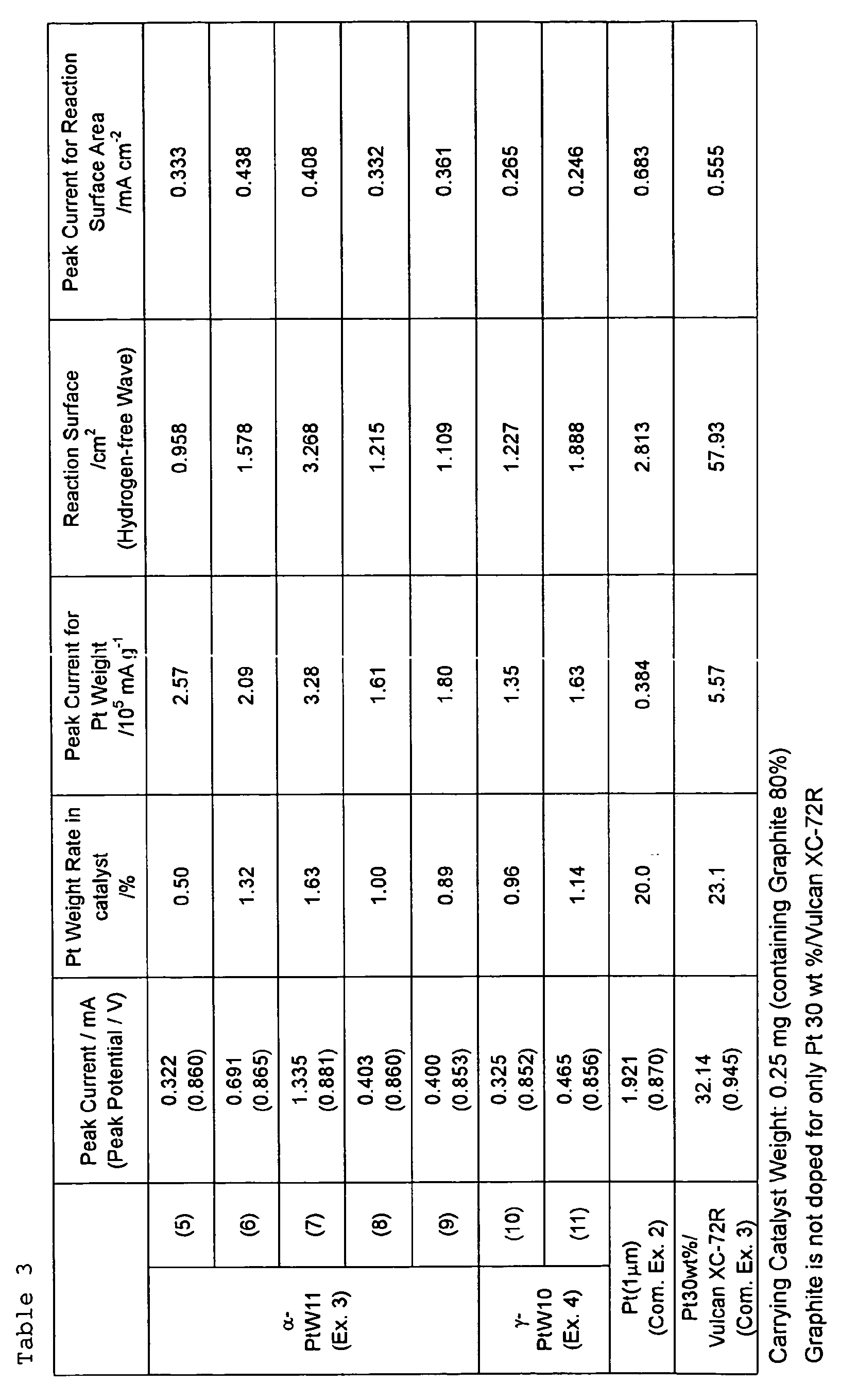
The present invention provides new materials as an
electrode catalyst of the electrochemical reaction. These
materials are a catalysts each having a new structure with
a noble metal atom such as platinum (Pt) or ruthenium (Ru)
substitutively inserted in each of solid polyacids in one
atomic level at the site of, e.g., a W site. It is
considered that these substitutive type solid polyacids
serve as fuel cell electrode catalysts with the contents of
the noble metal greatly reduced. It is considered that the
present invention realizes great reduction in cost of the
electrode catalyst which occupies the high cost as a
constituent material of the fuel cell, and contributes to
the spread of the fuel cells which have been outspritted in
the spread because of their high cost although they provide
remarkably smaller load to earth environment than internal
combustion engines do. Further, it is expected that the
catalyst with excellent CO poisoning resistance can be
easily designed because of easiness of control of
constituent elements and sites. So the present invention
can be applied to the catalytic electrode for the direct
methanol type fuel cell which has been widely noticed in
recent years as the power source for mobile devices. The
solid polyacid doped substitutively doped with a different
atom, e.g. Pt in its skeleton, fabricated according to the
present invention is useful as a high performance catalytic
electrode having both unique catalytic characteristic and
high Pt using rate. So, it is expected that the catalyst
with excellent CO poisoning resistance can be easily
designed because of easiness of control of the constituent
elements and sites. Thus, the present invention can be
applied to the catalytic electrode for the direct methanol
type fuel cell which has been widely noticed in recent
years as the power source for mobile devices.
Claims (10)
- A solid heteropolyacid catalyst for a fuel cell, which is a partial salt of a heteropolyacid including a noble metal and/or a transition metal and having a molecular weight of 800 to 10000.
- The solid heteropolyacid catalyst for a fuel cell according to claim 1,
wherein the noble metal is at least one selected from the group consisting of Ru, Rh, Pd, Ag, Ir, Pt and Au, and the transition metal is at least one selected from the group consisting of Ti, V, Cr, Mn, Fe, Co, Ni, Cu, Zn, Y, Zr, Nb, Mo, Ta and W. - The solid heteropolyacid catalyst for a fuel cell according to claim 1 or 2,
wherein the partial salt is a partial salt with an alkali metal or an alkali earth metal, a partial salt with an organic ammonium ion, or a partial salt insolubilized in water by a salt formation with a general cation (positive ion). - The solid heteropolyacid catalyst for a fuel cell according to any one of claims 1 to 3,
wherein the heteropolyacid is a polyacid having the Keggin structure, the Anderson structure or the Dawson structure. - The solid heteropolyacid catalyst for a fuel cell according to any one of claims 1 to 4,
wherein one atom of the noble metal is substituted in a skeleton of the heteropolyacid. - The solid heteropolyacid catalyst for a fuel cell according to claim 5,
wherein the atom of the noble metal is one selected from the group consisting of Ru, Rh, Pd, Ag, Ir, Pt and Au. - An electrode for a fuel cell characterized in that the solid heteropolyacid for a fuel cell according to any one of claims 1 to 6 is held on a surface of a carbon electrode.
- An electrode for a fuel cell characterized in that a mixture of the solid heteropolyacid for a fuel cell according to any one of claims 1 to 6, conductive powder and a binder is molded.
- The electrode for a fuel cell according to claim 8,
wherein the conductive powder is carbon powder or metal powder. - The electrode for a fuel cell according to claim 8 or 9,
wherein the binder is an organic polymer binder and/or an inorganic binder.
Applications Claiming Priority (3)
| Application Number | Priority Date | Filing Date | Title |
|---|---|---|---|
| JP2002329484 | 2002-11-13 | ||
| JP2002329484 | 2002-11-13 | ||
| PCT/JP2003/014359 WO2004045009A1 (en) | 2002-11-13 | 2003-11-12 | Catalyst for fuel cell and electrode using the same |
Publications (2)
| Publication Number | Publication Date |
|---|---|
| EP1569290A1 true EP1569290A1 (en) | 2005-08-31 |
| EP1569290A4 EP1569290A4 (en) | 2008-05-07 |
Family
ID=32310572
Family Applications (1)
| Application Number | Title | Priority Date | Filing Date |
|---|---|---|---|
| EP03772695A Withdrawn EP1569290A4 (en) | 2002-11-13 | 2003-11-12 | CATALYST FOR COMBUSTIBLE CELL AND ITS LECTRODE |
Country Status (6)
| Country | Link |
|---|---|
| US (1) | US20060141334A1 (en) |
| EP (1) | EP1569290A4 (en) |
| JP (1) | JPWO2004045009A1 (en) |
| AU (1) | AU2003280736A1 (en) |
| CA (1) | CA2510068A1 (en) |
| WO (1) | WO2004045009A1 (en) |
Cited By (1)
| Publication number | Priority date | Publication date | Assignee | Title |
|---|---|---|---|---|
| FR2944716A1 (en) * | 2009-04-28 | 2010-10-29 | Centre Nat Rech Scient | CATALYST AND PROCESS FOR ELECTROCHEMICAL OXIDATION OF METHANE |
Families Citing this family (12)
| Publication number | Priority date | Publication date | Assignee | Title |
|---|---|---|---|---|
| CN1300879C (en) * | 2004-10-20 | 2007-02-14 | 华南理工大学 | Fuel cell anode catalyst using heteropolyacid as promoter and preparation method thereof |
| EP1941575A1 (en) | 2005-09-30 | 2008-07-09 | Battelle Memorial Institute | Fuel cell components including immobilized heteropolyacids |
| US7910263B2 (en) * | 2006-10-26 | 2011-03-22 | Samsung Sdi Co., Ltd. | Electrode including a heteropoly acid additive for fuel cell, membrane-electrode assembly for fuel cell including same, and fuel cell system including the same |
| KR100823021B1 (en) * | 2006-12-06 | 2008-04-17 | 광주과학기술원 | Liquid fuel composition and fuel cell using same |
| ITRM20070228A1 (en) * | 2007-04-20 | 2008-10-21 | Univ Roma | LOW PLATINUM CATALYSTS FOR FUEL CELLS |
| FR2924443B1 (en) * | 2007-11-30 | 2011-08-26 | Univ Paris Sud | CELL FOR ELECTROLYSIS OF WATER WITH SOLID ELECTROLYTE CONTAINING LITTLE OR NO NOBLE METALS |
| FR2937979B1 (en) * | 2008-11-05 | 2010-12-24 | Centre Nat Rech Scient | PROCESS FOR PREPARING AN ELECTRODE FOR THE PRODUCTION OF HYDROGEN |
| JP5782365B2 (en) * | 2011-11-15 | 2015-09-24 | 株式会社日本触媒 | Metal compound-containing electrode catalyst |
| JP6762601B2 (en) * | 2016-04-08 | 2020-09-30 | 国立大学法人静岡大学 | A method for producing a calcined product of a polyoxometallate compound, a photocatalyst, and a calcined product of a polyoxometallate compound. |
| CN113842936B (en) * | 2021-10-22 | 2023-06-23 | 四川大学华西医院 | A platinum-based single-atom electrocatalytic material and its preparation method and application |
| CA3256607A1 (en) * | 2022-05-02 | 2025-06-17 | Korea Atomic Energy Research Institute | Anderson-type polyoxometalate and preparation method therefor |
| CN115020718B (en) * | 2022-06-14 | 2024-02-13 | 太原理工大学 | Non-noble metal nanocatalyst for methanol oxidation reaction and preparation method thereof |
Family Cites Families (14)
| Publication number | Priority date | Publication date | Assignee | Title |
|---|---|---|---|---|
| US4634502A (en) * | 1984-11-02 | 1987-01-06 | The Standard Oil Company | Process for the reductive deposition of polyoxometallates |
| JPS61192345A (en) * | 1985-02-22 | 1986-08-26 | Hitachi Ltd | Preparation of carbide catalyst |
| JPH0699355B2 (en) * | 1985-06-17 | 1994-12-07 | 東燃株式会社 | Method for producing aldehyde |
| JPH0819027B2 (en) * | 1988-01-25 | 1996-02-28 | 東燃化学株式会社 | Method for producing aldehyde and epoxide compound |
| JP2836275B2 (en) * | 1991-04-03 | 1998-12-14 | 松下電器産業株式会社 | Method for producing catalyst for liquid fuel cell and method for producing electrode thereof |
| JP3097258B2 (en) * | 1992-01-07 | 2000-10-10 | 松下電器産業株式会社 | Method for producing electrode for ion exchange membrane fuel cell |
| GB9419387D0 (en) * | 1994-09-26 | 1994-11-09 | Bp Chem Int Ltd | Olefin hydration process |
| US5916702A (en) * | 1997-08-15 | 1999-06-29 | Exxon Research And Engineering Co. | CO tolerant platinum-zinc fuel cell electrode |
| DE69804751T2 (en) * | 1997-12-23 | 2002-11-21 | Bp Chemicals Ltd., London | Estersynthese |
| EG21992A (en) * | 1998-01-22 | 2002-05-31 | Bp Chem Int Ltd | Ester synthesis |
| US6136469A (en) * | 1998-02-20 | 2000-10-24 | Motorola, Inc. | Multi-polyacid electrolytes for electrochemical cells and cells using same |
| JP2002134122A (en) * | 2000-10-26 | 2002-05-10 | Junichiro Otomo | Fuel electrode material for methanol fuel cell, methanol fuel cell, and manufacturing method of them |
| US6506932B2 (en) * | 2000-11-10 | 2003-01-14 | Nippon Shokubai Co., Ltd. | Method for production of oxygen-containing aromatic compound |
| JP3632087B2 (en) * | 2001-03-02 | 2005-03-23 | 独立行政法人産業技術総合研究所 | Electrode catalyst for fuel electrode of low temperature fuel cell |
-
2003
- 2003-11-12 US US10/534,722 patent/US20060141334A1/en not_active Abandoned
- 2003-11-12 JP JP2004551221A patent/JPWO2004045009A1/en active Pending
- 2003-11-12 AU AU2003280736A patent/AU2003280736A1/en not_active Abandoned
- 2003-11-12 CA CA002510068A patent/CA2510068A1/en not_active Abandoned
- 2003-11-12 EP EP03772695A patent/EP1569290A4/en not_active Withdrawn
- 2003-11-12 WO PCT/JP2003/014359 patent/WO2004045009A1/en not_active Ceased
Cited By (3)
| Publication number | Priority date | Publication date | Assignee | Title |
|---|---|---|---|---|
| FR2944716A1 (en) * | 2009-04-28 | 2010-10-29 | Centre Nat Rech Scient | CATALYST AND PROCESS FOR ELECTROCHEMICAL OXIDATION OF METHANE |
| WO2010125252A2 (en) | 2009-04-28 | 2010-11-04 | Centre National De La Recherche Scientifique | Catalyst and method for the electrochemical oxidation of methane |
| WO2010125252A3 (en) * | 2009-04-28 | 2010-12-23 | Centre National De La Recherche Scientifique | Catalyst and method for the electrochemical oxidation of methane |
Also Published As
| Publication number | Publication date |
|---|---|
| WO2004045009A1 (en) | 2004-05-27 |
| JPWO2004045009A1 (en) | 2006-04-06 |
| EP1569290A4 (en) | 2008-05-07 |
| AU2003280736A1 (en) | 2004-06-03 |
| CA2510068A1 (en) | 2004-05-27 |
| US20060141334A1 (en) | 2006-06-29 |
Similar Documents
| Publication | Publication Date | Title |
|---|---|---|
| Cai et al. | Bi-modified Pd/C catalyst via irreversible adsorption and its catalytic activity for ethanol oxidation in alkaline medium | |
| Antolini | Palladium in fuel cell catalysis | |
| JP4401059B2 (en) | Process for preparing anode catalyst for fuel cell and anode catalyst prepared using the process | |
| Huang et al. | A high-performance catalyst support for methanol oxidation with graphene and vanadium carbonitride | |
| KR101797782B1 (en) | Catalyst with metal oxide doping for fuel cells | |
| Barakat et al. | Ethanol electro-oxidation using cadmium-doped cobalt/carbon nanoparticles as novel non precious electrocatalyst | |
| EP0838872A2 (en) | Improved catalyst | |
| EP2037519A1 (en) | Fine particle of perovskite oxide, particle having deposited perovskite oxide, catalyst material, catalyst material for oxygen reduction, catalyst material for fuel cell, and electrode for fuel cell | |
| US9799893B2 (en) | Catalyst support for fuel cell | |
| CN115704097A (en) | M 1 M 2 Preparation method and application of diatomic catalyst with support structure | |
| EP3614472B1 (en) | Catalyst for solid polymer electrolyte fuel cells and method for producing same | |
| EP1569290A1 (en) | Catalyst for fuel cell and electrode using the same | |
| EP3525272B1 (en) | Catalyst for solid polymer fuel cell and method for producing the same | |
| EP4057427A1 (en) | Electrochemical oxygen reduction catalyst | |
| KR20120024889A (en) | Catalysts for Electrochemical Applications | |
| JP2009208070A (en) | Electrode catalyst for fuel cells, method for producing the same, and electrode for fuel cells | |
| JP5540294B2 (en) | Method for producing electrode catalyst for fuel cell | |
| Santos et al. | Electrocatalysis of oxygen reduction and hydrogen oxidation in platinum dispersed on tungsten carbide in acid medium | |
| Pagliaro et al. | Probing the effect of metal-CeO2 interactions in carbon supported electrocatalysts on alkaline hydrogen oxidation and evolution reactions | |
| JP2009117287A (en) | Direct alcohol fuel cell electrode catalyst and process for producing the electrode catalyst | |
| Yousaf et al. | Enhanced and durable electrocatalytic performance of thin layer PtRu bimetallic alloys on Pd-nanocubes for methanol oxidation reactions | |
| Guo et al. | Core–shell Pd–P@ Pt–Ni nanoparticles with enhanced activity and durability as anode electrocatalyst for methanol oxidation reaction | |
| TW201306368A (en) | Electrocatalytic catalyst and fuel cell containing the same | |
| Yavari et al. | SrFeO3-δ assisting with Pd nanoparticles on the performance of alcohols catalytic oxidation | |
| JP2011150867A (en) | Manufacturing method of ternary system electrode catalyst for fuel cell, and solid polymer fuel cell using the same |
Legal Events
| Date | Code | Title | Description |
|---|---|---|---|
| PUAI | Public reference made under article 153(3) epc to a published international application that has entered the european phase |
Free format text: ORIGINAL CODE: 0009012 |
|
| 17P | Request for examination filed |
Effective date: 20050613 |
|
| AK | Designated contracting states |
Kind code of ref document: A1 Designated state(s): AT BE BG CH CY CZ DE DK EE ES FI FR GB GR HU IE IT LI LU MC NL PT RO SE SI SK TR |
|
| AX | Request for extension of the european patent |
Extension state: AL LT LV MK |
|
| DAX | Request for extension of the european patent (deleted) | ||
| RBV | Designated contracting states (corrected) |
Designated state(s): DE |
|
| A4 | Supplementary search report drawn up and despatched |
Effective date: 20080404 |
|
| STAA | Information on the status of an ep patent application or granted ep patent |
Free format text: STATUS: THE APPLICATION HAS BEEN WITHDRAWN |
|
| 18W | Application withdrawn |
Effective date: 20080618 |