TECHNICAL FIELD
This invention relates to an additive for a non-aqueous
electrolyte of an electric double layer capacitor and a non-aqueous
electrolyte electric double layer capacitor obtained by adding the
additive to a non-aqueous electrolyte, and more particularly to an
additive for a non-aqueous electrolyte of an electric double layer
capacitor having a high dissolving power of a support salt and a low
viscosity and a non-aqueous electrolyte electric double layer capacitor
having excellent high-rate characteristics (quick discharge-charge
characteristics).
BACKGROUND ART
The non-aqueous electrolyte electric double layer capacitor
is a condenser utilizing an electric double layer formed between a
polarizable electrode and an electrolyte, which is a product developed
and practiced in the 1970s, rendered into an infant stage in 1980s and
come into a growth developing stage in 1990s. In such a non-aqueous
electrolyte electric double layer capacitor, a cycle of electrically
adsorbing an ion on a surface of an electrode from an electrolyte is
charge-discharge cycle, which is different from a battery in which a
cycle of oxidation-reduction reaction accompanied with a mass
transfer is charge-discharge cycle. Therefore, the non-aqueous
electric double layer capacitor is excellent in the instant charge-discharge
characteristics as compared with the battery, and also the
instant charge-discharge characteristics are not substantially
deteriorated even in the repetition of the charge-discharge. Also, a
simple and cheap electric circuit is sufficient in the non-aqueous
electrolyte electric double layer capacitor because there is no
overvoltage in the charge-discharge. Further, it has many merits that
the residual capacity is easily understandable, and there is the
temperature durable characteristic over a wide temperature range of
-30 to 90°C, and there is no pollution and the like as compared with the
battery, so that it recently comes under the spotlight as an earth-conscious
and new energy-storing product.
The electric double layer capacitor is an energy-storing
device comprising positive and negative polarizable electrodes and an
electrolyte, in which positive and negative charges are oppositely
arranged in a contact interface between the polarizable electrode and
the electrolyte at a very short separating distance to form an electric
double layer. The electrolyte plays a role as an ion source for the
formation of the electric double layer, so that it is an important
substance dominating basic characteristics of the energy-storing device
likewise the polarizable electrode. As the electrolyte have hitherto
been known aqueous electrolyte, non-aqueous electrolyte, solid
electrolyte and the like. From a point of improving the energy
density of the electric double layer capacitor, non-aqueous electrolytes
capable of setting a high operating voltage particularly come under the
spotlight and are putting into practical use. As such a non-aqueous
electrolyte is now practiced a non-aqueous electrolyte obtained by
dissolving a solute (support salt) such as (C2H5)4P·BF4, (C2H5)4N·BF4
or the like in an organic solvent having a high dielectric constant such
as a carbonate (ethylene carbonate, propylene carbonate), γ-butyrolactone
or the like.
However, since the flash point of the solvent is low in these
non-aqueous electrolytes, there is a problem that the risk is high
because if the non-aqueous electrolyte electric double layer capacitor
is fired by heat generation or the like, the electrolyte is ignited and the
flame is burnt out over the surface of the electrolyte. Also, there is a
problem that the non-aqueous electrolyte based on the organic solvent
is vaporized and decomposed accompanied with the heat generation of
the non-aqueous electrolyte electric double layer capacitor to generate
a gas, and the non-aqueous electrolyte electric double layer capacitor
is broken or fired by the generated gas to ignite the non-aqueous
electrolyte to burn out over the surface of the electrolyte.
On the contrary, there are known non-aqueous electrolyte
electric double layer capacitors in which the risk of firing and igniting
the electrolyte is largely reduced by adding a particular phosphazene
derivative to the electrolyte (see JP-A-2001-217152 and JP-A-2001-217154).
In this electric double layer capacitor, the self-extinguishing
property or flame retardance is given to the non-aqueous electrolyte by
a nitrogen gas or a halogen gas derived from the phosphazene
derivative, whereby the risk of the fire and ignition is reduced. Also,
phosphorus constituting the phosphazene derivative has an action of
suppressing the chain decomposition of a high molecular weight
material constituting the electric double layer capacitor, so that the
risk of the fire and ignition is effectively reduced.
However, cyclic phosphazene derivatives disclosed in JP-A-2001-217152
and JP-A-2001-217154 are very poor in the dissolving
power of a support salt, so that when a greater amount of the cyclic
phosphazene derivative is added to the non-aqueous electrolyte, an
ionic conductivity of the electrolyte is lowered to lower the electric
conductivity and hence the quick discharge characteristic and quick
charge characteristic of the electric double layer capacitor are poor.
Recently, a quick start (quick discharge) characteristic or an energy
recovery (quick charge) characteristic in the braking is demanded in
the electric double layer capacitor as an auxiliary power source for
actively examined electric cars, so that the electric double layer
capacitor obtained by adding a great amount of the cyclic phosphazene
derivative to the electrolyte is effective in the application of the flame
retardance but has a problem in the further stability of the quick
charge-discharge as an electric double layer capacitor for the auxiliary
power source of the electric car. Also, such a tendency becomes
remarkable at a temperature lower than room temperature, so that there
is particularly a problem in the quick charge characteristic and quick
discharge characteristic under a low temperature environment.
On the other hand, chain phosphazene derivatives disclosed
in JP-A-2001-217152 and JP-A-2001-217154 are sufficient in the
dissolving power of the support salt, but are somewhat higher in the
viscosity as compared with the cyclic phosphazene derivative, so that
when such a chain phosphazene derivative is added to the electrolyte,
there is a tendency of lowering the electric conductivity of the electric
double layer capacitor. The lowering of the electric conductivity
results in the lowering of the above quick discharge and quick charge
characteristics, so that the electric double layer capacitor having the
chain phosphazene derivative added to the electrolyte has a problem in
the quick discharge and quick charge characteristics.
DISCLOSURE OF THE INVENTION
It is, therefore, an object of the invention to solve the
problems of the conventional techniques and to provide an additive for
a non-aqueous electrolyte of an electric double layer capacitor having
a high dissolving power of a support salt and a low viscosity and a
non-aqueous electrolyte electric double layer capacitor containing this
additive in a non-aqueous electrolyte and having excellent high-rate
characteristics (quick discharge-charge characteristics).
The inventors have made various studies in order to achieve
the above object, and found that a specified chain phosphazene
derivatives has a low viscosity and a high dissolving power of a
support salt and that when such a phosphazene derivative is added to
an electrolyte of a non-aqueous electrolyte electric double layer
capacitor, the quick discharge characteristic and quick charge
characteristic of this electric double layer capacitor are improved, and
as a result, the invention has been accomplished.
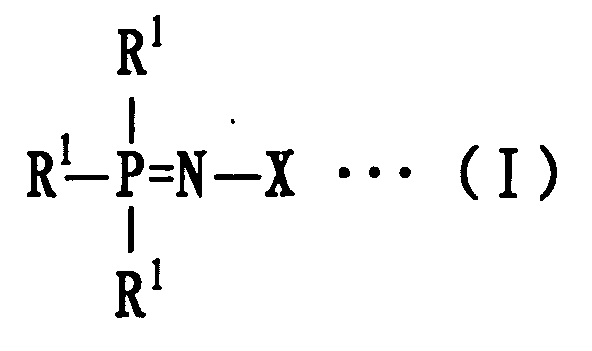
That is, the additive for a non-aqueous electrolyte of an
electric double layer capacitor according to the invention is
characterized by comprising a phosphazene derivative represented by
the following formula (I):
(wherein R
1 is independently a halogen element or a monovalent
substituent; and X is an organic group containing at least one element
selected from the group consisting of carbon, silicon, nitrogen,
phosphorus, oxygen and sulfur).
In a preferable embodiment of the additive for the non-aqueous
electrolyte of the electric double layer capacitor according to
the invention, at least one of R1s in the formula (I) is a halogen.
As the halogen, fluorine is particularly preferable.
In another preferable embodiment of the additive for the
non-aqueous electrolyte of the electric double layer capacitor
according to the invention, R1 in the formula (I) is any one of an
alkoxy group, a phenoxy group, an alkyl group, an aryl group, an acyl
group, an amino group, an alkylthio group and an arylthio group.
In the other preferable embodiment of the additive for the
non-aqueous electrolyte of the electric double layer capacitor
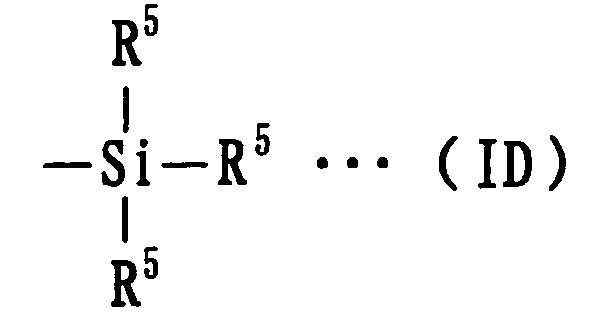
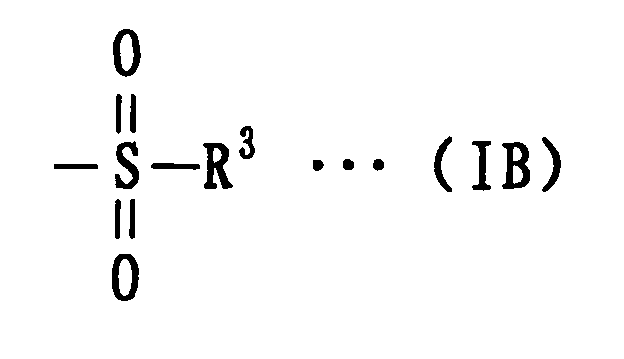
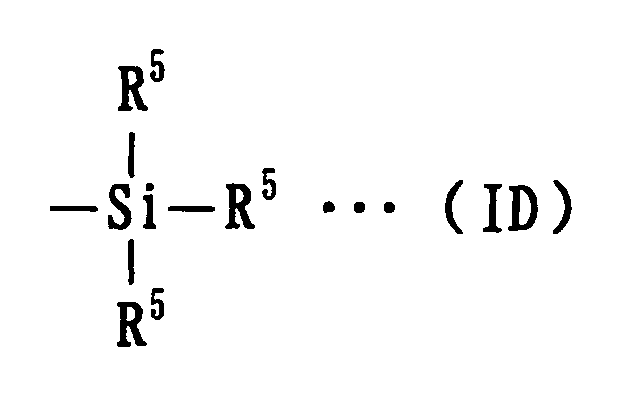
according to the invention, X in the formula (I) is represented by any
one of the following formulae (IA), (IB), (IC), (ID) and (IE):
(in the formulae (IA), (IB), (IC), (ID) and (IE), R
2, R
3, R
4, R
5 and R
6
are independently a halogen element or a monovalent substituent; and
Y is an organic group containing at least one element selected from the
group consisting of oxygen, sulfur, carbon, silicon, nitrogen and
phosphorus).
Also, the non-aqueous electrolyte electric double layer
capacitor according to the invention is characterized by comprising a
non-aqueous electrolyte containing the above additive for the non-aqueous
electrolyte of the electric double layer capacitor and a support
salt, a positive electrode, and a negative electrode.
In a preferable embodiment of the non-aqueous electrolyte
electric double layer capacitor according to the invention, a content of
the phosphazene derivative in the non-aqueous electrolyte is not less
than 1 volume%. At the moment, the content of the phosphazene
derivative in the non-aqueous electrolyte is preferably not less than 2
volume% from a viewpoint of the prevention of deterioration of
support salt, further preferably not less than 5 volume% from a
viewpoint of the application of flame retardance to the electrolyte,
particularly preferably not less than 10 volume% from a viewpoint of
the application of incombustibility to the electrolyte.
BEST MODE FOR CARRYING OUT THE INVENTION
The invention will be described in detail below.
<Additive for non-aqueous electrolyte of electric double
layer capacitor>
The additive for the non-aqueous electrolyte of the electric
double layer capacitor according to the invention comprises a
phosphazene derivative represented by the formula (I). This
phosphazene derivative is high in the dielectric constant and high in
the dissolving power of the support salt because it is a chain structure.
Also, a compound in which a halogen having a high electronegativity
is directly bonded to phosphorus or sulfur is very low in the viscosity.
For this end, the non-aqueous electrolyte containing such a
phosphazene derivative is high in the ionic conductivity, and also the
non-aqueous electrolyte electric double layer capacitor using such a
non-aqueous electrolyte is excellent in the quick charge characteristic
and quick discharge characteristic.
Further, when the above phosphazene derivative is included
into the conventional non-aqueous electrolyte, it is possible to give an
excellent safety to the non-aqueous electrolyte electric double layer
capacitor in the thermal runaway and reduce the risk of ignition or the
like under an action of nitrogen gas and phosphoric acid ester derived
from the phosphazene derivative. Also, since phosphorus has an
action of suppressing the chain decomposition of the high molecular
weight material constituting the electric double layer capacitor, the
safety of the electric double layer capacitor can be improved effectively.
Moreover, it is considered in the non-aqueous electrolyte
electric double layer capacitor that a compound produced by decomposition
or reaction of the electrolyte component or the support salt in the
non-aqueous electrolyte corrodes the electrode and the surrounding
members or the amount of the support salt itself is decreased by such a
decomposition or reaction to thereby bring about the troubles in the
electric characteristics and deteriorate the performances of the
capacitor. On the contrary, the phosphazene derivative suppresses the
decomposition or reaction of the electrolyte or support salt (particularly
effectively acts to PF6 salt) and contributes to the stabilization thereof.
Therefore, it is possible to suppress the deterioration while maintaining
the electric characteristics by adding the phosphazene derivative to the
conventional non-aqueous electrolyte.
The viscosity at 25°C of the phosphazene derivative
represented by the formula (I) is not particularly limited as long as it
is not more than 4.5 mPa · s (cP), but it is preferably not more than
3.8 mPa · s (cP), more preferably not more than 2.9 mPa · s (cP) from a
viewpoint of the improvement of the electric conduction and the
improvement of low temperature characteristics. In the invention, the
viscosity is determined by using a viscosity measuring device (R-type
viscometer Model RE500-SL, made by Toki Sangyo Co., Ltd.) and
conducting the measurement at each revolution rate of 1 rpm, 2 rpm,
3 rpm, 5 rpm, 7 rpm, 10 rpm, 20 rpm and 50 rpm for 120 seconds to
measure a viscosity under the revolution rate when an indication value
is 50-60% as an analytical condition.
The saturated dissolving amount of the support salt in the
phosphazene derivative of the formula (I) is 1.5-3.0 mol per 1000 mL
of the phosphazene derivative, for example, when the support salt is
(C2H5)4N·BF4, and is preferable to be not less than 2.0 mol from a
viewpoint of more preferably improving the electric conduction and
low temperature characteristics.
In the formula (I), R1 is independently a halogen element or
a monovalent substituent. As the halogen element, fluorine, chlorine,
bromine and the like are preferable, and among them, fluorine is
particularly preferable in a point that the viscosity is low. As the
monovalent substituent are mentioned an alkoxy group, a phenoxy
group, an alkyl group, an aryl group, an acyl group, an amino group,
an alkylthio group, an arylthio group and the like. Among them, the
alkoxy group, phenoxy group and amino group are preferable in a
point that the preparation is easy.
As the alkoxy group are mentioned methoxy group, ethoxy
group, propoxy group, butoxy group, an allyloxy group having a
double bond, and an alkoxy-substituted alkoxy group such as
methoxyethoxy group, methoxyethoxyethoxy group or the like.
As the phenoxy group are mentioned phenoxy group, methylphenoxy
group, methoxyphenoxy group and the like. As the alkyl group are
mentioned methyl group, ethyl group, propyl group, butyl group,
pentyl group and the like. As the acyl group are mentioned formyl
group, acetyl group, propionyl group, butyryl group, isobutyryl group,
valelyl group and the like. As the aryl group are mentioned phenyl
group, tolyl group, naphthyl group and the like. As the amino group
are mentioned amino group, methylamino group, dimethylamino group,
ethylamino group, diethylamino group, aziridyl group, pyrrolidyl
group and the like. As the alkylthio group are mentioned methylthio
group, ethylthio group, phenylthio group and the like. As the arylthio
group are mentioned phenylthio group, tolylthio group, naphthylthio
group and the like.
A hydrogen element in the monovalent substituent may be
substituted with a halogen element. In the formula (I), all of R1s may
be the same kind of the substituent, or some of them may be different
substituents. Particularly, a case that at least one of R1s is a halogen
is preferable in a point that the flame retardance is improved, and
further a case that the halogen is fluorine is particularly preferable in
a point that the viscosity is low.
In the formula (I), X is preferable to be an organic group
having a structure represented by any one of the formulae (IA)-(IE).
In the formulae (IA)-(IE), R2-R6 are independently a halogen element
or a monovalent substituent. As R2-R6 are preferably mentioned the
same halogen elements and monovalent substituents as described in R1
of the formula (I). R2, R5 and R6 may be the same or different in the
same organic group, or may be bonded to each other to form a ring.
As Y are mentioned, for example, NR group (R is an alkyl group, an
alkoxyl group, a phenyl group or the like, which is so forth on), and a
group containing an element such as oxygen, sulfur, carbon,
phosphorus, silicon or the like, and among them, NR group, oxygen
and sulfur are preferable.
<Non-aqueous electrolyte electric double layer capacitor>
The non-aqueous electrolyte electric double layer capacitor
according to the invention comprises a non-aqueous electrolyte
containing the aforementioned additive for the non-aqueous electrolyte
of the electric double layer capacitor and a support salt, a positive
electrode and a negative electrode. The support salt contained in the
non-aqueous electrolyte can be selected from the conventionally
known ones, but a quaternary ammonium salt is preferable in a point
that the electric conduction or the like in the electrolyte is good.
The quaternary ammonium salt is a solute of the electrolyte playing a
role as an ion source for the formation of the electric double layer.
The quaternary ammonium salt capable of forming a polyvalent ion is
preferable in a point that it is possible to effectively improve the
electric characteristics of the electrolyte such as electric conduction
and the like.
As the quaternary ammonium salt are preferably mentioned
(CH
3)
4N·BF
4, (CH
3)
3C
2H
5N·BF
4, (CH
3)
2(C
2H
5)
2N·BF
4,
CH
3(C
2H
5)
3N·BF
4, (C
2H
5)
4N·BF
4, (C
3H
7)
4N·BF
4, CH
3(C
4H
9)N·BF
4,
(C
4H
9)
4N·BF
4, (C
6H
13)
4N·BF
4, (C
2H
5)
4N·ClO
4, (C
2H
5)
4N·AsF
6,
(C
2H
5)
4N·SbF
6, (C
2H
5)
4N·CF
3SO
3, (C
2H
5)
4N·C
4F
9SO
3,
(C
2H
5)
4N·(CF
3SO
2)
2N, (C
2H
5)
4N·BCH
3(C
2H
5)
3, (C
2H
5)
4N·B(C
2H
5)
4,
(C
2H
5)
4N·B(C
4H
9)
4, (C
2H
5)
4N·B(C
6H
5)
4 and the like. Also, a
hexafluorophosphate in which an anion part of the quaternary
ammonium salt (e.g. ·BF
4, ·ClO
2, ·AsF
6 or the like) is replaced with
·PF6 is preferable. Among them, a quaternary ammonium salt in
which different alkyl groups are bonded to N atom is preferable in a
point that the solubility can be improved by making a polarity large.
Further, compounds represented by the following formulae (a)-(j) are
preferably mentioned as the quaternary ammonium salt. In the
formulae (a)-(j), Me is a methyl group and Et is ethyl group.
Among these quaternary ammonium salts, the salt capable of
generating (CH3)4N+, (C2H5)4N+ or the like as a cation is particularly
preferable from a viewpoint of ensuring a high electric conduction.
Also, the salt capable of producing an anion with a small formula
weight is preferable. These quaternary ammonium salts may be used
alone or in a combination of two or more.
The phosphazene derivative represented by the formula (I) is
high in the dissolving power of the support salt and low in the
viscosity as previously mentioned, so that the ionic conductivity of the
electrolyte is improved. As a result, the non-aqueous electrolyte
electric double layer capacitor according to the invention using this
electrolyte is high in the electric conductivity, excellent in the quick
discharge characteristic and quick charge characteristic and also
excellent in the low temperature characteristics.
The amount of the support salt compounded to the non-aqueous
electrolyte is preferably 0.5-1.5 mol, more preferably
0.5-1.0 mol per 1 L of the electrolyte (solvent component). When the
amount is less than 0.5 mol, the sufficient electric characteristics of
the non-aqueous electrolyte such as electric conduction and the like
can not be ensured, while when it exceeds 1.5 mol, the viscosity of the
non-aqueous electrolyte rises and the quick charge-discharge characteristics
and the low temperature characteristics may be damaged.
The electrolyte for the non-aqueous electrolyte electric
double layer capacitor according to the invention may contain an
aprotic organic solvent in addition to the support salt and the
phosphazene derivative of the formula (I). The aprotic organic
solvent is preferable to have a low viscosity and a high electric
conductivity from a viewpoint of the electric characteristics.
The aprotic organic solvent is not particularly limited, but
includes ether compounds, ester compounds, nitrile compounds and the
like. Concretely, there are preferably mentioned 1,2-dimethoxyethane,
tetrahydrofuran, dimethyl carbonate, diethyl carbonate, ethylmethyl
carbonate, ethylene carbonate, propylene carbonate, diphenyl
carbonate, γ-butyrolactone, γ-valerolactone, acetonitrile and the like.
Among them, cyclic ester compounds such as ethylene carbonate,
propylene carbonate, γ-butyrolactone and the like; chain ester
compounds such as dimethyl carbonate, diethyl carbonate, ethylmethyl
carbonate and the like; and chain ether compounds such as 1,2-dimethoxyethane
and the like are preferable. The cyclic ester
compound is preferable in a point that the dielectric constant is high
and the solubility of the support salt is excellent, and the chain ester
and ether compounds are preferable in a point that the viscosity is low
and the viscosity of the electrolyte is made low. They may be used
alone or in a combination of two or more. The viscosity at 25°C of
the aprotic organic solvent is not particularly limited, but it is
preferably not more than 5 mPa · s (cP), more preferably not more than
3.0 mPa · s (cP).
The viscosity at 25°C of the electrolyte in the non-aqueous
electrolyte electric double layer capacitor according to the invention is
preferably 1.0-5.0 mPa · s (cP), further preferably 1.0-4.0 mPa · s (cP).
Since the electrolyte contains the above phosphazene derivative, the
viscosity is low, and hence the non-aqueous electrolyte electric double
layer capacitor according to the invention using such an electrolyte is
high in the electric conductivity and excellent in the quick discharge
characteristic and quick charge characteristic.
The content of the phosphazene derivative in the electrolyte
of the non-aqueous electrolyte electric double layer capacitor according
to the invention is preferable to be not less than 1.0 volume% from
a viewpoint that the high-rate characteristics (quick charge-discharge
characteristics) of the electric double layer capacitor are preferably
improved. When the content of the phosphazene derivative is within
the above numerical range, the high-rate characteristics of the electric
double layer capacitor can be preferably improved. Also, the
phosphazene derivative is high in the wettability to the separator or
the electrode in addition to the low viscosity, which is reflected in the
improvement of the cell characteristics.
The content of the phosphazene derivative in the electrolyte
of the non-aqueous electrolyte electric double layer capacitor according
to the invention is preferable to be not less than 2 volume% from a
viewpoint that "resistance to deterioration" can be preferably given to
the electrolyte. When the content of the phosphazene derivative is
within the above numerical range, the deterioration can be preferably
suppressed. In this case, the "deterioration" means the corrosion of
the electrode and surrounding members and the decrease of the
concentration of the support salt accompanied therewith due to the
formation of a compound through the decomposition or reaction of the
electrolyte and support salt, and the effect of preventing the deterioration
is evaluated by the following method of evaluating the stability.
-Stability evaluating method-
(1) After the preparation of the non-aqueous electrolyte containing
the support salt, the water content is firstly measured. Then, the
concentration of hydrogen fluoride in the non-aqueous electrolyte is
measured by NMR, GC-MS. Further, the color tone of the non-aqueous
electrolyte is visually observed, and thereafter the electric
conduction is measured.
(2) After the non-aqueous electrolyte is left to stand in a globe box
for 2 months, the water content and concentration of hydrogen fluoride
are again measured, and the color tone is observed, and the electric
conduction is measured. The stability is evaluated by the change of
these measured numerical values.
Also, the content of the phosphazene derivative in the
electrolyte of the non-aqueous electrolyte electric double layer
capacitor according to the invention is preferable to be not less than
5 volume% from a viewpoint that "flame retardance" is given to the
electrolyte. Further, the content is preferable to be not less than
10 volume% from a viewpoint that "incombustibility" is given to the
electrolyte. When the content of the phosphazene derivative is not
less than 5 volume%, the electrolyte becomes flame retardant, while
when it is not less than 10 volume%, the electrolyte becomes
incombustible. At this moment, the flame retardance and
incombustibility are defined by a method according to UL94HB
method. In this case, when a test piece of 127 mm × 12.7 mm is
prepared by penetrating 1.0 mL of the electrolytes into a non-combustible
quartz fiber and then the test piece is ignited under an
atmosphere environment, a case that the ignited flame does not arrive
at a line of 25 mm of the device and the ignition is not observed in the
falling object is the flame retardance, and a case that the ignition is
not caused (combustion length: 0 mm) is the incombustibility. In the
invention, the flame retardance and incombustibility are evaluated by
measuring an oxygen index according to JIS K7201.
At this moment, the oxygen index means a value of lowest
oxygen concentration represented by a volume percentage required for
continuing the combustion of the material under given test conditions
defined in JIS K7201. As the oxygen index becomes low, the risk of
firing-ignition is high, while as the oxygen index becomes high, the
risk of firing-ignition is low, which means that "the safety is high".
Under the atmosphere condition, the oxygen index corresponds to
20.2 volume%, so that the electrolyte having an oxygen index of
20.2 volume% means that it burns in the atmosphere. As a result of
the inventors' examination, it is confirmed that the electrolyte having
an oxygen index of not less than 23 volume% has the flame retardance
defined by the method according to the UL94HB method and the
electrolyte having an oxygen index of not less than 25 volume% has
the incombustibility defined by the method according to the UL94HB
method, so that the flame retardance and incombustibility are evaluated
by the measurement of the oxygen index in the invention.
The positive electrode constituting the non-aqueous
electrolyte electric double layer capacitor according to the invention is
not particularly limited, but is preferable to be usually a polarizable
carbon-based electrode. As the polarizable electrode is preferable an
electrode having such properties that the specific surface area and bulk
gravity are usually large and the activity is electrochemically none and
the resistance is small and the like. The polarizable electrode
generally comprises an activated carbon and may contain other
components such as an electric conductive agent, a binder and the like,
if necessary.
The material of the activated carbon used as the positive
electrode is not particularly limited, but includes preferably phenolic
resin, various heat-resistant resins, pitch and the like. As the heat-resistant
resin are preferably mentioned resins such as polyimide,
polyamide, polyamideimide, polyether imide, polyether sulfon,
polyether ketone, bismalimide triazine, aramide, fluorine resin,
polyphenylene, polyphenylene sulfide and the like. They may be
used alone or in a combination of two or more. As the shape of the
activated carbon, powder, fibrous cloth and the like are preferable
from a point that the specific surface area is made higher to increase
the charge capacity of the non-aqueous electrolyte electric double
layer capacitor. Also, the activated carbon may be subjected to a
treatment such as heat treatment, drawing, high-temperature treatment
under vacuum, rolling or the like for the purpose of more increasing
the charge capacity of the electric double layer capacitor.
The electric conductive agent used in the positive electrode
is not particularly limited, but includes graphite, acetylene black and
the like. The material of the binder is not particularly limited, but
includes resins such as polyvinylidene fluoride (PVDF), polytetrafluoroethylene
(PTFE) and the like.
As the negative electrode constituting the non-aqueous
electrolyte electric double layer capacitor according to the invention
are preferably mentioned the same polarizable electrodes as in the
positive electrode.
The non-aqueous electrolyte electric double layer capacitor
according to the invention is preferable to comprise a separator, a
current collector, a container and the like in addition to the positive
electrode, negative electrode and the electrolyte, and further there can
be provided with various known members usually used in the electric
double layer capacitor. At this moment, the separator is interposed
between the positive and negative electrodes for the purpose of
preventing the short-circuiting of the non-aqueous electrolyte electric
double layer capacitor or the like. The separator is not particularly
limited, but there are preferably used known separators usually used as
a separator for the non-aqueous electrolyte electric double layer
capacitor. As the material of the separator are preferably mentioned
microporous films, non-woven fabrics, papers and the like. Concretely,
there are preferably mentioned non-woven fabrics, thin-layer films and
the like made of synthetic resin such as polytetrafluoroethylene,
polypropylene, polyethylene or the like. Among them, a microporous
film of polypropylene or polyethylene having a thickness of about 20-50
µm is particularly preferable.
The current collector is not particularly limited, but there are
preferably used known ones usually used as a current collector for the
non-aqueous electrolyte electric double layer capacitor. As the current
collector, it is preferable to be excellent in the electrochemically
corrosion resistance, chemically corrosion resistance, workability, and
mechanical strengths and low in the cost, and a current collector layer
made of aluminum, stainless steel, electrically conductive resin or the
like is preferable.
The container is not particularly limited, but there are
preferably mentioned known ones usually used as a container for the
non-aqueous electrolyte electric double layer capacitor. As the
material of the container are preferable aluminum, stainless steel,
electrically conductive resins and the like.
The shape of the non-aqueous electrolyte electric double
layer capacitor according to the invention is not particularly limited,
but there are preferably mentioned various known shapes such as
cylinder type (cylindrical shape, square shape), flat type (coin type)
and the like. The non-aqueous electrolyte electric double layer
capacitor is preferably used as an auxiliary power source for electric
cars, as power source for memory backup of various electronics,
industrial instruments and airplane instruments and the like, for
electromagnetic holding of toys, cordless equipments, gas equipments,
flash water heaters and the like and for watches such as wrist watch,
wall clock, solar watch, AGS wrist watch and the like.
In the non-aqueous electrolyte electric double layer capacitor
according to the invention, the electric conductivity (specific
conductance) of the electrolyte is not less than 5.0 mS/cm, preferably
not less than 10 mS/cm as an electric conductivity of a solution
containing a support salt at a concentration of 1.0 mol/L. The non-aqueous
electrolyte electric double layer capacitor according to the
invention is excellent in the high-rate characteristics (quick charge-discharge
characteristics) because the electric conductivity is higher
than that of the conventional one as mentioned above. Moreover, the
electric conductivity is a value obtained by measuring through an
electric conductivity meter (trade name: CDM210, made by
Radiometer Trading Co., Ltd.) while applying a constant current of
5 mA to the electric double layer capacitor.
The following examples are given in illustration of the
invention and are not intended as limitations thereof.
<Examples>
Using phosphazene derivatives shown in Table 1, the
saturated dissolving amount of tetraethyl ammonium fluoroborate
[(C
2H
5)
4N·BF
4 (quaternary ammonium salt)] and viscosity are
measured at 25°C. The results are shown in Table 1. In Table 1,
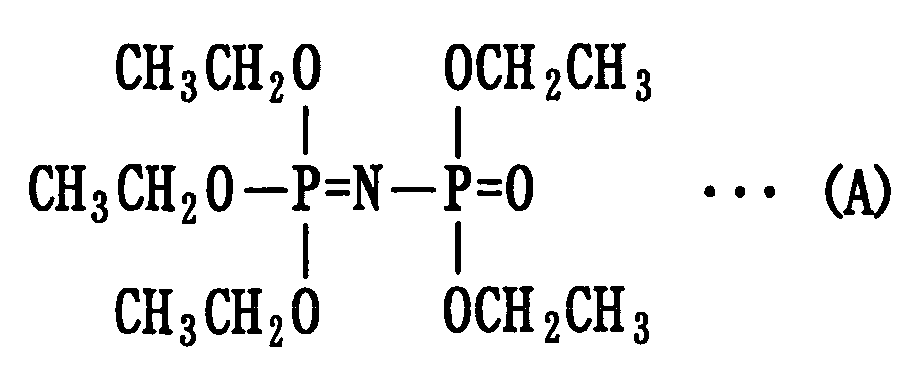
phosphazene A is a compound shown by the following formula (A),
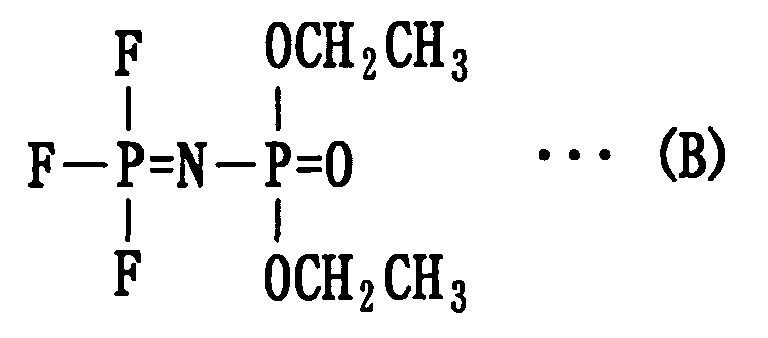
and phosphazene B is a compound shown by the following formula (B),
and phosphazene C is a compound shown by the following formula (C),
and phosphazene D is a compound shown by the following formula (D),
which are synthesized by the following methods.
A compound of the formulas (I), in which X is represented
by the formula (IA) and all of R1s and R2s are Cl and Y is oxygen, is
reacted with sodium ethoxide in a toluene solvent at a temperature
of -40°C and subjected to a molecular distillation to obtain a purified
phosphazene derivative A.
(Synthesis of phosphazene derivative B)
Phosphorus trifluoride dichloride (PCl2F3) is reacted with
diethyl phosphorylamide in the absence of a solvent at room
temperature and subjected to a molecular distillation to obtain a
purified phosphazene derivative B.
(Synthesis of phosphazene derivative C)
Phosphorus trifluoride dichloride (PCl2F3) is reacted with
methane sulfonamide in the absence of a solvent at room temperature
to obtain a compound of the formula (I) in which X is represented by
the formula (IB) and all of R1s are fluorine and R3 is methyl group.
Then, this compound is reacted with pyrrolidine in a toluene solvent at
room temperature and subjected to a molecular distillation to obtain a
purified phosphazene derivative C.
(Synthesis of phosphazene derivative D)
Phosphorus trifluoride dichloride (PCl
2F
3) is reacted with
acetoamide in the absence of a solvent at room temperature to obtain a
compound of the formula (I) in which X is represented by the formula
(IC) and all of R
1s are fluorine and R
4 is methyl group. Then, this
compound is added with sodium phenoxide in an acetonitrile solvent at
a temperature of -40°C and subjected to a molecular distillation to
obtain a purified phosphazene derivative D.
| | Saturated dissolving amount (mol/L) | Viscosity (mPa·s) |
| Phosphazene A | 2.0 | 5.8 |
| Phosphazene B | 3.0 | 3.8 |
| Phosphazene C | 3.0 | 3.3 |
| Phosphazene D | 3.0 | 2.9 |
As seen from Table 1, the phosphazene derivatives
represented by the formula (I) are excellent in the dissolving power of
the support salt and low in the viscosity as compared with the
conventionally used phosphazene derivative A.
Next, an electrolyte is prepared according to a compounding
recipe shown in Table 2, and the viscosity of the electrolyte is
measured at 25°C and the oxygen index thereof is measured by the
following method.
-Method of measuring oxygen index-
The limit oxygen index is measured according to JIS K7201.
A test specimen is prepared by reinforcing a SiO2 sheet (quartz filter
paper, incombustible) of 127 mm × 12.7 mm with a U-shaped aluminum
foil so as to render into self-standing posture and impregnating 1.0 mL
of the electrolyte into the SiO2 sheet. This test specimen is vertically
attached to a supporter for the test specimen so as to position at a
distance of not less than 100 mm separated from an upper end portion
of a combustion cylinder (inner diameter of 75 mm, height of 450 mm,
equally filled with glass particles of 4 mm in diameter over a region
ranging from the bottom to 100±5 mm, a metal net placed thereon).
Then, oxygen (equal to or more than JIS K1101) and nitrogen (equal to
or more than Grade 2 of JIS K1107) are flown into the combustion
cylinder, while the test specimen is ignited in air (heat source is
Class 1, No. 1 of JIS K2240) to examine a combustion state.
Moreover, the total flowing amount in the combustion cylinder is
11.4 L/min. This test is repeated 3 times, and an average value
thereof is determined.
Moreover, the oxygen index means a value of lowest oxygen
concentration represented by volume percentage required for continuing
the combustion of the material under given test conditions defined
according to JIS K7201. In the invention, the limit oxygen index is
calculated from a lowest oxygen flowing amount required for
continuously burning the test specimen for not less than 3 minutes or
continuing the combustion length of not less than 50 mm after the
ignition and a nitrogen flowing amount at the time.
Equation: Oxygen index = (oxygen flowing amount)/([oxygen flowing
amount]+[nitrogen flowing amount]) × 100 (volume%)
A non-aqueous electrolyte electric double layer capacitor is
prepared by using the above electrolyte by the following method.
With respect to the resulting electric double layer capacitor, the
electric conduction, stability, low temperature characteristic and
resistance to deterioration are measured and evaluated by the
following evaluation methods. These results are shown in Tables 2
and 3.
(Preparation of electric double layer capacitor)
An activated carbon (trade name: Kuractive-1500, made by
Kurare Chemical Co., Ltd.), acetylene black (electric conductive
agent) and polytetrafluoroethylene (PTFE)(binder) are mixed at a mass
ratio of 8/1/1/ (activated carbon/acetylene black/PTFE) to obtain a
mixture. 100 g of the resulting mixture is weighed and charged into a
carbon pressure vessel of 20 mm and green-compacted at room
temperature under a pressure of 150 kgf/cm2 to prepare positive
electrode and negative electrode (polarizable electrodes). A cell is
assembled by using the resulting positive and negative electrodes,
analuminum metal plate (current collector)(thickness: 0.5 mm) and a
polypropylene/polyethylene plate (separator)(thickness: 25 µm) and
sufficiently dried through vacuum drying. This cell is impregnated
with the electrolyte to prepare a non-aqueous electrolyte electric
double layer capacitor.
-Measurement of electric conduction-
The electric conduction is measured by using an electric
conductivity meter (trade name: CDM210, made by Radiometer
Trading Co., Ltd.) while applying a constant current of 5 mA to the
resulting electric double layer capacitor. The results are shown in
Table 1.
-Evaluation of stability-
With respect to the resulting non-aqueous electrolyte electric
double layer capacitor, internal resistance at initial stage and after
charge-discharge of 1000 cycles are measured to evaluate the long-period
stability. At this moment, the internal resistance (Ω) can be
obtained by a well-known method of measuring the internal resistance,
for example, a method in which a charge-discharge curve is determined
to measure a deviation width of a potential accompanied with the stop
of charge (charge rest) or the stop of discharge (discharge rest).
-Evaluation of low temperature characteristics-
The internal resistance when the electric double layer
capacitor is placed at -20°C is measured by an impedance analyzer.
-Evaluation of resistance to deterioration-
With respect to the resulting non-aqueous electrolyte, the
resistance to deterioration is evaluated by measuring and calculating
water content (ppm), concentration of hydrogen fluoride (ppm) and
electric conduction just after the preparation of the non-aqueous
electrolyte and after being left to stand in a globe box for 2 months in
the same manner as in the above method of evaluating the stability.
Also, the change of color tone in the non-aqueous electrolyte is
visually observed just after the preparation of the non-aqueous
electrolyte and after being left to stand in the globe box for 2 months.

| | Evaluation of resistance to deterioration |
| | Initial | After being left to stand for 2 months | Change of color tone | Evaluation |
| | Electric conductivity (mS/cm) | HF concentration (ppm) | Water content | Electric HF conductivity (ppm) (mS/cm) | concen content tration (ppm) | Water (ppm) |
| Conventional Example | 0.18 | 0 | 2 | 0.18 | 0 | 2 | none | ○:good |
| Example 1 | 0.13 | 0 | 2 | 0.13 | 0 | 2 | none | o ○:very good |
| Example 2 | 0.12 | 0 | 2 | 0.12 | 0 | 2 | none | o ○:very good |
| Example 3 | 0.10 | 0 | 1 | 0.10 | 0 | 1 | none | o ○:very good |
As seen from Table 2, the electrolyte in the non-aqueous
electrolyte electric double layer capacitor according to the invention is
low in the viscosity as compared with the conventional electrolyte, and
the non-aqueous electrolyte electric double layer capacitor according
to the invention using this electrolyte is high in the electric conductivity
as compared with the conventional battery. As a result, the
non-aqueous electrolyte electric double layer capacitor according to
the invention is excellent in the quick charge characteristic and the
quick discharge characteristic. Also, the characteristics as an electric
double layer capacitor and the resistance to deterioration in the non-aqueous
electrolyte electric double layer capacitor according to the
invention are equal to or more than those of the conventional battery.
Furthermore, the non-aqueous electrolyte electric double layer
capacitor according to the invention is high in the oxygen index and
high in the safety of the electrolyte.
INDUSTRIAL APPLICABILITY
According to the invention, there can be provided an additive
for a non-aqueous electrolyte of an electric double layer capacitor
having a high dissolving power of a support salt and a low viscosity.
Also, the non-aqueous electrolyte electric double layer capacitor
according to the invention obtained by adding this additive to the
electrolyte is high in the electric conductivity and excellent in the
quick discharge characteristic and the quick charge characteristic.









 (in the formulae (IA), (IB), (IC), (ID) and (IE), R2, R3, R4, R5 and R6 are independently a halogen element or a monovalent substituent; and Y is an organic group containing at least one element selected from the group consisting of oxygen, sulfur, carbon, silicon, nitrogen and phosphorus).