EP1578836B1 - Mit ch-aciden cyclischen ketonen blockierte polyurethan prepolymere, daraus hergestellte reaktivsysteme, deren herstellung und verwendung - Google Patents
Mit ch-aciden cyclischen ketonen blockierte polyurethan prepolymere, daraus hergestellte reaktivsysteme, deren herstellung und verwendung Download PDFInfo
- Publication number
- EP1578836B1 EP1578836B1 EP20030785759 EP03785759A EP1578836B1 EP 1578836 B1 EP1578836 B1 EP 1578836B1 EP 20030785759 EP20030785759 EP 20030785759 EP 03785759 A EP03785759 A EP 03785759A EP 1578836 B1 EP1578836 B1 EP 1578836B1
- Authority
- EP
- European Patent Office
- Prior art keywords
- optionally
- polyurethane prepolymers
- reactive systems
- blocked
- groups
- Prior art date
- Legal status (The legal status is an assumption and is not a legal conclusion. Google has not performed a legal analysis and makes no representation as to the accuracy of the status listed.)
- Expired - Lifetime
Links
Classifications
-
- C—CHEMISTRY; METALLURGY
- C08—ORGANIC MACROMOLECULAR COMPOUNDS; THEIR PREPARATION OR CHEMICAL WORKING-UP; COMPOSITIONS BASED THEREON
- C08G—MACROMOLECULAR COMPOUNDS OBTAINED OTHERWISE THAN BY REACTIONS ONLY INVOLVING UNSATURATED CARBON-TO-CARBON BONDS
- C08G18/00—Polymeric products of isocyanates or isothiocyanates
- C08G18/06—Polymeric products of isocyanates or isothiocyanates with compounds having active hydrogen
- C08G18/28—Polymeric products of isocyanates or isothiocyanates with compounds having active hydrogen characterised by the compounds used containing active hydrogen
- C08G18/40—High-molecular-weight compounds
- C08G18/48—Polyethers
- C08G18/4866—Polyethers having a low unsaturation value
-
- C—CHEMISTRY; METALLURGY
- C08—ORGANIC MACROMOLECULAR COMPOUNDS; THEIR PREPARATION OR CHEMICAL WORKING-UP; COMPOSITIONS BASED THEREON
- C08G—MACROMOLECULAR COMPOUNDS OBTAINED OTHERWISE THAN BY REACTIONS ONLY INVOLVING UNSATURATED CARBON-TO-CARBON BONDS
- C08G18/00—Polymeric products of isocyanates or isothiocyanates
- C08G18/06—Polymeric products of isocyanates or isothiocyanates with compounds having active hydrogen
- C08G18/08—Processes
- C08G18/10—Prepolymer processes involving reaction of isocyanates or isothiocyanates with compounds having active hydrogen in a first reaction step
-
- C—CHEMISTRY; METALLURGY
- C08—ORGANIC MACROMOLECULAR COMPOUNDS; THEIR PREPARATION OR CHEMICAL WORKING-UP; COMPOSITIONS BASED THEREON
- C08G—MACROMOLECULAR COMPOUNDS OBTAINED OTHERWISE THAN BY REACTIONS ONLY INVOLVING UNSATURATED CARBON-TO-CARBON BONDS
- C08G18/00—Polymeric products of isocyanates or isothiocyanates
- C08G18/06—Polymeric products of isocyanates or isothiocyanates with compounds having active hydrogen
- C08G18/08—Processes
- C08G18/10—Prepolymer processes involving reaction of isocyanates or isothiocyanates with compounds having active hydrogen in a first reaction step
- C08G18/12—Prepolymer processes involving reaction of isocyanates or isothiocyanates with compounds having active hydrogen in a first reaction step using two or more compounds having active hydrogen in the first polymerisation step
-
- Y—GENERAL TAGGING OF NEW TECHNOLOGICAL DEVELOPMENTS; GENERAL TAGGING OF CROSS-SECTIONAL TECHNOLOGIES SPANNING OVER SEVERAL SECTIONS OF THE IPC; TECHNICAL SUBJECTS COVERED BY FORMER USPC CROSS-REFERENCE ART COLLECTIONS [XRACs] AND DIGESTS
- Y10—TECHNICAL SUBJECTS COVERED BY FORMER USPC
- Y10T—TECHNICAL SUBJECTS COVERED BY FORMER US CLASSIFICATION
- Y10T428/00—Stock material or miscellaneous articles
- Y10T428/31504—Composite [nonstructural laminate]
- Y10T428/31551—Of polyamidoester [polyurethane, polyisocyanate, polycarbamate, etc.]
Definitions
- the invention relates to novel blocked polyurethane prepolymers, to a process for their preparation and to room temperature curing reactive systems prepared therefrom and to their use.
- polyamine / epoxy resin systems are characterized for example by excellent metal adhesion, very good chemical resistance and excellent corrosion protection properties.
- the use of high molecular weight epoxy resins and / or polyaminoamides, e.g. based on dimer fatty acids as curing agents, crosslinked films with high flexibility can be obtained.
- Coatings based on solvent-free liquid resins and solvent-free amine hardeners are very brittle due to the low molecular weights of the epoxy resins and the resulting high network density. Therefore, in solventless formulations, e.g. Tar substitutes such as coumarone resins used for plasticization. Especially when using larger amounts of hydrocarbon resins tend such coatings, due to migration of the non-functional components, for long-term embrittlement.
- a good and permanent elastification of the epoxy resins can be achieved by combining with polyurethanes.
- DE-A 23 38 256 produced high molecular weight, amine-terminated polyetherurethaneureas by reaction of prepolymers containing free isocyanate groups with amines in highly dilute solutions and then cured with epoxy resins.
- the use of the necessary, in particular aromatic solvents, is disadvantageous in practice from both the technical and physiological point of view.
- the viscosity of the solvent-free reaction products, as according to the DE-A 23 38 256 were made specifically for the applications in practice too high.
- DE-A 24 18 041 describes a process for the preparation of elasticized moldings and fabrics, in which epoxies are reacted with amine compounds obtained by hydrolysis of prepolymeric ketimines or enamines, respectively. With this method, chemical-resistant, well-adhering thermosets with improved properties can be produced.
- a disadvantage of the method described is the high procedural complexity.
- the DE-A 21 52 606 describes reactive systems based on alkylphenol-blocked polyisocyanates and polyamines, which can optionally be cured in combination with epoxy resins. These reactive systems also have some disadvantages in terms of application, for example, the reactive systems have a relatively high viscosity and the blocking agent released is of comparatively low molecular weight, which results in it migrating out of the coating over time and the adhesion of the coating to the substrate ceases to exist is sufficient.
- reactive compositions consist of reversibly blocked organic polyisocyanates and at least one polyamine having at least two primary amino groups and optionally additionally contain an oxirane-containing compound.
- blocking agents for the organic polyisocyanates hydrocarbon resins are used with phenolic OH groups.
- blocked polyisocyanates are characterized by a significantly reduced reactivity towards polyamines, compared with alkylphenol-blocked polyisocyanates.
- organic polyisocyanates it is possible to use prepolymers which are obtained by reacting polyhydroxy compounds with an excess of di- or polyisocyanates.
- Polyhydroxy compounds which can be used, for example, are polyether polyols which are obtainable by alkoxylation of suitable starter molecules (for example monomeric polyols).
- the object of the present invention was therefore to provide new polyurethane prepolymers which have a significantly lower viscosity than the previously known, reversibly blocked polyurethane prepolymers, and which can be used together with polyamines and optionally oxirane groups in space-temperature-curing reactive systems, wherein the Blocking agent is not released during the curing of the reactive system (splitter-free systems).
- R hydrogen or a methyl group and n is 1 to 300.
- Suitable polyisocyanates as component A) are all known aliphatic, cycloaliphatic, aromatic or heterocyclic organic isocyanates, preferably di- or polyisocyanates having at least two isocyanate groups and mixtures of said compounds.
- suitable aliphatic isocyanates are di- or triisocyanates such as 1,4-butane diisocyanate, 1,5-pentane diisocyanate, 1,6-hexane diisocyanate (hexamethylene diisocyanate, HDI), 4-isocyanatomethyl-1,8-octane diisocyanate (triisocyanatononane, TIN) or cyclic systems, such as 4,4'-methylenebis (cyclohexylisocyanate) (Desmodur ® W, Bayer AG, Leverkusen), 3,5,5-trimethyl-1-isocyanato-3-isocyanatomethyl-cyclohexane ⁇ (isophorone diiso
- aromatic polyisocyanates such as, for example, 1,5-naphthalene diisocyanate, diisocyanatodiphenylmethane (2,2'-, 2,4- and 4,4'-methylenediphenyl diisocyanate, MDI), in particular the 4,4'-isomer and technical mixtures of 2, 4- and 4,4'-isomers, diisocyanatomethylbenzene (2,4- and 2,6-toluene diisocyanate, TDI), in particular the 2,4 and 2,6-isomers and technical mixtures of the two isomers and 1,3-bis ( isocyanatomethyl) benzene (XDI).
- aromatic polyisocyanates such as, for example, 1,5-naphthalene diisocyanate, diisocyanatodiphenylmethane (2,2'-, 2,4- and 4,4'-methylenediphenyl diisocyanate, MDI), in particular the 4,4'-isomer and technical mixtures of
- a particularly suitable aromatic diisocyanate is 2,4-tolylene diisocyanate and its technical mixture of 70 to 90% 2,4-tolylene diisocyanate and 30 to 10% of 2,6-tolylene diisocyanate.
- isocyanates with biuret, isocyanurate, iminooxadiazinedione, uretdione, allophanate and / or urethane structure.
- polyhydric polyether polyols known per se from polyurethane chemistry are used which are obtainable in a manner known per se by alkoxylation of suitable starter molecules.
- polyether polyols having a molecular weight range of from 300 to 20,000, preferably from 1,000 to 12,000, particularly preferably from 2,000 to 6,000.
- starter molecules are simple polyols, such as ethylene glycol, 1,2- or 1,3-propylene glycol and 1,4-butanediol, 1,6-hexanediol, neopentyl glycol, 2-ethylhexanediol-1,3, glycerol, trimethylolpropane, pentaerythritol , Sorbitol and low molecular weight, hydroxyl-containing esters of such polyols with aliphatic or aromatic dicarboxylic acids.
- Further examples are low molecular weight ethoxylation or propoxylation products of such simple polyols or any mixtures of such modified or unmodified alcohols, water, organic polyamines having at least two N-H bonds or any mixtures of such starter molecules.
- Suitable for the alkoxylation are cyclic ethers such as tetrahydrofuran and / or alkylene oxides such as ethylene oxide, propylene oxide, butylene oxides, styrene oxide or epichlorohydrin, in particular ethylene oxide and / or propylene oxide, which can be used in any order or in a mixture in the alkoxylation.
- polyether polyols of the molecular weight range from 300 to 20,000, preferably from 1,000 to 12,000, particularly preferably from 2,000 to 6,000, having an unsaturated end group content of less than or equal to 0.02 milliequivalents per gram of polyol, preferably less than or equal to 0.015 milliequivalents per gram of polyol , more preferably less than or equal to 0.01 milliequivalents per gram of polyol (method of determination ASTM D2849-69).
- the stated polyether polyols preferably have a polydispersity of 1.1 to 1.5 and an OH functionality ⁇ 1.9, more preferably ⁇ 1.95.
- the polyether polyols having an unsaturated end group content of less than or equal to 0.02 milliequivalents and a particularly narrow molecular weight distribution, ie a polydispersity of 1.1 to 1.5 and / or an OH functionality ⁇ 1.90 can be prepared in a conventional manner by alkoxylation of suitable starter molecules, in particular using double metal cyanide catalysts (DMC catalysis). This is for example in the US-A 5,158,922 (Example 30) and EP-A 0 654 302 302 (P.5, Z. 26 to p.6, Z. 32).
- DMC catalysis double metal cyanide catalysts
- organometallic compounds such as stannous octoate, dibutyltin (II) diacetate, dibutyltin (II) dilaurate or tertiary amines such as triethylamine or diazabicyclooctane.
- the electron-withdrawing group X can be any substituent that leads to a CH acidity of the ⁇ -hydrogen. These may be, for example, ester groups, sulfoxide groups, sulfone groups, nitro groups, phosphonate groups, nitrile groups, isonitrile groups or carbonyl groups. Preference is given to nitrile and ester groups, particularly preferably the methyl carboxylate and carboxylic acid ethyl ester groups.
- Preferred compounds of general formula (3) are cyclopentanone-2-carboxymethyl ester and carboxyethyl ester, cyclopentanone-2-carbonitrile, cyclohexanone-2-carboxymethyl ester and carboxyethyl or cyclopentanone-2-carbonylmethane. Particularly preferred are cyclopentanone-2-carboxymethyl ester and -carboxyethylester and cyclohexanone-2-carboxymethylester and -carboxyethylester.
- the said CH-acidic cyclic ketones can be used both in mixtures with one another and in any desired mixtures with other blocking agents.
- Suitable further blocking agents are, for example, alcohols, lactams, oximes, malonic esters, alkylacetoacetates, triazoles, phenols, imidazoles, pyrazoles and amines, such as e.g.
- component D it is preferred to use exclusively CH-acidic cyclic ketones of the formula (3) as component D), in particular cyclopentanone-2-carboxyethyl ester.
- catalysts E) for blocking alkali and alkaline earth metal bases such as powdered sodium carbonate (soda), trisodium phosphate or amine bases such as DABCO (1,4-diazabicyclo [2.2.2] octane) can be used.
- the carbonates of the metals of the second subgroup and zinc salts are suitable. Preference is given to sodium carbonate, potassium carbonate or zinc 2-ethylhexanoate.
- the content of free NCO groups in the polyisocyanate prepolymers according to the invention is preferably ⁇ 1% by weight, particularly preferably ⁇ 0.1% by weight, very particularly preferably ⁇ 0.01% by weight.
- component B) is reacted with excess amounts of the polyisocyanate component A), if appropriate in the presence of a catalyst C). Subsequently, optionally unreacted polyisocyanate is distilled, e.g. by thin film distillation, removed again.
- the molar ratio of the OH groups of the polyether polyol component to the NCO groups of the diisocyanate or polyisocyanate is preferably between 1: 1.5 and 1:20, more preferably between 1: 1.8 and 1: 5 and most preferably between 1: 1.95 and 1: 2.05.
- reaction of B) with A) is generally carried out at temperatures of 0 to 250 ° C, preferably from 20 to 140 ° C, more preferably from 40 to 100 ° C, optionally with the use of a catalyst component C).
- the isocyanate group-containing polyurethane prepolymers obtained from A) and B), if appropriate using C) are finally still with the blocking agent D) at temperatures of 0 to 250 ° C, preferably 20 to 140 ° C, more preferably from 40 to 100 ° C, reacted, optionally with the use of suitable catalysts E).
- the blocking agent is to be used in the amount such that the equivalents of the groups of the blocking agent suitable for isocyanate blocking correspond to at least 30 mol%, preferably 50 mol%, particularly preferably more than 95 mol%, of the amount of isocyanate groups to be blocked , A slight excess of blocking agent may be useful to ensure complete reaction of all isocyanate groups. Usually the excess is not more than 20 mol .-%, preferably not more than 15 mol .-% and particularly preferably not more than 10 mol .-%, based on the isocyanate groups to be blocked. It is therefore very particularly preferable for the amount of blocking agent groups suitable for NCO blocking to be from 95 mol% to 110 mol%, based on the amount of isocyanate groups of the polyurethane prepolymer to be blocked.
- 0.001 to 10 wt .-% preferably 0.005 to 5 wt .-%, particularly preferably 0.005 to 0.1 wt .-% catalyst can be added.
- any time E) of the preparation of the polyisocyanates according to the invention one or more organic solvents which are inert under the process conditions can be used.
- the preparation of the products according to the invention is preferably carried out without additional solvents.
- the component B) is introduced into a suitable reaction vessel and optionally heated to 40 to 100 ° C. with stirring. After reaching the desired temperature, the polyisocyanate component A) is then added with stirring and stirred until the theoretical NCO content of the expected according to the selected stoichiometry polyurethane prepolymer is reached or slightly below.
- a suitable catalyst E for example zinc (II) 2-ethylhexanoate, is then added, the temperature of the reaction mixture optionally being adjusted to a value between 50 and 100 ° C. before or after the addition of the catalyst.
- the blocking agent D is then added and the reaction mixture is heated until the content of free isocyanate groups is less than 0.5 wt .-%, preferably less than 0.2 wt .-%, particularly preferably less than 0.1% by weight. Thereafter, the reaction mixture is cooled and optionally provided with a reaction stopper, such as benzoyl chloride.
- the polyisocyanate component in A) is introduced into a suitable reaction vessel and optionally heated to 40 to 100 ° C. with stirring. After reaching the desired temperature, component B) is then added with stirring and stirred until the theoretical NCO content of the expected according to the selected stoichiometry polyurethane prepolymer is reached or slightly below. The further implementation then takes place as already described.
- the amines of component b) are polyamines which have at least two primary amino groups per molecule and optionally also secondary amino groups and preferably have an average molecular weight of 60 to 500. Suitable examples are ethylenediamine, 1,2- and 1,3-diaminopropane, 1,4-diaminobutane, 2,2,4- and / or 2,4,4-trimethylhexamethylenediamine, the isomeric xylenediamines, 1,4-diaminocyclohexane, 4 , 4'-diaminodicyclohexylmethane, 1,3-diaminocyclopentane, 4,4'-diaminodicyclohexylsulfone, 4,4'-diaminodicyclohexylpropane-1,3,4,4'-diaminodicyclohexylpropane-2,2,3,3'-dimethyl-4,4'-diaminodicyclo
- polyamines in particular diamines of said.
- Molecular weight range having one or more cycloaliphatic rings include, for example, 1,4-diaminocyclohexane, 4,4'-diaminodicyclohexylmethane, 1,3-diaminocyclopentane, 4,4'-diaminodicyclohexylsulfone, 4,4'-diaminodicyclohexylpropane-1,3,4,4'-diaminodicyclohexylpropane-2,2 , 3,3'-Dimethyl-4,4'-diaminodicyclohexylmethane, 3-aminomethyl-3,3,5-trimethylcyclohexylamine (isophoronediamine), 3- and 4-aminomethyl-1-methylcyclohexylamine or technical bisaminomethyltricyclodecane.
- adducts which are prepared by reacting an excess of said polyamines with epoxy resins of the type mentioned below.
- component b) Further usable in component b) are polyether amines which are prepared by reacting polyether polyols with ammonia and are sold for example by Huntsman under the trade name Jeffamine ®.
- polyamide resins are also suitable as constituent of component b).
- Such polyamide resins which include polyaminoamides and polyaminoimidazolines, are marketed inter alia by Henkel KGaA under the trade name "Versamid ®”.
- Compounds of epoxide component c) are epoxy resins which contain on average more than one epoxide group per molecule.
- suitable epoxy resins are glycidyl ethers of polyhydric alcohols, e.g. Butanediol, hexanediol, glycerol, hydrogenated diphenylolpropane or polyhydric phenols such. Resorcinol, diphenylolpropane-2,2 (bisphenol A) diphenylolmethane (bisphenol F) or phenol-aldehyde condensates. It is also possible to use glycidyl esters of polybasic carboxylic acids; such as hexahydrophthalic acid or dimerized fatty acid.
- liquid epoxy resins based on epichlorohydrin and diphenylolpropane-2,2 (bisphenol A) or diphenylolmethane (bisphenol F) or mixtures thereof.
- bisphenol A diphenylolpropane-2,2
- bisphenol F diphenylolmethane
- the viscosity of the mixtures can be lowered, thereby improving processing.
- examples of these are aliphatic and aromatic glycidyl ethers such as butyl glycidyl ether, phenyl glycidyl ether or glycidyl esters such as versatic acid glycidyl ester or epoxides such as styrene oxide or 1,2-epoxidodecane.
- room temperature-curing reactive systems are generally per epoxide group of component c) 0.4 to 0.9, preferably 0.5 to 0.8 primary amino groups of component b) and 0.02 to 0.6, preferably 0, 03 to 0.5 blocked isocyanate groups of component a) before.
- the reactive auxiliaries according to the invention may contain the customary auxiliaries and additives such as, for example, fillers, solvents, leveling agents, pigments, solvents, reaction accelerators or viscosity regulators.
- reaction accelerators such as salicylic acid, bis (dimethylamino-methyl) phenol or Tris (dimethylaminomethyl) phenol
- fillers such as sands, rock flour, silica, asbestos powder, kaolin, talc, metal powder, tar, tar pitch, asphalts, cork pellets, polyamides
- plasticizers such as phthalic acid esters or other viscosity regulators such as benzyl alcohol.
- a solvent or paint solvent of the type already described above can be added to the ready-to-use mixture for application-technical purposes. If solvents are used at this point, even in the event of a possible use of solvents during the synthesis of the polyurethane prepolymers of the invention can be dispensed with the removal of the solvent.
- Component a) is mixed in the inventive process for the preparation of the reactive systems in any order with component b), preferably with stirring. Thereafter, also in any order and in turn, if appropriate, with stirring, the components c) and d) can be added.
- the preparation of the reactive systems of the invention from a) and b) and optionally c) and / or d) is preferably carried out at temperatures of -20 ° C to 50 ° C, more preferably at 0 ° C to 40 ° C.
- the polyisocyanates of the invention as well as the reactive systems are suitable for the production of coatings, adhesives, sealants, potting compounds or moldings in all applications where good adhesion, chemical resistance, and high impact and impact resistance, combined with good flexibility and elasticity are required.
- Particularly suitable are the inventive Systems as corrosion protection coatings.
- the systems are characterized by good wet grip and good adhesion under Kothodenschutz devis.
- the reactive systems of the invention can be used on a wide variety of substrates.
- substrates e.g. concrete and / or stone
- metallic substrates e.g. of iron, steel, copper, brass, bronze, aluminum or titanium and of alloys of said metals
- plastics e.g. in the form of already existing coatings on, for example, said metallic or mineral substrates.
- the reactive systems according to the invention can be applied to the surface to be coated, for example, by casting, brushing, dipping, spraying, flooding, doctoring or rolling. Depending on the field of application, it is thus possible to achieve layer thicknesses of 10 ⁇ m (for example for thin anti-corrosion coatings) up to several centimeters (for example for crack-bridging potting compounds).
- the reactive systems according to the invention cure at ambient conditions, ie at temperatures of preferably -30 ° C to 50 ° C and a relative humidity of preferably 10% to 90% within a few minutes to a few days.
- elevated temperatures ie above said 50 ° C, the curing can be additionally forced, which may also be desired in practice.
- the polyether polyols used in the examples for the preparation of the blocked polyurethane prepolymers according to the invention are obtainable, for example, from Bayer AG, Leverkusen, Germany, and are characterized by the following characteristics: ⁇ b> ⁇ u> Table 2: ⁇ / u> ⁇ /b> Acclaim® 1000 Acclaim® 2200 Acclaim® 3201 Acclaim® 4200 Physical data molecular weight 1000 2000 3000 4000 OH functionality 2 2 2 2 2 Viscosity (25 ° C) 70 335 620 980 Chemical data OH number 112 56 37 28 (Mg-KOH / g) Content of unsaturated end groups (meq / g) ⁇ 0.0070 ⁇ 0.0070 ⁇ 0.0070 ⁇ 0.0070 Acid number (mg KOH / g) 0.02 0.02 0.02 0,018 0,018
- DER 358 is a liquid bisphenol A and bisphenol F based epoxy resin having an epoxide equivalent of 170-180 and a corresponding epoxide content of 23.9-25.3% (both ASTM D-1652 values) available from Dow Plastics, Midland, USA.
- Perenol ® E 8 is an additive for ventilation and defoaming, available from Cognis GmbH & Co KG, Dusseldorf, DE, and laromine ® C 260, bis (4-amino-3-methylcyclohexyl) methane), is available from BASF AG, Ludwigshafen, DE
- polyether Acclaim ® 4200 (Bayer AG, OH number 28 [mg KOH / g]) were placed in a nitrogen atmosphere and heated to 60 ° C. Thereafter, 74.17 g (0.85 equivalent) of 2,4-tolylene diisocyanate (Bayer AG, Leverkusen) were allowed to run in rapidly at 60 ° C. via a metering funnel. The mixture was stirred until an NCO content of 1.93% was reached.
- the resulting blocked isocyanate prepolymer gave the following characteristics: blocked NCO content: 3.12% Viscosity (23 ° C): 23,700 mPas b) 20 g of the prepolymer from a) were reacted with 6.82 g of octahydro-4,7-methanoinden-1,5-dimethanamine, 20 g of DER 358, 0.2 g of 2,3-dimethyl-3,4,5,6-tetrahydropyrimidine, 0.4 g of oleic acid, 0.2 g Perenol ® e intimately stirred 8 and 0.2 g of benzyl alcohol. The mixture was poured out in a layer thickness of 3 mm. After a few hours, a transparent, highly elastic plastic with the following mechanical characteristics was obtained: Breakdown voltage: 20.1 MPa Elongation at break: 55.9% linear expansion Tear strength: 3 8.9 N / mm
- the resulting blocked isocyanate prepolymer gave the following characteristics: blocked NCO content: 2.28% Viscosity (23 ° C): 15 200 mPas b) 20 g of the prepolymer from a) were reacted with 6.70 g of octahydro-4,7-methanoindene-1,5-dimethanamine, 20 g of DER 358, 0.2 g of 2,3-dimethyl-3,4,5,6-tetrahydropyrimidine, 0.4 g of oleic acid, 0.2 g Perenol ® e intimately stirred 8 and 0.2 g of benzyl alcohol. The mixture was poured out in a layer thickness of 3 mm. After a few hours, a transparent, highly elastic plastic with the following mechanical characteristics was obtained: Breakdown voltage: 19.9 MPa Elongation at break: 56.9% length expansion Tear strength: 29.6 N / mm
- the resulting blocked isocyanate prepolymer gave the following characteristics: blocked NCO content: 2.59% Viscosity (23 ° C): 29 900 mPas b) 20 g of the prepolymer from a) were reacted with 6.75 g of octahydro-4,7-methanoindene-1,5-dimethanamine, 20 g of DER 358, 0.2 g of 2,3-dimethyl-3,4,5,6-tetrahydropyrimidine, 0.4 g of oleic acid, 0.2 g Perenol ® e intimately stirred 8 and 0.2 g of benzyl alcohol. The mixture was poured out in a layer thickness of 3 mm. After a few hours, a transparent, highly elastic plastic with the following mechanical characteristics was obtained: Breakdown voltage: 17.8 MPa Elongation at break: 41.2% linear expansion Tear strength: 37.7 N / mm
- the resulting blocked isocyanate prepolymer gave the following characteristics: blocked NCO content: 1.88% Viscosity (23 ° C): 15,600 mPas b) 20 g of the prepolymer from a) were mixed with 6.59 g of octahydro-4,7-methanoindene-1,5-dimethanamine, 20 g of DER 358, 0.2 g of 2,3-dimethyl-3,4,5,6-tetrahydropyrimidine, 0.4 g of oleic acid, 0.2 g Perenol ® e intimately stirred 8 and 0.2 g of benzyl alcohol. The mixture was poured out in a layer thickness of 3 mm. After a few hours, a very slightly turbid, highly elastic plastic with the following mechanical characteristics was obtained: Breakdown voltage: 18.7 MPa Elongation at break: 60.5% length expansion Tear strength: 26.4 N / mm
- the blocked polyurethane prepolymers were with 0.05 g Perenol ® E 8 and 0.05 g of mixed 2,3-dimethyl-3,4,5,6-tetrahydropyrimidine with stirring , Thereafter, the amount Laromin ® C shown in Table 3 were each added to 260 with stirring, and the reactive mixture then allowed to stand for 3 days at ambient temperature. In all cases, ie with all the described amounts of Laromin 260 ® C., transparent, homogeneous, well-cured and elastic plastics were obtained.
Landscapes
- Chemical & Material Sciences (AREA)
- Health & Medical Sciences (AREA)
- Chemical Kinetics & Catalysis (AREA)
- Medicinal Chemistry (AREA)
- Polymers & Plastics (AREA)
- Organic Chemistry (AREA)
- Polyurethanes Or Polyureas (AREA)
- Organic Low-Molecular-Weight Compounds And Preparation Thereof (AREA)
Description
- Die Erfindung betrifft neue blockierte Polyurethan-Prepolymere, ein Verfahren zu deren Herstellung und daraus hergestellte raumtemperaturhärtende Reaktivsysteme und deren Verwendung.
- Die aus dem Stand der Technik bekannten Polyamin-/Epoxidharz-Systeme zeichnen sich beispielsweise durch exzellente Metallhaftung, sehr gute Chemikalienbeständigkeit und hervorragende Korrosionsschutzeigenschaften aus. Bei lösemittelhaltigen Formulierungen und Pulverlacksystemen können durch den Einsatz von Epoxidharzen mit hohen Molmassen und/oder Polyaminoamiden, z.B. auf der Basis von Dimerfettsäuren als Härter, vernetzte Filme mit hoher Flexibilität erhalten werden. Beschichtungen auf der Basis von lösemittelfreien Flüssigharzen und lösemittelfreien, aminischen Härtern sind aufgrund der niedrigen Molmassen der Epoxidharze und der daraus resultierenden hohen Netzwerkdichte sehr spröde. Daher werden in lösemittelfreien Formulierungen z.B. Teerersatzstoffe wie Cumaronharze zur Plastifizierung eingesetzt. Insbesondere bei Verwendung größerer Mengen an Kohlenwasserstoffharzen neigen derartige Beschichtungen, infolge Migration der nichtfunktionellen Bestandteile, zur Langzeitversprödung.
- Eine gute und dauerhafte Elastifizierung der Epoxidharze lässt sich durch Kombination mit Polyurethanen erreichen. So wurden z.B. in der
DE-A 23 38 256 hochmolekulare, aminterminierte Polyetherurethanharnstoffe durch Reaktion von freien Isocyanatgruppen enthaltenden Prepolymeren mit Aminen in stark verdünnten Lösungen hergestellt und anschließend mit Epoxidharzen ausgehärtet. Der Einsatz der hierzu erforderlichen, insbesondere aromatischen Lösungsmittel, ist in der Praxis sowohl vom technischen als auch physiologischen Standpunkt aus nachteilig. Andererseits ist die Viskosität der lösemittelfreien Reaktionsprodukte, wie sie gemäß derDE-A 23 38 256 gezielt hergestellt wurden, für die Anwendungen in der Praxis zu hoch. - In der
DE-A 24 18 041 wird ein Verfahren zur Herstellung von elastifizierten Formteilen und Flächengebilden beschrieben, in welchem Epoxid- mit Aminverbindungen umgesetzt werden, die durch Hydrolyse prepolymerer Ketimine bzw. Enamine erhalten werden. Mit diesem Verfahren sind chemikalienfeste, gut haftende Duromere mit verbesserten Eigenschaften herstellbar. Nachteilig an dem beschriebenen Verfahren ist der hohe verfahrenstechnische Aufwand. - Die
DE-A 21 52 606 beschreibt Reaktivsysteme auf Basis Alkylphenol-blockierter Polyisocyanate und Polyamine, die gegebenenfalls auch in Kombination mit Epoxidharzen ausgehärtet werden können. Auch diese Reaktivsysteme sind mit einigen anwendungstechnischen Nachteilen behaftet, z.B. haben die Reaktivsysteme eine relativ hohe Viskosität und das freiwerdende Blockierungsmittel ist von vergleichsweise niedrigem Molekulargewicht, was dazu führt, dass es mit der Zeit aus der Beschichtung auswandert und die Haftung der Beschichtung zum Substrat nicht mehr ausreichend ist. - Um eine gezielte Reaktion von Polyisocyanat-Prepolymeren mit überschüssigen Mengen Diamin zu ermöglichen, wurde daher vielfach vorgeschlagen, die Polyisocyanate in blockierter Form einzusetzen, so z.B. beschrieben in
CA-A 219986 ,EP- A 293 110 EP-A 082 983 - In der
EP-A 0 457 089 werden dagegen sekundäre Amine mit vorzugsweise niedrigem Siedepunkt als Blockierungsmittel eingesetzt. Verbleiben diese Amine nach der Deblockierung in der Reaktionsmischung, kommt es leicht zu einer Geruchsbelästigung. Nach dem Einsatz in Epoxid-Systemen kann das sekundäre Amin zwar prinzipiell in das System eingebaut werden, diese Reaktion verläuft jedoch gerade bei tiefen Temperaturen (z.B. Raumtemperatur) relativ langsam, wodurch ein Teil der Amine die Beschichtung verlassen wird. In einer besonders bevorzugten Anwendung wird das aminische Blockierungsmittel nach der Deblockierung aus dem Reaktionsgemisch abdestilliert. Diese Verfahrensweise führt zwar zu Produkten ohne Geruchsbelästigung, ist aber sehr aufwendig und somit teuer. - Aus der
US-A 6,060,574 sind darüber hinaus reaktive Zusammensetzungen bekannt, welche aus reversibel blockierten organischen Polyisocyanaten und mindestens einem Polyamin mit mindestens zwei primären Aminogruppen bestehen und gegebenenfalls zusätzlich noch eine Oxirangruppen-haltige Verbindung enthalten. Als Blockierungsmittel für die organischen Polyisocyanate werden Kohlenwasserstoff-Harze mit phenolischen OH-Gruppen eingesetzt. Derart blockierte Polyisocyanate zeichnen sich durch eine deutlich reduzierte Reaktivität gegenüber Polyaminen aus, verglichen mit Alkylphenol-blockierten Polyisocyanaten. Als organische Polyisocyanate können Prepolymere eingesetzt werden, die durch Umsetzung von Polyhydroxy-Verbindungen mit einem Überschuß von Di- oder Polyisocyanaten erhalten werden. Als Polyhydroxy-Verbindungen können z.B. Polyetherpolyole eingesetzt werden, die durch Alkoxylierung geeigneter Starter-Moleküle (z.B. monomere Polyole) zugänglich sind. - Alle nach dem Stand der Technik beschriebenen, reversibel blockierten Polyurethan-Prepolymere, hergestellt durch Umsetzung eines Isocyanatgruppen-haltigen Polyurethan-Prepolymers mit einem Blockierungsmittel, weisen jedoch den Nachteil auf, dass nach der Umsetzung mit einem Polyamin das Blockierungsmittel wieder freigesetzt wird. Das Blockierungsmittel ist im entstehenden Kunststoff chemisch nicht gebunden und kann so mit der Zeit entweichen bzw. ausgewaschen werden, was für die mechanischen Eigenschaften des Kunststoffs von großem Nachteil ist.
- Darüber hinaus weisen die bislang bekannten, reversibel blockierte Polyurethan-Prepolymere durch intermolekulare Wasserstoffbrückenbildung der Urethangruppen eine hohe Viskosität auf, was für die Verarbeitung entsprechender Reaktivsysteme mit Polyaminen und gegebenenfalls Epoxiden von großem Nachteil ist. Eine Sprühapplikation ist aufgrund der hohen Viskosität solcher Systeme meist nicht möglich.
- Aufgabe der vorliegenden Erfindung war daher die Bereitstellung von neuen Polyurethan-Prepolymeren, die eine deutlich niedrigere Viskosität als die bisher bekannten, reversibel blockierten Polyurethan-Prepolymere aufweisen, und die zusammen mit Polyaminen und gegebenenfalls Oxirangruppen aufweisenden Verbindungen in raumtemperaturhärtenden Reaktivsystemen eingesetzt werden können, wobei das Blockierungsmittel bei der Aushärtung des Reaktivsystems nicht freigesetzt wird (Abspalter-freie Systeme).
- Es wurde nun gefunden, dass Polyurethan-Prepolymere, die mit bestimmten aktivierten cyclischen Ketonen blockiert sind, eine erheblich niedrigere Viskosität als entsprechend dem Stand der Technik blockierte Prepolymere aufweisen, und nach der Reaktion mit Polyaminen keine Abspaltung des Blockierungsmittels erfolgt (Abspalter-freie Systeme).
- Gegenstand der Erfindung sind daher Polyurethan-Prepolymere, die
- I) Alkylenoxid-Ether-Einheiten und
- II) Struktureinheiten der Formel (1)

- X
- eine elektronenziehende Gruppe ist,
- R1, R2
- unabhängig voneinander ein Wasserstoffatom, ein gesättigter oder ungesättigter aliphatischer oder cycloaliphatischer, ein gegebenenfalls substituierter aromatischer oder araliphatischer Rest sein können und je bis zu 12 Kohlenstoffatome und gegebenenfalls bis zu 3 Heteroatome der Elemente Sauerstoff, Schwefel, Stickstoff enthalten und gegebenenfalls durch Halogenatome substituiert sein können und
- n
- eine ganze Zahl von 0 bis 5 ist.
- Unter Alkylenoxid-Ether-Einheiten der erfindungsgemäßen Polyurethan-Prepolymere werden Strukturen der Formel (2)

- R:
- Wasserstoff oder ein C1- bis C10-Alkylrest und
- n:
- 1 bis 1000, und
- m:
- 1 bis 3 sein kann.
- Bevorzugt ist R = Wasserstoff oder eine Methylgruppe und n gleich 1 bis 300.
- Des weiteren ist ein Gegenstand der Erfindung ein Verfahren zur Herstellung der erfindungsgemäßen Polyurethan-Prepolymere, bei dem
- A) ein oder mehrere Polyisocyanate mit
- B) einem oder mehreren Polyetherpolyolen
- C) gegebenenfalls in Anwesenheit eines oder mehrerer Katalysatoren umgesetzt wird und anschließend die freien NCO-Gruppen mit
- D) einem Blockierungsmittel enthaltend mindestens ein CH-azides cyclisches Keton der allgemeinen Formel (3),

- X
- eine elektronenziehende Gruppe ist,
- R1, R2
- unabhängig voneinander ein Wasserstoffatom, ein gesättigter oder ungesättigter aliphatischer oder cycloaliphatischer, ein gegebenenfalls substituierter aromatischer oder araliphatischer Rest sein können und je bis zu 12 Kohlenstoffatome und gegebenenfalls bis zu 3 Heteroatome der Elemente Sauerstoff, Schwefel, Stickstoff enthalten und gegebenenfalls durch Halogenatome substituiert sein können und
- n
- eine ganze Zahl von 0 bis 5 ist,
- E) gegebenenfalls in Anwesenheit eines oder mehrerer Katalysatoren
- Geeignete Polyisocyanate als Komponente A) sind alle bekannten aliphatischen, cycloaliphatischen, aromatischen oder heterocyclischen organischen Isocyanate, bevorzugt Di- oder Polyisocyanate mit mindestens zwei Isocyanatgruppen sowie Gemische genannter Verbindungen. Beispiele für geeignete aliphatische Isocyanate sind Di- oder Triisocyanate wie z.B. 1,4-Butandiisocyanat, 1,5-Pentandiisocyanat, 1,6-Hexandiisocyanat (Hexamethylendiisocyanat, HDI), 4-Isocyanatomethyl-1,8-octandiisocyanat (Triisocyanatononan, TIN) oder cyclische Systeme, wie z.B. 4,4'-Methylenbis(cyclohexylisocyanat) (Desmodur® W, Bayer AG, Leverkusen), 3,5,5-Trimethyl-1-isocyanato-3-isocyanatomethyl-cyclohexan (Isophorondiisocyanat, IPDI) sowie ω,ω'-Diisocyanato-1,3-dimethylcyclohexan (H6XDI). Besonders geeignet sind aromatische Polyisocyanate wie z.B. 1,5-Naphthalendiisocyanat, Diisocyanatodiphenylmethan (2,2'-, 2,4- und 4,4'-Methylendiphenyldiisocyanat, MDI), insbesondere das 4,4'-Isomere und technische Gemische der 2,4- und 4,4'-Isomere, Diisocyanatomethylbenzol (2,4- und 2,6 Toluylendiisocyanat, TDI), insbesondere das 2,4 und das 2,6-Isomere und technische Gemische der beiden Isomeren sowie 1,3-Bis(isocyanatomethyl)benzol (XDI).
- Ein ganz besonders geeignetes aromatisches Diisocyanat ist 2,4-Toluylendiisocyanat sowie dessen technisches Gemisch aus 70 bis 90 % 2,4-Toluylendiisocyanat und 30 bis 10 % 2,6-Toluylendiisocyanat.
- Ebenfalls geeignet im Sinne der Erfindung sind die an sich bekannten Folgeprodukte der genannten Isocyanate mit Biuret-, Isocyanurat-, Iminooxadiazindion-, Uretdion-, Allophanat und/oder Urethanstruktur.
- Als Komponente B) des erfindungsgemäßen Verfahrens zur Herstellung der erfindungsgemäßen Polyurethan-Prepolymere, werden aus-der Polyurethanchemie an sich bekannte, höhermolekulare Polyetherpolyole eingesetzt, die in an sich bekannter Weise durch Alkoxylierung von geeigneten Starter-Molekülen zugänglich sind.
- Bevorzugt werden Polyetherpolyole eines Molekulargewichtsbereichs von 300 bis 20000, bevorzugt 1000 bis 12000, besonders bevorzugt 2000 bis 6000, eingesetzt.
- Geeignete Starter-Moleküle sind beispielsweise einfache Polyole wie Ethylenglykol, 1,2- bzw. 1,3-Propylenglykol und 1,4-Butandiol, 1,6-Hexandiol, Neopentylglykol, 2-Ethylhexandiol-1,3, Glyzerin, Trimethylolpropan, Pentaerythrit, Sorbit sowie niedermolekulare, Hydroxylgruppen aufweisende Ester derartiger Polyole mit aliphatischen oder aromatischen Dicarbonsäuren. Weitere Beispiele sind niedermolekulare Ethoxylierungs- oder Propoxylierungsprodukte derartiger einfacher Polyole oder beliebige Gemische derartiger modifizierter oder nicht modifizierter Alkohole, Wasser, organische Polyamine mit mindestens zwei N-H-Bindungen oder beliebige Gemische derartiger Starter-Moleküle.
- Für die Alkoxylierung geeignet sind cyclische Ether wie Tetrahydrofuran und/oder Alkylenoxide wie Ethylenoxid, Propylenoxid, Butylenoxide, Styroloxid oder Epichlorhydrin, insbesondere Ethylenoxid und/oder Propylenoxid, die in beliebiger Reihenfolge oder auch im Gemisch bei der Alkoxylierung eingesetzt werden können.
- Ganz besonders bevorzugt sind Polyetherpolyole des Molekulargewichtsbereichs 300 bis 20 000, bevorzugt 1000 bis 12000, besonders bevorzugt 2000 bis 6000, mit einem Gehalt an ungesättigten Endgruppen von kleiner oder gleich 0,02 Milliäquivalente pro Gramm Polyol, bevorzugt kleiner oder gleich 0,015 Milliäquivalente pro Gramm Polyol, besonders bevorzugt kleiner oder gleich 0,01 Milliäquivalente pro Gramm Polyol (Bestimmungsmethode ASTM D2849-69). Die Polyetherpolyole haben eine besonders enge Molekulargewichtsverteilung, d.h. eine Polydispersität (PD = Mw/Mn) von 1,1 bis 1,5 und/oder eine OH-Funktionalität ≥ 1,90. Bevorzugt weisen die genannten Polyetherpolyole eine Polydispersität von 1,1 bis 1,5 und eine OH-Funktionalität ≥ 1,9 auf, besonders bevorzugt ≥ 1,95 auf.
- Die Polyetherpolyole mit einem Gehalt an ungesättigten Endgruppen von kleiner oder gleich 0,02 Milliäquivalente und besonders enger Molekulargewichtsverteilung, d.h. einer Polydispersität von 1,1 bis 1,5 und/oder einer OH-Funktionalität ≥ 1,90 sind in an sich bekannter Weise durch Alkoxylierung von geeigneten Starter-Molekülen, insbesondere unter Verwendung von Doppelmetallcyanid-Katalysatoren (DMC-Katalyse) herstellbar. Dies ist z.B. in der
US-A 5158 922 (z.B. Beispiel 30) undEP-A 0 654 302 302 - Beispiele dieser ganz besonders bevorzugten Polyetherpolyole sind in Tabelle 1 genannt:
Tabelle 1 Acclaim® 1000 Acclaim® 2200 Acclaim® 3201 Acclaim® 4200 Acclaim® 6300 Acclaim® 8200 Physikalische Daten Molekulargewicht 1000 2000 3000 4000 6000 8000 Funktionalität 2 2 2 2 3 2 Viskosität (25°C) 70 335 620 980 1470 3000 Chemische Daten OH-Zahl 112 56 37 28 28 14 (mg KOH/g) Doppelbindungsanteil ≤ 0,0070 ≤ 0,0070 ≤ 0,0070 ≤ 0,0070 ≤ 0,0070 ≤ 0,0070 (meq/g) Säurezahl 0,02 0,02 0,018 0,018 0,02 0,02 (mg KOH/g) - Alle Acclaim®-Produkte sind bei der Fa. Bayer AG, Leverkusen, DE erhältlich.
- Als Verbindungen der Komponente C) können die aus der Polyurethanchemie an sich bekannten Katalysatoren zur Beschleunigung der NCO/OH-Reaktion, insbesondere metallorganische Verbindungen wie Zinn(II)octoat, Dibutylzinn(II)diacetat, Dibutylzinn(II)dilaurat oder tertiäre Amine wie Triethylamin oder Diazabicyclooctan eingesetzt werden.
- In Komponente D) werden als Blockierungsmittel CH-azide cyclische Ketone der allgemeinen Formel (3) eingesetzt,

- X
- eine elektronenziehende Gruppe ist,
- R1, R2
- unabhängig voneinander ein Wasserstoffatom, ein gesättigter oder ungesättigter aliphatischer oder cycloaliphatischer, ein gegebenenfalls substituierter aromatischer oder araliphatischer Rest sein können und je bis zu 12 Kohlenstoffatome und gegebenenfalls bis zu 3 Heteroatome der Elemente Sauerstoff, Schwefel, Stickstoff enthalten und gegebenenfalls durch Halogenatome substituiert sein können und
- n
- eine ganze Zahl von 0 bis 5 ist.
- Bei der elektronenziehenden Gruppe X kann es sich um alle Substituenten handeln, die zu einer CH-Azidität des α-ständigen Wasserstoffes führen. Dies können beispielsweise Estergruppen, Sulfoxidgruppen, Sulfongruppen, Nitrogruppen, Phosphonatgruppen, Nitrilgruppen, Isonitrilgruppen oder Carbonylgruppen sein. Bevorzugt sind Nitril-und Estergruppen, besonders bevorzugt der Carbonsäuremethylester- und Carbonsäureethylestergruppen.
- Geeignet sind auch Verbindungen der allgemeinen Formel (3), deren Ring gegebenenfalls Heteroatome, wie Sauerstoff-, Schwefel- oder Stickstoffatome enthalten. Bevorzugt ist hierbei das Strukturmotiv eines Lactons. Bevorzugt weist das aktivierte cyclische System der Formel (3) eine Ringgröße von 5 (n = 1) und 6 (n = 2) auf.
- Bevorzugte Verbindungen der allgemeinen Formel (3) sind Cyclopentanon-2-carboxymethylester und -carboxyethylester, Cyclopentanon-2-carbonsäurenitril, Cyclohexanon-2-carboxymethylester und -carboxyethylester oder Cyclopentanon-2-carbonylmethan. Besonders bevorzugt sind Cyclopentanon-2-carboxymethylester und -carboxyethylester sowie Cyclohexanon-2-carboxymethylester und -carboxyethylester.
- Selbstverständlich können in Komponente D) die genannten CH-aziden cyclischen Ketone sowohl in Mischungen untereinander als auch in beliebigen Mischungen mit anderen Blockierungsmitteln eingesetzt werden. Geeignete weitere Blockierungsmittel sind beispielsweise Alkohole, Lactame, Oxime, Malonester, Alkylacetoacetate, Triazole, Phenole, Imidazole, Pyrazole sowie Amine, wie z.B. Butanonoxim, Diisopropylamin, 1,2,4-Triazol, Dimethyl-1,2,4-triazol, Imidazol, Malonsäurediethylester, Acetessigester, Acetonoxim, 3,5-Dimethylpyrazol, ε-Caprolactam, N-Methyl-, N-Ethyl-, N-(Iso)propyl-, N-n-Butyl-, N-iso-Butyl-, N-tert.-Butyl-benzylamin oder 1,1-Dimethylbenzylamin, N-Alkyl-N-1,1-Dimethylmethylphenylamin, Addukte von Benzylamin an Verbindungen mit aktivierten Doppelbindungen wie Malonsäureestern, N,N-Dimethylaminopropylbenzylamin und andere tertiäre Aminogruppen enthaltende gegebenenfalls substituierte Benzylamine und/oder Dibenzylamin oder beliebige Gemische dieser Blockierungsmittel. Falls überhaupt mitverwendet beträgt der Anteil dieser weiteren von CH-aziden cyclischen Ketonen verschiedenen Blockierungsmittel der Komponente C) bis zu 80 Gew.-%, bevorzugt bis zu 40 Gew.%, insbesondere bis zu 20 Gew.-% von der gesamten Komponente D).
- Bevorzugt werden ausschließlich CH-azide cyclische Ketone der Formel (3) als Komponente D), insbesondere Cyclopentanon-2-carboxyethylester eingesetzt.
- Als Katalysatoren E) für die Blockierung können Alkali- und Erdalkalimetallbasen, wie z.B. gepulvertes Natriumcarbonat (Soda), Trinatriumphosphat oder Aminbasen wie DABCO (1,4-Diazabicyclo[2.2.2]octan) eingesetzt werden. Ebenfalls sind die Carbonate der Metalle der zweiten Nebengruppe sowie Zinksalzen geeignet. Bevorzugt sind Natriumcarbonat, Kaliumcarbonat oder Zink-2-ethylhexanoat.
- Der Gehalt freier NCO-Gruppen in den erfindungsgemäßen Polyisocyanat-Prepolymeren ist bevorzugt < 1 Gew.-%, besonders bevorzugt < 0,1 Gew.-%, ganz besonders bevorzugt < 0,01 Gew.%.
- Beim erfindungsgemäßen Verfahren wird die Komponente B) mit überschüssigen Mengen der Polyisocyanatkomponente A) gegebenenfalls in Anwesenheit eines Katalysators C) umgesetzt. Anschließend wird gegebenenfalls unreagiertes Polyisocyanat destillativ, z.B. durch Dünnschichtdestillation, wieder entfernt. Bevorzugt liegt das Molverhältnis der OH-Gruppen der Polyetherpolyolkomponente zu den NCO-Gruppen des Di- oder Polyisocyanats zwischen 1:1,5 und 1:20, besonders bevorzugt zwischen 1:1,8 und 1:5 und ganz besonders bevorzugt zwischen 1:1,95 und 1:2,05.
- Die Umsetzung von B) mit A) erfolgt allgemein bei Temperaturen von 0 bis 250°C, bevorzugt von 20 bis 140°C, besonders bevorzugt von 40 bis 100°C, gegebenenfalls unter der Verwendung einer Katalysatorkomponente C).
- Zur Herstellung der erfindungsgemäßen Produkte, werden die aus A) und B), gegebenenfalls unter Verwendung von C), erhaltenen Isocyanatgruppen-haltigen Polyurethan-Prepolymere schließlich noch mit dem Blockierungsmittel D) bei Temperaturen von 0 bis 250°C, bevorzugt 20 bis 140°C, besonders bevorzugt von 40 bis 100°C, umgesetzt, gegebenenfalls unter der Verwendung geeigneter Katalysatoren E).
- Das Blockierungsmittel ist in der Menge einzusetzen, dass die eingesetzten Äquivalente der zur Isocyanatblockierung geeigneten Gruppen des Blockierungsmittels mindestens 30 Mol.-%, bevorzugt 50 Mol.-%, besonders bevorzugt mehr als 95 Mol.-%, der Menge der zu blockierenden Isocyanatgruppen entsprechen. Ein geringer Überschuss an Blockierungsmittel kann zweckmäßig sein, um eine vollständige Reaktion aller Isocyanatgruppen zu gewährleisten. In der Regel beträgt der Überschuss nicht mehr als 20 Mol.-%, bevorzugt nicht mehr als 15 Mol.-% und besonders bevorzugt nicht mehr als 10 Mol.-%, bezogen auf die zu blockierenden Isocyanatgruppen. Ganz besonders bevorzugt liegt die Menge der zu NCO-Blockierung geeigneten Gruppen des Blockierungsmittels daher bei 95 Mol.-% bis 110 Mol.-%, bezogen auf die Menge der zu blockierenden Isocyanatgruppen des Polyurethan-Prepolyniers.
- In dem erfindungsgemäßen Verfahren können, bezogen auf die gesamte Reaktionsmischung, 0,001 bis 10 Gew.-%, bevorzugt 0,005 bis 5 Gew.-%, besonders bevorzugt 0,005 bis 0,1 Gew.-% Katalysator zugesetzt werden.
- Im Allgemeinen können zu jedem Zeitpunkt E) der Herstellung der erfindungsgemäßen Polyisocyanate ein oder mehrere unter den Verfahrensbedingungen inerte organische Lösemittel mitverwendet werden. Bevorzugt wird die Herstellung der erfindungsgemäßen Produkte ohne zusätzliche Lösemittel durchgeführt.
- In einer Ausführungsform des erfindungsgemäßen Verfahrens wird in einem geeigneten Reaktionsgefäß die Komponente B) vorgelegt und gegebenenfalls unter Rühren auf 40 bis 100°C erwärmt. Nach Erreichen der gewünschten Temperatur wird dann unter Rühren die Polyisocyanatkomponente A) zugegeben und solange gerührt, bis der theoretische NCO-Gehalt des nach der gewählten Stöchiometrie zu erwartenden Polyurethan-Prepolymers erreicht oder geringfügig unterschritten ist. Zur Beschleunigung der anschließenden Blockierungsreaktion wird dann ein geeigneter Katalysator E), wie z.B. Zink(II)2-ethylhexanoat zugegeben, wobei die Temperatur der Reaktionsmischung vor oder nach der Zugabe des Katalysators gegebenenfalls auf einen Wert zwischen 50 und 100°C eingestellt wird. Nach dem Erreichen der gewünschten Temperatur wird nun das Blockierungsmittel D) zugegeben und die Reaktionsmischung solange erwärmt, bis der Gehalt an freien Isocyanatgruppen kleiner als 0,5 Gew.-%, bevorzugt kleiner als 0,2 Gew.-%, besonders bevorzugt kleiner als 0,1 Gew.-%, ist. Danach wird das Reaktionsgemisch abgekühlt und gegebenenfalls noch mit einem Reaktionsstopper, wie z.B. Benzoylchlorid versehen.
- In einer weiteren Ausführungsform des erfindungsgemäßen Verfahrens zur Herstellung der Prepolymere wird die Polyisocyanatkomponente in A) einem geeigneten Reaktionsgefäß vorgelegt und gegebenenfalls unter Rühren auf 40 bis 100°C erwärmt. Nach Erreichen der gewünschten Temperatur wird unter Rühren dann Komponente B) zugegeben und solange gerührt, bis der theoretische NCO-Gehalt des nach der gewählten Stöchiometrie zu erwartenden Polyurethan-Prepolymers erreicht oder geringfügig unterschritten ist. Die weitere Umsetzung erfolgt dann wie bereits beschrieben.
- Ein weiterer Gegenstand der Erfindung sind Reaktivsysteme enthaltend
- a) ein oder mehrere erfindungsgemäße Polyurethan-Prepolymere
- b) ein oder mehrere organische Verbindungen mit mindestens 2 primären Aminogruppen,
- c) gegebenenfalls ein oder mehrere Oxirangruppen-aufweisende Verbindungen einer durchschnittlichen Oxiranfunktionalität > 1, sowie
- d) gegebenenfalls Produkte aus Reaktionen der Komponenten a) bis d) untereinander,
- Bei den Aminen der Komponente b) handelt es sich um Polyamine, die mindestens zwei primäre Aminogruppen pro Molekül und gegebenenfalls noch sekundäre Aminogruppen aufweisen und vorzugsweise ein mittleres Molekulargewicht von 60 bis 500 besitzen. Geeignet sind beispielsweise Ethylendiamin, 1,2- und 1,3-Diaminopropan, 1,4-Diaminobutan, 2,2,4-und/oder 2,4,4-Trimethylhexamethylendiamin, die isomeren Xylolendiamine, 1,4-Diaminocyclohexan, 4,4'-Diaminodicyclohexylmethan, 1,3-Diaminocyclopentan, 4,4'-Diaminodicyclohexylsulfon, 4,4'-Diaminodicyclohexylpropan-1,3, 4,4'-Diaminodicyclohexylpropan-2,2, 3,3'-Dimethyl-4,4'-diaminodicyclohexylmethan, 3-Aminomethyl-3,3,5-trimethylcyclohexylamin (Isophorondiamin), 3(4)-Aminomethyl-1-methylcycloliexylamin, technisches Bisaminomethyltricyclodecan, Octahydro-4.7-methanoinden-1.5-dimethanamin oder auch solche Polyamine, die neben mindestens zwei primären Aminogruppen noch sekundäre Aminogruppen aufweisen wie beispielsweise Diethylentriamin oder Triethylentetramin.
- Besonders bevorzugt sind Polyamine, insbesondere Diamine des genannten. Molekulargewichtsbereichs, die einen oder mehrere cycloaliphatische Ringe aufweisen. Hierzu gehören beispielsweise 1,4-Diaminocyclohexan, 4,4'-Diaminodicyclohexylmethan, 1,3-Diaminocyclopentan, 4,4'-Diaminodicyclohexylsulfon, 4,4'-Diaminodicyclohexylpropan-1,3, 4,4'-Diaminodicyclohexylpropan-2,2, 3,3'-Dimethyl-4,4'-diaminodicyclohexylmethan, 3-Aminomethyl-3,3,5-trimethylcyclohexylamin (Isophorondiamin), 3- und 4-Aminomethyl-1-methylcyclohexylamin oder technisches Bisaminomethyltricyclodecan.
- Ebenfalls als Bestandteil der Aminkomponente einsetzbar sind Addukte, die durch Umsetzung eines Überschusses der genannten Polyamine mit Epoxidharzen der nachstehend genannten Art hergestellt werden.
- Weiterhin in Komponente b) einsetzbar sind Polyetheramine, die durch Umsetzung von Polyetherpolyolen mit Ammoniak hergestellt werden und beispielsweise von Huntsman unter dem Handelsnamen Jeffamin® vertrieben werden.
- Des weiteren sind auch Polyamidharze als Bestandteil von Komponente b) geeignet. Derartige Polyamidharze, zu denen die Polyaminoamide und die Polyaminoimidazoline gehören, werden u.a. von Henkel KGaA unter dem Handelsnamen "Versamid® " vertrieben.
- Selbstverständlich ist es auch möglich Gemische der genannte Polyamine als Aminkomponente b) einzusetzen.
- Verbindungen der Epoxidkomponente c) sind Epoxidharze, die im Durchschnitt mehr als eine Epoxidgruppe pro Molekül enthalten. Beispiele für geeignete Epoxidharze sind Glycidylether von mehrwertigen Alkoholen wie z.B. Butandiol, Hexandiol, Glycerin, hydriertem Diphenylolpropan oder mehrwertigen Phenolen wie z.B. Resorcin, Diphenylolpropan-2,2 (Bisphenol A) Diphenylolmethan (Bisphenol F) oder Phenol-Aldehyd-Kondensaten. Es können auch Glycidylester mehrwertiger Carbonsäuren; wie Hexahydrophtalsäure oder dimerisierte Fettsäure verwendet werden.
- Besonders bevorzugt ist der Einsatz von flüssigen Epoxidharzen auf Basis von Epichlorhydrin und Diphenylolpropan-2,2 (Bisphenol A) oder Diphenylolmethan (Bisphenol F) bzw. deren Mischungen. Gewünschtenfalls kann mit monofunktionellen Epoxidverbindungen die Viskosität der Mischungen gesenkt werden und dadurch die Verarbeitung verbessert werden. Beispiele hierfür sind aliphatische und aromatische Glycidylether wie Butylglycidylether, Phenylglycidylether oder Glycidylester wie Versaticsäureglycidylester oder Epoxide wie Styroloxid oder 1,2-Epoxidodecan.
- In den erfindungsgemäßen lösemittelfreien, raumtemperaturhärtenden Reaktivsystemen liegen im Allgemeinen pro Epoxidgruppe der Komponente c) 0,4 bis 0,9, vorzugsweise 0,5 bis 0,8 primäre Aminogruppen der Komponente b) und 0,02 bis 0,6, vorzugsweise 0,03 bis 0,5 blockierte Isocyanatgruppen der Komponente a) vor.
- Zur Herstellung von gebrauchsfertigen Mischungen können den erfindungsgemäßen Reaktivsystemen die üblichen Hilfs- und Zusatzmittel wie beispielsweise Füllstoffe, Lösungsmittel, Verlaufshilfsmittel, Pigmente, Lösungsmittel, Reaktionsbeschleuniger oder Viskositätsregulatoren einverleibt werden. Beispielhaft genannt seien Reaktionsbeschleuniger wie Salicylsäure, Bis-(dimethylamino-methyl)-phenol oder Tris-(dimethylaminomethyl)-phenol, Füllstoffe wie Sande, Gesteinsmehl, Kieselsäure, Asbestmehl, Kaolin, Talkum, Metallpulver, Teer, Teerpech, Asphalte, Korkschrote, Polyamide, Weichmacher wie beispielsweise Phthalsäureester oder andere Viskositätsregulatoren wie beispielsweise Benzylalkohol.
- Selbstverständlich kann der gebrauchsfertigen Mischung gegebenenfalls bis zu 20 Gew.-%, vorzugsweise bis zu 10 Gew.-%, besonders bevorzugt bis zu 5 Gew.-% eines Lösemittels bzw. Lacklösemittels der zuvor bereits beschriebenen Art für applikationstechnische Zwecke zugefügt werden. Sollte an dieser Stelle Lösemittel eingesetzt werden, kann auch bei einem eventuellen Einsatz von Lösemitteln während der Synthese der erfindungsgemäßen Polyurethan-Prepolymere auf das Entfernen des Lösemittels verzichtet werden.
- Ganz besonders bevorzugt im Sinne dieser Erfindung sind allerdings lösemittelfreie gebrauchsfertige Reaktivsysteme.
- Die Komponente a) wird beim erfindungsgemäßen Verfahren zur Herstellung der Reaktivsysteme in beliebiger Reihenfolge mit der Komponente b) vermischt, bevorzugt unter Rühren. Danach können, ebenfalls in beliebiger Reihenfolge und wiederum gegebenenfalls unter Rühren, noch die Komponenten c) und d) zugegeben werden.
- Die Herstellung der erfindungsgemäßen Reaktivsysteme aus a) und b) und gegebenenfalls c) und/oder d) erfolgt bevorzugt bei Temperaturen von -20°C bis 50°C, besonders bevorzugt bei 0°C bis 40°C.
- Die erfindungsgemäßen Polyisocyanate wie auch die Reaktivsysteme eignen sich zur Herstellung von Beschichtungen, Klebstoffen, Dichtungsmassen, Vergussmassen oder Formteilen in allen Anwendungsgebieten, wo gute Haftung, Chemikalienfestigkeit, sowie hohe Schlag- und Stoßfestigkeit, verbunden mit guter Flexibilität und Elastizität gefordert werden. Besonders gut geeignet sind die erfindungsgemäßen Systeme als Korrosionsschutzbeschichtungen. Insbesondere bei Belastung mit aggressiven Medien, wie beispielsweise bei der Ballasttank-Beschichtung zeichnen sich die Systeme durch eine gute Nasshaftung und eine gute Haftung unter Kothodenschutzbedingungen aus.
- Die erfindungsgemäßen Reaktivsysteme können auf den unterschiedlichsten Untergründen eingesetzt werden. Als Beispiele seien genannt mineralische Untergründe, z.B. aus Beton und/oder Stein, metallische Untergründe, z.B. aus Eisen, Stahl, Kupfer, Messing, Bronze, Aluminium oder Titan sowie aus Legierungen der genannten Metalle, und Kunststoffe, z.B. in Form bereits bestehender Beschichtungen auf beispielsweise den genannten metallischen oder mineralischen Untergründen.
- Die erfindungsgemäßen Reaktivsysteme können beispielsweise durch Gießen, Streichen, Tauchen, Spritzen, Fluten, Rakeln oder Walzen auf die zu beschichtende Oberfläche applizierte werden. Je nach Anwendungsgebiet können somit Schichtdicken von 10 µm (z.B. für dünne Korrosionsschutzbeschichtungen) bis zu mehreren Zentimetern (z.B. für rissüberbrückende Vergussmassen) erzielt werden.
- Je nach gewählter Zusammensetzung der erfindungsgemäßen Reaktivsysteme, härten diese bei Umgebungsbedingungen, d.h. bei Temperaturen von vorzugsweise -30°C bis 50°C und einer relative Feuchte von vorzugsweise 10 % bis 90 % innerhalb von wenigen Minuten bis zu einigen Tagen. Durch erhöhte Temperaturen, d.h. oberhalb der genannten 50°C, kann die Aushärtung zusätzlich forciert werden, was in der Praxis ebenfalls gewünscht sein kann.
- Alle Prozentangaben sind, soweit nicht anders vermerkt, als Gewichtsprozent (Gew.-%) zu verstehen.
- Die in den Beispielen zur Herstellung der erfindungsgemäßen blockierten Polyurethan-Prepolymere eingesetzten Polyetherpolyole sind beispielsweise von der Fa. Bayer AG, Leverkusen, Deutschland, erhältlich, und sind durch folgende Kennzahlen charakterisiert:
Tabelle 2: Acclaim® 1000 Acclaim® 2200 Acclaim® 3201 Acclaim® 4200 Physikalische Daten Molekulargewicht 1000 2000 3000 4000 OH-Funktionalität 2 2 2 2 Viskosität (25°C) 70 335 620 980 Chemische Daten OH-Zahl 112 56 37 28 (mg-KOH/g) Gehalt ungesättigter Endgruppen (meq/g) ≤ 0,0070 ≤ 0,0070 ≤ 0,0070 ≤ 0,0070 Säurezahl (mg KOH/g) 0,02 0,02 0,018 0,018 - D.E.R 358 ist ein flüssiges Epoxidharz auf Basis Bisphenol A und Bisphenol F mit einem Epoxid-Äquivalent von 170-180 und einem entsprechenden Epoxid-Gehalt von 23,9-25,3 % (beide Werte nach ASTM D-1652), erhältlich von der Fa. Dow Plastics, Midland, USA. Perenol® E 8 ist ein Additiv zur Entlüftung und Entschäumung, erhältlich von Cognis, GmbH & Co KG, Düsseldorf, DE, und Laromin® C 260, Bis(4-Amino-3-methylcyclohexyl)methan), ist erhältlich von BASF AG, Ludwigshafen, DE
- In einem 2 Liter Vierhalskolben mit Rückflußkühler wurden in einer Stickstoffatmosphäre 852,58 g (0,43 val) Polyether Acclaim® 4200 (Bayer AG, OH-Zahl 28 [mg KOH/g]) vorgelegt und auf 60°C erhitzt. Danach wurden bei 60°C über einen Dosiertrichter 74,17g (0,85 val) 2,4-Toluylendiisocyanat (Bayer AG, Leverkusen) schnell zulaufen lassen. Es wurde so lange gerührt, bis ein NCO-Gehalt von 1,93 % erreicht war. Anschließend wurde zu der Mischung 1 g Zink-2-ethylhexanoat hinzugefügt, gefolgt von 73,25 g (0,47 val) Cyclopentanon-2-carboxyethylester. Bei einer Temperatur von 50°C - wurde dann gerührt, bis der NCO-Gehalt kleiner als 0,1 % war (ca. 4 Stunden). Das erhaltene blockierte Isocyanatprepolymer ergab folgende Kenndaten:
blockierter NCO-Gehalt: 1,79% Viskosität (23°C): 19 000 mPas -
a) In einem 2 Liter Vierhalskolben mit Rückflußkühler wurden in einer Stickstoffatmosphäre 743,04 g (0,743 val) Polyether Acclaim® 2200 (Bayer AG, OH-Zahl 56 [mg KOH/g]) vorgelegt und auf 60°C erhitzt. Danach wurden bei 60°C über einen Dosiertrichter 129,29 g (1,5 val) 2,4-Toluylendiisocyanat (Bayer AG, Leverkusen) schnell zulaufen gelassen. Es wurde so lange gerührt, bis ein NCO-Gehalt von 3,58% erreicht war. Anschließend wurde zu der Mischung 1 g Zink-2-ethylhexanoat hinzugefügt, gefolgt von 127,67 g (0,81 val) Cyclopentanon-2-carboxyethylester. Bei einer Temperatur von 50°C wurde dann solange gerührt, bis der NCO-Gehalt kleiner als 0,2 % war (ca. 4 Stunden). Das erhaltene blockierte Isocyanatprepolymer ergab folgende Kenndaten:blockierter NCO-Gehalt: 3,12 % Viskosität (23°C): 23 700 mPas
b) 20 g des Prepolymers aus a) wurden mit 6,82 g Octahydro-4.7-methanoinden-1.5-dimethanamin, 20 g D.E.R 358, 0,2 g 2,3-Dimethyl-3,4,5,6-tetrahydropyrimidin, 0,4 g Ölsäure, 0,2 g Perenol® E 8 und 0,2 g Benzylalkohol innig verrührt. Die Mischung wurde in einer Schichtdicke von 3 mm ausgegossen. Nach einigen Stunden wurde ein transparenter, hochelastischer Kunststoff mit folgenden mechanischen Kennwerten erhalten:Bruchspannung: 20,1 MPa Bruchdehnung: 55,9 % Längenausdehnung Weiterreißwiderstand: 3 8,9 N/mm -
a) In einem 2 Liter Vierhalskolben mit Rückflußkühler wurden in einer Stickstoffatmosphäre 591,14 g (1,18 val) Polyether Acclaim® 1000 (Bayer AG, OH-Zahl 112 (mg KOH/g) vorgelegt und auf 60°C erhitzt. Danach wurden bei 60°C über einen Dosiertrichter 205,72 g (2,36 val) 2,4-Toluylendiisocyanat (Bayer AG, Leverkusen) schnell zulaufen gelassen. Nun wurde solange gerührt, bis ein NCO-Gehalt von 6,23 % erreicht war. Anschließend wurde zu der Mischung 1 g Zink-2-ethylhexanoat hinzugefügt, gefolgt von 203,14 g (1,3 val) Cyclopentanon-2-carboxyethylester. Bei einer Temperatur von 50°C wurde dann noch solange gerührt, bis der NCO-Gehalt kleiner als 0,2 % war (ca. 4 Stunden). Das erhaltene blockierte Isocyanatprepolymer ergab folgende Kenndaten:blockierter NCO-Gehalt: 4,97 % Viskosität (23°C): 115 000 mPas
b) 20 g des Prepolymers aus a) wurden mit 7,33 g Octahydro-4.7-methanoinden-1.5-dimethanamin, 20 g D.E.R 358, 0,2 g 2,3-Dimethyl-3,4,5,6-tetrahydropyrimidin, 0,4 g Ölsäure, 0,2 g Perenol® E 8 und 0,2 g Benzylalkohol innig verrührt. Die Mischung wurde in einer Schichtdicke von 3 mm ausgegossen. Nach 24 Stunden wurde ein transparenter, hochelastischer Kunststoff mit einer Shore-A- bzw. Shore-D-Härte von 92 bzw. 60 erhalten. -
a) In einem 2 Liter Vierhalskolben mit Rückflußkühler wurden in einer-Stickstoffatmosphäre - 812,65 g (0,54 val) Polyether Acclaim® 3201 (Bayer AG, OH-Zahl 37 [mg KOH/g]) vorgelegt und auf 60°C erhitzt. Danach wurden bei 60°C über einen Dosiertrichter 94,27 g (1,08 val) 2,4-Toluylendiisocyanat (Bayer AG, Leverkusen) schnell zulaufen gelassen. Nun wurde so lange gerührt, bis ein NCO-Gehalt von 2,51 % erreicht war. Anschließend wurde zu der Mischung 1 g Zink-2-ethylhexanoat hinzugefügt, gefolgt von 93,09g (0,6 val) Cyclopentanon-2-carboxyethylester. Dann wurde bei einer Temperatur von 50°C solange gerührt, bis der NCO-Gehalt kleiner als 0,2 % war (ca. 4 Stunden). Das erhaltene blockierte Isocyanatprepolymer ergab folgende Kenndaten:blockierter NCO-Gehalt: 2,28 % Viskosität (23°C): 15 200 mPas
b) 20 g des Prepolymers aus a) wurden mit 6,70 g Octahydro-4.7-methanoinden-1.5-dimethanamin, 20 g D.E.R 358, 0,2 g 2,3-Dimethyl-3,4,5,6-tetrahydropyrimidin, 0,4 g Ölsäure, 0,2 g Perenol® E 8 und 0,2 g Benzylalkohol innig verrührt. Die Mischung wurde in einer Schichtdicke von 3 mm ausgegossen. Nach einigen Stunden wurde ein transparenter, hochelastischer Kunststoff mit folgenden mechanischen Kennwerten erhalten:Bruchspannung: 19,9 MPa Bruchdehnung: 56,9 % Längenausdehnung Weiterreißwiderstand: 29,6 N/mm -
a) In einem 2 Liter Vierhalskolben mit Rückflusskühler wurden in einer Stickstoffatmosphäre 786,64 g (0,62 val) eines Polyetherpolyols der OH-Zahl 42 (mg KOH/g), hergestellt durch basisch katalysierte, gleichzeitige Ethoxylierung und Propoxylierung (EO/PO-Verhältnis = 2:8) eines 2:1-Gemisches von Propylenglykol und Glycerin, vorgelegt und auf 60°C erhitzt. Danach wurden, bei 60°C über einen Dosiertrichter 107,35 g (1,23 val) 2,4-Toluylendiisocyanat (Bayer AG, Leverkusen) schnell zulaufen gelassen. Nun wurde so lange gerührt, bis ein NCO-Gehalt von 2,90 % erreicht war. Anschließend wurde zu der Mischung 1 g Zink-2-ethylhexanoat hinzugefügt, gefolgt von 106,01 g (0,68 val) Cyclopentanon-2-carboxyethylester. Nun wurde bei einer Temperatur von 50°C solange gerührt, bis der NCO-Gehalt kleiner als 0,2 % war (ca. 4 Stunden). Das erhaltene blockierte Isocyanatprepolymer ergab folgende Kenndaten:blockierter NCO-Gehalt: 2,59 % Viskosität (23°C): 29 900 mPas
b) 20 g des Prepolymers aus a) wurden mit 6,75 g Octahydro-4.7-methanoinden-1.5-dimethanamin, 20 g D.E.R 358, 0,2 g 2,3-Dimethyl-3,4,5,6-tetrahydropyrimidin,0,4 g Ölsäure, 0,2 g Perenol® E 8 und 0,2 g Benzylalkohol innig verrührt. Die Mischung wurde in einer Schichtdicke von 3 mm ausgegossen. Nach einigen Stunden wurde ein transparenter, hochelastischer Kunststoff mit folgenden mechanischen Kennwerten erhalten:Bruchspannung: 17,8 MPa Bruchdehnung: 41,2 % Längenausdehnung Weiterreißwiderstand: 37,7 N/mm -
a) In einem 2 Liter Vierhalskolben mit Rückflußkühler wurden in einer Stickstoffatmosphäre 845,6 g (0,45 val) eines Gemisches linearer Polyetherpolyole (OH-Zahl 28 [mg KOH/g]), bestehend aus 55 % eines linearen Polyetherpolyols erhalten durch Ethoxylierung und Propoxylierung (EO/PO-Verhältnis = 1:3) von Propylenglykol und 45 % eines linearen Polyetherpolyols erhalten durch Ethoxylierung und Propoxylierung (EO/PO-Verhältnis = 1:6) von Propylenglykol, vorgelegt und auf 60°C erhitzt. Danach wurden bei 60°C über einen Dosiertrichter 77,68 g (0,9 val) 2,4-Toluylendiisocyanat (Bayer AG, Leverkusen) schnell zulaufen gelassen. Nun wurde so lange gerührt, bis ein NCO-Gehalt von 2,03 % erreicht war. Anschließend wurde zu der Mischung 1 g Zink-2-ethylhexanoat hinzugefügt, gefolgt von 76,71 g (0,49 val) Cyclopentanon-2-carboxyethylester. Dann wurde bei einer Temperatur von 50°C gerührt, bis der NCO-Gehalt kleiner als 0,2 % war (ca. 4 Stunden). Das erhaltene blockierte Isocyanatprepolymer ergab folgende Kenndaten:blockierter NCO-Gehalt: 1,88 % Viskosität (23°C): 15 600 mPas
b) 20 g des Prepolymers aus a) wurden mit 6,59 g Octahydro-4.7-methanoinden-1.5-dimethanamin, 20 g D.E.R 358, 0,2 g 2,3-Dimethyl-3,4,5,6-tetrahydropyrimidin, 0,4 g Ölsäure, 0,2 g Perenol® E 8 und 0,2 g Benzylalkohol innig verrührt. Die Mischung wurde in einer Schichtdicke von 3 mm ausgegossen. Nach einigen Stunden wurde ein ganz schwach trüber, hochelastischer Kunststoff mit folgenden mechanischen Kennwerten erhalten:Bruchspannung: 18,7 MPa Bruchdehnung: 60,5 % Längenausdehnung Weiterreißwiderstand: 26,4 N/mm - Je 10 g der nach Beispiel 1-6 hergestellten, blockierten Polyurethan-Prepolymere, wurden mit je 0,05 g Perenol® E 8 und 0,05 g 2,3-Dimethyl-3,4,5,6-tetrahydropyrimidin unter Rühren vermischt. Danach wurden jeweils die in Tabelle 3 angegebenen Menge Laromin® C 260 unter Rühren zugegeben und die Reaktivmischung dann 3 Tage bei Umgebungstemperatur stehengelassen. In allen Fällen, d.h. mit allen beschriebenen Mengen an Laromin® C. 260, wurden transparente, homogene, gut ausgehärtete und elastische Kunststoffe erhalten.
Tabelle 3 Laromin® C 260 blockiertes Polyurethan-Prepolymer aus Beispiel Menge 1 Menge 2 Menge 3 [g] [g] [g] 1 0,4 0,6 0,8 2 0,6 0,8 1,2 3 1,6 2,0 2,4 4 0,6 0,8 1,2 5 0,6 0,8 1,2 6 0,6 0,8 1,2 - In einem 500 ml Dreihalskolben mit Rückflusskühler wurden in einer - Stickstoffatmosphäre 283,5 g (0,04 val) Polyether Acclaim® 8200 (Bayer AG, Leverkusen, OH-Zahl 15,8 (mg KOH/g)) vorgelegt und auf 60°C erhitzt. Danach wurden bei 60°C über einen Dosiertrichter 13,9 g (0,08 val) 2,4-Toluylendiisocyanat (Bayer AG, Leverkusen) schnell zulaufen gelassen. Nun wurde so lange gerührt, bis ein NCO-Gehalt von 1,13 % erreicht war. Anschließend wurden zu der Mischung 93 mg Zinktetramethylheptadionat hinzugefügt, gefolgt von 12,5 g (0,08 val) Cyclopentanon-2-carboxyethylester. Nun wurde bei einer Temperatur von 50°C gerührt, bis der NCO-Gehalt kleiner als 0,2 % war (ca. 22 Stunden).
blockierter NCO-Gehalt: 1,08% Viskosität (23°C): 31 000 mPas. - In einem 250 ml Dreihalskolben mit Rückflußkühler wurden in einer Stickstoffatmosphäre 112 g (0,01 val) Polyether Acclaim® 12200 (Bayer AG, Leverkusen, OH-Zahl 10,0 (mg KOH/g)) vorgelegt und auf 60°C erhitzt. Danach wurden bei 60°C über einen Dosiertrichter 3,5 g (0,02 val) 2,4-Toluylendiisocyanat (Bayer AG, Leverkusen) schnell zulaufen gelassen. Nun wurde so lange gerührt, bis ein NCO-Gehalt von 0,73 % erreicht war. Anschließend wurden zu der Mischung 59 mg Zinkacetylacetonat hinzugefügt, gefolgt von 3,1 g (0,01 val) Cyclopentanon-2-carboxyethylester. Dann wurde bei einer Temperatur von 50°C solange gerührt, bis der NCO-Gehalt kleiner als 0,2 % war (ca. 22 Stunden).
blockierter NCO-Gehalt: 0,71 % Viskosität (23°C): 103 000 mPas - In einem 250 mL Dreihalskolben mit Rückflusskühler wurden in einer Stickstoffatmosphäre 100 g (0,1 val) Polyether Acclaim® 2200 (Bayer AG, Leverkusen, OH-Zahl 55,9 (mg KOH/g)) vorgelegt und auf 60°C erhitzt. Danach wurden bei 60°C über einen Dosiertrichter 17,4 g (0,05 val) 2,4-Toluylendiisocyanat (Bayer AG, Leverkusen) schnell zulaufen gelassen. Nun wurde so lange gerührt, bis ein NCO-Gehalt von 3,58 % erreicht war. Anschließend wurde zu der Mischung 70 mg Zink-2-ethylhexanoat hinzugefügt, gefolgt von 18,7 g (0,12 val) Cyclohexanon-2-carboxyethylester. Dann wurde bei einer Temperatur von 50°C solange gerührt, bis der NCO-Gehalt kleiner als 0,2 % war (ca. 16 Stunden).
blockierter NCO-Gehalt: 3,13 % Viskosität (23°C): 17 700 mPas. - In einem 2 L Dreihalskolben mit Rückflußkühler wurden in einer Stickstoffatmosphäre 989,4 g (0,25 val) Polyether Acclaim® 4200 (Bayer AG, Leverkusen, OH-Zahl 28,3 (mg KOH/g)) vorgelegt und auf 60°C erhitzt. Danach wurden bei 60°C über einen Dosiertrichter 87 g (0,5 val) 2,4-Toluylendiisocyanat (Bayer AG, Leverkusen) schnell zulaufen gelassen. Nun wurde so lange gerührt, bis ein NCO-Gehalt von 1,95 % erreicht war. Von der entstandenen Menge Prepolymer wurden 215,4 g (0,1 val) abgenommen und in einem weiteren Kolben mit 18,7 g Cyclohexanon-2-carboxyethylester (0,11 val) umgesetzt, in dem zuvor 350 mg Zinkacetylacetonat aufgeschlämmt worden waren. Dann wurde bei einer Temperatur von 50°C solange gerührt, bis der NCO-Gehalt kleiner als 0,2 % war (ca. 30 Stunden).
blockierter NCO-Gehalt: 1,68 % Viskosität (23°C): 32 000 mPas. - In einem 250 mL Dreihalskolben mit Rückflußkühler wurden in einer Stickstoffatmosphäre zu 180 g (0,15 val) Desmodur® E 14 (Isocyanat-funktionelles Polyurethan-Prepolymer der Fa. Bayer AG, Leverkusen, NCO-Gehalt 3,3 Gew.-%, Viskosität 6800 mPas, Äquivalentgewicht ca. 1270) sowie 0,206 g Zink 2-ethylhexanoat langsam 25,5 g (0,15 val) Cyclohexanon-2-carboxyethylester hinzugegeben. Als Lösungsmittel wurden 28,2 g Methoxypropylacetat und 59,9 g Xylol verwendet. Nach 20 Stunden wurde ein NCO-Gehalt von 0,8 % erreicht. Es wurden noch 14,4 g 2-Butanol hinzugegeben.
blockierter NCO-Gehalt: 2,89 %. - Je 10 g der nach Beispiel 8-12 hergestellten, blockierten Polyurethan-Prepolymere, wurden mit je 0,05 g Perenol® E 8 und 0,05 g 2,3-Dimethyl-3,4,5,6-tetrahydropyrimidin unter Rühren vermischt. Danach wurden jeweils die in Tabelle 4 angegebenen Mengen Laromin® C 260 unter Rühren zugegeben und die Reaktivmischung dann 3 Tage bei Umgebungstemperatur stehengelassen. In allen Fällen, d.h. mit allen beschriebenen Mengen an Laromin® C 260, wurden transparente, homogene und elastische Kunststoffe erhalten.
Tabelle 4 Laromin® C 260 blockiertes Polyurethan-Prepolymer aus Beispiel Menge 1 Menge 2 Menge 3 [g] [g] [g] 8 0,4 0,6 0,8 9 0,4 0,6 0,8 10 0,4 0,6 0,8 11 0,4 0,6 0,8 12 0,4 0,6 0,8
Claims (9)
- Polyurethan-Prepolymere, dieI) Alkylenoxid-Ether-Einheiten undII) Struktureinheiten der Formel (1)aufweisen, in welcher
 X eine elektronenziehende Gruppe ist,R1, R2 unabhängig voneinander ein Wasserstoffatom, ein gesättigter oder ungesättigter aliphatischer oder cycloaliphatischer, ein gegebenenfalls substituierter aromatischer oder araliphatischer Rest sind und je bis zu 12 Kohlenstoffatome und gegebenenfalls bis zu 3 Heteroatome der Elemente Sauerstoff, Schwefel, Stickstoff enthalten und gegebenenfalls durch Halogenatome substituiert sind undn eine ganze Zahl von 0 bis 5 ist.
 - Polyurethan-Prepolymere nach Anspruch 1 dadurch gekennzeichnet, dass die elektronenziehende Gruppe X eine Ester-, Sulfoxid-, Sulfon-, Nitro-, Phosphonat-, Nitril-, Isonitril- oder Carbonylgruppe ist.
- Verfahren zur Herstellung von Polyurethan-Prepolymeren nach Anspruch 1 oder 2, bei demA) ein oder mehrere Polyisocyanate mitB) einem oder mehreren PolyetherpolyolenC) gegebenenfalls in Anwesenheit eines oder mehrerer Katalysatoren umgesetzt werden und anschließend die freien NCO-Gruppen mitD) einem Blockierungsmittel enthaltend mindestens ein CH-azides cyclisches Keton der allgemeinen Formel (3),
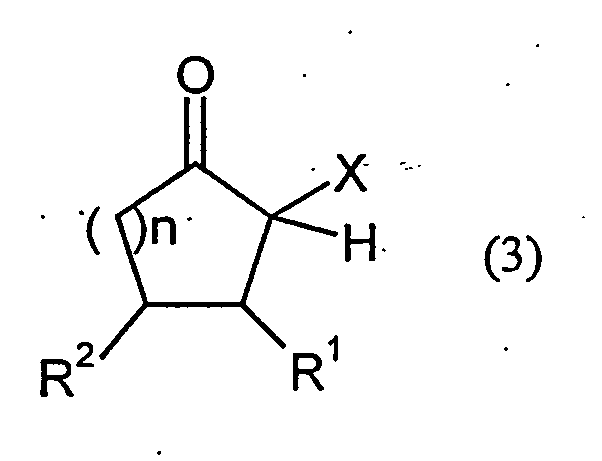 X eine elektronenziehende Gruppe ist,R1, R2 unabhängig voneinander ein Wasserstoffatom, ein gesättigter oder ungesättigter aliphatischer oder cycloaliphatischer, ein gegebenenfalls substituierter aromatischer oder araliphatischer Rest sind und je bis zu 12 Kohlenstoffatome und gegebenenfalls bis zu 3 Heteroatome der Elemente Sauerstoff, Schwefel, Stickstoff enthalten und gegebenenfalls durch Halogenatome substituiert sind undn eine ganze Zahl von 0 bis 5 ist,E) gegebenenfalls in Anwesenheit eines oder mehrerer Katalysatorenumgesetzt werden.
 - Verfahren nach Anspruch 3, dadurch gekennzeichnet, dass die elektronenziehende Gruppe X des CH-aziden cyclischen Ketons eine Ester-, Sulfoxid-, Sulfon-, Nitro-, Phosphonat-, Nitril-, Isonitril- oder Carbonylgruppe ist.
- Reaktivsystemen enthaltenda) ein oder mehrere Polyurethan-Prepolymere nach Anspruch 1 oder 2b) ein oder mehrere organische Verbindungen mit mindestens 2 primären Aminogruppen,c) gegebenenfalls ein oder mehrere Oxirangruppen-aufweisende Verbindungen einer durchschnittlichen Oxiranfunktionalität > 1, sowied) gegebenenfalls Katalysatoren und/oder Additivee) gegebenenfalls Produkte aus Reaktionen der Komponenten a) bis d) untereinander.
- Verfahren zur Herstellung der Reaktivsysteme nach Anspruch 5 bei dem die Komponenten a) bis d) in beliebiger Reihenfolge miteinander vermischt werden.
- Verwendung der Reaktivsysteme nach Anspruch 6 zur Herstellung von Klebstoffen, Dichtungsmassen, Formteilen und Beschichtungen.
- Substrate beschichtet mit Beschichtungen nach Anspruch 7.
- Formkörper erhältlich nach Anspruch 7.
Applications Claiming Priority (3)
| Application Number | Priority Date | Filing Date | Title |
|---|---|---|---|
| DE10260299A DE10260299A1 (de) | 2002-12-20 | 2002-12-20 | Reaktivsysteme, deren Herstellung und deren Verwendung |
| DE10260299 | 2002-12-20 | ||
| PCT/EP2003/013833 WO2004058849A1 (de) | 2002-12-20 | 2003-12-06 | Reaktivsysteme, deren herstellung und deren verwendung |
Publications (2)
| Publication Number | Publication Date |
|---|---|
| EP1578836A1 EP1578836A1 (de) | 2005-09-28 |
| EP1578836B1 true EP1578836B1 (de) | 2008-02-27 |
Family
ID=32404132
Family Applications (1)
| Application Number | Title | Priority Date | Filing Date |
|---|---|---|---|
| EP20030785759 Expired - Lifetime EP1578836B1 (de) | 2002-12-20 | 2003-12-06 | Mit ch-aciden cyclischen ketonen blockierte polyurethan prepolymere, daraus hergestellte reaktivsysteme, deren herstellung und verwendung |
Country Status (13)
| Country | Link |
|---|---|
| US (1) | US7057003B2 (de) |
| EP (1) | EP1578836B1 (de) |
| CN (1) | CN1307231C (de) |
| AT (1) | ATE387465T1 (de) |
| AU (1) | AU2003294804A1 (de) |
| BR (1) | BR0317494A (de) |
| CA (1) | CA2510560A1 (de) |
| DE (2) | DE10260299A1 (de) |
| DK (1) | DK1578836T3 (de) |
| ES (1) | ES2300638T3 (de) |
| MX (1) | MXPA05006529A (de) |
| RU (1) | RU2005122825A (de) |
| WO (1) | WO2004058849A1 (de) |
Cited By (1)
| Publication number | Priority date | Publication date | Assignee | Title |
|---|---|---|---|---|
| EP3892659A1 (de) | 2020-04-08 | 2021-10-13 | Covestro Deutschland AG | Mit aus cashewnuss-schalenöl erhältlichen phenolen blockierte, niedrigviskose isocyanat-prepolymere, verfahren zur deren herstellung und deren verwendung |
Families Citing this family (21)
| Publication number | Priority date | Publication date | Assignee | Title |
|---|---|---|---|---|
| DE10260269A1 (de) * | 2002-12-20 | 2004-07-01 | Bayer Ag | Neue Dual Cure-Systeme |
| DE10260298A1 (de) * | 2002-12-20 | 2004-07-01 | Bayer Ag | Hydrophilierte blockierte Polysocyanate |
| DE102004043342A1 (de) * | 2004-09-08 | 2006-03-09 | Bayer Materialscience Ag | Blockierte Polyurethan-Prepolymere als Klebstoffe |
| US20070031672A1 (en) * | 2005-08-08 | 2007-02-08 | Frank-Rainer Boehm | Wire-coating composition based on new polyester amide imides and polyester amides |
| DE102005048823A1 (de) * | 2005-10-10 | 2007-04-12 | Bayer Materialscience Ag | Reaktivsysteme, deren Herstellung und Verwendung |
| EP1772499A3 (de) * | 2005-10-10 | 2007-09-05 | Bayer MaterialScience AG | Reaktivsysteme, deren Herstellung und deren Verwendung |
| EP1860131A1 (de) * | 2006-05-24 | 2007-11-28 | Sika Technology AG | Katalysierungssystem |
| US9006350B2 (en) * | 2006-12-22 | 2015-04-14 | Axalta Coating Systems Ip Co., Llc | Selfbonding enamels based on new polyester amide imides and polyester amides |
| DE102007012908A1 (de) * | 2007-03-19 | 2008-09-25 | Momentive Performance Materials Gmbh | Neue Polyamid-Polysiloxan-Verbindungen |
| JP5765938B2 (ja) | 2007-10-17 | 2015-08-19 | ビーエーエスエフ ソシエタス・ヨーロピアBasf Se | 有機金属化合物を主成分とする光潜伏性触媒 |
| US20090156712A1 (en) * | 2007-12-18 | 2009-06-18 | Frank-Rainer Boehm | Process of fixing wound items |
| DE102009017412A1 (de) | 2009-04-14 | 2010-10-21 | Bayer Materialscience Ag | Reaktivsysteme, deren Herstellung und deren Verwendung |
| KR101752517B1 (ko) | 2009-09-15 | 2017-06-29 | 바스프 에스이 | 광-잠재성 티타늄-킬레이트 촉매 |
| CN102497931B (zh) | 2009-09-15 | 2016-03-09 | 巴斯夫欧洲公司 | 光潜钛催化剂 |
| CA2756124C (en) * | 2010-11-19 | 2014-02-11 | Rohm And Haas Company | Hydrophobically modified alkylene oxide urethane polymer |
| BR112013025510A2 (pt) | 2011-04-05 | 2018-07-03 | Basf Se | formulação e composto catalisador de oxo-quelato de titânio, usos de uma formulação de catalisador de oxo-quelato de titânio, e de uma composição polimerizável, composição, substrato revestido, e, processo para polimerizar compostos |
| EP3548530A1 (de) * | 2016-11-29 | 2019-10-09 | LANXESS Solutions US Inc. | Blockierte isocyanatterminierte präpolymere mit verbesserten verarbeitungseigenschaften |
| US20240376353A1 (en) * | 2021-08-30 | 2024-11-14 | Ddp Specialty Electronic Materials Us, Llc | Two-component structural adhesive |
| CN119968413A (zh) * | 2022-10-06 | 2025-05-09 | Ddp 特种电子材料美国有限责任公司 | 双组分粘合剂组合物 |
| CN122095001A (zh) | 2023-11-21 | 2026-05-26 | 科思创德国股份有限公司 | 封闭型异氰酸酯预聚物体系及其制备方法与应用 |
| CN119241994B (zh) * | 2024-12-09 | 2025-05-06 | 江苏和时利新材料股份有限公司 | 一种抗冲击发泡聚酯材料及其制备方法 |
Family Cites Families (17)
| Publication number | Priority date | Publication date | Assignee | Title |
|---|---|---|---|---|
| BE790295A (fr) | 1971-10-22 | 1973-04-19 | Bayer Ag | Matieres plastiques elastifiees |
| US3931116A (en) | 1972-08-14 | 1976-01-06 | Witco Chemical Corporation | Curable amine-terminated polyurethane-urea-epoxide lacquers |
| DE2418041C3 (de) | 1974-04-13 | 1982-04-29 | Schering Ag, 1000 Berlin Und 4619 Bergkamen | Verfahren zur Herstellung von elastifizierten Formteilen nach Flächengebilden |
| DE3151591A1 (de) | 1981-12-28 | 1983-07-14 | Lechler Chemie Gmbh, 7000 Stuttgart | Haertbare kunstharzmischungen und mittel fuer haertbare kunstharzmischungen auf basis von praepolymeren polyaetherurethanharnstoffaminen und epoxidharzen und/oder aromatischen carbamidsaeurearylestern |
| US4565000A (en) | 1982-09-24 | 1986-01-21 | Analog Devices, Incorporated | Matching of resistor sensitivities to process-induced variations in resistor widths |
| AU602399B2 (en) | 1987-05-15 | 1990-10-11 | Interez Inc. | Polyamine-polyisocyanate reaction products as epoxy resin curing agents |
| DE4015302A1 (de) | 1990-05-12 | 1991-11-14 | Bayer Ag | Verfahren zur herstellung von aminen, die so erhaltenen amine und ihre verwendung als haerter fuer epoxidharze |
| US5060573A (en) * | 1990-12-19 | 1991-10-29 | Goex International, Inc. | Detonator assembly |
| DE19813352A1 (de) | 1998-03-26 | 1999-09-30 | Bayer Ag | Malonesterblockierte Polyisocyanate mit Formaldehyd gegen Thermovergilbung |
| DE19816570A1 (de) | 1998-04-15 | 1999-10-21 | Bayer Ag | Reaktivsysteme und ihre Verwendung zur Herstellung von Beschichtungen, Klebstoffen, Dichtungsmassen, Vergußmassen oder Formteilen |
| DE19941213A1 (de) * | 1999-08-30 | 2001-03-01 | Bayer Ag | Malonester-blockiertes HDI-Trimerisat mit IPDA- und Formaldehydstabilisierung |
| NZ530396A (en) * | 2001-07-03 | 2005-07-29 | Bayer Ag | Cyclic ketones as blocking agents |
| DE10226926A1 (de) | 2002-06-17 | 2004-02-05 | Bayer Ag | Blockierte Polyisocyanate |
| DE10132016A1 (de) * | 2001-07-03 | 2003-01-16 | Bayer Ag | Cyclische Ketone als Blockierungsmittel |
| US6784243B2 (en) | 2002-06-17 | 2004-08-31 | Bayer Aktiengesellschaft | Polyurethane-polyurea dispersions |
| DE10260300A1 (de) * | 2002-12-20 | 2004-07-01 | Bayer Ag | Abspalterfreie Pulverlackvernetzer |
| DE10260269A1 (de) * | 2002-12-20 | 2004-07-01 | Bayer Ag | Neue Dual Cure-Systeme |
-
2002
- 2002-12-20 DE DE10260299A patent/DE10260299A1/de not_active Withdrawn
-
2003
- 2003-12-06 AU AU2003294804A patent/AU2003294804A1/en not_active Abandoned
- 2003-12-06 WO PCT/EP2003/013833 patent/WO2004058849A1/de not_active Ceased
- 2003-12-06 DK DK03785759T patent/DK1578836T3/da active
- 2003-12-06 CN CNB2003801070942A patent/CN1307231C/zh not_active Expired - Fee Related
- 2003-12-06 MX MXPA05006529A patent/MXPA05006529A/es active IP Right Grant
- 2003-12-06 ES ES03785759T patent/ES2300638T3/es not_active Expired - Lifetime
- 2003-12-06 CA CA 2510560 patent/CA2510560A1/en not_active Abandoned
- 2003-12-06 EP EP20030785759 patent/EP1578836B1/de not_active Expired - Lifetime
- 2003-12-06 DE DE50309280T patent/DE50309280D1/de not_active Expired - Lifetime
- 2003-12-06 AT AT03785759T patent/ATE387465T1/de active
- 2003-12-06 RU RU2005122825/04A patent/RU2005122825A/ru not_active Application Discontinuation
- 2003-12-06 BR BR0317494A patent/BR0317494A/pt not_active Application Discontinuation
- 2003-12-17 US US10/738,742 patent/US7057003B2/en not_active Expired - Lifetime
Cited By (2)
| Publication number | Priority date | Publication date | Assignee | Title |
|---|---|---|---|---|
| EP3892659A1 (de) | 2020-04-08 | 2021-10-13 | Covestro Deutschland AG | Mit aus cashewnuss-schalenöl erhältlichen phenolen blockierte, niedrigviskose isocyanat-prepolymere, verfahren zur deren herstellung und deren verwendung |
| WO2021204741A1 (de) | 2020-04-08 | 2021-10-14 | Covestro Deutschland Ag | Mit aus cashewnuss-schalenöl erhältlichen phenolen blockierte, niedrigviskose isocyanat-prepolymere, verfahren zur deren herstellung und deren verwendung |
Also Published As
| Publication number | Publication date |
|---|---|
| CN1307231C (zh) | 2007-03-28 |
| EP1578836A1 (de) | 2005-09-28 |
| RU2005122825A (ru) | 2006-01-20 |
| ES2300638T3 (es) | 2008-06-16 |
| DK1578836T3 (da) | 2008-06-16 |
| DE10260299A1 (de) | 2004-07-01 |
| WO2004058849A1 (de) | 2004-07-15 |
| CA2510560A1 (en) | 2004-07-15 |
| US20040147704A1 (en) | 2004-07-29 |
| BR0317494A (pt) | 2005-11-16 |
| US7057003B2 (en) | 2006-06-06 |
| CN1729224A (zh) | 2006-02-01 |
| AU2003294804A1 (en) | 2004-07-22 |
| DE50309280D1 (de) | 2008-04-10 |
| HK1088021A1 (en) | 2006-10-27 |
| ATE387465T1 (de) | 2008-03-15 |
| MXPA05006529A (es) | 2005-08-26 |
Similar Documents
| Publication | Publication Date | Title |
|---|---|---|
| EP4132984B1 (de) | Mit aus cashewnuss-schalenöl erhältlichen phenolen blockierte, niedrigviskose isocyanat-prepolymere, verfahren zur deren herstellung und deren verwendung | |
| WO2004058849A1 (de) | Reaktivsysteme, deren herstellung und deren verwendung | |
| EP1551894B1 (de) | Zweikomponente-systeme für die herstellung elastischer beschichtungen | |
| DE102005047562A1 (de) | Zweitkomponenten-Systeme für die Herstellung flexibler Beschichtungen | |
| DE4015302A1 (de) | Verfahren zur herstellung von aminen, die so erhaltenen amine und ihre verwendung als haerter fuer epoxidharze | |
| EP1578833B1 (de) | Raumtemperaturhärtende reaktivsysteme | |
| EP1208128B1 (de) | Harnstoffgruppen aufweisende polyamine, verfahren zu ihrer herstellung sowie ihre verwendung als härter für epoxidharze | |
| EP1204691B1 (de) | Lösemittelfreie, raumtemperaturhärtende reaktivsysteme und ihre verwendung zur herstellung von klebstoffen, dichtungsmassen, vergussmassen, formteilen oder beschichtungen | |
| EP0082983B1 (de) | Härtbare Kunstharzmischungen und Mittel für härtbare Kunstharzmischungen auf Basis von präpolymeren Polyätherurethanharnstoffaminen und Epoxidharzen und/oder aromatischen Carbamidsäurearylestern | |
| DE102005048823A1 (de) | Reaktivsysteme, deren Herstellung und Verwendung | |
| EP1615964B1 (de) | Verfahren zur herstellung von phenolisch-blockierten polyurethan-prepolymeren | |
| EP0473905A2 (de) | Bei Raumtemperatur härtbare Epoxidharzmischungen | |
| EP4240799B1 (de) | Bodenschutzsystem mit hoher dynamischer rissüberbrückung | |
| DE19755031B4 (de) | Bei Raumtemperatur härtbare Epoxidharzmischungen und ihre Verwendung | |
| DE102009017412A1 (de) | Reaktivsysteme, deren Herstellung und deren Verwendung | |
| EP1772499A2 (de) | Reaktivsysteme, deren Herstellung und deren Verwendung | |
| EP1765899A1 (de) | Verfahren zur herstellung aminofunktioneller polyurethan-prepolymere | |
| HK1088021B (en) | Polyurethane prepolymers blocked with ch-acidic cyclic ketones, reactive systems produced from said polymers and the use of the same | |
| JPH05331415A (ja) | ウレタンコーティング剤組成物 | |
| DE102004056398A1 (de) | Hydrolysestabile, hydrophobe, lösemittelfreie Polyole |
Legal Events
| Date | Code | Title | Description |
|---|---|---|---|
| PUAI | Public reference made under article 153(3) epc to a published international application that has entered the european phase |
Free format text: ORIGINAL CODE: 0009012 |
|
| 17P | Request for examination filed |
Effective date: 20050720 |
|
| AK | Designated contracting states |
Kind code of ref document: A1 Designated state(s): AT BE BG CH CY CZ DE DK EE ES FI FR GB GR HU IE IT LI LU MC NL PT RO SE SI SK TR |
|
| AX | Request for extension of the european patent |
Extension state: AL LT LV MK |
|
| DAX | Request for extension of the european patent (deleted) | ||
| RIN1 | Information on inventor provided before grant (corrected) |
Inventor name: KARLOU-DETIG, KAMELIA Inventor name: GUERTLER, CHRISTOPH Inventor name: STINGL, THOMAS Inventor name: SIMON, JOACHIM Inventor name: MAGER, MICHAEL Inventor name: SCHELHAAS, MICHAEL |
|
| GRAP | Despatch of communication of intention to grant a patent |
Free format text: ORIGINAL CODE: EPIDOSNIGR1 |
|
| GRAS | Grant fee paid |
Free format text: ORIGINAL CODE: EPIDOSNIGR3 |
|
| GRAA | (expected) grant |
Free format text: ORIGINAL CODE: 0009210 |
|
| AK | Designated contracting states |
Kind code of ref document: B1 Designated state(s): AT BE BG CH CY CZ DE DK EE ES FI FR GB GR HU IE IT LI LU MC NL PT RO SE SI SK TR |
|
| REG | Reference to a national code |
Ref country code: GB Ref legal event code: FG4D Free format text: NOT ENGLISH |
|
| REG | Reference to a national code |
Ref country code: CH Ref legal event code: EP |
|
| REG | Reference to a national code |
Ref country code: IE Ref legal event code: FG4D Free format text: LANGUAGE OF EP DOCUMENT: GERMAN |
|
| REF | Corresponds to: |
Ref document number: 50309280 Country of ref document: DE Date of ref document: 20080410 Kind code of ref document: P |
|
| REG | Reference to a national code |
Ref country code: CH Ref legal event code: NV Representative=s name: E. BLUM & CO. AG PATENT- UND MARKENANWAELTE VSP |
|
| REG | Reference to a national code |
Ref country code: ES Ref legal event code: FG2A Ref document number: 2300638 Country of ref document: ES Kind code of ref document: T3 Ref country code: DK Ref legal event code: T3 |
|
| REG | Reference to a national code |
Ref country code: GR Ref legal event code: EP Ref document number: 20080401150 Country of ref document: GR |
|
| PG25 | Lapsed in a contracting state [announced via postgrant information from national office to epo] |
Ref country code: FI Free format text: LAPSE BECAUSE OF FAILURE TO SUBMIT A TRANSLATION OF THE DESCRIPTION OR TO PAY THE FEE WITHIN THE PRESCRIBED TIME-LIMIT Effective date: 20080227 |
|
| PG25 | Lapsed in a contracting state [announced via postgrant information from national office to epo] |
Ref country code: SI Free format text: LAPSE BECAUSE OF FAILURE TO SUBMIT A TRANSLATION OF THE DESCRIPTION OR TO PAY THE FEE WITHIN THE PRESCRIBED TIME-LIMIT Effective date: 20080227 |
|
| REG | Reference to a national code |
Ref country code: IE Ref legal event code: FD4D |
|
| REG | Reference to a national code |
Ref country code: HU Ref legal event code: AG4A Ref document number: E003540 Country of ref document: HU |
|
| PG25 | Lapsed in a contracting state [announced via postgrant information from national office to epo] |
Ref country code: PT Free format text: LAPSE BECAUSE OF FAILURE TO SUBMIT A TRANSLATION OF THE DESCRIPTION OR TO PAY THE FEE WITHIN THE PRESCRIBED TIME-LIMIT Effective date: 20080721 Ref country code: SE Free format text: LAPSE BECAUSE OF FAILURE TO SUBMIT A TRANSLATION OF THE DESCRIPTION OR TO PAY THE FEE WITHIN THE PRESCRIBED TIME-LIMIT Effective date: 20080527 Ref country code: SK Free format text: LAPSE BECAUSE OF FAILURE TO SUBMIT A TRANSLATION OF THE DESCRIPTION OR TO PAY THE FEE WITHIN THE PRESCRIBED TIME-LIMIT Effective date: 20080227 Ref country code: IE Free format text: LAPSE BECAUSE OF FAILURE TO SUBMIT A TRANSLATION OF THE DESCRIPTION OR TO PAY THE FEE WITHIN THE PRESCRIBED TIME-LIMIT Effective date: 20080227 |
|
| ET | Fr: translation filed | ||
| PG25 | Lapsed in a contracting state [announced via postgrant information from national office to epo] |
Ref country code: RO Free format text: LAPSE BECAUSE OF FAILURE TO SUBMIT A TRANSLATION OF THE DESCRIPTION OR TO PAY THE FEE WITHIN THE PRESCRIBED TIME-LIMIT Effective date: 20080227 |
|
| PLBE | No opposition filed within time limit |
Free format text: ORIGINAL CODE: 0009261 |
|
| STAA | Information on the status of an ep patent application or granted ep patent |
Free format text: STATUS: NO OPPOSITION FILED WITHIN TIME LIMIT |
|
| 26N | No opposition filed |
Effective date: 20081128 |
|
| PG25 | Lapsed in a contracting state [announced via postgrant information from national office to epo] |
Ref country code: EE Free format text: LAPSE BECAUSE OF FAILURE TO SUBMIT A TRANSLATION OF THE DESCRIPTION OR TO PAY THE FEE WITHIN THE PRESCRIBED TIME-LIMIT Effective date: 20080227 Ref country code: BG Free format text: LAPSE BECAUSE OF FAILURE TO SUBMIT A TRANSLATION OF THE DESCRIPTION OR TO PAY THE FEE WITHIN THE PRESCRIBED TIME-LIMIT Effective date: 20080527 |
|
| PG25 | Lapsed in a contracting state [announced via postgrant information from national office to epo] |
Ref country code: MC Free format text: LAPSE BECAUSE OF NON-PAYMENT OF DUE FEES Effective date: 20081231 Ref country code: CY Free format text: LAPSE BECAUSE OF FAILURE TO SUBMIT A TRANSLATION OF THE DESCRIPTION OR TO PAY THE FEE WITHIN THE PRESCRIBED TIME-LIMIT Effective date: 20080227 |
|
| PG25 | Lapsed in a contracting state [announced via postgrant information from national office to epo] |
Ref country code: LU Free format text: LAPSE BECAUSE OF NON-PAYMENT OF DUE FEES Effective date: 20081206 |
|
| PGFP | Annual fee paid to national office [announced via postgrant information from national office to epo] |
Ref country code: DK Payment date: 20101210 Year of fee payment: 8 |
|
| PGFP | Annual fee paid to national office [announced via postgrant information from national office to epo] |
Ref country code: CZ Payment date: 20101202 Year of fee payment: 8 Ref country code: HU Payment date: 20101214 Year of fee payment: 8 |
|
| PGFP | Annual fee paid to national office [announced via postgrant information from national office to epo] |
Ref country code: GR Payment date: 20101129 Year of fee payment: 8 Ref country code: TR Payment date: 20101122 Year of fee payment: 8 |
|
| REG | Reference to a national code |
Ref country code: DK Ref legal event code: EBP |
|
| PG25 | Lapsed in a contracting state [announced via postgrant information from national office to epo] |
Ref country code: CZ Free format text: LAPSE BECAUSE OF NON-PAYMENT OF DUE FEES Effective date: 20111206 |
|
| REG | Reference to a national code |
Ref country code: GR Ref legal event code: ML Ref document number: 20080401150 Country of ref document: GR Effective date: 20120704 |
|
| PG25 | Lapsed in a contracting state [announced via postgrant information from national office to epo] |
Ref country code: HU Free format text: LAPSE BECAUSE OF NON-PAYMENT OF DUE FEES Effective date: 20111207 Ref country code: GR Free format text: LAPSE BECAUSE OF NON-PAYMENT OF DUE FEES Effective date: 20120704 |
|
| PG25 | Lapsed in a contracting state [announced via postgrant information from national office to epo] |
Ref country code: DK Free format text: LAPSE BECAUSE OF NON-PAYMENT OF DUE FEES Effective date: 20120102 |
|
| PG25 | Lapsed in a contracting state [announced via postgrant information from national office to epo] |
Ref country code: TR Free format text: LAPSE BECAUSE OF NON-PAYMENT OF DUE FEES Effective date: 20111206 |
|
| REG | Reference to a national code |
Ref country code: DE Ref legal event code: R081 Ref document number: 50309280 Country of ref document: DE Owner name: BAYER INTELLECTUAL PROPERTY GMBH, DE Free format text: FORMER OWNER: BAYER MATERIALSCIENCE AKTIENGESELLSCHAFT, 51373 LEVERKUSEN, DE Effective date: 20140317 Ref country code: DE Ref legal event code: R081 Ref document number: 50309280 Country of ref document: DE Owner name: COVESTRO DEUTSCHLAND AG, DE Free format text: FORMER OWNER: BAYER MATERIALSCIENCE AKTIENGESELLSCHAFT, 51373 LEVERKUSEN, DE Effective date: 20140317 |
|
| PGFP | Annual fee paid to national office [announced via postgrant information from national office to epo] |
Ref country code: CH Payment date: 20141212 Year of fee payment: 12 |
|
| REG | Reference to a national code |
Ref country code: FR Ref legal event code: PLFP Year of fee payment: 13 |
|
| REG | Reference to a national code |
Ref country code: DE Ref legal event code: R081 Ref document number: 50309280 Country of ref document: DE Owner name: COVESTRO DEUTSCHLAND AG, DE Free format text: FORMER OWNER: BAYER INTELLECTUAL PROPERTY GMBH, 40789 MONHEIM, DE |
|
| PGFP | Annual fee paid to national office [announced via postgrant information from national office to epo] |
Ref country code: GB Payment date: 20151202 Year of fee payment: 13 |
|
| PGFP | Annual fee paid to national office [announced via postgrant information from national office to epo] |
Ref country code: AT Payment date: 20151125 Year of fee payment: 13 Ref country code: BE Payment date: 20151207 Year of fee payment: 13 Ref country code: NL Payment date: 20151126 Year of fee payment: 13 Ref country code: FR Payment date: 20151123 Year of fee payment: 13 Ref country code: ES Payment date: 20151127 Year of fee payment: 13 |
|
| PGFP | Annual fee paid to national office [announced via postgrant information from national office to epo] |
Ref country code: IT Payment date: 20151221 Year of fee payment: 13 |
|
| REG | Reference to a national code |
Ref country code: CH Ref legal event code: PL |
|
| PG25 | Lapsed in a contracting state [announced via postgrant information from national office to epo] |
Ref country code: CH Free format text: LAPSE BECAUSE OF NON-PAYMENT OF DUE FEES Effective date: 20151231 Ref country code: LI Free format text: LAPSE BECAUSE OF NON-PAYMENT OF DUE FEES Effective date: 20151231 |
|
| PG25 | Lapsed in a contracting state [announced via postgrant information from national office to epo] |
Ref country code: BE Free format text: LAPSE BECAUSE OF NON-PAYMENT OF DUE FEES Effective date: 20161231 |
|
| REG | Reference to a national code |
Ref country code: NL Ref legal event code: MM Effective date: 20170101 |
|
| REG | Reference to a national code |
Ref country code: AT Ref legal event code: MM01 Ref document number: 387465 Country of ref document: AT Kind code of ref document: T Effective date: 20161206 |
|
| GBPC | Gb: european patent ceased through non-payment of renewal fee |
Effective date: 20161206 |
|
| PG25 | Lapsed in a contracting state [announced via postgrant information from national office to epo] |
Ref country code: NL Free format text: LAPSE BECAUSE OF NON-PAYMENT OF DUE FEES Effective date: 20170101 |
|
| REG | Reference to a national code |
Ref country code: FR Ref legal event code: ST Effective date: 20170831 |
|
| PG25 | Lapsed in a contracting state [announced via postgrant information from national office to epo] |
Ref country code: FR Free format text: LAPSE BECAUSE OF NON-PAYMENT OF DUE FEES Effective date: 20170102 Ref country code: IT Free format text: LAPSE BECAUSE OF NON-PAYMENT OF DUE FEES Effective date: 20161206 Ref country code: AT Free format text: LAPSE BECAUSE OF NON-PAYMENT OF DUE FEES Effective date: 20161206 |
|
| PG25 | Lapsed in a contracting state [announced via postgrant information from national office to epo] |
Ref country code: GB Free format text: LAPSE BECAUSE OF NON-PAYMENT OF DUE FEES Effective date: 20161206 |
|
| REG | Reference to a national code |
Ref country code: BE Ref legal event code: MM Effective date: 20161231 |
|
| PG25 | Lapsed in a contracting state [announced via postgrant information from national office to epo] |
Ref country code: ES Free format text: LAPSE BECAUSE OF NON-PAYMENT OF DUE FEES Effective date: 20161207 |
|
| REG | Reference to a national code |
Ref country code: ES Ref legal event code: FD2A Effective date: 20180625 |
|
| PGFP | Annual fee paid to national office [announced via postgrant information from national office to epo] |
Ref country code: DE Payment date: 20181120 Year of fee payment: 16 |
|
| REG | Reference to a national code |
Ref country code: DE Ref legal event code: R119 Ref document number: 50309280 Country of ref document: DE |
|
| PG25 | Lapsed in a contracting state [announced via postgrant information from national office to epo] |
Ref country code: DE Free format text: LAPSE BECAUSE OF NON-PAYMENT OF DUE FEES Effective date: 20200701 |