EP1584372A2 - A microarray having microarray identification information stored in the form of a spot. Method of producing the microarray and method of using the microarray - Google Patents
A microarray having microarray identification information stored in the form of a spot. Method of producing the microarray and method of using the microarray Download PDFInfo
- Publication number
- EP1584372A2 EP1584372A2 EP05007430A EP05007430A EP1584372A2 EP 1584372 A2 EP1584372 A2 EP 1584372A2 EP 05007430 A EP05007430 A EP 05007430A EP 05007430 A EP05007430 A EP 05007430A EP 1584372 A2 EP1584372 A2 EP 1584372A2
- Authority
- EP
- European Patent Office
- Prior art keywords
- microarray
- spot
- identification information
- treatment
- detectable
- Prior art date
- Legal status (The legal status is an assumption and is not a legal conclusion. Google has not performed a legal analysis and makes no representation as to the accuracy of the status listed.)
- Withdrawn
Links
Images


Classifications
-
- B—PERFORMING OPERATIONS; TRANSPORTING
- B01—PHYSICAL OR CHEMICAL PROCESSES OR APPARATUS IN GENERAL
- B01J—CHEMICAL OR PHYSICAL PROCESSES, e.g. CATALYSIS OR COLLOID CHEMISTRY; THEIR RELEVANT APPARATUS
- B01J19/00—Chemical, physical or physico-chemical processes in general; Their relevant apparatus
- B01J19/0046—Sequential or parallel reactions, e.g. for the synthesis of polypeptides or polynucleotides; Apparatus and devices for combinatorial chemistry or for making molecular arrays
-
- C—CHEMISTRY; METALLURGY
- C12—BIOCHEMISTRY; BEER; SPIRITS; WINE; VINEGAR; MICROBIOLOGY; ENZYMOLOGY; MUTATION OR GENETIC ENGINEERING
- C12Q—MEASURING OR TESTING PROCESSES INVOLVING ENZYMES, NUCLEIC ACIDS OR MICROORGANISMS; COMPOSITIONS OR TEST PAPERS THEREFOR; PROCESSES OF PREPARING SUCH COMPOSITIONS; CONDITION-RESPONSIVE CONTROL IN MICROBIOLOGICAL OR ENZYMOLOGICAL PROCESSES
- C12Q1/00—Measuring or testing processes involving enzymes, nucleic acids or microorganisms; Compositions therefor; Processes of preparing such compositions
- C12Q1/68—Measuring or testing processes involving enzymes, nucleic acids or microorganisms; Compositions therefor; Processes of preparing such compositions involving nucleic acids
- C12Q1/6813—Hybridisation assays
- C12Q1/6834—Enzymatic or biochemical coupling of nucleic acids to a solid phase
- C12Q1/6837—Enzymatic or biochemical coupling of nucleic acids to a solid phase using probe arrays or probe chips
-
- C—CHEMISTRY; METALLURGY
- C40—COMBINATORIAL TECHNOLOGY
- C40B—COMBINATORIAL CHEMISTRY; LIBRARIES, e.g. CHEMICAL LIBRARIES
- C40B60/00—Apparatus specially adapted for use in combinatorial chemistry or with libraries
- C40B60/14—Apparatus specially adapted for use in combinatorial chemistry or with libraries for creating libraries
-
- B—PERFORMING OPERATIONS; TRANSPORTING
- B01—PHYSICAL OR CHEMICAL PROCESSES OR APPARATUS IN GENERAL
- B01J—CHEMICAL OR PHYSICAL PROCESSES, e.g. CATALYSIS OR COLLOID CHEMISTRY; THEIR RELEVANT APPARATUS
- B01J2219/00—Chemical, physical or physico-chemical processes in general; Their relevant apparatus
- B01J2219/00274—Sequential or parallel reactions; Apparatus and devices for combinatorial chemistry or for making arrays; Chemical library technology
- B01J2219/00277—Apparatus
- B01J2219/00351—Means for dispensing and evacuation of reagents
- B01J2219/00387—Applications using probes
-
- B—PERFORMING OPERATIONS; TRANSPORTING
- B01—PHYSICAL OR CHEMICAL PROCESSES OR APPARATUS IN GENERAL
- B01J—CHEMICAL OR PHYSICAL PROCESSES, e.g. CATALYSIS OR COLLOID CHEMISTRY; THEIR RELEVANT APPARATUS
- B01J2219/00—Chemical, physical or physico-chemical processes in general; Their relevant apparatus
- B01J2219/00274—Sequential or parallel reactions; Apparatus and devices for combinatorial chemistry or for making arrays; Chemical library technology
- B01J2219/00277—Apparatus
- B01J2219/00497—Features relating to the solid phase supports
- B01J2219/00527—Sheets
-
- B—PERFORMING OPERATIONS; TRANSPORTING
- B01—PHYSICAL OR CHEMICAL PROCESSES OR APPARATUS IN GENERAL
- B01J—CHEMICAL OR PHYSICAL PROCESSES, e.g. CATALYSIS OR COLLOID CHEMISTRY; THEIR RELEVANT APPARATUS
- B01J2219/00—Chemical, physical or physico-chemical processes in general; Their relevant apparatus
- B01J2219/00274—Sequential or parallel reactions; Apparatus and devices for combinatorial chemistry or for making arrays; Chemical library technology
- B01J2219/00277—Apparatus
- B01J2219/0054—Means for coding or tagging the apparatus or the reagents
-
- B—PERFORMING OPERATIONS; TRANSPORTING
- B01—PHYSICAL OR CHEMICAL PROCESSES OR APPARATUS IN GENERAL
- B01J—CHEMICAL OR PHYSICAL PROCESSES, e.g. CATALYSIS OR COLLOID CHEMISTRY; THEIR RELEVANT APPARATUS
- B01J2219/00—Chemical, physical or physico-chemical processes in general; Their relevant apparatus
- B01J2219/00274—Sequential or parallel reactions; Apparatus and devices for combinatorial chemistry or for making arrays; Chemical library technology
- B01J2219/00277—Apparatus
- B01J2219/0054—Means for coding or tagging the apparatus or the reagents
- B01J2219/00545—Colours
-
- B—PERFORMING OPERATIONS; TRANSPORTING
- B01—PHYSICAL OR CHEMICAL PROCESSES OR APPARATUS IN GENERAL
- B01J—CHEMICAL OR PHYSICAL PROCESSES, e.g. CATALYSIS OR COLLOID CHEMISTRY; THEIR RELEVANT APPARATUS
- B01J2219/00—Chemical, physical or physico-chemical processes in general; Their relevant apparatus
- B01J2219/00274—Sequential or parallel reactions; Apparatus and devices for combinatorial chemistry or for making arrays; Chemical library technology
- B01J2219/00277—Apparatus
- B01J2219/0054—Means for coding or tagging the apparatus or the reagents
- B01J2219/00547—Bar codes
- B01J2219/00549—2-dimensional
-
- B—PERFORMING OPERATIONS; TRANSPORTING
- B01—PHYSICAL OR CHEMICAL PROCESSES OR APPARATUS IN GENERAL
- B01J—CHEMICAL OR PHYSICAL PROCESSES, e.g. CATALYSIS OR COLLOID CHEMISTRY; THEIR RELEVANT APPARATUS
- B01J2219/00—Chemical, physical or physico-chemical processes in general; Their relevant apparatus
- B01J2219/00274—Sequential or parallel reactions; Apparatus and devices for combinatorial chemistry or for making arrays; Chemical library technology
- B01J2219/00277—Apparatus
- B01J2219/0054—Means for coding or tagging the apparatus or the reagents
- B01J2219/00572—Chemical means
- B01J2219/00574—Chemical means radioactive
-
- B—PERFORMING OPERATIONS; TRANSPORTING
- B01—PHYSICAL OR CHEMICAL PROCESSES OR APPARATUS IN GENERAL
- B01J—CHEMICAL OR PHYSICAL PROCESSES, e.g. CATALYSIS OR COLLOID CHEMISTRY; THEIR RELEVANT APPARATUS
- B01J2219/00—Chemical, physical or physico-chemical processes in general; Their relevant apparatus
- B01J2219/00274—Sequential or parallel reactions; Apparatus and devices for combinatorial chemistry or for making arrays; Chemical library technology
- B01J2219/00277—Apparatus
- B01J2219/0054—Means for coding or tagging the apparatus or the reagents
- B01J2219/00572—Chemical means
- B01J2219/00576—Chemical means fluorophore
-
- B—PERFORMING OPERATIONS; TRANSPORTING
- B01—PHYSICAL OR CHEMICAL PROCESSES OR APPARATUS IN GENERAL
- B01J—CHEMICAL OR PHYSICAL PROCESSES, e.g. CATALYSIS OR COLLOID CHEMISTRY; THEIR RELEVANT APPARATUS
- B01J2219/00—Chemical, physical or physico-chemical processes in general; Their relevant apparatus
- B01J2219/00274—Sequential or parallel reactions; Apparatus and devices for combinatorial chemistry or for making arrays; Chemical library technology
- B01J2219/00583—Features relative to the processes being carried out
- B01J2219/00603—Making arrays on substantially continuous surfaces
- B01J2219/00659—Two-dimensional arrays
Definitions
- the present invention relates to a microarray having microarray identification information stored in the form of a spot, and a method of producing the microarray.
- Microarrays such as nucleic acid microarrays or protein microarrays, are used in various analytical methods.
- the analysis methods using microarrays have an advantage in that they can reveal a great deal information in a short time.
- the results obtained by using microarrays should be interpreted differently according to the manufacturing conditions or the characteristics of microarrays. Thus, it is necessary to identify microarray identification information during merchandising and when analyzing the experimental results obtained by using the microarray.
- U.S. Patent No. 6,399,365 discloses a package for hybridization comprising a housing containing a bar code for microarray identification information.
- U.S. Patent No. 6,215,894 discloses a microarray having a machine-readable array identifier.
- these methods require a separate reader, apart from a microarray reader generally used to read the results of the experiment obtained in an analytical method using the microarray. That is, microarray identification information should be recorded in a space apart from an array of probes and a separate reader should be used.
- the location where the bar code is disposed may depend on microarray manufacturers, and thus, the reader should be manually controlled.
- the present inventors conducted a considerable amount of research to overcome these problems and designed a microarray of which identification information can be read using the same reader that is used to detect the results of an experiment in an analytical method using the microarray, without using a separate instrument, such as a bar code, in a separate space apart from a microarray of probes.
- the present invention provides a microarray of which identification information can be read in a convenient and efficient manner.
- the present invention also provides a method of producing a microarray of which identification information can be read in a convenient and efficient manner.
- a microarray having microarray identification information stored in the form of a spot.
- a method of producing a microarray having microarray identification information stored in the form of a spot comprising: coding the microarray identification information as a number; and immobilizing a detectable substance on a solid substrate, the coded number being expressed by using a combination of a spot having a detectable substance immobilized thereon and a spot not having a detectable substance immobilized thereon.
- a method of producing a microarray having microarray identification information stored in the form of a spot comprising: coding the microarray identification information to a number; and having a surface of a solid substrate subjected to a treatment so that a detectable signal can be generated therefrom, the coded number being expressed by using a combination of a spot having a surface subjected to the treatment and a spot having a surface not subjected to the treatment.
- An embodiment of the present invention provides a microarray having microarray identification information stored in the form of a spot.
- the microarray identification information may be stored using a combination of a spot having a detectable substance immobilized thereon and a spot not having a detectable substance immobilized thereon.
- the detectable substance refers to a substance that generates a detectable signal, for example, by irradiation of light and a reaction of an enzyme with a substrate.
- Examples of the detectable signal include light, such as fluorescence, phosphorescence, and radioactive rays, and a difference of reflection during irradiation of light.
- Examples of the detectable substance include those selected from the group consisting of a fluorescent substance, a radioactive substance and an enzyme capable of generating a detectable signal.
- the detectable substance may generate the same signal as signals indicating a degree of correlation between a probe substance and a target substance.
- a target which is a nucleic acid is labeled with a fluorescent dye, such as Cy-3 and Cy-5
- the fluorescent dye can be used as a detectable substance.
- a detector used for determining the results of a correlation between the probe substance and the target substance can be also used for reading the microarray identification information, which would eliminate a separate detector for reading.
- the signal determined and read through the detector can be stored in an extractable storage medium. Therefore, there is no need for separately inputting of the microarray identification information.
- the microarray identification information may be stored in the form of a binary number or a tertiary number.
- the term "microarray identification information" refers to information on a microarray itself, i.e., information on the characteristics, a manufacturing process of a microarray, the manufacturer, and immobilized probes etc.
- the microarray identification information may be expressed in a language which human can read and understand, such as letters, numbers or symbols.
- the microarray identification information may be encoded into numbers and expressed in a binary number or a tertiary number using a spot on a substrate of the microarray.
- one type of the detectable substance may be used and the microarray identification information may be stored on a spot of the microarray in the form of a binary number by representing a signal generated from the spot having the detectable substance immobilized thereon by 0 or 1 and a signal generated from the spot not having the detectable substance immobilized thereon by 1 or 0, in a respective order.
- the microarray identification information may be stored on a spot of the microarray in the form of a tertiary number by representing a signal generated from the spot having a first detectable substance immobilized thereon by 0, 1 or 2, a signal generated from the spot having a second detectable substance immobilized thereon by 1, 2 or 0, and a signal generated from the spot not having the first or the second detectable substance immobilized thereon by 2, 0 or 1, in a respective order.
- microarray refers to a substrate in which specific molecules are densely immobilized in a predetermined region.
- examples of the microarray include, but are not limited to, a polynucleotide microarray and a protein microarray.
- polynucleotide microarray refers to a substrate in which polynuleotides are densely immobilized in each predetermined region.
- the microarray is well known in the art, for example, U.S. Patent Nos. 5,445,934 and 5,744,305. Methods of producing a microarray using photolithography are known in the art.
- One method includes coating a surface of substrate with a monomer protected with a removable protecting group, exposing a predetermined region of the surface to an energy source to remove the protecting group, and coupling a monomer protected with a removable protecting group to the monomer, and repeating the process, thereby producing a polynucleotide microarray.
- a polynucleotide is synthesized by extending monomers one by one, thus allowing immobilization of a polynucleotide.
- a method of producing a microarray using spotting a polynucleotide previously synthesized is immobilized in a predetermined region on a substrate.
- the method of producing a microarray using spotting is described, for example, in U.S. Patent Nos. 5,744,305, 5,143,854 and 5,424,186. All the above patents are incorporated herein in their entirety by reference.
- probe substance refers to a substance which is immobilized on a substrate and specifically binds to a target substance.
- a probe substance include nucleic acids, proteins, and sugars.
- a probe substance may be a polynuleotide complementary to the target polynucleotide.
- a probe substance may be a ligand, an antigen or an antibody, or the like which specifically binds to the target protein.
- spot refers to a region on which the probe substance is immobilized or will be immobilized in rows and columns in a substrate.
- the spot may include a region on the substrate, on which the probe substance is not immobilized.
- the microarray identification information may be stored using a combination of a spot having a surface subjected to a treatment so that a detectable signal can be generated therefrom and a spot not having a surface subjected to the treatment.
- the microarray identification information is stored in the form of a binary number or a tertiary number.
- one type of surface treatment may be used and the microarray identification information may be stored in the form of a binary number by representing a signal generated from the spot having the surface subjected to the treatment so that the detectable signal can be generated therefrom by 0 or 1 and a signal generated from the spot not having the surface subjected to the treatment by 1 or 0, in a respective order.
- microarray identification information may be stored in the form of a tertiary number by representing a signal generated from the spot having the surface subjected to a first treatment so that the detectable signal can be generated therefrom by 0, 1 or 2, a signal generated from the spot having the surface subjected to a second treatment so that the detectable signal can be generated therefrom by 1, 2 or 0, and a signal generated from the spot not having the surface subjected to the first or the second treatment by 2, 0 or 1, in a respective order.
- the surface treatment may be any treatment that generates a detectable signal.
- the surface treatment include a treatment by which the reflection of light can be changed, such as the formation of a grid.
- Another embodiment of the present invention provides a method of producing a microarray having microarray identification information stored in the form of a spot, comprising: coding the microarray identification information to a number; and immobilizing a detectable substance on a solid substrate, the coded number being expressed by using a combination of a spot having a detectable substance immobilized thereon and a spot not having a detectable substance immobilized thereon.
- the detectable substance may generate the same signal as those indicating a degree of correlation between a probe and a target.
- the microarray identification information may be stored in the form of a binary number or a tertiary number, but are not limited thereto.
- one type of detectable substance may be used and the microarray identification information may be stored in the form of a binary number by representing a signal generated from the spot having the detectable substance immobilized thereon by 0 or 1 and a signal generated from the spot not having the detectable substance immobilized thereon by 1 or 0, in a respective order.
- the microarray identification information may be stored in the form of a tertiary number by representing a signal generated from the spot having a first detectable substance immobilized thereon by 0, 1 or 2, a signal generated from the spot having a second detectable substance immobilized thereon by 1, 2 or 0, and a signal generated from the spot not having the first or the second detectable substance immobilized thereon by 2, 0 or 1, in a respective order.
- Still another embodiment of the present invention provides a method of producing a microarray having microarray identification information stored in the form of a spot, comprising: coding the microarray identification information to a number; and having a surface of a solid substrate subjected to a treatment so that a detectable signal can be generated therefrom, the coded number being expressed by using a combination of a spot having a surface subjected to the treatment and a spot having a surface not subjected to the treatment.
- the microarray identification information may be stored in the form of a binary number or a tertiary number.
- one type of surface treatment may be used and the microarray identification information may be stored in the form of a binary number by representing a signal generated from the spot having the surface subjected to the treatment so that the detectable signal can be generated therefrom by 0 or 1 and a signal generated from the spot having the surface not subjected to the treatment by 1 or 0, in a respective order.
- microarray identification information may be stored in the form of a tertiary number by representing a signal generated from the spot having the surface subjected to a first treatment so that the detectable signal can be generated therefrom by 0, 1 or 2, a signal generated from the spot having the surface subjected to a second treatment so that the detectable signal can be generated therefrom by 1, 2 or 0, and a signal generated from the spot not having the surface subjected to the first or the second treatment by 2, 0 or 1, in a respective order.
- the surface treatment may be any treatment that generates a detectable signal.
- the surface treatment may include a treatment by which the difference of reflection, transmittance or energy level of light, which can be confirmed using a microarray reader, can be generated. Specific examples include, but are not limited thereto, formation of a grid or coating of a substance which causes a change of reflection on a surface.
- Yet another embodiment of the present invention provides a method of using a probe microarray, comprising: reacting a target substance with a probe substance immobilized on the microarray having microarray identification information stored in the form of a spot according to a previous embodiment of the present invention and determining a signal generated due to the reaction; and reading the microarray identification information stored in the form of a spot.
- the determining the signal due to the reacting and the reading the microarray identification information may be performed using an identical detector.
- a separate detector is not required in the reading of the microarray identification information.
- the method of using a probe microarray further comprises storing data obtained from the determining the signal due to the reaction and the microarray identification information obtained from the reading, in an extractable storage medium.
- the data of the experiment and the microarray identification information can be simultaneously processed, without separately inputting the microarray identification information to a storage medium.
- the data of the experiment data and the microarray identification information stored in the extractable storage medium can be conveniently used in the following data exchange or operation using a computer, or the like. For example, a researcher may identify information on the manufacturer and the version of a microarray product from the microarray identification information stored in the microarray, and then using the information, request a analytical algorithm suitable for analyzing the product through an Internet site of the manufacturer.
- FIG. 1A is a view illustrating a conventional microarray having microarray identification information stored using a bar code
- FIG. 1B is a view illustrating a microarray according to an embodiment of the present invention having microarray identification information stored using spots.
- microarray identification information is expressed using a separate bar code for the conventional microarray, it is expressed using spots in the microarray according to an embodiment of the present invention.
- microarray identification information was encoded in a binary number, and then stored in the form of a spot by immobilizing a fluorescent substance on a substrate of a microarray in the same manner as in the process of immobilizing a probe on the substrate.
- FIG. 2A is a view illustrating a binary encoding table listing spots representing integers between 0 and 9, a discriminator for discriminating an information unit, and an "END" term designating the end of information.
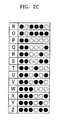
- 2B and 2C are views illustrating binary encoding tables listing spots representing all 26 letters of the Alphabet.
- a colored spot represents the number "1" and a vacant spot represents the number "0" .
- the colored spot may be coated with a detectable substance, such as Cy-3 and Cy-5, or surface-treated.
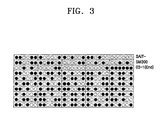
- FIG. 3 is a view illustrating the microarray identification information "SAIT-SM30003-1" stored in the upper 1 st to 3 rd rows of the spot region in a microarray.
- the microarray identification information expressed in a binary number and the results of the experiments of a reaction of a probe substance with a target substance in an analytical method using the microarray can be simultaneously read using a detector for determining the results of the experiments of the reaction, without using a separate detector for reading microarray identification information as in the prior art, and can be together used in the following data anaylsis.
- microarray identification information is stored in the form of a spot, and thus, it can be read using a detector for an analytical method using a microarray, without a need for a separate detector.
- the microarray identification information read by the detector can be stored in an extractable storage medium using the same detector, without a separate input, and can be used in the following analysis.
- a microarray having microarray identification information stored in the form of a spot can be produced.
Landscapes
- Chemical & Material Sciences (AREA)
- Organic Chemistry (AREA)
- Chemical Kinetics & Catalysis (AREA)
- Life Sciences & Earth Sciences (AREA)
- Health & Medical Sciences (AREA)
- Zoology (AREA)
- Proteomics, Peptides & Aminoacids (AREA)
- Biochemistry (AREA)
- Molecular Biology (AREA)
- Wood Science & Technology (AREA)
- Engineering & Computer Science (AREA)
- Microbiology (AREA)
- Medicinal Chemistry (AREA)
- Analytical Chemistry (AREA)
- Biotechnology (AREA)
- Immunology (AREA)
- General Chemical & Material Sciences (AREA)
- Physics & Mathematics (AREA)
- Biophysics (AREA)
- Bioinformatics & Cheminformatics (AREA)
- General Engineering & Computer Science (AREA)
- General Health & Medical Sciences (AREA)
- Genetics & Genomics (AREA)
- Apparatus Associated With Microorganisms And Enzymes (AREA)
- Measuring Or Testing Involving Enzymes Or Micro-Organisms (AREA)
- Automatic Analysis And Handling Materials Therefor (AREA)
Abstract
Description
Claims (14)
- A microarray having microarray identification information stored in the form of a spot.
- The microarray of claim 1, wherein the microarray identification information is stored using a combination of a spot having a detectable substance immobilized thereon and a spot not having a detectable substance immobilized thereon.
- The microarray of claim 1, wherein the microarray identification information is stored using a combination of a spot having a surface subjected to a treatment so that a detectable signal can be generated therefrom and a spot having a surface not subjected to the treatment.
- The microarray of claim 2 or 3, wherein the microarray identification information is stored in the form of a binary number or a tertiary number.
- The microarray of claim 2 or 3, wherein one type of detectable substance is used and the microarray identification information is stored in the form of a binary number by representing a signal generated from the spot having the detectable substance immobilized thereon by 0 or 1 and a signal generated from the spot not having the detectable substance immobilized thereon by 1 or 0, in a respective order; or
one type of surface treatment is used and the microarray identification information is stored in the form of a binary number by representing a signal generated from the spot having the surface subjected to the treatment so that the detectable signal can be generated therefrom by 0 or 1 and a signal generated from the spot having the surface not subjected to the treatment by 1 or 0, in a respective order. - The microarray of claim 2 or 3, wherein two types of detectable substances are used and the microarray identification information is stored in the form of a tertiary number by representing a signal generated from the spot having a first detectable substance immobilized thereon by 0, 1 or 2, a signal generated from the spot having a second detectable substance immobilized thereon by 1, 2 or 0, and a signal generated from the spot not having the first or the second detectable substance immobilized thereon by 2, 0 or 1, in a respective order; or
two types of surface treatments are used and the microarray identification information is stored in the form of a tertiary number by representing a signal generated from the spot having the surface subjected to a first treatment so that the detectable signal can be generated therefrom by 0, 1 or 2, a signal generated from the spot having the surface subjected to a second treatment so that the detectable signal can be generated therefrom by 1, 2 or 0, and a signal generated from the spot having the surface not subjected to the first or the second treatment by 2, 0 or 1, in a respective order. - The microarray of claim 2, wherein the detectable substance is selected from the group consisting of a fluorescent substance, a radioactive substance and an enzyme capable of generating a detectable signal.
- The microarray of claim 3, wherein the surface treatment is the formation of a grid.
- A method of producing a microarray having microarray identification information stored in the form of a spot, comprising:coding the microarray identification information as a number; andimmobilizing a detectable substance on a solid substrate, the coded number being expressed by using a combination of a spot having a detectable substance immobilized thereon and a spot not having a detectable substance immobilized thereon.
- A method of producing a microarray having microarray identification information stored in the form of a spot, comprising:coding the microarray identification information to a number; andhaving a surface of a solid substrate subjected to a treatment so that a detectable signal can be generated therefrom, the coded number being expressed by using a combination of a spot having a surface subjected to the treatment and a spot having a surface not subjected to the treatment.
- The method of claim 9 or 10, wherein the microarray identification information is stored in the form of a binary number or a tertiary number.
- The method of claim 9 or 10, wherein one type of detectable substance is used and the microarray identification information is stored in the form of a binary number by representing a signal generated from the spot having the detectable substance immobilized thereon by 0 or 1 and a signal generated from the spot not having the detectable substance immobilized thereon by 1 or 0, in a respective order; or
one type of surface treatment is used and the microarray identification information is stored in the form of a binary number by representing a signal generated from the spot having the surface subjected to the treatment so that the detectable signal can be generated therefrom by 0 or 1 and a signal generated from the spot having the surface not subjected to the treatment by 1 or 0, in a respective order. - The method of claim 9 or 10, wherein two types of detectable substances are used and the microarray identification information is stored in the form of a tertiary number by representing a signal generated from the spot having a first detectable substance immobilized thereon by 0, 1 or 2, a signal generated from the spot having a second detectable substance immobilized thereon by 1, 2 or 0, and a signal generated from the spot not having the first or the second detectable substance immobilized thereon by 2, 0 or 1, in a respective order; or
two types of surface treatments are used and the microarray identification information is stored in the form of a tertiary number by representing a signal generated from the spot having the surface subjected to a first treatment so that the detectable signal can be generated therefrom by 0, 1 or 2, a signal generated from the spot having the surface subjected to a second treatment so that the detectable signal can be generated therefrom by 1, 2 or 0, and a signal generated from the spot having the surface not subjected to the first or the second treatment by 2, 0 or 1, in a respective order. - The method of claim 10, wherein the surface treatment is formation of a grid.
Applications Claiming Priority (2)
| Application Number | Priority Date | Filing Date | Title |
|---|---|---|---|
| KR1020040024738A KR100624420B1 (en) | 2004-04-10 | 2004-04-10 | A microarray in which information about the microarray is stored in the form of spots, a method of manufacturing the same, and a method of using the same. |
| KR2004024738 | 2004-04-10 |
Publications (2)
| Publication Number | Publication Date |
|---|---|
| EP1584372A2 true EP1584372A2 (en) | 2005-10-12 |
| EP1584372A3 EP1584372A3 (en) | 2005-11-16 |
Family
ID=34910107
Family Applications (1)
| Application Number | Title | Priority Date | Filing Date |
|---|---|---|---|
| EP05007430A Withdrawn EP1584372A3 (en) | 2004-04-10 | 2005-04-05 | A microarray having microarray identification information stored in the form of a spot. Method of producing the microarray and method of using the microarray |
Country Status (5)
| Country | Link |
|---|---|
| US (1) | US20050227271A1 (en) |
| EP (1) | EP1584372A3 (en) |
| JP (1) | JP2005300543A (en) |
| KR (1) | KR100624420B1 (en) |
| CN (1) | CN100352942C (en) |
Cited By (3)
| Publication number | Priority date | Publication date | Assignee | Title |
|---|---|---|---|---|
| WO2008096318A3 (en) * | 2007-02-09 | 2008-10-30 | Koninkl Philips Electronics Nv | Identification system |
| WO2010127834A1 (en) * | 2009-05-04 | 2010-11-11 | Biametrics Marken Und Rechte Gmbh | Recognizable carrier for optical measuring methods |
| EP2933017A1 (en) * | 2014-04-17 | 2015-10-21 | AyoxxA Biosystems GmbH | Encoded device and method for encoding and decoding reference areas on a substrate |
Families Citing this family (70)
| Publication number | Priority date | Publication date | Assignee | Title |
|---|---|---|---|---|
| WO2009091039A1 (en) * | 2008-01-16 | 2009-07-23 | Nippon Telegraph And Telephone Corporation | Surface plasmon resonance measuring device, sample cell, and measuring method |
| US20190300945A1 (en) | 2010-04-05 | 2019-10-03 | Prognosys Biosciences, Inc. | Spatially Encoded Biological Assays |
| WO2011127099A1 (en) | 2010-04-05 | 2011-10-13 | Prognosys Biosciences, Inc. | Spatially encoded biological assays |
| US10787701B2 (en) | 2010-04-05 | 2020-09-29 | Prognosys Biosciences, Inc. | Spatially encoded biological assays |
| GB201106254D0 (en) | 2011-04-13 | 2011-05-25 | Frisen Jonas | Method and product |
| EP4592400A3 (en) | 2012-10-17 | 2025-10-29 | 10x Genomics Sweden AB | Methods and product for optimising localised or spatial detection of gene expression in a tissue sample |
| CA2916662C (en) | 2013-06-25 | 2022-03-08 | Prognosys Biosciences, Inc. | Methods and systems for determining spatial patterns of biological targets in a sample |
| EP3901282B1 (en) | 2015-04-10 | 2023-06-28 | Spatial Transcriptomics AB | Spatially distinguished, multiplex nucleic acid analysis of biological specimens |
| US11519033B2 (en) | 2018-08-28 | 2022-12-06 | 10X Genomics, Inc. | Method for transposase-mediated spatial tagging and analyzing genomic DNA in a biological sample |
| WO2020123316A2 (en) | 2018-12-10 | 2020-06-18 | 10X Genomics, Inc. | Methods for determining a location of a biological analyte in a biological sample |
| CN109886058B (en) * | 2019-01-03 | 2021-07-13 | 青岛海信移动通信技术股份有限公司 | A method and device for detecting images |
| US11649485B2 (en) | 2019-01-06 | 2023-05-16 | 10X Genomics, Inc. | Generating capture probes for spatial analysis |
| US11926867B2 (en) | 2019-01-06 | 2024-03-12 | 10X Genomics, Inc. | Generating capture probes for spatial analysis |
| WO2020243579A1 (en) | 2019-05-30 | 2020-12-03 | 10X Genomics, Inc. | Methods of detecting spatial heterogeneity of a biological sample |
| WO2021091611A1 (en) | 2019-11-08 | 2021-05-14 | 10X Genomics, Inc. | Spatially-tagged analyte capture agents for analyte multiplexing |
| WO2021092433A2 (en) | 2019-11-08 | 2021-05-14 | 10X Genomics, Inc. | Enhancing specificity of analyte binding |
| ES2982420T3 (en) | 2019-12-23 | 2024-10-16 | 10X Genomics Inc | Methods for spatial analysis using RNA-templated ligation |
| CN115135984B (en) | 2019-12-23 | 2025-12-23 | 10X基因组学有限公司 | Reversible fixation reagents and their usage |
| EP4081656A1 (en) | 2019-12-23 | 2022-11-02 | 10X Genomics, Inc. | Compositions and methods for using fixed biological samples in partition-based assays |
| US12365942B2 (en) | 2020-01-13 | 2025-07-22 | 10X Genomics, Inc. | Methods of decreasing background on a spatial array |
| US12405264B2 (en) | 2020-01-17 | 2025-09-02 | 10X Genomics, Inc. | Electrophoretic system and method for analyte capture |
| US11702693B2 (en) | 2020-01-21 | 2023-07-18 | 10X Genomics, Inc. | Methods for printing cells and generating arrays of barcoded cells |
| US11732299B2 (en) | 2020-01-21 | 2023-08-22 | 10X Genomics, Inc. | Spatial assays with perturbed cells |
| US20210230681A1 (en) | 2020-01-24 | 2021-07-29 | 10X Genomics, Inc. | Methods for spatial analysis using proximity ligation |
| US11821035B1 (en) | 2020-01-29 | 2023-11-21 | 10X Genomics, Inc. | Compositions and methods of making gene expression libraries |
| US12076701B2 (en) | 2020-01-31 | 2024-09-03 | 10X Genomics, Inc. | Capturing oligonucleotides in spatial transcriptomics |
| US11898205B2 (en) | 2020-02-03 | 2024-02-13 | 10X Genomics, Inc. | Increasing capture efficiency of spatial assays |
| US12110541B2 (en) | 2020-02-03 | 2024-10-08 | 10X Genomics, Inc. | Methods for preparing high-resolution spatial arrays |
| US11732300B2 (en) | 2020-02-05 | 2023-08-22 | 10X Genomics, Inc. | Increasing efficiency of spatial analysis in a biological sample |
| WO2021158925A1 (en) | 2020-02-07 | 2021-08-12 | 10X Genomics, Inc. | Quantitative and automated permeabilization performance evaluation for spatial transcriptomics |
| US11835462B2 (en) | 2020-02-11 | 2023-12-05 | 10X Genomics, Inc. | Methods and compositions for partitioning a biological sample |
| US12281357B1 (en) | 2020-02-14 | 2025-04-22 | 10X Genomics, Inc. | In situ spatial barcoding |
| US12399123B1 (en) | 2020-02-14 | 2025-08-26 | 10X Genomics, Inc. | Spatial targeting of analytes |
| US11891654B2 (en) | 2020-02-24 | 2024-02-06 | 10X Genomics, Inc. | Methods of making gene expression libraries |
| US11926863B1 (en) | 2020-02-27 | 2024-03-12 | 10X Genomics, Inc. | Solid state single cell method for analyzing fixed biological cells |
| US11768175B1 (en) | 2020-03-04 | 2023-09-26 | 10X Genomics, Inc. | Electrophoretic methods for spatial analysis |
| EP4139485B1 (en) | 2020-04-22 | 2023-09-06 | 10X Genomics, Inc. | Methods for spatial analysis using targeted rna depletion |
| US12416603B2 (en) | 2020-05-19 | 2025-09-16 | 10X Genomics, Inc. | Electrophoresis cassettes and instrumentation |
| EP4414459B1 (en) | 2020-05-22 | 2025-09-03 | 10X Genomics, Inc. | Simultaneous spatio-temporal measurement of gene expression and cellular activity |
| EP4153776B1 (en) | 2020-05-22 | 2025-03-05 | 10X Genomics, Inc. | Spatial analysis to detect sequence variants |
| WO2021242834A1 (en) | 2020-05-26 | 2021-12-02 | 10X Genomics, Inc. | Method for resetting an array |
| AU2021283174A1 (en) | 2020-06-02 | 2023-01-05 | 10X Genomics, Inc. | Nucleic acid library methods |
| US12265079B1 (en) | 2020-06-02 | 2025-04-01 | 10X Genomics, Inc. | Systems and methods for detecting analytes from captured single biological particles |
| EP4600376A3 (en) | 2020-06-02 | 2025-10-22 | 10X Genomics, Inc. | Spatial transcriptomics for antigen-receptors |
| US12031177B1 (en) | 2020-06-04 | 2024-07-09 | 10X Genomics, Inc. | Methods of enhancing spatial resolution of transcripts |
| EP4421186B1 (en) | 2020-06-08 | 2025-08-13 | 10X Genomics, Inc. | Methods of determining a surgical margin and methods of use thereof |
| WO2021252747A1 (en) | 2020-06-10 | 2021-12-16 | 1Ox Genomics, Inc. | Fluid delivery methods |
| EP4165207B1 (en) | 2020-06-10 | 2024-09-25 | 10X Genomics, Inc. | Methods for determining a location of an analyte in a biological sample |
| US12435363B1 (en) | 2020-06-10 | 2025-10-07 | 10X Genomics, Inc. | Materials and methods for spatial transcriptomics |
| ES2994976T3 (en) | 2020-06-25 | 2025-02-05 | 10X Genomics Inc | Spatial analysis of dna methylation |
| US11981960B1 (en) | 2020-07-06 | 2024-05-14 | 10X Genomics, Inc. | Spatial analysis utilizing degradable hydrogels |
| US11761038B1 (en) | 2020-07-06 | 2023-09-19 | 10X Genomics, Inc. | Methods for identifying a location of an RNA in a biological sample |
| US12209280B1 (en) | 2020-07-06 | 2025-01-28 | 10X Genomics, Inc. | Methods of identifying abundance and location of an analyte in a biological sample using second strand synthesis |
| US12553898B1 (en) | 2020-08-10 | 2026-02-17 | 10X Genomics, Inc. | Fluorescent hybridization of antibody-oligonucleotide for multiplexing and signal amplification |
| US11981958B1 (en) | 2020-08-20 | 2024-05-14 | 10X Genomics, Inc. | Methods for spatial analysis using DNA capture |
| WO2022061150A2 (en) | 2020-09-18 | 2022-03-24 | 10X Geonomics, Inc. | Sample handling apparatus and image registration methods |
| US11926822B1 (en) | 2020-09-23 | 2024-03-12 | 10X Genomics, Inc. | Three-dimensional spatial analysis |
| US11827935B1 (en) | 2020-11-19 | 2023-11-28 | 10X Genomics, Inc. | Methods for spatial analysis using rolling circle amplification and detection probes |
| EP4729631A2 (en) | 2020-12-21 | 2026-04-22 | 10X Genomics, Inc. | Methods, compositions, and systems for capturing probes and/or barcodes |
| EP4421491A3 (en) | 2021-02-19 | 2024-11-27 | 10X Genomics, Inc. | Method of using a modular assay support device |
| AU2022238446A1 (en) | 2021-03-18 | 2023-09-07 | 10X Genomics, Inc. | Multiplex capture of gene and protein expression from a biological sample |
| EP4305196B1 (en) | 2021-04-14 | 2025-04-02 | 10X Genomics, Inc. | Methods of measuring mislocalization of an analyte |
| EP4320271B1 (en) | 2021-05-06 | 2025-03-19 | 10X Genomics, Inc. | Methods for increasing resolution of spatial analysis |
| WO2022256503A1 (en) | 2021-06-03 | 2022-12-08 | 10X Genomics, Inc. | Methods, compositions, kits, and systems for enhancing analyte capture for spatial analysis |
| US12553805B2 (en) | 2021-08-02 | 2026-02-17 | 10X Genomics, Inc. | Methods of preserving a biological sample |
| WO2023034489A1 (en) | 2021-09-01 | 2023-03-09 | 10X Genomics, Inc. | Methods, compositions, and kits for blocking a capture probe on a spatial array |
| WO2023086880A1 (en) | 2021-11-10 | 2023-05-19 | 10X Genomics, Inc. | Methods, compositions, and kits for determining the location of an analyte in a biological sample |
| WO2023102118A2 (en) | 2021-12-01 | 2023-06-08 | 10X Genomics, Inc. | Methods, compositions, and systems for improved in situ detection of analytes and spatial analysis |
| WO2023122033A1 (en) | 2021-12-20 | 2023-06-29 | 10X Genomics, Inc. | Self-test for pathology/histology slide imaging device |
| EP4482979B1 (en) | 2022-11-09 | 2025-10-01 | 10X Genomics, Inc. | Methods, compositions, and kits for determining the location of multiple analytes in a biological sample |
Family Cites Families (12)
| Publication number | Priority date | Publication date | Assignee | Title |
|---|---|---|---|---|
| US5744101A (en) * | 1989-06-07 | 1998-04-28 | Affymax Technologies N.V. | Photolabile nucleoside protecting groups |
| US5143854A (en) * | 1989-06-07 | 1992-09-01 | Affymax Technologies N.V. | Large scale photolithographic solid phase synthesis of polypeptides and receptor binding screening thereof |
| US6287850B1 (en) | 1995-06-07 | 2001-09-11 | Affymetrix, Inc. | Bioarray chip reaction apparatus and its manufacture |
| US6215894B1 (en) | 1999-02-26 | 2001-04-10 | General Scanning, Incorporated | Automatic imaging and analysis of microarray biochips |
| JP2002542793A (en) | 1999-04-22 | 2002-12-17 | ザ アルバート アインシュタイン カレッジ オブ メディシン オブ イエシバ ユニバーシティ | Assay of gene expression pattern by multi-fluorescent FISH |
| JP3469504B2 (en) * | 1999-06-01 | 2003-11-25 | 日立ソフトウエアエンジニアリング株式会社 | Microarray chip and indexing method thereof |
| DE10042797C2 (en) * | 2000-08-30 | 2003-12-04 | Basf Lynx Bioscience Ag | Analysis chip |
| CN1138145C (en) * | 2001-04-27 | 2004-02-11 | 上海晶泰生物技术有限公司 | Multiple-sample microarray biochip |
| US6730515B2 (en) | 2002-06-11 | 2004-05-04 | Eastman Kodak Company | Micro-array calibration means |
| KR101107765B1 (en) * | 2002-08-06 | 2012-01-25 | 싸이퍼젠 바이오시스템즈, 인코포레이티드 | Use of biomarkers for detecting ovarian cancer |
| US20040185481A1 (en) * | 2003-02-06 | 2004-09-23 | Canon Kabushiki Kaisha | Testing method using DNA microarray |
| US20050049796A1 (en) * | 2003-09-03 | 2005-03-03 | Webb Peter G. | Methods for encoding non-biological information on microarrays |
-
2004
- 2004-04-10 KR KR1020040024738A patent/KR100624420B1/en not_active Expired - Fee Related
-
2005
- 2005-03-25 US US11/090,650 patent/US20050227271A1/en not_active Abandoned
- 2005-04-05 EP EP05007430A patent/EP1584372A3/en not_active Withdrawn
- 2005-04-07 JP JP2005111157A patent/JP2005300543A/en active Pending
- 2005-04-07 CN CNB2005100638085A patent/CN100352942C/en not_active Expired - Fee Related
Cited By (6)
| Publication number | Priority date | Publication date | Assignee | Title |
|---|---|---|---|---|
| WO2008096318A3 (en) * | 2007-02-09 | 2008-10-30 | Koninkl Philips Electronics Nv | Identification system |
| WO2010127834A1 (en) * | 2009-05-04 | 2010-11-11 | Biametrics Marken Und Rechte Gmbh | Recognizable carrier for optical measuring methods |
| US20120052597A1 (en) * | 2009-05-04 | 2012-03-01 | Johannes Landgraf | Recognizable carrier for optical measurement methods |
| US10076755B2 (en) | 2009-05-04 | 2018-09-18 | Biametrics Gmbh | Recognizable carrier for optical measurement methods |
| EP2933017A1 (en) * | 2014-04-17 | 2015-10-21 | AyoxxA Biosystems GmbH | Encoded device and method for encoding and decoding reference areas on a substrate |
| WO2015158911A1 (en) * | 2014-04-17 | 2015-10-22 | AyoxxA Biosystems GmbH | Encoded device and method for encoding and decoding reference areas on a substrate |
Also Published As
| Publication number | Publication date |
|---|---|
| US20050227271A1 (en) | 2005-10-13 |
| KR20050099586A (en) | 2005-10-13 |
| CN100352942C (en) | 2007-12-05 |
| EP1584372A3 (en) | 2005-11-16 |
| CN1680604A (en) | 2005-10-12 |
| KR100624420B1 (en) | 2006-09-19 |
| JP2005300543A (en) | 2005-10-27 |
Similar Documents
| Publication | Publication Date | Title |
|---|---|---|
| EP1584372A2 (en) | A microarray having microarray identification information stored in the form of a spot. Method of producing the microarray and method of using the microarray | |
| US11262307B2 (en) | System and method with reflective fiducials for locating or registering locations receiving biological samples in successive cycles of fluorescent imaging | |
| CN100404692C (en) | Biomolecular substrates, testing and diagnostic methods and devices using same | |
| CN1325915C (en) | Biomolecular substrates, detection and diagnostic methods and devices using same | |
| US7534561B2 (en) | Nucleic acid array in situ fabrication methods and arrays produced using the same | |
| EP1048723B1 (en) | Biochip and method of using biochip | |
| US6869763B1 (en) | Microarray chip and method for indexing the same | |
| US20050026181A1 (en) | Bio bar-code | |
| EP3577441B1 (en) | System and method with fiducial features in a hexagonal arrangement | |
| EP3577442B1 (en) | System and method with fiducials of non-closed shapes | |
| US20040152083A1 (en) | Multiple arrays with surface energy transition to maintain separation of samples on the arrays | |
| CN109414673B (en) | Systems and methods with fiducials responsive to multiple excitation frequencies | |
| US11249025B2 (en) | System and method with fiducials in non-rectilinear layouts | |
| JP5019088B2 (en) | Inspection system, inspection apparatus and method, recording medium, program | |
| US20040115722A1 (en) | Biopolymeric arrays and methods of producing the same | |
| US20050208504A1 (en) | Method and system for testing feature-extractability of high-density microarrays using an embedded pattern block | |
| US20050095598A1 (en) | Nucleic acid arrays comprising depurination probe features and methods for using the same | |
| HK40016612A (en) | System and method with fiducial features in a hexagonal arrangement | |
| HK40016612B (en) | System and method with fiducial features in a hexagonal arrangement |
Legal Events
| Date | Code | Title | Description |
|---|---|---|---|
| PUAI | Public reference made under article 153(3) epc to a published international application that has entered the european phase |
Free format text: ORIGINAL CODE: 0009012 |
|
| PUAL | Search report despatched |
Free format text: ORIGINAL CODE: 0009013 |
|
| 17P | Request for examination filed |
Effective date: 20050405 |
|
| AK | Designated contracting states |
Kind code of ref document: A2 Designated state(s): AT BE BG CH CY CZ DE DK EE ES FI FR GB GR HU IE IS IT LI LT LU MC NL PL PT RO SE SI SK TR |
|
| AX | Request for extension of the european patent |
Extension state: AL BA HR LV MK YU |
|
| AK | Designated contracting states |
Kind code of ref document: A3 Designated state(s): AT BE BG CH CY CZ DE DK EE ES FI FR GB GR HU IE IS IT LI LT LU MC NL PL PT RO SE SI SK TR |
|
| AX | Request for extension of the european patent |
Extension state: AL BA HR LV MK YU |
|
| AKX | Designation fees paid |
Designated state(s): DE FR GB |
|
| 17Q | First examination report despatched |
Effective date: 20071120 |
|
| STAA | Information on the status of an ep patent application or granted ep patent |
Free format text: STATUS: THE APPLICATION IS DEEMED TO BE WITHDRAWN |
|
| 18D | Application deemed to be withdrawn |
Effective date: 20080401 |