EP1584633B1 - Polyallylamine modifiee et son procede d'obtention - Google Patents
Polyallylamine modifiee et son procede d'obtention Download PDFInfo
- Publication number
- EP1584633B1 EP1584633B1 EP04711744A EP04711744A EP1584633B1 EP 1584633 B1 EP1584633 B1 EP 1584633B1 EP 04711744 A EP04711744 A EP 04711744A EP 04711744 A EP04711744 A EP 04711744A EP 1584633 B1 EP1584633 B1 EP 1584633B1
- Authority
- EP
- European Patent Office
- Prior art keywords
- group
- carbon atoms
- general formula
- alkyl
- copolymer
- Prior art date
- Legal status (The legal status is an assumption and is not a legal conclusion. Google has not performed a legal analysis and makes no representation as to the accuracy of the status listed.)
- Expired - Lifetime
Links
- 0 CC**(**(C)C(C)(C)C(C)(C)N*C)*(C)C Chemical compound CC**(**(C)C(C)(C)C(C)(C)N*C)*(C)C 0.000 description 6
Images
Classifications
-
- C—CHEMISTRY; METALLURGY
- C08—ORGANIC MACROMOLECULAR COMPOUNDS; THEIR PREPARATION OR CHEMICAL WORKING-UP; COMPOSITIONS BASED THEREON
- C08F—MACROMOLECULAR COMPOUNDS OBTAINED BY REACTIONS ONLY INVOLVING CARBON-TO-CARBON UNSATURATED BONDS
- C08F8/00—Chemical modification by after-treatment
- C08F8/30—Introducing nitrogen atoms or nitrogen-containing groups
-
- C—CHEMISTRY; METALLURGY
- C08—ORGANIC MACROMOLECULAR COMPOUNDS; THEIR PREPARATION OR CHEMICAL WORKING-UP; COMPOSITIONS BASED THEREON
- C08F—MACROMOLECULAR COMPOUNDS OBTAINED BY REACTIONS ONLY INVOLVING CARBON-TO-CARBON UNSATURATED BONDS
- C08F8/00—Chemical modification by after-treatment
-
- C—CHEMISTRY; METALLURGY
- C08—ORGANIC MACROMOLECULAR COMPOUNDS; THEIR PREPARATION OR CHEMICAL WORKING-UP; COMPOSITIONS BASED THEREON
- C08F—MACROMOLECULAR COMPOUNDS OBTAINED BY REACTIONS ONLY INVOLVING CARBON-TO-CARBON UNSATURATED BONDS
- C08F8/00—Chemical modification by after-treatment
- C08F8/10—Acylation
-
- C—CHEMISTRY; METALLURGY
- C08—ORGANIC MACROMOLECULAR COMPOUNDS; THEIR PREPARATION OR CHEMICAL WORKING-UP; COMPOSITIONS BASED THEREON
- C08F—MACROMOLECULAR COMPOUNDS OBTAINED BY REACTIONS ONLY INVOLVING CARBON-TO-CARBON UNSATURATED BONDS
- C08F8/00—Chemical modification by after-treatment
- C08F8/44—Preparation of metal salts or ammonium salts
-
- C—CHEMISTRY; METALLURGY
- C08—ORGANIC MACROMOLECULAR COMPOUNDS; THEIR PREPARATION OR CHEMICAL WORKING-UP; COMPOSITIONS BASED THEREON
- C08F—MACROMOLECULAR COMPOUNDS OBTAINED BY REACTIONS ONLY INVOLVING CARBON-TO-CARBON UNSATURATED BONDS
- C08F2800/00—Copolymer characterised by the proportions of the comonomers expressed
- C08F2800/20—Copolymer characterised by the proportions of the comonomers expressed as weight or mass percentages
-
- C—CHEMISTRY; METALLURGY
- C08—ORGANIC MACROMOLECULAR COMPOUNDS; THEIR PREPARATION OR CHEMICAL WORKING-UP; COMPOSITIONS BASED THEREON
- C08F—MACROMOLECULAR COMPOUNDS OBTAINED BY REACTIONS ONLY INVOLVING CARBON-TO-CARBON UNSATURATED BONDS
- C08F2810/00—Chemical modification of a polymer
- C08F2810/30—Chemical modification of a polymer leading to the formation or introduction of aliphatic or alicyclic unsaturated groups
Definitions
- the present invention relates to a modified polyallylamine and a process for producing the same. More specifically, the present invention relates to a modified polyallylamine that is easily soluble both in water and in an organic solvent and that attains excellent stability of an aqueous solution or organic solvent solution thereof and that is suitable for use in fine chemical fields such as an inkjet recording field, and a process for efficiently producing this modified polyallylamine.
- a polyallylamine (allylamine polymer) is a linear olefin polymer having an amino group on a side chain and is a cationic polymer compound that is well dissolved in water and is positively chargeable in water.
- This polyallylamine has characteristic reactive polymer structure and properties and is hence used in many fields including the fields of a dye binder for a reactive dye, a dye binder for a direct dye and an additive in an inkjet recording field. .
- a polyallylamine for example, there is disclosed an inkjet recording method in which both an ink composition and a liquid composition containing a polyallylamine and an organic solvent are caused to separately adhere (for example, see JP-A-9-207424 and JP-A-9-286940 ).
- this method it is proposed to use a liquid composition containing a polyallylamine for improving a record in storage stability, color developability and glossiness.
- further improvement is required for attaining the realization of excellent cleaning operation in which no residual liquid mixture (waste liquid) of an ink composition and the above liquid composition occurs in a cleaning cap.
- polyallylamine-based high-molecular-weight polymer having useful properties of the polyallylamine as a cationic polymer, for example, the properties of retaining an improvement in color developability, having solubility in an organic solvent as well and attaining excellent stability of a solution thereof in an organic solvent.
- polyallylamine As polyallylamine is studied in the use in the field of fine chemicals as described above, there has come to be practically required a new polyallylamine-based high-molecular-weight polymer having the properties of being soluble in various organic solvents and being stably present therein.
- JP 10316827 (A ) relates to a thermally reversible material that can be in the form of a solution at a temperature lower than the phase transition temperature and in the form of a dispersion in the higher temperature zone by using a certain kind of polyallylamine derivative and water.
- This derivative is prepared by adding less than 200 mol.%, per the polyallylamine monomer unit, of allyl glycidyl ether to an aqueous solution of polyallylamine at 20-60°C and is used in a concentration of 0.01-80%, preferably 0.05-50%.
- JP 10204120 (A ) relates to a hydrophilic-hydrophobic thermally reversible material which is in the state of a solution in a low-temperature region and is in the state of an emulsion in a high-temperature region and is obtained by mixing a specific acylated polyallylamine with water.
- the phase transition temperature can be varied by adding a salt (e.g. common salt) and other necessary additives.
- the concentration of the acylated polyallylamine though may be varied according to the purpose of the use, is generally 0.01-80 wt.%, preferably 0.05-50 wt.%.
- the amine is prepared by acylating a polyallylamine with a specific carboxylic anhydride.
- JP 9286816 (A ) relates to an acylated polyallylamine and a method for its preparation by treating a polyallylamine with a specific carboxylic anhydride.
- JP 9235318 (A ) relates to a N-allylurethane-based polymer and a method for its preparation by reacting a specific polyamine-based polymer with a carbonic acid diester.
- JP 6263826 (A ) relates to a Langmuir-Blodgett film made of fluoropolymer.
- JP 60106801 (A ) describes a method for the preparation of polyallylamine derivatives having a high degree of polymerisation by polymerizing an inorganic acid salt of monoallylamine at 30-100°C for 100 hr or shorter in a polar medium in the presence of a radical polymerization initiator containing an azo group in the molecule (e.g., 2,2'-diamidinyl-2,2'-azopropane hydrochloride) and precipitating the product by adding a large amount of methanol.
- This polyallylamine salt is dissolved in water, a strong alkali is added to the solution, and the salt formed as a by-product is separated to obtain polyallylamine.
- This polyallylamine is reacted with 0.1-200 mol% acrylic compound (e.g., acrylonitrile) at 40-50°C for 1-2 hr to obtain a polyallylamine derivative.
- EP 1 004 641 A1 relates to an ink composition comprising a cationic water-soluble resin.
- the ink composition comprises an alkali-soluble colorant, a water-soluble organic solvent, water, and a cationic water-soluble resin comprising specific repeating units.
- JP 11021321 (A ) relates to a polyallylamine derivative, a method for its preparation and to a thermoreversible hydrophilic and hydrophobic material using this polyallylamine derivative. It is obtained by reacting polyallylamine with an epoxy compound.
- the present inventors have made diligent studies for developing a polyallylamine-based high-molecular-weight polymer having the above desirable properties, and as a result, have found that a modified polyallylamine having a specific structure is suitable for the above object, and that the above modified polyallylamine can be efficiently produced by a specific process.
- the present invention has been completed on the basis of the above finding.
- the present invention provides
- the modified polyallylamine of the present invention maintains the useful properties of a polyallylamine as a cationic polymer and at the same time is easily soluble in water and an organic solvent. Further, it is stably dissolved in a solution containing an organic solvent. In an inkjet recording method in which a liquid composition and an ink composition is mixed and a recording is made on a recording sheet, therefore, when the modified polyallylamine of the present invention is incorporated into the liquid composition, no residual waste liquid occurs, so that easy cleaning can be performed.
- the modified polyallylamine of the present invention when used in the above inkjet recording method, the basic performances required for the inkjet recording, such as color developability can be imparted to records to a high degree, a residual liquid mixture (waste liquid) of a liquid composition and an ink composition does not occur easily, and as a result, excellent cleaning operation which was not conventionally permitted can be realized.
- the present invention can provide a polymer remarkably useful in the fine chemical fields such as the inkjet recording field.
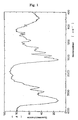
- Fig. 1 is an infrared absorption (IR) spectrum chart of a modified polyallylamine obtained in Example 1.
- the modified polyallylamine of the present invention is a copolymer or, generally, random copolymer containing, as an essential unit, a monomer unit of the general formula (M-1), containing at least one monomer unit selected from the monomer units of the formula (M-2), the general formula (M-3), the general formula (M-4), the general formula (M-5), the general formula (M-6), the general formula (M-7) and the general formula (M-8), and optionally containing a monomer unit of the formula (M-9).
- the modified polyallylamine of the present invention includes a modified polyallylamine I and a modified polyallylamine II as preferred embodiments.
- the modified polyallylamine I of the present invention is a high-molecular-weight polymer or, generally, random copolymer having a structure of the general formula (I).
- R 1 and R 2 represent an alkyl group having 1 to 4 carbon atoms.
- the alkyl group may be linear or branched, and specific examples thereof include methyl, ethyl, propyl, isopropyl, n-butyl, isobutyl, sec-butyl and tert-butyl. While R 1 and R 2 may be the same as, or may be different from, each other, R 1 and R 2 are particularly preferably methyl.
- X is -CONH 2 , - COOR 3 or -COR 4 .
- R 3 is an alkyl group having 1 to 12 carbon atoms or an aryl group having 6 to 12 carbon atoms
- R 4 is an alkyl group having 1 to 12 carbon atoms.
- the alkyl group having 1 to 12 carbon atoms, represented by R 3 may be linear or branched, and examples thereof preferably include linear alkyl groups having 1 to 4 carbon atoms such as methyl, ethyl, propyl and butyl.
- examples of the aryl group having 6 to 12 carbon atoms include phenyl, o-tolyl, m-tolyl and p-tolyl.
- the alkyl group having 1 to 12 carbon atoms, represented by R 4 may be linear or branched, and examples thereof include methyl, ethyl, n-propyl, isopropyl, n-butyl, n-pentyl, n-hexyl, n-heptyl and n-nonyl.
- each of p and q is independently an integer of 1 or more, and r is 0 or an integer of 1 or more.
- the ratio of p/(q + r) is preferably 5/95 to 95/5, more preferably 10/90 to 90/10, particularly preferably 20/80 to 80/20.
- the ratio of q/(q + r) (modification degree) is preferably 0.6 - 1, more preferably 0.9 - 1, and particularly preferably, it is substantially 1, that is, 0.95 - 1.
- the weight average molecular weight of the modified polyallylamine I is preferably 5,000 or less, more preferably 200 to 3,000, particularly preferably 300 to 2,500.
- the solubility in an organic solvent may be poor.
- a record may be poor in performances when the modified polyallylamine is applied to an inkjet recording method.
- the above weight average molecular weight refers to a value determined, as a polyethylene glycol, by measurement according to a gel permeation chromatography (GPC) method.
- the modified polyallylamine II of the present invention is a high-molecular-weight polymer or, generally, random copolymer having a structure of the general formula (II).
- R 1 and R 2 represent an alkyl group having 1 to 4 carbon atoms. This alkyl group is as explained with regard to R 1 and R 2 in the above modified polyallylamine I.
- Y is -CH 2 CH(R 5 )-A or -CH 2 CH(OH)-B.
- R 5 is a hydrogen atom or methyl.
- A is -CONR 6 R 7 , -CN or -COOR 8 .
- Each of R 6 and R 7 is independently a hydrogen atom or an alkyl group having 1 to 8 carbon atoms and optionally containing a hydroxyl group, a keto group, a mono(C 1 -C 4 alkyl) amino group, a di(C 1 -C 4 alkyl) amino group or a tri(C 1 -C 4 alkyl) ammonium group.
- R 6 and R 7 may bond to each other to form a piperidino or morpholino group together with a nitrogen atom.
- R 8 is an alkyl group having 1 to 8 carbon atoms, and the alkyl group may contain a hydroxyl group, a keto group, a mono(C 1 -C 4 alkyl) amino group, a di(C 1 -C 4 alkyl) amino group or a tri(C 1 -C 4 alkyl) ammonium group.
- examples of the -CH 2 CH(R 5 )-A include -CH 2 CH 2 CONH 2 , -CH 2 CH 2 CONHCH 3 , -CH 2 CH 2 CON(CH 3 ) 2 , -CH 2 CH 2 CONHC 2 H 5 , -CH 2 CH 2 CON(C 2 H 5 ) 2 , -CH 2 CH 2 CONH-nC 3 H 7 , -CH 2 CH 2 CON(nC 3 H 7 ) 2 , -CH 2 CH 2 CONH-iC 3 H 7 , -CH 2 CH 2 CONHCH 2 O-nC 4 H 9 , -CH 2 CH 2 CONHCH 2 OH, -CH 2 CH 2 CONHCH 2 CH 2 N(CH 3 ) 2 , -CH 2 CH 2 CONHCH 2 CH 2 N(C 2 H 5 ) 2 , -CH 2 CH 2 CONHCH 2 CH 2 CH 2 N(CH 3 ) 2 , -CH 2 CH 2 CONE
- examples of the -CH 2 CH(R 5 )-A include-CH 2 CH 2 CN and -CH 2 CH(CH 3 )CN.
- examples of the -CH 2 CH(R 5 )-A include -CH 2 CH 2 COOCH 3 , -CH 2 CH 2 COOC 2 H 5 , -CH 2 CH 2 COOC 3 H 7 , -CH 2 CH 2 COOC 4 H 9 , -CH 2 CB 2 COOCH 2 CH 2 N(CH 3 ) 2 , -CH 2 CH 2 COOCH 2 CH 2 CH 2 N(CH 3 ) 2 , -CH 2 CH 2 COOCH 2 CH 2 N(C 2 H 5 ) 2 , -CH 2 CB 2 COOCH 2 CH 2 CH 2 M(C 2 H 5 ) 2 , -CH 2 CH 2 COOCH 2 CH 2 CH 2 M + (CH 3 ) 3 , -CH 2 CH 2 COOCH 2 CH 2 N + (CH 3 ) 3 , -CH 2 CH 2 COOCH
- B is an alkyl group having 1 to 8 carbon atoms, and the alkyl group may contain a hydroxyl group or an alkoxyl or alkenyloxy group having 1 to 4 carbon atoms, Examples of B include methyl, ethyl, propyl, butyl, pentyl, hexyl, methoxymethyl, ethoxymethyl, propyloxymethyl, butoxymethyl, pentoxymethyl, hydroxymethyl and (2-propenyloxy)methyl.
- Examples of the -CH 2 CH(OH)-B include 2-hydroxypropyl, 2-hydroxybutyl, 2-hydroxypentyl, 2-hydroxyhexyl, 2-hydroxyheptyl, 2-hydroxyoctyl, 3-methoxy-2-hydroxypropyl, 3-ethoxy-2-hdyroxypropyl, 3-propoxy-2-hydroxypropyl, 3-(isopropoxy)-2-hydroxypropyl, 3-butoxy-2-hydroxypropyl, 3-pentoxy-2-hydroxypropyl, 2,3-dihydroxypropyl and 3-(2-propenyloxy)-2hydroxypropyl.
- p is an integer or 1 or more
- each of t, u and v is independently 0 or an integer of 1 or more
- at least one of t and u is an integer of 1 or more.
- the ratio of p/(t+u+v) is preferably 5/95 to 95/5, more preferably 10/90 to 90/10, particularly preferably 20/80 to 80/20.
- the ratio of (t+u)/(t+u+v) (modification degree) is preferably from 0.6 to 1, more preferably from 0.9 to 1, particularly preferably, substantial 1, that is, from 0.95 to 1.
- the weight average molecular weight of the modified polyallylamine II is preferably 5,000 or less, more preferably 200 to 3,000, particularly preferably 300 to 2,500.
- the solubility in an organic solvent may be poor.
- a record may be poor in performances when the modified polyallylamine is applied to an inkjet recording method.
- the above weight average molecular weight refers to a value determined, as a polyethylene glycol, by measurement according to a gel permeation chromatography (GPC) method.
- the modified polyallylamines of the general formula (I-1), the general formula (I-2) and the general formula (I-3) can be produced as follows.
- a cyanic acid as an N-carbamoylation reagent is reacted with a copolymer of N,N-dialkylallylamine and allylamine, generally a random copolymer thereof (to be sometimes referred to as "raw material copolymer” hereinafter), represented by the general formula (III), wherein w is an integer of 1 or more, and R 1 , R 2 and p are as defined above, to produce a modified polyallylamine of the general formula (I-1) in which the primary amino group is carbamoylated, wherein R 1 , R 2 , p, q and r are as defined above.
- the raw material copolymer of the above general formula (III) can be prepared, for example, according to the method described in WO-A-99/21901 .
- Examples of the monomer for forming the N,N-dialkylallylamine unit include N,N-dimethylallylamine, N,N-diethylallylamine, N,N-dipropylallylamine and N,N-dibutylallylamine. In view of solubility of a modified product, N,N-dimethylallylamine is preferred.
- the weight average molecular weight of the raw material copolymer (value as polyethylene glycol, measured by GPC method) is preferably 5,000 or less, more preferably 200 to 3,000, particularly preferably 300 to 2,500.
- a formed modified polyallylamine which is the modified polyallylamine of the present invention, is sometimes not easily soluble.
- the monomer unit ratio p/w of the raw material copolymer is preferably 5/95 to 95/5, more preferably 10/90 to 90/10, particularly preferably 20/80 to 80/20.
- the cyanic acid salt is added to the salt of raw material copolymer to carry out a reaction of them.
- a typical production embodiment will be described below.
- the raw material copolymer is dissolved in water or a polar solvent, and a solution of an inorganic acid such as hydrochloric acid is added thereto to prepare a copolymer salt solution.
- concentration of the raw material copolymer is preferably 5 to 50 % by weight.
- the solution of the raw material copolymer salt is heated to 30 to 80°C, and an aqueous solution of a cyanate such as sodium cyanate or, potassium cyanate is dropwise added thereto, and the mixture is allowed to react for approximately 1 to 100 hours. In this reaction, a salt (sodium chloride when the raw material copolymer is a hydrochloride and when the cyanic acid salt is sodium cyanate) is produced as a byproduct.
- the modified polyallylamine (a copolymer which contains N,N-dialkylallylamine unit and N-carbamoylated allylamine unit) of the present invention can be obtained.
- the amount of the cyanate to be used based on the allylamine unit is preferably 0.6 to 1 mole equivalent, more preferably 0.9 to 1 mole equivalent, particularly preferably 1 mole equivalent.
- an alkoxycarbonylation agent having 1 to 12 carbon atoms in the alkyl group or an aryloxycarbonylation agent having 6 to 12 carbon atoms in the aryl group is reacted with the raw material copolymer of the above general formula (III), to produce a modified polyallylamine of the general formula (I-2) in which the primary amino group is alkoxy- or aryloxycarbonylated, wherein R 1 , R 2 , R 3 , p, q and r are as defined above.
- a carbonic acid diester represented by R 3 O-CO-OR 3 (in which R 3 is an alkyl group having 1 to 12 carbon atoms or an aryl group having 6 to 12 carbon atoms) is preferred in view of reactivity.
- the carbonic acid diester include dimethyl carbonate, diethyl carbonate, dipropyl carbonate, dibutyl carbonate, diphenyl carbonate, di(o-tolyl) carbonate, di(m-tolyl) carbonate and di(p-tolyl) carbonate.
- the carbonic acid diester can be gradually dropwise added to a solution such as an aqueous solution, or the like, of the raw material copolymer.
- a solution of the carbonic acid diester in a solvent is dropwise added to the raw material copolymer.
- the solvent for dissolving the carbonic acid diester is preferably the same as the solvent for dissolving the raw material copolymer.
- the reaction between the raw material copolymer and the carbonic acid diester is preferably carried out with stirring.
- the reaction temperature is maintained preferably at 0 to 100°C, more preferably at 30 to 60°C. When the reaction temperature is too high, a formed urethane may be sometimes decomposed.
- the reaction time period is generally 1 to 100 hours, preferably 3 to 48 hours, and the modified polyallylamine of the present invention can be obtained in the form of a solution. After completion of the reaction, the solution is concentrated for removing an alcohol formed as a byproduct, whereby the modified polyallylamine (a copolymer containing N,N-dialkylallylamine unit and alkoxycarbonylated allylamine unit) of the present invention can be obtained in the form of a solution.
- the concentration is carried out under reduced pressure at a temperature of 25 to 70°C, preferably 35 to 60°C. When the temperature is too high, a side reaction can take place.
- the N-alkoxycarbonylation degree (or aryloxycarbonylation degree) is dependent upon the amount of the carbonic acid diester used as a raw material.
- a carbonic acid diester is used in an amount equimolar to the amount of amino groups of the raw material copolymer, generally, almost all of the amino groups are converted to urethane. Therefore, the N-alkoxycarbonylation degree (or aryloxycarbonylation degree) of the modified polyallylamine of the present invention that is to be produced can be adjusted by adjusting the amount of the carbonic acid diester used as a raw material.
- an acylation agent whose alkyl group has 1 to 12 carbon atoms is reacted with the raw material copolymer of the above general formula (III), to produce a modified polyallylamine of the general formula (I-3) in which the primary amino group is acylated, wherein R 1 , R 2 , R 4 , p, q and r are as defined above.
- acylation agent there can be used an carboxylic anhydride of the general formula (IV), (R 4 CO) 2 O (IV) wherein R 4 is as defined above.
- Examples of the above carboxylic anhydride include acetic anhydride, propionic anhydride, n-butyric anhydride, isobutyric anhydride, valeric anhydride, hexanoic anhydride, octanoic anhydride, decanoic anhydride and lauric anhydride.
- the carboxylic anhydride can be used in an amount equivalent to the equivalent weight of the amino groups to be acylated.
- the solvent for preparing a solution of the raw material copolymer can be selected from water, an organic solvent or a solvent mixture of water with an organic solvent.
- the organic solvent can be selected from alcohols such as methyl alcohol, ethyl alcohol, n-propyl alcohol, isopropyl alcohol and n-butyl alcohol, and it can be also selected from acetonitrile, formamide, N,N-dimethylformamide, dimethyl sulfoxide, tetrahydrofuran or 1,4-dioxane. Of these, water is preferred in view of safety and easiness in operation.
- the carboxylic anhydride when the carboxylic anhydride is reacted with the raw material copolymer, the carboxylic anhydride can be gradually dropwise added to a solution of the copolymer. Although differing depending upon a reaction scale, the carboxylic anhydride is generally dropwise added over 2 to 8 hours. When the reaction scale is small, the addition can be carried out over a smaller period of time than the above, and it can be generally carried out over 1 to 8 hours.
- the reaction is preferably carried out with stirring. Since the above reaction is an exothermic reaction, it is preferred to carry out the reaction with cooling a reactor with ice and the reaction solution is preferably maintained at a 40°C or lower, more preferably, at 0 to 10°C.
- an aqueous solution of an alkali such as sodium hydroxide, potassium hydroxide or sodium carbonate is added to the reaction solution, to neutralize a carboxylic acid derived from an carboxylic anhydride formed on a side-chain amino group of an intermediate formed after the acylation, whereby a solution of a free acylated modified polyallylamine of the present invention can be produced.
- an alkali such as sodium hydroxide, potassium hydroxide or sodium carbonate
- the acylation is carried out with regard to more than 50 mol% of primary amino groups of the raw material copolymer, the acylation may be proceeded with while the carboxylic anhydride formed on a side-chain amino group of the intermediate is neutralized with an alkali such as sodium hydroxide, potassium hydroxide or sodium carbonate as required.
- the reaction liquid is maintained at a pH of 10 to 12.
- the neutralization preferably, the reaction liquid is maintained at 0 to 10°C.
- the resultant solution is dialyzed to remove a neutralization salt, whereby a solution of a purified free acylated modified polyallylamine of the present invention can be obtained.
- the dialysis for removing the neutralization salt it is preferred to employ the electrodialysis described in JP-B-7-68298 in view of easiness in operation.
- the acylated polyallylamine solution under purification is subjected to GPC chromatography, the content of a salt present in the solution can be easily monitored, so that the termination of the purification can be determined by employing GPC chromatography.
- the carboxylic anhydride When the carboxylic anhydride is used in an amount less than the equivalent weight of the primary amino group of the raw material copolymer, generally, almost all of the carboxylic anhydride is consumed as an acylation agent.
- the acylation degree of the modified polyallylamine of the present invention can be adjusted on the basis of the amount of the carboxylic anhydride.
- modified polyallylamine II of the general formula (II) modified polyallylamines of the general formula (II-1) and the general formula (II-2) can be produced as follows.
- an acryl compound of the general formula (V) CH 2 C (R 5 )-A (V) wherein R 5 and A are as defined above, is reacted with the raw material monomer of the above general formula (III), to produce a modified polyallylamine of the general formula (II-1), in which the acryl compound is Michael-added to the primary amino group, wherein R 1 , R 2 , Y 1 , p, t, u and v are as defined above.
- the above modification is carried out by a Michael addition reaction in which the above acryl compound is added to the primary amino group of the raw material copolymer.
- the above acryl compound is selected from a compound having an acrylamide skeleton, a compound having an acrylonitrile skeleton or a compound having an acrylic ester skeleton.
- the compound having an acrylamide skeleton include acrylamide, N-methyl acrylamide, N,N-dimethyl acrylamide, N-ethyl acrylamide, N,N-diethyl acrylamide, N-n-propyl acrylamide, N,N-di(n-propyl) acrylamide, N-isopropyl acrylamide, N-n-butyl acrylamide, N-isobutyl acrylamide, N-methylol acrylamide, N,N-dimethylaminoethyl acrylamide, N,N-diethylaminoethyl acrylamide, N,N-dimethylaminopropyl acrylamide, N,N-diethylaminopropyl acrylamide, N,N-dimethylaminoe
- Examples of the compound having an acrylonitrile skeleton include acrylonitrile and methacrylonitrile.
- Examples of the compound having an acrylic ester skeleton include methyl acrylate, ethyl acrylate, propyl acrylate, butyl acrylate, N,N-dimethylaminoethyl acrylate, N,N-diethylaminoethyl acrylate, N,N-dimethylaminopropyl acrylate, N,N-diethylaminopropyl acrylate, N,N-dimethylaminoethyl acrylate-methyl chloride quaternary salt, N,N-diethylaminoethyl acrylate-methyl chloride quaternary salt, N,N-dimethylaminopropyl acrylate-methyl chloride quaternary salt and N,N-diethylaminopropyl acrylate-methyl chloride quaternary salt.
- the amount of the acryl compound based on the primary amino group of the raw material copolymer is preferably 60 to 200 mol%, more preferably 70 to 120 mol%, particularly preferably 90 to 105 mol%.
- the degree of substitution of the acryl compound on the amino group is dependent upon the acryl compound added. Generally, when the amount of the acryl compound is 100 mol% or less based on the primary amino group, one acryl compound molecule is added to one primary amino group. When it exceeds 100 mol%, there are consecutively formed units in each of which two acryl compound molecules are added to one primary amino group.
- the raw material copolymer is dissolved in water, methanol or a mixture of these with a polar solvent.
- concentration of the raw material copolymer is adjusted to approximately 5 to 60 % by weight. While the reaction mixture is maintained at 30 to 70°C, the above acryl compound is added directly when it is a liquid, or the above acryl compound is dropwise added in the form of a solution thereof in water or methanol when it is a solid. After completion of the addition, the mixture is allowed to react for approximately 0.5 to 48 hours.
- an epoxy compound of the general formula (VI) wherein B is as defined above is reacted with the raw material monomer of the above general formula (III), to produce a modified polyallylamine of the general formula (II-2), in which the epoxy compound is added to the primary amino group, wherein R 1 , R 2 , Y 2 , p, t, u and v are as defined above.
- Examples of the epoxy compound of the above general formula (VI) include 1,2-epoxypropane, 1,2-epoxy-n-butane, 1,2-epoxy-n-pentane, 1,2-epoxy-n-hexane, 1,2-epoxy-n-heptane, 1,2-epoxy-n-octane, methyl glycidyl ether, ethyl glycidyl ether, n-propyl glycidyl ether, isopropyl glycidyl ether, n-butyl glycidyl ether, n-pentyl glycidyl ether, glycidol and allyl glycidol ether.
- the amount of the above epoxy compound based on the primary amino group of the raw material copolymer is preferably 60 to 200 mol%, more preferably 70 to 150 mol%, particularly preferably 90 to 120 mol%.
- the degree of substitution of the epoxy compound on the amino group is dependent upon the amount of the epoxy compound used.
- the modified polyallylamine (II-2) of the present invention can be easily produced by dissolving the raw material copolymer in a solvent, adding the above epoxy compound to the resultant solution and allowing the mixture to react at approximately 20 to 70°C. Water is preferred as a solvent for use in the reaction.
- the reaction temperature for the reaction between the polyallylamine and the epoxy compound is generally 20 to 70°C, preferably 30 to 60°C. Although the reaction time period differs depending upon reaction conditions, generally, it is sufficient to take 0.5 to 48 hours for the reaction.
- Samples were adjusted so as to have a concentration of 0.5 g/100 ml in an eluting solution, and 20 ⁇ l of each was used. A 0.4 mol/L sodium chloride aqueous solution was used as an eluting solution. The measurements were made at a column temperature of 30°C at a flow rate of 1.0 ml/minute.
- polyethylene glycols having molecular weights of 106, 194, 440, 600, 1,470, 4,100, 7,100, 10,300, 12,600, 23,000, etc., were used to prepare calibration curve, and the weight average molecular weights Mw of polymers were determined on the basis of the calibration curve.
- a 2-liter four-necked separable flask having a stirrer, a Dimroth condenser and a thermometer was charged with 431.24 g of an N,N-dimethylallylamine hydrochloride aqueous solution having a concentration of 63.45 wt% and 362.25 g of a monoallylamine hydrochloride aqueous solution having a concentration of 58.11 wt%.
- This monomer aqueous solution was warmed to 60°C, 146.45 g of 2,2'-azobis(2-amidinopropane)dihydrochloride was added as a radical initiator, and the monomer were polymerized for 120 hours.
- the thus-obtained solution was subjected to electrodialysis for desalting, to give 1,914.97 g of an aqueous solution having a concentration of 14.35 wt% of a free type copolymer (copolymerization ratio 5:5) of N,N-dimethylallylamine and allylamine.
- a one-liter four-necked separable flask having a stirrer, a Dimroth condenser and a thermometer was charged with 421.29 g of the aqueous solution having a concentration of 14.35 wt% of a free type copolymer of N,N-dimethylallylamine and allylamine, prepared in Preparation Example 1, and 88.65 g of hydrochloric acid having a concentration of 35 wt% with stirring with ice. Then, the mixture was warmed to 50°C, 368.37 g of sodium cyanate aqueous solution having a concentration of 7.5 % was dropwise added, and the mixture was allowed to react for 24 hours.
- the thus-obtained solution was subjected to electrodialysis for desalting, to give 729.61 g (yield 95 %) of an aqueous solution having a concentration of 10.30 wt % of a free type copolymer (copolymerization ratio 5:5) of N,N-dimethylallylamine and carbamoylated allylamine.
- the copolymer had a weight average molecular weight of 1,200.
- the copolymer was concentrated to obtain a solid, and the polymer was tested for its solubility at 10 % by weight in various solvents. As a result, the polymer was insoluble in acetone and acetonitrile, while it was dissolved in methanol, ethanol, isopropanol, DMSO and DMF. These results show that the copolymer of the present invention is soluble in organic solvents as compared with an allylamine polymer.
- a one-liter four-necked separable flask having a stirrer, a Dimroth condenser and a thermometer was charged with 421.29 g of the aqueous solution having a concentration of 14.35 wt% of a free type copolymer of N,N-dimethylallylamine and allylamine, prepared in Example 1, the aqueous solution was warmed to 50°C, 38.67 g of dimethyl carbonate having a purity of 99 % was dropwise added, and the mixture was allowed to react for 24 hours.
- a 500-ml four-necked separable flask having a stirrer, a Dimroth condenser and a thermometer was charged with 421.29 g of the aqueous solution having a concentration of 14.35 wt% of a free type copolymer of N,N-dimethylallylamine and allylamine, prepared in Example 1.
- acetic anhydride having a purity of 98 % was dropwise added in such an amount that corresponded to 1/2 molar amount of allylamine, to neutralize that portion of 34.00 g of sodium hydroxide having a concentration of 50 % which corresponded to a molar amount of acetic acid formed as a byproduct, and the entire amount of the acetic anhydride was dropwise added by repeating this procedure, followed by a reaction for 24 hours.
- the thus-obtained solution was subjected to electrodialysis for desalting, to give 522.50 g (100 %) of an aqueous solution having a concentration of 14.94 wt% of a free type copolymer (copolymerization ratio 5:5) of N,N-dimethylallylamine and acetylated allylamine.
- the copolymer had a weight average molecular weight of 1,200.
- a 500-ml four-necked separable flask having a stirrer, a Dimroth condenser and a thermometer was charged with 421.29 g of the aqueous solution having a concentration of 14.35 wt% of a free type copolymer of N,N-dimethylallylamine and allylamine, prepared in Example 1, the aqueous solution was warmed to 50°C, 60.42 g of acrylamide having a concentration of 50 % was dropwise added, and the mixture was allowed to react for 24 hours.
- a 500-ml four-necked separable flask having a stirrer, a Dimroth condenser and a thermometer was charged with 421.29 g of the aqueous solution having a concentration of 14.35 wt% of a free type copolymer of N,N-dimethylallylamine and allylamine, prepared in Preparation Example 1, the aqueous solution was warmed to 50°C, 43.41 g of ethyl glycidyl ether having a purity of 100 % was dropwise added, and the mixture was allowed to react for 24 hours.
- Example 18 507.52 Grams (99 %) of an aqueous solution having a concentration of 22.94 wt % of a free type copolymer (copolymerization ratio 7:3) of N,N-dimethylallylamine and diethoxy-2-hydroxypropylated allylamine was obtained in the same manner as in Example 18 except that 52.09 g of ethyl glycidyl ether was used in Example 18.
- the copolymer had a weight average molecular weight of 1,200.
- the modified polyallylamines of the present invention (Examples 1 to 26) were tested for performances with regard to color developability and the property of being free from the occurrence of a residual waste liquid in inkjet recording.
- Table 2 shows the results.
- an allylamine homopolymer, the copolymers of allylamine and dimethylallylamine (Preparation Examples 1 to 3) and a dimethylallylamine homopolymer were also similarly tested.
- Table 3 shows the results.
- the modified polyallylamine of the present invention exhibits remarkably excellent performances with regard to color developability and the property of being free from the occurrence of a residual waste liquid.
- the method for the evaluation and the results thereof will be explained in detail below.
- Liquid compositions having the following composition were prepared.
- Modified polyallylamine of the present invention 5.0 % by weight (as a solid) Glycerin (Gly) 25.0 % by weight Triethylene glycol monobutyl ether 3.0 % by weight Olefin E1010 0.3 % by weight Water Balance
- An ink composition was prepared by the following procedures. First, a pigment and a dispersion liquid (containing styrene-acrylate copolymer) were mixed, and they were dispersed in a sand mill (Yasukawa Seisakusho) together with glass beads (diameter 1.7 mm, an amount (weight) 1.5 times the amount of the mixture) for 2 hours. Then, the glass beads were removed, other additives were added, and the mixture was stirred at room temperature for 20 minutes. The mixture was filtered with a 10 ⁇ m membrane filter to give a pigment ink.
- a pigment and a dispersion liquid containing styrene-acrylate copolymer
- Pigment 3.0 parts by weight Styrene-acrylate copolymer 1.0 part by weight Olefin E1010 0.5 part by weight Gly 15.0 parts by weight TEGmBE 5.0 parts by weight TEA 0.9 part by weight Water Balance Total 100 parts by weight
- C.I. Pigment Yellow 74 was used for yellow
- C.I. Pigment Red 202 was used for magenta
- C.I. Pigment Blue 15:3 was used for cyan
- carbon black was used for black.
- duty refers to a value calculated on the basis of the following equation.
- duty % number of actual printing dots / longitudinal resolution ⁇ transverse resolution ⁇ 100
- the "number of actual printing dots” is the number of printing dots per unit area
- the "longitudinal resolution” and “transverse” resolution refer to resolutions per unit area.
- “100 % duty” refers to a monochromic maximum ink weight per pixel.
- a liquid composition and an ink set were charged into an inkjet printer ("MC-2000" supplied by Seiko Epson Corporation), printing was conducted on an ordinary paper (Xerox 4024) at 720 x 720 dpi. In this case, the printing was conducted using the ink composition at 70 % duty and, almost at the same time, using the liquid composition at 10 % duty.
- the thus-obtained print was measured for an optical density.
- the optical density was measured with "Gretag-Macbeth SPM50" supplied by Gretag Macbeth AG using a D50 light source without a filter at a viewing angle of 2°.
- AA A non-colored portion is not easily visually observable, and the OD value increases and is greater than a case where no liquid composition is printed, by 0.06 or more.
- a non-colored portion is not easily visually observable, and the OD value increases and is greater than a case where no liquid composition is printed, by at least 0.03 and less than 0.06.
- a non-colored portion is easily visually observable, and the OD value increases and is greater than a case where no liquid composition is printed, by less than 0.03.
- Table 3 shows the evaluation results. In Examples, those portions which were not colored were not easily visually observable, and the OD values increased to be greater by at least 0.03.
- a liquid composition and an ink set were charged into an inkjet printer ("MC-2000" supplied by Seiko Epson Corporation), and the cleaning of a recording head (to push a cleaning button of the printer once) and the printing of a nozzle check pattern were repeated. These procedures were repeated 10 times to judge whether or not nozzle check patterns were normally printed. Further, a state of a waste liquid in the cap (with a non-woven fabric) was observed. Further, with regard to those liquid composition that resulted in A, the above procedures were carried out 90 times to judge whether or not the check pattern was normally printed.
- the modified polyallylamine of the present invention exhibits excellent color developability and is easily soluble in water and organic solvents, and it also exhibits excellent stability in a solution containing water or organic solvent(s), so that it can be suitably used in fine chemical fields such as the field of inkjet recording.
Landscapes
- Chemical & Material Sciences (AREA)
- General Chemical & Material Sciences (AREA)
- Health & Medical Sciences (AREA)
- Chemical Kinetics & Catalysis (AREA)
- Medicinal Chemistry (AREA)
- Polymers & Plastics (AREA)
- Organic Chemistry (AREA)
- Addition Polymer Or Copolymer, Post-Treatments, Or Chemical Modifications (AREA)
Claims (10)
- Polyallylamine modifiée comprenant, en tant que composant essentiel, un motif de formule (M-1) générale,

et comprenant en outre au moins un motif choisi parmi les motifs de formule (M-2),

de formule (M-4) générale,
de formule (M-5) générale,
de formule (M-6) générale,
de formule (M-7) générale,
et de formule (M-8) générale,
et contenant facultativement un motif de formule (M-9),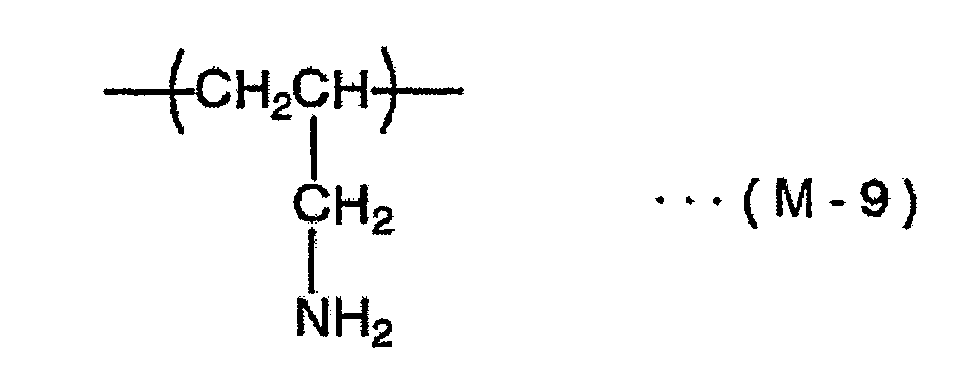
- Polyallylamine modifiée possédant une structure de formule (I) générale,

- Polyallylamine modifiée possédant une structure de formule (II) générale,

- Procédé de production d'une polyallylamine modifiée de formule (I-1) générale, comprenant la réaction d'un acide cyanique avec un copolymère de N,N-dialkylallylamine et une allylamine, représenté par la formule (III) générale,

pour produire la polyallylamine modifiée de formule (I-1) générale,
- Procédé de production d'une polyallylamine modifiée de formule (I-2) générale, comprenant la réaction d'un agent d'alcoxycarbonylation contenant 1 à 12 atomes de carbone dans le groupe alkyle ou d'un agent d'aryloxycarbonylation contenant 6 à 12 atomes de carbone dans le groupe aryle avec un copolymère de N,N-dialkylallylamine et une allylamine, représenté par la formule (III) générale,

pour produire la polyallylamine modifiée de formule (I-2) générale,
- Procédé de production d'une polyallylamine modifiée selon la revendication 5, dans lequel l'agent d'alcoxycarbonylation ou l'agent d'aryloxycarbonylation est un diester de carbonate représenté par R3O-CO-OR3 où R3 est un groupe alkyle contenant 1 à 12 atomes de carbone ou un groupe aryle contenant 6 à 12 atomes de carbone.
- Procédé de production d'une polyallylamine modifiée de formule (I-3) générale, comprenant la réaction d'un agent d'acylation contenant 1 à 12 atomes de carbone dans le groupe alkyle avec un copolymère de N,N-dialkylallylamine et une allylamine, représenté par la formule (III) générale,

pour produire la polyallylamine modifiée de formule (I-3) générale,
- Procédé de production d'une polyallylamine modifiée selon la revendication 7, dans lequel l'agent d'acylation est un anhydride carboxylique de formule (IV) générale,
(R4CO)2O (IV)
dans laquelle R4 est un groupe alkyle contenant 1 à 12 atomes de carbone. - Procédé de production d'une polyallylamine modifiée de formule (II-1) générale, comprenant la réaction d'un composé de (méth)acryle de formule (V) générale,
CH2=C (R5) -A (V)
dans laquelle R5 est un atome d'hydrogène ou un méthyle et A est -CONR6R7, -CN ou -COOR8, où R6 et R7 sont chacun indépendamment un atome d'hydrogène ou un groupe alkyle contenant 1 à 8 atomes de carbone et contenant facultativement un groupe hydroxyle, un groupe céto, un groupe mono(alkyle en C1 à C4)amino, un groupe di (alkyle en C1 à C4)amino ou un groupe tri (alkyle en C1 à C4)ammonium, et R6 et R7 peuvent être liés l'un à l'autre et former un groupe pipéridino ou morpholino avec un atome d'azote, et R8 est un groupe alkyle contenant 1 à 8 atomes de carbone et contenant facultativement un groupe hydroxyle, un groupe céto, un groupe mono(alkyle en C1 à C4)amino, un groupe di(alkyle en C1 à C4)amino ou un groupe tri(alkyle en C1 à C4)ammonium, avec un copolymère de N,N-dialkylallyl-amine et une allylamine, représenté par la formule (III) générale,
pour produire la polyallylamine modifiée de formule (II-1) générale,
- Procédé de production d'une polyallylamine modifiée de formule (II-2) générale, comprenant la réaction d'un composé époxy de formule (VI) générale,


pour produire la polyallylamine modifiée de formule (II-2) générale,
Applications Claiming Priority (3)
| Application Number | Priority Date | Filing Date | Title |
|---|---|---|---|
| JP2003098120 | 2003-04-01 | ||
| JP2003098120 | 2003-04-01 | ||
| PCT/JP2004/001746 WO2004089997A1 (fr) | 2003-04-01 | 2004-02-17 | Polyallylamine modifiee et son procede d'obtention |
Publications (3)
| Publication Number | Publication Date |
|---|---|
| EP1584633A1 EP1584633A1 (fr) | 2005-10-12 |
| EP1584633A4 EP1584633A4 (fr) | 2006-06-14 |
| EP1584633B1 true EP1584633B1 (fr) | 2010-10-20 |
Family
ID=33156664
Family Applications (1)
| Application Number | Title | Priority Date | Filing Date |
|---|---|---|---|
| EP04711744A Expired - Lifetime EP1584633B1 (fr) | 2003-04-01 | 2004-02-17 | Polyallylamine modifiee et son procede d'obtention |
Country Status (6)
| Country | Link |
|---|---|
| US (1) | US7547747B2 (fr) |
| EP (1) | EP1584633B1 (fr) |
| JP (1) | JP4462188B2 (fr) |
| AT (1) | ATE485313T1 (fr) |
| DE (1) | DE602004029647D1 (fr) |
| WO (1) | WO2004089997A1 (fr) |
Families Citing this family (16)
| Publication number | Priority date | Publication date | Assignee | Title |
|---|---|---|---|---|
| FR2902799B1 (fr) | 2006-06-27 | 2012-10-26 | Millipore Corp | Procede et unite de preparation d'un echantillon pour l'analyse microbiologique d'un liquide |
| JP2008102343A (ja) * | 2006-10-19 | 2008-05-01 | Az Electronic Materials Kk | 現像済みレジスト基板処理液とそれを用いたレジスト基板の処理方法 |
| JP5000260B2 (ja) * | 2006-10-19 | 2012-08-15 | AzエレクトロニックマテリアルズIp株式会社 | 微細化されたパターンの形成方法およびそれに用いるレジスト基板処理液 |
| WO2008079280A1 (fr) | 2006-12-21 | 2008-07-03 | Millipore Corporation | Purification de protéines |
| US8362217B2 (en) * | 2006-12-21 | 2013-01-29 | Emd Millipore Corporation | Purification of proteins |
| US8569464B2 (en) | 2006-12-21 | 2013-10-29 | Emd Millipore Corporation | Purification of proteins |
| JP5583329B2 (ja) * | 2008-03-11 | 2014-09-03 | 富士フイルム株式会社 | 顔料組成物、インク組成物、印刷物、インクジェット記録方法、及びポリアリルアミン誘導体 |
| WO2009151514A1 (fr) | 2008-06-11 | 2009-12-17 | Millipore Corporation | Bioréacteur à cuve agitée |
| JP5306755B2 (ja) * | 2008-09-16 | 2013-10-02 | AzエレクトロニックマテリアルズIp株式会社 | 基板処理液およびそれを用いたレジスト基板処理方法 |
| CN102257122B (zh) | 2008-12-16 | 2015-07-29 | Emd密理博公司 | 搅拌槽反应器及方法 |
| CN107312062B (zh) | 2010-05-17 | 2021-03-16 | Emd密理博公司 | 用于纯化生物分子的刺激响应性聚合物 |
| KR102017649B1 (ko) * | 2011-05-03 | 2019-09-03 | 아반토 퍼포먼스 머티리얼즈, 엘엘씨 | 알릴아민에 기반한, 단백질 정제용 신규한 크로마토그래피 매체 및 이의 유도체 |
| RU2489448C1 (ru) * | 2012-05-12 | 2013-08-10 | Федеральное государственное бюджетное образовательное учреждение высшего профессионального образования "Иркутский государственный университет" | Способ получения водорастворимых алифатических полиаминокислот |
| KR102043497B1 (ko) * | 2014-03-24 | 2019-11-11 | 니토 보세키 가부시기가이샤 | 그래프트 중합체 및 이의 제조 방법 |
| CN106460027B (zh) | 2014-03-24 | 2020-07-31 | 日东纺绩株式会社 | 使用阳离子性接枝聚合物的目标物分离浓缩方法 |
| CN116693759B (zh) * | 2023-04-26 | 2025-09-05 | 国家能源集团新能源技术研究院有限公司 | 聚合胺及其制备方法和应用 |
Family Cites Families (20)
| Publication number | Priority date | Publication date | Assignee | Title |
|---|---|---|---|---|
| US2662877A (en) * | 1950-06-27 | 1953-12-15 | Chemstrand Corp | Copolymers of acrylonitrile and allyl amines |
| US2662875A (en) * | 1952-02-20 | 1953-12-15 | Chemstrand Corp | Terpolymers of acrylonitrile and allyl amines |
| JPS60106801A (ja) | 1983-11-14 | 1985-06-12 | Nitto Boseki Co Ltd | ポリアリルアミン誘導体の製造方法 |
| AU551886B2 (en) * | 1983-11-14 | 1986-05-15 | Nitto Boseki Co. Ltd. | Poly(allylamine) derivatives |
| IE914179A1 (en) * | 1990-12-07 | 1992-06-17 | Ici Plc | Nitrogen derivatives |
| JPH0768314B2 (ja) | 1993-07-19 | 1995-07-26 | 工業技術院長 | 含フッ素高分子化合物からなるラングミュアーブロジェット膜 |
| JP2766168B2 (ja) | 1993-09-03 | 1998-06-18 | 日本碍子株式会社 | 消化汚泥の固液分離装置 |
| JP3358377B2 (ja) * | 1995-03-17 | 2002-12-16 | 日本ピー・エム・シー株式会社 | 表面紙質向上剤 |
| JP3206797B2 (ja) | 1995-04-21 | 2001-09-10 | セイコーエプソン株式会社 | インクジェット記録方法 |
| EP0791605A3 (fr) | 1996-02-20 | 1998-01-14 | Nitto Boseki Co., Ltd. | Polyalkylamines acylées et leur procédé de préparation |
| JP3199227B2 (ja) | 1996-02-20 | 2001-08-13 | 日東紡績株式会社 | アシル化ポリアリルアミン及びその製造方法 |
| JP3693205B2 (ja) | 1996-02-22 | 2005-09-07 | セイコーエプソン株式会社 | インクジェット記録用インクおよび記録方法 |
| JP3494261B2 (ja) | 1996-02-29 | 2004-02-09 | 日東紡績株式会社 | N−アリルウレタン系重合体およびその製造方法 |
| JP3778387B2 (ja) | 1997-01-24 | 2006-05-24 | 日東紡績株式会社 | 親水性−疎水性熱可逆型材料 |
| JP4003141B2 (ja) | 1997-05-20 | 2007-11-07 | 日東紡績株式会社 | 熱可逆型材料の製造方法 |
| JP3717021B2 (ja) | 1997-06-30 | 2005-11-16 | 日東紡績株式会社 | ポリアリルアミン誘導体、その製造方法、及びそれを用いた親水性・疎水性熱可逆型材料 |
| US6290947B1 (en) * | 1997-09-19 | 2001-09-18 | Geltex Pharmaceuticals, Inc. | Ionic polymers as toxin-binding agents |
| AU9184998A (en) | 1997-10-29 | 1999-05-17 | Nitto Boseki Co. Ltd. | Processes for producing n,n-dialkylallylamine polymers and n,n-dialkylallylaminepolymers |
| US6268452B1 (en) * | 1998-04-17 | 2001-07-31 | Nitto Boseki Co., Ltd. | Process for the production of allylamine polymer |
| US6809128B2 (en) | 1998-11-27 | 2004-10-26 | Seiko Epson Corporation | Ink composition comprising cationic water-soluble resin, and ink set |
-
2004
- 2004-02-17 EP EP04711744A patent/EP1584633B1/fr not_active Expired - Lifetime
- 2004-02-17 AT AT04711744T patent/ATE485313T1/de not_active IP Right Cessation
- 2004-02-17 US US10/541,464 patent/US7547747B2/en not_active Expired - Lifetime
- 2004-02-17 WO PCT/JP2004/001746 patent/WO2004089997A1/fr not_active Ceased
- 2004-02-17 DE DE602004029647T patent/DE602004029647D1/de not_active Expired - Lifetime
- 2004-02-17 JP JP2005505173A patent/JP4462188B2/ja not_active Expired - Lifetime
Also Published As
| Publication number | Publication date |
|---|---|
| JPWO2004089997A1 (ja) | 2006-07-06 |
| EP1584633A1 (fr) | 2005-10-12 |
| US20060122335A1 (en) | 2006-06-08 |
| US7547747B2 (en) | 2009-06-16 |
| DE602004029647D1 (de) | 2010-12-02 |
| JP4462188B2 (ja) | 2010-05-12 |
| ATE485313T1 (de) | 2010-11-15 |
| WO2004089997A1 (fr) | 2004-10-21 |
| EP1584633A4 (fr) | 2006-06-14 |
Similar Documents
| Publication | Publication Date | Title |
|---|---|---|
| EP1584633B1 (fr) | Polyallylamine modifiee et son procede d'obtention | |
| US6395849B1 (en) | Processes for producing N,N-dialkylallylamine polymers and N,N-dialkyllylamine polymers | |
| CA2435516A1 (fr) | Utilisation de copolymeres gradients comme dispersants pour traiter des pigments et des solides | |
| EP2578618B1 (fr) | Procédé de production d'un copolymère de diallylamine et de dioxyde de soufre | |
| EP2454334A1 (fr) | Dispersion de pigments de réticulation à base de dispersants polymériques à deux blocs | |
| US20120313997A1 (en) | Ink Jet Ink and Ink Jet Recording Method | |
| US20120098910A1 (en) | Method of printing using ink jet inks comprising a crosslinking pigment dispersion based on diblock polymeric dispersants | |
| JPWO1999021901A1 (ja) | N,n−ジアルキルアリルアミン系重合体の製造方法およびn,n−ジアルキルアリルアミン系重合体 | |
| US7244774B2 (en) | Aqueous dispersion for inkjet recording | |
| EP1605026B1 (fr) | Dispersants polymères | |
| US20110040026A1 (en) | Monomers, Polymers, Dispersions and Inks | |
| US6268452B1 (en) | Process for the production of allylamine polymer | |
| US20030055135A1 (en) | Pigmented ink jet inks | |
| EP0874028B1 (fr) | Composition d'encre contenant une resine cationique hydrosoluble | |
| JP4186748B2 (ja) | ジアリルアミン類と二酸化イオウとの共重合体の製造方法およびジアリルアミン類と二酸化イオウとの共重合体の酸塩の製造方法 | |
| JP4576815B2 (ja) | 変性ポリアリルアミン及びその製造方法 | |
| US7465765B2 (en) | Latex particulates with epoxide functional groups | |
| JP4144487B2 (ja) | 液体組成物 | |
| JP3828554B2 (ja) | インクジェット記録用水分散体 | |
| JP4474696B2 (ja) | ジアリルアルキレンジアミン系重合体及びそれを用いたインク組成物 | |
| JP2001106736A (ja) | アリルアミン系共重合体の製造方法 | |
| JP2016210921A (ja) | インク組成物及び捺染方法 | |
| JPH1149994A (ja) | 記録液 |
Legal Events
| Date | Code | Title | Description |
|---|---|---|---|
| PUAI | Public reference made under article 153(3) epc to a published international application that has entered the european phase |
Free format text: ORIGINAL CODE: 0009012 |
|
| 17P | Request for examination filed |
Effective date: 20050714 |
|
| AK | Designated contracting states |
Kind code of ref document: A1 Designated state(s): AT BE BG CH CY CZ DE DK EE ES FI FR GB GR HU IE IT LI LU MC NL PT RO SE SI SK TR |
|
| AX | Request for extension of the european patent |
Extension state: AL LT LV MK |
|
| A4 | Supplementary search report drawn up and despatched |
Effective date: 20060503 |
|
| DAX | Request for extension of the european patent (deleted) | ||
| 17Q | First examination report despatched |
Effective date: 20091110 |
|
| RIC1 | Information provided on ipc code assigned before grant |
Ipc: C08F 226/02 20060101ALI20100226BHEP Ipc: C08F 8/10 20060101ALN20100226BHEP Ipc: C08F 8/30 20060101ALN20100226BHEP Ipc: C08F 8/00 20060101AFI20100226BHEP Ipc: C08F 8/44 20060101ALN20100226BHEP |
|
| GRAP | Despatch of communication of intention to grant a patent |
Free format text: ORIGINAL CODE: EPIDOSNIGR1 |
|
| GRAS | Grant fee paid |
Free format text: ORIGINAL CODE: EPIDOSNIGR3 |
|
| GRAA | (expected) grant |
Free format text: ORIGINAL CODE: 0009210 |
|
| AK | Designated contracting states |
Kind code of ref document: B1 Designated state(s): AT BE BG CH CY CZ DE DK EE ES FI FR GB GR HU IE IT LI LU MC NL PT RO SE SI SK TR |
|
| REG | Reference to a national code |
Ref country code: GB Ref legal event code: FG4D |
|
| REG | Reference to a national code |
Ref country code: CH Ref legal event code: EP |
|
| REG | Reference to a national code |
Ref country code: IE Ref legal event code: FG4D |
|
| REG | Reference to a national code |
Ref country code: CH Ref legal event code: NV Representative=s name: RENTSCH & PARTNER |
|
| REF | Corresponds to: |
Ref document number: 602004029647 Country of ref document: DE Date of ref document: 20101202 Kind code of ref document: P |
|
| REG | Reference to a national code |
Ref country code: NL Ref legal event code: VDEP Effective date: 20101020 |
|
| PG25 | Lapsed in a contracting state [announced via postgrant information from national office to epo] |
Ref country code: PT Free format text: LAPSE BECAUSE OF FAILURE TO SUBMIT A TRANSLATION OF THE DESCRIPTION OR TO PAY THE FEE WITHIN THE PRESCRIBED TIME-LIMIT Effective date: 20110221 Ref country code: AT Free format text: LAPSE BECAUSE OF FAILURE TO SUBMIT A TRANSLATION OF THE DESCRIPTION OR TO PAY THE FEE WITHIN THE PRESCRIBED TIME-LIMIT Effective date: 20101020 Ref country code: BG Free format text: LAPSE BECAUSE OF FAILURE TO SUBMIT A TRANSLATION OF THE DESCRIPTION OR TO PAY THE FEE WITHIN THE PRESCRIBED TIME-LIMIT Effective date: 20110120 Ref country code: SI Free format text: LAPSE BECAUSE OF FAILURE TO SUBMIT A TRANSLATION OF THE DESCRIPTION OR TO PAY THE FEE WITHIN THE PRESCRIBED TIME-LIMIT Effective date: 20101020 Ref country code: NL Free format text: LAPSE BECAUSE OF FAILURE TO SUBMIT A TRANSLATION OF THE DESCRIPTION OR TO PAY THE FEE WITHIN THE PRESCRIBED TIME-LIMIT Effective date: 20101020 Ref country code: SE Free format text: LAPSE BECAUSE OF FAILURE TO SUBMIT A TRANSLATION OF THE DESCRIPTION OR TO PAY THE FEE WITHIN THE PRESCRIBED TIME-LIMIT Effective date: 20101020 Ref country code: FI Free format text: LAPSE BECAUSE OF FAILURE TO SUBMIT A TRANSLATION OF THE DESCRIPTION OR TO PAY THE FEE WITHIN THE PRESCRIBED TIME-LIMIT Effective date: 20101020 |
|
| PG25 | Lapsed in a contracting state [announced via postgrant information from national office to epo] |
Ref country code: GR Free format text: LAPSE BECAUSE OF FAILURE TO SUBMIT A TRANSLATION OF THE DESCRIPTION OR TO PAY THE FEE WITHIN THE PRESCRIBED TIME-LIMIT Effective date: 20110121 Ref country code: BE Free format text: LAPSE BECAUSE OF FAILURE TO SUBMIT A TRANSLATION OF THE DESCRIPTION OR TO PAY THE FEE WITHIN THE PRESCRIBED TIME-LIMIT Effective date: 20101020 |
|
| REG | Reference to a national code |
Ref country code: CH Ref legal event code: PFA Owner name: NITTO BOSEKI CO., LTD. Free format text: NITTO BOSEKI CO., LTD.#1, AZA HIGASHI, GONOME#FUKUSHIMA-SHI, FUKUSHIMA 960-8161 (JP) -TRANSFER TO- NITTO BOSEKI CO., LTD.#1, AZA HIGASHI, GONOME#FUKUSHIMA-SHI, FUKUSHIMA 960-8161 (JP) |
|
| PG25 | Lapsed in a contracting state [announced via postgrant information from national office to epo] |
Ref country code: CZ Free format text: LAPSE BECAUSE OF FAILURE TO SUBMIT A TRANSLATION OF THE DESCRIPTION OR TO PAY THE FEE WITHIN THE PRESCRIBED TIME-LIMIT Effective date: 20101020 Ref country code: EE Free format text: LAPSE BECAUSE OF FAILURE TO SUBMIT A TRANSLATION OF THE DESCRIPTION OR TO PAY THE FEE WITHIN THE PRESCRIBED TIME-LIMIT Effective date: 20101020 Ref country code: ES Free format text: LAPSE BECAUSE OF FAILURE TO SUBMIT A TRANSLATION OF THE DESCRIPTION OR TO PAY THE FEE WITHIN THE PRESCRIBED TIME-LIMIT Effective date: 20110131 |
|
| PLBE | No opposition filed within time limit |
Free format text: ORIGINAL CODE: 0009261 |
|
| STAA | Information on the status of an ep patent application or granted ep patent |
Free format text: STATUS: NO OPPOSITION FILED WITHIN TIME LIMIT |
|
| PG25 | Lapsed in a contracting state [announced via postgrant information from national office to epo] |
Ref country code: DK Free format text: LAPSE BECAUSE OF FAILURE TO SUBMIT A TRANSLATION OF THE DESCRIPTION OR TO PAY THE FEE WITHIN THE PRESCRIBED TIME-LIMIT Effective date: 20101020 Ref country code: SK Free format text: LAPSE BECAUSE OF FAILURE TO SUBMIT A TRANSLATION OF THE DESCRIPTION OR TO PAY THE FEE WITHIN THE PRESCRIBED TIME-LIMIT Effective date: 20101020 Ref country code: RO Free format text: LAPSE BECAUSE OF FAILURE TO SUBMIT A TRANSLATION OF THE DESCRIPTION OR TO PAY THE FEE WITHIN THE PRESCRIBED TIME-LIMIT Effective date: 20101020 |
|
| 26N | No opposition filed |
Effective date: 20110721 |
|
| PG25 | Lapsed in a contracting state [announced via postgrant information from national office to epo] |
Ref country code: MC Free format text: LAPSE BECAUSE OF NON-PAYMENT OF DUE FEES Effective date: 20110228 |
|
| REG | Reference to a national code |
Ref country code: DE Ref legal event code: R097 Ref document number: 602004029647 Country of ref document: DE Effective date: 20110721 |
|
| REG | Reference to a national code |
Ref country code: IE Ref legal event code: MM4A |
|
| PG25 | Lapsed in a contracting state [announced via postgrant information from national office to epo] |
Ref country code: IE Free format text: LAPSE BECAUSE OF NON-PAYMENT OF DUE FEES Effective date: 20110217 |
|
| PG25 | Lapsed in a contracting state [announced via postgrant information from national office to epo] |
Ref country code: LU Free format text: LAPSE BECAUSE OF NON-PAYMENT OF DUE FEES Effective date: 20110217 Ref country code: CY Free format text: LAPSE BECAUSE OF FAILURE TO SUBMIT A TRANSLATION OF THE DESCRIPTION OR TO PAY THE FEE WITHIN THE PRESCRIBED TIME-LIMIT Effective date: 20101020 |
|
| PG25 | Lapsed in a contracting state [announced via postgrant information from national office to epo] |
Ref country code: TR Free format text: LAPSE BECAUSE OF FAILURE TO SUBMIT A TRANSLATION OF THE DESCRIPTION OR TO PAY THE FEE WITHIN THE PRESCRIBED TIME-LIMIT Effective date: 20101020 |
|
| PG25 | Lapsed in a contracting state [announced via postgrant information from national office to epo] |
Ref country code: HU Free format text: LAPSE BECAUSE OF FAILURE TO SUBMIT A TRANSLATION OF THE DESCRIPTION OR TO PAY THE FEE WITHIN THE PRESCRIBED TIME-LIMIT Effective date: 20101020 |
|
| REG | Reference to a national code |
Ref country code: FR Ref legal event code: PLFP Year of fee payment: 12 |
|
| REG | Reference to a national code |
Ref country code: FR Ref legal event code: PLFP Year of fee payment: 13 |
|
| REG | Reference to a national code |
Ref country code: FR Ref legal event code: PLFP Year of fee payment: 14 |
|
| REG | Reference to a national code |
Ref country code: CH Ref legal event code: PCAR Free format text: NEW ADDRESS: BELLERIVESTRASSE 203 POSTFACH, 8034 ZUERICH (CH) |
|
| REG | Reference to a national code |
Ref country code: FR Ref legal event code: PLFP Year of fee payment: 15 |
|
| PGFP | Annual fee paid to national office [announced via postgrant information from national office to epo] |
Ref country code: GB Payment date: 20220223 Year of fee payment: 19 Ref country code: DE Payment date: 20220217 Year of fee payment: 19 Ref country code: CH Payment date: 20220216 Year of fee payment: 19 |
|
| PGFP | Annual fee paid to national office [announced via postgrant information from national office to epo] |
Ref country code: IT Payment date: 20220218 Year of fee payment: 19 Ref country code: FR Payment date: 20220216 Year of fee payment: 19 |
|
| REG | Reference to a national code |
Ref country code: DE Ref legal event code: R119 Ref document number: 602004029647 Country of ref document: DE |
|
| REG | Reference to a national code |
Ref country code: CH Ref legal event code: PL |
|
| GBPC | Gb: european patent ceased through non-payment of renewal fee |
Effective date: 20230217 |
|
| PG25 | Lapsed in a contracting state [announced via postgrant information from national office to epo] |
Ref country code: LI Free format text: LAPSE BECAUSE OF NON-PAYMENT OF DUE FEES Effective date: 20230228 Ref country code: CH Free format text: LAPSE BECAUSE OF NON-PAYMENT OF DUE FEES Effective date: 20230228 |
|
| PG25 | Lapsed in a contracting state [announced via postgrant information from national office to epo] |
Ref country code: GB Free format text: LAPSE BECAUSE OF NON-PAYMENT OF DUE FEES Effective date: 20230217 |
|
| PG25 | Lapsed in a contracting state [announced via postgrant information from national office to epo] |
Ref country code: IT Free format text: LAPSE BECAUSE OF NON-PAYMENT OF DUE FEES Effective date: 20230217 Ref country code: GB Free format text: LAPSE BECAUSE OF NON-PAYMENT OF DUE FEES Effective date: 20230217 Ref country code: FR Free format text: LAPSE BECAUSE OF NON-PAYMENT OF DUE FEES Effective date: 20230228 Ref country code: DE Free format text: LAPSE BECAUSE OF NON-PAYMENT OF DUE FEES Effective date: 20230901 |