EP1605730A1 - A method to automate cooking processes - Google Patents
A method to automate cooking processes Download PDFInfo
- Publication number
- EP1605730A1 EP1605730A1 EP04102578A EP04102578A EP1605730A1 EP 1605730 A1 EP1605730 A1 EP 1605730A1 EP 04102578 A EP04102578 A EP 04102578A EP 04102578 A EP04102578 A EP 04102578A EP 1605730 A1 EP1605730 A1 EP 1605730A1
- Authority
- EP
- European Patent Office
- Prior art keywords
- cooking
- cook
- processes
- transitions
- transition
- Prior art date
- Legal status (The legal status is an assumption and is not a legal conclusion. Google has not performed a legal analysis and makes no representation as to the accuracy of the status listed.)
- Granted
Links
Images


Classifications
-
- G—PHYSICS
- G05—CONTROLLING; REGULATING
- G05D—SYSTEMS FOR CONTROLLING OR REGULATING NON-ELECTRIC VARIABLES
- G05D23/00—Control of temperature
- G05D23/19—Control of temperature characterised by the use of electric means
- G05D23/1902—Control of temperature characterised by the use of electric means characterised by the use of a variable reference value
-
- F—MECHANICAL ENGINEERING; LIGHTING; HEATING; WEAPONS; BLASTING
- F24—HEATING; RANGES; VENTILATING
- F24C—DOMESTIC STOVES OR RANGES ; DETAILS OF DOMESTIC STOVES OR RANGES, OF GENERAL APPLICATION
- F24C7/00—Stoves or ranges heated by electric energy
- F24C7/08—Arrangement or mounting of control or safety devices
Definitions
- the present invention refers to a new method to automate cooking processes by means of a learning procedure coding recipes into stochastic models.
- Potential methods of cooking control include techniques such as predictive and adaptive control.
- Predictive control methods are based on the model availability of the process to be controlled. These methods may be repeatedly applied only in case the food to be cooked has all its quality and quantity parameters exactly the same of the model.
- An adaptive cooking system is able to adjust the current cooking situation. It gains information about the current cooking state and uses it. However, such a system is memoryless in the sense that it is not able to store the information for later use. All new information replaces the old one. Only the current information is available.
- the main scope of the present invention is to provide a new method to automate cooking processes based on learning the cook's experience and on its coding in stochastic models.
- Another scope of the invention is to accomplish the new cooking method by using well tested low-cost devices without the need to implement different apparatuses.
- Another scope of the invention is to implement an effective and flexible cooking decisional process using stochastic simulation techniques, i.e. based on realizations of casual variables representing a process developing according to probabilistic laws.
- a method for simulating a mechanistic kinetic process, such as a chemical process including one or more chemical reactions, over a predetermined time period, subject to a programmed temperature variation is known by US Patent no. 5,745,385.
- Said patent discloses a method which provides a first step wherein a time value selection technique is a stochastic technique, whereas successive deterministic time steps are made.
- deterministic means externally imposed.
- the deterministic time steps can be fixed length time steps.
- Another scope of the present invention is to use the most simple and direct variable of the cooking process, i.e. the food temperature, to automate the whole learning and controlling processes.
- a cooking process has an inherent dynamic complexity due to a synergy of a lot of physical variables, e.g. quality and quantity of the food, features of the heating device and of control tools.
- An effective complexity reduction is not allowable.
- a complex system is not informatively compressible; therefore, its control asks for an adequate approach.
- the idea behind the present invention is to try to model the hidden human decisional process by one stochastic.
- Controller states are defined over a discrete set constituted by cooking power levels.
- a human decision about a power switching is related to the observable food temperature level. It is possible to estimate transition probabilities by means of cooking experiments reaching a homogeneous cooking target.
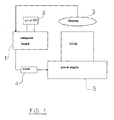
- FIG. 1 shows a schematic representation of a cooking device to implement the present invention.
- the cooking system in organised in a close loop control system, comprising a microcomputer board 1 which is activated through input means 2, which may be of any known kind, e.g. vocal device.
- the microcomputer board 1 is also connected to sensor means 3 for detecting the cooking conditions and to actuating means 4 for controlling a heating device 5.
- the sensor means 3 may be a temperature probe to be inserted into the food, or a temperature infrared sensor, or other known devices.
- the new automate cooking method according with the invention is based on the principle to train the system by supplying it with experimental data for each specific food cooking.
- a periodical survey of the food temperature during the cooking process allows gathering relevant data which are used to implement the learning development of the system.
- Threshold should be chosen between 0 and 1. As far as it has been experienced, an adequate ⁇ -parameter value is 0,66.
- the process begins (step 11) by activation of the cooking device and goes on (step 12) with a first record of data, at time 1.
- Said first datum represents the first heating transition, i.e. a first operation made by the user on the control means of the cooking device 5.
- a temperature sensor associated with the food starts periodically to survey the food temperature (step 13) and to record each heating power level transition (step 14).
- the process begins, (step 21) by selecting a recipe and activating the heating device. Then, the first step of cooking starts (step 22) by gathering a first heating power level.
- Figure 2 shows the curve of the transition probability depending on the gathered food temperature.
- Microprocessor unit makes a simulation about transition activation by a na ⁇ ve Montecarlo approach. It supposes a population of stochastic cooking systems and by a pseudocasual random number generator tries to realise transitions (step 25).
- step 26 Decision is taken at step 26. In case the next heating power level is OFF (step 27) the process runs to the end (step 29). In case the next heating power level is different from OFF, the process continues (step 28) by activating a further cooking step 22.
- the new method allows fully to automate cooking processes by storing cook's experience and applying a stochastic process, in order to repeat automatically said processes adjusted on the basis of different parameters (in particular, the quantity) of the food to be cooked.
Landscapes
- Engineering & Computer Science (AREA)
- Physics & Mathematics (AREA)
- General Physics & Mathematics (AREA)
- Automation & Control Theory (AREA)
- Chemical & Material Sciences (AREA)
- Combustion & Propulsion (AREA)
- Mechanical Engineering (AREA)
- General Engineering & Computer Science (AREA)
- General Preparation And Processing Of Foods (AREA)
- Electric Stoves And Ranges (AREA)
- Management, Administration, Business Operations System, And Electronic Commerce (AREA)
Abstract
Description
- The present invention refers to a new method to automate cooking processes by means of a learning procedure coding recipes into stochastic models.
- It is known that cooking chemical reactions are highly non linear chaotic processes. This means that stabilising and controlling cooking processes are very hard tasks, so as said processes were not automated for long time. Adaptive human control has been an unavoidable solution. As a consequence, cooking results largely depend on the cook's skill. This situation is not at all acceptable, particularly in a catering system.
- Potential methods of cooking control include techniques such as predictive and adaptive control.
- Predictive control methods are based on the model availability of the process to be controlled. These methods may be repeatedly applied only in case the food to be cooked has all its quality and quantity parameters exactly the same of the model.
- An adaptive cooking system is able to adjust the current cooking situation. It gains information about the current cooking state and uses it. However, such a system is memoryless in the sense that it is not able to store the information for later use. All new information replaces the old one. Only the current information is available.
- Reliable close loop systems are now feasible by using computerised means which act on devices regulating heat power levels in order to accomplish a cooking procedure to produce the best result in connection with the specific food to be prepared.
- Therefore, the main scope of the present invention is to provide a new method to automate cooking processes based on learning the cook's experience and on its coding in stochastic models.
- Another scope of the invention is to accomplish the new cooking method by using well tested low-cost devices without the need to implement different apparatuses.
- Another scope of the invention is to implement an effective and flexible cooking decisional process using stochastic simulation techniques, i.e. based on realizations of casual variables representing a process developing according to probabilistic laws. A method for simulating a mechanistic kinetic process, such as a chemical process including one or more chemical reactions, over a predetermined time period, subject to a programmed temperature variation, is known by US Patent no. 5,745,385. Said patent, however, discloses a method which provides a first step wherein a time value selection technique is a stochastic technique, whereas successive deterministic time steps are made. In its context, "deterministic" means externally imposed. Alternatively, the deterministic time steps can be fixed length time steps.
- Then, another scope of the present invention is to use the most simple and direct variable of the cooking process, i.e. the food temperature, to automate the whole learning and controlling processes.
- These and other scopes of the invention are obtained by the method and means which are defined in the appended claims.
- Feature and advantages of the invention will be better appreciated from the following description given solely by way of non-limiting example and with reference to the accompanying drawings, wherein:
- Figure 1 shows a schematic view of a cooking system according to the invention;
- Figure 2 shows the relationship between the transition probability from a power level to another and the food temperature;
- Figure 3 shows a flow chart representing the learning process according to the invention; and
- Figure 4 shows a flow chart representing the autonomous control process according to the invention.
-
- A cooking process has an inherent dynamic complexity due to a synergy of a lot of physical variables, e.g. quality and quantity of the food, features of the heating device and of control tools. An effective complexity reduction is not allowable. By definition a complex system is not informatively compressible; therefore, its control asks for an adequate approach.
- The idea behind the present invention is to try to model the hidden human decisional process by one stochastic.
- Controller states are defined over a discrete set constituted by cooking power levels. A human decision about a power switching is related to the observable food temperature level. It is possible to estimate transition probabilities by means of cooking experiments reaching a homogeneous cooking target.
- A human operator can train the system, e.g. by simple speech commands. Figure 1 shows a schematic representation of a cooking device to implement the present invention. The cooking system in organised in a close loop control system, comprising a
microcomputer board 1 which is activated throughinput means 2, which may be of any known kind, e.g. vocal device. Themicrocomputer board 1 is also connected to sensor means 3 for detecting the cooking conditions and to actuating means 4 for controlling aheating device 5. The sensor means 3 may be a temperature probe to be inserted into the food, or a temperature infrared sensor, or other known devices. - All components of the system are of traditional type and well known, so as there is no need to discuss them in details.
- The new automate cooking method according with the invention is based on the principle to train the system by supplying it with experimental data for each specific food cooking. A periodical survey of the food temperature during the cooking process allows gathering relevant data which are used to implement the learning development of the system.
- Specifically, heating power transitions are gathered and transition probabilities from a power level to another are evaluated by a parameter estimation procedure. Figure 2 shows the curve of the transition probability depending on the food temperature according to the following formula:
- The value of the parameter α is estimated by solving the following equation at temperature where a power transition is realised by the cook:
- Threshold should be chosen between 0 and 1. As far as it has been experienced, an adequate α-parameter value is 0,66.
- The learning process is shown by the flow chart of Figure 3.
- The process begins (step 11) by activation of the cooking device and goes on (step 12) with a first record of data, at
time 1. Said first datum represents the first heating transition, i.e. a first operation made by the user on the control means of thecooking device 5. - Then, a temperature sensor associated with the food starts periodically to survey the food temperature (step 13) and to record each heating power level transition (step 14).
- All data are sent to the microcomputer 1 (Figure 1) and each datum is compared with the previous one (step 15). If the present datum is different from the former one, the process continues as long as the heating power level is maintained (step 16) and ends when the heating is stopped, i.e. power level equal OFF.
- The automatic cooking process is shown by the flow chart of Figure 4.
- The process begins, (step 21) by selecting a recipe and activating the heating device. Then, the first step of cooking starts (step 22) by gathering a first heating power level.
- A temperature sensor, which is introduced into the food, periodically surveys the food temperature (step 23) and sends the relevant data to a microprocessor unit which evaluate a transition probability (step 24) according to the already reported formula:
- Figure 2 shows the curve of the transition probability depending on the gathered food temperature.
- Microprocessor unit makes a simulation about transition activation by a naïve Montecarlo approach. It supposes a population of stochastic cooking systems and by a pseudocasual random number generator tries to realise transitions (step 25).
- It has been found experimentally that a stochastic cooking systems population of 10000 elements is a parameter sufficient to implement the system.
- Decision is taken at
step 26. In case the next heating power level is OFF (step 27) the process runs to the end (step 29). In case the next heating power level is different from OFF, the process continues (step 28) by activating afurther cooking step 22. - In conclusion, the new method allows fully to automate cooking processes by storing cook's experience and applying a stochastic process, in order to repeat automatically said processes adjusted on the basis of different parameters (in particular, the quantity) of the food to be cooked.
Claims (7)
- A method to automate cooking processes, to be implemented in a cooking device controlled by computer, through a stochastic process by using a periodical survey of the food temperature,
characterised by the following steps:Realization cook's selected recipe.Identification of bi-univocal relationships between power levels transitions and temperatures.Estimation of probability transitions parameters by information carried by the quoted bi-univocal relationships.Implementation of the recipe into a system electronic library where cook's recipes are coded by means of probability transitions parameters.Autonomous cooking process synthesis by stochastic simulation of cook's decisional processes. - A method according to claim1, characterised in that the heating power transitions are produced following a gathered data of the food temperature.
- A method according to claim 2, characterised in that the transition probabilities are evaluated on the base of the following formula:
- A method according to claim 3, characterised in that the α-parameter is evaluated by the following equation:
- A method according to claim 4, characterised in that the transition probability threshold is estimated as 0.66.
- A cooking device to implement a method according to the preceding claims 1 to 5, comprising a microcomputer unit (1) which is activated through input means (2) to store data concerning cooking processes, the microcomputer unit (1) being connected to sensor means (3) for detecting the cooking conditions and to actuating means (4) for controlling the cooking device (5), characterised in that the microcomputer unit (1) is able to control the cooking device (5) by periodical stochastic simulations of cook's decisional processes.
- A cooking device according with claim 6, characterised in that the microcomputer unit (1) is able to activate the actuating means (4) on the basis of the transition probabilities evaluated with following formula:
Priority Applications (4)
| Application Number | Priority Date | Filing Date | Title |
|---|---|---|---|
| DE602004002098T DE602004002098T2 (en) | 2004-06-08 | 2004-06-08 | Method for automating cooking processes |
| AT04102578T ATE337694T1 (en) | 2004-06-08 | 2004-06-08 | METHOD FOR AUTOMATION OF COOKING PROCESSES |
| ES04102578T ES2270281T3 (en) | 2004-06-08 | 2004-06-08 | METHOD TO AUTOMATE COOKING PROCESSES. |
| EP04102578A EP1605730B1 (en) | 2004-06-08 | 2004-06-08 | A method to automate cooking processes |
Applications Claiming Priority (1)
| Application Number | Priority Date | Filing Date | Title |
|---|---|---|---|
| EP04102578A EP1605730B1 (en) | 2004-06-08 | 2004-06-08 | A method to automate cooking processes |
Publications (2)
| Publication Number | Publication Date |
|---|---|
| EP1605730A1 true EP1605730A1 (en) | 2005-12-14 |
| EP1605730B1 EP1605730B1 (en) | 2006-08-23 |
Family
ID=34929179
Family Applications (1)
| Application Number | Title | Priority Date | Filing Date |
|---|---|---|---|
| EP04102578A Expired - Lifetime EP1605730B1 (en) | 2004-06-08 | 2004-06-08 | A method to automate cooking processes |
Country Status (4)
| Country | Link |
|---|---|
| EP (1) | EP1605730B1 (en) |
| AT (1) | ATE337694T1 (en) |
| DE (1) | DE602004002098T2 (en) |
| ES (1) | ES2270281T3 (en) |
Cited By (6)
| Publication number | Priority date | Publication date | Assignee | Title |
|---|---|---|---|---|
| EP2101229A1 (en) | 2008-03-13 | 2009-09-16 | Rational AG | Method for creating an intelligent human-machine interface for cooking devices |
| EP2101230A1 (en) | 2008-03-13 | 2009-09-16 | Rational AG | Method for creating an intelligent human-machine interface for cooking devices |
| DE102008014006A1 (en) | 2008-03-13 | 2009-09-17 | Rational Ag | Intelligent man-machine interface method for combi steam oven, involves inputting satisfaction indicated by user and/or monitoring person at time point selected by user and/or person via Intranet and/or Internet in wireless manner |
| DE102008014007A1 (en) | 2008-03-13 | 2009-09-24 | Rational Ag | Intelligent man-machine interface providing method for use with combi-steamer in e.g. hotel, involves changing adjustment of cooking device, and outputting information about cooking device in dependence of user class classification |
| DE102008013995A1 (en) | 2008-03-13 | 2009-09-24 | Rational Ag | Intelligent human-machine-interface providing method for e.g. tilting fry pan, in kitchen, involves sorting operating programs selected from cooking programs, cleaning programs, and/or diagnosing programs in preset operating program class |
| US11631010B1 (en) | 2019-01-06 | 2023-04-18 | Adaptics Limited | System and method for use with connected kitchen appliances |
Families Citing this family (1)
| Publication number | Priority date | Publication date | Assignee | Title |
|---|---|---|---|---|
| SE537209C2 (en) * | 2012-06-04 | 2015-03-03 | Bbbl Innovation Ab | A food preparation device, a food preparation system with an electronic library and methods related thereto |
Citations (6)
| Publication number | Priority date | Publication date | Assignee | Title |
|---|---|---|---|---|
| US4503502A (en) * | 1983-06-03 | 1985-03-05 | Chapin Roger A | Method and apparatus for automated chinese stir-fry cooking |
| US4914277A (en) * | 1986-10-27 | 1990-04-03 | De Dietrich Et Cie, S.A. | Electronic control device for automatic cooking, including learning for home electric oven |
| DE19517104A1 (en) * | 1995-05-10 | 1996-11-14 | Istec Gmbh | Procedure for monitoring the status of dynamic noise processes |
| EP0933596A1 (en) * | 1997-06-19 | 1999-08-04 | Matsushita Electric Industrial Co., Ltd. | Cooking device |
| EP1091208A1 (en) * | 1999-09-27 | 2001-04-11 | Mettler-Toledo GmbH | Method and apparatus for thermally analyzing a material |
| JP2004028625A (en) * | 2002-06-21 | 2004-01-29 | Hitachi Ltd | Precipitation estimation method, system, program, and storage medium storing program |
-
2004
- 2004-06-08 DE DE602004002098T patent/DE602004002098T2/en not_active Expired - Fee Related
- 2004-06-08 ES ES04102578T patent/ES2270281T3/en not_active Expired - Lifetime
- 2004-06-08 AT AT04102578T patent/ATE337694T1/en not_active IP Right Cessation
- 2004-06-08 EP EP04102578A patent/EP1605730B1/en not_active Expired - Lifetime
Patent Citations (6)
| Publication number | Priority date | Publication date | Assignee | Title |
|---|---|---|---|---|
| US4503502A (en) * | 1983-06-03 | 1985-03-05 | Chapin Roger A | Method and apparatus for automated chinese stir-fry cooking |
| US4914277A (en) * | 1986-10-27 | 1990-04-03 | De Dietrich Et Cie, S.A. | Electronic control device for automatic cooking, including learning for home electric oven |
| DE19517104A1 (en) * | 1995-05-10 | 1996-11-14 | Istec Gmbh | Procedure for monitoring the status of dynamic noise processes |
| EP0933596A1 (en) * | 1997-06-19 | 1999-08-04 | Matsushita Electric Industrial Co., Ltd. | Cooking device |
| EP1091208A1 (en) * | 1999-09-27 | 2001-04-11 | Mettler-Toledo GmbH | Method and apparatus for thermally analyzing a material |
| JP2004028625A (en) * | 2002-06-21 | 2004-01-29 | Hitachi Ltd | Precipitation estimation method, system, program, and storage medium storing program |
Non-Patent Citations (1)
| Title |
|---|
| PATENT ABSTRACTS OF JAPAN vol. 2003, no. 12 5 December 2003 (2003-12-05) * |
Cited By (8)
| Publication number | Priority date | Publication date | Assignee | Title |
|---|---|---|---|---|
| EP2101229A1 (en) | 2008-03-13 | 2009-09-16 | Rational AG | Method for creating an intelligent human-machine interface for cooking devices |
| EP2101230A1 (en) | 2008-03-13 | 2009-09-16 | Rational AG | Method for creating an intelligent human-machine interface for cooking devices |
| DE102008014006A1 (en) | 2008-03-13 | 2009-09-17 | Rational Ag | Intelligent man-machine interface method for combi steam oven, involves inputting satisfaction indicated by user and/or monitoring person at time point selected by user and/or person via Intranet and/or Internet in wireless manner |
| DE102008014007A1 (en) | 2008-03-13 | 2009-09-24 | Rational Ag | Intelligent man-machine interface providing method for use with combi-steamer in e.g. hotel, involves changing adjustment of cooking device, and outputting information about cooking device in dependence of user class classification |
| DE102008013995A1 (en) | 2008-03-13 | 2009-09-24 | Rational Ag | Intelligent human-machine-interface providing method for e.g. tilting fry pan, in kitchen, involves sorting operating programs selected from cooking programs, cleaning programs, and/or diagnosing programs in preset operating program class |
| DE102008014006B4 (en) | 2008-03-13 | 2023-06-22 | Rational Ag | Method for providing an intelligent man-machine interface for cooking devices and associated cooking device |
| US11631010B1 (en) | 2019-01-06 | 2023-04-18 | Adaptics Limited | System and method for use with connected kitchen appliances |
| US12056624B2 (en) | 2019-01-06 | 2024-08-06 | Adaptics Limited | System and method for use with connected kitchen appliances |
Also Published As
| Publication number | Publication date |
|---|---|
| DE602004002098T2 (en) | 2006-12-28 |
| DE602004002098D1 (en) | 2006-10-05 |
| ES2270281T3 (en) | 2007-04-01 |
| ATE337694T1 (en) | 2006-09-15 |
| EP1605730B1 (en) | 2006-08-23 |
Similar Documents
| Publication | Publication Date | Title |
|---|---|---|
| US12242234B2 (en) | Heuristic method of automated and learning control, and building automation systems thereof | |
| Gallistel | Conditioning from an information processing perspective | |
| US10338542B2 (en) | Method for computer-aided installation control optimization using a simulation module | |
| Ditterich | Evidence for time‐variant decision making | |
| EP1605730A1 (en) | A method to automate cooking processes | |
| Rachlin | From overt behavior to hypothetical behavior to memory: Inference in the wrong direction | |
| DE69738467D1 (en) | INTERPRETATIVE BIOS MACHINE AND METHOD OF USE THEREOF | |
| JP2004240437A5 (en) | ||
| DE69839766D1 (en) | METHOD AND DEVICE FOR REGULATING THE USE OF ELECTROMAGNETIC RADIATION | |
| Huang et al. | The source of the often observed property of initial convergence followed by divergence in learning and repetitive control | |
| WO2024233968A8 (en) | Method of retraining a device with real-world data | |
| Brunner et al. | Mnemonics for variability: remembering food delay. | |
| ATE487092T1 (en) | METHOD AND DEVICE FOR CONTROLLING COOKING PROCESSES IN A COOKING ROOM | |
| JP2010026842A (en) | Operation support device and operation support method using prediction simulator | |
| Nevin | Extension to multiple schedules: Some surprising (and accurate) predictions | |
| Lattal et al. | Memories and functional response units | |
| Donahoe | What do reinforcers strengthen? The unit of selection | |
| Bradshaw | Validation of behavioural equations: Can neurobiology help? | |
| Timberlake | Animal-centered models of reinforcement | |
| JP2020201304A (en) | Evaluation system, evaluation method, and program | |
| Pear | Problems and pitfalls for Killeen's mathematical principles of reinforcement | |
| Killeen | Rats, responses and reinforcers: Using a little psychology on our subjects | |
| Stephens | The scale of nature: Fitted parameters and dimensional correctness | |
| Lei et al. | Delayed feedback control of a chemical chaotic model | |
| Wearden | Fifty years on: The new “principles of behavior”? |
Legal Events
| Date | Code | Title | Description |
|---|---|---|---|
| PUAI | Public reference made under article 153(3) epc to a published international application that has entered the european phase |
Free format text: ORIGINAL CODE: 0009012 |
|
| 17P | Request for examination filed |
Effective date: 20050620 |
|
| AK | Designated contracting states |
Kind code of ref document: A1 Designated state(s): AT BE BG CH CY CZ DE DK EE ES FI FR GB GR HU IE IT LI LU MC NL PL PT RO SE SI SK TR |
|
| AX | Request for extension of the european patent |
Extension state: AL HR LT LV MK |
|
| GRAP | Despatch of communication of intention to grant a patent |
Free format text: ORIGINAL CODE: EPIDOSNIGR1 |
|
| GRAS | Grant fee paid |
Free format text: ORIGINAL CODE: EPIDOSNIGR3 |
|
| GRAA | (expected) grant |
Free format text: ORIGINAL CODE: 0009210 |
|
| AK | Designated contracting states |
Kind code of ref document: B1 Designated state(s): AT BE BG CH CY CZ DE DK EE ES FI FR GB GR HU IE IT LI LU MC NL PL PT RO SE SI SK TR |
|
| AKX | Designation fees paid |
Designated state(s): AT BE BG CH CY CZ DE DK EE ES FI FR GB GR HU IE IT LI LU MC NL PL PT RO SE SI SK TR |
|
| PG25 | Lapsed in a contracting state [announced via postgrant information from national office to epo] |
Ref country code: IT Free format text: LAPSE BECAUSE OF FAILURE TO SUBMIT A TRANSLATION OF THE DESCRIPTION OR TO PAY THE FEE WITHIN THE PRESCRIBED TIME-LIMIT;WARNING: LAPSES OF ITALIAN PATENTS WITH EFFECTIVE DATE BEFORE 2007 MAY HAVE OCCURRED AT ANY TIME BEFORE 2007. THE CORRECT EFFECTIVE DATE MAY BE DIFFERENT FROM THE ONE RECORDED. Effective date: 20060823 Ref country code: CZ Free format text: LAPSE BECAUSE OF FAILURE TO SUBMIT A TRANSLATION OF THE DESCRIPTION OR TO PAY THE FEE WITHIN THE PRESCRIBED TIME-LIMIT Effective date: 20060823 Ref country code: BE Free format text: LAPSE BECAUSE OF FAILURE TO SUBMIT A TRANSLATION OF THE DESCRIPTION OR TO PAY THE FEE WITHIN THE PRESCRIBED TIME-LIMIT Effective date: 20060823 Ref country code: CH Free format text: LAPSE BECAUSE OF FAILURE TO SUBMIT A TRANSLATION OF THE DESCRIPTION OR TO PAY THE FEE WITHIN THE PRESCRIBED TIME-LIMIT Effective date: 20060823 Ref country code: FI Free format text: LAPSE BECAUSE OF FAILURE TO SUBMIT A TRANSLATION OF THE DESCRIPTION OR TO PAY THE FEE WITHIN THE PRESCRIBED TIME-LIMIT Effective date: 20060823 Ref country code: PL Free format text: LAPSE BECAUSE OF FAILURE TO SUBMIT A TRANSLATION OF THE DESCRIPTION OR TO PAY THE FEE WITHIN THE PRESCRIBED TIME-LIMIT Effective date: 20060823 Ref country code: NL Free format text: LAPSE BECAUSE OF FAILURE TO SUBMIT A TRANSLATION OF THE DESCRIPTION OR TO PAY THE FEE WITHIN THE PRESCRIBED TIME-LIMIT Effective date: 20060823 Ref country code: AT Free format text: LAPSE BECAUSE OF FAILURE TO SUBMIT A TRANSLATION OF THE DESCRIPTION OR TO PAY THE FEE WITHIN THE PRESCRIBED TIME-LIMIT Effective date: 20060823 Ref country code: LI Free format text: LAPSE BECAUSE OF FAILURE TO SUBMIT A TRANSLATION OF THE DESCRIPTION OR TO PAY THE FEE WITHIN THE PRESCRIBED TIME-LIMIT Effective date: 20060823 Ref country code: SI Free format text: LAPSE BECAUSE OF FAILURE TO SUBMIT A TRANSLATION OF THE DESCRIPTION OR TO PAY THE FEE WITHIN THE PRESCRIBED TIME-LIMIT Effective date: 20060823 Ref country code: SK Free format text: LAPSE BECAUSE OF FAILURE TO SUBMIT A TRANSLATION OF THE DESCRIPTION OR TO PAY THE FEE WITHIN THE PRESCRIBED TIME-LIMIT Effective date: 20060823 Ref country code: RO Free format text: LAPSE BECAUSE OF FAILURE TO SUBMIT A TRANSLATION OF THE DESCRIPTION OR TO PAY THE FEE WITHIN THE PRESCRIBED TIME-LIMIT Effective date: 20060823 |
|
| REG | Reference to a national code |
Ref country code: GB Ref legal event code: FG4D |
|
| REG | Reference to a national code |
Ref country code: CH Ref legal event code: EP |
|
| REG | Reference to a national code |
Ref country code: IE Ref legal event code: FG4D |
|
| REF | Corresponds to: |
Ref document number: 602004002098 Country of ref document: DE Date of ref document: 20061005 Kind code of ref document: P |
|
| PG25 | Lapsed in a contracting state [announced via postgrant information from national office to epo] |
Ref country code: BG Free format text: LAPSE BECAUSE OF FAILURE TO SUBMIT A TRANSLATION OF THE DESCRIPTION OR TO PAY THE FEE WITHIN THE PRESCRIBED TIME-LIMIT Effective date: 20061123 Ref country code: SE Free format text: LAPSE BECAUSE OF FAILURE TO SUBMIT A TRANSLATION OF THE DESCRIPTION OR TO PAY THE FEE WITHIN THE PRESCRIBED TIME-LIMIT Effective date: 20061123 Ref country code: DK Free format text: LAPSE BECAUSE OF FAILURE TO SUBMIT A TRANSLATION OF THE DESCRIPTION OR TO PAY THE FEE WITHIN THE PRESCRIBED TIME-LIMIT Effective date: 20061123 |
|
| ET | Fr: translation filed | ||
| PG25 | Lapsed in a contracting state [announced via postgrant information from national office to epo] |
Ref country code: PT Free format text: LAPSE BECAUSE OF FAILURE TO SUBMIT A TRANSLATION OF THE DESCRIPTION OR TO PAY THE FEE WITHIN THE PRESCRIBED TIME-LIMIT Effective date: 20070124 |
|
| NLV1 | Nl: lapsed or annulled due to failure to fulfill the requirements of art. 29p and 29m of the patents act | ||
| REG | Reference to a national code |
Ref country code: CH Ref legal event code: PL |
|
| REG | Reference to a national code |
Ref country code: ES Ref legal event code: FG2A Ref document number: 2270281 Country of ref document: ES Kind code of ref document: T3 |
|
| PLBE | No opposition filed within time limit |
Free format text: ORIGINAL CODE: 0009261 |
|
| STAA | Information on the status of an ep patent application or granted ep patent |
Free format text: STATUS: NO OPPOSITION FILED WITHIN TIME LIMIT |
|
| 26N | No opposition filed |
Effective date: 20070524 |
|
| PG25 | Lapsed in a contracting state [announced via postgrant information from national office to epo] |
Ref country code: MC Free format text: LAPSE BECAUSE OF NON-PAYMENT OF DUE FEES Effective date: 20070630 |
|
| PG25 | Lapsed in a contracting state [announced via postgrant information from national office to epo] |
Ref country code: GR Free format text: LAPSE BECAUSE OF FAILURE TO SUBMIT A TRANSLATION OF THE DESCRIPTION OR TO PAY THE FEE WITHIN THE PRESCRIBED TIME-LIMIT Effective date: 20061124 |
|
| PG25 | Lapsed in a contracting state [announced via postgrant information from national office to epo] |
Ref country code: IE Free format text: LAPSE BECAUSE OF NON-PAYMENT OF DUE FEES Effective date: 20070608 |
|
| PG25 | Lapsed in a contracting state [announced via postgrant information from national office to epo] |
Ref country code: EE Free format text: LAPSE BECAUSE OF FAILURE TO SUBMIT A TRANSLATION OF THE DESCRIPTION OR TO PAY THE FEE WITHIN THE PRESCRIBED TIME-LIMIT Effective date: 20060823 |
|
| PGFP | Annual fee paid to national office [announced via postgrant information from national office to epo] |
Ref country code: DE Payment date: 20080730 Year of fee payment: 5 Ref country code: ES Payment date: 20080729 Year of fee payment: 5 |
|
| PGFP | Annual fee paid to national office [announced via postgrant information from national office to epo] |
Ref country code: FR Payment date: 20080724 Year of fee payment: 5 |
|
| GBPC | Gb: european patent ceased through non-payment of renewal fee |
Effective date: 20080608 |
|
| PG25 | Lapsed in a contracting state [announced via postgrant information from national office to epo] |
Ref country code: GB Free format text: LAPSE BECAUSE OF NON-PAYMENT OF DUE FEES Effective date: 20080608 |
|
| PG25 | Lapsed in a contracting state [announced via postgrant information from national office to epo] |
Ref country code: LU Free format text: LAPSE BECAUSE OF NON-PAYMENT OF DUE FEES Effective date: 20070608 Ref country code: CY Free format text: LAPSE BECAUSE OF FAILURE TO SUBMIT A TRANSLATION OF THE DESCRIPTION OR TO PAY THE FEE WITHIN THE PRESCRIBED TIME-LIMIT Effective date: 20060823 |
|
| PG25 | Lapsed in a contracting state [announced via postgrant information from national office to epo] |
Ref country code: HU Free format text: LAPSE BECAUSE OF FAILURE TO SUBMIT A TRANSLATION OF THE DESCRIPTION OR TO PAY THE FEE WITHIN THE PRESCRIBED TIME-LIMIT Effective date: 20070224 Ref country code: TR Free format text: LAPSE BECAUSE OF FAILURE TO SUBMIT A TRANSLATION OF THE DESCRIPTION OR TO PAY THE FEE WITHIN THE PRESCRIBED TIME-LIMIT Effective date: 20060823 |
|
| REG | Reference to a national code |
Ref country code: FR Ref legal event code: ST Effective date: 20100226 |
|
| PG25 | Lapsed in a contracting state [announced via postgrant information from national office to epo] |
Ref country code: FR Free format text: LAPSE BECAUSE OF NON-PAYMENT OF DUE FEES Effective date: 20090630 |
|
| PG25 | Lapsed in a contracting state [announced via postgrant information from national office to epo] |
Ref country code: DE Free format text: LAPSE BECAUSE OF NON-PAYMENT OF DUE FEES Effective date: 20100101 |
|
| REG | Reference to a national code |
Ref country code: ES Ref legal event code: FD2A Effective date: 20090609 |
|
| PG25 | Lapsed in a contracting state [announced via postgrant information from national office to epo] |
Ref country code: ES Free format text: LAPSE BECAUSE OF NON-PAYMENT OF DUE FEES Effective date: 20090609 |