EP1608096A1 - Verfahren zur Aufrüstung eines optischen Übertragungsnetzwerks, optisches Übertragungsnetz und zugehöriger optischer Übertragungsknoten - Google Patents
Verfahren zur Aufrüstung eines optischen Übertragungsnetzwerks, optisches Übertragungsnetz und zugehöriger optischer Übertragungsknoten Download PDFInfo
- Publication number
- EP1608096A1 EP1608096A1 EP20050103347 EP05103347A EP1608096A1 EP 1608096 A1 EP1608096 A1 EP 1608096A1 EP 20050103347 EP20050103347 EP 20050103347 EP 05103347 A EP05103347 A EP 05103347A EP 1608096 A1 EP1608096 A1 EP 1608096A1
- Authority
- EP
- European Patent Office
- Prior art keywords
- optical
- transmission
- node
- output
- input
- Prior art date
- Legal status (The legal status is an assumption and is not a legal conclusion. Google has not performed a legal analysis and makes no representation as to the accuracy of the status listed.)
- Withdrawn
Links
- 230000003287 optical effect Effects 0.000 title claims abstract description 322
- 230000005540 biological transmission Effects 0.000 title claims abstract description 267
- 238000000034 method Methods 0.000 title claims abstract description 48
- 239000013307 optical fiber Substances 0.000 claims abstract description 77
- 239000000835 fiber Substances 0.000 claims abstract description 42
- 238000000605 extraction Methods 0.000 claims description 29
- 238000003780 insertion Methods 0.000 claims description 29
- 230000037431 insertion Effects 0.000 claims description 29
- 238000011144 upstream manufacturing Methods 0.000 claims description 25
- 230000003595 spectral effect Effects 0.000 claims description 13
- 230000002457 bidirectional effect Effects 0.000 description 5
- 230000008901 benefit Effects 0.000 description 3
- 238000012546 transfer Methods 0.000 description 3
- 230000006870 function Effects 0.000 description 2
- 238000009434 installation Methods 0.000 description 2
- 238000012986 modification Methods 0.000 description 2
- 230000004048 modification Effects 0.000 description 2
- 238000001228 spectrum Methods 0.000 description 2
- 238000004891 communication Methods 0.000 description 1
- 230000003247 decreasing effect Effects 0.000 description 1
- 239000000284 extract Substances 0.000 description 1
- 238000000926 separation method Methods 0.000 description 1
- 239000007787 solid Substances 0.000 description 1
- 239000013589 supplement Substances 0.000 description 1
Images


Classifications
-
- H—ELECTRICITY
- H04—ELECTRIC COMMUNICATION TECHNIQUE
- H04J—MULTIPLEX COMMUNICATION
- H04J14/00—Optical multiplex systems
- H04J14/02—Wavelength-division multiplex systems
- H04J14/0201—Add-and-drop multiplexing
- H04J14/0202—Arrangements therefor
- H04J14/0204—Broadcast and select arrangements, e.g. with an optical splitter at the input before adding or dropping
-
- H—ELECTRICITY
- H04—ELECTRIC COMMUNICATION TECHNIQUE
- H04J—MULTIPLEX COMMUNICATION
- H04J14/00—Optical multiplex systems
- H04J14/02—Wavelength-division multiplex systems
- H04J14/0201—Add-and-drop multiplexing
- H04J14/0202—Arrangements therefor
- H04J14/0205—Select and combine arrangements, e.g. with an optical combiner at the output after adding or dropping
-
- H—ELECTRICITY
- H04—ELECTRIC COMMUNICATION TECHNIQUE
- H04J—MULTIPLEX COMMUNICATION
- H04J14/00—Optical multiplex systems
- H04J14/02—Wavelength-division multiplex systems
- H04J14/0201—Add-and-drop multiplexing
- H04J14/0202—Arrangements therefor
- H04J14/021—Reconfigurable arrangements, e.g. reconfigurable optical add/drop multiplexers [ROADM] or tunable optical add/drop multiplexers [TOADM]
- H04J14/0212—Reconfigurable arrangements, e.g. reconfigurable optical add/drop multiplexers [ROADM] or tunable optical add/drop multiplexers [TOADM] using optical switches or wavelength selective switches [WSS]
-
- H—ELECTRICITY
- H04—ELECTRIC COMMUNICATION TECHNIQUE
- H04J—MULTIPLEX COMMUNICATION
- H04J14/00—Optical multiplex systems
- H04J14/02—Wavelength-division multiplex systems
- H04J14/0201—Add-and-drop multiplexing
- H04J14/0215—Architecture aspects
- H04J14/0217—Multi-degree architectures, e.g. having a connection degree greater than two
-
- H—ELECTRICITY
- H04—ELECTRIC COMMUNICATION TECHNIQUE
- H04J—MULTIPLEX COMMUNICATION
- H04J14/00—Optical multiplex systems
- H04J14/02—Wavelength-division multiplex systems
- H04J14/0201—Add-and-drop multiplexing
- H04J14/0215—Architecture aspects
- H04J14/0219—Modular or upgradable architectures
Definitions
- the invention relates to the field of extension methods (corresponding to the term “Upgrade” in Anglo-Saxon language and not the term “reconfigurable") of optical transmission network, extensible optical transmission networks associated to be extended by the extension process, nodes of extensible optical transmission intended to be extended by the method extension, extended optical transmission nodes having been extended by the extension method.
- an extensible optical transmission network comprising optical transmission nodes of degree 2 based on the use optical splitters consisting of 1 to 2 couplers and optical combiners consisting of 2-to-1 couplers, as well as the use of blockers in length waveforms, which are then expanded to become nodes of higher degree by cascading of couplers 1 to 2 and couplers 2 to 1 respectively in optical dividers and in optical combiners.
- Examples of this type of prior art are described in particular in the US patent application US2003 / 002104.
- Other types of nodes using optical splitters based of couplers 1 to 2 and optical combiners based on 2 to 1 couplers are described in the European patent application EP 1298467 and in the application European patent EP 1271827.
- Another type of knot using dividers optics based couplers 1 to 3 is described in the patent application International Patent WO99 / 65165. None of these examples of transmission nodes optics can not be extended, for example with a higher degree, without interruption of traffic.
- the invention proposes the establishment of an extensible optical transmission node having for at least one of its optical dividers a transmission line optical output of the optical divider which has a free end and for at least one of its optical combiners an input optical transmission line an optical combiner having a free end. So, the node of optical transmission can be extended into an optical transmission node by example of a higher degree without interruption of traffic, simply by connecting unbound free ends of available optical transmission lines to the new direction that is added to the knot; connect free ends already available can be done without interruption of traffic.
- Optical dividers having more output optical transmission lines than in the prior art, at least one more, their losses are higher: so there is an additional loss compared to the prior art during operation before extension.
- the invention also relates to the extensible optical transmission network integrating one or several expandable nodes according to the invention, as well as the extension method and the extended knot obtained.
- Linking to an entity means establishing a link with the entity in order to allow the transfer of information from and to that entity, whether directly or indirectly, that is to say via one or more several optical transmission lines and / or one or more components than for example an amplifier. Connection will be used in the same direction.
- Being connected upstream to an entity means having a link with the entity in order to allow the transfer of information from this entity, whether directly or indirectly, ie through one or more optical transmission lines and / or one or more components such as example an amplifier.
- Being connected downstream to an entity means having a link with the entity so as to allow the transfer of information to that entity, whether either directly or indirectly, that is to say via a or more optical transmission lines and or one or more components such as for example an amplifier.
- a method of extending an extensible network of optical transmission in wavelength division multiplexing comprising: a plurality of transmission directions; at least one extensible node optical transmission connecting at least some of said directions of transmission, and comprising: a plurality of optical fiber transmission lines; several optical dividers, an optical splitter having a line of fiber optic transmission at the input and several fiber transmission lines optical output; several optical combiners, an optical combiner presenting several optical fiber transmission lines at the input and a line of optical fiber transmission at the output; at least one of the transmission lines at optical fiber at the output of at least one of the optical dividers, having a end being connected downstream neither to a transmission direction nor to a possible extraction device; at least one of the optical fiber transmission lines input of at least one of the optical combiners, having one end connected upstream neither to a direction of transmission, nor to a possible device insertion; the extension method comprising at least one step of connection, at said node or at least one of said nodes, to minus one forward fiber optic transmission
- the purpose of the extension method is to extend a transmission network which is extensible, that is, which has been designed to be the extension process. More precisely, the function of the extension method is to extend one or advantageously several optical transmission nodes belonging to the optical transmission network, and possibly all the nodes optical transmission of the optical transmission network.
- the nodes of optical transmission are extensible, that is to say that they have been be extended by the extension process.
- An optical transmission node connects several directions of transmission and allows all or part of the directions of transmission, preference to all directions, to exchange either one-way or preferably bidirectionally, information with all or part other directions of transmission, preferably with all other transmission directions.
- the optical transmission node for conveying the information, comprises lines optical transmission systems, ie lines based on optical fiber, comprising one or more optical fibers, wired or not, possibly disposed within one or more fiber optic cables when they are wired.
- the transmission node has several optical dividers as well than several optical combiners.
- An optical splitter separates or distributes information, so it includes a single entry and several exits.
- a combiner optical collects information, so it includes multiple inputs and only one exit.
- At least one optical divider has a free exit, that is to say not yet connected downstream to a direction of transmission or to an extraction device, that is to say in the air, that is to say unused and unusable without modification which is precisely to connect it to one direction transmission either to an extraction device, connection operation which is performed during the connection step of the extension method.
- the free exit is an unused output that is already planned in advance to be able to connect simply without interruption of traffic.
- At least one optical combiner has a free input, that is to say not yet connected in upstream to a transmission direction or to an insertion device, that is to say in air, that is to say, unused and unusable without modification which consists precisely of connect it either to a transmission direction or to an insertion device, operation connection that is made during the process connection step extension.
- Free entry is an unused entry that is already planned in advance to be able to be connected simply without interruption of traffic.
- the disadvantage is to have higher losses at the beginning, a disadvantage the invention considers compensated by the possibility of a simple, rapid and especially without interruption of traffic.
- the type of evolution to which the transmission node (s) will be subjected optical is preferably of two kinds preferred, ie the degree of the node goes increase, for example a node of degree 2 will become a node of degree 3 or a node of degree 3 will become a node of degree 4 or even a node of degree 2 will become directly a node of degree 4, a system of insertion and extraction device, comprising an extraction device and an insertion device, will be added at the optical transmission node.
- a new direction of transmission is added not yet connected to said node, to which will be connected at least one line of forward optical fiber transmission not connected downstream and at least one line of optical fiber transmission at the input not connected upstream, so as to extend to minus a node of degree N, with N integer greater than or equal to 2, in a node of degree N + P, with P integer greater than or equal to 1.
- the degree of the node of Optical transmission increases by at least one unit.
- the degree of the knot corresponds to the number of transmission directions that are connected to the node.
- the transmission directions can be unidirectionally bidirectional, to one or more other directions of transmission connected to the node, preferably all the directions of transmission are connected bidirectionally to all other transmission directions connected to the node.
- N is 2 or 3.
- P is 1 or 2.
- N is 2 or 3.
- P is 1 or 2.
- a node of degree 2 or 3 will see its degree increase to 3 or 4.
- the losses initially in the extensible knots are more important: this is why, preferably, the divisor optic intended to be extended is at most 1 to 4, with two free outputs at the most, and the optical combiner to be extended is at most 4 to 1, with two free entries at most.
- a node from degree 2 to degree 3 while the losses pass for example from 12dB, corresponding to a sequence comprising a coupler 1vers 2 followed by a blocker wavelength followed by a 2-to-1 coupler at 24dB, corresponding to two sequences of the preceding type in series, in the case of the invention, they are example 16dB, corresponding to a coupler 1vers 3 followed by a blocker in wavelength followed by a 3-to-1 coupler.
- At least one extraction device is added and at least one insertion device, to which are respectively connected, at least an optical fiber transmission line at the output not connected downstream and at least an optical fiber transmission line input not connected upstream.
- the lines of free transmission are used to add a possibility of extraction and insertion at the node instead of being used to increase the degree of node.
- the invention also relates to an extensible network provided to be able to be extended by the extension method according to the invention.
- an extensible network of optical transmission in length multiplexing waveform comprising: a plurality of transmission directions; at least one node extensible optical transmission interconnecting at least some of said transmission directions, and comprising: a plurality of fiber transmission lines optical; several optical dividers, an optical splitter having a line of fiber optic transmission at the input and several fiber transmission lines optical output; several optical combiners, an optical combiner presenting several optical fiber transmission lines at the input and a line of optical fiber transmission at the output; characterized in that said node or at least one of said nodes also comprises: at least one of the lines of optical fiber transmission at the output of at least one of the optical dividers, which has an end which is not connected downstream to a direction of transmission, nor to a possible extraction device; at least one of the transmission lines at fiber optic input of at least one of the optical combiners, which has a end which is not connected upstream either
- an expandable node of optical transmission comprising: a plurality of optical fiber transmission lines; several optical dividers, an optical splitter having a line of fiber optic transmission at the input and several fiber transmission lines optical output; several optical combiners, an optical combiner presenting several optical fiber transmission lines at the input and a line of optical fiber transmission at the output; characterized in that: at least one of optical fiber transmission lines at the output of at least one of the dividers optical, has a free end; at least one of the transmission lines at fiber optic input of at least one of the optical combiners, has a free end.
- the extensible node is of degree 2 or 3, so as to limit the initial supplement of losses, during the operation of the node before extension.
- the extension method is a method of extending the nodes after operation and not a simple step of a method of installing a non-extensible node, without interruption of traffic, after operation.
- the node has: several optical fiber transmission lines at the output of at least one of the optical dividers, having a free end; several optical fiber transmission lines at the input of at least one of the optical combiners, having a free end. Therefore, the node can undergo at least two evolutions without interruption of traffic
- the node has: a plurality of optical dividers having at least an optical fiber transmission line at the output having a free end; several optical combiners having at least one transmission line to optical fiber input having a free end.
- a plurality of optical dividers having at least an optical fiber transmission line at the output having a free end
- several optical combiners having at least one transmission line to optical fiber input having a free end.
- all optical dividers have at least one line of optical fiber transmission at the output having a free end and all optical combiners have at least one optical fiber transmission line in input having a free end.
- all the directions of transmission can benefit from the evolution of the node.
- the node is an optical brewer. So, the evolution can make it possible to transform it into optical multiplexer with insertion and extraction and or increase its degree.
- the node is an optical multiplexer insertion and extraction (OADM for "optical add drop multiplexer”) comprising at least one insertion device and at least one extraction device.
- OADM optical multiplexer insertion and extraction
- This optical multiplexer with insertion and extraction is extensible. So, the evolution can add another extraction and insertion feature, and or increase its degree.
- At least one of the optical splitters of the node is a switch in wavelength (that is to say "wavelength switch” in English).
- several optical dividers of the node and or of the network are wavelength switches. Even more advantageously, all optical splitters of the node and or network are switches in length wave.
- At least one of the optical dividers of the node is a coupler and least one of the optical fiber transmission lines at the output of said coupler is connected to a wavelength blocker (ie "wavelength blocker" in English).
- a wavelength blocker ie "wavelength blocker" in English.
- several optical dividers of the node and or the network are couplers to which wavelength blockers are added. Even more advantageously, all the optical dividers of the node and or network are couplers to which are added blockers in length wave.
- At least one of the optical combiners of the node is a wavelength switch.
- Advantageously several optical combiners node and or network are wavelength switches. Even more advantageously, all the optical combiners of the node and or the network are wavelength switches.
- At least one of the optical combiners of the node is a coupler and at least one of the optical fiber transmission lines at the input of said coupler is connected to a wavelength blocker.
- Advantageously several optical combiners of the node and or network are couplers that are added blockers in wavelength. Even more advantageously, all optical combiners of the node and or network are couplers that are added blockers in wavelength.
- the wavelength switch as well as the wavelength blocker are reconfigurable, that is to say that their wavelength selectivity can be changed.
- each optical splitter upstream of each optical splitter is located a amplifier and downstream of each optical combiner is located an amplifier.
- These amplifiers are for example amplifiers with two stages (symbolized in the following figures by a double arrow, which also indicates the meaning of transmission of information).
- the invention also relates to an example of an extended node belonging to the extended network having been extended by the extension method according to the invention.
- an extended optical transmission node degree N with N integer greater than or equal to 3, comprising: several lines of fiber optic transmission; N optical dividers, an optical divider being a coupler having an optical fiber transmission line at the input and several optical fiber transmission lines at the output; N optical combiners, one optical combiner being a coupler having a plurality of transmission lines optical fiber input and an output fiber optic transmission line; characterized in that the node further comprises: N.
- N-1 blockers in length each wavelength blocker being located between a line of optical fiber transmission at the output of an optical splitter and a line of optical fiber transmission at the input of an optical combiner.
- a network of optical transmission comprising optical transmission nodes based on the use of optical dividers consisting of demultiplexers and other elements frozen passive optics for which the spectral capacitance at the level of each output is fixed at installation and can not be changed without interrupting traffic in the network and optical combiners consisting of multiplexers and other non-reconfigurable passive optical elements for which the spectral capacitance at each input is fixed at installation and can no longer be changed.
- some optical dividers or combiners may have free legs to increase capacity by adding wavelengths.
- a capacity spectrum, at each output or input which is variable ( can add or remove wavelengths at their level) and that can be modified during a reconfiguration (we can redirect the wavelengths of a leg to another leg), no free leg is required to increase the ability by adding wavelengths; however, to solve the problem specific to the invention, unknown in this prior art, namely to add new directions to one or more nodes in the network, the invention has one or more free legs, on these combiners and optical dividers, which would not have been required for a simple capacity problem.
- optical combiners or at least some of them have fiber transmission lines optical input with variable spectral capacity and reconfigurable without interruption traffic and optical splitters or at least some of them have output fiber optic transmission lines with variable spectral capacity and Reconfigurable without interruption of traffic.
- Typical examples of such dividers and optical combiners are the wavelength switches on the one hand and the coupler and blocker associations in wavelength on the other hand.
- Each previous embodiment of the invention may be associated with this embodiment preferential combiners and optical dividers.
- the fine line noted in some places 1 represents an optical transmission line. All the inputs and outputs of the dividers and optical combiners are lines of optical transmission.
- a dark solid arrow on a transmission line optics indicates the direction of information transmission, as does the meaning of the light arrow 7 which is located at the end of the optical transmission line shown on the figures and which symbolizes an amplifier.
- the upstream-downstream direction is the meaning of transmission of information.
- the directions of transmission at least D1 entitled "WEST” and D2 entitled “EAST”, and possibly D3 entitled “SOUTH” and or D4 entitled “NORTH”.
- the knot depicted relates the directions shown bidirectionally.
- Each optical splitter is noted 2, it comprises an input 20, an output 21, an output extracted 22 directed to an extraction device which is noted 4 and entitled “MUX DROP ", possibly one or more other outputs 23 and / or 24.
- Each optical combiner is noted 3, it comprises an output 30, an input 31, an input inserted 32 directed to an insertion device which is noted 5 and entitled “MUX ADD ", possibly one or more other entries 33 and 34.
- MUX ADD possibly one or more other entries 33 and 34.
- the output transmission line 23 has no free end, since one of its ends is connected indirectly to the direction D1 while the other is connected to the direction D3.
- Each wavelength blocker is rated 6 and is entitled “WB". The wavelength blocker extracts a part of the channels spectrum that crosses it, it "blocks" indeed certain wavelengths of to allow their reuse when inserting new channels spectral downstream without risk of collision.
- the optical dividers are denoted 2 and labeled "1x4" while that the optical combiners are denoted 3 and labeled "4x1".
- All optical splitters 2 are couplers while all optical combiners 3 are wavelength switches.
- all the optical dividers 2 are wavelength switches while all optical combiners 3 are couplers.
- all the optical dividers 2 and all the optical combiners 3 are wavelength switches.
- a coupler separates the information received at the input into several parts respectively issued on the outputs, each part comprising the entire information but having a decreased amplitude compared to the information available as input.
- a switch wavelength spectrally separates the input information into several parts corresponding to spectrally different subdomains respectively issued on the outputs, each part comprising only one subdomain spectral information. This spectral separation is not fixed and can possibly be reconfigured.
- a coupler gathers the information received on the different inputs to emit it on the output.
- a multiplex wavelength switch output information received on its entries after spectrally filtered.
- FIG. 1 schematically represents a degree optical transmission node 2 according to the prior art.
- the node is of degree 2, it connects two directions D1 and D2 of bidirectional way between them. From one direction of transmission to another, information coming from a direction of transmission, for example direction D1, passes through an amplifier 7, arrives at an input 20 of an optical divider 2, crosses the optical divider 2. Information is sent to an output 22 of the optical splitter 2 and is extracted by an extraction device 4. Information is sent on an output 21 of the optical divider 2 and then passes through a blocker in wavelength 6 and then arrives at an input 31 of an optical combiner 3. From the information is inserted by an insertion device 5 to arrive at an entrance 32 3. The information received on entries 31 and 32 of the 3 are combined on the output 30 of the optical combiner 3. The information transmitted on the output 30 of the optical combiner 3 goes through a amplifier 7 to go to another direction of transmission, here to the direction D2.
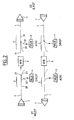
- FIG. 2 schematically represents an example of a transmission node optical degree 2 according to the invention, expandable once by the extension method according to the invention. Expandable once means that the degree, if it is to increase the degree, can be increased by one, that this evolution be made in one times or in several times in time.
- the knot is of degree 2, it connects two directions D1 and D2 bidirectionally between them. From a direction of transmission to another, information arriving from a direction of transmission, by example D1, goes through an amplifier 7, arrives on an input 20 of a divider optical 2, passes through the optical splitter 2. Information is sent to an output 22 of the optical divider 2 and is extracted by an extraction device 4.
- optical splitter 2 From the information is sent to an output 23 of the optical splitter 2 and then remains blocked because the output 23 is free downstream, that is to say not connected downstream.
- Information is sent on an output 21 of the optical divider 2 and then passes through a blocker in wavelength 6 and then arrives at an input 31 of an optical combiner 3. From the information is inserted by an insertion device 5 to arrive at an entrance 32 3. No information comes from entry 33 optical combiner which input 33 is free upstream, that is to say not connected in upstream.
- the information received on entries 31, 32 and 33, but there is no information on the input 33, of the optical combiner 3 are gathered on the output 30 of the optical combiner 3.
- the information transmitted on the output 30 of the combiner optical 3 goes through an amplifier 7 to go to another direction of transmission, for example D2.
- Optical dividers 2 and optical combiners 3 are couplers.
- FIG. 3 diagrammatically represents an example of a transmission node optical degree 3 according to the invention, having been extended by the extension method according to the invention.
- the node is of degree 3, it connects three directions D1, D2 and D3 of bidirectional way between them. From one direction of transmission to another, information arriving from a transmission direction, for example D1, goes through a amplifier 7, arrives at an input 20 of an optical divider 2, passes through the divider 2. Information is sent on an output 22 of the optical divider 2 and is extracted by an extraction device 4. Information is sent on a output 23 of the optical divider 2 which output 23 has been connected to another direction of transmission, for example to the direction D3, via a blocker in wavelength 6 and an optical combiner 3, during the connection step of the extension method.
- Information is sent on an output 21 of the divider optic 2 then crosses a blocker at wavelength 6 and then arrives at an entrance 31 of an optical combiner 3.
- Information is inserted by a device 5 to arrive at an input 32 of the optical combiner 3.
- Information arrives on the input 33 of the optical combiner 3, coming from another direction of transmission, for example here the direction D3, said input 33 having been connected to the direction D3 via a wavelength blocker 6 and a optical divider 2, during the step of connecting the extension method.
- the received information on the inputs 31, 32 and 33 of the optical combiner 3 are gathered on the output 30 of the optical combiner 3.
- the information transmitted on the output 30 of the optical combiner 3 goes through an amplifier 7 to go to a other direction of transmission, for example here the direction D2.
- the node of degree 3 comprises three optical dividers 2, three optical combiners 3, and six blockers in wavelength 6.
- the optical dividers 2 and the optical combiners 3 are couplers.
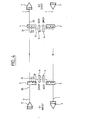
- FIG. 4 schematically represents an example of a transmission node optical degree 2 according to the invention, expandable twice by the extension method according to the invention.
- the node is of degree 2, it connects two directions D1 and D2 of bidirectional way between them. From one direction of transmission to another, information coming from a direction of transmission, for example direction D1, passes through an amplifier 7, arrives at an input 20 of an optical divider 2, crosses the optical divider 2. All or part of the information, depending on which divider optical 2 is respectively a coupler or a wavelength switch, is sent to an output 22 of the optical divider 2 and is then extracted by a device 4.
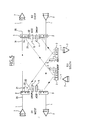
- FIG. 5 schematically represents an example of a transmission node optical degree 3 according to the invention, extendable once by the extension method according to the invention.
- Figure 5 also corresponds to Figure 4 extended once.
- the node is of degree 3, it connects three directions D1, D2 and D3 so bidirectional between them. From one direction of transmission to another, the information coming from a direction of transmission, for example the direction D1, goes through a amplifier 7, arrives at an input 20 of an optical divider 2, passes through the divider 2. All or part of the information, depending on whether the optical splitter 2 is respectively a coupler or a wavelength switch, is sent on an output 22 of the optical divider 2 and is extracted by an extraction device 4.
- All or part of the information, depending on whether the optical splitter 2 is respectively a coupler or a wavelength switch is sent to an output 23 of the optical divider 2 which output 23 has been connected to another direction of transmission, for example to the direction D3, via a combiner optical 3, during the step of connecting the extension method.
- All or part information, depending on whether the optical splitter 2 is respectively a coupler or a wavelength switch is sent on an output 24 of the divider optical 2 and then remains blocked because the output 24 is free downstream, that is to say not connected downstream.
- All or part of the information, depending on whether the optical splitter 2 is respectively a coupler or a wavelength switch is sent on an output 21 of the optical divider 2 and then arrives on an input 31 of a combiner 3.
- Information is inserted by an insertion device 5 to arrive on an input 32 of the optical combiner 3.
- Information arrives on the input 33 of the optical combiner 3, from another direction of transmission, by example here of the direction D3, said input 33 having been connected to the direction D3 by via an optical splitter 2, during the process connection step extension.
- No information comes from the input 34 of the optical combiner 3 which input 34 is free upstream, that is to say not connected upstream.
- the information received on entries 31, 32, 33 and 34, but there is no information on the input 34, of the optical combiner 3, are gathered on the output 30 of the optical combiner 3.
- the information transmitted on the output 30 of the optical combiner 3 goes through an amplifier 7 to go to another direction of transmission, for example here the direction D2.
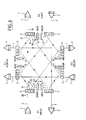
- FIG. 6 schematically represents an example of a transmission node optical degree 4, having been extended by the extension method according to the invention.
- FIG. 6 also corresponds to FIG. 5 extended once or again in FIG. 4 extended twice.
- the node is of degree 4, it connects four directions D1, D2, D3 and D4 bidirectionally between them. From one direction of transmission to another, information arriving from a transmission direction, for example D1, goes through a amplifier 7, arrives at an input 20 of an optical divider 2, passes through the divider 2. All or part of the information, depending on whether the optical splitter 2 is respectively a coupler or a wavelength switch, is sent on an output 22 of the optical divider 2 and is extracted by an extraction device 4.
- All or part of the information, depending on whether the optical splitter 2 is respectively a coupler or a wavelength switch is sent to an output 23 of the optical divider 2 which output 23 has been connected to another direction of transmission, for example to the direction D3, via a combiner optical 3, during the step of connecting the extension method.
- All or part information, depending on whether the optical splitter 2 is respectively a coupler or a wavelength switch is sent on an output 24 of the divider 2, which output 24 has been connected to another direction of transmission, for example example in direction D4, via an optical combiner 3, when the step of connecting the extension method.
- Information is inserted by a insertion device 5 to arrive at an input 32 of the optical combiner 3. From the information arrives at the input 33 of the optical combiner 3, coming from a other direction of transmission, for example here from the direction D3, said input 33 having been connected to direction D3 via an optical splitter 2, when the step of connecting the extension method.
- Information arrives at the entrance 34 of the optical combiner 3, from another direction of transmission, for example here of the direction D4, said input 34 having been connected to the direction D4 via an optical splitter 2, during the connection step of the extension method.
- the information received on entries 31, 32, 33 and 34 of optical combiner 3, are gathered on the output 30 of the optical combiner 3.
- the information transmitted on the output 30 of the optical combiner 3 goes through a amplifier 7 to go to another direction of transmission, for example here the direction D2.
Landscapes
- Engineering & Computer Science (AREA)
- Computer Networks & Wireless Communication (AREA)
- Signal Processing (AREA)
- Optical Communication System (AREA)
Applications Claiming Priority (2)
| Application Number | Priority Date | Filing Date | Title |
|---|---|---|---|
| FR0451168 | 2004-06-14 | ||
| FR0451168A FR2871637B1 (fr) | 2004-06-14 | 2004-06-14 | Procede d'extension d'un reseau de transmission optique, reseau de transmission optique et noeuds de transmission optique associes |
Publications (1)
| Publication Number | Publication Date |
|---|---|
| EP1608096A1 true EP1608096A1 (de) | 2005-12-21 |
Family
ID=34939493
Family Applications (1)
| Application Number | Title | Priority Date | Filing Date |
|---|---|---|---|
| EP20050103347 Withdrawn EP1608096A1 (de) | 2004-06-14 | 2005-04-25 | Verfahren zur Aufrüstung eines optischen Übertragungsnetzwerks, optisches Übertragungsnetz und zugehöriger optischer Übertragungsknoten |
Country Status (4)
| Country | Link |
|---|---|
| US (1) | US20050276605A1 (de) |
| EP (1) | EP1608096A1 (de) |
| CN (1) | CN1716833A (de) |
| FR (1) | FR2871637B1 (de) |
Families Citing this family (8)
| Publication number | Priority date | Publication date | Assignee | Title |
|---|---|---|---|---|
| DE102006008404B4 (de) * | 2006-02-21 | 2011-04-14 | Adva Ag Optical Networking | Optische Schaltungsstrukturen zur Realisierung eines Knotens höherer Ordnung in einem optischen Übertragungsnetzwerk sowie Basis- und Erweiterungsschaltungsstruktur |
| US7805073B2 (en) * | 2006-04-28 | 2010-09-28 | Adc Telecommunications, Inc. | Systems and methods of optical path protection for distributed antenna systems |
| KR100918391B1 (ko) * | 2006-12-05 | 2009-09-21 | 한국전자통신연구원 | 광 네트워크 노드 장치 |
| US20080131130A1 (en) * | 2006-12-05 | 2008-06-05 | Electronics And Telecommunications Research Institute | Optical network node device |
| CN101938312B (zh) * | 2010-08-31 | 2013-02-27 | 中航光电科技股份有限公司 | 双纤无源总线型光网络结构 |
| EP2852081B1 (de) * | 2013-09-24 | 2019-12-11 | Alcatel Lucent | Optisches Ringnetzwerk |
| US20150093111A1 (en) * | 2013-10-02 | 2015-04-02 | Nec Laboratories America, Inc. | Secure wavelength selective switch-based reconfigurable branching unit for submarine network |
| US20150256908A1 (en) * | 2014-03-05 | 2015-09-10 | Oplink Communications, Inc. | N-degree cdc wsx roadm |
Citations (5)
| Publication number | Priority date | Publication date | Assignee | Title |
|---|---|---|---|---|
| EP1069720A2 (de) * | 1999-07-15 | 2001-01-17 | Marconi Communications Limited | Kommunikationssysteme |
| US20020075540A1 (en) * | 2000-12-19 | 2002-06-20 | Munter Ernst A. | Modular high capacity network |
| EP1271827A1 (de) * | 2001-06-29 | 2003-01-02 | Lucent Technologies Inc. | Wellenlängenselektive Add/Drop Vorrichtung für optische Nachrichtensysteme |
| US20030076560A1 (en) * | 2001-07-20 | 2003-04-24 | Pratt Michael K. | Single fiber passive optical network wavelength division multiplex overlay |
| US20040131356A1 (en) * | 1998-12-14 | 2004-07-08 | Tellabs Operations, Inc. | Optical line terminal arrangement, apparatus and methods |
Family Cites Families (5)
| Publication number | Priority date | Publication date | Assignee | Title |
|---|---|---|---|---|
| KR20010061613A (ko) * | 1999-12-28 | 2001-07-07 | 윤종용 | 업그레이드 가능한 파장 분할 다중화 시스템의 노드 구조 |
| US7039009B2 (en) * | 2000-01-28 | 2006-05-02 | At&T Corp. | Control of optical connections in an optical network |
| FR2812988B1 (fr) * | 2000-08-10 | 2005-06-24 | Cit Alcatel | Commutateur de signaux optiques |
| US7133616B2 (en) * | 2001-09-01 | 2006-11-07 | Lucent Technologies Inc. | Wavelength-selective routing using an optical add/drop architecture |
| US7356259B1 (en) * | 2003-06-18 | 2008-04-08 | Ciena Corporation | Optical bypass upgrade configuration |
-
2004
- 2004-06-14 FR FR0451168A patent/FR2871637B1/fr not_active Expired - Fee Related
-
2005
- 2005-04-25 EP EP20050103347 patent/EP1608096A1/de not_active Withdrawn
- 2005-05-16 US US11/129,410 patent/US20050276605A1/en not_active Abandoned
- 2005-06-13 CN CN200510076669.XA patent/CN1716833A/zh active Pending
Patent Citations (5)
| Publication number | Priority date | Publication date | Assignee | Title |
|---|---|---|---|---|
| US20040131356A1 (en) * | 1998-12-14 | 2004-07-08 | Tellabs Operations, Inc. | Optical line terminal arrangement, apparatus and methods |
| EP1069720A2 (de) * | 1999-07-15 | 2001-01-17 | Marconi Communications Limited | Kommunikationssysteme |
| US20020075540A1 (en) * | 2000-12-19 | 2002-06-20 | Munter Ernst A. | Modular high capacity network |
| EP1271827A1 (de) * | 2001-06-29 | 2003-01-02 | Lucent Technologies Inc. | Wellenlängenselektive Add/Drop Vorrichtung für optische Nachrichtensysteme |
| US20030076560A1 (en) * | 2001-07-20 | 2003-04-24 | Pratt Michael K. | Single fiber passive optical network wavelength division multiplex overlay |
Also Published As
| Publication number | Publication date |
|---|---|
| FR2871637A1 (fr) | 2005-12-16 |
| CN1716833A (zh) | 2006-01-04 |
| US20050276605A1 (en) | 2005-12-15 |
| FR2871637B1 (fr) | 2008-10-31 |
Similar Documents
| Publication | Publication Date | Title |
|---|---|---|
| EP2141842B1 (de) | Schaltelement für optische Signale | |
| JP4361092B2 (ja) | 光挿入分岐装置及び光ネットワークシステム | |
| US8521024B2 (en) | Long reach optical network | |
| EP0838918B1 (de) | Vorrichtung zum Ein-und Ausfügen von Wellenlängenmultiplexkanälen | |
| EP1608096A1 (de) | Verfahren zur Aufrüstung eines optischen Übertragungsnetzwerks, optisches Übertragungsnetz und zugehöriger optischer Übertragungsknoten | |
| JP2001217777A (ja) | 光波長分岐/挿入マルチプレクサ及びそれに使用されるフィルタ要素 | |
| US20030215178A1 (en) | Bidirectional wavelength cross connect architectures using wavelength routing elements | |
| EP0977394A2 (de) | Bidirektionale Ringnetzwerke ausgeführt mit einer einzigen Glasfaser | |
| FR2933256A1 (fr) | Dispositif de commutation de signaux optiques | |
| EP0697800B1 (de) | Optische Rangierverteiler | |
| JP4278628B2 (ja) | 光伝送システム | |
| FR2829327A1 (fr) | Reseau en anneau realise a partir d'un bus optique double | |
| EP1303161A1 (de) | Frequenzselektiver Schalter und diesen enthaltende optische Verzögerungsschaltung | |
| EP1315320A2 (de) | Faseroptisches Übertragungssystem mit gemeinsamem Takt | |
| EP1193995A1 (de) | Koppelfeld für ein optischen WDM Netzwerk | |
| EP1986361B1 (de) | Optische Schaltvorrichtung für transparentes optisches Netz | |
| EP2160045B1 (de) | Knoten zur Kommunikation von optischen Paketen | |
| FR2937815A1 (fr) | Dispositif de commutation de signaux optiques | |
| EP1009119A2 (de) | Integrierung von optischen Ein-/Ausfügemultiplexfilteren | |
| FR2947915A1 (fr) | Dispositif d'extraction multivoies de canaux wdm | |
| EP2007049B1 (de) | Vorrichtung zur Übertragung optischer Signale mit unterschiedlichen Datenraten | |
| EP1347592B1 (de) | Metropolitan-Kommunikationsnetzwerk mit einem Ring-Typ-Kern | |
| JP4476200B2 (ja) | 光信号送受信装置、光信号合分波装置及び光通信ネットワーク | |
| JP2001505728A (ja) | 複数の分岐ユニットからの挿入/抜き出し光信号ラインを結合する方法及び装置 | |
| CN115308845A (zh) | 波分复用器及通信设备 |
Legal Events
| Date | Code | Title | Description |
|---|---|---|---|
| PUAI | Public reference made under article 153(3) epc to a published international application that has entered the european phase |
Free format text: ORIGINAL CODE: 0009012 |
|
| AK | Designated contracting states |
Kind code of ref document: A1 Designated state(s): AT BE BG CH CY CZ DE DK EE ES FI FR GB GR HU IE IS IT LI LT LU MC NL PL PT RO SE SI SK TR |
|
| AX | Request for extension of the european patent |
Extension state: AL BA HR LV MK YU |
|
| 17P | Request for examination filed |
Effective date: 20051202 |
|
| AKX | Designation fees paid |
Designated state(s): AT BE BG CH CY CZ DE DK EE ES FI FR GB GR HU IE IS IT LI LT LU MC NL PL PT RO SE SI SK TR |
|
| RAP1 | Party data changed (applicant data changed or rights of an application transferred) |
Owner name: ALCATEL LUCENT |
|
| 17Q | First examination report despatched |
Effective date: 20070425 |
|
| RAP1 | Party data changed (applicant data changed or rights of an application transferred) |
Owner name: ALCATEL LUCENT |
|
| 111Z | Information provided on other rights and legal means of execution |
Free format text: AT BE BG CH CY CZ DE DK EE ES FI FR GB GR HU IE IS IT LI LT LU MC NL PL PT RO SE SI SK TR Effective date: 20130410 |
|
| RAP1 | Party data changed (applicant data changed or rights of an application transferred) |
Owner name: ALCATEL LUCENT |
|
| D11X | Information provided on other rights and legal means of execution (deleted) | ||
| STAA | Information on the status of an ep patent application or granted ep patent |
Free format text: STATUS: THE APPLICATION IS DEEMED TO BE WITHDRAWN |
|
| 18D | Application deemed to be withdrawn |
Effective date: 20150923 |