EP1608602B1 - Verwendung einer vernetzten polymerzusammensetzung als wassseraufnehmende komponente in dichtungs- und absorptionsmaterialien - Google Patents
Verwendung einer vernetzten polymerzusammensetzung als wassseraufnehmende komponente in dichtungs- und absorptionsmaterialien Download PDFInfo
- Publication number
- EP1608602B1 EP1608602B1 EP04722284A EP04722284A EP1608602B1 EP 1608602 B1 EP1608602 B1 EP 1608602B1 EP 04722284 A EP04722284 A EP 04722284A EP 04722284 A EP04722284 A EP 04722284A EP 1608602 B1 EP1608602 B1 EP 1608602B1
- Authority
- EP
- European Patent Office
- Prior art keywords
- water
- swelling
- rubber
- sealing
- composition according
- Prior art date
- Legal status (The legal status is an assumption and is not a legal conclusion. Google has not performed a legal analysis and makes no representation as to the accuracy of the status listed.)
- Expired - Lifetime
Links
- 239000000203 mixture Substances 0.000 title claims abstract description 46
- 238000007789 sealing Methods 0.000 title claims abstract description 22
- 239000000463 material Substances 0.000 title claims abstract description 14
- 229920006037 cross link polymer Polymers 0.000 title claims abstract description 7
- 238000010521 absorption reaction Methods 0.000 title claims abstract description 6
- 239000000470 constituent Substances 0.000 title description 2
- 229920000642 polymer Polymers 0.000 claims abstract description 17
- 150000001252 acrylic acid derivatives Chemical class 0.000 claims abstract description 10
- 150000002734 metacrylic acid derivatives Chemical class 0.000 claims abstract description 7
- 229920001971 elastomer Polymers 0.000 claims description 42
- 239000005060 rubber Substances 0.000 claims description 35
- XLYOFNOQVPJJNP-UHFFFAOYSA-N water Substances O XLYOFNOQVPJJNP-UHFFFAOYSA-N 0.000 claims description 22
- 229910001868 water Inorganic materials 0.000 claims description 20
- 239000003792 electrolyte Substances 0.000 claims description 17
- 239000011159 matrix material Substances 0.000 claims description 11
- 239000002245 particle Substances 0.000 claims description 9
- 239000000806 elastomer Substances 0.000 claims description 7
- 239000006260 foam Substances 0.000 claims description 5
- 239000000178 monomer Substances 0.000 claims description 5
- 239000011236 particulate material Substances 0.000 claims description 5
- 125000002496 methyl group Chemical group [H]C([H])([H])* 0.000 claims description 2
- 239000004636 vulcanized rubber Substances 0.000 claims description 2
- 239000011148 porous material Substances 0.000 claims 1
- 230000008961 swelling Effects 0.000 description 38
- 239000000243 solution Substances 0.000 description 13
- 239000000565 sealant Substances 0.000 description 11
- 239000003795 chemical substances by application Substances 0.000 description 9
- VYPSYNLAJGMNEJ-UHFFFAOYSA-N Silicium dioxide Chemical compound O=[Si]=O VYPSYNLAJGMNEJ-UHFFFAOYSA-N 0.000 description 8
- 239000003566 sealing material Substances 0.000 description 8
- LYCAIKOWRPUZTN-UHFFFAOYSA-N Ethylene glycol Chemical compound OCCO LYCAIKOWRPUZTN-UHFFFAOYSA-N 0.000 description 7
- FAPWRFPIFSIZLT-UHFFFAOYSA-M Sodium chloride Chemical compound [Na+].[Cl-] FAPWRFPIFSIZLT-UHFFFAOYSA-M 0.000 description 7
- 229920002472 Starch Polymers 0.000 description 7
- 239000000047 product Substances 0.000 description 7
- 235000019698 starch Nutrition 0.000 description 7
- 239000008107 starch Substances 0.000 description 7
- 229920002943 EPDM rubber Polymers 0.000 description 6
- 239000002250 absorbent Substances 0.000 description 6
- 238000004132 cross linking Methods 0.000 description 6
- 235000002639 sodium chloride Nutrition 0.000 description 6
- 229920002818 (Hydroxyethyl)methacrylate Polymers 0.000 description 5
- 244000043261 Hevea brasiliensis Species 0.000 description 5
- WOBHKFSMXKNTIM-UHFFFAOYSA-N Hydroxyethyl methacrylate Chemical compound CC(=C)C(=O)OCCO WOBHKFSMXKNTIM-UHFFFAOYSA-N 0.000 description 5
- 150000001875 compounds Chemical class 0.000 description 5
- 229920003052 natural elastomer Chemical class 0.000 description 5
- 229920001194 natural rubber Chemical class 0.000 description 5
- 239000004014 plasticizer Substances 0.000 description 5
- 229920001282 polysaccharide Polymers 0.000 description 5
- 239000005017 polysaccharide Substances 0.000 description 5
- 150000004804 polysaccharides Chemical class 0.000 description 5
- 229920006395 saturated elastomer Polymers 0.000 description 5
- 239000013535 sea water Substances 0.000 description 5
- OZAIFHULBGXAKX-UHFFFAOYSA-N 2-(2-cyanopropan-2-yldiazenyl)-2-methylpropanenitrile Chemical compound N#CC(C)(C)N=NC(C)(C)C#N OZAIFHULBGXAKX-UHFFFAOYSA-N 0.000 description 4
- DBCAQXHNJOFNGC-UHFFFAOYSA-N 4-bromo-1,1,1-trifluorobutane Chemical compound FC(F)(F)CCCBr DBCAQXHNJOFNGC-UHFFFAOYSA-N 0.000 description 4
- 239000004971 Cross linker Substances 0.000 description 4
- NIXOWILDQLNWCW-UHFFFAOYSA-M acrylate group Chemical group C(C=C)(=O)[O-] NIXOWILDQLNWCW-UHFFFAOYSA-M 0.000 description 4
- 235000010443 alginic acid Nutrition 0.000 description 4
- 229920000615 alginic acid Polymers 0.000 description 4
- 235000012216 bentonite Nutrition 0.000 description 4
- 238000000576 coating method Methods 0.000 description 4
- STVZJERGLQHEKB-UHFFFAOYSA-N ethylene glycol dimethacrylate Substances CC(=C)C(=O)OCCOC(=O)C(C)=C STVZJERGLQHEKB-UHFFFAOYSA-N 0.000 description 4
- 235000013312 flour Nutrition 0.000 description 4
- 150000002500 ions Chemical class 0.000 description 4
- 238000006116 polymerization reaction Methods 0.000 description 4
- 238000002360 preparation method Methods 0.000 description 4
- 239000011780 sodium chloride Substances 0.000 description 4
- CHQMHPLRPQMAMX-UHFFFAOYSA-L sodium persulfate Chemical compound [Na+].[Na+].[O-]S(=O)(=O)OOS([O-])(=O)=O CHQMHPLRPQMAMX-UHFFFAOYSA-L 0.000 description 4
- 239000000126 substance Substances 0.000 description 4
- 239000002023 wood Substances 0.000 description 4
- WEVYAHXRMPXWCK-UHFFFAOYSA-N Acetonitrile Chemical compound CC#N WEVYAHXRMPXWCK-UHFFFAOYSA-N 0.000 description 3
- KAKZBPTYRLMSJV-UHFFFAOYSA-N Butadiene Chemical compound C=CC=C KAKZBPTYRLMSJV-UHFFFAOYSA-N 0.000 description 3
- MQIUGAXCHLFZKX-UHFFFAOYSA-N Di-n-octyl phthalate Natural products CCCCCCCCOC(=O)C1=CC=CC=C1C(=O)OCCCCCCCC MQIUGAXCHLFZKX-UHFFFAOYSA-N 0.000 description 3
- CERQOIWHTDAKMF-UHFFFAOYSA-N Methacrylic acid Chemical compound CC(=C)C(O)=O CERQOIWHTDAKMF-UHFFFAOYSA-N 0.000 description 3
- 239000002202 Polyethylene glycol Substances 0.000 description 3
- OKKRPWIIYQTPQF-UHFFFAOYSA-N Trimethylolpropane trimethacrylate Chemical compound CC(=C)C(=O)OCC(CC)(COC(=O)C(C)=C)COC(=O)C(C)=C OKKRPWIIYQTPQF-UHFFFAOYSA-N 0.000 description 3
- VJRITMATACIYAF-UHFFFAOYSA-N benzenesulfonohydrazide Chemical compound NNS(=O)(=O)C1=CC=CC=C1 VJRITMATACIYAF-UHFFFAOYSA-N 0.000 description 3
- BJQHLKABXJIVAM-UHFFFAOYSA-N bis(2-ethylhexyl) phthalate Chemical compound CCCCC(CC)COC(=O)C1=CC=CC=C1C(=O)OCC(CC)CCCC BJQHLKABXJIVAM-UHFFFAOYSA-N 0.000 description 3
- 238000006243 chemical reaction Methods 0.000 description 3
- 238000001816 cooling Methods 0.000 description 3
- 229920001577 copolymer Polymers 0.000 description 3
- 239000003431 cross linking reagent Substances 0.000 description 3
- 239000000945 filler Substances 0.000 description 3
- 238000005187 foaming Methods 0.000 description 3
- 239000000499 gel Substances 0.000 description 3
- 239000007788 liquid Substances 0.000 description 3
- 238000004519 manufacturing process Methods 0.000 description 3
- 238000000465 moulding Methods 0.000 description 3
- 235000011837 pasties Nutrition 0.000 description 3
- 229920001223 polyethylene glycol Polymers 0.000 description 3
- 239000005077 polysulfide Substances 0.000 description 3
- 229920001021 polysulfide Polymers 0.000 description 3
- 150000008117 polysulfides Polymers 0.000 description 3
- 229920001592 potato starch Polymers 0.000 description 3
- 229910052717 sulfur Inorganic materials 0.000 description 3
- XMNIXWIUMCBBBL-UHFFFAOYSA-N 2-(2-phenylpropan-2-ylperoxy)propan-2-ylbenzene Chemical compound C=1C=CC=CC=1C(C)(C)OOC(C)(C)C1=CC=CC=C1 XMNIXWIUMCBBBL-UHFFFAOYSA-N 0.000 description 2
- ICGLPKIVTVWCFT-UHFFFAOYSA-N 4-methylbenzenesulfonohydrazide Chemical compound CC1=CC=C(S(=O)(=O)NN)C=C1 ICGLPKIVTVWCFT-UHFFFAOYSA-N 0.000 description 2
- GJCOSYZMQJWQCA-UHFFFAOYSA-N 9H-xanthene Chemical compound C1=CC=C2CC3=CC=CC=C3OC2=C1 GJCOSYZMQJWQCA-UHFFFAOYSA-N 0.000 description 2
- 229920002126 Acrylic acid copolymer Polymers 0.000 description 2
- 229920000945 Amylopectin Polymers 0.000 description 2
- 229920000856 Amylose Polymers 0.000 description 2
- 239000004604 Blowing Agent Substances 0.000 description 2
- 229920002101 Chitin Polymers 0.000 description 2
- 235000008733 Citrus aurantifolia Nutrition 0.000 description 2
- 229920002307 Dextran Polymers 0.000 description 2
- RTZKZFJDLAIYFH-UHFFFAOYSA-N Diethyl ether Chemical compound CCOCC RTZKZFJDLAIYFH-UHFFFAOYSA-N 0.000 description 2
- 229920000181 Ethylene propylene rubber Polymers 0.000 description 2
- 229920001202 Inulin Polymers 0.000 description 2
- RRHGJUQNOFWUDK-UHFFFAOYSA-N Isoprene Chemical compound CC(=C)C=C RRHGJUQNOFWUDK-UHFFFAOYSA-N 0.000 description 2
- 229920000881 Modified starch Polymers 0.000 description 2
- 229920001730 Moisture cure polyurethane Polymers 0.000 description 2
- 229920000459 Nitrile rubber Polymers 0.000 description 2
- 239000005062 Polybutadiene Substances 0.000 description 2
- UIIMBOGNXHQVGW-UHFFFAOYSA-M Sodium bicarbonate Chemical compound [Na+].OC([O-])=O UIIMBOGNXHQVGW-UHFFFAOYSA-M 0.000 description 2
- 229920002125 Sokalan® Polymers 0.000 description 2
- 235000021355 Stearic acid Nutrition 0.000 description 2
- PPBRXRYQALVLMV-UHFFFAOYSA-N Styrene Chemical compound C=CC1=CC=CC=C1 PPBRXRYQALVLMV-UHFFFAOYSA-N 0.000 description 2
- NINIDFKCEFEMDL-UHFFFAOYSA-N Sulfur Chemical compound [S] NINIDFKCEFEMDL-UHFFFAOYSA-N 0.000 description 2
- 235000011941 Tilia x europaea Nutrition 0.000 description 2
- GSEJCLTVZPLZKY-UHFFFAOYSA-N Triethanolamine Chemical compound OCCN(CCO)CCO GSEJCLTVZPLZKY-UHFFFAOYSA-N 0.000 description 2
- XLOMVQKBTHCTTD-UHFFFAOYSA-N Zinc monoxide Chemical compound [Zn]=O XLOMVQKBTHCTTD-UHFFFAOYSA-N 0.000 description 2
- 230000002745 absorbent Effects 0.000 description 2
- 239000000783 alginic acid Substances 0.000 description 2
- 229960001126 alginic acid Drugs 0.000 description 2
- 150000004781 alginic acids Chemical class 0.000 description 2
- TZCXTZWJZNENPQ-UHFFFAOYSA-L barium sulfate Chemical compound [Ba+2].[O-]S([O-])(=O)=O TZCXTZWJZNENPQ-UHFFFAOYSA-L 0.000 description 2
- 229920005549 butyl rubber Polymers 0.000 description 2
- 239000006229 carbon black Substances 0.000 description 2
- 235000019241 carbon black Nutrition 0.000 description 2
- 239000001913 cellulose Substances 0.000 description 2
- 229920002678 cellulose Polymers 0.000 description 2
- 235000010980 cellulose Nutrition 0.000 description 2
- 239000004568 cement Substances 0.000 description 2
- 239000011248 coating agent Substances 0.000 description 2
- 239000008367 deionised water Substances 0.000 description 2
- 229910021641 deionized water Inorganic materials 0.000 description 2
- 239000010459 dolomite Substances 0.000 description 2
- 229910000514 dolomite Inorganic materials 0.000 description 2
- 238000001035 drying Methods 0.000 description 2
- 239000000428 dust Substances 0.000 description 2
- 150000002148 esters Chemical class 0.000 description 2
- 239000010433 feldspar Substances 0.000 description 2
- 229910021485 fumed silica Inorganic materials 0.000 description 2
- 125000003827 glycol group Chemical group 0.000 description 2
- IPCSVZSSVZVIGE-UHFFFAOYSA-N hexadecanoic acid Chemical compound CCCCCCCCCCCCCCCC(O)=O IPCSVZSSVZVIGE-UHFFFAOYSA-N 0.000 description 2
- WGCNASOHLSPBMP-UHFFFAOYSA-N hydroxyacetaldehyde Natural products OCC=O WGCNASOHLSPBMP-UHFFFAOYSA-N 0.000 description 2
- 229920013747 hydroxypolyethylene Polymers 0.000 description 2
- 229910052500 inorganic mineral Inorganic materials 0.000 description 2
- JYJIGFIDKWBXDU-MNNPPOADSA-N inulin Chemical compound O[C@H]1[C@H](O)[C@@H](CO)O[C@@]1(CO)OC[C@]1(OC[C@]2(OC[C@]3(OC[C@]4(OC[C@]5(OC[C@]6(OC[C@]7(OC[C@]8(OC[C@]9(OC[C@]%10(OC[C@]%11(OC[C@]%12(OC[C@]%13(OC[C@]%14(OC[C@]%15(OC[C@]%16(OC[C@]%17(OC[C@]%18(OC[C@]%19(OC[C@]%20(OC[C@]%21(OC[C@]%22(OC[C@]%23(OC[C@]%24(OC[C@]%25(OC[C@]%26(OC[C@]%27(OC[C@]%28(OC[C@]%29(OC[C@]%30(OC[C@]%31(OC[C@]%32(OC[C@]%33(OC[C@]%34(OC[C@]%35(OC[C@]%36(O[C@@H]%37[C@@H]([C@@H](O)[C@H](O)[C@@H](CO)O%37)O)[C@H]([C@H](O)[C@@H](CO)O%36)O)[C@H]([C@H](O)[C@@H](CO)O%35)O)[C@H]([C@H](O)[C@@H](CO)O%34)O)[C@H]([C@H](O)[C@@H](CO)O%33)O)[C@H]([C@H](O)[C@@H](CO)O%32)O)[C@H]([C@H](O)[C@@H](CO)O%31)O)[C@H]([C@H](O)[C@@H](CO)O%30)O)[C@H]([C@H](O)[C@@H](CO)O%29)O)[C@H]([C@H](O)[C@@H](CO)O%28)O)[C@H]([C@H](O)[C@@H](CO)O%27)O)[C@H]([C@H](O)[C@@H](CO)O%26)O)[C@H]([C@H](O)[C@@H](CO)O%25)O)[C@H]([C@H](O)[C@@H](CO)O%24)O)[C@H]([C@H](O)[C@@H](CO)O%23)O)[C@H]([C@H](O)[C@@H](CO)O%22)O)[C@H]([C@H](O)[C@@H](CO)O%21)O)[C@H]([C@H](O)[C@@H](CO)O%20)O)[C@H]([C@H](O)[C@@H](CO)O%19)O)[C@H]([C@H](O)[C@@H](CO)O%18)O)[C@H]([C@H](O)[C@@H](CO)O%17)O)[C@H]([C@H](O)[C@@H](CO)O%16)O)[C@H]([C@H](O)[C@@H](CO)O%15)O)[C@H]([C@H](O)[C@@H](CO)O%14)O)[C@H]([C@H](O)[C@@H](CO)O%13)O)[C@H]([C@H](O)[C@@H](CO)O%12)O)[C@H]([C@H](O)[C@@H](CO)O%11)O)[C@H]([C@H](O)[C@@H](CO)O%10)O)[C@H]([C@H](O)[C@@H](CO)O9)O)[C@H]([C@H](O)[C@@H](CO)O8)O)[C@H]([C@H](O)[C@@H](CO)O7)O)[C@H]([C@H](O)[C@@H](CO)O6)O)[C@H]([C@H](O)[C@@H](CO)O5)O)[C@H]([C@H](O)[C@@H](CO)O4)O)[C@H]([C@H](O)[C@@H](CO)O3)O)[C@H]([C@H](O)[C@@H](CO)O2)O)[C@@H](O)[C@H](O)[C@@H](CO)O1 JYJIGFIDKWBXDU-MNNPPOADSA-N 0.000 description 2
- 229940029339 inulin Drugs 0.000 description 2
- NLYAJNPCOHFWQQ-UHFFFAOYSA-N kaolin Chemical compound O.O.O=[Al]O[Si](=O)O[Si](=O)O[Al]=O NLYAJNPCOHFWQQ-UHFFFAOYSA-N 0.000 description 2
- 239000004816 latex Substances 0.000 description 2
- 229920000126 latex Polymers 0.000 description 2
- 239000004571 lime Substances 0.000 description 2
- 238000000034 method Methods 0.000 description 2
- 239000010445 mica Substances 0.000 description 2
- 229910052618 mica group Inorganic materials 0.000 description 2
- 235000010755 mineral Nutrition 0.000 description 2
- 239000011707 mineral Substances 0.000 description 2
- 238000002156 mixing Methods 0.000 description 2
- 235000019426 modified starch Nutrition 0.000 description 2
- QIQXTHQIDYTFRH-UHFFFAOYSA-N octadecanoic acid Chemical compound CCCCCCCCCCCCCCCCCC(O)=O QIQXTHQIDYTFRH-UHFFFAOYSA-N 0.000 description 2
- OQCDKBAXFALNLD-UHFFFAOYSA-N octadecanoic acid Natural products CCCCCCCC(C)CCCCCCCCC(O)=O OQCDKBAXFALNLD-UHFFFAOYSA-N 0.000 description 2
- 239000001814 pectin Substances 0.000 description 2
- 229920001277 pectin Polymers 0.000 description 2
- 235000010987 pectin Nutrition 0.000 description 2
- 239000000049 pigment Substances 0.000 description 2
- 229920001515 polyalkylene glycol Polymers 0.000 description 2
- 229920002857 polybutadiene Polymers 0.000 description 2
- 229920000573 polyethylene Polymers 0.000 description 2
- 239000010453 quartz Substances 0.000 description 2
- -1 retarders Substances 0.000 description 2
- 150000003839 salts Chemical class 0.000 description 2
- 239000004576 sand Substances 0.000 description 2
- 150000004760 silicates Chemical class 0.000 description 2
- 229920002545 silicone oil Polymers 0.000 description 2
- 239000008117 stearic acid Substances 0.000 description 2
- 239000011593 sulfur Substances 0.000 description 2
- 238000010557 suspension polymerization reaction Methods 0.000 description 2
- 230000002522 swelling effect Effects 0.000 description 2
- 239000000454 talc Substances 0.000 description 2
- 229910052623 talc Inorganic materials 0.000 description 2
- KUAZQDVKQLNFPE-UHFFFAOYSA-N thiram Chemical compound CN(C)C(=S)SSC(=S)N(C)C KUAZQDVKQLNFPE-UHFFFAOYSA-N 0.000 description 2
- 229960002447 thiram Drugs 0.000 description 2
- 239000003643 water by type Substances 0.000 description 2
- 229920001285 xanthan gum Polymers 0.000 description 2
- VDYWHVQKENANGY-UHFFFAOYSA-N 1,3-Butyleneglycol dimethacrylate Chemical compound CC(=C)C(=O)OC(C)CCOC(=O)C(C)=C VDYWHVQKENANGY-UHFFFAOYSA-N 0.000 description 1
- OWRCNXZUPFZXOS-UHFFFAOYSA-N 1,3-diphenylguanidine Chemical compound C=1C=CC=CC=1NC(=N)NC1=CC=CC=C1 OWRCNXZUPFZXOS-UHFFFAOYSA-N 0.000 description 1
- HWSSEYVMGDIFMH-UHFFFAOYSA-N 2-[2-[2-(2-methylprop-2-enoyloxy)ethoxy]ethoxy]ethyl 2-methylprop-2-enoate Chemical compound CC(=C)C(=O)OCCOCCOCCOC(=O)C(C)=C HWSSEYVMGDIFMH-UHFFFAOYSA-N 0.000 description 1
- NLHHRLWOUZZQLW-UHFFFAOYSA-N Acrylonitrile Chemical compound C=CC#N NLHHRLWOUZZQLW-UHFFFAOYSA-N 0.000 description 1
- ATRRKUHOCOJYRX-UHFFFAOYSA-N Ammonium bicarbonate Chemical compound [NH4+].OC([O-])=O ATRRKUHOCOJYRX-UHFFFAOYSA-N 0.000 description 1
- 229910000013 Ammonium bicarbonate Inorganic materials 0.000 description 1
- BWGNESOTFCXPMA-UHFFFAOYSA-N Dihydrogen disulfide Chemical compound SS BWGNESOTFCXPMA-UHFFFAOYSA-N 0.000 description 1
- VGGSQFUCUMXWEO-UHFFFAOYSA-N Ethene Chemical compound C=C VGGSQFUCUMXWEO-UHFFFAOYSA-N 0.000 description 1
- 239000005977 Ethylene Substances 0.000 description 1
- 239000005909 Kieselgur Substances 0.000 description 1
- CERQOIWHTDAKMF-UHFFFAOYSA-M Methacrylate Chemical compound CC(=C)C([O-])=O CERQOIWHTDAKMF-UHFFFAOYSA-M 0.000 description 1
- VVQNEPGJFQJSBK-UHFFFAOYSA-N Methyl methacrylate Chemical compound COC(=O)C(C)=C VVQNEPGJFQJSBK-UHFFFAOYSA-N 0.000 description 1
- 235000021314 Palmitic acid Nutrition 0.000 description 1
- 239000004698 Polyethylene Substances 0.000 description 1
- 229920002367 Polyisobutene Polymers 0.000 description 1
- 235000019484 Rapeseed oil Nutrition 0.000 description 1
- XTXRWKRVRITETP-UHFFFAOYSA-N Vinyl acetate Chemical compound CC(=O)OC=C XTXRWKRVRITETP-UHFFFAOYSA-N 0.000 description 1
- 239000002253 acid Substances 0.000 description 1
- 150000007513 acids Chemical class 0.000 description 1
- 150000003926 acrylamides Chemical class 0.000 description 1
- NIXOWILDQLNWCW-UHFFFAOYSA-N acrylic acid group Chemical group C(C=C)(=O)O NIXOWILDQLNWCW-UHFFFAOYSA-N 0.000 description 1
- 239000012190 activator Substances 0.000 description 1
- 239000011149 active material Substances 0.000 description 1
- 239000000654 additive Substances 0.000 description 1
- WNLRTRBMVRJNCN-UHFFFAOYSA-N adipic acid Chemical class OC(=O)CCCCC(O)=O WNLRTRBMVRJNCN-UHFFFAOYSA-N 0.000 description 1
- 150000001408 amides Chemical class 0.000 description 1
- 235000012538 ammonium bicarbonate Nutrition 0.000 description 1
- 239000001099 ammonium carbonate Substances 0.000 description 1
- 230000003712 anti-aging effect Effects 0.000 description 1
- 239000007864 aqueous solution Substances 0.000 description 1
- 125000003118 aryl group Chemical group 0.000 description 1
- 239000010428 baryte Substances 0.000 description 1
- 229910052601 baryte Inorganic materials 0.000 description 1
- 239000012267 brine Substances 0.000 description 1
- 238000009435 building construction Methods 0.000 description 1
- 229910052799 carbon Inorganic materials 0.000 description 1
- 239000000679 carrageenan Substances 0.000 description 1
- 235000010418 carrageenan Nutrition 0.000 description 1
- 229920001525 carrageenan Polymers 0.000 description 1
- 229940113118 carrageenan Drugs 0.000 description 1
- 235000019438 castor oil Nutrition 0.000 description 1
- 239000004359 castor oil Substances 0.000 description 1
- YACLQRRMGMJLJV-UHFFFAOYSA-N chloroprene Chemical compound ClC(=C)C=C YACLQRRMGMJLJV-UHFFFAOYSA-N 0.000 description 1
- 229920003211 cis-1,4-polyisoprene Polymers 0.000 description 1
- 230000001427 coherent effect Effects 0.000 description 1
- 238000010276 construction Methods 0.000 description 1
- 238000007796 conventional method Methods 0.000 description 1
- 235000012343 cottonseed oil Nutrition 0.000 description 1
- 239000002385 cottonseed oil Substances 0.000 description 1
- 125000004386 diacrylate group Chemical group 0.000 description 1
- 229920003244 diene elastomer Polymers 0.000 description 1
- 150000001993 dienes Chemical class 0.000 description 1
- 239000000975 dye Substances 0.000 description 1
- 229920005558 epichlorohydrin rubber Polymers 0.000 description 1
- 238000009472 formulation Methods 0.000 description 1
- 125000000524 functional group Chemical group 0.000 description 1
- ZEMPKEQAKRGZGQ-XOQCFJPHSA-N glycerol triricinoleate Natural products CCCCCC[C@@H](O)CC=CCCCCCCCC(=O)OC[C@@H](COC(=O)CCCCCCCC=CC[C@@H](O)CCCCCC)OC(=O)CCCCCCCC=CC[C@H](O)CCCCCC ZEMPKEQAKRGZGQ-XOQCFJPHSA-N 0.000 description 1
- 239000008187 granular material Substances 0.000 description 1
- 238000000227 grinding Methods 0.000 description 1
- 239000003673 groundwater Substances 0.000 description 1
- 229920005555 halobutyl Polymers 0.000 description 1
- 238000010438 heat treatment Methods 0.000 description 1
- 239000010720 hydraulic oil Substances 0.000 description 1
- 239000000017 hydrogel Substances 0.000 description 1
- 229920001477 hydrophilic polymer Polymers 0.000 description 1
- 238000009439 industrial construction Methods 0.000 description 1
- 238000011835 investigation Methods 0.000 description 1
- 239000000314 lubricant Substances 0.000 description 1
- DWLAVVBOGOXHNH-UHFFFAOYSA-L magnesium;prop-2-enoate Chemical compound [Mg+2].[O-]C(=O)C=C.[O-]C(=O)C=C DWLAVVBOGOXHNH-UHFFFAOYSA-L 0.000 description 1
- 238000010077 mastication Methods 0.000 description 1
- 230000018984 mastication Effects 0.000 description 1
- 239000000155 melt Substances 0.000 description 1
- 125000000956 methoxy group Chemical group [H]C([H])([H])O* 0.000 description 1
- 239000002480 mineral oil Substances 0.000 description 1
- 235000010446 mineral oil Nutrition 0.000 description 1
- ZIUHHBKFKCYYJD-UHFFFAOYSA-N n,n'-methylenebisacrylamide Chemical compound C=CC(=O)NCNC(=O)C=C ZIUHHBKFKCYYJD-UHFFFAOYSA-N 0.000 description 1
- WQEPLUUGTLDZJY-UHFFFAOYSA-N n-Pentadecanoic acid Natural products CCCCCCCCCCCCCCC(O)=O WQEPLUUGTLDZJY-UHFFFAOYSA-N 0.000 description 1
- 239000003960 organic solvent Substances 0.000 description 1
- 150000002978 peroxides Chemical class 0.000 description 1
- 239000003208 petroleum Substances 0.000 description 1
- 150000003014 phosphoric acid esters Chemical class 0.000 description 1
- 229920003023 plastic Polymers 0.000 description 1
- 239000004033 plastic Substances 0.000 description 1
- 229920000058 polyacrylate Polymers 0.000 description 1
- 229920000570 polyether Polymers 0.000 description 1
- 229920002635 polyurethane Polymers 0.000 description 1
- 239000004814 polyurethane Substances 0.000 description 1
- 239000000843 powder Substances 0.000 description 1
- 239000002244 precipitate Substances 0.000 description 1
- 239000003380 propellant Substances 0.000 description 1
- 239000011541 reaction mixture Substances 0.000 description 1
- 230000035484 reaction time Effects 0.000 description 1
- 230000000306 recurrent effect Effects 0.000 description 1
- 238000005096 rolling process Methods 0.000 description 1
- 102220206201 rs1057524801 Human genes 0.000 description 1
- 229940116351 sebacate Drugs 0.000 description 1
- CXMXRPHRNRROMY-UHFFFAOYSA-L sebacate(2-) Chemical compound [O-]C(=O)CCCCCCCCC([O-])=O CXMXRPHRNRROMY-UHFFFAOYSA-L 0.000 description 1
- 229920002379 silicone rubber Polymers 0.000 description 1
- 239000004945 silicone rubber Substances 0.000 description 1
- 235000017557 sodium bicarbonate Nutrition 0.000 description 1
- 229910000030 sodium bicarbonate Inorganic materials 0.000 description 1
- HPALAKNZSZLMCH-UHFFFAOYSA-M sodium;chloride;hydrate Chemical compound O.[Na+].[Cl-] HPALAKNZSZLMCH-UHFFFAOYSA-M 0.000 description 1
- 239000007787 solid Substances 0.000 description 1
- 239000002904 solvent Substances 0.000 description 1
- 238000005507 spraying Methods 0.000 description 1
- 230000006641 stabilisation Effects 0.000 description 1
- 238000011105 stabilization Methods 0.000 description 1
- 238000003756 stirring Methods 0.000 description 1
- 125000001424 substituent group Chemical group 0.000 description 1
- 150000005846 sugar alcohols Polymers 0.000 description 1
- 150000003464 sulfur compounds Chemical class 0.000 description 1
- 229920001059 synthetic polymer Polymers 0.000 description 1
- 229920001897 terpolymer Polymers 0.000 description 1
- 229920002725 thermoplastic elastomer Polymers 0.000 description 1
- 230000005641 tunneling Effects 0.000 description 1
- 238000004073 vulcanization Methods 0.000 description 1
- 235000013618 yogurt Nutrition 0.000 description 1
- RKQOSDAEEGPRER-UHFFFAOYSA-L zinc diethyldithiocarbamate Chemical compound [Zn+2].CCN(CC)C([S-])=S.CCN(CC)C([S-])=S RKQOSDAEEGPRER-UHFFFAOYSA-L 0.000 description 1
- 239000011787 zinc oxide Substances 0.000 description 1
- UHVMMEOXYDMDKI-JKYCWFKZSA-L zinc;1-(5-cyanopyridin-2-yl)-3-[(1s,2s)-2-(6-fluoro-2-hydroxy-3-propanoylphenyl)cyclopropyl]urea;diacetate Chemical compound [Zn+2].CC([O-])=O.CC([O-])=O.CCC(=O)C1=CC=C(F)C([C@H]2[C@H](C2)NC(=O)NC=2N=CC(=CC=2)C#N)=C1O UHVMMEOXYDMDKI-JKYCWFKZSA-L 0.000 description 1
Classifications
-
- C—CHEMISTRY; METALLURGY
- C04—CEMENTS; CONCRETE; ARTIFICIAL STONE; CERAMICS; REFRACTORIES
- C04B—LIME, MAGNESIA; SLAG; CEMENTS; COMPOSITIONS THEREOF, e.g. MORTARS, CONCRETE OR LIKE BUILDING MATERIALS; ARTIFICIAL STONE; CERAMICS; REFRACTORIES; TREATMENT OF NATURAL STONE
- C04B24/00—Use of organic materials as active ingredients for mortars, concrete or artificial stone, e.g. plasticisers
- C04B24/24—Macromolecular compounds
- C04B24/26—Macromolecular compounds obtained by reactions only involving carbon-to-carbon unsaturated bonds
- C04B24/2641—Polyacrylates; Polymethacrylates
- C04B24/2647—Polyacrylates; Polymethacrylates containing polyether side chains
-
- C—CHEMISTRY; METALLURGY
- C04—CEMENTS; CONCRETE; ARTIFICIAL STONE; CERAMICS; REFRACTORIES
- C04B—LIME, MAGNESIA; SLAG; CEMENTS; COMPOSITIONS THEREOF, e.g. MORTARS, CONCRETE OR LIKE BUILDING MATERIALS; ARTIFICIAL STONE; CERAMICS; REFRACTORIES; TREATMENT OF NATURAL STONE
- C04B26/00—Compositions of mortars, concrete or artificial stone, containing only organic binders, e.g. polymer or resin concrete
- C04B26/02—Macromolecular compounds
- C04B26/04—Macromolecular compounds obtained by reactions only involving carbon-to-carbon unsaturated bonds
- C04B26/045—Polyalkenes
-
- C—CHEMISTRY; METALLURGY
- C04—CEMENTS; CONCRETE; ARTIFICIAL STONE; CERAMICS; REFRACTORIES
- C04B—LIME, MAGNESIA; SLAG; CEMENTS; COMPOSITIONS THEREOF, e.g. MORTARS, CONCRETE OR LIKE BUILDING MATERIALS; ARTIFICIAL STONE; CERAMICS; REFRACTORIES; TREATMENT OF NATURAL STONE
- C04B28/00—Compositions of mortars, concrete or artificial stone, containing inorganic binders or the reaction product of an inorganic and an organic binder, e.g. polycarboxylate cements
- C04B28/02—Compositions of mortars, concrete or artificial stone, containing inorganic binders or the reaction product of an inorganic and an organic binder, e.g. polycarboxylate cements containing hydraulic cements other than calcium sulfates
-
- C—CHEMISTRY; METALLURGY
- C09—DYES; PAINTS; POLISHES; NATURAL RESINS; ADHESIVES; COMPOSITIONS NOT OTHERWISE PROVIDED FOR; APPLICATIONS OF MATERIALS NOT OTHERWISE PROVIDED FOR
- C09K—MATERIALS FOR MISCELLANEOUS APPLICATIONS, NOT PROVIDED FOR ELSEWHERE
- C09K3/00—Materials not provided for elsewhere
- C09K3/10—Materials in mouldable or extrudable form for sealing or packing joints or covers
-
- C—CHEMISTRY; METALLURGY
- C04—CEMENTS; CONCRETE; ARTIFICIAL STONE; CERAMICS; REFRACTORIES
- C04B—LIME, MAGNESIA; SLAG; CEMENTS; COMPOSITIONS THEREOF, e.g. MORTARS, CONCRETE OR LIKE BUILDING MATERIALS; ARTIFICIAL STONE; CERAMICS; REFRACTORIES; TREATMENT OF NATURAL STONE
- C04B2103/00—Function or property of ingredients for mortars, concrete or artificial stone
- C04B2103/0045—Polymers chosen for their physico-chemical characteristics
- C04B2103/0049—Water-swellable polymers
-
- C—CHEMISTRY; METALLURGY
- C04—CEMENTS; CONCRETE; ARTIFICIAL STONE; CERAMICS; REFRACTORIES
- C04B—LIME, MAGNESIA; SLAG; CEMENTS; COMPOSITIONS THEREOF, e.g. MORTARS, CONCRETE OR LIKE BUILDING MATERIALS; ARTIFICIAL STONE; CERAMICS; REFRACTORIES; TREATMENT OF NATURAL STONE
- C04B2103/00—Function or property of ingredients for mortars, concrete or artificial stone
- C04B2103/0045—Polymers chosen for their physico-chemical characteristics
- C04B2103/0051—Water-absorbing polymers, hydrophilic polymers
-
- C—CHEMISTRY; METALLURGY
- C04—CEMENTS; CONCRETE; ARTIFICIAL STONE; CERAMICS; REFRACTORIES
- C04B—LIME, MAGNESIA; SLAG; CEMENTS; COMPOSITIONS THEREOF, e.g. MORTARS, CONCRETE OR LIKE BUILDING MATERIALS; ARTIFICIAL STONE; CERAMICS; REFRACTORIES; TREATMENT OF NATURAL STONE
- C04B2111/00—Mortars, concrete or artificial stone or mixtures to prepare them, characterised by specific function, property or use
- C04B2111/20—Resistance against chemical, physical or biological attack
- C04B2111/27—Water resistance, i.e. waterproof or water-repellent materials
-
- C—CHEMISTRY; METALLURGY
- C09—DYES; PAINTS; POLISHES; NATURAL RESINS; ADHESIVES; COMPOSITIONS NOT OTHERWISE PROVIDED FOR; APPLICATIONS OF MATERIALS NOT OTHERWISE PROVIDED FOR
- C09K—MATERIALS FOR MISCELLANEOUS APPLICATIONS, NOT PROVIDED FOR ELSEWHERE
- C09K3/00—Materials not provided for elsewhere
- C09K3/10—Materials in mouldable or extrudable form for sealing or packing joints or covers
- C09K2003/1034—Materials or components characterised by specific properties
- C09K2003/104—Water-swellable materials
-
- C—CHEMISTRY; METALLURGY
- C09—DYES; PAINTS; POLISHES; NATURAL RESINS; ADHESIVES; COMPOSITIONS NOT OTHERWISE PROVIDED FOR; APPLICATIONS OF MATERIALS NOT OTHERWISE PROVIDED FOR
- C09K—MATERIALS FOR MISCELLANEOUS APPLICATIONS, NOT PROVIDED FOR ELSEWHERE
- C09K2200/00—Chemical nature of materials in mouldable or extrudable form for sealing or packing joints or covers
- C09K2200/06—Macromolecular organic compounds, e.g. prepolymers
- C09K2200/0607—Rubber or rubber derivatives
-
- C—CHEMISTRY; METALLURGY
- C09—DYES; PAINTS; POLISHES; NATURAL RESINS; ADHESIVES; COMPOSITIONS NOT OTHERWISE PROVIDED FOR; APPLICATIONS OF MATERIALS NOT OTHERWISE PROVIDED FOR
- C09K—MATERIALS FOR MISCELLANEOUS APPLICATIONS, NOT PROVIDED FOR ELSEWHERE
- C09K2200/00—Chemical nature of materials in mouldable or extrudable form for sealing or packing joints or covers
- C09K2200/06—Macromolecular organic compounds, e.g. prepolymers
- C09K2200/0615—Macromolecular organic compounds, e.g. prepolymers obtained by reactions only involving carbon-to-carbon unsaturated bonds
- C09K2200/0625—Polyacrylic esters or derivatives thereof
Definitions
- the present invention relates to a water-swelling sealant composition
- a water-swelling sealant composition comprising a matrix formed by rubbers and a particulate material having a particle diameter of 5 to 5000 ⁇ m dispersed therein.
- Water-absorbent or water-swelling polymer compositions have been known for a long time.
- WO 99/35208 describes a water-swelling sealing composition which, in addition to a matrix of elastomeric components incorporated therein, comprises particulate water-absorbent materials.
- the water-absorbent materials are formed by particulate materials which are a combination of polysaccharides and other water-absorptive synthetic polymers.
- These additionally highly absorbent active materials are polymers in the form of highly swelling granules or powder.
- Particularly suitable are linear (meth) acrylic acid polymers and copolymers having a weight-average molecular weight of 5,000 to 70,000, and crosslinked (meth) acrylic acid polymers and copolymers having a weight-average molecular weight of 1,000,000 to 5,000,000.
- the particles of the combination then have an average particle size of preferably 400 to 800 microns.
- the water-swelling sealant compositions described in this reference are particularly suitable for so-called preformed seals, such as those used for sealing buildings in civil engineering, underground or tunneling and in industrial construction.
- EP 0 858 478 B1 discloses water-absorbing, foam-like, crosslinked hydrogel products which are proposed for use as sealing material.
- WO 00/78888 discloses one-component sealants which can be applied in pasty form to components and are cured there. Such sealants are used in building construction, civil engineering and civil engineering and regularly comprise a matrix of uncrosslinked silicone oils, polysulfides and / or polyurethane prepolymers.
- the crosslinker serves to form an elastomer from the matrix material by crosslinking reactions.
- the sealing compounds contain a particulate water-absorbent Material, in turn, formed from a combination of polysaccharides and polymers as described above.
- sealing material in the construction industry.
- the sealing materials are used to largely seal joints and cracks in groundwater or in canals and tunnels against ingress of water.
- various materials are presented that consist of liquids, pastes or tapes.
- Particularly effective are water-swelling sealing materials that absorb the water and increase its volume. As a result of the water absorption resulting swelling and contact pressure remains a joint or crack even after movements, such as subsidence, always sealed.
- the object of the invention was therefore to provide a polymeric absorbent material, on the one hand shows a sufficient absorption capacity against electrolyte-containing water and does not significantly deteriorate its water-absorbing or water-swelling properties even with recurrent swelling and drying cycles, especially in electrolyte-containing water.
- a nonionic group which imparts hydrophilic properties in the sense of the present invention is, for example, a polyalkylene glycol chain. Such a chain may be branched or linear and bear additional substituents.
- the polymers according to the invention need not be composed exclusively of the nonionic hydrophilic acrylates or methacrylates as monomer units, but may additionally contain further monomer building blocks, which are conventional acrylic esters, acrylamides and optionally substituted derivatives of these (meth) acrylic acid derivatives. As comonomers and acrylic acid derivatives can be tolerated with ionic functional group in certain amounts.
- those polymers are preferably provided in which the nonionic hydrophilic acrylates and / or (meth) acrylates make up a molar fraction of at least 30%.
- the polymers according to the invention can be present as linear or branched polymers or copolymers having a weight-average molecular weight of 50,000 to 5,000,000.
- nonionic hydrophilic acrylates or methacrylates which have different degrees of polymerization in the side chain.
- Suitable crosslinkers are usually hydrophilic crosslinkers, for example diacrylates, triacrylates, dimethacrylates or trimethacrylates or their amide derivatives.
- the crosslinkers are used in an amount of up to 25 wt .-%, preferably between 0.01 and 10 wt .-%, particularly preferably between 0.05 and 2 wt .-%, each based on the polymer composition (without additives) , Ideally, the Polymer composition crosslinked so that the acrylate units via an ethylene glycol or polyethylene glycol or a polyhydric alcohol selected from the group of ethylene glycol dimethacrylate, triethylene glycol dimethacrylate, trimethylolpropane trimethacrylate, 1,3-butylene glycol dimethacrylate or N, N'-methylenebisacrylamide interconnected.
- the monomer used is methoxypolyethylene glycol methacrylate, hydroxypolyethylene glycol methacrylate, methoxypolyethylene glycol acrylate or hydroxypolyethylene glycol acrylate, and mixtures, in particular with a molecular weight of the polyethylene glycol of 200 to 15,000, preferably 300 to 6,000.
- the conventional methods can be used.
- Advantageous processes are the inverse suspension polymerization and the polymerization in bulk or solution. Depending on requirements and chosen method can be used with or without solvents.
- the reaction temperatures are usually 0 to 250 ° C, preferably at temperatures of 15 to 150 ° C. In some cases it may be advantageous to control the reaction in the melt, i. with completely or partially molten reaction mixture.
- the polymerization product may be in the form of a gel or in the form of a solid. If a gel is present, it may be dried and ground if necessary.
- the crosslinked nonionic hydrophilic polymers as described above are provided as a particulate water-absorbing or water-swelling material.
- the average particle size is usually 5 to 5,000 .mu.m, preferably 25 to 1,000 .mu.m and particularly preferably 100 to 800 .mu.m (diameter).
- the material according to the invention may additionally contain further constituents which may be of importance in the respective desired field of use. These may be, for example, lubricants, anti-aging agents, dyes, blowing agents, plasticizers, rubber crosslinking agents, crosslinking accelerators, activators, retarders, crosslinking agents for elastomers, and the like.
- fillers may be present such as precipitated and / or fumed silica, silicates, sand, mineral flour such as quartz, talc, mica, chalk, kaolin, light latex, lime, dolomite, basalt, kieselguhr, barite, feldspar, carbon blacks, polymeric hollow sphere pigments, wood , Wood flour, rubber dust and swelling inorganic clays such as bentonites and derivatized bentonites.
- mineral flour such as quartz, talc, mica, chalk, kaolin, light latex, lime, dolomite, basalt, kieselguhr, barite, feldspar, carbon blacks, polymeric hollow sphere pigments, wood , Wood flour, rubber dust and swelling inorganic clays such as bentonites and derivatized bentonites.
- polysaccharides in particular starch, starch derivatives, cellulose, amylose, amylopectin, dextrans, pectins, inulin, chitin, xanthan, alginic acid, alginates, caragenan and similar compounds.
- plasticizers mineral oil, paraffinic, naphthenic or aromatic nature, ester plasticizers such as dioctyl phthalate, adipates, sebacate-based ester plasticizers, phosphoric acid esters, stearic acid, palmitic acid, castor oil, cottonseed oil, rapeseed oil, but also polymeric plasticizers, such as low molecular weight rubbers may be used.
- the invention is also directed to the use of the optionally crosslinked polymer composition as a concrete admixture.
- the crosslinked polymer composition may be mixed in the production and processing of concrete. As a result, in particular the flow, setting and curing properties of the concrete mixture can be better adapted to the requirements of the practice.
- the crosslinked polymer composition may also be used for stabilization purposes or as a swelling agent in concrete formulations. It has been shown that the polymers can also be uncrosslinked for the purpose discussed here.
- a water-swelling sealant composition comprising, in addition to a matrix, a particulate material dispersed therein as described above.
- a sealing material may, for example, be present as a preformed seal, i. as endless profile, band or round cord.
- the matrix in such a case is a rubber or an elastomer.
- nitrile rubber hydrogenated nitrile rubber, ethylene-propylene rubber, ethylene-propylene-diene rubber, copolymers of vinyl acetate and ethylene, and terpolymers of ethylene, propylene, and non-conjugated dienes
- natural rubber compounds polybutadiene, polyisobutylene, butyl rubber, halogenated Butyl rubber, copolymers of butadiene with one or more polymerizable, ethylenic unsaturated monomers, such as styrene, acetonitrile, methyl methacrylate, polyacrylates, polyethers and polymers of substituted butadienes, such as chlorobutadiene and isoprene, and mixtures of various plastics may be mentioned.
- the matrix-forming rubbers may be crosslinked or vulcanized in addition to elastomers.
- the matrix is comprised of vulcanized natural rubber, vulcanized cis-1,4-polyisoprene rubber, vulcanized polybutadiene, vulcanized random copolymerized styrene-diene rubbers, vulcanized rubber Acrylate rubber, vulcanized acrylonitrile rubbers, vulcanized ethylene-propylene rubber, vulcanized isobutylene-isoprene rubber, vulcanized ethylene-propylene-diene rubber, vulcanized epichlorohydrin rubber, vulcanized silicone rubber, vulcanized polysulfide rubber, crosslinked polyurethane, and crosslinked thermoplastic elastomers.
- Suitable crosslinking or vulcanizing agents for rubber and crosslinking agents for elastomers are the usual ones, i. e.g. Sulfur, sulfur compounds, peroxides or the like.
- the matrix is regularly formed by uncrosslinked silicone oils, polysulfides and / or polyurethane prepolymers. Such materials regularly cure under the influence of moisture to polymers with elastomeric properties.
- a matrix consisting of two components and curing after mixing of the components may be used.
- the compositions according to the invention have the advantage that the swelling capacity can be comparable to electrolyte-containing water, for example seawater or cement water on the one hand, and in water with very low electrolyte content, such as rainwater on the other hand.
- swelling is often better than with conventional superabsorbents or water-swelling sealants of the prior art.
- the swelling power of the composition of the present invention is almost maintained even when several wet-dry cycles are performed.
- sealants according to the invention here called swelling gums
- swelling gums not only show improved uptake or swelling towards electrolyte-containing water, but also resistance to swelling properties compared to repeated wet-dry cycles with electrolyte-containing water.
- the special properties of the products according to the invention are also found even with a single swelling with electrolyte-containing water, which has a particularly high salt content, especially in seawater with an electrolyte content of more than 1 wt .-% to 2 or 4 wt .-% ( predominantly monovalent ions besides a smaller proportion of divalent ions).
- the compositions of the invention exhibit improved water absorption when a sealant composition is contacted with seawater.
- the density of the foamed swelling gums is in the range between 0.01 g / cm 3 and 2.0 g / cm 3 .
- the following fillers may in particular be used: precipitated and / or fumed silica, silicates, sand, mineral flour such as quartz, talc, mica, chalk, kaolin, light latex, lime, dolomite; Basalt, diatomaceous earth, barytes, feldspar, carbon blacks, polymeric hollow spherical pigments, wood, wood flour, rubber dust and swellable inorganic clays such as bentonites and derivatized bentonites.
- polysaccharides in particular starch, starch derivatives, cellulose, amylose, amylopectin, dextrans, pectins, inulin, chitin, xanthan, alginic acid, alginates, carrageenan and similar compounds can be used.
- coatings may be applied to the molded sealant compositions of the present invention. These coatings are generally between 5 and 500 microns, preferably between 20 and 300 microns. Such a coating film can be obtained in various ways. For example, by coating in a dip or spraying. Particularly advantageous in practice are multicomponent systems which can be composed of two or more rubbers having different properties (including combinations of rubbers with at least one swelling rubber or combinations of different swelling rubbers). With such multicomponent systems, it is possible, for example, to produce extremely efficient seals.
- the swelling gums according to the invention have the advantage that the swelling power can be comparable to electrolyte-containing water, for example seawater or cement water on the one hand, and in water with a very low electrolyte content, such as rainwater.
- This property makes it possible to incorporate a larger amount of superabsorbent in the elastomer matrix, because in conventional superabsorbers, as a result of excessive swelling pressure, the swelling gums may break down at a very high proportion of them.
- the skins thus obtained are cut into strips about 1 to 1.5 cm wide. Three of them are pressed together and placed in a 50 cm long rail with a cross section of 2 cm X 2 cm. The mold is sealed and placed in the oven for 30 min at 100 ° C. Thereafter, the oven is heated to 160 ° C (duration about 30 min). The mold is then removed from the oven, cooled briefly and the tape removed from the mold.
- the sealing tapes obtained in this way have a bulk density of 0.81 g / cm 3 .
- the skins obtained according to Example 3a) are introduced into an extruder from Brabender, Duisburg, all heating zones and the die being set at 80.degree.
- the nozzle had a diameter of 3 mm, the cylinder of 2.1 cm.
- the screw was rotated at 50 rpm.
- the sausage-shaped extrudate was foamed in the oven for 30 min at 100 ° C and then vulcanized at 160 ° C.
- Sealing tapes were produced analogously to Example 3, but now with 11 parts of potato starch and 50 parts of superabsorber from Example 2.
- the sealing tapes obtained in this way have a bulk density of 0.75 g / cm 3 .
- the elongation at break of the sealing material is 531%.
- Sealing tapes were produced analogously to Example 3, but now with 63 parts of superabsorbent from Example 2 and without starch.
- the sealing tapes obtained in this way have a bulk density of 0.84 g / cm 3 . After 5 days, they have a swelling of 400% by volume in deionized water, of 300% by volume in seawater according to ASTM D 1141-98 and of 375% by volume in saturated aqueous Ca (OH) 2 solution (10 g / l). It turns out that the sealing tapes obtained in this way have similar swelling rates in media with very different electrolyte contents. Furthermore, the omission of the starch and the possible high increase of the superabsorbent from example 2 in a short time results in extremely high swelling rates in electrolyte-containing waters.
Landscapes
- Chemical & Material Sciences (AREA)
- Engineering & Computer Science (AREA)
- Ceramic Engineering (AREA)
- Materials Engineering (AREA)
- Organic Chemistry (AREA)
- Chemical Kinetics & Catalysis (AREA)
- Structural Engineering (AREA)
- Inorganic Chemistry (AREA)
- Sealing Material Composition (AREA)
- Compositions Of Macromolecular Compounds (AREA)
- Addition Polymer Or Copolymer, Post-Treatments, Or Chemical Modifications (AREA)
Description
- Die vorliegende Erfindung betrifft eine wasserquellende Dichtungszusammensetzung umfassend eine durch Kautschuke gebildete Matrix und ein darin verteiltes, teilchenförmiges Material mit einem Teilchendurchmesser von 5 bis 5000 µm.
- Wasseraufnehmende oder wasserquellende Polymerzusammensetzungen sind bereits seit langem bekannt.
- So beschreibt die WO 99/35208 eine wasserquellende Dichtungszusammensetzung, die neben einer Matrix aus Elastomer-Komponenten darin eingelagert teilchenförmige wasseraufnehmende Materialien umfasst. Die wasseraufnehmenden Materialien werden durch teilchenförmige Materialien gebildet bei denen es sich um eine Kombination aus Polysacchariden und weiteren für Wasser hochsaugaktiven synthetischen Polymeren handelt. Diese zusätzlich verwendeten hochsaugaktiven Materialien sind Polymere in Form von stark quellendem Granulat oder Pulver. Als besonders geeignet werden lineare (Meth)acrylsäurepolymere und- copolymere mit einem gewichtsmittlerem Molekulargewicht von 5.000 bis 70.000 und quervernetzte (Meth)acrylsäurepolymere und- copolymere mit einem gewichtsmittlerem Molekulargewicht von 1.000.000 bis 5.000.000 angegeben. Die Teilchen der Kombination haben dann eine mittlere Teilchengröße von vorzugsweise 400 bis 800 µm. Die in dieser Entgegenhaltung beschriebenen wasserquellenden Dichtungszusammensetzungen eignen sich insbesondere für sogenannte vorgeformte Dichtungen, wie sie zum Abdichten von Bauwerken im Hoch-, Tief- oder Tunnelbau und im industriellen Bauwesen eingesetzt werden.
- Auf der EP 0 858 478 B1 sind wasserabsorbierende, schaumförmige, vernetzte Hydrogelprodukte bekannt, die zur Verwendung als Dichtungsmaterial vorgeschlagen werden.
- Die WO 00/78888 offenbart einkomponentige Dichtungsmassen, die in pastöser Form auf Bauteile aufgetragen werden können und dort zum Aushärten gebracht werden. Solche Dichtungsmassen werden im Hoch-, Tief- und Ingenieurbau eingesetzt und umfassen regelmäßig eine Matrix aus unvernetzten Silikonölen, Polysulfiden und/oder Polyurethanvorpolymeren. Der Vernetzer dient dazu, aus dem Matrixmaterial durch Vernetzungsreaktionen ein Elastomer zu bilden. Als wasserquellende bzw. wasseraufnehmende Komponente enthalten die Dichtungsmassen ein teilchenförmiges wasseraufnehmendes Material, das wiederum aus einer Kombination von Polysacchariden und Polymeren, wie zuvor beschrieben, gebildet wird.
- Es besteht ganz allgemein ein großer Bedarf an Abdichtmaterial in der Bauindustrie. Die Abdichtmaterialien werden eingesetzt, um Fugen und Risse im Grundwasserbereich oder in Kanälen und Tunnels gegen eindringendes Wasser weitgehend abzudichten. Im Stand der Téchnik werden hierzu verschiedene Materialien vorgestellt, die aus Flüssigkeiten, Pasten oder Bändern bestehen. Besonders wirkungsvoll sind dabei wasserquellende Dichtmaterialien, die das eindringende Wasser aufnehmen und ihr Volumen vergrößern. Durch den in Folge der Wasseraufnahme entstehenden Quell- und Anpressdruck bleibt ein Fuge oder Riss auch nach Bewegungen, wie beispielsweise Setzungen, immer dicht verschlossen.
- Ein besonderes Problem solcher wasserquellenden Abdichtmaterialien besteht darin, dass sich nicht nur eine beträchtliche Abnahme der Quelleigenschaften gegenüber elektrolythaltigem Wasser zeigt, sondern auch, dass bei wiederkehrenden Quell- und Trocknungszyklen insgesamt eine beträchtliche Abnahme der wasseraufnehmenden Eigenschaften zu beobachten ist.
- Aufgabe der Erfindung war es folglich, ein polymeres Absorptionsmaterial anzugeben, das einerseits eine ausreichende Absorptionsfähigkeit gegenüber elektrolythaltigem Wasser zeigt und das auch bei wiederkehrenden Quell- und Trocknungszyklen, insbesondere bei elektrolythaltigem Wasser, seine wasseraufnehmenden bzw. wasserquellenden Eigenschaften nicht wesentlich verschlechtert.
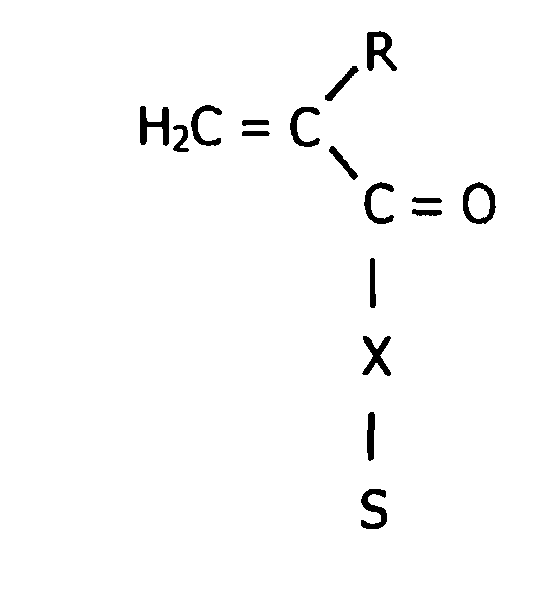
- Diese Aufgabe wird durch eine gegebenenfalls vernetzte Polymerzusammensetzung gelöst, die zumindest ein Polymer auf Basis von nichtionischen hydrophilen Acrylaten und/oder Methacrylaten enthält. Nichtionische hydrophile Acrylate und/oder Methacrylate entsprechen vorzugsweise der allgemeinen Formel:
- Die erfindungsgemäßen Polymere müssen nicht ausschließlich aus den nichtionischen hydrophilen Acrylaten oder Methacrylaten als Monomereinheiten aufgebaut sein, sondern können zusätzlich weitere Monomerbausteine enthalten, bei denen es sich um übliche Acrylsäureester, Acrylsäureamide und gegebenenfalls substituierte Derivate dieser (Meth)acrylsäurederivate handelt. Als Comonomere können auch Acrylsäurederivate mit ionischen funktionellen Gruppe in gewissen Mengen toleriert werden.
- Erfindungsgemäß werden vorzugsweise solche Polymere bereitgestellt, bei denen die nichtionischen hydrophilen Acrylate und/oder (Meth)acrylate einen molaren Anteil von mindestens 30 % ausmachen.
- Üblicherweise können die erfindungsgemäßen Polymere als lineare oder verzweigte Polymere oder Copolymere mit einem gewichtsmittleren Molekulargewicht von 50.000 bis 5.000.000 vorliegen.
- Erfindungsgemäß können auch nichtionische hydrophile Acrylate oder Methacrylate eingesetzt werden, die unterschiedliche Polymerisationsgrade in der Seitenkette aufweisen.
- Um den vielfältigen Anforderungen in der Praxis zu genügen, ist es üblicherweise erforderlich, die erfindungsgemäßen Polymere zu vernetzen. Als Vernetzer kommen üblicherweise hydrophile Vernetzer in Frage wie beispielsweise Diacrylate, Triacrylate, Dimethacrylate oder Trimethacrylate bzw. deren Amidderivate. Die Vernetzer werden in einer Menge von bis zu 25 Gew.-%, bevorzugt zwischen 0,01 und 10 Gew.-%, besonders bevorzugt zwischen 0,05 und 2 Gew.-%, jeweils bezogen auf die Polymerzusammensetzung (ohne Zusatzstoffe) eingesetzt. Idealerweise wird die Polymerzusammensetzung so vernetzt, dass die Acrylateinheiten über ein Ethylenglykol oder Polyethylenglykoleinheit oder einen mehrfunktionellen Alkohol, ausgewählt aus der Gruppe von Ethylenglykoldimethacrylat, Triethylenglykoldimethacrylat, Trimethylolpropantrimethacrylat, 1,3-Butylenglykol-Dimethacrylat oder N,N'-Methylenbisacrylamid miteinander verbunden sind. Besonders vorteilhafte Eigenschaften ergeben sich, wenn als Monomer Methoxypolyethylenglykolmethacrylat, Hydroxypolyethylenglykolmethacrylat, Methoxypolyethylenglykolacrylat oder Hydroxypolyethylenglykolacrylat, sowie Mischungen, insbesondere mit einer Molmasse des Polyethylenglykols von 200 bis 15.000, vorzugsweise 300 bis 6.000, eingesetzt werden.
- Als Polymerisationsverfahren können die üblichen Verfahren eingesetzt werden. Vorteilhafte Verfahren sind die inverse Suspensionspolymerisation und die Polymerisation in Substanz oder Lösung. Je nach Bedarf und gewählter Methode kann mit oder ohne Lösungsmittel gearbeitet werden. Die Reaktionstemperaturen liegen üblicherweise bei 0 bis 250 °C, bevorzugt bei Temperaturen von 15 bis 150 °C. In einigen Fällen kann es vorteilhaft sein, die Reaktion in der Schmelze, d.h. mit vollständig oder teilweise geschmolzener Reaktionsmischung, durchzuführen. Das Polymerisationsprodukt kann in Form eines Gels vorliegen oder in Form eines Feststoffes. Falls ein Gel vorliegt, kann dies gegebenenfalls getrocknet und zermahlen werden.
- Nach einer besonders bevorzugten Ausführungsform der vorliegenden Erfindung werden die vernetzten nichtionischen hydrophilen Polymere, wie vorstehend beschrieben, als teilchenförmiges wasseraufnehmendes oder wasserquellendes Material bereitgestellt. Die mittlere Teilchengröße beträgt üblicherweise 5 bis 5.000 µm, vorzugsweise 25 bis 1.000 µm und besonders bevorzugt 100 bis 800 µm (Durchmesser).
- Das erfindungsgemäße Material kann zusätzlich weitere Bestandteile enthalten, die bei dem jeweils gewünschten Einsatzgebiet von Bedeutung sein können. Hierbei kann es sich beispielsweise um Gleitmittel, Alterungsschutzmittel, Farbstoffe, Treibmittel, Weichmacher, Vernetzungsmittel für Kautschuk, Vernetzungsbeschleuniger, Aktivatoren, Verzögerer, Vernetzungsmittel für Elastomere usw. handeln. Darüber hinaus können Füllstoffe vorliegen, wie gefällte und/oder pyrogene Kieselsäure, Silicate, Sand, Mineralmehl wie Quarz, Talkum, Glimmer, Kreide, Kaolin, Leichtspat, Kalk, Dolomit, Basalt, Kieselgur, Baryt, Feldspat, Ruße, polymerer Hohlkugelpigmente, Holz, Holzmehl, Gummimehlstaub und quellfähige anorganische Tone wie Bentonite und derivatisierte Bentonite. Darüber hinaus können Polysaccharide, insbesondere Stärke, Stärkederivate, Cellulose, Amylose, Amylopektin, Dextrane, Pektine, Inulin, Chitin, Xanthan, Alginsäure, Alginate, Caragenaan und ähnliche Verbindungen eingesetzt werden. Als Weichmacher können Mineralöl, paraffinischer, naphthenischer oder aromatischer Natur, Esterweichmacher wie Dioctylphthalat, auf Adipaten, Sebacaten basierende Esterweichmacher, Phosphorsäureester, Stearinsäure, Palmitinsäure, Rizinusöl, Baumwollsaatöl, Rapsöl, aber auch polymere Weichmacher, wie beispielsweise niedermolekulare Kautschuke verwendet werden.
- Die Erfindung richtet sich auch auf die Verwendung der gegebenenfalls vernetzten Polymerzusammensetzung als Betonzusatzmittel. Die vernetzte Polymerzusammensetzung kann bei der Herstellung und Verarbeitung von Beton zugemischt werden. Dadurch lassen sich insbesondere die Fließ-, Abbinde- sowie Aushärteeigenschaften der Betonmischung besser an die Erfordernisse der Praxis anpassen. Darüber hinaus kann die vernetzte Polymerzusammensetzung auch zu Stabilisierungszwecken oder als Quellsprengmittel in Betonzubereitungen verwendet werden. Es hat sich gezeigt, dass die Polymere für den hier diskutierten Einsatzzweck auch unvernetzt vorliegen können.
- Als weitere Ausführungsform der vorliegenden Erfindung wird eine wasserquellende Dichtungszusammensetzung bereitgestellt, die neben einer Matrix ein darin verteiltes, teilchenförmiges Material, wie vorstehend beschrieben, umfasst. Ein solches Dichtungsmaterial kann beispielsweise als eine vorgeformte Dichtung vorliegen, d.h. als Endlosprofil, Band oder Rundschnur. Vorzugsweise handelt es sich bei der Matrix in einem solchen Fall um ein Kautschuk oder ein Elastomer.
- Als Kautschuk können Nitrilkautschuk, hydrierter Nitrilkautschuk, Ethylen-Propylen-Kautschuk, Ethylen-Propylen-Dien-Kautschuk, Copolymere aus Vinylacetat und Ethylen, sowie Terpolymere aus Ethylen, Propylen, und nicht konjugierten Dienen, natürliche Gummimischungen, Polybutadien, Polyisobutylen, Butylkautschuk, halogenierter Butylkautschuk, Copolymere aus Butadien mit einem oder mehreren polymerisierbaren, ethylenartigen ungesättigten Monomeren, wie z.B. Styrol, Acetonitril, Methylmethacrylat, Polyacrylate, Polyether und Polymere substituierter Butadiene, wie z.B. Chlorbutadien und Isopren, sowie Mischungen verschiedener Kunststoffe erwähnt werden. Die matrixbildenden Kautschuke können zusätzlich zu Elastomeren vernetzt bzw. vulkanisiert sein. Vorzugsweise besteht die Matrix aus vulkanisiertem Naturkautschuk, vulkanisiertem cis-1,4-Polyisoprenkautschuk, vulkanisiertem Polybutadien, vulkanisierten statistisch copolymerisierte-Styrol-Dienkautschuken, vulkanisiertem Acrylatkautschuk, vulkanisierten Acrylnitril-Dientkautschuken, vulkanisiertem Ethylen-Propylen-Kautschuk, vulkanisiertem Isobutylen-Isoprenkautschuk, vulkanisiertem Ethylen-Propylen-Dienkautschuk, vulkanisiertem Epichlorhydrinkautschuk, vulkanisiertem Siliconkautschuk, vulkanisiertem Polysulfidkautschuk, vernetztem Poylurethan- sowie vernetzten thermoplastischen Elastomeren.
- Geeignete Vernetzungsmittel oder Vulkanisationsmittel für Kautschuk und Vernetzungsmittel für Elastomere sind die dafür üblichen, d.h. z.B. Schwefel, Schwefelverbindungen, Peroxide oder dergleichen.
- Besonders vorteilhaft ist es, die erfindungsgemäßen wasserquellenden Dichtungszusammensetzungen aufzuschäumen. Dies erfolgt mittels an sich bekannter Maßnahmen, beispielsweise mit Hilfe von Treibmitteln wie Wasser, Ammoniumbicarbonat, Natriumbicarbonat oder organischen Treibmitteln, wie beispielsweise Sulfohydraziden oder Azodicarbonamiden. Es können sowohl offenporige Schäume als auch geschlossenporige Schäume hergestellt werden. Besonders bevorzugt wird eine offenporige Schaumstruktur mit einer Dichte von 0,4 bis 2 g/cm3, ganz besonders bevorzugt von etwa 0,7 g/cm3.
- Im Falle von pastösen oder flüssigen Dichtungsmassen, die erst an der Luft durch Feuchtigkeit aushärten, wird die Matrix regelmäßig durch unvernetzte Silikonöle, Polysulfide und/oder Polyurethanvorpolymere gebildet. Solche Materialien härten unter Feuchtigkeitseinfluss regelmäßig zu Polymeren mit elastomeren Eigenschaften aus. Ferner kann im Fall von pastösen oder flüssigen Dichtungsmassen eine Matrix verwendet werden, die aus zwei Komponenten besteht und nach dem Vermischen der Komponenten aushärtet.
- Gegenüber bekannten Polymerzusammensetzungen bzw. wasserquellenden Dichtungszusammensetzungen haben die erfindungsgemäßen Zusammensetzungen den Vorteil, dass das Quellvermögen gegenüber elektrolythaltigem Wasser, z.B. Meerwasser oder Zementwasser einerseits, und in Wasser mit sehr geringem Elektrolytgehalt, wie z.B. Regenwasser andererseits, vergleichbar sein kann. In stark salzhaltigen Wässern und besonders solchen mit mehrwertigen Ionen ist die Quellung häufig besser als mit üblichen Superabsorbern oder wasserquellenden Dichtungsmassen nach dem Stand der Technik. Für die Praxis bedeutet dies, dass die erfindungsgemäßen Zusammensetzungen mehrere Anforderungsprofile gleichzeitig erfüllen. Darüber hinaus bleibt das Quellvermögen der erfindungsgemäßen Zusammensetzung auch dann nahezu erhalten, wenn mehrere Nass-Trocken-Zyklen durchlaufen werden.
- Häufig lassen sich den erfindungsgemäßen Zusammensetzungen noch bekannte Superabsorber hinzufügen.
- Anhand von Untersuchungen konnte gezeigt werden, dass erfindungsgemäße Dichtungsmassen (hier sogenannte Quellgummis) nicht nur eine verbesserte Aufnahme bzw. Quellung gegenüber elektrolythaltigem Wasser, sondern auch gegenüber wiederholten Nass-Trocken-Zyklen mit elektrolythaltigem Wasser eine Beständigkeit der Quelleigenschaften zeigen.
- Die verbesserte Aufnahme bzw. Quellung gegenüber elektrolythaltigem Wasser zeigt sich bereits bei sehr geringem Elektrolytgehalt, d.h. etwa bei einem Salzgehalt von unter 0,5 Gew.-%, insbesondere bei wiederholten Naß-Trocken-Zyklen. Dichtungsmassen nach dem Stand der Technik zeigen nämlich bereits nach wenigen Zyklen, insbesondere wenn das elektrolythaltige Wasser zwei- oder dreiwertige Ionen enthält, eine deutlich verschlechterte Quellfähigkeit. Bei erfindungsgemäßen Produkten zeigt sich regelmäßig eine Verbesserung hinsichtlich der Quellfähigkeiten bei wiederholten Nass-Trocken-Zyklen. Die besonderen Eigenschaften der erfindungsgemäßen Produkte findet man aber auch bereits bei einmaliger Quellung mit elektrolythaltigem Wasser, das einen besonders hohen Salzgehalt aufweist, insbesondere bei Meerwasser mit einem Elektrolytgehalt von mehr als 1 Gew.-% bis hin zu 2 oder 4 Gew.-% (überwiegend einwertige Ionen neben einem kleineren Anteil zweiwertiger Ionen). Gegenüber vielen Produkten des Standes der Technik zeigen die erfindungsgemäßen Zusammensetzungen eine verbesserte Wasseraufnahme, wenn eine Dichtungszusammensetzung in Kontakt gebracht wird mit Meerwasser.
- Diese Vorteile zeigen sich ganz besonders bei geschäumten Quellgummis.
- Je nach eingesetzter Menge der Füllstoffe liegt die Dichte der aufgeschäumten Quellgummis im Bereich zwischen 0.01 g/cm3 und 2.0 g/cm3. Als Füllstoffe können vor allem verwendet werden: gefällte und/oder pyrogene Kieselsäure, Silicate, Sand, Mineralmehl wie Quarz, Talkum, Glimmer, Kreide, Kaolin, Leichtspat, Kalk, Dolomit; Basalt, Kieselgur, Baryt, Feldspat, Ruße, polymerer Hohlkugelpigmente, Holz, Holzmehl, Gummimehlstaub sowie quellfähige anorganische Tone wie Bentonite und derivatisierte Bentonite. Darüber hinaus können Polysaccharide, insbesondere Stärke, Stärkederivate, Cellulose, Amylose, Amylopektin, Dextrane, Pektine, Inulin, Chitin, Xanthan, Alginsäure, Alginate, Carrageenan und ähnliche Verbindungen eingesetzt werden.
- Zur Verzögerung der Aufquellung oder für andere Zwecke, wie z.B. verbesserte mechanische Eigenschaften, verbesserte Beständigkeit gegenüber Chemikalien wie z.B. organischen Lösungsmitteln, Säuren und Laugen, können auf die erfindungsgemäßen geformten Dichtungszusammensetzungen Beschichtungen aufgebracht werden. Diese Beschichtungen sind in der Regel zwischen 5 und 500 µm, bevorzugt zwischen 20 und 300 µm. Ein solcher Überzugsfilm kann auf verschiedene Weise erhalten werden. Beispielsweise durch Beschichten in einem Tauchbad oder Besprühen. In der Praxis besonders vorteilhaft sind Mehrkomponentensysteme, welche sich aus zwei oder mehr Gummis mit unterschiedlichen Eigenschaften (einschließlich Kombinationen von Gummis mit mindestens einem Quellgummi oder Kombinationen unterschiedlicher Quellgummis) zusammensetzen lassen. Mit solchen Mehrkomponentensystemen ist es beispielsweise möglich, äußerst leistungsfähige Dichtungen herzustellen. Gegenüber bekannten Quellgummizusammensetzungen haben die erfindungsgemäßen Quellgummis den Vorteil, dass das Quellvermögen gegenüber elektrolythaltigen Wasser, z.B. Meerwasser oder Zementwasser einerseits, und in Wasser mit sehr geringem Elektrolytgehalt, wie z.B. Regenwasser, vergleichbar sein kann. Diese Eigenschaft macht es möglich eine größere Menge Superabsorber in die Elastomermatrix einzuarbeiten, denn bei konventionellen Superabsorbern kann es in Folge eines zu hohen Quelldrucks zu einem Zerfall der Quellgummis bei einem sehr hohen Anteil derselben kommen.
- In einem 250 ml-Becherglas werden 9,5 g Methoxy-Polyethylenglykol-5000-Methacrylat (MPEG-5000-MA; Röhm AG) sowie 0,5 g Hydroxyethylmethacrylat (HE-MA) und 0,5 g Ethylenglykoldimethacrylat (EGDMA) vorgelegt und dann 100 g Hydrauliköl hinzugegeben. Die Mischung wird unter Rühren mit einer Dissolverscheibe (350-500 Upm) auf 130°C erwärmt, bis das MPEG-5000-MA nach 5-10 min geschmolzen ist. Dann werden 0,4 g Azobisisobutyronitril (AIBN) zugegeben und die Mischung 2 h bei 130°C reagieren gelassen. Nach anschließendem Abkühlen wird der entstandene Niederschlag über eine Fritte abgetrennt, mehrmals mit Petrolether gewaschen und 1 Tag bei 50°C getrocknet. Es bleibt ein feinkörniges Produkt zurück.
- 100 g einer 75 %-igen wässrigen Lösung von Methoxy-Polyethylenglykol-2000-Methycrylat (MPEG-2000-MA, Bisomer S20W, Laporte) und 0,118 g Trimethylolpropantrimethacrylat (TMPTMA) sowie 2 g einer 25 %-igen Triethanolaminlösung werden in einem leeren Joghurtbecher vorgelegt. Dann werden 100 g einer frisch angesetzten 2,5 %-igen Natriumperoxodisulfat (NPS)-Lösung hinzugegeben und die Stoffe gut vermischt. Nach 60 min hat sich ein Gel gebildet, welches dem Becher entnommen wird und nach Zerreiben 2 Tage bei 50°C getrocknet wird. Das so getrocknete Produkt wird auf eine Korngröße kleiner 0,8 mm gemahlen; größere Partikel werden abgesiebt.
-
- Auf einem Laborwalzwerk, Hersteller: Schwabenthan, Berlin, wurde die Kautschukmischung für das Dichtungsmaterial hergestellt, wobei das Verhältnis der Drehzahlen von hinterer zu vorderer Walze (Friktion) ca. 1,2 betrug. Die vordere Walze drehte mit ca. 12 U/min; Walzentemperatur: 60 °C, Mastifikationszeit: 5-30 min.
- 100 Teile Naturkautschuk (SMR, Uniroyal Aachen) wurde bei einer Walzenbreite von ca. 3 mm auf die Walze gegeben. Der Walzenspalt wurde so lange verengt, bis ein zusammenhängendes Fell um die vordere Walze läuft. Zum beschleunigten Mastifizieren wurde der Kautschuk wiederholt mit einem Messer eingeschnitten. Die Mastifikation baute den Kautschuk ab und brachte damit die notwendige Konsistenz.
- Nach der Mastifikation wurden 1,5 Teile Zinkoxid (aktiv), 2,5 Teile Schwefel (90 % kristallin), 0,1 Teile Dibenzothiozyldisulfid (Vulkazit DM, Bayer AG, Leverkusen), 1,2 Teile Zink-Diethyldithiocarbamat (Vulkazit LDA, Bayer AG, Leverkusen), 0,4 Teile Tetramethylthiuramdisulfid (Vulkazit Thiuram, Bayer AG, Leverkusen), 1 Teil Stearinsäure und 7,5 Teile Porofor TSH Paste (Schaumbildner, Bayer AG, Leverkusen) sowie 2 Teile Chromoxidgrün GX Standard eingemischt.
- Anschließend werden zu 50 Teilen dieser Kautschukmischung 25 Teile Kartoffelstärke (Fa. Müllers Mühle) und 25 Teile Superabsorber aus Beispiel 2, die vorher vermischt wurden, in Portionen eingemischt, wobei jeweils abgewartet wurde, bis die jeweilige Kartoffelstärke-Superabsorbermenge vom Kautschuk aufgenommen war. Das Fell wird bei einem Walzenspalt von 3 mm abgezogen.
- Die so gewonnenen Felle werden in ca. 1 - 1,5 cm breite Streifen geschnitten. Drei davon werden aufeinandergedrückt und in eine ca. 50 cm lange Schiene mit einem Querschnitt von 2 cm X 2 cm eingelegt. Die Form wird verschlossen und für 30 min bei 100 °C in den Ofen gelegt. Danach wird der Ofen auf 160°C (Dauer ca. 30 min) aufgeheizt. Anschließend wird die Form aus dem Ofen genommen, kurz abgekühlt und das Band aus der Form entnommen. Die so gewonnenen Abdichtbänder weisen eine Rohdichte von 0,81 g/cm3 auf. Sie weisen nach 6 Tagen eine Quellung von 130 Vol.-% in 4%-iger wässriger Kochsalzlösung und von 167 Vol.-% in gesättigter wässriger Ca(OH)2-Lösung (10 g/l) auf und nach 14 Tagen eine Quellung von 157 Vol.-% in 4%-iger wässriger Kochsalzlösung und von 200 Vol.-% in gesättigter wässriger Ca(OH)2-Lösung (10 g/l).
- Die nach Beispiel 3a) gewonnenen Felle werden in einen Extruder Fa. Brabender, Duisburg, eingeführt, wobei sämtliche Heizzonen und die Düse auf 80°C eingestellt sind. Die Düse hatte einen Durchmesser von 3 mm, der Zylinder von 2,1 cm. Die Schnecke wurde mit 50 U/min gedreht. Das wurstförmige Extrudat wurde im Ofen für 30 min bei 100°C geschäumt und anschließend bei 160°C vulkanisiert.
- Analog Beispiel 3 wurden Abdichtbänder hergestellt, jetzt allerdings mit 11 Teilen Kartoffelstärke und 50 Teilen Superabsorber aus Beispiel 2. Die so gewonnenen Abdichtbänder weisen eine Rohdichte von 0,75 g/cm3 auf. Sie weisen nach 4 Tagen eine Quellung von 186 Vol-% in 4 %-iger wässriger Kochsalzlösung und von 230 Vol-% in gesättigter wässriger Ca(OH)2-Lösung (10 g/l) auf. Nach 14 Tagen weisen sie eine Quellung von 229 Vol-% in 4 %-iger wässriger Kochsalzlösung und von 300 Vol-% in gesättigter wässriger Ca(OH)2-Lösung (10 g/l) auf. Es zeigt sich, daß durch Erhöhen des Anteils des nach Beispiel 2 hergestellten Superabsorbers unter gleichzeitigem Reduzieren des Stärkeanteils die Quellung stark erhöht werden kann. Die Reißdehnung des Abdichtmaterials liegt bei 531 %.
- 25 g Hydroxyethylmethacrylat, 200 g MPEG-2000-MA, 2,5 g Etylenglykoldimethacrylat, 30 g einer wässrigen 25 %-igen Triethanolamin T85 (BASF)-Lösung, 25 g einer 40%-igen wässrigen Magnesiumacrylatlösung sowie 191,5 g Stärke werden in einem Becherglas vorgelegt. Dazu wird eine frisch angesetzte Lösung von 5 g Natriumperoxodisulfat in entionisiertem Wasser hinzugegeben und die Stoffe gut vermischt. Nach 1 h Reaktionszeit wird die Masse entnommen und bei 50°C im Umlufttrockenschrank getrocknet. Das sehr harte Material wird anschließend in der Kugelmühle auf Korngrößen unterhalb 1 mm zerkleinert.
- Auf einem Laborwalzwerk, Hersteller: Schwabenthan, Berlin, wurde, bei einer Walzentemperatur von 70°C für die vordere Walze und 60°C für die hintere Walze, 50 g des vorher zerkleinerten EPDM-Kautschuks (Typ EPT 6250, Bayer AG) auf die Walzen gegeben und der Walzenspalt nach und nach auf 3 mm verringert, sowie der Kautschuk als Fell abgezogen. Anschließend wurden 50 g Naturkautschuk auf die Walzen gegeben, langsam erwärmt und der Walzenspalt verringert, bis sich ein Fell abziehen lässt. Sobald sich ein homogenes Fell gebildet hatte, wurden 4 g Dioctylphthalat zugetropft und anschließend der EPDM-Kautschuk portionsweise zugegeben. Dabei wird das Fell immer wieder eingeschnitten und eingeschlagen durch die Walzen geführt.
- Dann wurden 1,893 g Dicumylperoxid (Merck AG), 5 g Porofor TSH (p-Toluolsulfonsäurehydrazid, Rhein Chemie Rheinbau GmbH) und 125 g des Superabsorbers aus Beispiel 6 zugemischt.
- Ca. 75 g des Felles werden in einer Fläche von 14 cm x 14 cm ausgeschnitten und in eine Form mit den gleichen Maßen 14 cm x 14 cm x 0,5 cm gelegt. Die Form wird geschlossen und zwischen die Platten einer Presse gelegt. Dann wird die Kautschukmischung eine halbe Stunde bei 100°C geschäumt (bei einem Schließdruck für die Form von 100 bar) und anschließend 2 Stunden bei 160°C vulkanisiert. Nach Entnahme und Abkühlen der Form wird der geschäumte Gummi aus der Form genommen. Die so gewonnenen Quellgummis weisen eine Rohdichte von 0,5 - 0,9 g/cm3 auf, sowie hinsichtlich der Masse eine Quellung in 4 %-iger wässriger Kochsalzlösung von 132 % nach 14 Tagen. Es zeigt sich, dass beim Einmischen eines stärkehaltigen Superabsorbers auch ohne Einmischen eines Polysaccharids in die Gummimischung eine hohe Quellrate erzielt wird.
- Auf einem Laborwalzwerk, Hersteller: Schwabenthan, Berlin, wurde bei einer Walzentemperatur von 70°C für die vordere Walze und 60°C für die hintere Walze 50 g des vorher zerkleinerten EPDM-Kautschuks (Typ EPT 6250, Bayer AG) auf die Walzen gegeben und der Walzenspalt nach und nach auf 3 mm verringert sowie der Kautschuk als Fell abgezogen. Anschließend wurden 50 g Naturkautschuk auf die Walzen gegeben, langsam erwärmt und der Walzenspalt verringert, bis sich ein Fell abziehen lässt. Sobald sich ein homogenes Fell gebildet hatte, wurden 4 g Dioctylphthalat zugetropft und anschließend der EPDM-Kautschuk portionsweise zugegeben. Dabei wird das Fell immer wieder eingeschnitten und eingeschlagen durch die Walzen geführt.
- Dann wurden 1,4 g Dicumylperoxid (Merck AG), 5 g Porofor TSH (p-Toluolsulfonsäure-hydrazid, Rhein Chemie Rheinbau GmbH) und 125 g des Superabsorbers aus Beispiel 6 zugemischt.
- Ca. 75 g des Felles werden in einer Fläche von 14 cm x 14 cm ausgeschnitten und in eine Form mit den gleichen Maßen 14 cm x 14 cm x 0,5 cm gelegt. Die Form wird geschlossen und zwischen die Platten einer Presse gelegt. Dann wird die Kautschukmischung eine halbe Stunde bei 100°C geschäumt bei einem Schließdruck für die Form von 100 bar und anschließend 2 Stunden bei 160°C vulkanisiert. Nach Entnahme und Abkühlen der Form wird der geschäumte Gummi aus der Form genommen. Die so gewonnenen Quellgummis weisen eine Rohdichte von 0,5 - 0,9 g/cm3 auf sowie hinsichtlich der Masse eine Quellung in 4 %-iger wässriger Kochsalzlösung von 176 % nach 4 Tagen. Es zeigt sich, dass eine geringere Vulkanisation zu einem höheren Quellgrad im Quellgummi führt.
- Analog Beispiel 3 wurden Abdichtbänder hergestellt, jetzt allerdings mit 63 Teilen Superabsorber aus Beispiel 2 und ohne Stärke. Die so gewonnenen Abdichtbänder weisen eine Rohdichte von 0,84 g/cm3 auf. Sie weisen nach 5 Tagen eine Quellung von 400 Vol.-% in entionisiertem Wasser, von 300 Vol.-% in Meerwasser nach ASTM D 1141-98 und von 375 Vol.-% in gesättigter wässriger Ca(OH)2-Lösung (10 g/l) auf. Es zeigt sich, dass die so gewonnenen Abdichtbänder in Medien mit sehr unterschiedlichem Elektrolytgehalt ähnliche Quellraten aufweisen. Ferner werden durch das Weglassen der Stärke und die damit mögliche starke Erhöhung des Superabsorbers aus Beispiel 2 in kurzer Zeit extrem hohe Quellraten in elektrolythaltigen Wässern erreicht.
Claims (6)
- Wasserquellende Dichtungszusammensetzung umfassend eine durch Kautschuke gebildete Matrix und ein darin verteiltes teilchenförmiges Material mit einem Teilchendurchmesser von 5 bis 5000 µm,
wobei das Material eine vernetzte Polymerzusammensetzung umfasst, die zumindest ein Polymer enthält, bei dem der Anteil der von nichtionischen hydrophilen Acrylaten oder Methacrylaten abgeleiteten Monomereinheiten mindestens 30 Mol-% ausmacht, wobei die nichtionischen hydrophilen Acrylate oder Methacrylate der allgemeinen Formel
- Dichtungszusammensetzung nach Anspruch 1, wobei der Kautschuk zu einem Elastomer bzw. Gummi vulkanisiert oder vernetzt ist.
- Dichtungszusammensetzung gemäß Anspruch 1 oder 2, wobei m = 5 bis 200.
- Dichtungszusammensetzung gemäß eines beliebigen der Ansprüche 1 bis 3, wobei eine offenporige Schaumstruktur mit einer Dichte von 0,4 bis 2 g/cm3 vorliegt.
- Dichtungszusammensetzung gemäß eines beliebigen der Ansprüche 1 bis 4, wobei das Material eine mittlere Teilchengröße von 100 bis 800 µm aufweist.
- Verwendung einer wasserquellenden Dichtungszusammensetzung gemäß eines beliebigen der voranstehenden Ansprüche als Dichtungs- und Absorptionsmaterial gegenüber elektrolythaltigem Wasser bei wiederholten Nass-Trocken-Zyklen.
Applications Claiming Priority (3)
| Application Number | Priority Date | Filing Date | Title |
|---|---|---|---|
| DE10314599 | 2003-03-31 | ||
| DE10314599A DE10314599A1 (de) | 2003-03-31 | 2003-03-31 | Verwendung einer vernetzten Polymerzusammensetzung als wasseraufnehmende Komponente in Dichtungs- und Absorptionsmaterialien |
| PCT/EP2004/003006 WO2004087603A1 (de) | 2003-03-31 | 2004-03-22 | Verwendung einer vernetzten polymerzusammensetzung als wassseraufnehmende komponente in dichtungs- und absorptionsmaterialien sowie als betonzusatz |
Publications (2)
| Publication Number | Publication Date |
|---|---|
| EP1608602A1 EP1608602A1 (de) | 2005-12-28 |
| EP1608602B1 true EP1608602B1 (de) | 2007-03-07 |
Family
ID=33016096
Family Applications (1)
| Application Number | Title | Priority Date | Filing Date |
|---|---|---|---|
| EP04722284A Expired - Lifetime EP1608602B1 (de) | 2003-03-31 | 2004-03-22 | Verwendung einer vernetzten polymerzusammensetzung als wassseraufnehmende komponente in dichtungs- und absorptionsmaterialien |
Country Status (6)
| Country | Link |
|---|---|
| US (1) | US20070100028A1 (de) |
| EP (1) | EP1608602B1 (de) |
| AT (1) | ATE356099T1 (de) |
| DE (2) | DE10314599A1 (de) |
| ES (1) | ES2281789T3 (de) |
| WO (1) | WO2004087603A1 (de) |
Families Citing this family (9)
| Publication number | Priority date | Publication date | Assignee | Title |
|---|---|---|---|---|
| CA2541975A1 (en) * | 2006-04-24 | 2007-10-24 | Hugomark Investments Inc. | Composition for, and method of, sealing cracks in concrete |
| US8181708B2 (en) * | 2007-10-01 | 2012-05-22 | Baker Hughes Incorporated | Water swelling rubber compound for use in reactive packers and other downhole tools |
| EP2247671A1 (de) * | 2008-02-26 | 2010-11-10 | Sto Ag | Masse mit steuerbaren poren, enthaltend wasser und quellbare teilchen |
| DE102008030712A1 (de) * | 2008-06-27 | 2009-12-31 | Construction Research & Technology Gmbh | Zeitverzögerte superabsorbierende Polymere |
| CN101649180A (zh) * | 2009-08-03 | 2010-02-17 | 上海华化塑胶有限公司 | 耐油性可发泡端盖密封材料及其制备方法 |
| WO2014172598A2 (en) * | 2013-04-19 | 2014-10-23 | Polymerium, Llc | Polymeric concrete admixture containing a new class of superplasticizer polymers |
| WO2020209057A1 (ja) * | 2019-04-09 | 2020-10-15 | 株式会社日本触媒 | セメント用添加剤、セメント混和剤、セメント組成物、成形体、および成形体の強度向上方法 |
| CN116348431A (zh) | 2020-10-28 | 2023-06-27 | 宝洁公司 | 包含回收的超吸收聚合物的胶结组合物 |
| CN112661446B (zh) * | 2020-12-22 | 2022-09-13 | 中建四局安装工程有限公司 | 一种防渗、抗开裂混凝土及其制备方法 |
Family Cites Families (12)
| Publication number | Priority date | Publication date | Assignee | Title |
|---|---|---|---|---|
| JPS61225249A (ja) * | 1985-03-29 | 1986-10-07 | Toyoda Gosei Co Ltd | 水膨潤性組成物 |
| US5011875A (en) * | 1985-09-28 | 1991-04-30 | Hiroshima Kasei Ltd. | Corrosion resistant, water expandable composition |
| JPH08312786A (ja) * | 1995-05-16 | 1996-11-26 | Yuusan Gasket Kk | ガスケット材 |
| DE19540951A1 (de) * | 1995-11-03 | 1997-05-07 | Basf Ag | Wasserabsorbierende, schaumförmige, vernetzte Polymerisate, Verfahren zu ihrer Herstellung und ihre Verwendung |
| DE19646484C2 (de) * | 1995-11-21 | 2000-10-19 | Stockhausen Chem Fab Gmbh | Flüssigkeitsabsorbierende Polymere, Verfahren zu deren Herstellung und deren Verwendung |
| DE19630949C2 (de) * | 1996-07-31 | 2000-08-24 | Murjahn Amphibolin Werke | Akustikputz |
| US6084011A (en) * | 1997-08-29 | 2000-07-04 | Lucero; Richard F. | Freeze/thaw resistant cementitious adhesive for composite materials and method for production thereof |
| DE19800489A1 (de) * | 1998-01-09 | 1999-07-15 | Thomas Prof Dr Mang | Polysaccharidhaltige Dichtungszusammensetzung |
| DE19806482A1 (de) * | 1998-02-17 | 1999-08-19 | Sueddeutsche Kalkstickstoff | Wasserlösliche oder wasserquellbare sulfogruppenhaltige Copolymere, Verfahren zu deren Herstellung und ihre Verwendung |
| DE19955839C1 (de) * | 1999-11-19 | 2001-03-01 | Hilti Ag | Verwendung von quellbare Füllstoffe enthaltenden Kunststoffschäumen zur Abdichtung von Mauerdurchführungen |
| MXPA02010603A (es) * | 2000-04-26 | 2003-03-10 | Nat Gypsum Properties Llc | Compuesto de union y metodo para hacer el mismo. |
| DE10231356B4 (de) * | 2002-07-11 | 2007-02-15 | Stockhausen Gmbh | Wasserabsorbierende, schaumförmige Polymergebilde, Verfahren zu deren Herstellung, deren Verwendung sowie daraus hergestellte Verbunde |
-
2003
- 2003-03-31 DE DE10314599A patent/DE10314599A1/de not_active Ceased
-
2004
- 2004-03-22 AT AT04722284T patent/ATE356099T1/de not_active IP Right Cessation
- 2004-03-22 WO PCT/EP2004/003006 patent/WO2004087603A1/de not_active Ceased
- 2004-03-22 US US10/551,226 patent/US20070100028A1/en not_active Abandoned
- 2004-03-22 ES ES04722284T patent/ES2281789T3/es not_active Expired - Lifetime
- 2004-03-22 EP EP04722284A patent/EP1608602B1/de not_active Expired - Lifetime
- 2004-03-22 DE DE502004003135T patent/DE502004003135D1/de not_active Expired - Lifetime
Also Published As
| Publication number | Publication date |
|---|---|
| EP1608602A1 (de) | 2005-12-28 |
| ATE356099T1 (de) | 2007-03-15 |
| US20070100028A1 (en) | 2007-05-03 |
| DE10314599A1 (de) | 2004-10-21 |
| DE502004003135D1 (de) | 2007-04-19 |
| WO2004087603A1 (de) | 2004-10-14 |
| ES2281789T3 (es) | 2007-10-01 |
Similar Documents
| Publication | Publication Date | Title |
|---|---|---|
| EP1044246B1 (de) | Wasserquellendes dichtungsmaterial | |
| EP1616906B1 (de) | Quellfähige Materialzusammensetzung und deren Verwendung | |
| AU672528B2 (en) | Method of improving the contaminant resistance of a smectite clay by rewetting and impregnating the clay with a water-soluble polymer, and redrying the polymer-impregnated clay | |
| DE60024678T2 (de) | Reifen der ein hydrophiles polymer enthält und dabei verwendete elastomerzusammensetzung | |
| EP1608602B1 (de) | Verwendung einer vernetzten polymerzusammensetzung als wassseraufnehmende komponente in dichtungs- und absorptionsmaterialien | |
| EP3684855B1 (de) | Kompositmaterial und seine verwendung | |
| EP4217326B1 (de) | Dachabdichtung und verwendung eines flüssig aufzubringenden reaktivdachabdichtungsmittels zur herstellung einer dachabdichtung | |
| DE3616883A1 (de) | Hydrophiles siliconverbundmaterial und seine herstellung | |
| DE69810590T2 (de) | Frostschutzmittel und Verfahren zur Verhinderung von Frost auf Strassenbelag | |
| EP1506979A1 (de) | Celluloseetherzusammensetzung für die Extrusion mineralischer Formkörper sowie ein Verfahren zur Extrusion mineralischer Formkörper unter Verwendung dieser Celluloseetherzusammensetzung | |
| WO2000078888A1 (de) | Wasserquellende dichtungsmassen | |
| DE69001409T2 (de) | Wasserquellbare Dichtung. | |
| DE102022106887A1 (de) | Verwendung eines flüssig aufzubringenden reaktivdachabdichtungsmittels zur herstellung einer dachabdichtung | |
| DE4214334A1 (de) | Dichtungsmittel das bei Kontakt mit Wasser durch Quellung sein Volumen vergrößert | |
| DE4226198A1 (de) | Dichtungsmaterial | |
| DE4124338A1 (de) | Durch wasser aufquellbare dichtungsmassen | |
| EP2247671A1 (de) | Masse mit steuerbaren poren, enthaltend wasser und quellbare teilchen | |
| EP0714965A1 (de) | Dichtungsmaterial aus Naturrohstoffen | |
| Natarajan | Water Responsive Mechano-adaptive Elastomer Composites based on Active Filler Morphology | |
| DE19720212A1 (de) | Wasserabsorbierendes oder wasserzurückhaltendes Material | |
| DE19954263A1 (de) | Zubereitung mit einem Gehalt an REA-Gips, Verfahren zu deren Herstellung und Verwendung der Zubereitung | |
| AT366356B (de) | Mischung zur herstellung eines zementgebundenen baustoffes, verfahren zu ihrer herstellung und daraus hergestellter baustoff | |
| DE1494313C (de) | Verfahren zur Herstellung wäßriger, Füllstoffe enthaltender Dispersionen aus Synthesekautschuk | |
| DE102005002122A1 (de) | Profil zur Abdichtung von Fugen in Beton mit einer schlauchartigen Hülle | |
| JPH08302078A (ja) | 低弾性率ゴム組成物 |
Legal Events
| Date | Code | Title | Description |
|---|---|---|---|
| PUAI | Public reference made under article 153(3) epc to a published international application that has entered the european phase |
Free format text: ORIGINAL CODE: 0009012 |
|
| 17P | Request for examination filed |
Effective date: 20050908 |
|
| AK | Designated contracting states |
Kind code of ref document: A1 Designated state(s): AT BE BG CH CY CZ DE DK EE ES FI FR GB GR HU IE IT LI LU MC NL PL PT RO SE SI SK TR |
|
| AX | Request for extension of the european patent |
Extension state: AL LT LV MK |
|
| GRAP | Despatch of communication of intention to grant a patent |
Free format text: ORIGINAL CODE: EPIDOSNIGR1 |
|
| RTI1 | Title (correction) |
Free format text: USE OF A CROSS-LINKED POLYMER COMPOSITION AS A WATER-ABSORBING CONSTITUENT IN SEALING AND ABSORPTION MATERIALS |
|
| GRAS | Grant fee paid |
Free format text: ORIGINAL CODE: EPIDOSNIGR3 |
|
| GRAA | (expected) grant |
Free format text: ORIGINAL CODE: 0009210 |
|
| AK | Designated contracting states |
Kind code of ref document: B1 Designated state(s): AT BE BG CH CY CZ DE DK EE ES FI FR GB GR HU IE IT LI LU MC NL PL PT RO SE SI SK TR |
|
| AX | Request for extension of the european patent |
Extension state: AL LT LV MK |
|
| PG25 | Lapsed in a contracting state [announced via postgrant information from national office to epo] |
Ref country code: PL Free format text: LAPSE BECAUSE OF FAILURE TO SUBMIT A TRANSLATION OF THE DESCRIPTION OR TO PAY THE FEE WITHIN THE PRESCRIBED TIME-LIMIT Effective date: 20070307 Ref country code: SI Free format text: LAPSE BECAUSE OF FAILURE TO SUBMIT A TRANSLATION OF THE DESCRIPTION OR TO PAY THE FEE WITHIN THE PRESCRIBED TIME-LIMIT Effective date: 20070307 |
|
| REG | Reference to a national code |
Ref country code: GB Ref legal event code: FG4D Free format text: NOT ENGLISH |
|
| REG | Reference to a national code |
Ref country code: SE Ref legal event code: TRGR |
|
| GBT | Gb: translation of ep patent filed (gb section 77(6)(a)/1977) |
Effective date: 20070307 |
|
| REG | Reference to a national code |
Ref country code: CH Ref legal event code: EP |
|
| REF | Corresponds to: |
Ref document number: 502004003135 Country of ref document: DE Date of ref document: 20070419 Kind code of ref document: P |
|
| REG | Reference to a national code |
Ref country code: IE Ref legal event code: FG4D Free format text: LANGUAGE OF EP DOCUMENT: GERMAN |
|
| PG25 | Lapsed in a contracting state [announced via postgrant information from national office to epo] |
Ref country code: PT Free format text: LAPSE BECAUSE OF FAILURE TO SUBMIT A TRANSLATION OF THE DESCRIPTION OR TO PAY THE FEE WITHIN THE PRESCRIBED TIME-LIMIT Effective date: 20070807 |
|
| LTIE | Lt: invalidation of european patent or patent extension |
Effective date: 20070307 |
|
| REG | Reference to a national code |
Ref country code: ES Ref legal event code: FG2A Ref document number: 2281789 Country of ref document: ES Kind code of ref document: T3 |
|
| PG25 | Lapsed in a contracting state [announced via postgrant information from national office to epo] |
Ref country code: SK Free format text: LAPSE BECAUSE OF FAILURE TO SUBMIT A TRANSLATION OF THE DESCRIPTION OR TO PAY THE FEE WITHIN THE PRESCRIBED TIME-LIMIT Effective date: 20070307 |
|
| REG | Reference to a national code |
Ref country code: IE Ref legal event code: FD4D |
|
| PG25 | Lapsed in a contracting state [announced via postgrant information from national office to epo] |
Ref country code: RO Free format text: LAPSE BECAUSE OF FAILURE TO SUBMIT A TRANSLATION OF THE DESCRIPTION OR TO PAY THE FEE WITHIN THE PRESCRIBED TIME-LIMIT Effective date: 20070307 Ref country code: CZ Free format text: LAPSE BECAUSE OF FAILURE TO SUBMIT A TRANSLATION OF THE DESCRIPTION OR TO PAY THE FEE WITHIN THE PRESCRIBED TIME-LIMIT Effective date: 20070307 |
|
| PLBE | No opposition filed within time limit |
Free format text: ORIGINAL CODE: 0009261 |
|
| STAA | Information on the status of an ep patent application or granted ep patent |
Free format text: STATUS: NO OPPOSITION FILED WITHIN TIME LIMIT |
|
| PG25 | Lapsed in a contracting state [announced via postgrant information from national office to epo] |
Ref country code: IE Free format text: LAPSE BECAUSE OF FAILURE TO SUBMIT A TRANSLATION OF THE DESCRIPTION OR TO PAY THE FEE WITHIN THE PRESCRIBED TIME-LIMIT Effective date: 20070307 Ref country code: DK Free format text: LAPSE BECAUSE OF FAILURE TO SUBMIT A TRANSLATION OF THE DESCRIPTION OR TO PAY THE FEE WITHIN THE PRESCRIBED TIME-LIMIT Effective date: 20070307 |
|
| 26N | No opposition filed |
Effective date: 20071210 |
|
| PG25 | Lapsed in a contracting state [announced via postgrant information from national office to epo] |
Ref country code: GR Free format text: LAPSE BECAUSE OF FAILURE TO SUBMIT A TRANSLATION OF THE DESCRIPTION OR TO PAY THE FEE WITHIN THE PRESCRIBED TIME-LIMIT Effective date: 20070608 |
|
| PGFP | Annual fee paid to national office [announced via postgrant information from national office to epo] |
Ref country code: FI Payment date: 20080331 Year of fee payment: 5 Ref country code: NL Payment date: 20080331 Year of fee payment: 5 |
|
| PGFP | Annual fee paid to national office [announced via postgrant information from national office to epo] |
Ref country code: CH Payment date: 20080421 Year of fee payment: 5 Ref country code: ES Payment date: 20080429 Year of fee payment: 5 Ref country code: LU Payment date: 20080402 Year of fee payment: 5 |
|
| PGFP | Annual fee paid to national office [announced via postgrant information from national office to epo] |
Ref country code: AT Payment date: 20080417 Year of fee payment: 5 |
|
| PGFP | Annual fee paid to national office [announced via postgrant information from national office to epo] |
Ref country code: BE Payment date: 20080522 Year of fee payment: 5 Ref country code: TR Payment date: 20080414 Year of fee payment: 5 Ref country code: MC Payment date: 20080414 Year of fee payment: 5 Ref country code: IT Payment date: 20080407 Year of fee payment: 5 |
|
| PGFP | Annual fee paid to national office [announced via postgrant information from national office to epo] |
Ref country code: SE Payment date: 20080418 Year of fee payment: 5 |
|
| PGFP | Annual fee paid to national office [announced via postgrant information from national office to epo] |
Ref country code: FR Payment date: 20080331 Year of fee payment: 5 |
|
| PGFP | Annual fee paid to national office [announced via postgrant information from national office to epo] |
Ref country code: GB Payment date: 20080429 Year of fee payment: 5 |
|
| PG25 | Lapsed in a contracting state [announced via postgrant information from national office to epo] |
Ref country code: EE Free format text: LAPSE BECAUSE OF FAILURE TO SUBMIT A TRANSLATION OF THE DESCRIPTION OR TO PAY THE FEE WITHIN THE PRESCRIBED TIME-LIMIT Effective date: 20070307 |
|
| PG25 | Lapsed in a contracting state [announced via postgrant information from national office to epo] |
Ref country code: CY Free format text: LAPSE BECAUSE OF FAILURE TO SUBMIT A TRANSLATION OF THE DESCRIPTION OR TO PAY THE FEE WITHIN THE PRESCRIBED TIME-LIMIT Effective date: 20070307 |
|
| PG25 | Lapsed in a contracting state [announced via postgrant information from national office to epo] |
Ref country code: BG Free format text: LAPSE BECAUSE OF FAILURE TO SUBMIT A TRANSLATION OF THE DESCRIPTION OR TO PAY THE FEE WITHIN THE PRESCRIBED TIME-LIMIT Effective date: 20070607 |
|
| BERE | Be: lapsed |
Owner name: MANG, THOMAS Effective date: 20090331 |
|
| PG25 | Lapsed in a contracting state [announced via postgrant information from national office to epo] |
Ref country code: HU Free format text: LAPSE BECAUSE OF FAILURE TO SUBMIT A TRANSLATION OF THE DESCRIPTION OR TO PAY THE FEE WITHIN THE PRESCRIBED TIME-LIMIT Effective date: 20070908 |
|
| PG25 | Lapsed in a contracting state [announced via postgrant information from national office to epo] |
Ref country code: AT Free format text: LAPSE BECAUSE OF NON-PAYMENT OF DUE FEES Effective date: 20090322 Ref country code: MC Free format text: LAPSE BECAUSE OF NON-PAYMENT OF DUE FEES Effective date: 20090331 Ref country code: FI Free format text: LAPSE BECAUSE OF NON-PAYMENT OF DUE FEES Effective date: 20090322 |
|
| REG | Reference to a national code |
Ref country code: CH Ref legal event code: PL |
|
| EUG | Se: european patent has lapsed | ||
| GBPC | Gb: european patent ceased through non-payment of renewal fee |
Effective date: 20090322 |
|
| NLV4 | Nl: lapsed or anulled due to non-payment of the annual fee |
Effective date: 20091001 |
|
| REG | Reference to a national code |
Ref country code: FR Ref legal event code: ST Effective date: 20091130 |
|
| PG25 | Lapsed in a contracting state [announced via postgrant information from national office to epo] |
Ref country code: LI Free format text: LAPSE BECAUSE OF NON-PAYMENT OF DUE FEES Effective date: 20090331 Ref country code: CH Free format text: LAPSE BECAUSE OF NON-PAYMENT OF DUE FEES Effective date: 20090331 |
|
| PG25 | Lapsed in a contracting state [announced via postgrant information from national office to epo] |
Ref country code: NL Free format text: LAPSE BECAUSE OF NON-PAYMENT OF DUE FEES Effective date: 20091001 Ref country code: BE Free format text: LAPSE BECAUSE OF NON-PAYMENT OF DUE FEES Effective date: 20090331 |
|
| PG25 | Lapsed in a contracting state [announced via postgrant information from national office to epo] |
Ref country code: FR Free format text: LAPSE BECAUSE OF NON-PAYMENT OF DUE FEES Effective date: 20091123 Ref country code: GB Free format text: LAPSE BECAUSE OF NON-PAYMENT OF DUE FEES Effective date: 20090322 |
|
| REG | Reference to a national code |
Ref country code: ES Ref legal event code: FD2A Effective date: 20090323 |
|
| PG25 | Lapsed in a contracting state [announced via postgrant information from national office to epo] |
Ref country code: ES Free format text: LAPSE BECAUSE OF NON-PAYMENT OF DUE FEES Effective date: 20090323 |
|
| PG25 | Lapsed in a contracting state [announced via postgrant information from national office to epo] |
Ref country code: IT Free format text: LAPSE BECAUSE OF NON-PAYMENT OF DUE FEES Effective date: 20090322 |
|
| PG25 | Lapsed in a contracting state [announced via postgrant information from national office to epo] |
Ref country code: LU Free format text: LAPSE BECAUSE OF NON-PAYMENT OF DUE FEES Effective date: 20090322 |
|
| PG25 | Lapsed in a contracting state [announced via postgrant information from national office to epo] |
Ref country code: SE Free format text: LAPSE BECAUSE OF NON-PAYMENT OF DUE FEES Effective date: 20090323 |
|
| REG | Reference to a national code |
Ref country code: DE Ref legal event code: R082 Ref document number: 502004003135 Country of ref document: DE |
|
| REG | Reference to a national code |
Ref country code: DE Ref legal event code: R084 Ref document number: 502004003135 Country of ref document: DE Effective date: 20120328 |
|
| PG25 | Lapsed in a contracting state [announced via postgrant information from national office to epo] |
Ref country code: TR Free format text: LAPSE BECAUSE OF NON-PAYMENT OF DUE FEES Effective date: 20090322 |
|
| PGFP | Annual fee paid to national office [announced via postgrant information from national office to epo] |
Ref country code: DE Payment date: 20160928 Year of fee payment: 13 |
|
| REG | Reference to a national code |
Ref country code: DE Ref legal event code: R119 Ref document number: 502004003135 Country of ref document: DE |
|
| PG25 | Lapsed in a contracting state [announced via postgrant information from national office to epo] |
Ref country code: DE Free format text: LAPSE BECAUSE OF NON-PAYMENT OF DUE FEES Effective date: 20171003 |