EP1609442A1 - Material zur wiederherstellung von biologischen geweben und verfahren zu seiner herstellung - Google Patents
Material zur wiederherstellung von biologischen geweben und verfahren zu seiner herstellung Download PDFInfo
- Publication number
- EP1609442A1 EP1609442A1 EP04724371A EP04724371A EP1609442A1 EP 1609442 A1 EP1609442 A1 EP 1609442A1 EP 04724371 A EP04724371 A EP 04724371A EP 04724371 A EP04724371 A EP 04724371A EP 1609442 A1 EP1609442 A1 EP 1609442A1
- Authority
- EP
- European Patent Office
- Prior art keywords
- biological tissues
- bone
- repairing
- partition wall
- repairing biological
- Prior art date
- Legal status (The legal status is an assumption and is not a legal conclusion. Google has not performed a legal analysis and makes no representation as to the accuracy of the status listed.)
- Withdrawn
Links
- 239000000463 material Substances 0.000 title claims abstract description 35
- 238000000034 method Methods 0.000 title claims abstract description 16
- 238000005192 partition Methods 0.000 claims abstract description 19
- 239000011148 porous material Substances 0.000 claims abstract description 11
- 239000002994 raw material Substances 0.000 claims description 13
- 238000005245 sintering Methods 0.000 claims description 10
- 239000007787 solid Substances 0.000 claims description 8
- 239000002002 slurry Substances 0.000 claims description 6
- 238000002844 melting Methods 0.000 claims description 4
- 230000008018 melting Effects 0.000 claims description 4
- 238000002156 mixing Methods 0.000 claims description 4
- 210000004027 cell Anatomy 0.000 abstract description 22
- QORWJWZARLRLPR-UHFFFAOYSA-H tricalcium bis(phosphate) Chemical compound [Ca+2].[Ca+2].[Ca+2].[O-]P([O-])([O-])=O.[O-]P([O-])([O-])=O QORWJWZARLRLPR-UHFFFAOYSA-H 0.000 abstract description 13
- 239000001506 calcium phosphate Substances 0.000 abstract description 5
- 229910000389 calcium phosphate Inorganic materials 0.000 abstract description 3
- 235000011010 calcium phosphates Nutrition 0.000 abstract description 3
- 210000000130 stem cell Anatomy 0.000 abstract description 3
- 230000012010 growth Effects 0.000 abstract description 2
- 210000001519 tissue Anatomy 0.000 description 28
- 239000000316 bone substitute Substances 0.000 description 18
- 210000000988 bone and bone Anatomy 0.000 description 16
- 210000001185 bone marrow Anatomy 0.000 description 13
- 210000002901 mesenchymal stem cell Anatomy 0.000 description 12
- 239000011324 bead Substances 0.000 description 10
- 239000000047 product Substances 0.000 description 8
- 239000007788 liquid Substances 0.000 description 7
- 238000012258 culturing Methods 0.000 description 6
- 230000007547 defect Effects 0.000 description 6
- 239000002699 waste material Substances 0.000 description 6
- 210000000963 osteoblast Anatomy 0.000 description 4
- 108091003079 Bovine Serum Albumin Proteins 0.000 description 3
- 239000012091 fetal bovine serum Substances 0.000 description 3
- 210000002449 bone cell Anatomy 0.000 description 2
- 239000012141 concentrate Substances 0.000 description 2
- 210000004748 cultured cell Anatomy 0.000 description 2
- UREBDLICKHMUKA-CXSFZGCWSA-N dexamethasone Chemical compound C1CC2=CC(=O)C=C[C@]2(C)[C@]2(F)[C@@H]1[C@@H]1C[C@@H](C)[C@@](C(=O)CO)(O)[C@@]1(C)C[C@@H]2O UREBDLICKHMUKA-CXSFZGCWSA-N 0.000 description 2
- 229960003957 dexamethasone Drugs 0.000 description 2
- 229910052588 hydroxylapatite Inorganic materials 0.000 description 2
- 238000004519 manufacturing process Methods 0.000 description 2
- 238000000465 moulding Methods 0.000 description 2
- XYJRXVWERLGGKC-UHFFFAOYSA-D pentacalcium;hydroxide;triphosphate Chemical compound [OH-].[Ca+2].[Ca+2].[Ca+2].[Ca+2].[Ca+2].[O-]P([O-])([O-])=O.[O-]P([O-])([O-])=O.[O-]P([O-])([O-])=O XYJRXVWERLGGKC-UHFFFAOYSA-D 0.000 description 2
- 239000012466 permeate Substances 0.000 description 2
- 230000001172 regenerating effect Effects 0.000 description 2
- 229910000391 tricalcium phosphate Inorganic materials 0.000 description 2
- 235000019731 tricalcium phosphate Nutrition 0.000 description 2
- 229940078499 tricalcium phosphate Drugs 0.000 description 2
- 102000008186 Collagen Human genes 0.000 description 1
- 108010035532 Collagen Proteins 0.000 description 1
- 102000004142 Trypsin Human genes 0.000 description 1
- 108090000631 Trypsin Proteins 0.000 description 1
- 238000009825 accumulation Methods 0.000 description 1
- 210000001124 body fluid Anatomy 0.000 description 1
- 239000010839 body fluid Substances 0.000 description 1
- 210000002805 bone matrix Anatomy 0.000 description 1
- 239000004068 calcium phosphate ceramic Substances 0.000 description 1
- 238000005266 casting Methods 0.000 description 1
- 230000010261 cell growth Effects 0.000 description 1
- 238000005119 centrifugation Methods 0.000 description 1
- 229920001436 collagen Polymers 0.000 description 1
- 238000004891 communication Methods 0.000 description 1
- 230000004069 differentiation Effects 0.000 description 1
- 238000009826 distribution Methods 0.000 description 1
- 238000001035 drying Methods 0.000 description 1
- 238000000605 extraction Methods 0.000 description 1
- 210000004700 fetal blood Anatomy 0.000 description 1
- 238000011049 filling Methods 0.000 description 1
- 239000003102 growth factor Substances 0.000 description 1
- 238000010438 heat treatment Methods 0.000 description 1
- 210000003692 ilium Anatomy 0.000 description 1
- 238000001727 in vivo Methods 0.000 description 1
- 230000001939 inductive effect Effects 0.000 description 1
- 208000014674 injury Diseases 0.000 description 1
- 239000000155 melt Substances 0.000 description 1
- 238000012986 modification Methods 0.000 description 1
- 230000004048 modification Effects 0.000 description 1
- 230000003387 muscular Effects 0.000 description 1
- 210000002569 neuron Anatomy 0.000 description 1
- 210000002997 osteoclast Anatomy 0.000 description 1
- 206010033675 panniculitis Diseases 0.000 description 1
- 210000005259 peripheral blood Anatomy 0.000 description 1
- 239000011886 peripheral blood Substances 0.000 description 1
- 229920003023 plastic Polymers 0.000 description 1
- 239000004033 plastic Substances 0.000 description 1
- 229920000747 poly(lactic acid) Polymers 0.000 description 1
- 239000004626 polylactic acid Substances 0.000 description 1
- 238000007634 remodeling Methods 0.000 description 1
- 238000002791 soaking Methods 0.000 description 1
- 210000001082 somatic cell Anatomy 0.000 description 1
- 210000001988 somatic stem cell Anatomy 0.000 description 1
- 210000004304 subcutaneous tissue Anatomy 0.000 description 1
- 230000008733 trauma Effects 0.000 description 1
- 239000012588 trypsin Substances 0.000 description 1
Images


Classifications
-
- A—HUMAN NECESSITIES
- A61—MEDICAL OR VETERINARY SCIENCE; HYGIENE
- A61L—METHODS OR APPARATUS FOR STERILISING MATERIALS OR OBJECTS IN GENERAL; DISINFECTION, STERILISATION OR DEODORISATION OF AIR; CHEMICAL ASPECTS OF BANDAGES, DRESSINGS, ABSORBENT PADS OR SURGICAL ARTICLES; MATERIALS FOR BANDAGES, DRESSINGS, ABSORBENT PADS OR SURGICAL ARTICLES
- A61L27/00—Materials for grafts or prostheses or for coating grafts or prostheses
- A61L27/02—Inorganic materials
- A61L27/12—Phosphorus-containing materials, e.g. apatite
-
- A—HUMAN NECESSITIES
- A61—MEDICAL OR VETERINARY SCIENCE; HYGIENE
- A61F—FILTERS IMPLANTABLE INTO BLOOD VESSELS; PROSTHESES; DEVICES PROVIDING PATENCY TO, OR PREVENTING COLLAPSING OF, TUBULAR STRUCTURES OF THE BODY, e.g. STENTS; ORTHOPAEDIC, NURSING OR CONTRACEPTIVE DEVICES; FOMENTATION; TREATMENT OR PROTECTION OF EYES OR EARS; BANDAGES, DRESSINGS OR ABSORBENT PADS; FIRST-AID KITS
- A61F2/00—Filters implantable into blood vessels; Prostheses, i.e. artificial substitutes or replacements for parts of the body; Appliances for connecting them with the body; Devices providing patency to, or preventing collapsing of, tubular structures of the body, e.g. stents
- A61F2/02—Prostheses implantable into the body
- A61F2/28—Bones
-
- A—HUMAN NECESSITIES
- A61—MEDICAL OR VETERINARY SCIENCE; HYGIENE
- A61F—FILTERS IMPLANTABLE INTO BLOOD VESSELS; PROSTHESES; DEVICES PROVIDING PATENCY TO, OR PREVENTING COLLAPSING OF, TUBULAR STRUCTURES OF THE BODY, e.g. STENTS; ORTHOPAEDIC, NURSING OR CONTRACEPTIVE DEVICES; FOMENTATION; TREATMENT OR PROTECTION OF EYES OR EARS; BANDAGES, DRESSINGS OR ABSORBENT PADS; FIRST-AID KITS
- A61F2/00—Filters implantable into blood vessels; Prostheses, i.e. artificial substitutes or replacements for parts of the body; Appliances for connecting them with the body; Devices providing patency to, or preventing collapsing of, tubular structures of the body, e.g. stents
- A61F2/02—Prostheses implantable into the body
- A61F2/30—Joints
- A61F2/3094—Designing or manufacturing processes
- A61F2/30942—Designing or manufacturing processes for designing or making customized prostheses, e.g. using templates, CT or NMR scans, finite-element analysis or CAD-CAM techniques
-
- A—HUMAN NECESSITIES
- A61—MEDICAL OR VETERINARY SCIENCE; HYGIENE
- A61F—FILTERS IMPLANTABLE INTO BLOOD VESSELS; PROSTHESES; DEVICES PROVIDING PATENCY TO, OR PREVENTING COLLAPSING OF, TUBULAR STRUCTURES OF THE BODY, e.g. STENTS; ORTHOPAEDIC, NURSING OR CONTRACEPTIVE DEVICES; FOMENTATION; TREATMENT OR PROTECTION OF EYES OR EARS; BANDAGES, DRESSINGS OR ABSORBENT PADS; FIRST-AID KITS
- A61F2/00—Filters implantable into blood vessels; Prostheses, i.e. artificial substitutes or replacements for parts of the body; Appliances for connecting them with the body; Devices providing patency to, or preventing collapsing of, tubular structures of the body, e.g. stents
- A61F2/02—Prostheses implantable into the body
- A61F2/30—Joints
- A61F2/3094—Designing or manufacturing processes
-
- A—HUMAN NECESSITIES
- A61—MEDICAL OR VETERINARY SCIENCE; HYGIENE
- A61F—FILTERS IMPLANTABLE INTO BLOOD VESSELS; PROSTHESES; DEVICES PROVIDING PATENCY TO, OR PREVENTING COLLAPSING OF, TUBULAR STRUCTURES OF THE BODY, e.g. STENTS; ORTHOPAEDIC, NURSING OR CONTRACEPTIVE DEVICES; FOMENTATION; TREATMENT OR PROTECTION OF EYES OR EARS; BANDAGES, DRESSINGS OR ABSORBENT PADS; FIRST-AID KITS
- A61F2/00—Filters implantable into blood vessels; Prostheses, i.e. artificial substitutes or replacements for parts of the body; Appliances for connecting them with the body; Devices providing patency to, or preventing collapsing of, tubular structures of the body, e.g. stents
- A61F2/02—Prostheses implantable into the body
- A61F2/30—Joints
- A61F2002/30001—Additional features of subject-matter classified in A61F2/28, A61F2/30 and subgroups thereof
- A61F2002/30108—Shapes
- A61F2002/3011—Cross-sections or two-dimensional shapes
- A61F2002/30138—Convex polygonal shapes
- A61F2002/30154—Convex polygonal shapes square
-
- A—HUMAN NECESSITIES
- A61—MEDICAL OR VETERINARY SCIENCE; HYGIENE
- A61F—FILTERS IMPLANTABLE INTO BLOOD VESSELS; PROSTHESES; DEVICES PROVIDING PATENCY TO, OR PREVENTING COLLAPSING OF, TUBULAR STRUCTURES OF THE BODY, e.g. STENTS; ORTHOPAEDIC, NURSING OR CONTRACEPTIVE DEVICES; FOMENTATION; TREATMENT OR PROTECTION OF EYES OR EARS; BANDAGES, DRESSINGS OR ABSORBENT PADS; FIRST-AID KITS
- A61F2/00—Filters implantable into blood vessels; Prostheses, i.e. artificial substitutes or replacements for parts of the body; Appliances for connecting them with the body; Devices providing patency to, or preventing collapsing of, tubular structures of the body, e.g. stents
- A61F2/02—Prostheses implantable into the body
- A61F2/30—Joints
- A61F2002/30001—Additional features of subject-matter classified in A61F2/28, A61F2/30 and subgroups thereof
- A61F2002/30108—Shapes
- A61F2002/30199—Three-dimensional shapes
- A61F2002/30224—Three-dimensional shapes cylindrical
-
- A—HUMAN NECESSITIES
- A61—MEDICAL OR VETERINARY SCIENCE; HYGIENE
- A61F—FILTERS IMPLANTABLE INTO BLOOD VESSELS; PROSTHESES; DEVICES PROVIDING PATENCY TO, OR PREVENTING COLLAPSING OF, TUBULAR STRUCTURES OF THE BODY, e.g. STENTS; ORTHOPAEDIC, NURSING OR CONTRACEPTIVE DEVICES; FOMENTATION; TREATMENT OR PROTECTION OF EYES OR EARS; BANDAGES, DRESSINGS OR ABSORBENT PADS; FIRST-AID KITS
- A61F2/00—Filters implantable into blood vessels; Prostheses, i.e. artificial substitutes or replacements for parts of the body; Appliances for connecting them with the body; Devices providing patency to, or preventing collapsing of, tubular structures of the body, e.g. stents
- A61F2/02—Prostheses implantable into the body
- A61F2/30—Joints
- A61F2/30767—Special external or bone-contacting surface, e.g. coating for improving bone ingrowth
- A61F2/30771—Special external or bone-contacting surface, e.g. coating for improving bone ingrowth applied in original prostheses, e.g. holes or grooves
- A61F2002/30772—Apertures or holes, e.g. of circular cross section
- A61F2002/30784—Plurality of holes
- A61F2002/30785—Plurality of holes parallel
-
- A—HUMAN NECESSITIES
- A61—MEDICAL OR VETERINARY SCIENCE; HYGIENE
- A61F—FILTERS IMPLANTABLE INTO BLOOD VESSELS; PROSTHESES; DEVICES PROVIDING PATENCY TO, OR PREVENTING COLLAPSING OF, TUBULAR STRUCTURES OF THE BODY, e.g. STENTS; ORTHOPAEDIC, NURSING OR CONTRACEPTIVE DEVICES; FOMENTATION; TREATMENT OR PROTECTION OF EYES OR EARS; BANDAGES, DRESSINGS OR ABSORBENT PADS; FIRST-AID KITS
- A61F2230/00—Geometry of prostheses classified in groups A61F2/00 - A61F2/26 or A61F2/82 or A61F9/00 or A61F11/00 or subgroups thereof
- A61F2230/0002—Two-dimensional shapes, e.g. cross-sections
- A61F2230/0017—Angular shapes
- A61F2230/0021—Angular shapes square
-
- A—HUMAN NECESSITIES
- A61—MEDICAL OR VETERINARY SCIENCE; HYGIENE
- A61F—FILTERS IMPLANTABLE INTO BLOOD VESSELS; PROSTHESES; DEVICES PROVIDING PATENCY TO, OR PREVENTING COLLAPSING OF, TUBULAR STRUCTURES OF THE BODY, e.g. STENTS; ORTHOPAEDIC, NURSING OR CONTRACEPTIVE DEVICES; FOMENTATION; TREATMENT OR PROTECTION OF EYES OR EARS; BANDAGES, DRESSINGS OR ABSORBENT PADS; FIRST-AID KITS
- A61F2230/00—Geometry of prostheses classified in groups A61F2/00 - A61F2/26 or A61F2/82 or A61F9/00 or A61F11/00 or subgroups thereof
- A61F2230/0063—Three-dimensional shapes
- A61F2230/0069—Three-dimensional shapes cylindrical
-
- A—HUMAN NECESSITIES
- A61—MEDICAL OR VETERINARY SCIENCE; HYGIENE
- A61F—FILTERS IMPLANTABLE INTO BLOOD VESSELS; PROSTHESES; DEVICES PROVIDING PATENCY TO, OR PREVENTING COLLAPSING OF, TUBULAR STRUCTURES OF THE BODY, e.g. STENTS; ORTHOPAEDIC, NURSING OR CONTRACEPTIVE DEVICES; FOMENTATION; TREATMENT OR PROTECTION OF EYES OR EARS; BANDAGES, DRESSINGS OR ABSORBENT PADS; FIRST-AID KITS
- A61F2310/00—Prostheses classified in A61F2/28 or A61F2/30 - A61F2/44 being constructed from or coated with a particular material
- A61F2310/00005—The prosthesis being constructed from a particular material
- A61F2310/00179—Ceramics or ceramic-like structures
- A61F2310/00293—Ceramics or ceramic-like structures containing a phosphorus-containing compound, e.g. apatite
Definitions
- the present invention relates to a material for repairing biological tissues used for repairing a defect in biological tissues, and a process for producing the same.
- hydroxyapatite HAP
- TCP tricalcium phosphate
- a scaffold made of a porous calcium phosphate material, for example, such as ⁇ -TCP is used. If the ⁇ -TCP is left in contact with bone cells of a defect part of bone, so-called remodeling is performed in which osteoclasts eat the ⁇ -TCP, and osteoblasts form a new bone. That is, the bone-repairing material filled in the defect part of the bone is replaced by autologous bone as time goes by.
- a product for repairing biological tissues such as a cultured bone, produced by soaking the bone substitute in bone marrow liquid collected from the patient, and then culturing bone marrow mesenchymal stem cells contained in the bone marrow liquid with the bone substitute.
- the defect part of bone is filled with the bone-repairing product including a lot of bone marrow mesenchymal stem cells that have proliferated by being cultured using the bone substitute as a scaffold
- the number of days required until the bone-repairing product is replaced by the autologous bone can be greatly shortened compared to a method in which cells are made to proliferate inside the body after an operation (refer to: Uemura and two others, "Tissue engineering in bone using biodegradable ⁇ -TCP porous material - a new material strengthened in vivo Osferion", Medical Asahi, The Asahi Shimbun Company, October 1, 2001, Vol. 30, No. 10, p. 46-49).
- the bone marrow mesenchymal stem cells stay only on the surface of the bone substitute, and it has been difficult to sufficiently adhere the bone marrow mesenchymal stem cells to the inside of the bone substitute. Moreover, even if the cells are adhered onto the bone substitute, there has been a problem in that components required for the cell growth do not permeate into the inside. Meanwhile, there whas been a probrem in that cell waste matter collects in the vicinity of the cells so that smooth exchange of the cell waste matter is hampered.
- an object of the present invention is to provide a material for repairing biological tissues with which the growth of adhered cells is promoted, and to which the adhesiveness of stem cells is high, and to provide a process for producing the same.
- the present invention employs the following solution.
- the material for repairing biological tissues of the present invention has a form in which a plurality of through-holes extending in a single direction are separated from each other by partition wall members having an almost uniform thickness.
- the material for repairing biological tissues has the abovementioned form, a large surface area can be ensured, and more cells can be adhered on the surface. Moreover, cells can be readily adhered to the inside of the repairing material through the through-holes, and cell waste matters can be readily exchanged through the through-holes.
- the material for repairing biological tissues may be in a honeycomb shape.
- the present invention is the material for repairing biological tissues, wherein preferably at least one of concavities and pores are formed in the partition wall member.
- a process for producing a material for repairing biological tissues of the present invention comprises: a step for mixing a raw material formed in a slurry form, with granular solid bodies having a melting point lower than a sintering temperature; a step for supplying the raw material mixed with the solid bodies into a mold, and forming a molded article in which a plurality of through-holes are separated from each other by partition wall members having an almost uniform thickness; and a step for sintering the molded article.
- the molded article may be a honeycomb molded article that is formed into a honeycomb shape.
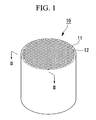
- a bone substitute (material for repairing biological tissues) 10 is a cylindrical scaffold made of a porous calcium phosphate (for example, ⁇ -TCP) material in which a plurality of through-holes 11 extending in a single direction are separated from each other by partition wall members 12 having an almost uniform thickness (for example, about 0.05 mm to 0.5 mm) to give a honeycomb shape.
- Each through-hole 11 is mainly formed into a quadrangular shape, and as shown in FIG. 2, each partition wall member 12 has a plurality of concavities 13 and a plurality of pores 14 in the surface.
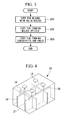
- the production process for the bone substitute 10 comprises: a step (S01) for mixing a raw material formed in a slurry form, with granular wax beads (solid body) 15 as shown in FIG. 5 having a melting point lower than a sintering temperature; a step (S02) for casting the raw material mixed with the wax beads 15 in a honeycomb mold (mold) 16 as shown in FIG. 4, so as to form a honeycomb molded article 17 as shown in FIG. 5 in which a plurality of through-holes 11 are separated from each other by partition wall members 12 having an almost uniform thickness; and a step (S03) for sintering the honeycomb molded article 17.
- a step (S01) for mixing a raw material formed in a slurry form, with granular wax beads (solid body) 15 as shown in FIG. 5 having a melting point lower than a sintering temperature a step (S02) for casting the raw material mixed with the wax beads 15 in a honeycomb mold (mold) 16 as shown in FIG.
- step (S01) for mixing with the wax beads 15 firstly, for example by a method disclosed in Japanese Unexamined Patent Application, First Publication No. Hei 5-237178, an aqueous foamed slurry which has been mixed and foamed, is adjusted and mixed with granular molded articles made from ⁇ -TCP so as to make a raw material which is formed in a slurry form.
- the wax beads 15 are then mixed into the raw material.
- the raw material mixed with the wax beads 15 is supplied to the honeycomb mold 16 shown in FIG. 4 to make the honeycomb molded article 17 shown in FIG. 5.
- raw material inlets 18 that have been formed in a funnel shape. Meanwhile, the inside at the bottom is formed with slits 19 extending respectively in parallel with the respective sides of the honeycomb mold 16, and having for example a width of 0.1 mm. The bottom ends of the raw material inlets 18 and one end of the slits 19 are communicated through passages 20.
- the honeycomb molded article 17 in honeycomb shape formed with the through-holes 11 in a quadrangular shape and the partition wall members 12 separating the respective through-holes 11, is discharged from the bottom surface 21 of the honeycomb mold 16.
- the cross-section of the honeycomb molded article 17 has a structure that includes the wax beads 15 in the partition wall members 12.
- the honeycomb molded article 17 is sintered after drying, for example in a method disclosed in Japanese Unexamined Patent Application, First Publication Hei 5-237178. At this time, since the melting point of the wax beads 15 contained in the honeycomb molded article 17 is lower than the sintering temperature, then after being melted by heating during the sintering, the wax beads 15 run out to the outside of the partition wall members 12 and are removed from the through-holes 11 to outside of the honeycomb molded article 17.
- bone marrow liquid is extracted from the ilium or the like, and the bone marrow liquid is concentrated by an appropriate process such as centrifugation. Then, a medium to which has been added growth factors such as MEM (Minimal Essential Medium) and FBS (Fetal Bovine Serum) is supplied to a culturing container and mixed with the bone marrow liquid, and primary culturing is performed so as to make a cell concentrate containing mesenchymal stem cells with unwanted components removed.
- MEM Minimum Essential Medium
- FBS Fetal Bovine Serum
- the cell concentrate is permeated throughout the bone substitute 10 that has been made by the abovementioned method. Then, it is introduced into the bone forming medium containing dexamethasone or the like serving as a factor for inducing differentation into osteoblasts, so as to perform secondary culturing.
- the bone substitute 10 since it is formed by a honeycomb mold, a large surface area can be ensured and the diameter of the holes can be readily controlled, enabling optimum size through-holes to be freely made. Moreover, since the through-holes 11 are provided, the mesenchymal stem cells can be readily adhered to the inside of the bone substitute 10, and waste matter can be readily exchanged with respect to the mesenchymal stem cells through the through-holes. Since not only holes but also concavities 13 are formed for the porous material, the mesenchymal stem cells are readily adhered onto the surface of the partition wall members 12, and a sufficient amount of cells can be adhered.
- the shape of the through-holes is not limited to the quadrangular shape, and may be a hexagonal shape as with honeycomb shape, a triangular shape, or a circular shape.
- the size of the respective through-holes is not necessarily uniform, and may be nonuniform.
- the solid body is not limited to wax beads, and may be plastic beads or any other form as long as it melts at a temperature below the sintering temperature.
- the shape of the solid body may be spherical or angular.
- the body fluid is not limited to bone marrow liquid, and may be peripheral blood or cord blood, as long as it contains somatic cells such as ES cells, somatic stem cells, bone cells, cartilagenous cells, or nerve cells.
- the biological tissue also is not necessarily bone tissue, and it is possible to use the present invention for regenerating any arbitrary biological tissue such as cartilaginous tissue, muscular tissue, or subcutaneous tissue.
- any material may be used as long as it has an affinity with the biological tissue, more preferably it has bioabsorbency.
- the material may also be porous.
- the porous material is not necessarily ⁇ -TCP, and provided is can form a slurry, it may be any material such as calcium phosphate ceramics, collagen, polylactic acid, or combinations thereof.
- a cultured rat bone was made as the bone-repairing product.
- the bone marrow liquid was extracted from a rat, and primary culturing was performed in a T-flask for 10 days, to generate cultured cells containing bone marrow mesenchymal stem cells with unwanted components removed.
- the cultured cells were trypsin treated, and then disseminated onto the bone substitute according to the present embodiment.
- the medium was then mixed with dexamethasone in addition to MEM and FBS, to initiate the differentiation of the stem cells. Then, secondary culturing was performed for about 2 weeks.
- the bone-repairing product was grafted subcutaneously into the rat, and taken out therefrom 4 weeks later. As a result, the generation of new bone tissue was confirmed.
- the cells permeated into the through-holes are adhered to the surface of the partition wall members, they are captured by the concavities or pores formed in the partition wall members. As a result, the adhesiveness of the cells is increased so that a sufficient amount of cells can be adhered.
- the process for producing the material for repairing biological tissues of the present invention since the surface area of the material for repairing biological tissues is increased, and the cells can be readily adhered, it becomes possible to produce the material for repairing biological tissues wherein a large number of cells can be adhered onto the surface, and cell waste matter can be smoothly exchanged through the through-holes. Furthermore, since the through-holes can be readily controlled at the time of the molding, it becomes possible to provide an organism to be grafted having an optimum form.
Landscapes
- Health & Medical Sciences (AREA)
- Animal Behavior & Ethology (AREA)
- Veterinary Medicine (AREA)
- Oral & Maxillofacial Surgery (AREA)
- Transplantation (AREA)
- Public Health (AREA)
- General Health & Medical Sciences (AREA)
- Life Sciences & Earth Sciences (AREA)
- Chemical & Material Sciences (AREA)
- Engineering & Computer Science (AREA)
- Biomedical Technology (AREA)
- Vascular Medicine (AREA)
- Heart & Thoracic Surgery (AREA)
- Cardiology (AREA)
- Orthopedic Medicine & Surgery (AREA)
- Medicinal Chemistry (AREA)
- Dermatology (AREA)
- Inorganic Chemistry (AREA)
- Epidemiology (AREA)
- Physics & Mathematics (AREA)
- Geometry (AREA)
- Manufacturing & Machinery (AREA)
- Materials For Medical Uses (AREA)
- Prostheses (AREA)
Applications Claiming Priority (3)
| Application Number | Priority Date | Filing Date | Title |
|---|---|---|---|
| JP2003095017A JP2004298407A (ja) | 2003-03-31 | 2003-03-31 | 生体組織補填材及びその製造方法 |
| JP2003095017 | 2003-03-31 | ||
| PCT/JP2004/004550 WO2004087020A1 (ja) | 2003-03-31 | 2004-03-30 | 生体組織補填材及びその製造方法 |
Publications (1)
| Publication Number | Publication Date |
|---|---|
| EP1609442A1 true EP1609442A1 (de) | 2005-12-28 |
Family
ID=33127424
Family Applications (1)
| Application Number | Title | Priority Date | Filing Date |
|---|---|---|---|
| EP04724371A Withdrawn EP1609442A1 (de) | 2003-03-31 | 2004-03-30 | Material zur wiederherstellung von biologischen geweben und verfahren zu seiner herstellung |
Country Status (6)
| Country | Link |
|---|---|
| US (1) | US20080099948A1 (de) |
| EP (1) | EP1609442A1 (de) |
| JP (1) | JP2004298407A (de) |
| KR (1) | KR20050120673A (de) |
| CN (1) | CN1767794A (de) |
| WO (1) | WO2004087020A1 (de) |
Cited By (2)
| Publication number | Priority date | Publication date | Assignee | Title |
|---|---|---|---|---|
| EP1609443A4 (de) * | 2003-04-01 | 2007-03-14 | Olympus Corp | Material zur wiederherstellung von biologischen geweben und verfahren zu seiner herstellung |
| WO2008032932A1 (en) * | 2006-09-11 | 2008-03-20 | Megagen Implant Co., Ltd. | Bone filler and method for fabricating the same |
Families Citing this family (7)
| Publication number | Priority date | Publication date | Assignee | Title |
|---|---|---|---|---|
| JP4804031B2 (ja) * | 2005-05-09 | 2011-10-26 | オリンパス株式会社 | 間葉系幹細胞の培養方法および生体組織補填体の製造方法 |
| US7972767B2 (en) * | 2005-05-09 | 2011-07-05 | Olympus Corporation | Method for culturing mesenchymal stem cell and method for producing biological tissue prosthesis |
| CN110087698B (zh) * | 2016-10-17 | 2022-06-24 | 国立大学法人九州大学 | 医疗用蜂窝结构体 |
| JP7541280B2 (ja) | 2019-08-27 | 2024-08-28 | 邦夫 石川 | 医療用炭酸カルシウム組成物、および関連医療用組成物、ならびにこれらの製造方法 |
| CN111067665A (zh) * | 2019-12-24 | 2020-04-28 | 深圳齐康医疗器械有限公司 | 多孔人工真皮及其制备方法和模具 |
| JP2021137577A (ja) | 2020-03-05 | 2021-09-16 | 邦夫 石川 | 医用ハニカム構造体およびその製造方法、医用組織再建袋、成形型 |
| JP7560406B2 (ja) * | 2021-04-27 | 2024-10-02 | 京セラ株式会社 | 医療用部材 |
Family Cites Families (5)
| Publication number | Priority date | Publication date | Assignee | Title |
|---|---|---|---|---|
| JPH0193473A (ja) * | 1987-10-01 | 1989-04-12 | Sumitomo Chem Co Ltd | 表面にハニカム層を有するセラミック成形体の製造方法 |
| JP3061732B2 (ja) * | 1993-09-13 | 2000-07-10 | 旭光学工業株式会社 | 骨誘導と骨形成の場を提供するセラミックス機能材料及びその製造方法 |
| JPH09299472A (ja) * | 1996-05-10 | 1997-11-25 | Ngk Spark Plug Co Ltd | 生体インプラント材料及びその製造方法 |
| JP2003019195A (ja) * | 2000-05-19 | 2003-01-21 | Mmt:Kk | 生体用部材 |
| US20020022885A1 (en) * | 2000-05-19 | 2002-02-21 | Takahiro Ochi | Biomaterial |
-
2003
- 2003-03-31 JP JP2003095017A patent/JP2004298407A/ja active Pending
-
2004
- 2004-03-30 EP EP04724371A patent/EP1609442A1/de not_active Withdrawn
- 2004-03-30 CN CN200480008382.7A patent/CN1767794A/zh active Pending
- 2004-03-30 US US10/555,140 patent/US20080099948A1/en not_active Abandoned
- 2004-03-30 KR KR1020057018165A patent/KR20050120673A/ko not_active Ceased
- 2004-03-30 WO PCT/JP2004/004550 patent/WO2004087020A1/ja not_active Ceased
Non-Patent Citations (1)
| Title |
|---|
| See references of WO2004087020A1 * |
Cited By (2)
| Publication number | Priority date | Publication date | Assignee | Title |
|---|---|---|---|---|
| EP1609443A4 (de) * | 2003-04-01 | 2007-03-14 | Olympus Corp | Material zur wiederherstellung von biologischen geweben und verfahren zu seiner herstellung |
| WO2008032932A1 (en) * | 2006-09-11 | 2008-03-20 | Megagen Implant Co., Ltd. | Bone filler and method for fabricating the same |
Also Published As
| Publication number | Publication date |
|---|---|
| CN1767794A (zh) | 2006-05-03 |
| KR20050120673A (ko) | 2005-12-22 |
| JP2004298407A (ja) | 2004-10-28 |
| WO2004087020A1 (ja) | 2004-10-14 |
| US20080099948A1 (en) | 2008-05-01 |
Similar Documents
| Publication | Publication Date | Title |
|---|---|---|
| US11518978B2 (en) | Self-assembling multicellular bodies and methods of producing a three-dimensional biological structure using the same | |
| Petrovic et al. | Craniofacial bone tissue engineering | |
| EP2187985B1 (de) | Gerüste | |
| EP1609442A1 (de) | Material zur wiederherstellung von biologischen geweben und verfahren zu seiner herstellung | |
| US10500306B2 (en) | Method and device for producing a bioartificial tissue construct | |
| Baptista et al. | Spheroids of stem cells as endochondral templates for improved bone engineering | |
| JP2004008437A (ja) | 培養骨 | |
| EP1609443A1 (de) | Material zur wiederherstellung von biologischen geweben und verfahren zu seiner herstellung | |
| JP2005110709A (ja) | 生体組織補填材 | |
| US7915038B2 (en) | Method for producing a recipient-specific tissue transplant or tissue implant | |
| JP2006230817A (ja) | 生体組織補填材、生体組織補填体およびその製造方法 | |
| Fernandes et al. | Biopolymer‐based scaffolds for bone and tissue engineering | |
| JP4175917B2 (ja) | 生体組織補填材、生体組織補填体の製造方法、これに用いる容器および生体組織補填体 | |
| JP2004049142A (ja) | 培養骨の製造方法 | |
| JP2006034111A (ja) | 細胞培養方法および生体組織補填体の製造方法 | |
| JP2005160668A (ja) | 生体組織補填体の製造方法 | |
| JP2004261511A (ja) | 生体組織補填材および生体組織補填体 | |
| HK1157440B (en) | Self-assembling multicellular bodies and methods of producing a three-dimensional biological structure using the same | |
| JP2004089626A (ja) | 生体組織補填体の製造方法および製造装置 | |
| HK1144262B (en) | Scaffolds | |
| AU2014277690A1 (en) | Scaffolds |
Legal Events
| Date | Code | Title | Description |
|---|---|---|---|
| PUAI | Public reference made under article 153(3) epc to a published international application that has entered the european phase |
Free format text: ORIGINAL CODE: 0009012 |
|
| 17P | Request for examination filed |
Effective date: 20050923 |
|
| AK | Designated contracting states |
Kind code of ref document: A1 Designated state(s): AT BE BG CH CY CZ DE DK EE ES FI FR GB GR HU IE IT LI LU MC NL PL PT RO SE SI SK TR |
|
| AX | Request for extension of the european patent |
Extension state: AL LT LV MK |
|
| DAX | Request for extension of the european patent (deleted) | ||
| RBV | Designated contracting states (corrected) |
Designated state(s): DE FR GB |
|
| STAA | Information on the status of an ep patent application or granted ep patent |
Free format text: STATUS: THE APPLICATION HAS BEEN WITHDRAWN |
|
| 18W | Application withdrawn |
Effective date: 20100111 |