EP1614480B1 - Applikationsroboter mit einer Parallelkinematik - Google Patents
Applikationsroboter mit einer Parallelkinematik Download PDFInfo
- Publication number
- EP1614480B1 EP1614480B1 EP05106073A EP05106073A EP1614480B1 EP 1614480 B1 EP1614480 B1 EP 1614480B1 EP 05106073 A EP05106073 A EP 05106073A EP 05106073 A EP05106073 A EP 05106073A EP 1614480 B1 EP1614480 B1 EP 1614480B1
- Authority
- EP
- European Patent Office
- Prior art keywords
- robot
- application
- painting
- kinematic
- parallel
- Prior art date
- Legal status (The legal status is an assumption and is not a legal conclusion. Google has not performed a legal analysis and makes no representation as to the accuracy of the status listed.)
- Expired - Lifetime
Links
Images



Classifications
-
- B—PERFORMING OPERATIONS; TRANSPORTING
- B25—HAND TOOLS; PORTABLE POWER-DRIVEN TOOLS; MANIPULATORS
- B25J—MANIPULATORS; CHAMBERS PROVIDED WITH MANIPULATION DEVICES
- B25J17/00—Joints
- B25J17/02—Wrist joints
- B25J17/0258—Two-dimensional joints
- B25J17/0266—Two-dimensional joints comprising more than two actuating or connecting rods
-
- B—PERFORMING OPERATIONS; TRANSPORTING
- B05—SPRAYING OR ATOMISING IN GENERAL; APPLYING FLUENT MATERIALS TO SURFACES, IN GENERAL
- B05B—SPRAYING APPARATUS; ATOMISING APPARATUS; NOZZLES
- B05B13/00—Machines or plants for applying liquids or other fluent materials to surfaces of objects or other work by spraying, not covered by groups B05B1/00 - B05B11/00
- B05B13/02—Means for supporting work; Arrangement or mounting of spray heads; Adaptation or arrangement of means for feeding work
- B05B13/04—Means for supporting work; Arrangement or mounting of spray heads; Adaptation or arrangement of means for feeding work the spray heads being moved during spraying operation
- B05B13/0431—Means for supporting work; Arrangement or mounting of spray heads; Adaptation or arrangement of means for feeding work the spray heads being moved during spraying operation with spray heads moved by robots or articulated arms, e.g. for applying liquid or other fluent material to three-dimensional [3D] surfaces
- B05B13/0433—Means for supporting work; Arrangement or mounting of spray heads; Adaptation or arrangement of means for feeding work the spray heads being moved during spraying operation with spray heads moved by robots or articulated arms, e.g. for applying liquid or other fluent material to three-dimensional [3D] surfaces the work being vehicle components, e.g. vehicle bodies
Definitions
- the invention relates to an application robot for applying a coating agent to an application object, in particular for painting motor vehicle body parts, according to the preamble of claim 1.
- multiaxial painting robots with serial kinematics are known to be used to guide the rotary atomizers used as application devices.
- Such painting robots are for example off DE 100 10 615 A1 known.
- a disadvantage of such multi-axis painting robots for guiding the application devices is the complex mechanism (for example, gearbox, mass compensation element) of the multi-axis painting robots.
- Another disadvantage of conventional multi-axis painting robots is the unfavorable mass ratio between the mass of the application device (in a rotary atomizer about 15 kg) and the robot mass of more than 500 kg, which among other things leads to a high energy consumption in the movement of the large robot mass.
- the document XP002349397 discloses a welding robot with parallel kinematics and connected serial kinematics for use in welding tasks ,
- the document DE 199 52 530 A1 also discloses a robot with a parallel kinematic, which has an additional serial kinematics, this robot being suitable for moving a tool or a workpiece.
- the invention is therefore based on the object to improve the known application robot accordingly.
- the invention comprises the general technical teaching of using an application robot with a parallel kinematics instead of a conventional multi-axis painting robot with a serial kinematics.
- parallel kinematics used in the context of the invention means that the application robot according to the invention has a plurality of drive axes which act in parallel on the end effector to which the application tool (eg a paint spray gun or a rotary atomizer) can be fastened.
- the application tool eg a paint spray gun or a rotary atomizer
- a parallel kinematic as it DE 100 19 162 A1 is known, so that the content of this document of the present description in the design of the parallel kinematic is fully attributable.
- the end effector of the parallel kinematic system is connected to at least one base via a plurality of kinematic members, whereby the individual kinematic members may be, for example, extendable telescopic arms which can be driven, for example, electrically, pneumatically or hydraulically.
- the end effector of the parallel kinematics is guided by three kinematic members, so that the parallel kinematics are also referred to as tripod.
- the invention is not limited to three in terms of the number of kinematic members, but also with four or more kinematic members feasible.
- the base of the kinematic members may optionally be stationary or movable, wherein in a preferred embodiment of the invention, the base of all kinematic members is movable to expand the working space of the application robot according to the invention.
- the base of the kinematic members on at least one travel rail is linearly displaceable.
- the application robot for guiding the application device has a combination of a parallel kinematics and a serial kinematics.
- a robot arm can be mounted rotatably and / or pivotably on the end effector of the parallel kinematics.
- a conventional robot hand axis is attached to the end effector of the parallel kinematics or to the robot arm.
- this is preferably pivotable about an axis of rotation, which preferably runs parallel to the longitudinal axis of the painting line.
- the axis of rotation of the robot arm thus preferably runs parallel to the feed direction of the application objects in the paint shop.
- the application device is guided exclusively by a parallel kinematics.
- An advantage of the inventive structure of the application robot is the lower weight compared to conventional application robots with a serial kinematics. This in turn advantageously enables a suspended mounting of the application robot according to the invention within a painting cell, without the painting cell having to be substantially mechanically reinforced for this purpose.
- the application robot according to the invention can thus have, for example, an overhead mounting.
- the application robot according to the invention is attached laterally to a side wall of the painting cell.
- a conventional floor mounting of the application robot according to the invention is possible.
- the application robot according to the invention preferably has a mass which is substantially smaller than 500 kg, which is of the order of magnitude of conventional application robots with serial kinematics.
- the mass of the application robot according to the invention may be less than 400 kg, 300 kg, 200 kg, 100 kg or even less than 50 kg.
- an application robot used in the context of the invention is not limited to painting robots for painting motor vehicle body parts, but also encompasses other robots in which an application means (eg Primer, filler, basecoat, clearcoat, transport wax) is applied to an application object.
- an application means eg Primer, filler, basecoat, clearcoat, transport wax
- the invention is not limited to a single application robot, but also includes a painting cell with an at least partially closed painting booth and at least one application robot according to the invention, as described above.
- the invention also encompasses a complete coating installation with an application robot according to the invention and the novel use of a robot with parallel kinematics as the application robot in a coating installation.
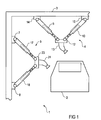
- FIG. 1 show in a greatly simplified form a painting cell 1 of a painting plant for painting automotive body parts, wherein for simplicity, only a motor vehicle body 2 is shown schematically.
- the paint booth 1 is hereby limited by a spray booth 3, wherein in the paint booth 1 on the inner wall of the spray booth 3 above and on the side wall in each case a painting robot 4, 5 is mounted.
- the painting installation has a plurality of linear guides 6, 7, 8 in the form of moving rails, along which the two painting robots 4, 5 can be displaced in the longitudinal direction of the painting line.
- the painting robot 4 has a plurality of extendable telescopic arms 9, 10, 11 as kinematic members, which can be driven, for example, electrically, pneumatically or hydraulically and lead to an end effector 12, to which a rotary atomizer 13 is attached.
- the telescopic arms 9-11 are supported on a respective base 14, 15 and 16, wherein the bases 14-16 along the linear guide 6 are displaceable, as seen from FIG. 2 is apparent.
- the painting robot 4 can be moved in the longitudinal direction of the linear guide 6.
- the end effector 12 can be largely freely positioned within the working space of the painting robot 4, which is a correspondingly allows free guidance of the rotary atomizer 13 to the vehicle body 2.
- the painting robot 5 mounted on the side of the painting booth 3 likewise has a plurality of extendable telescopic arms 17, 18, 19 which can be driven electrically, pneumatically or hydraulically and which are supported on the respective cabin 20, 21, 22.
- the base 20 is in this case displaceably guided in the linear guide 7, while the two bases 21, 22 are guided displaceably in the lower linear guide 8.
- the entire painting robot 5 can be moved in the longitudinal direction of the painting.
- the telescopic arms 17-19 carry a further end effector 23 to which a rotary atomizer 24 is also attached.
- the two painting robots 4, 5 thus each have a parallel kinematics for guiding the end effector 12 or 23, which leads to a more favorable mass ratio between the mass of the application device and the robot mass in comparison to conventional multi-axis painting robots.
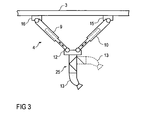
- FIG. 3 illustrated embodiment of a painting robot 4 is largely consistent with the in FIG. 1 shown painting robot 4 match, so that to avoid repetition largely to the above description FIG. 1 is referenced, wherein for corresponding components the same reference numerals as in FIG. 1 be used.
- a special feature of this embodiment is that the rotary atomizer 13 is not attached directly to the end effector 12.
- a robot hand axis 25 with a serial kinematics is attached to the end effector 12, wherein the robot hand axis 25 guides the rotary atomizer 13 to be highly mobile.
- the robot hand axis 25 may be designed to be largely conventional, so that reference is made to the relevant prior art with regard to the construction and the mode of operation of the robot hand axis 25.
- the mechanical control of the robot hand axis 25 is not shown here for the sake of simplicity.
- This embodiment of the painting robot 4 is thus characterized by the combination of a parallel kinematics with a serial kinematics of the robot hand axis 25.
- a special feature of this embodiment is that the robot hand axis 25 and 26 is not attached directly to the end effector 12 and 23, respectively. Instead, a robot arm 27 or 28 is disposed between the end effector 12 or 23 and the robot hand axis 25 or 26, wherein the robot arm 27 is pivotable about a pivot axis 29, while the robot arm 28 is pivotable about a pivot axis 30.
- the two pivot axes 29, 30 extend parallel to the longitudinal axis of the painting line, so that the painting robot 5 at the Side of the paint line can perform a meandering movement, which is advantageous for painting.
Landscapes
- Engineering & Computer Science (AREA)
- Robotics (AREA)
- Mechanical Engineering (AREA)
- Manipulator (AREA)
- Spray Control Apparatus (AREA)
- Forklifts And Lifting Vehicles (AREA)
Description
- Die Erfindung betrifft einen Applikationsroboter zur Applizierung eines Beschichtungsmittels auf ein Applikationsobjekt, insbesondere zur Lackierung von Kraftfahrzeugkarosserieteilen, gemäß dem Oberbegriff des Anspruchs 1.
- In modernen Lackieranlagen zur Lackierung von Kraftfahrzeugkarosserieteilen werden bekanntermaßen mehrachsige Lackierroboter mit einer seriellen Kinematik eingesetzt, um die als Applikationsgerät verwendeten Rotationszerstäuber zu führen. Derartige Lackierroboter sind beispielsweise aus
DE 100 10 615 A1 bekannt. - Nachteilig an derartigen mehrachsigen Lackierrobotern zur Führung der Applikationsgeräte ist die aufwendige Mechanik (z.B. Getriebe, Massenausgleichselement) der mehrachsigen Lackierroboter.
- Ein weiterer Nachteil herkömmlicher mehrachsiger Lackierroboter ist das ungünstige Massenverhältnis zwischen der Masse des Applikationsgeräts (bei einem Rotationszerstäuber ungefähr 15 kg) und der Robotermasse von mehr als 500 kg, was unter anderem zu einem hohen Energieverbrauch bei der Bewegung der großen Robotermasse führt.
- Das Dokument Hesselbach, J. et al.: "Parallelkinematiken in der Robotertechnik", ZWF Zeitschrift für wirtschaftliche Fertigung und Automatisierung, Carl Hanser Verlag, München, DE, Bd. 93, Nr. 6, Juni 1998 (1998-06), Seiten 259-262 offenbart verschiedene Parallelkinematiken und eine Kombination solcher Parallelkinematiken mit einem Handachsenkopf für Montageaufgaben und Bearbeitungsvorgänge.
- Das Dokument Liu K. et al.: "Stewart-Platform-Based Inlet Duct Painting System", Proceedings of the International Conference on Robotics and Automation Atlanta, May 2-6, 1993, Los Alamitos, IEEE Comp. Soc. Press, US, Bd. Vol. 1 Conf. 10, 3. Mai 1993 (1993-05-03), Seiten 106-113 offenbart einen gattungsgemäßen Roboter für die Innenlackierung von Rohrleitungen, wobei auf einer Parallelkinematik eine drehbare Lackierdüse angebracht wird. eine Bewegung dieses Roboters in dem Rohr wird durch Verfahren der Parallelkinematik in dem Rohr erreicht.
- Das Dokument
US-A-4 435 116 offenbart einen Roboter mit einer Parallelkinematik, wobei auch vorgeschlagen wird, dass dieser Roboter für Lackierzwecke eingesetzt werden kann. - Das Dokument XP002349396 (URL: http://web.archive.org/web/20030203152 347/http://www.maschinenbau.hs-magdeburg.d e/personal/bargfrede/fue/parallel/ani_para llel.html) offenbart verschiedene Parallelkinematiken für Roboter, die auch in einer Ebene verfahrbar sind.
- Das Dokument XP002349397 (URL: http://web.archive.org/web /20020610160112/http://www.hexel.com/custom.htm) offenbart einen Schweißroboter mit einer Parallelkinematik und einer daran angeschlossenen seriellen Kinematik zum Einsatz bei Schweißaufgaben.
- Das Dokument
DE 199 52 530 A1 offenbart ebenfalls einen Roboter mit einer Parallelkinematik, der über eine zusätzliche serielle Kinematik verfügt, wobei dieser Roboter für ein Bewegen eines Werkzeugs oder eines Werkstücks geeignet ist. - Der Erfindung liegt deshalb die Aufgabe zugrunde, die bekannten Applikationsroboter entsprechend zu verbessern.
- Diese Aufgabe wird durch einen erfindungsgemäßen Applikationsroboter gemäß Anspruch 1 gelöst.
- Die Erfindung umfasst die allgemeine technische Lehre, anstelle eines herkömmlichen mehrachsigen Lackierroboters mit einer seriellen Kinematik einen Applikationsroboter mit einer Parallelkinematik einzusetzen.
- Vorteilhaft an dem erfindungsgemäßen Applikationsroboter mit einer Parallelkinematik anstelle einer herkömmlichen seriellen Kinematik sind die einfachere Mechanik, das günstigere Massenverhältnis zwischen der Robotermasse und der Masse des Applikationswerkzeugs, der geringere Energieverbrauch, die größere Absolut- und Wiederholgenauigkeit sowie die bessere mechanische Steifigkeit.
- Der im Rahmen der Erfindung verwendete Begriff einer Parallelkinematik bedeutet, dass der erfindungsgemäße Applikationsroboter mehrere Antriebsachsen aufweist, die parallel auf den Endeffektor wirken, an dem das Applikationswerkzeug (z.B. eine Lackierpistole oder ein Rotationszerstäuber) befestigt werden kann. Beispielsweise kann im Rahmen der Erfindung eine Parallelkinematik verwenden werden, wie sie aus
DE 100 19 162 A1 bekannt ist, so dass der Inhalt dieser Druckschrift der vorliegenden Beschreibung hinsichtlich der Gestaltung der Parallelkinematik in vollem Umfang zuzurechnen ist. - Vorzugsweise ist der Endeffektor der Parallelkinematik über mehrere kinematische Glieder mit mindestens einer Basis verbunden, wobei es sich bei den einzelnen kinematischen Gliedern beispielsweise um ausfahrbare Teleskoparme handeln kann, die beispielsweise elektrisch, pneumatisch oder hydraulisch angetrieben werden können.
- In einem bevorzugten Ausführungsbeispiel wird der Endeffektor der Parallelkinematik durch drei kinematische Glieder geführt, so dass die Parallelkinematik auch als Tripod bezeichnet werden. Die Erfindung ist jedoch hinsichtlich der Anzahl der kinematischen Glieder nicht auf drei beschränkt, sondern auch mit vier oder mehr kinematischen Gliedern realisierbar.
- Die Basis der kinematischen Glieder kann wahlweise ortsfest oder beweglich sein, wobei in einem bevorzugten Ausführungsbeispiel der Erfindung die Basis von sämtlichen kinematischen Gliedern beweglich ist, um den Arbeitsraum des erfindungsgemäßen Applikationsroboters zu erweitern. Hierzu besteht die Möglichkeit, dass die Basis der kinematischen Glieder an mindestens einer Verfahrschiene linear verschiebbar ist.
- Darüber hinaus ist im Rahmen der Erfindung vorgesehen, dass der Applikationsroboter zur Führung des Applikationsgeräts eine Kombination aus einer Parallelkinematik und einer seriellen Kinematik aufweist.
- Erfindungsgemäß kann an dem Endeffektor der Parallelkinematik ein Roboterarm drehbar und/oder schwenkbar angebracht sein.
- Alternativ ist erfindungsgemäß an dem Endeffektor der Parallelkinematik oder an dem Roboterarm eine herkömmliche Roboterhandachse angebracht.
- Bei der Anbringung eines Roboterarms an dem Endeffektor der Parallelkinematik ist diese vorzugsweise um eine Drehachse schwenkbar, die vorzugsweise parallel zur Längsachse der Lackierstrasse verläuft. Die Drehachse des Roboterarms verläuft also vorzugsweise parallel zur Vorschubrichtung der Applikationsobjekte in der Lackieranlage. Durch diese Ausrichtung der Drehachse des Roboterarms kann dieser eine mäanderförmige Bewegung ausführen, was bei der Lackierung vorteilhaft ist.
- In einem Ausführungsbeispiel der Erfindung wird das Applikationsgerät jedoch ausschließlich durch eine Parallelkinematik geführt.
- Vorteilhaft an dem erfindungsgemäßen Aufbau des Applikationsroboters ist das geringere Gewicht im Vergleich zu herkömmlichen Applikationsrobotern mit einer seriellen Kinematik. Dies ermöglicht wiederum vorteilhaft eine hängende Montage des erfindungsgemäßen Applikationsroboters innerhalb einer Lackierzelle, ohne dass die Lackierzelle dazu mechanisch wesentlich verstärkt werden muss. Der erfindungsgemäße Applikationsroboters kann also beispielsweise eine Überkopfmontage aufweisen. Es besteht jedoch auch die Möglichkeit, dass der erfindungsgemäße Applikationsroboter seitlich an einer Seitenwand der Lackierzelle befestigt ist. Darüber hinaus ist auch eine herkömmliche Bodenmontage des erfindungsgemäßen Applikationsroboters möglich.
- Der erfindungsgemäße Applikationsroboter weist vorzugsweise eine Masse auf, die wesentlich kleiner als 500 kg ist, was in der Größenordnung der Masse herkömmlicher Applikationsroboter mit einer seriellen Kinematik liegt. Beispielsweise kann die Masse des erfindungsgemäßen Applikationsroboters kleiner als 400 kg, 300 kg, 200 kg, 100 kg oder sogar kleiner als 50 kg sein.
- Der im Rahmen der Erfindung verwendete Begriff eines Applikationsroboters ist nicht auf Lackierroboter zur Lackierung von Kraftfahrzeugkarosserieteilen beschränkt, sondern umfasst auch andere Roboter, bei denen ein Applikationsmittel (z.B. Grundierung, Füller, Basislack, Klarlack, Transportwachs) auf ein Applikationsobjekt aufgetragen wird.
- Darüber hinaus ist die Erfindung nicht auf einen einzelnen Applikationsroboter beschränkt, sondern umfasst auch eine Lackierzelle mit einer mindestens teilweise geschlossenen Lackierkabine und mindestens einem erfindungsgemäßen Applikationsroboter, wie er vorstehend beschrieben wurde.
- Ferner umfasst die Erfindung auch eine vollständige Beschichtungsanlage mit einem erfindungsgemäßen Applikationsroboter und die neuartige Verwendung eines Roboters mit einer Parallelkinematik als Applikationsroboter in einer Beschichtungsanlage.
- Andere vorteilhafte Weiterbildungen der Erfindung sind in den Unteransprüchen gekennzeichnet oder werden nachstehend zusammen mit der Beschreibung des bevorzugten Ausführungsbeispiels anhand der Figuren näher erläutert. Es zeigen:
- Figur 1
- eine schematisierte Frontansicht einer Lackieranlage mit zwei nicht erfindungsgemäßen Lackierrobotern,
- Figur 2
- eine Seitenansicht der Lackieranlage aus
Figur 1 , - Figur 3
- ein Ausführungsbeispiel eines erfindungsgemäßen Lackierroboters mit einer Kombination einer Parallelkinematik mit einer seriellen Kinematik,
- Figur 4
- eine schematisierte Frontansicht eines anderen Ausführungsbeispiels einer erfindungsgemäßen Lackieranlage mit zwei Lackierrobotern sowie
- Figur 5
- eine Seitenansicht der Lackieranlage aus
Figur 4 . - Die Zeichnungen zeigen in stark vereinfachter Form eine Lackierzelle 1 einer Lackieranlage zur Lackierung von Kraftfahrzeugkarosserieteilen, wobei zur Vereinfachung nur eine Kraftfahrzeugkarosserie 2 schematisch dargestellt ist.
- Die Lackierzelle 1 wird hierbei durch eine Lackierkabine 3 begrenzt, wobei in der Lackierzelle 1 an der Innenwand der Lackierkabine 3 oben und an der Seitenwand jeweils ein Lackierroboter 4, 5 angebracht ist.
- Aus der Seitenansicht in
Figur 2 ist weiterhin ersichtlich, dass die Lackieranlage mehrere Linearführungen 6, 7, 8 in Form von Verfahrschienen aufweist, entlang derer die beiden Lackierroboter 4, 5 in Längsrichtung der Lackierstraße verschoben werden können. - Der Lackierroboter 4 weist als kinematische Glieder mehrere ausfahrbare Teleskoparme 9, 10, 11 auf, die beispielsweise elektrisch, pneumatisch oder hydraulisch angetrieben werden können und einen Endeffektor 12 führen, an dem ein Rotationszerstäuber 13 angebracht ist.
- Kabinenseitig stützen sich die Teleskoparme 9-11 an jeweils einer Basis 14, 15 bzw. 16 ab, wobei die Basen 14-16 entlang der Linearführung 6 verschiebbar sind, wie aus
Figur 2 ersichtlich ist. - Auf diese Weise kann der Lackierroboter 4 in Längsrichtung der Linearführung 6 verschoben werden. Durch eine geeignete Ansteuerung der einzelnen Teleskoparme 9-11 kann der Endeffektor 12 innerhalb des Arbeitsraums des Lackierroboters 4 weitgehend frei positioniert werden, was eine entsprechend freie Führung des Rotationszerstäubers 13 um die Kraftfahrzeugkarosserie 2 ermöglicht.
- Der an der Seite der Lackierkabine 3 angebrachte Lackierroboter 5 weist ebenfalls mehrere ausfahrbare Teleskoparme 17, 18, 19 auf, die elektrisch, pneumatisch oder hydraulisch angetrieben werden können und die sich kabinenseitig an jeweils einer Basis 20, 21, 22 abstützen.
- Die Basis 20 ist hierbei verschiebbar in der Linearführung 7 geführt, während die beiden Basen 21, 22 verschiebbar in der unteren Linearführung 8 geführt werden. Durch eine entsprechende Verschiebung der Basen 20-22 kann also der gesamte Lackierroboter 5 in Längsrichtung der Lackierstraße verschoben werden.
- An ihrem anderen Ende tragen die Teleskoparme 17-19 einen weiteren Endeffektor 23, an dem ebenfalls ein Rotationszerstäuber 24 angebracht ist.
- Die beiden Lackierroboter 4, 5 weisen also jeweils eine Parallelkinematik zur Führung des Endeffektors 12 bzw. 23 auf, was im Vergleich zu herkömmlichen mehrachsigen Lackierrobotern zu einem günstigeren Massenverhältnis zwischen der Masse des Applikationsgerätes und der Robotermasse führt.
- Das in
Figur 3 dargestellte Ausführungsbeispiel eines Lackierroboters 4 stimmt weitgehend mit dem inFigur 1 gezeigten Lackierroboter 4 überein, so dass zur Vermeidung von Wiederholungen weitgehend auf die vorstehende Beschreibung zuFigur 1 verwiesen wird, wobei für entsprechende Bauteile dieselben Bezugszeichen wie inFigur 1 verwendet werden. - Eine Besonderheit dieses Ausführungsbeispiels besteht darin, dass der Rotationszerstäuber 13 nicht direkt an dem Endeffektor 12 angebracht ist.
- Stattdessen ist an dem Endeffektor 12 eine Roboterhandachse 25 mit einer seriellen Kinematik angebracht, wobei die Roboterhandachse 25 den Rotationszerstäuber 13 hochbeweglich führt. Die Roboterhandachse 25 kann weitgehend herkömmlich ausgebildet sein, so dass hinsichtlich des Aufbaus und der Funktionsweise der Roboterhandachse 25 auf den einschlägigen Stand der Technik verwiesen wird. Die mechanische Ansteuerung der Roboterhandachse 25 ist hierbei jedoch zur Vereinfachung nicht dargestellt.
- Dieses Ausführungsbeispiel des Lackierroboters 4 zeichnet sich also durch die Kombination einer Parallelkinematik mit einer seriellen Kinematik der Roboterhandachse 25 aus.
- Die nachfolgend beschriebene und in den
Figuren 4 und5 dargestellte Lackieranlage stimmt weitgehend mit den vorstehend beschriebenen Lackieranlagen überein, so dass zur Vermeidung von Wiederholungen weitgehend auf die vorstehende Beschreibung verwiesen wird, wobei für entsprechende Bauteile dieselben Bezugszeichen verwendet werden. - Eine Besonderheit dieses Ausführungsbeispiels besteht darin, dass die Roboterhandachse 25 bzw. 26 nicht direkt an dem Endeffektor 12 bzw. 23 angebracht ist. Stattdessen ist zwischen dem Endeffektor 12 bzw. 23 und der Roboterhandachse 25 bzw. 26 ein Roboterarm 27 bzw. 28 angeordnet, wobei der Roboterarm 27 um eine Schwenkachse 29 schwenkbar ist, während der Roboterarm 28 um eine Schwenkachse 30 schwenkbar ist. Die beiden Schwenkachsen 29, 30 verlaufen hierbei parallel zur Längsachse der Lackierstrasse, so dass der Lackierroboter 5 an der Seite der Lackierstraße eine mäanderförmige Bewegung ausführen kann, was für die Lackierung vorteilhaft ist.
-
- 1
- Lackierzelle
- 2
- Kraftfahrzeugkarosserie
- 3
- Lackierkabine
- 4, 5
- Lackierroboter
- 6-8
- Linearführungen
- 9-11
- Teleskoparme
- 12
- Endeffektor
- 13
- Rotationszerstäuber
- 14-16
- Basis
- 17-19
- Teleskoparme
- 20-22
- Basis
- 23
- Endeffektor
- 24
- Rotationszerstäuber
- 25
- Roboterhandachse
- 26
- Roboterhandachse
- 27
- Roboterarm
- 28
- Roboterarm
- 29
- Schwenkachse
- 30
- Schwenkachse
Claims (12)
- Applikationsroboter (4, 5) zur Applizierung eines Beschichtungsmittels auf ein Applikationsobjekt mit- einem Endeffektor (12, 23) zur Führung eines Applikationswerkzeugs (13, 24),- einer Parallelkinematik zur mechanischen Führung des Endeffektors (12, 23) mit dem Applikationswerkzeug (13, 24) und- einer Kombination der Parallelkinematik mit mindestens einer zusätzlichen seriellen Kinematik zur Führung des Applikationswerkzeugs (13, 24),dadurch gekennzeichnet, dass- der Applikationsroboter zur Lackierung von Kraftfahrzeugkarosserieteilen (2) geeignet ist, und- an dem Endeffektor (12, 13) der Parallelkinematik ein das Applikationswerkzeug (13, 24) führender Roboterarm (27, 28) schwenkbar und/oder drehbar angebracht ist und/oder eine Roboterhandachse (25, 26) angebracht ist.
- Applikationsroboter (4, 5) nach Anspruch 1, dadurch gekennzeichnet, dass der Endeffektor (12, 23) der Parallelkinematik über mehrere kinematische Glieder (9-11, 17-19) mit mindestens einer Basis (14-16, 20-22) verbunden ist.
- Applikationsroboter (4, 5) nach Anspruch 2, dadurch gekennzeichnet, dass die kinematischen Glieder (9-11, 17-19) der Parallelkinematik ausfahrbare Teleskoparme sind, die elektrisch, pneumatisch oder hydraulisch angetrieben sind.
- Applikationsroboter (4, 5) nach Anspruch 2 oder 3, dadurch gekennzeichnet, dass die Basis (14-16, 20-22) der kinematischen Glieder (9-11, 17-19) beweglich ist.
- Applikationsroboter (4, 5) nach Anspruch 4, dadurch gekennzeichnet, dass die Basis (14-16, 20-22) der kinematischen Glieder (9-11, 17-19) an mindestens einer Linearführung (6-8) linear verschiebbar ist.
- Applikationsroboter (4, 5) nach einem der vorhergehenden Ansprüche, dadurch gekennzeichnet, dass das Applikationswerkzeug (13, 24) eine Lackierpistole oder eine Rotationszerstäuber ist.
- Applikationsroboter (4, 5) nach einem der vorhergehenden Ansprüche, dadurch gekennzeichnet, dass an dem Roboterarm (27, 28) die Roboterhandachse (25, 26) angebracht ist.
- Applikationsroboter (4, 5) nach einem der vorhergehenden Ansprüche, dadurch gekennzeichnet, dass der Roboterarm (27, 28) um eine Drehachse (29, 30) drehbar ist, die im Wesentlichen parallel zur Vorschubrichtung des Applikationsobjekts (2) verläuft.
- Applikationsroboter (4, 5) nach einem der vorhergehenden Ansprüche, gekennzeichnet durch eine hängende Überkopfmontage oder eine Seitenwandmontage.
- Lackierzelle mit einer mindestens teilweise geschlossenen Lackierkabine (3) und mindestens einem Applikationsroboter (4, 5) nach einem der vorhergehenden Ansprüche.
- Beschichtungsanlage mit mindestens einem Applikationsroboter (4, 5) nach einem Ansprüche 1 bis 9.
- Verwendung eines Applikationsroboters (4, 5) nach einem der Ansprüche 1 bis 9 in einer Beschichtungsanlage.
Applications Claiming Priority (1)
| Application Number | Priority Date | Filing Date | Title |
|---|---|---|---|
| DE102004033329A DE102004033329B4 (de) | 2004-07-09 | 2004-07-09 | Applikationsroboter mit einer Parallelkinematik |
Publications (2)
| Publication Number | Publication Date |
|---|---|
| EP1614480A1 EP1614480A1 (de) | 2006-01-11 |
| EP1614480B1 true EP1614480B1 (de) | 2008-03-26 |
Family
ID=35056987
Family Applications (1)
| Application Number | Title | Priority Date | Filing Date |
|---|---|---|---|
| EP05106073A Expired - Lifetime EP1614480B1 (de) | 2004-07-09 | 2005-07-05 | Applikationsroboter mit einer Parallelkinematik |
Country Status (4)
| Country | Link |
|---|---|
| EP (1) | EP1614480B1 (de) |
| AT (1) | ATE390209T1 (de) |
| DE (2) | DE102004033329B4 (de) |
| ES (1) | ES2303188T3 (de) |
Cited By (2)
| Publication number | Priority date | Publication date | Assignee | Title |
|---|---|---|---|---|
| DE102008037035A1 (de) | 2008-08-08 | 2010-02-18 | Dürr Systems GmbH | Lackierroboter und zugehöriges Betriebsverfahren |
| DE102021115547A1 (de) | 2021-06-16 | 2022-12-22 | Deutsches Zentrum für Luft- und Raumfahrt e.V. | Robotersystem |
Families Citing this family (18)
| Publication number | Priority date | Publication date | Assignee | Title |
|---|---|---|---|---|
| DE102005033972A1 (de) | 2005-07-20 | 2007-01-25 | Dürr Systems GmbH | Beschichtungsverfahren und zugehörige Beschichtungseinrichtung |
| ITPR20060035A1 (it) | 2006-04-12 | 2007-10-13 | Turbocoating Spa | Torcia per deposizione di ricoprimenti superficiali mediante tecnologie thermal spray e corrispondenti ricoprimenti. |
| MX390257B (es) | 2008-03-20 | 2025-03-20 | Duerr Systems Gmbh | Robot de pintura y metodo de funcionamiento asociado. |
| US8893578B2 (en) | 2009-02-13 | 2014-11-25 | Fanuc Corporation | Parallel robot provided with wrist section having three degrees of freedom |
| JP4659098B2 (ja) * | 2009-02-13 | 2011-03-30 | ファナック株式会社 | 3自由度を有する姿勢変更機構を備えたパラレルリンクロボット |
| DE102009042014A1 (de) * | 2009-09-21 | 2011-03-24 | Dürr Systems GmbH | Handhabungsvorrichtung |
| DE202010004471U1 (de) * | 2010-04-01 | 2011-08-11 | Emima Gmbh | Werkzeugträgerstruktur für eine Werkzeugmaschine |
| DE102011108215A1 (de) | 2011-07-21 | 2013-01-24 | Daimler Ag | Korrosionsschutz-Verfahren zum Behandeln von Fügebereichen einer Kraftfahrzeugkarosserie |
| WO2014176334A1 (en) | 2013-04-23 | 2014-10-30 | Northwestern University | Translational parallel manipulators and methods of operating the same |
| DE102013013530A1 (de) * | 2013-08-13 | 2015-03-12 | Dürr Systems GmbH | Applikationssystem mit seilgeführter Handhabungsvorrichtung zum Bewegen eines Applikationsgeräts |
| DE102015009163A1 (de) | 2015-07-14 | 2017-01-19 | Dürr Systems Ag | Beschichtungsanlagenroboter, insbesondere Handhabungsroboter |
| JP2019005863A (ja) * | 2017-06-26 | 2019-01-17 | 山洋電気株式会社 | パラレルリンクロボットシステム |
| CN110733056B (zh) * | 2019-11-01 | 2024-06-18 | 达闼机器人股份有限公司 | 机器人的多轴机械臂及其转接组件、机器人 |
| CN110841840A (zh) * | 2019-11-08 | 2020-02-28 | 江苏科技大学 | 一种用于船舶外板涂装的伸缩式喷涂机器人 |
| CN111185329B (zh) * | 2019-12-30 | 2020-09-01 | 盐城市沿海新能源汽车科技有限公司 | 一种汽车制造用车身喷涂机器人 |
| CN113021303B (zh) * | 2021-03-01 | 2022-08-09 | 清华大学 | 四自由度并联机构及工业机器人 |
| CN113171906B (zh) * | 2021-04-27 | 2022-08-05 | 合肥工业大学 | 一种具有大工作空间的可移动式电液复合驱动喷涂机器人 |
| CN116425057A (zh) * | 2023-02-20 | 2023-07-14 | 中国船舶集团有限公司第七一三研究所 | 一种多自由度机械臂 |
Family Cites Families (4)
| Publication number | Priority date | Publication date | Assignee | Title |
|---|---|---|---|---|
| US4435116A (en) * | 1982-05-27 | 1984-03-06 | Deberg Walter H | Robotic manipulator |
| DE19952530A1 (de) * | 1999-10-30 | 2001-05-10 | Hueller Hille Gmbh | Bearbeitungsmaschine zum mehrachsigen Bewegen eines Werkzeuges oder eines Werkstückes |
| DE10010615A1 (de) * | 2000-03-03 | 2001-09-06 | Duerr Systems Gmbh | Roboter zum Beschichten oder Behandeln von Werkstücken |
| DE10019162A1 (de) * | 2000-04-12 | 2001-10-25 | Kai Anding | Bewegungssystem mit Parallelstruktur ("Cylindric-Glide") |
-
2004
- 2004-07-09 DE DE102004033329A patent/DE102004033329B4/de not_active Expired - Fee Related
-
2005
- 2005-07-05 AT AT05106073T patent/ATE390209T1/de not_active IP Right Cessation
- 2005-07-05 ES ES05106073T patent/ES2303188T3/es not_active Expired - Lifetime
- 2005-07-05 DE DE502005003420T patent/DE502005003420D1/de not_active Expired - Lifetime
- 2005-07-05 EP EP05106073A patent/EP1614480B1/de not_active Expired - Lifetime
Cited By (3)
| Publication number | Priority date | Publication date | Assignee | Title |
|---|---|---|---|---|
| DE102008037035A1 (de) | 2008-08-08 | 2010-02-18 | Dürr Systems GmbH | Lackierroboter und zugehöriges Betriebsverfahren |
| DE102008037035B4 (de) | 2008-08-08 | 2023-05-25 | Dürr Systems Ag | Ventilanordnung eines Lackierroboters |
| DE102021115547A1 (de) | 2021-06-16 | 2022-12-22 | Deutsches Zentrum für Luft- und Raumfahrt e.V. | Robotersystem |
Also Published As
| Publication number | Publication date |
|---|---|
| ATE390209T1 (de) | 2008-04-15 |
| DE102004033329B4 (de) | 2007-08-16 |
| DE502005003420D1 (de) | 2008-05-08 |
| DE102004033329A1 (de) | 2006-02-02 |
| EP1614480A1 (de) | 2006-01-11 |
| ES2303188T3 (es) | 2008-08-01 |
Similar Documents
| Publication | Publication Date | Title |
|---|---|---|
| EP1614480B1 (de) | Applikationsroboter mit einer Parallelkinematik | |
| DE102004033640B4 (de) | Farbauftragssystem | |
| EP2698232B1 (de) | Lackiereinrichtung | |
| EP2740563B1 (de) | Bearbeitungseinrichtung, Bearbeitungsmaschine und Verfahren zum Bewegen eines Bearbeitungskopfs | |
| DE102010007631B4 (de) | Parallelroboter mit einem Handgelenkabschnitt mit drei Freiheitsgraden | |
| EP1733799B1 (de) | Applikationsroboter mit mehreren Beschichtungsvorrichtungen | |
| EP3307491B1 (de) | Beschichtungsanlagenroboter, insbesondere handhabungsroboter | |
| EP0812652B1 (de) | Vorrichtung zur Bearbeitung und/oder Montage von Werkstücken | |
| EP2095884A1 (de) | Anordnung zum Beschichten von Werkstücken | |
| EP1839820A1 (de) | Handhabungsvorrichtung mit einer Trägereinheit mit mehreren Arbeitsmodulen | |
| EP0338334B1 (de) | Frei programmierbare Konturmaschine | |
| DE10391447B4 (de) | Hybrider Parallelmanipulator zum Verfahren eines Arbeitskopfes im Raum | |
| DE102016004846A1 (de) | Lackiereinheit | |
| DE102011105616A1 (de) | Hybridroboter auf der Basis von drei Linearaktoren deren Achsen sich schneiden, eines Parellelitätshalters, eines multifunktionalen Raumgelenkes, eines Mehrachsenraumgelenkes und einer Raumorientierungseinheit | |
| EP1675701B1 (de) | Verfahren und vorrichtung zum laserstrahlbearbeiten, insbesondere laserstrahlschweissen von bauteilen | |
| DE102015106543A1 (de) | Bearbeitungsanlage für Flugzeugstrukturbauteile | |
| WO2020126129A1 (de) | Mobile roboterplattform | |
| DE4017351B4 (de) | Automatische Werkzeugmaschine mit einem in den drei kartesischen Achsen bewegbaren Support | |
| DE102004021388A1 (de) | Positionier- und Bearbeitungssystem und geeignetes Verfahren zum Positionieren und Bearbeiten mindestens eines Bauteils | |
| DE102016001073B4 (de) | Mehrachsroboter sowie Verfahren zu dessen Steuerung bei der Lackierung von Gegenständen | |
| DE102015101616B3 (de) | Hybridkinematik zur Positionierung eines Inspektionssystems | |
| DE9115369U1 (de) | Roboter-Antriebsvorrichtung nach dem kartesischen Prinzip für mehrachsige, räumlich angeordnete Transportsysteme, insbesondere für NC-Linearachsen | |
| DE102018214549A1 (de) | Hebeeinrichtung | |
| WO2019158402A2 (de) | Konfigurationsverfahren einer roboterzelle | |
| DE102004064236B3 (de) | Roboter |
Legal Events
| Date | Code | Title | Description |
|---|---|---|---|
| PUAI | Public reference made under article 153(3) epc to a published international application that has entered the european phase |
Free format text: ORIGINAL CODE: 0009012 |
|
| AK | Designated contracting states |
Kind code of ref document: A1 Designated state(s): AT BE BG CH CY CZ DE DK EE ES FI FR GB GR HU IE IS IT LI LT LU LV MC NL PL PT RO SE SI SK TR |
|
| AX | Request for extension of the european patent |
Extension state: AL BA HR MK YU |
|
| 17P | Request for examination filed |
Effective date: 20060412 |
|
| AKX | Designation fees paid |
Designated state(s): AT BE BG CH CY CZ DE DK EE ES FI FR GB GR HU IE IS IT LI LT LU LV MC NL PL PT RO SE SI SK TR |
|
| GRAP | Despatch of communication of intention to grant a patent |
Free format text: ORIGINAL CODE: EPIDOSNIGR1 |
|
| RAP1 | Party data changed (applicant data changed or rights of an application transferred) |
Owner name: DUERR SYSTEMS GMBH |
|
| GRAS | Grant fee paid |
Free format text: ORIGINAL CODE: EPIDOSNIGR3 |
|
| GRAA | (expected) grant |
Free format text: ORIGINAL CODE: 0009210 |
|
| AK | Designated contracting states |
Kind code of ref document: B1 Designated state(s): AT BE BG CH CY CZ DE DK EE ES FI FR GB GR HU IE IS IT LI LT LU LV MC NL PL PT RO SE SI SK TR |
|
| REG | Reference to a national code |
Ref country code: GB Ref legal event code: FG4D Free format text: NOT ENGLISH |
|
| REG | Reference to a national code |
Ref country code: IE Ref legal event code: FG4D Free format text: LANGUAGE OF EP DOCUMENT: GERMAN Ref country code: CH Ref legal event code: EP |
|
| REF | Corresponds to: |
Ref document number: 502005003420 Country of ref document: DE Date of ref document: 20080508 Kind code of ref document: P |
|
| REG | Reference to a national code |
Ref country code: DE Ref legal event code: R096 Ref document number: 502005003420 Country of ref document: DE Effective date: 20080508 |
|
| REG | Reference to a national code |
Ref country code: SE Ref legal event code: TRGR |
|
| PG25 | Lapsed in a contracting state [announced via postgrant information from national office to epo] |
Ref country code: FI Free format text: LAPSE BECAUSE OF FAILURE TO SUBMIT A TRANSLATION OF THE DESCRIPTION OR TO PAY THE FEE WITHIN THE PRESCRIBED TIME-LIMIT Effective date: 20080326 |
|
| REG | Reference to a national code |
Ref country code: ES Ref legal event code: FG2A Ref document number: 2303188 Country of ref document: ES Kind code of ref document: T3 |
|
| PG25 | Lapsed in a contracting state [announced via postgrant information from national office to epo] |
Ref country code: LV Free format text: LAPSE BECAUSE OF FAILURE TO SUBMIT A TRANSLATION OF THE DESCRIPTION OR TO PAY THE FEE WITHIN THE PRESCRIBED TIME-LIMIT Effective date: 20080326 Ref country code: SI Free format text: LAPSE BECAUSE OF FAILURE TO SUBMIT A TRANSLATION OF THE DESCRIPTION OR TO PAY THE FEE WITHIN THE PRESCRIBED TIME-LIMIT Effective date: 20080326 Ref country code: PL Free format text: LAPSE BECAUSE OF FAILURE TO SUBMIT A TRANSLATION OF THE DESCRIPTION OR TO PAY THE FEE WITHIN THE PRESCRIBED TIME-LIMIT Effective date: 20080326 |
|
| REG | Reference to a national code |
Ref country code: IE Ref legal event code: FD4D |
|
| ET | Fr: translation filed | ||
| PG25 | Lapsed in a contracting state [announced via postgrant information from national office to epo] |
Ref country code: SK Free format text: LAPSE BECAUSE OF FAILURE TO SUBMIT A TRANSLATION OF THE DESCRIPTION OR TO PAY THE FEE WITHIN THE PRESCRIBED TIME-LIMIT Effective date: 20080326 Ref country code: PT Free format text: LAPSE BECAUSE OF FAILURE TO SUBMIT A TRANSLATION OF THE DESCRIPTION OR TO PAY THE FEE WITHIN THE PRESCRIBED TIME-LIMIT Effective date: 20080901 Ref country code: CZ Free format text: LAPSE BECAUSE OF FAILURE TO SUBMIT A TRANSLATION OF THE DESCRIPTION OR TO PAY THE FEE WITHIN THE PRESCRIBED TIME-LIMIT Effective date: 20080326 |
|
| PG25 | Lapsed in a contracting state [announced via postgrant information from national office to epo] |
Ref country code: RO Free format text: LAPSE BECAUSE OF FAILURE TO SUBMIT A TRANSLATION OF THE DESCRIPTION OR TO PAY THE FEE WITHIN THE PRESCRIBED TIME-LIMIT Effective date: 20080326 |
|
| PG25 | Lapsed in a contracting state [announced via postgrant information from national office to epo] |
Ref country code: IS Free format text: LAPSE BECAUSE OF FAILURE TO SUBMIT A TRANSLATION OF THE DESCRIPTION OR TO PAY THE FEE WITHIN THE PRESCRIBED TIME-LIMIT Effective date: 20080726 |
|
| PG25 | Lapsed in a contracting state [announced via postgrant information from national office to epo] |
Ref country code: LT Free format text: LAPSE BECAUSE OF FAILURE TO SUBMIT A TRANSLATION OF THE DESCRIPTION OR TO PAY THE FEE WITHIN THE PRESCRIBED TIME-LIMIT Effective date: 20080326 Ref country code: IE Free format text: LAPSE BECAUSE OF FAILURE TO SUBMIT A TRANSLATION OF THE DESCRIPTION OR TO PAY THE FEE WITHIN THE PRESCRIBED TIME-LIMIT Effective date: 20080326 Ref country code: DK Free format text: LAPSE BECAUSE OF FAILURE TO SUBMIT A TRANSLATION OF THE DESCRIPTION OR TO PAY THE FEE WITHIN THE PRESCRIBED TIME-LIMIT Effective date: 20080326 |
|
| PLBE | No opposition filed within time limit |
Free format text: ORIGINAL CODE: 0009261 |
|
| STAA | Information on the status of an ep patent application or granted ep patent |
Free format text: STATUS: NO OPPOSITION FILED WITHIN TIME LIMIT |
|
| 26N | No opposition filed |
Effective date: 20081230 |
|
| PG25 | Lapsed in a contracting state [announced via postgrant information from national office to epo] |
Ref country code: MC Free format text: LAPSE BECAUSE OF NON-PAYMENT OF DUE FEES Effective date: 20080731 |
|
| REG | Reference to a national code |
Ref country code: DE Ref legal event code: R097 Ref document number: 502005003420 Country of ref document: DE Effective date: 20081230 |
|
| PG25 | Lapsed in a contracting state [announced via postgrant information from national office to epo] |
Ref country code: EE Free format text: LAPSE BECAUSE OF FAILURE TO SUBMIT A TRANSLATION OF THE DESCRIPTION OR TO PAY THE FEE WITHIN THE PRESCRIBED TIME-LIMIT Effective date: 20080326 Ref country code: BG Free format text: LAPSE BECAUSE OF FAILURE TO SUBMIT A TRANSLATION OF THE DESCRIPTION OR TO PAY THE FEE WITHIN THE PRESCRIBED TIME-LIMIT Effective date: 20080626 |
|
| PG25 | Lapsed in a contracting state [announced via postgrant information from national office to epo] |
Ref country code: CY Free format text: LAPSE BECAUSE OF FAILURE TO SUBMIT A TRANSLATION OF THE DESCRIPTION OR TO PAY THE FEE WITHIN THE PRESCRIBED TIME-LIMIT Effective date: 20080326 |
|
| PG25 | Lapsed in a contracting state [announced via postgrant information from national office to epo] |
Ref country code: AT Free format text: LAPSE BECAUSE OF NON-PAYMENT OF DUE FEES Effective date: 20080705 |
|
| REG | Reference to a national code |
Ref country code: CH Ref legal event code: PL |
|
| REG | Reference to a national code |
Ref country code: DE Ref legal event code: R081 Ref document number: 502005003420 Country of ref document: DE Owner name: DUERR SYSTEMS AG, DE Free format text: FORMER OWNER: DUERR SYSTEMS GMBH, 70435 STUTTGART, DE Effective date: 20100115 |
|
| PG25 | Lapsed in a contracting state [announced via postgrant information from national office to epo] |
Ref country code: LI Free format text: LAPSE BECAUSE OF NON-PAYMENT OF DUE FEES Effective date: 20090731 Ref country code: CH Free format text: LAPSE BECAUSE OF NON-PAYMENT OF DUE FEES Effective date: 20090731 |
|
| PG25 | Lapsed in a contracting state [announced via postgrant information from national office to epo] |
Ref country code: LU Free format text: LAPSE BECAUSE OF NON-PAYMENT OF DUE FEES Effective date: 20080705 Ref country code: HU Free format text: LAPSE BECAUSE OF FAILURE TO SUBMIT A TRANSLATION OF THE DESCRIPTION OR TO PAY THE FEE WITHIN THE PRESCRIBED TIME-LIMIT Effective date: 20080927 |
|
| PG25 | Lapsed in a contracting state [announced via postgrant information from national office to epo] |
Ref country code: TR Free format text: LAPSE BECAUSE OF FAILURE TO SUBMIT A TRANSLATION OF THE DESCRIPTION OR TO PAY THE FEE WITHIN THE PRESCRIBED TIME-LIMIT Effective date: 20080326 |
|
| PG25 | Lapsed in a contracting state [announced via postgrant information from national office to epo] |
Ref country code: GR Free format text: LAPSE BECAUSE OF FAILURE TO SUBMIT A TRANSLATION OF THE DESCRIPTION OR TO PAY THE FEE WITHIN THE PRESCRIBED TIME-LIMIT Effective date: 20080627 |
|
| REG | Reference to a national code |
Ref country code: FR Ref legal event code: PLFP Year of fee payment: 12 |
|
| REG | Reference to a national code |
Ref country code: DE Ref legal event code: R082 Ref document number: 502005003420 Country of ref document: DE Representative=s name: V. BEZOLD & PARTNER PATENTANWAELTE - PARTG MBB, DE Ref country code: DE Ref legal event code: R081 Ref document number: 502005003420 Country of ref document: DE Owner name: DUERR SYSTEMS AG, DE Free format text: FORMER OWNER: DUERR SYSTEMS GMBH, 74321 BIETIGHEIM-BISSINGEN, DE |
|
| REG | Reference to a national code |
Ref country code: DE Ref legal event code: R082 Ref document number: 502005003420 Country of ref document: DE Representative=s name: V. BEZOLD & PARTNER PATENTANWAELTE - PARTG MBB, DE Ref country code: DE Ref legal event code: R081 Ref document number: 502005003420 Country of ref document: DE Owner name: DUERR SYSTEMS AG, DE Free format text: FORMER OWNER: DUERR SYSTEMS AG, 74321 BIETIGHEIM-BISSINGEN, DE |
|
| REG | Reference to a national code |
Ref country code: FR Ref legal event code: PLFP Year of fee payment: 13 |
|
| REG | Reference to a national code |
Ref country code: FR Ref legal event code: PLFP Year of fee payment: 14 |
|
| P01 | Opt-out of the competence of the unified patent court (upc) registered |
Effective date: 20230512 |
|
| PGFP | Annual fee paid to national office [announced via postgrant information from national office to epo] |
Ref country code: NL Payment date: 20240719 Year of fee payment: 20 |
|
| PGFP | Annual fee paid to national office [announced via postgrant information from national office to epo] |
Ref country code: DE Payment date: 20240719 Year of fee payment: 20 |
|
| PGFP | Annual fee paid to national office [announced via postgrant information from national office to epo] |
Ref country code: GB Payment date: 20240722 Year of fee payment: 20 |
|
| PGFP | Annual fee paid to national office [announced via postgrant information from national office to epo] |
Ref country code: BE Payment date: 20240719 Year of fee payment: 20 |
|
| PGFP | Annual fee paid to national office [announced via postgrant information from national office to epo] |
Ref country code: FR Payment date: 20240729 Year of fee payment: 20 |
|
| PGFP | Annual fee paid to national office [announced via postgrant information from national office to epo] |
Ref country code: ES Payment date: 20240828 Year of fee payment: 20 |
|
| PGFP | Annual fee paid to national office [announced via postgrant information from national office to epo] |
Ref country code: SE Payment date: 20240719 Year of fee payment: 20 Ref country code: IT Payment date: 20240725 Year of fee payment: 20 |
|
| REG | Reference to a national code |
Ref country code: DE Ref legal event code: R071 Ref document number: 502005003420 Country of ref document: DE |
|
| REG | Reference to a national code |
Ref country code: NL Ref legal event code: MK Effective date: 20250704 |
|
| REG | Reference to a national code |
Ref country code: ES Ref legal event code: FD2A Effective date: 20250728 |
|
| REG | Reference to a national code |
Ref country code: GB Ref legal event code: PE20 Expiry date: 20250704 |
|
| REG | Reference to a national code |
Ref country code: BE Ref legal event code: MK Effective date: 20250705 |
|
| REG | Reference to a national code |
Ref country code: SE Ref legal event code: EUG |
|
| PG25 | Lapsed in a contracting state [announced via postgrant information from national office to epo] |
Ref country code: ES Free format text: LAPSE BECAUSE OF EXPIRATION OF PROTECTION Effective date: 20250706 |