EP1615375A1 - Procédé et system d'attribution d'un canal de réponse et rapport d'un résultat de réception dans un système de communication mobile - Google Patents
Procédé et system d'attribution d'un canal de réponse et rapport d'un résultat de réception dans un système de communication mobile Download PDFInfo
- Publication number
- EP1615375A1 EP1615375A1 EP05014808A EP05014808A EP1615375A1 EP 1615375 A1 EP1615375 A1 EP 1615375A1 EP 05014808 A EP05014808 A EP 05014808A EP 05014808 A EP05014808 A EP 05014808A EP 1615375 A1 EP1615375 A1 EP 1615375A1
- Authority
- EP
- European Patent Office
- Prior art keywords
- channel
- response
- data
- multicast service
- multicast
- Prior art date
- Legal status (The legal status is an assumption and is not a legal conclusion. Google has not performed a legal analysis and makes no representation as to the accuracy of the status listed.)
- Withdrawn
Links
Images



Classifications
-
- H—ELECTRICITY
- H04—ELECTRIC COMMUNICATION TECHNIQUE
- H04L—TRANSMISSION OF DIGITAL INFORMATION, e.g. TELEGRAPHIC COMMUNICATION
- H04L12/00—Data switching networks
- H04L12/02—Details
- H04L12/16—Arrangements for providing special services to substations
- H04L12/18—Arrangements for providing special services to substations for broadcast or conference, e.g. multicast
- H04L12/1863—Arrangements for providing special services to substations for broadcast or conference, e.g. multicast comprising mechanisms for improved reliability, e.g. status reports
- H04L12/1868—Measures taken after transmission, e.g. acknowledgments
-
- H—ELECTRICITY
- H04—ELECTRIC COMMUNICATION TECHNIQUE
- H04L—TRANSMISSION OF DIGITAL INFORMATION, e.g. TELEGRAPHIC COMMUNICATION
- H04L1/00—Arrangements for detecting or preventing errors in the information received
- H04L1/12—Arrangements for detecting or preventing errors in the information received by using return channel
- H04L1/16—Arrangements for detecting or preventing errors in the information received by using return channel in which the return channel carries supervisory signals, e.g. repetition request signals
- H04L1/18—Automatic repetition systems, e.g. Van Duuren systems
- H04L1/1867—Arrangements specially adapted for the transmitter end
-
- H—ELECTRICITY
- H04—ELECTRIC COMMUNICATION TECHNIQUE
- H04L—TRANSMISSION OF DIGITAL INFORMATION, e.g. TELEGRAPHIC COMMUNICATION
- H04L5/00—Arrangements affording multiple use of the transmission path
- H04L5/0001—Arrangements for dividing the transmission path
- H04L5/0003—Two-dimensional division
- H04L5/0005—Time-frequency
- H04L5/0007—Time-frequency the frequencies being orthogonal, e.g. OFDM(A) or DMT
-
- H—ELECTRICITY
- H04—ELECTRIC COMMUNICATION TECHNIQUE
- H04L—TRANSMISSION OF DIGITAL INFORMATION, e.g. TELEGRAPHIC COMMUNICATION
- H04L12/00—Data switching networks
- H04L12/02—Details
- H04L12/16—Arrangements for providing special services to substations
- H04L12/18—Arrangements for providing special services to substations for broadcast or conference, e.g. multicast
- H04L12/189—Arrangements for providing special services to substations for broadcast or conference, e.g. multicast in combination with wireless systems
-
- H—ELECTRICITY
- H04—ELECTRIC COMMUNICATION TECHNIQUE
- H04L—TRANSMISSION OF DIGITAL INFORMATION, e.g. TELEGRAPHIC COMMUNICATION
- H04L1/00—Arrangements for detecting or preventing errors in the information received
- H04L2001/0092—Error control systems characterised by the topology of the transmission link
- H04L2001/0093—Point-to-multipoint
-
- H—ELECTRICITY
- H04—ELECTRIC COMMUNICATION TECHNIQUE
- H04L—TRANSMISSION OF DIGITAL INFORMATION, e.g. TELEGRAPHIC COMMUNICATION
- H04L27/00—Modulated-carrier systems
- H04L27/26—Systems using multi-frequency codes
- H04L27/2601—Multicarrier modulation systems
-
- H—ELECTRICITY
- H04—ELECTRIC COMMUNICATION TECHNIQUE
- H04W—WIRELESS COMMUNICATION NETWORKS
- H04W28/00—Network traffic management; Network resource management
- H04W28/02—Traffic management, e.g. flow control or congestion control
- H04W28/04—Error control
-
- H—ELECTRICITY
- H04—ELECTRIC COMMUNICATION TECHNIQUE
- H04W—WIRELESS COMMUNICATION NETWORKS
- H04W4/00—Services specially adapted for wireless communication networks; Facilities therefor
- H04W4/06—Selective distribution of broadcast services, e.g. multimedia broadcast multicast service [MBMS]; Services to user groups; One-way selective calling services
-
- H—ELECTRICITY
- H04—ELECTRIC COMMUNICATION TECHNIQUE
- H04W—WIRELESS COMMUNICATION NETWORKS
- H04W72/00—Local resource management
- H04W72/04—Wireless resource allocation
Definitions
- the present invention relates generally to a retransmission method in a mobile communication system, and more particularly to a response channel assignment method and a reception result reporting method for multicast services.
- BER Bit Error Rate
- a wireless access scheme which is suitable to transmit data at high speed and with a lower BER through a wireless channel.
- a spread spectrum modulation scheme which has advantages of low output, low detection probability, etc., is widely used as such a wireless access scheme.
- a solution to errors caused by multi-path fading, interference between users, noise, etc. includes a Forward Error Correction Code (FEC) scheme in which the probability of error occurrence is lowered by sending surplus information, an Automatic Repeat Request (ARQ) scheme in which, when errors occurs, a receiver requests a transmitter to retransmit an packet where the errors have occurred, and a Hybrid Automatic Retransmission Request (HARQ) scheme, which combines both the schemes.
- FEC Forward Error Correction Code
- ARQ Automatic Repeat Request
- HARQ Hybrid Automatic Retransmission Request
- a receiver uses an Acknowledgment (ACK)/Negative Acknowledgment (NACK) signal for notifying a transmitter if received packet data is erroneous. For example, if the transmitter receives the ACK signal, it confirms that the receiver successfully received the corresponding packet data. However, if the transmitter receives the NACK signal, which informs the transmitter of failure in receiving the corresponding packet data, the transmitter retransmits the corresponding packet data.
- ACK Acknowledgment
- NACK Negative Acknowledgment
- the ARQ scheme is subdivided into a Stop and Wait (SAW) scheme and an n-channel SAW scheme for complementing disadvantages of the SAW scheme.
- SAW Stop and Wait
- n-channel SAW scheme for complementing disadvantages of the SAW scheme.
- an ACK signal for packet data previously transmitted must be received before the next packet data is transmitted. This may cause a situation where the next packet data can be transmitted immediately, but still the transmitter must wait for the ACK signal to be received.
- n-channel SAW scheme a plurality of packet data can be transmitted in succession even when the ACK signal for the previously transmitted packet data is not received.
- the n-channel SAW scheme is further classified into an asynchronous ARQ scheme and a synchronous ARQ scheme.
- an ACK/NACK signal corresponding to packet data is transmitted in the form of a message.
- a structure of an ARQ-ACK message for transmitting an ACK signal for ARQ is shown below in Table 1.
- the ARQ-ACK message ranges from a minimum 16 bits to a maximum 80 bits, according to the 'Number of ACK Maps'. Such a type of ACK message is not suitable to real-time data communication and the HARQ scheme.
- the ACK message is created in the Medium Access Control (MAC) layer of a transmitter, and is converted into a physical signal in a physical layer (PHY layer) of the transmitter and then transmitted.
- MAC Medium Access Control
- PHY layer physical layer
- the ACK message is restored in a PHY layer of a receiver and is processed in a MAC layer of the receiver. Therefore, the ACK message is inevitably accompanied with delay with respect to its creation, encoding, and decoding.
- a system utilizing the synchronous ARQ scheme transmits the ACK/NACK signal through a response channel assigned correspondingly to a traffic channel over which packet data is transmitted. Accordingly, the synchronous ARQ scheme enables relatively faster transmission of the ACK/NACK signal as compared with the asynchronous ARQ scheme.
- the ARQ scheme when used in real-time communication, such as Voice over Internet Protocol (VoIP), video phoning, moving picture reception, etc., it is essential to quickly transfer the ACK/NACK signal and reduce overhead. Consequently, for the efficient transmission of data to be transmitted in real time, a fast ARQ scheme like the synchronous ARQ scheme is used.
- VoIP Voice over Internet Protocol
- a fast ARQ scheme like the synchronous ARQ scheme is used.
- a real-time traffic can be transmitted at least twice. This enables an efficient transmission method having a high modulation scheme and a high code rate because many retransmissions can be performed to satisfy the probability of packet reduction according to a quality of service (QoS) of the packet.
- QoS quality of service
- the unicast service commonly refers to a point-to-point service between a base station and a mobile terminal. Therefore, if the synchronous ARQ scheme is applied to a mobile communication system supporting the unicast service, transmission efficiency in real-time data transmission can be increased.
- the multicast service commonly refers to a service between one base station and plurality of mobile terminals. Therefore, if the synchronous ARQ scheme is applied to a mobile communication system supporting the multicast service, separate response channels must be assigned to the respective mobile terminals.
- the ACK/NACK signal has been reciprocated between physical layers of transmitting and receiving parties in order to provide a reliable multicast service. Therefore, when the existing ARQ scheme is to be applied to a mobile communication system supporting the multicast service, the following points must be taken into consideration.
- a base station must receive response signals from at least one mobile terminal belonging to one multicast service group on a terminal-by-terminal basis, it takes a long time to receive the response signals from all the mobile terminals and a time delay is large.
- the object of the present invention is to provide a method for supporting a fast ARQ scheme in a mobile communication system providing a multicast service.
- An aspect of the present invention is to provide an efficient fast ARQ scheme adapted to a multicast service in order to support a reliable multicast service.
- a further aspect of the present invention is to provide a method for transmitting a processing result of received packet data through the same response channel by at least one mobile terminal, which is provided with a multicast service.
- a yet still further aspect of the present invention is to provide a method for receiving response signals transmitted from a plurality of mobile terminals through one response channel in a mobile communication system.
- a yet still further aspect of the present invention is to provide a fast ARQ scheme in which, when at least one mobile terminal to be provided with a multicast service successfully receives packet data, the at least one mobile terminal does not have to transmit a response signal acknowledging the successful reception.
- a yet still further aspect of the present invention is to provide a sub-channel assignment method for transmitting a result of processing packet data, which at least one mobile terminal to be provided with a multicast service receives on a terminal-by-terminal basis in a mobile communication system based on an Orthogonal Frequency Division Multiplex Access (OFDMA) scheme.
- OFDMA Orthogonal Frequency Division Multiplex Access
- a yet still further aspect of the present invention is to provide a method for enabling at least one mobile terminal receiving the same multicast service to use the same orthogonal modulation symbols as a NACK signal for packet data in a mobile communication system based on an OFDMA scheme.
- a yet still further aspect of the present invention is to provide a method for demodulating a result of processing packet data, which is expressed by the same orthogonal modulation symbols, in a mobile communication system based on an OFDMA scheme.
- a method for assigning a response channel in a base station of a mobile communication system supporting a multicast service includes the steps of: dividing mobile terminals into multicast groups based on requested multicast services; and assigning a same response channel to a plurality of mobile terminals belonging to a same multicast group.
- a method for reporting a data processing result in a mobile terminal of a mobile communication system supporting a multicast service includes the steps of: assigning a response channel to the mobile terminal correspondingly to a requested multicast service by a base station; and transmitting a result of processing data, which is received from the base station according to the requested multicast service, to the base station through the response channel, wherein the same response channel is assigned to plural mobile terminals belonging to the same multicast group.
- a method for reporting a data processing result in a mobile communication system supporting a multicast service includes the steps of: decoding data received correspondingly to a multicast service; and transmitting a predetermined orthogonal modulation symbol row through a response channel assigned correspondingly to a traffic channel through which the data is transmitted, if the decoding for the receives data fails.
- the response channel and the orthogonal modulation symbol row are shared with at least one mobile terminal, and no signal is transmitted through the response channel, if the decoding for the received data succeeds.
- a method for receiving a data processing result in a mobile communication system supporting a multicast service includes the steps of: transmitting data according to the multicast service; determining if a response signal corresponding to the data according to the multicast service is received through a response channel shared with at least one mobile terminal; and retransmitting the data according to the multicast service if the response signal is received, wherein at least the mobile terminal uses the same response signal.
- the present invention to be described below proposes a method for transmitting and receiving a result of processed data frames by applying a retransmission technique in a mobile communication system supporting an Orthogonal Frequency Division Multiplex Access (OFDMA) scheme by way of example.
- OFDMA Orthogonal Frequency Division Multiplex Access
- embodiments to be described below can be applied to not only the mobile communication system supporting the OFDMA scheme, but also most mobile communication systems, which use orthogonal modulation symbols and to which ARQ is applied.
- Orthogonal Frequency Division Multiplexing (OFDM) scheme is usually suitable to high-speed data transmission in a wired/wireless channel and is vigorously being studied. Because the OFDM scheme uses a plurality of carriers having mutual orthogonality, frequency use efficiency is high. Further, procedures of modulating/demodulating the plurality of carriers produce the same results as those obtained by performing Inverse Discrete Fourier Transform (IDFT) and Discrete Fourier Transform (DFT), and thus can be realized at high speed using Inverse Fast Fourier Transform (IFFT) and Fast Fourier Transform (FFT).
- IDFT Inverse Discrete Fourier Transform
- DFT Discrete Fourier Transform
- IFFT Inverse Fast Fourier Transform
- FFT Fast Fourier Transform
- BWA Broadband Wireless Access
- DAB Digital Audio Broadcasting
- BTTB Digital Terrestrial Television Broadcasting
- ADSL Asymmetric Digital Subscriber Line
- VDSL Very High Speed Digital Subscriber Line
- a frequency domain structure of OFDM symbols according to the OFDM scheme is defined by sub-carriers.
- the sub-carriers are divided into a data sub-carrier, which is used for data transmission, a pilot sub-carrier, which is used for transmitting a promised pattern of symbols with a view to various estimations, and a null sub-carrier, which corresponds to a DC sub-carrier and a sub-carrier belonging to a guard zone. From among the sub-carriers, the data sub-carrier and the pilot sub-carrier not belonging to the null sub-carrier are collectively called 'effective sub-carriers'.
- sub-carriers different from each other are assigned to a plurality of users in the above-described OFDM scheme and signals of the plural users are multiplexed with the same symbol to be transmitted.
- Such an OFDMA scheme is utilized as a multiple access scheme in an OFDMA mode of the BWA standard.
- the OFDMA scheme uses a plurality of subsets into which a set of sub-carriers is divided and each subset is called 'sub-channel'. By assigning the respective sub-channels to users, an OFDMA-based system can simultaneously provide services to a plurality of users.
- FIG. 1 illustrates an example of a method for assigning sub-channels in the conventional OFDMA scheme.
- Embodiments of the present invention are intended to propose a method for transmitting a response signal for supporting a fast ARQ technique according to a multicast service in an OFDMA-based mobile communication system.
- the response signal is used to indicate success or failure in decoding for a received packet. That is, an ACK signal is used as the response signal when the received packet is successfully decoded, and a NACK signal is used as the response signal when the received packet fails to be decoded.
- the response signal In view of characteristics of the response signal, the response signal must be rapidly fed-back and continuously transmitted every frame. Accordingly, on a receiving side, processing time for creating a response signal corresponding to a specific packet must be short. Further, overhead caused by the response signal must be minimized.
- a separate physical channel for transmitting the response signal will be defined in order to shorten the processing time for creating the response signal in a mobile communication system supporting an OFDMA scheme.
- the so-defined physical channel for transmitting the response signal is referred to as a 'response channel'.
- the response channel must have a channel structure, which is commonly used in the OFDMA-based mobile communication system.
- the response channel is assigned in the unit of a multicast service. That is, at least one mobile terminal requesting to be provided with the same multicast service transmits the response signal through the same response channel.
- a non-coherent detection scheme is applied in order to minimize overhead due to the fast ARQ and the response signal. Additionally, when a received packet is successfully decoded, no response signal is transmitted in order to reduce overhead due to the response signal. That is, the present invention does not use the ACK signal, but uses only the NACK signal as the response signal.
- an asynchronous modulation scheme is used as an orthogonal modulation scheme to enable the non-coherent detection. In the orthogonal modulation scheme, a specific orthogonal modulation symbol row is used as the NACK signal.
- a Walsh code which is used for classifying channels in a CDMA scheme, may be used as the orthogonal modulation symbol.
- one response channel is assigned to mobile terminals requesting to be provided with the same multicast service.
- each mobile terminal transmits an orthogonal modulation symbol row corresponding to a NACK signal through the response channel, only when it fails to decode a received packet. Therefore, if any the mobile terminals fails in the decoding, the orthogonal modulation symbol row corresponding to the NACK signal is transmitted through the response channel. However, if all the mobile terminals succeed in the decoding, no information is transmitted through the response channel.
- a base station providing the multicast service determines if the corresponding packet is retransmitted by determining if the orthogonal modulation symbol row corresponding to the NACK signal is transmitted through the response channel. That is, the base station retransmits the corresponding packet only when the orthogonal modulation symbol row is transmitted thereto through the response channel.
- each of them transmits the orthogonal modulation symbol row through the response channel.
- the same response channel is shared with the mobile terminals, there is no problem in checking the response channel on the base station side because the same orthogonal modulation symbol rows are transmitted from the mobile terminals. That is, as the same orthogonal modulation symbol rows are transmitted from the mobile terminals through the same response channel, the base station can obtain a diversity gain and plan to improve reception performance.
- an orthogonal code to be used for orthogonally modulating the result of processing data frames (NACK) and a sub-channel to be assigned for transmitting the result of processing orthogonally modulated data frames (orthogonal modulation symbol row) must be definitely defined.
- FIG. 2 illustrates relations between downlink and uplink channels in accordance with a preferred embodiment of the present invention on the basis of a time division duplexing scheme.
- a control channel and a traffic channel exist as the downlink channel and a response channel exists as the uplink channel.
- Information on the traffic channel and the response channel is transmitted through the control channel.
- Multicast data according to a multicast service is transmitted through the traffic channel.
- an orthogonal modulation symbol row corresponding to the decoding failure is transmitted through the response channel.
- Uplink (UL)-MAP information and Downlink (DL)-MAP information are transmitted through the control channel from time slot to time slot.
- the UL-MAP information is a resource for transmitting data over an uplink and includes information notifying a mobile terminal of an OFDM symbol and a sub-channel.
- the DL-MAP information includes information indicating a downlink location where data is transmitted terminal by terminal.
- the transmission of the UL-MAP information may be omitted.
- the UL-MAP information and the DL-MAP information are separately determined according to multicast services. Accordingly, the UL-MAP information and the DL-MAP information are transmitted through the control channel at the location of a time slot separately specified according to the multicast services.
- the UL-MAP information and the DL-MAP information may be repeatedly transmitted at the location of a time slot specified on a terminal-by-terminal basis. Otherwise, the UL-MAP information and the DL-MAP information together with an identifier of a mobile terminal, which will receive the information, may be transmitted with an arbitrary cycle.
- a MAC address of the mobile terminal may be used as the identifier of the mobile terminal. In such a case, however, the mobile terminal must continually check the control channel in order to receive the UL-MAP information and the DL-MAP information.
- the mobile terminal checks at the location of a time slot specified thereto or in all time slots, if requested UL-MAP and DL-MAP information are received. Also, the mobile terminal becomes aware of a traffic segment or a traffic channel, that is, a resource to be used for a multicast service by receiving UL-MAP information and DL-MAP information provided thereto.
- a base station transmits multicast data in a downlink time slot of the traffic channel, which is specified by the DL-MAP information. Accordingly, the mobile terminal receives the multicast data, which is transmitted through the downlink time slot of the traffic channel, using DL-MAP information acquired through the control channel.
- the mobile terminal also demodulates and decodes the received multicast data and transmits a response signal corresponding to a result of the decoding in an uplink time slot of the response channel corresponding to the downlink time slot where the multicast data has been transmitted, provided that the transmission of the response signal is omitted when the decoding is successfully performed.
- the location of the uplink time slot where the response signal is transmitted may be acquired by UL-MAP information received through the control channel or an uplink time slot at a predetermined location corresponding to the downlink time slot may be selected as the uplink time slot.
- a base station transmits channel information in a predetermined time slot of a control channel and transmits multicast information in a downlink time slot of a traffic channel, which is specified by the channel information. Accordingly, a mobile terminal receives the multicast data, which is transmitted in the downlink time slot of the traffic channel, using the channel information provided through the control channel, and transmits a response signal (NACK signal) in an plink time slot corresponding to the downlink time slot, only when decoding for the multicast data fails.
- NACK signal response signal
- FIG. 3 illustrates procedures of performing fast ARQ in accordance with a preferred embodiment of the present invention in a mobile communication system supporting an OFDMA scheme.
- the mobile communication system based on an OFDMA scheme simultaneously provides a unicast service and a multicast service.
- a (k+1)-th symbol is used as a response channel for transmitting a response signal.
- sub-channels m 340 and (m+1 ) 350 are assigned as response channels to be used by mobile terminals 312 and 314, which are provided with the unicast service.
- sub-channel (m+2) 360 of the sub-channels included in the (k+1)-th symbol is assigned as a response channel.
- the sub-channel is a set of sub-carriers.
- a base station 330 separately assigns a dedicated traffic channel to each mobile terminal 312 and 314, which belong to a unicast group 310, which requests the unicast service.
- the base station 330 transmits data according to the unicast service through the dedicated traffic channel.
- the mobile terminals 312 and 314 receive the data according to the unicast service through the dedicated traffic channel assigned thereto.
- the mobile terminal 312 fails to receive the data according to the unicast service and the mobile terminal 314 succeeds in receiving the data according to the unicast service. Therefore, the mobile terminal 312 carries a NACK signal pursuant to the failure in data reception on the response channel 340 assigned thereto and transmits it through the response channel 340.
- the mobile terminal 314 carries an ACK signal pursuant to the success in data reception on the response channel 350 assigned thereto and transmits it through the response channel 350.
- Orthogonal modulation symbol rows having mutual orthogonality may be used as the NACK signal and the ACK signal.
- the base station 330 As the base station 330 receives the NACK signal through the response channel 340, it retransmits the data according to the unicast service to the mobile terminal 312. However, as the base station 330 receives the ACK signal through the response channel 350, it does not retransmit the data according to the unicast service to the mobile terminal 314.
- the base station 330 assigns traffic channels to the mobile terminals 322, 324, 326, and 328, which belonging to a multicast group 320 that requests the multicast service.
- a common channel to which a plurality of mobile terminals desiring the same multicast service are simultaneously accessible may be assigned as the traffic channel.
- the base station 330 transmits data according to the multicast service through the traffic channel.
- the mobile terminals 322, 324, 326, and 328 receive the multicast data through the traffic channel.
- the mobile terminals 324 and 326 fail in receiving the multicast data and the mobile terminals 322 and 328 successfully receive the multicast data. Therefore, each of the mobile terminals 324 and 326 carries a NACK signal pursuant to the failure in data reception on the response channel 360 assigned correspondingly to the traffic channel and transmits it through the response channel 360.
- the NACK signal transmitted from the mobile terminal 324 and the NACK signal transmitted from the mobile terminal 326 are the same orthogonal modulation symbol row.
- the mobile terminals 322 and 328 do not transmit an ACK signal pursuant to the success in data reception. This omission of transmitting an ACK signal is intended to prevent interference between the NACK signals although a plurality of mobile terminals sharing one response channel within the multicast group 320 transmit the NACK signals.
- the base station 330 By confirming the existence of the orthogonal modulation symbol row corresponding to the NACK signal in the response channel 360, the base station 330 detects that at least one of the mobile terminals belonging to the multicast group 320 failed to receive the data. The base station 330 that has received the NACK signal then retransmits the multicast data.
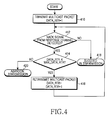
- FIG. 4 illustrates a base station operation for transmitting packet data for a multicast service in accordance with a preferred embodiment of the present invention:
- the operations illustrated in FIG 4 are confined to one multicast service from among one or more multicast services provided by the base station. However, it is obvious that the operations proposed in FIG. 4 are similarly applied to the respective multicast services. Further, the procedures illustrated in FIG. 4 are based on an n-channel SAW ARQ scheme. That is, the base station continuously transmits multicast data without waiting for reception of a response channel and retransmits the corresponding multicast data when a NACK signal is received.
- the base station transmits DL-MAP information, as information necessary for providing the requested multicast service, to the mobile terminal through a control channel.
- the control channel uses an MCS level resistant to errors in order to provide reliable transmission.
- the MCS level is selected such that it is suitable to support QoS of a mobile terminal, which is under the worst channel condition, from among mobile terminals having requested the multicast service. Additionally, the MCS level is selected in consideration of the number of retransmissions possible in supporting fast ARQ.
- the base station continuously transmits multicast data according to the multicast service.
- the multicast data is transmitted through a traffic channel assigned correspondingly to the multicast service.
- a code rate and a modulation scheme to be used for transmitting the multicast data are determined by the MCS level.
- the base station also sets DATA_RTR for counting the total number of transmissions to 1 multicast service by multicast service.
- the base station monitors if an orthogonal modulation symbol row corresponding to a NACK signal is received through a response channel (sub-channel assigned for transmitting a NACK signal). That is, the base station determines if an orthogonal modulation symbol row exists in the response channel to be checked, corresponding to the multicast service.
- the orthogonal modulation symbol row represents the NACK signal, and the orthogonal modulation symbol row may be transmitted through the response channel from at least one mobile terminal that is provided with the multicast service.
- the base station can determine that at least one mobile terminal has failed to decode the corresponding multicast data. However, if the orthogonal modulation symbol row does not exist, the base station determines that all the mobile terminals have successfully decoded the corresponding multicast data.
- the base station determines if the transmission of the corresponding multicast data has been executed as many times as the maximum allowed number of transmissions (MAX_DATA_RTR) in step 414. This step is performed by comparing DATA_RTR with MAX_DATA_RTR. That is, if DATA_RTR is smaller than MAX_DATA_RTR, the base station determines that the transmission of the corresponding multicast data has not been executed as many times as the maximum allowed number of transmissions (MAX_DATA_RTR). However, if DATA_RTR is equal to or larger than MAX_DATA_RTR, the base station determines that the transmission of the corresponding multicast data has not been executed as many times as the maximum allowed number of transmissions (MAX_DATA_RTR).
- the base station transmits the corresponding multicast data in step 416.
- the base station also adds 1 to DATA_RTR and then returns to step 412.
- step 418 to treat the transmission of the corresponding multicast data as a 'success'.
- This success treatment includes an operation of deleting the corresponding multicast data temporality stored for retransmission.
- the base station determines in step 414 that the transmission of the corresponding multicast data has not been executed the maximum allowed number of times (MAX_DATA_RTR), it proceeds to step 420 to abandon the transmission of the corresponding multicast data.
- the base station determines if an orthogonal modulation symbol row is included in a response channel assigned multicast service by multicast service, and retransmits the corresponding multicast data only when the orthogonal modulation symbol row is included the response channel.
- the base station assigns a specific response channel corresponding to a traffic channel separately assigned to each mobile terminal, and receives a response signal (ACK/NACK signal) to unicast packet data, which has been transmitted over the traffic channel, through the response channel.
- ACK/NACK signal a response signal
- FIG. 5 illustrates mobile terminal operations for receiving packet data for a multicast service in accordance with a preferred embodiment of the present invention.
- the mobile terminal requests a desired multicast service to a base station, and receives information necessary for being provided with the multicast service, i.e., DL-MAP information through a control channel.
- the control channel may be separately specified according to multicast services or mobile terminals. Otherwise, an identifier for identifying a corresponding mobile terminal together with DL-MA information may be transmitted through a control channel.
- the corresponding mobile terminal checks an identifier transmitted every time slot of the control channel, and receives corresponding DL-MAP information when the identifier specifies itself.
- the mobile terminal confirms a downlink time slot, in which it will receive multicast data, by the DL-MAP information. Thereafter, in step 512, the mobile terminal receives the multicast data transmitted in a predetermined downlink time slot of a traffic channel.
- the mobile terminal demodulates and decodes the received multicast data.
- Information on a code rate and a modulation scheme necessary for the demodulation and the decoding can be confirmed by an MCS level included in the DL-MAP information.
- step 514 the mobile terminal determines if the decoding for the multicast data succeeds. If the decoding for the multicast data succeeds, the mobile terminal does not transmit a response signal for the multicast data. However, if the decoding for the multicast data fails, the mobile terminal proceeds to step 516 to transmit a NACK signal through a response channel.
- An orthogonal modulation symbol row is used as the NACK signal.
- the orthogonal modulation symbol row must be commonly used by all mobile terminals to which the same multicast service is provided, and may be defined as '1 -1 -1 1 1 -1' by way of example.
- the response channel is specified correspondingly to the downlink time slot of the traffic channel where the multicast data is transmitted.
- the mobile terminal transmits an orthogonal modulation symbol row corresponding to a NACK signal through a response channel only when it fails in decoding for received multicast data. Therefore, even if a plurality of mobile terminals do not receive the same multicast data, there will be no interference between NACK signals transmitted from the respective plural mobile terminals. That is, a base station can obtain a synergy effect in receiving the NACK signals.
- the mobile terminal transmits no response signal when it successfully decodes the received multicast data, overhead due to the response signal can be reduced. Moreover, the reuse rate of RF resources can be increased.
- the present invention has the following effects.
- mobile terminals transmit a response signal through the same response channel, so that it is possible to efficiently use RF resources.
- mobile terminals transmit a response signal through a same response channel, so that a base station can obtain a synergy effect in receiving a response signal.
- traffic channels can correspond one-to-one to response channels, a base station need not transmit information on a response signal to mobile terminals.
Landscapes
- Engineering & Computer Science (AREA)
- Signal Processing (AREA)
- Computer Networks & Wireless Communication (AREA)
- Multimedia (AREA)
- Mobile Radio Communication Systems (AREA)
Applications Claiming Priority (1)
| Application Number | Priority Date | Filing Date | Title |
|---|---|---|---|
| KR1020040052775A KR20060003764A (ko) | 2004-07-07 | 2004-07-07 | 이동통신시스템에서의 동기 재전송 방법 |
Publications (1)
| Publication Number | Publication Date |
|---|---|
| EP1615375A1 true EP1615375A1 (fr) | 2006-01-11 |
Family
ID=34981435
Family Applications (1)
| Application Number | Title | Priority Date | Filing Date |
|---|---|---|---|
| EP05014808A Withdrawn EP1615375A1 (fr) | 2004-07-07 | 2005-07-07 | Procédé et system d'attribution d'un canal de réponse et rapport d'un résultat de réception dans un système de communication mobile |
Country Status (3)
| Country | Link |
|---|---|
| US (1) | US20060007887A1 (fr) |
| EP (1) | EP1615375A1 (fr) |
| KR (1) | KR20060003764A (fr) |
Cited By (3)
| Publication number | Priority date | Publication date | Assignee | Title |
|---|---|---|---|---|
| WO2010027167A3 (fr) * | 2008-09-05 | 2013-11-28 | Electronics And Telecommunications Research Institute | Appareil et procédé d'allocation de circuit de retour et procédé de transmission de signal d'accusé de réception |
| EP2067130A4 (fr) * | 2006-09-29 | 2014-01-01 | Intel Corp | Techniques de communication d'éléments d'information map dans un réseau sans fil |
| EP2181518A4 (fr) * | 2007-08-22 | 2014-06-18 | Samsung Electronics Co Ltd | Procédé et appareil pour transmettre une information ack/nack dans un système d'accès multiple à fréquence orthogonale basé sur le duplexage par division de temps |
Families Citing this family (29)
| Publication number | Priority date | Publication date | Assignee | Title |
|---|---|---|---|---|
| US7894818B2 (en) * | 2005-06-15 | 2011-02-22 | Samsung Electronics Co., Ltd. | Apparatus and method for multiplexing broadcast and unicast traffic in a multi-carrier wireless network |
| US9955438B2 (en) * | 2005-09-27 | 2018-04-24 | Qualcomm Incorporated | Method and apparatus for carrier allocation and management in multi-carrier communication systems |
| US8432794B2 (en) | 2005-12-29 | 2013-04-30 | Interdigital Technology Corporation | Method and apparatus for selecting multiple transport formats and transmitting multiple transport blocks simultaneously with multiple H-ARQ processes |
| US8611300B2 (en) * | 2006-01-18 | 2013-12-17 | Motorola Mobility Llc | Method and apparatus for conveying control channel information in OFDMA system |
| US8346256B2 (en) * | 2006-01-27 | 2013-01-01 | Alcatel Lucent | Method of multicast service provisioning |
| KR101435300B1 (ko) | 2006-02-03 | 2014-09-23 | 인터디지탈 테크날러지 코포레이션 | 다중 전송 블록들을 송수신하는 방법 및 장치 |
| US8102802B2 (en) * | 2006-05-08 | 2012-01-24 | Motorola Mobility, Inc. | Method and apparatus for providing downlink acknowledgments and transmit indicators in an orthogonal frequency division multiplexing communication system |
| EP2031774A1 (fr) * | 2006-06-15 | 2009-03-04 | Fujitsu Limited | Systeme de radiocommunication |
| US8897193B2 (en) | 2006-08-01 | 2014-11-25 | Samsung Electronics Co., Ltd. | Multicast packet transmitting method over wireless communication network and wireless communication network system using the method |
| KR101316622B1 (ko) * | 2006-08-01 | 2013-11-12 | 삼성전자주식회사 | 무선 통신망을 통한 멀티캐스트 패킷의 송수신 방법 및상기 무선 통신망 시스템 |
| JP4680860B2 (ja) * | 2006-09-29 | 2011-05-11 | 富士通株式会社 | データ通信方法 |
| KR100925436B1 (ko) * | 2006-10-02 | 2009-11-06 | 엘지전자 주식회사 | 효율적인 다중화를 이용한 제어 신호 전송 방법 |
| JP5159639B2 (ja) | 2007-01-09 | 2013-03-06 | パナソニック株式会社 | 基地局装置およびマッピング方法 |
| JP4563417B2 (ja) * | 2007-03-20 | 2010-10-13 | 株式会社エヌ・ティ・ティ・ドコモ | 移動通信システムにおけるユーザ装置、通信方法及び通信システム |
| WO2008133461A1 (fr) * | 2007-04-27 | 2008-11-06 | Lg Electronics Inc. | Procédé d'émission d'informations de diffusion dans un système de communication sans fil |
| US9516671B2 (en) * | 2007-07-05 | 2016-12-06 | Nokia Solutions And Networks Oy | Shared HARQ feedback channels for virtual grouping in a wireless relay network |
| US8296461B2 (en) * | 2007-08-07 | 2012-10-23 | Object Innovation Inc. | Data transformation and exchange |
| CN101855858A (zh) * | 2007-09-10 | 2010-10-06 | 韩国电子通信研究院 | 用于分配资源和接收数据的方法 |
| KR101478144B1 (ko) * | 2007-12-27 | 2015-01-02 | 삼성전자주식회사 | 알에프아이디 통신 방법 |
| EP2228933B1 (fr) * | 2008-01-04 | 2012-07-11 | Panasonic Corporation | Dispositif de transmission radio et procédé de transmission radio |
| US20090323575A1 (en) * | 2008-06-27 | 2009-12-31 | Motorola, Inc. | Method and apparatus for multicasting within a wireless communication network |
| US9270420B2 (en) * | 2009-04-24 | 2016-02-23 | Samsung Electronics Co., Ltd. | Data communication using 2D bar codes |
| US9210552B2 (en) * | 2011-01-03 | 2015-12-08 | Lg Electronics Inc. | Method for receiving multicast data in M2M device included in wireless communication system and M2M device therefor |
| US9148871B2 (en) * | 2011-06-09 | 2015-09-29 | Qualcomm Incorporated | Systems and methods for acknowledging communications from a plurality of devices |
| US9332492B2 (en) * | 2012-12-20 | 2016-05-03 | Google Inc. | Rapid acknowledgement of radio transmissions for energy minimization |
| US10609535B2 (en) * | 2013-08-26 | 2020-03-31 | Microchip Technology Incorporated | Blue-tooth communication system and broadcasting method thereof |
| KR102345169B1 (ko) * | 2015-05-27 | 2021-12-30 | 삼성전자 주식회사 | 플러딩 방식을 지원하는 메쉬 네트워크에서 신호 송/수신 장치 및 방법 |
| WO2017155332A2 (fr) * | 2016-03-09 | 2017-09-14 | 엘지전자 주식회사 | Procédé de réception d'un signal de multidiffusion dans un système de communication sans fil et appareil associé |
| US11758538B2 (en) * | 2017-05-12 | 2023-09-12 | Ntt Docomo, Inc. | User terminal and radio communication method |
Citations (5)
| Publication number | Priority date | Publication date | Assignee | Title |
|---|---|---|---|---|
| EP1089480A2 (fr) * | 1999-09-28 | 2001-04-04 | Kabushiki Kaisha Toshiba | Système de communication radio, procédé de communication radio, station de base radio et station de terminal radio |
| US20020057663A1 (en) * | 2000-11-15 | 2002-05-16 | Lim Byung Keun | Multicast and broadcast transmission method and apparatus of a CDMA mobile communication network |
| US20030005382A1 (en) * | 2001-07-02 | 2003-01-02 | Tao Chen | System and method for frame re-transmission in a broadcast communication system |
| EP1519598A1 (fr) * | 2003-09-29 | 2005-03-30 | Siemens Aktiengesellschaft | Transmission d'une information (NACK) provenant d'un terminal abonné relatif à la réception d'un paquet de données dans un système de transmission "point à multipoint" |
| WO2005032174A2 (fr) * | 2003-09-26 | 2005-04-07 | Benq Mobile Gmbh & Co. Ohg | Procede de transmission de messages, station mobile, station de base et systeme de communications |
Family Cites Families (3)
| Publication number | Priority date | Publication date | Assignee | Title |
|---|---|---|---|---|
| US6338800B1 (en) * | 2000-02-22 | 2002-01-15 | Natural Chemistry, Inc. | Methods and compositions using lanthanum for removing phosphates from water |
| WO2002056533A1 (fr) * | 2001-01-16 | 2002-07-18 | Siemens Aktiengesellschaft | Transmission parallele de donnees identiques vers plusieurs terminaux et retransmission d'informations concernant la qualite de transmission |
| US6781999B2 (en) * | 2001-07-23 | 2004-08-24 | Airvana, Inc. | Broadcasting and multicasting in wireless communication |
-
2004
- 2004-07-07 KR KR1020040052775A patent/KR20060003764A/ko not_active Ceased
-
2005
- 2005-07-07 EP EP05014808A patent/EP1615375A1/fr not_active Withdrawn
- 2005-07-07 US US11/176,180 patent/US20060007887A1/en not_active Abandoned
Patent Citations (5)
| Publication number | Priority date | Publication date | Assignee | Title |
|---|---|---|---|---|
| EP1089480A2 (fr) * | 1999-09-28 | 2001-04-04 | Kabushiki Kaisha Toshiba | Système de communication radio, procédé de communication radio, station de base radio et station de terminal radio |
| US20020057663A1 (en) * | 2000-11-15 | 2002-05-16 | Lim Byung Keun | Multicast and broadcast transmission method and apparatus of a CDMA mobile communication network |
| US20030005382A1 (en) * | 2001-07-02 | 2003-01-02 | Tao Chen | System and method for frame re-transmission in a broadcast communication system |
| WO2005032174A2 (fr) * | 2003-09-26 | 2005-04-07 | Benq Mobile Gmbh & Co. Ohg | Procede de transmission de messages, station mobile, station de base et systeme de communications |
| EP1519598A1 (fr) * | 2003-09-29 | 2005-03-30 | Siemens Aktiengesellschaft | Transmission d'une information (NACK) provenant d'un terminal abonné relatif à la réception d'un paquet de données dans un système de transmission "point à multipoint" |
Non-Patent Citations (2)
| Title |
|---|
| JENKAC H ET AL: "Retransmission strategies for MBMS over GERAN", WIRELESS COMMUNICATIONS AND NETWORKING CONFERENCE, 2005 IEEE NEW ORLEANS, LA, USA 13-17 MARCH 2005, PISCATAWAY, NJ, USA,IEEE, 13 March 2005 (2005-03-13), pages 1773 - 1779, XP010791443, ISBN: 0-7803-8966-2 * |
| KURI J ET AL: "RELIABLE MULTICAST IN MULTI-ACCESS WIRELESS LANS", WIRELESS NETWORKS, ACM, US, vol. 7, no. 4, July 2001 (2001-07-01), pages 359 - 369, XP001092554, ISSN: 1022-0038 * |
Cited By (3)
| Publication number | Priority date | Publication date | Assignee | Title |
|---|---|---|---|---|
| EP2067130A4 (fr) * | 2006-09-29 | 2014-01-01 | Intel Corp | Techniques de communication d'éléments d'information map dans un réseau sans fil |
| EP2181518A4 (fr) * | 2007-08-22 | 2014-06-18 | Samsung Electronics Co Ltd | Procédé et appareil pour transmettre une information ack/nack dans un système d'accès multiple à fréquence orthogonale basé sur le duplexage par division de temps |
| WO2010027167A3 (fr) * | 2008-09-05 | 2013-11-28 | Electronics And Telecommunications Research Institute | Appareil et procédé d'allocation de circuit de retour et procédé de transmission de signal d'accusé de réception |
Also Published As
| Publication number | Publication date |
|---|---|
| US20060007887A1 (en) | 2006-01-12 |
| KR20060003764A (ko) | 2006-01-11 |
Similar Documents
| Publication | Publication Date | Title |
|---|---|---|
| EP1615375A1 (fr) | Procédé et system d'attribution d'un canal de réponse et rapport d'un résultat de réception dans un système de communication mobile | |
| US11888615B2 (en) | Multiplexing schemes for OFDMA | |
| US9515803B2 (en) | Apparatus and method for processing configuration information received from a base station in a wireless communication system | |
| US8432855B2 (en) | Method for transmitting data using HARQ | |
| KR101379976B1 (ko) | Harq를 이용한 데이터 전송 방법 | |
| US20080168321A1 (en) | Method and apparatus for transmitting reverse ack/nack for forward control channel in mobile communication system supporting harq | |
| US20070242653A1 (en) | Method and apparatus for sharing radio resources in an ofdma-based communication system | |
| CN101926120B (zh) | 在无线通信系统中发射ack/nack信号的方法 | |
| US7957345B2 (en) | Adaptive HARQ in an OFDMA based communication system | |
| CN101091339B (zh) | 在正交频分多址无线接入系统中支持混合自动请求重发的方法和装置 | |
| US9635670B2 (en) | Method and apparatus for multiplexing frequency hopping in a communication system | |
| CN101669304A (zh) | 用于获取用于phich的资源范围信息的方法和接收pdcch的方法 | |
| CN101345609B (zh) | 无线通信系统、无线终端和无线基站 | |
| US20060251015A1 (en) | System and method for dynamic allocation of ARQ feedback in a multi-carrier wireless network | |
| KR20090034254A (ko) | 직교 주파수 분할 다중 접속 방식의 이동통신 시스템에서하향링크 제어 채널에 대한 상향링크 제어 채널 응답 채널송신 방법 및 장치 | |
| KR101426956B1 (ko) | Harq를 이용한 데이터 전송방법 | |
| KR20080074673A (ko) | 직교 주파수 분할 다중 시스템에서 이동 단말의 역방향전송 전력을 결정하는 방법 및 장치 |
Legal Events
| Date | Code | Title | Description |
|---|---|---|---|
| PUAI | Public reference made under article 153(3) epc to a published international application that has entered the european phase |
Free format text: ORIGINAL CODE: 0009012 |
|
| 17P | Request for examination filed |
Effective date: 20050707 |
|
| AK | Designated contracting states |
Kind code of ref document: A1 Designated state(s): AT BE BG CH CY CZ DE DK EE ES FI FR GB GR HU IE IS IT LI LT LU LV MC NL PL PT RO SE SI SK TR |
|
| AX | Request for extension of the european patent |
Extension state: AL BA HR MK YU |
|
| AKX | Designation fees paid |
Designated state(s): DE FI FR GB IT SE |
|
| 17Q | First examination report despatched |
Effective date: 20060504 |
|
| STAA | Information on the status of an ep patent application or granted ep patent |
Free format text: STATUS: THE APPLICATION IS DEEMED TO BE WITHDRAWN |
|
| 18D | Application deemed to be withdrawn |
Effective date: 20080730 |