EP1632364A1 - Pneumatic tire - Google Patents
Pneumatic tire Download PDFInfo
- Publication number
- EP1632364A1 EP1632364A1 EP05017907A EP05017907A EP1632364A1 EP 1632364 A1 EP1632364 A1 EP 1632364A1 EP 05017907 A EP05017907 A EP 05017907A EP 05017907 A EP05017907 A EP 05017907A EP 1632364 A1 EP1632364 A1 EP 1632364A1
- Authority
- EP
- European Patent Office
- Prior art keywords
- rubber
- cap
- tire
- pneumatic tire
- thickness
- Prior art date
- Legal status (The legal status is an assumption and is not a legal conclusion. Google has not performed a legal analysis and makes no representation as to the accuracy of the status listed.)
- Granted
Links
Images
Classifications
-
- B—PERFORMING OPERATIONS; TRANSPORTING
- B60—VEHICLES IN GENERAL
- B60C—VEHICLE TYRES; TYRE INFLATION; TYRE CHANGING; CONNECTING VALVES TO INFLATABLE ELASTIC BODIES IN GENERAL; DEVICES OR ARRANGEMENTS RELATED TO TYRES
- B60C11/00—Tyre tread bands; Tread patterns; Anti-skid inserts
-
- B—PERFORMING OPERATIONS; TRANSPORTING
- B60—VEHICLES IN GENERAL
- B60C—VEHICLE TYRES; TYRE INFLATION; TYRE CHANGING; CONNECTING VALVES TO INFLATABLE ELASTIC BODIES IN GENERAL; DEVICES OR ARRANGEMENTS RELATED TO TYRES
- B60C1/00—Tyres characterised by the chemical composition or the physical arrangement or mixture of the composition
- B60C1/0016—Compositions of the tread
-
- B—PERFORMING OPERATIONS; TRANSPORTING
- B60—VEHICLES IN GENERAL
- B60C—VEHICLE TYRES; TYRE INFLATION; TYRE CHANGING; CONNECTING VALVES TO INFLATABLE ELASTIC BODIES IN GENERAL; DEVICES OR ARRANGEMENTS RELATED TO TYRES
- B60C11/00—Tyre tread bands; Tread patterns; Anti-skid inserts
- B60C11/0041—Tyre tread bands; Tread patterns; Anti-skid inserts comprising different tread rubber layers
- B60C11/005—Tyre tread bands; Tread patterns; Anti-skid inserts comprising different tread rubber layers with cap and base layers
-
- B—PERFORMING OPERATIONS; TRANSPORTING
- B60—VEHICLES IN GENERAL
- B60C—VEHICLE TYRES; TYRE INFLATION; TYRE CHANGING; CONNECTING VALVES TO INFLATABLE ELASTIC BODIES IN GENERAL; DEVICES OR ARRANGEMENTS RELATED TO TYRES
- B60C11/00—Tyre tread bands; Tread patterns; Anti-skid inserts
- B60C11/0008—Tyre tread bands; Tread patterns; Anti-skid inserts characterised by the tread rubber
- B60C2011/0016—Physical properties or dimensions
- B60C2011/0025—Modulus or tan delta
-
- B—PERFORMING OPERATIONS; TRANSPORTING
- B60—VEHICLES IN GENERAL
- B60C—VEHICLE TYRES; TYRE INFLATION; TYRE CHANGING; CONNECTING VALVES TO INFLATABLE ELASTIC BODIES IN GENERAL; DEVICES OR ARRANGEMENTS RELATED TO TYRES
- B60C2200/00—Tyres specially adapted for particular applications
- B60C2200/10—Tyres specially adapted for particular applications for motorcycles, scooters or the like
Definitions
- the present invention relates to a pneumatic tire employing a rubber composition for a tire tread for preventing separation of the tread portion from the tire main body, and superior in grip performance and abrasion resistance, particularly suitable for a racing tire used on a pavement surface.
- the studless tire for example, including a two-layered tread portion with the cap rubber at the outer side and the base rubber at the inner side had the rubber elasticity and friction resistance of the cap rubber ensured under high temperature to exhibit grip performance by blending a softener with a low melting point in an amount greater in the cap rubber than in the base rubber.
- Japanese Patent Laying-Open No. 01-108232 discloses the method of preventing migration of the softener in the tread portion by providing an oil barrier between the tread portion and the belt ply. Although the amount of softener migrating to the belt ply is reduced by this method, migration of the softener onto the road and into the air could not be avoided.
- a pneumatic tire having microencapsulated oil blended into the tread portion has been proposed (refer to Japanese Patent Laying-Open No. 01-234441).
- this pneumatic tire is disadvantageous in that the microencapsulated oil facilitates friction of the tread portion against the road to result in degradation in the abrasion resistance.
- a tire having liquid polymer blended into the tire tread portion is also disclosed (refer to Japanese Patent Laying-Open No. 63-202636). This tire has migration of the softener in the tread portion only suppressed towards the belt, and the effect thereof was still insufficient.
- the present invention relates to a pneumatic tire employing a rubber composition for a tire tread for preventing separation of the tread portion from the tire main body, and superior in grip performance and abrasion resistance, particularly suitable for a racing tire used on a pavement surface.
- a pneumatic tire includes a two-layered tread portion having cap rubber at a ground-contact surface side and base rubber at the inner side, wherein the cap rubber has the JIS (K6253) type A hardness of 27 to 43 at 100°C, the base rubber has a thickness (TB) of at least 0.4 mm and a loss tangent (tan ⁇ ) value of at least 0.2, and the ratio (TC/TB) of a cap rubber thickness (C) to the base rubber thickness (TB) is at least 0.45.
- the cap rubber has the JIS (K6253) type A hardness of 27 to 43 at 100°C
- the base rubber has a thickness (TB) of at least 0.4 mm and a loss tangent (tan ⁇ ) value of at least 0.2
- the ratio (TC/TB) of a cap rubber thickness (C) to the base rubber thickness (TB) is at least 0.45.
- the cap rubber preferably includes 30 to 150 mass of a softener with respect to 100 mass of the rubber component. At least 60 mass % of the softener includes liquid styrene-butadiene rubber. Further, the liquid styrene-butadiene rubber has an average molecular weight of 600 to 20,000, preferably 1,000 to 10,000.
- the width of the base rubber (WB) is preferably at least 80% of the tread ground-contact width (TD) in straight-line driving and within the range of the width (WT) of the tread portion.
- the present invention is directed to a double layer of cap rubber and base rubber, wherein the hardness of the cap rubber, the thickness and the loss tangent (tan ⁇ ) value of the base rubber, and the ratio in thickness of the cap rubber to the base rubber are specified. Therefore, separation of the tread portion from the tire main body is prevented while the two competing properties of grip performance and abrasion resistance both can be improved at the same time.
- the grip performance and abrasion resistance are improved. Further, migration of the softener from the cap rubber to the base rubber can be alleviated.
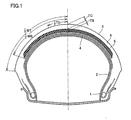
- Fig. 1 is a sectional view of a pneumatic tire for a two-wheeled vehicle of the present invention.
- a tread portion 3 on belt ply 4 includes a base rubber 5 at the inner side and a cap rubber 6 overlapping thereon.
- the cap rubber has the JIS (K6253) type A hardness adjusted to be within the range of 27 to 43. If this hardness of the cap rubber is below 27, the abrasion resistance is insufficient. On the other hand, if the hardness exceeds 43, the grip performance is degraded.
- the JIS (K6253) type A hardness was measured at 100°C using a digital hardness tester Model RH-708LE by EXCEL INC., based on a prepared rubber composition.
- the thickness (TB) of base rubber 5 is at least 0.4 mm, preferably 0.5 to 5.0 mm. If the base rubber thickness (TB) is below 0.4 mm, separation of the tread portion will easily occur by a running operation of the pneumatic tire. On the other hand, if this thickness exceeds 5.0 mm, the relative thickness of the cap rubber is so thin that the base rubber will be exposed when the cap rubber is worn away, disadvantageous in wear resistance.
- the thickness of base rubber 5 can be set substantially identical; or gradually decreasing/increasing from the center of the tire to the end of the tread, the thickness (TB) of base rubber 5 must be at least 0.4 mm at all sites.
- the width (WB) of base rubber 5 is preferably at least 80% of the tread ground-contact width (TD) in straight-line driving and within the range of the width (WT) of the tread portion. If the width (WB) of base rubber 5 is less than 80% of the tread ground-contact width (TD), separation of the tread portion will easily occur.
- the tread ground-contact width (TD) in straight-line running is defined as the average ground-contact width with respect to the road surface under the load of 100 kg with the air pressure of 240 kPa.
- the width (WB) of base rubber 5 is preferably within the range of 70 to 100% the width (WT) of the tread portion.
- the loss tangent (tan ⁇ ) value of base rubber 5 is at least 0.2. If this value is smaller than 0.2, the grip performance is degraded.
- the tan ⁇ value of the cap rubber is preferably at least 0.25.
- the value of loss tangent (tan ⁇ ) is based on a rubber piece of approximately 2 mm in thickness, approximately 4 mm in width, and approximately 40 mm in length, taken from a rubber sample of a tire tread portion. The loss tangent value of such rubber pieces was measured under the conditions of initial strain 10%, dynamic strain 5%, oscillation frequency 10Hz, and temperature of 100°C, using a viscoelasticity spectrometer VES-F-3 (by Iwamoto Seisaku-sho Co., Ltd.).
- the ratio (TC/TB) of the cap rubber thickness (TC) to the base rubber thickness (TB) is at least 0.45. If TC/TB is less than 0.45, the grip performance of the tread portion is degraded. Specifically, the cap rubber will be entirely worn away by the running operation of the tire, resulting in exposure of the base rubber that is further unfavorable than the cap rubber as to abrasion. Abrasion will be facilitated to result in degradation of the grip performance.
- diene-based rubber is used for the rubber component employed in the cap rubber and base rubber of the present invention.
- butadiene rubber, styrene-butadiene rubber, isoprene rubber, and the like generally employed in tires can be cited.
- styrene-butadiene rubber is preferable.
- at least 50 mass % of styrene-butadiene rubber is included in the rubber component, and one or two types of other diene-based rubber is blended.
- Styrene-butadiene rubber is advantageous in that grip performance is improved by virtue of the large hysteresis loss, as compared to natural rubber.
- the usage of liquid styrene-butadiene rubber as a softener is advantageous in that the bleeding phenomenon from the surface of the raw material rubber is alleviated.
- the rubber component can have an arbitrary diene-based polymer mixed within a range that does not exhibit softener bleeding.
- butadiene polymer, isoprene polymer, acrylonitrile-butadiene copolymer, aromatic vinyl butadiene copolymer, and the like can be mixed.
- the liquid styrene-butadiene rubber used in the present invention is a polymer of low molecular weight, having the molecular weight of 600 to 20,000 based on conversion into polystyrene, measured by GPC (Gel Permeation Chromatography).
- GPC Gel Permeation Chromatography
- the measurement conditions by GPC are set forth below.
- Solvent THF (tetra-hydrofuran) Concentration : 0.05 mass % Flow rate : 1 ml/min Column temperature : 40 °C Column : Ultrastyragel (product name)
- a softener is suitably blended into the cap rubber and base rubber in the present invention, it is preferable to also use the liquid styrene-butadiene rubber set forth above.
- the cap rubber at least 60 mass % of the liquid styrene-butadiene rubber set forth above is employed with respect to the entire softener.
- a plasticizer can be used as the softener employed in the present invention.
- the processing oil includes petroleum type softeners such as paraffinic processing oil, aromatic processing oil, and napthenic processing oil, coal tar type softeners, and fatty oil type softeners.
- various plasticizer compounds such as ester synthetic plasticizers and ether synthetic plasticizers can be used as the softener, as follows:
- Carbon black preferably has, but not particularly limited to, the iodine adsorption value of 100 to 330 g/kg, oil DBP absorption of 100 to 140 ml/100g, and nitrogen BET adsorption of 120 to 300 m 2 /g.
- the tread rubber of the present invention can have various additives added, if necessary, by adjusting an appropriate amount within a range that does not depart from the object of the present invention.
- vulcanizing agents such as sulfur employed in general rubber compositions, vulcanizing auxiliary agents such as zinc oxide (hydrozincite) and stearate, thiazole type accelerators such as mercaptobenzothiazole (MBT), di benzothiazyl disulfide (MBTS), N-tert-butyl-2-benzothiazolyl sulfenamide (TBBS), and N-cyclo hexyl-2-benzothiazyl sulfenamide (CZ), antioxidants such as N-(1, 3-dimethyl butyl)-N'-phenyl-p-phenylenediamine (6c), processing oils such as aromatic oil, naphthenic oil and paraffinic oil, wax, organic fiber, blowing agents and the like.
- processing oils such as aromatic oil, naphthenic oil and paraffinic
- the rubber compositions of the cap rubber and base rubber can be prepared as set forth below.
- the base rubber composition can be obtained by preparing an appropriate blending amount of each of the components, and base-kneading the components other than the vulcanizing agent and vulcanization accelerator using a Banbury mixer or the like. Then, the vulcanizing agent and vulcanization accelerator are added and mixed using a roller or a Banbury mixer.
- the time and temperature required for the base kneading and mixing set forth above are not particularly limited, and are to be controlled such that the respective components are mixed together evenly.
- the obtained base rubber is assembled with the cap rubber to be extruded and cut using an extruder, for example, followed by formation of a two-layered tread including a predetermined cap rubber and base rubber.
- a tire can be fabricated through a general method using the formed tread.
- the obtained tread can be applied to various types of tires such as pneumatic tires for two-wheeled vehicles in addition to pneumatic tires for passenger cars.
- a pneumatic tire including the tread formed of the cap rubber and base rubber of the present invention will be described hereinafter. It is to be noted that the present invention is not limited to the examples set forth below.
- Table 1 shows the basic blended contents of the cap rubber and base rubber. Sample tires of Examples 1 and 2 of the present invention as well as Comparative Examples 1 to 8 were fabricated using the rubber compositions set forth in Table 1, based on the specification shown in Table 2.
- Comparative Example 1 corresponds to a structure absent of base rubber in the tread portion.
- Comparative Example 2 corresponds to a structure in which the thickness and width of the base rubber are reduced.
- Comparative Example 3 corresponds to a structure in which the thickness of the base rubber is 0.5 mm, but with insufficient width, leading to tread separation.
- Comparative Example 4 corresponds to a structure in which the base rubber width is 50 mm, but with small thickness, leading to tread separation.
- Comparative Example 5 corresponds to a structure in which the base rubber width is 50 mm and the TC/TB value is 0.4, exhibiting poor grip performance.
- Comparative Example 6 corresponds to a structure in which the JIS (K6253) type A hardness of the cap rubber is as low as 26, leading to poor abrasion appearance after running. Further, the grip performance was not improved.
- Comparative Example 7 corresponds to a structure in which the JIS (K6253) type A hardness of the cap rubber is as high as 44, exhibiting extremely poor grip performance.
- Comparative Example 8 corresponds to a structure in which the tan ⁇ value is as low as 0.19, exhibiting extremely poor grip performance. Examples 1 and 2 were overall superior in grip performance, tread separation, and abrasion appearance.
- the present invention is directed to a double layer of cap rubber and base rubber, wherein the hardness of the cap rubber, the thickness and the loss tangent (tan ⁇ ) value of the base rubber, and the ratio in thickness of the cap rubber to the base rubber are specified. Therefore, separation of the tread portion from the tire main body is prevented while the two competing properties of grip performance and abrasion resistance both can be improved at the same time.
- a rubber composition for a tire tread particularly suitable for racing tires on pavement roads can be provided.
Landscapes
- Engineering & Computer Science (AREA)
- Mechanical Engineering (AREA)
- Tires In General (AREA)
- Compositions Of Macromolecular Compounds (AREA)
Abstract
Description
- This nonprovisional application is based on Japanese Patent Application No. 2004-259898 filed with the Japan Patent Office on September 7, 2004, the entire contents of which are hereby incorporated by reference.
- The present invention relates to a pneumatic tire employing a rubber composition for a tire tread for preventing separation of the tread portion from the tire main body, and superior in grip performance and abrasion resistance, particularly suitable for a racing tire used on a pavement surface.
- In general, it is important that studless tires, all-season tires, and racing tires used on a pavement surface maintain high level in grip performance and abrasion resistance, which are two competing considerations. Conventionally, the studless tire, for example, including a two-layered tread portion with the cap rubber at the outer side and the base rubber at the inner side had the rubber elasticity and friction resistance of the cap rubber ensured under high temperature to exhibit grip performance by blending a softener with a low melting point in an amount greater in the cap rubber than in the base rubber.
- In such tread rubber, the softener in the cap rubber will migrate into the base rubber during the running operation of the pneumatic tire, and also scattered onto the road and into the air. There was a problem that the initial tire performance is gradually degraded since aged deterioration (increase) in the hardness of the cap rubber occurs. In view of alleviating degradation in the performance over time in such studless tires and the like, Japanese Patent Laying-Open No. 01-108232 discloses the method of preventing migration of the softener in the tread portion by providing an oil barrier between the tread portion and the belt ply. Although the amount of softener migrating to the belt ply is reduced by this method, migration of the softener onto the road and into the air could not be avoided.
- A pneumatic tire having microencapsulated oil blended into the tread portion has been proposed (refer to Japanese Patent Laying-Open No. 01-234441). However, this pneumatic tire is disadvantageous in that the microencapsulated oil facilitates friction of the tread portion against the road to result in degradation in the abrasion resistance.
- A tire having liquid polymer blended into the tire tread portion is also disclosed (refer to Japanese Patent Laying-Open No. 63-202636). This tire has migration of the softener in the tread portion only suppressed towards the belt, and the effect thereof was still insufficient.
- The present invention relates to a pneumatic tire employing a rubber composition for a tire tread for preventing separation of the tread portion from the tire main body, and superior in grip performance and abrasion resistance, particularly suitable for a racing tire used on a pavement surface.
- According to an aspect of the present invention, a pneumatic tire includes a two-layered tread portion having cap rubber at a ground-contact surface side and base rubber at the inner side, wherein the cap rubber has the JIS (K6253) type A hardness of 27 to 43 at 100°C, the base rubber has a thickness (TB) of at least 0.4 mm and a loss tangent (tan δ) value of at least 0.2, and the ratio (TC/TB) of a cap rubber thickness (C) to the base rubber thickness (TB) is at least 0.45.
- In the present invention, the cap rubber preferably includes 30 to 150 mass of a softener with respect to 100 mass of the rubber component. At least 60 mass % of the softener includes liquid styrene-butadiene rubber. Further, the liquid styrene-butadiene rubber has an average molecular weight of 600 to 20,000, preferably 1,000 to 10,000. In the case where the present invention is directed to a pneumatic tire for a two-wheeled vehicle, the width of the base rubber (WB) is preferably at least 80% of the tread ground-contact width (TD) in straight-line driving and within the range of the width (WT) of the tread portion.
- The present invention is directed to a double layer of cap rubber and base rubber, wherein the hardness of the cap rubber, the thickness and the loss tangent (tan δ) value of the base rubber, and the ratio in thickness of the cap rubber to the base rubber are specified. Therefore, separation of the tread portion from the tire main body is prevented while the two competing properties of grip performance and abrasion resistance both can be improved at the same time.
- Particularly in the case where a softener mainly based on the liquid styrene-butadiene rubber set forth above is blended into the cap rubber and the base rubber, the grip performance and abrasion resistance are improved. Further, migration of the softener from the cap rubber to the base rubber can be alleviated.
- The foregoing and other objects, features, aspects and advantages of the present invention will become more apparent from the following detailed description of the present invention when taken in conjunction with the accompanying drawing.
- Fig. 1 is a sectional view of a pneumatic tire for a two-wheeled vehicle of the present invention.
- Referring to the sectional view of a pneumatic tire according to an embodiment of the present invention shown in Fig. 1, two plies of a
carcass ply 2 have respective ends thereof folded around a bead core 1 towards the tread from the inner side to the outer side of the tire. Atread portion 3 onbelt ply 4 includes abase rubber 5 at the inner side and a cap rubber 6 overlapping thereon. - The cap rubber has the JIS (K6253) type A hardness adjusted to be within the range of 27 to 43. If this hardness of the cap rubber is below 27, the abrasion resistance is insufficient. On the other hand, if the hardness exceeds 43, the grip performance is degraded.
- The JIS (K6253) type A hardness was measured at 100°C using a digital hardness tester Model RH-708LE by EXCEL INC., based on a prepared rubber composition.
- The thickness (TB) of
base rubber 5 is at least 0.4 mm, preferably 0.5 to 5.0 mm. If the base rubber thickness (TB) is below 0.4 mm, separation of the tread portion will easily occur by a running operation of the pneumatic tire. On the other hand, if this thickness exceeds 5.0 mm, the relative thickness of the cap rubber is so thin that the base rubber will be exposed when the cap rubber is worn away, disadvantageous in wear resistance. - Although the thickness of
base rubber 5 can be set substantially identical; or gradually decreasing/increasing from the center of the tire to the end of the tread, the thickness (TB) ofbase rubber 5 must be at least 0.4 mm at all sites. - In the case where the present invention is applied to a pneumatic tire for a two-wheeled vehicle, the width (WB) of
base rubber 5 is preferably at least 80% of the tread ground-contact width (TD) in straight-line driving and within the range of the width (WT) of the tread portion. If the width (WB) ofbase rubber 5 is less than 80% of the tread ground-contact width (TD), separation of the tread portion will easily occur. As used herein, the tread ground-contact width (TD) in straight-line running is defined as the average ground-contact width with respect to the road surface under the load of 100 kg with the air pressure of 240 kPa. In the case where the present invention is applied to a pneumatic tire for a passenger car, the width (WB) ofbase rubber 5 is preferably within the range of 70 to 100% the width (WT) of the tread portion. - The loss tangent (tan δ) value of
base rubber 5 is at least 0.2. If this value is smaller than 0.2, the grip performance is degraded. The tan δ value of the cap rubber is preferably at least 0.25. The value of loss tangent (tan δ) is based on a rubber piece of approximately 2 mm in thickness, approximately 4 mm in width, and approximately 40 mm in length, taken from a rubber sample of a tire tread portion. The loss tangent value of such rubber pieces was measured under the conditions of initial strain 10%,dynamic strain 5%, oscillation frequency 10Hz, and temperature of 100°C, using a viscoelasticity spectrometer VES-F-3 (by Iwamoto Seisaku-sho Co., Ltd.). - In the present invention, the ratio (TC/TB) of the cap rubber thickness (TC) to the base rubber thickness (TB) is at least 0.45. If TC/TB is less than 0.45, the grip performance of the tread portion is degraded. Specifically, the cap rubber will be entirely worn away by the running operation of the tire, resulting in exposure of the base rubber that is further unfavorable than the cap rubber as to abrasion. Abrasion will be facilitated to result in degradation of the grip performance.
- For the rubber component employed in the cap rubber and base rubber of the present invention, diene-based rubber is used. For example, butadiene rubber, styrene-butadiene rubber, isoprene rubber, and the like generally employed in tires can be cited. From the standpoint of improving grip performance, styrene-butadiene rubber is preferable. Further preferably, at least 50 mass % of styrene-butadiene rubber is included in the rubber component, and one or two types of other diene-based rubber is blended. Styrene-butadiene rubber is advantageous in that grip performance is improved by virtue of the large hysteresis loss, as compared to natural rubber.
- In the case where styrene-butadiene rubber is mainly employed as the rubber component in the present invention, the usage of liquid styrene-butadiene rubber as a softener is advantageous in that the bleeding phenomenon from the surface of the raw material rubber is alleviated. In the present invention, the rubber component can have an arbitrary diene-based polymer mixed within a range that does not exhibit softener bleeding. For example, butadiene polymer, isoprene polymer, acrylonitrile-butadiene copolymer, aromatic vinyl butadiene copolymer, and the like can be mixed.
- The liquid styrene-butadiene rubber used in the present invention is a polymer of low molecular weight, having the molecular weight of 600 to 20,000 based on conversion into polystyrene, measured by GPC (Gel Permeation Chromatography).
The measurement conditions by GPC are set forth below.Solvent : THF (tetra-hydrofuran) Concentration : 0.05 mass % Flow rate : 1 ml/min Column temperature : 40 °C Column : Ultrastyragel (product name) - If the molecular weight of liquid styrene-butadiene rubber is lower than 600, bleeding occurs from the base rubber and cap rubber, and abrasion is degraded. On the other hand, if the molecular weight exceeds 20,000, the rubber softening effect will become so low that the grip performance cannot be improved. Furthermore, the processability in milling is deteriorated.
- Although a softener is suitably blended into the cap rubber and base rubber in the present invention, it is preferable to also use the liquid styrene-butadiene rubber set forth above. With regards to the cap rubber, at least 60 mass % of the liquid styrene-butadiene rubber set forth above is employed with respect to the entire softener. As a result, increase in the cap rubber hardness during running or by aging can be suppressed while maintaining favorable friction property. The initial tire performance can be maintained for a long period of time.
- In addition to processing oil known as a general softener for rubber, a plasticizer can be used as the softener employed in the present invention. The processing oil includes petroleum type softeners such as paraffinic processing oil, aromatic processing oil, and napthenic processing oil, coal tar type softeners, and fatty oil type softeners. Besides these softeners, various plasticizer compounds such as ester synthetic plasticizers and ether synthetic plasticizers can be used as the softener, as follows:
- phthalic acid derivatives such as di-n-octylphthalate and di-butylphthalate, adipic acid derivatives such as di- (2-ethylhexyl) adipate and di-isobutyl-adipate, azelaic acid derivatives such as di- (2-ethylhexyl) azelate, sebacic acid derivatives such as di-(2-ethyhexyl) sebacate, maleic acid derivatives such as di-butylmaleate, fumaric acid derivatives such as di- (2-ethylhexyl) fumarate, trimellitic acid derivatives such as tri-isodecyl-trimellitate, citric acid derivatives such as acetyl triethyl-citrate, oleic acid derivatives such as methyl oleate, trimethylolpropane oleate, recinol acid derivatives such as methyl acetyl-ricinoleate, stearic acid derivatives such as diethylene glycol-di stearate, fatty acid derivatives such as triethylene glycol- dipelargonate, sulfonic acid derivatives such as N-cyclo hexyl-p-toluene sulfonamide, phosphoric acid derivatives such as tributyl phosphate, monoester type plasticizers such as octyl fatty acid ester, glycol derivatives such as triethylene glycol-di-(2-ethylbutylate), glycerol derivatives, paraffinic derivatives, diphenyl derivatives, epoxy derivatives, and the like. These can be used in singularity, or as an arbitrary mixture of two or more thereof.
- In the cap rubber and base rubber of the present invention, 30 to 150 mass of carbon black is blended as a filler with respect to 100 mass of the rubber component. Carbon black preferably has, but not particularly limited to, the iodine adsorption value of 100 to 330 g/kg, oil DBP absorption of 100 to 140 ml/100g, and nitrogen BET adsorption of 120 to 300 m2/g.
- The tread rubber of the present invention can have various additives added, if necessary, by adjusting an appropriate amount within a range that does not depart from the object of the present invention. For example, vulcanizing agents such as sulfur employed in general rubber compositions, vulcanizing auxiliary agents such as zinc oxide (hydrozincite) and stearate, thiazole type accelerators such as mercaptobenzothiazole (MBT), di benzothiazyl disulfide (MBTS), N-tert-butyl-2-benzothiazolyl sulfenamide (TBBS), and N-cyclo hexyl-2-benzothiazyl sulfenamide (CZ), antioxidants such as N-(1, 3-dimethyl butyl)-N'-phenyl-p-phenylenediamine (6c), processing oils such as aromatic oil, naphthenic oil and paraffinic oil, wax, organic fiber, blowing agents and the like.
- The rubber compositions of the cap rubber and base rubber can be prepared as set forth below. For example, the base rubber composition can be obtained by preparing an appropriate blending amount of each of the components, and base-kneading the components other than the vulcanizing agent and vulcanization accelerator using a Banbury mixer or the like. Then, the vulcanizing agent and vulcanization accelerator are added and mixed using a roller or a Banbury mixer. The time and temperature required for the base kneading and mixing set forth above are not particularly limited, and are to be controlled such that the respective components are mixed together evenly.
- The obtained base rubber is assembled with the cap rubber to be extruded and cut using an extruder, for example, followed by formation of a two-layered tread including a predetermined cap rubber and base rubber. A tire can be fabricated through a general method using the formed tread. The obtained tread can be applied to various types of tires such as pneumatic tires for two-wheeled vehicles in addition to pneumatic tires for passenger cars.
- A pneumatic tire including the tread formed of the cap rubber and base rubber of the present invention will be described hereinafter. It is to be noted that the present invention is not limited to the examples set forth below.
- Table 1 shows the basic blended contents of the cap rubber and base rubber. Sample tires of Examples 1 and 2 of the present invention as well as Comparative Examples 1 to 8 were fabricated using the rubber compositions set forth in Table 1, based on the specification shown in Table 2.
- Compounding agents other than sulfur and the vulcanization accelerator were subjected to base-kneading at approximately 150 to 180°C using a Banbury mixer (BB270 by Kobe Steel, Ltd.). Then 1.5 parts of sulfur and 2.5 parts of Nocceler NS were added and mixed at approximately 80 to 110°C to obtain the rubber compositions of cap rubber and base rubber. The obtained base rubber was extruded while being assembled with the cap rubber using an extruder (cold feed extruder by Nakata Engineering Co., Ltd.) to be cut into the desired length. Thus, the tread was obtained.
- Then, a rear wheel tire for a two-wheeled vehicle with the tire size of 205/60R17 was fabricated using the tread set forth above. The ground-contact width of the sample tire (inner pressure 240kPa) was 55 mm. The performance test on the obtained tires was conducted by the methods set forth hereinafter.
Table 1 Type Product Name Cap Rubber Base Rubber SBR N9550 by Zeon Corporation 100 100 Carbon N110 by Showa Cabot Kabushiki Kaisha variate variate Liquid SBR Sample Liquid SBR (Note 1) 80 30 Processing oil Diana Process PS32 by Idemitsu Kosan Co., Ltd. variate variate Wax SUNNOC wax by Ouchishinko Chemical Industrial Co., Ltd. 2 2 Antioxidant Santoflex 13 by Flexysis 2 2 Stearate Kiri by NOF Corporation 2 2 Hydrozincite Zinc Oxide No. 2 by Mitsui Kinzoku Kougyo 25 2 25 2 Sulfur Sulfur by Karuizawa Seirensho 1.5 1.5 Vulcanization Accelerator Nocceller by Ouchishinko Chemical Industrial Co., Ltd. 2.5 2.5 (Note 1) molecular weight: 7000, 50% hydrogenated treated 
- Each tire was mounted on a racing car, which was actually run on a circuit. The grip performance was evaluated by index based on an organoleptic test. A higher number indicates superior grip performance.
- Each tire was mounted onto a racing car, which was actually run for 70 kilometers on a circuit. The tread separation was visually observed. In Table 2, those of which tread separation could not be observed are indicated as "No Separation", and those of which tread separation could be observed are indicated as "Separation Identified".
- Each tire was mounted onto a racing car, which was run for 70 kilometers, under the designed normal load defined by JATMA (The Japan Automobile Tire Manufactures' Association). Then, the abrasion appearance of each tire was observed. Those of the level that can withstand race running are indicated as "No Abrasion", and those that are not fit for race running are indicated as "Abrasion Identified" in Table 2.
- Comparative Example 1 corresponds to a structure absent of base rubber in the tread portion. Comparative Example 2 corresponds to a structure in which the thickness and width of the base rubber are reduced. Comparative Example 3 corresponds to a structure in which the thickness of the base rubber is 0.5 mm, but with insufficient width, leading to tread separation.
- Comparative Example 4 corresponds to a structure in which the base rubber width is 50 mm, but with small thickness, leading to tread separation. Comparative Example 5 corresponds to a structure in which the base rubber width is 50 mm and the TC/TB value is 0.4, exhibiting poor grip performance. Comparative Example 6 corresponds to a structure in which the JIS (K6253) type A hardness of the cap rubber is as low as 26, leading to poor abrasion appearance after running. Further, the grip performance was not improved.
- Comparative Example 7 corresponds to a structure in which the JIS (K6253) type A hardness of the cap rubber is as high as 44, exhibiting extremely poor grip performance. Comparative Example 8 corresponds to a structure in which the tan δ value is as low as 0.19, exhibiting extremely poor grip performance. Examples 1 and 2 were overall superior in grip performance, tread separation, and abrasion appearance.
- The present invention is directed to a double layer of cap rubber and base rubber, wherein the hardness of the cap rubber, the thickness and the loss tangent (tan δ) value of the base rubber, and the ratio in thickness of the cap rubber to the base rubber are specified. Therefore, separation of the tread portion from the tire main body is prevented while the two competing properties of grip performance and abrasion resistance both can be improved at the same time. In particular, a rubber composition for a tire tread particularly suitable for racing tires on pavement roads can be provided.
- Although the present invention has been described and illustrated in detail, it is clearly understood that the same is by way of illustration and example only and is not to be taken by way of limitation, the spirit and scope of the present invention being limited only by the terms of the appended claims.
Claims (4)
- A pneumatic tire including a two-layered tread portion having cap rubber at a ground contact surface side and base rubber at an inner side, wherein said cap rubber has a JIS (K6253) type A hardness of 27 to 43 at 100°C, said base rubber has a thickness (TB) of at least 0.4 mm and a loss tangent (tan δ) value of at least 0.2, and a ratio (TC/TB) of a thickness (TC) of said cap rubber to the thickness (TB) of said base rubber is at least 0.45.
- The pneumatic tire according to claim 1, wherein said cap rubber includes a softener, said softener including at least 60 mass % of liquid styrene-butadiene rubber.
- The pneumatic tire according to claim 2, wherein the liquid styrene-butadiene rubber has an average molecular weight of 600 to 20,000.
- The pneumatic tire according to claim 1, wherein said pneumatic tire is a pneumatic tire for a two-wheeled vehicle, and a width (WB) of said base rubber is at least 80% of a tread ground-contact width (TD) in straight-line driving and within a range of a width (WT) of the tread portion.
Applications Claiming Priority (1)
| Application Number | Priority Date | Filing Date | Title |
|---|---|---|---|
| JP2004259898A JP4350622B2 (en) | 2004-09-07 | 2004-09-07 | Pneumatic tire |
Publications (2)
| Publication Number | Publication Date |
|---|---|
| EP1632364A1 true EP1632364A1 (en) | 2006-03-08 |
| EP1632364B1 EP1632364B1 (en) | 2014-03-05 |
Family
ID=35478434
Family Applications (1)
| Application Number | Title | Priority Date | Filing Date |
|---|---|---|---|
| EP20050017907 Ceased EP1632364B1 (en) | 2004-09-07 | 2005-08-17 | Pneumatic tire of a two-wheeled vehicle |
Country Status (3)
| Country | Link |
|---|---|
| EP (1) | EP1632364B1 (en) |
| JP (1) | JP4350622B2 (en) |
| CN (1) | CN100404281C (en) |
Cited By (14)
| Publication number | Priority date | Publication date | Assignee | Title |
|---|---|---|---|---|
| US20080216930A1 (en) * | 2007-03-05 | 2008-09-11 | Christopher John Valentine | Tyre with rubber tread which contains internal circumferential rubber stabilizer bars |
| US20090308514A1 (en) * | 2006-08-03 | 2009-12-17 | Bridgestone Corporation | Pneumatic tire, and manufacturing method of the same |
| EP2213481A4 (en) * | 2007-10-19 | 2011-01-19 | Bridgestone Corp | Pneumatic tire for two-wheeled vehicle |
| US7905262B2 (en) * | 2005-12-20 | 2011-03-15 | Sumitomo Rubber Industries, Ltd. | Tire for motorcycle with tread having center region, middle regions and shoulder regions |
| US8178605B2 (en) | 2006-12-27 | 2012-05-15 | Michelin Recherche Et Technique S.A. | Tread for tire |
| US20130167993A1 (en) * | 2011-12-29 | 2013-07-04 | Sumitomo Rubber Industries Ltd. | Two-wheeled automotive vehicle tire |
| US20130299054A1 (en) * | 2011-02-17 | 2013-11-14 | Bridgestone Corporation | Pneumatic tire for motorcycle |
| EP2206612A4 (en) * | 2007-09-18 | 2014-01-15 | Sumitomo Rubber Ind | Tire for motor-bicycle |
| EP2902436A1 (en) * | 2014-01-08 | 2015-08-05 | Sumitomo Rubber Industries, Ltd. | Studless winter tire |
| WO2016015896A1 (en) * | 2014-07-30 | 2016-02-04 | Continental Reifen Deutschland Gmbh | Bicycle tyre |
| EP2995472A1 (en) * | 2014-09-10 | 2016-03-16 | Sumitomo Rubber Industries, Ltd. | Pneumatic tire |
| EP3785928A1 (en) * | 2019-08-28 | 2021-03-03 | Sumitomo Rubber Industries, Ltd. | Tires |
| US20220032690A1 (en) * | 2020-07-29 | 2022-02-03 | Sumitomo Rubber Industries, Ltd. | Motorcycle tire |
| US12391074B2 (en) | 2020-07-24 | 2025-08-19 | Continental Reifen Deutschland Gmbh | Pneumatic tire for bicycle |
Families Citing this family (13)
| Publication number | Priority date | Publication date | Assignee | Title |
|---|---|---|---|---|
| JP2007332246A (en) * | 2006-06-14 | 2007-12-27 | Bridgestone Corp | Rubber composition and tire using the same |
| JP4420098B2 (en) * | 2006-11-06 | 2010-02-24 | 横浜ゴム株式会社 | Pneumatic tire |
| JP2008120940A (en) * | 2006-11-14 | 2008-05-29 | Toyo Tire & Rubber Co Ltd | Pneumatic tire |
| JP2009051317A (en) * | 2007-08-24 | 2009-03-12 | Bridgestone Corp | Pneumatic tire for two-wheeled vehicle |
| JP5182662B2 (en) * | 2007-08-30 | 2013-04-17 | 株式会社ブリヂストン | Pneumatic tires for motorcycles |
| JP5182743B2 (en) * | 2007-08-30 | 2013-04-17 | 株式会社ブリヂストン | Pneumatic tires for motorcycles |
| JP5265221B2 (en) * | 2008-03-10 | 2013-08-14 | 株式会社ブリヂストン | Motorcycle tires |
| WO2010070868A1 (en) * | 2008-12-17 | 2010-06-24 | 株式会社ブリヂストン | Tire |
| JP2010150324A (en) * | 2008-12-24 | 2010-07-08 | Sumitomo Rubber Ind Ltd | Tire |
| JP2016069483A (en) * | 2014-09-29 | 2016-05-09 | 住友ゴム工業株式会社 | High performance tires |
| JP7102754B2 (en) * | 2018-01-31 | 2022-07-20 | 住友ゴム工業株式会社 | Motorcycle tires |
| CN109050170A (en) * | 2018-08-16 | 2018-12-21 | 安徽奥丰汽车配件有限公司 | A kind of rubber and plastic semi-hollow tire |
| JP2024106869A (en) * | 2023-01-27 | 2024-08-08 | 株式会社ブリヂストン | Passenger car tires |
Citations (6)
| Publication number | Priority date | Publication date | Assignee | Title |
|---|---|---|---|---|
| JPS5751504A (en) * | 1980-09-09 | 1982-03-26 | Sumitomo Rubber Ind Ltd | Steel belt radial tire for passenger automobile |
| JPH07195906A (en) * | 1993-12-29 | 1995-08-01 | Sumitomo Rubber Ind Ltd | Motorcycle tires |
| US5851321A (en) * | 1995-01-13 | 1998-12-22 | The Yokohama Rubber Co., Ltd. | Pneumatic tire including cap tread portion |
| EP1008466A2 (en) * | 1998-12-11 | 2000-06-14 | Sumitomo Rubber Industries Limited | Pneumatic tyre |
| US20020000276A1 (en) * | 1998-11-26 | 2002-01-03 | Bridgestone Corporation | Pneumatic tire for front wheel of motorcycle |
| JP2002240510A (en) * | 2000-12-15 | 2002-08-28 | Ohtsu Tire & Rubber Co Ltd :The | Pneumatic tire |
Family Cites Families (1)
| Publication number | Priority date | Publication date | Assignee | Title |
|---|---|---|---|---|
| JP3943506B2 (en) * | 2003-01-24 | 2007-07-11 | 住友ゴム工業株式会社 | Pneumatic tire |
-
2004
- 2004-09-07 JP JP2004259898A patent/JP4350622B2/en not_active Expired - Fee Related
-
2005
- 2005-08-17 EP EP20050017907 patent/EP1632364B1/en not_active Ceased
- 2005-09-02 CN CNB2005100991429A patent/CN100404281C/en not_active Expired - Fee Related
Patent Citations (6)
| Publication number | Priority date | Publication date | Assignee | Title |
|---|---|---|---|---|
| JPS5751504A (en) * | 1980-09-09 | 1982-03-26 | Sumitomo Rubber Ind Ltd | Steel belt radial tire for passenger automobile |
| JPH07195906A (en) * | 1993-12-29 | 1995-08-01 | Sumitomo Rubber Ind Ltd | Motorcycle tires |
| US5851321A (en) * | 1995-01-13 | 1998-12-22 | The Yokohama Rubber Co., Ltd. | Pneumatic tire including cap tread portion |
| US20020000276A1 (en) * | 1998-11-26 | 2002-01-03 | Bridgestone Corporation | Pneumatic tire for front wheel of motorcycle |
| EP1008466A2 (en) * | 1998-12-11 | 2000-06-14 | Sumitomo Rubber Industries Limited | Pneumatic tyre |
| JP2002240510A (en) * | 2000-12-15 | 2002-08-28 | Ohtsu Tire & Rubber Co Ltd :The | Pneumatic tire |
Non-Patent Citations (3)
| Title |
|---|
| PATENT ABSTRACTS OF JAPAN vol. 006, no. 126 (M - 142) 10 July 1982 (1982-07-10) * |
| PATENT ABSTRACTS OF JAPAN vol. 1995, no. 11 26 December 1995 (1995-12-26) * |
| PATENT ABSTRACTS OF JAPAN vol. 2002, no. 12 12 December 2002 (2002-12-12) * |
Cited By (18)
| Publication number | Priority date | Publication date | Assignee | Title |
|---|---|---|---|---|
| US7905262B2 (en) * | 2005-12-20 | 2011-03-15 | Sumitomo Rubber Industries, Ltd. | Tire for motorcycle with tread having center region, middle regions and shoulder regions |
| US8480829B2 (en) * | 2006-08-03 | 2013-07-09 | Bridgestone Corporation | Pneumatic tire, and manufacturing method of the same |
| US20090308514A1 (en) * | 2006-08-03 | 2009-12-17 | Bridgestone Corporation | Pneumatic tire, and manufacturing method of the same |
| US8178605B2 (en) | 2006-12-27 | 2012-05-15 | Michelin Recherche Et Technique S.A. | Tread for tire |
| US20080216930A1 (en) * | 2007-03-05 | 2008-09-11 | Christopher John Valentine | Tyre with rubber tread which contains internal circumferential rubber stabilizer bars |
| EP2206612A4 (en) * | 2007-09-18 | 2014-01-15 | Sumitomo Rubber Ind | Tire for motor-bicycle |
| US9302545B2 (en) | 2007-09-18 | 2016-04-05 | Sumitomo Rubber Industries, Ltd. | Tire for motorcycle |
| EP2213481A4 (en) * | 2007-10-19 | 2011-01-19 | Bridgestone Corp | Pneumatic tire for two-wheeled vehicle |
| US20130299054A1 (en) * | 2011-02-17 | 2013-11-14 | Bridgestone Corporation | Pneumatic tire for motorcycle |
| US20130167993A1 (en) * | 2011-12-29 | 2013-07-04 | Sumitomo Rubber Industries Ltd. | Two-wheeled automotive vehicle tire |
| US9248702B2 (en) * | 2011-12-29 | 2016-02-02 | Sumitomo Rubber Industries, Ltd. | Two-wheeled automotive vehicle tire |
| EP2902436A1 (en) * | 2014-01-08 | 2015-08-05 | Sumitomo Rubber Industries, Ltd. | Studless winter tire |
| WO2016015896A1 (en) * | 2014-07-30 | 2016-02-04 | Continental Reifen Deutschland Gmbh | Bicycle tyre |
| US9962995B2 (en) | 2014-07-30 | 2018-05-08 | Continental Reifen Deutschland Gmbh | Bicycle tyre |
| EP2995472A1 (en) * | 2014-09-10 | 2016-03-16 | Sumitomo Rubber Industries, Ltd. | Pneumatic tire |
| EP3785928A1 (en) * | 2019-08-28 | 2021-03-03 | Sumitomo Rubber Industries, Ltd. | Tires |
| US12391074B2 (en) | 2020-07-24 | 2025-08-19 | Continental Reifen Deutschland Gmbh | Pneumatic tire for bicycle |
| US20220032690A1 (en) * | 2020-07-29 | 2022-02-03 | Sumitomo Rubber Industries, Ltd. | Motorcycle tire |
Also Published As
| Publication number | Publication date |
|---|---|
| CN1746040A (en) | 2006-03-15 |
| JP4350622B2 (en) | 2009-10-21 |
| JP2006076355A (en) | 2006-03-23 |
| EP1632364B1 (en) | 2014-03-05 |
| CN100404281C (en) | 2008-07-23 |
Similar Documents
| Publication | Publication Date | Title |
|---|---|---|
| EP1632364B1 (en) | Pneumatic tire of a two-wheeled vehicle | |
| JP4849176B2 (en) | Rubber composition for tire tread and pneumatic tire using the same | |
| EP1580037B1 (en) | Pneumatic radial tire | |
| EP3228659B1 (en) | Rubber composition for tire treads | |
| US9132698B2 (en) | Rubber composition for studless tire and studless tire using the same | |
| EP1897703A1 (en) | Tire with tread having a transition layer containing depolymerized rubber, pre-cured rubber or coal dust | |
| EP1897702A1 (en) | Tire with tread having an outer cap layer and underlying transition layer containing corncob granules | |
| AU2015254254B2 (en) | Rubber composition for tire tread | |
| EP2048006B1 (en) | Pneumatic tire, and its manufacturing method | |
| EP4331869B1 (en) | Tire | |
| JP2018002137A (en) | Pneumatic tire | |
| JP5477682B2 (en) | Process for producing rubber composition for base tread and pneumatic tire | |
| CN114056011A (en) | Tyre for vehicle wheels | |
| US20200001651A1 (en) | Pneumatic Tire | |
| JP5199033B2 (en) | Pneumatic tire | |
| JP4672416B2 (en) | Pneumatic tire manufacturing method and pneumatic tire obtained by the manufacturing method | |
| JP2005002206A (en) | Rubber composition and pneumatic tire | |
| JP4012160B2 (en) | Rubber composition for base tread and pneumatic tire | |
| JP4088290B2 (en) | Rubber composition for tire tread and tire comprising the same | |
| JP5648450B2 (en) | Heavy duty tire cap tread rubber composition and pneumatic tire using the same | |
| JP4010894B2 (en) | Pneumatic tire | |
| JP2008013609A (en) | Rubber composition for base tread of heavy duty tire | |
| JP7151932B1 (en) | Rubber composition for tire | |
| JP2005002139A (en) | Rubber composition and pneumatic tire | |
| JP7335497B2 (en) | Rubber composition for tire |
Legal Events
| Date | Code | Title | Description |
|---|---|---|---|
| PUAI | Public reference made under article 153(3) epc to a published international application that has entered the european phase |
Free format text: ORIGINAL CODE: 0009012 |
|
| AK | Designated contracting states |
Kind code of ref document: A1 Designated state(s): AT BE BG CH CY CZ DE DK EE ES FI FR GB GR HU IE IS IT LI LT LU LV MC NL PL PT RO SE SI SK TR |
|
| AX | Request for extension of the european patent |
Extension state: AL BA HR MK YU |
|
| 17P | Request for examination filed |
Effective date: 20060904 |
|
| 17Q | First examination report despatched |
Effective date: 20061006 |
|
| AKX | Designation fees paid |
Designated state(s): FR GB |
|
| REG | Reference to a national code |
Ref country code: DE Ref legal event code: 8566 |
|
| GRAJ | Information related to disapproval of communication of intention to grant by the applicant or resumption of examination proceedings by the epo deleted |
Free format text: ORIGINAL CODE: EPIDOSDIGR1 |
|
| GRAP | Despatch of communication of intention to grant a patent |
Free format text: ORIGINAL CODE: EPIDOSNIGR1 |
|
| INTG | Intention to grant announced |
Effective date: 20130814 |
|
| RIN1 | Information on inventor provided before grant (corrected) |
Inventor name: KUNISAWA, TETSUYA Inventor name: MATSUO, TOSHIRO Inventor name: SAKAMOTO, SHUICHI Inventor name: OTSUJI, HIDEKI |
|
| GRAS | Grant fee paid |
Free format text: ORIGINAL CODE: EPIDOSNIGR3 |
|
| GRAA | (expected) grant |
Free format text: ORIGINAL CODE: 0009210 |
|
| RAP1 | Party data changed (applicant data changed or rights of an application transferred) |
Owner name: SUMITOMO RUBBER INDUSTRIES, LTD. |
|
| AK | Designated contracting states |
Kind code of ref document: B1 Designated state(s): FR GB |
|
| REG | Reference to a national code |
Ref country code: GB Ref legal event code: FG4D |
|
| PGFP | Annual fee paid to national office [announced via postgrant information from national office to epo] |
Ref country code: GB Payment date: 20140820 Year of fee payment: 10 |
|
| PLBE | No opposition filed within time limit |
Free format text: ORIGINAL CODE: 0009261 |
|
| STAA | Information on the status of an ep patent application or granted ep patent |
Free format text: STATUS: NO OPPOSITION FILED WITHIN TIME LIMIT |
|
| 26N | No opposition filed |
Effective date: 20141208 |
|
| GBPC | Gb: european patent ceased through non-payment of renewal fee |
Effective date: 20150817 |
|
| REG | Reference to a national code |
Ref country code: FR Ref legal event code: PLFP Year of fee payment: 12 |
|
| PG25 | Lapsed in a contracting state [announced via postgrant information from national office to epo] |
Ref country code: GB Free format text: LAPSE BECAUSE OF NON-PAYMENT OF DUE FEES Effective date: 20150817 |
|
| REG | Reference to a national code |
Ref country code: FR Ref legal event code: PLFP Year of fee payment: 13 |
|
| REG | Reference to a national code |
Ref country code: FR Ref legal event code: PLFP Year of fee payment: 14 |
|
| PGFP | Annual fee paid to national office [announced via postgrant information from national office to epo] |
Ref country code: FR Payment date: 20210715 Year of fee payment: 17 |
|
| PG25 | Lapsed in a contracting state [announced via postgrant information from national office to epo] |
Ref country code: FR Free format text: LAPSE BECAUSE OF NON-PAYMENT OF DUE FEES Effective date: 20220831 |