EP1637618A1 - High strength thin steel sheet excellent in resistance to delayed fracture after forming and method for preparation thereof, and automobile parts requiring strength manufactured from high strength thin steel sheet - Google Patents
High strength thin steel sheet excellent in resistance to delayed fracture after forming and method for preparation thereof, and automobile parts requiring strength manufactured from high strength thin steel sheet Download PDFInfo
- Publication number
- EP1637618A1 EP1637618A1 EP03817075A EP03817075A EP1637618A1 EP 1637618 A1 EP1637618 A1 EP 1637618A1 EP 03817075 A EP03817075 A EP 03817075A EP 03817075 A EP03817075 A EP 03817075A EP 1637618 A1 EP1637618 A1 EP 1637618A1
- Authority
- EP
- European Patent Office
- Prior art keywords
- mass
- steel sheet
- fracture resistance
- delayed
- strength steel
- Prior art date
- Legal status (The legal status is an assumption and is not a legal conclusion. Google has not performed a legal analysis and makes no representation as to the accuracy of the status listed.)
- Granted
Links
Images

Classifications
-
- C—CHEMISTRY; METALLURGY
- C22—METALLURGY; FERROUS OR NON-FERROUS ALLOYS; TREATMENT OF ALLOYS OR NON-FERROUS METALS
- C22C—ALLOYS
- C22C38/00—Ferrous alloys, e.g. steel alloys
- C22C38/02—Ferrous alloys, e.g. steel alloys containing silicon
-
- C—CHEMISTRY; METALLURGY
- C21—METALLURGY OF IRON
- C21D—MODIFYING THE PHYSICAL STRUCTURE OF FERROUS METALS; GENERAL DEVICES FOR HEAT TREATMENT OF FERROUS OR NON-FERROUS METALS OR ALLOYS; MAKING METAL MALLEABLE, e.g. BY DECARBURISATION OR TEMPERING
- C21D9/00—Heat treatment, e.g. annealing, hardening, quenching or tempering, adapted for particular articles; Furnaces therefor
- C21D9/46—Heat treatment, e.g. annealing, hardening, quenching or tempering, adapted for particular articles; Furnaces therefor for sheet metals
-
- C—CHEMISTRY; METALLURGY
- C22—METALLURGY; FERROUS OR NON-FERROUS ALLOYS; TREATMENT OF ALLOYS OR NON-FERROUS METALS
- C22C—ALLOYS
- C22C1/00—Making non-ferrous alloys
- C22C1/06—Making non-ferrous alloys with the use of special agents for refining or deoxidising
-
- C—CHEMISTRY; METALLURGY
- C22—METALLURGY; FERROUS OR NON-FERROUS ALLOYS; TREATMENT OF ALLOYS OR NON-FERROUS METALS
- C22C—ALLOYS
- C22C38/00—Ferrous alloys, e.g. steel alloys
- C22C38/004—Very low carbon steels, i.e. having a carbon content of less than 0,01%
-
- C—CHEMISTRY; METALLURGY
- C22—METALLURGY; FERROUS OR NON-FERROUS ALLOYS; TREATMENT OF ALLOYS OR NON-FERROUS METALS
- C22C—ALLOYS
- C22C38/00—Ferrous alloys, e.g. steel alloys
- C22C38/04—Ferrous alloys, e.g. steel alloys containing manganese
-
- C—CHEMISTRY; METALLURGY
- C22—METALLURGY; FERROUS OR NON-FERROUS ALLOYS; TREATMENT OF ALLOYS OR NON-FERROUS METALS
- C22C—ALLOYS
- C22C38/00—Ferrous alloys, e.g. steel alloys
- C22C38/06—Ferrous alloys, e.g. steel alloys containing aluminium
-
- C—CHEMISTRY; METALLURGY
- C22—METALLURGY; FERROUS OR NON-FERROUS ALLOYS; TREATMENT OF ALLOYS OR NON-FERROUS METALS
- C22C—ALLOYS
- C22C38/00—Ferrous alloys, e.g. steel alloys
- C22C38/12—Ferrous alloys, e.g. steel alloys containing tungsten, tantalum, molybdenum, vanadium, or niobium
-
- C—CHEMISTRY; METALLURGY
- C22—METALLURGY; FERROUS OR NON-FERROUS ALLOYS; TREATMENT OF ALLOYS OR NON-FERROUS METALS
- C22C—ALLOYS
- C22C38/00—Ferrous alloys, e.g. steel alloys
- C22C38/14—Ferrous alloys, e.g. steel alloys containing titanium or zirconium
-
- C—CHEMISTRY; METALLURGY
- C22—METALLURGY; FERROUS OR NON-FERROUS ALLOYS; TREATMENT OF ALLOYS OR NON-FERROUS METALS
- C22C—ALLOYS
- C22C38/00—Ferrous alloys, e.g. steel alloys
- C22C38/16—Ferrous alloys, e.g. steel alloys containing copper
-
- C—CHEMISTRY; METALLURGY
- C21—METALLURGY OF IRON
- C21D—MODIFYING THE PHYSICAL STRUCTURE OF FERROUS METALS; GENERAL DEVICES FOR HEAT TREATMENT OF FERROUS OR NON-FERROUS METALS OR ALLOYS; MAKING METAL MALLEABLE, e.g. BY DECARBURISATION OR TEMPERING
- C21D2211/00—Microstructure comprising significant phases
-
- C—CHEMISTRY; METALLURGY
- C21—METALLURGY OF IRON
- C21D—MODIFYING THE PHYSICAL STRUCTURE OF FERROUS METALS; GENERAL DEVICES FOR HEAT TREATMENT OF FERROUS OR NON-FERROUS METALS OR ALLOYS; MAKING METAL MALLEABLE, e.g. BY DECARBURISATION OR TEMPERING
- C21D2211/00—Microstructure comprising significant phases
- C21D2211/004—Dispersions; Precipitations
Definitions
- the present invention relates to high-strength steel sheets, which inhibit delayed failures and delayed fractures that lead to problems, particularly with high-strength steel sheets, a method of manufacturing such steel sheets, and high-strength automotive part manufactured of such steel sheets.
- This technology changes the morphology of delayed fracture from intergranular to transgranular by precipitating alloy carbides and using the precipitated alloy carbides as hydrogen trap sites.
- Japanese Unexamined Patent Publication No. 11-293383 discloses that oxides consisting primarily of Ti and Mg are effective in preventing the occurrence of hydrogen defects.
- this paper concerns the high-strength steel sheets having certain specific structures, but does not concern any fundamental measures for improving delayed-fracture resistance.
- delayed-fracture resistance after forming of high-strength steel sheets can be improved without deteriorating the formability thereof by forming compounds or composite compounds of Mg and controlling the shape of such compounds.
- delayed fracture in tempered martensite steel starts from the voids and other defects resulting from the accumulation of hydrogen in prior austenite grain boundaries or other regions.
- the inventors studied the influences of various crystallized products and precipitates, and the strength and structure of steel sheets, in order to secure or improve the delayed-fracture resistance thereof after forming in the service environment thereof.
- equation (A) was defined as the condition to satisfy the above compatibility (Equation (A) will be discussed in detail later.).
- the parameters described in (i), (ii) and (iii) can be effectively controlled by limiting the manufacturing conditions so that the shape of the crystallized or precipitated products, such as oxides, nitrides and sulfides, of various elements, is controlled so as to form the trap sites of hydrogen.
- the present invention secures adequate post-forming delayed-fracture resistance in high-strength steel sheets by satisfying equation (A).
- Quantity of residual austenite The upper limit of residual austenite is limited to 7 vol.% because residual austenite increases the susceptibility to delayed fracture when it changes to martensite by working induced transformation.
- Mean particle diameter The mean particle diameter is limited to between 0.01 ⁇ m and 5.0 ⁇ m.
- the particles to form the hydrogen trap sites must have substantial sizes. Besides, the presence of fine particles in large quantities is unfavorable for securing the ductility of steel sheets and makes difficult the manufacture thereof.
- the lower limit of the mean particle diameter was set at 0.01 ⁇ m, and the upper limit was set at 5.0 ⁇ m because coarse particles do not form trap sites and can sometimes become the starting point of fracture.
- Particle density The particle density was limited to between 100 and 100000/mm 2 . Lower particle densities mean few trap sites, which, in turn, means that adequate post-forming delayed-fracture property cannot be secured. Therefore, the lower limit was set at 100/mm 2 .
- the upper limit was set at 100000/mm 2 because higher particle densities deteriorate ductility and formability and saturate the delayed-fracture resistance improving effect.
- Particle distribution The particle distribution was defined so that the ratio between the standard deviation ⁇ from the mean particle diameter and the mean particle diameter d satisfies ⁇ /d ⁇ 1.0. If ⁇ /d > 1.0, particles are widespread, which, in turn, reduces the delayed fracture improving effect and thereby deteriorates ductility and increases the number of fracture starting points. Therefore, the upper limit of ⁇ /d was set at 1.0.
- Particles are measured by observing membranes or sampled replicas through a scanning or transmission electron microscope, with a magnification of 5000 to 100000, in at least 30 visual fields.
- the particle diameter is evaluated by the circle equivalent diameter obtained by image analysis. In determining density, each composite precipitated or crystallized compound is counted as one.
- composition analysis is done by using energy dispersive x-ray (EDX) analysis and electron energy loss spectroscopy (EELS), structural analysis is done by analyzing diffraction patterns.
- EDX energy dispersive x-ray
- EELS electron energy loss spectroscopy
- the composite compounds are compounds (such as carbides, nitrides, oxides and sulfides) of Mg and other alloying additives (such as Ti, Nb, V, Cr, Mo, REM, and Ca).
- the present invention relates to high-strength steel sheets and primarily to steel sheets having a tensile strength of not lower than 780 MPa and a thickness in the range of 0.5 to 4.0 mm.
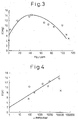
- Figs. 2 to 4 show the effects of the individual variables on delayed-fracture resistance.
- ⁇ shows good delayed-fracture resistance
- x shows poor delayed-fracture resistance.
- Fig. 2 shows the relationship between f (V ⁇ ) and volume percentage of residual austenite V ⁇ . It is assumed that Mg content is 300 ppm, mean particle diameter is 0.4 ⁇ m, density is 1500 particle/mm 2 , and tensile strength is 1480 MPa.
- V ⁇ is not higher than 7%, delayed-fracture resistance in compared steels marked with x deteriorates because Mg content, particle diameter and density are outside the range specified by the present invention and, therefore, f (V ⁇ ) ⁇ 10.
- Fig. 3 shows the relationship between f (Mg) and the quantity of Mg added. It is assumed that the volume percentage of residual austenite is 3.0%, mean particle diameter is 0.4 ⁇ m, density is 1500 particle/mm 2 , and tensile strength is 1480 MPa.
- Fig. 4 shows the relationship between f(p) and the density of crystallized and precipitated compounds. It is assumed that the volume percentage of residual austenite is 3.0%, Mg content is 30 ppm and tensile strength is 1380 MPa. If density is low, delayed-fracture resistance is poor.
- % means mass%.
- C is an element that increases the strength of steel sheets. C is particularly necessary for increasing strength as it forms hard phases such as martensite and austenite. In order to obtain 780 MPa or greater strength, C of not less than 0.05% is necessary. If, however, the C content is too high, the amount of cementite, which becomes the starting point of brittle fracture, increases, thereby causing hydrogen brittleness. Therefore, the upper limit is set at 0.3%.
- Si is a substitutional solid solution strengthening element that greatly hardens steel. Si effectively increases the strength of steel sheets and inhibits the precipitation of cementite. If the Si content exceeds 3.0%, scale removal in the hot-rolling process becomes costly and prone to economic disadvantage. Therefore, the upper limit is set at 3.0%.
- Si content should preferably be not more than 0.6% because too much Si addition deteriorates coatability.
- Mn is an element that is effective for increasing the strength of steel sheets. As this effect is unobtainable if Mn content is less than 0.01%, the lower limit is set at 0.01%. On the other hand, too much Mn addition not only promotes joint segregation with P and S but also deteriorates workability. Therefore, the upper limit is set at 3.0%.
- P is an element that promotes intergranular fracture by intergranular segregation. While a lower P content is preferable, too low an addition is unfavorable from the viewpoint of production cost. As P deteriorates corrosion resistance, the upper limit is set at 0.02%.
- S is an element that promotes hydrogen absorption in corrosive environments. While a lower content is preferable, it is unpreferable from the viewpoint of production cost to reduce S content too much.
- the upper limit is set at 0.02% because a lower content is preferable, particularly fox enhancing workability.
- Al at not less than 0.01%, is added for deoxidation. However, too much addition increases alumina and other inclusions, thereby deteriorating workability and weldability. Therefore, the upper limit is set at 3.0%. Addition of not less than 0.2% Al is preferable for inhibiting the formation of residual austenite.
- N contributes to deterioration of workability and formation of blowholes during welding. Therefore, a lower N content is preferable.
- the upper limit is set at 0.01% because an addition in excess thereof deteriorates workability.
- Mg is a necessary element because compounds of Mg effectively improve delayed-fracture resistance. Mg is also necessary for producing composite crystallized or precipitated compounds with other elements and controlling the shape thereof in such a manner as to contribute to improvement of delayed-fracture resistance. Thus, not less than 0.0002% Mg is added.
- the upper limit is set at 0.01%.
- V, Ti, Nb and Zr are strong-carbide-forming elements that improve strength and delayed-fracture resistance by forming precipitates and inclusions.
- V is effective for increasing steel strength and refining particle size.
- the lower limit is set at 0.005%.
- the upper limit is set at 1%.
- Ti is an element that effectively increases steel strength and refines particle size.
- the lower limit is set at 0.002% because the number of precipitates decreases therebelow.
- the upper limit is set at 1% because coarse precipitated or crystallized compounds are formed thereabove, which, in turn, lower workability and the delayed-fracture resistance.
- Nb also effectively increases steel strength and refines particle size.
- the lower limit is set at 0.002% as said effect is unobtainable therebelow.
- the upper limit is set at 1% because carbonitride precipitation increases and, as a result, workability and delayed-fracture resistance drop thereabove.
- Zn is an element that effectively increases steel strength and refines particle size.
- the lower limit is set at 0.002% because the number of precipitates decreases therebelow.
- the upper limit is set at 1% because coarse precipitated or crystallized compounds are formed thereabove, which, in turn, lowers workability and delayed-fracture resistance.
- Cr, Mo and W are elements that form carbides and exhibit resistance to temper softening and are necessary for the improvement of strength and delayed-fracture resistance.
- the Cr is effective for increasing steel strength.
- the lower limit is set at 0.005% because said effect is unobtainable therebelow.
- the upper limit is set at 5% because workability drops thereabove.
- Mo not only increases hardenability and stably forms martensite in continuous annealing lines but also strengthens grain boundaries and inhibits the occurrence of hydrogen brittleness.
- the lower limit is set at 0.005% because said effects are unobtainable therebelow.
- the upper limit is set at 5% because said effects saturate thereabove.
- W is an element that increases steel strength.
- the lower limit is set at 0.005% because said effect is unobtainable therebelow.
- the upper limit is set at 5% because workability drops thereabove.
- Cu is effective for strengthening and fine precipitation thereof contributes to the improvement of delayed-fracture resistance.
- the upper limit is set at 2.0% because excessive addition brings about deterioration of workability.
- Ni and Co are strengthening elements that increase hardenability.
- Ni has effects to improve delayed-fracture property by forming Ni sulfides and, thereby, inhibiting hydrogen penetration and increases the strength of steel sheets by enhancing the hardenability thereof.
- the lower limit is set at 0.005% because said effects are unobtainable therebelow, whereas the upper limit is set at 2% because workability drops thereabove.
- the upper limit is set at 2.0% because excessive addition brings about deterioration of workability.
- B is an element effective for increasing the strength of steel sheets.
- the lower limit is set at 0.0002% because said effect is unobtainable therebelow, whereas the upper limit is set at 0.1% because hot workability deteriorates thereabove.
- REM rare-earth metals
- Ca and Y are effective for the shape control of inclusions and conducive to delayed-fracture resistance. While the lower limit is set at 0.0005%, the upper limit is set at 0.01% because excessive addition deteriorates hot workability.
- slabs having specified compositions are hot-rolled.
- finish rolling is carried out at a temperature not lower than the Ar 3 point in order to prevent the excessive straining of ferrite particles and the lowering of workability.
- the finish rolling temperature should preferably be not higher than 940°C.
- Coiling at higher temperatures promotes recrystallization and particle growth and improves workability. At the same time, however, coiling at higher temperatures promotes the growth of scale formed during hot rolling and, thereby, lowers pickling efficiency. Therefore, the coiling temperature is set at not higher than 800°C.
- the coiling temperature is set at not lower than 500°C.
- the lower limit of the draft is set at 30%. If the draft exceeds 80%, sheet edge cracks and profile shape irregularities tend to occur. Therefore, the upper limit is set at 80%.
- the continuous annealing temperature is set at not lower than 600°C and not higher than 950°C. Annealing is done by using continuous annealing equipment or box annealing equipment.
- annealed steel sheets may be held in a temperature range between 200°C and 700°C for 1 minute to 10 hours and, then, cooled. This heat treatment causes precipitation of alloy carbides or nitrides (such as carbonitrides containing V, Cr, Mo and W).
- the precipitates thus formed serve as new hydrogen trap sites and further improve delayed-fracture resistance. If the temperature is low and the time is short, adequate precipitation does not occur. If the temperature is high and the time is long, precipitated compounds become coarse. As the precipitates fail to serve as trap sites in both cases, the temperature and time are limited to the ranges described above.
- the preferable slab casting speed is 0.05 to 20.0 m/minute, the speed between 1.0 m/minute and 3.0 m/minute is more preferable for stable use of the delayed fracture improving effect of Mg compounds.
- the steel sheets according to the present invention may be hot-rolled, cold-rolled or metal-coated.
- Metal coating may be ordinary zinc-coating, Al coating, etc.
- Coating may be provided by either hot-dip process or electrolytic process. Post-coating alloying heat treatment or multi-layer coating may be applied, too.
- Film-laminated uncoated or coated steel sheets are also within the scope of the present invention.
- High-strength automotive parts such as bumpers, door impact beams and other reinforcing members manufactured of high-strength steel sheets according to the present invention (such as steel sheets with strength of not lower than 780 MPa) also maintain excellent properties (such as strength and rigidity) and exhibit good shock absorption and delayed-fracture resistance.
- the steels were heated in the heating furnace at temperatures between 1160C° and 1250°C, hot-rolled with finishing temperatures between 870°C and 900°C, and coiled at temperatures between 650°C and 750°C.
- the steels marked with I and J were alloyed galvanized steel sheets with a coating weight of 50 g/m 2 on each side.
- the steel marked with J was further subjected to film laminating treatment.
- Table 2 shows the manufacturing methods and properties of the steel sheets.
- Table 3 shows evaluations of the delayed-fracture resistance of the steel sheets. Evaluations were made by bending 80 mm by 30 mm rectangular specimens, fitting a waterproof strain gage on the surface thereof, dipping the specimens in a 0.5 mol/l sulfuric acid, electrolyzing the solution, and causing hydrogen penetration.
- the high-strength steel sheets according to the present invention effectively disperse Mg compounds or composite crystallized or precipitated compounds, which function as hydrogen trap sites, and thereby make ductility compatible with delayed-fracture resistance after forming.
- the high-strength automotive members prepared by forming the high-strength steel sheets according to the present invention also maintained excellent properties and exhibited good shock absorption and delayed-fracture resistance.
Landscapes
- Chemical & Material Sciences (AREA)
- Engineering & Computer Science (AREA)
- Materials Engineering (AREA)
- Mechanical Engineering (AREA)
- Metallurgy (AREA)
- Organic Chemistry (AREA)
- Physics & Mathematics (AREA)
- Thermal Sciences (AREA)
- Crystallography & Structural Chemistry (AREA)
- Heat Treatment Of Sheet Steel (AREA)
Abstract
Description
- The present invention relates to high-strength steel sheets, which inhibit delayed failures and delayed fractures that lead to problems, particularly with high-strength steel sheets, a method of manufacturing such steel sheets, and high-strength automotive part manufactured of such steel sheets.
- While high-strength steels are often used for bolts, pre-stressed concrete (PC) wires, line pipes and other uses, it has been known that penetration of hydrogen into steel leads to delayed fractures when the strength exceeds 780 MPa.
- Meanwhile, there has been little awareness of delayed-fracture problems because (i) the penetrated hydrogen escapes from within steel in a short time because the sheet thickness is small and (ii) steel sheets whose strength is greater than 780 MPa were seldom used because of low workability.
- Recently, however, the need to reduce the weight and increase the pre-collision passive safety of automobiles have been rapidly increasing the use of ultra-high strength steel sheets having a tensile strength of 780 MPa or more for bumpers, impact beams and other reinforcing members, sheet rails, etc., with press forming, pipe forming, bending, end-face machining or bore expanding applied. Therefore, it is urgently necessary to develop ultra-high strength steel sheets having high delayed-fracture resistance.
- Most of the conventional technologies to improve delayed-fracture resistance have been developed for bolts, bars, shapes, plates and other steels that are used as they are and where applied forces are less than the yield strength or stress thereof.
- For example, the development of steels for bars, shapes and bolts have been centered on tempered martensite. "New Developments in Elucidation of Delayed Fracture" (Iron and Steel Institute of Japan, Ad-hoc Group on Structures and Characteristics of Materials, Study Group on Delayed Fracture of High-strength steels, January 1997) reports that addition of such elements as Cr, Mo and V that exhibit resistance to temper softening is effective in improving resistance to delayed fracture.
- This technology changes the morphology of delayed fracture from intergranular to transgranular by precipitating alloy carbides and using the precipitated alloy carbides as hydrogen trap sites.
- Containing 0.4% or more C and large quantities of alloying elements, however, such steels do not have the workability and weldability required of steel sheets. In addition, the need to apply hours of precipitation heat treatment to separate alloy carbides presents a problem in productivity.
- Japanese Unexamined Patent Publication No. 11-293383 discloses that oxides consisting primarily of Ti and Mg are effective in preventing the occurrence of hydrogen defects.
- However, this technology is for steel plates. While delayed fracture after welding with high heat input is considered, no consideration is given to the effects of high-level forming and generation of burrs resulting from end-face machining that are often applied to steel sheets.
- Furthermore, no consideration is given to workability that is a basic property of steel sheets.
- Regarding the delayed fracture of steel sheets, meanwhile, the furtherance, due to residual austenite, of delayed fractures resulting from working-induced transformation has been reported (Ex. Yamazaki et al. CAMP-ISIJ vol. 5, p. 1839-1842 (1992)).
- While considering the forming of steel sheets, this paper reports the quantity control of residual austenite for the purpose of precluding the deterioration of delayed-fracture resistance.
- That is to say, this paper concerns the high-strength steel sheets having certain specific structures, but does not concern any fundamental measures for improving delayed-fracture resistance.
- As described above, hardly any countermeasures have been developed against delayed fractures caused by pre-use forming and other working while considering, in particular, service environments and productivity on existing equipment and securing the intrinsic formability.
- Against such backgrounds, the inventors discovered measures to fundamentally improve resistance to delayed fractures while giving adequate consideration to service environments of steel sheets and manufacturing processes with existing equipment.
- That is to say, the inventors discovered that delayed-fracture resistance after forming of high-strength steel sheets can be improved without deteriorating the formability thereof by forming compounds or composite compounds of Mg and controlling the shape of such compounds.
- In addition, the inventors discovered effective manufacturing methods for high-strength steel sheets using existing manufacturing equipment (such as hot-rolling, continuous annealing, hot-dip galvanizing and electrolytic equipment). The details are as described below:
- (1) High-strength steel sheet having excellent post-forming delayed-fracture resistance, characterized by:
- containing, in mass%,
- C : 0.05 to 0.3%,
- Si : not more than 3.0%,
- Mn: 0.01 to 3.0%,
- P : not more than 0.02%,
- 5 : not more than 0.02%,
- Al: 0.01 to 3.0%,
- N : not more than 0.01% and
- Mg: 0.0002 to 0.01%,
- with the remainder comprising iron and unavoidable impurities,
- having the residual austenite in the structure of steel being not more than 7 vol.%,
- including one or more of the oxides, sulfides, composite crystallized products and composite precipitates of Mg having means particle diameter d in the range of 0.01 to 5.0 µm, density ρ in the range of 100 to 100000/mm2, and distribution satisfying the ratio between the standard deviationσfrom mean particle diameter and mean particle diameter d, σ/d ≤ 1.0, and
- having the volume percentage Vγ(%) of residual austenite and tensile strength TS (MPa) satisfying equation (A)

- Vγ: volume percentage of residual austenite (%)
- Mg: the amount of Mg (mass ppm)
- d : particle diameter (µm)
- ρ : density (particle/mm2)
- TS: tensile strength (MPa)
- (i) 1000 (V - 0.1)-5.5 = 10 when 1000 (V - 0.1)-5.5 ≥ 10,
- (ii) 2 ≤ Mg ≤ 100 ppm
- (iii) (d - 0.2)2 = 0.2 when 0.01 ≤ d ≤ 5.0 µm and (d-0.2)2 ≤ 0.2
- (iv) 100 ≤ ρ ≤ 100000 particle/mm2 and
- (v) 780 MPa ≤ TS
- containing, in mass%,
- (2) High-strength steel sheet having excellent post-forming delayed-fracture resistance described in (1), characterized by:
- containing, furthermore, in mass%, one or more of
- V : 0.005 to 1 mass%,
- Ti: 0.002 to 1 mass%,
- Nb: 0.002 to 1 mass% and
- Zr: 0.002 to 1 mass%.
- containing, furthermore, in mass%, one or more of
- (3) High-strength steel sheet having excellent post-forming delayed-fracture resistance described in (1) or (2), characterized by:
- containing, furthermore, in mass%, one or more of
- Cr: 0.005 to 5 mass%,
- Mo: 0.005 to 5 mass% and
- W : 0.005 to 5 mass%.
- containing, furthermore, in mass%, one or more of
- (4) High-strength steel sheet having excellent post-forming delayed-fracture resistance described in any of (1) to (3), characterized by:
- containing, furthermore, in mass%,
- Cu: 0.005 to 2.0 mass%.
- containing, furthermore, in mass%,
- (5) High-strength steel sheet having excellent post-forming delayed-fracture resistance described in any of (1) to (4), characterized by:
- containing, furthermore, in mass%, one or more of
- Ni: 0.005 to 2.0 mass% and
- Co: 0.005 to 2.0 mass%.
- containing, furthermore, in mass%, one or more of
- (6) High-strength steel sheet having excellent post-forming delayed-fracture resistance described in any of (1) to (5), characterized by:
- containing, furthermore, in mass%,
- B: 0.0002 to 0.1 mass%.
- containing, furthermore, in mass%,
- (7) High-strength steel sheet having excellent post-forming delayed-fracture resistance described in any of (1) to (6), characterized by:
- containing furthermore, in mass%, one or more of
- REM: 0.0005 to 0.01 mass%,
- Ca: 0.0005 to 0.01 mass% and
- Y : 0.0005 to 0.01 mass%.
- containing furthermore, in mass%, one or more of
- (8) High-strength steel sheet having excellent post-forming delayed-fracture resistance described in any of (1) to (7), characterized by that:
- the high-strength steel sheet is hot-rolled or cold-rolled steel sheet.
- (9) High-strength steel sheet having excellent post-forming delayed-fracture resistance described in any of (1) to (7), characterized by that
- the high-strength steel sheet is zinc-coated on the surface.
- (10) High-strength steel sheet having excellent post-forming delayed-fracture resistance described in (8) or (9), characterized by that:
- the high-strength steel sheet is also film-laminated.
- (11) Method for manufacturing high-strength steel sheet having excellent post-forming delayed-fracture resistance, characterized by comprising the steps of:
- preparing slab of the composition described in any of (1) to (7),
- hot-rolling said slab with a finishing temperature not lower than the Ar3 point,
- coiling the hot-rolled strip at a temperature between 500°C and 800°C,
- cold-rolling with a draft of 30 to 80% after applying pickling,
- applying recrystallization annealing by soaking at not lower than 600°C and not higher than 950°C, and then
- applying temper rolling.
- (12) Method for manufacturing high-strength steel sheet having excellent post-forming delayed-fracture resistance described in (11), characterized by comprising, furthermore, the step of:
- holding the strip in the temperature range of 200 to 700°C for 1 minute to 10 hours after annealing.
- (13) Automotive structural member, characterized by being manufactured of high-strength steel sheet having the excellent post-forming delayed-fracture resistance described in any of (1) to (7).
-
- Fig. 1 shows the relationship between equation (A) and delayed-fracture time.
- Fig. 2 shows the relationship between equation (A) and residual austenite.
- Fig. 3 shows the relationship between equation (A) and Mg content.
- Fig. 4 shows the relationship between equation (A) and density.
- It is considered that delayed fracture in tempered martensite steel starts from the voids and other defects resulting from the accumulation of hydrogen in prior austenite grain boundaries or other regions.
- Therefore, if the trap site of hydrogen is uniformly and finely dispersed and hydrogen is trapped therein, the concentration of diffusible hydrogen and, as a result, the sensibility to delayed fracture, drop.
- As disclosed in said Japanese Unexamined Patent Publication No. 11-293383, it is known that resistance to hydrogen-induced delayed fracture is improved by controlling the dispersion pattern of oxides in steel plates to which Mg and Ti are added in combination.
- In steel sheets, however, if high residual stresses and end-face burrs are generated as a result of forming, resistance to delayed fracture inevitably deteriorates and accompanying deterioration of delayed-fracture property cannot be compensated.
- Thus, few studies have been made of delayed-fracture property with consideration given to the use pattern of steel sheets and the problem of the deterioration of delayed-fracture property in steel sheets cannot be solved by the shape control of Mg and Ti oxides alone. Also, solid dispersion of trap site involves the possibility of deteriorating ductility which is a basic property of steel sheets.
- Against the above background, the inventors studied the influences of various crystallized products and precipitates, and the strength and structure of steel sheets, in order to secure or improve the delayed-fracture resistance thereof after forming in the service environment thereof.
- The studies led to the discovery of technology to improve or secure the delayed-fracture resistance of steel sheets in the service environment thereof, even under high residual stresses or in the presence of end-face burrs. That is to say, it is possible to make compatible ductility and delayed-fracture resistance after forming by effectively dispersing the compounds or composite crystallized products or precipitates of Mg, which are trap sites for hydrogen, by controlling
- (i) the dispersion pattern of oxides or sulfides containing Mg and the composite crystallized or precipitated compounds therewith,
- (ii) the quantity of residual austenite in the microstructure of steel sheet, and
- (iii) the strength of steel sheet.
- Then, equation (A) was defined as the condition to satisfy the above compatibility (Equation (A) will be discussed in detail later.).
- The presence in the crystal grains (except the phase boundaries in the microstructure, such as prior-austenite grain boundaries) of the oxides or sulfides containing Mg and the composite crystallized or precipitated compounds therewith described in (i) is more effective in the improvement of delayed-fracture property.
- The parameters described in (i), (ii) and (iii) can be effectively controlled by limiting the manufacturing conditions so that the shape of the crystallized or precipitated products, such as oxides, nitrides and sulfides, of various elements, is controlled so as to form the trap sites of hydrogen.
- The present invention secures adequate post-forming delayed-fracture resistance in high-strength steel sheets by satisfying equation (A).
- This is considered to be due to the difference between the dislocation and residual stress field induced by forming and the interaction of the particles forming the trap sites in steel sheets and the dislocation and residual stress field induced by hot-rolling and cooling after welding and the interaction of the particles forming the trap sites in steel plates. This is also considered to be due to the difference between the heat treatments applied to steel sheets and plates.
- Said parameters (i) and (ii) are limited as described below.
- Quantity of residual austenite: The upper limit of residual austenite is limited to 7 vol.% because residual austenite increases the susceptibility to delayed fracture when it changes to martensite by working induced transformation.
- Mean particle diameter: The mean particle diameter is limited to between 0.01 µm and 5.0 µm. The particles to form the hydrogen trap sites must have substantial sizes. Besides, the presence of fine particles in large quantities is unfavorable for securing the ductility of steel sheets and makes difficult the manufacture thereof.
- Therefore, the lower limit of the mean particle diameter was set at 0.01 µm, and the upper limit was set at 5.0 µm because coarse particles do not form trap sites and can sometimes become the starting point of fracture.
- Particle density: The particle density was limited to between 100 and 100000/mm2. Lower particle densities mean few trap sites, which, in turn, means that adequate post-forming delayed-fracture property cannot be secured. Therefore, the lower limit was set at 100/mm2.
- The upper limit was set at 100000/mm2 because higher particle densities deteriorate ductility and formability and saturate the delayed-fracture resistance improving effect.
- Particle distribution: The particle distribution was defined so that the ratio between the standard deviation σ from the mean particle diameter and the mean particle diameter d satisfies σ/d ≤ 1.0. If σ/d > 1.0, particles are widespread, which, in turn, reduces the delayed fracture improving effect and thereby deteriorates ductility and increases the number of fracture starting points. Therefore, the upper limit of σ/d was set at 1.0.
- Here, measurement of particles containing Mg compounds will be discussed. Particles are measured by observing membranes or sampled replicas through a scanning or transmission electron microscope, with a magnification of 5000 to 100000, in at least 30 visual fields.
- The particle diameter is evaluated by the circle equivalent diameter obtained by image analysis. In determining density, each composite precipitated or crystallized compound is counted as one.
- While composition analysis is done by using energy dispersive x-ray (EDX) analysis and electron energy loss spectroscopy (EELS), structural analysis is done by analyzing diffraction patterns.
- The composite compounds are compounds (such as carbides, nitrides, oxides and sulfides) of Mg and other alloying additives (such as Ti, Nb, V, Cr, Mo, REM, and Ca).
- More details of the present invention are described below.
- The present invention relates to high-strength steel sheets and primarily to steel sheets having a tensile strength of not lower than 780 MPa and a thickness in the range of 0.5 to 4.0 mm.
- Next, equation (A) will be explained. Equation (A) was derived from Fig. 1 as described below, based on the understanding that the volume percentage, mean particle diameter, density, Mg content and tensile strength of residual austenite are the factors involved in delayed-fracture resistance.

where α = -0.005(Mg ≤ 40), α = -0.002 (Mg > 40) - Vγ: volume percentage of residual austenite (%)
- Mg: the quantity of Mg (mass ppm)
- d : particle diameter (µm)
- ρ : density (particle/mm2)
- TS: tensile strength (MPa)
and- (i) 1000 (Vγ- 0.1)-5.5 = 10 when 1000 (Vγ- 0.1)-5.5 ≥ 10
- (ii) 2 ≤ Mg ≤ 100 ppm
- (iii) (d - 0.2)2 = 0.2 when 0.01 ≤ d ≤ 5.0 µm and (d - 0.2)2 ≤ 0.2
- (iv) 100 ≤ ρ ≤ 100000/mm2
- (v) 780 MPa ≤ TS
- When the left side of equation (A) is set as function f (Vγ, Mg, d, p, TS), delayed-fracture resistance remarkably improves if the value of f (Vγ, Mg, d, ρ, TS) is greater than 10.
- Figs. 2 to 4 show the effects of the individual variables on delayed-fracture resistance. In the figures, ○ shows good delayed-fracture resistance and x shows poor delayed-fracture resistance.
- Fig. 2 shows the relationship between f (Vγ) and volume percentage of residual austenite Vγ. It is assumed that Mg content is 300 ppm, mean particle diameter is 0.4 µm, density is 1500 particle/mm2, and tensile strength is 1480 MPa.
- While delayed-fracture resistance deteriorates if Vγ is high, steels according to the present invention with high f (Vγ) exhibit good delayed-fracture resistance when Vγ is not higher than 7%.
- Even if Vγ is not higher than 7%, delayed-fracture resistance in compared steels marked with x deteriorates because Mg content, particle diameter and density are outside the range specified by the present invention and, therefore, f (Vγ) < 10.
- Fig. 3 shows the relationship between f (Mg) and the quantity of Mg added. It is assumed that the volume percentage of residual austenite is 3.0%, mean particle diameter is 0.4 µm, density is 1500 particle/mm2, and tensile strength is 1480 MPa.
- Where Mg content is 20 to 70 ppm, there is a region where delayed-fracture resistance is particularly good. In steels marked with x and the Mg content is not higher than 100 ppm, delayed-fracture resistance deteriorates because the quantity of residual austenite, particle diameter and density are outside the ranges specified by the present invention and, therefore, f(Mg) < 10.
- Fig. 4 shows the relationship between f(p) and the density of crystallized and precipitated compounds. It is assumed that the volume percentage of residual austenite is 3.0%, Mg content is 30 ppm and tensile strength is 1380 MPa. If density is low, delayed-fracture resistance is poor.
- In steels marked with x, though density ρ is within the range specified by the present invention, delayed-fracture resistance deteriorates because the quantity of residual austenite, Mg content and particle diameter are outside the range of the present invention and, therefore, f (ρ) is < 10.
- Thus, excellent fracture resistance is obtainable when said parameters satisfy equation (A).
- Next, the reasons why the present invention limits the chemical composition of steel will be explained. In addition, % means mass%.
- C is an element that increases the strength of steel sheets. C is particularly necessary for increasing strength as it forms hard phases such as martensite and austenite. In order to obtain 780 MPa or greater strength, C of not less than 0.05% is necessary. If, however, the C content is too high, the amount of cementite, which becomes the starting point of brittle fracture, increases, thereby causing hydrogen brittleness. Therefore, the upper limit is set at 0.3%.
- Si is a substitutional solid solution strengthening element that greatly hardens steel. Si effectively increases the strength of steel sheets and inhibits the precipitation of cementite. If the Si content exceeds 3.0%, scale removal in the hot-rolling process becomes costly and prone to economic disadvantage. Therefore, the upper limit is set at 3.0%.
- In order to improve coatability, Si content should preferably be not more than 0.6% because too much Si addition deteriorates coatability.
- Mn is an element that is effective for increasing the strength of steel sheets. As this effect is unobtainable if Mn content is less than 0.01%, the lower limit is set at 0.01%. On the other hand, too much Mn addition not only promotes joint segregation with P and S but also deteriorates workability. Therefore, the upper limit is set at 3.0%.
- P is an element that promotes intergranular fracture by intergranular segregation. While a lower P content is preferable, too low an addition is unfavorable from the viewpoint of production cost. As P deteriorates corrosion resistance, the upper limit is set at 0.02%.
- S is an element that promotes hydrogen absorption in corrosive environments. While a lower content is preferable, it is unpreferable from the viewpoint of production cost to reduce S content too much. The upper limit is set at 0.02% because a lower content is preferable, particularly fox enhancing workability.
- Al, at not less than 0.01%, is added for deoxidation. However, too much addition increases alumina and other inclusions, thereby deteriorating workability and weldability. Therefore, the upper limit is set at 3.0%. Addition of not less than 0.2% Al is preferable for inhibiting the formation of residual austenite.
- N contributes to deterioration of workability and formation of blowholes during welding. Therefore, a lower N content is preferable. The upper limit is set at 0.01% because an addition in excess thereof deteriorates workability.
- Mg is a necessary element because compounds of Mg effectively improve delayed-fracture resistance. Mg is also necessary for producing composite crystallized or precipitated compounds with other elements and controlling the shape thereof in such a manner as to contribute to improvement of delayed-fracture resistance. Thus, not less than 0.0002% Mg is added.
- When added in excess of 0.01%, however, Mg forms coarse oxides and sulfides, thereby losing effectiveness in shape control and lowering formability fundamentally required of steel sheets. Therefore, the upper limit is set at 0.01%.
- Next, V, Ti, Nb and Zr are strong-carbide-forming elements that improve strength and delayed-fracture resistance by forming precipitates and inclusions.
- Furthermore, V is effective for increasing steel strength and refining particle size.
- As, however, said effect is unobtainable when V content is less than 0.005%, the lower limit is set at 0.005%. On the other hand, when V content exceeds 1%, carbonitrides precipitate so much that ductility drops significantly. Therefore, the upper limit is set at 1%.
- Ti is an element that effectively increases steel strength and refines particle size. The lower limit is set at 0.002% because the number of precipitates decreases therebelow. On the other hand, the upper limit is set at 1% because coarse precipitated or crystallized compounds are formed thereabove, which, in turn, lower workability and the delayed-fracture resistance.
- Nb also effectively increases steel strength and refines particle size. The lower limit is set at 0.002% as said effect is unobtainable therebelow. On the other hand, the upper limit is set at 1% because carbonitride precipitation increases and, as a result, workability and delayed-fracture resistance drop thereabove.
- Furthermore, Zn is an element that effectively increases steel strength and refines particle size. However, the lower limit is set at 0.002% because the number of precipitates decreases therebelow. On the other hand, the upper limit is set at 1% because coarse precipitated or crystallized compounds are formed thereabove, which, in turn, lowers workability and delayed-fracture resistance.
- Next, Cr, Mo and W are elements that form carbides and exhibit resistance to temper softening and are necessary for the improvement of strength and delayed-fracture resistance.
- Cr is effective for increasing steel strength. The lower limit is set at 0.005% because said effect is unobtainable therebelow. On the other hand, the upper limit is set at 5% because workability drops thereabove.
- Mo not only increases hardenability and stably forms martensite in continuous annealing lines but also strengthens grain boundaries and inhibits the occurrence of hydrogen brittleness. The lower limit is set at 0.005% because said effects are unobtainable therebelow. The upper limit is set at 5% because said effects saturate thereabove.
- W is an element that increases steel strength. The lower limit is set at 0.005% because said effect is unobtainable therebelow. On the other hand, the upper limit is set at 5% because workability drops thereabove.
- Next, not less than 0.005% Cu is added because Cu is effective for strengthening and fine precipitation thereof contributes to the improvement of delayed-fracture resistance. The upper limit is set at 2.0% because excessive addition brings about deterioration of workability.
- Next, Ni and Co are strengthening elements that increase hardenability.
- Ni has effects to improve delayed-fracture property by forming Ni sulfides and, thereby, inhibiting hydrogen penetration and increases the strength of steel sheets by enhancing the hardenability thereof.
- The lower limit is set at 0.005% because said effects are unobtainable therebelow, whereas the upper limit is set at 2% because workability drops thereabove.
- As Co increases strength effectively, not less than 0.005% is added. The upper limit is set at 2.0% because excessive addition brings about deterioration of workability.
- B is an element effective for increasing the strength of steel sheets. The lower limit is set at 0.0002% because said effect is unobtainable therebelow, whereas the upper limit is set at 0.1% because hot workability deteriorates thereabove.
- Next, REM (rare-earth metals), Ca and Y are effective for the shape control of inclusions and conducive to delayed-fracture resistance. While the lower limit is set at 0.0005%, the upper limit is set at 0.01% because excessive addition deteriorates hot workability.
- Next, manufacturing methods will be described. First, slabs having specified compositions are hot-rolled. Here, finish rolling is carried out at a temperature not lower than the Ar3 point in order to prevent the excessive straining of ferrite particles and the lowering of workability.
- If the finish rolling temperature is too high, the size of recrystallized particles and composite precipitated and crystallized compounds of Mg after annealing becomes unnecessarily coarse. Therefore, the finish rolling temperature should preferably be not higher than 940°C.
- Coiling at higher temperatures promotes recrystallization and particle growth and improves workability. At the same time, however, coiling at higher temperatures promotes the growth of scale formed during hot rolling and, thereby, lowers pickling efficiency. Therefore, the coiling temperature is set at not higher than 800°C.
- If the coiling temperature is too low, steel sheets harden and receive higher loads during cold rolling. Therefore, the coiling temperature is set at not lower than 500°C.
- If the draft of cold rolling after pickling is low, profile shape straightening of steel sheets becomes difficult. Therefore, the lower limit of the draft is set at 30%. If the draft exceeds 80%, sheet edge cracks and profile shape irregularities tend to occur. Therefore, the upper limit is set at 80%.
- If the continuous.annealing temperature is too low, recrystallization is undone and the steel structure hardens. If the continuous annealing temperature is too high, on the other hand, crystal grains become coarse and surface roughening sometimes occurs in the subsequent pressing process. Therefore, the continuous annealing temperature is set at not lower than 600°C and not higher than 950°C. Annealing is done by using continuous annealing equipment or box annealing equipment.
- If necessary, annealed steel sheets may be held in a temperature range between 200°C and 700°C for 1 minute to 10 hours and, then, cooled. This heat treatment causes precipitation of alloy carbides or nitrides (such as carbonitrides containing V, Cr, Mo and W).
- The precipitates thus formed serve as new hydrogen trap sites and further improve delayed-fracture resistance. If the temperature is low and the time is short, adequate precipitation does not occur. If the temperature is high and the time is long, precipitated compounds become coarse. As the precipitates fail to serve as trap sites in both cases, the temperature and time are limited to the ranges described above.
- If the slab casting speed is fast, Mg compounds become excessively fine. If the slab casting speed is slow, Mg compounds become coarse and the number thereof decreases. In both cases, therefore, Mg compounds sometimes fail to achieve adequate effect in delayed-fracture control.
- While the preferable slab casting speed is 0.05 to 20.0 m/minute, the speed between 1.0 m/minute and 3.0 m/minute is more preferable for stable use of the delayed fracture improving effect of Mg compounds.
- The steel sheets according to the present invention may be hot-rolled, cold-rolled or metal-coated. Metal coating may be ordinary zinc-coating, Al coating, etc. Coating may be provided by either hot-dip process or electrolytic process. Post-coating alloying heat treatment or multi-layer coating may be applied, too.
- Film-laminated uncoated or coated steel sheets are also within the scope of the present invention.
- High-strength automotive parts (such as bumpers, door impact beams and other reinforcing members) manufactured of high-strength steel sheets according to the present invention (such as steel sheets with strength of not lower than 780 MPa) also maintain excellent properties (such as strength and rigidity) and exhibit good shock absorption and delayed-fracture resistance.
- Next, the present invention will be described based on embodiments thereof.
- Steels having compositions given in Table 1 were prepared and continuously cast into slabs by conventional method. Reference characters A to J designate steels whose compositions are according to the present invention, whereas reference characters K to M designate steels whose compositions are outside the scope of the present invention.
- The steels were heated in the heating furnace at temperatures between 1160C° and 1250°C, hot-rolled with finishing temperatures between 870°C and 900°C, and coiled at temperatures between 650°C and 750°C.
- The steels, except the one marked with H, were then made into steel sheets by applying cold rolling after pickling, recrystallization annealing and 0.4% temper-rolling.
- The steels marked with I and J were alloyed galvanized steel sheets with a coating weight of 50 g/m2 on each side. The steel marked with J was further subjected to film laminating treatment. Table 2 shows the manufacturing methods and properties of the steel sheets.
- Table 3 shows evaluations of the delayed-fracture resistance of the steel sheets. Evaluations were made by bending 80 mm by 30 mm rectangular specimens, fitting a waterproof strain gage on the surface thereof, dipping the specimens in a 0.5 mol/l sulfuric acid, electrolyzing the solution, and causing hydrogen penetration.
- Then, occurrences of cracks were evaluated. While bending was done to radiuses of 5 mm, 10 mm and 15 mm, stresses were applied with forces of 60 MPa and 90 MPa.
- As shown in Tables 2 and 3, the steels marked with 1, 2, 3, 5 and 7 to 12 exhibited high enough tensile strength and ductility for use as automotive reinforcing members, took long time before cracks occurred and showed excellent delayed-fracture resistance.
- By comparison, the steels marked with 4, 6 and 13 to 15, which were tested for the purpose of comparison, were outside the scope of the present invention in respect of either composition or annealing temperature.
- The steels marked with 4 and 6 deviated from the scope of the present invention in respect of the value of equation (A) and it did not take long before cracks occurred. The steels marked with 13 to 15 deviated from the scope of the present invention in respect of chemical composition and did not take long time before crack occurred because the number of crystallized or precipitated compounds serving as hydrogen trap sites was few or too much hydrogen was trapped. Obviously, the delayed-fracture resistances of these steels were different from those obtained by the present invention.


- As described above, the high-strength steel sheets according to the present invention effectively disperse Mg compounds or composite crystallized or precipitated compounds, which function as hydrogen trap sites, and thereby make ductility compatible with delayed-fracture resistance after forming.
- The high-strength automotive members prepared by forming the high-strength steel sheets according to the present invention (such as bumpers, door impact beams and other reinforcing members) also maintained excellent properties and exhibited good shock absorption and delayed-fracture resistance.
Claims (13)
- High-strength steel sheet having excellent post-forming delayed-fracture resistance, characterized by:containing, in mass%,C : 0.05 to 0.3%,Si: not more than 3.0%,Mn: 0.01 to 3.0%,P : not more than 0.02%,S : not more than 0.02%,Al: 0.01 to 3.0%,N : not more than 0.01% andMg: 0.0002 to 0.01%,with the remainder comprising iron and unavoidable impurities,having the residual austenite in the structure of steel being not more than 7 vol.%,including one or more of the oxides, sulfides, composite crystallized products and composite precipitates of Mg having means particle diameter d in the range of 0.01 to 5.0 µm, density ρ in the range of 100 to 100000/mm2, and distribution satisfying the ratio between the standard deviationσfrom mean particle diameter and mean particle diameter d, σ/d ≤ 1.0, andhaving the volume percentage Vγ(%) of residual austenite and tensile strength TS (MPa) satisfying equation (A)

where α = -0.005 (Mg ≤ 40), α = -0.002 (Mg > 40)Vγ: volume percentage of residual austenite (%)Mg: the amount of Mg (mass ppm)d : particle diameter (µm)ρ : density (particle/mm2)TS: tensile strength (MPa)and, furthermore,(i) 1000 (V - 0.1)-5.5 = 10 when 1000(V - 0.1)-5.5 ≥ 10,(ii) 2 ≤ Mg ≤ 100 ppm(iii) (d - 0.2)2 = 0.2 when 0.01 ≤ d ≤ 5.0 µm and (d-0.2)2 ≤ 0.2(iv) 100 ≤ ρ ≤ 100000 particle/mm2 and(v) 780 MPa ≤ TS - High-strength steel sheet having excellent post-forming delayed-fracture resistance described in claim 1, characterized by:containing, furthermore, in mass%, one or more ofV : 0.005 to 1 mass%,Ti: 0.002 to 1 mass%,Nb: 0.002 to 1 mass% andZr: 0.002 to 1 mass%.
- High-strength steel sheet having excellent post-forming delayed-fracture resistance described in claim 1 or 2, characterized by:containing, furthermore, in mass%, one or more ofCr: 0.005 to 5 mass%,Mo: 0.005 to 5 mass% andW : 0.005 to 5 mass%.
- High-strength steel sheet having excellent post-forming delayed-fracture resistance described in any of claims 1 to 3, characterized by:containing, furthermore, in mass%,Cu: 0.005 to 2.0 mass%.
- High-strength steel sheet having excellent post-forming delayed-fracture resistance described in any of claims 1 to 4, characterized by:containing, furthermore, in mass%, one or more ofNi: 0.005 to 2.0 mass% andCo: 0.005 to 2.0 mass%.
- High-strength steel sheet having excellent post-forming delayed-fracture resistance described in any of claims 1 to 5, characterized by:containing, furthermore, in mass%,B: 0.0002 to 0.1 mass%.
- High-strength steel sheet having excellent post-forming delayed-fracture resistance described in any of claims 1 to 6, characterized by:containing furthermore, in mass%, one or more ofREM: 0.0005 to 0.01 mass%,Ca: 0.0005 to 0.01 mass% andY : 0.0005 to 0.01 mass%.
- High-strength steel sheet having excellent post-forming delayed-fracture resistance described in any of claims 1 to 7, characterized by that:the high-strength steel sheet is hot-rolled or cold-rolled steel sheet.
- High-strength steel sheet having excellent post-forming delayed-fracture resistance described in any of claims 1 to 7, characterized by thatthe high-strength steel sheet is zinc-coated on the surface.
- High-strength steel sheet having excellent post-forming delayed-fracture resistance described in claim 8 or 9, characterized by that:the high-strength steel sheet is also film-laminated.
- Method for manufacturing high-strength steel sheet having excellent post-forming delayed-fracture resistance, characterized by comprising the steps of:preparing slab of the composition described in any of claims 1 to 7,hot rolling said slab with a finishing temperature not lower than the Ar3 point,coiling the hot-rolled strip at a temperature between 500°C and 800°C,cold rolling with a draft of 30 to 80% after applying pickling,applying recrystallization annealing by soaking at not lower than 600°C and not higher than 950°C, and thenapplying temper rolling.
- Method for manufacturing high-strength steel sheet having excellent post-forming delayed-fracture resistance described in claim 11, characterized by comprising, furthermore, the step of:holding the strip in the temperature range of 200 to 700°C for 1 minute to 10 hours after annealing.
- Automotive structural member, characterized by being manufactured of high-strength steel sheet having the excellent post-forming delayed-fracture resistance described in any of claims 1 to 7.
Applications Claiming Priority (1)
| Application Number | Priority Date | Filing Date | Title |
|---|---|---|---|
| PCT/JP2003/006617 WO2004106571A1 (en) | 2003-05-27 | 2003-05-27 | High strength thin steel sheet excellent in resistance to delayed fracture after forming and method for preparation thereof, and automobile parts requiring strength manufactured from high strength thin steel sheet |
Publications (3)
| Publication Number | Publication Date |
|---|---|
| EP1637618A1 true EP1637618A1 (en) | 2006-03-22 |
| EP1637618A4 EP1637618A4 (en) | 2006-10-18 |
| EP1637618B1 EP1637618B1 (en) | 2010-07-14 |
Family
ID=33485770
Family Applications (1)
| Application Number | Title | Priority Date | Filing Date |
|---|---|---|---|
| EP03817075A Expired - Lifetime EP1637618B1 (en) | 2003-05-27 | 2003-05-27 | Method for manufacturing high strength steel sheets with excellent resistance to delayed fracture after forming |
Country Status (5)
| Country | Link |
|---|---|
| US (2) | US20070006948A1 (en) |
| EP (1) | EP1637618B1 (en) |
| AU (1) | AU2003235443A1 (en) |
| DE (1) | DE60333400D1 (en) |
| WO (1) | WO2004106571A1 (en) |
Cited By (4)
| Publication number | Priority date | Publication date | Assignee | Title |
|---|---|---|---|---|
| CN102031457A (en) * | 2010-12-23 | 2011-04-27 | 龙南龙钇重稀土科技股份有限公司 | Yttrium-containing low-alloy steel plate hammer |
| EP2216422A4 (en) * | 2007-11-22 | 2011-08-03 | Kobe Steel Ltd | COLD LAMINATED STEEL SHEET OF HIGH STRENGTH |
| WO2015185956A1 (en) * | 2014-06-06 | 2015-12-10 | ArcelorMittal Investigación y Desarrollo, S.L. | High strength multiphase galvanized steel sheet, production method and use |
| EP3269836A4 (en) * | 2015-03-13 | 2018-01-17 | JFE Steel Corporation | High-strength cold-rolled steel sheet and method for manufacturing same |
Families Citing this family (16)
| Publication number | Priority date | Publication date | Assignee | Title |
|---|---|---|---|---|
| CA2552963C (en) * | 2004-01-14 | 2010-11-16 | Nippon Steel Corporation | Hot dip galvanized high strength steel sheet excellent in plating adhesion and hole expandability and method of production of same |
| JP4510488B2 (en) * | 2004-03-11 | 2010-07-21 | 新日本製鐵株式会社 | Hot-dip galvanized composite high-strength steel sheet excellent in formability and hole expansibility and method for producing the same |
| JP4476923B2 (en) * | 2005-12-15 | 2010-06-09 | 株式会社神戸製鋼所 | Steel sheet with excellent impact absorption and base metal toughness |
| JP5214905B2 (en) * | 2007-04-17 | 2013-06-19 | 株式会社中山製鋼所 | High strength hot rolled steel sheet and method for producing the same |
| US9127409B2 (en) * | 2012-04-23 | 2015-09-08 | Nippon Steel & Sumitomo Metal Corporation | Rail |
| EP2870028B1 (en) * | 2012-07-03 | 2017-02-01 | Modul-System HH AB | A shelf |
| DE102014017274A1 (en) * | 2014-11-18 | 2016-05-19 | Salzgitter Flachstahl Gmbh | Highest strength air hardening multiphase steel with excellent processing properties and method of making a strip from this steel |
| CN107532262A (en) * | 2015-05-12 | 2018-01-02 | Posco公司 | The ultrahigh strength hot-rolled steel plate and its manufacture method of excellent in bending workability |
| RU2684659C1 (en) * | 2015-06-03 | 2019-04-11 | Зальцгиттер Флахшталь Гмбх | Strain-hardening component from galvanized steel, method for its production and method for production of a steel strip suitable for strain hardening of components |
| JP6610607B2 (en) * | 2017-04-25 | 2019-11-27 | Jfeスチール株式会社 | Method for evaluating delayed fracture characteristics of high strength steel sheets |
| CN107541659B (en) * | 2017-08-30 | 2019-05-24 | 宁波亿润汽车零部件有限公司 | A kind of air admission fork pipe holder |
| KR102131537B1 (en) * | 2018-11-30 | 2020-07-08 | 주식회사 포스코 | Steel plate for pressure vessel having excellent hydrogen induced cracking resistance and method of manufacturing the same |
| CN109371329B (en) * | 2018-12-24 | 2021-02-02 | 黄石华中模具材料研究所 | High-temperature-resistant artificial crystal forming die steel material and preparation method thereof |
| KR102792419B1 (en) * | 2020-04-07 | 2025-04-08 | 닛폰세이테츠 가부시키가이샤 | Slab and continuous casting method thereof |
| JP7800779B1 (en) * | 2024-03-12 | 2026-01-16 | Jfeスチール株式会社 | High strength steel plate and method for manufacturing the same |
| JP7758255B1 (en) * | 2024-03-12 | 2025-10-22 | Jfeスチール株式会社 | High strength steel plate and method for manufacturing the same |
Family Cites Families (11)
| Publication number | Priority date | Publication date | Assignee | Title |
|---|---|---|---|---|
| JP3481418B2 (en) * | 1997-03-26 | 2003-12-22 | 新日本製鐵株式会社 | Thick steel plate with excellent toughness of weld heat affected zone |
| JP3432713B2 (en) * | 1997-08-29 | 2003-08-04 | 新日本製鐵株式会社 | Structural steel plate with excellent strength and toughness |
| JP4267126B2 (en) * | 1998-05-01 | 2009-05-27 | 新日本製鐵株式会社 | Steel material excellent in delayed fracture resistance and method for producing the same |
| JP3802810B2 (en) * | 1999-10-12 | 2006-07-26 | 新日本製鐵株式会社 | Steel for welded structures having no dependence on heat input of HAZ toughness and method for manufacturing |
| JP4264212B2 (en) * | 2000-02-28 | 2009-05-13 | 新日本製鐵株式会社 | Steel pipe with excellent formability and method for producing the same |
| JP4031607B2 (en) | 2000-04-05 | 2008-01-09 | 新日本製鐵株式会社 | Machine structural steel with reduced grain coarsening |
| JP3958921B2 (en) * | 2000-08-04 | 2007-08-15 | 新日本製鐵株式会社 | Cold-rolled steel sheet excellent in paint bake-hardening performance and room temperature aging resistance and method for producing the same |
| JP3548519B2 (en) * | 2000-12-01 | 2004-07-28 | 新日本製鐵株式会社 | High strength steel with excellent hydrogen embrittlement resistance |
| KR100849974B1 (en) * | 2000-12-29 | 2008-08-01 | 니폰 스틸 코포레이션 | High strength hot-dip galvanized or galvannealed steel sheet having improved plating adhesion and press formability and process for producing the same |
| AU2002304255A1 (en) * | 2001-06-06 | 2002-12-23 | Nippon Steel Corporation | High-strength hot-dip galvanized steel sheet and hot-dip galvannealed steel sheet having fatigue resistance, corrosion resistance, ductility and plating adhesion, after severe deformation, and a method of producing the same |
| JP3924159B2 (en) * | 2001-11-28 | 2007-06-06 | 新日本製鐵株式会社 | High-strength thin steel sheet with excellent delayed fracture resistance after forming, its manufacturing method, and automotive strength parts made from high-strength thin steel sheet |
-
2003
- 2003-05-27 WO PCT/JP2003/006617 patent/WO2004106571A1/en not_active Ceased
- 2003-05-27 DE DE60333400T patent/DE60333400D1/en not_active Expired - Lifetime
- 2003-05-27 US US10/558,579 patent/US20070006948A1/en not_active Abandoned
- 2003-05-27 EP EP03817075A patent/EP1637618B1/en not_active Expired - Lifetime
- 2003-05-27 AU AU2003235443A patent/AU2003235443A1/en not_active Abandoned
-
2010
- 2010-12-07 US US12/928,310 patent/US20110120598A1/en not_active Abandoned
Cited By (9)
| Publication number | Priority date | Publication date | Assignee | Title |
|---|---|---|---|---|
| EP2216422A4 (en) * | 2007-11-22 | 2011-08-03 | Kobe Steel Ltd | COLD LAMINATED STEEL SHEET OF HIGH STRENGTH |
| EP2455507A1 (en) * | 2007-11-22 | 2012-05-23 | Kabushiki Kaisha Kobe Seiko Sho | High-strength cold-rolled steel sheet |
| US8679265B2 (en) | 2007-11-22 | 2014-03-25 | Kobe Steel, Ltd. | High-strength cold-rolled steel sheet |
| CN102031457A (en) * | 2010-12-23 | 2011-04-27 | 龙南龙钇重稀土科技股份有限公司 | Yttrium-containing low-alloy steel plate hammer |
| WO2015185956A1 (en) * | 2014-06-06 | 2015-12-10 | ArcelorMittal Investigación y Desarrollo, S.L. | High strength multiphase galvanized steel sheet, production method and use |
| US10612107B2 (en) | 2014-06-06 | 2020-04-07 | Arcelormittal | High strength multiphase steel, production method and use |
| US11047020B2 (en) | 2014-06-06 | 2021-06-29 | Arcelormittal | Method for making a high strength multiphase steel |
| EP3269836A4 (en) * | 2015-03-13 | 2018-01-17 | JFE Steel Corporation | High-strength cold-rolled steel sheet and method for manufacturing same |
| US10655201B2 (en) | 2015-03-13 | 2020-05-19 | Jfe Steel Corporation | High-strength cold-rolled steel sheet and method for manufacturing the same |
Also Published As
| Publication number | Publication date |
|---|---|
| US20070006948A1 (en) | 2007-01-11 |
| US20110120598A1 (en) | 2011-05-26 |
| EP1637618B1 (en) | 2010-07-14 |
| EP1637618A4 (en) | 2006-10-18 |
| DE60333400D1 (en) | 2010-08-26 |
| WO2004106571A1 (en) | 2004-12-09 |
| AU2003235443A1 (en) | 2005-01-21 |
Similar Documents
| Publication | Publication Date | Title |
|---|---|---|
| US20110120598A1 (en) | High-strength steel sheets with excellent resistance to delayed fracture after forming, method for manufacturing the same, and high-strength automotive part manufactured of the same | |
| JP3924159B2 (en) | High-strength thin steel sheet with excellent delayed fracture resistance after forming, its manufacturing method, and automotive strength parts made from high-strength thin steel sheet | |
| JP6040753B2 (en) | Hot stamping molded article excellent in strength and hydrogen embrittlement resistance and method for producing the same | |
| JP4317384B2 (en) | High-strength galvanized steel sheet with excellent hydrogen embrittlement resistance, weldability and hole expansibility, and its manufacturing method | |
| CN113637923B (en) | Steel sheet and plated steel sheet | |
| KR102629666B1 (en) | Method for producing high-strength steel parts with improved ductility, and parts obtained by said method | |
| EP2818569B1 (en) | Cold-rolled steel sheet and process for manufacturing same | |
| JP5020572B2 (en) | High strength thin steel sheet with excellent delayed fracture resistance after forming | |
| JP4167587B2 (en) | High-strength steel sheet excellent in hydrogen embrittlement resistance and method for producing the same | |
| EP3572543B1 (en) | Steel sheet for hot stamping | |
| JP2007016319A (en) | High tensile hot dip galvanized steel sheet and its manufacturing method | |
| JP4966485B2 (en) | High tensile hot dip galvanized steel sheet and its manufacturing method | |
| CN119677879B (en) | High-strength cold-rolled steel with reduced hydrogen embrittlement sensitivity and its manufacturing method | |
| US12071682B2 (en) | Steel sheet, member, and methods for producing them | |
| CN107849667A (en) | Steel plate, hot-dip galvanized steel sheet and alloyed hot-dip galvanized steel plate and their manufacture method | |
| KR20220092974A (en) | grater | |
| JP2006009116A (en) | Steel sheet for hot press | |
| WO2017009938A1 (en) | Steel sheet, hot-dip galvanized steel sheet, alloyed hot-dip galvanized steel sheet, and production methods therefor | |
| JP2021172838A (en) | High strength steel sheet and method for manufacturing the same | |
| JP7302756B1 (en) | Steel plate for hot press, manufacturing method thereof, hot press member and manufacturing method thereof | |
| JP7847592B2 (en) | Steel plate and its manufacturing method | |
| JP7764841B2 (en) | Hot-rolled steel sheet and manufacturing method thereof | |
| JP7569028B2 (en) | HOT-ROLLED STEEL SHEET AND ITS MANUFACTURING METHOD | |
| WO2024190769A1 (en) | Steel member and steel sheet | |
| WO2026058648A1 (en) | High-strength plated steel sheet and method for producing high-strength plated steel sheet |
Legal Events
| Date | Code | Title | Description |
|---|---|---|---|
| PUAI | Public reference made under article 153(3) epc to a published international application that has entered the european phase |
Free format text: ORIGINAL CODE: 0009012 |
|
| 17P | Request for examination filed |
Effective date: 20051221 |
|
| AK | Designated contracting states |
Kind code of ref document: A1 Designated state(s): BE DE FR GB |
|
| DAX | Request for extension of the european patent (deleted) | ||
| RBV | Designated contracting states (corrected) |
Designated state(s): BE DE FR GB |
|
| A4 | Supplementary search report drawn up and despatched |
Effective date: 20060915 |
|
| 17Q | First examination report despatched |
Effective date: 20070125 |
|
| GRAP | Despatch of communication of intention to grant a patent |
Free format text: ORIGINAL CODE: EPIDOSNIGR1 |
|
| RTI1 | Title (correction) |
Free format text: METHOD FOR MANUFACTURING HIGH STRENGTH STEEL SHEETS WITH EXCELLENT RESISTANCE TO DELAYED FRACTURE AFTER FORMING |
|
| GRAS | Grant fee paid |
Free format text: ORIGINAL CODE: EPIDOSNIGR3 |
|
| GRAA | (expected) grant |
Free format text: ORIGINAL CODE: 0009210 |
|
| RIN1 | Information on inventor provided before grant (corrected) |
Inventor name: TANIGUCHI, HIROKAZU Inventor name: FUJITA, NOBUHIRO Inventor name: NONAKA, TOSHIKI |
|
| RAP1 | Party data changed (applicant data changed or rights of an application transferred) |
Owner name: NIPPON STEEL CORPORATION |
|
| AK | Designated contracting states |
Kind code of ref document: B1 Designated state(s): BE DE FR GB |
|
| REG | Reference to a national code |
Ref country code: GB Ref legal event code: FG4D |
|
| REF | Corresponds to: |
Ref document number: 60333400 Country of ref document: DE Date of ref document: 20100826 Kind code of ref document: P |
|
| PLBE | No opposition filed within time limit |
Free format text: ORIGINAL CODE: 0009261 |
|
| STAA | Information on the status of an ep patent application or granted ep patent |
Free format text: STATUS: NO OPPOSITION FILED WITHIN TIME LIMIT |
|
| 26N | No opposition filed |
Effective date: 20110415 |
|
| REG | Reference to a national code |
Ref country code: DE Ref legal event code: R097 Ref document number: 60333400 Country of ref document: DE Effective date: 20110415 |
|
| REG | Reference to a national code |
Ref country code: DE Ref legal event code: R082 Ref document number: 60333400 Country of ref document: DE Representative=s name: VOSSIUS & PARTNER, DE Effective date: 20130227 Ref country code: DE Ref legal event code: R081 Ref document number: 60333400 Country of ref document: DE Owner name: NIPPON STEEL & SUMITOMO METAL CORPORATION, JP Free format text: FORMER OWNER: NIPPON STEEL CORP., TOKIO/TOKYO, JP Effective date: 20130227 Ref country code: DE Ref legal event code: R082 Ref document number: 60333400 Country of ref document: DE Representative=s name: VOSSIUS & PARTNER PATENTANWAELTE RECHTSANWAELT, DE Effective date: 20130227 |
|
| REG | Reference to a national code |
Ref country code: FR Ref legal event code: CD Owner name: NIPPON STEEL & SUMITOMO METAL CORPORATION, JP Effective date: 20130913 Ref country code: FR Ref legal event code: CA Effective date: 20130913 |
|
| REG | Reference to a national code |
Ref country code: FR Ref legal event code: PLFP Year of fee payment: 14 |
|
| REG | Reference to a national code |
Ref country code: FR Ref legal event code: PLFP Year of fee payment: 15 |
|
| REG | Reference to a national code |
Ref country code: FR Ref legal event code: PLFP Year of fee payment: 16 |
|
| REG | Reference to a national code |
Ref country code: DE Ref legal event code: R082 Ref document number: 60333400 Country of ref document: DE Representative=s name: VOSSIUS & PARTNER PATENTANWAELTE RECHTSANWAELT, DE Ref country code: DE Ref legal event code: R081 Ref document number: 60333400 Country of ref document: DE Owner name: NIPPON STEEL CORPORATION, JP Free format text: FORMER OWNER: NIPPON STEEL & SUMITOMO METAL CORPORATION, TOKYO, JP |
|
| PGFP | Annual fee paid to national office [announced via postgrant information from national office to epo] |
Ref country code: GB Payment date: 20200520 Year of fee payment: 18 Ref country code: BE Payment date: 20200416 Year of fee payment: 18 |
|
| PGFP | Annual fee paid to national office [announced via postgrant information from national office to epo] |
Ref country code: DE Payment date: 20210427 Year of fee payment: 19 Ref country code: FR Payment date: 20210412 Year of fee payment: 19 |
|
| GBPC | Gb: european patent ceased through non-payment of renewal fee |
Effective date: 20210527 |
|
| REG | Reference to a national code |
Ref country code: BE Ref legal event code: MM Effective date: 20210531 |
|
| PG25 | Lapsed in a contracting state [announced via postgrant information from national office to epo] |
Ref country code: GB Free format text: LAPSE BECAUSE OF NON-PAYMENT OF DUE FEES Effective date: 20210527 |
|
| PG25 | Lapsed in a contracting state [announced via postgrant information from national office to epo] |
Ref country code: BE Free format text: LAPSE BECAUSE OF NON-PAYMENT OF DUE FEES Effective date: 20210531 |
|
| REG | Reference to a national code |
Ref country code: DE Ref legal event code: R119 Ref document number: 60333400 Country of ref document: DE |
|
| PG25 | Lapsed in a contracting state [announced via postgrant information from national office to epo] |
Ref country code: FR Free format text: LAPSE BECAUSE OF NON-PAYMENT OF DUE FEES Effective date: 20220531 |
|
| PG25 | Lapsed in a contracting state [announced via postgrant information from national office to epo] |
Ref country code: DE Free format text: LAPSE BECAUSE OF NON-PAYMENT OF DUE FEES Effective date: 20221201 |