EP1641806B1 - Glycerophosphocholin und derivate davon zur medizinischen abbildung von neuropsychiatrischen erkrankungen - Google Patents
Glycerophosphocholin und derivate davon zur medizinischen abbildung von neuropsychiatrischen erkrankungen Download PDFInfo
- Publication number
- EP1641806B1 EP1641806B1 EP04753565A EP04753565A EP1641806B1 EP 1641806 B1 EP1641806 B1 EP 1641806B1 EP 04753565 A EP04753565 A EP 04753565A EP 04753565 A EP04753565 A EP 04753565A EP 1641806 B1 EP1641806 B1 EP 1641806B1
- Authority
- EP
- European Patent Office
- Prior art keywords
- atoms
- glycerophosphocholine
- human
- molecules
- derivative
- Prior art date
- Legal status (The legal status is an assumption and is not a legal conclusion. Google has not performed a legal analysis and makes no representation as to the accuracy of the status listed.)
- Expired - Lifetime
Links
Images




Classifications
-
- G—PHYSICS
- G01—MEASURING; TESTING
- G01N—INVESTIGATING OR ANALYSING MATERIALS BY DETERMINING THEIR CHEMICAL OR PHYSICAL PROPERTIES
- G01N33/00—Investigating or analysing materials by specific methods not covered by groups G01N1/00 - G01N31/00
- G01N33/48—Biological material, e.g. blood, urine; Haemocytometers
- G01N33/50—Chemical analysis of biological material, e.g. blood, urine; Testing involving biospecific ligand binding methods; Immunological testing
- G01N33/68—Chemical analysis of biological material, e.g. blood, urine; Testing involving biospecific ligand binding methods; Immunological testing involving proteins, peptides or amino acids
- G01N33/6893—Chemical analysis of biological material, e.g. blood, urine; Testing involving biospecific ligand binding methods; Immunological testing involving proteins, peptides or amino acids related to diseases not provided for elsewhere
- G01N33/6896—Neurological disorders, e.g. Alzheimer's disease
-
- A—HUMAN NECESSITIES
- A61—MEDICAL OR VETERINARY SCIENCE; HYGIENE
- A61K—PREPARATIONS FOR MEDICAL, DENTAL OR TOILETRY PURPOSES
- A61K49/00—Preparations for testing in vivo
- A61K49/06—Nuclear magnetic resonance [NMR] contrast preparations; Magnetic resonance imaging [MRI] contrast preparations
- A61K49/08—Nuclear magnetic resonance [NMR] contrast preparations; Magnetic resonance imaging [MRI] contrast preparations characterised by the carrier
- A61K49/10—Organic compounds
-
- A—HUMAN NECESSITIES
- A61—MEDICAL OR VETERINARY SCIENCE; HYGIENE
- A61K—PREPARATIONS FOR MEDICAL, DENTAL OR TOILETRY PURPOSES
- A61K51/00—Preparations containing radioactive substances for use in therapy or testing in vivo
- A61K51/02—Preparations containing radioactive substances for use in therapy or testing in vivo characterised by the carrier, i.e. characterised by the agent or material covalently linked or complexing the radioactive nucleus
- A61K51/04—Organic compounds
- A61K51/0404—Lipids, e.g. triglycerides; Polycationic carriers
- A61K51/0406—Amines, polyamines, e.g. spermine, spermidine, amino acids, (bis)guanidines
-
- G—PHYSICS
- G01—MEASURING; TESTING
- G01N—INVESTIGATING OR ANALYSING MATERIALS BY DETERMINING THEIR CHEMICAL OR PHYSICAL PROPERTIES
- G01N2800/00—Detection or diagnosis of diseases
- G01N2800/28—Neurological disorders
- G01N2800/2814—Dementia; Cognitive disorders
- G01N2800/2821—Alzheimer
Definitions
- the present invention relates to compounds, compositions and methods for synthesis and use adapted for medical imaging of the progression of neuropsychiatric disorders, generally, and of Alzheimer's disease, specifically.
- Alzheimer's disease is a progressive, neurodegenerative disease characterized by memory loss, language deterioration, impaired visuospatial skills, poor judgment, indifferent attitude, but preserved motor function.
- Alzheimer's disease is characterized by loss of synapses and neuronal cell death accompanied by the formation of extracellular senile plaques and intracellular neurofibrillary tangles.
- the causes of Alzheimer's disease have been widely studied, but remain poorly understood. Nevertheless, the initial molecular events in Alzheimer's disease resulting in neuronal cell death are widely considered to involve senile plaques.
- the senile plaques in the diseased brain are irregular, approximately spherical, and are found commonly in the cerebral cortex and hippocampus of brains of Alzheimer's disease patients.
- a major component of the senile plaques is a form of amyloid peptide.
- the amyloid peptide that accumulates in the senile plaques notably contains ⁇ -pleated sheets, whereas the normal amyloid peptide contains ⁇ -helices and random coils.
- the particular beta amyloid (A ⁇ ) peptide that accumulates in senile plaques is a 39-43 amino acid degradation product of the naturally-occurring transmembrane protein amyloid precursor protein. Soluble ⁇ -helical or random coil conformations of A ⁇ peptides have little or no neurotoxicity. However, in vitro studies have established that the fibrillar ⁇ -pleated sheet conformation of A ⁇ is neurotoxic (See, e.g., Yankner et al., Science 1990; 250: 279-282 ). One of the significant questions in Alzheimer's disease research is; Why does A ⁇ peptide begin to form ⁇ -pleated sheets to such a large degree in Alzheimer's disease?
- Membrane phospholipid changes in addition to abnormal A ⁇ formation have been reported in Alzheimer's disease.
- Research has demonstrated major alterations in membrane phospholipid metabolism in the brains of Alzheimer's disease patients, including changes in phospholipid composition ( Pettegrew et al., Neurochem. Res. 2001; 26:771-782 , the contents of which are hereby incorporated by reference); changes in phospholipid metabolic enzymes (See, e.g., Kanfer et al., Neurochem. Res. 1993; 18: 331-334 ,); and changes in the precursors and breakdown products of membrane phospholipids (See, e.g., Pettegrew et al., Brain Res. Bull. 2000, 53(4): 455-469 ).
- Glycerophosphocholine (C 8 H 20 PO 6 N, hereinafter abbreviated as GPC) is a normal membrane phospholipid breakdown product of phosphatidylcholine that is produced by the combined action of phospholipase A and lysophospholipase activity in all tissues, including brain.
- the normal levels of GPC in adult human brain are 1-2 mM and the levels are developmentally and aging regulated.
- the levels of GPC in brain naturally increase with age, but increase to a much greater degree in patients with Alzheimer's disease.
- the parallels between brain GPC levels and Alzheimer's disease raises the intriguing possibility that GPC plays a causal role in Alzheimer's disease.
- GPC can induces turns in the A ⁇ peptide, which may then lead to the formation of extracellular ⁇ sheets.
- the ⁇ sheets may, in turn, promote the formation of aggregates of A ⁇ peptide in senile plaques in Alzheimer's disease, leading to loss of synapses and neuronal cell death.
- brain concentrations of GPC have been shown to increase with age and prior to the expression of Alzheimer's disease symptoms.
- WO 94/09371 describes an antemortem diagnostic test for neurodegenerative diseases, particularly Alzheimer's disease, based on the discovery that (i) the presence of abnormalities in phospholipid metabolism in the brain can be identified by measuring levels of neuronal phospholipids and their metabolites in samples collected from other tissues or in bodily fluids, such as cerebrospinal fluid (CSF), blood, or urine, and (ii) there is a relationship between these levels and neurodegenerative disease, particularly Alzheimer's disease.
- CSF cerebrospinal fluid
- AD + P Alzheimer's disease that occurs together with psychotic symptoms
- MRS magnetic resonance spectroscopy
- a method for preparing sn-glycero-3-phospho[Me- 14 C]choline has been described by injecting an adult female rat intraperitoneally with [Me- 14 C]choline and extracting the radiolabeled glycerophosphocholine from the liver of the killed animal ( Spanner and Ansell, 1987, Neurochem. Res. 12: 203-206 ).
- compositions of the present invention preferably include derivatives of GPC that are adapted to allow for magnetic resonance imaging (MRI), or positron emission tomography (PET) imaging.
- the present invention includes methods for synthesizing the derivatives of GPC. Such methods preferably employ non-radioactive, paramagnetic, and radioactive reactants so that the final GPC derivative product is capable of being imaged in an MRI or PET imaging apparatus.
- the present invention provides a glycerophosphocholine derivative having the formula which contains at least one isotope selected from the group consisting of 11 C, 13 N, 13 N, 17 O, 18 F and 19 F, wherein if the isotope is 11 C, 13 N, 15 O, or 17 O it replaces the same atomic moiety or if the isotope is 18 F or 19 F it replaces hydrogen atom on methyl moieties, or a phosphonyl derivative thereof, wherein at least one oxygen atom on the phosphoryl group in the above formula has been replaced with a CH 2 group.
- the present invention provides said glycerophosphocholine derivative for diagnosing Alzheimer's disease in a human.
- the present invention provides said glycerophosphocholine derivative for diagnosing Alzheimer's disease in a human with a medical imaging process including magnetic resonance imaging.
- the present invention provides methods for producing the glycerophosphocholine derivative of the first aspect of the present invention.
- the method comprises the step of replacing original 16 O atoms in an original glycerophosphocholine compound with 17 O atoms.
- the glycerophosphocholine derivative of the first aspect of the present invention is produced by a chemical reaction comprising:
- the present invention provides a composition for diagnosing Alzheimer's disease in a human, comprising a glycerophosphocholine derivative of the first aspect, wherein the glycerophosphocholine derivative is capable of being imaged by magnetic resonance imaging (MRI) or positron emission tomography (PET). Further embodiments of the composition of the present invention are specified in claims 7 and 8.
- MRI magnetic resonance imaging
- PET positron emission tomography
- the present invention provides the use of a synthesized derivative compound of glycerophosphocholine for the preparation of a composition for diagnosing Alzheimer's disease in a human, wherein the synthesized derivative compound of glycerophosphocholine contains at least one isotope selected from the group consisting of 11 C 13 N, 15 O 17 O, 18 F, and 19 F, wherein if the isotope is 11 C, 13 N, 15 O, or 17 O it replaces the same atomic moiety or if the isotope is 18 F or 19 F it replaces a hydrogen atom on a methyl moiety; the composition is to be administered to the human; a brain of the human is to be imaged with a medical imaging process; and a signal intensity from the brain of the human is to be measured from the medical imaging process, wherein the signal intensity includes an output from the synthesized derivative compound of glycerophosphocholine. Further embodiments of this aspect of the invention are specified in claims 10 to 23.
- FIG. 1 is a molecular schematic diagram illustrating the formation of senile plaques from A ⁇ peptide
- FIG. 2 is a block diagram illustrating a chemical formula for a glycerophosphocholine (GPC) molecule
- FIG. 3 is an exemplary MRI image illustrating micro-imaging of H 2 17 O;
- FIG. 4 is a block diagram illustrating details of a chemical reaction used to create a synthesized GPC molecule
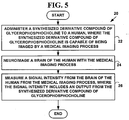
- FIG. 5 is a flow diagram for diagnosing Alzheimer's disease in a human
- FIG. 6 is a flow diagram for diagnosing Alzheimer's disease in a human.
- FIG. 7 is a flow diagram for diagnosing Alzheimer's disease in a human.
- FIG. 1 is a molecular schematic diagram 10 illustrating the formation of senile plaques from A ⁇ peptide.
- a ⁇ -turn is introduced into an A ⁇ peptide to form a ⁇ -sheet conformation which is the A ⁇ conformation which aggregates into senile plaques.
- FIG. 2 is a block diagram 12 illustrating a chemical formula for glycerophosphocholine (C 8 H 20 PO 6 N, hereinafter abbreviated as GPC) molecule 14.
- FIG. 2 also illustrates an equivalent representation 14' of the same GPC molecule 14.
- GPC specifically binds to A ⁇ peptides and can promote the formation of a ⁇ -turn in A ⁇ peptide which promotes ⁇ -sheet aggregates found in senile plaques. Therefore, GPC can be used for the non-invasive measurement of A ⁇ peptides containing ⁇ -turns in human and animal subjects.
- GPC molecules are capable of efficiently crossing the blood-brain barrier and subsequently specifically binding to A ⁇ peptides containing ⁇ -turns.
- GPC compounds are synthesized that include, but are not limited to, derivatives of GPC that are capable of being imaged via standard brain imaging techniques such as magnetic resonance imaging (MRI), positron emission tomography (PET) and other such medical imaging techniques known in the art.
- MRI magnetic resonance imaging
- PET positron emission tomography
- Such GPC compounds are used as a chemical means to diagnose ALzheimer's disease in humans.
- GPC enters the brain following intra-venous (IV) and oral administration
- IV intra-venous
- oral administration See, e.g., Abbiatti et al., Eur. J. Drug Metab. Pharmacokinet. 1993; 18: 173-180
- non-radioactive ( 19 F) paramagnetic ( 17 O) and radioactive ( 15 O, 13 N, 11 C, 18 F) derivatives of GPC may be synthesized for use in MRI ( 70 O, 19 F) and PET ( 15 O, 13 N, 11 C, 18 F) imaging.
- the interaction between GPC and the A ⁇ peptide is governed by highly specific chemical and physical spacing and interactions between the two molecules.
- the molecules of the present invention preferably do not contain large marker groups or fluorescent tags that are attached to GPC, as such hybrid molecules may disrupt the specific binding of GPC to A ⁇ peptides.
- the present invention uses molecules in which at least one of the atomic moieties of a normal GPC is replaced with a non-radioactive ( 19 F), paramagnetic ( 17 O), or radioactive ( 15 O, 13 N, 11 C, 18 F) isotope of the same or physiochemically related moiety.
- 17 O-containing derivative of GPC is one preferred embodiment of an imaging molecule within the context of the present invention.
- 17 O is a stable isotope of oxygen that has a nuclear spin of 5/2. This isotope enhances proton ( 1 H) T 2 relaxation rates through its scalar-coupled interactions (See, e.g., Meiboom et al., J. Chem. Phys. 1957; 27: 1411-1412 ; Meiboom, J. Chem. Phys. 1961; 34: 375-388 ), thus making it useful in MRI imaging applications.
- FIG. 3 is an exemplary MRI image 15 illustrating micro-imaging of H 2 17 O.
- the MRI image illustrates a difference in image contrast between 16 O and 17 O molecules.
- a GPC molecule is synthesized in which the standard 16 O atoms are substituted with 17 O atoms.
- GPC molecules selectively bind to the ⁇ -turn within an A ⁇ peptide, providing a specific marker for this precursor to the development of A ⁇ peptide aggregates in Alzheimer's disease.
- GPC contains six original 16 O atoms that could be replaced with 17 O. If all six original 16 O of GPC are replaced with 17 O, the strength of the paramagnetic signal is greatly increased. However, not all of the original 16 O atoms need to be replaced to practice the invention.
- FIG. 4 is a block diagram 16 illustrating details of a chemical reaction used to create a synthesized GPC molecule 18.
- each of the six 16 O atoms on an original GPC molecule 14 are replaced with six 17 O atoms to create a synthesized GPC molecule 18 (original GPC molecule 14' and synthesized GPC molecule 18 are shown in two different chemical formula structures that are equivalent except the original GPC molecule 14' includes 16 O atoms and the synthesized GPC molecule includes 17 O atoms).
- the synthesis of the synthesized GPC molecule 18 is based on the partial literature precedent established by Lacey et al. (J. Org. Chem.
- the 17 O-labelled starting materials e.g., 17 O 2 , H 2 17 O, and CH 3 17 OH are commercially available from many sources.
- GPC molecules can be synthesized using 16 O (naturally abundant isotope) starting materials to create a synthesized GPC molecule via a similar chemical reaction.
- the present invention is not limited to such an embodiment and less than all six 16 O atoms on an original GPC molecule are replaced witht 17 O atoms to create other forms of synthesized GPC) molecules.
- phosphorous trichloride is converted to [ 17 O]phosphoryl chloride, for example by spark-ignited combustion of phosphorous trichloride in a 17 O 2 atmosphere.
- the [ 17 O]phosphoryl chloride is then converted to [ 17 O 2 ]phosphorodichloridic acid methyl ester by methanolysis with [ 17 O]methanol.
- the methyl ester is converted to the phosphate diester by successive displacement of the chlorines by [ 17 O]allyl alcohol (which may be prepared by hydrolysis of allyl chloride with H 2 17 O) and [ 17 O] dimethylethanolamine (which may be prepared by chlorination of monooisotopic dimethylethanolamine with HCl gas and hydrolysis of the resulting dimethylaminoethyl chloride with H 2 17 O).
- the resulting triester is known to isomerize readily and spontaneously to allyl choline phosphate.
- the double bond is then dihydroxylated with [ 17 O 4 ]osmium tetroxide (which may be prepared by passing 17 O 2 gas over finely slivered metallic osmium) to yield racemic [ 17 O 6 ]GPC.
- the individual enantiomers of [ 17 O 6 ]GPC e.g., the natural 2R and the unnatural 2S forms
- the present invention is not limited to such an embodiment and other methods and techniques can also be used to create the synthesized GPC molecules.
- the synthesized [ 17 O 6 ] GPC molecule 18 is useful in MRI imaging of GPC binding to ⁇ -turns within an A ⁇ peptide. Therefore, this synthesized GPC molecule 18 can be used for the non-invasive measurement of A ⁇ peptides containing ⁇ -turns in human and animal subjects. Such synthesized GPC molecules 18 are capable of efficiently crossing the blood-brain barrier and subsequently specifically binding to A ⁇ peptides containing ⁇ -turns.
- the synthesized GPC molecule 18 is a compound that can be ingested in solid form (e.g., pill form) or liquid form (e.g., used via an IV) for human or animal subjects.
- the synthesized GPC molecule 18 does not require any further processing and does not have any known negative side effects.
- the original GPC molecule is a naturally occurring compound in human and animal subjects.
- the synthesized GPC molecule 14 is combined with other pharmaceutically acceptable compounds know in the art to form a composition.
- pharmaceutically acceptable compounds include solids and liquids.
- substitutions of replacement atoms for original atoms within the GPC molecule are within the scope of the present invention.
- substitutions may include substitution of fluorine ( 19 F for MRI, 18 F for PET) for the hydrogens on the methyl group on the GPC molecule and, alternatively or in combination, phosphonyl derivatives of the GPC molecule.
- fluorine 19 F for MRI, 18 F for PET
- phosphonyl derivatives of the GPC molecule In the phosphonyl derivatives, at least one of the oxygen atoms on the phosphoryl group of GPC are replaced with a carbon atom.
- Such derivatives of GPC may contain the added benefit of not being a substrate for the physiological enzymes that usually degrade GPC. Thus, the half life of these GPC derivatives would be increased in vivo, increasing their effectiveness in imaging applications.
- compositions of the present invention include GPC molecules in which normal atoms have been substituted with radioactive isotopes that are capable of emitting positrons as they decay. These embodiments of the present invention would preferably have a short period of instability during which they would emit positrons, and would thus pose a limited medical risk to subjects. Such molecules would be useful in PET imaging of GPC binding to ⁇ -turns within an A ⁇ peptide molecule. Such substitutions may include 15 O for 160, 13 N for 14 N, and 11 C for 12 C. A 18 F atom may be substituted for hydrogens on methyl groups of the GPC molecule without any loss of binding specificity. Accordingly, such substitutions are within the scope of the present invention.
- the synthetic reaction scheme illustrated in FIG. 4 may also be used to synthesize several of these radioactive derivatives of GPC. Where deviations from this synthetic reaction scheme are required, one of skill in the art would be well aware of how to make such modifications. As a result, the chemical reactions for these modifications are not illustrated.
- FIG. 5 is a flow diagram 20 for diagnosing Alzheimer's disease in a human.
- a synthesized derivative compound of GPC is administered to a human.
- the synthesized derivative compound of GPC is capable of being imaged by a medical imaging process.
- a brain of the human is imaged with the medical imaging process.
- a signal intensity from the brain of the human is measured with the medical imaging process.
- the signal intensity includes an output from the synthesized derivative compound of GPC.
- Diagram 20 is an exemplary embodiment. However, the present invention is not limited to this exemplary embodiment and other embodiments can also be used to practice the invention.
- a synthesized derivative compound of GPC is administered to a human.
- the synthesized derivative compound of GPC is capable of being imaged by a medical imaging process.
- the synthesized derivative compound of GPC includes replacing original 16 O atoms of original GPC molecules with 17 O atoms via the chemical reaction illustrated in FIG. 4 .
- the synthesized derivative compound of GPC includes replacing original 16 O atoms with 15 O atoms, original 14 N atoms with 13 N atoms, or replacing original 12 C atoms with 11 C atoms.
- hydrogens on the methyl moiety of the naturally occurring or a synthesized derivative compound of GPC are replaced with 18 F atoms.
- the replacement 15 O, 13 N, 11 C, and 18 F atoms are radioactive isotopes that are capable of emitting positrons as they decay.
- a brain of the human is imaged with the medical imaging process.
- the medical imaging process includes, but not limited to, MRI or PET or other medical imaging processes.
- a signal intensity from the brain of the human is measured with the medical imaging process.
- the signal intensity includes an output from the synthesized derivative compound of GPC.
- Step 26 includes measuring a signal intensity of an output from a binding of plural molecules of the synthesized derivative compound of GPC to ⁇ -turns within A ⁇ peptide within the human brain.
- FIG. 6 is a flow diagram 28 for diagnosing Alzheimer's disease in a human.
- a synthesized derivative compound of GPC is administered to a human.
- the synthesized derivative compound of GPC is capable of being imaged by an MRI process.
- the synthesized derivative compound of GPC includes plural synthesized GPC molecules in which original 16 O atoms of plural original GPC molecules are replaced with 17 O atoms.
- a brain of the human is imaged with the MRI process.
- a signal intensity from the brain of the human is measured from the MRI process.
- the signal intensity includes an output from a binding of plural molecules of the synthesized derivative compound of GPC to ⁇ -turns within A ⁇ peptide within the human brain.
- FIG. 7 is a flow diagram 34 for diagnosing Alzheimer's disease in a human.
- a synthesized derivative compound of GPC is administered to a human.
- the synthesized derivative compound of GPC is capable of being imaged by a PET imaging process.
- the synthesized derivative compound of GPC includes plural synthesized GPC molecules in which original atoms of plural original GPC molecules are replaced with replacement atoms.
- a brain of the human is imaged with the PET imaging process.
- a signal intensity from the brain of the human is measured from the PET process.
- the signal intensity includes an output from a binding of plural molecules of the synthesized derivative compound of GPC to ⁇ -turns within A ⁇ peptide within the human brain.
- replacement atoms include, but are not limited to, replacement atoms in which 15 O atoms are used to replace 16 O atoms, 13 N atoms are used to replace 14 N atoms, 11 C atoms are used to replace 12 C atoms, or hydrogens on the methyl moieties are replaced with 18 F atoms to be used for PET imaging.
Landscapes
- Health & Medical Sciences (AREA)
- Life Sciences & Earth Sciences (AREA)
- Chemical & Material Sciences (AREA)
- Engineering & Computer Science (AREA)
- General Health & Medical Sciences (AREA)
- Medicinal Chemistry (AREA)
- Molecular Biology (AREA)
- Biomedical Technology (AREA)
- Physics & Mathematics (AREA)
- Proteomics, Peptides & Aminoacids (AREA)
- Immunology (AREA)
- Epidemiology (AREA)
- Animal Behavior & Ethology (AREA)
- Urology & Nephrology (AREA)
- Public Health (AREA)
- Veterinary Medicine (AREA)
- Hematology (AREA)
- Optics & Photonics (AREA)
- Radiology & Medical Imaging (AREA)
- Neurology (AREA)
- Neurosurgery (AREA)
- Biotechnology (AREA)
- Cell Biology (AREA)
- Nuclear Medicine, Radiotherapy & Molecular Imaging (AREA)
- Pharmacology & Pharmacy (AREA)
- Microbiology (AREA)
- Biophysics (AREA)
- Food Science & Technology (AREA)
- Analytical Chemistry (AREA)
- Biochemistry (AREA)
- General Physics & Mathematics (AREA)
- Pathology (AREA)
- Medicines Containing Antibodies Or Antigens For Use As Internal Diagnostic Agents (AREA)
Claims (23)
- Glycerophosphocholin-Derivat der Formel
 das mindestens ein Isotop, ausgewählt aus der Gruppe, bestehend aus 11C, 13N, 15O, 17O, 18F und 19F, enthält, wobei das Isotop, falls es 11C, 13N, 15O oder 17O ist, die gleiche Atomgruppe ersetzt oder das Isotop, falls es 18F oder 19F ist, ein Wasserstoffatom an Methylgruppen ersetzt,oder ein Phosphonyl-Derivat davon, wobei mindestens ein Sauerstoffatom an der Phosphorylgruppe in der vorstehenden Formel mit einer CH2-Gruppe ersetzt wurde.
 - Glycerophosphocholin-Derivat nach Anspruch 1 zum Diagnostizieren von Alzheimer-Krankheit in einem Menschen.
- Glycerophosphocholin-Derivat nach Anspruch 1 zum Diagnostizieren von Alzheimer-Krankheit in einem Menschen mittels eines medizinischen Bildgebungsverfahrens, das Magnetresonanz-Bildgebung einschließt.
- Verfahren zum Herstellen des Glycerophosphocholin-Derivats nach Anspruch 1, das den Schritt eines Ersetzens von ursprünglichen 16O-Atomen in einer ursprünglichen Glycerophosphocholin-Verbindung mit 17O-Atomen umfasst.
- Verfahren zum Herstellen des Glycerophosphocholin-Derivats nach Anspruch 1 mittels einer chemischen Reaktion, umfassend:

- Zusammensetzung zum Diagnostizieren von Alzheimer-Krankheit in einem Menschen, die ein Glycerophosphocholin-Derivat nach Anspruch 1 umfasst, wobei das Glycerophosphocholin-Derivat fähig ist, durch Magnetresonanz-Bildgebung (MRI) oder Positronenemissionstomographie (PET) abgebildet zu werden.
- Zusammensetzung nach Anspruch 6, die ferner eine pharmazeutisch verträgliche Form des Glycerophosphocholin-Derivats umfasst.
- Zusammensetzung nach Anspruch 6, wobei das Glycerophosphocholin-Derivat:

- Verwendung eines wie in Anspruch 1 definierten Glycerophosphocholin-Derivats zur Herstellung einer Zusammensetzung zum Diagnostizieren von Alzheimer-Krankheit in einem Menschen, wobei die Zusammensetzung an einen Menschen verabreicht werden soll,
ein Gehirn des Menschen mit einem medizinischen Bildgebungsverfahren abgebildet werden soll und
eine Signalintensität von dem Gehirn des Menschen aus dem medizinischen Bildgebungsverfahren gemessen werden soll, wobei die Signalintensität einen Output von der synthetisierten Derivatverbindung von Glycerophosphocholin beinhaltet. - Verwendung nach Anspruch 9, wobei die Derivatverbindung von Glycerophosphocholin eine Vielzahl von synthetisierten Glycerophosphocholin-Molekülen beinhaltet, bei denen ursprüngliche 16O-Atome einer Vielzahl von ursprünglichen Glycerophosphocholin-Molekülen mit 17O-Atomen ersetzt sind.
- Verwendung nach Anspruch 9, wobei die Derivatverbindung von Glycerophosphocholin eine Vielzahl von synthetisierten Glycerophosphocholin-Molekülen beinhaltet, bei denen 15O-Atome verwendet werden, um 16O-Atome zu ersetzen, 13N-Atome verwendet werden, um 14N-Atome zu ersetzen, oder 11C-Atome verwendet werden, um 12C-Atome zu ersetzen.
- Verwendung nach Anspruch 11, wobei die 15O-Atome, 13N-Atome und 11C-Atome radioaktive Isotope sind, die fähig sind, bei ihrem Zerfall Positronen zu emittieren.
- Verwendung nach Anspruch 9, wobei die Derivatverbindung von Glycerophosphocholin eine Vielzahl von synthetisierten Glycerophosphocholin-Molekülen beinhaltet, bei denen die Wasserstoffatome an den Methyl-Gruppen von einer Vielzahl von ursprünglichen Glycerophosphocholin-Molekülen mit 19F-Atomen für MRI und 18F-Atome für PET-Bildgebung ersetzt sind.
- Verwendung nach Anspruch 13, wobei die 18F-Atome radioaktive Isotope sind, die fähig sind, bei ihrem Zerfall Positronen zu emittieren, was einen Nachweis durch PET-Bildgebung ermöglicht, und wobei die 19F-Atome nicht radioaktiv sind, aber durch MRI nachweisbar sind.
- Verwendung nach Anspruch 9, wobei das Glycerophosphocholin-Derivat eine Vielzahl von solchen Derivaten enthält, wobei mindestens ein Sauerstoffatom an einer Phosphorylgruppe mit einer CH2-Gruppe ersetzt ist.
- Verwendung nach Anspruch 9, wobei das medizinische Bildgebungsverfahren MRI oder PET-Bildgebung beinhaltet.
- Verwendung nach Anspruch 9, wobei der Schritt eines Messens der Signalintensität ein Messen einer Intensität eines magnetischen oder radioaktiven Signals beinhaltet.
- Verwendung nach Anspruch 9, wobei der Schritt eines Messens einer Signalintensität von dem Gehirn des Menschen aus dem medizinischen Bildgebungsverfahren ein Messen einer Signalintensität eines Outputs von einem Binden einer Vielzahl von Molekülen der synthetisierten Derivatverbindung von Glycerophosphocholin an β-Schleifen innerhalb von Aβ-Peptid-Molekülen innerhalb des menschlichen Gehirns beinhaltet.
- Verwendung nach Anspruch 9, wobei die synthetisierte Derivatverbindung von Glycerophosphocholin fähig ist, durch ein MRI-Verfahren abgebildet zu werden, und eine Vielzahl von synthetisierten Glycerophosphocholin-Molekülen beinhaltet, bei denen ursprüngliche 16O-Atome einer Vielzahl von ursprünglichen Glycerophosphocholin-Molekülen mit 17O-Atome ersetzt sind,
ein Gehirn des Menschen mit dem MRI-Verfahren abgebildet werden soll und
eine Signalintensität von dem Gehirn des Menschen aus dem MRI-Verfahren gemessen werden soll, wobei die Signalintensität einen Output von einem Binden einer Vielzahl von Molekülen der synthetisierten Derivatverbindung von Glycerophosphocholin an β-Schleifen innerhalb von Aβ-Peptid-Molekülen innerhalb des menschlichen Gehirns beinhaltet. - Verwendung nach Anspruch 19, wobei der Schritt eines Messens der Signalintensität ein Messen einer Intensität eines magnetischen Signals beinhaltet.
- Verwendung nach Anspruch 9, wobei die synthetisierte Derivatverbindung von Glycerophosphocholin fähig ist, durch ein PET-Bildgebungsverfahren abgebildet zu werden, und eine Vielzahl von synthetisierten Glycerophosphocholin-Molekülen beinhaltet, bei denen ursprüngliche Atome einer Vielzahl von ursprünglichen Glycerophosphocholin-Molekülen mit Ersatzatomen ersetzt sind,
ein Gehirn des Menschen mit dem PET-Bildgebungsverfahren abgebildet werden soll und
eine Signalintensität von dem Gehirn des Menschen aus dem PET-Bildgebungsverfahren gemessen werden soll, wobei die Signalintensität einen Output von einem Binden einer Vielzahl von Molekülen der synthetisierten Derivatverbindung von Glycerophosphocholin an β-Schleifen innerhalb von Aß-Peptid-Molekülen innerhalb des menschlichen Gehirns beinhaltet. - Verwendung nach Anspruch 21, wobei die Ersatzatome Ersatzatome beinhalten, bei denen 15O-Atome verwendet werden, um 16O-Atome zu ersetzen, 13N-Atome verwendet werden, um 14N-Atome zu ersetzen, 11C-Atome verwendet werden, um 12C-Atome zu ersetzen, oder Wasserstoffatome an den Methyl-Gruppen mit 18F-Atomen ersetzt sind.
- Verwendung nach Anspruch 21, wobei der Schritt eines Messens der Signalintensität ein Messen einer Intensität eines radioaktiven Signals beinhaltet.
Applications Claiming Priority (3)
| Application Number | Priority Date | Filing Date | Title |
|---|---|---|---|
| US47418203P | 2003-05-29 | 2003-05-29 | |
| US10/854,894 US7815894B2 (en) | 2003-05-29 | 2004-05-27 | Compounds, compositions and methods for medical imaging of neuropsychiatric disorders |
| PCT/US2004/016750 WO2004110963A2 (en) | 2003-05-29 | 2004-05-27 | Glycerophosphocholine and its derivatives for medical imaging neuropsychiatric disorders |
Publications (2)
| Publication Number | Publication Date |
|---|---|
| EP1641806A2 EP1641806A2 (de) | 2006-04-05 |
| EP1641806B1 true EP1641806B1 (de) | 2009-07-29 |
Family
ID=33457562
Family Applications (1)
| Application Number | Title | Priority Date | Filing Date |
|---|---|---|---|
| EP04753565A Expired - Lifetime EP1641806B1 (de) | 2003-05-29 | 2004-05-27 | Glycerophosphocholin und derivate davon zur medizinischen abbildung von neuropsychiatrischen erkrankungen |
Country Status (6)
| Country | Link |
|---|---|
| US (1) | US7815894B2 (de) |
| EP (1) | EP1641806B1 (de) |
| CN (1) | CN1795198B (de) |
| AT (1) | ATE437884T1 (de) |
| DE (1) | DE602004022301D1 (de) |
| WO (1) | WO2004110963A2 (de) |
Families Citing this family (4)
| Publication number | Priority date | Publication date | Assignee | Title |
|---|---|---|---|---|
| US8329142B2 (en) * | 2003-05-29 | 2012-12-11 | Pettegrew Jay W | Compounds, compositions and methods for medical imaging of Parkinson's disease |
| US20060257842A1 (en) * | 2003-05-29 | 2006-11-16 | Pettegrew Jay W | Cryopreservation media and molecules |
| WO2005089454A2 (en) * | 2004-03-18 | 2005-09-29 | Transtech Pharma, Inc. | Fluorescence polarization assay |
| CN102525992A (zh) * | 2012-03-09 | 2012-07-04 | 徐奎 | L-α-甘油磷酸胆碱薄膜衣片及其制备方法 |
Family Cites Families (70)
| Publication number | Priority date | Publication date | Assignee | Title |
|---|---|---|---|---|
| US401024A (en) | 1889-04-09 | Benfabriken | ||
| US622961A (en) | 1899-04-11 | Ivan levinstein and carl mensching | ||
| US329638A (en) | 1885-11-03 | Fabriken | ||
| US394841A (en) | 1888-12-18 | Carl duisberg | ||
| US1979534A (en) | 1931-10-15 | 1934-11-06 | Farastan Company | Disazo compound for therapeutic use |
| FR2398046A1 (fr) | 1977-07-18 | 1979-02-16 | Inst Francais Du Petrole | Synthese enzymatique de la l-carnitine |
| US4346107A (en) | 1979-02-12 | 1982-08-24 | Claudio Cavazza | Pharmaceutical composition comprising acyl-carnitine for the treatment of impaired cerebral metabolism |
| US4642290A (en) | 1982-12-06 | 1987-02-10 | Sih Charles J | Process for preparing a compound for use in the production of L-carnitine |
| JPS59192095A (ja) | 1983-04-13 | 1984-10-31 | Ajinomoto Co Inc | L−カルニチンの製造法 |
| US4542098A (en) | 1983-05-06 | 1985-09-17 | Institut Francais Du Petrole | Production of glucose dehydrogenase and use of the resultant enzyme in the enzymatic synthesis of L-carnitine |
| DD221905B1 (de) | 1983-11-03 | 1987-03-18 | Univ Leipzig | Verfahren zur herstellung von l(-)-carnitin und seinen derivaten |
| FI86889C (fi) | 1984-03-29 | 1992-10-26 | Lonza Ag | Foerfarande foer framstaellning av av l-karnitin pao mikrobiologiskt saett |
| IT1177874B (it) | 1984-07-04 | 1987-08-26 | Sigma Tau Ind Farmaceuti | Estere della acetil carnitina,procedimenti per la sua preparazione e composizioni farmaceutiche che lo contengono |
| CH664374A5 (de) | 1985-02-27 | 1988-02-29 | Lonza Ag | Verfahren zur herstellung von l-carnitin auf mikrobiologischem weg. |
| US4933156A (en) | 1987-04-08 | 1990-06-12 | Salutar, Inc. | Amyloidosis and Alzheimer's disease diagnostic assay and reagents therefor |
| US5008099A (en) | 1987-04-08 | 1991-04-16 | Salutar, Inc. | Amyloidosis and Alzheimer's disease diagnostic assay and reagents therefor |
| US5039511A (en) | 1987-04-08 | 1991-08-13 | Salutar, Inc. | Amyloidosis and alzheimer's disease diagnostic assay and reagents therefor |
| US5231000A (en) | 1987-10-08 | 1993-07-27 | The Mclean Hospital | Antibodies to A4 amyloid peptide |
| US4965364A (en) | 1988-02-23 | 1990-10-23 | Massachusetts Institute Of Technology | Ligand-accelerated catalytic asymmetric dihydroxylation |
| US4996041A (en) | 1988-08-19 | 1991-02-26 | Toshiyuki Arai | Method for introducing oxygen-17 into tissue for imaging in a magnetic resonance imaging system |
| US5853985A (en) | 1988-08-30 | 1998-12-29 | Bayer Aktiegsesellschaft | Promoter of the gene for the human precursor of the alzheimer's disease and its use |
| US5066583A (en) | 1988-12-21 | 1991-11-19 | Wisconsin Alumni Research Foundation | Method for distinguishing alcoholics from non-alcoholics |
| JP3059735B2 (ja) | 1989-10-13 | 2000-07-04 | 旭化成工業株式会社 | L―カルニチンデヒドロゲナーゼおよびその製造法 |
| US5585112A (en) | 1989-12-22 | 1996-12-17 | Imarx Pharmaceutical Corp. | Method of preparing gas and gaseous precursor-filled microspheres |
| US5773024A (en) | 1989-12-22 | 1998-06-30 | Imarx Pharmaceutical Corp. | Container with multi-phase composition for use in diagnostic and therapeutic applications |
| US6551576B1 (en) | 1989-12-22 | 2003-04-22 | Bristol-Myers Squibb Medical Imaging, Inc. | Container with multi-phase composition for use in diagnostic and therapeutic applications |
| US6088613A (en) | 1989-12-22 | 2000-07-11 | Imarx Pharmaceutical Corp. | Method of magnetic resonance focused surgical and therapeutic ultrasound |
| US5668117A (en) | 1991-02-22 | 1997-09-16 | Shapiro; Howard K. | Methods of treating neurological diseases and etiologically related symptomology using carbonyl trapping agents in combination with previously known medicaments |
| AU654013B2 (en) | 1991-03-13 | 1994-10-20 | Regents Of The University Of Minnesota | 2-hydroxy-3(4-iodophenyl)-1-(4-phenylpiperidinyl) propane |
| GB9108756D0 (en) | 1991-04-24 | 1991-06-12 | Ici Plc | Production of polyalkanoate in plants |
| US5276059A (en) | 1992-07-10 | 1994-01-04 | The United States Of America As Represented By The Department Of Health And Human Services | Inhibition of diseases associated with amyloid formation |
| WO1994009371A1 (en) * | 1992-10-09 | 1994-04-28 | Massachusetts Institute Of Technology | Antemortem diagnostic test for alzheimer's disease |
| US6107050A (en) | 1993-05-03 | 2000-08-22 | The United States Of America As Represented By The Department Of Health And Human Services | Diagnostic test for alzheimers disease |
| US6300085B1 (en) | 1993-05-03 | 2001-10-09 | The United States Of America As Represented By The Department Of Health And Human Services | Diagnostic method for Alzheimer's disease |
| US5976816A (en) | 1993-05-03 | 1999-11-02 | The United States Of America As Represented By The Department Of Health And Human Services | Cell tests for alzheimer's disease |
| US6168776B1 (en) | 1994-07-19 | 2001-01-02 | University Of Pittsburgh | Alkyl, alkenyl and alkynyl Chrysamine G derivatives for the antemortem diagnosis of Alzheimer's disease and in vivo imaging and prevention of amyloid deposition |
| US6417178B1 (en) | 1994-07-19 | 2002-07-09 | University Of Pittsburgh | Amyloid binding nitrogen-linked compounds for the antemortem diagnosis of alzheimer's disease, in vivo imaging and prevention of amyloid deposits |
| US6521211B1 (en) | 1995-06-07 | 2003-02-18 | Bristol-Myers Squibb Medical Imaging, Inc. | Methods of imaging and treatment with targeted compositions |
| US6139819A (en) | 1995-06-07 | 2000-10-31 | Imarx Pharmaceutical Corp. | Targeted contrast agents for diagnostic and therapeutic use |
| US6231834B1 (en) | 1995-06-07 | 2001-05-15 | Imarx Pharmaceutical Corp. | Methods for ultrasound imaging involving the use of a contrast agent and multiple images and processing of same |
| US5837219A (en) | 1995-10-31 | 1998-11-17 | Japan Science And Technology Corporation | Labelled acyl-L-carnitine and diagnostic agent |
| DE69721542D1 (de) | 1996-06-14 | 2003-06-05 | Mclean Hospital Corp | In vitro h-nmr-nachweis der häufigkeit und menge von alkoholeinnahme |
| US6380252B1 (en) | 1996-07-05 | 2002-04-30 | Sigma-Tau Industrie Farmaceutiche Riunite S.P.A. | Use of L-acetylcarnitine, L-isovalerylcarnitine, L-propionylcarnitine for increasing the levels of IGF-1 |
| IT1290801B1 (it) | 1996-07-05 | 1998-12-11 | Mendes Srl | Uso della acetil l-carnitina, della isovaleril l-carnitina, della propionil l-carnitina o dei loro sali farmacologicamente accettabili |
| US6255057B1 (en) | 1996-07-26 | 2001-07-03 | Ernest Gallo Clinic And Research Center | Detection of cellular exposure to ethanol |
| WO1998010798A1 (en) | 1996-09-11 | 1998-03-19 | Imarx Pharmaceutical Corp. | Improved methods for diagnostic imaging using a contrast agent and a vasodilator |
| US5846517A (en) | 1996-09-11 | 1998-12-08 | Imarx Pharmaceutical Corp. | Methods for diagnostic imaging using a renal contrast agent and a vasodilator |
| US5770324A (en) * | 1997-03-03 | 1998-06-23 | Saint-Gobain Industrial Ceramics, Inc. | Method of using a hot pressed silicon carbide dummy wafer |
| US6120751A (en) | 1997-03-21 | 2000-09-19 | Imarx Pharmaceutical Corp. | Charged lipids and uses for the same |
| US5889055A (en) | 1997-04-04 | 1999-03-30 | Howard; James R. | L-carnitine and acetyl-L-carnitine combined for prevention and treatment of syndromes related to diseases of energy metabolism |
| US5973004A (en) | 1997-04-04 | 1999-10-26 | Howard; James R. | L-carnitine, acetyl-L-carnitine, and pantothenic acid or ubiquinone, combined for prevention and treatment of syndromes related to ineffective energy metabolism |
| US6416740B1 (en) | 1997-05-13 | 2002-07-09 | Bristol-Myers Squibb Medical Imaging, Inc. | Acoustically active drug delivery systems |
| US6066664A (en) | 1997-06-06 | 2000-05-23 | Sigma-Tau Industrie Farmaceutiche Riunite S.P.A. | Method for decreasing the appetite in bulimic, overweight individuals |
| IT1291930B1 (it) | 1997-06-18 | 1999-01-21 | Sigma Tau Ind Farmaceuti | Composizione riequilibratrice delle turbe dell'umore in individui sani |
| DE19749480A1 (de) | 1997-11-08 | 1999-05-20 | Univ Leipzig | Verfahren zur Herstellung von L-Carnitin aus Crotonobetain |
| US6548047B1 (en) | 1997-09-15 | 2003-04-15 | Bristol-Myers Squibb Medical Imaging, Inc. | Thermal preactivation of gaseous precursor filled compositions |
| TW477702B (en) | 1997-10-23 | 2002-03-01 | Dev Center Biotechnology | Controlled release tacrine dosage form |
| KR20010086245A (ko) | 1998-03-04 | 2001-09-10 | 다케다 야쿠힌 고교 가부시키가이샤 | Aⅱ 길항제용 서방성 제제, 그것의 제조 및 용도 |
| IT1299182B1 (it) | 1998-05-29 | 2000-02-29 | Sigma Tau Ind Farmaceuti | Procedimento chimico per la sintesi stereoselettiva della r-(-)- carnitina. |
| IT1299195B1 (it) | 1998-06-25 | 2000-02-29 | Sigma Tau Healthscience Spa | Composizione ad attivita' neuroprotettiva per la prevenzione ed il trattamento delle alterazioni nervose e comportamentali legate a stati |
| DE69922206T2 (de) | 1998-07-22 | 2005-11-24 | Metabolix, Inc., Cambridge | Nahrungs- und therapeutische verwendung von hydroxyalkanoat oligomere |
| US6337197B2 (en) | 1998-10-27 | 2002-01-08 | Sigma-Tau Industrie Farmaceutiche Riunite S.P.A. | Coenzymes useful for the synthesis of L-carnitine |
| JP2002528468A (ja) | 1998-10-27 | 2002-09-03 | シグマ−タウ・インドゥストリエ・ファルマチェウチケ・リウニテ・ソシエタ・ペル・アチオニ | L−カルニチンの合成に有用な補酵素 |
| US6708053B1 (en) | 1999-03-04 | 2004-03-16 | Science And Technology Corp. @ Unm | Biochemical markers of brain function |
| US6313159B1 (en) | 1999-08-20 | 2001-11-06 | Guilford Pharmaceuticals Inc. | Metabotropic glutamate receptor ligand derivatives as naaladase inhibitors |
| US6348464B1 (en) | 1999-11-12 | 2002-02-19 | Guilford Pharmaceuticals, Inc. | Pyrrolecarbonylimino derivatives as naaladase inhibitors |
| US6589948B1 (en) | 2000-11-28 | 2003-07-08 | Eukarion, Inc. | Cyclic salen-metal compounds: reactive oxygen species scavengers useful as antioxidants in the treatment and prevention of diseases |
| AU2003219511A1 (en) | 2002-02-07 | 2003-09-02 | Sigma-Tau Industrie Farmaceutiche Riunite S.P.A. | Carnitine in the treatment of geriatric depression |
| WO2003077902A1 (en) * | 2002-02-19 | 2003-09-25 | Xenoport, Inc. | Methods for synthesis of prodrugs from 1-acyl-alkyl derivatives and compositions thereof |
| ITRM20020620A1 (it) | 2002-12-13 | 2004-06-14 | Sigma Tau Ind Farmaceuti | Uso delle carnitine per la prevenzione e/o il trattamento dei disturbi causati dall'andropausa. |
-
2004
- 2004-05-27 US US10/854,894 patent/US7815894B2/en not_active Expired - Fee Related
- 2004-05-27 EP EP04753565A patent/EP1641806B1/de not_active Expired - Lifetime
- 2004-05-27 AT AT04753565T patent/ATE437884T1/de not_active IP Right Cessation
- 2004-05-27 CN CN200480014302.9A patent/CN1795198B/zh not_active Expired - Fee Related
- 2004-05-27 DE DE602004022301T patent/DE602004022301D1/de not_active Expired - Lifetime
- 2004-05-27 WO PCT/US2004/016750 patent/WO2004110963A2/en not_active Ceased
Non-Patent Citations (4)
| Title |
|---|
| GELBHARD ET AL, J. NUCL. MED., vol. 15, no. 12, 1974, pages 1223 - 1225 * |
| JERRY MARCH: "Advanced Organic Chemistry", JOHN WILEY AND SONS * |
| LAUE ET AL: "Namen- und Schlagwort-Reaktionen der Organischen Chemie", 1994, TEUBNER, STUTTGART * |
| LOWE ET AL, PHIL. TRANS. R. SOC. LOND. B, vol. 293, 1981, pages 75 - 92 * |
Also Published As
| Publication number | Publication date |
|---|---|
| ATE437884T1 (de) | 2009-08-15 |
| DE602004022301D1 (de) | 2009-09-10 |
| US20040241090A1 (en) | 2004-12-02 |
| CN1795198A (zh) | 2006-06-28 |
| WO2004110963A3 (en) | 2005-03-10 |
| CN1795198B (zh) | 2011-08-17 |
| US7815894B2 (en) | 2010-10-19 |
| WO2004110963A2 (en) | 2004-12-23 |
| EP1641806A2 (de) | 2006-04-05 |
Similar Documents
| Publication | Publication Date | Title |
|---|---|---|
| Scheres et al. | Molecular pathology of neurodegenerative diseases by cryo-EM of amyloids | |
| Tsigelny et al. | Mechanisms of hybrid oligomer formation in the pathogenesis of combined Alzheimer's and Parkinson's diseases | |
| Killinger et al. | Endogenous alpha-synuclein monomers, oligomers and resulting pathology: let’s talk about the lipids in the room | |
| Miller et al. | Alzheimer disease: depiction of increased cerebral myo-inositol with proton MR spectroscopy. | |
| Irvine et al. | Protein aggregation in the brain: the molecular basis for Alzheimer’s and Parkinson’s diseases | |
| Ross et al. | In vivo MR spectroscopy of human dementia | |
| Schiffmann et al. | Childhood ataxia with diffuse central nervous system hypomyelination | |
| JP5116662B2 (ja) | インビボにおける神経系由来生体分子の代謝測定方法 | |
| Schröder et al. | Cerebral changes and cerebrospinal fluid β-amyloid in Alzheimer's disease: a study with quantitative magnetic resonance imaging | |
| Pettegrew et al. | Magnetic resonance spectroscopic changes in Alzheimer's disease a | |
| Wang et al. | Biomarkers for the clinical diagnosis of Alzheimer’s disease: Metabolomics analysis of brain tissue and blood | |
| Kaur et al. | Membrane interactions of α-synuclein probed by neutrons and photons | |
| Smith et al. | Alzheimer disease: therapeutic strategies | |
| Pandey et al. | Metabolomics profiling reveals distinct, sex‐specific signatures in serum and brain metabolomes in mouse models of Alzheimer's disease | |
| Crivelli et al. | Ceramide analog [18F] F-HPA-12 detects sphingolipid disbalance in the brain of Alzheimer’s disease transgenic mice by functioning as a metabolic probe | |
| Bateman et al. | Requirement of aggregation propensity of Alzheimer amyloid peptides for neuronal cell surface binding | |
| EP1641806B1 (de) | Glycerophosphocholin und derivate davon zur medizinischen abbildung von neuropsychiatrischen erkrankungen | |
| US8329142B2 (en) | Compounds, compositions and methods for medical imaging of Parkinson's disease | |
| Wilson et al. | Site of cholesterol oxidation impacts its localization and domain formation in the neuronal plasma membrane | |
| JP2015500472A (ja) | 生体分子の濃度を測定するための方法 | |
| Kang et al. | Metabolomics-based promising candidate biomarkers and pathways in Alzheimer's disease | |
| Shafit-Zagardo et al. | TMEM106B puncta is increased in multiple sclerosis plaques, and reduced protein in mice results in delayed lipid clearance following CNS injury | |
| WO1994016327A1 (en) | Methods and compositions for blocking amyloid protein ion channels | |
| Singh et al. | Repercussion of Primary Nucleation Pathway: Dementia and Cognitive Impairment | |
| Bateman et al. | Stable Isotope Labeling Kinetics in CNS Translational Medicine: Introduction to SILK Technology |
Legal Events
| Date | Code | Title | Description |
|---|---|---|---|
| PUAI | Public reference made under article 153(3) epc to a published international application that has entered the european phase |
Free format text: ORIGINAL CODE: 0009012 |
|
| 17P | Request for examination filed |
Effective date: 20051125 |
|
| AK | Designated contracting states |
Kind code of ref document: A2 Designated state(s): AT BE BG CH CY CZ DE DK EE ES FI FR GB GR HU IE IT LI LU MC NL PL PT RO SE SI SK TR |
|
| DAX | Request for extension of the european patent (deleted) | ||
| 17Q | First examination report despatched |
Effective date: 20070727 |
|
| GRAP | Despatch of communication of intention to grant a patent |
Free format text: ORIGINAL CODE: EPIDOSNIGR1 |
|
| GRAS | Grant fee paid |
Free format text: ORIGINAL CODE: EPIDOSNIGR3 |
|
| GRAA | (expected) grant |
Free format text: ORIGINAL CODE: 0009210 |
|
| AK | Designated contracting states |
Kind code of ref document: B1 Designated state(s): AT BE BG CH CY CZ DE DK EE ES FI FR GB GR HU IE IT LI LU MC NL PL PT RO SE SI SK TR |
|
| REG | Reference to a national code |
Ref country code: GB Ref legal event code: FG4D |
|
| REG | Reference to a national code |
Ref country code: CH Ref legal event code: NV Representative=s name: SERVOPATENT GMBH Ref country code: CH Ref legal event code: EP |
|
| REG | Reference to a national code |
Ref country code: IE Ref legal event code: FG4D |
|
| REF | Corresponds to: |
Ref document number: 602004022301 Country of ref document: DE Date of ref document: 20090910 Kind code of ref document: P |
|
| RAP2 | Party data changed (patent owner data changed or rights of a patent transferred) |
Owner name: MCCLURE, RICHARD J. Owner name: DAY, BILLY W. Owner name: PANCHALINGAM, KANAGASABAI Owner name: PETTEGREW, JAY W. |
|
| RIN2 | Information on inventor provided after grant (corrected) |
Inventor name: PETTEGREW, JAY W. Inventor name: PANCHALINGAM, KANAGASABAI Inventor name: MCCLURE, RICHARD J. Inventor name: DAY, BILLY W. |
|
| NLT2 | Nl: modifications (of names), taken from the european patent patent bulletin |
Owner name: PETTEGREW, JAY W. EN MCCLURE, RICHARD J. EN PANCHA Effective date: 20090916 |
|
| NLV1 | Nl: lapsed or annulled due to failure to fulfill the requirements of art. 29p and 29m of the patents act | ||
| PG25 | Lapsed in a contracting state [announced via postgrant information from national office to epo] |
Ref country code: FI Free format text: LAPSE BECAUSE OF FAILURE TO SUBMIT A TRANSLATION OF THE DESCRIPTION OR TO PAY THE FEE WITHIN THE PRESCRIBED TIME-LIMIT Effective date: 20090729 Ref country code: SE Free format text: LAPSE BECAUSE OF FAILURE TO SUBMIT A TRANSLATION OF THE DESCRIPTION OR TO PAY THE FEE WITHIN THE PRESCRIBED TIME-LIMIT Effective date: 20090729 Ref country code: AT Free format text: LAPSE BECAUSE OF FAILURE TO SUBMIT A TRANSLATION OF THE DESCRIPTION OR TO PAY THE FEE WITHIN THE PRESCRIBED TIME-LIMIT Effective date: 20090729 Ref country code: ES Free format text: LAPSE BECAUSE OF FAILURE TO SUBMIT A TRANSLATION OF THE DESCRIPTION OR TO PAY THE FEE WITHIN THE PRESCRIBED TIME-LIMIT Effective date: 20091109 |
|
| PG25 | Lapsed in a contracting state [announced via postgrant information from national office to epo] |
Ref country code: NL Free format text: LAPSE BECAUSE OF FAILURE TO SUBMIT A TRANSLATION OF THE DESCRIPTION OR TO PAY THE FEE WITHIN THE PRESCRIBED TIME-LIMIT Effective date: 20090729 Ref country code: PL Free format text: LAPSE BECAUSE OF FAILURE TO SUBMIT A TRANSLATION OF THE DESCRIPTION OR TO PAY THE FEE WITHIN THE PRESCRIBED TIME-LIMIT Effective date: 20090729 Ref country code: SI Free format text: LAPSE BECAUSE OF FAILURE TO SUBMIT A TRANSLATION OF THE DESCRIPTION OR TO PAY THE FEE WITHIN THE PRESCRIBED TIME-LIMIT Effective date: 20090729 |
|
| PG25 | Lapsed in a contracting state [announced via postgrant information from national office to epo] |
Ref country code: PT Free format text: LAPSE BECAUSE OF FAILURE TO SUBMIT A TRANSLATION OF THE DESCRIPTION OR TO PAY THE FEE WITHIN THE PRESCRIBED TIME-LIMIT Effective date: 20091129 Ref country code: BG Free format text: LAPSE BECAUSE OF FAILURE TO SUBMIT A TRANSLATION OF THE DESCRIPTION OR TO PAY THE FEE WITHIN THE PRESCRIBED TIME-LIMIT Effective date: 20091029 |
|
| PG25 | Lapsed in a contracting state [announced via postgrant information from national office to epo] |
Ref country code: RO Free format text: LAPSE BECAUSE OF FAILURE TO SUBMIT A TRANSLATION OF THE DESCRIPTION OR TO PAY THE FEE WITHIN THE PRESCRIBED TIME-LIMIT Effective date: 20090729 Ref country code: EE Free format text: LAPSE BECAUSE OF FAILURE TO SUBMIT A TRANSLATION OF THE DESCRIPTION OR TO PAY THE FEE WITHIN THE PRESCRIBED TIME-LIMIT Effective date: 20090729 Ref country code: CZ Free format text: LAPSE BECAUSE OF FAILURE TO SUBMIT A TRANSLATION OF THE DESCRIPTION OR TO PAY THE FEE WITHIN THE PRESCRIBED TIME-LIMIT Effective date: 20090729 Ref country code: DK Free format text: LAPSE BECAUSE OF FAILURE TO SUBMIT A TRANSLATION OF THE DESCRIPTION OR TO PAY THE FEE WITHIN THE PRESCRIBED TIME-LIMIT Effective date: 20090729 |
|
| PG25 | Lapsed in a contracting state [announced via postgrant information from national office to epo] |
Ref country code: BE Free format text: LAPSE BECAUSE OF FAILURE TO SUBMIT A TRANSLATION OF THE DESCRIPTION OR TO PAY THE FEE WITHIN THE PRESCRIBED TIME-LIMIT Effective date: 20090729 Ref country code: SK Free format text: LAPSE BECAUSE OF FAILURE TO SUBMIT A TRANSLATION OF THE DESCRIPTION OR TO PAY THE FEE WITHIN THE PRESCRIBED TIME-LIMIT Effective date: 20090729 |
|
| PLBE | No opposition filed within time limit |
Free format text: ORIGINAL CODE: 0009261 |
|
| STAA | Information on the status of an ep patent application or granted ep patent |
Free format text: STATUS: NO OPPOSITION FILED WITHIN TIME LIMIT |
|
| 26N | No opposition filed |
Effective date: 20100503 |
|
| PG25 | Lapsed in a contracting state [announced via postgrant information from national office to epo] |
Ref country code: GR Free format text: LAPSE BECAUSE OF FAILURE TO SUBMIT A TRANSLATION OF THE DESCRIPTION OR TO PAY THE FEE WITHIN THE PRESCRIBED TIME-LIMIT Effective date: 20091030 |
|
| PG25 | Lapsed in a contracting state [announced via postgrant information from national office to epo] |
Ref country code: MC Free format text: LAPSE BECAUSE OF NON-PAYMENT OF DUE FEES Effective date: 20100531 |
|
| PG25 | Lapsed in a contracting state [announced via postgrant information from national office to epo] |
Ref country code: IE Free format text: LAPSE BECAUSE OF NON-PAYMENT OF DUE FEES Effective date: 20100527 |
|
| PG25 | Lapsed in a contracting state [announced via postgrant information from national office to epo] |
Ref country code: CY Free format text: LAPSE BECAUSE OF FAILURE TO SUBMIT A TRANSLATION OF THE DESCRIPTION OR TO PAY THE FEE WITHIN THE PRESCRIBED TIME-LIMIT Effective date: 20090729 |
|
| PG25 | Lapsed in a contracting state [announced via postgrant information from national office to epo] |
Ref country code: LU Free format text: LAPSE BECAUSE OF NON-PAYMENT OF DUE FEES Effective date: 20100527 Ref country code: HU Free format text: LAPSE BECAUSE OF FAILURE TO SUBMIT A TRANSLATION OF THE DESCRIPTION OR TO PAY THE FEE WITHIN THE PRESCRIBED TIME-LIMIT Effective date: 20100130 |
|
| PG25 | Lapsed in a contracting state [announced via postgrant information from national office to epo] |
Ref country code: TR Free format text: LAPSE BECAUSE OF FAILURE TO SUBMIT A TRANSLATION OF THE DESCRIPTION OR TO PAY THE FEE WITHIN THE PRESCRIBED TIME-LIMIT Effective date: 20090729 |
|
| REG | Reference to a national code |
Ref country code: FR Ref legal event code: PLFP Year of fee payment: 13 |
|
| PGFP | Annual fee paid to national office [announced via postgrant information from national office to epo] |
Ref country code: GB Payment date: 20161130 Year of fee payment: 13 Ref country code: FR Payment date: 20161129 Year of fee payment: 13 Ref country code: CH Payment date: 20161125 Year of fee payment: 13 Ref country code: DE Payment date: 20161130 Year of fee payment: 13 |
|
| PGFP | Annual fee paid to national office [announced via postgrant information from national office to epo] |
Ref country code: IT Payment date: 20161130 Year of fee payment: 13 |
|
| REG | Reference to a national code |
Ref country code: DE Ref legal event code: R119 Ref document number: 602004022301 Country of ref document: DE |
|
| REG | Reference to a national code |
Ref country code: CH Ref legal event code: PL |
|
| GBPC | Gb: european patent ceased through non-payment of renewal fee |
Effective date: 20170527 |
|
| PG25 | Lapsed in a contracting state [announced via postgrant information from national office to epo] |
Ref country code: CH Free format text: LAPSE BECAUSE OF NON-PAYMENT OF DUE FEES Effective date: 20170531 Ref country code: LI Free format text: LAPSE BECAUSE OF NON-PAYMENT OF DUE FEES Effective date: 20170531 |
|
| REG | Reference to a national code |
Ref country code: FR Ref legal event code: ST Effective date: 20180131 |
|
| PG25 | Lapsed in a contracting state [announced via postgrant information from national office to epo] |
Ref country code: DE Free format text: LAPSE BECAUSE OF NON-PAYMENT OF DUE FEES Effective date: 20171201 Ref country code: GB Free format text: LAPSE BECAUSE OF NON-PAYMENT OF DUE FEES Effective date: 20170527 |
|
| PG25 | Lapsed in a contracting state [announced via postgrant information from national office to epo] |
Ref country code: IT Free format text: LAPSE BECAUSE OF NON-PAYMENT OF DUE FEES Effective date: 20170527 Ref country code: FR Free format text: LAPSE BECAUSE OF NON-PAYMENT OF DUE FEES Effective date: 20170531 |