EP1656030B1 - A method for processing milk - Google Patents
A method for processing milk Download PDFInfo
- Publication number
- EP1656030B1 EP1656030B1 EP03768107A EP03768107A EP1656030B1 EP 1656030 B1 EP1656030 B1 EP 1656030B1 EP 03768107 A EP03768107 A EP 03768107A EP 03768107 A EP03768107 A EP 03768107A EP 1656030 B1 EP1656030 B1 EP 1656030B1
- Authority
- EP
- European Patent Office
- Prior art keywords
- milk
- micro
- skimmed
- filtering
- creamy
- Prior art date
- Legal status (The legal status is an assumption and is not a legal conclusion. Google has not performed a legal analysis and makes no representation as to the accuracy of the status listed.)
- Expired - Lifetime
Links
Images


Classifications
-
- A—HUMAN NECESSITIES
- A23—FOODS OR FOODSTUFFS; TREATMENT THEREOF, NOT COVERED BY OTHER CLASSES
- A23C—DAIRY PRODUCTS, e.g. MILK, BUTTER OR CHEESE; MILK OR CHEESE SUBSTITUTES; PREPARATION THEREOF
- A23C7/00—Other dairy technology
- A23C7/04—Removing unwanted substances other than lactose or milk proteins from milk
- A23C7/046—Removing unwanted substances other than lactose or milk proteins from milk by centrifugation without using chemicals, e.g. bactofugation; re-use of bactofugate
-
- A—HUMAN NECESSITIES
- A23—FOODS OR FOODSTUFFS; TREATMENT THEREOF, NOT COVERED BY OTHER CLASSES
- A23B—PRESERVATION OF FOODS, FOODSTUFFS OR NON-ALCOHOLIC BEVERAGES; CHEMICAL RIPENING OF FRUIT OR VEGETABLES
- A23B11/00—Preservation of milk or dairy products
- A23B11/10—Preservation of milk or milk preparations
- A23B11/12—Preservation of milk or milk preparations by heating
-
- A—HUMAN NECESSITIES
- A23—FOODS OR FOODSTUFFS; TREATMENT THEREOF, NOT COVERED BY OTHER CLASSES
- A23C—DAIRY PRODUCTS, e.g. MILK, BUTTER OR CHEESE; MILK OR CHEESE SUBSTITUTES; PREPARATION THEREOF
- A23C2210/00—Physical treatment of dairy products
- A23C2210/25—Separating and blending
- A23C2210/256—Removal or separation of bacteria, or a fraction containing bacteria, by centrifugation; Bactofugation
Definitions
- the present invention relates to a method for processing milk.
- a method for processing milk according to the preamble of claim 1 is known from WO 94 26121 .
- Said milk processing method substantially comprises the following steps:
- the aforementioned method is characterised by the fact that it comprises a step of recirculating the retentate containing the bacterial cells and obtained from micro-filtering; said recirculating step brings the retentate back to the centrifuging step.
- the final milk is then treated again at 60-105°C for 0-25 seconds and then cooled to 2-10°C.
- Micro-filtering can take place in multiple distinct stages, as taught for instance by WO 02 63969 , US 2002/0012732 or WO 00 74495 .
- the first step of micro-filtering the milk allows to obtain a permeate which undergoes a subsequent micro-filtering step in such a way as to be safeguarded against the rupture of one of the two membranes (the simultaneous rupture of both membranes is highly unlikely).
- the method provides for the retentate collected after the second micro-filtering step to be sent again to the first micro-filtering step (recirculating the second retentate).
- the method provides for the second permeate to be mixed with a sterilised creamy fraction, to obtain a milk having a determined fat content.
- the main drawback of the aforesaid methods derives from the need to subject the milk and the creamy part to one or more heat treatments at high temperature, to assure that bacteria are all destroyed, but this leads to a denaturation of the original nutrients and to a worsening of the original organoleptic characteristics.
- US 5401523 also known from a method for pressing milk with a low bacteria content by homogenising raw milk and within about 5 minutes from the homogenisation by subjecting it to a dynamic microfiltration, to yield a filtrate which has a lower bacterial content than the initial raw milk.
- An object of the present invention is to eliminate the aforesaid drawbacks, making available a method for processing milk which allows an effective elimination of bacteria, together with a long duration of the milk, estimated to be at least 15-20 days, if preserved at a temperature of about 2-6°C.
- An additional object is to obtain this in the context of a simple, economical and reliable solution.
- Said pre-treatment preferably consists of a centrifugal clarification.
- the skimmed part of the milk is preferably subjected to heating to about 45-55°C for 10-20 seconds before micro-filtering.
- the milk undergoes pre-heating to about 50-55°C.
- raw milk is fed to a pre-heating stage 1 where it is brought to a temperature of a about 45-65°C to be then originally fed to a centrifugal clarification treatment 2 or otherwise a treatment which eliminates about 70-90% of the bacterial charge or of the micro-organisms and removes most of the microbial and cellular impurities and part of any somatic cells which may be present.
- Centrifugal clarification preferably takes place through the use of a centrifugal apparatus which discharges bacteria and sediments through an appropriate sludge chamber. Normally, clarification leads to obtaining a portion of over 99% of milk that is at least partially free of bacteria and a waste 3 of less than 1% constituted by a bacterial concentrate which may be recycled after sterilisation at a temperature exceeding 120 °C.
- the centrifugal clarification treatment can be single or multiple, through the use of multiple centrifugal apparatuses arranged in series.
- the partially purified milk is fed to a centrifugal separation stage 4 of a substantially known type, wherefrom exits a creamy portion C and a skimmed portion S.
- the creamy portion after a standardisation stage 5 in which the final product is defined by correcting its fat percentage, yields a surplus of cream P which is removed and a creamy part which undergoes a homogenisation treatment 7, possibly after undergoing high temperature pasteurisation 6 (preferably 120°C for 2-10 seconds, and in any case exceeding 100°C).
- the skimmed portion S can undergo an original heat treatment 8 (preferably heated to 45-65°C maintaining said temperature for 10-20 seconds) before undergoing micro-filtration 9 in one or more stages, according to the prior art.
- an original heat treatment 8 preferably heated to 45-65°C maintaining said temperature for 10-20 seconds
- the heat treatment 8 has an advantageous protein stabilisation and bacterial charge pre-lowering effect.
- micro-filtration yields a permeate with low bacterial and somatic cell content, and a retentate constituted by skimmed milk containing microbes and somatic cells.
- the retentate R1 is again sent to the input of the pre-heating 1 or is sent to the high temperature pasteurisation stage 6, whilst in the case of multiple stages the retentate R1 of the first stage is normally sent at the input of a subsequent micro-filtration stage, according to the diagram of Figure 1 , in which there may be one or more type 60 stages and one or more type 50 stages.
- the subsequent stages use filtering membranes with pores of equal or progressively smaller (e.g. 0.8 and 0.5 ⁇ m) diameter than those of the first stage (for example 1.4 ⁇ m).
- Figure 1 shows the case of a single cascaded stage for micro-filtering the permeate, but there may be multiple cascaded filters 60 for micro-filtering the permeate.
- the retentate (R1, or R2, or R3, ...) of the last stage can be further recycled to the input of the pre-heating 1, or it may be definitively discharged.
- the permeate (P1 or P2...or Pn) is partly aspirated by the homogenisation 7 and partly instead directly undergoes a pasteurisation 10 at a temperature of about 72-75°C for at least 15 seconds.
- the permeate can undergo the same treatment or, according to an embodiment variation illustrated with dashed lines 20 and 21, the homogeniser receives previously pasteurised milk 10 and combines with cream that had already undergone heat treatment in 6.
- cooling 11 is provided at a temperature lower than ambient temperature and preferably at 2-6°C.
- the retentate R2 of the second stage is sent to the input of the fourth micro-filtering stage or to the high temperature pasteurisation stage 6, whilst the retentate R3 exiting the third stage is discharged or fed back to the pre-heating 1.
- the retentate R4 exiting the fourth stage is discharged or fed back to the pre-heating 1.
- the permeate P3 exiting the third stage is sent to the input of the first micro-filtering stage, whilst the permeate P4 exiting the fourth stage can be sent to the input of the second micro-filtering stage (dashed line 30) or to the input of the first micro-filtering stage (dashed line 31) together with the permeates exiting the type 50 stages.
- the permeate of the last stage is preferably fed back to the input of the first micro-filtering stage as permeate exiting a micro-filtering of a retentate that has high bacterial concentration.
- the method of the present invention allows to reach the centrifugal separation 4 with a higher quality milk (because it undergoes less pasteurisation) and hence to obtain a final product, at the end of the whole process, whose characteristics are such as to provide it with greater duration, and in fact studies conducted by the Applicant have allowed experimentally to observe a duration even greater than 20 days, provided it is preserved at a temperature of about 2-6°C.
- the purpose is to obtain micro-filtered milk without processing the creamy part C at high temperature.
- the cream part C is originally homogenised at high pressure (for example about 300 bar, so that the diameter of the fat globules is smaller (about 0.2 micron) than the diameter of the pores of the membranes used in micro-filtering.
Landscapes
- Life Sciences & Earth Sciences (AREA)
- Engineering & Computer Science (AREA)
- Chemical & Material Sciences (AREA)
- Food Science & Technology (AREA)
- Polymers & Plastics (AREA)
- Wood Science & Technology (AREA)
- Zoology (AREA)
- Dairy Products (AREA)
- General Preparation And Processing Of Foods (AREA)
Abstract
Description
- The present invention relates to a method for processing milk.
- A method for processing milk according to the preamble of claim 1 is known from
WO 94 26121 - Said milk processing method substantially comprises the following steps:
- centrifuging the milk (pre-heated to a 45°-65°C) to separate it into a creamy fraction and a skimmed fraction, both containing spores and bacteria;
- micro-filtering the skimmed fraction to separate it into a concentrated retentate containing the bacterial cells and into a permeate in the form of skimmed fraction with low bacterial content;
- heat treating the creamy fraction (at 70°-150°C for 0.5-25 seconds with subsequent cooling to 45°-65°C);
- mixing the heat treated creamy fraction with the skimmed fraction with reduced microbe content to obtain a milk having the desired fat content.
- The aforementioned method is characterised by the fact that it comprises a step of recirculating the retentate containing the bacterial cells and obtained from micro-filtering; said recirculating step brings the retentate back to the centrifuging step.
- The final milk is then treated again at 60-105°C for 0-25 seconds and then cooled to 2-10°C.
- It is possible to adopt a bypass for the cream, so that it will not flow through the pasteuriser, and a bypass for the skimmed milk flowing out of the centrifuge, to avoid the micro-filtering unit.
- A similar method is also described in
WO 96 36238 - Micro-filtering can take place in multiple distinct stages, as taught for instance by
WO 02 63969 US 2002/0012732 orWO 00 74495 - This latter document provides for two micro-filtering steps. The first step of micro-filtering the milk allows to obtain a permeate which undergoes a subsequent micro-filtering step in such a way as to be safeguarded against the rupture of one of the two membranes (the simultaneous rupture of both membranes is highly unlikely).
- In accordance with a first embodiment variation, the method provides for the retentate collected after the second micro-filtering step to be sent again to the first micro-filtering step (recirculating the second retentate). In accordance with a second embodiment variation, the method provides for the second permeate to be mixed with a sterilised creamy fraction, to obtain a milk having a determined fat content.
- The main drawback of the aforesaid methods derives from the need to subject the milk and the creamy part to one or more heat treatments at high temperature, to assure that bacteria are all destroyed, but this leads to a denaturation of the original nutrients and to a worsening of the original organoleptic characteristics.
- There is
US 5401523 also known from a method for pressing milk with a low bacteria content by homogenising raw milk and within about 5 minutes from the homogenisation by subjecting it to a dynamic microfiltration, to yield a filtrate which has a lower bacterial content than the initial raw milk. - An object of the present invention is to eliminate the aforesaid drawbacks, making available a method for processing milk which allows an effective elimination of bacteria, together with a long duration of the milk, estimated to be at least 15-20 days, if preserved at a temperature of about 2-6°C.
- An additional object is to obtain this in the context of a simple, economical and reliable solution.
- Said objects are fully achieved by the method of the present invention, which is characterised by the content of the claims set out below and in particular in that before separating the milk into a creamy part and a skimmed part there is a step of pre-processing all the milk, in one or more stages, by at least partially lowering the bacterial charge and removing somatic cells.
- Said pre-treatment preferably consists of a centrifugal clarification.
- The skimmed part of the milk is preferably subjected to heating to about 45-55°C for 10-20 seconds before micro-filtering.
- Before the reduction of the bacterial charge and somatic cells, the milk undergoes pre-heating to about 50-55°C.
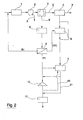
- This and other characteristics shall become more readily apparent from the following description of a preferred embodiment, illustrated purely by way of non limiting example in the accompanying drawing tables in which:
-
Figure 1 shows the method with the possible variations in dashed lines; -
Figure 2 shows a simplified method with a single micro-filtration stage; -
Figure 3 shows a method according to a variation ofFigure 1 . - With reference to the figures, raw milk is fed to a pre-heating stage 1 where it is brought to a temperature of a about 45-65°C to be then originally fed to a
centrifugal clarification treatment 2 or otherwise a treatment which eliminates about 70-90% of the bacterial charge or of the micro-organisms and removes most of the microbial and cellular impurities and part of any somatic cells which may be present. Centrifugal clarification preferably takes place through the use of a centrifugal apparatus which discharges bacteria and sediments through an appropriate sludge chamber. Normally, clarification leads to obtaining a portion of over 99% of milk that is at least partially free of bacteria and a waste 3 of less than 1% constituted by a bacterial concentrate which may be recycled after sterilisation at a temperature exceeding 120 °C. - The centrifugal clarification treatment can be single or multiple, through the use of multiple centrifugal apparatuses arranged in series.
- The partially purified milk is fed to a centrifugal separation stage 4 of a substantially known type, wherefrom exits a creamy portion C and a skimmed portion S.
- The creamy portion, after a
standardisation stage 5 in which the final product is defined by correcting its fat percentage, yields a surplus of cream P which is removed and a creamy part which undergoes ahomogenisation treatment 7, possibly after undergoing high temperature pasteurisation 6 (preferably 120°C for 2-10 seconds, and in any case exceeding 100°C). - The skimmed portion S can undergo an original heat treatment 8 (preferably heated to 45-65°C maintaining said temperature for 10-20 seconds) before undergoing micro-filtration 9 in one or more stages, according to the prior art.
- The
heat treatment 8 has an advantageous protein stabilisation and bacterial charge pre-lowering effect. - Normally, micro-filtration yields a permeate with low bacterial and somatic cell content, and a retentate constituted by skimmed milk containing microbes and somatic cells.
- In the case of a single state, the retentate R1 is again sent to the input of the pre-heating 1 or is sent to the high
temperature pasteurisation stage 6, whilst in the case of multiple stages the retentate R1 of the first stage is normally sent at the input of a subsequent micro-filtration stage, according to the diagram ofFigure 1 , in which there may be one ormore type 60 stages and one ormore type 50 stages. - Normally, in the case of the permeate, the subsequent stages use filtering membranes with pores of equal or progressively smaller (e.g. 0.8 and 0.5 µm) diameter than those of the first stage (for example 1.4 µm).
-
Figure 1 shows the case of a single cascaded stage for micro-filtering the permeate, but there may bemultiple cascaded filters 60 for micro-filtering the permeate. - The retentate (R1, or R2, or R3, ...) of the last stage can be further recycled to the input of the pre-heating 1, or it may be definitively discharged.
- If the creamy part C does not undergo
high temperature pasteurisation 6, the permeate (P1 or P2...or Pn) is partly aspirated by thehomogenisation 7 and partly instead directly undergoes apasteurisation 10 at a temperature of about 72-75°C for at least 15 seconds. - If instead the creamy part undergoes
high temperature pasteurisation 6, then the permeate can undergo the same treatment or, according to an embodiment variation illustrated withdashed lines milk 10 and combines with cream that had already undergone heat treatment in 6. - Lastly,
cooling 11 is provided at a temperature lower than ambient temperature and preferably at 2-6°C. - From the
homogenisation stage 7 therefore exits a product (partly constituted by a creamy part and partly constituted by a skimmed part) which can be sent topasteurisation 10 or directly to cooling 11. - In the case shown in
Figure 1 , where four micro-filtering stages are considered, the retentate R2 of the second stage is sent to the input of the fourth micro-filtering stage or to the hightemperature pasteurisation stage 6, whilst the retentate R3 exiting the third stage is discharged or fed back to the pre-heating 1. The retentate R4 exiting the fourth stage is discharged or fed back to the pre-heating 1. - The permeate P3 exiting the third stage is sent to the input of the first micro-filtering stage, whilst the permeate P4 exiting the fourth stage can be sent to the input of the second micro-filtering stage (dashed line 30) or to the input of the first micro-filtering stage (dashed line 31) together with the permeates exiting the
type 50 stages. - The permeate of the last stage is preferably fed back to the input of the first micro-filtering stage as permeate exiting a micro-filtering of a retentate that has high bacterial concentration.
- The method of the present invention, as a result of the
original treatment 2 for the partial removal of bacteria and somatic cells, allows to reach the centrifugal separation 4 with a higher quality milk (because it undergoes less pasteurisation) and hence to obtain a final product, at the end of the whole process, whose characteristics are such as to provide it with greater duration, and in fact studies conducted by the Applicant have allowed experimentally to observe a duration even greater than 20 days, provided it is preserved at a temperature of about 2-6°C. - With reference to
Figure 3 , an embodiment variation is illustrated in which there is no pre-treatment 2 of all the milk with bacterial charge and somatic cell removal, but the creamy part C, after thestandardisation stage 5, is sent to thehomogenisation stage 7 together, originally, to a portion of skimmed milk S drawn before micro-filtering. The milk exiting thehomogenisation stage 7 is sent directly and originally to micro-filtering together with the skimmed part S exiting the centrifugal separation 4. - The purpose is to obtain micro-filtered milk without processing the creamy part C at high temperature.
- The cream part C is originally homogenised at high pressure (for example about 300 bar, so that the diameter of the fat globules is smaller (about 0.2 micron) than the diameter of the pores of the membranes used in micro-filtering.
Claims (11)
- A method for processing milk, of the type comprising the steps of:- separating (4) the milk into a creamy part (C) and into a skimmed part(S);- micro-filtering (9) the skimmed part, in one or more stages by using filtering pores membranes, generating a permeate with low bacterial charge and a retentate in which are concentrated any bacteria and somatic cells;- pasteurising (10) the permeate, possibly after adding a fraction of creamy part (C) to the permeate;- cooling (11) to a preservation temperature lower than ambient temperature, characterised in that, before separating (4) the milk into a creamy part and into a skimmed part there is a step of pre-processing (2) all the milk, in one or more stages, by means of an at least partial removal of bacterial charge and somatic cells which eliminates about 70-90% of the bacterial charge or of the micro-organisms and removes most of the microbial and cellular impurities and part of any somatic cells which may be present in the milk, wherein said partial removal of bacterial charge and somatic cells is obtained by centrifugal clarification that takes place through the use of a centrifugal apparatus which discharges bacteria and sediments through an appropriate sludge chamber, said clarification leading to obtaining a portion of over 99% of milk that is at least partially free of bacteria and a waste (3) of less than 1% constituted by a bacterial concentrate.
- A method as claimed in claim 1, wherein the skimmed part (S) of the milk is subjected to heating (8) to about 45-65°C for 10-20 seconds before micro-filtering (9).
- A method as claimed in claim 1, wherein at least a fraction of the 20 creamy part (C) undergoes a pasteurisation treatment (6) at over 100°C before a step of homogenisation (7) and mixing with the skimmed part which precedes the final cooling (11).
- A method as claimed in claim 1, wherein at least a fraction of the creamy part (C) is homogenised and subsequently mixed with the skimmed part (S) before pasteurisation (10).
- A method as claimed in claim 1, wherein pasteurisation (10) takes place at about 72-75°C for at least 15 seconds.
- A method as claimed in claim 1, wherein the milk, before the reduction of bacterial charge and somatic cells, undergoes pre-heating (1) to about 45-65°C.
- A method as claimed in claim 1, wherein the retentate is fed back to the input of the step (2) of reduction of bacterial charges and somatic cells, or undergoes pasteurisation (6) at over 100°C, or is sent to an additional micro-filtering stage (9).
- A method as claimed in claim 1, wherein the permeate is homogenised (7) and then pasteurised (10) at 72-75°C.
- A method as claimed in claim 1, wherein the reduction of bacterial charge and the removal of somatic cells takes place by means of centrifugal clarification.
- A method for processing milk, of the type comprising the steps of:- separating (4) the milk into a creamy part (C) and into a skimmed part (S); micro-filtering (9) the skimmed part, in one or more stages by using filtering pores membranes, generating a permeate with low bacterial charge and a retentate in which are concentrated any bacteria and somatic cells;- pasteurising (10) the permeate, possibly after adding a fraction of creamy part (C) to the permeate;- cooling (11) to a preservation temperature lower than ambient temperature, characterised in that a homogenisation step (7) is provided between the creamy part (C) exiting a standardisation stage (5) and a skimmed part (S), at high pressure of about 300 bar, so that the diameter of the fat globules is smaller, about 0.2 micron, than the diameter of the pores of the membranes used in micro-filtering, the milk resulting from said homogenisation being sent to the input of the micro-filtration together with the skimmed part (S) exiting a centrifugal separation stage (4),before the separation (4) of the milk into a creamy part and into a skimmed part there may be provided a possible step of pre-treating (2) all the milk, in one or more stages, by means of an at least partial removal of bacterial charge and somatic cells.
- A method as claimed in claim 10, wherein homogenisation (7) takes place at such a high pressure that the diameter of the fat globules in the product exiting the homogenisation is no greater than the diameter of the pores of the membranes used for micro-filtering.
Applications Claiming Priority (2)
| Application Number | Priority Date | Filing Date | Title |
|---|---|---|---|
| IT000047A ITPR20030047A1 (en) | 2003-06-19 | 2003-06-19 | MILK TREATMENT PROCEDURE. |
| PCT/IT2003/000737 WO2004110158A1 (en) | 2003-06-19 | 2003-11-13 | A method for processing milk |
Publications (2)
| Publication Number | Publication Date |
|---|---|
| EP1656030A1 EP1656030A1 (en) | 2006-05-17 |
| EP1656030B1 true EP1656030B1 (en) | 2011-01-26 |
Family
ID=33548878
Family Applications (1)
| Application Number | Title | Priority Date | Filing Date |
|---|---|---|---|
| EP03768107A Expired - Lifetime EP1656030B1 (en) | 2003-06-19 | 2003-11-13 | A method for processing milk |
Country Status (10)
| Country | Link |
|---|---|
| EP (1) | EP1656030B1 (en) |
| AT (1) | ATE496539T1 (en) |
| AU (1) | AU2003292525B2 (en) |
| BR (1) | BR0318361B1 (en) |
| CA (1) | CA2529487C (en) |
| DE (1) | DE60335920D1 (en) |
| IT (1) | ITPR20030047A1 (en) |
| PT (1) | PT1656030E (en) |
| WO (1) | WO2004110158A1 (en) |
| ZA (1) | ZA200600558B (en) |
Cited By (5)
| Publication number | Priority date | Publication date | Assignee | Title |
|---|---|---|---|---|
| US9055752B2 (en) | 2008-11-06 | 2015-06-16 | Intercontinental Great Brands Llc | Shelf-stable concentrated dairy liquids and methods of forming thereof |
| EP2949218A1 (en) | 2014-05-28 | 2015-12-02 | DMK Deutsches Milchkontor GmbH | Process for the production of low-germ milk products |
| EP2962574A1 (en) | 2014-07-02 | 2016-01-06 | DMK Deutsches Milchkontor GmbH | Process for the production of low-germ milk products |
| US11490629B2 (en) | 2010-09-08 | 2022-11-08 | Koninklijke Douwe Egberts B.V. | High solids concentrated dairy liquids |
| EP3522732B1 (en) * | 2016-10-04 | 2024-04-24 | LactaLogics, Inc. | Methods and systems for generating a sterilized human milk product |
Families Citing this family (6)
| Publication number | Priority date | Publication date | Assignee | Title |
|---|---|---|---|---|
| PL1883308T5 (en) * | 2005-05-16 | 2018-09-28 | Tetra Laval Holdings & Finance Sa | A method in the protein fractionation of skim milk by means of microfiltration |
| WO2007035870A2 (en) | 2005-09-20 | 2007-03-29 | Prolacta Bioscience, Inc. | A method for testing milk |
| HK1200062A1 (en) * | 2011-07-13 | 2015-07-31 | 弗里斯兰品牌有限公司 | Dairy based compositions with low lps |
| EP2661967B1 (en) | 2012-05-11 | 2017-08-02 | DMK Deutsches Milchkontor GmbH | Process for making cheese dairy milk |
| TWI617245B (en) * | 2014-09-03 | 2018-03-11 | 統一企業股份有限公司 | Method for extending the shelf life of chilled fresh milk |
| CN114271324A (en) * | 2021-12-28 | 2022-04-05 | 光明乳业股份有限公司 | Liquid milk cooperatively treated by membrane filtration and dynamic ultrahigh pressure and preparation method thereof |
Family Cites Families (6)
| Publication number | Priority date | Publication date | Assignee | Title |
|---|---|---|---|---|
| GB1057286A (en) * | 1964-09-21 | 1967-02-01 | Alfa Laval Co Ltd | Improvements in or relating to the sterilisation of milk |
| US5256437A (en) * | 1992-06-19 | 1993-10-26 | Pall Corporation | Product and process of making sterile milk through dynamic microfiltration |
| DK169510B1 (en) * | 1993-05-13 | 1994-11-14 | Apv Pasilac As | Plant and method of treating milk |
| SE506683C2 (en) * | 1995-05-17 | 1998-02-02 | Tetra Laval Holdings & Finance | Way to make consumable milk with long shelf life |
| US6652900B2 (en) * | 1997-03-14 | 2003-11-25 | Tetra Laval Holdings & Finance S.A. | Method and plant for producing a sterile milk product |
| DK174656B1 (en) * | 1999-06-04 | 2003-08-11 | Apv Pasilac As | Process and plant for the treatment of milk |
-
2003
- 2003-06-19 IT IT000047A patent/ITPR20030047A1/en unknown
- 2003-11-13 ZA ZA200600558A patent/ZA200600558B/en unknown
- 2003-11-13 PT PT03768107T patent/PT1656030E/en unknown
- 2003-11-13 EP EP03768107A patent/EP1656030B1/en not_active Expired - Lifetime
- 2003-11-13 AU AU2003292525A patent/AU2003292525B2/en not_active Ceased
- 2003-11-13 DE DE60335920T patent/DE60335920D1/en not_active Expired - Lifetime
- 2003-11-13 AT AT03768107T patent/ATE496539T1/en active
- 2003-11-13 CA CA2529487A patent/CA2529487C/en not_active Expired - Lifetime
- 2003-11-13 WO PCT/IT2003/000737 patent/WO2004110158A1/en not_active Ceased
- 2003-11-13 BR BRPI0318361-0A patent/BR0318361B1/en active IP Right Grant
Cited By (5)
| Publication number | Priority date | Publication date | Assignee | Title |
|---|---|---|---|---|
| US9055752B2 (en) | 2008-11-06 | 2015-06-16 | Intercontinental Great Brands Llc | Shelf-stable concentrated dairy liquids and methods of forming thereof |
| US11490629B2 (en) | 2010-09-08 | 2022-11-08 | Koninklijke Douwe Egberts B.V. | High solids concentrated dairy liquids |
| EP2949218A1 (en) | 2014-05-28 | 2015-12-02 | DMK Deutsches Milchkontor GmbH | Process for the production of low-germ milk products |
| EP2962574A1 (en) | 2014-07-02 | 2016-01-06 | DMK Deutsches Milchkontor GmbH | Process for the production of low-germ milk products |
| EP3522732B1 (en) * | 2016-10-04 | 2024-04-24 | LactaLogics, Inc. | Methods and systems for generating a sterilized human milk product |
Also Published As
| Publication number | Publication date |
|---|---|
| BR0318361B1 (en) | 2014-03-04 |
| AU2003292525A1 (en) | 2005-01-04 |
| ITPR20030047A1 (en) | 2004-12-20 |
| ATE496539T1 (en) | 2011-02-15 |
| ZA200600558B (en) | 2007-04-25 |
| CA2529487C (en) | 2012-08-28 |
| DE60335920D1 (en) | 2011-03-10 |
| BR0318361A (en) | 2006-08-01 |
| PT1656030E (en) | 2011-04-20 |
| EP1656030A1 (en) | 2006-05-17 |
| CA2529487A1 (en) | 2004-12-23 |
| AU2003292525B2 (en) | 2010-02-04 |
| WO2004110158A1 (en) | 2004-12-23 |
Similar Documents
| Publication | Publication Date | Title |
|---|---|---|
| KR100384657B1 (en) | A method for producing a consumer milk having good quality preservability | |
| US4876100A (en) | Method for producing milk with a lowered bacterial content | |
| EP1656030B1 (en) | A method for processing milk | |
| CA2295444C (en) | A method for the production of sterile skimmed milk | |
| AU2010297385B2 (en) | Method for producing fresh milk having a longer shelf life | |
| US6652898B2 (en) | Process for producing a milk or whey product having a reduced spores and bacteria content | |
| US6326044B1 (en) | Filter apparatus and method for the production of sterile skimmed milk | |
| US6117470A (en) | Method of producing aseptic consumer milk | |
| US5202142A (en) | Process for the production of cloudy juice which is clouding-stable | |
| EP0137671A1 (en) | Production of juice concentrates | |
| EP2368437B1 (en) | Method for manufacturing cheese-making milk from raw milk | |
| CN115191486A (en) | Method for improving stability of liquid goat milk and prepared liquid goat milk | |
| JP3065328B2 (en) | Methods for disinfecting and homogenizing dairy products | |
| CN215873298U (en) | Apparatus system for preparing dairy products | |
| BG98039A (en) | Method for fruit and vegetables processing |
Legal Events
| Date | Code | Title | Description |
|---|---|---|---|
| PUAI | Public reference made under article 153(3) epc to a published international application that has entered the european phase |
Free format text: ORIGINAL CODE: 0009012 |
|
| 17P | Request for examination filed |
Effective date: 20060119 |
|
| AK | Designated contracting states |
Kind code of ref document: A1 Designated state(s): AT BE BG CH CY CZ DE DK EE ES FI FR GB GR HU IE IT LI LU MC NL PT RO SE SI SK TR |
|
| DAX | Request for extension of the european patent (deleted) | ||
| 17Q | First examination report despatched |
Effective date: 20081013 |
|
| RAP1 | Party data changed (applicant data changed or rights of an application transferred) |
Owner name: PARMALAT S.P.A. |
|
| GRAP | Despatch of communication of intention to grant a patent |
Free format text: ORIGINAL CODE: EPIDOSNIGR1 |
|
| GRAS | Grant fee paid |
Free format text: ORIGINAL CODE: EPIDOSNIGR3 |
|
| GRAA | (expected) grant |
Free format text: ORIGINAL CODE: 0009210 |
|
| AK | Designated contracting states |
Kind code of ref document: B1 Designated state(s): AT BE BG CH CY CZ DE DK EE ES FI FR GB GR HU IE IT LI LU MC NL PT RO SE SI SK TR |
|
| REG | Reference to a national code |
Ref country code: GB Ref legal event code: FG4D |
|
| REG | Reference to a national code |
Ref country code: CH Ref legal event code: EP |
|
| REG | Reference to a national code |
Ref country code: IE Ref legal event code: FG4D |
|
| REF | Corresponds to: |
Ref document number: 60335920 Country of ref document: DE Date of ref document: 20110310 Kind code of ref document: P |
|
| REG | Reference to a national code |
Ref country code: DE Ref legal event code: R096 Ref document number: 60335920 Country of ref document: DE Effective date: 20110310 |
|
| REG | Reference to a national code |
Ref country code: RO Ref legal event code: EPE |
|
| REG | Reference to a national code |
Ref country code: PT Ref legal event code: SC4A Free format text: AVAILABILITY OF NATIONAL TRANSLATION Effective date: 20110414 |
|
| REG | Reference to a national code |
Ref country code: NL Ref legal event code: VDEP Effective date: 20110126 |
|
| PG25 | Lapsed in a contracting state [announced via postgrant information from national office to epo] |
Ref country code: GR Free format text: LAPSE BECAUSE OF FAILURE TO SUBMIT A TRANSLATION OF THE DESCRIPTION OR TO PAY THE FEE WITHIN THE PRESCRIBED TIME-LIMIT Effective date: 20110427 Ref country code: SE Free format text: LAPSE BECAUSE OF FAILURE TO SUBMIT A TRANSLATION OF THE DESCRIPTION OR TO PAY THE FEE WITHIN THE PRESCRIBED TIME-LIMIT Effective date: 20110126 Ref country code: ES Free format text: LAPSE BECAUSE OF FAILURE TO SUBMIT A TRANSLATION OF THE DESCRIPTION OR TO PAY THE FEE WITHIN THE PRESCRIBED TIME-LIMIT Effective date: 20110507 |
|
| PG25 | Lapsed in a contracting state [announced via postgrant information from national office to epo] |
Ref country code: SI Free format text: LAPSE BECAUSE OF FAILURE TO SUBMIT A TRANSLATION OF THE DESCRIPTION OR TO PAY THE FEE WITHIN THE PRESCRIBED TIME-LIMIT Effective date: 20110126 Ref country code: NL Free format text: LAPSE BECAUSE OF FAILURE TO SUBMIT A TRANSLATION OF THE DESCRIPTION OR TO PAY THE FEE WITHIN THE PRESCRIBED TIME-LIMIT Effective date: 20110126 Ref country code: BG Free format text: LAPSE BECAUSE OF FAILURE TO SUBMIT A TRANSLATION OF THE DESCRIPTION OR TO PAY THE FEE WITHIN THE PRESCRIBED TIME-LIMIT Effective date: 20110426 Ref country code: BE Free format text: LAPSE BECAUSE OF FAILURE TO SUBMIT A TRANSLATION OF THE DESCRIPTION OR TO PAY THE FEE WITHIN THE PRESCRIBED TIME-LIMIT Effective date: 20110126 Ref country code: FI Free format text: LAPSE BECAUSE OF FAILURE TO SUBMIT A TRANSLATION OF THE DESCRIPTION OR TO PAY THE FEE WITHIN THE PRESCRIBED TIME-LIMIT Effective date: 20110126 Ref country code: CY Free format text: LAPSE BECAUSE OF FAILURE TO SUBMIT A TRANSLATION OF THE DESCRIPTION OR TO PAY THE FEE WITHIN THE PRESCRIBED TIME-LIMIT Effective date: 20110126 |
|
| PG25 | Lapsed in a contracting state [announced via postgrant information from national office to epo] |
Ref country code: DK Free format text: LAPSE BECAUSE OF FAILURE TO SUBMIT A TRANSLATION OF THE DESCRIPTION OR TO PAY THE FEE WITHIN THE PRESCRIBED TIME-LIMIT Effective date: 20110126 Ref country code: EE Free format text: LAPSE BECAUSE OF FAILURE TO SUBMIT A TRANSLATION OF THE DESCRIPTION OR TO PAY THE FEE WITHIN THE PRESCRIBED TIME-LIMIT Effective date: 20110126 |
|
| PG25 | Lapsed in a contracting state [announced via postgrant information from national office to epo] |
Ref country code: SK Free format text: LAPSE BECAUSE OF FAILURE TO SUBMIT A TRANSLATION OF THE DESCRIPTION OR TO PAY THE FEE WITHIN THE PRESCRIBED TIME-LIMIT Effective date: 20110126 Ref country code: CZ Free format text: LAPSE BECAUSE OF FAILURE TO SUBMIT A TRANSLATION OF THE DESCRIPTION OR TO PAY THE FEE WITHIN THE PRESCRIBED TIME-LIMIT Effective date: 20110126 |
|
| PLBE | No opposition filed within time limit |
Free format text: ORIGINAL CODE: 0009261 |
|
| STAA | Information on the status of an ep patent application or granted ep patent |
Free format text: STATUS: NO OPPOSITION FILED WITHIN TIME LIMIT |
|
| 26N | No opposition filed |
Effective date: 20111027 |
|
| REG | Reference to a national code |
Ref country code: DE Ref legal event code: R097 Ref document number: 60335920 Country of ref document: DE Effective date: 20111027 |
|
| PG25 | Lapsed in a contracting state [announced via postgrant information from national office to epo] |
Ref country code: MC Free format text: LAPSE BECAUSE OF NON-PAYMENT OF DUE FEES Effective date: 20111130 |
|
| REG | Reference to a national code |
Ref country code: CH Ref legal event code: PL |
|
| GBPC | Gb: european patent ceased through non-payment of renewal fee |
Effective date: 20111113 |
|
| PG25 | Lapsed in a contracting state [announced via postgrant information from national office to epo] |
Ref country code: CH Free format text: LAPSE BECAUSE OF NON-PAYMENT OF DUE FEES Effective date: 20111130 Ref country code: LI Free format text: LAPSE BECAUSE OF NON-PAYMENT OF DUE FEES Effective date: 20111130 |
|
| REG | Reference to a national code |
Ref country code: FR Ref legal event code: ST Effective date: 20120731 |
|
| REG | Reference to a national code |
Ref country code: IE Ref legal event code: MM4A |
|
| PG25 | Lapsed in a contracting state [announced via postgrant information from national office to epo] |
Ref country code: GB Free format text: LAPSE BECAUSE OF NON-PAYMENT OF DUE FEES Effective date: 20111113 Ref country code: IE Free format text: LAPSE BECAUSE OF NON-PAYMENT OF DUE FEES Effective date: 20111113 |
|
| PG25 | Lapsed in a contracting state [announced via postgrant information from national office to epo] |
Ref country code: FR Free format text: LAPSE BECAUSE OF NON-PAYMENT OF DUE FEES Effective date: 20111130 |
|
| PG25 | Lapsed in a contracting state [announced via postgrant information from national office to epo] |
Ref country code: LU Free format text: LAPSE BECAUSE OF NON-PAYMENT OF DUE FEES Effective date: 20111113 |
|
| PG25 | Lapsed in a contracting state [announced via postgrant information from national office to epo] |
Ref country code: TR Free format text: LAPSE BECAUSE OF FAILURE TO SUBMIT A TRANSLATION OF THE DESCRIPTION OR TO PAY THE FEE WITHIN THE PRESCRIBED TIME-LIMIT Effective date: 20110126 |
|
| PG25 | Lapsed in a contracting state [announced via postgrant information from national office to epo] |
Ref country code: HU Free format text: LAPSE BECAUSE OF FAILURE TO SUBMIT A TRANSLATION OF THE DESCRIPTION OR TO PAY THE FEE WITHIN THE PRESCRIBED TIME-LIMIT Effective date: 20110126 |
|
| PGFP | Annual fee paid to national office [announced via postgrant information from national office to epo] |
Ref country code: AT Payment date: 20151119 Year of fee payment: 13 |
|
| REG | Reference to a national code |
Ref country code: AT Ref legal event code: MM01 Ref document number: 496539 Country of ref document: AT Kind code of ref document: T Effective date: 20161113 |
|
| PG25 | Lapsed in a contracting state [announced via postgrant information from national office to epo] |
Ref country code: AT Free format text: LAPSE BECAUSE OF NON-PAYMENT OF DUE FEES Effective date: 20161113 |
|
| PGFP | Annual fee paid to national office [announced via postgrant information from national office to epo] |
Ref country code: DE Payment date: 20171121 Year of fee payment: 15 |
|
| PGFP | Annual fee paid to national office [announced via postgrant information from national office to epo] |
Ref country code: RO Payment date: 20181030 Year of fee payment: 16 |
|
| REG | Reference to a national code |
Ref country code: DE Ref legal event code: R119 Ref document number: 60335920 Country of ref document: DE |
|
| PG25 | Lapsed in a contracting state [announced via postgrant information from national office to epo] |
Ref country code: DE Free format text: LAPSE BECAUSE OF NON-PAYMENT OF DUE FEES Effective date: 20190601 |
|
| PG25 | Lapsed in a contracting state [announced via postgrant information from national office to epo] |
Ref country code: RO Free format text: LAPSE BECAUSE OF NON-PAYMENT OF DUE FEES Effective date: 20191113 |
|
| PGFP | Annual fee paid to national office [announced via postgrant information from national office to epo] |
Ref country code: PT Payment date: 20211102 Year of fee payment: 19 |
|
| PGFP | Annual fee paid to national office [announced via postgrant information from national office to epo] |
Ref country code: IT Payment date: 20221102 Year of fee payment: 20 |
|
| P01 | Opt-out of the competence of the unified patent court (upc) registered |
Effective date: 20230418 |
|
| PG25 | Lapsed in a contracting state [announced via postgrant information from national office to epo] |
Ref country code: PT Free format text: LAPSE BECAUSE OF NON-PAYMENT OF DUE FEES Effective date: 20230515 |
|
| PG25 | Lapsed in a contracting state [announced via postgrant information from national office to epo] |
Ref country code: PT Free format text: LAPSE BECAUSE OF EXPIRATION OF PROTECTION Effective date: 20231122 |
|
| PG25 | Lapsed in a contracting state [announced via postgrant information from national office to epo] |
Ref country code: PT Free format text: LAPSE BECAUSE OF NON-PAYMENT OF DUE FEES Effective date: 20221114 |
|
| PG25 | Lapsed in a contracting state [announced via postgrant information from national office to epo] |
Ref country code: PT Free format text: LAPSE BECAUSE OF NON-PAYMENT OF DUE FEES Effective date: 20221114 |