EP1693418A1 - Resin composition for light reflector and light reflector - Google Patents
Resin composition for light reflector and light reflector Download PDFInfo
- Publication number
- EP1693418A1 EP1693418A1 EP04820200A EP04820200A EP1693418A1 EP 1693418 A1 EP1693418 A1 EP 1693418A1 EP 04820200 A EP04820200 A EP 04820200A EP 04820200 A EP04820200 A EP 04820200A EP 1693418 A1 EP1693418 A1 EP 1693418A1
- Authority
- EP
- European Patent Office
- Prior art keywords
- polyamide resin
- resin composition
- component unit
- mol
- mass
- Prior art date
- Legal status (The legal status is an assumption and is not a legal conclusion. Google has not performed a legal analysis and makes no representation as to the accuracy of the status listed.)
- Withdrawn
Links
Classifications
-
- C—CHEMISTRY; METALLURGY
- C08—ORGANIC MACROMOLECULAR COMPOUNDS; THEIR PREPARATION OR CHEMICAL WORKING-UP; COMPOSITIONS BASED THEREON
- C08K—Use of inorganic or non-macromolecular organic substances as compounding ingredients
- C08K5/00—Use of organic ingredients
- C08K5/0008—Organic ingredients according to more than one of the "one dot" groups of C08K5/01 - C08K5/59
- C08K5/005—Stabilisers against oxidation, heat, light, ozone
-
- B—PERFORMING OPERATIONS; TRANSPORTING
- B29—WORKING OF PLASTICS; WORKING OF SUBSTANCES IN A PLASTIC STATE IN GENERAL
- B29C—SHAPING OR JOINING OF PLASTICS; SHAPING OF MATERIAL IN A PLASTIC STATE, NOT OTHERWISE PROVIDED FOR; AFTER-TREATMENT OF THE SHAPED PRODUCTS, e.g. REPAIRING
- B29C45/00—Injection moulding, i.e. forcing the required volume of moulding material through a nozzle into a closed mould; Apparatus therefor
- B29C45/0001—Injection moulding, i.e. forcing the required volume of moulding material through a nozzle into a closed mould; Apparatus therefor characterised by the choice of material
-
- C—CHEMISTRY; METALLURGY
- C08—ORGANIC MACROMOLECULAR COMPOUNDS; THEIR PREPARATION OR CHEMICAL WORKING-UP; COMPOSITIONS BASED THEREON
- C08K—Use of inorganic or non-macromolecular organic substances as compounding ingredients
- C08K5/00—Use of organic ingredients
- C08K5/04—Oxygen-containing compounds
- C08K5/13—Phenols; Phenolates
- C08K5/132—Phenols containing keto groups, e.g. benzophenones
-
- C—CHEMISTRY; METALLURGY
- C08—ORGANIC MACROMOLECULAR COMPOUNDS; THEIR PREPARATION OR CHEMICAL WORKING-UP; COMPOSITIONS BASED THEREON
- C08K—Use of inorganic or non-macromolecular organic substances as compounding ingredients
- C08K5/00—Use of organic ingredients
- C08K5/16—Nitrogen-containing compounds
- C08K5/17—Amines; Quaternary ammonium compounds
-
- C—CHEMISTRY; METALLURGY
- C08—ORGANIC MACROMOLECULAR COMPOUNDS; THEIR PREPARATION OR CHEMICAL WORKING-UP; COMPOSITIONS BASED THEREON
- C08K—Use of inorganic or non-macromolecular organic substances as compounding ingredients
- C08K5/00—Use of organic ingredients
- C08K5/16—Nitrogen-containing compounds
- C08K5/34—Heterocyclic compounds having nitrogen in the ring
- C08K5/3467—Heterocyclic compounds having nitrogen in the ring having more than two nitrogen atoms in the ring
- C08K5/3477—Six-membered rings
- C08K5/3492—Triazines
-
- C—CHEMISTRY; METALLURGY
- C08—ORGANIC MACROMOLECULAR COMPOUNDS; THEIR PREPARATION OR CHEMICAL WORKING-UP; COMPOSITIONS BASED THEREON
- C08K—Use of inorganic or non-macromolecular organic substances as compounding ingredients
- C08K7/00—Use of ingredients characterised by shape
- C08K7/02—Fibres or whiskers
- C08K7/04—Fibres or whiskers inorganic
- C08K7/14—Glass
-
- C—CHEMISTRY; METALLURGY
- C08—ORGANIC MACROMOLECULAR COMPOUNDS; THEIR PREPARATION OR CHEMICAL WORKING-UP; COMPOSITIONS BASED THEREON
- C08L—COMPOSITIONS OF MACROMOLECULAR COMPOUNDS
- C08L77/00—Compositions of polyamides obtained by reactions forming a carboxylic amide link in the main chain; Compositions of derivatives of such polymers
-
- F—MECHANICAL ENGINEERING; LIGHTING; HEATING; WEAPONS; BLASTING
- F21—LIGHTING
- F21V—FUNCTIONAL FEATURES OR DETAILS OF LIGHTING DEVICES OR SYSTEMS THEREOF; STRUCTURAL COMBINATIONS OF LIGHTING DEVICES WITH OTHER ARTICLES, NOT OTHERWISE PROVIDED FOR
- F21V7/00—Reflectors for light sources
- F21V7/22—Reflectors for light sources characterised by materials, surface treatments or coatings, e.g. dichroic reflectors
- F21V7/24—Reflectors for light sources characterised by materials, surface treatments or coatings, e.g. dichroic reflectors characterised by the material
-
- H—ELECTRICITY
- H10—SEMICONDUCTOR DEVICES; ELECTRIC SOLID-STATE DEVICES NOT OTHERWISE PROVIDED FOR
- H10H—INORGANIC LIGHT-EMITTING SEMICONDUCTOR DEVICES HAVING POTENTIAL BARRIERS
- H10H20/00—Individual inorganic light-emitting semiconductor devices having potential barriers, e.g. light-emitting diodes [LED]
- H10H20/80—Constructional details
- H10H20/85—Packages
- H10H20/855—Optical field-shaping means, e.g. lenses
- H10H20/856—Reflecting means
-
- C—CHEMISTRY; METALLURGY
- C08—ORGANIC MACROMOLECULAR COMPOUNDS; THEIR PREPARATION OR CHEMICAL WORKING-UP; COMPOSITIONS BASED THEREON
- C08K—Use of inorganic or non-macromolecular organic substances as compounding ingredients
- C08K3/00—Use of inorganic substances as compounding ingredients
- C08K3/18—Oxygen-containing compounds, e.g. metal carbonyls
- C08K3/20—Oxides; Hydroxides
- C08K3/22—Oxides; Hydroxides of metals
- C08K2003/2237—Oxides; Hydroxides of metals of titanium
Definitions
- the present invention relates to a resin composition suitable for a reflector plate and a reflector plate formed from the resin composition. More particularly, the invention relates to a polyamide resin composition suitable for a reflector plate, which comprises a polyamide resin, an inorganic filler and a white pigment, which is excellent in reflectance, heat resistance, mechanical properties and adhesive properties to a sealing resin and which at the same time is suitable for insert molding, and which further realizes a reduced drop of light reflectance over the course of time when used as the reflector plate indoors and outdoors, and to a reflector plate formed from the resin composition.
- a polyamide resin composition suitable for a reflector plate which comprises a polyamide resin, an inorganic filler and a white pigment, which is excellent in reflectance, heat resistance, mechanical properties and adhesive properties to a sealing resin and which at the same time is suitable for insert molding, and which further realizes a reduced drop of light reflectance over the course of time when used as the reflector plate indoors and outdoors, and to a reflector plate formed from the resin
- Reflector plates for effectively using light have been used in various aspects.
- the miniaturization of a light source and the miniaturization of a device are achieved, and thus it is required that the reflector plates to have not only high mechanical strength, but also good heat resistance and capability to be precisely molded.
- a special insert molding has also been performed, and thus it has required a resin composition which can be used in this application.
- LCPs liquid crystal polymers
- heat resistant polyamide resins have been used.
- the LCPs are superior in heat resistance and light resistance, and flowability during molding, but are inferior in adhesive properties to a sealing resin such as an epoxy resin used at sealing therewith after mounting a light emitting diode on a reflector plate.
- Patent Documents 1 and 2 propose a resin composition for a reflector plate, which is made by blending an inorganic filler to a polyamide resin composed of 1,9-diaminononane.
- this resin composition has a problem in adhesive properties to a sealing resin.
- Patent Document 4 describes a polyamide resin composition comprising an inorganic filler having an average particle size of 2 ⁇ m or less
- Patent Document 5 describes a polyamide resin containing potassium titanate fiber and/or wollastonite.
- these polyamide resins are not capable of obtaining sufficient rigidity during molding and have problems as being used in insert molding.
- Patent Documents 3, 6 and 7 describe a polyamide resin containing a specific light stabilizer and having a less discoloration of a molded product.
- these resins have problems in productivities due to occurrence of a mold deposit during molding.
- Patent Document 1 WO 03/085029
- a molded product formed of a specific polyamide resin composition comprising a polyamide resin (A), an inorganic filler (B) and a white pigment (C) is excellent in mechanical strength and heat resistance and no problems occur when the polyamide resin composition is use in precision insert molded product, and a polyamide resin composition further comprising a specific ultraviolet absorber (D), or both an ultraviolet absorber (D) and a hindered amine compound (E) and a reflector plate formed from the resin composition realizes a reduced drop of light reflectance over the course of time when used as the reflector plate indoors and outdoors, and thus have completed the present invention.
- a specific ultraviolet absorber D
- E hindered amine compound
- the present invention provides:
- the invention can provide a polyamide resin composition which has high light reflectance, high light stability and good adhesive properties to a sealing resin, and which can obtain a reflective plate molded product comprising an insert molded-hoop material and a resin, which does not occur problems in a post-process such as a set process of LED by a sealing resin such as an epoxy resin and a solder reflow process, and a reflector plate formed from the resin composition.
- the polyamide resin (A) used in the invention comprises a dicarboxylic acid component unit (a-1) and a diamine component unit (a-2).
- the dicarboxylic acid component unit (a-1) constituting the polyamide resin (A) used in the invention preferably comprises 30 to 100 mol% of a terephthalic acid component unit, 0 to 70 mol% of an aromatic dicarboxylic acid component unit other than the terephthalic acid, and/or 0 to 70 mol% of an aliphatic dicarboxylic acid component unit having 4 to 20 carbon atoms.
- the aromatic dicarboxylic acid component unit other than the terephthalic acid for example, isophthalic acid, 2-methylterephthalic acid, naphthalene dicarboxylic acid and a combination thereof are preferred.
- the aliphatic dicarboxylic acid component unit is derived from an aliphatic dicarboxylic acid having 4 to 20 carbon atoms and preferably 6 to 12 carbon atoms.
- Examples of the aliphatic dicarboxylic acid used for deriving the aliphatic dicarboxylic acid component unit include adipic acid, suberic acid, azelaic acid, sebacic acid, decanedicarboxylic acid, undecanedicarboxylic acid, dodecanedicarboxylic acid and the like.
- the adipic acid is particularly preferred.
- the polyamide resin when the amount of the dicarboxylic acid component unit in the polyamide resin is 100 mol%, the polyamide resin preferably contains the terephthalic acid component unit in an amount of 30 to 100 mol%, preferably 40 to 100 mol%, and more preferably 40 to 80 mol%; the aromatic dicarboxylic acid component unit other than the terephthalic acid in an amount of 0 to 70 mol%, preferably 0 to 60 mol%, and more preferably 20 to 60 mol%; and/or the aliphatic dicarboxylic acid having 4 to 20 carbon atoms, preferably 6 to 12 carbon atoms in an amount of 0 to 70 mol%, preferably 0 to 60 mol% and more preferably 20 to 60 mol%.
- the polyamide resin may contain, as a dicarboxylic acid component unit (a-1), a polyvalent carboxylic acid component unit in a small amount, for example, in an amount of about 10 mol% or less, together with the above-mentioned component units.
- a-1 dicarboxylic acid component unit
- a polyvalent carboxylic acid component unit in a small amount, for example, in an amount of about 10 mol% or less, together with the above-mentioned component units.
- Specific examples of the polyvalent carboxylic acid component unit include tribasic or polybasic acid such as trimellitic acid or pyromellitic acid.
- the diamine component unit (a-2) constituting the polyamide resin (A) used in the invention is preferably a straight chain and/or branched chain aliphatic diamine having 4 to 20 carbon atoms, preferably 6 to 12 carbon atoms.
- straight chain aliphatic diamine component unit examples include 1,4-diaminobutane, 1,6-diaminohexane, 1,7-diaminoheptane, 1,8-diaminooctane, 1,9-diaminononane, 1,10-diaminodecane, 1,11-diaminoundecane and 1,12-diaminododecane. Of these, it is preferable to contain 1,6-diaminohexane in an amount of 50 to 100 mol%.
- branched straight chain aliphatic diamine component unit examples include 2-methyl-1,5-diaminopetane, 2-methyl-1,6-diaminohexane, 2-methyl-1,7-diaminoheptane, 2-methyl-1,8-diaminooctane, 2-methyl-1,9-diaminononane, 2-methyl-1,10-diaminodecane, 2-methyl-1,11-diaminoundecane and the like. Of these, 2-methyl-1,7-diaminoheptane, 2-methyl-1,8-diaminooctane and 2-methyl-1,9-diaminononane are preferred.
- the polyamide resin (A) used in the invention can be prepared by a known method and prepared by the polycondensation of a dicarboxylic acid component with a diamine component.
- the polyamide resin can be prepared by heating the dicarboxylic acid component and the diamine component in the presence of a catalyst to obtain a lower condensate and subsequently by carrying out the polycondensation by the application of shear stress to a melt of the lower condensate.
- the polyamide resin (A) used in the invention has an intrinsic viscosity [ ⁇ ], as measured in 96.5% sulfuric acid at 25°C, of 0.5 to 0.9 [dl/g], preferably 0.6 to 0.9 [dl/g], and more preferably 0.7 to 0.9 [dl/g].
- the polyamide resin has excellent flowability during molding.
- the polyamide resin has a melting point, as measured by DSC, usually in the range of 260 to 350°C, and particularly preferably in the range of 290 to 335°C.
- the polyamide resin having the above melting point ranges is particularly excellent in heat resistance.
- the inorganic filler (B) used in the invention there can be various inorganic reinforcing materials in the form of fiber, powder, granule, plate, needle, cloth, mat, and the like used. More specifically, the inorganic filler include inorganic fibers such as glass fiber, metal-coated glass fiber, ceramic fiber, carbon fiber, metal carbide fiber, hardened metal fiber, asbestos fiber and boron fiber. Of these fibrous fillers, the glass fiber is particularly preferable. By using the glass fiber, the moldability of the composition improves and further improves mechanical properties such as tensile strength, bending strength and flexural modulus of elasticity, and heat resisting property such as thermal deformation temperature of the molded product formed from the resin composition.
- the glass fiber has an average length of usually in the range of 0.1 to 20 mm, preferably in the range of 0.3 to 6 mm and an aspect ratio (L (average length of fiber) / D (average outer diameter of fiber) of usually in the range of 10 to 2000, preferably in the range of 30 to 600. It is preferable to use the glass fiber having the average length and the aspect ratio in the above-mentioned ranges.
- Examples of the white pigment (C) used in the invention include titanium oxide, zinc oxide, zinc sulfide, white lead, zinc sulfate, barium sulfate, calcium carbonate, alumina oxide and the like.
- these white pigments may be used alone or in combination of two or more kinds. Moreover, these white pigments can also be used after treating them with a silane coupling agent, a titanium coupling agent or the like.
- the white pigments may be surface-treated with a silane compound such as vinyltriethoxysilane, 2-aminopropyltriethoxysilane and 2-glycidoxypropyltriethoxysilane.
- a silane compound such as vinyltriethoxysilane, 2-aminopropyltriethoxysilane and 2-glycidoxypropyltriethoxysilane.
- titanium oxide is particularly preferable, and by using titanium oxide, the optical properties such as reflectance and concealability improve.
- a rutile-type titanium oxide is preferably used as titanium oxide.
- a particle size of titanium oxide is 0.05 to 2.0 ⁇ m, preferably 0.05 to 0.7 ⁇ m.
- the polyamide resin composition of this invention can prevent the discoloration and realize the reduced drop of reflectance in a reflector plate obtained by molding the polyamide resin composition by adding a specific ultraviolet absorber (D), or both an ultraviolet absorber (D) and a hindered amine compound (E).
- D specific ultraviolet absorber
- E hindered amine compound
- the ultraviolet absorber (D) of the invention preferably has a heating mass reduction ratio of 0 to 50% by mass, preferably 0 to 40% by mass, and more preferably 0 to 30% by mass when held at 340°C for 10 minutes after elevating the temperature at 20°C/min from 25°C to 340°C under a nitrogen atmosphere.
- the ultraviolet absorber (D) particularly preferably comprises one or more compounds selected from a benzotriazole compound, a triazine compound or a benzophenone compound.
- ultraviolet absorber examples include 2-[2'-hydroxy-3'-(3",4",5",6"-tetrahydrophthalimidemethl)-5'-methylphenyl]-benzotriazole, 2-(4,6-diphenyl-1,3,5-triazin-2-yl)-5-[(hexyl)oxy]-phenol, 2-[4,6-bis(2,4-dimethylphenyl)-1,3,5-triazin-2-yl]-5-(octyloxy)phenol and the like.
- a higher light stability can be obtained by using a combination of the above-mentioned ultraviolet absorber (D) and a hindered amine compound (E).
- the hindered amine compound (E) of the invention preferably has a heating mass reduction ratio of 0 to 50% by mass, preferably 0 to 40% by mass, and more preferably 0 to 30% by mass when held at 340°C for 10 minutes after elevating the temperature at 20°C/min from 25°C to 340°C under a nitrogen atmosphere.
- the polyamide resin composition of the invention may be incorporated with the following additives, specifically, various known compounding agents such as an antioxidant (phenols, amines, sulfur, phosphorous, etc.), a heat stabilizer (lactone compound, vitamin E group, hydroquinones, copper halide, iodine compound, etc.), a light stabilizer (benzotriazoles, triazines, benzophenones, benzoates, hindered amines, oxanilides, etc.), other polymers (olefins, modified polyolefines, an olefin copolymer such as an ethylene/propylene copolymer and an ethylene/1-butene copolymer, an olefin copolymer such as a propylene/1-butene copolymer, polystyrene, polyamide, polycarbonate, polyacetal, polysulfone, polyphenylene oxide, a fluororesin, a silicone resin, LCP, etc.), a
- the polyamide resin composition of the invention can be produced by a known method, for example, by mixing the above-described components using a Henschel mixer, a V blender, a ribbon blender, a tumbler blender or the like, or granulating or crushing the mixed components after they are melt-kneaded using a single-screw or multi-screw extruder, a kneader, a Banbury mixer or the like.
- the polyamide resin composition of the invention preferably contains the polyamide resin (A) in an amount of 30 to 80% by mass, preferably 40 to 70% by mass, more preferably 45 to 65% by mass, based on 100% by mass of the total amount of the polyamide resin (A), the inorganic filler (B) and the white pigment (C).
- the inorganic filler (B) is preferably added to the polyamide resin composition in a proportion of 10 to 60% by mass, preferably 15 to 50% by mass, more preferably 20 to 40% by mass, based on 100% by mass of the total amount of the polyamide resin (A), the inorganic filler (B) and the white pigment (C).
- the white pigment (C) is preferably added to the polyamide resin composition in a proportion of 5 to 50% by mass, preferably 5 to 40% by mass, more preferably 5 to 35% by mass, based on 100% by mass of the total amount of the polyamide resin (A), the inorganic filler (B) and the white pigment (C).
- the ultraviolet absorber (D) is preferably added to the polyamide resin composition in a proportion of 0.05 to 3 parts by mass, preferably 0.05 to 2 parts by mass, based on 100 parts by mass of the polyamide resin (A).
- the hindered amine compound (E) is preferably added to the polyamide resin composition in a proportion of 0.05 to 3 parts by mass, preferably 0.05 to 2 parts by mass, based on 100 parts by mass of the polyamide resin (A).
- the polyamide resin composition of the invention obtained by the above-mentioned method can be suitably used as a reflector plate in that it is excellent in light reflectance, heat resistance, and adhesive properties to a sealing resin such as an epoxy resin and it further realizes a reduced drop of reflectance when used as the reflector plate indoors and outdoors.
- a molded product that is injection molded from the polyamide resin composition with a length of 64 mm, a width of 6 mm and a thickness of 0.8 mm, has a flexural modulus of elasticity of 45.00 MPa to 12000 MPa, preferably 4500 MPa to 10000 MPa, as obtained by measuring in an atmosphere at 130°C under the conditions of a span of 26 mm and a bending speed of 5 mm/min after being placed in an air oven at 130°C for 20 minutes, and sufficient rigidity is obtained at the time of insert molding thereof, and therefore there does not occur a problem such as peeling in use in insert molded products.
- reflector plate as used herein includes a Chinese character called a "plate”, but the concept of this term is not limited to only one having a "plate” shape. This term includes normal casings or housings in which at least the direction side to which light is emitted is opened or not opened. More specifically, the term “reflector plate” further includes those having general three-dimensional shapes, provided with a plate (surfaces such as a flat surface, a spherical surface and a curved surface) as the surface to which light is reflected, such as a box or case, a funnel, a bowl, a parabola, a cylinder, a cone and a honeycomb.
- a reflector plate for an LED device is shaped into a desired shape by hot forming such as injection molding (metal insert molding such as hoop molding), melt molding, extrusion molding, inflation molding, and blow molding of a resin composition usually comprising a polyamide resin or both a polyamide resin and an inorganic filler.
- the LED reflector plate of the invention is usually sealed, bonded and adhered to an LED device and other components with a sealing resin.
- the polyamide resin composition and the reflector plate of the invention can be adapted not only for an LED application, but also for other applications reflecting light beams.
- a reflector plate for a light emitting device such as various electric/electronic products, indoor lighting, ceiling area lighting, outdoor lighting, automobile lighting, a display apparatus, and a headlight.
- the reflector plate can be prepared by heat melting the polyamide resin composition for a reflector plate of the invention to shape into a desired shape and then cooling the resultant.
- This shaping can be obtained by a method of melt molding the polyamide resin composition in a mold capable of forming a desired shape.
- the polyamide resin composition can be molded into a reflector plate using a known method such as injection molding, compression molding and extrusion molding.
- the reflecting plate or the reflecting plate for a light emitting diode device formed from the polyamide resin composition of the invention preferably has reflectance retention of 80 to 100%, preferably 80 to 90%, more preferably 82 to 85%, as calculated by measuring light reflectance at a wavelength of 470 nm before and after light is irradiated with a metal halide lamp at 40 mW/cm 2 for 48 hours.
- a DSC-7 available from PerkinElmer, Inc. was used. A sample was once held at 330°C for 5 minutes and followed by cooling to 23°C at a rate of 10°C/min. Then, the temperature of the sample was elevated at 10°C/min and an endothermic peak based on melting at this time was defined as a melting point.
- Reflectances at wavelengths of 470 nm, 520 nm and 650 nm were measured using an injection molded specimen having a thickness of 2 mm. The results of the evaluation were indicated by the symbols O: reflectance of 85% or more and x: reflectance of less than 85%.
- Molding machine IS-55EPN manufactured by TOSHIBA MACHINE CO., LTD. (Temperature of cylinder: 335°C, Temperature of mold: 120°C)
- Measuring apparatus of reflectance CM3500d manufactured by Minolta Co., Ltd.
- a cup-shaped molded product having a length of 3 mm, a width of 2.5 mm and a height of 2 mm was obtained by hoop molding and an aqueous ink was dropped onto the contact portion of a hoop material and the cup-shaped molded product to examine whether or not the aqueous ink permeates into the contact surface of the cup-shaped molded product and the hoop material by the capillary phenomenon.
- the results of the evaluation were indicated by the symbols O: no permeation and x: permeation.
- Molding machine IS-55EPN manufactured by TOSHIBA MACHINE CO., LTD. (Temperature of cylinder: 335°C, Temperature of mold: 120°C)
- Light irradiation apparatus Eye super UV tester manufactured by DAINIPPON PLASTICS CO., LTD. (40 mW/cm 2 , 48 h)
- Measuring apparatus of reflectance CM3500d manufactured by Minolta Co., Ltd.
- the polyamide resin (A1), the inorganic filler (B) and the white pigment (C) were mixed together at ratios shown in Table 1 using a tumbler blender, and were fed into a twinscrew extruder equipped with a vent (BT-40 manufactured by PLASTIC ENGINEERING RESEARCH CO., LTD.) and melt-kneaded therein at a setpoint temperature of 320°C to prepare pellet-shaped resin compositions. Then, the respective properties of the obtained resin compositions were evaluated and the results thereof are shown in Table 1.
- Composition dicarboxylic acid component unit (terephthalic acid/62.5 mol% and adipic acid/37.5 mol%) and diamine component unit (1,6-diaminohexane/100 mol%)
- Intrinsic viscosity [ ⁇ ]: 0.8 dl/g
- Melting point 320°C
- Inorganic filler B): glass fiber (length of 3 mm and aspect ratio of 300)
- Pellet-shaped resin compositions were prepared in the same manner as in Example 1, except that the polyamide resin (A1) was changed to the polyamide resin (A2). Then, the respective properties of the obtained resin compositions were evaluated and the results thereof are shown in Table 1.
- composition dicarboxylic acid component unit (terephthalic acid/62.5 mol% and adipic acid/37.5 mol%) and diamine component (1,6-diaminohexane/100 mol%)
- Intrinsic viscosity [ ⁇ ]: 1.0 dl/g Melting point: 320°C
- Pellet-shaped resin compositions were prepared in the same manner as in Example 2, except that ultraviolet absorbers (D1) and (D2) and hindered amine compounds (D3) and (D4) were added at ratios shown in Table 1, based on 100 parts by mass of the polyamide resin (A1).
- Ultraviolet absorber (D1) 2-(4,6-diphenyl-1,3,5-triazin-2-yl)-5-[(hexyl)oxy]-phenol Trade name: TINUVIN 1577FF manufactured by Ciba Speciality Chemicals, Inc. (heating mass reduction ratio of 20%)
- Hindered amine compound (D3) a mixture of N,N',N",N'''-tetrakis-(4,6-bis-(butyl-(N-methyl-2,2,6,6-tetramethylpiperidin-4-yl)amino)-triazin-2-yl)-4,7-diazadecane-1,10-diamine (A) and polymer (B) of dimethyl succinate and 4-hydroxy-2,2,6,6-tetramethyl-1-piperidine ethanol Trade name: CHIMASSORB119FL manufactured by Ciba Speciality Chemicals, Inc.
- Hindered amine compound (D4) poly[ ⁇ 6-((1,1,3,3-tetramethylbutyl)amino)-1,3,5-triazine-2,4-diyl ⁇ (2,2,6,6-tetramethyl-4-piperidyl)imino ⁇ hexamethylene ⁇ (2,2,6,6-tetramethyl-4-piperidyl)imino ⁇ ]
- the polyamide resin composition according to the present invention having excellent mechanical strength and excellent heat resistance, high light reflectance, high light shielding properties and high light resistance can be suitably used as a reflector plate for an LED device or a reflector plate for a light emitting device such as various electric/electronic products, indoor lighting, ceiling area lighting, outdoor lighting, automobile lighting, a display apparatus, and a headlight.
Landscapes
- Chemical & Material Sciences (AREA)
- Health & Medical Sciences (AREA)
- Chemical Kinetics & Catalysis (AREA)
- Medicinal Chemistry (AREA)
- Polymers & Plastics (AREA)
- Organic Chemistry (AREA)
- Engineering & Computer Science (AREA)
- General Engineering & Computer Science (AREA)
- Manufacturing & Machinery (AREA)
- Mechanical Engineering (AREA)
- Compositions Of Macromolecular Compounds (AREA)
- Led Device Packages (AREA)
Abstract
Description
- The present invention relates to a resin composition suitable for a reflector plate and a reflector plate formed from the resin composition. More particularly, the invention relates to a polyamide resin composition suitable for a reflector plate, which comprises a polyamide resin, an inorganic filler and a white pigment, which is excellent in reflectance, heat resistance, mechanical properties and adhesive properties to a sealing resin and which at the same time is suitable for insert molding, and which further realizes a reduced drop of light reflectance over the course of time when used as the reflector plate indoors and outdoors, and to a reflector plate formed from the resin composition.
- Reflector plates for effectively using light have been used in various aspects. However, in recent years, due to the light source gaining semiconductance (semiconductor laser and light emitting diode (hereinafter referred to as LED)), the miniaturization of a light source and the miniaturization of a device are achieved, and thus it is required that the reflector plates to have not only high mechanical strength, but also good heat resistance and capability to be precisely molded. Particularly, in obtaining a reflector plate having high reflectance, a special insert molding has also been performed, and thus it has required a resin composition which can be used in this application.
- In this field, conventional LCPs (liquid crystal polymers) and heat resistant polyamide resins have been used. The LCPs are superior in heat resistance and light resistance, and flowability during molding, but are inferior in adhesive properties to a sealing resin such as an epoxy resin used at sealing therewith after mounting a light emitting diode on a reflector plate.
- Patent Documents 1 and 2 propose a resin composition for a reflector plate, which is made by blending an inorganic filler to a polyamide resin composed of 1,9-diaminononane. However, this resin composition has a problem in adhesive properties to a sealing resin. Further, Patent Document 4 describes a polyamide resin composition comprising an inorganic filler having an average particle size of 2 µm or less, and Patent Document 5 describes a polyamide resin containing potassium titanate fiber and/or wollastonite. However, these polyamide resins are not capable of obtaining sufficient rigidity during molding and have problems as being used in insert molding. Furthermore, Patent Documents 3, 6 and 7 describe a polyamide resin containing a specific light stabilizer and having a less discoloration of a molded product. However, these resins have problems in productivities due to occurrence of a mold deposit during molding.
- [Patent Document 1] WO 03/085029
- [Patent Document 2] JP-A No. 7-228776
- [Patent Document 3] JP-A No. 2004-75994
- [Patent Document 4] JP-A No. 2000-204244
- [Patent Document 5] JP-A No. 2002-294070
- [Patent Document 6] JP-A No. 2001-115014
- [Patent Document 7] JP-A No. 2001-115015
- It is an object of the present invention to provide a polyamide resin composition that is excellent in mechanical strength and heat resistance of a molded product and has no problem as being used in precision insert molded products.
It is another object of the invention to provide a reflector plate formed from the resin composition, which realizes a reduced drop of light reflectance over the course of time when used as the reflector plate. - In the light of these consideration, the present inventors have studied intensively, and as a result, they have found that a molded product formed of a specific polyamide resin composition comprising a polyamide resin (A), an inorganic filler (B) and a white pigment (C) is excellent in mechanical strength and heat resistance and no problems occur when the polyamide resin composition is use in precision insert molded product, and a polyamide resin composition further comprising a specific ultraviolet absorber (D), or both an ultraviolet absorber (D) and a hindered amine compound (E) and a reflector plate formed from the resin composition realizes a reduced drop of light reflectance over the course of time when used as the reflector plate indoors and outdoors, and thus have completed the present invention.
- That is, the present invention provides:
- (1) A polyamide resin composition which comprises 30 to 80% by mass of a polyamide resin (A) comprising (i) a dicarboxylic acid component unit (a-1) consisting of 30 to 100 mol% of a dicarboxylic acid component unit derived from terephthalic acid, 0 to 70 mol% of an aromatic dicarboxylic acid component unit other than the terephthalic acid, and/or 0 to 70 mol% of an aliphatic dicarboxylic acid component unit having 4 to 20 carbon atoms (provided that the total amount of these dicarboxylic acid component units is 100 mol%) and (ii) 100 mol% of a diamine component unit (a-2) consisting of a straight chain aliphatic diamine component unit having 4 to 20 carbon atoms and/or a branched chain aliphatic diamine component unit having 4 to 20 carbon atoms, as a diamine component unit, 10 to 60% by mass of an inorganic filler (B) and 5 to 50% by mass of a white pigment (C), in which a molded product that is injection molded from the polyamide resin composition has a flexural modulus of elasticity at 130°C of 4500 MPa to 12000 MPa;
- (2) A polyamide resin composition which comprises 30 to 80% by mass of a polyamide resin (A) comprising (i) a dicarboxylic acid component unit (a-1) consisting of 30 to 100 mol% of a dicarboxylic acid component unit derived from terephthalic acid, 0 to 70 mol% of an aromatic dicarboxylic acid component unit other than the terephthalic acid, and/or 0 to 70 mol% of an aliphatic dicarboxylic acid component unit having 4 to 20 carbon atoms (provided that the total amount of these dicarboxylic acid component units is 100 mol%) and (ii) 100 mol% of a diamine component unit (a-2) consisting of a straight chain aliphatic diamine component unit having 4 to 20 carbon atoms and/or a branched chain aliphatic diamine component unit having 4 to 20 carbon atoms, as a diamine component unit, 10 to 60% by mass of an inorganic filler (B) and 5 to 50% by mass of a white pigment (C), in which the polyamide resin composition further comprises an ultraviolet absorber (D) having a heating mass reduction ratio of 50% by mass or less when held at 340°C for 10 minutes under a nitrogen atmosphere, or both an ultraviolet absorber (D) and a hindered amine compound (E); and
- (3) A reflector plate and a reflector plate for a light emitting diode device, which are formed from the polyamide resin composition.
- The invention can provide a polyamide resin composition which has high light reflectance, high light stability and good adhesive properties to a sealing resin, and which can obtain a reflective plate molded product comprising an insert molded-hoop material and a resin, which does not occur problems in a post-process such as a set process of LED by a sealing resin such as an epoxy resin and a solder reflow process, and a reflector plate formed from the resin composition.
- Hereinafter, the present invention will be explained in detail.
- The polyamide resin (A) used in the invention comprises a dicarboxylic acid component unit (a-1) and a diamine component unit (a-2).
- The dicarboxylic acid component unit (a-1) constituting the polyamide resin (A) used in the invention preferably comprises 30 to 100 mol% of a terephthalic acid component unit, 0 to 70 mol% of an aromatic dicarboxylic acid component unit other than the terephthalic acid, and/or 0 to 70 mol% of an aliphatic dicarboxylic acid component unit having 4 to 20 carbon atoms. Among these, as the aromatic dicarboxylic acid component unit other than the terephthalic acid, for example, isophthalic acid, 2-methylterephthalic acid, naphthalene dicarboxylic acid and a combination thereof are preferred.
- Further, the aliphatic dicarboxylic acid component unit, even though the number of carbon atoms thereof is not particularly limited, is derived from an aliphatic dicarboxylic acid having 4 to 20 carbon atoms and preferably 6 to 12 carbon atoms. Examples of the aliphatic dicarboxylic acid used for deriving the aliphatic dicarboxylic acid component unit include adipic acid, suberic acid, azelaic acid, sebacic acid, decanedicarboxylic acid, undecanedicarboxylic acid, dodecanedicarboxylic acid and the like. Among these, the adipic acid is particularly preferred.
- Further in the invention, when the amount of the dicarboxylic acid component unit in the polyamide resin is 100 mol%, the polyamide resin preferably contains the terephthalic acid component unit in an amount of 30 to 100 mol%, preferably 40 to 100 mol%, and more preferably 40 to 80 mol%; the aromatic dicarboxylic acid component unit other than the terephthalic acid in an amount of 0 to 70 mol%, preferably 0 to 60 mol%, and more preferably 20 to 60 mol%; and/or the aliphatic dicarboxylic acid having 4 to 20 carbon atoms, preferably 6 to 12 carbon atoms in an amount of 0 to 70 mol%, preferably 0 to 60 mol% and more preferably 20 to 60 mol%.
- Furthermore in the invention, the polyamide resin may contain, as a dicarboxylic acid component unit (a-1), a polyvalent carboxylic acid component unit in a small amount, for example, in an amount of about 10 mol% or less, together with the above-mentioned component units. Specific examples of the polyvalent carboxylic acid component unit include tribasic or polybasic acid such as trimellitic acid or pyromellitic acid.
- The diamine component unit (a-2) constituting the polyamide resin (A) used in the invention is preferably a straight chain and/or branched chain aliphatic diamine having 4 to 20 carbon atoms, preferably 6 to 12 carbon atoms.
- Specific examples of the straight chain aliphatic diamine component unit include 1,4-diaminobutane, 1,6-diaminohexane, 1,7-diaminoheptane, 1,8-diaminooctane, 1,9-diaminononane, 1,10-diaminodecane, 1,11-diaminoundecane and 1,12-diaminododecane. Of these, it is preferable to contain 1,6-diaminohexane in an amount of 50 to 100 mol%.
- Specific examples of the branched straight chain aliphatic diamine component unit include 2-methyl-1,5-diaminopetane, 2-methyl-1,6-diaminohexane, 2-methyl-1,7-diaminoheptane, 2-methyl-1,8-diaminooctane, 2-methyl-1,9-diaminononane, 2-methyl-1,10-diaminodecane, 2-methyl-1,11-diaminoundecane and the like. Of these, 2-methyl-1,7-diaminoheptane, 2-methyl-1,8-diaminooctane and 2-methyl-1,9-diaminononane are preferred.
- The polyamide resin (A) used in the invention can be prepared by a known method and prepared by the polycondensation of a dicarboxylic acid component with a diamine component. For example, as described in WO 03/085029, the polyamide resin can be prepared by heating the dicarboxylic acid component and the diamine component in the presence of a catalyst to obtain a lower condensate and subsequently by carrying out the polycondensation by the application of shear stress to a melt of the lower condensate.
- The polyamide resin (A) used in the invention has an intrinsic viscosity [η], as measured in 96.5% sulfuric acid at 25°C, of 0.5 to 0.9 [dl/g], preferably 0.6 to 0.9 [dl/g], and more preferably 0.7 to 0.9 [dl/g]. When it is in the above ranges, the polyamide resin has excellent flowability during molding. Further, the polyamide resin has a melting point, as measured by DSC, usually in the range of 260 to 350°C, and particularly preferably in the range of 290 to 335°C. The polyamide resin having the above melting point ranges is particularly excellent in heat resistance.
- As the inorganic filler (B) used in the invention, there can be various inorganic reinforcing materials in the form of fiber, powder, granule, plate, needle, cloth, mat, and the like used. More specifically, the inorganic filler include inorganic fibers such as glass fiber, metal-coated glass fiber, ceramic fiber, carbon fiber, metal carbide fiber, hardened metal fiber, asbestos fiber and boron fiber. Of these fibrous fillers, the glass fiber is particularly preferable. By using the glass fiber, the moldability of the composition improves and further improves mechanical properties such as tensile strength, bending strength and flexural modulus of elasticity, and heat resisting property such as thermal deformation temperature of the molded product formed from the resin composition. The glass fiber has an average length of usually in the range of 0.1 to 20 mm, preferably in the range of 0.3 to 6 mm and an aspect ratio (L (average length of fiber) / D (average outer diameter of fiber) of usually in the range of 10 to 2000, preferably in the range of 30 to 600. It is preferable to use the glass fiber having the average length and the aspect ratio in the above-mentioned ranges.
- Examples of the white pigment (C) used in the invention include titanium oxide, zinc oxide, zinc sulfide, white lead, zinc sulfate, barium sulfate, calcium carbonate, alumina oxide and the like.
- These white pigments may be used alone or in combination of two or more kinds. Moreover, these white pigments can also be used after treating them with a silane coupling agent, a titanium coupling agent or the like. For example, the white pigments may be surface-treated with a silane compound such as vinyltriethoxysilane, 2-aminopropyltriethoxysilane and 2-glycidoxypropyltriethoxysilane. As the white pigments, titanium oxide is particularly preferable, and by using titanium oxide, the optical properties such as reflectance and concealability improve. Further, a rutile-type titanium oxide is preferably used as titanium oxide. Furthermore, a particle size of titanium oxide is 0.05 to 2.0 µm, preferably 0.05 to 0.7 µm.
- The polyamide resin composition of this invention can prevent the discoloration and realize the reduced drop of reflectance in a reflector plate obtained by molding the polyamide resin composition by adding a specific ultraviolet absorber (D), or both an ultraviolet absorber (D) and a hindered amine compound (E).
- The ultraviolet absorber (D) of the invention preferably has a heating mass reduction ratio of 0 to 50% by mass, preferably 0 to 40% by mass, and more preferably 0 to 30% by mass when held at 340°C for 10 minutes after elevating the temperature at 20°C/min from 25°C to 340°C under a nitrogen atmosphere.
- Further, the ultraviolet absorber (D) particularly preferably comprises one or more compounds selected from a benzotriazole compound, a triazine compound or a benzophenone compound.
- Specific examples of the ultraviolet absorber include 2-[2'-hydroxy-3'-(3",4",5",6"-tetrahydrophthalimidemethl)-5'-methylphenyl]-benzotriazole, 2-(4,6-diphenyl-1,3,5-triazin-2-yl)-5-[(hexyl)oxy]-phenol, 2-[4,6-bis(2,4-dimethylphenyl)-1,3,5-triazin-2-yl]-5-(octyloxy)phenol and the like.
- In the invention, a higher light stability can be obtained by using a combination of the above-mentioned ultraviolet absorber (D) and a hindered amine compound (E).
- The hindered amine compound (E) of the invention preferably has a heating mass reduction ratio of 0 to 50% by mass, preferably 0 to 40% by mass, and more preferably 0 to 30% by mass when held at 340°C for 10 minutes after elevating the temperature at 20°C/min from 25°C to 340°C under a nitrogen atmosphere.
- Specific examples of the hindered amine compound (E) include N,N',N",N'''-tetrakis-(4,6-bis-(butyl-(N-methyl-2,2,6,6-tetramethylpiperidin-4-yl)amino)-triazin-2-yl)-4,7-diazadecane-1,10-diamine, poly[{6-((1,1,3,3= tetramethylbutyl)amino)-1,3,5-triazine-2,4-diyl}{(2,2,6,6-tetramethyl-4-piperidyl)imino}hexamethylene{(2,2,6,6-tetramethyl-4-piperidyl)imino}] and the like.
- The polyamide resin composition of the invention may be incorporated with the following additives, specifically, various known compounding agents such as an antioxidant (phenols, amines, sulfur, phosphorous, etc.), a heat stabilizer (lactone compound, vitamin E group, hydroquinones, copper halide, iodine compound, etc.), a light stabilizer (benzotriazoles, triazines, benzophenones, benzoates, hindered amines, oxanilides, etc.), other polymers (olefins, modified polyolefines, an olefin copolymer such as an ethylene/propylene copolymer and an ethylene/1-butene copolymer, an olefin copolymer such as a propylene/1-butene copolymer, polystyrene, polyamide, polycarbonate, polyacetal, polysulfone, polyphenylene oxide, a fluororesin, a silicone resin, LCP, etc.), a flame retardant (bromine-based, chlorine-based, phosphorus-based, antimony-based, inorganic-based, etc.), a fluorescent brightener, a plasticizer, a thickener, an antistatic agent, a release agent, a pigment and a nucleating agent, in accordance with its application within limits not harmful to the effects of the present invention.
- The polyamide resin composition of the invention can be produced by a known method, for example, by mixing the above-described components using a Henschel mixer, a V blender, a ribbon blender, a tumbler blender or the like, or granulating or crushing the mixed components after they are melt-kneaded using a single-screw or multi-screw extruder, a kneader, a Banbury mixer or the like.
- Further, the polyamide resin composition of the invention preferably contains the polyamide resin (A) in an amount of 30 to 80% by mass, preferably 40 to 70% by mass, more preferably 45 to 65% by mass, based on 100% by mass of the total amount of the polyamide resin (A), the inorganic filler (B) and the white pigment (C).
- The inorganic filler (B) is preferably added to the polyamide resin composition in a proportion of 10 to 60% by mass, preferably 15 to 50% by mass, more preferably 20 to 40% by mass, based on 100% by mass of the total amount of the polyamide resin (A), the inorganic filler (B) and the white pigment (C).
- The white pigment (C) is preferably added to the polyamide resin composition in a proportion of 5 to 50% by mass, preferably 5 to 40% by mass, more preferably 5 to 35% by mass, based on 100% by mass of the total amount of the polyamide resin (A), the inorganic filler (B) and the white pigment (C).
- The ultraviolet absorber (D) is preferably added to the polyamide resin composition in a proportion of 0.05 to 3 parts by mass, preferably 0.05 to 2 parts by mass, based on 100 parts by mass of the polyamide resin (A).
- The hindered amine compound (E) is preferably added to the polyamide resin composition in a proportion of 0.05 to 3 parts by mass, preferably 0.05 to 2 parts by mass, based on 100 parts by mass of the polyamide resin (A).
- The polyamide resin composition of the invention obtained by the above-mentioned method can be suitably used as a reflector plate in that it is excellent in light reflectance, heat resistance, and adhesive properties to a sealing resin such as an epoxy resin and it further realizes a reduced drop of reflectance when used as the reflector plate indoors and outdoors. Further, a molded product that is injection molded from the polyamide resin composition, with a length of 64 mm, a width of 6 mm and a thickness of 0.8 mm, has a flexural modulus of elasticity of 45.00 MPa to 12000 MPa, preferably 4500 MPa to 10000 MPa, as obtained by measuring in an atmosphere at 130°C under the conditions of a span of 26 mm and a bending speed of 5 mm/min after being placed in an air oven at 130°C for 20 minutes, and sufficient rigidity is obtained at the time of insert molding thereof, and therefore there does not occur a problem such as peeling in use in insert molded products.
- The term "reflector plate" as used herein includes a Chinese character called a "plate", but the concept of this term is not limited to only one having a "plate" shape.
This term includes normal casings or housings in which at least the direction side to which light is emitted is opened or not opened. More specifically, the term "reflector plate" further includes those having general three-dimensional shapes, provided with a plate (surfaces such as a flat surface, a spherical surface and a curved surface) as the surface to which light is reflected, such as a box or case, a funnel, a bowl, a parabola, a cylinder, a cone and a honeycomb. - In the invention, a reflector plate for an LED device is shaped into a desired shape by hot forming such as injection molding (metal insert molding such as hoop molding), melt molding, extrusion molding, inflation molding, and blow molding of a resin composition usually comprising a polyamide resin or both a polyamide resin and an inorganic filler. The LED reflector plate of the invention is usually sealed, bonded and adhered to an LED device and other components with a sealing resin.
- Further, the polyamide resin composition and the reflector plate of the invention can be adapted not only for an LED application, but also for other applications reflecting light beams. Specifically, it is possible to use as a reflector plate for a light emitting device such as various electric/electronic products, indoor lighting, ceiling area lighting, outdoor lighting, automobile lighting, a display apparatus, and a headlight.
- The reflector plate can be prepared by heat melting the polyamide resin composition for a reflector plate of the invention to shape into a desired shape and then cooling the resultant. This shaping can be obtained by a method of melt molding the polyamide resin composition in a mold capable of forming a desired shape. Specifically, the polyamide resin composition can be molded into a reflector plate using a known method such as injection molding, compression molding and extrusion molding.
- Moreover, the reflecting plate or the reflecting plate for a light emitting diode device formed from the polyamide resin composition of the invention preferably has reflectance retention of 80 to 100%, preferably 80 to 90%, more preferably 82 to 85%, as calculated by measuring light reflectance at a wavelength of 470 nm before and after light is irradiated with a metal halide lamp at 40 mW/cm2 for 48 hours.
- Hereafter, the present invention is specifically explained on the basis of Examples, but the invention is not limited to these Examples. In Examples and Comparative Examples, the measurement and evaluation of the respective properties were carried out according to the methods described below.
- 0.5 g of a polyamide resin was dissolved in 50 ml of a 96.5% sulfuric acid solution, and the number of seconds required for a sample solution to drop under the conditions of 25°C ± 0.05°C was measured using an Ubellohde viscometer and was calculated based on the following formulas:

[η]: intrinsic viscosity (dl/g), ηSP: specific viscosity, C: concentration of sample (g/dl), t: number of seconds required for sample solution to drop (seconds), and t0: number of seconds required for sulfuric acid as a blank to drop (seconds) - A DSC-7 available from PerkinElmer, Inc. was used. A sample was once held at 330°C for 5 minutes and followed by cooling to 23°C at a rate of 10°C/min. Then, the temperature of the sample was elevated at 10°C/min and an endothermic peak based on melting at this time was defined as a melting point.
- An injection molded specimen having a length of 64 mm, a width of 6 mm and a thickness of 0.8 mm was subjected to a bending test in an atmosphere at 130°C under the conditions of a span of 26 mm and a bending speed of 5 mm/min, to measure the flexural modulus of elasticity.
Molding machine: TUPARL TR40S3A manufactured by Sodick Plustech Co., Ltd.
Temperature of cylinder: 335°C
Temperature of mold: 120°C
Bending tester: INTESCO-Model 205 manufactured by INTESCO CO., LTD. - Reflectances at wavelengths of 470 nm, 520 nm and 650 nm were measured using an injection molded specimen having a thickness of 2 mm. The results of the evaluation were indicated by the symbols O: reflectance of 85% or more and x: reflectance of less than 85%.
- Molding machine: IS-55EPN manufactured by TOSHIBA MACHINE CO., LTD. (Temperature of cylinder: 335°C, Temperature of mold: 120°C)
- Measuring apparatus of reflectance: CM3500d manufactured by Minolta Co., Ltd.
- A cup-shaped molded product having a length of 3 mm, a width of 2.5 mm and a height of 2 mm was obtained by hoop molding and an aqueous ink was dropped onto the contact portion of a hoop material and the cup-shaped molded product to examine whether or not the aqueous ink permeates into the contact surface of the cup-shaped molded product and the hoop material by the capillary phenomenon. The results of the evaluation were indicated by the symbols O: no permeation and x: permeation.
- The heating mass reduction ratio of the ultraviolet absorber (D) and the hindered amine compound (E) were measured by thermogravimetric analysis (TG) to examine a TG curve when held at 340°C for 10 minutes after elevating the temperature at a rate of 20°C/min from 25°C to 340°C under a nitrogen atmosphere, and to calculate a mass reduction ratio before and after heating with regard to the ultraviolet absorber (D) and the hindered amine compound (E), based on the following formula:

- W1: Mass before heating
- W2: Mass after heating
- A specimen having a thickness of 2 mm was fabricated by an injection molding machine and the ratio of reflectance after light irradiation to reflectance before light irradiation was calculated by measuring light reflectance at a wavelength of 470 nm before and after light irradiation of the specimen with a metal halide lamp at 40 mW/cm2 for 48 hours, based on the following formula:

- R1: Light reflectance at wavelength of 470 nm before light irradiation with metal halide lamp
- R2: Light reflectance at wavelength of 470 nm after light irradiation with metal halide lamp
- Molding machine: IS-55EPN manufactured by TOSHIBA MACHINE CO., LTD. (Temperature of cylinder: 335°C, Temperature of mold: 120°C)
- Light irradiation apparatus: Eye super UV tester manufactured by DAINIPPON PLASTICS CO., LTD. (40 mW/cm2, 48 h)
- Measuring apparatus of reflectance: CM3500d manufactured by Minolta Co., Ltd.
- The polyamide resin (A1), the inorganic filler (B) and the white pigment (C) were mixed together at ratios shown in Table 1 using a tumbler blender, and were fed into a twinscrew extruder equipped with a vent (BT-40 manufactured by PLASTIC ENGINEERING RESEARCH CO., LTD.) and melt-kneaded therein at a setpoint temperature of 320°C to prepare pellet-shaped resin compositions. Then, the respective properties of the obtained resin compositions were evaluated and the results thereof are shown in Table 1.
- Composition: dicarboxylic acid component unit (terephthalic acid/62.5 mol% and adipic acid/37.5 mol%) and diamine component unit (1,6-diaminohexane/100 mol%)
Intrinsic viscosity [η]: 0.8 dl/g
Melting point: 320°C
Inorganic filler (B): glass fiber (length of 3 mm and aspect ratio of 300)
White pigment (C): titanium oxide (powder, average particle size of 0.21 µm) - Pellet-shaped resin compositions were prepared in the same manner as in Example 1, except that the polyamide resin (A1) was changed to the polyamide resin (A2). Then, the respective properties of the obtained resin compositions were evaluated and the results thereof are shown in Table 1.
- Composition: dicarboxylic acid component unit (terephthalic acid/62.5 mol% and adipic acid/37.5 mol%) and diamine component (1,6-diaminohexane/100 mol%)
Intrinsic viscosity [η]: 1.0 dl/g
Melting point: 320°C - Pellet-shaped resin compositions were prepared in the same manner as in Example 2, except that ultraviolet absorbers (D1) and (D2) and hindered amine compounds (D3) and (D4) were added at ratios shown in Table 1, based on 100 parts by mass of the polyamide resin (A1).
- Then, the respective properties of the obtained resin compositions for a reflector plate were evaluated and the results thereof are shown in Table 1.
Ultraviolet absorber (D1): 2-(4,6-diphenyl-1,3,5-triazin-2-yl)-5-[(hexyl)oxy]-phenol
Trade name: TINUVIN 1577FF manufactured by Ciba Speciality Chemicals, Inc. (heating mass reduction ratio of 20%)
Ultraviolet absorber (D2): ethanediamide, N-(2-ethoxyphenyl)-N'-(2-ethylphenyl)-ethanediamine
Trade name: TINUVIN 312 manufactured by Ciba Speciality Chemicals, Inc. (heating mass reduction ratio of 100%)
Hindered amine compound (D3): a mixture of N,N',N",N'''-tetrakis-(4,6-bis-(butyl-(N-methyl-2,2,6,6-tetramethylpiperidin-4-yl)amino)-triazin-2-yl)-4,7-diazadecane-1,10-diamine (A) and polymer (B) of dimethyl succinate and 4-hydroxy-2,2,6,6-tetramethyl-1-piperidine ethanol
Trade name: CHIMASSORB119FL manufactured by Ciba Speciality Chemicals, Inc. (heating mass reduction ratio of 10%)
Hindered amine compound (D4): poly[{6-((1,1,3,3-tetramethylbutyl)amino)-1,3,5-triazine-2,4-diyl}{(2,2,6,6-tetramethyl-4-piperidyl)imino}hexamethylene{(2,2,6,6-tetramethyl-4-piperidyl)imino}]
Trade name: CHIMASSORB944FDL manufactured by Ciba Speciality Chemicals, Inc. (heating mass reduction ratio of 4%)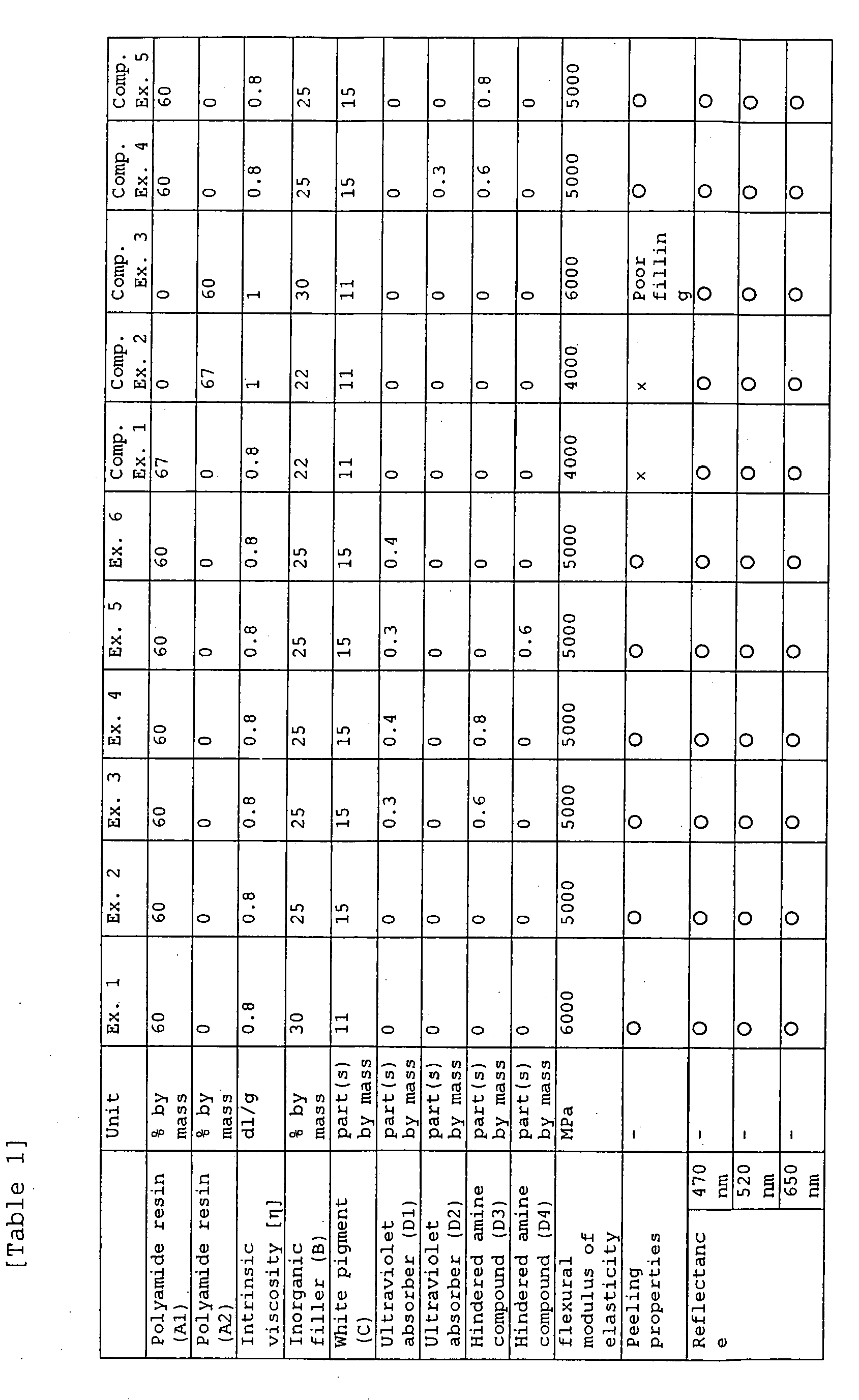

- The polyamide resin composition according to the present invention having excellent mechanical strength and excellent heat resistance, high light reflectance, high light shielding properties and high light resistance can be suitably used as a reflector plate for an LED device or a reflector plate for a light emitting device such as various electric/electronic products, indoor lighting, ceiling area lighting, outdoor lighting, automobile lighting, a display apparatus, and a headlight.
Claims (10)
- A polyamide resin composition which comprises 30 to 80% by mass of a polyamide resin (A) comprising (i) a dicarboxylicacid component unit (a-1) consisting of 30 to 100 mol% of a dicarboxylic acid component unit derived from terephthalic acid, 0 to 70 mol% of an aromatic dicarboxylic acid component unit other than the terephthalic acid, and/or 0 to 70 mol% of an aliphatic dicarboxylic acid component unit having 4 to 20 carbon atoms (provided that the total amount of these dicarboxylic acid component units is 100 mol%) and (ii) 100 mol% of a diamine component unit (a-2) consisting of a straight chain aliphatic diamine component unit having 4 to 20 carbon atoms and/or a branched chain aliphatic diamine component unit having 4 to 20 carbon atoms, as a diamine component unit; 10 to 60% by mass of an inorganic filler (B); and 5 to 50% by mass of a white pigment (C), wherein a molded product that is injection molded from the polyamide resin composition has a flexural modulus of elasticity at 130°C of 4500 MPa to 12000 MPa.
- A polyamide resin composition which comprises 30 to 80% by mass of a polyamide resin (A) comprising (i) a dicarboxylic acid component unit (a-1) consisting of 30 to 100 mol% of a dicarboxylic acid component unit derived from terephthalic acid, 0 to 70 mol% of an aromatic dicarboxylic acid component unit other than the terephthalic acid, and/or 0 to 70 mol% of an aliphatic dicarboxylic acid component unit having 4 to 20 carbon atoms (provided that the total amount of these dicarboxylic acid component units is 100 mol%) and (ii) 100 mol% of a diamine component unit (a-2) consisting of a straight chain aliphatic diamine component unit having 4 to 20 carbon atoms and/or a branched chain aliphatic diamine component unit having 4 to 20 carbon atoms, as a diamine component unit; 10 to 60% by mass of an inorganic filler (B); and 5 to 50% by mass of a white pigment (C), wherein the polyamide resin composition further comprises an ultraviolet absorber (D) having a heating mass reduction ratio of 50% by mass or less when held at 340°C for 10 minutes under a nitrogen atmosphere, or both an ultraviolet absorber (D) and a hindered amine compound (E).
- The polyamide resin composition according to claim 2, wherein the ultraviolet absorber (D) is one or more compounds selected from a benzotriazole compound, a triazine compound or a benzophenone compound.
- The polyamide resin composition according to claims 1 to 3, wherein the polyamide resin (A) has an intrinsic viscosity [η] of 0.5 to 0.9 dl/g and a melting point of 260 to 350°C.
- The polyamide resin composition according to claims 1 to 3, wherein the diamine component unit (a-2) of the polyamide resin (A) comprises one or more kinds selected from 1,6-diaminohexane, 1,10-diaminodecane, 1,11-diaminoundecane and 1,12-diaminododecane.
- The polyamide resin composition according to claims 1 to 3, wherein the inorganic filler (B) is glass fiber.
- The polyamide resin composition according to claims 1 to 3, wherein the white pigment (C) is titanium oxide.
- A reflector plate which is formed from the polyamide resin composition according to claims 1 to 3.
- A reflector plate for a light emitting diode device, which is formed from the polyamide resin composition according to claims 1 to 3.
- The reflector plate for a light emitting diode according to claim 9, wherein reflectance retention is 80% or more.
Applications Claiming Priority (2)
| Application Number | Priority Date | Filing Date | Title |
|---|---|---|---|
| JP2003409801 | 2003-12-09 | ||
| PCT/JP2004/018203 WO2005056681A1 (en) | 2003-12-09 | 2004-12-07 | Resin composition for light reflector and light reflector |
Publications (2)
| Publication Number | Publication Date |
|---|---|
| EP1693418A1 true EP1693418A1 (en) | 2006-08-23 |
| EP1693418A4 EP1693418A4 (en) | 2009-01-21 |
Family
ID=34674910
Family Applications (1)
| Application Number | Title | Priority Date | Filing Date |
|---|---|---|---|
| EP04820200A Withdrawn EP1693418A4 (en) | 2003-12-09 | 2004-12-07 | RESIN COMPOSITION FOR LIGHT REFLECTOR AND LIGHT REFLECTOR |
Country Status (6)
| Country | Link |
|---|---|
| US (1) | US20070161741A1 (en) |
| EP (1) | EP1693418A4 (en) |
| KR (1) | KR20060135649A (en) |
| CN (1) | CN1890323A (en) |
| TW (1) | TWI265179B (en) |
| WO (1) | WO2005056681A1 (en) |
Cited By (5)
| Publication number | Priority date | Publication date | Assignee | Title |
|---|---|---|---|---|
| WO2006135842A3 (en) * | 2005-06-10 | 2007-03-01 | Du Pont | Articles of manufacture made from polyamide resins and suitable for incorporation into led reflector applications |
| EP1888679A1 (en) | 2005-06-10 | 2008-02-20 | E.I. Dupont De Nemours And Company | Light-emitting diode assembly housing comprising high temperature polyamide compositions |
| EP2028231A1 (en) | 2007-08-24 | 2009-02-25 | Ems-Patent Ag | High temperature polyamide moulding composition reinforced with flat glass fibres |
| EP2388293A1 (en) | 2010-05-17 | 2011-11-23 | Ems-Patent Ag | Polyamide moulding material and its use in producing LED housing components |
| EP2703449A4 (en) * | 2011-10-10 | 2014-10-08 | Kingfa Science & Technology Co | HEAT-RESISTANT POLYAMIDE COMPOSITION AND APPLICATION THEREOF |
Families Citing this family (28)
| Publication number | Priority date | Publication date | Assignee | Title |
|---|---|---|---|---|
| EP1791910B1 (en) * | 2004-07-01 | 2012-02-22 | Solvay Specialty Polymers USA, LLC. | Aromatic polyamide composition and article manufactured therefrom |
| US8426549B2 (en) * | 2005-04-15 | 2013-04-23 | Mitsui Chemicals, Inc. | Resin composition for reflector, and reflector |
| EP1831756B1 (en) | 2005-08-31 | 2018-02-21 | LG Chem, Ltd. | Reflection plate for backlight unit and backlight unit of liquid crystal display having good thermal conductivity |
| US20100113657A1 (en) * | 2007-03-30 | 2010-05-06 | Mitsui Chemicals, Inc | Flame-retardant polyamide composition |
| DE112008003185T5 (en) * | 2007-11-29 | 2010-09-30 | Mitsubishi Plastics, Inc. | Metal laminated object, LED substrate and white foil |
| WO2009112425A1 (en) * | 2008-03-12 | 2009-09-17 | Basf Se | An optical film for a flat panel display |
| KR101323507B1 (en) * | 2008-12-22 | 2013-10-29 | 미쓰이 가가쿠 가부시키가이샤 | Flame-retardant polyamide composition |
| KR20110075703A (en) * | 2009-12-28 | 2011-07-06 | 제일모직주식회사 | Polyamide resin composition excellent in reflectivity, impact resistance, heat resistance and moisture resistance, and a method of manufacturing the same |
| CN101921475B (en) * | 2010-09-07 | 2012-11-28 | 厦门建霖工业有限公司 | Metal-like engineering plastic composite material and preparation method thereof |
| CN102418902A (en) * | 2010-09-27 | 2012-04-18 | 山汰科技企业有限公司 | Reflector plate and backlight module using the same |
| KR101282706B1 (en) * | 2010-09-28 | 2013-07-05 | 제일모직주식회사 | Polyamide resin composition having improved surface reflectance and heat resistance |
| US20120080640A1 (en) * | 2010-09-30 | 2012-04-05 | E.I. Du Pont De Nemours And Company | Thermally conductive resin composition |
| CN103270098B (en) * | 2010-10-13 | 2015-07-01 | 索维特殊聚合物有限责任公司 | Anti-Stain Items |
| US20130197150A1 (en) * | 2010-10-13 | 2013-08-01 | Solvay Specialty Polymers Usa, Llc | Stain-resistant articles |
| KR101436081B1 (en) * | 2010-12-28 | 2014-08-29 | 제일모직주식회사 | Polyamide resin composition having improved surface gloss and surface reflectance |
| JP2012140619A (en) * | 2010-12-28 | 2012-07-26 | Cheil Industries Inc | Polyamide resin composition for reflector excellent in surface glossiness and reflectance and molded product thereof |
| EP2647671B1 (en) | 2011-01-28 | 2016-12-21 | Kuraray Co., Ltd. | Polyamide composition for reflector, reflector, light emitting device including the reflector, and lighting device and image display device each including the light emitting device |
| US10301449B2 (en) | 2013-11-29 | 2019-05-28 | Lotte Advanced Materials Co., Ltd. | Thermoplastic resin composition having excellent light stability at high temperature |
| CN103676238B (en) * | 2013-12-20 | 2016-09-14 | 深圳市华星光电技术有限公司 | Orientation ultraviolet apparatus for baking |
| KR101690829B1 (en) | 2013-12-30 | 2016-12-28 | 롯데첨단소재(주) | Thermoplastic resin composition having excellent Impact resistance and light stability |
| EP2927273B1 (en) * | 2014-04-02 | 2017-06-07 | Ems-Patent Ag | Polyamide moulding material, moulded parts produced from the same and use of the polyamide moulding material |
| US10636951B2 (en) | 2014-06-27 | 2020-04-28 | Lotte Advanced Materials Co., Ltd. | Thermoplastic resin composition having excellent reflectivity |
| KR101793319B1 (en) | 2014-12-17 | 2017-11-03 | 롯데첨단소재(주) | Polyester resin composition and molded part using the same |
| CN104610739B (en) * | 2015-01-21 | 2017-09-15 | 金发科技股份有限公司 | A kind of reflecting plate daiamid composition |
| KR101849830B1 (en) | 2015-06-30 | 2018-04-18 | 롯데첨단소재(주) | Polyester resin composition with excellent impact resistance and light reliability and molded article using the same |
| DE102016005291B4 (en) * | 2016-04-29 | 2024-01-11 | Ksg Austria Gmbh | Method for producing an electronic device in the form of an injection molded part with an inserted circuit board |
| WO2017212816A1 (en) | 2016-06-09 | 2017-12-14 | 株式会社Adeka | Resin composition |
| CN109929265A (en) * | 2019-04-15 | 2019-06-25 | 南通天木绝缘复合材料有限公司 | A kind of ageing-resistant glass-reinforced plastic material and preparation method thereof |
Family Cites Families (12)
| Publication number | Priority date | Publication date | Assignee | Title |
|---|---|---|---|---|
| US4876300A (en) * | 1987-12-30 | 1989-10-24 | Ciba-Geigy Corporation | Polyolefin compositions stabilized with long chain N,N-dialkylhydroxylamines |
| JP3362061B2 (en) * | 1992-11-20 | 2003-01-07 | 旭化成株式会社 | Polyamide resin composition |
| CA2137477C (en) * | 1993-12-24 | 2002-05-07 | Hideaki Oka | Polyamide and polyamide composition |
| JPH07228776A (en) * | 1994-02-18 | 1995-08-29 | Kuraray Co Ltd | Polyamide composition for molding material |
| US5670609A (en) * | 1995-08-08 | 1997-09-23 | E. I. Du Pont De Nemours And Company | Polyimide films from pyromellitic dianhydride and 2-2'-bis(perfluoroalkoxy)benzidines as alignment layers for liquid crystal displays |
| US6051164A (en) * | 1998-04-30 | 2000-04-18 | Cytec Technology Corp. | Methods and compositions for protecting polymers from UV light |
| JP2000300131A (en) * | 1999-04-14 | 2000-10-31 | Kureha Chem Ind Co Ltd | Light-resistant fishline and its production |
| CO5231248A1 (en) * | 2000-07-26 | 2002-12-27 | Ciba Sc Holding Ag | LOW CONSISTENCY POLYMER TRANSPARENT ITEMS |
| JP4892140B2 (en) * | 2001-03-30 | 2012-03-07 | 大塚化学株式会社 | Resin composition for LED reflector |
| JP2004010875A (en) * | 2002-06-12 | 2004-01-15 | Mitsubishi Polyester Film Copp | Polyester film for display |
| JP2004075994A (en) * | 2002-06-21 | 2004-03-11 | Kuraray Co Ltd | Polyamide composition |
| CA2432522C (en) * | 2002-06-21 | 2010-09-21 | Kuraray Co., Ltd. | Polyamide composition |
-
2004
- 2004-12-07 WO PCT/JP2004/018203 patent/WO2005056681A1/en not_active Ceased
- 2004-12-07 CN CNA2004800367119A patent/CN1890323A/en active Pending
- 2004-12-07 EP EP04820200A patent/EP1693418A4/en not_active Withdrawn
- 2004-12-07 US US10/582,347 patent/US20070161741A1/en not_active Abandoned
- 2004-12-07 KR KR1020067011374A patent/KR20060135649A/en not_active Ceased
- 2004-12-08 TW TW093137877A patent/TWI265179B/en not_active IP Right Cessation
Cited By (8)
| Publication number | Priority date | Publication date | Assignee | Title |
|---|---|---|---|---|
| WO2006135842A3 (en) * | 2005-06-10 | 2007-03-01 | Du Pont | Articles of manufacture made from polyamide resins and suitable for incorporation into led reflector applications |
| EP1888667A2 (en) | 2005-06-10 | 2008-02-20 | E.I. Dupont De Nemours And Company | Articles of manufacture made from polyamide resins and suitable for incorporation into led reflector applications |
| EP1888679A1 (en) | 2005-06-10 | 2008-02-20 | E.I. Dupont De Nemours And Company | Light-emitting diode assembly housing comprising high temperature polyamide compositions |
| EP2028231A1 (en) | 2007-08-24 | 2009-02-25 | Ems-Patent Ag | High temperature polyamide moulding composition reinforced with flat glass fibres |
| EP2314644A1 (en) * | 2007-08-24 | 2011-04-27 | EMS-Patent AG | High temperature polyamide moulding composition reinforced with flat glass fibres |
| EP2388293A1 (en) | 2010-05-17 | 2011-11-23 | Ems-Patent Ag | Polyamide moulding material and its use in producing LED housing components |
| US8859662B2 (en) | 2010-05-17 | 2014-10-14 | Ems-Patent Ag | Polyamide moulding material and use thereof for production of LED housing components |
| EP2703449A4 (en) * | 2011-10-10 | 2014-10-08 | Kingfa Science & Technology Co | HEAT-RESISTANT POLYAMIDE COMPOSITION AND APPLICATION THEREOF |
Also Published As
| Publication number | Publication date |
|---|---|
| TW200530333A (en) | 2005-09-16 |
| TWI265179B (en) | 2006-11-01 |
| KR20060135649A (en) | 2006-12-29 |
| EP1693418A4 (en) | 2009-01-21 |
| WO2005056681A1 (en) | 2005-06-23 |
| CN1890323A (en) | 2007-01-03 |
| US20070161741A1 (en) | 2007-07-12 |
Similar Documents
| Publication | Publication Date | Title |
|---|---|---|
| US20070161741A1 (en) | Resin composition for reflector plate and reflector plate | |
| US8426549B2 (en) | Resin composition for reflector, and reflector | |
| EP2744845B1 (en) | Improved polyamide compositions for led applications | |
| JP5871920B2 (en) | Thermoplastic resin composition for reflector, reflector and light-emitting diode element | |
| KR101566063B1 (en) | Thermoplastic Resin Composition Having Excellent Surface Gloss, Reflectance, Anti-yellowing property and Moldability | |
| EP2647671B1 (en) | Polyamide composition for reflector, reflector, light emitting device including the reflector, and lighting device and image display device each including the light emitting device | |
| KR101426268B1 (en) | Polyamide resin composition having improved surface reflectance and heat resistance | |
| EP2471868A1 (en) | Polyamide resin composition | |
| JP2009202567A (en) | Manufacturing method of composite comprising resin-made member and metallic member, substrate for mounting led and reflector for mounting led | |
| TWI445764B (en) | Polyamide resin composition with good reflectance, impact strength, heat resistance, and water resistance, and method of preparing the same | |
| CN103124769A (en) | Polyamide composition having excellent surface reflectance and heat resistance | |
| JP2005194513A (en) | Resin composition for reflector, and reflector | |
| WO2012136693A1 (en) | Polyamide composition and article manufactured therefrom | |
| JP2017071728A (en) | Polyester resin composition, method for manufacturing reflector and method for manufacturing light-emitting diode (led) element | |
| JP2007271834A (en) | Resin composition for reflection plate and reflection plate | |
| KR101827196B1 (en) | Polyester resin composition for reflective material, and reflective material comprising same | |
| JP6042271B2 (en) | Polyester resin composition for reflector and reflector | |
| KR20170008779A (en) | Polyester resin composition for reflective materials and reflection plate containing same | |
| JP2019142986A (en) | Polyester resin composition for reflective material, and reflective material | |
| KR101436081B1 (en) | Polyamide resin composition having improved surface gloss and surface reflectance | |
| JP2018162354A (en) | Polyester resin composition for reflector and reflector using the same | |
| TW201905080A (en) | Polyester composition for LED reflector, LED reflector composed of the composition, and light-emitting device including the reflector | |
| JP2018172511A (en) | Polyester resin composition for reflector, and reflector using the same | |
| JP2021172783A (en) | Molding method and reflective material | |
| JP2020204013A (en) | Method for producing resin composition |
Legal Events
| Date | Code | Title | Description |
|---|---|---|---|
| PUAI | Public reference made under article 153(3) epc to a published international application that has entered the european phase |
Free format text: ORIGINAL CODE: 0009012 |
|
| 17P | Request for examination filed |
Effective date: 20060623 |
|
| AK | Designated contracting states |
Kind code of ref document: A1 Designated state(s): DE FR GB |
|
| DAX | Request for extension of the european patent (deleted) | ||
| RBV | Designated contracting states (corrected) |
Designated state(s): DE FR GB |
|
| A4 | Supplementary search report drawn up and despatched |
Effective date: 20081223 |
|
| RIC1 | Information provided on ipc code assigned before grant |
Ipc: C08K 7/14 20060101ALI20081217BHEP Ipc: C08K 5/00 20060101ALI20081217BHEP Ipc: C08K 3/22 20060101ALI20081217BHEP Ipc: C08L 77/06 20060101AFI20050629BHEP |
|
| 17Q | First examination report despatched |
Effective date: 20090408 |
|
| STAA | Information on the status of an ep patent application or granted ep patent |
Free format text: STATUS: THE APPLICATION IS DEEMED TO BE WITHDRAWN |
|
| 18D | Application deemed to be withdrawn |
Effective date: 20131210 |