EP1725716B1 - Element d'insonorisation compose d'au moins deux couches, procede d'ignifugation dudit element et utilisation - Google Patents
Element d'insonorisation compose d'au moins deux couches, procede d'ignifugation dudit element et utilisation Download PDFInfo
- Publication number
- EP1725716B1 EP1725716B1 EP05715681.2A EP05715681A EP1725716B1 EP 1725716 B1 EP1725716 B1 EP 1725716B1 EP 05715681 A EP05715681 A EP 05715681A EP 1725716 B1 EP1725716 B1 EP 1725716B1
- Authority
- EP
- European Patent Office
- Prior art keywords
- layer
- sound insulation
- insulation element
- sponge
- sponge cloth
- Prior art date
- Legal status (The legal status is an assumption and is not a legal conclusion. Google has not performed a legal analysis and makes no representation as to the accuracy of the status listed.)
- Expired - Lifetime
Links
- 238000009413 insulation Methods 0.000 title claims description 22
- 238000000034 method Methods 0.000 title claims description 13
- 238000004079 fireproofing Methods 0.000 title 1
- 239000004744 fabric Substances 0.000 claims description 71
- 238000010521 absorption reaction Methods 0.000 claims description 41
- 229920000742 Cotton Polymers 0.000 claims description 23
- RNFJDJUURJAICM-UHFFFAOYSA-N 2,2,4,4,6,6-hexaphenoxy-1,3,5-triaza-2$l^{5},4$l^{5},6$l^{5}-triphosphacyclohexa-1,3,5-triene Chemical compound N=1P(OC=2C=CC=CC=2)(OC=2C=CC=CC=2)=NP(OC=2C=CC=CC=2)(OC=2C=CC=CC=2)=NP=1(OC=1C=CC=CC=1)OC1=CC=CC=C1 RNFJDJUURJAICM-UHFFFAOYSA-N 0.000 claims description 21
- 239000003063 flame retardant Substances 0.000 claims description 21
- 229920000297 Rayon Polymers 0.000 claims description 20
- 229920002678 cellulose Polymers 0.000 claims description 20
- 239000001913 cellulose Substances 0.000 claims description 20
- 239000006185 dispersion Substances 0.000 claims description 16
- 239000000126 substance Substances 0.000 claims description 16
- 239000000463 material Substances 0.000 claims description 12
- 239000004033 plastic Substances 0.000 claims description 12
- 229920003023 plastic Polymers 0.000 claims description 12
- 229910052751 metal Inorganic materials 0.000 claims description 8
- 239000002184 metal Substances 0.000 claims description 8
- XLYOFNOQVPJJNP-UHFFFAOYSA-N water Substances O XLYOFNOQVPJJNP-UHFFFAOYSA-N 0.000 claims description 8
- 150000001412 amines Chemical class 0.000 claims description 4
- 238000001035 drying Methods 0.000 claims description 4
- 238000009987 spinning Methods 0.000 claims description 4
- 150000003018 phosphorus compounds Chemical class 0.000 claims description 3
- 239000004627 regenerated cellulose Substances 0.000 claims description 3
- 150000001638 boron Chemical class 0.000 claims description 2
- 239000000470 constituent Substances 0.000 claims description 2
- 150000008282 halocarbons Chemical class 0.000 claims description 2
- 238000007598 dipping method Methods 0.000 claims 1
- 239000003361 porogen Substances 0.000 claims 1
- 239000010410 layer Substances 0.000 description 60
- 239000000835 fiber Substances 0.000 description 13
- 239000011148 porous material Substances 0.000 description 13
- 239000004745 nonwoven fabric Substances 0.000 description 10
- HEMHJVSKTPXQMS-UHFFFAOYSA-M Sodium hydroxide Chemical compound [OH-].[Na+] HEMHJVSKTPXQMS-UHFFFAOYSA-M 0.000 description 7
- 239000000853 adhesive Substances 0.000 description 7
- 230000001070 adhesive effect Effects 0.000 description 7
- 239000011358 absorbing material Substances 0.000 description 6
- 238000005259 measurement Methods 0.000 description 6
- 239000000203 mixture Substances 0.000 description 6
- 238000004519 manufacturing process Methods 0.000 description 5
- RSIJVJUOQBWMIM-UHFFFAOYSA-L sodium sulfate decahydrate Chemical compound O.O.O.O.O.O.O.O.O.O.[Na+].[Na+].[O-]S([O-])(=O)=O RSIJVJUOQBWMIM-UHFFFAOYSA-L 0.000 description 5
- QGJOPFRUJISHPQ-UHFFFAOYSA-N Carbon disulfide Chemical compound S=C=S QGJOPFRUJISHPQ-UHFFFAOYSA-N 0.000 description 4
- 239000003795 chemical substances by application Substances 0.000 description 4
- 238000009826 distribution Methods 0.000 description 4
- 239000010446 mirabilite Substances 0.000 description 4
- 229920000139 polyethylene terephthalate Polymers 0.000 description 4
- 239000005020 polyethylene terephthalate Substances 0.000 description 4
- 239000000523 sample Substances 0.000 description 4
- 238000005345 coagulation Methods 0.000 description 3
- 230000015271 coagulation Effects 0.000 description 3
- ZOOODBUHSVUZEM-UHFFFAOYSA-N ethoxymethanedithioic acid Chemical compound CCOC(S)=S ZOOODBUHSVUZEM-UHFFFAOYSA-N 0.000 description 3
- 239000010440 gypsum Substances 0.000 description 3
- 229910052602 gypsum Inorganic materials 0.000 description 3
- 230000002787 reinforcement Effects 0.000 description 3
- 125000006850 spacer group Chemical group 0.000 description 3
- 239000012991 xanthate Substances 0.000 description 3
- 239000004604 Blowing Agent Substances 0.000 description 2
- 150000001204 N-oxides Chemical class 0.000 description 2
- QAOWNCQODCNURD-UHFFFAOYSA-N Sulfuric acid Chemical compound OS(O)(=O)=O QAOWNCQODCNURD-UHFFFAOYSA-N 0.000 description 2
- 239000002253 acid Substances 0.000 description 2
- 230000001419 dependent effect Effects 0.000 description 2
- 239000012774 insulation material Substances 0.000 description 2
- 239000007788 liquid Substances 0.000 description 2
- -1 polyethylene terephthalate Polymers 0.000 description 2
- 239000012783 reinforcing fiber Substances 0.000 description 2
- 150000003839 salts Chemical class 0.000 description 2
- 235000011121 sodium hydroxide Nutrition 0.000 description 2
- 150000003512 tertiary amines Chemical class 0.000 description 2
- 238000012360 testing method Methods 0.000 description 2
- 244000025254 Cannabis sativa Species 0.000 description 1
- 235000012766 Cannabis sativa ssp. sativa var. sativa Nutrition 0.000 description 1
- 235000012765 Cannabis sativa ssp. sativa var. spontanea Nutrition 0.000 description 1
- 229920003043 Cellulose fiber Polymers 0.000 description 1
- 240000000491 Corchorus aestuans Species 0.000 description 1
- 235000011777 Corchorus aestuans Nutrition 0.000 description 1
- 235000010862 Corchorus capsularis Nutrition 0.000 description 1
- 241000219146 Gossypium Species 0.000 description 1
- DGAQECJNVWCQMB-PUAWFVPOSA-M Ilexoside XXIX Chemical compound C[C@@H]1CC[C@@]2(CC[C@@]3(C(=CC[C@H]4[C@]3(CC[C@@H]5[C@@]4(CC[C@@H](C5(C)C)OS(=O)(=O)[O-])C)C)[C@@H]2[C@]1(C)O)C)C(=O)O[C@H]6[C@@H]([C@H]([C@@H]([C@H](O6)CO)O)O)O.[Na+] DGAQECJNVWCQMB-PUAWFVPOSA-M 0.000 description 1
- 240000006240 Linum usitatissimum Species 0.000 description 1
- 235000004431 Linum usitatissimum Nutrition 0.000 description 1
- WHXSMMKQMYFTQS-UHFFFAOYSA-N Lithium Chemical compound [Li] WHXSMMKQMYFTQS-UHFFFAOYSA-N 0.000 description 1
- 229920000433 Lyocell Polymers 0.000 description 1
- FYYHWMGAXLPEAU-UHFFFAOYSA-N Magnesium Chemical compound [Mg] FYYHWMGAXLPEAU-UHFFFAOYSA-N 0.000 description 1
- LFTLOKWAGJYHHR-UHFFFAOYSA-N N-methylmorpholine N-oxide Chemical compound CN1(=O)CCOCC1 LFTLOKWAGJYHHR-UHFFFAOYSA-N 0.000 description 1
- 229920005830 Polyurethane Foam Polymers 0.000 description 1
- ZLMJMSJWJFRBEC-UHFFFAOYSA-N Potassium Chemical compound [K] ZLMJMSJWJFRBEC-UHFFFAOYSA-N 0.000 description 1
- 229920001131 Pulp (paper) Polymers 0.000 description 1
- 239000006096 absorbing agent Substances 0.000 description 1
- 230000002378 acidificating effect Effects 0.000 description 1
- 238000004026 adhesive bonding Methods 0.000 description 1
- 125000000129 anionic group Chemical group 0.000 description 1
- 230000004888 barrier function Effects 0.000 description 1
- 235000009120 camo Nutrition 0.000 description 1
- 239000012876 carrier material Substances 0.000 description 1
- 239000011797 cavity material Substances 0.000 description 1
- 235000005607 chanvre indien Nutrition 0.000 description 1
- 238000004140 cleaning Methods 0.000 description 1
- 230000000052 comparative effect Effects 0.000 description 1
- 239000002131 composite material Substances 0.000 description 1
- 238000010276 construction Methods 0.000 description 1
- 239000007799 cork Substances 0.000 description 1
- 238000012937 correction Methods 0.000 description 1
- 239000013078 crystal Substances 0.000 description 1
- 238000013016 damping Methods 0.000 description 1
- 239000003599 detergent Substances 0.000 description 1
- 238000011161 development Methods 0.000 description 1
- 230000018109 developmental process Effects 0.000 description 1
- 238000001914 filtration Methods 0.000 description 1
- 239000012467 final product Substances 0.000 description 1
- 239000006260 foam Substances 0.000 description 1
- 238000001879 gelation Methods 0.000 description 1
- 239000003292 glue Substances 0.000 description 1
- 239000011487 hemp Substances 0.000 description 1
- 230000002209 hydrophobic effect Effects 0.000 description 1
- 238000011835 investigation Methods 0.000 description 1
- 229910052744 lithium Inorganic materials 0.000 description 1
- 239000011777 magnesium Substances 0.000 description 1
- 229910052749 magnesium Inorganic materials 0.000 description 1
- 238000002844 melting Methods 0.000 description 1
- 230000008018 melting Effects 0.000 description 1
- 229910021645 metal ion Inorganic materials 0.000 description 1
- 239000002557 mineral fiber Substances 0.000 description 1
- 238000004806 packaging method and process Methods 0.000 description 1
- 229920000642 polymer Polymers 0.000 description 1
- 229920006327 polystyrene foam Polymers 0.000 description 1
- 239000004814 polyurethane Substances 0.000 description 1
- 239000011591 potassium Substances 0.000 description 1
- 229910052700 potassium Inorganic materials 0.000 description 1
- 238000001556 precipitation Methods 0.000 description 1
- 238000002360 preparation method Methods 0.000 description 1
- 239000000047 product Substances 0.000 description 1
- 239000003380 propellant Substances 0.000 description 1
- 230000008929 regeneration Effects 0.000 description 1
- 238000011069 regeneration method Methods 0.000 description 1
- 238000010022 rotary screen printing Methods 0.000 description 1
- 238000000926 separation method Methods 0.000 description 1
- 239000002356 single layer Substances 0.000 description 1
- 239000011734 sodium Substances 0.000 description 1
- 229910052708 sodium Inorganic materials 0.000 description 1
- 238000010998 test method Methods 0.000 description 1
- 239000004753 textile Substances 0.000 description 1
Images

Classifications
-
- B—PERFORMING OPERATIONS; TRANSPORTING
- B32—LAYERED PRODUCTS
- B32B—LAYERED PRODUCTS, i.e. PRODUCTS BUILT-UP OF STRATA OF FLAT OR NON-FLAT, e.g. CELLULAR OR HONEYCOMB, FORM
- B32B13/00—Layered products comprising a a layer of water-setting substance, e.g. concrete, plaster, asbestos cement, or like builders' material
- B32B13/14—Layered products comprising a a layer of water-setting substance, e.g. concrete, plaster, asbestos cement, or like builders' material next to a fibrous or filamentary layer
-
- B—PERFORMING OPERATIONS; TRANSPORTING
- B32—LAYERED PRODUCTS
- B32B—LAYERED PRODUCTS, i.e. PRODUCTS BUILT-UP OF STRATA OF FLAT OR NON-FLAT, e.g. CELLULAR OR HONEYCOMB, FORM
- B32B3/00—Layered products comprising a layer with external or internal discontinuities or unevennesses, or a layer of non-planar shape; Layered products comprising a layer having particular features of form
- B32B3/26—Layered products comprising a layer with external or internal discontinuities or unevennesses, or a layer of non-planar shape; Layered products comprising a layer having particular features of form characterised by a particular shape of the outline of the cross-section of a continuous layer; characterised by a layer with cavities or internal voids ; characterised by an apertured layer
- B32B3/266—Layered products comprising a layer with external or internal discontinuities or unevennesses, or a layer of non-planar shape; Layered products comprising a layer having particular features of form characterised by a particular shape of the outline of the cross-section of a continuous layer; characterised by a layer with cavities or internal voids ; characterised by an apertured layer characterised by an apertured layer, the apertures going through the whole thickness of the layer, e.g. expanded metal, perforated layer, slit layer regular cells B32B3/12
-
- B—PERFORMING OPERATIONS; TRANSPORTING
- B32—LAYERED PRODUCTS
- B32B—LAYERED PRODUCTS, i.e. PRODUCTS BUILT-UP OF STRATA OF FLAT OR NON-FLAT, e.g. CELLULAR OR HONEYCOMB, FORM
- B32B15/00—Layered products comprising a layer of metal
- B32B15/14—Layered products comprising a layer of metal next to a fibrous or filamentary layer
-
- B—PERFORMING OPERATIONS; TRANSPORTING
- B32—LAYERED PRODUCTS
- B32B—LAYERED PRODUCTS, i.e. PRODUCTS BUILT-UP OF STRATA OF FLAT OR NON-FLAT, e.g. CELLULAR OR HONEYCOMB, FORM
- B32B27/00—Layered products comprising a layer of synthetic resin
- B32B27/12—Layered products comprising a layer of synthetic resin next to a fibrous or filamentary layer
-
- B—PERFORMING OPERATIONS; TRANSPORTING
- B32—LAYERED PRODUCTS
- B32B—LAYERED PRODUCTS, i.e. PRODUCTS BUILT-UP OF STRATA OF FLAT OR NON-FLAT, e.g. CELLULAR OR HONEYCOMB, FORM
- B32B5/00—Layered products characterised by the non- homogeneity or physical structure, i.e. comprising a fibrous, filamentary, particulate or foam layer; Layered products characterised by having a layer differing constitutionally or physically in different parts
- B32B5/22—Layered products characterised by the non- homogeneity or physical structure, i.e. comprising a fibrous, filamentary, particulate or foam layer; Layered products characterised by having a layer differing constitutionally or physically in different parts characterised by the presence of two or more layers which are next to each other and are fibrous, filamentary, formed of particles or foamed
- B32B5/24—Layered products characterised by the non- homogeneity or physical structure, i.e. comprising a fibrous, filamentary, particulate or foam layer; Layered products characterised by having a layer differing constitutionally or physically in different parts characterised by the presence of two or more layers which are next to each other and are fibrous, filamentary, formed of particles or foamed one layer being a fibrous or filamentary layer
- B32B5/26—Layered products characterised by the non- homogeneity or physical structure, i.e. comprising a fibrous, filamentary, particulate or foam layer; Layered products characterised by having a layer differing constitutionally or physically in different parts characterised by the presence of two or more layers which are next to each other and are fibrous, filamentary, formed of particles or foamed one layer being a fibrous or filamentary layer another layer next to it also being fibrous or filamentary
-
- B—PERFORMING OPERATIONS; TRANSPORTING
- B32—LAYERED PRODUCTS
- B32B—LAYERED PRODUCTS, i.e. PRODUCTS BUILT-UP OF STRATA OF FLAT OR NON-FLAT, e.g. CELLULAR OR HONEYCOMB, FORM
- B32B7/00—Layered products characterised by the relation between layers; Layered products characterised by the relative orientation of features between layers, or by the relative values of a measurable parameter between layers, i.e. products comprising layers having different physical, chemical or physicochemical properties; Layered products characterised by the interconnection of layers
- B32B7/04—Interconnection of layers
- B32B7/12—Interconnection of layers using interposed adhesives or interposed materials with bonding properties
- B32B7/14—Interconnection of layers using interposed adhesives or interposed materials with bonding properties applied in spaced arrangements, e.g. in stripes
-
- B—PERFORMING OPERATIONS; TRANSPORTING
- B60—VEHICLES IN GENERAL
- B60R—VEHICLES, VEHICLE FITTINGS, OR VEHICLE PARTS, NOT OTHERWISE PROVIDED FOR
- B60R13/00—Elements for body-finishing, identifying, or decorating; Arrangements or adaptations for advertising purposes
- B60R13/08—Insulating elements, e.g. for sound insulation
-
- G—PHYSICS
- G10—MUSICAL INSTRUMENTS; ACOUSTICS
- G10K—SOUND-PRODUCING DEVICES; METHODS OR DEVICES FOR PROTECTING AGAINST, OR FOR DAMPING, NOISE OR OTHER ACOUSTIC WAVES IN GENERAL; ACOUSTICS NOT OTHERWISE PROVIDED FOR
- G10K11/00—Methods or devices for transmitting, conducting or directing sound in general; Methods or devices for protecting against, or for damping, noise or other acoustic waves in general
- G10K11/16—Methods or devices for protecting against, or for damping, noise or other acoustic waves in general
- G10K11/162—Selection of materials
-
- B—PERFORMING OPERATIONS; TRANSPORTING
- B32—LAYERED PRODUCTS
- B32B—LAYERED PRODUCTS, i.e. PRODUCTS BUILT-UP OF STRATA OF FLAT OR NON-FLAT, e.g. CELLULAR OR HONEYCOMB, FORM
- B32B2262/00—Composition or structural features of fibres which form a fibrous or filamentary layer or are present as additives
- B32B2262/04—Cellulosic plastic fibres, e.g. rayon
-
- B—PERFORMING OPERATIONS; TRANSPORTING
- B32—LAYERED PRODUCTS
- B32B—LAYERED PRODUCTS, i.e. PRODUCTS BUILT-UP OF STRATA OF FLAT OR NON-FLAT, e.g. CELLULAR OR HONEYCOMB, FORM
- B32B2262/00—Composition or structural features of fibres which form a fibrous or filamentary layer or are present as additives
- B32B2262/06—Vegetal fibres
- B32B2262/062—Cellulose fibres, e.g. cotton
-
- B—PERFORMING OPERATIONS; TRANSPORTING
- B32—LAYERED PRODUCTS
- B32B—LAYERED PRODUCTS, i.e. PRODUCTS BUILT-UP OF STRATA OF FLAT OR NON-FLAT, e.g. CELLULAR OR HONEYCOMB, FORM
- B32B2307/00—Properties of the layers or laminate
- B32B2307/10—Properties of the layers or laminate having particular acoustical properties
- B32B2307/102—Insulating
-
- B—PERFORMING OPERATIONS; TRANSPORTING
- B60—VEHICLES IN GENERAL
- B60R—VEHICLES, VEHICLE FITTINGS, OR VEHICLE PARTS, NOT OTHERWISE PROVIDED FOR
- B60R13/00—Elements for body-finishing, identifying, or decorating; Arrangements or adaptations for advertising purposes
- B60R13/08—Insulating elements, e.g. for sound insulation
- B60R13/0815—Acoustic or thermal insulation of passenger compartments
-
- B—PERFORMING OPERATIONS; TRANSPORTING
- B60—VEHICLES IN GENERAL
- B60R—VEHICLES, VEHICLE FITTINGS, OR VEHICLE PARTS, NOT OTHERWISE PROVIDED FOR
- B60R13/00—Elements for body-finishing, identifying, or decorating; Arrangements or adaptations for advertising purposes
- B60R13/08—Insulating elements, e.g. for sound insulation
- B60R13/0815—Acoustic or thermal insulation of passenger compartments
- B60R13/083—Acoustic or thermal insulation of passenger compartments for fire walls or floors
Definitions
- the invention relates to a soundproofing element comprising at least two layers, of which one layer of a flexible material serves for soundproofing and the other layer is a carrier layer for the flexible material.
- sound absorption systems which are composed of a large number of soundproofing elements, are used not only for ceilings, but also for room walls and room floors. Due to the use of sound absorption systems in living and working buildings as well as schools and hospitals, they must at least meet fire protection class B, ie. H. be flame retardant.
- Known soundproofing elements that use nonwoven fabrics as soundproofing have a sound absorption coefficient of about 0.77 at a frequency of 800 hertz, such as measurements in Kundt's tube. With an increase in frequency to 1600 hertz, the sound absorption coefficient drops to 0.43.
- each separating layer is connected at least on one side with ends of the spacer fibers.
- nonwoven fabric is selected as the soundproofing medium from the group hemp, jute, flax, cotton, viscose, pulp, cork.
- a hydrophobic barrier layer of similar fibers or a paper is provided with a flame retardant and intended for use in motor vehicle interior and body area, in the packaging, architecture, home construction, medical, filtration and hygiene sector.
- JP-A 08-087278 discloses a soundproofing element comprising a support material and a sound-absorbing layer of a porous material attached thereto.
- the layer can be flame-retardant.
- porous materials are solidified nonwoven fabrics, besides also - preferably open-celled - foams. Polyurethane and polystyrene foams are specifically mentioned.
- the fibers may be cellulose fibers (®Tencel), whereas sponges or cellulosic sponges are not described.
- the object of the invention is to develop a soundproofing element so that it has a higher average sound absorption level over a given frequency range than conventional soundproofing elements, which are equipped with non-woven fabrics.
- the sound-absorbing material should be flexible, light in weight, variable in thickness and have sufficient flame retardancy for its purpose.
- a soundproofing element comprising at least two layers, of which one layer (2) of a flexible material serves for soundproofing and the other layer is a carrier layer (3; 5; 6; 8) for the flexible material, characterized in that the flexible material of the one layer (2) consists of sponge cloth whose main constituent is regenerated or non-derivatized cellulose and in that one or more flame-retardant substances are added to the layer (2):
- the layer (2) expediently has a dry thickness of 0.5 to 23 mm.
- the layer consists of a dry state 0.5 to 8 mm thick sponge cloth.
- the basis weight of the dry sponge cloth is generally 70 to 700 g / m 2 . Since sponge cloth and sponge are known to absorb water, it is possible to use the soundproofing element also in damp rooms. advantageously, the water absorption of the sponge cloth is 1.8 to 11 1 / m 2 and that of the sponge 12 to 23 1 / m 2 .
- the sponge cloth is made of regenerated cellulose reinforced by cotton fibers, viscose fibers or a net of plastic or cotton.
- the sponge cloth production by the viscose process has long been known and among others in the EP-B1 035 794 described.
- first pulp in particular wood pulp
- pulp is converted with sodium hydroxide and carbon disulphide into an alkaline cellulose xanthate solution, the so-called viscose solution.
- cotton fibers or noils are degreased with dilute, detergent-containing NAOH.
- the ripened viscose solution is then mixed with these cotton fibers in a kneader.
- Viscose fibers can also be used as internal reinforcement instead of cotton fibers.
- This sponge cloth raw mass is applied to a support, for example a perforated endless belt, in the desired thickness. It is also possible to apply a mixture of viscose solution and Glauber's salt on a carrier material made of cotton or plastic, for example, a network of polyethylene terephthalate (PET).
- PET polyethylene terephthalate
- the regeneration of the cellulose takes place in a heated alkaline coagulation bath, but can also be carried out in an acid medium, for example dilute sulfuric acid.
- the cotton or viscose fibers are incorporated into the sponge cloth body. Since the Glauber's salt has a very low melting point, it is melted in the heated coagulation bath and dissolved out.
- the salt crystals instead of the salt crystals, pores and cavities remain, which cause heat insulation in the dry state in which they are filled with air. In a humid environment, these pores and voids can absorb moisture. Finally, the sponge cloth is washed out to rid it of salt residues and adhering products. After drying, it is cut into narrow strips, which can be stored rolled up. The rolls are then assembled into pieces of the desired dimensions.
- a provided with an internal reinforcement sponge cloth based on cellulose by the amine oxide process For this purpose is prepared a mixture containing in the N-oxide of a tertiary amine and water-dissolved cellulose and at least one pore former and fibers, but no blowing agent.
- the mixture is spread on a conveyor belt and passed through a coagulation bath of a dilute aqueous amine oxide solution which dissolves the pore-forming agent.
- the remaining amine oxide is washed out, dried the sponge cloth and then formulated.
- the mixture can be applied not only on one side, but on both sides of a net made of plastic or cotton.
- the N-oxide of a tertiary amine used in this process is N-methylmorpholine-N-oxide.
- the sponges used in the soundproofing element can be produced by various methods.
- the cellulose is derivatized with carbon disulphide and caustic soda to cellulose xanthate.
- the resulting viscose solution is then treated with a pore-forming agent, e.g. B. Glauber's salt, optionally mixed with reinforcing fibers and / or blowing agents.
- a pore-forming agent e.g. B. Glauber's salt
- the mixture is formed into a layer and the cellulose is regenerated from the cellulose xanthate in a strongly alkaline or acidic bath.
- the propellants form the pores typically large pores and are capable of forming both macropores and micropores in the sponges during the precipitation of the dissolved cellulose.
- the sponges differ from sponge cloths mainly by their non-homogeneous pore distribution and different sized pores and lower density, which is generally, without reinforcing fibers or textile fabric as a liner, in the range of 20 to 50 kg / m 3 .
- One of the sponge manufacturing processes requires a gelation step, which is effected by lithium, sodium, potassium, magnesium or other metal ions.
- the viscosity of the solution increases until a gel state is reached.
- the gelling step is critical to the structure and properties of the final product.
- the layer of the sponge cloth or sponge is expediently glued point-like on the carrier layer.
- a dispersion of flame retardant substances is applied to a sponge cloth or a sponge by immersing the sponge cloth or sponge in the dispersion and then drying, i. H. in this case, the dispersion is subsequently applied to the finished sponge cloth or sponge.
- a dispersion of flame retardant substance or flame retardant substances together with cellulose is prepared in such a way that the dispersion of a spinning solution of the viscose, from which the sponge cloth or the sponge is produced, is added.
- sponge cloth or sponge is used as a sound-absorbing material.
- sponge cloth or sponge is used in a soundproofing element as a sound-absorbing material and applied to the carrier layer of the soundproofing element and selectively, strip-shaped or full surface connected to the carrier layer, for example by gluing.
- the invention achieves the advantage that when using a sponge cloth or sponge in soundproofing elements, the sound absorption in a given frequency range is higher than when using nonwoven fabrics.
- the sound absorption coefficient can be optimized for different frequency ranges, ie the greatest possible sound absorption for the respective frequency range can be set. It is generally true that the use of sponge cloth or sponge achieves sound absorption levels which exceed those of nonwoven fabrics.
- Prerequisite for the use of sponge cloth or sponge in soundproofing elements, which are used in buildings, but also as sound-absorbing materials in covers and panels of machinery, equipment, motor vehicle bodies and the like, is the equipment of the sponge cloth or sponge with flame retardant substances, so that the soundproofing elements are difficult to ignite.
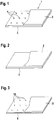
- a first embodiment of a soundproofing element 1 is in perspective in FIG Fig. 1 shown.
- the soundproofing element has two layers, of which a carrier layer 3 is, for example, rigid and a flexible layer 2 consists of a sponge cloth or sponge.
- the layer 2 is connected to the carrier layer 3 and has a dry thickness of 0.5 to 8 mm as a sponge cloth and a dry thickness of 9 to 23 mm as a sponge.
- the support layer 3 is a perforated plasterboard panel, has the holes 4, which are for example uniformly arranged in columns and rows. The diameters of the holes 4 are in the range of 1 to 5 mm.
- the layer 2 of the sponge cloth or sponge is shown partially broken, so that the holes 4 of the support layer 3 are visible.
- the grid of the holes 4 is uniform, ie the distances between the holes are approximately equal in all directions.
- the layer 2 has a thickness of 0.5 to 6 mm as a sponge cloth in the dry state.
- the basis weight of the dry sponge cloth is 70 to 700 g / m 2
- the sponge has a basis weight of 500 to 1050 g / m 2 .
- the sponge cloth is made of regenerated cellulose reinforced by cotton fibers, viscose fibers or a net of plastic or cotton.
- cellulose-based sponge cloths are used, which are produced by the amine-oxide process with at least one pore-forming agent. Such sponge cloths are also equipped with an internal reinforcement of cotton fibers, viscose fibers or a network of plastic or cotton.
- sponge cloths can absorb large amounts of moisture, ie liquid.
- the water absorption of the sponge cloths used is in the range of 1.8 to 11 1 / m 2 , that of the sponge in the range of 12 to greater 22 1 / m 2 .
- Fig. 2 shows a second embodiment of a soundproofing element, which consists of a support layer in the form of a full-surface plasterboard 5 and a layer 2 of sponge cloth or sponge.
- the gypsum board is made of the same material as the gypsum board of the first embodiment, with the only difference that it does not contain holes.
- the layer 2 is in the first and second embodiments according to the Figures 1 and 2 glued point-shaped on the carrier layer 3 and 5 respectively.
- Fig. 6 is schematically the punctual distribution of connection points, which consist of adhesive, shown on the carrier layer 3.
- the connection points of the adhesive are shown as rings 11 with their center point to make them distinguishable from the holes 4 of the perforated plasterboard 3.
- the punctual geometry of the connection points as in Fig.
- the punctiform distribution of the adhesive takes place by means of stencil and doctor blade, rotary screen printing or through stencil and pressure roller.
- the adhesive can also be applied over the entire surface to the carrier layer are applied, so that the layer 2 of sponge cloth or sponge over the entire area, ie the entire surface, is glued to the carrier layer 3 or 5.
- the cellulosic sponge cloth is made of non-derivatized cellulose prepared by the amine-oxide process with at least one pore-forming agent and reinforced by cotton fibers, viscose fibers or a mesh of plastic or cotton.
- a third embodiment of a soundproofing element consists of a carrier layer 6 in the form of a metal slot plate and a layer 2 of sponge cloth or sponge, as in Fig. 3 shown.
- the sponge cloth or the sponge is shown partially broken.
- the slot plate has holes 12, for example, have a hole diameter of 3 to 5 mm, with a plate thickness of 0.5 to 0.6 mm.
- the hole proportion of the total surface of the slot plate 6 is 20 to 40%, in particular 30%.
- the carrier layer 3 or 5 in the form of a perforated plasterboard plate or a full-surface plasterboard plate the hole proportion is in the range of 0 to 40% of the total area of the respective carrier layer.
- the hole proportion of 0% then applies to the full-surface carrier layer 5, ie for the full-surface plasterboard.
- the layer 2 of sponge cloth or sponge is in and of itself a flat, non-perforated layer which contains very uniform pores as a sponge cloth due to the method of preparation with pore formers, the diameter of these pores having only slight deviations from one another. In the sponge, on the other hand, the pores vary greatly in size.
- a fourth embodiment of a soundproofing element consists of a perforated plasterboard 3 or a metal slot plate 6, are applied to the strip 7 of sponge cloth or sponge, as shown schematically in FIG Fig. 4 is shown.
- the strips 7 of sponge cloth or sponge cover two or more columns of holes 4 and 12, respectively.
- a further, fifth embodiment of a soundproofing element consists of a net 8 made of cotton or plastic, for example polyethylene terephthalate (PET), the On both sides, each with a layer 2 of sponge cloth or sponge is connected.
- the net 8 is designed in the form of a lattice and in the lattice points of the net, the adhesive is applied, which permanently bonds the layers 2, 2 to the net 8.
- This embodiment of the soundproofing element is flexible and especially intended for use in covers and panels of machinery and equipment as well as of motor vehicle bodies as sound insulation material.
- the soundproofing element can also be made up of two layers, namely the cotton or plastic net 8 and a single layer 2 of sponge cloth or sponge covering one side of the net 8 and bonded to the net 8 by adhesive ,
- the layers 2 are flame retardant according to the fire protection class B1.
- the flame retardant substance (s) is or are added in an amount of 15 to 25 wt .-%, in particular 20 wt .-%, based on the cellulose weight of the sponge cloth or the sponge.
- Suitable flame-retardant substances are organic, halogen-free phosphorus compounds, boron salts and conditionally halogenated hydrocarbons. Preference is given to organic, halogen-free phosphorus compounds which are dispersed, for example, in polyethercarboxylic acid. These dispersions are weakly anionic active and have a pH of 7.5 to 8.5.
- Such flame-retardant substances are added, for example, as an aqueous dispersion of the spinning composition of viscose during the production of the sponge cloth or of the sponge. It is commercially available dispersions as EXOLIT ® from Clariant Huningue SA, France. Such dispersions of flame-retardant substances are also applied to the finished sponge cloth or sponge, for example, by immersing the sponge cloth or sponge in such a dispersion and then drying it. As already mentioned above, the dispersion of one or more flame-retardant substances can be added during the production of the sponge or sponge by adding the dispersion together with regenerated or non-derivatized cellulose to a spinning solution of the viscose, from which the sponge or sponge is added.
- a sponge cloth or sponge is used as the sound absorbing material.
- This use is new since sponges or sponges are generally used primarily for cleaning purposes, especially for absorbing larger quantities of liquid.
- the use of a sponge cloth or a sponge cloth as a sound-absorbing material in a soundproofing element in which the sponge cloth or the sponge is applied to a carrier layer and connected to this point, strip or over the entire surface is not known in the prior art.
- Table 1 shows the basis weights of the sponge cloths, measuring method DIN 53854, the dry thicknesses, measured according to DIN 43855, 2N / 10 cm 2 and the water absorption, measured according to the test method QM-PA19 for the comparative example VB and the working examples B1 to B6 according to the invention posed.
- Tables 2 to 4 contain the respectively measured values P max (dB), P min (dB) and the sound absorption coefficient ⁇ as a function of the frequency range 400 to 2000 hertz.
- the sound absorption coefficient ⁇ is 0.99 to 0.60, with the higher values ⁇ being more likely to be located at the lower frequency ranges.
- Table 2 Pmax [dB] P min [dB] Sound absorption coefficient ⁇ Frequency [Hz] VB B1 B2 VB B1 B2 VB B1 B2 400 67 65 67 48 49 55 0.36 0.47 0.64 500 74 67 67 55 58 57 0.36 0.77 0.73 630 65 60 60 52 58 51 0.60 0.99 0.77 800 66 58 62 57 55 53 0.77 0.97 0.77 1000 59 57 62 47 52 53 0.64 0.92 0.77 1250 62 57 57 50 49 49 0.64 0.81 0.81 1600 56 42 45 39 32 35 0.43 0.73 0.73 2000 46 45 42 35 33 30 0.69 0.64 0.64 Pmax [dB] P min [dB] Sound absorption coefficient ⁇ Frequency [Hz] B3 B4 B3 B4 B3 B4 400 64 68
- This burglary apparently results from the specific data of the Kundt tube used and it is justified the assumption that in practice and in measurements of the sound absorption level in a reverberation room according to DIN EN 20354 such a collapse is not expected.
- the course of the sound absorption coefficient ⁇ for these mentioned samples will in practice have a similar course as for the samples B1, B2 and B5.
- the course of the sound absorption coefficient ⁇ in the sample B2 is uniform, so that over the entire frequency range of 400 to 2000 hertz good sound absorption is achieved.
- the individual samples have different maxima of the sound absorption levels, so that an optimal sound absorption for a desired frequency range can be achieved by a suitable choice of the sponge cloth. Almost all embodiments have averaged over the examined frequency range of 400 to 2000 hertz a higher average sound absorption coefficient ⁇ than the comparison sample of a conventional nonwoven fabric.
- Table 5 summarizes the basis weight, dry thickness and water absorption of suitable sponges. The data were measured by the same methods as in the examples of Table 1. ⁇ b> Table ⁇ / b> 5 Basis weight [g / m 2 ] Dry thickness [mm] Water absorption [l / m 2 ] S1 501 14 14.0 S2 877 23 20.6 S3 596 21 18.1 S4 1043 15 > 22 S5 1041 14 > 22
Landscapes
- Engineering & Computer Science (AREA)
- Physics & Mathematics (AREA)
- Acoustics & Sound (AREA)
- Mechanical Engineering (AREA)
- Multimedia (AREA)
- Structural Engineering (AREA)
- Laminated Bodies (AREA)
Claims (15)
- Élément d'insonorisation constitué d'au moins deux couches, parmi lesquelles une couche (2) en un matériau souple sert à l'insonorisation et l'autre couche est une couche de support (3; 5; 6; 8) pour le matériau souple, caractérisé en ce que le matériau souple de la couche (2) est une étoffe éponge dont le composant principal est de la cellulose régénérée ou non dérivée et en ce qu'une ou plusieurs substances ignifuges sont ajoutées à la couche (2).
- Élément d'insonorisation selon la revendication 1, caractérisé en ce que la couche (2) a une épaisseur à sec de 0,5 à 23 mm, la couche (2) étant constituée de préférence d'une étoffe éponge épaisse de 0,5 à 8,0 mm à l'état sec.
- Élément d'insonorisation selon la revendication 1, caractérisé en ce que le poids surfacique de l'étoffe éponge sèche est compris entre 70 et 700 g/m2.
- Élément d'insonorisation selon la revendication 1, caractérisé en ce que l'absorption d'eau de l'étoffe éponge est comprise entre 1,8 et 11 l/m2.
- Élément d'insonorisation selon la revendication 1, caractérisé en ce que l'étoffe éponge est en cellulose régénérée, renforcée par des fibres de coton, des fibres de viscose ou un treillis en plastique ou en coton.
- Élément d'insonorisation selon la revendication 1, caractérisé en ce que l'étoffe éponge à base de cellulose est en cellulose non dérivée, fabriquée selon le procédé à l'oxyde d'amine avec au moins un agent porogène, et est renforcée le cas échéant par des fibres de coton, des fibres de viscose ou un treillis en plastique ou en coton.
- Élément d'insonorisation selon la revendication 1, caractérisé en ce que la couche (2) est collée ponctuellement sur la couche de support (3; 5; 6; 8) ou en ce que la couche (2) est collée par toute sa surface à la couche de support (3).
- Élément d'insonorisation selon la revendication 1, caractérisé en ce que la couche de support est un placoplâtre (3; 5) avec des trous ou avec une surface continue, une plaque à trous oblongs (6) en métal ou un treillis (8) en coton ou en plastique.
- Élément d'insonorisation selon la revendication 8, caractérisé en ce que la proportion de trous sur la couche de support vaut de 0 à 40% de la surface totale de la couche de support.
- Élément d'insonorisation selon la revendication 1, caractérisé en ce que la couche (2) est une couche plane, non trouée, en une étoffe éponge.
- Élément d'insonorisation selon la revendication 8, caractérisé en ce que la couche (2) sous forme de bandes (7; 7) recouvre des trous (4; 12) dans le placoplâtre troué (3) ou dans la plaque à trous oblongs (6).
- Élément d'insonorisation selon la revendication 1, caractérisé en ce qu'il y a trois couches, à savoir deux couches (2, 2) en une étoffe éponge et une couche de support (3; 5; 6; 8) et en ce que la couche de support est assemblée de chaque côté à l'une des couches en une étoffe éponge.
- Élément d'insonorisation selon la revendication 1, caractérisé en ce que la couche (2) est difficilement inflammable selon la classe de protection anti-incendie B1, de préférence grâce au fait qu'une ou plusieurs substances ignifuges sont ajoutées pour une quantité allant de 15 à 25% en pourcentage pondéral du poids de cellulose de l'étoffe éponge, les substances ignifuges pouvant être choisies dans le groupe des composés phosphorés organiques sans halogène, des sels de bore, des hydrocarbures halogénés.
- Élément d'insonorisation selon la revendication 1, caractérisé en ce que, dans la plage de fréquences de 630 à 1250 Hz, le coefficient d'absorption acoustique α vaut de 0,99 à 0,60.
- Procédé d'apprêtage d'une couche en un matériau souple, qui est utilisée dans un élément d'insonorisation selon la revendication 1, avec des substances ignifuges, caractérisé en ce que l'on applique sur une étoffe éponge une dispersion d'une ou plusieurs substances ignifuges en plongeant l'étoffe éponge dans la dispersion puis en la séchant ou en ce que l'on prépare une dispersion à partir d'une ou plusieurs substances ignifuges conjointement avec de la cellulose de telle sorte que la dispersion est ajoutée à une solution à filer de la viscose à partir de laquelle est fabriquée l'étoffe éponge.
Applications Claiming Priority (2)
| Application Number | Priority Date | Filing Date | Title |
|---|---|---|---|
| DE102004011287A DE102004011287A1 (de) | 2004-03-09 | 2004-03-09 | Schallschutzelement aus mindestens zwei Schichten, Verfahren zu seiner flammhemmenden Ausrüstung und seine Verwendung |
| PCT/EP2005/002219 WO2005090699A1 (fr) | 2004-03-09 | 2005-03-03 | Element d'insonorisation compose d'au moins deux couches, procede d'ignifugation dudit element et utilisation |
Publications (2)
| Publication Number | Publication Date |
|---|---|
| EP1725716A1 EP1725716A1 (fr) | 2006-11-29 |
| EP1725716B1 true EP1725716B1 (fr) | 2017-01-04 |
Family
ID=34877527
Family Applications (1)
| Application Number | Title | Priority Date | Filing Date |
|---|---|---|---|
| EP05715681.2A Expired - Lifetime EP1725716B1 (fr) | 2004-03-09 | 2005-03-03 | Element d'insonorisation compose d'au moins deux couches, procede d'ignifugation dudit element et utilisation |
Country Status (3)
| Country | Link |
|---|---|
| EP (1) | EP1725716B1 (fr) |
| DE (1) | DE102004011287A1 (fr) |
| WO (1) | WO2005090699A1 (fr) |
Families Citing this family (4)
| Publication number | Priority date | Publication date | Assignee | Title |
|---|---|---|---|---|
| DE102007042251B4 (de) * | 2007-09-06 | 2018-09-20 | Erich R. Vogl | Verfahren zur Herstellung einer abgehängten Decke |
| DE102008007475A1 (de) * | 2008-02-04 | 2009-08-06 | Kalle Gmbh | Bindemittel zur Aufnahme von Flüssigkeiten, insbesondere Öl |
| DE102010039619B4 (de) * | 2010-08-20 | 2020-02-13 | Röchling Automotive AG & Co. KG | Verkleidungsbauteil |
| DE102024131331A1 (de) | 2024-10-28 | 2026-04-30 | Dr. Ing. H.C. F. Porsche Aktiengesellschaft | Schallabsorbierende Vorrichtung einer Kraftfahrzeugkarosserie |
Family Cites Families (11)
| Publication number | Priority date | Publication date | Assignee | Title |
|---|---|---|---|---|
| FR744204A (fr) * | 1933-04-05 | 1933-04-14 | ||
| US2096233A (en) * | 1935-09-07 | 1937-10-19 | Universal Insulation Company | Perforated plaster sound-deadening construction |
| US4370249A (en) * | 1978-11-15 | 1983-01-25 | Jack E. White | Fire-retardant cellulose insulation and method of production |
| DE3724744A1 (de) * | 1987-07-25 | 1989-02-02 | Minnesota Mining & Mfg | Intumeszierendes feuerschutzmaterial |
| CH682934A5 (de) * | 1992-04-02 | 1993-12-15 | Roger J Meier Remo Miglierina | Isolierkörper und Verfahren zur Herstellung desselben. |
| DE4437196C1 (de) * | 1993-05-11 | 1996-03-07 | Fraunhofer Ges Forschung | Schallabsorbierendes Glas- oder transparentes Kunstglasbauteil |
| JP2611668B2 (ja) * | 1994-07-27 | 1997-05-21 | 日本電気株式会社 | ヘッドディスク組立体用梱包装置 |
| JP3130431B2 (ja) * | 1994-09-14 | 2001-01-31 | ダイセル堺実業株式会社 | 吸音体 |
| DE19635214C2 (de) | 1996-08-30 | 1999-08-05 | Univ Dresden Tech | Mehrschichtiger Folien-Dämmstoff für Wärmeisolation und Schallschutz |
| DE19753546A1 (de) | 1997-12-03 | 1999-06-10 | Kalle Nalo Gmbh | Schwammtuch auf Cellulosebasis und Verfahren zu dessen Herstellung |
| DE29909306U1 (de) | 1999-05-27 | 1999-08-26 | Taucke, Jörn, Dipl.-Ing., 28844 Weyhe | Vlies-Folienverbundsystem |
-
2004
- 2004-03-09 DE DE102004011287A patent/DE102004011287A1/de not_active Withdrawn
-
2005
- 2005-03-03 WO PCT/EP2005/002219 patent/WO2005090699A1/fr not_active Ceased
- 2005-03-03 EP EP05715681.2A patent/EP1725716B1/fr not_active Expired - Lifetime
Also Published As
| Publication number | Publication date |
|---|---|
| EP1725716A1 (fr) | 2006-11-29 |
| WO2005090699A1 (fr) | 2005-09-29 |
| DE102004011287A1 (de) | 2005-09-22 |
Similar Documents
| Publication | Publication Date | Title |
|---|---|---|
| EP2501749B1 (fr) | Mousses de résine contenant des microsphères creuses | |
| DE2036124A1 (de) | Tafel aus Isoliermaterial und Verfahren zum Herstellen derselben | |
| DE3002775A1 (de) | Verfahren zur herstellung eines schalldaemmenden werkstoffes sowie durch das verfahren hergestellter werkstoff | |
| DE3546114A1 (de) | Fasermatten-belag mit verbesserten durchschlag-widerstand | |
| DE112016001741T5 (de) | Schalldämmmatte mit flüssig aufgebrachter, sprühbarer Beschichtung und Verfahren zu deren Herstellung | |
| EP2673408B1 (fr) | Non-tissé en fibres de verre et produits contenant des non-tissés en fibres de verre | |
| DE102012220176A1 (de) | Zusammensetzungen auf Basis unterschiedlicher Wassergläser | |
| DE2700907C2 (fr) | ||
| DE60113071T2 (de) | Glassvlies und dieses vlies als substrat enthaltende bitumenbahn | |
| EP2197810B1 (fr) | Procédé pour fabriquer un panneau de construction à base de sulfate de calcium-sulfate de baryum | |
| EP1725716B1 (fr) | Element d'insonorisation compose d'au moins deux couches, procede d'ignifugation dudit element et utilisation | |
| EP0752458B1 (fr) | Procédé d'équipement ignifuge de structures textiles planes et produits éuipés par ledit procédé | |
| EP1493556A1 (fr) | Procédé pour la facrication d'un vitrage pare-feu | |
| DE1923161A1 (de) | Schalldaemmende Matte fuer Kraftfahrzeugwandungen und Verfahren zur Herstellung derselben | |
| CH635156A5 (en) | Load-bearing, sound-absorbing structural element | |
| EP2368936A2 (fr) | Tissu-éponge doté d'un filet | |
| DE2818385C3 (de) | Verfahren zum Herstellen eines plattenförmigen Formkörpers aus Polyvinylidenfluorid mit einem Faservlies | |
| DE2323659C3 (de) | Verfahren zur Herstellung von Schallabsorptionstafeln, -brettern, -platten oder anderen -formkörpern | |
| EP1582622A2 (fr) | Couche de revêtement à base de nappe ou de tissu | |
| EP2605903B1 (fr) | Composant résistant aux incendies et procédé de fabrication du composant | |
| DE10129858A1 (de) | Oberflächenbeschichtung von akustisch wirksamen Schaumstoffmaterialien | |
| DE1804601B2 (de) | Verfahren zur Herstellung eines mit Fasern verstärkten Polyurethanschaumstoffes | |
| DE19825977C2 (de) | Plattenfilter und Verfahren zu seiner Herstellung | |
| DE2707392C3 (de) | Verfahren zur Herstellung eines Verband- und Umschlagmaterials | |
| DE2649802C2 (de) | Flexibles poröses Schallschluckmaterial |
Legal Events
| Date | Code | Title | Description |
|---|---|---|---|
| PUAI | Public reference made under article 153(3) epc to a published international application that has entered the european phase |
Free format text: ORIGINAL CODE: 0009012 |
|
| 17P | Request for examination filed |
Effective date: 20061009 |
|
| AK | Designated contracting states |
Kind code of ref document: A1 Designated state(s): AT BE BG CH CY CZ DE DK EE ES FI FR GB GR HU IE IS IT LI LT LU MC NL PL PT RO SE SI SK TR |
|
| DAX | Request for extension of the european patent (deleted) | ||
| 17Q | First examination report despatched |
Effective date: 20080626 |
|
| RIC1 | Information provided on ipc code assigned before grant |
Ipc: B60R 13/08 20060101ALI20160602BHEP Ipc: G10K 11/162 20060101ALI20160602BHEP Ipc: B32B 3/26 20060101ALI20160602BHEP Ipc: E04B 1/84 20060101AFI20160602BHEP Ipc: E04B 1/94 20060101ALI20160602BHEP |
|
| GRAP | Despatch of communication of intention to grant a patent |
Free format text: ORIGINAL CODE: EPIDOSNIGR1 |
|
| INTG | Intention to grant announced |
Effective date: 20160715 |
|
| GRAS | Grant fee paid |
Free format text: ORIGINAL CODE: EPIDOSNIGR3 |
|
| GRAA | (expected) grant |
Free format text: ORIGINAL CODE: 0009210 |
|
| AK | Designated contracting states |
Kind code of ref document: B1 Designated state(s): AT BE BG CH CY CZ DE DK EE ES FI FR GB GR HU IE IS IT LI LT LU MC NL PL PT RO SE SI SK TR |
|
| REG | Reference to a national code |
Ref country code: GB Ref legal event code: FG4D Free format text: NOT ENGLISH |
|
| REG | Reference to a national code |
Ref country code: CH Ref legal event code: EP |
|
| REG | Reference to a national code |
Ref country code: AT Ref legal event code: REF Ref document number: 859384 Country of ref document: AT Kind code of ref document: T Effective date: 20170115 |
|
| REG | Reference to a national code |
Ref country code: IE Ref legal event code: FG4D Free format text: LANGUAGE OF EP DOCUMENT: GERMAN |
|
| REG | Reference to a national code |
Ref country code: DE Ref legal event code: R096 Ref document number: 502005015484 Country of ref document: DE |
|
| REG | Reference to a national code |
Ref country code: FR Ref legal event code: PLFP Year of fee payment: 13 |
|
| REG | Reference to a national code |
Ref country code: LT Ref legal event code: MG4D Ref country code: NL Ref legal event code: MP Effective date: 20170104 |
|
| PG25 | Lapsed in a contracting state [announced via postgrant information from national office to epo] |
Ref country code: NL Free format text: LAPSE BECAUSE OF FAILURE TO SUBMIT A TRANSLATION OF THE DESCRIPTION OR TO PAY THE FEE WITHIN THE PRESCRIBED TIME-LIMIT Effective date: 20170104 |
|
| PG25 | Lapsed in a contracting state [announced via postgrant information from national office to epo] |
Ref country code: LT Free format text: LAPSE BECAUSE OF FAILURE TO SUBMIT A TRANSLATION OF THE DESCRIPTION OR TO PAY THE FEE WITHIN THE PRESCRIBED TIME-LIMIT Effective date: 20170104 Ref country code: IS Free format text: LAPSE BECAUSE OF FAILURE TO SUBMIT A TRANSLATION OF THE DESCRIPTION OR TO PAY THE FEE WITHIN THE PRESCRIBED TIME-LIMIT Effective date: 20170504 Ref country code: GR Free format text: LAPSE BECAUSE OF FAILURE TO SUBMIT A TRANSLATION OF THE DESCRIPTION OR TO PAY THE FEE WITHIN THE PRESCRIBED TIME-LIMIT Effective date: 20170405 Ref country code: FI Free format text: LAPSE BECAUSE OF FAILURE TO SUBMIT A TRANSLATION OF THE DESCRIPTION OR TO PAY THE FEE WITHIN THE PRESCRIBED TIME-LIMIT Effective date: 20170104 |
|
| PG25 | Lapsed in a contracting state [announced via postgrant information from national office to epo] |
Ref country code: PT Free format text: LAPSE BECAUSE OF FAILURE TO SUBMIT A TRANSLATION OF THE DESCRIPTION OR TO PAY THE FEE WITHIN THE PRESCRIBED TIME-LIMIT Effective date: 20170504 Ref country code: ES Free format text: LAPSE BECAUSE OF FAILURE TO SUBMIT A TRANSLATION OF THE DESCRIPTION OR TO PAY THE FEE WITHIN THE PRESCRIBED TIME-LIMIT Effective date: 20170104 Ref country code: BG Free format text: LAPSE BECAUSE OF FAILURE TO SUBMIT A TRANSLATION OF THE DESCRIPTION OR TO PAY THE FEE WITHIN THE PRESCRIBED TIME-LIMIT Effective date: 20170404 Ref country code: SE Free format text: LAPSE BECAUSE OF FAILURE TO SUBMIT A TRANSLATION OF THE DESCRIPTION OR TO PAY THE FEE WITHIN THE PRESCRIBED TIME-LIMIT Effective date: 20170104 Ref country code: PL Free format text: LAPSE BECAUSE OF FAILURE TO SUBMIT A TRANSLATION OF THE DESCRIPTION OR TO PAY THE FEE WITHIN THE PRESCRIBED TIME-LIMIT Effective date: 20170104 |
|
| REG | Reference to a national code |
Ref country code: DE Ref legal event code: R097 Ref document number: 502005015484 Country of ref document: DE |
|
| PG25 | Lapsed in a contracting state [announced via postgrant information from national office to epo] |
Ref country code: SK Free format text: LAPSE BECAUSE OF FAILURE TO SUBMIT A TRANSLATION OF THE DESCRIPTION OR TO PAY THE FEE WITHIN THE PRESCRIBED TIME-LIMIT Effective date: 20170104 Ref country code: RO Free format text: LAPSE BECAUSE OF FAILURE TO SUBMIT A TRANSLATION OF THE DESCRIPTION OR TO PAY THE FEE WITHIN THE PRESCRIBED TIME-LIMIT Effective date: 20170104 Ref country code: IT Free format text: LAPSE BECAUSE OF FAILURE TO SUBMIT A TRANSLATION OF THE DESCRIPTION OR TO PAY THE FEE WITHIN THE PRESCRIBED TIME-LIMIT Effective date: 20170104 Ref country code: EE Free format text: LAPSE BECAUSE OF FAILURE TO SUBMIT A TRANSLATION OF THE DESCRIPTION OR TO PAY THE FEE WITHIN THE PRESCRIBED TIME-LIMIT Effective date: 20170104 Ref country code: CZ Free format text: LAPSE BECAUSE OF FAILURE TO SUBMIT A TRANSLATION OF THE DESCRIPTION OR TO PAY THE FEE WITHIN THE PRESCRIBED TIME-LIMIT Effective date: 20170104 |
|
| PLBE | No opposition filed within time limit |
Free format text: ORIGINAL CODE: 0009261 |
|
| STAA | Information on the status of an ep patent application or granted ep patent |
Free format text: STATUS: NO OPPOSITION FILED WITHIN TIME LIMIT |
|
| PG25 | Lapsed in a contracting state [announced via postgrant information from national office to epo] |
Ref country code: DK Free format text: LAPSE BECAUSE OF FAILURE TO SUBMIT A TRANSLATION OF THE DESCRIPTION OR TO PAY THE FEE WITHIN THE PRESCRIBED TIME-LIMIT Effective date: 20170104 Ref country code: MC Free format text: LAPSE BECAUSE OF FAILURE TO SUBMIT A TRANSLATION OF THE DESCRIPTION OR TO PAY THE FEE WITHIN THE PRESCRIBED TIME-LIMIT Effective date: 20170104 |
|
| 26N | No opposition filed |
Effective date: 20171005 |
|
| REG | Reference to a national code |
Ref country code: IE Ref legal event code: MM4A |
|
| PG25 | Lapsed in a contracting state [announced via postgrant information from national office to epo] |
Ref country code: LU Free format text: LAPSE BECAUSE OF NON-PAYMENT OF DUE FEES Effective date: 20170303 |
|
| PG25 | Lapsed in a contracting state [announced via postgrant information from national office to epo] |
Ref country code: SI Free format text: LAPSE BECAUSE OF FAILURE TO SUBMIT A TRANSLATION OF THE DESCRIPTION OR TO PAY THE FEE WITHIN THE PRESCRIBED TIME-LIMIT Effective date: 20170104 Ref country code: IE Free format text: LAPSE BECAUSE OF NON-PAYMENT OF DUE FEES Effective date: 20170303 |
|
| REG | Reference to a national code |
Ref country code: BE Ref legal event code: MM Effective date: 20170331 |
|
| REG | Reference to a national code |
Ref country code: FR Ref legal event code: PLFP Year of fee payment: 14 |
|
| PG25 | Lapsed in a contracting state [announced via postgrant information from national office to epo] |
Ref country code: BE Free format text: LAPSE BECAUSE OF NON-PAYMENT OF DUE FEES Effective date: 20170331 |
|
| PG25 | Lapsed in a contracting state [announced via postgrant information from national office to epo] |
Ref country code: HU Free format text: LAPSE BECAUSE OF FAILURE TO SUBMIT A TRANSLATION OF THE DESCRIPTION OR TO PAY THE FEE WITHIN THE PRESCRIBED TIME-LIMIT; INVALID AB INITIO Effective date: 20050303 |
|
| PG25 | Lapsed in a contracting state [announced via postgrant information from national office to epo] |
Ref country code: CY Free format text: LAPSE BECAUSE OF NON-PAYMENT OF DUE FEES Effective date: 20170104 |
|
| PG25 | Lapsed in a contracting state [announced via postgrant information from national office to epo] |
Ref country code: TR Free format text: LAPSE BECAUSE OF FAILURE TO SUBMIT A TRANSLATION OF THE DESCRIPTION OR TO PAY THE FEE WITHIN THE PRESCRIBED TIME-LIMIT Effective date: 20170104 |
|
| PGFP | Annual fee paid to national office [announced via postgrant information from national office to epo] |
Ref country code: CH Payment date: 20210325 Year of fee payment: 17 Ref country code: FR Payment date: 20210323 Year of fee payment: 17 |
|
| PGFP | Annual fee paid to national office [announced via postgrant information from national office to epo] |
Ref country code: GB Payment date: 20210324 Year of fee payment: 17 Ref country code: AT Payment date: 20210330 Year of fee payment: 17 |
|
| REG | Reference to a national code |
Ref country code: CH Ref legal event code: PL |
|
| REG | Reference to a national code |
Ref country code: AT Ref legal event code: MM01 Ref document number: 859384 Country of ref document: AT Kind code of ref document: T Effective date: 20220303 |
|
| GBPC | Gb: european patent ceased through non-payment of renewal fee |
Effective date: 20220303 |
|
| PG25 | Lapsed in a contracting state [announced via postgrant information from national office to epo] |
Ref country code: LI Free format text: LAPSE BECAUSE OF NON-PAYMENT OF DUE FEES Effective date: 20220331 Ref country code: GB Free format text: LAPSE BECAUSE OF NON-PAYMENT OF DUE FEES Effective date: 20220303 Ref country code: FR Free format text: LAPSE BECAUSE OF NON-PAYMENT OF DUE FEES Effective date: 20220331 Ref country code: CH Free format text: LAPSE BECAUSE OF NON-PAYMENT OF DUE FEES Effective date: 20220331 Ref country code: AT Free format text: LAPSE BECAUSE OF NON-PAYMENT OF DUE FEES Effective date: 20220303 |
|
| PGFP | Annual fee paid to national office [announced via postgrant information from national office to epo] |
Ref country code: DE Payment date: 20240423 Year of fee payment: 20 |
|
| REG | Reference to a national code |
Ref country code: DE Ref legal event code: R071 Ref document number: 502005015484 Country of ref document: DE |