EP1738775A1 - Epurateur bacterien - Google Patents
Epurateur bacterien Download PDFInfo
- Publication number
- EP1738775A1 EP1738775A1 EP06300518A EP06300518A EP1738775A1 EP 1738775 A1 EP1738775 A1 EP 1738775A1 EP 06300518 A EP06300518 A EP 06300518A EP 06300518 A EP06300518 A EP 06300518A EP 1738775 A1 EP1738775 A1 EP 1738775A1
- Authority
- EP
- European Patent Office
- Prior art keywords
- fluid
- ultrasonic wave
- generating
- outlet
- ultrasonic
- Prior art date
- Legal status (The legal status is an assumption and is not a legal conclusion. Google has not performed a legal analysis and makes no representation as to the accuracy of the status listed.)
- Granted
Links
Images

Classifications
-
- A—HUMAN NECESSITIES
- A61—MEDICAL OR VETERINARY SCIENCE; HYGIENE
- A61L—METHODS OR APPARATUS FOR STERILISING MATERIALS OR OBJECTS IN GENERAL; DISINFECTION, STERILISATION OR DEODORISATION OF AIR; CHEMICAL ASPECTS OF BANDAGES, DRESSINGS, ABSORBENT PADS OR SURGICAL ARTICLES; MATERIALS FOR BANDAGES, DRESSINGS, ABSORBENT PADS OR SURGICAL ARTICLES
- A61L2/00—Disinfection or sterilisation of materials or objects, in general; Accessories therefor
- A61L2/02—Disinfection or sterilisation of materials or objects, in general; Accessories therefor using physical processes
-
- A—HUMAN NECESSITIES
- A61—MEDICAL OR VETERINARY SCIENCE; HYGIENE
- A61L—METHODS OR APPARATUS FOR STERILISING MATERIALS OR OBJECTS IN GENERAL; DISINFECTION, STERILISATION OR DEODORISATION OF AIR; CHEMICAL ASPECTS OF BANDAGES, DRESSINGS, ABSORBENT PADS OR SURGICAL ARTICLES; MATERIALS FOR BANDAGES, DRESSINGS, ABSORBENT PADS OR SURGICAL ARTICLES
- A61L2/00—Disinfection or sterilisation of materials or objects, in general; Accessories therefor
- A61L2/02—Disinfection or sterilisation of materials or objects, in general; Accessories therefor using physical processes
- A61L2/025—Ultrasonic waves
-
- A—HUMAN NECESSITIES
- A61—MEDICAL OR VETERINARY SCIENCE; HYGIENE
- A61L—METHODS OR APPARATUS FOR STERILISING MATERIALS OR OBJECTS IN GENERAL; DISINFECTION, STERILISATION OR DEODORISATION OF AIR; CHEMICAL ASPECTS OF BANDAGES, DRESSINGS, ABSORBENT PADS OR SURGICAL ARTICLES; MATERIALS FOR BANDAGES, DRESSINGS, ABSORBENT PADS OR SURGICAL ARTICLES
- A61L9/00—Disinfection, sterilisation or deodorisation of air
- A61L9/16—Disinfection, sterilisation or deodorisation of air using physical phenomena
-
- C—CHEMISTRY; METALLURGY
- C02—TREATMENT OF WATER, WASTE WATER, SEWAGE, OR SLUDGE
- C02F—TREATMENT OF WATER, WASTE WATER, SEWAGE, OR SLUDGE
- C02F1/00—Treatment of water, waste water, or sewage
- C02F1/34—Treatment of water, waste water, or sewage with mechanical oscillations
- C02F1/36—Treatment of water, waste water, or sewage with mechanical oscillations ultrasonic vibrations
-
- C—CHEMISTRY; METALLURGY
- C02—TREATMENT OF WATER, WASTE WATER, SEWAGE, OR SLUDGE
- C02F—TREATMENT OF WATER, WASTE WATER, SEWAGE, OR SLUDGE
- C02F1/00—Treatment of water, waste water, or sewage
- C02F1/48—Treatment of water, waste water, or sewage with magnetic or electric fields
-
- C—CHEMISTRY; METALLURGY
- C02—TREATMENT OF WATER, WASTE WATER, SEWAGE, OR SLUDGE
- C02F—TREATMENT OF WATER, WASTE WATER, SEWAGE, OR SLUDGE
- C02F2201/00—Apparatus for treatment of water, waste water or sewage
- C02F2201/48—Devices for applying magnetic or electric fields
- C02F2201/483—Devices for applying magnetic or electric fields using coils
Definitions
- the present invention relates to a device for the treatment of fluids, in particular the treatment of water or gases, using a magnetic field and ultrasonic waves, in order to reduce the amount of pathogens present in said fluid.
- Pathogens potentially harmful to living things include bacteria, viruses, fungi, molds and yeasts.
- pathogens proliferate rapidly depending on the media in which they are present such as liquids or aerosols consisting of microdroplets of liquid dispersed in a gas. These pathogens also proliferate rapidly as a function of temperature.
- Prokaryotic cells among which bacteria are counted, are small, generally of the order of 0.4 ⁇ m to 1 ⁇ m in diameter. These single cells are limited by an envelope called a plasma membrane with a single chromosome formed of a DNA molecule in the cytoplasm of the bacterium. The replication and transcription of the genetic material of bacteria takes place directly in the cytoplasm.
- viruses are entities of very small size, of the order of 0.001 to 0.1 microns including, as genetic material, short DNA or RNA sequences, protected within an essentially proteinaceous protective envelope , the capsid.
- One of the ways to destroy pathogens is to weaken, or destroy, plasma membranes or capsids, and more generally the envelopes protecting the genetic material of pathogens.
- the inventor has discovered that this operation of destroying the protective envelope of the genetic material of the pathogens, within a fluid, can be achieved by emitting, within the fluid, electromagnetic waves and multiplexed ultrasound waves.
- the cytoplasm no longer delimits a viable environment for the bacterium, and the bacterial elements become ineffective.
- the bacteria becomes non-pathogenic.
- the pathogens subjected to electromagnetic waves and multiplexed ultrasonic waves within the fluid carrying them become non-pathogenic agents, no longer any biological function being able to be ensured. These agents then become simple aggregates of non-pathogenic macromolecules.
- the inventor has therefore developed a device for treating a fluid, intended to reduce the amount of pathogens in said fluid.
- the ultrasonic wave generation means are arranged around the fluid treatment chamber, so that the ultrasound waves emitted have a common point of convergence on the longitudinal main axis.
- the inlet and outlet conduits of the fluid comprise supports that hold the ultrasonic wave reflector along the longitudinal main axis of said device.
- the ultrasonic wave reflector preferably in the form of a cylinder, is made of ferrite so as to promote the reflection of the waves towards the part of the treatment chamber traversed by the fluid.
- ferrite is meant a magnetic oxide, such as manganese-zinc ferrites or nickel-zinc ferrites.
- ultrasonic waves is intended to mean high frequency acoustic waves whose operating range is between 10 kHz and 20 MHz, preferably greater than 10 kHz, or better still greater than 20 kHz. .
- the operating range of frequencies will preferably be between 1 MHz and 10 MHz, the power setting being between 30 and 200 watts.
- the ultrasonic waves are emitted at a speed of the order of 1480 m / s in the water.
- the wavelength varies, for a speed of 1480 m / s, from 0.3 mm to 1.5 mm, which corresponds respectively to frequencies of 5 MHz and 1 MHz.
- the ultrasound waves emitted have a direction preferably perpendicular to the longitudinal main axis of the device of the invention, therefore to the flow direction of the fluid flow, and pathogens within it.
- the direction of the fluid flow is coincident with the longitudinal main axis of the dipositif, and forms an angle of about 90 ° with the direction of the ultrasonic waves.
- the inventor believes that the described treatment device, promotes the formation of transverse waves with respect to the longitudinal main axis, and shear waves so that the direction of the vibration pathogens processed within the fluid is perpendicular to the direction of propagation of the ultrasonic wave.
- the ultrasonic wave generating means is in direct contact with the fluid to be treated.
- the ultrasonic wave generating means are disposed at the periphery of the fluid treatment chamber, so that the ultrasonic waves thus produced are emitted towards the ultrasonic wave reflector and then reflected by said reflector.
- the ultrasound wave generating means comprising a transmitter, generates an ultrasonic wave which passes through the fluid flow within the treatment chamber, a first time in the direction of of the wave reflector ultrasound, then is reflected by the latter. The wave then traverses a second time the fluid flow within the treatment chamber, and returns to a receiver in the vicinity of the ultrasonic wave generating means.
- a receiver makes it possible to adapt the power and the emission frequency as a function of the path of the wave and of the efficiency sought for the destruction of the pathogens.
- the device of the invention comprises at least two ultrasonic transducers carried by the treatment chamber in diametrically opposed positions.
- each of the means generating an electromagnetic field, within said inlet and outlet conduits of the fluid has a magnetic field component of 1 to 5 Tesla, preferably 1 to 2 Tesla.
- each of the means generating an electromagnetic field, within said inlet and outlet conduits of the fluid is an electromagnetic coil.
- said fluid passing through the device according to the invention is a gas or a liquid, for example selected from air, water vapor or water.
- said pathogen is selected from a bacterium, a virus or a fungus.
- the invention also relates to a method for reducing the quantity of pathogens in a fluid stream, comprising subjecting in a treatment chamber in which the flow flows along a longitudinal axis, a fluid flow to ultrasonic waves propagating preferably perpendicular to the longitudinal flow axis of the flux, under the influence of a magnetic field.
- the treatment chamber (1) may have any shape, but is preferably cylindrical as will become more clearly apparent in FIG. 3.
- the ultrasonic wave reflector (4) comprising magnetic ferrite has a central portion (5). ), which becomes magnetic under the influence of the coils (3) and (3 ').
- the fluid inlet (2) and outlet (2 ') ducts comprise supports (20) which hold the ultrasonic wave reflector (4) along the longitudinal main axis of the device (400).
- each of the means generating an electromagnetic field preferably coils electromagnetic field
- Such magnetic field values allow to create an area conducive to reducing the amount of pathogens within said fluid and in particular in the area (7) of fluid circulation.
- the presence of the ultrasonic wave reflector (4) makes it possible to induce permanent magnetization.
- the ultrasonic waves produced in the treatment chamber are accelerated which promotes the destruction of pathogens.
- the coils (3 and 3 ') which generate a magnetic field comprise power supply means (31).
- the device (400) as shown in Figure 1 comprises at least two ultrasonic transducers (9) carried by the treatment chamber (1) in diametrically opposed positions.
- the ultrasonic wave generating means (8) which comprises an ultrasonic transducer (9), generate ultrasonic waves which pass through the fluid flow within the treatment chamber (1), towards the ultrasonic wave reflector (4), and these ultrasonic waves are reflected by the latter. The ultrasonic waves then pass through the fluid flow a second time within the treatment chamber (1) and return to a receiver located near the transducer (9).
- the waves emitted in bundles (11) pass through the fluid circulation zone (7) to be reflected according to the orientation (12) after reflection on the ultrasonic wave reflector (4); the intermediate zone (13) having a magnetic influence and strong vibrations induced by the ultrasonic waves. Therefore, it is in the intermediate zone (13) that the pathogens will be destroyed.
- the arrangement of the concentric transducers (8) makes it possible to have a point of convergence of the ultrasonic waves on the longitudinal principal axis of the device (400), and more particularly on the reflector d ultrasonic waves (4).
- the path of the emitted ultrasonic waves is represented by the indices (11) (incident waves), and (12) (reflected waves).
- the magnetic central (131) and peripheral magnetic (132) zones in which the ultrasonic and magnetic waves reach high velocities result in the destruction of pathogens and eliminate any risk of biofilm formation.
- the longitudinal wave (11) is reflected on the ultrasonic wave reflector (4) at an angle (200) to the vertical, its reflection being at a lower angle (201). ) with respect to a planar display (203).
- a transverse wave also exists (202) favoring shearing obliquely with respect to the axis of circulation of the fluid.
- the emission of the wave (11) represents an amplitude (304) for a characteristic wavelength of the frequency adopted setting.
- the adjustment of the power and the frequency of emission of the ultrasonic waves will be done by quantifying the emission times (302) of the reflected wave (303).
- the approximation of the rate of the next emission (301) makes it possible to modulate and multiplex these ultrasonic waves for a better efficiency of the device.
- FIG. 7 represents the spatial visualization of the entanglement of the incident (11) and reflected (12) waves and shows the shearing effect induced by the multiplexing of the waves.
- the settings can be optimized for the emission of the initial wave between 0.1 m / s and 5 m / s depending on the flow rate and the flow rate of the fluid to be decontaminated so that during the time of in the device (400), the number of transmitted wave trains is between 10 and 30 or more, so as to cause the vibrations and shear waves necessary to destroy the pathogens contained in the fluid to be treated.
- the device (400) described above equips a cooling tower.
- the cooling towers being known to those skilled in the art these will not be described in detail below.
- the cooling towers are generally rectangular and comprise an envelope (100) which has at its lower part a water tank (101) which circulates by a pump (104) to be injected at the top (105) and then run off on oblique plates (103) for cooling the air by mixing.
- An airflow (107) initiated by a fan (102) releases air to the atmosphere at (108). If bacterial contamination occurs in the refrigeration tower, the bacterial contamination will be dispersed by the relative humidity released to the outside by the flow (108) thus causing contamination around the cooling tower.
- the use of the device (400) on the water injection recycling in (115) makes it possible to reduce this risk.
Landscapes
- Health & Medical Sciences (AREA)
- Life Sciences & Earth Sciences (AREA)
- Engineering & Computer Science (AREA)
- Epidemiology (AREA)
- Animal Behavior & Ethology (AREA)
- General Health & Medical Sciences (AREA)
- Public Health (AREA)
- Veterinary Medicine (AREA)
- Water Supply & Treatment (AREA)
- Environmental & Geological Engineering (AREA)
- Hydrology & Water Resources (AREA)
- Chemical & Material Sciences (AREA)
- Organic Chemistry (AREA)
- Mechanical Engineering (AREA)
- Apparatus For Disinfection Or Sterilisation (AREA)
- Physical Water Treatments (AREA)
- Medicines Containing Material From Animals Or Micro-Organisms (AREA)
- Polysaccharides And Polysaccharide Derivatives (AREA)
- Medicines Containing Plant Substances (AREA)
- Separation Using Semi-Permeable Membranes (AREA)
- Chemical Or Physical Treatment Of Fibers (AREA)
- External Artificial Organs (AREA)
- Immobilizing And Processing Of Enzymes And Microorganisms (AREA)
Abstract
- un conduit d'entrée 2 du fluide équipé d'un moyen 3 générant un champ électromagnétique 6,
- une enceinte 1 définissant une cavité de traitement dudit fluide et comprenant au moins un moyen 8 de génération d'ondes ultrasonores en direction du centre de ladite cavité,
- un conduit de sortie 2' du fluide, équipé d'un moyen 3' générant un champ électromagnétique 6', et
- un réflecteur d'ondes ultrasonores 4, magnétisable.
Description
- La présente invention concerne un dispositif destiné au traitement des fluides, en particulier au traitement des eaux ou des gaz, mettant en oeuvre un champ magnétique et des ondes ultrasonores, dans le but de réduire la quantité d'agents pathogènes présents au sein dudit fluide.
- La présence, dans l'atmosphère, et/ou les liquides, tels que l'eau, d'une concentration importante en agents pathogènes peut entraîner des nuisances importantes pour les êtres vivants, telles que des maladies.
- Parmi les agents pathogènes, potentiellement dangereux pour les êtres vivants, on compte les bactéries, les virus, les champignons, ou encore les moisissures et les levures.
- Ces agents pathogènes prolifèrent rapidement en fonction des milieux dans lesquels ils sont présents tels que les liquides ou les aérosols constitués de microgouttelettes de liquide dispersées dans un gaz. Ces agents pathogènes prolifèrent également rapidement en fonction de la température.
- Les cellules procaryotes, parmi lesquelles on compte les bactéries, sont de petite taille, généralement de l'ordre de 0,4 µm à 1 µm de diamètre. Ces cellules simples sont limitées par une enveloppe que l'on appelle membrane plasmique comportant un chromosome unique formé d'une molécule d'ADN dans le cytoplasme de la bactérie. La réplication et la transcription du matériel génétique des bactéries s'effectue directement dans le cytoplasme.
- Parmi les agents pathogènes qui peuvent être transportés par les gaz et les liquides, on compte également des acaryotes, et notamment des virus. Les virus sont des entités de très petite taille, de l'ordre de 0,001 à 0,1 µm comprenant, à titre de matériel génétique, de courtes séquences d'ADN ou d'ARN, protégées au sein d'une enveloppe protectrice essentiellement protéique, la capside.
- La totalité de l'information génétique des agents pathogènes décrits ci-dessus est nécessaire au maintien de leurs fonctions métaboliques.
- Compte tenu du danger des agents pathogènes pour l'homme et l'animal, il existe un besoin pour de nouveaux moyens de destruction des agents pathogènes au sein de flux de liquides ou de gaz.
- L'un des moyens pour détruire des agents pathogènes est de fragiliser, ou de détruire, les membranes plasmiques ou les capsides, et de manière plus générale les enveloppes de protection du matériel génétique des agents pathogènes.
- L'inventeur a découvert que cette opération de destruction de l'enveloppe de protection du matériel génétique des agents pathogènes, au sein d'un fluide, peut être réalisée en émettant, au sein du fluide, des ondes électromagnétiques et des ondes ultrasonores multiplexées.
- En affectant les membranes plasmiques des bactéries par exemple, le cytoplasme ne délimite plus un environnement viable pour la bactérie, et les éléments bactériens deviennent ainsi inopérants. Par ce mécanisme, la bactérie devient non pathogène. Ainsi, les agents pathogènes soumis, au sein du fluide qui les transporte, à des ondes électromagnétiques et à des ondes ultrasonores multiplexées, deviennent des agents non pathogènes, plus aucune fonction biologique ne pouvant être assurée. Ces agents deviennent alors de simples agrégats de macromolécules non pathogènes.
- L'inventeur a donc mis au point un dispositif de traitement d'un fluide, destiné à réduire la quantité d'agents pathogènes au sein dudit fluide.
- Selon l'invention, ledit dispositif comprend, dans le sens d'écoulement dudit fluide, et selon un axe principal longitudinal :
- un conduit d'entrée du fluide équipé d'un moyen générant un champ électromagnétique au sein dudit conduit d'entrée,
- une enceinte définissant une cavité de traitement dudit fluide et comprenant au moins un moyen de génération d'ondes ultrasonores en direction du centre de ladite cavité,
- un conduit de sortie du fluide, équipé d'un moyen générant un champ électromagnétique au sein dudit conduit de sortie, et
- un réflecteur d'ondes ultrasonores, magnétisable, disposé selon l'axe principal longitudinal dudit dispositif, et comprenant une partie centrale située dans la cavité de l'enceinte et un prolongement situé dans chacun des conduits d'entrée et de sortie du fluide.
- Les moyens de génération d'ondes ultrasonores sont disposés autour de l'enceinte de traitement du fluide, de sorte que les ondes ultrasonores émises possèdent un point de convergence commun sur l'axe principal longitudinal.
- La présence, au niveau de l'axe principal longitudinal, d'un réflecteur d'ondes ultrasonores, permet une réflexion cylindrique ou « de paroi » des ondes ultrasonores. Ainsi, une concentration d'ondes importante est obtenue au sein de la cavité définie par l'enceinte de traitement. Cette concentration d'ondes importante au sein de l'enceinte de traitement, favorise la destruction des agents pathogènes véhiculés par le flux de fluide traversant l'enceinte de traitement.
- De préférence, les conduits d'entrée et de sortie du fluide comprennent des supports qui maintiennent le réflecteur d'ondes ultrasonores selon l'axe principal longitudinal dudit dispositif.
- Le réflecteur d'ondes ultrasonores, préférentiellement sous forme de cylindre, est en ferrite de sorte à favoriser la réflexion des ondes vers la partie de l'enceinte de traitement traversée par le fluide.
- Par ferrite, on entend un oxyde magnétique, tel que les ferrites de manganèse-zinc ou les ferrites nickel-zinc.
- Par « ondes ultrasonores » au sens de la présente invention, on entend, des ondes acoustiques de haute fréquence, dont la gamme d'exploitation se situe entre 10 kHz et 20 MHz, préférentiellement supérieures à 10 kHz, ou mieux encore supérieures à 20 kHz.
- A titre d'exemple, dans le domaine des fluides peu visqueux, la gamme d'exploitation des fréquences se situera préférentiellement entre 1 Mhz et 10 MHz, le réglage de la puissance s'effectuant entre 30 et 200 Watt.
- Les ondes ultrasonores sont émises à une vitesse de l'ordre de 1480 m/s dans l'eau. Lorsque le flux de fluide traité est de l'eau, la longueur d'onde varie, pour une vitesse de 1480 m/s, de 0,3 mm à 1,5 mm, ce qui correspond respectivement à des fréquences de 5 MHz et 1 MHz.
- Les ondes ultrasonores émises ont une direction de préférence perpendiculaire à l'axe principal longitudinal du dispositif de l'invention, donc à la direction d'écoulement du flux de fluide, et des agents pathogènes au sein de celui-ci. Ainsi, la direction du flux de fluide est confondue avec l'axe principal longitudinal du dipositif, et forme un angle d'environ 90° avec la direction des ondes ultrasonores.
- Sans vouloir être lié par une quelconque théorie, l'inventeur pense que le dispositif de traitement décrit, favorise la formation d'ondes transversales par rapport à l'axe principal longitudinal, et d'ondes de cisaillement de sorte que la direction de la vibration des agents pathogènes traités au sein du fluide est perpendiculaire à la direction de propagation de l'onde ultrasonore.
- Avantageusement, pour éviter les atténuations d'interface, le moyen de génération d'ondes ultrasonores est en contact direct avec le fluide à traiter.
- Avantageusement, les moyens de génération d'ondes ultrasonores sont disposés en périphérie de l'enceinte de traitement du fluide, de sorte que les ondes ultrasonores ainsi produites sont émises en direction du réflecteur d'ondes ultrasonores, puis réfléchies par ledit réflecteur.
- Ainsi, dans un mode de réalisation particulier de l'invention, le moyen de génération d'ondes ultrasonores, comprenant un émetteur, génère une onde ultrasonore qui traverse le flux de fluide au sein de l'enceinte de traitement, une première fois en direction du réflecteur d'ondes ultrasonores, puis est réfléchie par ce dernier. L'onde traverse ensuite une seconde fois le flux de fluide au sein de l'enceinte de traitement, et revient vers un récepteur à proximité du moyen de génération d'ondes ultrasonores. Un tel récepteur permet d'adapter la puissance et la fréquence d'émission en fonction du parcours de l'onde et de l'efficacité recherchée pour la destruction des agents pathogènes.
- De préférence, le dispositif de l'invention comprend au moins deux transducteurs ultrasonores portés par l'enceinte de traitement dans des positions diamétralement opposées.
- De préférence, chacun des moyens engendrant un champ électromagnétique, au sein desdits conduits d'entrée et de sortie du fluide, possède une composante de champ magnétique de 1 à 5 Tesla, de préférence, 1 à 2 Tesla.
- Avantageusement, chacun des moyens engendrant un champ électromagnétique, au sein desdits conduits d'entrée et de sortie du fluide est une bobine électromagnétique.
- De préférence, ledit fluide traversant le dispositif selon l'invention est un gaz ou un liquide, par exemple choisi parmi l'air, la vapeur d'eau ou l'eau.
- De préférence, ledit agent pathogène est choisi parmi une bactérie, un virus ou un champignon.
- L'invention concerne également un procédé de réduction de la quantité d'agents pathogènes au sein d'un flux de fluide, consistant à soumettre dans une enceinte de traitement dans laquelle le flux s'écoule suivant un axe longitudinal, un flux de fluide à des ondes ultrasonores se propageant de préférence perpendiculairement à l'axe longitudinal d'écoulement du flux, sous l'influence d'un champ magnétique.
- La suite de la description se réfère aux figures annexées qui représentent, respectivement :
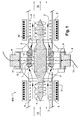
- Figure 1 : une vue générale du dispositif 400 selon l'invention.
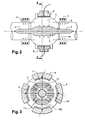
- Figure 2 : une représentation schématique du dispositif présenté figure 1.
- Figure 3 : une vue en coupe du dispositif 400, selon l'axe AA représenté sur la figure 2.
- Figure 4 : une représentation en coupe de l'orientation et du cheminement des ondes ultrasonores au sein de l'enceinte de traitement 1.
- Figure 5 : une représentation schématique du trajet d'une onde ultrasonore 11 qui se réfléchit sur le réflecteur d'ondes ultrasonores.
- Figure 6: un oscillogramme de l'onde 11 citée ci-dessus.
- Figure 7 : une représentation spatiale de la propagation des ondes ultrasonores incidentes et réfléchies.
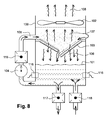
- Figure 8 : une tour de réfrigération équipée du dispositif de l'invention.
- Dans la description qui suit ainsi que sur les dessins et afin de leur apporter plus de concision et de clarté, les mêmes chiffres de référence sont utilisés pour désigner des organes ou objets identiques permettant la mise en oeuvre du procédé objet de l'invention.
- Les parties symétriques du dispositif décrit ci-après, portent les mêmes numéros de référence, auxquels un « prime » est ajouté.
- Le dispositif (400) de traitement d'un fluide, représenté sur la figure 1, est destiné à réduire la quantité d'agents pathogènes au sein d'un fluide. Ce dispositif comprend, dans le sens d'écoulement dudit fluide, selon un axe principal longitudinal :
- un conduit d'entrée (2) du fluide équipé d'un moyen (3) générant un champ électromagnétique (6) au sein dudit conduit d'entrée (2),
- une enceinte (1) définissant une cavité de traitement dudit fluide et comprenant au moins un moyen (8) de génération d'ondes ultrasonores en direction du centre de ladite cavité,
- un conduit de sortie (2') du fluide, équipé d'un moyen (3') générant un champ électromagnétique (6') au sein dudit conduit de sortie (2'), et
- un réflecteur d'ondes ultrasonores (4), magnétisable, disposé selon l'axe principal longitudinal dudit dispositif (400), et comprenant une partie centrale (5) située dans la cavité de l'enceinte (1) et un prolongement situé dans chacun des conduits d'entrée (2) et de sortie (2') du fluide.
- L'enceinte de traitement (1) peut avoir une forme quelconque, mais est de préférence cylindrique comme cela ressortira plus clairement sur la figure 3. Le réflecteur d'ondes ultrasonores (4) comportant de la ferrite magnétique, possède une partie centrale (5), qui devient magnétique sous l'influence des bobines (3) et (3').
- Comme on l'observe sur la figure 1, les conduits d'entrée (2) et de sortie (2') du fluide comprennent des supports (20) qui maintiennent le réflecteur d'ondes ultrasonores (4) selon l'axe principal longitudinal du dispositif (400).
- chacun des moyens engendrant un champ électromagnétique, de préférence des bobines électromagnétiques, possède une composante de champ magnétique de 1 à 5 Tesla, de préférence, 1 à 2 Tesla.
- Ces valeurs permettent tout d'abord d'éviter les dépôts d'un biofilm bactérien sur les parois des conduits d'entrée (2) et de sortie (2') en contact avec le fluide à traiter. Ces valeurs de champ magnétique, permettent également de magnétiser le réflecteur d'ondes ultrasonores (4) de manière directe, et de magnétiser de manière indirecte le centre (5) du réflecteur d'ondes ultrasonores (4). Cette magnétisation du centre (5) du réflecteur (4) permet d'obtenir une induction magnétique forte au niveau de la zone (7) de circulation du fluide dans l'enceinte de traitement (1).
- Enfin, de telles valeurs de champ magnétique, permettent de créer une zone propice à la réduction de la quantité d'agents pathogènes au sein dudit fluide et en particulier dans la zone (7) de circulation du fluide.
- La présence du réflecteur d'ondes ultrasonores (4) permet d'induire une aimantation permanente. Ainsi, les ondes ultrasonores produites dans l'enceinte de traitement sont accélérées ce qui favorise la destruction des agents pathogènes.
- Les bobines (3 et 3') qui génèrent un champ magnétique, comprennent des moyens d'alimentation électrique (31).
- Le dispositif (400), tel que représenté sur la figure 1 comprend au moins deux transducteurs ultrasonores (9) portés par l'enceinte de traitement (1) dans des positions diamétralement opposées.
- Le ou les moyens de génération d'ondes ultrasonores (8), qui comprennent un transducteur ultrasonore (9), génèrent des ondes ultrasonores qui traversent le flux de fluide au sein de l'enceinte de traitement (1), en direction du réflecteur d'ondes ultrasonores (4), puis ces ondes ultrasonores sont réfléchies par ce dernier. Les ondes ultrasonores traversent ensuite une seconde fois le flux de fluide au sein de l'enceinte de traitement (1) et reviennent vers un récepteur situé à proximité du transducteur (9).
- En d'autres termes, les ondes émises en faisceaux (11) traversent la zone de circulation du fluide (7) pour se réfléchir selon l'orientation (12) après réflexion sur le réflecteur d'ondes ultrasonores (4) ; la zone intermédiaire (13) présentant une influence magnétique et des vibrations fortes induites par les ondes ultrasonores. Par conséquent, c'est dans la zone intermédiaire (13) que les agents pathogènes seront détruits.
- Comme on l'observe sur les figures 2 et 3, la disposition des transducteurs (8) concentriques permet d'avoir un point de convergence des ondes ultrasonores sur l'axe principal longitudinal du dispositif (400), et plus particulièrement sur le réflecteur d'ondes ultrasonores (4). Le cheminement des ondes ultrasonores émises est représenté par les indices (11) (ondes incidentes), et (12) (ondes réfléchies). Les zones d'influence magnétique centrale (131) et périphérique (132) dans lesquelles les ondes ultrasonores et magnétiques atteignent des vitesses élevées, entraînent la destruction des agents pathogènes et élimine tout risque de formation d'un biofilm.
- Sans vouloir être lié à une quelconque théorie, l'inventeur pense que la zone (13) dans laquelle on observe un multiplexage des ondes magnétiques et des ondes ultrasonores, représente la zone essentielle de traitement.
- Comme on l'observe sur la figure 4, il peut exister une rétroréflexion des ondes ultrasonores émises (11) et réfléchies (12), sur le cylindre extérieur. Néanmoins, cette rétroréflection d'ondes (206) est atténuée.
- Comme cela est illustré sur la figure 5, l'onde longitudinale (11) se réfléchit sur le réflecteur d'ondes ultrasonores (4) avec un angle (200) par rapport à la verticale, sa réflexion se situant en un angle moindre (201) par rapport à une visualisation plane (203). Une onde transversale existe également (202) favorisant le cisaillement en oblique par rapport à l'axe de circulation du fluide.
- Sur la figure 6, on observe que l'émission de l'onde (11) représente une amplitude (304) pour une longueur d'onde caractéristique du réglage adopté en fréquence. Le réglage de la puissance et de la fréquence d'émission des ondes ultrasonores s'effectuera en quantifiant les temps d'émission (302) de l'onde réfléchie (303). Le rapprochement de la cadence de l'émission suivante (301) permet de moduler et de multiplexer ces ondes ultrasonores pour une meilleure efficacité du dispositif.
- La figure 7 représente la visualisation spatiale de l'enchevêtrement des ondes incidentes (11) et réfléchies (12) et montre l'effet de cisaillement induit par le multiplexage des ondes. Les réglages peuvent être optimisés pour l'émission de l'onde initiale entre 0,1 m/s et 5 m/s en fonction du débit et de la vitesse de circulation du fluide à décontaminer de façon à ce que, pendant le temps de transit dans le dispositif (400), le nombre de trains d'ondes émis se situe entre 10 et 30 ou plus, de sorte à entraîner les vibrations et les ondes de cisaillement nécessaires pour détruire les agents pathogènes contenus dans le fluide à traiter.
- Dans un mode de réalisation préféré, le dispositif (400) décrit ci-dessus équipe une tour de réfrigération. Les tours de réfrigération étant connues de l'homme du métier celles-ci ne seront pas décrites en détail ci-après. Brièvement, les tours de réfrigération sont généralement rectangulaires et comportent une enveloppe (100) qui possède à sa partie inférieure un réservoir d'eau (101) qui circule par une pompe (104) pour être injectée en partie haute (105) puis va ruisseler sur des plaques obliques (103) pour effectuer un refroidissement de l'air par mélange. Un flux d'air (107) initié par un ventilateur (102) rejette l'air vers l'atmosphère en (108). Si une contamination bactérienne intervient dans la tour de réfrigération, la contamination bactérienne se retrouvera dispersée par l'humidité relative rejetée à l'extérieur par le flux (108) provoquant ainsi des contaminations autour de la tour de réfrigération. L'utilisation du dispositif (400) sur le recyclage d'injection d'eau en (115) permet de réduire ce risque.
Claims (9)
- Dispositif (400) de traitement d'un fluide, destiné à réduire la quantité d'agents pathogènes au sein dudit fluide, caractérisé en ce qu'il comprend, dans le sens d'écoulement dudit fluide, selon un axe principal longitudinal :- un conduit d'entrée (2) du fluide équipé d'un moyen (3) générant un champ électromagnétique (6) au sein dudit conduit d'entrée (2),- une enceinte (1) définissant une cavité de traitement dudit fluide et comprenant au moins un moyen (8) de génération d'ondes ultrasonores en direction du centre de ladite cavité,- un conduit de sortie (2') du fluide, équipé d'un moyen (3') générant un champ électromagnétique (6') au sein dudit conduit de sortie (2'), et- un réflecteur d'ondes ultrasonores (4), magnétisable, disposé selon l'axe principal longitudinal dudit dispositif (400), et comprenant une partie centrale (5) située dans la cavité de l'enceinte (1) et un prolongement situé dans chacun des conduits d'entrée (2) et de sortie (2') du fluide.
- Dispositif (400) selon la revendication 1, caractérisé en ce que ledit réflecteur d'ondes ultrasonores (4) est en ferrite.
- Dispositif (400) selon la revendication 1 ou 2, caractérisé en ce que les conduits d'entrée (2) et de sortie (2') du fluide comprennent des supports (20) qui maintiennent le réflecteur d'ondes ultrasonores (4) selon l'axe principal longitudinal dudit dispositif (400).
- Dispositif (400) selon l'une quelconque des revendications 1 à 3, caractérisé en ce que chacun des moyens engendrant un champ électromagnétique, au sein desdits conduits d'entrée (2) et de sortie (2') du fluide, possède une composante de champ magnétique de 1 à 5 Tesla, de préférence, 1 à 2 Tesla.
- Dispositif (400) selon l'une quelconque des revendications 1 à 4, caractérisé en ce que chacun des moyens engendrant un champ électromagnétique, au sein desdits conduits d'entrée (2) et de sortie (2') du fluide est une bobine électromagnétique.
- Dispositif (400) selon l'une quelconque des revendications 1 à 5, caractérisé en ce que le moyen de génération d'ondes ultrasonores (8) comprend au moins deux transducteurs ultrasonores (9) portés par l'enceinte de traitement (1) dans des positions diamétralement opposées.
- Dispositif (400) selon l'une quelconque des revendications 1 à 6, caractérisé en ce que ledit fluide est un gaz ou un liquide.
- Dispositif (400) selon l'une quelconque des revendications 1 à 7, caractérisé en ce que ledit fluide est choisi parmi l'air, la vapeur d'eau ou l'eau.
- Dispositif (400) selon l'une quelconque des revendications 1 à 8, caractérisé en ce que ledit agent pathogène est choisi parmi une bactérie, un virus ou un champignon.
Applications Claiming Priority (1)
| Application Number | Priority Date | Filing Date | Title |
|---|---|---|---|
| FR0551385A FR2886157B1 (fr) | 2005-05-26 | 2005-05-26 | Epurateur bacterien |
Publications (2)
| Publication Number | Publication Date |
|---|---|
| EP1738775A1 true EP1738775A1 (fr) | 2007-01-03 |
| EP1738775B1 EP1738775B1 (fr) | 2009-04-29 |
Family
ID=34955280
Family Applications (1)
| Application Number | Title | Priority Date | Filing Date |
|---|---|---|---|
| EP06300518A Not-in-force EP1738775B1 (fr) | 2005-05-26 | 2006-05-24 | Epurateur bacterien |
Country Status (4)
| Country | Link |
|---|---|
| EP (1) | EP1738775B1 (fr) |
| AT (1) | ATE429934T1 (fr) |
| DE (1) | DE602006006503D1 (fr) |
| FR (1) | FR2886157B1 (fr) |
Cited By (3)
| Publication number | Priority date | Publication date | Assignee | Title |
|---|---|---|---|---|
| WO2010066999A1 (fr) | 2008-12-09 | 2010-06-17 | Rc - Lux | Procédé et dispositif de traitement d'au moins un composé transporté dans un liquide |
| CN103232127A (zh) * | 2013-05-15 | 2013-08-07 | 陕西师范大学 | 超声空化协同水力空化污水处理器 |
| WO2022090658A1 (fr) * | 2020-10-29 | 2022-05-05 | Marc Durand | Dispositif de purification d'un fluide comprenant des particules en suspension |
Citations (6)
| Publication number | Priority date | Publication date | Assignee | Title |
|---|---|---|---|---|
| WO1997011908A2 (fr) * | 1995-09-25 | 1997-04-03 | The National Engineering Research Center For Urban Pollution Control | Procede et dispositif de traitement d'eau chargee en micro-organismes et/ou en polluants |
| WO1998005595A1 (fr) * | 1996-08-01 | 1998-02-12 | Burnham Technologies Ltd. | Procede et appareil permettant d'appliquer des champs combines afin de desinfecter des fluides |
| US5965093A (en) * | 1994-07-08 | 1999-10-12 | Amphion International, Limited | Decontamination system with improved components |
| WO2002034075A1 (fr) * | 2000-10-27 | 2002-05-02 | Apit Corp. Sa | Procede et dispositif de sterilisation |
| DE10056581A1 (de) * | 2000-07-17 | 2003-04-30 | Werner Buehre | Vrrichtung zur Entkeimung von Legionellen, Bakterien, Pilzen U. Algen usw. in geschlossenen Wasserkreisläufen |
| FR2841475A1 (fr) * | 2002-06-28 | 2004-01-02 | Deschamps Lathus Sa | Procede de traitement thermique par induction d'une canalisation d'eau sanitaire et systeme pour sa mise en oeuvre |
-
2005
- 2005-05-26 FR FR0551385A patent/FR2886157B1/fr not_active Expired - Fee Related
-
2006
- 2006-05-24 DE DE602006006503T patent/DE602006006503D1/de active Active
- 2006-05-24 EP EP06300518A patent/EP1738775B1/fr not_active Not-in-force
- 2006-05-24 AT AT06300518T patent/ATE429934T1/de not_active IP Right Cessation
Patent Citations (6)
| Publication number | Priority date | Publication date | Assignee | Title |
|---|---|---|---|---|
| US5965093A (en) * | 1994-07-08 | 1999-10-12 | Amphion International, Limited | Decontamination system with improved components |
| WO1997011908A2 (fr) * | 1995-09-25 | 1997-04-03 | The National Engineering Research Center For Urban Pollution Control | Procede et dispositif de traitement d'eau chargee en micro-organismes et/ou en polluants |
| WO1998005595A1 (fr) * | 1996-08-01 | 1998-02-12 | Burnham Technologies Ltd. | Procede et appareil permettant d'appliquer des champs combines afin de desinfecter des fluides |
| DE10056581A1 (de) * | 2000-07-17 | 2003-04-30 | Werner Buehre | Vrrichtung zur Entkeimung von Legionellen, Bakterien, Pilzen U. Algen usw. in geschlossenen Wasserkreisläufen |
| WO2002034075A1 (fr) * | 2000-10-27 | 2002-05-02 | Apit Corp. Sa | Procede et dispositif de sterilisation |
| FR2841475A1 (fr) * | 2002-06-28 | 2004-01-02 | Deschamps Lathus Sa | Procede de traitement thermique par induction d'une canalisation d'eau sanitaire et systeme pour sa mise en oeuvre |
Cited By (6)
| Publication number | Priority date | Publication date | Assignee | Title |
|---|---|---|---|---|
| WO2010066999A1 (fr) | 2008-12-09 | 2010-06-17 | Rc - Lux | Procédé et dispositif de traitement d'au moins un composé transporté dans un liquide |
| US9579614B2 (en) | 2008-12-09 | 2017-02-28 | Rc Lux | Device comprising a cavitation chamber with opposed radial and parallel faces, in communication with a secondary chamber, for treating compounds in a liquid |
| CN103232127A (zh) * | 2013-05-15 | 2013-08-07 | 陕西师范大学 | 超声空化协同水力空化污水处理器 |
| CN103232127B (zh) * | 2013-05-15 | 2014-03-05 | 陕西师范大学 | 超声空化协同水力空化污水处理器 |
| WO2022090658A1 (fr) * | 2020-10-29 | 2022-05-05 | Marc Durand | Dispositif de purification d'un fluide comprenant des particules en suspension |
| FR3115708A1 (fr) * | 2020-10-29 | 2022-05-06 | Marc Durand | Dispositif de purification d’un fluide comprenant des particules en suspension |
Also Published As
| Publication number | Publication date |
|---|---|
| FR2886157B1 (fr) | 2007-12-07 |
| DE602006006503D1 (de) | 2009-06-10 |
| ATE429934T1 (de) | 2009-05-15 |
| EP1738775B1 (fr) | 2009-04-29 |
| FR2886157A1 (fr) | 2006-12-01 |
Similar Documents
| Publication | Publication Date | Title |
|---|---|---|
| EP0183583B1 (fr) | Dispositif d'insonification | |
| EP0609404B1 (fr) | Dispositif de micropulverisation generee par ondes ultrasonores | |
| US6649069B2 (en) | Active acoustic piping | |
| US9011698B2 (en) | Method and devices for sonicating liquids with low-frequency high energy ultrasound | |
| US7373805B2 (en) | Apparatus for directing particles in a fluid | |
| CA2194543C (fr) | Systeme de decontamination a composants ameliores | |
| CN101626822B (zh) | 处理液体的方法和装置 | |
| EP0648531B1 (fr) | Traitement de fluide | |
| US6749406B2 (en) | Ultrasonic pump with non-planar transducer for generating focused longitudinal waves and pumping methods | |
| EP1148943B1 (fr) | Procede et appareil d'irradiation de fluides | |
| JPH09502388A (ja) | 物体を洗浄するための静止型メガソニック洗浄装置 | |
| EP1738775B1 (fr) | Epurateur bacterien | |
| FR2671737A1 (fr) | Unite modulaire de reacteur ultra-sonique tubulaire. | |
| RU2291712C2 (ru) | Способ и устройство для дезинфицирования продукта путем его поверхностной обработки | |
| FR2910826A1 (fr) | Dispositif pour la production de vibrations ultrasoniques | |
| CN100344385C (zh) | 强超声波探棒能量引导器 | |
| US20030173307A1 (en) | Assembly and method for purifying water at a point of use and apparatus and method for testing same | |
| US7354556B2 (en) | Process and apparatus for irradiating fluids | |
| US7608440B2 (en) | Apparatus for ultrasonic microbial disruption | |
| JP2005288376A (ja) | 超音波殺菌分解装置 | |
| BE1009104A3 (fr) | Venturi a cavitation et tuyeres multiples. | |
| EP4003917B1 (fr) | Dispositif de traitement mecanique d'un fluide tel que l'eau | |
| EP0808425A1 (fr) | Procede de conditionnement d'un ecoulement d'un fluide et conditionneur d'ecoulement du fluide | |
| CN120515035A (zh) | 一种基于声波共振驻波的电池组气溶胶灭火渗透系统 | |
| Mephane | Modelling of the ultrasonic inspection of steel tubes with longitudinal defects; Modelisation du controle ultrasonore de tubes dacier presentant des defauts de type``entaille longitudinale`` |
Legal Events
| Date | Code | Title | Description |
|---|---|---|---|
| PUAI | Public reference made under article 153(3) epc to a published international application that has entered the european phase |
Free format text: ORIGINAL CODE: 0009012 |
|
| AK | Designated contracting states |
Kind code of ref document: A1 Designated state(s): AT BE BG CH CY CZ DE DK EE ES FI FR GB GR HU IE IS IT LI LT LU LV MC NL PL PT RO SE SI SK TR |
|
| AX | Request for extension of the european patent |
Extension state: AL BA HR MK YU |
|
| 17P | Request for examination filed |
Effective date: 20070703 |
|
| AKX | Designation fees paid |
Designated state(s): AT BE BG CH CY CZ DE DK EE ES FI FR GB GR HU IE IS IT LI LT LU LV MC NL PL PT RO SE SI SK TR |
|
| GRAP | Despatch of communication of intention to grant a patent |
Free format text: ORIGINAL CODE: EPIDOSNIGR1 |
|
| GRAS | Grant fee paid |
Free format text: ORIGINAL CODE: EPIDOSNIGR3 |
|
| GRAA | (expected) grant |
Free format text: ORIGINAL CODE: 0009210 |
|
| AK | Designated contracting states |
Kind code of ref document: B1 Designated state(s): AT BE BG CH CY CZ DE DK EE ES FI FR GB GR HU IE IS IT LI LT LU LV MC NL PL PT RO SE SI SK TR |
|
| REG | Reference to a national code |
Ref country code: GB Ref legal event code: FG4D Free format text: NOT ENGLISH |
|
| REG | Reference to a national code |
Ref country code: CH Ref legal event code: EP |
|
| REF | Corresponds to: |
Ref document number: 602006006503 Country of ref document: DE Date of ref document: 20090610 Kind code of ref document: P |
|
| REG | Reference to a national code |
Ref country code: IE Ref legal event code: FG4D |
|
| REG | Reference to a national code |
Ref country code: CH Ref legal event code: NV Representative=s name: KIRKER & CIE S.A. |
|
| NLV1 | Nl: lapsed or annulled due to failure to fulfill the requirements of art. 29p and 29m of the patents act | ||
| PG25 | Lapsed in a contracting state [announced via postgrant information from national office to epo] |
Ref country code: FI Free format text: LAPSE BECAUSE OF FAILURE TO SUBMIT A TRANSLATION OF THE DESCRIPTION OR TO PAY THE FEE WITHIN THE PRESCRIBED TIME-LIMIT Effective date: 20090429 Ref country code: LT Free format text: LAPSE BECAUSE OF FAILURE TO SUBMIT A TRANSLATION OF THE DESCRIPTION OR TO PAY THE FEE WITHIN THE PRESCRIBED TIME-LIMIT Effective date: 20090429 Ref country code: AT Free format text: LAPSE BECAUSE OF FAILURE TO SUBMIT A TRANSLATION OF THE DESCRIPTION OR TO PAY THE FEE WITHIN THE PRESCRIBED TIME-LIMIT Effective date: 20090429 Ref country code: ES Free format text: LAPSE BECAUSE OF FAILURE TO SUBMIT A TRANSLATION OF THE DESCRIPTION OR TO PAY THE FEE WITHIN THE PRESCRIBED TIME-LIMIT Effective date: 20090809 Ref country code: PT Free format text: LAPSE BECAUSE OF FAILURE TO SUBMIT A TRANSLATION OF THE DESCRIPTION OR TO PAY THE FEE WITHIN THE PRESCRIBED TIME-LIMIT Effective date: 20090829 |
|
| PG25 | Lapsed in a contracting state [announced via postgrant information from national office to epo] |
Ref country code: LV Free format text: LAPSE BECAUSE OF FAILURE TO SUBMIT A TRANSLATION OF THE DESCRIPTION OR TO PAY THE FEE WITHIN THE PRESCRIBED TIME-LIMIT Effective date: 20090429 Ref country code: NL Free format text: LAPSE BECAUSE OF FAILURE TO SUBMIT A TRANSLATION OF THE DESCRIPTION OR TO PAY THE FEE WITHIN THE PRESCRIBED TIME-LIMIT Effective date: 20090429 Ref country code: IS Free format text: LAPSE BECAUSE OF FAILURE TO SUBMIT A TRANSLATION OF THE DESCRIPTION OR TO PAY THE FEE WITHIN THE PRESCRIBED TIME-LIMIT Effective date: 20090829 Ref country code: SE Free format text: LAPSE BECAUSE OF FAILURE TO SUBMIT A TRANSLATION OF THE DESCRIPTION OR TO PAY THE FEE WITHIN THE PRESCRIBED TIME-LIMIT Effective date: 20090729 Ref country code: PL Free format text: LAPSE BECAUSE OF FAILURE TO SUBMIT A TRANSLATION OF THE DESCRIPTION OR TO PAY THE FEE WITHIN THE PRESCRIBED TIME-LIMIT Effective date: 20090429 Ref country code: SI Free format text: LAPSE BECAUSE OF FAILURE TO SUBMIT A TRANSLATION OF THE DESCRIPTION OR TO PAY THE FEE WITHIN THE PRESCRIBED TIME-LIMIT Effective date: 20090429 |
|
| REG | Reference to a national code |
Ref country code: IE Ref legal event code: FD4D |
|
| PG25 | Lapsed in a contracting state [announced via postgrant information from national office to epo] |
Ref country code: MC Free format text: LAPSE BECAUSE OF NON-PAYMENT OF DUE FEES Effective date: 20090531 |
|
| PG25 | Lapsed in a contracting state [announced via postgrant information from national office to epo] |
Ref country code: IE Free format text: LAPSE BECAUSE OF FAILURE TO SUBMIT A TRANSLATION OF THE DESCRIPTION OR TO PAY THE FEE WITHIN THE PRESCRIBED TIME-LIMIT Effective date: 20090429 Ref country code: DK Free format text: LAPSE BECAUSE OF FAILURE TO SUBMIT A TRANSLATION OF THE DESCRIPTION OR TO PAY THE FEE WITHIN THE PRESCRIBED TIME-LIMIT Effective date: 20090429 Ref country code: RO Free format text: LAPSE BECAUSE OF FAILURE TO SUBMIT A TRANSLATION OF THE DESCRIPTION OR TO PAY THE FEE WITHIN THE PRESCRIBED TIME-LIMIT Effective date: 20090429 Ref country code: EE Free format text: LAPSE BECAUSE OF FAILURE TO SUBMIT A TRANSLATION OF THE DESCRIPTION OR TO PAY THE FEE WITHIN THE PRESCRIBED TIME-LIMIT Effective date: 20090429 Ref country code: CZ Free format text: LAPSE BECAUSE OF FAILURE TO SUBMIT A TRANSLATION OF THE DESCRIPTION OR TO PAY THE FEE WITHIN THE PRESCRIBED TIME-LIMIT Effective date: 20090429 |
|
| PG25 | Lapsed in a contracting state [announced via postgrant information from national office to epo] |
Ref country code: SK Free format text: LAPSE BECAUSE OF FAILURE TO SUBMIT A TRANSLATION OF THE DESCRIPTION OR TO PAY THE FEE WITHIN THE PRESCRIBED TIME-LIMIT Effective date: 20090429 |
|
| PLBE | No opposition filed within time limit |
Free format text: ORIGINAL CODE: 0009261 |
|
| STAA | Information on the status of an ep patent application or granted ep patent |
Free format text: STATUS: NO OPPOSITION FILED WITHIN TIME LIMIT |
|
| PG25 | Lapsed in a contracting state [announced via postgrant information from national office to epo] |
Ref country code: BG Free format text: LAPSE BECAUSE OF FAILURE TO SUBMIT A TRANSLATION OF THE DESCRIPTION OR TO PAY THE FEE WITHIN THE PRESCRIBED TIME-LIMIT Effective date: 20090729 |
|
| 26N | No opposition filed |
Effective date: 20100201 |
|
| PGFP | Annual fee paid to national office [announced via postgrant information from national office to epo] |
Ref country code: LU Payment date: 20100324 Year of fee payment: 5 |
|
| PGFP | Annual fee paid to national office [announced via postgrant information from national office to epo] |
Ref country code: GB Payment date: 20100330 Year of fee payment: 5 |
|
| PGFP | Annual fee paid to national office [announced via postgrant information from national office to epo] |
Ref country code: BE Payment date: 20100322 Year of fee payment: 5 Ref country code: DE Payment date: 20100329 Year of fee payment: 5 |
|
| PG25 | Lapsed in a contracting state [announced via postgrant information from national office to epo] |
Ref country code: GR Free format text: LAPSE BECAUSE OF FAILURE TO SUBMIT A TRANSLATION OF THE DESCRIPTION OR TO PAY THE FEE WITHIN THE PRESCRIBED TIME-LIMIT Effective date: 20090730 |
|
| PGFP | Annual fee paid to national office [announced via postgrant information from national office to epo] |
Ref country code: CH Payment date: 20100420 Year of fee payment: 5 |
|
| PG25 | Lapsed in a contracting state [announced via postgrant information from national office to epo] |
Ref country code: IT Free format text: LAPSE BECAUSE OF FAILURE TO SUBMIT A TRANSLATION OF THE DESCRIPTION OR TO PAY THE FEE WITHIN THE PRESCRIBED TIME-LIMIT Effective date: 20090429 |
|
| PG25 | Lapsed in a contracting state [announced via postgrant information from national office to epo] |
Ref country code: HU Free format text: LAPSE BECAUSE OF FAILURE TO SUBMIT A TRANSLATION OF THE DESCRIPTION OR TO PAY THE FEE WITHIN THE PRESCRIBED TIME-LIMIT Effective date: 20091030 |
|
| PG25 | Lapsed in a contracting state [announced via postgrant information from national office to epo] |
Ref country code: TR Free format text: LAPSE BECAUSE OF FAILURE TO SUBMIT A TRANSLATION OF THE DESCRIPTION OR TO PAY THE FEE WITHIN THE PRESCRIBED TIME-LIMIT Effective date: 20090429 |
|
| PG25 | Lapsed in a contracting state [announced via postgrant information from national office to epo] |
Ref country code: CY Free format text: LAPSE BECAUSE OF FAILURE TO SUBMIT A TRANSLATION OF THE DESCRIPTION OR TO PAY THE FEE WITHIN THE PRESCRIBED TIME-LIMIT Effective date: 20090429 |
|
| BERE | Be: lapsed |
Owner name: DREAN, HENRI Effective date: 20110531 |
|
| REG | Reference to a national code |
Ref country code: CH Ref legal event code: PL |
|
| GBPC | Gb: european patent ceased through non-payment of renewal fee |
Effective date: 20110524 |
|
| PG25 | Lapsed in a contracting state [announced via postgrant information from national office to epo] |
Ref country code: CH Free format text: LAPSE BECAUSE OF NON-PAYMENT OF DUE FEES Effective date: 20110531 Ref country code: LI Free format text: LAPSE BECAUSE OF NON-PAYMENT OF DUE FEES Effective date: 20110531 |
|
| REG | Reference to a national code |
Ref country code: DE Ref legal event code: R119 Ref document number: 602006006503 Country of ref document: DE Effective date: 20111201 |
|
| PG25 | Lapsed in a contracting state [announced via postgrant information from national office to epo] |
Ref country code: BE Free format text: LAPSE BECAUSE OF NON-PAYMENT OF DUE FEES Effective date: 20110531 |
|
| PG25 | Lapsed in a contracting state [announced via postgrant information from national office to epo] |
Ref country code: GB Free format text: LAPSE BECAUSE OF NON-PAYMENT OF DUE FEES Effective date: 20110524 |
|
| PG25 | Lapsed in a contracting state [announced via postgrant information from national office to epo] |
Ref country code: LU Free format text: LAPSE BECAUSE OF NON-PAYMENT OF DUE FEES Effective date: 20110524 |
|
| PG25 | Lapsed in a contracting state [announced via postgrant information from national office to epo] |
Ref country code: DE Free format text: LAPSE BECAUSE OF NON-PAYMENT OF DUE FEES Effective date: 20111201 |
|
| PGFP | Annual fee paid to national office [announced via postgrant information from national office to epo] |
Ref country code: FR Payment date: 20130424 Year of fee payment: 8 |
|
| REG | Reference to a national code |
Ref country code: FR Ref legal event code: ST Effective date: 20150130 |
|
| PG25 | Lapsed in a contracting state [announced via postgrant information from national office to epo] |
Ref country code: FR Free format text: LAPSE BECAUSE OF NON-PAYMENT OF DUE FEES Effective date: 20140602 |