EP1743581A1 - Methode und System zur Ermittlung des Gewichts eines Foetus - Google Patents
Methode und System zur Ermittlung des Gewichts eines Foetus Download PDFInfo
- Publication number
- EP1743581A1 EP1743581A1 EP20050425498 EP05425498A EP1743581A1 EP 1743581 A1 EP1743581 A1 EP 1743581A1 EP 20050425498 EP20050425498 EP 20050425498 EP 05425498 A EP05425498 A EP 05425498A EP 1743581 A1 EP1743581 A1 EP 1743581A1
- Authority
- EP
- European Patent Office
- Prior art keywords
- parameters
- phenomenological
- physiological
- pregnancy
- weight
- Prior art date
- Legal status (The legal status is an assumption and is not a legal conclusion. Google has not performed a legal analysis and makes no representation as to the accuracy of the status listed.)
- Granted
Links
Images




Classifications
-
- A—HUMAN NECESSITIES
- A61—MEDICAL OR VETERINARY SCIENCE; HYGIENE
- A61B—DIAGNOSIS; SURGERY; IDENTIFICATION
- A61B8/00—Diagnosis using ultrasonic, sonic or infrasonic waves
- A61B8/08—Clinical applications
- A61B8/0866—Clinical applications involving foetal diagnosis; pre-natal or peri-natal diagnosis of the baby
-
- A—HUMAN NECESSITIES
- A61—MEDICAL OR VETERINARY SCIENCE; HYGIENE
- A61B—DIAGNOSIS; SURGERY; IDENTIFICATION
- A61B5/00—Measuring for diagnostic purposes; Identification of persons
- A61B5/103—Measuring devices for testing the shape, pattern, colour, size or movement of the body or parts thereof, for diagnostic purposes
- A61B5/107—Measuring physical dimensions, e.g. size of the entire body or parts thereof
- A61B5/1075—Measuring physical dimensions, e.g. size of the entire body or parts thereof for measuring dimensions by non-invasive methods, e.g. for determining thickness of tissue layer
Definitions
- the invention relates to a method for estimating fetal weight which comprises the following steps:
- Obstetric management of deliveries is affected by gestational age and fetal weight.
- an accurate ultrasonographic examination, as well as the comparison of certain ultrasound biometric parameters of the fetus with respective normal curves, particularly before the 20th week of pregnancy provides reliable gestation dating.
- many problems are still associated to fetal weight estimation by ultrasonic measurement of standard biometric parameters, usually relating to geometric head, abdominal and limb dimensions.
- fetal growth monitoring is of the utmost importance, for its being strictly related to fetus health. The detection of alterations in fetal growth allows to optimize pregnancy management.
- birth weight prediction accuracy seems to be only improvable by basically trying to reduce the human error associated to the use of the ultrasound imaging apparatus to measure the main fetal dimensions in utero.
- Operators with a longer experience in the field of fetal ultrasound are known to provide a significantly lower error level than less expert operators, although the former still have unacceptable inaccuracy margins on particularly difficult cases.
- This invention is based on the problem of improving a method of the type described hereinbefore so that the problems of the above prior art methods may be obviated without requiring heavier loads of computation and/or detection of ultrasound biometric and/or physiological and phenomenological pregnancy parameters.
- the invention has the object of providing probabilistic data on the reliability or consistency of the measurements of ultrasound biometric parameters and/or physiological and/or phenomenological pregnancy parameters with the actually obtained fetal weight estimate, to allow real-time corrections based on new measurements of such parameters.
- the invention has the further object of providing a method as described hereinbefore, which may be easily managed by the operator and allow direct and immediate data reading.
- the invention proposes a method as described hereinbefore, in which fetal weight is predicted on the basis of sample case data, relating to ultrasound biometric parameters and/or physiological and/or phenomenological pregnancy parameters, by using a mathematical multivariate Gaussian probabilistic model.
- the use of a probabilistic model provides a number of advantages: the main advantage, in the specific case of this invention, is to provide unbiased estimates, i.e. with no systematic over/underestimates of micro/macrosomic fetuses. Furthermore, the mathematical multivariate or multinormal model allows to associate probability levels to estimates, to evaluate both the reliability of the estimated weight, and the mutual consistency of the measurements of ultrasound biometric parameters and/or physiological and/or phenomenological pregnancy parameters.
- the invention further relates to a system for determining the fetal weight, characterized in that it comprises a computer having at least one data input device and at least one display monitor and in which a computer program is or may be loaded, wherein the algorithms of the multinormal model, the interfaces for access to sample case database data, and the algorithms of the mean vector and covariance matrix estimation model, as well as the code for displaying the neonatal weight estimate and the probability thereof are coded.
- HC Head circumference
- AC Abdominal Circumference
- BPD Biparietal Dimeter
- FL Femur Length
- Fetal weight was estimated by using a procedure based on a multinormal probabilistic model and Artificial Neural Networks (ANN).
- the probabilistic model is a five-dimensional model and expresses the probability of all 4 ultrasound biometric measurements as well as the gestational age, associated to each weight at birth (WB) and other important pregnancy information, specifically the amount of amniotic fluid (AF), the number of fetuses (NF) and the number of days to delivery (DD).
- AF amniotic fluid
- NF number of fetuses
- DD days to delivery
- the problem of estimating the mean vector and the covariance matrix of the multinormal fetal or neonatal weight determination model is solved by the combined use of multiple Artificial Neural Networks (ANN), which excellently solve the problem.
- ANN Artificial Neural Networks
- ANNs have been developed in cognitive sciences and bioengineering. Their structure is derived from the nervous system of living beings. They have the peculiarity of possessing many processing units (neurons), arranged in different layers and joined together by particular connections (synapses). Among the various classes of ANNs, feed-forward networks may be found. In these networks, information only flows in the forward direction from inputs to outputs (see Fig. 1).
- Fig. 1 is a schematic representation of a feed-forward neural network having 3 inputs (I1, I2, I3), 2 outputs (U1, U2), a hidden layer with 4 neuron units and an output layer with 2 neuron units.
- the inputs are linearly combined by synaptic weights ⁇ .
- Each neuron is activated by afferent synapses, based on a threshold ⁇ and on an activation function. Neuron activation propagates forwards always in the same manner.
- An ANN is trained by introducing known input and output data and by estimating, with the help of numerical optimization algorithms, the weights of synaptic connections and the values of neuron activating thresholds, which provide a better representation of input-output relations.
- Neural networks are complex algorithms which often have convergence problems as well as long processing times and heavy computation hardware requirements.
- the present method should allow execution by unskilled personnel, having no specific expertise and on easily available and relatively low-cost commercial hardware.
- the invention suggests a solution in which a combination of three neural networks is used and preferably such neural networks, or the tasks thereof, are defined so that at least one of the neural networks is used to generate output data that can be stored in as a data table or a database, based on the sample data database. Particularly this is performed in a separate and independent step and, as further explained in the following description, the system for carrying out the method only has one software-integrated neural network and the above output data database of the other neural networks. This arrangement allows to restrict the intervention of expert personnel to the most difficult neural network operation step, which is an independent process step, and does not add any load to the computation of the fetal or neonatal weight by the final user.
- the parameters of the multinormal model were estimated by using a combination of three ANNs was used, the first (ANNm) for estimating the mean vector, the second (ANNv) for estimating the variances of the covariance matrix (diagonal elements) and the third (ANNc) for the covariances of the same matrix (see Fig. 2).
- the three ANNs are all constructed with 2 neuron layers, having 10 neurons in the hidden layers with a logsig type activation function having a suitable threshold, whereas the output neurons have a linear activation function.
- the weights of synaptic connections and the neuron thresholds have been estimated in an iterative manner, by using a numerical descending gradient algorithm with adaptive moment and training speed.
- Overfitting is usually controlled by using the so-called early-stopping method, which consists in stopping the iterative training procedure performed on half of the data being trained (learning set) when the predictive error in the other data half (testing set) ceases to decrease, starts to increase again or decreases significantly less than in the learning set
- early-stopping is an effective method
- Bayesan filtering method see handbook of Matlab 'Neural Networks' toolbox
- ANNs allow to effectively estimate the parameters of the probabilistic model (1) as well as their dependency on the data vector w. This is obtained by simply training the ANNs with the available data according to the scheme of Fig. 2, where the rectangular blocks represent the ANNs with 10 neurons in the hidden layer, that are used in the training (T) and simulation (S) steps.
- Fig. 2 shows a block diagram of the artificial neural networks that are used to estimate the mean vector and the covariance matrix of the multinormal probabilistic model expressed in equation (1).
- FIG. 2 The block diagram of Fig. 2 shall be interpreted as follows:
- AF Amniotic Fluid
- NF Number of Fetuses
- DD number of days to delivery
- the estimates of synaptic weights ⁇ m and neuron excitation thresholds ⁇ m so obtained allow such identified ANNm to simulate (Fig. 3, bottom left) the most reliable outputs for any combination of values WB, AF, NF and DD, even those that never occurred in the available data. These outputs may be reasonably considered as estimates of the mean vector ⁇ (w) of the multinormal model (1). Particularly, by presenting to the input of the network the data that were used to train the ANNm, the output will give the corresponding estimated mean values of the ultrasound biometric measurements, as well as the gestational age.
- the deviations from the respective measurement means are determined (see block with minus sign). These deviations are squared (Fig. 2, top center),to be placed at the output of the ANNv during the training step (Fig. 2, top right), or suitably multiplied (Fig. 2, bottom center) to be placed at the output of the ANNc being trained (Fig. 2, bottom right).
- Neural networks allow a uniform and continuous mapping of the input ⁇ output relation and identify the expected output values even when there is a small number of available data items, or there is no data at all. Therefore they represent herein an excellent method to estimate the parameters of the probabilistic model (1) from available data.
- the problem arises of estimating fetal weight from pregnancy data and ultrasound biometric measurements.
- the value of FW is to be estimated.
- an estimate has to be produced of the first component WB of the data vector w, which obviously coincides with FW at the time of delivery, after determining the measured observation vector x and the data w relating to the amount of Amniotic Fluid (AF), the Number of Fetuses (NF), and the number of Days to Delivery (DD), except the quantity to be estimated, i.e. the fetal or neonatal weight.
- AF Amniotic Fluid
- NF Number of Fetuses
- DD Days to Delivery
- the multinormal model of the expression (1) allows to trace probability curves (sometimes called percentiles) for each component of the data vector x, i.e. for the measured ultrasound biometric parameters, which in this example are Head Circumference (HC), Abdominal Circumference (AC), Biparietal Diameter (BPD), and Femur Length (FL), as well as gestational age.
- HC Head Circumference
- AC Abdominal Circumference
- BPD Biparietal Diameter
- FL Femur Length
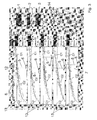
- Fig. 3 shows the user interface screen of fetal weight estimation, which allows interactive control of measurement errors.
- the charts of the 5 parameters measured during ultrasound show the mean curves (50th percentile), denoted by C1, and the curves that delimit 95% confidence intervals, denoted by C2 and C3.
- the graphic interface for fetal (or neonatal) weight estimation from ultrasound measurements allows interactive control of measurement errors.
- the mean and confidence curves are obtained in a fast and efficient manner thanks to the incorporation of two data sets in the software.
- a first data set is stored in a file that contains the synaptic weights ⁇ m , the neuron excitation thresholds ⁇ m and the structure of the ANNm.
- a simulated ANNm is used in the software and this allows to trace any mean curve for each input data set consisting of the components of the data vector w, which in this particular preferred embodiment are the amount of Amniotic Fluid (AF), the Number of Fetuses (NF), and the number of Days to Delivery (DD).
- AF Amniotic Fluid
- NF Number of Fetuses
- DD Days to Delivery
- a second set contains the covariance matrices for each fetal weight WB.
- the covariance matrices only depend on fetal or neonatal weight WB and are independent of the three other input parameters, which are given in respective windows on the right side of the screen of Figure 3 and are denoted by numerals 1, 2 and 3. Therefore, the second set consists of a collection of 6000 covariance matrices (5 variances and 10 covariances), each for a different fetal or neonatal weight, in an incremental sequence with one-gram increments and in a range of 1 to 6000 grams.
- the software that represents the multinormal model according to the expression (1) only incorporates the mean curve representing neural network, whereas the covariance matrices are obtained from externally stored data.
- the software procedure is highly fast and efficient.
- the simulated ANNm only requires simple mathematical addition calculations and exponential functions.
- the dash line L5 in the window of each ultrasound biometric parameter and at the gestational age MA show the correspondence between the measured value of these parameters ad the fetal weight in grams, corresponding to the mean curve C1 whose value is the most probable weight for the corresponding parameter.
- the fetal or neonatal weight WB which is estimated as the most probable for each parameter is indicated in a window 6 at the lower end of the corresponding dash line 5, this value being preferably displayed with well visible background-character combinations, such as red character on yellow background.
- 5 fetal weight values, corresponding to the mean curves of each component of the measured data vector x are combined together.
- the most probable weight for all simultaneously taken parameters i.e. un a multivariate manner, intended as the value that maximizes the expression (1) among all weight values, has to be found in a narrower range of weights, from the lowest to the highest of these 5 weights.
- the conditioned probability expressed in the equation (1) is identified by the confidence ellipsoid of the parameters which may be in turn calculated by inverting the covariance matrix and calculating the cumulative probability density function Fc for Fischer's distribution F corresponding to the ellipsoid.
- matrix inversion involves long computation times.
- the invention provides an efficient dichotomous algorithm for determining the maximum or minimum value of a range in which a function only admits one maximum or minimum.
- the maximum probability is determined by the following steps:
- Fig. 4 The operation of the dichotomous algorithm for fetal weight estimation, corresponding to the maximum of the multivariate probability is also shown in Fig. 4, which relates to the example of Fig. 3.
- the most probable weight value so obtained is assigned a unique probabilistic model, denoted in Fig. 3 by a vertical dash line passing through all the charts for all ultrasound biometric parameters and the gestational age.
- This line denoted by numeral 7, defines the most probable estimated weight, which is indicated in window 8, in Fig. 3, and its multivariate probability percent value, which is indicated in an adjacent window 12, but also defines, at the intersection with the mean curves C1, along the horizontal line 13, the most probable values of the ultrasound biometric parameters ,which are indicated in window 9 to the right of each chart and their respective deviations from actual measurements, expressed in terms of univariate consistency probability, which are also indicated to the right of each chart, in window 10. Furthermore, the values obtained from parameter measurements are also indicated in the interface screen of Fig. 3, to the right of each chart, in window 11.
- An overall weight value having an excessively low multivariate probability can indicate two important alternative or combined possibilities: the baby may be out of normal biological ranges, have wrong measurements, or both. These possibilities are worthy of serious attention. More in detail, the probabilities associated to the individual measured parameters provide real-time data about their consistency with the other measurements. Once more, very low probabilities may indicate that the corresponding parameters may be measured in a wrong manner, or that the fetus has unusual morphological characteristics.
- This data allows the ultrasound operator to effectively interact with the software and the apparatus, to actually minimize errors and improve estimation accuracy. For instance, if the doctor suspects the measurements to be wrong, he/she may decide to take other measurements or correct their values according to model suggestions, to obtain new estimates and new probabilities, to possibly take new measurements and so on.
- steps, as well as other steps, e.g. to save the estimation session or start prediction, may be controlled by the user by means of one or more virtual buttons which may be accessed and actuated by a mouse or key combinations, such as in the example of Figure 3, which shows the "Run", “Save” and “Read” buttons 14.
- the system for carrying out the above method comprises a computer having at least one data input device and at least one display monitor and in which a computer program is or may be loaded, wherein the algorithms of the multinormal model, the interfaces for access to sample case database data, and the algorithms of the mean vector and covariance matrix estimation model, as well as the code for displaying the neonatal weight estimate and the probability thereof are coded.
- the program has a neonatal weight prediction module 20, which may be executed in a computer, and an independent preparation module 21, which may be executed in an additional apparatus, the neonatal weight prediction module only having the code for the multinormal model and for the first neural network, trained with the database of sample cases for estimation of the mean values of said ultrasound biometric parameters, and of said one or more physiological and/or phenomenological pregnancy parameters, i.e. the components of the mean vector ⁇ (w).
- the prediction module has a computation algorithm coded therein, for predicting the most probable neonatal weight, for each ultrasound biometric parameter and/or for one or more physiological and/or phenomenological pregnancy parameters.
- a data input interface section 120 is interfaced with a multinormal model computation section 220 for predicting the neonatal and fetal weight from input data, which comprises the code for the multinormal model, as expressed in the function (1), and for the first neural network ANNm, trained with the database of sample cases to estimate the mean values of said ultrasound biometric parameters and said one or more physiological and/or phenomenological pregnancy parameters, i.e. the components of the mean vector ⁇ (w) as well as the matrix of weights and thresholds of said trained network.
- the output of this section 220 is directly connected to the input of a display and graphic interface section 320, which determines the probability curves in the form of a value for each ultrasound parameter and/or for each of the one or more physiological and phenomenological pregnancy parameters, corresponding to the 50th percentile.
- the section 420 comprises the tables of covariance matrices which allow to determine the curves that delimit a 95% confidence interval, which curves are traced and displayed by the display and interface section 320.
- the display and graphic user interface section traces, in vertically adjacent and aligned positions, the 50th percentile probability curve for each ultrasound biometric parameter and/or each physiological and/or phenomenological pregnancy parameter as a function of the neonatal weight, and the curves that delimit a 95% confidence interval, said curves being traced in different colors and/or different gray tones and/or different graphic aspects, whereas the predicted and most probable neonatal weight for each ultrasound biometric parameter and for each of the one or more physiological and/or phenomenological pregnancy parameters is determined from said 50th percentile probability curve to the value of the corresponding ultrasound biometric parameter and of the corresponding physiological or phenomenological pregnancy parameter, and is graphically indicated by a dash line intersecting the neonatal weight scale at the intersection of said 50th percentile probability curve with the line that passes through the value of the corresponding ultrasound biometric parameter or the corresponding physiological or phenomenological pregnancy parameter.
- this display and interface section comprises the code to execute the functions described with reference to Figure 3.
- the prediction module comprises the section 520, in which a computation algorithm is coded for determining the most probable fetal or neonatal weight, for all ultrasound biometric parameters and/or for one or more of the physiological and/or phenomenological pregnancy parameters.
- the output of this section 520 is also provided to the display and user interface section 320.
- the independent preparation module 21 which may be executed on an independent apparatus, separately from the prediction module 20, comprises a section for input of the database of sample data and a section 221 for preparation of the tables of covariance matrices on the basis of sample data, in which the algorithms of the second and third neural networks are coded for estimating the values of the covariance matrix ⁇ (w) to generate a database of covariance matrices, each determined for a different neonatal weight of a set of neonatal weights in a predetermined range, particularly from 1 g to 6000 g, in 1 g increments, which database of covariance matrices is provided as a reference database for computing the neonatal weight prediction in combination with the prediction module, and may be accessed by said module for computation of said prediction.
- the preparation module 21 also comprises a section 321 for training the first neural network ANNm in which the algorithm of said first neural network is coded for training thereof, and provides at its output the trained network and the corresponding matrix of weights and thresholds.
- the table of covariance matrices 521 and the trained neural network ANNm, with the corresponding matrix of weights and synaptic activation thresholds 421 are provided at the output of the preparation module 21 and are integrated in the prediction module 20, which does not have to compute this data every time it is executed.
- the neural network ANNm and the corresponding matrices of weights and synaptic activation thresholds and/or the table of the covariance matrices are computed once, before execution of the prediction module.
- the neural network ANNm and its respective matrices of weights and synaptic activation thresholds and/or the table of covariance matrices may be computed once in a while at regular intervals to refine and improve the performances of the networks and data and the prediction module may be submitted at regular intervals to maintenance, consisting in updating the code of the updated neural network ANNm and its respective matrices of weights and synaptic activation thresholds and/or in updating the table of covariance matrices.
- the physiological and/or phenomenological pregnancy parameter is not displayed and cannot be corrected.
- the menstrual age is not shown on the screen as a parameter to be edited.
- the MA is entered once by the ultrasound operator to be possibly corrected internally by the system which brings it back to the most probable value, as provided by the model. This allows to provide a MA value that is constantly consistent with ultrasound biometric measurements, for any ethnic group.
- this parameter might be inconsistent for populations in which, given the same fetal dimensions, a higher or lower MA would be obtained.
Landscapes
- Health & Medical Sciences (AREA)
- Life Sciences & Earth Sciences (AREA)
- Medical Informatics (AREA)
- Molecular Biology (AREA)
- Veterinary Medicine (AREA)
- Biophysics (AREA)
- Pathology (AREA)
- Engineering & Computer Science (AREA)
- Biomedical Technology (AREA)
- Heart & Thoracic Surgery (AREA)
- Public Health (AREA)
- Physics & Mathematics (AREA)
- Surgery (AREA)
- Animal Behavior & Ethology (AREA)
- General Health & Medical Sciences (AREA)
- Dentistry (AREA)
- Oral & Maxillofacial Surgery (AREA)
- Gynecology & Obstetrics (AREA)
- Pregnancy & Childbirth (AREA)
- Nuclear Medicine, Radiotherapy & Molecular Imaging (AREA)
- Radiology & Medical Imaging (AREA)
- Ultra Sonic Daignosis Equipment (AREA)
Priority Applications (2)
| Application Number | Priority Date | Filing Date | Title |
|---|---|---|---|
| EP05425498.2A EP1743581B8 (de) | 2005-07-11 | 2005-07-11 | Methode und System zur Ermittlung des Gewichts eines Foetus |
| US11/484,099 US8012091B2 (en) | 2005-07-11 | 2006-07-11 | Method and system for fetal weight estimation |
Applications Claiming Priority (1)
| Application Number | Priority Date | Filing Date | Title |
|---|---|---|---|
| EP05425498.2A EP1743581B8 (de) | 2005-07-11 | 2005-07-11 | Methode und System zur Ermittlung des Gewichts eines Foetus |
Publications (3)
| Publication Number | Publication Date |
|---|---|
| EP1743581A1 true EP1743581A1 (de) | 2007-01-17 |
| EP1743581B1 EP1743581B1 (de) | 2016-07-06 |
| EP1743581B8 EP1743581B8 (de) | 2016-09-21 |
Family
ID=35432162
Family Applications (1)
| Application Number | Title | Priority Date | Filing Date |
|---|---|---|---|
| EP05425498.2A Expired - Lifetime EP1743581B8 (de) | 2005-07-11 | 2005-07-11 | Methode und System zur Ermittlung des Gewichts eines Foetus |
Country Status (2)
| Country | Link |
|---|---|
| US (1) | US8012091B2 (de) |
| EP (1) | EP1743581B8 (de) |
Cited By (4)
| Publication number | Priority date | Publication date | Assignee | Title |
|---|---|---|---|---|
| WO2015063631A1 (en) * | 2013-10-29 | 2015-05-07 | Koninklijke Philips N.V. | Method and system for monitoring the development of neonates |
| EP2735272A3 (de) * | 2012-11-23 | 2017-08-02 | Samsung Medison Co., Ltd. | Ultraschallsystem und Verfahren zur Bereitstellung biometrischer Informationen von Föten |
| WO2021037766A1 (en) * | 2019-08-23 | 2021-03-04 | Five AI Limited | Performance testing for robotic systems |
| CN113855081A (zh) * | 2021-10-25 | 2021-12-31 | 南方医科大学南方医院 | 孕37-42周预测足月新生儿出生体重的方法 |
Families Citing this family (14)
| Publication number | Priority date | Publication date | Assignee | Title |
|---|---|---|---|---|
| US11037330B2 (en) | 2017-04-08 | 2021-06-15 | Intel Corporation | Low rank matrix compression |
| CN108109693A (zh) * | 2017-12-19 | 2018-06-01 | 深圳京柏医疗科技股份有限公司 | 胎儿估重方法、装置、系统、存储介质和计算机设备 |
| KR102661804B1 (ko) * | 2018-03-27 | 2024-04-30 | 삼성메디슨 주식회사 | 태아의 성장도를 예측하는 초음파 영상 장치 및 그 동작 방법 |
| JP7008845B2 (ja) * | 2018-05-02 | 2022-01-25 | コーニンクレッカ フィリップス エヌ ヴェ | 新生児のシミュレーション画像の生成 |
| CN110338843A (zh) * | 2019-08-02 | 2019-10-18 | 无锡海斯凯尔医学技术有限公司 | 组织评价方法、装置、设备及计算机可读存储介质 |
| CN114254688A (zh) * | 2020-09-25 | 2022-03-29 | 华为技术有限公司 | 一种数据处理方法及其设备 |
| CN113197550B (zh) * | 2021-04-30 | 2022-09-06 | 北京大学第三医院(北京大学第三临床医学院) | 一种双胎生长发育标准曲线构建的方法 |
| CN114081532A (zh) * | 2021-11-25 | 2022-02-25 | 无锡海鹰电子医疗系统有限公司 | 一种基于超声诊断仪的超声产科测量计算方法 |
| CN114767065B (zh) * | 2022-03-30 | 2025-06-13 | 深圳市优必选科技股份有限公司 | 一种异常监控方法、装置、监护设备和存储介质 |
| CN115349889B (zh) * | 2022-08-09 | 2025-04-01 | 合肥合滨智能机器人有限公司 | 一种双模型融合的胎儿年龄和体重预测方法 |
| CN115966314B (zh) * | 2022-12-23 | 2023-12-12 | 南栖仙策(南京)高新技术有限公司 | 一种数据处理方法、装置、电子设备及存储介质 |
| CN116013520B (zh) * | 2022-12-27 | 2023-11-17 | 上海市第一妇婴保健院 | 预测发育性协调障碍的方法、装置及电子设备 |
| GB2636226A (en) * | 2023-12-07 | 2025-06-11 | Mads Nielsen Consultings Aps | A method of, and apparatus for, improved estimation of fetal characteristics |
| CN119721331B (zh) * | 2024-11-27 | 2025-12-26 | 华南农业大学 | 基于多特征深度融合学习的鸡群均重估计方法及系统 |
Citations (3)
| Publication number | Priority date | Publication date | Assignee | Title |
|---|---|---|---|---|
| US6575907B1 (en) * | 1999-07-12 | 2003-06-10 | Biomedicom, Creative Biomedical Computing Ltd. | Determination of fetal weight in utero |
| US6695780B1 (en) * | 2002-10-17 | 2004-02-24 | Gerard Georges Nahum | Methods, systems, and computer program products for estimating fetal weight at birth and risk of macrosomia |
| EP1473667A2 (de) * | 2003-04-29 | 2004-11-03 | Topvine Medical Microsystems Limited | Tragbares Gerät zur Klassifikation von Medizinischer Daten |
Family Cites Families (2)
| Publication number | Priority date | Publication date | Assignee | Title |
|---|---|---|---|---|
| US6004267A (en) * | 1997-03-07 | 1999-12-21 | University Of Florida | Method for diagnosing and staging prostate cancer |
| GB0208329D0 (en) * | 2002-04-11 | 2002-05-22 | Univ York | Data processing particularly in communication systems |
-
2005
- 2005-07-11 EP EP05425498.2A patent/EP1743581B8/de not_active Expired - Lifetime
-
2006
- 2006-07-11 US US11/484,099 patent/US8012091B2/en active Active
Patent Citations (3)
| Publication number | Priority date | Publication date | Assignee | Title |
|---|---|---|---|---|
| US6575907B1 (en) * | 1999-07-12 | 2003-06-10 | Biomedicom, Creative Biomedical Computing Ltd. | Determination of fetal weight in utero |
| US6695780B1 (en) * | 2002-10-17 | 2004-02-24 | Gerard Georges Nahum | Methods, systems, and computer program products for estimating fetal weight at birth and risk of macrosomia |
| EP1473667A2 (de) * | 2003-04-29 | 2004-11-03 | Topvine Medical Microsystems Limited | Tragbares Gerät zur Klassifikation von Medizinischer Daten |
Non-Patent Citations (6)
| Title |
|---|
| CHUANG L ET AL: "Ultrasound estimation of fetal weight with the use of computerized artificial neural network model", ULTRASOUND IN MEDICINE AND BIOLOGY, NEW YORK, NY, US, vol. 28, no. 8, August 2002 (2002-08-01), pages 991 - 996, XP004379307, ISSN: 0301-5629 * |
| FARMER R M; MEDEARIS A L; HIRATA G I; PLATT L D: "The use of a neural network for the ultrasonographic estimation of fetal weight in the macrosomic fetus", AMERICAN JOURNAL OF OBSTETRICS AND GYNECOLOGY, vol. 166, no. 5, May 1992 (1992-05-01), united states, pages 1467 - 1472, XP008057321, ISSN: 0002-9378 * |
| FOLLAND ET AL: "Comparison of neural network predictors in the classification of tracheal-bronchial breath sounds by respiratory auscultation", ARTIFICIAL INTELLIGENCE IN MEDICINE, vol. 31, no. 3, July 2004 (2004-07-01), pages 211 - 220, XP002358923 * |
| MOL ET AL: "Implementation of probabilistic decision rules improves the predictive values of algorithms in the diagnostic managment of ectopic pregnancy", HUMAN REPRODUCTION, vol. 14, no. 11, 1999, pages 2855 - 2862, XP002358922 * |
| PERRONNIN ET AL: "A probabilistic model for face transformation with application to person identification", EURASIP JOURNAL ON APPLIED SIGNAL PROCESSING, vol. 2004, no. 4, April 2004 (2004-04-01), pages 510 - 521, XP002358921 * |
| SPECHT D F: "PROBABILISTIC NEURAL NETWORKS", NEURAL NETWORKS, ELSEVIER SCIENCE PUBLISHERS, BARKING, GB, vol. 3, no. 1, January 1990 (1990-01-01), pages 109 - 118, XP000086865, ISSN: 0893-6080 * |
Cited By (11)
| Publication number | Priority date | Publication date | Assignee | Title |
|---|---|---|---|---|
| EP2735272A3 (de) * | 2012-11-23 | 2017-08-02 | Samsung Medison Co., Ltd. | Ultraschallsystem und Verfahren zur Bereitstellung biometrischer Informationen von Föten |
| WO2015063631A1 (en) * | 2013-10-29 | 2015-05-07 | Koninklijke Philips N.V. | Method and system for monitoring the development of neonates |
| CN105683978A (zh) * | 2013-10-29 | 2016-06-15 | 皇家飞利浦有限公司 | 用于监测新生儿的发育的方法和系统 |
| WO2021037766A1 (en) * | 2019-08-23 | 2021-03-04 | Five AI Limited | Performance testing for robotic systems |
| US12210349B2 (en) | 2019-08-23 | 2025-01-28 | Five AI Limited | Performance testing for robotic systems |
| US12271202B2 (en) | 2019-08-23 | 2025-04-08 | Five AI Limited | Performance testing for robotic systems |
| US12271201B2 (en) | 2019-08-23 | 2025-04-08 | Five AI Limited | Performance testing for robotic systems |
| US12292741B2 (en) | 2019-08-23 | 2025-05-06 | Five AI Limited | Performance testing for robotic systems |
| US12416921B2 (en) | 2019-08-23 | 2025-09-16 | Five AI Limited | Performance testing for robotic systems |
| CN113855081A (zh) * | 2021-10-25 | 2021-12-31 | 南方医科大学南方医院 | 孕37-42周预测足月新生儿出生体重的方法 |
| CN113855081B (zh) * | 2021-10-25 | 2023-06-30 | 南方医科大学南方医院 | 孕37-42周预测足月新生儿出生体重的方法 |
Also Published As
| Publication number | Publication date |
|---|---|
| EP1743581B8 (de) | 2016-09-21 |
| US8012091B2 (en) | 2011-09-06 |
| EP1743581B1 (de) | 2016-07-06 |
| US20070038093A1 (en) | 2007-02-15 |
Similar Documents
| Publication | Publication Date | Title |
|---|---|---|
| EP1743581B1 (de) | Methode und System zur Ermittlung des Gewichts eines Foetus | |
| Lu et al. | Prediction of fetal weight at varying gestational age in the absence of ultrasound examination using ensemble learning | |
| Cömert et al. | Fetal hypoxia detection based on deep convolutional neural network with transfer learning approach | |
| Tao et al. | Fetal birthweight prediction with measured data by a temporal machine learning method | |
| Liang et al. | A CNN-RNN unified framework for intrapartum cardiotocograph classification | |
| US20030105731A1 (en) | Methods for selecting, developing and improving diagnostic tests for pregnancy-related conditions | |
| Spairani et al. | A deep learning mixed-data type approach for the classification of FHR signals | |
| Ding et al. | Mortality prediction for ICU patients combining just-in-time learning and extreme learning machine | |
| JP2002523168A (ja) | 胎盤および胎児健康診断用モニター | |
| Akilandeswari et al. | Enhancing fetal health monitoring through TPOT and optuna in machine learning-driven prenatal care | |
| CN113052205B (zh) | 基于机器学习的产妇数据分类方法、装置、设备及介质 | |
| CN118430834A (zh) | 基于妇产临床的智能医学决策模型训练方法 | |
| Jugunta et al. | Exploring the Insights of Bat Algorithm-Driven XGBRNN (BARXG) for Optimal Fetal Health Classification in Pregnancy Monitoring. | |
| Prasad et al. | Longitudinal twin growth discordance patterns and adverse perinatal outcomes | |
| Gorthi et al. | Automated risk assessment tool for pregnancy care | |
| CN109102896A (zh) | 一种分类模型生成方法、数据分类方法及装置 | |
| CN119964811A (zh) | 一种智能化产科护理筛查辅助系统 | |
| Sefidi et al. | Fetal health classification by support vector machine based on feature vector optimization | |
| CN112992353A (zh) | 预产期精准预测方法、装置、计算机设备及存储介质 | |
| Kychkin | Intelligent information and diagnostic system for examining blood vessels | |
| Salinas et al. | Artificial intelligence for prediction of perinatal health | |
| Eraslan Sahin et al. | Evaluation of midtrimester ductus venosus diameter and peak systolic velocity to predict late onset small for gestational age fetuses | |
| Zhao et al. | NIPT time point selection and abnormality determination of female fetuses via KMeans and random forest | |
| Izadi et al. | Foetal weight estimation with descriptive statistics and correlation analysis of significant ultrasonographic parameter and fuzzy artmap classifier | |
| Lwin et al. | Enhancing Fetal Monitoring through Digital Twin Technology and Entropy-based Fetal Heart Rate Variability Analysis |
Legal Events
| Date | Code | Title | Description |
|---|---|---|---|
| PUAI | Public reference made under article 153(3) epc to a published international application that has entered the european phase |
Free format text: ORIGINAL CODE: 0009012 |
|
| 17P | Request for examination filed |
Effective date: 20060613 |
|
| AK | Designated contracting states |
Kind code of ref document: A1 Designated state(s): AT BE BG CH CY CZ DE DK EE ES FI FR GB GR HU IE IS IT LI LT LU LV MC NL PL PT RO SE SI SK TR |
|
| AX | Request for extension of the european patent |
Extension state: AL BA HR MK YU |
|
| AKX | Designation fees paid |
Designated state(s): AT BE BG CH CY CZ DE DK EE ES FI FR GB GR HU IE IS IT LI LT LU LV MC NL PL PT RO SE SI SK TR |
|
| RAP1 | Party data changed (applicant data changed or rights of an application transferred) |
Owner name: ESAOTE S.P.A. |
|
| RAP1 | Party data changed (applicant data changed or rights of an application transferred) |
Owner name: ESAOTE S.P.A. |
|
| REG | Reference to a national code |
Ref country code: DE Ref legal event code: R079 Ref document number: 602005049673 Country of ref document: DE Free format text: PREVIOUS MAIN CLASS: A61B0008080000 Ipc: A61B0005107000 |
|
| GRAP | Despatch of communication of intention to grant a patent |
Free format text: ORIGINAL CODE: EPIDOSNIGR1 |
|
| RIC1 | Information provided on ipc code assigned before grant |
Ipc: A61B 8/08 20060101ALI20160112BHEP Ipc: A61B 5/107 20060101AFI20160112BHEP |
|
| INTG | Intention to grant announced |
Effective date: 20160126 |
|
| GRAS | Grant fee paid |
Free format text: ORIGINAL CODE: EPIDOSNIGR3 |
|
| GRAA | (expected) grant |
Free format text: ORIGINAL CODE: 0009210 |
|
| AK | Designated contracting states |
Kind code of ref document: B1 Designated state(s): AT BE BG CH CY CZ DE DK EE ES FI FR GB GR HU IE IS IT LI LT LU LV MC NL PL PT RO SE SI SK TR |
|
| REG | Reference to a national code |
Ref country code: GB Ref legal event code: FG4D |
|
| REG | Reference to a national code |
Ref country code: AT Ref legal event code: REF Ref document number: 810102 Country of ref document: AT Kind code of ref document: T Effective date: 20160715 Ref country code: CH Ref legal event code: EP |
|
| REG | Reference to a national code |
Ref country code: FR Ref legal event code: PLFP Year of fee payment: 12 |
|
| REG | Reference to a national code |
Ref country code: IE Ref legal event code: FG4D |
|
| RAP2 | Party data changed (patent owner data changed or rights of a patent transferred) |
Owner name: ESAOTE S.P.A. |
|
| REG | Reference to a national code |
Ref country code: DE Ref legal event code: R096 Ref document number: 602005049673 Country of ref document: DE |
|
| REG | Reference to a national code |
Ref country code: NL Ref legal event code: MP Effective date: 20160706 |
|
| REG | Reference to a national code |
Ref country code: LT Ref legal event code: MG4D |
|
| REG | Reference to a national code |
Ref country code: AT Ref legal event code: MK05 Ref document number: 810102 Country of ref document: AT Kind code of ref document: T Effective date: 20160706 |
|
| PG25 | Lapsed in a contracting state [announced via postgrant information from national office to epo] |
Ref country code: BE Free format text: LAPSE BECAUSE OF NON-PAYMENT OF DUE FEES Effective date: 20160731 |
|
| PG25 | Lapsed in a contracting state [announced via postgrant information from national office to epo] |
Ref country code: LT Free format text: LAPSE BECAUSE OF FAILURE TO SUBMIT A TRANSLATION OF THE DESCRIPTION OR TO PAY THE FEE WITHIN THE PRESCRIBED TIME-LIMIT Effective date: 20160706 Ref country code: NL Free format text: LAPSE BECAUSE OF FAILURE TO SUBMIT A TRANSLATION OF THE DESCRIPTION OR TO PAY THE FEE WITHIN THE PRESCRIBED TIME-LIMIT Effective date: 20160706 Ref country code: IS Free format text: LAPSE BECAUSE OF FAILURE TO SUBMIT A TRANSLATION OF THE DESCRIPTION OR TO PAY THE FEE WITHIN THE PRESCRIBED TIME-LIMIT Effective date: 20161106 Ref country code: FI Free format text: LAPSE BECAUSE OF FAILURE TO SUBMIT A TRANSLATION OF THE DESCRIPTION OR TO PAY THE FEE WITHIN THE PRESCRIBED TIME-LIMIT Effective date: 20160706 |
|
| PG25 | Lapsed in a contracting state [announced via postgrant information from national office to epo] |
Ref country code: ES Free format text: LAPSE BECAUSE OF FAILURE TO SUBMIT A TRANSLATION OF THE DESCRIPTION OR TO PAY THE FEE WITHIN THE PRESCRIBED TIME-LIMIT Effective date: 20160706 Ref country code: LV Free format text: LAPSE BECAUSE OF FAILURE TO SUBMIT A TRANSLATION OF THE DESCRIPTION OR TO PAY THE FEE WITHIN THE PRESCRIBED TIME-LIMIT Effective date: 20160706 Ref country code: SE Free format text: LAPSE BECAUSE OF FAILURE TO SUBMIT A TRANSLATION OF THE DESCRIPTION OR TO PAY THE FEE WITHIN THE PRESCRIBED TIME-LIMIT Effective date: 20160706 Ref country code: GR Free format text: LAPSE BECAUSE OF FAILURE TO SUBMIT A TRANSLATION OF THE DESCRIPTION OR TO PAY THE FEE WITHIN THE PRESCRIBED TIME-LIMIT Effective date: 20161007 Ref country code: BE Free format text: LAPSE BECAUSE OF FAILURE TO SUBMIT A TRANSLATION OF THE DESCRIPTION OR TO PAY THE FEE WITHIN THE PRESCRIBED TIME-LIMIT Effective date: 20160706 Ref country code: AT Free format text: LAPSE BECAUSE OF FAILURE TO SUBMIT A TRANSLATION OF THE DESCRIPTION OR TO PAY THE FEE WITHIN THE PRESCRIBED TIME-LIMIT Effective date: 20160706 Ref country code: PT Free format text: LAPSE BECAUSE OF FAILURE TO SUBMIT A TRANSLATION OF THE DESCRIPTION OR TO PAY THE FEE WITHIN THE PRESCRIBED TIME-LIMIT Effective date: 20161107 Ref country code: PL Free format text: LAPSE BECAUSE OF FAILURE TO SUBMIT A TRANSLATION OF THE DESCRIPTION OR TO PAY THE FEE WITHIN THE PRESCRIBED TIME-LIMIT Effective date: 20160706 |
|
| REG | Reference to a national code |
Ref country code: CH Ref legal event code: PL |
|
| REG | Reference to a national code |
Ref country code: DE Ref legal event code: R097 Ref document number: 602005049673 Country of ref document: DE |
|
| PG25 | Lapsed in a contracting state [announced via postgrant information from national office to epo] |
Ref country code: RO Free format text: LAPSE BECAUSE OF FAILURE TO SUBMIT A TRANSLATION OF THE DESCRIPTION OR TO PAY THE FEE WITHIN THE PRESCRIBED TIME-LIMIT Effective date: 20160706 Ref country code: MC Free format text: LAPSE BECAUSE OF FAILURE TO SUBMIT A TRANSLATION OF THE DESCRIPTION OR TO PAY THE FEE WITHIN THE PRESCRIBED TIME-LIMIT Effective date: 20160706 Ref country code: EE Free format text: LAPSE BECAUSE OF FAILURE TO SUBMIT A TRANSLATION OF THE DESCRIPTION OR TO PAY THE FEE WITHIN THE PRESCRIBED TIME-LIMIT Effective date: 20160706 Ref country code: LI Free format text: LAPSE BECAUSE OF NON-PAYMENT OF DUE FEES Effective date: 20160731 Ref country code: CH Free format text: LAPSE BECAUSE OF NON-PAYMENT OF DUE FEES Effective date: 20160731 |
|
| REG | Reference to a national code |
Ref country code: IE Ref legal event code: MM4A |
|
| PLBE | No opposition filed within time limit |
Free format text: ORIGINAL CODE: 0009261 |
|
| STAA | Information on the status of an ep patent application or granted ep patent |
Free format text: STATUS: NO OPPOSITION FILED WITHIN TIME LIMIT |
|
| PG25 | Lapsed in a contracting state [announced via postgrant information from national office to epo] |
Ref country code: CZ Free format text: LAPSE BECAUSE OF FAILURE TO SUBMIT A TRANSLATION OF THE DESCRIPTION OR TO PAY THE FEE WITHIN THE PRESCRIBED TIME-LIMIT Effective date: 20160706 Ref country code: DK Free format text: LAPSE BECAUSE OF FAILURE TO SUBMIT A TRANSLATION OF THE DESCRIPTION OR TO PAY THE FEE WITHIN THE PRESCRIBED TIME-LIMIT Effective date: 20160706 Ref country code: BG Free format text: LAPSE BECAUSE OF FAILURE TO SUBMIT A TRANSLATION OF THE DESCRIPTION OR TO PAY THE FEE WITHIN THE PRESCRIBED TIME-LIMIT Effective date: 20161006 Ref country code: SK Free format text: LAPSE BECAUSE OF FAILURE TO SUBMIT A TRANSLATION OF THE DESCRIPTION OR TO PAY THE FEE WITHIN THE PRESCRIBED TIME-LIMIT Effective date: 20160706 |
|
| 26N | No opposition filed |
Effective date: 20170407 |
|
| REG | Reference to a national code |
Ref country code: FR Ref legal event code: PLFP Year of fee payment: 13 |
|
| PG25 | Lapsed in a contracting state [announced via postgrant information from national office to epo] |
Ref country code: IE Free format text: LAPSE BECAUSE OF NON-PAYMENT OF DUE FEES Effective date: 20160711 |
|
| PG25 | Lapsed in a contracting state [announced via postgrant information from national office to epo] |
Ref country code: LU Free format text: LAPSE BECAUSE OF NON-PAYMENT OF DUE FEES Effective date: 20160711 Ref country code: SI Free format text: LAPSE BECAUSE OF FAILURE TO SUBMIT A TRANSLATION OF THE DESCRIPTION OR TO PAY THE FEE WITHIN THE PRESCRIBED TIME-LIMIT Effective date: 20160706 |
|
| PG25 | Lapsed in a contracting state [announced via postgrant information from national office to epo] |
Ref country code: CY Free format text: LAPSE BECAUSE OF FAILURE TO SUBMIT A TRANSLATION OF THE DESCRIPTION OR TO PAY THE FEE WITHIN THE PRESCRIBED TIME-LIMIT Effective date: 20160706 Ref country code: HU Free format text: LAPSE BECAUSE OF FAILURE TO SUBMIT A TRANSLATION OF THE DESCRIPTION OR TO PAY THE FEE WITHIN THE PRESCRIBED TIME-LIMIT; INVALID AB INITIO Effective date: 20050711 |
|
| PG25 | Lapsed in a contracting state [announced via postgrant information from national office to epo] |
Ref country code: TR Free format text: LAPSE BECAUSE OF FAILURE TO SUBMIT A TRANSLATION OF THE DESCRIPTION OR TO PAY THE FEE WITHIN THE PRESCRIBED TIME-LIMIT Effective date: 20160706 |
|
| REG | Reference to a national code |
Ref country code: FR Ref legal event code: PLFP Year of fee payment: 14 |
|
| P01 | Opt-out of the competence of the unified patent court (upc) registered |
Effective date: 20230426 |
|
| PGFP | Annual fee paid to national office [announced via postgrant information from national office to epo] |
Ref country code: GB Payment date: 20240613 Year of fee payment: 20 |
|
| PGFP | Annual fee paid to national office [announced via postgrant information from national office to epo] |
Ref country code: FR Payment date: 20240612 Year of fee payment: 20 |
|
| PGFP | Annual fee paid to national office [announced via postgrant information from national office to epo] |
Ref country code: IT Payment date: 20240617 Year of fee payment: 20 |
|
| PGFP | Annual fee paid to national office [announced via postgrant information from national office to epo] |
Ref country code: DE Payment date: 20240626 Year of fee payment: 20 |
|
| REG | Reference to a national code |
Ref country code: DE Ref legal event code: R071 Ref document number: 602005049673 Country of ref document: DE |
|
| REG | Reference to a national code |
Ref country code: GB Ref legal event code: PE20 Expiry date: 20250710 |