EP1755851B1 - Procede et dispositf de fabrication d'une preforme en matiere plastique - Google Patents
Procede et dispositf de fabrication d'une preforme en matiere plastique Download PDFInfo
- Publication number
- EP1755851B1 EP1755851B1 EP05747538A EP05747538A EP1755851B1 EP 1755851 B1 EP1755851 B1 EP 1755851B1 EP 05747538 A EP05747538 A EP 05747538A EP 05747538 A EP05747538 A EP 05747538A EP 1755851 B1 EP1755851 B1 EP 1755851B1
- Authority
- EP
- European Patent Office
- Prior art keywords
- polymer
- temperature
- container
- die
- carried out
- Prior art date
- Legal status (The legal status is an assumption and is not a legal conclusion. Google has not performed a legal analysis and makes no representation as to the accuracy of the status listed.)
- Expired - Lifetime
Links
- 238000000034 method Methods 0.000 title claims abstract description 28
- 238000004519 manufacturing process Methods 0.000 title claims description 11
- 239000004033 plastic Substances 0.000 title description 5
- 229920000642 polymer Polymers 0.000 claims abstract description 66
- IJGRMHOSHXDMSA-UHFFFAOYSA-N Atomic nitrogen Chemical compound N#N IJGRMHOSHXDMSA-UHFFFAOYSA-N 0.000 claims abstract description 14
- 238000002844 melting Methods 0.000 claims abstract description 12
- 230000008018 melting Effects 0.000 claims abstract description 12
- 238000002425 crystallisation Methods 0.000 claims abstract description 8
- CURLTUGMZLYLDI-UHFFFAOYSA-N Carbon dioxide Chemical compound O=C=O CURLTUGMZLYLDI-UHFFFAOYSA-N 0.000 claims abstract description 6
- 238000010438 heat treatment Methods 0.000 claims abstract description 6
- 239000011261 inert gas Substances 0.000 claims abstract description 5
- 239000001569 carbon dioxide Substances 0.000 claims abstract description 3
- 229910002092 carbon dioxide Inorganic materials 0.000 claims abstract description 3
- 238000010408 sweeping Methods 0.000 claims abstract 2
- 239000007789 gas Substances 0.000 claims description 12
- 238000001816 cooling Methods 0.000 claims description 8
- 229910052757 nitrogen Inorganic materials 0.000 claims description 6
- 229920006125 amorphous polymer Polymers 0.000 claims description 3
- 239000004760 aramid Substances 0.000 claims description 2
- 229920003235 aromatic polyamide Polymers 0.000 claims description 2
- 238000003825 pressing Methods 0.000 claims description 2
- 238000007493 shaping process Methods 0.000 claims 4
- 229920006126 semicrystalline polymer Polymers 0.000 abstract description 6
- JCXJVPUVTGWSNB-UHFFFAOYSA-N nitrogen dioxide Inorganic materials O=[N]=O JCXJVPUVTGWSNB-UHFFFAOYSA-N 0.000 abstract 1
- 239000005020 polyethylene terephthalate Substances 0.000 description 11
- 230000007935 neutral effect Effects 0.000 description 6
- 230000006835 compression Effects 0.000 description 5
- 238000007906 compression Methods 0.000 description 5
- 230000008025 crystallization Effects 0.000 description 5
- 239000000463 material Substances 0.000 description 5
- WSFSSNUMVMOOMR-UHFFFAOYSA-N Formaldehyde Chemical compound O=C WSFSSNUMVMOOMR-UHFFFAOYSA-N 0.000 description 3
- 230000009477 glass transition Effects 0.000 description 3
- 239000008187 granular material Substances 0.000 description 3
- 230000001105 regulatory effect Effects 0.000 description 3
- IKHGUXGNUITLKF-UHFFFAOYSA-N Acetaldehyde Chemical compound CC=O IKHGUXGNUITLKF-UHFFFAOYSA-N 0.000 description 2
- 229910000952 Be alloy Inorganic materials 0.000 description 1
- 101000576320 Homo sapiens Max-binding protein MNT Proteins 0.000 description 1
- 229920006121 Polyxylylene adipamide Polymers 0.000 description 1
- 229910000831 Steel Inorganic materials 0.000 description 1
- 150000001299 aldehydes Chemical class 0.000 description 1
- 229910052782 aluminium Inorganic materials 0.000 description 1
- XAGFODPZIPBFFR-UHFFFAOYSA-N aluminium Chemical compound [Al] XAGFODPZIPBFFR-UHFFFAOYSA-N 0.000 description 1
- 238000000071 blow moulding Methods 0.000 description 1
- 150000001875 compounds Chemical class 0.000 description 1
- 238000000354 decomposition reaction Methods 0.000 description 1
- 238000009826 distribution Methods 0.000 description 1
- 238000001035 drying Methods 0.000 description 1
- 239000000284 extract Substances 0.000 description 1
- 230000004927 fusion Effects 0.000 description 1
- 238000003475 lamination Methods 0.000 description 1
- 229910052751 metal Inorganic materials 0.000 description 1
- 239000002184 metal Substances 0.000 description 1
- 229910001092 metal group alloy Inorganic materials 0.000 description 1
- 229920006135 semi-crystalline thermoplastic polymer Polymers 0.000 description 1
- 239000010959 steel Substances 0.000 description 1
- 229920001169 thermoplastic Polymers 0.000 description 1
- 239000004416 thermosoftening plastic Substances 0.000 description 1
- 239000003039 volatile agent Substances 0.000 description 1
- XLYOFNOQVPJJNP-UHFFFAOYSA-N water Substances O XLYOFNOQVPJJNP-UHFFFAOYSA-N 0.000 description 1
Images

Classifications
-
- B—PERFORMING OPERATIONS; TRANSPORTING
- B29—WORKING OF PLASTICS; WORKING OF SUBSTANCES IN A PLASTIC STATE IN GENERAL
- B29C—SHAPING OR JOINING OF PLASTICS; SHAPING OF MATERIAL IN A PLASTIC STATE, NOT OTHERWISE PROVIDED FOR; AFTER-TREATMENT OF THE SHAPED PRODUCTS, e.g. REPAIRING
- B29C43/00—Compression moulding, i.e. applying external pressure to flow the moulding material; Apparatus therefor
- B29C43/32—Component parts, details or accessories; Auxiliary operations
- B29C43/34—Feeding the material to the mould or the compression means
-
- B—PERFORMING OPERATIONS; TRANSPORTING
- B29—WORKING OF PLASTICS; WORKING OF SUBSTANCES IN A PLASTIC STATE IN GENERAL
- B29C—SHAPING OR JOINING OF PLASTICS; SHAPING OF MATERIAL IN A PLASTIC STATE, NOT OTHERWISE PROVIDED FOR; AFTER-TREATMENT OF THE SHAPED PRODUCTS, e.g. REPAIRING
- B29C48/00—Extrusion moulding, i.e. expressing the moulding material through a die or nozzle which imparts the desired form; Apparatus therefor
- B29C48/14—Extrusion moulding, i.e. expressing the moulding material through a die or nozzle which imparts the desired form; Apparatus therefor characterised by the particular extruding conditions, e.g. in a modified atmosphere or by using vibration
- B29C48/141—Extrusion moulding, i.e. expressing the moulding material through a die or nozzle which imparts the desired form; Apparatus therefor characterised by the particular extruding conditions, e.g. in a modified atmosphere or by using vibration extruding in a clean room
-
- B—PERFORMING OPERATIONS; TRANSPORTING
- B29—WORKING OF PLASTICS; WORKING OF SUBSTANCES IN A PLASTIC STATE IN GENERAL
- B29C—SHAPING OR JOINING OF PLASTICS; SHAPING OF MATERIAL IN A PLASTIC STATE, NOT OTHERWISE PROVIDED FOR; AFTER-TREATMENT OF THE SHAPED PRODUCTS, e.g. REPAIRING
- B29C48/00—Extrusion moulding, i.e. expressing the moulding material through a die or nozzle which imparts the desired form; Apparatus therefor
- B29C48/03—Extrusion moulding, i.e. expressing the moulding material through a die or nozzle which imparts the desired form; Apparatus therefor characterised by the shape of the extruded material at extrusion
- B29C48/05—Filamentary, e.g. strands
Definitions
- the present invention relates to a method of manufacturing plastic preforms and the device for carrying out said method.
- the object of the present invention is to develop a method for manufacturing plastic preforms, in which energy is saved, because instead of starting from a crystallized polymer, starting from a semi-crystalline polymer in its amorphous state, having a point of plasticization well below the melting point of the same polymer in its crystalline state.
- it also allows to spare the polymer used because it does not require a high shear rate.
- the polymer since the polymer is in the amorphous state, it may have a lower intrinsic viscosity and will allow therefore downstream, during the stretch-blow-molding step to facilitate said step and to achieve again energy savings.
- Semi-crystalline polymer with a slow crystallization speed in the amorphous state means a semi-crystalline thermoplastic polymer whose isothermal crystallization temperature is between the glass transition temperature Tg and the melting temperature Tf, but much less than Tf.
- semicrystalline polymer is meant a polymer having a degree of crystallinity of the order of 30%.
- the polymers that can be used according to the present invention can be any polymers falling into this category.
- polymers mention may be made of poly-ethylene-terephthalate (PET), aromatic polyamides (for example MXD6) and polyethylene-naphthhalate (PEN).
- PET poly-ethylene-terephthalate
- aromatic polyamides for example MXD6
- PEN polyethylene-naphthhalate
- the method according to the invention applies to PET.
- the first step of the process is to raise the temperature of the amorphous semi-crystalline polymer rapidly to plasticize said polymer.
- This plastification step is carried out at a polymer temperature between its melting temperature and the temperature representing the upper limit of the crystallization zone. This temperature is generally well below the melting temperature of the polymer. In the preferred case of PET, this plasticization temperature is between 220 and 230 ° C. While for the crystallized polymer, the melting temperature is of the order of 250 ° C and its working area is 280 ° C. More preferably, the amorphous PET is plasticized at a temperature of the order of 225 ° C.
- the second step is to press said polymer through a die.
- This sector is not critical. Preferably, it comprises a multitude of cylindrical openings of size and dimension adapted to the desired result. It thus appears under the thread of the plasticized polymer son.
- the reason for this pressing through the die is to produce fine threads, so as to extract the volatiles with a dry and hot neutral gas.
- volatile products is meant water as well as aldehydes (acetaldehyde or formaldehyde) and the like.
- the neutral gas used according to the present invention is not critical. This is for example nitrogen, carbon dioxide and others.
- the gas used is nitrogen.
- the gas is normally introduced dry and hot under low pressure.
- the gas is injected at a relative minimum pressure of the order of 0.2 bar, at a temperature of 220 to 240 ° C.
- the plasticized polymer is pressed through the die with a pressure that is not critical. However, it is unnecessary to provide too high pressures.
- the operation is preferably carried out according to the invention at a pressure of less than 100 bar. Preferably, the pressure used is of the order of 50 bar. After scanning with a neutral gas of the plasticized polymer, said polymer is collected in a container. There are two positivities in this case.
- the first is to perform the stamping in the same container, then cooling the plasticization temperature to a temperature of about 50 ° C below the glass transition temperature.
- the material used for said container must be of low thermal inertia and the container itself must have a small thickness, so as to allow rapid cooling.
- the material of the container is thermally conductive.
- the material is a metal alloy, for example a copper-beryllium alloy.
- the second solution consists in transferring the polymer from a first container to a second container in which the stamping is carried out, then cooling the plasticizing temperature to a temperature of the order of 50 ° C lower than the glass transition temperature.
- the material used in this case for the second container may be different than for the container of the previous solution.
- the material of the first container it is in this case a metal container, for example steel or aluminum.
- the plasticized polymer is cooled very rapidly over a period of the order of one minute, for example between 30 and 180 seconds.
- the method according to the invention makes it possible to manufacture preforms of a few grams as preforms of a few tens of grams.
- the conditions mentioned above are valid for both small and larger preforms.
- the consumption of the polymer is of the order of 100 kg to more than 1 ton per hour.
- the heating and regulating means may be electric or any other means known in the state of the art.
- Feed amorphous granules is provided by a traditional system of hopper and distribution ring or any other means of feeding.
- the means for pushing the plasticized polymer through the die are constituted by a thrust cylinder.
- the disk generally comprises of the order of 10 to 100 containers. It rotates at a speed between 0.1 and 15 rpm.
- the stamping punch is actuated by a stamping cylinder, the speed of which is adapted to the speed of rotation of the disk.
- PET is exemplified.
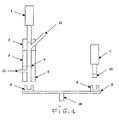
- the polymer granules in an amorphous state arrive via line (12) in the plasticizing chamber (3).
- the power supply (2) isolates the heating chamber (3) so as to plasticize the polymer at the last moment.
- the jack (1) makes it possible to push the polymer to be laminated.
- the die (4) comprises a multitude of small holes and opens into the chamber (5) for extracting volatile products, said chamber comprising a neutral gas inlet (11).
- the container (6) collects the plasticized polymer and the rotating disk (8) brings the container under the punch (13) of the stamping cylinder (7).
- the operating mode of the device is as follows.
- the amorphous PET granules arrive via the pipe (12) and they are heated to 220 ° C. in the chamber (3) thanks to the regulation of this chamber. What is needed is that the layer close to the die (4) is plasticized while the layer above just begins to plasticize.
- the cylinder (1) is operated downhill and moves the plasticized polymer through the die (4), so as to create a multitude of son. Nitrogen (11) arrives on these wires and carries or extracts the volatile compounds.
- the plasticized polymer falls into the container (6) and the cylinder (1) rises to fill the chamber and the next container.
- the container (9) previously filled is at the filling of the container (6) under the stamping cylinder and the punch (13) down to manufacture the preform and cool by means not shown.
- the disk (8) rotates about its axis (10) and thus makes it possible to manufacture preforms continuously.
- a compression plasticizing wheel (20) which rotates in the direction of the arrow (22).
- This wheel comprises 8 receptacles (21) for recovering plasticized polymer.
- each plasticizing head provides for example 1 g of amorphous PET in each container (21), which will make 7 g per container. It must of course always be considered that the 3 wheels (20, 24, 26) are rotating.
- the container in (37) it is emptied into a new container (23) and the transfer wheel (24) brings the container into position (38). From this position, the container is emptied into a new container (27) and the plasticized polymer is then stamped by the head (7, 13) of the figure 1 .
- the containers are emptied either by a gear pump or by a piston. There is provided on the latter wheel 8 stamping heads which rotate with the latter wheel (26). The preform thus obtained is rapidly cooled by means not shown and is ejected at (29).
- the Figure 2B is a simplification of the Figure 2A there is a compression plasticizing wheel (30) which rotates in the direction of the arrow (32).
- This wheel comprises 8 containers (31) for recovering plasticized polymer.
- the transfer wheel of the Figure 2A is deleted and in (33) the container is emptied into a container (34) and thus passes directly on the compression forming wheel (39), rotating in the direction of the arrow (35).
- each plasticizing head provides for example 1 g of amorphous PET in each container (31), which will make 7 g per container. It must of course always be considered that the two wheels (30, 39) are rotating.
- the container at (33) it is emptied into a new container (34) and the plasticized polymer is then stamped by the head (7, 13) of the figure 1 . It is provided on the latter wheel 8 stamping heads which rotate with the latter wheel (37). The preform thus obtained is rapidly cooled by means not shown and is ejected at (36).
- PET with an intrinsic viscosity of the order of 0.60 dl / g is used. It is fed into a plastification chamber regulated at 225 ° C. The polymer is swept with dried nitrogen and heated to between 225 and 240 ° C and 7 g of plasticized polymer is deposited in the container. The disc rotates at 12 revolutions / min, it contains 20 containers and allows to manufacture 14400 preforms per hour. The preforms thus produced are used to make 33 cl containers.
Landscapes
- Engineering & Computer Science (AREA)
- Mechanical Engineering (AREA)
- Processing And Handling Of Plastics And Other Materials For Molding In General (AREA)
- Blow-Moulding Or Thermoforming Of Plastics Or The Like (AREA)
Description
- La présent invention concerne un procédé de fabrication de préformes en matière plastique ainsi que le dispositif pour la mise en oeuvre dudit procédé.
- Les procédés actuels de fabrication de préformes sont basés sur l'utilisation de polymères cristallisés, qu'on extrude pour fondre au-delà de leur point de fusion et ensuite qu'on injecte dans un moule : c'est la méthode usuelle de fabrication des préformes en matière plastique. Il existe une seconde méthode connue de fabrication de préformes en matière plastique, dans laquelle on fond un polymère cristallisé dans une extrudeuse et ensuite on effectue un matriçage dudit polymère fondu, étape appelée aussi compression. Il existe déjà divers brevets basés sur cette approche, à savoir des brevets de
Toyo Seikan Kaisha US 6 349 838 , deSacmi WO 01/66327 Emery L. Valyi US 5 762 854 . Les inconvénients de cette seconde méthode est que l'on utilise un polymère cristallisé, ce qui signifie que l'on doit fournir une énergie élevée pour arriver à la fusion et qu'on utilise pour ladite fusion une extrudeuse classique. Il est aussi connu d'extruder de pièce en matière thermoplastique sous une atmosphère contrôlée par du gaz inerte, voirEP0 743160 . - Le but de la présente invention est de mettre au point un procédé de fabrication de préformes en matière plastique, dans lequel on économise de l'énergie, car au lieu de partir d'un polymère cristallisé, on part d'un polymère semi cristallin dans son état amorphe, ayant un point de plastification bien en dessous du point de fusion du même polymère dans son état cristallin. Outre le gain d'énergie permis par le procédé selon l'invention, celui-ci permet aussi de ménager le polymère utilisé, car il ne nécessite pas un fort taux de cisaillement. D'autre part, comme le polymère est dans l'état amorphe, il peut avoir une viscosité intrinsèque plus faible et il permettra donc en aval, lors de l'étape d'étirage-soufflage-moulage de faciliter ladite étape et de réaliser à nouveau des économies d'énergie.
- La présente invention concerne un procédé de fabrication d'une préforme à partir d'un polymère amorphe semi-cristallin à l'état amorphe à vitesse de cristallisation lente, dans lequel
- on plastifie ledit polymère par montée rapide en température, à une température inférieure à la température de fusion,
- on presse à travers une filière ledit polymère plastifié,
- on balaye à la sortie de la filière ledit polymère par un gaz neutre, sec et chaud,
- on recueille le polymère plastifié dans un premier récipient, tout en maintenant le polymère à la même température que celle de plastification dans toutes les étapes et
- on effectue un matriçage dans ledit premier récipient ou dans un second récipient, transféré du premier, sous refroidissement brutal de manière à obtenir la préforme dans un état amorphe.
- Par polymère semi-cristallin à vitesse de cristallisation lente à l'état amorphe, on entend un polymère thermoplastique semi-cristallin dont la température de cristallisation isothermique est comprise entre la température de transition vitreuse Tg et la température de fusion Tf, mais nettement inférieure à Tf. Par polymère semi-cristallin, on entend un polymère ayant un taux de cristallinité de l'ordre de 30 %. Les polymères utilisables selon la présente invention peuvent être tous polymères tombant dans cette catégorie. Comme examples possibles de polymères, on peut citer le Poly-Ethylène-Téréphthalate (PET), les Polyamides aromatiques (par exemple MXD6), le Poly-Ethylène-Naphthalate (PEN). De manière préférentielle,le procédé selon l'invention s'applique au PET.
- La première étape du procédé consiste à élever la température du polymère semi-cristallin à l'état amorphe de manière rapide pour plastifier ledit polymère. Cette étape de plastification est mise en oeuvre à une température du polymère comprise entre sa température de fusion et la température représentant la borne supérieure de la zone de cristallisation. Cette température est généralement bien inférieure à la température de fusion du polymère. Dans le cas préférentiel du PET, cette température de plastification est comprise entre 220 et 230 °C. Alors que pour le polymère cristallisé, la température de fusion est de l'ordre de 250 °C et sa zone de travail est de 280 °C. De manière plus préférentielle, on plastifie le PET amorphe à une température de l'ordre de 225 °C.
- Il est important dans le procédé selon l'invention de maintenir une température constante dans les étapes suivantes afin de ne pas provoquer une cristallisation isothermique ou une décomposition.
- Il est également important de plastifier rapidement pour les mêmes raisons qu'explicitées précédemment. Par exemple, dans les cas du PET, la montée en température doit être faite en une durée de l'ordre de la minute. Il est bien entendu possible de dépasser la minute, mais en aucun cas dépasser les 5 minutes.
- Lorsque le polymère est plastifié, la seconde étape consiste à presser ledit polymère à travers une filière. Cette filière n'est pas critique. De préférence, elle comporte une multitude d'ouvertures cylindriques de taille et de dimension adaptées au résultat voulu. Il ressort ainsi sous la filière des fils de polymère plastifié. La raison de ce pressage à travers la filière est de produire des fils fins, de manière à extraire avec un gaz neutre sec et chaud les produits volatils. Par produits volatils, on entend aussi bien l'eau que les aldéhydes (l'acétaldéhyde ou le formaldéhyde) et autres. Le gaz neutre utilisé selon la présente invention n'est pas critique. C'est par exemple de l'azote, du gaz carbonique et autres. De préférence, le gaz utilisé est de l'azote. Le gaz est normalement introduit sec et chaud sous faible pression. De préférence, on injecte le gaz à une pression minimale relative de l'ordre de 0,2 bar, à une température de 220 à 240 °C.
- Le polymère plastifié est pressé à travers la filière avec une pression qui n'est pas critique. Cependant, il est inutile de prévoir des pressions trop élevées. on opère de préférence selon l'invention à une pression inférieure à 100 bar. De préférence, la pression mise en oeuvre est de l'ordre de 50 bar.
Après le balayage avec un gaz neutre du polymère plastifié, on recueille ledit polymère dans un récipient. Il y a dans ce cas, deux posibilités. - La première consiste à effectuer le matriçage dans le même récipient, en refroidissant ensuite de la température de plastification à une température de l'ordre de 50 °C en dessous de la température de transition vitreuse. Le matériau utilisé pour ledit récipient doit être de faible inertie thermique et le récipient lui-même doit avoir une faible épaisseur, de manière à permettre un refroidissement rapide. Le matériau du récipient est thermoconducteur. De préférence, le matériau est un alliage métallique,par exemple un alliage cuivre-béryllium.
- La seconde solution consiste à transférer le polymère d'un premier récipient à un second récipient dans lequel on effectue le matriçage en refroidissant ensuite de la température de plastification à une température de l'ordre de 50 °C inférieure àla température de transition vitreuse. Le matériau utilisé dans ce cas pour le second récipient peut être différent que pour le récipient de la solution précédente. S'agissant du matériau du premier récipient, il s'agit dans ce cas d'un récipient métallique, par exemple en acier ou en aluminium.
- Dans les deux cas,après le matriçage, on effectue le refroidissement très rapide du polymère plastifié en une durée de l'ordre de la minute, par exemple entre 30 et 180 secondes.
- Il est bien entendu que le procédé selon l'invention permet aussi bien de fabriquer des préformes de quelques grammes que des préformes de quelques dizaines de grammes. Les conditions mentionnées ci-dessus restent valables aussi bien pour des petites que pour de plus grandes préformes.
- La présente invention concerne également un dispositif pour la mise en oeuvre du procédé décrit ci-dessus, ledit dispositif comprenant :
- une chambre de plastification du polymère semi-cristallin dans son état amorphe,
- des moyens de chauffage et de régulation de ladite chambre, autour de celle-ci,
- des moyens d'alimentation en polymère de ladite chambre,
- une filière sous la chambre de plastification,
- des moyens au dessus de ladite chambre pour pousser le polymère plastifié à travers la filière
- une arrivée de gaz neutre sous la filière et un dispositif pour sécher et chauffer le gaz,
- un récipient pour recueillir le polymère plastifié,
- un disque tournant comportant une pluralité de récipients et
- un poinçon de matriçage pour former la préforme.
- On peut envisager comme dispositif selon l'invention, un appareil permettant de produire entre 1000 et 10000 préformes à l'heure. La consommation du polymère est de l'ordre de 100 kg à plus de 1 tonne à l'heure.
- Les moyens de chauffage et de régulation peuvent être électriques ou tout autre moyen connu dans l'état de la technique.
- L'alimentation en granulés amorphes est assurée par un système traditionnel de trémie et couronne de répartition ou tout autre moyen d'alimentation. Les moyens pour pousser le polymère plastifié à travers la filière sont constitués par un vérin de poussée. Le disque comporte de manière générale de l'ordre de 10 à 100 récipients. Il tourne à une vitesse comprise entre 0,1 et 15 tours/min. Le poinçon de matriçage est actionné par un vérin de matriçage, dont la vitesse est adaptée à la vitesse de rotation du disque.
- Comme déjà mentionné ci-dessus, on peut envisager deux solution également pour le dispositif. La première consiste à remplir directement le récipient dans lequel on procédera au matriçage et la seconde est de prévoir un premier récipient de transfert et ensuite un second récipient dans lequel on procédera au matriçage. Ces deux solutions seront mieux explicitées ci-dessous en référence aux dessins, sur lesquels
-
Fig. 1 est une représentation schématique du procédé selon l'invention dans le premier mode de réalisation et -
Fig. 2A est une représentation schématique du dispositif selon l'invention dans un mode de réalisation industrielle et -
Fig. 2B est une représentation schématique du dispositif selon l'invention dans un second mode de réalisation industrielle. - Dans ces modes de réalisation, on prendra comme exemple le PET. Les granulés de polymère dans un état amorphe arrivent par la conduite (12) dans la chambre de plastification (3). Le bloc d'alimentation (2) permet d'isoler la chambre de chauffage (3) de manière à plastifier le polymère au dernier moment. Le verin (1) permet de pousser le polymère à plastifier. La filière (4) comprend une multitude de petits orifices et débouche dans la chambre (5) d'extraction des produits volatils, ladite chambre comprenant une arrivée de gaz neutre (11). Le récipient (6) recueille le polymère plastifié et le disque tournant (8) amène le récipient sous le poinçon (13) du vérin de matriçage (7).
- Le mode de fonctionnement du dispositif est le suivant. Les granulés de PET amorphe arrivent par la conduite (12) et il sont chauffés à 220 °C dans la chambre (3) grâce à la régulation de cette chambre. Ce qu'il faut , c'est que la couche proche de la filière (4) soit bien plastifié alors que la couche au dessus commence seulement à plastifier. Le vérin (1) est actionné en descente et déplace le polymère plastifié à travers la filière (4), de manière à créer une multitude de fils. L'azote (11) arrive sur ces fils et emporte ou extrait les composés volatils. Le polymère plastifié tombe dans le récipient (6) et le vérin (1) remonte pour remplir la chambre et le récipient suivant. Le récipient (9) rempli précédemment se trouve au moment du remplissage du récipient (6) sous le vérin de matriçage et le poinçon (13) descend pour fabriquer la préforme et la refroidir par des moyens non représentés. Le disque (8) tourne autour de son axe (10) et permet ainsi de fabriquer en continu des préformes.
- Dans le mode de réalisation du dispositif selon l'invention selon la
figure 2A , on dispose d'une roue de plastification par compression (20) qui tourne dans le sens de la flèche (22). Cette roue comporte 8 récipients (21) de récupération de polymère plastifié. Au dessus de ces récipients on dispose 7 têtes de plastification, comme l'une est représentée sur lafigure 1 , mais non représentées sur la présente figure. La roue de transfert (24), tournant dans le sens de la flèche (25), permet de transférer le polymère plastifié sur la roue de formage par compression (26). Cette dernière tourne dans le sens de la flèche (28). - Le fonctionnement du dispositif est le suivant : chaque tête de plastification fournit par exemple 1 g de PET amorphe dans chaque récipient (21), ce qui fera 7 g par récipient. Il faut bien sûr toujours considérer que les 3 roues (20, 24, 26) sont en mouvement de rotation. Pour le récipient qui se trouve en (37), il est vidé dans un nouveau récipient (23) et la roue de transfert (24) amène ce récipient en position (38). Depuis cette position, le récipient est vidé dans un nouveau récipient (27) et le polymère plastifié est alors matricé par la tête (7,13) de la
figure 1 . les récipients sont vidés soit par une pompe à engrenage, soit par un piston. Il est prévu sur cette dernière roue 8 têtes de matriçage qui tournent avec cette dernière roue (26). La préforme ainsi obtenue est refroidie rapidement par des moyens non représentés et elle est éjectée en (29). - La
figure 2B est une simplification de lafigure 2A , on dispose d'une roue de plastification par compression (30) qui tourne dans le sens de la flèche (32). Cette roue comporte 8 récipients (31) de récupération de polymère plastifié. Au dessus de ces récipients on dispose 7 têtes de plastification, comme l'une est représentée sur lafigure 1 , mais non représentées sur la présente figure. La roue de transfert de lafigure 2A est supprimée et en (33) le récipient est vidée dans un récipient (34) et passe donc directement sur la roue de formage par compression (39), tournant dans le sens de la flèche (35). - Le fonctionnement du dispositif est le suivant : chaque tête de plastification fournit par exemple 1 g de PET amorphe dans chaque récipient (31), ce qui fera 7 g par récipient. Il faut bien sûr toujours considérer que les 2 roues (30, 39) sont en mouvement de rotation. Pour le récipient qui se trouve en (33), il est vidé dans un nouveau récipient (34) et le polymère plastifié est alors matricé par la tête (7,13) de la
figure 1 . Il est prévu sur cette dernière roue 8 têtes de matriçage qui tournent avec cette dernière roue (37). La préforme ainsi obtenue est refroidie rapidement par des moyens non représentés et elle est éjectée en (36). - On utilise du PET ayant une viscosité intrinsèque de l'ordre de 0,60 dl/g. On l'améne dans une chambre de plastification régulée à 225 °C. On balaye le polymère avec de l'azote séché et chauffé entre 225 et 240 °C et on dépose dans le récipient 7 g de polymère plastifié. Le disque tourne à 12 tours/min, il comportent 20 récipients et permet de fabriquer 14400 préformes à l'heure. Les préformes ainsi produites sont utilisées pour faire des contenants de 33 cl.
Claims (14)
- Procédé de fabrication d'une préforme à partir d'un polymère amorphe semi-cristallin à l'état amorphe à vitesse de cristallisation lente, dans lequel- on plastifie ledit polymère par montée rapide en température, à une température inférieure à la température de fusion,- on presse à travers une filière (4) ledit polymère plastifié,- on balaye à la sortie de la filière ledit polymère par un gaz neutre (11), sec et chaud,- on recueille le polymère plastifié dans un premier récipient (6), tout en maintenant le polymère à la même température que celle de plastification dans toutes les étapes et- on effectue un matriçage (13) dans ledit premier récipient ou dans un second récipient, transféré du premier, sous refroidissement brutal de manière à obtenir la préforme dans un état amorphe.
- Procédé selon la revendication 1, caractérisé en ce que le polymère amorphe est choisi dans le groupe constitué par du PET, des polyamides aromatiques, du PEN, et autres.
- Procédé selon l'une des revendications 1 ou 2, caractérisé en que la plastification est effectuée à une température du polymère comprise entre sa température de fusion et la température représentant la borne supérieure de zone de cristallisation.
- Procédé selon la revendication 3, caractérisé en ce que le polymère est du PET et la température de plastification est comprise entre 220 et 230 °C.
- Procédé selon l'une des revendications 1 à 4, caractérisé en ce la plastification est effectuée en une durée de l'ordre de la minute.
- Procédé selon l'une des revendications 1 à 5, caractérisé en ce qu'on presse le polymère à travers une filière comportant une multitude d'ouvertures cylindriques identiques en taille et dimension.
- Procédé selon l'une des revendications 1 à 6, caractérisé en ce qu'on presse le polymère plastifié à une pression inférieure à 100 bar.
- Procédé selon la revendication 7, caractérisé en ce qu'on presse à une pression de l'ordre de 50 bar.
- Procédé selon l'une des revendications 1 à 8, caractérisé en ce qu'on balaye à la sortie de la filière avec un gaz choisi parmi l'azote, le gaz carbonique, ...
- Procédé selon la revendication 9, caractérisé en ce que le gaz est de l'azote introduit à une pression relative de l'ordre de 0,2 bar.
- Procédé selon l'une des revendications 1 à 10, caractérisé en qu'on effectue le matriçage dans le premier récipient, en refroidissant ensuite de la température de plastification à une température de l'ordre de 50 °C.
- Procédé selon l'une des revendications 1 à 10, caractérisé en ce qu'on transfère le polymère du premier récipient à un second récipient dans lequel on effectue le matriçage en refroidissant ensuite de la température de plastification à une température de l'ordre de 50 °C.
- Procédé selon l'une des revendications 11 ou 12, caractérisé en ce qu'on effectue le refroidissement en une durée de l'ordre de la minute.
- Dispositif pour la mise en oeuvre du procédé selon l'une des revendications 1 à 13, caractérisé en ce qu'il comprend :- une chambre de plastification (3) du polymère,- des moyens de chauffage de ladite chambre, autour de celle-ci,- des moyens d'alimentation (12) en polymère de ladite chambre,- une filière (4) sous la chambre de plastification,- des moyens (1) au dessus de ladite chambre pour pousser le polymère plastifié à travers la filière- une arrivée de gaz neutre (11) sous la filière,- un récipient (6) pour recueillir le polymère plastifié,- un disque tournant (8) comportant une pluralité de récipients et- un poinçon de matriçage (13) pour former la préforme.
Priority Applications (2)
| Application Number | Priority Date | Filing Date | Title |
|---|---|---|---|
| PL05747538T PL1755851T3 (pl) | 2004-05-11 | 2005-05-10 | Sposób i urządzenie do wytwarzania preform z tworzywa sztucznego |
| EP05747538A EP1755851B1 (fr) | 2004-05-11 | 2005-05-10 | Procede et dispositf de fabrication d'une preforme en matiere plastique |
Applications Claiming Priority (3)
| Application Number | Priority Date | Filing Date | Title |
|---|---|---|---|
| EP04011159A EP1600271A1 (fr) | 2004-05-11 | 2004-05-11 | Procédé et dispositif de fabrication d'une préforme en matière plastique |
| EP05747538A EP1755851B1 (fr) | 2004-05-11 | 2005-05-10 | Procede et dispositf de fabrication d'une preforme en matiere plastique |
| PCT/EP2005/005038 WO2005108043A1 (fr) | 2004-05-11 | 2005-05-10 | Procede et dispositif de fabrication d’une preforme en matiere plastique |
Publications (2)
| Publication Number | Publication Date |
|---|---|
| EP1755851A1 EP1755851A1 (fr) | 2007-02-28 |
| EP1755851B1 true EP1755851B1 (fr) | 2009-09-30 |
Family
ID=34924956
Family Applications (2)
| Application Number | Title | Priority Date | Filing Date |
|---|---|---|---|
| EP04011159A Withdrawn EP1600271A1 (fr) | 2004-05-11 | 2004-05-11 | Procédé et dispositif de fabrication d'une préforme en matière plastique |
| EP05747538A Expired - Lifetime EP1755851B1 (fr) | 2004-05-11 | 2005-05-10 | Procede et dispositf de fabrication d'une preforme en matiere plastique |
Family Applications Before (1)
| Application Number | Title | Priority Date | Filing Date |
|---|---|---|---|
| EP04011159A Withdrawn EP1600271A1 (fr) | 2004-05-11 | 2004-05-11 | Procédé et dispositif de fabrication d'une préforme en matière plastique |
Country Status (10)
| Country | Link |
|---|---|
| US (1) | US20070210471A1 (fr) |
| EP (2) | EP1600271A1 (fr) |
| AT (1) | ATE444150T1 (fr) |
| CA (1) | CA2566044C (fr) |
| DE (1) | DE602005016923D1 (fr) |
| ES (1) | ES2330455T3 (fr) |
| PL (1) | PL1755851T3 (fr) |
| PT (1) | PT1755851E (fr) |
| TW (1) | TW200600305A (fr) |
| WO (1) | WO2005108043A1 (fr) |
Families Citing this family (3)
| Publication number | Priority date | Publication date | Assignee | Title |
|---|---|---|---|---|
| GB2503258A (en) * | 2012-06-21 | 2013-12-25 | Oxford Plastic Sys Ltd | Moulding method |
| GB201223032D0 (en) * | 2012-12-20 | 2013-02-06 | Cytec Ind Inc | Method for forming shaped preform |
| CN107053723B (zh) * | 2017-05-31 | 2022-11-01 | 泉州三川机械有限公司 | 一种鞋衬高效加工机 |
Family Cites Families (14)
| Publication number | Priority date | Publication date | Assignee | Title |
|---|---|---|---|---|
| US3102304A (en) * | 1959-01-19 | 1963-09-03 | Morris Ltd Herbert | Injection moulding machine |
| CH437016A (fr) * | 1964-03-18 | 1967-05-31 | Aichele Marie Katherina | Machine pour constituer des joints d'étanchéité en matière plastique |
| US4363611A (en) * | 1979-09-05 | 1982-12-14 | Bethlehem Steel Corporation | Apparatus for hydrostatic extrusion of thermoplastic polymers |
| US4412797A (en) * | 1979-11-30 | 1983-11-01 | Japan Crown Cork, Co., Ltd. | Apparatus for forming a liner in a container closure |
| FR2658119B1 (fr) * | 1990-02-13 | 1992-06-05 | Sidel Sa | Procede et installation pour fabriquer des recipients, tels que des bouteilles, en polyethyleneterephtalate, resistant a des conditions thermiques relativement severes au cours de leur utilisation. |
| DE4231810A1 (de) * | 1992-09-23 | 1994-03-24 | Basf Magnetics Gmbh | Verfahren zum Heißverkleben von semikristallinen Polymeren mit Metallen |
| US5800757A (en) * | 1994-03-31 | 1998-09-01 | Modern Technologies Corp. | System and method for molding a basketball backboard |
| FR2734199B1 (fr) * | 1995-05-16 | 1997-08-01 | Ecia Equip Composants Ind Auto | Installation de fabrication de pieces de structure en matiere thermoplastique renforcee de fibres, notamment pour vehicules automobiles |
| US5788901A (en) * | 1996-04-30 | 1998-08-04 | Ecologix Corporation | Method and apparatus for molding continuous lengths of plastic |
| US6610408B1 (en) * | 1996-11-08 | 2003-08-26 | Solvay Engineered Polymers | TPO blends containing multimodal elastomers |
| US6270705B1 (en) * | 1999-02-16 | 2001-08-07 | Praxair Technology, Inc. | Method and system for inerting polymeric film producing machines |
| US6610398B1 (en) * | 2000-06-02 | 2003-08-26 | Biogeneral, Inc. | Haptic materials and process for preparation |
| ITBO20020225A1 (it) * | 2002-04-23 | 2003-10-23 | Sacmi | Apparecchiatura per lo stampaggio a compressione di articoli in materiale plastico |
| US7691305B2 (en) * | 2002-10-15 | 2010-04-06 | Dow Global Technologies, Inc. | Articles comprising a fiber-reinforced thermoplastic polymer composition |
-
2004
- 2004-05-11 EP EP04011159A patent/EP1600271A1/fr not_active Withdrawn
-
2005
- 2005-05-10 ES ES05747538T patent/ES2330455T3/es not_active Expired - Lifetime
- 2005-05-10 WO PCT/EP2005/005038 patent/WO2005108043A1/fr not_active Ceased
- 2005-05-10 AT AT05747538T patent/ATE444150T1/de not_active IP Right Cessation
- 2005-05-10 EP EP05747538A patent/EP1755851B1/fr not_active Expired - Lifetime
- 2005-05-10 DE DE602005016923T patent/DE602005016923D1/de not_active Expired - Lifetime
- 2005-05-10 CA CA2566044A patent/CA2566044C/fr not_active Expired - Fee Related
- 2005-05-10 US US11/569,053 patent/US20070210471A1/en not_active Abandoned
- 2005-05-10 PL PL05747538T patent/PL1755851T3/pl unknown
- 2005-05-10 PT PT05747538T patent/PT1755851E/pt unknown
- 2005-05-11 TW TW094115283A patent/TW200600305A/zh unknown
Also Published As
| Publication number | Publication date |
|---|---|
| TW200600305A (en) | 2006-01-01 |
| EP1600271A1 (fr) | 2005-11-30 |
| PL1755851T3 (pl) | 2010-02-26 |
| EP1755851A1 (fr) | 2007-02-28 |
| WO2005108043A1 (fr) | 2005-11-17 |
| CA2566044C (fr) | 2012-03-06 |
| US20070210471A1 (en) | 2007-09-13 |
| ATE444150T1 (de) | 2009-10-15 |
| DE602005016923D1 (de) | 2009-11-12 |
| ES2330455T3 (es) | 2009-12-10 |
| PT1755851E (pt) | 2009-10-29 |
| CA2566044A1 (fr) | 2005-11-17 |
Similar Documents
| Publication | Publication Date | Title |
|---|---|---|
| US8419997B2 (en) | Method and device for injection molding plastic material | |
| IE49941B1 (en) | Methods of and apparatus for producing a plastics moulding | |
| EP1529620A1 (fr) | Contenant en résine polyester, son procédé de fabrication et dispositif pour sa mise en oeuvre | |
| EP0541441A1 (fr) | Procédé de fabrication d'un produit composite par moulage | |
| WO2017212190A1 (fr) | Filament pour impression 3d, procede de fabrication d'un tel filament, et procede de fabrication d'un objet par impression 3d | |
| EP1755851B1 (fr) | Procede et dispositf de fabrication d'une preforme en matiere plastique | |
| US4189291A (en) | Apparatus and process for recovering scraps of thermoplastic material, even of heterogeneous shapes, by gradual melting and compression through one or more orifices | |
| WO2018055146A1 (fr) | Méthode de production d'un matériau densifié à partir d'un film complexe, installation de production et utilisation | |
| EP1955835A1 (fr) | Méthode de réalisation d'un objet multicouche | |
| CH457813A (fr) | Procédé de moulage d'un objet à partir d'une matière thermoélastiquement déformable et machine pour la mise en oeuvre de ce procédé | |
| FR2639867A1 (fr) | Procede d'estampage d'un materiau composite thermoplastique | |
| EP1370409B1 (fr) | Atelier et procede de fabrication de tubes souples en matiere plastique avec moulage de la tete sur la jupe effectuee par des outillages en mouvement continu | |
| CN108368683A (zh) | 源于回收塑料的热粘结多孔结构和制造方法 | |
| EP1133384B1 (fr) | Procede et installation pour la fabrication d'une preforme, mettant en oeuvre des moyens de sechage perfectionnes | |
| JP3578157B2 (ja) | ブロー成形用予備成形物を圧縮成形するための圧縮成形装置 | |
| FR2465586A1 (fr) | Procede et installation pour la fabrication d'objets moules en matieres thermoplastiques pouvant etre amenees a l'etat partiellement cristallise | |
| EP0239136B1 (fr) | Dispositif pour mouler par injection des préformes tubulaires en matière thermoplastique | |
| EP4410512B1 (fr) | Procédé pour la revalorisation des chutes de matériaux composites thermoplastiques | |
| CN1241723C (zh) | 用于高速生产需保持优异物理及机械特性的制品的压缩模塑方法 | |
| FR2512385A1 (fr) | Procede et appareillage pour la production d'articles creux biorentes | |
| WO2013136001A1 (fr) | Procédé de fabrication d'une pluralité de préformes d'éléments de renforcement | |
| FR2951105A1 (fr) | Procede et dispositif de compression-injection et piece d'habillage ou garniture pour automobile obtenue | |
| FR2868727A1 (fr) | Procede et dispositif d'extrusion-moulage de corps creux en matiere thermoplastique | |
| CN1232132A (zh) | 一种玻璃钢柱鞋的生产方法及其专用的模具 | |
| JP2000000848A (ja) | 射出成形装置、再生樹脂製造装置、射出成形方法、再生樹脂製造方法、射出成形物品及び再生樹脂 |
Legal Events
| Date | Code | Title | Description |
|---|---|---|---|
| PUAI | Public reference made under article 153(3) epc to a published international application that has entered the european phase |
Free format text: ORIGINAL CODE: 0009012 |
|
| 17P | Request for examination filed |
Effective date: 20061211 |
|
| AK | Designated contracting states |
Kind code of ref document: A1 Designated state(s): AT BE BG CH CY CZ DE DK EE ES FI FR GB GR HU IE IS IT LI LT LU MC NL PL PT RO SE SI SK TR |
|
| DAX | Request for extension of the european patent (deleted) | ||
| RAP1 | Party data changed (applicant data changed or rights of an application transferred) |
Owner name: NESTLE WATERS MANAGEMENT & TECHNOLOGY |
|
| GRAP | Despatch of communication of intention to grant a patent |
Free format text: ORIGINAL CODE: EPIDOSNIGR1 |
|
| RIC1 | Information provided on ipc code assigned before grant |
Ipc: B29C 43/34 20060101AFI20090519BHEP Ipc: B29C 31/06 20060101ALI20090519BHEP Ipc: B29C 31/04 20060101ALI20090519BHEP |
|
| GRAC | Information related to communication of intention to grant a patent modified |
Free format text: ORIGINAL CODE: EPIDOSCIGR1 |
|
| GRAC | Information related to communication of intention to grant a patent modified |
Free format text: ORIGINAL CODE: EPIDOSCIGR1 |
|
| GRAS | Grant fee paid |
Free format text: ORIGINAL CODE: EPIDOSNIGR3 |
|
| GRAA | (expected) grant |
Free format text: ORIGINAL CODE: 0009210 |
|
| AK | Designated contracting states |
Kind code of ref document: B1 Designated state(s): AT BE BG CH CY CZ DE DK EE ES FI FR GB GR HU IE IS IT LI LT LU MC NL PL PT RO SE SI SK TR |
|
| REG | Reference to a national code |
Ref country code: GB Ref legal event code: FG4D Free format text: NOT ENGLISH Ref country code: CH Ref legal event code: EP |
|
| REG | Reference to a national code |
Ref country code: IE Ref legal event code: FG4D |
|
| REG | Reference to a national code |
Ref country code: PT Ref legal event code: SC4A Free format text: AVAILABILITY OF NATIONAL TRANSLATION Effective date: 20091022 |
|
| REF | Corresponds to: |
Ref document number: 602005016923 Country of ref document: DE Date of ref document: 20091112 Kind code of ref document: P |
|
| REG | Reference to a national code |
Ref country code: ES Ref legal event code: FG2A Ref document number: 2330455 Country of ref document: ES Kind code of ref document: T3 |
|
| REG | Reference to a national code |
Ref country code: GR Ref legal event code: EP Ref document number: 20090403123 Country of ref document: GR |
|
| PG25 | Lapsed in a contracting state [announced via postgrant information from national office to epo] |
Ref country code: SE Free format text: LAPSE BECAUSE OF FAILURE TO SUBMIT A TRANSLATION OF THE DESCRIPTION OR TO PAY THE FEE WITHIN THE PRESCRIBED TIME-LIMIT Effective date: 20090930 Ref country code: FI Free format text: LAPSE BECAUSE OF FAILURE TO SUBMIT A TRANSLATION OF THE DESCRIPTION OR TO PAY THE FEE WITHIN THE PRESCRIBED TIME-LIMIT Effective date: 20090930 |
|
| PG25 | Lapsed in a contracting state [announced via postgrant information from national office to epo] |
Ref country code: SI Free format text: LAPSE BECAUSE OF FAILURE TO SUBMIT A TRANSLATION OF THE DESCRIPTION OR TO PAY THE FEE WITHIN THE PRESCRIBED TIME-LIMIT Effective date: 20090930 |
|
| REG | Reference to a national code |
Ref country code: PL Ref legal event code: T3 |
|
| PG25 | Lapsed in a contracting state [announced via postgrant information from national office to epo] |
Ref country code: EE Free format text: LAPSE BECAUSE OF FAILURE TO SUBMIT A TRANSLATION OF THE DESCRIPTION OR TO PAY THE FEE WITHIN THE PRESCRIBED TIME-LIMIT Effective date: 20090930 Ref country code: IS Free format text: LAPSE BECAUSE OF FAILURE TO SUBMIT A TRANSLATION OF THE DESCRIPTION OR TO PAY THE FEE WITHIN THE PRESCRIBED TIME-LIMIT Effective date: 20100130 Ref country code: RO Free format text: LAPSE BECAUSE OF FAILURE TO SUBMIT A TRANSLATION OF THE DESCRIPTION OR TO PAY THE FEE WITHIN THE PRESCRIBED TIME-LIMIT Effective date: 20090930 Ref country code: CZ Free format text: LAPSE BECAUSE OF FAILURE TO SUBMIT A TRANSLATION OF THE DESCRIPTION OR TO PAY THE FEE WITHIN THE PRESCRIBED TIME-LIMIT Effective date: 20090930 |
|
| REG | Reference to a national code |
Ref country code: IE Ref legal event code: FD4D |
|
| PG25 | Lapsed in a contracting state [announced via postgrant information from national office to epo] |
Ref country code: SK Free format text: LAPSE BECAUSE OF FAILURE TO SUBMIT A TRANSLATION OF THE DESCRIPTION OR TO PAY THE FEE WITHIN THE PRESCRIBED TIME-LIMIT Effective date: 20090930 Ref country code: CY Free format text: LAPSE BECAUSE OF FAILURE TO SUBMIT A TRANSLATION OF THE DESCRIPTION OR TO PAY THE FEE WITHIN THE PRESCRIBED TIME-LIMIT Effective date: 20090930 |
|
| PG25 | Lapsed in a contracting state [announced via postgrant information from national office to epo] |
Ref country code: AT Free format text: LAPSE BECAUSE OF FAILURE TO SUBMIT A TRANSLATION OF THE DESCRIPTION OR TO PAY THE FEE WITHIN THE PRESCRIBED TIME-LIMIT Effective date: 20090930 |
|
| PG25 | Lapsed in a contracting state [announced via postgrant information from national office to epo] |
Ref country code: DK Free format text: LAPSE BECAUSE OF FAILURE TO SUBMIT A TRANSLATION OF THE DESCRIPTION OR TO PAY THE FEE WITHIN THE PRESCRIBED TIME-LIMIT Effective date: 20090930 Ref country code: IE Free format text: LAPSE BECAUSE OF FAILURE TO SUBMIT A TRANSLATION OF THE DESCRIPTION OR TO PAY THE FEE WITHIN THE PRESCRIBED TIME-LIMIT Effective date: 20090930 |
|
| PLBE | No opposition filed within time limit |
Free format text: ORIGINAL CODE: 0009261 |
|
| STAA | Information on the status of an ep patent application or granted ep patent |
Free format text: STATUS: NO OPPOSITION FILED WITHIN TIME LIMIT |
|
| 26N | No opposition filed |
Effective date: 20100701 |
|
| BERE | Be: lapsed |
Owner name: NESTLE WATERS MANAGEMENT & TECHNOLOGY Effective date: 20100531 |
|
| PG25 | Lapsed in a contracting state [announced via postgrant information from national office to epo] |
Ref country code: MC Free format text: LAPSE BECAUSE OF NON-PAYMENT OF DUE FEES Effective date: 20100531 |
|
| PG25 | Lapsed in a contracting state [announced via postgrant information from national office to epo] |
Ref country code: BE Free format text: LAPSE BECAUSE OF NON-PAYMENT OF DUE FEES Effective date: 20100531 |
|
| PGFP | Annual fee paid to national office [announced via postgrant information from national office to epo] |
Ref country code: PL Payment date: 20110407 Year of fee payment: 7 |
|
| PGFP | Annual fee paid to national office [announced via postgrant information from national office to epo] |
Ref country code: DE Payment date: 20120502 Year of fee payment: 8 Ref country code: NL Payment date: 20120515 Year of fee payment: 8 Ref country code: CH Payment date: 20120514 Year of fee payment: 8 Ref country code: TR Payment date: 20120413 Year of fee payment: 8 Ref country code: LT Payment date: 20120416 Year of fee payment: 8 |
|
| PGFP | Annual fee paid to national office [announced via postgrant information from national office to epo] |
Ref country code: GR Payment date: 20120417 Year of fee payment: 8 Ref country code: GB Payment date: 20120509 Year of fee payment: 8 Ref country code: FR Payment date: 20120608 Year of fee payment: 8 |
|
| PG25 | Lapsed in a contracting state [announced via postgrant information from national office to epo] |
Ref country code: BG Free format text: LAPSE BECAUSE OF FAILURE TO SUBMIT A TRANSLATION OF THE DESCRIPTION OR TO PAY THE FEE WITHIN THE PRESCRIBED TIME-LIMIT Effective date: 20090930 Ref country code: LU Free format text: LAPSE BECAUSE OF NON-PAYMENT OF DUE FEES Effective date: 20100510 Ref country code: HU Free format text: LAPSE BECAUSE OF FAILURE TO SUBMIT A TRANSLATION OF THE DESCRIPTION OR TO PAY THE FEE WITHIN THE PRESCRIBED TIME-LIMIT Effective date: 20100401 |
|
| PGFP | Annual fee paid to national office [announced via postgrant information from national office to epo] |
Ref country code: IT Payment date: 20120516 Year of fee payment: 8 |
|
| PGFP | Annual fee paid to national office [announced via postgrant information from national office to epo] |
Ref country code: ES Payment date: 20120607 Year of fee payment: 8 |
|
| PGFP | Annual fee paid to national office [announced via postgrant information from national office to epo] |
Ref country code: PT Payment date: 20120509 Year of fee payment: 8 |
|
| REG | Reference to a national code |
Ref country code: PT Ref legal event code: MM4A Free format text: LAPSE DUE TO NON-PAYMENT OF FEES Effective date: 20131111 |
|
| REG | Reference to a national code |
Ref country code: NL Ref legal event code: V1 Effective date: 20131201 |
|
| REG | Reference to a national code |
Ref country code: LT Ref legal event code: MM4D Effective date: 20130510 |
|
| REG | Reference to a national code |
Ref country code: CH Ref legal event code: PL |
|
| GBPC | Gb: european patent ceased through non-payment of renewal fee |
Effective date: 20130510 |
|
| PG25 | Lapsed in a contracting state [announced via postgrant information from national office to epo] |
Ref country code: PT Free format text: LAPSE BECAUSE OF NON-PAYMENT OF DUE FEES Effective date: 20131111 Ref country code: DE Free format text: LAPSE BECAUSE OF NON-PAYMENT OF DUE FEES Effective date: 20131203 Ref country code: LT Free format text: LAPSE BECAUSE OF NON-PAYMENT OF DUE FEES Effective date: 20130510 Ref country code: CH Free format text: LAPSE BECAUSE OF NON-PAYMENT OF DUE FEES Effective date: 20130531 Ref country code: LI Free format text: LAPSE BECAUSE OF NON-PAYMENT OF DUE FEES Effective date: 20130531 |
|
| REG | Reference to a national code |
Ref country code: GR Ref legal event code: ML Ref document number: 20090403123 Country of ref document: GR Effective date: 20131204 |
|
| REG | Reference to a national code |
Ref country code: DE Ref legal event code: R119 Ref document number: 602005016923 Country of ref document: DE Effective date: 20131203 |
|
| PG25 | Lapsed in a contracting state [announced via postgrant information from national office to epo] |
Ref country code: NL Free format text: LAPSE BECAUSE OF NON-PAYMENT OF DUE FEES Effective date: 20131201 Ref country code: GR Free format text: LAPSE BECAUSE OF NON-PAYMENT OF DUE FEES Effective date: 20131204 Ref country code: IT Free format text: LAPSE BECAUSE OF NON-PAYMENT OF DUE FEES Effective date: 20130510 |
|
| REG | Reference to a national code |
Ref country code: FR Ref legal event code: ST Effective date: 20140131 |
|
| PG25 | Lapsed in a contracting state [announced via postgrant information from national office to epo] |
Ref country code: GB Free format text: LAPSE BECAUSE OF NON-PAYMENT OF DUE FEES Effective date: 20130510 |
|
| PG25 | Lapsed in a contracting state [announced via postgrant information from national office to epo] |
Ref country code: FR Free format text: LAPSE BECAUSE OF NON-PAYMENT OF DUE FEES Effective date: 20130531 |
|
| REG | Reference to a national code |
Ref country code: ES Ref legal event code: FD2A Effective date: 20140610 |
|
| PG25 | Lapsed in a contracting state [announced via postgrant information from national office to epo] |
Ref country code: PL Free format text: LAPSE BECAUSE OF NON-PAYMENT OF DUE FEES Effective date: 20130510 Ref country code: ES Free format text: LAPSE BECAUSE OF NON-PAYMENT OF DUE FEES Effective date: 20130511 |
|
| REG | Reference to a national code |
Ref country code: PL Ref legal event code: LAPE |
|
| PG25 | Lapsed in a contracting state [announced via postgrant information from national office to epo] |
Ref country code: TR Free format text: LAPSE BECAUSE OF NON-PAYMENT OF DUE FEES Effective date: 20130510 |