EP1764037A1 - Dispositif pour l'extraction de liquides corporels aux fins d'analyse - Google Patents
Dispositif pour l'extraction de liquides corporels aux fins d'analyse Download PDFInfo
- Publication number
- EP1764037A1 EP1764037A1 EP05020062A EP05020062A EP1764037A1 EP 1764037 A1 EP1764037 A1 EP 1764037A1 EP 05020062 A EP05020062 A EP 05020062A EP 05020062 A EP05020062 A EP 05020062A EP 1764037 A1 EP1764037 A1 EP 1764037A1
- Authority
- EP
- European Patent Office
- Prior art keywords
- movement
- lancing
- drive
- piercing
- wire
- Prior art date
- Legal status (The legal status is an assumption and is not a legal conclusion. Google has not performed a legal analysis and makes no representation as to the accuracy of the status listed.)
- Withdrawn
Links
Images

Classifications
-
- A—HUMAN NECESSITIES
- A61—MEDICAL OR VETERINARY SCIENCE; HYGIENE
- A61B—DIAGNOSIS; SURGERY; IDENTIFICATION
- A61B5/00—Measuring for diagnostic purposes; Identification of persons
- A61B5/15—Devices for taking samples of blood
- A61B5/151—Devices specially adapted for taking samples of capillary blood, e.g. by lancets, needles or blades
- A61B5/15186—Devices loaded with a single lancet, i.e. a single lancet with or without a casing is loaded into a reusable drive device and then discarded after use; drive devices reloadable for multiple use
- A61B5/15188—Constructional features of reusable driving devices
- A61B5/15192—Constructional features of reusable driving devices comprising driving means, e.g. a spring, for retracting the lancet unit into the driving device housing
- A61B5/15194—Constructional features of reusable driving devices comprising driving means, e.g. a spring, for retracting the lancet unit into the driving device housing fully automatically retracted, i.e. the retraction does not require a deliberate action by the user, e.g. by terminating the contact with the patient's skin
-
- A—HUMAN NECESSITIES
- A61—MEDICAL OR VETERINARY SCIENCE; HYGIENE
- A61B—DIAGNOSIS; SURGERY; IDENTIFICATION
- A61B5/00—Measuring for diagnostic purposes; Identification of persons
- A61B5/15—Devices for taking samples of blood
- A61B5/150007—Details
- A61B5/150015—Source of blood
- A61B5/150022—Source of blood for capillary blood or interstitial fluid
-
- A—HUMAN NECESSITIES
- A61—MEDICAL OR VETERINARY SCIENCE; HYGIENE
- A61B—DIAGNOSIS; SURGERY; IDENTIFICATION
- A61B5/00—Measuring for diagnostic purposes; Identification of persons
- A61B5/15—Devices for taking samples of blood
- A61B5/150007—Details
- A61B5/150175—Adjustment of penetration depth
-
- A—HUMAN NECESSITIES
- A61—MEDICAL OR VETERINARY SCIENCE; HYGIENE
- A61B—DIAGNOSIS; SURGERY; IDENTIFICATION
- A61B5/00—Measuring for diagnostic purposes; Identification of persons
- A61B5/15—Devices for taking samples of blood
- A61B5/150007—Details
- A61B5/150374—Details of piercing elements or protective means for preventing accidental injuries by such piercing elements
- A61B5/150381—Design of piercing elements
- A61B5/150412—Pointed piercing elements, e.g. needles, lancets for piercing the skin
-
- A—HUMAN NECESSITIES
- A61—MEDICAL OR VETERINARY SCIENCE; HYGIENE
- A61B—DIAGNOSIS; SURGERY; IDENTIFICATION
- A61B5/00—Measuring for diagnostic purposes; Identification of persons
- A61B5/15—Devices for taking samples of blood
- A61B5/150007—Details
- A61B5/150374—Details of piercing elements or protective means for preventing accidental injuries by such piercing elements
- A61B5/150381—Design of piercing elements
- A61B5/150503—Single-ended needles
-
- A—HUMAN NECESSITIES
- A61—MEDICAL OR VETERINARY SCIENCE; HYGIENE
- A61B—DIAGNOSIS; SURGERY; IDENTIFICATION
- A61B5/00—Measuring for diagnostic purposes; Identification of persons
- A61B5/15—Devices for taking samples of blood
- A61B5/151—Devices specially adapted for taking samples of capillary blood, e.g. by lancets, needles or blades
- A61B5/15101—Details
- A61B5/15103—Piercing procedure
- A61B5/15107—Piercing being assisted by a triggering mechanism
- A61B5/15113—Manually triggered, i.e. the triggering requires a deliberate action by the user such as pressing a drive button
-
- A—HUMAN NECESSITIES
- A61—MEDICAL OR VETERINARY SCIENCE; HYGIENE
- A61B—DIAGNOSIS; SURGERY; IDENTIFICATION
- A61B5/00—Measuring for diagnostic purposes; Identification of persons
- A61B5/15—Devices for taking samples of blood
- A61B5/151—Devices specially adapted for taking samples of capillary blood, e.g. by lancets, needles or blades
- A61B5/15101—Details
- A61B5/15115—Driving means for propelling the piercing element to pierce the skin, e.g. comprising mechanisms based on shape memory alloys, magnetism, solenoids, piezoelectric effect, biased elements, resilient elements, vacuum or compressed fluids
- A61B5/15119—Driving means for propelling the piercing element to pierce the skin, e.g. comprising mechanisms based on shape memory alloys, magnetism, solenoids, piezoelectric effect, biased elements, resilient elements, vacuum or compressed fluids comprising shape memory alloys
-
- A—HUMAN NECESSITIES
- A61—MEDICAL OR VETERINARY SCIENCE; HYGIENE
- A61B—DIAGNOSIS; SURGERY; IDENTIFICATION
- A61B5/00—Measuring for diagnostic purposes; Identification of persons
- A61B5/15—Devices for taking samples of blood
- A61B5/151—Devices specially adapted for taking samples of capillary blood, e.g. by lancets, needles or blades
- A61B5/15101—Details
- A61B5/15126—Means for controlling the lancing movement, e.g. 2D- or 3D-shaped elements, tooth-shaped elements or sliding guides
- A61B5/15128—Means for controlling the lancing movement, e.g. 2D- or 3D-shaped elements, tooth-shaped elements or sliding guides comprising 2D- or 3D-shaped elements, e.g. cams, curved guide rails or threads
-
- A—HUMAN NECESSITIES
- A61—MEDICAL OR VETERINARY SCIENCE; HYGIENE
- A61B—DIAGNOSIS; SURGERY; IDENTIFICATION
- A61B5/00—Measuring for diagnostic purposes; Identification of persons
- A61B5/15—Devices for taking samples of blood
- A61B5/151—Devices specially adapted for taking samples of capillary blood, e.g. by lancets, needles or blades
- A61B5/15186—Devices loaded with a single lancet, i.e. a single lancet with or without a casing is loaded into a reusable drive device and then discarded after use; drive devices reloadable for multiple use
- A61B5/15188—Constructional features of reusable driving devices
- A61B5/1519—Constructional features of reusable driving devices comprising driving means, e.g. a spring, for propelling the piercing unit
Definitions
- the invention relates to a device for obtaining body fluid for analysis purposes with a pierceable into a body part lancing element and a drive for a forward and backward lancing movement of the lancing element.
- Such removal systems for small amounts of body fluid are used primarily by diabetics for daily repeated blood sugar self-monitoring in the context of insulin treatment.
- For the extraction of capillary blood it is necessary to create a skin opening through a puncture, the puncture pain and scarring should be reduced as much as possible and at the same time a hygienic procedure should be guaranteed. So that the required steps can be made easily and quickly by laypersons, it is desirable to realize a largely automatic measurement procedure in a compact hand-held device.
- the conventional lancing devices provide spring-driven lancing drives, which are characterized by a fast removal rate of stored energy.
- complex motion control is involved necessary to ensure a high level of process safety, especially for small quantities removed.
- the object of the invention is to avoid the disadvantages which have arisen in the prior art and to enable optimized extraction of body fluid with simple means.
- the invention is based on the idea to provide a highly dynamic drive with high energy density for a controlled reciprocation. Accordingly, the invention proposes that the drive has at least one actuator wire based on shape memory alloys for controlling the piercing movement via a change in the wire length.
- Such so-called SMA actuators are characterized by miniaturization and direct generation of linear movements. While with conventional stacked SMA actuators a forward and subsequent return movement of a lancing unit can not be realized in practice, it has surprisingly been found that the energy extraction speeds and movement amplitudes of SMA wire actuators are sufficient to realize a highly dynamic movement for a lancing and collecting function. By simple thermal influence, a linear lancing movement can be generated, wherein the small amount of heat required to heat the thin wire material, allows a fast movement.
- an advantageous embodiment provides that the actuator wire forms a feed means for the forward movement of the lancing element by heat-activated contraction. It can be realized just by the wire design, the short periods of time and sufficient Einstechtiefen.
- Embodiments in which the drive has a motion converter arranged between the actuator wire and the piercing element for converting a change in length of the actuator wire into the piercing movement are particularly preferred. In this way, complex motion profiles can be represented, as they are advantageous for a combined piercing and collecting function.
- the drive comprises a heating unit for heating the actuator wire to a heating temperature causing the contraction of the shape memory alloy.
- a heating unit for heating the actuator wire to a heating temperature causing the contraction of the shape memory alloy.
- the actuator wire can be heated preferably by displaceable electrical contact points over a variable length.
- One type of hybrid drive can be realized by means of a restoring means which can be prestressed during the forward movement of the piercing element, in particular a return spring for the return movement of the piercing element.
- a particularly preferred embodiment provides that the or an actuator wire as a braking means brakes the return movement of the lancing element.
- the blood intake can be favorably influenced by slow retraction of the lancing element.
- a further advantageous variant provides two alternately contractible actuator wires for the alternating control of the lancing movements in successive cycles.
- a wire material is not mandatory for such an embodiment, so that an aspect of the invention is also the fact that the drive has two alternately contractible actuators based on shape memory alloys for alternating control of lancing in successive cycles.
- a further improvement provides that an actuator wire drives the forward movement of the piercing element under contraction and the other actuator wire brakes the backward movement under expansion.
- the actuator wire acting as a brake means it is possible for the actuator wire acting as a brake means to be shortened in a targeted manner by preheating to a microstructure transformation temperature of the shape memory alloy and to be correspondingly extendable while cooling.
- the actuator wire acting as the brake means is preheated in sections.
- the actuator wire acts as a braking means by tension-induced phase transformation of the shape memory alloy.
- the drive comprises a toggle lever mechanism which can be stretched in the axis of the lancing movement.
- a movement cycle can be realized in that the toggle mechanism can be brought by the Aktuatordraht in an extended position and by a biased in the extended position return element in a bending position.
- the bearing point of a pivot bearing remote from the lancing element of the toggle mechanism in the lancing axis be adjustable.
- a slowing down of the return movement of the piercing element can also be realized by a damping element designed in particular as a piston-cylinder unit.
- the diameter of the actuator wire is less than 1 mm, preferably less than 0.5 mm.
- the shape memory alloy formed in particular as a nickel-titanium alloy has a transformation temperature of more than 100 ° C.
- the actuator wire has a plurality of wire sections guided over deflection means and running side by side.
- the actuator wire consists of a plurality of mutually parallel individual wires.
- the forward movement of the lancing element to create a skin puncture is at least an order of magnitude faster than the return movement for collecting body fluid.
- a further aspect of the invention comprises a body fluid sampling device in which the drive has an EAP actuator formed by electro-active polymers (EAP).
- EAP electro-active polymers
- the EAP actuator has an elastomer element arranged between two electrodes which can be acted upon by high voltage, wherein a deformation of the elastomer element caused by electrostatic attraction of the electrodes can be converted into the lancing movement.
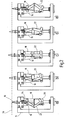
- the lancing devices for obtaining small amounts of blood for blood sugar tests shown in the drawing comprise a lancing element 10 pierceable in a body part (not shown, for example), a drive 12 for a forward and backward lancing movement of lancing element 10 and a receptacle 14 for the drive and the linear guide of the lancing element.
- Fig. 1 shows a test setup for a means of two Aktuatordrumbleten 16, 18 based on shape memory alloys (Shape Memory Alloys, short: SMA) aktuierbaren Drive 12.
- shape memory alloys Shape Memory Alloys, short: SMA
- SMA actuators experience a change in shape when reaching a certain transition temperature, especially a shortening of the wire length, which can be exploited to produce a lancing or collecting movement.
- the drive 12 comprises a toggle lever mechanism 22 which can be stretched in the axis 20 of the lancing movement as a motion converter. This can be brought into the extended position by the alternately contractible actuator wires 16, 18 in successive puncturing cycles, wherein a tensioned return spring 24 in each case again ensures the return to the flexion position.
- a damping cylinder 26 cause additional damping of the return movement.
- the damping cylinder 26 has a valve 28 which controls the direction of damping, so that an undamped fast forward movement and a damped slower return movement of the guided in the cylinder piston rod 30 is achieved.
- the Aktuatordrumblete 16, 18 are clamped at their ends on clamping pieces 32 on the receiving side and thereby electrically contacted via connecting sockets 34.
- a center piece of the actuator wires 16, 18 is guided via a deflection pin 36 at each of a leg end of a T-arm 38 of the toggle mechanism 22, so that a large wire length is achieved by two adjacent wire sections.
- the wire diameter can be less than 0.5 mm are selected.
- a nickel-titanium alloy in particular nickel-titanium-hafnium or nickel-titanium-zirconium with a transformation temperature of more than 100 ° C can be used as wire material.
- the toggle mechanism has two parallel toggle mechanisms 22, which are pivotally connected via a distal pivot bearing 40 to a collar 42 of the rod 30 and are supported fixed by a proximal abutment 44 at the piercing, wherein the knee lever 46, 48 connecting the knee joint 50 oscillates freely ,
- the piercing depth of the lancing element 10 can be adjusted by means of an adjusting device 52, which determines the position of the abutment 44 bearing cylinder 26 in the direction of the piercing axis 20.
- the actuator wires 16, 18 are provided for a mutual drive, wherein in the position shown in Fig. 1, the wire 16 by heat-activated contraction forms an advancing means for the forward movement of the lancing element 10, while the other wire 18 under expansion the return movement the piercing element 10 brakes or dampens.
- the braking wire 18 may have a over the deflection point 36 standing-over loop 54, so that the braking intervention is delayed after a certain return stroke.
- FIG. 2 The sequence of the piercing movement is illustrated in FIG. 2 in various positions.
- the upper wire 16 is stretched and the lower wire 18 relaxed.
- the lancing element 10 is located with its tip in the zero position 56 of the piercing stroke. Then, the wire 16 is heated by a rush current. Upon reaching the forming temperature, the wire 16 contracts and the lancing element 10 moves forward ( Figure 2b).
- the maximum feed position is achieved in the extended position of the toggle mechanism 22 (FIG. 2 c), in which also the restoring spring 24 is maximally tensioned. Then, the wire 16 does not shorten much further, and the toggle mechanism oscillates under the force of the return spring 24 in the opposite buckling position Fig.
- the further return movement of the lancing element 10 is delayed so as to ensure a sufficient collection time for blood uptake via an integrated in the lancing element, not specifically shown collection channel.
- a quick pain-free puncture can be combined with a collection period of at least one order of magnitude slower in one motion sequence, until finally the end position FIG. 2e is reached.
- the wire 16 can cool slowly while the wire 18 is stretched for the next puncture cycle, without any user intervention would be required.
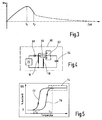
- FIG. 3 again illustrates the sequence of the puncturing movement in a path-time diagram.
- the fast puncture phase runs until a time t1 in which the maximum puncture depth is reached.
- t1 may be a few milliseconds and the piercing depth a few millimeters.
- an initial rapid return movement takes place up to the time t2, from which the body fluid is slowly absorbed in a suitable retracted collecting depth.
- This collection phase can be in the range of seconds, so that only by capillary action a sufficient amount of liquid is obtained.
- the drive has an electric heating unit 60, which may be designed in accordance with the circuit example FIG. 4.
- the capacitor 64 is charged in series with the resistor 66 and the diode 68 from the voltage source 70, specifically a battery.
- the capacitor 64 can then be discharged via the wire 16, wherein the generated current surge due to the low heat capacity of the thin wire, the heating in a very short period of time is possible. Subsequently, the capacitor 64 is recharged in the zero position, so that in the lower Switch position now the other wire 18 can be activated.
- the second SMA wire 16, 18 used in each case as a braking means can be preheated to a certain preload length.
- the driven by the return spring 24 return movement is then decelerated prematurely and delayed by cooling the wire in question. This can be achieved by controlled heating of the shape memory alloy in the microstructure temperature band or by part heating only a portion of the wire length.
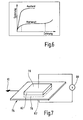
- a typical hysteresis cycle for the temperature-dependent transformation of a shape memory alloy is shown in FIG.
- a phase transition takes place in the metallurgical structure from the martensitic to the austenitic form.
- the reverse transition on cooling is characterized by a hysteretic behavior of the structure-temperature relationship according to curve 72.
- a recovery of tension occurs in the austenite phase and concomitantly a contraction into a "remembered" form.
- the wire length can be deliberately shortened by corresponding expansion to brake during braking the return movement of the lancing element.
- the problem here is the influence of the ambient temperature, which can be minimized by suitable heat insulation of the wire or by choosing a material with high transformation temperature.
- SMA materials exhibit a superelastic behavior under deformation. This effect is caused by stress-induced martensite formation (English: “stress-induced martensite formation”). Because the martensite fraction has been formed above its normal temperature, it immediately converts to undeformed austenite as soon as the external stress ceases. This material property can also be used to return the lancing element 10 without great vibrations dampen. For this purpose, the wire material only has to be heated in the area 74 before the mechanical load is applied, so that this damping then starts.
- the martensite phase has quasi-ideal damping in the expansion interval indicated by dashed lines, which is likewise usable for slowing down the return movement of lancing element 10.
- EAP actuator 76 formed by electro-active polymers (EAP).
- EAP dielectric actuator As an EAP dielectric actuator, this has two opposing surface electrodes 78, which are connected via a suitable voltage source 80 can be acted upon by high voltage.
- the actuator principle is based on a highly dynamic deformation of this elastomeric block 82 when connecting the high voltage to the electrodes 78th These then attract due to electrostatic interaction, whereby the incompressible elastomeric material under transverse deformation of an expansion in the flat configuration 82 'learns.
- elastic electrodes 78 Prerequisite for this are elastic electrodes 78, which is the surface area be able to record.
- the transverse deformation can be used for a linear lancing movement of the lancing element 10.
- a suitable geometry of the elastomer element and the coupling of the lancing element By a suitable geometry of the elastomer element and the coupling of the lancing element, a large stroke in the lancing axis can be achieved.
- Capacitance measurement across the electrodes 78 allows feedback control of the generated motion via a closed loop circuit acting on the high voltage source 80.
Landscapes
- Health & Medical Sciences (AREA)
- Life Sciences & Earth Sciences (AREA)
- Molecular Biology (AREA)
- General Health & Medical Sciences (AREA)
- Biophysics (AREA)
- Pathology (AREA)
- Engineering & Computer Science (AREA)
- Biomedical Technology (AREA)
- Heart & Thoracic Surgery (AREA)
- Medical Informatics (AREA)
- Hematology (AREA)
- Surgery (AREA)
- Animal Behavior & Ethology (AREA)
- Physics & Mathematics (AREA)
- Public Health (AREA)
- Veterinary Medicine (AREA)
- Dermatology (AREA)
- Media Introduction/Drainage Providing Device (AREA)
- Manipulator (AREA)
- Prostheses (AREA)
- Investigating Or Analysing Biological Materials (AREA)
- Optical Measuring Cells (AREA)
- Measurement Of The Respiration, Hearing Ability, Form, And Blood Characteristics Of Living Organisms (AREA)
Priority Applications (6)
| Application Number | Priority Date | Filing Date | Title |
|---|---|---|---|
| EP05020062A EP1764037A1 (fr) | 2005-09-15 | 2005-09-15 | Dispositif pour l'extraction de liquides corporels aux fins d'analyse |
| EP06777190A EP1924200B8 (fr) | 2005-09-15 | 2006-09-14 | Dispositif permettant de recueillir des volumes humoraux a des fins d'analyse |
| DE502006008887T DE502006008887D1 (de) | 2005-09-15 | 2006-09-14 | Vorrichtung zum gewinnen von körperflüssigkeit für analysezwecke |
| AT06777190T ATE497727T1 (de) | 2005-09-15 | 2006-09-14 | Vorrichtung zum gewinnen von körperflüssigkeit für analysezwecke |
| PCT/EP2006/008952 WO2007031310A2 (fr) | 2005-09-15 | 2006-09-14 | Dispositif permettant de recueillir des volumes humoraux a des fins d'analyse |
| US12/048,798 US20080269639A1 (en) | 2005-09-15 | 2008-03-14 | Device for obtaining bodily fluids for analysis |
Applications Claiming Priority (1)
| Application Number | Priority Date | Filing Date | Title |
|---|---|---|---|
| EP05020062A EP1764037A1 (fr) | 2005-09-15 | 2005-09-15 | Dispositif pour l'extraction de liquides corporels aux fins d'analyse |
Publications (1)
| Publication Number | Publication Date |
|---|---|
| EP1764037A1 true EP1764037A1 (fr) | 2007-03-21 |
Family
ID=35953929
Family Applications (2)
| Application Number | Title | Priority Date | Filing Date |
|---|---|---|---|
| EP05020062A Withdrawn EP1764037A1 (fr) | 2005-09-15 | 2005-09-15 | Dispositif pour l'extraction de liquides corporels aux fins d'analyse |
| EP06777190A Not-in-force EP1924200B8 (fr) | 2005-09-15 | 2006-09-14 | Dispositif permettant de recueillir des volumes humoraux a des fins d'analyse |
Family Applications After (1)
| Application Number | Title | Priority Date | Filing Date |
|---|---|---|---|
| EP06777190A Not-in-force EP1924200B8 (fr) | 2005-09-15 | 2006-09-14 | Dispositif permettant de recueillir des volumes humoraux a des fins d'analyse |
Country Status (5)
| Country | Link |
|---|---|
| US (1) | US20080269639A1 (fr) |
| EP (2) | EP1764037A1 (fr) |
| AT (1) | ATE497727T1 (fr) |
| DE (1) | DE502006008887D1 (fr) |
| WO (1) | WO2007031310A2 (fr) |
Cited By (6)
| Publication number | Priority date | Publication date | Assignee | Title |
|---|---|---|---|---|
| WO2009067325A1 (fr) * | 2007-11-02 | 2009-05-28 | Refocus Group, Inc. | Appareils et procédés pour former des incisions dans un tissu oculaire |
| WO2011127346A1 (fr) | 2010-04-09 | 2011-10-13 | Facet Technologies, Llc | Dispositif autopiqueur comportant un mécanisme de contrôle de profondeur ancré |
| US8597318B2 (en) | 2011-08-08 | 2013-12-03 | Refocus Group, Inc. | Apparatus and method for forming incisions in ocular tissue |
| WO2015032740A1 (fr) * | 2013-09-05 | 2015-03-12 | Sanofi-Aventis Deutschland Gmbh | Mécanisme d'entraînement pour dispositif d'insertion d'aiguille |
| US10085681B2 (en) | 2012-04-11 | 2018-10-02 | Facet Technologies, Llc | Lancing device with moving pivot depth adjust |
| US10806631B2 (en) | 2017-08-23 | 2020-10-20 | Refocus Group, Inc. | Surgical tool for forming incisions in ocular tissue with tip providing visibility and related apparatus and method |
Families Citing this family (8)
| Publication number | Priority date | Publication date | Assignee | Title |
|---|---|---|---|---|
| US20090099437A1 (en) * | 2007-10-11 | 2009-04-16 | Vadim Yuzhakov | Lancing Depth Adjustment Via Moving Cap |
| US8118824B2 (en) * | 2008-09-16 | 2012-02-21 | Roche Diagnostics Operations, Inc. | Magnetic powered lancing drive |
| EP2193746B8 (fr) * | 2008-12-02 | 2012-03-28 | Roche Diagnostics GmbH | Appareil destiné à la production d'un échantillon de sang |
| EP2311373B1 (fr) * | 2009-10-15 | 2012-08-01 | Roche Diagnostics GmbH | Système de piqûre pour l'extraction d'un liquide corporel |
| KR101109197B1 (ko) * | 2009-12-17 | 2012-01-30 | 국립암센터 | 바늘 투입장치 |
| JP2019011804A (ja) * | 2017-06-29 | 2019-01-24 | 高砂電気工業株式会社 | 形状記憶合金バルブ装置 |
| IT201700109554A1 (it) * | 2017-09-29 | 2019-03-29 | Getters Spa | Modulo air bag |
| CN110613463B (zh) * | 2019-10-29 | 2021-11-30 | 南京市儿童医院 | 一种用于新生儿的采血装置 |
Citations (4)
| Publication number | Priority date | Publication date | Assignee | Title |
|---|---|---|---|---|
| US20020113499A1 (en) * | 2001-02-22 | 2002-08-22 | Von Behrens Peter E. | SMA actuator with improved temperature control |
| WO2003088835A2 (fr) * | 2002-04-19 | 2003-10-30 | Pelikan Technologies, Inc. | Technique et dispositif de penetration tissulaire |
| US20040098009A1 (en) * | 2002-04-19 | 2004-05-20 | Pelikan Technologies, Inc. | Method and apparatus for body fluid sampling and analyte sensing |
| US20050023086A1 (en) * | 2003-06-30 | 2005-02-03 | Andrei Szilagyi | Shape memory alloy-actuated and bender-actuated helical spring brakes |
Family Cites Families (4)
| Publication number | Priority date | Publication date | Assignee | Title |
|---|---|---|---|---|
| KR20040106495A (ko) * | 2002-05-06 | 2004-12-17 | 나노머슬, 인크. | 고 스트로크를 갖는 형상 기억 합금 액츄에이터 |
| US20040010207A1 (en) * | 2002-07-15 | 2004-01-15 | Flaherty J. Christopher | Self-contained, automatic transcutaneous physiologic sensing system |
| US7572237B2 (en) * | 2002-11-06 | 2009-08-11 | Abbott Diabetes Care Inc. | Automatic biological analyte testing meter with integrated lancing device and methods of use |
| US7213736B2 (en) * | 2003-07-09 | 2007-05-08 | Ethicon Endo-Surgery, Inc. | Surgical stapling instrument incorporating an electroactive polymer actuated firing bar track through an articulation joint |
-
2005
- 2005-09-15 EP EP05020062A patent/EP1764037A1/fr not_active Withdrawn
-
2006
- 2006-09-14 AT AT06777190T patent/ATE497727T1/de active
- 2006-09-14 WO PCT/EP2006/008952 patent/WO2007031310A2/fr not_active Ceased
- 2006-09-14 DE DE502006008887T patent/DE502006008887D1/de active Active
- 2006-09-14 EP EP06777190A patent/EP1924200B8/fr not_active Not-in-force
-
2008
- 2008-03-14 US US12/048,798 patent/US20080269639A1/en not_active Abandoned
Patent Citations (5)
| Publication number | Priority date | Publication date | Assignee | Title |
|---|---|---|---|---|
| US20020113499A1 (en) * | 2001-02-22 | 2002-08-22 | Von Behrens Peter E. | SMA actuator with improved temperature control |
| WO2002068820A1 (fr) * | 2001-02-22 | 2002-09-06 | Nanomuscle, Inc. | Actionneur d'alliage a memoire de forme a regulation de temperature amelioree |
| WO2003088835A2 (fr) * | 2002-04-19 | 2003-10-30 | Pelikan Technologies, Inc. | Technique et dispositif de penetration tissulaire |
| US20040098009A1 (en) * | 2002-04-19 | 2004-05-20 | Pelikan Technologies, Inc. | Method and apparatus for body fluid sampling and analyte sensing |
| US20050023086A1 (en) * | 2003-06-30 | 2005-02-03 | Andrei Szilagyi | Shape memory alloy-actuated and bender-actuated helical spring brakes |
Cited By (15)
| Publication number | Priority date | Publication date | Assignee | Title |
|---|---|---|---|---|
| KR101503380B1 (ko) * | 2007-11-02 | 2015-03-17 | 리포쿠스 그룹 인코포레이티드 | 눈 조직의 절개를 형성하기 위한 장치 및 방법 |
| US8083759B2 (en) | 2007-11-02 | 2011-12-27 | Refocus Ocular, Inc. | Apparatuses and methods for forming incisions in ocular tissue |
| CN101854891B (zh) * | 2007-11-02 | 2012-07-04 | 重新聚焦集团公司 | 在眼组织内形成切口的仪器和方法 |
| US8460325B2 (en) | 2007-11-02 | 2013-06-11 | Refocus Ocular, Inc. | Apparatuses and methods for forming incisions in ocular tissue |
| WO2009067325A1 (fr) * | 2007-11-02 | 2009-05-28 | Refocus Group, Inc. | Appareils et procédés pour former des incisions dans un tissu oculaire |
| US8764780B2 (en) | 2007-11-02 | 2014-07-01 | Refocus Ocular, Inc. | Apparatuses and methods for forming incisions in ocular tissue |
| US8771300B2 (en) | 2007-11-02 | 2014-07-08 | Refocus Ocular, Inc. | Apparatuses and methods for forming incisions in ocular tissue |
| WO2011127346A1 (fr) | 2010-04-09 | 2011-10-13 | Facet Technologies, Llc | Dispositif autopiqueur comportant un mécanisme de contrôle de profondeur ancré |
| US8512366B2 (en) | 2010-04-09 | 2013-08-20 | Facet Technologies, Llc | Lancing device with tethered depth-control mechanism |
| US8597318B2 (en) | 2011-08-08 | 2013-12-03 | Refocus Group, Inc. | Apparatus and method for forming incisions in ocular tissue |
| US8945166B2 (en) | 2011-08-08 | 2015-02-03 | Refocus Group, Inc. | Apparatus and method for forming incisions in ocular tissue |
| US10085681B2 (en) | 2012-04-11 | 2018-10-02 | Facet Technologies, Llc | Lancing device with moving pivot depth adjust |
| WO2015032740A1 (fr) * | 2013-09-05 | 2015-03-12 | Sanofi-Aventis Deutschland Gmbh | Mécanisme d'entraînement pour dispositif d'insertion d'aiguille |
| US10188806B2 (en) | 2013-09-05 | 2019-01-29 | Sanofi-Aventis Deutschland Gmbh | Drive mechanism for a needle insertion arrangement |
| US10806631B2 (en) | 2017-08-23 | 2020-10-20 | Refocus Group, Inc. | Surgical tool for forming incisions in ocular tissue with tip providing visibility and related apparatus and method |
Also Published As
| Publication number | Publication date |
|---|---|
| WO2007031310A2 (fr) | 2007-03-22 |
| WO2007031310A3 (fr) | 2007-06-21 |
| ATE497727T1 (de) | 2011-02-15 |
| EP1924200B1 (fr) | 2011-02-09 |
| EP1924200A2 (fr) | 2008-05-28 |
| DE502006008887D1 (de) | 2011-03-24 |
| US20080269639A1 (en) | 2008-10-30 |
| EP1924200B8 (fr) | 2011-03-23 |
Similar Documents
| Publication | Publication Date | Title |
|---|---|---|
| EP1924200B1 (fr) | Dispositif permettant de recueillir des volumes humoraux a des fins d'analyse | |
| DE102011112290B4 (de) | Aktor mit wenigstens einem, thermisches Wandlermaterial aufweisenden Stellelement | |
| DE60031687T2 (de) | Antrieb aus einer formgedächtnislegierung und verfahren zur steuerung | |
| EP1669028B1 (fr) | Dispositif lancette pour formation d'une incision et sous-ensemble pour un actioneur d'une lancette | |
| EP1734864B1 (fr) | Procede et systeme de prelevement de liquides corporels | |
| DE102009012626B4 (de) | Linearführung mit Bremseinrichtung | |
| DE102011102597A1 (de) | Beschleunigung der Abkühlung in Aktuatoren mit einem aktiven Material mithilfe von Wärmesenken | |
| DE102009037614A1 (de) | Elektrochirurgisches Instrument | |
| EP0740522A1 (fr) | Endoscope a partie terminale anterieure mobile | |
| EP2594312A1 (fr) | Dispositif de perçage d'un tissu organique et module d'entraînement | |
| WO2010105592A1 (fr) | Dispositif et procédé de positionnement électromécanique | |
| EP3191066A1 (fr) | Dispositif de stimulation avec déformation au moyen d'un élément à mémoire de forme | |
| DE102009025444A1 (de) | Stechhilfe mit Lanzettenauswurfmittel | |
| EP2193746B1 (fr) | Appareil destiné à la production d'un échantillon de sang | |
| DE102010038700A1 (de) | Aktuator mit Formgedächtnislegierung | |
| DE102018116437A1 (de) | Bremse mit Keilgetriebe und mechanischem Energiespeicher sowie Verfahren für deren Betrieb | |
| DE102019117448B3 (de) | Schreitantriebsanordnung und Verfahren für deren Betrieb | |
| DE102019101089A1 (de) | Aktuator für eine endoskopische Sonde, endoskopische Sonde und Verfahren zur Steuerung eines Aktuators einer endoskopischen Sonde | |
| DE102009037613A1 (de) | Elektrochirurgisches Instrument | |
| DE102015215080A1 (de) | Aktuator zum Betätigen eines Stellglieds | |
| DE60017536T2 (de) | Steuervorrichtung mit mehreren stabilen Positionen, insbesondere fur Zigarrenanzünder | |
| WO2013044946A1 (fr) | Actionneur pour la production de mouvements de positionnement | |
| DE102010024577B4 (de) | Antriebsvorrichtung | |
| DE102009055874A1 (de) | Einfach betätigbare Stechhilfe | |
| DE102016214783A1 (de) | Sprungantrieb sowie Schalteinrichtung mit Sprungantrieb |
Legal Events
| Date | Code | Title | Description |
|---|---|---|---|
| PUAI | Public reference made under article 153(3) epc to a published international application that has entered the european phase |
Free format text: ORIGINAL CODE: 0009012 |
|
| AK | Designated contracting states |
Kind code of ref document: A1 Designated state(s): AT BE BG CH CY CZ DE DK EE ES FI FR GB GR HU IE IS IT LI LT LU LV MC NL PL PT RO SE SI SK TR |
|
| AX | Request for extension of the european patent |
Extension state: AL BA HR MK YU |
|
| AKX | Designation fees paid | ||
| STAA | Information on the status of an ep patent application or granted ep patent |
Free format text: STATUS: THE APPLICATION IS DEEMED TO BE WITHDRAWN |
|
| 18D | Application deemed to be withdrawn |
Effective date: 20070923 |
|
| REG | Reference to a national code |
Ref country code: DE Ref legal event code: 8566 |