EP1800697B1 - Stabilisierte mRNA mit erhöhtem G/C-Gehalt für die Gentherapie - Google Patents
Stabilisierte mRNA mit erhöhtem G/C-Gehalt für die Gentherapie Download PDFInfo
- Publication number
- EP1800697B1 EP1800697B1 EP20070000343 EP07000343A EP1800697B1 EP 1800697 B1 EP1800697 B1 EP 1800697B1 EP 20070000343 EP20070000343 EP 20070000343 EP 07000343 A EP07000343 A EP 07000343A EP 1800697 B1 EP1800697 B1 EP 1800697B1
- Authority
- EP
- European Patent Office
- Prior art keywords
- modified mrna
- mrna
- coding
- peptide
- modified
- Prior art date
- Legal status (The legal status is an assumption and is not a legal conclusion. Google has not performed a legal analysis and makes no representation as to the accuracy of the status listed.)
- Expired - Lifetime
Links
Images



Classifications
-
- A—HUMAN NECESSITIES
- A61—MEDICAL OR VETERINARY SCIENCE; HYGIENE
- A61K—PREPARATIONS FOR MEDICAL, DENTAL OR TOILETRY PURPOSES
- A61K48/00—Medicinal preparations containing genetic material which is inserted into cells of the living body to treat genetic diseases; Gene therapy
- A61K48/005—Medicinal preparations containing genetic material which is inserted into cells of the living body to treat genetic diseases; Gene therapy characterised by an aspect of the 'active' part of the composition delivered, i.e. the nucleic acid delivered
-
- A—HUMAN NECESSITIES
- A61—MEDICAL OR VETERINARY SCIENCE; HYGIENE
- A61K—PREPARATIONS FOR MEDICAL, DENTAL OR TOILETRY PURPOSES
- A61K38/00—Medicinal preparations containing peptides
- A61K38/16—Peptides having more than 20 amino acids; Gastrins; Somatostatins; Melanotropins; Derivatives thereof
- A61K38/17—Peptides having more than 20 amino acids; Gastrins; Somatostatins; Melanotropins; Derivatives thereof from animals; from humans
- A61K38/1703—Peptides having more than 20 amino acids; Gastrins; Somatostatins; Melanotropins; Derivatives thereof from animals; from humans from vertebrates
- A61K38/1709—Peptides having more than 20 amino acids; Gastrins; Somatostatins; Melanotropins; Derivatives thereof from animals; from humans from vertebrates from mammals
- A61K38/1735—Mucins, e.g. human intestinal mucin
-
- A—HUMAN NECESSITIES
- A61—MEDICAL OR VETERINARY SCIENCE; HYGIENE
- A61K—PREPARATIONS FOR MEDICAL, DENTAL OR TOILETRY PURPOSES
- A61K38/00—Medicinal preparations containing peptides
- A61K38/16—Peptides having more than 20 amino acids; Gastrins; Somatostatins; Melanotropins; Derivatives thereof
- A61K38/17—Peptides having more than 20 amino acids; Gastrins; Somatostatins; Melanotropins; Derivatives thereof from animals; from humans
- A61K38/18—Growth factors; Growth regulators
- A61K38/1816—Erythropoietin [EPO]
-
- A—HUMAN NECESSITIES
- A61—MEDICAL OR VETERINARY SCIENCE; HYGIENE
- A61K—PREPARATIONS FOR MEDICAL, DENTAL OR TOILETRY PURPOSES
- A61K38/00—Medicinal preparations containing peptides
- A61K38/16—Peptides having more than 20 amino acids; Gastrins; Somatostatins; Melanotropins; Derivatives thereof
- A61K38/17—Peptides having more than 20 amino acids; Gastrins; Somatostatins; Melanotropins; Derivatives thereof from animals; from humans
- A61K38/19—Cytokines; Lymphokines; Interferons
-
- A—HUMAN NECESSITIES
- A61—MEDICAL OR VETERINARY SCIENCE; HYGIENE
- A61K—PREPARATIONS FOR MEDICAL, DENTAL OR TOILETRY PURPOSES
- A61K38/00—Medicinal preparations containing peptides
- A61K38/16—Peptides having more than 20 amino acids; Gastrins; Somatostatins; Melanotropins; Derivatives thereof
- A61K38/17—Peptides having more than 20 amino acids; Gastrins; Somatostatins; Melanotropins; Derivatives thereof from animals; from humans
- A61K38/19—Cytokines; Lymphokines; Interferons
- A61K38/193—Colony stimulating factors [CSF]
-
- A—HUMAN NECESSITIES
- A61—MEDICAL OR VETERINARY SCIENCE; HYGIENE
- A61K—PREPARATIONS FOR MEDICAL, DENTAL OR TOILETRY PURPOSES
- A61K38/00—Medicinal preparations containing peptides
- A61K38/16—Peptides having more than 20 amino acids; Gastrins; Somatostatins; Melanotropins; Derivatives thereof
- A61K38/17—Peptides having more than 20 amino acids; Gastrins; Somatostatins; Melanotropins; Derivatives thereof from animals; from humans
- A61K38/22—Hormones
- A61K38/28—Insulins
-
- A—HUMAN NECESSITIES
- A61—MEDICAL OR VETERINARY SCIENCE; HYGIENE
- A61K—PREPARATIONS FOR MEDICAL, DENTAL OR TOILETRY PURPOSES
- A61K39/00—Medicinal preparations containing antigens or antibodies
-
- A—HUMAN NECESSITIES
- A61—MEDICAL OR VETERINARY SCIENCE; HYGIENE
- A61K—PREPARATIONS FOR MEDICAL, DENTAL OR TOILETRY PURPOSES
- A61K39/00—Medicinal preparations containing antigens or antibodies
- A61K39/0005—Vertebrate antigens
- A61K39/0011—Cancer antigens
-
- A—HUMAN NECESSITIES
- A61—MEDICAL OR VETERINARY SCIENCE; HYGIENE
- A61K—PREPARATIONS FOR MEDICAL, DENTAL OR TOILETRY PURPOSES
- A61K39/00—Medicinal preparations containing antigens or antibodies
- A61K39/0005—Vertebrate antigens
- A61K39/0011—Cancer antigens
- A61K39/001102—Receptors, cell surface antigens or cell surface determinants
- A61K39/001103—Receptors for growth factors
- A61K39/001106—Her-2/neu/ErbB2, Her-3/ErbB3 or Her 4/ErbB4
-
- A—HUMAN NECESSITIES
- A61—MEDICAL OR VETERINARY SCIENCE; HYGIENE
- A61K—PREPARATIONS FOR MEDICAL, DENTAL OR TOILETRY PURPOSES
- A61K39/00—Medicinal preparations containing antigens or antibodies
- A61K39/0005—Vertebrate antigens
- A61K39/0011—Cancer antigens
- A61K39/001152—Transcription factors, e.g. SOX or c-MYC
- A61K39/001153—Wilms tumor 1 [WT1]
-
- A—HUMAN NECESSITIES
- A61—MEDICAL OR VETERINARY SCIENCE; HYGIENE
- A61K—PREPARATIONS FOR MEDICAL, DENTAL OR TOILETRY PURPOSES
- A61K39/00—Medicinal preparations containing antigens or antibodies
- A61K39/0005—Vertebrate antigens
- A61K39/0011—Cancer antigens
- A61K39/001154—Enzymes
- A61K39/001156—Tyrosinase and tyrosinase related proteinases [TRP-1 or TRP-2]
-
- A—HUMAN NECESSITIES
- A61—MEDICAL OR VETERINARY SCIENCE; HYGIENE
- A61K—PREPARATIONS FOR MEDICAL, DENTAL OR TOILETRY PURPOSES
- A61K39/00—Medicinal preparations containing antigens or antibodies
- A61K39/0005—Vertebrate antigens
- A61K39/0011—Cancer antigens
- A61K39/001169—Tumor associated carbohydrates
- A61K39/00117—Mucins, e.g. MUC-1
-
- A—HUMAN NECESSITIES
- A61—MEDICAL OR VETERINARY SCIENCE; HYGIENE
- A61K—PREPARATIONS FOR MEDICAL, DENTAL OR TOILETRY PURPOSES
- A61K39/00—Medicinal preparations containing antigens or antibodies
- A61K39/0005—Vertebrate antigens
- A61K39/0011—Cancer antigens
- A61K39/001184—Cancer testis antigens, e.g. SSX, BAGE, GAGE or SAGE
-
- A—HUMAN NECESSITIES
- A61—MEDICAL OR VETERINARY SCIENCE; HYGIENE
- A61K—PREPARATIONS FOR MEDICAL, DENTAL OR TOILETRY PURPOSES
- A61K39/00—Medicinal preparations containing antigens or antibodies
- A61K39/0005—Vertebrate antigens
- A61K39/0011—Cancer antigens
- A61K39/001184—Cancer testis antigens, e.g. SSX, BAGE, GAGE or SAGE
- A61K39/001186—MAGE
-
- A—HUMAN NECESSITIES
- A61—MEDICAL OR VETERINARY SCIENCE; HYGIENE
- A61K—PREPARATIONS FOR MEDICAL, DENTAL OR TOILETRY PURPOSES
- A61K39/00—Medicinal preparations containing antigens or antibodies
- A61K39/0005—Vertebrate antigens
- A61K39/0011—Cancer antigens
- A61K39/001184—Cancer testis antigens, e.g. SSX, BAGE, GAGE or SAGE
- A61K39/001188—NY-ESO
-
- A—HUMAN NECESSITIES
- A61—MEDICAL OR VETERINARY SCIENCE; HYGIENE
- A61K—PREPARATIONS FOR MEDICAL, DENTAL OR TOILETRY PURPOSES
- A61K39/00—Medicinal preparations containing antigens or antibodies
- A61K39/0005—Vertebrate antigens
- A61K39/0011—Cancer antigens
- A61K39/001184—Cancer testis antigens, e.g. SSX, BAGE, GAGE or SAGE
- A61K39/001189—PRAME
-
- A—HUMAN NECESSITIES
- A61—MEDICAL OR VETERINARY SCIENCE; HYGIENE
- A61K—PREPARATIONS FOR MEDICAL, DENTAL OR TOILETRY PURPOSES
- A61K39/00—Medicinal preparations containing antigens or antibodies
- A61K39/0005—Vertebrate antigens
- A61K39/0011—Cancer antigens
- A61K39/00119—Melanoma antigens
- A61K39/001191—Melan-A/MART
-
- A—HUMAN NECESSITIES
- A61—MEDICAL OR VETERINARY SCIENCE; HYGIENE
- A61K—PREPARATIONS FOR MEDICAL, DENTAL OR TOILETRY PURPOSES
- A61K39/00—Medicinal preparations containing antigens or antibodies
- A61K39/0005—Vertebrate antigens
- A61K39/0011—Cancer antigens
- A61K39/00119—Melanoma antigens
- A61K39/001192—Glycoprotein 100 [Gp100]
-
- A—HUMAN NECESSITIES
- A61—MEDICAL OR VETERINARY SCIENCE; HYGIENE
- A61K—PREPARATIONS FOR MEDICAL, DENTAL OR TOILETRY PURPOSES
- A61K39/00—Medicinal preparations containing antigens or antibodies
- A61K39/0005—Vertebrate antigens
- A61K39/0011—Cancer antigens
- A61K39/001193—Prostate associated antigens e.g. Prostate stem cell antigen [PSCA]; Prostate carcinoma tumor antigen [PCTA]; PAP or PSGR
- A61K39/001194—Prostate specific antigen [PSA]
-
- A—HUMAN NECESSITIES
- A61—MEDICAL OR VETERINARY SCIENCE; HYGIENE
- A61K—PREPARATIONS FOR MEDICAL, DENTAL OR TOILETRY PURPOSES
- A61K39/00—Medicinal preparations containing antigens or antibodies
- A61K39/0005—Vertebrate antigens
- A61K39/0011—Cancer antigens
- A61K39/001196—Fusion proteins originating from gene translocation in cancer cells
- A61K39/001197—Breakpoint cluster region-abelson tyrosine kinase [BCR-ABL]
-
- A—HUMAN NECESSITIES
- A61—MEDICAL OR VETERINARY SCIENCE; HYGIENE
- A61K—PREPARATIONS FOR MEDICAL, DENTAL OR TOILETRY PURPOSES
- A61K39/00—Medicinal preparations containing antigens or antibodies
- A61K39/02—Bacterial antigens
- A61K39/025—Enterobacteriales, e.g. Enterobacter
- A61K39/0258—Escherichia
-
- A—HUMAN NECESSITIES
- A61—MEDICAL OR VETERINARY SCIENCE; HYGIENE
- A61K—PREPARATIONS FOR MEDICAL, DENTAL OR TOILETRY PURPOSES
- A61K39/00—Medicinal preparations containing antigens or antibodies
- A61K39/12—Viral antigens
-
- A—HUMAN NECESSITIES
- A61—MEDICAL OR VETERINARY SCIENCE; HYGIENE
- A61K—PREPARATIONS FOR MEDICAL, DENTAL OR TOILETRY PURPOSES
- A61K39/00—Medicinal preparations containing antigens or antibodies
- A61K39/12—Viral antigens
- A61K39/145—Orthomyxoviridae, e.g. influenza virus
-
- A—HUMAN NECESSITIES
- A61—MEDICAL OR VETERINARY SCIENCE; HYGIENE
- A61K—PREPARATIONS FOR MEDICAL, DENTAL OR TOILETRY PURPOSES
- A61K39/00—Medicinal preparations containing antigens or antibodies
- A61K39/12—Viral antigens
- A61K39/21—Retroviridae, e.g. equine infectious anemia virus
-
- A—HUMAN NECESSITIES
- A61—MEDICAL OR VETERINARY SCIENCE; HYGIENE
- A61K—PREPARATIONS FOR MEDICAL, DENTAL OR TOILETRY PURPOSES
- A61K47/00—Medicinal preparations characterised by the non-active ingredients used, e.g. carriers or inert additives; Targeting or modifying agents chemically bound to the active ingredient
- A61K47/50—Medicinal preparations characterised by the non-active ingredients used, e.g. carriers or inert additives; Targeting or modifying agents chemically bound to the active ingredient the non-active ingredient being chemically bound to the active ingredient, e.g. polymer-drug conjugates
- A61K47/51—Medicinal preparations characterised by the non-active ingredients used, e.g. carriers or inert additives; Targeting or modifying agents chemically bound to the active ingredient the non-active ingredient being chemically bound to the active ingredient, e.g. polymer-drug conjugates the non-active ingredient being a modifying agent
- A61K47/54—Medicinal preparations characterised by the non-active ingredients used, e.g. carriers or inert additives; Targeting or modifying agents chemically bound to the active ingredient the non-active ingredient being chemically bound to the active ingredient, e.g. polymer-drug conjugates the non-active ingredient being a modifying agent the modifying agent being an organic compound
- A61K47/542—Carboxylic acids, e.g. a fatty acid or an amino acid
-
- A—HUMAN NECESSITIES
- A61—MEDICAL OR VETERINARY SCIENCE; HYGIENE
- A61K—PREPARATIONS FOR MEDICAL, DENTAL OR TOILETRY PURPOSES
- A61K47/00—Medicinal preparations characterised by the non-active ingredients used, e.g. carriers or inert additives; Targeting or modifying agents chemically bound to the active ingredient
- A61K47/50—Medicinal preparations characterised by the non-active ingredients used, e.g. carriers or inert additives; Targeting or modifying agents chemically bound to the active ingredient the non-active ingredient being chemically bound to the active ingredient, e.g. polymer-drug conjugates
- A61K47/51—Medicinal preparations characterised by the non-active ingredients used, e.g. carriers or inert additives; Targeting or modifying agents chemically bound to the active ingredient the non-active ingredient being chemically bound to the active ingredient, e.g. polymer-drug conjugates the non-active ingredient being a modifying agent
- A61K47/62—Medicinal preparations characterised by the non-active ingredients used, e.g. carriers or inert additives; Targeting or modifying agents chemically bound to the active ingredient the non-active ingredient being chemically bound to the active ingredient, e.g. polymer-drug conjugates the non-active ingredient being a modifying agent the modifying agent being a protein, peptide or polyamino acid
- A61K47/64—Drug-peptide, drug-protein or drug-polyamino acid conjugates, i.e. the modifying agent being a peptide, protein or polyamino acid which is covalently bonded or complexed to a therapeutically active agent
- A61K47/645—Polycationic or polyanionic oligopeptides, polypeptides or polyamino acids, e.g. polylysine, polyarginine, polyglutamic acid or peptide TAT
- A61K47/6455—Polycationic oligopeptides, polypeptides or polyamino acids, e.g. for complexing nucleic acids
-
- A—HUMAN NECESSITIES
- A61—MEDICAL OR VETERINARY SCIENCE; HYGIENE
- A61K—PREPARATIONS FOR MEDICAL, DENTAL OR TOILETRY PURPOSES
- A61K48/00—Medicinal preparations containing genetic material which is inserted into cells of the living body to treat genetic diseases; Gene therapy
- A61K48/005—Medicinal preparations containing genetic material which is inserted into cells of the living body to treat genetic diseases; Gene therapy characterised by an aspect of the 'active' part of the composition delivered, i.e. the nucleic acid delivered
- A61K48/0066—Manipulation of the nucleic acid to modify its expression pattern, e.g. enhance its duration of expression, achieved by the presence of particular introns in the delivered nucleic acid
-
- A—HUMAN NECESSITIES
- A61—MEDICAL OR VETERINARY SCIENCE; HYGIENE
- A61K—PREPARATIONS FOR MEDICAL, DENTAL OR TOILETRY PURPOSES
- A61K48/00—Medicinal preparations containing genetic material which is inserted into cells of the living body to treat genetic diseases; Gene therapy
- A61K48/0075—Medicinal preparations containing genetic material which is inserted into cells of the living body to treat genetic diseases; Gene therapy characterised by an aspect of the delivery route, e.g. oral, subcutaneous
-
- A—HUMAN NECESSITIES
- A61—MEDICAL OR VETERINARY SCIENCE; HYGIENE
- A61K—PREPARATIONS FOR MEDICAL, DENTAL OR TOILETRY PURPOSES
- A61K48/00—Medicinal preparations containing genetic material which is inserted into cells of the living body to treat genetic diseases; Gene therapy
- A61K48/0083—Medicinal preparations containing genetic material which is inserted into cells of the living body to treat genetic diseases; Gene therapy characterised by an aspect of the administration regime
-
- A—HUMAN NECESSITIES
- A61—MEDICAL OR VETERINARY SCIENCE; HYGIENE
- A61P—SPECIFIC THERAPEUTIC ACTIVITY OF CHEMICAL COMPOUNDS OR MEDICINAL PREPARATIONS
- A61P11/00—Drugs for disorders of the respiratory system
-
- A—HUMAN NECESSITIES
- A61—MEDICAL OR VETERINARY SCIENCE; HYGIENE
- A61P—SPECIFIC THERAPEUTIC ACTIVITY OF CHEMICAL COMPOUNDS OR MEDICINAL PREPARATIONS
- A61P25/00—Drugs for disorders of the nervous system
- A61P25/28—Drugs for disorders of the nervous system for treating neurodegenerative disorders of the central nervous system, e.g. nootropic agents, cognition enhancers, drugs for treating Alzheimer's disease or other forms of dementia
-
- A—HUMAN NECESSITIES
- A61—MEDICAL OR VETERINARY SCIENCE; HYGIENE
- A61P—SPECIFIC THERAPEUTIC ACTIVITY OF CHEMICAL COMPOUNDS OR MEDICINAL PREPARATIONS
- A61P31/00—Antiinfectives, i.e. antibiotics, antiseptics, chemotherapeutics
-
- A—HUMAN NECESSITIES
- A61—MEDICAL OR VETERINARY SCIENCE; HYGIENE
- A61P—SPECIFIC THERAPEUTIC ACTIVITY OF CHEMICAL COMPOUNDS OR MEDICINAL PREPARATIONS
- A61P31/00—Antiinfectives, i.e. antibiotics, antiseptics, chemotherapeutics
- A61P31/04—Antibacterial agents
-
- A—HUMAN NECESSITIES
- A61—MEDICAL OR VETERINARY SCIENCE; HYGIENE
- A61P—SPECIFIC THERAPEUTIC ACTIVITY OF CHEMICAL COMPOUNDS OR MEDICINAL PREPARATIONS
- A61P31/00—Antiinfectives, i.e. antibiotics, antiseptics, chemotherapeutics
- A61P31/12—Antivirals
-
- A—HUMAN NECESSITIES
- A61—MEDICAL OR VETERINARY SCIENCE; HYGIENE
- A61P—SPECIFIC THERAPEUTIC ACTIVITY OF CHEMICAL COMPOUNDS OR MEDICINAL PREPARATIONS
- A61P31/00—Antiinfectives, i.e. antibiotics, antiseptics, chemotherapeutics
- A61P31/12—Antivirals
- A61P31/14—Antivirals for RNA viruses
-
- A—HUMAN NECESSITIES
- A61—MEDICAL OR VETERINARY SCIENCE; HYGIENE
- A61P—SPECIFIC THERAPEUTIC ACTIVITY OF CHEMICAL COMPOUNDS OR MEDICINAL PREPARATIONS
- A61P31/00—Antiinfectives, i.e. antibiotics, antiseptics, chemotherapeutics
- A61P31/12—Antivirals
- A61P31/14—Antivirals for RNA viruses
- A61P31/16—Antivirals for RNA viruses for influenza or rhinoviruses
-
- A—HUMAN NECESSITIES
- A61—MEDICAL OR VETERINARY SCIENCE; HYGIENE
- A61P—SPECIFIC THERAPEUTIC ACTIVITY OF CHEMICAL COMPOUNDS OR MEDICINAL PREPARATIONS
- A61P31/00—Antiinfectives, i.e. antibiotics, antiseptics, chemotherapeutics
- A61P31/12—Antivirals
- A61P31/14—Antivirals for RNA viruses
- A61P31/18—Antivirals for RNA viruses for HIV
-
- A—HUMAN NECESSITIES
- A61—MEDICAL OR VETERINARY SCIENCE; HYGIENE
- A61P—SPECIFIC THERAPEUTIC ACTIVITY OF CHEMICAL COMPOUNDS OR MEDICINAL PREPARATIONS
- A61P31/00—Antiinfectives, i.e. antibiotics, antiseptics, chemotherapeutics
- A61P31/12—Antivirals
- A61P31/20—Antivirals for DNA viruses
-
- A—HUMAN NECESSITIES
- A61—MEDICAL OR VETERINARY SCIENCE; HYGIENE
- A61P—SPECIFIC THERAPEUTIC ACTIVITY OF CHEMICAL COMPOUNDS OR MEDICINAL PREPARATIONS
- A61P31/00—Antiinfectives, i.e. antibiotics, antiseptics, chemotherapeutics
- A61P31/12—Antivirals
- A61P31/20—Antivirals for DNA viruses
- A61P31/22—Antivirals for DNA viruses for herpes viruses
-
- A—HUMAN NECESSITIES
- A61—MEDICAL OR VETERINARY SCIENCE; HYGIENE
- A61P—SPECIFIC THERAPEUTIC ACTIVITY OF CHEMICAL COMPOUNDS OR MEDICINAL PREPARATIONS
- A61P35/00—Antineoplastic agents
-
- A—HUMAN NECESSITIES
- A61—MEDICAL OR VETERINARY SCIENCE; HYGIENE
- A61P—SPECIFIC THERAPEUTIC ACTIVITY OF CHEMICAL COMPOUNDS OR MEDICINAL PREPARATIONS
- A61P35/00—Antineoplastic agents
- A61P35/04—Antineoplastic agents specific for metastasis
-
- A—HUMAN NECESSITIES
- A61—MEDICAL OR VETERINARY SCIENCE; HYGIENE
- A61P—SPECIFIC THERAPEUTIC ACTIVITY OF CHEMICAL COMPOUNDS OR MEDICINAL PREPARATIONS
- A61P37/00—Drugs for immunological or allergic disorders
- A61P37/02—Immunomodulators
- A61P37/04—Immunostimulants
-
- A—HUMAN NECESSITIES
- A61—MEDICAL OR VETERINARY SCIENCE; HYGIENE
- A61P—SPECIFIC THERAPEUTIC ACTIVITY OF CHEMICAL COMPOUNDS OR MEDICINAL PREPARATIONS
- A61P43/00—Drugs for specific purposes, not provided for in groups A61P1/00-A61P41/00
-
- C—CHEMISTRY; METALLURGY
- C07—ORGANIC CHEMISTRY
- C07K—PEPTIDES
- C07K14/00—Peptides having more than 20 amino acids; Gastrins; Somatostatins; Melanotropins; Derivatives thereof
- C07K14/005—Peptides having more than 20 amino acids; Gastrins; Somatostatins; Melanotropins; Derivatives thereof from viruses
-
- C—CHEMISTRY; METALLURGY
- C07—ORGANIC CHEMISTRY
- C07K—PEPTIDES
- C07K14/00—Peptides having more than 20 amino acids; Gastrins; Somatostatins; Melanotropins; Derivatives thereof
- C07K14/195—Peptides having more than 20 amino acids; Gastrins; Somatostatins; Melanotropins; Derivatives thereof from bacteria
- C07K14/24—Peptides having more than 20 amino acids; Gastrins; Somatostatins; Melanotropins; Derivatives thereof from bacteria from Enterobacteriaceae (F), e.g. Citrobacter, Serratia, Proteus, Providencia, Morganella, Yersinia
- C07K14/245—Escherichia (G)
-
- C—CHEMISTRY; METALLURGY
- C07—ORGANIC CHEMISTRY
- C07K—PEPTIDES
- C07K14/00—Peptides having more than 20 amino acids; Gastrins; Somatostatins; Melanotropins; Derivatives thereof
- C07K14/435—Peptides having more than 20 amino acids; Gastrins; Somatostatins; Melanotropins; Derivatives thereof from animals; from humans
- C07K14/46—Peptides having more than 20 amino acids; Gastrins; Somatostatins; Melanotropins; Derivatives thereof from animals; from humans from vertebrates
- C07K14/47—Peptides having more than 20 amino acids; Gastrins; Somatostatins; Melanotropins; Derivatives thereof from animals; from humans from vertebrates from mammals
- C07K14/4701—Peptides having more than 20 amino acids; Gastrins; Somatostatins; Melanotropins; Derivatives thereof from animals; from humans from vertebrates from mammals not used
- C07K14/4727—Mucins, e.g. human intestinal mucin
-
- C—CHEMISTRY; METALLURGY
- C07—ORGANIC CHEMISTRY
- C07K—PEPTIDES
- C07K14/00—Peptides having more than 20 amino acids; Gastrins; Somatostatins; Melanotropins; Derivatives thereof
- C07K14/435—Peptides having more than 20 amino acids; Gastrins; Somatostatins; Melanotropins; Derivatives thereof from animals; from humans
- C07K14/46—Peptides having more than 20 amino acids; Gastrins; Somatostatins; Melanotropins; Derivatives thereof from animals; from humans from vertebrates
- C07K14/47—Peptides having more than 20 amino acids; Gastrins; Somatostatins; Melanotropins; Derivatives thereof from animals; from humans from vertebrates from mammals
- C07K14/4701—Peptides having more than 20 amino acids; Gastrins; Somatostatins; Melanotropins; Derivatives thereof from animals; from humans from vertebrates from mammals not used
- C07K14/4748—Tumour specific antigens; Tumour rejection antigen precursors [TRAP], e.g. MAGE
-
- C—CHEMISTRY; METALLURGY
- C12—BIOCHEMISTRY; BEER; SPIRITS; WINE; VINEGAR; MICROBIOLOGY; ENZYMOLOGY; MUTATION OR GENETIC ENGINEERING
- C12N—MICROORGANISMS OR ENZYMES; COMPOSITIONS THEREOF; PROPAGATING, PRESERVING, OR MAINTAINING MICROORGANISMS; MUTATION OR GENETIC ENGINEERING; CULTURE MEDIA
- C12N15/00—Mutation or genetic engineering; DNA or RNA concerning genetic engineering, vectors, e.g. plasmids, or their isolation, preparation or purification; Use of hosts therefor
- C12N15/09—Recombinant DNA-technology
- C12N15/11—DNA or RNA fragments; Modified forms thereof; Non-coding nucleic acids having a biological activity
-
- C—CHEMISTRY; METALLURGY
- C12—BIOCHEMISTRY; BEER; SPIRITS; WINE; VINEGAR; MICROBIOLOGY; ENZYMOLOGY; MUTATION OR GENETIC ENGINEERING
- C12N—MICROORGANISMS OR ENZYMES; COMPOSITIONS THEREOF; PROPAGATING, PRESERVING, OR MAINTAINING MICROORGANISMS; MUTATION OR GENETIC ENGINEERING; CULTURE MEDIA
- C12N15/00—Mutation or genetic engineering; DNA or RNA concerning genetic engineering, vectors, e.g. plasmids, or their isolation, preparation or purification; Use of hosts therefor
- C12N15/09—Recombinant DNA-technology
- C12N15/63—Introduction of foreign genetic material using vectors; Vectors; Use of hosts therefor; Regulation of expression
- C12N15/67—General methods for enhancing the expression
-
- C—CHEMISTRY; METALLURGY
- C12—BIOCHEMISTRY; BEER; SPIRITS; WINE; VINEGAR; MICROBIOLOGY; ENZYMOLOGY; MUTATION OR GENETIC ENGINEERING
- C12N—MICROORGANISMS OR ENZYMES; COMPOSITIONS THEREOF; PROPAGATING, PRESERVING, OR MAINTAINING MICROORGANISMS; MUTATION OR GENETIC ENGINEERING; CULTURE MEDIA
- C12N7/00—Viruses; Bacteriophages; Compositions thereof; Preparation or purification thereof
-
- G—PHYSICS
- G16—INFORMATION AND COMMUNICATION TECHNOLOGY [ICT] SPECIALLY ADAPTED FOR SPECIFIC APPLICATION FIELDS
- G16B—BIOINFORMATICS, i.e. INFORMATION AND COMMUNICATION TECHNOLOGY [ICT] SPECIALLY ADAPTED FOR GENETIC OR PROTEIN-RELATED DATA PROCESSING IN COMPUTATIONAL MOLECULAR BIOLOGY
- G16B20/00—ICT specially adapted for functional genomics or proteomics, e.g. genotype-phenotype associations
- G16B20/50—Mutagenesis
-
- G—PHYSICS
- G16—INFORMATION AND COMMUNICATION TECHNOLOGY [ICT] SPECIALLY ADAPTED FOR SPECIFIC APPLICATION FIELDS
- G16B—BIOINFORMATICS, i.e. INFORMATION AND COMMUNICATION TECHNOLOGY [ICT] SPECIALLY ADAPTED FOR GENETIC OR PROTEIN-RELATED DATA PROCESSING IN COMPUTATIONAL MOLECULAR BIOLOGY
- G16B30/00—ICT specially adapted for sequence analysis involving nucleotides or amino acids
-
- A—HUMAN NECESSITIES
- A61—MEDICAL OR VETERINARY SCIENCE; HYGIENE
- A61K—PREPARATIONS FOR MEDICAL, DENTAL OR TOILETRY PURPOSES
- A61K39/00—Medicinal preparations containing antigens or antibodies
- A61K2039/51—Medicinal preparations containing antigens or antibodies comprising whole cells, viruses or DNA/RNA
- A61K2039/53—DNA (RNA) vaccination
-
- A—HUMAN NECESSITIES
- A61—MEDICAL OR VETERINARY SCIENCE; HYGIENE
- A61K—PREPARATIONS FOR MEDICAL, DENTAL OR TOILETRY PURPOSES
- A61K48/00—Medicinal preparations containing genetic material which is inserted into cells of the living body to treat genetic diseases; Gene therapy
-
- C—CHEMISTRY; METALLURGY
- C12—BIOCHEMISTRY; BEER; SPIRITS; WINE; VINEGAR; MICROBIOLOGY; ENZYMOLOGY; MUTATION OR GENETIC ENGINEERING
- C12N—MICROORGANISMS OR ENZYMES; COMPOSITIONS THEREOF; PROPAGATING, PRESERVING, OR MAINTAINING MICROORGANISMS; MUTATION OR GENETIC ENGINEERING; CULTURE MEDIA
- C12N2310/00—Structure or type of the nucleic acid
- C12N2310/30—Chemical structure
- C12N2310/33—Chemical structure of the base
- C12N2310/334—Modified C
-
- C—CHEMISTRY; METALLURGY
- C12—BIOCHEMISTRY; BEER; SPIRITS; WINE; VINEGAR; MICROBIOLOGY; ENZYMOLOGY; MUTATION OR GENETIC ENGINEERING
- C12N—MICROORGANISMS OR ENZYMES; COMPOSITIONS THEREOF; PROPAGATING, PRESERVING, OR MAINTAINING MICROORGANISMS; MUTATION OR GENETIC ENGINEERING; CULTURE MEDIA
- C12N2310/00—Structure or type of the nucleic acid
- C12N2310/30—Chemical structure
- C12N2310/33—Chemical structure of the base
- C12N2310/336—Modified G
-
- C—CHEMISTRY; METALLURGY
- C12—BIOCHEMISTRY; BEER; SPIRITS; WINE; VINEGAR; MICROBIOLOGY; ENZYMOLOGY; MUTATION OR GENETIC ENGINEERING
- C12N—MICROORGANISMS OR ENZYMES; COMPOSITIONS THEREOF; PROPAGATING, PRESERVING, OR MAINTAINING MICROORGANISMS; MUTATION OR GENETIC ENGINEERING; CULTURE MEDIA
- C12N2740/00—Reverse transcribing RNA viruses
- C12N2740/00011—Details
- C12N2740/10011—Retroviridae
- C12N2740/16011—Human Immunodeficiency Virus, HIV
- C12N2740/16022—New viral proteins or individual genes, new structural or functional aspects of known viral proteins or genes
-
- C—CHEMISTRY; METALLURGY
- C12—BIOCHEMISTRY; BEER; SPIRITS; WINE; VINEGAR; MICROBIOLOGY; ENZYMOLOGY; MUTATION OR GENETIC ENGINEERING
- C12N—MICROORGANISMS OR ENZYMES; COMPOSITIONS THEREOF; PROPAGATING, PRESERVING, OR MAINTAINING MICROORGANISMS; MUTATION OR GENETIC ENGINEERING; CULTURE MEDIA
- C12N2740/00—Reverse transcribing RNA viruses
- C12N2740/00011—Details
- C12N2740/10011—Retroviridae
- C12N2740/16011—Human Immunodeficiency Virus, HIV
- C12N2740/16034—Use of virus or viral component as vaccine, e.g. live-attenuated or inactivated virus, VLP, viral protein
-
- C—CHEMISTRY; METALLURGY
- C12—BIOCHEMISTRY; BEER; SPIRITS; WINE; VINEGAR; MICROBIOLOGY; ENZYMOLOGY; MUTATION OR GENETIC ENGINEERING
- C12N—MICROORGANISMS OR ENZYMES; COMPOSITIONS THEREOF; PROPAGATING, PRESERVING, OR MAINTAINING MICROORGANISMS; MUTATION OR GENETIC ENGINEERING; CULTURE MEDIA
- C12N2760/00—MICROORGANISMS OR ENZYMES; COMPOSITIONS THEREOF; PROPAGATING, PRESERVING, OR MAINTAINING MICROORGANISMS; MUTATION OR GENETIC ENGINEERING; CULTURE MEDIA ssRNA viruses negative-sense
- C12N2760/00011—Details
- C12N2760/14011—Filoviridae
- C12N2760/14111—Ebolavirus, e.g. Zaire ebolavirus
- C12N2760/14122—New viral proteins or individual genes, new structural or functional aspects of known viral proteins or genes
-
- C—CHEMISTRY; METALLURGY
- C12—BIOCHEMISTRY; BEER; SPIRITS; WINE; VINEGAR; MICROBIOLOGY; ENZYMOLOGY; MUTATION OR GENETIC ENGINEERING
- C12N—MICROORGANISMS OR ENZYMES; COMPOSITIONS THEREOF; PROPAGATING, PRESERVING, OR MAINTAINING MICROORGANISMS; MUTATION OR GENETIC ENGINEERING; CULTURE MEDIA
- C12N2760/00—MICROORGANISMS OR ENZYMES; COMPOSITIONS THEREOF; PROPAGATING, PRESERVING, OR MAINTAINING MICROORGANISMS; MUTATION OR GENETIC ENGINEERING; CULTURE MEDIA ssRNA viruses negative-sense
- C12N2760/00011—Details
- C12N2760/14011—Filoviridae
- C12N2760/14111—Ebolavirus, e.g. Zaire ebolavirus
- C12N2760/14134—Use of virus or viral component as vaccine, e.g. live-attenuated or inactivated virus, VLP, viral protein
-
- C—CHEMISTRY; METALLURGY
- C12—BIOCHEMISTRY; BEER; SPIRITS; WINE; VINEGAR; MICROBIOLOGY; ENZYMOLOGY; MUTATION OR GENETIC ENGINEERING
- C12N—MICROORGANISMS OR ENZYMES; COMPOSITIONS THEREOF; PROPAGATING, PRESERVING, OR MAINTAINING MICROORGANISMS; MUTATION OR GENETIC ENGINEERING; CULTURE MEDIA
- C12N2760/00—MICROORGANISMS OR ENZYMES; COMPOSITIONS THEREOF; PROPAGATING, PRESERVING, OR MAINTAINING MICROORGANISMS; MUTATION OR GENETIC ENGINEERING; CULTURE MEDIA ssRNA viruses negative-sense
- C12N2760/00011—Details
- C12N2760/16011—Orthomyxoviridae
- C12N2760/16022—New viral proteins or individual genes, new structural or functional aspects of known viral proteins or genes
-
- C—CHEMISTRY; METALLURGY
- C12—BIOCHEMISTRY; BEER; SPIRITS; WINE; VINEGAR; MICROBIOLOGY; ENZYMOLOGY; MUTATION OR GENETIC ENGINEERING
- C12N—MICROORGANISMS OR ENZYMES; COMPOSITIONS THEREOF; PROPAGATING, PRESERVING, OR MAINTAINING MICROORGANISMS; MUTATION OR GENETIC ENGINEERING; CULTURE MEDIA
- C12N2760/00—MICROORGANISMS OR ENZYMES; COMPOSITIONS THEREOF; PROPAGATING, PRESERVING, OR MAINTAINING MICROORGANISMS; MUTATION OR GENETIC ENGINEERING; CULTURE MEDIA ssRNA viruses negative-sense
- C12N2760/00011—Details
- C12N2760/16011—Orthomyxoviridae
- C12N2760/16034—Use of virus or viral component as vaccine, e.g. live-attenuated or inactivated virus, VLP, viral protein
-
- C—CHEMISTRY; METALLURGY
- C12—BIOCHEMISTRY; BEER; SPIRITS; WINE; VINEGAR; MICROBIOLOGY; ENZYMOLOGY; MUTATION OR GENETIC ENGINEERING
- C12N—MICROORGANISMS OR ENZYMES; COMPOSITIONS THEREOF; PROPAGATING, PRESERVING, OR MAINTAINING MICROORGANISMS; MUTATION OR GENETIC ENGINEERING; CULTURE MEDIA
- C12N2760/00—MICROORGANISMS OR ENZYMES; COMPOSITIONS THEREOF; PROPAGATING, PRESERVING, OR MAINTAINING MICROORGANISMS; MUTATION OR GENETIC ENGINEERING; CULTURE MEDIA ssRNA viruses negative-sense
- C12N2760/00011—Details
- C12N2760/16011—Orthomyxoviridae
- C12N2760/16071—Demonstrated in vivo effect
-
- C—CHEMISTRY; METALLURGY
- C12—BIOCHEMISTRY; BEER; SPIRITS; WINE; VINEGAR; MICROBIOLOGY; ENZYMOLOGY; MUTATION OR GENETIC ENGINEERING
- C12N—MICROORGANISMS OR ENZYMES; COMPOSITIONS THEREOF; PROPAGATING, PRESERVING, OR MAINTAINING MICROORGANISMS; MUTATION OR GENETIC ENGINEERING; CULTURE MEDIA
- C12N2770/00—MICROORGANISMS OR ENZYMES; COMPOSITIONS THEREOF; PROPAGATING, PRESERVING, OR MAINTAINING MICROORGANISMS; MUTATION OR GENETIC ENGINEERING; CULTURE MEDIA ssRNA viruses positive-sense
- C12N2770/00011—Details
- C12N2770/24011—Flaviviridae
- C12N2770/24111—Flavivirus, e.g. yellow fever virus, dengue, JEV
- C12N2770/24122—New viral proteins or individual genes, new structural or functional aspects of known viral proteins or genes
-
- C—CHEMISTRY; METALLURGY
- C12—BIOCHEMISTRY; BEER; SPIRITS; WINE; VINEGAR; MICROBIOLOGY; ENZYMOLOGY; MUTATION OR GENETIC ENGINEERING
- C12N—MICROORGANISMS OR ENZYMES; COMPOSITIONS THEREOF; PROPAGATING, PRESERVING, OR MAINTAINING MICROORGANISMS; MUTATION OR GENETIC ENGINEERING; CULTURE MEDIA
- C12N2770/00—MICROORGANISMS OR ENZYMES; COMPOSITIONS THEREOF; PROPAGATING, PRESERVING, OR MAINTAINING MICROORGANISMS; MUTATION OR GENETIC ENGINEERING; CULTURE MEDIA ssRNA viruses positive-sense
- C12N2770/00011—Details
- C12N2770/24011—Flaviviridae
- C12N2770/24111—Flavivirus, e.g. yellow fever virus, dengue, JEV
- C12N2770/24134—Use of virus or viral component as vaccine, e.g. live-attenuated or inactivated virus, VLP, viral protein
-
- G—PHYSICS
- G16—INFORMATION AND COMMUNICATION TECHNOLOGY [ICT] SPECIALLY ADAPTED FOR SPECIFIC APPLICATION FIELDS
- G16B—BIOINFORMATICS, i.e. INFORMATION AND COMMUNICATION TECHNOLOGY [ICT] SPECIALLY ADAPTED FOR GENETIC OR PROTEIN-RELATED DATA PROCESSING IN COMPUTATIONAL MOLECULAR BIOLOGY
- G16B20/00—ICT specially adapted for functional genomics or proteomics, e.g. genotype-phenotype associations
-
- Y—GENERAL TAGGING OF NEW TECHNOLOGICAL DEVELOPMENTS; GENERAL TAGGING OF CROSS-SECTIONAL TECHNOLOGIES SPANNING OVER SEVERAL SECTIONS OF THE IPC; TECHNICAL SUBJECTS COVERED BY FORMER USPC CROSS-REFERENCE ART COLLECTIONS [XRACs] AND DIGESTS
- Y02—TECHNOLOGIES OR APPLICATIONS FOR MITIGATION OR ADAPTATION AGAINST CLIMATE CHANGE
- Y02A—TECHNOLOGIES FOR ADAPTATION TO CLIMATE CHANGE
- Y02A50/00—TECHNOLOGIES FOR ADAPTATION TO CLIMATE CHANGE in human health protection, e.g. against extreme weather
- Y02A50/30—Against vector-borne diseases, e.g. mosquito-borne, fly-borne, tick-borne or waterborne diseases whose impact is exacerbated by climate change
Definitions
- the present invention relates to a pharmaceutical composition containing an mRNA which is stabilized by sequence modifications in the translated region and optimized for translation or the corresponding modified mRNA.
- the pharmaceutical composition according to the invention is suitable as a therapeutic agent for gene therapy, in particular for tissue regeneration.
- Gene therapy and genetic vaccination are molecular medical procedures whose application in the treatment and prevention of diseases will have a significant impact on medical practice. Both methods are based on the introduction of nucleic acids into cells or tissue of the patient as well as on the subsequent processing of the information encoded by the introduced nucleic acids, i. the expression of the desired polypeptides.
- DNA viruses as DNA vehicles.
- Such viruses have the advantage that a very high transfection rate can be achieved due to their infectious properties.
- the viruses used are genetically modified so that no functional infectious particles are formed in the transfected cell. Despite this precautionary measure, however, due to possible recombination events, a certain risk of uncontrolled spread of the gene therapy and viral genes introduced can not be ruled out.
- the DNA introduced into the cell is to some extent integrated into the genome of the transfected cell.
- this phenomenon can exert a desired effect, since it can achieve a long-lasting effect of the introduced DNA.
- integration into the genome carries a significant risk of gene therapy.
- an insertion of the introduced DNA into an intact gene can occur, which represents a mutation which impedes the function of the endogenous gene or even completely eliminates it.
- vital enzyme systems for the cell on the other hand there is also the risk of transformation of the cell thus altered into a degenerate state, if the integration of the foreign DNA changes a gene which is decisive for the regulation of cell growth.
- the risk of cancer formation can not be ruled out when using DNA viruses as gene therapeutics and vaccines.
- the corresponding DNA vehicles contain a strong promoter, for example the viral CMV promoter. Integration of such promoters into the genome of the treated cell can lead to undesirable changes in the regulation of gene expression in the cell.
- DNA as a gene therapeutic and vaccine is Another disadvantage of using DNA as a gene therapeutic and vaccine.
- Another disadvantage of using DNA as a gene therapeutic and vaccine is the induction of pathogenic anti-DNA antibodies in the patient, eliciting a potentially fatal immune response.
- RNA does not involve the risk of being stably integrated into the genome of the transfected cell. Furthermore, no viral sequences, such as promoters, are required for efficient transcription. In addition, RNA is much easier to degrade in vivo . Probably due to the relatively short half-life of RNA in the bloodstream compared to DNA, no anti-RNA antibodies have been detected so far. Therefore, RNA can be considered as the molecule of choice for molecular medical therapies.
- RNA expression systems based on RNA expression systems, medical procedures still require a solution to some fundamental problems before broader use.
- One of the problems with the use of RNA is the shear, cell- or tissue-specific efficient transfer of the nucleic acid. Since RNA in solution usually proves to be very unstable, the conventional methods used in DNA have made it impossible or very inefficient to use RNA as a therapeutic or vaccine.
- RNAases ribonucleases
- RNAases RNA-degrading enzymes
- ribonucleases RNA-degrading enzymes
- Even the smallest impurities of ribonucleases are sufficient to completely degrade RNA in solution.
- the natural degradation of mRNA in the cytoplasm of cells is very finely regulated.
- several mechanisms are known.
- the terminal structure is of crucial importance for a functional mRNA.
- cap structure a modified guanosine nucleotide
- poly A tail a sequence of up to 200 adenosine nucleotides
- RNA Surveillance System was described ( Hellerin and Parker, Annu. Rev. Genet. 1999, 33: 229-260 ), in which certain feedback protein interactions in the cytosol detect incomplete or nonsense mRNA and make it accessible to degradation, whereby a major part of these processes is performed by exonucleases.
- WO 98/34640 In this context describes WO 98/34640 however, only synthetic DNA molecules that encode HIV and encode modifications of HIV gag.
- Molecules disclosed can be used as polynucleotide vaccines that enable effective immunoprophylaxis against HIV by stimulating neutralizing antibodies and cell-mediated immunity.
- WO 98/34640 In this context, no increases or even maximizations of the G / C content of the coding synthetic DNA molecules and also no mRNA molecules used and modified in this connection are described.
- WO 97/48370 discloses synthetic DNA molecules encoding a peptide or protein, particularly HIV env, as well as modifications of HIV env.
- WO 97/48370 But also does not describe any increases or even maximizations of the G / C content of the coding synthetic DNA molecules and also no modifications of the mRNA molecules used in this context.
- EP-A-1083232 For example, in order to solve the above-mentioned problem of instability of RNA ex vivo , there is proposed a method for introducing RNA, especially mRNA, into cells and organisms in which the RNA is in the form of a complex with a cationic peptide or protein. That's how it describes EP 1083232 also the use of such complexes for the treatment of diseases based on at least one genetic defect. In this case, the complexed mRNA provides the correct genetic information that is not present in the defective or absent gene of the patient.
- WO 99/14346 describes further methods for stabilizing mRNA.
- modifications of the mRNA are proposed which stabilize the mRNA species against the degradation of RNases.
- modifications relate to the stabilization by sequence modifications, in particular reduction of the C and / or U content by base elimination or base substitution.
- chemical modifications in particular the use of nucleotide analogues, as well as 5'- and 3'-blocking groups, an increased length of the poly A tail and the complexation of the mRNA with stabilizing agents and combinations of said measures are proposed.
- a modified mRNA and at least one such modified mRNA in association with a pharmaceutical composition also containing a pharmaceutically acceptable carrier and / or vehicle for the manufacture of a medicament for gene therapy wherein the modified mRNA encodes at least one biologically active peptide or polypeptide which is not only insufficiently or erroneously formed in the patient to be treated, wherein the sequence of the mRNA, in particular in the coding for the at least one peptide or polypeptide region, compared to the wild-type mRNA has the following modification.
- the G / C content of the peptide or polypeptide coding region of the modified mRNA of the invention is greater than the G / C content of the coding region of the peptide or polypeptide-encoding wild-type mRNA, wherein the encoded amino acid sequence is unchanged from the wild-type.
- This modification is based on the fact that the sequence of sequence of the mRNA to be translated is essential for efficient translation of an mRNA.
- the composition and sequence of the various nucleotides play a major role.
- sequences with elevated G (guanosine) / C (cytosine) content are more stable than sequences with increased A (adenosine) / U (uracil) content. Therefore, according to the invention, while maintaining the translated amino acid sequence, the codons are varied from wild-type mRNA to include G / C nucleotides. Since several codons code for one and the same amino acid (degeneracy of the genetic code), the most favorable for the stability codons can be determined (alternative codon usage, English "codon usage").
- the modified mRNA Depending on the amino acid to be coded by the modified mRNA according to the invention, different possibilities for modifying the mRNA sequence compared to the wild-type sequence are possible. In the case of amino acids encoded by codons containing only G or C nucleotides, no modification of the codon is required. Thus, the codons for Pro (CCC or CCG), Arg (CGC or CGG), Ala (GCC or GCG) and Gly (GGC or GGG) require no change since there is no A or U present.
- the G / C content of the peptide or polypeptide coding region of the modified mRNA of the invention will be at least 7%, more preferably at least 15%, most preferably at least 20%, higher than the G / C Content of the encoded region of the wild-type mRNA encoding the polypeptide.
- the link in particular the maximum, sequential G / C moiety increased in the modified mRNA with the "frequent" codons, without the amino acid sequence of the peptide or polypeptide coded by the coding region of the mRNA (a or several) to change.
- These A preferred embodiment provides a particularly efficiently translated and stabilized mRNA, for example, for the pharmaceutical composition according to the invention.
- DSE destabilizing sequence elements
- the modified mRNA contained in the pharmaceutical composition of the present invention one or more changes are made to the corresponding region of the wild-type mRNA in the region coding for the at least one peptide or polypeptide so that no destabilizing sequence elements are included.
- Such destabilizing sequences are, for example, AU-rich sequences ("AURES") which occur in 3 'UTR sections of numerous unstable mRNAs ( Caput et al., Proc. Natl. Acad. Sci. USA 1986, 83: 1670-1674 ).
- the RNA molecules of the invention contained in the pharmaceutical composition according to the invention are therefore preferably modified from the wild-type mRNA in such a way that they have no such destabilizing sequences.
- sequence motifs which are recognized by possible endonucleases, for example the sequence GAACAAG, which is contained in the 3 'UTR segment of the gene encoding the transferrin receptor ( Binder et al., EMBO J. 1994, 13: 1969-80 ).
- sequence motifs are also preferably eliminated in the modified mRNA of the pharmaceutical composition according to the invention.
- a corresponding DNA molecule is transcribed in vitro for the production of the mRNA according to the invention.
- This DNA template has a suitable promoter, for example a T7 or SP6 promoter, for in vitro transcription, followed by the desired nucleotide sequence for the mRNA to be produced and a termination signal for in vitro transcription.
- the DNA molecule that forms the template of the RNA construct to be produced can be prepared by fermentative propagation and subsequent isolation as part of a plasmid replicable in bacteria.
- plasmids suitable for the present invention for example, the plasmids pT7Ts (GenBank accession number U26404; Lai et al., Development 1995, 121: 2349-2360 ), PGEM ® series, for example, pGEM ® -1 (GenBank accession number X65300;. By Promega) and pSP64 (GenBank accession number X65327) can be mentioned; see. also Mezei and Storts, Purification of PCR Products, in: Griffin and Griffin (eds.), PCR Technology: Current Innovation, CRC Press, Boca Raton, FL, 2001 ,
- the desired nucleotide sequence can be cloned into a suitable plasmid according to methods familiar to a person skilled in the art (see Maniatis et al. so).
- the DNA molecule is then excised from the plasmid, in which it may be in single or multiple copy, by digestion with restriction endonucleases.
- the mRNA modified according to the present invention contained in the pharmaceutical composition of the present invention and used for the production of a medicament for gene therapy may further have a 5'-cap structure (a modified guanosine nucleotide).
- a 5'-cap structure a modified guanosine nucleotide.
- cap structures may be mentioned m7G (5 ') ppp (5' (A, G (5 ') ppp (5') A and G (5 ') ppp (5') G).
- the mRNA modified according to the invention contains a polyA tail of at least 50 nuclotides, preferably at least 70 nucleotides, more preferably at least 100 nucleotides, most preferably at least 200 nucleotides.
- Efficient translation of the mRNA according to the invention furthermore requires effective binding of the ribosomes to the ribosome binding site (Kozak sequence: GCCGCCACCAUGG, the AUG forms the start codon).
- ribosome binding site Kozak sequence: GCCGCCACCAUGG, the AUG forms the start codon.
- IRES internal ribosomal entry side
- IRES sequences which can be used according to the invention are those from picomaviruses (eg FMDV), pestiviruses (CFFV), polioviruses (PV), encephalo Myocarditis virus (ECMV), foot-and-mouth disease virus (FMDV), hepatitis C virus (HCV), classical swine fever virus (CSFV), murine leucoma virus (MLV), Simean immunodeficiency virus Viruses (SIV) or Cricket Paralysis Viruses (CrPV).
- picomaviruses eg FMDV
- CFFV pestiviruses
- PV polioviruses
- ECMV encephalo Myocarditis virus
- FMDV foot-and-mouth disease virus
- HCV hepatitis C virus
- CSFV classical swine fever virus
- MMV murine leucoma virus
- SIV Simean immunodeficiency virus Viruses
- the modified mRNA according to the invention in the 5'- and / or 3'-untranslated regions stabilization sequences which are capable of increasing the half-life of the mRNA in the cytosol.
- stabilizing sequences may have 100% sequence homology to naturally occurring sequences found in viruses, bacteria and eukaryotes, but may also be partially or wholly synthetic.
- the untranslated sequences (UTR) of the ⁇ -globin gene for example of Homo sapiens or Xenopus laevis , may be mentioned.
- Another example of a stabilization sequence has the general formula (C / U) CCAN x CCC (U / A) Py x UC (C / U) CC, which in the 3'UTR of FIG contains very stable mRNA coding for ⁇ -globin, ⁇ - (I) collagen, 15-lipoxygenase or tyrosine hydroxylase (see.
- the modified and inventive mRNA it is also preferred that it has at least one analogous naturally occurring nucleotide. This is due to the fact that the RNA-degrading enzymes found in the cells preferentially recognize naturally occurring nucleotides as the substrate. Thus, by incorporating nucleotide analogues, RNA degradation can be hampered, and the effect on translation efficiency of inserting these analogs, particularly into the coding region of the mRNA, can have a positive or negative effect on translation efficiency.
- nucleotide analogues useful in the present invention include phosphoramidates, phosphorothioates, peptide nucleotides, methylphosphonates, 7-deazaguanosine, 5-methylcytosine, and inosine.
- the preparation of such analogs are one skilled in the art, for example. From the U.S. Patents 4,373,071 . US 4,401,796 . US 4,415,732 . US 4,458,066 . US 4,500,707 . US 4,668,777 . US 4,973,679 . US 5,047,524 . US 5,132,418 . US 5,153,319 . US 5,262,530 and 5,700,642 known. According to the invention, such analogs can occur in untranslated and translated regions of the modified mRNA according to the invention.
- the effective transfer of the modified and inventive mRNA into the cells to be treated or the organism to be treated can be improved by the fact that the modified mRNA is associated with or bound to a cationic peptide or protein.
- the use of protamine as a polycationic, nucleic acid-binding protein is particularly effective.
- the use of other cationic peptides or proteins, such as poly-L-lysine or histones, is also possible. This procedure for stabilizing the modified mRNA according to the invention is described in EP-A-1083232 described.
- the pharmaceutical composition according to the invention encodes the modified mRNA for at least one biologically active peptide or polypeptide which in the For example, the patient being treated is not formed insufficiently or incorrectly.
- examples of the mRNA-encoded polypeptide of the present invention are dystrophin, the chloride channel which is erroneously changed in cystic fibrosis, enzymes lacking in metabolic diseases such as phenylketonuria, galactosemia, homocystinuria, adenosine deaminase deficiency, etc., which are enzymes in the synthesis of neurotransmitters such as dopamine, norepinephrine, and GABA, particularly tyrosine hydroxylase and DOPA decarboxylase, ⁇ -1-antitrypsin, etc.
- metabolic diseases such as phenylketonuria, galactosemia, homocystinuria, adenosine deaminase deficiency, etc.
- neurotransmitters such as dopamine, norepinephrine, and GABA, particularly tyrosine hydroxylase and DOPA decarboxylase, ⁇ -1-antitryps
- the pharmaceutical composition can be used to deliver cell surface receptors and molecules that bind to such receptors in that the modified mRNA contained in the pharmaceutical composition codes for such a biologically active protein or peptide.
- the modified mRNA contained in the pharmaceutical composition codes for such a biologically active protein or peptide.
- extracellular proteins or binding to cell surface receptors are, for example, tissue plasminogen activator (TPA), growth hormones, insulin, interferons, granulocyte-macrophage colony stimulating factor (GM-CFS), erythropoietin (EPO), etc.
- TPA tissue plasminogen activator
- GM-CFS granulocyte-macrophage colony stimulating factor
- EPO erythropoietin
- the pharmaceutical Composition of the present invention for example, be used for tissue regeneration.
- the modified mRNA contained particularly in the pharmaceutical composition of the present invention preferably codes for growth factors from the TGF- ⁇ family, in particular EGF, FGF, PDGF, BMP, GDNF, BDNF, GDF and neurotrophic factors such as NGF , Neutrophins, etc. are mentioned.
- the mRNA modified according to the invention may contain, in addition to the gene-therapeutically active peptide or polypeptide, at least one further functional segment which, for example, can be used for a cytokine promoting the immune response (monokine, lymphokine, interleukin or chemokine, such as IL-1, IL-2, IL-3, IL-4, IL-5, IL-6, IL-7, IL-8, IL-9, IL-10, IL-12, INF- ⁇ , INF- ⁇ , GM-CFS, LT- ⁇ or growth factors, such as hGH.
- a cytokine promoting the immune response monokine, lymphokine, interleukin or chemokine, such as IL-1, IL-2, IL-3, IL-4, IL-5, IL-6, IL-7, IL-8, IL-9, IL-10, IL-12, INF- ⁇ , INF- ⁇ , GM-CFS, LT- ⁇ or growth factors, such
- the pharmaceutical composition according to the invention contains a pharmaceutically acceptable carrier and / or a pharmaceutically acceptable vehicle.
- a pharmaceutically acceptable carrier for example, sterile water, sterile saline solutions, polyalkylene glycols, hydrogenated naphthalene and in particular biocompatible lactide polymers, lactide / glycolide copolymer or polyoxyethylene / polyoxypropylene copolymers.
- compositions according to the invention may be fillers or substances such as lactose, mannitol, substances for the covalent attachment of polymers, for example polyethylene glycol to inhibitors according to the invention, complexing with metal ions or inclusion of materials in or on special preparations of polymer compound, such as polylactate, polyglycolic acid, hydrogel or on liposomes, microemulsion, micelles, unilamellar or multilamellar vesicles, erythrocyte fragments or spheroplasts.
- polymer compound such as polylactate, polyglycolic acid, hydrogel or on liposomes, microemulsion, micelles, unilamellar or multilamellar vesicles, erythrocyte fragments or spheroplasts.
- the particular embodiments of the compositions are chosen depending on the physical behavior, for example with regard to solubility, stability, bioavailability or degradability.
- Controlled or constant release of the active ingredient component according to the invention in the composition includes formulations based on lipophilic depots (eg fatty acids, waxes or oils). Coatings of substances according to the invention or compositions containing such substances, namely coatings with polymers (for example poloxamers or poloxamines) are also disclosed in the context of the present invention. Furthermore, substances or compositions according to the invention may have protective coatings, for example protease inhibitors or permeability enhancers.
- Preferred carriers are typically aqueous carriers using water for injection (WFI) or water buffered with phosphate, citrate or acetate, etc., and the pH is typically 5.0 to 8.0, preferably 6.0 to 7.0 , is set.
- the carrier or vehicle - will additionally preferably contain salt components, for example sodium chloride, potassium chloride or other components which make the solution, for example, isotonic.
- the carrier or vehicle may contain, in addition to the aforementioned ingredients, additional components such as human serum albumin (HSA), polysorbate 80, sugars or amino acids.
- HSA human serum albumin
- polysorbate 80 polysorbate 80, sugars or amino acids.
- the manner of administration and the dosage of the pharmaceutical composition according to the invention depend on the disease to be treated and its progress stage, as well as the body weight, the age and the sex of the patient.
- the concentration of the modified mRNA according to the invention in such formulations may therefore vary within a wide range from 1 ⁇ g to 100 mg / ml.
- the pharmaceutical composition according to the invention is preferably administered to the patient parenterally, for example intravenously, intraarterially, subcutaneously, intramuscularly. It is also possible to administer the pharmaceutical composition topically or orally.
- a method for the treatment of the abovementioned diseases can also be used, which comprises administering the pharmaceutical composition according to the invention to a patient, in particular a human.
- a method can also be used which serves to determine the modified sequence of the mRNA contained in the pharmaceutical composition according to the invention.
- the adaptation of the RNA sequences can be carried out with two different optimization targets. On the one hand, with the greatest possible G / C content, on the other hand, if possible with the best possible consideration of the frequency of tRNAs according to codon usage.
- a virtual translation of any RNA (or DNA) sequence is performed to generate the corresponding amino acid sequence. Based on the amino acid sequence, a virtual reverse translation is performed, which provides choices for the corresponding codons due to the degenerate genetic code.
- appropriate selection lists and optimization algorithms are used to select the appropriate codons.
- the algorithms are typically executed using suitable software on a computer.
- the optimized mRNA sequence is created and can be output, for example, with the aid of a corresponding display device and compared with the usual (wild-type) sequence.
- the changes to the original nucleotide sequence are preferably highlighted.
- stable sequences known in nature are read in, which can provide the basis for a RNA stabilized according to natural sequence motifs.
- a secondary structure analysis can also be provided which can analyze stabilizing and unstabilizing properties or regions of the RNA on the basis of structural calculations.
- a computer program was created which, with the aid of the genetic code or its degenerative nature, the nucleotide sequence of any modified mRNA such that a maximum G / C content results in conjunction with the use of codons coding for tRNAs occurring as frequently as possible in the cell, wherein the amino acid sequence encoded by the modified mRNA is opposite to the unmodified sequence is identical.
- the G / C content or only the codon usage can be modified from the original sequence.
- Visual Basic 6.0 used development environment: Microsoft Visual Studio Enterprise 6.0 with Service Pack 3
- Microsoft Visual Studio Enterprise 6.0 with Service Pack 3 The source code in Visual Basic 6.0 (used development environment: Microsoft Visual Studio Enterprise 6.0 with Service Pack 3) is given in the appendix.
- RNA construct with a sequence optimized for stabilization and translation efficiency of the lac Z gene from E. coli was prepared. It could thus a G / C content of 69% (compared to the wild-type sequence of 51%; Kalnins et al., EMBO J. 1983, 2 (4): 593-597 ) be achieved.
- the optimized sequence was prepared according to methods known in the art.
- the terminal oligonucleotides had the following restriction sites: an Eco RV at the 5 'end and a Bgl II at the 3' end.
- the modified lacZ sequence was transformed into the plasmid pT7Ts (GenBank accession number U 26404, see Lai et al., Supra).
- pT7Ts contains as untranslated regions sequences from the ⁇ -globin gene of Xenopus levis at 5 'and 3', respectively.
- the plasmid was cut before inserting the modified lacZ sequence with said restriction enzymes.
- the pT7Ts-lac Z construct was propagated in bacteria and purified by phenol-chloroform extraction. 2 ⁇ g of the construct was transcribed in vitro by the method known to a person skilled in the art, whereby the modified mRNA was produced.
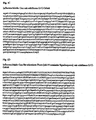
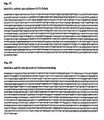
- the gene for the influenza matrix protein (wild-type sequence cf. Fig. 1A , deduced amino acid sequence Fig. 1B ) optimized. This was the in Fig. 1C created G / C-rich sequence variant created. Likewise, a G / C-rich sequence coding for the secreted form of the influenza matrix protein and coding for an N-terminal signal sequence was determined (cf. Fig. 1D ).
- the secreted form of the influenza matrix protein has the advantage that it has an increased immunogenicity compared to the non-secreted form.
- mRNA molecules were designed.
- the optimized mRNA for the influenza matrix protein in terms of G / C content and codon usage was additionally supplemented with stabilizing sequences in the 5 'and 3' region (the stabilization sequences originate from the 5 'and 3' UTRs of the ⁇ - and 3 'UTRs, respectively).
- Globin mRNA of Xenupus laevis see pT7Ts vector in Lai et al., Supra) (see FIG. Fig. 1E and 1F ).
- the mRNA coding for the secreted form of the influenza matrix protein was sequence-optimized in the translated region and provided with the said stabilizing sequences (cf. Fig. 1G ).
- the mRNA coding for the tumor antigen MA-GE1 was modified. This was the in Fig. 2C shown sequence, which in comparison to the wild-type sequence (275 G, 244 G) has a 24% higher G / C content (351 G, 291 C). Furthermore, the wild-type sequence was improved by alternative codon usage for translation efficiency due to the coding of more abundant tRNAs in the cell (cf. Fig. 2D ). The alternative codon usage also increased the G / C content by 24%.
- Annex Source code of a computer program according to the invention
Landscapes
- Health & Medical Sciences (AREA)
- Life Sciences & Earth Sciences (AREA)
- Chemical & Material Sciences (AREA)
- General Health & Medical Sciences (AREA)
- Medicinal Chemistry (AREA)
- Veterinary Medicine (AREA)
- Public Health (AREA)
- Animal Behavior & Ethology (AREA)
- Pharmacology & Pharmacy (AREA)
- Epidemiology (AREA)
- Immunology (AREA)
- Engineering & Computer Science (AREA)
- Microbiology (AREA)
- Oncology (AREA)
- Bioinformatics & Cheminformatics (AREA)
- Organic Chemistry (AREA)
- Mycology (AREA)
- Genetics & Genomics (AREA)
- Molecular Biology (AREA)
- Proteomics, Peptides & Aminoacids (AREA)
- Virology (AREA)
- Zoology (AREA)
- Biotechnology (AREA)
- Gastroenterology & Hepatology (AREA)
- Biochemistry (AREA)
- Chemical Kinetics & Catalysis (AREA)
- Nuclear Medicine, Radiotherapy & Molecular Imaging (AREA)
- General Chemical & Material Sciences (AREA)
- Biophysics (AREA)
- Biomedical Technology (AREA)
- Physics & Mathematics (AREA)
- Communicable Diseases (AREA)
- Wood Science & Technology (AREA)
- General Engineering & Computer Science (AREA)
- Cell Biology (AREA)
- Pulmonology (AREA)
- Toxicology (AREA)
- Plant Pathology (AREA)
- Theoretical Computer Science (AREA)
- Medical Informatics (AREA)
Description
- Die vorliegende Erfindung betrifft eine pharmazeutische Zusammensetzung, enthaltend eine mRNA, die durch Sequenzmodifikationen im translatierten Bereich stabilisiert und für die Translation optimiert ist bzw. die entsprechende modifizierte mRNA. Die erfindungsgemäße pharmazeutische Zusammensetzung eignet sich als Therapeutikum zur Gentherapie insbesondere zur Geweberegeneration.
- Die Gentherapie und die genetische Vakzinierung sind molekularmedizinische Verfahren, deren Anwendung in der Therapie und Prävention von Erkrankungen erhebliche Auswirkungen auf die medizinische Praxis haben wird. Beide Verfahren beruhen auf der Einbringung von Nukleinsäuren in Zellen bzw. in Gewebe des Patienten sowie auf der anschließenden Verarbeitung der durch die eingebrachten Nukleinsäuren codierten Information, d.h. der Expression der erwünschten Polypeptide.
- Die übliche Vorgehensweise bisheriger Verfahren der Gentherapie und der genetischen Vakzinierung ist die Verwendung von DNA, um die benötigte genetische Information in die Zelle einzuschleusen. In diesem Zusammenhang sind verschiedene Verfahren zur Einbringung von DNA in Zellen, wie bspw. Calciumphosphat-Transfektion, Polypren-Transfektion, Protoplasten-Fusion, Elektroporation, Mikroinjektion und Lipofektion, entwickelt worden, wobei sich insbesondere die Lipofektion als geeignetes Verfahren herausgestellt hat.
- Ein weiteres Verfahren, das insbesondere bei genetischen Vakzinierungsverfahren vorgeschlagen wurde, ist die Verwendung von DNA-Viren als DNA-Vehikel. Derartige Viren haben den Vorteil, daß aufgrund ihrer infektiösen Eigenschaften eine sehr hohe Transfektionsrate zu erzielen ist. Die verwendeten Viren werden genetisch verändert, so daß in der transfizierten Zelle keine funktionsfähigen infektiösen Partikel gebildet werden. Trotz dieser Vorsichtsmaßnahme kann jedoch aufgrund möglicher Rekombinationsereignisse ein gewisses Risiko der unkontrollierten Ausbreitung der eingebrachten gentherapeutisch wirksamen sowie viralen Gene nicht ausgeschlossen werden.
- Üblicherweise wird die in die Zelle eingebrachte DNA in gewissem Ausmaß in das Genom der transfizierten Zelle integriert. Einerseits kann dieses Phänomen einen erwünschten Effekt ausüben, da hierdurch eine langandauernde Wirkung der eingebrachten DNA erzielt werden kann. Andererseits bringt die Integration in das Genom ein wesentliches Risiko der Gentherapie mit sich. So kann es bspw. zu einer Insertion der eingebrachten DNA in ein intaktes Gen kommen, was eine Mutation darstellt, welche die Funktion des endogenen Gens behindert oder gar vollkommen ausschaltet. Durch solche Integrationsereignisse können einerseits für die Zelle lebenswichtige Enzymsysteme ausgeschaltet werden, andererseits besteht auch die Gefahr einer Transformation der so veränderten Zelle in einen entarteten Zustand, falls durch die Integration der Fremd-DNA ein für die Regulation des Zellwachstums entscheidendes Gen verändert wird. Daher kann bei der Verwendung von DNA-Viren als Gentherapeutika und Vakzine ein Risiko der Krebsbildung nicht ausgeschlossen werden. In diesem Zusammenhang ist auch zu beachten, daß zur wirksamen Expression der in die Zelle eingebrachten Gene die entsprechenden DNA-Vehikel einen starken Promotor, bspw. den viralen CMV-Promotor, enthalten. Die Integration derartiger Promotoren in das Genom der behandelten Zelle kann zu unerwünschten Veränderungen der Regulierung der Genexpression in der Zelle führen.
- Ein weiterer Nachteil der Verwendung von DNA als Gentherapeutika und Vakzine ist die Induktion pathogener Anti-DNA-Antikörper im Patienten unter Hervorrufung einer möglicherweise tödlichen Immunantwort.
- Im Gegensatz zu DNA ist der Einsatz von RNA als Gentherapeutikum oder Vakzin als wesentlich sicherer einzustufen. Insbesondere bringt RNA nicht die Gefahr mit sich, stabil in das Genom der transfizierten Zelle integriert zu werden. Des weiteren sind keine viralen Sequenzen, wie Promotoren, zur wirksamen Transkription, erforderlich. Darüber hinaus wird RNA wesentlich einfacher in vivo abgebaut. Wohl aufgrund der gegenüber DNA relativ kurzen Halbwertszeit von RNA im Blutkreislauf sind bisher keine anti-RNA-Antikörper nachgewiesen worden. Daher kann RNA für molekularmedizinische Therapieverfahren als Molekül der Wahl angesehen werden.
- Allerdings bedürfen auf RNA-Expressionssystemen beruhende medizinische Verfahren vor einer breiteren Anwendung noch der Lösung einiger grundsätzlicher Probleme. Eines der Probleme bei der Verwendung von RNA ist der schere, Zell- bzw. Gewebespezifische effiziente Transfer der Nukleinsäure. Da sich RNA in Lösung normalerweise als sehr instabil erweist, konnte durch die herkömmlichen Verfahren, die bei DNA verwendet werden, RNA bisher nicht oder nur sehr ineffizient als Therapeutikum bzw. Impfstoff verwendet werden.
- Für die Instabilität sind RNA-abbauende Enzyme, sog. RNAasen (Ribonucleasen), verantwortlich. Selbst kleinste Verunreinigungen von Ribonucleasen reichen aus, um RNA in Lösung vollständig abzubauen. Der natürliche Abbau von mRNA im Cytoplasma von Zellen ist sehr fein reguliert. Diesbezüglich sind mehrere Mechanismen bekannt. So ist für eine funktionale mRNA die endständige Struktur von entscheidender Bedeutung. Am 5'-Ende befindet sich die sogenannte "Cap-Struktur" (ein modifiziertes Guanosin-Nucleotid) und am 3'-Ende eine Abfolge von bis zu 200 Adenosin-Nucleotiden (der sog. Poly-A-Schwanz). Über diese Strukturen wird die RNA als mRNA erkannt und der Abbau reguliert. Darüber hinaus gibt es weitere Prozesse, die RNA stabilisieren bzw. destabilisieren. Viele diese Prozesse sind noch unbekannt, oftmals scheint jedoch eine Wechselwirkung zwischen der RNA und Proteinen dafür maßgeblich zu sein. Bspw. wurde kürzlich ein "mRNA-Surveillance-System" beschrieben (Hellerin und Parker, Annu. Rev. Genet. 1999, 33: 229 bis 260), bei dem durch bestimmte Feedback-Protein-Wechselwirkungen im Cytosol unvollständige oder Nonsense-mRNA erkannt und dem Abbau zugänglich gemacht wird, wobei ein Hauptteil dieser Prozesse durch Exonucleasen vollzogen wird.
- Im Stand der Technik sind einige Maßnahmen vorgeschlagen worden, um die Stabilität von RNA zu erhöhen und dadurch ihren Einsatz als Gentherapeutikum bzw. RNA-Vakzine zu ermöglichen.
- In diesem Zusammenhang beschreibt
WO 98/34640 WO 98/34640 WO 98/34640 - Auch
WO 97/48370 WO 97/48370 - In
EP-A-1083232 wird zur Lösung des vorstehend genannten Problems der Instabilität von RNA ex vivo ein Verfahren zur Einbringung von RNA, insbesondere mRNA, in Zellen und Organismen vorgeschlagen, bei welchem die RNA in Form eines Komplexes mit einem kationischen Peptid oder Protein vorliegt. So beschreibt dieEP 1083232 auch die Verwendung derartiger Komplexe zur Behandlung von Erkrankungen, die auf mindestens einem genetischen Defekt beruhen. Hierbei wird durch die komplexierte mRNA die korrekte genetische Information bereitgestellt, die im fehlerhaften oder abwesenden Gen des Patienten nicht entsprechend vorliegt. -
WO 99/14346 - In den US-Patenten
US 5,580,859 undUS 6,214,804 werden unter anderem im Rahmen der "transienten Gentherapie" (TGT) mRNA-Vakzine und -Therapeutika offenbart. Es werden verschiedene Maßnahmen zur Erhöhung der Translationseffizienz und der mRNA-Stabilität beschrieben, die sich vor allem auf die nicht-translatierten Sequenzbereiche beziehen. - Bieler und Wagner (in: Schleef (Hrsg.), Plasmids for Therapy and Vaccination, Kapitel 9, Seiten 147 bis 168, Wiley-VCH, Weinheim, 2001) berichten von der Verwendung synthetischer Gene im Zusammenhang mit gentherapeutischen Methoden unter Verwendung von DNA-Vakzinen und lentiveralen Vektoren. Es wird die Konstruktion eines synthetischen, von HIV-1 abgeleiteten gag-Gens beschrieben, bei welchem die Codons gegenüber der Wildtyp-Sequenz derart modifiziert wurden (alternative Codonverwendung, engl. "codon usage"), daß sie der Verwendung von Codons entsprach, die in hoch exprimierten Säugergenen zu finden ist. Dadurch wurde insbesondere der A/T-Gehalt gegenüber der Wildtyp-Sequenz vermindert. Die Autoren stellen insbesondere eine erhöhte Expressionsrate des synthetischen gag-Gens in transfizierten Zellen fest. Des weiteren wurde in Mäusen eine erhöhte Antikörperbildung gegen das gag-Protein bei mit dem synthetischen DNA-Konstrukt immunisierten Mäusen und auch eine verstärkte Cytokinfreisetzung in vitro bei transfizierten Milzzellen von Mäusen beobachtet. Schließlich konnte eine Induzierung einer cytotoxischen Immunantwort in mit dem gag-Expressionsplasmid immunisierten Mäusen festgestellt werden. Die Autoren dieses Artikels führen die verbesserten Eigenschaften ihres DNA-Vakzins im wesentlichen auf einen durch die optimierte Codonverwendung hervorgerufene Veränderung des nucleo-cytoplasmatischen Transports der vom DNA-Vakzin exprimierten mRNA zurück. Im Gegensatz dazu halten die Autoren die Auswirkung der veränderten Codonverwendung auf die Translationseffizienz für gering.
- Der vorliegenden Erfindung liegt daher die Aufgabe zugrunde, ein neues System zur Gentherapie bereitzustellen, das die mit den Eigenschaften von DNA-Therapeutika verbundenen Nachteile überwindet und die Wirksamkeit von auf RNA-Spezies basierenden Therapeutika erhöht.
- Diese Aufgabe wird durch die in den Ansprüchen gekennzeichneten Ausführungsformen der vorliegenden Erfindung gelöst.
- Insbesondere wird erfindungsgemäß eine modifizierte mRNA sowie mindestens eine derartige modifizierte mRNA in Verbindung mit einem pharmazeutisch, auch zur Herstellung eines Medikaments zur Gentherapie, verträglichen Träger und/oder Vehikel enthaltende pharmazeutische Zusammensetzung bereitgestellt, wobei die modifizierte mRNA für mindestens ein biologisch wirksames Peptid oder Polypeptid codiert, welches in dem zu behandelnden Patienten nicht nur unzureichend oder fehlerhalft gebildet wird, wobei die Sequenz der mRNA, insbesondere im für das mindestens eine Peptid oder Polypeptid codierenden Bereich, gegenüber der Wildtyp-mRNA folgende Modifikation aufweist.
- Der G/C-Gehalt des für das Peptid oder Polypeptid codierenden Bereichs der modifizierten erfindungsgemäßen mRNA ist größer als der G/C-Gehalt des codierenden Bereichs der für das Peptid oder Polypeptid codierenden Wildtyp-mRNA, wobei die codierte Aminosäuresequenz gegenüber dem Wildtyp unverändert ist.
- Diese Modifikation beruht auf der Tatsache, daß für eine effiziente Translation einer mRNA die Sequenzabfolge des zu translatierenden Bereichs der mRNA wesentlich ist. Dabei spielt die Zusammensetzung und die Abfolge der verschiedenen Nucleotide eine große Rolle. Insbesondere sind Sequenzen mit erhöhtem G(Guanosin)/C(Cytosin)-Gehalt stabiler als Sequenzen mit einem erhöhten A(Adenosin)/U(Uracil)-Gehalt. Daher werden erfindungsgemäß unter Beibehaltung der translatierten Aminosäureabfolge die Codons gegenüber der Wildtyp-mRNA derart variiert, daß sie vermehrt G/C-Nucleotide beinhalten. Da mehrere Codons für ein und dieselbe Aminosäure codieren (Degeneration des genetischen Codes), können die für die Stabilität günstigsten Codons ermittelt werden (alternative Codonverwendung, engl. "codon usage").
- In Abhängigkeit von der durch die modifizierte erfindungsgemäße mRNA zu codierenden Aminosäure sind unterschiedliche Möglichkeiten zur Modifikation der mRNA-Sequenz gegenüber der Wildtyp-Sequenz möglich. Im Fall von Aminosäuren, die durch Codons codiert werden, die ausschließlich G- oder C- Nucleotide enthalten, ist keine Modifikation des Codons erforderlich. So erfordern die Codons für Pro (CCC oder CCG), Arg (CGC oder CGG), Ala (GCC oder GCG) und Gly (GGC oder GGG) keine Veränderung, da kein A oder U vorhanden ist.
- In folgenden Fällen werden die Codons, welche A-und/oder U-Nucleotide enthalten durch Substituieren anderer Codons, welche die gleichen Aminosäuren codieren, jedoch kein A und/oder U enthalten, verändert. Beispiele sind:
- Die Codons für Pro können von CCU oder CCA zu CCC oder CCG verändert werden;
- die Codons für Arg können von CGU oder CGA oder AGA oder AGG zu CGC oder CGG verändert werden;
- die Codons für Ala können von GCU oder GCA zu GCC oder GCG verändert werden;
- die Codons für Gly können von GGU oder GGA zu GGC oder GGG verändert werden.
- In anderen Fällen können A bzw. U-Nucleotide zwar nicht aus den Codons eliminiert werden, es ist jedoch möglich, den A- und U-Gehalt durch Verwendung von Codons zu vermindern, die weniger A- und/oder U-Nucleotide enthalten. Zum Beispiel:
- Die Codons für Phe können von UUU zu UUC verändert werden;
- die Codons für Leu können von UUA, CUU oder CUA zu CUC oder CUG verändert werden;
- die Codons für Ser können von UCU oder UCA oder AGU zu UCC, UCG oder AGC verändert werden;
- das Codon für Tyr kann von UAU zu UAC verändert werden;
- das Stop-Codon UAA kann zu UAG oder UGA verändert werden;
- das Codon für Cys kann von UGU zu UGC verändert werden;
- das Codon His kann von CAU zu CAC verändert werden;
- das Codon für Gln kann von CAA zu CAG verändert werden;
- die Codons für Ile können von AUU oder AUA zu AUC verändert werden;
- die Codons für Thr können von ACU oder ACA zu ACC oder ACG verändert werden;
- das Codon für Asn kann von AAU zu AAC verändert werden;
- das Codon für Lys kann von AAA zu AAG verändert werden;
- die Codons für Val können von GUU oder GUA zu GUC oder GUG verändert werden;
- das Codon für Asp kann von GAU zu GAC verändert werden;
- das Codon für Glu kann von GAA zu GAG verändert werden.
- Im Falle der Codons für Met (AUG) und Trp (UGG) besteht hingegen keine Möglichkeit der Sequenzmodifikation.
- Die vorstehend aufgeführten Substitutionen können selbstverständlich einzeln aber auch in allen möglichen Kombinationen zur Erhöhung des G/C-Gehalts der modifizierten erfindungsgemäßen mRNA gegenüber der ursprünglichen Sequenz verwendet werden. So können beispielsweise alle in der ursprünglichen (Wildtyp-) Sequenz auftretenden Codons für Thr zu ACC (oder ACG) verändert werden. Vorzugsweise werden jedoch Kombinationen der vorstehenden Substitutionsmöglichkeiten genutzt, z.B.:
- Substitution aller in der ursprünglichen Sequenz für Thr codierenden Codons zu ACC (oder ACG) und Substitution aller ursprünglich für Ser codierenden Codons zu UCC ( oder UCG oder AGC);
- Substitution aller in der ursprünglichen Sequenz für Ile codierenden Codons zu AUC und Substitution aller ursprünglich für Lys codierenden Codons zu AAG und Substitution aller ursprünglich für Tyr codierenden Codons zu UAC;
- Substitution aller in der ursprünglichen Sequenz für Val codierenden Codons zu GUC (oder GUG) und Substitution aller ursprünglich für Glu codierenden Codons zu GAG und Substitution aller ursprünglich für Ala codierenden Codons zu GCC (oder GCG) und Substitution aller ursprünglich für Arg codierenden Codons zu CGC (oder CGG);
- Substitution aller in der ursprünglichen Sequenz für Val codierenden Codons zu GUC (oder GUG) und Substitution aller ursprünglich für Glu codierenden Codons zu GAG und Substitution aller ursprünglich für Ala codierenden Codons zu GCC (oder GCG) und Substitution aller ursprünglich für Gly codierenden Codons zu GGC (oder GGG) und Substituion aller ursprünglich für Asn codierenden Codons zu AAC;
- Substitution aller in der ursprünglichen Sequenz für Val codierenden Codons zu GUC (oder GUG) und Substitution aller usprünglich für Phe codierenden Codons zu UUC und Substitution aller ursprünglich für Cys codierenden Codons zu UGC und Substitution aller ursprünglich für Leu codierenden Codons zu CUG (oder CUC) und Substitution aller ursprünglich für Gln codierenden Codons zu CAG und Substitution aller ursprünglich für Pro codierenden Codons zu CCC (oder CCG);
- Vorzugsweise wird der G/C-Gehalt des für das Peptid bzw. Polypeptid codierenden Bereichs der modifizierten erfindungsgemäßen mRNA um mindestens 7%-Punkte, mehr bevorzugt um mindestens 15%-Punkte, besonders bevorzugt um mindestens 20%-Punkte gegenüber dem G/C-Gehalt des codierten Bereichs der für das Polypeptid codierenden Wildtyp-mRNA erhöht.
- Besonders bevorzugt ist es in diesem Zusammenhang, den G/C-Gehalt der modifizierten mRNA insbesondere zur Verwendung zur Herstellung eines Medikaments, insbesondere im für das mindestens eine Peptid bzw. Polypeptid codierenden Bereich, im Vergleich zur Wildtyp-Sequenz maximal zu erhöhen.
- Erfindungsgemäß besonders bevorzugt ist es, den erfindungsgemäß in der modifizierten mRNA erhöhten, insbesondere maximalen, sequenziellen G/C-Anteil mit den "häufigen" Codons zu verknüpfen, ohne die Aminosäuresequenz des durch den codierenden Bereich der mRNA codierten Peptids bzw. Polypeptids (ein oder mehrere) zu verändern. Diese bevorzugte Ausführungsform stellt eine besonders effizient translatierte und stabilisierte mRNA bspw. für die erfindungsgemäße pharmazeutische Zusammensetzung bereit.
- In den Sequenzen eukaryotischer mRNAs gibt es destabilisierende Sequenzelemente (DSE), an welche Signalproteine binden und den enzymatischen Abbau der mRNA in vivo regulieren. Daher werden zur weiteren Stabilisierung der in der erfindungsgemäßen pharmazeutischen Zusammensetzung enthaltenen modifizierten mRNA gegebenenfalls im für das mindestens eine Peptid bzw. Polypeptid codierenden Bereich ein oder mehrere Veränderungen gegenüber dem entsprechenden Bereich der Wildtyp-mRNA vorgenommen, so daß keine destabilisierenden Sequenzelemente enthalten sind. Selbstverständlich ist es ebenfalls bevorzugt, gegebenenfalls in den nicht-translatierten Bereichen (3'- und/oder 5'-UTR) vorhandene DSE aus der erfindungsgemäßen mRNA zu eliminieren.
- Derartige destabilisierende Sequenzen sind bspw. AU-reiche Sequenzen ("AURES"), die in 3'-UTR-Abschnitten zahlreicher instabiler mRNA vorkommen (Caput et al., Proc. Natl. Acad. Sci. USA 1986, 83: 1670 bis 1674). Die in der erfindungsgemäßen pharmazeutischen Zusammensetzung enthaltenen erfindungsgemäßen RNA-Moleküle sind daher vorzugsweise derart gegenüber der Wildtyp-mRNA verändert, daß sie keine derartigen destabilisierenden Sequenzen aufweisen. Dies gilt auch für solche Sequenzmotive, die von möglichen Endonucleasen erkannt werden, bspw. die Sequenz GAACAAG, die im 3' UTR-Segment des für den Transferin-Rezeptor codierenden Gens enthalten ist (Binder et al., EMBO J. 1994, 13: 1969 bis 1980). Auch diese Sequenzmotive werden bevorzugt in der modifizierten mRNA der erfindungsgemäßen pharmazeutischen Zusammensetzung eliminiert.
- Einem Fachmann sind verschiedene Verfahren geläufig, die zur Substitution von Codons in der erfindungsgemäßen modifizierten mRNA geeignet sind. Im Falle kürzerer codierender Bereiche (die für biologisch wirksame Peptide codieren) kann bspw. die gesamte mRNA chemisch unter Verwendung von Standardtechniken synthetisiert werden.
- Bevorzugt werden allerdings Basensubstitutionen unter Verwendung einer DNA-Matrize zur Herstellung der modifizierten mRNA mit Hilfe von Techniken der gängigen zielgerichteten Mutagenese eingeführt; Maniatis et al., Molecular Cloning: A Laboratory Manual, Cold Spring Harbor Laboratory Press, 3. Aufl., Cold Spring Harbor, NY, 2001.
- Bei diesem Verfahren wird zur Herstellung der erfindungsgemäßen mRNA daher ein entsprechendes DNA-Molekül in vitro transkribiert. Diese DNA-Matrize besitzt einen geeigneten Promotor, bspw. einen T7 -oder SP6-Promotor, für die in vitro Transkription, dem die gewünschte Nucleotidsequenz für die herzustellende mRNA und ein Termisationssignal für die in in vitro Transkribtion folgen. Das DNA-Molekül, das die Matrize des herzustellenden RNA-Konstrukts bildet, kann durch fermentative Vermehrung und anschließende Isolierung als Teil eines in Bakterien replizierbaren Plasmids hergestellt werden. Als für die vorliegende Erfindung geeignete Plasmide können bspw. die Plasmide pT7Ts (GenBank-Zugriffsnummer U26404; Lai et al., Development 1995, 121: 2349 bis 2360), pGEM®-Reihe, bspw. pGEM®-1 (GenBank-Zugriffsnummer X65300; von Promega) und pSP64 (GenBank-Zugriffsnummer X65327) genannt werden; vgl. auch Mezei und Storts, Purification of PCR Products, in: Griffin und Griffin (Hrsg.), PCR Technology: Current Innovation, CRC Press, Boca Raton, FL, 2001.
- Es kann so unter Verwendung kurzer synthetischer DNA-Oligonucleotide, die an den entstehenden Schnittstellen kurze einzelsträngige Übergänge aufweisen, oder durch chemische Synthese hergestellte Gene die gewünschte Nucleotidsequenz nach einem Fachmann geläufigen molekularbiologischen Methoden in ein geeignetes Plasmid cloniert werden (vgl. Maniatis et al., s.o.). Das DNA-Molekül wird dann aus dem Plasmid, in welchem es in einfacher oder mehrfacher Kopie vorliegen kann, durch Verdauung mit Restriktionsendonukleasen ausgeschnitten.
- Die erfindungsgemäß modifizierte mRNA, welche in der erfindungsgemäßen pharmazeutischen Zusammensetzung enthalten ist, und zur Herstellung eines Medikaments zur Gentherapie verwendet wird, kann darüber hinaus eine 5'-Cap-Struktur (ein modifiziertes Guanosin-Nucleotid) aufweisen. Als Beispiele von Cap-Strukturen können m7G(5')ppp (5'(A,G(5')ppp(5')A und G(5')ppp(5')G genannt werden.
- Gemäß einer weiteren bevorzugten Ausführungsform der vorliegenden Erfindung enthält die erfindungsgemäß modifizierte mRNA einen PolyA-Schwanz von mindestens 50 Nuclotiden, vorzugsweise mindestens 70 Nucleotiden, mehr bevorzugt mindestens 100 Nucleotiden, besonders bevorzugt mindestens 200 Nucleotiden.
- Für eine effiziente Translation der erfindungsgemäßen mRNA ist weiterhin eine wirksame Bindung der Ribosomen an die Ribosomen-Bindungsstelle (Kozak-Sequenz: GCCGCCACCAUGG, das AUG bildet das Startcodon) erforderlich. Diesbezüglich ist festgestellt worden, daß ein erhöhter A/U-Gehalt um diese Stelle herum eine effizientere Ribosomen-Bindung an die mRNA ermöglicht.
- Des weiteren ist es möglich, in die modifizierte und erfindungsgemäß mRNA eine oder mehrere sog. IRES (engl. "internal ribosomal entry side) einzufügen. Eine IRES kann so als alleinige Ribosomen-Bindungsstelle fungieren, sie kann jedoch auch zur Bereitstellung einer mRNA dienen, die mehrere Peptide bzw. Polypeptide codiert, die unabhängig voneinander durch die Ribosomen translatiert werden sollen ("multicistronische mRNA"). Beispiele erfindungsgemäß verwendbarer IRES-Sequenzen sind diejenigen aus Picomaviren (z.B. FMDV), Pestviren (CFFV), Polioviren (PV), Enzephalo-Myocarditis-Viren (ECMV), Maul-und-Klauenseuche-Viren (FMDV), Hepatitis-C-Viren (HCV), Klassisches-Schweinefieber-Viren (CSFV), Murines-Leukoma-Virus (MLV), Simean-Immundefizienz-Viren (SIV) oder Cricket-Paralysis-Viren (CrPV).
- Gemäß einer weiteren bevorzugten Ausführungsform der vorliegenden Erfindung weist die modifizierte erfindungsgemäße mRNA in den 5'- und/oder 3'-nicht translatierten Bereichen Stabilisierungssequenzen auf, die befähigt sind, die Halbwertszeit der mRNA im Cytosol zu erhöhen.
- Diese Stabilisierungssequenzen können eine 100%ige Sequenzhomologie zu natürlich vorkommenden Sequenzen, die in Viren, Bakterien und Eukaryoten auftreten, aufweisen, können aber auch teilweise oder vollständig synthetischer Natur sein. Als Beispiel für stabilisierende Sequenzen, die in der vorliegenden Erfindung verwendbar sind, können die nicht-translatierten Sequenzen (UTR) des β-Globingens, bspw. von Homo sapiens oder Xenopus laevis, genannt werden. Ein anderes Beispiel einer Stabilisierungssequenz weist die allgemeine Formel (C/U)CCANxCCC(U/A)PyxUC(C/U)CC auf, die im 3'UTR der sehr stabilen mRNA enthalten ist, die für α-Globin, α-(I)-Collagen, 15-Lipoxygenase oder für Tyrosin-Hydroxylase codiert (vgl. Holcik et al., Proc. Natl. Acad. Sci. USA 1997, 94: 2410 bis 2414). Selbstverständlich können derartige Stabilisierungssequenzen einzeln oder in Kombination miteinander als auch in Kombination mit anderen, einem Fachmann bekannten Stabilisierungssequenzen verwendet werden.
- Zur weiteren Stabilisierung der modifizierten und erfindungsgemäß mRNA ist es außerdem bevorzugt, daß diese mindestens ein Analoges natürlich vorkommender Nucleotide aufweist. Dies beruht auf der Tatsache, daß die in den Zellen vorkommenden RNA-abbauenden Enzyme als Substrat vorzugsweise natürlich vorkommende Nucleotide erkennen. Durch Einfügen von Nucleotidanaloga kann daher der RNA-Abbau erschwert werden, wobei die Auswirkung auf die Translationseffizienz bei Einfügen von diesen Analoga, insbesondere in den codierenden Bereich der mRNA, einen positiven oder negativen Effekt auf die Translationseffizienz haben kann.
- In einer keineswegs abschließenden Aufzählung können als Beispiele erfindungsgemäß verwendbarer Nucleotidanaloga Phosphoramidate, Phosphorthioate, Peptidnucleotide, Methylphosphonate, 7-Deazaguaonsin, 5-Methylcytosin und Inosin genannt werden. Die Herstellung derartiger Analoga sind einem Fachmann bspw. aus den
US-Patenten 4,373,071 ,US 4,401,796 ,US 4,415,732 ,US 4,458,066 ,US 4,500,707 ,US 4,668,777 ,US 4,973,679 ,US 5,047,524 ,US 5,132,418 ,US 5,153,319 ,US 5,262,530 und5,700,642 bekannt. Erfindungsgemäß können derartige Analoga in nicht-translatierten und translatierten Bereichen der modifizierten erfindungsgemäßen mRNA vorkommen. - Des weiteren kann der wirksame Transfer der modifizierten und erfindungsgemäß mRNA in die zu behandelnden Zellen bzw. den zu behandelnden Organismus dadurch verbessert werden, daß die modifizierte mRNA mit einem kationischen Peptid oder Protein assoziiert oder daran gebunden ist. Insbesondere ist dabei die Verwendung von Protamin als polykationischem, Nucleinsäure-bindenden Protein besonders wirksam. Des weiteren ist die Verwendung anderer kationischer Peptide oder Proteine, wie Poly-L-Lysin oder Histonen, ebenfalls möglich. Diese Vorgehensweise zur Stabilisierung der modifizierten erfindungsgemäßen mRNA ist in
EP-A-1083232 beschrieben. - Bei der gentherapeutischen Verwendung der erfindungsgemäßen pharmazeutischen Zusammensetzung (bzw. bei der Verwendung der mRNA zur Gentherapie bzw. bei der Verwendung der mRNA zur Herstelllung einer pharmazeutischen Zusammensetzung zur Gentherapie) codiert die modifizierte mRNA für mindestens ein biologisch wirksames Peptid oder Polypeptid, welches in dem zu behandelnden Patienten bspw. nicht, nur unzureichend oder fehlerhaft gebildet wird. Daher sind Beispiele von der erfindungsgemäßen mRNA codierte Polypeptide Dystrophin, der Chloridkanal, der bei der cystischen Fibrose fehlerhaft verändert ist, Enzyme, die bei metabolischen Erkrankungen, wie Phenylketonurie, Galktosämie, Homocystinurie, Adenosindeaminasedefizienz usw., fehlen bzw. fehlerhaft sind, Enzyme, die an der Synthese von Neurotransmittern, wie Dopamin, Norepinephrin und GABA beteiligt sind, insbesondere Tyrosinhydroxylase und DOPA-Decarboxylase, α-1-Antitrypsin usw. Des weiteren kann die pharmazeutische Zusammensetzung zur Abgabe von Zelloberflächenrezeptoren und Molekülen, die an derartige Rezeptoren binden, verwendet werden, indem die in der pharmazeutischen Zusammensetzung enthaltene modifizierte mRNA für ein derartiges biologisch wirksames Protein bzw. Peptid codiert. Beispiele derartiger Proteine, die extrazellulär wirken oder an Zelloberflächenrezeptoren binden, sind bspw. Gewebsplasminogenaktivator (TPA), Wachstumshormone, Insulin, Interferone, Granulocyten-Makrophagen-Koloniestimulisierungsfaktor (GM-CFS), Erythropoietin (EPO) usw. Durch Auswahl geeigneter Wachstumsfaktoren kann die pharmazeutische Zusammensetzung der vorliegenden Erfindung bspw. zur Geweberegeneration verwendet werden. Dadurch können Erkrankungen, die durch eine Gewebedegeneration gekennzeichnet sind, bspw. neurodegenerative Erkrankungen, wie Morbus Alzheimer, Morbus Parkinson usw., und andere degenerative Erkrankungen, bspw. Arthrose, behandelt werden. In diesen Fällen codiert die, insbesondere in der pharmazeutischen Zusammensetzung der vorliegenden Erfindung enthaltene, modifizierte mRNA vorzugsweise für Wachstumsfaktoren aus der TGF-β -Familie, wobei insbesondere EGF, FGF, PDGF, BMP, GDNF, BDNF, GDF und neurotrophe Faktoren, wie NGF, Neutrophine usw. zu nennen sind.
- Darüber hinaus kann die erfindungsgemäß modifizierte mRNA neben dem gentherapeutisch wirksamen Peptid bzw. Polypeptid auch mindestens einen weiteren funktionalen Abschnitt enthalten, der bspw. für ein die Immunantwort förderndes Cytokin (Monokin, Lymphokin, Interleukin oder Chemokin, wie IL-1, IL-2, IL-3, IL-4, IL-5, IL-6, IL-7, IL-8, IL-9, IL-10, IL-12, INF-α, INF-γ, GM-CFS, LT-α oder Wachstumsfaktoren, wie hGH, codiert.
- Die erfindungsgemäße pharmazeutische Zusammensetzung enthält neben der modifizierten erfindungsgemäßen mRNA einen pharmazeutisch verträglichen Träger und/oder ein pharmazeutisch verträgliches Vehikel. Entsprechende Wege zur geeigneten Formulierung und Herstellung der erfindungsgemäßen pharmazeutischen Zusammensetzung sind bei "Remington's Pharmaceutical Sciences" (Mack Pub. Co., Easton, PA, 1980) offenbart, das vollinhaltlich Bestandteil der Offenbarung der vorliegenden Erfindung ist. Für die parenterale Verabreichung kommen als Trägerstoffe bspw. steriles Wasser, sterile Kochsalzlösungen, Polyalkylenglykole, hydrogenierte Naphthalen und insbesondere biokompatible Lactidpolymere, Lactid/Glycolidcopolymer oder Polyoxyethylen-/Polyoxypropylencopolymere in Betracht. Erfindungsgemäße Zusammensetzungen können Füllsubstanzen oder Substanzen, wie Lactose, Mannitol, Substanzen zur kovalenten Anknüpfung von Polymeren, wie z.B. Polyethylenglykol an erfindungsgemäße Inhibitoren, Komplexierung mit Metallionen oder Einschluß von Materialien in oder auf besondere Präparationen von Polymerverbindung, wie z.B. Polylactat, Polyglykolsäure, Hydrogel oder auf Liposomen, Mikroemulsion, Micellen, unilamellare oder multilamellare Vesikel, Erythrozyten-Fragmente oder Sphäroplasten, enthalten. Die jeweiligen Ausführungsformen der Zusammensetzungen werden abhängig vom physikalische Verhalten, beispielsweise in Hinblick auf die Löslichkeit, die Stabilität, Bioverfügbarkeit oder Abbaubarkeit gewählt. Kontrollierte oder konstante Freisetzung der erfindungsgemäßen Wirkstoffkomponente in der Zusammensetzung schließt Formulierungen auf der Basis lipophiler Depots ein (z.B. Fettsäuren, Wachse oder Öle). Im Rahmen der vorliegenden Erfindung werden auch Beschichtungen erfindungsgemäßer Substanzen oder Zusammensetzungen, enthaltend solche Substanzen, nämlich Beschichtungen mit Polymeren offenbart (z.B. Poloxamere oder Poloxamine). Weiterhin können erfindungsgemäßen Substanzen bzw. Zusammensetzungen protektive Beschichtungen, z.B. Proteaseinhibitoren oder Permeabilitätsverstärker, aufweisen. Bevorzugte Träger sind typischerweise wässrige Trägermaterialien, wobei Wasser zur Injektion (WFI) oder Wasser, gepuffert mit Phosphat, Citrat oder Acetat usw. verwendet wird, und der pH typischerweise auf 5,0 bis 8,0, vorzugsweise 6,0 bis 7,0, eingestellt wird. Der Träger bzw. das Vehikel - wird zusätzlich vorzugsweise Salzbestandteile enthalten, z.B. Natriumchlorid, Kaliumchlorid oder andere Komponenten, welche die Lösung bspw. isotonisch machen. Weiterhin kann der Träger bzw. das Vehikel neben den vorstehend genannten Bestandteilen zusätzliche Komponenten, wie humanes Serumalbumin (HSA), Polysorbat 80, Zucker oder Aminosäuren, enthalten.
- Die Art und Weise der Verabreichung und die Dosierung der erfindungsgemäßen pharmazeutischen Zusammensetzung hängen von der zu behandelnden Erkrankung und deren Fortschrittsstadium, wie auch dem Körpergewicht, dem Alter und dem Geschlecht des Patienten ab.
- Die Konzentration der modifizierten erfindungsgemäßen mRNA in derartigen Formulierungen kann daher innerhalb eines weiten Bereichs von 1 µg bis 100 mg/ml variieren. Die erfindungsgemäße pharmazeutische Zusammensetzung wird vorzugsweise parenteral, bspw. intravenös, intraarteriell, subkutan, intramuskulär, dem Patienten verabreicht. Ebenso ist es möglich, die pharmazeutische Zusammensetzung topisch oder oral zu verabreichen.
- Somit kann erfindungsgemäß auch ein Verfahren zur Behandlung der vorstehend genannten Krankheiten eingesetzt werden, welches das Verabreichen der erfindungsgemäßen pharmazeutischen Zusammensetzung an einen Patienten, insbesondere einen Menschen, umfasst.
- Darüber hinaus kann ebenfalls ein Verfahren eingesetzt werden, das der Ermittlung der modifizierten Sequenz der in der erfindungsgemäßen pharmazeutischen Zusammensetzung enthaltenen mRNA dient. Dabei kann bspw. die Adaptierung der RNA-Sequenzen mit zwei unterschiedlichen Optimierungszielen durchgeführt werden. Zum einen mit größtmöglichen G/C-Gehalt, zum anderen ggf. unter bestmöglicher Berücksichtigung der Häufigkeit der tRNAs gemäß Codon Usage. Im ersten Schritt des Verfahrens wird eine virtuelle Translation einer beliebigen RNA(oder DNA)-Sequenz durchgeführt, um die entsprechende Aminosäuresequenz zu generieren. Ausgehend von der Aminosäuresequenz wird eine virtuelle reverse Translation durchgeführt, die aufgrund des degenerierten genetischen Codes Wahlmöglichkeiten für die entsprechenden Codons liefert. Je nach geforderter Optimierung bzw. Modifizierung werden zur Auswahl der geeigneten Codons entsprechende Selektionslisten und Optimierungsalgorithmen verwendet. Die Ausführung der Algorithmen erfolgt typischerweise mit Hilfe einer geeigneten Software auf einem Computer. So wird die optimierte mRNA-Sequenz erstellt und kann bspw. mit Hilfe einer entsprechenden Anzeigevorrichtung ausgegeben und mit der usrpünglichen (Wildtyp-)Sequenz verglichen werden. Das gleiche gilt auch für die Häufigkeit der einzelnen Nucleotide. Die Änderungen gegenüber der ursprünglichen Nucleotidsequenz werden dabei vorzugsweise hervorgehoben. Weiter werden gemäß einer bevorzugten Ausführungsform in der Natur bekannte stabile Sequenzen eingelesen, welche die Grundlage für eine gemäß natürlichen Sequenzmotiven stabilisierte RNA bieten können. Es kann ebenfalls eine Sekundärstrukturanalyse vorgesehen werden, die anhand von Strukturberechnungen stabilisierende und instabilisierende Eigenschaften bzw. Bereiche der RNA analysieren kann.
- Die Figuren zeigen:
-
Fig. 1 zeigt Wildtyp- und modifizierte nicht-erfindungsgemäße Sequenzen für das Influenza-Matrix-Protein.
Fig. 1A zeigt das Wildtyp-Gen undFig. 1B zeigt die davon abgeleitete Aminosäuresequenz (Ein-Buchstaben-Code).Fig. 1C zeigt eine für das Influenza-Matrix-Protein codierende Gen-Sequenz, deren G/C-Gehalt gegenüber der Wildtyp-Sequenz erhöht ist.Fig. 1D zeigt die Sequenz eines Gens, das für eine sekretierte Form des Influenza-Matrix-Proteins codiert (einschließlich einer N-terminalen Signalsequenz), wobei der G/C-Gehalt der Sequenz gegenüber der Wildtyp-Sequenz erhöht ist.Fig. 1E zeigt eine für das Influenza-Matrix-Protein codierende mRNA, die im Vergleich zur Wildtyp-mRNA stabilisierende Sequenzen enthält.Fig. 1F zeigt eine für das Influenza-Matrix-Protein codierende nicht-erfindungsgemäße mRNA, die neben stabilisierenden Sequenzen einen erhöhten G/C-Gehalt aufweist.Fig. 1G zeigt ebenfalls eine modifizierte nicht-erfindungsgemäße mRNA, die für die sekretierte Form des Influenza-Matrix-Proteins codiert und im Vergleich zum Wildtyp stabilisierende Sequenzen und einen erhöhten GC-Gehalt aufweist. InFig. 1A undFig. 1C bis 1G sind die Start- und Stop-Codons fett hervorgehoben. Gegenüber der Wildtyp-Sequenz vonFig. 1A veränderte Nucleotide sind in denFiguren 1C bis 1G in Großbuchstaben dargestellt. -
Fig. 2 zeigt Wildtyp- und modifizierte nicht-erfindungsgemäße Sequenzen, die für das Tumorantigen MAGE1 codieren.
Fig. 2A zeigt die Sequenz des Wildtyp-Gens undFig. 2B die davon abgeleitete Aminosäuresequenz (Drei-Buchstaben-Code)Fig. 2C zeigt eine für MAGE1 codierende modifizierte nicht-erfindungsgemäße mRNA, deren G/C-Gehalt gegenüber dem Wildtyp erhöht ist.Fig. 2D zeigt die Sequenz einer für MAGE1 codierenden modifizierten nicht-erfindungsgemäßen mRNA, bei der die Codon-Verwendung bezüglich der Codierung möglichst häufig in de Zelle vorkommender tRNA optimiert wurde. Start- und Stop-Codons sind jeweils fett gekennzeichnet. - Die folgenden Beispiele erläutern die vorliegende Erfindung näher, ohne sie einzuschränken.
- Als beispielhafte Ausführungsform des Verfahrens zu Ermittlung der Sequenz einer erfindungsgemäß modifizierten mRNA wurde ein Computerprogramm erstellt, das mit Hilfe des genetischen Codes bzw. dessen degenerativer Natur die Nucleotid-Sequenz einer beliebigen mRNA derart modifiziert, daß sich ein maximaler G/C-Gehalt in Verbindung mit der Verwendung von Codons, die für möglichst häufig in der Zelle vorkommende tRNAs codieren, ergibt, wobei die durch die modifizierte mRNA codierte Aminosäure-Sequenz gegenüber der nicht-modifizierten Sequenz identisch ist. Alternativ kann auch nur der G/C-Gehalt oder nur die Codonverwendung gegenüber der ursprünglichen Sequenz modifiziert werden.
- Der Quellcode in Visual Basic 6.0 (eingesetzte Entwicklungsumgebung: Microsoft Visual Studio Enterprise 6.0 mit Servicepack 3) ist im Anhang angegeben.
- Mit Hilfe des Computerprogramms von Beispiel 1 wurde ein RNA-Konstrukt mit einer hinsichtlich Stabilisierung und Translationseffizienz optimierten Sequenz des lac-Z-Gens aus E.coli erstellt. Es konnte so ein G/C-Gehalt von 69% (im Vergleich zur Wildtyp-Sequenz von 51%; vgl. Kalnins et al., EMBO J. 1983, 2(4): 593-597) erzielt werden. Durch die Synthese überlappender Oligonucleotide, welche die modifizierte Sequenz aufweisen, wurde die optimierte Sequenz gemäß im Stand der Technik bekannter Verfahren hergestellt. Die endständigen Oligonucleotide wiesen die folgenden Restriktionsschnittstellen auf: Am 5'-Ende eine EcoRV- sowie am 3'-Ende eine BglII-Schnittstelle. Über Verdau mit EcoRV/BglII wurde die modifizierte lacZ-Sequenz in das Plasmid pT7Ts (GenBank-Zugriffsnummer U 26404; vgl. Lai et al., s.o.). pT7Ts enthält als nichttranslatierte Regionen Sequenzen aus dem β-Globingen von Xenopus levis jeweils an 5' und 3'. Das Plasmid wurde vor dem Einfügen der modifizierten lacZ-Sequenz mit den genannten Restriktionsenzymen geschnitten.
- Das pT7Ts-lac-Z-Konstrukt wurde in Bakterien vermehrt und durch Phenol-Chloroform-Extraktion gereinigt. 2 µg des Konstrukts wurden in vitro mittels dem einem Fachmann bekannten Verfahren transkribiert, wodurch die modifizierte mRNA hergestellt wurde.
- Mit Hilfe des Computerprogramms von Beispiel 1 wurde das Gen für das Influenza-Matrix-Protein (Wildtyp-Sequenz vgl.
Fig. 1A , abgeleitete AminosäuresequenzFig. 1B ) optimiert. Dadurch wurde die inFig. 1C dargestellte G/C-reiche Sequenzvariante erstellt. Ebenfalls wurde eine für die sekretierte Form des Influenza-Matrix-Proteins codierende G/C-reiche Sequenz, die für eine N-terminale Signalsequenz codiert, ermittelt (vgl.Fig. 1D ). Die sekretierte Form des Influenza-Matrix-Proteins hat den Vorteil, daß sie eine im Vergleich zur nicht-sekretierten Form erhöhte Immunogenizität aufweist. - Ausgehend von den optimierten Sequenzen wurden entsprechende nicht-erfindungsgemäße mRNA-Moleküle entworfen. Die hinsichtlich G/C-Gehalt und Codonverwendung optimierte mRNA für das Influenza-Matrix-Protein wurde zusätzlich mit stabilisierenden Sequenzen im 5'- und 3'-Bereich (die Stabilisierungssequenzen stammen aus den 5'- bzw. 3'-UTRs des β-Globin-mRNA von Xenupus laevis; vgl. pT7Ts-Vektor in Lai et al., s.o.) ausgestattet (vgl.
Fig. 1E und 1F ). Desgleichen wurde auch die für die sekretierte Form des Influenza-Matrix-Proteins codierende mRNA im translatierten Bereich sequenzoptimiert und mit den genannten stabilisierenden Sequenzen versehen (vgl.Fig. 1G ). - Mit Hilfe des Computerprogramms von Beispiel 1 wurde die für das Tumorantigen MA-GE1 codierende mRNA modifiziert. Dadurch wurde die in
Fig. 2C gezeigte Sequenz ermittelt, die im Vergleich zur Wildtyp-Sequenz (275 G, 244 G) einen um 24% höheren G/C-Gehalt aufweist (351 G, 291 C). Des weiteren wurde die Wildtyp-Sequenz durch alternative Codonverwendung hinsichtlich der Translationseffizienz aufgrund der Codierung von in der Zelle häufiger vorkommenden tRNAs verbessert (vgl.Fig. 2D ). Durch die alternative Codonverwendung wurde der G/C-Gehalt ebenfalls um 24% erhöht. -


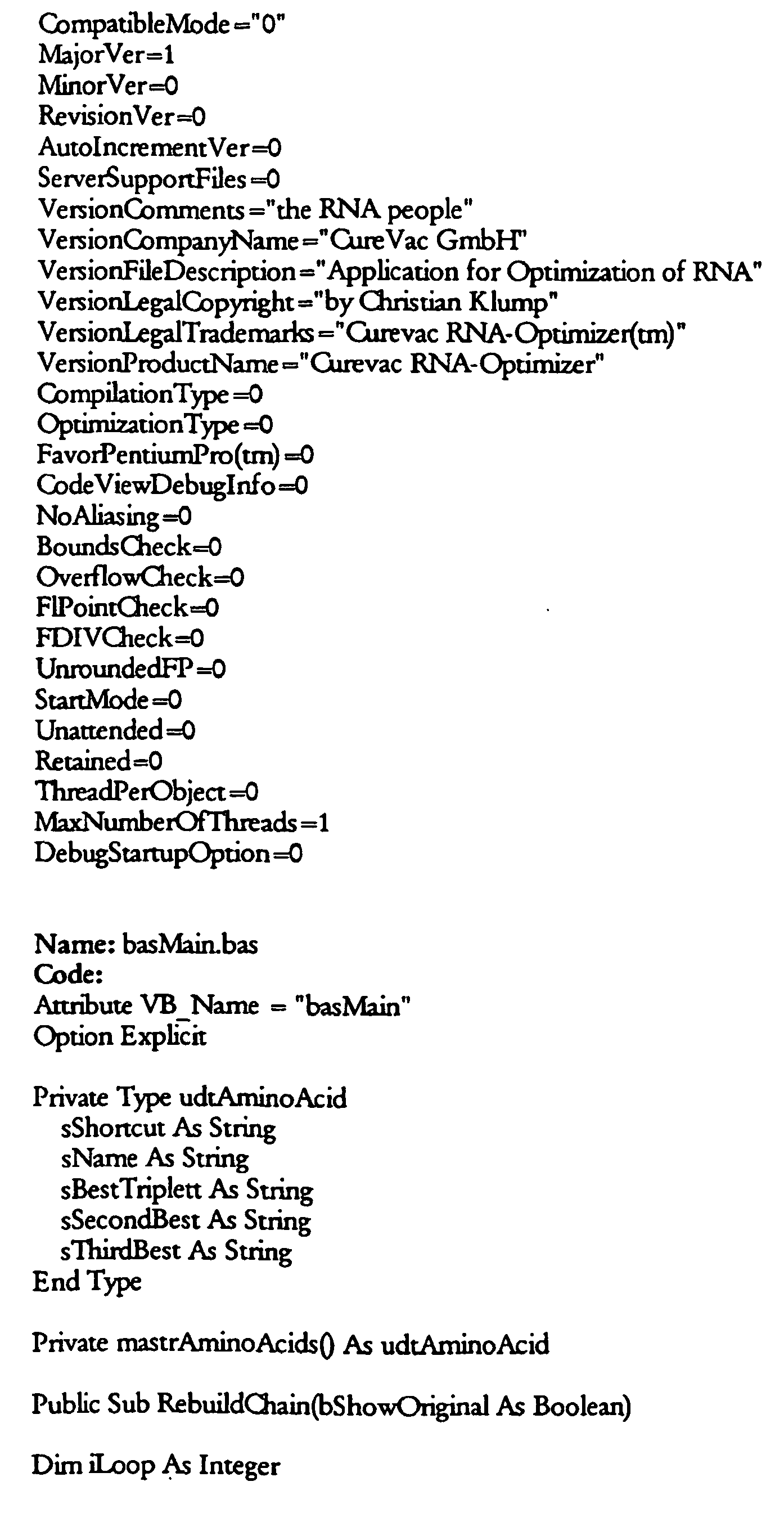


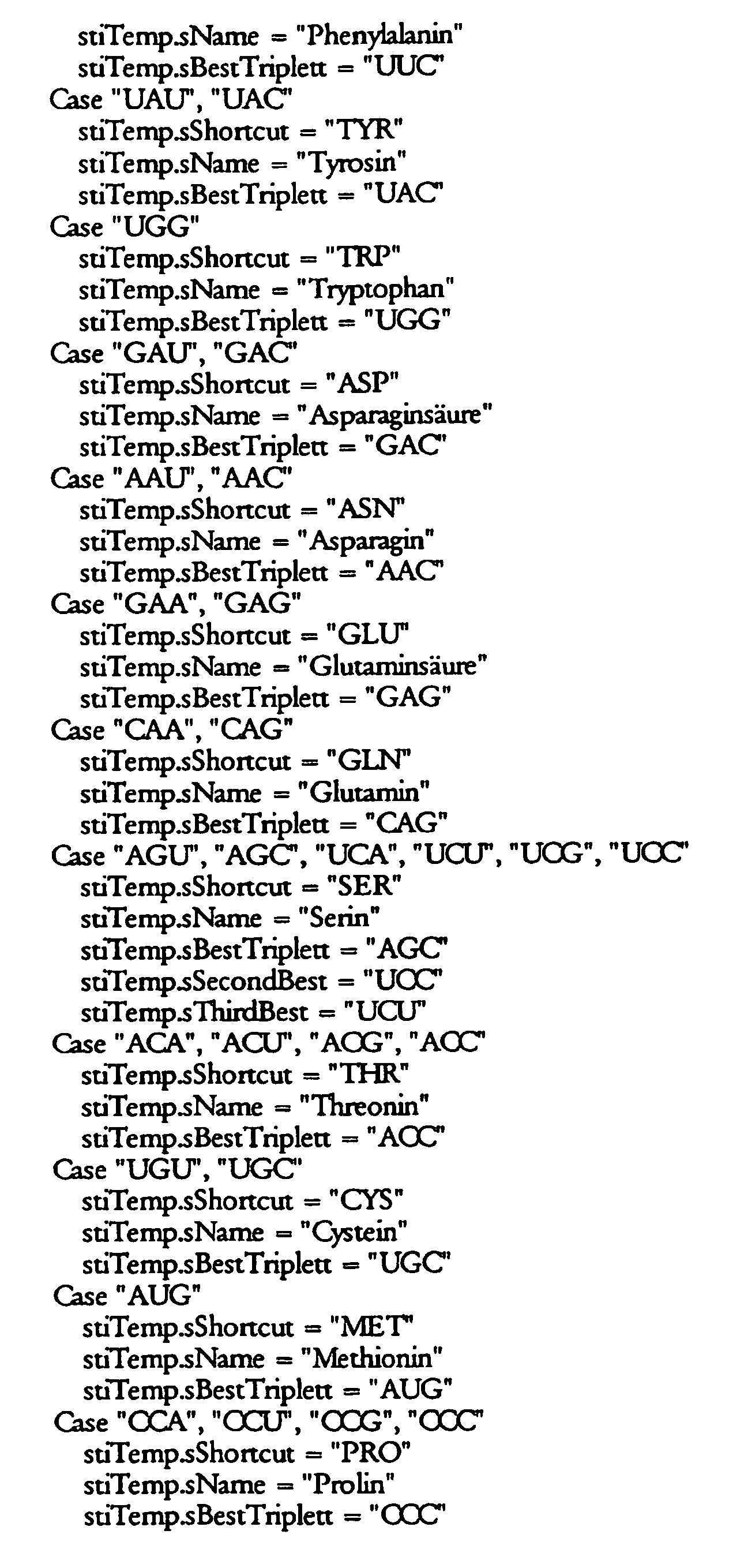


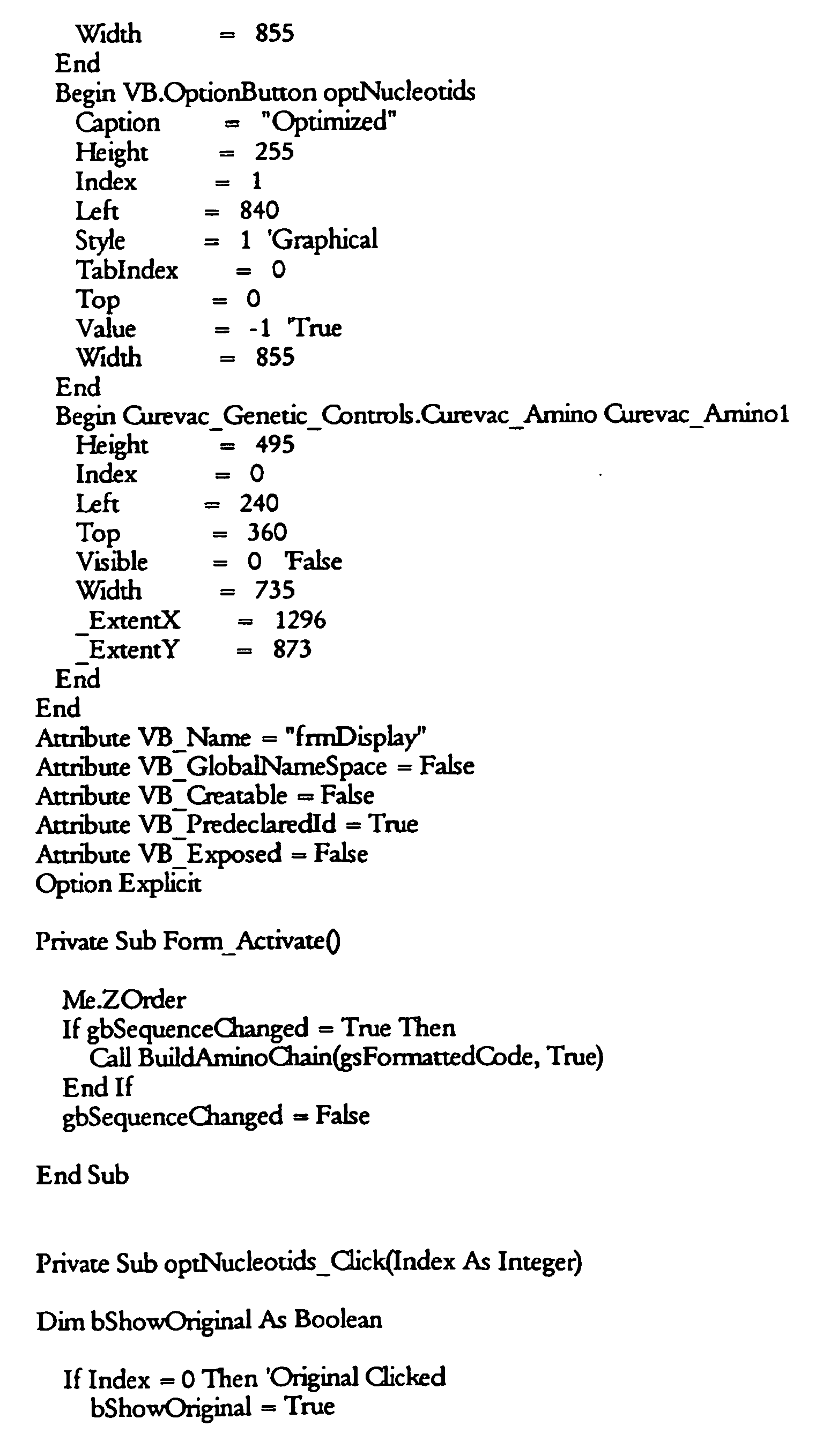


-
- <110> CureVac GmbH
- <120> Pharmazeutische Zusammensetzung, enthaltend eine stabilisierte und für die Translation in ihren codierenden Bereichen optimierte mRNA
- <130> CU01P003WOEPT2
- <150>
PCT/EP02/06180
<151> 2002-06-05 - <160> 13
- <170> PatentIn Ver. 2.1
- <210> 1
<211> 774
<212> DNA
<213> Influenza virus - <220>
<223> Influenza-Matrix: Wildtyp-Gen (zum Vergleich) - <220>
<223> Startcodon: atg (Nucleotide 11 bis 13), Stopcodon: tga (Nucleotide 767 bis 769 ) - <400> 1

- <210> 2
<211> 252
<212> PRT
<213> Influenza virus - <400> 2


- <210> 3
<211> 775
<212> DNA
<213> Artificial Sequence - <220>
<223> Description of Artificial Sequence: Influenza-Matrix: Gen mit erhöhtem G/C-Gehalt - <220>
<223> Startcodon: atg (Nucleotide 11 bis 13), Stopcodon: tga (Nucleotide 767 bis 769) - <400> 3

- <210> 4
<211> 844
<212> DNA
<213> Artificial Sequence - <220>
<223> Description of Artificial Sequence: Influenza-Matrix: Gen für sekretierte Form (mit N-terminaler Signalsequenz) mit erhöhtem G/C-Gehalt - <220>
<223> Startcodon: atg (Nucleotide 11 bis 13), Stopcodon: tga (Nucleotide 836 bis 838) - <400> 4

- <210> 5
<211> 942
<212> RNA
<213> Artificial Sequence - <220>
<223> Description of Artificial Sequence: Influenza-Matrix: mRNA mit Stabilisierungssequenzen - <220>
<223> Die Stabilisierungssequenzen stammen aus den 5'- bzw. 3'-UTRs der β-Globin-mRNA von Xenopus laevis - <220>
<223> Startcodon: aug (Nucleotide 56 bis 58), Stopcodon: uga (Nucleotide 812 bis 814) - <400> 5


- <210> 6
<211> 942
<212> RNA
<213> Artificial Sequence - <220>
<223> Description of Artificial Sequence: Influenza-Matrix: mRNA mit erhöhtem G/C-Gehalt und Stabilisierungssequenzen - <220>
<223> Die Stabilisierungssequenzen stammen aus den 5'- bzw. 3'-UTRs der β-Globin-mRNA von Xenopus laevis - <220>
<223> Startcodon: aug (Nucleotide 56 bis 58), Stopcodon: uga (Nucleotide 812 bis 814) - <400> 6

- <210> 7
<211> 1011
<212> RNA
<213> Artificial Sequence - <220>
<223> Description of Artificial Sequence: Influenza-Matrix: für sekretierte Form codierende mRNA mit erhöhtem G/C-Gehalt und Stabilisierungssequenzen - <220>
<223> Startcodon: aug (Nucleotide 56 bis 58), Stopcodon: uga (Nucleotide 881 bis 883) - <400> 7

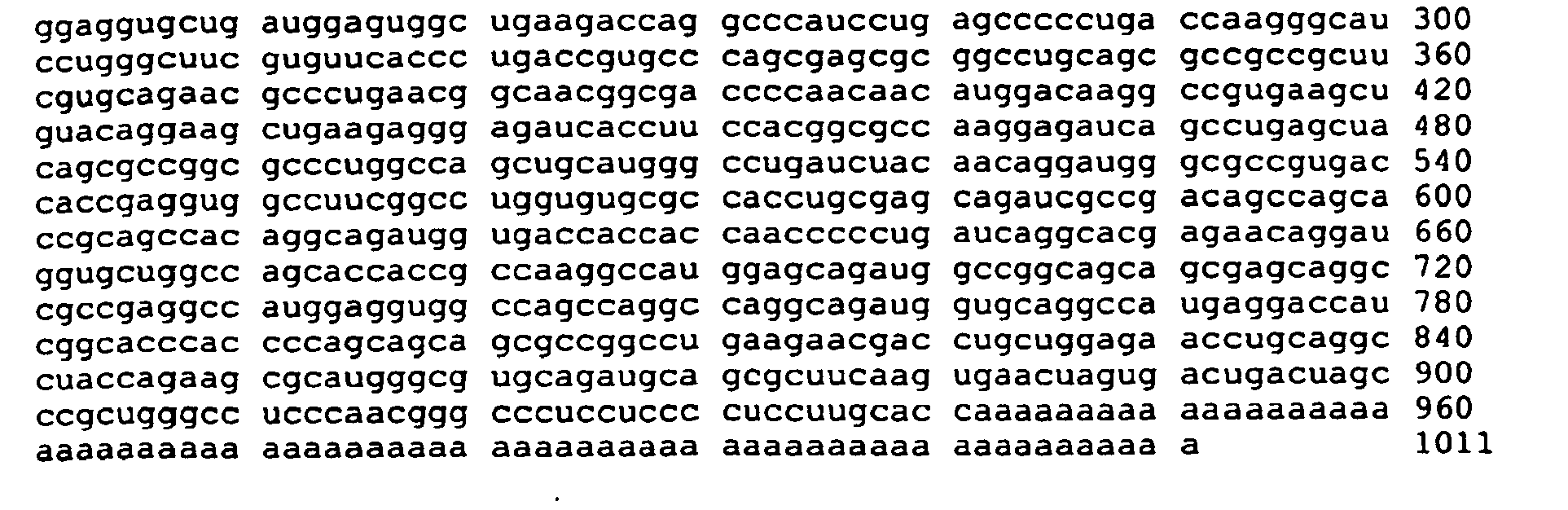
- <210> 8
<211> 940
<212> DNA
<213> Homo sapiens - <220>
<223> MAGE1: Wildtyp-Gen (zum Vergleich) - <220>
<223> Startcodon: atg (Nucleotide 5 bis 7), Stopcodon: tga (Nucleotide 932 bis 934) - <400> 8

- <210> 9
<211> 308
<212> PRT
<213> Homo sapiens - <220>
<223> Tumorantigen MAGE1: Proteinsequenz - <400> 9


- <210> 10
<211> 939
<212> RNA
<213> Artificial Sequence - <220>
<223> Description of Artificial Sequence: MAGE1: mRNA mit erhöhtem G/C-Gehalt - <220>
<223> Startcodon: aug (Nucleotide 1 bis 3), Stopcodon: uga (Nucleotide 937 bis 939) - <400> 10

- <210> 11
<211> 939
<212> RNA
<213> Artificial Sequence - <220>
<223> Description of Artificial Sequence: MAGE1: mRNA mit alternativer Codonverwendung - <220>
<223> Startcodon: aug (Nucleotide 1 bis 3), Stopcodon: uga (Nucleotide 937 bis 939) - <400> 11
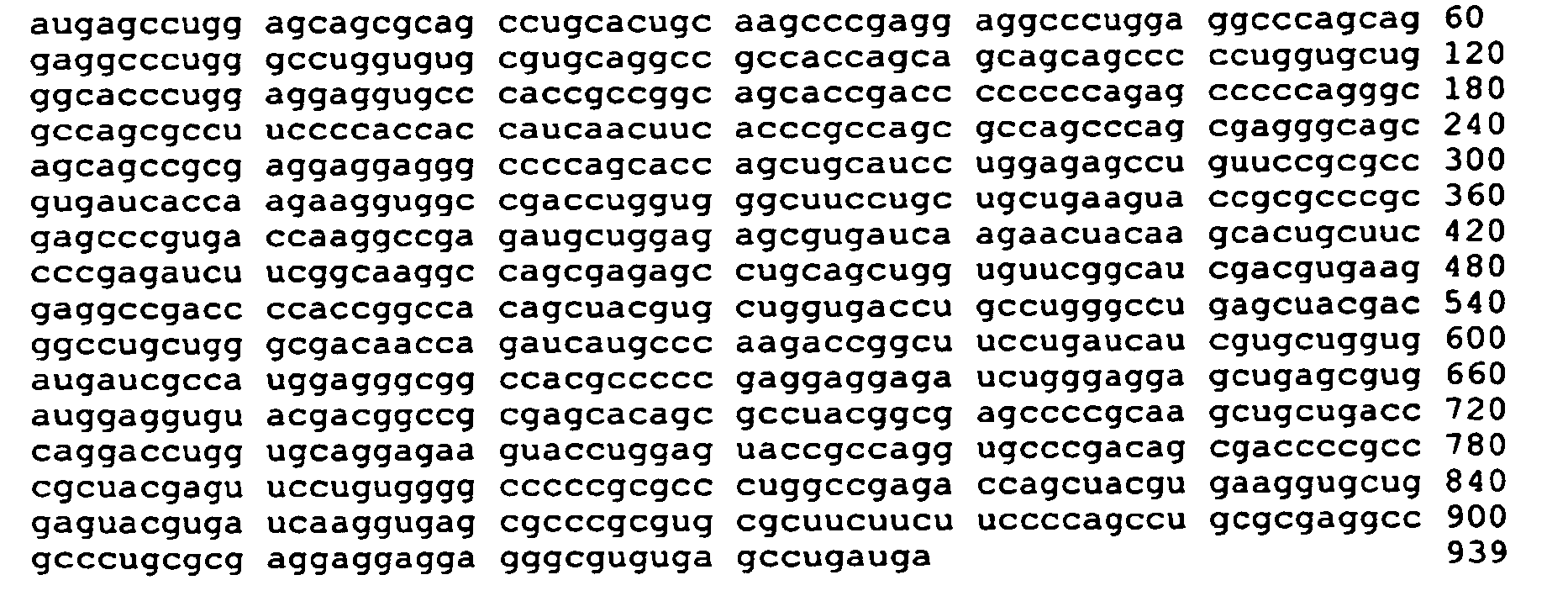
- <210> 12
<211> 7
<212> RNA
<213> Artificial Sequence - <220>
<223> Description of Artificial Sequence: Ein für eine Endonuklease erkennbares Sequenzmotiv, das im 3'UTR-Segment des für den Transferin-Rezeptor codierenden Gens enthalten ist (S. 10 der Beschreibung). - <400> 12
gaacaag 7 - <210> 13
<211> 13
<212> RNA
<213> Artificial Sequence - <220>
<223> Description of Artificial Sequence: Kozak-Sequenz, Ribosomen-Bindungsstelle (S. 12 der Beschreibung) - <400> 13
gccgccacca ugg 13
Claims (23)
- Verwendung einer modifizierten mRNA, die für mindestens ein biologisch wirksames Peptid oder Polypeptid codiert, dadurch gekennzeichnet, dass der G/C-Gehalt des für das Peptid oder Polypeptid codierenden Bereichs der modifizierten mRNA größer als der G/C-Gehalt des codierenden Bereichs der für das Peptid oder Polypeptid codierenden Wildtyp-mRNA ist und die codierte Aminosäuresequenz gegenüber dem Wildtyp unverändert ist, zur Herstellung eines Medikaments zur Gentherapie.
- Verwendung einer modifizierten mRNA nach Anspruch 1, dadurch gekennzeichnet, dass der G/C-Gehalt des für das Peptid oder Polypeptid codierenden Bereichs der modifizierten mRNA um mindestens 7%-Punkte, bevorzugt mindestens 15%-Punkte, größer als der G/C-Gehalt des codierenden Bereichs der für das Peptid oder Polypeptid codierenden Wildtyp-mRNA ist.
- Verwendung einer modifizierten mRNA nach Anspruch 1 oder 2, dadurch gekennzeichnet, dass der für das Peptid oder Polypeptid codierende Bereich der modifizierten mRNA derart verändert ist, dass sich ein maximaler G/C-Gehalt in Verbindung mit den Codons ergibt, die für relative häufige tRNAs codieren.
- Verwendung einer modifizierten mRNA nach einem der Ansprüche 1 bis 3, dadurch gekennzeichnet, dass die modifizierte mRNA eine 5'-Cap-Struktur und/oder einen polyA-Schwanz von mindestens 70 Nucleotiden und/oder eine IRES und/oder eine 5'-Stabilisierungssequenz und/oder eine 3'-Stabilisierungssequenz aufweist.
- Verwendung einer modifizierten mRNA nach einem der Ansprüche 1 bis 4, dadurch gekennzeichnet, dass die modifizierte mRNA mindestens ein Analoges natürlich vorkommender Nucleotide aufweist.
- Verwendung einer modifizierten mRNA nach Anspruch 5, dadurch gekennzeichnet, dass das Analoge aus der Gruppe, bestehend aus Phosphorthioaten, Phosphoramidaten, Peptidnucleotiden, Methylphosphonaten, 7-Deazaguanosin, 5-Methylcytosin und Inosin, ausgewählt ist.
- Verwendung einer modifizierten mRNA nach einem der Ansprüche 1 bis 6, dadurch gekennzeichnet, dass die mRNA für ein Polypeptid codiert, welches in dem zu behandelnden Patienten nicht oder nur unzureichend oder fehlerhaft gebildet wird.
- Verwendung einer modifizierten mRNA nach einem der Ansprüche 1 bis 7, dadurch gekennzeichnet, dass die modifizierte mRNA für Dystrophin, Enzyme, die bei metabolischen Erkrankungen fehlen oder fehlerhaft sind, oder Enzyme, die an der Synthese von Neurotransmittern beteiligt sind, codiert.
- Verwendung einer modifizierten mRNA nach einem der Ansprüche 1 bis 7, dadurch gekennzeichnet, dass die mRNA ein Peptid oder Protein codiert, das an Zelloberflächen-Rezeptoren bindet.
- Verwendung einer modifizierten mRNA nach einem der Ansprüche 1 bis 7 oder 9, dadurch gekennzeichnet, dass die mRNA für Wachstumsfaktoren oder Wachstumshormone codiert.
- Verwendung einer modifizierten mRNA nach Anspruch 7 oder 9, dadurch gekennzeichnet, dass die mRNA für den Gewebeplasminogenaktivator, Insulin, Interferone, GM-CSF, Erythropoietin, Tyrosinhydroxylase, DOPA-Decarboxylase oder α-1-Antitrypsin codiert.
- Verwendung einer modifizierten mRNA nach einem der Ansprüche 1 bis 7, dadurch gekennzeichnet, dass die mRNA mit einem kationischen Peptid oder Protein assoziiert oder daran gebunden ist, insbesondere Protamin, Poly-L-Lysin oder Historie.
- Verwendung einer modifizierten mRNA nach einem der Ansprüche 1 bis 9, dadurch gekennzeichnet, dass die mRNA zusätzlich für mindestens ein Cytokin codiert.
- Verwendung einer modifizierten mRNA nach einem der Ansprüche 1 bis 13, in Verbindung mit einem pharmazeutisch verträglichen Träger und/oder Vehikel.
- Verwendung einer modifizierten mRNA nach einem der Ansprüche 1 bis 14, zur Geweberegeneration oder zur Behandlung von degenerativen, insbesondere neurodegenerativen Erkrankungen.
- Verwendung einer modifizierten mRNA nach einem der Ansprüche 1 bis 14, zur Behandlung von Morbus Alzheimer, Morbus Parkinson oder Arthrose.
- Verwendung einer modifizierten mRNA nach Anspruch 15 oder 16, dadurch gekennzeichnet dass die mRNA für Wachstumsfaktoren aus der TGF-β-Familie codiert.
- Verwendung einer modifizierten mRNA nach Anspruch 15 oder 16, dadurch gekennzeichnet, dass die mRNA für EGF, FGF, PDGF, BMP, GDNF, BDNF, GDF und neurotrophe Faktoren, bspw. NGF oder Neutrophine, codiert.
- Modifizierte mRNA, die für mindestens ein biologisch wirksames Peptid oder Polypeptid codiert, welches in dem zu behandelnden Patienten nicht oder nur unzureichend oder fehlerhaft gebildet wird, dadurch gekennzeichnet, dass der G/C-Gehalt des für das Peptid oder Polypeptid codierenden Bereichs der modifizierten mRNA größer als der G/C-Gehalt des codierenden Bereichs der für das Peptid oder Polypeptid codierenden Wildtyp-mRNA ist und die codierte Aminosäuresequenz gegenüber dem Wildtyp unverändert ist.
- Modifizierte mRNA nach Anspruch 19, wobei die modifizierte mRNA Enzyme, die bei metabolischen Erkrankungen fehlen bzw. fehlerhaft sind, oder für Enzyme, die an der Synthese von Neurotransmittern beteiligt sind, codiert.
- Modifizierte mRNA nach Anspruch 19, wobei die modifizierte mRNA für Zelloberflächen-Rezeptoren codiert.
- Modifizierte mRNA nach Anspruch 19, dadurch gekennzeichnet, dass die modifizierte mRNA für Proteine, die an Zelloberflächen-Rezeptoren binden oder extrazellulär wirken, ausgewählt werden aus der Gruppe bestehend aus Gewebeplasminogenaktivator, Wachstumshormone, Insulin, Interferone, Granulozyten-Makrophagen-Koloniestimulierungsfaktor, Wachstumsfaktoren und Erythropoietin, codiert.
- Pharmazeutische Zusammensetzung, enthaltend eine modifizierte mRNA nach einem der Ansprüche 19 bis 22 in Verbindung mit einem pharmazeutisch verträglichen Träger und/oder Vehikel.
Applications Claiming Priority (3)
| Application Number | Priority Date | Filing Date | Title |
|---|---|---|---|
| DE10127283 | 2001-06-05 | ||
| EP05004938A EP1604688B1 (de) | 2001-06-05 | 2002-06-05 | Stabilisierte Tumorantigen-mRNA mit erhöhtem G/C-Gehalt |
| EP02732752A EP1392341B1 (de) | 2001-06-05 | 2002-06-05 | Stabilisierte mrna mit erhöhtem g/c-gehalt und optimierter codon usage für die gentherapie |
Related Parent Applications (3)
| Application Number | Title | Priority Date | Filing Date |
|---|---|---|---|
| EP05004938A Division EP1604688B1 (de) | 2001-06-05 | 2002-06-05 | Stabilisierte Tumorantigen-mRNA mit erhöhtem G/C-Gehalt |
| EP02732752.7 Division | 2002-06-05 | ||
| EP05004938.6 Division | 2005-03-07 |
Publications (3)
| Publication Number | Publication Date |
|---|---|
| EP1800697A2 EP1800697A2 (de) | 2007-06-27 |
| EP1800697A3 EP1800697A3 (de) | 2007-10-31 |
| EP1800697B1 true EP1800697B1 (de) | 2010-04-14 |
Family
ID=7687266
Family Applications (8)
| Application Number | Title | Priority Date | Filing Date |
|---|---|---|---|
| EP20070023083 Withdrawn EP1903054A3 (de) | 2001-06-05 | 2002-06-05 | Stabilisierte mRNA mit erhöhtem G/C-Gehalt und optimierter Codon Usage für die Gentherapie |
| EP20070000343 Expired - Lifetime EP1800697B1 (de) | 2001-06-05 | 2002-06-05 | Stabilisierte mRNA mit erhöhtem G/C-Gehalt für die Gentherapie |
| EP10007991.2A Expired - Lifetime EP2305699B1 (de) | 2001-06-05 | 2002-06-05 | Stabilisierte mRNA mit erhöhtem G/C-Gehalt und optimierter Codon Usage für die Impfung gegen Schlafkrankheit, Leishmaniose und Toxoplasmose |
| EP20140002635 Withdrawn EP2842964A1 (de) | 2001-06-05 | 2002-06-05 | Virtuelles Verfahren zur Ermittlung einer modifzierten mRNA-Sequenz |
| EP07015835A Expired - Lifetime EP1857122B1 (de) | 2001-06-05 | 2002-06-05 | Stabilisierte mRNA mit erhöhtem G/C-Gehalt, kodierend für ein virales Antigen |
| EP05004938A Expired - Lifetime EP1604688B1 (de) | 2001-06-05 | 2002-06-05 | Stabilisierte Tumorantigen-mRNA mit erhöhtem G/C-Gehalt |
| EP02732752A Expired - Lifetime EP1392341B1 (de) | 2001-06-05 | 2002-06-05 | Stabilisierte mrna mit erhöhtem g/c-gehalt und optimierter codon usage für die gentherapie |
| EP07002195A Expired - Lifetime EP1832603B1 (de) | 2001-06-05 | 2002-06-05 | Stabilisierte mRNA mit erhöhtem G/C-Gehalt, enkodierend für ein bakterielles Antigen sowie deren Verwendung |
Family Applications Before (1)
| Application Number | Title | Priority Date | Filing Date |
|---|---|---|---|
| EP20070023083 Withdrawn EP1903054A3 (de) | 2001-06-05 | 2002-06-05 | Stabilisierte mRNA mit erhöhtem G/C-Gehalt und optimierter Codon Usage für die Gentherapie |
Family Applications After (6)
| Application Number | Title | Priority Date | Filing Date |
|---|---|---|---|
| EP10007991.2A Expired - Lifetime EP2305699B1 (de) | 2001-06-05 | 2002-06-05 | Stabilisierte mRNA mit erhöhtem G/C-Gehalt und optimierter Codon Usage für die Impfung gegen Schlafkrankheit, Leishmaniose und Toxoplasmose |
| EP20140002635 Withdrawn EP2842964A1 (de) | 2001-06-05 | 2002-06-05 | Virtuelles Verfahren zur Ermittlung einer modifzierten mRNA-Sequenz |
| EP07015835A Expired - Lifetime EP1857122B1 (de) | 2001-06-05 | 2002-06-05 | Stabilisierte mRNA mit erhöhtem G/C-Gehalt, kodierend für ein virales Antigen |
| EP05004938A Expired - Lifetime EP1604688B1 (de) | 2001-06-05 | 2002-06-05 | Stabilisierte Tumorantigen-mRNA mit erhöhtem G/C-Gehalt |
| EP02732752A Expired - Lifetime EP1392341B1 (de) | 2001-06-05 | 2002-06-05 | Stabilisierte mrna mit erhöhtem g/c-gehalt und optimierter codon usage für die gentherapie |
| EP07002195A Expired - Lifetime EP1832603B1 (de) | 2001-06-05 | 2002-06-05 | Stabilisierte mRNA mit erhöhtem G/C-Gehalt, enkodierend für ein bakterielles Antigen sowie deren Verwendung |
Country Status (11)
| Country | Link |
|---|---|
| US (14) | US10188748B2 (de) |
| EP (8) | EP1903054A3 (de) |
| AT (5) | ATE490267T1 (de) |
| AU (2) | AU2007203181B2 (de) |
| CA (2) | CA2457959C (de) |
| DE (5) | DE50202634D1 (de) |
| DK (1) | DK1857122T3 (de) |
| ES (5) | ES2340499T3 (de) |
| FR (2) | FR21C1008I1 (de) |
| PT (1) | PT1857122E (de) |
| WO (1) | WO2002098443A2 (de) |
Cited By (1)
| Publication number | Priority date | Publication date | Assignee | Title |
|---|---|---|---|---|
| WO2012130941A2 (de) | 2011-03-31 | 2012-10-04 | Schaefer Konstanze | Perfluorierte verbindungen zum nicht-viralen transfer von nukleinsäuren |
Families Citing this family (475)
| Publication number | Priority date | Publication date | Assignee | Title |
|---|---|---|---|---|
| ATE490267T1 (de) | 2001-06-05 | 2010-12-15 | Curevac Gmbh | Stabilisierte mrna mit erhöhtem g/c-gehalt, kodierend für ein virales antigen |
| DE10162480A1 (de) | 2001-12-19 | 2003-08-07 | Ingmar Hoerr | Die Applikation von mRNA für den Einsatz als Therapeutikum gegen Tumorerkrankungen |
| FR2845918A1 (fr) * | 2002-10-16 | 2004-04-23 | Pasteur Institut | Preparations immunogenes et vaccinantes a base d'arn |
| WO2003059381A2 (en) * | 2002-01-18 | 2003-07-24 | Curevac Gmbh | Immunogenic preparations and vaccines on the basis of mrna |
| US7901708B2 (en) | 2002-06-28 | 2011-03-08 | Protiva Biotherapeutics, Inc. | Liposomal apparatus and manufacturing methods |
| DE10229872A1 (de) | 2002-07-03 | 2004-01-29 | Curevac Gmbh | Immunstimulation durch chemisch modifizierte RNA |
| AU2002953015A0 (en) * | 2002-12-02 | 2002-12-12 | Women's And Children's Hospital | Modified lacz gene |
| DE10335833A1 (de) * | 2003-08-05 | 2005-03-03 | Curevac Gmbh | Transfektion von Blutzellen mit mRNA zur Immunstimulation und Gentherapie |
| DE10347710B4 (de) | 2003-10-14 | 2006-03-30 | Johannes-Gutenberg-Universität Mainz | Rekombinante Impfstoffe und deren Verwendung |
| CA2572151A1 (en) | 2004-06-30 | 2006-08-24 | Alnylam Pharmaceuticals, Inc. | Oligonucleotides comprising a non-phosphate backbone linkage |
| DE102004035227A1 (de) * | 2004-07-21 | 2006-02-16 | Curevac Gmbh | mRNA-Gemisch zur Vakzinierung gegen Tumorerkrankungen |
| DE102004042546A1 (de) * | 2004-09-02 | 2006-03-09 | Curevac Gmbh | Kombinationstherapie zur Immunstimulation |
| WO2006046132A2 (en) * | 2004-09-17 | 2006-05-04 | Institut Pasteur | Method for modulating the evolution of a polypeptide encoded by a nucleic acid sequence |
| DE102005023170A1 (de) * | 2005-05-19 | 2006-11-23 | Curevac Gmbh | Optimierte Formulierung für mRNA |
| EP3611266B1 (de) | 2005-08-23 | 2022-11-09 | The Trustees of the University of Pennsylvania | Modifizierte nukleoside enthaltende rna und verfahren zur verwendung davon |
| KR20080082956A (ko) | 2005-09-15 | 2008-09-12 | 노보솜 아게 | 양쪽성 리포솜의 개선 또는 양쪽성 리포솜에 관련된 개선 |
| DE102005046490A1 (de) * | 2005-09-28 | 2007-03-29 | Johannes-Gutenberg-Universität Mainz | Modifikationen von RNA, die zu einer erhöhten Transkriptstabilität und Translationseffizienz führen |
| DE102006035618A1 (de) * | 2006-07-31 | 2008-02-07 | Curevac Gmbh | Nukleinsäure der Formel (I): GlXmGn, insbesondere als immunstimulierendes Adjuvanz |
| AU2007280690C1 (en) | 2006-07-31 | 2012-08-23 | Curevac Gmbh | Nucleic acid of formula (I): GIXmGn, or (II): CIXmCn, in particular as an immune-stimulating agent/adjuvant |
| US8980561B1 (en) * | 2006-08-22 | 2015-03-17 | Los Alamos National Security, Llc. | Nucleic acid detection system and method for detecting influenza |
| WO2008105814A2 (en) * | 2006-08-22 | 2008-09-04 | Los Alamos National Security, Llc | Miniturized lateral flow device for rapid and sensitive detection of proteins or nucleic acids |
| JP5424885B2 (ja) | 2006-10-13 | 2014-02-26 | マリーナ バイオテック,インコーポレイテッド | 両性リポソームにおけるまたは両性リポソームに関する改善、両性リポソームを処方する方法および両性リポソームに充填する方法 |
| DE102006051516A1 (de) * | 2006-10-31 | 2008-05-08 | Curevac Gmbh | (Basen-)modifizierte RNA zur Expressionssteigerung eines Proteins |
| DE102007001370A1 (de) * | 2007-01-09 | 2008-07-10 | Curevac Gmbh | RNA-kodierte Antikörper |
| DE102007029471A1 (de) | 2007-06-20 | 2008-12-24 | Novosom Ag | Neue fakultativ kationische Sterole |
| WO2009030254A1 (en) | 2007-09-04 | 2009-03-12 | Curevac Gmbh | Complexes of rna and cationic peptides for transfection and for immunostimulation |
| WO2009039198A2 (en) * | 2007-09-17 | 2009-03-26 | The Trustees Of The University Of Pennsylvania | Generation of hyperstable mrnas |
| EP3222290A1 (de) | 2007-10-09 | 2017-09-27 | CureVac AG | Zusammensetzung zur behandlung von prostatakrebs |
| WO2009046738A1 (en) | 2007-10-09 | 2009-04-16 | Curevac Gmbh | Composition for treating lung cancer, particularly of non-small lung cancers (nsclc) |
| WO2009046739A1 (en) * | 2007-10-09 | 2009-04-16 | Curevac Gmbh | Composition for treating prostate cancer (pca) |
| EP2231264A1 (de) * | 2007-12-05 | 2010-09-29 | Eyegate Pharma S.A.S. | Verfahren zur abgabe von sirna durch iontophorese |
| EP2176408B9 (de) | 2008-01-31 | 2015-11-11 | Curevac GmbH | NUKLEINSÄUREN MIT FORMEL-(NuGiXmGnNv)a UND DERIVATE DAVON ALS IMMUNSTIMULIERENDE MITTEL ODER ADJUVANZIEN |
| WO2009127230A1 (en) * | 2008-04-16 | 2009-10-22 | Curevac Gmbh | MODIFIED (m)RNA FOR SUPPRESSING OR AVOIDING AN IMMUNOSTIMULATORY RESPONSE AND IMMUNOSUPPRESSIVE COMPOSITION |
| EP3067694A1 (de) * | 2008-05-05 | 2016-09-14 | Los Alamos National Security, LLC | Vorbereitung von nukleinsäureproben auf lateralflussbasis und passive strömungssteuerung |
| WO2010037408A1 (en) | 2008-09-30 | 2010-04-08 | Curevac Gmbh | Composition comprising a complexed (m)rna and a naked mrna for providing or enhancing an immunostimulatory response in a mammal and uses thereof |
| CN201397956Y (zh) * | 2009-03-23 | 2010-02-03 | 富士康(昆山)电脑接插件有限公司 | 电连接器组件 |
| DK2823810T3 (da) | 2009-07-09 | 2019-05-27 | Novosom Verwaltungs Gmbh | Amfotere liposomer, der omfatter iminolipider |
| US20110053829A1 (en) | 2009-09-03 | 2011-03-03 | Curevac Gmbh | Disulfide-linked polyethyleneglycol/peptide conjugates for the transfection of nucleic acids |
| HUE042177T2 (hu) | 2009-12-01 | 2019-06-28 | Translate Bio Inc | Szteroidszármazék mRNS szállítására humán genetikai betegségekben |
| WO2011069529A1 (en) | 2009-12-09 | 2011-06-16 | Curevac Gmbh | Mannose-containing solution for lyophilization, transfection and/or injection of nucleic acids |
| WO2011069528A1 (en) | 2009-12-09 | 2011-06-16 | Curevac Gmbh | Lyophilization of nucleic acids in lactate-containing solutions |
| RS63817B1 (sr) | 2010-07-06 | 2023-01-31 | Glaxosmithkline Biologicals Sa | Čestice za isporuku slične virionu za molekule samoreplicirajuće rnk |
| HUE047796T2 (hu) | 2010-07-06 | 2020-05-28 | Glaxosmithkline Biologicals Sa | RNS bevitele több immunútvonal bekapcsolására |
| HUE026646T2 (en) | 2010-07-06 | 2016-07-28 | Glaxosmithkline Biologicals Sa | Preferred liposomes containing lipids of PKA value for delivery of RNA |
| PL2591114T3 (pl) | 2010-07-06 | 2017-08-31 | Glaxosmithkline Biologicals Sa | Immunizacja dużych ssaków małymi dawkami rna |
| CA2801523C (en) | 2010-07-30 | 2021-08-03 | Curevac Gmbh | Complexation of nucleic acids with disulfide-crosslinked cationic components for transfection and immunostimulation |
| WO2012019168A2 (en) | 2010-08-06 | 2012-02-09 | Moderna Therapeutics, Inc. | Engineered nucleic acids and methods of use thereof |
| WO2012019630A1 (en) | 2010-08-13 | 2012-02-16 | Curevac Gmbh | Nucleic acid comprising or coding for a histone stem-loop and a poly(a) sequence or a polyadenylation signal for increasing the expression of an encoded protein |
| PT3970742T (pt) | 2010-08-31 | 2022-06-27 | Glaxosmithkline Biologicals Sa | Lipossomas peguilados para entrega de arn codificador de imunogénio |
| RU2013120302A (ru) | 2010-10-01 | 2014-11-20 | Модерна Терапьютикс, Инк. | Сконструированные нуклеиновые кислоты и способы их применения |
| JP2013544504A (ja) | 2010-10-11 | 2013-12-19 | ノバルティス アーゲー | 抗原送達プラットフォーム |
| WO2012075040A2 (en) | 2010-11-30 | 2012-06-07 | Shire Human Genetic Therapies, Inc. | mRNA FOR USE IN TREATMENT OF HUMAN GENETIC DISEASES |
| WO2012089225A1 (en) | 2010-12-29 | 2012-07-05 | Curevac Gmbh | Combination of vaccination and inhibition of mhc class i restricted antigen presentation |
| WO2012116715A1 (en) | 2011-03-02 | 2012-09-07 | Curevac Gmbh | Vaccination in newborns and infants |
| WO2012113413A1 (en) | 2011-02-21 | 2012-08-30 | Curevac Gmbh | Vaccine composition comprising complexed immunostimulatory nucleic acids and antigens packaged with disulfide-linked polyethyleneglycol/peptide conjugates |
| WO2012116714A1 (en) | 2011-03-02 | 2012-09-07 | Curevac Gmbh | Vaccination in elderly patients |
| EP2691101A2 (de) | 2011-03-31 | 2014-02-05 | Moderna Therapeutics, Inc. | Freisetzung und formulierung von manipulierten nukleinsäuren |
| US10519492B2 (en) | 2011-04-20 | 2019-12-31 | Mesa Biotech, Inc. | Integrated device for nucleic acid detection and identification |
| HRP20211595T1 (hr) | 2011-05-24 | 2022-01-21 | BioNTech SE | Individualizirana cjepiva protiv raka |
| HRP20191535T1 (hr) * | 2011-05-24 | 2019-11-29 | Biontech Rna Pharmaceuticals Gmbh | Individualizirana cjepiva protiv raka |
| PL3586861T3 (pl) | 2011-06-08 | 2022-05-23 | Translate Bio, Inc. | Kompozycje nanocząstek lipidowych i sposoby dostarczania mrna |
| WO2013006838A1 (en) | 2011-07-06 | 2013-01-10 | Novartis Ag | Immunogenic combination compositions and uses thereof |
| US20140141070A1 (en) * | 2011-07-06 | 2014-05-22 | Andrew Geall | Liposomes having useful n:p ratio for delivery of rna molecules |
| US9464124B2 (en) | 2011-09-12 | 2016-10-11 | Moderna Therapeutics, Inc. | Engineered nucleic acids and methods of use thereof |
| RU2648950C2 (ru) | 2011-10-03 | 2018-04-02 | Модерна Терапьютикс, Инк. | Модифицированные нуклеозиды, нуклеотиды и нуклеиновые кислоты и их применение |
| CN104114572A (zh) | 2011-12-16 | 2014-10-22 | 现代治疗公司 | 经修饰的核苷、核苷酸和核酸组合物 |
| WO2013113326A1 (en) | 2012-01-31 | 2013-08-08 | Curevac Gmbh | Pharmaceutical composition comprising a polymeric carrier cargo complex and at least one protein or peptide antigen |
| WO2013120498A1 (en) | 2012-02-15 | 2013-08-22 | Curevac Gmbh | Nucleic acid comprising or coding for a histone stem-loop and a poly(a) sequence or a polyadenylation signal for increasing the expression of an encoded allergenic antigen or an autoimmune self-antigen |
| WO2013120497A1 (en) | 2012-02-15 | 2013-08-22 | Curevac Gmbh | Nucleic acid comprising or coding for a histone stem-loop and a poly(a) sequence or a polyadenylation signal for increasing the expression of an encoded therapeutic protein |
| EP3527662B1 (de) | 2012-02-15 | 2022-01-26 | CureVac AG | Nukleinsäure mit oder zur codierung einer histon-haarnadelstruktur und poly(a)-sequenz oder ein polyadenylationssignal zur erhöhung der expression eines codierten tumorantigens |
| EP2814964B1 (de) | 2012-02-15 | 2019-01-09 | CureVac AG | Nucleinsäure, enthaltend eine oder codierend für eine histon-stammschleife und eine poly(a)-sequenz oder ein polyadenylierungssignal zur erhöhung der expression eines codierten allergen-antigens oder eines autoimmunen selbstantigens |
| WO2013120499A1 (en) | 2012-02-15 | 2013-08-22 | Curevac Gmbh | Nucleic acid comprising or coding for a histone stem-loop and a poly (a) sequence or a polyadenylation signal for increasing the expression of an encoded pathogenic antigen |
| WO2013120500A1 (en) * | 2012-02-15 | 2013-08-22 | Curevac Gmbh | Nucleic acid comprising or coding for a histone stem-loop and a poly(a) sequence or a polyadenylation signal for increasing the expression of an encoded tumour antigen |
| PL2814962T3 (pl) | 2012-02-15 | 2018-11-30 | Curevac Ag | Kwas nukleinowy zawierający lub kodujący histonowy trzonek-pętlę i sekwencję poli(A) lub sygnał poliadenylacji do zwiększania ekspresji zakodowanego antygenu patogennego |
| WO2013143555A1 (en) | 2012-03-26 | 2013-10-03 | Biontech Ag | Rna formulation for immunotherapy |
| EP3260541B1 (de) | 2012-03-27 | 2019-05-15 | CureVac AG | Künstliche nukleinsäuremoleküle zur verbesserten protein- oder peptidexpression |
| RU2658490C2 (ru) | 2012-03-27 | 2018-06-21 | Кьюрвак Аг | Искусственные молекулы нуклеиновых кислот для улучшенной экспрессии белков или пептидов |
| SG10201607962RA (en) | 2012-03-27 | 2016-11-29 | Curevac Ag | Artificial nucleic acid molecules |
| WO2013143700A2 (en) | 2012-03-27 | 2013-10-03 | Curevac Gmbh | Artificial nucleic acid molecules comprising a 5'top utr |
| CA2868391A1 (en) | 2012-04-02 | 2013-10-10 | Stephane Bancel | Polynucleotides comprising n1-methyl-pseudouridine and methods for preparing the same |
| US9254311B2 (en) | 2012-04-02 | 2016-02-09 | Moderna Therapeutics, Inc. | Modified polynucleotides for the production of proteins |
| US9283287B2 (en) | 2012-04-02 | 2016-03-15 | Moderna Therapeutics, Inc. | Modified polynucleotides for the production of nuclear proteins |
| US9572897B2 (en) | 2012-04-02 | 2017-02-21 | Modernatx, Inc. | Modified polynucleotides for the production of cytoplasmic and cytoskeletal proteins |
| AU2013243948A1 (en) | 2012-04-02 | 2014-10-30 | Moderna Therapeutics, Inc. | Modified polynucleotides for the production of proteins associated with human disease |
| US10501513B2 (en) | 2012-04-02 | 2019-12-10 | Modernatx, Inc. | Modified polynucleotides for the production of oncology-related proteins and peptides |
| US9649208B2 (en) | 2012-04-13 | 2017-05-16 | Medtronic Vascular, Inc. | Hollow drug-filled stent and method of forming hollow drug-filled stent |
| US8998977B2 (en) | 2012-04-13 | 2015-04-07 | Medtronic Vascular, Inc. | Hollow drug-filled stent and method of forming hollow drug-filled stent |
| EP3536787A1 (de) | 2012-06-08 | 2019-09-11 | Translate Bio, Inc. | Nukleaseresistente polynukleotide und verwendungen davon |
| US9512456B2 (en) | 2012-08-14 | 2016-12-06 | Modernatx, Inc. | Enzymes and polymerases for the synthesis of RNA |
| WO2014081507A1 (en) * | 2012-11-26 | 2014-05-30 | Moderna Therapeutics, Inc. | Terminally modified rna |
| WO2014082729A1 (en) | 2012-11-28 | 2014-06-05 | Biontech Ag | Individualized vaccines for cancer |
| US20140200261A1 (en) | 2013-01-17 | 2014-07-17 | Moderna Therapeutics, Inc. | Signal-sensor polynucleotides for the alteration of cellular phenotypes |
| EP2765137A1 (de) | 2013-02-07 | 2014-08-13 | Sanofi Pasteur | Induktion von kreuzreaktiver Zellreaktion gegen Rhinovirus-Antigene |
| EP2958588B1 (de) | 2013-02-22 | 2017-08-23 | CureVac AG | Kombination einer impfung mit einer hemmung des pd-1-pfades |
| RU2718988C2 (ru) | 2013-02-22 | 2020-04-15 | Куревак Аг | Комбинация противораковой рнк-вакцины и ингибитора пути pd-1 и ее применение |
| EP2971010B1 (de) | 2013-03-14 | 2020-06-10 | ModernaTX, Inc. | Formulierung und abgabe von modifizierten nukleosid-, nukleotid- und nukleinsäurezusammensetzungen |
| KR20210122917A (ko) | 2013-03-14 | 2021-10-12 | 샤이어 휴먼 지네틱 테라피즈 인크. | Cftr mrna 조성물 및 관련 방법 및 사용 |
| WO2014160243A1 (en) | 2013-03-14 | 2014-10-02 | The Trustees Of The University Of Pennsylvania | Purification and purity assessment of rna molecules synthesized with modified nucleosides |
| PL3467108T3 (pl) | 2013-03-14 | 2024-09-30 | Translate Bio, Inc. | Sposoby oczyszczania informacyjnego rna |
| WO2014152030A1 (en) | 2013-03-15 | 2014-09-25 | Moderna Therapeutics, Inc. | Removal of dna fragments in mrna production process |
| US8980864B2 (en) | 2013-03-15 | 2015-03-17 | Moderna Therapeutics, Inc. | Compositions and methods of altering cholesterol levels |
| WO2014152031A1 (en) | 2013-03-15 | 2014-09-25 | Moderna Therapeutics, Inc. | Ribonucleic acid purification |
| WO2014144767A1 (en) | 2013-03-15 | 2014-09-18 | Moderna Therapeutics, Inc. | Ion exchange purification of mrna |
| WO2014180490A1 (en) | 2013-05-10 | 2014-11-13 | Biontech Ag | Predicting immunogenicity of t cell epitopes |
| EP3008191A2 (de) | 2013-06-13 | 2016-04-20 | Shire Human Genetic Therapies, Inc. | Virenproduktion auf messenger-rna-basis |
| SMT202100691T1 (it) | 2013-07-11 | 2022-01-10 | Modernatx Inc | Composizioni 5 comprendenti polinucleotidi sintetici che codificano proteine correlate a crispr e sgrna sintetici e metodi d'uso |
| BR112016001192A2 (pt) | 2013-08-21 | 2017-08-29 | Curevac Ag | Vacina contra a raiva |
| BR112016003361A2 (pt) | 2013-08-21 | 2017-11-21 | Curevac Ag | vacina do vírus sincicial respiratório (rsv) |
| EP3036330B1 (de) * | 2013-08-21 | 2018-09-12 | CureVac AG | Verfahren zur erhöhung der expression von rna-kodierten proteinen |
| AU2014310935B2 (en) | 2013-08-21 | 2019-11-21 | CureVac SE | Combination vaccine |
| SG11201510747RA (en) * | 2013-08-21 | 2016-03-30 | Curevac Ag | Method for increasing expression of rna-encoded proteins |
| EP3035955B1 (de) | 2013-08-21 | 2019-09-11 | CureVac AG | Zusammensetzung und impfstoff zur behandlung von lungenkrebs |
| US20160194368A1 (en) | 2013-09-03 | 2016-07-07 | Moderna Therapeutics, Inc. | Circular polynucleotides |
| US20160194625A1 (en) | 2013-09-03 | 2016-07-07 | Moderna Therapeutics, Inc. | Chimeric polynucleotides |
| US10023626B2 (en) | 2013-09-30 | 2018-07-17 | Modernatx, Inc. | Polynucleotides encoding immune modulating polypeptides |
| WO2015051169A2 (en) | 2013-10-02 | 2015-04-09 | Moderna Therapeutics, Inc. | Polynucleotide molecules and uses thereof |
| JP2016538829A (ja) | 2013-10-03 | 2016-12-15 | モデルナ セラピューティクス インコーポレイテッドModerna Therapeutics,Inc. | 低密度リポタンパク質受容体をコードするポリヌクレオチド |
| EA034103B1 (ru) | 2013-10-22 | 2019-12-27 | Транслейт Био, Инк. | СПОСОБ ЛЕЧЕНИЯ ФЕНИЛКЕТОНУРИИ С ПРИМЕНЕНИЕМ мРНК |
| ES2707966T3 (es) | 2013-10-22 | 2019-04-08 | Translate Bio Inc | Terapia de ARNm para la deficiencia en síntesis de argininosuccinato |
| EP3062798B1 (de) | 2013-11-01 | 2020-05-06 | CureVac AG | Modifizierte rna mit verminderten immunstimulierenden eigenschaften |
| ES2806575T3 (es) | 2013-11-01 | 2021-02-18 | Curevac Ag | ARN modificado con propiedades inmunoestimuladoras disminuidas |
| JP2016535989A (ja) | 2013-11-01 | 2016-11-24 | ファイザー・インク | 前立腺関連抗原を発現させるためのベクター |
| US11254951B2 (en) | 2014-12-30 | 2022-02-22 | Curevac Ag | Artificial nucleic acid molecules |
| SG11201604198YA (en) | 2013-12-30 | 2016-07-28 | Curevac Ag | Methods for rna analysis |
| EP3495486B1 (de) | 2013-12-30 | 2020-12-16 | CureVac AG | Künstliche nukleinsäuremoleküle |
| CA2927254C (en) | 2013-12-30 | 2023-10-24 | Curevac Ag | Artificial nucleic acid molecules |
| EP3090052B1 (de) * | 2013-12-30 | 2018-06-13 | CureVac AG | Künstliche nukleinsäuremoleküle |
| KR102399799B1 (ko) | 2013-12-30 | 2022-05-18 | 큐어백 아게 | 인공 핵산 분자 |
| WO2015135558A1 (en) | 2014-03-12 | 2015-09-17 | Curevac Gmbh | Combination of vaccination and ox40 agonists |
| CA2936286A1 (en) | 2014-04-01 | 2015-10-08 | Curevac Ag | Polymeric carrier cargo complex for use as an immunostimulating agent or as an adjuvant |
| SG10201912038TA (en) | 2014-04-23 | 2020-02-27 | Modernatx Inc | Nucleic acid vaccines |
| PT3134506T (pt) | 2014-04-25 | 2019-10-31 | Translate Bio Inc | Métodos de purificação de rna mensageiro |
| WO2015184466A1 (en) * | 2014-05-30 | 2015-12-03 | The Trustees Of Columbia University In The City Of New York | Methods for altering polypeptide expression |
| US10837039B2 (en) | 2014-06-10 | 2020-11-17 | Curevac Real Estate Gmbh | Methods and means for enhancing RNA production |
| WO2015196128A2 (en) | 2014-06-19 | 2015-12-23 | Moderna Therapeutics, Inc. | Alternative nucleic acid molecules and uses thereof |
| EP3169693B1 (de) | 2014-07-16 | 2022-03-09 | ModernaTX, Inc. | Chimäre polynukleotide |
| US10407683B2 (en) | 2014-07-16 | 2019-09-10 | Modernatx, Inc. | Circular polynucleotides |
| JP6824594B2 (ja) * | 2014-09-11 | 2021-02-03 | Jnc株式会社 | 合成遺伝子の設計方法 |
| WO2016045732A1 (en) | 2014-09-25 | 2016-03-31 | Biontech Rna Pharmaceuticals Gmbh | Stable formulations of lipids and liposomes |
| WO2016077123A1 (en) | 2014-11-10 | 2016-05-19 | Moderna Therapeutics, Inc. | Multiparametric nucleic acid optimization |
| EP3461904A1 (de) | 2014-11-10 | 2019-04-03 | ModernaTX, Inc. | Alternative nukleinsäuremoleküle mit reduziertem uracilgehalt und verwendungen davon |
| WO2016086988A1 (en) * | 2014-12-03 | 2016-06-09 | Wageningen Universiteit | Optimisation of coding sequence for functional protein expression |
| DE202015010000U1 (de) * | 2014-12-12 | 2023-07-03 | CureVac SE | Artifizielle Nukleinsäuremoleküle für eine verbesserte Proteinexpression |
| CA2962849A1 (en) * | 2014-12-16 | 2016-06-23 | Curevac Ag | Ebolavirus and marburgvirus vaccines |
| KR102580696B1 (ko) | 2014-12-30 | 2023-09-19 | 큐어백 에스이 | 신규 인공 핵산 분자 |
| WO2016128060A1 (en) | 2015-02-12 | 2016-08-18 | Biontech Ag | Predicting t cell epitopes useful for vaccination |
| EP3283059B1 (de) | 2015-04-13 | 2024-01-03 | CureVac Manufacturing GmbH | Verfahren zur herstellung von rna-zusammensetzungen |
| SG11201707663SA (en) | 2015-04-17 | 2017-11-29 | Curevac Ag | Lyophilization of rna |
| RU2749113C2 (ru) | 2015-04-22 | 2021-06-04 | Куревак Аг | Содержащая рнк композиция для лечения опухолевых заболеваний |
| US20160310948A1 (en) | 2015-04-24 | 2016-10-27 | Mesa Biotech, Inc. | Fluidic Test Cassette |
| US20180303925A1 (en) | 2015-04-27 | 2018-10-25 | The Trustees Of The University Of Pennsylvania | Nucleoside-Modified RNA For Inducing an Adaptive Immune Response |
| ES2897823T3 (es) | 2015-04-30 | 2022-03-02 | Curevac Ag | Poli(N)polimerasa inmovilizada |
| DK3294885T3 (da) | 2015-05-08 | 2020-08-10 | Curevac Real Estate Gmbh | Fremgangsmåde til at fremstille rna |
| KR20180004820A (ko) | 2015-05-15 | 2018-01-12 | 큐어백 아게 | 적어도 하나의 mRNA 구성의 투여를 포함하는 신규 프라임-부스트 요법 |
| US20200317764A1 (en) * | 2015-05-19 | 2020-10-08 | Morphogenesis, Inc. | Modified mrna for multicell transformation |
| WO2016184575A1 (en) | 2015-05-20 | 2016-11-24 | Curevac Ag | Dry powder composition comprising long-chain rna |
| EP3297682B1 (de) | 2015-05-20 | 2021-07-14 | CureVac AG | Trockenpulverzusammensetzung mit langkettiger rna |
| EP4098743A1 (de) | 2015-05-29 | 2022-12-07 | CureVac AG | Verfahren zum hinzufügen von kappenstrukturen zu rns mittels immobilisierter enzyme |
| PL4108769T3 (pl) | 2015-05-29 | 2024-02-05 | CureVac Manufacturing GmbH | Sposób wytwarzania i oczyszczania rna obejmujący co najmniej jeden etap filtracji o przepływie stycznym |
| WO2017009376A1 (en) | 2015-07-13 | 2017-01-19 | Curevac Ag | Method of producing rna from circular dna and corresponding template dna |
| EP3324979B1 (de) | 2015-07-21 | 2022-10-12 | ModernaTX, Inc. | Impfstoffe gegen infektionserkrankungen |
| US11364292B2 (en) | 2015-07-21 | 2022-06-21 | Modernatx, Inc. | CHIKV RNA vaccines |
| WO2017020026A1 (en) | 2015-07-30 | 2017-02-02 | Modernatx, Inc. | Concatemeric peptide epitopes rnas |
| CA2992801A1 (en) | 2015-08-28 | 2017-03-09 | Curevac Ag | Artificial nucleic acid molecules |
| JP7078812B2 (ja) | 2015-08-28 | 2022-06-01 | バイオンテック・エスイー | Rnaの免疫原性を低減するための方法 |
| EP4286012A3 (de) | 2015-09-17 | 2024-05-29 | ModernaTX, Inc. | Verbindungen und zusammensetzungen zur intrazellulären verabreichung von therapeutischen wirkstoffen |
| PL3350333T3 (pl) | 2015-09-17 | 2022-03-07 | Modernatx, Inc. | Polinukleotydy zawierające region stabilizujący ogon |
| WO2017049286A1 (en) | 2015-09-17 | 2017-03-23 | Moderna Therapeutics, Inc. | Polynucleotides containing a morpholino linker |
| AU2016336344A1 (en) | 2015-10-05 | 2018-04-19 | Modernatx, Inc. | Methods for therapeutic administration of messenger ribonucleic acid drugs |
| WO2017059902A1 (en) * | 2015-10-07 | 2017-04-13 | Biontech Rna Pharmaceuticals Gmbh | 3' utr sequences for stabilization of rna |
| US11225682B2 (en) | 2015-10-12 | 2022-01-18 | Curevac Ag | Automated method for isolation, selection and/or detection of microorganisms or cells comprised in a solution |
| WO2017066781A1 (en) | 2015-10-16 | 2017-04-20 | Modernatx, Inc. | Mrna cap analogs with modified phosphate linkage |
| US11866754B2 (en) | 2015-10-16 | 2024-01-09 | Modernatx, Inc. | Trinucleotide mRNA cap analogs |
| WO2017066791A1 (en) | 2015-10-16 | 2017-04-20 | Modernatx, Inc. | Sugar substituted mrna cap analogs |
| WO2017066789A1 (en) | 2015-10-16 | 2017-04-20 | Modernatx, Inc. | Mrna cap analogs with modified sugar |
| WO2017066782A1 (en) | 2015-10-16 | 2017-04-20 | Modernatx, Inc. | Hydrophobic mrna cap analogs |
| JP2018530587A (ja) | 2015-10-16 | 2018-10-18 | モデルナティエックス インコーポレイテッドModernaTX,Inc. | mRNAキャップ類似体およびmRNAキャッピングの方法 |
| US20180289792A1 (en) | 2015-10-22 | 2018-10-11 | ModernaTX. Inc. | Sexually transmitted disease vaccines |
| EP3364949A4 (de) | 2015-10-22 | 2019-07-31 | ModernaTX, Inc. | Krebsimpfstoffe |
| AU2016342049B2 (en) | 2015-10-22 | 2023-05-18 | Modernatx, Inc. | Herpes simplex virus vaccine |
| TW201729835A (zh) | 2015-10-22 | 2017-09-01 | 現代公司 | 呼吸道病毒疫苗 |
| CA3002912A1 (en) * | 2015-10-22 | 2017-04-27 | Modernatx, Inc. | Nucleic acid vaccines for varicella zoster virus (vzv) |
| MX2018004917A (es) | 2015-10-22 | 2019-04-01 | Modernatx Inc | Vacuna de virus sincitial respiratorio. |
| WO2017070620A2 (en) | 2015-10-22 | 2017-04-27 | Modernatx, Inc. | Broad spectrum influenza virus vaccine |
| EP3364981A4 (de) | 2015-10-22 | 2019-08-07 | ModernaTX, Inc. | Impfstoff gegen das humane cytomegalovirus |
| EP3364950A4 (de) | 2015-10-22 | 2019-10-23 | ModernaTX, Inc. | Impfstoffe gegen tropenkrankheiten |
| EP3374504B1 (de) * | 2015-11-09 | 2025-03-19 | CureVac SE | Optimierte nukleinsäuremoleküle |
| US11413346B2 (en) | 2015-11-09 | 2022-08-16 | Curevac Ag | Rotavirus vaccines |
| HUE057877T2 (hu) | 2015-12-22 | 2022-06-28 | Modernatx Inc | Vegyületek és készítmények terápiás szerek intracelluláris bejuttatására |
| EP3701963A1 (de) | 2015-12-22 | 2020-09-02 | CureVac AG | Verfahren zur herstellung von rna-molekül-zusammensetzungen |
| EP3394280A1 (de) | 2015-12-23 | 2018-10-31 | CureVac AG | Verfahren für rna-in-vitro-transkription mittels eines puffers mit dicarboxylsäure oder tricarbonsäure oder einem salz davon |
| JP2019511255A (ja) | 2016-01-11 | 2019-04-25 | バーンダリ,インク. | マイクロニードル組成物およびそれを使用する方法 |
| EP3405579A1 (de) | 2016-01-22 | 2018-11-28 | Modernatx, Inc. | Boten-ribonukleinsäuren (mrna) zur herstellung intrazellulärer bindungspolypeptide und verfahren zur verwendung davon |
| EP3414340B1 (de) | 2016-02-12 | 2023-08-09 | CureVac SE | Verfahren zur analyse von rna |
| US11723967B2 (en) | 2016-02-17 | 2023-08-15 | CureVac SE | Zika virus vaccine |
| EP3423595A1 (de) | 2016-03-03 | 2019-01-09 | CureVac AG | Rns-analyse durch gesamthydrolyse |
| EP3443001B1 (de) | 2016-04-11 | 2025-04-30 | Obsidian Therapeutics, Inc. | Regulierte bioschaltkreissysteme |
| EP3777881A1 (de) | 2016-04-22 | 2021-02-17 | CureVac AG | Für ein tumor-antigen codierende rns |
| WO2017186928A1 (en) | 2016-04-29 | 2017-11-02 | Curevac Ag | Rna encoding an antibody |
| EP4631970A3 (de) | 2016-05-04 | 2026-01-07 | CureVac SE | Nukleinsäuremoleküle und verwendungen davon |
| EP3452101A2 (de) | 2016-05-04 | 2019-03-13 | CureVac AG | Rna-codierung eines therapeutischen proteins |
| EP4233898A3 (de) | 2016-05-04 | 2023-11-01 | CureVac SE | Influenza-mrna-impfstoffe |
| EP3458104A1 (de) | 2016-05-18 | 2019-03-27 | Modernatx, Inc. | Polynukleotide zur codierung von porphobilinogendeaminase zur behandlung von akuter intermittierender porphyrie |
| KR20230074598A (ko) | 2016-05-18 | 2023-05-30 | 모더나티엑스, 인크. | 릴랙신을 인코딩하는 폴리뉴클레오타이드 |
| KR102469450B1 (ko) | 2016-05-18 | 2022-11-22 | 모더나티엑스, 인크. | 인터류킨-12 (il12)를 코딩하는 폴리뉴클레오티드 및 그의 용도 |
| WO2017201348A1 (en) | 2016-05-18 | 2017-11-23 | Modernatx, Inc. | Polynucleotides encoding galactose-1-phosphate uridylyltransferase for the treatment of galactosemia type 1 |
| EP3458474B1 (de) | 2016-05-18 | 2022-07-06 | ModernaTX, Inc. | Kombinationen aus immunmodulierenden polynukleotiden zur mrna-codierung und verwendungen davon |
| US20190298657A1 (en) | 2016-05-18 | 2019-10-03 | Modernatx, Inc. | Polynucleotides Encoding Acyl-CoA Dehydrogenase, Very Long-Chain for the Treatment of Very Long-Chain Acyl-CoA Dehydrogenase Deficiency |
| MA45052A (fr) | 2016-05-18 | 2019-03-27 | Modernatx Inc | Polynucléotides codant pour jagged1 pour le traitement du syndrome d'alagille |
| AU2017266932B2 (en) | 2016-05-18 | 2023-04-20 | Modernatx, Inc. | Polynucleotides encoding alpha-galactosidase A for the treatment of Fabry disease |
| MA45036A (fr) | 2016-05-18 | 2019-03-27 | Modernatx Inc | Polynucléotides codant pour la citrine pour le traitement de la citrullinémie de type 2 |
| WO2017212006A1 (en) | 2016-06-09 | 2017-12-14 | Curevac Ag | Hybrid carriers for nucleic acid cargo |
| WO2017212009A1 (en) | 2016-06-09 | 2017-12-14 | Curevac Ag | Hybrid carriers for nucleic acid cargo |
| WO2017212007A1 (en) | 2016-06-09 | 2017-12-14 | Curevac Ag | Cationic carriers for nucleic acid delivery |
| WO2017218704A1 (en) | 2016-06-14 | 2017-12-21 | Modernatx, Inc. | Stabilized formulations of lipid nanoparticles |
| MX2019001920A (es) | 2016-08-19 | 2019-07-01 | Curevac Ag | Arn la terapia contra el cancer. |
| WO2018041921A1 (en) | 2016-08-31 | 2018-03-08 | Curevac Ag | Mixing device for the production of a liquid nucleic acid composition |
| MA46584A (fr) | 2016-10-21 | 2019-08-28 | Modernatx Inc | Vaccin contre le cytomégalovirus humain |
| BR112019008481A2 (pt) | 2016-10-26 | 2020-03-03 | Curevac Ag | Vacinas de mrna de nanopartículas lipídicas |
| US11583504B2 (en) | 2016-11-08 | 2023-02-21 | Modernatx, Inc. | Stabilized formulations of lipid nanoparticles |
| EP3538549A1 (de) | 2016-11-10 | 2019-09-18 | iOmx Therapeutics AG | Or10h1-antigen-binding proteine und verwendungen davon |
| WO2018089851A2 (en) | 2016-11-11 | 2018-05-17 | Modernatx, Inc. | Influenza vaccine |
| US11279923B2 (en) | 2016-11-28 | 2022-03-22 | Curevac Ag | Method for purifying RNA |
| EP4035659A1 (de) | 2016-11-29 | 2022-08-03 | PureTech LYT, Inc. | Exosome zur ausgabe von therapeutischen wirkstoffen |
| WO2018107088A2 (en) | 2016-12-08 | 2018-06-14 | Modernatx, Inc. | Respiratory virus nucleic acid vaccines |
| WO2018104540A1 (en) | 2016-12-08 | 2018-06-14 | Curevac Ag | Rnas for wound healing |
| EP3551230A1 (de) | 2016-12-08 | 2019-10-16 | CureVac AG | Rna zur behandlung oder prophylaxe einer lebererkrankung |
| WO2018115525A1 (en) | 2016-12-23 | 2018-06-28 | Curevac Ag | Lassa virus vaccine |
| EP3558355A2 (de) | 2016-12-23 | 2019-10-30 | CureVac AG | Henipavirus-impfstoff |
| EP3558356A2 (de) | 2016-12-23 | 2019-10-30 | CureVac AG | Mers-coronavirus-impfstoff |
| WO2018132537A1 (en) | 2017-01-11 | 2018-07-19 | The Trustees Of The University Of Pennsylvania | Nucleoside-modified rna for inducing an immune response against zika virus |
| JP2020514321A (ja) | 2017-02-01 | 2020-05-21 | モデルナティーエックス, インコーポレイテッド | 活性化がん遺伝子変異ペプチドをコードする免疫調節治療mRNA組成物 |
| WO2018144778A1 (en) | 2017-02-01 | 2018-08-09 | Modernatx, Inc. | Polynucleotide secondary structure |
| WO2018151816A1 (en) | 2017-02-16 | 2018-08-23 | Modernatx, Inc. | High potency immunogenic compositions |
| EA201991747A1 (ru) | 2017-02-27 | 2020-06-04 | Транслейт Био, Инк. | НОВАЯ КОДОН-ОПТИМИЗИРОВАННАЯ мРНК CFTR |
| TW202428301A (zh) | 2017-02-28 | 2024-07-16 | 法商賽諾菲公司 | 治療性rna |
| WO2018160592A1 (en) | 2017-02-28 | 2018-09-07 | Arcturus Therapeutics, Inc. | Translatable molecules and synthesis thereof |
| CA3055200A1 (en) | 2017-03-03 | 2018-09-07 | Obsidian Therapeutics, Inc. | Compositions and methods for immunotherapy |
| KR102746901B1 (ko) | 2017-03-03 | 2024-12-26 | 옵시디안 테라퓨틱스, 인크. | Cd19 조성물 및 면역요법을 위한 방법 |
| US11752206B2 (en) | 2017-03-15 | 2023-09-12 | Modernatx, Inc. | Herpes simplex virus vaccine |
| US11045540B2 (en) | 2017-03-15 | 2021-06-29 | Modernatx, Inc. | Varicella zoster virus (VZV) vaccine |
| SMT202300097T1 (it) | 2017-03-15 | 2023-05-12 | Modernatx Inc | Composto e composizioni per il rilascio intracellulare di agenti terapeutici |
| US11969506B2 (en) | 2017-03-15 | 2024-04-30 | Modernatx, Inc. | Lipid nanoparticle formulation |
| EP3595713A4 (de) | 2017-03-15 | 2021-01-13 | ModernaTX, Inc. | Impfstoff gegen respiratorisches synzytialvirus |
| WO2018170245A1 (en) | 2017-03-15 | 2018-09-20 | Modernatx, Inc. | Broad spectrum influenza virus vaccine |
| CA3050614A1 (en) | 2017-03-17 | 2018-09-20 | Curevac Ag | Rna vaccine and immune checkpoint inhibitors for combined anticancer therapy |
| MA47790A (fr) | 2017-03-17 | 2021-05-05 | Modernatx Inc | Vaccins à base d'arn contre des maladies zoonotiques |
| AU2018240515B2 (en) | 2017-03-24 | 2024-07-25 | CureVac SE | Nucleic acids encoding CRISPR-associated proteins and uses thereof |
| WO2018178215A1 (en) | 2017-03-31 | 2018-10-04 | Accanis Biotech F&E Gmbh & Co Kg | Prevention and treatment of non-melanoma skin cancer (nmsc) |
| WO2018187590A1 (en) | 2017-04-05 | 2018-10-11 | Modernatx, Inc. | Reduction or elimination of immune responses to non-intravenous, e.g., subcutaneously administered therapeutic proteins |
| WO2018191657A1 (en) | 2017-04-13 | 2018-10-18 | Acuitas Therapeutics, Inc. | Lipids for delivery of active agents |
| JP7464954B2 (ja) | 2017-04-27 | 2024-04-10 | ザ トラスティーズ オブ ザ ユニバーシティ オブ ペンシルバニア | C型肝炎ウイルスに対するヌクレオシド修飾mRNA-脂質ナノ粒子系統ワクチン |
| MX2019013752A (es) | 2017-05-16 | 2020-07-20 | Translate Bio Inc | Tratamiento de la fibrosis quística mediante el suministro de arnm que codifica cftr optimizado en codones. |
| WO2018211038A1 (en) | 2017-05-17 | 2018-11-22 | Curevac Ag | Method for determining at least one quality parameter of an rna sample |
| JP7285220B2 (ja) | 2017-05-18 | 2023-06-01 | モデルナティエックス インコーポレイテッド | 連結したインターロイキン-12(il12)ポリペプチドをコードするポリヌクレオチドを含む脂質ナノ粒子 |
| WO2018222926A1 (en) | 2017-05-31 | 2018-12-06 | Ultragenyx Pharmaceutical Inc. | Therapeutics for glycogen storage disease type iii |
| WO2018224166A1 (en) | 2017-06-09 | 2018-12-13 | Biontech Rna Pharmaceuticals Gmbh | Methods for predicting the usefulness of disease specific amino acid modifications for immunotherapy |
| US12077501B2 (en) | 2017-06-14 | 2024-09-03 | Modernatx, Inc. | Compounds and compositions for intracellular delivery of agents |
| RU2020103379A (ru) | 2017-07-04 | 2021-08-04 | Куревак Аг | Новые молекулы нуклеиновых кислот |
| WO2019036638A1 (en) | 2017-08-18 | 2019-02-21 | Modernatx, Inc. | METHODS FOR PREPARING MODIFIED RNA |
| US11602557B2 (en) | 2017-08-22 | 2023-03-14 | Cure Vac SE | Bunyavirales vaccine |
| WO2019046809A1 (en) | 2017-08-31 | 2019-03-07 | Modernatx, Inc. | METHODS OF MANUFACTURING LIPID NANOPARTICLES |
| EP3681514A4 (de) | 2017-09-14 | 2021-07-14 | ModernaTX, Inc. | Rna-vakzine gegen zika-virus |
| CN111630173A (zh) | 2017-10-19 | 2020-09-04 | 库瑞瓦格股份公司 | 新型人工核酸分子 |
| EP3707271A1 (de) | 2017-11-08 | 2020-09-16 | CureVac AG | Rna-sequenzanpassung |
| EP3723796A1 (de) | 2017-12-13 | 2020-10-21 | CureVac AG | Flavivirus-impfstoff |
| EP3728634A1 (de) | 2017-12-21 | 2020-10-28 | CureVac AG | Lineare doppelsträngige, mit einem einzelträger oder einem tag gekoppelte dna und verfahren zur herstellung der besagten linearen doppelsträngigen dna |
| EP3508499A1 (de) | 2018-01-08 | 2019-07-10 | iOmx Therapeutics AG | Antikörper zum targeting von, und andere modulatoren von, einem immunglobulingen im zusammenhang mit resistenz gegen antitumor-immunantworten und verwendungen davon |
| WO2019148101A1 (en) | 2018-01-29 | 2019-08-01 | Modernatx, Inc. | Rsv rna vaccines |
| CN108363904B (zh) * | 2018-02-07 | 2019-06-28 | 南京林业大学 | 一种用于木本植物遗传密码子优化的CodonNX系统及其优化方法 |
| WO2019193183A2 (en) | 2018-04-05 | 2019-10-10 | Curevac Ag | Novel yellow fever nucleic acid molecules for vaccination |
| CA3091558A1 (en) | 2018-04-17 | 2019-10-24 | Curevac Ag | Novel rsv rna molecules and compositions for vaccination |
| WO2019241315A1 (en) | 2018-06-12 | 2019-12-19 | Obsidian Therapeutics, Inc. | Pde5 derived regulatory constructs and methods of use in immunotherapy |
| WO2020002525A1 (en) | 2018-06-27 | 2020-01-02 | Curevac Ag | Novel lassa virus rna molecules and compositions for vaccination |
| BR112020025601A8 (pt) | 2018-06-28 | 2022-07-05 | Tesla Automation GmbH | Biorreator para a transcrição in vitro de rna |
| CA3108544A1 (en) | 2018-08-24 | 2020-02-27 | Translate Bio, Inc. | Methods for purification of messenger rna |
| US12263248B2 (en) | 2018-09-19 | 2025-04-01 | Modernatx, Inc. | Compounds and compositions for intracellular delivery of therapeutic agents |
| AU2019345067A1 (en) | 2018-09-19 | 2021-04-08 | Modernatx, Inc. | High-purity peg lipids and uses thereof |
| MA53650A (fr) | 2018-09-19 | 2021-07-28 | Modernatx Inc | Lipides peg et leurs utilisations |
| CN113271926A (zh) | 2018-09-20 | 2021-08-17 | 摩登纳特斯有限公司 | 脂质纳米颗粒的制备及其施用方法 |
| WO2020086742A1 (en) | 2018-10-24 | 2020-04-30 | Obsidian Therapeutics, Inc. | Er tunable protein regulation |
| MX2021005969A (es) | 2018-11-21 | 2021-09-14 | Translate Bio Inc | Tratamiento de la fibrosis quística mediante el suministro de arnm que codifica cftr nebulizado. |
| JP7445657B2 (ja) | 2018-12-06 | 2024-03-07 | アークトゥラス・セラピューティクス・インコーポレイテッド | オルニチントランスカルバミラーゼ欠損症を処置するための組成物および方法 |
| TW202039534A (zh) | 2018-12-14 | 2020-11-01 | 美商美國禮來大藥廠 | KRAS變體mRNA分子 |
| AU2019407921A1 (en) | 2018-12-19 | 2021-06-10 | Versameb Ag | RNA encoding a protein |
| US12492425B2 (en) | 2018-12-21 | 2025-12-09 | CureVac SE | Methods for RNA analysis |
| CA3118034A1 (en) | 2018-12-21 | 2020-06-25 | Curevac Ag | Rna for malaria vaccines |
| JP7635131B2 (ja) | 2019-01-31 | 2025-02-25 | モデルナティエックス インコーポレイテッド | 脂質ナノ粒子の調製方法 |
| MX2021009236A (es) | 2019-01-31 | 2021-11-12 | Modernatx Inc | Agitadores vorticiales y metodos, sistemas y aparatos asociados de estos. |
| US20220133908A1 (en) | 2019-02-08 | 2022-05-05 | Curevac Ag | Coding rna administered into the suprachoroidal space in the treatment of ophthalmic diseases |
| US11351242B1 (en) | 2019-02-12 | 2022-06-07 | Modernatx, Inc. | HMPV/hPIV3 mRNA vaccine composition |
| EP3938379A4 (de) | 2019-03-15 | 2023-02-22 | ModernaTX, Inc. | Hiv-rna-vakzine |
| US20220313813A1 (en) | 2019-06-18 | 2022-10-06 | Curevac Ag | Rotavirus mrna vaccine |
| EP3987027A1 (de) * | 2019-06-24 | 2022-04-27 | ModernaTX, Inc. | Endonukleaseresistente messenger-rna und verwendungen davon |
| CA3146023A1 (en) | 2019-07-05 | 2021-01-14 | Iomx Therapeutics Ag | Antibodies binding igc2 of igsf11 (vsig3) and uses thereof |
| EP4013880A1 (de) | 2019-08-14 | 2022-06-22 | CureVac AG | Rna-kombinationen und -zusammensetzungen mit verringerten immunstimulatorischen eigenschaften |
| WO2021079002A2 (en) | 2019-10-24 | 2021-04-29 | Novago Therapeutics Ag | Novel anti-nogo-a antibodies |
| EP3822288A1 (de) | 2019-11-18 | 2021-05-19 | Deutsches Krebsforschungszentrum, Stiftung des öffentlichen Rechts | Gegen das cd276-antigen gerichtete antikörper, und andere modulatoren gegen das cd276-antigen, und deren verwendung |
| KR20220121246A (ko) | 2019-12-20 | 2022-08-31 | 큐어백 아게 | 핵산 전달용 신규한 지질 나노입자 |
| JP2023511633A (ja) | 2020-01-28 | 2023-03-20 | モデルナティエックス インコーポレイテッド | コロナウイルスrnaワクチン |
| US12194089B2 (en) | 2020-02-04 | 2025-01-14 | CureVac SE | Coronavirus vaccine |
| US11241493B2 (en) | 2020-02-04 | 2022-02-08 | Curevac Ag | Coronavirus vaccine |
| MX2022009460A (es) | 2020-02-04 | 2022-12-16 | Curevac Ag | Vacuna contra el coronavirus. |
| JP7438604B2 (ja) | 2020-02-07 | 2024-02-27 | モデルナティエックス インコーポレイテッド | SARS-COV-2 mRNAドメインワクチン |
| JP7832114B2 (ja) | 2020-03-03 | 2026-03-17 | アークトゥラス・セラピューティクス・インコーポレイテッド | オルニチントランスカルバミラーゼ欠損症の治療のための組成物及び方法 |
| JP7681617B2 (ja) | 2020-04-09 | 2025-05-22 | スージョウ・アボジェン・バイオサイエンシズ・カンパニー・リミテッド | 脂質ナノ粒子組成物 |
| EP4132576A1 (de) | 2020-04-09 | 2023-02-15 | Suzhou Abogen Biosciences Co., Ltd. | Nukleinsäureimpfstoffe gegen coronavirus |
| EP3901261A1 (de) | 2020-04-22 | 2021-10-27 | BioNTech RNA Pharmaceuticals GmbH | Coronavirusimpfstoff |
| WO2021222304A1 (en) | 2020-04-27 | 2021-11-04 | Modernatx, Inc. | Sars-cov-2 rna vaccines |
| WO2021159130A2 (en) | 2020-05-15 | 2021-08-12 | Modernatx, Inc. | Coronavirus rna vaccines and methods of use |
| MX2022015132A (es) | 2020-05-29 | 2023-03-08 | CureVac SE | Vacunas combinadas a base de acidos nucleicos. |
| US20230242624A1 (en) | 2020-06-02 | 2023-08-03 | Neurimmune Ag | HUMAN ANTIBODIES AGAINST SEVERE ACUTE RESPIRATORY SYNDROME CORONAVIRUS-2 (SARS-CoV-2) |
| WO2025056938A1 (en) | 2023-09-11 | 2025-03-20 | BioNTech SE | Rna compositions for delivery of incretin agents |
| JP2023532707A (ja) | 2020-06-30 | 2023-07-31 | スージョウ・アボジェン・バイオサイエンシズ・カンパニー・リミテッド | 脂質化合物及び脂質ナノ粒子組成物 |
| EP4175668A1 (de) | 2020-07-06 | 2023-05-10 | iOmx Therapeutics AG | Igv von igsf11 (vsig3) bindende antikörper und verwendungen davon |
| WO2022023559A1 (en) | 2020-07-31 | 2022-02-03 | Curevac Ag | Nucleic acid encoded antibody mixtures |
| CN114391008B (zh) | 2020-08-20 | 2024-05-03 | 苏州艾博生物科技有限公司 | 脂质化合物和脂质纳米颗粒组合物 |
| US11406703B2 (en) | 2020-08-25 | 2022-08-09 | Modernatx, Inc. | Human cytomegalovirus vaccine |
| CA3170743A1 (en) | 2020-08-31 | 2022-03-03 | Susanne RAUCH | Multivalent nucleic acid based coronavirus vaccines |
| EP4217371A1 (de) | 2020-09-25 | 2023-08-02 | ModernaTX, Inc. | Impfstoffe mit multiprolin-substituiertem coronavirus-spike-protein |
| JP2023546175A (ja) | 2020-10-14 | 2023-11-01 | ジョージ・メイソン・リサーチ・ファウンデーション・インコーポレイテッド | 脂質ナノ粒子製造の方法及びそれに由来する組成物 |
| EP4203997A1 (de) | 2020-10-26 | 2023-07-05 | Pécsi Tudományegyetem | Impfstoffplattform |
| KR20230098317A (ko) | 2020-11-03 | 2023-07-03 | 도이체스크레브스포르슝스젠트룸스티프퉁데스외펜트리헨레크츠 | 표적 세포가 제한되는, 공동자극, 이중특이적 및 2가 항-cd28 항체 |
| EP3992205A1 (de) | 2020-11-03 | 2022-05-04 | Rheinische Friedrich-Wilhelms-Universität Bonn | Verbindung zum binden des sars coronavirus-2 spike-proteins |
| WO2022106205A1 (en) | 2020-11-18 | 2022-05-27 | Rheinische Friedrich-Wilhelms-Universität Bonn | Corona virus spike protein binding compounds |
| WO2022106860A1 (en) | 2020-11-20 | 2022-05-27 | Pécsi Tudományegyetem | Recombinant peptides for use in therapy |
| WO2022135993A2 (en) | 2020-12-22 | 2022-06-30 | Curevac Ag | Pharmaceutical composition comprising lipid-based carriers encapsulating rna for multidose administration |
| US20240156946A1 (en) | 2020-12-22 | 2024-05-16 | CureVac SE | Rna vaccine against sars-cov-2 variants |
| WO2022137133A1 (en) | 2020-12-22 | 2022-06-30 | Curevac Ag | Rna vaccine against sars-cov-2 variants |
| US12329811B2 (en) | 2021-01-11 | 2025-06-17 | Modernatx, Inc. | Seasonal RNA influenza virus vaccines |
| WO2022152109A2 (en) | 2021-01-14 | 2022-07-21 | Suzhou Abogen Biosciences Co., Ltd. | Lipid compounds and lipid nanoparticle compositions |
| WO2022152141A2 (en) | 2021-01-14 | 2022-07-21 | Suzhou Abogen Biosciences Co., Ltd. | Polymer conjugated lipid compounds and lipid nanoparticle compositions |
| JP2024503699A (ja) | 2021-01-15 | 2024-01-26 | モデルナティエックス インコーポレイテッド | バリアント株ベースのコロナウイルスワクチン |
| EP4277655A1 (de) | 2021-01-15 | 2023-11-22 | ModernaTX, Inc. | Coronavirus-impfstoffe auf der basis von varianten |
| CN112735525B (zh) * | 2021-01-18 | 2023-12-26 | 苏州科锐迈德生物医药科技有限公司 | 一种基于分治法的mRNA序列优化的方法与装置 |
| WO2022162027A2 (en) | 2021-01-27 | 2022-08-04 | Curevac Ag | Method of reducing the immunostimulatory properties of in vitro transcribed rna |
| US20240226337A9 (en) * | 2021-02-16 | 2024-07-11 | The Board Of Trustees Of The Leland Stanford Junior University | Systems and Methods to Enhance RNA Stability and Translation and Uses Thereof |
| WO2022184594A1 (en) | 2021-03-01 | 2022-09-09 | Scirhom Gmbh | Humanized antibodies against irhom2 |
| US20240174768A1 (en) | 2021-03-03 | 2024-05-30 | Chemotherapeutisches Forschungsinstitut Georg-Speyer-Haus | Bispecific antibodies enhancing cell mediated immune responses |
| JP2024511463A (ja) | 2021-03-22 | 2024-03-13 | リコード セラピューティクス,インク. | 細胞への標的送達のための組成物および方法 |
| JP2024511437A (ja) | 2021-03-23 | 2024-03-13 | リコード セラピューティクス,インク. | ポリヌクレオチド組成物、関連製剤、およびその使用方法 |
| US20240181037A1 (en) | 2021-03-26 | 2024-06-06 | Glaxosmithkline Biologicals Sa | Immunogenic compositions |
| US20240174744A1 (en) | 2021-03-29 | 2024-05-30 | Scirhom Gmbh | Methods of treatment using protein binders to irhom2 epitopes |
| EP4312988A2 (de) | 2021-03-31 | 2024-02-07 | CureVac SE | Spritzen mit pharmazeutischen zusammensetzungen mit rna |
| JP2024512669A (ja) | 2021-03-31 | 2024-03-19 | フラグシップ パイオニアリング イノベーションズ ブイ,インコーポレーテッド | タノトランスミッションポリペプチド及び癌の処置におけるそれらの使用 |
| WO2022214664A1 (en) | 2021-04-09 | 2022-10-13 | Philogen S.P.A. | Improved interferon-gamma mutant |
| WO2022221335A1 (en) | 2021-04-13 | 2022-10-20 | Modernatx, Inc. | Respiratory virus combination vaccines |
| JP2024513999A (ja) | 2021-04-14 | 2024-03-27 | モデルナティエックス インコーポレイテッド | インフルエンザ-コロナウイルス組み合わせワクチン |
| CA3171589A1 (en) | 2021-05-03 | 2022-11-03 | Moritz THRAN | Improved nucleic acid sequence for cell type specific expression |
| WO2022245888A1 (en) | 2021-05-19 | 2022-11-24 | Modernatx, Inc. | Seasonal flu rna vaccines and methods of use |
| CA3211623A1 (en) | 2021-05-24 | 2022-12-01 | Bo YING | Lipid compounds and lipid nanoparticle compositions |
| CA3171750A1 (en) | 2021-07-30 | 2023-02-02 | Tim SONNTAG | Mrnas for treatment or prophylaxis of liver diseases |
| JP2024534120A (ja) | 2021-08-24 | 2024-09-18 | ビオンテック・ソシエタス・エウロパエア | インビトロ転写技術 |
| US20240358008A1 (en) * | 2021-08-31 | 2024-10-31 | New York University | COMPOSITIONS AND METHODS FOR SWITCHING ANTIBIOTIC RESISTANCE MARKERS PROGRESSIVELY FOR INTEGRATION (mSwAP-In) |
| WO2023031392A2 (en) | 2021-09-03 | 2023-03-09 | CureVac SE | Novel lipid nanoparticles for delivery of nucleic acids comprising phosphatidylserine |
| MX2024002726A (es) | 2021-09-03 | 2024-03-20 | CureVac SE | Nuevas nanoparticulas lipidicas para la administracion de acidos nucleicos. |
| CN118317944A (zh) | 2021-09-14 | 2024-07-09 | 雷纳嘉德医疗管理公司 | 非环状脂质及其使用方法 |
| TW202328067A (zh) | 2021-09-14 | 2023-07-16 | 美商雷納嘉德醫療管理公司 | 環狀脂質及其使用方法 |
| US20230190806A1 (en) | 2021-10-06 | 2023-06-22 | Immatics Biotechnologies Gmbh | Methods of treating metastatic lesions and compositions thereof |
| CA3234127A1 (en) | 2021-10-08 | 2023-04-13 | Suzhou Abogen Biosciences Co., Ltd. | Lipid compounds and lipid nanoparticle compositions |
| CN116064598B (zh) | 2021-10-08 | 2024-03-12 | 苏州艾博生物科技有限公司 | 冠状病毒的核酸疫苗 |
| AR127312A1 (es) | 2021-10-08 | 2024-01-10 | Suzhou Abogen Biosciences Co Ltd | Compuestos lipídicos ycomposiciones de nanopartículas lipídicas |
| EP4416274A2 (de) | 2021-10-15 | 2024-08-21 | BioNTech SE | Pharmazeutische zusammensetzungen zur abgabe von viralen antigenen und zugehörige verfahren |
| KR20240090727A (ko) | 2021-10-22 | 2024-06-21 | 세일 바이오메디슨스, 인크. | Mrna 백신 조성물 |
| WO2023073228A1 (en) | 2021-10-29 | 2023-05-04 | CureVac SE | Improved circular rna for expressing therapeutic proteins |
| WO2023092069A1 (en) | 2021-11-18 | 2023-05-25 | Modernatx, Inc. | Sars-cov-2 mrna domain vaccines and methods of use |
| CN118488834A (zh) | 2021-11-23 | 2024-08-13 | 赛欧生物医药股份有限公司 | 细菌源性脂质组合物和其用途 |
| US12186387B2 (en) | 2021-11-29 | 2025-01-07 | BioNTech SE | Coronavirus vaccine |
| EP4444345A2 (de) | 2021-12-08 | 2024-10-16 | ModernaTX, Inc. | Mrna impfstoffe gegen herpes simplex virus |
| WO2023122080A1 (en) | 2021-12-20 | 2023-06-29 | Senda Biosciences, Inc. | Compositions comprising mrna and lipid reconstructed plant messenger packs |
| US12529047B1 (en) | 2021-12-21 | 2026-01-20 | Modernatx, Inc. | mRNA quantification methods |
| US20250108007A1 (en) | 2021-12-23 | 2025-04-03 | Suzhou Abogen Biosciences Co., Ltd. | Lipid compound and lipid nanoparticle composition |
| WO2023122752A1 (en) | 2021-12-23 | 2023-06-29 | Renagade Therapeutics Management Inc. | Constrained lipids and methods of use thereof |
| WO2023144193A1 (en) | 2022-01-25 | 2023-08-03 | CureVac SE | Mrnas for treatment of hereditary tyrosinemia type i |
| CA3242744A1 (en) | 2022-01-27 | 2023-08-03 | The Trustees Of The University Of Pennsylvania | Pharmaceutical compositions for the administration of herpes simplex virus antigens and associated methods |
| US20250099614A1 (en) | 2022-01-28 | 2025-03-27 | CureVac SE | Nucleic acid encoded transcription factor inhibitors |
| WO2023161350A1 (en) | 2022-02-24 | 2023-08-31 | Io Biotech Aps | Nucleotide delivery of cancer therapy |
| CA3255619A1 (en) | 2022-04-07 | 2023-10-12 | Renagade Therapeutics Management Inc. | CYCLIC LIPIDS AND LIPID NANOPARTICLES (LPNs) FOR THE SUPPLY OF NUCLEIC ACIDS OR PEPTIDES INTENDED FOR USE IN VACCINATION AGAINST INFECTIOUS AGENTS |
| WO2023196914A1 (en) | 2022-04-08 | 2023-10-12 | Modernatx, Inc. | Influenza nucleic acid compositions and uses thereof |
| JP2025517238A (ja) | 2022-05-05 | 2025-06-03 | イーザアールエヌーエー イムノセラピーズ エンヴェー | 多重エピトープ構築物 |
| WO2023218431A1 (en) | 2022-05-13 | 2023-11-16 | BioNTech SE | Rna compositions targeting hiv |
| WO2023230481A1 (en) | 2022-05-24 | 2023-11-30 | Modernatx, Inc. | Orthopoxvirus vaccines |
| KR20250021330A (ko) | 2022-05-25 | 2025-02-12 | 비온테크 에스이 | 원숭이두창 항원 전달을 위한 rna 조성물 및 관련 방법 |
| WO2023227608A1 (en) | 2022-05-25 | 2023-11-30 | Glaxosmithkline Biologicals Sa | Nucleic acid based vaccine encoding an escherichia coli fimh antigenic polypeptide |
| US20250375521A1 (en) * | 2022-06-20 | 2025-12-11 | The Board Of Trustees Of The Leland Stanford Junior University | Methods of Genetically Modifying Cells for Altered Codon-Anti-Codon Interactions |
| WO2024002985A1 (en) | 2022-06-26 | 2024-01-04 | BioNTech SE | Coronavirus vaccine |
| WO2024015890A1 (en) | 2022-07-13 | 2024-01-18 | Modernatx, Inc. | Norovirus mrna vaccines |
| JP2025525569A (ja) | 2022-07-18 | 2025-08-05 | レナゲード セラピューティクス マネージメント インコーポレイテッド | 遺伝子編集成分、システム、及び使用方法 |
| WO2024023246A1 (en) | 2022-07-28 | 2024-02-01 | Philogen S.P.A. | Antibody binding to pd1 |
| EP4568997A1 (de) | 2022-08-08 | 2025-06-18 | ATB Therapeutics | Humanisierte antikörper gegen cd79b |
| EP4572745A1 (de) | 2022-08-18 | 2025-06-25 | Suzhou Abogen Biosciences Co., Ltd. | Zusammensetzung aus lipidnanopartikeln |
| WO2024050483A1 (en) | 2022-08-31 | 2024-03-07 | Modernatx, Inc. | Variant strain-based coronavirus vaccines and uses thereof |
| EP4590331A1 (de) | 2022-09-23 | 2025-07-30 | BioNTech SE | Zusammensetzungen zur abgabe von plasmodium-csp-antigenen und zugehörige verfahren |
| WO2024063789A1 (en) | 2022-09-23 | 2024-03-28 | BioNTech SE | Compositions for delivery of malaria antigens and related methods |
| WO2024063788A1 (en) | 2022-09-23 | 2024-03-28 | BioNTech SE | Compositions for delivery of malaria antigens and related methods |
| JP2025533541A (ja) | 2022-09-23 | 2025-10-07 | ビオンテック・ソシエタス・エウロパエア | 肝病期抗原の送達のための組成物及び関連方法 |
| CN119947747A (zh) | 2022-09-26 | 2025-05-06 | 葛兰素史克生物有限公司 | 流感病毒疫苗 |
| WO2024077191A1 (en) | 2022-10-05 | 2024-04-11 | Flagship Pioneering Innovations V, Inc. | Nucleic acid molecules encoding trif and additionalpolypeptides and their use in treating cancer |
| WO2024083345A1 (en) | 2022-10-21 | 2024-04-25 | BioNTech SE | Methods and uses associated with liquid compositions |
| WO2024089229A1 (en) | 2022-10-28 | 2024-05-02 | CureVac SE | Improved formulations comprising lipid-based carriers encapsulating rna |
| WO2024089638A1 (en) | 2022-10-28 | 2024-05-02 | Glaxosmithkline Biologicals Sa | Nucleic acid based vaccine |
| EP4612301A1 (de) | 2022-11-03 | 2025-09-10 | ModernaTX, Inc. | Chemische stabilität von mrna |
| GB202216449D0 (en) | 2022-11-04 | 2022-12-21 | Io Biotech Aps | TGF-BETA1 vaccine |
| EP4615424A1 (de) | 2022-11-10 | 2025-09-17 | Sail Biomedicines, Inc. | Rna-zusammensetzungen mit lipidnanopartikeln oder lipidrekonstruierten natürlichen messenger-packs |
| JP2025537033A (ja) | 2022-11-24 | 2025-11-12 | スージョウ・アボジェン・バイオサイエンシズ・カンパニー・リミテッド | タンパク質発現量を増加させるutr分子 |
| DE102022213056A1 (de) * | 2022-12-05 | 2024-06-06 | Universität Rostock, Körperschaft des öffentlichen Rechts | Innovative antimikrobielle Therapie gegen Streptococcus pneumoniae mittels mRNA kodierter Bakteriophagen-Endolysine/Autolysine |
| WO2024125597A1 (en) | 2022-12-14 | 2024-06-20 | Providence Therapeutics Holdings Inc. | Compositions and methods for infectious diseases |
| CN120548326A (zh) | 2022-12-23 | 2025-08-26 | 艾奥麦克斯治疗公司 | 靶向白细胞免疫球蛋白样受体亚家族b1(lilrb1)和lilrb2的交叉特异性抗原结合蛋白(abp)、其组合和用途 |
| EP4491230A1 (de) | 2023-07-14 | 2025-01-15 | iOmx Therapeutics AG | Gegen leukozyten-immunglobulin-lirb1 (lilrb1) und lilrb2, gerichtete kreuzspezifische antigenbindende proteine (abp) und verwendungen davon |
| WO2024141955A1 (en) | 2022-12-28 | 2024-07-04 | BioNTech SE | Rna compositions targeting hiv |
| WO2024151687A1 (en) | 2023-01-09 | 2024-07-18 | Flagship Pioneering Innovations V, Inc. | Genetic switches and their use in treating cancer |
| US20240238473A1 (en) | 2023-01-09 | 2024-07-18 | Beth Israel Deaconess Medical Center, Inc. | Recombinant nucleic acid molecules and their use in wound healing |
| US20240252520A1 (en) | 2023-01-09 | 2024-08-01 | Beth Israel Deaconess Medical Center, Inc. | Therapeutic agents and their use for treating chronic wounds |
| EP4648793A1 (de) | 2023-01-11 | 2025-11-19 | ModernaTX, Inc. | Personalisierte krebsimpfstoffe |
| EP4654996A1 (de) | 2023-01-27 | 2025-12-03 | BioNTech SE | Pharmazeutische zusammensetzungen zur abgabe von herpes-simplex-virus-glycoprotein-c-, glycoprotein-d- und glycoprotein-e-antigenen und zugehörige verfahren |
| CN121057577A (zh) | 2023-01-27 | 2025-12-02 | 赛欧生物医药股份有限公司 | 经修饰的脂质组合物及其用途 |
| WO2024163465A1 (en) | 2023-01-30 | 2024-08-08 | Modernatx, Inc. | Epstein-barr virus mrna vaccines |
| WO2024160936A1 (en) | 2023-02-03 | 2024-08-08 | Glaxosmithkline Biologicals Sa | Rna formulation |
| GB202302092D0 (en) | 2023-02-14 | 2023-03-29 | Glaxosmithkline Biologicals Sa | Analytical method |
| KR20250153298A (ko) | 2023-03-08 | 2025-10-24 | 큐어백 에스이 | 핵산 전달을 위한 신규의 지질 나노입자 제형 |
| WO2024192291A1 (en) | 2023-03-15 | 2024-09-19 | Renagade Therapeutics Management Inc. | Delivery of gene editing systems and methods of use thereof |
| WO2024189146A1 (en) | 2023-03-15 | 2024-09-19 | Versameb Ag | Rna encoding a protein |
| EP4680595A2 (de) | 2023-03-15 | 2026-01-21 | Renagade Therapeutics Management Inc. | Lipidnanopartikel mit codierenden rna-molekülen zur verwendung bei der geneditierung und als impfstoffe und therapeutika |
| WO2024206835A1 (en) | 2023-03-30 | 2024-10-03 | Modernatx, Inc. | Circular mrna and production thereof |
| WO2024215721A1 (en) | 2023-04-10 | 2024-10-17 | Modernatx, Inc. | Lyme disease vaccines |
| WO2024220712A2 (en) | 2023-04-19 | 2024-10-24 | Sail Biomedicines, Inc. | Vaccine compositions |
| WO2024223724A1 (en) | 2023-04-27 | 2024-10-31 | Glaxosmithkline Biologicals Sa | Influenza virus vaccines |
| EP4701658A1 (de) | 2023-04-27 | 2026-03-04 | GlaxoSmithKline Biologicals S.A. | Impfstoffe gegen influenzavirus |
| WO2024230934A1 (en) | 2023-05-11 | 2024-11-14 | CureVac SE | Therapeutic nucleic acid for the treatment of ophthalmic diseases |
| EP4713483A1 (de) | 2023-05-16 | 2026-03-25 | CureVac RNA Printer GmbH | Verbesserte rna-in-vitro-transkription unter verwendung von dna-kügelchen |
| AU2024278682A1 (en) | 2023-05-26 | 2025-11-27 | CureVac SE | Cancer antigens |
| US12311033B2 (en) | 2023-05-31 | 2025-05-27 | Capstan Therapeutics, Inc. | Lipid nanoparticle formulations and compositions |
| WO2024263826A1 (en) | 2023-06-22 | 2024-12-26 | Modernatx, Inc. | Sars-cov-2 t cell vaccines |
| EP4731655A1 (de) | 2023-06-23 | 2026-04-29 | CureVac SE | Nukleinsäure-codierte antikörper |
| WO2025019352A2 (en) | 2023-07-14 | 2025-01-23 | Modernatx, Inc. | Mers-cov mrna vaccines |
| CN121816193A (zh) | 2023-07-21 | 2026-04-07 | 生物技术欧洲股份公司 | 用于递送疟原虫抗原的组合物及相关方法 |
| WO2025024324A1 (en) | 2023-07-21 | 2025-01-30 | BioNTech SE | Compositions for delivery of plasmodium antigens and related methods |
| IL325898A (en) | 2023-07-24 | 2026-03-01 | BioNTech SE | Compositions for administering Plasmodium antigens and related methods |
| WO2025029700A1 (en) | 2023-07-28 | 2025-02-06 | Modernatx, Inc. | Vlp enteroviral vaccines |
| WO2025027060A1 (en) | 2023-07-31 | 2025-02-06 | CureVac SE | Nucleic acid encoded runx3 transcription factor |
| CN121843710A (zh) | 2023-08-03 | 2026-04-10 | 宾夕法尼亚大学理事会 | 编码单纯疱疹病毒糖蛋白b抗原的rna组合物及其用途 |
| WO2025027579A2 (en) | 2023-08-03 | 2025-02-06 | BioNTech SE | Rna compositions targeting hiv |
| CN121772938A (zh) | 2023-08-03 | 2026-03-31 | 百欧恩泰欧洲股份公司 | 用于递送单纯疱疹病毒抗原的药物组合物及相关方法 |
| IL326358A (en) | 2023-08-03 | 2026-04-01 | Univ Pennsylvania | RNA compositions encoding herpes simplex virus glycoprotein E and/or glycoprotein I antigens and their uses |
| CN121866336A (zh) | 2023-08-03 | 2026-04-14 | 百欧恩泰欧洲股份公司 | 靶向hiv的rna组合物 |
| WO2025030154A1 (en) | 2023-08-03 | 2025-02-06 | The Trustees Of The University Of Pennsylvania | Pharmaceutical compositions for delivery of herpes simplex virus glycoprotein b antigens and related methods |
| WO2025034612A1 (en) | 2023-08-04 | 2025-02-13 | Modernatx, Inc. | Varicella-zoster virus mrna vaccine |
| WO2025036992A1 (en) | 2023-08-16 | 2025-02-20 | CureVac SE | Rna conjugates |
| WO2025040598A2 (en) | 2023-08-18 | 2025-02-27 | Immatics Biotechnologies Gmbh | Peptides displayed by mhc for use in immunotherapy against different types of cancer |
| AU2024335327A1 (en) | 2023-09-01 | 2026-03-26 | Renagade Therapeutics Management Inc. | Gene editing systems, compositions, and methods for treatment of vexas syndrome |
| WO2025054383A1 (en) | 2023-09-06 | 2025-03-13 | Modernatx, Inc. | Chemical stability of mrna |
| WO2025054556A1 (en) | 2023-09-07 | 2025-03-13 | BioNTech SE | Rna compositions for delivery of mpox antigens and related methods |
| CN121844046A (zh) | 2023-09-11 | 2026-04-10 | C·米库尔卡 | 用于递送肠促胰岛素剂的rna组合物 |
| WO2025081042A1 (en) | 2023-10-12 | 2025-04-17 | Renagade Therapeutics Management Inc. | Nickase-retron template-based precision editing system and methods of use |
| WO2025088088A1 (en) | 2023-10-27 | 2025-05-01 | CureVac SE | Rna composition for improving cell therapy |
| WO2025101837A1 (en) * | 2023-11-10 | 2025-05-15 | Eccletech Llc | Biological devices and methods of using the same for detection of different types of cancer |
| WO2025103803A1 (en) | 2023-11-13 | 2025-05-22 | CureVac SE | Immunotherapy against neuronal and brain tumors |
| GB202416789D0 (en) | 2023-11-15 | 2025-01-01 | BioNTech SE | SARS-COV-2 immunogenic compositions |
| US12364773B2 (en) | 2023-12-01 | 2025-07-22 | Recode Therapeutics, Inc. | Lipid nanoparticle compositions and uses thereof |
| WO2025128871A2 (en) | 2023-12-13 | 2025-06-19 | Renagade Therapeutics Management Inc. | Lipid nanoparticles comprising coding rna molecules for use in gene editing and as vaccines and therapeutic agents |
| WO2025132839A1 (en) | 2023-12-21 | 2025-06-26 | Glaxosmithkline Biologicals Sa | Influenza virus vaccines |
| WO2025144938A1 (en) | 2023-12-26 | 2025-07-03 | Emmune, Inc. | Systems for nucleic acid transfer |
| WO2025155753A2 (en) | 2024-01-17 | 2025-07-24 | Renagade Therapeutics Management Inc. | Improved gene editing system, guides, and methods |
| WO2025171182A1 (en) | 2024-02-08 | 2025-08-14 | Iovance Biotherapeutics, Inc. | Treatment of cancer patients with tumor infiltrating lymphocyte therapies in combination with cancer vaccine |
| WO2025174765A1 (en) | 2024-02-12 | 2025-08-21 | Renagade Therapeutics Management Inc. | Lipid nanoparticles comprising coding rna molecules for use in gene editing and as vaccines and therapeutic agents |
| WO2025202937A1 (en) | 2024-03-26 | 2025-10-02 | BioNTech SE | Cancer vaccines |
| GB202404607D0 (en) | 2024-03-29 | 2024-05-15 | Glaxosmithkline Biologicals Sa | RNA formulation |
| WO2025213131A1 (en) | 2024-04-05 | 2025-10-09 | BioNTech SE | Rna compositions for delivery of orthopox antigens and related methods |
| WO2025226656A1 (en) | 2024-04-23 | 2025-10-30 | Modernatx, Inc. | Hepatitis b virus mrna vaccines |
| WO2025242815A1 (en) | 2024-05-23 | 2025-11-27 | CureVac SE | Immunotherapy of squamous cell carcinoma |
| WO2026003224A2 (en) | 2024-06-26 | 2026-01-02 | Iomx Therapeutics Ag | Bispecific antigen binding proteins (abp) targeting immune checkpoint molecules and both leukocyte immunoglobulin-like receptor subfamily b1 (lilrb1) and lilrb2; combinations and uses thereof |
| WO2026015882A1 (en) | 2024-07-12 | 2026-01-15 | BioNTech SE | Hsv antigen fragments and related methods |
| WO2026041734A1 (en) | 2024-08-22 | 2026-02-26 | Novago Therapeutics Ag | Methods for treating neurological disorders using anti-nogo-a antibodies |
| WO2026047603A1 (en) | 2024-08-28 | 2026-03-05 | BioNTech SE | Sars-cov-2 immunogenic compositions |
| WO2026080379A1 (en) | 2024-10-07 | 2026-04-16 | Modernatx, Inc. | Lyme disease mrna vaccines |
Family Cites Families (122)
| Publication number | Priority date | Publication date | Assignee | Title |
|---|---|---|---|---|
| US3906092A (en) | 1971-11-26 | 1975-09-16 | Merck & Co Inc | Stimulation of antibody response |
| US4458066A (en) | 1980-02-29 | 1984-07-03 | University Patents, Inc. | Process for preparing polynucleotides |
| US4500707A (en) | 1980-02-29 | 1985-02-19 | University Patents, Inc. | Nucleosides useful in the preparation of polynucleotides |
| US5132418A (en) | 1980-02-29 | 1992-07-21 | University Patents, Inc. | Process for preparing polynucleotides |
| US4973679A (en) | 1981-03-27 | 1990-11-27 | University Patents, Inc. | Process for oligonucleo tide synthesis using phosphormidite intermediates |
| US4415732A (en) | 1981-03-27 | 1983-11-15 | University Patents, Inc. | Phosphoramidite compounds and processes |
| US4668777A (en) | 1981-03-27 | 1987-05-26 | University Patents, Inc. | Phosphoramidite nucleoside compounds |
| US4373071A (en) | 1981-04-30 | 1983-02-08 | City Of Hope Research Institute | Solid-phase synthesis of polynucleotides |
| US4401796A (en) | 1981-04-30 | 1983-08-30 | City Of Hope Research Institute | Solid-phase synthesis of polynucleotides |
| US4737462A (en) | 1982-10-19 | 1988-04-12 | Cetus Corporation | Structural genes, plasmids and transformed cells for producing cysteine depleted muteins of interferon-β |
| US4588585A (en) | 1982-10-19 | 1986-05-13 | Cetus Corporation | Human recombinant cysteine depleted interferon-β muteins |
| US4816567A (en) | 1983-04-08 | 1989-03-28 | Genentech, Inc. | Recombinant immunoglobin preparations |
| JPS6173986A (ja) * | 1984-09-19 | 1986-04-16 | 塩野義製薬株式会社 | 遺伝子コドン配列教習具 |
| US4959314A (en) | 1984-11-09 | 1990-09-25 | Cetus Corporation | Cysteine-depleted muteins of biologically active proteins |
| US5116943A (en) | 1985-01-18 | 1992-05-26 | Cetus Corporation | Oxidation-resistant muteins of Il-2 and other protein |
| US5017691A (en) | 1986-07-03 | 1991-05-21 | Schering Corporation | Mammalian interleukin-4 |
| US5091309A (en) | 1986-01-16 | 1992-02-25 | Washington University | Sindbis virus vectors |
| US5153319A (en) | 1986-03-31 | 1992-10-06 | University Patents, Inc. | Process for preparing polynucleotides |
| US4879111A (en) | 1986-04-17 | 1989-11-07 | Cetus Corporation | Treatment of infections with lymphokines |
| US5262530A (en) | 1988-12-21 | 1993-11-16 | Applied Biosystems, Inc. | Automated system for polynucleotide synthesis and purification |
| US5047524A (en) | 1988-12-21 | 1991-09-10 | Applied Biosystems, Inc. | Automated system for polynucleotide synthesis and purification |
| US5082767A (en) * | 1989-02-27 | 1992-01-21 | Hatfield G Wesley | Codon pair utilization |
| ES2116269T3 (es) | 1989-03-21 | 1998-07-16 | Vical Inc | Expresion de secuencias exogenas de polinucleotidos en un vertebrado. |
| US6673776B1 (en) | 1989-03-21 | 2004-01-06 | Vical Incorporated | Expression of exogenous polynucleotide sequences in a vertebrate, mammal, fish, bird or human |
| US6214804B1 (en) * | 1989-03-21 | 2001-04-10 | Vical Incorporated | Induction of a protective immune response in a mammal by injecting a DNA sequence |
| US5703055A (en) | 1989-03-21 | 1997-12-30 | Wisconsin Alumni Research Foundation | Generation of antibodies through lipid mediated DNA delivery |
| SE9003978D0 (sv) | 1990-12-13 | 1990-12-13 | Henrik Garoff | Dna expressionssystem baserade paa ett virus replikon |
| WO1993014778A1 (en) | 1992-01-23 | 1993-08-05 | Vical, Inc. | Ex vivo gene transfer |
| US6174666B1 (en) * | 1992-03-27 | 2001-01-16 | The United States Of America As Represented By The Department Of Health And Human Services | Method of eliminating inhibitory/instability regions from mRNA |
| EP0609739A1 (de) | 1993-02-02 | 1994-08-10 | American Cyanamid Company | Methode der Umkehrung der Immunsuppression in Vakzinen |
| ATE272113T1 (de) * | 1994-02-16 | 2004-08-15 | Crucell Holland Bv | Melanoma-assoziierte antigene, epitope davon und impstoffe gegen melanoma |
| IL112820A0 (en) | 1994-03-07 | 1995-05-26 | Merck & Co Inc | Coordinate in vivo gene expression |
| HUT76094A (en) | 1994-03-18 | 1997-06-30 | Lynx Therapeutics | Oligonucleotide n3'-p5' phosphoramidates: synthesis and compounds; hybridization and nuclease resistance properties |
| WO1995026204A1 (en) | 1994-03-25 | 1995-10-05 | Isis Pharmaceuticals, Inc. | Immune stimulation by phosphorothioate oligonucleotide analogs |
| GB9406498D0 (en) * | 1994-03-31 | 1994-05-25 | Smithkline Beecham Biolog | Novel compounds |
| US6239116B1 (en) | 1994-07-15 | 2001-05-29 | University Of Iowa Research Foundation | Immunostimulatory nucleic acid molecules |
| US5795737A (en) * | 1994-09-19 | 1998-08-18 | The General Hospital Corporation | High level expression of proteins |
| US5786464C1 (en) * | 1994-09-19 | 2012-04-24 | Gen Hospital Corp | Overexpression of mammalian and viral proteins |
| US5700642A (en) | 1995-05-22 | 1997-12-23 | Sri International | Oligonucleotide sizing using immobilized cleavable primers |
| US6051429A (en) | 1995-06-07 | 2000-04-18 | Life Technologies, Inc. | Peptide-enhanced cationic lipid transfections |
| US6265387B1 (en) | 1995-10-11 | 2001-07-24 | Mirus, Inc. | Process of delivering naked DNA into a hepatocyte via bile duct |
| US20030143204A1 (en) | 2001-07-27 | 2003-07-31 | Lewis David L. | Inhibition of RNA function by delivery of inhibitors to animal cells |
| US6534312B1 (en) * | 1996-02-22 | 2003-03-18 | Merck & Co., Inc. | Vaccines comprising synthetic genes |
| US6090391A (en) | 1996-02-23 | 2000-07-18 | Aviron | Recombinant tryptophan mutants of influenza |
| US5853719A (en) | 1996-04-30 | 1998-12-29 | Duke University | Methods for treating cancers and pathogen infections using antigen-presenting cells loaded with RNA |
| CA2258568A1 (en) * | 1996-06-21 | 1997-12-24 | Merck & Co., Inc. | Vaccines comprising synthetic genes |
| US6114148C1 (en) | 1996-09-20 | 2012-05-01 | Gen Hospital Corp | High level expression of proteins |
| ES2241042T3 (es) | 1996-10-11 | 2005-10-16 | The Regents Of The University Of California | Conjugados de polinucleotido inmunoestimulador/ molecula inmunomoduladora. |
| EP0839912A1 (de) | 1996-10-30 | 1998-05-06 | Instituut Voor Dierhouderij En Diergezondheid (Id-Dlo) | Ansteckende Klone von RNA-Viren und darauf basierende Impfstoffe und diagnostisches Verfahren |
| US6204250B1 (en) * | 1996-11-22 | 2001-03-20 | The Mount Sinai Medical Center Of The City Of New York | Immunization of infants |
| EP0855184A1 (de) | 1997-01-23 | 1998-07-29 | Grayson B. Dr. Lipford | Pharmazeutisches Präparat das ein Polynukleotid und ein Antigen enthält, insbesondere zur Impfung |
| DK0969862T3 (da) * | 1997-02-07 | 2007-02-12 | Merck & Co Inc | Syntetisk HIV gag-gener |
| US6406705B1 (en) | 1997-03-10 | 2002-06-18 | University Of Iowa Research Foundation | Use of nucleic acids containing unmethylated CpG dinucleotide as an adjuvant |
| US6589940B1 (en) | 1997-06-06 | 2003-07-08 | Dynavax Technologies Corporation | Immunostimulatory oligonucleotides, compositions thereof and methods of use thereof |
| WO1998055495A2 (en) | 1997-06-06 | 1998-12-10 | Dynavax Technologies Corporation | Immunostimulatory oligonucleotides, compositions thereof and methods of use thereof |
| EP1002091B1 (de) * | 1997-07-09 | 2012-02-29 | Coridon Pty Limited | Nukleinsäuresequenz und verfahren zur selektiven expression eines proteins in einer zielzelle oder -gewebe |
| US20030083272A1 (en) | 1997-09-19 | 2003-05-01 | Lahive & Cockfield, Llp | Sense mrna therapy |
| WO1999020766A2 (en) * | 1997-10-20 | 1999-04-29 | Genzyme Transgenics Corporation | NOVEL MODIFIED NUCLEIC ACID SEQUENCES AND METHODS FOR INCREASING mRNA LEVELS AND PROTEIN EXPRESSION IN CELL SYSTEMS |
| DE69815707T2 (de) | 1997-11-20 | 2004-07-01 | Vical, Inc., San Diego | Behandlung von krebs durch verwendung von zytokin-exprimierender polynukleotiden und zusammensetzungen dafür |
| US6432925B1 (en) | 1998-04-16 | 2002-08-13 | John Wayne Cancer Institute | RNA cancer vaccine and methods for its use |
| IL125608A0 (en) * | 1998-07-30 | 1999-03-12 | Yeda Res & Dev | Tumor associated antigen peptides and use of same as anti-tumor vaccines |
| US6924365B1 (en) | 1998-09-29 | 2005-08-02 | Transkaryotic Therapies, Inc. | Optimized messenger RNA |
| US20090148906A1 (en) * | 1998-09-29 | 2009-06-11 | Shire Human Genetic Therapies, Inc. A Delaware Corporation | Optimized messenger rna |
| US6734172B2 (en) * | 1998-11-18 | 2004-05-11 | Pacific Northwest Research Institute | Surface receptor antigen vaccines |
| AU2487300A (en) | 1998-12-31 | 2000-07-31 | Chiron Corporation | Polynucleotides encoding antigenic hiv type c polypeptides, polypeptides and uses thereof |
| WO2000039302A2 (en) * | 1998-12-31 | 2000-07-06 | Chiron Corporation | Improved expression of hiv polypeptides and production of virus-like particles |
| US6537557B1 (en) * | 1999-03-26 | 2003-03-25 | The United States Of America As Represented By The Secretary Of The Army | Attenuated dengue-4 virus vaccine |
| WO2000029561A2 (en) * | 1999-03-29 | 2000-05-25 | Statens Serum Institut | Nucleotide construct with optimised codons for an hiv genetic vaccine based on a primary, early hiv isolate and synthetic envelope |
| AU776268B2 (en) | 1999-06-08 | 2004-09-02 | Aventis Pasteur | Immunostimulant oligonucleotide |
| US6514948B1 (en) | 1999-07-02 | 2003-02-04 | The Regents Of The University Of California | Method for enhancing an immune response |
| IL147026A0 (en) * | 1999-07-09 | 2002-08-14 | American Home Prod | Method and compositions for preventing the formation of aberrant rna during transcripting of a plasmid sequence |
| AU772611B2 (en) * | 1999-08-25 | 2004-05-06 | Merck Sharp & Dohme Corp. | Synthetic human papillomavirus genes |
| US20050112141A1 (en) | 2000-08-30 | 2005-05-26 | Terman David S. | Compositions and methods for treatment of neoplastic disease |
| US20040106567A1 (en) | 1999-09-07 | 2004-06-03 | Hagstrom James E. | Intravascular delivery of non-viral nucleic acid |
| ATE289630T1 (de) * | 1999-09-09 | 2005-03-15 | Curevac Gmbh | Transfer von mrnas unter verwendung von polykationischen verbindungen |
| AU7398200A (en) | 1999-09-17 | 2001-04-24 | Aventis Pasteur Limited | Chlamydia antigens and corresponding dna fragments and uses thereof |
| WO2002064799A2 (en) | 1999-09-28 | 2002-08-22 | Transkaryotic Therapies, Inc. | Optimized messenger rna |
| EP1253947A4 (de) | 2000-01-31 | 2005-01-05 | Univ California | Immunmodulatorische polynukleotide zur behandlung von infektionen durch intrazelluläre krankheitserreger |
| WO2001076642A1 (en) * | 2000-04-07 | 2001-10-18 | The Regents Of The University Of California | Synergistic improvements to polynucleotide vaccines |
| AU2001275294A1 (en) | 2000-06-07 | 2001-12-17 | Biosynexus Incorporated. | Immunostimulatory RNA/DNA hybrid molecules |
| CN1298738C (zh) | 2000-06-23 | 2007-02-07 | 惠氏控股有限公司 | 修饰的麻疹病毒v蛋白 |
| WO2002002606A2 (en) | 2000-07-03 | 2002-01-10 | Chiron S.P.A. | Immunisation against chlamydia pneumoniae |
| WO2002008435A1 (en) * | 2000-07-21 | 2002-01-31 | Glaxo Group Limited | Codon-optimized papilloma virus sequences |
| GB0017990D0 (en) * | 2000-07-21 | 2000-09-13 | Glaxo Group Ltd | Papilloma virus sequences |
| US20030092145A1 (en) * | 2000-08-24 | 2003-05-15 | Vic Jira | Viral vaccine composition, process, and methods of use |
| AU1152402A (en) | 2000-10-04 | 2002-04-15 | Univ Pennsylvania | Highly expressible genes |
| AR034853A1 (es) | 2000-10-11 | 2004-03-24 | Transkaryotic Therapies Inc | Secuencia de acido nucleico sintetico que codifica una alfa-galactosidasa, vector y celula que la comprenden, metodo para producir alfa-galactosidasa, metodo para prepararla, composicion farmaceutica que comprende dicha secuencia y su uso para preparar esta ultima |
| US20030077604A1 (en) | 2000-10-27 | 2003-04-24 | Yongming Sun | Compositions and methods relating to breast specific genes and proteins |
| US20020132788A1 (en) | 2000-11-06 | 2002-09-19 | David Lewis | Inhibition of gene expression by delivery of small interfering RNA to post-embryonic animal cells in vivo |
| ATE404679T1 (de) | 2001-03-09 | 2008-08-15 | Gene Stream Pty Ltd | Neue expressionsvektoren |
| AUPR446801A0 (en) * | 2001-04-18 | 2001-05-17 | University Of Queensland, The | Novel compositions and uses therefor |
| DE10119005A1 (de) | 2001-04-18 | 2002-10-24 | Roche Diagnostics Gmbh | Verfahren zur Proteinexpression ausgehend von stabilisierter linearer kurzer DNA in zellfreien in vitro-Transkription/Translations-Systemen mit Exonuklease-haltigen Lysaten oder in einem zellulären System enthaltend Exonukleasen |
| IL158514A0 (en) | 2001-04-23 | 2004-05-12 | Amaxa Gmbh | Buffer solution for electroporation and a method comprising the use of the same |
| US20030039636A1 (en) * | 2001-05-01 | 2003-02-27 | Genetix Pharmaceuticals, Inc. | Novel self-inactivating (SIN) lentiviral vectors |
| US20030232324A1 (en) * | 2001-05-31 | 2003-12-18 | Chiron Corporation | Chimeric alphavirus replicon particles |
| AU2002303330B2 (en) * | 2001-05-31 | 2008-07-24 | Novartis Vaccines And Diagnostics, Inc. | Chimeric alphavirus replicon particles |
| ATE490267T1 (de) | 2001-06-05 | 2010-12-15 | Curevac Gmbh | Stabilisierte mrna mit erhöhtem g/c-gehalt, kodierend für ein virales antigen |
| US7547551B2 (en) | 2001-06-21 | 2009-06-16 | University Of Antwerp. | Transfection of eukaryontic cells with linear polynucleotides by electroporation |
| US7785610B2 (en) | 2001-06-21 | 2010-08-31 | Dynavax Technologies Corporation | Chimeric immunomodulatory compounds and methods of using the same—III |
| AR045702A1 (es) | 2001-10-03 | 2005-11-09 | Chiron Corp | Composiciones de adyuvantes. |
| DE10148886A1 (de) | 2001-10-04 | 2003-04-30 | Avontec Gmbh | Inhibition von STAT-1 |
| US7276489B2 (en) | 2002-10-24 | 2007-10-02 | Idera Pharmaceuticals, Inc. | Modulation of immunostimulatory properties of oligonucleotide-based compounds by optimal presentation of 5′ ends |
| DE10162480A1 (de) * | 2001-12-19 | 2003-08-07 | Ingmar Hoerr | Die Applikation von mRNA für den Einsatz als Therapeutikum gegen Tumorerkrankungen |
| WO2003059381A2 (en) | 2002-01-18 | 2003-07-24 | Curevac Gmbh | Immunogenic preparations and vaccines on the basis of mrna |
| GB0202569D0 (en) * | 2002-02-04 | 2002-03-20 | Oxford Biomedica Ltd | Delivery means |
| EP1474432A1 (de) | 2002-02-04 | 2004-11-10 | Biomira Inc. | Immunstimulierende, kovalent lipid-modifizierte oligonukleotide |
| EP1572941A4 (de) | 2002-02-26 | 2009-03-18 | Maxygen Inc | Neue flavivirus-antigene |
| US8153141B2 (en) | 2002-04-04 | 2012-04-10 | Coley Pharmaceutical Gmbh | Immunostimulatory G, U-containing oligoribonucleotides |
| ES2526191T3 (es) | 2002-04-26 | 2015-01-08 | Medimmune, Llc | Método para producir virus influenza B infeccioso en cultivo celular |
| DE10229872A1 (de) | 2002-07-03 | 2004-01-29 | Curevac Gmbh | Immunstimulation durch chemisch modifizierte RNA |
| DE60336736D1 (de) | 2002-07-16 | 2011-05-26 | VGX Pharmaceuticals LLC | Codon-optimierte synthetische plasmide |
| EP1393745A1 (de) | 2002-07-29 | 2004-03-03 | Hybridon, Inc. | Modulierung der immunstimulierenden Eigenschaften von Oligonukleotiden und Analoga durch optimale Darstellung der 5'-Enden |
| US6943015B2 (en) * | 2002-12-12 | 2005-09-13 | Ilya Frolov | Large scale production of packaged alphavirus replicons |
| JP2006516099A (ja) | 2002-12-23 | 2006-06-22 | ダイナバックス テクノロジーズ コーポレイション | 分枝状の免疫調節化合物及び該化合物の使用方法 |
| US20040242502A1 (en) | 2003-04-08 | 2004-12-02 | Galenica Pharmaceuticals, Inc. | Semi-synthetic saponin analogs with carrier and immune stimulatory activities for DNA and RNA vaccines |
| DK176326B1 (da) | 2003-05-14 | 2007-08-13 | Smidth As F L | Indretning til at opdele en ström af partikel- eller pulverformet materiale i delströmme |
| DE10335833A1 (de) | 2003-08-05 | 2005-03-03 | Curevac Gmbh | Transfektion von Blutzellen mit mRNA zur Immunstimulation und Gentherapie |
| DE102004035227A1 (de) | 2004-07-21 | 2006-02-16 | Curevac Gmbh | mRNA-Gemisch zur Vakzinierung gegen Tumorerkrankungen |
| DE102004042546A1 (de) | 2004-09-02 | 2006-03-09 | Curevac Gmbh | Kombinationstherapie zur Immunstimulation |
| WO2006116458A2 (en) | 2005-04-26 | 2006-11-02 | Coley Pharmaceutical Gmbh | Modified oligoribonucleotide analogs with enhances immunostimulatory activity |
| EP3611266B1 (de) | 2005-08-23 | 2022-11-09 | The Trustees of the University of Pennsylvania | Modifizierte nukleoside enthaltende rna und verfahren zur verwendung davon |
| US20160194625A1 (en) | 2013-09-03 | 2016-07-07 | Moderna Therapeutics, Inc. | Chimeric polynucleotides |
-
2002
- 2002-06-05 AT AT07015835T patent/ATE490267T1/de active
- 2002-06-05 AT AT02732752T patent/ATE291925T1/de active
- 2002-06-05 EP EP20070023083 patent/EP1903054A3/de not_active Withdrawn
- 2002-06-05 DK DK07015835T patent/DK1857122T3/da active
- 2002-06-05 DE DE50202634T patent/DE50202634D1/de not_active Expired - Lifetime
- 2002-06-05 ES ES05004938T patent/ES2340499T3/es not_active Expired - Lifetime
- 2002-06-05 EP EP20070000343 patent/EP1800697B1/de not_active Expired - Lifetime
- 2002-06-05 ES ES07000343T patent/ES2344078T3/es not_active Expired - Lifetime
- 2002-06-05 EP EP10007991.2A patent/EP2305699B1/de not_active Expired - Lifetime
- 2002-06-05 CA CA2457959A patent/CA2457959C/en not_active Expired - Fee Related
- 2002-06-05 AT AT07000343T patent/ATE464317T1/de active
- 2002-06-05 EP EP20140002635 patent/EP2842964A1/de not_active Withdrawn
- 2002-06-05 EP EP07015835A patent/EP1857122B1/de not_active Expired - Lifetime
- 2002-06-05 ES ES07002195T patent/ES2340532T3/es not_active Expired - Lifetime
- 2002-06-05 ES ES02732752T patent/ES2240745T3/es not_active Expired - Lifetime
- 2002-06-05 DE DE50214200T patent/DE50214200D1/de not_active Expired - Lifetime
- 2002-06-05 DE DE50214201T patent/DE50214201D1/de not_active Expired - Lifetime
- 2002-06-05 ES ES07015835T patent/ES2356934T3/es not_active Expired - Lifetime
- 2002-06-05 AT AT05004938T patent/ATE456959T1/de active
- 2002-06-05 EP EP05004938A patent/EP1604688B1/de not_active Expired - Lifetime
- 2002-06-05 EP EP02732752A patent/EP1392341B1/de not_active Expired - Lifetime
- 2002-06-05 DE DE50214801T patent/DE50214801D1/de not_active Expired - Lifetime
- 2002-06-05 DE DE50214379T patent/DE50214379D1/de not_active Expired - Lifetime
- 2002-06-05 AT AT07002195T patent/ATE457029T1/de active
- 2002-06-05 CA CA2830887A patent/CA2830887C/en not_active Expired - Fee Related
- 2002-06-05 WO PCT/EP2002/006180 patent/WO2002098443A2/de not_active Ceased
- 2002-06-05 PT PT07015835T patent/PT1857122E/pt unknown
- 2002-06-05 EP EP07002195A patent/EP1832603B1/de not_active Expired - Lifetime
-
2003
- 2003-12-05 US US10/729,830 patent/US10188748B2/en not_active Expired - Lifetime
-
2007
- 2007-07-10 AU AU2007203181A patent/AU2007203181B2/en not_active Ceased
-
2009
- 2009-07-16 AU AU2009202873A patent/AU2009202873B2/en not_active Ceased
-
2010
- 2010-05-26 US US12/787,755 patent/US20100239608A1/en not_active Abandoned
- 2010-05-26 US US12/787,566 patent/US20110077287A1/en not_active Abandoned
-
2011
- 2011-07-18 US US13/185,119 patent/US20110269950A1/en not_active Abandoned
-
2014
- 2014-09-16 US US14/487,425 patent/US11135312B2/en not_active Expired - Fee Related
-
2016
- 2016-01-13 US US14/994,913 patent/US20230181765A2/en not_active Abandoned
- 2016-01-25 US US15/005,753 patent/US20160136243A1/en not_active Abandoned
- 2016-01-25 US US15/005,950 patent/US10568972B2/en not_active Expired - Lifetime
- 2016-01-25 US US15/005,863 patent/US20160136263A1/en not_active Abandoned
- 2016-01-25 US US15/005,986 patent/US11369691B2/en not_active Expired - Lifetime
- 2016-01-25 US US15/005,911 patent/US20160136258A1/en not_active Abandoned
- 2016-01-25 US US15/005,808 patent/US20160136247A1/en not_active Abandoned
- 2016-08-26 US US15/248,902 patent/US20160361438A1/en not_active Abandoned
-
2018
- 2018-08-29 US US16/116,320 patent/US20190134222A1/en not_active Abandoned
-
2021
- 2021-02-15 FR FR21C1008C patent/FR21C1008I1/fr active Active
- 2021-02-15 FR FR21C1007C patent/FR21C1007I1/fr active Active
Cited By (1)
| Publication number | Priority date | Publication date | Assignee | Title |
|---|---|---|---|---|
| WO2012130941A2 (de) | 2011-03-31 | 2012-10-04 | Schaefer Konstanze | Perfluorierte verbindungen zum nicht-viralen transfer von nukleinsäuren |
Also Published As
Similar Documents
| Publication | Publication Date | Title |
|---|---|---|
| EP1800697B1 (de) | Stabilisierte mRNA mit erhöhtem G/C-Gehalt für die Gentherapie | |
| EP1685844B1 (de) | Immunstimulation durch chemisch modifizierte RNA | |
| DE102004035227A1 (de) | mRNA-Gemisch zur Vakzinierung gegen Tumorerkrankungen | |
| EP4086346A1 (de) | Verfahren zur behandlung des usher-syndroms und zusammensetzung dafür | |
| EP1881847B2 (de) | Optimierte injektionsformulierung für mrna | |
| EP2223700A1 (de) | Transfektion von Blutzellen mit mRNA zur Immunstimulation und Gentherapie | |
| DE102004042546A1 (de) | Kombinationstherapie zur Immunstimulation | |
| DE69627644T2 (de) | Vektoren, die therapeutische gene fuer antimikrobielle peptide enthalten, zur verwendung in der gentherapie | |
| EP1259263B1 (de) | Komplexierung von rns, insbesondere von ribozymen, mit polyethyleniminen zu deren stabilisierung und zellulären einschleusung | |
| DE10057014A1 (de) | Verfahren zur Herstellung von zielzellspezifischen Arzneimitteln |
Legal Events
| Date | Code | Title | Description |
|---|---|---|---|
| PUAI | Public reference made under article 153(3) epc to a published international application that has entered the european phase |
Free format text: ORIGINAL CODE: 0009012 |
|
| 17P | Request for examination filed |
Effective date: 20070109 |
|
| AC | Divisional application: reference to earlier application |
Ref document number: 1392341 Country of ref document: EP Kind code of ref document: P Ref document number: 1604688 Country of ref document: EP Kind code of ref document: P |
|
| AK | Designated contracting states |
Kind code of ref document: A2 Designated state(s): AT BE CH CY DE DK ES FI FR GB GR IE IT LI LU MC NL PT SE TR |
|
| RIN1 | Information on inventor provided before grant (corrected) |
Inventor name: HOERR, INGMAR Inventor name: VON DER MUELBE, FLORIAN Inventor name: PASCOLO, STEVE |
|
| RIC1 | Information provided on ipc code assigned before grant |
Ipc: C07K 14/47 20060101ALI20070705BHEP Ipc: C07K 14/11 20060101AFI20070705BHEP Ipc: A61P 31/16 20060101ALI20070705BHEP Ipc: A61K 48/00 20060101ALI20070705BHEP Ipc: A61K 39/00 20060101ALI20070705BHEP Ipc: A61P 35/04 20060101ALI20070705BHEP Ipc: A61K 39/145 20060101ALI20070705BHEP |
|
| PUAL | Search report despatched |
Free format text: ORIGINAL CODE: 0009013 |
|
| AK | Designated contracting states |
Kind code of ref document: A3 Designated state(s): AT BE CH CY DE DK ES FI FR GB GR IE IT LI LU MC NL PT SE TR |
|
| 17Q | First examination report despatched |
Effective date: 20080205 |
|
| AKX | Designation fees paid |
Designated state(s): AT BE CH CY DE DK ES FI FR GB GR IE IT LI LU MC NL PT SE TR |
|
| RIC1 | Information provided on ipc code assigned before grant |
Ipc: A61P 43/00 20060101ALI20090803BHEP Ipc: A61P 11/00 20060101ALI20090803BHEP Ipc: A61K 39/145 20060101ALI20090803BHEP Ipc: A61K 39/00 20060101ALI20090803BHEP Ipc: A61K 48/00 20060101ALI20090803BHEP Ipc: C07K 14/47 20060101ALI20090803BHEP Ipc: C07K 14/11 20060101AFI20090803BHEP |
|
| RTI1 | Title (correction) |
Free format text: STABILISED MRNA WITH INCREASED G/C-CONTENT FOR USE IN GENE THERAPY |
|
| GRAP | Despatch of communication of intention to grant a patent |
Free format text: ORIGINAL CODE: EPIDOSNIGR1 |
|
| GRAS | Grant fee paid |
Free format text: ORIGINAL CODE: EPIDOSNIGR3 |
|
| GRAA | (expected) grant |
Free format text: ORIGINAL CODE: 0009210 |
|
| AC | Divisional application: reference to earlier application |
Ref document number: 1604688 Country of ref document: EP Kind code of ref document: P Ref document number: 1392341 Country of ref document: EP Kind code of ref document: P |
|
| AK | Designated contracting states |
Kind code of ref document: B1 Designated state(s): AT BE CH CY DE DK ES FI FR GB GR IE IT LI LU MC NL PT SE TR |
|
| REG | Reference to a national code |
Ref country code: GB Ref legal event code: FG4D Free format text: NOT ENGLISH |
|
| REG | Reference to a national code |
Ref country code: CH Ref legal event code: EP |
|
| REG | Reference to a national code |
Ref country code: IE Ref legal event code: FG4D Free format text: LANGUAGE OF EP DOCUMENT: GERMAN |
|
| REG | Reference to a national code |
Ref country code: CH Ref legal event code: NV Representative=s name: PATENTANWALTSKANZLEI NUECKEL |
|
| REF | Corresponds to: |
Ref document number: 50214379 Country of ref document: DE Date of ref document: 20100527 Kind code of ref document: P |
|
| REG | Reference to a national code |
Ref country code: NL Ref legal event code: T3 |
|
| REG | Reference to a national code |
Ref country code: SE Ref legal event code: TRGR |
|
| REG | Reference to a national code |
Ref country code: ES Ref legal event code: FG2A Ref document number: 2344078 Country of ref document: ES Kind code of ref document: T3 |
|
| PG25 | Lapsed in a contracting state [announced via postgrant information from national office to epo] |
Ref country code: FI Free format text: LAPSE BECAUSE OF FAILURE TO SUBMIT A TRANSLATION OF THE DESCRIPTION OR TO PAY THE FEE WITHIN THE PRESCRIBED TIME-LIMIT Effective date: 20100414 |
|
| PG25 | Lapsed in a contracting state [announced via postgrant information from national office to epo] |
Ref country code: CY Free format text: LAPSE BECAUSE OF FAILURE TO SUBMIT A TRANSLATION OF THE DESCRIPTION OR TO PAY THE FEE WITHIN THE PRESCRIBED TIME-LIMIT Effective date: 20100512 |
|
| PG25 | Lapsed in a contracting state [announced via postgrant information from national office to epo] |
Ref country code: PT Free format text: LAPSE BECAUSE OF FAILURE TO SUBMIT A TRANSLATION OF THE DESCRIPTION OR TO PAY THE FEE WITHIN THE PRESCRIBED TIME-LIMIT Effective date: 20100816 Ref country code: MC Free format text: LAPSE BECAUSE OF NON-PAYMENT OF DUE FEES Effective date: 20100630 Ref country code: GR Free format text: LAPSE BECAUSE OF FAILURE TO SUBMIT A TRANSLATION OF THE DESCRIPTION OR TO PAY THE FEE WITHIN THE PRESCRIBED TIME-LIMIT Effective date: 20100715 Ref country code: DK Free format text: LAPSE BECAUSE OF FAILURE TO SUBMIT A TRANSLATION OF THE DESCRIPTION OR TO PAY THE FEE WITHIN THE PRESCRIBED TIME-LIMIT Effective date: 20100414 |
|
| PLBE | No opposition filed within time limit |
Free format text: ORIGINAL CODE: 0009261 |
|
| STAA | Information on the status of an ep patent application or granted ep patent |
Free format text: STATUS: NO OPPOSITION FILED WITHIN TIME LIMIT |
|
| 26N | No opposition filed |
Effective date: 20110117 |
|
| PGFP | Annual fee paid to national office [announced via postgrant information from national office to epo] |
Ref country code: IE Payment date: 20120619 Year of fee payment: 11 Ref country code: CH Payment date: 20120622 Year of fee payment: 11 Ref country code: NL Payment date: 20120628 Year of fee payment: 11 |
|
| PGFP | Annual fee paid to national office [announced via postgrant information from national office to epo] |
Ref country code: SE Payment date: 20120625 Year of fee payment: 11 |
|
| PG25 | Lapsed in a contracting state [announced via postgrant information from national office to epo] |
Ref country code: LU Free format text: LAPSE BECAUSE OF NON-PAYMENT OF DUE FEES Effective date: 20100605 |
|
| PGFP | Annual fee paid to national office [announced via postgrant information from national office to epo] |
Ref country code: IT Payment date: 20120623 Year of fee payment: 11 |
|
| PG25 | Lapsed in a contracting state [announced via postgrant information from national office to epo] |
Ref country code: TR Free format text: LAPSE BECAUSE OF FAILURE TO SUBMIT A TRANSLATION OF THE DESCRIPTION OR TO PAY THE FEE WITHIN THE PRESCRIBED TIME-LIMIT Effective date: 20100414 |
|
| PGFP | Annual fee paid to national office [announced via postgrant information from national office to epo] |
Ref country code: BE Payment date: 20120622 Year of fee payment: 11 |
|
| PGFP | Annual fee paid to national office [announced via postgrant information from national office to epo] |
Ref country code: ES Payment date: 20120628 Year of fee payment: 11 |
|
| PGFP | Annual fee paid to national office [announced via postgrant information from national office to epo] |
Ref country code: AT Payment date: 20120620 Year of fee payment: 11 |
|
| BERE | Be: lapsed |
Owner name: CUREVAC G.M.B.H. Effective date: 20130630 |
|
| REG | Reference to a national code |
Ref country code: NL Ref legal event code: V1 Effective date: 20140101 |
|
| PG25 | Lapsed in a contracting state [announced via postgrant information from national office to epo] |
Ref country code: SE Free format text: LAPSE BECAUSE OF NON-PAYMENT OF DUE FEES Effective date: 20130606 |
|
| REG | Reference to a national code |
Ref country code: CH Ref legal event code: PL |
|
| REG | Reference to a national code |
Ref country code: SE Ref legal event code: EUG |
|
| REG | Reference to a national code |
Ref country code: AT Ref legal event code: MM01 Ref document number: 464317 Country of ref document: AT Kind code of ref document: T Effective date: 20130605 |
|
| REG | Reference to a national code |
Ref country code: IE Ref legal event code: MM4A |
|
| PG25 | Lapsed in a contracting state [announced via postgrant information from national office to epo] |
Ref country code: BE Free format text: LAPSE BECAUSE OF NON-PAYMENT OF DUE FEES Effective date: 20130630 |
|
| PG25 | Lapsed in a contracting state [announced via postgrant information from national office to epo] |
Ref country code: IE Free format text: LAPSE BECAUSE OF NON-PAYMENT OF DUE FEES Effective date: 20130605 Ref country code: CH Free format text: LAPSE BECAUSE OF NON-PAYMENT OF DUE FEES Effective date: 20130630 Ref country code: LI Free format text: LAPSE BECAUSE OF NON-PAYMENT OF DUE FEES Effective date: 20130630 Ref country code: NL Free format text: LAPSE BECAUSE OF NON-PAYMENT OF DUE FEES Effective date: 20140101 |
|
| PG25 | Lapsed in a contracting state [announced via postgrant information from national office to epo] |
Ref country code: IT Free format text: LAPSE BECAUSE OF NON-PAYMENT OF DUE FEES Effective date: 20130605 Ref country code: AT Free format text: LAPSE BECAUSE OF NON-PAYMENT OF DUE FEES Effective date: 20130605 |
|
| REG | Reference to a national code |
Ref country code: ES Ref legal event code: FD2A Effective date: 20140708 |
|
| PG25 | Lapsed in a contracting state [announced via postgrant information from national office to epo] |
Ref country code: ES Free format text: LAPSE BECAUSE OF NON-PAYMENT OF DUE FEES Effective date: 20130606 |
|
| REG | Reference to a national code |
Ref country code: FR Ref legal event code: PLFP Year of fee payment: 14 |
|
| REG | Reference to a national code |
Ref country code: FR Ref legal event code: PLFP Year of fee payment: 15 |
|
| PGFP | Annual fee paid to national office [announced via postgrant information from national office to epo] |
Ref country code: GB Payment date: 20160628 Year of fee payment: 15 Ref country code: DE Payment date: 20160321 Year of fee payment: 15 |
|
| PGFP | Annual fee paid to national office [announced via postgrant information from national office to epo] |
Ref country code: FR Payment date: 20160621 Year of fee payment: 15 |
|
| REG | Reference to a national code |
Ref country code: DE Ref legal event code: R119 Ref document number: 50214379 Country of ref document: DE |
|
| GBPC | Gb: european patent ceased through non-payment of renewal fee |
Effective date: 20170605 |
|
| REG | Reference to a national code |
Ref country code: FR Ref legal event code: ST Effective date: 20180228 |
|
| PG25 | Lapsed in a contracting state [announced via postgrant information from national office to epo] |
Ref country code: GB Free format text: LAPSE BECAUSE OF NON-PAYMENT OF DUE FEES Effective date: 20170605 Ref country code: DE Free format text: LAPSE BECAUSE OF NON-PAYMENT OF DUE FEES Effective date: 20180103 |
|
| PG25 | Lapsed in a contracting state [announced via postgrant information from national office to epo] |
Ref country code: FR Free format text: LAPSE BECAUSE OF NON-PAYMENT OF DUE FEES Effective date: 20170630 |