EP1825843A1 - Dentalmaterialien auf der Basis von multicyclischen Allylsulfiden - Google Patents
Dentalmaterialien auf der Basis von multicyclischen Allylsulfiden Download PDFInfo
- Publication number
- EP1825843A1 EP1825843A1 EP06110429A EP06110429A EP1825843A1 EP 1825843 A1 EP1825843 A1 EP 1825843A1 EP 06110429 A EP06110429 A EP 06110429A EP 06110429 A EP06110429 A EP 06110429A EP 1825843 A1 EP1825843 A1 EP 1825843A1
- Authority
- EP
- European Patent Office
- Prior art keywords
- radical
- weight
- dental material
- material according
- absent
- Prior art date
- Legal status (The legal status is an assumption and is not a legal conclusion. Google has not performed a legal analysis and makes no representation as to the accuracy of the status listed.)
- Granted
Links
- 239000005548 dental material Substances 0.000 title claims abstract description 41
- 150000008126 allyl sulfides Chemical class 0.000 title description 5
- 229910052760 oxygen Inorganic materials 0.000 claims abstract description 16
- 229910052717 sulfur Inorganic materials 0.000 claims abstract description 15
- 125000005842 heteroatom Chemical group 0.000 claims abstract description 9
- 125000004432 carbon atom Chemical group C* 0.000 claims abstract description 5
- 125000003118 aryl group Chemical group 0.000 claims abstract 2
- 125000000623 heterocyclic group Chemical group 0.000 claims abstract 2
- 239000000178 monomer Substances 0.000 claims description 70
- 239000000463 material Substances 0.000 claims description 27
- 239000002253 acid Substances 0.000 claims description 25
- 239000002131 composite material Substances 0.000 claims description 23
- VNFYMAPAENTMMO-UHFFFAOYSA-N 5-chloro-2-methylquinoline Chemical compound ClC1=CC=CC2=NC(C)=CC=C21 VNFYMAPAENTMMO-UHFFFAOYSA-N 0.000 claims description 19
- 229940008075 allyl sulfide Drugs 0.000 claims description 19
- 239000003999 initiator Substances 0.000 claims description 18
- 239000000945 filler Substances 0.000 claims description 17
- 125000002496 methyl group Chemical group [H]C([H])([H])* 0.000 claims description 13
- 238000011049 filling Methods 0.000 claims description 12
- 239000000853 adhesive Substances 0.000 claims description 10
- 238000010526 radical polymerization reaction Methods 0.000 claims description 10
- 230000002378 acidificating effect Effects 0.000 claims description 9
- 239000004568 cement Substances 0.000 claims description 8
- 230000001070 adhesive effect Effects 0.000 claims description 7
- 229920000642 polymer Polymers 0.000 claims description 7
- 238000002360 preparation method Methods 0.000 claims description 7
- 125000001931 aliphatic group Chemical class 0.000 claims description 5
- 238000000576 coating method Methods 0.000 claims description 5
- 238000000034 method Methods 0.000 claims description 5
- 239000011248 coating agent Substances 0.000 claims description 4
- ZFSLODLOARCGLH-UHFFFAOYSA-N isocyanuric acid Chemical compound OC1=NC(O)=NC(O)=N1 ZFSLODLOARCGLH-UHFFFAOYSA-N 0.000 claims description 4
- 238000004519 manufacturing process Methods 0.000 claims description 4
- ABLZXFCXXLZCGV-UHFFFAOYSA-N phosphonic acid group Chemical group P(O)(O)=O ABLZXFCXXLZCGV-UHFFFAOYSA-N 0.000 claims description 4
- 239000002904 solvent Substances 0.000 claims description 4
- 125000002619 bicyclic group Chemical group 0.000 claims description 3
- 125000004430 oxygen atom Chemical group O* 0.000 claims description 3
- 125000002467 phosphate group Chemical group [H]OP(=O)(O[H])O[*] 0.000 claims description 3
- 239000004215 Carbon black (E152) Substances 0.000 claims description 2
- YUWBVKYVJWNVLE-UHFFFAOYSA-N [N].[P] Chemical compound [N].[P] YUWBVKYVJWNVLE-UHFFFAOYSA-N 0.000 claims description 2
- 125000002843 carboxylic acid group Chemical group 0.000 claims description 2
- 125000004433 nitrogen atom Chemical group N* 0.000 claims description 2
- 229910017464 nitrogen compound Inorganic materials 0.000 claims description 2
- 125000004437 phosphorous atom Chemical group 0.000 claims description 2
- 229920006395 saturated elastomer Polymers 0.000 claims description 2
- 125000000542 sulfonic acid group Chemical group 0.000 claims description 2
- 125000004434 sulfur atom Chemical group 0.000 claims description 2
- 125000000217 alkyl group Chemical group 0.000 abstract description 2
- 125000002947 alkylene group Chemical group 0.000 abstract 1
- 125000000732 arylene group Chemical group 0.000 abstract 1
- -1 cyclic allylsulfides Chemical class 0.000 description 24
- 239000000203 mixture Substances 0.000 description 13
- 125000004122 cyclic group Chemical group 0.000 description 12
- NIXOWILDQLNWCW-UHFFFAOYSA-M Acrylate Chemical compound [O-]C(=O)C=C NIXOWILDQLNWCW-UHFFFAOYSA-M 0.000 description 9
- 238000005452 bending Methods 0.000 description 9
- 238000006116 polymerization reaction Methods 0.000 description 9
- 150000001875 compounds Chemical class 0.000 description 8
- XLYOFNOQVPJJNP-UHFFFAOYSA-N water Substances O XLYOFNOQVPJJNP-UHFFFAOYSA-N 0.000 description 6
- VNQXSTWCDUXYEZ-UHFFFAOYSA-N 1,7,7-trimethylbicyclo[2.2.1]heptane-2,3-dione Chemical compound C1CC2(C)C(=O)C(=O)C1C2(C)C VNQXSTWCDUXYEZ-UHFFFAOYSA-N 0.000 description 5
- OKTJSMMVPCPJKN-UHFFFAOYSA-N Carbon Chemical group [C] OKTJSMMVPCPJKN-UHFFFAOYSA-N 0.000 description 5
- 239000005057 Hexamethylene diisocyanate Substances 0.000 description 5
- VYPSYNLAJGMNEJ-UHFFFAOYSA-N Silicium dioxide Chemical compound O=[Si]=O VYPSYNLAJGMNEJ-UHFFFAOYSA-N 0.000 description 5
- 229930006711 bornane-2,3-dione Natural products 0.000 description 5
- RRAMGCGOFNQTLD-UHFFFAOYSA-N hexamethylene diisocyanate Chemical compound O=C=NCCCCCCN=C=O RRAMGCGOFNQTLD-UHFFFAOYSA-N 0.000 description 5
- 239000002245 particle Substances 0.000 description 5
- 239000000126 substance Substances 0.000 description 5
- 239000013638 trimer Substances 0.000 description 5
- CERQOIWHTDAKMF-UHFFFAOYSA-M Methacrylate Chemical compound CC(=C)C([O-])=O CERQOIWHTDAKMF-UHFFFAOYSA-M 0.000 description 4
- NIXOWILDQLNWCW-UHFFFAOYSA-N acrylic acid group Chemical group C(C=C)(=O)O NIXOWILDQLNWCW-UHFFFAOYSA-N 0.000 description 4
- 125000004429 atom Chemical group 0.000 description 4
- 239000003795 chemical substances by application Substances 0.000 description 4
- 238000012360 testing method Methods 0.000 description 4
- AAMTXHVZOHPPQR-UHFFFAOYSA-N 2-(hydroxymethyl)prop-2-enoic acid Chemical compound OCC(=C)C(O)=O AAMTXHVZOHPPQR-UHFFFAOYSA-N 0.000 description 3
- HDXJAGRAUAFNMQ-UHFFFAOYSA-N 3-methylidene-1,5-dithiocane Chemical compound C=C1CSCCCSC1 HDXJAGRAUAFNMQ-UHFFFAOYSA-N 0.000 description 3
- YMWUJEATGCHHMB-UHFFFAOYSA-N Dichloromethane Chemical compound ClCCl YMWUJEATGCHHMB-UHFFFAOYSA-N 0.000 description 3
- CERQOIWHTDAKMF-UHFFFAOYSA-N Methacrylic acid Chemical compound CC(=C)C(O)=O CERQOIWHTDAKMF-UHFFFAOYSA-N 0.000 description 3
- HEMHJVSKTPXQMS-UHFFFAOYSA-M Sodium hydroxide Chemical compound [OH-].[Na+] HEMHJVSKTPXQMS-UHFFFAOYSA-M 0.000 description 3
- 150000007513 acids Chemical class 0.000 description 3
- 150000001252 acrylic acid derivatives Chemical class 0.000 description 3
- 230000015572 biosynthetic process Effects 0.000 description 3
- IISBACLAFKSPIT-UHFFFAOYSA-N bisphenol A Chemical compound C=1C=C(O)C=CC=1C(C)(C)C1=CC=C(O)C=C1 IISBACLAFKSPIT-UHFFFAOYSA-N 0.000 description 3
- 238000006243 chemical reaction Methods 0.000 description 3
- 239000004567 concrete Substances 0.000 description 3
- 238000004132 cross linking Methods 0.000 description 3
- 210000004268 dentin Anatomy 0.000 description 3
- PODOEQVNFJSWIK-UHFFFAOYSA-N diphenylphosphoryl-(2,4,6-trimethoxyphenyl)methanone Chemical compound COC1=CC(OC)=CC(OC)=C1C(=O)P(=O)(C=1C=CC=CC=1)C1=CC=CC=C1 PODOEQVNFJSWIK-UHFFFAOYSA-N 0.000 description 3
- 238000006266 etherification reaction Methods 0.000 description 3
- 125000004494 ethyl ester group Chemical group 0.000 description 3
- 239000011521 glass Substances 0.000 description 3
- 238000000465 moulding Methods 0.000 description 3
- NWVVVBRKAWDGAB-UHFFFAOYSA-N p-methoxyphenol Chemical compound COC1=CC=C(O)C=C1 NWVVVBRKAWDGAB-UHFFFAOYSA-N 0.000 description 3
- 150000002978 peroxides Chemical class 0.000 description 3
- 239000011164 primary particle Substances 0.000 description 3
- 230000009257 reactivity Effects 0.000 description 3
- 238000007142 ring opening reaction Methods 0.000 description 3
- ATOUXIOKEJWULN-UHFFFAOYSA-N 1,6-diisocyanato-2,2,4-trimethylhexane Chemical compound O=C=NCCC(C)CC(C)(C)CN=C=O ATOUXIOKEJWULN-UHFFFAOYSA-N 0.000 description 2
- CFKBCVIYTWDYRP-UHFFFAOYSA-N 10-phosphonooxydecyl 2-methylprop-2-enoate Chemical compound CC(=C)C(=O)OCCCCCCCCCCOP(O)(O)=O CFKBCVIYTWDYRP-UHFFFAOYSA-N 0.000 description 2
- OZAIFHULBGXAKX-UHFFFAOYSA-N 2-(2-cyanopropan-2-yldiazenyl)-2-methylpropanenitrile Chemical compound N#CC(C)(C)N=NC(C)(C)C#N OZAIFHULBGXAKX-UHFFFAOYSA-N 0.000 description 2
- JIRMBSZYGGCTQG-UHFFFAOYSA-N 2-methylidenepropane-1,3-dithiol Chemical compound SCC(=C)CS JIRMBSZYGGCTQG-UHFFFAOYSA-N 0.000 description 2
- CSCPPACGZOOCGX-UHFFFAOYSA-N Acetone Chemical compound CC(C)=O CSCPPACGZOOCGX-UHFFFAOYSA-N 0.000 description 2
- CIWBSHSKHKDKBQ-JLAZNSOCSA-N Ascorbic acid Chemical compound OC[C@H](O)[C@H]1OC(=O)C(O)=C1O CIWBSHSKHKDKBQ-JLAZNSOCSA-N 0.000 description 2
- OMPJBNCRMGITSC-UHFFFAOYSA-N Benzoylperoxide Chemical compound C=1C=CC=CC=1C(=O)OOC(=O)C1=CC=CC=C1 OMPJBNCRMGITSC-UHFFFAOYSA-N 0.000 description 2
- UBJVUCKUDDKUJF-UHFFFAOYSA-N Diallyl sulfide Chemical compound C=CCSCC=C UBJVUCKUDDKUJF-UHFFFAOYSA-N 0.000 description 2
- RTZKZFJDLAIYFH-UHFFFAOYSA-N Diethyl ether Chemical compound CCOCC RTZKZFJDLAIYFH-UHFFFAOYSA-N 0.000 description 2
- LFQSCWFLJHTTHZ-UHFFFAOYSA-N Ethanol Chemical compound CCO LFQSCWFLJHTTHZ-UHFFFAOYSA-N 0.000 description 2
- WOBHKFSMXKNTIM-UHFFFAOYSA-N Hydroxyethyl methacrylate Chemical compound CC(=C)C(=O)OCCO WOBHKFSMXKNTIM-UHFFFAOYSA-N 0.000 description 2
- YIVJZNGAASQVEM-UHFFFAOYSA-N Lauroyl peroxide Chemical compound CCCCCCCCCCCC(=O)OOC(=O)CCCCCCCCCCC YIVJZNGAASQVEM-UHFFFAOYSA-N 0.000 description 2
- 229910019142 PO4 Inorganic materials 0.000 description 2
- 229910010413 TiO 2 Inorganic materials 0.000 description 2
- 240000007591 Tilia tomentosa Species 0.000 description 2
- HEDRZPFGACZZDS-MICDWDOJSA-N Trichloro(2H)methane Chemical compound [2H]C(Cl)(Cl)Cl HEDRZPFGACZZDS-MICDWDOJSA-N 0.000 description 2
- COHCXWLRUISKOO-UHFFFAOYSA-N [AlH3].[Ba] Chemical compound [AlH3].[Ba] COHCXWLRUISKOO-UHFFFAOYSA-N 0.000 description 2
- 150000003926 acrylamides Chemical class 0.000 description 2
- FAKKOTXPHDKJRH-UHFFFAOYSA-N azaphosphinane Chemical compound C1CCPNC1 FAKKOTXPHDKJRH-UHFFFAOYSA-N 0.000 description 2
- TZCXTZWJZNENPQ-UHFFFAOYSA-L barium sulfate Chemical compound [Ba+2].[O-]S([O-])(=O)=O TZCXTZWJZNENPQ-UHFFFAOYSA-L 0.000 description 2
- 235000019400 benzoyl peroxide Nutrition 0.000 description 2
- 229910052799 carbon Inorganic materials 0.000 description 2
- 230000000052 comparative effect Effects 0.000 description 2
- NBIIXXVUZAFLBC-UHFFFAOYSA-M dihydrogenphosphate Chemical compound OP(O)([O-])=O NBIIXXVUZAFLBC-UHFFFAOYSA-M 0.000 description 2
- GHLKSLMMWAKNBM-UHFFFAOYSA-N dodecane-1,12-diol Chemical compound OCCCCCCCCCCCCO GHLKSLMMWAKNBM-UHFFFAOYSA-N 0.000 description 2
- MKVYSRNJLWTVIK-UHFFFAOYSA-N ethyl carbamate;2-methylprop-2-enoic acid Chemical compound CCOC(N)=O.CC(=C)C(O)=O.CC(=C)C(O)=O MKVYSRNJLWTVIK-UHFFFAOYSA-N 0.000 description 2
- 239000007788 liquid Substances 0.000 description 2
- 229920002521 macromolecule Polymers 0.000 description 2
- 125000001570 methylene group Chemical group [H]C([H])([*:1])[*:2] 0.000 description 2
- 235000021317 phosphate Nutrition 0.000 description 2
- 239000002243 precursor Substances 0.000 description 2
- 230000035945 sensitivity Effects 0.000 description 2
- 239000005368 silicate glass Substances 0.000 description 2
- 239000003381 stabilizer Substances 0.000 description 2
- 238000003860 storage Methods 0.000 description 2
- 238000003786 synthesis reaction Methods 0.000 description 2
- 239000011800 void material Substances 0.000 description 2
- XASAPYQVQBKMIN-UHFFFAOYSA-K ytterbium(iii) fluoride Chemical compound F[Yb](F)F XASAPYQVQBKMIN-UHFFFAOYSA-K 0.000 description 2
- ZZCNGCMJBJERQI-UHFFFAOYSA-N (1-prop-2-enoylpiperidin-4-yl) dihydrogen phosphate Chemical compound OP(O)(=O)OC1CCN(C(=O)C=C)CC1 ZZCNGCMJBJERQI-UHFFFAOYSA-N 0.000 description 1
- JZNDTNIMGJMICF-UHFFFAOYSA-N (2,4,6-trimethylphenyl) 2-methylprop-2-enoate Chemical compound CC(=C)C(=O)OC1=C(C)C=C(C)C=C1C JZNDTNIMGJMICF-UHFFFAOYSA-N 0.000 description 1
- IJAOUFAMBRPHSJ-UHFFFAOYSA-N (4-ethenylphenyl)methylphosphonic acid Chemical compound OP(O)(=O)CC1=CC=C(C=C)C=C1 IJAOUFAMBRPHSJ-UHFFFAOYSA-N 0.000 description 1
- CJBYXOUKKQTXPF-UHFFFAOYSA-N (4-ethenylphenyl)phosphonic acid Chemical compound OP(O)(=O)C1=CC=C(C=C)C=C1 CJBYXOUKKQTXPF-UHFFFAOYSA-N 0.000 description 1
- XLSPVIFZAYFJHO-UHFFFAOYSA-N (6-methylidene-1,4-dithiepan-2-yl)methyl 2-[2-[(6-methylidene-1,4-dithiepan-2-yl)methoxy]-2-oxoethoxy]acetate Chemical compound S1CC(=C)CSCC1COC(=O)COCC(=O)OCC1SCC(=C)CSC1 XLSPVIFZAYFJHO-UHFFFAOYSA-N 0.000 description 1
- MFEWNFVBWPABCX-UHFFFAOYSA-N 1,1,2,2-tetraphenylethane-1,2-diol Chemical compound C=1C=CC=CC=1C(C(O)(C=1C=CC=CC=1)C=1C=CC=CC=1)(O)C1=CC=CC=C1 MFEWNFVBWPABCX-UHFFFAOYSA-N 0.000 description 1
- XMAWUPHYEABFDR-UHFFFAOYSA-N 1,2-bis(4-chlorophenyl)ethane-1,2-dione Chemical compound C1=CC(Cl)=CC=C1C(=O)C(=O)C1=CC=C(Cl)C=C1 XMAWUPHYEABFDR-UHFFFAOYSA-N 0.000 description 1
- YNANGXWUZWWFKX-UHFFFAOYSA-N 1,2-bis(4-methoxyphenyl)ethane-1,2-dione Chemical compound C1=CC(OC)=CC=C1C(=O)C(=O)C1=CC=C(OC)C=C1 YNANGXWUZWWFKX-UHFFFAOYSA-N 0.000 description 1
- HGFPNCCIFWOGHW-UHFFFAOYSA-N 1,3-bis[prop-2-enoyl(propyl)amino]propan-2-yl dihydrogen phosphate Chemical compound CCCN(C(=O)C=C)CC(OP(O)(O)=O)CN(CCC)C(=O)C=C HGFPNCCIFWOGHW-UHFFFAOYSA-N 0.000 description 1
- DEWLEGDTCGBNGU-UHFFFAOYSA-N 1,3-dichloropropan-2-ol Chemical compound ClCC(O)CCl DEWLEGDTCGBNGU-UHFFFAOYSA-N 0.000 description 1
- YHRUOJUYPBUZOS-UHFFFAOYSA-N 1,3-dichloropropane Chemical compound ClCCCCl YHRUOJUYPBUZOS-UHFFFAOYSA-N 0.000 description 1
- YERHJBPPDGHCRJ-UHFFFAOYSA-N 1-[4-(1-oxoprop-2-enyl)-1-piperazinyl]-2-propen-1-one Chemical compound C=CC(=O)N1CCN(C(=O)C=C)CC1 YERHJBPPDGHCRJ-UHFFFAOYSA-N 0.000 description 1
- 238000005160 1H NMR spectroscopy Methods 0.000 description 1
- SMZOUWXMTYCWNB-UHFFFAOYSA-N 2-(2-methoxy-5-methylphenyl)ethanamine Chemical compound COC1=CC=C(C)C=C1CCN SMZOUWXMTYCWNB-UHFFFAOYSA-N 0.000 description 1
- UHWLJHBFRWUMNP-UHFFFAOYSA-N 2-(2-methylprop-2-enoylamino)ethylphosphonic acid Chemical compound CC(=C)C(=O)NCCP(O)(O)=O UHWLJHBFRWUMNP-UHFFFAOYSA-N 0.000 description 1
- OKKJMXCNNZVCPO-UHFFFAOYSA-N 2-(2-methylprop-2-enoyloxy)ethylphosphonic acid Chemical compound CC(=C)C(=O)OCCP(O)(O)=O OKKJMXCNNZVCPO-UHFFFAOYSA-N 0.000 description 1
- XXEYEDZRUQKMLI-UHFFFAOYSA-N 2-(2-phosphonoethoxymethyl)prop-2-enoic acid Chemical compound OC(=O)C(=C)COCCP(O)(O)=O XXEYEDZRUQKMLI-UHFFFAOYSA-N 0.000 description 1
- CHLIEYMSXLYEBR-UHFFFAOYSA-N 2-(2-phosphonooxyphenyl)ethyl 2-methylprop-2-enoate Chemical compound CC(=C)C(=O)OCCC1=CC=CC=C1OP(O)(O)=O CHLIEYMSXLYEBR-UHFFFAOYSA-N 0.000 description 1
- IZNVNFGCUTXHEH-UHFFFAOYSA-N 2-(ethoxymethyl)prop-2-enoic acid Chemical compound CCOCC(=C)C(O)=O IZNVNFGCUTXHEH-UHFFFAOYSA-N 0.000 description 1
- GPLACOONWGSIIP-UHFFFAOYSA-N 2-(n-[2-hydroxy-3-(2-methylprop-2-enoyloxy)propyl]anilino)acetic acid Chemical compound CC(=C)C(=O)OCC(O)CN(CC(O)=O)C1=CC=CC=C1 GPLACOONWGSIIP-UHFFFAOYSA-N 0.000 description 1
- JDKSTARXLKKYPS-UHFFFAOYSA-N 2-[10-(2-methylprop-2-enoyloxy)decyl]propanedioic acid Chemical compound CC(=C)C(=O)OCCCCCCCCCCC(C(O)=O)C(O)=O JDKSTARXLKKYPS-UHFFFAOYSA-N 0.000 description 1
- UEKHZPDUBLCUHN-UHFFFAOYSA-N 2-[[3,5,5-trimethyl-6-[2-(2-methylprop-2-enoyloxy)ethoxycarbonylamino]hexyl]carbamoyloxy]ethyl 2-methylprop-2-enoate Chemical compound CC(=C)C(=O)OCCOC(=O)NCCC(C)CC(C)(C)CNC(=O)OCCOC(=O)C(C)=C UEKHZPDUBLCUHN-UHFFFAOYSA-N 0.000 description 1
- JUVSRZCUMWZBFK-UHFFFAOYSA-N 2-[n-(2-hydroxyethyl)-4-methylanilino]ethanol Chemical compound CC1=CC=C(N(CCO)CCO)C=C1 JUVSRZCUMWZBFK-UHFFFAOYSA-N 0.000 description 1
- 125000000954 2-hydroxyethyl group Chemical group [H]C([*])([H])C([H])([H])O[H] 0.000 description 1
- CDIYIEKBGHJSDO-UHFFFAOYSA-N 2-methyl-n-[3-(2-methylprop-2-enoylamino)propyl]prop-2-enamide Chemical compound CC(=C)C(=O)NCCCNC(=O)C(C)=C CDIYIEKBGHJSDO-UHFFFAOYSA-N 0.000 description 1
- LRQCBMGUUWENBW-UHFFFAOYSA-N 3-(2-methylprop-2-enoylamino)propane-1-sulfonic acid Chemical compound CC(=C)C(=O)NCCCS(O)(=O)=O LRQCBMGUUWENBW-UHFFFAOYSA-N 0.000 description 1
- XJFZOSUFGSANIF-UHFFFAOYSA-N 3-chloro-2-(chloromethyl)prop-1-ene Chemical compound ClCC(=C)CCl XJFZOSUFGSANIF-UHFFFAOYSA-N 0.000 description 1
- DSWAQZBIVDRGLP-UHFFFAOYSA-N 3-ethenyl-1-[6-(3-ethenyl-2-oxopyrrolidin-1-yl)hexyl]pyrrolidin-2-one Chemical compound O=C1C(C=C)CCN1CCCCCCN1C(=O)C(C=C)CC1 DSWAQZBIVDRGLP-UHFFFAOYSA-N 0.000 description 1
- ATVJXMYDOSMEPO-UHFFFAOYSA-N 3-prop-2-enoxyprop-1-ene Chemical compound C=CCOCC=C ATVJXMYDOSMEPO-UHFFFAOYSA-N 0.000 description 1
- XRUKRHLZDVJJSX-UHFFFAOYSA-N 4-cyanopentanoic acid Chemical compound N#CC(C)CCC(O)=O XRUKRHLZDVJJSX-UHFFFAOYSA-N 0.000 description 1
- MAGFQRLKWCCTQJ-UHFFFAOYSA-N 4-ethenylbenzenesulfonic acid Chemical compound OS(=O)(=O)C1=CC=C(C=C)C=C1 MAGFQRLKWCCTQJ-UHFFFAOYSA-N 0.000 description 1
- IRQWEODKXLDORP-UHFFFAOYSA-N 4-ethenylbenzoic acid Chemical compound OC(=O)C1=CC=C(C=C)C=C1 IRQWEODKXLDORP-UHFFFAOYSA-N 0.000 description 1
- JMEOAFDGECURHG-UHFFFAOYSA-N 5-methylidene-1,3-dithiepane Chemical compound C=C1CCSCSC1 JMEOAFDGECURHG-UHFFFAOYSA-N 0.000 description 1
- CEHDFGSOKUKTNJ-UHFFFAOYSA-N 6-methylidene-1,4-dithiepane Chemical compound C=C1CSCCSC1 CEHDFGSOKUKTNJ-UHFFFAOYSA-N 0.000 description 1
- YYVYAPXYZVYDHN-UHFFFAOYSA-N 9,10-phenanthroquinone Chemical compound C1=CC=C2C(=O)C(=O)C3=CC=CC=C3C2=C1 YYVYAPXYZVYDHN-UHFFFAOYSA-N 0.000 description 1
- OZAIFHULBGXAKX-VAWYXSNFSA-N AIBN Substances N#CC(C)(C)\N=N\C(C)(C)C#N OZAIFHULBGXAKX-VAWYXSNFSA-N 0.000 description 1
- 229910002020 Aerosil® OX 50 Inorganic materials 0.000 description 1
- 239000004342 Benzoyl peroxide Substances 0.000 description 1
- LCFVJGUPQDGYKZ-UHFFFAOYSA-N Bisphenol A diglycidyl ether Chemical compound C=1C=C(OCC2OC2)C=CC=1C(C)(C)C(C=C1)=CC=C1OCC1CO1 LCFVJGUPQDGYKZ-UHFFFAOYSA-N 0.000 description 1
- 241000283690 Bos taurus Species 0.000 description 1
- 0 C*(C)(N(C(N(C)C(N1*(C)(C)N=C=O)=O)O)C1=O)N=C=O Chemical compound C*(C)(N(C(N(C)C(N1*(C)(C)N=C=O)=O)O)C1=O)N=C=O 0.000 description 1
- BIYISJKWSRMLOT-UHFFFAOYSA-N CCC(COC(CSC1)CSCC1=C)(COC(CSC1)CSCC1=C)COC(CSC1)CSCC1=CC=C(CSC1)CSCC1Oc1cc(OC(CSC2)CSCC2=C)cc(OC(CSC2)CSCC2=C)c1 Chemical compound CCC(COC(CSC1)CSCC1=C)(COC(CSC1)CSCC1=C)COC(CSC1)CSCC1=CC=C(CSC1)CSCC1Oc1cc(OC(CSC2)CSCC2=C)cc(OC(CSC2)CSCC2=C)c1 BIYISJKWSRMLOT-UHFFFAOYSA-N 0.000 description 1
- 101100116570 Caenorhabditis elegans cup-2 gene Proteins 0.000 description 1
- 229920000049 Carbon (fiber) Polymers 0.000 description 1
- 239000004971 Cross linker Substances 0.000 description 1
- QSJXEFYPDANLFS-UHFFFAOYSA-N Diacetyl Chemical group CC(=O)C(C)=O QSJXEFYPDANLFS-UHFFFAOYSA-N 0.000 description 1
- 101100116572 Drosophila melanogaster Der-1 gene Proteins 0.000 description 1
- OTMSDBZUPAUEDD-UHFFFAOYSA-N Ethane Chemical compound CC OTMSDBZUPAUEDD-UHFFFAOYSA-N 0.000 description 1
- JOYRKODLDBILNP-UHFFFAOYSA-N Ethyl urethane Chemical compound CCOC(N)=O JOYRKODLDBILNP-UHFFFAOYSA-N 0.000 description 1
- 239000005058 Isophorone diisocyanate Substances 0.000 description 1
- WHNWPMSKXPGLAX-UHFFFAOYSA-N N-Vinyl-2-pyrrolidone Chemical compound C=CN1CCCC1=O WHNWPMSKXPGLAX-UHFFFAOYSA-N 0.000 description 1
- AMFGWXWBFGVCKG-UHFFFAOYSA-N Panavia opaque Chemical compound C1=CC(OCC(O)COC(=O)C(=C)C)=CC=C1C(C)(C)C1=CC=C(OCC(O)COC(=O)C(C)=C)C=C1 AMFGWXWBFGVCKG-UHFFFAOYSA-N 0.000 description 1
- 239000004952 Polyamide Substances 0.000 description 1
- OFOBLEOULBTSOW-UHFFFAOYSA-N Propanedioic acid Natural products OC(=O)CC(O)=O OFOBLEOULBTSOW-UHFFFAOYSA-N 0.000 description 1
- 229910004298 SiO 2 Inorganic materials 0.000 description 1
- PMZURENOXWZQFD-UHFFFAOYSA-L Sodium Sulfate Chemical compound [Na+].[Na+].[O-]S([O-])(=O)=O PMZURENOXWZQFD-UHFFFAOYSA-L 0.000 description 1
- 244000028419 Styrax benzoin Species 0.000 description 1
- 235000000126 Styrax benzoin Nutrition 0.000 description 1
- NINIDFKCEFEMDL-UHFFFAOYSA-N Sulfur Chemical compound [S] NINIDFKCEFEMDL-UHFFFAOYSA-N 0.000 description 1
- UCKMPCXJQFINFW-UHFFFAOYSA-N Sulphide Chemical compound [S-2] UCKMPCXJQFINFW-UHFFFAOYSA-N 0.000 description 1
- 235000008411 Sumatra benzointree Nutrition 0.000 description 1
- QYTDEUPAUMOIOP-UHFFFAOYSA-N TEMPO Chemical group CC1(C)CCCC(C)(C)N1[O] QYTDEUPAUMOIOP-UHFFFAOYSA-N 0.000 description 1
- ZJCCRDAZUWHFQH-UHFFFAOYSA-N Trimethylolpropane Chemical compound CCC(CO)(CO)CO ZJCCRDAZUWHFQH-UHFFFAOYSA-N 0.000 description 1
- KJBLLFKNQIHZFC-UHFFFAOYSA-N [4-methyl-4-(2-methylprop-2-enoylamino)pentyl]phosphonic acid Chemical compound CC(=C)C(=O)NC(C)(C)CCCP(O)(O)=O KJBLLFKNQIHZFC-UHFFFAOYSA-N 0.000 description 1
- NBJODVYWAQLZOC-UHFFFAOYSA-L [dibutyl(octanoyloxy)stannyl] octanoate Chemical compound CCCCCCCC(=O)O[Sn](CCCC)(CCCC)OC(=O)CCCCCCC NBJODVYWAQLZOC-UHFFFAOYSA-L 0.000 description 1
- 239000006096 absorbing agent Substances 0.000 description 1
- 150000001253 acrylic acids Chemical class 0.000 description 1
- 238000007259 addition reaction Methods 0.000 description 1
- 239000000654 additive Substances 0.000 description 1
- 125000004849 alkoxymethyl group Chemical group 0.000 description 1
- 125000000746 allylic group Chemical group 0.000 description 1
- 238000010640 amide synthesis reaction Methods 0.000 description 1
- 150000001412 amines Chemical class 0.000 description 1
- 150000008064 anhydrides Chemical class 0.000 description 1
- 150000004982 aromatic amines Chemical class 0.000 description 1
- 229960005070 ascorbic acid Drugs 0.000 description 1
- 235000010323 ascorbic acid Nutrition 0.000 description 1
- 239000011668 ascorbic acid Substances 0.000 description 1
- 229940125717 barbiturate Drugs 0.000 description 1
- 229960002130 benzoin Drugs 0.000 description 1
- 125000001797 benzyl group Chemical group [H]C1=C([H])C([H])=C(C([H])=C1[H])C([H])([H])* 0.000 description 1
- CDQSJQSWAWPGKG-UHFFFAOYSA-N butane-1,1-diol Chemical compound CCCC(O)O CDQSJQSWAWPGKG-UHFFFAOYSA-N 0.000 description 1
- 125000000484 butyl group Chemical group [H]C([*])([H])C([H])([H])C([H])([H])C([H])([H])[H] 0.000 description 1
- 150000001721 carbon Chemical group 0.000 description 1
- 239000004917 carbon fiber Substances 0.000 description 1
- 150000001735 carboxylic acids Chemical class 0.000 description 1
- 239000003054 catalyst Substances 0.000 description 1
- 239000003638 chemical reducing agent Substances 0.000 description 1
- 238000009833 condensation Methods 0.000 description 1
- 230000005494 condensation Effects 0.000 description 1
- 238000007334 copolymerization reaction Methods 0.000 description 1
- INSRQEMEVAMETL-UHFFFAOYSA-N decane-1,1-diol Chemical compound CCCCCCCCCC(O)O INSRQEMEVAMETL-UHFFFAOYSA-N 0.000 description 1
- FOTKYAAJKYLFFN-UHFFFAOYSA-N decane-1,10-diol Chemical compound OCCCCCCCCCCO FOTKYAAJKYLFFN-UHFFFAOYSA-N 0.000 description 1
- 239000003479 dental cement Substances 0.000 description 1
- 239000011350 dental composite resin Substances 0.000 description 1
- ISAOCJYIOMOJEB-UHFFFAOYSA-N desyl alcohol Natural products C=1C=CC=CC=1C(O)C(=O)C1=CC=CC=C1 ISAOCJYIOMOJEB-UHFFFAOYSA-N 0.000 description 1
- LSXWFXONGKSEMY-UHFFFAOYSA-N di-tert-butyl peroxide Chemical compound CC(C)(C)OOC(C)(C)C LSXWFXONGKSEMY-UHFFFAOYSA-N 0.000 description 1
- 150000004985 diamines Chemical class 0.000 description 1
- MTHSVFCYNBDYFN-UHFFFAOYSA-N diethylene glycol Chemical compound OCCOCCO MTHSVFCYNBDYFN-UHFFFAOYSA-N 0.000 description 1
- 125000005442 diisocyanate group Chemical group 0.000 description 1
- 150000004662 dithiols Chemical class 0.000 description 1
- 239000000975 dye Substances 0.000 description 1
- 238000005516 engineering process Methods 0.000 description 1
- 150000002118 epoxides Chemical class 0.000 description 1
- 239000003822 epoxy resin Substances 0.000 description 1
- 150000002148 esters Chemical class 0.000 description 1
- 238000005530 etching Methods 0.000 description 1
- IQIJRJNHZYUQSD-UHFFFAOYSA-N ethenyl(phenyl)diazene Chemical compound C=CN=NC1=CC=CC=C1 IQIJRJNHZYUQSD-UHFFFAOYSA-N 0.000 description 1
- 125000001495 ethyl group Chemical group [H]C([H])([H])C([H])([H])* 0.000 description 1
- 239000012765 fibrous filler Substances 0.000 description 1
- 229910021485 fumed silica Inorganic materials 0.000 description 1
- 239000003365 glass fiber Substances 0.000 description 1
- 239000002241 glass-ceramic Substances 0.000 description 1
- 235000019382 gum benzoic Nutrition 0.000 description 1
- 238000013007 heat curing Methods 0.000 description 1
- 125000004435 hydrogen atom Chemical group [H]* 0.000 description 1
- 238000002329 infrared spectrum Methods 0.000 description 1
- 239000003112 inhibitor Substances 0.000 description 1
- 230000000977 initiatory effect Effects 0.000 description 1
- 239000012948 isocyanate Substances 0.000 description 1
- 150000002513 isocyanates Chemical class 0.000 description 1
- NIMLQBUJDJZYEJ-UHFFFAOYSA-N isophorone diisocyanate Chemical compound CC1(C)CC(N=C=O)CC(C)(CN=C=O)C1 NIMLQBUJDJZYEJ-UHFFFAOYSA-N 0.000 description 1
- 239000000314 lubricant Substances 0.000 description 1
- VZCYOOQTPOCHFL-UPHRSURJSA-N maleic acid Chemical compound OC(=O)\C=C/C(O)=O VZCYOOQTPOCHFL-UPHRSURJSA-N 0.000 description 1
- 239000011976 maleic acid Substances 0.000 description 1
- 239000011159 matrix material Substances 0.000 description 1
- 238000005259 measurement Methods 0.000 description 1
- 238000002844 melting Methods 0.000 description 1
- 230000008018 melting Effects 0.000 description 1
- 125000002950 monocyclic group Chemical group 0.000 description 1
- GYVGXEWAOAAJEU-UHFFFAOYSA-N n,n,4-trimethylaniline Chemical compound CN(C)C1=CC=C(C)C=C1 GYVGXEWAOAAJEU-UHFFFAOYSA-N 0.000 description 1
- BSCJIBOZTKGXQP-UHFFFAOYSA-N n-(2-hydroxyethyl)-2-methylprop-2-enamide Chemical compound CC(=C)C(=O)NCCO BSCJIBOZTKGXQP-UHFFFAOYSA-N 0.000 description 1
- VYHUMZYFJVMWRC-UHFFFAOYSA-N n-(2-hydroxyethyl)-n-methylprop-2-enamide Chemical compound OCCN(C)C(=O)C=C VYHUMZYFJVMWRC-UHFFFAOYSA-N 0.000 description 1
- UUORTJUPDJJXST-UHFFFAOYSA-N n-(2-hydroxyethyl)prop-2-enamide Chemical compound OCCNC(=O)C=C UUORTJUPDJJXST-UHFFFAOYSA-N 0.000 description 1
- JKGFLKYTUYKLQL-UHFFFAOYSA-N n-[4-(prop-2-enoylamino)butyl]prop-2-enamide Chemical compound C=CC(=O)NCCCCNC(=O)C=C JKGFLKYTUYKLQL-UHFFFAOYSA-N 0.000 description 1
- GKTNLYAAZKKMTQ-UHFFFAOYSA-N n-[bis(dimethylamino)phosphinimyl]-n-methylmethanamine Chemical compound CN(C)P(=N)(N(C)C)N(C)C GKTNLYAAZKKMTQ-UHFFFAOYSA-N 0.000 description 1
- ZIWDVJPPVMGJGR-UHFFFAOYSA-N n-ethyl-2-methylprop-2-enamide Chemical compound CCNC(=O)C(C)=C ZIWDVJPPVMGJGR-UHFFFAOYSA-N 0.000 description 1
- NCOOVOHQKQGDSY-UHFFFAOYSA-N n-ethyl-n-[3-[ethyl(prop-2-enoyl)amino]propyl]prop-2-enamide Chemical compound C=CC(=O)N(CC)CCCN(CC)C(=O)C=C NCOOVOHQKQGDSY-UHFFFAOYSA-N 0.000 description 1
- SWPMNMYLORDLJE-UHFFFAOYSA-N n-ethylprop-2-enamide Chemical compound CCNC(=O)C=C SWPMNMYLORDLJE-UHFFFAOYSA-N 0.000 description 1
- 229910052757 nitrogen Inorganic materials 0.000 description 1
- 230000003287 optical effect Effects 0.000 description 1
- 239000012074 organic phase Substances 0.000 description 1
- 125000006353 oxyethylene group Chemical group 0.000 description 1
- BPUBBGLMJRNUCC-UHFFFAOYSA-N oxygen(2-);tantalum(5+) Chemical compound [O-2].[O-2].[O-2].[O-2].[O-2].[Ta+5].[Ta+5] BPUBBGLMJRNUCC-UHFFFAOYSA-N 0.000 description 1
- FZUGPQWGEGAKET-UHFFFAOYSA-N parbenate Chemical compound CCOC(=O)C1=CC=C(N(C)C)C=C1 FZUGPQWGEGAKET-UHFFFAOYSA-N 0.000 description 1
- WXZMFSXDPGVJKK-UHFFFAOYSA-N pentaerythritol Chemical compound OCC(CO)(CO)CO WXZMFSXDPGVJKK-UHFFFAOYSA-N 0.000 description 1
- 239000012071 phase Substances 0.000 description 1
- 125000001997 phenyl group Chemical group [H]C1=C([H])C([H])=C(*)C([H])=C1[H] 0.000 description 1
- 239000010452 phosphate Substances 0.000 description 1
- 150000003013 phosphoric acid derivatives Chemical class 0.000 description 1
- 150000003014 phosphoric acid esters Chemical class 0.000 description 1
- 239000000049 pigment Substances 0.000 description 1
- 229920002647 polyamide Polymers 0.000 description 1
- 229920000647 polyepoxide Polymers 0.000 description 1
- 229920001223 polyethylene glycol Polymers 0.000 description 1
- 239000000843 powder Substances 0.000 description 1
- NCNISYUOWMIOPI-UHFFFAOYSA-N propane-1,1-dithiol Chemical class CCC(S)S NCNISYUOWMIOPI-UHFFFAOYSA-N 0.000 description 1
- 125000006239 protecting group Chemical group 0.000 description 1
- 150000004040 pyrrolidinones Chemical class 0.000 description 1
- 239000010453 quartz Substances 0.000 description 1
- 238000003847 radiation curing Methods 0.000 description 1
- 239000011541 reaction mixture Substances 0.000 description 1
- 239000011347 resin Substances 0.000 description 1
- 229920005989 resin Polymers 0.000 description 1
- 238000007151 ring opening polymerisation reaction Methods 0.000 description 1
- 238000007493 shaping process Methods 0.000 description 1
- 239000000377 silicon dioxide Substances 0.000 description 1
- 229910052938 sodium sulfate Inorganic materials 0.000 description 1
- 235000011152 sodium sulphate Nutrition 0.000 description 1
- HPALAKNZSZLMCH-UHFFFAOYSA-M sodium;chloride;hydrate Chemical class O.[Na+].[Cl-] HPALAKNZSZLMCH-UHFFFAOYSA-M 0.000 description 1
- 239000007787 solid Substances 0.000 description 1
- 239000000243 solution Substances 0.000 description 1
- 238000003756 stirring Methods 0.000 description 1
- 125000001424 substituent group Chemical group 0.000 description 1
- 150000003455 sulfinic acids Chemical class 0.000 description 1
- 150000003460 sulfonic acids Chemical class 0.000 description 1
- 239000011593 sulfur Substances 0.000 description 1
- PBCFLUZVCVVTBY-UHFFFAOYSA-N tantalum pentoxide Inorganic materials O=[Ta](=O)O[Ta](=O)=O PBCFLUZVCVVTBY-UHFFFAOYSA-N 0.000 description 1
- GJBRNHKUVLOCEB-UHFFFAOYSA-N tert-butyl benzenecarboperoxoate Chemical compound CC(C)(C)OOC(=O)C1=CC=CC=C1 GJBRNHKUVLOCEB-UHFFFAOYSA-N 0.000 description 1
- BWSZXUOMATYHHI-UHFFFAOYSA-N tert-butyl octaneperoxoate Chemical compound CCCCCCCC(=O)OOC(C)(C)C BWSZXUOMATYHHI-UHFFFAOYSA-N 0.000 description 1
- UWHCKJMYHZGTIT-UHFFFAOYSA-N tetraethylene glycol Chemical compound OCCOCCOCCOCCO UWHCKJMYHZGTIT-UHFFFAOYSA-N 0.000 description 1
- VZCYOOQTPOCHFL-UHFFFAOYSA-N trans-butenedioic acid Natural products OC(=O)C=CC(O)=O VZCYOOQTPOCHFL-UHFFFAOYSA-N 0.000 description 1
- ZIBGPFATKBEMQZ-UHFFFAOYSA-N triethylene glycol Chemical compound OCCOCCOCCO ZIBGPFATKBEMQZ-UHFFFAOYSA-N 0.000 description 1
- 150000003673 urethanes Chemical class 0.000 description 1
- 125000000391 vinyl group Chemical group [H]C([*])=C([H])[H] 0.000 description 1
- 229920002554 vinyl polymer Polymers 0.000 description 1
- ZTWTYVWXUKTLCP-UHFFFAOYSA-N vinylphosphonic acid Chemical compound OP(O)(=O)C=C ZTWTYVWXUKTLCP-UHFFFAOYSA-N 0.000 description 1
- NLVXSWCKKBEXTG-UHFFFAOYSA-N vinylsulfonic acid Chemical compound OS(=O)(=O)C=C NLVXSWCKKBEXTG-UHFFFAOYSA-N 0.000 description 1
- SXPUVBFQXJHYNS-UHFFFAOYSA-N α-furil Chemical compound C=1C=COC=1C(=O)C(=O)C1=CC=CO1 SXPUVBFQXJHYNS-UHFFFAOYSA-N 0.000 description 1
Classifications
-
- A—HUMAN NECESSITIES
- A61—MEDICAL OR VETERINARY SCIENCE; HYGIENE
- A61K—PREPARATIONS FOR MEDICAL, DENTAL OR TOILETRY PURPOSES
- A61K6/00—Preparations for dentistry
- A61K6/30—Compositions for temporarily or permanently fixing teeth or palates, e.g. primers for dental adhesives
-
- A—HUMAN NECESSITIES
- A61—MEDICAL OR VETERINARY SCIENCE; HYGIENE
- A61K—PREPARATIONS FOR MEDICAL, DENTAL OR TOILETRY PURPOSES
- A61K6/00—Preparations for dentistry
- A61K6/20—Protective coatings for natural or artificial teeth, e.g. sealings, dye coatings or varnish
-
- A—HUMAN NECESSITIES
- A61—MEDICAL OR VETERINARY SCIENCE; HYGIENE
- A61K—PREPARATIONS FOR MEDICAL, DENTAL OR TOILETRY PURPOSES
- A61K6/00—Preparations for dentistry
- A61K6/80—Preparations for artificial teeth, for filling teeth or for capping teeth
- A61K6/884—Preparations for artificial teeth, for filling teeth or for capping teeth comprising natural or synthetic resins
- A61K6/887—Compounds obtained by reactions only involving carbon-to-carbon unsaturated bonds
Definitions
- the invention relates to dental materials based on free-radically polymerizable, multicyclic allylsulfides.
- the dental materials according to the invention are particularly suitable as composites, cements, adhesives, for the production of coatings or dental moldings.
- Radically polymerizable cyclic monomers are of particular interest because of the significantly lower polymerization shrinkage compared to linear monomers (cf. RK Sadhir, RM Luck, Expanding Monomers, CRC Press, Boca Raton, etc. 1992 ).
- the WO 96/19471 discloses mono- or difunctional cyclic allylsulfides which are said to be useful in the preparation of adhesives, dental composites and optical lenses. These monomers are said to exhibit less shrinkage in polymerization than conventional monomers. Unfortunately, these monomers are characterized by insufficient in comparison to commercial dimethacrylates, too low reactivity in the radical photopolymerization.
- the object of the invention is to provide dental materials which, in the case of free-radical polymerization, have a reactivity comparable to dimethacrylate-based materials and only a slight shrinkage. Furthermore, the dental materials should be acid-stable in order to be able to incorporate acidic monomers and thus make self-adhesive materials accessible.
- Formula (I) extends only to those compounds which are compatible with the chemical valence theory.
- Alkyl and alkylene radicals can be branched or preferably straight-chain.
- the radical R 4 is substituted n-fold by the parent molecule in parentheses.
- groups may be interrupted by sulfur or oxygen atoms is understood to mean that the foreign atoms are inserted into the carbon chain of the groups, i. be bound on both sides of carbon atoms.
- the foreign atoms can thus take no terminal position. If several atoms are integrated into a carbon chain, they must each be separated from each other by at least one carbon atom.
- carbon chain straight and branched chains are not understood but rings.
- the total number of atoms integrated into the carbon chain is at least 1 less than the number of carbon atoms in the chain.
- the allyl sulfides of the formula (I) can be radically polymerized by ring opening. Since the allylic sulfides used in the present invention have at least three polymerizable groups, i. Allylsulfidringe have, they have crosslinking properties.
- the multicyclic allyl sulfides are also referred to below as multifunctional or n-functional allyl sulfides.
- the cyclic allyl sulfides are notable for their low sensitivity to moisture and good radical copolymerization ability with other vinyl monomers. In addition, they have a relatively high refractive index, which is advantageous for dental use.
- a preferred phosphazane radical is the cyclotri (phosphazane) radical, a preferred phosphazene radical of the cyclotri (phosphazene) radical.
- n-functional cyclic allyl sulfides of the general formula (I) can be prepared starting from suitably functionalized monocyclic allyl sulfides can be obtained by known bond-linking reactions with appropriately suitable n-functional precursor compounds.
- the n-functional cyclic allylsulfides of the general formula I can then be prepared by known bond-linking reactions, such as condensation (for example, ether, ester or Amide formation) or addition reactions (eg urethane formation) with correspondingly suitable n-functional precursor compounds:
- the dental materials according to the invention based on the cyclic allyl sulfides of the formula (I) can be reacted with the known radical initiators (cf. Encylopedia of Polymer Science and Engineering, Vol. 13, Wiley-Intersci. Pub., New York, etc. 1988, 754ff .) Polymerize with ring opening.
- Photoinitiators are particularly suitable (cf. JP Fouassier, JF Rabek (ed.), Radiation Curing in Polymer Science and Technology, Vol. II, Elsevier Applied Science, London and New York 1993 ) for the UV or visible range, such as benzoin ethers, Dialkylbenzilketals, dialkoxyacetophenones, acyl-bisacylphosphine oxides, ⁇ -diketones such as 9,10-phenanthrenequinone, diacetyl, furil, anisil, 4,4'-dichlorobenzil and 4,4'-dialkoxybenzil and camphorquinone.
- benzoin ethers such as benzoin ethers, Dialkylbenzilketals, dialkoxyacetophenones, acyl-bisacylphosphine oxides, ⁇ -diketones such as 9,10-phenanthrenequinone, diacetyl, furil, anisil, 4,4'-d
- azo compounds such as 2,2'-azobis (isobutyronitrile) (AIBN) or azobis- (4-cyanovalerianic acid), or peroxides, such as dibenzoyl peroxide, dilauroyl peroxide, tert-butyl peroctoate, tert-butyl perbenzoate or di- (tert. Butyl) peroxide can be used.
- Benzopinacol and 2,2'-dialkylbenzopinacols are also particularly suitable as initiators for the heat curing.
- redox systems are: combinations of benzoyl peroxide, lauroyl peroxide or camphorquinone with amines, in particular N, N-dimethyl-p-toluidine, N, N-dihydroxyethyl-p-toluidine, p-dimethylaminobenzoic acid ethyl ester or structurally related systems.
- redox systems which combine peroxides in combination with reducing agents, e.g. Ascorbic acid, barbiturates or sulfinic acids.
- the dental materials according to the invention may contain as polymerisable component exclusively cyclic allyl sulphides of the formula (I) or a mixture thereof with conventional radically polymerisable monomers, in particular with monofunctional or polyfunctional (meth) acrylates.
- Monofunctional (meth) acrylic compounds are understood to mean compounds having one or more polyfunctional (meth) acrylic compounds and compounds having two or more, preferably from 2 to 3, (meth) acrylic groups. Multifunctional monomers have crosslinking properties.
- Preferred monofunctional (meth) acrylates are commercially available monofunctional monomers, such as methyl, ethyl, butyl, benzyl, furfuryl or phenyl (meth) acrylate, and also 2-hydroxyethyl or -propyl (meth) acrylate.
- hydrolysis-stable monomers such as hydrolysis-stable mono (meth) acrylates, e.g. Mesityl methacrylate or 2- (alkoxymethyl) acrylic acids, e.g. 2- (ethoxymethyl) acrylic acid, 2- (hydroxymethyl) acrylic acid, N-mono- or disubstituted acrylamides, e.g. N-ethylacrylamide, N, N-dimethacrylamide, N- (2-hydroxyethyl) acrylamide or N-methyl-N- (2-hydroxyethyl) -acrylamide, and N-monosubstituted methacrylamides, e.g. N-ethylmethacrylamide or N- (2-hydroxyethyl) methacrylamide and also N-vinylpyrrolidone and allyl ether.
- These monomers are liquid at room temperature and therefore are also useful as thinners.
- Preferred polyfunctional monomers are bisphenol A di (meth) acrylate, bis-GMA (an addition product of methacrylic acid and bisphenol A diglycidyl ether), UDMA (an addition product of 2-hydroxyethyl methacrylate and 2,2,4-trimethylhexamethylene diisocyanate), Di , Tri- or tetraethylene glycol di (meth) acrylate, trimethylolpropane tri (meth) acrylate, pentaerythritol tetra (meth) acrylate, and butanediol di (meth) acrylate, 1,10-decanediol di (meth) acrylate or 1,12-dodecanediol di (meth ) acrylate.
- hydrolysis-stable crosslinker monomers for example urethanes of 2- (hydroxymethyl) acrylic acid and diisocyanates, such as 2,2,4-trimethylhexamethylene diisocyanate or isophorone diisocyanate, crosslinking pyrrolidones, for example 1,6-bis (3-vinyl-2-pyrrolidonyl) - hexane, or commercially available bisacrylamides such as methylene or ethylenebisacrylamide, bis (meth) acrylamides, such as N, N'-diethyl-1,3-bis (acrylamido) -propane, 1,3-bis (methacrylamido) - propane, 1,4-bis (acrylamido) butane or 1,4-bis (acryloyl) piperazine obtained by reaction can be synthesized from the corresponding diamines with (meth) acrylic acid chloride.
- crosslinking pyrrolidones for example 1,6-bis (3-vinyl-2-pyrrolidon
- the dental materials based on the cyclic allyl sulfides of the formula (I) according to the invention are acid-stable and therefore, according to a preferred embodiment, can contain at least one radically polymerizable, acid group-containing monomer which is capable of etching the tooth hard substance, so that preconditioning of the tooth hard substance with acid is not necessary.
- Acid group-containing monomers are also referred to below as acidic monomers.
- Such acid group-containing monomers improve the adhesion of the materials to the hard dental substance and thus make low-shrinkage dental materials, e.g. Filling composites or cements, accessible with self-adhesive properties.
- Preferred acid groups are carboxylic acid groups, phosphonic acid groups, phosphate groups and / or sulfonic acid groups, it being possible for groups with more than one acidic hydrogen atom to be partially esterified.
- Particularly preferred are monomers with phosphonic acid groups or phosphate groups.
- the monomers may have one or more acidic groups, preferred are compounds having 1 to 2 acidic groups.
- Preferred polymerizable carboxylic acids are maleic acid, acrylic acid, methacrylic acid, 2- (hydroxymethyl) acrylic acid, 4- (meth) acryloyloxyethyltrimellitic anhydride, 10-methacryloyloxydecylmalonic acid, N- (2-hydroxy-3-methacryloyloxypropyl) -N-phenylglycine and 4-vinylbenzoic acid.
- Preferred phosphonic acid monomers are alkenephosphonic acids, vinylphosphonic acid, 4-vinylphenylphosphonic acid, 4-vinylbenzylphosphonic acid, 2-methacryloyloxyethylphosphonic acid, 2-methacrylamidoethylphosphonic acid, 4-methacrylamido-4-methylpentylphosphonic acid, 2- [4- (dihydroxyphosphoryl) -2-oxa-butyl] -acrylic acid and 2- [2-dihydroxyphosphoryl) -ethoxymethyl] -acrylic acid-2,4,6-trimethyl-phenyl ester.
- Preferred acidic polymerizable phosphoric acid esters are 2-methacryloyloxypropyl mono- and dihydrogenphosphate, 2-methacryloyloxyethylmono- and dihydrogenphosphate, 2-methacryloyloxyethylphenylhydrogenphosphate, dipentaerythritol-pentamethacryloyloxyphosphate, 10-methacryloyloxydecyldihydrogenphosphate, dipentaerythritolpentamethacryloyloxyphosphate, phosphoric mono (1-acryloyl -piperidin-4-yl) ester, 6- (methacrylamido) hexyl dihydrogen phosphate and 1,3-bis (N-acryloyl-N-propylamino) -propan-2-yl dihydrogen phosphate.
- Preferred polymerizable sulfonic acids are vinylsulfonic acid, 4-vinylphenylsulfonic acid or 3- (methacrylamido) propylsulfonic acid.
- the dental materials may contain organic or inorganic, particulate or fibrous fillers to improve the mechanical properties or to adjust the viscosity.
- Preferred inorganic particulate fillers are amorphous spherical materials, preferably with a primary particle size of 10 to 500 nm, based on oxides such as ZrO 2 and TiO 2 or mixed oxides of SiO 2 , ZrO 2 and / or TiO 2 , nanoparticulate (primary particle size of 10 to 100 nm) or microfine fillers (mean particle size of 100 nm to 5 microns), such as fumed silica or precipitated silica, as well as mini-fillers, such as quartz, glass-ceramic or glass powder, preferably having an average particle size of 0.1 to 10 microns, and X-ray opaque fillers, such as ytterbium trifluoride, preferably having an average particle size of about 200 nm, or nanoparticulate tantalum (V) oxide or barium sul
- the dental materials according to the invention may contain one or more further additives, such as stabilizers, UV absorbers, dyes, pigments and / or lubricants.
- further additives such as stabilizers, UV absorbers, dyes, pigments and / or lubricants.
- solvents such as ethanol, acetone or mixtures thereof with water.
- the cyclic allyl sulfides of the formula (I) are particularly suitable for the preparation of dental filling composites, fixing cements, adhesives, coating materials and moldings. In addition, they are suitable for the production of materials for inlays / onlays, artificial teeth and veneering materials for crowns and bridges.
- Another object of the invention is a process for the preparation of cured moldings.
- a dental material according to the invention is shaped into a shaped body, preferably a crown, bridge, an inlay or onlay, an artificial tooth or other dental restoration, and then at least partially hardened. Shaping happens in ways known per se.
- the dental materials of the invention are characterized by a lower polymerization shrinkage, very good mechanical properties and when using acid group-containing monomers by a high inherent adhesion to the hard tooth substance.
- Example 1 Synthesis of the addition product of the trimer of hexamethylene diisocyanate with 7-hydroxy-3-methylene-1,5-dithiacylooctane (s-TDTO)
- the clear reaction mixture was washed twice with 100 ml each of 1.0 N NaOH and three times with 100 ml each of saturated brine. Then, the organic phase was dried with sodium sulfate, stabilized with 20 mg MEHQ, and the solvent was completely removed on a rotary evaporator with introduction of air.
- Example 2 Synthesis of the addition product of the asymmetric trimer of hexamethylene diisocyanate with 7-hydroxy-3-methylene-1,5-dithiacylooctane (a-TDTO)
- Example 3 Production of a Dental Cement Based on the Cyclic Allyl Sulfide from Example 2
- composite fixing cements based on (A) a conventional methacrylate mixture (comparative) and (B) the trifunctional cyclic allylic sulfide a-TDTO of Example 2 were obtained by means of a roller mill (type Exakt, Exakt Apparatebau, Norderstedt). Of the materials, test specimens were prepared, the two times for 3 minutes each with a dental light source (Spectramat ®, Ivoclar Vivadent AG) were irradiated and thus cured.
- ISO-standard ISO-4049 Dens -polymer-based filling, restorative and luting materials was used to determine the flexural strength, the bending modulus and the exothermic time.
- the material B has mechanical properties comparable to those of the material A on the basis of a purely conventional methacrylate mixture, and that the reactivity of the material B (exothermic time only 8 seconds) is even higher than that of the comparison material (Exothermic time 13 s).
- a filling composite was prepared based on a methacrylate mixture including the monomer a-TDTO from Example 2 by means of a laboratory kneader (type LPM 0.5 SP, Fa. Linden, Marienheide).
- a laboratory kneader type LPM 0.5 SP, Fa. Linden, Marienheide
- test specimens were prepared, the two times for 3 minutes each with a dental light source (Spectramat ®, Ivoclar Vivadent AG) were irradiated and thus cured.
- Spectramat ® Ivoclar Vivadent AG
- the example shows that with the cyclic allylsulfide a-TDTO from Example 2 filling composites with good mechanical properties are accessible.
- the dilatometrically determined polymerization shrinkage was only 1.7% compared to 2.7% of a comparative composite in which a pure dimethacrylate resin was used as the matrix.
- Example 5 Preparation of a filling composite based on the cyclic allyl sulfide from Example 2 and the acidic monomer MDP
- the dentin adhesion was determined according to ISO / TS 11405 (Dental materials - Testing of adhesion to tooth structure). The procedure was as follows: The carpal-free cattle teeth are used to remove the pulp and the root. The teeth are embedded in an epoxy resin and stored in water at 37 ° C. Before use, the teeth were sanded with 600 grit sandpaper until a flat dentin surface became visible. This area was washed with water and slightly dried. The embedded tooth was then fixed in a suitable holder. A ring with an inner diameter of 4 mm and a height of 4 mm was fixed on the tooth surface.
- the composite was stuffed into the ring in a layer thickness of about 2 mm and cured with a dental lamp (blue phase) for 20 seconds.
- a second layer of composite was applied over the first layer and also cured.
- the ring was removed and the tooth-composite composite stored in water at 37 ° C.
- the grafted-on composite was sheared off with an apparatus described in ISO / TS 11405. The force required for this was divided by the cross-sectional area of the specimen, resulting in a shear strength of 8.6 N / mm 2 for the composite being tested. This dentin adhesion represents a very good value for a self-adhesive composite.
Landscapes
- Health & Medical Sciences (AREA)
- Oral & Maxillofacial Surgery (AREA)
- Epidemiology (AREA)
- Life Sciences & Earth Sciences (AREA)
- Animal Behavior & Ethology (AREA)
- General Health & Medical Sciences (AREA)
- Public Health (AREA)
- Veterinary Medicine (AREA)
- Plastic & Reconstructive Surgery (AREA)
- Dental Preparations (AREA)
- Organic Low-Molecular-Weight Compounds And Preparation Thereof (AREA)
Abstract

Description
- Die Erfindung betrifft Dentalwerkstoffe auf der Basis von radikalisch polymerisierbaren, multicyclischen Allylsulfiden. Die erfindungsgemäßen Dentalmaterialien eignen sich besonders als Komposite, Zemente, Adhäsive, zur Herstellung von Beschichtungen oder dentalen Formkörpern.
- Radikalisch polymerisierbare cyclische Monomere sind aufgrund des im Vergleich zu linearen Monomeren deutlichen geringeren Polymerisationsschrumpfes von besonderem Interesse (vgl. R. K. Sadhir, R. M. Luck, Expanding Monomers, CRC Press, Boca Raton etc. 1992).
- Die
WO 96/19471 - R. A. Evans, E. Rizzardo, Macromolecules 29 (1996) 6983-6989, beschreiben die ringöffnende Polymerisation von 6-Methylen-1,3-dithiepan und 3-Methylen-1,5-dithiacyclooctan. Diese Monomere sollen gegenüber Feuchtigkeit sowie Säuren und Basen stabil sein, weisen jedoch einen durchdringenden, unangenehmen Geruch auf.
- In späteren Arbeiten, R. A. Evans, E. Rizzardo, Macromolecules 33 (2000) 6722-6731 und R. A. Evans, E. Rizzardo, J. Polym. Sci.: Part A Polym. Chem. 39 (2001) 202-215, untersuchen dieselben Autoren den Einfluß von Substituenten auf die Polymerisation von mono- und bicyclischen Allylsulfiden. Bei unsymmetrisch substituierten Monomeren wurden amorphe Polymerisationsprodukte erhalten, die sich gegenüber kristallinen Produkten durch einen geringeren Schrumpf auszeichnen sollen. Das untersuchte bicyclische Monomer Bis(6-methylen-1,4-dithiacycloheptan-2-ylmethyl)diglycolat ergab ein gummiartiges, weiches Polymer, das für dentale Anwendungen ungeeignet ist.
- W. Weinmann, C. Thalacker, R. Guggenberger, Dent. Mat. 21 (2005) 68-74, beschreiben Dentalmaterialien auf der Basis von mit cycloaliphatischen Epoxiden modifizierten Cyclosiloxanen, sogenannten Siloranen, die eine weitere Verringerung des Polymerisationsschrumpfes ermöglichen sollen. Nachteilig an diesen Verbindungen ist jedoch ihre Empfindlichkeit gegenüber Säuren.
- Der Erfindung liegt die Aufgabe zugrunde, Dentalmaterialien bereitzustellen, die bei der radikalischen Polymerisation eine mit auf Dimethacrylaten basierenden Materialien vergleichbare Reaktivität und nur einen geringen Schrumpf zeigen. Weiterhin sollen die Dentalmaterialien säurestabil sein, um saure Monomere einarbeiten zu können und so selbsthaftende Werkstoffe zugänglich zu machen.
- Diese Aufgabe wird durch Dentalwerkstoffe gelöst, die mindestens ein multicyclisches Allylsulfid mit der allgemeinen Formel (I) enthalten

- R1 =
- H oder ein C1-C10-Alkyl-Rest,
- R2 =
- H oder ein C1-C10-Alkyl-Rest,
- R3 =
- entfällt oder ein C1-C20-Alkylen-Rest, der durch O oder S unterbrochen sein kann, ein cycloaliphatischer C4-C12-Rest, ein bicyclischer C6-C12-Rest, ein C6-C14-Arylen- oder C7-C20-Alkylenarylen-Rest,
- R4 =
- ein n-fach substituierter aliphatischer C2- bis C20-Kohlenwasserstoffrest, der durch O oder S unterbrochen sein kann, ein cycloaliphatischer C4-C12-Rest, ein aromatischer C6-C14-Rest, ein aliphatisch-aromatischer C7-C20-Rest oder ein heterocyclischer Rest, der 4 bis 20 Kohlenstoffatome und 1 bis 6 Heteroatome enthalten kann, die aus N-, O-, P- und/oder S-Atomen ausgewählt sind, oder der ausschließlich durch diese Heteroatome gebildet wird,
- R5 =
- entfällt oder ein C1-C10-Alkylen-Rest,
- X =
- entfällt, O, S, -O-CO- oder -O-CO-NH-,
- Y =
- entfällt, O, S, -O-CO- oder -O-CO-NH-,
- m =
- 0 oder 1 und
- n =
- eine ganze Zahl von 3 bis 6.
- Formel (I) erstreckt sich nur auf solche Verbindungen, die mit der chemischen Valenzlehre vereinbar sind.
- Alkyl- und Alkylen-Reste können verzweigt oder vorzugsweise geradkettig sein.
- Der Rest R4 ist n-fach durch die in Klammern stehende Molekülgruppe substituiert.
- Der Hinweis, daß Gruppen durch Schwefel- oder Sauerstoffatome unterbrochen sein können, ist so zu verstehen, daß die Fremdatome in die Kohlenstoffkette der Gruppen eingeschoben werden, d.h. beidseitig von Kohlenstoffatomen gebunden werden. Die Fremdatome können somit keine endständige Position einnehmen. Werden mehrere Atome in eine Kohlenstoffkette integriert, müssen sie jeweils durch mindestens ein Kohlenstoffatom voneinander getrennt sein. Unter "Kohlenstoffkette" werden gerade und verzweigte Ketten nicht aber Ringe verstanden. Die Gesamtzahl der Atome, die in die Kohlenstoffkette integriert wird, ist mindestens um den Wert 1 kleiner als die Zahl der Kohlenstoffatome in der Kette.
- Die Allylsulfide der Formel (I) lassen sich unter Ringöffnung radikalisch polymerisieren. Da die erfindungsgemäß verwendeten Allylsulfide mindestens drei polymerisierbare Gruppen, d.h. Allylsulfidringe aufweisen, haben sie vernetzende Eigenschaften. Die multicyclischen Allylsulfide werden im folgenden auch als multifunktionelle oder n-funktionelle Allylsulfide bezeichnet. Im Gegensatz zu anderen ringöffnenden Monomeren, wie methylengruppenhaltigen Spiroorthocarbonaten (SOC), Spiroorthoestern (SOE), bicyclischen Orthoestern (BOE) oder 1,1-disubstituierten 2-Vinylcyclopropanen (VCP) zeichnen sich die cyclischen Allylsulfide vor allem durch eine geringe Feuchtigkeitsempfindlichkeit und eine gute radikalische Copolymerisationsfähigkeit mit anderen Vinylmonomeren aus. Außerdem haben sie einen relativ hohen Brechungsindex, was für eine dentale Verwendung vorteilhaft ist.
- Bevorzugt sind Dentalwerkstoffe die ein Allylsulfid gemäß Formel (I) enthalten, bei dem mindestens eine und vorzugsweise alle Variablen eine der folgenden Bedeutungen haben:
- R1 =
- H oder Methyl,
- R2 =
- H oder Methyl,
- R3 =
- entfällt, ein C1-C6-Alkylen-Rest, ein cycloaliphatischer C4-C6-Rest oder ein C6-C12-Arylen-Rest,
- R4 =
- ein n-fach substituierter aliphatischer C2- bis C10-Rest, ein cyclo-aliphatischer C4-C5-Rest, ein aromatischer C6-C12-Rest, ein heterocyclischer C4-C12-Rest, der 1 bis 6 Heteroatome enthalten kann, der Rest einer gesättigten oder ungesättigten Phosphor-Stickstoffverbindung, wie zB. ein cyclischer Phosphazan- oder Phosphazenrest,
- R5 =
- entfällt oder ein C1-C3-Alkylen-Rest,
- X =
- entfällt, O, -O-CO- oder -O-CO-NH-,
- Y =
- entfällt, O, -O-CO- oder -O-CO-NH-,
- m =
- 0 oder 1 und
- n =
- 3 oder 4.
- Ganz besonders bevorzugt sind Dentalwerkstoffe, die ein Allylsulfid gemäß Formel (I) enthalten, bei dem mindestens eine und vorzugsweise Variablen eine der folgenden Bedeutungen haben:
- R1 =
- H oder Methyl,
- R2 =
- H oder Methyl,
- R3 =
- entfällt oder ein C1-C6-Alkylen-Rest,
- R4 =
- ein n-fach substituierter aliphatischer C2- bis C6-Rest, ein aromatischer C6-C10-Rest, ein Cyanursäure- oder vorzugsweise Isocyanursäure-Rest (symmetrisches oder asymmetrisches Hexamethylendiisocyanattrimer), ein cyclischer Triphosphazenrest,
- R5 =
- entfällt,
- X =
- O oder -O-CO-NH-,
- Y =
- entfällt oder O,
- m =
- 0 oder 1 und
- n =
- 3 oder 4.
- Ein bevorzugter Phosphazanrest ist der Cyclotri(phosphazan)-Rest, ein bevorzugter Phosphazenrest der Cyclotri(phosphazen)-Rest.
- Die n-funktionellen cyclischen Allylsulfide der allgemeinen Formel (I) können ausgehend von geeignet funktionalisierten monocyclischen Allylsulfiden durch bekannte Bindungsknüpfungsreaktionen mit entsprechend geeigneten n-funktionellen Precursorverbindungen erhalten werden. Die monocyclischen Allylsulfide, wie z.B. 6-Methylen-1,4-dithiepane (m = 0) oder 3-Methylen-1,5-dithiacyclooctane (m = 1) lassen sich durch Veretherung von geeigneten Dihalogenverbindungen mit Dithiolen, d.h. z.B. von 3-Chlor-2-chlormethyl-1-propen mit einem Ethan- oder Propandithiolderivat (HS-CH(R5-)-CH2-SH bzw. HS-CH2-CH(R5-)-CH2-SH) analog zur Literatur (R. A. Evans, E. Rizzardo, J. Polym. Sci.: Part A Polym. Chem. 39 (2001) 202-215) herstellen:
-

- Andererseits lassen sich z.B. auch mit der Gruppe X' funktionalisierte 3-Methylen-1,5-dithiacyclooctane (m = 1) durch Veretherung von z.B. in 2-Position mit X'-funktionalisierten 1,3-Dichlorpropan Cl-CH2-CH(R5-X')-CH2-Cl mit 3-Mercapto-2-mercaptomethyl-1-propen (HS-CH2-C(=CH2)-CH2-SH) synthetisieren (analog zu DD 100 001).
-

- Bei funktionalisierten Derivaten, muß gegebenenfalls auch eine entsprechende Schutzgruppentechnik verwendet werden. Ausgehend von den geeignet funktionalisierten monocyclischen Allylsulfiden, lassen sich dann die n-funktionellen cyclischen Allylsulfide der allgemeinen Formel I durch bekannte Bindungsknüpfungsreaktionen, wie Kondensations- (z.B. Ether-, Ester oder Amidbildung) oder Additionsreaktionen (z.B. Urethanbildung) mit entsprechend geeigneten n-funktionellen Precusorverbindungen herstellen:

- Konkretes Beispiel für n = 3:

- Bevorzugte cyclische Allylsulfid-Monomere der Formel (I) sind nachfolgend aufgeführt:


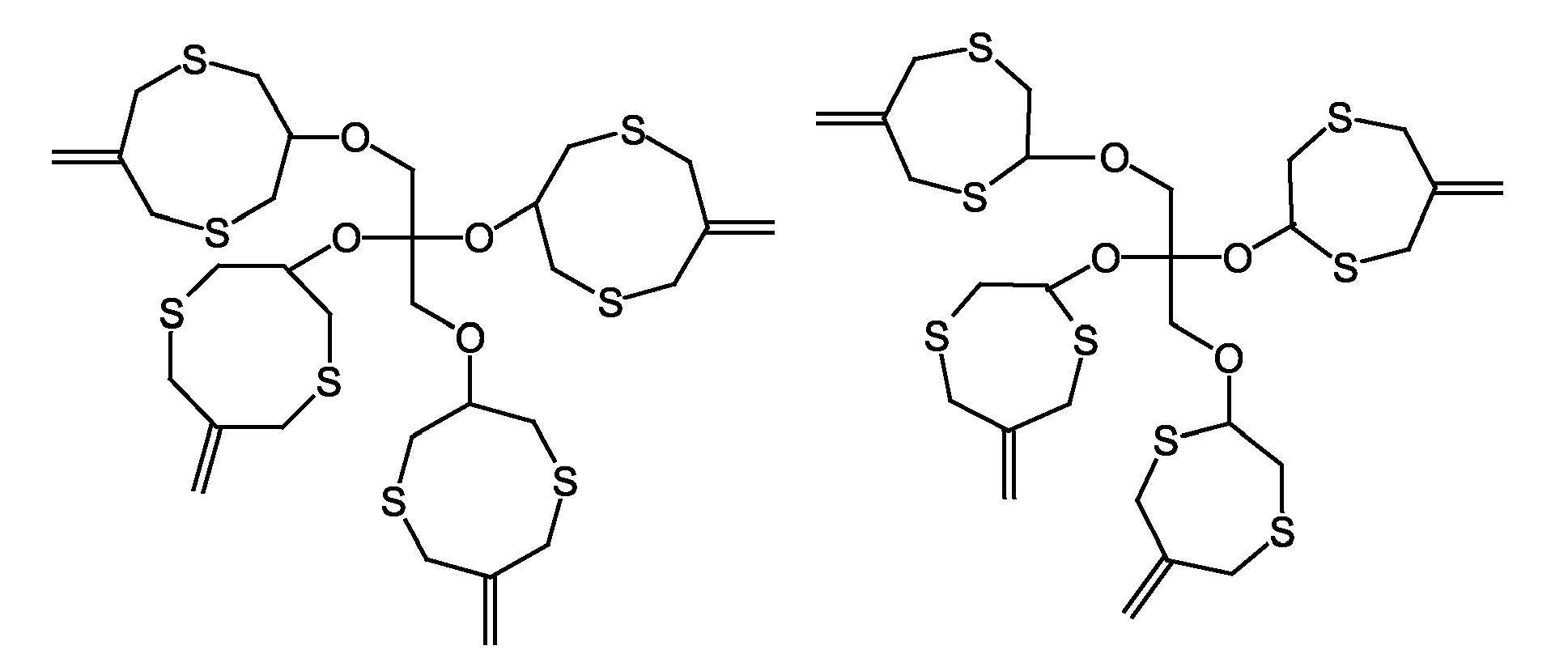


- Die erfindungsgemäßen Dentalmaterialien auf der Basis der cyclischen Allylsulfide der Formel (I) lassen sich mit den bekannten radikalischen Initiatoren (vgl. Encylopedia of Polymer Science and Engineering, Vol. 13, Wiley-Intersci. Pub., New York etc. 1988, 754ff.) unter Ringöffnung polymerisieren.
- Es eignen sich besonders Photoinitiatoren (vgl. J.P. Fouassier, J.F. Rabek (Hrsg.), Radiation Curing in Polymer Science and Technology, Vol. II, Elsevier Applied Science, London und New York 1993) für den UV- oder sichtbaren Bereich, wie Benzoinether, Dialkylbenzilketale, Dialkoxyacetophenone, Acylder Bisacylphosphinoxide, α-Diketone wie 9,10-Phenanthrenchinon, Diacetyl, Furil, Anisil, 4,4'-Dichlorbenzil und 4,4'-Dialkoxybenzil und Campherchinon.
- Weiterhin können auch Azoverbindungen, wie 2,2'-Azobis(isobutyronitril) (AIBN) oder Azobis-(4-cyanovaleriansäure), oder Peroxide, wie Dibenzoylperoxid, Dilauroylperoxid, tert.-Butylperoctoat, tert.-Butylperbenzoat oder Di-(tert.-butyl)-peroxid verwendet werden. Als Initiatoren für die Heißhärtung eignen sich besonders auch Benzpinakol und 2,2'-Dialkylbenzpinakole.
- Zur Beschleunigung der Initiierung von Peroxiden oder α-Diketonen werden vorzugsweise Kombinationen mit aromatischen Aminen eingesetzt. Bevorzugte Redoxsysteme sind: Kombinationen von Benzoylperoxid, Lauroylperoxid oder Campherchinon mit Aminen, wie insbesondere N,N-Dimethyl-p-toluidin, N,N-Dihydroxyethyl-p-toluidin, p-Dimethylaminobenzoesäureethylester oder strukturverwandte Systeme. Darüber hinaus sind auch Redoxsysteme geeignet, die Peroxide in Kombination mit Reduktionsmitteln, wie z.B. Ascorbinsäure, Barbituraten oder Sulfinsäuren enthalten.
- Die erfindungsgemäßen Dentalmaterialien können als polymerisierbare Komponente ausschließlich cyclische Allylsulfide der Formel (I) oder eine Mischung derselben mit herkömmlichen radikalisch polymerisierbaren Monomeren, insbesondere mit monofunktionellen oder mehrfach funktionellen (Meth)acrylaten enthalten.
- Unter monofunktionellen (Meth)acrylverbindungen werden Verbindungen mit einer, unter mehrfach funktionellen (Meth)acrylverbindungen Verbindungen mit zwei oder mehr, vorzugsweise 2 bis 3 (Meth)acrylgruppen verstanden. Mehrfach funktionelle Monomere haben vernetzende Eigenschaften.
- Bevorzugte monofunktionelle (Meth)acrylate sind kommerziell verfügbare monofunktionelle Monomere, wie Methyl-, Ethyl-, Butyl-, Benzyl-, Furfuryl- oder Phenyl(meth)acrylat sowie 2-Hydroxyethyl- oder -propyl(meth)acrylat.
- Besonders bevorzugt sind hydrolysestabile Monomere wie hydrolysestabile Mono(meth)acrylate, z.B. Mesitylmethacrylat oder 2-(Alkoyxymethyl)acrylsäuren, z.B. 2-(Ethoxymethyl)acrylsäure, 2-(Hydroxymethyl)acrylsäure, N-mono- oder -disubstitiuierte Acrylamide, wie z.B. N-Ethylacrylamid, N,N-Dimethacrylamid, N-(2-Hydroxyethyl)acrylamid oder N-Methyl-N-(2-hydroxyethyl)-acrylamid, und N-monosubstituierte Methacrylamide, wie z.B. N-Ethylmethacrylamid oder N-(2-Hydroxyethyl)methacrylamid sowie außerdem N-Vinylpyrrolidon und Allylether. Diese Monomere sind bei Raumtemperatur flüssig und eignen sich daher auch als Verdünner.
- Bevorzugte mehrfach funktionelle Monomere sind Bisphenol-A-di(meth)acrylat, Bis-GMA (ein Additionsprodukt aus Methacrylsäure und Bisphenol-A-diglycidylether), UDMA (ein Additionsprodukt aus 2-Hydroxyethylmethacrylat und 2,2,4-Trimethylhexamethylendiisocyanat), Di-, Tri- oder Tetraethylenglycoldi(meth)acrylat, Trimethylolpropantri(meth)acrylat, Pentaerythrittetra(meth)acrylat, sowie Butandioldi(meth)-acrylat, 1,10-Decandioldi(meth)acrylat oder 1,12-Dodecandiol-di(meth)acrylat.
- Besonders bevorzugt sind hydrolysestabile Vernetzermonomere, wie z.B. Urethane aus 2-(Hydroxymethyl)acrylsäure und Diisocyanten, wie 2,2,4-Trimethylhexamethylendiisocyanat oder Isophorondiisocyanat, vernetzende Pyrrolidone, wie z.B. 1,6-Bis(3-vinyl-2-pyrrolidonyl)-hexan, oder kommerziell zugängliche Bisacrylamide wie Methylen- oder Ethylenbisacrylamid, Bis-(meth)acrylamide, wie z.B. N,N'-Diethyl-1,3-bis-(acrylamido)-propan, 1,3-Bis-(methacrylamido)-propan, 1,4-Bis-(acrylamido)-butan oder 1,4-Bis-(acryloyl)-piperazin, die durch Umsetzung aus den entsprechenden Diaminen mit (Meth)acrylsäurechorid synthetisiert werden können.
- Die erfindungsgemäßen Dentalmaterialien auf der Basis der cyclischen Allylsulfide der Formel (I) sind säurestabil und können daher gemäß einer bevorzugten Ausführungsform mindestens ein radikalisch polymerisierbares, säuregruppenhaltiges Monomer enthalten, das in der Lage ist, die Zahnhartsubstanz anzuätzen, so daß eine Präkonditionierung der Zahnhartsubstanz mit Säure nicht notwendig ist. Säuregruppenhaltige Monomere werden im folgenden auch als acide Monomere bezeichnet. Solche säuregruppenhaltige Monomere verbessern die Haftung der Werkstoffe auf der Zahnhartsubstanz und machen so schrumpfungsarme Dentalmaterialien, wie z.B. Füllungskomposite oder Zemente, mit selbsthaftenden Eigenschaften zugänglich.
- Bevorzugte Säuregruppen sind Carbonsäuregruppen, Phosphonsäuregruppen, Phosphatgruppen und/oder Sulfonsäuregruppen, wobei Gruppen mit mehr als einem aciden Wasserstoffatom teilweise verestert sein können. Besonders bevorzugt sind Monomere mit Phosphonsäuregruppen oder Phosphatgruppen. Die Monomere können eine oder mehrere acide Gruppen aufweisen, bevorzugte sind Verbindungen mit 1 bis 2 aciden Gruppen.
- Bevorzugte polymerisationsfähige Carbonsäuren sind Maleinsäure, Acrylsäure, Methacrylsäure, 2-(Hydroxymethyl)acrylsäure, 4-(Meth)acryloyloxyethyltrimellitsäureanhydrid, 10-Methacryloyloxydecylmalonsäure, N-(2-Hydroxy-3-methacryloyloxypropyl)-N-phenylglycin und 4-Vinylbenzoesäure.
- Bevorzugte Phosphonsäuremonomere sind Alkenphosphonsäuren, Vinylphosphonsäure, 4-Vinylphenylphosphonsäure, 4-Vinylbenzylphosphonsäure, 2-Methacryloyloxyethylphosphonsäure, 2-Methacrylamidoethylphosphonsäure, 4-Methacrylamido-4-methylpentyl-phosphonsäure, 2-[4-(Dihydroxyphosphoryl)-2-oxa-butyl]-acrylsäure und 2-[2-Dihydroxyphosphoryl)-ethoxymethyl]-acrylsäure-2,4,6-trimethyl-phenylester.
- Bevorzugte acide polymerisationsfähige Phosphorsäureester (Phosphate) sind 2-Methacryloyloxypropylmono- und -dihydrogenphosphat, 2-Methacryloyloxyethylmono- und -dihydrogenphosphat, 2-Methacryloyloxyethyl-phenyl-hydrogenphosphat, Dipentaerythritol-pentamethacryloyloxyphosphat, 10-Methacryloyloxydecyl-dihydrogenphosphat, Dipentaerythritolpentamethacryloyloxyphosphat, Phosphorsäuremono-(1-acryloyl-piperidin-4-yl)-ester, 6-(Methacrylamido)hexyldihydrogenphosphat und 1,3-Bis-(N-acryloyl-N-propyl-amino)-propan-2-yl-dihydrogenphosphat.
- Bevorzugte polymerisationsfähige Sulfonsäuren sind Vinylsulfonsäure, 4-Vinylphenylsulfonsäure oder 3-(Methacrylamido)propylsulfonsäure.
- Weiterhin können die Dentalwerkstoffe zur Verbesserung der mechanischen Eigenschaften oder zur Einstellung der Viskosität organische oder anorganische, partikuläre oder faserförmige Füllstoffe enthalten. Bevorzugte anorganische partikuläre Füllstoffe sind amorphe kugelförmige Materialien, vorzugsweise mit einer Primärpartikelgröße von 10 bis 500 nm, auf der Basis von Oxiden, wie ZrO2 und TiO2 oder Mischoxiden aus SiO2, ZrO2 und/oder TiO2, nanopartikuläre (Primärpartikelgröße von 10 bis 100 nm) oder mikrofeine Füllstoffe (mittlere Teilchengröße von 100 nm bis 5 µm), wie pyrogene Kieselsäure oder Fällungskieselsäure, sowie Minifüllstoffe, wie Quarz-, Glaskeramik- oder Glaspulver, vorzugsweise mit einer mittleren Teilchengröße von 0,1 bis 10 µm, sowie röntgenopake Füllstoffe, wie Ytterbiumtrifluorid, vorzugsweise mit einer mittleren Teilchengröße von etwa 200 nm, oder nanopartikuläres Tantal(V)-oxid oder Bariumsulfat, vorzugsweise mit einer Primärpartikelgröße von 10 bis 100 nm. Darüber hinaus können auch Glasfasern, Polyamid- oder Kohlenstoff-Fasern eingesetzt werden.
- Außerdem können die erfindungsgemäßen Dentalwerkstoffe ein oder mehrere weitere Additive enthalten, wie Stabilisatoren, UV-Absorbern, Farbstoffen, Pigmenten und/oder Gleitmittel. Im Falle von Adhäsiven können auch Lösungsmittel wie Ethanol, Aceton oder deren Mischungen mit Wasser eingesetzt werden.
- Die cyclischen Allylsulfide der Formel (I) eignen sich besonders zur Herstellung von dentalen Füllungskompositen, Befestigungszementen, Adhäsiven, Beschichtungsmaterialien und Formkörpern. Außerdem eignen sie sich zur Herstellung von Werkstoffen für Inlays/Onlays, künstliche Zähne und Verblendmaterialien für Kronen und Brücken.
- Ein weiterer Gegenstand der Erfindung ist ein Verfahren zur Herstellung von gehärteten Formkörpern. Hierzu wird ein erfindungsgemäßer Dentalwerkstoff zu einem Formkörper, vorzugsweise einer Krone, Brücke, einem Inlay oder Onlay, einem künstlichen Zahn oder anderen Dentalrestauration geformt und anschließend zumindest teilweise gehärtet. Das Formen geschieht auf an sich bekannte Weisen.
- Die erfindungsgemäßen Dentalwerkstoffe zeichnen sich durch einen geringeren Polymerisationschrumpf, sehr gute mechanische Eigenschaften und bei Verwendung säuregruppenhaltiger Monomere durch eine hohe Eigenhaftung auf der Zahnhartsubstanz aus.
- Die erfindungsgemäßen Dentalwerkstoffe enthalten vorzugsweise:
- 1 bis 95 Gew.-% Allylsulfid gemäß Formel (I);
- 0,01 bis 5 Gew.-% Initiator für die radikalische Polymerisation;
- 0 bis 60 Gew.-%weiteres radikalisch polymerisierbares Monomer;
- 0 bis 2 0 Gew.-%säuregruppenhaltiges Monomer;
- 0 bis 85 Gew.-% Füllstoff.
- Soweit nicht anders angegeben beziehen sich alle Gew.-%-Angaben auf die Gesamtmasse des Werkstoffs. Die weiteren radikalisch polymerisierbaren Monomere schließen nicht die säuregruppenhaltigen Monomere ein.
- Die genaue Zusammensetzung richtet sich dabei nach dem gewünschten Anwendungszweck. Dentalwerkstoffe zur Verwendung als Füllungskomposite enthalten vorzugsweise:
- 1 bis 45 Gew.-%, besonders bevorzugt 10 bis 30 Gew.-% cyclisches Allylsulfid gemäß Formel (I),
- 0,01 bis 5 Gew.-%, besonders bevorzugt 0,1 bis 2,0 Gew.-% Initiator für die radikalische Polymerisation,
- 0 bis 50 Gew.-%, besonders bevorzugt 0 bis 10 Gew.-% zusätzliches radikalisch polymerisierbares Monomer,
- 30 bis 85 Gew.-%, besonders bevorzugt 40 bis 80 Gew.-% Füllstoff,
- 0 bis 10 Gew.-% säuregruppenhaltiges Monomer.
- Dentalwerkstoffe zur Verwendung als Zemente enthalten vorzugsweise:
- 1 bis 60 Gew.-%, besonders bevorzugt 20 bis 50 Gew.-% cyclisches Allylsulfid der Formel (I),
- 0,01 bis 5 Gew.-%, besonders bevorzugt 0,1 bis 2,0 Gew.-% Initiator für die radikalische Polymerisation,
- 0 bis 60 Gew.-%, besonders bevorzugt 0 bis 20 Gew.-% zusätzliches radikalisch polymerisierbares Monomer,
- 20 bis 60 Gew.-%, besonders bevorzugt 30 bis 60 Gew.-% Füllstoff,
- 0 bis 15 Gew.-% säuregruppenhaltiges Monomer.
- Dentalwerkstoffe zur Verwendung als Beschichtungsmaterialien enthalten vorzugsweise:
- 1 bis 95 Gew.-%, besonders bevorzugt 10 bis 60 Gew.-% cyclisches Allylsulfid gemäß Formel (I),
- 0,01 bis 5 Gew.-%, besonders bevorzugt 0,1 bis 2,0 Gew.-% Initiator für die radikalische Polymerisation,
- 0 bis 60 Gew.-%, besonders bevorzugt 0 bis 40 Gew.-% zusätzliches radikalisch polymerisierbares Monomer,
- 0 bis 20 Gew.-% Füllstoff,
- 0 bis 10 Gew.-% säuregruppenhaltiges Monomer.
- Dentalwerkstoffe zur Verwendung als Adhäsive enthalten vorzugsweise:
- 1 bis 80 Gew.-%, besonders bevorzugt 10 bis 60 Gew.-% cyclisches Allylsulfid gemäß Formel (I),
- 0,01 bis 5 Gew.-%, besonders bevorzugt 0,1 bis 2,0 Gew.-% Initiator für die radikalische Polymerisation,
- 0 bis 60 Gew.-%, besonders bevorzugt 0 bis 40 Gew.-% zusätzliches radikalisch polymerisierbares Monomer,
- 0 bis 40 Gew.-%, besonders bevorzugt 0 bis 30 Gew.-% Lösungsmittel,
- 0 bis 20 Gew.-% Füllstoff,
- 0 bis 20 Gew.-% säuregruppenhaltiges Monomer.
- Die Erfindung wird im Folgenden anhand von Beispielen näher erläutert.
- 50,5 g (0,1 mol) symmetrisches Hexamethylendiisocynat-Trimer (Desmodur N 3300, Bayer AG; Scherviskosität bei 40 °C = 4,3 Pas) wurden bei Raumtemperatur zu einer Lösung von 52,9 g (0,3 mol) 7-Hydroxy-3-methylen-1,5-dithiacylooctan, das durch Veretherung von 2-Hydroxy-1,3-dichlorpropan mit 3-Mercapto-2-mercaptomethyl-1-propen zugänglich ist, 12 mg TEMPO (2,2,6,6-Tetramethyl-piperidin-1-oxyl, Inhibitor), 25 mg MEHQ (Hydrochinonmonomethylether, Stabilisator) und 0,2 g Metatin 812 (Dibutylzinndioctoat, Katalysator) in 100 ml Methylenchlorid getropft. Nach 48 h Rühren war im IR-Spektrum keine Isocyanatbande mehr zu erkennen. Das klare Reaktionsgemisch wurde zweimal mit je 100 ml 1,0 N NaOH und dreimal mit je 100 ml gesättigter Kochsalzlösung gewaschen. Dann wurde die organische Phase mit Natriumsulfat getrocknet, mit 20 mg MEHQ stabilisiert, und das Lösungsmittel am Rotationsverdampfer unter Lufteinleiten vollständig entfernt. Es ergaben sich 95,5 g (Ausbeute: 92 %) eines weissen Feststoffes des trifunktionellen Monomeren s-TDTO mit einem Schmelzpunkt von 55,1 °C und der Struktur:

- Analog zu Beispiel 1 wurden 50,5 g (0,1 mol) asymmetrisches Hexamethylendiisocyanat-Trimer (Desmodur VP LS 2294, Bayer AG; Scherviskosität bei 40 °C = 1,3 Pas) mit 52,9 g (0,3 mol) 7-Hydroxy-3-methylen-1,5-dithiacylooctan umgesetzt und aufgearbeitet. Es ergaben sich 92 g (Ausbeute: 89 %) des trifunktionellen Monomer a-TDTO als farblose hochviskose Flüssigkeit mit nachfolgender Struktur:

- Entsprechend der nachfolgend aufgeführten Tabelle 1 wurden Kompositbefestigungszemente auf der Basis von (A) einer herkömmlichen Methacrylatmischung (Vergleich) und (B) des trifunktionellen cyclischen Allylsulfids a-TDTO aus Beispiel 2 mittels eines Walzenstuhles (Typ Exakt, Exakt Apparatebau, Norderstedt) hergestellt. Von den Materialien wurden Prüfkörper präpariert, die zweimal für jeweils 3 Minuten mit einer dentalen Lichtquelle (Spectramat®, Ivoclar Vivadent AG) bestrahlt und damit ausgehärtet wurden. Nach der ISO-Norm ISO-4049 (Dentistry - Polymer-based filling, restorative and luting materials) erfolgte die Bestimmung der Biegefestigkeit, des Biege-E-Moduls und der Exothermzeit.
- Aus Tabelle 2 ist ersichtlich, daß das Material B mechanische Eigenschaften aufweist, die mit denen des Materials A auf der Basis einer rein konventionellen Methacrylatmischung vergleichbar sind, und daß die Reaktivität des Materials B (Exothermzeit nur 8 s) sogar höher als die des Vergleichsmaterials ist (Exothermzeit 13 s).
Tabelle 1: Zusammensetzung der Zemente Bestandteil Material A*) Anteile (Gew.-%) Material B Anteile (Gew.-%) Urethandimethacrylat1) 31,6 31,6 Decandioldimethacrylat 7,8 - a-TDTO(Bsp. 2) - 7,8 Aerosil OX-50 (Degussa) 41,2 41,2 Ytterbiumtrifluorid (Rhone-Poulenc) 18,7 18,7 Photoinitiator2) 0,7 0,7 *) Vergleichsmaterial
1) Urethandimethacrylat aus 2 mol 2-Hydroxyethylmethacrylat und 1 mol 2,2,4-Trimethylhexamethylendiisocyanat-1,6
2) Mischung aus Campherchinon (0,17 %), p-N,N-Dimethylaminobenzoesäureethylester (0,30 %), Lucirin TPO (0,23 %, BASF)Tabelle 2: Materialeigenschaften der Zemente Materialeigenschaft Material A*) Material B Biegefestigkeit (MPa) nach 24 h 120 120 Biegefestigkeit (MPa) nach 24 h WL1) 120 125 Biegefestigkeit (MPa) nach 7 d WL 123 129 Biege-E-Modul (GPa) nach 24 h 6,39 5,78 Biege-E-Modul (GPa) nach 24 h WL 6,32 6,45 Biege-E-Modul (GPa) nach 7 d WL 6,21 6,05 Exothermzeit(s) 13 8 *) Vergleichsmaterial
1) WL = Wasserlagerung der Prüfkörper - Entsprechend der nachfolgend aufgeführten Tabelle 3 wurde ein Füllungskomposit auf der Basis einer Methacrylatmischung unter Einbeziehung des Monomer a-TDTO aus Beispiel 2 mittels eines Laborkneters (Type LPM 0.5 SP, Fa. Linden, Marienheide) hergestellt. Von den Materialien wurden Prüfkörper präpariert, die zweimal für jeweils 3 Minuten mit einer dentalen Lichtquelle (Spectramat®, Ivoclar Vivadent AG) bestrahlt und damit ausgehärtet wurden. Nach der ISO-Norm ISO-4049 (Dentistry - Polymer-based filling, restorative and luting materials) wurde die Biegefestigkeit, der Biege-E-Modul und der Polymerisationsschrumpf bestimmt.
Tabelle 3: Zusammensetzung des Komposits Bestandteil Anteile (Gew.-%) a-TDTO (Bs p. 2) 19,74 SR-348C (Satomer)1) 6,90 Glasfüller GM278842) 72,00 Photoinitiator3) 0,36 1) ethoxyliertes Bisphenol-Dimethacrylat, das hauptsächlich 3 Oxyethylengruppen enthält
2) Bariumaluminiumsilikatglas (Schott) silanisiert, mittlere Partikelgrösse 1,0 µm
3) Mischung aus Campherchinon (0,06 %), p-N,N-Dimethylaminobenzoesäureethylester (0,12 %), Lucirin TPO (0,08 %, BASF) und Diphenyliodoniumhexafluorophosphat (0,10 %)Tabelle 4: Materialeigenschaften des Komposits Materialeigenschaft Meßwert Biegefestigkeit (MPa) nach 24 h WL1) 131 Biege-E-Modul (GPa) nach 24 h WL1) 9,92 Polymerisationsschrumpf (%) nach 24 h 1,71 1) WL = Wasserlagerung der Prüfkörper bei 37 °C - Das Beispiel zeigt, daß mit dem cyclischen Allylsulfid a-TDTO aus Beispiel 2 Füllungskomposite mit guten mechanischen Eigenschaften zugänglich sind. Der dilatometrisch ermittelte Polymerisationsschrumpf betrug nur 1,7 % im Vergleich zu 2,7 % von einem Vergleichskomposit bei dem eines reines Dimethacrylat-Harz als Matrix verwendet wurde.
- Entsprechend der nachfolgend aufgeführten Tabelle 5 wurde ein Füllungskomposit auf der Basis einer Methacrylatmischung unter Einbeziehung des Monomers a-TDTO aus Beispiel 2 und des aciden Monomeren MDP (= 10-(Methacryloyloxy)-decyldihydrogenphosphat) mittels eines Laborkneters (Typ LPM 0.5 SP, Fa. Linden, Marienheide) hergestellt.
Tabelle 5: Zusammensetzung des Komposits Stoffe Anteile (Gew.-%) a-TDTO (B s p . 2) 17,34 SR-348C (Satomer) 5,70 MDP 3,60 Glasfüller GM278841) 72,00 Photoinitiator2) 0,36 1) Bariumaluminiumsilikatglas (Schott) silanisiert, mittlere Partikelgrösse 1,0 µm
2) Mischung aus Campherchinon (0,06 %), p-N,N-Dimethylaminobenzoesäureethylester (0,12 %), Lucirin TPO (0,08 %, BASF) und Diphenyliodoniumhexafluorophosphat (0,10 %) - Von dem Komposit wurde die Dentinhaftung gemäß ISO/TS 11405 (Dental materials - Testing of adhesion to tooth structure) bestimmt. Dabei wurde wie folgt vorgegangen: Von kariesfreien Rinder-Zähnen wird die Pulpa und die Wurzel entfernt. Die Zähne werden in einem Epoxidharz eingebettet und in Wasser bei 37 °C gelagert. Vor dem Gebrauch wurden die Zähne mit Schleifpapier (600 grid) angeschliffen, bis eine ebene Dentinoberfläche sichtbar wird. Diese Fläche wurde mit Wasser gewaschen und leicht angetrocknet. Der eingebettete Zahn wurde dann in einer geeigneten Halterung fixiert. Ein Ring mit einem Innendurchmesser von 4 mm und einer Höhe von 4 mm wurde auf der Zahnoberfläche fixiert. Das Komposit wurde in einer Schichtstärke von ca. 2 mm in den Ring gestopft und mit einer Dentallampe (Bluephase) 20 Sekunden ausgehärtet. Eine zweite Schicht Komposit wurde über der ersten Schicht appliziert und ebenfalls ausgehärtet. Der Ring wurde entfernt und der Zahn-Komposit-Verbund in Wasser bei 37 °C gelagert. Nach 24 Stunden wurde das aufpolymerisierte Komposit mit einer in der ISO/TS 11405 beschriebenen Apparatur abgeschert. Der Kraftaufwand, der hierzu erforderlich war, wurde durch die Querschnittsfläche des Prüfkörpers dividiert, wodurch sich für das getestete Komposit eine Scherfestigkeit von 8,6 N/mm2 ergab. Diese Dentinhaftung stellt für ein selbsthaftendes Komposit einen sehr guten Wert dar.
Claims (18)
- Dentalwerkstoff, der mindestens ein multicyclisches Allylsulfid mit der allgemeinen Formel (I) enthält:
 R1 = H oder ein C1-C10-Alkyl-Rest,R2 = H oder ein C1-C10-Alkyl-Rest,R3 = entfällt oder ein C1-C20-Alkylen-Rest, der durch O oder S unterbrochen sein kann, ein cycloaliphatischer C4-C12-Rest, ein bicyclischer C6-C12-Rest, ein C6-C14-Arylen- oder C7-C20-Alkylenarylen-Rest,R4 = ein n-fach substituierter aliphatischer C2- bis C20-Kohlenwasserstoffrest, der durch O oder S unterbrochen sein kann, ein cycloaliphatischer C4-C12-Rest, ein aromatischer C6-C14-Rest, ein aliphatisch-aromatischer C7-C20-Rest oder ein heterocyclischer Rest, der 4 bis 20 Kohlenstoffatome und 1 bis 6 Heteroatome enthalten kann, die aus N-, O-, P- und/oder S-Atomen ausgewählt sind, oder der ausschließlich durch diese Heteroatome gebildet wird,R5 = entfällt oder ein C1-C10-Alkylen-Rest,X = entfällt, O, S, -O-CO- oder -O-CO-NH-,Y = entfällt, O, S, -O-CO- oder -O-CO-NH-,m = 0 oder 1 undn = eine ganze Zahl von 3 bis 6.
 - Dentalwerkstoff nach Anspruch 1, bei dem mindestens eine der Variablen eine der folgenden Bedeutungen hat:R1 = H oder Methyl,R2 = H oder Methyl,R3 = entfällt, ein C1-C6-Alkylen-Rest, ein cycloaliphatischer C4-C6-Rest oder ein C6-C12-Arylen-Rest,R4 = ein n-fach substituierter aliphatischer C2- bis C10-Rest, ein cyclo-aliphatischer C4-C5-Rest, ein aromatischer C6-C12-Rest, ein heterocyclischer C4-C12-Rest, der 1 bis 6 Heteroatome enthalten kann, einen gesättigten oder ungesättigten Rest einer Phosphor-Stickstoffverbindung,R5 = entfällt oder ein C1-C3-Alkylen-Rest,X = entfällt, O, -O-CO- oder -O-CO-NH-,Y = entfällt, O, -O-CO- oder -O-CO-NH-,m = 0 oder 1 undn = 3 oder 4.
- Dentalwerkstoff nach Anspruch 2, bei dem mindestens eine der Variablen eine der folgenden Bedeutungen hat:R1 = H oder Methyl,R2 = H oder Methyl,R3 = entfällt oder ein C1-C6-Alkylen-Rest,R4 = ein n-fach substituierter aliphatischer C2- bis C6-Rest, aromatischer C6-C10-Rest, ein Cyanursäure- oder Isocyanursäure-Rest, der 1 bis 6 Heteroatome enthalten kann, ein cyclischer Triphosphazenrest,R5 = entfällt,X = O oder -O-CO-NH-,Y = entfällt oder O,m = 0 oder 1 undn = 3 oder 4.
- Dentalwerkstoff nach einem der vorhergehenden Ansprüche, der zusätzlich mindestens einen Initiator für die radikalische Polymerisation enthält.
- Dentalwerkstoff nach einem der vorhergehenden Ansprüche, der zusätzlich mindestens ein weiteres radikalisch polymerisierbares Monomer enthält.
- Dentalwerkstoff nach Anspruch 5, der ein radikalisch polymerisierbares Monomer mit 2 bis 3 radikalisch polymerisierbaren Gruppen enthält.
- Dentalwerkstoff nach einem der vorhergehenden Ansprüche, der zusätzlich mindestens säuregruppenhaltiges radikalisch polymerisierbares Monomer enthält.
- Dentalwerkstoff nach Anspruch 7, bei dem das säuregruppenhaltige Monomer als acide Gruppe eine Carbonsäuregruppe, Phosphonsäuregruppe, Phosphatgruppe und/oder Sulfonsäuregruppe enthält.
- Dentalwerkstoff nach einem der vorhergehenden Ansprüche, der zusätzlich mindestens einen Füllstoff enthält.
- Dentalwerkstoff nach einem der vorhergehenden Ansprüche, der
1 bis 95 Gew.-% Allylsulfid gemäß Formel (I); 0,01 bis 5 Gew.-% Initiator für die radikalische Polyme- risation; 0 bis 60 Gew.-% weiteres radikalisch polymerisierbares Monomer; 0 bis 20 Gew.-% säuregruppenhaltiges Monomer; 0 bis 85 Gew.-% Füllstoff enthält. - Dentalwerkstoff nach Anspruch 10 zur Verwendung als Füllungskomposit, der
1 bis 45 Gew.-% Allylsulfid gemäß Formel (I); 0,01 bis 5 Gew.-% Initiator für die radikalische Polyme- risation; 0 bis 50 Gew.-% weiteres radikalisch polymerisierbares Monomer; 30 bis 85 Gew.-% Füllstoff; 0 bis 10 Gew.-% säuregruppenhaltiges Monomer enthält. - Dentalwerkstoff nach Anspruch 10 zur Verwendung als Zement, der
1 bis 60 Gew.-% Allylsulfid gemäß Formel (I); 0,01 bis 5 Gew.-% Initiator für die radikalische Polymerisation; 0 bis 60 Gew.-% weiteres radikalisch polymerisierbares Monomer; 20 bis 60 Gew.-% Füllstoff; 0 bis 15 Gew.-% säuregruppenhaltiges Monomer enthält. - Dentalwerkstoff nach Anspruch 10 zur Verwendung als Beschichtungsmaterial, der
1 bis 95 Gew.-% Allylsulfid gemäß Formel (I); 0,01 bis 5 Gew.-% Initiator für die radikalische Polymerisation; 0 bis 60 Gew.-% weiteres radikalisch polymerisierbares Monomer; 0 bis 20 Gew.-% Füllstoff; 0 bis 10 Gew.-% säuregruppenhaltiges Monomer enthält. - Dentalwerkstoff nach Anspruch 10 zur Verwendung als Adhäsiv, der
1 bis 80 Gew.-% Allylsulfid nach Formel (I); 0,01 bis 5 Gew.-% Initiator für die radikalische Polymerisation; 0 bis 60 Gew.-% weiteres radikalisch polymerisierbares Monomer; 0 bis 20 Gew.-% Füllstoff; 0 bis 20 Gew.-% säuregruppenhaltiges Monomer; 0 bis 40 Gew.-% Lösungsmittel enthält. - Verwendung eines Allylsulfids gemäß Formel (I) zur Herstellung eines Dentalwerkstoffs.
- Verwendung nach Anspruch 15 zur Herstellung eines Füllungskomposits, Zements, Beschichtungsmaterials oder Adhäsivs.
- Verfahren zur Herstellung von gehärteten Formkörpern bei dem man einen Dentalwerkstoff gemäß einem der Ansprüche 1 bis 14 zu einem Formkörper formt und anschließend zumindest teilweise härtet.
- Verfahren nach Anspruch 17, bei dem der Formkörper eine Krone, Brücke, ein Inlay, Onlay, ein künstlicher Zahn oder eine andere Dentalrestauration ist.
Priority Applications (5)
| Application Number | Priority Date | Filing Date | Title |
|---|---|---|---|
| AT06110429T ATE433314T1 (de) | 2006-02-24 | 2006-02-24 | Dentalmaterialien auf der basis von multicyclischen allylsulfiden |
| DE502006003930T DE502006003930D1 (de) | 2006-02-24 | 2006-02-24 | Dentalmaterialien auf der Basis von multicyclischen Allylsulfiden |
| EP06110429A EP1825843B1 (de) | 2006-02-24 | 2006-02-24 | Dentalmaterialien auf der Basis von multicyclischen Allylsulfiden |
| US11/482,164 US7501457B2 (en) | 2006-02-24 | 2006-07-07 | Dental materials based on multicyclic allyl sulphides |
| JP2007027948A JP2007224024A (ja) | 2006-02-24 | 2007-02-07 | 多環状硫化アリルに基づく歯科材料 |
Applications Claiming Priority (1)
| Application Number | Priority Date | Filing Date | Title |
|---|---|---|---|
| EP06110429A EP1825843B1 (de) | 2006-02-24 | 2006-02-24 | Dentalmaterialien auf der Basis von multicyclischen Allylsulfiden |
Publications (2)
| Publication Number | Publication Date |
|---|---|
| EP1825843A1 true EP1825843A1 (de) | 2007-08-29 |
| EP1825843B1 EP1825843B1 (de) | 2009-06-10 |
Family
ID=36678356
Family Applications (1)
| Application Number | Title | Priority Date | Filing Date |
|---|---|---|---|
| EP06110429A Expired - Lifetime EP1825843B1 (de) | 2006-02-24 | 2006-02-24 | Dentalmaterialien auf der Basis von multicyclischen Allylsulfiden |
Country Status (5)
| Country | Link |
|---|---|
| US (1) | US7501457B2 (de) |
| EP (1) | EP1825843B1 (de) |
| JP (1) | JP2007224024A (de) |
| AT (1) | ATE433314T1 (de) |
| DE (1) | DE502006003930D1 (de) |
Cited By (1)
| Publication number | Priority date | Publication date | Assignee | Title |
|---|---|---|---|---|
| EP2198824A1 (de) | 2008-12-22 | 2010-06-23 | Ernst Mühlbauer GmbH & Co.KG | Polymerisierbares Dentalmaterial mit Initiatorsystem |
Families Citing this family (6)
| Publication number | Priority date | Publication date | Assignee | Title |
|---|---|---|---|---|
| WO2006122074A1 (en) * | 2005-05-09 | 2006-11-16 | 3M Innovative Properties Company | Hardenable dental compositions with low polymerization shrinkage |
| WO2006122081A1 (en) * | 2005-05-09 | 2006-11-16 | 3M Innovative Properties Company | Dental compositions containing hybrid monomers |
| EP2404916B1 (de) * | 2010-07-08 | 2015-06-17 | Ivoclar Vivadent AG | Dentalmaterialien auf der Basis von Dimersäure-Derivaten mit ringöffnend polymerisierbaren Gruppen |
| ES2777206T3 (es) * | 2013-01-03 | 2020-08-04 | Tripp Gmbh & Co Kg | Preparación adhesiva para prótesis de mandíbula |
| WO2018106912A1 (en) * | 2016-12-08 | 2018-06-14 | The Board Of Regents Of The University Of Oklahoma | Compositions with doped titanium dioxide nanoparticles and methods of use |
| CN106750818B (zh) * | 2017-01-09 | 2020-02-07 | 大连联合高分子材料有限公司 | 一种防护车管路用热缩组合物及由其制备的内齿热缩套管 |
Citations (1)
| Publication number | Priority date | Publication date | Assignee | Title |
|---|---|---|---|---|
| WO1996019471A1 (en) * | 1994-12-22 | 1996-06-27 | Commonwealth Scientific And Industrial Research Organisation | Polymerisable monomers and polymers |
Family Cites Families (3)
| Publication number | Priority date | Publication date | Assignee | Title |
|---|---|---|---|---|
| CN1270504A (zh) * | 1997-06-19 | 2000-10-18 | 伊万·斯坦格尔 | 牙用复合材料和增粘剂 |
| DE19860364C2 (de) * | 1998-12-24 | 2001-12-13 | 3M Espe Ag | Polymerisierbare Dentalmassen auf der Basis von zur Aushärtung befähigten Siloxanverbindungen, deren Verwendung und Herstellung |
| US7378259B2 (en) | 2004-07-15 | 2008-05-27 | Applera Corporation | Fluid processing device |
-
2006
- 2006-02-24 EP EP06110429A patent/EP1825843B1/de not_active Expired - Lifetime
- 2006-02-24 DE DE502006003930T patent/DE502006003930D1/de not_active Expired - Lifetime
- 2006-02-24 AT AT06110429T patent/ATE433314T1/de active
- 2006-07-07 US US11/482,164 patent/US7501457B2/en not_active Expired - Fee Related
-
2007
- 2007-02-07 JP JP2007027948A patent/JP2007224024A/ja not_active Withdrawn
Patent Citations (1)
| Publication number | Priority date | Publication date | Assignee | Title |
|---|---|---|---|---|
| WO1996019471A1 (en) * | 1994-12-22 | 1996-06-27 | Commonwealth Scientific And Industrial Research Organisation | Polymerisable monomers and polymers |
Cited By (1)
| Publication number | Priority date | Publication date | Assignee | Title |
|---|---|---|---|---|
| EP2198824A1 (de) | 2008-12-22 | 2010-06-23 | Ernst Mühlbauer GmbH & Co.KG | Polymerisierbares Dentalmaterial mit Initiatorsystem |
Also Published As
| Publication number | Publication date |
|---|---|
| US20070203256A1 (en) | 2007-08-30 |
| US7501457B2 (en) | 2009-03-10 |
| EP1825843B1 (de) | 2009-06-10 |
| ATE433314T1 (de) | 2009-06-15 |
| JP2007224024A (ja) | 2007-09-06 |
| DE502006003930D1 (de) | 2009-07-23 |
Similar Documents
| Publication | Publication Date | Title |
|---|---|---|
| EP3150641B1 (de) | Acylgermanium-photoinitiatoren und verfahren zu deren herstellung | |
| EP3166569B1 (de) | Komposite mit gesteuerter netzwerkstruktur | |
| EP2910236B1 (de) | Dentalmaterialien auf der Basis von geruchsarmen Thiolen | |
| EP1374829B1 (de) | Dentalmaterialien auf der Basis von Acrylesterphosphonsäuren | |
| EP1970042B1 (de) | Verwendung von polymerisierbaren Calix[n]arenen als Dentalmaterialien | |
| EP2823801B1 (de) | Dentalmaterialien auf der Basis von harnstoffgruppenhaltigen Monomeren | |
| EP1674066B1 (de) | Selbstätzende Dentalmaterialien auf Basis von (Meth)acrylamidophosphaten | |
| EP3166568B1 (de) | Dentalmaterialien mit debonding-on-demand eigenschaften | |
| EP1222910A2 (de) | Dentalmaterialien auf der Basis polyfunktioneller Amide | |
| EP3868767B1 (de) | Langwellig absorbierende photoinitiatoren | |
| EP1340483B1 (de) | Dentalmaterialien auf der Basis von (Meth)acrylatsubstuierten Iminooxadiazindion-Derivaten | |
| EP3064192B1 (de) | Dentalmaterialien auf der Basis von Hybridmonomeren | |
| DE102016214389B4 (de) | Dentalmaterialien auf der Basis von monofunktionellen Vinylcyclopropan-Derivaten | |
| JP2007224024A (ja) | 多環状硫化アリルに基づく歯科材料 | |
| EP2816049B1 (de) | ß-Ketophosphonsäuren und Dentalmateriallen auf deren Basis | |
| EP2404916B1 (de) | Dentalmaterialien auf der Basis von Dimersäure-Derivaten mit ringöffnend polymerisierbaren Gruppen | |
| EP2324810B1 (de) | Gefüllter Dentalwerkstoff auf der Basis von polymerisationsfähigen Dihydroxyphenylalanin-Derivaten | |
| EP2289483B1 (de) | Verwendung von polymerisierbaren makrocyclischen Polyethern und makrocyclischen heteroanalogen Polyethern in Dentalmaterialien | |
| EP3278786B1 (de) | Dentalmaterialien auf der basis von urethangruppenhaltigen vinylcyclopropan-derivaten | |
| EP4094748B1 (de) | Dentalwerkstoffe auf basis von redoxsystemen mit oligomeren cumolhydroperoxid-derivaten | |
| DE10234326B3 (de) | Dentalmaterialien auf der Basis von Acrylesterphosphonsäuren | |
| EP2921156B1 (de) | Monomermischung zur Herstellung von Dentalwerkstoffen | |
| EP1864642B1 (de) | Dentalmaterialien auf der Basis von ringöffnend polymerisierbaren, aciden Monomeren | |
| EP2883528B1 (de) | Dentalwerkstoffe auf Basis von polymerisierbaren Aziden und Alkinen | |
| EP3932383B1 (de) | Komposite mit verringerter polymerisationsschrumpfungsspannung |
Legal Events
| Date | Code | Title | Description |
|---|---|---|---|
| PUAI | Public reference made under article 153(3) epc to a published international application that has entered the european phase |
Free format text: ORIGINAL CODE: 0009012 |
|
| AK | Designated contracting states |
Kind code of ref document: A1 Designated state(s): AT BE BG CH CY CZ DE DK EE ES FI FR GB GR HU IE IS IT LI LT LU LV MC NL PL PT RO SE SI SK TR |
|
| AX | Request for extension of the european patent |
Extension state: AL BA HR MK YU |
|
| 17P | Request for examination filed |
Effective date: 20080229 |
|
| AKX | Designation fees paid |
Designated state(s): AT BE BG CH CY CZ DE DK EE ES FI FR GB GR HU IE IS IT LI LT LU LV MC NL PL PT RO SE SI SK TR |
|
| 17Q | First examination report despatched |
Effective date: 20080508 |
|
| GRAP | Despatch of communication of intention to grant a patent |
Free format text: ORIGINAL CODE: EPIDOSNIGR1 |
|
| GRAS | Grant fee paid |
Free format text: ORIGINAL CODE: EPIDOSNIGR3 |
|
| GRAA | (expected) grant |
Free format text: ORIGINAL CODE: 0009210 |
|
| RIN1 | Information on inventor provided before grant (corrected) |
Inventor name: MOSZNER, PROF. DR., NORBERT Inventor name: BURTSCHER, DR., PETER Inventor name: FISCHER, URS KARL Inventor name: ANGERMANN, DR., JOERG Inventor name: RHEINBERGER, DR., VOLKER |
|
| AK | Designated contracting states |
Kind code of ref document: B1 Designated state(s): AT BE BG CH CY CZ DE DK EE ES FI FR GB GR HU IE IS IT LI LT LU LV MC NL PL PT RO SE SI SK TR |
|
| REG | Reference to a national code |
Ref country code: GB Ref legal event code: FG4D Free format text: NOT ENGLISH |
|
| REG | Reference to a national code |
Ref country code: CH Ref legal event code: NV Representative=s name: KELLER & PARTNER PATENTANWAELTE AG Ref country code: CH Ref legal event code: EP |
|
| REG | Reference to a national code |
Ref country code: IE Ref legal event code: FG4D Free format text: LANGUAGE OF EP DOCUMENT: GERMAN |
|
| REF | Corresponds to: |
Ref document number: 502006003930 Country of ref document: DE Date of ref document: 20090723 Kind code of ref document: P |
|
| PG25 | Lapsed in a contracting state [announced via postgrant information from national office to epo] |
Ref country code: LT Free format text: LAPSE BECAUSE OF FAILURE TO SUBMIT A TRANSLATION OF THE DESCRIPTION OR TO PAY THE FEE WITHIN THE PRESCRIBED TIME-LIMIT Effective date: 20090610 Ref country code: FI Free format text: LAPSE BECAUSE OF FAILURE TO SUBMIT A TRANSLATION OF THE DESCRIPTION OR TO PAY THE FEE WITHIN THE PRESCRIBED TIME-LIMIT Effective date: 20090610 |
|
| NLV1 | Nl: lapsed or annulled due to failure to fulfill the requirements of art. 29p and 29m of the patents act | ||
| PG25 | Lapsed in a contracting state [announced via postgrant information from national office to epo] |
Ref country code: SI Free format text: LAPSE BECAUSE OF FAILURE TO SUBMIT A TRANSLATION OF THE DESCRIPTION OR TO PAY THE FEE WITHIN THE PRESCRIBED TIME-LIMIT Effective date: 20090610 Ref country code: SE Free format text: LAPSE BECAUSE OF FAILURE TO SUBMIT A TRANSLATION OF THE DESCRIPTION OR TO PAY THE FEE WITHIN THE PRESCRIBED TIME-LIMIT Effective date: 20090910 Ref country code: LV Free format text: LAPSE BECAUSE OF FAILURE TO SUBMIT A TRANSLATION OF THE DESCRIPTION OR TO PAY THE FEE WITHIN THE PRESCRIBED TIME-LIMIT Effective date: 20090610 Ref country code: PL Free format text: LAPSE BECAUSE OF FAILURE TO SUBMIT A TRANSLATION OF THE DESCRIPTION OR TO PAY THE FEE WITHIN THE PRESCRIBED TIME-LIMIT Effective date: 20090610 Ref country code: NL Free format text: LAPSE BECAUSE OF FAILURE TO SUBMIT A TRANSLATION OF THE DESCRIPTION OR TO PAY THE FEE WITHIN THE PRESCRIBED TIME-LIMIT Effective date: 20090610 |
|
| REG | Reference to a national code |
Ref country code: IE Ref legal event code: FD4D |
|
| PG25 | Lapsed in a contracting state [announced via postgrant information from national office to epo] |
Ref country code: CZ Free format text: LAPSE BECAUSE OF FAILURE TO SUBMIT A TRANSLATION OF THE DESCRIPTION OR TO PAY THE FEE WITHIN THE PRESCRIBED TIME-LIMIT Effective date: 20090610 Ref country code: IE Free format text: LAPSE BECAUSE OF FAILURE TO SUBMIT A TRANSLATION OF THE DESCRIPTION OR TO PAY THE FEE WITHIN THE PRESCRIBED TIME-LIMIT Effective date: 20090610 Ref country code: EE Free format text: LAPSE BECAUSE OF FAILURE TO SUBMIT A TRANSLATION OF THE DESCRIPTION OR TO PAY THE FEE WITHIN THE PRESCRIBED TIME-LIMIT Effective date: 20090610 Ref country code: ES Free format text: LAPSE BECAUSE OF FAILURE TO SUBMIT A TRANSLATION OF THE DESCRIPTION OR TO PAY THE FEE WITHIN THE PRESCRIBED TIME-LIMIT Effective date: 20090921 Ref country code: IS Free format text: LAPSE BECAUSE OF FAILURE TO SUBMIT A TRANSLATION OF THE DESCRIPTION OR TO PAY THE FEE WITHIN THE PRESCRIBED TIME-LIMIT Effective date: 20091010 Ref country code: RO Free format text: LAPSE BECAUSE OF FAILURE TO SUBMIT A TRANSLATION OF THE DESCRIPTION OR TO PAY THE FEE WITHIN THE PRESCRIBED TIME-LIMIT Effective date: 20090610 |
|
| PG25 | Lapsed in a contracting state [announced via postgrant information from national office to epo] |
Ref country code: SK Free format text: LAPSE BECAUSE OF FAILURE TO SUBMIT A TRANSLATION OF THE DESCRIPTION OR TO PAY THE FEE WITHIN THE PRESCRIBED TIME-LIMIT Effective date: 20090610 |
|
| PG25 | Lapsed in a contracting state [announced via postgrant information from national office to epo] |
Ref country code: PT Free format text: LAPSE BECAUSE OF FAILURE TO SUBMIT A TRANSLATION OF THE DESCRIPTION OR TO PAY THE FEE WITHIN THE PRESCRIBED TIME-LIMIT Effective date: 20091010 Ref country code: BG Free format text: LAPSE BECAUSE OF FAILURE TO SUBMIT A TRANSLATION OF THE DESCRIPTION OR TO PAY THE FEE WITHIN THE PRESCRIBED TIME-LIMIT Effective date: 20090910 |
|
| PLBE | No opposition filed within time limit |
Free format text: ORIGINAL CODE: 0009261 |
|
| STAA | Information on the status of an ep patent application or granted ep patent |
Free format text: STATUS: NO OPPOSITION FILED WITHIN TIME LIMIT |
|
| PG25 | Lapsed in a contracting state [announced via postgrant information from national office to epo] |
Ref country code: DK Free format text: LAPSE BECAUSE OF FAILURE TO SUBMIT A TRANSLATION OF THE DESCRIPTION OR TO PAY THE FEE WITHIN THE PRESCRIBED TIME-LIMIT Effective date: 20090610 |
|
| 26N | No opposition filed |
Effective date: 20100311 |
|
| BERE | Be: lapsed |
Owner name: IVOCLAR VIVADENT AG Effective date: 20100228 |
|
| PG25 | Lapsed in a contracting state [announced via postgrant information from national office to epo] |
Ref country code: MC Free format text: LAPSE BECAUSE OF NON-PAYMENT OF DUE FEES Effective date: 20100301 Ref country code: GR Free format text: LAPSE BECAUSE OF FAILURE TO SUBMIT A TRANSLATION OF THE DESCRIPTION OR TO PAY THE FEE WITHIN THE PRESCRIBED TIME-LIMIT Effective date: 20090911 |
|
| PG25 | Lapsed in a contracting state [announced via postgrant information from national office to epo] |
Ref country code: BE Free format text: LAPSE BECAUSE OF NON-PAYMENT OF DUE FEES Effective date: 20100228 |
|
| PG25 | Lapsed in a contracting state [announced via postgrant information from national office to epo] |
Ref country code: CY Free format text: LAPSE BECAUSE OF FAILURE TO SUBMIT A TRANSLATION OF THE DESCRIPTION OR TO PAY THE FEE WITHIN THE PRESCRIBED TIME-LIMIT Effective date: 20090610 |
|
| PG25 | Lapsed in a contracting state [announced via postgrant information from national office to epo] |
Ref country code: LU Free format text: LAPSE BECAUSE OF NON-PAYMENT OF DUE FEES Effective date: 20100224 Ref country code: HU Free format text: LAPSE BECAUSE OF FAILURE TO SUBMIT A TRANSLATION OF THE DESCRIPTION OR TO PAY THE FEE WITHIN THE PRESCRIBED TIME-LIMIT Effective date: 20091211 |
|
| PG25 | Lapsed in a contracting state [announced via postgrant information from national office to epo] |
Ref country code: TR Free format text: LAPSE BECAUSE OF FAILURE TO SUBMIT A TRANSLATION OF THE DESCRIPTION OR TO PAY THE FEE WITHIN THE PRESCRIBED TIME-LIMIT Effective date: 20090610 |
|
| REG | Reference to a national code |
Ref country code: AT Ref legal event code: MM01 Ref document number: 433314 Country of ref document: AT Kind code of ref document: T Effective date: 20110224 |
|
| PG25 | Lapsed in a contracting state [announced via postgrant information from national office to epo] |
Ref country code: AT Free format text: LAPSE BECAUSE OF NON-PAYMENT OF DUE FEES Effective date: 20110224 |
|
| REG | Reference to a national code |
Ref country code: CH Ref legal event code: PCAR Free format text: NEW ADDRESS: EIGERSTRASSE 2 POSTFACH, 3000 BERN 14 (CH) |
|
| PGFP | Annual fee paid to national office [announced via postgrant information from national office to epo] |
Ref country code: IT Payment date: 20150224 Year of fee payment: 10 |
|
| REG | Reference to a national code |
Ref country code: FR Ref legal event code: PLFP Year of fee payment: 11 |
|
| PG25 | Lapsed in a contracting state [announced via postgrant information from national office to epo] |
Ref country code: IT Free format text: LAPSE BECAUSE OF NON-PAYMENT OF DUE FEES Effective date: 20160224 |
|
| REG | Reference to a national code |
Ref country code: FR Ref legal event code: PLFP Year of fee payment: 12 |
|
| REG | Reference to a national code |
Ref country code: FR Ref legal event code: PLFP Year of fee payment: 13 |
|
| REG | Reference to a national code |
Ref country code: DE Ref legal event code: R079 Ref document number: 502006003930 Country of ref document: DE Free format text: PREVIOUS MAIN CLASS: A61K0006083000 Ipc: A61K0006887000 |
|
| PGFP | Annual fee paid to national office [announced via postgrant information from national office to epo] |
Ref country code: GB Payment date: 20200116 Year of fee payment: 15 Ref country code: DE Payment date: 20200116 Year of fee payment: 15 |
|
| PGFP | Annual fee paid to national office [announced via postgrant information from national office to epo] |
Ref country code: CH Payment date: 20200120 Year of fee payment: 15 |
|
| PGFP | Annual fee paid to national office [announced via postgrant information from national office to epo] |
Ref country code: FR Payment date: 20200117 Year of fee payment: 15 |
|
| REG | Reference to a national code |
Ref country code: CH Ref legal event code: PFA Owner name: IVOCLAR VIVADENT AG, LI Free format text: FORMER OWNER: IVOCLAR VIVADENT AG, LI |
|
| REG | Reference to a national code |
Ref country code: DE Ref legal event code: R119 Ref document number: 502006003930 Country of ref document: DE |
|
| GBPC | Gb: european patent ceased through non-payment of renewal fee |
Effective date: 20210224 |
|
| PG25 | Lapsed in a contracting state [announced via postgrant information from national office to epo] |
Ref country code: CH Free format text: LAPSE BECAUSE OF NON-PAYMENT OF DUE FEES Effective date: 20210228 Ref country code: LI Free format text: LAPSE BECAUSE OF NON-PAYMENT OF DUE FEES Effective date: 20210228 |
|
| PG25 | Lapsed in a contracting state [announced via postgrant information from national office to epo] |
Ref country code: DE Free format text: LAPSE BECAUSE OF NON-PAYMENT OF DUE FEES Effective date: 20210901 Ref country code: GB Free format text: LAPSE BECAUSE OF NON-PAYMENT OF DUE FEES Effective date: 20210224 Ref country code: FR Free format text: LAPSE BECAUSE OF NON-PAYMENT OF DUE FEES Effective date: 20210228 |