EP1825913A1 - Neue Katalysatorsysteme und deren Verwendung für Metathesereaktionen - Google Patents
Neue Katalysatorsysteme und deren Verwendung für Metathesereaktionen Download PDFInfo
- Publication number
- EP1825913A1 EP1825913A1 EP07002964A EP07002964A EP1825913A1 EP 1825913 A1 EP1825913 A1 EP 1825913A1 EP 07002964 A EP07002964 A EP 07002964A EP 07002964 A EP07002964 A EP 07002964A EP 1825913 A1 EP1825913 A1 EP 1825913A1
- Authority
- EP
- European Patent Office
- Prior art keywords
- catalyst
- general formula
- alkyl
- aryl
- catalyst system
- Prior art date
- Legal status (The legal status is an assumption and is not a legal conclusion. Google has not performed a legal analysis and makes no representation as to the accuracy of the status listed.)
- Granted
Links
- KFQGJXSOUBDWLU-UHFFFAOYSA-O CC(N(C=C1)SC)[NH+]1SC Chemical compound CC(N(C=C1)SC)[NH+]1SC KFQGJXSOUBDWLU-UHFFFAOYSA-O 0.000 description 1
- POKQCCVKEUHHGT-UHFFFAOYSA-N CC(N(CC1)SC)N1SC Chemical compound CC(N(CC1)SC)N1SC POKQCCVKEUHHGT-UHFFFAOYSA-N 0.000 description 1
Classifications
-
- B—PERFORMING OPERATIONS; TRANSPORTING
- B01—PHYSICAL OR CHEMICAL PROCESSES OR APPARATUS IN GENERAL
- B01J—CHEMICAL OR PHYSICAL PROCESSES, e.g. CATALYSIS OR COLLOID CHEMISTRY; THEIR RELEVANT APPARATUS
- B01J31/00—Catalysts comprising hydrides, coordination complexes or organic compounds
- B01J31/16—Catalysts comprising hydrides, coordination complexes or organic compounds containing coordination complexes
- B01J31/22—Organic complexes
-
- C—CHEMISTRY; METALLURGY
- C08—ORGANIC MACROMOLECULAR COMPOUNDS; THEIR PREPARATION OR CHEMICAL WORKING-UP; COMPOSITIONS BASED THEREON
- C08C—TREATMENT OR CHEMICAL MODIFICATION OF RUBBERS
- C08C19/00—Chemical modification of rubber
- C08C19/08—Depolymerisation
-
- B—PERFORMING OPERATIONS; TRANSPORTING
- B01—PHYSICAL OR CHEMICAL PROCESSES OR APPARATUS IN GENERAL
- B01J—CHEMICAL OR PHYSICAL PROCESSES, e.g. CATALYSIS OR COLLOID CHEMISTRY; THEIR RELEVANT APPARATUS
- B01J23/00—Catalysts comprising metals or metal oxides or hydroxides, not provided for in group B01J21/00
-
- B—PERFORMING OPERATIONS; TRANSPORTING
- B01—PHYSICAL OR CHEMICAL PROCESSES OR APPARATUS IN GENERAL
- B01J—CHEMICAL OR PHYSICAL PROCESSES, e.g. CATALYSIS OR COLLOID CHEMISTRY; THEIR RELEVANT APPARATUS
- B01J31/00—Catalysts comprising hydrides, coordination complexes or organic compounds
- B01J31/02—Catalysts comprising hydrides, coordination complexes or organic compounds containing organic compounds or metal hydrides
-
- B—PERFORMING OPERATIONS; TRANSPORTING
- B01—PHYSICAL OR CHEMICAL PROCESSES OR APPARATUS IN GENERAL
- B01J—CHEMICAL OR PHYSICAL PROCESSES, e.g. CATALYSIS OR COLLOID CHEMISTRY; THEIR RELEVANT APPARATUS
- B01J31/00—Catalysts comprising hydrides, coordination complexes or organic compounds
- B01J31/02—Catalysts comprising hydrides, coordination complexes or organic compounds containing organic compounds or metal hydrides
- B01J31/0234—Nitrogen-, phosphorus-, arsenic- or antimony-containing compounds
- B01J31/0235—Nitrogen containing compounds
- B01J31/0239—Quaternary ammonium compounds
-
- B—PERFORMING OPERATIONS; TRANSPORTING
- B01—PHYSICAL OR CHEMICAL PROCESSES OR APPARATUS IN GENERAL
- B01J—CHEMICAL OR PHYSICAL PROCESSES, e.g. CATALYSIS OR COLLOID CHEMISTRY; THEIR RELEVANT APPARATUS
- B01J31/00—Catalysts comprising hydrides, coordination complexes or organic compounds
- B01J31/02—Catalysts comprising hydrides, coordination complexes or organic compounds containing organic compounds or metal hydrides
- B01J31/0234—Nitrogen-, phosphorus-, arsenic- or antimony-containing compounds
- B01J31/0255—Phosphorus containing compounds
- B01J31/0267—Phosphines or phosphonium compounds, i.e. phosphorus bonded to at least one carbon atom, including e.g. sp2-hybridised phosphorus compounds such as phosphabenzene, the other atoms bonded to phosphorus being either carbon or hydrogen
- B01J31/0268—Phosphonium compounds, i.e. phosphine with an additional hydrogen or carbon atom bonded to phosphorous so as to result in a formal positive charge on phosphorous
-
- B—PERFORMING OPERATIONS; TRANSPORTING
- B01—PHYSICAL OR CHEMICAL PROCESSES OR APPARATUS IN GENERAL
- B01J—CHEMICAL OR PHYSICAL PROCESSES, e.g. CATALYSIS OR COLLOID CHEMISTRY; THEIR RELEVANT APPARATUS
- B01J31/00—Catalysts comprising hydrides, coordination complexes or organic compounds
- B01J31/16—Catalysts comprising hydrides, coordination complexes or organic compounds containing coordination complexes
- B01J31/22—Organic complexes
- B01J31/2204—Organic complexes the ligands containing oxygen or sulfur as complexing atoms
- B01J31/2208—Oxygen, e.g. acetylacetonates
-
- B—PERFORMING OPERATIONS; TRANSPORTING
- B01—PHYSICAL OR CHEMICAL PROCESSES OR APPARATUS IN GENERAL
- B01J—CHEMICAL OR PHYSICAL PROCESSES, e.g. CATALYSIS OR COLLOID CHEMISTRY; THEIR RELEVANT APPARATUS
- B01J31/00—Catalysts comprising hydrides, coordination complexes or organic compounds
- B01J31/16—Catalysts comprising hydrides, coordination complexes or organic compounds containing coordination complexes
- B01J31/22—Organic complexes
- B01J31/2265—Carbenes or carbynes, i.e.(image)
-
- B—PERFORMING OPERATIONS; TRANSPORTING
- B01—PHYSICAL OR CHEMICAL PROCESSES OR APPARATUS IN GENERAL
- B01J—CHEMICAL OR PHYSICAL PROCESSES, e.g. CATALYSIS OR COLLOID CHEMISTRY; THEIR RELEVANT APPARATUS
- B01J31/00—Catalysts comprising hydrides, coordination complexes or organic compounds
- B01J31/16—Catalysts comprising hydrides, coordination complexes or organic compounds containing coordination complexes
- B01J31/22—Organic complexes
- B01J31/2265—Carbenes or carbynes, i.e.(image)
- B01J31/2269—Heterocyclic carbenes
- B01J31/2273—Heterocyclic carbenes with only nitrogen as heteroatomic ring members, e.g. 1,3-diarylimidazoline-2-ylidenes
-
- B—PERFORMING OPERATIONS; TRANSPORTING
- B01—PHYSICAL OR CHEMICAL PROCESSES OR APPARATUS IN GENERAL
- B01J—CHEMICAL OR PHYSICAL PROCESSES, e.g. CATALYSIS OR COLLOID CHEMISTRY; THEIR RELEVANT APPARATUS
- B01J31/00—Catalysts comprising hydrides, coordination complexes or organic compounds
- B01J31/16—Catalysts comprising hydrides, coordination complexes or organic compounds containing coordination complexes
- B01J31/22—Organic complexes
- B01J31/2265—Carbenes or carbynes, i.e.(image)
- B01J31/2278—Complexes comprising two carbene ligands differing from each other, e.g. Grubbs second generation catalysts
-
- B—PERFORMING OPERATIONS; TRANSPORTING
- B01—PHYSICAL OR CHEMICAL PROCESSES OR APPARATUS IN GENERAL
- B01J—CHEMICAL OR PHYSICAL PROCESSES, e.g. CATALYSIS OR COLLOID CHEMISTRY; THEIR RELEVANT APPARATUS
- B01J31/00—Catalysts comprising hydrides, coordination complexes or organic compounds
- B01J31/26—Catalysts comprising hydrides, coordination complexes or organic compounds containing in addition, inorganic metal compounds not provided for in groups B01J31/02 - B01J31/24
-
- B—PERFORMING OPERATIONS; TRANSPORTING
- B01—PHYSICAL OR CHEMICAL PROCESSES OR APPARATUS IN GENERAL
- B01J—CHEMICAL OR PHYSICAL PROCESSES, e.g. CATALYSIS OR COLLOID CHEMISTRY; THEIR RELEVANT APPARATUS
- B01J31/00—Catalysts comprising hydrides, coordination complexes or organic compounds
- B01J31/26—Catalysts comprising hydrides, coordination complexes or organic compounds containing in addition, inorganic metal compounds not provided for in groups B01J31/02 - B01J31/24
- B01J31/28—Catalysts comprising hydrides, coordination complexes or organic compounds containing in addition, inorganic metal compounds not provided for in groups B01J31/02 - B01J31/24 of the platinum group metals, iron group metals or copper
- B01J31/30—Halides
-
- C—CHEMISTRY; METALLURGY
- C08—ORGANIC MACROMOLECULAR COMPOUNDS; THEIR PREPARATION OR CHEMICAL WORKING-UP; COMPOSITIONS BASED THEREON
- C08C—TREATMENT OR CHEMICAL MODIFICATION OF RUBBERS
- C08C19/00—Chemical modification of rubber
- C08C19/02—Hydrogenation
-
- C—CHEMISTRY; METALLURGY
- C08—ORGANIC MACROMOLECULAR COMPOUNDS; THEIR PREPARATION OR CHEMICAL WORKING-UP; COMPOSITIONS BASED THEREON
- C08G—MACROMOLECULAR COMPOUNDS OBTAINED OTHERWISE THAN BY REACTIONS ONLY INVOLVING UNSATURATED CARBON-TO-CARBON BONDS
- C08G61/00—Macromolecular compounds obtained by reactions forming a carbon-to-carbon link in the main chain of the macromolecule
- C08G61/02—Macromolecular compounds containing only carbon atoms in the main chain of the macromolecule, e.g. polyxylylenes
- C08G61/04—Macromolecular compounds containing only carbon atoms in the main chain of the macromolecule, e.g. polyxylylenes only aliphatic carbon atoms
- C08G61/06—Macromolecular compounds containing only carbon atoms in the main chain of the macromolecule, e.g. polyxylylenes only aliphatic carbon atoms prepared by ring-opening of carbocyclic compounds
- C08G61/08—Macromolecular compounds containing only carbon atoms in the main chain of the macromolecule, e.g. polyxylylenes only aliphatic carbon atoms prepared by ring-opening of carbocyclic compounds of carbocyclic compounds containing one or more carbon-to-carbon double bonds in the ring
-
- C—CHEMISTRY; METALLURGY
- C08—ORGANIC MACROMOLECULAR COMPOUNDS; THEIR PREPARATION OR CHEMICAL WORKING-UP; COMPOSITIONS BASED THEREON
- C08C—TREATMENT OR CHEMICAL MODIFICATION OF RUBBERS
- C08C19/00—Chemical modification of rubber
Definitions
- the present invention relates to novel catalyst systems and their use for the catalysis of metathesis reactions, in particular for the metathesis of nitrile rubber.
- Metathesis reactions are extensively used in chemical syntheses, e.g. in the form of ring-closing metathesis (RCM), cross-metathesis (CM), or ring-opening metathesis (ROMP). Metathesis reactions are used, for example, for the olefin synthesis, for the depolymerization of unsaturated polymers and for the synthesis of telechelic polymers.
- RCM ring-closing metathesis
- CM cross-metathesis
- RMP ring-opening metathesis
- Metathesis reactions are used, for example, for the olefin synthesis, for the depolymerization of unsaturated polymers and for the synthesis of telechelic polymers.
- Metathesis catalysts are among others from the WO-A-96/04289 and WO-A-97/06185 known. They have the following basic structure: wherein M is osmium or ruthenium, R is the same or different organic radicals having a large structural variation, X 1 and X 2 are anionic ligands and L is neutral electron donors.
- anionic ligands in the literature for such metathesis catalysts is always understood to mean those ligands which, when considered as remote from the metal center, are negatively charged when the electron shell is closed.
- Nitrile rubber also abbreviated to "NBR” is understood to mean rubbers which are copolymers or terpolymers of at least one ⁇ , ⁇ -unsaturated nitrile, at least one conjugated diene and optionally one or more further copolymerizable monomers.
- the degree of hydrogenation of the copolymerized diene units is usually in a range of 50 to 100%.
- Hydrogenated nitrile rubber is a special rubber that has very good heat resistance, excellent resistance to ozone and chemicals, and excellent oil resistance.
- HNBR has found wide use in a variety of applications.
- HNBR is used, for example, for seals, hoses, belts and damping elements in the automotive sector, as well as for stators, borehole seals and valve seals in the field of oil extraction as well as for numerous parts of the aerospace industry, the electrical industry, mechanical engineering and shipbuilding.
- HNBR types on the market usually have a Mooney viscosity (ML 1 + 4 at 100 ° C) in the range of 55 to 105, which is a weight average molecular weight M w (determination method: gel permeation chromatography (GPC) versus polystyrene equivalents) in the range of about 200,000 to 500,000 corresponds.
- M w determination method: gel permeation chromatography (GPC) versus polystyrene equivalents
- the residual double bond content is usually in a range of 1 to 18% (determined by IR spectroscopy).
- HNBR processability of HNBR is severely limited by the relatively high Mooney viscosity.
- HNBR type that has a lower molecular weight and thus a lower Mooney viscosity. This would significantly improve processability.
- thermomechanical treatment z. B. on a rolling mill or in a screw unit ( EP-A-0 419 952 ) possible.
- this thermomechanical degradation has the disadvantage that functional groups such as hydroxyl, keto, carboxylic acid and ester groups are incorporated into the molecule by partial oxidation and, in addition, the microstructure of the polymer is substantially changed.
- the lowest Mooney viscosity of an NBR feedstock that can be processed without difficulty in an established large-scale plant is about 30 Mooney units (ML 1 + 4 at 100 ° C).
- the Mooney viscosity of the hydrogenated nitrile rubber obtained with such NBR feedstock is on the order of 55 Mooney units (ML 1 + 4 at 100 ° C).
- the Mooney viscosity is determined according to ASTM standard D 1646.
- this problem is solved by controlling the molecular weight of the nitrile rubber before hydrogenation by degradation to a Mooney viscosity (ML 1 + 4 at 100 ° C) of less than 30 Mooney units or a number average molecular weight of M n ⁇ 70,000 g / mol reduced.
- the reduction of the molecular weight can be achieved by metathesis, in which one usually adds low molecular weight 1-olefins. Described is the metathesis of nitrile rubber, for example in WO-A-02/100905 .
- the metathesis reaction is expediently carried out in the same solvent as the hydrogenation reaction (in situ) so that the degraded nitrile rubber does not have to be isolated from the solvent after completion of the degradation reaction before it is subjected to the subsequent hydrogenation.
- Metathesis catalysts which are tolerant of polar groups, particularly nitrile groups, are used to catalyze the metathesis degradation reaction.
- WO-A-02/100905 and the WO-A-02/100941 there is described a process comprising the degradation of nitrile rubber starting polymers by olefin metathesis followed by hydrogenation to low Mooney viscosity HNBR.
- a nitrile rubber is reacted in a first step in the presence of a co-olefin and special complex catalysts based on osmium, ruthenium, molybdenum or tungsten and hydrogenated in a second step.
- Hydrogenated nitrile rubbers having a weight average molecular weight (M w ) in the range of 30,000 to 250,000, a Mooney viscosity (ML 1 + 4 at 100 ° C.) in the range from 3 to 50 and a polydispersity index PDI of less than 2.5 are obtainable in this way ,
- the nitrile rubbers After metathesis and hydrogenation, the nitrile rubbers have a lower molecular weight and a narrower molecular weight distribution than the prior art hydrogenated nitrile rubbers that can be produced hitherto.
- the hydrogenated nitrile rubber has lower molecular weights and a narrower molecular weight distribution (PDI) than when using Grubbs (I) type catalysts.
- PDI molecular weight distribution
- metathesis degradation proceeds more efficiently with Grubbs II type catalysts than with Grubbs I type catalysts.
- the amounts of ruthenium required for this efficient metathesis degradation are still relatively high. Also, long reaction times are still required to perform the metathesis with the Grubbs II catalyst.
- substituted used in the context of this application in connection with the metathesis catalyst or the salt of the general formula (I) means that a hydrogen atom on a specified radical or atom is replaced by one of the groups indicated, with the proviso that that the valency of the specified atom is not exceeded and the substitution leads to a stable compound.
- Suitable cations are based on elements from the periodic table (main groups and subgroup elements) which can form mono-, di- or tri-positively charged cations, with the exception of copper.
- Suitable cations are lithium, sodium, potassium, rubidium, cesium, francium, beryllium, magnesium, calcium, strontium, barium, aluminum, gallium, indium, thallium, germanium, tin, lead, arsenic, antimony, bismuth, scandium, yttrium, Titanium, zirconium, hafnium, vanadium, niobium, tantalum, chromium, molybdenum, tungsten, manganese, technetium, rhenium, iron, ruthenium, osmium, cobalt, rhodium, iridium, nickel, palladium, platinum, silver, gold, zinc, cadmium, Mercury, as well as all elements of the groups of the rare earths in particular cerium, praseodymium and neodymium as well as the elements of actinides.
- Suitable cations are also complex cations based on nitrogen, phosphorus or sulfur. It is possible, for example, to use tetralkylammonium, tetraarylammonium, hydroxylammonium, tetraalkylphosphonium, tetraarylphosphonium, sulfonium, anilinium, pyridinium, imidazolonium, guanidinium and hydrazinium cations and also cationic ethylenediamine derivatives.
- alkyl radicals in all the abovementioned complex cations can be identical or different and are each usually a straight-chain or branched C 1 -C 30 -alkyl radical, preferably C 1 -C 20 -alkyl radical, particularly preferably C 1 -C 18 -alkyl radical. These alkyl radicals may also be substituted by aryl radicals.
- C 1 -C 18 -alkyl includes, for example, methyl, ethyl, n-propyl, iso-propyl, n-butyl, sec-butyl, tert-butyl, n-pentyl, 1-methylbutyl, 2-methylbutyl, 3-methylbutyl , neo-pentyl, 1-ethylpropyl, cyclohexyl, cyclopentyl, n-hexyl, 1,1-dimethylpropyl, 1,2-dimethylpropyl, 1,2-dimethylpropyl, 1-methylpentyl, 2-methylpentyl, 3-methylpentyl, 4-methylpentyl 1,1-dimethylbutyl, 1,2-dimethylbutyl, 1,3-dimethylbutyl, 2,2-dimethylbutyl, 2,3-dimethylbutyl, 3,3-dimethylbutyl, 1-ethylbutyl, 2-eth
- the aryl radicals in all of the abovementioned complex cations can also be identical or different and are usually a C 6 -C 24 -aryl radical, preferably C 6 -C 14 -aryl radical, particularly preferably C 6 -C 10 -aryl radical.
- Examples of C 6 -C 24 -aryl are phenyl, o-, p-, m-tolyl, naphthyl, phenanthrenyl, anthracenyl or fluorenyl.
- the sulfonium cations of the type [R 3 S] + have three identical or different radicals, which may have aliphatic or aromatic character. These radicals may be alkyl or aryl radicals having the stated general, preferred and particularly preferred meanings.
- Particularly preferred complex cations are benzyldodecyldimethylammonium, didecyldimethylammonium, dimethylanilinium, N-alkyl-N, N-bis (2-hydroxyalkyl) -N-benzylammonium, N, N, N-triethylbenzenemethanamine, O-methyluronium, S-methyl thiuronium, pyridinium, tetrabutylammonium, tetramethyluronium, tetracetylammonium, tetrabutylphosphonium, tetraphenylphosphonium, diphenylguanidinium, di-o-tolylguanidinium, butyldiphenylsulfonium, tributylsulfonium.
- A is a mono-, di- or tri-charged anion, preferably from the group of halides, pseudohalides, complex anions, organic acid anions, aliphatic or aromatic sulfonates, aliphatic or aromatic sulfates , phosphonates, phosphates, thiophosphates, xanthates, dithiocarbamates and non-coordinating anions.
- Preferred halides are fluoride, chloride, bromide, iodide.
- Examples of preferred pseudohalides are triiodide, azide, cyanide, thiocyanide, thiocyanate and also interhalides.
- Suitable complex anions include sulfite, sulfate, dithionite, thiosulfate, carbonate, bicarbonate, perthiocarbonate, nitrite, nitrate, perchlorate, tetrafluoroborate, tetrafluoroaluminate, hexafluorophosphate, hexafluoroarsenate, hexafluoroantimonate and hexachloroantimonate.
- Preferred mono-, di- or tri-charged anions of organic acids are mono-, di- or tri-charged anions of organic carboxylic acids having 1 to 20 C atoms.
- the organic ones Carboxylic acids may be saturated or mono- or polyunsaturated. Selected examples are formate, acetate, propionate, butyrate, oleate, palmitate, stearate, versatate, acrylate, methacrylate, crotonate, benzoate, naphthalene carbonate, oxalate, salicylate, terephthalate, fumarate, maleate, itaconate and abietate.
- Suitable aliphatic or aromatic sulfonates are anthraquinone-2-sulfonate, benzenesulfonate, benzene-1,3-disulfonate, decane-1-sulfonate, hexadecane-1-sulfonate, hydroquinone monosulfonate, methyl-4-toluenesulfonate, naphthalene-1-sulfonate, naphthalene 1,5-disulfonate, tosylate and mesylate.
- Suitable aliphatic or aromatic sulfates are, for example, dodecyl sulfate and alkylbenzene sulfates .
- Suitable phosphonates, phosphates and thiophosphates are vinyl phosphonate, ethyl phosphonate, butyl phosphonate, cetyl phosphonate, dibutyl phosphate, dioctyl phosphate, dibutyl dithiophosphate, and dioctyl thiophosphate.
- Suitable aliphatic or aromatic xanthates are ethylxanthogenate, butylxanthogenate, phenylxanthogenate, benzylxanthogenate, etc.
- Suitable aliphatic or aromatic dithiocarbamates are dimethyldithiocarbamate, diethyldithiocarbamate, di-ethyldithiocarbamate and dibenzyldithiocarbamate.
- Noncoordinating anions are, for example, tetrakis [pentafluorophenyl] borate, pentakis [pentafluorophenyl] phosphate, tetrakis [3,5-trifluoromethylphenyl] borate, pentakis [3,5-trifluoromethylphenyl] phosphate and pentakis [pentafluorophenyl] cyclohexadienyl anion.
- X 1 and X 2 are identical or different and represent two ligands, preferably anionic ligands.
- X 1 and X 2 may, for example, be hydrogen, halogen, pseudohalogen, straight-chain or branched C 1 -C 30 -alkyl, C 6 -C 24 -aryl, C 1 -C 20 -alkoxy, C 6 -C 24 -aryloxy, C 3 -C 20 alkyl diketonate, C 6 -C 24 aryl diketonate, C 1 -C 20 carboxylate, C 1 -C 20 alkyl sulfonate, C 6 -C 24 aryl sulfonate, C 1 -C 20 alkylthiol, C 6 -C 24 -arylthiol, C 1 -C 20 -alkylsulfonyl or C 1 -C 20 -alkylsulfinyl radicals.
- radicals X 1 and X 2 may be further substituted by one or more further radicals, for example by halogen, preferably fluorine, C 1 -C 10 alkyl, C 1 -C 10 -alkoxy or C 6 -C 24 aryl, these radicals may optionally in turn be substituted by one or more substituents selected from the group consisting of halogen, preferably fluorine, C 1 -C 5 alkyl, C 1 -C 5 alkoxy and phenyl.
- halogen preferably fluorine, C 1 -C 10 alkyl, C 1 -C 10 -alkoxy or C 6 -C 24 aryl
- substituents selected from the group consisting of halogen, preferably fluorine, C 1 -C 5 alkyl, C 1 -C 5 alkoxy and phenyl.
- X and X 1 are identical or different and are halogen, in particular fluorine, chlorine, bromine or iodine, benzoate, C 1 -C 5 -carboxylate, C 1 -C 5 -alkyl, phenoxy, C 1 -C 5 Alkoxy, C 1 -C 5 alkylthiol, C 6 -C 24 arylthiol, C 6 -C 24 aryl or C 1 -C 5 alkylsulfonate.
- halogen in particular fluorine, chlorine, bromine or iodine
- X and X 1 are identical and are halogen, in particular chlorine, CF 3 COO, CH 3 COO, CFH 2 COO, (CH 3 ) 3 CO, (CF 3 ) 2 (CH 3 ) CO, (CF 3 ) (CH 3 ) 2 CO, PhO (phenoxy), MeO (methoxy), EtO (ethoxy), tosylate (p-CH 3 -C 6 H 4 -SO 3 ), mesylate (2,4,6-trimethylphenyl) or CF 3 SO 3 (trifluoromethanesulfonate).
- L represents the same or different ligands, preferably neutral electron donors.
- the two ligands L for example, independently of each other, a phosphine, sulfonated phosphine, phosphate, phosphinite, phosphonite, arsine, stibin, ether, amine, amide, sulfoxide, carboxyl, nitrosyl, pyridine -, thioether or an imidazolidine ("Im”) - ligands mean.
- a phosphine, sulfonated phosphine, phosphate, phosphinite, phosphonite, arsine, stibin, ether, amine, amide, sulfoxide, carboxyl, nitrosyl, pyridine -, thioether or an imidazolidine (“Im”) - ligands mean.
- the two ligands L independently of one another preferably denote a C 6 -C 24 -aryl, C 1 -C 5 -alkyl or C 3 -C 20 -cycloalkyl-phosphine ligand, a C 6 -C 24 -aryl or C C 1 -C 10 -alkylsulfonated phosphine ligands, a C 6 -C 24 -aryl or C 1 -C 10 -alkyl phosphinite ligand, a C 6 -C 24 -aryl or C 1 -C 10 -alkylphosphonite Ligands, a C 6 -C 24 -aryl or C 1 -C 10 -alkyl phosphite ligand, a C 6 -C 24 -aryl or C 1 -C 10 -alkylarsine ligand, a C 6 -C 24 -aryl or C 1 -C 10 -alkyl
- the importance phosphine includes, for example, PPh 3, P (p-Tol) 3, P (o-Tol) 3, PPh (CH 3) 2, P (CF 3) 3, P (p-FC 6 H 4) 3, P (p-CF 3 C 6 H 4 ) 3 , P (C 6 H 4 -SO 3 Na) 3 , P (CH 2 C 6 H 4 -SO 3 Na) 3 , P (iso-Pr) 3 , P ( CHCH 3 (CH 2 CH 3 )) 3 , P (cyclpentyl) 3 , P (cyclohexyl) 3 , P (neopentyl) 3 and (P (neophenyl) 3 .
- Phosphinite includes, for example, triphenylphosphinite, tricyclohexylphosphinite, triisopropylphosphinite and methyldiphenylphosphinite.
- Phosphite includes, for example, triphenyl phosphite, tricyclohexyl phosphite, tri-tert-butyl phosphite, triisopropyl phosphite and methyl diphenyl phosphite.
- Stibin includes, for example, triphenylstibin, tricyclohexylstibine and trimethylstibene.
- Sulfonate includes, for example, trifluoromethanesulfonate, tosylate and mesylate.
- Thioethers include, for example, CH 3 SCH 3 , C 6 H 5 SCH 3 , CH 3 OCH 2 CH 2 SCH 3 and tetrahydrothiophene.
- R 8 , R 9 , R 10 , R 11 may independently be substituted by one or more substituents, preferably straight or branched C 1 -C 10 alkyl, C 3 -C 8 cycloalkyl, C 1 -C 10 -alkoxy or C 6 -C 24 -aryl be substituted, these aforementioned substituents in turn by one or more radicals, preferably selected from the group halogen, in particular chlorine or bromine, C 1 -C 5 alkyl, C 1 -C 5 Alkoxy and phenyl may be substituted.
- substituents preferably straight or branched C 1 -C 10 alkyl, C 3 -C 8 cycloalkyl, C 1 -C 10 -alkoxy or C 6 -C 24 -aryl be substituted, these aforementioned substituents in turn by one or more radicals, preferably selected from the group halogen, in particular chlorine or bromine, C 1 -C 5 alkyl, C 1 -C
- R 8 and R 9 independently of one another are hydrogen, C 6 -C 24 -aryl, particularly preferably phenyl, straight-chain or branched C 1 -C 10 -alkyl, particularly preferably propyl or Butyl, or form together with the inclusion of the carbon atoms to which they are attached, a cycloalkyl or aryl radical, all of the above radicals may be optionally substituted by one or more further radicals selected from the group comprising straight-chain or branched C 1 C 10 alkyl, C 1 -C 10 alkoxy, C 6 -C 24 aryl and a functional group selected from the group of hydroxy, thiol, thioether, ketone, aldehyde, ester, ether, amine, imine, amide, Nitro, carboxylic acid, disulfide, carbonate, isocyanate, carbodiimide, carboalkoxy, carbamate
- the radicals R 10 and R 11 are identical and different and are straight-chain or branched C 1 -C 10 -alkyl, particularly preferably i-propyl or neopentyl, C 3 -C 10 -Cycloalkyl, preferably adamantyl, C 6 -C 24 -aryl, more preferably phenyl, C 1 -C 10 -alkyl sulfonate, more preferably methanesulfonate, C 6 -C 10 -arylsulfonate, more preferably p-toluenesulfonate.
- radicals as meanings of R 10 and R 11 are substituted by one or more further radicals selected from the group comprising straight-chain or branched C 1 -C 5 -alkyl, in particular methyl, C 1 -C 5 -alkoxy, aryl and a functional group selected from the group of hydroxy, thiol, thioether, ketone, aldehyde, ester, ether, amine, imine, amide, nitro, carboxylic acid, disulfide, carbonate, isocyanate, carbodiimide, carboalkoxy, carbamate and halogen.
- further radicals selected from the group comprising straight-chain or branched C 1 -C 5 -alkyl, in particular methyl, C 1 -C 5 -alkoxy, aryl and a functional group selected from the group of hydroxy, thiol, thioether, ketone, aldehyde, ester, ether, amine, imine, amide,
- radicals R 10 and R 11 may be the same and different and denote i-propyl, neopentyl, adamantyl or mesityl.
- both ligands L in the general formula (A) for identical or different Trialkylphosphin ligands wherein at least one of the alkyl groups represents a secondary alkyl group or a cycloalkyl group, preferably iso-propyl, iso-butyl, sec-butyl, neo-pentyl, cyclopentyl or cyclohexyl.
- a ligand L for a trialkylphosphine ligand in which at least one of the alkyl groups represents a secondary alkyl group or a cycloalkyl group, preferably isopropyl, isobutyl, sec-butyl, neopentyl, cyclopentyl or cyclohexyl ,
- Two preferred catalysts for the catalyst system of the present invention which fall under the general formula (A) have the following structures (III) (Grubbs (I) catalyst) and (IV) (Grubbs (II) catalyst), wherein Cy represents cyclohexyl.
- the catalysts of general formula (B) are known in principle. Representatives of this class of compounds are the catalysts described by Hoveyda et al. in US 2002/0107138 A1 and Angew Chem. Int. Ed. 2003, 42, 4592 and the catalysts described by Grela in WO-A-2004/035596 . Eur. J. Org. Chem 2003, 963-966 and Angew. Chem. Int. Ed. 2002, 41, 4038 as in J. Org. Chem. 2004, 69, 6894-96 and Chem. Eur. J 2004, 10, 777-784 to be discribed. The catalysts are commercially available or can be prepared according to the cited references.
- L is a ligand which usually has an electron-donor function and can assume the same general, preferred and particularly preferred meanings as L in the general formula (A).
- L in the general formula (B) is preferably a P (R 7 ) 3 radical, where R 7 is independently C 1 -C 6 alkyl, C 3 -C 8 cycloalkyl or aryl, or optionally substituted imidazolidine residue ("Im").
- C 1 -C 6 -alkyl is, for example, methyl, ethyl, n-propyl, isopropyl, n-butyl, sec-butyl, tert-butyl, n-pentyl, 1-methylbutyl, 2-methylbutyl, 3 Methylbutyl, neo-pentyl, 1-ethylpropyl and n-hexyl.
- C 3 -C 8 cycloalkyl includes cyclopropyl, cyclobutyl, cyclopentyl, cyclohexyl, cycloheptyl and cyclooctyl.
- Aryl comprises an aromatic radical having 6 to 24 skeletal carbon atoms.
- Preferred mono-, bi- or tricyclic carbocyclic aromatic radicals having 6 to 10 skeletal carbon atoms are, for example, phenyl, biphenyl, naphthyl, phenanthrenyl or anthracenyl.
- R 8 , R 9 , R 10 , R 11 may independently be substituted by one or more substituents, preferably straight or branched C 1 -C 10 alkyl, C 3 -C 8 cycloalkyl, C 1 -C 10 -alkoxy or C 6 -C 24 -aryl be substituted, these aforementioned substituents in turn by one or more radicals, preferably selected from the group halogen, in particular chlorine or bromine, C 1 -C 5 alkyl, C 1 -C 5 Alkoxy and phenyl may be substituted.
- substituents preferably straight or branched C 1 -C 10 alkyl, C 3 -C 8 cycloalkyl, C 1 -C 10 -alkoxy or C 6 -C 24 -aryl be substituted, these aforementioned substituents in turn by one or more radicals, preferably selected from the group halogen, in particular chlorine or bromine, C 1 -C 5 alkyl, C 1 -C
- R 8 and R 9 independently of one another are hydrogen, C 6 -C 24 -aryl, particularly preferably phenyl, straight-chain or branched C 1 -C 10 -alkyl, particularly preferably propyl or Butyl, or form together with the inclusion of the carbon atoms to which they are attached, a cycloalkyl or aryl radical, all of the above radicals may be optionally substituted by one or more further radicals selected from the group comprising straight-chain or branched C 1 C 10 alkyl, C 1 -C 10 alkoxy, C 6 -C 24 aryl and a functional group selected from the group of hydroxy, thiol, thioether, ketone, aldehyde, ester, ether, amine, imine, amide, Nitro, carboxylic acid, disulfide, carbonate, isocyanate, carbodiimide, carboalkoxy, carbamate
- the radicals R 10 and R 11 are identical and different and are straight-chain or branched C 1 -C 10 -alkyl, particularly preferably i-propyl or neopentyl, C 3 -C 10 -Cycloalkyl, preferably adamantyl, C 6 -C 24 -aryl, more preferably phenyl, C 1 -C 10 -alkyl sulfonate, more preferably methanesulfonate, C 6 -C 10 -arylsulfonate, more preferably p-toluenesulfonate.
- radicals as meanings of R 10 and R 11 are substituted by one or more further radicals selected from the group comprising straight-chain or branched C 1 -C 5 -alkyl, in particular methyl, C 1 -C 5 -alkoxy, aryl and a functional group selected from the group of hydroxy, thiol, thioether, ketone, aldehyde, ester, ether, amine, imine, amide, nitro, carboxylic acid, disulfide, carbonate, isocyanate, carbodiimide, carboalkoxy, carbamate and halogen.
- further radicals selected from the group comprising straight-chain or branched C 1 -C 5 -alkyl, in particular methyl, C 1 -C 5 -alkoxy, aryl and a functional group selected from the group of hydroxy, thiol, thioether, ketone, aldehyde, ester, ether, amine, imine, amide,
- radicals R 10 and R 11 may be the same and different and denote i-propyl, neopentyl, adamantyl or mesityl.
- imidazolidine radicals (Im) have the following structures (Va-f), where Mes is in each case a 2,4,6-trimethylphenyl radical,
- X 1 and X 2 are identical or different and may be, for example, hydrogen, halogen, pseudohalogen, straight-chain or branched C 1 -C 30 alkyl, C 6 -C 24 -aryl, C 1 -C 20 -alkoxy, C 6 -C 24 -aryloxy, C 3 -C 20 -alkyl diketonate, C 6 -C 24 -aryl diketonate, C 1 -C 20 -carboxylate, C 1 -C 20 alkyl sulfonate, C 6 -C 24 arylsulfonate, C 1 -C 20 alkylthiol, C 6 -C 24 arylthiol, C 1 -C 20 alkylsulfonyl or C 1 -C 20 alkylsulfinyl.
- radicals X 1 and X 2 may be further substituted by one or more further radicals, for example by halogen, preferably fluorine, C 1 -C 10 alkyl, C 1 -C 10 -alkoxy or C 6 -C 24 aryl Radicals, wherein the latter radicals may optionally in turn be substituted by one or more substituents selected from the group consisting of halogen, preferably fluorine, C 1 -C 5 alkyl, C 1 -C 5 alkoxy and phenyl.
- halogen preferably fluorine, C 1 -C 10 alkyl, C 1 -C 10 -alkoxy or C 6 -C 24 aryl Radicals
- substituents selected from the group consisting of halogen, preferably fluorine, C 1 -C 5 alkyl, C 1 -C 5 alkoxy and phenyl.
- X and X 1 are identical or different and are halogen, in particular fluorine, chlorine, bromine or iodine, benzoate, C 1 -C 5 -carboxylate, C 1 -C 5 -alkyl, phenoxy, C 1 -C 5 Alkoxy, C 1 -C 5 alkylthiol, C 6 -C 24 arylthiol, C 6 -C 24 aryl or C 1 -C 5 alkylsulfonate.
- halogen in particular fluorine, chlorine, bromine or iodine
- X and X 1 are identical and are halogen, in particular chlorine, CF 3 COO, CH 3 COO, CFH 2 COO, (CH 3 ) 3 CO, (CF 3 ) 2 (CH 3 ) CO, (CF 3 ) (CH 3 ) 2 CO, PhO (phenoxy), MeO (methoxy), EtO (ethoxy), tosylate (p-CH 3 -C 6 H 4 -SO 3 ), mesylate (2,4,6-trimethylphenyl) or CF 3 SO 3 (trifluoromethanesulfonate).
- the radical R 1 is an alkyl, cycloalkyl, alkenyl, alkynyl, aryl, alkoxy, alkenyloxy, alkinyloxy, aryloxy, alkoxycarbonyl, alkylamino, alkylthio, arylthio -, Alkylsulfonyl- or alkylsulfinyl radical, each of which may be in each case optionally substituted by one or more alkyl, halogen, alkoxy, aryl or heteroaryl radicals.
- the radical R 1 usually denotes a C 1 -C 30 -alkyl, C 3 -C 20 -cycloalkyl, C 2 -C 20 -alkenyl, C 2 -C 20 -alkynyl, C 6 -C 24 -aryl, C 1 - C 20 alkoxy, C 2 -C 20 alkenyloxy, C 2 -C 20 alkynyloxy, C 6 -C 24 aryloxy, C 2 -C 20 -mycoxycarbonyl, C 1 -C 20 -alkylamino, C 1 -C 20 -alkylthio, C 6 -C 24 -arylthio, C 1 -C 20 -alkylsulfonyl or C 1 -C 20 -alkylsulfinyl radical, all of which are each optionally substituted by one or more alkyl, halogen, alkoxy, aryl or heteroaryl Radicals may be substituted.
- R 1 is a C 3 -C 20 -cycloalkyl radical, a C 6 -C 24 -aryl radical or a straight-chain or branched C 1 -C 30 -alkyl radical, the latter being optionally substituted by one or more double or triple bonds or one or more heteroatoms, preferably oxygen or nitrogen, may be interrupted.
- R 1 is a straight-chain or branched C 1 -C 12 -alkyl radical.
- the C 3 -C 20 cycloalkyl radical includes, for example, cyclopropyl, cyclobutyl, cyclopentyl, cyclohexyl, cycloheptyl and cyclooctyl.
- the C 1 -C 12 -alkyl radical may be, for example, methyl, ethyl, n-propyl, isopropyl, n-butyl, sec-butyl, tert-butyl, n-pentyl, 1-methylbutyl, 2-methylbutyl, 3-methylbutyl, neo-pentyl, 1-ethylpropyl, n-hexyl, n-heptyl, n-octyl, n-decyl or n-dodecyl.
- R 1 is methyl or isopropyl.
- the C 6 -C 24 aryl radical represents an aromatic radical having 6 to 24 skeleton carbon atoms.
- Preferred mono-, bi- or tricyclic carbocyclic aromatic radicals having 6 to 10 skeletal carbon atoms are, for example, phenyl, biphenyl, naphthyl, phenanthrenyl or anthracenyl.
- radicals R 2 , R 3 , R 4 and R 5 are identical or different and may be hydrogen, organic or inorganic radicals.
- R 2 , R 3 , R 4 , R 5 are identical or different and denote hydrogen, halogen, nitro, CF 3 , alkyl, cycloalkyl, alkenyl, alkynyl, aryl, alkoxy, alkenyloxy , Alkynyloxy, aryloxy, alkoxycarbonyl, alkylamino, alkylthio, arylthio, alkylsulfonyl or alkylsulfinyl radicals, all of which are each optionally substituted by one or more alkyl, alkoxy, halogen, aryl or heteroaryl radicals could be.
- R 2 , R 3 , R 4 , R 5 are the same or different and are hydrogen, halogen, preferably chlorine or bromine, nitro, CF 3 , C 1 -C 30 alkyl, C 3 -C 20 -cycloalkyl, C 2 -C 20 alkenyl, C 2 -C 20 alkynyl, C 6 -C 24 aryl, C 1 -C 20 alkoxy, C 2 -C 20 alkenyloxy, C 2 -C 20 alkynyloxy, C 6 -C 24 -aryloxy, C 2 -C 20 -alkoxycarbonyl, C 1 -C 20 -alkylamino, C 1 -C 20 -alkylthio, C 6 -C 24 -arylthio, C 1 -C 20 -alkylsulfonyl or C 1 -C 20 -Alkylsulfinyl radicals, each of which may be optionally substituted by one or
- R 2 , R 3 , R 4 , R 5 are identical or different and are nitro, straight-chain or branched C 1 -C 30 -alkyl, C 5 -C 20 -cycloalkyl, straight-chain or branched C 1 -C 20 -alkoxy radicals or C 6 -C 24 -aryl radicals, preferably phenyl or naphthyl.
- the C 1 -C 30 -alkyl radicals and C 1 -C 20 -alkoxy radicals may optionally be interrupted by one or more double or triple bonds or else one or more heteroatoms, preferably oxygen or nitrogen.
- R 3 and R 4 can form a fused-on phenyl ring, including the carbon atoms to which they are bonded in the phenyl ring of the formula (B), so that the overall result is a naphthyl structure.
- R 6 is hydrogen, an alkyl, alkenyl, alkynyl or an aryl radical.
- R 6 is preferably hydrogen, a C 1 -C 30 -alkyl, a C 2 -C 20 -alkenyl, a C 2 -C 20 -alkynyl or a C 6 -C 24 -aryl radical. More preferably R 6 is hydrogen.
- These catalysts are for example US 2002/0107138 A1 (Hoveyda et al. ) in principle known and can be obtained according to the manufacturing process specified there.
- This catalyst is also referred to in the literature as "Hoveyda catalyst”.
- These catalysts are for example WO-A-2004/035596 (Grela ) in principle known and can be obtained according to the manufacturing process specified there.
- a particularly suitable catalyst which falls under the general formula (B2) has the structure (XIV) and is also referred to in the literature as a "Grela catalyst".
- Another suitable catalyst which falls under the general formula (B2) has the following structure (XV), where Mes is in each case a 2,4,6-trimethylphenyl radical,
- Such catalysts according to the general formula (B3) are made US 2002/0107138 A1 known and produced according to the information given there.
- a catalyst of the formula (B4) can be used, where the symbol stands for a carrier.
- the support is preferably a poly (styrenedivinylbenzene) copolymer (PS-DVB).
- PS-DVB poly (styrenedivinylbenzene) copolymer
- All of the aforementioned catalysts of type (B) can either be used as such in the reaction mixture of the NBR metathesis or else be applied to a solid support and immobilized.
- Suitable solid phases or carriers are those materials which, on the one hand, are inert to the metathesis reaction mixture and, on the other hand, do not impair the activity of the catalyst.
- immobilization of the catalyst it is possible, for example, to use metals, glass, polymers, ceramics, organic polymer beads or also inorganic sol gels.
- X 1 and X 2 in general formula (C) may have the same general, preferred and particularly preferred meanings as in formula (B).
- the imidazolidine residue (Im) usually has a structure of the general formulas (IIa) or (IIb) which have already been mentioned for the catalyst type of the formulas (A) and (B) and may also have all the structures mentioned there as preferred, in particular having the formulas (Va) - (Vf).
- the radicals R 'in the general formula (C) are identical or different and denote a straight-chain or branched C 1 -C 30 -alkyl, C 5 -C 30 -cycloalkyl or aryl radical, where the C 1 -C 30 Alkyl radicals may optionally be interrupted by one or more double or triple bonds or one or more heteroatoms, preferably oxygen or nitrogen.
- Aryl comprises an aromatic radical having 6 to 24 skeletal carbon atoms.
- Preferred mono-, bi- or tricyclic carbocyclic aromatic radicals having 6 to 10 skeletal carbon atoms are, for example, phenyl, biphenyl, naphthyl, phenanthrenyl or anthracenyl.
- radicals R 'in the general formula (C) are identical and are phenyl, cyclohexyl, cyclopentyl, isopropyl, o-tolyl o-xylyl or mesityl.
- the catalyst systems of the invention thus comprise the metathesis catalyst and one or more salts of the general formula (I).
- the invention further relates to the use of the catalyst systems according to the invention in metathesis reactions.
- the metathesis reactions may be RCTs, CMCs or ROMP.
- the catalyst systems of the invention are preferably used for the metathesis of nitrile rubber. This is a cross metathesis.
- the metathesis catalyst and the salt or salts of the general formula (I) are in a weight ratio of salt (e): metathesis catalyst of 0.01: 1 to 10000: 1, preferably 0.1: 1 to 1000: 1, more preferably 0.5: 1 to 500: 1 used.
- the salts of the general formula (I) can be added in a solvent or else without solvent to the metathesis catalyst or its solution, to thereby obtain the catalyst system according to the invention.
- solvents include, but are not limited to, acetone, benzene, chlorobenzene, chloroform, cyclohexane, dichloromethane, dioxane, dimethylformamide, dimethylacetamide, dimethylsulfone, dimethylsulfoxide, methyl ethyl ketone, tetrahydrofuran, tetrahydropyran, and toluene.
- the solvent is inert to the metathesis catalyst.
- the salts or the salts of general formula (I) in a solvent or even without solvent to a solution of the metathesis catalyst are given.
- the salt or salts of the general formula (I) may also be added directly to a solution of the nitrile rubber to be degraded, to which the metathesis catalyst is further added so that the entire catalyst system according to the invention is present in the reaction mixture.
- the amount of the metathesis catalyst based on the nitrile rubber used depends on the nature and catalytic activity of the particular catalyst.
- the amount of catalyst used is usually 1 to 1000 ppm noble metal, preferably 2 to 500 ppm, in particular 5 to 250 ppm, based on the nitrile rubber used.
- the NBR metathesis can be carried out in the absence or in the presence of a co-olefin.
- This is preferably a straight-chain or branched C 2 -C 16 -olefin. Suitable examples are ethylene, propylene, isobutene, styrene, 1-hexene or 1-octene. Preference is given to using 1-hexene or 1-octene.
- the co-olefin is liquid (such as, for example, 1-hexene), the amount of the co-olefin is preferably in a range of 0.2-20% by weight, based on the NBR used.
- the amount of co-olefin is chosen so that a pressure in the range of 1 x 10 5 Pa - 1 x 10 7 Pa is established in the reaction vessel at room temperature, preferably a pressure in the range of 5.2 x 10 5 Pa to 4 x 10 6 Pa.
- the metathesis reaction can be carried out in a suitable solvent which does not deactivate the catalyst used and also does not adversely affect the reaction in any other way.
- suitable solvents include, but are not limited to, dichloromethane, benzene, toluene, methyl ethyl ketone, acetone, tetrahydrofuran, tetrahydropyran, dioxane and cyclohexane.
- the most preferred solvent is chlorobenzene.
- when the co-olefin itself can act as a solvent, e.g. with 1-hexene, can be dispensed with the addition of a further additional solvent.
- the concentration of the nitrile rubber used in the metathesis reaction mixture is not critical, but it should of course be noted that the reaction should not be adversely affected by too high a viscosity of the reaction mixture and the associated mixing problems.
- the concentration of NBR in the reaction mixture is preferably in the range from 1 to 20% by weight, more preferably in the range from 5 to 15% by weight, based on the total reaction mixture.
- the metathesis degradation is usually carried out at a temperature in the range of 10 ° C to 150 ° C, preferably at a temperature in the range of 20 to 100 ° C.
- the reaction time depends on a number of factors, for example the type of NBR, the type of catalyst, the catalyst concentration used and the reaction temperature. Typically, the reaction is complete within three hours under normal conditions.
- the progress of the metathesis can be monitored by standard analysis, e.g. by GPC measurements or by determination of the viscosity.
- NBR nitrile rubbers
- NBR nitrile rubbers
- the conjugated diene can be of any nature. Preference is given to using (C 4 -C 6 ) conjugated dienes. Particular preference is given to 1,3-butadiene, isoprene, 2,3-dimethylbutadiene, piperylene or mixtures thereof. Particular preference is given to 1,3-butadiene and isoprene or mixtures thereof. Very particular preference is given to 1,3-butadiene.
- any known ⁇ , ⁇ -unsaturated nitrile can be used, preferred are (C 3 -C 5 ) - ⁇ , ⁇ -unsaturated nitriles such as acrylonitrile, methacrylonitrile, ethacrylonitrile or mixtures thereof. Particularly preferred is acrylonitrile.
- a particularly preferred nitrile rubber thus represents a copolymer of acrylonitrile and 1,3-butadiene.
- conjugated diene and the ⁇ , ⁇ -unsaturated nitrile it is also possible to use one or more further copolymerizable monomers known to the person skilled in the art, for example ⁇ , ⁇ -unsaturated mono- or dicarboxylic acids, their esters or amides. Fumaric acid, maleic acid, acrylic acid and methacrylic acid are preferred as ⁇ , ⁇ -unsaturated mono- or dicarboxylic acids.
- esters of the ⁇ , ⁇ -unsaturated carboxylic acids their alkyl esters and alkoxyalkyl esters are preferably used.
- alkyl esters of the ⁇ , ⁇ -unsaturated carboxylic acids are methyl acrylate, ethyl acrylate, butyl acrylate, butyl methacrylate, 2-ethylhexyl acrylate, 2-ethylhexyl methacrylate and octyl acrylate.
- Particularly preferred alkoxyalkyl esters of the ⁇ , ⁇ -unsaturated carboxylic acids are methoxyethyl (meth) acrylate, Ethoxyethyl (meth) acrylate and methoxyethyl (meth) acrylate. It is also possible to use mixtures of alkyl esters, such as those mentioned above, with alkoxyalkyl esters, for example in the form of the abovementioned.
- the proportions of conjugated diene and ⁇ , ⁇ -unsaturated nitrile in the NBR polymers to be used can vary widely.
- the proportion of or the sum of the conjugated dienes is usually in the range of 40 to 90 wt .-%, preferably in the range of 60 to 85 wt.%, Based on the total polymer.
- the proportion of or the sum of the ⁇ , ⁇ -unsaturated nitriles is usually from 10 to 60 wt .-%, preferably from 15 to 40 wt .-%, based on the total polymer.
- the proportions of the monomers in each case add up to 100% by weight.
- the additional monomers can be present in amounts of from 0 to 40% by weight, preferably from 0.1 to 40% by weight, particularly preferably from 1 to 30% by weight, based on the total polymer.
- corresponding proportions of the conjugated dienes and / or of the ⁇ , ⁇ -unsaturated nitriles are replaced by the proportions of the additional monomers, the proportions of all monomers adding up to 100% by weight in each case.
- Nitrile rubbers which can be used in the inventive mind are also commercially available, eg as products from the product range of the brands Perbunan ® and Krynac ® from Lanxess Germany GmbH.
- the nitrile rubbers used for the metathesis have a Mooney viscosity (ML 1 + 4 at 100 ° C) in the range of 30 to 70, preferably from 30 to 50. This corresponds to a weight average molecular weight M w in the range of 200,000 - 500,000, preferably in Range of 200,000 - 400,000.
- the Mooney viscosity is determined according to ASTM standard D 1646.
- the nitrile rubbers obtained by the metathesis process of the present invention have a Mooney viscosity (ML 1 + 4 at 100 ° C.) in the range of 5 to 30, preferably 5 to 20. This corresponds to a weight average molecular weight M w in the range of 10,000 to 200,000 , preferably in the range of 10,000-150,000.
- Hydrogenation of the resulting degraded nitrile rubbers can follow the metathesis degradation in the presence of the catalyst system according to the invention. This can be done in the manner known to those skilled in the art.
- the catalysts used are usually based on rhodium, ruthenium or titanium, but it is also possible to use platinum, iridium, palladium, rhenium, ruthenium, osmium, cobalt or copper either as metal or preferably in the form of metal compounds (see, for example, US Pat US-A-3,700,637 . DE-A-25 39 132 . EP-A-0 134 023 . DE-OS 35 41 689 . DE-OS 35 40 918 . EP-A-0 298 386 . DE-OS 35 29 252 . DE-OS 34 33 392 . US-A-4,464,515 and US-A-4,503,196 ).
- the selective hydrogenation can be achieved, for example, in the presence of a rhodium or ruthenium-containing catalyst. It is possible, for example, to use a catalyst of the general formula (R 1 m B) 1 MX n, wherein M is ruthenium or rhodium, R 1 are the same or different and represent a C 1 -C 8 alkyl group, a C 4 -C 8 cycloalkyl group, a C 6 -C 15 aryl group or a C 7 -C 15 aralkyl group.
- X is hydrogen or an anion, preferably halogen and more preferably chlorine or bromine
- 1 is 2,3 or 4
- m is 2 or 3
- n is 1, 2 or 3, preferably 1 or 3.
- Preferred catalysts are tris (triphenylphosphine) rhodium (I) chloride, tris (triphenylphosphine) rhodium (III) chloride and tris (dimethyl sulfoxide) rhodium (III) chloride and tetrakis ( triphenylphosphine) rhodium hydride of the formula (C 6 H 5 ) 3 P) 4 RhH and the corresponding compounds in which the triphenylphosphine has been wholly or partly replaced by tricyclohexylphosphine.
- the catalyst can be used in small quantities. An amount in the range of 0.01-1 wt%, preferably in the range of 0.03-0.5% by weight and more preferably in the range of 0.1-0.3% by weight, based on the weight of the polymer are suitable.
- co-catalyst which is a ligand of the formula R 1 m B, where R 1 , m and B have the meanings given above for the catalyst.
- R 1 , m and B have the meanings given above for the catalyst.
- m is 3
- B is phosphorus and the radicals R 1 may be the same or different.
- co-catalysts with trialkyl, tricycloalkyl, triaryl, triaralkyl, diaryl-monoalkyl, diaryl-monocycloalkyl, dialkyl-monoaryl, dialkyl-monocycloalkyl, dicycloalkyl-monoaryl or dicyclalkyl-monoaryl radicals.
- co-catalysts can be found, for example, in US-A-4,631,315 , Preferred co-catalyst is triphenylphosphine.
- the co-catalyst is preferably used in amounts in a range of 0.3-5 wt.%, Preferably in the range of 0.5-4 wt.%, Based on the weight of the nitrile rubber to be hydrogenated.
- the weight ratio of the rhodium-containing catalyst to the cocatalyst is preferably in the range from 1: 3 to 1:55, particularly preferably in the range from 1: 5 to 1:45.
- the co-catalyst Based on 100 parts by weight of the nitrile rubber to be hydrogenated, suitably 0.1 to 33 parts by weight of the co-catalyst, preferably 0.5 to 20 and most preferably 1 to 5 parts by weight, especially more than 2 but less than 5 parts by weight of co-catalyst based 100 parts by weight of the nitrile rubber to be hydrogenated.
- hydrogenation is understood as meaning a conversion of the double bonds present in the starting nitrile rubber to at least 50%, preferably 70-100%, particularly preferably 80-100%.
- heterogeneous catalysts are usually supported catalysts based on palladium, z. B. supported on carbon, silica, calcium carbonate or barium sulfate.
- a hydrogenated nitrile rubber having a Mooney viscosity (ML 1 + 4 at 100 ° C.), measured according to ASTM Standard D 1646, in the range of 10 to 50, preferably 10 to 30, is obtained Molecular weight M w in the range of 2,000 - 400,000 g / mol, preferably in the range of 20,000 - 200,000.
- the catalyst system of the invention can be successfully used for the metathesis degradation of nitrile rubbers, but also more universally for other metathesis reactions, e.g. for ring-closing metathesis such as the ring closure of diethyl diallylmalonate.
- the amount of the metathesis catalyst and thus the amount of noble metal can be significantly reduced with respect to analogous metathesis reactions at comparable reaction times, in which case only the catalyst ; ie used without salts.
- the salt additions shorten the reaction times substantially.
- degraded nitrile rubbers with significantly lower molecular weights M w and M n can be achieved.
- the Grubbs II catalyst was purchased from Materia (Pasadena, California).
- the Hoveyda catalyst was purchased from Aldrich under product number 569755.
- the Grela catalyst was used after the in J. Org. Chem. 2004, 69, 6894-6896 published regulation.
- NBR Nitrile Rubber
- the degradation reactions described below in the test series 1 to 6 were carried out 3435 from Lanxess Germany GmbH using the nitrile Buna ® NT.
- This nitrile rubber had the following characteristics: acrylonitrile content: 35% by weight Mooney Viscosity (ML 1 + 4 @ 100 ° C): 34 Mooney units Residual moisture: 1.8% by weight M w : 240,000 g / mol M n: 100,000 g / mol PDI (M w / M n ): 2.4
- the metathesis reaction was carried out with the amounts of starting materials listed below in Table 1 at room temperature.
- the Ru catalysts were each dissolved in 20 g of MCB at room temperature under argon.
- the addition of the catalyst solutions to the NBR solutions in MCB was carried out immediately after the preparation of the catalyst solutions.
- approximately 5 ml of each of the reaction solutions were removed and immediately stopped with about 0.2 ml of ethyl vinyl ether for stopping and then diluted with 5 ml of DMAc ( N , N- dimethylacetamide) from Aldrich.
- DMAc N , N- dimethylacetamide
- the solutions were each filtered by means of a 0.2 ⁇ m syringe filter made of Teflon (Chromafil PTFE 0.2 ⁇ m, Machery-Nagel company). Subsequently, the GPC analysis was carried out with a device from the company Fa. Waters (mod. 510).
- a combination of 4 columns of Polymer Laboratories was used: 1) PLgel 5 ⁇ m Mixed-C, 300 x 7.5mm, 2) PLgel 5 ⁇ m Mixed-C, 300 x 7.5mm, 3) PLgel 3 ⁇ m Mixed-E, 300 x 7.5mm, and 4) PLgel 3 ⁇ m Mixed-E, 300 x 7.5mm.
- the GPC columns were calibrated using linear poly (methyl methacrylate) from Polymer Standards Services.
- the detector used was a RI detector from Waters (Waters 410).
- the analysis was carried out at a flow rate of 0.5 mL / min using DMAc as the eluent.
- the evaluation of the GPC curves was done with software from Millenium.
- Grubbs II catalyst added salt temperature (MW: 848.33 g / mol) salt solvent amount amount Ru kind amount kind amount [Mg] [Phr] [Ppm] [Phr] [Phr] [° C] 20 0.05 60 - - - 23 Analytical data Reaction time [min.] 0 30 60 185 425 1300 M w [kg / mol] 240 185 165 77 60 53 M n [kg / mol] 100 84 78 38 35 29 PDI 2.4 2.13 2.11 2.03 1.71 1.82
- Hoveyda catalyst added salt temperature (MW: 626.14 g / mol) salt solvent amount amount Ru kind amount kind amount [Mg] [Phr] [Ppm] [Phr] [Phr] [° C] 8th 0.02 32.3 - - - - 23
- Analytical data Reaction time [min.] 0 30 60 185 425 1300 M w [kg / mol] 240 85 60 58 55 - M n [kg / mol] 100 50 32 31 31 - PDI 2.4 1.7 1.9 1.8 1.7 -
- test series 2.02. Through the addition of salt in test series 2.02. the molecular weights M w and M n were significantly reduced compared to the comparative experiments without addition of salt (test series 2.01.). Thus, the addition of salt improved the efficiency of the Hoveyda catalyst. In addition, they were in the experimental series 2.02. obtained degraded nitrile rubbers gel-free.
- test series 3.02. Through the addition of salt in test series 3.02. the molecular weights M w and M n were significantly reduced compared to the comparative experiments without addition of salt (test series 3.01.). Thus, the addition of the salt has improved the efficiency of the Buchmeiser Nuyken catalyst. In addition, they were in the experimental series 3.02. obtained degraded nitrile rubbers gel-free.
- Grela catalyst added salt temperature (MW: 671.13 g / mol) salt solvent amount amount Ru kind amount kind amount [Mg] [Phr] [Ppm] [Phr] [Phr] [° C] 15.8 0.0395 23.8 LiBr 5.08 - - 23
- Analytical data Reaction time [min.] 0 30 60 185 425 1300 M w [kg / mol] 240 33 31 29 24 - M n [kg / mol] 100 21 20 19 16 - PDI 2.4 1.57 1.55 1.53 1.50 -
- test series 4.02. Through the addition of salt in test series 4.02. the molecular weights M w and M n were reduced compared to the comparative experiments without addition of salt (test series 4.01.). Thus, the addition of the salt improved the efficiency of the Grela catalyst. In addition, they were in the experimental series 4.02. obtained degraded nitrile rubbers gel-free.
- Hoveyda catalyst added salt temperature (MW: 626.14 g / mol) amount amount Ru kind amount kind amount [Mg] [Phr] [Ppm] [Phr] [Phr] [° C] 14.7 0.0368 2.37 - - - - 23
- Analytical data Reaction time [min.] 0 30 60 185 425 1300 M w [kg / mol] 240 42 42 41 39 - M n [kg / mol] 100 28 24 23 23 - PDI 2.4 1.5 1.75 1.78 1.69 -
- Hoveyda catalyst added salt temperature (MW: 626.14 g / mol) salt solvent amount amount Ru kind amount kind amount [° C] [Mg] [Phr] [Ppm] [Phr] [Phr] 14.7 0.0368 2.37 CuCl 2.32 - - 23
- Analytical data Reaction time [min.] 0 30 60 185 425 1300 M w [kg / mol] 240 104 92 90 93 - M n [kg / mol] 100 58 54 53 54 - PDI 2.4 1.79 1.70 1.69 1.72 -
- Grela catalyst added salt temperature (MW: 671.13 g / mol) salt solvent amount amount Ru kind amount kind amount [Mg] [Phr] [Ppm] [Phr] [Phr] [° C] 15.8 0.0395 2.38 CuCl 2.32 - - 23
- Analytical data Reaction time [min.] 0 30 60 185 425 1300 M w [kg / mol] 240 101 96 94 100 - M n [kg / mol] 100 58 53 55 58 - PDI 2.4 1.74 1.81 1.71 1.72 -
Landscapes
- Chemical & Material Sciences (AREA)
- Organic Chemistry (AREA)
- Chemical Kinetics & Catalysis (AREA)
- Engineering & Computer Science (AREA)
- Materials Engineering (AREA)
- Inorganic Chemistry (AREA)
- Health & Medical Sciences (AREA)
- Medicinal Chemistry (AREA)
- Polymers & Plastics (AREA)
- General Chemical & Material Sciences (AREA)
- Catalysts (AREA)
- Addition Polymer Or Copolymer, Post-Treatments, Or Chemical Modifications (AREA)
- Organic Low-Molecular-Weight Compounds And Preparation Thereof (AREA)
- Polyoxymethylene Polymers And Polymers With Carbon-To-Carbon Bonds (AREA)
Abstract
Description
- Die vorliegende Erfindung betrifft neue Katalysator-Systeme und deren Verwendung für die Katalyse von Metathese Reaktionen, insbesondere für die Metathese von Nitrilkautschuk.
- Metathese-Reaktionen werden umfangreich im Rahmen chemischer Synthesen eingesetzt, z.B. in Form von Ringschlussmetathesen (RCM), Kreuzmetathesen (CM), oder Ringöffnungsmetathesen (ROMP). Anwendung finden Metathese-Reaktionen beispielsweise zur Olefin-Synthese, zur Depolymerisation ungesättigter Polymere und zur Synthese von telechelen Polymeren.
- Metathesekatalysatoren sind unter anderem aus der
WO-A-96/04289 WO-A-97/06185 
- Auch für den Abbau von Nitrilkautschuken gewinnen Metathese-Reaktionen in jüngerer Zeit zunehmende Bedeutung.
- Unter Nitrilkautschuk, abgekürzt auch als "NBR" bezeichnet, werden Kautschuke verstanden, bei denen es sich um Co- oder Terpolymere aus mindestens einem α,β-ungesättigten Nitril, mindestens einem konjugierten Dien und gegebenenfalls einem oder mehreren weiteren copolymerisierbaren Monomeren handelt.
- Hydrierter Nitrilkautschuk, abgekürzt auch als "HNBR" bezeichnet, wird durch Hydrierung von Nitrilkautschuk hergestellt. Entsprechend sind in HNBR die C=C Doppelbindungen der einpolymerisierten Dieneinheiten ganz oder teilweise hydriert. Der Hydriergrad der einpolymerisierten Dieneinheiten liegt üblicherweise in einem Bereich von 50 bis 100%.
- Hydrierter Nitrilkautschuk ist ein Spezialkautschuk, der über eine sehr gute Hitzebeständigkeit, eine hervorragende Beständigkeit gegen Ozon und Chemikalien sowie eine ausgezeichnete Ölbeständigkeit verfügt.
- Die vorgenannten physikalischen und chemischen Eigenschaften des HNBR gehen einher mit sehr guten mechanischen Eigenschaften, insbesondere einer hohen Abriebfestigkeit. Aus diesem Grund hat HNBR breite Verwendung in den verschiedensten Anwendungsgebieten gefunden. HNBR wird beispielsweise eingesetzt für Dichtungen, Schläuche, Riemen und Dämpfungselemente im Automobilsektor, ferner für Statoren, Bohrlochdichtungen und Ventildichtungen im Bereich der Ölförderung sowie auch für zahlreiche Teile der Luftfahrtindustrie, der Elektroindustrie, des Maschinen- und des Schiffsbaus.
- Am Markt kommerziell erhältliche HNBR Typen weisen üblicherweise eine Mooney-Viskosität (ML 1+4 bei 100°C) im Bereich von 55 bis 105 auf, was einem Gewichtsmittel des Molekulargewichts Mw (Bestimmungsmethode: Gelpermeationschromatographie (GPC) gegen Polystyroläquivalente) im Bereich von ca. 200.000 bis 500.000 entspricht. Die dabei zu messenden Polydispersitätsindizes PDI (PDI = Mw /Mn, wobei Mw das Gewichtsmittel und Mn das Zahlenmittel des Molekulargewichts darstellt), die eine Aussage über die Breite der Molekulargewichtsverteilung liefern, besitzen häufig einen Wert von 3 oder darüber. Der Restdoppelbindungsgehalt liegt üblicherweise in einem Bereich von 1 bis 18 % (bestimmt durch IR-Spektroskopie).
- Der Verarbeitbarkeit von HNBR sind durch die relativ hohe Mooney-Viskosität starke Beschränkungen auferlegt. Für viele Anwendungen wäre ein HNBR Typ wünschenswert, der ein niedrigeres Molekulargewicht und damit eine niedrigere Mooney-Viskosität besitzt. Dies würde die Verarbeitbarkeit entscheidend verbessern.
- In der Vergangenheit wurden zahlreiche Versuche unternommen, die Kettenlänge von HNBR durch Abbau zu verkürzen. Beispielsweise ist ein Molekulargewichtsabbau durch thermomechanische Behandlung (Mastikation) z. B. auf einem Walzwerk oder auch in einem Schneckenaggregat (
EP-A-0 419 952 ) möglich. Dieser thermomechanische Abbau hat jedoch den Nachteil, dass durch partielle Oxidation funktionelle Gruppen wie Hydroxyl-, Keto-, Carbonsäure- und Ester-Gruppen in das Molekül eingebaut werden und zusätzlich die Mikrostrukur des Polymers substanziell geändert wird. - Die Herstellung von HNBR mit niedrigen Molmassen, entsprechend einer Mooney-Viskosität (ML 1+4 bei 100°C) in einem Bereich kleiner 55 bzw. einem Zahlenmittel des Molekulargewichts von ca. Mn < 200.000 g /mol, war mittels etablierter Herstellungsverfahren lange Zeit nicht möglich, da einerseits bei der Hydrierung von NBR ein sprunghafter Anstieg der Mooney-Viskosität erfolgt und andererseits die Molmasse des für die Hydrierung einzusetzenden NBR-Feedstocks nicht beliebig reduziert werden kann, da sonst die Aufarbeitung in den zur Verfügung stehenden großtechnischen Anlagen wegen zu hoher Klebrigkeit nicht mehr möglich ist. Die niedrigste Mooney-Viskosität eines NBR-Feedstocks, die ohne Schwierigkeiten in einer etablierten großtechnischen Anlage aufarbeitbar ist, liegt bei ca. 30 Mooney-Einheiten (ML 1+4 bei 100°C). Die Mooney-Viskosität des hydrierten Nitrilkautschuks, der mit einem solchen NBR-Feedstock erhalten wird, liegt in der Größenordnung von 55 Mooney-Einheiten (ML 1+4 bei 100°C). Die Bestimmung der Mooney-Viskosität erfolgt dabei gemäß ASTM Norm D 1646.
- Im neueren Stand der Technik wird dieses Problem gelöst, indem man das Molekulargewicht des Nitrilkautschuks vor der Hydrierung durch Abbau auf eine Mooney-Viskosität (ML 1+4 bei 100°C) von weniger als 30 Mooney-Einheiten bzw. ein Zahlenmittel des Molekulargewichts von Mn < 70.000 g / mol reduziert. Den Abbau des Molekulargewichts erreicht man durch Metathese, bei der man üblicherweise niedermolekulare 1-Olefine zusetzt. Beschrieben ist die Metathese von Nitrilkautschuk beispielsweise in
WO-A-02/100905 WO-A-02/100941 WO-A-03/002613 - In der
WO-A-02/100905 WO-A-02/100941 - Zur Metathese von Nitrilkautschuk kann z.B. der nachfolgend dargestellte Katalysator Bis(tricyclohexylphosphin) benzyliden-rutheniumdichlorid eingesetzt werden.

- Nach Metathese und Hydrierung weisen die Nitrilkautschuke ein niedrigeres Molekulargewicht sowie eine engere Molekulargewichtsverteilung auf als die nach dem Stand der Technik bisher herstellbaren hydrierten Nitrilkautschuke.
- Die für die Durchführung der Metathese angewandten Mengen an Grubbs-(I)-Katalysator sind jedoch groß. Sie betragen in den Versuchen der
WO-A-03/002613 WO-A-03/002613 -
US 2004/0127647 A1 beschreibt Blends auf der Basis niedermolekularer HNBR-Kautschuke mit bi- bzw. multimodaler Molekulargewichtsverteilung sowie Vulkanisate dieser Kautschuke. Für die Durchführung der Metathese werden nach den Beispielen 0,5 phr an Grubbs-I-Katalysator verwendet. Dies entspricht der hohen Menge von 614 ppm Ruthenium bezogen auf den eingesetzten Nitrilkautschuk. - Aus
WO-A-00/71554 - Verwendet man einen solchen "Grubbs(II) Katalysator" wie z.B. den nachfolgend dargestellten Katalysator 1,3-Bis (2,4,6-trimethylphenyl)-2-imidazolidenyliden) (tricyclohexylphosphin)-ruthenium(phenyl-methylen)dichlorid für die NBR-Metathese (
US-A-2004/0132891 ), so gelingt diese auch ohne Verwendung eines Co-Olefins.
- Nach der anschließenden Hydrierung, die bevorzugt in-situ durchgeführt wird, weist der hydrierte Nitrilkautschuk niedrigere Molekulargewichte und eine engere Molekulargewichtsverteilung (PDI) auf als bei Verwendung von Katalysatoren des Grubbs-(I)-Typs. Bezüglich des Molekulargewichts und der Molekulargewichtsverteilung verläuft somit der Metatheseabbau mit Katalysatoren des Typs Grubbs-II effizienter als mit Katalysatoren des Typs Grubbs-I. Allerdings sind die für diesen effizienten Metatheseabbau notwendigen Ruthenium-Mengen immer noch relativ hoch. Auch werden für die Durchführung der Metathese mit dem Grubbs-II-Katalysator immer noch lange Reaktionszeiten benötigt.
- Allen zuvor genannten Verfahren zum Metatheseabbau von Nitrilkautschuk ist gemeinsam, dass relativ große Katalysatormengen eingesetzt werden müssen und lange Reaktionszeiten benötigt werden, um die gewünschten niedermolekularen Nitrilkautschuke mittels Metathese herzustellen.
- Auch bei den anderen Typen der Metathese-Reaktionen kommt der Aktivität der eingesetzten Katalysatoren entscheidende Bedeutung zu.
- In J.Am.Chem. Soc. 1997, 119, 3887-3897 wird beschrieben, dass bei der nachfolgend dargestellten Ringschlussmetathese von Diethyldiallylmalonat

- Diese Aktivitätssteigerung durch Kupfer-Salze in der genannten Ringschlussmetathese lässt sich jedoch nicht beliebig auf andere Arten von Metathese-Reaktionen übertragen. Eigene Untersuchungen ergaben, dass unerwarteterweise der Zusatz von Kupfer-Salzen für den Metathese-Abbau von Nitrilkautschuken zwar zu einer anfänglichen Beschleunigung der Metathese-Reaktion führt, dann aber eine signifikante Verschlechterung der Metathese-Effizienz zu beobachten ist: Die letzendlich erreichbaren Molekulargewichte der abgebauten Nitrilkautschuke sind substanziell höher, als wenn die Metathese-Reaktion in Gegenwart des gleichen Katalysators aber in Abwesenheit der Kupfer-Salze durchgeführt wird.
- Es bestand daher die Aufgabe, universell einsetzbare Katalysator-Systeme zu finden, die bei Anwendung in den verschiedenen Typen von Metathese-Reaktionen jeweils eine erhöhte Aktivität aufweisen, um dadurch die notwendigen Katalysatormengen, insbesondere die enthaltenen Edelmetallmengen, zu reduzieren. Vor allem für den Metatheseabbau von Nitrilkautschuk sollten Möglichkeiten gefunden werden, die eine Aktivitätssteigerung des eingesetzten Katalysators ohne Vergelung des Nitrilkautschuks ermöglichen.
- Überraschenderweise wurde gefunden, dass die Aktivität von Metathese-Katalysatoren gesteigert werden kann, wenn man diese in Kombination mit Salzen ausgenommen Kupfer-Salzen einsetzt.
- Gegenstand der Erfindung ist somit ein Katalysator-System umfassend einen Metathese-Katalysator und ein oder mehrere Salze der allgemeinen Formel (I)
Kn+ Az- (I)
worin - K
- ein Kation ausgenommen Kupfer und
- A
- ein Anion darstellt,
- n
- 1, 2 oder 3 ist und
- z
- 1, 2 oder 3 ist.
- Im Rahmen dieser Anmeldung und Erfindung können alle zuvor genannten und im Folgenden genannten, allgemeinen oder in Vorzugsbereichen genannten Definitionen von Resten, Parametern oder Erläuterungen untereinander, also auch zwischen den jeweiligen Bereichen und Vorzugsbereichen in beliebiger Weise kombiniert werden.
- Der im Rahmen dieser Anmeldung im Zusammenhang mit dem Metathese-Katalysator oder dem Salz der allgemeinen Formel (I) verwendete Begriff "substituiert" bedeutet, dass ein WasserstoffAtom an einem angegebenen Rest oder Atom durch eine der jeweils angegebenen Gruppen ersetzt ist, mit der Maßgabe, dass die Wertigkeit des angegebenen Atoms nicht überschritten wird und die Substitution zu einer stabilen Verbindung führt.
- Geeignete Kationen basieren auf Elementen aus dem Periodensystem (Hauptgruppen und Nebengruppenelemente), die ein-, zwei- oder dreifach positiv geladene Kationen bilden können, mit Ausnahme von Kupfer.
- Geeignete Kationen sind beispielsweise Lithium, Natrium, Kalium, Rubidium, Cäsium, Francium, Beryllium, Magnesium, Calcium, Strontium, Barium, Aluminium, Gallium, Indium, Thallium, Germanium, Zinn, Blei, Arsen, Antimon, Bismut, Scandium, Yttrium, Titan, Zirkonium, Hafnium, Vanadin, Niob, Tantal, Chrom, Molybdän, Wolfram, Mangan, Technetium, Rhenium, Eisen, Ruthenium, Osmium, Cobalt, Rhodium, Iridium, Nickel, Palladium, Platin, Silber, Gold, Zink, Cadmium, Quecksilber, sowie alle Elemente aus den Gruppen der Seltenen Erden insbesondere Cer, Praseodym und Neodym sowie die Elemente der Actiniden.
- Geeignete Kationen sind ferner komplexe Kationen auf der Basis von Stickstoff, Phosphor oder Schwefel. Einsetzbar sind beispielsweise Tetralkyl-Ammonium-, Tetraaryl-Ammonium-, Hydroxyl-ammonium-, Tetraalkyl-Phosphonium-, Tetraaryl-Phosphonium-, Sulfonium-, Anilinium-, Pyridinium-, Imidazolonium-, Guanidinium- und Hydrazinium-Kationen sowie kationische Ethylendiamin-Derivate.
- Die Alkyl-Reste in allen vorgenannten komplexen Kationen können gleich oder verschieden sein und stehen üblicherweise jeweils für einen geradkettigen oder verzweigten C1-C30-Alkylrest, bevorzugt C1-C20-Alkylrest, besonders bevorzugt C1-C18-Alkylrest. Diese Alkyl-Reste können dabei auch durch Aryl-Reste substituiert sein. C1-C18-Alkyl umfasst beispielsweise Methyl, Ethyl, n-Propyl, iso-Propyl, n-Butyl, sec.-Butyl, tert.-Butyl, n-Pentyl, 1-Methylbutyl, 2-Methylbutyl, 3-Methylbutyl, neo-Pentyl, 1-Ethylpropyl, Cyclohexyl, Cyclopentyl, n-Hexyl, 1,1-Dimethylpropyl, 1,2-Dimethylpropyl, 1,2-Dimethylpropyl, 1-Methylpentyl, 2-Methylpentyl, 3-Methylpentyl, 4-Methylpentyl, 1,1-Dimethylbutyl, 1,2-Dimethylbutyl, 1,3-Dimethylbutyl, 2,2-Dimethylbutyl, 2,3-Dimethylbutyl, 3,3-Dimethylbutyl, 1-Ethylbutyl, 2-Ethylbutyl, 1,1,2-Trimethylpropyl, 1,2,2-Trimethylpropyl, 1-Ethyl-1-methylpropyl, 1-Ethyl-2-methylpropyl, n-Heptyl, n-Octyl, n-Nonyl, n-Decyl, n-Undexyl, n-Dodecyl, n-Tridecyl, n-Tetradecyl, n-Hexadecyl, n-Octadecyl sowie Benzyl.
- Die Aryl-Reste in allen vorgenannten komplexen Kationen können ebenfalls gleich oder verschieden sein und stehen üblicherweise für einen C6-C24-Arylrest, bevorzugt C6-C14-Arylrest, besonders bevorzugt C6-C10-Arylrest. Beispiele für C6-C24-Aryl sind Phenyl, o-, p-, m-Tolyl, Naphthyl, Phenanthrenyl, Anthracenyl oder Fluorenyl.
- Die Sulfonium-Kationen des Typs [R3S]+ weisen drei gleiche oder verschiedene Reste auf, die aliphatischen oder aromatischen Charakter haben können. Bei diesen Resten kann es sich um Alkyl- oder Aryl-Reste mit den genannten allgemeinen, bevorzugten und besonders bevorzugten Bedeutungen handeln.
- Besonders bevorzugte komplexe Kationen sind Benzyldodecyldimethylammonium-, Didecyldimethylammonium-, Dimethylanilinium-, N-Alkyl-N,N-bis-(2-hydroxyalkyl)-N-benzylammonium-, N,N.N-Triethylbenzolmethanaminium, O-Methyluronium-, S-Methyl-thiuronium-, Pyridinium-, Tetrabutylammonium-, Tetramethyluronium-, Tetracetylammonium-, Tetrabutylphosphonium-, Tetraphenylphosphonium-, Diphenylguanidinium-, Di-o-tolylguanidinium-, Butyldiphenylsulfonium-, Tributylsulfonium.
- In der allgemeinen Formel (I) ist A ein ein-, zwei- oder dreifach geladenes Anion, bevorzugt aus der Gruppe der Halogenide, der Pseudohalogenide, der komplexen Anionen, der Anionen organischer Säuren, der aliphatischen oder aromatischen Sulfonate, der aliphatischen oder aromatischen Sulfate, der Phosphonate, der Phosphate, der Thiophosphate, der Xanthogenate, der Dithiocarbamate sowie der nicht koordinierenden Anionen.
- Bevorzugte Halogenide sind Fluorid, Chlorid, Bromid, Jodid.
- Bevorzugte Pseudohalogenide sind beispielsweise Trijodid, Azid, Cyanid, Thiocyanid, Thiocyanat sowie Interhalogenide.
- Geeignete komplexe Anionen sind beispielsweise Sulfit, Sulfat, Dithionit, Thiosulfat, Carbonat, Hydrogencarbonat, Perthiocarbonat, Nitrit, Nitrat, Perchlorat, Tetrafluoroborat, Tetrafluoroaluminat, Hexafluorophosphat, Hexafluoroarsenat, Hexafluoroantimonat und Hexachloroantimonat.
- Bevorzugte ein-, zwei- oder dreifach geladene Anionen organischer Säuren sind ein-, zwei- oder dreifach geladene Anionen organischer Carbonsäuren mit 1 bis 20 C-Atomen. Die organischen Carbonsäuren können dabei gesättigt oder auch ein- oder mehrfach ungesättigt sein. Ausgewählte Beispiele sind Formiat, Acetat, Propionat, Butyrat, Oleat, Palmitat, Stearat, Versatat, Acrylat, Methacrylat, Crotonat, Benzoat, Naphthalincarbonat, Oxalat, Salicylat, Terephthalat, Fumarat, Maleinat, Itaconat und Abietat.
- Geeignete aliphatische oder aromatischer Sulfonate sind Anthrachinon-2-sulfonat, Benzolsulfonat, Benzol-1,3-disulfonat, Decan-1-sulfonat, Hexadecan-1-sulfonat, Hydrochinonmonosulfonat, Methyl-4-toluolsulfonat, Naphthalin-1-sulfonat, Naphthalin-1,5-disulfonat, Tosylat und Mesylat.
- Geeignete aliphatische oder aromatische Sulfate sind beispielsweise Dodecylsulfat und Alkylbenzolsulfate.
- Geeignete Phosphonate, Phosphate und Thiophosphate sind Vinylphosphonat, Ethylphosphonat, Butylphosphonat, Cetylphosphonat, Dibutylphosphat, Dioctylphosphat, Dibutyldithiophosphat, und Dioctylthiophosphat.
- Geeignete aliphatische oder aromatische Xanthogenate sind Ethylxanthogenat, Butylxanthogenat, Phenylxanthogenat, Benzylxanthogenat etc.
- Geeignete aliphatische oder aromatische Dithiocarbamate sind Dimethyldithiocarbamat, Diethyldithiocarbamat, Diutyldithiocarbamat und Dibenzyldithiocarbamat.
- Nichtkoordinierende Anione sind beispielsweise Tetrakis[pentafluorphenyl]borat, Pentakis-[pentafluorphenyl]phosphat, Tetrakis[3,5-trifluormethylphenyl]borat, Pentakis[3,5-trifluormethylphenyl]phosphat und Pentakis[pentafluorphenyl]cyclohexadienylanion.
- Im Rahmen der folgenden Definitionen können alle jeweils zu einem Katalysator-Typ genannten allgemeinen oder als bevorzugt oder besonders bevorzugt genannte Definitionen von Resten, Parametern oder Erläuterungen untereinander, also auch zwischen den jeweiligen Bereichen und Vorzugsbereichen der Katalysator-Typen in beliebiger Weise kombiniert werden.
- Als Katalysatoren sind in den erfindungsgemäßen Katalysator-Systemen Verbindungen der allgemeinen Formel (A) geeignet

- M
- Osmium oder Ruthenium bedeutet,
- R
- gleich oder verschieden sind und einen Alkyl-, bevorzugt C1-C30-Alkyl-, Cycloalkyl-, bevorzugt C3-C20-Cycloalkyl-, Alkenyl-, bevorzugt C2-C20-Alkenyl-, Alkinyl-, bevorzugt C2-C20-Alkinyl-, Aryl-, bevorzugt C6-C24-Aryl-, Carboxylat-, bevorzugt C1-C20-Carboxylat-, Alkoxy-, bevorzugt C1-C20-Alkoxy-, Alkenyloxy-, bevorzugt C2-C20-Alkenyloxy-, Alkinyloxy-, bevorzugt C2-C20-Alkinyloxy-, Aryloxy-, bevorzugt C6-C24-Aryloxy, Alkoxycarbonyl-, bevorzugt C2-C20-Alkoxycarbonyl-, Alkylamino-, bevorzugt C1-C30-Alkylamino, Alkylthio-, bevorzugt C1-C30-Alkylthio, Arylthio-, bevorzugt C6-C24-Arylthio, Alkylsulfonyl-, bevorzugt C1-C20-Alkylsulfonyl, oder Alkylsulfinyl, bevorzugt C1-C20-Alkylsulfinyl-Rest darstellen, die alle jeweils optional durch ein oder mehrere Alkyl-, Halogen-, Alkoxy-, Aryl- oder Heteroaryl-Reste substituiert sein können,
- X1 und X2
- gleich oder verschieden sind und zwei Liganden, bevorzugt anionische Liganden, darstellen, und
- L
- gleiche oder verschiedene Liganden, bevorzugt neutrale Elektronen-Donoren darstellen.
- In den Katalysatoren der allgemeinen Formel (A) sind X1 und X2 gleich oder verschieden und stellen zwei Liganden, bevorzugt anionische Liganden, dar.
- X1 und X2 können beispielsweise Wasserstoff, Halogen, Pseudohalogen, geradkettige oder verzweigte C1-C30-Alkyl, C6-C24-Aryl, C1-C20-Alkoxy, C6-C24-Aryloxy, C3-C20-Alkyldiketonat, C6-C24-Aryldiketonat, C1-C20-Carboxylat, C1-C20-Alkylsulfonat, C6-C24-Arylsulfonat, C1-C20-Alkylthiol, C6-C24-Arylthiol, C1-C20-Alkylsulfonyl oder C1-C20-Alkylsulfinyl-Reste bedeuten.
- Die vorgenannten Reste X1 und X2 können ferner durch ein oder mehrere weitere Reste substituiert sein, beispielsweise durch Halogen, bevorzugt Fluor, C1-C10-Alkyl, C1-C10-Alkoxy oder C6-C24-Aryl, wobei auch diese Reste gegebenenfalls wiederum durch ein oder mehrere Substituenten substituiert sein können, die aus der Gruppe umfassend Halogen, bevorzugt Fluor, C1-C5-Alkyl, C1-C5-Alkoxy und Phenyl ausgewählt sind.
- In einer bevorzugten Ausführungsform sind X und X1 gleich oder verschieden und bedeuten Halogen, insbesondere Fluor, Chlor, Brom oder Jod, Benzoat, C1-C5-Carboxylat, C1-C5-Alkyl, Phenoxy, C1-C5-Alkoxy, C1-C5-Alkylthiol, C6-C24-Arylthiol, C6-C24-Aryl oder C1-C5-Alkylsulfonat.
- In einer besonders bevorzugten Ausführungsform sind X und X1 identisch und bedeuten Halogen, insbesondere Chlor, CF3COO, CH3COO, CFH2COO, (CH3)3CO, (CF3)2(CH3)CO, (CF3)(CH3)2CO, PhO (Phenoxy), MeO (Methoxy), EtO (Ethoxy), Tosylat (p-CH3-C6H4-SO3), Mesylat (2,4,6-Trimethylphenyl) oder CF3SO3 (Trifluormethansulfonat).
- In der allgemeinen Formel (A) steht L für gleiche oder verschiedene Liganden, bevorzugt neutrale Elektronen-Donoren.
- Die beiden Liganden L können beispielsweise unabhängig voneinander einen Phosphin-, sulfonierten Phosphin-, Phosphat-, Phosphinit-, Phosphonit-, Arsin-, Stibin-, Ether-, Amin-, Amid-, Sulfoxid-, Carboxyl-, Nitrosyl-, Pyridin-, Thioether- oder einen Imidazolidin ("Im")-Liganden bedeuten.
- Bevorzugt bedeuten die beiden Liganden L unabhängig voneinander einen C6-C24-Aryl-, C1-C5-Alkyl- oder C3-C20-Cycloalkyl-Phosphin-Liganden, einen C6-C24-Aryl- oder C1-C10-Alkylsulfonierten Phosphin-Liganden, einen C6-C24-Aryl- oder C1-C10-Alkyl-Phosphinit-Liganden, einen C6-C24-Aryl- oder C1-C10-Alkylphosphonit-Liganden, einen C6-C24-Aryl- oder C1-C10-Alkylphosphit-Liganden, einen C6-C24-Aryl- oder C1-C10-Alkylarsin-Liganden, einen C6-C24-Aryl- oder C1-C10-Alkylamin-Liganden, einen Pyridin-Liganden, einen C6-C24-Aryl- oder C1-C10-Alkyl-Sulfoxid-Liganden, einen C6-C24-Aryl- oder C1-C10-Alkyl-Ether-Liganden oder einen C6-C24-Aryl- oder C1-C10-Alkylamid-Liganden, die alle jeweils durch eine Phenylgrupppe substituiert sein können, die wiederum gegebenenfalls durch einen Halogen-, C1-C5 Alkyl- oder C1-C5 Alkoxy-Rest substituiert ist.
- Die Bedeutung Phosphin schließt beispielsweise PPh3, P(p-Tol)3, P(o-Tol)3, PPh(CH3)2, P(CF3)3, P(p-FC6H4)3, P(p-CF3C6H4)3, P(C6H4-SO3Na)3, P(CH2C6H4-SO3Na)3, P(iso-Pr)3, P(CHCH3(CH2CH3))3, P(cyclpentyl)3, P(Cyclohexyl)3, P(neopentyl)3 und (P(neophenyl)3 ein.
- Phosphinit schließt beispielsweise Triphenylphosphinit, Tricyclohexylphosphinit, Triisopropylphosphinit und Methyldiphenylphosphinit ein.
- Phosphit schließt beispielsweise Triphenylphosphit, Tricyclohexylphosphit, Tri-tert.-Butylphosphit, Triisopropylphosphit und Methyldiphenylphosphit ein.
- Stibin schließt beispielsweise Triphenylstibin, Tricyclohexylstibin und Trimethylstiben ein.
- Sulfonat schließt beispielsweise Trifluoromethansulfonat, Tosylat und Mesylat ein.
- Sulfoxid schließt beispielsweise CH3S(=O)CH3 und (C6H5)2SO ein.
- Thioether schließt beispielsweise CH3SCH3, C6H5SCH3, CH3OCH2CH2SCH3 und Tetrahydrothiophen ein.
- Der Imidazolidinrest (Im) weist üblicherweise eine Struktur der allgemeinen Formeln (IIa) oder (IIb) auf,

- R8, R9, R10, R11
- gleich oder verschieden sind und Wasserstoff, geradkettiges oder verzweigtes C1-C30-Alkyl, C3-C20-Cycloalkyl, C2-C20-Alkenyl, C2-C20-Alkinyl, C6-C24-Aryl, C1-C20-Carboxylat, C1-C20-Alkoxy, C2-C20-Alkenyloxy, C2-C20-Alkinyloxy, C6-C20-Aryloxy, C2-C20-Alkoxycarbonyl, C1-C20-Alkylthio, C6-C20-Arylthio, C1-C20-Alkylsulfonyl, C1-C20-Alkylsulfonat, C6-C20-Arylsulfonat oder C1-C20-Alkylsulfinyl bedeuten.
- Gegebenenfalls kann einer oder mehrere der Reste R8, R9, R10, R11 unabhängig voneinander durch einen oder mehrere Substituenten, vorzugsweise geradkettiges oder verzweigtes C1-C10-Alkyl, C3-C8-Cycloalkyl, C1-C10-Alkoxy oder C6-C24-Aryl substituiert sein, wobei diese vorgenannten Substituenten wiederum durch ein oder mehrere Reste, vorzugsweise ausgewählt aus der Gruppe Halogen, insbesondere Chlor oder Brom, C1-C5-Alkyl, C1-C5-Alkoxy und Phenyl substituiert sein können.
- In einer bevorzugten Ausführungsform der erfindungsgemäßen Katalysatoren der allgemeinen Formel (A) bedeuten R8 und R9 unabhängig voneinander Wasserstoff, C6-C24-Aryl, besonders bevorzugt Phenyl, geradkettiges oder verzweigtes C1-C10-Alkyl, besonders bevorzugt Propyl oder Butyl, oder bilden zusammen unter Einschluss der Kohlenstoffatome, an die sie gebunden sind, einen Cycloalkyl- oder Aryl-Rest, wobei alle vorgenannten Reste gegebenenfalls wiederum durch ein oder mehrere weitere Reste substituiert sein können, ausgewählt aus der Gruppe umfassend geradkettiges oder verzweigtes C1-C10-Alkyl, C1-C10-Alkoxy, C6-C24-Aryl und eine funktionelle Gruppe ausgewählt aus der Gruppe von Hydroxy, Thiol, Thioether, Keton, Aldehyd, Ester, Ether, Amin, Imin, Amid, Nitro, Carbonsäure, Disulfid, Carbonat, Isocyanat, Carbodiimid, Carboalkoxy, Carbamat und Halogen.
- In einer bevorzugten Ausführungsform der erfindungsgemäßen Katalysatoren der allgemeinen Formel (B) sind die Reste R10 und R11 gleich und verschieden und bedeuten geradkettiges oder verzweigtes C1-C10-Alkyl, besonders bevorzugt i-Propyl oder Neopentyl, C3-C10-Cycloalkyl, bevorzugt Adamantyl, C6-C24-Aryl, besonders bevorzugt Phenyl, C1-C10-Alkylsulfonat, besonders bevorzugt Methansulfonat, C6-C10-Arylsulfonat, besonders bevorzugt p-Toluolsulfonat.
- Gegebenenfalls sind die vorgenannten Reste als Bedeutungen von R10 und R11 substituiert durch einen oder mehrere weitere Reste ausgewählt aus der Gruppe umfassend geradkettiges oder verzweigtes C1-C5-Alkyl, insbesondere Methyl, C1-C5-Alkoxy, Aryl und eine funktionelle Grupppe ausgewählt aus der Gruppe von Hydroxy, Thiol, Thioether, Keton, Aldehyd, Ester, Ether, Amin, Imin, Amid, Nitro, Carbonsäure, Disulfid, Carbonat, Isocyanat, Carbodiimid, Carboalkoxy, Carbamat und Halogen.
- Insbesondere können die Reste R10 und R11 gleich und verschieden sein und bedeuten i-Propyl, Neopentyl, Adamantyl oder Mesityl.
- Verschiedenste Vertreter der Katalysatoren der Formel (A) sind prinzipiell bekannt, so z.B aus der
WO-A-96/04289 WO-A-97/06185 - Besonders bevorzugt stehen beide Liganden L in der allgemeinen Formel (A) für gleiche oder verschiedene Trialkylphosphin-Liganden, worin mindestens eine der Alkylgruppen eine sekundäre Alkylgruppe oder ein Cycloalkylgruppe darstellt, bevorzugt iso-Propyl, iso-Butyl, sec-Butyl, Neopentyl, Cyclopentyl oder Cyclohexyl.
- Besonders bevorzugt steht in der allgemeinen Formel (A) ein Ligand L für einen Trialkylphosphin-Liganden, worin mindestens eine der Alkylgruppen eine sekundäre Alkylgruppe oder ein Cycloalkylgruppe darstellt, bevorzugt iso-Propyl, iso-Butyl, sec-Butyl, Neopentyl, Cyclopentyl oder Cyclohexyl.
- Zwei für das erfindungsgemäße Katalysator-System bevorzugte Katalysatoren, die unter die allgemeine Formel (A) fallen, besitzen die folgenden Strukturen (III) (Grubbs (I)-Katalysator) und (IV) (Grubbs (II)-Katalysator), wobei Cy für Cyclohexyl steht.

- Als Metathese-Katalysatoren sind in den erfindungsgemäßen Katalysator-Systemen ferner auch Katalysatoren der allgemeinen Formel (B) geeignet.

- M
- Ruthenium oder Osmium bedeutet,
- Y
- Sauerstoff (O), Schwefel (S), einen Rest N-R1 oder einen Rest P-R1 bedeutet, wobei R1 die nachfolgend genannten Bedeutungen besitzt,
- X1 und X2
- gleiche oder verschiedene Liganden sind,
- R1
- einen Alkyl-, Cycloalkyl-, Alkenyl-, Alkinyl-, Aryl-, Alkoxy-, Alkenyloxy-, Alkinyloxy-, Aryloxy-, Alkoxycarbonyl-, Alkylamino-, Alkylthio-, Arylthio-, Alkylsulfonyl- oder Alkylsulfinyl-Rest darstellt, die alle jeweils optional durch ein oder mehrere Alkyl-, Halogen-, Alkoxy-, Aryl- oder Heteroaryl-Reste substituiert sein können,
- R2, R3, R4 und R5
- gleich oder verschieden sind und Wasserstoff, organische oder anorganische Reste darstellen,
- R6
- Wasserstoff, einen Alkyl-, Alkenyl-, Alkinyl- oder einen Aryl-Rest bedeutet und
- L
- ein Ligand ist, der die gleichen Bedeutungen besitzt wie in Formel (A) genannt.
- Die Katalysatoren der allgemeinen Formel (B) sind prinzipiell bekannt. Vertreter dieser Verbindungsklasse sind die Katalysatoren, die von Hoveyda et al. in
US 2002/0107138 A1 und Angew Chem. Int. Ed. 2003, 42, 4592 beschrieben sind, und die Katalysatoren, die von Grela inWO-A-2004/035596 , Eur. J. Org. Chem 2003, 963-966 und Angew. Chem. Int. Ed. 2002, 41, 4038 sowie in J. Org. Chem. 2004, 69, 6894-96 und Chem. Eur. J 2004, 10, 777-784 beschrieben werden. Die Katalysatoren sind käuflich erhältlich bzw. gemäß den angegebenen Literaturstellen herstellbar. - In den Katalysatoren der allgemeinen Formel (B) steht L für einen Liganden, der üblicherweise eine Elektronen-Donor-Funktion besitzt und die gleichen allgemeinen, bevorzugten und besonders bevorzugten Bedeutungen annehmen kann wie L in der allgemeinen Formel (A).
- Darüber hinaus gilt, dass L in der allgemeinen Formel (B) bevorzugt einen P(R7)3 Rest, wobei R7 unabhängig voneinander C1-C6 Alkyl, C3-C8-Cycloalkyl oder Aryl bedeuten, oder aber einen gegebenenfalls substituierten Imidazolidinrest ("Im") darstellt.
- C1-C6-Alkyl steht beispielsweise für Methyl, Ethyl, n-Propyl, iso-Propyl, n-Butyl, sec.-Butyl, tert.-Butyl, n-Pentyl, 1-Methylbutyl, 2-Methylbutyl, 3-Methylbutyl, neo-Pentyl, 1-Ethylpropyl und n-Hexyl.
- C3-C8-Cycloalkyl umfasst Cyclopropyl, Cyclobutyl, Cylopentyl, Cyclohexyl, Cycloheptyl und Cyclooctyl.
- Aryl umfasst einen aromatischen Rest mit 6 bis 24 Gerüstkohlenstoffatomen. Als bevorzugte mono-, bi- oder tricyclische carbocyclische aromatische Reste mit 6 bis 10 Gerüstkohlenstoffatomen seien beispielsweise Phenyl, Biphenyl, Naphtyl, Phenanthrenyl oder Anthracenyl genannt.
- Der Imidazolidinrest (Im) weist üblicherweise eine Struktur der allgemeinen Formeln (IIa) oder (IIb) auf,

- R8, R9, R10, R11
- gleich oder verschieden sind und Wasserstoff, geradkettiges oder verzweigtes C1-C30-Alkyl, C3-C20-Cycloalkyl, C2-C20-Alkenyl, C2-C20-Alkinyl, C6-C24-Aryl, C1-C20-Carboxylat, C1-C20-Alkoxy, C2-C20-Alkenyloxy, C2-C20-Alkinyloxy, C6-C20-Aryloxy, C2-C20-Alkoxycarbonyl, C1-C20-Alkylthio, C6-C20-Arylthio, C1-C20-Alkylsulfonyl, C1-C20-Alkylsulfonat, C6-C20-Arylsulfonat oder C1-C20-Alkylsulfinyl bedeuten.
- Gegebenenfalls kann einer oder mehrere der Reste R8, R9, R10, R11 unabhängig voneinander durch einen oder mehrere Substituenten, vorzugsweise geradkettiges oder verzweigtes C1-C10-Alkyl, C3-C8-Cycloalkyl, C1-C10-Alkoxy oder C6-C24-Aryl substituiert sein, wobei diese vorgenannten Substituenten wiederum durch ein oder mehrere Reste, vorzugsweise ausgewählt aus der Gruppe Halogen, insbesondere Chlor oder Brom, C1-C5-Alkyl, C1-C5-Alkoxy und Phenyl substituiert sein können.
- In einer bevorzugten Ausführungsform der erfindungsgemäßen Katalysatoren der allgemeinen Formel (B) bedeuten R8 und R9 unabhängig voneinander Wasserstoff, C6-C24-Aryl, besonders bevorzugt Phenyl, geradkettiges oder verzweigtes C1-C10-Alkyl, besonders bevorzugt Propyl oder Butyl, oder bilden zusammen unter Einschluss der Kohlenstoffatome, an die sie gebunden sind, einen Cycloalkyl- oder Aryl-Rest, wobei alle vorgenannten Reste gegebenenfalls wiederum durch ein oder mehrere weitere Reste substituiert sein können, ausgewählt aus der Gruppe umfassend geradkettiges oder verzweigtes C1-C10-Alkyl, C1-C10-Alkoxy, C6-C24-Aryl und eine funktionelle Gruppe ausgewählt aus der Gruppe von Hydroxy, Thiol, Thioether, Keton, Aldehyd, Ester, Ether, Amin, Imin, Amid, Nitro, Carbonsäure, Disulfid, Carbonat, Isocyanat, Carbodiimid, Carboalkoxy, Carbamat und Halogen.
- In einer bevorzugten Ausführungsform der erfindungsgemäßen Katalysatoren der allgemeinen Formel (B) sind die Reste R10 und R11 gleich und verschieden und bedeuten geradkettiges oder verzweigtes C1-C10-Alkyl, besonders bevorzugt i-Propyl oder Neopentyl, C3-C10-Cycloalkyl, bevorzugt Adamantyl, C6-C24-Aryl, besonders bevorzugt Phenyl, C1-C10-Alkylsulfonat, besonders bevorzugt Methansulfonat, C6-C10-Arylsulfonat, besonders bevorzugt p-Toluolsulfonat.
- Gegebenenfalls sind die vorgenannten Reste als Bedeutungen von R10 und R11 substituiert durch einen oder mehrere weitere Reste ausgewählt aus der Gruppe umfassend geradkettiges oder verzweigtes C1-C5-Alkyl, insbesondere Methyl, C1-C5-Alkoxy, Aryl und eine funktionelle Gruppe ausgewählt aus der Gruppe von Hydroxy, Thiol, Thioether, Keton, Aldehyd, Ester, Ether, Amin, Imin, Amid, Nitro, Carbonsäure, Disulfid, Carbonat, Isocyanat, Carbodiimid, Carboalkoxy, Carbamat und Halogen.
- Insbesondere können die Reste R10 und R11 gleich und verschieden sein und bedeuten i-Propyl, Neopentyl, Adamantyl oder Mesityl.
- Besonders bevorzugte Imidazolidinreste (Im) haben die nachfolgenden Strukturen (Va-f), wobei Mes jeweils für einen 2,4,6-Trimethylphenyl-Rest steht,
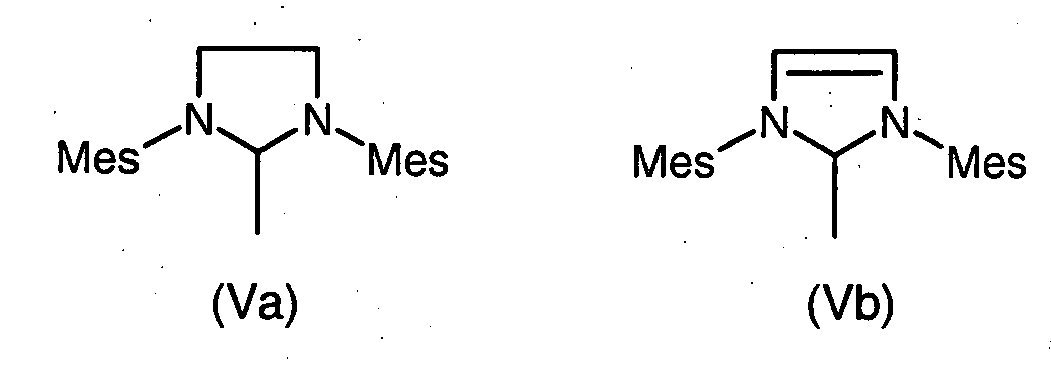


- In den Katalysatoren der allgemeinen Formel (B) sind X1 und X2 gleich oder verschieden und können beispielsweise Wasserstoff, Halogen, Pseudohalogen, geradkettige oder verzweigte C1-C30-Alkyl, C6-C24-Aryl, C1-C20-Alkoxy, C6-C24-Aryloxy, C3-C20-Alkyldiketonat, C6-C24-Aryldiketonat, C1-C20-Carboxylat, C1-C20-Alkylsulfonat, C6-C24-Arylsulfonat, C1-C20-Alkylthiol, C6-C24-Arylthiol, C1-C20-Alkylsulfonyl oder C1-C20-Alkylsulfinyl bedeuten.
- Die vorgenannten Reste X1 und X2 können ferner durch ein oder mehrere weitere Reste substituiert sein, beispielsweise durch Halogen, bevorzugt Fluor, C1-C10-Alkyl, C1-C10-Alkoxy oder C6-C24-Aryl-Reste, wobei auch die letzteren Reste gegebenenfalls wiederum durch ein oder mehrere Substituenten substituiert sein können, die aus der Gruppe umfassend Halogen, bevorzugt Fluor, C1-C5-Alkyl, C1-C5-Alkoxy und Phenyl ausgewählt sind.
- In einer bevorzugten Ausführungsform sind X und X1 gleich oder verschieden und bedeuten Halogen, insbesondere Fluor, Chlor, Brom oder Jod, Benzoat, C1-C5-Carboxylat, C1-C5-Alkyl, Phenoxy, C1-C5-Alkoxy, C1-C5-Alkylthiol, C6-C24-Arylthiol, C6-C24-Aryl oder C1-C5-Alkylsulfonat.
- In einer besonders bevorzugten Ausführungsform sind X und X1 identisch und bedeuten Halogen, insbesondere Chlor, CF3COO, CH3COO, CFH2COO, (CH3)3CO, (CF3)2(CH3)CO, (CF3)(CH3)2CO, PhO (Phenoxy), MeO (Methoxy), EtO (Ethoxy), Tosylat (p-CH3-C6H4-SO3), Mesylat (2,4,6-Trimethylphenyl) oder CF3SO3 (Trifluormethansulfonat).
- In der allgemeinen Formel (B) bedeutet der Rest R1 einen Alkyl-, Cycloalkyl-, Alkenyl-, Alkinyl-, Aryl-, Alkoxy-, Alkenyloxy-, Alkinyloxy-, Aryloxy-, Alkoxycarbonyl-, Alkylamino-, Alkylthio-, Arylthio-, Alkylsulfonyl- oder Alkylsulfinyl-Rest, die alle jeweils optional durch ein oder mehrere Alkyl-, Halogen-, Alkoxy-, Aryl- oder Heteroaryl-Reste substituiert sein können.
- Üblicherweise bedeutet der Rest R1 einen C1-C30-Alkyl, C3-C20-Cylcoalkyl, C2-C20-Alkenyl, C2-C20-Alkinyl, C6-C24-Aryl, C1-C20-Alkoxy, C2-C20-Alkenyloxy, C2-C20-Alkinyloxy, C6-C24-Aryloxy, C2-C20-Mkoxycarbonyl, C1-C20-Alkylamino-, C1-C20-Alkylthio, C6-C24-Arylthio, C1-C20-Alkylsulfonyl oder C1-C20-Alkylsulfinyl Rest, die alle jeweils optional durch ein oder mehrere Alkyl-, Halogen-, Alkoxy-, Aryl- oder Heteroaryl-Reste substituiert sein können.
- Bevorzugt steht R1 für einen C3-C20-Cylcoalkyl-Rest, einen C6-C24-Aryl-Rest oder einen geradkettigen oder verzweigten C1-C30-Alkyl-Rest, wobei letztere gegebenenfalls durch ein oder mehrere Doppel- oder Dreifachbindungen oder auch ein oder mehrere Heteroatome, bevorzugt Sauerstoff oder Stickstoff, unterbrochen sein kann. Besonders bevorzugt steht R1 für einen geradkettigen oder verzweigten C1-C12-Alkyl-Rest.
- Der C3-C20-Cycloalkyl-Rest umfasst beispielsweise Cyclopropyl, Cyclobutyl, Cylopentyl, Cyclohexyl, Cycloheptyl und Cyclooctyl.
- Bei dem C1-C12-Alkyl-Rest kann es sich beispielsweise um Methyl, Ethyl, n-Propyl, iso-Propyl, n-Butyl, sec.-Butyl, tert.-Butyl, n-Pentyl, 1-Methylbutyl, 2-Methylbutyl, 3-Methylbutyl, neo-Pentyl, 1-Ethylpropyl, n-Hexyl, n-Heptyl, n-Octyl, n-Decyl oder n-Dodecyl handeln. Insbesondere steht R1 für Methyl oder Isopropyl.
- Der C6-C24-Aryl-Rest steht für einen aromatischen Rest mit 6 bis 24 Gerüstkohlenstoffatomen. Als bevorzugte mono-, bi- oder tricyclische carbocyclische aromatische Reste mit 6 bis 10 Gerüstkohlenstoffatomen seien beispielsweise Phenyl, Biphenyl, Naphtyl, Phenanthrenyl oder Anthracenyl genannt.
- In der allgemeinen Formel (B) sind die Reste R2, R3, R4 und R5 gleich oder verschieden und können Wasserstoff, organische oder anorganische Reste darstellen.
- In einer geeigneten Ausführungsform sind R2, R3, R4, R5 gleich oder verschieden und bedeuten Wasserstoff, Halogen, Nitro, CF3, Alkyl-, Cycloalkyl-, Alkenyl-, Alkinyl-, Aryl-, Alkoxy-, Alkenyloxy-, Alkinyloxy-, Aryloxy-, Alkoxycarbonyl-, Alkylamino-, Alkylthio-, Arylthio, Alkylsulfonyl- oder Alkylsulfinyl-Reste darstellen, die alle jeweils optional durch ein oder mehrere Alkyl-, Alkoxy-, Halogen-, Aryl- oder Heteroaryl-Reste substituiert sein können.
- Üblicherweise sind R2, R3, R4, R5 gleich oder verschieden und bedeuten Wasserstoff, Halogen, bevorzugt Chlor oder Brom, Nitro, CF3, C1-C30-Alkyl, C3-C20-Cylcoalkyl, C2-C20-Alkenyl, C2-C20-Alkinyl, C6-C24-Aryl, C1-C20-Alkoxy, C2-C20-Alkenyloxy, C2-C20-Alkinyloxy, C6-C24-Aryloxy, C2-C20-Alkoxycarbonyl, C1-C20-Alkylamino-, C1-C20-Alkylthio, C6-C24-Arylthio, C1-C20-Alkylsulfonyl oder C1-C20-Alkylsulfinyl Reste, die alle jeweils optional durch ein oder mehrere C1-C30-Alkyl-, C1-C20-Alkoxy-, Halogen-, C6-C24-Aryl- oder Heteroaryl-Reste substituiert sein können.
- In einer besonders bewährten Ausführungsform sind R2, R3, R4, R5 sind gleich oder verschieden und stehen für Nitro, geradkettige oder verzweigte C1-C30-Alkyl-, C5-C20-Cylcoalkyl-, geradkettige oder verzweigte C1-C20-Alkoxy-Reste oder C6-C24-Aryl-Reste, bevorzugt Phenyl oder Naphthyl. Die C1-C30-Alkyl-Reste sowie C1-C20-Alkoxy-Reste können optional durch ein oder mehrere Doppel- oder Dreifachbindungen oder auch ein oder mehrere Heteroatome, bevorzugt Sauerstoff oder Stickstoff, unterbrochen sein.
- Ferner können auch zwei oder mehr der Reste R2, R3, R4 oder R5 über aliphatische oder aromatische Strukturen verbrückt sein. R3 und R4 können beispielsweise unter Einbeziehung der Kohlenstoff-Atome, an die sie im Phenylring der Formel (B) gebunden sind, einen ankondensierten Phenylring bilden, so dass insgesamt eine Naphthylstruktur resultiert.
- In der allgemeinen Formel (B) bedeutet R6 Wasserstoff, einen Alkyl-, Alkenyl-, Alkinyl- oder einen Aryl-Rest. Bevorzugt bedeutet R6 Wasserstoff, einen C1-C30-Alkyl, einen C2-C20-Alkenyl-, einen C2-C20-Alkinyl oder einen C6-C24-Aryl-Rest. Besonders bevorzugt ist R6 Wasserstoff.
- Für das erfindungsgemäße Katalysator-System eignen sich besonders Katalysatoren gemäß der allgemeinen Formel (B1)

- M, L, X1, X2, R1, R2, R3, R4 und R5
- die für die allgemeine Formel (B) genannten allgemeinen, bevorzugten und besonders bevorzugten Bedeutungen besitzen können.
- Diese Katalysatoren sind beispielsweise aus
US 2002/0107138 A1 (Hoveyda et al. ) prinzipiell bekannt und können nach dort angegebenen Herstellverfahren erhalten werden. - Besonders bevorzugt sind Katalysatoren der allgemeinen Formel (B1), wobei
- M
- Ruthenium darstellt,
- X1 und X2
- gleichzeitig Halogen, insbesondere gleichzeitig Chlor bedeuten,
- R1
- für einen geradkettigen oder verzweigten C1-C12 Alkylrest steht,
- R2, R3, R4, R5
- die für die allgemeine Formel (B) genannten allgemeinen und bevorzugten Bedeutungen besitzen und
- L
- die für die allgemeine Formel (B) genannten allgemeinen und bevorzugten Bedeutungen besitzt.
- Inbesondere bevorzugt sind Katalysatoren der allgemeinen Formel (B1), wobei
- M
- Ruthenium darstellt,
- X1 und X2
- gleichzeitig Chlor bedeuten,
- R1
- für einen Isopropyl-Rest steht,
- R2, R3, R4, R5
- alle Wasserstoff bedeuten und
- L
- einen gegebenenfalls substituierten Imidazolidin-Rest der Formeln (IIa) oder (IIb) darstellt,

- R8, R9, R10, R11
- gleich oder verschieden sind und Wasserstoff, geradkettiges oder verzweigtes C1-C30-Alkyl, C3-C20-Cylcoalkyl, C2-C20-Alkenyl, C2-C20-Alkinyl, C6-C24-Aryl, C1-C20-Carboxylat, C1-C20-Alkoxy, C2-C20-Alkenyloxy, C2-C20-Alkinyloxy, C6-C24-Aryloxy, C2-C20-Alkoxycarbonyl, C1-C20-Alkylthio, C6-C24-Arylthio, C1-C20-Alkylsulfonyl, C1-C20-Alkylsulfonat, C6-C24-Arylsulfonat oder C1-C20-Alkylsulfinyl bedeuten.
- Ganz besonders bevorzugt ist für die erfindungsgemäßen Katalysator-Systeme als Katalysator, der unter die allgemeine Strukturformel (B1) fällt, derjenige der Formel (VI), wobei Mes jeweils für einen 2,4,6-Trimethylphenyl-Rest steht,

- Dieser Katalysator wird in der Literatur auch als "Hoveyda-Katalysator" bezeichnet.
- Weiterhin geeignete Katalysatoren, die unter die allgemeine Strukturformel (B1) fallen, sind solche der folgenden Formeln (VII), (VIII), (IX), (X), (XI), (XII), (XIII) und (XVII), wobei Mes jeweils einen 2,4,6-Trimethylphenyl-Rest bedeutet.


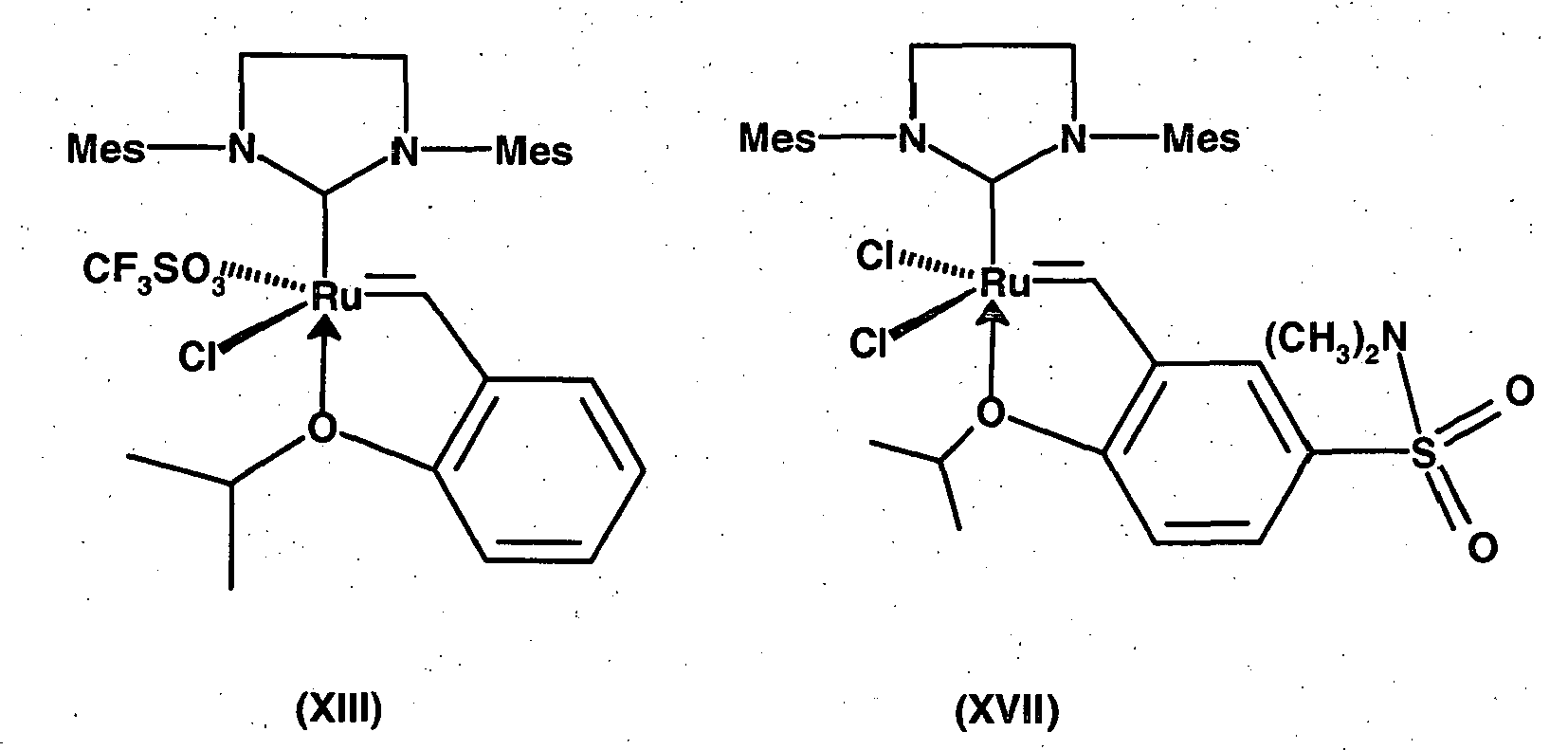
- Für das erfindungsgemäße Katalysator-System eignen sich ferner auch Katalysatoren gemäß der allgemeinen Formel (B2)

- M, L, X1, X2, R1 und R6
- die für die Formel (B) genannten allgemeinen und bevorzugten Bedeutungen haben,
- R12
- gleich oder verschieden sind und die für die Reste R2, R3, R4 und R5 in der Formel (B) genannten allgemeinen und bevorzugten Bedeutungen, ausgenommen Wasserstoff, besitzen und
- n
- gleich 0, 1, 2 oder 3 ist.
- Diese Katalysatoren sind beispielsweise aus
WO-A-2004/035596 (Grela ) prinzipiell bekannt und können nach dort angegebenen Herstellverfahren erhalten werden. - Besonders bevorzugt sind Katalysatoren der allgemeinen Formel (B2), wobei
- M
- Ruthenium darstellt,
- X1 und X2
- gleichzeitig Halogen, insbesondere gleichzeitig Chlor bedeuten,
- R1
- für einen geradkettigen oder verzweigten C1-C12 Alkylrest steht,
- R12
- die für die allgemeine Formel (B) genannten Bedeutungen besitzt,
- n
- gleich 0, 1, 2 oder 3 ist,
- R6
- Wasserstoff bedeutet und
- L
- die für die allgemeine Formel (B) genannten Bedeutungen besitzt,
- Inbesondere bevorzugt sind Katalysatoren der allgemeinen Formel (B2), wobei
- M
- Ruthenium darstellt,
- X1 und X2
- gleichzeitig Chlor bedeuten,
- R1
- für einen Isopropyl-Rest steht,
- n
- gleich 0 ist und
- L
- einen gegebenenfalls substituierten Imidazolidin-Rest der Formeln (IIa) oder (IIb) darstellt,

- R8, R9, R10, R11
- gleich oder verschieden sind und Wasserstoff, geradkettiges oder verzweigtes, cyclisches oder acyclisches C1-C30-Alkyl, C2-C20-Alkenyl, C2-C20-Alkinyl, C6-C24-Aryl, C1-C20-Carboxylat, C1-C20-Alkoxy, C2-C20-Alkenyloxy, C2-C20-Alkinyloxy, C6-C24-Aryloxy, C2-C20-Alkoxycarbonyl, C1-C20-Alkylthio, C6-C24-Arylthio, C1-C20-Alkylsulfonyl, C1-C20-Alkylsulfonat, C6-C24-Arylsulfonat oder C1-C20-Alkylsulfinyl bedeuten.
- Ein besonders geeigneter Katalysator, der unter die allgemeine Formel (B2) fällt, besitzt die Struktur (XIV)

- Ein weiterer geeigneter Katalysator, der unter die allgemeine Formel (B2) fällt, besitzt folgende Struktur (XV), wobei Mes jeweils für einen 2,4,6-Trimethylphenyl-Rest steht,

- In einer alternativen Ausführungsform sind auch dendritisch aufgebaute Katalysatoren der allgemeinen Formel (B3) einsetzbar,


- M, L, X1, X2, R1, R2, R3, R5 und R6
- die für die allgemeine Formel (B) genannten Bedeutungen besitzen und auch die zuvor genannten bevorzugten Bedeutungen besitzen können.
- Derartige Katalysatoren gemäß der allgemeinen Formel (B3) sind aus
US 2002/0107138 A1 bekannt und gemäß den dort gemachten Angaben herstellbar. - In einer weiteren alternativen Ausführungsform ist ein Katalysator der Formel (B4) einsetzbar,


für einen Träger steht. - Bevorzugt handelt es sich bei dem Träger um ein Poly(styroldivinylbenzol)-Copolymer (PS-DVB).
- Dieser Katalysatoren gemäß Formel (B4) sind aus Chem. Eur. J. 2004 10, 777-784 prinzipiell bekannt und nach dort beschriebenen Herstellmethoden erhältlich.
- Alle vorgenannten Katalysatoren des Typs (B) können entweder als solche im Reaktionsgemisch der NBR-Metathese eingesetzt werden oder aber auch auf einem festen Träger aufgebracht und immobilisiert werden. Als feste Phasen bzw. Träger sind solche Materialien geeignet, die einerseits inert gegenüber dem Reaktionsgemisch der Metathese sind und zum anderen die Aktivität des Katalysators nicht beeinträchtigen. Einsetzbar sind zur Immobilisierung des Katalysators beispielsweise Metalle, Glas, Polymere, Keramik, organische Polymerkügelchen oder auch anorganische Sol-Gele.
- Für das erfindungsgemäße Katalysator-System können auch Katalysatoren der allgemeinen Formel (C) eingesetzt werden.

- M
- Ruthenium oder Osmium bedeutet,
- X1 und X2
- gleich oder verschieden sein können und anionische Liganden darstellen,
- R'
- gleich oder verschieden sind und organische Reste darstellen,
- Im
- einen gegebenenfalls substituierten Imidazolidinrest darstellt und
- An
- ein Anion darstellt.
- Diese Katalysatoren sind prinzipiell bekannt (siehe z.B. Angew. Chem. Int. Ed. 2004,43, 6161-6165).
- X1 und X2 können in der allgemeinen Formel (C) die gleichen allgemeinen, bevorzugten und besonders bevorzugten Bedeutungen besitzen wie in Formel (B).
- Der Imidazolidinrest (Im) weist üblicherweise eine Struktur der allgemeinen Formeln (IIa) oder (IIb) auf, die bereits für den Katalysator-Typ der Formeln (A) und (B) genannt wurden und kann auch alle dort als bevorzugt genannten Strukturen, insbesondere die der Formeln (Va)-(Vf) aufweisen.
- Die Reste R' sind in der allgemeinen Formel (C) gleich oder verschieden und bedeuten einen geradkettigen oder verzweigten C1-C30-Alkyl-, C5-C30-Cylcoalkyl- oder Aryl-Rest, wobei die C1-C30-Alkylreste gegebenenfalls durch ein oder mehrere Doppel- oder Dreifachbindungen oder auch ein oder mehrere Heteroatome, bevorzugt Sauerstoff oder Stickstoff, unterbrochen sein können.
- Aryl umfasst einen aromatischen Rest mit 6 bis 24 Gerüstkohlenstoffatomen. Als bevorzugte mono-, bi- oder tricyclische carbocyclische aromatische Reste mit 6 bis 10 Gerüstkohlenstoffatomen seien beispielsweise Phenyl, Biphenyl, Naphthyl, Phenanthrenyl oder Anthracenyl genannt.
- Bevorzugt sind die Reste R' in der allgemeinen Formel (C) gleich und bedeuten Phenyl, Cyclohexyl, Cyclopentyl, Isopropyl, o-Tolyl o-Xylyl oder Mesityl.
- Für die erfindungsgemäßen Katalysator-Systeme sind ferner Katalysatoren der allgemeinen Formel (D) geeignet.

- M
- Ruthenium oder Osmium bedeutet,
- R13 und R14
- unabhängig voneinander Wasserstoff, C1-C20-Alkyl, C2-C20-Alkenyl, C2-C20 Alkinyl, C6-C24-Aryl, C1-C20-Carboxylat, C1-C20-Alkoxy, C1-C20-Alkenyloxy, C2-C20-Alkinyloxy, C6-C24-Aryloxy, C2-C20-Alkoxycarbonyl, C1-C20-Alkylthio, C1-C20 -Alkylsulfonyl oder C1-C20 Alkylsulfinyl bedeuten,
- X3
- ein anionischer Ligand ist,
- L2
- ein neutraler π-gebundener Ligand ist, unabhängig davon, ob mono- oder polycyclisch,
- L3
- ist ein Ligand aus der Gruppe der Phosphine, sulfonierten Phosphine, fluorierten Phosphine, funktionalisierten Phosphine mit bis zu drei Aminoalkyl-, Ammoniumalkyl-, Alkoxyalkyl-, Alkoxycarbonylalkyl-, Hydrocarbonylalkyl-, Hydroxyalkyl- oder Ketoalkyl-Gruppen, Phosphite, Phosphinite, Phosphonite, Phosphinamine, Arsine, Stibine, Ether, Amine, Amide, Imine, Sulfoxide, Thioether und Pyridine,
- Y-
- ein nicht-koordinierendes Anion ist und
- n
- 0, 1, 2, 3, 4 oder 5 ist.
- In den erfindungsgemäßen Katalysator-Systemen sind ferner Katalysatoren der allgemeinen Formel (E) geeignet

- M2
- Molybdän oder Wolfram bedeutet,
- R15 und R16
- gleich oder verschieden sind und Wasserstoff, C1-C20-Alkyl, C2-C20-Alkenyl, C2-C20-Alkinyl, C6-C24-Aryl, C1-C20-Carboxylat, C1-C20-Alkoxy, C2-C20-Alkenyloxy, C2-C20-Alkinyloxy, C6-C24-Aryloxy, C2-C20-Alkoxycarbonyl, C1-C20-Alkylthio, C1-C20 -Alkylsulfonyl oder C1-C20 Alkylsulfinyl bedeuten,
- R17 and R18
- gleich oder verschieden sind und einen substituierten oder einen halogensubstituierten C1-C20-Alkyl, C6-C24-Aryl, C6-C30-Aralkyl-Rest oder Silikon-enthaltende Analoga davon darstellen.
- In den erfindungsgemäßen Katalysator-Systemen sind ferner Katalysatoren der allgemeinen Formel (F) geeignet.

- M
- Ruthenium oder Osmium bedeutet,
- X1 und X2
- gleich oder verschieden sind und anionische Liganden darstellen, die alle Bedeutungen von X1 und X2 in der allgemeinen Formeln (A) und (B) annehmen können,
- L
- gleiche oder verschiedene Liganden darstellt, die alle allgemeinen und bevorzugten Bedeutungen von L in den allgemeinen Formeln (A) und (B) annehmen können,
- R19 and R20
- gleich oder verschieden sind und Wasserstoff oder substituiertes oder unsubstituiertes Alkyl bedeuten.
- Die erfindungsgemäßen Katalysator-Systeme umfassen somit den Metathese-Katalysator sowie ein oder mehrere Salze der allgemeinen Formel (I).
- Gegenstand der Erfindung ist ferner die Verwendung der erfindungsgemäßen Katalysator-Systeme in Metathese-Reaktionen.
- Bei den Metathese-Reaktionen kann es sich um Ringschlussmetathesen (RCM), Kreuzmetathesen (CM) oder auch Ringöffnungsmetathesen (ROMP) handeln.
- Bevorzugt werden die erfindungsgemäßen Katalysator-Systeme für die Metathese von Nitrilkautschuk verwenden. Hierbei handelt es sich um eine Kreuzmetathese.
- Im erfindungsgemäßen Katalysator-System wird der Metathese-Katalysator und das oder die Salze der allgemeinen Formel (I) in einem Gewichtsverhältnis Salz(e) : Metathesekatalysator von 0,01:1 bis 10000:1, bevorzugt 0,1:1 bis 1000:1, besonders bevorzugt 0,5:1 bis 500:1 eingesetzt.
- Das bzw. die Salze der allgemeinen Formel (I) können in einem Lösungsmittel oder auch ohne Lösungsmittel zum Metathese-Katalysator oder dessen Lösung gegeben werden, um dadurch das erfindungsgemäße Katalysator-System zu erhalten.
- Als Lösungsmittel bzw. Dispergiermittel, mit dem das Salz bzw. die Salze der allgemeinen Formel (I) dem Katalysator bzw. dessen Lösung zugesetzt wird, können alle bekannten Lösungsmittel verwendet werden. Für die Wirksamkeit des Salzzusatzes ist es nicht unbedingt erforderlich, dass das Salz in dem Lösungsmittel eine hohe Löslichkeit aufweist. Bevorzugte Lösungsmittel umfassen, sind aber nicht beschränkt auf, Aceton, Benzol, Chlorbenzol, Chloroform, Cyclohexan, Dichlormethan, Dioxan, Dimethylformamid, Dimethylacetamid, Dimethylsulfon, Dimethylsufoxid, Methylethylketon, Tetrahydrofuran, Tetrahydropyran und Toluol. Vorzugsweise ist das Lösungsmittel gegenüber dem Metathesekatalysator inert.
- Sofern die erfindungsgemäßen Katalysator-Systeme für die Metathese von Nitrilkautschuk eingesetzt werden, liegt die Menge, in der das Salz oder die Salze der allgemeinen Formel (I) bezogen auf den abzubauenden Kautschuk verwendet werden, in einem Bereich von 0,0001 phr bis 50 phr, bevorzugt 0,001 phr bis 35 phr (phr = Gew.Teile auf 100 Gew.-Teile Kautschuk).
- Auch für den Einsatz zur NBR Metathese kann das Salze bzw. die Salze der allgemeinen Formel (I) in einem Lösungsmittel oder auch ohne Lösungsmittel zu einer Lösung der Metathese-Katalysators gegeben werden. Alternativ dazu kann das Salz oder die Salze der allgemeinen Formel (I) auch direkt einer Lösung des abzubauenden Nitrilkautschuks zugegeben werden, der darüber hinaus der Metathese-Katalysator zugegeben wird, so dass das gesamte erfindungsgemäße Katalysator-System im Reaktionsgemisch vorliegt.
- Die Menge des Metathese-Katalysators bezogen auf den eingesetzten Nitrilkautschuk hängt von der Natur sowie katalytischen Aktivität des speziellen Katalysators ab. Die Menge an eingesetztem Katalysator beträgt üblicherweise 1 bis 1.000 ppm Edelmetall, bevorzugt 2 bis 500 ppm, insbesondere 5 bis 250 ppm, bezogen auf den eingesetzten Nitrilkautschuk.
- Die NBR-Metathese kann in Abwesenheit oder aber in Gegenwart eines Co-Olefins durchgeführt werden. Bei diesem handelt es sich bevorzugt um ein geradkettiges oder verzweigtes C2-C16-Olefin. Geeignet sind beispielsweise Ethylen, Propylen, Isobuten, Styrol, 1-Hexen oder 1-Octen. Bevorzugt wird 1-Hexen oder 1-Octen verwendet. Sofern das Co-Olefin flüssig ist (wie beispielsweise 1-Hexen), liegt die Menge des Co-Olefins bevorzugt in einem Bereich von 0,2-20 Gew.% bezogen auf den eingesetzten NBR. Sofern das Co-Olefin ein Gas ist, wie beispielsweise Ethylen, wird die Menge des Co-Olefins so gewählt, dass sich im Reaktionsgefäß bei Raumtemperatur ein Druck im Bereich von 1 x 10⁵ Pa - 1 x 10⁷ Pa einstellt, bevorzugt ein Druck im Bereich von 5,2 x 10⁵ Pa bis 4 x 10⁶ Pa.
- Die Metathese-Reaktion kann in einem geeigneten Lösungsmittel durchgeführt werden, welches den eingesetzten Katalyator nicht deaktiviert und die Reaktion auch nicht in irgendeiner anderen Weise negativ beeinflusst. Bevorzugte Lösungsmittel umfassen, sind aber nicht begrenzt auf, Dichlormethan, Benzol, Toluol, Methylethylketon, Aceton, Tetrahydrofuran, Tetrahydropyran, Dioxan und Cyclohexan. Das besonders bevorzugte Lösungsmittel ist Chlorbenzol. In manchen Fällen, wenn das Co-Olefin selbst als Lösungsmittel fungieren kann, so z.B. bei 1-Hexen, kann auch auf den Zusatz eines weiteren zusätzlichen Lösungsmittels verzichtet werden.
- Die Konzentration des eingesetzten Nitrilkautschuks in der Reaktionsmischung der Metathese ist nicht kritisch, aber es ist natürlich zu beachten, dass die Reaktion nicht durch eine viel zu hohe Viskosität der Reaktionsmischung und die damit verbundenen Mischungsprobleme negativ beeinflusst werden sollte. Bevorzugt liegt die Konzentration des NBR in der Reaktionsmischung im Bereich von 1 bis 20 Gew.%, besonders bevorzugt im Bereich von 5 bis 15 Gew.%, bezogen auf die gesamte Reaktionsmischung.
- Der Metathese Abbau wird üblicherweise bei einer Temperatur im Bereich von 10°C bis 150°C durchgeführt, bevorzugt bei einer Temperatur im Bereich von 20 bis 100 °C.
- Die Reaktionszeit hängt von einer Reihe von Faktoren ab, beispielsweise vom Typ des NBR, der Art des Katalysators, der verwendeten Katalysator-Konzentration und der Reaktionstemperatur. Typischerweise ist die Reaktion innerhalb von drei Stunden unter normalen Bedingungen beendet. Der Fortschritt der Metathese kann durch Standard-Analytik überwacht werden, z.B. durch GPCmessungen oder durch Bestimmung der Viskosität.
- Als Nitrilkautschuke ("NBR") können in die Metathese-Reaktion Co- oder Terpolymere eingesetzt werden, welche Wiederholungseinheiten mindestens eines konjugierten Diens, mindestens eines α,β-ungesättigten Nitrils und gegebenenfalls einer oder mehrerer weiterer copolymerisierbarer Monomere enthalten.
- Das konjugierte Dien kann von jeder Natur sein. Bevorzugt werden (C4-C6) konjugierte Diene eingesetzt. Besonders bevorzugt sind 1,3-Butadien, Isopren, 2,3-Dimethylbutadien, Piperylen oder Gemische daraus. Insbesondere bevorzugt sind 1,3-Butadien und Isopren oder Gemische daraus. Ganz besonders bevorzugt ist 1,3-Butadien.
- Als α,β-ungesättigtes Nitril kann jedes bekannte α,β-ungesättigte Nitril eingesetzt werden, bevorzugt sind (C3-C5)-α,β-ungesättigte Nitrile wie Acrylnitril, Methacrylnitril, Ethacrylnitril oder Mischungen davon. Besonders bevorzugt ist Acrylnitril.
- Einen besonders bevorzugten Nitrilkautschuk stellt somit ein Copolymer aus Acrylnitril und 1,3-Butadien dar.
- Neben dem konjugierten Dien und dem α,β-ungesättigten Nitril können noch ein oder mehrere weitere dem Fachmann bekannte, copolymerisierbare Monomere eingesetzt werden, z.B. α,β-ungesättigte Mono- oder Dicarbonsäuren, deren Ester oder Amide. Als α,β-ungesättigte Mono- oder Dicarbonsäuren sind dabei Fumarsäure, Maleinsäure, Acrylsäure und Methacrylsäure bevorzugt. Als Ester der α,β-ungesättigten Carbonsäuren werden vorzugsweise deren Alkylester und Alkoxyalkylester eingesetzt. Besonders bevorzugte Alkylester der α,β-ungesättigten Carbonsäuren sind Methylacrylat, Ethylacrylat, Butylacrylat, Butylmethacrylat, 2-Ethylhexylacrylat, 2-Ethylhexylmethacrylat und Octylacrylat. Besonders bevorzugte Alkoxyalkylester der α,β-ungesättigten Carbonsäuren sind Methoxyethyl(meth)acrylat, Ethoxyethyl(meth)acrylat und Methoxyethyl-(meth)acrylat. Einsetzbar sind auch Mischungen von Alkylestern, wie z.B. den vorgenannten, mit Alkoxyalkylestern, z.B. in Form der vorgenannten.
- Die Anteile an konjugiertem Dien und α,β-ungesättigtem Nitril in den einzusetzenden NBR-Polymeren können in weiten Bereichen schwanken. Der Anteil des oder der Summe der konjugierten Diene liegt üblicherweise im Bereich von 40 bis 90 Gew.-%, bevorzugt im Bereich von 60 bis 85 Gew. %, bezogen auf das Gesamtpolymer. Der Anteil des oder der Summe der α,β-ungesättigten Nitrile liegt üblicherweise bei 10 bis 60 Gew.-%, bevorzugt bei 15 bis 40 Gew.-%, bezogen auf das Gesamtpolymer. Die Anteile der Monomere summieren sich jeweils zu 100 Gew.-% auf. Die zusätzlichen Monomere können in Mengen von 0 bis 40 Gew.%, bevorzugt 0,1 bis 40 Gew.-%, besonders bevorzugt 1 bis 30 Gew.-%, bezogen auf das Gesamtpolymer, vorliegen. In diesem Fall werden entsprechende Anteile des oder der konjugierten Diene und/oder des oder der α,β-ungesättigten Nitrile durch die Anteile der zusätzlichen Monomere ersetzt, wobei sich die Anteile aller Monomere jeweils zu 100 Gew.-% aufsummieren.
- Die Herstellung der Nitrilkautschuke durch Polymerisation der vorgenannten Monomere ist dem Fachmann hinlänglich bekannt und in der Polymerliteratur umfangreich beschrieben.
- Nitrilkautschuke, die im erfindungsgemäßen Sinn verwendet werden können, sind ferner käuflich erhältlich, z.B. als Produkte aus der Produktreihe der Marken Perbunan® und Krynac® von der Lanxess Deutschland GmbH.
- Die zur Metathese eingesetzten Nitrilkautschuke besitzen eine Mooney-Viskosität (ML 1+4 bei 100°C) im Bereich von 30 bis 70, bevorzugt von 30 bis 50. Dies entspricht einem Gewichtsmittel des Molekulargewicht Mw im Bereich von 200.000 - 500.000, bevorzugt im Bereich von 200.000 - 400.000. Die eingesetzten Nitrilkautschuke besitzen ferner eine Polydispersität PDI = Mw/Mn, wobei Mw das Gewichtsmittel und Mn das Zahlenmittel des Molekulargewichts darstellt, im Bereich von 2,0 - 6,0 und bevorzugt im Bereich von 2,0 - 4,0.
- Die Bestimmung der Mooney-Viskosität erfolgt dabei gemäß ASTM Norm D 1646.
- Die durch das erfindungsgemäße Metathese-Verfahren erhaltenen Nitrilkautschuke besitzen eine Mooney-Viskosität (ML 1+4 bei 100°C) im Bereich von 5 - 30, bevorzugt von 5 - 20 Dies entspricht einem Gewichtsmittel des Molekulargewicht Mw im Bereich von 10.000- 200.000, bevorzugt im Bereich von 10.000-150.000. Die erhaltenen Nitrilkautschuke besitzen ferner eine Polydispersität PDI = Mw/Mn, wobei Mn das Zahlenmittel des Molekulargewichts darstellt, im Bereich 1,5 - 4,0 bevorzugt im Bereich von 1,7 - 3.
- An den Metathese Abbau in Gegenwart des erfindungsgemäßen Katalysator-Systems kann sich eine Hydrierung der erhaltenen abgebauten Nitrilkautschuke anschließen. Diese kann in der dem Fachmann bekannten Art und Weise erfolgen.
- Es ist möglich, die Hydrierung unter Einsatz homogener oder heterogener Hydrierkatalysatoren durchzuführen. Es ist ferner möglich, die Hydrierung in-situ durchzuführen, d.h. in dem gleichen Reaktionsgefäß, in dem zuvor auch der Metathese-Abbau erfolgte und ohne Notwendigkeit den abgebauten Nitrilkautschuk zu isolieren. Der Hydrierkatalysator wird einfach dem Reaktionsgefäß zugesetzt.
- Die eingesetzten Katalysatoren basieren üblicherweise auf Rhodium, Ruthenium oder Titan, es können aber auch Platin, Iridium, Palladium, Rhenium, Ruthenium, Osmium, Kobalt oder Kupfer entweder als Metall, oder aber bevorzugt in Form von Metallverbindungen eingesetzt werden (siehe z.B.
US-A-3,700,637 ,DE-A-25 39 132 ,EP-A- 0 134 023 ,DE-OS- 35 41 689 ,DE-OS- 35 40 918 ,EP-A-0 298 386 ,DE-OS- 35 29 252 ,DE-OS- 34 33 392 ,US-A-4,464,515 undUS-A-4,503,196 ). - Geeignete Katalysatoren und Lösungsmittel für eine Hydrierung in homogener Phase werden im folgenden beschrieben und sind auch aus
DE-A-25 39 132 und derEP-A-0 471 250 bekannt - Die selektive Hydrierung kann beispielsweise in Gegenwart eines Rhodium- oder Rutheniumhaltigen Katalysators erreicht werden. Einsetzbar ist beispielsweise ein Katalysator der allgemeinen Formel
(R1 mB)1 M Xn,
worin M Ruthenium oder Rhodium ist, R1 gleich oder verschieden sind und eine C1-C8 Alkylgruppe, eine C4-C8 Cycloalkylgruppe, eine C6-C15 Aryl-Gruppe oder eine C7-C15 Aralkylgruppe darstellen. B ist Phosphor, Arsen, Schwefel oder eine Sulfoxid-Gruppe S=O, X ist Wasserstoff oder ein Anion, vorzugsweise Halogen und besonders bevorzugt Chlor oder Brom, 1 ist 2,3 oder 4, m ist 2 oder 3 und n ist 1,2 oder 3, bevorzugt 1 oder 3. Bevorzugte Katalysatoren sind Tris(triphenylphosphin)-rhodium(I)-chlorid, Tris(triphenylphosphin)-rhodium(III)-chlorid und Tris(dimethylsulfoxid)-rhodium(III)-chlorid sowie Tetrakis(triphenylphosphin)-rhodium-hydrid der Formel (C6H5)3P)4RhH und die entsprechenden Verbindungen, in denen das Triphenylphosphin ganz oder teilweise durch Tricyclohexylphosphin ersetzt wurde. Der Katalysator kann in kleinen Mengen benutzt werden. Eine Menge im Bereich von 0,01-1 Gew.%, bevorzugt im Bereich von 0,03-0,5 Gew.% und besonders bevorzugt im Bereich von 0,1-0,3 Gew.% bezogen auf das Gewicht des Polymers sind geeignet. - Üblicherweise ist es sinnvoll, den Katalysator zusammen mit einem Co-Katalysator zu verwenden, der ein Ligand der Formel R1 mB ist, wobei R1, m und B die zuvor für den Katalysator genannten Bedeutungen besitzen. Bevorzugt ist m gleich 3, B gleich Phosphor und die Reste R1 können gleich oder verschieden sein. Bevorzugt handelt es sich um Co-Katalysatoren mit Trialkyl, Tricycloalkyl, Triaryl, Triaralkyl, Diaryl-monoalkyl, Diaryl-monocycloalkyl, Dialkyl-monoaryl, Dialkyl-monocycloalkyl, Dicycloalkyl-monoaryl oder Dicyclalkyl-monoaryl-Resten.
- Beispiele von Co-Katalysatoren finden sich beispielsweise in
US-A-4,631,315 . Bevorzugter Co-Katalysator ist Triphenylphosphin. Der Co-Katalysator wird bevorzugt in Mengen in einem Bereich von 0,3-5 Gew.%, bevorzugt im Bereich von 0,5-4 Gew.% eingesetzt, bezogen auf das Gewicht des zu hydrierenden Nitrilkautschuks. Bevorzugt liegt ferner das Gewichtsverhältnis des Rhodium-haltigen Katalysators zum Co-Katalysator im Bereich von 1:3 bis 1:55, besonders bevorzugt im Bereich von 1:5 bis 1:45. Bezogen auf 100 Gewichtsteile des zu hydrierenden Nitrilkautschuks werden geeigneterweise 0,1 bis 33 Gewichtsteile des Co-Katalyators, bevorzugt 0,5 bis 20 und ganz besonders bevorzugt 1 bis 5 Gewichtsteile, insbesondere mehr als 2 aber weniger als 5 Gewichtsteile Co-Katalysator bezogen auf 100 Gewichtsteile des zu hydrierenden Nitrilkautschuks eingesetzt. - Die praktische Durchführung dieser Hydrierung ist dem Fachmann aus
US-A-6,683,136 hinlänglich bekannt. Sie erfolgt üblicherweise, indem man den zu hydrierenden Nitrilkautschuk in einem Lösungsmittel wie Toluol oder Monochlorbenzol bei einer Temperatur im Bereich von 100 bis 150 °C und einem Druck im Bereich von 50 bis 150 bar für 2 bis 10 h mit Wasserstoff beaufschlagt. - Unter Hydrierung wird im Rahmen dieser Erfindung eine Umsetzung der im Ausgangs-Nitrilkautschuk vorhandenen Doppelbindungen zu mindestens 50 %, bevorzugt 70-100%, besonders bevorzugt 80-100%, verstanden.
- Bei Einsatz heterogener Katalysatoren handelt es sich üblicherweise um geträgerte Katalysatoren auf der Basis von Palladium, die z. B. auf Kohle, Kieselsäure, Calciumcarbonat oder Bariumsulfat geträgert sind.
- Nach Abschluss der Hydrierung erhält man einen hydrierten Nitrilkautschuk mit einer Mooney-Viskosität (ML 1+4 bei 100°C), gemessen gemäß ASTM Norm D 1646, im Bereich von 10 - 50, bevorzugt von 10 bis 30. Dies entspricht einem Gewichtsmittel des Molekulargewicht Mw im Bereich von 2.000 - 400.000 g/mol, bevorzugt im Bereich von 20.000 - 200.000. Die erhaltenen hydrierten Nitrilkautschuke besitzen ferner eine Polydispersität PDI= Mw/Mn, wobei Mw das Gewichtsmittel und Mn das Zahlenmittel des Molekulargewichts darstellt, im Bereich von 1- 5 und bevorzugt im Bereich von 1,5 - 3.
- Überraschenderweise tritt bei Einsatz der Salze der allgemeinen Formel (I) der negative Effekt, der unter Verwendung von Kupfer-Salzen bei der Nitrilkautschuk-Metathese beobachtet wurde, nicht ein.
- Das erfindungsgemäße Katalysator-System lässt sich jedoch nicht nur erfolgreich für den Metathese-Abbau von Nitrilkautschuken einsetzen, sondern auch universeller für andere Metathese-Reaktionen, so z.B. für Ringschlussmetathesen wie den Ringschluss von Diethyldiallylmalonat.
- Durch den Einsatz der erfindungsgemäßen Katalysator-Systeme aus Katalysator und einem oder mehreren Salzen der allgemeinen Formel (I) lässt sich bei vergleichbaren Reaktionszeiten die Menge des Metathese Katalysators und damit die Edelmetall-Menge deutlich gegenüber analogen Metathese-Reaktionen reduzieren, bei denen nur der Katalysator; d.h. ohne Salze eingesetzt wird. Bei Einsatz vergleichbarer Edelmetallgehalte werden durch die Salzzusätze die Reaktionszeiten substanziell verkürzt. Beim Einsatz für den Abbau von Nitrilkautschuken können abgebaute Nitrilkautschuke mit deutlich niedrigeren Molekulargewichten Mw und Mn erreicht werden.
- In nachfolgenden Versuchen wird gezeigt, dass die Aktivität des Katalysators erhöht werden kann, wenn er in Kombination mit Salzzusätzen verwendet wird.
- Hierfür wurden folgende Katalysatoren eingesetzt:
-

- Der Grubbs-II-Katalysator wurde von der Firma Materia (Pasadena/Kalifornien) bezogen.
-

- Der Hoveyda-Katalysator wurde von Aldrich unter der Produktnummer 569755 bezogen.
-

- Der Grela-Katalysator wurde nach der in J. Org. Chem. 2004, 69, 6894-6896 publizierten Vorschrift hergestellt.
-

- Der Buchmeiser Nuyken Katalysator wurde gemäß Chemistry European Journal 2004, 10(3), 777-785 hergestellt.
- Die nachfolgend beschriebenen Abbaureaktionen in den Versuchserien 1 bis 6 wurden unter Einsatz des Nitrilkautschuks Perbunan® NT 3435 der Lanxess Deutschland GmbH durchgeführt. Dieser Nitrilkautschuk wies folgende charakteristischen Kenngrößen auf:
Acrylnitrilgehalt: 35 Gew.% Mooney-Viskosität (ML 1+4 @100°C): 34 Mooney-Einheiten Restfeuchte: 1,8 Gew.% Mw: 240.000 g/mol Mn: 100.000 g/mol PDI(Mw / Mn): 2,4 - Für den Metatheseabbau wurden jeweils 293,3 g Chlorbenzol (nachfolgend "MCB" genannt/Firma Aldrich) verwendet, das vor Einsatz destilliert und bei Raumtemperatur durch Durchleiten von Argon inertisiert wurde. Hierin wurden 40 g NBR während eines Zeitraums von 10 h bei Raumtemperatur gelöst. Zu der NBR-haltigen Lösung wurde jeweils 0,8 g (2 phr) 1-Hexen gegeben und zur Homogenisierung 30 min gerührt.
- Die Durchführung der Metathese-Reaktion erfolgte mit den nachfolgend in Tabelle 1 genannten Mengen an Einsatzstoffen bei Raumtemperatur. Die Ru-Katalysatoren wurden jeweils in 20 g MCB bei Raumtemperatur unter Argon gelöst. Die Zugabe der Katalysatorlösungen zu den NBR-Lösungen in MCB erfolgte sofort nach der Herstellung der Katalysatorlösungen. Nach den in der nachfolgenden Tabelle 2 angegebenen Reaktionszeiten wurden von den Reaktionslösungen jeweils ca. 5 ml entnommen und zur Abstoppung unmittelbar mit ca. 0,2 ml Ethylvinylether versetzt und anschließend mit 5 ml DMAc (N,N-Dimethylacetamid) der Firma Aldrich verdünnt. Von diesen Lösungen wurden jeweils 2 ml in ein GPC-Gläschen gegeben und mit DMAc auf 3 ml verdünnt. Vor Durchführung der GPC-Analyse wurden die Lösungen jeweils mittels eines 0,2µm-Spritzenfilters aus Teflon (Chromafil PTFE 0,2 µm; Firma Machery-Nagel) filtriert. Im Anschluss daran erfolgte die GPC-Analyse mit einem Gerät der Firma Fa. Waters (Mod. 510). Für die Analytik wurde eine Kombination von 4 Säulen der Polymer Laboratories verwendet: 1) PLgel 5µm Mixed-C, 300 x 7,5mm, 2) PLgel 5µm Mixed-C, 300 x 7,5mm, 3) PLgel 3µm Mixed-E, 300 x 7,5mm, und 4) PLgel 3µm Mixed-E, 300 x 7,5mm.
- Die Kalibrierung der GPC-Säulen erfolgte mit linearem Poly(methylmethacrylat) der Firma Polymer Standards Services. Als Detektor wurde ein RI-Detektor der Firma Waters (Waters 410) verwendet. Die Analytik wurde mit einer Flussrate von 0,5 mL/min durchgeführt, wobei als Eluent DMAc verwendet wurde. Die Auswertung der GPC-Kurven erfolgte mit Software der Firma Millenium.
- Mittels GPC-Analyse wurden folgende charakteristischen Kenngrößen sowohl für den NBR-Originalkautschuk (vor dem Abbau) als auch für die abgebauten Nitrilkautschuke bestimmt:
- Mw [kg/mol]:
- Gewichtsmittel der Molmasse
- Mn [kg/mol]:
- Zahlenmittel der Molmasse
- PDI:
- Breite der Molmassenverteilung (Mw/Mn)
-
Grubbs-II-Katalysator Salzzusatz Temperatur (MG: 848,33 g/mol) Salz Lösungsmittel Menge Menge Ru Art Menge Art Menge [mg] [phr] [ppm] [phr] [phr] [°C] 20 0,05 60 - - - - 23 Analytische Daten Reaktionszeit [min.] 0 30 60 185 425 1300 Mw [kg/mol] 240 185 165 77 60 53 Mn [kg/mol] 100 84 78 38 35 29 PDI 2,4 2,13 2,11 2,03 1,71 1,82 -
Grubbs-II-Katalysator Salzzusatz Temperatur Salz Lösungsmttel Menge Menge Ru Art Menge Art Menge [mg] [phr] [ppm] [phr] [phr] [°C] 20 0,05 60 LiBr 0,023 DMAc 5,0 23 Analytische Daten Reaktionszeit [min.] 0 30 60 185 425 1300 Mw [kg/mol] 240 140 78 42 23 22 Mn [kg/mol] 100 66 40 24 13 14 PDI 2,4 2,12 1,95 1,75 1,76 1,58 -
Grubbs-II-Katalysator Salzzusatz Temperatur Salz Lösungsmittel Menge Menge Ru Art Menge Art Menge [mg] [phr] [ppm] [phr] [phr] [°C] 20 0,05 60 LiBr 0,00475 DMAc 0,58 23 Analytische Daten Reaktionszeit [min.] 0 30 60 185 425 1300 Mw [kg/mol] 240 138 105 - 52 47 Mn [kg/mol] 100 69 56 - 31 28 PDI 2,4 2,0 1,88 - 1,68 1,7 -
Grubbs-II-Katalysator Salzzusatz Temperatur Salz Lösungsmittel Menge Menge Ru Art Menge Art Menge [mg] [phr] [ppm] [phr] [phr] [°C] 20 0,05 60 LiBr 0,5 - - 23 Analytische Daten Reaktionszeit [min.] 0 30 60 185 425 1300 Mw [kg/mol] 240 - 61 40 27 - Mn [kg/mol] 100 - 34 25 16 - PDI 2,4 - 1,7 1,6 1,7 - -
Grubbs-II-Katalysator Salzzusatz Temperatur Salz Lösungsmittel Menge Menge Ru Art Menge Art Menge [mg] [phr] [ppm] [phr] [phr] [°C] 20 0,05 60 LiBr 5,08 - - 23 Analytische Daten Reaktionszeit [min.] 0 30 60 185 425 1300 Mw [kg/mol] 240 140 66 41 23 - Mn [kg/mol] 100 78 40 24 13 - PDI 2,4 2,12 1,95 1,71 1,76 - -
Grubbs-II-Katalysator Salzzusatz Temperatur Salz Lösungsmittel Menge Menge Ru Art Menge Art Menge [mg] [phr] [ppm] [phr] [phr] [°C] 20 0,05 60 CsBr 12,45 - - 23 Analytische Daten Reaktionszeit [min.] 0 30 60 185 425 1300 Mw [kg/mol] 240 144 109 61 52 - Mn [kg/mol] 100 64 55 35 25 - PDI 2,4 2,25 1,99 1,77 2,06 - -
Grubbs-II-Katalysator Salzzusatz Temperatur Salz Lösungsmittel Menge Menge Ru Art Menge Art Menge [mg] [phr] [ppm] [phr] [phr] [°C] 20 0,05 60 LiCl 2,55 - - 23 Analytische Daten Reaktionszeit [min.] 0 30 60 185 425 1300 Mw [kg/mol] 240 170 111 - 50 - Mn [kg/mol] 100 75 54 - 29 - PDI 2,4 2,3 2,1 - 1,7 - -
Grubbs-II-Katalysator Salzzusatz Temperatur Salz Lösungsmittel Menge Menge Ru Art Menge Art Menge [mg] [phr] [ppm] [phr] [phr] [°C] 20 0,05 60 Bu4NCl 16,25 - - 23 Analytische Daten Reaktionszeit [min.] 0 30 60 185 425 1300 Mw [kg/mol] 240 - 91 51 38 - Mn [kg/mol] 100 - 51 30 23 - PDI 2,4 - 1,8 1,7 1,7 - -
Grubbs-II-Katalysator Salzzusatz Temperatur Salz Lösungsmittel Menge Menge Ru Art Menge Art Menge [mg] [phr] [ppm] [phr] [phr] [°C] 20 0,05 60 Bu4NBr 18,85 - - 23 Analytische Daten Reaktionszeit [min.] 0 30 60 185 425 1300 Mw [kg/mol] 240 134 78 37 22 - Mn [kg/mol] 100 70 45 21 13 - PDI 2,4 1,91 1,73 1,75 1,75 - -
Grubbs-II-Katalysator Salzzusatz Temperatur Salz Lösungsmittel Menge Menge Ru Art Menge Art Menge [mg] [phr] [ppm] [phr] [phr] [°C] 20 0,05 60 Bu4NI 21,60 - - 23 Analytische Daten Reaktionszeit [min.] 0 30 60 185 425 1300 Mw [kg/mol] 240 - 136 - - - Mn [kg/mol] 100 - 64 - - - PDI 2,4 - 2,14 - - - -
Grubbs-II-Katalysator Salzzusatz Temperatur Salz Lösungsmittel Menge Menge Ru Art Menge Art Kenge [mg] [phr] [ppm] [phr] [phr] [°C] 20 0,05 60 Bu4PCl 17,23 - - 23 Analytische Daten Reaktionszeit [min.] 0 30 60 185 425 1300 Mw [kg/mol] 240 175 - - - - Mn [kg/mol] 100 83 - - - - PDI 2,4 2,11 - - - - -
Grubbs-II-Katalysator Salzzusatz Temperatur Salz Lösungsmittel Menge Menge Ru Art Menge Art Menge [mg] [phr] [ppm] [phr] [phr] [°C] 20 0,05 60 Bu4PBr 19,85 - - 23 Analytische Daten Reaktionszeit [min.] 0 30 60 185 425 1300 Mw [kg/mol] 240 102 58 34 25 - Mn [kg/mol] 100 48 32 20 14 - PDI 2,4 2,14 1,84 1,69 1,73 - -
Grubbs-II-Katalysator Salzzusatz Temperatur Salz Lösungsmittel Menge Menge Ru Art Menge Art Menge [mg] [phr] [ppm] [phr] [phr] [°C] 20 0,05 60 Ph4PBr 24,53 - - 23 Analytische Daten Reaktionszeit [min.] 0 30 60 185 425 1300 Mw [kg/mol] 240 183 130 - - - Mn [kg/mol] 100 84 66 - - - PDI 2,4 2,1 2,0 - - - -
Grubbs-II-Katalysator Salzzusatz Temperatur Salz Lösungsmittel Menge Menge Ru Art Menge Art Menge [mg] [phr] [ppm] [phr] [phr] [°C] 20 0,05 60 Oc4PBr 32,98 - - 23 Analytische Daten Reaktionszeit [min.] 0 30 60 185 425 1300 Mw [kg/mol] 240 170 85 44 30 - Mn [kg/mol] 100 72 49 25 18 - PDI 2,4 2,37 1,73 1,78 1,65 - -
Grubbs-II-Katalysator Salzzusatz Temperatur Salz Lösungsmittel Menge Menge Ru Art Menge Art Menge [mg] [phr] [ppm] [phr] [phr] [°C] 20 0,05 60 Bu4NSCN 17,58 - - 23 Analytische Daten Reaktionszeit [min.] 0 30 60 185 425 1300 Mw [kg/mol] 240 - 159 - - - Mn [kg/mol] 100 - 71 - - - PDI 2,4 - 2,25 - - - -
Grubbs-II-Katalysator Salzzusatz Temperatur Salz Lösungsmittel Menge Menge Ru Art Menge Art Menge [mg] [phr] [ppm] [phr] [phr] [°C] 20 0,05 60 Oc4NCl 2,93 - - 23 Analytische Daten Reaktionszeit [min.] 0 30 60 185 425 1300 Mw [kg/mol] 240 149 112 57 40 - Mn [kg/mol] 100 69 56 35 22 - PDI 2,4 2,2 2,0 1,7 1,8 - -
Grubbs-II-Katalysator Salzzusatz Temperatur Salz Lösungsmittel Menge Menge Ru Art Menge Art Menge [mg] [phr] [ppm] [phr] [phr] [°C] 20 0,05 60 Na2SO4 8,30 - - 23 Analytische Daten Reaktionszeit [min.] 0 30 60 185 425 1300 Mw [kg/mol] 240 110 78 55 47 - Mn [kg/mol] 100 55 44 30 26 - PDI 2,4 2,0 1,8 1,8 1,8 - -
Grubbs-II-Katalysator Salzzusatz Temperatur Salz Lösungsmittel Menge Menge Ru Art Menge Art Menge [°C] [mg] [phr] [ppm] [phr] [phr] 20 0,05 60 LiNO3 4,03 - - 23 Analytische Daten Reaktionszeit [min.] 0 30 60 185 425 1300 Mw [kg/mol] 240 182 106 66 57 - Mn [kg/mol] 100 75 53 37 32 - PDI 2,4 2,43 2,00 1,78 1,78 - -
Grubbs-II-Katalysator Salzzusatz Temperatur Salz Lösungsmittel Menge Menge Ru Art Menge Art Menge [°C] [mg] [phr] [ppm] [phr] [phr] 20 0,05 60 NaNO2 4,03 - - 23 Analytische Daten Reaktionszeit [min.] 0 30 60 185 425 1300 Mw [kg/mol] 240 184 133 - 56 - Mn [kg/mol] 100 77 63 - 32 - PDI 2,4 2,38 2,11 - 1,75 - - Durch die Salzzusätze in den Versuchsserien 1.02. bis 1.19. wurden die Molekulargewichte Mw und Mn gegenüber dem Vergleichsversuch ohne Salzzusatz (Versuchsserie 1.01.) deutlich reduziert. Somit wird durch die Salzzusätze die Effizienz des Grubbs-II-Katalysators verbessert. Außerdem waren die in den Versuchsserien 1.02. bis 1.19. erhaltenen abgebauten Nitrilkautschuke gelfrei.
-
Hoveyda-Katalysator Salzzusatz Temperatur (MG: 626,14 g/mol) Salz Lösungsmittel Menge Menge Ru Art Menge Art Menge [mg] [phr] [ppm] [phr] [phr] [°C] 8 0,02 32,3 - - - - 23 Analytische Daten Reaktionszeit [min.] 0 30 60 185 425 1300 Mw [kg/mol] 240 85 60 58 55 - Mn [kg/mol] 100 50 32 31 31 - PDI 2,4 1,7 1,9 1,8 1,7 - -
Hoveyda-Katalysator Salzzusatz Temperatur (MG: 626,14 g/mol) Salz Lösungsmittel Menge Menge Ru Art Menge Art Menge [mg] [phr] [ppm] [phr] [phr] [°C] 8 0,02 32,3 LiBr 5,08 - - 23 Analytische Daten Reaktionszeit [min.] 0 30 60 185 425 1300 Mw [kg/mol] 240 60 36 28 25 - Mn [kg/mol] 100 26 20 15 15 - PDI 2,4 2,3 1,8 1,9 1,7 - - Durch den Salzzusatz in Versuchsserie 2.02. wurden die Molgewichte Mw und Mn gegenüber den Vergleichsversuchen ohne Salzzusatz (Versuchsserie 2.01.) deutlich reduziert. Somit wurde durch den Salzzusatz die Effizienz des Hoveyda-Katalysators verbessert. Außerdem waren die in der Versuchsserie 2.02. erhaltenen abgebauten Nitrilkautschuke gelfrei.
-
Buchmeiser-Nuyken-Katalysator Salzzusatz Temperatur (MG: 781,14 g/mol) Salz Lösungsmittel Menge Menge Ru Art Menge Art Menge [mg] [phr] [ppm] [phr] [phr] [°C] 36,8 0,0092 119 - - - - 23 Analytische Daten Reaktionszeit [min.] 0 30 60 185 425 1300 Mw [kg/mol] 240 221 219 185 170 - Mn [kg/mol] 100 79 78 62 58 - PDI 2,4 2,8 2,8 2,9 2,9 - -
Buchmeiser-Nuyken-Katalysator Salzzusatz Temperatur Salz Lösungsmittel Menge Menge Ru Art Menge Art Menge [°C] [mg] [phr] [ppm] [phr] [phr] 36,8 0,0092 119 LiBr 5,08 - - 23 Analytische Daten Reaktionszeit [min.] 0 30 60 185 425 1300 Mw [kg/mol] 240 117 43 23 17 - Mn [kg/mol] 100 50 24 14 10 - PDI 2,4 2,3 1,8 1,6 1,6 - - Durch den Salzzusatz in Versuchsserie 3.02. wurden die Molekulargewichte Mw und Mn gegenüber den Vergleichsversuchen ohne Salzzusatz (Versuchsserie 3.01.) deutlich reduziert. Somit wurde durch den Salzzusatz die Effizienz des Buchmeiser-Nuyken-Kataiysators verbessert. Außerdem waren die in der Versuchsserie 3.02. erhaltenen abgebauten Nitrilkautschuke gelfrei.
-
Grela-Katalysator Salzzusatz Temperatur (MG: 671,13 g/mol) Salz Lösungsmittel Menge Menge Ru Art Menge Art Menge [mg] [phr] [ppm] [phr] [phr] [°C] 15,8 0,0395 23,8 - - - - 23 Analytische Daten Reaktionszeit [min.] 0 30 60 185 425 1300 Mw [kg/mol] 240 37 35 33 31 - Mn [kg/mol] 100 23 22 22 20 - PDI 2,4 1,61 1,59 1,50 1,55 - -
Grela-Katalysator Salzzusatz Temperatur (MG: 671,13 g/mol) Salz Lösungsmittel Menge Menge Ru Art Menge Art Menge [mg] [phr] [ppm] [phr] [phr] [°C] 15,8 0,0395 23,8 LiBr 5,08 - - 23 Analytische Daten Reaktionszeit [min.] 0 30 60 185 425 1300 Mw [kg/mol] 240 33 31 29 24 - Mn [kg/mol] 100 21 20 19 16 - PDI 2,4 1,57 1,55 1,53 1,50 - - Durch den Salzzusatz in Versuchsserie 4.02. wurden die Molgewichte Mw und Mn gegenüber den Vergleichsversuchen ohne Salzzusatz (Versuchsserie 4.01.) reduziert. Somit wurde durch den Salzzusatz die Effizienz des Grela-Katalysators verbessert. Außerdem waren die in der Versuchsserie 4.02. erhaltenen abgebauten Nitrilkautschuke gelfrei.
-
Hoveyda-Katalysator Salzzusatz Temperatur (MG: 626,14 g/mol) Menge Menge Ru Art Menge Art Menge [mg] [phr] [ppm] [phr] [phr] [°C] 14,7 0,0368 2,37 - - - - 23 Analytische Daten Reaktionszeit [min.] 0 30 60 185 425 1300 Mw [kg/mol] 240 42 42 41 39 - Mn [kg/mol] 100 28 24 23 23 - PDI 2,4 1,5 1,75 1,78 1,69 - -
Hoveyda-Katalysator Salzzusatz Temperatur (MG: 626,14 g/mol) Salz Lösungsmittel Menge Menge Ru Art Menge Art Menge [°C] [mg] [phr] [ppm] [phr] [phr] 14,7 0,0368 2,37 CuCl 2,32 - - 23 Analytische Daten Reaktionszeit [min.] 0 30 60 185 425 1300 Mw [kg/mol] 240 104 92 90 93 - Mn [kg/mol] 100 58 54 53 54 - PDI 2,4 1,79 1,70 1,69 1,72 - - Der Vergleich der Versuchsserien 5.01 und 5.02 zeigt, dass der Metathese-Abbau unter Einsatz des Hoveyda-Katalysators durch den Zusatz von CuCl sogar noch schlechter läuft, als wenn ganz auf einen Zusatz verzichtet wird. Sowohl das mittlere Molekulargewicht Mw als auch Mn liegen bei Zusatz des CuCl nach gleichen Reaktionszeiten mehr als doppelt so hoch verglichen mit den Werten von Mw und Mn, die ohne Salzzusatz erreicht werden.
-
Grela-Katalysator Salzzusatz Temperatur (MG: 671,13 g/mol) Salz Lösungsmittel Menge Menge Ru Art Menge Art Menge [mg] [phr] [ppm] [phr] [phr] [°C] 15,8 0,0395 2,38 - - - - 23 Analytische Daten Reaktionszeit [min.] 0 30 60 185 425 1300 Mw [kg/mol] 240 37 35 33 31 - Mn [kg/mol] 100 23 22 22 20 - PDI 2,4 1,61 1,59 1,50 1,55 - -
Grela-Katalysator Salzzusatz Temperatur (MG: 671,13 g/mol) Salz Lösungsmittel Menge Menge Ru Art Menge Art Menge [mg] [phr] [ppm] [phr] [phr] [°C] 15,8 0,0395 2,38 CuCl 2,32 - - 23 Analytische Daten Reaktionszeit [min.] 0 30 60 185 425 1300 Mw [kg/mol] 240 101 96 94 100 - Mn [kg/mol] 100 58 53 55 58 - PDI 2,4 1,74 1,81 1,71 1,72 - - Der Vergleich der Versuchsserien 7.01 und 7.02 zeigt, dass der Metathese-Abbau unter Einsatz des Grela-Katalysators durch den Zusatz von CuCl sogar noch schlechter läuft, als wenn ganz auf einen Zusatz verzichtet wird. Sowohl das mittlere Molekulargewicht Mw als auch Mn liegen bei Zusatz des CuCl nach gleichen Reaktionszeiten mehr als doppelt so hoch verglichen mit den Werten von Mw und Mn, die ohne Salzzusatz erreicht werden.
- Die Ringschlussmetathese von Diethyldiallylmalonat wurde einmal ohne und einmal mit 1 mg LiBr (Beispiele 7.01 und 7.02) sowie einmal ohne und einmal mit 1 mg CsBr (Beispiele 8.01 und 8.02) durchgeführt.
- Für die Durchführung der Versuche wurden jeweils 10 mg Grubbs II-Katalysator in einem NMR-Röhrchen vorgelegt. Bei den erfindungsgemäßen Beispielen, die mit Zusätzen von LiBr (Beispiel 7.02) bzw. CsBr (Beispiel 8.02) durchgeführt wurden, wurden zusätzlich zum Grubbs-II-Katalysator (10 mg) 1 mg LiBr bzw. 1 mg CsBr in das NMR-Röhrchen eingewogen. Danach wurden bei Raumtemperatur mit einer Spritze zuerst 0,3 ml Chlorbenzol und dann 0,2 ml CDCl3 zugegeben. Der Inhalt des NMR-Röhrchens wurde durch Schütteln durchmischt. Nach jeweils 2 min. wurden mit einer Spritze 0,15 ml Diethyldiallylmalonat zugegeben. Die Reaktionsumsätze wurden mittels 1HNMR-Spektroskopie bei Raumtemperatur bestimmt.
- Die nachfolgende Tabelle zeigt deutlich die beschleunigende Wirkung des Zusatzes von LiBr auf die Ringschlussmetathese des Diethyldiallylmalonats.
Ohne Salzzusatz (7.01) Mit Salzzusatz (7.02) 1 mg LiBr Zeit Umsatz Umsatz [min.] [%] [%] 0 0 0 30 21,3 55,4 60 57,7 100 - Die Durchführung erfolgte analog zu Beispiel 7. Anstelle von 1 mg LiBr wurde jedoch 1 mg CsBr eingesetzt.
Ohne Salzzusatz (8.01) Mit Salzzusatz (8.02) 1 mg CsBr Zeit Umsatz Umsatz [min.] [%] [%] 0 0 0 15 13,4 16,5 30 25,3 40,3 60 46,5 68,9 90 71,9 84,7 150 96,2 100
| Versuchs-Serie | Katalysator | Salz | Lösungsmittel | |
| Art | Menge | |||
| [phr] | ||||
| 1.01 | Grubbs-(II) | - | - | - |
| 1.02 | Grubbs-(II) | LiBr | 0,023 | DMAC |
| 1.03 | Grubbs-(II) | LiBr | 0,00475 | DMAC |
| 1.04 | Grubbs-(II) | LiBr | 0,5 | - |
| 1.05 | Grubbs-(II) | LiBr | 5,08 | - |
| 1.06 | Grubbs-(II) | CsBr | 12,45 | - |
| 1.07 | Grubbs-(II) | LiCl | 2,55 | - |
| 1.08 | Grubbs-(II) | [Bu4N]+Cl- | 16,25 | - |
| 1.09 | Grubbs-(II) | [Bu4N]+Br- | 18,85 | - |
| 1.10 | Grubbs-(II) | [Bu4N]+J- | 21,60 | - |
| 1.11. | Grubbs-(II) | [Bu4P]+Cl- | 17,23 | - |
| 1.12. | Grubbs-(II) | [Bu4P]+Br- | 19,85 | - |
| 1.13 | Grubbs-(II) | [Ph4P]+Br- | 24,53 | - |
| 1.14 | Grubbs-(II) | [Oc4P]+Br- | 32,98 | - |
| 1.15 | Grubbs-(II) | [Bu4N]+SCN- | 17,58 | - |
| 1.16 | Grubbs-(II) | [Oc4N]+Cl- | 2,93 | - |
| 1.17 | Grubbs-(II) | Na2SO4 | 8,30 | |
| 1.18 | Grubbs-(II) | LiNO3 | 4,03 | - |
| 1.19 | Grubbs-(II) | NaNO2 | 4,03 | |
| 2.01 | Hoveyda | - | - | - |
| 2.02 | Hoveyda | LiBr | 5,08 | - |
| 3.01 | Buchmeiser-Nuyken | - | - | - |
| 3.02 | Buchmeiser-Nuyken | LiBr | 5,08 | - |
| 4.01 | Grela | - | - | - |
| 4.02 | Grela | LiBr | 5,08 | - |
| 5.01 | Hoveyda | - | ||
| 5.02 | Hoveyda | CuCl | 2,32 | |
| 6.01 | Grela | - | - | - |
| 6.02 | Grela | CuCl | 2.32 | - |
Claims (33)
- Katalysator-System umfassend einen Metathese-Katalysator und ein oder mehrere Salze der allgemeinen Formel (I)
Kn+ Az- (I)
worinK ein Kation ausgenommen Kupfer undA ein Anion darstellt,wobein 1, 2 oder 3 ist undz 1, 2 oder 3 ist. - Katalysator-System gemäß Anspruch 1, wobei das oder die Kationen K in der allgemeinen Formel (I) Lithium, Natrium, Kalium, Rubidium, Cäsium, Francium, Beryllium, Magnesium, Calcium, Strontium, Barium, Aluminium, Gallium, Indium, Thallium, Germanium, Zinn, Blei, Arsen, Antimon, Bismut, Scandium, Yttrium, Titan, Zirkonium, Hafnium, Vanadin, Niob, Tantal, Chrom, Molybdän, Wolfram, Mangan, Technetium, Rhenium, Eisen, Ruthenium, Osmium, Cobalt, Rhodium, Iridium, Nickel, Palladium, Platin, Silber, Gold, Zink, Cadmium, Quecksilber, sowie alle Elemente aus den Gruppen der Seltenen Erden insbesondere Cer, Praseodym und Neodym oder die Elemente der Actiniden bedeuten.
- Katalysator-System gemäß Anspruch 1, wobei das oder die Kationen K in der allgemeinen Formel (I) komplexe Kationen auf der Basis von Stickstoff, Phosphor oder Schwefel sind, bevorzugt Tetralkyl-Ammonium-, Tetraaryl-Ammonium-, Hydroxylammonium-, Tetraalkyl-Phosphonium-, Tetraaryl-Phosphonium-, Sulfonium-, Anilinium-, Pyridinium-, Imidazolonium-, Guanidinium- und Hydrazinium-Kationen sowie kationischen Ethylendiamin-Derivaten.
- Katalysator-System gemäß Anspruch 3, wobei das oder die Kationen K in der allgemeinen Formel (I) Benzyldodecyldimethylammonium-, Didecyldimethylammonium-, Dimethylanilinium-, N-Alkyl-N,N-bis-(2-hydroxyalkyl)-N-benzylammonium-, N,N.N-Triethylbenzolmethan-aminium, O-Methyluronium-, S-Methyl-thiuronium-, Pyridinium-, Tetrabutylammonium-, Tetramethyluronium-, Tetracetylammonium-, Tetrabutylphosphonium-, Tetraphenyl-phosphonium-, Diphenylguanidinium-, Di-o-tolylguanidinium-, Butyldiphenylsulfonium- oder Tributylsulfonium sind.
- Katalysator-System gemäß einem oder mehreren der Ansprüche 1 bis 4, wobei das oder die Anionen in der allgemeinen Formel (I) aus der Gruppe der Halogenide, der Pseudohalogenide, der komplexen Anionen, der Anionen organischer Säuren, der aliphatischen oder aromatischen Sulfonate, der aliphatischen oder aromatischen Sulfate, der Phosphonate, der Phosphate, der Thiophosphate, der Xanthogenate, der Dithiocarbamate sowie der nicht koordinierenden Anionen ausgewählt sind.
- Katalysator-System gemäß Anspruch 5, wobei das oder die Anionen in der allgemeinen Formel (I) Fluorid, Chlorid, Bromid, Jodid, Trijodid, Azid, Cyanid, Thiocyanid, Thiocyanat, Interhalogenide, Sulfit, Sulfat, Dithionit, Thiosulfat, Carbonat, Hydrogencarbonat, Perthiocarbonat, Nitrit, Nitrat, Perchlorat, Tetrafluoroborat, Tetrafluoroaluminat, Hexafluorophosphat, Hexafluoroarsenat, Hexafluoroantimonat, Hexachloroantimonat, Anionen organischer Carbonsäuren mit 1 bis 20 C-Atomen, die gesättigt oder ein- oder mehrfach ungesättigt sind, inbesondere Formiat, Acetat, Propionat, Butyrat, Oleat, Palmitat, Stearat, Versatat, Acrylat, Methacrylat, Crotonat, Benzoat, Naphthalincarbonat, Oxalat, Salicylat, Terephthalat, Fumarat, Maleinat, Itaconat und Abietat, Anthrachinon-2-sulfonat, Benzolsulfonat, Benzol-1,3-disulfonat, Decan-1-sulfonat, Hexadecan-1-sulfonat, Hydrochinonmonosulfonat, Methyl-4-toluolsulfonat, Naphthalin-1-sulfonat, Naphthalin-1,5-disulfonat, Tosylat, Mesylat, Dodecylsulfat, Alkylbenzolsulfate, Vinylphosphonat, Ethylphosphonat, Butylphosphonat, Cetylphosphonat, Dibutylphosphat, Dioctylphosphat, Dibutyldithiophosphat, Dioctylthiophosphat, Ethylxanthogenat, Butylxanthogenat, Phenylxanthogenat, Benzylxanthogenat, Dimethyldithiocarbamat, Diethyldithiocarbamat, Diutyldithocarbamat, Dibenzyldithiocarbamat, Tetrakis[pentafluorphenyl]borat, Pentakis[pentafluorphenyl]phosphat, Tetrakis[3,5-trifluormethylphenyl]borat, Pentakis[3,5-trifluormethylphenyl]phosphat oder Pentakis[pentafluorphenyl]cyclohexadienylanion bedeuten.
- Katalysator-System gemäß einem oder mehreren der Ansprüche 1 bis 6, wobei als Katalysator Verbindungen der allgemeinen Formel (A) eingesetzt werden,
 M Osmium oder Ruthenium bedeutet,R gleich oder verschieden sind und einen Alkyl-, bevorzugt C1-C30-Alkyl-, Cycloalkyl-, bevorzugt C3-C20-Cycloalkyl-, Alkenyl-, bevorzugt C2-C20-Alkenyl-, Alkinyl-, bevorzugt C2-C20-Alkinyl-, Aryl-, bevorzugt C6-C24-Aryl-, Carboxylat-, bevorzugt C1-C20-Carboxylat-, Alkoxy-, bevorzugt C1-C20-Alkoxy-, Alkenyloxy-, bevorzugt C2-C20-Alkenyloxy-, Alkinyloxy-, bevorzugt C2-C20-Alkinyloxy-, Aryloxy-, bevorzugt C6-C24-Aryloxy, Alkoxycarbonyl-, bevorzugt C2-C20-Alkoxycarbonyl-, Alkylamino-, bevorzugt C1-C30-Alkylamino, Alkylthio-, bevorzugt C1-C30-Alkylthio, Arylthio-, bevorzugt C6-C24-Arylthio, Alkylsulfonyl-, bevorzugt C1-C20-Alkylsulfonyl, oder Alkylsulfinyl, bevorzugt C1-C20-Alkylsulfinyl-Rest darstellen, die alle jeweils optional durch ein oder mehrere Alkyl-, Halogen-, Alkoxy-, Aryl- oder Heteroaryl-Reste substituiert sein können,X1 und X2 gleich oder verschieden sind und zwei Liganden, bevorzugt anionische Liganden, darstellen, undL gleiche oder verschiedene Liganden, bevorzugt neutrale Elektronen-Donoren darstellen.
 - Katalysator-System gemäß Anspruch 7, wobei X1 und X2 gleich oder verschieden sind und Wasserstoff, Halogen, Pseudohalogen, geradkettige oder verzweigte C1-C30-Alkyl, C6-C24-Aryl, C1-C20-Alkoxy, C6-C24-Aryloxy, C3-C20-Alkyldiketonat, C6-C24-Aryldiketonat, C1-C20-Carboxylat, C1-C20-Alkylsulfonat, C6-C24-Arylsulfonat, C1-C20-Alkylthiol, C6-C24-Arylthiol, C1-C20-Alkylsulfonyl oder C1-C20-Alkylsulfinyl-Reste bedeuten.
- Katalysator-System gemäß Anspruch 8, wobei X und X1 gleich oder verschieden sind und Halogen, insbesondere Fluor, Chlor, Brom oder Jod, Benzoat, C1-C5-Carboxylat, C1-C5-Alkyl, Phenoxy, C1-C5-Alkoxy, C1-C5-Alkylthiol, C6-C24-Arylthiol, C6-C24-Aryl oder C,-C5-Alkylsulfonat bedeuten.
- Katalysator-System gemäß Anspruch 8 oder 9, wobei X und X1 identisch sind und Halogen, insbesondere Chlor, CF3COO, CH3COO, CFH2COO, (CH3)3CO, (CF3)2(CH3)CO, (CF3)(CH3)2CO, PhO (Phenoxy), MeO (Methoxy), EtO (Ethoxy), Tosylat (p-CH3-C6H4-SO3), Mesylat (2,4,6-Trimethylphenyl) oder CF3SO3 (Trifluormethansulfonat) bedeuten.
- Katalysator-System gemäß einem oder mehreren der Ansprüche 7-10, wobei die beiden Liganden L unabhängig voneinander einen Phosphin-, sulfonierten Phosphin-, Phosphat-, Phosphinit-, Phosphonit-, Arsin-, Stibin-, Ether-, Amin-, Amid-, Sulfoxid-, Carboxyl-, Nitrosyl-, Pyridin-, Thioether- oder einen Imidazolidin("Im")-Liganden bedeuten.
- Katalysator-System gemäß Anspruch 11, wobei der Imidazolidinrest (Im) eine Struktur der allgemeinen Formeln (IIa) oder (IIb) auf weist,
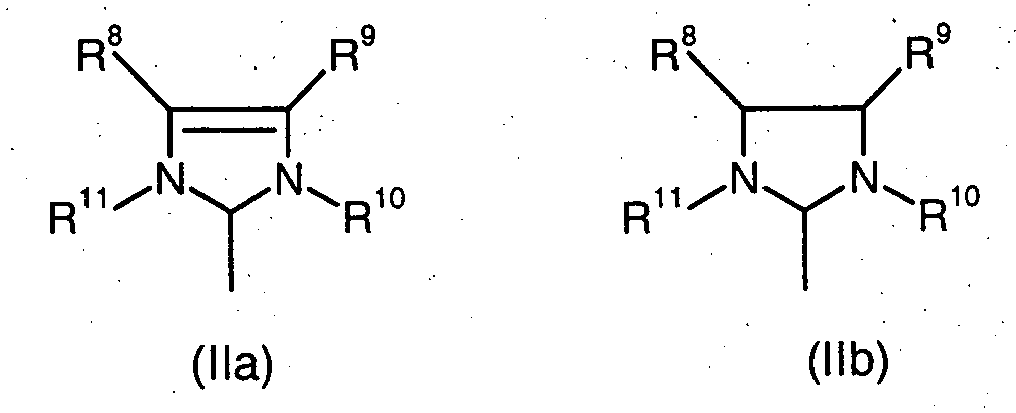 R8, R9, R10, R11 gleich oder verschieden sind und Wasserstoff, geradkettiges oder verzweigtes C1-C30-Alkyl, C3-C20-Cycloalkyl, C2-C20-Alkenyl, C2-C20-Alkinyl, C6-C24-Aryl, C1-C20-Carboxylat, C1-C20-Alkoxy, C2-C20-Alkenyloxy, C2-C20-Alkinyloxy, C6-C20-Aryloxy, C2-C20-Alkoxycarbonyl, C1-C20-Alkylthio, C6-C20-Arylthio, C1-C20-Alkylsulfonyl, C1-C20-Alkylsulfonat, C6-C20-Arylsulfonat oder C1-C20-Alkylsulfinyl bedeuten.
 - Katalysator-System gemäß einem oder mehreren der Ansprüche 1-7, wobei der Katalysator die Struktur (III) oder (IV) besitzt, wobei Cy jeweils für Cylcohexyl steht.

- Katalysator-System gemäß einem oder mehreren der Ansprüche 1-6, wobei Katalysatoren der allgemeinen Formel (B) eingesetzt werden,
 M Ruthenium oder Osmium bedeutet,Y Sauerstoff (O), Schwefel (S), einen Rest N-R1 oder einen Rest P-R1 bedeutet,X1 und X2 gleiche oder verschiedene Liganden sind,R1 einen Alkyl-, Cycloalkyl-, Alkenyl-, Alkinyl-, Aryl-, Alkoxy-, Alkenyloxy-, Alkinyloxy-, Aryloxy-, Alkoxycarbonyl-, Alkylamino-, Alkylthio-, Arylthio-, Alkylsulfonyl- oder Alkylsulfinyl-Rest darstellt, die alle jeweils optional durch ein oder mehrere Alkyl-, Halogen-, Alkoxy-, Aryl- oder Heteroaryl-Reste substituiert sein können,R2, R3, R4 und R5 gleich oder verschieden sind und Wasserstoff, organische oder anorganische Reste darstellen,R6 Wasserstoff, einen Alkyl-, Alkenyl-, Alkinyl- oder einen Aryl-Rest bedeutet undL ein Ligand ist, der die gleichen Bedeutungen besitzt, wie der Ligand L in der in Anspruch 7 genannten Formel (A).
 - Katalysator gemäß Anspruch 14, wobei L einen P(R7)3 Rest darstellt, wobei R7 unabhängig voneinander C1-C6-Alkyl, C3-C8-Cycloalkyl oder Aryl bedeuten, oder aber einen gegebenenfalls substituierten Imidazolidinrest ("Im"), der bevorzugt die Struktur der in Anspruch 12 genannten allgemeinen Formeln (IIa) und (IIb) besitzt und besonders bevorzugt eine der nachfolgenden Strukturen (Va-f) aufweist, wobei Mes jeweils für einen 2,4,6-Trimethylphenyl-Rest steht,


- Katalysator-System gemäß Anspruch 14 oder 15, wobei X1 und X2 in der allgemeinen Formel (B) die Bedeutungen annimmt, die X1 und X2 in den Ansprüchen 8-10 besitzen.
- Katalysator-System gemäß einem oder mehreren der Ansprüche 14 bis 16, wobei Katalysatoren gemäß der allgemeinen Formel (B1) eingesetzt werden,
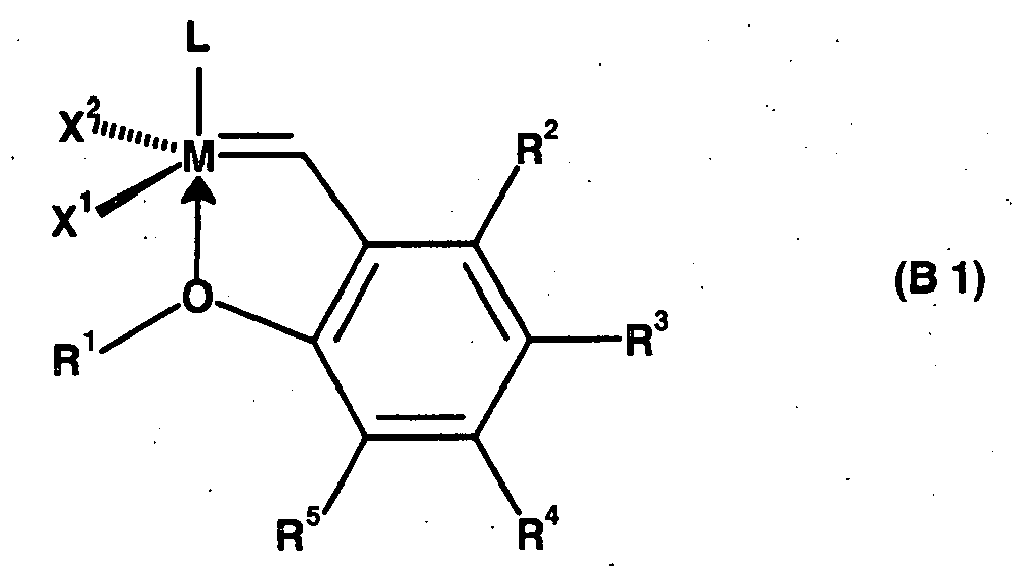 M, L, X1, X2, R1, R2, R3, R4 und R5 die für die allgemeine Formel (B) in Anspruch 14 genannten Bedeutungen besitzen.
 - Katalysator-System gemäß Anspruch 17, wobei Katalysatoren gemäß der allgemeinen Formel (B1) eingesetzt werden, worinM Ruthenium bedeutet,X1 und X2 gleichzeitig Halogen, insbesondere Chlor bedeuten,R1 für einen geradkettigen oder verzweigten C1-C12 Alkylrest steht,R2, R3, R4, R5 die für die allgemeine Formel (B) in Anspruch 14 genannten Bedeutungen besitzen undL die für die allgemeine Formel (B) in Anspruch 14 genannten Bedeutungen besitzt.
- Katalysator-System gemäß Anspruch 17, wobei Katalysatoren gemäß der allgemeinen Formel (B1) eingesetzt werden, worinM Ruthenium darstellt,X1 und X2 gleichzeitig Chlor bedeuten,R1 für einen Isopropyl-Rest steht,R2, R3, R4, R5 alle Wasserstoff bedeuten undL einen gegebenenfalls substituierten Imidazolidin-Rest der Formeln (IIa) oder (IIb) darstellt,
 R8, R9, R10, R11 gleich oder verschieden sind und Wasserstoff, geradkettiges oder verzweigtes C1-C30-Alkyl, C3-C20-Cylcoalkyl, C2-C20-Alkenyl, C2-C20-Alkinyl, C6-C24-Aryl, C1-C20-Carboxylat, C1-C20-Alkoxy, C2-C20-Alkenyloxy, C2-C20-Alkinyloxy, C6-C24-Aryloxy, C2-C20-Alkoxycarbonyl, C1-C20-Alkylthio, C6-C24-Arylthio, C1-C20-Alkylsulfonyl, C1-C20-Alkylsulfonat, C6-C24-Arylsulfonat oder C1-C20-Alkylsulfinyl bedeuten.
 - Katalysator-System gemäß Anspruch 17, wobei als Katalysator der allgemeinen Strukturformel (B1) ein Katalysator der nachfolgenden Strukturen (VI), (VII), (VIII), (IX), (X), (XI), (XII), (XIII) oder (XVII) eingesetzt wird, wobei Mes jeweils einen 2,4,6-Trimethylphenyl-Rest bedeutet.


- Katalysator-System gemäß Anspruch 14, wobei ein Katalysator der allgemeinen Formel (B2) eingesetzt wird,
 M, L, X1, X2, R1 und R6 die für die allgemeine Formel (B) in Anspruch 14 genannten Bedeutungen haben,R12 gleich oder verschieden sind und die für die Reste R2, R3, R4 und R5 in der allgemeinen Formel (B) in Anspruch 14 genannten Bedeutungen, ausgenommen Wasserstoff, besitzen undn gleich 0, 1, 2 oder 3 ist.
 - Katalysator-System gemäß Anspruch 21, wobei der Katalysator der folgenden Strukturen (XIV) oder (XV) eingesetzt wird, wobei Mes jeweils einen 2,4,6-Trimethylphenyl-Rest bedeutet.

- Katalysator-System gemäß Anspruch 14, wobei ein Katalysator der allgemeinen Formel (B3) eingesetzt wird,
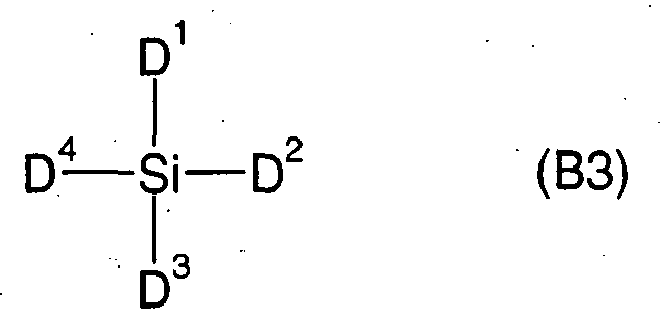
 M, L, X1, X2, R1, R2, R3, R5 und R6 die für die allgemeine Formel (B) in Anspruch 14 genannten Bedeutungen besitzen.
 - Katalysator-System gemäß einem oder mehreren der Ansprüche 1-6, wobei ein Katalysator allgemeinen Formel (B4) eingesetzt wird,


für einen Träger steht. - Katalysator-Systeme gemäß einem oder mehreren der Ansprüche 1-6, wobei ein Katalysator der allgemeinen Formel (C) eingesetzt wird.
 M Ruthenium oder Osmium bedeutet,X1 und X2 gleich oder verschieden sind und anionische Liganden darstellen,R' gleich oder verschieden sind und organische Reste darstellen,Im einen gegebenenfalls substituierten Imidazolidinrest darstellt undAn ein Anion darstellt.
 - Katalysator-Systeme gemäß einem oder mehreren der Ansprüche 1-6, wobei ein Katalysator der allgemeinen Formel (D) eingesetzt wird.
 M Ruthenium oder Osmium bedeutet,R13 und R14 unabhängig voneinander Wasserstoff, C1-C20-Alkyl, C2-C20-Alkenyl, C2-C20 Alkinyl, C6-C24-Aryl, C1-C20-Carboxylat, C1-C20-Alkoxy, C2-C20-Alkenyloxy, C2-C20-Alkinyloxy, C6-C24-Aryloxy, C2-C20-Alkoxycarbonyl, C1-C20-Alkylthio, C1-C20 -Alkylsulfonyl oder C1-C20 Alkylsulfinyl bedeuten,X3 ein anionischer Ligand ist,L2 ein neutraler π-gebundener Ligand ist, unabhängig davon, ob mono- oder polycyclisch,L3 ein Ligand aus der Gruppe der Phosphine, sulfonierten Phosphine, fluorierten Phosphine, funktionalisierten Phosphine mit bis zu drei Aminoalkyl-, Ammoniumalkyl, Alkoxyalkyl, Alkoxycarbonylalkyl, Hydrocarbonylalkyl-, Hydroxyalkyl- oder Ketoalkyl-Gruppen, Phosphite, Phosphinite, Phosphonite, Phosphinamine, Arsine, Stibene, Ether, Amine, Amides, Imine, Sulfoxide, Thioether und Pyridine darstellt,Y- ein nicht-koordinierendes Anion ist undn 0, 1, 2, 3, 4 oder 5 ist.
 - Katalysator-Systeme gemäß einem oder mehreren der Ansprüche 1-6, wobei ein Katalysator der allgemeinen Formel (E) eingesetzt wird.
 M2 Molybdän oder Wolfram ist,R15 und R16 gleich oder verschieden sind und Wasserstoff, C1-C20-Alkyl, C2-C20-Alkenyl, C2-C20-Alkinyl, C6-C24-Aryl, C1-C20-Carboxylat, C1-C20-Alkoxy, C2-C20-Alkenyloxy, C2-C20-Alkinyloxy, C6-C24-Aryloxy, C2-C20-Alkoxycarbonyl, C1-C20-Alkylthio, C1-C20-Alkylsulfonyl oder C1-C20 Alkylsulfinyl bedeuten,R17 and R18 gleich oder verschieden sind und einen substituierten oder einen halogensubstituierten C1-C20-Alkyl, C6-C24-Aryl, C6-C30-Aralkyl-Rest oder Silikon-enthaltende Analoga davon darstellen.
 - Katalysator-Systeme gemäß einem oder mehreren der Ansprüche 1-6, wobei ein Katalysator der allgemeinen Formel (F) eingesetzt wird.
 M Ruthenium oder Osmium bedeutet,X1 und X2 gleich oder verschieden sind und anionische Liganden darstellen, die alle Bedeutungen von X1 und X2 in der allgemeinen Formeln (A) und (B) annehmen können,L gleiche oder verschiedene Liganden darstellt, die alle Bedeutungen von L in den allgemeinen Formeln (A) und (B) annehmen können undR19 and R20 gleich oder verschieden sind und Wasserstoff oder substituiertes oder unsubstituiertes Alkyl bedeuten.
 - Katalysator-System gemäß einem oder mehreren der Ansprüche 1-28, wobei der Metathese-Katalysator und das oder die Salze der allgemeinen Formel (I) in einem Gewichtsverhältnis Salz(e) : Metathesekatalysator von 0,01:1 bis 10000:1, bevorzugt 0,1:1 bis 1000:1, besonders bevorzugt 0,5:1 bis 500:1 eingesetzt werden.
- Verwendung der Katalysator-Systeme gemäß einem oder mehreren der Ansprüche 1-29 in Metathese-Reaktionen, bevorzugt in Ringschlussmetathesen (RCM), Kreuzmetathesen (CM) oder Ringöffnungsmetathesen (ROMP), insbesondere zur Metathese von Nitrilkautschuk.
- Verwendung gemäß Anspruch 30, wobei das oder die Salze der allgemeinen Formel (I) in einem Lösungsmittel oder ohne Lösungsmittel zu dem Katalysator oder einer Lösung des Katalysators gegeben wird.
- Verwendung gemäß Anspruch 29 oder 30, wobei die Menge des Katalysators des Katalysator-Systems 1 bis 1.000 ppm Edelmetall, bevorzugt 2 bis 500 ppm, insbesondere 5 bis 250 ppm, bezogen auf den eingesetzten Nitrilkautschuk beträgt.
- Verwendung eines Salzes der allgemeinen Formel (I) wie in den Ansprüchen 1 bis 6 definiert, als Bestandteil von Katalysator-Systemen für die Metathese.
Applications Claiming Priority (1)
| Application Number | Priority Date | Filing Date | Title |
|---|---|---|---|
| DE102006008520A DE102006008520A1 (de) | 2006-02-22 | 2006-02-22 | Neue Katalysator-Systeme und deren Verwendung für Metathese-Reaktionen |
Publications (2)
| Publication Number | Publication Date |
|---|---|
| EP1825913A1 true EP1825913A1 (de) | 2007-08-29 |
| EP1825913B1 EP1825913B1 (de) | 2016-08-17 |
Family
ID=37969706
Family Applications (1)
| Application Number | Title | Priority Date | Filing Date |
|---|---|---|---|
| EP07002964.0A Active EP1825913B1 (de) | 2006-02-22 | 2007-02-13 | Neue Katalysatorsysteme und deren Verwendung für Metathesereaktionen |
Country Status (9)
| Country | Link |
|---|---|
| US (3) | US20070208206A1 (de) |
| EP (1) | EP1825913B1 (de) |
| JP (1) | JP5618454B2 (de) |
| KR (1) | KR101374960B1 (de) |
| CN (1) | CN101024200B (de) |
| BR (1) | BRPI0702155A (de) |
| DE (1) | DE102006008520A1 (de) |
| MX (1) | MX2007002125A (de) |
| TW (1) | TWI417140B (de) |
Cited By (8)
| Publication number | Priority date | Publication date | Assignee | Title |
|---|---|---|---|---|
| EP2030988A1 (de) * | 2007-08-21 | 2009-03-04 | Lanxess Deutschland GmbH | Verfahren zum Metathese-Abbau von Nitrilkautschuk |
| WO2009080542A1 (en) * | 2007-12-21 | 2009-07-02 | F. Hoffmann-La Roche Ag | Process for the preparation of a macrocycle |
| EP2143489A1 (de) * | 2008-07-08 | 2010-01-13 | Lanxess Deutschland GmbH | Katalysator-Systeme und deren Verwendung für Metathese-Reaktionen |
| EP2145681A1 (de) | 2008-07-08 | 2010-01-20 | Lanxess Deutschland GmbH | Verfahren zum Molekulargewichtsabbau von Nitrilkautschuk |
| DE102009017498A1 (de) | 2009-04-16 | 2010-10-28 | Süd-Chemie AG | Verwendung einer Katalysatorzusammensetzung zur Olefinmetathese in der Gasphase und Verfahren zur Olefinmetathese in der Gasphase |
| EP2418225A1 (de) | 2010-08-09 | 2012-02-15 | LANXESS Deutschland GmbH | Teilhydrierte Nitrilkautschuke |
| EP2484700A1 (de) | 2011-02-04 | 2012-08-08 | LANXESS Deutschland GmbH | Funktionalisierte Nitrilkautschuke und ihre Herstellung |
| EP2027919A3 (de) * | 2007-08-21 | 2015-06-10 | LANXESS Deutschland GmbH | Katalysator-Systeme enthaltend ein Erdalkalimetallchlorid und deren Verwendung für Metathese-Reaktionen |
Families Citing this family (30)
| Publication number | Priority date | Publication date | Assignee | Title |
|---|---|---|---|---|
| EP1760093B1 (de) * | 2005-08-30 | 2011-12-21 | LANXESS Deutschland GmbH | Verwendung von Katalysatoren für den Metatheseabbau von Nitrilkautschuk |
| US8889932B2 (en) | 2008-11-26 | 2014-11-18 | Elevance Renewable Sciences, Inc. | Methods of producing jet fuel from natural oil feedstocks through oxygen-cleaved reactions |
| MY156576A (en) | 2008-11-26 | 2016-03-15 | Elevance Renewable Sciences | Methods of producing jet fuel from natural oil feedstocks through metathesis reactions |
| EP2289623A1 (de) * | 2009-08-31 | 2011-03-02 | LANXESS Deutschland GmbH | Metathese eines Nitrilkautschuks in Gegenwart von Übergangsmetallkatalysatoren |
| EP2289622A1 (de) * | 2009-08-31 | 2011-03-02 | LANXESS Deutschland GmbH | Rutheniumbasierte Katalysatoren zur Metathese von Nitrilgummis |
| US9222056B2 (en) | 2009-10-12 | 2015-12-29 | Elevance Renewable Sciences, Inc. | Methods of refining natural oils, and methods of producing fuel compositions |
| US9365487B2 (en) | 2009-10-12 | 2016-06-14 | Elevance Renewable Sciences, Inc. | Methods of refining and producing dibasic esters and acids from natural oil feedstocks |
| PL2488474T3 (pl) | 2009-10-12 | 2017-07-31 | Elevance Renewable Sciences, Inc. | Sposoby rafinacji i wytwarzania paliw z surowców na bazie olejów naturalnych |
| US9175231B2 (en) | 2009-10-12 | 2015-11-03 | Elevance Renewable Sciences, Inc. | Methods of refining natural oils and methods of producing fuel compositions |
| US9051519B2 (en) | 2009-10-12 | 2015-06-09 | Elevance Renewable Sciences, Inc. | Diene-selective hydrogenation of metathesis derived olefins and unsaturated esters |
| US8735640B2 (en) | 2009-10-12 | 2014-05-27 | Elevance Renewable Sciences, Inc. | Methods of refining and producing fuel and specialty chemicals from natural oil feedstocks |
| US9382502B2 (en) | 2009-10-12 | 2016-07-05 | Elevance Renewable Sciences, Inc. | Methods of refining and producing isomerized fatty acid esters and fatty acids from natural oil feedstocks |
| US9000246B2 (en) | 2009-10-12 | 2015-04-07 | Elevance Renewable Sciences, Inc. | Methods of refining and producing dibasic esters and acids from natural oil feedstocks |
| US9169447B2 (en) | 2009-10-12 | 2015-10-27 | Elevance Renewable Sciences, Inc. | Methods of refining natural oils, and methods of producing fuel compositions |
| WO2013056459A1 (en) | 2011-10-21 | 2013-04-25 | Lanxess Deutschland Gmbh | Catalyst compositions and their use for hydrogenation of nitrile rubber |
| WO2013056461A1 (en) | 2011-10-21 | 2013-04-25 | Lanxess Deutschland Gmbh | Catalyst compositions and their use for hydrogenation of nitrile rubber |
| WO2013056400A1 (en) | 2011-10-21 | 2013-04-25 | Lanxess Deutschland Gmbh | Catalyst compositions and their use for hydrogenation of nitrile rubber |
| WO2013056463A1 (en) * | 2011-10-21 | 2013-04-25 | Lanxess Deutschland Gmbh | Catalyst compositions and their use for hydrogenation of nitrile rubber |
| US9139493B2 (en) | 2011-12-22 | 2015-09-22 | Elevance Renewable Sciences, Inc. | Methods for suppressing isomerization of olefin metathesis products |
| US9133416B2 (en) | 2011-12-22 | 2015-09-15 | Elevance Renewable Sciences, Inc. | Methods for suppressing isomerization of olefin metathesis products |
| US9169174B2 (en) | 2011-12-22 | 2015-10-27 | Elevance Renewable Sciences, Inc. | Methods for suppressing isomerization of olefin metathesis products |
| WO2013098052A2 (en) * | 2011-12-28 | 2013-07-04 | Lanxess Deutschland Gmbh | Metathesis of nitrile rubbers in the presence of transition metal complex catalysts |
| US9388098B2 (en) | 2012-10-09 | 2016-07-12 | Elevance Renewable Sciences, Inc. | Methods of making high-weight esters, acids, and derivatives thereof |
| US10501488B2 (en) * | 2015-09-24 | 2019-12-10 | Umicore Ag & Co. Kg | Metal carbene olefin metathesis catalysts |
| CN107626282A (zh) * | 2016-07-18 | 2018-01-26 | 天津师范大学 | 4‑(5‑甲基‑1,3,4‑噁二唑)吡啶配体构筑的氟硼酸‑Ag(I)配合物在吸附染料中的应用 |
| CN112088044B (zh) * | 2018-04-27 | 2023-10-24 | 阿朗新科德国有限责任公司 | 钌和锇催化剂用于丁腈橡胶复分解的用途 |
| WO2020120207A2 (en) * | 2018-12-12 | 2020-06-18 | Arlanxeo Deutschland Gmbh | Catalyst system containing a metathesis catalyst and at least one phenolic compound and a process for metathesis of nitrile-butadiene rubber (nbr) using the catalyst system |
| CN110183852A (zh) * | 2019-05-20 | 2019-08-30 | 黄广展 | 一种抗撕裂硅混炼胶及其制备方法 |
| US11987651B2 (en) | 2019-08-26 | 2024-05-21 | Lg Chem, Ltd. | Catalyst composition and method for preparing hydrocarbon resin using the same |
| CN118994484B (zh) * | 2024-08-07 | 2026-02-13 | 中国科学院长春应用化学研究所 | 一种大分子型α-二亚胺镍、钯催化剂、及其制备方法和应用 |
Citations (1)
| Publication number | Priority date | Publication date | Assignee | Title |
|---|---|---|---|---|
| WO2002083742A2 (en) * | 2001-04-16 | 2002-10-24 | California Institute Of Technology | Group 8 transition metal carbene complexes as enantioselective olefin metathesis catalysts |
Family Cites Families (36)
| Publication number | Priority date | Publication date | Assignee | Title |
|---|---|---|---|---|
| GB155849A (en) | 1916-10-21 | 1921-01-06 | Walter Challiner | Improvements in the construction of built-up metal wheels for motor vehicles |
| US3700637A (en) * | 1970-05-08 | 1972-10-24 | Shell Oil Co | Diene-nitrile rubbers |
| DE2539132C2 (de) | 1975-09-03 | 1987-04-09 | Bayer Ag, 5090 Leverkusen | Verwendung hydrierter Dien-Copolymere als temperaturbeständige Materialien auf dem Dichtungssektor |
| CA1203047A (en) * | 1982-12-08 | 1986-04-08 | Hormoz Azizian | Polymer hydrogenation process |
| CA1220300A (en) * | 1982-12-08 | 1987-04-07 | Polysar Limited | Polymer hydrogenation process |
| DE3329974A1 (de) * | 1983-08-19 | 1985-02-28 | Bayer Ag, 5090 Leverkusen | Herstellung von hydrierten nitrilkautschuken |
| DE3433392A1 (de) * | 1984-09-12 | 1986-03-20 | Bayer Ag, 5090 Leverkusen | Hydrierung nitrilgruppenhaltiger ungesaettigter polymerer |
| DE3529252A1 (de) * | 1985-08-16 | 1987-02-19 | Bayer Ag | Verfahren zur selektiven hydrierung ungesaettigter verbindungen |
| DE3540918A1 (de) * | 1985-11-19 | 1987-05-21 | Bayer Ag | Verfahren zur selektiven hydrierung ungesaettigter verbindungen |
| DE3541689A1 (de) * | 1985-11-26 | 1987-05-27 | Bayer Ag | Verfahren zur selektiven hydrierung nitrilgruppenhaltiger ungesaettigter polymerer |
| US4816525A (en) | 1987-07-06 | 1989-03-28 | University Of Waterloo | Polymer hydrogenation process |
| DE3932019C1 (de) | 1989-09-26 | 1991-05-08 | Bayer Ag, 5090 Leverkusen, De | |
| DE4025781A1 (de) | 1990-08-15 | 1992-02-20 | Bayer Ag | Hydrierte butadien/isopren/(meth-)acrylnitril- copolymerisate |
| EP1253156A3 (de) | 1992-04-03 | 2004-01-07 | California Institute Of Technology | Hochwirksame Ruthenium- oder Osmium- Metall-Carben-Komplexe für Olefinmetathesereaktionen, und deren Herstellung und Verwendung |
| US5312940A (en) * | 1992-04-03 | 1994-05-17 | California Institute Of Technology | Ruthenium and osmium metal carbene complexes for olefin metathesis polymerization |
| US5512635A (en) * | 1993-05-27 | 1996-04-30 | Amoco Corporation | Process for preparing linear monofunctional and telechelic difunctional polymers and compositions obtained thereby |
| US5403904A (en) * | 1993-05-27 | 1995-04-04 | Amoco Corporation | Process for preparation of telechelic difunctional unsaturated oligomers or polymers by acyclic olefin metathesis |
| US5405924A (en) * | 1993-07-22 | 1995-04-11 | Shell Oil Company | Imido transition metal complex metathesis catalysts |
| DE4447068A1 (de) * | 1994-12-29 | 1996-07-04 | Hoechst Ag | Verfahren zur Herstellung aromatischer Olefine |
| US5831108A (en) | 1995-08-03 | 1998-11-03 | California Institute Of Technology | High metathesis activity ruthenium and osmium metal carbene complexes |
| JP3693484B2 (ja) * | 1998-02-20 | 2005-09-07 | 三井化学株式会社 | 開環メタセシス共重合体の水素添加物及びその製造方法 |
| US7329758B1 (en) | 1999-05-24 | 2008-02-12 | California Institute Of Technology | Imidazolidine-based metal carbene metathesis catalysts |
| CN1213032C (zh) | 1999-05-24 | 2005-08-03 | 加州理工学院 | 咪唑烷基金属卡宾易位催化剂 |
| DE10005794A1 (de) * | 2000-02-10 | 2001-08-16 | Basf Ag | Verbindungen des Phosphors, Arsens und des Antimons |
| AU2001284773B2 (en) * | 2000-08-10 | 2004-08-05 | Trustees Of Boston College | Recyclable metathesis catalysts |
| CA2329844A1 (en) * | 2000-12-28 | 2002-06-28 | Bayer Inc. | Esbo enhanced hydrogenation |
| US6673881B2 (en) | 2001-06-12 | 2004-01-06 | Bayer Inc. | Process for the preparation of low molecular weight hydrogenated nitrile rubber |
| CA2350280A1 (en) | 2001-06-12 | 2002-12-12 | Bayer Inc. | Low molecular weight hydrogenated nitrile rubber |
| US6841623B2 (en) | 2001-06-29 | 2005-01-11 | Bayer Inc. | Low molecular weight nitrile rubber |
| PL199412B1 (pl) | 2002-10-15 | 2008-09-30 | Boehringer Ingelheim Int | Nowe kompleksy rutenu jako (pre)katalizatory reakcji metatezy, pochodne 2-alkoksy-5-nitrostyrenu jako związki pośrednie i sposób ich wytwarzania |
| CA2409434A1 (en) * | 2002-10-17 | 2004-04-17 | Bayer Inc. | Polymer blends comprising low molecular weight nitrile rubber |
| CA2413607A1 (en) * | 2002-12-05 | 2004-06-05 | Bayer Inc. | Process for the preparation of low molecular weight hydrogenated nitrile rubber |
| CA2413636A1 (en) * | 2002-12-05 | 2004-06-05 | Bayer Inc. | Adhesive compositions |
| EP1757623A1 (de) * | 2005-07-14 | 2007-02-28 | Lanxess Inc. | Verfahren zur Herstellung von Nitrilterpolymeren mit niedriger Mooney Viskosität |
| EP1760093B1 (de) * | 2005-08-30 | 2011-12-21 | LANXESS Deutschland GmbH | Verwendung von Katalysatoren für den Metatheseabbau von Nitrilkautschuk |
| DE102006008521A1 (de) * | 2006-02-22 | 2007-08-23 | Lanxess Deutschland Gmbh | Verwendung von Katalysatoren mit erhöhter Aktivität für die NBR-Metathese |
-
2006
- 2006-02-22 DE DE102006008520A patent/DE102006008520A1/de not_active Withdrawn
-
2007
- 2007-02-13 EP EP07002964.0A patent/EP1825913B1/de active Active
- 2007-02-16 TW TW096105895A patent/TWI417140B/zh not_active IP Right Cessation
- 2007-02-16 US US11/707,420 patent/US20070208206A1/en not_active Abandoned
- 2007-02-21 JP JP2007041078A patent/JP5618454B2/ja active Active
- 2007-02-21 MX MX2007002125A patent/MX2007002125A/es active IP Right Grant
- 2007-02-21 KR KR1020070017349A patent/KR101374960B1/ko not_active Expired - Fee Related
- 2007-02-22 BR BRPI0702155-0A patent/BRPI0702155A/pt not_active Application Discontinuation
- 2007-02-25 CN CN2007100031828A patent/CN101024200B/zh active Active
-
2010
- 2010-12-07 US US12/961,876 patent/US8530584B2/en active Active
-
2013
- 2013-08-07 US US13/961,459 patent/US8957161B2/en active Active
Patent Citations (1)
| Publication number | Priority date | Publication date | Assignee | Title |
|---|---|---|---|---|
| WO2002083742A2 (en) * | 2001-04-16 | 2002-10-24 | California Institute Of Technology | Group 8 transition metal carbene complexes as enantioselective olefin metathesis catalysts |
Non-Patent Citations (3)
| Title |
|---|
| DIAS, ERIC L. ET AL: "Well-Defined Ruthenium Olefin Metathesis Catalysts: Mechanism and Activity", JOURNAL OF THE AMERICAN CHEMICAL SOCIETY , 119(17), 3887-3897 CODEN: JACSAT; ISSN: 0002-7863, 1997, XP002433026 * |
| ROBERTS, KENNY S. ET AL: "Comparison of fertilin.beta.-peptide-substituted polymers and liposomes as inhibitors of in vitro fertilization", CHEMBIOCHEM , 4(11), 1229-1231 CODEN: CBCHFX; ISSN: 1439-4227, 2003, XP002433024 * |
| ROBERTS, KENNY S. ET AL: "Increased Polymer Length of Oligopeptide-Substituted Polynorbornenes with LiCl", JOURNAL OF ORGANIC CHEMISTRY , 68(5), 2020-2023 CODEN: JOCEAH; ISSN: 0022-3263, 2003, XP002433025 * |
Cited By (13)
| Publication number | Priority date | Publication date | Assignee | Title |
|---|---|---|---|---|
| EP2027919A3 (de) * | 2007-08-21 | 2015-06-10 | LANXESS Deutschland GmbH | Katalysator-Systeme enthaltend ein Erdalkalimetallchlorid und deren Verwendung für Metathese-Reaktionen |
| EP2030988A1 (de) * | 2007-08-21 | 2009-03-04 | Lanxess Deutschland GmbH | Verfahren zum Metathese-Abbau von Nitrilkautschuk |
| WO2009080542A1 (en) * | 2007-12-21 | 2009-07-02 | F. Hoffmann-La Roche Ag | Process for the preparation of a macrocycle |
| US7910728B2 (en) | 2007-12-21 | 2011-03-22 | Roche Palo Alto Llc | Process for the preparation of a macrocycle |
| EP2143489A1 (de) * | 2008-07-08 | 2010-01-13 | Lanxess Deutschland GmbH | Katalysator-Systeme und deren Verwendung für Metathese-Reaktionen |
| EP2145681A1 (de) | 2008-07-08 | 2010-01-20 | Lanxess Deutschland GmbH | Verfahren zum Molekulargewichtsabbau von Nitrilkautschuk |
| EP2145680A1 (de) * | 2008-07-08 | 2010-01-20 | Lanxess Deutschland GmbH | Katalysator-Systeme und deren Verwendung für Metathese-Reaktionen |
| EP2147721A1 (de) * | 2008-07-08 | 2010-01-27 | Lanxess Deutschland GmbH | Katalysator-Systeme und deren Verwendung für Metathese-Reaktionen |
| DE102009017498A1 (de) | 2009-04-16 | 2010-10-28 | Süd-Chemie AG | Verwendung einer Katalysatorzusammensetzung zur Olefinmetathese in der Gasphase und Verfahren zur Olefinmetathese in der Gasphase |
| WO2012019978A1 (de) | 2010-08-09 | 2012-02-16 | Lanxess Deutschland Gmbh | Teilhydrierte nitrilkautschuke |
| EP2418225A1 (de) | 2010-08-09 | 2012-02-15 | LANXESS Deutschland GmbH | Teilhydrierte Nitrilkautschuke |
| EP2484700A1 (de) | 2011-02-04 | 2012-08-08 | LANXESS Deutschland GmbH | Funktionalisierte Nitrilkautschuke und ihre Herstellung |
| WO2012104183A1 (de) | 2011-02-04 | 2012-08-09 | Lanxess Deutschland Gmbh | Funktionalisierte nitrilkautschuke und ihre herstellung |
Also Published As
| Publication number | Publication date |
|---|---|
| US8530584B2 (en) | 2013-09-10 |
| US20110077360A1 (en) | 2011-03-31 |
| TWI417140B (zh) | 2013-12-01 |
| KR20070085152A (ko) | 2007-08-27 |
| KR101374960B1 (ko) | 2014-03-14 |
| BRPI0702155A (pt) | 2007-12-11 |
| US20130324672A1 (en) | 2013-12-05 |
| DE102006008520A1 (de) | 2007-08-23 |
| JP5618454B2 (ja) | 2014-11-05 |
| EP1825913B1 (de) | 2016-08-17 |
| JP2007224302A (ja) | 2007-09-06 |
| CN101024200B (zh) | 2013-05-08 |
| US8957161B2 (en) | 2015-02-17 |
| CN101024200A (zh) | 2007-08-29 |
| US20070208206A1 (en) | 2007-09-06 |
| MX2007002125A (es) | 2008-10-30 |
| TW200803981A (en) | 2008-01-16 |
Similar Documents
| Publication | Publication Date | Title |
|---|---|---|
| EP1825913B1 (de) | Neue Katalysatorsysteme und deren Verwendung für Metathesereaktionen | |
| EP1894946B1 (de) | Verfahren zum Metathese-Abbau von Nitrilkautschuken | |
| EP1826220B1 (de) | Verwendung von Katalysatoren mit erhöhter Aktivität für die Metathese von Nitrilkautschuken | |
| EP2027919B1 (de) | Katalysator-Systeme enthaltend ein Erdalkalimetallchlorid und deren Verwendung für Metathese-Reaktionen | |
| EP2027920B1 (de) | Katalysatoren für Metathese-Reaktionen | |
| EP2030988B1 (de) | Verfahren zum Metathese-Abbau von Nitrilkautschuk | |
| EP1760093B1 (de) | Verwendung von Katalysatoren für den Metatheseabbau von Nitrilkautschuk | |
| EP2143489A1 (de) | Katalysator-Systeme und deren Verwendung für Metathese-Reaktionen | |
| EP2145681B1 (de) | Verfahren zum Molekulargewichtsabbau von Nitrilkautschuk | |
| DE60219011T3 (de) | Hydrierter nitrilkautschuk mit niedrigem molekulargewicht | |
| JP2009046681A (ja) | 遷移金属錯体触媒存在下におけるニトリルゴムのメタセシス | |
| DE102007039527A1 (de) | Katalysatoren für Metathese-Reaktionen | |
| EP2603533B1 (de) | Teilhydrierte nitrilkautschuke | |
| DE102005040939A1 (de) | Neuer Katalysator für den Metatheseabbau von Nitrilkautschuk | |
| EP3720885B1 (de) | Verfahren zur herstellung von nitrilkautschuken mit ruthenium-komplexkatalysatoren | |
| DE102005058834A1 (de) | Neuer Katalysator für den Metatheseabbau von Nitrilkautschuk | |
| DE102005048327A1 (de) | Neuer Katalysator für den Metatheseabbau von Nitrilkautschuk | |
| DE102007039695A1 (de) | Katalysatoren für Metathese-Reaktionen |
Legal Events
| Date | Code | Title | Description |
|---|---|---|---|
| PUAI | Public reference made under article 153(3) epc to a published international application that has entered the european phase |
Free format text: ORIGINAL CODE: 0009012 |
|
| AK | Designated contracting states |
Kind code of ref document: A1 Designated state(s): AT BE BG CH CY CZ DE DK EE ES FI FR GB GR HU IE IS IT LI LT LU LV MC NL PL PT RO SE SI SK TR |
|
| AX | Request for extension of the european patent |
Extension state: AL BA HR MK YU |
|
| 17P | Request for examination filed |
Effective date: 20080229 |
|
| 17Q | First examination report despatched |
Effective date: 20080403 |
|
| AKX | Designation fees paid |
Designated state(s): AT BE BG CH CY CZ DE DK EE ES FI FR GB GR HU IE IS IT LI LT LU LV MC NL PL PT RO SE SI SK TR |
|
| RAP1 | Party data changed (applicant data changed or rights of an application transferred) |
Owner name: LANXESS DEUTSCHLAND GMBH |
|
| GRAP | Despatch of communication of intention to grant a patent |
Free format text: ORIGINAL CODE: EPIDOSNIGR1 |
|
| INTG | Intention to grant announced |
Effective date: 20160510 |
|
| RIN1 | Information on inventor provided before grant (corrected) |
Inventor name: NUYKEN, OSKAR, PROF. DR. -ING. Inventor name: OBRECHT, WERNER, DR. PROF. DR. Inventor name: MUELLER, JULIA MARIA |
|
| GRAS | Grant fee paid |
Free format text: ORIGINAL CODE: EPIDOSNIGR3 |
|
| GRAA | (expected) grant |
Free format text: ORIGINAL CODE: 0009210 |
|
| AK | Designated contracting states |
Kind code of ref document: B1 Designated state(s): AT BE BG CH CY CZ DE DK EE ES FI FR GB GR HU IE IS IT LI LT LU LV MC NL PL PT RO SE SI SK TR |
|
| REG | Reference to a national code |
Ref country code: GB Ref legal event code: FG4D Free format text: NOT ENGLISH |
|
| RAP2 | Party data changed (patent owner data changed or rights of a patent transferred) |
Owner name: ARLANXEO DEUTSCHLAND GMBH |
|
| REG | Reference to a national code |
Ref country code: CH Ref legal event code: EP |
|
| REG | Reference to a national code |
Ref country code: IE Ref legal event code: FG4D Free format text: LANGUAGE OF EP DOCUMENT: GERMAN |
|
| REG | Reference to a national code |
Ref country code: AT Ref legal event code: REF Ref document number: 820533 Country of ref document: AT Kind code of ref document: T Effective date: 20160915 |
|
| REG | Reference to a national code |
Ref country code: DE Ref legal event code: R096 Ref document number: 502007015019 Country of ref document: DE |
|
| REG | Reference to a national code |
Ref country code: NL Ref legal event code: MP Effective date: 20160817 |
|
| REG | Reference to a national code |
Ref country code: LT Ref legal event code: MG4D |
|
| REG | Reference to a national code |
Ref country code: FR Ref legal event code: PLFP Year of fee payment: 11 |
|
| PG25 | Lapsed in a contracting state [announced via postgrant information from national office to epo] |
Ref country code: FI Free format text: LAPSE BECAUSE OF FAILURE TO SUBMIT A TRANSLATION OF THE DESCRIPTION OR TO PAY THE FEE WITHIN THE PRESCRIBED TIME-LIMIT Effective date: 20160817 Ref country code: LT Free format text: LAPSE BECAUSE OF FAILURE TO SUBMIT A TRANSLATION OF THE DESCRIPTION OR TO PAY THE FEE WITHIN THE PRESCRIBED TIME-LIMIT Effective date: 20160817 Ref country code: NL Free format text: LAPSE BECAUSE OF FAILURE TO SUBMIT A TRANSLATION OF THE DESCRIPTION OR TO PAY THE FEE WITHIN THE PRESCRIBED TIME-LIMIT Effective date: 20160817 |
|
| PG25 | Lapsed in a contracting state [announced via postgrant information from national office to epo] |
Ref country code: ES Free format text: LAPSE BECAUSE OF FAILURE TO SUBMIT A TRANSLATION OF THE DESCRIPTION OR TO PAY THE FEE WITHIN THE PRESCRIBED TIME-LIMIT Effective date: 20160817 Ref country code: PL Free format text: LAPSE BECAUSE OF FAILURE TO SUBMIT A TRANSLATION OF THE DESCRIPTION OR TO PAY THE FEE WITHIN THE PRESCRIBED TIME-LIMIT Effective date: 20160817 Ref country code: SE Free format text: LAPSE BECAUSE OF FAILURE TO SUBMIT A TRANSLATION OF THE DESCRIPTION OR TO PAY THE FEE WITHIN THE PRESCRIBED TIME-LIMIT Effective date: 20160817 Ref country code: GR Free format text: LAPSE BECAUSE OF FAILURE TO SUBMIT A TRANSLATION OF THE DESCRIPTION OR TO PAY THE FEE WITHIN THE PRESCRIBED TIME-LIMIT Effective date: 20161118 Ref country code: LV Free format text: LAPSE BECAUSE OF FAILURE TO SUBMIT A TRANSLATION OF THE DESCRIPTION OR TO PAY THE FEE WITHIN THE PRESCRIBED TIME-LIMIT Effective date: 20160817 Ref country code: PT Free format text: LAPSE BECAUSE OF FAILURE TO SUBMIT A TRANSLATION OF THE DESCRIPTION OR TO PAY THE FEE WITHIN THE PRESCRIBED TIME-LIMIT Effective date: 20161219 |
|
| PG25 | Lapsed in a contracting state [announced via postgrant information from national office to epo] |
Ref country code: RO Free format text: LAPSE BECAUSE OF FAILURE TO SUBMIT A TRANSLATION OF THE DESCRIPTION OR TO PAY THE FEE WITHIN THE PRESCRIBED TIME-LIMIT Effective date: 20160817 Ref country code: EE Free format text: LAPSE BECAUSE OF FAILURE TO SUBMIT A TRANSLATION OF THE DESCRIPTION OR TO PAY THE FEE WITHIN THE PRESCRIBED TIME-LIMIT Effective date: 20160817 |
|
| REG | Reference to a national code |
Ref country code: DE Ref legal event code: R097 Ref document number: 502007015019 Country of ref document: DE |
|
| PG25 | Lapsed in a contracting state [announced via postgrant information from national office to epo] |
Ref country code: SK Free format text: LAPSE BECAUSE OF FAILURE TO SUBMIT A TRANSLATION OF THE DESCRIPTION OR TO PAY THE FEE WITHIN THE PRESCRIBED TIME-LIMIT Effective date: 20160817 Ref country code: BG Free format text: LAPSE BECAUSE OF FAILURE TO SUBMIT A TRANSLATION OF THE DESCRIPTION OR TO PAY THE FEE WITHIN THE PRESCRIBED TIME-LIMIT Effective date: 20161117 Ref country code: DK Free format text: LAPSE BECAUSE OF FAILURE TO SUBMIT A TRANSLATION OF THE DESCRIPTION OR TO PAY THE FEE WITHIN THE PRESCRIBED TIME-LIMIT Effective date: 20160817 Ref country code: CZ Free format text: LAPSE BECAUSE OF FAILURE TO SUBMIT A TRANSLATION OF THE DESCRIPTION OR TO PAY THE FEE WITHIN THE PRESCRIBED TIME-LIMIT Effective date: 20160817 Ref country code: BE Free format text: LAPSE BECAUSE OF NON-PAYMENT OF DUE FEES Effective date: 20170228 |
|
| PLBE | No opposition filed within time limit |
Free format text: ORIGINAL CODE: 0009261 |
|
| STAA | Information on the status of an ep patent application or granted ep patent |
Free format text: STATUS: NO OPPOSITION FILED WITHIN TIME LIMIT |
|
| 26N | No opposition filed |
Effective date: 20170518 |
|
| PG25 | Lapsed in a contracting state [announced via postgrant information from national office to epo] |
Ref country code: SI Free format text: LAPSE BECAUSE OF FAILURE TO SUBMIT A TRANSLATION OF THE DESCRIPTION OR TO PAY THE FEE WITHIN THE PRESCRIBED TIME-LIMIT Effective date: 20160817 |
|
| PG25 | Lapsed in a contracting state [announced via postgrant information from national office to epo] |
Ref country code: MC Free format text: LAPSE BECAUSE OF FAILURE TO SUBMIT A TRANSLATION OF THE DESCRIPTION OR TO PAY THE FEE WITHIN THE PRESCRIBED TIME-LIMIT Effective date: 20160817 |
|
| REG | Reference to a national code |
Ref country code: CH Ref legal event code: PL |
|
| PG25 | Lapsed in a contracting state [announced via postgrant information from national office to epo] |
Ref country code: CH Free format text: LAPSE BECAUSE OF NON-PAYMENT OF DUE FEES Effective date: 20170228 Ref country code: LI Free format text: LAPSE BECAUSE OF NON-PAYMENT OF DUE FEES Effective date: 20170228 |
|
| REG | Reference to a national code |
Ref country code: IE Ref legal event code: MM4A |
|
| PG25 | Lapsed in a contracting state [announced via postgrant information from national office to epo] |
Ref country code: LU Free format text: LAPSE BECAUSE OF NON-PAYMENT OF DUE FEES Effective date: 20170213 |
|
| REG | Reference to a national code |
Ref country code: FR Ref legal event code: PLFP Year of fee payment: 12 |
|
| REG | Reference to a national code |
Ref country code: BE Ref legal event code: MM Effective date: 20170228 |
|
| PG25 | Lapsed in a contracting state [announced via postgrant information from national office to epo] |
Ref country code: IE Free format text: LAPSE BECAUSE OF NON-PAYMENT OF DUE FEES Effective date: 20170213 |
|
| REG | Reference to a national code |
Ref country code: AT Ref legal event code: MM01 Ref document number: 820533 Country of ref document: AT Kind code of ref document: T Effective date: 20170213 |
|
| PG25 | Lapsed in a contracting state [announced via postgrant information from national office to epo] |
Ref country code: AT Free format text: LAPSE BECAUSE OF NON-PAYMENT OF DUE FEES Effective date: 20170213 |
|
| PG25 | Lapsed in a contracting state [announced via postgrant information from national office to epo] |
Ref country code: HU Free format text: LAPSE BECAUSE OF FAILURE TO SUBMIT A TRANSLATION OF THE DESCRIPTION OR TO PAY THE FEE WITHIN THE PRESCRIBED TIME-LIMIT; INVALID AB INITIO Effective date: 20070213 |
|
| PG25 | Lapsed in a contracting state [announced via postgrant information from national office to epo] |
Ref country code: CY Free format text: LAPSE BECAUSE OF NON-PAYMENT OF DUE FEES Effective date: 20160817 |
|
| PG25 | Lapsed in a contracting state [announced via postgrant information from national office to epo] |
Ref country code: TR Free format text: LAPSE BECAUSE OF FAILURE TO SUBMIT A TRANSLATION OF THE DESCRIPTION OR TO PAY THE FEE WITHIN THE PRESCRIBED TIME-LIMIT Effective date: 20160817 |
|
| PG25 | Lapsed in a contracting state [announced via postgrant information from national office to epo] |
Ref country code: IS Free format text: LAPSE BECAUSE OF FAILURE TO SUBMIT A TRANSLATION OF THE DESCRIPTION OR TO PAY THE FEE WITHIN THE PRESCRIBED TIME-LIMIT Effective date: 20161217 |
|
| REG | Reference to a national code |
Ref country code: DE Ref legal event code: R081 Ref document number: 502007015019 Country of ref document: DE Owner name: ARLANXEO DEUTSCHLAND GMBH, DE Free format text: FORMER OWNER: LANXESS DEUTSCHLAND GMBH, 50569 KOELN, DE |
|
| PGFP | Annual fee paid to national office [announced via postgrant information from national office to epo] |
Ref country code: GB Payment date: 20211223 Year of fee payment: 16 |
|
| P01 | Opt-out of the competence of the unified patent court (upc) registered |
Effective date: 20230608 |
|
| GBPC | Gb: european patent ceased through non-payment of renewal fee |
Effective date: 20230213 |
|
| PG25 | Lapsed in a contracting state [announced via postgrant information from national office to epo] |
Ref country code: GB Free format text: LAPSE BECAUSE OF NON-PAYMENT OF DUE FEES Effective date: 20230213 |
|
| PG25 | Lapsed in a contracting state [announced via postgrant information from national office to epo] |
Ref country code: GB Free format text: LAPSE BECAUSE OF NON-PAYMENT OF DUE FEES Effective date: 20230213 |
|
| PGFP | Annual fee paid to national office [announced via postgrant information from national office to epo] |
Ref country code: FR Payment date: 20251208 Year of fee payment: 20 |
|
| PGFP | Annual fee paid to national office [announced via postgrant information from national office to epo] |
Ref country code: DE Payment date: 20251216 Year of fee payment: 20 |
|
| PGFP | Annual fee paid to national office [announced via postgrant information from national office to epo] |
Ref country code: IT Payment date: 20260122 Year of fee payment: 20 |