EP1832816B1 - Hydraulic device, hydraulic appliance, hydraulic system and method for its use - Google Patents
Hydraulic device, hydraulic appliance, hydraulic system and method for its use Download PDFInfo
- Publication number
- EP1832816B1 EP1832816B1 EP07103489.6A EP07103489A EP1832816B1 EP 1832816 B1 EP1832816 B1 EP 1832816B1 EP 07103489 A EP07103489 A EP 07103489A EP 1832816 B1 EP1832816 B1 EP 1832816B1
- Authority
- EP
- European Patent Office
- Prior art keywords
- hydraulic
- duct
- hydraulic device
- water
- topping
- Prior art date
- Legal status (The legal status is an assumption and is not a legal conclusion. Google has not performed a legal analysis and makes no representation as to the accuracy of the status listed.)
- Active
Links
- 238000000034 method Methods 0.000 title claims description 18
- XLYOFNOQVPJJNP-UHFFFAOYSA-N water Substances O XLYOFNOQVPJJNP-UHFFFAOYSA-N 0.000 claims description 91
- 239000012530 fluid Substances 0.000 claims description 66
- 238000010438 heat treatment Methods 0.000 claims description 44
- 239000008236 heating water Substances 0.000 claims description 28
- 238000012544 monitoring process Methods 0.000 claims description 15
- 230000008878 coupling Effects 0.000 claims description 9
- 238000010168 coupling process Methods 0.000 claims description 9
- 238000005859 coupling reaction Methods 0.000 claims description 9
- 238000009428 plumbing Methods 0.000 claims description 8
- 238000004891 communication Methods 0.000 claims description 7
- 230000009471 action Effects 0.000 claims description 6
- 238000005259 measurement Methods 0.000 claims description 4
- 238000001514 detection method Methods 0.000 claims description 2
- 230000005291 magnetic effect Effects 0.000 description 21
- 238000007789 sealing Methods 0.000 description 8
- 239000007788 liquid Substances 0.000 description 7
- 230000033001 locomotion Effects 0.000 description 7
- 230000008901 benefit Effects 0.000 description 6
- 238000011144 upstream manufacturing Methods 0.000 description 6
- 230000007613 environmental effect Effects 0.000 description 5
- 238000004092 self-diagnosis Methods 0.000 description 4
- 230000002547 anomalous effect Effects 0.000 description 3
- 238000009530 blood pressure measurement Methods 0.000 description 3
- 239000000654 additive Substances 0.000 description 2
- 230000002528 anti-freeze Effects 0.000 description 2
- 238000006243 chemical reaction Methods 0.000 description 2
- 238000010276 construction Methods 0.000 description 2
- 230000000694 effects Effects 0.000 description 2
- 239000003302 ferromagnetic material Substances 0.000 description 2
- 238000003780 insertion Methods 0.000 description 2
- 230000037431 insertion Effects 0.000 description 2
- 238000003825 pressing Methods 0.000 description 2
- 230000008569 process Effects 0.000 description 2
- 230000011664 signaling Effects 0.000 description 2
- 230000005355 Hall effect Effects 0.000 description 1
- 235000014676 Phragmites communis Nutrition 0.000 description 1
- 230000003213 activating effect Effects 0.000 description 1
- 238000013459 approach Methods 0.000 description 1
- 230000003750 conditioning effect Effects 0.000 description 1
- 230000002950 deficient Effects 0.000 description 1
- 230000001419 dependent effect Effects 0.000 description 1
- 238000003745 diagnosis Methods 0.000 description 1
- 238000002405 diagnostic procedure Methods 0.000 description 1
- 238000009826 distribution Methods 0.000 description 1
- 230000009977 dual effect Effects 0.000 description 1
- 230000008014 freezing Effects 0.000 description 1
- 238000007710 freezing Methods 0.000 description 1
- 239000000446 fuel Substances 0.000 description 1
- 230000036039 immunity Effects 0.000 description 1
- 238000009434 installation Methods 0.000 description 1
- 238000004519 manufacturing process Methods 0.000 description 1
- 230000007246 mechanism Effects 0.000 description 1
- 239000000203 mixture Substances 0.000 description 1
- 230000000007 visual effect Effects 0.000 description 1
- 239000002699 waste material Substances 0.000 description 1
Images




Classifications
-
- F—MECHANICAL ENGINEERING; LIGHTING; HEATING; WEAPONS; BLASTING
- F24—HEATING; RANGES; VENTILATING
- F24D—DOMESTIC- OR SPACE-HEATING SYSTEMS, e.g. CENTRAL HEATING SYSTEMS; DOMESTIC HOT-WATER SUPPLY SYSTEMS; ELEMENTS OR COMPONENTS THEREFOR
- F24D3/00—Hot-water central heating systems
- F24D3/10—Feed-line arrangements, e.g. providing for heat-accumulator tanks, expansion tanks ; Hydraulic components of a central heating system
-
- F—MECHANICAL ENGINEERING; LIGHTING; HEATING; WEAPONS; BLASTING
- F24—HEATING; RANGES; VENTILATING
- F24D—DOMESTIC- OR SPACE-HEATING SYSTEMS, e.g. CENTRAL HEATING SYSTEMS; DOMESTIC HOT-WATER SUPPLY SYSTEMS; ELEMENTS OR COMPONENTS THEREFOR
- F24D3/00—Hot-water central heating systems
- F24D3/10—Feed-line arrangements, e.g. providing for heat-accumulator tanks, expansion tanks ; Hydraulic components of a central heating system
- F24D3/1083—Filling valves or arrangements for filling
-
- F—MECHANICAL ENGINEERING; LIGHTING; HEATING; WEAPONS; BLASTING
- F24—HEATING; RANGES; VENTILATING
- F24H—FLUID HEATERS, e.g. WATER OR AIR HEATERS, HAVING HEAT-GENERATING MEANS, e.g. HEAT PUMPS, IN GENERAL
- F24H9/00—Details
- F24H9/12—Arrangements for connecting heaters to circulation pipes
- F24H9/13—Arrangements for connecting heaters to circulation pipes for water heaters
- F24H9/133—Storage heaters
- F24H9/136—Arrangement of inlet valves used therewith
Definitions
- the present invention relates to a hydraulic device according to the preamble of claim 1.
- the invention also relates to a hydraulic appliance and to a hydraulic system, in particular for heating water, comprising said hydraulic device, as well as to a method of operating such a hydraulic system.
- the present invention especially applies to the field of household water heating systems, wherein the system is used for heating both the household environments and the water used in sanitaryware.
- These types of systems typically comprise a heating water circuit and a sanitary water circuit.
- the system also comprises at least one heating hydraulic appliance, typically a gas or electric boiler, for heating the water circulating in the system.
- the heating hydraulic appliance may comprise, for example, only one heater; alternatively, two heaters may be used, one for heating water and the other one for sanitary water, being dependent or independent of each other.
- the heating water may, for example, be water taken from the main, possibly with the addition of additives (e.g. antifreeze).
- additives e.g. antifreeze
- the water pressure or level in the heating circuit may decrease, so that the heating circuit must be topped up, i.e. supplied with additional water in order to, for example, restore the proper pressure or level in the circuit and/or to remove air from the plumbing.
- heating circuit can be filled and topped up by manually operating a tap connected to or associated with a water network plumbing, typically the public water distribution main.
- an automatic top-up valve generally a pressure switch, which opens below a preset pressure and closes when the preset pressure is reached.
- These automatic valves are subject to malfunctioning due to, for example, seizing caused by a long non-operational time, without providing any indication about their failure.
- Such a hydraulic device according to the preamble of claim 1 is known from the patent DE8219381 .
- the general object of the present invention is therefore to provide a hydraulic device, a hydraulic appliance and a hydraulic system comprising it, which allow to overcome the drawbacks of the prior art, in particular those mentioned above.
- a particular object of the present invention is to fill and top up the system through a single small component which offers the possibility of controlling the topping up of the heating circuit automatically and reliably.
- the present invention is based on the idea of using at least two hydraulic on-off devices.
- these two on-off devices allow to carry out filling and topping-up operations in an effective manner.
- said at least two on-off devices can be connected, either directly or indirectly, in series and/or in parallel.
- At least one of the on-off devices can be manually or automatically operated; advantageously, the automatic operation can be of the electric type, in particular magnetoelectric or the thermoelectric type, through suitable drive and/or control signals to be sent to the on-off device.
- Some particularly advantageous embodiment examples of the present invention are those which utilize at least three on-off devices, in particular one manually operated device for filling operations and two automatically operated devices (in series or in parallel) for topping-up operations.
- An important feature common to all three embodiment examples of the hydraulic device according to the present invention is the fact that they provide a single component, in particular a small one; thus, these components can be easily and effectively inserted in hydraulic appliances and/or in hydraulic systems, in particular for domestic use.
- Such devices, appliances and systems are particularly adapted to operate with water or watery mixtures, but the use of different fluids should not be excluded.
- a particularly advantageous application of the present invention is found in the field of heating by circulation of water or other liquids; nevertheless, the present invention may also be advantageously applied to the field of conditioning by circulation of water or other liquids.
- the hydraulic device according to the present invention is designated as a whole by reference numeral 1.
- the device is designated by reference numeral 1'; in the second embodiment example, the device is designated by reference numeral 1"; in the third embodiment example, the device is designated by reference numeral 1"'.
- the first embodiment example comprises two on-off devices connected together hydraulically in parallel, in particular a manually operated device for filling operations and an automatically operated device for topping-up operations
- the second and the third embodiment examples comprise three on-off devices, i.e. one manually operated device for filling operations and two automatically operated devices (connected together hydraulically in series) for topping-up operations.
- Said second and third embodiment examples turn out to be particularly advantageous not only as such, but also in comparison with the first embodiment example, in particular as concerns the safety and reliability of the hydraulic device according to the present invention and/or the diagnostic capability of the hydraulic device according to the present invention.
- the hydraulic device comprises at least one body having an inlet duct, a first outlet duct and a second outlet duct, as well as on-off means adapted to stop a fluid flow.
- the on-off means of these examples are adapted to be in at least a first, a second and a third operating configurations; the first operating configuration is such that fluid flow is prevented from the inlet duct to the second outlet duct, the second operating configuration is such that a first amount of fluid flow is allowed from the inlet duct to the second outlet duct, the third operating configuration is such that a second amount of fluid flow is allowed from the inlet duct to the second outlet duct.
- the first operating configuration has been conceived as a system operating status, i.e. the condition the system is in when it performs its primary function, e.g. when a heating system circulates hot water in radiators.
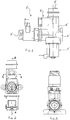
- the device 1' is essentially a hydraulic T-shaped fitting comprising a hollow body 4', wherein water enters through an inlet duct 6', flows through the hollow body and exits through two outlet ducts 5' and 7', one of which (in the example of Fig. 1 , the duct 7') is a controlled outlet, while the second outlet (in the example of Fig. 1 , the duct 5') is always open.
- the device 1' comprises on-off means adapted to affect the liquid flow in the duct 7'; preferably, said on-off means are adapted to be in at least three operating configurations and to determine at least three corresponding fluid flows (in the outlet 7'), not necessarily being different from one another.
- the on-off means may be manifold type; for example, in systems using liquids at low pressures (preferably lower than 0.1 bar), said on-off means may comprise at least one solenoid valve or a valve adapted to control the opening and closing of the shutter only through the force of its own actuator, preferably by changing the outlet section of the duct 7'; said valve will hereafter also be referred to as a direct on-off valve or a direct-control valve.
- the water in the mains typically has a pressure between 0.2 and 10 bar, so that the above-described valves cannot be easily used and different on-off means are to be preferred, such as, for example, solenoid valves exploiting the same pressure of the fluid in order to assist the switching of the shutter; these valves will hereafter also be referred to as servo-assisted valves.
- the outlet duct 7' comprises internally a main duct 11' and a by-pass duct 9'.
- the main duct 11' has an aperture 4'c, or through seat, and an aperture 8', which are opened or closed by respective on-off means, in particular by a tap or by-pass valve 3' that allows or prevents water flow through the aperture 4'c, while a direct on-off valve 2' allows or prevents water flow through the aperture 8'.
- the aperture 8' cannot be too large, otherwise it could not be closed by a standard valve 2', thus requiring valves having too big actuators and excessive forces.
- an optimal size of the aperture 8' has been estimated to be about 0.5 mm 2 ; in this case, the fluid will typically exert a thrust of approximately 50 gr, which can be countered by a spring adapted to exert a thrust of approximately 100 gr in the closed position.
- the water flow passing through the aperture 8' is nonetheless still sufficient for topping up the environmental heating circuit.
- the complete filling of the circuit can take place thanks to a by-pass duct 9' in the device 1', through which a higher flow rate of water can be supplied to the outlet duct 7'.
- the main duct 11' and the by-pass duct 9' run substantially parallel along an axis AA and can be put in communication by means of a through seat 4'c (transversal to the axis AA) of the by-pass valve 3'.
- the by-pass valve 3' which is substantially a manual tap, is integrated with the main body 4' of the device 1' and comprises a mobile shutter 12'; said shutter 12' can slide in the seat 4'c and can therefore stop the fluid flow coming out from the by-pass duct 9' before it enters the main duct 11'.
- first sealing element 14' e.g. a gasket or an O-ring, adapted to prevent any leakage from said by-pass duct 9' into the central duct 11', or vice versa, when the tap 3' is in the closed position, i.e. when the end 12'a is housed in the through seat 4'c.
- a second sealing element 15' e.g. a gasket or an O-ring, adapted to prevent any leakage from the by-pass duct 9' to the outside of the device 1'.
- the upper portion 12'b of the shutter has a threaded structure adapted to cooperate with a threaded plug or element 13' being present in the seat 4'b of the by-pass valve 3'.
- a groove 13'a which is used for the insertion of a catch or locking pin, e.g. a U-shaped, in order to keep the threaded element 13' in its position.
- the shutter 12' has a seat 17' for a suitable tool or wrench, such as an Allen key, in order to allow the tap 3' to be operated, preferably by qualified personnel.
- a suitable tool or wrench such as an Allen key
- the direct on-off valve is a solenoid valve 2' connected to the end 4'a of the main body 4' of the hydraulic device 1', and is, for example, of a type having an internal structure similar to the one shown and detailed, for example, in the American patent US 4,776,559 to the present Applicant (to be precise, it should be noted that, in this American patent, the actuator is electrothermal type, not electromagnetic type as in the hydraulic device 1').
- the solenoid valve 2' is direct-control type, i.e. the opening and closing of said solenoid valve takes place through direct driving of a shutter 10', which is moved by the magnetic field generated within a magnetic core due to electric current running through a coil.
- the magnetic field therefore causes the movement of the shutter 10', on which a rubber piece 20' is mounted which opens and/or closes the aperture 8'.
- the movement of the shutter 10' is countered only by a spring being present within the magnetic core, the force of which is opposite to the force exerted by the water column or pressure.
- a servo-assisted valve having suitable features for use in the hydraulic device 1' may have, for example, an internal structure being similar to the one described in detail, for example, in the European patent application EP 0 599 341 to the present Applicant.
- servo-assisted valves suffer from the drawback that, if the pressure of the water in the duct 11' is higher than the pressure of the water supplied from the inlet duct 6', the necessary servo-assistance forces will not be provided and water will flow back from the hydraulic circuit downstream of the outlet duct 7' to the inside of the device 1, i.e. to the ducts 5' and 6'.
- a non-return valve 50' is preferably mounted to the outlet duct 7' of the hydraulic device 1'.
- the non-return valve 50' which is known to the man skilled in the art, is of the type comprising at least one hollow cylindrical body 51' inserted in the duct 7' through a respective sealing element or O-ring 53'.
- the valve 50' also comprises an inner shutter 52', e.g. having a substantially "mushroom-like" shape, i.e. comprising a stem which can slide in a central seat of said hollow cylindrical body 51' and an end cap adapted to close a suitable seat, thus stopping the water flow.
- an inner shutter 52' e.g. having a substantially "mushroom-like" shape, i.e. comprising a stem which can slide in a central seat of said hollow cylindrical body 51' and an end cap adapted to close a suitable seat, thus stopping the water flow.
- said non-return valve 50' may advantageously comprise some elements, e.g. the hollow cylindrical body 51', obtained directly from the body 4' of the device 1'.
- This solution turns out to be advantageous for several reasons: on the one hand, it reduces the risks of leakage in the contact areas between the main body 4' of the hydraulic device 1' and the cylindrical body 51' of the non-return valve 50', while on the other hand the gasket 53' is no longer necessary (thus reducing the number of components used, and therefore the cost of the device).
- the hydraulic device 1' may also advantageously comprise a sensor for detecting a significant parameter of the fluid flowing in the device, e.g. temperature, hardness, flow rate, etc.
- an axial-turbine flow meter 30' is housed in a seat located on the outlet duct 5'.
- the flow meter 30' comprises a mobile element 18' and at least one magnetic element 19', which are adapted to generate or modify a magnetic field; the electric detector 21' is adapted to detect said magnetic field; according to an embodiment, the electric detector 21' may be a Hall-effect sensor or, alternatively, a Reed sensor.
- the mobile element 18' may have any shape and be moved by a fluid flow in different ways; for example, it may be translated or rotated or rotated and translated or turned by the fluid flow; the motion of the mobile element may be free or braked or countered or subject to a reaction, for example, for effect of an elastic element, in particular a spring, acting directly or indirectly onto it.
- the mobile element is an "impeller", since it is turned by the fluid flow.
- the magnetic element 19' is an element capable of generating or modifying a magnetic field, and may be a permanent magnet, a magnetized element or an element made of ferromagnetic material, or any other element adapted to produce a signal variation in a magnetic sensor.
- the magnetic element 19' may be fixed or mobile, in particular mounted to or built in the mobile element 18'; moreover, the mobile element 18' itself may be magnetic as well, e.g. it may be at least partly magnetized or made of ferromagnetic material.
- a hydraulic device according to the invention employs an impeller to which at least one permanent magnet is mounted.
- the hydraulic device 1' is so provided that, in the presence of fluid flowing through it, a magnetic field is generated the value and/or variation of which depends on the fluid flow, in particular on the velocity and/or quantity and/or flow rate thereof.
- the electric detector 21' is a unit capable of detecting said magnetic field value and/or variation and, consequently, of generating directly or causing the generation of an electric signal, e.g. an analog or digital signal.
- this unit may consist of several mechanic, electric and electronic components, but it comprises at least one magnetic sensor, i.e. an electric or electronic component which is capable of sensing a magnetic field or a variation in a magnetic field.
- the electric signal generated or caused by the electric detector 21' may be detected and/or used by a control unit of a user apparatus, such as the control unit of a water heater (in particular a boiler) in a water heating system.
- a control unit of a user apparatus such as the control unit of a water heater (in particular a boiler) in a water heating system.
- the hydraulic device 1' is adapted to be included in, for example, a water heating system like that shown in Figs. 15 and 16 .
- Said flow meter may however be of any other known type.
- the hydraulic device is designated as a whole by reference numeral 1".
- the device 1 (Figs. 8 to 10 ) is essentially a hydraulic T-shaped fitting comprising a hollow body 4", wherein water enters through an inlet duct 6", flows through the hollow body and exits through two outlet ducts 5" and 7", one of which (in the example of Figs.8-10 , the duct 7") is a controlled outlet, while the second outlet (in the example of Figs.8-10 , the duct 5") is always open.
- the device 1" comprises on-off means adapted to affect the liquid flow in the duct 7"; preferably, said on-off means are adapted to be in at least three operating configurations and to determine at least three corresponding fluid flows (in the outlet duct 7"), not necessarily being different from one another.
- the outlet duct 7" comprises internally a main duct 11" and a by-pass duct 9".
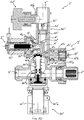
- the main duct 11" has an aperture 4"c, or through seat, an aperture 8" and an aperture 40"a which are opened or closed by respective on-off means; in particular, a tap or by-pass valve 3" allows or prevents water flow through the aperture 4"c, while a servo-assisted valve 2", preferably an electrically controlled one, allows or prevents water flow through the aperture 8" and a direct on-off solenoid valve 40", e.g. actuated by an electrothermal element, allows or prevents water flow through the aperture 40"a; the two on-off means 2" and 40" are arranged in series.
- the respective aperture is preferably small (otherwise too big and strong valve mechanisms and actuators would be needed) and therefore the quantity of water allowed to flow therethrough is small, especially if we consider the supply requirements of a hydraulic system like a household heating system.
- the fact that there is an additional servo-assisted valve 2" downstream of the direct-on-off valve 40" does not affect the above considerations about the dimensions of the aperture associated with the latter.
- the device 1" is provided with a by-pass duct 9", through which a higher flow rate of water can be supplied to the outlet duct 7".
- the main duct 11" and the by-pass duct 9" run at least partly substantially parallel to each other along an axis AA.
- the by-pass valve 3" is integrated with the main body 4" of the device 1" and comprises a mobile shutter 12" which can slide in a seat 4"c communicating with the duct 9" and can thus stop the fluid flow entering the duct 9";
- the seat 4"c is a through hole being transversal, in particular substantially orthogonal, to the axis A-A, and is used for housing at least partly the valve 3"; in particular, said hole leads into a chamber immediately upstream of the main duct 11".
- a first sealing element 14 e.g. a gasket or an O-ring, adapted to prevent any leakage from said by-pass duct 9" into the ducts 5" and 6", in particular into a chamber immediately upstream of the main duct 11", or vice versa, when the tap 3" is in the closed position, i.e. when the end 12"a is housed in the through seat 4"c.
- a second and a third sealing elements 15" and 16 e.g. a gasket or an O-ring; the element 15" provides additional sealing onto the duct 4"c, i.e. works in aid of the element 14"; the element 16" is adapted to prevent any leakage from the by-pass duct 9" to the outside of the device 1".
- the upper portion 12"b of the shutter has a threaded structure adapted to cooperate with a threaded element 13" being present in the seat 4"b of the by-pass valve 3".
- a threaded element 13" being present in the seat 4"b of the by-pass valve 3.
- a groove 13"a is used for the insertion of a catch or locking pin, e.g. U-shaped, in order to keep the threaded element 13" in its position.
- the shutter 12" has a seat 17" for a suitable tool or wrench, such as a screwdriver, in order to allow the tap 3" to be operated, preferably by qualified personnel.
- a suitable tool or wrench such as a screwdriver
- valve 2 is a solenoid valve which is servo-assisted by fluid pressure and is, for example, of a type having an internal structure similar to the one illustrated and described in detail, for example, in the European patent EP 0 599 341 to the present Applicant.
- the solenoid valve 2" is servo-assisted type and the opening and closing of said solenoid valve takes place through a shutter 10" which is moved by the magnetic field generated within a magnetic core due to electric current running through a coil.
- the magnetic field thus causes the movement of the shutter 10", on which a rubber piece 20" is mounted which opens and/or closes the aperture 8"; the opening of the passage 8", which is small, determines pressure variations in the chamber housing the core or shutter 10", which variations move a second mobile shutter, i.e. the one in which the passage 8" is obtained, which in turn opens a larger duct; this operation is typical of servo-assisted valves.
- the movement of the shutter 10" is counteracted by a spring being present inside the magnetic core.
- this second embodiment example like the first one, would be equally advantageous should the solenoid valve 2" be replaced with a different type of valve, such as a direct on-off valve.
- a non-return valve 50" is mounted on the outlet duct 7" of the hydraulic device 1".
- the non-return valve 50 which is known to the man skilled in the art, is of a type comprising at least one hollow cylindrical body 51" inserted in the duct 7" through a respective sealing element or O-ring 53".
- the valve 50" also comprises an inner shutter 52", e.g. having a substantially “mushroom-like” shape, i.e. comprising a stem which can slide in a central seat of said hollow cylindrical body 51" and an end cap adapted to close a suitable seat, thus stopping the water flow.
- an inner shutter 52 e.g. having a substantially “mushroom-like” shape, i.e. comprising a stem which can slide in a central seat of said hollow cylindrical body 51" and an end cap adapted to close a suitable seat, thus stopping the water flow.
- said non-return valve 50" may advantageously comprise some elements, e.g. the hollow cylindrical body 51", obtained directly from the body 4" of the device 1".
- This solution turns out to be advantageous for several reasons: on the one hand, it reduces the risks of leakage in the contact areas between the main body 4" of the hydraulic device 1" and the cylindrical body 51" of the non-return valve 50", while on the other hand the gasket 53" is no longer necessary (thus reducing the number of components used, and therefore the cost of the device).
- valve is controlled by an electrothermal shutter.
- the valve 40" is direct-control type, i.e. the opening and closing of the valve take place through a shutter 40"b, ending with a sealing element 40"c, moved by a thermoelectric element 41" which is actuated electrically through terminals 41 "a.
- Said terminals are advantageously connected to an electric source or to a drive or control circuit through wires not shown in the drawing for simplicity's sake.
- thermoelectric element 41 is, for example, of a type having an internal structure similar to the one illustrated and described in detail, for example, in the European patent application EP 0 940 577 to the present Applicant.
- thermoactuator 41 is "pull” type, i.e. when supplied with power it exerts a pulling action towards its own body, although its thermic element is “push” type; of course, the thermic element is suitably oriented for this purpose inside the element 41", in opposition to a reaction element or spring 40"d.
- thermoelectric element 41" is advantageously coupled mechanically to the shutter 40"b, e.g. by means of a plugin or bayonet type coupling system.
- the electromechanical drive of the thermoelectric element 41" moves the shutter 40"b, which is pulled towards said thermoelectric element 41".
- thermoelectric element 41 The larger the aperture 40"a, the higher the force that must be exerted by the valve 40" in order to keep the aperture 40"a closed through said contrast spring 40"d adapted to push the shutter 40"b, and therefore the higher the forces to be overcome by the thermoelectric element 41".
- the aperture 40"a cannot be too large, otherwise it could not be closed by a standard valve 40", thus requiring bigger valves.
- an optimal size of the aperture associated with the direct on-off valve has been estimated to be about 0.5 mm 2 ; in this case, the fluid will typically exert a thrust of approximately 50 gr, which can be counteracted by a spring adapted to exert a thrust of approximately 100 gr when in the closed position.
- the two valves 40" and 2" provide a “double safety function", in that they are hydraulically connected together in series; should one of them fail, the other one will still ensure the closing of the inlet duct, thus preventing the circuit from being over filled and avoiding any risks of damage or waste of water.
- thermoelectric valve which operates slowly
- the electric connection of said valves may be distinct, so that they can be opened or closed at different times or in different ways; however, in general, an electric connection of said valves in parallel should not be excluded either.
- valves of different types may improve safety, because they are subject to different potential causes of failure.
- the hydraulic device 1" may also advantageously comprise a sensor for detecting a significant parameter of the fluid flowing in the device, e.g. flow rate, temperature, hardness, pressure, etc.
- a pressure sensor 60" is housed in a seat 60"a located on the outlet duct 7" and is electrically connected, for example, to a system control unit (the wiring harness for the electronic connection between the sensor and the control unit and the control unit itself are not shown for simplicity's sake).
- the pressure sensor 60" is adapted to detect the pressure in the outlet duct 7"; said sensor 60" can therefore be useful for detecting any anomalous pressure increase or decrease in the system.
- the electric signal generated or caused by the pressure sensor 60" can be detected and/or utilized by a control unit, for example, in order to control topping up or filling operations automatically of the system.
- the hydraulic device 1" is also adapted to be included in a water heating system, as shown in Figs. 15 and 16 .
- the hydraulic device is designated as a whole by reference numeral 1"'.
- the hydraulic device 1"' is essentially a hydraulic T-shaped fitting.
- the hydraulic device 1"' bears many conceptual similarities to the device 1", though it features a number of advantageous implementation differences.
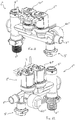
- the hydraulic device 1"' comprises two on-off devices 2'" and 40'" arranged in series; however, in this example, they are two electromagnetically controlled solenoid valves (though they may alternatively be both electro thermally controlled valves or different types of valves) of the type being servo-assisted by fluid pressure.
- the main duct 11"' is subdivided into three sections 11"'a, 11"'b, 11"'c arranged in series.
- the valve 2"' through the servo-assisted movement of its shutter driven by the core 10"', allows to connect the section 11"'b to the downstream section 11'" c.
- the valve 40"' through the servo-assisted movement of its shutter driven by the core 10"", allows to connect the section 11'"a to the downstream section 11"'b.
- the inlet duct 6'" and the outlet duct 5"' are substantially aligned (in particular coaxial) and substantially the same size (a filter applied to the inlet duct 6'" may alternatively be incorporated in the duct itself).
- the duct 11'" extends in a substantially linear direction being transversal, in particular substantially orthogonal, to the axis of the duct 5"' and/or of the duct 6"', up to the duct 7"'.
- the by-pass duct 9'" is somewhat shorter than the main duct 11"'; it extends in a substantially linear direction being transversal, in particular substantially orthogonal, to the axis of the duct 5"' and/or of the duct 6"', up to the seat 4"'c of the tap 3"'; the seat 4"'c is located in the immediate vicinity of the duct 7"', i.e. close to the outlet of the device 1"'; advantageously, the ducts 9'" and 11"' have substantially parallel axes.
- the body 4'" of the device 1"' there are two seats 4"'a and 4""a adapted to house at least partly the valves 2"' and 40"', respectively.
- the two valve seats are close side by side, and preferably have an axis which is transversal, in particular substantially orthogonal, to the duct 11"'.
- the tap seat has an axis being transversal, in particular substantially orthogonal, to the duct section 11'" c.
- the axes of the seats 4"'a, 4"'b and 4"'c are advantageously substantially parallel to one another; in particular, the tap seat is located on a side opposite to both valve seats.
- a pressure sensor 60' comprising a first measuring element 61'" and a second measuring element 62"'; the element 61'" is adapted to measure the pressure in the inlet duct 6"', whereas the element 62"' is adapted to measure the pressure in the outlet duct 7"'.
- a sensor capable of directly providing a pressure difference it would likewise be possible to use a sensor capable of directly providing a pressure difference.
- the sensor 60' features very clever mechanical solutions; in fact, it utilizes a cylindrical body from which two ducts come out, in particular two small tubes preferably having a circular cross-section; one tube is associated with the element 61"', while the other is associated with the element 62"'.
- Said tubes are inserted in two adjacent holes or seats in the body 4'" of the hydraulic device 1"'.
- the tubes are in communication with the main duct 11'" and with the by-pass duct 9"'; in particular, one duct is in communication with the section 11"'c downstream of the shutter 10'" of the valve 2"" (i.e. with the outlet duct 7"', too), while the other duct is in communication with the duct 9'" immediately upstream of the seat 4"'c of the tap 3"'. Therefore, the two elements 61"' and 62"', which are preferably located in the body of the sensor 60'" in a position close to its outer surface, are able to carry out the above-mentioned pressure measurements.
- the elements 61'" and 62'" are associated with a support element which may typically be a printed circuit or an electronic circuit; electric connections are then associated with said circuit for carrying the signals of both detection elements out of the body of the sensor 60"'; in Fig.12 , said electric connections are represented by four electric leads, but one may also use a suitable electric connector or welded contacts, or else a different number or type of connections. Additional electric and/or electronic components may be associated with the support element, in particular with the printed circuit; thus, the signals of both elements 61"' and 62'" may, for example, be amplified and/or processed and/or stored (e.g. by a microcontroller or even a simpler circuitry); in such a case, the measurements carried out may also be sent, for example, to an electronic control unit through two electric leads only, e.g. by means of a serial connection.
- a support element which may typically be a printed circuit or an electronic circuit
- electric connections are then associated with said circuit for carrying the signals of both detection elements out
- the respective axes shall be substantially parallel. Also, for obtaining a proper arrangement of the sensor 60"', it is advantageous that these axes are transversal, in particular substantially orthogonal, to both the duct 9"' and the duct 11'"; more in particular, said axes shall also be substantially orthogonal both to the axes of the seats 4"'a and 4""a of the valves and to the seat 4"'c of the tap; thus, the sensor body will be positioned on one side of the body 4'" of the hydraulic device.
- the body of the pressure sensor may also be at least partly built in the body of the hydraulic device.
- the removable part may be the support (e.g. the printed circuit) of the measurement element(s) (at least during the assembly stage).
- At least one of the two devices is direct-control type, since this type can ensure the interruption of the flow between the inlet and the outlet even in the presence of anomalous pressures.
- a non-return valve may nonetheless be used as a safety measure should the solenoid valves fail.
- the hydraulic device comprises electric connection means for at least the on-off devices; said connection means are so connected that the operation or control of the on-off devices can take place either jointly or separately, in particular through same or respective electric signals.
- At least one printed circuit (not shown in the drawings) which connects to at least some actuation or on-off devices and/or some sensor means; such a printed circuit incorporates or is provided with at least one electric connector, preferably obtained from the printed circuit itself, which is shaped suitably for this purpose, in particular for its connection to the user apparatus, at least a portion of said printed circuit being preferably housed at least partly in a seat of the body (not shown in the drawings).
- the hydraulic device according to the present invention may advantageously be used, for example, in a gas or electric boiler, typically for domestic use, in order to provide both the filling, in particular the manual filling, and the topping up, in particular the automatic topping up, of the same.
- the hydraulic appliance is designated by numerals 100' and 100", respectively.
- the hydraulic device according to the present invention which is a single component, is designated by reference numeral 101, in particular 101' in the case of Fig.15 and 101" in the case of Fig.16 .
- the devices 101' and 101" are schematized as a solenoid valve and a tap connected together in parallel, and are located essentially in the same position as the flow meter 130.
- said solenoid valve may advantageously be replaced with two or more valves, e.g. arranged in series, as in the case of the devices 1" and 1"' according to the invention; also, said manual tap may be replaced with an automatic or controlled valve.
- the device 101 comprises an inlet duct 106, a first outlet duct 105 and a second outlet duct 107, and the flow meter 130 is associated with the first outlet duct 105.
- reference numerals higher than one hundred have been used for describing the applications of Fig.15 and Fig.16 in order to have the elements of the hydraulic devices comprised in said applications match the elements of the hydraulic devices described above; in particular, the reference of the first outlet duct 105 of the devices 101 corresponds to the reference of the first outlet duct 5 of the devices 1, the reference of the second outlet duct 107 of the devices 101 corresponds to the reference of the second outlet duct 7 of the devices 1, and the reference of the inlet duct 106 of the devices 101 corresponds to the reference of the inlet duct 6 of the devices 1.
- the components 101' and 101 in particular their inlet ducts 106' and 106", are respectively connected to the main inlet of the appliance; said inlet is typically connected to the water supply network of the hydraulic system of the house or building, i.e. connected to the water meter through suitable plumbing.
- Both of the appliances schematized in the drawings comprise first hydraulic coupling means 180 to be connected to a first hydraulic circuit for sanitary water and second hydraulic coupling means 190 to be connected to a second hydraulic circuit for heating water.
- the first means 180 comprise a main inlet 181 (for cold water), an outlet 182 for hot sanitary water, an outlet 192 for heating water (the “delivery” of the heating hydraulic circuit), an inlet 191 for heating water (the “return” of the heating hydraulic circuit).
- household hydraulic systems which generally comprise at least one hydraulic circuit for heating water and at least one hydraulic circuit for sanitary water.
- the heating circuit is substantially a "closed circuit", i.e. a liquid circulates continuously between a boiler and suitable radiators adapted to heat the environment; the liquid is generally water, with the possible addition of additives, e.g. antifreeze, etc.
- the sanitary circuit is substantially an "open circuit", in which water (from the public main) flows in, is heated and then flows out through the taps of the house (generally for alimentary or hygienic use); usually a drain is available at each tap for draining the water (e.g. into the public drainage system).
- the two circuits i.e. the heating and the sanitary circuits
- the two circuits are substantially independent of each other.
- the first outlet 105' is connected to the inlet 106' through a duct which is preferably always open; near the outlet 105', there is preferably at least one sensor 130', such as a flow meter; said sensor may however be mounted or connected hydraulically in another location or to another part of the appliance or of the system.
- the second outlet 107' is connected to the inlet 106' through two fluid flow on-off means connected in parallel, in particular a tap 103' and at least one solenoid valve 102'; preferably at least one non-return valve 150' is associated with the outlet 107'.
- the device 101' has been described in a very concise manner because detailed descriptions of devices according to the present invention have already been provided above. However, it should be taken into account that the appliance 100' may use different hydraulic devices according to the teachings of the present invention; for example, the hydraulic device employed may be fitted with two solenoid valves in series instead of the single solenoid valve 102' shown in Fig. 15 .
- the appliance of Fig. 15 comprises one section dedicated to the treatment of sanitary water and one section dedicated to the treatment of heating water.
- the heating water section comprises the respective inlet 191', the respective outlet 192', a fuel burner 171', such as a gas burner, a primary heat exchanger 172', a circulator 175', an expansion tank 176', and a number of connection pipes.
- the heating water enters the appliance through the inlet 191' (called "return"), flows through the circulator 175', flows through the exchanger 172' (which warms up the water by using the heat received from the burner 171'), and exits the appliance through the outlet 192' (called “delivery").
- the section for sanitary water comprises the respective inlet 181' (called “main inlet”), the respective outlet 182', and a secondary exchanger 200'.
- cold sanitary water enters the appliance through the inlet 181' and flows through the exchanger 200', after which hot water exits the appliance through the outlet 182'.
- the appliance shown in Fig. 15 comprises a solenoid valve 205' which connects two sections of the heating circuit; the solenoid valve 205' is a diverting valve adapted to allow the flow of the heating circuit to be distributed between the two exchangers 172' and 200'.
- the diverting solenoid valve 205' is connected to four pipes. With reference to Fig. 15 , the pipe at the top is connected directly to the secondary exchanger 200', the pipe at the bottom is connected to the inlet 191' or heating return of the appliance, the pipe on the left is connected to the circulator 175', the pipe on the right is connected to the exchanger 172'; in said hydraulic connections there are also unidirectional valves 206' and 207'.
- the heating water circulates not only in the primary exchanger 172' (associated with the burner 171'), but also in the secondary exchanger 200'; thus the heating water is also used for heating the sanitary water, thanks to the secondary exchanger.
- the heating water In a second operating condition, the heating water only circulates in the primary exchanger 172', not in the secondary exchanger 200'; thus the heating water is only used for the heating system.
- the component 101' is connected to the sanitary water section as follows: the inlet 106' is connected to the outlet of the exchanger 200', the outlet 105' is connected to the outlet 182' of the appliance.
- the component 101' is also connected to the heating water section as follows: the outlet 107' is connected through a T-shaped fitting to an inlet of the exchanger 200' and (indirectly) to the solenoid valve 205'. Based on the above-described connections, the filling or topping-up operation is preferably carried out when the solenoid valve 205' is in the first operating condition, i.e. when the device 101' is in hydraulic communication with the whole system.
- the filling or topping-up operation may also be carried out in different phases or conditions.
- the appliance 100" of Fig. 16 differs from the appliance 100' of Fig. 15 in the way in which the hydraulic device according to the present invention has been included in said appliance.
- the component 101" is connected to the sanitary water section as follows: the inlet 106" is connected to the inlet 181" of the appliance, the outlet 105" is connected to an inlet of the exchanger 200" of the appliance.
- the component 101" is also connected to the heating water section as follows: the outlet 107" is connected through a T-shaped fitting to an inlet of the exchanger 200" and (indirectly) to the solenoid valve 205".
- the appliance according to the present invention may advantageously comprise an electronic control unit to control the operation of the hydraulic appliance.
- a hydraulic device according to the present invention may comprise on-off means, e.g. one or more solenoid valves (designated by way of example 2' , 2" and 40" in the drawings) of the same type or of different types, and/or sensor means, e.g. one or more sensors (designated by way of example 30' and 60" in the drawings) of the same type or of different types.
- the solenoid valves and the sensors typically have electric connections; in the solenoid valves, the electric connections are used at least for driving or controlling their on-off action; in the sensors, the connections are used at least for detecting or receiving their readings.
- the electronic control unit may therefore be connected electrically at least to the on-off means of the hydraulic device and/or to the sensor means of the hydraulic device, in particular to the electric connections thereof, in order to control them.
- the appliance according to the present invention will typically include a control unit or system performing the task, among other things, of controlling the hydraulic device according to the present invention (101 with reference to the examples of Fig.15 and Fig.16 ).
- the hydraulic device according to the present invention may have its own control circuit as well. The latter may be at least partly applied to or built in the hydraulic device and be at least partly housed, for example, in the body of the hydraulic device.
- the control circuit of the hydraulic device may be adapted to be connected to or integrated into the control system of the appliance.
- an aspect of the present invention also relates to a hydraulic system; said hydraulic system may be, for example, of the type adapted to heat and/or cool water, in particular for domestic use.
- a hydraulic system according to the present invention can supply hot and/or cold water for different purposes, e.g. both sanitary water and heating water, and can be installed, for example, in an apartment, a house or a building.
- a hydraulic device according to the present invention can be included to advantage in such a system in order to allow said system to be filled, in particular manually or automatically, and/or topped up, in particular automatically.
- the system may comprise a hydraulic appliance according to the present invention (e.g. like those described above).
- the system according to the present invention may comprise at least a first hydraulic circuit for sanitary water and a second hydraulic circuit for heating water.
- Said two hydraulic circuits may be both connected to one hydraulic device according to the present invention; in particular, the hydraulic circuit for sanitary water will typically be connected to the uncontrolled outlet of the hydraulic device (i.e. referring to the previously described examples, to the duct 5', 5", 5"', 105' or 105"), whereas the hydraulic circuit for heating water will typically be connected to the controlled outlet of the hydraulic device (i.e. referring to the previously described examples, the duct 7', 7", 7"', 107' or 107").
- the inlet of the hydraulic device i.e.
- the duct 6', 6", 6"', 106' or 106 may be connected to or associated with a plumbing of a water network, e.g. the public water main; in this latter case, some pipes providing a connection to a meter will typically be provided between the plumbing and the device inlet.
- a water network e.g. the public water main; in this latter case, some pipes providing a connection to a meter will typically be provided between the plumbing and the device inlet.
- hydraulic system according to the present invention may advantageously comprise an electronic control unit.
- Said control unit may provide at least all of the advantageous aspects described above with reference to the hydraulic appliance, which aspects will not be described again in this context.
- the operations for filling and/or topping up a hydraulic system can be made comfortable and easy by using the device according to the present invention. Furthermore, if said hydraulic device is provided as a single component, such comfort and easiness of use are achieved with very small outer dimensions, which are typically much smaller than those of existing solutions.
- the fluid flow supplied to the system during a system topping-up operation is typically different from (preferably lower than) the fluid flow supplied to the system during a system filling operation.
- filling a hydraulic system (or a hydraulic circuit thereof) requires a large quantity of fluid to be supplied to the system (e.g. several tens of litres for a heating system), whereas topping up a hydraulic system (or a circuit thereof) only requires a small quantity of fluid to be supplied to the system (e.g. less than one litre); therefore, in order to fill up the system within a reasonable time (e.g. a few tens of minutes), it is advantageous that the fluid flow is high (e.g. 1 litre per minute), whereas in order to top up the system in an accurate way it is acceptable or advantageous that the fluid flow is low (e.g. 1 cl per minute).
- the hydraulic device according to the present invention provides a method for topping up the system automatically; this is obtained by appropriately actuating the controllable on-off means, e.g. the solenoid valve 2' with reference to the first device example or the solenoid valves 2" and 40" or 2'" and 40'" with reference to the second or the third device examples, respectively.
- the controllable on-off means e.g. the solenoid valve 2' with reference to the first device example or the solenoid valves 2" and 40" or 2'" and 40'” with reference to the second or the third device examples, respectively.
- the fluid flow rate may be either constant or variable.
- the taps 3', 3" and 3"' for example, provide a high flow, which can be adjusted manually by the user; this fluid flow can be used for filling a system.
- the solenoid valves 2', 2", 2"', 40" and 40"' for example, provide a fluid flow (low for the solenoid valves 2' and 40", high for the solenoid valves 2", 2'" and 40"') which can be adjusted automatically, for example, by having an electronic control unit (not shown in the drawings) send them suitable electric signals.
- on-off means may be arranged which are adapted to set or adjust the fluid flow.
- the filling fluid flow and the topping-up fluid flow may be supplied through the same duct (with reference to the drawings, the ducts 7' and 7"); thus, the hydraulic system or the hydraulic appliance requires only one hydraulic connection point for both purposes.
- said flows may be supplied through two distinct ducts.
- topping-up method turns out to be particularly effective if topping-up operations are controlled or performed automatically under the control of an electronic control unit and through on-off means, of course operated or controlled by the same unit.
- the control unit may be operated manually through, for example, push-buttons of a keypad associated with the device by means of cables and/or by radio.
- the user can decide to start a topping-up operation (e.g. by pressing a "top-up start” push-button) when desired or required; the topping-up operation will continue automatically; the topping-up operation may then be terminated, for example, at the user's discretion (e.g. by pressing a "top-up stop” push-button); it is therefore a semi-automatic topping-up operation.
- safety systems may be employed for preventing the user from making control mistakes which may cause damage to hydraulic appliances and/or systems.
- the control unit may be operated or controlled by one or more sensors; in this way, the whole topping-up operation can take place automatically, i.e. it can start, continue and terminate without the user's intervention; it is therefore a fully automatic topping-up operation.
- a sensor suitable for operating or controlling the topping-up operation is typically a sensor adapted to detect the presence and/or the pressure of a fluid in a system.
- topping up may be required, and therefore a topping-up operation may be started, for example, when the fluid pressure is lower than a predetermined lower threshold value or when there is not a sufficient quantity of fluid in the circuit.
- the topping-up operation may then be terminated, for example, when the fluid pressure exceeds a predetermined upper threshold value.
- the control unit may check periodically the pressure of the fluid in the system or the level of the fluid in the system.
- the advantageous possibility of providing semi-automatic or fully automatic filling operations should not however be excluded; of course, hydraulic devices being different from those described above should be employed; it is nonetheless worth pointing out that the third embodiment example (drawings from Fig.1 to Fig.14 ) uses a solution with two servo-assisted solenoid valves in series which may also apply to such a purpose (of course, the tap would become unnecessary or redundant).
- filling operations which are generally carried out by qualified personnel (e.g. an installer or a service technician), may substantially take place, for example, as previously described with reference to topping-up operations.
- the hydraulic device it may be useful to monitor the fluid which flows, for example, in a system and/or in one of the hydraulic circuits of the system (e.g. the heating water circuit and/or the sanitary water circuit); it may be interesting to monitor, for example, the quantity of fluid flowed, the fluid flow rate, and the velocity of the fluid.
- Said monitoring operation may be provided, for example, through one or more flow sensors associated with or built in the device according to the present invention; in the presence of built-in sensors, said monitoring operation can be carried out without a significant increase in outer dimensions.
- Said monitoring is particularly effective when performed through an electronic control unit, e.g.
- this arrangement not only allows to detect the sensor readings, but also allows to store them, compare them with predefined data tables, process them (e.g. statistically) and re-send them to a remote monitoring system.
- the applications of such a monitoring function include, for example, hot sanitary water consumption and heating circuit leaks.
- the hydraulic device In many applications of the hydraulic device according to the present invention, it may be useful to monitor the temperature of the fluid which flows, for example, in a system and/or in one of the hydraulic circuits of the system (e.g. the heating water circuit and/or the sanitary water circuit).
- Said monitoring operation may be provided, for example, through one or more temperature sensors associated with or built in the device according to the present invention; in the presence of built-in sensors, said monitoring operation can be carried out without a significant increase in outer dimensions.
- Said monitoring is particularly effective when performed through an electronic control unit electrically connected to the sensor(s); in fact, this arrangement not only allows to detect the sensor readings, but also allows to store them, process them (e.g. statistically) and re-send them to a remote monitoring system.
- the applications of such a monitoring function include, for example, signalling a dangerous situation when the water temperature approaches 0 °C (e.g. by setting a threshold value to 4 or 5 °C), i.e. close to freezing.
- the hydraulic device according to the present invention it may be useful to monitor the pressure of the fluid at the inlet or upstream of the hydraulic device according to the present invention.
- Said monitoring operation may be provided, for example, through a pressure sensor associated with or built in the device according to the present invention; in the presence of a built-in sensor, said monitoring operation can be carried out without any significant increase in outer dimensions.
- the applications of such a monitoring function include, for example, preventing any topping-up or filling operations if the inlet pressure of the hydraulic device is inappropriate, e.g.
- the control circuit will not open one or more valves adapted to top up or fill the system, so as to prevent any backflow towards the device inlet or the main.
- This latter problem can also be at least partly solved by using a non-return valve, as provided for in the first two embodiment examples described above.
- a preferred embodiment of the hydraulic device according to the present invention (which includes both the second and the third embodiment examples) comprises two on-off devices which are controlled electrically and connected in series; thus, the automatic topping-up system is safer (mostly as concerns undesired topping-up operations), since it is unlikely that two on-off devices can fail at the same time.
- both an electromagnetic-control solenoid valve and an electrothermal-control solenoid valve for performing topping-up operations offers not only a higher level of safety, but also a higher degree of immunity to interference (in fact, while the electromagnetic solenoid valve might be activated accidentally by electromagnetic noise being present, for example, on the private or public power supply network, the electrothermal solenoid valve would be very unlikely to suffer such an effect). In this case, during a topping-up operation it will be necessary to operate or control both on-off devices at the same time.
- valves i.e. an electromagnetic valve (which operates rapidly) and a thermoelectric valve (which operates slowly) can improve the performance of the system, e.g. by providing a slow closing, thus preventing the known phenomenon called "water hammer".
- the electric connection of said valves may be distinct, so that they can be opened or closed at different times or in different ways; however, in general, an electric connection of said valves in parallel should not be excluded either.
- Said preferred embodiment (which includes both the second and the third embodiment examples) allows to establish a diagnostic procedure, in particular a self-diagnosis procedure when carried out through an electronic control station connected to the on-off means and to the sensor means of the hydraulic device, for the hydraulic device according to the present invention. It is therefore a matter of verifying the proper operation of both on-off devices; with non-limiting reference to the second embodiment example (shown in Fig.8, Fig.9 and Fig.10 ), said devices are the direct-control electrothermal solenoid valve 40" and the servo-assisted electromagnetic solenoid valve 2".
- said electronic control unit detects an anomalous situation, i.e. a valve blocked in the closed position or in a partially or wide open position, it is advantageous to provide an alarm indication, e.g. through visual and/or acoustic signals, and/or to send alarm signals to a remote electronic system; of course, these operations can be performed easily and effectively by the electronic control unit.
- an anomalous situation i.e. a valve blocked in the closed position or in a partially or wide open position
- control system may also stop the operation of the entire apparatus, or else it may activate other safety devices or valves, such as an on-off valve located upstream of said system or connection to the water main.
- step A) is performed and the solenoid valve 40" is found to be defective, steps B) and C) can be omitted.
- the solenoid valves are operated or controlled sometimes simultaneously and sometimes alternately; said procedure may be carried out repeatedly or periodically (e.g. once a day, once a week, once a month, once a year), preferably automatically. This especially applies, for example, to environmental heating boilers for use in houses and buildings.
- the primary advantage of the present invention is that it allows for automatic and/or semi-automatic topping-up and/or filling operations; among other things, this can be attained without any significant increase in outer dimensions, especially if the hydraulic device according to the present invention is provided with only one hydraulic component, in particular a device in which various parts or components are integrated into a single body or a single assembly.
- the filling operations can thus be carried out in a fully manual manner or in a semi-automatic manner; however, they may also be carried out in a fully automatic manner.
- One or more sensors of the same type or of different types may be used for different monitoring functions; in this case as well, this is attained without any substantial increase in outer dimensions, especially if the hydraulic device according to the present invention is provided with only one hydraulic component.
- hydraulic devices bring similar advantages also to the applications of said device, for example hydraulic appliances, typically gas boilers for household use or buildings, and to hydraulic systems using it.
Landscapes
- Engineering & Computer Science (AREA)
- Physics & Mathematics (AREA)
- Thermal Sciences (AREA)
- Chemical & Material Sciences (AREA)
- Combustion & Propulsion (AREA)
- Mechanical Engineering (AREA)
- General Engineering & Computer Science (AREA)
- Fluid-Pressure Circuits (AREA)
- Valve Device For Special Equipments (AREA)
Priority Applications (1)
| Application Number | Priority Date | Filing Date | Title |
|---|---|---|---|
| PL07103489T PL1832816T3 (pl) | 2006-03-09 | 2007-03-05 | Urządzenie hydrauliczne, narzędzie hydrauliczne i układ hydrauliczny oraz sposób jego zastosowania |
Applications Claiming Priority (1)
| Application Number | Priority Date | Filing Date | Title |
|---|---|---|---|
| IT000177A ITTO20060177A1 (it) | 2006-03-09 | 2006-03-09 | Dispositivo idraulico, apparecchiatura idraulica, impianto idraulico e metodo per il suo utilizzo |
Publications (3)
| Publication Number | Publication Date |
|---|---|
| EP1832816A2 EP1832816A2 (en) | 2007-09-12 |
| EP1832816A3 EP1832816A3 (en) | 2013-04-03 |
| EP1832816B1 true EP1832816B1 (en) | 2016-12-28 |
Family
ID=38117053
Family Applications (1)
| Application Number | Title | Priority Date | Filing Date |
|---|---|---|---|
| EP07103489.6A Active EP1832816B1 (en) | 2006-03-09 | 2007-03-05 | Hydraulic device, hydraulic appliance, hydraulic system and method for its use |
Country Status (6)
| Country | Link |
|---|---|
| EP (1) | EP1832816B1 (it) |
| DK (1) | DK1832816T3 (it) |
| ES (1) | ES2619158T3 (it) |
| IT (1) | ITTO20060177A1 (it) |
| PL (1) | PL1832816T3 (it) |
| PT (1) | PT1832816T (it) |
Cited By (2)
| Publication number | Priority date | Publication date | Assignee | Title |
|---|---|---|---|---|
| EP4431818A1 (en) * | 2023-03-13 | 2024-09-18 | Stuart Turner Limited | Pressure fill device |
| EP4431819A1 (en) * | 2023-03-13 | 2024-09-18 | Stuart Turner Limited | Pressure fill device |
Families Citing this family (10)
| Publication number | Priority date | Publication date | Assignee | Title |
|---|---|---|---|---|
| US20090078218A1 (en) * | 2007-09-26 | 2009-03-26 | Bradford White Corporation | Water heater having temperature control system with thermostatically controlled mixing device |
| ITTO20080036U1 (it) | 2008-03-11 | 2009-09-12 | Elbi Int Spa | Gruppo disconnettore idraulico, in particolare per comandare il caricamento di acqua in un circuito idraulico di una caldaia |
| KR101639188B1 (ko) * | 2014-11-19 | 2016-07-13 | 주식회사 경동나비엔 | 수배관 관로 일체형 체크밸브를 구비한 보일러 |
| GB2551192B (en) * | 2016-06-10 | 2019-10-16 | Cook Bernard | Automatic heating-system filling apparatus |
| EP3260795B1 (de) * | 2016-06-20 | 2019-08-21 | Bosch Termoteknik Isitma ve Kilma San. Tic. A.S. | Heizgerätevorrichtung |
| CN106979612B (zh) * | 2017-04-28 | 2022-12-20 | 广东万和热能科技有限公司 | 壁挂炉 |
| NL2019988B1 (nl) * | 2017-11-28 | 2019-06-05 | Remeha B V | Samenstel voor het op een werkdruk brengen en/of houden van een CV-leidingstelsel, een CV-ketel en een CV-installatie |
| DE102018222726A1 (de) * | 2018-12-21 | 2020-06-25 | Robert Bosch Gmbh | Brenn- und/oder Heizanlagenvorrichtung |
| ES2951118T3 (es) * | 2019-02-08 | 2023-10-18 | Vaillant Gmbh | Sistema de llenado con dispositivo de accionamiento térmico |
| IT202000013348A1 (it) * | 2020-06-05 | 2021-12-05 | Pietro Fiorentini Spa | Metodo per controllare una valvola |
Family Cites Families (3)
| Publication number | Priority date | Publication date | Assignee | Title |
|---|---|---|---|---|
| DE8219381U1 (de) * | 1982-07-07 | 1982-08-26 | August Beul, Armaturenfabrik und Metallgießerei, 5952 Attendorn | Ventilblock fuer den anschluss von zusatzgeraeten zur aufbereitung des wassers einer hausversorgungsleitung |
| EP0675326A1 (de) * | 1994-03-28 | 1995-10-04 | Joh. Vaillant GmbH u. Co. | Wasserheizanlage zur Bereitung von Brauch- und Heizwasser |
| US6021805A (en) * | 1998-06-09 | 2000-02-08 | Watts Investment Company | Backflow preventer assembly |
-
2006
- 2006-03-09 IT IT000177A patent/ITTO20060177A1/it unknown
-
2007
- 2007-03-05 PL PL07103489T patent/PL1832816T3/pl unknown
- 2007-03-05 PT PT71034896T patent/PT1832816T/pt unknown
- 2007-03-05 DK DK07103489.6T patent/DK1832816T3/en active
- 2007-03-05 EP EP07103489.6A patent/EP1832816B1/en active Active
- 2007-03-05 ES ES07103489.6T patent/ES2619158T3/es active Active
Non-Patent Citations (1)
| Title |
|---|
| None * |
Cited By (2)
| Publication number | Priority date | Publication date | Assignee | Title |
|---|---|---|---|---|
| EP4431818A1 (en) * | 2023-03-13 | 2024-09-18 | Stuart Turner Limited | Pressure fill device |
| EP4431819A1 (en) * | 2023-03-13 | 2024-09-18 | Stuart Turner Limited | Pressure fill device |
Also Published As
| Publication number | Publication date |
|---|---|
| ITTO20060177A1 (it) | 2007-09-10 |
| ES2619158T3 (es) | 2017-06-23 |
| DK1832816T3 (en) | 2017-03-27 |
| EP1832816A3 (en) | 2013-04-03 |
| EP1832816A2 (en) | 2007-09-12 |
| PT1832816T (pt) | 2017-03-15 |
| PL1832816T3 (pl) | 2017-07-31 |
Similar Documents
| Publication | Publication Date | Title |
|---|---|---|
| EP1832816B1 (en) | Hydraulic device, hydraulic appliance, hydraulic system and method for its use | |
| US7740182B2 (en) | Method and system for controlled release of hot water from a fixture | |
| US7073528B2 (en) | Water pump and thermostatically controlled bypass valve | |
| US8231064B2 (en) | Water control fixture having auxiliary functions | |
| EP2554919B1 (en) | Modular water-saving device | |
| US7970494B2 (en) | Systems and methods for monitoring relief valve drain in hot water Heater | |
| US20100212752A1 (en) | Shut Off Protection For Hot Water Heater | |
| WO2006014891A1 (en) | Systems and methods for detecting and eliminating leaks in water delivery systems for use with appliances | |
| WO2010122564A1 (en) | Water supply system with recirculation | |
| JP2010501824A (ja) | 飲料作成器の流れ検出ロジック | |
| EP0568122A2 (en) | A valve assembly for plants providing both heating and domestic hot water | |
| RU2763810C1 (ru) | Проточный водонагреватель и способ предотвращения его повреждения | |
| EP1831609B1 (en) | Heat exchanger for a combined boiler, and combined boiler using said heat exchanger | |
| WO2008123785A1 (en) | Improvements in and relating to fluid systems | |
| KR20120023251A (ko) | 형상기억합금으로 구동되는 개폐밸브를 포함하는 온수 보일러 절수시스템 | |
| EP3653941B1 (en) | Fluid recirculation system | |
| JP3744340B2 (ja) | 自動補水ユニット及びこの自動補水ユニットを用いた補水制御方法 | |
| KR101609094B1 (ko) | 온수 순환배관장치 | |
| CN214172530U (zh) | 一种防混水的即热式热水器 | |
| EP3693671B1 (en) | Filling system with thermal actuating device | |
| EP2975485B1 (en) | Valve assembly suitable for automatically connecting a water supply network to a primary circuit | |
| EP0240390B1 (fr) | Dispositif de sécurité pour chaudière à gaz du type à ventilation mécanique controlée | |
| JP2005061640A (ja) | ソーラ給湯装置付き湯制御装置およびソーラ給湯装置付加方法 | |
| JP2757512B2 (ja) | 給湯機の制御装置 | |
| JP2002048391A (ja) | 風呂装置 |
Legal Events
| Date | Code | Title | Description |
|---|---|---|---|
| PUAI | Public reference made under article 153(3) epc to a published international application that has entered the european phase |
Free format text: ORIGINAL CODE: 0009012 |
|
| AK | Designated contracting states |
Kind code of ref document: A2 Designated state(s): AT BE BG CH CY CZ DE DK EE ES FI FR GB GR HU IE IS IT LI LT LU LV MC MT NL PL PT RO SE SI SK TR |
|
| AX | Request for extension of the european patent |
Extension state: AL BA HR MK YU |
|
| PUAL | Search report despatched |
Free format text: ORIGINAL CODE: 0009013 |
|
| AK | Designated contracting states |
Kind code of ref document: A3 Designated state(s): AT BE BG CH CY CZ DE DK EE ES FI FR GB GR HU IE IS IT LI LT LU LV MC MT NL PL PT RO SE SI SK TR |
|
| AX | Request for extension of the european patent |
Extension state: AL BA HR MK RS |
|
| RIC1 | Information provided on ipc code assigned before grant |
Ipc: F24H 9/12 20060101ALI20130226BHEP Ipc: F24D 3/10 20060101AFI20130226BHEP |
|
| 17P | Request for examination filed |
Effective date: 20131001 |
|
| RBV | Designated contracting states (corrected) |
Designated state(s): AT BE BG CH CY CZ DE DK EE ES FI FR GB GR HU IE IS IT LI LT LU LV MC MT NL PL PT RO SE SI SK TR |
|
| AKX | Designation fees paid |
Designated state(s): AT BE BG CH CY CZ DE DK EE ES FI FR GB GR HU IE IS IT LI LT LU LV MC MT NL PL PT RO SE SI SK TR |
|
| 17Q | First examination report despatched |
Effective date: 20150508 |
|
| GRAP | Despatch of communication of intention to grant a patent |
Free format text: ORIGINAL CODE: EPIDOSNIGR1 |
|
| INTG | Intention to grant announced |
Effective date: 20160901 |
|
| GRAS | Grant fee paid |
Free format text: ORIGINAL CODE: EPIDOSNIGR3 |
|
| GRAA | (expected) grant |
Free format text: ORIGINAL CODE: 0009210 |
|
| AK | Designated contracting states |
Kind code of ref document: B1 Designated state(s): AT BE BG CH CY CZ DE DK EE ES FI FR GB GR HU IE IS IT LI LT LU LV MC MT NL PL PT RO SE SI SK TR |
|
| REG | Reference to a national code |
Ref country code: GB Ref legal event code: FG4D |
|
| REG | Reference to a national code |
Ref country code: CH Ref legal event code: EP |
|
| REG | Reference to a national code |
Ref country code: AT Ref legal event code: REF Ref document number: 857640 Country of ref document: AT Kind code of ref document: T Effective date: 20170115 |
|
| REG | Reference to a national code |
Ref country code: IE Ref legal event code: FG4D |
|
| REG | Reference to a national code |
Ref country code: DE Ref legal event code: R096 Ref document number: 602007049294 Country of ref document: DE |
|
| PG25 | Lapsed in a contracting state [announced via postgrant information from national office to epo] |
Ref country code: LV Free format text: LAPSE BECAUSE OF FAILURE TO SUBMIT A TRANSLATION OF THE DESCRIPTION OR TO PAY THE FEE WITHIN THE PRESCRIBED TIME-LIMIT Effective date: 20161228 |
|
| REG | Reference to a national code |
Ref country code: PT Ref legal event code: SC4A Ref document number: 1832816 Country of ref document: PT Date of ref document: 20170315 Kind code of ref document: T Free format text: AVAILABILITY OF NATIONAL TRANSLATION Effective date: 20170309 |
|
| REG | Reference to a national code |
Ref country code: FR Ref legal event code: PLFP Year of fee payment: 11 |
|
| REG | Reference to a national code |
Ref country code: DK Ref legal event code: T3 Effective date: 20170321 |
|
| REG | Reference to a national code |
Ref country code: NL Ref legal event code: FP |
|
| REG | Reference to a national code |
Ref country code: LT Ref legal event code: MG4D |
|
| PG25 | Lapsed in a contracting state [announced via postgrant information from national office to epo] |
Ref country code: SE Free format text: LAPSE BECAUSE OF FAILURE TO SUBMIT A TRANSLATION OF THE DESCRIPTION OR TO PAY THE FEE WITHIN THE PRESCRIBED TIME-LIMIT Effective date: 20161228 Ref country code: GR Free format text: LAPSE BECAUSE OF FAILURE TO SUBMIT A TRANSLATION OF THE DESCRIPTION OR TO PAY THE FEE WITHIN THE PRESCRIBED TIME-LIMIT Effective date: 20170329 Ref country code: LT Free format text: LAPSE BECAUSE OF FAILURE TO SUBMIT A TRANSLATION OF THE DESCRIPTION OR TO PAY THE FEE WITHIN THE PRESCRIBED TIME-LIMIT Effective date: 20161228 |
|
| REG | Reference to a national code |
Ref country code: AT Ref legal event code: MK05 Ref document number: 857640 Country of ref document: AT Kind code of ref document: T Effective date: 20161228 |
|
| PG25 | Lapsed in a contracting state [announced via postgrant information from national office to epo] |
Ref country code: FI Free format text: LAPSE BECAUSE OF FAILURE TO SUBMIT A TRANSLATION OF THE DESCRIPTION OR TO PAY THE FEE WITHIN THE PRESCRIBED TIME-LIMIT Effective date: 20161228 |
|
| REG | Reference to a national code |
Ref country code: ES Ref legal event code: FG2A Ref document number: 2619158 Country of ref document: ES Kind code of ref document: T3 Effective date: 20170623 |
|
| PG25 | Lapsed in a contracting state [announced via postgrant information from national office to epo] |
Ref country code: RO Free format text: LAPSE BECAUSE OF FAILURE TO SUBMIT A TRANSLATION OF THE DESCRIPTION OR TO PAY THE FEE WITHIN THE PRESCRIBED TIME-LIMIT Effective date: 20161228 Ref country code: EE Free format text: LAPSE BECAUSE OF FAILURE TO SUBMIT A TRANSLATION OF THE DESCRIPTION OR TO PAY THE FEE WITHIN THE PRESCRIBED TIME-LIMIT Effective date: 20161228 Ref country code: CZ Free format text: LAPSE BECAUSE OF FAILURE TO SUBMIT A TRANSLATION OF THE DESCRIPTION OR TO PAY THE FEE WITHIN THE PRESCRIBED TIME-LIMIT Effective date: 20161228 Ref country code: IS Free format text: LAPSE BECAUSE OF FAILURE TO SUBMIT A TRANSLATION OF THE DESCRIPTION OR TO PAY THE FEE WITHIN THE PRESCRIBED TIME-LIMIT Effective date: 20170428 |
|
| PG25 | Lapsed in a contracting state [announced via postgrant information from national office to epo] |
Ref country code: BE Free format text: LAPSE BECAUSE OF FAILURE TO SUBMIT A TRANSLATION OF THE DESCRIPTION OR TO PAY THE FEE WITHIN THE PRESCRIBED TIME-LIMIT Effective date: 20161228 Ref country code: BG Free format text: LAPSE BECAUSE OF FAILURE TO SUBMIT A TRANSLATION OF THE DESCRIPTION OR TO PAY THE FEE WITHIN THE PRESCRIBED TIME-LIMIT Effective date: 20170328 Ref country code: AT Free format text: LAPSE BECAUSE OF FAILURE TO SUBMIT A TRANSLATION OF THE DESCRIPTION OR TO PAY THE FEE WITHIN THE PRESCRIBED TIME-LIMIT Effective date: 20161228 |
|
| REG | Reference to a national code |
Ref country code: SK Ref legal event code: T3 Ref document number: E 23775 Country of ref document: SK |
|
| REG | Reference to a national code |
Ref country code: DE Ref legal event code: R097 Ref document number: 602007049294 Country of ref document: DE |
|
| REG | Reference to a national code |
Ref country code: CH Ref legal event code: PL |
|
| PLBE | No opposition filed within time limit |
Free format text: ORIGINAL CODE: 0009261 |
|
| STAA | Information on the status of an ep patent application or granted ep patent |
Free format text: STATUS: NO OPPOSITION FILED WITHIN TIME LIMIT |
|
| PG25 | Lapsed in a contracting state [announced via postgrant information from national office to epo] |
Ref country code: MC Free format text: LAPSE BECAUSE OF FAILURE TO SUBMIT A TRANSLATION OF THE DESCRIPTION OR TO PAY THE FEE WITHIN THE PRESCRIBED TIME-LIMIT Effective date: 20161228 |
|
| 26N | No opposition filed |
Effective date: 20170929 |
|
| REG | Reference to a national code |
Ref country code: IE Ref legal event code: MM4A |
|
| PG25 | Lapsed in a contracting state [announced via postgrant information from national office to epo] |
Ref country code: LU Free format text: LAPSE BECAUSE OF NON-PAYMENT OF DUE FEES Effective date: 20170305 |
|
| PG25 | Lapsed in a contracting state [announced via postgrant information from national office to epo] |
Ref country code: SI Free format text: LAPSE BECAUSE OF FAILURE TO SUBMIT A TRANSLATION OF THE DESCRIPTION OR TO PAY THE FEE WITHIN THE PRESCRIBED TIME-LIMIT Effective date: 20161228 Ref country code: IE Free format text: LAPSE BECAUSE OF NON-PAYMENT OF DUE FEES Effective date: 20170305 Ref country code: CH Free format text: LAPSE BECAUSE OF NON-PAYMENT OF DUE FEES Effective date: 20170331 Ref country code: LI Free format text: LAPSE BECAUSE OF NON-PAYMENT OF DUE FEES Effective date: 20170331 |
|
| REG | Reference to a national code |
Ref country code: FR Ref legal event code: PLFP Year of fee payment: 12 |
|
| PG25 | Lapsed in a contracting state [announced via postgrant information from national office to epo] |
Ref country code: MT Free format text: LAPSE BECAUSE OF NON-PAYMENT OF DUE FEES Effective date: 20170305 |
|
| PGFP | Annual fee paid to national office [announced via postgrant information from national office to epo] |
Ref country code: PL Payment date: 20190222 Year of fee payment: 13 |
|
| PG25 | Lapsed in a contracting state [announced via postgrant information from national office to epo] |
Ref country code: HU Free format text: LAPSE BECAUSE OF FAILURE TO SUBMIT A TRANSLATION OF THE DESCRIPTION OR TO PAY THE FEE WITHIN THE PRESCRIBED TIME-LIMIT; INVALID AB INITIO Effective date: 20070305 |
|
| PGFP | Annual fee paid to national office [announced via postgrant information from national office to epo] |
Ref country code: SK Payment date: 20190227 Year of fee payment: 13 |
|
| PGFP | Annual fee paid to national office [announced via postgrant information from national office to epo] |
Ref country code: AT Payment date: 20181220 Year of fee payment: 14 |
|
| PG25 | Lapsed in a contracting state [announced via postgrant information from national office to epo] |
Ref country code: CY Free format text: LAPSE BECAUSE OF NON-PAYMENT OF DUE FEES Effective date: 20161228 |
|
| PGFP | Annual fee paid to national office [announced via postgrant information from national office to epo] |
Ref country code: IT Payment date: 20200331 Year of fee payment: 14 Ref country code: DK Payment date: 20200320 Year of fee payment: 14 Ref country code: GB Payment date: 20200324 Year of fee payment: 14 Ref country code: NL Payment date: 20200325 Year of fee payment: 14 |
|
| PGFP | Annual fee paid to national office [announced via postgrant information from national office to epo] |
Ref country code: TR Payment date: 20200305 Year of fee payment: 14 |
|
| PGFP | Annual fee paid to national office [announced via postgrant information from national office to epo] |
Ref country code: FR Payment date: 20200401 Year of fee payment: 14 Ref country code: DE Payment date: 20200402 Year of fee payment: 14 |
|
| REG | Reference to a national code |
Ref country code: SK Ref legal event code: MM4A Ref document number: E 23775 Country of ref document: SK Effective date: 20200305 |
|
| PG25 | Lapsed in a contracting state [announced via postgrant information from national office to epo] |
Ref country code: PT Free format text: LAPSE BECAUSE OF NON-PAYMENT OF DUE FEES Effective date: 20201009 |
|
| PG25 | Lapsed in a contracting state [announced via postgrant information from national office to epo] |
Ref country code: SK Free format text: LAPSE BECAUSE OF NON-PAYMENT OF DUE FEES Effective date: 20200305 |
|
| REG | Reference to a national code |
Ref country code: ES Ref legal event code: FD2A Effective date: 20210727 |
|
| REG | Reference to a national code |
Ref country code: DE Ref legal event code: R119 Ref document number: 602007049294 Country of ref document: DE |
|
| REG | Reference to a national code |
Ref country code: DK Ref legal event code: EBP Effective date: 20210331 |
|
| REG | Reference to a national code |
Ref country code: NL Ref legal event code: MM Effective date: 20210401 |
|
| GBPC | Gb: european patent ceased through non-payment of renewal fee |
Effective date: 20210305 |
|
| PG25 | Lapsed in a contracting state [announced via postgrant information from national office to epo] |
Ref country code: ES Free format text: LAPSE BECAUSE OF NON-PAYMENT OF DUE FEES Effective date: 20200306 |
|
| PG25 | Lapsed in a contracting state [announced via postgrant information from national office to epo] |
Ref country code: NL Free format text: LAPSE BECAUSE OF NON-PAYMENT OF DUE FEES Effective date: 20210401 Ref country code: FR Free format text: LAPSE BECAUSE OF NON-PAYMENT OF DUE FEES Effective date: 20210331 Ref country code: GB Free format text: LAPSE BECAUSE OF NON-PAYMENT OF DUE FEES Effective date: 20210305 Ref country code: DE Free format text: LAPSE BECAUSE OF NON-PAYMENT OF DUE FEES Effective date: 20211001 |
|
| PG25 | Lapsed in a contracting state [announced via postgrant information from national office to epo] |
Ref country code: IT Free format text: LAPSE BECAUSE OF NON-PAYMENT OF DUE FEES Effective date: 20210305 Ref country code: DK Free format text: LAPSE BECAUSE OF NON-PAYMENT OF DUE FEES Effective date: 20210331 |
|
| PG25 | Lapsed in a contracting state [announced via postgrant information from national office to epo] |
Ref country code: PL Free format text: LAPSE BECAUSE OF NON-PAYMENT OF DUE FEES Effective date: 20200305 |