EP1840108A1 - Procédé de réalisation d'une surface satinée - Google Patents
Procédé de réalisation d'une surface satinée Download PDFInfo
- Publication number
- EP1840108A1 EP1840108A1 EP06111851A EP06111851A EP1840108A1 EP 1840108 A1 EP1840108 A1 EP 1840108A1 EP 06111851 A EP06111851 A EP 06111851A EP 06111851 A EP06111851 A EP 06111851A EP 1840108 A1 EP1840108 A1 EP 1840108A1
- Authority
- EP
- European Patent Office
- Prior art keywords
- micro
- laser
- polished surface
- satin
- grooves
- Prior art date
- Legal status (The legal status is an assumption and is not a legal conclusion. Google has not performed a legal analysis and makes no representation as to the accuracy of the status listed.)
- Granted
Links
Images
Classifications
-
- C—CHEMISTRY; METALLURGY
- C23—COATING METALLIC MATERIAL; COATING MATERIAL WITH METALLIC MATERIAL; CHEMICAL SURFACE TREATMENT; DIFFUSION TREATMENT OF METALLIC MATERIAL; COATING BY VACUUM EVAPORATION, BY SPUTTERING, BY ION IMPLANTATION OR BY CHEMICAL VAPOUR DEPOSITION, IN GENERAL; INHIBITING CORROSION OF METALLIC MATERIAL OR INCRUSTATION IN GENERAL
- C23C—COATING METALLIC MATERIAL; COATING MATERIAL WITH METALLIC MATERIAL; SURFACE TREATMENT OF METALLIC MATERIAL BY DIFFUSION INTO THE SURFACE, BY CHEMICAL CONVERSION OR SUBSTITUTION; COATING BY VACUUM EVAPORATION, BY SPUTTERING, BY ION IMPLANTATION OR BY CHEMICAL VAPOUR DEPOSITION, IN GENERAL
- C23C26/00—Coating not provided for in groups C23C2/00 - C23C24/00
- C23C26/02—Coating not provided for in groups C23C2/00 - C23C24/00 applying molten material to the substrate
-
- B—PERFORMING OPERATIONS; TRANSPORTING
- B23—MACHINE TOOLS; METAL-WORKING NOT OTHERWISE PROVIDED FOR
- B23K—SOLDERING OR UNSOLDERING; WELDING; CLADDING OR PLATING BY SOLDERING OR WELDING; CUTTING BY APPLYING HEAT LOCALLY, e.g. FLAME CUTTING; WORKING BY LASER BEAM
- B23K26/00—Working by laser beam, e.g. welding, cutting or boring
- B23K26/352—Working by laser beam, e.g. welding, cutting or boring for surface treatment
-
- A—HUMAN NECESSITIES
- A44—HABERDASHERY; JEWELLERY
- A44C—PERSONAL ADORNMENTS, e.g. JEWELLERY; COINS
- A44C27/00—Making jewellery or other personal adornments
-
- B—PERFORMING OPERATIONS; TRANSPORTING
- B23—MACHINE TOOLS; METAL-WORKING NOT OTHERWISE PROVIDED FOR
- B23K—SOLDERING OR UNSOLDERING; WELDING; CLADDING OR PLATING BY SOLDERING OR WELDING; CUTTING BY APPLYING HEAT LOCALLY, e.g. FLAME CUTTING; WORKING BY LASER BEAM
- B23K26/00—Working by laser beam, e.g. welding, cutting or boring
- B23K26/352—Working by laser beam, e.g. welding, cutting or boring for surface treatment
- B23K26/355—Texturing
-
- B—PERFORMING OPERATIONS; TRANSPORTING
- B23—MACHINE TOOLS; METAL-WORKING NOT OTHERWISE PROVIDED FOR
- B23K—SOLDERING OR UNSOLDERING; WELDING; CLADDING OR PLATING BY SOLDERING OR WELDING; CUTTING BY APPLYING HEAT LOCALLY, e.g. FLAME CUTTING; WORKING BY LASER BEAM
- B23K26/00—Working by laser beam, e.g. welding, cutting or boring
- B23K26/36—Removing material
- B23K26/38—Removing material by boring or cutting
- B23K26/382—Removing material by boring or cutting by boring
- B23K26/389—Removing material by boring or cutting by boring of fluid openings, e.g. nozzles, jets
-
- B—PERFORMING OPERATIONS; TRANSPORTING
- B28—WORKING CEMENT, CLAY, OR STONE
- B28D—WORKING STONE OR STONE-LIKE MATERIALS
- B28D1/00—Working stone or stone-like materials, e.g. brick, concrete or glass, not provided for elsewhere; Machines, devices, tools therefor
-
- B—PERFORMING OPERATIONS; TRANSPORTING
- B28—WORKING CEMENT, CLAY, OR STONE
- B28D—WORKING STONE OR STONE-LIKE MATERIALS
- B28D1/00—Working stone or stone-like materials, e.g. brick, concrete or glass, not provided for elsewhere; Machines, devices, tools therefor
- B28D1/22—Working stone or stone-like materials, e.g. brick, concrete or glass, not provided for elsewhere; Machines, devices, tools therefor by cutting, e.g. incising
- B28D1/221—Working stone or stone-like materials, e.g. brick, concrete or glass, not provided for elsewhere; Machines, devices, tools therefor by cutting, e.g. incising by thermic methods
-
- C—CHEMISTRY; METALLURGY
- C04—CEMENTS; CONCRETE; ARTIFICIAL STONE; CERAMICS; REFRACTORIES
- C04B—LIME, MAGNESIA; SLAG; CEMENTS; COMPOSITIONS THEREOF, e.g. MORTARS, CONCRETE OR LIKE BUILDING MATERIALS; ARTIFICIAL STONE; CERAMICS; REFRACTORIES; TREATMENT OF NATURAL STONE
- C04B41/00—After-treatment of mortars, concrete, artificial stone or ceramics; Treatment of natural stone
- C04B41/0036—Laser treatment
-
- C—CHEMISTRY; METALLURGY
- C04—CEMENTS; CONCRETE; ARTIFICIAL STONE; CERAMICS; REFRACTORIES
- C04B—LIME, MAGNESIA; SLAG; CEMENTS; COMPOSITIONS THEREOF, e.g. MORTARS, CONCRETE OR LIKE BUILDING MATERIALS; ARTIFICIAL STONE; CERAMICS; REFRACTORIES; TREATMENT OF NATURAL STONE
- C04B41/00—After-treatment of mortars, concrete, artificial stone or ceramics; Treatment of natural stone
- C04B41/009—After-treatment of mortars, concrete, artificial stone or ceramics; Treatment of natural stone characterised by the material treated
-
- C—CHEMISTRY; METALLURGY
- C04—CEMENTS; CONCRETE; ARTIFICIAL STONE; CERAMICS; REFRACTORIES
- C04B—LIME, MAGNESIA; SLAG; CEMENTS; COMPOSITIONS THEREOF, e.g. MORTARS, CONCRETE OR LIKE BUILDING MATERIALS; ARTIFICIAL STONE; CERAMICS; REFRACTORIES; TREATMENT OF NATURAL STONE
- C04B41/00—After-treatment of mortars, concrete, artificial stone or ceramics; Treatment of natural stone
- C04B41/80—After-treatment of mortars, concrete, artificial stone or ceramics; Treatment of natural stone of only ceramics
-
- G—PHYSICS
- G04—HOROLOGY
- G04B—MECHANICALLY-DRIVEN CLOCKS OR WATCHES; MECHANICAL PARTS OF CLOCKS OR WATCHES IN GENERAL; TIME PIECES USING THE POSITION OF THE SUN, MOON OR STARS
- G04B37/00—Cases
- G04B37/22—Materials or processes of manufacturing pocket watch or wrist watch cases
-
- B—PERFORMING OPERATIONS; TRANSPORTING
- B41—PRINTING; LINING MACHINES; TYPEWRITERS; STAMPS
- B41M—PRINTING, DUPLICATING, MARKING, OR COPYING PROCESSES; COLOUR PRINTING
- B41M5/00—Duplicating or marking methods; Sheet materials for use therein
- B41M5/24—Ablative recording, e.g. by burning marks; Spark recording
-
- C—CHEMISTRY; METALLURGY
- C04—CEMENTS; CONCRETE; ARTIFICIAL STONE; CERAMICS; REFRACTORIES
- C04B—LIME, MAGNESIA; SLAG; CEMENTS; COMPOSITIONS THEREOF, e.g. MORTARS, CONCRETE OR LIKE BUILDING MATERIALS; ARTIFICIAL STONE; CERAMICS; REFRACTORIES; TREATMENT OF NATURAL STONE
- C04B2111/00—Mortars, concrete or artificial stone or mixtures to prepare them, characterised by specific function, property or use
- C04B2111/80—Optical properties, e.g. transparency or reflexibility
-
- Y—GENERAL TAGGING OF NEW TECHNOLOGICAL DEVELOPMENTS; GENERAL TAGGING OF CROSS-SECTIONAL TECHNOLOGIES SPANNING OVER SEVERAL SECTIONS OF THE IPC; TECHNICAL SUBJECTS COVERED BY FORMER USPC CROSS-REFERENCE ART COLLECTIONS [XRACs] AND DIGESTS
- Y10—TECHNICAL SUBJECTS COVERED BY FORMER USPC
- Y10T—TECHNICAL SUBJECTS COVERED BY FORMER US CLASSIFICATION
- Y10T428/00—Stock material or miscellaneous articles
- Y10T428/24—Structurally defined web or sheet [e.g., overall dimension, etc.]
- Y10T428/24355—Continuous and nonuniform or irregular surface on layer or component [e.g., roofing, etc.]
Definitions
- the invention relates to the field of microtechnology. It relates more particularly to a local decoration process of a piece of hard material.
- hard material is meant materials having a Vickers hardness higher than 1000HV.
- Ceramics such as ZrO 2 zirconia or Al 2 O 3 alumina, and hard materials in general, are widely used in watchmaking for making scratch-resistant boxes and wristbands.
- the surface condition of these pieces is usually the polished state that gives the piece a shiny appearance.
- the mechanical satinization of these materials is difficult because being very hard, they are difficult to machine. In addition, such a satin does not allow to make patterns because it applies to the entire surface.
- the invention also relates to a part made of a material having a Vickers hardness of greater than 1000HV, comprising a polished surface locally having a satin appearance due to the presence of micro-grooves substantially parallel to each other and equidistant.
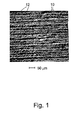
- FIG. 1 is a magnification representing the satined surface state of the part treated by the method according to the invention.
- a pigmented ZrO 2 zirconia coin is used for the process according to the invention.
- the term "pigmented zirconia” means a zirconium oxide ZrO 2 doped with an oxide of yttrium, calcium, magnesium or scandium, intended to stabilize the zirconia, and containing a metal oxide.
- another ceramic or a cermet for example aluminum oxide Al2O3, titanium carbide TiC, or any other ceramic or cermet suitable for the manufacture of mechanical parts.
- the piece is, for example, a watch case or a bracelet link. It comprises at least one surface polished by a method well known to those skilled in the art.
- the method according to the invention consists in locally illuminating the polished surface of such a piece by means of a laser.
- the piece is arranged on a support, vertically moving laser in an XY plane and whose movement is controlled by a computer.
- the laser is of Nd: YAG pulse type, optically pumped, wavelength 1.06 ⁇ m, optical power 75W.
- the laser is used in q-switched mode.
- the size of the spot is 100 ⁇ m, the pulse frequency is 20 to 40kHz, and their width is 11 ⁇ s.
- the scanning speed is of the order of 500 to 800 mm / s.
- a pattern is chosen and converted, by a suitable software, into a series of laser displacement commands. The surface of the piece is thus scanned by the laser beam so as to form the chosen pattern.
- FIG. 1 A photograph taken by scanning electron microscope of the surface of the piece thus treated is shown in FIG. 1.
- the illuminated surface melts locally and a micro-crater 10 with a diameter of approximately 50 ⁇ m is formed.
- the succession of pulses combined with the displacement of the laser makes it possible to trace a substantially rectilinear micro-groove 12 formed by the alignment of the successive micro-craters 10 partially superimposed.
- the micro-craters 10 are substantially equidistant.
- the micro-grooves 12 are themselves substantially parallel to each other, substantially equidistant and partially superimposed. They together define a surface having a roughness organized at the microscopic scale. At the macroscopic scale such a surface has a particularly aesthetic satin appearance, due to the presence of substantially parallel and equidistant micro-structures.
- the contrast between the polished surface and the surface satin by the laser forms the chosen pattern.
- the craters 10 are strongly superimposed.
- they could be slightly superimposed, while remaining aligned so as to form a micro-groove 12.
- the micro-grooves could be juxtaposed or even slightly distant from each other, while remaining substantially parallel and equidistant.
- the satin aspect would be unchanged.
Landscapes
- Engineering & Computer Science (AREA)
- Chemical & Material Sciences (AREA)
- Ceramic Engineering (AREA)
- Mechanical Engineering (AREA)
- Physics & Mathematics (AREA)
- Optics & Photonics (AREA)
- Materials Engineering (AREA)
- Organic Chemistry (AREA)
- Structural Engineering (AREA)
- Plasma & Fusion (AREA)
- Manufacturing & Machinery (AREA)
- Mining & Mineral Resources (AREA)
- General Physics & Mathematics (AREA)
- Chemical Kinetics & Catalysis (AREA)
- Metallurgy (AREA)
- Laser Beam Processing (AREA)
- Mechanical Treatment Of Semiconductor (AREA)
- Adornments (AREA)
Abstract
Description
- L'invention se rapporte au domaine de la microtechnique. Elle concerne plus particulièrement un procédé de décoration locale d'une pièce en matériau dur. Par matériau dur, on entend des matériaux présentant une dureté Vickers supérieure à 1000HV.
- Les céramiques telles que la zircone ZrO2 ou l'alumine Al2O3, et les matériaux durs de manière générale, sont largement employés en horlogerie pour la réalisation de boîtes et de bracelets inrayables. L'état de surface de ces pièces est généralement l'état poli qui donne un aspect brillant à la pièce. Le satinage mécanique de ces matériaux est malaisé car étant très durs, ils sont difficilement usinables. De plus, un tel satinage ne permet pas de réaliser des motifs, car il s'applique à l'intégralité de la surface.
- La présente invention propose un procédé de satinage local d'une pièce en matériau dur, en particulier en céramique, permettant la réalisation de motif en surface.
Plus précisément l'invention concerne un procédé de réalisation d'une surface satinée sur une pièce en un matériau présentant une dureté Vickers supérieure à 1000HV comportant au moins une surface polie, comprenant principalement les étapes suivantes : - se munir d'un support pour la pièce et d'un laser à impulsion, dotés d'un mouvement relatif l'un par rapport à l'autre dans un plan XY,
- exposer localement la surface polie à une impulsion du laser apportant suffisamment d'énergie pour provoquer une fusion locale de la surface polie de manière à former un micro-cratère,
- répéter les impulsions du laser simultanément à un déplacement relatif de la pièce par rapport au laser, de manière à tracer sur la surface polie des micro-sillons formés par l'alignement de plusieurs micro-cratères successifs se recouvrant partiellement, les micro-sillons étant sensiblement parallèles les uns aux autres et équidistants, et définissant ensemble la surface satinée.
- L'invention concerne également une pièce en un matériau présentant une dureté Vickers supérieure à 1000HV, comportant une surface polie présentant localement un aspect satiné dû à la présence de micro-sillons sensiblement parallèles les uns aux autres et équidistants.
- D'autres caractéristiques apparaîtront plus clairement à la lecture de la description qui suit d'un exemple de mise en oeuvre du procédé selon l'invention, la description étant faite en référence à la figure 1 annexée qui est un grossissement représentant l'état de surface satiné de la pièce traitée par le procédé selon l'invention.
- Une pièce en zircone Zr02 pigmentée est utilisée pour le procédé selon l'invention. On entend par zircone pigmentée, un oxyde de zirconium Zr02 dopé avec un oxyde d'yttrium, de calcium, de magnésium ou de scandium, destiné à stabiliser la zircone, et contenant un oxyde métallique. Dans une variante du procédé, on pourrait employer une autre céramique ou un cermet, par exemple l'oxyde d'aluminium Al2O3, le carbure de titane TiC, ou tout autre céramique ou cermet adaptée à la fabrication de pièces mécaniques. La pièce est, par exemple, une boîte de montre ou un maillon de bracelet. Elle comporte au moins une surface polie par un procédé bien connu de l'homme de métier.
- Le procédé selon l'invention consiste à illuminer localement la surface polie d'une telle pièce à l'aide d'un laser. Pour cela, la pièce est disposée sur un support, à la verticale d'un laser mobile dans un plan XY et dont le mouvement est contrôlé par un ordinateur. Le laser est de type Nd:YAG à impulsion, pompé optiquement, de longueur d'onde 1.06µm, de puissance optique 75W. Le laser est utilisé en mode q-switched. La taille du spot est de 100µm, la fréquence des impulsions est de 20 à 40kHz, et leur largeur est de 11µs. La vitesse de balayage est de l'ordre de 500 à 800 mm/s. Un motif est choisi et converti, par un logiciel adapté, en une série de commandes de déplacement du laser. La surface de la pièce est ainsi balayée par le faisceau laser de façon à former le motif choisi.
- Une photographie prise au microscope électronique à balayage de la surface de la pièce ainsi traitée est représentée en figure 1. Sous l'effet d'une impulsion laser, et à condition d'apporter localement suffisamment d'énergie, la surface illuminée fond localement et un micro-cratère 10 de diamètre environ 50µm est formé. La succession des impulsions combinée au déplacement du laser, permet de tracer un micro-sillon 12 sensiblement rectiligne formé par l'alignement des micro-cratères 10 successifs se superposant partiellement. On notera qu'au sein d'un micro-sillon 12, les micro-cratères 10 sont sensiblement équidistants. Les micro-sillons 12 sont eux-mêmes sensiblement parallèles les uns aux autres, sensiblement équidistants et partiellement superposés. Ils définissent ensemble une surface présentant une rugosité organisée à l'échelle microscopique. A l'échelle macroscopique une telle surface présente un aspect satiné particulièrement esthétique, dû à la présence de micro-structures sensiblement parallèles et équidistantes. Le contraste entre la surface polie et la surface satinée par le laser forme le motif choisi.
- On notera que la présente invention n'est pas limitée à l'exemple de mise en oeuvre du procédé qui vient d'être décrit, et que diverses modifications et variantes simples peuvent être envisagées par l'homme du métier sans sortir du cadre de l'invention tel que défini par les revendications annexées.
- En particulier, dans le procédé de satinage local décrit, les cratères 10 sont fortement superposés. Dans une variante du procédé, ils pourraient être faiblement superposés, tout en restant alignés de manière à former un micro-sillon 12. Par ailleurs, les micro-sillons pourraient être juxtaposés ou même légèrement distants les uns des autres, tout en restant sensiblement parallèles et équidistants. L'aspect satiné en serait inchangé.
Claims (6)
- Procédé de réalisation d'une surface satinée sur une pièce en un matériau présentant une dureté Vickers supérieure à 1000HV comportant au moins une surface polie, comprenant principalement les étapes suivantes :- se munir d'un support pour ladite pièce et d'un laser à impulsion, dotés d'un mouvement relatif l'un par rapport à l'autre dans un plan XY,- exposer localement ladite surface polie à une impulsion dudit laser apportant suffisamment d'énergie pour provoquer une fusion locale de la surface polie de manière à former un micro-cratère (10),- répéter les impulsions dudit laser simultanément à un déplacement relatif de ladite pièce par rapport audit laser, de manière à tracer sur ladite surface polie des micro-sillons (12) formés par l'alignement de plusieurs micro-cratères (10) successifs se recouvrant partiellement, lesdits micro-sillons (12) étant sensiblement parallèles les uns aux autres et équidistants, et définissant ensemble ladite surface satinée.
- Procédé selon la revendication 1, caractérisé en ce que le déplacement relatif dudit laser par rapport à ladite pièce est contrôlé de façon à ce que ladite surface satinée forme un motif contrastant avec ladite surface polie.
- Procédé selon la revendication 1 ou 2, caractérisé en ce que ledit matériau est une céramique.
- Procédé selon la revendication 3, caractérisé en ce que ladite céramique est un oxyde métallique.
- Pièce en un matériau présentant une dureté Vickers supérieure à 1000HV, comportant une surface polie présentant localement un aspect satiné dû à la présence de micro-sillons (12) sensiblement parallèles les uns aux autres et équidistants.
- Pièce selon la revendication 5, caractérisé en ce que lesdits micro-sillons (12) sont formés par l'alignement de micro-cratères (10) se recouvrant partiellement et sensiblement équidistants.
Priority Applications (8)
| Application Number | Priority Date | Filing Date | Title |
|---|---|---|---|
| EP06111851A EP1840108B1 (fr) | 2006-03-28 | 2006-03-28 | Procédé de réalisation d'une surface satinée |
| AT06111851T ATE474821T1 (de) | 2006-03-28 | 2006-03-28 | Verfahren zur herstellung einer satinierten oberfläche |
| DE602006015602T DE602006015602D1 (de) | 2006-03-28 | 2006-03-28 | Verfahren zur Herstellung einer satinierten Oberfläche |
| KR1020070026525A KR20070097314A (ko) | 2006-03-28 | 2007-03-19 | 새틴 피니시 표면을 만드는 방법 |
| JP2007071945A JP2007261266A (ja) | 2006-03-28 | 2007-03-20 | サテン仕上げ表面を形成する方法 |
| US11/690,378 US20070228012A1 (en) | 2006-03-28 | 2007-03-23 | Method for making a satin finish surface |
| CN2007100897055A CN101045644B (zh) | 2006-03-28 | 2007-03-27 | 制造缎面光表面的方法 |
| HK08100951.9A HK1110300B (en) | 2006-03-28 | 2008-01-24 | Method for making a satin finish surface |
Applications Claiming Priority (1)
| Application Number | Priority Date | Filing Date | Title |
|---|---|---|---|
| EP06111851A EP1840108B1 (fr) | 2006-03-28 | 2006-03-28 | Procédé de réalisation d'une surface satinée |
Publications (2)
| Publication Number | Publication Date |
|---|---|
| EP1840108A1 true EP1840108A1 (fr) | 2007-10-03 |
| EP1840108B1 EP1840108B1 (fr) | 2010-07-21 |
Family
ID=36658798
Family Applications (1)
| Application Number | Title | Priority Date | Filing Date |
|---|---|---|---|
| EP06111851A Expired - Lifetime EP1840108B1 (fr) | 2006-03-28 | 2006-03-28 | Procédé de réalisation d'une surface satinée |
Country Status (7)
| Country | Link |
|---|---|
| US (1) | US20070228012A1 (fr) |
| EP (1) | EP1840108B1 (fr) |
| JP (1) | JP2007261266A (fr) |
| KR (1) | KR20070097314A (fr) |
| CN (1) | CN101045644B (fr) |
| AT (1) | ATE474821T1 (fr) |
| DE (1) | DE602006015602D1 (fr) |
Cited By (3)
| Publication number | Priority date | Publication date | Assignee | Title |
|---|---|---|---|---|
| EP2543653A1 (fr) * | 2011-07-04 | 2013-01-09 | Comadur S.A. | Procédé de fabrication d'une céramique mate non marquante |
| EP3865955A1 (fr) * | 2020-02-17 | 2021-08-18 | The Swatch Group Research and Development Ltd | Procédé de fabrication d'une pièce mécanique d'horlogerie monobloc |
| WO2024246276A1 (fr) * | 2023-06-01 | 2024-12-05 | Rolex Sa | Composant horloger robuste |
Families Citing this family (6)
| Publication number | Priority date | Publication date | Assignee | Title |
|---|---|---|---|---|
| CN104334311A (zh) * | 2012-03-12 | 2015-02-04 | 劳力士有限公司 | 雕刻计时器组件的方法和使用该方法获得的计时器组件 |
| EP3623877B1 (fr) * | 2018-09-17 | 2025-08-20 | Rolex Sa | Procédé de fabrication d'un composant horloger |
| JP6754511B1 (ja) * | 2018-09-28 | 2020-09-09 | ダイセルポリマー株式会社 | 窒化物系の非磁性セラミックス成形体とその製造方法 |
| CN110757001B (zh) * | 2019-11-06 | 2021-06-29 | 浙江星淦科技有限公司 | 一种微米级激光雕刻防伪平面烫金版的制备方法 |
| JP2022145513A (ja) * | 2021-03-17 | 2022-10-04 | シチズン時計株式会社 | 時計用装飾部品の製造方法、時計用装飾部品及び時計 |
| JP2022145514A (ja) * | 2021-03-17 | 2022-10-04 | シチズン時計株式会社 | 時計用装飾部品の製造方法、時計用装飾部品及び時計 |
Citations (2)
| Publication number | Priority date | Publication date | Assignee | Title |
|---|---|---|---|---|
| US6599461B1 (en) * | 1997-04-16 | 2003-07-29 | Thomas Sievers | Method for producing nonslip floor coverings |
| US20050155955A1 (en) * | 2003-03-10 | 2005-07-21 | Daskal Vadim M. | Method for reducing glare and creating matte finish of controlled density on a silicon surface |
Family Cites Families (10)
| Publication number | Priority date | Publication date | Assignee | Title |
|---|---|---|---|---|
| US4972061A (en) * | 1987-12-17 | 1990-11-20 | Duley Walter W | Laser surface treatment |
| CA2009514C (fr) * | 1990-02-07 | 1995-04-25 | Mahmud U. Islam | Methode d'usinage par laser |
| JPH0849060A (ja) * | 1994-08-08 | 1996-02-20 | Nisshin Steel Co Ltd | 防眩性に優れたセラミックス被覆ステンレス鋼板及びその製造方法 |
| JPH10130702A (ja) * | 1996-10-22 | 1998-05-19 | Nisshin Steel Co Ltd | 傾斜機能材料の製法 |
| US7411150B2 (en) * | 2002-06-12 | 2008-08-12 | Alstom Technology Ltd. | Method of producing a composite component |
| JP2004066299A (ja) * | 2002-08-07 | 2004-03-04 | Arai Kk | セラミック材のレーザーマーキング方法 |
| US6847004B2 (en) * | 2003-01-10 | 2005-01-25 | General Electric Company | Process of removing a ceramic coating deposit in a surface hole of a component |
| JP4311661B2 (ja) * | 2004-05-21 | 2009-08-12 | ライト工業株式会社 | 繊維供給装置 |
| CN1326791C (zh) * | 2005-05-26 | 2007-07-18 | 上海交通大学 | 在硼硅玻璃表面加工微槽阵列的方法 |
| ATE432915T1 (de) * | 2006-03-28 | 2009-06-15 | Comadur Sa | Verfahren zum dekorieren eines keramikteils |
-
2006
- 2006-03-28 AT AT06111851T patent/ATE474821T1/de not_active IP Right Cessation
- 2006-03-28 DE DE602006015602T patent/DE602006015602D1/de not_active Expired - Lifetime
- 2006-03-28 EP EP06111851A patent/EP1840108B1/fr not_active Expired - Lifetime
-
2007
- 2007-03-19 KR KR1020070026525A patent/KR20070097314A/ko not_active Ceased
- 2007-03-20 JP JP2007071945A patent/JP2007261266A/ja active Pending
- 2007-03-23 US US11/690,378 patent/US20070228012A1/en not_active Abandoned
- 2007-03-27 CN CN2007100897055A patent/CN101045644B/zh active Active
Patent Citations (2)
| Publication number | Priority date | Publication date | Assignee | Title |
|---|---|---|---|---|
| US6599461B1 (en) * | 1997-04-16 | 2003-07-29 | Thomas Sievers | Method for producing nonslip floor coverings |
| US20050155955A1 (en) * | 2003-03-10 | 2005-07-21 | Daskal Vadim M. | Method for reducing glare and creating matte finish of controlled density on a silicon surface |
Cited By (4)
| Publication number | Priority date | Publication date | Assignee | Title |
|---|---|---|---|---|
| EP2543653A1 (fr) * | 2011-07-04 | 2013-01-09 | Comadur S.A. | Procédé de fabrication d'une céramique mate non marquante |
| US9248582B2 (en) | 2011-07-04 | 2016-02-02 | Comadur S.A. | Method for fabricating a non-marking, matte ceramic |
| EP3865955A1 (fr) * | 2020-02-17 | 2021-08-18 | The Swatch Group Research and Development Ltd | Procédé de fabrication d'une pièce mécanique d'horlogerie monobloc |
| WO2024246276A1 (fr) * | 2023-06-01 | 2024-12-05 | Rolex Sa | Composant horloger robuste |
Also Published As
| Publication number | Publication date |
|---|---|
| HK1110300A1 (en) | 2008-07-11 |
| CN101045644B (zh) | 2013-03-13 |
| EP1840108B1 (fr) | 2010-07-21 |
| ATE474821T1 (de) | 2010-08-15 |
| JP2007261266A (ja) | 2007-10-11 |
| US20070228012A1 (en) | 2007-10-04 |
| KR20070097314A (ko) | 2007-10-04 |
| DE602006015602D1 (de) | 2010-09-02 |
| CN101045644A (zh) | 2007-10-03 |
Similar Documents
| Publication | Publication Date | Title |
|---|---|---|
| Sugioka et al. | Ultrafast lasers—reliable tools for advanced materials processing | |
| EP3452250B1 (fr) | Méthode et dispositif d'assemblage d'un substrat et d'une pièce par la structuration du substrat | |
| EP2825347B1 (fr) | Procédé de gravage d'un élément d'horlogerie | |
| CN102825251B (zh) | 一种基于ccd视觉定位的复杂零件制造方法 | |
| EP1840108B1 (fr) | Procédé de réalisation d'une surface satinée | |
| EP1840107B1 (fr) | Procédé de décoration d'une pièce en céramique | |
| CN114571086B (zh) | 纳秒激光诱导等离子体复合飞秒激光加工装置及加工方法 | |
| Schanz et al. | Laser polishing of additive manufactured AlSi10Mg parts with an oscillating laser beam | |
| CH713871B1 (fr) | Composant horloger comprenant des éléments graphiques de divers aspects et procédé de fabrication d'un tel composant. | |
| Poprawe et al. | Digital photonic production along the lines of industry 4.0 | |
| EP3126150B1 (fr) | Procede de marquage en surface d'une piece mecanique par une representation graphique predefinie avec effet de type holographique | |
| CA2887103C (fr) | Procede de marquage en surface d'une piece mecanique par une representation graphique predefinie visible a l'oeil nu | |
| Rathmann et al. | Laser based process chain to use LIPSS on forming tools | |
| CH718465A2 (fr) | Procédé de fabrication d'une pièce d'habillage d'horlogerie ou de bijouterie à base ceramique et à decor structuré. | |
| WO2020025497A1 (fr) | Procede de marquage d'une piece ceramique refractaire | |
| EP3761123A1 (fr) | Composant de micromécanique permettant le confinement d'une substance lubrifiante | |
| WO2022234155A9 (fr) | Procédé de découpe d'un échantillon en alliage métallique amorphe | |
| FR2552554A1 (fr) | Miroir pour faisceau lumineux, notamment laser de puissance | |
| Jahromi et al. | Enabling manufacturing of precision freeform glass optics using laser-assisted diamond turning | |
| EP4638391A1 (fr) | Procédé pour la fabrication d'une pièce en céramique | |
| Kniffler et al. | Pushing scan speed limits in ultrashort pulse laser polishing of steel | |
| YAMAMURO | Micro/nanostructuring of Yttria-stabilized Zirconia Surface by Femtosecond Pulsed Laser Irradiation | |
| Rajput et al. | Laser machining of glass substrates | |
| EP4684903A1 (fr) | Procédé de fabrication d'un composant horloger | |
| Mohammadi | Hybrid Processes in Material Removal of Hard and Brittle Materials |
Legal Events
| Date | Code | Title | Description |
|---|---|---|---|
| PUAI | Public reference made under article 153(3) epc to a published international application that has entered the european phase |
Free format text: ORIGINAL CODE: 0009012 |
|
| AK | Designated contracting states |
Kind code of ref document: A1 Designated state(s): AT BE BG CH CY CZ DE DK EE ES FI FR GB GR HU IE IS IT LI LT LU LV MC NL PL PT RO SE SI SK TR |
|
| AX | Request for extension of the european patent |
Extension state: AL BA HR MK YU |
|
| 17P | Request for examination filed |
Effective date: 20061109 |
|
| AKX | Designation fees paid |
Designated state(s): AT BE BG CH CY CZ DE DK EE ES FI FR GB GR HU IE IS IT LI LT LU LV MC NL PL PT RO SE SI SK TR |
|
| 17Q | First examination report despatched |
Effective date: 20080725 |
|
| GRAP | Despatch of communication of intention to grant a patent |
Free format text: ORIGINAL CODE: EPIDOSNIGR1 |
|
| GRAC | Information related to communication of intention to grant a patent modified |
Free format text: ORIGINAL CODE: EPIDOSCIGR1 |
|
| GRAS | Grant fee paid |
Free format text: ORIGINAL CODE: EPIDOSNIGR3 |
|
| GRAA | (expected) grant |
Free format text: ORIGINAL CODE: 0009210 |
|
| AK | Designated contracting states |
Kind code of ref document: B1 Designated state(s): AT BE BG CH CY CZ DE DK EE ES FI FR GB GR HU IE IS IT LI LT LU LV MC NL PL PT RO SE SI SK TR |
|
| REG | Reference to a national code |
Ref country code: GB Ref legal event code: FG4D Free format text: NOT ENGLISH |
|
| REG | Reference to a national code |
Ref country code: CH Ref legal event code: EP |
|
| REG | Reference to a national code |
Ref country code: IE Ref legal event code: FG4D |
|
| REF | Corresponds to: |
Ref document number: 602006015602 Country of ref document: DE Date of ref document: 20100902 Kind code of ref document: P |
|
| REG | Reference to a national code |
Ref country code: CH Ref legal event code: NV Representative=s name: ICB INGENIEURS CONSEILS EN BREVETS SA |
|
| REG | Reference to a national code |
Ref country code: NL Ref legal event code: VDEP Effective date: 20100721 |
|
| LTIE | Lt: invalidation of european patent or patent extension |
Effective date: 20100721 |
|
| PG25 | Lapsed in a contracting state [announced via postgrant information from national office to epo] |
Ref country code: LT Free format text: LAPSE BECAUSE OF FAILURE TO SUBMIT A TRANSLATION OF THE DESCRIPTION OR TO PAY THE FEE WITHIN THE PRESCRIBED TIME-LIMIT Effective date: 20100721 Ref country code: FI Free format text: LAPSE BECAUSE OF FAILURE TO SUBMIT A TRANSLATION OF THE DESCRIPTION OR TO PAY THE FEE WITHIN THE PRESCRIBED TIME-LIMIT Effective date: 20100721 Ref country code: AT Free format text: LAPSE BECAUSE OF FAILURE TO SUBMIT A TRANSLATION OF THE DESCRIPTION OR TO PAY THE FEE WITHIN THE PRESCRIBED TIME-LIMIT Effective date: 20100721 Ref country code: NL Free format text: LAPSE BECAUSE OF FAILURE TO SUBMIT A TRANSLATION OF THE DESCRIPTION OR TO PAY THE FEE WITHIN THE PRESCRIBED TIME-LIMIT Effective date: 20100721 |
|
| REG | Reference to a national code |
Ref country code: IE Ref legal event code: FD4D |
|
| PG25 | Lapsed in a contracting state [announced via postgrant information from national office to epo] |
Ref country code: PL Free format text: LAPSE BECAUSE OF FAILURE TO SUBMIT A TRANSLATION OF THE DESCRIPTION OR TO PAY THE FEE WITHIN THE PRESCRIBED TIME-LIMIT Effective date: 20100721 Ref country code: BG Free format text: LAPSE BECAUSE OF FAILURE TO SUBMIT A TRANSLATION OF THE DESCRIPTION OR TO PAY THE FEE WITHIN THE PRESCRIBED TIME-LIMIT Effective date: 20101021 Ref country code: CY Free format text: LAPSE BECAUSE OF FAILURE TO SUBMIT A TRANSLATION OF THE DESCRIPTION OR TO PAY THE FEE WITHIN THE PRESCRIBED TIME-LIMIT Effective date: 20100721 Ref country code: IS Free format text: LAPSE BECAUSE OF FAILURE TO SUBMIT A TRANSLATION OF THE DESCRIPTION OR TO PAY THE FEE WITHIN THE PRESCRIBED TIME-LIMIT Effective date: 20101121 Ref country code: PT Free format text: LAPSE BECAUSE OF FAILURE TO SUBMIT A TRANSLATION OF THE DESCRIPTION OR TO PAY THE FEE WITHIN THE PRESCRIBED TIME-LIMIT Effective date: 20101122 Ref country code: SI Free format text: LAPSE BECAUSE OF FAILURE TO SUBMIT A TRANSLATION OF THE DESCRIPTION OR TO PAY THE FEE WITHIN THE PRESCRIBED TIME-LIMIT Effective date: 20100721 |
|
| PG25 | Lapsed in a contracting state [announced via postgrant information from national office to epo] |
Ref country code: SE Free format text: LAPSE BECAUSE OF FAILURE TO SUBMIT A TRANSLATION OF THE DESCRIPTION OR TO PAY THE FEE WITHIN THE PRESCRIBED TIME-LIMIT Effective date: 20100721 Ref country code: LV Free format text: LAPSE BECAUSE OF FAILURE TO SUBMIT A TRANSLATION OF THE DESCRIPTION OR TO PAY THE FEE WITHIN THE PRESCRIBED TIME-LIMIT Effective date: 20100721 Ref country code: GR Free format text: LAPSE BECAUSE OF FAILURE TO SUBMIT A TRANSLATION OF THE DESCRIPTION OR TO PAY THE FEE WITHIN THE PRESCRIBED TIME-LIMIT Effective date: 20101022 |
|
| PG25 | Lapsed in a contracting state [announced via postgrant information from national office to epo] |
Ref country code: IE Free format text: LAPSE BECAUSE OF FAILURE TO SUBMIT A TRANSLATION OF THE DESCRIPTION OR TO PAY THE FEE WITHIN THE PRESCRIBED TIME-LIMIT Effective date: 20100721 Ref country code: DK Free format text: LAPSE BECAUSE OF FAILURE TO SUBMIT A TRANSLATION OF THE DESCRIPTION OR TO PAY THE FEE WITHIN THE PRESCRIBED TIME-LIMIT Effective date: 20100721 |
|
| PLBE | No opposition filed within time limit |
Free format text: ORIGINAL CODE: 0009261 |
|
| STAA | Information on the status of an ep patent application or granted ep patent |
Free format text: STATUS: NO OPPOSITION FILED WITHIN TIME LIMIT |
|
| PG25 | Lapsed in a contracting state [announced via postgrant information from national office to epo] |
Ref country code: IT Free format text: LAPSE BECAUSE OF FAILURE TO SUBMIT A TRANSLATION OF THE DESCRIPTION OR TO PAY THE FEE WITHIN THE PRESCRIBED TIME-LIMIT Effective date: 20100721 Ref country code: EE Free format text: LAPSE BECAUSE OF FAILURE TO SUBMIT A TRANSLATION OF THE DESCRIPTION OR TO PAY THE FEE WITHIN THE PRESCRIBED TIME-LIMIT Effective date: 20100721 Ref country code: CZ Free format text: LAPSE BECAUSE OF FAILURE TO SUBMIT A TRANSLATION OF THE DESCRIPTION OR TO PAY THE FEE WITHIN THE PRESCRIBED TIME-LIMIT Effective date: 20100721 Ref country code: RO Free format text: LAPSE BECAUSE OF FAILURE TO SUBMIT A TRANSLATION OF THE DESCRIPTION OR TO PAY THE FEE WITHIN THE PRESCRIBED TIME-LIMIT Effective date: 20100721 Ref country code: SK Free format text: LAPSE BECAUSE OF FAILURE TO SUBMIT A TRANSLATION OF THE DESCRIPTION OR TO PAY THE FEE WITHIN THE PRESCRIBED TIME-LIMIT Effective date: 20100721 |
|
| 26N | No opposition filed |
Effective date: 20110426 |
|
| PG25 | Lapsed in a contracting state [announced via postgrant information from national office to epo] |
Ref country code: ES Free format text: LAPSE BECAUSE OF FAILURE TO SUBMIT A TRANSLATION OF THE DESCRIPTION OR TO PAY THE FEE WITHIN THE PRESCRIBED TIME-LIMIT Effective date: 20101101 |
|
| REG | Reference to a national code |
Ref country code: DE Ref legal event code: R097 Ref document number: 602006015602 Country of ref document: DE Effective date: 20110426 |
|
| BERE | Be: lapsed |
Owner name: COMADUR S.A. Effective date: 20110331 |
|
| PG25 | Lapsed in a contracting state [announced via postgrant information from national office to epo] |
Ref country code: MC Free format text: LAPSE BECAUSE OF NON-PAYMENT OF DUE FEES Effective date: 20110331 |
|
| PG25 | Lapsed in a contracting state [announced via postgrant information from national office to epo] |
Ref country code: BE Free format text: LAPSE BECAUSE OF NON-PAYMENT OF DUE FEES Effective date: 20110331 |
|
| PG25 | Lapsed in a contracting state [announced via postgrant information from national office to epo] |
Ref country code: LU Free format text: LAPSE BECAUSE OF NON-PAYMENT OF DUE FEES Effective date: 20110328 |
|
| PG25 | Lapsed in a contracting state [announced via postgrant information from national office to epo] |
Ref country code: TR Free format text: LAPSE BECAUSE OF FAILURE TO SUBMIT A TRANSLATION OF THE DESCRIPTION OR TO PAY THE FEE WITHIN THE PRESCRIBED TIME-LIMIT Effective date: 20100721 |
|
| PG25 | Lapsed in a contracting state [announced via postgrant information from national office to epo] |
Ref country code: HU Free format text: LAPSE BECAUSE OF FAILURE TO SUBMIT A TRANSLATION OF THE DESCRIPTION OR TO PAY THE FEE WITHIN THE PRESCRIBED TIME-LIMIT Effective date: 20100721 |
|
| REG | Reference to a national code |
Ref country code: FR Ref legal event code: PLFP Year of fee payment: 11 |
|
| REG | Reference to a national code |
Ref country code: FR Ref legal event code: PLFP Year of fee payment: 12 |
|
| REG | Reference to a national code |
Ref country code: FR Ref legal event code: PLFP Year of fee payment: 13 |
|
| P01 | Opt-out of the competence of the unified patent court (upc) registered |
Effective date: 20230611 |
|
| PGFP | Annual fee paid to national office [announced via postgrant information from national office to epo] |
Ref country code: GB Payment date: 20240221 Year of fee payment: 19 |
|
| PGFP | Annual fee paid to national office [announced via postgrant information from national office to epo] |
Ref country code: DE Payment date: 20250218 Year of fee payment: 20 |
|
| PGFP | Annual fee paid to national office [announced via postgrant information from national office to epo] |
Ref country code: FR Payment date: 20250218 Year of fee payment: 20 |
|
| PGFP | Annual fee paid to national office [announced via postgrant information from national office to epo] |
Ref country code: CH Payment date: 20250401 Year of fee payment: 20 |
|
| GBPC | Gb: european patent ceased through non-payment of renewal fee |
Effective date: 20250328 |
|
| PG25 | Lapsed in a contracting state [announced via postgrant information from national office to epo] |
Ref country code: GB Free format text: LAPSE BECAUSE OF NON-PAYMENT OF DUE FEES Effective date: 20250328 |
|
| REG | Reference to a national code |
Ref country code: CH Ref legal event code: H14 Free format text: ST27 STATUS EVENT CODE: U-0-0-H10-H14 (AS PROVIDED BY THE NATIONAL OFFICE) Effective date: 20260328 Ref country code: DE Ref legal event code: R071 Ref document number: 602006015602 Country of ref document: DE |