EP1845468A1 - Method, computer network system and gate for identifying and controlling unsolicited traffic - Google Patents
Method, computer network system and gate for identifying and controlling unsolicited traffic Download PDFInfo
- Publication number
- EP1845468A1 EP1845468A1 EP06007693A EP06007693A EP1845468A1 EP 1845468 A1 EP1845468 A1 EP 1845468A1 EP 06007693 A EP06007693 A EP 06007693A EP 06007693 A EP06007693 A EP 06007693A EP 1845468 A1 EP1845468 A1 EP 1845468A1
- Authority
- EP
- European Patent Office
- Prior art keywords
- traffic
- gate
- source
- unsolicited
- access network
- Prior art date
- Legal status (The legal status is an assumption and is not a legal conclusion. Google has not performed a legal analysis and makes no representation as to the accuracy of the status listed.)
- Granted
Links
Images


Classifications
-
- H—ELECTRICITY
- H04—ELECTRIC COMMUNICATION TECHNIQUE
- H04L—TRANSMISSION OF DIGITAL INFORMATION, e.g. TELEGRAPHIC COMMUNICATION
- H04L63/00—Network architectures or network communication protocols for network security
- H04L63/14—Network architectures or network communication protocols for network security for detecting or protecting against malicious traffic
- H04L63/1441—Countermeasures against malicious traffic
- H04L63/1458—Denial of Service
-
- G—PHYSICS
- G06—COMPUTING OR CALCULATING; COUNTING
- G06F—ELECTRIC DIGITAL DATA PROCESSING
- G06F21/00—Security arrangements for protecting computers, components thereof, programs or data against unauthorised activity
- G06F21/50—Monitoring users, programs or devices to maintain the integrity of platforms, e.g. of processors, firmware or operating systems
- G06F21/55—Detecting local intrusion or implementing counter-measures
- G06F21/554—Detecting local intrusion or implementing counter-measures involving event detection and direct action
-
- H—ELECTRICITY
- H04—ELECTRIC COMMUNICATION TECHNIQUE
- H04L—TRANSMISSION OF DIGITAL INFORMATION, e.g. TELEGRAPHIC COMMUNICATION
- H04L2463/00—Additional details relating to network architectures or network communication protocols for network security covered by H04L63/00
- H04L2463/141—Denial of service attacks against endpoints in a network
-
- H—ELECTRICITY
- H04—ELECTRIC COMMUNICATION TECHNIQUE
- H04L—TRANSMISSION OF DIGITAL INFORMATION, e.g. TELEGRAPHIC COMMUNICATION
- H04L63/00—Network architectures or network communication protocols for network security
- H04L63/02—Network architectures or network communication protocols for network security for separating internal from external traffic, e.g. firewalls
Definitions
- the present invention relates to a method for identifying and controlling unsolicited traffic in a computer network system which comprises access networks for connecting sources and destinations, respectively, to a core network, like the Internet.
- the present invention further relates to a computer network system and a gate adapted to perform a method for identifying and controlling unsolicited traffic.
- Viruses and worms have been shown to clog entire parts of the Internet by causing extensive traffic. Moreover, they can carry code that modifies or destroys infected end systems up to a complete loss of data or steal private data.
- DDoS attacks aim at overloading a resource such that legitimate users are denied access to the resource.
- Well-known DDoS targets include, but are not limited to, Web servers and Internet Data Centers.
- the present invention aims at protecting network resources.
- access networks that have a significantly lower capacity than the core must be protected against unsolicited traffic.
- Protection includes the prevention of flooding attacks with unsolicited traffic (DDoS), such that legitimate traffic is no longer able to reach its destination due to exceeded network capacity, as well as the early prevention of unsolicited (malicious or infectious) traffic spreading into the core to infect other systems.
- DDoS unsolicited traffic
- a further approach to protect end devices against Denial-of-Service attacks is known wherein a source wanting to send data to a destination must first receive a permission to communicate prior to sending data. This permission to communicate is also termed capability. See for example the publication of T. Anderson et al. "Preventing Internet Denial-of-Service with capabilities", Proceedings of Hot Topics in Networking (HotNetsII), Boston, October 2003 .
- the capabilities are used to authenticate sources on an end-to-end basis. This means, that the capabilities are issued by a destination after checking the legitimacy of a source, and thus traffic is checked for capabilities by the destination to protect end system resources.
- an end-to-end scheme does not protect the access networks and the core network from unsolicited traffic. Therefore, DDoS attacks on an access network or malware spread into the core network are not addressed.
- EP 1 284 558 B1 discloses a method and apparatus for limiting the effect upon certain clients that access an electronic merchant's server from a denial of service attack against the electronic merchant's server. Therefore, the e-merchant designates some clients as VIP clients, wherein a packet addressed to the e-merchant's server is marked for forwarding in a privileged class of services, if the source of the packet is a VIP client.
- the present invention relates to a computer network system and a method using authentication or permissions, also termed capabilities, to
- each gate is located between an access network and the core network.
- the gate operates to identify and control unsolicited traffic received from malicious sources and to forward permissions or capabilities to sources wishing to send data by using an authentication authority.
- These functions performed by the gate and the authentication authority are also called edge-based capability (EC) functions due to the fact that the gate is located at an edge of the core network. Every source, e. g. a user, a web client or a host computer wanting to send data to a destination must receive a permission to send (a capability) prior to sending. This permission is used to generate and include a tag in every packet so that the EC gate is able to distinguish authenticated from unsolicited traffic and thus to allow only authenticated traffic to pass the gate.
- EC edge-based capability
- the present invention based on edge-based capabilities protects the core network and/or a destinations' access network, whereas the above mentioned known schemes protect end systems or destination resources.
- the authentication authority uses state-of-the-art authentication techniques, such as CAPTCHAS as described by L. v. Ahn et al. in “CAPTCHA: Using Hard AI Problems for Security”; Advances in Cryptology-EUROCRYPT 2003, volume 2656 of Lecture Notes in Computer Science, pages 294-311, Springer Verlag and/or IP Puzzles as described by D. Dean et al. in "Using client puzzles to protect TLS", Proceedings of the 10th USENIX Security Symposium, Washington, D.C., August 2001 to transmit permission information to the sources.
- the sources i.e. users and/or computers try to obtain the valid tagging key from the permission information, used for tagging packets to be sent to a destination.
- the authentication information is shared among three distributed components, i.e. sources, the gates and the authentication authority in a secure, efficient and scalable way.
- the computer network system can be implemented readily, e.g. by a single Internet Service Provider (ISP). Owners of end systems connected to the ISP's network have the incentive to install the respective components of the present invention to profit from the protection against unsolicited traffic provided by the gate.
- ISP Internet Service Provider
- the above mentioned technical problem is solved by a a method for identifying and controlling unsolicited traffic in a computer network system.
- the computer network system comprises at least a first access network to which at least one source is connected, at least a second access network to which at least one destination is connected and a core network connecting the access networks.
- the method comprises the following steps:
- This method helps to thwart Distributed Denial of Service (DDoS) attacks against the second access network at the edge of a core network and thus by implication on servers.
- DDoS Distributed Denial of Service
- This method aims to stop worm and virus spread prior to reaching the core network.
- IP packets are IP packets.
- the step of controlling the flow of each traffic unit having been identified as unsolicited may include blocking, delaying and/or limiting the flow of each traffic unit having been identified as unsolicited to a destination for example in dependence of the congestion condition of the core network and/or the second access network.
- a permission message is generated and transmitted to the at least one source. Traffic units to be sent are then marked at the source using information from the permission message.
- the permission message comprises as an information a tagging key, in the description also called session keys, to mark traffic units.
- a tagging key in the description also called session keys, to mark traffic units.
- the permission message is transmitted in form of a challenge to be solved by the at least one source to obtain the tagging key. Using challenges only computers working properly are able to obtain a valid tagging key from the permission message.
- the challenge is to be designed such that it can distinguish legitimate users or end systems from other sources.
- a challenge is constructed such that it can be solved only with an interaction of a human user.
- a CAPTCHA algorithm and/or an IP puzzle algorithm as mentioned above can be used to generate a challenge to transmit the permission message to the at least one source.
- cryptographic keys are used for tagging traffic units.
- the tagging key is used in a message authentication code (MAC) to compute a tag to mark traffic units.
- MAC message authentication code
- the tagging key or information to derive the tagging key is stored at the gate to verify traffic units received from sources.
- the tagging key is a cryptographic key that is used by the source to generate tags for marking traffic units and that is used by the gate to verify tags included in traffic units.
- the permission message is generated by the gate and forwarded to an authentication means which in turn transmits the permission message to the at least one source.
- the permission message is generated by an authentication means which transmits the permission message to the at least one source and the gate.
- the above mentioned problem is also solved by a computer network system for identifying and controlling unsolicited traffic.
- the system comprises a core network, at least a first access network, at least one source connected to said first access network, at least a second access network, at least one destination connected to said second access network, and at least one gate located between the first access network and the core network and/or between the second access network and the core network.
- means for generating and transmitting a permission message to the at least one source are provided, wherein the at least one source comprises means for obtaining a tagging key from that permission message used to mark traffic units addressed to a destination.
- the gate comprises storage means for storing information related to a permission message, means for verifying received traffic units on the basis of the information stored to determine whether or not the traffic units are marked validly, means for identifying each traffic unit being marked invalidly as unsolicited, and means for controlling the flow of each traffic unit being marked invalidly in response to at least one predetermined system parameter.
- each source comprises a client computer
- each destination comprises a server
- the core network is the Internet.
- the means for generating and transmitting a permission message to the at least one source is implemented in an authentication unit which can be located in a separate device connected to the gate or in at least one destination.
- the authentication unit is adapted to generated a permission message in form of a challenge to be solved by the at least one source, wherein only sources having solved the challenge are able to mark traffic units validly.
- the above mentioned technical problem is further solved by a gate used in a computer network system according to any one of the claims 14 to 17.
- the gate comprises storage means for storing information related to a permission message, means for verifying traffic units on the basis of the information stored to determine whether or not the traffic units are marked validly, means for identifying each traffic unit being marked invalidly as unsolicited, and means for controlling the flow of each traffic unit being marked invalidly in response to at least one predetermined system parameter. It is to be noted that the feature "traffic unit being marked invalidly" also covers traffic units which are not marked at all.
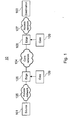
- Fig. 1 shows a block diagram of a preferred communication system 10 based on a commonly used distributed networked system including an aspect of the present invention.
- the communication system 10 comprises end systems or end devices and a network. End systems are separated into sources 101 and destinations 103, wherein only one source and one destination are shown.
- the network is divided into a core network 104, e. g. the Internet, and access networks. In order to facilitate the illustration only a single source-side access network 105 and a single destination-side network 107 are shown.
- the conjunction of an access network and the core network is called edge.
- Each edge usually comprises one or multiple hardware components, such as routers.
- edges A common characteristic of the edges is that the network capacity is significantly different between an access network and the core network, i.e., the network capacity is one or several orders of magnitude smaller in the access networks 105, 108 than in the core network 104. Therefore, an access network is significantly more vulnerable to traffic flooding than the core network 104. Therefore, unsolicited traffic must be identified and controlled, e.g. limited or completely blocked, at an edge.
- a specific network element termed gate 109 is added to the network infrastructure at least at one edge, for example at the source side and/or the destination side that ensures that the network resources are available for legitimate traffic.
- Fig. 2 shows a first preferred embodiment of a communication system as generally depicted in Fig. 1.
- This communication system comprises a gate 109 at a destination side edge of a core network 104, i. e. between an destination-side access network 107 and the core network 104.
- the destination-side access network 107 serves to connect destinations, e. g. Web servers 103-1 to 103-N to the core network 104. It is to be understood, that basically a plurality of destination-side access networks are connected to the core network 104.
- the gate 109 operates to protect the destination-side access network 107 against DDoS flooding attacks.
- legitimate sources 101-1 to 101-N such as Web clients are connected to the core network 104 via a source-side access network 105a
- malicious sources (zombies) 102-1 to 102-N are connected to the core network 104 via a separate access network 105b.
- wanted traffic generated by the legitimate sources 101-1 to 101-N is designated by reference number 111
- unsolicited traffic generated by the malicious sources 102-1 to 102-N is designated by reference numbers 112. It will be described later how clients are identified and distinguished as legitimate sources and malicious sources, respectively.
- the attack or unsolicited traffic 112 from the malicious sources 102 to 102-N sent to one or multiple destinations 103-1 to 103-N converges at the edge joining the core network 104 with the destination-side access network 107. Without gate 109, the access network 107 with its lower capacity can be flooded with unsolicited traffic 112.
- the permission 115 is generated and forwarded to one or more sources by a specific software module called authentification authority 113.
- the authentification authority 113 might be implemented in one or more destinations 103 to 103-N or in a separate device associated to the gate 109.
- the attack traffic 112 is identified and can be filtered out such that only a controllable number of legitimate packets 111 are forwarded from the core network 104 to the access network 107.
- the unsolicited traffic 112 filtered out by the gate 109 is symbolically depicted by a ground symbol.
- the amount of attack traffic 112 flowing through the access network 107 can be controlled by the gate 109 in dependence of the condition of the access network 107.
- the gate 109 identifies traffic as unsolicited traffic if the received packets do not contain a valid tag generated on the basis of the permission.
- the gate 109 uses a key generation algorithm to generate tagging keys.
- the tagging keys are transported to the authentication authority 113 which forwards the permission and the tagging key or portion of the key to the sources. Only sources which work correctly are able to calculate the tagging key from the permission which is then used to tag or mark packets to be sent to respective destinations.
- Fig. 3 shows a second embodiment of a communication system.
- This communication system differs from that shown in Fig. 2 in that a gate 109 is arranged at a source side edge of a core network 104, i.e. between a source-side access network 105 and the core network 104.
- malware e. g. a virus or a worm has infected a set of sources 102-1 to 102-N, for example computers and replicates itself with horrendous speed to infect other source computers.
- These source computers 102-1 to 102-N will fail to obtain a correct permission generated by and received from an authentication authority 115.
- the malware 112 spreads via email.
- Gate 109 is adapted to automatically determine whether an email 111 has been sent by a legitimate source 101-1 to 101-N or by a malicious computer 102-1 to 102-N. Only emails 111 sent by a legitimate source 101 to 101-N have been marked correctly and will pass the gate 109. Therefore, the malware which are not marked or carrying an invalid tag can be identified as unsolicited traffic 112 and prevented from spreading past the gate 109 into the Internet 104.
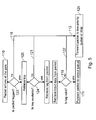
- the gate 109 has the ability to identify and control, e.g. filter out or limit unsolicited traffic.
- the gate 109 first checks in step 123 whether the packet contains a tag. If the packet contains a tag, then the gate 109 retrieves in step 120 a tagging key previously generated for a given session. If a suitable tagging key is available, the gate 109 uses the tagging key to determine in step 124 whether or not the packet includes a valid tag. If the tag is valid, the packet 111 can be forwarded immediately to an output queue of the gate 109.
- the packet is considered as an unsolicited or a malicious packet 112 and thus will be filtered or controlled 125 by the gate 109.
- the term "filtered” or “controlled” 125 can be interpreted and implemented in various ways. Examples include, but are not limited, to simply drop unsolicited packets 112 or to forward them to a low-priority queue 125.
- An efficient solution is required such that the gate 109 does not slow down the traffic in the destination's access network 107 or in the core network 104. Furthermore, the solution needs to scale to a large number of flows.
- the capability exchange for legitimating sources to send wanted traffic 111 involves three independent components: sources which must acquire a capability, the authentication authority 113 to issue and forward capabilities and the gate 109 to check capabilities in order to identify and control unsolicited traffic.
- sources which must acquire a capability the authentication authority 113 to issue and forward capabilities
- the gate 109 to check capabilities in order to identify and control unsolicited traffic.
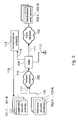
- the general concept is shown in Fig. 4.
- the gate 109 uses a tagging scheme for verifying packets and a keying scheme for generating tagging keys.
- the keying scheme can be implemented in key generation means 114 and the tagging scheme can be located in a tag verification means 117, both located within the gate 109.
- a key transport scheme is used by the authentication authority 113.
- the key transport scheme can be implemented in a key transport means 118.
- both the authentication authority 113 as well as the key transport scheme are implemented in one or more of the destinations 103-1 to 103-N.
- a tagging scheme is used by the sources to generate tags and embed them into packets to be sent. Therefore, tag generating means 116 can be implemented in each source to perform the tagging scheme. A detailed description of these schemes will be given below.
- a tagging key is generated by the key generation means 114 of the gate 109. Derivations of this key are passed to the authentication authority 113.
- the authentication authority 113 is a logical unit or software module that may be mapped onto an independent device, or may be collocated with other devices, such as the server 103-1.
- the authentication authority 113 is adapted to implicitly authenticate clients 101. This is done by generating a permission or a capability, for example in form of a challenge which includes a tagging key or a portion of a tagging key that is valid for a single session.
- the challenge is forwarded to the sources 101 and 102. Each source tries to solve the received challenge for obtaining a valid tag which is used to mark packets to be sent to destinations.
- packets marked with a valid tag are considered as a legitimate traffic 111 whereas traffic without a tag or with an invalid tag are identified as unsolicited traffic 112 and thus filtered respectively, as shown in Fig. 2, 3 and 5.
- This computer network system is adapted to prevent the access network 107 from DDoS attacks, but as mentioned above, it can be used for other scenarios as well.
- the destinations 103-1 to 103-N are servers, that the sources 101-1 to 102-N are client computers and that the authentication authority 113 is located in at least one of the servers 103.
- the Keying Scheme built into the key generation means 114 is responsible for generating a key at the gate 109 and communicating it to one or more of the servers 103-1 to 103-N or, in general, the authentication authority 113. It is important to realize that the gate 109 defines and manages keys and exchanges them with the servers, but not vice versa.
- the key sent to the server 103-1 is server-specific.
- the server 103-1 stores its key locally. Once the server 103-1 receives a request from a client, e. g. client 101-1, it derives a session-specific key as a tagging key to be sent to the sources.
- the Key Transport Scheme associated to the authentication authority and implemented for example in the server 103-1 is responsible for communicating the session or tagging key to clients, e.g. in form of a challenge generated by the authentication authority 113.
- clients e.g. in form of a challenge generated by the authentication authority 113.
- the client 101-1 the user uses, is considered as authenticated.
- the clients 101-1 to 101-N are assumed to be able to solve the received challenge correctly and thus are legitimated or authenticated. It is assumed that the clients 102-1 to 102-N are not able to solve the received challenge correctly and thus are considered as zombies.
- the Tagging Scheme implemented in the clients allow the legitimate clients to embed a tag in each packet it send, after being authenticated and after obtaining a tagging key by solving the challenge correctly.
- the Tagging Scheme defines how the gate 109 verifies the tags included in the packets with information stored at the gate 109.
- Notation 1 For an IP packet P we use IP s ( P ), IP d ( P ), Ident(P), Flow(P), Len(P) to denote the respective header fields source address, destination address, identification (in IPv4), flow label (in IPv6), and payload length of the packet. Likewise, we use Port s ( P ), Port d ( P ), Seq( P ), Ack( P ) to denote the source port, destination port, sequence and acknowledge number in case that P is a TCP packet.
- Notation 2 For a bitstring X let [ X ] r denote the leftmost r bits of X; if X has less than r bits, it is filled up by zero bits. Let [ X ] r,s with r ⁇ s denote the sub-bitstring consisting of the bits r,...,s, filled up by zeroes if necessary.
- the first scheme which is called stateless keying, derives all tagging keys from a central master key held at the gate 109.
- the gate 109 needs to keep some state for each flow routed through it.
- the gate 109 has a central master or gate key k G . As all other keys are derived from this key it is kept secret at all times.
- the scheme further uses two key derivation functions KDF 1 , KDF 2 to derive server keys and session or client keys. Session keys are also termed tagging keys. Given a server S with address IP( S ), its key is k S ⁇ KDF 1 k G , IP S
- the tagging key used to tag any packet sent to server S is k C , S ⁇ KDF 2 k S , IP C , IP S
- the interface to the tag verification means 117 in the gate 109 can be easily implemented using these functions. Note that the client does only receive k c,s , so it does not need to know about KDF 1 , KDF 2 .
- Adding a cache (not shown) in the gate 109 for the results of key derivation does not affect the property that the scheme is stateless. However, it does improve computational efficiency of the scheme.
- the achievable improvement in computation time depends on available memory at the gate 109 and the number of different flows passing the gate at any single time.
- the gate 109 could issue a new tagging key for each single connection it encounters. In the following we describe how such an alternative keying scheme could work.
- the gate 109 generates a session or tagging key k whenever it sees a connection initiation involving a client C and a server 5 pass by, i.e. in form of a SYN packet. It then stores k along with (C, S) and other information identifying the flow, e.g. port numbers, for future use.
- the gate 109 passes on the tagging key to the respective server in which the authentication authority 113 is implemented such that the server can transport it to the client.
- the communication between the gate 109 and the server 103-1 can be done in-band, i.e. by adding the encrypted key to the original SYN packet of the client 101-1 before passing it on to the server 103-1.
- the gate 109 has to watch the connection and know about protocol timeouts. This requires a similar state-keeping as in a stateful-inspection firewall.
- the key sizes as well as the key derivation functions need to be specified. Given that we select CBC-MAC with AES and a key size of 128 bits for the tagging scheme, it is reasonable also use these parameters for the keying scheme. Furthermore, the key derivation functions KDF 1 , KDF 2 can be implemented using CBC-MAC, given that it is a good pseudorandom function. This function is described, for example, by M. Bellare et al. "The security of the cipher block chaining message authentication code.”, Journal of Computer and Systems Sciences, 61(3):362-399, December 2000 . This way no additional code needs to be added.
- KDF 1 k G , IP S : CBC - MAC [ AES ⁇ ] k G c 1 ⁇ IP S , KDF 2 ( k S , IP C , IP S : CBC - MAC [ AES ⁇ ] k S c 2 ⁇ IP C ⁇ IP S using two different constants c 1 , c 2 for separating the input to the encryption function.
- constants 12 or 8 octets each.
- the performance of these functions is then as follows: For IPv4 the IP addresses(es) and constants result in inputs of 16 octets for KDF 1 resp. KDF 2 , i.e. a single block cipher operation.
- IPv6 For IPv6 the IP address(es) and constants result in inputs of 28 or 40 octets, resulting in KDF 1 resp. KDF 2 using 2 or 3 block cipher operations. Furthermore, a key scheduling operation is needed when putting the resulting key to use.
- CAPTCHA test Completely Automated Public Turing Test to tell Computers and Humans Apart
- the CAPTCHA test is for example described by L.v.Ahn et al. in "CHAPTCHA: Using Hard AI Problems for Security", Advances in Cryptology-EUROCRYPT 2003, vol. 2656 of Lecture Notes in Computer Science, pages 294-311, Springer Verlag .
- the CAPTCHAs were originally designed as tests.
- AI artificial intelligence
- a challenge is generated by the authentication authority 113 using a tagging key received by the gate 109.
- the challenge including the tagging key is then transmitted to the clients 101 and 102.
- IP puzzles are known and described for example by D. Dean et al. in "Using client puzzles to protect TLS", Proceedings of the 10th USENIX Security Symposium, Washington, D.C., August 2001 .
- the client machine tries to obtain the key that is used by the server 103-1 or the authentication authority 113 to encrypt the tagging key.
- Our proposals are scalable in the sense that a busy server 103-1 can select which effort, e. g. in computing cycles or waiting time a client computer has to invest in order to access the server.
- the schemes make use of a preimage-resistant cryptographic hash function h (such as SHA-256) with h : 0 ⁇ 1 * ⁇ ⁇ 0 , 1 ⁇ ⁇ n .
- h preimage-resistant cryptographic hash function
- the hash function SHA-256 is described, for example, in National Institute of Standards and Technology (NIST), Computer Systems Laboratory. Secure Hash Standard. Federal Information Processing Standards Publication (FIPS PUB 180-2), February 2004 .
- the schemes need to be realized as a single round, i.e. a single back-and-forth exchange of messages.
- the idea is to piggyback a client-to-server message, if existing, into an initial SYN packet, while the server-to-client message is integrated into the SYN-ACK packet.
- the server 103-1 or authentication authority 113 selects an m ⁇ n , i. e. the work factor, and a random string r* of length n.
- the value r * itself will not be transmitted to the client computer.
- the server computes k e ⁇ h ( c p ⁇ IP S ⁇ IP C ⁇ r * ) and uses k e to encrypt the tagging key.
- n p n-m denote the number of cleartext bits
- m u the number of bits to be entered by the user
- m c the number of bits determined by the machine.
- We require m u +m c m.
- h is a cryptographic hash function that is providing some partial-input preimage resistance
- this needs to be done by brute force. This allows us to roughly predict the average amount of computing time the client needs to invest. After finding r * the client can compute k e and decrypt k t .
- the CAPTCHA now plays into this by giving an additional hint on r * by providing r u in the form of a CAPTCHA, so that the user can type in r u into the client computer and thus effectively help the client computer to solve the puzzle and retrieve the tagging key.
- a slight variation of the above scheme allows making sure that the client computer can make use of the solution to the client puzzle only if a human user provides the correct solution to the CAPTCHA.
- the client puzzle is very similar to the one given above.
- r_u)] mu . Then we use r* r ⁇
- c u and c' u are again two publicly known constants (differing also from the other constants used above).
- the user will be given r u in the form of a CAPTCHA.
- the crucial observation here is that the client is not provided a means to integrity check either k e or k t and therefore has no means to directly verify that the correct key has been found. This means that essentially the correct key is obtained only if both the correct solution to the IP puzzle and the CAPTCHA are known to the client computer.
- m c and m u are critical for the security as well as the usability of the system.
- a graphical CAPTCHA consisting of characters and digits (and resolving some ambiguities such as '0' vs. 'O', '1' vs. '1') is acceptable.
- Pentium M (1.5GHz) system the implementation of SHA-256 runs at about 2 18 operations per second.
- a client computer C wishing to communicate with a server S behind the gate 109 has a cryptographic key k c,s that is specific to the client-server pair and possibly time-dependent or even session-dependent. Furthermore, we assume that the gate 109 itself does also know k c,s , possibly by deriving it via the keying scheme from other information known to the gate 109.
- the purpose of the tagging scheme is to provide proof to the gate 109 about the authenticity of a packet sent from the client computer C to the server S , as the gate sets -in the event of an attack or overload - the priority with which the packet is forwarded via the access network 107 to the server.
- server S or the authentication authority does not have to cope with generation or verification of tags.
- the tag generation means 116 of a client uses a special tag field in the IP header of a packet to be sent.
- the gate 109 will then look for available tags in received packets, check the tags, and for example base a decision about the packet's priority on this.
- MAC Message Authentication Code
- IPv4 and IPv6 For a given packet P, we use the tuples M hdr P ⁇ ⁇ IP s P , IP d P , Len P , Ident P ) IPv ⁇ 4 IP s P , IP d P , Len P , Flow P ) IPv ⁇ 6 and for a TCP packet M hdr P ⁇ Port s P , Port d P , Seq P , Ack P (or M t cp (P) ⁇ () for non-TCP packets) to set up the input to the tagging and verification operations as M P ⁇ M hdr P , M tcp P
- HMAC-SHA1 For implementing the MAC scheme several straight-forward choices are available, such as CBC-MAC with various block ciphers or the HMAC construction, e.g. HMAC-SHA1. This choice directly affects the natural key size and maximal tag length of our scheme. For IPv4 M(P) fits into two AES blocks, so using CBC-MAC with AES would require just two encryption operations, while for IPv6 four encryption operations would be needed. In both cases HMAC-SHA1 would need, depending on implementation, 2 or 4 compression function operations, so we chose CBC-MAC with AES and a 128 bit key.
Landscapes
- Engineering & Computer Science (AREA)
- Computer Security & Cryptography (AREA)
- Software Systems (AREA)
- Computer Hardware Design (AREA)
- General Engineering & Computer Science (AREA)
- Theoretical Computer Science (AREA)
- Physics & Mathematics (AREA)
- General Physics & Mathematics (AREA)
- Computing Systems (AREA)
- Computer Networks & Wireless Communication (AREA)
- Signal Processing (AREA)
- Data Exchanges In Wide-Area Networks (AREA)
Abstract
Description
- The present invention relates to a method for identifying and controlling unsolicited traffic in a computer network system which comprises access networks for connecting sources and destinations, respectively, to a core network, like the Internet. The present invention further relates to a computer network system and a gate adapted to perform a method for identifying and controlling unsolicited traffic.
- The open design of the Internet has been a key factor for its growth and success. However, the ability to send anything to anybody at any time has shown to have severe drawbacks. The lack of authentication and security is increasingly exploited to inject unsolicited traffic into the network, leading to uncontrolled virus and worm spread and devastating Distributed Denial-of-Service (DDoS) attacks.
- Viruses and worms have been shown to clog entire parts of the Internet by causing extensive traffic. Moreover, they can carry code that modifies or destroys infected end systems up to a complete loss of data or steal private data.
- DDoS attacks aim at overloading a resource such that legitimate users are denied access to the resource. Well-known DDoS targets include, but are not limited to, Web servers and Internet Data Centers.
- The damage caused by unsolicited traffic has rapidly increased in the past years and its damage exceeds today billions of dollars.
- There already exist approaches which aim to protect end systems or end devices against unsolicited traffic such as Denial of Service Attacks, worms or virus.
- The present invention aims at protecting network resources. In particular, access networks that have a significantly lower capacity than the core must be protected against unsolicited traffic. Protection includes the prevention of flooding attacks with unsolicited traffic (DDoS), such that legitimate traffic is no longer able to reach its destination due to exceeded network capacity, as well as the early prevention of unsolicited (malicious or infectious) traffic spreading into the core to infect other systems.
- One known approach is based on statistical methods as, for example, disclosed by Y. Kim et al. in "Packetscore: statistics-based overload control against distributed denial-of-service attacks", Proceedings of IEEE INFOCOM'04, Hong Kong, March 2004.
- Statistical methods require no user interaction that might annoy the user. However, the increasing sophistication of attacks, such as mimicking attacks as flash crowds or attack with specific traffic patterns, makes it significantly more difficult to address unsolicited traffic by statistical methods.
- Further approaches are disclosed by S. Savage et al. in "Network support for IP-traceback", IEEE/ACM Transactions on Networking, 9(3):226-237, June 2001 and A. Yaar et al. "A stateless internet flow filter to mitigate DDoS flooding attacks; Proceedings of the IEEE Symposium on Security and Privacy, Oakland, CA, May 2004. In these approaches all or at least a large number of routers along a communication path within a network participate in the defending end systems against DDoS attacks. In practice, such solutions are slow to be deployed as they require changes by multiple providers or even support from routers in the network.
- A still further solution is disclosed by X. Yang et al. in "A DoS-limiting network architecture", ACM SIGCOMM'05, Philadelphia, PA, August 2005. This solution requires a collaboration of multiple entities at the edge of an access network and a core network. Again, a deployment is slow and difficult to achieve in practice as it is difficult to imagine that multiple Internet Service providers (ISPs) exchange information, in particular regarding security-related issues.
- A further approach to protect end devices against Denial-of-Service attacks is known wherein a source wanting to send data to a destination must first receive a permission to communicate prior to sending data. This permission to communicate is also termed capability. See for example the publication of T. Anderson et al. "Preventing Internet Denial-of-Service with capabilities", Proceedings of Hot Topics in Networking (HotNetsII), Boston, October 2003. The capabilities are used to authenticate sources on an end-to-end basis. This means, that the capabilities are issued by a destination after checking the legitimacy of a source, and thus traffic is checked for capabilities by the destination to protect end system resources. However, such an end-to-end scheme does not protect the access networks and the core network from unsolicited traffic. Therefore, DDoS attacks on an access network or malware spread into the core network are not addressed.
- Furthermore,
EP 1 284 558 B1 discloses a method and apparatus for limiting the effect upon certain clients that access an electronic merchant's server from a denial of service attack against the electronic merchant's server. Therefore, the e-merchant designates some clients as VIP clients, wherein a packet addressed to the e-merchant's server is marked for forwarding in a privileged class of services, if the source of the packet is a VIP client. - It is an object of the present invention to provide a method, a computer network system and a gate which are capable of preventing unsolicited traffic from spreading into the core network or preventing unsolicited traffic from overloading a destination's access network.
- It is a major aspect of the invention to identify and control unsolicited traffic, in particular by limiting or entirely blocking unsolicited traffic in an access network or the core network, e. g. the Internet. In particular, the present invention relates to a computer network system and a method using authentication or permissions, also termed capabilities, to
- a) thwart Distributed Denial of Service (DDoS) attacks against a destination's access network at the edge of a core network and thus by implication on servers, and
- b) stop worm and virus spread prior to reaching the core network.
- This aim is achieved by at least one gate, wherein each gate is located between an access network and the core network. The gate operates to identify and control unsolicited traffic received from malicious sources and to forward permissions or capabilities to sources wishing to send data by using an authentication authority. These functions performed by the gate and the authentication authority are also called edge-based capability (EC) functions due to the fact that the gate is located at an edge of the core network. Every source, e. g. a user, a web client or a host computer wanting to send data to a destination must receive a permission to send (a capability) prior to sending. This permission is used to generate and include a tag in every packet so that the EC gate is able to distinguish authenticated from unsolicited traffic and thus to allow only authenticated traffic to pass the gate.
- Therefore, the present invention based on edge-based capabilities protects the core network and/or a destinations' access network, whereas the above mentioned known schemes protect end systems or destination resources.
- According to one aspect of the invention, the authentication authority uses state-of-the-art authentication techniques, such as CAPTCHAS as described by L. v. Ahn et al. in "CAPTCHA: Using Hard AI Problems for Security"; Advances in Cryptology-EUROCRYPT 2003, volume 2656 of Lecture Notes in Computer Science, pages 294-311, Springer Verlag and/or IP Puzzles as described by D. Dean et al. in "Using client puzzles to protect TLS", Proceedings of the 10th USENIX Security Symposium, Washington, D.C., August 2001 to transmit permission information to the sources. The sources, i.e. users and/or computers try to obtain the valid tagging key from the permission information, used for tagging packets to be sent to a destination.
- It is to be noted, that in a preferred embodiment the authentication information is shared among three distributed components, i.e. sources, the gates and the authentication authority in a secure, efficient and scalable way.
- It is a further aspect of the invention that the computer network system can be implemented readily, e.g. by a single Internet Service Provider (ISP). Owners of end systems connected to the ISP's network have the incentive to install the respective components of the present invention to profit from the protection against unsolicited traffic provided by the gate.
- The above mentioned technical problem is solved by a a method for identifying and controlling unsolicited traffic in a computer network system. The computer network system comprises at least a first access network to which at least one source is connected, at least a second access network to which at least one destination is connected and a core network connecting the access networks. The method comprises the following steps:
- directing traffic units addressed to a destination from the at least one source to a gate which is interconnected between the core network and the second access network;
- verifying each traffic unit at the gate to determine whether or not the traffic unit has been marked validly;
- identifying each traffic unit as unsolicited if it has been marked invalidly or if it has not been marked at all;
- controlling the flow of each traffic unit having been identified as unsolicited in response to at least one predetermined system parameter.
- This method helps to thwart Distributed Denial of Service (DDoS) attacks against the second access network at the edge of a core network and thus by implication on servers.
- The technical problem is further solved by a method which comprises the steps:
- directing traffic units addressed to a destination from the at least one source to a gate which is interconnected between the core network and the first access network;
- verifying each traffic unit at the gate to determine whether or not the traffic unit has been marked validly;
- identifying each traffic unit as unsolicited if it has been marked invalidly or if it has not been marked at all;
- controlling flow of each traffic unit having been identified as unsolicited in response to at least one predetermined system parameter.
- This method aims to stop worm and virus spread prior to reaching the core network.
- Preferred embodiments are set forth in the dependent claims.
- If the Internet is used as the core network traffic units are IP packets.
- The step of controlling the flow of each traffic unit having been identified as unsolicited may include blocking, delaying and/or limiting the flow of each traffic unit having been identified as unsolicited to a destination for example in dependence of the congestion condition of the core network and/or the second access network.
- In order to improve the network based flow control of traffic units having been identified as unsolicited a permission message is generated and transmitted to the at least one source. Traffic units to be sent are then marked at the source using information from the permission message. It is to be noted, that the permission message comprises as an information a tagging key, in the description also called session keys, to mark traffic units. To allow the gate to verify traffic units information relating to the permission message is stored at the gate. This information might be the tagging key or information to derive a tagging key.
- In a preferred embodiment, the permission message is transmitted in form of a challenge to be solved by the at least one source to obtain the tagging key. Using challenges only computers working properly are able to obtain a valid tagging key from the permission message.
- The challenge is to be designed such that it can distinguish legitimate users or end systems from other sources. In a preferred embodiment that allows a distinction between human users and remotely controlled machines (zombies, bot-nets) a challenge is constructed such that it can be solved only with an interaction of a human user.
- A CAPTCHA algorithm and/or an IP puzzle algorithm as mentioned above can be used to generate a challenge to transmit the permission message to the at least one source. In this case cryptographic keys are used for tagging traffic units.
- In a preferred embodiment the tagging key is used in a message authentication code (MAC) to compute a tag to mark traffic units. The tagging key or information to derive the tagging key is stored at the gate to verify traffic units received from sources.
- In a preferred embodiment, the tagging key is a cryptographic key that is used by the source to generate tags for marking traffic units and that is used by the gate to verify tags included in traffic units.
- Preferably, the permission message is generated by the gate and forwarded to an authentication means which in turn transmits the permission message to the at least one source.
- Alternatively, the permission message is generated by an authentication means which transmits the permission message to the at least one source and the gate.
- The above mentioned problem is also solved by a computer network system for identifying and controlling unsolicited traffic. The system comprises a core network, at least a first access network, at least one source connected to said first access network, at least a second access network, at least one destination connected to said second access network, and at least one gate located between the first access network and the core network and/or between the second access network and the core network. Furthermore, means for generating and transmitting a permission message to the at least one source are provided, wherein the at least one source comprises means for obtaining a tagging key from that permission message used to mark traffic units addressed to a destination. The gate comprises storage means for storing information related to a permission message, means for verifying received traffic units on the basis of the information stored to determine whether or not the traffic units are marked validly, means for identifying each traffic unit being marked invalidly as unsolicited, and means for controlling the flow of each traffic unit being marked invalidly in response to at least one predetermined system parameter.
- It is to be noted that the feature "traffic unit being marked invalidly" also covers traffic units which are not marked at all.
- In a preferred embodiment, each source comprises a client computer, each destination comprises a server and the core network is the Internet.
- In order to facilitate authentication of sources, the means for generating and transmitting a permission message to the at least one source is implemented in an authentication unit which can be located in a separate device connected to the gate or in at least one destination.
- In a preferred embodiment the authentication unit is adapted to generated a permission message in form of a challenge to be solved by the at least one source, wherein only sources having solved the challenge are able to mark traffic units validly.
- The above mentioned technical problem is further solved by a gate used in a computer network system according to any one of the claims 14 to 17. The gate comprises storage means for storing information related to a permission message, means for verifying traffic units on the basis of the information stored to determine whether or not the traffic units are marked validly, means for identifying each traffic unit being marked invalidly as unsolicited, and means for controlling the flow of each traffic unit being marked invalidly in response to at least one predetermined system parameter. It is to be noted that the feature "traffic unit being marked invalidly" also covers traffic units which are not marked at all.
-
- Fig. 1
- is a principle block diagram of a communication system showing the basic concept of the present invention;
- Fig. 2
- is a block diagram of a communication system adapted to thwart DoS attacks against a destination's access network;
- Fig. 3
- is a block diagram of a communication system adapted to stop worm and virus spread prior to reach the core network;
- Fig. 4
- is a block diagram showing the function modules associated to the respective components of the communication systems as depicted in Fig. 2 and 3;
- Fig. 5
- is a flowchart showing the steps performed at the gate.
- Fig. 1 shows a block diagram of a
preferred communication system 10 based on a commonly used distributed networked system including an aspect of the present invention. Thecommunication system 10 comprises end systems or end devices and a network. End systems are separated intosources 101 anddestinations 103, wherein only one source and one destination are shown. The network is divided into acore network 104, e. g. the Internet, and access networks. In order to facilitate the illustration only a single source-side access network 105 and a single destination-side network 107 are shown. The conjunction of an access network and the core network is called edge. Thus, we distinguish between a source-side edge 106 and a destination-side edge 108. Each edge usually comprises one or multiple hardware components, such as routers. A common characteristic of the edges is that the network capacity is significantly different between an access network and the core network, i.e., the network capacity is one or several orders of magnitude smaller in theaccess networks core network 104. Therefore, an access network is significantly more vulnerable to traffic flooding than thecore network 104. Therefore, unsolicited traffic must be identified and controlled, e.g. limited or completely blocked, at an edge. For this purpose, a specific network element termedgate 109 is added to the network infrastructure at least at one edge, for example at the source side and/or the destination side that ensures that the network resources are available for legitimate traffic. - Fig. 2 shows a first preferred embodiment of a communication system as generally depicted in Fig. 1. This communication system comprises a
gate 109 at a destination side edge of acore network 104, i. e. between an destination-side access network 107 and thecore network 104. The destination-side access network 107 serves to connect destinations, e. g. Web servers 103-1 to 103-N to thecore network 104. It is to be understood, that basically a plurality of destination-side access networks are connected to thecore network 104. Thegate 109 operates to protect the destination-side access network 107 against DDoS flooding attacks. - In this embodiment, legitimate sources 101-1 to 101-N, such as Web clients are connected to the
core network 104 via a source-side access network 105a, whereas malicious sources (zombies) 102-1 to 102-N are connected to thecore network 104 via aseparate access network 105b. In Fig. 2, wanted traffic generated by the legitimate sources 101-1 to 101-N is designated byreference number 111, whereas unsolicited traffic generated by the malicious sources 102-1 to 102-N is designated byreference numbers 112. It will be described later how clients are identified and distinguished as legitimate sources and malicious sources, respectively. - The attack or
unsolicited traffic 112 from themalicious sources 102 to 102-N sent to one or multiple destinations 103-1 to 103-N converges at the edge joining thecore network 104 with the destination-side access network 107. Withoutgate 109, theaccess network 107 with its lower capacity can be flooded withunsolicited traffic 112. - In the communication system, whenever a source wants to communicate with a destination, it must first receive a permission to communicate. This permission to communicate is also termed capability in literature. The
permission 115 is generated and forwarded to one or more sources by a specific software module calledauthentification authority 113. Theauthentification authority 113 might be implemented in one ormore destinations 103 to 103-N or in a separate device associated to thegate 109. By generating and forwarding permissions to sources wishing to communicate with destinations the sources become implicitly authenticated, i. e. legitimate sources, only if they are able to obtain a valid tagging key from the received permission. This procedure will be explained below in detail. With other words, capabilities or permissions are used to authenticate sources implicitly. A legitimate source uses the tagging key included in the permission to tag packets to be sent to a destination. - With
gate 109, theattack traffic 112 is identified and can be filtered out such that only a controllable number oflegitimate packets 111 are forwarded from thecore network 104 to theaccess network 107. Theunsolicited traffic 112 filtered out by thegate 109 is symbolically depicted by a ground symbol. - Additionally or alternatively, the amount of
attack traffic 112 flowing through theaccess network 107 can be controlled by thegate 109 in dependence of the condition of theaccess network 107. Thegate 109 identifies traffic as unsolicited traffic if the received packets do not contain a valid tag generated on the basis of the permission. - Furthermore, as will be described later, the
gate 109 uses a key generation algorithm to generate tagging keys. The tagging keys are transported to theauthentication authority 113 which forwards the permission and the tagging key or portion of the key to the sources. Only sources which work correctly are able to calculate the tagging key from the permission which is then used to tag or mark packets to be sent to respective destinations. - Fig. 3 shows a second embodiment of a communication system. This communication system differs from that shown in Fig. 2 in that a
gate 109 is arranged at a source side edge of acore network 104, i.e. between a source-side access network 105 and thecore network 104. Assume that malware, e. g. a virus or a worm has infected a set of sources 102-1 to 102-N, for example computers and replicates itself with horrendous speed to infect other source computers. These source computers 102-1 to 102-N will fail to obtain a correct permission generated by and received from anauthentication authority 115. Assume further, that themalware 112 spreads via email.Gate 109 is adapted to automatically determine whether anemail 111 has been sent by a legitimate source 101-1 to 101-N or by a malicious computer 102-1 to 102-N.Only emails 111 sent by alegitimate source 101 to 101-N have been marked correctly and will pass thegate 109. Therefore, the malware which are not marked or carrying an invalid tag can be identified asunsolicited traffic 112 and prevented from spreading past thegate 109 into theInternet 104. - The internal operation of the
gate 109 as shown in Fig. 2 and 3 is depicted in Fig. 5. Thegate 109 has the ability to identify and control, e.g. filter out or limit unsolicited traffic. When apacket 110 arrives fromsources gate 109, thegate 109 first checks instep 123 whether the packet contains a tag. If the packet contains a tag, then thegate 109 retrieves in step 120 a tagging key previously generated for a given session. If a suitable tagging key is available, thegate 109 uses the tagging key to determine instep 124 whether or not the packet includes a valid tag. If the tag is valid, thepacket 111 can be forwarded immediately to an output queue of thegate 109. - If, however, a tag is not included in a
packet 118 or not valid 122 or a tagging key is not available 121 in thegate 109, the packet is considered as an unsolicited or amalicious packet 112 and thus will be filtered or controlled 125 by thegate 109. The term "filtered" or "controlled" 125 can be interpreted and implemented in various ways. Examples include, but are not limited, to simply dropunsolicited packets 112 or to forward them to a low-priority queue 125. An efficient solution is required such that thegate 109 does not slow down the traffic in the destination'saccess network 107 or in thecore network 104. Furthermore, the solution needs to scale to a large number of flows. - As a brief overview, the capability exchange for legitimating sources to send wanted
traffic 111 involves three independent components: sources which must acquire a capability, theauthentication authority 113 to issue and forward capabilities and thegate 109 to check capabilities in order to identify and control unsolicited traffic. The general concept is shown in Fig. 4. - For this purpose, the
gate 109 uses a tagging scheme for verifying packets and a keying scheme for generating tagging keys. The keying scheme can be implemented in key generation means 114 and the tagging scheme can be located in a tag verification means 117, both located within thegate 109. - Furthermore, a key transport scheme is used by the
authentication authority 113. The key transport scheme can be implemented in a key transport means 118. In a preferred embodiment both theauthentication authority 113 as well as the key transport scheme are implemented in one or more of the destinations 103-1 to 103-N. In addition, a tagging scheme is used by the sources to generate tags and embed them into packets to be sent. Therefore, tag generating means 116 can be implemented in each source to perform the tagging scheme. A detailed description of these schemes will be given below. - In a first step, a tagging key is generated by the key generation means 114 of the
gate 109. Derivations of this key are passed to theauthentication authority 113. Theauthentication authority 113 is a logical unit or software module that may be mapped onto an independent device, or may be collocated with other devices, such as the server 103-1. Theauthentication authority 113 is adapted to implicitly authenticateclients 101. This is done by generating a permission or a capability, for example in form of a challenge which includes a tagging key or a portion of a tagging key that is valid for a single session. The challenge is forwarded to thesources gate 109 packets marked with a valid tag are considered as alegitimate traffic 111 whereas traffic without a tag or with an invalid tag are identified asunsolicited traffic 112 and thus filtered respectively, as shown in Fig. 2, 3 and 5. - An illustrative operation of the computer network system as shown in Fig. 2 will be described in more detail.
- This computer network system is adapted to prevent the
access network 107 from DDoS attacks, but as mentioned above, it can be used for other scenarios as well. - It is assumed, that the destinations 103-1 to 103-N are servers, that the sources 101-1 to 102-N are client computers and that the
authentication authority 113 is located in at least one of theservers 103. - In a preferred embodiment, the Keying Scheme built into the key generation means 114 is responsible for generating a key at the
gate 109 and communicating it to one or more of the servers 103-1 to 103-N or, in general, theauthentication authority 113. It is important to realize that thegate 109 defines and manages keys and exchanges them with the servers, but not vice versa. The key sent to the server 103-1 is server-specific. The server 103-1 stores its key locally. Once the server 103-1 receives a request from a client, e. g. client 101-1, it derives a session-specific key as a tagging key to be sent to the sources. - The Key Transport Scheme associated to the authentication authority and implemented for example in the server 103-1 is responsible for communicating the session or tagging key to clients, e.g. in form of a challenge generated by the
authentication authority 113. When the user of the client 101-1 and/or the client itself solves this challenge, the client 101-1, the user uses, is considered as authenticated. - In the present embodiment, the clients 101-1 to 101-N are assumed to be able to solve the received challenge correctly and thus are legitimated or authenticated. It is assumed that the clients 102-1 to 102-N are not able to solve the received challenge correctly and thus are considered as zombies.
- The Tagging Scheme implemented in the clients allow the legitimate clients to embed a tag in each packet it send, after being authenticated and after obtaining a tagging key by solving the challenge correctly.
- At
gate 109, the Tagging Scheme defines how thegate 109 verifies the tags included in the packets with information stored at thegate 109. - In the following, we describe the three schemes in detail. For the description we introduce the following notation: Notation 1: For an IP packet P we use IPs(P), IP d (P), Ident(P), Flow(P), Len(P) to denote the respective header fields source address, destination address, identification (in IPv4), flow label (in IPv6), and payload length of the packet. Likewise, we use Ports(P), Portd(P), Seq(P), Ack(P) to denote the source port, destination port, sequence and acknowledge number in case that P is a TCP packet.
- Notation 2: For a bitstring X let [X] r denote the leftmost r bits of X; if X has less than r bits, it is filled up by zero bits. Let [X] r,s with r≤s denote the sub-bitstring consisting of the bits r,...,s, filled up by zeroes if necessary.
- In the following two schemes are described for tagging key generation and management for the gate, servers, and clients. The first scheme, which is called stateless keying, derives all tagging keys from a central master key held at the
gate 109. In the second scheme thegate 109 needs to keep some state for each flow routed through it. - In this keying scheme, the
gate 109 has a central master or gate key kG. As all other keys are derived from this key it is kept secret at all times. The scheme further uses two key derivation functions KDF1, KDF2 to derive server keys and session or client keys. Session keys are also termed tagging keys. Given a server S with address IP(S), its key is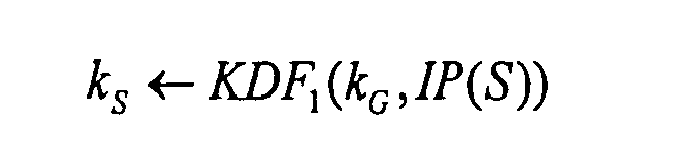
- Furthermore, for a client C with address IP(C), the tagging key used to tag any packet sent to server S is

- The interface to the tag verification means 117 in the
gate 109 can be easily implemented using these functions. Note that the client does only receive kc,s , so it does not need to know about KDF1, KDF2. - Adding a cache (not shown) in the
gate 109 for the results of key derivation does not affect the property that the scheme is stateless. However, it does improve computational efficiency of the scheme. We use two LRU (least recently used) tables in thegate 109 holding entries (IP(S),ks ) and (IP(S), IP(C), kc,s). That way we can amortize the computational complexity of the tagging key derivation over a significant number of tag verifications while the tables are easy to maintain. The achievable improvement in computation time depends on available memory at thegate 109 and the number of different flows passing the gate at any single time. - Rather than deriving all the keys from a single master key kept at the
gate 109, thegate 109 could issue a new tagging key for each single connection it encounters. In the following we describe how such an alternative keying scheme could work. - In this scheme the
gate 109 generates a session or tagging key k whenever it sees a connection initiation involving a client C and a server 5 pass by, i.e. in form of a SYN packet. It then stores k along with (C, S) and other information identifying the flow, e.g. port numbers, for future use. - Then the
gate 109 passes on the tagging key to the respective server in which theauthentication authority 113 is implemented such that the server can transport it to the client. This requires that the session or tagging key k is encrypted with some key ks shared between thegate 109 and the server 103-1. The communication between thegate 109 and the server 103-1 can be done in-band, i.e. by adding the encrypted key to the original SYN packet of the client 101-1 before passing it on to the server 103-1. To expire session keys thegate 109 has to watch the connection and know about protocol timeouts. This requires a similar state-keeping as in a stateful-inspection firewall. - For the stateless keying scheme the key sizes as well as the key derivation functions need to be specified. Given that we select CBC-MAC with AES and a key size of 128 bits for the tagging scheme, it is reasonable also use these parameters for the keying scheme. Furthermore, the key derivation functions KDF1, KDF2 can be implemented using CBC-MAC, given that it is a good pseudorandom function. This function is described, for example, by M. Bellare et al. "The security of the cipher block chaining message authentication code.", Journal of Computer and Systems Sciences, 61(3):362-399, December 2000. This way no additional code needs to be added. Concretely,


- In this section we propose methods to transport the cryptographic key generated by the
gate 109 from the server 103-1 orauthentication authority 113 to the client 101-1 at the start of the respective connection. The client uses this key to tag each packet to be sent to a server. - We employ the general idea of a CAPTCHA test (Completely Automated Public Turing Test to tell Computers and Humans Apart) to distinguish between a human user and a machine or client. The CAPTCHA test is for example described by L.v.Ahn et al. in "CHAPTCHA: Using Hard AI Problems for Security", Advances in Cryptology-EUROCRYPT 2003, vol. 2656 of Lecture Notes in Computer Science, pages 294-311, Springer Verlag.
- This way our scheme ensures that human users can still access a server even under attack. On the other hand, a malicious client, e.g. 102-1, that is potentially part of a DDoS attack network, and that can therefore not rely on help of a human user, is not able to get a valid tagging key.
- The CAPTCHAs were originally designed as tests. In this embodiment, we use a subclass of those problems that allow the user to input some information derived from a given artificial intelligence (AI) problem. In particular, such an AI problem is called a challenge. The challenge is generated by the
authentication authority 113 using a tagging key received by thegate 109. The challenge including the tagging key is then transmitted to theclients - Then we use this input for a computation that will give a cryptographic key to the client computer.
- One problem we face here is that probably only a minor fraction of potential user is willing to input the equivalent of a 128-bit tagging key, which is a tedious and error-prone task, e.g. reading the key from a distorted image. Therefore we must restrict ourselves to using only a small number of bits, resulting in a low-entropy input.
- In the following we propose two solutions that combine the CAPTCHA with a variant of IP puzzles in a way that either the user helps the client machine in solving the puzzle faster, or allows the client machine to use the solution at all. IP puzzles are known and described for example by D. Dean et al. in "Using client puzzles to protect TLS", Proceedings of the 10th USENIX Security Symposium, Washington, D.C., August 2001.
- In fact, in the first scheme the puzzle-solving is helped by the human user, while the second scheme requires a correct solution of the CAPTHCA by the user.
- In both schemes the client machine tries to obtain the key that is used by the server 103-1 or the
authentication authority 113 to encrypt the tagging key. - Our proposals are scalable in the sense that a busy server 103-1 can select which effort, e. g. in computing cycles or waiting time a client computer has to invest in order to access the server.
- The schemes make use of a preimage-resistant cryptographic hash function h (such as SHA-256) with

- The hash function SHA-256 is described, for example, in National Institute of Standards and Technology (NIST), Computer Systems Laboratory. Secure Hash Standard. Federal Information Processing Standards Publication (FIPS PUB 180-2), February 2004.
- We assume that h is either shared somehow between the client and the server or is otherwise public.
- Furthermore it should be noted that due to the way the key transport schemes are integrated into the EC communication system, the schemes need to be realized as a single round, i.e. a single back-and-forth exchange of messages. The idea is to piggyback a client-to-server message, if existing, into an initial SYN packet, while the server-to-client message is integrated into the SYN-ACK packet. Preferably, we are using in-band communication.
- With the two key transport schemes the system's designer or operator has a choice whether client machines shall be able to connect even though no human user stands essentially behind it. This choice might also be dependent on the current system and network load.
- In the first scheme, we are effectively realizing a differential work load for a client computer, i.e. a client computer and a human user working together have a vastly faster access to the tagging key than the machine alone.
- Our IP puzzle works as follows. The server 103-1 or
authentication authority 113 selects an m<n, i. e. the work factor, and a random string r* of length n. The value r* itself will not be transmitted to the client computer. Additionally the server computes
- The client is given the tuple


where kt is the tagging key to be transmitted. - In order to obtain the cleartext kt , the client needs to find rc and ru in order to retrieve r*. The client can check that it found a solution r by testing if
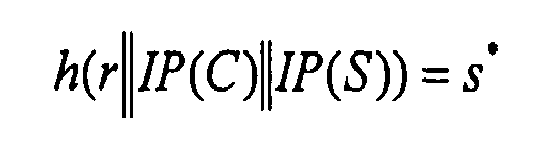
- Given that h is a cryptographic hash function that is providing some partial-input preimage resistance, this needs to be done by brute force. This allows us to roughly predict the average amount of computing time the client needs to invest. After finding r* the client can compute ke and decrypt kt.
- The CAPTCHA now plays into this by giving an additional hint on r* by providing ru in the form of a CAPTCHA, so that the user can type in ru into the client computer and thus effectively help the client computer to solve the puzzle and retrieve the tagging key.
- A slight variation of the above scheme allows making sure that the client computer can make use of the solution to the client puzzle only if a human user provides the correct solution to the CAPTCHA. The client puzzle is very similar to the one given above.
- Using the notation r*, r^, rc, ru established above, the server 103-1 selects, instead of r*, a random r^, rc, ru, computes r~ u = [h(c_u||r_u)]mu. Then we use r*=r^||rc ||r~ u and

- We propose a possible instantiation of our first scheme for key transport, the one realizing a differential work factor. We instantiate the 2nd preimage resistant hash function h with SHA-256. For the encryption function Enck(.) we employ the block cipher AES with a 128-bit key; we obtain the key ke from the output of h by truncating the output to the required size.
- The selection of mc and mu (and thus m) is critical for the security as well as the usability of the system. We assume that a graphical CAPTCHA consisting of characters and digits (and resolving some ambiguities such as '0' vs. 'O', '1' vs. '1') is acceptable. We use only the lowercase characters and convert uppercase letters if necessary. This will give us about 5 bit per character typed in by the user. In our opinion 4 characters or 20 bits in total should be acceptable. Furthermore, on a Pentium M (1.5GHz) system the implementation of SHA-256 runs at about 218 operations per second.
- This choice of mu=20 results in a differential work factor of about 220, so that a choice of mc=18 and thus m=38 should be sufficient at the current time. Solving the puzzle with human help should need about 0.5 seconds on average on the machine given as reference above. The value of mc would need to be gradually increased in the future when vastly faster machines are commonplace.
- First, we recall the requirements that the tagging scheme performed by a client must fulfill in order to efficiently and securely work. Then we describe the concrete scheme, and provide some performance figures.
- To explain the tagging scheme we assume that a client computer C wishing to communicate with a server S behind the
gate 109 has a cryptographic key kc,s that is specific to the client-server pair and possibly time-dependent or even session-dependent. Furthermore, we assume that thegate 109 itself does also know kc,s, possibly by deriving it via the keying scheme from other information known to thegate 109. - The purpose of the tagging scheme is to provide proof to the
gate 109 about the authenticity of a packet sent from the client computer C to the server S, as the gate sets -in the event of an attack or overload - the priority with which the packet is forwarded via theaccess network 107 to the server. - * Security. The tagging mechanism shall keep an adversary from learning the cryptographic key kc,s from the packets of a flow. Furthermore, an adversary shall be unable to reuse the tag from one packet to forge a valid tag for another packet, even if the adversary spoofs the client address as origin.
- * Efficiency of verification. The
gate 109 has to check every packet that is tagged, so the tagging scheme shall not impose too much computational overhead in order to keep latencies small. - It should be noted that the server S or the authentication authority does not have to cope with generation or verification of tags.
- For tagging a packet the tag generation means 116 of a client uses a special tag field in the IP header of a packet to be sent. The
gate 109 will then look for available tags in received packets, check the tags, and for example base a decision about the packet's priority on this. - Given the requirements discussed above we employ a secure Message Authentication Code (MAC) scheme, i.e. a pair of possibly randomized algorithms (Mac, Ver) for tagging packets and verification, making use of parameters k and t for tagging key and tag lengths measured in bits:


- In the following we describe the tagging and verification scheme based on these functions.
- First we describe which data from a packet P is included in the tag computation and verification. Here we distinguish between IPv4 and IPv6: For a given packet P, we use the tuples



- For IPv4 the maximal total size of M(P) is 12+12 octets or 96+96=192 bits, for IPv6 these numbers are 37+12=49 octets resp. 296+96=392 bits (where we count Flow(P) as 3 octets or 24 bits).
- Now the procedures for computing a tag at the client 101-1 and for checking a tag at
gate 109 are as follows: - * The client tries to retrieve from its internal key storage the tagging key for each packet P it sends to the server:


- * The
gate 109 maintains a label (cfg. Fig.5)

If a packet P carries a tag option, the gate obtains


gate 109 decides what further to do with the packet, e.g. forward it with high or low priority, or drop it entirely. Note, however, that dropping of SYN packets is not a good idea, as it would essentially prevent the server to be reachable. - For implementing the MAC scheme several straight-forward choices are available, such as CBC-MAC with various block ciphers or the HMAC construction, e.g. HMAC-SHA1. This choice directly affects the natural key size and maximal tag length of our scheme. For IPv4 M(P) fits into two AES blocks, so using CBC-MAC with AES would require just two encryption operations, while for IPv6 four encryption operations would be needed. In both cases HMAC-SHA1 would need, depending on implementation, 2 or 4 compression function operations, so we chose CBC-MAC with AES and a 128 bit key.
- We shorten the output of 128 bits to the first 80 bits of tag data, so that the option for IPv4, including option type and length, has a total length of 96 bits or 12 octets. This still offers a level of security against an adversary that is appropriate for our purpose.
Claims (18)
- A method for identifying and controlling unsolicited traffic in a computer network system (10), which comprises at least a first access network (105, 105a, 105b) connecting at least one source (101-1 to 101-N; 102-1 to 102-N) to a core network (104) and at least a second access network (107) connecting at least one destination (103-1 to 103-N) to said core network (104), wherein said method comprises the steps:- directing traffic units addressed to at least one destination (103-1) from the at least one source (101-1) to the gate (109) which is interconnected between the core network (104) and the second access network (107);- verifying each traffic unit at the gate (109) to determine whether or not the traffic unit has been marked validly;- identifying each traffic unit (112) as unsolicited if it has been marked invalidly or if it has not been marked at all;- controlling the flow of each traffic unit (112) having been idenitified as unsolicited in response to at least one predetermined system parameter.
- A method for identifying and controlling unsolicited traffic in a computer network system, which comprises at least a first access network (105) connecting at least one source ((101-1 to 101-N; 102-1 to 102-N) to a core network (104) and at least a second access network (107) connecting at least one destination (103-1 to 103-N) to said core network (104), wherein said method comprises the steps:- directing traffic units addressed to at least one destination (103-1) from the at least one source (103-1) to the gate (109) which is interconnected between the core network (104) and the first access network (105);- verifying each traffic unit at the gate (109) to determine whether or not the traffic unit has been marked validly;- identifying each traffic unit (112) as unsolicited if it has been marked invalidly or if it has not been marked at all;- controlling flow of each traffic unit having been identified as unsolicited in response to at least one predetermined system parameter.
- The method according to claim 1 or 2, wherein the traffic units are IP packets or TCP packets and wherein the core network (104) is the Internet.
- The method according to any one of the claims 1 to 3, wherein the step of controlling comprises the following steps:blocking, delaying and/or limiting flow of each traffic unit having been identified as unsolicited to a destination (103-1 to 103-N) in dependence of the congestion condition of the core network (104) and/or second access network (107).
- The method according to any one of the preceding claims, comprising the following steps:- Generating and transmitting a permission message to the at least one source (101-1);- Marking traffic units to be sent at the source using information from the permission message; and- Storing information relating to the permission message at the gate (104) to allow the gate to verify traffic units.
- The method according to claim 5, wherein the permission message includes a tagging key used to mark traffic units to be sent at the source.
- The method according to claim 5 or 6, wherein the permission message is transmitted in form of a challenge to be solved by the at least one source to obtain the tagging key.
- The method of claim 7, wherein the challenge is solved at the source only with an interaction of a human user.
- The method of claim 7 or 8, wherein a CAPTCHA algorithm and/or an IP puzzle algorithm are used to generate a challenge to transmit the permission message to the at least one source.
- The method of claim 6, wherein the tagging key is used in a message authentication code (MAC) to compute a tag to mark traffic units, wherein the tagging key or information to derive the tagging key is stored at the gate.
- The method of claim 10, wherein the tagging key is a cryptographic key that is used by the source to generate tags for marking traffic units and that is used by the gate to verify tags included in traffic units.
- The method according to any one of the claims 5 to 11, wherein the permission message is generated by the gate (104) and forwarded to an authentication means (113) which in turn transmits the permission message to the at least one source.
- The method according to any one of the claims 5 to 11, wherein the permission message is generated by an authentication means (113) which transmits the permission message to the at least one source and the gate.
- A computer network system for identifying and controlling unsolicited traffic, comprising
a core network (104),
at least a first access network (105; 105a, 105b),
at least one source (101-1 to 101-N; 102-1 to 102-N) connected to said first access network (105; 105a, 105b),
at least a second access network (107),
at least one destination (103-1 to 103-N) connected to said second access network (107),
at least one gate (109) located between the first access network (105; 105a, 105b) and the core network (104) and/or between the second access network (107) and the core network (104),
means (113; 114)) for generating and transmitting a permission message to the at least one source (101-1 to 101-N; 102-1 to 102-N), wherein
the at least one source (101-1 to 101-N; 102-1 to 102-N) comprises means (116) for obtaining a tagging key from that permission message used to mark traffic units addressed to a destination,
the gate (109) comprises:- storage means for storing information related to a permission message,- means (117) for verifying received traffic units on the basis of the information stored to determine whether or not the traffic units are marked validly,- means (117) for identifying each traffic unit being marked invalidly as unsolicited, and- means (117) for controlling the flow of each traffic unit being marked invalidly in response to at least one predetermined system parameter. - The computer network system according to claim 14, wherein each source (101-1 to 101-N; 102-1 to 102-N)comprises a client computer, each destination (103-1 to 103-N) comprises a server and wherein the core network (104) is the Internet.
- The computer network system according to claim 14, wherein the means for generating and transmitting a permission message to the at least one source is implemented in an authentication unit (113) which is located in a device connected to the gate (104) or in at least one destination.
- The computer network system according to claim 16, wherein the authentication unit (113) is adapted to generate a permission message in form of a challenge to be solved by the at least one source, wherein only sources (101-1 to 101-N) having solved the challenge are able to mark traffic units validly.
- A gate (109) used in a computer network system according to any one of the claims 14 to 17, comprising- storage means for storing information related to a permission message,- means (117) for verifying traffic units on the basis of the information stored to determine whether or not the traffic units are marked validly,- means (117) for identifying each traffic unit being marked invalidly as unsolicited, and- means (117) for controlling the flow of each traffic unit being marked invalidly in response to at least one predetermined system parameter.
Priority Applications (2)
| Application Number | Priority Date | Filing Date | Title |
|---|---|---|---|
| ES06007693T ES2430992T3 (en) | 2006-04-12 | 2006-04-12 | Method, computer network system and computer portal to identify and control unsolicited traffic |
| EP20060007693 EP1845468B1 (en) | 2006-04-12 | 2006-04-12 | Method, computer network system and gate for identifying and controlling unsolicited traffic |
Applications Claiming Priority (1)
| Application Number | Priority Date | Filing Date | Title |
|---|---|---|---|
| EP20060007693 EP1845468B1 (en) | 2006-04-12 | 2006-04-12 | Method, computer network system and gate for identifying and controlling unsolicited traffic |
Publications (2)
| Publication Number | Publication Date |
|---|---|
| EP1845468A1 true EP1845468A1 (en) | 2007-10-17 |
| EP1845468B1 EP1845468B1 (en) | 2013-07-17 |
Family
ID=37591834
Family Applications (1)
| Application Number | Title | Priority Date | Filing Date |
|---|---|---|---|
| EP20060007693 Expired - Lifetime EP1845468B1 (en) | 2006-04-12 | 2006-04-12 | Method, computer network system and gate for identifying and controlling unsolicited traffic |
Country Status (2)
| Country | Link |
|---|---|
| EP (1) | EP1845468B1 (en) |
| ES (1) | ES2430992T3 (en) |
Cited By (4)
| Publication number | Priority date | Publication date | Assignee | Title |
|---|---|---|---|---|
| FR2964814A1 (en) * | 2010-09-15 | 2012-03-16 | Alcatel Lucent | SECURE REGISTRATION TO A SERVICE PROVIDED BY A WEB SERVER |
| US9443075B2 (en) | 2013-06-27 | 2016-09-13 | The Mitre Corporation | Interception and policy application for malicious communications |
| CN108512768A (en) * | 2017-02-23 | 2018-09-07 | 苏宁云商集团股份有限公司 | A kind of control method and device of visit capacity |
| US11228421B1 (en) | 2017-02-03 | 2022-01-18 | Apple Inc. | Secure secrets to mitigate against attacks on cryptographic systems |
Citations (2)
| Publication number | Priority date | Publication date | Assignee | Title |
|---|---|---|---|---|
| EP1284558A1 (en) * | 2001-08-16 | 2003-02-19 | Lucent Technologies Inc. | Method and apparatus for protecting electronic commerce sites from distributed denial-of-service attacks |
| US20040230797A1 (en) * | 2002-03-16 | 2004-11-18 | Yoram Ofek | Remotely authenticated operation method |
-
2006
- 2006-04-12 EP EP20060007693 patent/EP1845468B1/en not_active Expired - Lifetime
- 2006-04-12 ES ES06007693T patent/ES2430992T3/en not_active Expired - Lifetime
Patent Citations (2)
| Publication number | Priority date | Publication date | Assignee | Title |
|---|---|---|---|---|
| EP1284558A1 (en) * | 2001-08-16 | 2003-02-19 | Lucent Technologies Inc. | Method and apparatus for protecting electronic commerce sites from distributed denial-of-service attacks |
| US20040230797A1 (en) * | 2002-03-16 | 2004-11-18 | Yoram Ofek | Remotely authenticated operation method |
Non-Patent Citations (1)
| Title |
|---|
| ANDERSON T ET AL: "PREVENTING INTERNET DENIAL-OF-SERVICE WITH CAPABILITIES", COMPUTER COMMUNICATION REVIEW, ACM, NEW YORK, NY, US, vol. 34, no. 1, January 2004 (2004-01-01), pages 39 - 44, XP001223359, ISSN: 0146-4833 * |
Cited By (10)
| Publication number | Priority date | Publication date | Assignee | Title |
|---|---|---|---|---|
| FR2964814A1 (en) * | 2010-09-15 | 2012-03-16 | Alcatel Lucent | SECURE REGISTRATION TO A SERVICE PROVIDED BY A WEB SERVER |
| WO2012035051A1 (en) * | 2010-09-15 | 2012-03-22 | Alcatel Lucent | Secure registration to a service provided by a web server |
| CN103210607A (en) * | 2010-09-15 | 2013-07-17 | 阿尔卡特朗讯公司 | Secure registration to a service provided by a web server |
| JP2013543168A (en) * | 2010-09-15 | 2013-11-28 | アルカテル−ルーセント | Secure registration for services provided by web servers |
| CN103210607B (en) * | 2010-09-15 | 2016-06-01 | 阿尔卡特朗讯公司 | The method and apparatus that the service provided by WEB server is carried out secure registration |
| US10291588B2 (en) | 2010-09-15 | 2019-05-14 | Alcatel Lucent | Secure registration to a service provided by a web server |
| US9443075B2 (en) | 2013-06-27 | 2016-09-13 | The Mitre Corporation | Interception and policy application for malicious communications |
| US11228421B1 (en) | 2017-02-03 | 2022-01-18 | Apple Inc. | Secure secrets to mitigate against attacks on cryptographic systems |
| CN108512768A (en) * | 2017-02-23 | 2018-09-07 | 苏宁云商集团股份有限公司 | A kind of control method and device of visit capacity |
| CN108512768B (en) * | 2017-02-23 | 2021-12-10 | 苏宁易购集团股份有限公司 | Access amount control method and device |
Also Published As
| Publication number | Publication date |
|---|---|
| EP1845468B1 (en) | 2013-07-17 |
| ES2430992T3 (en) | 2013-11-22 |
Similar Documents
| Publication | Publication Date | Title |
|---|---|---|
| Petullo et al. | MinimaLT: minimal-latency networking through better security | |
| CN101867473B (en) | Connection establishment method and access authentication system for blocking-attacking resistant shared media terminal | |
| CA2506418C (en) | Systems and apparatuses using identification data in network communication | |
| Joarder et al. | Exploring quic security and privacy: A comprehensive survey on quic security and privacy vulnerabilities, threats, attacks, and future research directions | |
| Lee et al. | Security Enhancement in InfiniBand Architecture. | |
| Jose et al. | Implementation of data security in cloud computing | |
| Parmar et al. | Analysis and study of network security at transport layer | |
| Joshi | Network security: know it all | |
| EP1845468B1 (en) | Method, computer network system and gate for identifying and controlling unsolicited traffic | |
| CN108282337B (en) | A Routing Protocol Reinforcement Method Based on Trusted Cryptographic Cards | |
| CN101827079A (en) | Blocking and attacking-resistant terminal connection building method and terminal access authenticating system | |
| Crope et al. | An efficient cryptographic approach for secure policy based routing:(TACIT Encryption Technique) | |
| Mao et al. | Methodical use of cryptographic transformations in authentication protocols | |
| US20080289004A1 (en) | Method and Module for Protecting Against Attacks in a High-Speed Network | |
| Singh | Network Security and Cryptography: A Qualitative Exploration and Recent Advancements | |
| Efe et al. | A hidden hazard: Man-in-the-middle attack in networks | |
| Apiecionek et al. | Authentication over internet protocol | |
| Isaiah et al. | SLECP-SDN: A Secure and Lightweight Communication Protocol in a Software-Defined Network (SDN). | |
| Budzko et al. | Analysis of the level of security provided by advanced information and communication technologies | |
| Calvert et al. | FPAC: fast, fixed-cost authentication for access to reserved resources | |
| Lee et al. | Ipbio: Embedding biometric data in ip header for per-packet authentication | |
| Bhaskar et al. | Comparison of WWW security Protocols: Secure Sockets Layer (SSL), Transport Layer Security (TLS), & Secure HTIP (S-HTIP) | |
| Reimers | On the security of TLS and IPsec: Mitigation through physical constraints | |
| Kołodziejczyk et al. | Applying of security mechanisms to middle and high layers of OSI/ISO network model | |
| Bhople | Server based DoS vulnerabilities in SSL/TLS Protocols |
Legal Events
| Date | Code | Title | Description |
|---|---|---|---|
| PUAI | Public reference made under article 153(3) epc to a published international application that has entered the european phase |
Free format text: ORIGINAL CODE: 0009012 |
|
| AK | Designated contracting states |
Kind code of ref document: A1 Designated state(s): AT BE BG CH CY CZ DE DK EE ES FI FR GB GR HU IE IS IT LI LT LU LV MC NL PL PT RO SE SI SK TR |
|
| AX | Request for extension of the european patent |
Extension state: AL BA HR MK YU |
|
| RAP1 | Party data changed (applicant data changed or rights of an application transferred) |
Owner name: DEUTSCHE TELEKOM AG |
|
| 17P | Request for examination filed |
Effective date: 20080415 |
|
| 17Q | First examination report despatched |
Effective date: 20080519 |
|
| AKX | Designation fees paid |
Designated state(s): AT BE BG CH CY CZ DE DK EE ES FI FR GB GR HU IE IS IT LI LT LU LV MC NL PL PT RO SE SI SK TR |
|
| REG | Reference to a national code |
Ref country code: DE Ref legal event code: R079 Ref document number: 602006037313 Country of ref document: DE Free format text: PREVIOUS MAIN CLASS: G06F0021000000 Ipc: H04L0029060000 |
|
| GRAP | Despatch of communication of intention to grant a patent |
Free format text: ORIGINAL CODE: EPIDOSNIGR1 |
|
| RIC1 | Information provided on ipc code assigned before grant |
Ipc: H04L 29/06 20060101AFI20130118BHEP Ipc: G06F 21/55 20130101ALI20130118BHEP |
|
| GRAS | Grant fee paid |
Free format text: ORIGINAL CODE: EPIDOSNIGR3 |
|
| GRAA | (expected) grant |
Free format text: ORIGINAL CODE: 0009210 |
|
| AK | Designated contracting states |
Kind code of ref document: B1 Designated state(s): AT BE BG CH CY CZ DE DK EE ES FI FR GB GR HU IE IS IT LI LT LU LV MC NL PL PT RO SE SI SK TR |
|
| REG | Reference to a national code |
Ref country code: GB Ref legal event code: FG4D |
|
| REG | Reference to a national code |
Ref country code: CH Ref legal event code: EP |
|
| REG | Reference to a national code |
Ref country code: IE Ref legal event code: FG4D |
|
| REG | Reference to a national code |
Ref country code: AT Ref legal event code: REF Ref document number: 622776 Country of ref document: AT Kind code of ref document: T Effective date: 20130815 |
|
| REG | Reference to a national code |
Ref country code: DE Ref legal event code: R096 Ref document number: 602006037313 Country of ref document: DE Effective date: 20130912 |
|
| REG | Reference to a national code |
Ref country code: NL Ref legal event code: T3 |
|
| REG | Reference to a national code |
Ref country code: ES Ref legal event code: FG2A Ref document number: 2430992 Country of ref document: ES Kind code of ref document: T3 Effective date: 20131122 |
|
| REG | Reference to a national code |
Ref country code: AT Ref legal event code: MK05 Ref document number: 622776 Country of ref document: AT Kind code of ref document: T Effective date: 20130717 |
|
| REG | Reference to a national code |
Ref country code: LT Ref legal event code: MG4D |
|
| PG25 | Lapsed in a contracting state [announced via postgrant information from national office to epo] |
Ref country code: LT Free format text: LAPSE BECAUSE OF FAILURE TO SUBMIT A TRANSLATION OF THE DESCRIPTION OR TO PAY THE FEE WITHIN THE PRESCRIBED TIME-LIMIT Effective date: 20130717 Ref country code: SE Free format text: LAPSE BECAUSE OF FAILURE TO SUBMIT A TRANSLATION OF THE DESCRIPTION OR TO PAY THE FEE WITHIN THE PRESCRIBED TIME-LIMIT Effective date: 20130717 Ref country code: CY Free format text: LAPSE BECAUSE OF FAILURE TO SUBMIT A TRANSLATION OF THE DESCRIPTION OR TO PAY THE FEE WITHIN THE PRESCRIBED TIME-LIMIT Effective date: 20130724 Ref country code: PT Free format text: LAPSE BECAUSE OF FAILURE TO SUBMIT A TRANSLATION OF THE DESCRIPTION OR TO PAY THE FEE WITHIN THE PRESCRIBED TIME-LIMIT Effective date: 20131118 Ref country code: IS Free format text: LAPSE BECAUSE OF FAILURE TO SUBMIT A TRANSLATION OF THE DESCRIPTION OR TO PAY THE FEE WITHIN THE PRESCRIBED TIME-LIMIT Effective date: 20131117 Ref country code: BE Free format text: LAPSE BECAUSE OF FAILURE TO SUBMIT A TRANSLATION OF THE DESCRIPTION OR TO PAY THE FEE WITHIN THE PRESCRIBED TIME-LIMIT Effective date: 20130717 Ref country code: AT Free format text: LAPSE BECAUSE OF FAILURE TO SUBMIT A TRANSLATION OF THE DESCRIPTION OR TO PAY THE FEE WITHIN THE PRESCRIBED TIME-LIMIT Effective date: 20130717 |
|
| PG25 | Lapsed in a contracting state [announced via postgrant information from national office to epo] |
Ref country code: PL Free format text: LAPSE BECAUSE OF FAILURE TO SUBMIT A TRANSLATION OF THE DESCRIPTION OR TO PAY THE FEE WITHIN THE PRESCRIBED TIME-LIMIT Effective date: 20130717 Ref country code: LV Free format text: LAPSE BECAUSE OF FAILURE TO SUBMIT A TRANSLATION OF THE DESCRIPTION OR TO PAY THE FEE WITHIN THE PRESCRIBED TIME-LIMIT Effective date: 20130717 Ref country code: SI Free format text: LAPSE BECAUSE OF FAILURE TO SUBMIT A TRANSLATION OF THE DESCRIPTION OR TO PAY THE FEE WITHIN THE PRESCRIBED TIME-LIMIT Effective date: 20130717 Ref country code: GR Free format text: LAPSE BECAUSE OF FAILURE TO SUBMIT A TRANSLATION OF THE DESCRIPTION OR TO PAY THE FEE WITHIN THE PRESCRIBED TIME-LIMIT Effective date: 20131018 Ref country code: FI Free format text: LAPSE BECAUSE OF FAILURE TO SUBMIT A TRANSLATION OF THE DESCRIPTION OR TO PAY THE FEE WITHIN THE PRESCRIBED TIME-LIMIT Effective date: 20130717 |
|
| PG25 | Lapsed in a contracting state [announced via postgrant information from national office to epo] |
Ref country code: CY Free format text: LAPSE BECAUSE OF FAILURE TO SUBMIT A TRANSLATION OF THE DESCRIPTION OR TO PAY THE FEE WITHIN THE PRESCRIBED TIME-LIMIT Effective date: 20130717 |
|
| PG25 | Lapsed in a contracting state [announced via postgrant information from national office to epo] |
Ref country code: DK Free format text: LAPSE BECAUSE OF FAILURE TO SUBMIT A TRANSLATION OF THE DESCRIPTION OR TO PAY THE FEE WITHIN THE PRESCRIBED TIME-LIMIT Effective date: 20130717 Ref country code: EE Free format text: LAPSE BECAUSE OF FAILURE TO SUBMIT A TRANSLATION OF THE DESCRIPTION OR TO PAY THE FEE WITHIN THE PRESCRIBED TIME-LIMIT Effective date: 20130717 Ref country code: SK Free format text: LAPSE BECAUSE OF FAILURE TO SUBMIT A TRANSLATION OF THE DESCRIPTION OR TO PAY THE FEE WITHIN THE PRESCRIBED TIME-LIMIT Effective date: 20130717 Ref country code: CZ Free format text: LAPSE BECAUSE OF FAILURE TO SUBMIT A TRANSLATION OF THE DESCRIPTION OR TO PAY THE FEE WITHIN THE PRESCRIBED TIME-LIMIT Effective date: 20130717 Ref country code: RO Free format text: LAPSE BECAUSE OF FAILURE TO SUBMIT A TRANSLATION OF THE DESCRIPTION OR TO PAY THE FEE WITHIN THE PRESCRIBED TIME-LIMIT Effective date: 20130717 |
|
| PLBE | No opposition filed within time limit |
Free format text: ORIGINAL CODE: 0009261 |
|
| STAA | Information on the status of an ep patent application or granted ep patent |
Free format text: STATUS: NO OPPOSITION FILED WITHIN TIME LIMIT |
|
| 26N | No opposition filed |
Effective date: 20140422 |
|
| REG | Reference to a national code |
Ref country code: DE Ref legal event code: R097 Ref document number: 602006037313 Country of ref document: DE Effective date: 20140422 |
|
| PG25 | Lapsed in a contracting state [announced via postgrant information from national office to epo] |
Ref country code: MC Free format text: LAPSE BECAUSE OF FAILURE TO SUBMIT A TRANSLATION OF THE DESCRIPTION OR TO PAY THE FEE WITHIN THE PRESCRIBED TIME-LIMIT Effective date: 20130717 Ref country code: LU Free format text: LAPSE BECAUSE OF FAILURE TO SUBMIT A TRANSLATION OF THE DESCRIPTION OR TO PAY THE FEE WITHIN THE PRESCRIBED TIME-LIMIT Effective date: 20140412 |
|
| REG | Reference to a national code |
Ref country code: CH Ref legal event code: PL |
|
| REG | Reference to a national code |
Ref country code: IE Ref legal event code: MM4A |
|
| PG25 | Lapsed in a contracting state [announced via postgrant information from national office to epo] |
Ref country code: LI Free format text: LAPSE BECAUSE OF NON-PAYMENT OF DUE FEES Effective date: 20140430 Ref country code: CH Free format text: LAPSE BECAUSE OF NON-PAYMENT OF DUE FEES Effective date: 20140430 |
|
| PG25 | Lapsed in a contracting state [announced via postgrant information from national office to epo] |
Ref country code: IE Free format text: LAPSE BECAUSE OF NON-PAYMENT OF DUE FEES Effective date: 20140412 |
|
| REG | Reference to a national code |
Ref country code: FR Ref legal event code: PLFP Year of fee payment: 11 |
|
| PG25 | Lapsed in a contracting state [announced via postgrant information from national office to epo] |
Ref country code: BG Free format text: LAPSE BECAUSE OF FAILURE TO SUBMIT A TRANSLATION OF THE DESCRIPTION OR TO PAY THE FEE WITHIN THE PRESCRIBED TIME-LIMIT Effective date: 20130717 |
|
| PG25 | Lapsed in a contracting state [announced via postgrant information from national office to epo] |
Ref country code: HU Free format text: LAPSE BECAUSE OF FAILURE TO SUBMIT A TRANSLATION OF THE DESCRIPTION OR TO PAY THE FEE WITHIN THE PRESCRIBED TIME-LIMIT; INVALID AB INITIO Effective date: 20060412 Ref country code: TR Free format text: LAPSE BECAUSE OF FAILURE TO SUBMIT A TRANSLATION OF THE DESCRIPTION OR TO PAY THE FEE WITHIN THE PRESCRIBED TIME-LIMIT Effective date: 20130717 |
|
| REG | Reference to a national code |
Ref country code: FR Ref legal event code: PLFP Year of fee payment: 12 |
|
| REG | Reference to a national code |
Ref country code: FR Ref legal event code: PLFP Year of fee payment: 13 |
|
| PGFP | Annual fee paid to national office [announced via postgrant information from national office to epo] |
Ref country code: DE Payment date: 20210421 Year of fee payment: 16 Ref country code: FR Payment date: 20210421 Year of fee payment: 16 Ref country code: IT Payment date: 20210430 Year of fee payment: 16 |
|
| PGFP | Annual fee paid to national office [announced via postgrant information from national office to epo] |
Ref country code: GB Payment date: 20210422 Year of fee payment: 16 Ref country code: ES Payment date: 20210519 Year of fee payment: 16 |
|
| PGFP | Annual fee paid to national office [announced via postgrant information from national office to epo] |
Ref country code: NL Payment date: 20210421 Year of fee payment: 16 |
|
| REG | Reference to a national code |
Ref country code: DE Ref legal event code: R079 Ref document number: 602006037313 Country of ref document: DE Free format text: PREVIOUS MAIN CLASS: H04L0029060000 Ipc: H04L0065000000 |
|
| REG | Reference to a national code |
Ref country code: DE Ref legal event code: R119 Ref document number: 602006037313 Country of ref document: DE |
|
| REG | Reference to a national code |
Ref country code: NL Ref legal event code: MM Effective date: 20220501 |
|
| GBPC | Gb: european patent ceased through non-payment of renewal fee |
Effective date: 20220412 |
|
| PG25 | Lapsed in a contracting state [announced via postgrant information from national office to epo] |
Ref country code: NL Free format text: LAPSE BECAUSE OF NON-PAYMENT OF DUE FEES Effective date: 20220501 Ref country code: GB Free format text: LAPSE BECAUSE OF NON-PAYMENT OF DUE FEES Effective date: 20220412 Ref country code: FR Free format text: LAPSE BECAUSE OF NON-PAYMENT OF DUE FEES Effective date: 20220430 Ref country code: DE Free format text: LAPSE BECAUSE OF NON-PAYMENT OF DUE FEES Effective date: 20221103 |
|
| REG | Reference to a national code |
Ref country code: ES Ref legal event code: FD2A Effective date: 20230526 |
|
| PG25 | Lapsed in a contracting state [announced via postgrant information from national office to epo] |
Ref country code: IT Free format text: LAPSE BECAUSE OF NON-PAYMENT OF DUE FEES Effective date: 20220412 |
|
| PG25 | Lapsed in a contracting state [announced via postgrant information from national office to epo] |
Ref country code: ES Free format text: LAPSE BECAUSE OF NON-PAYMENT OF DUE FEES Effective date: 20220413 |