EP1865718A2 - Mobile terminal and method of visual data processing - Google Patents
Mobile terminal and method of visual data processing Download PDFInfo
- Publication number
- EP1865718A2 EP1865718A2 EP07008328A EP07008328A EP1865718A2 EP 1865718 A2 EP1865718 A2 EP 1865718A2 EP 07008328 A EP07008328 A EP 07008328A EP 07008328 A EP07008328 A EP 07008328A EP 1865718 A2 EP1865718 A2 EP 1865718A2
- Authority
- EP
- European Patent Office
- Prior art keywords
- terminal
- image
- photographing function
- visual
- mobile terminal
- Prior art date
- Legal status (The legal status is an assumption and is not a legal conclusion. Google has not performed a legal analysis and makes no representation as to the accuracy of the status listed.)
- Granted
Links
- 230000000007 visual effect Effects 0.000 title claims abstract description 196
- 238000000034 method Methods 0.000 title claims description 35
- 238000004891 communication Methods 0.000 claims abstract description 143
- 230000004913 activation Effects 0.000 claims abstract description 12
- 230000003213 activating effect Effects 0.000 claims description 11
- 238000003672 processing method Methods 0.000 abstract description 4
- 238000010586 diagram Methods 0.000 description 8
- 230000008901 benefit Effects 0.000 description 4
- 238000012986 modification Methods 0.000 description 4
- 230000004048 modification Effects 0.000 description 4
- 230000009849 deactivation Effects 0.000 description 3
- 238000010295 mobile communication Methods 0.000 description 3
- 230000008569 process Effects 0.000 description 2
- 208000006930 Pseudomyxoma Peritonei Diseases 0.000 description 1
- 230000005540 biological transmission Effects 0.000 description 1
- 230000000694 effects Effects 0.000 description 1
- 229920001690 polydopamine Polymers 0.000 description 1
- 229920000306 polymethylpentene Polymers 0.000 description 1
Images





Classifications
-
- H—ELECTRICITY
- H04—ELECTRIC COMMUNICATION TECHNIQUE
- H04B—TRANSMISSION
- H04B1/00—Details of transmission systems, not covered by a single one of groups H04B3/00 - H04B13/00; Details of transmission systems not characterised by the medium used for transmission
- H04B1/38—Transceivers, i.e. devices in which transmitter and receiver form a structural unit and in which at least one part is used for functions of transmitting and receiving
- H04B1/40—Circuits
-
- H—ELECTRICITY
- H04—ELECTRIC COMMUNICATION TECHNIQUE
- H04N—PICTORIAL COMMUNICATION, e.g. TELEVISION
- H04N7/00—Television systems
- H04N7/14—Systems for two-way working
- H04N7/141—Systems for two-way working between two video terminals, e.g. videophone
- H04N7/142—Constructional details of the terminal equipment, e.g. arrangements of the camera and the display
-
- H—ELECTRICITY
- H04—ELECTRIC COMMUNICATION TECHNIQUE
- H04N—PICTORIAL COMMUNICATION, e.g. TELEVISION
- H04N1/00—Scanning, transmission or reproduction of documents or the like, e.g. facsimile transmission; Details thereof
- H04N1/00127—Connection or combination of a still picture apparatus with another apparatus, e.g. for storage, processing or transmission of still picture signals or of information associated with a still picture
- H04N1/00281—Connection or combination of a still picture apparatus with another apparatus, e.g. for storage, processing or transmission of still picture signals or of information associated with a still picture with a telecommunication apparatus, e.g. a switched network of teleprinters for the distribution of text-based information, a selective call terminal
- H04N1/00307—Connection or combination of a still picture apparatus with another apparatus, e.g. for storage, processing or transmission of still picture signals or of information associated with a still picture with a telecommunication apparatus, e.g. a switched network of teleprinters for the distribution of text-based information, a selective call terminal with a mobile telephone apparatus
-
- H—ELECTRICITY
- H04—ELECTRIC COMMUNICATION TECHNIQUE
- H04N—PICTORIAL COMMUNICATION, e.g. TELEVISION
- H04N1/00—Scanning, transmission or reproduction of documents or the like, e.g. facsimile transmission; Details thereof
- H04N1/0035—User-machine interface; Control console
- H04N1/00405—Output means
- H04N1/00408—Display of information to the user, e.g. menus
- H04N1/0044—Display of information to the user, e.g. menus for image preview or review, e.g. to help the user position a sheet
-
- H—ELECTRICITY
- H04—ELECTRIC COMMUNICATION TECHNIQUE
- H04N—PICTORIAL COMMUNICATION, e.g. TELEVISION
- H04N1/00—Scanning, transmission or reproduction of documents or the like, e.g. facsimile transmission; Details thereof
- H04N1/00912—Arrangements for controlling a still picture apparatus or components thereof not otherwise provided for
- H04N1/00915—Assigning priority to, or interrupting, a particular operation
-
- H—ELECTRICITY
- H04—ELECTRIC COMMUNICATION TECHNIQUE
- H04N—PICTORIAL COMMUNICATION, e.g. TELEVISION
- H04N7/00—Television systems
- H04N7/14—Systems for two-way working
-
- H—ELECTRICITY
- H04—ELECTRIC COMMUNICATION TECHNIQUE
- H04N—PICTORIAL COMMUNICATION, e.g. TELEVISION
- H04N7/00—Television systems
- H04N7/14—Systems for two-way working
- H04N7/141—Systems for two-way working between two video terminals, e.g. videophone
- H04N7/147—Communication arrangements, e.g. identifying the communication as a video-communication, intermediate storage of the signals
-
- H—ELECTRICITY
- H04—ELECTRIC COMMUNICATION TECHNIQUE
- H04N—PICTORIAL COMMUNICATION, e.g. TELEVISION
- H04N7/00—Television systems
- H04N7/14—Systems for two-way working
- H04N7/141—Systems for two-way working between two video terminals, e.g. videophone
- H04N7/142—Constructional details of the terminal equipment, e.g. arrangements of the camera and the display
- H04N2007/145—Handheld terminals
-
- H—ELECTRICITY
- H04—ELECTRIC COMMUNICATION TECHNIQUE
- H04N—PICTORIAL COMMUNICATION, e.g. TELEVISION
- H04N2101/00—Still video cameras
Definitions
- the present invention is directed to a mobile terminal, and more particularly, to a mobile terminal and visual data processing method.
- the present invention is suitable for a wide scope of applications, it is particularly suitable for a mobile terminal provided with a visual communication function.
- Mobile terminals equipped with various cameras for photographing objects and storing the photographs as image files have been developed.
- a mobile terminal equipped with a camera also facilitates visual communication.
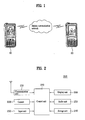
- FIG. 1 is an exemplary diagram for explaining a related art visual communication. As illustrated in FIG. 1, communications are facilitated via display screens of terminals 10, 20 while users are viewing each other.
- a camera can be provided in each of the terminals 10, 20 in various ways.
- a camera can be provided in the same direction as a display screen.
- a camera can be provided in a direction opposite to that of a display screen.
- a camera should face a user for a visual communication.
- a user is unable to capture images, such as a photograph or moving picture, during the course of a visual communication. Therefore, a user must enter a camera photographing menu after stopping the visual communication in order to photograph an image.
- an image can be stored during the course of a visual communication for transmission to another user's terminal.
- a quality of the image stored during the course of the visual communication is inferior to an image photographed using the camera photographing menu.
- a method of processing visual data in a mobile terminal includes establishing visual communication with another terminal, receiving a request to activate an image photographing function while the visual communication is in progress and activating the image photographing function while maintaining the visual communication.
- receiving the request to activate the image photographing function includes at least one detecting selection of an image photographing menu, detecting entry of a previously set key signal and detecting rotation of a camera. It is further contemplated that the method further includes displaying both a preview image received from a camera and visual data received from the other terminal on a display unit.
- the method further includes transmitting at least one image to the other terminal when the image photographing function is activated. It is further contemplated that the at least one image includes one of a preview image received from a camera, a last visual communication frame image prior to activating the image photographing function and an image stored by a user of the mobile terminal.
- the method further includes deactivating the image photographing function upon completion of image photographing. It is further contemplated that the method further includes transmitting a photographed image to the other terminal according to a selection made by a user of the mobile terminal.
- a mobile terminal in another aspect of the present invention, includes a camera, a communication unit performing visual communication with another terminal, a storage unit storing at least one image, a display unit displaying visual data related to the visual communication and a control unit controlling the camera to perform an image photographing function when an activation signal is received, wherein the visual communication with the other terminal is maintained while the image photographing function is performed if the activation signal is received while the visual communication is in progress.
- the activation signal includes at least one of a signal for selecting an image photographing menu, a preset key signal and a signal indicating rotation of the camera. It is further contemplated that the control unit displays both a preview image received from the camera and visual data received from the other terminal on the display unit.
- control unit transmits the at least one image to the other terminal when the image photographing function is activated, the at least one image transmitted via the communication unit.
- the at least image includes one of a preview image received from the camera, a last visual communication image prior to activation of the image photographing function and an image stored by a user of the mobile terminal.
- control unit deactivates the image photographing function upon completion of image photographing.
- control unit transmits a photographed image to the other terminal via the communicating unit according to a selection made by a user of the mobile terminal.
- a method of processing visual data in a mobile terminal includes establishing visual communication with another terminal, displaying visual data of the other terminal, determining that the other terminal activates an image photographing function while the visual communication is in progress and replacing the visual data of the other terminal with a replacement image.
- determining that the other terminal activates the image photographing function comprises at least one of receiving a signal from the other terminal (FIG. 8), determining that visual data of the other terminal is not received for a preset time while the visual communication is in progress, and determining that a photographed image is received from the other terminal.
- the replacement image is at least one of an image received from the other terminal, a preview image received from a camera, a last visual communication frame image before the other terminal activated the image photographing function and an image stored by a user of the mobile terminal.
- a mobile terminal in another aspect of the present invention, includes a camera, a communication unit establishing visual communication with another terminal, a display unit displaying visual data of the other terminal, a storage unit storing a replacement image and a control unit determining that the other terminal activates an image photographing function while the visual communication is in progress and replacing the visual data of the other terminal on the display unit with the replacement image.
- control unit determines that the other terminal activates the image photographing function comprises receiving a signal from the other terminal, determining that visual data of the other terminal is not received for a preset time while the visual communication is in progress, and receiving a photographed image from the other terminal.
- the replacement image is at least one of an image received from the other terminal, a preview image received from a camera, a last visual communication frame image before the other terminal activated the image photographing function and an image stored by a user of the mobile terminal.
- FIG. 1 is an exemplary diagram for explaining a related art visual communication.
- FIG. 2 is a block diagram of a mobile terminal provided with a visual communication function according to the present invention.
- FIG. 3 is a flowchart of a method of processing visual data in a mobile terminal according to a first embodiment of the present invention.
- FIGS. 4A to 4G are diagrams illustrating the method of processing visual data in a mobile terminal according to the first embodiment of the present invention.
- FIG. 5 is a flowchart of a method of processing visual data in a mobile terminal according to a second embodiment of the present invention.
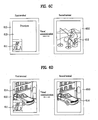
- FIGS. 6A to 6D are diagrams illustrating the method of processing visual data in a mobile terminal according to the second embodiment of the present invention.
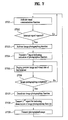
- FIG. 7 is a flowchart of an operational process of the first terminal in visual data communicating with a second terminal according to a third embodiment of the present invention.
- FIG. 8 is a flowchart of an operational process of the second terminal in visual data communicating with the first terminal according to a third embodiment of the present invention.
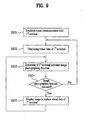
- FIG. 9 is a flowchart of a method of processing visual data in a second terminal according to a fourth embodiment of the present invention.
- the present invention is applicable to various types of terminals, such as game players, digital cameras, PMPs, digital broadcast receiving terminals, PDAs, mobile phones, and smart phones.
- terminals such as game players, digital cameras, PMPs, digital broadcast receiving terminals, PDAs, mobile phones, and smart phones.
- a mobile terminal such as a mobile phone.
- the present invention is not limited to a mobile terminal.
- a mobile terminal according to the present invention is equipped with a visual communication function.
- the mobile terminal according to the present invention has access to a mobile communication network or a wireless Internet in order to perform the visual communication function.
- visual communication between mobile terminals can be accomplished via the mobile communication network and visual communication between a mobile terminal and a personal computer can be accomplished via the wireless Internet.
- the mobile terminal according to the present invention can also utilize ad-hoc communication for performing communication without access points.
- the mobile terminal according to the present invention is capable of performing group communications, including point-to-multipoint visual communication, as well as a point-to-point visual communication, the details of which are omitted in the following description. However, It will be apparent that the present invention is not so limited.
- An image photographing function of the present invention corresponds to a related art menu function to facilitate picture photographing, moving picture photographing, or special photographing using a camera. Specifically, a user is able to enter a mode for performing an image photographing function during the course of a visual communication.
- FIG. 2 is a block diagram of a mobile terminal 200 provided with a visual communication function according to the present invention.
- the mobile terminal 200 includes a communication unit 210, a camera 220, an input unit 230, a storage unit 240, an audio unit 250, a display unit 260, and a control unit 270.
- the control unit 270 controls overall operations of the mobile terminal 200.
- the communication unit 210 receives signals for visual communication with another terminal using a mobile communication network. Specifically, the communication unit 210 modulates visual data input from the camera 220 into a wireless signal and then transmits the modulated wireless signal to the other terminal.
- the communication unit 210 demodulates a wireless signal received from the other terminal into visual data and then outputs video and audio for the demodulated visual data to the display unit 260 and the audio unit 250, respectively, under control of the control unit 270.
- the communication unit 210 can include various communication modules.
- the communication unit 210 can include a Bluetooth module for short-distance wireless communication with the other terminal, an IrDA (infrared data association) module, or a Zigbee module.
- the camera 220 converts an image incident on a lens to an electrical signal and then outputs the electrical signal.
- the input unit 230 includes a plurality of numeral keys and function keys and outputs key signals for the keys to the control unit 270.
- the input unit 230 includes a separate key to generate a signal to the control unit 270 for activating a photographing function while a visual communication is maintained according to the present invention.
- the input unit 230 can include a touch pad or touch screen.
- the storage unit 240 stores programs for controlling overall operations of the mobile terminal 200 and various types of data input/output when performing a control operation of the mobile terminal 200.
- the storage unit 240 also stores an image photographed using the image photographing function as well as visual data received from another terminal while visual communication is maintained with the other terminal.
- the audio unit 250 converts sound data stored in the storage unit 240 to an analog signal under the control of the control unit 270 and then outputs the analog signal to a speaker.
- the audio unit 250 also converts audio corresponding to the visual data demodulated by the communication unit 210 to an analog signal and then outputs the analog signal to the speaker.
- the display unit 260 displays data corresponding to the key signal of the input unit 230.
- the display unit 260 also displays an operational status of the mobile terminal 200 and a plurality of information as icons and characters.
- the display unit 260 displays preview visual data received from the camera 220 and displays visual data of the other terminal received from the communication unit on a visual communication screen under the control of the control unit 270.
- the display unit 260 is able to display both the preview visual data received from the camera 220 and the visual data of the other terminal together.
- FIG. 3 is a flowchart of a method of processing visual data in a terminal 200 according to a first embodiment of the present invention.
- a visual communication function is activated to perform visual communication with another terminal (S301).
- the control unit 270 activates an image photographing function while maintaining the visual communication function (S303).
- the activated image photographing function is executed in addition to the visual communication function instead of terminating the visual communication function.
- the interrupt signal is a signal for activating the image photographing function according to the present invention.
- the interrupt signal may be a signal generated when a user of the terminal 200 selects an image photographing menu via the input unit 230.
- the interrupt signal may be a signal generated by an image photographing dedicated key provided on one side of the terminal 200.
- the interrupt signal may be a signal generated by detecting rotation when the user of the terminal 200 rotates the camera 220, which was facing the user.
- the control unit 270 displays a preview image received from the camera 220 and visual data of the other terminal on the display unit 260 when the image photographing function is activated (S304).
- the control unit 270 is able to display both the preview image and the visual data of the second terminal according to a user's selection.
- the preview image and the visual data are displayed such that the size of the displayed preview image differs from the size of the displayed visual data of the other terminal.
- the control unit 270 deactivates the image photographing function (S306), transmits the photographed image (S307) and then returns to the visual communication function. Specifically, the control unit 270 returns to the visual communication function and transmits visual communication data received from the camera to the correspondent terminal when the image photographing function is completed.
- the control unit 270 also stores the photographed image in the storage unit 240.
- FIGS. 4A to 4G are diagrams for explaining the method of processing visual data in a mobile terminal according to the first embodiment of the present invention.
- a first screen 410 is a visual communication screen of a first terminal and a second screen 450 is a visual communication screen of a second terminal.
- visual data 411 of the second terminal is displayed on the first screen 410 and visual data 451 of the first terminal is displayed on the second screen 450, as illustrated in FIG. 4A.
- the first terminal activates the image photographing function and displays a preview image 412 currently received from a camera and the visual data 411 of the second terminal when a signal for activating the image photographing function is input by a user.
- the first terminal displays the preview image 412 and the visual data 411 of the second terminal in various forms according to a user's selection.
- the first terminal may display only the preview image 412, as illustrated in FIG 4B.
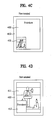
- the first terminal may display both the preview image 412 and the visual data 411 of the second terminal together such that the preview image is larger than the visual data, as illustrated in FIG 4C.
- the first terminal may display both the preview image 412 and the visual data 411 of the second terminal together such that the visual data of the second terminal is larger than the preview image, as illustrated in FIG. 4D.
- the first terminal transmits the photographed image to the second terminal, deactivates the image photographing function and then returns to the visual communication function, as illustrated in FIG. 4F.
- the image 413 received from the first terminal is displayed on the second screen 450 of the second terminal, as illustrated in FIG. 4G.
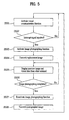
- FIG. 5 is a flowchart of a method of processing visual data in a mobile terminal 200 according to a second embodiment of the present invention.
- a visual communication function is activated to perform visual communication with another terminal (S501).
- the control unit 270 activates an image photographing function while maintaining the visual communication function (S503).
- the image photographing function is executed, in addition to the visual communication function instead of terminating the visual communication function.
- the interrupt signal is a signal for activating the image photographing function according to the present invention.
- the interrupt signal may be the signal generated when a user of the terminal 200 selects an image photographing menu using the input unit 230.
- the interrupt signal may be a signal generated by an image photographing dedicated key provided on one side of the first terminal.
- the interrupt signal may be a signal generated by detecting a rotation of the camera 220 when the user of the terminal 200 rotates the camera 220, which was facing the user.
- the control unit 270 transmits an image previously stored in the storage unit 240 of the terminal to the other terminal via the communication unit 210 (S504) to replace the visual data when the image photographing function is activated.
- the control unit 270 transmits the replacement image according to a user's selection.
- the replacement image may include a preview image received from the camera 220 while the image photographing function is activated.
- the replacement image may include a last visual communication frame image before the image photographing function was activated.
- the replacement image may include an image stored by a user.
- the replacement image may include at least one of a still image, a combination of a still image and audio and a combination of a moving picture and audio.
- the camera 220 performs an image photographing operation instead of an operation for a visual communication if the image photographing function is activated while the terminal maintains a visual communication function. Since no visual data is transmitted to the other terminal while the image photographing function is activated, a user of the other terminal may experience a disconnection of the visual communication. Therefore, the replacement image is transmitted to the other terminal to replace the image of the first terminal's user while the image photographing function is performed.
- the control unit 270 displays a preview image received from the camera 220 and visual data of the other terminal on the display unit 260 (S505) after the replacement image is transmitted to the other terminal.
- the control unit 270 displays the preview image separate from the visual data of the other terminal according to a user's selection such that the displayed preview image and the displayed visual data of the other terminal differ in size.
- the control unit 270 of the other terminal displays both the preview image and the replacement image on the display unit 260 such that the displayed preview image and the displayed replacement image differ in size.
- the control unit 270 deactivates the image photographing function and returns to the visual communication function (S507) when the image photographing function is completed (S506). Specifically, the control unit 270 returns to the visual communication function and transmits visual communication data, such as the photographed image received from the camera 220, to the other terminal (S508) according to a user's selection. The control unit 270 also stores the photographed image in the storage unit 240.
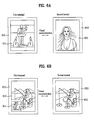
- FIGS. 6A to 6D are diagrams for explaining the method of processing visual data in a mobile terminal according to the second embodiment of the present invention.
- a first screen 610 is a visual communication screen of a first terminal and a second screen 650 is a visual communication screen of a second terminal.
- visual data 611 of the second terminal is displayed on the first screen 610 and visual data 651 of the first terminal is displayed on the second screen 650, as illustrated in FIG. 6A.
- the first terminal activates the image photographing function and transmits a replacement image 612 to the second terminal when a user inputs a signal for activating the image photographing function.
- the first terminal displays both the replacement image 612 and the visual data 611 of the second terminal and the second terminal displays the replacement image 612 received from the first terminal, as illustrated in FIG. 6B.
- the first terminal displays both the preview image 613 currently received from the camera 220 and the visual data 611 of the second terminal after transmitting the replacement image 612, as illustrated in FIG. 6C.
- the first terminal transmits the photographed image to the second terminal, as illustrated in FIG. 6D, deactivates the image photographing function and returns to the visual communication function, as illustrated in FIG. 6A.
- the second terminal switches the to the visual communication screen, as illustrated in FIG. 6A.
- FIG. 7 is a flowchart of a method of a first terminal in communication with a second terminal according to a third embodiment of the present invention.
- a visual communication function is activated to perform visual communication with a second terminal (S701).
- an interrupt signal is received via the input unit 230 during the visual communication (S702)
- the control unit 270 of the first terminal activates an image photographing function while maintaining the visual communication function (S703) .
- the control unit 270 at the first terminal transmits a first signal indicating activation of the image photographing function to the second terminal via the communication unit 210 (S704) when the image photographing function is activated.
- the control unit 270 of the first terminal displays a preview image received from the camera 220 and visual data of the second terminal on the display unit 260 (S705) after the first signal has been transmitted to the second terminal.
- the control unit 270 of the first terminal displays the preview image separate from the visual data of the second terminal according to a user's selection such that the displayed preview image and the displayed visual data of the second terminal differ in size.
- the control unit 270 of the first terminal deactivates the image photographing function and returns to the visual communication function (S707) when the image photographing function is completed (S706).
- the control unit 270 of the first terminal then transmits a second signal indicating deactivation of the image photographing function to the second terminal via the communication unit 210 (S708).
- the control unit 270 of the first terminal then transmits the photographed image to the second terminal (S709).
- the step of transmitting the second signal may be omitted. If the second terminal receives the photographed image without receiving the second signal, the second terminal recognizes reception of the image as deactivation of the image photographing function of the first terminal.
- FIG. 8 is a flowchart of a method of the second terminal in communication with the first terminal according to the third embodiment of the present invention. As illustrated in FIG. 8, the second terminal establishes visual communication with the first terminal (S801) and displays visual data received from the first terminal on a visual communication screen (S802).
- the second terminal Upon receiving the first signal indicating activation of the image photographing function in the first terminal (S803), the second terminal displays a replacement image instead of the visual data of the first terminal on the visual communication screen (S804).
- the replacement image includes an image selected by a user of the second terminal from among images stored in the storage unit 240 of the second terminal.
- the replacement image may include at least one of a still image, a combination of a still image and audio, and a combination of a moving picture and audio.
- the second terminal Upon receiving the second signal indicating deactivation of the image photographing function of the first terminal (S805) while displaying the replacement image on the visual communication screen, the second terminal returns to step S802, stops displaying the replacement image and displays the visual data of the first terminal again (S802).
- the second terminal displays the image photographed by the first terminal if it is included in the second signal.
- the second terminal displays the image photographed by the first terminal for a predetermined time and then displays the visual data of the first terminal if the image photographed by the first terminal is received instead of the second signal.
- FIG. 9 is a flowchart of a method of processing visual data in a second terminal according to a fourth embodiment of the present invention.
- the control unit 270 of the second terminal establishes visual communication with the first terminal (S901) and displays visual data received from the first terminal via the communication unit 210 on a visual communication screen (S902).
- control unit 270 of the second terminal determines if the first terminal activates an image photographing function (S903).
- the control unit 270 of the second terminal may perform the determination in various ways.
- control unit 270 of the second terminal can determine that the first terminal activates the image photographing function if the visual data of the first terminal for the visual communication is not received for a preset time during the visual communication. Furthermore, the control unit 270 of the second terminal may determine that the first terminal activates the image photographing function if a photographed image is received from the first terminal via the communication unit 210.
- the control unit 270 of the second terminal displays a replacement image instead of the visual data of the first terminal on the visual communication screen of the display unit 260 (S905) if it is determined that the image photographing function is activated (S904).
- the replacement image may include at least one of a preview image input from the camera 200, the image received from the first terminal, a last visual communication frame image before the first terminal activated the image photographing function and a previously stored image.
- the replacement image may include at least one of a still image, a combination of a still image and audio and a combination of a moving picture and audio.
- the control unit 270 of the second terminal displays both the replacement image and an image photographed by the first terminal if the photographed image is received from the first terminal while the replacement image is displayed on the display unit 260 and stores the received image in the storage unit 240.
- the control unit 270 of the second terminal displays the replacement image and received image such that the display sizes of the images is varied according to a user's selection.
- the control unit 270 of the second terminal stops displaying the replacement image and displays the received visual data on the visual communication screen upon determining that the first terminal has deactivated the image photographing function. Specifically, the control unit 270 of the second terminal determines that the first terminal has deactivated the image photographing function upon receiving the visual data of the first terminal for visual communication within a preset time.
- an image photographing function is provided during the course of a visual communication between a first terminal and a second terminal while the visual communication is maintained, thereby enabling a user to photograph an image using a camera and store a high quality image while performing visual communication with another user.
- a second terminal is able to display an image replacing visual data of the first terminal when the first terminal uses an image photographing function, thereby enabling visual communication to be smoothly and seamlessly performed between the first and second terminals.
Landscapes
- Engineering & Computer Science (AREA)
- Signal Processing (AREA)
- Multimedia (AREA)
- Human Computer Interaction (AREA)
- Computer Networks & Wireless Communication (AREA)
- Telephone Function (AREA)
- Studio Devices (AREA)
- Two-Way Televisions, Distribution Of Moving Picture Or The Like (AREA)
Abstract
Description
- This application claims the benefit of the
Korean Patent Application No. 10-2006-0047005, filed on May 25, 2006 - The present invention is directed to a mobile terminal, and more particularly, to a mobile terminal and visual data processing method. Although the present invention is suitable for a wide scope of applications, it is particularly suitable for a mobile terminal provided with a visual communication function.
- Mobile terminals equipped with various cameras for photographing objects and storing the photographs as image files have been developed. A mobile terminal equipped with a camera also facilitates visual communication.
- FIG. 1 is an exemplary diagram for explaining a related art visual communication. As illustrated in FIG. 1, communications are facilitated via display screens of
terminals - A camera can be provided in each of the
terminals - A camera should face a user for a visual communication. However, a user is unable to capture images, such as a photograph or moving picture, during the course of a visual communication. Therefore, a user must enter a camera photographing menu after stopping the visual communication in order to photograph an image.
- To solve this problem, an image can be stored during the course of a visual communication for transmission to another user's terminal. However, a quality of the image stored during the course of the visual communication is inferior to an image photographed using the camera photographing menu.
- An object of the present invention is to provide a mobile terminal and visual data processing method by which an image photographing function is facilitated while a visual communication is maintained between terminals. Another object of the present invention is to provide a mobile terminal and visual data processing method by which visual communication is performed smoothly in a manner that a second terminal displays an image that replaces an image from a first terminal when the first terminal utilizes an image photographing function.
- In one aspect of the present invention, a method of processing visual data in a mobile terminal is provided. The method includes establishing visual communication with another terminal, receiving a request to activate an image photographing function while the visual communication is in progress and activating the image photographing function while maintaining the visual communication.
- It is contemplated that receiving the request to activate the image photographing function includes at least one detecting selection of an image photographing menu, detecting entry of a previously set key signal and detecting rotation of a camera. It is further contemplated that the method further includes displaying both a preview image received from a camera and visual data received from the other terminal on a display unit.
- It is contemplated that the method further includes transmitting at least one image to the other terminal when the image photographing function is activated. It is further contemplated that the at least one image includes one of a preview image received from a camera, a last visual communication frame image prior to activating the image photographing function and an image stored by a user of the mobile terminal.
- It is contemplated that the method further includes deactivating the image photographing function upon completion of image photographing. It is further contemplated that the method further includes transmitting a photographed image to the other terminal according to a selection made by a user of the mobile terminal.
- In another aspect of the present invention, a mobile terminal is provided. The mobile terminal includes a camera, a communication unit performing visual communication with another terminal, a storage unit storing at least one image, a display unit displaying visual data related to the visual communication and a control unit controlling the camera to perform an image photographing function when an activation signal is received, wherein the visual communication with the other terminal is maintained while the image photographing function is performed if the activation signal is received while the visual communication is in progress.
- It is contemplated that the activation signal includes at least one of a signal for selecting an image photographing menu, a preset key signal and a signal indicating rotation of the camera. It is further contemplated that the control unit displays both a preview image received from the camera and visual data received from the other terminal on the display unit.
- It is further contemplated that the control unit transmits the at least one image to the other terminal when the image photographing function is activated, the at least one image transmitted via the communication unit.
- It is contemplated that the at least image includes one of a preview image received from the camera, a last visual communication image prior to activation of the image photographing function and an image stored by a user of the mobile terminal.
- It is further contemplated that the control unit deactivates the image photographing function upon completion of image photographing.
- It is further contemplated that the control unit transmits a photographed image to the other terminal via the communicating unit according to a selection made by a user of the mobile terminal.
- In another aspect of the present invention, a method of processing visual data in a mobile terminal is provided. The method includes establishing visual communication with another terminal, displaying visual data of the other terminal, determining that the other terminal activates an image photographing function while the visual communication is in progress and replacing the visual data of the other terminal with a replacement image.
- It is contemplated that determining that the other terminal activates the image photographing function comprises at least one of receiving a signal from the other terminal (FIG. 8), determining that visual data of the other terminal is not received for a preset time while the visual communication is in progress, and determining that a photographed image is received from the other terminal.
- It is further contemplated that the replacement image is at least one of an image received from the other terminal, a preview image received from a camera, a last visual communication frame image before the other terminal activated the image photographing function and an image stored by a user of the mobile terminal.
- In another aspect of the present invention, a mobile terminal is provided. The mobile terminal includes a camera, a communication unit establishing visual communication with another terminal, a display unit displaying visual data of the other terminal, a storage unit storing a replacement image and a control unit determining that the other terminal activates an image photographing function while the visual communication is in progress and replacing the visual data of the other terminal on the display unit with the replacement image.
- It is contemplated that the control unit determines that the other terminal activates the image photographing function comprises receiving a signal from the other terminal, determining that visual data of the other terminal is not received for a preset time while the visual communication is in progress, and receiving a photographed image from the other terminal.
- It is further contemplated that the replacement image is at least one of an image received from the other terminal, a preview image received from a camera, a last visual communication frame image before the other terminal activated the image photographing function and an image stored by a user of the mobile terminal.
- Additional features and advantages of the invention will be set forth in the description which follows, and in part will be apparent from the description, or may be learned by practice of the invention. It is to be understood that both the foregoing general description and the following detailed description of the present invention are exemplary and explanatory and are intended to provide further explanation of the invention as claimed.
- These and other embodiments will also become readily apparent to those skilled in the art from the following detailed description of the embodiments having reference to the attached figures, the invention not being limited to any particular embodiments disclosed.
- The accompanying drawings, which are included to provide a further understanding of the invention and are incorporated in and constitute a part of this specification, illustrate embodiments of the invention and together with the description serve to explain the principles of the invention. Features, elements, and aspects of the invention that are referenced by the same numerals in different figures represent the same, equivalent, or similar features, elements, or aspects in accordance with one or more embodiments.
- FIG. 1 is an exemplary diagram for explaining a related art visual communication.
- FIG. 2 is a block diagram of a mobile terminal provided with a visual communication function according to the present invention.
- FIG. 3 is a flowchart of a method of processing visual data in a mobile terminal according to a first embodiment of the present invention.
- FIGS. 4A to 4G are diagrams illustrating the method of processing visual data in a mobile terminal according to the first embodiment of the present invention.
- FIG. 5 is a flowchart of a method of processing visual data in a mobile terminal according to a second embodiment of the present invention.
- FIGS. 6A to 6D are diagrams illustrating the method of processing visual data in a mobile terminal according to the second embodiment of the present invention.
- FIG. 7 is a flowchart of an operational process of the first terminal in visual data communicating with a second terminal according to a third embodiment of the present invention.
- FIG. 8 is a flowchart of an operational process of the second terminal in visual data communicating with the first terminal according to a third embodiment of the present invention.
- FIG. 9 is a flowchart of a method of processing visual data in a second terminal according to a fourth embodiment of the present invention.
- Reference will be made in detail to the preferred embodiments of the present invention, examples of which are illustrated in the accompanying drawings. Wherever possible, the same reference numbers will be used throughout the drawings to refer to the same or like parts.
- The present invention is applicable to various types of terminals, such as game players, digital cameras, PMPs, digital broadcast receiving terminals, PDAs, mobile phones, and smart phones. For convenience of explanation, it is assumed in the following description that the present invention is applied to a mobile terminal, such as a mobile phone. However, it will be apparent to those skilled in the art that the present invention is not limited to a mobile terminal.
- A mobile terminal according to the present invention is equipped with a visual communication function. The mobile terminal according to the present invention has access to a mobile communication network or a wireless Internet in order to perform the visual communication function.
- Specifically, visual communication between mobile terminals can be accomplished via the mobile communication network and visual communication between a mobile terminal and a personal computer can be accomplished via the wireless Internet. The mobile terminal according to the present invention can also utilize ad-hoc communication for performing communication without access points.
- The mobile terminal according to the present invention is capable of performing group communications, including point-to-multipoint visual communication, as well as a point-to-point visual communication, the details of which are omitted in the following description. However, It will be apparent that the present invention is not so limited.
- An image photographing function of the present invention corresponds to a related art menu function to facilitate picture photographing, moving picture photographing, or special photographing using a camera. Specifically, a user is able to enter a mode for performing an image photographing function during the course of a visual communication.
- FIG. 2 is a block diagram of a
mobile terminal 200 provided with a visual communication function according to the present invention. As illustrated in FIG. 2, themobile terminal 200 includes acommunication unit 210, acamera 220, aninput unit 230, astorage unit 240, anaudio unit 250, adisplay unit 260, and acontrol unit 270. Thecontrol unit 270 controls overall operations of themobile terminal 200. - The
communication unit 210 receives signals for visual communication with another terminal using a mobile communication network. Specifically, thecommunication unit 210 modulates visual data input from thecamera 220 into a wireless signal and then transmits the modulated wireless signal to the other terminal. - The
communication unit 210 demodulates a wireless signal received from the other terminal into visual data and then outputs video and audio for the demodulated visual data to thedisplay unit 260 and theaudio unit 250, respectively, under control of thecontrol unit 270. Thecommunication unit 210 can include various communication modules. For example, thecommunication unit 210 can include a Bluetooth module for short-distance wireless communication with the other terminal, an IrDA (infrared data association) module, or a Zigbee module. - The
camera 220 converts an image incident on a lens to an electrical signal and then outputs the electrical signal. Theinput unit 230 includes a plurality of numeral keys and function keys and outputs key signals for the keys to thecontrol unit 270. - Preferably, the
input unit 230 includes a separate key to generate a signal to thecontrol unit 270 for activating a photographing function while a visual communication is maintained according to the present invention. Alternatively, theinput unit 230 can include a touch pad or touch screen. - The
storage unit 240 stores programs for controlling overall operations of themobile terminal 200 and various types of data input/output when performing a control operation of themobile terminal 200. Thestorage unit 240 also stores an image photographed using the image photographing function as well as visual data received from another terminal while visual communication is maintained with the other terminal. - The
audio unit 250 converts sound data stored in thestorage unit 240 to an analog signal under the control of thecontrol unit 270 and then outputs the analog signal to a speaker. Theaudio unit 250 also converts audio corresponding to the visual data demodulated by thecommunication unit 210 to an analog signal and then outputs the analog signal to the speaker. - The
display unit 260 displays data corresponding to the key signal of theinput unit 230. Thedisplay unit 260 also displays an operational status of themobile terminal 200 and a plurality of information as icons and characters. - The
display unit 260 displays preview visual data received from thecamera 220 and displays visual data of the other terminal received from the communication unit on a visual communication screen under the control of thecontrol unit 270. Thedisplay unit 260 is able to display both the preview visual data received from thecamera 220 and the visual data of the other terminal together. - FIG. 3 is a flowchart of a method of processing visual data in a terminal 200 according to a first embodiment of the present invention. As illustrated in FIG. 3, a visual communication function is activated to perform visual communication with another terminal (S301). When an interrupt signal is received via the
input unit 230 during the visual communication (S302), thecontrol unit 270 activates an image photographing function while maintaining the visual communication function (S303). - Specifically, the activated image photographing function is executed in addition to the visual communication function instead of terminating the visual communication function. The interrupt signal is a signal for activating the image photographing function according to the present invention.
- The interrupt signal may be a signal generated when a user of the terminal 200 selects an image photographing menu via the
input unit 230. The interrupt signal may be a signal generated by an image photographing dedicated key provided on one side of the terminal 200. The interrupt signal may be a signal generated by detecting rotation when the user of the terminal 200 rotates thecamera 220, which was facing the user. - The
control unit 270 displays a preview image received from thecamera 220 and visual data of the other terminal on thedisplay unit 260 when the image photographing function is activated (S304). Thecontrol unit 270 is able to display both the preview image and the visual data of the second terminal according to a user's selection. The preview image and the visual data are displayed such that the size of the displayed preview image differs from the size of the displayed visual data of the other terminal. - When the image photographing function is completed (S305), the
control unit 270 deactivates the image photographing function (S306), transmits the photographed image (S307) and then returns to the visual communication function. Specifically, thecontrol unit 270 returns to the visual communication function and transmits visual communication data received from the camera to the correspondent terminal when the image photographing function is completed. Thecontrol unit 270 also stores the photographed image in thestorage unit 240. - FIGS. 4A to 4G are diagrams for explaining the method of processing visual data in a mobile terminal according to the first embodiment of the present invention. As illustrated in FIGS. 4A to 4G, a
first screen 410 is a visual communication screen of a first terminal and asecond screen 450 is a visual communication screen of a second terminal. Specifically,visual data 411 of the second terminal is displayed on thefirst screen 410 andvisual data 451 of the first terminal is displayed on thesecond screen 450, as illustrated in FIG. 4A. - The first terminal activates the image photographing function and displays a
preview image 412 currently received from a camera and thevisual data 411 of the second terminal when a signal for activating the image photographing function is input by a user. The first terminal displays thepreview image 412 and thevisual data 411 of the second terminal in various forms according to a user's selection. - The first terminal may display only the
preview image 412, as illustrated in FIG 4B. The first terminal may display both thepreview image 412 and thevisual data 411 of the second terminal together such that the preview image is larger than the visual data, as illustrated in FIG 4C. The first terminal may display both thepreview image 412 and thevisual data 411 of the second terminal together such that the visual data of the second terminal is larger than the preview image, as illustrated in FIG. 4D. - If an
image 413 is photographed by the user, as illustrated in FIG. 4E, the first terminal transmits the photographed image to the second terminal, deactivates the image photographing function and then returns to the visual communication function, as illustrated in FIG. 4F. Theimage 413 received from the first terminal is displayed on thesecond screen 450 of the second terminal, as illustrated in FIG. 4G. - FIG. 5 is a flowchart of a method of processing visual data in a
mobile terminal 200 according to a second embodiment of the present invention. As illustrated in FIG. 5, a visual communication function is activated to perform visual communication with another terminal (S501). When an interrupt signal is received via theinput unit 230 during the visual communication (S502), thecontrol unit 270 activates an image photographing function while maintaining the visual communication function (S503). - Specifically, the image photographing function is executed, in addition to the visual communication function instead of terminating the visual communication function. The interrupt signal is a signal for activating the image photographing function according to the present invention.
- The interrupt signal may be the signal generated when a user of the terminal 200 selects an image photographing menu using the
input unit 230. The interrupt signal may be a signal generated by an image photographing dedicated key provided on one side of the first terminal. The interrupt signal may be a signal generated by detecting a rotation of thecamera 220 when the user of the terminal 200 rotates thecamera 220, which was facing the user. - The
control unit 270 transmits an image previously stored in thestorage unit 240 of the terminal to the other terminal via the communication unit 210 (S504) to replace the visual data when the image photographing function is activated. Thecontrol unit 270 transmits the replacement image according to a user's selection. - The replacement image may include a preview image received from the
camera 220 while the image photographing function is activated. The replacement image may include a last visual communication frame image before the image photographing function was activated. The replacement image may include an image stored by a user. The replacement image may include at least one of a still image, a combination of a still image and audio and a combination of a moving picture and audio. - The
camera 220 performs an image photographing operation instead of an operation for a visual communication if the image photographing function is activated while the terminal maintains a visual communication function. Since no visual data is transmitted to the other terminal while the image photographing function is activated, a user of the other terminal may experience a disconnection of the visual communication. Therefore, the replacement image is transmitted to the other terminal to replace the image of the first terminal's user while the image photographing function is performed. - The
control unit 270 displays a preview image received from thecamera 220 and visual data of the other terminal on the display unit 260 (S505) after the replacement image is transmitted to the other terminal. Thecontrol unit 270 displays the preview image separate from the visual data of the other terminal according to a user's selection such that the displayed preview image and the displayed visual data of the other terminal differ in size. Thecontrol unit 270 of the other terminal displays both the preview image and the replacement image on thedisplay unit 260 such that the displayed preview image and the displayed replacement image differ in size. - The
control unit 270 deactivates the image photographing function and returns to the visual communication function (S507) when the image photographing function is completed (S506). Specifically, thecontrol unit 270 returns to the visual communication function and transmits visual communication data, such as the photographed image received from thecamera 220, to the other terminal (S508) according to a user's selection. Thecontrol unit 270 also stores the photographed image in thestorage unit 240. - FIGS. 6A to 6D are diagrams for explaining the method of processing visual data in a mobile terminal according to the second embodiment of the present invention. As illustrated in FIGS. 6A to 6D, a
first screen 610 is a visual communication screen of a first terminal and asecond screen 650 is a visual communication screen of a second terminal. Specifically,visual data 611 of the second terminal is displayed on thefirst screen 610 andvisual data 651 of the first terminal is displayed on thesecond screen 650, as illustrated in FIG. 6A. - The first terminal activates the image photographing function and transmits a
replacement image 612 to the second terminal when a user inputs a signal for activating the image photographing function. The first terminal displays both thereplacement image 612 and thevisual data 611 of the second terminal and the second terminal displays thereplacement image 612 received from the first terminal, as illustrated in FIG. 6B. - The first terminal displays both the
preview image 613 currently received from thecamera 220 and thevisual data 611 of the second terminal after transmitting thereplacement image 612, as illustrated in FIG. 6C. When photographing animage 614 is completed by a user, the first terminal transmits the photographed image to the second terminal, as illustrated in FIG. 6D, deactivates the image photographing function and returns to the visual communication function, as illustrated in FIG. 6A. After displaying theimage 614 received from the first terminal, as illustrated in FIG. 6D, the second terminal switches the to the visual communication screen, as illustrated in FIG. 6A. - FIG. 7 is a flowchart of a method of a first terminal in communication with a second terminal according to a third embodiment of the present invention. As illustrated in FIG. 7, a visual communication function is activated to perform visual communication with a second terminal (S701). When an interrupt signal is received via the
input unit 230 during the visual communication (S702), thecontrol unit 270 of the first terminal activates an image photographing function while maintaining the visual communication function (S703) . - The
control unit 270 at the first terminal transmits a first signal indicating activation of the image photographing function to the second terminal via the communication unit 210 (S704) when the image photographing function is activated. Thecontrol unit 270 of the first terminal displays a preview image received from thecamera 220 and visual data of the second terminal on the display unit 260 (S705) after the first signal has been transmitted to the second terminal. Thecontrol unit 270 of the first terminal displays the preview image separate from the visual data of the second terminal according to a user's selection such that the displayed preview image and the displayed visual data of the second terminal differ in size. - The
control unit 270 of the first terminal deactivates the image photographing function and returns to the visual communication function (S707) when the image photographing function is completed (S706). Thecontrol unit 270 of the first terminal then transmits a second signal indicating deactivation of the image photographing function to the second terminal via the communication unit 210 (S708). - The
control unit 270 of the first terminal then transmits the photographed image to the second terminal (S709). The step of transmitting the second signal may be omitted. If the second terminal receives the photographed image without receiving the second signal, the second terminal recognizes reception of the image as deactivation of the image photographing function of the first terminal. - FIG. 8 is a flowchart of a method of the second terminal in communication with the first terminal according to the third embodiment of the present invention. As illustrated in FIG. 8, the second terminal establishes visual communication with the first terminal (S801) and displays visual data received from the first terminal on a visual communication screen (S802).
- Upon receiving the first signal indicating activation of the image photographing function in the first terminal (S803), the second terminal displays a replacement image instead of the visual data of the first terminal on the visual communication screen (S804). Preferably, the replacement image includes an image selected by a user of the second terminal from among images stored in the
storage unit 240 of the second terminal. Specifically, the replacement image may include at least one of a still image, a combination of a still image and audio, and a combination of a moving picture and audio. - Upon receiving the second signal indicating deactivation of the image photographing function of the first terminal (S805) while displaying the replacement image on the visual communication screen, the second terminal returns to step S802, stops displaying the replacement image and displays the visual data of the first terminal again (S802). The second terminal displays the image photographed by the first terminal if it is included in the second signal. The second terminal displays the image photographed by the first terminal for a predetermined time and then displays the visual data of the first terminal if the image photographed by the first terminal is received instead of the second signal.
- FIG. 9 is a flowchart of a method of processing visual data in a second terminal according to a fourth embodiment of the present invention. As illustrated in FIG. 9. the
control unit 270 of the second terminal establishes visual communication with the first terminal (S901) and displays visual data received from the first terminal via thecommunication unit 210 on a visual communication screen (S902). - Subsequently, the
control unit 270 of the second terminal determines if the first terminal activates an image photographing function (S903). Thecontrol unit 270 of the second terminal may perform the determination in various ways. - For example, the
control unit 270 of the second terminal can determine that the first terminal activates the image photographing function if the visual data of the first terminal for the visual communication is not received for a preset time during the visual communication. Furthermore, thecontrol unit 270 of the second terminal may determine that the first terminal activates the image photographing function if a photographed image is received from the first terminal via thecommunication unit 210. - The
control unit 270 of the second terminal displays a replacement image instead of the visual data of the first terminal on the visual communication screen of the display unit 260 (S905) if it is determined that the image photographing function is activated (S904). The replacement image may include at least one of a preview image input from thecamera 200, the image received from the first terminal, a last visual communication frame image before the first terminal activated the image photographing function and a previously stored image. The replacement image may include at least one of a still image, a combination of a still image and audio and a combination of a moving picture and audio. - The
control unit 270 of the second terminal displays both the replacement image and an image photographed by the first terminal if the photographed image is received from the first terminal while the replacement image is displayed on thedisplay unit 260 and stores the received image in thestorage unit 240. Thecontrol unit 270 of the second terminal displays the replacement image and received image such that the display sizes of the images is varied according to a user's selection. - The
control unit 270 of the second terminal stops displaying the replacement image and displays the received visual data on the visual communication screen upon determining that the first terminal has deactivated the image photographing function. Specifically, thecontrol unit 270 of the second terminal determines that the first terminal has deactivated the image photographing function upon receiving the visual data of the first terminal for visual communication within a preset time. - The present invention provides several effects or advantages. First, an image photographing function is provided during the course of a visual communication between a first terminal and a second terminal while the visual communication is maintained, thereby enabling a user to photograph an image using a camera and store a high quality image while performing visual communication with another user. Second, a second terminal is able to display an image replacing visual data of the first terminal when the first terminal uses an image photographing function, thereby enabling visual communication to be smoothly and seamlessly performed between the first and second terminals.
- It will be apparent to those skilled in the art that various modifications and variations can be made in the present invention without departing from the spirit or scope of the inventions. Thus, it is intended that the present invention covers the modifications and variations of this invention provided they come within the scope of the appended claims and their equivalents.
- As the present invention may be embodied in several forms without departing from the spirit or essential characteristics thereof, it should also be understood that the above-described embodiments are not limited by any of the details of the foregoing description, unless otherwise specified, but rather should be construed broadly within its spirit and scope as defined in the appended claims. Therefore, all changes and modifications that fall within the metes and bounds of the claims, or equivalence of such metes and bounds are intended to be embraced by the appended claims.
- The foregoing embodiments and advantages are merely exemplary and are not to be construed as limiting the present invention. The present teaching can be readily applied to other types of apparatuses.
- The description of the present invention is intended to be illustrative, and not to limit the scope of the claims. Many alternatives, modifications, and variations will be apparent to those skilled in the art. In the claims, means-plus-function clauses are intended to cover the structure described herein as performing the recited function and not only structural equivalents but also equivalent structures.
Claims (20)
- A method of processing visual data in a mobile terminal, the method comprising: ("first" terminal that activates the photographing function / FIG. 3)
establishing visual communication with another terminal;
receiving a request to activate an image photographing function while the visual communication is in progress; and
activating the image photographing function while maintaining the visual communication. - The method of claim 1, wherein receiving the request to activate the image photographing function comprises at least one detecting selection of an image photographing menu, detecting entry of a previously set key signal and detecting rotation of a camera.
- The method of claim 1, further comprising displaying both a preview image received from a camera and visual data received from the other terminal on a display unit.
- The method of claim 1, further comprising transmitting at least one image to the other terminal when the image photographing function is activated. (FIG. 5)
- The method of claim 4, wherein the at least one image comprises one of a preview image received from a camera, a last visual communication frame image prior to activating the image photographing function and an image stored by a user of the mobile terminal.
- The method of claim 1, further comprising deactivating the image photographing function upon completion of image photographing.
- The method of claim 1, further comprising transmitting a photographed image to the other terminal according to a selection made by a user of the mobile terminal.
- A mobile terminal, comprising: ("first" terminal that activates the photographing function)
a camera;
a communication unit performing visual communication with another terminal;
a storage unit storing at least one image;
a display unit displaying visual data related to the visual communication; and
a control unit controlling the camera to perform an image photographing function when an activation signal is received,
wherein the visual communication with the other terminal is maintained while the image photographing function is performed if the activation signal is received while the visual communication is in progress. - The mobile terminal of claim 8, wherein the activation signal comprises at least one of a signal for selecting an image photographing menu, a preset key signal and a signal indicating rotation of the camera.
- The mobile terminal of claim 8, wherein the control unit displays both a preview image received from the camera and visual data received from the other terminal on the display unit.
- The mobile terminal of claim 8, wherein the control unit transmits the at least one image to the other terminal when the image photographing function is activated, the at least one image transmitted via the communication unit.
- The mobile terminal of claim 11, wherein the at least image comprises one of a preview image received from the camera, a last visual communication image prior to activation of the image photographing function and an image stored by a user of the mobile terminal.
- The mobile terminal of claim 8, wherein the control unit deactivates the image photographing function upon completion of image photographing.
- The mobile terminal of claim 8, wherein the control unit transmits a photographed image to the other terminal via the communicating unit according to a selection made by a user of the mobile terminal.
- A method of processing visual data in a mobile terminal, the method comprising: ("second" mobile terminal in communication with the terminal activating the photographing function / FIG. 9)
establishing visual communication with another terminal;
displaying visual data of the other terminal;
determining that the other terminal activates an image photographing function while the visual communication is in progress; and
replacing the visual data of the other terminal with a replacement image. - The method of claim 15, wherein determining that the other terminal activates the image photographing function comprises at least one of receiving a signal from the other terminal (FIG. 8), determining that visual data of the other terminal is not received for a preset time while the visual communication is in progress, and determining that a photographed image is received from the other terminal.
- The method of claim 15, wherein the replacement image is at least one of an image received from the other terminal, a preview image received from a camera, a last visual communication frame image before the other terminal activated the image photographing function and an image stored by a user of the mobile terminal.
- A mobile terminal, comprising: ("second" mobile terminal in communication with the terminal activating the photographing function / FIG. 9)
a camera;
a communication unit establishing visual communication with another terminal;
a display unit displaying visual data of the other terminal;
a storage unit storing a replacement image;
a control unit determining that the other terminal activates an image photographing function while the visual communication is in progress and replacing the visual data of the other terminal on the display unit with the replacement image. - The mobile terminal of claim 18, wherein the control unit determines that the other terminal activates the image photographing function comprises at least one of receiving a signal from the other terminal, determining that visual data of the other terminal is not received for a preset time while the visual communication is in progress, and receiving a photographed image from the other terminal.
- The mobile terminal of claim 18, wherein the replacement image is at least one of an image received from the other terminal, a preview image received from a camera, a last visual communication frame image before the other terminal activated the image photographing function and an image stored by a user of the mobile terminal.
Applications Claiming Priority (1)
| Application Number | Priority Date | Filing Date | Title |
|---|---|---|---|
| KR1020060047005A KR101137348B1 (en) | 2006-05-25 | 2006-05-25 | A mobile phone having a visual telecommunication and a visual data processing method therof |
Related Child Applications (1)
| Application Number | Title | Priority Date | Filing Date |
|---|---|---|---|
| EP11166797.8 Division-Into | 2011-05-19 |
Publications (3)
| Publication Number | Publication Date |
|---|---|
| EP1865718A2 true EP1865718A2 (en) | 2007-12-12 |
| EP1865718A3 EP1865718A3 (en) | 2009-10-21 |
| EP1865718B1 EP1865718B1 (en) | 2011-11-16 |
Family
ID=38611075
Family Applications (1)
| Application Number | Title | Priority Date | Filing Date |
|---|---|---|---|
| EP07008328A Not-in-force EP1865718B1 (en) | 2006-05-25 | 2007-04-24 | Mobile terminal and method of visual data processing |
Country Status (5)
| Country | Link |
|---|---|
| US (1) | US7941137B2 (en) |
| EP (1) | EP1865718B1 (en) |
| KR (1) | KR101137348B1 (en) |
| AT (1) | ATE534239T1 (en) |
| ES (1) | ES2374945T3 (en) |
Families Citing this family (6)
| Publication number | Priority date | Publication date | Assignee | Title |
|---|---|---|---|---|
| US8285651B1 (en) | 2005-12-30 | 2012-10-09 | Stamps.Com Inc. | High speed printing |
| KR101500505B1 (en) * | 2009-01-29 | 2015-03-09 | 엘지전자 주식회사 | Mobile terminal and operation method thereof |
| JP5388611B2 (en) * | 2009-02-03 | 2014-01-15 | キヤノン株式会社 | Imaging apparatus, control method therefor, and program |
| WO2012102416A1 (en) * | 2011-01-24 | 2012-08-02 | Lg Electronics Inc. | Data sharing between smart devices |
| KR102101818B1 (en) * | 2012-07-30 | 2020-04-17 | 삼성전자주식회사 | Device and method for controlling data transfer in terminal |
| CN105162526B (en) * | 2015-07-30 | 2018-06-29 | 广州三星通信技术研究有限公司 | The method and apparatus for sending photo in the terminal |
Citations (2)
| Publication number | Priority date | Publication date | Assignee | Title |
|---|---|---|---|---|
| EP1326409A1 (en) | 2001-12-31 | 2003-07-09 | Nokia Corporation | Method and system for mobile telecommunication |
| EP1549067A2 (en) | 2003-12-26 | 2005-06-29 | Lg Electronics Inc. | Mobile communication device with enhanced image communication capabiltiy |
Family Cites Families (7)
| Publication number | Priority date | Publication date | Assignee | Title |
|---|---|---|---|---|
| KR20000031666A (en) * | 1998-11-09 | 2000-06-05 | 구자홍 | Privacy protector of image phone |
| US7224851B2 (en) * | 2001-12-04 | 2007-05-29 | Fujifilm Corporation | Method and apparatus for registering modification pattern of transmission image and method and apparatus for reproducing the same |
| JP2003244425A (en) * | 2001-12-04 | 2003-08-29 | Fuji Photo Film Co Ltd | Method and apparatus for registering on fancy pattern of transmission image and method and apparatus for reproducing the same |
| KR100476006B1 (en) * | 2001-12-21 | 2005-03-10 | 에스케이텔레텍주식회사 | Method for transmitting substitution images during video phone call |
| US20040085259A1 (en) * | 2002-11-04 | 2004-05-06 | Mark Tarlton | Avatar control using a communication device |
| KR20040054004A (en) * | 2002-12-16 | 2004-06-25 | 엘지전자 주식회사 | Method for transmitting a standby displayer in case of image call |
| KR100651032B1 (en) * | 2004-10-26 | 2006-11-29 | 주식회사 케이티프리텔 | Alternative video telephone service providing terminal apparatus and method |
-
2006
- 2006-05-25 KR KR1020060047005A patent/KR101137348B1/en not_active Expired - Fee Related
-
2007
- 2007-04-24 EP EP07008328A patent/EP1865718B1/en not_active Not-in-force
- 2007-04-24 ES ES07008328T patent/ES2374945T3/en active Active
- 2007-04-24 AT AT07008328T patent/ATE534239T1/en active
- 2007-04-25 US US11/740,123 patent/US7941137B2/en not_active Expired - Fee Related
Patent Citations (2)
| Publication number | Priority date | Publication date | Assignee | Title |
|---|---|---|---|---|
| EP1326409A1 (en) | 2001-12-31 | 2003-07-09 | Nokia Corporation | Method and system for mobile telecommunication |
| EP1549067A2 (en) | 2003-12-26 | 2005-06-29 | Lg Electronics Inc. | Mobile communication device with enhanced image communication capabiltiy |
Also Published As
| Publication number | Publication date |
|---|---|
| KR101137348B1 (en) | 2012-04-19 |
| US7941137B2 (en) | 2011-05-10 |
| ES2374945T3 (en) | 2012-02-23 |
| EP1865718A3 (en) | 2009-10-21 |
| ATE534239T1 (en) | 2011-12-15 |
| EP1865718B1 (en) | 2011-11-16 |
| KR20070113578A (en) | 2007-11-29 |
| US20070275714A1 (en) | 2007-11-29 |
Similar Documents
| Publication | Publication Date | Title |
|---|---|---|
| US10908702B2 (en) | Apparatus and method for automatic display control of a video image in mobile terminal | |
| US8823766B2 (en) | Mobile terminal and method for transmitting image therein | |
| KR100816286B1 (en) | Display device and method using mobile terminal and external device | |
| EP4037329A1 (en) | Video stream processing method and apparatus, terminal device, and computer readable storage medium | |
| CN1630303B (en) | Portable communication terminal with switchable image display based on multiple video signal sources | |
| EP3432588B1 (en) | Method and system for processing image information | |
| JP2009141489A (en) | Electronic equipment | |
| JP2012099889A (en) | Camera, imaging method, and imaging program | |
| EP1865718A2 (en) | Mobile terminal and method of visual data processing | |
| US9270982B2 (en) | Stereoscopic image display control device, imaging apparatus including the same, and stereoscopic image display control method | |
| JP2008097571A (en) | Electronic device and method for selecting effective functions | |
| US8271030B2 (en) | Method of providing preview image and mobile communication terminal | |
| JP2010528508A (en) | Communication apparatus and image transmission method | |
| JP4403931B2 (en) | Electronic device, display method and display program | |
| JP5158902B2 (en) | Electronic device, effective function selection method and program | |
| EP1863259A1 (en) | Mobile terminal having wide viewing function digital broadcasting | |
| JP2012123091A (en) | Image display device | |
| KR100735705B1 (en) | Mobile terminal having video communication function and video communication method using same | |
| JP2008098828A (en) | Mobile terminal device | |
| KR100678130B1 (en) | How to perform call on mobile terminal | |
| EP4683340A1 (en) | Method and device for photographing image, electronic device and storage medium | |
| US20060109355A1 (en) | Mobile communication terminal having a camera function and a method for implementing the camera function | |
| KR20060136235A (en) | Method for performing call in wireless terminal | |
| KR100623913B1 (en) | Apparatus and method for fast camera continuous shooting entry of mobile communication terminal | |
| JP2010245602A (en) | File storage system and file storage method |
Legal Events
| Date | Code | Title | Description |
|---|---|---|---|
| PUAI | Public reference made under article 153(3) epc to a published international application that has entered the european phase |
Free format text: ORIGINAL CODE: 0009012 |
|
| AK | Designated contracting states |
Kind code of ref document: A2 Designated state(s): AT BE BG CH CY CZ DE DK EE ES FI FR GB GR HU IE IS IT LI LT LU LV MC MT NL PL PT RO SE SI SK TR |
|
| AX | Request for extension of the european patent |
Extension state: AL BA HR MK YU |
|
| PUAL | Search report despatched |
Free format text: ORIGINAL CODE: 0009013 |
|
| AK | Designated contracting states |
Kind code of ref document: A3 Designated state(s): AT BE BG CH CY CZ DE DK EE ES FI FR GB GR HU IE IS IT LI LT LU LV MC MT NL PL PT RO SE SI SK TR |
|
| AX | Request for extension of the european patent |
Extension state: AL BA HR MK RS |
|
| 17P | Request for examination filed |
Effective date: 20100419 |
|
| AKX | Designation fees paid |
Designated state(s): AT BE BG CH CY CZ DE DK EE ES FI FR GB GR HU IE IS IT LI LT LU LV MC MT NL PL PT RO SE SI SK TR |
|
| 17Q | First examination report despatched |
Effective date: 20100618 |
|
| GRAP | Despatch of communication of intention to grant a patent |
Free format text: ORIGINAL CODE: EPIDOSNIGR1 |
|
| RIC1 | Information provided on ipc code assigned before grant |
Ipc: H04N 7/14 20060101AFI20110524BHEP |
|
| GRAS | Grant fee paid |
Free format text: ORIGINAL CODE: EPIDOSNIGR3 |
|
| GRAA | (expected) grant |
Free format text: ORIGINAL CODE: 0009210 |
|
| AK | Designated contracting states |
Kind code of ref document: B1 Designated state(s): AT BE BG CH CY CZ DE DK EE ES FI FR GB GR HU IE IS IT LI LT LU LV MC MT NL PL PT RO SE SI SK TR |
|
| REG | Reference to a national code |
Ref country code: GB Ref legal event code: FG4D |
|
| REG | Reference to a national code |
Ref country code: CH Ref legal event code: EP |
|
| REG | Reference to a national code |
Ref country code: IE Ref legal event code: FG4D |
|
| REG | Reference to a national code |
Ref country code: NL Ref legal event code: T3 |
|
| REG | Reference to a national code |
Ref country code: DE Ref legal event code: R096 Ref document number: 602007018695 Country of ref document: DE Effective date: 20120126 |
|
| REG | Reference to a national code |
Ref country code: ES Ref legal event code: FG2A Ref document number: 2374945 Country of ref document: ES Kind code of ref document: T3 Effective date: 20120223 |
|
| LTIE | Lt: invalidation of european patent or patent extension |
Effective date: 20111116 |
|
| PG25 | Lapsed in a contracting state [announced via postgrant information from national office to epo] |
Ref country code: IS Free format text: LAPSE BECAUSE OF FAILURE TO SUBMIT A TRANSLATION OF THE DESCRIPTION OR TO PAY THE FEE WITHIN THE PRESCRIBED TIME-LIMIT Effective date: 20120316 Ref country code: LT Free format text: LAPSE BECAUSE OF FAILURE TO SUBMIT A TRANSLATION OF THE DESCRIPTION OR TO PAY THE FEE WITHIN THE PRESCRIBED TIME-LIMIT Effective date: 20111116 |
|
| PG25 | Lapsed in a contracting state [announced via postgrant information from national office to epo] |
Ref country code: SE Free format text: LAPSE BECAUSE OF FAILURE TO SUBMIT A TRANSLATION OF THE DESCRIPTION OR TO PAY THE FEE WITHIN THE PRESCRIBED TIME-LIMIT Effective date: 20111116 Ref country code: BE Free format text: LAPSE BECAUSE OF FAILURE TO SUBMIT A TRANSLATION OF THE DESCRIPTION OR TO PAY THE FEE WITHIN THE PRESCRIBED TIME-LIMIT Effective date: 20111116 Ref country code: GR Free format text: LAPSE BECAUSE OF FAILURE TO SUBMIT A TRANSLATION OF THE DESCRIPTION OR TO PAY THE FEE WITHIN THE PRESCRIBED TIME-LIMIT Effective date: 20120217 Ref country code: LV Free format text: LAPSE BECAUSE OF FAILURE TO SUBMIT A TRANSLATION OF THE DESCRIPTION OR TO PAY THE FEE WITHIN THE PRESCRIBED TIME-LIMIT Effective date: 20111116 Ref country code: PL Free format text: LAPSE BECAUSE OF FAILURE TO SUBMIT A TRANSLATION OF THE DESCRIPTION OR TO PAY THE FEE WITHIN THE PRESCRIBED TIME-LIMIT Effective date: 20111116 Ref country code: SI Free format text: LAPSE BECAUSE OF FAILURE TO SUBMIT A TRANSLATION OF THE DESCRIPTION OR TO PAY THE FEE WITHIN THE PRESCRIBED TIME-LIMIT Effective date: 20111116 Ref country code: PT Free format text: LAPSE BECAUSE OF FAILURE TO SUBMIT A TRANSLATION OF THE DESCRIPTION OR TO PAY THE FEE WITHIN THE PRESCRIBED TIME-LIMIT Effective date: 20120316 |
|
| PG25 | Lapsed in a contracting state [announced via postgrant information from national office to epo] |
Ref country code: CY Free format text: LAPSE BECAUSE OF FAILURE TO SUBMIT A TRANSLATION OF THE DESCRIPTION OR TO PAY THE FEE WITHIN THE PRESCRIBED TIME-LIMIT Effective date: 20111116 |
|
| PG25 | Lapsed in a contracting state [announced via postgrant information from national office to epo] |
Ref country code: BG Free format text: LAPSE BECAUSE OF FAILURE TO SUBMIT A TRANSLATION OF THE DESCRIPTION OR TO PAY THE FEE WITHIN THE PRESCRIBED TIME-LIMIT Effective date: 20120216 Ref country code: CZ Free format text: LAPSE BECAUSE OF FAILURE TO SUBMIT A TRANSLATION OF THE DESCRIPTION OR TO PAY THE FEE WITHIN THE PRESCRIBED TIME-LIMIT Effective date: 20111116 Ref country code: EE Free format text: LAPSE BECAUSE OF FAILURE TO SUBMIT A TRANSLATION OF THE DESCRIPTION OR TO PAY THE FEE WITHIN THE PRESCRIBED TIME-LIMIT Effective date: 20111116 Ref country code: DK Free format text: LAPSE BECAUSE OF FAILURE TO SUBMIT A TRANSLATION OF THE DESCRIPTION OR TO PAY THE FEE WITHIN THE PRESCRIBED TIME-LIMIT Effective date: 20111116 Ref country code: SK Free format text: LAPSE BECAUSE OF FAILURE TO SUBMIT A TRANSLATION OF THE DESCRIPTION OR TO PAY THE FEE WITHIN THE PRESCRIBED TIME-LIMIT Effective date: 20111116 |
|
| PG25 | Lapsed in a contracting state [announced via postgrant information from national office to epo] |
Ref country code: RO Free format text: LAPSE BECAUSE OF FAILURE TO SUBMIT A TRANSLATION OF THE DESCRIPTION OR TO PAY THE FEE WITHIN THE PRESCRIBED TIME-LIMIT Effective date: 20111116 |
|
| REG | Reference to a national code |
Ref country code: AT Ref legal event code: MK05 Ref document number: 534239 Country of ref document: AT Kind code of ref document: T Effective date: 20111116 |
|
| PLBE | No opposition filed within time limit |
Free format text: ORIGINAL CODE: 0009261 |
|
| STAA | Information on the status of an ep patent application or granted ep patent |
Free format text: STATUS: NO OPPOSITION FILED WITHIN TIME LIMIT |
|
| 26N | No opposition filed |
Effective date: 20120817 |
|
| PG25 | Lapsed in a contracting state [announced via postgrant information from national office to epo] |
Ref country code: MC Free format text: LAPSE BECAUSE OF NON-PAYMENT OF DUE FEES Effective date: 20120430 |
|
| REG | Reference to a national code |
Ref country code: CH Ref legal event code: PL |
|
| REG | Reference to a national code |
Ref country code: DE Ref legal event code: R097 Ref document number: 602007018695 Country of ref document: DE Effective date: 20120817 |
|
| REG | Reference to a national code |
Ref country code: IE Ref legal event code: MM4A |
|
| PG25 | Lapsed in a contracting state [announced via postgrant information from national office to epo] |
Ref country code: LI Free format text: LAPSE BECAUSE OF NON-PAYMENT OF DUE FEES Effective date: 20120430 Ref country code: CH Free format text: LAPSE BECAUSE OF NON-PAYMENT OF DUE FEES Effective date: 20120430 Ref country code: IE Free format text: LAPSE BECAUSE OF NON-PAYMENT OF DUE FEES Effective date: 20120424 Ref country code: AT Free format text: LAPSE BECAUSE OF FAILURE TO SUBMIT A TRANSLATION OF THE DESCRIPTION OR TO PAY THE FEE WITHIN THE PRESCRIBED TIME-LIMIT Effective date: 20111116 |
|
| PG25 | Lapsed in a contracting state [announced via postgrant information from national office to epo] |
Ref country code: MT Free format text: LAPSE BECAUSE OF FAILURE TO SUBMIT A TRANSLATION OF THE DESCRIPTION OR TO PAY THE FEE WITHIN THE PRESCRIBED TIME-LIMIT Effective date: 20111116 |
|
| PG25 | Lapsed in a contracting state [announced via postgrant information from national office to epo] |
Ref country code: TR Free format text: LAPSE BECAUSE OF FAILURE TO SUBMIT A TRANSLATION OF THE DESCRIPTION OR TO PAY THE FEE WITHIN THE PRESCRIBED TIME-LIMIT Effective date: 20111116 |
|
| PG25 | Lapsed in a contracting state [announced via postgrant information from national office to epo] |
Ref country code: LU Free format text: LAPSE BECAUSE OF NON-PAYMENT OF DUE FEES Effective date: 20120424 |
|
| PG25 | Lapsed in a contracting state [announced via postgrant information from national office to epo] |
Ref country code: HU Free format text: LAPSE BECAUSE OF FAILURE TO SUBMIT A TRANSLATION OF THE DESCRIPTION OR TO PAY THE FEE WITHIN THE PRESCRIBED TIME-LIMIT Effective date: 20070424 |
|
| REG | Reference to a national code |
Ref country code: FR Ref legal event code: PLFP Year of fee payment: 10 |
|
| REG | Reference to a national code |
Ref country code: FR Ref legal event code: PLFP Year of fee payment: 11 |
|
| REG | Reference to a national code |
Ref country code: FR Ref legal event code: PLFP Year of fee payment: 12 |
|
| PGFP | Annual fee paid to national office [announced via postgrant information from national office to epo] |
Ref country code: NL Payment date: 20210308 Year of fee payment: 15 Ref country code: FI Payment date: 20210305 Year of fee payment: 15 Ref country code: FR Payment date: 20210309 Year of fee payment: 15 |
|
| PGFP | Annual fee paid to national office [announced via postgrant information from national office to epo] |
Ref country code: GB Payment date: 20210309 Year of fee payment: 15 |
|
| PGFP | Annual fee paid to national office [announced via postgrant information from national office to epo] |
Ref country code: IT Payment date: 20210412 Year of fee payment: 15 Ref country code: DE Payment date: 20210305 Year of fee payment: 15 |
|
| PGFP | Annual fee paid to national office [announced via postgrant information from national office to epo] |
Ref country code: ES Payment date: 20210511 Year of fee payment: 15 |
|
| REG | Reference to a national code |
Ref country code: DE Ref legal event code: R119 Ref document number: 602007018695 Country of ref document: DE |
|
| REG | Reference to a national code |
Ref country code: NL Ref legal event code: MM Effective date: 20220501 |
|
| GBPC | Gb: european patent ceased through non-payment of renewal fee |
Effective date: 20220424 |
|
| PG25 | Lapsed in a contracting state [announced via postgrant information from national office to epo] |
Ref country code: NL Free format text: LAPSE BECAUSE OF NON-PAYMENT OF DUE FEES Effective date: 20220501 Ref country code: GB Free format text: LAPSE BECAUSE OF NON-PAYMENT OF DUE FEES Effective date: 20220424 Ref country code: FR Free format text: LAPSE BECAUSE OF NON-PAYMENT OF DUE FEES Effective date: 20220430 Ref country code: FI Free format text: LAPSE BECAUSE OF NON-PAYMENT OF DUE FEES Effective date: 20220424 Ref country code: DE Free format text: LAPSE BECAUSE OF NON-PAYMENT OF DUE FEES Effective date: 20221103 |
|
| PG25 | Lapsed in a contracting state [announced via postgrant information from national office to epo] |
Ref country code: IT Free format text: LAPSE BECAUSE OF NON-PAYMENT OF DUE FEES Effective date: 20220424 |
|
| REG | Reference to a national code |
Ref country code: ES Ref legal event code: FD2A Effective date: 20230601 |
|
| PG25 | Lapsed in a contracting state [announced via postgrant information from national office to epo] |
Ref country code: ES Free format text: LAPSE BECAUSE OF NON-PAYMENT OF DUE FEES Effective date: 20220425 |