EP1878522A1 - Mass production of tridimensional articles made of intermetallic compounds - Google Patents
Mass production of tridimensional articles made of intermetallic compounds Download PDFInfo
- Publication number
- EP1878522A1 EP1878522A1 EP07013153A EP07013153A EP1878522A1 EP 1878522 A1 EP1878522 A1 EP 1878522A1 EP 07013153 A EP07013153 A EP 07013153A EP 07013153 A EP07013153 A EP 07013153A EP 1878522 A1 EP1878522 A1 EP 1878522A1
- Authority
- EP
- European Patent Office
- Prior art keywords
- articles
- powders
- melting
- section
- cross
- Prior art date
- Legal status (The legal status is an assumption and is not a legal conclusion. Google has not performed a legal analysis and makes no representation as to the accuracy of the status listed.)
- Granted
Links
Images


Classifications
-
- B—PERFORMING OPERATIONS; TRANSPORTING
- B22—CASTING; POWDER METALLURGY
- B22F—WORKING METALLIC POWDER; MANUFACTURE OF ARTICLES FROM METALLIC POWDER; MAKING METALLIC POWDER; APPARATUS OR DEVICES SPECIALLY ADAPTED FOR METALLIC POWDER
- B22F5/00—Manufacture of workpieces or articles from metallic powder characterised by the special shape of the product
- B22F5/009—Manufacture of workpieces or articles from metallic powder characterised by the special shape of the product of turbine components other than turbine blades
-
- B—PERFORMING OPERATIONS; TRANSPORTING
- B22—CASTING; POWDER METALLURGY
- B22F—WORKING METALLIC POWDER; MANUFACTURE OF ARTICLES FROM METALLIC POWDER; MAKING METALLIC POWDER; APPARATUS OR DEVICES SPECIALLY ADAPTED FOR METALLIC POWDER
- B22F10/00—Additive manufacturing of workpieces or articles from metallic powder
- B22F10/20—Direct sintering or melting
- B22F10/28—Powder bed fusion, e.g. selective laser melting [SLM] or electron beam melting [EBM]
-
- B—PERFORMING OPERATIONS; TRANSPORTING
- B22—CASTING; POWDER METALLURGY
- B22F—WORKING METALLIC POWDER; MANUFACTURE OF ARTICLES FROM METALLIC POWDER; MAKING METALLIC POWDER; APPARATUS OR DEVICES SPECIALLY ADAPTED FOR METALLIC POWDER
- B22F10/00—Additive manufacturing of workpieces or articles from metallic powder
- B22F10/30—Process control
- B22F10/36—Process control of energy beam parameters
- B22F10/362—Process control of energy beam parameters for preheating
-
- B—PERFORMING OPERATIONS; TRANSPORTING
- B22—CASTING; POWDER METALLURGY
- B22F—WORKING METALLIC POWDER; MANUFACTURE OF ARTICLES FROM METALLIC POWDER; MAKING METALLIC POWDER; APPARATUS OR DEVICES SPECIALLY ADAPTED FOR METALLIC POWDER
- B22F10/00—Additive manufacturing of workpieces or articles from metallic powder
- B22F10/40—Structures for supporting workpieces or articles during manufacture and removed afterwards
- B22F10/47—Structures for supporting workpieces or articles during manufacture and removed afterwards characterised by structural features
-
- B—PERFORMING OPERATIONS; TRANSPORTING
- B22—CASTING; POWDER METALLURGY
- B22F—WORKING METALLIC POWDER; MANUFACTURE OF ARTICLES FROM METALLIC POWDER; MAKING METALLIC POWDER; APPARATUS OR DEVICES SPECIALLY ADAPTED FOR METALLIC POWDER
- B22F12/00—Apparatus or devices specially adapted for additive manufacturing; Auxiliary means for additive manufacturing; Combinations of additive manufacturing apparatus or devices with other processing apparatus or devices
- B22F12/10—Auxiliary heating means
- B22F12/13—Auxiliary heating means to preheat the material
-
- B—PERFORMING OPERATIONS; TRANSPORTING
- B22—CASTING; POWDER METALLURGY
- B22F—WORKING METALLIC POWDER; MANUFACTURE OF ARTICLES FROM METALLIC POWDER; MAKING METALLIC POWDER; APPARATUS OR DEVICES SPECIALLY ADAPTED FOR METALLIC POWDER
- B22F5/00—Manufacture of workpieces or articles from metallic powder characterised by the special shape of the product
- B22F5/04—Manufacture of workpieces or articles from metallic powder characterised by the special shape of the product of turbine blades
-
- B—PERFORMING OPERATIONS; TRANSPORTING
- B22—CASTING; POWDER METALLURGY
- B22F—WORKING METALLIC POWDER; MANUFACTURE OF ARTICLES FROM METALLIC POWDER; MAKING METALLIC POWDER; APPARATUS OR DEVICES SPECIALLY ADAPTED FOR METALLIC POWDER
- B22F10/00—Additive manufacturing of workpieces or articles from metallic powder
- B22F10/60—Treatment of workpieces or articles after build-up
- B22F10/66—Treatment of workpieces or articles after build-up by mechanical means
-
- B—PERFORMING OPERATIONS; TRANSPORTING
- B22—CASTING; POWDER METALLURGY
- B22F—WORKING METALLIC POWDER; MANUFACTURE OF ARTICLES FROM METALLIC POWDER; MAKING METALLIC POWDER; APPARATUS OR DEVICES SPECIALLY ADAPTED FOR METALLIC POWDER
- B22F2998/00—Supplementary information concerning processes or compositions relating to powder metallurgy
- B22F2998/10—Processes characterised by the sequence of their steps
-
- Y—GENERAL TAGGING OF NEW TECHNOLOGICAL DEVELOPMENTS; GENERAL TAGGING OF CROSS-SECTIONAL TECHNOLOGIES SPANNING OVER SEVERAL SECTIONS OF THE IPC; TECHNICAL SUBJECTS COVERED BY FORMER USPC CROSS-REFERENCE ART COLLECTIONS [XRACs] AND DIGESTS
- Y02—TECHNOLOGIES OR APPLICATIONS FOR MITIGATION OR ADAPTATION AGAINST CLIMATE CHANGE
- Y02P—CLIMATE CHANGE MITIGATION TECHNOLOGIES IN THE PRODUCTION OR PROCESSING OF GOODS
- Y02P10/00—Technologies related to metal processing
- Y02P10/25—Process efficiency
Definitions
- the present invention relates to a process for producing three-dimensional articles made of intermetallic compounds using a "layer by layer” technique.
- the process according to the present invention can be applied, for example, in the motor vehicle and/or aeronautical sector to produce specific components such as valves for internal combustion engines, gas turbines, blades and/or impellers for turbo compressors or the like.
- Intermetallics are metal compounds whose crystal structures differ from those of the metals of which they are composed. This is a unique class of compounds that are composed of ordered phases of two or more metal materials whose atomic species occupy specific sites in the crystal lattice. These compounds are formed because the strength of bonding between unlike atoms is greater than that between like atoms.
- Intermetallic compounds differ considerably from conventional metal alloys.
- the latter are essentially formed of a disordered solid solution of one or more metallic elements, do not have a particular chemical formula and are described as consisting of a base material to which certain percentages of other elements have been added.
- the atoms of conventional alloys are linked by relatively weak metallic bonds, with atomic nuclei floating in a "gas" of electrons which move relatively freely.
- an intermetallic compound is a particular chemical compound based on a well definite chemical formula, with a chemical composition that is fixed or in any case very limited in variability.
- the bonds in intermetallic compounds can be ionic or covalent, and therefore particularly strong.
- the bonding can also be entirely of the metallic type, but the atoms of the single elements take up preferred positions within the crystal lattice.
- Titanium and aluminium intermetallic compounds represent the group of intermetallics of most interest for application in the motor vehicle and aeronautical field due to their properties of low density and high resistance to high temperatures.
- This group of intermetallics includes ⁇ TiA1 compounds with ordered face-centred tetragonal L1 0 structure, and compounds defined with the abbreviation ⁇ 2 Ti 3 Al with ordered hexagonal DO 19 structure.
- the ⁇ / ⁇ 2 volume fraction is controlled on the basis of the aluminium content and of other additional elements, but thermal and/or thermomechanical treatments have a high influence on the ⁇ / ⁇ 2 volume fraction in ⁇ TiAl compounds.
- ⁇ TiAl intermetallic compounds are principally their low density (3.9 - 4.2 g/cm 3 as a function of their composition), high specific yield strength, high specific stiffness, considerable resistance to oxidation and good creep properties up to high temperatures. Nonetheless, as has been shown, it is difficult to obtain an article produced with a ⁇ TiA1 intermetallic compound with exactly the composition and structure desired.
- Machining from solid workpieces entails very high costs and is therefore unacceptable for mass production.
- Other known manufacturing techniques for this type of component are just as unprofitable.
- the lost-wax casting technique can entail a high number of rejects, above all due to the porosities and cracks that are created in articles thus produced and does not allow particularly complex geometries to be obtained.
- Another widely used technique is press-forging, but besides requiring particularly high temperatures and therefore high energy consumption, it is still difficult to obtain complex geometries without requiring several other machining cycles for each article produced.
- the temperature in the melting chambers is particularly low, in the order of approximately 100°C, but the metal powders have very high melting temperatures, often over 1000°C.
- the beam of the laser light loses focus making the melting process difficult and evaporation of part of the chemical species with lower melting temperatures compromises the final composition of the article.
- the jet of argon alone is unable to limit oxidation of the article during manufacture to acceptable values.
- Patent application WO-0181031 in the name of ARCAM AB discloses a "layer by layer” manufacturing technique for producing three-dimensional articles.
- the machine includes a melting chamber in which there is disposed a movable work table on which the article is formed by successive depositions of layers of powders. Each layer of powders deposited in the chamber is melted using a beam of electrons according to the technology known as "Electron Beam Melting" (EBM).
- EBM Electrodeam Melting
- the emission source of the electron beam is activated to melt the powders only at one cross section of the three-dimensional article to be formed.
- the machine necessarily operates under high vacuum conditions, thereby reducing the risk of oxidation in the material of the article. This document suggests in particular controlling the temperature in the melting area and modulating the energy of the incident electron beam to prevent vaporization of the melted material.
- the object of the present invention is to propose a process for mass production of three-dimensional articles produced with intermetallic materials which allows a considerable reduction in production costs with respect to prior art.
- Another object of the present invention is to propose a process of the aforesaid type that allows the production of articles made of intermetallic materials based on titanium and aluminium, and in particular articles made of intermetallic compounds of the ⁇ TiAl type, also with particularly complex geometries.
- the powders are powders of an intermetallic compound based on titanium and aluminium with the same chemical composition as the final intermetallic compound with which the articles are produced.
- EBM technology for "layer by layer” productions in any case offers several advantages with respect to the technology using a beam of laser light. Firstly, operations are performed in vacuum conditions, thereby reducing contamination of the articles by oxygen and it is possible to operate at temperatures closer to the melting points of the intermetallic compounds.
- articles made of ⁇ TiAl intermetallic compounds have an elongation at break of approximately 1%, but much higher thermal contractions than this percentage. Considering that the melting temperatures of these compounds are approximately 1600°C, the melting technology using a laser light beam could not be applied with success due to the noteworthy thermal gradient between the articles being produced and the surrounding environment maintained at approximately 100°C.
- the articles are produced without vaporization of the powders of the initial material or the occurrence of other problems that might influence the composition of the desired material and/or formation of the desired atomic structure.
- the process is particularly suitable for mass production of articles made of ⁇ TiAl intermetallic compounds.
- Cooling can, for example, be implemented by a flow of inert gas, such as helium or mixtures thereof, fed into the melting chamber at a pre-established pressure.
- inert gas such as helium or mixtures thereof
- the preheating step d) can, for example, be implemented using only the focused energy beam. Preheating can also be implemented by heating the melting chamber using electrical resistors, the latter placed outside of the melting chamber, or by combining the heating produced by these resistors with that generated by the focused energy beam.
- the preheating step d) is preferably implemented at a sufficiently high temperature to cause weak sintering of the powders at least in the area of each cross section of the articles.
- a preheating step at a temperature not lower than 700°C.
- the melting step e) starts out with melting performed by the focused electron beam which is guided along the perimeter of the area corresponding to a cross section of the articles.
- the melting step e) then continues by moving the focused energy beam along a transverse scanning path, for example with an angle ranging from 60 to 90 degrees with respect to the one with which the melting step of the cross section below was performed.
- the focused energy beam proceeds along a scanning path constituted by parallel lengths; the parallel lengths of the scanning path followed to form the successive cross section are crossed, i.e. perpendicular, with respect to the preceding lengths.
- These supporting portions are generally constituted by thin, or less dense, structures, which are produced simultaneously to the article and then removed when the article has been formed.
- the powders of the mixture have a grain size ranging from 20 to 150 ⁇ m. Below this grain size the powders are too fine and explosions can occur due to the well-known phenomena of self-ignition, while above this range there is an excessive increase in the surface roughness of the articles produced.
- grain size of the powders is substantially a compromise between the maximum production speed, which would favour powders with larger grain sizes, and minimum surface roughness which would favour powders with smaller grain sizes.
- a grain size suitable for most production processes for articles intended for the motor vehicle and aeronautical industry is around 70 ⁇ m.
- Powders obtained through gas atomization processes i.e. processes capable of forming powders with substantially spherical granule, are preferably used.
- the process is performed by repeating the steps from (c) to (f) several times, forming during each cycle a cross section of the articles with a thickness ranging from 20 to 150 ⁇ m, i.e. superposing successive cross sections of the articles until reaching the last section.
- the process is advantageously suitable to be applied to produce articles made of intermetallic compounds used principally, although not exclusively, to manufacture gas turbine blades or other components subject to high temperatures, such as turbo compressors, engine valves or the like.
- the process according to the present invention allows a plurality of articles all with the same mechanical properties to be produced with extreme precision, regardless of the complexity of the geometry of these articles. Moreover, it is performed in high vacuum conditions, thereby allowing oxidation of the material of the finished articles to be kept very low.
- a noteworthy advantage of the process according to the invention lies in the optimal use of the material. In fact, most of the powders that have not been subjected to the melting process can be re-utilized for successive production cycles. The costs for mass production of the articles, regardless of their geometry and the materials with which they are produced, are thus greatly reduced.
- the process according to the present invention also allows the production of articles which comply with relatively strict tolerance constraints and which all have the same properties.
- FIG. 1 represents in a greatly simplified form a possible embodiment of a blade 10 for gas turbine comprising a fixing foot 11, a base flange 12 and a wing 13.
- a blade 10 made of an intermetallic compound in particular a titanium and aluminium based intermetallic compound of the ⁇ TiAl series which is particularly critical to obtain.
- a three-dimensional model of the articles is generated and stored in a control unit.
- the mathematical model of the articles can be generated using a computer aided design (CAD) program and transferred in the form of file to the control unit of an electron beam melting machine.
- CAD computer aided design
- a suitable machine for implementation of the process according to the present invention is, for example, the one identified with the trade name EBM A2 manufactured and distributed by ARCAM AB (Sweden), which allows focused electron beam melting to be performed in high vacuum conditions.
- FIGS. 2A-2D Some steps of the process according to the present invention are represented in Figures 2A-2D, where for clarity of representation the production of a single turbine blade has been shown, with views not in scale. However, in actual mass production, a plurality of blades or, in any case, a plurality of the desired articles, are produced. Moreover, although not expressly represented, it must be understood that the process steps shown in Figure 2A-2D are carried out in the melting chamber of an EBM machine in high vacuum conditions.
- FIG 2A represents an intermediate step in the production of an article like the one represented in Figure 1.
- this step some portions of the blade 10, in particular the fixing foot 11, the base flange 12 and a portion 13' of the wing are assumed as already produced, while the remaining portion 13" still to be produced is shown with a broken line.
- the blade 10 rests on a movable supporting plane 20 which can be controlled to move along the direction represented by the arrow V.
- the supporting plane 20 is made of a material capable of withstanding the high melting temperatures of ⁇ TiAl intermetallic compounds.
- the supporting plane 20 can be made of nickel based alloys, such as the alloy identified by the trade name Inconel TM , which also offers the advantage of not adhering to articles made of ⁇ TiAl intermetallic compounds.
- the portions of the blade 10 already produced are surrounded by the mass of powders 1 which have already been deposited in successive layers during the preceding steps but have not been subjected to melting. Most of the powders that have not been subjected to melting can then be recovered and re-utilized in subsequent production cycles as no oxidation of the powders occurs as the process is performed in vacuum conditions.
- the powders have exactly the same chemical composition as the material with which the articles are to be produced.
- the powders have a grain size ranging from 20 to 150 ⁇ m, more preferably of approximately 70 ⁇ m, and are preferably obtained through gas atomization processes so as to form substantially spherical grains.
- the powders are disposed in a movable dispenser 30 which moves horizontally (arrow HR) and deposits in the melting chamber a layer of powders 2 with a regular and substantially uniform thickness, as shown by way of example in Figure 2B with the thickness of the layer 2 deliberately exaggerated for reasons of clarity.
- the distance between the movable dispenser 30 and the surface layer of the powder bath present in the melting chamber can be adjusted so that, during movement thereof, only powders with a grain size that does not exceed the one desired are deposited.
- the powders are subjected to a preheating step up to a temperature in any case lower than the melting temperature of the material used.
- the preheating step can be performed using the same electron beam, or using in combination electrical resistors, placed outside the melting chamber, to aid preheating supplied by the electron beam alone.
- Preheating also allows a weak sintering to take place between the powders, especially in the area of the cross section of the articles to be subjected to melting.
- the generator 40 of the focused electron beam is activated to initially perform melting of the powders along the perimeter of the area corresponding to the cross section to be formed.
- the focused energy beam is then guided along a scanning path that covers the area of the section to be formed.
- the new cross section 130 is formed over the portion 13' already produced previously following a scanning path with lengths transverse with respect to those with which the section immediately below was formed.
- the section 130 is amalgamated with the portion below 13' to form a new portion 130' of the wing 13, as shown in Figure 2D.
- the temperatures required to obtain melting of the powders in the chamber are generally approximately not lower than 1500°C and can even reach 1700-1800°C as a function of the particular compound used.
- the temperature inside the melting chamber is kept under constant control, for example using a thermocouple placed under the supporting plane 20 and extrapolating the temperature of the powder bath in the chamber on the basis of the data relative to the thermal capacity of the materials and to the increasing mass of powders in the chamber.
- a thermocouple placed under the supporting plane 20 and extrapolating the temperature of the powder bath in the chamber on the basis of the data relative to the thermal capacity of the materials and to the increasing mass of powders in the chamber.
- Regulation can be made in various ways, such as by "defocusing" the electron beam (dispersion of energy per surface unit), by varying the supply current of the electron beam emitter, by varying the scanning speed of the beam, or by any combination of two or more of these methods.
- the movable supporting plane 20 is lowered by a pre-established height (arrow V) substantially corresponding to the thickness of the layer of powders deposited by the dispenser 30 at each cycle in the melting chamber.
- the upper surface of the portion 130', together with the powders 1' now deposited in the melting chamber around the part of the article already formed, is thus taken to the level of a fixed reference height (line Q) with respect to the movable dispenser 30.
- the movable dispenser 30 then starts to move in the opposite direction to deposit a new layer of powders 2' which will then be subjected to melting.
- the process continues in this way with repetition of the steps to deposit a layer of powders, preheating, melting and lowering of the movable supporting plane 20 until reaching the last section of the three-dimensional model stored in the control unit, i.e. until completing the missing portion 130" of the wing 13.
- a section with a thickness ranging from 20 to 150 ⁇ m is formed, as a function both of the grain size of the mixture of powders used, and of the thickness of the layer of powders deposited in the melting chamber by the dispenser 30 at each cycle.
- cooling can be advantageously provided by a flow of inert gas in the melting chamber.
- the inert gas used is preferably helium fed into the chamber at a pressure of approximately 2 bar for a time sufficient to ensure that a temperature which allows removal of the articles from the melting chamber has been reached.
- This step allows a considerable reduction in production times to be achieved.
- Figure 3 shows an impeller 50 for a turbine after it has been removed from the melting chamber and separated from other identical turbines produced simultaneously.
- the impeller 50 comprises the supporting portions 55 which are produced simultaneously to the article and with the same material to facilitate forming flat surfaces during the production process.
- the supporting portions 55 for example constituted by very thin walls lightened with slots 56, are nonetheless temporary and are removed prior to the last surface finish steps to obtain the impeller as represented in Figure 4.
- EXAMPLE 1 Production of turbine blades made of intermetallic compounds by electron beam melting.
- Powders of the intermetallic compound ⁇ TiAl 48Al-2Cr-2Nb were prepared according to the specifications supplied by General Electric Aviation (USA) to produce low pressure gas turbine blades.
- the intermetallic compound used has a melting temperature of approximately 1550°C.
- the powders were loaded into the dispenser located inside the melting chamber of a EBM machine identified by the abbreviation A2 and manufactured by ARCAM AB (Sweden).
- the preheating step was performed using only the focused electron beam until taking the powders to a temperature of approximately 900°C.
- the mathematical model used was configured for the simultaneous production of 30 turbine blades all with the same properties of geometrical shape and dimensions.
- the production process performed under high vacuum, required a total of approximately 30 hours to complete production and cooling in a helium atmosphere.
- the 30 blades were then separated and the supporting portions (such as those represented by way of example for the impeller in Figure 3) were removed before subjecting the blades to surface finish machining operations to remove a surface layer (machining allowance) of approximately 0.2 mm. It was estimated that, using a process according to the present invention, the mass production costs of the blades for gas turbines made of ⁇ TiAl intermetallic compounds can be reduced by about four times with respect to mass production costs using prior art processes.
Landscapes
- Engineering & Computer Science (AREA)
- Manufacturing & Machinery (AREA)
- Chemical & Material Sciences (AREA)
- Materials Engineering (AREA)
- Mechanical Engineering (AREA)
- Automation & Control Theory (AREA)
- Physics & Mathematics (AREA)
- Plasma & Fusion (AREA)
- Powder Metallurgy (AREA)
- Turbine Rotor Nozzle Sealing (AREA)
Abstract
Description
- The present invention relates to a process for producing three-dimensional articles made of intermetallic compounds using a "layer by layer" technique.
- The process according to the present invention can be applied, for example, in the motor vehicle and/or aeronautical sector to produce specific components such as valves for internal combustion engines, gas turbines, blades and/or impellers for turbo compressors or the like.
- These types of components must have noteworthy properties of creep and fatigue strength at high temperatures. For these reasons, research is oriented towards various materials, in particular intermetallic compounds, capable of imparting the desired properties to each article produced.
- Intermetallics are metal compounds whose crystal structures differ from those of the metals of which they are composed. This is a unique class of compounds that are composed of ordered phases of two or more metal materials whose atomic species occupy specific sites in the crystal lattice. These compounds are formed because the strength of bonding between unlike atoms is greater than that between like atoms.
- Intermetallic compounds differ considerably from conventional metal alloys. The latter are essentially formed of a disordered solid solution of one or more metallic elements, do not have a particular chemical formula and are described as consisting of a base material to which certain percentages of other elements have been added. The atoms of conventional alloys are linked by relatively weak metallic bonds, with atomic nuclei floating in a "gas" of electrons which move relatively freely.
- On the contrary, an intermetallic compound is a particular chemical compound based on a well definite chemical formula, with a chemical composition that is fixed or in any case very limited in variability. The bonds in intermetallic compounds can be ionic or covalent, and therefore particularly strong. Alternatively, the bonding can also be entirely of the metallic type, but the atoms of the single elements take up preferred positions within the crystal lattice.
- These peculiarities reflect on the properties of intermetallic compounds, such as high melting point, noteworthy resistance to high temperatures but poor ductility.
- Titanium and aluminium intermetallic compounds, and in particular the compounds defined with the abbreviation γTiAl (γ Titanium Aluminides), represent the group of intermetallics of most interest for application in the motor vehicle and aeronautical field due to their properties of low density and high resistance to high temperatures. This group of intermetallics includes γTiA1 compounds with ordered face-centred tetragonal L10 structure, and compounds defined with the abbreviation α2Ti3Al with ordered hexagonal DO19 structure. In conditions of thermodynamic equilibrium, the γ/α2 volume fraction is controlled on the basis of the aluminium content and of other additional elements, but thermal and/or thermomechanical treatments have a high influence on the γ/α2 volume fraction in γTiAl compounds.
- In view of the growing interest in γTiAl intermetallic compounds, studies carried out in the last 10 years have identified ideal composition ranges that provide for a nearly equal aluminium and titanium content, between 44% and 48%, together with small percentages of other elements that impart specific properties to the resulting intermetallic compound. For further information on intermetallic compounds see, for example, the following publications:
- G.Sauthoff "Intermetallics", Weinheim, New York (1995); and
- H. Clemens, F. Appel, A. Bartels, H. Baur, R. Gerling, V. Guther, H. Kestler, "Processing and application of engineering g-TiA1 based alloys", in Ti-2003 Science and Technology, Volume IV, Wiley-VCH.
- The advantages achieved by the use of γTiAl intermetallic compounds are principally their low density (3.9 - 4.2 g/cm3 as a function of their composition), high specific yield strength, high specific stiffness, considerable resistance to oxidation and good creep properties up to high temperatures. Nonetheless, as has been shown, it is difficult to obtain an article produced with a γTiA1 intermetallic compound with exactly the composition and structure desired.
- A typical example of articles which can advantageously be produced with a γTiAl intermetallic compound regards gas turbine blades. Besides the difficulties already mentioned concerning obtaining an article produced with the desired material, it must also be borne in mind that these articles require extremely precise machining operations but are difficult to mass produce at reasonable costs with conventional metallurgical techniques, above all due to their extremely complex geometry. A further difficulty lies in the fact that articles of this type must have an extremely low oxygen content, preferably much lower than 1,500 ppm.
- Machining from solid workpieces entails very high costs and is therefore unacceptable for mass production. Other known manufacturing techniques for this type of component are just as unprofitable.
- For example, the lost-wax casting technique can entail a high number of rejects, above all due to the porosities and cracks that are created in articles thus produced and does not allow particularly complex geometries to be obtained.
- Another widely used technique is press-forging, but besides requiring particularly high temperatures and therefore high energy consumption, it is still difficult to obtain complex geometries without requiring several other machining cycles for each article produced.
- Neither of these known techniques is therefore able to guarantee the necessary repeatability in the composition of the material, and therefore of the mechanical properties in mass produced articles. This is an essential requisite, above all for mass production of components for engines and/or turbines, in order to guarantee a high level of reliability.
- Alternative manufacturing techniques have recently been added to conventional techniques, such as "layer by layer" manufacturing techniques, which essentially use a focused beam of laser light to obtain melting and/or sintering of successive sections or layers of materials melted by an incident laser light.
- These techniques, known for example as "Direct Laser Forming" (DLF) or "Laser Engineered Net Shaping" (LENS), entail a launching system of the metal powders generally integral with the laser light emitter and simultaneous injection of a jet of inert gas (argon), aligned with the laser beam to protect the melting area from oxidation.
- Nonetheless, a high degree of turbulence occurs at the melting point due not only to the jet of inert gas, but also to evaporation of metal powders, above all in the case of aluminium powders. In fact, the temperature in the melting chambers is particularly low, in the order of approximately 100°C, but the metal powders have very high melting temperatures, often over 1000°C. The beam of the laser light loses focus making the melting process difficult and evaporation of part of the chemical species with lower melting temperatures compromises the final composition of the article. Moreover, the jet of argon alone is unable to limit oxidation of the article during manufacture to acceptable values.
- Consequently, these known techniques cannot be utilized for mass production, nor can they be used to produce articles made of intermetallic compounds, but at the most are usable to produce metal alloy coatings on articles already manufactured ("Laser Cladding" or "Direct Metal Deposition").
- Further information on these techniques can be found in the following publications:
- "Practical considerations and capabilities for laser assisted direct metal deposition" - G. K. Lewis et al.;
- "Laser forming titanium components" - D. H. Abbot et al.;
- "Producing titanium aerospace components from powder using laser forming" - F. G. Arcella et al.; and
- "The optimisation of processing parameters and characterisation of microstructures of direct laser fabricated TiAl alloy components" - D. Srivastava et al.
- Patent application
WO-0181031 - In practice, after having deposited a layer of powders, the emission source of the electron beam is activated to melt the powders only at one cross section of the three-dimensional article to be formed. Using EBM technology, the machine necessarily operates under high vacuum conditions, thereby reducing the risk of oxidation in the material of the article. This document suggests in particular controlling the temperature in the melting area and modulating the energy of the incident electron beam to prevent vaporization of the melted material.
- However, there are no suggestions for particular measures to be taken for the manufacture of articles made of particularly critical materials, such as intermetallic compounds and, in particular γTiA1 intermetallic compounds.
- In general, the object of the present invention is to propose a process for mass production of three-dimensional articles produced with intermetallic materials which allows a considerable reduction in production costs with respect to prior art.
- Another object of the present invention is to propose a process of the aforesaid type that allows the production of articles made of intermetallic materials based on titanium and aluminium, and in particular articles made of intermetallic compounds of the γTiAl type, also with particularly complex geometries.
- These objects are achieved by means of the present invention, which relates to a process for the mass production of three-dimensional articles made of an intermetallic compound through electron beam melting, comprising the steps of:
- a) generating a three-dimensional mathematical model of the articles and storing it in a control unit;
- b) preparing the powders of the intermetallic compound to be used;
- c) depositing a quantity of powders in a melting chamber to form a layer of powders with a regular and substantially uniform thickness;
- d) preheating the layer of powders deposited in the melting chamber to a temperature below the melting point of the powders;
- e) performing melting by scanning with a focused electron beam in the area corresponding to a cross section of the articles according to the three-dimensional model stored in the control unit;
- f) bringing the upper surface of the last cross section of the articles thus formed to the level of the powders located in the melting chamber and which are arranged around the portions already formed of the articles; and
- g) repeating the steps from c) to f) until reaching the last cross section of the articles according to the three-dimensional model stored in the control unit.
- According to the process proposed by the present invention, the powders are powders of an intermetallic compound based on titanium and aluminium with the same chemical composition as the final intermetallic compound with which the articles are produced.
- EBM technology for "layer by layer" productions in any case offers several advantages with respect to the technology using a beam of laser light. Firstly, operations are performed in vacuum conditions, thereby reducing contamination of the articles by oxygen and it is possible to operate at temperatures closer to the melting points of the intermetallic compounds.
- Moreover, articles made of γTiAl intermetallic compounds have an elongation at break of approximately 1%, but much higher thermal contractions than this percentage. Considering that the melting temperatures of these compounds are approximately 1600°C, the melting technology using a laser light beam could not be applied with success due to the noteworthy thermal gradient between the articles being produced and the surrounding environment maintained at approximately 100°C.
- Operating according to the steps of the process, the articles are produced without vaporization of the powders of the initial material or the occurrence of other problems that might influence the composition of the desired material and/or formation of the desired atomic structure.
- Therefore, the process is particularly suitable for mass production of articles made of γTiAl intermetallic compounds.
- To increase productivity of the process according to the invention, there can be provided a step of cooling the articles at the end of their formation. Cooling can, for example, be implemented by a flow of inert gas, such as helium or mixtures thereof, fed into the melting chamber at a pre-established pressure. In fact, it has been found that controlled cooling, once the temperature of the articles has dropped below approximately 1200°C does not influence the microstructure of the articles produced using γTiAl intermetallic compounds.
- The preheating step d) can, for example, be implemented using only the focused energy beam. Preheating can also be implemented by heating the melting chamber using electrical resistors, the latter placed outside of the melting chamber, or by combining the heating produced by these resistors with that generated by the focused energy beam.
- The preheating step d) is preferably implemented at a sufficiently high temperature to cause weak sintering of the powders at least in the area of each cross section of the articles.
- In particular, for titanium and aluminium intermetallic compounds, there is provided a preheating step at a temperature not lower than 700°C.
- During the process set-up steps it has been found that forming by melting without a suitable preheating step can cause the onset of cracks in the finished components and deformation of the layers cast in preceding cycles.
- Preferably, the melting step e) starts out with melting performed by the focused electron beam which is guided along the perimeter of the area corresponding to a cross section of the articles.
- The melting step e) then continues by moving the focused energy beam along a transverse scanning path, for example with an angle ranging from 60 to 90 degrees with respect to the one with which the melting step of the cross section below was performed. In particular, for each cross section to be formed, the focused energy beam proceeds along a scanning path constituted by parallel lengths; the parallel lengths of the scanning path followed to form the successive cross section are crossed, i.e. perpendicular, with respect to the preceding lengths.
- To produce some articles it may be necessary to provide for the formation of one or more portions to support the cross sections which are formed subsequently. These supporting portions are generally constituted by thin, or less dense, structures, which are produced simultaneously to the article and then removed when the article has been formed.
- During the process set-up steps it has in fact been found that the lack of suitable supports can give rise to undesirable deformations.
- The powders of the mixture have a grain size ranging from 20 to 150 µm. Below this grain size the powders are too fine and explosions can occur due to the well-known phenomena of self-ignition, while above this range there is an excessive increase in the surface roughness of the articles produced.
- The choice of grain size of the powders is substantially a compromise between the maximum production speed, which would favour powders with larger grain sizes, and minimum surface roughness which would favour powders with smaller grain sizes. A grain size suitable for most production processes for articles intended for the motor vehicle and aeronautical industry is around 70 µm.
- Powders obtained through gas atomization processes, i.e. processes capable of forming powders with substantially spherical granule, are preferably used.
- The process is performed by repeating the steps from (c) to (f) several times, forming during each cycle a cross section of the articles with a thickness ranging from 20 to 150 µm, i.e. superposing successive cross sections of the articles until reaching the last section.
- The process is advantageously suitable to be applied to produce articles made of intermetallic compounds used principally, although not exclusively, to manufacture gas turbine blades or other components subject to high temperatures, such as turbo compressors, engine valves or the like.
- The process according to the present invention allows a plurality of articles all with the same mechanical properties to be produced with extreme precision, regardless of the complexity of the geometry of these articles. Moreover, it is performed in high vacuum conditions, thereby allowing oxidation of the material of the finished articles to be kept very low.
- A noteworthy advantage of the process according to the invention lies in the optimal use of the material. In fact, most of the powders that have not been subjected to the melting process can be re-utilized for successive production cycles. The costs for mass production of the articles, regardless of their geometry and the materials with which they are produced, are thus greatly reduced.
- The process according to the present invention also allows the production of articles which comply with relatively strict tolerance constraints and which all have the same properties.
- Further advantages and characteristics of the present invention will be more apparent from the description below, provided with reference to the accompanying schematic drawings purely by way of a non-limiting example, wherein:
- Figure 1 is an elevation view of an article that can be produced according to the present invention;
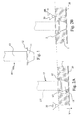
- Figures 2A-2D represent some steps of the process according to the invention to produce an article such as the one represented in Figure 1;
- Figure 3 is a perspective view of an impeller for a turbine produced with a process according to the present invention, in which the supporting portions are highlighted; and
- Figure 4 is a perspective view of the same impeller of Figure 3 from which the supporting portions have been removed.
- The view in Figure 1 represents in a greatly simplified form a possible embodiment of a
blade 10 for gas turbine comprising a fixingfoot 11, abase flange 12 and awing 13. - In the example, reference is made in particular to a
blade 10 made of an intermetallic compound, in particular a titanium and aluminium based intermetallic compound of the γTiAl series which is particularly critical to obtain. - To produce the articles with the process according to the invention firstly a three-dimensional model of the articles is generated and stored in a control unit. The mathematical model of the articles can be generated using a computer aided design (CAD) program and transferred in the form of file to the control unit of an electron beam melting machine.
- A suitable machine for implementation of the process according to the present invention is, for example, the one identified with the trade name EBM A2 manufactured and distributed by ARCAM AB (Sweden), which allows focused electron beam melting to be performed in high vacuum conditions.
- Some steps of the process according to the present invention are represented in Figures 2A-2D, where for clarity of representation the production of a single turbine blade has been shown, with views not in scale. However, in actual mass production, a plurality of blades or, in any case, a plurality of the desired articles, are produced. Moreover, although not expressly represented, it must be understood that the process steps shown in Figure 2A-2D are carried out in the melting chamber of an EBM machine in high vacuum conditions.
- Figure 2A represents an intermediate step in the production of an article like the one represented in Figure 1. In this step, some portions of the
blade 10, in particular the fixingfoot 11, thebase flange 12 and a portion 13' of the wing are assumed as already produced, while the remainingportion 13" still to be produced is shown with a broken line. - The
blade 10 rests on a movable supportingplane 20 which can be controlled to move along the direction represented by the arrow V. The supportingplane 20 is made of a material capable of withstanding the high melting temperatures of γTiAl intermetallic compounds. The supportingplane 20 can be made of nickel based alloys, such as the alloy identified by the trade name Inconel™, which also offers the advantage of not adhering to articles made of γTiAl intermetallic compounds. - The portions of the
blade 10 already produced are surrounded by the mass of powders 1 which have already been deposited in successive layers during the preceding steps but have not been subjected to melting. Most of the powders that have not been subjected to melting can then be recovered and re-utilized in subsequent production cycles as no oxidation of the powders occurs as the process is performed in vacuum conditions. - The powders have exactly the same chemical composition as the material with which the articles are to be produced. The powders have a grain size ranging from 20 to 150 µm, more preferably of approximately 70 µm, and are preferably obtained through gas atomization processes so as to form substantially spherical grains.
- The powders are disposed in a
movable dispenser 30 which moves horizontally (arrow HR) and deposits in the melting chamber a layer ofpowders 2 with a regular and substantially uniform thickness, as shown by way of example in Figure 2B with the thickness of thelayer 2 deliberately exaggerated for reasons of clarity. - The distance between the
movable dispenser 30 and the surface layer of the powder bath present in the melting chamber can be adjusted so that, during movement thereof, only powders with a grain size that does not exceed the one desired are deposited. - The powders are subjected to a preheating step up to a temperature in any case lower than the melting temperature of the material used. The preheating step can be performed using the same electron beam, or using in combination electrical resistors, placed outside the melting chamber, to aid preheating supplied by the electron beam alone.
- Preheating also allows a weak sintering to take place between the powders, especially in the area of the cross section of the articles to be subjected to melting.
- After completion of the layer of powders 2 (Figure 2C) the
generator 40 of the focused electron beam is activated to initially perform melting of the powders along the perimeter of the area corresponding to the cross section to be formed. The focused energy beam is then guided along a scanning path that covers the area of the section to be formed. - The
new cross section 130 is formed over the portion 13' already produced previously following a scanning path with lengths transverse with respect to those with which the section immediately below was formed. - At the end of the melting step, the
section 130 is amalgamated with the portion below 13' to form a new portion 130' of thewing 13, as shown in Figure 2D. With regard to intermetallic compounds based on titanium and aluminium, the temperatures required to obtain melting of the powders in the chamber are generally approximately not lower than 1500°C and can even reach 1700-1800°C as a function of the particular compound used. - The temperature inside the melting chamber is kept under constant control, for example using a thermocouple placed under the supporting
plane 20 and extrapolating the temperature of the powder bath in the chamber on the basis of the data relative to the thermal capacity of the materials and to the increasing mass of powders in the chamber. As a function of the temperature detected, it is possible to regulate the energy transmitted to the powders during the preheating and/or melting steps. Regulation can be made in various ways, such as by "defocusing" the electron beam (dispersion of energy per surface unit), by varying the supply current of the electron beam emitter, by varying the scanning speed of the beam, or by any combination of two or more of these methods. - After the melting step, the movable supporting
plane 20 is lowered by a pre-established height (arrow V) substantially corresponding to the thickness of the layer of powders deposited by thedispenser 30 at each cycle in the melting chamber. The upper surface of the portion 130', together with the powders 1' now deposited in the melting chamber around the part of the article already formed, is thus taken to the level of a fixed reference height (line Q) with respect to themovable dispenser 30. - The
movable dispenser 30 then starts to move in the opposite direction to deposit a new layer of powders 2' which will then be subjected to melting. The process continues in this way with repetition of the steps to deposit a layer of powders, preheating, melting and lowering of the movable supportingplane 20 until reaching the last section of the three-dimensional model stored in the control unit, i.e. until completing themissing portion 130" of thewing 13. - At each repetition of the steps set forth above a section with a thickness ranging from 20 to 150 µm is formed, as a function both of the grain size of the mixture of powders used, and of the thickness of the layer of powders deposited in the melting chamber by the
dispenser 30 at each cycle. - At the end of the step to form the articles, cooling can be advantageously provided by a flow of inert gas in the melting chamber. The inert gas used is preferably helium fed into the chamber at a pressure of approximately 2 bar for a time sufficient to ensure that a temperature which allows removal of the articles from the melting chamber has been reached.
- This step allows a considerable reduction in production times to be achieved.
- The articles obtained at the end of the process are then subjected to simple mechanical machining to obtained the desired degree of finish. Considering the high precision of the production process according to the invention, only simple and rapid surface finish machining operations are required.
- Figure 3 shows an
impeller 50 for a turbine after it has been removed from the melting chamber and separated from other identical turbines produced simultaneously. - The
impeller 50 comprises the supportingportions 55 which are produced simultaneously to the article and with the same material to facilitate forming flat surfaces during the production process. - The supporting
portions 55, for example constituted by very thin walls lightened withslots 56, are nonetheless temporary and are removed prior to the last surface finish steps to obtain the impeller as represented in Figure 4. - There is now described an example of implementation of a process according to the invention for mass production of articles for turbines.
- Powders of the intermetallic compound γTiAl 48Al-2Cr-2Nb were prepared according to the specifications supplied by General Electric Aviation (USA) to produce low pressure gas turbine blades. The intermetallic compound used has a melting temperature of approximately 1550°C.
- The powders were loaded into the dispenser located inside the melting chamber of a EBM machine identified by the abbreviation A2 and manufactured by ARCAM AB (Sweden).
- The preheating step was performed using only the focused electron beam until taking the powders to a temperature of approximately 900°C.
- The mathematical model used was configured for the simultaneous production of 30 turbine blades all with the same properties of geometrical shape and dimensions.
- The production process, performed under high vacuum, required a total of approximately 30 hours to complete production and cooling in a helium atmosphere.
- The 30 blades were then separated and the supporting portions (such as those represented by way of example for the impeller in Figure 3) were removed before subjecting the blades to surface finish machining operations to remove a surface layer (machining allowance) of approximately 0.2 mm. It was estimated that, using a process according to the present invention, the mass production costs of the blades for gas turbines made of γTiAl intermetallic compounds can be reduced by about four times with respect to mass production costs using prior art processes.
- Although the process of the present invention has been presented for the mass production of components for turbines, it must be understood that the principles of the present invention can be applied equally to the mass production of other components for engines or the like made of intermetallic compounds, obtaining the same advantages listed above in terms of cost and quality of the articles produced.
Claims (18)
- A process for the mass production of three-dimensional articles made of an intermetallic compound by electron beam melting, comprising the steps of:a) generating a three-dimensional mathematical model of said articles and storing it in a control unit;b) preparing the powders of the intermetallic compound to be used;c) depositing a quantity of said powders in a melting chamber to form a layer of powders with a regular and substantially uniform thickness;d) preheating said layer of powders deposited in said melting chamber to a temperature below the melting point of said powders;e) performing melting by scanning with a focused electron beam in the area corresponding to a cross section of said articles according to the three-dimensional model stored in said control unit;f) bringing the upper surface of the last cross section of said articles thus formed to the level of the powders located in said melting chamber and which are arranged around the portions already formed of said articles; andg) repeating said steps from c) to f) until the last cross section of said articles is reached according to the three-dimensional model stored in said control unit,characterized in that said powders are powders of an intermetallic compound based on titanium and aluminium with the same chemical composition as the final intermetallic compound with which said articles are produced.
- The process as claimed in claim 1, wherein said powders and said articles are made of γTiAl intermetallic compounds.
- The process as claimed in claim 1, wherein a final cooling step of said articles is provided in inert gas atmosphere.
- The process as claimed in claim 3, wherein said inert gas is constituted by helium or mixtures thereof.
- The process as claimed in claim 1, wherein said preheating step d) is performed entirely or partly by scanning with a focused electron beam.
- The process as claimed in claim 1, wherein said preheating step d) is performed entirely or partly by heating said melting chamber using electrical resistors.
- The process as claimed in claim 1, wherein said preheating step d) is performed at a sufficiently high temperature to cause a weak sintering of the powders at least in the area of each cross section of said articles.
- The process as claimed in claim 1, wherein said preheating step d) is performed at a temperature not lower than 700°C.
- The process as claimed in claim 1, wherein said melting step e) is performed by moving said focused electron beam along a transverse scanning path with an angle ranging from 60 to 90 degrees with respect to the one with which the melting step of the cross section below was performed.
- The process as claimed in claim 1, wherein said melting step e) initially includes melting with focused electron beam along the perimeter of the area corresponding to a cross section of said articles.
- The process as claimed in claim 1, wherein said melting with focused electron beam in said step e) is performed maintaining at least said melting chamber in high vacuum conditions.
- The process as claimed in claim 1, wherein during each repetition of said steps from c) to f) there is provided the formation of one or more portions to support the cross sections which are formed successively.
- The process as claimed in claim 12, wherein there is provided removal of said one or more supporting portions after said articles have been formed.
- The process as claimed in claim 1, wherein the grain size of said powders ranges from 20 to 150 µm.
- The process as claimed in claim 1, wherein the grain size of said powders is approximately 70 µm.
- The process as claimed in claim 1, wherein said powders are obtained by gas atomization processes.
- The process as claimed in claim 1, wherein at each cycle of repeated steps from c) to f) there is formed a cross section of said articles with a thickness ranging from 20 to 150 µm.
- An article produced with a process as claimed in any one of claims 1 to 17.
Priority Applications (1)
| Application Number | Priority Date | Filing Date | Title |
|---|---|---|---|
| EP07013153A EP1878522B1 (en) | 2006-07-14 | 2007-07-05 | Mass production of tridimensional articles made of intermetallic compounds |
Applications Claiming Priority (3)
| Application Number | Priority Date | Filing Date | Title |
|---|---|---|---|
| EP06425491 | 2006-07-14 | ||
| ITMI20062228 | 2006-11-21 | ||
| EP07013153A EP1878522B1 (en) | 2006-07-14 | 2007-07-05 | Mass production of tridimensional articles made of intermetallic compounds |
Publications (2)
| Publication Number | Publication Date |
|---|---|
| EP1878522A1 true EP1878522A1 (en) | 2008-01-16 |
| EP1878522B1 EP1878522B1 (en) | 2012-02-08 |
Family
ID=38474134
Family Applications (1)
| Application Number | Title | Priority Date | Filing Date |
|---|---|---|---|
| EP07013153A Revoked EP1878522B1 (en) | 2006-07-14 | 2007-07-05 | Mass production of tridimensional articles made of intermetallic compounds |
Country Status (1)
| Country | Link |
|---|---|
| EP (1) | EP1878522B1 (en) |
Cited By (16)
| Publication number | Priority date | Publication date | Assignee | Title |
|---|---|---|---|---|
| EP2093018A1 (en) | 2008-02-25 | 2009-08-26 | Satisloh AG | Block piece for holding an optical workpiece, in particular a spectacle lens, for processing thereof, and method for manufacturing spectacle lenses according to a prescription |
| EP2156941A1 (en) | 2008-08-21 | 2010-02-24 | AVIO S.p.A. | Process for producing a filter, in particular for a rotary separator |
| WO2010057469A1 (en) * | 2008-11-22 | 2010-05-27 | Mtu Aero Engines Gmbh | Method for producing or repairing gas turbine components |
| DE102010045713A1 (en) * | 2010-09-16 | 2012-03-22 | Mtu Aero Engines Gmbh | Method for manufacturing or repairing e.g. housing of gas turbine, involves selectively adhering material layer in chemical film when connecting material layer with substrate, where material layer is adhered in form of component |
| DE102011008809A1 (en) * | 2011-01-19 | 2012-07-19 | Mtu Aero Engines Gmbh | Generatively produced turbine blade and apparatus and method for their production |
| US8292982B2 (en) | 2009-12-01 | 2012-10-23 | Avio S.P.A. | Process for producing a filter, in particular for a rotary separator |
| CN104765385A (en) * | 2015-03-29 | 2015-07-08 | 西安赛隆金属材料有限责任公司 | Electron beam selected area melting atmosphere adjust and control system and method |
| EP3079856A4 (en) * | 2013-12-13 | 2016-12-28 | United Technologies Corp | ADDITIVE FABRICATION OF FAIR SUPPORT STRUCTURE |
| DE102015216802A1 (en) | 2015-09-02 | 2017-03-02 | MTU Aero Engines AG | Method for producing a capsule for hot isostatic pressing |
| EP2754515A3 (en) * | 2013-01-14 | 2017-05-24 | Honeywell International Inc. | Gas turbine engine components and methods for their manufacture using additive manufacturing techniques |
| EP3239468A1 (en) | 2016-04-27 | 2017-11-01 | MTU Aero Engines GmbH | Method for producing a rotor blade for a fluid flow engine |
| EP3238863A1 (en) | 2016-04-27 | 2017-11-01 | MTU Aero Engines GmbH | Method for producing a rotor blade for a fluid flow engine |
| BE1024125B1 (en) * | 2015-09-21 | 2017-11-17 | Safran Aero Boosters S.A. | AXIAL TURBOMACHINE COMPRESSOR BLADE WITH TREILLIS |
| EP3249064A1 (en) | 2016-05-23 | 2017-11-29 | MTU Aero Engines GmbH | Additive manufacture of high temperature components from tial |
| CN109255146A (en) * | 2018-07-23 | 2019-01-22 | 长沙理工大学 | A kind of Roots air blower processing method |
| CN120060689A (en) * | 2025-04-29 | 2025-05-30 | 北京清研智束科技有限公司 | Method for regulating microstructure of titanium-aluminum alloy in layering manner in additive manufacturing |
Families Citing this family (1)
| Publication number | Priority date | Publication date | Assignee | Title |
|---|---|---|---|---|
| US20240151155A1 (en) * | 2022-11-07 | 2024-05-09 | Rtx Corporation | Bearing chamber with mapped thermal heat exchange fins |
Citations (7)
| Publication number | Priority date | Publication date | Assignee | Title |
|---|---|---|---|---|
| EP0289116A1 (en) | 1987-03-04 | 1988-11-02 | Westinghouse Electric Corporation | Method and device for casting powdered materials |
| US5156697A (en) * | 1989-09-05 | 1992-10-20 | Board Of Regents, The University Of Texas System | Selective laser sintering of parts by compound formation of precursor powders |
| US5182170A (en) * | 1989-09-05 | 1993-01-26 | Board Of Regents, The University Of Texas System | Method of producing parts by selective beam interaction of powder with gas phase reactant |
| US5837960A (en) * | 1995-08-14 | 1998-11-17 | The Regents Of The University Of California | Laser production of articles from powders |
| US6269540B1 (en) | 1998-10-05 | 2001-08-07 | National Research Council Of Canada | Process for manufacturing or repairing turbine engine or compressor components |
| WO2004056511A1 (en) | 2002-12-19 | 2004-07-08 | Arcam Ab | Arrangement and method for producing a three-dimensional product |
| US20050186538A1 (en) | 2004-02-25 | 2005-08-25 | Bego Medical Ag | Method and apparatus for making products by sintering and/or melting |
-
2007
- 2007-07-05 EP EP07013153A patent/EP1878522B1/en not_active Revoked
Patent Citations (7)
| Publication number | Priority date | Publication date | Assignee | Title |
|---|---|---|---|---|
| EP0289116A1 (en) | 1987-03-04 | 1988-11-02 | Westinghouse Electric Corporation | Method and device for casting powdered materials |
| US5156697A (en) * | 1989-09-05 | 1992-10-20 | Board Of Regents, The University Of Texas System | Selective laser sintering of parts by compound formation of precursor powders |
| US5182170A (en) * | 1989-09-05 | 1993-01-26 | Board Of Regents, The University Of Texas System | Method of producing parts by selective beam interaction of powder with gas phase reactant |
| US5837960A (en) * | 1995-08-14 | 1998-11-17 | The Regents Of The University Of California | Laser production of articles from powders |
| US6269540B1 (en) | 1998-10-05 | 2001-08-07 | National Research Council Of Canada | Process for manufacturing or repairing turbine engine or compressor components |
| WO2004056511A1 (en) | 2002-12-19 | 2004-07-08 | Arcam Ab | Arrangement and method for producing a three-dimensional product |
| US20050186538A1 (en) | 2004-02-25 | 2005-08-25 | Bego Medical Ag | Method and apparatus for making products by sintering and/or melting |
Cited By (19)
| Publication number | Priority date | Publication date | Assignee | Title |
|---|---|---|---|---|
| EP2093018A1 (en) | 2008-02-25 | 2009-08-26 | Satisloh AG | Block piece for holding an optical workpiece, in particular a spectacle lens, for processing thereof, and method for manufacturing spectacle lenses according to a prescription |
| EP2156941A1 (en) | 2008-08-21 | 2010-02-24 | AVIO S.p.A. | Process for producing a filter, in particular for a rotary separator |
| WO2010057469A1 (en) * | 2008-11-22 | 2010-05-27 | Mtu Aero Engines Gmbh | Method for producing or repairing gas turbine components |
| US8292982B2 (en) | 2009-12-01 | 2012-10-23 | Avio S.P.A. | Process for producing a filter, in particular for a rotary separator |
| DE102010045713A1 (en) * | 2010-09-16 | 2012-03-22 | Mtu Aero Engines Gmbh | Method for manufacturing or repairing e.g. housing of gas turbine, involves selectively adhering material layer in chemical film when connecting material layer with substrate, where material layer is adhered in form of component |
| DE102010045713B4 (en) * | 2010-09-16 | 2016-06-23 | MTU Aero Engines AG | Method and device for producing or repairing components, in particular turbomachine components |
| DE102011008809A1 (en) * | 2011-01-19 | 2012-07-19 | Mtu Aero Engines Gmbh | Generatively produced turbine blade and apparatus and method for their production |
| EP2754515A3 (en) * | 2013-01-14 | 2017-05-24 | Honeywell International Inc. | Gas turbine engine components and methods for their manufacture using additive manufacturing techniques |
| EP3079856A4 (en) * | 2013-12-13 | 2016-12-28 | United Technologies Corp | ADDITIVE FABRICATION OF FAIR SUPPORT STRUCTURE |
| CN104765385A (en) * | 2015-03-29 | 2015-07-08 | 西安赛隆金属材料有限责任公司 | Electron beam selected area melting atmosphere adjust and control system and method |
| DE102015216802A1 (en) | 2015-09-02 | 2017-03-02 | MTU Aero Engines AG | Method for producing a capsule for hot isostatic pressing |
| BE1024125B1 (en) * | 2015-09-21 | 2017-11-17 | Safran Aero Boosters S.A. | AXIAL TURBOMACHINE COMPRESSOR BLADE WITH TREILLIS |
| EP3239468A1 (en) | 2016-04-27 | 2017-11-01 | MTU Aero Engines GmbH | Method for producing a rotor blade for a fluid flow engine |
| EP3238863A1 (en) | 2016-04-27 | 2017-11-01 | MTU Aero Engines GmbH | Method for producing a rotor blade for a fluid flow engine |
| US20170314402A1 (en) * | 2016-04-27 | 2017-11-02 | MTU Aero Engines AG | Method for producing a blade for a turbomachine |
| EP3249064A1 (en) | 2016-05-23 | 2017-11-29 | MTU Aero Engines GmbH | Additive manufacture of high temperature components from tial |
| CN109255146A (en) * | 2018-07-23 | 2019-01-22 | 长沙理工大学 | A kind of Roots air blower processing method |
| CN109255146B (en) * | 2018-07-23 | 2023-06-02 | 长沙理工大学 | Roots blower impeller processing method |
| CN120060689A (en) * | 2025-04-29 | 2025-05-30 | 北京清研智束科技有限公司 | Method for regulating microstructure of titanium-aluminum alloy in layering manner in additive manufacturing |
Also Published As
| Publication number | Publication date |
|---|---|
| EP1878522B1 (en) | 2012-02-08 |
Similar Documents
| Publication | Publication Date | Title |
|---|---|---|
| US7815847B2 (en) | Mass production of tridimensional articles made of intermetallic compounds | |
| EP1878522B1 (en) | Mass production of tridimensional articles made of intermetallic compounds | |
| Murr | A metallographic review of 3D printing/additive manufacturing of metal and alloy products and components | |
| CN103624257B (en) | Method for making three-dimensional articles | |
| Yap et al. | Review of selective laser melting: Materials and applications | |
| EP2790858B1 (en) | Method for additively manufacturing an article made of a difficult-to-weld material | |
| Sames | Additive manufacturing of Inconel 718 using electron beam melting: processing, post-processing, & mechanical properties | |
| Liu et al. | In-situ reactive processing of nickel aluminides by laser-engineered net shaping | |
| Mandil et al. | Building new entities from existing titanium part by electron beam melting: microstructures and mechanical properties | |
| EP3241634B1 (en) | Method for fabricating a component having a directionally solidified microstructure or a single crystal microstructure | |
| Abdulrahman et al. | Laser metal deposition of titanium aluminide composites: A review | |
| JP6344004B2 (en) | Method for producing single crystal | |
| CN115716134A (en) | Method for manufacturing mechanical components by additive manufacturing | |
| Kotoban et al. | Comparative study of selective laser melting and direct laser metal deposition of Ni3Al intermetallic alloy | |
| Kulkarni | Additive manufacturing of nickel based superalloy | |
| Peyre et al. | Additive manufacturing of metal alloys 1: processes, raw materials and numerical simulation | |
| US5312650A (en) | Method of forming a composite article by metal spraying | |
| Kotoban et al. | Comparative study of selective laser melting and direct laser metal deposition of Ni3Al intermetallic alloy | |
| Mladenov et al. | State of the arts of additive manufacturing by selective electron beam melting. | |
| Ciftci et al. | Analysis of direct metal laser sintering-DMLS and heat treatment influence on the Inconel 713C nickel alloy structure | |
| Baudana | γ-Titanium aluminide alloys for aircraft and automotive engine components applications processed by electron beam melting | |
| CN116673492B (en) | Nickel-based alloy and preparation method and application thereof | |
| Handtrack et al. | Additive Manufacturing of Tungsten Heavy Alloys–A Technology Assessment of Sinter-based AM Processes | |
| Manfredi et al. | Laser powder bed fusion of aluminum, titanium and nickel based alloys: materials and design investigations | |
| Liu et al. | Additive Manufacturing and Phase Control |
Legal Events
| Date | Code | Title | Description |
|---|---|---|---|
| PUAI | Public reference made under article 153(3) epc to a published international application that has entered the european phase |
Free format text: ORIGINAL CODE: 0009012 |
|
| AK | Designated contracting states |
Kind code of ref document: A1 Designated state(s): AT BE BG CH CY CZ DE DK EE ES FI FR GB GR HU IE IS IT LI LT LU LV MC MT NL PL PT RO SE SI SK TR |
|
| AX | Request for extension of the european patent |
Extension state: AL BA HR MK YU |
|
| RAP1 | Party data changed (applicant data changed or rights of an application transferred) |
Owner name: PROTOCAST S.R.L. Owner name: AVIO S.P.A. |
|
| 17P | Request for examination filed |
Effective date: 20080715 |
|
| AKX | Designation fees paid |
Designated state(s): AT BE BG CH CY CZ DE DK EE ES FI FR GB GR HU IE IS IT LI LT LU LV MC MT NL PL PT RO SE SI SK TR |
|
| 17Q | First examination report despatched |
Effective date: 20090219 |
|
| RAP1 | Party data changed (applicant data changed or rights of an application transferred) |
Owner name: AVIOPROP S.R.L. Owner name: AVIO S.P.A. |
|
| GRAP | Despatch of communication of intention to grant a patent |
Free format text: ORIGINAL CODE: EPIDOSNIGR1 |
|
| GRAS | Grant fee paid |
Free format text: ORIGINAL CODE: EPIDOSNIGR3 |
|
| GRAA | (expected) grant |
Free format text: ORIGINAL CODE: 0009210 |
|
| AK | Designated contracting states |
Kind code of ref document: B1 Designated state(s): AT BE BG CH CY CZ DE DK EE ES FI FR GB GR HU IE IS IT LI LT LU LV MC MT NL PL PT RO SE SI SK TR |
|
| REG | Reference to a national code |
Ref country code: GB Ref legal event code: FG4D |
|
| REG | Reference to a national code |
Ref country code: AT Ref legal event code: REF Ref document number: 544548 Country of ref document: AT Kind code of ref document: T Effective date: 20120215 Ref country code: CH Ref legal event code: EP |
|
| REG | Reference to a national code |
Ref country code: CH Ref legal event code: NV Representative=s name: KAMINSKI HARMANN PATENTANWAELTE EST. |
|
| REG | Reference to a national code |
Ref country code: DE Ref legal event code: R096 Ref document number: 602007020548 Country of ref document: DE Effective date: 20120405 |
|
| REG | Reference to a national code |
Ref country code: SE Ref legal event code: TRGR |
|
| REG | Reference to a national code |
Ref country code: ES Ref legal event code: FG2A Ref document number: 2381854 Country of ref document: ES Kind code of ref document: T3 Effective date: 20120601 |
|
| REG | Reference to a national code |
Ref country code: NL Ref legal event code: VDEP Effective date: 20120208 |
|
| LTIE | Lt: invalidation of european patent or patent extension |
Effective date: 20120208 |
|
| PG25 | Lapsed in a contracting state [announced via postgrant information from national office to epo] |
Ref country code: LT Free format text: LAPSE BECAUSE OF FAILURE TO SUBMIT A TRANSLATION OF THE DESCRIPTION OR TO PAY THE FEE WITHIN THE PRESCRIBED TIME-LIMIT Effective date: 20120208 Ref country code: NL Free format text: LAPSE BECAUSE OF FAILURE TO SUBMIT A TRANSLATION OF THE DESCRIPTION OR TO PAY THE FEE WITHIN THE PRESCRIBED TIME-LIMIT Effective date: 20120208 Ref country code: IS Free format text: LAPSE BECAUSE OF FAILURE TO SUBMIT A TRANSLATION OF THE DESCRIPTION OR TO PAY THE FEE WITHIN THE PRESCRIBED TIME-LIMIT Effective date: 20120608 |
|
| PG25 | Lapsed in a contracting state [announced via postgrant information from national office to epo] |
Ref country code: PL Free format text: LAPSE BECAUSE OF FAILURE TO SUBMIT A TRANSLATION OF THE DESCRIPTION OR TO PAY THE FEE WITHIN THE PRESCRIBED TIME-LIMIT Effective date: 20120208 Ref country code: GR Free format text: LAPSE BECAUSE OF FAILURE TO SUBMIT A TRANSLATION OF THE DESCRIPTION OR TO PAY THE FEE WITHIN THE PRESCRIBED TIME-LIMIT Effective date: 20120509 Ref country code: BE Free format text: LAPSE BECAUSE OF FAILURE TO SUBMIT A TRANSLATION OF THE DESCRIPTION OR TO PAY THE FEE WITHIN THE PRESCRIBED TIME-LIMIT Effective date: 20120208 Ref country code: FI Free format text: LAPSE BECAUSE OF FAILURE TO SUBMIT A TRANSLATION OF THE DESCRIPTION OR TO PAY THE FEE WITHIN THE PRESCRIBED TIME-LIMIT Effective date: 20120208 Ref country code: PT Free format text: LAPSE BECAUSE OF FAILURE TO SUBMIT A TRANSLATION OF THE DESCRIPTION OR TO PAY THE FEE WITHIN THE PRESCRIBED TIME-LIMIT Effective date: 20120608 Ref country code: LV Free format text: LAPSE BECAUSE OF FAILURE TO SUBMIT A TRANSLATION OF THE DESCRIPTION OR TO PAY THE FEE WITHIN THE PRESCRIBED TIME-LIMIT Effective date: 20120208 |
|
| REG | Reference to a national code |
Ref country code: AT Ref legal event code: MK05 Ref document number: 544548 Country of ref document: AT Kind code of ref document: T Effective date: 20120208 |
|
| PG25 | Lapsed in a contracting state [announced via postgrant information from national office to epo] |
Ref country code: CY Free format text: LAPSE BECAUSE OF FAILURE TO SUBMIT A TRANSLATION OF THE DESCRIPTION OR TO PAY THE FEE WITHIN THE PRESCRIBED TIME-LIMIT Effective date: 20120208 |
|
| PLBI | Opposition filed |
Free format text: ORIGINAL CODE: 0009260 |
|
| 26 | Opposition filed |
Opponent name: SIEMENS AG Effective date: 20120921 |
|
| PG25 | Lapsed in a contracting state [announced via postgrant information from national office to epo] |
Ref country code: DK Free format text: LAPSE BECAUSE OF FAILURE TO SUBMIT A TRANSLATION OF THE DESCRIPTION OR TO PAY THE FEE WITHIN THE PRESCRIBED TIME-LIMIT Effective date: 20120208 Ref country code: SI Free format text: LAPSE BECAUSE OF FAILURE TO SUBMIT A TRANSLATION OF THE DESCRIPTION OR TO PAY THE FEE WITHIN THE PRESCRIBED TIME-LIMIT Effective date: 20120208 Ref country code: RO Free format text: LAPSE BECAUSE OF FAILURE TO SUBMIT A TRANSLATION OF THE DESCRIPTION OR TO PAY THE FEE WITHIN THE PRESCRIBED TIME-LIMIT Effective date: 20120208 Ref country code: CZ Free format text: LAPSE BECAUSE OF FAILURE TO SUBMIT A TRANSLATION OF THE DESCRIPTION OR TO PAY THE FEE WITHIN THE PRESCRIBED TIME-LIMIT Effective date: 20120208 Ref country code: EE Free format text: LAPSE BECAUSE OF FAILURE TO SUBMIT A TRANSLATION OF THE DESCRIPTION OR TO PAY THE FEE WITHIN THE PRESCRIBED TIME-LIMIT Effective date: 20120208 |
|
| PG25 | Lapsed in a contracting state [announced via postgrant information from national office to epo] |
Ref country code: SK Free format text: LAPSE BECAUSE OF FAILURE TO SUBMIT A TRANSLATION OF THE DESCRIPTION OR TO PAY THE FEE WITHIN THE PRESCRIBED TIME-LIMIT Effective date: 20120208 |
|
| PLAX | Notice of opposition and request to file observation + time limit sent |
Free format text: ORIGINAL CODE: EPIDOSNOBS2 |
|
| REG | Reference to a national code |
Ref country code: DE Ref legal event code: R026 Ref document number: 602007020548 Country of ref document: DE Effective date: 20120921 |
|
| PG25 | Lapsed in a contracting state [announced via postgrant information from national office to epo] |
Ref country code: AT Free format text: LAPSE BECAUSE OF FAILURE TO SUBMIT A TRANSLATION OF THE DESCRIPTION OR TO PAY THE FEE WITHIN THE PRESCRIBED TIME-LIMIT Effective date: 20120208 |
|
| PG25 | Lapsed in a contracting state [announced via postgrant information from national office to epo] |
Ref country code: MC Free format text: LAPSE BECAUSE OF NON-PAYMENT OF DUE FEES Effective date: 20120731 |
|
| PLBB | Reply of patent proprietor to notice(s) of opposition received |
Free format text: ORIGINAL CODE: EPIDOSNOBS3 |
|
| REG | Reference to a national code |
Ref country code: IE Ref legal event code: MM4A |
|
| PG25 | Lapsed in a contracting state [announced via postgrant information from national office to epo] |
Ref country code: BG Free format text: LAPSE BECAUSE OF FAILURE TO SUBMIT A TRANSLATION OF THE DESCRIPTION OR TO PAY THE FEE WITHIN THE PRESCRIBED TIME-LIMIT Effective date: 20120508 Ref country code: IE Free format text: LAPSE BECAUSE OF NON-PAYMENT OF DUE FEES Effective date: 20120705 Ref country code: MT Free format text: LAPSE BECAUSE OF FAILURE TO SUBMIT A TRANSLATION OF THE DESCRIPTION OR TO PAY THE FEE WITHIN THE PRESCRIBED TIME-LIMIT Effective date: 20120208 |
|
| REG | Reference to a national code |
Ref country code: DE Ref legal event code: R082 Ref document number: 602007020548 Country of ref document: DE Representative=s name: GODEMEYER BLUM LENZE PARTNERSCHAFT, PATENTANWA, DE Effective date: 20140123 Ref country code: DE Ref legal event code: R082 Ref document number: 602007020548 Country of ref document: DE Representative=s name: GODEMEYER BLUM LENZE PATENTANWAELTE, PARTNERSC, DE Effective date: 20140123 Ref country code: DE Ref legal event code: R081 Ref document number: 602007020548 Country of ref document: DE Owner name: AVIOPROP S.R.L., IT Free format text: FORMER OWNERS: AVIOPROP S.R.L., CAMERI, IT; AVIO S.P.A., TORINO, IT Effective date: 20140123 Ref country code: DE Ref legal event code: R081 Ref document number: 602007020548 Country of ref document: DE Owner name: GE AVIO S.R.L., IT Free format text: FORMER OWNERS: AVIOPROP S.R.L., CAMERI, IT; AVIO S.P.A., TORINO, IT Effective date: 20140123 Ref country code: DE Ref legal event code: R081 Ref document number: 602007020548 Country of ref document: DE Owner name: AVIOPROP S.R.L., IT Free format text: FORMER OWNER: AVIOPROP S.R.L., AVIO S.P.A., , IT Effective date: 20140123 Ref country code: DE Ref legal event code: R081 Ref document number: 602007020548 Country of ref document: DE Owner name: GE AVIO S.R.L., IT Free format text: FORMER OWNER: AVIOPROP S.R.L., AVIO S.P.A., , IT Effective date: 20140123 Ref country code: DE Ref legal event code: R082 Ref document number: 602007020548 Country of ref document: DE Representative=s name: FLEISCHER, GODEMEYER, KIERDORF & PARTNER, PATE, DE Effective date: 20140123 |
|
| REG | Reference to a national code |
Ref country code: DE Ref legal event code: R082 Ref document number: 602007020548 Country of ref document: DE Representative=s name: GODEMEYER BLUM LENZE PARTNERSCHAFT, PATENTANWA, DE Ref country code: DE Ref legal event code: R082 Ref document number: 602007020548 Country of ref document: DE Representative=s name: GODEMEYER BLUM LENZE PATENTANWAELTE, PARTNERSC, DE |
|
| PG25 | Lapsed in a contracting state [announced via postgrant information from national office to epo] |
Ref country code: TR Free format text: LAPSE BECAUSE OF FAILURE TO SUBMIT A TRANSLATION OF THE DESCRIPTION OR TO PAY THE FEE WITHIN THE PRESCRIBED TIME-LIMIT Effective date: 20120208 |
|
| RAP2 | Party data changed (patent owner data changed or rights of a patent transferred) |
Owner name: AVIOPROP S.R.L. Owner name: GE AVIO S.R.L. |
|
| PG25 | Lapsed in a contracting state [announced via postgrant information from national office to epo] |
Ref country code: LU Free format text: LAPSE BECAUSE OF NON-PAYMENT OF DUE FEES Effective date: 20120705 |
|
| REG | Reference to a national code |
Ref country code: ES Ref legal event code: PC2A Owner name: GE AVIO S.R.L. Effective date: 20140528 |
|
| PG25 | Lapsed in a contracting state [announced via postgrant information from national office to epo] |
Ref country code: HU Free format text: LAPSE BECAUSE OF FAILURE TO SUBMIT A TRANSLATION OF THE DESCRIPTION OR TO PAY THE FEE WITHIN THE PRESCRIBED TIME-LIMIT Effective date: 20070705 |
|
| REG | Reference to a national code |
Ref country code: GB Ref legal event code: 732E Free format text: REGISTERED BETWEEN 20140828 AND 20140903 |
|
| RAP2 | Party data changed (patent owner data changed or rights of a patent transferred) |
Owner name: GE AVIO S.R.L. |
|
| RIC2 | Information provided on ipc code assigned after grant |
Ipc: B22F 5/04 20060101ALI20141114BHEP Ipc: B22F 3/105 20060101ALI20141114BHEP Ipc: B22F 5/00 20060101AFI20141114BHEP |
|
| APBM | Appeal reference recorded |
Free format text: ORIGINAL CODE: EPIDOSNREFNO |
|
| APBP | Date of receipt of notice of appeal recorded |
Free format text: ORIGINAL CODE: EPIDOSNNOA2O |
|
| APAH | Appeal reference modified |
Free format text: ORIGINAL CODE: EPIDOSCREFNO |
|
| APBM | Appeal reference recorded |
Free format text: ORIGINAL CODE: EPIDOSNREFNO |
|
| APBP | Date of receipt of notice of appeal recorded |
Free format text: ORIGINAL CODE: EPIDOSNNOA2O |
|
| APBQ | Date of receipt of statement of grounds of appeal recorded |
Free format text: ORIGINAL CODE: EPIDOSNNOA3O |
|
| APBQ | Date of receipt of statement of grounds of appeal recorded |
Free format text: ORIGINAL CODE: EPIDOSNNOA3O |
|
| REG | Reference to a national code |
Ref country code: FR Ref legal event code: TP Owner name: GE AVIO S.R.L., IT Effective date: 20150310 |
|
| REG | Reference to a national code |
Ref country code: FR Ref legal event code: PLFP Year of fee payment: 9 |
|
| REG | Reference to a national code |
Ref country code: CH Ref legal event code: NV Representative=s name: KAMINSKI HARMANN PATENTANWAELTE AG, LI Ref country code: CH Ref legal event code: PUE Owner name: GE AVIO S.R.L., IT Free format text: FORMER OWNER: AVIO S.P.A., IT |
|
| REG | Reference to a national code |
Ref country code: GB Ref legal event code: 732E Free format text: REGISTERED BETWEEN 20160317 AND 20160323 |
|
| REG | Reference to a national code |
Ref country code: FR Ref legal event code: PLFP Year of fee payment: 10 |
|
| REG | Reference to a national code |
Ref country code: DE Ref legal event code: R082 Ref document number: 602007020548 Country of ref document: DE Representative=s name: RUEGER ABEL PATENT- UND RECHTSANWAELTE, DE Ref country code: DE Ref legal event code: R082 Ref document number: 602007020548 Country of ref document: DE Representative=s name: RUEGER ABEL PATENTANWAELTE PARTGMBB, DE Ref country code: DE Ref legal event code: R082 Ref document number: 602007020548 Country of ref document: DE Representative=s name: GODEMEYER BLUM LENZE PATENTANWAELTE, PARTNERSC, DE Ref country code: DE Ref legal event code: R081 Ref document number: 602007020548 Country of ref document: DE Owner name: GE AVIO S.R.L., IT Free format text: FORMER OWNERS: AVIOPROP S.R.L., CAMERI, IT; GE AVIO S.R.L., RIVALTA DI TORINO, IT |
|
| REG | Reference to a national code |
Ref country code: FR Ref legal event code: PLFP Year of fee payment: 11 |
|
| PLAB | Opposition data, opponent's data or that of the opponent's representative modified |
Free format text: ORIGINAL CODE: 0009299OPPO |
|
| R26 | Opposition filed (corrected) |
Opponent name: SIEMENS AKTIENGESELLSCHAFT Effective date: 20120921 |
|
| REG | Reference to a national code |
Ref country code: FR Ref legal event code: PLFP Year of fee payment: 12 |
|
| PGFP | Annual fee paid to national office [announced via postgrant information from national office to epo] |
Ref country code: CH Payment date: 20180627 Year of fee payment: 12 |
|
| PGFP | Annual fee paid to national office [announced via postgrant information from national office to epo] |
Ref country code: IT Payment date: 20180620 Year of fee payment: 12 Ref country code: FR Payment date: 20180621 Year of fee payment: 12 |
|
| PGFP | Annual fee paid to national office [announced via postgrant information from national office to epo] |
Ref country code: SE Payment date: 20180627 Year of fee payment: 12 |
|
| PGFP | Annual fee paid to national office [announced via postgrant information from national office to epo] |
Ref country code: ES Payment date: 20180801 Year of fee payment: 12 Ref country code: DE Payment date: 20180620 Year of fee payment: 12 Ref country code: GB Payment date: 20180621 Year of fee payment: 12 |
|
| REG | Reference to a national code |
Ref country code: DE Ref legal event code: R064 Ref document number: 602007020548 Country of ref document: DE Ref country code: DE Ref legal event code: R103 Ref document number: 602007020548 Country of ref document: DE |
|
| APBU | Appeal procedure closed |
Free format text: ORIGINAL CODE: EPIDOSNNOA9O |
|
| REG | Reference to a national code |
Ref country code: DE Ref legal event code: R082 Ref document number: 602007020548 Country of ref document: DE Representative=s name: RUEGER ABEL PATENT- UND RECHTSANWAELTE, DE Ref country code: DE Ref legal event code: R082 Ref document number: 602007020548 Country of ref document: DE Representative=s name: RUEGER ABEL PATENTANWAELTE PARTGMBB, DE |
|
| PLAB | Opposition data, opponent's data or that of the opponent's representative modified |
Free format text: ORIGINAL CODE: 0009299OPPO |
|
| PLAB | Opposition data, opponent's data or that of the opponent's representative modified |
Free format text: ORIGINAL CODE: 0009299OPPO |
|
| RDAF | Communication despatched that patent is revoked |
Free format text: ORIGINAL CODE: EPIDOSNREV1 |
|
| RDAG | Patent revoked |
Free format text: ORIGINAL CODE: 0009271 |
|
| REG | Reference to a national code |
Ref country code: CH Ref legal event code: PL |
|
| R26 | Opposition filed (corrected) |
Opponent name: SIEMENS AKTIENGESELLSCHAFT Effective date: 20120921 |
|
| R26 | Opposition filed (corrected) |
Opponent name: SIEMENS AKTIENGESELLSCHAFT Effective date: 20120921 |
|
| 27W | Patent revoked |
Effective date: 20190115 |
|
| GBPR | Gb: patent revoked under art. 102 of the ep convention designating the uk as contracting state |
Effective date: 20190115 |
|
| REG | Reference to a national code |
Ref country code: SE Ref legal event code: ECNC |