EP1886827B1 - Hidden image - Google Patents
Hidden image Download PDFInfo
- Publication number
- EP1886827B1 EP1886827B1 EP06118812A EP06118812A EP1886827B1 EP 1886827 B1 EP1886827 B1 EP 1886827B1 EP 06118812 A EP06118812 A EP 06118812A EP 06118812 A EP06118812 A EP 06118812A EP 1886827 B1 EP1886827 B1 EP 1886827B1
- Authority
- EP
- European Patent Office
- Prior art keywords
- image
- printed
- substrate
- transparent material
- security
- Prior art date
- Legal status (The legal status is an assumption and is not a legal conclusion. Google has not performed a legal analysis and makes no representation as to the accuracy of the status listed.)
- Active
Links
- 239000000758 substrate Substances 0.000 claims abstract description 59
- 239000012780 transparent material Substances 0.000 claims abstract description 39
- 238000000034 method Methods 0.000 claims abstract description 37
- 230000000295 complement effect Effects 0.000 claims abstract description 26
- 239000003086 colorant Substances 0.000 claims description 9
- 230000005540 biological transmission Effects 0.000 claims description 7
- 239000007787 solid Substances 0.000 claims description 4
- 229920002994 synthetic fiber Polymers 0.000 claims description 3
- 239000000976 ink Substances 0.000 description 16
- 239000004033 plastic Substances 0.000 description 6
- 229920003023 plastic Polymers 0.000 description 6
- 238000005516 engineering process Methods 0.000 description 5
- 239000000463 material Substances 0.000 description 5
- -1 polyethylene Polymers 0.000 description 3
- 229920000742 Cotton Polymers 0.000 description 2
- 239000004743 Polypropylene Substances 0.000 description 2
- 229920000728 polyester Polymers 0.000 description 2
- 229920001155 polypropylene Polymers 0.000 description 2
- 206010073306 Exposure to radiation Diseases 0.000 description 1
- 239000004952 Polyamide Substances 0.000 description 1
- 239000004698 Polyethylene Substances 0.000 description 1
- 230000002745 absorbent Effects 0.000 description 1
- 239000002250 absorbent Substances 0.000 description 1
- 238000002955 isolation Methods 0.000 description 1
- 230000003287 optical effect Effects 0.000 description 1
- 229920002647 polyamide Polymers 0.000 description 1
- 229920000515 polycarbonate Polymers 0.000 description 1
- 239000004417 polycarbonate Substances 0.000 description 1
- 229920000573 polyethylene Polymers 0.000 description 1
- 229920000642 polymer Polymers 0.000 description 1
- 238000004088 simulation Methods 0.000 description 1
- 238000000859 sublimation Methods 0.000 description 1
- 230000008022 sublimation Effects 0.000 description 1
- 230000000007 visual effect Effects 0.000 description 1
Images


Classifications
-
- B—PERFORMING OPERATIONS; TRANSPORTING
- B41—PRINTING; LINING MACHINES; TYPEWRITERS; STAMPS
- B41M—PRINTING, DUPLICATING, MARKING, OR COPYING PROCESSES; COLOUR PRINTING
- B41M3/00—Printing processes to produce particular kinds of printed work, e.g. patterns
- B41M3/14—Security printing
-
- B—PERFORMING OPERATIONS; TRANSPORTING
- B42—BOOKBINDING; ALBUMS; FILES; SPECIAL PRINTED MATTER
- B42D—BOOKS; BOOK COVERS; LOOSE LEAVES; PRINTED MATTER CHARACTERISED BY IDENTIFICATION OR SECURITY FEATURES; PRINTED MATTER OF SPECIAL FORMAT OR STYLE NOT OTHERWISE PROVIDED FOR; DEVICES FOR USE THEREWITH AND NOT OTHERWISE PROVIDED FOR; MOVABLE-STRIP WRITING OR READING APPARATUS
- B42D25/00—Information-bearing cards or sheet-like structures characterised by identification or security features; Manufacture thereof
- B42D25/20—Information-bearing cards or sheet-like structures characterised by identification or security features; Manufacture thereof characterised by a particular use or purpose
- B42D25/29—Securities; Bank notes
Definitions
- the present invention relates to a method for printing a security item on a substrate of which at least a part is made of a transparent material, wherein a first part of an image is printed on one side of the transparent material, and that a second complementary part of the image is printed on the opposite side of the transparent material, both parts being printed in register.
- the present invention relates in particular to a method for printing a security item on security documents, on a part of a security document or on a substrate that can be transferred to a security document.
- Security documents are in particular: banknotes, postage stamps, identity cards, passports, checks, certificates, certificates of authenticity, ... .
- the present invention relates also to a printed security item manufactured according to such a method.
- Security printing is an application or combination of printing technologies such as offset, intaglio, silkscreen and letterpress.
- Security printing encompasses the printing of banknotes, postage stamps, stamps, stock certificates, identity cards, passports, checks, deeds, plane tickets, diploma's and other documents needing a protection against counterfeiting.
- Security papers such as banknotes circulate in a world where the threat of the counterfeiter is ever present. With the development of new printing processes and the introduction of new technologies, more methods of reproduction are available to the counterfeiter than ever before. It is therefore essential that security documents, such as banknotes should be practically forgeryproof. This is achieved not only by the way in which the printing technologies and their combinations are used, but also through the nature of the substrate and the ink, and the use of special additional elements such as security threads, holograms, and so on.
- Banknotes are generally printed on a substrate made of 100 % cotton and are further protected by a watermark, a security thread, fluorescent fibres of different colours and length, optical variable inks or other visual or machine detectable characteristics.
- banknotes in a synthetic material do not have this drawback, as they can last about four times as long as the conventional cotton notes.
- the plastic note technology uses a polymer plastic substrate instead of paper. Compared to paper, plastic banknotes are stronger and non-porous.
- plastic banknotes have the disadvantage that a number of safety features such as real multitone watermarks, windowed security threads which are successfully used in paper notes, can not be used or are less effective when used in plastic notes.
- WO 97/47478 describes a method for providing a security device which comprises a substrate having a viewing region which is provided on one side with first indicia and on the other side with second indicia overlying the first indicia.
- the substrate carries an obscuring material. Including an obscuring material prevents the second indicia from being seen in reflected light from the one side of the substrate
- WO 94/09990 and WO 94/04367 relate to a method for providing an anti-copying film or layer for documents, consisting of a film or layer of transparent material with a plurality of mutually spaced, at least partially non-transparent areas made of a photosensitive material converted by exposure to radiation into a non-transparent or reflecting material.
- WO 95/09731 illustrates the use of two substantially parallel patterns, each having relatively more and less light-transmissive regions.
- the patterns appear random in isolation, and are in fixed position on either side of a light transmissive lamina and precisely aligned to give a non-random transmitted image when viewed together in transmission.
- US-A-4 684 593 describes a secure and self-verifiable image formed by an array of image dots on one side of a pellucid stratum or film and a corresponding array of light-transmitting apertures in a dark screen on the other side of film with image dots, so that the image is viewable only by light passing obliquely through film at an angle that intersects arrayed apertures and dots.
- the above mentioned object is achieved by providing a new method for printing a security item on a substrate of which at least a part is made of a transparent material, wherein a first part of an image is printed on one side of the transparent material, and that a second complementary part of the image is printed on the opposite side of the transparent material, both parts being printed in register, and wherein the parts of the image being printed in an ink having a different reflection than the transparent material, such that, when the substrate being looked at in transmission and at a first angle of view which is essentially perpendicular to the surface of the substrate, the first and second part of the image are not distinguishable, and when the substrate being looked at in reflection such that the light reflects on the side of the substrate at which is looked at, and when changing the angle of view, then the first and second part of the image become distinguishable due to the different reflection between the transparent material and the ink of the image.
- image refers to any representation, text, message, symbol, pattern and alike, which may be applied on a document in visible form or which may be visualised under specific light circumstances, for example use of an invisible fluo ink which becomes visible under black light, the use of Infra-Red (IR) absorbent ink, ... .
- the image can according to the invention be printed in single colour or multi colour.
- At least a part of the image comprises indicia, such as lines, solid areas, security backgrounds and/or dots, said first part and said second complementary part of the image being constituted by some of said indicia.
- At least a part of the image comprises indicia, such as lines, solid areas, security backgrounds and/or dots in at least two different colours, said first part of the image being constituted by the indicia in at least one particular colour of said colours.
- Documents according to the invention preferably comprise a transparent synthetic material such as polyethylene, polyester, polypropylene, polycarbonate, polyamide or combination thereof.
- plastic substrates made from one or more other materials may be used as well.
- This invention enables the printer of security documents to improve the security level of security documents, through an optimal use of the technical possibilities of existing banknote presses.
- the first part and the second complementary part of the image are printed in see-through register, preferably by means of a banknote press which puts the different parts of the image simultaneously on both sides of the substrate.
- the first part of the image is at least one area of the whole image, said area being surrounded by the second complementary part.
- the first part is preferably shaped in such a way that it represents a message (e.g. the numeral 5).
- the first part of the image is distinguishable from the second part at a second angle of view.
- the message of the first part will not be visible in transmission at the first angle (P°) which is essentially perpendicular to the surface of the substrate.
- P° first angle
- the fact that the message of the first part is not visible is due to the fact that both parts (images) are printed in perfect see-through register.
- the first part of the image will appear, as a kind of outline and the message will be visible at any angle of view.
- the first part of the image and/or the second complementary part of the image are printed using an ink which is less reflective than the transparent material.
- the first part and the complementary second part of the image are printed in matt ink on a glossy transparent material.
- the first part of the image and/or the second complementary part of the image are printed using an ink which is more reflective than the transparent material.
- the first part and the complementary second part of the image are printed in glossy ink on a matt transparent material.
- This patent application also relates to a printed security item on a substrate of which at least a part is made of a transparent material wherein the printed security item comprises a first part of an image that is printed on one side of the transparent material, and comprises a second complementary part of the image that is printed on the opposite side of the transparent material, both parts being printed in register, and wherein both parts of the image being printed in an ink having a different reflection than the transparent material, such that, when the substrate being looked at in transmission and at a first angle of view which is essentially perpendicular to the surface of the substrate, the first and second part of the image are not distinguishable, and when the substrate being looked at in reflection such that the light reflects on the side of the substrate at which is looked at, and when changing the angle of view, then the first and second part of the image become distinguishable due to the different reflection between the transparent material and the ink of the image.
- the printed security item is preferably manufactured applying a method according to any of the claims 2 to 8.
- said substrate is a security document.
- said security document is a banknote.
- security documents such as banknotes, printed on a substrate (1) of which at least a part is made of a transparent material, for example polypropylene or polyester, can be provided with a new security item via known banknote presses.
- Another possibility is transferring a transparent substrate, comprising a security item according to the invention, to a document.
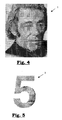
- an image (2) for example the picture of a person (see figure 4 ), will be provided on a glossy transparent substrate.
- This image (2) will be separated in two parts (3 and 4).
- a first part (3) of the image will be printed with mat ink on the glossy transparent (part of the) substrate (1).
- the complementary second part (4) will be printed in perfect register on the other side of the transparent substrate (1), with mat ink as well.
- the first part (3) is a well defined area of the image (2) and is preferably surrounded by the complementary second part (4).
- the selected area has the form of the numeral 5.
- the first part (3) constitutes a message (in this example the denomination 5) and will be printed in a specific colour and density on one side of the substrate (1), now considered as the back side of the transparent substrate (1) (see figure 5 ).
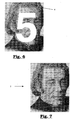
- the complementary second part (4) of the image (2) will be printed in perfect register on the opposite side of the transparent substrate (1) with the same colour and density as the first part (see figure 6 ).
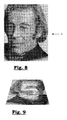
- the message will be visible only when changing the angle of view (Q°) in reflection, for example when one looks at the document at the front side at an angle of view (Q°) such that the light reflects on the front side of the glossy substrate, then the first part (3) of the image (on the back side) is invisible or less visible because of the light reflection on the front side of the glossy substrate (see figure 9 ).
- the complementary second part (4) printed on the front side remains clearly visible because the light does not reflect, or reflects to a lesser degree on the matt ink surface (see also figure 9 ). As a result thereof, the first part (3) of the image (2) will be distinguishable from the second part, and the message will appear.
- the second part (4) of the image is invisible or less visible because of the light reflection on the back side of the glossy substrate (see figure 10 ).
- the first part (3) printed on the back side remains clearly visible because the light does not reflect or reflects to a lesser degree on the matt ink surface (see also figure 10 )
- At least one multicolour image may, for example, be constituted of a first and a second complementary part comprising printed indicia in three different colours.
- the numeral "5" can be composed of indicia in three different colours, and the indicia in one, two or three of these colours can be printed on the backside of the substrate.
- first part of the image can be printed in a single colour, whereas the second complementary part is printed in multicolour, and vice versa.
- first part of the image can be printed in a Pantone colour and the second part of the image can be printed in a multicolour simulation of said Pantone colour, and vice versa.
Landscapes
- Business, Economics & Management (AREA)
- Accounting & Taxation (AREA)
- Finance (AREA)
- Printing Methods (AREA)
- Credit Cards Or The Like (AREA)
- Inspection Of Paper Currency And Valuable Securities (AREA)
- Endoscopes (AREA)
- Holo Graphy (AREA)
Abstract
Description
- The present invention relates to a method for printing a security item on a substrate of which at least a part is made of a transparent material, wherein a first part of an image is printed on one side of the transparent material, and that a second complementary part of the image is printed on the opposite side of the transparent material, both parts being printed in register. The present invention relates in particular to a method for printing a security item on security documents, on a part of a security document or on a substrate that can be transferred to a security document. Security documents are in particular: banknotes, postage stamps, identity cards, passports, checks, certificates, certificates of authenticity, ... . The present invention relates also to a printed security item manufactured according to such a method.
- Printing security items, so called security printing is an application or combination of printing technologies such as offset, intaglio, silkscreen and letterpress. Security printing encompasses the printing of banknotes, postage stamps, stamps, stock certificates, identity cards, passports, checks, deeds, plane tickets, diploma's and other documents needing a protection against counterfeiting.
- Security papers, such as banknotes circulate in a world where the threat of the counterfeiter is ever present. With the development of new printing processes and the introduction of new technologies, more methods of reproduction are available to the counterfeiter than ever before. It is therefore essential that security documents, such as banknotes should be practically forgeryproof. This is achieved not only by the way in which the printing technologies and their combinations are used, but also through the nature of the substrate and the ink, and the use of special additional elements such as security threads, holograms, and so on.
- Banknotes are generally printed on a substrate made of 100 % cotton and are further protected by a watermark, a security thread, fluorescent fibres of different colours and length, optical variable inks or other visual or machine detectable characteristics.
- However, a disadvantage of such banknotes is their restricted lifespan. Banknotes in a synthetic material do not have this drawback, as they can last about four times as long as the conventional cotton notes. The plastic note technology uses a polymer plastic substrate instead of paper. Compared to paper, plastic banknotes are stronger and non-porous.
- However, plastic banknotes have the disadvantage that a number of safety features such as real multitone watermarks, windowed security threads which are successfully used in paper notes, can not be used or are less effective when used in plastic notes.
- There are already known a few methods for printing a security item on a substrate of which at least a part is made of a transparent material wherein a first part of an image is printed on one side of the transparent material, and that a second complementary part of the image is printed on the opposite side of the transparent material
-
WO 97/47478 -
WO 94/09990 WO 94/04367 -
WO 95/09731 -
US-A-4 684 593 describes a secure and self-verifiable image formed by an array of image dots on one side of a pellucid stratum or film and a corresponding array of light-transmitting apertures in a dark screen on the other side of film with image dots, so that the image is viewable only by light passing obliquely through film at an angle that intersects arrayed apertures and dots. - It is an object of the present invention to provide an alternative method for printing a security item on a substrate of which at least a part is made of a transparent material, in particular, a method for printing a security item on banknotes which results in a security item with a high security level against counterfeiting.
- The above mentioned object is achieved by providing a new method for printing a security item on a substrate of which at least a part is made of a transparent material, wherein a first part of an image is printed on one side of the transparent material, and that a second complementary part of the image is printed on the opposite side of the transparent material, both parts being printed in register, and wherein the parts of the image being printed in an ink having a different reflection than the transparent material, such that, when the substrate being looked at in transmission and at a first angle of view which is essentially perpendicular to the surface of the substrate, the first and second part of the image are not distinguishable, and when the substrate being looked at in reflection such that the light reflects on the side of the substrate at which is looked at, and when changing the angle of view, then the first and second part of the image become distinguishable due to the different reflection between the transparent material and the ink of the image.
- The expression "image" as used in this text refers to any representation, text, message, symbol, pattern and alike, which may be applied on a document in visible form or which may be visualised under specific light circumstances, for example use of an invisible fluo ink which becomes visible under black light, the use of Infra-Red (IR) absorbent ink, ... . The image can according to the invention be printed in single colour or multi colour.
- In a preferred method at least a part of the image comprises indicia, such as lines, solid areas, security backgrounds and/or dots, said first part and said second complementary part of the image being constituted by some of said indicia.
- In another preferred method at least a part of the image comprises indicia, such as lines, solid areas, security backgrounds and/or dots in at least two different colours, said first part of the image being constituted by the indicia in at least one particular colour of said colours.
- Documents according to the invention preferably comprise a transparent synthetic material such as polyethylene, polyester, polypropylene, polycarbonate, polyamide or combination thereof. However, plastic substrates made from one or more other materials may be used as well.
- This invention enables the printer of security documents to improve the security level of security documents, through an optimal use of the technical possibilities of existing banknote presses. Preferably, the first part and the second complementary part of the image are printed in see-through register, preferably by means of a banknote press which puts the different parts of the image simultaneously on both sides of the substrate.
- In a preferred method for printing a security item according to the invention, the first part of the image is at least one area of the whole image, said area being surrounded by the second complementary part. The first part is preferably shaped in such a way that it represents a message (e.g. the numeral 5).
- In a further preferred method according to the invention, the first part of the image is distinguishable from the second part at a second angle of view. The message of the first part will not be visible in transmission at the first angle (P°) which is essentially perpendicular to the surface of the substrate. The fact that the message of the first part is not visible is due to the fact that both parts (images) are printed in perfect see-through register. As soon as a counterfeiter has a problem to print the parts on the front and the back in register on the substrate, the first part of the image will appear, as a kind of outline and the message will be visible at any angle of view.
- According to a more preferred method for printing a security item according the invention, the first part of the image and/or the second complementary part of the image are printed using an ink which is less reflective than the transparent material. Preferably, the first part and the complementary second part of the image are printed in matt ink on a glossy transparent material.
- According to another preferred method for printing security items, the first part of the image and/or the second complementary part of the image are printed using an ink which is more reflective than the transparent material. Preferably the first part and the complementary second part of the image are printed in glossy ink on a matt transparent material.
- This patent application also relates to a printed security item on a substrate of which at least a part is made of a transparent material wherein the printed security item comprises a first part of an image that is printed on one side of the transparent material, and comprises a second complementary part of the image that is printed on the opposite side of the transparent material, both parts being printed in register, and wherein both parts of the image being printed in an ink having a different reflection than the transparent material, such that, when the substrate being looked at in transmission and at a first angle of view which is essentially perpendicular to the surface of the substrate, the first and second part of the image are not distinguishable, and when the substrate being looked at in reflection such that the light reflects on the side of the substrate at which is looked at, and when changing the angle of view, then the first and second part of the image become distinguishable due to the different reflection between the transparent material and the ink of the image.
- The printed security item is preferably manufactured applying a method according to any of the
claims 2 to 8. - In a more preferred embodiment of the invention said substrate is a security document. In particular, said security document is a banknote.
- As this invention is meant to be printed on a transparent substrate it is clear that beyond the traditional printing techniques all possible techniques for transferring or generating an image on such a substrate can be used, such as inkjet, thermal transfer, sublimation, etc.
- Additional features and advantages of the invention will be further explained on the basis of non-restricting exemplifying embodiments represented in the attached drawings and in the following detailed description. In this description reference is made to the following drawings in which:
-
figure 1 is a representation of a printed security item on a substrate; -
figure 2 shows that the angle of view is perpendicular to the image; -
figure 3 shows that the angle of view is changing; -
figure 4 is a representation of a screened monochrome image which can be printed on a security document; -
figure 5 is representation of the first part of the monochrome image offigure 4 ; -
figure 6 shows the complementary second part of the monochrome image offigure 4 ; -
figures 7 and8 are a representation of the front and backside of the image when looking at it perpendicularly; -
figures 9 and10 are a representation of the front and backside of the image when looking at it after changing the angle of view; -
figure 11 is a representation of an image of which the first and second parts are not printed in perfect register. - According to the method of the invention, security documents, such as banknotes, printed on a substrate (1) of which at least a part is made of a transparent material, for example polypropylene or polyester, can be provided with a new security item via known banknote presses. Another possibility is transferring a transparent substrate, comprising a security item according to the invention, to a document.
- Therefore an image (2), for example the picture of a person (see
figure 4 ), will be provided on a glossy transparent substrate. This image (2) will be separated in two parts (3 and 4). A first part (3) of the image will be printed with mat ink on the glossy transparent (part of the) substrate (1). The complementary second part (4) will be printed in perfect register on the other side of the transparent substrate (1), with mat ink as well. - The first part (3) is a well defined area of the image (2) and is preferably surrounded by the complementary second part (4). In this example, the selected area has the form of the
numeral 5. The first part (3) constitutes a message (in this example the denomination 5) and will be printed in a specific colour and density on one side of the substrate (1), now considered as the back side of the transparent substrate (1) (seefigure 5 ). At the same time, the complementary second part (4) of the image (2) will be printed in perfect register on the opposite side of the transparent substrate (1) with the same colour and density as the first part (seefigure 6 ). When one looks at the document in transmission in such a way that the angle of view (P°) is about 90°, which is essentially perpendicular to the substrate (1) (as shown infigure 2 ), the complete image (2) is visible (seefigures 7 and8 ). The first part (3) and the second part (4) of the image can not be distinguished, and the message (e.g. numeral 5) is not visible. The fact that the message is not distinguishable from the rest of the image (2) is also due to the fact that both parts (3 and 4) are printed in perfect see-through register. - The message will be visible only when changing the angle of view (Q°) in reflection, for example when one looks at the document at the front side at an angle of view (Q°) such that the light reflects on the front side of the glossy substrate, then the first part (3) of the image (on the back side) is invisible or less visible because of the light reflection on the front side of the glossy substrate (see
figure 9 ). The complementary second part (4) printed on the front side remains clearly visible because the light does not reflect, or reflects to a lesser degree on the matt ink surface (see alsofigure 9 ). As a result thereof, the first part (3) of the image (2) will be distinguishable from the second part, and the message will appear. When one looks at the document at the back side at an angle of view (Q°) such that the light reflects on the back side of the glossy substrate, then the second part (4) of the image (on the front side) is invisible or less visible because of the light reflection on the back side of the glossy substrate (seefigure 10 ). The first part (3) printed on the back side remains clearly visible because the light does not reflect or reflects to a lesser degree on the matt ink surface (see alsofigure 10 ) - When a counterfeiter has a problem with printing in perfect register on the back and the front side of a substrate, the message will appear as a kind of outline, as shown in
figure 11 . - In the method according to this invention, it is also possible to include at least one multicolour image. Such an image may, for example, be constituted of a first and a second complementary part comprising printed indicia in three different colours.
- In applying this method, one can choose to print all the indicia of the first part of this multicolour image on one side of the substrate and to print only the indicia in one or two colours of the second complementary part on the other side of the substrate or vice versa.
- In the example described above, the numeral "5" can be composed of indicia in three different colours, and the indicia in one, two or three of these colours can be printed on the backside of the substrate.
- It is also possible to print the first part of the image in a single colour, whereas the second complementary part is printed in multicolour, and vice versa. In this case, the first part of the image can be printed in a Pantone colour and the second part of the image can be printed in a multicolour simulation of said Pantone colour, and vice versa.
- Applying this method results in banknotes and other security documents being provided with a security item, which is extremely difficult to counterfeit and which is easily verifiable. Further important advantages are that this method is not complex and that it can be applied on existing printing presses.
- It is also possible to transfer or place a transparent substrate, which comprises a security item according the invention, using known technologies or techniques to a document, ... . This method can be combined with other known security features for security documents, such as banknotes.
Claims (11)
- Method for printing a security item on a substrate (1) of which at least a part is made of a transparent material, wherein a first part (3) of an image (2) is printed on one side of the transparent material, and that a second complementary part (4) of the image (2) is printed on the opposite side of the transparent material, both parts (3,4) being printed in register, characterised in that the parts (3,4) of the image (2) being printed in an ink having a different reflection than the transparent material, such that, when the substrate (1) being looked at in transmission and at a first angle (P°) of view which is essentially perpendicular to the surface of the substrate (1), the first (3) and second (4) part of the image are not distinguishable, and when the substrate being looked at in reflection such that the light reflects on the side of the substrate at which it is looked at, and when changing the angle of view (Q°), then the first (3) and second (4) part of the image become distinguishable due to the different reflection between the transparent material and the ink of the image (2).
- Method for printing a security item according to claim 1, characterised in that the first part (3) of the image (2) is printed in a specific colour and density and the second part (4) of the image is printed in the same specific colour and density.
- Method for printing a security item according to claim 1 or 2, characterised in that the first part (3) of the image and/or the second complementary part (4) of the image (2) are printed using an ink which is less reflective than the transparent material.
- Method for printing a security item according to claim 1 or 2, characterised in that the first part (3) of the image (2) and/or the second complementary part (4) of the image (2) are printed using an ink which is more reflective than the transparent material.
- Method for printing a security item according to any of the claims 1 to 4, characterised in that the first part (3) of the image (2) is at least one area of the whole image (2), said area being surrounded by the second complementary part (4).
- Method for printing a security item according to any of the claims 1 to 4, characterised in that at least a part of the image (2) comprises indicia, such as lines, solid areas, security backgrounds and/or dots, said first part (3) and said second complementary part (4) of the image (2) being constituted by some of said indicia.
- Method for printing a security item according to claim 6, characterised in that at least a part of the image (2) comprises indicia, such as lines, solid areas, security backgrounds and/or dots in at least two different colours, said first part (3) of the image (2) being constituted by the indicia in at least one particular colour of said colours.
- Method for printing a security item according to any of the preceding claims, characterised in that the transparent material is a synthetic material.
- Printed security item on a substrate (1) of which at least a part is made of a transparent material wherein the printed security item comprises a first part (3) of an image (2)that is printed on one side of the transparent material, and comprises a second complementary part (4) of the image (2) that is printed on the opposite side of the transparent material, both parts (3,4) being printed in register, characterised in that both parts (3,4) of the image (2) being printed in an ink having a different reflection than the transparent material, such that, when the substrate (1) being looked at in transmission and at a first angle (P°) of view which is essentially perpendicular to the surface of the substrate (1), the first (3) and second (4) part of the image are not distinguishable, and when the substrate being looked at in reflection such that the light reflects on the side of the substrate at which it is looked at, and when changing the angle of view (Q°), then the first (3) and second (4) part of the image become distinguishable due to the different reflection between the transparent material and the ink of the image (2).
- Printed security item according to claim 9, characterised in that the security item is manufactured applying a method according to any of the claims 2 to 8.
- Printed security item on a substrate according to claim 10, characterised in that said substrate is a security document.
Priority Applications (6)
| Application Number | Priority Date | Filing Date | Title |
|---|---|---|---|
| AT06118812T ATE452764T1 (en) | 2006-08-11 | 2006-08-11 | HIDDEN PICTURE |
| EP06118812A EP1886827B1 (en) | 2006-08-11 | 2006-08-11 | Hidden image |
| ES06118812T ES2338353T3 (en) | 2006-08-11 | 2006-08-11 | HIDDEN IMAGE. |
| DE602006011307T DE602006011307D1 (en) | 2006-08-11 | 2006-08-11 | Hidden picture |
| JP2007013423A JP2008044340A (en) | 2006-08-11 | 2007-01-24 | Masked image |
| US11/715,613 US20080036194A1 (en) | 2006-08-11 | 2007-03-08 | Hidden image |
Applications Claiming Priority (1)
| Application Number | Priority Date | Filing Date | Title |
|---|---|---|---|
| EP06118812A EP1886827B1 (en) | 2006-08-11 | 2006-08-11 | Hidden image |
Publications (2)
| Publication Number | Publication Date |
|---|---|
| EP1886827A1 EP1886827A1 (en) | 2008-02-13 |
| EP1886827B1 true EP1886827B1 (en) | 2009-12-23 |
Family
ID=37189000
Family Applications (1)
| Application Number | Title | Priority Date | Filing Date |
|---|---|---|---|
| EP06118812A Active EP1886827B1 (en) | 2006-08-11 | 2006-08-11 | Hidden image |
Country Status (6)
| Country | Link |
|---|---|
| US (1) | US20080036194A1 (en) |
| EP (1) | EP1886827B1 (en) |
| JP (1) | JP2008044340A (en) |
| AT (1) | ATE452764T1 (en) |
| DE (1) | DE602006011307D1 (en) |
| ES (1) | ES2338353T3 (en) |
Cited By (2)
| Publication number | Priority date | Publication date | Assignee | Title |
|---|---|---|---|---|
| DE102010054760A1 (en) | 2010-12-16 | 2012-02-16 | Giesecke & Devrient Gmbh | Security element, method of making same and disk |
| EP2522529A2 (en) | 2011-05-10 | 2012-11-14 | Giesecke & Devrient GmbH | Security element and data carrier provided therewith |
Families Citing this family (15)
| Publication number | Priority date | Publication date | Assignee | Title |
|---|---|---|---|---|
| EP1886834B1 (en) * | 2006-08-11 | 2013-10-16 | National Bank of Belgium | Three images in one |
| US8087698B2 (en) * | 2008-06-18 | 2012-01-03 | L-1 Secure Credentialing, Inc. | Personalizing ID document images |
| EP2199098A1 (en) * | 2008-12-19 | 2010-06-23 | Gemalto SA | Anti-counterfeiting element for identification document, method for manufacturing such element, and secure identification document |
| FR2941649A1 (en) | 2009-02-03 | 2010-08-06 | Arjowiggins Security | SECURITY ELEMENT COMPRISING TWO SEPARATE SEPARATE REASONS, SECURITY DOCUMENT COMPRISING IT AND ASSOCIATED METHODS. |
| US20110227327A1 (en) * | 2010-03-16 | 2011-09-22 | Bryan Prichard | Privacy card cover |
| DE102010019616A1 (en) | 2010-05-06 | 2011-11-10 | Giesecke & Devrient Gmbh | Security element for security papers, documents of value or the like |
| JP2011238109A (en) * | 2010-05-12 | 2011-11-24 | Girard J. Moravcik | Improved type shading method for dry offset printing process |
| US9708773B2 (en) | 2011-02-23 | 2017-07-18 | Crane & Co., Inc. | Security sheet or document having one or more enhanced watermarks |
| RU2485588C1 (en) * | 2012-01-23 | 2013-06-20 | Закрытое акционерное общество "Научные приборы" | Identification mark and method of making said mark |
| JP5900822B2 (en) * | 2012-04-17 | 2016-04-06 | 独立行政法人 国立印刷局 | Synthetic pattern forming body |
| DE102012222583A1 (en) | 2012-12-07 | 2014-06-26 | Giesecke & Devrient Gmbh | Security system for security papers, documents of value or the like |
| BR112016012684B1 (en) * | 2013-12-03 | 2022-01-11 | Crane & Co., Inc. | SAFETY SHEET OR DOCUMENT WITH ONE OR MORE IMPROVED WATERMARKS |
| JP6369812B2 (en) * | 2015-04-21 | 2018-08-08 | 独立行政法人 国立印刷局 | Transparent pattern printed matter |
| GB2539389B (en) * | 2015-06-10 | 2017-12-06 | De La Rue Int Ltd | Image arrays for security devices and methods of manufacture thereof |
| RU2605074C1 (en) * | 2015-06-26 | 2016-12-20 | Акционерное общество "Гознак" (АО "Гознак") | Protective element for sheet printing product |
Family Cites Families (9)
| Publication number | Priority date | Publication date | Assignee | Title |
|---|---|---|---|---|
| US4632430A (en) | 1984-05-08 | 1986-12-30 | Wicker Ralph C | Secure and self-verifiable image |
| DE4226906A1 (en) * | 1992-08-14 | 1994-02-17 | Basf Magnetics Gmbh | Anti-copy film or layer for documents |
| DE4236563A1 (en) | 1992-10-29 | 1994-05-05 | Basf Magnetics Gmbh | Anti-copy film or layer |
| GB2282563A (en) | 1993-10-07 | 1995-04-12 | Central Research Lab Ltd | A composite image arrangement for documents of value |
| GB9612496D0 (en) | 1996-06-14 | 1996-08-14 | De La Rue Thomas & Co Ltd | Security device |
| EP0967091A1 (en) * | 1998-06-26 | 1999-12-29 | Alusuisse Technology & Management AG | Object with optical effect |
| CH700198B1 (en) * | 2000-09-13 | 2010-07-15 | Trueb Ag | A multi-layer recording medium. |
| US6991260B2 (en) * | 2002-10-30 | 2006-01-31 | Xerox Corporation | Anti-counterfeiting see-through security feature using line patterns |
| EP1886834B1 (en) * | 2006-08-11 | 2013-10-16 | National Bank of Belgium | Three images in one |
-
2006
- 2006-08-11 EP EP06118812A patent/EP1886827B1/en active Active
- 2006-08-11 DE DE602006011307T patent/DE602006011307D1/en active Active
- 2006-08-11 ES ES06118812T patent/ES2338353T3/en active Active
- 2006-08-11 AT AT06118812T patent/ATE452764T1/en active
-
2007
- 2007-01-24 JP JP2007013423A patent/JP2008044340A/en active Pending
- 2007-03-08 US US11/715,613 patent/US20080036194A1/en not_active Abandoned
Cited By (3)
| Publication number | Priority date | Publication date | Assignee | Title |
|---|---|---|---|---|
| DE102010054760A1 (en) | 2010-12-16 | 2012-02-16 | Giesecke & Devrient Gmbh | Security element, method of making same and disk |
| EP2522529A2 (en) | 2011-05-10 | 2012-11-14 | Giesecke & Devrient GmbH | Security element and data carrier provided therewith |
| DE102011100979A1 (en) | 2011-05-10 | 2012-11-15 | Giesecke & Devrient Gmbh | Security element and the same equipped disk |
Also Published As
| Publication number | Publication date |
|---|---|
| JP2008044340A (en) | 2008-02-28 |
| DE602006011307D1 (en) | 2010-02-04 |
| EP1886827A1 (en) | 2008-02-13 |
| ATE452764T1 (en) | 2010-01-15 |
| ES2338353T3 (en) | 2010-05-06 |
| US20080036194A1 (en) | 2008-02-14 |
Similar Documents
| Publication | Publication Date | Title |
|---|---|---|
| US20080036194A1 (en) | Hidden image | |
| CA2637140C (en) | Security document | |
| AU2010234215B2 (en) | Security document with an optically variable image and method of manufacture | |
| AU734937B2 (en) | Security device | |
| US20080036193A1 (en) | Three images in one | |
| EP1415828B1 (en) | Anti-counterfeiting feature using line patterns | |
| KR20050044911A (en) | Reinforced substrate for securities | |
| US7429062B2 (en) | Anti-counterfeiting see-through moire security feature using frequency-varying patterns | |
| WO2007127944A2 (en) | Double-blind security features | |
| US11453234B2 (en) | Security document including an optical security feature | |
| EP3457323A1 (en) | Data carrier and a method for producing such data carrier | |
| EP2088003B1 (en) | Colour switching | |
| EP2088004B1 (en) | Method for printing one or more security items and security item | |
| EP3974204A1 (en) | Laser marked optically variable device and production method thereof | |
| JP6403014B2 (en) | Authentic printed material | |
| JP2003305938A (en) | Anti-counterfeit printing | |
| AU2002301508B2 (en) | Security device | |
| WO2018020224A1 (en) | Anti-counterfeit image | |
| KR102319624B1 (en) | Data carrier with TACTILE PRINTED AREA for ink writing data | |
| JP7574622B2 (en) | Print Media | |
| GB2637289A (en) | Security devices and methods of manufacture thereof | |
| GB2636452A (en) | Security devices and methods of manufacture thereof | |
| Kumar | Step Forward to Enhancing The Security of Secured Documents of Universities and Educational Institutions | |
| JP2000309182A (en) | Anti-counterfeit sheet |
Legal Events
| Date | Code | Title | Description |
|---|---|---|---|
| PUAI | Public reference made under article 153(3) epc to a published international application that has entered the european phase |
Free format text: ORIGINAL CODE: 0009012 |
|
| AK | Designated contracting states |
Kind code of ref document: A1 Designated state(s): AT BE BG CH CY CZ DE DK EE ES FI FR GB GR HU IE IS IT LI LT LU LV MC NL PL PT RO SE SI SK TR |
|
| AX | Request for extension of the european patent |
Extension state: AL BA HR MK YU |
|
| 17P | Request for examination filed |
Effective date: 20080813 |
|
| AKX | Designation fees paid |
Designated state(s): AT BE BG CH CY CZ DE DK EE ES FI FR GB GR HU IE IS IT LI LT LU LV MC NL PL PT RO SE SI SK TR |
|
| AXX | Extension fees paid |
Extension state: RS Payment date: 20080813 Extension state: HR Payment date: 20080813 Extension state: BA Payment date: 20080813 Extension state: AL Payment date: 20080813 Extension state: MK Payment date: 20080813 |
|
| GRAP | Despatch of communication of intention to grant a patent |
Free format text: ORIGINAL CODE: EPIDOSNIGR1 |
|
| GRAS | Grant fee paid |
Free format text: ORIGINAL CODE: EPIDOSNIGR3 |
|
| GRAA | (expected) grant |
Free format text: ORIGINAL CODE: 0009210 |
|
| AK | Designated contracting states |
Kind code of ref document: B1 Designated state(s): AT BE BG CH CY CZ DE DK EE ES FI FR GB GR HU IE IS IT LI LT LU LV MC NL PL PT RO SE SI SK TR |
|
| AX | Request for extension of the european patent |
Extension state: AL BA HR MK RS |
|
| REG | Reference to a national code |
Ref country code: GB Ref legal event code: FG4D |
|
| REG | Reference to a national code |
Ref country code: CH Ref legal event code: EP |
|
| REG | Reference to a national code |
Ref country code: IE Ref legal event code: FG4D |
|
| REF | Corresponds to: |
Ref document number: 602006011307 Country of ref document: DE Date of ref document: 20100204 Kind code of ref document: P |
|
| REG | Reference to a national code |
Ref country code: NL Ref legal event code: T3 |
|
| REG | Reference to a national code |
Ref country code: SE Ref legal event code: TRGR |
|
| PG25 | Lapsed in a contracting state [announced via postgrant information from national office to epo] |
Ref country code: LT Free format text: LAPSE BECAUSE OF FAILURE TO SUBMIT A TRANSLATION OF THE DESCRIPTION OR TO PAY THE FEE WITHIN THE PRESCRIBED TIME-LIMIT Effective date: 20091223 Ref country code: FI Free format text: LAPSE BECAUSE OF FAILURE TO SUBMIT A TRANSLATION OF THE DESCRIPTION OR TO PAY THE FEE WITHIN THE PRESCRIBED TIME-LIMIT Effective date: 20091223 |
|
| REG | Reference to a national code |
Ref country code: ES Ref legal event code: FG2A Ref document number: 2338353 Country of ref document: ES Kind code of ref document: T3 |
|
| LTIE | Lt: invalidation of european patent or patent extension |
Effective date: 20091223 |
|
| PG25 | Lapsed in a contracting state [announced via postgrant information from national office to epo] |
Ref country code: PL Free format text: LAPSE BECAUSE OF FAILURE TO SUBMIT A TRANSLATION OF THE DESCRIPTION OR TO PAY THE FEE WITHIN THE PRESCRIBED TIME-LIMIT Effective date: 20091223 Ref country code: LV Free format text: LAPSE BECAUSE OF FAILURE TO SUBMIT A TRANSLATION OF THE DESCRIPTION OR TO PAY THE FEE WITHIN THE PRESCRIBED TIME-LIMIT Effective date: 20091223 Ref country code: SI Free format text: LAPSE BECAUSE OF FAILURE TO SUBMIT A TRANSLATION OF THE DESCRIPTION OR TO PAY THE FEE WITHIN THE PRESCRIBED TIME-LIMIT Effective date: 20091223 |
|
| PG25 | Lapsed in a contracting state [announced via postgrant information from national office to epo] |
Ref country code: EE Free format text: LAPSE BECAUSE OF FAILURE TO SUBMIT A TRANSLATION OF THE DESCRIPTION OR TO PAY THE FEE WITHIN THE PRESCRIBED TIME-LIMIT Effective date: 20091223 Ref country code: BG Free format text: LAPSE BECAUSE OF FAILURE TO SUBMIT A TRANSLATION OF THE DESCRIPTION OR TO PAY THE FEE WITHIN THE PRESCRIBED TIME-LIMIT Effective date: 20100323 Ref country code: RO Free format text: LAPSE BECAUSE OF FAILURE TO SUBMIT A TRANSLATION OF THE DESCRIPTION OR TO PAY THE FEE WITHIN THE PRESCRIBED TIME-LIMIT Effective date: 20091223 Ref country code: PT Free format text: LAPSE BECAUSE OF FAILURE TO SUBMIT A TRANSLATION OF THE DESCRIPTION OR TO PAY THE FEE WITHIN THE PRESCRIBED TIME-LIMIT Effective date: 20100423 Ref country code: IS Free format text: LAPSE BECAUSE OF FAILURE TO SUBMIT A TRANSLATION OF THE DESCRIPTION OR TO PAY THE FEE WITHIN THE PRESCRIBED TIME-LIMIT Effective date: 20100423 |
|
| PG25 | Lapsed in a contracting state [announced via postgrant information from national office to epo] |
Ref country code: SK Free format text: LAPSE BECAUSE OF FAILURE TO SUBMIT A TRANSLATION OF THE DESCRIPTION OR TO PAY THE FEE WITHIN THE PRESCRIBED TIME-LIMIT Effective date: 20091223 Ref country code: CZ Free format text: LAPSE BECAUSE OF FAILURE TO SUBMIT A TRANSLATION OF THE DESCRIPTION OR TO PAY THE FEE WITHIN THE PRESCRIBED TIME-LIMIT Effective date: 20091223 |
|
| PG25 | Lapsed in a contracting state [announced via postgrant information from national office to epo] |
Ref country code: GR Free format text: LAPSE BECAUSE OF FAILURE TO SUBMIT A TRANSLATION OF THE DESCRIPTION OR TO PAY THE FEE WITHIN THE PRESCRIBED TIME-LIMIT Effective date: 20100324 Ref country code: CY Free format text: LAPSE BECAUSE OF FAILURE TO SUBMIT A TRANSLATION OF THE DESCRIPTION OR TO PAY THE FEE WITHIN THE PRESCRIBED TIME-LIMIT Effective date: 20091223 |
|
| PLBE | No opposition filed within time limit |
Free format text: ORIGINAL CODE: 0009261 |
|
| STAA | Information on the status of an ep patent application or granted ep patent |
Free format text: STATUS: NO OPPOSITION FILED WITHIN TIME LIMIT |
|
| 26N | No opposition filed |
Effective date: 20100924 |
|
| PG25 | Lapsed in a contracting state [announced via postgrant information from national office to epo] |
Ref country code: DK Free format text: LAPSE BECAUSE OF FAILURE TO SUBMIT A TRANSLATION OF THE DESCRIPTION OR TO PAY THE FEE WITHIN THE PRESCRIBED TIME-LIMIT Effective date: 20091223 |
|
| PG25 | Lapsed in a contracting state [announced via postgrant information from national office to epo] |
Ref country code: MC Free format text: LAPSE BECAUSE OF NON-PAYMENT OF DUE FEES Effective date: 20100831 Ref country code: IT Free format text: LAPSE BECAUSE OF FAILURE TO SUBMIT A TRANSLATION OF THE DESCRIPTION OR TO PAY THE FEE WITHIN THE PRESCRIBED TIME-LIMIT Effective date: 20091223 |
|
| PG25 | Lapsed in a contracting state [announced via postgrant information from national office to epo] |
Ref country code: IE Free format text: LAPSE BECAUSE OF NON-PAYMENT OF DUE FEES Effective date: 20100811 |
|
| PG25 | Lapsed in a contracting state [announced via postgrant information from national office to epo] |
Ref country code: HU Free format text: LAPSE BECAUSE OF FAILURE TO SUBMIT A TRANSLATION OF THE DESCRIPTION OR TO PAY THE FEE WITHIN THE PRESCRIBED TIME-LIMIT Effective date: 20100624 |
|
| PG25 | Lapsed in a contracting state [announced via postgrant information from national office to epo] |
Ref country code: TR Free format text: LAPSE BECAUSE OF FAILURE TO SUBMIT A TRANSLATION OF THE DESCRIPTION OR TO PAY THE FEE WITHIN THE PRESCRIBED TIME-LIMIT Effective date: 20091223 |
|
| REG | Reference to a national code |
Ref country code: FR Ref legal event code: PLFP Year of fee payment: 11 |
|
| REG | Reference to a national code |
Ref country code: FR Ref legal event code: PLFP Year of fee payment: 12 |
|
| REG | Reference to a national code |
Ref country code: DE Ref legal event code: R081 Ref document number: 602006011307 Country of ref document: DE Owner name: EUROPEAN CENTRAL BANK, DE Free format text: FORMER OWNER: NATIONAL BANK OF BELGIUM, BRUSSELS, BE |
|
| REG | Reference to a national code |
Ref country code: BE Ref legal event code: PD Owner name: EUROPEAN CENTRAL BANK; DE Free format text: DETAILS ASSIGNMENT: CHANGE OF OWNER(S), CESSION; FORMER OWNER NAME: NATIONAL BANK OF BELGIUM Effective date: 20171207 |
|
| REG | Reference to a national code |
Ref country code: FR Ref legal event code: TP Owner name: EUROPEAN CENTRAL BANK, DE Effective date: 20180405 |
|
| REG | Reference to a national code |
Ref country code: FR Ref legal event code: PLFP Year of fee payment: 13 |
|
| PGFP | Annual fee paid to national office [announced via postgrant information from national office to epo] |
Ref country code: LU Payment date: 20190821 Year of fee payment: 14 |
|
| PGFP | Annual fee paid to national office [announced via postgrant information from national office to epo] |
Ref country code: SE Payment date: 20190821 Year of fee payment: 14 |
|
| REG | Reference to a national code |
Ref country code: AT Ref legal event code: PC Ref document number: 452764 Country of ref document: AT Kind code of ref document: T Owner name: EUROPEAN CENTRAL BANK, DE Effective date: 20191113 |
|
| REG | Reference to a national code |
Ref country code: CH Ref legal event code: NV Representative=s name: BOVARD SA NEUCHATEL CONSEILS EN PROPRIETE INTE, CH Ref country code: CH Ref legal event code: PUE Owner name: EUROPEAN CENTRAL BANK, DE Free format text: FORMER OWNER: NATIONAL BANK OF BELGIUM, BE |
|
| REG | Reference to a national code |
Ref country code: NL Ref legal event code: PD Owner name: EUROPEAN CENTRAL BANK; DE Free format text: DETAILS ASSIGNMENT: CHANGE OF OWNER(S), ASSIGNMENT; FORMER OWNER NAME: NATIONAL BANK OF BELGIUM Effective date: 20200116 |
|
| REG | Reference to a national code |
Ref country code: LU Ref legal event code: PD Owner name: EUROPEAN CENTRAL BANK; DE Effective date: 20200107 |
|
| REG | Reference to a national code |
Ref country code: GB Ref legal event code: 732E Free format text: REGISTERED BETWEEN 20200213 AND 20200219 |
|
| PGFP | Annual fee paid to national office [announced via postgrant information from national office to epo] |
Ref country code: GB Payment date: 20200826 Year of fee payment: 15 Ref country code: NL Payment date: 20200826 Year of fee payment: 15 Ref country code: FR Payment date: 20200821 Year of fee payment: 15 Ref country code: DE Payment date: 20200827 Year of fee payment: 15 |
|
| PGFP | Annual fee paid to national office [announced via postgrant information from national office to epo] |
Ref country code: AT Payment date: 20200820 Year of fee payment: 15 Ref country code: BE Payment date: 20200826 Year of fee payment: 15 Ref country code: CH Payment date: 20200819 Year of fee payment: 15 |
|
| PGFP | Annual fee paid to national office [announced via postgrant information from national office to epo] |
Ref country code: ES Payment date: 20201023 Year of fee payment: 15 |
|
| REG | Reference to a national code |
Ref country code: SE Ref legal event code: EUG |
|
| PG25 | Lapsed in a contracting state [announced via postgrant information from national office to epo] |
Ref country code: LU Free format text: LAPSE BECAUSE OF NON-PAYMENT OF DUE FEES Effective date: 20200811 |
|
| REG | Reference to a national code |
Ref country code: DE Ref legal event code: R082 Ref document number: 602006011307 Country of ref document: DE Representative=s name: PRINZ & PARTNER MBB PATENTANWAELTE RECHTSANWAE, DE |
|
| PG25 | Lapsed in a contracting state [announced via postgrant information from national office to epo] |
Ref country code: SE Free format text: LAPSE BECAUSE OF NON-PAYMENT OF DUE FEES Effective date: 20200812 |
|
| REG | Reference to a national code |
Ref country code: DE Ref legal event code: R082 Ref document number: 602006011307 Country of ref document: DE Representative=s name: PRINZ & PARTNER MBB PATENTANWAELTE RECHTSANWAE, DE |
|
| REG | Reference to a national code |
Ref country code: DE Ref legal event code: R119 Ref document number: 602006011307 Country of ref document: DE |
|
| REG | Reference to a national code |
Ref country code: CH Ref legal event code: PL |
|
| REG | Reference to a national code |
Ref country code: NL Ref legal event code: MM Effective date: 20210901 |
|
| REG | Reference to a national code |
Ref country code: AT Ref legal event code: MM01 Ref document number: 452764 Country of ref document: AT Kind code of ref document: T Effective date: 20210811 |
|
| REG | Reference to a national code |
Ref country code: BE Ref legal event code: MM Effective date: 20210831 |
|
| GBPC | Gb: european patent ceased through non-payment of renewal fee |
Effective date: 20210811 |
|
| PG25 | Lapsed in a contracting state [announced via postgrant information from national office to epo] |
Ref country code: LI Free format text: LAPSE BECAUSE OF NON-PAYMENT OF DUE FEES Effective date: 20210831 Ref country code: CH Free format text: LAPSE BECAUSE OF NON-PAYMENT OF DUE FEES Effective date: 20210831 Ref country code: AT Free format text: LAPSE BECAUSE OF NON-PAYMENT OF DUE FEES Effective date: 20210811 |
|
| PG25 | Lapsed in a contracting state [announced via postgrant information from national office to epo] |
Ref country code: NL Free format text: LAPSE BECAUSE OF NON-PAYMENT OF DUE FEES Effective date: 20210901 |
|
| PG25 | Lapsed in a contracting state [announced via postgrant information from national office to epo] |
Ref country code: GB Free format text: LAPSE BECAUSE OF NON-PAYMENT OF DUE FEES Effective date: 20210811 Ref country code: FR Free format text: LAPSE BECAUSE OF NON-PAYMENT OF DUE FEES Effective date: 20210831 Ref country code: DE Free format text: LAPSE BECAUSE OF NON-PAYMENT OF DUE FEES Effective date: 20220301 Ref country code: BE Free format text: LAPSE BECAUSE OF NON-PAYMENT OF DUE FEES Effective date: 20210831 |
|
| REG | Reference to a national code |
Ref country code: ES Ref legal event code: FD2A Effective date: 20220930 |
|
| PG25 | Lapsed in a contracting state [announced via postgrant information from national office to epo] |
Ref country code: ES Free format text: LAPSE BECAUSE OF NON-PAYMENT OF DUE FEES Effective date: 20210812 |