EP1900148B1 - Methods for spreading or preventing spreading of information in a network - Google Patents
Methods for spreading or preventing spreading of information in a network Download PDFInfo
- Publication number
- EP1900148B1 EP1900148B1 EP06769430A EP06769430A EP1900148B1 EP 1900148 B1 EP1900148 B1 EP 1900148B1 EP 06769430 A EP06769430 A EP 06769430A EP 06769430 A EP06769430 A EP 06769430A EP 1900148 B1 EP1900148 B1 EP 1900148B1
- Authority
- EP
- European Patent Office
- Prior art keywords
- nodes
- network
- node
- centre
- neighbourhood
- Prior art date
- Legal status (The legal status is an assumption and is not a legal conclusion. Google has not performed a legal analysis and makes no representation as to the accuracy of the status listed.)
- Active
Links
- 230000007480 spreading Effects 0.000 title claims abstract description 84
- 238000000034 method Methods 0.000 title claims abstract description 51
- 230000005540 biological transmission Effects 0.000 claims abstract description 7
- 230000000903 blocking effect Effects 0.000 claims abstract description 7
- 235000008694 Humulus lupulus Nutrition 0.000 claims description 2
- 238000013507 mapping Methods 0.000 claims 4
- 241000700605 Viruses Species 0.000 abstract description 6
- 208000015181 infectious disease Diseases 0.000 description 43
- 238000013459 approach Methods 0.000 description 11
- 238000013461 design Methods 0.000 description 11
- 238000004458 analytical method Methods 0.000 description 10
- 238000004891 communication Methods 0.000 description 9
- 238000011081 inoculation Methods 0.000 description 5
- 239000011159 matrix material Substances 0.000 description 5
- 238000012876 topography Methods 0.000 description 5
- 230000004048 modification Effects 0.000 description 4
- 238000012986 modification Methods 0.000 description 4
- 230000006872 improvement Effects 0.000 description 3
- 229920006395 saturated elastomer Polymers 0.000 description 3
- 230000001186 cumulative effect Effects 0.000 description 2
- 230000036039 immunity Effects 0.000 description 2
- 230000002093 peripheral effect Effects 0.000 description 2
- 238000004088 simulation Methods 0.000 description 2
- 230000002155 anti-virotic effect Effects 0.000 description 1
- 230000008901 benefit Effects 0.000 description 1
- 238000004364 calculation method Methods 0.000 description 1
- 230000008859 change Effects 0.000 description 1
- 238000012790 confirmation Methods 0.000 description 1
- 230000001276 controlling effect Effects 0.000 description 1
- 230000002596 correlated effect Effects 0.000 description 1
- 230000000875 corresponding effect Effects 0.000 description 1
- 238000010586 diagram Methods 0.000 description 1
- 238000009792 diffusion process Methods 0.000 description 1
- 238000003012 network analysis Methods 0.000 description 1
- 230000008569 process Effects 0.000 description 1
- 230000036279 refractory period Effects 0.000 description 1
- 238000012552 review Methods 0.000 description 1
- 230000000630 rising effect Effects 0.000 description 1
- 238000009738 saturating Methods 0.000 description 1
- 238000012916 structural analysis Methods 0.000 description 1
- 230000001360 synchronised effect Effects 0.000 description 1
- 238000012800 visualization Methods 0.000 description 1
Images




Classifications
-
- H—ELECTRICITY
- H04—ELECTRIC COMMUNICATION TECHNIQUE
- H04L—TRANSMISSION OF DIGITAL INFORMATION, e.g. TELEGRAPHIC COMMUNICATION
- H04L41/00—Arrangements for maintenance, administration or management of data switching networks, e.g. of packet switching networks
- H04L41/12—Discovery or management of network topologies
-
- H—ELECTRICITY
- H04—ELECTRIC COMMUNICATION TECHNIQUE
- H04L—TRANSMISSION OF DIGITAL INFORMATION, e.g. TELEGRAPHIC COMMUNICATION
- H04L41/00—Arrangements for maintenance, administration or management of data switching networks, e.g. of packet switching networks
- H04L41/14—Network analysis or design
- H04L41/142—Network analysis or design using statistical or mathematical methods
Definitions
- the present invention refers to a set of methods for managing networks (both logical and physical networks), within a number of areas. More particularly the present invention discloses methods for spreading or preventing spreading of information in a network, where the network consists of any number of network nodes connected by links. The inventive methods are based on the method of analyzing networks disclosed in Norwegian patent application NO 2003 5852 .
- the present invention includes both methods for helping information to spread more efficiently, and methods for hindering the spreading of unwanted information (e.g., viruses).
- unwanted information e.g., viruses.
- Much of the background discussion in the present invention disclosure is relevant to either purpose (helping desired information, or hindering unwanted information).
- Our convention is however that this epidemic-oriented language refers implicitly to both desired and undesired information, unless otherwise specified; it is used only for convenience.
- Brauer [8] has examined the SI model for the case that the nodes (organisms, especially humans) are born and die. Because of the addition of these dynamic features, the steady infection rate is not necessarily 100%. This work uses the well-mixed approximation, which gives rise to coupled ordinary differential equations. Hence it too cannot suggest local, specific design improvements of the type included in the present invention.
- the Document "Archipelago: A Network Security Analysis Tool” by Tuva Hassel Stang, Fahimeh Pourbayat, Mark Burgess, Geoffrey Canright, ⁇ smund Weltzien, and Kenth Eng ⁇ discloses a system analysis and visualization tool which implements several methods of automated resource and security analysis for human-computer networks; It uses the calculation of the EVC - Eigenvector Centrality Index to determine the susceptibility of (certain parts of) networks for spreading information.
- Eigenvector centrality [11] has the desirable property that-since it depends on the properties of the neighbourhood of a node, and not just of the node itself-it is rather sooth, over the graph (or network; we use these terms interchangeably). This is in contrast to the related quantity degree centrality , which simply counts the links leaving a node and so is completely local.
- Equation (1) is readily solved to find the EVC, as long as one includes the constant (const) in the weighted sum. Furthermore, assuming only that the graph is connected and the links are symmetric, we know that the EVC values will all be positive (although they can be 'practically zero' for very peripheral nodes).
- the EVC depends not only on how many neighbours a node has, but also on longer-ranged questions such as how many neighbours a node's neighbours have, etc.
- the EVC of a node depends on the whole graph. More relevant for our purposes, however are two things: (i) the EVC clearly does measure well-connectedness in some kind of non-local fashion, and (ii) because of (i), the EVC values of nodes on any given path through the network cannot vary randomly and arbitrarily. That is, Eq. (1) forces the EVC of any node to be positively coupled to the EVC of that node's neighbours. We like to rephrase this as follows: the EVC is 'smooth' as one moves over the graph. (More mathematical arguments for this ⁇ smoothness' are given in [1]).
- the smoothness of the EVC allows one to think in terms of the 'topography' of the graph. That is, if a node has high EVC, its neighbourhood (from smoothness) will also have a somewhat high EVC-so that one can imagine EVC as a smoothly varying 'height', with mountains, valleys, mountaintops, etc.
- We caution the reader that all standard notions of topography assume that the rippling 'surface' which the topography describes is continuous (and typically two-dimensional, such as the Earth's surface).
- a graph on the other hand, is not continuous; nor does it (in general) have a clean correspondence with discrete versions of a d-dimensional space for any d. Hence one must use topographic ideas with care. Nevertheless we will appeal often to topographic ideas as aids to the intuition. Our definitions will be inspired by this intuition, but still mathematically precise, and appropriate to the realities of a discrete network.
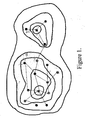
- a 'mountaintop' This is a point that is higher than all its neighbouring points-a definition which can be applied unchanged to the case of a discrete network. That is, if a node's EVC is higher than that of any of its neighbours (so that it is a local maximum of the EVC), we call that node a Centre. Next, we know that there must be a mountain for each mountaintop. We will call these mountains regions ; and they are important entities in our analysis. That is, each node which is not a Centre must either belong to some Centre's mountain (region), or lie on a 'border' between regions. In fact, our preferred definition of region membership has essentially no nodes on borders between regions. Thus our definition of regions promises to give us just what we wanted: a way to break up the network into well connected clusters (the regions).
- region membership all those nodes for which a steepest-ascent path terminates at the same local maximum of the EVC belong to the same region. That is, a given node can find which region it belongs to by finding its highest neighbour, and asking that highest neighbour to find its highest neighbour, and so on, until the steepest-ascent path terminates at a local maximum of the EVC (i.e., at a Centre). All nodes on that path belong to the region of that Centre. Also, every node will belong to only one Centre, barring the unlikely event that a node has two or more highest neighbours having exactly the same EVC, but belonging to differing regions.
- Figure 1 expresses pictorially the two aims we seek to achieve by using EVC: (i) find the well connected clusters, and (ii) understand spreading.
- neighbourhoods rather than in terms of single nodes. It follows from the meaning of spreading power that a neighbourhood characterized by high spreading power will have more rapid spreading than one characterized by low spreading power. Furthermore, we note that these different types of neighbourhoods (high and low) are smoothly joined by areas of intermediate spreading power (and speed) .
- Figure 2 expresses these ideas pictorially.
- the figure shows our two-region example of Figure 1 , but viewed from the 'side'-as if each node truly has a height.
- EMC which tells us, by our assumption, the spreading power
- the spreading of the infection reaches a maximum rate when the most central nodes in the region are reached; it then 'takes off', and infects the rest of the region.
- Figure 3 shows a typical S curve for infection, in the case (as we study in this paper) that immunity is not possible. Above this S curve, we plot the expected centrality of the newly infected nodes over time. According to our arguments above, relatively few nodes are infected before the most central node is reached-even as the centrality of the infection front is steadily rising. The takeoff of the infection then roughly coincides with the infection of the most central neighbourhood. Hence, the part of Figure 3 to the left of the dashed line corresponds to the left half of Figure 2 ; similarly, the right-hand parts of the two figures correspond.
- the first problem is to try to quantify and make precise our assumption (A). Since (A) relates two quantities-spreading power and EVC-and the latter is precisely defined, the task is then to define the former, and then to seek a relation between the two.
- the spreading power of node i to be simply the sum over all other nodes j of its infection coefficient C(i,j) with respect to j .
- every node will have a nonzero C(i,j) with every other, thus contributing to the sum.
- each node has the same number of terms in the sum; but the nodes with many large infection coefficients will of course get a higher spreading power.
- idea 2 is a "greedy" version of idea 1.
- the greediest version of idea 2 is to connect all Centres to all, thus forming a complete sub-graph among the Centres.
- a complete subgraph among 5 Centres is shown in Fig. 11A .
- An alternative to this design is to insert a new star node (shown in white in Fig. 11B ), which is connected to all the centre nodes by just one link to each. In some situations, where physically laying down new links is costly in terms of scarce resources, and adding new nodes is feasible, this star design can be more attractive than the complete subgraph option.
- inoculating a bridge link (idea 3) is not the same as inoculating the two nodes which the link joins (idea 4): inoculating a node effectively removes that node and all links connected to it, while inoculating a link removes only that link.
- inoculating a link removes only that link.
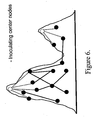
- the two nodes at the ends of the bridge link are inoculated, while in Figure 9 , only the bridge link itself is inoculated.
- link EVC the arithmetic mean of the EVC values of the nodes on the ends of the link. Ideas 3 and 4 are then almost certainly most effective if the bridging links chosen for inoculation have a relatively high link EVC.
- Inoculating a link means removing the link. And “removing” means blocking any and all communication over the link.
- inoculating a node means inoculating ALL links connected to that node. In this way, no communication to or from the inoculated node is possible. This is equivalent to "removing the node from the graph”. For our purposes, it is not necessary to shut down a node in order to inoculate it. One must simply close off all communication to & from the node.
- inoculation Another definition of inoculation is possible. If it is possible to detect and block the unwanted information, and thereby to filter the communication over links in some way, then we need not close off ALL communication on a link in order to inoculate the link. That is, if we can detect the unwanted, harmful communication (e.g., a virus), then it is sufficient to block only THAT form for communication, and allow other communications through. Inoculation of a link may then be defined as: Blocking any transmission of "unwonted" information over the link. Then inoculating a node can be defined as inoculating all links connected to the node (as before).
Landscapes
- Engineering & Computer Science (AREA)
- Computer Networks & Wireless Communication (AREA)
- Signal Processing (AREA)
- Pure & Applied Mathematics (AREA)
- General Physics & Mathematics (AREA)
- Mathematical Analysis (AREA)
- Mathematical Optimization (AREA)
- Mathematical Physics (AREA)
- Probability & Statistics with Applications (AREA)
- Physics & Mathematics (AREA)
- Algebra (AREA)
- Information Retrieval, Db Structures And Fs Structures Therefor (AREA)
- Agricultural Chemicals And Associated Chemicals (AREA)
- Data Exchanges In Wide-Area Networks (AREA)
- Information Transfer Between Computers (AREA)
- Computer And Data Communications (AREA)
- Artificial Filaments (AREA)
- Glass Compositions (AREA)
- Crystals, And After-Treatments Of Crystals (AREA)
- Processes Of Treating Macromolecular Substances (AREA)
- Pharmaceuticals Containing Other Organic And Inorganic Compounds (AREA)
- Mobile Radio Communication Systems (AREA)
- Peptides Or Proteins (AREA)
Applications Claiming Priority (2)
| Application Number | Priority Date | Filing Date | Title |
|---|---|---|---|
| NO20053330A NO323392B1 (no) | 2005-07-07 | 2005-07-07 | Fremgangsmate for spredning eller hindring av spredning av informasjon i et nettverk. |
| PCT/NO2006/000259 WO2007008078A1 (en) | 2005-07-07 | 2006-07-06 | Methods for spreading or preventing spreading of information in a network |
Publications (2)
| Publication Number | Publication Date |
|---|---|
| EP1900148A1 EP1900148A1 (en) | 2008-03-19 |
| EP1900148B1 true EP1900148B1 (en) | 2009-01-07 |
Family
ID=35295151
Family Applications (1)
| Application Number | Title | Priority Date | Filing Date |
|---|---|---|---|
| EP06769430A Active EP1900148B1 (en) | 2005-07-07 | 2006-07-06 | Methods for spreading or preventing spreading of information in a network |
Country Status (10)
| Country | Link |
|---|---|
| US (1) | US7881227B2 (no) |
| EP (1) | EP1900148B1 (no) |
| AT (1) | ATE420509T1 (no) |
| DE (1) | DE602006004737D1 (no) |
| DK (1) | DK1900148T3 (no) |
| MY (1) | MY141291A (no) |
| NO (1) | NO323392B1 (no) |
| RU (1) | RU2408145C2 (no) |
| UA (1) | UA88963C2 (no) |
| WO (1) | WO2007008078A1 (no) |
Families Citing this family (5)
| Publication number | Priority date | Publication date | Assignee | Title |
|---|---|---|---|---|
| US7765593B1 (en) * | 2004-06-24 | 2010-07-27 | Mcafee, Inc. | Rule set-based system and method for advanced virus protection |
| US7917955B1 (en) * | 2005-01-14 | 2011-03-29 | Mcafee, Inc. | System, method and computer program product for context-driven behavioral heuristics |
| US7889679B2 (en) * | 2008-02-01 | 2011-02-15 | Telenor Asa | Arrangements for networks |
| TWI599905B (zh) * | 2016-05-23 | 2017-09-21 | 緯創資通股份有限公司 | 惡意碼的防護方法、系統及監控裝置 |
| CN116756433B (zh) * | 2023-06-30 | 2025-08-08 | 西北工业大学 | 一种社交网络不实信息控制方法及装置 |
Family Cites Families (3)
| Publication number | Priority date | Publication date | Assignee | Title |
|---|---|---|---|---|
| US5473692A (en) * | 1994-09-07 | 1995-12-05 | Intel Corporation | Roving software license for a hardware agent |
| US7426574B2 (en) * | 2003-12-16 | 2008-09-16 | Trend Micro Incorporated | Technique for intercepting data in a peer-to-peer network |
| NO321340B1 (no) * | 2003-12-30 | 2006-05-02 | Telenor Asa | Fremgangsmate for a administrere nettverk ved analyse av konnektivitet |
-
2005
- 2005-07-07 NO NO20053330A patent/NO323392B1/no not_active IP Right Cessation
-
2006
- 2006-07-03 MY MYPI20063151A patent/MY141291A/en unknown
- 2006-07-06 UA UAA200801098A patent/UA88963C2/ru unknown
- 2006-07-06 DE DE602006004737T patent/DE602006004737D1/de active Active
- 2006-07-06 WO PCT/NO2006/000259 patent/WO2007008078A1/en not_active Ceased
- 2006-07-06 DK DK06769430T patent/DK1900148T3/da active
- 2006-07-06 AT AT06769430T patent/ATE420509T1/de not_active IP Right Cessation
- 2006-07-06 RU RU2008103454/09A patent/RU2408145C2/ru not_active IP Right Cessation
- 2006-07-06 EP EP06769430A patent/EP1900148B1/en active Active
-
2007
- 2007-07-06 US US11/988,370 patent/US7881227B2/en not_active Expired - Fee Related
Also Published As
| Publication number | Publication date |
|---|---|
| US20090141652A1 (en) | 2009-06-04 |
| RU2008103454A (ru) | 2009-08-20 |
| US7881227B2 (en) | 2011-02-01 |
| RU2408145C2 (ru) | 2010-12-27 |
| ATE420509T1 (de) | 2009-01-15 |
| EP1900148A1 (en) | 2008-03-19 |
| NO20053330L (no) | 2007-01-08 |
| NO323392B1 (no) | 2007-04-23 |
| MY141291A (en) | 2010-04-16 |
| UA88963C2 (ru) | 2009-12-10 |
| DE602006004737D1 (de) | 2009-02-26 |
| DK1900148T3 (da) | 2009-05-04 |
| WO2007008078A1 (en) | 2007-01-18 |
| NO20053330D0 (no) | 2005-07-07 |
Similar Documents
| Publication | Publication Date | Title |
|---|---|---|
| Davanam et al. | Novel defense framework for cross-layer attacks in cognitive radio networks | |
| US7881227B2 (en) | Methods for spreading or preventing spreading of information in a network | |
| Ye et al. | Competitive epidemic spreading over networks | |
| Ren et al. | A compartmental model to explore the interplay between virus epidemics and honeynet potency | |
| Kumar et al. | SMIR model for controlling the spread of information in social networking sites | |
| Zhang et al. | Building network attack graph for alert causal correlation | |
| Wang et al. | Coupled propagation dynamics on complex networks: A brief review | |
| CN111342991A (zh) | 基于跨社交网络的信息传播方法 | |
| Skopik et al. | Trustworthy interaction balancing in mixed service-oriented systems | |
| Chen et al. | Epidemic dynamics driven by adaptive rewiring mechanism on higher-order networks | |
| Di et al. | A dynamic epidemic model for rumor spread in multiplex network with numerical analysis | |
| Koïta et al. | A generic learning simulation framework to assess security strategies in cyber-physical production systems | |
| Borgatti | Identifying sets of key players in a network | |
| Canright et al. | Epidemic spreading over networks-a view from neighbourhoods | |
| Li et al. | A theory of network security: Principles of natural selection and combinatorics | |
| CN114598486B (zh) | 一种sdn网络中面向业务流的威胁等级划分方法和系统 | |
| Chatterjee et al. | The evolutionary price of anarchy: Locally bounded agents in a dynamic virus game | |
| Asadi et al. | Modeling of Malware Propagation Under the Clustering Approach in Scale‐Free Networks | |
| Tian et al. | A smart topology construction method for anti-tracking network based on the neural network | |
| Zhang et al. | Stability analysis of a SAIR epidemic model on scale-free community networks | |
| CN111669760B (zh) | 认知无线电网络中基于协作干扰的安全传输方案 | |
| CN110826003B (zh) | 一种基于删边聚簇的非法或有害网络信息传播控制方法 | |
| Neznik et al. | Smart Radio Resource Management for Content Delivery Services in 5G and Beyond Networks | |
| Muhammad et al. | Agent-based Simulation of Socially-inspired Model of Resistance against Unpopular Norms. | |
| Zhang et al. | The analysis of an SEI2R information propagation model based on Pareto's law in social networks |
Legal Events
| Date | Code | Title | Description |
|---|---|---|---|
| PUAI | Public reference made under article 153(3) epc to a published international application that has entered the european phase |
Free format text: ORIGINAL CODE: 0009012 |
|
| AK | Designated contracting states |
Kind code of ref document: A1 Designated state(s): AT BE BG CH CY CZ DE DK EE ES FI FR GB GR HU IE IS IT LI LT LU LV MC NL PL PT RO SE SI SK TR |
|
| RAX | Requested extension states of the european patent have changed |
Extension state: YU Payment date: 20080207 |
|
| RAX | Requested extension states of the european patent have changed |
Extension state: RS Payment date: 20080207 |
|
| 17P | Request for examination filed |
Effective date: 20071222 |
|
| GRAP | Despatch of communication of intention to grant a patent |
Free format text: ORIGINAL CODE: EPIDOSNIGR1 |
|
| GRAS | Grant fee paid |
Free format text: ORIGINAL CODE: EPIDOSNIGR3 |
|
| GRAA | (expected) grant |
Free format text: ORIGINAL CODE: 0009210 |
|
| AK | Designated contracting states |
Kind code of ref document: B1 Designated state(s): AT BE BG CH CY CZ DE DK EE ES FI FR GB GR HU IE IS IT LI LT LU LV MC NL PL PT RO SE SI SK TR |
|
| AX | Request for extension of the european patent |
Extension state: RS |
|
| REG | Reference to a national code |
Ref country code: GB Ref legal event code: FG4D |
|
| REG | Reference to a national code |
Ref country code: CH Ref legal event code: EP |
|
| REG | Reference to a national code |
Ref country code: IE Ref legal event code: FG4D |
|
| REF | Corresponds to: |
Ref document number: 602006004737 Country of ref document: DE Date of ref document: 20090226 Kind code of ref document: P |
|
| REG | Reference to a national code |
Ref country code: SE Ref legal event code: TRGR |
|
| REG | Reference to a national code |
Ref country code: DK Ref legal event code: T3 |
|
| PG25 | Lapsed in a contracting state [announced via postgrant information from national office to epo] |
Ref country code: NL Free format text: LAPSE BECAUSE OF FAILURE TO SUBMIT A TRANSLATION OF THE DESCRIPTION OR TO PAY THE FEE WITHIN THE PRESCRIBED TIME-LIMIT Effective date: 20090107 Ref country code: SI Free format text: LAPSE BECAUSE OF FAILURE TO SUBMIT A TRANSLATION OF THE DESCRIPTION OR TO PAY THE FEE WITHIN THE PRESCRIBED TIME-LIMIT Effective date: 20090107 |
|
| NLV1 | Nl: lapsed or annulled due to failure to fulfill the requirements of art. 29p and 29m of the patents act | ||
| PG25 | Lapsed in a contracting state [announced via postgrant information from national office to epo] |
Ref country code: LT Free format text: LAPSE BECAUSE OF FAILURE TO SUBMIT A TRANSLATION OF THE DESCRIPTION OR TO PAY THE FEE WITHIN THE PRESCRIBED TIME-LIMIT Effective date: 20090107 Ref country code: ES Free format text: LAPSE BECAUSE OF FAILURE TO SUBMIT A TRANSLATION OF THE DESCRIPTION OR TO PAY THE FEE WITHIN THE PRESCRIBED TIME-LIMIT Effective date: 20090418 Ref country code: FI Free format text: LAPSE BECAUSE OF FAILURE TO SUBMIT A TRANSLATION OF THE DESCRIPTION OR TO PAY THE FEE WITHIN THE PRESCRIBED TIME-LIMIT Effective date: 20090107 |
|
| PG25 | Lapsed in a contracting state [announced via postgrant information from national office to epo] |
Ref country code: PT Free format text: LAPSE BECAUSE OF FAILURE TO SUBMIT A TRANSLATION OF THE DESCRIPTION OR TO PAY THE FEE WITHIN THE PRESCRIBED TIME-LIMIT Effective date: 20090608 Ref country code: LV Free format text: LAPSE BECAUSE OF FAILURE TO SUBMIT A TRANSLATION OF THE DESCRIPTION OR TO PAY THE FEE WITHIN THE PRESCRIBED TIME-LIMIT Effective date: 20090107 Ref country code: AT Free format text: LAPSE BECAUSE OF FAILURE TO SUBMIT A TRANSLATION OF THE DESCRIPTION OR TO PAY THE FEE WITHIN THE PRESCRIBED TIME-LIMIT Effective date: 20090107 Ref country code: IS Free format text: LAPSE BECAUSE OF FAILURE TO SUBMIT A TRANSLATION OF THE DESCRIPTION OR TO PAY THE FEE WITHIN THE PRESCRIBED TIME-LIMIT Effective date: 20090507 Ref country code: PL Free format text: LAPSE BECAUSE OF FAILURE TO SUBMIT A TRANSLATION OF THE DESCRIPTION OR TO PAY THE FEE WITHIN THE PRESCRIBED TIME-LIMIT Effective date: 20090107 |
|
| PG25 | Lapsed in a contracting state [announced via postgrant information from national office to epo] |
Ref country code: BE Free format text: LAPSE BECAUSE OF FAILURE TO SUBMIT A TRANSLATION OF THE DESCRIPTION OR TO PAY THE FEE WITHIN THE PRESCRIBED TIME-LIMIT Effective date: 20090107 |
|
| PG25 | Lapsed in a contracting state [announced via postgrant information from national office to epo] |
Ref country code: EE Free format text: LAPSE BECAUSE OF FAILURE TO SUBMIT A TRANSLATION OF THE DESCRIPTION OR TO PAY THE FEE WITHIN THE PRESCRIBED TIME-LIMIT Effective date: 20090107 Ref country code: CZ Free format text: LAPSE BECAUSE OF FAILURE TO SUBMIT A TRANSLATION OF THE DESCRIPTION OR TO PAY THE FEE WITHIN THE PRESCRIBED TIME-LIMIT Effective date: 20090107 |
|
| PLBE | No opposition filed within time limit |
Free format text: ORIGINAL CODE: 0009261 |
|
| STAA | Information on the status of an ep patent application or granted ep patent |
Free format text: STATUS: NO OPPOSITION FILED WITHIN TIME LIMIT |
|
| PG25 | Lapsed in a contracting state [announced via postgrant information from national office to epo] |
Ref country code: RO Free format text: LAPSE BECAUSE OF FAILURE TO SUBMIT A TRANSLATION OF THE DESCRIPTION OR TO PAY THE FEE WITHIN THE PRESCRIBED TIME-LIMIT Effective date: 20090107 Ref country code: SK Free format text: LAPSE BECAUSE OF FAILURE TO SUBMIT A TRANSLATION OF THE DESCRIPTION OR TO PAY THE FEE WITHIN THE PRESCRIBED TIME-LIMIT Effective date: 20090107 |
|
| 26N | No opposition filed |
Effective date: 20091008 |
|
| PG25 | Lapsed in a contracting state [announced via postgrant information from national office to epo] |
Ref country code: BG Free format text: LAPSE BECAUSE OF FAILURE TO SUBMIT A TRANSLATION OF THE DESCRIPTION OR TO PAY THE FEE WITHIN THE PRESCRIBED TIME-LIMIT Effective date: 20090407 |
|
| PG25 | Lapsed in a contracting state [announced via postgrant information from national office to epo] |
Ref country code: MC Free format text: LAPSE BECAUSE OF NON-PAYMENT OF DUE FEES Effective date: 20090731 |
|
| PG25 | Lapsed in a contracting state [announced via postgrant information from national office to epo] |
Ref country code: IE Free format text: LAPSE BECAUSE OF NON-PAYMENT OF DUE FEES Effective date: 20090706 |
|
| PG25 | Lapsed in a contracting state [announced via postgrant information from national office to epo] |
Ref country code: GR Free format text: LAPSE BECAUSE OF FAILURE TO SUBMIT A TRANSLATION OF THE DESCRIPTION OR TO PAY THE FEE WITHIN THE PRESCRIBED TIME-LIMIT Effective date: 20090408 |
|
| REG | Reference to a national code |
Ref country code: CH Ref legal event code: PL |
|
| PG25 | Lapsed in a contracting state [announced via postgrant information from national office to epo] |
Ref country code: IT Free format text: LAPSE BECAUSE OF FAILURE TO SUBMIT A TRANSLATION OF THE DESCRIPTION OR TO PAY THE FEE WITHIN THE PRESCRIBED TIME-LIMIT Effective date: 20090107 |
|
| PG25 | Lapsed in a contracting state [announced via postgrant information from national office to epo] |
Ref country code: CH Free format text: LAPSE BECAUSE OF NON-PAYMENT OF DUE FEES Effective date: 20100731 Ref country code: LU Free format text: LAPSE BECAUSE OF NON-PAYMENT OF DUE FEES Effective date: 20090706 Ref country code: LI Free format text: LAPSE BECAUSE OF NON-PAYMENT OF DUE FEES Effective date: 20100731 |
|
| PG25 | Lapsed in a contracting state [announced via postgrant information from national office to epo] |
Ref country code: HU Free format text: LAPSE BECAUSE OF FAILURE TO SUBMIT A TRANSLATION OF THE DESCRIPTION OR TO PAY THE FEE WITHIN THE PRESCRIBED TIME-LIMIT Effective date: 20090708 |
|
| PG25 | Lapsed in a contracting state [announced via postgrant information from national office to epo] |
Ref country code: TR Free format text: LAPSE BECAUSE OF FAILURE TO SUBMIT A TRANSLATION OF THE DESCRIPTION OR TO PAY THE FEE WITHIN THE PRESCRIBED TIME-LIMIT Effective date: 20090107 |
|
| PG25 | Lapsed in a contracting state [announced via postgrant information from national office to epo] |
Ref country code: CY Free format text: LAPSE BECAUSE OF FAILURE TO SUBMIT A TRANSLATION OF THE DESCRIPTION OR TO PAY THE FEE WITHIN THE PRESCRIBED TIME-LIMIT Effective date: 20090107 |
|
| REG | Reference to a national code |
Ref country code: DE Ref legal event code: R082 Ref document number: 602006004737 Country of ref document: DE Representative=s name: RPK PATENTANWAELTE REINHARDT, POHLMANN UND KAU, DE |
|
| REG | Reference to a national code |
Ref country code: DE Ref legal event code: R082 Ref document number: 602006004737 Country of ref document: DE Representative=s name: RPK PATENTANWAELTE REINHARDT, POHLMANN UND KAU, DE |
|
| REG | Reference to a national code |
Ref country code: FR Ref legal event code: PLFP Year of fee payment: 10 |
|
| PGFP | Annual fee paid to national office [announced via postgrant information from national office to epo] |
Ref country code: DK Payment date: 20150624 Year of fee payment: 10 Ref country code: GB Payment date: 20150626 Year of fee payment: 10 Ref country code: SE Payment date: 20150626 Year of fee payment: 10 |
|
| PGFP | Annual fee paid to national office [announced via postgrant information from national office to epo] |
Ref country code: FR Payment date: 20150625 Year of fee payment: 10 |
|
| PGFP | Annual fee paid to national office [announced via postgrant information from national office to epo] |
Ref country code: DE Payment date: 20150623 Year of fee payment: 10 |
|
| REG | Reference to a national code |
Ref country code: DE Ref legal event code: R119 Ref document number: 602006004737 Country of ref document: DE |
|
| REG | Reference to a national code |
Ref country code: DK Ref legal event code: EBP Effective date: 20170131 |
|
| REG | Reference to a national code |
Ref country code: SE Ref legal event code: EUG |
|
| GBPC | Gb: european patent ceased through non-payment of renewal fee |
Effective date: 20160706 |
|
| PG25 | Lapsed in a contracting state [announced via postgrant information from national office to epo] |
Ref country code: SE Free format text: LAPSE BECAUSE OF NON-PAYMENT OF DUE FEES Effective date: 20160707 Ref country code: DE Free format text: LAPSE BECAUSE OF NON-PAYMENT OF DUE FEES Effective date: 20170201 Ref country code: FR Free format text: LAPSE BECAUSE OF NON-PAYMENT OF DUE FEES Effective date: 20160801 |
|
| REG | Reference to a national code |
Ref country code: FR Ref legal event code: ST Effective date: 20170331 |
|
| PG25 | Lapsed in a contracting state [announced via postgrant information from national office to epo] |
Ref country code: GB Free format text: LAPSE BECAUSE OF NON-PAYMENT OF DUE FEES Effective date: 20160706 |
|
| PG25 | Lapsed in a contracting state [announced via postgrant information from national office to epo] |
Ref country code: DK Free format text: LAPSE BECAUSE OF NON-PAYMENT OF DUE FEES Effective date: 20160731 |