EP1924296B1 - Verbandsmaterial mit wirkstoffen - Google Patents
Verbandsmaterial mit wirkstoffen Download PDFInfo
- Publication number
- EP1924296B1 EP1924296B1 EP06778096A EP06778096A EP1924296B1 EP 1924296 B1 EP1924296 B1 EP 1924296B1 EP 06778096 A EP06778096 A EP 06778096A EP 06778096 A EP06778096 A EP 06778096A EP 1924296 B1 EP1924296 B1 EP 1924296B1
- Authority
- EP
- European Patent Office
- Prior art keywords
- dressing material
- dressing
- complaints
- active substance
- flowers
- Prior art date
- Legal status (The legal status is an assumption and is not a legal conclusion. Google has not performed a legal analysis and makes no representation as to the accuracy of the status listed.)
- Expired - Lifetime
Links
Images

Classifications
-
- A—HUMAN NECESSITIES
- A61—MEDICAL OR VETERINARY SCIENCE; HYGIENE
- A61L—METHODS OR APPARATUS FOR STERILISING MATERIALS OR OBJECTS IN GENERAL; DISINFECTION, STERILISATION OR DEODORISATION OF AIR; CHEMICAL ASPECTS OF BANDAGES, DRESSINGS, ABSORBENT PADS OR SURGICAL ARTICLES; MATERIALS FOR BANDAGES, DRESSINGS, ABSORBENT PADS OR SURGICAL ARTICLES
- A61L15/00—Chemical aspects of, or use of materials for, bandages, dressings or absorbent pads
- A61L15/16—Bandages, dressings or absorbent pads for physiological fluids such as urine or blood, e.g. sanitary towels, tampons
- A61L15/40—Bandages, dressings or absorbent pads for physiological fluids such as urine or blood, e.g. sanitary towels, tampons containing ingredients of undetermined constitution or reaction products thereof, e.g. plant or animal extracts
-
- A—HUMAN NECESSITIES
- A61—MEDICAL OR VETERINARY SCIENCE; HYGIENE
- A61K—PREPARATIONS FOR MEDICAL, DENTAL OR TOILETRY PURPOSES
- A61K36/00—Medicinal preparations of undetermined constitution containing material from algae, lichens, fungi or plants, or derivatives thereof, e.g. traditional herbal medicines
- A61K36/18—Magnoliophyta (angiosperms)
- A61K36/185—Magnoliopsida (dicotyledons)
- A61K36/22—Anacardiaceae (Sumac family), e.g. smoketree, sumac or poison oak
-
- A—HUMAN NECESSITIES
- A61—MEDICAL OR VETERINARY SCIENCE; HYGIENE
- A61K—PREPARATIONS FOR MEDICAL, DENTAL OR TOILETRY PURPOSES
- A61K36/00—Medicinal preparations of undetermined constitution containing material from algae, lichens, fungi or plants, or derivatives thereof, e.g. traditional herbal medicines
- A61K36/18—Magnoliophyta (angiosperms)
- A61K36/185—Magnoliopsida (dicotyledons)
- A61K36/28—Asteraceae or Compositae (Aster or Sunflower family), e.g. chamomile, feverfew, yarrow or echinacea
-
- A—HUMAN NECESSITIES
- A61—MEDICAL OR VETERINARY SCIENCE; HYGIENE
- A61K—PREPARATIONS FOR MEDICAL, DENTAL OR TOILETRY PURPOSES
- A61K36/00—Medicinal preparations of undetermined constitution containing material from algae, lichens, fungi or plants, or derivatives thereof, e.g. traditional herbal medicines
- A61K36/18—Magnoliophyta (angiosperms)
- A61K36/185—Magnoliopsida (dicotyledons)
- A61K36/75—Rutaceae (Rue family)
-
- A—HUMAN NECESSITIES
- A61—MEDICAL OR VETERINARY SCIENCE; HYGIENE
- A61P—SPECIFIC THERAPEUTIC ACTIVITY OF CHEMICAL COMPOUNDS OR MEDICINAL PREPARATIONS
- A61P19/00—Drugs for skeletal disorders
- A61P19/02—Drugs for skeletal disorders for joint disorders, e.g. arthritis, arthrosis
-
- A—HUMAN NECESSITIES
- A61—MEDICAL OR VETERINARY SCIENCE; HYGIENE
- A61P—SPECIFIC THERAPEUTIC ACTIVITY OF CHEMICAL COMPOUNDS OR MEDICINAL PREPARATIONS
- A61P19/00—Drugs for skeletal disorders
- A61P19/04—Drugs for skeletal disorders for non-specific disorders of the connective tissue
Definitions
- the present invention relates to a bandage material comprising a carrier material and at least one active ingredient each of Arnica montana, Rhus toxicodendron and Ruta graveolens. Furthermore, the invention relates to a medicament comprising this dressing material and the use of this dressing material for the manufacture of a medicament for the treatment of diseases or disorders of the musculoskeletal system.
- the dressing material is used here as a tape bandage.
- Injuries to the musculoskeletal system can be treated by partial or complete immobilization of the affected parts of the body.
- the complete rest position eg by plaster bandages, is well known in the art.
- a disadvantage of this treatment method is that the affected parts of the body often have to be immobilized over a longer period of time and can occur as a result of the type of immobilization, eg plaster, consequential damage to the body parts, such as circulatory disorders, decreased lymphatic drainage or tissue atrophy.
- the tape bandage supports and relieves damaged parts, eg of a joint, for movement, allows a functional load to a limited extent and thereby avoids extreme movements, which could possibly lead to further damage to various parts of the joint.
- Tapes have not only a stabilizing effect as a passive outer shell, but also activate muscle groups on the irritation of mechanoreceptors in the skin and proprioceptors of muscles and tendons.
- Taped bandages are now an integral part of medical care. Nevertheless, some of the consequential damage mentioned above in connection with bandages that cause a complete immobilization of the body part can also occur with tapes. These include, in particular, damage due to insufficient lymphatic drainage, blood supply or tissue atrophy.
- the invention therefore relates to a bandage material comprising a carrier material and at least one active ingredient each of Arnica montana, Rhus toxicodendron and Ruta graveolens.
- the present invention further relates to a bandage material comprising a carrier material and at least one active ingredient each of Flos cathaimi, Ruta graveolens and Rhus delavayi.
- the present invention also relates to bandage materials comprising a carrier material; preferably as described above, and at least one further active ingredient selected from the group consisting of: (i) active ingredients of Bryonia alba, Bryonia dioica, mixtures of cherry plum blossoms, flowers of the white clematis, flowers of the gland-bearing bog, flowers of the yellow Sun-rose and flowers of the Golden Star (commercially available as Rescue Remedy Blend), Hypericum perforatum (St.
- Diclofenac is a known medicinal product with the chemical name [2- (2,6-dichloroanilino) phenyl] acetic acid sodium salt.
- Dressing material according to the present invention is a flexible material that can be applied to the skin of the body on damaged parts of the body of the musculoskeletal system.
- the flexibility of the dressing material should be chosen so that it on the one hand a guided, supported movement of the affected parts of the musculoskeletal system On the other hand, however, it also allows it to be fixed sufficiently to avoid undesired or extreme movements, such as overstretching.
- the bandage material according to the invention can be constructed from one or more materials.
- the dressing material comprises at least one carrier material as well as an active ingredient or a combination of active ingredients as described above.
- the active ingredient may in this case be applied directly to the carrier material or be coupled to an adjuvant which is applied to the carrier material.
- the dressing material can thus also comprise auxiliaries. Suitable excipients include pharmaceutically acceptable solvents for the active ingredients, substances that affect the elasticity or stiffness of the carrier material, but also substances that are needed for the attachment of the dressing material to the skin, such as adhesives.
- the dressing material may be in any geometric form. Preferably, it is in the form of a rectangular or round plaster or, more preferably, a rectangular band.
- the dressing material according to the invention is preferably permeable to air, water-repellent and consists of hypoallergenic materials. By choosing suitable colors, preferably red, blue, yellow, it is also possible to influence the body process and the healing process in an energetic way. As dressing materials, it is also possible according to the invention to use all commercially available plasters, bandages or tape dressings.
- carrier material is to be understood as meaning a woven or non-woven material which may be composed of one or more different constituents.
- the backbone of the support material is preferably composed of a natural or synthetic polymer, for example a polyester, or a polycondensate, for example a polyhydroxyalkanoate. Suitable materials for the backbone of the support material are known in the art.
- the support material particularly preferably comprises a mixture of natural constituents, preferably cotton or rubber, and synthetic constituents, preferably acrylic. In the carrier material, other substances, such as the aforementioned auxiliaries, are introduced.
- the carrier material should furthermore be such that it can form a compound with the abovementioned active substances or combinations of active substances either directly or via auxiliaries. Likewise, it is preferable that the carrier material be capable of bonding with an adhesive, as disclosed elsewhere in the specification.
- an active ingredient as used herein is a chemical compound that can be obtained from any of the aforementioned plants or a plant part, eg, seeds, leaves or stems thereof.
- a mixture of active substances in the context of the present invention is a mixture of such chemical compounds.
- the mixture can be prepared by mixing corresponding individual active ingredients or can be provided by joint extraction of various active substances from the plants or plant components.
- an active ingredient mixture of in each case Arnica montana, Rhus toxicodendron and Ruta graveolens is obtained by extraction with a solvent consisting of an alcohol and water.
- urea extract For this purpose, first healthy plants are harvested, cleaned and then freshly minced. The comminuted plant porridge is then mixed with the solvents and preferably incubated in the dark, so that the active ingredients can be dissolved out of the comminuted plant fragments by the solvent. Subsequent separation of the comminuted plant fragments from the solvent active substance mixture now yields a urea extract. The separation can be carried out for example by filtration, sedimentation or centrifugation. Preferably, the urea extract is recovered by filtration.
- the solvent used is preferably 90% alcohol and 10% water. Most preferably, the alcohol is ethanol.
- Extracts of Arnica montana are preferably obtained from the dried subterranean portions of the plant or the aboveground portions at flowering time in accordance with Rules 4a and 17 of the HAB. Extracts from Rhus toxicodendron are preferably obtained from young, not yet lignified sprouts according to rules 2a and 7 of the HAB.
- Extracts of Ruta graveolens are preferably obtained from the fresh, aerial parts at flowering time in accordance with Rules 3a and 7 of the Habitats.
- the ureus extract prepared by the methods described above is preferably used in the dressing material according to the invention as a dilute extract.
- the diluent used here likewise is an alcohol-water mixture, preferably as described above.
- the diluted extract is preferably prepared by sputtering as described in the HAB.
- active ingredients that can not be dissolved in alcohol, distilled water from the raw material may be first dissolved until the 3rd / 4th century. Potency be triturated (triturated). In the trituration, the raw material per potency step is triturated 3 x with milk sugar in a mortar and patted, the ratio between raw material and milk sugar should be about 1: 100.
- the extracts or triturations described above are preferably formulated for topical application.
- the active substances from the plants or plant constituents of Fos cathaimi, Rhus Delavayi, Bryonia alba, Bryonia dioica, St. John's wort, Apis melifica, Calendula, Agaricus muscarius, Anacardium Orientale, Lendium palustris, Bellis perennsis and Hamamelis virginica can also be obtained according to the regulations HAB.
- active substances from Bryonia alba or dioica can be obtained according to Rule 2a of the HAB.
- Active substances from Agaricus muscarius can preferably be obtained according to Rule 3a of the HAB.
- Active substances from Apis melifica can preferably be obtained according to Rule 4b of the HAB.
- the active compounds and active ingredient mixtures are formulated as ointments or creams.
- the ointments or creams preferably also contain wool wax, wool wax alcohol ointment (consisting of cetylstearyl alcohol, wool wax alcohols and white visilin), thick paraffin and water.
- the ointments contain the extract or the trituration with the active ingredients in a concentration of 5-20% (w / w), preferably 10% (w / w).
- the aforementioned extracts or triturations may also be applied to the carrier material in any other form suitable for local administration, e.g. as a gel. However, it is a prerequisite that this form of administration allows a bioavailability of the active ingredients in local, dermal administration.
- a bandage material comprising the aforementioned ingredients has the therapeutic advantages of a tape dressing known in the art, but at the same time can circumvent its disadvantages.
- active ingredients such as Arnica montana, Rhus toxicodendron and Ruta graveolens and thus allowing local supply of provided with the dressing material section of the musculoskeletal system is an efficient lymphatic drainage, increased blood supply (especially venous activation), a stabilization of the damaged structure under Maintaining good mobility, avoiding muscle atrophy and a therapy-promoting influence of skin and pain receptors, muscle and muscle attachments and the capsule and the ligament apparatus causes.
- Parts of the musculoskeletal system such as muscular pain syndromes, muscle spasms, joint pain and joint sprains, tendon and ligament disorders, rheumatic complaints, bruises, overstretching, torn muscle fibers, ligament ruptures, strains, recent injuries with severe hematomas, finger compression, ski thumbs, tennis and golf elbow Inpigmentyndrome, Insertionsendopathien, abductor injuries, knee joint effusions, knee joint pain, Achilles tendon complaints, heel spurs, ankle discomfort, fore and midfoot pain (longitudinal and transverse arch), wrist discomfort, cervical, thoracic or longitudinal spine complaints, migraine or lymphedema can efficiently and without thanks to the present invention Side effects or consequential damages are treated.
- a dressing material for example a tape dressing
- the advantageous effects of a dressing material can be combined synergistically with the therapeutic effects of the abovementioned active ingredients, wherein, in addition to the synergism found, at the same time a drastic reduction in consequential damage could be triggered by a tape bandage was observed.
- the at least one Arnica montana active ingredient is a dilute extract consisting of a part extract of 10 12 parts of a pharmaceutically acceptable solvent, preferably an alcohol-water mixture as described above.
- a dilute extract is also referred to in the art as Arnica D12 and is commercially available.
- the at least one Rhus toxicodendron active ingredient is a dilute extract consisting of a part extract of 10 12 parts of a pharmaceutically acceptable solvent, preferably an ethanol-water mixture as described above.
- a dilute extract is also referred to in the art as Rhus toxicodendron D12 and is commercially available.
- the at least one Ruta graveolens active ingredient is a dilute extract consisting of a part extract of 10 12 parts of a pharmaceutically acceptable solvent, preferably an ethanol-water mixture as described above.
- a dilute extract is also referred to in the art as Ruta graveolens D12 and is commercially available.
- this has an adhesive for fastening the dressing material to the skin.
- adhesives in the context of the present invention, agents can be used which mediate a reversible connection between the skin and the dressing material. These adhesives are preferably adhesives. These adhesives are preferably skin-friendly and cause otherwise no body reactions, such as contact allergies. Suitable adhesives for dressings, such as patches or tape dressings, are well known in the art.
- the dressing material may be impregnated with the adhesive or, preferably, one-sidedly coated therewith. Preferably, the dressing material is not completely provided with the adhesive.
- the adhesive is applied along the boundaries of rhombic surfaces (102), preferably in the form of splints (101), so that the diamond surfaces of the diamonds formed by the boundaries remain free of adhesive.
- a corresponding dressing material is in FIG. 1 shown.
- the diamond surfaces are then provided with the active ingredients or mixtures of active ingredients.
- the dressing material may in this case be impregnated with solutions of the corresponding active ingredients or coated therewith, with a coating being preferred.
- the adhesive is applied flat to the carrier material.
- the active ingredients are preferably introduced directly into a suitable adhesive before it is applied to the carrier material.
- suitable adhesives which do not affect the pharmaceutical properties of the active ingredients are known in the art.
- the active compounds or mixtures of active substances can be applied subsequently, for example as a film, to an adhesive already applied to the carrier material.
- this is up to 95% extensible along a first axis (110).
- the course of the first axis of the dressing material is in FIG. 1 shown.
- the first axis according to the invention the longitudinal axis of the dressing material, which is characterized in that applied with bandage material parallel to an imaginary axis along the skin surface and, if a dressing material with a rectangular shape, such as a band, is used as a dressing material, parallel extends to the longer of the side surfaces of the rectangle.
- the bandage material can be stretched along a second axis (120) by at most 5%.
- the second axis is the transverse axis of the dressing material, characterized in that, with the dressing material applied, parallel to an imaginary axis along the skin surface and, if a dressing material of rectangular shape, e.g. a band, as dressing material is used, runs parallel to the shorter of the side surfaces of the rectangle.
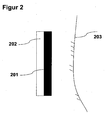
- the carrier material has a first carrier material (201) which is to be brought into contact with the skin and a second carrier material (202) for the outside of the bandage.
- the first support material (201) comprises zinc oxide, rubber and acrylic, with zinc oxide preferably in 1 to 10%, particularly preferably in 5% (w / w), rubber preferably in 1 to 10%, particularly preferably 5% (w / w ) and acrylic is preferably present in 80 to 98%, more preferably 90% (w / w).
- the second carrier material (202) is preferably cotton, more preferably pure cotton (100%). A preferred carrier material according to the invention is in FIG. 2 shown and described in the embodiment.
- the invention also relates to a pharmaceutical composition
- a pharmaceutical composition comprising a dressing material according to the invention as described above.
- the dressing material is sterile packaged in the drug formulation.
- the bandage material is preferably provided rolled up on a roll as a medicament.
- the dosage of the agents comprised by the dressing material has been previously described.
- the drug is so formulated that it can be used as a tape bandage.
- a rectangular band of bandage material preferably 5 to 15 meters long, most preferably 10 meters long, is rolled up.
- the invention relates to the use of a dressing material according to the invention as described above for the manufacture of a medicament for the treatment of disorders or disorders of the musculoskeletal system, preferably muscular pain syndrome, muscle cramps, joint pain and joint sprains, tendon and ligament disorders, rheumatic complaints, bruises, overstretching, torn muscle fibers, Ligament rupture, strains, recent injuries with pronounced hematomas, finger compressions, ski thumbs, tennis and golf elbow, impingement syndrome, insertion endopathy, adductor injuries, knee joint effusions, knee joint complaints, Achilles tendon complaints, heel spurs, ankle discomfort, fore and midfoot pain (longitudinal and transverse arch), wrist discomfort, Cervical spine, thoracic spine or lumbar spine pain, migraine or lymphedema.
- the bandage material is preferably used here as a tape bandage.
- Example 1 Tape Banding Material
- An approximately 10 m long ribbon of 4.5 cm width consists of a surface material and a skin-side applied material.
- the surface material is 100% cotton.
- the skin-side material consists of 5% zinc oxide, 5% rubber and 90% acrylic.
- An adhesive is applied to the skin side material in strips, the strips being mounted to define diamond shaped surfaces.
- dilute extracts of Arnica montana, Rhus toxicodendron and Ruta graveolens are applied.
- the extracts are Arnica D 12, Rhus toxicodendron D 12 and Ruta graveolens D12.
- the dressing material is processed so that it is permeable to air and water repellent.
- the bandage allows 95% longitudinal stretch and 5% lateral stretch.
- the substances used for the dressing material are hypoallergenic.
- the bandage is in the colors red, blue, yellow.
- the bandage material is used as a tape bandage for injuries and disorders of the musculoskeletal system. Very good results have been achieved on several occasions. In particular, the lymphatic drainage and a better blood supply to the affected parts of the musculoskeletal system could be achieved and muscle atrophy can be avoided.
- the effect of the active ingredients on the tape bandage has had a positive effect on the blood and blood vessels and lymphatic system.
- the regeneration of the tissue is improved (which is not optimally supplied by the trauma if the muscle capsule ligament is injured).
- the taped tape which adapts to the skin movements by its flexibility, the skin and pain receptors and the circulatory system was activated with each movement of the patient, so that the active ingredients could act locally.
- the removal of tissue fluid was increased.
- the circulation was significantly accelerated and thus shortened the healing process. A faster pain reduction allows a faster load, which in turn causes an increase in the circulatory system and at the same time supports muscle building.
Landscapes
- Health & Medical Sciences (AREA)
- Natural Medicines & Medicinal Plants (AREA)
- Life Sciences & Earth Sciences (AREA)
- Chemical & Material Sciences (AREA)
- Engineering & Computer Science (AREA)
- Public Health (AREA)
- Veterinary Medicine (AREA)
- General Health & Medical Sciences (AREA)
- Animal Behavior & Ethology (AREA)
- Epidemiology (AREA)
- Botany (AREA)
- Medicinal Chemistry (AREA)
- Pharmacology & Pharmacy (AREA)
- Medical Informatics (AREA)
- Microbiology (AREA)
- Biotechnology (AREA)
- Alternative & Traditional Medicine (AREA)
- Mycology (AREA)
- Chemical Kinetics & Catalysis (AREA)
- Organic Chemistry (AREA)
- Hematology (AREA)
- Bioinformatics & Cheminformatics (AREA)
- General Chemical & Material Sciences (AREA)
- Nuclear Medicine, Radiotherapy & Molecular Imaging (AREA)
- Materials Engineering (AREA)
- Physical Education & Sports Medicine (AREA)
- Zoology (AREA)
- Rheumatology (AREA)
- Orthopedic Medicine & Surgery (AREA)
- Immunology (AREA)
- Biomedical Technology (AREA)
- Medicinal Preparation (AREA)
- Materials For Medical Uses (AREA)
- Acyclic And Carbocyclic Compounds In Medicinal Compositions (AREA)
Description
- Die vorliegende Erfindung betrifft ein Verbandsmaterial umfassend ein Trägermaterial sowie zumindest einen Wirkstoff aus jeweils Arnica montana, Rhus toxicodendron und Ruta graveolens. Ferner betrifft die Erfindung ein Arzneimittel umfassend dieses Verbandsmaterial sowie die Verwendung dieses Verbandsmaterials zur Herstellung eines Arzneimittels zur Behandlung von Erkrankungen oder Störungen des Bewegungsapparates. Vorzugsweise wird das Verbandsmaterial als Tapeverband hierbei eingesetzt.
- Verletzungen des Bewegungsapparates, z.B. Kapselbandverletzungen, Muskelsehnenverletzungen, knöcherne Verletzungen oder auch degenerative Prozesse, können durch teilweise oder vollständige Ruhigstellung der betroffenen Körperpartien behandelt werden. Die vollständige Ruhestellung, z.B. durch Gipsverbände, ist im Stand der Technik wohlbekannt. Ein Nachteil dieser Behandlungsmethode ist jedoch, dass die betroffenen Körperpartien oft über einen längeren Zeitraum ruhig gestellt werden müssen und durch die Art der Ruhigstellung, z.B. Gipsverband, Folgeschäden an den Körperpartien auftreten können, wie Durchblutungsstörungen, verminderte Lymphdrainage oder auch Gewebeatrophien. Neben der vollständigen Ruhigstellung von betroffenen Körperpartien gibt es mittlerweile auch Verfahren zur teilweisen Ruhigstellung. Von besonderer Bedeutung sind hierbei die Tapeverbände, durch die verschiedene Verletzungen in kurzer Zeit zur Ausheilung gebracht werden können, ohne dass es einer vollständigen Ruhigstellung (z.B. durch Gips) bedarf. Zumindest einige der Folgeschäden, die durch die bekannten Maßnahmen zur vollständigen Ruhigstellung von Körperpartien auftreten können, können dadurch effizient vermieden werden. Der Tapeverband stützt und entlastet geschädigte Anteile, z.B. eines Gelenks, für Bewegungen, erlaubt eine funktionelle Belastung in begrenztem Ausmaß und vermeidet dadurch extreme Bewegungen, die unter Umständen zu einer weiteren Schädigung verschiedener Gelenkanteile führen könnten. Er ermöglicht jedoch funktionelle Nachbehandlungen, z.B. nach einer Gelenkoperation. Tapeverbände haben dabei nicht nur stabilisierende Wirkung als passive äußere Hülle, sondern aktivieren auch Muskelgruppen über die Reizung von Mechanorezeptoren in der Haut sowie Propriorezeptoren von Muskeln und Sehnen. Durch die Anspannung der aktivierten Muskelgruppen wird eine zusätzliche Stabilisierung, auch als propriozeptiver Effekt bezeichnet, bewirkt. Tapeverbände sind also mittlerweile aus der medizinischen Versorgung nicht mehr wegzudenken. Trotzdem können einige der zuvor im Zusammenhang mit Verbänden, die eine vollständige Ruhigstellung von Körperpartie bewirken, genannten Folgeschäden auch bei Tapeverbänden auftreten. Hierzu gehören insbesondere Schäden durch unzureichende Lymphdrainage, Blutversorgung oder Gewebeatrophien.
- Aufgabe der vorliegenden Erfindung ist es also, Maßnahmen bereitzustellen, durch die die zuvor genannten Nachteile vermieden werden können, wobei gleichzeitig ein verbesserter Heilungsprozess für geschädigte Körperpartien des Bewegungsapparates ermöglicht wird.
- Die Aufgabe wird durch die in den Ansprüchen sowie anschließend beschriebenen Ausführungsformen gelöst.
- Die Erfindung betrifft daher ein Verbandsmaterial umfassend ein Trägermaterial sowie zumindest einen Wirkstoff aus jeweils Arnica montana, Rhus toxicodendron und Ruta graveolens. Die vorliegende Erfindung betrifft weiterhin ein Verbandsmaterial umfassend einer Trägermaterial sowie zumindest einen Wirkstoff aus jeweils Flos cathaimi, Ruta graveolens und Rhus delavayi.
- Darüber hinaus betrifft die vorliegende Erfindung auch Verbandsmaterialien, die ein Trägermaterial umfassen; vorzugsweise wie zuvor beschrieben, und zumindest einen weiteren Wirkstoff aufweisen, der ausgewählt ist aus der Gruppe bestehend aus: (i) Wirkstoffen aus Bryonia alba, Bryonia dioica, Mixturen aus Kirschpflaumenblüten, Blüten der Weißen Waldrebe, Blüten des Drüsen tragenden Springkrauts, Blüten des gelben Sonnenröschens und Blüten des Goldigen Milchsterns (kommerziell erhältlich als Rescue Remedy Mischung), Hypericum perforatum (Johanniskraut), Apis mellifica, Calendula, Agaricus muscarius, Anacardium orientale, Lendium palustris, Bellis perennsis, Hamamelis viriginica sowie (ii) den Wirkstoffen Strontium carbonicum, Acidum sulforicum und Diclofenac. Bei Diclofenac handelt es sich um ein bekanntes Arzneimittel mit der chemischen Bezeichnung [2-(2,6-Dichloranilino)phenyl]essigsäure-natriumsalz.
- Verbandsmaterial im Sinne der vorliegenden Erfindung ist ein flexibles Material, das auf der Haut des Körpers an geschädigten Körperpartien des Bewegungsapparates angebracht werden kann. Die Flexibilität des Verbandsmaterials soll so gewählt sein, dass es einerseits eine geführte, unterstützte Bewegung der betroffenen Teile des Bewegungsapparates gestattet, diesen andererseits aber auch hinreichend fixiert, um unerwünschte oder extreme Bewegungen, wie Überdehnungen, zu vermeiden. Das erfindungsgemäße Verbandsmaterial kann aus einem oder mehreren Materialien aufgebaut sein. Das Verbandsmaterial umfasst zumindest ein Trägermaterial sowie einen Wirkstoff oder eine Wirkstoffkombination wie zuvor beschrieben. Der Wirkstoff kann hierbei direkt auf dem Trägermaterial aufgebracht sein oder an einen Hilfsstoff gekoppelt sein, der auf dem Trägermaterial aufgebracht ist. Neben dem Trägermaterial und den Wirkstoffen kann das Verbandsmaterial somit auch Hilfsstoffe umfassen. Geeignete Hilfsstoffe umfassen pharmazeutisch verträgliche Lösungsmittel für die Wirkstoffe, Stoffe, die die Elastizität oder Steifigkeit des Trägermaterials beeinflussen, aber auch Stoffe, die für die Anbringung des Verbandsmaterials an der Haut benötigt werden, wie z.B. Klebemittel. Das Verbandsmaterial kann in jeder geometrischen Form vorliegen. Bevorzugt liegt es in Form eines rechteckigen oder runden Pflasters oder, besonders bevorzugt, als rechteckiges Band vor. Das erfindungsgemäße Verbandsmaterial ist vorzugsweise luftdurchlässig, wasserabweisend und besteht aus hypoallergenen Materialien. Durch die Auswahl geeigneter Farben, vorzugsweise rot, blau, gelb, kann zusätzlich auf energetischem Weg auf das Körpergeschehen und den Heilungsprozess Einfluss genommen werden. Als Verbandsmaterialien können erfindungsgemäß auch alle kommerziell erhältlichen Pflaster, Verbände oder Tapeverbände eingesetzt werden.
- Unter dem Begriff "Trägermaterial" ist im Rahmen der vorliegenden Erfindung ein gewebter oder nicht gewebter Stoff zu verstehen, der aus einem oder mehreren unterschiedlichen Bestandteilen aufgebaut sein kann. Das Grundgerüst des Trägermaterials ist vorzugsweise aus einem natürlichen oder synthetischen Polymer, z.B. einem Polyester, oder einem Polykondensat, z.B. einem Polyhydroxyalkanoat, aufgebaut. Geeignete Stoffe für das Grundgerüst des Trägermaterials sind im Stand der Technik bekannt. Besonders bevorzugt umfasst das Trägermaterial eine Mischung aus natürlichen Bestandteilen, vorzugsweise Baumwolle oder Kautschuk, und synthetischen Bestandteilen, vorzugsweise Acryl. In das Trägermaterial können weitere Stoffe, z.B. die zuvor genannten Hilfsstoffe, eingebracht werden. Das Trägermaterial soll weiterhin so beschaffen sein, dass es entweder direkt oder über Hilfsstoffe eine Verbindung mit den zuvor genannten Wirkstoffen oder Wirkstoffkombinationen eingehen kann. Ebenso soll vorzugsweise das Trägermaterial in der Lage sein, eine Verbindung mit einem Klebemittel einzugehen, wie andernorts in der Beschreibung offenbart.
- Der Begriff "zumindest einen Wirkstoff" bezieht sich sowohl auf isolierte Wirkstoffe als auch auf Wirkstoffgemische. Ein Wirkstoff, wie hierin verwendet, ist eine chemische Verbindung, die aus einer der zuvor genannten Pflanzen oder einem Pflanzenteil, z.B. Samen, Blätter oder Stängel, davon gewonnen werden kann. Ein Wirkstoffgemisch im Sinne der vorliegenden Erfindung ist ein Gemisch von solchen chemischen Verbindungen. Das Gemisch kann hierbei durch Vermischung entsprechender Einzelwirkstoffe hergestellt werden oder durch gemeinsame Gewinnung verschiedener Wirkstoffe aus den Pflanzen oder Pflanzenanteilen bereitgestellt werden. Vorzugsweise wird im Rahmen der vorliegenden Erfindung ein Wirkstoffgemisch aus jeweils Arnica montana, Rhus toxicodendron und Ruta graveolens durch Extraktion mit einem Lösungsmittel bestehend aus einem Alkohol und Wasser gewonnen. Hierzu werden zunächst jeweils gesunde Pflanzen geerntet, gesäubert und anschließend frisch zerkleinert. Der zerkleinerte Pflanzenbrei wird nun mit den Lösungsmittel vermischt und vorzugsweise bei Dunkelheit inkubiert, so dass die Wirkstoffe aus den zerkleinerten Pflanzenfragmenten durch das Lösungsmittel herausgelöst werden können. Durch anschließende Trennung der zerkleinerten Pflanzenfragmente von dem Lösungsmittelwirkstoffgemisch wird nun ein Urextrakt gewonnen. Die Trennung kann beispielsweise durch Filtration, Sedimentieren oder Zentrifugation erfolgen. Vorzugsweise wird das Urextrakt durch Filtration gewonnen. Das verwendete Lösungsmittel besteht vorzugsweise zu 90 % aus einem Alkohol und 10 % aus Wasser. Besonders bevorzugt ist der Alkohol Ethanol. Einzelheiten zur Wirkstoffformulierung und Herstellung der Wirkstoffe, die im Rahmen der vorliegenden Erfindung eingesetzt werden sollen, sind dem "Deutschen Homöopathischen Arzneibuch", Schwabe, Leipzig, 1901, (HAB) zu entnehmen. Präparate, die entsprechend hergestellte Wirkstoffe und/oder Wirkstoffgemische enthalten, sind kommerziell erhältlich. Extrakte aus Arnica montana werden vorzugsweise aus den getrockneten unterirdischen Anteilen der Pflanze oder den oberirdischen Anteilen zur Blütezeit nach den Regeln 4a und 17 des HAB gewonnen. Extrakte aus Rhus toxicodendron werden vorzugsweise aus jungen, noch nicht verholzten Sprossen nach Regeln 2a und 7 des HAB gewonnen. Extrakte aus Ruta graveolens werden vorzugsweise aus den frischen, oberirdischen Teilen zur Blütezeit nach den Regeln 3a und 7 des HAB gewonnen. Der mit den zuvor beschriebenen Verfahren hergestellte Urextrakt wird im erfindungsgemäßen Verbandsmaterial vorzugsweise als verdünnter Extrakt eingesetzt. Als Verdünnungsmittel wird hierbei ebenfalls ein Alkoholwassergemisch, vorzugsweise wie oben beschrieben, eingesetzt. Der verdünnte Extrakt wird vorzugsweise durch Verschüttelung, wie im HAB beschrieben, hergestellt.
- Alternativ können Wirkstoffe, die nicht in Alkohol, destilliertem Wasser aus dem Rohstoff (z.B. Pflanzenblätter) aufgelöst werden können, zunächst bis zur 3./4. Potenz verrieben (trituriert) werden. Bei der Verreibung wird der Rohstoff je Potenzierungsschritt 3 x mit Milchzucker in einem Mörser verrieben und aufgescharrt, wobei das Verhältnis zwischen Rohstoff und Milchzucker etwa 1:100 betragen sollte. Die zuvor beschriebenen Extrakte oder Triturierungen werden vorzugsweise zur lokalen Anwendung formuliert.
- Die Wirkstoffe aus den Pflanzen oder Pflanzenbestandteilen von Fos cathaimi, Rhus Delavayi, Bryonia alba, Bryonia dioica, Johanniskraut, Apis melifica, Calendula, Agaricus muscarius, Anacardium Orientale, Lendium palustris, Bellis perennsis und Hamamelis virginica können ebenfalls entsprechend den Vorschriften HAB gewonnen werden. Besonders bevorzugt können Wirkstoffe aus Bryonia alba oder dioica gemäß Regel 2a des HAB gewonnen werden. Wirkstoffe aus Agaricus muscarius können vorzugsweise nach Regel 3a des HAB gewonnen werden. Wirkstoffe aus Apis melifica können vorzugsweise nach Regel 4b des HAB gewonnen werden.
- Besonders bevorzugt werden die Wirkstoffe und Wirkstoffgemische als Salben oder Cremes formuliert. Neben den zuvor genannten Extrakten oder Triturierungen enthalten die Salben oder Cremes vorzugsweise noch Wollwachs, Wollwachsalkohol Salbe (bestehend aus Cetylstearylalkohol, Wollwachsalkoholen und weißem Visilin), dickflüssiges Paraffin und Wasser. Üblicherweise enthalten die Salben den Extrakt oder die Triturierung mit den Wirkstoffen in einer Konzentration von 5-20 % (w/w), vorzugsweise 10 % (w/w). Anstelle von Salbenform können die zuvor genannten Extrakte oder Triturierungen auch in jeder anderen für die lokale Verabreichung geeigneten Form am Trägermaterial angebracht sein, z.B. als Gel. Voraussetzung ist jedoch, dass diese Verabreichungsform eine Bioverfügbarkeit der Wirkstoffe bei lokaler, dermaler Verabreichung gestattet.
- Im Rahmen der vorliegenden Erfindung wurde festgestellt, dass ein Verbandsmaterial, welches die zuvor genannten Bestandteile umfasst, die therapeutischen Vorteile eines im Stand der Technik bekannten Tapeverbands besitzt, gleichzeitig aber dessen Nachteile umgehen kann. Durch das zusätzlich Aufbringen von Wirkstoffen z.B. aus Arnica montana, Rhus toxicodendron und Ruta graveolens und die damit ermöglichte lokale Versorgung des mit dem Verbandsmaterial versehenen Abschnitts des Bewegungsapparates wird eine effiziente Lymphdrainage, gesteigerte Blutversorgung (insbesondere venöse Aktivierung), eine Stabilisierung der geschädigten Struktur unter Beibehaltung guter Beweglichkeit, ein Vermeiden von Muskelatrophie sowie eine die Therapie fördernde Beeinflussung von Haut- und Schmerzrezeptoren, Muskel und Muskelansätzen sowie des Kapsel- und des Bandapparates bewirkt. Verletzungen und Störungen von Teilen des Bewegungsapparates wie muskuläre Schmerzsyndrome, Muskelverkrampfungen, Gelenkschmerzen und Gelenkverstauchungen, Sehnen- und Bänderbeschwerden, rheumatische Beschwerden, Prellungen, Überdehnungen, Muskelfaserrisse, Bandrupturen, Zerrungen, frische Verletzungen mit ausgeprägten Hämatomen, Fingerstauchungen, Skidaumen, Tennis- und Golfellenbogen, Inpigmentsyndrome, Insertionsendopathien, Abduktorenverletzungen, Kniegelenksergüsse, Kniegelenksbeschwerden, Achillessehnenbeschwerden, Fersen-sporne, Sprunggelenksbeschwerden, Vor- und Mittelfußschmerzen (Längs- und Quergewölbe), Handgelenksbeschwerden, Halswirbelsäulen-, Brustwirbelsäulen- oder Längswirbelsäulenbeschwerden, Migräne oder Lymphödeme können dank der vorliegenden Erfindung effizient und ohne Nebenwirkungen oder Folgeschäden behandelt werden. In den der vorliegenden Erfindung zugrunde liegenden Fallstudien wurden festgestellt, dass sich die vorteilhaften Effekte eines Verbandsmaterials, z.B. eines Tapeverbands, synergistisch mit den therapeutischen Effekten der zuvor genannten Wirkstoffe kombinieren lassen, wobei zusätzlich zu dem gefundenen Synergismus auch gleichzeitig ein drastischer Rückgang der Folgeschäden, die durch einen Tapeverband ausgelöst werden können, beobachtet wurde.
- In einer bevorzugten Ausführungsform des erfindungsgemäßen Verbandsmaterials ist der zumindest eine Wirkstoff aus Arnica montana ein verdünnter Extrakt, der aus einem Teilextrakt auf 1012 Teilen eines pharmazeutisch verträglichen Lösungsmittels, vorzugsweise eines Alkoholwassergemischs, wie zuvor beschrieben, besteht. Ein solcher verdünnter Extrakt wird im Stand der Technik auch als Arnica D12 bezeichnet und ist kommerziell erhältlich.
- In einer bevorzugten Ausführungsform des erfindungsgemäßen Verbandsmaterials ist der zumindest eine Wirkstoff aus Rhus toxicodendron ein verdünnter Extrakt, der aus einem Teilextrakt auf 1012 Teilen eines pharmazeutisch verträglichen Lösungsmittels, vorzugsweise eines Ethanolwassergemischs, wie zuvor beschrieben, besteht. Ein solcher verdünnter Extrakt wird im Stand der Technik auch als Rhus toxicodendron D12 bezeichnet und ist kommerziell erhältlich.
- In einer bevorzugten Ausführungsform des erfindungsgemäßen Verbandsmaterials ist der zumindest eine Wirkstoff aus Ruta graveolens ein verdünnter Extrakt, der aus einem Teilextrakt auf 1012 Teilen eines pharmazeutisch verträglichen Lösungsmittels, vorzugsweise eines Ethanolwassergemischs, wie zuvor beschrieben, besteht. Ein solcher verdünnter Extrakt wird im Stand der Technik auch als Ruta graveolens D12 bezeichnet und ist kommerziell erhältlich.
- In einer weiteren bevorzugten Ausführungsform des erfindungsgemäßen Verbandsmaterials weist dieses ein Klebemittel zum Befestigen des Verbandsmaterials an der Haut auf. Als "Klebemittel" im Sinne der vorliegenden Erfindung können Mittel verwendet werden, die eine reversible Verbindung zwischen der Haut und dem Verbandsmaterial vermitteln. Bevorzugt handelt es sich bei diesen Klebemitteln um Klebstoffe. Diese Klebstoffe sind vorzugsweise hautverträglich und verursachen auch sonst keine Körperreaktionen, wie Kontaktallergien. Geeignete Klebstoffe für Verbandsmaterialien, wie Pflaster oder Tapeverbände, sind im Stand der Technik wohlbekannt. Das Verbandsmaterial kann mit dem Klebemittel getränkt sein oder, vorzugsweise einseitig, damit beschichtet sein. Vorzugsweise ist das Verbandsmaterial nicht vollständig mit dem Klebemittel versehen.
- In einer bevorzugteren Ausführungsform des Verbandsmaterials ist das Klebemittel entlang der Begrenzungen von Rautenflächen (102), vorzugsweise in Form von Spreißen (101) angebracht, so dass die Rautenflächen der von den Begrenzungen gebildeten Rauten frei von Klebemittel verbleiben. Ein entsprechendes Verbandsmaterial ist in
Figur 1 gezeigt. Am meisten bevorzugt sind die Rautenflächen dann mit den Wirkstoffen oder Wirkstoffgemischen versehen. Das Verbandsmaterial kann hierbei mit Lösungen der entsprechenden Wirkstoffe getränkt sein oder damit beschichtet sein, wobei eine Beschichtung bevorzugt ist. - In einer weiteren bevorzugten Ausführungsform des Verbandsmaterials ist das Klebemittel flächig auf das Trägermaterial aufgebracht. In dieser Ausführungsform werden die Wirkstoffe vorzugsweise direkt in ein geeignetes Klebemittel eingebracht bevor dieses auf das Trägermaterial aufgebracht wird. Geeignete Klebemittel, die die pharmazeutischen Eigenschaften der Wirkstoffe nicht beeinträchtigen, sind im Stand der Technik bekannt. Alternativ können die Wirkstoffe oder Wirkstoffmischungen nachträglich z.B. als Film auf ein bereits auf das Trägermaterial aufgebrachtes Klebemittel aufgebracht werden.
- In einer weiteren bevorzugten Ausführungsform des erfindungsgemäßen Verbandsmaterials ist dieses entlang einer ersten Achse (110) bis zu 95 % dehnbar. Der Verlauf der ersten Achse des Verbandsmaterials ist in
Figur 1 dargestellt. Vorzugsweise ist die erste Achse im Sinne der Erfindung die Längsachse des Verbandsmaterials, die sich dadurch auszeichnet, dass bei aufgebrachtem Verbandsmaterial parallel zu einer gedachten Achse entlang der Hautoberfläche und, falls ein Verbandmaterial mit rechteckiger Form, z.B. ein Band, als Verbandsmaterial verwendet wird, parallel zur längeren der Seitenflächen des Rechtecks verläuft. - In einer weiteren bevorzugten Ausführungsform des erfindungsgemäßen Verbandsmaterials ist das Verbandsmaterial entlang einer zweiten Achse (120) um höchstens 5 % dehnbar. Vorzugsweise ist die zweite Achse im Sinne der Erfindung die Querachse des Verbandsmaterials, die sich dadurch auszeichnet, dass bei aufgebrachtem Verbandsmaterial parallel zu einer gedachten Achse entlang der Hautoberfläche und, falls ein Verbandmaterial mit rechteckiger Form, z.B. ein Band, als Verbandsmaterial verwendet wird, parallel zur kürzeren der Seitenflächen des Rechtecks verläuft.
- Bevorzugt im Rahmen der vorliegenden Erfindung ist auch ein Verbandsmaterial, bei dem das Trägermaterial ein erstes Trägermaterial (201) aufweist, das mit der Haut in Kontakt gebracht werden soll und ein zweites Trägermaterial (202) für die Außenseite des Verbands. Bevorzugt umfasst das erste Trägermaterial (201) Zinkoxid, Kautschuk und Acryl, wobei Zinkoxid vorzugsweise in 1 bis 10 %, besonders bevorzugt in 5 % (w/w), Kautschuk vorzugsweise in 1 bis 10%, besonders bevorzugt 5 % (w/w) und Acryl bevorzugt in 80 bis 98 %, besonders bevorzugt 90 % (w/w) vorliegt. Die Anteile an Zinkoxid, Kautschuk und Acryl in dem ersten Trägermaterial sollen sich im Rahmen dieser bevorzugten Ausführungsform jedoch immer auf 100 % (w/w) aufaddieren. Das zweite Trägermaterial (202) ist vorzugsweise Baumwolle, besonders bevorzugt reine Baumwolle (100 %). Ein bevorzugtes Trägermaterial im Sinne der Erfindung ist in
Figur 2 gezeigt und im Ausführungsbeispiel beschrieben. - Die Erfindung betrifft auch ein Arzneimittel umfassend ein erfindungsgemäßes Verbandsmaterial wie zuvor beschrieben. Vorzugsweise wird das Verbandsmaterial bei der Arzneimittelformulierung steril verpackt. Wenn als Verbandsmaterial ein Band (z.B. Tape) eingesetzt werden soll, wird das Verbandsmaterial vorzugsweise aufgerollt auf einer Rolle als Arzneimittel bereitgestellt. Die Dosierung der von dem Verbandsmaterial umfassten Wirkstoffe wurde bereits zuvor beschrieben. Besonders bevorzugt wird das Arzneimittel so formuliert, dass es als Tapeverband eingesetzt werden kann. Für ein solches Arzneimittel wird ein rechteckiges Band aus Verbandsmaterial, vorzugsweise von 5 bis 15 m Länge, am meisten bevorzugt 10 m Länge aufgerollt bereitgestellt.
- Die Erfindung betrifft schließlich die Verwendung eines erfindungsgemäßen Verbandsmaterials wie zuvor beschrieben zur Herstellung eines Arzneimittels zur Behandlung von Erkrankungen oder Störungen des Bewegungsapparates, vorzugsweise von muskulärem Schmerzsyndrom, Muskelverkrampfungen, Gelenkschmerzen und Gelenkverstauchungen, Sehnen- und Bänderbeschwerden, rheumatischen Beschwerden, Prellungen, Überdehnungen, Muskelfaserrissen, Bandrupturen, Zerrungen, frischen Verletzungen mit ausgeprägten Hämatomen, Fingerstauchungen, Skidaumen, Tennis- und Golfellenbogen, Impingmentsyndrom, Insertionsendopathie, Adduktorenverletzungen, Kniegelenksergüssen, Kniegelenks-beschwerden, Achillessehnenbeschwerden, Fersensporn, Sprunggelenksbeschwerden, Vor- und Mittelfußschmerzen (Längs- und Quergewölbe), Handgelenksbeschwerden, Halswirbelsäulen, Brustwirbelsäulen oder Lendenwirbelsäulenbeschwerden, Migräne oder Lymphödeme. Das Verbandsmaterial wird hierbei vorzugsweise als Tapeverband eingesetzt.
- Die Figuren zeigen:
- Figur 1:
- Sicht auf die Hautkontaktfläche eines erfindungsgemäßen Trägermaterials, wobei Begrenzungen der Rautenflächen (101), die mit Klebemittel versehen sein sollen, die klebemittelfreien Rautenflächen (102) sowie die erste (Längs-)achse (110) und die zweite (Quer-)achse (120) gezeigt werden.
- Figur 2:
- Die Figur zeigt einen Querschnitt durch ein erfindungsgemäßes Trägermaterial, das aus einem ersten Trägermaterial (201) und einem zweiten Trägermaterial (202) besteht. Das erste Trägermaterial (201) soll hierbei mit der Hautoberfläche (203) in Kontakt gebracht werden.
- Die Erfindung wird nun anhand der Ausführungsbeispiele illustriert. Die Ausführungsbeispiele sollen hierbei den Schutzumfang nicht begrenzen.
- Ein etwa 10 m langes Band von 4,5 cm Breite besteht aus einem Oberflächenmaterial und einem hautseitigen aufgebrachten Material. Das Oberflächenmaterial ist 100 % Baumwolle. Das hautseitige Material besteht zu 5 % aus Zinkoxid, 5 % aus Kautschuk und 90 % aus Acryl. Ein Kleber ist auf dem hautseitigen Material in Streifen angebracht, wobei die Streifen so angebracht sind, dass sie rautenförmige Flächen begrenzen. Innerhalb dieser Rautenflächen werden verdünnte Extrakte von Arnica montana, Rhus toxicodendron und Ruta graveolens aufgebracht. Die Extrakte sind Arnica D 12, Rhus toxicodendron D 12 und Ruta graveolens D12. Das Verbandsmaterial ist so verarbeitet, dass es luftdurchlässig und wasserabweisend ist. Das Verbandsmaterial erlaubt 95 % Längsdehnung und 5 % Querdehnung. Die für das Verbandsmaterial verwendeten Substanzen sind hypoallergen. Das Verbandsmaterial ist in den Farben rot, blau, gelb gehalten.
- Das Verbandsmaterial wird als Tapeverband bei Verletzungen und Störungen des Bewegungsapparates eingesetzt. Es wurden bereits verschiedentlich sehr gute Heilerfolge erzielt. Insbesondere konnte die Lymphdrainage und eine bessere Blutversorgung der betroffenen Teile des Bewegungsapparates erzielt werden sowie Muskelatrophien vermieden werden.
-
- Patient: männlich, 30 Jahre, Sportler
- Anamnese: Zog sich beim Tennis spielen eine Achillessehnenteilruptur zu
- Diagnostik: mit Hilfe einer Ultraschalluntersuchung wurde Teilruptur festgestellt
- vorherige Therapie: Adimedschuh mit Fersenkeilen für 4-6 Wochen (innerhalb dieser Zeit Keilveränderung bis zur neutral-null Stellung des Sprunggelenkes)
- Patient klagt noch Wochen nach der Heilungsphase, dass der Fuß dicker war, über morgendlichen Anlaufschmerz und Instabilitätsgefühl.
- Durch Anlegen des Verbandes wurden der morgendliche Anlaufschmerz und das Ödem innerhalb 2 Tagen behoben. Nach 1 Woche wurde der Verband gewechselt und nach der 2. Woche komplett entfernt. Der Patient konnte seinen sportlichen Aktivitäten wieder normal nachgehen.
- Durch die Wirkung der Wirkstoffe auf dem Tapeverband wurden Blut und Blutgefäße und lymphathisches System positiv beeinflusst. Durch die Erhöhung der Durchblutung wird die Regeneration des Gewebes verbessert (die bei einer Verletzung des Muskel-Kapsel-Bandapparates durch das Trauma ja nicht optimal versorgt ist). Durch das Auftragen des Tapeverbands, welcher sich den Hautbewegungen durch seine Flexibilität anpasst, wurde mit jeder Bewegung des Patienten die Haut und Schmerzrezeptoren und das zirkulatorische System aktiviert, so dass die Wirkstoffe lokal einwirken konnten. Der Abtransport von Gewebeflüssigkeit wurde erhöht. Die Zirkulation wurde deutlich beschleunigt und somit der Heilungsprozess verkürzt. Durch eine schnellere Schmerzreduktion lässt sich eine schnellere Belastung ermöglichen, dadurch wurde wiederum eine Erhöhung des zirkulatorischen Systems bewirkt und gleichzeitig der Muskelaufbau unterstützt.
Claims (19)
- Verbandsmaterial umfassend ein Trägermaterial sowie zumindest einen Wirkstoff aus jeweils Arnica montana, Rhus toxicodendron und Ruta graveolens.
- Verbandsmaterial nach Anspruch 1, wobei der zumindest ein Wirkstoff aus Arnica montana, ein verdünnter Extrakt ist, der aus einem Teil Extrakt auf 1012 Teilen eines pharmazeutisch verträglichen Lösungsmittels besteht (Arnica D 12).
- Verbandsmaterial nach Anspruch 1 und 2, wobei der zumindest eine Wirkstoff aus Rhus toxicodendron, ein verdünnter Extrakt, der aus einem Teil Extrakt auf 1012 Teilen eines pharmazeutisch verträglichen Lösungsmittels besteht (Rhus toxicodendron D12).
- Verbandsmaterial nach einem der Ansprüche 1 bis 3, wobei der zumindest eine Wirkstoff aus Ruta graveolens, ein verdünnter Extrakt ist, der aus einem Teil Extrakt auf 1012 Teilen eines pharmazeutisch verträglichen Lösungsmittels besteht (Ruta graveolens D 12).
- Verbandsmaterial umfassend ein Trägermaterial sowie zumindest einen Wirkstoff aus jeweils Flos cathaimi, Ruta graveolens und Rhus delavayi.
- Verbandsmaterial umfassend ein Trägermaterial, vorzugsweise nach einem der Ansprüche 1 bis 5, und zumindest einen weiteren Wirkstoff ausgewählt aus der Gruppe bestehend aus: Bryonia alba, Bryonia dioica, Mixturen aus Kirschpflaumenblüten, Blüten der Weißen Waldrebe, Blüten des Drüsen tragenden Springkraut, Blüten des Gelben Sonnenröschens und Blüten des Goldigen Milchsterns, Hypericum perforatum, Apis mellifica, Calendula, Strontium carbonicum, Agaricus muscarius, Anacardium orientale, Lendium palustris, Bellis percunis, Acidum sulforicum, Hamamelis virginica und Diclofenac.
- Verbandsmaterial nach einem der Ansprüche 1 bis 5, das ein Klebemittel zum Befestigen des Verbandmaterials an der Haut aufweist.
- Verbandsmaterial nach Anspruch 7, wobei das Klebemittel entlang der Begrenzungen von Rautenflächen (102) angebracht ist und die Rautenflächen frei von Klebemittel verbleiben.
- Verbandsmaterial nach Anspruch 8, wobei die Rautenflächen mit dem zumindest einen Wirkstoff aus jeweils Arnica montana, Rhus toxicodendron, Ruta graveolens versehen sind.
- Verbandsmaterial nach einem der Ansprüche 1 bis 9, wobei das Verbandsmaterial entlang einer ersten Achse (110) um bis zu 95% dehnbar ist.
- Verbandsmaterial nach einem der Ansprüche 1 bis 10, wobei das Verbandsmaterial entlang einer zweiten Achse (120) um höchsten 5% dehnbar ist.
- Verbandsmaterial nach einem der Ansprüche 1 bis 11, wobei das Trägermaterial ein erstes Trägermaterial (201) aufweist, das mit der Haut in Kontakt gebracht werden soll und ein zweites Trägermaterial (202) für die Außenseite des Verbands aufweist.
- Verbandsmaterial nach Anspruch 12, wobei das erste Trägermaterial (201) Zinkoxid, Kautschuk und Acryl umfasst.
- Verbandsmaterial nach Anspruch 13, wobei Zinkoxid in 1 bis 10% (W/W), Kautschuk in 1 bis 10% (W/W) und Acryl in 80 bis 98% (W/W) vorliegt.
- Verbandsmaterial nach Anspruch 13 oder 14, wobei Zinkoxid in 5% (W/W), Kautschuk in 5% (W/W) und Acryl in 90% (W/W) vorliegt.
- Verbandsmaterial nach einem der Ansprüche 12 bis 15, wobei das zweite Trägermaterial (202) Baumwolle umfasst.
- Arzneimittel umfassend ein Verbandsmaterial nach einem der Ansprüche 1 bis 16.
- Verwendung eines Verbandsmaterials nach einem der Ansprüche 1 bis 16 zur Herstellung eines Arzneimittels zur Behandlung von muskulärem Schmerzsyndrom, Muskelverkrampfungen, Gelenkschmerzen und Gelenkverstauchungen, Sehnen- und Bänderbeschwerden, rheumatischen Beschwerde, Prellungen, Überdehnungen, Muskelfaserrisse, Bandrupturen, Zerrungen, frische Verletzungen mit ausgeprägtem Hämatom, Fingerstauchungen, Skidaumen, Tennis- und Golfellenbogen, Impingmentsyndrom, Insertionsendopathie, Adduktorenverletzungen, Kniegelenksergüsse, Kniegelenkbeschwerden, Achillessehnenbeschwerden, Fersenspom, Sprunggelenksbeschwerden, Vor- und Mittelfußschmerzen (Längs- und Quergewölbe), Handgelenksbeschwerden, HWS, BWS, LWS Beschwerden, Migräne, Lymphödeme.
- Arzneimittel nach Anspruch 17 oder Verwendung nach Anspruch 18, wobei das Verbandsmaterial als Tape-Verband eingesetzt wird.
Priority Applications (1)
| Application Number | Priority Date | Filing Date | Title |
|---|---|---|---|
| EP06778096A EP1924296B1 (de) | 2005-09-13 | 2006-08-01 | Verbandsmaterial mit wirkstoffen |
Applications Claiming Priority (3)
| Application Number | Priority Date | Filing Date | Title |
|---|---|---|---|
| EP05019854 | 2005-09-13 | ||
| PCT/EP2006/064887 WO2007031364A1 (de) | 2005-09-13 | 2006-08-01 | Verbandsmaterial mit wirkstoffen |
| EP06778096A EP1924296B1 (de) | 2005-09-13 | 2006-08-01 | Verbandsmaterial mit wirkstoffen |
Publications (2)
| Publication Number | Publication Date |
|---|---|
| EP1924296A1 EP1924296A1 (de) | 2008-05-28 |
| EP1924296B1 true EP1924296B1 (de) | 2009-02-18 |
Family
ID=37685148
Family Applications (1)
| Application Number | Title | Priority Date | Filing Date |
|---|---|---|---|
| EP06778096A Expired - Lifetime EP1924296B1 (de) | 2005-09-13 | 2006-08-01 | Verbandsmaterial mit wirkstoffen |
Country Status (5)
| Country | Link |
|---|---|
| US (1) | US20100233247A1 (de) |
| EP (1) | EP1924296B1 (de) |
| AT (1) | ATE422905T1 (de) |
| DE (1) | DE502006002907D1 (de) |
| WO (1) | WO2007031364A1 (de) |
Cited By (1)
| Publication number | Priority date | Publication date | Assignee | Title |
|---|---|---|---|---|
| CN102652791A (zh) * | 2011-07-25 | 2012-09-05 | 长春康彼达科技有限公司 | 一种具有抗肝纤维化作用的药物组合物及制备方法 |
Families Citing this family (5)
| Publication number | Priority date | Publication date | Assignee | Title |
|---|---|---|---|---|
| DE102007023021A1 (de) * | 2007-03-26 | 2008-10-02 | Angelika-Regine Dr. med. Dietz | Therapeutisches Pflaster für Trigger- und Akupunkturpunkte sowie zur Meridiantherapie |
| EP2702984A1 (de) * | 2012-08-27 | 2014-03-05 | MSF Medizinische Sportwerke Frankfurt GmbH | Wirkstoffhaltiges Pflaster zur Therapie lokaler Symptome |
| US10441473B1 (en) * | 2014-03-24 | 2019-10-15 | Charise Marie Vacca | Taping method for inhibition of skeletal muscle tone |
| EP3788996A1 (de) | 2019-09-09 | 2021-03-10 | Aktimed GmbH | Verbandsmaterial |
| DE202026101622U1 (de) | 2026-03-23 | 2026-06-11 | J&F Business Concepts UG (haftungsbeschränkt) | Verbandmaterial zur äußeren Anwendung auf der Haut |
Family Cites Families (10)
| Publication number | Priority date | Publication date | Assignee | Title |
|---|---|---|---|---|
| US4743249A (en) * | 1986-02-14 | 1988-05-10 | Ciba-Geigy Corp. | Dermal and transdermal patches having a discontinuous pattern adhesive layer |
| US4994267A (en) * | 1988-03-04 | 1991-02-19 | Noven Pharmaceuticals, Inc. | Transdermal acrylic multipolymer drug delivery system |
| DE69229122T2 (de) * | 1991-11-06 | 2000-01-05 | Bioderm, Inc. | 0kklusiver wundverband sowie vorrichtung zum anbringen |
| US5397298A (en) * | 1992-09-09 | 1995-03-14 | Sherwood Medical Company | Elastic bandaging material |
| CA2092581C (en) * | 1992-12-22 | 2003-10-14 | Judith K. Faass | Self-adhesive nonwoven elastic compressible composite material |
| US6630238B2 (en) * | 1995-02-16 | 2003-10-07 | 3M Innovative Properties Company | Blended pressure-sensitive adhesives |
| DE19738855C2 (de) * | 1997-09-05 | 2001-01-04 | Lohmann Therapie Syst Lts | Transdermales therapeutisches System mit haftklebender Reservoirschicht und unidirektional elastischer Rückschicht |
| US6896897B2 (en) * | 1999-07-23 | 2005-05-24 | Alwyn Company, Inc. | Flexible applicator for applying oil-in-water emulsion with improved stability |
| GB2414670B (en) * | 2003-03-14 | 2008-03-19 | Nutrition Res Inc | Homeopathic formulations useful for treating pain and/or inflammation |
| WO2006017632A1 (en) * | 2004-08-04 | 2006-02-16 | Cassel Douglas R | An analgesic patch for sports injury and rehabilitation medicine and method to alleviate pain |
-
2006
- 2006-08-01 WO PCT/EP2006/064887 patent/WO2007031364A1/de not_active Ceased
- 2006-08-01 EP EP06778096A patent/EP1924296B1/de not_active Expired - Lifetime
- 2006-08-01 US US11/991,810 patent/US20100233247A1/en not_active Abandoned
- 2006-08-01 AT AT06778096T patent/ATE422905T1/de not_active IP Right Cessation
- 2006-08-01 DE DE502006002907T patent/DE502006002907D1/de not_active Expired - Lifetime
Cited By (1)
| Publication number | Priority date | Publication date | Assignee | Title |
|---|---|---|---|---|
| CN102652791A (zh) * | 2011-07-25 | 2012-09-05 | 长春康彼达科技有限公司 | 一种具有抗肝纤维化作用的药物组合物及制备方法 |
Also Published As
| Publication number | Publication date |
|---|---|
| ATE422905T1 (de) | 2009-03-15 |
| US20100233247A1 (en) | 2010-09-16 |
| EP1924296A1 (de) | 2008-05-28 |
| DE502006002907D1 (de) | 2009-04-02 |
| WO2007031364A1 (de) | 2007-03-22 |
Similar Documents
| Publication | Publication Date | Title |
|---|---|---|
| EA018425B1 (ru) | Фармацевтический, дезинфицирующий или консервирующий экстракт пажитника сенного (trigonella foenum-graecum), способ его получения и применение экстракта | |
| DE3014524A1 (de) | Wundheilmittel | |
| DE19654468C1 (de) | Extrem flexibles, dermal oder transdermal wirkendes Pflaster und Verfahren zu seiner Herstellung | |
| KR20130120375A (ko) | 피부 궤양을 치료 및/또는 예방하기 위한 성분의 키트 | |
| AU2020103238A4 (en) | A formulation for treatment of diabetic complications and method of preparation thereof | |
| JPH08511283A (ja) | 皮膚再生および治療用製造物、その製造方法およびその使用 | |
| EP1924296A1 (de) | Verbandsmaterial mit wirkstoffen | |
| DE19681207B4 (de) | Therapeutische Verwendung von Rubidiumionen und Zubereitungen | |
| JP6590233B1 (ja) | 皮膚疾患治療剤及びその製造方法 | |
| DE602005004030T2 (de) | ZUSAMMENSETZUNG UMFASSEND NEEMÖL UND EXTRAKT VON HYPERICUM MIT HELLENDEN, ABWEISENDEN UND BIOZIDEN EIGENSCHAFTEN ZUR BEHANDLUNG ÄUßERER WUNDEN | |
| DE69513109T2 (de) | Holunder enthaltendes Hautpflegemittel | |
| US20240269088A1 (en) | Pain relief patch | |
| DE4300969A1 (de) | ||
| EP1434591A1 (de) | Verwendung von fliegenlarvenextrakten zur wundbehandlung | |
| DE1667891A1 (de) | Neue therapeutische Zusammensetzungen mit analgetischer Wirksamkeit | |
| US20210052524A1 (en) | N-acetylcysteine and urea-based formulation for the treatment of dermatological disorders | |
| DE102005061246A1 (de) | Präparate mit niedermolekularen Substanzen aus Dipteren zur Behandlung von Wunden | |
| KR101034212B1 (ko) | 소나무껍질추출물을 함유한 패치 제제 | |
| US9867775B2 (en) | Topical pharmaceutical bases for treating inflammatory disorders | |
| KR20100117864A (ko) | 화상 치료용 약제학적 조성물 | |
| RU2337702C2 (ru) | Бальзам "гайсановой", обладающий ранозаживляющим, противовоспалительным и противоожоговым действием | |
| CN107095884A (zh) | 一种袪腐生肌膏 | |
| CN112741863A (zh) | 一种治疗皮肤创伤的药物及其制备方法 | |
| KR20220144070A (ko) | 계란 껍데기 분말을 유효 성분으로 함유하는 화상 치료용 조성물 | |
| KR20150030585A (ko) | 말기름을 함유하는 상처 치료용 조성물 |
Legal Events
| Date | Code | Title | Description |
|---|---|---|---|
| PUAI | Public reference made under article 153(3) epc to a published international application that has entered the european phase |
Free format text: ORIGINAL CODE: 0009012 |
|
| 17P | Request for examination filed |
Effective date: 20080319 |
|
| AK | Designated contracting states |
Kind code of ref document: A1 Designated state(s): AT BE BG CH CY CZ DE DK EE ES FI FR GB GR HU IE IS IT LI LT LU LV MC NL PL PT RO SE SI SK TR |
|
| GRAP | Despatch of communication of intention to grant a patent |
Free format text: ORIGINAL CODE: EPIDOSNIGR1 |
|
| GRAS | Grant fee paid |
Free format text: ORIGINAL CODE: EPIDOSNIGR3 |
|
| GRAA | (expected) grant |
Free format text: ORIGINAL CODE: 0009210 |
|
| AK | Designated contracting states |
Kind code of ref document: B1 Designated state(s): AT BE BG CH CY CZ DE DK EE ES FI FR GB GR HU IE IS IT LI LT LU LV MC NL PL PT RO SE SI SK TR |
|
| REG | Reference to a national code |
Ref country code: GB Ref legal event code: FG4D Free format text: NOT ENGLISH |
|
| REG | Reference to a national code |
Ref country code: CH Ref legal event code: EP |
|
| REG | Reference to a national code |
Ref country code: IE Ref legal event code: FG4D Free format text: LANGUAGE OF EP DOCUMENT: GERMAN |
|
| REG | Reference to a national code |
Ref country code: CH Ref legal event code: NV Representative=s name: ISLER & PEDRAZZINI AG |
|
| REF | Corresponds to: |
Ref document number: 502006002907 Country of ref document: DE Date of ref document: 20090402 Kind code of ref document: P |
|
| PG25 | Lapsed in a contracting state [announced via postgrant information from national office to epo] |
Ref country code: SI Free format text: LAPSE BECAUSE OF FAILURE TO SUBMIT A TRANSLATION OF THE DESCRIPTION OR TO PAY THE FEE WITHIN THE PRESCRIBED TIME-LIMIT Effective date: 20090218 Ref country code: LT Free format text: LAPSE BECAUSE OF FAILURE TO SUBMIT A TRANSLATION OF THE DESCRIPTION OR TO PAY THE FEE WITHIN THE PRESCRIBED TIME-LIMIT Effective date: 20090218 Ref country code: NL Free format text: LAPSE BECAUSE OF FAILURE TO SUBMIT A TRANSLATION OF THE DESCRIPTION OR TO PAY THE FEE WITHIN THE PRESCRIBED TIME-LIMIT Effective date: 20090218 Ref country code: ES Free format text: LAPSE BECAUSE OF FAILURE TO SUBMIT A TRANSLATION OF THE DESCRIPTION OR TO PAY THE FEE WITHIN THE PRESCRIBED TIME-LIMIT Effective date: 20090529 Ref country code: FI Free format text: LAPSE BECAUSE OF FAILURE TO SUBMIT A TRANSLATION OF THE DESCRIPTION OR TO PAY THE FEE WITHIN THE PRESCRIBED TIME-LIMIT Effective date: 20090218 |
|
| NLV1 | Nl: lapsed or annulled due to failure to fulfill the requirements of art. 29p and 29m of the patents act | ||
| PG25 | Lapsed in a contracting state [announced via postgrant information from national office to epo] |
Ref country code: IS Free format text: LAPSE BECAUSE OF FAILURE TO SUBMIT A TRANSLATION OF THE DESCRIPTION OR TO PAY THE FEE WITHIN THE PRESCRIBED TIME-LIMIT Effective date: 20090618 Ref country code: PL Free format text: LAPSE BECAUSE OF FAILURE TO SUBMIT A TRANSLATION OF THE DESCRIPTION OR TO PAY THE FEE WITHIN THE PRESCRIBED TIME-LIMIT Effective date: 20090218 Ref country code: SE Free format text: LAPSE BECAUSE OF FAILURE TO SUBMIT A TRANSLATION OF THE DESCRIPTION OR TO PAY THE FEE WITHIN THE PRESCRIBED TIME-LIMIT Effective date: 20090518 Ref country code: LV Free format text: LAPSE BECAUSE OF FAILURE TO SUBMIT A TRANSLATION OF THE DESCRIPTION OR TO PAY THE FEE WITHIN THE PRESCRIBED TIME-LIMIT Effective date: 20090218 |
|
| REG | Reference to a national code |
Ref country code: IE Ref legal event code: FD4D |
|
| PG25 | Lapsed in a contracting state [announced via postgrant information from national office to epo] |
Ref country code: PT Free format text: LAPSE BECAUSE OF FAILURE TO SUBMIT A TRANSLATION OF THE DESCRIPTION OR TO PAY THE FEE WITHIN THE PRESCRIBED TIME-LIMIT Effective date: 20090727 Ref country code: CZ Free format text: LAPSE BECAUSE OF FAILURE TO SUBMIT A TRANSLATION OF THE DESCRIPTION OR TO PAY THE FEE WITHIN THE PRESCRIBED TIME-LIMIT Effective date: 20090218 Ref country code: IE Free format text: LAPSE BECAUSE OF FAILURE TO SUBMIT A TRANSLATION OF THE DESCRIPTION OR TO PAY THE FEE WITHIN THE PRESCRIBED TIME-LIMIT Effective date: 20090218 Ref country code: EE Free format text: LAPSE BECAUSE OF FAILURE TO SUBMIT A TRANSLATION OF THE DESCRIPTION OR TO PAY THE FEE WITHIN THE PRESCRIBED TIME-LIMIT Effective date: 20090218 Ref country code: DK Free format text: LAPSE BECAUSE OF FAILURE TO SUBMIT A TRANSLATION OF THE DESCRIPTION OR TO PAY THE FEE WITHIN THE PRESCRIBED TIME-LIMIT Effective date: 20090218 |
|
| PG25 | Lapsed in a contracting state [announced via postgrant information from national office to epo] |
Ref country code: SK Free format text: LAPSE BECAUSE OF FAILURE TO SUBMIT A TRANSLATION OF THE DESCRIPTION OR TO PAY THE FEE WITHIN THE PRESCRIBED TIME-LIMIT Effective date: 20090218 Ref country code: RO Free format text: LAPSE BECAUSE OF FAILURE TO SUBMIT A TRANSLATION OF THE DESCRIPTION OR TO PAY THE FEE WITHIN THE PRESCRIBED TIME-LIMIT Effective date: 20090218 |
|
| PLBE | No opposition filed within time limit |
Free format text: ORIGINAL CODE: 0009261 |
|
| STAA | Information on the status of an ep patent application or granted ep patent |
Free format text: STATUS: NO OPPOSITION FILED WITHIN TIME LIMIT |
|
| 26N | No opposition filed |
Effective date: 20091119 |
|
| PG25 | Lapsed in a contracting state [announced via postgrant information from national office to epo] |
Ref country code: BG Free format text: LAPSE BECAUSE OF FAILURE TO SUBMIT A TRANSLATION OF THE DESCRIPTION OR TO PAY THE FEE WITHIN THE PRESCRIBED TIME-LIMIT Effective date: 20090518 |
|
| BERE | Be: lapsed |
Owner name: HOHMANN, SABINE Effective date: 20090831 |
|
| PG25 | Lapsed in a contracting state [announced via postgrant information from national office to epo] |
Ref country code: MC Free format text: LAPSE BECAUSE OF NON-PAYMENT OF DUE FEES Effective date: 20090831 |
|
| PG25 | Lapsed in a contracting state [announced via postgrant information from national office to epo] |
Ref country code: BE Free format text: LAPSE BECAUSE OF NON-PAYMENT OF DUE FEES Effective date: 20090831 |
|
| PG25 | Lapsed in a contracting state [announced via postgrant information from national office to epo] |
Ref country code: GR Free format text: LAPSE BECAUSE OF FAILURE TO SUBMIT A TRANSLATION OF THE DESCRIPTION OR TO PAY THE FEE WITHIN THE PRESCRIBED TIME-LIMIT Effective date: 20090519 |
|
| PG25 | Lapsed in a contracting state [announced via postgrant information from national office to epo] |
Ref country code: AT Free format text: LAPSE BECAUSE OF NON-PAYMENT OF DUE FEES Effective date: 20090801 |
|
| PG25 | Lapsed in a contracting state [announced via postgrant information from national office to epo] |
Ref country code: IT Free format text: LAPSE BECAUSE OF FAILURE TO SUBMIT A TRANSLATION OF THE DESCRIPTION OR TO PAY THE FEE WITHIN THE PRESCRIBED TIME-LIMIT Effective date: 20090218 |
|
| PG25 | Lapsed in a contracting state [announced via postgrant information from national office to epo] |
Ref country code: LU Free format text: LAPSE BECAUSE OF NON-PAYMENT OF DUE FEES Effective date: 20090801 |
|
| PG25 | Lapsed in a contracting state [announced via postgrant information from national office to epo] |
Ref country code: HU Free format text: LAPSE BECAUSE OF FAILURE TO SUBMIT A TRANSLATION OF THE DESCRIPTION OR TO PAY THE FEE WITHIN THE PRESCRIBED TIME-LIMIT Effective date: 20090819 |
|
| PG25 | Lapsed in a contracting state [announced via postgrant information from national office to epo] |
Ref country code: TR Free format text: LAPSE BECAUSE OF FAILURE TO SUBMIT A TRANSLATION OF THE DESCRIPTION OR TO PAY THE FEE WITHIN THE PRESCRIBED TIME-LIMIT Effective date: 20090218 |
|
| PG25 | Lapsed in a contracting state [announced via postgrant information from national office to epo] |
Ref country code: CY Free format text: LAPSE BECAUSE OF FAILURE TO SUBMIT A TRANSLATION OF THE DESCRIPTION OR TO PAY THE FEE WITHIN THE PRESCRIBED TIME-LIMIT Effective date: 20090218 |
|
| REG | Reference to a national code |
Ref country code: FR Ref legal event code: PLFP Year of fee payment: 11 |
|
| REG | Reference to a national code |
Ref country code: FR Ref legal event code: PLFP Year of fee payment: 12 |
|
| REG | Reference to a national code |
Ref country code: FR Ref legal event code: PLFP Year of fee payment: 13 |
|
| PGFP | Annual fee paid to national office [announced via postgrant information from national office to epo] |
Ref country code: GB Payment date: 20230824 Year of fee payment: 18 |
|
| PGFP | Annual fee paid to national office [announced via postgrant information from national office to epo] |
Ref country code: FR Payment date: 20230821 Year of fee payment: 18 |
|
| GBPC | Gb: european patent ceased through non-payment of renewal fee |
Effective date: 20240801 |
|
| PG25 | Lapsed in a contracting state [announced via postgrant information from national office to epo] |
Ref country code: GB Free format text: LAPSE BECAUSE OF NON-PAYMENT OF DUE FEES Effective date: 20240801 |
|
| PG25 | Lapsed in a contracting state [announced via postgrant information from national office to epo] |
Ref country code: FR Free format text: LAPSE BECAUSE OF NON-PAYMENT OF DUE FEES Effective date: 20240831 |
|
| PGFP | Annual fee paid to national office [announced via postgrant information from national office to epo] |
Ref country code: DE Payment date: 20250828 Year of fee payment: 20 |
|
| PGFP | Annual fee paid to national office [announced via postgrant information from national office to epo] |
Ref country code: CH Payment date: 20250901 Year of fee payment: 20 |
|
| REG | Reference to a national code |
Ref country code: CH Ref legal event code: H14 Free format text: ST27 STATUS EVENT CODE: U-0-0-H10-H14 (AS PROVIDED BY THE NATIONAL OFFICE) Effective date: 20260801 Ref country code: DE Ref legal event code: R071 Ref document number: 502006002907 Country of ref document: DE |