EP1933341A2 - Inductive SMD component - Google Patents
Inductive SMD component Download PDFInfo
- Publication number
- EP1933341A2 EP1933341A2 EP07020361A EP07020361A EP1933341A2 EP 1933341 A2 EP1933341 A2 EP 1933341A2 EP 07020361 A EP07020361 A EP 07020361A EP 07020361 A EP07020361 A EP 07020361A EP 1933341 A2 EP1933341 A2 EP 1933341A2
- Authority
- EP
- European Patent Office
- Prior art keywords
- housing
- component according
- support element
- component
- electrical connections
- Prior art date
- Legal status (The legal status is an assumption and is not a legal conclusion. Google has not performed a legal analysis and makes no representation as to the accuracy of the status listed.)
- Withdrawn
Links
Images
Classifications
-
- H—ELECTRICITY
- H01—ELECTRIC ELEMENTS
- H01F—MAGNETS; INDUCTANCES; TRANSFORMERS; SELECTION OF MATERIALS FOR THEIR MAGNETIC PROPERTIES
- H01F27/00—Details of transformers or inductances, in general
- H01F27/28—Coils; Windings; Conductive connections
- H01F27/29—Terminals; Tapping arrangements for signal inductances
- H01F27/292—Surface mounted devices
-
- H—ELECTRICITY
- H01—ELECTRIC ELEMENTS
- H01F—MAGNETS; INDUCTANCES; TRANSFORMERS; SELECTION OF MATERIALS FOR THEIR MAGNETIC PROPERTIES
- H01F27/00—Details of transformers or inductances, in general
- H01F27/02—Casings
- H01F27/027—Casings specially adapted for combination of signal type inductors or transformers with electronic circuits, e.g. mounting on printed circuit boards
-
- H—ELECTRICITY
- H05—ELECTRIC TECHNIQUES NOT OTHERWISE PROVIDED FOR
- H05K—PRINTED CIRCUITS; CASINGS OR CONSTRUCTIONAL DETAILS OF ELECTRIC APPARATUS; MANUFACTURE OF ASSEMBLAGES OF ELECTRICAL COMPONENTS
- H05K3/00—Apparatus or processes for manufacturing printed circuits
- H05K3/30—Assembling printed circuits with electric components, e.g. with resistors
- H05K3/303—Assembling printed circuits with electric components, e.g. with resistors with surface mounted components
-
- H—ELECTRICITY
- H01—ELECTRIC ELEMENTS
- H01F—MAGNETS; INDUCTANCES; TRANSFORMERS; SELECTION OF MATERIALS FOR THEIR MAGNETIC PROPERTIES
- H01F17/00—Fixed inductances of the signal type
- H01F17/04—Fixed inductances of the signal type with magnetic core
- H01F2017/048—Fixed inductances of the signal type with magnetic core with encapsulating core, e.g. made of resin and magnetic powder
-
- H—ELECTRICITY
- H05—ELECTRIC TECHNIQUES NOT OTHERWISE PROVIDED FOR
- H05K—PRINTED CIRCUITS; CASINGS OR CONSTRUCTIONAL DETAILS OF ELECTRIC APPARATUS; MANUFACTURE OF ASSEMBLAGES OF ELECTRICAL COMPONENTS
- H05K2201/00—Indexing scheme relating to printed circuits covered by H05K1/00
- H05K2201/09—Shape and layout
- H05K2201/09209—Shape and layout details of conductors
- H05K2201/09654—Shape and layout details of conductors covering at least two types of conductors provided for in H05K2201/09218 - H05K2201/095
- H05K2201/09781—Dummy conductors, i.e. not used for normal transport of current; Dummy electrodes of components
-
- H—ELECTRICITY
- H05—ELECTRIC TECHNIQUES NOT OTHERWISE PROVIDED FOR
- H05K—PRINTED CIRCUITS; CASINGS OR CONSTRUCTIONAL DETAILS OF ELECTRIC APPARATUS; MANUFACTURE OF ASSEMBLAGES OF ELECTRICAL COMPONENTS
- H05K2201/00—Indexing scheme relating to printed circuits covered by H05K1/00
- H05K2201/10—Details of components or other objects attached to or integrated in a printed circuit board
- H05K2201/10007—Types of components
- H05K2201/1003—Non-printed inductor
-
- H—ELECTRICITY
- H05—ELECTRIC TECHNIQUES NOT OTHERWISE PROVIDED FOR
- H05K—PRINTED CIRCUITS; CASINGS OR CONSTRUCTIONAL DETAILS OF ELECTRIC APPARATUS; MANUFACTURE OF ASSEMBLAGES OF ELECTRICAL COMPONENTS
- H05K3/00—Apparatus or processes for manufacturing printed circuits
- H05K3/30—Assembling printed circuits with electric components, e.g. with resistors
- H05K3/32—Assembling printed circuits with electric components, e.g. with resistors electrically connecting electric components or wires to printed circuits
- H05K3/34—Assembling printed circuits with electric components, e.g. with resistors electrically connecting electric components or wires to printed circuits by soldering
- H05K3/341—Surface mounted components
- H05K3/3421—Leaded components
-
- Y—GENERAL TAGGING OF NEW TECHNOLOGICAL DEVELOPMENTS; GENERAL TAGGING OF CROSS-SECTIONAL TECHNOLOGIES SPANNING OVER SEVERAL SECTIONS OF THE IPC; TECHNICAL SUBJECTS COVERED BY FORMER USPC CROSS-REFERENCE ART COLLECTIONS [XRACs] AND DIGESTS
- Y02—TECHNOLOGIES OR APPLICATIONS FOR MITIGATION OR ADAPTATION AGAINST CLIMATE CHANGE
- Y02P—CLIMATE CHANGE MITIGATION TECHNOLOGIES IN THE PRODUCTION OR PROCESSING OF GOODS
- Y02P70/00—Climate change mitigation technologies in the production process for final industrial or consumer products
- Y02P70/50—Manufacturing or production processes characterised by the final manufactured product
Definitions
- the invention relates to an inductive SMD component (SMD: surface mounted device) with an inductive element in a housing, and an arrangement of an electrical circuit board and the inductive SMD component.
- SMD surface mounted device
- SMT surface-mounting technology
- PTH pin through hole
- SMD components are soldered on one side only to the pads of a printed circuit board, saving material and reducing the size of electronic circuits.
- a printed circuit board can be equipped on both sides.
- the SMD component is not fixed on the printed circuit board prior to the production of a solder connection between an SMD component and the SMT circuit board, with secure positioning of the SMD component solely via the contact surface of the connection of the SMD component and the SMT board is not guaranteed. Due to the limited SMT contact surface per connection results in particular in a throttle with only two electrical connections at their ends so far the problem that this must be laboriously positioned on a circuit board in order to be reliably soldered can.
- the present invention is based on the object, a suitable for SMT assembly and safe with little effort to provide positionable inductive component with two electrical connections, as well as an arrangement with such a component and a circuit board.
- the object is achieved in that in addition to two existing terminals of an inductive element, a relative to the inductive element fixed support member is provided on the component in the component.
- the end of the support element leading away from the inductive element forms a mounting surface outside the component with the ends of the electrical connections.
- a mounting plane of the component the plane is considered, which is formed after the SMT assembly by the component facing side of the printed circuit board to be contacted.
- inductive elements in addition to coils with magnetic cores air coils, wound films, strip conductors, etc. can be used.
- One aspect of the invention is that the contact areas of the terminal ends on the printed circuit board do not lie in a line, but form a triangle, no matter how many electrical connections are present. With only two electrical connections, without the presence of a support element, positioning the device on an SMT board would be difficult because the device would threaten to fall over. Also, more than two connection elements can be unfavorable for the stability of the component, for example, when the connection elements are arranged in a line. Also in this case, the additional provision of a support element outside this line can be useful for mounting a mounting surface.
- bearing areas it is advantageous if all bearing areas are aligned as coplanar as possible to the defined mounting surface. But it can also be provided that the support areas are not flat, but each with a circuit board facing tip or edge are formed to each other by the thus formed tapering space between the support area and the circuit board to form a space in which liquid soldering material is sucked in by the surface tension. Also in this case, it is advantageous to allow a defined position of the SMD component on a circuit board by means of a support element.
- an adhesive or a solder paste can be used, which are placed before the application of the component, for example by means of a screen printing method or by applying a thin tube. Thereafter, for example, by means of a programmable placement machine, a component is placed and then this conductively connected to the printed circuit with heat.
- the solder paste used typically contains a mixture of a flux and very small solder balls.
- soldering of SMD components various soldering methods are known, in which case, in particular, the reflow soldering method can be used favorably.
- the soldering provides both an electrical and a mechanical connection.
- the so-called tombstoning has been found in which components are subjected as part of their soldering by asymmetric action of the surface tension of the liquefied solder of a force that the corresponding component tilts out of the circuit board level and leads to non-contacted terminals.
- the support element consists of an electrically conductive material.
- the support element as well as the electrical connections for example, consist of an electrically conductive wire, which may be bent to form support areas at its end. This can be the case both in the support element and in the electrical connection elements, wherein the bend can advantageously be provided at right angles.
- connection elements can also be designed as strip-shaped conductors. At the ends of the conductors may be provided instead of bent wire ends and widened metal pads, similar to those provided on the corresponding circuit boards.
- the soldering of the support areas on mostly round pads of the circuit board is centered due to the surface tension of the liquefied solder used. This effect is exacerbated when the support areas of the component are formed as round pads.
- the support element can be attached directly to the inductive element. This has the advantage that the positioning of the electrical connections and support areas of the inductive element are fixed relative to the support element and are stable.
- the component has a stabilizing element connected to the inductive element.
- a stabilizing element can be for example a housing body or a potting compound connected to the inductive element or another stabilizing body, for example a plate, to which the inductive element is glued.
- Such stabilizing elements can on the one hand serve to protect the inductive element on the circuit board, on the other hand also to make the inductive element transportable and shield in the SMT assembly against external influences, since some inductive elements are so unstable that they require mechanical protection.
- the component may for example comprise a housing made of a conductive material, wherein the material may be processed, for example as a powder metallic material by pressing or sintering and also may also have soft magnetic properties.
- the material of the housing can also take over magnetic properties in connection with the inductive element.
- the conductive property of the material can serve to shield the inductive element or to place the housing at ground potential by means of the support element.
- the stabilizing element may have a potting compound, in which the inductive element is embedded.
- the potting compound may be provided alone as a stabilizing element or in turn be surrounded by the housing.
- the potting compound may for example consist of a soft magnetic material to cooperate in the function of the inductive element with this, in particular, if it is a coil, in the desired manner.
- the support member may for example be attached to the housing or even connected in one piece and made of the same material as this.
- the support element may for example also be produced in a single production step together with the housing.
- the support member may also be partially poured into the potting compound and connected in this way with the inductive element or one of the parts of the stabilizing element may have a receptacle for fixing and positioning of the support element, in which this is insertable and in which it can be fixed, for example by gluing ,
- This may, for example, simply be a hole in the potting compound or in the housing, into which a pin of the support element can be inserted.
- the stabilizing element may have a shell core of a soft magnetic material, which influences the magnetic flux lines of the air coil in a desired manner.
- the shell core may have a pin passing through the inductive element.
- the shell core is advantageously designed in several parts, so that it can be wrapped around this after the provision of the inductive element.
- the invention also relates to an arrangement of an electrical circuit board and an inductive SMD component, wherein at least the electrical connections of the inductive element are soldered to the circuit board by SMT technology, whereby an electrical and mechanical connection is created.
- a support element can either rest unsoldered on the circuit board, whereby it ensures during the assembly process by its supporting and positioning effect for a positionally accurate fixation of the component or the support element can be soldered as well as the electrical connections of the inductive element to the circuit board and so for an additional Stabilize the connection. additionally
- the supporting element can also cause the housing, as part of the stabilizing element, to be connected to a specific desired potential.
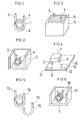
- FIG. 1 shows as an example of an inductive element 1, an electric coil, which consists of a simple conductor 2 with several turns and two electrical terminals 3, 4, but no core of magnetically active, such as soft magnetic, material has, which is generally referred to as an air coil ,
- Such coils can be embedded as inductive elements in a potting compound or produced in a housing both as classic electronic components for the PTH technique (pin through hole) and as SMD components.
- FIG. 2 shows a coil, as in FIG. 1 is shown, in a housing 5, in which the coil is glued or cast, for example, such that the electrical connections 3, 4 protrude.
- the housing may for example consist of an insulating material to electrically energize the coil isolate, alternatively, from a conductive material, so that the housing can be placed, for example at ground potential.
- FIG. 3 In the FIG. 3 is the component made FIG. 2 shown shed, with a casting material 6 is shown hatched.
- Both the material of the housing 5 and the casting material may have special magnetic properties, for example, be soft magnetic.
- the properties of the inductive element as far as it is an inductive element as in the present example, can be selectively influenced.
- the housing 5 may for example be made of a powder metallurgical material by pressing or sintering.
- FIG. 4 shows an electronic component 7 with an inductive element 2 in the form of a coil, from which the electrical connections 3, 4 protrude, wherein the component 7 is shown floating over a printed circuit board 8.
- the printed circuit board 8 corresponds to the conventional, conventional PTH (pin through hole) technique and has bores 9, 10 for receiving the electrical connections 3, 4.
- PTH pin through hole
- An inductive component as in the FIGS. 1 to 4 is illustrated, could in principle also be produced as an SMD component.
- a prerequisite is that the terminals 13, 14 have such contact areas, which allow the plant to the surface of an electrical circuit board for the purpose of soldering.
- the SMD component must first be positioned on the circuit board before the actual Soldering takes place.
- the component can first be glued or fixed by means of a solder paste, but remains a certain uncertainty that the component changes its position by tilting. This is especially a problem when there are only two electrical connections that are naturally in line and do not span a mounting surface, such as a coil. But even with more than two electrical connections, these can lie in a line or close to each other, so that an additional support element according to the invention has the advantageous effect of better support.
- the support element will be positioned relative to the inductive element or the rest of the support areas so that a mounting surface is clamped.
- both the electrical connections 13, 14 as well as in the FIG. 5 designated 15 supporting member which terminates in a connecting wire 16, bent to form support areas at right angles.
- the electrical connections 13, 14 and the support element 15 may consist of enameled wires, wherein the wire ends of the electrical connections (13, 14) and the support element 15 are advantageously either stripped or stripped and tinned.
- Suitable materials for the leads are Cu, Cu alloys such as CuSn 6 or other conductive materials in question.
- inductive element 1 and the support member 15 are shown together in a housing part 17, which in turn together with another, for example mirror-symmetrically attached housing part 17a forms an overall housing for receiving the inductive element 1 and the support element 15.
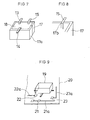
- Such a component in already finished potted state is in the FIG. 7 shown, where there already the support areas by right-angled bending of the terminals 13, 14 and the support element 15 are formed.
- the electrical connections 13, 14 and the support element 15 extend bent at the edges of the open side of the housing 17 away from the inductive element 1 in the mounting plane.
- the ends of the electrical connections 13, 14 and of the support element 15 bent into the mounting plane are in contact with the housing 17, 25.
- the electrical terminals 13, 14 and the support element 15 may also be bent to the inductive element 1 leading in the mounting plane, for example as J-shaped elements (J-leads).
- the potting material 18 does not fill the housing 17, 17 a completely, so that a disability can be excluded by the potting material 18 when placing the component on a circuit board.
- Suitable potting materials are, for example, epoxy, pure or silicone. Other materials are possible.
- a recess 17b is shown in the housing 17 in which a curved support member 15 extends.
- the recess 17 causes in addition to the in FIG. 7 Guide shown by the edges of the housing 17 is a guide of the support member 15 in the plane of the open side of the housing 17.
- the recess 17b is open in the direction of the normal on the level of the open side of the housing 17 of the inductive element 1 (not shown ) leading away. In cross section, the recess 17b may have a substantially round or semicircular shape. Due to the course of the support element 15 below the housing edge, the support member 15 is not outside the housing 17. In course of the electrical contacts 13, 14 (not shown) in guides 17b, the housing 17 can rest flat on the mounting surface.
- the three angled bearing areas of the electrical connections and the support element span a mounting surface which lies below the housing and faces the circuit board. This is clearer in the FIG. 9 shown where a component 19 is shown floating with correspondingly formed electrical connections and a support element over a printed circuit board 20.
- solder pads 21, 22, 23 is applied to the soldering paste during the manufacturing process, for example by means of a screen printing method, before the component 19 is placed. Thereafter, the arrangement is heated at least for a short time, so that the solder balls melt in the solder paste and a solder connection is made at least in the region of the electrical connections.
- the support element can be soldered to increase the supporting action.
- FIG. 9 On the printed circuit board 20 and printed conductors 21a, 22a, 23a are shown, which are arranged on the side facing the component of the printed circuit board. This has the consequence that on the underside of the circuit board 20, a similar arrangement can be additionally arranged with other components.
- the provision according to the invention of a support element 15 under the component 19 has the consequence that the component can be permanently and safely positioned on the printed circuit board 20. For a stable positioning, a plurality of supporting elements can be mounted next to the electrical connections under the component 15.
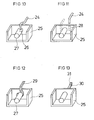
- FIG. 10 a variant is shown which shows the attachment of a support element 24 to a housing 25 by means of a receiving bore 26.
- the bore 26 is provided in a slug 27, which may be integrally connected to the housing 25 and also may consist of a soft magnetic material.
- a corresponding receptacle 28 as in the FIG. 11 also be arranged in a housing wall of the housing 25.
- the support element 29 of the FIG. 12 can advantageously be attached to the housing 25 with a loop which is clamped on the slug 27.
- the support element 29 may be formed, for example, by a wire bent into a loop. This is shed after being pushed onto the slug 27 with the (not shown) inductive element together.
- the support member 30 is directly connected to the housing 25 in one piece.
- the support member 30 may be pressed as a web with a cranked head 31 directly to the housing material 25.
- the housing material 25 may also be wholly or partially solderable, in order to be able to fix the support element 30 to the housing in this way.
- the right-angled bends of the electrical connections 3, 4, 13, 14 are then designed such that the cranked head 31 of the support element 30 lies in a mounting surface, which is advantageously parallel to the underside of the housing 25.
- the assembly of SMT printed circuit boards is simplified and SMD components are easier and with lower loss rate than previously used without much design effort.
Landscapes
- Engineering & Computer Science (AREA)
- Power Engineering (AREA)
- Manufacturing & Machinery (AREA)
- Microelectronics & Electronic Packaging (AREA)
- Coils Or Transformers For Communication (AREA)
Abstract
Ein SMD-Bauteil (19) (SMD: surface-mounted device) umfasst ein induktives Element (1) in einem Gehäuse (17, 25). Das induktive Element (1) weist zwei elektrische Anschlüsse (13,14) auf, die zu einer Seite eines Gehäuses (17, 25) aus dem Gehäuse (17, 25) extern kontaktierbar herausgeführt sind. Zusätzlich zu den elektrischen Anschlüssen (13, 14) ist ein gegenüber dem induktiven Element (1) fixiertes Abstützelement (15, 24, 29, 30) am Bauteil (19) vorgesehen ist. Das von dem induktiven Element (1) wegführende Ende des Abstützelementes (15, 24, 29, 30) bildet mit den aus dem Gehäuse (17, 25) herausgeführten Enden der elektrischen Anschlüsse (13, 14) eine Montagefläche ausserhalb des Gehäuses (17, 25).

Description
Die Erfindung betrifft ein induktives SMD-Bauteil (SMD: surface mounted device) mit einem induktiven Element in einem Gehäuse, und eine Anordnung aus einer elektrischen Leiterplatte und dem induktiven SMD-Bauteil.The invention relates to an inductive SMD component (SMD: surface mounted device) with an inductive element in a housing, and an arrangement of an electrical circuit board and the inductive SMD component.
In vielen Bereichen der Elektronik hat die SMT-Technologie (surface-mounting technology) als Oberflächenmontagetechnik für elektrische Bauteile auf Leiterplatten die konventionelle Art der Bestückung von elektronischen Elementen in der PTH-Technologie (pin through hole) abgelöst. Gemäß der früher üblichen Technologie wurden Anschlussdrähte von elektronischen Bauteilen durch eine Leiterplatine hindurch geführt und auf der Gegenseite verlötet.In many areas of electronics, surface-mounting technology (SMT) as a surface mount technique for printed circuit board electrical components has replaced the conventional way of mounting electronic elements in PTH (pin through hole) technology. According to the previously common technology, leads of electronic components were passed through a printed circuit board and soldered on the opposite side.
SMD-Bauteile werden nur einseitig auf die Anschlussflächen einer Leiterplatte gelötet, wodurch Material eingespart und die Baugröße von elektronischen Schaltungen verringert wird. Zusätzlich kann eine Leiterplatte beidseitig bestückt werden. Im Gegensatz zur PTH-Technik ist vor der Herstellung einer Lotverbindung zwischen einem SMD-Bauteil und der SMT-Leiterplatte das SMD-Bauteil auf der Leiterplatte nicht fixiert, wobei eine sichere Positionierung des SMD-Bauteils allein über die Kontaktfläche des Anschlusses des SMD-Bauteils und der SMT-Leiterplatte nicht gewährleistet ist. Aufgrund der beschränkten SMT-Kontaktfläche je Anschluss ergibt sich insbesondere bei einer Drossel mit nur zwei elektrischen Anschlüssen an ihren Enden bisher das Problem, dass dieses aufwändig auf einer Leiterplatte positioniert werden muss, um zuverlässig verlötet werden zu können.SMD components are soldered on one side only to the pads of a printed circuit board, saving material and reducing the size of electronic circuits. In addition, a printed circuit board can be equipped on both sides. In contrast to the PTH technique, the SMD component is not fixed on the printed circuit board prior to the production of a solder connection between an SMD component and the SMT circuit board, with secure positioning of the SMD component solely via the contact surface of the connection of the SMD component and the SMT board is not guaranteed. Due to the limited SMT contact surface per connection results in particular in a throttle with only two electrical connections at their ends so far the problem that this must be laboriously positioned on a circuit board in order to be reliably soldered can.
Der vorliegenden Erfindung liegt die Aufgabe zugrunde, ein für die SMT-Montage geeignetes und mit geringem Aufwand sicher positionierbares induktives Bauteil mit zwei elektrischen Anschlüssen bereitzustellen, , sowie eine Anordnung mit einem solchen Bauteil und einer Leiterplatte.The present invention is based on the object, a suitable for SMT assembly and safe with little effort To provide positionable inductive component with two electrical connections, as well as an arrangement with such a component and a circuit board.
Die Aufgabe wird dadurch gelöst, dass in dem Bauteil zusätzlich zu zwei vorhandenen Anschlüssen eines induktiven Elementes ein relativ zum induktiven Element fixiertes Abstützelement am Bauteil vorgesehen ist. Das von dem induktiven Element wegführende Ende des Abstützelementes bildet hierbei mit den Enden der elektrischen Anschlüsse eine Montagefläche ausserhalb des Bauteiles. Als Montageebene des Bauelementes wird die Ebene angesehen, die nach der SMT-Montage durch die dem Bauteil zugewandte Seite der zu kontaktierenden Leiterplatte gebildet wird. Als induktive Elemente können neben Spulen mit magnetischen Kernen Luftspulen, bewickelte Folien, Streifenleiter etc. verwendet werden.The object is achieved in that in addition to two existing terminals of an inductive element, a relative to the inductive element fixed support member is provided on the component in the component. The end of the support element leading away from the inductive element forms a mounting surface outside the component with the ends of the electrical connections. As a mounting plane of the component, the plane is considered, which is formed after the SMT assembly by the component facing side of the printed circuit board to be contacted. As inductive elements in addition to coils with magnetic cores air coils, wound films, strip conductors, etc. can be used.
Ein Aspekt der Erfindung ist, dass die Auflagebereiche der Anschlussenden auf der Leiterplatte nicht in einer Linie liegen, sondern ein Dreieck bilden, gleich wie viele elektrische Anschlüsse vorhanden sind. Bei lediglich zwei elektrischen Anschlüssen würde ohne das Vorhandensein eines Abstützelementes die Positionierung des Bauteiles auf einer SMT-Leiterplatte schwierig, da das Bauelement drohen würde, umzufallen. Auch mehr als zwei Anschlusselemente können ungünstig für die Standfestigkeit des Bauteiles sein, beispielsweise wenn die Anschlusselemente in einer Linie angeordnet sind. Auch in diesem Fall kann das zusätzliche Vorsehen eines Abstützelementes außerhalb dieser Linie zum Aufspannen einer Montagefläche sinnvoll sein.One aspect of the invention is that the contact areas of the terminal ends on the printed circuit board do not lie in a line, but form a triangle, no matter how many electrical connections are present. With only two electrical connections, without the presence of a support element, positioning the device on an SMT board would be difficult because the device would threaten to fall over. Also, more than two connection elements can be unfavorable for the stability of the component, for example, when the connection elements are arranged in a line. Also in this case, the additional provision of a support element outside this line can be useful for mounting a mounting surface.
Bei flächiger Ausbildung der Auflagebereiche ist es günstig, wenn alle Auflagebereiche möglichst koplanar zu der definierten Montagefläche ausgerichtet sind. Es kann aber auch vorgesehen sein, dass die Auflagebereiche nicht flächig, sondern jeweils mit einer der Leiterplatte zugewandten Spitze oder Kante ausgebildet sind, um durch den derart jeweils gebildeten spitz zulaufenden Zwischenraum zwischen dem Auflagebereich und der Leiterplatte einen Raum zu bilden, in den durch die Oberflächenspannung flüssiger Lotwerkstoff hineingesaugt wird.Auch in diesen Fall ist es vorteilhaft, mittels eines Abstützelementes eine definierte Position des SMD-Bauteiles auf einer Leiterplatte zu ermöglichen.In a planar design of the bearing areas, it is advantageous if all bearing areas are aligned as coplanar as possible to the defined mounting surface. But it can also be provided that the support areas are not flat, but each with a circuit board facing tip or edge are formed to each other by the thus formed tapering space between the support area and the circuit board to form a space in which liquid soldering material is sucked in by the surface tension. Also in this case, it is advantageous to allow a defined position of the SMD component on a circuit board by means of a support element.
Zum Befestigen des Bauteiles auf einer Leiterplatte kann ein Kleber oder eine Lötpaste verwendet werden, die vor dem Aufbringen des Bauteiles beispielsweise mittels eines Siebdruckverfahrens oder durch Aufbringen mittels eines dünnen Röhrchens platziert werden. Danach wird beispielsweise mittels eines programmierbaren Bestückungsautomaten ein Bauteil aufgesetzt und danach dieses unter Wärmezufuhr leitend mit der Leiterplatte verbunden. Die verwendete Lötpaste enthält typischerweise eine Mischung aus einem Flussmittel und sehr kleinen Lötmittelkügelchen.For fixing the component on a printed circuit board, an adhesive or a solder paste can be used, which are placed before the application of the component, for example by means of a screen printing method or by applying a thin tube. Thereafter, for example, by means of a programmable placement machine, a component is placed and then this conductively connected to the printed circuit with heat. The solder paste used typically contains a mixture of a flux and very small solder balls.
Zur Verlötung von SMD-Bauteilen sind verschiedene Lötverfahren bekannt, wobei besonders das Reflow-Lötverfahren günstig einzusetzen ist. Die Verlötung sorgt sowohl für eine elektrische als auch für eine mechanische Verbindung.For soldering of SMD components, various soldering methods are known, in which case, in particular, the reflow soldering method can be used favorably. The soldering provides both an electrical and a mechanical connection.
Als ein weiteres Problem bei der Verarbeitung von SMD-Bauteilen, das durch die Erfindung gelöst wird, hat sich das sogenannte Tombstoning herausgestellt, bei dem Bauteile im Rahmen ihrer Verlötung durch asymmetrische Wirkung der Oberflächenspannung des verflüssigten Lötzinns einer Kraft unterworfen werden, die das entsprechende Bauteil aus der Leiterplattenebene herauskippt und zu nicht kontaktierten Anschlüssen führt.As a further problem in the processing of SMD components, which is solved by the invention, the so-called tombstoning has been found in which components are subjected as part of their soldering by asymmetric action of the surface tension of the liquefied solder of a force that the corresponding component tilts out of the circuit board level and leads to non-contacted terminals.
Tendenziell wirkt das Vorsehen von zusätzlichen Abstützstellen für ein Bauteil einer solchen Kippbewegung entgegen. Wird zusätzlich das Abstützelement mit seinem Auflagebereich auch mit der Leiterplatte verlötet, so wirkt auch dies gegen eine Verkippung des Bausteins stabilisierend.The provision of additional support points for a component tends to counteract such a tilting movement. If, in addition, the support element is soldered to its contact area with the printed circuit board, this also acts to stabilize against tilting of the building block.
Eine Ausgestaltung der Erfindung liegt darin, dass das Abstützelement aus einem elektrisch leitenden Werkstoff besteht. Zusätzlich kann auch der Auflagebereich des Abstützelementes an der Oberfläche der Leiterplatte, wie oben ausgeführt, verlötbar sein. Dazu kann das Abstützelement ebenso wie die elektrischen Anschlüsse beispielsweise aus einem elektrisch leitenden Draht bestehen, der zur Ausbildung von Auflagebereichen an seinem Ende abgebogen sein kann. Dies kann sowohl bei dem Abstützelement als auch bei den elektrischen Anschlusselementen der Fall sein, wobei die Abbiegung vorteilhaft jeweils rechtwinklig vorgesehen sein kann.An embodiment of the invention is that the support element consists of an electrically conductive material. In addition, the support region of the support element on the surface of the circuit board, as stated above, be soldered. For this purpose, the support element as well as the electrical connections, for example, consist of an electrically conductive wire, which may be bent to form support areas at its end. This can be the case both in the support element and in the electrical connection elements, wherein the bend can advantageously be provided at right angles.
Die Anschlusselemente können jedoch auch als streifenförmige Leiter ausgebildet sein. An den Enden der Leiter können anstelle von abgebogenen Drahtenden auch verbreiterte metallische Pads vorgesehen sein, ähnlich denen, die auf den entsprechenden Leiterplatten vorgesehen sind. Das Auflöten der Auflagebereiche auf meist runde Pads der Leiterplatte erfolgt aufgrund der Oberflächenspannung des verwendeten verflüssigten Lötzinns zentrierend. Diese Wirkung wird noch verstärkt, wenn auch die Auflagebereiche des Bauteiles als runde Pads ausgebildet sind.However, the connection elements can also be designed as strip-shaped conductors. At the ends of the conductors may be provided instead of bent wire ends and widened metal pads, similar to those provided on the corresponding circuit boards. The soldering of the support areas on mostly round pads of the circuit board is centered due to the surface tension of the liquefied solder used. This effect is exacerbated when the support areas of the component are formed as round pads.
Weiterhin kann das Abstützelement unmittelbar an dem induktiven Element befestigt werden kann. Dies hat den Vorteil, dass die Positionierung der elektrischen Anschlüsse und Auflagebereiche des induktiven Elementes relativ zu dem Abstützelement festliegen und stabil sind.Furthermore, the support element can be attached directly to the inductive element. This has the advantage that the positioning of the electrical connections and support areas of the inductive element are fixed relative to the support element and are stable.
Alternativ kann auch vorgesehen sein, dass das Bauteil ein mit dem induktiven Element verbundenes Stabilisierungselement aufweist. Ein solches Stabilisierungselement kann beispielsweise ein Gehäusekörper oder eine mit dem induktiven Element verbundene Vergussmasse oder ein anderer stabilisierender Körper, beispielsweise eine Platte sein, an die das induktive Element angeklebt ist. Derartige Stabilisierungselemente können einerseits zum Schutz des induktiven Elementes auf der Leiterplatte dienen, andererseits auch dazu, das induktive Element transportfähig zu machen und bei der SMT-Montage gegen äussere Einflüsse abzuschirmen, da manche induktive Elemente derart labil sind, dass sie des mechanischen Schutzes bedürfen.Alternatively, it can also be provided that the component has a stabilizing element connected to the inductive element. Such a stabilizing element can be for example a housing body or a potting compound connected to the inductive element or another stabilizing body, for example a plate, to which the inductive element is glued. Such stabilizing elements can on the one hand serve to protect the inductive element on the circuit board, on the other hand also to make the inductive element transportable and shield in the SMT assembly against external influences, since some inductive elements are so unstable that they require mechanical protection.
Das Bauteil kann beispielsweise ein Gehäuse aus einem leitenden Werkstoff aufweisen, wobei der Werkstoff beispielsweise als pulvermetallischer Werkstoff durch Pressen beziehungsweise Sintern verarbeitet sein kann und zudem auch weichmagnetische Eigenschaften aufweisen kann. In diesem Fall kann das Material des Gehäuses auch magnetische Eigenschaften in Verbindung mit dem induktiven Element übernehmen.The component may for example comprise a housing made of a conductive material, wherein the material may be processed, for example as a powder metallic material by pressing or sintering and also may also have soft magnetic properties. In this case, the material of the housing can also take over magnetic properties in connection with the inductive element.
Die leitende Eigenschaft des Werkstoffs kann dazu dienen, das induktive Element abzuschirmen beziehungsweise auch mittels des Abstützelementes das Gehäuse auf Erdpotential zu legen.The conductive property of the material can serve to shield the inductive element or to place the housing at ground potential by means of the support element.
Zudem kann das Stabilisierungselement eine Vergussmasse aufweisen, in die das induktive Element eingebettet ist. Die Vergussmasse kann allein als Stabilisierungselement vorgesehen sein oder ihrerseits von dem Gehäuse umgeben sein.In addition, the stabilizing element may have a potting compound, in which the inductive element is embedded. The potting compound may be provided alone as a stabilizing element or in turn be surrounded by the housing.
Auch die Vergussmasse kann beispielsweise aus einem weichmagnetischen Werkstoff bestehen, um bei der Funktion des induktiven Elementes mit diesem, insbesondere wenn es sich um eine Spule handelt, in gewünschter Weise zusammenzuwirken.The potting compound may for example consist of a soft magnetic material to cooperate in the function of the inductive element with this, in particular, if it is a coil, in the desired manner.
In allen genannten Fällen kann das Abstützelement beispielsweise an dem Gehäuse befestigt oder mit diesem sogar einstückig verbunden sein und aus dem selben Material wie dieses bestehen. Das Abstützelement kann beispielsweise auch in einem einzigen Herstellungsschritt gemeinsam mit dem Gehäuse hergestellt sein.In all the above cases, the support member may for example be attached to the housing or even connected in one piece and made of the same material as this. The support element may for example also be produced in a single production step together with the housing.
Das Abstützelement kann jedoch auch teilweise in die Vergussmasse eingegossen und auf diese Weise mit dem induktiven Element verbunden sein oder eines der Teile des Stabilisierungselementes kann eine Aufnahme zur Befestigung und Positionierung des Abstützelementes aufweisen, in die dieses einführbar und in der es beispielsweise durch Verkleben fixierbar ist.However, the support member may also be partially poured into the potting compound and connected in this way with the inductive element or one of the parts of the stabilizing element may have a receptacle for fixing and positioning of the support element, in which this is insertable and in which it can be fixed, for example by gluing ,
Es kann dies beispielsweise einfach eine Bohrung in der Vergussmasse oder im Gehäuse sein, in die ein Stift des Abstützelementes einsteckbar ist.This may, for example, simply be a hole in the potting compound or in the housing, into which a pin of the support element can be inserted.
Vorteilhaft ist die Anwendung der Erfindung bei einer Spule, beispielsweise einer Luftspule. In diesem Fall kann das Stabilisierungselement einen Schalenkern aus einem weichmagnetischen Material aufweisen, der die magnetischen Flusslinien der Luftspule in gewünschter Weise beeinflusst.Advantageously, the application of the invention in a coil, such as an air coil. In this case, the stabilizing element may have a shell core of a soft magnetic material, which influences the magnetic flux lines of the air coil in a desired manner.
Um diese Wirkung noch zu verstärken, kann der Schalenkern einen das induktive Element durchsetzenden Butzen aufweisen. Der Schalenkern ist vorteilhaft mehrteilig ausgebildet, so dass er nach der Bereitstellung des induktiven Elementes um dieses herumgelegt werden kann.To enhance this effect, the shell core may have a pin passing through the inductive element. The shell core is advantageously designed in several parts, so that it can be wrapped around this after the provision of the inductive element.
Die Erfindung bezieht sich auch auf eine Anordnung aus einer elektrischen Leiterplatte und einem induktiven SMD-Bauteil, wobei zumindest die elektrischen Anschlüsse des induktiven Elementes mit der Leiterplatte durch SMT-Technologie verlötet sind, wodurch eine elektrische und mechanische Verbindung geschaffen ist.The invention also relates to an arrangement of an electrical circuit board and an inductive SMD component, wherein at least the electrical connections of the inductive element are soldered to the circuit board by SMT technology, whereby an electrical and mechanical connection is created.
Ein Abstützelement kann entweder unverlötet auf der Leiterplatte aufliegen, wobei es während des Montagevorgangs durch seine Abstütz- und Positionierungswirkung für eine positionsgenaue Fixierung des Bauteiles sorgt oder das Abstützelement kann ebenso wie die elektrischen Anschlüsse des induktiven Elementes mit der Leiterplatte verlötet sein und so für eine zusätzliche Stabilisierung der Verbindung sorgen. Zusätzlich kann das Abstützelement, wie oben erwähnt, auch bewirken, dass das Gehäuse als Teil des Stabilisierungselementes mit einem bestimmten gewünschten Potential verbunden wird.A support element can either rest unsoldered on the circuit board, whereby it ensures during the assembly process by its supporting and positioning effect for a positionally accurate fixation of the component or the support element can be soldered as well as the electrical connections of the inductive element to the circuit board and so for an additional Stabilize the connection. additionally For example, as mentioned above, the supporting element can also cause the housing, as part of the stabilizing element, to be connected to a specific desired potential.
Die Erfindung wird nachfolgend anhand der in den Figuren dargestellten Beispiele näher erläutert. In den Figuren bezeichnen, sofern nicht anders angegeben, gleiche Bezugszeichen gleiche Bauteile mit gleicher Bedeutung. Es zeigt
Figur 1- ein induktives Element in Form einer Luftspule,
Figur 2- eine Luftspule in einem durchbrochen dargestellten Gehäuse,
Figur 3- eine Luftspule, die in einem Gehäuse vergossen ist mit zwei herausragenden Anschlüssen in herkömmlicher Anschlusstechnik,
Figur 4- ein Bauteil wie das der
Figur 3 Figur 5- eine Luftspule mit einem zusätzlichen Abstützelement,
Figur 6- eine Luftspule mit einem zusätzlichen Abstützelement in einem durchbrochen dargestellten Gehäuse,
Figur 7- ein Bauteil, bei dem ein induktives Element in einem Gehäuse vergossen ist mit rechtwinklig abgebogenen elektrischen Anschlüssen und einem Abstützelement,
Figur 8- eine Ausnehmung in einem Gehäuse zur Führung eines elektrischen Anschlusses oder Abstützelementes
Figur 9- ein Bauteil über einer Leiterplatte, die auf ihrer Oberfläche Lötpads aufweist,
Figur 10- einen Teil eines Gehäuses für eine Luftspule, das einen Schalenkern mit Butzen aus einem weichmagnetischen Material bildet, wobei in dem Butzen eine Öffnung zur Aufnahme eines Abstützelementes vorgesehen ist,
Figur 11- ein Gehäuse ähnlich
dem aus Figur 10 , wobei eine Aufnahme für ein Abstützelement in der Gehäusewand vorgesehen ist, Figur 12- ein Gehäuse ähnlich dem aus
den Figuren 10 , wobei ein Abstützelement teilweise um den Butzen herumgelegt ist,und 11 Figur 13- ein Gehäuse ähnlich dem aus
den Figuren 10, 11 , wobei in die Gehäusewand ein Abstützelement einstückig integriert ist.und 12
- FIG. 1
- an inductive element in the form of an air-core coil,
- FIG. 2
- an air-core coil in a perforated housing,
- FIG. 3
- an air-core coil encapsulated in a housing with two protruding connections in conventional connection technology,
- FIG. 4
- a component like that
FIG. 3 with connection spiders over a printed circuit board with holes, - FIG. 5
- an air-core coil with an additional support element,
- FIG. 6
- an air-core coil with an additional support element in a housing shown in broken lines,
- FIG. 7
- a component in which an inductive element is encapsulated in a housing with rectangularly bent electrical connections and a support element,
- FIG. 8
- a recess in a housing for guiding an electrical connection or support element
- FIG. 9
- a component above a printed circuit board having solder pads on its surface,
- FIG. 10
- a part of a housing for an air coil, which forms a shell core with slugs of a soft magnetic material, wherein in the slit an opening for receiving a support element is provided,
- FIG. 11
- a case similar to that
FIG. 10 wherein a receptacle is provided for a support element in the housing wall, - FIG. 12
- a housing similar to that of the
FIGS. 10 and 11 wherein a support element is partially wrapped around the slug, - FIG. 13
- a housing similar to that of the
FIGS. 10, 11 and 12 , wherein in the housing wall, a support element is integrally integrated.
Derartige Spulen können als induktive Elemente in eine Vergussmasse eingebettet beziehungsweise in einem Gehäuse sowohl als klassische elektronische Bauteile für die PTH-Technik (pin through hole) als auch als SMD-Bauteile hergestellt werden.Such coils can be embedded as inductive elements in a potting compound or produced in a housing both as classic electronic components for the PTH technique (pin through hole) and as SMD components.
In der
Sowohl das Material des Gehäuses 5 als auch der Vergusswerkstoff können besondere magnetische Eigenschaften besitzen, beispielsweise weichmagnetisch sein. Damit können die Eigenschaften des induktiven Elementes, soweit es sich um ein induktives Element wie im vorliegenden Beispiel handelt, gezielt beeinflusst werden. Das Gehäuse 5 kann beispielsweise aus einem pulvermetallurgischen Werkstoff durch Pressen beziehungsweise Sintern hergestellt sein.Both the material of the
Ein induktives Bauteil, wie dies in den
Dabei ergibt sich das Problem, dass das SMD-Bauteil zunächst auf der Leiterplatte positioniert werden muss, bevor die eigentliche Verlötung stattfindet. Zwar kann das Bauteil zunächst angeklebt oder mittels einer Lötpaste fixiert werden, jedoch bleibt eine gewisse Unsicherheit, dass das Bauteil durch Kippen seine Position verändert. Dies ist speziell dann ein Problem, wenn nur zwei elektrische Anschlüsse vorhanden sind, die naturgemäß in einer Linie liegen und keine Montagefläche aufspannen, beispielsweise bei einer Spule. Aber auch bei mehr als zwei elektrischen Anschlüssen können diese in einer Linie oder nah beieinander liegen, so dass ein zusätzliches Abstützelement gemäß der Erfindung die vorteilhafte Wirkung einer besseren Abstützung hat. Das Abstützelement wird derart relativ zum induktiven Element beziehungsweise den übrigen Auflagebereichen positioniert werden, das eine Montagefläche aufgespannt wird.This results in the problem that the SMD component must first be positioned on the circuit board before the actual Soldering takes place. Although the component can first be glued or fixed by means of a solder paste, but remains a certain uncertainty that the component changes its position by tilting. This is especially a problem when there are only two electrical connections that are naturally in line and do not span a mounting surface, such as a coil. But even with more than two electrical connections, these can lie in a line or close to each other, so that an additional support element according to the invention has the advantageous effect of better support. The support element will be positioned relative to the inductive element or the rest of the support areas so that a mounting surface is clamped.
Im vorliegenden Fall werden sowohl die elektrischen Anschlüsse 13, 14 als auch das in der
In der
Ein derartiges Bauteil im bereits fertig vergossenem Zustand ist in der
In
Die drei abgewinkelten Auflagebereiche der elektrischen Anschlüsse und des Abstützelementes spannen eine Montagefläche auf, die unterhalb des Gehäuses liegt und der Leiterplatte zugewandt ist. Dies ist deutlicher in der
In der
In der
Um zu vermeiden, dass besonders im Bereich des Butzen 27 durch das Einstecken eines Abstützelementes 24 möglicherweise magnetische Eigenschaften geändert werden, kann eine entsprechende Aufnahme 28, wie in der
Das Abstützelement 29 der
In der
Durch die vorliegende Erfindung wird ohne großen konstruktiven Aufwand die Bestückung von SMT-Leiterplatten vereinfacht und SMD-Bauteile sind einfacher und mit geringerer Verlustrate als bisher einzusetzen.By the present invention, the assembly of SMT printed circuit boards is simplified and SMD components are easier and with lower loss rate than previously used without much design effort.
Claims (24)
Applications Claiming Priority (1)
| Application Number | Priority Date | Filing Date | Title |
|---|---|---|---|
| DE102006058336A DE102006058336A1 (en) | 2006-12-11 | 2006-12-11 | Inductive SMD component |
Publications (2)
| Publication Number | Publication Date |
|---|---|
| EP1933341A2 true EP1933341A2 (en) | 2008-06-18 |
| EP1933341A3 EP1933341A3 (en) | 2009-04-29 |
Family
ID=39092809
Family Applications (1)
| Application Number | Title | Priority Date | Filing Date |
|---|---|---|---|
| EP07020361A Withdrawn EP1933341A3 (en) | 2006-12-11 | 2007-10-18 | Inductive SMD component |
Country Status (2)
| Country | Link |
|---|---|
| EP (1) | EP1933341A3 (en) |
| DE (1) | DE102006058336A1 (en) |
Cited By (3)
| Publication number | Priority date | Publication date | Assignee | Title |
|---|---|---|---|---|
| DE102013208176A1 (en) * | 2013-05-03 | 2014-11-20 | Robert Bosch Gmbh | Stabkerndrossel |
| WO2018135357A1 (en) * | 2017-01-17 | 2018-07-26 | 株式会社オートネットワーク技術研究所 | Multistage coil and circuit structure |
| US20190378641A1 (en) * | 2017-01-26 | 2019-12-12 | Samsung Electronics Co., Ltd. | Inductor and inductor manufacturing method |
Family Cites Families (5)
| Publication number | Priority date | Publication date | Assignee | Title |
|---|---|---|---|---|
| DE3477438D1 (en) * | 1984-03-23 | 1989-04-27 | Siemens Ag | Electronic component, in particular a chip inductance |
| DE4206813A1 (en) * | 1992-03-04 | 1993-09-09 | Siemens Matsushita Components | Inductive component arrangement - is sheathed in cast or moulded magnetic powder mixt which is finished at level of one surface of coil former so as to enclose coil completely on all sides |
| JP2002043131A (en) * | 2000-07-25 | 2002-02-08 | Taiyo Yuden Co Ltd | Inductance element and its manufacturing method |
| US7411477B2 (en) * | 2004-06-04 | 2008-08-12 | Sumida Corporation | Inductor |
| DE102004048030A1 (en) * | 2004-09-29 | 2006-03-30 | Robert Bosch Gmbh | Electrical inductor for use in printed circuit board, has insulation layer, and retaining unit encompasses inductor on both sides, where mechanical vibrations of inductor are damped by retaining unit |
-
2006
- 2006-12-11 DE DE102006058336A patent/DE102006058336A1/en not_active Withdrawn
-
2007
- 2007-10-18 EP EP07020361A patent/EP1933341A3/en not_active Withdrawn
Cited By (3)
| Publication number | Priority date | Publication date | Assignee | Title |
|---|---|---|---|---|
| DE102013208176A1 (en) * | 2013-05-03 | 2014-11-20 | Robert Bosch Gmbh | Stabkerndrossel |
| WO2018135357A1 (en) * | 2017-01-17 | 2018-07-26 | 株式会社オートネットワーク技術研究所 | Multistage coil and circuit structure |
| US20190378641A1 (en) * | 2017-01-26 | 2019-12-12 | Samsung Electronics Co., Ltd. | Inductor and inductor manufacturing method |
Also Published As
| Publication number | Publication date |
|---|---|
| DE102006058336A1 (en) | 2008-06-19 |
| EP1933341A3 (en) | 2009-04-29 |
Similar Documents
| Publication | Publication Date | Title |
|---|---|---|
| DE19735409A1 (en) | Printed circuit board with contact element | |
| DE3854437T2 (en) | Chip capacitor. | |
| DE3010876A1 (en) | METHOD FOR PRODUCING A CIRCUIT BOARD | |
| EP1933341A2 (en) | Inductive SMD component | |
| EP1128476A2 (en) | Connector and method of manufacturing a connector | |
| DE19625934C1 (en) | Electrical conductor for coupling double-sided printed circuit conductor paths | |
| DE3910750C2 (en) | Connection device for an electronic component | |
| DE19726856C1 (en) | Flat-plug for electrical plug-in connections | |
| DE102004049575B4 (en) | Electrical connection element and method for connecting a conductor cable | |
| DE29904493U1 (en) | Pin header with angled contact pins that can be mounted on a printed circuit board | |
| DE10038424A1 (en) | Lead terminal structure for electronic components e.g. piezoresonator, has round bar-like terminals mounted at mounting sections of component, which has bent sections formed between mounting section and outer end | |
| WO2006013145A1 (en) | Printed circuit board with smd components and at least one wired component and a method for picking fixing and electrical contacting of said components | |
| EP1205951B1 (en) | Process for contacting the winding wire of a coil with a contacting pin | |
| DE202013104811U1 (en) | Electrical contact device, in particular electrical pressure terminal and / or base strip | |
| DE19813527C1 (en) | SMD-plastics body, such as bobbin, for inductive components | |
| WO2015024715A1 (en) | Electrical print clamp | |
| CH698875B1 (en) | Printed circuit board assembling method for switching device of room apparatus, involves resting head of pin at edge of bore when pin is completely arranged through bore, and soldering head of pin on carrier over solder area | |
| DE202004020191U1 (en) | Push in contact using an insulation displacement contact terminal whereby an secure electric connection is ensured by bending back the clamp tongue | |
| DE19543765B4 (en) | Process for the production of contact tongues and their connection in connection pins provided on the underside of an electrical component | |
| DD131612B1 (en) | ARRANGEMENT FOR THE CONTACT OF PCB CONDUCTORS | |
| DE102015211734B4 (en) | SMD component | |
| AT412935B (en) | CONTACTING PCB PCBs. CIRCUIT CARRIERS | |
| DE3802441A1 (en) | DEVICE FOR ATTACHING MAINS CONNECTING LEADS TO CIRCUITS ARRANGED ON CIRCUIT BOARDS | |
| DE10349956A1 (en) | Printed circuit board (PCB) for electronic components has a drilled hole, a location on the PCB with no drilled hole and an electronic component | |
| DE10105416A1 (en) | Kitchen sink |
Legal Events
| Date | Code | Title | Description |
|---|---|---|---|
| PUAI | Public reference made under article 153(3) epc to a published international application that has entered the european phase |
Free format text: ORIGINAL CODE: 0009012 |
|
| AK | Designated contracting states |
Kind code of ref document: A2 Designated state(s): AT BE BG CH CY CZ DE DK EE ES FI FR GB GR HU IE IS IT LI LT LU LV MC MT NL PL PT RO SE SI SK TR |
|
| AX | Request for extension of the european patent |
Extension state: AL BA HR MK RS |
|
| PUAL | Search report despatched |
Free format text: ORIGINAL CODE: 0009013 |
|
| AK | Designated contracting states |
Kind code of ref document: A3 Designated state(s): AT BE BG CH CY CZ DE DK EE ES FI FR GB GR HU IE IS IT LI LT LU LV MC MT NL PL PT RO SE SI SK TR |
|
| AX | Request for extension of the european patent |
Extension state: AL BA HR MK RS |
|
| AKX | Designation fees paid | ||
| STAA | Information on the status of an ep patent application or granted ep patent |
Free format text: STATUS: THE APPLICATION IS DEEMED TO BE WITHDRAWN |
|
| 18D | Application deemed to be withdrawn |
Effective date: 20091030 |
|
| REG | Reference to a national code |
Ref country code: DE Ref legal event code: 8566 |