EP1988083B1 - Dérivé de triazole - Google Patents
Dérivé de triazole Download PDFInfo
- Publication number
- EP1988083B1 EP1988083B1 EP07708069.5A EP07708069A EP1988083B1 EP 1988083 B1 EP1988083 B1 EP 1988083B1 EP 07708069 A EP07708069 A EP 07708069A EP 1988083 B1 EP1988083 B1 EP 1988083B1
- Authority
- EP
- European Patent Office
- Prior art keywords
- group
- compound
- carbon atoms
- ppm
- mhz
- Prior art date
- Legal status (The legal status is an assumption and is not a legal conclusion. Google has not performed a legal analysis and makes no representation as to the accuracy of the status listed.)
- Active
Links
- 0 C[C@@]1C=C(CCC(*2)=O)C2=CC1 Chemical compound C[C@@]1C=C(CCC(*2)=O)C2=CC1 0.000 description 47
- KACPBXKQODZWGX-HWZXHQHMSA-N CC([C@H]1Cl)C(S(=O)=O)=CC=C1Cl Chemical compound CC([C@H]1Cl)C(S(=O)=O)=CC=C1Cl KACPBXKQODZWGX-HWZXHQHMSA-N 0.000 description 1
- MUOALEXNMPARPC-UDTDMRASSA-N CCC(CC1)C([C@@H](C)CCS(/C=C/c2ccccc2)(=O)=O)=CN=C1Oc1ccc(C)cc1 Chemical compound CCC(CC1)C([C@@H](C)CCS(/C=C/c2ccccc2)(=O)=O)=CN=C1Oc1ccc(C)cc1 MUOALEXNMPARPC-UDTDMRASSA-N 0.000 description 1
- OKABQVJKRNKMNN-DDABOFDQSA-N CCCC/C(/CC)=C(\C)/C=C\COC(CCC)=[N]=C Chemical compound CCCC/C(/CC)=C(\C)/C=C\COC(CCC)=[N]=C OKABQVJKRNKMNN-DDABOFDQSA-N 0.000 description 1
- BKVLEFXUCSOXDH-GFCCVEGCSA-N CCCCc(cc1)ccc1Oc1nnc([C@@H](C)N)[n]1CC Chemical compound CCCCc(cc1)ccc1Oc1nnc([C@@H](C)N)[n]1CC BKVLEFXUCSOXDH-GFCCVEGCSA-N 0.000 description 1
- XMPDPHURXVKBAT-DNVCBOLYSA-N CCC[C@H]1C(Oc2ccc(C)cc2)=NN=C1[C@@H](C)NS(c1ccc(C(F)(F)F)cc1)(=O)=O Chemical compound CCC[C@H]1C(Oc2ccc(C)cc2)=NN=C1[C@@H](C)NS(c1ccc(C(F)(F)F)cc1)(=O)=O XMPDPHURXVKBAT-DNVCBOLYSA-N 0.000 description 1
- VGMFDKQNYQVGTD-UHFFFAOYSA-N CC[N+](C1C=C(CCC=C2)C2=CC1)(O)[IH-] Chemical compound CC[N+](C1C=C(CCC=C2)C2=CC1)(O)[IH-] VGMFDKQNYQVGTD-UHFFFAOYSA-N 0.000 description 1
- NVMZBYYIVCSIHA-TZHYSIJRSA-N CC[n]1c(Oc2cc(N(CC3)CCC33O[C@H](C)CO3)ccc2)nnc1C(C)[N-][S](c1ccc2Cl)(c1c2Cl)(=O)=O Chemical compound CC[n]1c(Oc2cc(N(CC3)CCC33O[C@H](C)CO3)ccc2)nnc1C(C)[N-][S](c1ccc2Cl)(c1c2Cl)(=O)=O NVMZBYYIVCSIHA-TZHYSIJRSA-N 0.000 description 1
- IFBUQNGYFWXDPQ-QGZVFWFLSA-N CC[n]1c(Oc2cccc(N(CC3)CCC33OCCO3)c2)nnc1[C@@H](C)NS(c(cc1Cl)ccc1Cl)(=O)=O Chemical compound CC[n]1c(Oc2cccc(N(CC3)CCC33OCCO3)c2)nnc1[C@@H](C)NS(c(cc1Cl)ccc1Cl)(=O)=O IFBUQNGYFWXDPQ-QGZVFWFLSA-N 0.000 description 1
- WQHCLVWKHFQWOC-CYBMUJFWSA-N CC[n]1c(S(c2ccc(C)cc2)(=O)=O)nnc1[C@@H](C)NS(c(cc1Cl)ccc1Cl)(=O)=O Chemical compound CC[n]1c(S(c2ccc(C)cc2)(=O)=O)nnc1[C@@H](C)NS(c(cc1Cl)ccc1Cl)(=O)=O WQHCLVWKHFQWOC-CYBMUJFWSA-N 0.000 description 1
- DBZLHMQPIRBQHR-UHFFFAOYSA-N CCc([n]1CC)nnc1Oc1ccc(cc[nH]2)c2c1 Chemical compound CCc([n]1CC)nnc1Oc1ccc(cc[nH]2)c2c1 DBZLHMQPIRBQHR-UHFFFAOYSA-N 0.000 description 1
- SMSBBYWJXDYYNR-UHFFFAOYSA-N CN(CC1)CCN1c(cc(cc1)O)c1F Chemical compound CN(CC1)CCN1c(cc(cc1)O)c1F SMSBBYWJXDYYNR-UHFFFAOYSA-N 0.000 description 1
- JVJXXYKLTBTKEB-UHFFFAOYSA-N Oc1cc(N(CC2)CCC22OCCO2)ccc1 Chemical compound Oc1cc(N(CC2)CCC22OCCO2)ccc1 JVJXXYKLTBTKEB-UHFFFAOYSA-N 0.000 description 1
Classifications
-
- C—CHEMISTRY; METALLURGY
- C07—ORGANIC CHEMISTRY
- C07D—HETEROCYCLIC COMPOUNDS
- C07D249/00—Heterocyclic compounds containing five-membered rings having three nitrogen atoms as the only ring hetero atoms
- C07D249/02—Heterocyclic compounds containing five-membered rings having three nitrogen atoms as the only ring hetero atoms not condensed with other rings
- C07D249/08—1,2,4-Triazoles; Hydrogenated 1,2,4-triazoles
-
- A—HUMAN NECESSITIES
- A61—MEDICAL OR VETERINARY SCIENCE; HYGIENE
- A61P—SPECIFIC THERAPEUTIC ACTIVITY OF CHEMICAL COMPOUNDS OR MEDICINAL PREPARATIONS
- A61P1/00—Drugs for disorders of the alimentary tract or the digestive system
- A61P1/04—Drugs for disorders of the alimentary tract or the digestive system for ulcers, gastritis or reflux esophagitis, e.g. antacids, inhibitors of acid secretion, mucosal protectants
-
- A—HUMAN NECESSITIES
- A61—MEDICAL OR VETERINARY SCIENCE; HYGIENE
- A61P—SPECIFIC THERAPEUTIC ACTIVITY OF CHEMICAL COMPOUNDS OR MEDICINAL PREPARATIONS
- A61P11/00—Drugs for disorders of the respiratory system
- A61P11/06—Antiasthmatics
-
- A—HUMAN NECESSITIES
- A61—MEDICAL OR VETERINARY SCIENCE; HYGIENE
- A61P—SPECIFIC THERAPEUTIC ACTIVITY OF CHEMICAL COMPOUNDS OR MEDICINAL PREPARATIONS
- A61P17/00—Drugs for dermatological disorders
-
- A—HUMAN NECESSITIES
- A61—MEDICAL OR VETERINARY SCIENCE; HYGIENE
- A61P—SPECIFIC THERAPEUTIC ACTIVITY OF CHEMICAL COMPOUNDS OR MEDICINAL PREPARATIONS
- A61P17/00—Drugs for dermatological disorders
- A61P17/06—Antipsoriatics
-
- A—HUMAN NECESSITIES
- A61—MEDICAL OR VETERINARY SCIENCE; HYGIENE
- A61P—SPECIFIC THERAPEUTIC ACTIVITY OF CHEMICAL COMPOUNDS OR MEDICINAL PREPARATIONS
- A61P19/00—Drugs for skeletal disorders
- A61P19/02—Drugs for skeletal disorders for joint disorders, e.g. arthritis, arthrosis
-
- A—HUMAN NECESSITIES
- A61—MEDICAL OR VETERINARY SCIENCE; HYGIENE
- A61P—SPECIFIC THERAPEUTIC ACTIVITY OF CHEMICAL COMPOUNDS OR MEDICINAL PREPARATIONS
- A61P25/00—Drugs for disorders of the nervous system
-
- A—HUMAN NECESSITIES
- A61—MEDICAL OR VETERINARY SCIENCE; HYGIENE
- A61P—SPECIFIC THERAPEUTIC ACTIVITY OF CHEMICAL COMPOUNDS OR MEDICINAL PREPARATIONS
- A61P27/00—Drugs for disorders of the senses
- A61P27/02—Ophthalmic agents
-
- A—HUMAN NECESSITIES
- A61—MEDICAL OR VETERINARY SCIENCE; HYGIENE
- A61P—SPECIFIC THERAPEUTIC ACTIVITY OF CHEMICAL COMPOUNDS OR MEDICINAL PREPARATIONS
- A61P29/00—Non-central analgesic, antipyretic or antiinflammatory agents, e.g. antirheumatic agents; Non-steroidal antiinflammatory drugs [NSAID]
-
- A—HUMAN NECESSITIES
- A61—MEDICAL OR VETERINARY SCIENCE; HYGIENE
- A61P—SPECIFIC THERAPEUTIC ACTIVITY OF CHEMICAL COMPOUNDS OR MEDICINAL PREPARATIONS
- A61P35/00—Antineoplastic agents
-
- A—HUMAN NECESSITIES
- A61—MEDICAL OR VETERINARY SCIENCE; HYGIENE
- A61P—SPECIFIC THERAPEUTIC ACTIVITY OF CHEMICAL COMPOUNDS OR MEDICINAL PREPARATIONS
- A61P37/00—Drugs for immunological or allergic disorders
-
- A—HUMAN NECESSITIES
- A61—MEDICAL OR VETERINARY SCIENCE; HYGIENE
- A61P—SPECIFIC THERAPEUTIC ACTIVITY OF CHEMICAL COMPOUNDS OR MEDICINAL PREPARATIONS
- A61P37/00—Drugs for immunological or allergic disorders
- A61P37/02—Immunomodulators
-
- A—HUMAN NECESSITIES
- A61—MEDICAL OR VETERINARY SCIENCE; HYGIENE
- A61P—SPECIFIC THERAPEUTIC ACTIVITY OF CHEMICAL COMPOUNDS OR MEDICINAL PREPARATIONS
- A61P37/00—Drugs for immunological or allergic disorders
- A61P37/02—Immunomodulators
- A61P37/06—Immunosuppressants, e.g. drugs for graft rejection
-
- A—HUMAN NECESSITIES
- A61—MEDICAL OR VETERINARY SCIENCE; HYGIENE
- A61P—SPECIFIC THERAPEUTIC ACTIVITY OF CHEMICAL COMPOUNDS OR MEDICINAL PREPARATIONS
- A61P37/00—Drugs for immunological or allergic disorders
- A61P37/08—Antiallergic agents
-
- A—HUMAN NECESSITIES
- A61—MEDICAL OR VETERINARY SCIENCE; HYGIENE
- A61P—SPECIFIC THERAPEUTIC ACTIVITY OF CHEMICAL COMPOUNDS OR MEDICINAL PREPARATIONS
- A61P43/00—Drugs for specific purposes, not provided for in groups A61P1/00-A61P41/00
-
- A—HUMAN NECESSITIES
- A61—MEDICAL OR VETERINARY SCIENCE; HYGIENE
- A61P—SPECIFIC THERAPEUTIC ACTIVITY OF CHEMICAL COMPOUNDS OR MEDICINAL PREPARATIONS
- A61P9/00—Drugs for disorders of the cardiovascular system
-
- A—HUMAN NECESSITIES
- A61—MEDICAL OR VETERINARY SCIENCE; HYGIENE
- A61P—SPECIFIC THERAPEUTIC ACTIVITY OF CHEMICAL COMPOUNDS OR MEDICINAL PREPARATIONS
- A61P9/00—Drugs for disorders of the cardiovascular system
- A61P9/06—Antiarrhythmics
-
- A—HUMAN NECESSITIES
- A61—MEDICAL OR VETERINARY SCIENCE; HYGIENE
- A61P—SPECIFIC THERAPEUTIC ACTIVITY OF CHEMICAL COMPOUNDS OR MEDICINAL PREPARATIONS
- A61P9/00—Drugs for disorders of the cardiovascular system
- A61P9/10—Drugs for disorders of the cardiovascular system for treating ischaemic or atherosclerotic diseases, e.g. antianginal drugs, coronary vasodilators, drugs for myocardial infarction, retinopathy, cerebrovascula insufficiency, renal arteriosclerosis
Definitions
- the present invention relates to novel triazole derivatives which have an inhibitory effect on the binding between sphingosine-1-phosphate having various physiological actions and its receptor Edg-1 (Endothelial differentiation gene receptor type-1, S1P1).
- the present invention also relates to pharmaceutical preparations comprising these compounds as active ingredients, and synthetic intermediates for these compounds.
- Sphingosine-1-phosphate (hereinafter referred to as "S1P") is a physiologically active lipid which is generated when sphingolipids (typified by sphingomyelin) are metabolized in cells.
- S1P is known to have a wide variety of actions such as cell differentiation induction, cell growth stimulation, cell motility inhibition and apoptosis inhibition, and is also known to show physiological actions such as angiogenesis, bradycardia induction, inflammatory cell activation and platelet activation (Non-patent Document 1).
- Non-patent Document 2 As S1P receptors, the following 5 subtypes have been reported: Edg-1(S1P1), Edg-3(S1P3), Edg-5(S1P2), Edg-6(S1P4) and Edg-8(S1P5) (Non-patent Document 2).
- Edg-1(S1P1) is highly expressed in immunocytes (e.g., T cells, dendritic cells) and vascular endothelial cells, suggesting that Edg-1(S1P1) contributes deeply to S1P-stimulated T cell migration (Non-patent Document 3), mast cell migration (Non-patent Document 4), T and B cell egress from lymphoid organs (Non-patent Document 5) and angiogenesis (Non-patent Document 6), and is involved in autoimmune diseases such as Crohn's disease, irritable colitis, Sjogren's syndrome, multiple sclerosis and systemic lupus erythematosus, as well as other diseases such as rheumatoid arthritis, asthma, atopic dermatitis, rejection after organ transplantation, cancer, retinopathy, psoriasis, osteoarthritis, age-related macular degeneration, etc.
- autoimmune diseases such as Crohn's disease, irritable colitis, Sjogren
- ligands for Edg-1(S1P1) would be effective for treatment or prevention of these diseases.
- Bdg-1(S1P1) ligands previously known include certain types of thiophene derivatives (Non-patent Document 7), phosphoric acid derivatives (Patent Documents 1 and 2, Non-patent Documents 8 and 9) and thiazolidine derivatives (Patent Document 3), carboxylic acid derivatives (Patent Documents 4, 5, 6 and 8, Non-patent Documents 10 and 11), amino group-containing derivatives (Patent Document 7), and pyrrole derivatives (Patent Document 9).
- the present invention has as an object to provide a compound with a new skeletal structure, which compound has an action of inhibiting binding between S1P and its receptor Edg-1 (S1P 1 ) and is useful as a pharmaceutical product.
- the inventors of the present invention have diligently studied in an attempt to find ligand compounds for Edg-1 (S1P 1 ). As a result, they find that the object is attained with a triazole derivative of Formula (I) below or a pharmaceutically acceptable salt thereof (a feature is that R 3 in the formula is an optionally substituted aryl group). This finding has led to the accomplishment of the present invention.
- the triazole derivative of Formula (I) below with this feature is a completely new compound.
- compounds having an alkyl group corresponding to R 3 of Formula (I) are commercially available from Bionet as reagents, they differ in structure from that of the compound of the subject application, and pharmaceutical use of the compounds of Bionet has not been known at all.
- halogen atom means a fluorine atom, a chlorine atom, a bromine atom, or an iodine atom.
- alkyl group having from 1 to 6 carbon atoms refers to a linear or branched alkyl group containing 1 to 6 carbon atoms. Examples include a methyl group, an ethyl group, a n-propyl group, an isopropyl group, a n-butyl group, an isobutyl group, a tert-butyl group, a sec-butyl group, a n-pentyl group, an isopentyl group, a neopentyl group, a tert-pentyl group, and a n-hexyl group.
- cycloalkyl group having from 3 to 8 carbon atoms refers to a cycloalkyl group containing 3 to 8 carbon atoms. Examples include a cyclopropyl group, a cyclobutyl group, a cyclopentyl group, and a cyclohexyl group.
- alkenyl group having from 2 to 8 carbon atoms refers to a linear or branched alkenyl group containing 2 to 8 carbon atoms. Examples include a vinyl group, an allyl group, a 1-propenyl group, an isopropenyl group, a 1-butenyl group, a 2-butenyl group, a 3-butenyl group, a 1,3-butadienyl group, a 2-methylallyl group, a 2-methyl-propenyl group, a 2-pentenyl group, and a 3-methyl-but-2-enyl group.
- alkynyl group having from 2 to 8 carbon atoms refers to a linear or branched alkynyl group containing 2 to 8 carbon atoms. Examples include an ethynyl group, a 2-propynyl group, a 2-butynyl group, a 1-methyl-prop-2-ynyl group, a 2-pentynyl group, and a 4-pentynyl group.
- alkoxy group having from 1 to 6 carbon atoms refers to a linear or branched alkoxy group containing 1 to 6 carbon atoms. Examples include a methoxy group, an ethoxy group, a propoxy group, an isopropoxy group, a butoxy group, an isobutoxy group, a sec-butoxy group, a tert-butoxy group, a pentyloxy group, and a hexyloxy group.
- alkyl group having from 1 to 10 carbon atoms refers to a linear or branched alkyl group containing 1 to 10 carbon atoms. Examples include a methyl group, an ethyl group, a n-propyl group, an isopropyl group, a n-butyl group, an isobutyl group, a tert-butyl group, a sec-butyl group, a n-pentyl group, an isopentyl group, a neopentyl group, a tert-pentyl group, a n-hexyl group, a n-heptyl group, a n-octyl group, and a n-hexadecyl group.
- alkylthio group having from 1 to 6 carbon atoms refers to a linear or branched alkylthio group containing 1 to 6 carbon atoms. Examples include a methylthio group, an ethylthio group, a propylthio group, an isopropylthio group, a butylthio group, an isobutylthio group, a pentylthio group, and a hexylthio group.
- alkylsulfonyl group having from 1 to 6 carbon atoms refers to a linear or branched alkylsulfonyl group containing 1 to 6 carbon atoms. Examples include a methanesulfonyl group, an ethanesulfonyl group, a propane-2-sulfony group, and a hexanesulfonyl group.
- alkoxycarbonyl group having from 2 to 10 carbon atoms refers to a linear or branched alkoxycarbonyl group containing 2 to 10 carbon atoms. Examples include alkanoyl group having from 2 to 7 carbon atoms such as a methoxycarbonyl group, an ethoxycarbonyl group and a t-butoxycarbonyl group, as well as an octyloxycarbonyl group.
- alkanoyl group having from 2 to 7 carbon atoms refers to a linear or branched alkanoyl group containing 2 to 7 carbon atoms. Examples include an acetyl group, a propanoyl group, a butanoyl group, and a hexanoyl group.
- alkanoyl group having from 1 to 6 carbon atoms refers to a linear or branched alkanoyl group containing 1 to 6 carbon atoms. Examples include a formyl group, an acetyl group, a propanoyl group, and a butanoyl group.
- amino group optionally substituted with one or two alkyl groups each having from 1 to 6 carbon atoms is intended to include, for example, an amino group, a methylamino group, an ethylamino group, an isopropylamino group, a hexylamino group, a dimethylamino group, a dimethylamino group, a diisopropylamino group, and a dihexylamino group.
- aminonosulfonyl group optionally substituted with one or two alkyl groups each having from 1 to 6 carbon atoms is intended to include, for example, a sulfamoyl group, a dimethylaminosulfonyl group, and a diethylaminosulfonyl group.
- carrier group optionally substituted with an alkyl group(s) having from 1 to 4 carbon atoms
- carbamoyl group is intended to include a carbamoyl group, a methylcarbamoyl group, an ethylcarbamoyl group, and a propylcarbamoyl group.
- piperazino group which may be substituted or “optionally substituted piperazino group” refers to a piperazino group which may be substituted (preferably on its nitrogen atom) with a substituent(s) selected from the group consisting of an alkyl group having 1-6 carbon atoms (wherein said alkyl group may be substituted with an amino group which may be substituted with one or two alkyl groups each having 1-6 carbon atoms, a morpholino group, a hydroxyl group, or an alkoxy group having 1-6 carbon atoms), a formyl group, an alkanoyl group having 2-7 carbon atoms, a carbamoyl group which may be substituted with one or two alkyl groups each having 1-4 carbon atoms, an aminosulfonyl group optionally substituted with one or two alkyl groups each having 1-6 carbon atoms, and an alkylsulfonyl group having 1-6 carbon atoms.
- Specific examples include a piperazino group
- monocylic saturated hydrocarbon group having from 2 to 7 carbon atoms and having a nitrogen atom(s) as a ring atom(s) means a 3- to 9-membered monocylic saturated hydrocarbon group containing one or two nitrogen atoms as ring-forming atoms and substituted at a ring carbon atom.
- monocylic saturated hydrocarbon group include aziridinyl groups, azetidinyl groups, pyrrolidinyl groups, and piperidinyl groups (e.g., 4-piperidinyl groups).
- nitrogen-containing monocyclic unsaturated hydrocarbon group refers to a 5- or 6-membered unsaturated ring containing 1 to 3 nitrogen atoms as its ring members.
- examples include a pyrrolyl group (e.g., a pyrrol-1-yl group), an imidazol-1-yl group (e.g., an imidazolyl group), a pyrazolyl group, a triazol-4-yl group (e.g., a [1,2,4]triazol-4-yl group), and a pyridyl group.
- the 3- to 5-membered saturated hydrocarbon ring formed by R A and R B together with the nitrogen atom to which R A and R B are attached is intended to include an aziridinyl group, an azetidinyl group, and a pyrrolidinyl group.
- the 3- to 8-membered saturated hydrocarbon ring formed by R 7 and R 8 (or R C and R D ) together with the nitrogen atom to which R 7 and R 8 (or R C and R D ) are attached is intended to include an aziridinyl group, an azetidinyl group, a pyrrolidinyl group, and a piperidinyl group.
- aryl group refers to an aromatic hydrocarbon group, a partially saturated aromatic hydrocarbon group, an aromatic heterocyclic group, or a partially saturated aromatic heterocyclic ring.
- the aromatic hydrocarbon group refers to, for example, an aromatic hydrocarbon group containing 6-14 carbon atoms, including a phenyl group, a naphthyl group, and an anthryl group.
- the partially saturated aromatic hydrocarbon group refers to a group obtained by partial saturation of a polycyclic aromatic hydrocarbon group having 6-14 carbon atoms. Examples include a tetrahydronaphthyl group and an indanyl group.
- the aromatic heterocyclic group refers to a monocylic or polycyclic aromatic heterocyclic group containing 2-13 carbon atoms and having 1-6 hetero atoms (e.g., oxygen, sulfur and/or nitrogen atoms).
- Examples include a thienyl group, a furanyl group, a pyrrolyl group, an isothiazolyl group, an isoxazolyl group, a pyrazolyl group, a thiazolyl group, an oxazolyl group, an imidazolyl group, a pyridyl group, a pyridazinyl group, a pyrimidinyl group, a pyrazinyl group, a benzothienyl group, a benzofuranyl group, an indolyl group, a benzothiazolyl group, a benzoxazolyl group, a benzimidazolyl group, a quinolinyl group, an isoquinolin
- the partially saturated aromatic heterocyclic ring refers to a heterocyclic ring obtained by partial saturation of a polycyclic aromatic heterocyclic group.
- a heterocyclic ring may be substituted with an oxo group.
- Examples include a dihydroquinolinonyl group: a dihydrobenzofuranyl group, a dihydrobenzodioxinyl group, a dihydrobenzodioxepinyl group, a benzodioxolyl group, a dihydrobenzoxazolyl group, and a dihydrobenzoxazinyl group.
- substituents for the aryl group include those listed below and the aryl group can be substituted with 1 to 5 of these substituents:
- pharmaceutically acceptable salt refers to a salt with an alkali metal, an alkaline earth metal, ammonium or an alkylammonium, or a salt with a mineral acid or an organic acid.
- examples include a sodium salt, a potassium salt, a calcium salt, an ammonium salt, an aluminum salt, a triethylammonium salt, an acetate salt, a propionate salt, a butyrate salt, a formate salt, a trifluoroacetate salt, a maleate salt, a tartrate salt, a citrate salt, a stearate salt, a succinate salt, an ethylsuccinate salt, a lactobionate salt, a gluconate salt, a glucoheptate salt, a benzoate salt, a methanesulfonate salt, an ethanesulfonate salt, a 2-hydroxyethanesulfonate salt, a benzenesulf
- the compounds of the present invention may have stereoisomers including optical isomers, diastereoisomers and geometrical isomers. All of these stereoisomers and mixtures thereof also fall within the scope of the present invention. Some of the compounds and intermediates of the present invention may also exist, e.g., as keto-enol tautomers.
- the compounds of the present invention show strong activity in an action of inhibiting binding between S1P and its receptor, Edg-1 (S1P1).
- the compounds are expected to have preventive or therapeutic effects on autoimmune diseases, such as Crohn disease, hypersensitivity colitis, Sjogren's syndrome, multiple sclerosis, and systemic lupus erythematosus, and diseases such as rheumatoid arthritis, asthma, atopic dermatitis, organ transplant rejection, cancer, retinopathy, psoriasis, osteoarthritis, and age-related macular degeneration.
- a preferred example of A is an oxygen atom or -NR 6 - (it is preferable that R 6 be hydrogen).
- a more preferred example of A is an oxygen atom.
- R 1 is an alkyl group having 1-6 carbon atoms or a benzyl group. More preferred is a methyl group, an ethyl group, or a benzyl group, and even more preferred is a methyl group.
- R 1A is a hydrogen atom.
- R 2 are an ethyl group and a cyclopropyl group.
- R 4 is a hydrogen atom.
- R 3 is: a optionally substituted phenyl group; a 2-naphthyl group (the naphthyl group is optionally substituted with a substituent(s) selected from the group consisting of a halogen atom and an alkyl group having 1-6 carbon atoms); a 3-pyrazolyl group (the pyrazolyl group is optionally substituted with a substituent(s) selected from the group consisting of an alkyl group having 1-6 carbon atoms (preferably a methyl group), a trifluoromethyl group, and a halogen atom); or a 5-benzothiazolyl group, a 5-benzothiadiazolyl group, a 7-dihydroquinolinonyl group, a 7-isoquinolinyl group, a 7-quinolinyl group, a 3-pyridyl group, or an indolyl group (preferably a 6-indolyl group), each optionally substituted phenyl group
- the "optionally substituted phenyl group" in the preferred embodiment of R 3 includes unsubstituted phenyl groups and substituted phenyl groups (A)-(C) below:
- Formula -NR 7 R 8 in item (v) above be - NR C R D as defined below.
- R C and R D each represent a hydrogen atom, an alkyl group having 1-6 carbon atoms (the alkyl group is optionally substituted with an amino group optionally substituted with one or two alkyl groups each having 1-4 carbon atoms, a hydroxyl group, or an alkoxy group having 1-4 carbon atoms), a formyl group, an acetyl group, an aminocarbonyl group, a dimethylaminosulfonyl group, or a methylsulfonyl group, or R C and R D optionally form, together with the nitrogen atom to which R C and R D are attached, a 3- to 8-membered saturated hydrocarbon ring, which ring is optionally substituted with a substituent(s) selected from the group consisting of a dimethylenedioxy group, an oxo group, and a hydroxyl group.
- R 3 is a phenyl group substituted at 4 position with a fluorine atom or a chlorine atom, a 6-indolyl group, and nitrogen-containing groups (i), (iv), and (v) shown in item (C) above, which phenyl group substituted with a substituent selected from the above group is optionally further substituted at 4 position with a halogen atom.
- R 5 is: an alkyl group having 1-10 carbon atoms (preferably 1-6 carbon atoms) and substituted with a cycloalkyl group having 3-8 carbon atoms; an alkyl group having 1-10 carbon atoms (preferably 1-6 carbon atoms) and substituted with a naphthyl group; an alkenyl group having 2-8 carbon atoms (preferably 2-6 carbon atoms) and substituted with a phenyl group; a phenyl group or a naphthyl group (preferably 2-naphthyl group) each optionally substituted with 1-5 substituents selected from the group consisting of an alkyl group having 1-6 carbon atoms, a halogen atom, an alkoxy group having 1-6 carbon atoms, a trifluoromethoxy group, a difluoromethoxy group, a trifluoromethyl group, an alkenyl group having 1-6 carbon atoms, an alkylsulfonyl group having
- examples of the "phenyl group which is optionally substituted" include an unsubstituted phenyl group, a phenyl group substituted with 1-5 substituents selected from the group consisting of an alkyl group having 1-6 carbon atoms (preferably a methyl group), an alkoxy group having 1-6 carbon atoms (preferably a methoxy group), and a halogen atom, and a phenyl group substituted at either 3 or 4 position or both and substituted with 1-3 substituents selected from the group consisting of an alkyl group having 1-6 carbon atoms, a halogen atom, an alkoxy group having 1-6 carbon atoms (preferably a methoxy group), a trifluoromethoxy group, a difluoromethoxy group, a trifluoromethyl group, an alkenyl group having 1-6 carbon atoms, an alkylsulfonyl group having 1-6 carbon atoms (preferably a methyls
- an example of the "naphthyl group which is optionally substituted” is a naphthyl group optionally substituted with a substituent(s) (preferably 1-3 substituents) selected from the group consisting of a halogen atom, an alkyl group having 1-6 carbon atoms (preferably a methyl group), a cyano group, and an alkylsulfonyl group having 1-6 carbon atoms (preferably a methylsulfonyl group).
- it is a naphthyl group optionally substituted with a substituent(s) selected from the group consisting of a halogen atom, an alkyl group having 1-6 carbon atoms (preferably a methyl group), and a cyano group.
- a substituent(s) selected from the group consisting of a halogen atom, an alkyl group having 1-6 carbon atoms (preferably a methyl group), and a cyano group.
- substituent(s) selected from the group consisting of a halogen atom, an alkyl group having 1-6 carbon atoms (preferably a methyl group), and a cyano group.
- 2-naphthyl group include an unsubstituted 2-naphthyl group and a 2-naphthyl group substituted with a substituent(s) selected from the group consisting of an alkyl group having 1-6 carbon atoms (substituted at any position, preferably at 5, 7 and/or
- Examples in a case of a 1-naphthyl group include an unsubstituted 1-naphthyl group and a 1-naphthyl group substituted with a substituent(s) selected from the group consisting of an alkyl group having 1-6 carbon atoms (substituted at any position) and other substituents, preferably a halogen atom (substituted preferably at 4 position).
- R 5 is a phenyl group substituted at 3 and 4 positions with a halogen atom, an unsubstituted 2-naphthyl group, and a 2-naphthyl group substituted at 5, 7 and/or 8 position with a substituent(s) selected from the group consisting of a halogen atom, an alkyl group having 1-6 carbon atoms (preferably a methyl group), and a cyano group.
- R 3 and R 5 are especially preferred.
- R 5 is: an alkyl group having 1-10 carbon atoms (preferably 1-6 carbon atoms) and substituted with a naphthyl group; an alkenyl group having 2-8 carbon atoms (preferably 2-6 carbon atoms) and substituted with a phenyl group; a substituted phenyl group (e.g., a phenyl group substituted with 1-5 methyl groups, a phenyl group substituted at either 3 or 4 position or both and substituted with 1-3 substituents selected from the group consisting of an alkyl group having 1-6 a carbon atom (preferably a methyl group, an ethyl group, a propyl group), a halogen atom, a methoxy group, a trifluoromethoxy group, a difluorometh
- R 5 is: an alkyl group having 1-10 carbon atoms (preferably 1-6 carbon atoms) and substituted with a naphthyl group; an alkenyl group having 2-8 carbon atoms (preferably 2-6 carbon atoms) and substituted with a phenyl group; a phenyl group which is optionally substituted (e.g., an unsubstituted phenyl group, a phenyl group substituted with 1-5 methyl groups, a phenyl group substituted at either 3 or 4 position or both and substituted with 1-3 substituents selected from the group consisting of an alkyl group having 1-6 carbon atoms (preferably a methyl group, an ethyl group, a propyl group), a halogen atom, a methoxy group, a trifluoromethoxy group, a difluoromethoxy group, a trifluoromethyl group, an alkeny
- R 5 is: an alkyl group having 1-6 carbon atoms and substituted with a cycloalkyl group having 3-8 carbon atoms; an alkyl group having 1-10 carbon atoms (preferably 1-6 carbon atoms) and substituted with a naphthyl group; an alkenyl group having 2-8 carbon atoms (preferably 2-6 carbon atoms) and substituted with a phenyl group; a optionally substituted phenyl group (e.g., an unsubstituted phenyl group, a phenyl group substituted with 1-5 substituents selected from the group consisting of an alkyl group having 1-6 carbon atoms (preferably a methyl group) and a halogen atom, a phenyl group substituted at 3 or 4 position or both and substituted with 1-3 substituents selected from the group consisting of an alkyl group having 1-6 carbon atoms, a hal
- a preferred optically-active compound of the present compound having R 1A being a hydrogen atom has the structure below.
- the compound of the present invention can be synthesized by, for instance, the method described below.
- R 1 , R 1A , R 2 , R 3 , and R 5 are as defined above, R' represents an alkyl group having 1-6 carbon atoms, R'' represents a protecting group for an amino group, which protecting group is stable under a basic condition (e.g., a t-butoxycarbonyl group, a benzyloxycarbonyl group), L represents a leaving group (e.g., a halogen atom, such as a chlorine atom, a bromine atom, and an iodine atom, an alkylsulfonyloxy group, such as an a methanesulfonyloxy group and a p-toluenesulfonyloxy group, an arylsulfonyloxy group, a 2-oxo-1-oxazolyl group), and A 1 represents an oxygen atom, a sulfur atom, or a group represented by -NR 6 -, where R 6
- a compound having A being an oxygen atom, a sulfur atom, or a group represented by -NR 6 - can be synthesized by, for instance, the method shown in Scheme 1.
- the compound represented by Formula (b) can be obtained by allowing the compound represented by Formula (a) to react with hydrazine in a solvent or in the absence of a solvent.
- the amount of the hydrazine used is generally 1-30 equivalent weight with respect to Compound (a), preferably 5-30 equivalent weight.
- a solvent to be used when it is necessary is not particularly limited, as long as it is inert. Examples of the solvent to be used include alcohols such as methanol and ethanol.
- the reaction temperature is generally a room temperature to a solvent reflux temperature.
- the reaction time is generally 12-24 hours, but it depends on the reaction temperature and starting compounds.
- the compound represented by Formula (d) can be obtained by allowing the compound represented by Formula (b) to react with the compound represented by Formula (c) in a solvent or in the absence of a solvent.
- the amount of the compound represented by Formula (c) to be used is generally 1-3 equivalent weight with respect to the compound represented by Formula (b), preferably 1.1-1.5 equivalent weight.
- a solvent to be used when it is necessary is not particularly limited, as long as it is inert. For instance, alcohols, such as methanol and ethanol, and halogenated hydrocarbons, such as dichloromethane and chloroform, are preferably used.
- the reaction temperature is generally a room temperature to a solvent reflux temperature.
- the reaction time is generally 30 minutes to 24 hours, but it depends on the reaction temperature and starting compounds.
- the compound represented by Formula (e) can be obtained by allowing the compound of Formula (d) to react with a base in a solvent or in the absence of a solvent to cyclize.
- the base to be used includes alkali metal hydroxides such as NaOH and KOH, and alkali metal salts such as NaHCO 3 and K 2 CO 3 .
- the amount of the base used is 1-10 equivalent weight with respect to the compound represented by Formula (d), preferably 1.1-1.5 equivalent weight.
- a solvent is necessary, the following can be used as the solvent: water, alcohols such as methanol and ethanol, ethers such as dioxane and tetrahydrofuran (THF), and mixed solvents thereof.
- the reaction temperature is generally a room temperature to a solvent reflux temperature.
- the reaction time is generally a period of 30 minutes to 24 hours, but it depends on the reaction temperature and starting compounds.
- the compound represented by Formula (g) can be obtained by allowing, in a solvent or in the absence of a solvent, the compound represented by Formula (e) to react with the compound represented by Formula (f) in the presence of a base.
- the amount of the compound represented by Formula (f) to be used is generally 1-5 equivalent weight, preferably 1.1-1.5 equivalent weight, with respect to the compound represented by Formula (e).
- the base to be used includes alkali metal hydroxides, such as NaOH and KOH, alkali metal salts, such as NaHCO 3 and K 2 CO 3 , and amines, such as triethylamine, diisopropylethylamine, and diisopropylamine.
- the amount of the base used is 1-10 equivalent weight with respect to the compound represented by Formula (e), preferably 1.0-3.0 equivalent weight.
- the reaction temperature is 0°C to a solvent reflux temperature, preferably 0°C to a room temperature.
- a solvent to be used when it is necessary is not particularly limited, as long as it is inert. Examples of the solvent to be used include water, ethers such as dioxane and THF, dimethylformamide (DMF), N,N'-dimethylacetamide (DMA), N,N'-dimethylpropyleneurea (DMPU), hexamethylphosphoramide (HMPA), and mixed solvents thereof.
- the reaction time is generally a period of 30 minutes to 24 hours, but it depends on the reaction temperature and starting compounds.
- the compound represented by Formula (h) can be obtained by allowing the compound represented by Formula (g) to react with an oxidant in a solvent.
- the oxidant to be used include organic peroxyacids such as m-chloroperbenzoic acid, magnesium monoperphthalate hexahydrate, peroxyacetic acid, and peroxyformic acid, inorganic or organic peroxides such as hydrogen peroxide, hydrogen peroxide urea adduct/phthalic anhydride, tert -butylhydroperoxide, and cumenehydroperoxide, sodium periodate, Oxone (registered trademark), N-bromosuccinimide, N-chlorosuccinimide, chloramine-T, hypochlorite tert -butyl, iodobenzene diacetate, and bromine-1,4-diazabicyclo[2,2,2]octane addition complex.
- organic peroxyacids such as m-chloroperbenzo
- the amount of the oxidant used is 2-10 equivalent weight with respect to the compound represented by Formula (g), preferably 2-3 equivalent weight.
- a solvent to be used when it is necessary is not particularly limited, as long as it is inert. Examples of the solvent to be used include halogenated hydrocarbons such as methylene chloride and chloroform.
- the reaction temperature is 0° C to a solvent reflux temperature, preferably 0° C-40° C.
- the reaction time is generally a period of 30 minutes to 24 hours, but it depends on the reaction temperature and starting compound.
- the compound represented by Formula (i) or a salt of the compound can be obtained by subjecting the compound represented by Formula (h) to deprotection of an amino group in a solvent under a conventional condition, e.g., allowing it to react with an acid.
- the acid used include inorganic acids (e.g., hydrochloric acid, hydrobromic acid, hydroiodic acid, sulfuric acid, nitric acid) and organic acids (e.g., trifluoroacetic acid, p-toluenesulfonic acid, methanesulfonic acid).
- the amount of the acid used is 1-50 equivalent weight with respect to the compound represented by Formula (h).
- the reaction temperature is 0°C to a solvent reflux temperature, preferably a room temperature to 40°C.
- a solvent to be used when it is necessary is not particularly limited, as long as it is inert. Examples of the solvent to be used include halogenated hydrocarbons such as methylene chloride and chloroform.
- the reaction time is generally a period of 30 minutes to 24 hours, but it depends on the reaction temperature and starting compound.
- the compound represented by Formula (k) or a pharmaceutically acceptable salt of the compound can be obtained by allowing, in a solvent or in the absence of a solvent, the compound represented by Formula (i) to react with the compound represented by Formula (j) (where A 1 represents an oxygen atom, a sulfur atom, or a group represented by Formula -NR 6 -, and R 3 is as defined above) in the presence of a base and, when necessary, forming a salt.
- the amount of the compound of Formula (j) to be used is generally 1-5 equivalent weight with respect to the compound represented by Formula (i), preferably 1-3 equivalent weight.
- Examples of the base used include alkali metal salts, such as sodium carbonate, potassium carbonate, cesium carbonate, sodium hydrogen carbonate, potassium hydrogen carbonate, sodium hydroxide, dimsyl sodium, sodium hydride, sodium amide, tert- butoxypotassium, and tert -butoxysodium, amines, such as triethylamine, diisopropylamine, pyrrolidine, and piperidine, sodium acetate, and potassium acetate.
- the amount of the base used is generally 1-10 equivalent weight with respect to the compound represented by Formula (i), preferably 1-3 equivalent weight.
- the reaction temperature is 0°C to a solvent reflux temperature, and it can be carried out under ordinary pressure, increased pressure, microwave irradiation, or the like.
- the reaction solvent to be used includes ethers such as dioxane and THF, DMF, DMA, DMPU, HMPA, or the like, or mixed solvents thereof.
- the reaction time is generally a period of 1-12 hours, but it depends on the reaction temperature and starting compound.
- the compound represented by Formula (m) or a pharmaceutically acceptable salt of the compound can be obtained by allowing, in a solvent or in the absence of a solvent, the compound represented by Formula (k) to react with the compound represented by Formula (1) in the presence of a base and, when necessary, forming a salt.
- the amount of the compound represented by Formula (1) used is 1-5 equivalent weight with respect to the compound represented by Formula (k), preferably 1-1.2 equivalent weight.
- the base to be used includes alkali metal hydroxides, such as NaOH and KOH, alkali metal salts, such as NaHCO 3 and K 2 CO 3 , or amines, such as triethylamine, diisopropylethylamine, and diisopropylamine.
- the amount of the base used is 1-10 equivalent weight with respect to the compound represented by Formula (k), preferably 1.0-3.0 equivalent weight.
- the reaction temperature is 0°C to a solvent reflux temperature, preferably 0°C to a room temperature.
- a solvent to be used when it is necessary is not particularly limited, as long as it is inert. Examples of the solvent to be used include halogenated hydrocarbons such as methylene chloride and chloroform, ethers such as dioxane and THF, and mixed solvents thereof.
- the reaction time is generally a period of 30 minutes to 24 hours, but it depends on the reaction temperature and starting compound.
- the compound represented by Formula (m2), the compound represented by Formula (m3), or pharmaceutically acceptable salts of the compounds can be obtained by allowing, among the compounds obtained in Scheme 1 and represented by Formula (m), the compound represented by Formula (m1) having A 1 being a sulfur atom to react with an oxidant and, when necessary, forming a salt.
- oxidant to be used examples include organic peroxyacids such as m-chloroperbenzoic acid, magnesium monoperphthalate hexahydrate, peroxyacetic acid, and peroxyformic acid, inorganic or organic peroxides such as hydrogen peroxide, hydrogen peroxide urea adduct/phthalic anhydride, tert -butylhydroperoxide, and cumenehydroperoxide, sodium periodate, Oxone (registered trademark), N-bromosuccinimide, N-chlorosuccinimide, chloramine-T, hypochlorite tert -butyl, iodobenzene diacetate, and bromine-1,4-diazabicyclo[2,2,2]octane addition complex.
- organic peroxyacids such as m-chloroperbenzoic acid, magnesium monoperphthalate hexahydrate, peroxyacetic acid, and peroxyformic acid
- the amount of the oxidant used is 1-10 equivalent weight with respect to the compound represented by Formula (m1), preferably 1-3 equivalent weight.
- a solvent to be used when it is necessary is not particularly limited, as long as it is inert. Examples of the solvent to be used include halogenated hydrocarbons such as methylene chloride and chloroform.
- the reaction temperature is - 78° C to a solvent reflux temperature, preferably 0° -40° C.
- the reaction time is generally a period of 30 minutes to 24 hours, but it depends on the reaction temperature and starting compound.
- the compound represented by Formula (o) can be obtained by allowing the compound represented by Formula (a) to react with the compound represented by Formula (n) (R 2 is as defined above) in a solvent or in the absence of a solvent.
- the amount of the compound represented by Formula (n) to be used is 1-10 equivalent weight with respect to the compound represented by Formula (a), preferably 1-1.2 equivalent weight.
- a solvent to be used when it is necessary is not particularly limited, as long as it is inert. Examples of the solvent to be used include alcohols such as methanol and ethanol.
- the reaction temperature is generally a room temperature to a solvent reflux temperature, preferably a room temperature to 50°C.
- the reaction time is generally a period of 12-24 hours, but it depends on the reaction temperature and starting compound.
- the compound represented by Formula (p) can be obtained by allowing the compound represented by Formula (o) to react with a Lawesson's reagent in a solvent or in the absence of a solvent.
- the amount of the Lawesson's reagent used is 1-5 equivalent weight with respect to the compound represented by Formula (o), preferably 1-1.2 equivalent weight.
- the reaction solvent to be used includes ethers such as dioxane and THF, and mixed solvents thereof.
- the reaction temperature is a room temperature to a solvent reflux temperature, preferably a room temperature to 50°C.
- the reaction time is generally 1-12 hours, but it depends on the reaction temperature and starting compounds.
- the compound represented by Formula (r) can be obtained by allowing the compound represented by Formula (p) to react with the compound represented by Formula (q) in the presence of a mercury compound.
- the amount of the compound represented by Formula (q) to be used is 1-10 equivalent weight with respect to the compound represented by Formula (p), preferably 1-1.2 equivalent weight.
- the mercury compound include HgCl 2 and Hg(OAc) 2 .
- the amount of the mercury compound used is 1-10 equivalent weight with respect to the compound represented by Formula (p), preferably 1-1.2 equivalent weight.
- the solvent to be used includes acetonitrile, THF, dioxane, and the like.
- the reaction temperature is a room temperature to a solvent reflux temperature, preferably a room temperature to 50°C.
- the reaction time is generally a period of 12-48 hours, but it depends on the reaction temperature and starting compound.
- the compound represented by Formula (kl) or a salt of the compound can be obtained by subjecting the compound represented by Formula (r) to deprotection of an amino group in a solvent under a conventional condition, e.g., allowing it to react with an acid.
- the acid include inorganic acids (e.g., hydrochloric acid, hydrobromic acid, hydroiodic acid, sulfuric acid, nitric acid) and organic acids (e.g., trifluoroacetic acid, p-toluenesulfonic acid, methanesulfonic acid).
- the amount of the acid used is 1-50 equivalent weight with respect to the compound represented by Formula (r).
- the reaction temperature is 0°C to a solvent reflux temperature, preferably a room temperature to 40°C.
- a solvent to be used when it is necessary is not particularly limited, as long as it is inert. Examples of the solvent to be used include halogenated hydrocarbons such as methylene chloride and chloroform.
- the reaction time is generally a period of 30 minutes to 24 hours, but it depends on the reaction temperature and starting compound.
- the compound represented by Formula (m4) or a pharmaceutically acceptable salt of the compound can be obtained by allowing, in a solvent or in the absence of a solvent, the compound represented by Formula (kl) to react with the compound represented by Formula (1) in the presence of a base and, when necessary, forming a salt.
- the amount of the compound represented by Formula (1) to be used is 1-5 equivalent weight with respect to the compound represented by Formula (kl), preferably 1-1.2 equivalent weight.
- the base to be used includes alkali metal hydroxides, such as NaOH and KOH, alkali metal salts, such as NaHCO 3 and K 2 CO 3 , and amines, such as triethylamine, diisopropylethylamine, and diisopropylamine.
- the -amount of the base is 1-10 equivalent weight, preferably 1.0-3.0 equivalent weight.
- the reaction temperature is 0°C to a solvent reflux temperature, preferably 0°C to a room temperature.
- a solvent to be used when it is necessary is not particularly limited, as long as it is inert. Examples of the solvent to be used include halogenated hydrocarbons such as methylene chloride and chloroform, ethers such as dioxane and THF, and mixed solvents thereof.
- the reaction time is generally a period of 30 minutes to 24 hours, but it depends on the reaction temperature and starting compound.
- the compound represented by Formula (u) or a pharmaceutically acceptable salt of the compound can be obtained by allowing, in a solvent or in the absence of a solvent, the compound represented by Formula (m5) to react with the compound represented by Formula (s) in the presence of a base and, when necessary, forming a salt.
- the amount of the compound represented by Formula (s) to be used is generally 1-10 equivalent weight with respect to the compound represented by Formula (m5), preferably 1.1-1.5 equivalent weight.
- the base to be used includes alkali metal hydroxides, such as NaOH and KOH, alkali metal salts, such as NaHCO 3 and K 2 CO 3 , and amines, such as triethylamine, diisopropylethylamine, and diisopropylamine.
- the amount of the base used is 1-10 equivalent weight with respect to the compound represented by Formula (m5), preferably 1.0-3.0 equivalent weight.
- the reaction temperature is 0°C to a solvent reflux temperature, preferably 0°C to a room temperature.
- a solvent to be used when it is necessary is not particularly limited, as long as it is inert. Examples of the solvent to be used include water, ethers such as dioxane and THF, dimethylformamide (DMF), N,N'-dimethylacetamide (DMA), N,N'-dimethylpropyleneurea (DMPU), hexamethylphosphoramide (HMPA), and mixed solvents thereof.
- the reaction time is generally a period of 30 minutes to 24 hours, but it depends on the reaction temperature and starting compound.
- a functional group can be introduced to R 3 by carrying out protection, deprotection, functional group transformation in the process described above.
- the compounds of the present invention may be supplemented with commonly used excipients, extenders, pH regulators, solubilizers and so on, and then formulated using standard techniques into tablets, granules, pills, capsules, powders, solutions, suspensions, injections, etc.
- the pharmaceutical preparations thus obtained can be administered as oral or parenteral formulations.
- the compound of the present invention can be administered to an adult patient at a dose of 1-1000 mg per day in one dose or in several separated doses. This dosage can be increased or reduced according to a type of a disease, an age, a weight, and a symptom of a patient, or the like.
- Example 3-(2) To a solution of the compound (0.300 g) of Example 3-(2) in chloroform (6 mL), m-chloroperbenzoic acid (0.329 g) was added, and the mixture was stirred at room temperature for one hour. Then, a further portion of m-chloroperbenzoic acid (0.329 g) was added, and the mixture was stirred at room temperature for 15 hours. Thereafter, a further portion of m-chloroperbenzoic acid (0.329 g) was added, and the mixture was stirred at room temperature for two hours.
- Example 7 To a solution of the compound (0.981 g) of Example 7 in THF (10 mL), 2N aqueous hydrochloric acid (8.4 mL) was added, and the mixture was stirred at room temperature for one hour. Concentrated hydrochloric acid (2 mL) was added, and the mixture was stirred at 50°C for six hours. Saturated aqueous sodium bicarbonate was added for neutralization, and the mixture was extracted with ethyl acetate. The organic layer was washed with saturated aqueous sodium chloride, dried over anhydrous magnesium sulfate, filtered, and then evaporated under reduced pressure to remove the solvent.
- NaBH 4 (0.021 g) was added at 0°C to a solution of the compound (0.150 g) of Example 8 in methanol (3.0 ml), and the mixture was stirred at room temperature for 16 hours. Water was added, and the mixture was extracted with ethyl acetate. The organic layer was washed with saturated aqueous sodium chloride, dried over MgSO 4 , filtered, and evaporated under reduced pressure to remove the solvent.
- Methanesulfonyl chloride (114 mg) was added to a solution of the compound (300 mg) of Example 10-(2) in pyridine (1.32 ml), and the mixture was stirred at room temperature for three hours. Hydrochloric acid (1.0 N) was added, and the mixture was extracted with methanol/chloroform (1/4).
- Example 1-(7) To a solution of the compound (12.5 mg) of Example 1-(7) in THF (0.3 ml), triethylamine (25 ⁇ l) was added, and then a solution of 4-methoxybenzenesulfonylchloride (15.5 mg) in THF (0.3 ml) was added. The mixture was stirred at room temperature for two hours. PSA (product name: VARIAN Inc. polymer supported amine, 1.4 meq/g) (75 ⁇ l) was added to the reaction mixture, and the mixture was stirred at room temperature for 12 hours. The insoluble matter was filtered off, and the resulting residue was evaporated to remove the solvent.
- PSA product name: VARIAN Inc. polymer supported amine, 1.4 meq/g
- N,N'-dimethylpropyleneurea (DMPU) (4.0 ml), 3-(4-methylpiperazin-1-yl)-phenol (500 mg), and cesium carbonate (2.21 g) were added to the compound (750 mg) obtained in Example 1-(6), and the mixture was stirred at 160°C for three hours.
- the mixture was brought to room temperature, and saturated aqueous sodium chloride was added.
- the mixture was extracted with ethyl acetate.
- the organic layer was dried over anhydrous sodium sulfate, filtered, and evaporated under reduced pressure to remove the solvent.
- Triethylamine (0.41 mL) and 3,4-dichlorobenzenesulfonyl chloride (0.232 mL) were added at room temperature to a solution of the compound (427 mg) of Example 21-(1) in THF (8.0 mL), and the mixture was stirred at room temperature overnight.
- N,N'-dimethylpropyleneurea (5.0 ml), 1H-indol-6-ol (601 mg), and cesium carbonate (2.94 g) were added to the compound (1.00 g) obtained in Example 1-(6), and the mixture was stirred at 200°C for one hour and then brought to room temperature. Saturated aqueous sodium chloride was added, and the mixture was extracted with ethyl acetate. The organic layer was dried (MgSO 4 ), filtered and evaporated under reduced pressure to remove the solvent.
- DMPU N,N'-dimethylpropyleneurea
- Triethylamine (0.77 mL) and 3,4-dichlorobenzenesulfonyl chloride (1.02 g) were added at room temperature to the compound (748 mg) of Example 22-(1) in THF (10.0 mL), and the mixture was stirred at room temperature overnight.
- the membrane fraction was obtained by treating the cells with a solubilizing buffer (1 mM Tris/HCl, pH 7.2) for 10 minutes on ice, centrifuging at 1000 x g for 5 minutes to remove insoluble fractions, and then centrifuging at 40000 x g for 30 minutes at 4°C.
- the resulting membrane fraction was dissolved in a binding buffer (20 mM Tris-HCl, pH 7.4, 100 mM NaCl, 15mM NaF, 2 mM deoxypyridoxine, 4 mg/mL fatty acid-free BSA), and then [ 33 P]-S1P (manufactured by ARC, final concentration 0.1nM) and a DMSO solution (final concentration of the compound 10 -5 M, final concentration of DMSO 0.1%) of the test compound were added. Thereafter, the mixture was stirred and then treated for one hour at 30°C.
- a binding buffer (20 mM Tris-HCl, pH 7.4, 100 mM NaCl, 15mM NaF, 2 mM deoxypyridoxine, 4 mg/mL fatty acid-free BSA
- [ 33 P]-S1P manufactured by ARC, final concentration 0.1nM
- a DMSO solution final concentration of the compound 10 -5 M, final concentration of DMSO 0.16%
- the membrane fraction was harvested onto unifilter-96 GF/C filter (manufactured by Perkin Elmer), washing was carried out four times with the binding buffer, and the filter was dried. Twenty five ⁇ L Microscint 0 (manufactured by Perkin Elmer) was added, and radioactivity was measured using Top Count NXT (manufactured by Packard) to calculate the amount (A) of [ 33 P]-S1P bound to the membrane fraction at the time when the compound was added.
- IC 50 concentrations at the time when binding in the absence of the test compound was inhibited by 50% were calculated.
- the membrane system binding assay was carried out in the presence of test compounds with various concentrations, and the Edg-1 (S1P 1 ) binding inhibition rates were calculated using the equation-above. Then, IC 50 values were calculated using Origin (Lightstone Corp.), a software for data analysis.
- the compounds below each had an IC 50 value of 35nM or lower and showed particularly strong activity.
- the following compounds had an IC 50 value of 10 nM or below, and showed even stronger activity.
- Example 7-(1) Starting from the corresponding amine in place of 1,4-dioxa-8-azaspiro[4,5]decane used in Example 7-(1), the same procedure as used in Example 7-(1) was repeated to give the titled compounds.
- the compounds of the present invention are excellent Edg-1 (S1P 1 ) ligands, they are useful as agents for treating or preventing autoimmune diseases, such as Crohn disease, hypersensitivity colitis, Sjogren's syndrome, multiple sclerosis, and systemic lupus erythematosus, and diseases such as rheumatoid arthritis, asthma, atopic dermatitis, organ transplant rejection, cancer, retinopathy, psoriasis, osteoarthritis, and age-related macular degeneration.
- autoimmune diseases such as Crohn disease, hypersensitivity colitis, Sjogren's syndrome, multiple sclerosis, and systemic lupus erythematosus
- diseases such as rheumatoid arthritis, asthma, atopic dermatitis, organ transplant rejection, cancer, retinopathy, psoriasis, osteoarthritis, and age-related macular degeneration.
Landscapes
- Health & Medical Sciences (AREA)
- Chemical & Material Sciences (AREA)
- Organic Chemistry (AREA)
- Veterinary Medicine (AREA)
- Life Sciences & Earth Sciences (AREA)
- Bioinformatics & Cheminformatics (AREA)
- Chemical Kinetics & Catalysis (AREA)
- General Chemical & Material Sciences (AREA)
- Medicinal Chemistry (AREA)
- Nuclear Medicine, Radiotherapy & Molecular Imaging (AREA)
- Engineering & Computer Science (AREA)
- Pharmacology & Pharmacy (AREA)
- Public Health (AREA)
- Animal Behavior & Ethology (AREA)
- General Health & Medical Sciences (AREA)
- Immunology (AREA)
- Heart & Thoracic Surgery (AREA)
- Pulmonology (AREA)
- Cardiology (AREA)
- Dermatology (AREA)
- Rheumatology (AREA)
- Transplantation (AREA)
- Ophthalmology & Optometry (AREA)
- Pain & Pain Management (AREA)
- Urology & Nephrology (AREA)
- Biomedical Technology (AREA)
- Neurology (AREA)
- Neurosurgery (AREA)
- Vascular Medicine (AREA)
- Orthopedic Medicine & Surgery (AREA)
- Physical Education & Sports Medicine (AREA)
- Pharmaceuticals Containing Other Organic And Inorganic Compounds (AREA)
- Plural Heterocyclic Compounds (AREA)
- Nitrogen Condensed Heterocyclic Rings (AREA)
Claims (22)
- Composé représenté par la formule (I)
 un atome d'oxygène,un atome de soufre,un groupe représenté par la formule -SO-,un groupe représenté par la formule -SO2-,un groupe représenté par la formule -CH2-, ouun groupe représenté par la formule -NR6- où R6 représente un atome d'hydrogène ou un groupe alkyle possédant de 1 à 6 atomes de carbone ;R1 représente :un atome d'hydrogène,un groupe alkyle possédant de 1 à 6 atomes de carbone,un groupe alkyle possédant de 1 à 6 atomes de carbone et substitué par un groupe phényle,un groupe cycloalkyle possédant de 3 à 8 atomes de carbone,un groupe alcényle possédant de 2 à 8 atomes de carbone,un groupe alcynyle possédant de 2 à 8 atomes de carbone, ouun groupe phényle ;R1A représente un atome d'hydrogène ;
R2 représente :un groupe alkyle possédant de 1 à 6 atomes de carbone,un groupe alcényle possédant de 2 à 8 atomes de carbone,un groupe alcynyle possédant de 2 à 8 atomes de carbone, ouun groupe cycloalkyle possédant de 3 à 6 atomes de carbone ;R4 représente :un atome d'hydrogène, ouun groupe alkyle possédant de 1 à 6 atomes de carbone ;R5 représente :(i) un groupe alkyle possédant de 1 à 10 atomes de carbone,(ii) un groupe alkyle possédant de 1 à 10 atomes de carbone, et substitué par 1 ou 2 substituants choisis parmi le groupe comprenant :un groupe cycloalkyle possédant de 3 à 8 atomes de carbone,un groupe phényle,un groupe naphtyle,un groupe pyridyle, etun groupe phényle substitué par 1 ou 2 substituants choisis parmi le groupe comprenant un atome d'halogène et un groupe alcoxy possédant de 1 à 6 atomes de carbone,(iii) un groupe cycloalkyle possédant de 3 à 8 atomes de carbone,(iv) un groupe alcényle possédant de 2 à 8 atomes de carbone,(v) un groupe alcényle possédant de 2 à 8 atomes de carbone et substitué par un groupe phényle,(vi) un groupe alcynyle possédant de 2 à 8 atomes de carbone,(vii) un groupe alcynyle possédant de 2 à 8 atomes de carbone et substitué par un groupe phényle, ou(viii) un groupe hydrocarboné aromatique facultativement substitué,un groupe hydrocarboné aromatique partiellement saturé facultativement substitué,
un groupe hétérocyclique aromatique facultativement substitué ou un groupe hétérocyclique aromatique partiellement saturé facultativement substitué ;
R3 représente :un groupe hydrocarboné aromatique facultativement substitué,un groupe hétérocyclique aromatique facultativement substitué, ouun groupe hétérocyclique aromatique partiellement saturé facultativement substitué ;à la condition que les composés de formule (I) avec R1 = atome d'hydrogène, R1A = atome d'hydrogène, R2 est un atome d'hydrogène, -A-R3 = radical -NH-phényle, R4 = atome d'hydrogène et R5 = radical p-méthylphényle soient exclus. - Composé selon la revendication 1 ou un sel pharmaceutiquement acceptable de celui-ci, dans lequel A est un atome d'oxygène ou un groupe représenté par la formule - NR6-.
- Composé selon la revendication 1 ou un sel pharmaceutiquement acceptable de celui-ci, dans lequel A est un atome d'oxygène.
- Composé selon la revendication 1 ou un sel pharmaceutiquement acceptable de celui-ci, dans lequel A est un groupe représenté par la formule -NH-.
- Composé selon l'une quelconque des revendications 1 à 4 ou un sel pharmaceutiquement acceptable de celui-ci, dans lequel R1 est un groupe méthyle ou un groupe éthyle.
- Composé selon l'une quelconque des revendications 1 à 5 ou un sel pharmaceutiquement acceptable de celui-ci, dans lequel R4 est un atome d'hydrogène.
- Composé selon l'une quelconque des revendications 1 à 6 ou un sel pharmaceutiquement acceptable de celui-ci, dans lequel R2 est un groupe alkyle possédant de 1 à 6 atomes de carbone ou un groupe cycloalkyle possédant de 3 à 6 atomes de carbone.
- Composé selon l'une quelconque des revendications 1 à 6 ou un sel pharmaceutiquement acceptable de celui-ci, dans lequel R2 est un groupe éthyle ou un groupe cyclopropyle.
- Composé selon la revendication 1 ou un sel pharmaceutiquement acceptable de celui-ci, dans lequel le groupe hydrocarboné aromatique est choisi parmi un groupe phényle, un groupe naphtyle ou un groupe anthryle.
- Composé selon la revendication 1 ou un sel pharmaceutiquement acceptable de celui-ci, dans lequel le groupe hydrocarboné aromatique partiellement saturé est choisi parmi un groupe tétrahydronaphtyle ou un groupe indanyle.
- Composé selon la revendication 1 ou un sel pharmaceutiquement acceptable de celui-ci, dans lequel le groupe hétérocyclique aromatique est un groupe hétérocyclique aromatique monocyclique ou polycyclique contenant de 2 à 13 atomes de carbone et possédant de 1 à 6 hétéroatomes.
- Composé selon la revendication 1 ou un sel pharmaceutiquement acceptable de celui-ci, dans lequel le groupe hétérocyclique aromatique est choisi parmi le groupe comprenant un groupe thiényle, un groupe furanyle, un groupe pyrrolyle, un groupe isothiazolyle, un groupe isoxazolyle, un groupe pyrazolyle, un groupe thiazolyle, un groupe oxazolyle, un groupe imidazolyle, un groupe pyridyle, un groupe pyridazinyle, un groupe pyrimidinyle, un groupe pyrazinyle, un groupe benzothiényle, un groupe benzofuranyle, un groupe indolyle, un groupe benzothiazolyle, un groupe benzoxazolyle, un groupe benzimidazolyle, un groupe quinolinyle, un groupe isoquinolinyle, un groupe benzoxadiazolyle, un groupe benzothiadiazolyle et un groupe pyrazolopyrimidinyle.
- Composé selon la revendication 1 ou un sel pharmaceutiquement acceptable de celui-ci, dans lequel l'hétérocycle aromatique partiellement saturé est un hétérocycle obtenu par saturation partielle d'un groupe hétérocyclique aromatique polycyclique.
- Composé selon la revendication 1 ou un sel pharmaceutiquement acceptable de celui-ci, dans lequel l'hétérocycle aromatique partiellement saturé est choisi parmi le groupe comprenant un groupe dihydroquinolinonyle
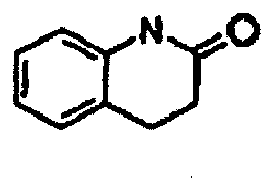
- Composé selon l'une quelconque des revendications 1 et 9 à 14, ou un sel pharmaceutiquement acceptable de celui-ci, dans lequel, dans le cas où le groupe hydrocarboné aromatique, le groupe hydrocarboné aromatique partiellement saturé, le groupe hétérocyclique aromatique, ou l'hétérocycle aromatique partiellement saturé, est substitué, le substituant ou les substituants sont de 1 à 5 substituants choisis parmi le groupe comprenant un atome d'halogène, un groupe cyano, un groupe nitro, un groupe sulfamoyle, un groupe hydroxyle, un groupe carboxyle, un groupe alkyle possédant de 1 à 6 atomes de carbone, un groupe trifluorométhyle, un groupe méthoxycarbonyléthyle, un groupe alcoxy possédant de 1 à 6 atomes de carbone (le groupe alcoxy étant facultativement substitué par un groupe phényle, un groupe alkylamino possédant de 1 à 6 atomes de carbone, un groupe dialkylamino possédant de 2 à 12 atomes de carbone, ou un groupe morpholino), un groupe trifluorométhoxy, un groupe difluorométhoxy, un groupe cyanoéthoxy,
un groupe alcényle possédant de 2 à 8 atomes de carbone, un groupe alcynyle possédant de 2 à 8 atomes de carbone,
un groupe cycloalkyle possédant de 3 à 8 atomes de carbone, un groupe alcanoyle possédant de 2 à 7 atomes de carbone, un groupe rifluoroacétyle, un groupe alcoxycarbonyle possédant de 2 à 10 atomes de carbone,
un groupe phényle (le groupe phényle étant facultativement substitué par un groupe alcanoyle possédant de 2 à 7 atomes de carbone ou un groupe alcoxy possédant de 1 à 6 atomes de carbone),
un groupe phénoxy facultativement substitué par un groupe alcoxy possédant de 1 à 6 atomes de carbone,
un groupe pyrazolyle, un groupe 1-méthyl-5-trifluorométhyl-1H-pyrazol-3-yle, un groupe méthyl-pyrimidinyle, un groupe 2-méthylsulfanylpyrimidin-4-yle, un groupe oxazolyle, un groupe isoxazol-5-yle, un groupe 5-trifluorométhylisoxazol-3-yle, un groupe pyridyloxy, un groupe pyridinecarbonyle, un groupe benzoyle, un groupe pyrrolyle, un groupe imidazolyle, un groupe thiazolyle, un groupe [1,2,3]thiadiazol-4-yle, un groupe triazolyle, un groupe alkylthio possédant de 1 à 6 atomes de carbone, un groupe alkylsulfonyle possédant de 1 à 6 atomes de carbone, un groupe benzènesulfonyle, un groupe pyrrolidinesulfonyle, un groupe morpholinylsulfonyle, un groupe 4-pipéridinyle facultativement substitué par un groupe alkyle possédant de 1 à 6 atomes de carbone, un groupe morpholino facultativement substitué par un groupe alkyle possédant de 1 à 6 atomes de carbone, un groupe pipérazino substitué par un groupe alkyle possédant de 1 à 6 atomes de carbone ou un groupe alkyle possédant de 1 à 6 atomes de carbone et substitué par un groupe diméthylamino, ou un groupe représenté par la formule -NR7R8 où chacun de R7 et R8 représente un atome d'hydrogène, un groupe alkyle possédant de 1 à 6 atomes de carbone (le groupe alkyle étant facultativement substitué par un groupe alcoxy possédant 1 à 6 atomes de carbone ou un groupe diméthylamino), un groupe alcanoyle possédant de 1 à 6 atomes de carbone, un groupe carbamoyle, un groupe carbamoyle substitué par un(des) groupe(s) alkyle possédant de 1 à 4 atomes de carbone, un groupe morpholinocarbonyle, un groupe diméthylaminosulfonyle, ou un groupe alkylsulfonyle possédant de 1 à 6 atomes de carbone, ou bien R7 et R8, ensemble avec l'atome d'azote auquel R7 et R8 sont rattachés, forment ensemble un cycle hydrocarboné saturé de 3 à 8 chaînons, ce cycle étant facultativement substitué par un groupe diméthylènedioxy, un groupe oxo, ou un groupe hydroxyle, un groupe méthoxyéthyluréido, un groupe pyridyléthoxycarbonylamino. - Préparation pharmaceutique comprenant le composé selon l'une quelconque des revendications 1 à 15 ou un sel pharmaceutiquement acceptable de celui-ci.
- Préparation pharmaceutique selon la revendication 16, qui est destinée à être utilisée dans le traitement d'une maladie auto-immune, telle que la maladie de Crohn, une colite d'hypersensibilité, le syndrome de Sjögren, la sclérose en plaques, et le lupus érythémateux disséminé, la polyarthrite rhumatoïde, l'asthme, une dermatite atopique, un rejet de greffe d'organe, un cancer, une rétinopathie, un psoriasis, l'arthrose, ou la dégénérescence maculaire liée à l'âge.
- Composé représenté par la formule

R1, R2 et R3 sont tels que définis selon la revendication 1. - Composé représenté par la formule

- Composé selon la revendication 18 ou 19, ou un sel de celui-ci, dans lequel R2 est un groupe alkyle possédant de 1 à 6 atomes de carbone, ou un groupe cycloalkyle possédant de 3 à 8 atomes de carbone.
- Composé selon la revendication 18 ou 19, ou un sel de celui-ci, dans lequel R2 est un groupe éthyle ou un groupe cyclopropyle.
- Composé selon l'une quelconque des revendications 18 à 21, ou un sel de celui-ci, dans lequel R1 est un groupe méthyle ou un groupe éthyle.
Priority Applications (1)
| Application Number | Priority Date | Filing Date | Title |
|---|---|---|---|
| PL07708069T PL1988083T3 (pl) | 2006-02-03 | 2007-02-05 | Pochodna triazolowa |
Applications Claiming Priority (2)
| Application Number | Priority Date | Filing Date | Title |
|---|---|---|---|
| JP2006027799 | 2006-02-03 | ||
| PCT/JP2007/051951 WO2007089018A1 (fr) | 2006-02-03 | 2007-02-05 | Dérivé de triazole |
Publications (3)
| Publication Number | Publication Date |
|---|---|
| EP1988083A1 EP1988083A1 (fr) | 2008-11-05 |
| EP1988083A4 EP1988083A4 (fr) | 2009-11-11 |
| EP1988083B1 true EP1988083B1 (fr) | 2014-04-02 |
Family
ID=38327575
Family Applications (1)
| Application Number | Title | Priority Date | Filing Date |
|---|---|---|---|
| EP07708069.5A Active EP1988083B1 (fr) | 2006-02-03 | 2007-02-05 | Dérivé de triazole |
Country Status (8)
| Country | Link |
|---|---|
| US (2) | US8022091B2 (fr) |
| EP (1) | EP1988083B1 (fr) |
| JP (1) | JP5035752B2 (fr) |
| CN (1) | CN101415691B (fr) |
| ES (1) | ES2458615T3 (fr) |
| PL (1) | PL1988083T3 (fr) |
| RU (1) | RU2409570C2 (fr) |
| WO (1) | WO2007089018A1 (fr) |
Families Citing this family (16)
| Publication number | Priority date | Publication date | Assignee | Title |
|---|---|---|---|---|
| US8022225B2 (en) * | 2004-08-04 | 2011-09-20 | Taisho Pharmaceutical Co., Ltd | Triazole derivative |
| JP5218737B2 (ja) | 2006-02-06 | 2013-06-26 | 大正製薬株式会社 | スフィンゴシン−1−リン酸結合阻害物質 |
| DK2177512T3 (da) * | 2007-08-01 | 2012-06-18 | Taisho Pharmaceutical Co Ltd | S1P1-bindingshæmmer |
| WO2009108633A2 (fr) * | 2008-02-25 | 2009-09-03 | Expression Drug Designs, Llc. | Antagonisme de la sphingosine 1-phosphate |
| US8212010B2 (en) | 2008-02-25 | 2012-07-03 | Expression Drug Designs, Llc | Sphingosine 1-phosphate antagonism |
| CA2727862C (fr) | 2008-06-17 | 2016-04-19 | Millennium Pharmaceuticals, Inc. | Composes de borates esters et compositions pharmaceutiques contenant des composes |
| CN102395567A (zh) * | 2009-02-12 | 2012-03-28 | 埃克塞利希斯股份有限公司 | 在治疗糖尿病和肥胖症中用作的tgr5激动剂的三唑和咪唑衍生物 |
| CA2787037C (fr) * | 2010-02-24 | 2018-04-10 | Research Triangle Institute | Antagonistes arylpiperazone de recepteurs des opioides |
| EP2788332A1 (fr) * | 2011-12-07 | 2014-10-15 | Amgen, Inc. | Inhibiteurs aryle et hétéroaryle bicycliques des canaux calciques |
| JP6294872B2 (ja) | 2013-04-26 | 2018-03-14 | 国立大学法人京都大学 | 脳動脈瘤の形成および/または増大の抑制若しくは縮小用医薬組成物 |
| US10889555B2 (en) | 2016-05-31 | 2021-01-12 | Taiho Pharmaceutical Co., Ltd. | Sulfonamide compound or salt thereof |
| PT3466934T (pt) | 2016-05-31 | 2024-04-30 | Taiho Pharmaceutical Co Ltd | Compostos de sulfonamida ou seus sais como inibidores da ribonucleótido-redutase para o tratamento de cancro |
| MX2020005478A (es) * | 2017-11-29 | 2020-08-27 | Taiho Pharmaceutical Co Ltd | Compuestos de sulfonamida y usos de los mismos. |
| US20200405697A1 (en) * | 2017-11-29 | 2020-12-31 | Taiho Pharmaceutical Co., Ltd. | Antitumor Agent |
| JPWO2019151470A1 (ja) | 2018-02-02 | 2021-02-25 | 国立大学法人京都大学 | 眼内血管新生及び/又は眼内血管透過性亢進を伴う眼科疾患の予防又は治療のための医薬 |
| CA3139285A1 (fr) * | 2019-06-27 | 2020-12-30 | Hangzhou Healzen Therapeutics Co., Ltd. | Inhibiteur de caseine kinase 1e, composition pharmaceutique et application connexe |
Family Cites Families (32)
| Publication number | Priority date | Publication date | Assignee | Title |
|---|---|---|---|---|
| JPH05194412A (ja) | 1991-12-28 | 1993-08-03 | Advance Co Ltd | ジアゾリン化合物 |
| GB9202791D0 (en) | 1992-02-11 | 1992-03-25 | British Bio Technology | Compounds |
| JP3682075B2 (ja) * | 1993-04-16 | 2005-08-10 | クミアイ化学工業株式会社 | トリアゾール誘導体及び殺虫、殺ダニ剤 |
| RU2157368C2 (ru) | 1994-09-26 | 2000-10-10 | Сионоги Энд Ко., Лтд. | Производные имидазола и фармацевтическая композиция на их основе |
| TW533205B (en) * | 1996-06-25 | 2003-05-21 | Novartis Ag | Substituted 3,5-diphenyl-l,2,4-triazoles and their pharmaceutical composition |
| EP1276729B1 (fr) | 2000-04-06 | 2008-07-09 | AstraZeneca AB | Nouveaux antagonistes de la neurokinine utilises comme medicaments |
| WO2002018395A1 (fr) | 2000-08-31 | 2002-03-07 | Merck & Co., Inc. | Derives de phosphates utilises en tant qu'agents immuno-regulateurs |
| JP2002212070A (ja) * | 2001-01-24 | 2002-07-31 | Ono Pharmaceut Co Ltd | アスパラギン酸誘導体を有効成分として含有するスフィンゴシン−1−リン酸拮抗剤 |
| JP2002332278A (ja) * | 2001-05-08 | 2002-11-22 | Human Science Shinko Zaidan | Edg受容体拮抗作用を有する複素環誘導体 |
| WO2002092068A1 (fr) | 2001-05-10 | 2002-11-21 | Ono Pharmaceutical Co., Ltd. | Derives d'acide carboxylique et medicaments contenant ces derives comme principe actif |
| GB0113524D0 (en) | 2001-06-04 | 2001-07-25 | Hoffmann La Roche | Pyrazole derivatives |
| DE10130397A1 (de) | 2001-06-23 | 2003-01-09 | Bayer Cropscience Gmbh | Herbizide substituierte Pyridine, Verfahren zu ihrer Herstellung und ihre Verwendung als Herbzide und Pflanzenwachstumsregulatoren |
| JP4035759B2 (ja) | 2001-11-06 | 2008-01-23 | 独立行政法人産業技術総合研究所 | アミノアルコールリン酸化合物、製造方法、及びその利用方法 |
| US7309721B2 (en) | 2002-03-01 | 2007-12-18 | Merck + Co., Inc. | Aminoalkylphosphonates and related compounds as Edg receptor agonists |
| AU2003218056A1 (en) | 2002-03-01 | 2003-09-16 | Merck & Co., Inc. | Aminoalkylphosphonates and related compounds as edg receptor agonists |
| PL372103A1 (en) | 2002-05-16 | 2005-07-11 | Novartis Ag | Use of edg receptor binding agents in cancer |
| JP2005533058A (ja) | 2002-06-17 | 2005-11-04 | メルク エンド カムパニー インコーポレーテッド | Edg受容体アゴニストとしての1−((5−アリール−1,2,4−オキサジアゾール−3−イル)ベンジル)アゼチジン−3−カルボキシラートおよび1−((5−アリール−1,2,4−オキサジアゾール−3−イル)ベンジル)ピロリジン−3−カルボキシラート |
| CN100349855C (zh) * | 2002-09-11 | 2007-11-21 | 日本化学医药株式会社 | 胺衍生物 |
| US7612238B2 (en) * | 2002-09-13 | 2009-11-03 | Novartis Ag | Amino-propanol derivatives |
| JP4516430B2 (ja) | 2002-12-20 | 2010-08-04 | メルク・シャープ・エンド・ドーム・コーポレイション | 1−(アミノ)インダン並びに(1,2−ジヒドロ−3−アミノ)−ベンゾフラン、ベンゾチオフェン及びインドール |
| TW200423930A (en) | 2003-02-18 | 2004-11-16 | Hoffmann La Roche | Non-nucleoside reverse transcriptase inhibitors |
| AU2004231070B2 (en) | 2003-04-10 | 2008-02-14 | Amgen, Inc. | Bicyclic compounds having bradykinin receptors affinity and pharmaceutical compositions thereof |
| WO2004089367A1 (fr) | 2003-04-11 | 2004-10-21 | Novo Nordisk A/S | Utilisation pharmaceutique de 1,2,4-triazoles substituees |
| US20060252741A1 (en) * | 2003-05-15 | 2006-11-09 | Colandrea Vincent J | 3-(2-amino-1-azacyclyl)-5-aryl-1,2,4-oxadiazoles as s1p receptor agonists |
| WO2005123677A1 (fr) | 2004-06-16 | 2005-12-29 | Actelion Pharmaceuticals Ltd | Utilisation de derives de 1,1,2-trimethyl-1a,4,5,5a-tetrahydro-1h-4-aza-cyclopropa[a]pentalene a substitution 4-carbonyle comme agonistes du recepteur couple aux proteines g s1p1/edg1 et agents immunosuppresseurs |
| US8022225B2 (en) | 2004-08-04 | 2011-09-20 | Taisho Pharmaceutical Co., Ltd | Triazole derivative |
| PL1860941T3 (pl) | 2005-03-16 | 2009-04-30 | Basf Se | Bifenylo-n-(4-pirydylo)metylosulfonoamidy |
| TW200736234A (en) | 2006-01-17 | 2007-10-01 | Astrazeneca Ab | Chemical compounds |
| JP5218737B2 (ja) | 2006-02-06 | 2013-06-26 | 大正製薬株式会社 | スフィンゴシン−1−リン酸結合阻害物質 |
| WO2007112322A2 (fr) | 2006-03-28 | 2007-10-04 | Allergan, Inc. | Composés d'indole présentant une activité biologique agoniste et/ou antagoniste vis-à-vis du récepteur de la sphingosine-1-phosphate (s1p) |
| JP2009534365A (ja) | 2006-04-21 | 2009-09-24 | アストラゼネカ アクチボラグ | Adg受容体修飾物質として有用なスルホンアミド化合物 |
| WO2007122401A1 (fr) | 2006-04-21 | 2007-11-01 | Astrazeneca Ab | Derives d'imidazole utilisables en tant qu'antagonistes de edg-1 |
-
2007
- 2007-02-05 EP EP07708069.5A patent/EP1988083B1/fr active Active
- 2007-02-05 PL PL07708069T patent/PL1988083T3/pl unknown
- 2007-02-05 JP JP2007556950A patent/JP5035752B2/ja not_active Expired - Fee Related
- 2007-02-05 RU RU2008135694/04A patent/RU2409570C2/ru not_active IP Right Cessation
- 2007-02-05 ES ES07708069.5T patent/ES2458615T3/es active Active
- 2007-02-05 WO PCT/JP2007/051951 patent/WO2007089018A1/fr not_active Ceased
- 2007-02-05 US US12/278,054 patent/US8022091B2/en not_active Expired - Fee Related
- 2007-02-05 CN CN2007800118463A patent/CN101415691B/zh not_active Expired - Fee Related
-
2011
- 2011-07-11 US US13/180,011 patent/US20110269960A1/en not_active Abandoned
Also Published As
| Publication number | Publication date |
|---|---|
| CN101415691A (zh) | 2009-04-22 |
| US8022091B2 (en) | 2011-09-20 |
| RU2409570C2 (ru) | 2011-01-20 |
| JP5035752B2 (ja) | 2012-09-26 |
| US20110269960A1 (en) | 2011-11-03 |
| RU2008135694A (ru) | 2010-03-10 |
| ES2458615T3 (es) | 2014-05-06 |
| CN101415691B (zh) | 2011-12-14 |
| HK1131128A1 (en) | 2010-01-15 |
| PL1988083T3 (pl) | 2014-08-29 |
| EP1988083A1 (fr) | 2008-11-05 |
| WO2007089018A1 (fr) | 2007-08-09 |
| US20100041655A1 (en) | 2010-02-18 |
| EP1988083A4 (fr) | 2009-11-11 |
| JPWO2007089018A1 (ja) | 2009-06-25 |
Similar Documents
| Publication | Publication Date | Title |
|---|---|---|
| EP1988083B1 (fr) | Dérivé de triazole | |
| EP1988081B1 (fr) | Inhibiteur de liaison de sphingosine-1-phosphate | |
| US8785488B2 (en) | Triazole and imidazole derivatives for use as TGR5 agonists in the treatment of diabetes and obesity | |
| RU2383536C2 (ru) | Производное триазола | |
| EP3331864B1 (fr) | Composés dérivés de 1,3,4-oxadiazole utilisés en tant qu'inhibiteur de l'histone désacétylase 6, et composition pharmaceutique les comprenant | |
| EP3328843B1 (fr) | Composés dérivés de 1,3,4-oxadiazole sulfonamide servant d'inhibiteur de l'histone désacétylase 6, et composition pharmaceutique comprenant ceux-ci | |
| AU773273B2 (en) | Novel sulfonamide compounds and uses thereof | |
| EP3107898B1 (fr) | Cyclopentanes 1,2-substitués en tant qu'inhibiteurs du récepteur de l'orexine | |
| EP2172450A1 (fr) | Nouveau dérivé sulfamide d'acide malonique et son usage pharmaceutique | |
| HUE034647T2 (hu) | Oxálsavamidok mint neprilizin inhibitorok, gyógyszerkészítményeik és elõállításuk | |
| EP2508513A1 (fr) | Composés 2-pyridones | |
| EP2017263A1 (fr) | Derive acide carboxylique inferieur d'heteroarylamide | |
| HK1041476A1 (en) | Cell adhesion-inhibiting antiinflammatory and immune-suppressive compounds | |
| CA2934936A1 (fr) | Inhibiteurs de la neprilysine | |
| JPWO2008078725A1 (ja) | チアゼピン誘導体 | |
| EP0757670A1 (fr) | Derives de benzamide utilises comme antagonistes de la vasopressine | |
| AU729468B2 (en) | Novel amide derivatives and medicinal compositions thereof | |
| JP2010006707A (ja) | チアゼピン誘導体を含有する医薬 | |
| US8048898B2 (en) | Inhibitor of binding of S1P1 | |
| HK1131128B (en) | Triazole derivative |
Legal Events
| Date | Code | Title | Description |
|---|---|---|---|
| PUAI | Public reference made under article 153(3) epc to a published international application that has entered the european phase |
Free format text: ORIGINAL CODE: 0009012 |
|
| 17P | Request for examination filed |
Effective date: 20080828 |
|
| AK | Designated contracting states |
Kind code of ref document: A1 Designated state(s): AT BE BG CH CY CZ DE DK EE ES FI FR GB GR HU IE IS IT LI LT LU LV MC NL PL PT RO SE SI SK TR |
|
| AX | Request for extension of the european patent |
Extension state: AL BA HR MK RS |
|
| A4 | Supplementary search report drawn up and despatched |
Effective date: 20091013 |
|
| 17Q | First examination report despatched |
Effective date: 20101020 |
|
| GRAP | Despatch of communication of intention to grant a patent |
Free format text: ORIGINAL CODE: EPIDOSNIGR1 |
|
| INTG | Intention to grant announced |
Effective date: 20131001 |
|
| GRAS | Grant fee paid |
Free format text: ORIGINAL CODE: EPIDOSNIGR3 |
|
| RAP1 | Party data changed (applicant data changed or rights of an application transferred) |
Owner name: TAISHO PHARMACEUTICAL CO., LTD. |
|
| RIN1 | Information on inventor provided before grant (corrected) |
Inventor name: TAKAYAMA, TETSUO Inventor name: YAGI, MAKOTO Inventor name: KATAKAI, HIRONORI Inventor name: ONO, NAOYA Inventor name: SATO, MASAKAZU Inventor name: SHIOZAWA, FUMIYASU Inventor name: OTA, TOMOMI Inventor name: YABUUCHI, TETSUYA |
|
| GRAA | (expected) grant |
Free format text: ORIGINAL CODE: 0009210 |
|
| AK | Designated contracting states |
Kind code of ref document: B1 Designated state(s): AT BE BG CH CY CZ DE DK EE ES FI FR GB GR HU IE IS IT LI LT LU LV MC NL PL PT RO SE SI SK TR |
|
| AX | Request for extension of the european patent |
Extension state: AL BA HR MK RS |
|
| REG | Reference to a national code |
Ref country code: GB Ref legal event code: FG4D |
|
| REG | Reference to a national code |
Ref country code: AT Ref legal event code: REF Ref document number: 660038 Country of ref document: AT Kind code of ref document: T Effective date: 20140415 Ref country code: CH Ref legal event code: NV Representative=s name: E. BLUM AND CO. AG PATENT- UND MARKENANWAELTE , CH Ref country code: CH Ref legal event code: EP |
|
| REG | Reference to a national code |
Ref country code: NL Ref legal event code: T3 |
|
| REG | Reference to a national code |
Ref country code: ES Ref legal event code: FG2A Ref document number: 2458615 Country of ref document: ES Kind code of ref document: T3 Effective date: 20140506 |
|
| REG | Reference to a national code |
Ref country code: IE Ref legal event code: FG4D |
|
| REG | Reference to a national code |
Ref country code: DE Ref legal event code: R096 Ref document number: 602007035874 Country of ref document: DE Effective date: 20140515 |
|
| REG | Reference to a national code |
Ref country code: AT Ref legal event code: MK05 Ref document number: 660038 Country of ref document: AT Kind code of ref document: T Effective date: 20140402 |
|
| REG | Reference to a national code |
Ref country code: PL Ref legal event code: T3 |
|
| REG | Reference to a national code |
Ref country code: GR Ref legal event code: EP Ref document number: 20140401207 Country of ref document: GR Effective date: 20140718 |
|
| REG | Reference to a national code |
Ref country code: LT Ref legal event code: MG4D |
|
| PG25 | Lapsed in a contracting state [announced via postgrant information from national office to epo] |
Ref country code: LT Free format text: LAPSE BECAUSE OF FAILURE TO SUBMIT A TRANSLATION OF THE DESCRIPTION OR TO PAY THE FEE WITHIN THE PRESCRIBED TIME-LIMIT Effective date: 20140402 Ref country code: CY Free format text: LAPSE BECAUSE OF FAILURE TO SUBMIT A TRANSLATION OF THE DESCRIPTION OR TO PAY THE FEE WITHIN THE PRESCRIBED TIME-LIMIT Effective date: 20140402 Ref country code: IS Free format text: LAPSE BECAUSE OF FAILURE TO SUBMIT A TRANSLATION OF THE DESCRIPTION OR TO PAY THE FEE WITHIN THE PRESCRIBED TIME-LIMIT Effective date: 20140802 Ref country code: CZ Free format text: LAPSE BECAUSE OF FAILURE TO SUBMIT A TRANSLATION OF THE DESCRIPTION OR TO PAY THE FEE WITHIN THE PRESCRIBED TIME-LIMIT Effective date: 20140402 Ref country code: FI Free format text: LAPSE BECAUSE OF FAILURE TO SUBMIT A TRANSLATION OF THE DESCRIPTION OR TO PAY THE FEE WITHIN THE PRESCRIBED TIME-LIMIT Effective date: 20140402 Ref country code: BG Free format text: LAPSE BECAUSE OF FAILURE TO SUBMIT A TRANSLATION OF THE DESCRIPTION OR TO PAY THE FEE WITHIN THE PRESCRIBED TIME-LIMIT Effective date: 20140702 |
|
| PG25 | Lapsed in a contracting state [announced via postgrant information from national office to epo] |
Ref country code: AT Free format text: LAPSE BECAUSE OF FAILURE TO SUBMIT A TRANSLATION OF THE DESCRIPTION OR TO PAY THE FEE WITHIN THE PRESCRIBED TIME-LIMIT Effective date: 20140402 Ref country code: SE Free format text: LAPSE BECAUSE OF FAILURE TO SUBMIT A TRANSLATION OF THE DESCRIPTION OR TO PAY THE FEE WITHIN THE PRESCRIBED TIME-LIMIT Effective date: 20140402 Ref country code: LV Free format text: LAPSE BECAUSE OF FAILURE TO SUBMIT A TRANSLATION OF THE DESCRIPTION OR TO PAY THE FEE WITHIN THE PRESCRIBED TIME-LIMIT Effective date: 20140402 |
|
| PG25 | Lapsed in a contracting state [announced via postgrant information from national office to epo] |
Ref country code: PT Free format text: LAPSE BECAUSE OF FAILURE TO SUBMIT A TRANSLATION OF THE DESCRIPTION OR TO PAY THE FEE WITHIN THE PRESCRIBED TIME-LIMIT Effective date: 20140804 |
|
| REG | Reference to a national code |
Ref country code: DE Ref legal event code: R097 Ref document number: 602007035874 Country of ref document: DE |
|
| PG25 | Lapsed in a contracting state [announced via postgrant information from national office to epo] |
Ref country code: RO Free format text: LAPSE BECAUSE OF FAILURE TO SUBMIT A TRANSLATION OF THE DESCRIPTION OR TO PAY THE FEE WITHIN THE PRESCRIBED TIME-LIMIT Effective date: 20140402 Ref country code: DK Free format text: LAPSE BECAUSE OF FAILURE TO SUBMIT A TRANSLATION OF THE DESCRIPTION OR TO PAY THE FEE WITHIN THE PRESCRIBED TIME-LIMIT Effective date: 20140402 Ref country code: EE Free format text: LAPSE BECAUSE OF FAILURE TO SUBMIT A TRANSLATION OF THE DESCRIPTION OR TO PAY THE FEE WITHIN THE PRESCRIBED TIME-LIMIT Effective date: 20140402 Ref country code: SK Free format text: LAPSE BECAUSE OF FAILURE TO SUBMIT A TRANSLATION OF THE DESCRIPTION OR TO PAY THE FEE WITHIN THE PRESCRIBED TIME-LIMIT Effective date: 20140402 |
|
| PLBE | No opposition filed within time limit |
Free format text: ORIGINAL CODE: 0009261 |
|
| STAA | Information on the status of an ep patent application or granted ep patent |
Free format text: STATUS: NO OPPOSITION FILED WITHIN TIME LIMIT |
|
| 26N | No opposition filed |
Effective date: 20150106 |
|
| REG | Reference to a national code |
Ref country code: DE Ref legal event code: R097 Ref document number: 602007035874 Country of ref document: DE Effective date: 20150106 |
|
| PG25 | Lapsed in a contracting state [announced via postgrant information from national office to epo] |
Ref country code: BE Free format text: LAPSE BECAUSE OF NON-PAYMENT OF DUE FEES Effective date: 20150228 |
|
| PG25 | Lapsed in a contracting state [announced via postgrant information from national office to epo] |
Ref country code: SI Free format text: LAPSE BECAUSE OF FAILURE TO SUBMIT A TRANSLATION OF THE DESCRIPTION OR TO PAY THE FEE WITHIN THE PRESCRIBED TIME-LIMIT Effective date: 20140402 |
|
| REG | Reference to a national code |
Ref country code: DE Ref legal event code: R119 Ref document number: 602007035874 Country of ref document: DE |
|
| REG | Reference to a national code |
Ref country code: NL Ref legal event code: V1 Effective date: 20150901 |
|
| PG25 | Lapsed in a contracting state [announced via postgrant information from national office to epo] |
Ref country code: LU Free format text: LAPSE BECAUSE OF FAILURE TO SUBMIT A TRANSLATION OF THE DESCRIPTION OR TO PAY THE FEE WITHIN THE PRESCRIBED TIME-LIMIT Effective date: 20150205 Ref country code: NL Free format text: LAPSE BECAUSE OF NON-PAYMENT OF DUE FEES Effective date: 20150901 |
|
| REG | Reference to a national code |
Ref country code: CH Ref legal event code: PL |
|
| GBPC | Gb: european patent ceased through non-payment of renewal fee |
Effective date: 20150205 |
|
| PG25 | Lapsed in a contracting state [announced via postgrant information from national office to epo] |
Ref country code: LI Free format text: LAPSE BECAUSE OF NON-PAYMENT OF DUE FEES Effective date: 20150228 Ref country code: MC Free format text: LAPSE BECAUSE OF FAILURE TO SUBMIT A TRANSLATION OF THE DESCRIPTION OR TO PAY THE FEE WITHIN THE PRESCRIBED TIME-LIMIT Effective date: 20140402 Ref country code: CH Free format text: LAPSE BECAUSE OF NON-PAYMENT OF DUE FEES Effective date: 20150228 |
|
| REG | Reference to a national code |
Ref country code: GR Ref legal event code: ML Ref document number: 20140401207 Country of ref document: GR Effective date: 20150902 |
|
| REG | Reference to a national code |
Ref country code: IE Ref legal event code: MM4A |
|
| REG | Reference to a national code |
Ref country code: FR Ref legal event code: ST Effective date: 20151030 |
|
| PG25 | Lapsed in a contracting state [announced via postgrant information from national office to epo] |
Ref country code: GR Free format text: LAPSE BECAUSE OF NON-PAYMENT OF DUE FEES Effective date: 20150902 |
|
| PG25 | Lapsed in a contracting state [announced via postgrant information from national office to epo] |
Ref country code: IT Free format text: LAPSE BECAUSE OF NON-PAYMENT OF DUE FEES Effective date: 20150205 |
|
| PG25 | Lapsed in a contracting state [announced via postgrant information from national office to epo] |
Ref country code: DE Free format text: LAPSE BECAUSE OF NON-PAYMENT OF DUE FEES Effective date: 20150901 Ref country code: GB Free format text: LAPSE BECAUSE OF NON-PAYMENT OF DUE FEES Effective date: 20150205 Ref country code: IE Free format text: LAPSE BECAUSE OF NON-PAYMENT OF DUE FEES Effective date: 20150205 |
|
| PG25 | Lapsed in a contracting state [announced via postgrant information from national office to epo] |
Ref country code: FR Free format text: LAPSE BECAUSE OF NON-PAYMENT OF DUE FEES Effective date: 20150302 |
|
| PG25 | Lapsed in a contracting state [announced via postgrant information from national office to epo] |
Ref country code: PL Free format text: LAPSE BECAUSE OF NON-PAYMENT OF DUE FEES Effective date: 20150205 |
|
| PG25 | Lapsed in a contracting state [announced via postgrant information from national office to epo] |
Ref country code: HU Free format text: LAPSE BECAUSE OF FAILURE TO SUBMIT A TRANSLATION OF THE DESCRIPTION OR TO PAY THE FEE WITHIN THE PRESCRIBED TIME-LIMIT; INVALID AB INITIO Effective date: 20070205 |
|
| PG25 | Lapsed in a contracting state [announced via postgrant information from national office to epo] |
Ref country code: ES Free format text: LAPSE BECAUSE OF NON-PAYMENT OF DUE FEES Effective date: 20150206 |
|
| REG | Reference to a national code |
Ref country code: ES Ref legal event code: FD2A Effective date: 20180706 |
|
| PG25 | Lapsed in a contracting state [announced via postgrant information from national office to epo] |
Ref country code: TR Free format text: LAPSE BECAUSE OF NON-PAYMENT OF DUE FEES Effective date: 20150205 |