EP1989063B1 - Verfahren zur steuerung des drucks in einem rad für fahrzeuge und rad mit gesteuertem druck gemäss dem verfahren - Google Patents
Verfahren zur steuerung des drucks in einem rad für fahrzeuge und rad mit gesteuertem druck gemäss dem verfahren Download PDFInfo
- Publication number
- EP1989063B1 EP1989063B1 EP06728457A EP06728457A EP1989063B1 EP 1989063 B1 EP1989063 B1 EP 1989063B1 EP 06728457 A EP06728457 A EP 06728457A EP 06728457 A EP06728457 A EP 06728457A EP 1989063 B1 EP1989063 B1 EP 1989063B1
- Authority
- EP
- European Patent Office
- Prior art keywords
- pressure
- tyre
- valve
- tank
- valve assembly
- Prior art date
- Legal status (The legal status is an assumption and is not a legal conclusion. Google has not performed a legal analysis and makes no representation as to the accuracy of the status listed.)
- Expired - Lifetime
Links
Images



Classifications
-
- B—PERFORMING OPERATIONS; TRANSPORTING
- B60—VEHICLES IN GENERAL
- B60C—VEHICLE TYRES; TYRE INFLATION; TYRE CHANGING; CONNECTING VALVES TO INFLATABLE ELASTIC BODIES IN GENERAL; DEVICES OR ARRANGEMENTS RELATED TO TYRES
- B60C23/00—Devices for measuring, signalling, controlling, or distributing tyre pressure or temperature, specially adapted for mounting on vehicles; Arrangement of tyre inflating devices on vehicles, e.g. of pumps or of tanks; Tyre cooling arrangements
- B60C23/001—Devices for manually or automatically controlling or distributing tyre pressure whilst the vehicle is moving
- B60C23/004—Devices for manually or automatically controlling or distributing tyre pressure whilst the vehicle is moving the control being done on the wheel, e.g. using a wheel-mounted reservoir
Definitions
- the present invention relates to a method of controlling the pressure in a vehicle wheel.
- the invention also relates to a wheel having a controlled and compensated pressure, to be used for putting said method into practice.
- a wheel for two-wheeled or four-wheeled vehicles generally comprises a rim coupled with a tyre that is inflated to a given operating pressure.
- Said tyre generally comprises a carcass structure having at least one carcass ply, and at least one annular reinforcing structure associated with the carcass ply, a tread band of elastomer material at a radially external position to the carcass structure, a belt structure interposed between the carcass structure and tread band and a pair of sidewalls at axially opposite positions on the carcass structure.
- the tyre airtightness is ensured by the radially inner layer of said carcass structure generally called "liner".
- liner the radially inner layer of said carcass structure
- Patent US 6,601,625 B2 discloses a wheel with a compressed air tank integrated into the rim. More specifically it is disclosed a high pressure tank to store compressed air from an outer source, a first mechanical valve allowing the compressed air to flow from a source external to the high pressure tank, a second mechanical valve allowing air passage from the high pressure tank to the inner tube of the tyre, a third valve releasing air from the inner tube of the tyre, and a fourth valve releasing air from the high pressure tank.
- the wheel described in said patent keeps the tyre pressure within a predetermined value in a mechanical manner, reducing the necessity for the vehicle driver to manually inflate the tyre to reach the desired pressure.
- Patent US 4,067,376 depicts a system for automatic readmission of the air lost from a tyre while the vehicle is running in order to minimise the effects of an explosion.
- the wheel is formed with an integrated annular bag adapted to store an amount of compressed air under high pressure.
- a pressure safety valve is placed between said bag and the tyre and is adapted to release air from the bag to the tyre each time pressure within the tyre decreases below a predetermined limit.
- US 5,293,919 refers to a self-regulating tire pressure system and method employing a bistable valve that allows air from a high pressure reservoir to replenish the pressure within a tire when it has fallen below an actuating pressure, and discontinues its operation only after the tire pressure has increased to a closing pressure that is greater than the actuating pressure.
- the valve includes a bistable diaphragm that receives a reference pressure on one side and the tire pressure on its opposite side, and snaps between two stable positions respectively opening and closing the valve in response to the tire pressure falling below the actuating pressure and then increasing to the closing pressure.
- WO 2005/084967 in the name of the same Applicant proposes insertion of a valve between a tank of fluid under pressure associated with the rim of a wheel and the tyre mounted on said rim, which valve is designed to compensate for pressure variations with respect to variations in the room temperature by an elastic element having a variable elastic constant in response to temperature variations, so as to keep the valve to a closed position when the inner pressure of the tyre decreases due to a temperature reduction.
- restoration of the operating pressure in the tyre is carried out only when the pressure has gone down as a result of true air losses (micropunctures, lack of airtightness of the liner, etc.) and not for reasons connected with lowering of the room temperature.
- pressure' in the tyre is maintained constant over long periods of time, due to the fact that the operating duration of the tank of fluid under pressure is increased, the other conditions being the same.
- EP 305 312 discloses a device for maintaining in the tyre the recommended air pressure and, in the event of a puncture, transferring an air reserve and triggering an alarm, It consists of a vessel fixed to the rim and connected to a pressure regulator connected to the tyre.
- the regulator consist of a body within which a cylinder is housed. A radial orifice is located laterally at the cylinder; by which the air from the reservoir will arrive. Part of the cylinder defines a pressure chamber provided with a hat which comprises in its center an opening.
- An axial orifice is obtained in the center of the piston, leading to the middle portion of the piston to communicate with a throat on entire circumference of the piston to communicate with the radial orifice of the cylinder. Compressed air comes whose pressure will push a ball floatingly located in the pressure chamber, to cause a sealing with the level of the head of the piston when the pressure is optimum.
- the Applicant has ascertained that by providing between the tank of the fluid under pressure and the tyre, a safety valve which is able to intercept the fluid outflow towards the tank without inhibiting passage of fluid from the tank itself to the tyre, a sudden deflation of the tyre is avoided in case of fluid losses in the tank, the functional operation of the tank itself being maintained for purposes of maintenance of the operating pressure in the tyre.
- the invention relates to a method of controlling pressure in a vehicle wheel, in which said wheel comprises a tyre mounted on a rim, said method comprising the steps of: inflating an inner volume of the tyre to an operating pressure; admitting a fluid compressed to a first pressure higher that the operating pressure of the tyre, into a tank associated with the rim; opening a fluid communication, by at least one primary mechanical valve, between the inner volume of said tyre and said tank when pressure of the inner volume of said tyre is lower than said operating pressure; stopping the communication between said inner volume and tank when said tyre pressure is substantially equal to said operating pressure; stopping the communication between said inner volume and tank when during said opening step by means of the primary valve, the pressure value within the tank is lower than the pressure value in the tyre
- Stopping of the fluid communication in case of weak pressure in the tank is preferably carried out by a mechanical safety valve, preferably a one-way on-off valve.
- the safety valve operates independently of the primary valve, thus avoiding undesirable structural complications in the primary valve itself and ensuring a satisfactory accuracy of intervention of said primary valve for restoration of the operating pressure of the tyre during normal running.
- Opening of the fluid communication between the inner volume of the tyre and the tank can be advantageously carried out by at least one primary mechanical valve opening of which is controlled by an elastic element with an elastic constant varying in a temperature range from -50°C to +50°C so as to maintain said primary valve to a closed position following a reduction in the inner tyre pressure due to a temperature reduction within said range.
- said elastic element controlling opening of said primary valve has a value of elastic constant measured at -50 °C (K -50°C ) differing from the value of elastic constant measured at +50°C (K +50°C ) by at least 10% with respect to the value of elastic constant measured at +50°C (K +50°C ).
- said elastic element controlling opening of said primary valve has a value of elastic constant measured at -50°C (K -50°C ) differing from the value of elastic constant measured at +50°C (K +50°C ) by no more than 40% with respect to the value of elastic constant measured at +50°C (K +50°C ).
- the ratio between said operating pressure of the tyre and said first pressure in said tank is included between about 0.1 and about 0.6.
- the ratio between said operating pressure of the tyre and said first pressure in said tank is included between about 0.2 and about 0.4.
- said method allows widely spread reloading devices to be used, due to the fact that said first pressure in said tank is included between about 8 and about 12 bars.
- said first pressure in said tank is included between about 8.5 and about 10 bars.
- opening of the fluid communication between tyre and tank is advantageously carried out in response to a pressure gradient reduction between the tyre pressure and the ambient pressure.
- said step of bringing the inner volume of said tyre into communication with said tank takes place when the pressure of the inner volume of said tyre is lower than said operating pressure by at least 5%.
- the invention relates to a wheel having a controlled and compensated pressure, comprising: a rim associated with a tank adapted to be filled with a fluid to a first pressure; a tyre mounted on said rim and having an inner volume inflatable to an operating pressure, said operating pressure being lower than said first pressure;
- said safety valve can be a mechanical valve, preferably a one-way on-off valve.
- the safety valve preferably comprises a second closure member to be made in the form of an elastic diaphragm or a ball acting against said abutment seat.
- a second auxiliary elastic element can be advantageously associated with the safety valve to push said closure member towards the perimetral edge of said communication opening, so as to maintain the safety valve in a closed condition.
- Said safety valve can be advantageously integrated into a valve body of said primary valve so as to be integrated with the latter in a compact assembly of reduced bulkiness capable of facilitating housing of same in the wheel rim.
- the primary valve comprises at least one elastic element operatively associated with a closure member designed to open and close a port of said primary valve.
- Said elastic element preferably has an elastic constant (K) varying in a temperature range from -50°C to +50°C for example, so as to maintain the primary valve to a closed position following a reduction in the inner tyre pressure due to a temperature reduction within said range.
- said tank provides for such a volume that the ratio of said volume of said tank to said inner volume of the tyre is included between about 0.1 and about 0.4.
- said ratio is included between about 0.12 and about 0.25.
- said elastic element comprises at least one spring.
- said elastic element comprises a second spring operatively associated with said one spring.
- said second spring has an elastic constant (K) that is substantially constant within a temperature range from -50°C to +50°C.
- Modulation of the intervention in fact, can specifically rely on the spring, in which materials and expedients are capable of favouring a variation of the elastic constant against the temperature, while the thrust function relies on the second spring with an elastic constant that is substantially insensitive to temperature variations.
- said second spring supports a major portion of the load of said elastic element.
- the load supported by the second spring is included between about 60% and about 95% of the load supported by said elastic element.
- the load supported by the second spring is included between about 70% and about 80% of the load supported by said elastic element.
- the second spring is concentrically coupled with said one spring.
- the second spring is external with respect to said one spring.
- said elastic constant (K) decreases on decreasing of the temperature in said temperature range.
- the primary closure member preferably comprises a diaphragm having a first surface exposed to the pressure of the inner tyre volume, and a second surface exposed to the ambient pressure, or other reference pressure in an environment hermetically insulated from the tank.
- the primary closure member is movable relative to the primary-valve port in response to a reduction in a pressure gradient between the tyre pressure and the reference pressure.
- said wheel comprises an inflating valve operatively associated with said tank.
- said wheel comprises a control and restoration valve associated with said tyre.
- the invention relates to a valve assembly adapted to regulate a communication between a tank and an inner volume of a tyre to bring said tank into communication with said tyre when pressure in said tyre is lower than an operating pressure, said mechanical valve assembly comprising the features defined in any of claims 1 to 24.
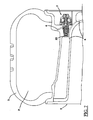
- wheel 1 for two-wheeled vehicles ( Figs. 1, 2 ) or four-wheeled vehicles ( Figs. 5, 6 ) in accordance with the invention, comprises a rim 2 on which a tyre 3 of an inner volume 3' is mounted.
- a tank 4 associated with said rim and preferably integrated into the latter, said tank being suitable to contain a fluid under pressure, said fluid being air or a substantially inert gas such as nitrogen, for example.
- the ratio between the operating pressure of tyre 3 and a first pressure existing in said tank 4, when fully loaded varies between about 0.1 and about 0.6, preferably between about 0.2 and about 0.4.
- the ratio between the volume of said tank 4 and said inner volume 3' of the tyre is included between about 0.1 and about 0.4, preferably between about 0.12 and about 0.25.
- the rim 2 preferably houses a primary mechanical valve 5 at a radially internal position not far from the rotation centre of the wheel, which valve allows communication between tank 4 and the inner volume 3' of tyre 3 to be regulated.
- said communication is obtained by providing, within rim 2, a duct 6 connecting said primary valve 5 witch the inner volume of said tyre 3, said primary valve 5 further providing a connection with said tank 4 either directly through a communication opening 25 and/or or through a further duct 6' ( Fig. 7 ).
- Said primary valve 5 preferably comprises a valve body 7 housed in a suitable seat 8 formed in said rim 2, which valve body has a first port 9 for connection with said tank 4 and a second port 10 for connection with said tyre 3 and therefore preferably connected with said duct 6.
- said.valve body 7 is provided, internally of the axially external end, i.e. preferably at the opposite end of said first port 9, with a base disc 11 on which an elastic element rests, which elastic element preferably comprises at least one spring 12 housed in a space 11a.
- said spring 12 is made of a material preferably selected from the so-called “shape memory alloy” (SMA) materials, in such a manner that its elastic constant K greatly depends on temperature.
- SMA shape memory alloy
- the value of this constant K varies by approximately 26% with respect to the value found at the upper end of the range (+20°C) for a spring made of a nickel-titanium steel (diameter of the wire 1.2 mm, 2 useful coils), more specifically from about 5,500 N/m (at 20°C) to about 4,060 N/m (at -30°C).
- the employed materials are in any case selected in such a manner that said variation is included between about 10% and about 40%, preferably between about 20% and about 30% in a predetermined temperature range, at least included between -50°C and 50°C or narrower.
- such dependence on temperature of the elastic constant is represented by a function increasing in said predetermined temperature range ( Fig. 8 ).
- a spring made of a traditional spring steel a UNI steel Class C for example, has a substantially constant value of the elastic constant K in the same temperature range (-30°C/+20°C), said value being substantially equal to about 14,000 N/m at +20 °C and equal to about 14,200 N/m at -30°C, from which a variation ⁇ K equal to about 1.43% is drawn (diameter 1.2 mm, 3.5 useful coils).
- said elastic element 12, 12a comprises a second spring 12a operatively associated with spring 12.
- the second spring 12a is a spring made of traditional spring steel (e.g. UNI steel Class C), the spring 12 being made of shape memory alloy (SMA) materials as above explained. Therefore, the elastic constant K of the second spring 12a is substantially constant in a temperature range included between -50°C and +50°C.
- springs 12 and 12a are concentrically coupled, so that the second spring 12a is external with respect to spring 12.
- the load supported by said elastic element is divided between springs 12 and 12a in such a manner that the second spring 12a supports the major portion of said load. Consequently, valve 5 increases its sensitivity to temperature variation, because the spring 12 supports only a small load.
- the load supported by spring 12 lies in a region of the diagram in which the curve is not asymptotic, i.e. a region in which the ratio between force and elongation is substantially linear.
- the load supported by said second spring 12a is included between about 60% and about 95% of the load supported by said elastic element, and more preferably between about 70% and about 80%.
- spring 12 is advantageously associated with a diaphragm 13 delimiting, by its axial position, the volume of a bag 21 communicating with said duct 6 and with the axially internal end of said valve body 7, i.e. the portion thereof close to the first port 9.
- the diaphragm 13 has a first surface 13a facing the bag 21 which is exposed to pressure of duct 6 and of the inner volume 3' of tyre 3, and a second surface 13b which is exposed to a reference pressure present in the space 11a housing the springs 12, 12a and confined between the diaphragm itself and the base disc 11, which is hermetically insulated relative to tank 4.
- the space 11a can communicate with the external environment, in which case the reference pressure will correspond to the ambient pressure present externally of the wheel 1.
- Said diaphragm 13 is connected to a cap 14 extended in an axial direction, the other end of which can come into contact with a needle 15 housed in a bush 16 and terminating with a primary closure member 17 having an enlarged head, intervention of which allows passage of fluid through said first port 9 or not. Needle 15 is further maintained in place by another elastic element, such as a closing spring 18 for example.
- a closing spring 18 for example.
- at least one safety valve 22, preferably of the mechanical type, is advantageously provided, said valve being operatively interposed between the inner volume 3' of the tyre and the tank itself.
- the safety valve 22 preferably consists of a one-way on-off valve, advantageously integrated into the same valve body 7 housing the primary valve.
- the safety valve 22 is preferably housed in one end of bush 16 axially facing tank 4, in which provision is made for a cavity 23 containing the primary closure member 17 belonging to the primary valve 5.
- the safety valve 22 comprises a second closure member 24 housed in the holding cavity 23 as well and acting against an abutment seat defined by a perimetral edge 25a of a communication opening 25 connecting tank 4 to the inner volume 3' of tyre 3 through the holding cavity 23 and port 9.
- the second closure member 24 may comprise an elastic diaphragm acting in an abutment relationship against the perimetral edge 25a, as shown in Fig. 4 .
- the second closure member 24 comprises a ball acting in abutment relationship with the perimetral edge 25a of the communication opening 25.
- a further spring or other auxiliary elastic element 26 can be housed in the holding cavity 23 to urge the second closure member 24 towards the perimetral edge 25a to close the communication opening 25.
- rim 2 is an inflation valve 19 directly in communication with tank 4, whereas in a further preferred embodiment a control and restoration valve 20 is provided that is in communication with the inner volume 3' of tyre 3.
- tank 4 preferably through the inflation valve 19 to a given room temperature, of 15, 20, 25°C or other value for example, said temperature being here and in the following identified as reference temperature TR.
- tyre 3 is deflated, so that spring 12, preloaded to a given reference value in relation to the desired operating pressure within the tyre (that can generally vary from about 1.7 to about 5.5 bars, depending on the different tyre types), exerts pressure on the diaphragm 13 bringing cap 14 to act against needle 15, which action leads the closure member 17 to open the passage through port 9 thereby connecting tank 4 to bag 21 and therefrom to duct 6 and tyre 3.
- the primary valve 5 is calibrated so that it begins operating only after the reduction in pressure within the inner volume 3' has reached at least 5% of the operating pressure; in other words, taking into account what previously stated, such a reduction must preferably be included between about 0.085 and about 0.275 bars. In this way steadiness to the wheel assembly is ensured, small reloading operations being avoided when minimum pressure losses occur. This is due to the fact that, when the primary valve 5 is closed, pressure in tank 4 acts on the respective port 9 over the whole contact area of the closure member 17, while when the valve is open the action area of the same pressure corresponds to the only cross section of needle 15.
- the elastic constant K of spring 12 advantageously depends on the temperature in the terms previously illustrated (in the example shown in Fig. 8 relating to a Ni/Ti steel, K decreases of about 5.24% every -10°C), so that with a temperature reduction the constant too decreases, causing a reduction in the calibration preload as well. In this way the pressure reduction that is transferred to bag 21 from the inside of tyre 3 does not activate spring 12 because the spring preload is substantially decreased to such a value that it keeps balanced in spite of the reduced tyre pressure.
- valve 20 in a preferred embodiment is designed to avoid sudden overpressures, in case of failure of the primary valve 5 for example, and when it is necessary to control pressure within the inner volume 3' of the tyre, also allowing the tyre inflation.
- the provided range in accordance with the invention within which said elastic constant varies substantially comprises the room temperature of normal operation of the tyre. This means that the concerned wheel 1 when it has to operate to such temperatures, has a temperature-compensated pressure control because the primary valve 5 does not start operation if the pressure reduction is only due to variations in the room temperature.
- the safety valve 22 inhibits occurrence of the drawback described above.
- the primary valve 5 opens in the absence of pressure or in the presence of an insufficient pressure within tank 4
- the second closure member 24 is pushed against the corresponding abutment seat 25 by the pressure itself that is present in tyre 3, any flowing back of the fluid from the tyre to tank 4 being eliminated.
- a safe running is ensured also in the absence of pressure in tank 4.
- the inner arrangement of the elements of the primary valve 5 can be easily modified so as to have a closure member that is opened by effect of a pulling action of spring 12 and not of a thrusting action as previously illustrated.
- the elastic constant K of the elastic element must increase on decreasing of the temperature in the previously mentioned temperature ranges, in order to obtain the same operation of said primary valve 5.
Landscapes
- Engineering & Computer Science (AREA)
- Mechanical Engineering (AREA)
- Control Of Fluid Pressure (AREA)
- Hydraulic Control Valves For Brake Systems (AREA)
- Check Valves (AREA)
Claims (39)
- VerfahrenzumRegeln des Drucks in einemFahrzeugrad, wobei das Rad einen Reifen (3) aufweist, der an einer Felge (2) angebracht ist, wobeida s Verfahrenals Schritteaufweist:- dasAufblaseneines inneren Volumens (3') des Reifens (3) bis zu einem Betriebsdruck;- das Einbringen eines Fluids,das mit einem ersten Druckkomprimiert ist, der höheristals der Betriebsdruck des Reifens (3), in einen Tank (4), welcher der Felge (2) zugeordnetist;- das Öffnen einer Fluid verbindung durch wenigstens ein primäresmechanisches Ventil (5) zwischen dem inneren Volumen (3') des Reifens (3) und dem Tank (4), wenn ein Druck in dem inneren Volumen (3') des Reifens (3) niedriger als der Betriebsdruck ist;- das Unterbrechen der Verbindung zwischen dem inneren Volumen (3') und dem Tank (4), wenn der Druck des Reifens (4) im Wesentlichengleich dem Betriebsdruck ist;- das Unterbrechen der Verbindung zwischen dem inneren Volumen (3') und dem Tank (4), wenn während des Öffnungsschritts durch das primäre Ventil (5) der Druck wertinnerhalb desTanks (4) geringer ist als der Druckwert in dem Reifen (3) wobei der Schritt des Unterbrechens der Verbindung zwischen dem inneren Volumen (3') und dem Tank (4), falls der Druckwert in dem Tank (4) niedrigerals der Druckwert in dem Reifen (3) sein sollte, durch Schließeneiner Verbindung zwischendem inneren Volumen (3') des Reifens (3) und dem Tank (4) über ein mechanisches Sicherheitsventil (22) ausgeführt wird, das dem Primärventil (5) zugeordnet ist,dadurch gekennzeichnet, dass
das Primärventil (5) einen Ventilkörper (7) mit einem ersten Anschluss (9) zum Verbinden mit dem Tank (4) durch eine Verbindungsöffnung (25) undeinen zweiten Anschluss (10) zum Verbinden mit dem Reifen (3) aufweist, und dass das Sicherheitsventil (22) ein zweites Verschlusselement (24) aufweist, das gegeneinen Anlagesitz (25a) wirt, der durch eine Umfangskanteder Verbindungsöffnung (25) definiert wird. - Verfahren nach Anspruch 1, bei dem das Sicherheitsventil (22) ein Einweg-Auf-Zu-Ventilist.
- Verfahren nach einem oder mehreren der vorherigen Ansprüche, bei dem der Öffnungsschritt durch ein elastisches Element (12, 12a) mit einer Elastizitätskonstante (K), die sich beim Verändern der Temperatur verändert, so geregel twird, dass es das Primärventil (5) in einer geschlossenen Position im Anschlussan eine Verringerung des inneren Drucks des Reifens (3) aufgrund einerTemperaturverringerung innerhalbeines vorherfestgelegten Temperaturbereichs hält.
- Verfahren nach einem oder mehreren der vorherigen Ansprüche, bei dem das Verhältnis zwischen dem Betriebsdruck des Reifens (3) und dem ersten Druck in demTank (4) zwischen ungefähr 0, 1 und ungefähr 0,6 liegt.
- Verfahren nach einem oder mehreren der vorherigen Ansprüche, bei dem der erste Druck in demTank (4) zwischen ungefähr 8 und ungefähr 12 bar liegt.
- Verfahren nach einem oder mehreren der vorherigen Ansprüche, bei dem der Schritt des Öffnensder Fluid verbindung in Abhängigkeit von einer Verringerung des Druckgradienten zwisch endem Druckdes Reifens (3) und einem Referenzdruck, der in einer Umgebungvorhanden ist, die hermetisch von dem Tank (4) isoliert ist, ausgeführt wird.
- Verfahren nach einem oder mehreren der vorherigen Ansprüche, bei dem der Schritt des Öffnens der Fluid verbindung zwischen dem inneren Volumen (3') des Reifens (3) un d dem Tank (4) ausgeführt wird, wenn der Druck des Reifens (3) um wenigstens 5% niedriger ist als der Betriebsdruck.
- Verfahren nach einem oder mehreren der Ansprüche 3 bis 7, bei dem die Elastizitätskonstante (K) bei abnehmen der Temperaturabnimmt.
- Verfahren nach einem oder mehreren der Ansprüche 3 bis 7, bei dem die Elastizitätskonstante (K) bei abnehmen der Temperaturansteigt.
- Mechanische Ventilanordnung, die dafürangepasst ist, eine Verbindung zwischen einemTank (4) und einem inneren Volumen (3') eines Reifens (3) zuregeln, um den Tank (4) in Verbindung mit dem Reifen (3) zu bringen, wenn ein Druck in dem Reifen (3) niedriger ist als ein Betriebs druck, wobei die mechanischeventil anordnung ein primäresmechanisches Ventil (5) aufweist, das wenigstens einem Sicherheitsventil (22) zugeordnet ist, wobei das Sicherheitsventil operativ zwischen einem Durchlass (6), der dafür vorgesehen ist, mit dem inneren Volumen (3') des Reifens (3) verbunden zu werden, und eine Verbindungsöffnung (25), die mit dem Tank (4) zu verbinden ist, eingefügt ist, um eine Verbindung zwischen dem Durchlass (6) und der Verbindungsöffnung (25) zu unterbrechen, falls ein Druckwertinnerhalbdes Durchlasses (6) niedrigerals ein Druckwert in der Verbindungsöffnung (25) sein sollte,
dadurch gekennzeichnet, dass
das Primärventil (5) einen Ventilkörper (7) mit einem ersten Anschluss (9) zur Verbindung mit dem Tank (4) durch die Verbindungsöffnung (25) und einen zweiten Anschluss (10) zur Verbindung mit dem Reifen (3) aufweist, und dass das Sicherheitsventil (22) ein zweites Verschlusselement (24) aufweist, das gegen einen Anlagesitz (25a) wirkt, der durch eine Umfangskante der Verbindungsöffnung (25) definiert ist. - Ventilanordnung nach Anspruch 10, bei der das Sicherheitsventil (22) einmechanischesVentilist.
- Ventilanordnung nach Anspruch 10 oder 11, bei der das Sicherheitsventil (22) ein Einweg-Auf-Zu-Ventilist.
- Ventilanordnung nach Anspruch 10, bei der das zweite Verschlusselement (24) eineelastischeMembranaufweist, die in einer Anlagebeziehungmit dem Anlagesitz (25a) wirkt.
- Ventilanordnung nach Anspruch 10, bei der das zweite Verschlusselement (24) einenBallaufweist, derin einer Anlagebeziehungmi t dem Anlagesitz (25a) wirkt.
- VentilanordnungnacheinemodermehrerenderAnsprüche 10 bis 14, bei der das Sicherheitsventil (22) fernerein elastischesHilfselement (26) aufweist, um das zweite Verschlusselement (24) gegenden Anlagesitz (25a) zu drücken.
- Ventilanordnung nach einem oder mehreren der Ansprüche 10 bis 15, bei der das Sicherheitsventil (22) in einen Ventilkörperde s Primärventils (5) eingebautist.
- Ventilanordnung nach einemoder mehrerende r Ansprüche 10 bis 16, bei der das Primärventil (5) wenigstensein elastischesElement (12, 12a) aufweist, das operativ dem wenigstens einen primären Verschlusselement (17) zugeordnet ist, das dafürausgestaltet ist, wenigstens einenAnschluss (9) des Primärventils (5) zu öffnenund z u schließen.
- Ventilanordnungnac h Anspruch17, bei der das elastische Element (12, 12a) eineElastizitätskonstante (K) aufweist, die sich so verändert, dass sie das Primärventil (5) in einergeschlossenen Positionim Anschlussan eine Druckverringerungin dem Durchlass (6) aufgrund einer Temperaturverringerung innerhalbeines vorherfestgelegten Bereichshält.
- Ventilanordnung nach Anspruch 18, bei der sich die Elastizitätskonstantede s elastischen Elements (12, 12a) innerhalbeinesTemperaturbereichs verändert, der zwischenungefähr -50°C und ungefähr+50°Cliegt.
- VentilanordnungnacheinemodermehrerenderAnsprüche 17 bis 19, bei der das elastische Element eine Feder (12) aufweist.
- Ventilanordnungnac h Anspruch20, bei der das elastische Element (12, 12a) eine zweite Feder (12a) aufweist, die operativ der einen Feder (12) zugeordnetist.
- Ventilanordnungnac h Anspruch21 , bei der die zweite Feder (12a) eine Elastizitätskonstante (K) aufweist, die innerhalbei n e s Temperaturbereichs von -50°C zu +50°Cim Wesentlichenkonstant ist.
- Ventilanordnungnac h Anspruch22 , bei der die zweite Feder (12a) einen Großteil der Last de s elastischen Elements (12, 12a) trägt.
- Ventilanordnungnac h Anspruch23 , bei der die Last, die vonder zweiten Feder (12a) getragen wird, zwischen ungefähr 60 % un d ungefähr 95 % der Lastliegt, die von demelastischenElement (12, 12a) getragenwird.
- Ventilanordnung nach Anspruch 23, bei der die Last, die von der zweiten Feder (12a) getragen wird, zwischen ungefähr70 % und ungefähr 80% der Lastliegt, die von demelastischenElement (12, 12a) getragenwird.
- Ventilanordnung nach einem oder mehreren der Ansprüche 21 bis 25, bei der die zweite Feder (12a) konzentrisch mit der einen Feder (12) gekoppeltist.
- Ventilanordnung nach Anspruch 26, bei der die zweite Feder (12a) außerhalbder einen Feder (12) liegt.
- Ventilanordnung nach einem oder mehreren der Ansprüche 1 7 bis 27, bei der die Elastizitätskonstante (K) beim Abnehmende r Temperatur innerhalbde s Temperaturbereichs abnimmt.
- Ventilanordnungnac h einemode rmehrerende r Ansprüche 1 7 bis 27, bei der die Elastizitätskonstante (K) beim Abnehmen der Temperatur innerhalb des Temperaturbereichs ansteigt.
- Ventilanordnung nach einem oder mehrerende ansprüche 1 7 bis 29, bei der das primäre Verschlusselement (17) eine Membran (13) aufweist, die eine erste Oberfläche (13a), die dafürangepasstist, dem Druck des Durchlasses (6) ausgesetztzu werden, und eine zweite Oberfläche (13b) aufweist, die einemReferenzdruck ausgesetzt ist , der in einer Umgebung (11a) vorhanden ist, die hermetisch von der Verbindungs öffnung (25) isoliertist.
- Ventilanordnungnach Anspruch30 , bei der die zweite Oberfläche (13b) der Membran (13) einem Umgebungsdruck ausgesetzt ist, der außerhalb der Ventilanordnung vorhandenist.
- Ventilanordnungnach Anspruch30 oder 31, bei der das primäreVerschlusselement (17) in Bezugauf den Anschluss (9) des Primärventils (5) aufgrundeiner Verringerung in einem Druckgradienten im Druck, der jeweils gegen die erste Oberfläche (13a) und die zweite Oberfläche (13b) der Membran (13) wirkt, beweglich ist.
- Ventilanordnung nach einem oder mehreren der Ansprüche 17 bis 32, bei der das Primärventil (5) den Durchlass (6) in Verbindung mit der Verbindungsöffnung (25) bringt, wennder Druckin dem Durchlass (6) um wenigstens 5% niedriger als der Betriebsdruck ist.
- Rad (1) mit einemgeregeltenDruck,mit:- einerFelge (2) die einemTank (4) zugeordnetist, der da für vorgesehen ist, mit einem Fluidmit einem ersten Druckgefüllt zu sein;- einemReifen (3) der ander Felgeangebracht ist und ein inneres Volumen (3') aufweist, das mit einem Betriebsdruck aufpumpbar ist, wobei der Betriebsdruckniedriger istals der erste Druck; und- wenigstens einer mechanischen Ventilanordnung nach einemder Ansprüche 11 bis 34.
- Rad nach Anspruch 34, bei dem der Tank (4) in die Felge (2) eingebaut ist.
- Rad nach einem oder mehreren der Ansprüche 34 bis 35, bei dem der Tank (4) ein solches Volumen aufweist, dass das Verhältnis zwischen dem Volumen des Tanks (4) und dem inneren Volumen (3') des Reifenszwischenungefähr 0,1 und ungefähr 0,4 liegt.
- Rad nach Anspruch 36, bei dem das Verhältnis zwischen ungefähr 0,1 2 un d ungefähr 0,25 liegt.
- Rad nach einem oder mehreren der Ansprüche 34 bis 37, wobei das Rad (1) ein Füllventil (19) aufweist, das operativ dem Tank (4) zugeordnet ist.
- Rad nach einem oder mehreren der Ansprüche 34 bis 38, wobei das Rad (4) ein Regelungs- und Wieder herstellungsventil (20) aufweist,das dem Reifen (3) zugeordnetist.
Applications Claiming Priority (1)
| Application Number | Priority Date | Filing Date | Title |
|---|---|---|---|
| PCT/IT2006/000115 WO2007099563A1 (en) | 2006-02-28 | 2006-02-28 | Method for controlling the pressure in a wheel for vehicles and wheel having controlled pressure according to said method |
Publications (2)
| Publication Number | Publication Date |
|---|---|
| EP1989063A1 EP1989063A1 (de) | 2008-11-12 |
| EP1989063B1 true EP1989063B1 (de) | 2011-11-30 |
Family
ID=37204918
Family Applications (1)
| Application Number | Title | Priority Date | Filing Date |
|---|---|---|---|
| EP06728457A Expired - Lifetime EP1989063B1 (de) | 2006-02-28 | 2006-02-28 | Verfahren zur steuerung des drucks in einem rad für fahrzeuge und rad mit gesteuertem druck gemäss dem verfahren |
Country Status (6)
| Country | Link |
|---|---|
| US (1) | US20090218023A1 (de) |
| EP (1) | EP1989063B1 (de) |
| CN (1) | CN101400526A (de) |
| AT (1) | ATE535395T1 (de) |
| BR (1) | BRPI0621367A2 (de) |
| WO (1) | WO2007099563A1 (de) |
Cited By (1)
| Publication number | Priority date | Publication date | Assignee | Title |
|---|---|---|---|---|
| IT202300012678A1 (it) * | 2023-06-20 | 2024-12-20 | Ochain S R L | Sistema di gestione della pressione della ruota di un veicolo, veicolo comprendente tale sistema di gestione, relativa ruota di veicolo, relativo cerchio, kit di gestione e procedimento di gestione |
Families Citing this family (4)
| Publication number | Priority date | Publication date | Assignee | Title |
|---|---|---|---|---|
| CN104985993A (zh) * | 2015-06-17 | 2015-10-21 | 无锡夕阳康科技有限公司 | 一种节油型安全自动调压轮毂 |
| CN109050184B (zh) * | 2018-08-22 | 2021-09-03 | 浙江大学 | 一种磁吸附轮式爬壁机器人的胎压稳定装置 |
| US11001109B1 (en) * | 2019-05-13 | 2021-05-11 | Unicus Innovations Llc | Tire stem having breather |
| US11571936B1 (en) | 2019-05-13 | 2023-02-07 | Unicus Innovations Llc | Self contained tire inflator |
Family Cites Families (18)
| Publication number | Priority date | Publication date | Assignee | Title |
|---|---|---|---|---|
| US1303893A (en) * | 1919-05-20 | Air-pbesstjbe begtjlatob fob pneumatic tibes | ||
| US1035207A (en) * | 1910-12-15 | 1912-08-13 | John K Libby | Vehicle-wheel. |
| US2141542A (en) * | 1935-08-07 | 1938-12-27 | Tire Pressure Control Inc | Tire inflating device |
| US2141543A (en) * | 1936-02-04 | 1938-12-27 | Tire Pressure Control Inc | Tire inflating device |
| US2167398A (en) * | 1936-07-06 | 1939-07-25 | Ira I Tubbs | Pneumatic tire |
| US2206737A (en) * | 1938-04-23 | 1940-07-02 | Tomsic Guy | Combination automobile wheel and tire |
| US3504698A (en) * | 1968-08-05 | 1970-04-07 | Westinghouse Air Brake Co | Variable load relay valve device |
| US3934223A (en) * | 1973-12-04 | 1976-01-20 | Safety Research & Engineering Corporation | Tire pressure warning system |
| US4508132A (en) * | 1979-09-10 | 1985-04-02 | Microphor, Inc. | Temperature controlled valve mechanism and method |
| FR2619761B1 (fr) * | 1987-08-26 | 1990-03-02 | Duclos Paul | Dispositif monte sur une roue destine a maintenir la pression dans un pneu comprenant un reservoir d'air comprime, un regulateur de pression, et qui declenche une alarme en cas de crevaison |
| US5293919A (en) * | 1991-11-18 | 1994-03-15 | Hughes Aircraft Company | Self-regulating tire pressure system and method |
| US6296012B1 (en) * | 1999-01-12 | 2001-10-02 | Siemens Automotive Corporation | Fuel pressure regulator with fuel temperature responsive shape memory calibration |
| US6601625B2 (en) * | 2000-11-22 | 2003-08-05 | Richard M. Rheinhardt | Wheel with integral compressed air tank apparatus |
| FR2834671B1 (fr) * | 2002-01-11 | 2005-03-25 | Labinal | Ensemble a roue gonflable |
| US6880598B2 (en) * | 2002-09-06 | 2005-04-19 | Eaton Corporation | Check valve for tire inflation system |
| WO2005092641A1 (en) * | 2004-02-27 | 2005-10-06 | Pirelli Tyre S.P.A. | Wheel having temperature compensated and controlled pressure |
| WO2006027639A1 (en) * | 2004-09-09 | 2006-03-16 | Pirelli Tyre S.P.A. | Method for allowing a control of a vehicle provided with at least two wheels in case of puncture of a tyre |
| US20060201598A1 (en) * | 2005-03-08 | 2006-09-14 | Rheinhardt Richard D | Tire inflation maintenance apparatus |
-
2006
- 2006-02-28 AT AT06728457T patent/ATE535395T1/de active
- 2006-02-28 CN CNA200680053491XA patent/CN101400526A/zh active Pending
- 2006-02-28 US US12/223,334 patent/US20090218023A1/en not_active Abandoned
- 2006-02-28 BR BRPI0621367A patent/BRPI0621367A2/pt not_active IP Right Cessation
- 2006-02-28 WO PCT/IT2006/000115 patent/WO2007099563A1/en not_active Ceased
- 2006-02-28 EP EP06728457A patent/EP1989063B1/de not_active Expired - Lifetime
Cited By (1)
| Publication number | Priority date | Publication date | Assignee | Title |
|---|---|---|---|---|
| IT202300012678A1 (it) * | 2023-06-20 | 2024-12-20 | Ochain S R L | Sistema di gestione della pressione della ruota di un veicolo, veicolo comprendente tale sistema di gestione, relativa ruota di veicolo, relativo cerchio, kit di gestione e procedimento di gestione |
Also Published As
| Publication number | Publication date |
|---|---|
| US20090218023A1 (en) | 2009-09-03 |
| EP1989063A1 (de) | 2008-11-12 |
| BRPI0621367A2 (pt) | 2016-08-30 |
| ATE535395T1 (de) | 2011-12-15 |
| WO2007099563A1 (en) | 2007-09-07 |
| CN101400526A (zh) | 2009-04-01 |
Similar Documents
| Publication | Publication Date | Title |
|---|---|---|
| EP1737683B1 (de) | Rad mit einem gesteuerten druck und einem druckspeicher | |
| EP1031899B1 (de) | Ventil mit variabler Durchflussrate | |
| US5694969A (en) | Pressure relief tire valve | |
| CN103025546B (zh) | 具有分立放气回路的轮胎充气系统 | |
| EP2297494B1 (de) | Druckgesteuerte dreiwegeventilvorrichtung | |
| EP1725412B1 (de) | Rad mit temperaturkompensiertem und gesteuertem druck | |
| JP2005511993A (ja) | 液圧ハイブリッドアキュムレータ閉止バルブ | |
| RU2237581C2 (ru) | Устройство для сигнализирования о давлении в шинах | |
| EP1989063B1 (de) | Verfahren zur steuerung des drucks in einem rad für fahrzeuge und rad mit gesteuertem druck gemäss dem verfahren | |
| CN100509453C (zh) | 用于充气轮胎的卸压装置 | |
| US20060096637A1 (en) | Bistable membrane valve | |
| RU2324605C1 (ru) | Колесо с регулируемым давлением, имеющее емкость давления | |
| TW505581B (en) | Device for inflating and deflating a tyre inner tube, inner tube and wheel formed by a tyre and a rim inside which the inner tube is arranged | |
| WO2002062596A3 (en) | Method for controlling pneumatic tire pressures during dynamic vehicle test procedures | |
| US20160059645A1 (en) | Temperature compensated self-inflating tire system | |
| GB1567402A (en) | Pressure control apparatus | |
| US9931897B2 (en) | Self-pressure regulator tire mechanism | |
| US20190135057A1 (en) | Highflow air coupling device and system | |
| GB2428995A (en) | Tyre pressure modulation with valve actuator |
Legal Events
| Date | Code | Title | Description |
|---|---|---|---|
| PUAI | Public reference made under article 153(3) epc to a published international application that has entered the european phase |
Free format text: ORIGINAL CODE: 0009012 |
|
| 17P | Request for examination filed |
Effective date: 20080731 |
|
| AK | Designated contracting states |
Kind code of ref document: A1 Designated state(s): AT BE BG CH CY CZ DE DK EE ES FI FR GB GR HU IE IS IT LI LT LU LV MC NL PL PT RO SE SI SK TR |
|
| 17Q | First examination report despatched |
Effective date: 20100507 |
|
| GRAP | Despatch of communication of intention to grant a patent |
Free format text: ORIGINAL CODE: EPIDOSNIGR1 |
|
| DAX | Request for extension of the european patent (deleted) | ||
| GRAS | Grant fee paid |
Free format text: ORIGINAL CODE: EPIDOSNIGR3 |
|
| GRAA | (expected) grant |
Free format text: ORIGINAL CODE: 0009210 |
|
| AK | Designated contracting states |
Kind code of ref document: B1 Designated state(s): AT BE BG CH CY CZ DE DK EE ES FI FR GB GR HU IE IS IT LI LT LU LV MC NL PL PT RO SE SI SK TR |
|
| REG | Reference to a national code |
Ref country code: GB Ref legal event code: FG4D Ref country code: CH Ref legal event code: EP |
|
| REG | Reference to a national code |
Ref country code: IE Ref legal event code: FG4D |
|
| REG | Reference to a national code |
Ref country code: DE Ref legal event code: R096 Ref document number: 602006026147 Country of ref document: DE Effective date: 20120216 |
|
| REG | Reference to a national code |
Ref country code: NL Ref legal event code: VDEP Effective date: 20111130 |
|
| LTIE | Lt: invalidation of european patent or patent extension |
Effective date: 20111130 |
|
| PG25 | Lapsed in a contracting state [announced via postgrant information from national office to epo] |
Ref country code: LT Free format text: LAPSE BECAUSE OF FAILURE TO SUBMIT A TRANSLATION OF THE DESCRIPTION OR TO PAY THE FEE WITHIN THE PRESCRIBED TIME-LIMIT Effective date: 20111130 Ref country code: IS Free format text: LAPSE BECAUSE OF FAILURE TO SUBMIT A TRANSLATION OF THE DESCRIPTION OR TO PAY THE FEE WITHIN THE PRESCRIBED TIME-LIMIT Effective date: 20120330 |
|
| PG25 | Lapsed in a contracting state [announced via postgrant information from national office to epo] |
Ref country code: LV Free format text: LAPSE BECAUSE OF FAILURE TO SUBMIT A TRANSLATION OF THE DESCRIPTION OR TO PAY THE FEE WITHIN THE PRESCRIBED TIME-LIMIT Effective date: 20111130 Ref country code: BE Free format text: LAPSE BECAUSE OF FAILURE TO SUBMIT A TRANSLATION OF THE DESCRIPTION OR TO PAY THE FEE WITHIN THE PRESCRIBED TIME-LIMIT Effective date: 20111130 Ref country code: NL Free format text: LAPSE BECAUSE OF FAILURE TO SUBMIT A TRANSLATION OF THE DESCRIPTION OR TO PAY THE FEE WITHIN THE PRESCRIBED TIME-LIMIT Effective date: 20111130 Ref country code: PT Free format text: LAPSE BECAUSE OF FAILURE TO SUBMIT A TRANSLATION OF THE DESCRIPTION OR TO PAY THE FEE WITHIN THE PRESCRIBED TIME-LIMIT Effective date: 20120330 Ref country code: GR Free format text: LAPSE BECAUSE OF FAILURE TO SUBMIT A TRANSLATION OF THE DESCRIPTION OR TO PAY THE FEE WITHIN THE PRESCRIBED TIME-LIMIT Effective date: 20120301 Ref country code: SE Free format text: LAPSE BECAUSE OF FAILURE TO SUBMIT A TRANSLATION OF THE DESCRIPTION OR TO PAY THE FEE WITHIN THE PRESCRIBED TIME-LIMIT Effective date: 20111130 Ref country code: SI Free format text: LAPSE BECAUSE OF FAILURE TO SUBMIT A TRANSLATION OF THE DESCRIPTION OR TO PAY THE FEE WITHIN THE PRESCRIBED TIME-LIMIT Effective date: 20111130 |
|
| PG25 | Lapsed in a contracting state [announced via postgrant information from national office to epo] |
Ref country code: CY Free format text: LAPSE BECAUSE OF FAILURE TO SUBMIT A TRANSLATION OF THE DESCRIPTION OR TO PAY THE FEE WITHIN THE PRESCRIBED TIME-LIMIT Effective date: 20111130 |
|
| PG25 | Lapsed in a contracting state [announced via postgrant information from national office to epo] |
Ref country code: BG Free format text: LAPSE BECAUSE OF FAILURE TO SUBMIT A TRANSLATION OF THE DESCRIPTION OR TO PAY THE FEE WITHIN THE PRESCRIBED TIME-LIMIT Effective date: 20120229 Ref country code: CZ Free format text: LAPSE BECAUSE OF FAILURE TO SUBMIT A TRANSLATION OF THE DESCRIPTION OR TO PAY THE FEE WITHIN THE PRESCRIBED TIME-LIMIT Effective date: 20111130 Ref country code: DK Free format text: LAPSE BECAUSE OF FAILURE TO SUBMIT A TRANSLATION OF THE DESCRIPTION OR TO PAY THE FEE WITHIN THE PRESCRIBED TIME-LIMIT Effective date: 20111130 Ref country code: SK Free format text: LAPSE BECAUSE OF FAILURE TO SUBMIT A TRANSLATION OF THE DESCRIPTION OR TO PAY THE FEE WITHIN THE PRESCRIBED TIME-LIMIT Effective date: 20111130 Ref country code: EE Free format text: LAPSE BECAUSE OF FAILURE TO SUBMIT A TRANSLATION OF THE DESCRIPTION OR TO PAY THE FEE WITHIN THE PRESCRIBED TIME-LIMIT Effective date: 20111130 |
|
| PG25 | Lapsed in a contracting state [announced via postgrant information from national office to epo] |
Ref country code: PL Free format text: LAPSE BECAUSE OF FAILURE TO SUBMIT A TRANSLATION OF THE DESCRIPTION OR TO PAY THE FEE WITHIN THE PRESCRIBED TIME-LIMIT Effective date: 20111130 Ref country code: RO Free format text: LAPSE BECAUSE OF FAILURE TO SUBMIT A TRANSLATION OF THE DESCRIPTION OR TO PAY THE FEE WITHIN THE PRESCRIBED TIME-LIMIT Effective date: 20111130 |
|
| REG | Reference to a national code |
Ref country code: AT Ref legal event code: MK05 Ref document number: 535395 Country of ref document: AT Kind code of ref document: T Effective date: 20111130 |
|
| PG25 | Lapsed in a contracting state [announced via postgrant information from national office to epo] |
Ref country code: MC Free format text: LAPSE BECAUSE OF NON-PAYMENT OF DUE FEES Effective date: 20120229 |
|
| REG | Reference to a national code |
Ref country code: CH Ref legal event code: PL |
|
| PLBE | No opposition filed within time limit |
Free format text: ORIGINAL CODE: 0009261 |
|
| STAA | Information on the status of an ep patent application or granted ep patent |
Free format text: STATUS: NO OPPOSITION FILED WITHIN TIME LIMIT |
|
| PG25 | Lapsed in a contracting state [announced via postgrant information from national office to epo] |
Ref country code: CH Free format text: LAPSE BECAUSE OF NON-PAYMENT OF DUE FEES Effective date: 20120229 Ref country code: LI Free format text: LAPSE BECAUSE OF NON-PAYMENT OF DUE FEES Effective date: 20120229 |
|
| 26N | No opposition filed |
Effective date: 20120831 |
|
| REG | Reference to a national code |
Ref country code: IE Ref legal event code: MM4A |
|
| REG | Reference to a national code |
Ref country code: DE Ref legal event code: R097 Ref document number: 602006026147 Country of ref document: DE Effective date: 20120831 |
|
| PG25 | Lapsed in a contracting state [announced via postgrant information from national office to epo] |
Ref country code: AT Free format text: LAPSE BECAUSE OF FAILURE TO SUBMIT A TRANSLATION OF THE DESCRIPTION OR TO PAY THE FEE WITHIN THE PRESCRIBED TIME-LIMIT Effective date: 20111130 Ref country code: IE Free format text: LAPSE BECAUSE OF NON-PAYMENT OF DUE FEES Effective date: 20120228 |
|
| PG25 | Lapsed in a contracting state [announced via postgrant information from national office to epo] |
Ref country code: ES Free format text: LAPSE BECAUSE OF FAILURE TO SUBMIT A TRANSLATION OF THE DESCRIPTION OR TO PAY THE FEE WITHIN THE PRESCRIBED TIME-LIMIT Effective date: 20120311 |
|
| PG25 | Lapsed in a contracting state [announced via postgrant information from national office to epo] |
Ref country code: FI Free format text: LAPSE BECAUSE OF FAILURE TO SUBMIT A TRANSLATION OF THE DESCRIPTION OR TO PAY THE FEE WITHIN THE PRESCRIBED TIME-LIMIT Effective date: 20111130 |
|
| PG25 | Lapsed in a contracting state [announced via postgrant information from national office to epo] |
Ref country code: TR Free format text: LAPSE BECAUSE OF FAILURE TO SUBMIT A TRANSLATION OF THE DESCRIPTION OR TO PAY THE FEE WITHIN THE PRESCRIBED TIME-LIMIT Effective date: 20111130 |
|
| PG25 | Lapsed in a contracting state [announced via postgrant information from national office to epo] |
Ref country code: LU Free format text: LAPSE BECAUSE OF NON-PAYMENT OF DUE FEES Effective date: 20120228 |
|
| PG25 | Lapsed in a contracting state [announced via postgrant information from national office to epo] |
Ref country code: HU Free format text: LAPSE BECAUSE OF FAILURE TO SUBMIT A TRANSLATION OF THE DESCRIPTION OR TO PAY THE FEE WITHIN THE PRESCRIBED TIME-LIMIT Effective date: 20060228 |
|
| REG | Reference to a national code |
Ref country code: FR Ref legal event code: PLFP Year of fee payment: 11 |
|
| REG | Reference to a national code |
Ref country code: FR Ref legal event code: PLFP Year of fee payment: 12 |
|
| REG | Reference to a national code |
Ref country code: FR Ref legal event code: PLFP Year of fee payment: 13 |
|
| PGFP | Annual fee paid to national office [announced via postgrant information from national office to epo] |
Ref country code: IT Payment date: 20200220 Year of fee payment: 15 Ref country code: GB Payment date: 20200227 Year of fee payment: 15 Ref country code: DE Payment date: 20200227 Year of fee payment: 15 |
|
| PGFP | Annual fee paid to national office [announced via postgrant information from national office to epo] |
Ref country code: FR Payment date: 20200225 Year of fee payment: 15 |
|
| REG | Reference to a national code |
Ref country code: DE Ref legal event code: R119 Ref document number: 602006026147 Country of ref document: DE |
|
| GBPC | Gb: european patent ceased through non-payment of renewal fee |
Effective date: 20210228 |
|
| PG25 | Lapsed in a contracting state [announced via postgrant information from national office to epo] |
Ref country code: FR Free format text: LAPSE BECAUSE OF NON-PAYMENT OF DUE FEES Effective date: 20210228 Ref country code: GB Free format text: LAPSE BECAUSE OF NON-PAYMENT OF DUE FEES Effective date: 20210228 Ref country code: DE Free format text: LAPSE BECAUSE OF NON-PAYMENT OF DUE FEES Effective date: 20210901 |
|
| PG25 | Lapsed in a contracting state [announced via postgrant information from national office to epo] |
Ref country code: IT Free format text: LAPSE BECAUSE OF NON-PAYMENT OF DUE FEES Effective date: 20210228 |